Two-columns text has been converted to a single column.
Blank pages have been eliminated.
Variations in spelling and hyphenation have been left as in the
original.
A few typographical errors have been corrected.
The cover page was created by the transcriber and can be considered public domain.
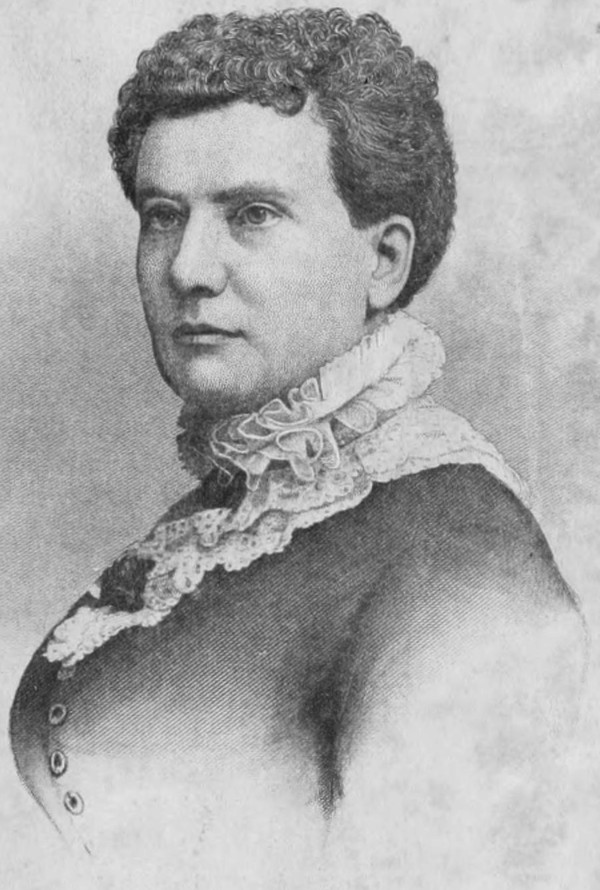
Marilla M. Ricker.
I DON'T KNOW, DO YOU?
BY
MARILLA M. RICKER
DONE INTO
A PRINTED BOOK BY THE ROYCROFTERS
AT THEIR SHOPS, WHICH ARE IN
EAST AURORA, NEW YORK
MCMXVI
Copyright, 1916
By
Marilla M. Ricker
You are what you think, and to believe in
a Hell for other people is literally to go
to Hell yourself.—Elbert Hubbard.
A religious man is a man scared.
FOREWORD
There is in the city of Boston a memorial building
to Thomas Paine. This Paine Memorial was finished
and dedicated forty-two years ago. It is the finest
monument to Thomas Paine on the earth.
For twenty years Ralph Washburn Chainey has been
the Manager of this building and the Treasurer of
the Paine Memorial Corporation. Under his wise
and prudent management the building was freed from
debt, and today it is a monument to the energy and
devotion of its Manager as much as to the genius
and labors of Thomas Paine.
Ralph Washburn Chainey is only forty-two, and as
great an example of thrift as Ben Franklin was.
Very early in life he acquired the habit of thrift—which
is the basis of all virtues. He learned early
that time was money and he is always at work. He
is not only able to take care of himself, but he can
and does take care of others. He is sufficient unto
himself, and when one is right with himself he is
right with all the world. I have known him intimately
for more than a quarter of a century, and if he has
faults I have yet to learn what they are.
In appreciation, therefore, of his great service to
the cause of Freethought, I dedicate this volume to
RALPH WASHBURN CHAINEY
—Marilla M. Ricker.
Dover, New Hampshire
December, Nineteen Hundred Fifteen
As man advances, as his intellect enlarges,
as his knowledge increases, as his ideals
become nobler, the Bibles and creeds will
lose their authority, the miraculous will
be classed with the impossible, and the
idea of special providence will be discarded.
Thousands of religions have perished,
innumerable gods have died, and
why should the religion of our time be
exempt from the common fate?
I know of no other book that so fully
teaches the subjection and degradation
of woman as the Bible.—Elizabeth Cady Stanton.
That God had to come to earth to find a
mother for his son reveals the poverty
of Heaven.
CREEDS AGAINST CIVILIZATION
Any system of religion that shocks the
mind of a child can not be a true system.—Thomas Paine.
Hell is a place invented by priests and
parsons for the sake of being supported.
CREEDS AGAINST CIVILIZATION
NE hundred fifty years ago, there
was not a single white man in
what is now Kentucky, Ohio,
Indiana and Illinois. What is now
the most flourishing part of the
United States was then as little
known as the country in the heart of Africa itself.
It was not until Seventeen Hundred Seventy-six
that Boone left his home in North Carolina to
become the first settler in Kentucky; and the
pioneers of Ohio did not settle that territory until
twenty years later.
Canada belonged to France one hundred fifty-three
years ago, and Washington was a modest
Virginia Colonel, and the United States was the
most loyal part of the British Empire, and scarcely
a speck on the political horizon indicated the
struggle that in a few years was to lay the foundation
of the greatest republic in the world.
One hundred fifty years ago there were but four
small newspapers in America; steam-engines had
not been imagined; and locomotives and railroads,
and telegraphs and postal cards, and friction-matches,
and revolvers and percussion-caps, and
breechloading-guns and Mauser rifles, and stoves
and furnaces, and gas and electricity and rubber
shoes, and Spaulding's glue, and sewing-machines
and anthracite coal, and photographs, and kerosene-oil,
free schools, and spring-beds and hair-mattresses,
and lever-watches and greenbacks
were unknown. The spinning-wheel was in almost
every family, and clothing was spun and woven
and made up in the family; and the printing-press
was a cumbrous machine worked by hand.
Down to Eighteen Hundred Fourteen every paper
in the world was printed one side at a time, on an
ordinary hand-press; and a nail, or a brick, or a
knife, or a pair of shears or scissors, or a razor, or a
woven pair of stockings, or an ax or a hoe or a
shovel, or a lock and key, or a plate of glass of any
size, was not made in what is now the United
States.
In Seventeen Hundred Ninety, there were only
seventy-five post-offices in the country, and the
whole extent of our post-routes was less than nineteen
hundred miles; cheap postage was unheard
of; so were envelopes; and had any one suggested
the transmission of messages with lightning speed,
he would have been thought insane. The microscope
on the one hand and the telescope on the
other were in their infancy as instruments of
science; and geology and chemistry were almost
unknown, to say nothing of the telephone and all
the other various phones, and the X-rays, and
hundreds of other new things.
In Seventeen Hundred Sixty-two there were only
six stagecoaches running in all England, and these
were a novelty. A man named John Crosset thought
they were so dangerous an innovation that he wrote
a pamphlet against them. "These coaches," he
wrote, "make gentlemen come to London upon
every small occasion which otherwise they would
not do, except upon urgent necessity. The conveniency
of the passage makes their wives come
often up, who, rather than come such long journeys
on horseback, would stay at home. Then when
they come to town they must be in the 'wade'
[probably that is where the word swim comes in
now], get fine clothes, go to plays, and treats, and
by these means get such a habit of idleness and
love of pleasure that they are uneasy ever after."
We can all see how much improvement there
has been in all things but creeds. Improvements
can come, and old things go, but creeds go on
forever! A creed implies something fixed and
immovable. In other words, it means you have a
"heel-rope on."
The word "creed" is from credo, "I believe." We
have had a great deal of compulsion of belief, and
a thousand years of almost absolute unanimity.
Liberty was dead and the ages were dark. We call
them the Middle Ages because they were the death
between the life that was before and the life that
came after. Then came a new birth of thought—a
"Renaissance"—and after this, some reformation
in the form of a Protestantism.
Since then, the Protestants have continued to
protest, not only against the old, but against each
other. And this is the best thing they have done.
Thus liberty has been saved, for each would have
coerced its fellow organization, as did their infamous
mother, the Roman Catholic Church, before them.
From "creed" comes "credulous" and "credulity."
And they have filled the world with their
kind. In the United States alone, there are about
one hundred forty types. Each is a system of
credulity pitted against a hundred and thirty-nine
others. They all rest on authority. They all denounce
investigation—unless it has for its end the
support of their authority.
Hence, with the exception of two or three denominations,
to become a professed Christian means to
accept credulously and without question a system of
belief about Nature and man and the world which
you would deny in toto if you reasoned as you do
about other things, and which you do practically
deny by re-explaining and refining it into anything
but what is stated. Down deep in your heart you
do not, and never did, believe it in the same honest
way in which you form your other opinions.
Think for a moment of the Christian idea of the
world, its origin, its shape, place, importance, and
its final end. Does any man or woman who has
been through a common-school geography believe
the ideas implied in the common Christian dogmas
regarding the world? We must remember that the
world taught in the geography is not the Christian
world.
The world taught in the Christian dogmas is
beneath the heavens—not a rolling sphere flying
through space. It is flat, and the sun and stars pass
over it daily. It is the chief object of God's creation
on which to place man. It is God's footstool,
and his throne is Heaven above. He created it just
four thousand and four years before the Christian
era began. Now we all know that this is not true;
that there is no up nor down; that the earth is not
the center; that it is not flat; that the sun does not
go round it; that it is a very insignificant little
orb; that "up in Heaven" is an utterly meaningless
expression; and that the world is not a creation,
but an evolution.
And yet thousands of people credulously cling to
creeds which embody the notions of barbarous or
uncivilized ages.
Take the dogma of revelation. It tells us that the
Bible is a revelation of the will and wisdom of an
omniscient God; that it is a perfect and sufficient
rule of faith and practise. What, in the name of
humanity, causes people to make such statements
today? It is like trying to light the house with a
saucer of tallow in which a rag is immersed, instead
of using gas or electricity.
Take an example of this Bible. In Deuteronomy
xiv: 21, we read, "Ye shall not eat of anything
that dieth of itself: thou mayest give it unto the
sojourner that is within thy gates, that he may eat
it; or thou mayest sell it unto a foreigner: for thou
art a holy people unto Jehovah thy God." In
Matthew vii: 12, we read, "Whatsoever ye would
that men should do unto you, even so do ye also
unto them."
Why do you talk about the infallibility, the inerrancy,
or even the moral unity of a volume written
by many hands at widely different times? Are such
people so ignorant that they have not read the
Book they are swearing by? Are they moral idiots
and do not know the plainest right and wrong?
Are they scoundrels and have some deceitful reason
for urging such a book as an authority? Or are they
the dupes of their own credulity, clinging without
thought to the beliefs in which they have been
reared? They are evidently not using commonsense
in an honest way.
I often hear the Bible spoken of as a holy book, full
of a holy spirit. I sometimes reply: "Have you
read the conduct of Moses, Joshua, Samuel, David,
Solomon, and other ancient worthies, who were
said to be men after the heart of the bloodthirsty
and avenging Jehovah? How long would you keep
out of prison if you took them for your models?
Have you read the Thirty-fifth, Fifty-eighth,
Sixty-ninth and One Hundred Ninth Psalms? If
not, read them, and tell me what you think of
them."
There never was any intrinsic reason for believing
the Bible except that a designing priesthood said
so, and stupid people trusted them.
Here, by common consent, people agree to be
duped. Ages and ages ago, they began to make
admissions that two and two might be six, or even
sixteen, in religion. They had sense enough to say
that two and two are four in other things. In
Divine Revelation they shut their eyes to all mistakes
and wilful lies. If people should deceive in
other matters as the priests, parsons and teachers
do in religion, they would not escape arrest.
Another central doctrine is that of the Atonement.
This is derived from the moral character of the
Jewish God; he governed the world of humanity
on the principle of primitive society. Men were
responsible to him in everything. Any infraction
of his supposed laws rendered them subject to his
vengeance. That is why the Jew thought that God
sent a thunderstorm to punish him for eating pork.
What explanation besides credulity can be suggested
for the continuation of this belief century
after century? Preachers shout it from the pulpits,
and Salvation Army people hawk it through the
streets. Not one of them knows what he is talking
about. Each learned it from some one who told
him to say it. They all do it because it is a part of a
system which they have inherited, but the reason
for which they do not know, and have never
allowed themselves to seek.
This cringing credulity keeps the masses from
using their powers. They seem to believe that if
they should lose these superstitions they would
be lost.
And the dogma regarding Jesus is inextricably
mixed up in Christian theology with that of
the Atonement. One assumption bolsters the other.
He is made to occupy the central place in this
scheme of blood-redemption through that other
highly rational fable of the immaculate conception.
If Jesus was not immaculately conceived, then
Matthew and Luke have deceived; then Jesus is
not God; then he is a mere man; and if so, he is
not the Redeemer. Man could not redeem himself
according to the first premise of the scheme. Man
has been and is redeeming himself by learning
Nature's laws and through them rising to a higher
life ever since he reached the stage of humanity.
Take the theory of the Resurrection. The account
of it was written long after the assumed occurrence,
and by credulous men with superstitious inclinations.
Men and women of these days, understanding
the laws of Nature, can not give assent to the
crude beliefs which easily commanded the minds
of ancient times.
Both Protestantism and Catholicism are systems
built on essentially the same foundation. Remove
any of these stones, and the systems will have to
be rebuilt. If there is no special revelation, there
is no special scheme of salvation. If there is no
vengeful, blood-seeking God, there is no theological
reconciliation. If there was no fall, there is no hopeless
depravity. If there was no immaculate conception,
there is no Redeemer in a special ecclesiastical
sense. If there is no total depravity, there is
no lost world. If there is no lost world, there is no
yawning Hell. One and all, these fictions have their
only ground for continuance in a selfish and unreasoning
priesthood and clergy, and a credulous
people.
In the place of the "fall," science has put the
"rise" of man. It finds the Garden of Eden to
have been a jungle. It finds the mythical perfect
Adam to have been a savage. It finds the Biblical
"origin of evil" to have been a puerile legend. It
finds that sin and evil are made by the seeing of
higher states. It finds that there was no bad until
the better was reached. It finds that it is the advancing
good which makes the existing bad. It finds
that among the worst of sinners are those who live
in and propagate outworn doctrines upon their
own and others' credulity.
In the olden times, God was made a king—the world
was his kingdom. His powers, virtues and vices
were simply those of earthly kings exaggerated.
Jewish and Christian liturgies are full of expressions
showing the attitude of slaves and serfs to a tyrant.
Sin has been manufactured as heresy and disobedience
to the so-called orthodox system instead
of to the laws of Nature.
Science has shown that the bottomless pit did not
even have a top. Columbus sailed over the Western
edge of the flat Christian world on which all this
Christian system depended, and found that the
material Heaven and Hell were unfounded myths;
but the preachers and priests still threaten hell to
the most ignorant and credulous, but they tell
some of us that there is a final judgment.
In the old days, we used to hear a great deal about
judgments. A certain honest, good-natured,
old farmer in New Hampshire, who was a freethinker,
but had a very pious wife, lost many
cattle when the black tongue was an epidemic in
the State.
One day the hired man came in and told him the
red oxen were dead.
"Are they?" said the old man. "Well, they were
'breechy cusses.' Take off their hides and carry
them down to Fletcher's. They will bring the cash."
An hour or so later the man came back with the
news that Lineback and his mate were both dead.
"Are they?" said the old man. "Well, I took
them of B—— to save a bad debt that I never
expected to get. Take the hides down to Fletcher's.
They will bring the cash."
After the lapse of another hour the man came back
to tell him that the nigh brindle was dead.
"Is he?" said the old man. "Well, he was a very
old ox. Take off his hide and send it down to
Fletcher's. It is worth cash and will bring more
than two of the others."
Hereupon his wife reminded him that his loss was
a judgment of Heaven upon him.
"Is it?" said the old chap. "Well, if they will take
the judgment in cattle, it is the easiest way I can pay it."
But they know no more about final judgments than
they did about the lake of fire and brimstone which
commenced to drain off in Columbus' day. Science
has vaporized the notion of a future judgment by
the same method it has that of a past Creation.
From the facts, it has learned laws. But credulity
is always half-hearted with facts. It does not know
enough of truth to love it. It is ever glowing over
and setting up as a dogma the little it knows, or
assumes to know, of the truth of former times. It
has no faith in the newly discovered, because it
knows nothing of it.
Hence, age after age we see the spectacle of men
who have not studied the science of their own day
denouncing it in pulpit and councils; of men who
have steeped themselves in the traditions of the
past pronouncing shallow invectives against the
demonstrations of (science) the present.
Many church people say immortality must be
true, or the great majority would not believe
in it. But do they? They do not talk or write as if
they did. If language means anything, I think the
majority believe in annihilation. Most people speak
of the dead body of a man as though it were the
man. They say, "He was buried at Greenwood,"
or, "She was cremated at Forest Hills." And we
hear the "late" Mr. Smith left an immense
fortune. If Mr. Smith still exists, why do they say
the late Mr. Smith? If people didn't believe that
the soul and body are one, and that life ceases and
mind expires when the body dies, why do they say,
"They were"? What little the Church has learned
has been by main force so to speak.
A friend of
mine many years ago was a college student. At
that time they were all compelled to attend the
college church. On one occasion he heard the
preacher, who was also a college professor, make
these statements:
First, that the elect alone would be saved.
Second, that among those who by the world were
called Christians, probably not more than one in a
hundred belonged really and truly to the elect.
Third, that the others, by reason of their Christian
privileges, would suffer more hereafter than the
heathen, who had never heard the Gospel at all.
The young man made a note of these propositions,
and on the strength of them drew up a petition to
the Faculty soliciting exemption from further
attendance at church, as only preparing for himself
a more terrible future.
He said: "The congregation here amounts to six
hundred persons, and nine of these are the college
professors. Now if only one in a hundred is to be
saved, it follows that three even of the professors
must be damned, and I, being a mere student,
could not expect to be saved in preference to a
professor." Far, he said, be it from him to cherish
so presumptuous a hope. Nothing remained for
him, therefore, but perdition. In this melancholy
state of affairs he was anxious to abstain from anything
that might aggravate his future punishment;
and as church attendance had been shown to have
this influence on the non-elect, he trusted that the
Faculty would for all time exempt him from it.
The result was he came very near being expelled
from the college—simply by heeding their sermons.
The professors of some colleges have learned something,
and do not insist on the students attending
church.
Ponder for a moment on the many dishonest
ways churches have for raising money. Think
of the amount of money they can raise at a church-fair—alias,
a confidence-game.
A young man from Kentucky told me that he
attended one at Chicago. First he went to the table
where refreshments were sold. A beautiful siren
with big black eyes and small white hands spread
the edibles before him. When he arose from the
table he handed her a five-dollar bill. She put it in
a little box and forgot to give him any change. She
smiled sweetly at him, and asked him if he would
like to walk about the room and look at the fancy
articles, all to be sold for the good of the church.
She took his arm and murmured, "We are not
strangers; we both feel interested in the church."
"We soon came," said the young man in telling
me the story, "to a silver tea-set that was to be
'raffled off.' Would I take a chance? Of course
I did. Then came a cake with a valuable ring concealed
in it. Would I take a chance in that? Of
course I did.
"So things glided on until I concluded if I took
many more chances, my chances for getting home
would be slim. So I refused to tempt fortune any
further, until the little black-eyed scoundrel took
me on a new tack. Leaning heavily on my arm,
and resting her cheek on my shoulder, she said,
'Please take a chance for me.'
"It is needless to add that I took the chance, and
kept on taking chances for the beautiful and
unprincipled wretch that had me in tow, until I
had not a dollar left. Yes, I was penniless, and then
it began to dawn on me that she was working me
for the success of the church. There I was, bankrupt
in money and self-respect. I had been robbed—yes,
robbed, for where is the difference between
a pair of pistols and a pair of black eyes in a robbery?
You part with your money because you can not
help it.
"I know that Society looks with lenient eyes upon
church-fairs, but it is my opinion that all robbers
will take sentence, and when that little Chicago
robber receives her sentence, she will take her
place by the side of Jack Sheppard!"
You see he still believes in Judgments. He is
learning by main force.
A very pious woman whose father was a missionary,
now living in Hawaii, wrote not long ago that
professional men flocking to the Islands will be
disappointed unless they are friends of old families;
and the old families are descendants of missionaries
who went there in the early days and took lands
and everything else from the natives.
There seems to be nothing like being a descendant
from a missionary family. These people, equally
pious and provident, thought it a good scheme to
cheat the sinful savages out of all their worldly
possessions, in order that they might be taught
humility and holiness through the chastening
influence of poverty. So they robbed the unregenerate
to the glory of God.
Who says it doesn't pay to save the heathen?
Think of the ignorance and superstition of the
majority of the preachers of the present day.
Up in Northern Minnesota, less than fifty years
ago, an old Baptist was preaching on the
death of Moses on the Mount, and his not being
permitted to go over into the Promised Land.
The preacher said:
"I have always felt sorry for Moses. It has seemed
so hard to me that he could not go over with Caleb
and Joshua, the only two of the host which he had
led out of Egypt, and enjoy with his people the
good country towards which they had been so long
traveling. When as a boy I read that in the Bible
for the first time, I sat down and cried for sympathy
with him. But Moses had a hard time from
the first. He was no sooner born than his life was
threatened. His mother had to hide him to save it.
After three months she could hide him no longer,
and so she made an ark of bulrushes and set him
afloat on the river. Indeed, it seemed as though the
Lord had all he could do to raise Moses."
But the people of this generation do not take the
story of Moses so seriously. A bright young girl of
ten, on being asked by her Sabbath School teacher,
"Where did Pharaoh's daughter get Moses?"
replied, with the accent on the said, "She said she
'found him in the bulrushes.'"
I attended a campmeeting in North Carolina. The
exhortations and prayers would cause a graven
image to smile audibly. One old Baptist preacher
said he always felt so sorry to think that "Ingine
corn" didn't grow in Palestine, because he would
like to think that the little Jesus had a good time
playing with cob-houses.
But those preachers compare favorably with the
Reverend George F. Hall, of Decatur, Illinois, and
the Reverend Doctor John P. D. John, and the
Reverend Doctor Frederick Bell, late of the
Metropolitan Temple of San Francisco, California,
who at various times challenged Robert G.
Ingersoll to debate with them. It shows what ignorance,
superstition and egotism combined can do.
Darwin said the herding instinct in animals has
its base in fear. Sheep and cattle go in droves, while
a lion simply flocks with his mate. Those who wish
to lead have always fostered fear, encouraging this
tendency to herd, promising protection, and offering
what they call knowledge in return for a
luxurious living.
In other words, the men who preach and pray,
always want the people who work to divide with
them. They work on the line that fear will compel
men to join churches. This joining instinct is a
manifestation of weakness. By going with a gang
they hope to get to Heaven. But the moment you
eliminate the Devil from Christianity, there is
nothing left. You can not have a revival, alias an
epidemic, of religion, without the Devil. If there
were no Devil, there would be nothing to pray
about, and all these people who are gifted in prayer
would be without a job.
Think of the chaplains of the Army and Navy, in
Congress and in the Legislatures being turned out
to browse for themselves. Think of their being
obliged to earn an honest living. They could not
do it. I am amused when I think of the prayers
that are exchanged in war times. One side will
pray that the wrath of Heaven will descend on the
other, and the other side will return the compliment
with ten per cent interest.
I remember when I was a child of reading the
prayer of a Hungarian officer. He said: "O Lord,
I will not ask thee to help us, and I know that thou
wilt not help the Austrians. But if thou wilt sit on
yonder hill, thou shalt not be ashamed of thy
children."
The famous Bishop Leslie prayed before a battle
in Ireland, "O God, for our unworthiness we are
not fit to claim thy help, but if we are bad, our
enemies are worse, and if thou seest not meet to
help us, we pray thee help them not, but stand
thou neutral this day, and leave it to the arm of
flesh."
All this dramatic power would be lost without the
Devil. So it behooves the Christian churches to
hold fast to the Devil. Get a good grip on his hoofs,
horns and tail, for without him they would be
relegated to "innocuous desuetude." He should be
incorporated as the fourth person in the Orthodox
Godhead, and respectfully addressed as "Holy
Devil."
There is no truth in the dogma of the divinity of
Jesus, no sense in it, no religion in it. It is the
product of mythology and has no claim upon this age.
This is my doctrine: Give every other
human being every right you claim for
yourself. Keep your mind open to the
influences of Nature. Receive new
thoughts with hospitality. Let us advance.
The man who does not do his own
thinking is a slave, and is a traitor to himself
and to his fellowmen.
As far as I am concerned, I wish to be
out on the high seas. I wish to take my
chances with wind and wave and star.
And I had rather go down in the glory
and grandeur of the storm, than to rot in
any orthodox harbor whatever.
—Robert Ingersoll.
WHAT I KNOW ABOUT SOME CHURCHES AND WHY I AM AN AGNOSTIC
The ignorance of the masses insures
abundant contributions to the clergy and
to religion.—Ralph W. Chainey.
The mother who teaches her child to
pray makes a mistake.
WHY I AM AN AGNOSTIC
HE Millerites—or Second Adventists,
as they now call themselves—are
the first sect that I remember.
They are a people of remarkable
vigor: they have been at work for
seventy years to bring this world
to an end, and although they have been wrong in
their arithmetic all these years, they rub out the
slate and begin again.
And they prove everything by the Bible, as all
other denominations do. The "time" has been set
at least twenty times since I can remember. I
recollect having awful palpitations in the kneepans
upon one of the eventful days, and crawling under
the barn so as not to be in the way. They used to
congregate on the height of land near my father's,
"to go up," and one man climbed upon an old
shed, and fell and broke his hip; he fainted, and
they thought he was dead. As soon as he had
revived a little, they asked him if he had any
requests to make before he died. He replied, "I
want you to work in 'durn fool' somewhere on my
tombstone." He recovered, and lived many years,
but he was cured of Millerism.
A large share of the students of the Second Advent
doctrine came into this world, not only naked, but
without any brains, nor any place suitable to put
any; and the first business they do is to wonder
about their souls and talk about being "born
again." They never seem to realize that to be well
born is much more essential than to be "born
again." I never knew immortality to be secured
at the second birth.
I attended one of their meetings this year, and
asked one of the sisters for their creed. She said,
"Our creed is the whole Bible, from the first book
of Genesis to the last word of the last chapter of
Revelations."
I thought of what a boy said when the Baptist
Elder came and took tea at his home, and asked a
"blessing."
The boy said: "Is that the way you ask a blessing?
My father doesn't ask it that way."
"How does he ask it?"
"Oh, he sat down to the table the other evening,
and looked it all over, and said, 'My God, what a
supper!'"
And I thought, "My God, what a creed!"
I was tempted to ask the Millerite sister what she
thought of the discrepancy between the first and
the second chapter of Genesis. In the first chapter
Man and Woman were a simultaneous creation.
In the second chapter, Woman was an afterthought.
But I had the deep sagacity to hold my tongue,
and leave her and her creed in peace.
The second church that I remember anything
about is the Free-Will Baptist. My mother
was a devout member of that church. I have heard
thousands of times, "Except a man be born of
water and of the Spirit, he can not enter into the
Kingdom of God." And man included woman—it
always did, so far as pains and penalties were
concerned.
I remember distinctly a sermon I heard on Hell.
You younger people can not have the faintest idea
of the terrific sermons that were preached in those
days.
That sermon commenced in this wise:
"Now we will look into Hell and see what we can
see. It is all red-hot like red-hot iron. Streams of
burning pitch and sulphur run through it. The
floor blazes up to the roof. Look at the walls—the
enormous stones are red-hot. Sparks of fire are
always falling down from them. Lift up your eyes
to the roof of Hell. It is like a sheet of blazing fire.
Hell is filled with a fog of fire. In Hell, torrents not
of water, but of fire and brimstone, are rained
down. You may have seen a house on fire, but you
never saw a house made of fire. Hell is a house
made of fire. The fire of Hell burns the devils, who
are spirits, for it was prepared for them. But it will
burn the body as well as the soul. Take a little
spark out of Hell—less than the size of a pin-head—and
throw it into the ocean, and it will not go out.
In one moment it would dry up all the waters of
the ocean, and set the whole world in a blaze!
Listen to the terrific noise of Hell—to the horrible
uproar of countless millions of tormented creatures,
mad with the fury of Hell! Oh, the screams of fear,
the groanings of horror, the yells of rage, the cries
of pain, the shouts of agony, the shrieks of despair,
from millions on millions. You hear them roaring
like lions, hissing like serpents, howling like dogs,
and wailing like dragons! And above all, you hear
the roaring of the thunder of God's anger, which
shakes Hell to its foundations. Little children, if
you go to Hell, there will be a devil at your side
to strike you. How will you feel after you have been
struck every minute for a hundred millions of
years? Look into this inner room of Hell, and see a
girl of about sixteen. She stands in the middle of a
red-hot floor; her feet are bare; sleep can never
come to her; she can never forget for one moment
in all the eternity of years."
And so this description
of Hell went on for nearly two hours. Do you
wonder that I, a child of ten years, said to my
father, who was a freethinker, infidel, atheist, or
whatever else you please to call him: "I hate my
mother's church. I will not go there again!"
The next church I became acquainted with was
the Calvin Baptist Church. That church
seemed to think that the most of us were born to
be damned anyway!
The great Ingersoll had it right when he said it
was the damned-if-you-do-and-the-damned-if-you-don't
church.
The only difference between the Free-Will Baptists
and the Calvin Baptists that I can see, is, that you
are allowed to exercise your will. The Free-Will
Baptists will damn you if you wish to be, and the
Calvinists will damn you anyway!
The next church to which I was introduced was the
Congregationalist, alias the Orthodox. Their creed
is rather complex from a mathematical standpoint.
They seem to think that three Gods are one God,
and one God is three Gods.
I, having been taught that figures don't lie,
couldn't understand it, until I thought of a boy
who said to his teacher when she explained to him
that figures didn't lie: "You should see my sisters
at home, and then on the street. You will find that
figures do lie."
I then went to Italy, and became conversant
with the outside doings of the Roman Catholic
Church. I visited many of them, saw the beggars
eating crusts at the doors, and the well-fed priests
saying masses inside; saw the white hand of famine
always extended, in bitter contrast to the magnificent
cathedrals; saw well-dressed, intelligent-looking
men and women going upstairs on their hands
and knees, and saw hundreds of them kissing the
toe of the bronze statue of Saint Peter; saw monks
of every shade and description; and all begging for
the Holy Catholic Church!
I attended a church festival at Rome at the Ara
Cœli, where the most "Holy Bambino" is kept, a
little wooden doll about two feet long. It is said
to be the image of Jesus. It had a crown of gold on
its head and was fairly ablaze with diamonds. It
has great power to heal the sick. It is taken to visit
patients in great style—that is, if the patients are
rich. The Bambino is placed in a coach accompanied
by priests in full dress. The Great Festival of the
Bambino is celebrated annually. Military bands
and the Soldiers of the Guard dance attendance.
Saint Gennaro is held to be the guardian saint of
Naples. The alleged miracle by which the blood of
this holy person, contained in a glass tube, changes
from a solid to a liquid state, is well known.
Thousands go to see the miracle performed. When
the priest first held up the sacred vial with its
clotted contents we could hear all about us: "Holy
Gennaro, save and protect us! Bless the City of
Naples, and keep it free from plagues and earthquakes
and other ills. Do this miracle so that we
can see that thy power and thy favor are still with
us." And so it went on for an hour or more, until
the great throng was nearly hysterical.
At last the priest stepped forward, showing that
the blood flowed freely in the tube, and then such
a shout went up from the big crowd as one hears
only in Southern climes.
I have never been introduced to the Church of
England, alias, the Episcopalian, but I've
always thought if a man had a good voice, and
understood the mysteries of the corkscrew, he
would make a good rector.
I became acquainted with a High-Church Episcopalian
woman not long ago, and she showed me a
prayer-rug and praying-costume imported from
Paris. I told her that she looked like an angel in it,
as she ought after going to all that expense and
trouble; if she didn't, dressmakers might as well
give it up and wait for Gabriel. The attitude of
prayer threw the back breadths of the skirt into
graceful prominence, and hence the necessity
(which will be at once recognized by all the truly
pious) of increased attention to the frills and
embroidery required by the religious attitude of
prayer.
An old farmer in Indiana said he was a "Piscopal."
"To what parish do you belong?"
"I don't know nothing about parishes."
"Who confirmed you?"
"Nobody."
"Then how do you belong to the Episcopalian Church?"
"Well, last Winter I went down to Arkansas
visiting, and while I was there, I went to a church
and it was called 'Piscopal,' and I heard them say
that they had done the things they ought not to
have done, and left undone the things they ought
to have done, and I says to myself, 'That is my
fix exactly,' and ever since then I've considered
myself a 'Piscopal'!"
And I came to the conclusion that that is why the
membership of that church is so large!
I know but little about the Methodists, but I
do know that John Wesley, one of the founders
of that church, believed in witchcraft, and was one
of the latest of its supporters.
History tells us that Brother Wesley preached a
sermon entitled, The Cause and Cure of Earthquakes.
He said that earthquakes were caused by
sin, and the only way to stop them was to believe
in his theology and teachings, thus showing great
knowledge of seismology; but people who bank on
gullibility are usually safe. I know the Methodists
make a great hullabaloo about their religion, and
appear to think their God is deaf.
The Methodist Conference has refused to allow
women to be delegates to the General Conference.
The Methodist sisters should discipline the Church.
What I know about the Universalists I like.
They seem to think that we are all in the
same boat, and that one stands as good a chance
as another, of which I approve. When I was a child,
Sylvanus Cobb, at that time the great Universalist
preacher, preached in the adjoining town. One
Sunday, my father and I went to hear him. His
sermon caused a great commotion, and the Baptist
who preached that terrific sermon about Hell said
to my mother, "There is a wicked man about here
preaching that everybody is to be saved; but,
Sister Young, let us hope for better things!"
I believe that the Unitarians, as a class, think
for themselves. I approve of that, and the
Evangelical Alliance disapproves of them. That is
in their favor.
I taught school at Lee, New Hampshire, fifty years
ago. One of the committee was a Unitarian, and one
was a Quaker. I was tired of selecting suitable
reading matter from that obscene old book, the
Bible, and I suggested that we read from some
other book, which we did for two mornings, when
the Unitarian materialized at the schoolhouse, and
with much suavity suggested that we read from the
Bible every morning, and recite the Lord's Prayer;
and I, teaching school for my bread and butter,
bowed to the suggestion, and the next morning
said: "Pupils, Mr. Smith prefers that we read
from the Bible. Therefore, we will this morning
read the startling and authentic account of Jonah
whilst he was stopping at the submarine hotel."
That is the most narrow-minded thing I ever knew
about a Unitarian; but I always thought Mr. Smith
voiced the opinion of the parents of the pupils
rather than his own.
I am somewhat acquainted with the Church of the
Latter-Day Saints, alias the Mormons. They are
a prudent, industrious, painstaking people, and
only about two per cent of them ever did practise
polygamy, and that is a very small proportion for
any Christian church. Brigham Young never did
have but seventeen wives, but Solomon had five
hundred wives, and one thousand other lady
friends, and David, whose honor and humility
show greater in his psalms than in the history of his
ordinary, every-day life, was, as the Bible says, a
man after God's own heart.
I am sure that Brigham Young compared favorably
with David. And if God interviewed Moses, why
shouldn't he have interviewed Joe Smith?
There are more than one thousand religions. They
are founded mostly on fraud. All their saviors had
virgins for mothers, and gods for fathers.
The churches own more than thirteen billions of
property, and they are all too dishonest to pay
honest taxes. Many of the churches couldn't be
run three weeks without the women. They do all
the work, for which they get no credit.
The churches claim all the distinguished people,
especially after they are dead and hence can not
deny their claims. They have many times claimed
that Abraham Lincoln was a churchman. The
Honorable H. C. Deming, of Connecticut, an old
friend of Lincoln, said it is false. Lincoln belonged
to no church, and at one time said, "I have never
united myself to any church, because I have found
difficulty in giving my assent without mental
reservation to the long, complicated statements of
Christian doctrine, which characterize their articles
of belief, and confessions of faith." But still they
claim him. Honest, very!
No institution in modern civilization is so
tyrannical and so unjust to women as is the
Christian church. The history of the Church does
not contain a single suggestion for the equality of
woman with man, and still the Church claims that
woman owes her advancement to the Bible. She
owes it much more to the dictionary.
History, both ancient and modern, tells us that the
condition of women is most degraded in those
countries where Church and State are in closest
affiliation (such as, Spain, Italy, Russia and Ireland),
and most advanced in nations where the
power of ecclesiasticism is markedly on the wane.
It has been proved that, whatever progress woman
has made in any department of effort, she has
accomplished independent of, and in opposition to,
the so-called inspired and infallible Word of God;
and that the Bible has been of more injury to her
than has any other book ever written in the history
of the world.
William Root Bliss, in his Side Glimpses From the
Colonial Meetinghouse, tells us many startling
truths concerning the Puritans, and reminds me of
what Chauncey M. Depew said—that the first
thing the Puritans did, after they landed at
Plymouth, was to fall on their knees, and the second
thing was to fall on the Aborigines.
The business of trading in slaves was not immoral
by the estimate of public opinion in Colonial times.
A deacon of the church in Newport esteemed the
slave trade, with its rum accessories, as home
missionary work. It is said that on the first Sunday
after the arrival of his slaves he was accustomed to
offer thanks that an overruling Providence had
been pleased to bring to this land of freedom another
cargo of benighted heathen to enjoy the blessings
of a Gospel dispensation.
At a Bridgewater town meeting of the year Sixteen
Hundred Seventy-six, a vote was called to see
what should be done with the money that was made
from selling the Indians.
John Bacon of Barnstable directed in his will that
his Indian slave Dinah be sold and the proceeds
used "by my executors in buying Bibles." By men
who sat in the Colonial meetinghouse, the first
fugitive-slave law was formed. This law became a
part of the Articles of Confederation between all
the New England Colonies.
The affinity between rum and the religion of
Colonial times was exemplified in the license
granted John Vyall to keep a house of entertainment
in Boston. He must keep it near the meetinghouse
of the Second Church, where he extended
his invitation to thirsty sinners who were going
to hear John Mayo or Increase Mather preach.
The importation of slaves began early. The
first arrival at Boston was by the ship Desire,
on February Twenty-sixth, Sixteen Hundred Thirty-seven,
bringing negroes, tobacco and cotton from
Barbados. She had sailed from Boston eleven
months before, carrying Indian captives to the
Bermudas to be sold as slaves, and thus she became
noted as the first New England slave-ship.
In time, slaves were brought to Boston direct from
Africa.
Advertisements of just-arrived negroes to be sold
may be seen in the Boston News Letter of the years
Seventeen Hundred Twenty-six and Seventeen
Hundred Twenty-seven. The pious Puritans did
not hesitate to sell slaves on the auction-block. I
find in the Boston News Letter of September Nineteenth,
Seventeen Hundred Fifteen, a notice of an
auction-sale at Newport, Rhode Island, of several
Indians, men and boys, and a very likely negro man.
They were treated in all respects as merchandise,
and were rated with horses and cattle.
Peter Faneuil, to whom Boston is indebted for
its Cradle of Liberty, was deep in the business. In
an inventory of the property of Parson Williams
of Deerfield, in Seventeen Hundred Twenty-nine,
his slaves were rated with his horses and cows.
"Believe and be baptized" is all that was essential.
I think many of them would have been improved
by anchoring them out overnight.
A negro preacher whom I knew came to me when
I was in Florida, and said: "What shall I preach
about tomorrow? I'se done preached myself
'plumb out.' I'se worked on election sanctification
and damnation predestination till I can't say
another word to save my life."
I said, "Preach a sermon on 'Thou shalt not steal'
for a text."
"Yes," he said, "that certainly is a good text,
but I am monstros 'fraid it will produce a coolness
in my congregation!"
Doubtless it would produce a coolness in many
a congregation today.
Now I want to talk a little about law and its
penalty. We want to consider the invariable
laws of Nature. Let us look at it in the way in
which we became acquainted with it—through
experience.
To the child, law is an educator; he plays with fire
and is burned. Law and its penalty have done their
work. A burnt child dreads the fire. On that point
his education is complete. He cuts himself with a
knife; again the law works. Do not play with
edged tools is the lesson. And so, whenever he comes
in contact with external objects, he learns something
very definite from them; and if he has any
sense, he soon conforms to the order which he sees
in force all around him. He does what he can to act
in such a way as not to run counter to Nature's
laws; or, at least, Nature teaches him to do so by
repeated suffering when he acts otherwise. The
law thus far is all in favor of life, and is teaching the
child to preserve it. He must eat not to starve; he
must be clothed not to freeze; he must not be
burned, or cut, or crushed. In one word, he must
take care of himself, and be careful of external
objects, or he must be hurt.
But his education has another connection with law.
If he has proper parents he learns that he can not
lie, or steal, or do many other things without suffering
a penalty. If he has no home education in this
matter, the reform-school and the jail step in and
take up the lesson.
And so the law teaches him that his actions must be
of a certain quality, both with respect to external
Nature and his fellowmen, or that he must pay a
penalty.
Thus he comes to man's estate, and law has been
to him an educator and a good one. He has learned
that Nature's law means punishment every time
it is violated, and that man's law, whatever it may
attain to, aims at the same object as Nature's law.
But neither his education nor his contact with
law ends with his youth. Hitherto he has obeyed
blindly for fear of the penalty. He now obeys
intelligently, and connected with the penalty to be
incurred by disobedience is the reward to be
obtained through obedience. He finds that every
act, every thought, of his brings him in direct contact
with law. He can not elude it by standing still,
for no man can stand still. He must go forward, or
backward. This is an inexorable law; with progress,
improvement; without progress, what? Rest?
Repose? No! Deterioration. No man can stand
still in this universe for a day without losing something.
The man who means to do anything in life
must go forward; if he falters, another goes ahead;
and then he learns that the penalty of faltering is
failure.
Nature works no special miracles in any one's
favor. Nature works no miracles, anyway. The sun
and the moon did not stand still at Joshua's command!
No riches and influence can buy exemption from
Nature.
Law says to the poor man who is dependent on his
daily toil: "You have only yourself to rely upon.
Take care of your health; be temperate, honest
and industrious, for sickness, imprisonment, idleness,
mean to you death."
It says to the rich man: "Inherited wealth has
exempted you from daily labor of body, but it has
not earned for you rest. Go to work; do something,
or your mind and body will be enfeebled; your
sympathies will disappear; you will become dry
as the summer's dust; you will sink into a nonentity."
The whole cry of Nature's law is onward and
upward. Evolution is the word—there is no God
about it. It is not alone the survival of the fittest—that
is only a part of the process. It is the fittest of
one generation becoming something better and
higher for the next.
It is the fashion now to say that the struggle for
existence becomes yearly more fierce, but that is
not so. The truth is that those who struggle become
with each survival fitter to struggle, and that for
which they struggle is placed one step forward.
Men used to want thousands and hundreds of thousands;
now, they want millions and hundreds of
millions. They used to want general knowledge;
now, they are all specialists, and cry out that life
is too short. Steam used to content them; now,
electricity does not satisfy them, and they are
grasping at the possibilities of the mighty currents
of air caused by the revolutions of the earth itself.
The law of progress is not limited to the mind.
The body shares in it. Men are stronger, larger,
longer-lived than they have ever been. Even with
the animals, finer, better breeds are constantly
producing themselves under law.
This law of the survival of the fittest and the
elevation of the type of the fittest pronounced
against slavery, and a nation paid the penalty in
blood, as Spain has, and other nations will pay it.
It has pronounced against the subjection of women,
and let those who stand in the way, beware, lest
some ruin crush them as it falls!
The type of sympathy has become higher and
tenderer. Sweet hands of mercy are now stretched
down even to the brutes. Let those lovers of the
past who can see no progress in the present, who
would question this onward tendency, and the
result of law, let them remember that they must
run rapidly to keep from being overwhelmed by the
expansionists.
Nature's law teaches us that like
begets like. You plant a grain of wheat, and you
reap wheat. You breed Morgan stock and the foal
is of Morgan blood. The child is the offspring of
certain parents, and it inherits their blood. If
parents choose to unfit themselves to be healthy
parents, who shall be blamed?
Shall gravitation cease as I go by? Teach
children that no amount of so-called religion
will compensate for rheumatism; that Christianity
has nothing to do with morality; that "vicarious
atonement" is a fraud, and a lie; that to be born
well and strong is the highest birth; that to be
honest and pay one's debts spells peace of mind;
that the Bible is no more inspired than the dictionary;
that sin is a transgression of the laws of life,
and that the blood of all the bulls and goats and
lambs of ancient times, and the blood of Christ or
any other man, never had, and never can have, the
least effect in making a life what it would have
been had it obeyed the laws of life. If you have
marred your life, you must bear the consequences.
If you have made a mistake, be more careful in the
future. Let the thought that the past is irretrievable
make you more careful in the present and for
the future.
And, above all, teach children that prayer is
idiotic. There may be one God or twenty. I do not
know or care. I am not afraid, and no priest or
parson can make me believe that my title to a
future life, if there be one, is defective. And the
great and good man Thomas Paine, who wrote the
Age of Reason, and said, "The world is my
country, and to do good my religion," is a good
enough god for me. And the great Ingersoll, who
said, "I belong to the great Church that holds the
world within its starlit aisles; that claims the great
and good of every race and clime; that finds with
joy the grain of gold in every creed and floods with
light and love the germs of good in every soul," is
in my opinion an excellent god—as good as any
that ever lived, from Confucius to Christ. A friend
of mine said to me, "Ingersoll should have been
a Christian." I replied, "The dog-collar of Christianity
did not belong on his neck: he preached the
truth; he preferred that to the Bible. I can not
imagine the great Ingersoll preaching from II
Kings xiv: 35."
When I was a child I heard very little about Christmas
and nothing about Lent and Easter. I was taught
to be honest and truthful and to pay one hundred
cents on a dollar. In my opinion there is no Bible
extant so good as Ingersoll's Complete Works.
A LETTER AND THE REJOINDER
Fear paralyzes the brain. Progress is
born of courage. Fear believes—courage
doubts. Fear falls upon the earth and
prays—courage stands erect and thinks.
Fear retreats—courage advances. Fear
is barbarism—courage is civilization.
Fear believes in witchcraft, in devils and
in ghosts. Fear is religion—courage is
science.
There are real crimes enough without
creating artificial ones. All progress in
legislation has for centuries consisted in
repealing the laws of the ghosts.
—Robert Ingersoll.
THE REJOINDER
A LETTER AND THE REJOINDER
A LABOR OF FOLLY From the Portsmouth "Times"
UR old friend, Marilla M. Ricker,
of Dover, lifelong advocate of
"woman's rights," zealous champion
of "freethought," admirer of
Bob Ingersoll, worshiper of Tom
Paine, and collaborator of Elbert
Hubbard, who fears neither God, man nor the
Devil, because she does not believe particularly in
any of them, is engaged in a labor of folly, in that
she is fighting the doctrine of the immortality of
the human soul.
In the prosecution of her warfare she has gone into
print and issued a pamphlet in which she takes
issue, primarily, with one Elder E. A. Kenyon
upon his proposition of a universal consciousness
that "if a man die he shall live again," and even
goes so far as to assert that the majority of mankind
believe in annihilation. Moreover, she pronounces
the doctrine of personal immortality "a
most selfish and harmful one," "pernicious in its
results," and operating for the enslavement of
mankind, filling the world with gloom and making
of man a crawling coward.
We invite no controversy with Marilla, and will
have none. We concede her right to believe anything,
or nothing, to say what she thinks, write
what she pleases, get it printed where she may, and
circulate it as she can; but our advice to the dear
sister is to "let up" on this contention, wherein
she is out-Ingersolling Ingersoll. He did not
believe in immortality, but he did not deny it. He
claimed that he did not know, and that no man
could know it to be a fact; but he never sought to
blot out hope. And the truth is that but for this
hope of immortal existence, entertained by the
vast majority of the race, in all lands and ages, life
would not be worth living, and men and women
everywhere would lie down and perish in despair.
It is this hope, or faith, or consciousness—however
we may express it—of life beyond the grave, or the
immortality of the soul, that inspires mankind to
all that is noble and heroic in the great struggle for
progress and development here. Without it there
would be no incentive effort beyond that which
impels the brute. Without it, in fact, man would
be mere brute, and nothing else.
That the horrid doctrines of Calvinism were dinned
into Mrs. Ricker's ears in childhood, and the fear
of eternal torment held up before her, instead of
the infinite love of a God of Mercy and Justice,
may have impelled her to repudiate all idea of God
or Justice, or life to come; but she ought to be
intelligent enough to sift the error from the truth
and cling to the latter. If not, she should at least
be willing to allow others to do so. She may
repudiate the old Calvinism, or even Christianity
itself. She may become a Mohammedan, a Buddhist,
an Agnostic or an out-and-out "heathen" if
she will. She may accept annihilation as the universal
fate of humanity; but she should be willing
to allow mankind in general its indulgence in that
one "Great Hope," which has illumined with
immortal splendor the darkest passages of human
life, and sustains the soul of man and woman in the
severest trials and conflicts of earth.
(From the Portsmouth "Times")
I was amused when I read in the
Portsmouth Times an article from
my friend Metcalf, entitled, A
Labor of Folly. The genial Henry
said I was a lifelong advocate of
"woman's rights," which is true.
And an admirer of Ingersoll. Could any one help
admire that great and good man? And a worshiper
of Thomas Paine. Worship is rather a strong word
to apply to me, but I think the man who said, "The
world is my country, and to do good my religion,"
and who did more than any other man to put the
stars on our flag and to give that flag to the breeze,
should be loved and respected.
He, the aforesaid Henry, said I collaborated with
Elbert Hubbard. I am proud of that, whether it is
true or not.
I consider Hubbard the most brilliant writer in
this country.
Henry also said I feared neither God, man nor the
Devil, because I did not believe particularly in any
of them. If he would add an "o" to God and make
it good, take the "d" from devil and make it evil,
then I would have something tangible to write
about besides man, in whom I believe.
Henry also said that I was engaged in a "labor of
folly," fighting the doctrine of the immortality of
the soul.
I simply expressed my opinion on the subject.
My friend Henry wrote me not long ago that there
was no earthly need of a Freethought paper; that
thought was as free as air always and everywhere.
I take issue with him there, and I call his attention
to the Little Journey to the home of Copernicus—of
January, Nineteen Hundred Five—by Elbert Hubbard.
Copernicus was the founder of modern
astronomy.
If Henry will read his life he can see what freethought
meant at that time. I also call his attention
to Giordano Bruno. He can see what happened to
him and how free thought was at that time. Henry
said I could write what I pleased, and get it printed
where I could.
That was well added, for I could not in the year
Nineteen Hundred Nine, in the city of Dover,
New Hampshire, get my article on Immortality
printed in the only paper in the city; so you see
how freethought is up to date.
I certainly "take issue" with Henry, "That the
hope or consciousness of life beyond the grave, or
immortality of the soul, inspires mankind to all
that is noble and heroic in the great struggle for
progress and development here."
Robert Ingersoll did not believe in immortality,
but he was a great, tender-hearted man, full of
kindness, full of generous impulses. No man ever
loved the true, the good and the beautiful more
than he. He would take the case of a poor man into
court without pay; he would give a young reporter
an interview when he could sell every word he
spoke for a dollar; he would present the proceeds
of a lecture to some worthy object as though he
were throwing a nickel to an organ-grinder; and
when there was persecution he was on the side of
the persecuted.
I do not believe in individual immortality, but I
do the best I can, pay one hundred cents on the
dollar, and I am not afraid to die. I know thousands
who believe as I do.
John Wesley, the founder of Methodism, believed
in the immortality of the soul—so do his followers.
He also believed that sin was the cause of earthquakes,
and the only way to stop them was to
believe in the Lord Jesus Christ. He didn't know
much about seismology, but he certainly had
faith, plus.
John Calvin founded the Presbyterian Church; he
believed in the immortality of the soul. So do his
followers; but Calvin was a murderer.
Henry, it is absurd to say that without hope of
immortality we should be degraded to brutes; in
my opinion it is not true. What we want is a
religion that will pay debts; that will practise
honesty in business life; that will treat employees
with justice and consideration; that will render
employers full and faithful work; that will keep
bank-cashiers true, officeholders patriotic, and
reliable citizens interested in the purity of politics
(and the woman citizen will be)—such a religion is
real, vital and effective. But a religion that embraces
vicarious atonement, miraculous conception, regeneration
by faith, baptism, individual immortality
and other monkey business is, in my opinion,
degrading, absurd and unworthy.
Henry, you say you want no controversy with me.
I enjoy controversy, but if you are averse to it I'll
stop and we will unite in singing one stanza of that
Christian hymn:
King David and King Solomon
Led merry, merry lives
With their many, many lady friends
And their many, many wives;
But when old age came o'er them
With its many, many qualms,
(It was said)
King Solomon wrote the Proverbs
And King David wrote the Psalms.
But did they?
Where religion is afraid of liberty,
liberty should be afraid of religion.—Lemuel K. Washburn.
So long as man believes that he has an
immortal soul, he will fear the future.
THE HOLY GHOST
For ages, a deadly conflict has been
waged between a few brave men and
women of thought and genius upon the
one side, and the great ignorant religious
mass on the other. This is the war between
Science and Faith. The few have appealed
to reason, to honor, to law, to freedom, to
the known, and to happiness here in this
world. The many have appealed to
prejudice, to fear, to miracle, to slavery,
to the unknown, and to misery hereafter.
The few have said, "Think!" The many
have said, "Believe!"
—Robert Ingersoll.
THE HOLY GHOST
F all the weird, fanciful and fabulous
stories appertaining to the
gods and other pious frauds, that
concerning the Holy Ghost ranks
them all! Now listen to what the
Bible has to say about that
mythical personage—alias, the Holy Ghost. You
will see that scarcely any two references to it agree
in assigning it the same character or attributes.
(It reminds me of what an old lady said at a prayer-meeting:
"Dear brothers and sisters, it seems to
me that there are no two of a mind here tonight,
nor hardly one!")
In John xiv: 26, the Holy Ghost is spoken of as a
person or personal God. In Luke iii: 22, the Holy
Ghost changes and assumes the form of a dove. In
Matthew xiii: 16, the Holy Ghost becomes a spirit.
In John i: 32, the Holy Ghost is presented as an
inanimate senseless object. In I John v: 7, the Holy
Ghost becomes a God—the third member of the
Trinity. In Acts ii: 1, the Holy Ghost is averred to
be a mighty rushing wind. In Acts x: 38, the Holy
Ghost, we infer from its mode of application, is an
ointment. In John xx: 22, the Holy Ghost is the
breath, as we legitimately infer by its being
breathed into the mouth of the recipient after the
ancient Oriental custom. In Acts ii: 3, we learn the
Holy Ghost "sat upon each of them." In Acts ii: 1,
the Holy Ghost appears as cloven tongues of fire.
In Luke ii: 26, the Holy Ghost is the author of a
revelation or inspiration. In Mark i: 8, the Holy
Ghost is a medium or element for baptism. In
Acts xxviii: 25, the Holy Ghost appears with vocal
organs and speaks. In Hebrews vi: 4, the Holy
Ghost is dealt out or imparted by measure. In
Luke iii: 22 the Holy Ghost appears with a tangible
body. In Luke i: 5, we are taught that people are
filled with the Holy Ghost. In Matthew xi: 15,the
Holy Ghost falls upon the people as a ponderable
substance. In Luke iv: 1, the Holy Ghost is a God
within a God—Jesus being full of the Holy Ghost.
These are only a few quotations. There are many
more, but we can all see what a multifarious
personage, or rather he, she, or it the Holy Ghost is.
I remember hearing much about the unpardonable
sin against the Holy Ghost. The sin
against the Holy Ghost consisted in resisting its
operations in the second birth—that is, the regeneration
of the heart or soul by the Holy Ghost.
And it was considered unpardonable simply because
as the pardoning and cleansing process consisted
in, or was at least always accompanied with,
baptism by water, in which operation the Holy
Ghost was the agent in effecting the "new birth,"
therefore, when the ministrations or operations of
this indispensable agent were resisted or rejected,
there was no channel, no means, no possible mode
left for the sinner to find a renewed acceptance with
God.
When a person sinned against the Father or the
Son, he could find a door of forgiveness through the
baptizing processes, spiritual or elementary, of the
Holy Ghost. But an offense committed against this
third limb of the Godhead had the effect of closing
and barring the door so that there could be no
forgiveness, either in this life or in that which is
to come.
To sin against the Holy Ghost was to tear down the
scaffold by which the door of Heaven was to be
reached. This sin against the Holy Ghost has
caused thousands of the disciples of the Christian
faith the most agonizing hours of alarm and despair.
It has always been my opinion that many people
who thought they had sinned against the Holy
Ghost simply had dyspepsia.
If people should deceive in other matters as the
priests, parsons and teachers do in religion, they
would not escape arrest.
The destruction of religions and superstition
means the upbuilding of charity
and ethics.—Ralph W. Chainey.
Superstition is nothing but a misplaced
fear of some fancied supernatural phantasm
of divinity.
HOW CAN WE "TAKE" CHRIST?
All that is good in our civilization is the
result of commerce, climate, soil, geographical
position, industry, invention, discovery,
art and science. The Church has
been the enemy of progress, for the
reason that it has endeavored to prevent
man from thinking for himself. To prevent
thought is to prevent all advancement
except in the direction of faith.
—Robert Ingersoll.
HOW CAN WE "TAKE" CHRIST?
receive many letters from
various people telling me that
Christ is mine if I will only take
him. I am always amused at the
solicitations of these people and
feel as President Taft did when
Peary "laid the Pole" at his feet. Taft replied he
had no idea what he should do with it. I should not
know what to do with Christ if I took him.
What can they mean by taking Christ? The word
Christ is used to designate a certain individual
who died, if he ever lived, nearly two thousand
years ago. Now to take this person we should have
to take him from the earth where he was buried.
I am at a loss to comprehend what Christians mean
when they offer Christ to any one. What right has
an individual today to offer another a person who
has been dead two thousand years? I fail to see any
sense in such an offer.
Certain men and women go about the world asking
people to come to Christ, to accept Christ. What
do they mean—do they know?
In my opinion the supreme dogma of Christianity
is the divinity of Jesus. If Jesus was a man, all that
was related of his divine acts in the four Gospels is
false. How would a person like the Nazarene
peasant be accepted today were he to play the part
of a god?
Suppose a person who had lived in our neighborhood
should come to us and say, "I am God, and
I want you to help me save the world; quit your
work and follow me." What would you think of
him? Would any one pay the least attention to
him, except to think he was insane and have him
placed in an asylum for safety?
The people who are preaching the divinity of Jesus
know nothing about him except what they read in a
book that was written by unknown authors. Jesus
is the last hope of Christian theology. He is the
only solution of the divine problem that Christianity
has to offer. Is not the direction of the world's
most rational thought away from the Christian
notion of Jesus? In my opinion it is.
Let us look at the once famous stronghold of
New England Orthodoxy, the Andover Theological
Seminary, which was chartered on June Nineteenth,
Eighteen Hundred Seven, and opened for
instruction on September Twenty-eighth, Eighteen
Hundred Eight. I think it was about seven years
ago that it was transferred to Cambridge and
became a part of Harvard University. At that time
the school consisted of seven instructors, twelve
students and a library of sixty-five thousand books,
with an endowment of eight hundred fifty thousand
dollars in productive funds and an annual income
of thirty-five thousand dollars.
It has been said that the highways were scoured
every Summer for students, and enticing scholarships
held out, but to no avail. No students
materialized.
Why is this? In my opinion it is the rising generation's
dissatisfaction with traditional theology;
they have outgrown it. Ingersoll said that once in
five years the President of the Seminary summoned
his professors before him to make oath that
they had learned absolutely nothing during the
preceding five years and would not learn anything
for the next five years. And that promise was not
subject to recall.
But even Andover couldn't remain in that condition.
In Eighteen Hundred Eighty-six it announced
its new system of "progressive orthodoxy."
This created a division between the Old School and
the New, and marked the beginning of the end of
Andover; and after much litigation it consented to
be "gathered in" by Harvard or "swallowed," or
perhaps they would say "merged."
They have now a new building located upon land
adjacent to that of Harvard University, and the
last account from the "Great Seminary" was that
they had twenty-four pupils. The library of the
Seminary and that of the Harvard Divinity School
have been combined and are housed together in
Bartlett Hall.
The defenders of the Gospel of Christ don't
seem to be increasing; on the contrary, there
seems to be great depression in matters ecclesiastical
these days, even in puritanical New England. It
plainly shows that the young men of the present
day are not anxious to wear the "Dog-Collar of
Christianity," and as far as I've heard no Christian
arose to remark that the morals of the "Reverend"
Clarence Richeson were contaminated by reading
the words of Thomas Paine, Robert Ingersoll,
Elbert Hubbard or Lemuel K. Washburn. The
Reverend Clarence seemed to be a product of the
Christian Bible, and talked to the last of his God
and his Bible.
What is left of Christianity? Who wrote the
Christian Bible? The smallest child in a Sunday
School would answer the question by saying
"God," but the most learned person on the globe
would say, "I do not know." It is being admitted
by thinking persons that answers to religious
questions possess nothing more than a religious
value. When a person is graduated from a Sunday
School he is wiser than he will be after he has lived
forty years, provided he learns anything by living.
"God" is a term used to express what man
does not know, but it does not seem to me necessary
to assign to the Bible divine authorship, as
it can be accounted for on other grounds. It is
certain that men and women have written books.
It is not certain that there is a God and, if so,
that he has written a book. If man could write
the Bible, there seems to be no need for God to
do so. It is a fact that no one knows who wrote
a word of the Bible, and yet it will require many
more years to kill the foolish superstition that
God inspired certain men to write this book.
Nothing grows slower than truth, and nothing
faster than superstition. Falsehood was never
known to commit suicide. Unknown men wrote
the Christian Bible, not an unknown God.
Not many years ago I saw that a teacher in
the Holyoke (Massachusetts) High School
was dismissed for saying that Jesus was one of a
family of ten. Jesus is a word that paralyzes the
mental faculties. As to the accuracy of the statement
we have only the Gospels for authority.
At any rate, if Matthew and Mark are reliable
he had four brothers and sisters.
In Matthew xiii: 54 we read: "Is not this the
carpenter's son? Is not his mother called Mary,
and his brethren, James, and Joseph, and Simon,
and Judas? And his sisters, are they not all with us?"
Mark confirms Matthew about the size of
Mary's family.
I tried to learn something concerning
this case, but silence a yard wide lay all
about it. I fancy the teacher was silenced in some
way. Leastwise I could learn nothing.
It doesn't take much to silence a teacher, or it
didn't fifty years ago, especially if she were
dependent upon teaching for her bread and butter,
which I was.
I, at one time, tried to substitute one of Ralph
Waldo Emerson's books to be read in school in
the morning instead of the Christian Bible. I
was informed by one of the committee that the
Bible must be read every morning and the Ten
Commandments repeated. The next morning I
selected the "truthful" and startling account of
Jonah whilst he was sojourning at the Submarine
Hotel. I at that time made up my mind that if
I were ever financially independent I'd say what
I thought concerning the Christian religion, and
no one doubts that I've done so.
Jesus is the last hope of Christian theology.
It can be but a few years at most when faith
in Jesus as God will be the mark of intellectual
stupidity. It seems to me that mankind will soon
be sensible enough to dismiss this dogma to eternal
oblivion.
It is the last relic of heathen mythology that clings
to modern civilization. The Christian church is
put to its utmost ingenuity to hide the absurdity
in this dogma.
The dogma of the divinity of Jesus rests upon
fictitious events, and hence its fate is sealed.
Many persons regard any one that calls Jesus a
man as a blasphemer. There is a great amount of
pious nonsense in the world, and there is more
connected with Jesus than with any other character
whom Christendom honors.
The reverence paid to Jesus by Christians is the
homage of idolatry.
The first thing for people to do is to get rid of the
silly notion that there is anything holy in the
name of Jesus any more than in the name of Hercules,
Bacchus or Adonis. All the gods of the past
are myths to the present. Jesus stands in the way
of the world's advancement. The path of civilization
is over his grave. The mind has been fettered
by worship of this myth. We want to get rid of the
Christian superstition.
Isn't it astonishing that many children should be
taught about the "resurrection" before they can
spell cat?
Whenever a man believes that he has the
exact truth from God, there is in that
man no spirit of compromise. He has not
the modesty born of the imperfections of
human nature; he has the arrogance of
theological certainty and the tyranny
born of ignorant assurance. Believing
himself to be the slave of God, he imitates
his master, and of all tyrants the worst is
a slave in power.
When a man really believes that it is
necessary to do a certain thing to be
happy forever, or that a certain belief is
necessary to insure eternal joy, there is
in that man no spirit of concession. He
divides the whole world into saints and
sinners, into believers and unbelievers,
into God's sheep and Devil's goats, into
people who will be glorified and people
who will be damned.
—Robert Ingersoll.
COLONEL ROBERT G. INGERSOLL
We need no myths, no miracles, no gods,
no devils.—Robert Ingersoll.
The world is my country and to do good is
my religion.—Thomas Paine.
The presence of a hypocrite is a sure
indication that there is a Bible and a
prayer-book not very far away.
COLONEL ROBERT G. INGERSOLL
T is difficult to sketch this many-sided
man. He was full of pity and
sympathy for the poor and unfortunate.
He was great enough
to applaud the good, and good
enough to forgive the erring. He
could charm a child with his speech, or sway thousands
by his magic words. He was the supreme
philosopher of commonsense.
He knew how to answer a fool, but he never forgot
to be courteous to an opponent. He would take
the case of a poor man into court without pay;
he would give a young reporter an interview when
he could sell every word he spoke for a dollar; he
would present the proceeds of a lecture to some
worthy object as though he were throwing a nickel
to an organ-grinder; he would lead a reform with a
dozen workers if he believed them in the right, just
as if he had a million followers; and where there
was persecution he was on the side of the persecuted.
Ingersoll was the truest American that
America ever bore.
He was the orator of her rivers and mountains, of
her hills and dales, of her forests and flowers, of
her struggles and victories, of her free institutions,
of her Stars and Stripes—the orator of the home, of
wife and child, of love and liberty. The head, heart
and hand of Ingersoll were perfectly united and
worked together. As he thought he acted; when he
had anything to say, he said it aloud. He was not
ashamed of his thoughts. He did not hide or go
around the corner, or beat about the bush. He
spoke honestly what he saw, what he thought,
what he knew.
MARK TWAIN'S BEST THOUGHT
The entire New Testament is the work
of Catholic Churchmen.—Lemuel K. Washburn.
God is not a fact; nothing that can be
seen, heard or felt; nothing that can be
found out or in. God is a verbal content.
MARK TWAIN'S BEST THOUGHT
HE best thing Mark Twain ever
said was, "I should like to see
the ballot in the hands of every
woman." Freethinkers should also
remember him with gratitude; he
said enough from our point of
view to warrant that. "Give me my glasses," were
his last words. It will be but a short time before
some pious evangelical hypocrite will add, "I
want to read my Bible!" They are already writing
about his "highest sphere of thought," namely,
his religious thought.
I remember when a Presbyterian deacon said of
him, "I would rather bury a daughter of mine
than have her marry such a fellow." The church
people are all anxious to avoid their own history
concerning Mark Twain and many other people.
The Reverend Doctor Twitchell said at Mark's
funeral that a simple soul had gone trustingly to
the beyond. He didn't mention where the beyond
was, and he prayed to the Christian God that
courage in the faith of immortality be given to
those who mourn.
Through all these Christian notices runs an undercurrent
that Mark Twain was only secondarily a
humorist. I knew him somewhat in the old days
and have heard him lecture. He certainly laughed
superstition from the minds of thousands, and the
most of his books bear witness to his broad and
liberal views.
The Reverend Doctor Van Dyke mixed much
religious sophistry with his remarks at the funeral
of Twain, but the reverend doctor is a theological
acrobat.
He preached once on the Atonement, and said there
are a thousand true doctrines of the Atonement,
which is saying substantially that no doctrine
specifically is true—for instance, the doctrine of
the Westminster Confession, to which Van Dyke
pledged loyalty when he was ordained a Presbyterian
minister. He at that time ripped up the
Westminster settlement, and reopened the whole
question for discussion.
Any preacher who believes in the geology of Moses,
the astronomy of Joshua, and the mathematics of
the Trinity, must do an immense amount of "side-stepping."
Christianity is only a bubble of superstition, and
Jesus is reduced to a toy god of the Sunday School.
AN IRRELIGIOUS DISCOURSE ON RELIGION
Religion is inherited fear.—Lemuel K. Washburn.
In my opinion a steeple is no more to be
excluded from taxation than a smokestack.
Faith is the cross on which man crucifies
his liberty.
AN IRRELIGIOUS DISCOURSE
E are living in the Twentieth
Century of what is called the
Christian Era, and we have not
outgrown the superstitions of the
First Century. And worse than
this, we have not had the courage
to abandon the fictions of the Book of Genesis for
the truths of modern science. Just what the world
is afraid of, that it fears to trust its senses, its
reason, its knowledge, surpasses my understanding.
One of the first things that men and women
should learn is, that there is nothing in the universe
to be afraid of; that all the malignant deities
are dead; that the ancient gods that presided over
the destiny of earth and of earthly things have all
fallen from the sky; that in the realm of Nature
everything is natural, and that no man is pursued
by a god of wrath and vengeance who would punish
him for his unbelief. Every god that can not hear
the truth without getting mad should be dethroned.
Every priest who can not join in singing the songs
of civilization should be warned to look out for the
engine while the bell rings.
This world of ours is a world to be enjoyed, but it
can not be enjoyed if we fear every manifestation
of Nature and if we put a cruel god behind every
cloud.
Let us live without fear, without superstition,
without religion.
There is nothing above, beneath or around
you that cares whether you are a Christian
or an unbeliever. The real reason why a priest hates
an unbeliever is that he can not get a dollar out of
him. He damns those who know better than to
swallow his say-sos. But it still remains a fact that
an infidel can raise as many bushels of potatoes to
the acre as can the Roman Catholic. The sun will
not wrong an honest man. The stars will not punish
a single human being for telling the truth. The
sky will not persecute a person who gives his
thoughts, his talents, his time, to finding ways to
help mankind.
Everything that man believes in that can not be
found, that can not be proved, that can not stand
the test of commonsense: everything that contradicts
Nature, that is opposed to established facts,
that is contrary to the laws of the universe, must
be given up.
We must have a new man: the man born of woman,
not the man made by God; the man who has been
growing better ever since his advent on earth, not
the man who has been growing worse; the man
who started with nothing and has conquered the
earth, the sea and the air; not the man who began
perfect and has not got halfway back; the man
who made the telescope, the steam-engine, the
power-loom, the telephone and the wireless telegraph;
not the man who made the thumbscrew,
the rack, the ducking-stool and the stocks; the
man who has carried the torch of liberty to enlighten
the world, not the man who has carried the
crucifix to enslave mankind.
It is quite common to be told what Moses said
or what Jesus said. Now, if all that these two
Hebrew gentlemen (who in my opinion never lived)
said, is preserved in the Bible, I appeal from what
they said to those who know more. I assert that
Moses said a lot of stuff that isn't so, and a lot
more that never was so, and that all that Jesus is
said to have said is practically worthless to the
world today; that there is not in all of his utterances
a single word that will help man to get a
living, a single word that will aid man in his
struggle for knowledge; that there is not a statement
of a single scientific fact, or a plea for human
liberty in all his language. He told his generation
nothing that was not already known, except a mess
of superstitious nonsense about angels and devils,
heavens and hells. His so-called gospel of salvation
was to follow him, and he landed on a cross.
The truth is this: the world has outgrown Moses
and Jesus. It does not take commands from either.
This age believes in work, not worship; in deeds,
not prayers; in men, not monks; in liberty, not in
pious obedience; in human rights, not in submission;
in knowledge, not in revelation.
For hundreds of years man was bound by a
religious faith, and the priest was his cruel master.
He dared not doubt; he dared not rebel; he dared
not dream of freedom; but there came a time when
religious tyranny could no longer be borne. Then
Mankind cried out to the Church: Give back man's
brain to man; restore to him the mind you have
robbed him of; take from his head and heart the
paralyzing fear that makes him a coward and a
slave, and leave to him the liberty with which
Nature dowered him, that his mind may discover
and preserve those mighty thoughts which make
man brave, honest, free and happy.
That cry was heard far. It was heard by glad ears,
and liberty sprang from the ground like the warriors
from the fabled dragon-teeth of Cadmus. The
war between liberty and tyranny, between fact
and fable, between truth and falsehood, between
man and priest, was on, and for centuries this war
has raged, nor is it yet over. Freedom still lies
bleeding, but victory for the right will sooner or
later be won.
That victory will not be complete until every man
will dare to say: Let come what will come, no man,
be he priest, minister or judge, shall sit upon the
throne of my mind, and decide for me what is right,
true or good. I am my own master, my own teacher,
my own guide. I will keep my reason free from
control and will never surrender my own convictions
to the dictates of another.
Nature has made every man commander of his own
destiny.
But we are yet victims of ecclesiastical villainy.
The priest is still the worst enemy of mankind.
His church is like that monster of fiction which
lived on little children. In the name of the children
I protest against the action of the Church in stealing
their tender brains, in making them slaves of
superstition before they are old enough to know to
what they are doomed.
The age of consent to a religious faith should be
determined by law, if necessary. Today any boy
or girl may be the victim of a designing priest or
clergyman, or of a designing religious system.
No person under eighteen years of age should be
allowed to join a church or consent to a statement
of faith. Mental purity should be guarded and protected
as well as physical purity.
While the Church is powerful in numbers and while
its religion is supported by wealth and fashion, the
world is becoming more and more emancipated from
its pernicious influence. The light that truth gives
is still ahead of us, but it is there, and some day the
world will grow warmer under its rays and men
become better and kinder to one another.
A hundred years ago the God worshiped in orthodox
churches went about drowning little boys and
girls who went skating on Sundays. Those were
the "good old days" when men and women had
religion for breakfast, dinner and supper, and took
it to bed with them. It takes a long time to get
such a horrible religion out of the system.
Men and women still have a mean faith, a faith
which can see others damned with satisfaction if
they can only be saved. Nothing but a mean religion
could make men and women as mean as that.
I would rather starve than preach the doctrine of
endless pain for a human being—or even for a dog.
I believe that this world is hard and dark and
cruel enough without borrowing suffering from
another world to make darker and harder the road
of life and add torture to the nights of pain and
misery.
A church must be sunk pretty low when it lives on
the fears and tears of mankind; but what lower
depths of degradation does it sound when it can
deliberately create fears and tears that it may live
and thrive in its vile and cruel business! A human
being without pity should be shunned and despised;
but a human being who can fill the heart with
terror should not be allowed in a civilized community.
The mind today wants to get out into the open,
into the free daylight, wants to walk the earth,
look at the stars and sky, feel the warmth of the
sun and smell the odor of the ground; it has
become tired of being shut up in a faith, in a
creed, in a church; tired of being kept in the
darkness of the past, in the tomb of dead thoughts,
in the moldy caskets of unreal things, and in the
dungeon of fear.
The mind is striving to break the chains of the
priest and be free from the bonds of the Church.
You can not have men free where the priest
demands and claims their obedience. The greatest
menace to our national institutions is the power
that controls men; that controls their thoughts,
their actions and their destinies. Liberty can survive
only where men are free: free to think, free to
read, free to speak and free to act. The mind must
not be bound by any vow of obedience. One man,
no matter what his office, what his position, what
his rank, has no right to compel another's obedience.
This is the worst oppression on earth.
What is needed in this country is more men
who dare think and speak for themselves;
who dare belong to no church; who dare work for
the right as they see it, and speak the truth as they
understand it; who dare live their own lives
independent of fashion's demands or society's
usages; who dare put liberty above conformity,
and who dare defy customs, law and religion in
their zeal to help their fellow-beings.
There is more than one liberty—more than the
liberty to do right—that is partly won for every
civilized being. There is another liberty that is
dangerous and that persists even where civilization
exists—the liberty to take another's liberty
from him. This liberty is usually taken from another
in the name of God and what is called holy; but
there is nothing on earth so holy as liberty, and he
who takes it from another robs him of the dearest
right possessed by man. Binding a human being
with the chains of faith before that being is old
enough to judge whether the faith is reasonable or
true is the assassination of freedom.
The greatest danger which confronts our nation
today is not political but religious, and the preservation
of our free institutions does not depend
upon our army and navy, but upon the emancipation
of the human mind from ecclesiastical slavery.
As Thomas Paine well said, "Spiritual freedom is
the root of political liberty." You can not have free
schools, free speech and a free press where the
mind is not free.
There is too much faith in this country and too
little sense. Men have given up about everything
they possess to be saved; but it is more necessary,
and more commendable in the workingmen of this
nation, to save their dollars than to save their souls.
A subject that needs to be investigated quite
as much as, if not more than, the high cost of
living is the high cost of worship. There may be
some justice in the criticism of the price of meats.
We must remember, however, that we do get something
for our money when we buy meat, but let us
not forget that we get absolutely nothing for the
money spent for worship. Money given to the
Church is lost to the world. It is not used to improve
homes; to help the poor and needy; to alleviate
suffering; to bring hope to the sick or to give a few
comforts to old age. It goes into the pocket of
ecclesiastical greed.
This country just at present is suffering from those
twin curses of humanity—religion and Bull-Mooseism.
The priest and Bull-Mooseism are the two
worst trouble-makers in this country. To get rid
of this precious pair of knaves would be to bring
peace on earth and hasten the dawn.
I don't know which is the bigger knave, the priest
or the Bull-Mooser, but I do know that the priest
is engaged in the meaner business of the two.
When a man tries to sell me a mouse-trap to catch
elephants, I am suspicious of his mental sanity;
and when a man tells me that eternal happiness
can be won by enlisting in his salvation army, I
question his moral sanity. I know that religion is
offered at cut rates, but there is no discount on
morality. You can not have the reward of good
behavior unless you behave. You may save your
soul by saying, "I believe," but you have to do
something to save your body.
There is too much of this "believe-in-me" business.
You don't want to believe in any one you
know nothing about. The faith of a little child in
its parents is beautiful, but the faith of a grown-up
man in a priest is idiotic. Faith has ruined more
than it has saved. With faith goes obedience, and
he or she who obeys is lost.
There is no honest call today to believe, because
there is opportunity to know. Faith is hatched in
the nest of imposition. He who yields obedience is a
fool, and he who demands it is a scoundrel.
In this age, as in the past, a lie made "holy" is
allowed to assassinate the truth. Nothing is cursing
this nation; nothing is cursing human life; nothing
is cursing honest effort and brave striving so
much as what is called holiness. It is holy to
believe all you are told; holy to wear the robes
of hypocrisy; holy to rob the poor in the name
of God, and holy to put the poison of faith to
the lips of a child. It is holy to repudiate Nature
and make a lie of your body, your mind, your
life. To purify the dwelling-place of man, it is
necessary to drive from the earth everything
that religion has made holy.
The only really sacred things were holy before
a church was ever built, before there was a priest
on the globe.
Human love and the home which human love built
for its offspring were the first holy things which
men and women knew, and it is this human love
of ours which is holier than mosque, temple or
church; holier than priestly robe or ecclesiastical
rite; holier by far than all the holy things of faith.
The Church has always lived by robbing the
home; the priest has always lived on the
wages of the toiler. The gods of religion have never
done aught to lighten the heavy load on the
shoulders of labor. The priest has said to mankind
that his Lord left this consolation to the world:
"Come unto me, all ye that labor and are heavy-laden
and I will give you rest."
What the priest really means is this: Come unto
me and I will do the rest; and by the time he has
done it, there is nothing of manhood left.
The priest also teaches that his Lord and Master
said, "Ask and ye shall receive," and adds, "The
Lord will provide." How many poor wretches have
believed those words; but their outstretched hands
withered away day by day, and at last dropped
empty by their sides. There they lay white and
cold, holding not the bread they fondly expected,
but holding the hand of death.
It may be pious and it may be beautiful to say,
"The Lord will provide," but it is a lie just the
same. When, the other day, the bodies of a mother
and her two children were being carried to the
grave with the words, "starved to death," written
on their faces, but not written on their caskets, it
was a sufficient refutation of the religious teaching
that "The Lord will provide." It is the plain,
unvarnished truth that the Lord will not even provide
the coffin for the poor victim of such a false,
deceptive, religious faith.
In olden times it was customary for the Church to
say, God's light lights the world. Not so today.
God's light has gone out. It is man's light that
lights the world and the Church too. Our enlightenment
is human, not divine. No altar of religion
burns with the fire of truth. Science carries the
torch of knowledge: liberty is the way and truth
is the goal.
On our earth gods no longer make their homes.
It was not safe for them to live any more.
Their sons may once have married the daughters of
men, but they can not get a license to do so today.
Parents will not stand for it.
So the gods have
gone, bag and baggage. Where they have gone,
no one knows. The skies give no sign that they
are hiding up there. The telescope has found
seventy million stars, but not one god.
It is time for the pulpit to stop repeating the old
superstitions about God and about what he has
done for man. He has never done any more for
man than he is doing today; never spoken to man
any more than he is speaking today; never revealed
himself to anybody any more than he stands
revealed to you and me and to every human being
everywhere.
Every word that ever came from the mouth of
God man put in his mouth, and every book revealed
by God was written by man.
Half the work of man for the next one hundred
years will be to kill the lies told about what God
has done.
Whether there is in all the vast universe a higher
and nobler being than man, I don't know. Whether
there is in all the vast universe a better place for
man to live than on this earth, I don't know.
And no one knows any more about these matters
than I do.
We have found out much that is not so; now we
want to find out all we can that is so. And it is of
no use to go to the Church to learn anything. The
Church is only a place where falsehoods are kept
in cold storage. The man who thinks and studies
is the man who is helping the world most, not the
man who preaches and prays. To find the truth
one needs to get as far from the Church as possible.
Christians of all denominations have lots of pity
for the man without a church. Let me assure these
persons that the man without a church doesn't
want one. As a rule, he is satisfied with what he has.
He has a home, which is better than a church. If
those persons who are pitying men and women
for not having a church would, instead, pity the
man without a home, and pity him enough to help
him get one, they would show much better sense
and manifest a truer sympathy with their fellow-beings.
I can not see any good in painting a thing white
that is black, or calling a thing beautiful that is
ugly. There are persons who talk as though they
believed that a Northeast storm was sunshine. I
am not made that way. I am as ready and as willing
as anybody to acknowledge the good in Nature, or
the good in life, but I do not believe in lying, in
saying that wrong is right, or that suffering is to be
enjoyed. There are lots of hard things in our life,
and it does not alter facts to call them by some
other name. A man dying with a cancer can not be
made to believe that he is having a good time.
The most that any man can do who goes through
this earthly existence is to use his fellow-mortals
right and square; to give them an honest day's
work when he works for them and an honest day's
pay when he hires them; to say nothing to hurt
them and everything he can to assist them; to help
them out of trouble and not get them into trouble.
If one does this, and does no more than this, he has
done what beats every religion on earth.
We have got to deal with men and women as they
are and where they are. The man who is natural;
the man who has not been made a fool of by a
priest or parson; the man who has not swapped his
commonsense for a foolish belief; the man who has
not had his mind stuffed with religious dope,
knows that this life on earth is the important life,
and that it is a higher work to determine his fate
here than anywhere else.
There is not a person living who would not be well
and strong and happy here rather than hereafter.
I would rather have the power to make every
cripple straight and whole; every poor, unfortunate
man and woman prosperous and contented; every
sick person well, every bad person good, and every
slave to vice master of his appetite and passions,
in this life on earth, than to save the human wrecks,
the human unfortunates, the human victims of vice
and crime, for another life somewhere else.
What men and women want is happiness,
not Heaven. They want a good home on
this globe, not a loafing-place in Abraham's bosom.
They want the opportunity to enjoy the good
things of this life, not the promise that they will
hear the angels sing. They want better wages for
their work, better treatment from their employers,
and better things to eat and drink and wear. They
want better things here, not hereafter. They want
to be happy while they are living on earth, not have
the assurance of happiness after they are dead.
If I ever attempt to write my creed, I shall say:
I believe in so much that I can hardly expect to
express all of my faith in one statement. I am all
the time believing in something new. But there is
one thing that I most heartily believe in now and
have believed in ever since I was a child, and that is,
SUNSHINE—external and internal and eternal
sunshine.
Sunshine is the joy of the universe, and joy is the
sunshine of the human heart. Let us be bright and
cheerful. Let us be happy. Let us give to the world
the sunshine of our hearts.
A male trinity is repulsive; Father, Mother and
Child is the sacred triad. The Christian trinity is a
monster.
DECAY OF CHRISTIAN MORALITY
Nature has no need of a Holy Ghost.—Lemuel K. Washburn.
All progress has been due to the Devil.
He was the first investigator.—Ingersoll.
God takes care of the weed. Man must
take care of the corn.
DECAY OF CHRISTIAN MORALITY
HERE is a great deal of exaggerated
rhetoric employed in praising
what is called "Christian
Morality." I have examined with
considerable care everything that
may justly come within the meaning
of this expression, and I am bound to say, out of
respect for the truth, that such morality does not
deserve praise and can not be praised by the honest
lips of an honest person.
I am perfectly aware that I have made a statement
which challenges the sincerity of the Christian
pulpit, but every one knows that there is not a
minister in Christendom whose practise agrees
with his preaching.
While it is common to hear a clergyman in pious
ecstasy exhaust the vocabulary of laudation in his
praises of the beautiful morals of the "Sermon on
the Mount," it is exceedingly rare to see one of
these parsons sacrifice his commonsense to the
nonsense of Jesus.
We are learning that the theological morality of
the Christian faith is not the right kind of morality
to make manhood and womanhood. The great
weakness of Christian morality is this: It depends
upon the Christian idea of Jesus, and when the
world has outgrown the superstition about this
person, all of his moral precepts will lose their
value and their splendor.
Men and women of any intellectual penetration
know that the New Testament story is founded
upon unreliable tradition; that its heart is a myth.
Where men live independent of the foolish faith
of the Gospels, there is a character of self-reliance
which towers like a mountain-peak above the dead
level of Christian endeavor. The person who accepts
the Christian theology is no more in sympathy
with the best thought of the age than is the man
who wanders about the streets, begging his food
and sleeping wherever he can, in harmony with
the highest comforts of our civilization.
There is a nobler purpose in a train of cars carrying
grain and produce across the continent than in a
conference of clergymen trying to keep alive a
theology which teaches that God was born of a
Jewish maiden who lived and died in Palestine,
and devising ways to make the people believe the
ridiculous superstition.
Truth is born where men are allowed to think and
speak their thoughts. Error can not be maintained
where man is permitted to ask questions. The only
way to preserve Christianity is to put it in a tin
can and have it hermetically sealed.
We are getting a new examination of the universe
as a basis for our philosophy. The telescope has
afforded man visions far beyond the seventh
heaven of the Apocalypse. The genesis of things is
found to lie millions of years back of the Genesis of
the Bible. The chaos out of which this world was
made has been discovered to be a previous state
of existence.
Science is laying the new foundation for our faith,
and knowledge is building the new temple of the
mind.
Men and women everywhere are stating their
opinions, and the world recognizes that there is to
be a religious controversy upon this earth which
will shake to its base everything that is not true.
Not one stone of falsehood will be left standing
upon another. Every dogma of superstition must
find a grave, and truth alone be reverenced by man.
The world has taken a step forward of Christianity,
and in its march of advancement has
left behind the Christian God, the Christian Savior,
the Christian Bible, and the Christian Faith.
But the world will not stop here. It must go further.
The question which the human mind wants
answered today is this: Is the decay of Christian
theology to be followed by the decay of Christian
morality?
I think that it is, and I also think that this morality
is about as near dead now as it can be.
It is true
that the author of this morality is painted in divine
colors for human adoration Sunday after Sunday,
and that his other-world ethics are inculcated by
the pulpit; but beyond these attempts to give the
peculiar moral teachings of Jesus the show of life,
there is absolutely no sign of them in the world of
man.
The morality of the Christian system is not designed
for humanity in its present condition, nor does it
possess the elements necessary to make man into
the image of any higher virtue. It is, in fact, an
unreal, unnatural morality which Jesus taught,
and the notion that men and women do not practise
it because it is too far above them, depends
upon an estimate of this morality which we are not
willing to allow.
I do not wish to be misunderstood on this point.
I want to say that the general moral duties of man,
as they have been taught for ages by teachers of
every race and of every religion, are not Christian,
and that Christian ethics are found in the code of
moral duties taught by Jesus which are different
from the recognized standard of morality adopted by
mankind generally. Christian morals are Christian
only wherein they differ from all other morals.
It is because they are peculiar to Christianity that
they are Christian.
Because I do not believe in Christianity—in the
Christian theology and in Christian morals—I do
not wish it said that I do not believe in morality,
for I do. I believe that man can be good and true
and that he can do right, and I believe that he
ought to do right.
I do not say that every one can reach the same
moral altitude. I do not even say that every individual
can be good and true. Some persons do
not seem to be morally adjusted. I think, however,
that we do not trespass beyond the domain
of truth when we predicate the power of man
to be moral.
The notion that man can not be good has been the
apology of half the criminals of the world. It is the
creed of all crime. If we affirm the idea of human
depravity, we may as well erase our statutes, for,
if man can not be good, it is the height of folly to
expect him to be so.
The healthy faith of man is faith in man.
The theology which has been preached for the past
few centuries is not calculated to make men moral.
Those ministers who have shouted themselves
hoarse for the salvation of the soul, and who have
made no account of man's behavior in their scheme
to save the race, are the ones who have rubbed
humanity in the dirt and undermined the moral
foundations of the world.
Every ethical principle that supports our
social structure is independent of ecclesiastical
relations, and it is not essential that we recognize
any theology in order to comprehend the necessity
of moral obedience.
There is no sympathy between right, truth and
justice, and the "Apostles' Creed." We may go so
far as to say that the attempt to establish a
perpetual union between Christianity and morality
would result in an absolute divorce of these two
forces.
I wish to make it plain beyond a question that the
Christian faith, in itself, is entirely distinct from
all moral effort on the part of man.
To believe that Jesus was the Christ does not carry
any obligation to do right; does not make it
incumbent upon the believer to do a single moral
action.
It is sufficient to establish our predication that not
a single church in Christendom makes moral
character the condition of membership, or good
behavior the way to Heaven.
There is a code of Christian morals which has been
taught, but never practised. The special duties
which Jesus enjoined upon his followers have
never been reduced to conduct. It is not too much
to say that the moral precepts of Jesus, if carried
into action, would cause social revolutions beyond
precedent, and produce a state of existence compared
with which anarchy would be government,
and confusion would be order.
But, before we undertake to examine the Christian
morals, let us shed a few tears of rejoicing upon the
grave of Orthodox theology. We do not ask to
have a coroner's jury decide what caused the death
of this theology. We bless the cause, whatever it
was. We only wish to feel assured that it is really,
truly dead, and the fact that "not a single treatise
written by a New England Puritan is a living and
authoritative book" seems to prove it beyond a
question. The persons who still preach this theology
and profess to believe it are only "sitting up with
the corpse."
While it is asserted that a wrong interpretation of
this theology sent it out of the world, it is pretty
evident that a right understanding of it inspires
no wish to have it back. Much of the superstition
in morals sprang from fear of God, which the
Christian church has inculcated as the highest
incentive to right doing.
The truth, broadly and frankly stated, is this:
God is no longer the inspiration of morality. Fear
of God does not check the actions of man today,
nor is the attempt to make human and divine
interests identical sufficient to insure obedience to
moral laws. The ancient basis of morals is gone,
and another and better one must be found to
inspire a freer life, a fuller life, a better life, and
a higher.
We who have rejected the Christian theology are
looked upon as orphans. But, if I understand the
position of freethinkers, the question of a supreme
power is neither affirmed nor denied by those who
wish to have no further business with the God of
Orthodoxy.
We read that, "the fool hath said in his heart
there is no God," but we prefer to say nothing about
the matter. Theologies may come, and theologies
may go, but humanity goes on forever, and so we
do not deem it as important to worship the fleeting
shadows of the universe which are cast upon the
minds of men as it is to hold fast to those realities
which make human existence a blessing and "a
joy forever."
We are called "infidels" and denounced as "unbelievers"
because we will not march in the ranks
of hypocrisy, and dance to the music of Orthodoxy.
We believe no statement which our reason can not
approve; we accept no doctrine which is contrary
to commonsense; we have confidence in human
nature; we believe in truth, justice and love; we
accept life as a blessing, and try to make it so; we
believe in taking care of ourselves, in helping others
and in being just and kind to all, and we say to the
Christian Church, "If this be Infidelity, make the
most of it."
It is suggested by some that if man's exact relation
to the Deity were understood, the whole
question of morals would be settled at once. But
would it not be truer to say that if man's exact
relation to his fellowmen were understood and
respected, the highest individual welfare, no less
than the general good, would dictate the morality
which the world needs? And is not this the grand
task for the human race, to rightly interpret the
effect of human action upon the individual and the
community, and to deduce from human experience
the rules for human conduct?
I do not know that I owe to God any duty. I do
know that I owe a duty to my neighbor. I plead
total indifference to the demands of divine ethics,
but I trust that I am not completely callous to the
wants of my fellow-beings. I owe it to myself to be
moral. I owe it to my race, to every man and woman
that I meet in life, to be as honest, as true, as
upright, as my nature will permit. I can comprehend
and appreciate obligations to humanity, but moral
indebtedness to the Deity I know nothing about.
The Christian morals are founded upon the
assumption that the work of man here is to do something
that he may escape punishment hereafter,
and hence the morality of the Christian Church
has had little reference to the concerns of the
present life.
Christian morality is based upon the Christian
faith that the human race is under the curse of
God, and that, to evade the penalty pronounced
upon him, man must perform certain duties—these
duties being taught as paramount to all we
owe to self, to family, to society, and to the world.
But an almost universal disbelief of the Christian
dogmas prevails today, and, consequently, a new
morality, with man's welfare for its supreme object,
is fast supplanting the outworn and valueless performances
of Christian duties.
The moral teaching of the New Testament may be
the highest and purest of its kind of teaching, but
it is not the kind which is needed today. It is a
false morality, yea, a dead morality for the most
part, which the Christian Church demands of men.
The general conviction is that no salvation is
needed by man, and that all the virtues advertised
as requisite for such safety as the Church is prepared
to secure, are spurious virtues.
Those actions which advance man along the way
of general prosperity, which make it easier to live
and get a living on the earth, which have their
value determined by their respect for human
beings, are what the world needs.
The generally acknowledged author of Christian
morals offers no salient points for criticism, as he
can not be regarded as a historical person whose
career has been carefully followed and marked by
the biographer. He is a mythological man, with a
little less of the fabulous and a little more of the
real than attaches to the gods and goddesses of
ancient Greece and Rome.
The name of Jesus adorns an anatomy of words. It
pictures a person, not of flesh and blood, but of
faith and fancy. Jesus is a man of the imagination;
but mythical as he is, certain men and women
believe in him in their own way, and are not over-tolerant
of those who are disposed to ask for the
proofs of his life and works.
This person has left no more marks of his living
upon the earth than have the birds the marks of
their flight through the air. The New Testament is
no more history than is Bunyan's Pilgrim's Progress.
We can not make any positive assertions in
regard to the life and character of a man when we
do not know who was his father, where or when he
was born, with whom he lived, nor when he died.
The only historical fact connected with Jesus which
is not disputed is that Mary was his mother. This
is a very important point in his history, but it is
not sufficient to constitute a biography.
Notwithstanding the fact that the entire narrative
of Jesus is without a single chronological date, and
the vastly more significant fact that not a single
incident connected with the career of Jesus is
mentioned in contemporaneous history, we must
perforce speak of him as a person whose life was
watched and noted from his miraculous advent to
his miraculous ascension, and look upon his disciples
as so many Boswells ready to mirror to the
world his every speech and act.
We must do this—Why? Because the world will
not candidly and critically study the gospel-story.
For the present, then, we will speak of Jesus as a
man, and accept him as the author of the moral
code in the New Testament. But a word or two
about the man. The Christian world sets him apart
as the model of the race, as the masterpiece of
Nature, as the utmost which earth can produce.
Every man must here fetch his word of praise,
and every word be a mountain to meet the demand
of the Christian Church for reverence of Jesus.
I do not believe in the infallibility of any man,
but I believe in the improvability of all men.
Is man no longer heir to the virtues of life, that he
must erect monuments of praise forever over the
name of Jesus? I shall take the liberty to express
my dissent from the common expressions of admiration
for this man. I can not praise everything
which he did, nor can I think that every word he
uttered is a star of wisdom. He said some good
things,but much of what he said is good for nothing.
His theology will do for Sunday Schools, but it will
not stand half a dozen questions by commonsense.
His Hell is barbarous, his Heaven childish, and his
ideas of humanity show but a superficial knowledge
of human nature. His life can not be imitated
with advantage to the race, and his notions of
human existence are wholly inadequate to the
complex, varied civilization of this age.
Let us see what he did. He paid no filial respect to
his parents; he refused to acknowledge his mother
and his brothers; he lived a roving, wandering life;
he paid no heed to the laws of his country; he
placed no value upon industry, and even went so
far as to tell men and women that God would feed
and clothe them; he helped himself to the property
and possessions of other people without paying for
them, and destroyed what belonged to others without
offering an equivalent; he had no property, no
home, not a place to lay his head; he hated the
rulers, yet sought to establish a kingdom for himself;
he failed to reach the throne he sought, and
died upon the malefactor's cross.
Is this the man for the Twentieth Century to
honor? Is this the man for men to follow in this
age? Is this the man whose life all should strive to
imitate?
The man who took the life of Jesus for a model
would hate father and mother, brother and sister;
he would have neither wife nor child; he would live
from place to place; he would be a lawbreaker and
an idler; he would live the life of a wanderer and
die the death of a criminal.
Have I put a false color in this picture which I
have painted? Have I misrepresented the life of
Jesus? Read the four Gospels and see. I find this
character sketched in the New Testament, and it
is there called Jesus, and it is this character which
we are adjured to imitate if we would be perfect.
To the man or woman who declares that the life
of Jesus is the way to salvation, I have only this to
say, "Why then do you not imitate it?"
Now, I wish to ask, "What kind of morals would
such a man as we have sketched naturally teach?"
You will answer, "The morals he lived." At
least, we find such morals taught in the New
Testament.
My point here is: If the life of Jesus was an honest,
faithful exponent of his moral teachings, then such
a morality as he practised is not wanted today—and
that such a morality is not wanted is shown
by the fact that no one practises it.
I know that it is considered respectable and pious
to profess great admiration for the doctrines taught
by Jesus, and the world has paid them the outward
compliment of profession, saying that the moral
code of the New Testament was the despair of
man; but it has never seriously set to work to
reduce this code to practise, which proves that
such profession is only a part of the universal
accomplishment of fashionable hypocrisy.
Do not understand me as saying that there is
no moral precept contained in the Gospels
which is worthy of being practised. I make no such
declaration, and wish no such construction put
upon my words. What I desire to enforce is this:
That the morality of Jesus sprang from a philosophy
which has passed away, and therefore, that
it is, for the greater part, obsolete and worthless.
That Jesus shared the general belief of his age that
the world was soon to be destroyed, is shown by his
estimate of earthly things; and that a morality
founded upon such a belief should survive and outlast
the faith which inspired it reveals a condition
of things that is not flattering to our intellectual
perception or to our moral sense.
The morals of the New Testament are founded
upon a theory of the universe which is found
now only in creeds—those epitaphs of religion.
The most superficial observation is sufficient to
enable us to perceive that theology can no longer
be the basis of morality, and that the authority
of the New Testament can not be accepted on
this question.
There is nothing more firmly impressed upon the
mind of man than the fact of the stability of
the universe, notwithstanding an occasional earthquake;
and the value of earthly things has a
higher moral significance consequent upon the
assurance of material existence.
Morality must have a physical basis; that is, the
moral code which man can practise to his safety
and his honor must not contradict human nature.
The defeat of the New Testament morals is assured
by their antagonism to the nature of man. The
morals of Jesus were designed to fit man for what
he called the "Kingdom of Heaven," but the only
morality which is worth the name is that which
fits man for living his life on earth.
Jesus constantly urged men to the performance of
moral duties that they might be rewarded by their
"Father in Heaven." Such a motive for good
behavior is offensive to the rational mind, and
moral commandments which are enforced with a
Heaven and a Hell do not spring from an opinion
of human nature which deserves our respect.
The most comprehensive criticism which one can
make upon the morals of the New Testament is,
that they are not practicable. Is the character of
Christians fashioned by the power and influence of
the words which Jesus left in the world? This
question should be pressed to an answer, and
honesty would answer it in a way which would
shake every church-building in the land and tear
the mask from the face of every Christian worshiper
on the globe.
Jesus taught that men and women were to love
him more than father or mother, son or daughter.
Imagine human beings loving a man whom they
know nothing about, and consequently can care
nothing about, and who has no more claim to their
affections than has the ghost in Hamlet, better
than they love parent or child! Such morality as
this is not fit for a Hottentot.
If any command is implanted in our nature and is
a part of the bone and fiber of our very being, it is
to love beyond all else those who have borne us
and cared for us through infancy and childhood,
and those whose existence depends upon us, and to
whom we stand pledged by the holiest ties of our
beings, to watch over and protect, to care for and
love, to the last days of our lives. It is love of parent
and child which is alike the supreme obligation
and the supreme benefaction of our humanity.
No being has walked this earth who had the moral
right to demand a greater love than is due to
father and mother, son and daughter; and if Jesus
claimed such affection, his claim is an impertinence
which we are bound to treat with indignation and
scorn.
For the Christian Church to make of the words
of Jesus commands to the world is to deserve
the severest condemnation. Jesus taught that men
were not to make for themselves a home, not to
cultivate those virtues which blossom into the
family, and not to save the fruits of their toil to
make old age with its tottering form and feeble
limbs less liable to the hardships of the world, but
he summed up all the duties of life in these words:
"Sell what thou hast and give to the poor, and
come follow me."
To obey such teaching as this would overturn
every monument of prosperity upon the earth,
blight every feeling of happiness that gladdens the
heart of man, and convert the busy, working,
loving world into one vast army of tramps, following
a king without a kingdom, a leader without a
purpose, a commander with nothing to give those
who followed his command.
Jesus taught that we were not to resist evil; that is,
that if a thief stole our watch and chain, we were
bound to run after him and give him our purse
also; that if a man took away our coat, we should
wrong him if we did not send him the balance of
the suit; that if a man struck us on one side of the
face, we were to invite him to strike us on the other
side also; that if, as it were, the armies of some
foreign powers were to invade our land, and burn
and destroy our cities and towns, pillage our homes
and murder our families, we were in duty bound to
look upon them as benefactors and thank them for
their work of destruction, and ask them to come
and do it again.
Such moral teaching as this would make a nation
of cowards and slaves.
It is our duty to punish thieves and robbers, not
to reward them; to resist wrong and injustice, not
to submit to them like cravens; to protect our
country from foes, even though we are obliged to
shed their blood and our own in so doing.
Is there a Christian on the globe who pays the
least heed to a single one of the moral commands
of Jesus? You all know there is not.
I need not tell the Christian Church that the
morality taught by Jesus is decaying when every
church is its coffin, and every minister its grave-digger.
If you wish to see how much respect for the moral
teachings of Jesus one of his professed followers
has, just steal his coat, and if he gives you his
cloak also, as he is commanded to do by his Lord
and Master, please publish his name in the daily
papers—for the benefit of others who wish to get
a cloak.
We find among the express commands of Jesus
this advice: "Lay not up for yourselves treasures
upon earth." The most liberal translation of this
counsel can not make it anything but poor advice.
Every material blessing of mankind has come from
the savings of human labor, and the value of laying
up treasures upon earth is more evident than that
of laying up treasures in Heaven, whatever this
saying may mean. When every Christian tries as
hard to be poor as he tries now to get rich, we
shall think that he has some regard for the moral
teachings of Jesus.
It must be apparent to all that what may be
claimed as Christian morality is not only decaying,
but that it ought to decay. There is no sense
in it. Imagine a man telling people in the Twentieth
Century to "take no thought for your life, what
ye shall eat or what ye shall drink, nor yet for your
body, what ye shall put on," and endeavoring to
prove that because the fowls of the air do not have
to broil a beefsteak for their breakfast or make
biscuit for tea, human beings will be fed whether
they provide anything for their appetites or not.
Jesus tells us that our Heavenly Father will feed
us because we are better than the fowls of the air,
and that he will clothe us because he clothes the
grass of the field. Our earthly fathers seem to have
done more in the way of providing food and clothing
for us before we were able to take care of ourselves
than any Heavenly Father. Others may put their
trust in God for something to eat and drink and
wear, if they wish to, but I prefer to give the matter
a little thought myself.
Jesus concludes these
admonitions by saying, "Take no thought for the
morrow." This is bad counsel, and it shows the
good sense of mankind that it has never been
followed. The whole world lives in what one of our
poets called, "The bright tomorrow of the mind."
We will refer to only one more of the peculiar
moral injunctions of Jesus. In the fifth chapter of
Matthew, in the forty-fourth verse, we read, "Love
your enemies, bless them that curse you, do good
to them that hate you, and pray for them which
despitefully use you and persecute you."
If we were to do as herein commanded, we should
have an inverted morality which would place the
crown of virtue upon the forehead of vice.
Let us see if the preacher of this doctrine practised it.
Did Jesus bless the Scribes and Pharisees when
they refused to acknowledge his claim to be the
Messiah? This is the blessing which he pronounced
upon them: "Woe unto you, Scribes and Pharisees,
hypocrites, for ye devour widows' houses and for a
pretense make long prayers; therefore ye shall
receive the greater damnation." "Ye serpents, ye
generation of vipers, how can ye escape the damnation
of Hell?" That is not a very sweet blessing!
And these men did not curse Jesus. They only
did not agree with his opinions. Jesus, also, in
his wrath against his enemies, calls them, in the
seventeenth and nineteenth verses of the twenty-third
chapter of Matthew, "Ye fools and blind,"
forgetting, doubtless, that he had previously declared,
when preaching on the Mount, "Whosoever
shall say, 'Thou Fool,' shall be in danger of
hell-fire."
The moral teachings of Jesus were inspired by a
false estimate of all earthly things. There is no
doubt that Jesus believed the world was coming to
an end in his generation. How to get into the
Kingdom of Heaven was of more consequence than
how to reform mankind, or improve the world,
since the end of earthly things was near at hand.
This appears to have been the thought of Jesus,
and explains much of his language.
But today we do not believe that the earth has
run its course, and that the end of all material
things is near at hand. We are living without fear
of failure on the part of the universe, and are giving
our attention more to human wants than to divine
commands.
Not fear of offending God, but fear of wronging man,
is the highest basis of morals. We have reached a
time when apologies are not respected, when
repentance is looked upon as the mask of villainy,
when the stature of life is most shorn of manliness
by prancing in the garb of humility, when a brave
facing of life's trials and demands counts for more
than cowardly surrender in the name of God.
In fact, we have come to say to the world of humanity,
"Be moral, and you need not be religious."
Work for man is coming to be a sufficient excuse
for neglect of God.
But we want no cheap moral duties held up for
man to perform. It is serious business to live
this life of ours and live it well, and it is hard work
to do it. Morality sets us as high a task as we are
able to perform, and a higher task than has yet
been performed by most of mankind. The effort of
this age is to expose the sham of what is called
holiness, and make sacred the surroundings of
human beings. We must throw off the past, and
stand upon that sunlit height where we can feel
that "somehow life is bigger after all than any
painted angel, could we see the man that is within
us."
This is the moral duty of the world: to respect the
man that is within us. We ought to rear on the
earth a range of moral Alps that would stand and
command the admiration of the world as long as
eye could see and heart could feel. We need a
rational hope and a burning purpose in this
century, something noble to live for and the
courage of nobility to work and win it.
The improvement of the world is the only object
of life worthy of man. Do and say nothing that
will not improve mankind. Were this simple
admonition heeded, we should have the key to the
kingdom of the only heaven that man needs in our
own pocket.
It is time for the reign of commonsense to begin
on earth; time for men to elevate morality above
religion; and time for us to say, "Millions for the
world, not a cent for the Church." The battle
between Freedom and Christianity has begun, and
I believe that when it ends Christianity will be
buried beneath the ruins of its own dogmas, there
to remain forever. It possesses no spirit that can
rise again from its ashes and mount on wings of
flame to a higher life. When superstition dies, it
dies to the root.
The Christian minister can not arrest the march of
liberty by crying, "Infidelity!" and threatening
with everlasting cremation all those who refuse to
heed his words.
But let there be no base understanding of freedom.
The new John the Baptist must not be a cowboy,
saying, "The kingdom of highwaymen is at hand."
As a person when in perfect bodily health knows
not from any intimation from the respective parts
that he has a stomach, a brain, or a heart, so a
person when living in perfect freedom is unconscious
of law, of creed, of custom. The healthy
man physically is the free man physically; the
healthy man mentally is the free man mentally;
the healthy man morally is the free man morally;
liberty of the individual is health of the individual,
and a free man means a man who is true and
obedient to all natural laws.
There is a misunderstanding of freedom upon
the one side, and a misrepresentation of it
upon the other, that make it hazardous for one to
employ the word. To connect this word with morality
in the eyes of many is to confound the Madonna
with Mary Magdalene. It is to start the ghost of
Don Juan.
The conservatism of society has ever regarded
liberty as the black flag of the moral marauder, the
emblem of a piratical intention upon the casket of
the world that contains the jewels of honor, justice,
virtue and social order.
So persistently and malignantly has freedom been
represented as a wrecker's light, kindled only to
lure to destruction, that to represent it as worthy
to be trusted is to arouse the spirit which pursued
Voltaire to his grave with a lie, erected a shaft of
calumny over the tomb of Paine, and which now,
with the coward's weapon of slander, attacks the
living who refuse to acknowledge that the voice
of the Church is the voice of God.
But nevertheless we believe with Burns that:
Upo' this tree there grows sic fruit,
Its virtues a' can tell, man;
It raises man aboon the brute,
It maks him ken himsel', man;
Gif ance the peasant taste a bite,
He's greater than a lord, man,
And ni' the beggar shares a mite
Of a' he can afford, man.
And so we exclaim in the words of one of our own
true poets:
Always in thine eyes, O Liberty!
Shines that high light whereby the world is saved,
And though thou slay us, we will trust in thee.
You have all heard of the man who refused to open
his eyes for a year, and who declared that during
that time nothing could be seen on account of the
darkness. But the endeavor to perpetuate old
errors by keeping the eyes closed to the facts of
science, the truths of philosophy, and the progress
of the human race, has not been crowned with
success. The further attempt to convert the world
to what James Parton calls a "kitchen religion"
is merely waste of power.
The preaching of Christianity is making "much
ado about nothing." What we want is manhood
and womanhood.
It is said by the Church that the man who lives
for his family and brings all that he can win of
what is fair and bright and glad to those he loves,
may be a good man, but he is not a Christian, and
therefore has no religion.
Give me then the man who is not a Christian, and
who has no religion, for if the man who loves his
wife and children, who gives to them the strength
of his arm, the thought of his brain, the warmth
of his heart, has not religion, the world is better
off without it, for these are the highest and holiest
things which man can do.
There is only one thing worth praying
for: to be in the line of evolution.—Elbert Hubbard.
Jesus as Savior of the world is a theological
creation, and not a historical character.
SO HERE THEN ENDETH THAT GREAT AND GOOD BOOK
"I DON'T KNOW—DO YOU?" WRITTEN BY MARILLA M.
RICKER, AND PRINTED AND BOUND FOR HER BY THE
ROYCROFTERS AT THEIR SHOP, WHICH IS IN EAST AURORA,
ERIE COUNTY AND STATE OF NEW YORK, MCMXVI.
THOMAS PAINE
Born Jan 29, 1737.
Friend and adviser of Washington, Jefferson, Franklin,
Monroe, etc., etc.
Author of Common Sense, The Crisis, Rights of Man, and
The Age of Reason;
Editor of Pennsylvania Magazine;
Enlisted in Continental Army; appointed Aide-de-Camp to
General Nathaniel Greene;
Secretary of Committee on Foreign Affairs, Congress and
Pennsylvania Assembly;
By his writings did more for the American cause in the
Revolution than any other one person;
First proposed American Independence;
First suggested the Federal Union of States;
First proposed the abolition of Negro slavery;
First suggested protection for dumb animals;
First proposed arbitration and international peace;
First suggested justice to women;
First pointed out the reality of human brotherhood;
First pointed out the folly of hereditary succession and
monarchical government;
First proposed old-age pensions;
First suggested international copyright;
First proposed the education of the children of the poor at
public expense;
First suggested a great republic of all the nations of the world;
First proposed "the land for the people";
First suggested "the religion of humanity";
First proposed and first wrote the words, "United States of
America";
Founder of the first Ethical Society;
Proposed the purchase of the Louisiana Territory;
Inventor of the iron bridge, the hollow candle—principle of
the modern central-draft burner, etc., etc.
Died June 9, 1809.
This is history. But this great and good man was called
"a filthy little atheist" by a hyphenated Dutch-American.