Nitrogenous Animal Foods.—These are divided into two
groups, the one containing gelatin, and the other all the proteid or
albuminoid substances, which are taken in the flesh of various
animals, and in milk and eggs.
Gelatin is obtainable from bones, and from connective tissue
wherever found. Being easily digested, and absorbed, it has been
very popular as an invalid’s food; but the fact that animals cannot
sustain life on it without the addition of proteids proves that its
value is limited. It is incapable of building tissues, but is a valuable
proteid-saver, being able to save from metabolism half its weight of
proteid, or twice as much as is spared by an equal weight of
carbohydrate. Its utility in this direction is, however, limited,
because of the dilute form in which it is taken in ordinary foods. It
is useful for invalids, partly because it forms a bulk, and prevents
the evil tendency to give their food in too concentrated a form;
partly because it forms a source of easily metabolised material, and
so prevents tissue-waste; and partly because it commonly contains
phosphate of lime, derived from the bones forming the source of
gelatin.
Gelatin as prepared for the table contains a considerable proportion
of water; as little as one per cent. of gelatin in water will
cause it to gelatinise on cooling. Isinglass obtained from the
floating bladder of the sturgeon is an example of the purest kind of
gelatin; glue is an inferior sort, made from bones, etc.
Gelatin is only a cheap food when obtained, for instance, from
bones which cannot otherwise be utilised. When made from veal
it is costly out of proportion to its dietetic value.
The Flesh of various animals is one of the main sources of our
nitrogenous and fatty food. Meats may be divided into two kinds,
viz., red meat and white meat. These gradually merge into one
another. As common examples of red meats, we have beef, mutton,
pork, game, wild fowl, and salmon.
The common fowl and turkey, most fishes, rabbits, crustaceans,
and molluscs, are examples of white meat. As a rule white meats
are more digestible than red, having more delicate fibres, and containing
a smaller proportion of nitrogenous matter.
Flesh consists almost entirely of muscular tissue, of which there
are two kinds, striped and unstriped.
The striped is the variety most commonly used as food.
Unstriped muscle has a softer texture, but is not so easily masticated
as striped, and for this reason may be indigestible. Tripe is
composed of the unstriped muscle and connective tissue of the
stomach of the cow, and if well cooked forms a cheap and easily
digested dish.
The influence of feeding on the quality of the meat is great. In
ill-fed or old animals, connective tissue is more abundant, and the
meat is tougher. Well-fed and fattened meat contains for equal
weights much more nutritious matter than non-fattened meat, the
fat which is deposited in the muscle replacing water and not
proteid. Hence the gain in nutritive value is an absolute one, and
is not attained at the expense of the proteid part of the meat. Young
animals, again, contain more water and fat and a larger proportion
of connective tissue than the full-grown, and are consequently not
so nourishing.
Meat ought to be eaten either before the onset of rigor mortis,
or near its end, before putrefaction has commenced. During rigor
mortis it is denser, tougher, and more difficult to digest than after it.
The proportion of fat in meat varies greatly in different individuals
of the same species, in different animals, and in different
parts of the same animal. According to Dr. Ed. Smith, the proportion
of fat in fat oxen is ⅓, in fat sheep ½, in calves ⅙, lambs ⅓,
and fat pigs ½.
Good meat, whether beef or mutton, ought to have a marbled
appearance, a medium colour, neither pale pink nor deep purple; its
texture should be firm, and not leave the impress of the finger; its
odour slight and pleasant, the juice reddish and acid, the bundles
of fibres not coarse, and free from foreign particles imbedded
in them; and lastly, it should not be taken from an animal
killed near the time of parturition, nor in consequence of any
accident or disease.
Beef is, as a rule, more lean than mutton or pork; it has a
closer texture, and more nutritive material in a given bulk. It is
also fullest of the red-blood juices, and possesses a richer flavour
than the two others.
Liebig’s beef extract contains little if any albumin or gelatin.
It is a useful stimulant to the gastric secretion, as in soups at the
beginning of a meal, but is not a food. Its chief constituents are
the various extractives of meat, the most important of which are
inosinic acid, kreatin (C₄H₉N₃O₂,H₂O), and inosite, or muscle sugar
(C₆H12O₆, 2H₂O). Even in substances like Bovril, containing
powdered meat fibre mixed with Liebig’s extract, the amount of
nutritive material is very small. The white of one egg contains as
much nutritive matter as three teaspoonsful of bovril. None of these
substances can be trusted like eggs or milk to keep a patient alive
for several weeks.
Mutton is regarded as being more suitable for people of sedentary
occupation than beef. Lamb is more watery than mutton, and
less nutritious.
Veal, as ordinarily prepared in this country, is difficult of
digestion; its shreddy, juiceless fibres eluding the teeth, and consequently
not undergoing proper mastication.
Pork is not so digestible as beef or mutton, partly because of
the large proportion of fat, and partly because its fibres are hard and
difficult to masticate. Its digestibility varies greatly with its age,
breeding, and proportion of fat.
The Flesh of Birds contains very little fat, and that found
separate from the meat is rarely nice. Most birds are edible, but
fish-eating birds are apt to be nasty. As a rule, the flavour of the
male bird is richer than that of the female. The chief virtues in
poultry are their tenderness, and the large proportion of phosphates
they contain. They are deficient in fat and in iron. To compensate
for the former, one commonly takes with them melted butter
and fat bacon or pork sausages; to compensate for the latter, the
addition of Liebig’s extract to the gravy is useful. Young, and
consequently tender, birds are known by their large feet and leg-joints.
When a bird appears at table with violet-tinged thighs and
a thin neck, if possible avoid being helped to the leg. Wild fowls
are harder and less digestible than tame. In ducks and geese fat is
more abundant, and of a stronger flavour; they are, consequently,
not so digestible as fowls.
Fish forms an important article of diet. It is easily cooked,
and usually very digestible; it possesses a larger bulk in proportion
to its nutritive quality, and hence is very valuable for those who
habitually take an excess of meat food, which is commonly the case
with those leading sedentary lives, and in declining years. There
appears to be no foundation for the statement that fish is rich in
phosphorus, and is thus a good brain food. Generally, white-fleshed
fish is more digestible than red-fleshed (such as salmon), the latter
usually containing more fat than the former. When the fat is distributed
throughout the flesh, as in the salmon, fish is more satisfying
than when it is mainly stored up in the liver, as in the cod-fish.
According to Payen, the percentage proportion of fat in soles is
only 0.248, in whiting 0.383, conger eel 5.021, mackerel 5.758, eels
23.861. The addition of some fatty food, as melted butter, is very
advisable to such meats as poultry, rabbits, soles, whiting, plaice,
haddock, cod, turbot, and other fishes; whereas sprats, eels,.
herrings, pilchards, salmon, etc., are more or less rich in fat.
A Hen’s Egg usually weighs a little under two ounces. It
consists of 74 per cent. of water and 26 per cent. of solid matter.
The white of the egg is chiefly albumin, the yolk consists of a very
digestible oil, rich in phosphorus and iron, each particle of the oil
being enveloped in a form of albumin called vitellin. The salts are
chiefly contained in the shell. There is no sugar in the egg, the
necessity for such oxidisable material for the chick being obviated
by the heat produced by incubation. Eggs, when kept for some
time, lose weight, owing to evaporation through the porous shell;
similarly, air entering from without sets up decomposition. In
a solution of brine containing an ounce of common salt to half a
pint of water, fresh eggs sink, stale ones float; rotten eggs may
even float in fresh water. Eggs may be preserved by keeping them
in brine, or, better still in lime water, or by smearing them over
with lard or butter, as soon as possible after they are laid.
Cow’s Milk has a specific gravity of 1028-34, and on allowing
it to stand in a long narrow vessel ought to form ten or twelve per
cent. of its volume of cream. The percentage composition of
human and cow’s milk has been given on page 5. The legal
minimum standard for dairy milk, which is presumably derived
from a number of cows, is now 3 per cent. of fat, and 8.5 per cent.
of “solids not fat.” This standard is unfortunately very low, and
allows a considerable margin of adulteration, which cannot be
prevented by legal means. Thus ordinary milk derived from a herd
of cows would probably contain 4.5 per cent. of fat; and it is, therefore,
practicable to mix pure new milk with a large proportion of
separated milk, and yet keep within the legal standard. This is
largely done in towns, and infants suffer much from the deficiency
of cream in their sole food (see page 28). The lactometer determines
the specific gravity, which should be taken at a temperature of
60° F. In skimmed or separated milk it will be over 1034;
watering on the contrary lowers the specific gravity. If the
milk has been both watered and skimmed the specific gravity will
give an uncertain indication. Measurement of the cream in a tall
narrow glass will enable one to detect the second possible source of
fallacy; but the composition of milk can only be certainly determined
by analysis. This is done (a) by evaporating a weighed amount
of milk to dryness and then re-weighing. (b) From a separate
amount of dried milk the fat is extracted by ether, the ether
then evaporated, the remaining fat weighed, and its percentage
calculated. The weight of fat deducted from the total solids i.e.
(b) from (a), gives the “solids not fat.” The following example will
make the method then followed clear. The sample gives 7.9 per
cent. of “solids not fat.” Genuine milk contains at least 8.5 per
cent. of “solids not fat.”
Then the sample contains—
100 × 7.9 ∕ 8.5 = 92.9 per cent. of genuine milk,
i.e. 7.1 per cent. of water has been added to it.
Half a pint of milk supplies as much nitrogenous nutriment as
two good-sized eggs, and as three and a half ounces of beef. Milk
may be deteriorated (1) by skimming or “separating” by machinery,
or (2) by the addition of water—the first diminishing the proportion
of fats, and the second the total amount of solids.
Skim Milk still contains nearly 1 per cent. of fat, but
Separated Milk, in which the cream has been removed by
centrifugal apparatus, contains less than 1 ∕ 8 per cent.
Skim or separated milk forms a cheap source of nitrogenous
food; but when it is sold mixed with new or alone as new milk,
the public is defrauded, and infants fed on it are robbed of the fat
which is so essential for their growth.
Condensed Milk is milk deprived of a large part of its water.
It represents three times its volume of fresh milk. There are in the
market (a) unsweetened and condensed whole milk, (b) sweetened
and condensed whole milk, and (c) sweetened and condensed skim
or separated milk. Unfortunately the latter is most largely sold
because cheapest; and infants are thus often robbed of fat, a most
important element in their food. Always examine the label of each
tin carefully, to ascertain whether the milk has been deprived of its
cream. The law requires that this fact should be stated on the
label. Tins which have bulged should be rejected. Condensed
milk is more easily digested by infants than new cow’s milk,
but it lacks the anti-scorbutic properties of new milk (see page
28). Even the condensed whole milk if diluted beyond 1 part of
milk to 3 of water is deficient in fat. Sweetened condensed milk
has one-third its weight of extraneous sugar added to it, and on
this account it tends in children to produce fatness, and a distaste
for simple food; in children fed on it alone ossification (formation
of bone) is retarded, and resistance to illness is diminished. The
only dietetic advantages it possesses over fresh cow’s milk are
its freedom from possible disease germs and easier digestibility.
The digestion of milk is preceded by its clotting in the
stomach. The same thing happens when junket is formed by the
addition of rennet to milk. This is a different process from the
curdling of milk, which occurs when milk turns sour. The latter is
caused by the splitting up of milk sugar and the formation of lactic
acid by certain micro-organisms in the milk. When milk is heated,
a skin is formed, consisting of coagulated albumin, in which is also a
little casein, fat, and salts of lime. Boiled milk becomes sterilized.
Cow’s milk should always be boiled, unless it is quite certain that
the cows from which it is derived are perfectly healthy, and that
the milk has not been exposed to infection before reaching the
house. The disadvantages of boiling which are outweighed by
its advantages, are that the taste of the milk is altered, some
nutritive matter is lost by the formation of the “skin,” and the
casein is not quite so easily digested. Pasteurization of milk, i.e.
keeping it at a temperature of 70° C. (158° F.) for 20 to 30 minutes
has been proposed as an alternative to boiling. This appears to
destroy the bacilli causing tuberculosis (see page 312). The typhoid
bacilli are killed at 60° C. in five minutes when suspended in
emulsion. Pasteurization is not, however, so certainly efficacious
for other disease-germs as is boiling, and is not so easily carried
out in domestic life as boiling. By boiling milk in a double
saucepan, i.e. in a water-bath, very little change occurs in the taste
of the milk, especially if it be cooled rapidly and strained.
Cheese is prepared by coagulating milk by “rennet,” the
mucous membrane of the fourth stomach of the calf, salted and
dried before using. By this means the casein is precipitated,
carrying down with it the cream, and a large proportion of the salts
of milk. The whey, containing the sugar, soluble albumin, and
remaining salts, is separated by straining, while the mixed curd and
fat are pressed in moulds. Cheese thus consists of casein, fat in
varying proportions, water and salts, especially phosphate of lime.
It is coloured with annatto, a vegetable colouring matter. When
new, cheese is tough; when old, its oils tend to become rancid;
the best age is from nine to twenty months. It is probable that
cheese in small amount helps the digestion of other foods, though it
is itself a highly concentrated and comparatively indigestible food.
When toasted it is proverbially indigestible.
There are many different kinds of cheese. The following
classification gives the more important varieties:—
(1) Cream cheese is the new curd only slightly pressed, and is more
digestible than ordinary cheese.
(2) Next to these are cheeses made with whole milk rich in cream, such as
Stilton, Gorgonzola, Cheshire, and Cheddar.
(3) Cheeses made of poor or partially skimmed milk, such as Shropshire,
Single Gloucester, and Gruyère.
(4) Cheeses made of skimmed milk, such as Suffolk, Parmesan, and Dutch.
American cheeses may belong to any of these classes; they are
generally pure, but occasionally are made from separated milk,
margarine being added to take the place of cream. The sale of
such cheeses, except under the name of “margarine cheese,” is now
illegal.
Non-Nitrogenous Animal Foods.—These are all fats, and
the most important are the various meat fats and butter. They
possess a higher food value than carbohydrates in the proportion of
2¼; to 1. The composition of the various fats differs somewhat;
they usually contain varying proportions of olein, palmitin, and
stearin, which are compounds of glycerine with the radicle of a fatty
acid (stearin = C₃H₅ (C18H35O₂)₃). Thus mutton suet consists of
stearin, olein, and palmitin, with a preponderance of stearin. Beef
suet contains less stearin and more olein than mutton suet. The
more olein a fat contains the less solid it is. Olive oil is composed
almost entirely of olein. Palmitin, which melts sooner than stearin,
is the chief solid constituent of butter, while olein is its chief liquid
constituent. Butter is specially distinguished by containing 7 to 8
per cent. of “volatile fatty acids,” such as butyric, caproic, etc.,
combined with glycerine. The presence and amount of these
compounds is an important test for the freedom of butter from
adulterating fats.
Cod-liver oil is next to butter the most digestible animal fat
known. The best cod-liver oil is frozen at a low temperature, by
which means the stearin is frozen out, and nearly pure olein is left.
Traces of iodine have been found in it, and more commonly a small
amount of bile, which probably increases its digestibility.
The temperature at which a fat becomes hard is a fair guide to
its digestibility. Thus we know that beef, and still more, mutton
fat, would become solid, under conditions in which bacon dripping
is still soft. Where digestion is weak, there may be an instinctive
loathing of fat meat; for such persons, especially for children,
some other fat should always be substituted. Thus the addition
of butter to the potatoes makes up the deficiency.
Butter forms 3½ to 4½ per cent. of cow’s milk. It is separated
from milk by churning, the oil particles being deprived by this
means of their albuminous coats. The more completely the butter-milk
is separated the longer the butter keeps. It can be kept longer
if salt is added, or in hot weather by keeping it under frequently-changed
water. Rancidity indicates the decomposition of traces of
the fat of butter into its fatty acid and glycerine.
Cream contains about 30 per cent. of butter fat, Cheshire
cheese 25 per cent., and skim milk cheese 7 per cent.
Butter milk differs from skim milk in the presence of lactic
acid. It is more digestible than skim milk, the casein being in a
more flocculent condition.
The odour and flavour of butter are not due to olein and
palmitin, the two chief constituents, but to a smaller quantity of
butyrin, caproin, and caprylin fats of a much lower series. Ordinary
butter contains a considerable proportion of water, and the presence
of about 8 per cent. renders it more palatable; if it is over 15 per
cent., the butter is considered adulterated. An excessive amount of
salt is sometimes present. The most frequent adulteration is the
substitution of foreign fats for butter fat, e.g. lard, palm oil, rape seed
oil, or cocoa-nut oil. Margarine is most frequently used for this
purpose.
Margarine is prepared from beef-fat by melting, the stearin
becoming solid again at a temperature at which olein and margarine
still remain liquid. It forms a wholesome and cheap food, being
nearly as digestible as butter, for which more expensive food it is
often fraudulently sold. When mixed with a small proportion of
butter its recognition by smell, etc., is almost impossible, but on
careful chemical analysis, it is found to have a higher melting point
and a lower specific gravity than butter, and a much smaller percentage
of soluble fatty acids than the latter. Thus:—
|
MELTING
POINT. |
SPECIFIC
GRAVITY. |
SAPONIFICATION AND FORMATION
OF INSOLUBLE FATTY ACID. |
| Butter |
32° C. |
.913 |
88 per cent. insoluble fatty acid |
| Margarine |
35° C.1 |
.904-.907 |
952 per cent. insoluble fatty acid |
Cereal Foods.—Gluten is peculiar to plants, and is chiefly
found in plants belonging to the great family of grasses. Gluten is
to bread what casein is to milk, and myosin to flesh. If one takes
a piece of dough made from wheat flour, and holds it under a stream
of water from the tap, a large part of it is washed away, while a
sticky adherent mass is left behind. This is gluten, and it is its
tenacity which enables bread to be made. If the fluid with which
the dough was washed is collected, it will be found to contain
a large quantity of starch, a small amount of sugar, of albumin, and
certain salts. All cereals possess these constituents in various
proportions, as may be seen from the following table:—
|
WATER. |
PROTEID. |
FAT. |
CARBO-
HYDRATES. |
CELLULOSE. |
MINERAL MATTER. |
| Wheatmeal |
12.1 |
12.9 |
1.9 |
70.3 |
1.6 |
1.2 |
| Fine wheat flour |
13.0 |
9.5 |
0.8 |
75.3 |
0.7 |
0.7 |
| Oatmeal |
7.2 |
14.2 |
7.3 |
65.9 |
3.5 |
1.9 |
| Barley meal |
11.9 |
10.0 |
2.2 |
71.5 |
1.8 |
2.6 |
| Maize meal |
11.4 |
8.5 |
4.6 |
72.8 |
1.4 |
1.3 |
| Rice (husk removed) |
12.0 |
7.2 |
2.0 |
76.8 |
1.0 |
1.0 |
The proteid varies in character in the different cereals; wheat
flour has the largest proportion of gluten (8 to 12 per cent.) and
therefore makes the best bread.
Good wheat flour ought to be white, not gritty or lumpy, not
acid or musty, forming a coherent stringy dough. Examined
microscopically, it should show the absence of any fungi, or acarus
farinæ, or of foreign starches, such as barley, maize, rice, potato,
known by the different shape of their starch granules. (See Fig.
1.) Alum has been occasionally added to flour, to enable the
baker to make a white and porous bread from damaged wheat
flour. It can be detected as follows:—Pour over the freshly cut
surface of a slice of bread some freshly prepared decoction of
logwood chips, and then a solution of carbonate of ammonia. If
alum is present, the bread turns a marked blue to violet colour; but
if the bread is pure, it is only stained pink.
The wheat grain may be used as food in its entirety. Thus
boiled in milk, after having been soaked in water, it forms the chief
constituent of frumenty. Usually it is converted into flour by
grinding or milling. A grain of wheat consists of three parts, an
outer envelope, the bran, consisting chiefly of indigestible cellulose,
and composing 13½ per cent. of the grain; the kernel, or endosperm,
which makes up 85 per cent. of the grain; and the germ, forming 1½
per cent. of the grain. In the old method of stone grinding, the bran
was removed, and the germ left along with the endosperm. In the
elaborate processes of modern roller milling, the bran is removed as
in the old grinding, because it cannot without the greatest difficulty
be reduced to powder; and the germ is also removed, because the
oil abundantly present in it is apt to become rancid and spoil the
flour, and because the soluble proteids in it are apt to change some
of the flour into dextrin and sugar, which become brown in baking
and spoil the appearance of the bread. The germ is easily removed,
because its toughness causes it to be flattened out in the milling,
while the endosperm becomes powdery. The central part of the
endosperm is the source of ‘patents.’ It is very rich in starch and
is used for making fancy breads and pastry. The outer part of the
endosperm is ‘households.’ ‘Households flour’ is subdivided into
(a) second patents, or ‘whites’; (b) first households; (c) second
households or ‘seconds.’ ‘Seconds’ is richest in gluten, ‘whites’
in starch. Ordinary bread is normally derived from a blend of
these three. Some ‘strong’ wheats, e.g. Australian, yield a
‘patents’ which is rich in gluten, and such flour is used for making
Vienna bread. ‘Strong’ wheats take up most water in baking, and
so yield most loaves per sack. ‘Seconds’ flour yields a bread which
is richer in proteid than most other kinds; but the dark colour of
the loaf makes it unpopular. Various schemes have been devised
to utilise the germ and the bran, which are ordinarily discarded. In
the preparation of Hovis flour the separated germ is partially cooked
by superheated steam. This kills the ferment contained in the
soluble proteids, and thus prevents it from changing starch into
maltose and dextrin. The action thus prevented is represented
by the following formula:—
STARCH.MALTOSE.DEXTRIN.
10 C12H20O10 + 6 H₂0 = 6 C12H22O11 + 4 C12H20O10.
The germ thus treated is ground to a fine meal, of which one part
to three of ordinary flour, forms Hovis flour. Other ‘germ breads’
are also in the market. In the making of Frame food the bran is
boiled with water under high pressure. The watery extract,
containing the mineral and part of the nitrogenous constituents of
the bran, is evaporated to dryness, and forms the basis of various
preparations. It is doubtful if this food possesses any great
value.
Brown bread is a somewhat vague expression, meaning either
an admixture of bran or of germ or of both with flour, or bread
made from whole wheat flour. In each of these cases the loaf would
be brown. The bran is rich in fat as well as in phosphates. It acts
as a mechanical irritant, ill borne by delicate stomachs, but very
useful where a tendency to constipation exists. The excess of
nitrogenous matter in brown bread and its richness in fat, do not
prove its greater nutritiveness, as it is present in a condition in
which only a portion is absorbable from the alimentary canal into
the circulation.
The harder wheats, such as Sicilian wheat, contain a larger
percentage of gluten; and from them macaroni and vermicelli are
obtained, which are nearly pure gluten. They are very nutritious
and useful foods. Semolina is prepared from wheat, the millstones
being left sufficiently apart to leave the product in a granular
condition. In malted breads, a syrupy infusion of malted barley
(malt extract) is added to the flour. Malt extract contains in
addition to malt sugar (maltose) and dextrins, a ferment (diastase)
which, like the saliva, is able to convert starch into the soluble
substances, maltose and dextrin (see formulæ above). The action
of this ferment is stopped by the temperature of baking. Hence
even when the malt extract is allowed a considerable time for its
operation on the dough, only about 10 per cent. of the starch in the
loaf becomes soluble, as compared with 4 per cent. in an ordinary
loaf.
Oatmeal, obtained from the common oat, contains very little
gluten, and so cannot be made into vesiculated bread. It contains
a large proportion of other nitrogenous material and of fat. As
porridge and oatmeal cake it forms a very nutritious diet. The husk
ought to be carefully removed from the meal intended for human
food, as, although very nitrogenous, it acts as a mechanical irritant.
Groats consists of oats from which the husk has been entirely
removed. The substitution of rolling for grinding in preparing oats
for food and the application of heat during the rolling process, have
made oatmeal more digestible, as in Quaker, Provost, and Waverley
oats.
Barley contains very little gluten; on this account, like
oatmeal, it does not admit of being made easily into bread.
Malt is barley which has been made to germinate by heat and
moisture and then dried, “diastase” being formed in the process.
Extract of malt, containing diastase in an active condition, is
useful in cases of impaired digestion and deficient assimilation of
food.
Rye is rarely used in this country for making bread. In
Germany it is known as “black bread,” but its colour and acid
taste make it disagreeable, and it is laxative in its action.
Maize, or Indian Corn, is deficient in gluten, and so not
suitable for making vesiculated bread. Like oatmeal, it is made
into cakes, called in America “Johnny cake.” It contains much
fatty matter, and is largely used for fattening poultry and other
animals. Oswego flour and corn flour are maize flour deprived by
a weak solution of soda, of its proteids and fat; hominy contains all
its constituents. Maize is a cheap and nutritious food. When
wheat flour is dear, it is occasionally adulterated with maize. The
adulteration can be detected by the forms of the starch granules,
examined under a low power of the microscope.
Rice contains less proteids and fat than any other cereal. Its
chief value as a food depends on the large amount of starch it
contains (table, page 16).
Leguminous Foods.—The chief seeds belonging to this group
are peas, beans, and lentils. They contain a smaller proportion of
starch, and a larger proportion of nitrogenous materials than cereals.
Thus while flour contains 9.5 and bread 8 per cent. of proteid, lean
meat 15.18 per cent., and cheese about 30 per cent., peas and beans
contain 21 to 26 per cent. (green peas only 4 per cent., dried peas 21
per cent.) of proteid. The nitrogenous material exists chiefly as
legumin, which has been called vegetable casein. Although
leguminous seeds contain more nutritive material in a given weight
than cereals, dietetically they are inferior, owing to the fact that they
are less digestible, often causing flatulence and other dyspeptic
symptoms. Cereals, again, are more palatable than leguminous
seeds, and are more prolific, and consequently cheaper. In the
absence of animal food, legumens form a useful substitute. They
are advantageously diluted with oily substances, or with rice. The
farm-labourer’s dish of broad beans and fat bacon is founded on strict
physiological principles. A mixture of lentil and barley flour is
sold under the name of Revalenta Arabica. Lentil flour costs 2½d.,
Revalenta 3s. 6d. per lb. Green peas, French beans, and scarlet
runners are much more easily digested than are dried peas or beans.
Lentils contain the largest proportion of proteid of any of the pulses.
They also contain very little sulphur, and so do not give rise to the
same liberation of sulphuretted hydrogen in the intestine, as other
pulses. The ash of the Egyptian lentil is particularly rich in iron.
Amylaceous Foods. Amylaceous or starchy substances are
contained in many of the preceding foods; but some other foods
consist almost entirely of starch. The chief of these are sago,
tapioca, and arrowroot.
Sago is obtained from the pith of the stems of various species
of palm; a single tree may yield several hundred pounds. Alone it
is easy of digestion. Boiled with milk it forms a light, nutritious,
and non-irritating food. Fictitious sagos are frequently sold, made
from potato starch.
Tapioca and Cassava are derived from the tubers of more
than one species of the poisonous family, Euphorbiaceæ. The juices
are removed, and the prussic acid removed by heat. Tapioca only
differs from cassava in being a purer form of starch; the latter is
more nutritious, and among the Indians takes the place of bread.
Arrowroot is obtained from the tubers of Maranta Arundinacea.
Tous-les-mois is a form of starch obtained from the tubers of a
West Indian plant, the Canna edulis.
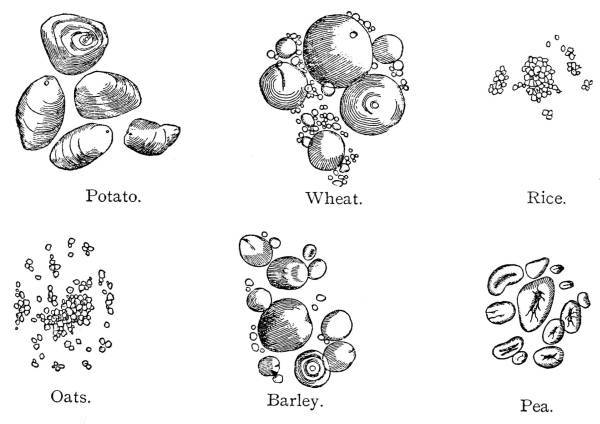
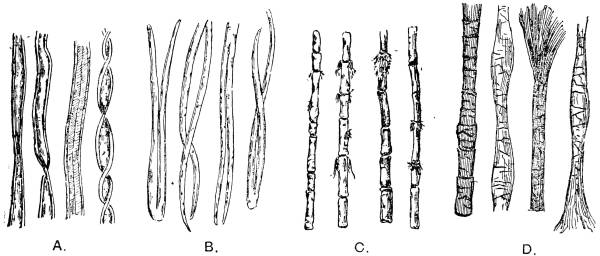
Fig. 1.—Different Forms of Starch Granules.
Potato. Wheat. Rice.
Oats. Barley. Pea.
The detection of the varieties of starch is usually possible
owing to their fairly characteristic appearance under the microscope.
Fig. 1 shows the most important starches. It must be noted that in
oats, maize, and rice the contour is completely marked by facets or
surfaces, while there are less complete markings in tapioca and sago.
In wheat, rye, pea, bean, barley, potato, and arrowroot the contour
is even, though there are minor differences of size and shape.
Other Vegetable Foods.—Green Vegetables contain comparatively
little nutriment, but form valuable additions to other
foods. Cellulose, which forms their main constituent, although
indigestible, forms a bulk in the alimentary canal, which is necessary
to ensure peristalsis. Concentrated nourishment can only be
digested in limited quantity, and is very apt to produce digestive
disorder. Cabbage contains 92 per cent. of water, and 2½ per cent.
nitrogenous matter. Carrots contain 6 per cent. and turnips 2 per
cent. of nitrogenous matter; parsnips are intermediate between
these. Green vegetables possess valuable anti-scorbutic properties.
They may be made an important vehicle for giving fatty food, by
adding butter, etc.
Rhubarb and sorrel contain oxalates and tartrates of potash and
lime, to which they owe their tartness. Spinach is cooling and
laxative, like rhubarb, but not tart. Sea-kale, artichoke, and
asparagus are all wholesome vegetables. Asparagus is somewhat
diuretic, and gives a peculiar, disagreeable odour to the urine.
Salads, such as mustard and cress, water-cress, endive, and the
garden lettuce are very useful as anti-scorbutics. Some of them
possess a peculiar pungency due to a volatile oil analogous to that
contained in horse-radish.
The Potato contains 26 solid parts in 100, of which nearly 20
are starch and 2½ nitrogenous matter. It forms one of our best-appreciated
vegetable foods, and as it possesses valuable anti-scorbutic
properties, its universal use is, perhaps, the chief cause of
the present rarity of scurvy. Alone, it possesses too small a
proportion of nitrogenous material to support life, but the addition
of butter milk makes up this deficiency; and these two together
form a sufficient diet to maintain life and health for a long time.
The Onion, Garlic, Leek, and Shalot, all members of the lily
family, are chiefly used as condiments. They contain an acid
volatile oil, which gives them a peculiar odour and flavour. By long
boiling, this is dissipated (as in the case of the Spanish onion), and
the onion is then fairly digestible, as well as nutritious.
Celery possesses a more delicate flavour and odour than the
preceding, but even the most tender celery is digested with
difficulty; less so, when boiled or stewed, or a constituent of soups.
Only four Fungi are, with us, commonly regarded as safe—mushrooms,
champignons, morels, and truffles; but there are many
others which are equally edible. The food value of fungi has been
exaggerated. They are difficult of digestion and contain little
nutritive material. Poisonous fungi usually have an astringent
styptic taste and a disagreeable pungent odour. In any doubtful
case it is better to abstain.
Oily Seeds contain a considerable amount of fixed oil which
renders them unfit for persons of weak digestion. The almond,
walnut, hazel-nut, and cocoa-nut are common examples. The
sweet almond, when eaten unbleached, occasionally produces nettlerash,
and its solid texture and large proportion of fixed oils render
it difficult of digestion. The chestnut contains less oil, but a large
amount of carbohydrate. It is extensively used as a food in Italy
and some other countries. In the uncooked condition it is very
difficult of digestion.
Fruits are chiefly used as adjuncts to other foods; but the
vegetable salts and the cellulose and sugar which they contain,
make them very valuable. Cucurbitaceous fruits are used as
vegetables rather than as fruits. Vegetable marrow is wholesome
and agreeable, but not very nutritive. Cucumber is most digestible
when rapidly grown and freshly gathered.
Stone-fruits or drupes, such as the peach, nectarine, plum,
cherry, are rather luxuries than foods, like many other fruits.
Before ripening they are unfit for food; when ripening is complete,
the acids and astringent matter largely disappear. The date
contains chiefly sugar, and forms an important food in the East.
Pomaceous Fruits, as the apple, pear, and quince, are more
digestible when cooked; and, speaking generally, all fruit not
perfectly ripe should be cooked before eating. The presence of
vegetable acids in fruit soon converts the sucrose of cane sugar
into dextrose, a less sweet variety of sugar. It is therefore more
economical to sweeten after than before cooking.
The chief Berries are the grape, currant, gooseberry, cranberry,
and elderberry. The grape is the most important, and 1,500
varieties of it have been described. Its juice contains a large
amount of grape sugar (dextrose), and small quantities of glutinous
material, bitartrate of potash, tartrate of lime, malic acid, etc.
Besides the above fruits, we have strawberries, mulberries, figs,
plantains, melons, etc., which are all refreshing and anti-scorbutic.
The orange family furnishes us with the orange, lemon, citron,
lime, shaddock, and pomelo, of which the orange is by far the
most important, and possesses most valuable refreshing qualities.
Sugar exists in two chief forms, viz. sucroses and glucoses.
Sucroses, known chemically as disaccharids (Sucrose = C12H22O11;
compare starch = C12H20O10) are exemplified in cane, beet, maple,
malt (maltose), and milk sugar (lactose). Cane sugar has been
gradually displaced by beet sugar. The two are chemically identical,
and equally nutritious. Maltose is given in malt extract as a food,
and because of the digestive action of the ferment also contained in
the extract on starchy food. Thus:—
STARCH.MALTOSE.
C12H20O10 + H2O = C12H22O11.
Lactose is comparatively free from sweetness, and is hardly capable
of being fermented by yeasts.
Of Glucoses the best example is dextrose = C6H12O6, H2O,
which can be seen crystallised in dried raisins; it only possesses
one-third the sweetening power of sucrose. Starchy food becomes
changed into glucose by the action of saliva and pancreatic juice in
the alimentary canal. Grapes, cherries, gooseberries, figs, and
honey contain lævulose in addition to glucose (glucose = C6H12O6,
H2O, lævulose = C6H12O6). Lævulose resembles dextrose except in
being uncrystalline, and in its effect on polarised light. Many ripe
fruits, such as pineapples, strawberries, peaches, citrons, contain
sucrose and lævulose, the latter being not quite so sweet as
sucrose.
In the alimentary canal sucroses are inverted into dextrose and
lævulose. Thus natural foods containing these sugars are more
readily assimilated than those containing sucrose.
The sweetening power of the varieties of sugar depends on
their degree of solubility in water. Sucrose is soluble in one-third
of its weight of cold, and in rather more of hot water. Dextrose is
soluble in its own weight of water; lævulose is more soluble, and
therefore sweeter than dextrose. Lactose requires five to six parts
of cold and two of hot water, and is therefore not so sweet as the
other varieties.