With a wild clatter a twelve-foot section
of the ceiling came down. We sat up in
our bunks and waited. It occurred to
me that no shell had exploded above, within, or
immediately about the "hut," and that this interruption
of our peaceful slumbers must be due
to the vibrations from our own batteries; there
was consolation in the thought. But I did not
fall asleep again. Our guns were going on at a
terrific rate now. It was no ordinary shelling of
enemy objectives, no mere following of a regular
schedule by which "big ones" and "little ones"
are dropped on military roads, headquarters, and
concentration-points in "Germany."
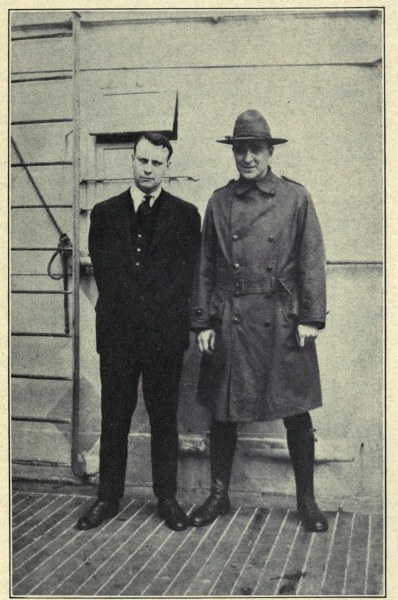
Pest, secretary in charge of the "hut," who in
happier times is physical director of the Young
Men's Christian Association in Newark, N. J.,
said: "Something doing. That's a barrage;
wonder whether they're coming across or whether
we are going over. The first brigade is due for
relief to-day; guess the Hun knows it, and is
'speeding the departing guest.' We'll sure have
company for breakfast if our fellows keep on
stirring up the animals."
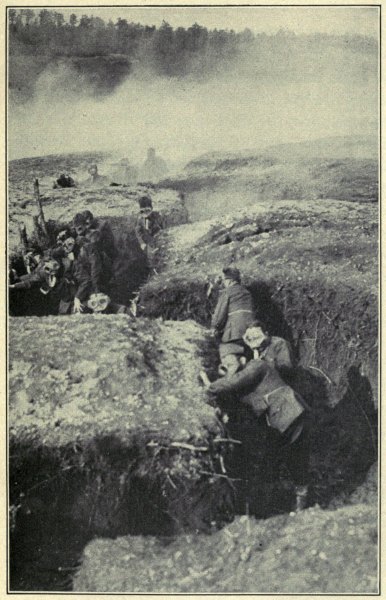
Presently the "company" arrived. First the
gas-alarm was given, and we hurried into our
masks. I kept on my waterproof, so that my
friends would not see my knees in action! Then
the shrapnel began to spray, and high explosives
felt out our guns. The throaty roar of our seventy-fives
mingled with the longer and nearly double
shocks of enemy explosions. We knew that "William"
would not waste shells on us; but we knew,
too, that we were desperately near the places he
was trying to find, and that even modern military
science is not always exact.
There was a stern patter on the roof—spent
shrapnel; a few minutes later it came again with
a sterner knocking and the sound of an explosion
directly overhead, but high. Hummel got up and
opened the door. He looked out, and then closed
the door. Simultaneously with the banging of the
door a huge explosion took place in our back yard.
Hummel said that he saw the field go up as high
as the spire of the ruined village church. There
was a mighty rush of wind and a scream of steel;
a fragment of high explosive tore out the sash of
a window, and "carried on." This particular
piece of projectile passed through the hut less
than twenty-five feet from the cots.
From three o'clock in the morning until seven
the shelling was heavy, the roar of the guns was
continuous. It then lessened, but for the rest
of the day and through the night there was no
quiet. During the barrage, the reason for which
we learned a few hours later, our village suffered
more than usual. In one billet six men were instantly
killed and five were horribly wounded.
In another billet there was a fatality, and a French
soldier was killed at the meeting of two streets as
he walked towards his home, going back on his
first "leave" in two years.
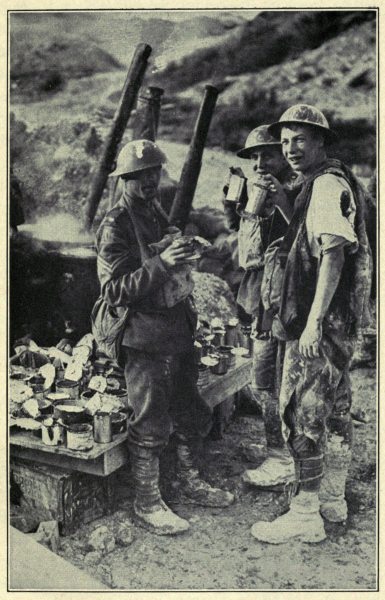
We waded through the mud to our "mess" just
across the street; good, steaming hot, and well
prepared it was. I went back for a "second," as
is the privilege of every man provided he waits
until all have had the first serving.
It was the first day of the month, and so while
Pest fixed the packs for the trenches, and Hummel
(Rev. Mr. Hummel, of California, if you
please) completed a sink and drain which his deft
hands had begun the day before, I took account
of stock, and incidentally packed more securely
on the shelves the supplies that were in quantity.
The bombardment was shaking things loose. At
10 A.M. Pest and I started for the trenches, with
the former remarking to Hummel that if things
continued so active the supply-truck would hardly
get in, and that it might be well to "shove the
stuff" a bit easy to conserve what we had.
Up the road we hiked toward Germany. Our
sacks held a hundred pounds of chocolate, nuts,
cigarettes, and oranges, things that the regular
and necessarily severe front-line mess could not
duplicate. The oranges came from Italy, and the
chocolate was made by Americans in French or
Swiss factories taken over by the Y. M. C. A.
Trench supplies are never sold; these are "specials,"
gifts to those who for days at a time must
bear the body and nerve destroying ordeal of the
most advanced places. No man who has not
seen the faces of the men and heard their "Thank
yous" can appreciate what these trench trips of
the Red Triangle mean to the soldiers of the Republic.
Every day the secretaries go "in," and
clear in. To the last observation-post they carry
the extra food, the bit of luxury, and the strong
man's word and grip of comradeship that build
fighting spirit and morale.
For a mile the going was easy, the road-bed
straight away toward the trenches; and the footing
beneath five or six inches of mud was firm.
At "Dead Man's Curve," a bad spot which bends
out from behind a great ammunition-dump and
passes between batteries on into another ruined
village, we took a short cut across the field.
The mud at the bend was red, and the road was
filled with blood; an empty supply-wagon had
been caught there earlier in the morning. The
two men on the driver's seat and all of the mules
had been killed. For five hundred yards we continued
across the shell-ploughed field; now and
then we were forced to turn out of the direct path
to avoid shell-holes close together; several times
I found as many as three small craters with rim
touching rim.
The firing continued heavy, and the moaning
missiles passed one another high above our heads.
There were explosions half a mile away, and the
surface of the earth was churned with fury; but
no shells dropped near. We entered the communication-trench
at the far edge of the great
military road that at this particular point parallels
the first line of fifteen miles. It runs directly
in front of the last heavy batteries, and to a
height of twenty feet is carefully camouflaged
with branches and painted canvas. The camouflage
does not disguise the location of the road
itself; but it does hide the movements of troops,
munitions, and supplies from the enemy observers,
who here look down upon our lines from a
famous mountain which towers nine hundred feet
above our position.
The morning was cloudy; mist was in the air,
and a little later it began to snow. We caught
glimpses now and then of another ruined village,
the battalion headquarters (a kilometer from the
head of the communicating trench), where we
reported before going on to the most advanced
positions. Presently we met a lieutenant coming
out. He was smiling, and without being asked
for information told us that the enemy had come
over in force with shock troops after shelling the
lines for twelve hundred meters on either side of
the eight-hundred-meter front which bore the full
weight of the infantry attack. He gave us no
details; but, as he hurried on, he assured us that
"the boys brought away the bacon."
We reported to the major on reaching headquarters,
and learned from him that the company
we had planned to serve that morning had been
very "busy"; that it was digging itself out, reopening
the trenches after the intense bombardment,
clearing away the dead, looking after the
wounded; and that he would prefer to have these
supplies taken into Company K, where things
were in better order. He spoke with pardonable
pride when he informed us that already the men
at the most advanced listening-posts had been
served with food and red-hot coffee. We began
to understand the heavy firing of the morning.
Our guns had been supporting the infantry, and
German guns had been trying to silence them.
A sergeant, covered with blood but happy, had
just made his report for Company I. He accompanied
us until our paths, or rather trenches, separated.
He was going back to the "busy" portion
of the front. His story was interesting, to say
the least. During the preparatory bombardment
which preceded the raid he was buried in a dugout.
When the barrage lifted for the raiders to
come across, he dug frantically toward the faint
light that came through a tiny opening in the
shattered roof. Suddenly two hand-grenades
were hurled through his little window of hope.
Both exploded, but the sergeant miraculously escaped.
Indeed, the grenades helped him out!
He despatched the thrower, and leaped into the
heart of the counter-attack. How fierce that
counter-attack was may be judged from the fact
that every commissioned officer of his company
was killed or wounded before it was crowned with
triumph.
The Germans were forced into our supporting
barrage, and were virtually annihilated. It was
a demoralized remnant indeed that reached German
lines to make a report far different from what
had been anticipated. But our losses were not
light. Our first infantry captain to die in action
was killed that morning at the head of his men.
Five out of the six lieutenants "up" at the time
were wounded, and the sixth followed his gallant
captain. The sergeant spoke slowly when he recounted
the losses, but he was jubilant when he
recalled the perfect support given by the artillery.
We knew and he knew that the first great test
had come, and that Americans had not been
found wanting in courage, initiative, or skill.
Presently we reached company headquarters as
the major had directed us, and heard at length
the story of the morning. With a guide we now
went on. Hip-boots did little good, for the
"chicken-ladder" trench floor had been badly
smashed by the shelling. Often we sank to our
hips. The boys were mighty glad to get the candy
and fruit. The Italian oranges were our leaders!
A soft-voiced Southern lieutenant gave us additional
details, and told us how the gallant French
on our right came down and dropped in behind
us at a distance of five hundred yards. There in
the open they lay, a reserve against the possible
breaking through of the enemy. No Man's Land
looked strangely peaceful through our parapet,
and the German barbed wire a hundred and
seventy yards away was more like loganberry
trellises in Oregon than part of a war machine in
France. The company had lost only one man
during the shelling, and it had not suffered in
the raid.
It was nearing one o'clock when, returning, we
reached the place where our friend the sergeant
had left us. Pest looked down the trench toward
headquarters, and then down the front line toward
the low ground where we had originally planned
to go, and where the boys were "busy." Surely
things were cleaned up now, and they would be
hungry for a bit of chocolate and a strong word.
I followed him toward the left, but not without
forebodings. There was plenty of noise in front
of us, and I was sure that the enemy would not
co-operate with the engineers who were restoring
our trenches, by refraining from shelling them.
The "little ones," three-inch high explosives, were
falling not far away; but we were well covered.
We crossed the low ground where the boys had
suffered so seriously from the gas attack three
days before, and then entered the woods, whose
tree-trunks bore many new wounds.
At the far edge of the woods our progress was
completely blocked. Working parties filled the
space. All about were the marks of the bloody
struggle. Not all the dead had been carried back,
but the wounded were either out or had been
started toward the rear. There were yet bodies in
the barbed wire, hanging like ghastly scarecrows.
We emptied our sacks, and right about faced.
The firing was steadily increasing, and we hurried
our steps. When we came to the place where we
had entered the woods, we found our way barred
again. Two stretcher parties were resting under
the cover of the little ruined forest. One carried
the remains of the second lieutenant, who had
been killed by a trench mortar; the other bore a
wounded German prisoner, a fine-looking, husky
Bavarian whose legs had been fearfully mangled.
The carriers were worn out; it had been a "busy"
morning for them, too. They were within a hundred
yards of the point where it was necessary to
leave the trench and take to the open. The trench
had been so shattered by the shelling that a
stretcher could not be carried through it. The
light had been growing steadily better, and it was
very apparent that German observers, at this
point less than two hundred yards away, would
quickly spot a party taking to the open. But
there was nothing else to do. Pest volunteered to
lend a hand, and together we carried the wounded
prisoner to the point where with assistance we
lifted him to the parapet.
The two stretcher parties now started down
across the low ground in the open, their burdens
shoulder-high, not only for greater ease in carrying,
but to give the "kultured" gentlemen across
the way a square and open look. The going was
heavy. After carrying for perhaps three hundred
yards the four of us who had lifted the burden
at the parapet were relieved. Pest and I now increased
our speed in the direction of battalion
headquarters, which were in plain view and not
more than a kilometer away as the bird flies.
Suddenly hell opened. A barrage was put down
upon the field. I can hear to-day as distinctly as
I heard it then the close-up crash of German guns,
and almost simultaneously with that the cry of
the officer in charge of the stretcher, "Scatter!"
Then all about us the shells dropped and broke.
I suppose that the barrage lasted ten minutes,
hardly more, but it was a kind of eternity. It
seemed to my terrified eyes that no foot of ground
about us was left untouched. That night an observer
in our line, on his way back after being
relieved, stopped long enough to say that more
than two hundred shells fell within a radius of
fifty yards from the centre of our party.
I sprawled upon my face, and rolled over into
a very shallow shell-hole. At my right, and not
ten feet away, suddenly a man was lifted into
the air; five feet he seemed to go up. He turned
over, and came down with a flop into a shell-hole
filled with water. Aside from the shock and
bruises he was uninjured. The "three-inch" had
gone in, by his side and at an angle, almost under
him. But in the open and in soft ground high
explosives are not particularly dangerous unless
they score direct hits. They penetrate so far
before they explode that they are largely smothered;
and, while they kick up a great commotion,
their bark is worse than their bite.
Fortunately for our little party, this barrage
had no shrapnel mixed with it; had there been
shrapnel, the story would be of another sort.
But I was so profoundly frightened that I made
no distinction between high explosives and
shrapnel.
I found myself trying to hide behind a rock no
larger than a baby's fist. I envied the white dog,
which wheeled about on his hind legs, barking
angrily in a dozen directions at once, trying to
cover each new explosion. I envied not his bark,
but his potential speed, and called him a fool for
not using it.
And then I heard some one say,—or perhaps
it was my own heart speaking,—"Run for it!"
and faster than I ever left the scratch on a cinder
path, in the days when I was credited with 10 1-5
seconds for the hundred-yard dash, I got away.
As I ran, I thought of two things. First, I
breathed a prayer of thankfulness for the additional
five thousand of war-risk life-insurance that
I had taken out just before leaving New York;
and then I remembered the ancient tale of the
colored brother who heard the bullet twice, once
when it passed him and once again when he
passed it! And I did my best to emulate the
hero of the tale. Two men reached headquarters
before I did, but they were younger men and unimpeded
by trench coats.
I followed Pest into the presence of the major,—we
ran a dead heat!—and heard his report.
The major smiled, a trifle anxiously, told us of
the comparative safety we had really enjoyed because
of the soft ground and high explosives, and
then inquired, "Did the carriers stay with the
prisoner?" Pest replied, "I am not sure, sir; I
did not look around, but I am inclined to think
that he is out there alone." Some one felt it in
order to remark that if the Hun wanted to kill
his own wounded, he ought to be given the privilege
of doing so "without mussing up any good
Americans"; and then the major said: "Yes,
he's a Hun, but we're Americans. Go back and get
him."
I am writing these lines more than five thousand
miles from the candle-lighted room in the
bomb-shelter of that battalion headquarters; but,
as I write them, I cross the sea, and stand again
by the side of the rough table where I stood that
March afternoon when the major startled me out
of my terror into soberness and quiet with his "Yes,
he's a Hun, but we're Americans. Go back and
get him." I believe that I am better for trying to
give the German the benefit of the doubt; for half
thinking that, after all, he may not have recognized
the nature of the party crossing the open
field. But the major waived the whole question of
German "frightfulness," and leaped at once into
the heart of American traditions of war and
America's military idealism. He saw only a
prisoner, wounded and under fire, and—he knew
his duty.
And before we continue this story let us halt
for a moment with the "major." I saw him only
once and under tense and extreme circumstances.
His battalion had just come through a baptism
of fire that will not be forgotten when the story
of America's part in the great war is told. I do
not know how he looked in a dress uniform or
when he was clean-shaven; I have no conception
of what his carriage was in a drawing-room; and
I am uninformed as to his church affiliation—if
he had any. But he acted like a soldier that
afternoon and talked like a Christian. I am sure
that he was every inch a soldier, too; for he
fought through the Spanish-American war, and
was a major in the Philippine constabulary. He
enlisted in the British army; but, when the Stars
and Stripes came to stand by the side of the
Union Jack, he moved over, and was commissioned
a major in the national army. I intended to
write him a letter after I returned; but now that
will be unnecessary, for to-day at the top of a
column I read, "American colonel killed in action,"
and below, "Lieutenant-Colonel Richard
H. Griffiths; commanding a battalion of infantry,
has been killed by shell-fire in Picardy. He
emerged from a dugout just as a German shell
arrived and exploded directly in front of him."
And now he stands at attention before the
Commander whose orders, whether he thought
of it in that way or not, he so completely
obeyed.[1]
As the major spoke, he turned to a lieutenant,
and said, "Get those carriers, and send them
back." Pest and I followed the lieutenant into
the open. The lieutenant inquired of Pest the
location of the prisoner; and the man from Newark
replied, "I'll show you." It was at this point
that the writer made a speech. The speech was
brief, but logical and unanswerable. I told Mr.
Pest that he had no business to go back. True,
the barrage had lifted, but the Germans had
another one where the first one came from, and
they might decide to spare it! Then, too, he—Pest—had
done not only his full duty, but
more. To go back would be to expose himself
needlessly and also to run the risk of having the
trenches closed to the Y. M. C. A. "What will
the army over here say if it gets the idea that you
Y. M. C. A. fellows are sticking your heads above
parapets and rambling around in open fields?
How long will it stand for the Y. M. C. A. man's
assuming a rôle that does not belong to him?
Granted that you did the only thing you could
do by helping with that prisoner when you ran
into the immediate need, this return trip is another
proposition."
I laid hands on my friend; but he started up
the road for the open field, showing the way to
the lieutenant, and with a heavy heart I followed
another officer to indicate the carriers who must
go out to help bring in the wounded man. Pest
had made no reply to my speech, and I knew that
my logic was sound; but that didn't satisfy my
heart, with Pest out there. And Pest's heart
would not have been satisfied, had he allowed me
to win the debate.
I came back and stood at the head of the road
leading through the tumbled walls, out by some
abandoned trenches with tangles of rusted wires
above them, and on into that open field where so
many brave men had fought and died since the
first rush came down from Metz. "Poor place to
spend a vacation," said the sentinel, who stood
post there, and scarcely had the last word left
his lips when that field again became an inferno.
I could not see my friend and those who had gone
to join him, a slight rise in the ground and an
old cut-to-pieces orchard obscured the view; but
the air was full of earth and rocks, and I was
sure that I saw fragments of bodies in the vortex.
Surely men could not come again unscathed
through such a horror.
And now I was forced into the sickening acknowledgment
that, while my logic had been
sound when I sought to dissuade Pest from returning
to the prisoner, my nerve had not been. I
knew that my feverish urgency was not unmixed
with personal fear. Never did a more sick and
anguished heart cry out to God than the one that
supplicated for that stretcher party. But it did
not appear! When the suspense became unbearable,
I hurried to the major; and, when I told
him the situation, he became very grave. He had
been trying for some minutes to silence our own
batteries, fearing that the enemy would continue
to concentrate their fire on objectives near our
battalion headquarters if our firing continued to
stir them up. And our fire was stirring them up!
Our shelling was deadly and unrelenting. The
major wanted to give that party in the field a
chance to get back. But his communications
were down. Already two runners had been despatched,
and the signal-corps men were working
frantically.
I asked for permission to go down the road a
little way to see whether there might be a sign
of the men. I could not face my own soul without
knowing for myself what Pest's end was. The
major understood, and down the road I went. A
great fear possessed me, but it was a new kind of
fear. I reached the edge of the open place; there
was no sign of life anywhere. The snow was falling
again, and I hurried on. I met a runner; he
had not seen the party. Three minutes more,
and I was on the spot where the first barrage
broke; and still there was no sign.
Suddenly the tightening about my heart loosened,
and I fairly shouted, "There would be
something left, if they were dead." A second runner
was skirting the woods we had passed through
earlier in the day. I ran to meet him, and fairly
choked him to get the information that I was
desperately searching for. "Yes," he had seen
them. They had waited till the shelling stopped,
and then from the cover of the woods he had
watched them rush the stretcher back to the
trench. They had followed close against the
lower side of the trench, the longer way into
the village. This brought them into the lower
end of the town, and gave them a slight cover for
the entire distance. It was the way we should
have taken in the beginning.
"And now," the runner said, "this is our 'busy'
afternoon,"—I had heard the word so often that
day,—"and we must get to headquarters 'toot
sweet'!" The youthful veteran instructed me to
follow him at a distance of twenty paces, and he
led the way down the road which skirted the edge
of the field farthest from the German lines. The
snow was falling more rapidly now, and we were
practically safe from observation. We walked
in the shallow ditch by the roadside, so that in
case shelling was resumed we could avail ourselves
of its protection. By lying flat we should be on a
level with the surface of the ground.
The road was deep in mud, and I saw the prints
of French boots! Then I remembered what the
lieutenant had said in the morning of the gallant
French reserves, and realized that I was on the
exact spot where they had waited in the open behind
our trenches. A rush of emotion overwhelmed
me, and I wept. Suddenly in front of
me I saw a mask, a blue gas-mask, half buried in
the mud, lying where the brave Poilu had dropped
it only a few hours before. When I showed it to
the major a little later, soaked with water and
with blood, ruined and useless, he said, "Take it
home to your children; you are a millionaire."
Yes, a millionaire in the treasure of sentiment, by
the wealth of the vision the blue mask brings to
me of the comradeship of democracy in suffering
and in sacrifice.
Before we reached the edge of the village the
batteries became busy again, but at first their
objectives seemed to be well beyond the town.
Then without warning the fire assumed the intensity
of a barrage, and the range was shortened so
that the projectiles fell all over "headquarters."
Such a spectacle I had never seen before. It was
as though the heavens had opened and precipitated
an ocean of soil, bowlders, and trees upon
the earth. No, rather the earth itself seemed to
open as the result of some great sickness and
vomit this terrifying spectacle upon us. The
ground trembled, and the noise became literally
deafening. I stood transfixed behind the runner.
I was conscious of no other emotion than one of
complete amazement. I had been in the midst of
the former barrage, and had not seen it! We were
perhaps one hundred and fifty yards away from
this one, and so soon does one become accustomed
to the eccentricities of shell-fire that we felt ourselves
in no danger. We listened to the shells as
they described their low arc above us, and knew
instinctively whether they would land to the
right or to the left, near us or relatively far away.
One's judgment in these matters is much akin to
his judgment of a batted ball; only he judges the
shell altogether by its sound.
But we were roused from our stupor. Off at
our left, not far away, a shrapnel broke, the first
I had seen that day. For an instant I was paralyzed.
The balls flew all about us; dirt spattered
us; and then we ran! Straight toward that barrage
we sprinted. Our one chance—and I knew
it as well as the splendid fellow in front of me—was
those abandoned trenches with their caved-in
dugouts; we were not more than fifty yards from
them. It was shrapnel now and no mistake.
That we were not hit is merely one of the hourly
miracles of the front. But we did reach, without
being wounded, the old barbed wire with the barrage
being pulled across the village and shortening
in our direction, and with the shrapnel
overhead. Both of us dove head first into the
trench, and a good eight-foot plunge it was, into
slime and water six inches deep. There we waited
until the affair was over.
As suddenly as it begins, intense shell-fire
ceases; this demonstration against battalion headquarters
lasted in all not more than ten minutes.
Then, save for explosions well up on the ridge or
behind it in the region of the batteries, comparative
quiet reigned. With my new-found friend I
climbed out of our refuge and hurried into the
village. Here I received another shock; aside
from three men wounded, several old walls tumbled
in, a score of small craters in the streets, and
yards of destroyed camouflage the bombardment
had done no injury. I was sure that bodies would
be scattered everywhere. But the major was at
his table, working furiously and as if nothing had
happened; the signal-corps room hard by had
been mussed up; one shell had dropped close by
the wall of the major's bomb-proof, and another
had destroyed the camouflage at its entrance;
but these experiences were with the day's work.
With the first explosions just beyond the town the
men had taken to the cellars, and there remained
until the storm was over. The last few hours had
given me a vivid demonstration of the truth of
the statement that I had often heard, but scarcely
believed, "It takes a thousand shells to kill a
man by shell-fire."
My first inquiries were for Pest, and he was reported
safe and waiting for me in the communicating
trench; the sentinel at the head of the old
road had given him a statement of my movements.
The prisoner had been carried in, and
presently he was hurried by in an ambulance
bound for the hospital. Every hand that I had
seen touch his stretcher had been a kindly, ministering
hand; and the men who were risking their
lives to bring him out had been prompt to express
their admiration of his nerve; he was suffering
terribly. He in his turn, when bearers "eased
off" their load in the hard going of the open field,
would say deeply between his groans, "Schön,
schön!" ("Fine, fine.")
Shells exploding half a mile away had made
me very nervous in the morning; but now as I
hurried back, ploughing through the mud and
snow of the communicating trench, sinking often
to my hips, and pulling myself out as best I
could, no sounds worried me. Men were coming
in—the relief; they looked clean and fit. A
machine-gun company passed me, and was eager
for a few words of information. It was great to
have good news for those fellows! At last I
reached the main road; its inches of mud with
firm footing beneath seemed a paradise. The
field in front of the batteries had been reploughed
since we crossed it in the morning, and there
were many new craters about "Dead Man's
Curve."
As darkness came down, we reached——home!
and home it is to thousands of hungry-eyed lads
who have become men in an hour. Home it is
to these far-called soldiers of freedom, who pay
the sterner price of the world's redemption. It
holds them to their yesterdays; it grips them
with their past. By its tables they sit and think
and write; about its fire they talk and muse. In
the atmosphere of its manly decency they breathe
deeply and are purified; and the fellowship of
those other soldiers who wear the red triangle
makes them fit and strong in their hearts. Ah!
as I stepped across the threshold of that place
fenced with rough boards and set where heaven
touches hell, I saw all things become new. We
could not win this war without the Young Men's
Christian Association; for, even though our
armies reached Berlin, our souls would lose their
way.
I put my trophies out of sight—the masks
and some pieces of shell that I had taken from
a shell-hole after I scrambled up from the first
shock of the barrage. A few hurried changes
were made, and then we relieved Hummel, who
had been working like a lonely Trojan all day.
Out of the corner of my eye I watched Pest.
He didn't even know that he was a hero! When
I think of him, I shall always see him as I saw
him swinging down the road with the lieutenant,
bound for the open field, head up and chin out,
leaning slightly forward as he took the long and
easy stride of the trained athlete—a soldier and
a Christian, under higher orders than any that
man ever gave or refused, facing death to be
merciful, risking his own life to salvage the life
of his enemy.
And Pest is more than one man; he is a type.
This one day of his life, a trifle more than ordinary,
to be sure, but not unlike scores of days he
experiences, is a single page from the ledger of
service which the Y. M. C. A. secretaries are
writing on every front where freedom bleeds.