BY
EMIL REICH DOCTOR JURIS Author of “History of Civilization,” “Historical Atlas
Of Modern History,” “Græco-Roman
Institutions,” etc.
WITH AN AUTHENTIC MAP OF HUNGARY
Boston
L. C. PAGE AND COMPANY
[INCORPORATED]
PUBLISHERS
PREFACE.
The present book is the first attempt in the English
language at a connected story of Hungarian literature.
The remarkable success achieved by a few Magyar
novelists in English-speaking countries, together with
the growing recognition of the international importance
of Hungary as a state and a nation, seem to justify
the assumption, that the Anglo-Saxon peoples too, are
not unwilling to learn more about the intellectual life
of the Magyars than can be found in the ordinary
books of reference.
The main object of the author, himself a Hungarian,
has been to impress the reader with a vivid picture of
the chief currents and the leading personalities of
Hungarian literature. Magyar literature is too vast a
topic to be fully treated within the very limited space
of a small essay like the present. By introducing the
comparative method of historical investigation and
analysis, by means of which Hungarian works are
measured, contrasted to, or compared with works of
English, French, German, Italian or the ancient classical
writers, the reader may obtain, it is hoped, a more
life-like idea of a literature hitherto unknown to him.
No nation outside Hungary has facilities of studying
Magyar literature as great as those offered to the English
public in the incomparable library of the British
Museum. Nearly every Magyar work of any importance
may be found there, and the catalogues of those works
are, in the strict sense of the word, correct. This latter
circumstance is chiefly owing to the labours of an
English scholar, whose name no Hungarian can pronounce
without a feeling of reverential gratitude. Mr.
E. D. Butler, of the British Museum, the author of the
only authentic and comprehensive, if small, English
work on Hungary (his article “Hungary” in the last
edition of the Encyclopædia Britannica) is, to our knowledge,
the only English student of Magyar language and
literature who has thoroughly grasped the philology and
spirit of that language and the distinctive qualities of
Magyar writers. He will, we trust, pardon our patriotism
for shocking his excessive modesty by this public acknowledgment
of his merit.
May this book contribute somewhat to increase the
interest of the great British nation in a nation much less
numerous but in many ways akin.
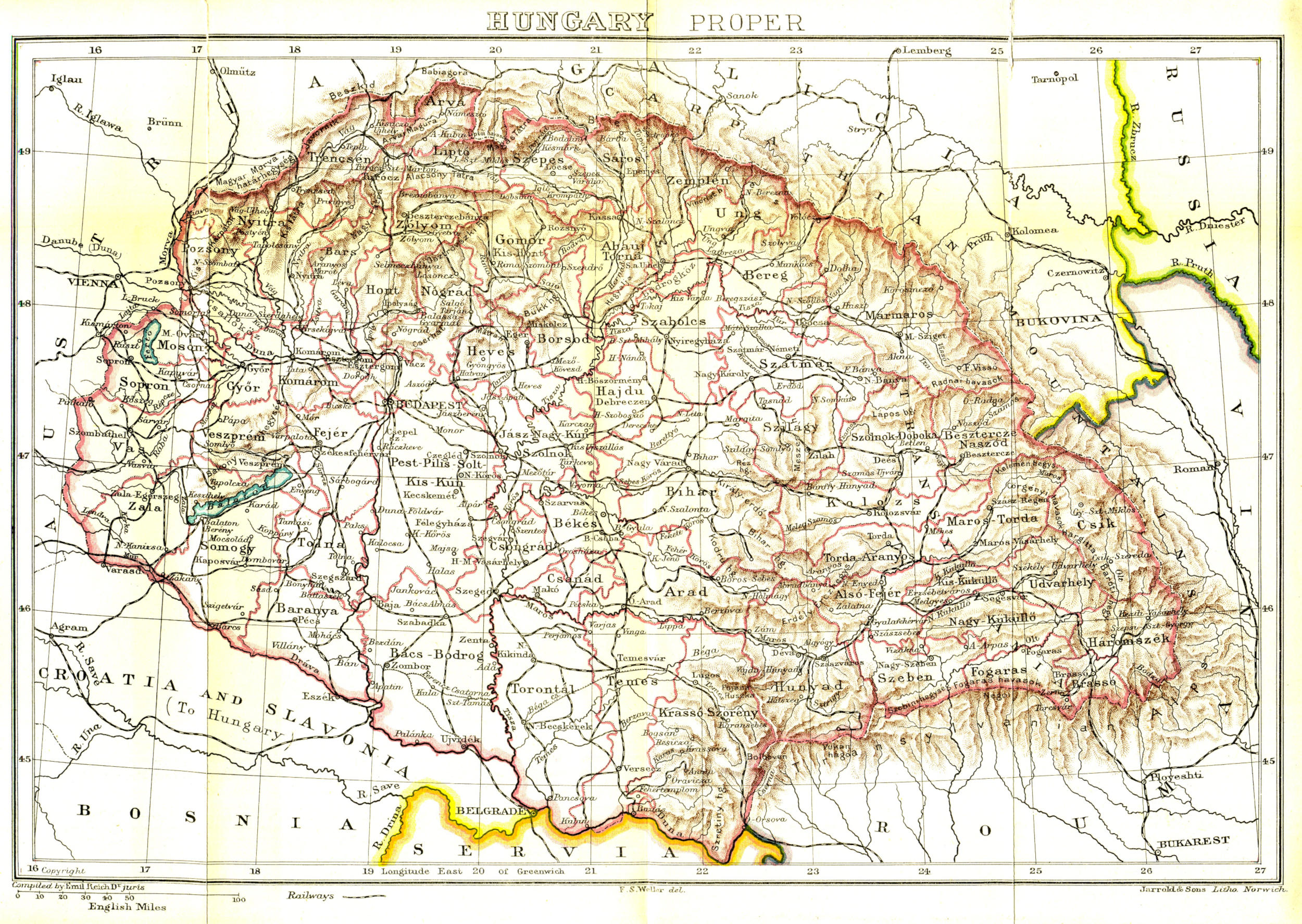
The map of Hungary accompanying this book is,
we venture to say, the first map published outside
Hungary based on the most careful comparison of
the original sources. The greatest pains have been
taken to ensure absolute accuracy of names of places
and of county boundaries, according to the most
recent data.
EMIL REICH.
17, Tavistock Road, W. June 15th, 1898.
Transcriber’s Note: Map is clickable for a larger version.
HUNGARY PROPER
HUNGARIAN LITERATURE. — CHAPTER I.
Of the nations in the south-east of Europe, the
Hungarians, or Magyars, are probably the most
renowned, and at the same time, the least known.
Although their extensive country has now been
in their possession and under their rule for over
one thousand years, and albeit the historic rôle
of the Hungarians, rather than that of Hungary,
has been and is one of no common magnitude,
in that, without their secular and successful
fight against Osman ascendancy, Europe could
scarcely have maintained its civilization in the
countries east of Munich: yet in spite of all
such claims to attention on the part of western
nations, Hungary and the Hungarians are still
largely unknown in England, France and America.
In English-speaking countries no serious
attempts have as yet been made either to tell
the stirring story of Hungary’s past, or to analyse
the rich possibilities of her future. Except single
and singular features of Magyar life or natural
products, such as the famous “Hungarian” bands
of the Tsiganes or gypsies and their “weird”
music; Hungarian flour and Hungarian wine;
and most of all the figure of Hungary’s greatest
political orator, Louis Kossúth; except these
and a few more curiosities relating to Hungary,
the proud nations of the west of Europe do not,
as a rule, take notice of all the rest of the life
of a nation of eighteen million persons.
The festivities of the Hungarian millennium
celebrated the year before last, came to the
western world as a surprise. Few Englishmen
were prepared to realize the fact that, at a time
when their ancestors were still under small princes
of mixed blood, and, moreover, constantly exposed
to, and finally nearly absorbed by foreign conquerors,
the Hungarians had already reared a
solid fabric of government on the site on which
for now over a thousand years they have withstood
the armies, the diplomacy and the alien
immigration of the Turks, the Germans and the
Slavs. Unconquered by force or disaster, and not
denationalized by either the Germans or Slavs
around them, the Hungarians have maintained
almost intact the language and music they brought
with them from the Steppes of Asia; and when
in the ripeness of time a Magyar literature was
beginning to develop, it proceeded on lines neither
German nor Slav, but thoroughly Hungarian.
This literature is both in extent and quality,
one of the most remarkable of the lesser literatures
of Europe. The number of writers of Magyar
works is no less than 5,000; and their works
cover all the provinces of poetry and of philosophic,
historic or scientific inquiry into nature or
man. While accepting the standard of criticism
adopted by the recognized arbiters of literary
greatness, we have no hesitation in saying that
Hungarian Literature has a number, if a limited
one, of stars of the first magnitude, and no inconsiderable
number of lesser lights. This fact
acquires still greater importance from the consideration
that the bulk of Hungarian Literature
properly speaking dates back little over a hundred
years; and that many, far too many Hungarians
have, up to recent times, left their native country
and, writing their works in German or French,
added to the literature of nations other than their
own. Comparatively few, exceedingly few, Englishmen
have enlisted among the writers of nations
outside the United Kingdom; very many, exceedingly
many Hungarians have, under stress of
various circumstances, written in Latin, German,
French or English, and thereby reduced the bulk
and often the quality of Hungarian Literature
proper. The number of works in Magyar published
from 1531 to 1711 is 1,793. During the same
period 2,443 non-Magyar works were published
in Hungary. The preceding two totals were
given in 1879 and 1885 respectively. Up to April,
1897, 404 more works had been discovered,
belonging mostly to the class of non-Magyar
books printed in Hungary down to 1711. When,
however, we inquire into the number of works
written by Hungarians and published outside
Hungary, down to 1711, we learn that no less
than about 5,000 works were written and published
by Hungarian authors, in 130 non-Hungarian
towns, during the period ending 1711.[1] At a
time when all the western peoples had long ceased
to use Latin for all literary purposes, the idiom
of Cicero was still the chief vehicle of thought in
Hungary. Nearly all through the eighteenth, and
during the first quarter of the present century,
the number of works written by Hungarians in
Latin far outnumbered the works written by
them in Magyar. It was even so with German;
and many a famous German author was really a
Hungarian; such as Ladislaus Pyrker, Nicolaus
Lenau, Klein (J. L.), the great historian of the
drama, Charles Beck, the poet, Fessler, the
historian, etc.
In comparing Hungarian Literature with the
literature of the Germans, French or English, we
cannot but recognize, for the reasons just mentioned,
that the splendour and comprehensiveness
of the Literature of those nations cannot be found
in that of the Magyars. At the same time we
make bold to point out an advantage which
Hungarian Literature has over the literature of
many another nation, if not in the past, certainly
in the future. This advantage is in the Hungarian
language. The Magyars have a language of their
own. It is not a borrowed language; not one
taken from another nation, in whose use it had
been for centuries.
The Americans, both in North and South
America, although they are in nearly everything
else the counterparts of their European parent-nations,
have yet preserved the idioms of the
latter. In politics, social constitution, individual
temper, and attitude of mind, the North and South
Americans are—a long stay in that continent has
convinced us of that—utterly different from either
the English or the Spanish. The Americans
proper have indeed built up, or developed into a
nation of their own. For good or for bad, they
have a distinct and novel national personality.
One thing excepted; that one thing, however,
is a vital element in the intellectual activity of
a nation. We mean, of course, Language. The
Americans have moulded and coloured all the
old elements of their nationality into organs with
a tone and hue of their own. Language alone
they have, with slight differences, taken over and
preserved in the very form and woof in which
the English and Spanish had left it in the old
colonies. Hence there is between the Americans,
as a new nation, and their language, as an old
and foreign idiom, a discordance and discrepancy
that no genius can entirely remove. The words
of a language are mostly gentry of olden
descent. Between them there are associations
and tacit understandings ill-fitted for an environment
essentially different from their original cast.
This discrepancy has, there can be little doubt,
exercised a baneful influence on the literature
of the American nations. It has baulked them
of the higher achievements, and neither in the
literature of North America nor in that of South
America can we meet with literary masterworks
of the first rank. Between the poets and writers
of those nations and the languages they are using
there is much of that antagonism which has
always been found to exist between the cleverest
of Neo-Latin poets and the language of Rome.
Latin is a dead language; and all the intellectual
atmosphere and soil that nurtured and developed
it have long since ceased to stimulate. Accordingly,
the Politiani and Sadoleti, the Sannazari and
Buchanani, and all others who in modern times
have tried to revive Latin literature have entirely
failed. As with individuals so it is with nations.
The Belgians, or the Swiss in Europe are, like the
Americans, in the false position of having each a
distinct nationality of their own with languages
not their own. This fundamental shortcoming
has rendered and will probably, in all times, render
them incapable of reaching the lofty summits
of literature. Language is intimately allied to
literature; language is the mother, and thought
the father of literary works. Any lack of harmony
in the parents must needs show in the offspring.
Now the Hungarians have not only a language
of their own, but also one the possibilities of
which are far from being exhausted. For the
Hungarians therefore there is no danger of a
false position, of an initial vice in the growth of
their literature; and moreover there are immense
vistas of literary exploits still in store for
future generations. The quarries and mines of
the Latin and Teutonic languages have, it may
be apprehended, been worked so intensely as to
leave scant margins for new shafts. French has
changed little in the last three generations, and
English and German little in the last two; while
Italian and Spanish have long reached the
beautiful but stereotyped plasticity of ripeness.
Hungarian, on the other hand, is a young language.
The number of people using and
moulding it has been considerably increased in
the last generation, and most of its gold-fields
and diamond-layers have not yet been touched
by the prospector’s axe. There is thus an
immense future still open for Hungarian Literature,
and this prospective, but certain fact ought
never to be lost sight of in a fair appreciation
of the literary efforts of the Hungarians.
Literature being a nation in words, as history
is a nation in deeds, it would be impossible to
grasp the drift, or value the achievements of
Hungarian Literature without some knowledge of
the Magyar nation in the past and in the present.
It may be therefore advisable to premise a few
remarks on Hungary and her history before
entering on a narrative of Hungarian Literature.
CHAPTER II.
Hungary, in extent larger than the United
Kingdom, is, geographically speaking, one large
basin, watered by one large river and its affluents,
and bounded by one imposing range of mountains.
The river is called the Danube, the mountains are
the Carpathian offshoots of the Alps. This geographical
unity makes Hungary almost predestined
to be the seat of one nation. The natural unity
calls for, it may be presumed, the national. Yet
the very richness of the soil, diversified as it is
by the vegetable and mineral wealth of huge
mountains, and the cereal and animal exuberance
of vast plains has, in all times, attracted
numerous tribes from eastern Europe and western
and central Asia to the country of the “blue”
Danube, and the “blonde” Theiss. Some of these
invaders succeeded for a time in establishing a
kind of dominion over parts of Hungary. Thus
the Huns in the fifth, the Gepidae in the fifth
and sixth, the Avars in the seventh and eighth,
numerous Slav tribes in the eighth and ninth
centuries were successively lords of the plains and
some mountainous parts of Hungary. Not one
of these peoples, however, could either maintain
themselves as rulers, or quite disappear as dwellers.
Already in the ninth century we find Hungary
inhabited by more than fifteen different nations
or portions of nations, offering then the same
gorgeous medley of Humanity that is still so
characteristic of the country. Where the above
nations failed, the Magyars signally succeeded.
They and they alone of all the numerous, if
not perhaps innumerable nations that had tried
to rear a lasting polity on the columns of the
Carpathians, and behind the moats of the Danube;
the Hungarians alone, we say, succeeded in establishing
themselves as the permanent rulers of the
Slav and Turanian peoples of Hungary, and as
the members of a state endowed with abiding
forces of order within and power without. From
996 to 1301 A.D., they took their dukes and kings
from the family of the Árpáds, under whom
they had entered (some 100,000 men, women,
and children) the country. Saint Stephen (the
first canonized king) consolidated their constitution.
Without attempting to overrate the value
of constitutions either grown or made, and, while
laying due stress on that geometria situs, or
providential strategy in the location of nations
which has perhaps wrought the major part of
History, it is tolerably certain, that the constitution
of Hungary, as developed under the Árpád
dynasty, and as still surviving in some of its
essential elements, has had a most beneficial
influence on the public life of the Magyars.
Like that of England, it combines the excellency
of the Latin system of centralization, with the
advantages of the Germanic custom of local
autonomy.
Already in the early middle ages, Hungary
was divided into counties endowed with selfgovernment.
At the same time there was a
centre of government and legislation in the
national assembly or diet, where king and
subjects met to discuss the affairs affecting the
peace or wars of the entire state. In 1222, or
seven years after Magna Charta was signed at
Runnymede, the Hungarians forced their King
John, whose name was Andrew II., to sign the
Golden Bull, which, like the English Charter, was
to be the text of the country’s constitution, all
subsequent laws being in the nature of commentaries
on that text. The elements of the
Hungarian and English constitution being nearly
alike, the domestic histories of the two nations
bear, up to the sixteenth century, striking resemblance
to one another. We learn of wars of the
“barons” against the king, such as those under
Henry III. and Henry IV. in England; we read
of the constant struggles of the “commons” (in
Hungary consisting of the lower nobility, that
is, of knights as distinguished from burgesses),
for broader recognition of their parliamentary
rights; of rebellions, like that of Wat the Tyler,
of the peasants against their oppressors, the
landed gentry; and of fierce dynastic struggles,
like the Wars of the Roses. But while these
historic parallels may be found in many another
country of mediæval Europe with its remarkable
homogeneity of structure, the distinctive parallelism
between England and Hungary is in the tenacity
with which the ruling people of both countries
have carried over their autonomous institutions
from the times before the Reformation to the
sixteenth and the following centuries, or to the
period of Absolutism sweeping over Europe ever
since Luther had raised his voice for religious
liberty.
All nations of Europe had constitutions more
or less similar to that of England during the
Middle Ages; for there was after all a very considerable
amount of Liberty extant in mediæval
institutions. But at the threshold of the sixteenth
century, when new worlds were discovered by the
genius and daring of the Portuguese and the
Italians, the better part of the old world, that
is, its Liberty, was completely lost, and sovereigns
became absolute and peoples slaves. Three nations
alone amongst the larger states remained unaffected
by the plague of absolutism then spreading
over Europe; they alone preserving intact the
great principles of local autonomy, central
parliaments, and limited power of the Crown.
These were the English, the Poles and the
Hungarians. In these three countries alone there
was practically no dead past as against a
presumptuous present. The nation’s past was
still living in the shape of actual realities, and
the growth of the constitution was, in spite of
all sudden ruptures and breaks, continuous and
organic. What the Stuarts were to England, the
Habsburgs were to Hungary during the seventeenth
century. Hence in both countries we
notice continual rebellions and wars, both parliamentary
and other. The Stuarts, however, were
little aided by foreign powers in their attempts
at crushing the autonomous rights of the English
nation. On the contrary, one of the greatest
statesmen of modern times, William of Orange,
came, and with him several great powers of
Europe, to the rescue of the people of England;
and thus the end of the seventeenth century was
also the termination of Absolutism in England.
In Hungary it was the grave of Liberty. The
Hungarian Stuarts, or the then Habsburgs, far
from being deserted by the other Great Powers
of Europe, were most efficiently abetted by
them. This happened of course in a way
apparently quite alien to any desire to destroy
the liberties of Hungary. Vienna, the capital
of the Habsburgs, was, in 1683, besieged by
the hitherto fairly invincible Turks, and Austria
was menaced with utter ruin. The war being,
on the face of it, a crusade, the Christian
powers, and, chiefly, fat and gallant John Sobieski,
King of Poland, came to the succour of
Leopold of Austria. The Turk was beaten, and
not only out of Austria, but also out of Hungary,
where he had been holding two-thirds of
the counties for over one hundred and fifty years.
Hungary was almost entirely liberated from her
Mahometan oppressor, and, such is the illogicality
of History, for the very same reason nearly lost
her autonomous existence. For the evil of foreign
saviours now told on the Magyars. Had they
driven back the Turk by their own efforts, the
result would have been an unprecedented electrization
and stimulation of all the forces of the
nation. The Greeks after Salamis; the Romans
after Zama; the English after Trafalgar had
won not only a victory over an enemy, but an
immeasurably increased vitality fraught with novel
energies. The Hungarians after the capture of
Buda and the Battle of Zenta, both achieved by
Austria’s foreign allies and foreign generals, had
defeated the Turks indeed; but their own ends
too. Never was Hungary in a lower state of
national stagnation than shortly after the peace
of Carlovitz (1699), which put a formal end to
Turkish rule in most of the Hungarian counties.
Prince Francis Rákóczy II., who started the last
of the Great Rebellions of the Magyars previous
to 1848, and after the above peace, found no
Holland rich in capital, no Brandenburg ready
to hand with well-trained regiments, no Austria
willing to avert side-blows from enemies, to help
him in the manner in which the asthmatic
Prince of Orange was helped against James II.
and his powerful abettor. And when Rákóczy
too had expended his forces in vain, Hungary
fell into a decrepitude but too natural in a nation
whose foreign foe had been conquered by its
domestic oppressor.
The political bankruptcy of the Hungarians by
the beginning of the eighteenth century is of such
importance for the study of the history of their
literature, that we cannot but attempt to search
for some of the reasons and causes of this
national disaster. The principal cause was, it
would seem, the lack of that very class of citizens
which had in England so potently contributed to
the ultimate victory of popular freedom—the
middle class. Hungary never recognized, nor
tolerated the complicated maze of semi-public
and semi-private institutions collectively called
Feudalism. Whatever the merits or demerits
of that mediæval fabric may or may not
have been, it is certain that the rise of the
bourgeois class is owing directly, and still
more indirectly to the action and re-action of
Feudalism. The parallelism between England
Poland, and Hungary pointed out above, must
now be supplemented by the statement, that
England alone of these three commonwealths
had, through the invasion and conquests of the
French Normans, received a large infusion of
feudal institutions, and that therefore England
alone was to create that powerful class of burgesses
and yeomen, which was entirely lacking in both
Poland and Hungary. Without such a class of
“mean” citizens no modern nation has been able
to consolidate its polity; and Hungary in the
seventeenth century, being totally devoid of such
a class, was in the long run bound to be wrecked
by such a deficiency. We shall see how heavily
the absence of a middle class told on the growth
of Hungarian Literature.
During the eighteenth century and up to 1815,
the great and scarcely interrupted wars of the
Habsburgs enlisted all the powers of Hungary.
In 1741 the Magyars, and they alone, saved
Austria from what seemed to be inevitable
dismemberment. From that date onward to the
campaign of 1788 the History of Hungary is but
a chapter in that of Austria. Towards that latter
date the wave of Nationalism started in France
had reached Hungary. Like the Belgians and
the Czechs (Bohemians), the Hungarians too began
to revolt from the anti-nationalist and egalitarian
autocracy of Emperor Joseph II., one of the
characteristic geniuses of the last century, who
was exceedingly enlightened on everything else
but his own business. The old Magyar institutions,
and weightiest amongst them, the Magyar
language was, by the Hungarian diet, alas! not by
the Hungarian people, decreed to be the public
language of the country. Resistance to Joseph’s
“reforms” became so serious, as to prevail upon
the dying monarch to revoke them, 1790; and
under his successor, Leopold II., 1790-1792, who
was of a less aggressive temper, Hungarian
nationality seemed to approach its revival. This
was, however, not to be.
The French Revolution, although essentially a
nationalist movement, forwarded in Europe outside
France, for nearly two generations after its rise,
none but the cause of the monarchs. The Hungarians,
who gave Austria many of her best
generals, and fought in nearly all the battles of
the Revolutionary Wars from 1792 to 1815, were
in the end shorn of all their hopes and expectations
by the successful fop who directed Austria’s
policy from 1809 to 1848. Prince Metternich had
not the faintest conception of the rights or wants
of the Hungarians; and having brought to fall,
as he thought he did, the French Revolution and
its personification, Napoleon Buonaparte, he could
not but think that a small nation, as the Hungarians,
would speedily and lastingly yield to high-handed
police regulations, to gagging the public
conscience, and to unmanning the press. The year
1848 witnessed the final victory of the French
Revolution all over Europe. Hungary, foremost
amongst the countries where oppressed nations
were demolishing the bulwarks of tyranny, freed
herself from the yoke of Austrian ministers.
The Austrian armies were driven out of Hungary;
the Habsburgs were declared to have forfeited
the crown of St. Stephen; and but for the
help of Russia, the Austrian monarchs would
have been deprived of more than one half of
their empire. When a now nameless Hungarian
general surrendered to the Russians at Világos
(1849), Hungary was bodily incorporated with the
Austrian Empire, and Czech and Austrian officials
were sent down to germanize and denationalize
Hungary. In 1860 the reaction set in. The
nation, offering a passive resistance of a most
formidable character, brought the Vienna Cabinet
to its senses; and when, at Königsgrätz (July,
1866), the Prussians had routed the armies of
Austria, Hungary’s greatest political sage, Francis
Deák, aided by the Austrian minister, Count
Beust, restored the ancient Magyar autonomy
and independence. Ever since (1867) Hungary’s
relation to Austria has been that of confederation
for purposes of foreign policy, and absolute
independence for the work of domestic rule.
The Emperor of Austria is at the same time
the King of Hungary; and thus the two halves
of the Empire are united by a personal link.
Law and its administration; Parliament and
municipal government; commerce and trade; in
short, all that goes to form the life of a
separate nation is, in Hungary, of as independent
a character as it is in Austria. A
Hungarian must, like any other foreigner, be
formally naturalized in order that he may be considered
an Austrian citizen, and vice versâ.
CHAPTER III.
The preceding short survey of the history of
Hungary may now be followed by a brief sketch
of the character and temper of the Hungarians.
The Magyar proper, and all the numerous
individuals in Hungary who have become completely
assimilated to and by the Magyar element,
bear in character much similarity to the Poles
on the one hand, and to the Spanish on the
other. They are rhapsodic and enthusiastic;
excellent orators and improvisators; and most
sensitive as to their personal dignity and social
respect. As their music so their character is
written in passionate rhythms, moving from broad
and majestic largo to quick and highly accentuated
presto. Yet Hungarians, unlike Poles and
Spaniards, do not let their rhapsodic impetus run
away with them, and they have shown on all great
occasions of their history, much coolness and
firmness of judgment. Nor do they exaggerate
their sense of dignity into bloated grandezza.
They are rather humorous than witty; yet in
a country replete with so many idioms and
peoples, there may be found curious borderlands
of pun, wit, and humour. Passionately fond of
music and dancing, to both of which the Hungarians
have given a peculiar artistic development
of their own, the Magyars have seldom manifested
remarkable talent for architecture. Painting
and sculpture have found many an able devotee
in Hungary.
But it is in music that most artists of Hungary
have excelled. Hungary is saturated with music.
No student of Magyar literature can afford to
neglect the study of Magyar music. The parallelism
between the growth of Hungarian music
and Hungarian Literature is not so complete, as
that between German music and German literature.
Yet nothing will furnish us an ampler commentary
on Magyar lyrics or epic poetry, than that
magnificent music which has inspired heroes on
the battlefield, lovers in their closets, Bach and
Beethoven in their studies alike. It is intense
music of torrential and meteoric beauties, and a
bewildering bass. Strange to say, Bach’s preludes
à la fantasia come nearest in character to the
original Hungarian music, as played in the
wayside inns of the immense puszta, or Plain of
Hungary. In Hungary, all musical performances
at social gatherings are entrusted to the gypsies,
who undoubtedly added much outward ornament
and characteristic fioriture to the melodies and
harmonies of the Hungarian people; yet the body
and soul of that music are thoroughly Hungarian.
Music in Hungary is the vocal and instrumental
folk-lore of the people; and no lyrical poet of
the Magyars could help writing without having
in view the musical adaptation of his poem. On
the other hand, it cannot be denied that the
continual indulgence in music has had its serious
drawbacks. In a measure, music is the opium
of Hungary. It fosters but too much that
bent for dreamy idleness, which is the chief
failing in the Hungarian character. Much has
been done in recent times to inspirit the slumbering
energies of the nation not only in the high
walks of public life, but also in the lowly avenues
of industrial, commercial, and other less picturesque
activity. Still more remains to be done.
The lack of a middle class, or bourgeois proper,
has retarded the growth of literature no less than
that of political independence. Within recent
times there were only two classes of Hungarians in
Hungary, nobles and peasants. The floating and
unassimilated portion of the population between
these two classes remained either quite alien to
Hungarian aspirations, or it attempted to imitate
the nobles, of course chiefly in their less commendable
qualities. The undeniable indolence of the
small nobleman, or country-squire; his aversion
to town-life; his abhorrence of trades and crafts;
all these and similar shortcomings inherent in
a caste of nobles had a baneful influence on
their numerous imitators. Literature is, as a rule,
an urban growth. The urban element in Hungary,
however—was till the end of the last century
of very subordinate importance. The frequent
social gatherings of the Hungarian country gentlemen
and their numerous imitators were indeed
full of spirited talk and engaging conversation.
In what might be called the Parlature of a
nation, or the aggregate of their private discussions,
dialogues, speeches, etc., the Hungarians
are and always have been very rich. Many a
brilliant essay or novelette has been talked in
Hungarian drawing-rooms and dining-halls, which
in other countries would have made the fortune
of a writer. In fact, there is little exaggeration
in advancing the statement that the literature of
a nation is the complement of its parlature; and
where the latter is inordinately developed, the
former is necessarily of a less exuberant growth.
This “law,” if so it may be called, operated with
much force in a country where it is far easier
to find listeners than readers. It also accounts
for much that is characteristic of Hungarian
prose. Like French literature, Hungarian poetry
or prose applies more to the ear than to the
eye, and accordingly suffers very much from
translation. That rich parlature in Hungary has,
however, another and still more serious drawback.
Up to 1870, in round numbers, there was in
many parts of Hungary, more especially in the
north-west and north, a custom of using, in
common conversation, two or three idioms, almost
at a time. Sentences were commenced in Latin,
continued in Hungarian, and wound up in
German, or Slovak. The constant use of
several idioms, as it has rendered Hungarians
peculiarly apt for the acquisition of foreign
languages, so it has made them more than
apt to read and assimilate foreign literatures.
This again made many a less enterprising mind
hesitate, and likewise many a feeble mind but
too prone to imitate, especially the German
writers, both in style and subject. The originality
of Hungarian authors was thus at times much
impaired. In the course of the present work
we shall meet with several cases. At present we
must hasten to speak of the most potent of the
factors of Hungarian Literature; of the Hungarian
language.
CHAPTER IV.
The Hungarian language is totally different in
vocabulary and grammar from the Teutonic,
Latin, Slav, or Celtic languages. Between Russian
and German, or between Russian and English
there is much affinity, both groups of languages
belonging to the Aryan, or Indo-German class
of idioms. Between Hungarian and German, or
Hungarian and Slav, there is no affinity whatever.
The Hungarians have indeed inserted some Slav
and German mortar into crevices left open by
an occasional decay of the Hungarian material;
but the structure and functions of the Magyar
language are totally alien to either Slav or
German idioms. It is an agglutinative language,
the root of words being almost invariably formed
by their first syllables, unto which all affixes
and pronouns are soldered according to a fairly
regular process of word and case-formation. In
Aryan languages the root is, as it were, subterranean,
and frequently hard to lay bare. In
Hungarian the root is always transparent. The
vowels have a distinct musical value, and do not
resemble the musically indeterminable vowels or
diphthongs of English or German. Consonants
are never unduly accumulated, as in Bohemian;
and strong accents on one syllable of a word
are unknown. Generally, the first syllable of
the word has a heavier stress on it. Hungarian
is rich both in its actual vocabulary, especially
for outward things and phenomena, more
especially still for acoustic phenomena; and in
its prospective word-treasury. In few languages
can new words, expressing shades and phases of
meanings, be coined with greater ease. This
facility applies to abstract terms as well as to
material ones. It is probably not too much
to say, that for purposes of Metaphysics or
Psychology few languages offer so ample a
repository and laboratory for terms as does the
Magyar language. Although far from being as
adapted for rhyme as English or German, yet
Hungarian has many and sonorous rhymes. On
the other hand, it crystallizes with readiness into
all the metres of Greek or Latin poetry. A
peculiarity of Hungarian (and Finnish) are the
diminutives of endearment and affection.
The origin of the Hungarian language has
been, and still is, a matter of great discussion
between the students of philology. It is certain
that Hungarian is not an Aryan, but an Ugor
(Ugrian) language, belonging to a vast group of
languages spoken in parts of China, in Siberia,
Central Asia, Russia, and Turkey. We here
adjoin the genealogy of the Hungarian language
as given by Professor Simonyi, of Budapest, who
is considered one of the greatest living authorities
on the history and grammar of the Magyar language.
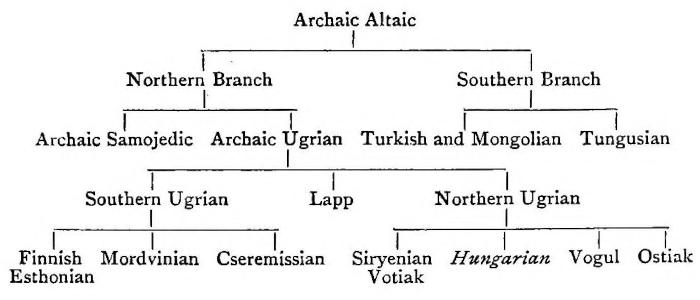
He says that Hungarian, together with
Vogul, Ostiak, Siryenian, Votiak, Lapp, Finnish,
Mordvin, and Cseremiss (spoken in the north and
north-east of Russia) form the Ugrian language-group.
This group is closely akin to four other
groups, viz., the Samojed; the Turkish or Tartar;
the Mongolian; and the Tungusian, or Mandchu
groups. These five large groups are called the
Altaic languages, and are all derived from an
original Altaic idiom. Their mutual relations are
shown in the following diagram taken from
Professor Simonyi’s work:
It will be seen that Hungarian is in near
relation to Finnish and also to Lapp, as had
been recognized already by the Jesuit John
Sajnovics (1770), and proved by the great
traveller, Anton Reguly. It is, however, also
related to Turkish; and this explains why the
leading neo-philologists of Hungary (Budenz,
Paul Hunfalvy, and Arminius Vámbéry) are,
the two former in favour of a Finnish, the
latter in favour of a Turkish origin and kinship
of both the Hungarians and their language.
Amongst the numerous students of that vexed
question, no one has done more to excite the
admiration of his compatriots and foreigners,
and the applause of scholars, than Alexander
Csoma de Kőrős, who sacrificed his life in the
monasteries of Thibet in the noble attempt
at discovering, by the laborious acquisition
of Central-Asiatic languages, the origin of the
Magyars. We confess that we entertain but
scant sympathy for the belief in races and racial
persistency. Wherever the Hungarians may have
come from, and whether or no every one living
Hungarian can trace his descent to one of the
clans invading Hungary at the close of the
ninth century is, in our opinion, immaterial. As
a matter of fact, very few Magyar noblemen can
trace their family beyond the year of the battle
of Mohács (1526). It is quite different with the
language of the Hungarians. Its origin and
character are, on the whole, pretty clear, and from
the knowledge of its relations to kindred idioms,
many a valuable conclusion may be drawn regarding
the rise and nature of Hungarian Literature
in the past and in the present. The greatest
patriot of Hungary, Count Stephen Széchenyi,
has tersely expressed the immense influence of
language on the nation in the words: “Language
carries the nation away with it.” Our whole
view of Hungarian Literature would be different
if for instance the opinion of erudite Matthew
Bél (Belius) as to the Hebrew origin of the
Hungarian language had proved to be true. It
would likewise essentially alter our conception of
Magyar literary works if the opinion of Podhorszky
as to the close relation between Hungarian
and Chinese would not have been found
untenable. But the physical origin of the Hungarians
themselves is, at best, only an idle
inquiry into insufficient records of the past.
CHAPTER V.
896-1520.
The history of Hungarian Literature is divided
into four distinct periods. The first comprises the
time from the advent of the Magyars in Hungary
to the Reformation (896-1520); the second, from
the Reformation to the peace of Szathmár, or
the termination and failure of Hungary’s revolt
from Austria (1520-1711); the third, from 1711
to 1772, or the period of stagnation; and finally
from 1772 to our own days, or the period of the
full development.
896-1520. The first period is exceedingly poor
in written remains of literature. In fact, the first
and thus the oldest literary relic of the Hungarian
language is a short “Funeral Sermon”
(Halotti Beszéd), dating from the first third of
the thirteenth century; and for 200 years after
that date, we meet, with the exception of a
Hungarian glossary of the year 1400, recently
discovered at Schlaegl, in Upper Austria, with
no example of a Hungarian literary work of
even slight extent. From the middle of the
fifteenth century we possess a fragment, called
after the town where it was discovered, by Dr.
Julius Zacher in 1862, the “Königsberg (in
Prussia) Fragment.” Thus, the number of extant,
or hitherto discovered Hungarian works of even
slight literary merit is, down to 1450 A.D., an
almost negligible quantity. Mr. Szilády in his
“Collection of Ancient Hungarian Poets” (Régi
Magyar Költők Tára) has indeed communicated
six and fifty mediæval Hungarian church-poems
and other fragments; but of that number scarcely
a dozen are original poems, the rest being mere
translations of the then current church-poetry.
The philologist may no doubt find much to
glean from even this scant harvest of Hungarian
Literature in the first period. For literature
proper, it is of no account whatever. Yet it
would be unfair to leave this period without
even a passing mention of its oral literature, or
epic and legendary stories, of which there must
have been no small quantity in those agitated
times.
The Hungarian naïve epic is lost. A glance at
the habits of the Finns will, however, suffice to
satisfy the inquirer that the Hungarians, like
their cousins in Russia, must have cultivated
the art of recitation and oral handing down of
the glorious deeds of their ancestors, to no
small extent. We now know that the immense
epic of the Finns, the Kalevala, has been transmitted
from generation to generation by bards
who had treasured up in their memories the
endless runot recording the deeds of Lemminkäinen,
Väinämöinen, and Jlmarinen. The
Hungarians, too, had their bards, called igrigeczek,
or hegedősök (violinists); and at the manors of
the nobles or the courts of the kings, old heroic
songs were recited about Attila, King of the
Huns; his brother, Bleda; the fearful battle on
the Catalaunian fields (Chalons-sur-Marne, 451
A.D.); the building of the castle of Buda; the
siege of Aquileia; and the last fatal wedding of
the terrible Hun. These Hun epics were widely
known and recited in mediæval Hungary, as
witnessed by the chronicles of those times. The
people firmly believed themselves to be the
successors of Attila’s hordes, and this belief,
although absolutely discountenanced by modern
historians, is still lingering in the spinning-halls
of Hungarian villages, and in lecture halls in
England and America.
The circle of those oral epics comprised also
the Magyar heroes proper. There were stories
about Álmos, father of Árpád, the conqueror of
Hungary; others about the “Seven Magyars”
(Hét Magyar); the conquest of Transylvania by
doughty Tuhutum, one of Árpád’s generals; the
flight of King Zalán, defeated by Árpád; the
exploits of valiant Botond, Lehel (the Hungarian
Roland), Bölscü, and other paladins of
Árpád’s times, etc. In the fragments from Priscus,
the Byzantine rhetorician and historian; in the
chronicles of Ekkehard, the monk of St. Gallen;
and in the “Anonymus,” or one of the chief, but
hitherto, fatherless chronicles of Hungary, the
above and some more heroic stories and epical
records may be found.
In addition to the heroic epic, the Hungarians,
like all the rest of the Christian nations of the
west, had a considerable tradition of legends and
lives of saints. Fortunately for Hungary, it had
become, by the end of the tenth century of our
era, both the hierarchical and political interest
of one of the most learned and most statesmanlike
of the popes, Sylvester II., to detach
Hungary completely from the Eastern, or Greek
Church; and to adopt it, by sending a royal
crown to Stephen, duke of the Hungarians, into
the world of Roman Catholicism. Had Hungary
joined the Eastern Church, it could never have
withstood the ambition and supremacy of the
German Emperors, aided by the Popes of Rome.
Having, however, adopted the Roman, or
progressive form of Christianity, Hungary was
endowed with occidental or richer seedlings of
civilization. St. Mary was made the patroness
of Hungary; and all through the Middle Ages,
she was adored and glorified in legends and
songs. Some of these Hungarian legends about
the Virgin Mary we still possess; likewise, the life
of St. Margit, the daughter of King Béla IV.;
the famous story of Josaphat and Barlaam, one
of the most popular of mediæval Christian
legends, taken originally from Indian (Buddhistic)
sources; the life of St. Catherine of Alexandria,
etc. The most characteristically Hungarian of
these legends is, as to its subject, the life of St.
Margit. As to its literary merits, it is, alas! a
dry chronicle without any charm of form or
diction at all. Nor did the Hungarians, as far
as we know, succeed in throwing one or another
of their crusading heroes into strong epic relief.
The crusaders, in spite of their marvellous deeds,
lent themselves far more to good chronicling
than to epics. Their inherent poetic vice of
being, or trying to be, saints rather than heroes
rendered them unfit for real epics.
CHAPTER VI.
1520-1711.
1520-1711. The Reformation made rapid
headway in Hungary. From the very beginning,
Protestantism in Hungary had a political element,
in that its rise was coeval with the
accession of the Catholic Austrian dynasty so
unwelcome to many Hungarians. Theological
and political opposition thus gave a more than
ordinary impetus to the study of all the
questions and problems agitated during the
Reformation. The most prominent result of
that movement was a revival of the national
feeling; and coupled with that, a regeneration
of Hungarian Literature. The vast intellectual
revolution of the fifteenth century, commonly
called the Renascence, had, of course, left its
traces in Hungary too. One of the most popular
of Magyar Kings, Matthew Corvinus (1458-1490),
invited a number of Italian scholars and artists
to Hungary, such as Anton Bonfini, of Ascoli
(1427-1503), Marzio Galeotto, of Narni, in Umbria
(1427(?)-1497), Peter Ranzanus, of Palermo;
Thaddeus Ugoletus, of Parma; Bartholinus
Fontius; Felix of Ragusa; etc.
These scholars and artists, ably assisted by the
Hungarian John Cesinge, or Janus Pannonius
(1432-1472), and chiefly by the generous and
refined king himself, brought some new leaven
into the stagnant intellectual life of Hungary. In
addition to the university founded by King
Lewis the Great, at Pécs (1367), a new university
was founded at Pozsony, where the Danube
enters Hungary; the king’s famous library (the
Corvina) became the delight of scholars; and a
printing press was established at Buda (1473).
The king’s victorious campaigns against the
Hussites (see Jósika’s novel, “The Bohemians
in Hungary”), the Turks and the Austrians,
gave rise to numerous poems and songs
composed by unknown poets; and his age,
called the Age of the Hunyadis, the king
being a Hunyadi, bade fair to be one of great
intellectual brilliancy too. However Matthew’s
premature death and the ensuing political troubles
put an end to such prospects. It was left for
the passions roused by the Reformation to kindle
the fire which the torch of the Renascence had
been unable to light. In all the countries where
the deep influence of the Renascence preceded
that of the Reformation, the intellectual capital
of the country was not impaired, even when its
political was. In Hungary, the Renascence left
too slender traces to guard the nation from
falling into lawless writing about the topics of
the day, regardless of the rules and classical
measure so deeply impressed by the Renascence
on the more fortunate nations of Italy, Spain,
France and England. Hence the immense mental
and emotional stir imparted by the Reformation
was not sufficient to raise up great writers in Hungary.
In fact, Hungary was, on a smaller scale,
in a mental condition exactly similar to that of
Germany. There too the Renascence had scarcely
begun to do its beneficial work, when the Reformation
swept everything before it. The consequence
was the same. Luther himself, although
one of the geniuses of language; Fischart, a very
demon of language; and Hutten, the great
champion of thought and liberty, together with
numerous minor lights, were, in spite of efforts
without number, debarred from creating a great
German national literature. It was only much
later, when the Renascence had done its work in
Germany too, that the Germans, following in the
wake of the Greeks, Romans, French, English,
Spanish and Italians, were able to create a great
national literature of their own. The same remark
holds good for Hungary too.
Protestantism in Hungary assumed all the aspects
it had taken in Germany and Switzerland.
There were Lutherans proper, and Calvinists;
Anabaptists and Unitarians. The Geneva of
Hungary was the town of the “cives,” Debreczen,
east of the middle Theiss, in a large plain.
Melius, or Peter Juhász (1536-1572) was the
“pope” of the Magyar Calvinists; as Matthew
Biró de Déva, 1500(?)-1545, was that of the
Lutherans. Both preached in Hungarian and
published a number of doctrinal and controversial
writings in Hungarian; and both were
followed by many a writer whose enthusiasm
was the better part of his ability. The Bible,
portions of which had been translated into Hungarian
before the Reformation, was now published
in Magyar in its entirety. This most excellent
translation, executed chiefly by Caspar Károlyi,
was printed at Vizsoly, in the county of
Abauj.
The number of Hungarian poets writing in Hungarian
during the sixteenth century is more than
one hundred; most of them being Protestants. In
the first years of the Reformation, their works
were mostly of a religious character, such as
psalms and prayers. Amongst these we may
mention the religious poems of Andreas Batizi,
Matthew Biró, and Gál Huszár. The constant
wars with the Turks or infidels added a peculiar
intensity to the religious passions of the time;
and accordingly the first Hungarian drama, “The
Marriage of Priests” (A papok házassága), published
in Cracow (then belonging to Poland) in
1550, and written by Michael Sztárai, was in reality
an exposition of Protestantism in the form of a
drama. “Moralities,” and mordant satires against
priests and the Catholic Church generally, were
frequent. Didactic poetry, so closely allied with
the moralizing spirit of early Protestantism, was
ably represented by Gabriel Pesti, whose translation
of Æsop’s “Fables” appeared in 1536 (in
Vienna); and by Caspar Heltai, who likewise
translated fables from ancient authors, 1566.
From the second half of the sixteenth century
we possess a great number of rhymed stories,
taken from the Bible, from foreign novels or
from Hungarian history. One of the most famous
of the authors of such stories was Sebastian
Tinódy, whose “Chronicle,” or poetical narrative of
contemporary events appeared in Kolozsvár, in
Transylvania, in 1554. As a poetical work it is
scarcely of any value, with the exception of the
music accompanying it. As a faithful picture
of the Hungary of that time it will continue
to be valuable to the patriot and historian.
The language is heavy; the form is unshapely.
In some respects superior to Tinódy were
Stephen Temesváry and Matthew Nagy de
Bánka; the latter being the bard of the great
John Hunyadi. One, Albert Gergei, of whose
personal circumstances nothing is known, composed,
chiefly from Italian sources, the story of a young
prince fighting innumerable foes and surmounting
difficulties of all sorts in search of the fairy whom
he, in the end, does not fail to win. This story
(“Argirius Királyfi”) has ever since the sixteenth
century been the most popular chap-book amongst
the lower classes in Hungary. Its naïveté and
good epic tone render it agreeable even to a more
cultured taste. Another poet of the second half
of the sixteenth century, Peter İlosvai, composed,
probably from the floating folk-poetry of his age,
a poetical narrative of the life of Nicolas Toldy,
one of the most popular heroes of the Magyars,
who lived in the fourteenth century, under King
Lewis the Great, and was of Herculean strength.
His feats are sung in İlosvai’s poem (published
at Debreczen in 1574) in an effective, if rough,
manner. A number of Magyar novels may also
be found; but nearly all were translations from
German or Latin novels of the time. The
sixteenth century produced even a few Magyar
works of historic and philologic character. John
Erdősi, or Sylvester, wrote the first grammar of
the Magyar language (1539); Gabriel Pesti gave,
in 1538, a short dictionary of the Magyar language;
John Decsi de Baranya published in 1588 a collection
of about 5,000 Magyar proverbs; Stephen
Székely de Bencéd and Caspar Heltai published
“World-Chronicles,” in 1559 and 1575 respectively.
Very many memoirs and journals of that time are
still unpublished.
We must now mention the greatest of all the
Hungarian poets of the sixteenth century, whose
name we have so far left unnoticed because, by
one of the strange freaks of life, the manuscripts
of his lyrical poems, on which rests his great
fame among Magyar poets, were first discovered
only twenty-four years ago (in 1874), and some
of them even after that date, and were therefore
never largely known to the contemporaries of
their author. This poet is Baron Valentin Balassi
(1551-1594). He came from a magnate family,
and so great were the gifts with which nature
had endowed him, that men praised him as a
model of heroism, and women worshipped him
as the embodiment of chivalrous charm. In the
troubles of his time, both political and social, he
took more than one part; and he may be considered
as at once the Knight Errant and the
Parsifal of Hungary in the latter half of the
sixteenth century. Highly cultivated and sensitive
as he was, he could not but respond to the
religious impulses of his time, and so became the
author of many a religious poem. On his wanderings,
which took him not only over the whole
of his own country, but even as far as North
Germany and probably also to England, he saw
all forms and aspects of life. His lyric sentiments
he embodied in the so-called “Flower Songs”
(“Virág-énekek”), which are full of that verve
and sweetness so characteristic of the best lyric
poets of Hungary. He also introduced a new
form of lyric stanza—the Balassi Stanza—which
consists of nine short lines, the end-rhymes of
which are the same in the third, sixth, and ninth
lines, while the remaining three couples, have
each their own rhymes.
CHAPTER VII.
1520-1711.
During the seventeenth century Hungary was
oppressed by two evils of apparently antagonistic
character; either of which, however, was to have
the same fatal effect on Hungarian Literature.
On the one hand, nearly two-thirds of Hungary
proper, as apart from Transylvania, was under
Turkish rule; on the other, the Habsburgs, then
at their apogee, waged a relentless war against
the liberties and independence of the Hungarians
both in non-Turkish Hungary and in Transylvania.
In the latter country, the Bocskays,
Bethlens, and Rákóczys had in succession contrived
to establish a Hungarian principate which,
although acknowledging Turkish ascendancy, yet
retained many of the rights of sovereignty.
These two sets of circumstances were in themselves
hurtful to the development of anything
relating to Hungarian nationality, and most of
all to Hungarian Literature. The counties under
Turkish rule could not, by the very nature of
the oppression under which they smarted, produce
any literary movement at all. The counties under
Austrian rule were held in bondage both political
and intellectual, which stifled all attempts at a
national literature. The sages have as yet not
been able to prove, that a republican government
must of necessity be beneficial to the material and
political welfare of a nation. As to the intellectual
progress of a nation, on the other hand, Liberty is
generally taken to be an indispensable condition.
Literature is possible only where there is at least
a republic of minds. The Austrian government
took good precautions to render the rise of such
a republic in Hungary an impossibility. All the
higher and middle schools in Austrian Hungary
were, during the seventeenth century, in the hands
of the Jesuits. The order of Jesus has not, as is
well known, prevented a very great number of
its members and pupils from rising to eminence
in Theology and in Science. It could not, owing
to its cosmopolitan and anti-national constitution,
further movements of national literature. Quite
apart from the debatable nature of its moral
and political teachings, it retarded or stopped
all such movements by employing in its schools
the Latin language as the vehicle of instruction.
At Nagyszombat (in 1635); at Kassa (in 1657);
at Buda (in 1687), the Jesuits founded, or taught
in, universities, where lectures on all branches of
knowledge were delivered in the mongrel language
of the mediæval Scholastics, which has always had
a baneful influence both on knowledge and its
students. In the Protestant schools, the number
of which exceeded seven hundred and fifty, the
same radically false system was observed. The
consequence was, that the vast majority of
Hungarians had never received a living knowledge
of either the history of Man or of Nature, and
could accordingly turn their dead intellectual
capital to no account. The only Hungarians
whose mental acquirements had sufficient vitality
to serve as stimulants to literary production of
a higher type were such as could read Italian or
French, that is, works, written in one, and thus
fertilizing another living language. Such exceptional
individuals could then be found only
amongst the wealthy classes, or in other words,
amongst the magnates. Thus it happened that
all great literary work in Hungarian produced
during the seventeenth century was done by the
great noblemen, and by them alone. Hungary
may therefore afford a fair test for the curious
problem, whether from an aristocracy of birth can
be recruited that aristocracy of genius the work
of which forms a nation’s great literature. In
Hungary, the aristocracy of birth proved, on the
whole, unequal to such a task. The Hungarian
magnates of the seventeenth century did much
creditable work in belles-lettres, and some also
in graver departments of literature. Yet, they
were unable to originate more than a temporary
and inferior reform; and, moreover, they did, as
we shall see, serious harm to the literary life of
the nation at large, in that they were not able to
engage its interests in the growth of its literature.
Of these magnates, the eloquent Cardinal
Primate of Hungary, Peter Pázmány (1570-1637),
Archbishop of Esztergom, claims our attention
first. In his thirteenth year he became a convert
to Catholicism, and later a Jesuit; and so intense
was his zeal for the Church of Rome, that most
of his active life was spent in a propaganda,
by writings even more than by words, for his
church, and with a constant literary warfare with
the non-Catholics of Hungary. He is said to
have converted no less than thirty of the noblest
families of his country to the Catholic persuasion.
At his time, perhaps the greatest number of
Protestants were in Transylvania, whose princes
were warm-hearted protectors of the Reformation;
and since they cultivated the Hungarian language
in preference to any other, Pázmány thought it
wise to use the same idiom in his controversial
writings. Pázmány’s theological armoury is taken
chiefly from the controversial works of his French
colleague and contemporary, the famous Jesuit
Bellarmin. In his style, however, he shows
considerable originality. He prefers the strong,
racy expressions, proverbs and similes of the
common people. His is a direct and vigorous,
rather than an artistic style. The strange contrast
between his popular vocabulary and the
scholastic fence of his thoughts lends a peculiar
flavour to his Hodegus or “Kalauz” (1613), and
his sermons (“Prédikácziók,” 1636). Among his
numerous Protestant opponents were: Peter
Alvinczi, of Kassa; and George Komáromi
Csipkés, of Debreczen; the latter translated the
whole Bible into Hungarian. As a sad contrast
to the splendid career of the convert Pázmány,
we may mention here the life-long sufferings
and wanderings of the loyal Protestant Albert
Molnár de Szencz (1574-1634), who was persecuted
wherever he came, in Germany, Austria, Hungary
or Transylvania; and who, one of the
true epigones of the Conrad Gesners and
Sylburgs, published, in the midst of poverty
and misery, Hungarian dictionaries; a valuable
Hungarian translation of the Psalms (1607, after
French models), which is in use to the present
day; a Hungarian Grammar (1610); and a
Hungarian translation of Calvin’s Institutio.
Finally, the gorgeous picture of the Cardinal
cannot be set off to more advantage, than by
a slight mention of the fanatic and obscure
Sabbatarians (“Szombatosok”), in the background,
whose religious poetry is no uninteresting evidence
of the Hungarian theological literature of that
time.
Amongst the numerous protégés and pupils of
the victorious archbishop we find also Count
Michael Zrinyi (1618-1664), a descendant of the
famous Zrinyi, who, in 1566, defied single-handed
the invasion of Sultan Soliman the Splendid, by
offering him, with a handful of men, unconquerable
resistance in the Castle of Szigeth, some
twenty miles west of Pécs. Count Michael was
one of the best educated men of his time, and
equally great as a patriot, poet and general.
The sad state of Hungary could not but affect
deeply a man, whose historic rôle seemed to be
clearly indicated by the glorious heroism of his
ancestor. Having travelled abroad, especially in
Italy, where Tasso’s religious epic Gerusalemme
liberata was read then more than ever after,
he conceived the idea of stirring up a vast
crusade against the Turks, by singing the deeds
of his great-grandfather in an epic at once
political and religious. This epic is commonly
called the “Zrinyiad” (“Zrinyiász”), and consists
of fifteen cantos, written in rugged and rough
style. It reveals much power of description and
religious enthusiasm; but it is lacking in form
and moderation; nor can the portraits of its
heroes be called plastic by any means. It is,
from the artistic standpoint, spoiled by the
deficiency above mentioned; the central hero is
too perfect to be lastingly interesting. Old
Zrinyi is capital matter for ballads; for an epic
he is too faultless. On the other hand, the
“Zrinyiad” is one of the most effective of
patriotic epics. Like the epic works of Klopstock
in Germany, or “Ossian” in England, it
had at the time of its appearance a great
national value, apart from its literary merits.
In telling the Hungarian nation in tones of
sacred anger, that the Turkish oppression was
due to the depravity of the Magyars, in exhorting
them in vigorous modes to rally and shake
off the yoke of the infidels, Zrinyi added an
internal lustre to his work which even now,
after more than two centuries, has not lost
much of its splendour. Like the daring and
glorious deed of his ancestor, his poem is more
of a patriotic than an historic event. It were
only gross exaggeration to count the “Zrinyiad”
amongst the world’s great epics. The poet might
well belie history in letting his ancestor personally
kill the great Sultan. It would be dishonest to
add to the glory of the poet by ignoring the truth
of the literary canon.
As to the other magnates who wrote poetical
works in Hungarian during the seventeenth
century, it will be sufficient to say, that their
poems were meant chiefly for the gratification
of their authors; and although some of them
were printed in book form, yet the bulk was
left in the well-deserved obscurity of family
archives. The most noteworthy of these poets
were: John Rimay de Rima (1564-1631), an
imitator of Balassi; Peter Beniczky de Benicze
(1606(?)-1664); Count Stephen Kohári (1649-1731);
Baroness Catherine Sidonia Petrőczi;
Count Peter Zichy; Count Valentin Balassi, the
second poet of that name (1626(?)-1684); and
Baron Ladislas Listhy (1630-1660(?)), whose epic,
“The Disaster of Mohács” (“Mohács veszedelme”),
betokens a remarkable talent for versification.
So exclusive was the influence of the magnates
on the literature of that time, that the one
remarkable poet of the seventeenth century who
was no magnate himself, although a nobleman,
selected as the subject of his epic poem a
romantic event from the life of one of the
leading magnates. Count Francis Wesselényi
besieged, in 1644, the Castle of Murány, defended
by the beautiful widow, Mary Szécsi. In the
end he won both the heart of the heroic beauty
and the castle. This famous event forms the
burden of one of the most popular of Hungarian
poetical narratives, briefly called, “The Venus of
Murány” (“Murányi Vénus”, 1664), written by
Stephen Gyöngyössi. Its language is musical,
and the narrative tone very felicitous. The poet
has evidently made a close study of Ovid,
and frequently reaches the light touch and charm
of the Roman; he even adds an element of
romance, which has endeared his work to more
than six generations of Hungarian readers. The
metre is Alexandrine.
CHAPTER VIII.
1520-1711.
Amidst the din and excitement of the endless
wars in Hungary, both civil and foreign, during
the seventeenth century, the agitated mind of the
common people vented itself in numerous ditties,
skits and lampoons, which, after the name of one
of the national parties, have been called Kurucz-poetry.
It consists almost exclusively of largely
unprinted little poems, mostly political, and depicts
the agonies and torments of the patriots. Some of
them are good and true in tone, and even powerful
in the expression of hatred and satire. The one
ever-memorable folk-poem of that time, however,
was not written in words. The profound passions
aroused by the last great revolution under the
romantic Francis Rákóczy II., towards the end
of the seventeenth and the beginning of the
eighteenth century, were incarnated in inimitable
fashion in the “Rákóczy march,” the most
fanaticising of all war-marches. Whoever actually
composed it (tradition ascribes it to a Hungarian
gipsy-woman by the name of Panna Czinka),
that march spells a whole period of Hungarian
history, just as Milton’s Paradise Lost spells a
whole period of English life. The Magyar
nation was at the end of the seventeenth century
far too unpractised in literary architecture
to rear its pangs and longings into a dome of
words. It was, however, then as now sufficiently
imbued with the power of musical creation, to
embody its woes in the fiery rhythms of the most
heroic of martial songs.
CHAPTER IX.
1520-1711.
During the period in question very little was
done for historic and scientific studies. John
Cséri de Apáca (1625-1660), an enthusiastic
student and patriot, published a small Hungarian
“Encyclopedia” (1655), in which the elements of
knowledge, both philologic, natural and mathematical
are given in a simple and clear manner.
Francis Páriz-Pápai published a much used
dictionary of the Hungarian and Latin languages
(1708). The nine books of the chronicle of John
Szalárdi, who died 1666 (“Siralmas Krónika”),
form the first attempt at historiography in the
Hungarian language. Some of the leading men
of that age left memoirs; and grammarians were
also not wanting. The great philosophic wave,
sweeping over Europe in the seventeenth century
(Bacon, Descartes, Spinoza, Leibniz, Pierre Bayle),
left scarcely any traces in Hungarian Literature,
except in Cséri’s Encyclopedia, where Cartesianism
is not quite absent.
CHAPTER X.
1711-1772.
1711-1772. The period bounded by the years
1711-1772 is one of decline. During these years,
which comprise the reigns of Emperor Charles
VI., and most of that of Austria’s greatest ruler,
Maria Theresa (1740-1780), there was practically
very little Magyar literature; and the little was
bad. Hungarians of that period wrote, as a rule,
in Latin; and the subjects they selected were
those of laborious erudition; philology; descriptive
natural science; annalistic history; historic
theology. This decline in national literature was
only another phase of the decline of the Magyar
idiom. For, both in Transylvania, which was
now again, as formerly, united with Hungary,
and in Hungary proper, the Hungarian language
ceased to be used in the schools, at the county-sessions,
in the law-courts, and in polite society.
In all these centres of intellectual intercourse,
Latin, German or French were used instead of
the sonorous language of Árpád. In Catholic
and Protestant schools alike instruction was
given in bad Latin. At the county-sessions; in
the national parliament; and in the law-courts,
Latin alone was used; while the higher classes
of society were talking either in German or in
French. For the latter fact, there is a simple
explanation at hand. When, in 1711, Hungary
was at last “pacified,” it had become evident to
the most patriotic of the leading families, that
further armed resistance to the Habsburgs being
impossible, the only chances of promotion for their
children were at the court of Vienna. This
involved the adoption of Viennese manners, and
Viennese mediums of conversation; that is, of
French and German. No sooner was that done
by the aristocratic families of Hungary, than the
abnormal state of the then national literature
revealed all its latent barrenness. As has been
seen in the preceding chapters, all the great
Hungarian writers from 1600 to 1711 were recruited
from the class of the magnates. When,
now, after 1711, the magnates flocked to Vienna,
there to undergo a thorough process of Germanization,
or rather Austrianization, there was no
class of writers left in Hungary to take their
place. Hence the sudden dearth of great writers,
and the astounding decline of Hungarian Literature.
To this must be added the fact, that
German literature which was naturally destined
to have a considerable influence on Hungarian
writers, both from geographical contiguity, and
on account of the general knowledge of German
in the then Hungary; that German literature, we
say, was not beginning to reach its classical period
before the sixties of that century, and could
therefore stimulate Hungarian Literature but very
little. It is much more difficult to account for
the exclusive use of Latin in the schools and in
parliamentary debates. Had the use of Latin in
the schools been accompanied by the study of
Greek and Greek literature it would probably
have wrought very much less mischief.
Unfortunately for Hungarian Literature, the
study of Greek was almost entirely neglected
in the last century. Graeca non leguntur. The
immense power of æsthetic education inherent in
Greek classical works could thus not benefit the
Hungarians. Nay, it may be said in strict truth,
that for Hungarians, naturally inclined as they
are to grandiloquence and redundancy, both of
words and thought, the study of Latin literature,
untempered by that of Greek, was in many ways
harmful. Many Latin poets and prose-writers
lack that simplicity and moderation, which mark
off Hellenic authors from all but the very best
writers of all ages. The exclusive study of Latin
was therefore doubly harmful to the Hungarians:
first, in that it made them neglect their own
language; and secondly, in that it supplanted
the study of Greek literature. The exclusive
use of Latin in all the schools and colleges of
Hungary during the last century was, however,
part of that general obscurantism weighing on
all the educational institutions of the Habsburg
empire. Both Charles VI. and Maria Theresa
left the instruction of youths in the hands of
monks and priests. Previous to the abolition of
the order of the Jesuits (1773) that order had no
less than thirty “gymnasia,” or higher colleges
in Hungary. After its abolition, these colleges
were placed in the hands of other orders, such
as the Præmonstratencians, the Benedictines, Paulists
and Franciscans. As in Austria, so in
Hungary, the regular clergy, more still than the
secular, attempted to shut off their pupils from
the new light rising in France, England and
Germany, and for that purpose the habitual use
of scholastic Latin was one of the most efficient
means. At the Protestant schools, of which the
most famous were at Debreczen, at Sárospatak,
and at Pozsony, in Hungary proper; and at
Nagy Enyed, Kolosvár, Marosvásárhely, and at
Udvarhely, in Transylvania, instruction was
likewise given in Latin. Nor can it be seriously
maintained that the Protestant teachers were
more prone to let in the new light than were
the Catholic.
CHAPTER XI.
1711-1772.
In poetry proper, it is for the present period
customary, but scarcely necessary, to mention the
Jesuit Francis Faludi (1704-1779), who has put
some wise saws and moral platitudes into light
verse; and Baron Ladislas Amadé (1703-1764),
whose not unmelodious lyrics were sufficient to
give the successful courtier a mild reputation as
an interesting poet. In dramatic poetry there is
nothing worth mentioning. The Jesuits occasionally
had their pupils play a patriotic or religious
drama made ad hoc, and good pro tunc. Of prose-writers
there is one, and one only, whose “Letters”
written from Turkey, where he was in exile, have
abiding literary value. This was Clement Mikes
(1690-1761), who was brought up by Prince
Rákóczy, to whom he proved constant under all
circumstances, and for this reason Mikes still
belongs to the generation of Hungarian nobles
who cultivated their language with the pride of
true patriots. The “Letters” are not only full of
historic interest, especially with regard to the
interior condition of the then still mighty Turkish
empire, but also as specimens of pure, idiomatic
and well-balanced Hungarian prose.
The remarkable works in History, Theology or
Science of that period were, as noticed, written in
Latin. Of learned works written in Hungarian
the two best were by men who had spent their
youth in the preceding century, and were thus less
afflicted with the gangrene of the decadence of
the period from 1711 to 1772; Michael Cserei
(1668-1756), and Peter Apor (1676-1752), both of
very great nobility. Cserei wrote a “Transylvanian
History” (“Erdélyi Historia”), in which the events
from 1661 to 1711 are told in a lively, naïve and
pleasing style. Apor is the author of a remarkable
work on the history of the manners, customs, and
institutions of ancient Transylvania. It is entitled
“Metamorphosis Transylvaniae,” and its object is
to show, by contrast, how low the country had
sunk from its former glory. His satire is not
infrequently both scathing and well-expressed.
The bent for erudite laboriousness gave rise to
several works on the history of Hungarian Literature.
The still-life of the small town of Bártfa in
the county of Sáros must have hung heavily on the
hands of David Czwittinger, one of the lawyers of
that town, who published, in 1711, a dry list of
Hungarian writers, in alphabetical order. He was
distanced by the indefatigable and patriotic Peter
Bod (1712-1769), who had, like so many Protestants,
spent several years at Dutch universities,
where he amassed much polyhistoric knowledge
and a good library. There, no doubt, he also
acquired the taste for literary history, and in his
“Hungarian Athenæum” (“Magyar Athénás”, 1766)
he collected much material bearing on the lives
and works of no less than six hundred Hungarian
authors. In Law or Philosophy there appeared,
during this period, no work in Hungarian claiming
our attention.
CHAPTER XII.
1772-1825.
1772-1825. After a period of decadence, lasting
for over sixty years, Hungarian Literature was again
brought to a state of revival and progress, which
has gone on almost uninterruptedly to the present
day. This revival is part of an immense revolution
which swept over most countries of continental
Europe in the second half of the last
century. The most conspicuous and best known
event of this Modern Renascence is the series of
terrific upheavals and wars commonly called the
French Revolution. It is, however, quite evident
that the French Revolution was only the politic
aspect of a vast movement, which in many
countries outside France assumed the garb of
intellectual revolutions. Thus the mental achievements
that, in their totality, are called the
“classical period” of German literature (1750-1805)
are in the domain of Thought and Sentiment,
a revolution no less colossal and far-reaching
than were the ever-memorable proceedings
of the French assemblées, or the bloody epics of
the Revolutionary campaigns. Both were gigantic
onslaughts against the Ancien Régime in institutions,
manners, thought and sentiment. Accordingly,
the course of both revolutions was—making
due allowance for externals—essentially the same.
As the French Revolution landed in, or rather
was brought to its final consummation in the
titanic and all-embracing personality of Napoleon,
so German literature met its final trysting-place
and culmination in the orchestral mind of Goethe.
The minor nations of Europe were seized by the
same Revolution, if in a manner considerably less
intense. The very aggressiveness of the French
Revolution, its encroachments on the territories
of Italy, Switzerland, Germany and Austria, prevented
those minor nations from enacting their
Revolution at once in its intellectual and political
aspects. While fighting the French, they were all
engaged in following them on the lines of the
Revolution, first (1790-1830) for intellectual freedom;
and then, after the defeat of the French
armies (1830-1848), for the very political ideals
that the French had been the first to proclaim.
For, this was the immense advantage of the
French over the other nations on the continent:
they had brought their intellectual revolution
through men like Turgot, d’Alembert, Diderot,
Voltaire, Rousseau, etc., to maturity, before they
started for their crusade of politic liberty; whereas
the other nations were a generation or two behind-hand,
and still in the throes of their intellectual
renascence.
This is not the place for a laborious inquiry into
the causes of that immense Revolution which has,
towards the end of the last, and in the first five
decades of the present century, completely altered
the face of European civilization. It is nevertheless
necessary to give some account of such causes
as were instrumental in ripening the intellectual
aspect of that Revolution in Hungary. Among
the leading causes was a structural change in the
population of Hungary on the one hand, and the
reaction against the provocative and anti-national
measures of the Habsburgs on the other.
Up to the sixties of the last century, the
population of Hungary consisted practically of
(1) a rural population, comprising both magnates,
noblemen and peasants; and (2) a small urban
population, comprising largely foreign or Germanized
craftsmen and tradespeople. Under such
circumstances, literature, which is pre-eminently
an urban growth, could not develop. For, not
only was the urban population too small and too
much immersed in material pursuits, but the only
intellectual class, viz., the aristocracy, was living in
the country, that is, in an atmosphere unfavourable
to continuous literary efforts. By the end of the
sixties, however, the structural change, above
indicated, took place. Owing to a series of
measures issued by Maria Theresa and Joseph II.,
the rural population of Hungary was liberated
from its most odious fetters. Bondage, and a sort
of serfdom (jobbágyság), with all its concomitant
evils were almost abolished. Numerous rural
families left their obscure abodes, repaired to the
towns, and urban life, for the first time in Hungarian
history, was raised above the low level on
which it had been vegetating for centuries. With
the increase of urban population came an increase
of wealth and comfort; a greater activity in commerce,
both mercantile and social. Many a gifted
Hungarian, who would have previously spent his
days in the obscurity of his county, now willingly
lived in one of the rising towns. With an accelerated
speed of work came a more rapid appreciation
of talent, and a greater number of authors.
The influx of the rural population to the town
facilitated that mutual action and reaction between
Nature and Man, which, in one form or other, is
the main spring of literature. In England, too,
the great period of Shakespeare was preceded by a
similar structural change in the population. The
dissolution of the monasteries and the numerous
enclosures of commons, depriving as they did,
hundreds of thousands of rural people of their
means of livelihood, drove them into the towns,
which rapidly ozonified that atmosphere of great
intellectual stir, without which no great writers
are possible. In Germany, too, the period of
Lessing, Schiller, and Goethe was preceded by a
new influx of the rural population into the towns
devastated by the thirty years’ war. Nor can it
be doubted that Italy, in possession of highly-organized
and rich towns long before any other
mediæval nation, took, for this very reason, the
lead in all literary matters.
This broad fact of Hungarian history (totally
neglected by the historians of Hungary, probably
because of its very broadness), must therefore be
considered as the prime mover in the revival of
Hungarian Literature. It created that mysterious
propelling power which in times of progress everybody
feels and nobody can account for. It was
the latent and constant stimulus to renewed mental
labour, and to keener delight in it. Like great
rivers it was swelled by smaller affluents of causes.
Thus that great structural change in nearly all
parts of Hungary was accompanied by two
structural changes in limited layers of Hungarian
society. Maria Theresa, probably with a view of
carrying Austrianization into the very hearts of the
Hungarian nobles had, in 1760, established the
famous Hungarian Guard in Vienna. Each county
in Hungary was to send up a few young noblemen
to Vienna, where they were clad in sumptuous
style, and treated with all the seductive arts of a
refined court. Thus a considerable number of
Hungarian noblemen were given an opportunity
for that higher education and refinement, which in
former times had been the privilege of the select
few. Vienna was in many ways a centre of
Franco-German civilization, and the young Magyar
noblemen derived, from a lengthy stay in the
Austrian capital, a benefit similar to that for which
English gentlemen flocked to Paris in the thirteenth
and seventeenth century. This then, constituted
one of the minor changes in the intellectual development
of one class of Hungarians. There was also
another change. Joseph II., in dissolving over
a third of the existing monasteries, and a great
number of monastic orders too, set free a number
of educated men, who would have otherwise led a
sterile life in the lonely cells of their monasteries.
They now began to devote their unexpected
leisure to pursuits of a different kind; and some
amongst them became workers in the field of
literature. Thus a new source of literary production
was opened up.
To these structural changes in the population of
Hungary, that is, to the home and internal cause
of a potential revival, now came the external
agency of those anti-national measures against
Hungarian institutions, which Maria Theresa, with
fine womanly tact, had used in a tentative manner,
but which were applied by Joseph II. in the most
reckless and irritating fashion. Joseph had one
ideal: the homogeneous Austrian state. Like all
ideals it was unrealisable. It was worse than that:
it was suicidal. The Austrian empire has its very
raison d’être in the heterogeneity of its constituent
parts. To level down the Austrian “lands” to one
and the same pattern, is to deprive them of all
vitality. They live by contrast to one another.
Unable to be quite independent each by itself,
they would, if unconnected by some common tie,
only serve to aggrandize either Prussia, Russia or
Italy, and so upset the balance of Europe in a
fatal manner. United by the dynastic tie, they
form an imposing, if incongruous whole, the component
parts still retaining very much of a strong
individuality. Any attempt at forcing them into
blank uniformity must needs be answered by a still
stronger attempt on their part to rend the dynastic
tie asunder. The various provinces have, since
1648, and with respect to Hungary, since 1711,
made no civil war on one another. Not one of
them had, as had Prussia in Germany since
Frederick II.’s time, or England since Cromwell’s
time, the supremacy over the rest. Their sole
union and bond was in their common dynasty.
To try to reduce them to one and the same level,
as Joseph II. did, was both the worst dynastic
and national policy imaginable. The Austrian
provinces, then or now, if reduced to complete
uniformity, will first of all abolish the dynasty—as
superfluous. In the egalitarian ordinances of
Joseph II. there was so much that was subversive
of the very pillars and coping-stones of the whole
Austrian edifice, that the Hungarians, as well as
all the other nationalities under his rule (Belgians,
Czechs, Poles, etc.), forthwith rose in a body in
defence of their privileges, charters, rights; in fact,
of their existence severally and collectively. The
Emperor wanted to abolish the Hungarian language,
Hungarian institutions, Hungarian society.
At once the Hungarians, who had then almost
entirely neglected their language, learned to regard
it as the chief palladium of their nationality.
Hungarian periodicals were started; such as
the “Magyar Múzsa” (since 1787); “Magyar
Múzeum” (since 1788, in Kassa); “Mindenes
Gyűjtemény” (since 1789); “Orpheus” (since 1790,
edited by Kazinczy); “Urania” (since 1794, edited
by Kármán), etc. Hungarian actors were encouraged;
Hungarian literary societies were started,
the oldest being that founded by John Kis, at
Sopron, in 1790. These efforts were immeasurably
increased in efficiency by the publication of very
numerous Magyar works in nearly all genres of
literature, and in styles and “schools” of great
divergency. The members of the Guard naturally
proceeded on French lines, taking the great
French writers, and chiefly Voltaire, as their model.
The foremost members of the new urban element,
which also included many an unfrocked monk,
coming as they did from the country where the
Magyar language and folk-poetry had never died
out, and where the national pulse beat strongest,
proceeded on national lines. The older country-gentry,
and numerous released monks, conversant
above all with Latin literature, proclaimed the
classical metres and forms as the only safeguard
and aim of literature; while another section of the
new urban element followed in the wake of the
Germans, whose classical writers were just then at
the height of their fame. This great divergence of
schools was in itself proof of the definite revival of
Hungarian Literature. In the spiritual republic, no
less than in the political, parties are of the very
essence of vigorous life. By the end of the last
century there could have no longer been any doubt
about the strong vitality of Hungarian Literature.
CHAPTER XIII.
1772-1825.
The first of these “schools” to publish serious
works with the intention of reforming the literature
of Hungary, were the members of the Hungarian
Guard at Vienna, and chiefly George Bessenyei
(1747-1811).[2] In 1772 he published a tragedy,
entitled “Agis” (“Agis tragédiája”) in which he
attempted to give, within the strict rules of the
Franco-Aristotelean tri-unity of time, place and
action, a model for his contemporaries. In point
of language, Agis is not without some merits;
as a dramatic work it has long been regarded as a
failure. Bessenyei was more successful in his
comedies (“Philosophus,” etc.), in which he even
contrived to create a type, Pontyi, representing the
narrow-minded, ultra-conservative country-squire
of his time. His style is held to be much better
still in his prose works containing philosophical
essays after the rationalistic fashion of his epoch.
Amongst the numerous colleagues and literary
followers of Bessenyei were: Abraham Barcsai
(1742-1806), Alexander Báróczi (1735-1809), who
excelled chiefly in translations from the French;
Ladislas Baranyi, Joseph Naláczi, Bessenyei’s own
brother, Alexander, who tried his hand at Milton’s
“Paradise Lost,” etc. To the Bessenyei circle
(“Bessenyei György társasága”) belonged also
Paul Ányos (1756-1784), in whose mournful and
sentimental poems there are many traces of
genuine poetry. Nor must Joseph Péczeli be
forgotten (1750-1792), who through his numerous
translations from French and English works
(Edward Young’s “Night Thoughts”) and his
“Fables” (“Mesék”) deserved highly of Hungarian
Literature.
The next in time and merit was the school of
the Classicists, or more properly speaking, Latinists.
The first four remarkable members of that school
were all unfrocked priests. Baróti David Szabó
(1739-1819), and Joseph Rajnis (Reinisch) were
ex-Jesuits; Nicolas Révai (1750-1807) was a
Piarist, and Benedictus Virág (1752(?)-1830) an
ex-Paulist. The circumstances of their mental
development above indicated led them naturally
to an imitation of the Latin poets; and Virág in
Hungary, like Ramler in Germany, or Cowley
in England, was held to be one of the numerous
“Horaces,” in whom the nascent literatures of
Europe were happily so rich. In ripe mellowness
of formal beauty and musical ring Virág cannot,
we are afraid, be said to have seriously challenged
the laurels of the friend of Augustus. His Works
(Poétai Munkák, 1799) are, on the other hand,
inspired by a noble glow of patriotism, which
might have added some lustre to the poems
even of Flaccus. Virág translated Horace into
Hungarian, as Baróti had done with the Aeneid.
The poetical works of the other two ex-priests
were of an inferior kind.
To the above two schools now was added the
third; the national or genuinely Magyar school.
The two former laid special stress on purity and
perfection of form, both external and internal. In
fact, the classicists came near sacrificing everything
else to correctness of form. In this they were
partly justified, partly supported by the peculiar
adaptability of the Hungarian language to the
most complicated of classic metres. Hexameters
or alcaics are just as natural to Hungarian, as
they are to Greek and Latin; and infinitely more
so than to any other Indo-German language of
Europe. The classicists, and especially the
greatest of them, Berzsenyi—see below—were able
to handle the most national and intimate subjects
in the most foreign of verse-forms, and with perfect
ease too. This seemed to go far in convincing
many writers, that classical forms were the only
ones to adopt, and classical models the only ones
to follow. The prosodic wealth of the Hungarian
language is, however, not exhausted by its classic
metres by far. From time immemorial Hungarian
poetry was wedded to Hungarian music, and the
latter, with its pointed rhythms and sudden irruptions
of cadences, was quite unfitted for the stately
calm of antique metres. In German classical
music, classical metres, such as the hexameter or
the alcaic may be, and have been employed. In
Hungarian music they are out of place altogether.
Here, then, was the inner justification of the
“Magyar” school. Its members strongly and
rightly felt, that in the cult of antique prosody
the classicists had overstepped the bounds; that
Hungarian poetry needed forms and moulds other
than those of Virgil or Horace; and that the
short cross-rhymed stanza was to Hungarian
Literature, what the violin and the “czimbalom”
(dulcimer) were to Hungarian music. It is impossible
to play Hungarian music on the organ.
Of the Magyar school was Ádám Horváth
(1760-1820), who in addition to an epic called
“Hunnias” (1787), in which he tried to sing
the exploits of John Hunyadi after the battle
of Varna (1444), published a number of simple
poems in the style of the folk-poetry of the
Hungarian peasants. By refining the prosody of
that genre he introduced it into the literary world.
The most successful of the Magyarists was Count
Joseph Gvadányi (1725-1801), whose “A Village
Notary’s Travel to Buda” (“Egy falusi nótárius
budai utazása,” 1790), was a felicitous attempt to
expose, in the form of a novel in verse, the utter
decadence and denationalization of the town-people
and the gentry of the middle of the last century.
The “notary” has survived as a type. Gvadányi’s
other novels are on the same lines, all of them
being animated by a resolute patriotism. He was
followed by Andreas Dugonics (1740-1818), an
ex-Piarist, whose “Etelka” a novel (1788) became
very popular, chiefly owing to its strongly accentuated
patriotism and anti-Austrian feeling, and also
to the racy, popular language he used. He also
compiled a valuable collection of Hungarian
proverbs and apophthegms (“Magyar példabeszédek
és jeles mondások”). The number of writers
belonging to the Magyar school in the two last
decades of the eighteenth century is considerable.
They all excel in patriotic verve, and much of the
anonymous work done at that time for the restoration
of Hungarian Literature is due to them. We
cannot here give more than a list of a few names.
John Kónyi, Stephán Gáti, Francis Nagy, the first
Hungarian translator of the Iliad, and Joachim
Szekér, who did much for the bettering of female
education in Hungary. Separate mention must
be made of a number of Magyarist poet-naturalists
whose centre was the city of Debreczen, and
amongst whom were John Földi (1755-1801), who
wrote some remarkable works on Hungarian
prosody in its relation to music; and Michael
Fazekas, whose “Ludas Matyi,” a chap-book
written in the interests of the peasants, has long
been one of the most popular comic stories. Nor
were the usual excrescences of the juvenile epoch
of a new language wanting. A limited class of
now obscure writers (Gregory Édes, John Varjas,
etc.), abused the great flexibility of the Hungarian
language in verse-forms and metres of the most
absurd kind. They were the caricaturists of the
rapidly growing Magyar idiom.
CHAPTER XIV.
1772-1825.
The formation of different schools of literature
was of great benefit to the growth and advance
of Hungarian poetry and prose. Many a minor
talent could and did, by clinging to and being
supported by a “school,” steady his work. After
the lapse of some time, however, the exclusiveness
of “schools” would have done great harm to the
higher development of Hungarian Literature. By
1795 more than schools and literary guilds was
needed. The nation wanted powerful individualities
who were, so to speak, schools themselves.
Fortunately for the cause of the Hungarian
intellect, such men did arise in time. The first
of them was Francis Verseghy (1757-1822).
An ex-Piarist, and involved in the conspiracy
of Martinovics: he had gone through the
experiences of a priest, a politician and a
state-prisoner. His poetical works, which are
very numerous, manifest a tender, yet strong
mind, much ease of form, and a power of
satire. He translated the Marseillaise into Hungarian.
He is at his best in short poems.
What raises him above most of his predecessors
is his considerable independence as a poet. He
clings slavishly to no school, and succeeds in
combining some of the excellencies of all. In
genius he was far excelled by tempestuous John
Bacsányi (1763-1845), who espoused the cause
of the French Revolution, did some work for
Napoleon, and was in 1814 taken back to
Austria, where he died an exile. He brought
Ossian’s poems to Hungary; and in his fierce
poems all the fire of the revolutionary fever
may be felt. Yet with all that he could reduce
to fine proportions and to efficiency neither his
life nor his work. In the melancholy and sweet
poems of the ex-priest, Gabriel Dayka (1768-1796),
the Hungarian Hölty, which have to the present
day lost nothing of their Wordsworth-like delicacy,
we have the first instalment of those mournful
largos, in which Hungarian Literature is as rich
as is Hungarian music.
These three writers were as the forerunners
of literary individualities of a much higher
type. The first of them was Joseph Kármán
(1769-1795). He too spent some time in Vienna,
where then centred the political and social life
of a large portion of Europe. Like so many
more Hungarians, he burst into enthusiasm for his
country by staying and living amongst a foreign
people who, in the nobler traits of character,
were decidedly inferior to the Magyars, and
who yet were considered to be their rulers. The
people of Austria, and especially the Viennese,
are utterly different from the Hungarians. Their
love of the burlesque, of the grotesquely funny,
of the clownish, stood out then, as it still largely
does, in sharp contrast to the dignified gravity
of the Magyars. To be considered as subject
to people so very much less adapted for the
functions of government than themselves, was
at all times galling to the Hungarians; and
perhaps never more so, than in the nineties of
the last century, when a mighty wave of
opposition to the Habsburgs was sweeping over
Hungary. Kármán’s was a most sensitive soul.
He fully realized that to render Hungarian
Literature more perfect and independent was
first of all a great political deed. He keenly
felt, that Hungary, unless emancipated intellectually,
must fall a victim to the then immense
ascendancy of Austria. Every good poem, every
good novel, written by a Hungarian in the
language of his country, was then of more
service to Hungary than all the proceedings at
the national assemblies. Kármán, despite his
extreme youth, at once set to work. He
proclaimed that Pesth ought to be the literary
centre of Hungary. He started a quarterly
(“Urania”), and hastened to write his “Memoirs
of Fanny” (“Fanni hagyományai”). The latter
is a novel in the form of letters and leaves
from a diary. Fanny, the heroine, loves with
all the inconsiderate passion of a young girl,
a young man, whom she is not allowed to
marry. She dies of a broken heart in the
arms of her lover. The plot of the novel is
of the simplest. The excessive sentimentality
of the heroine, who is, as it were, drowned in
the floods of her own feelings, is to our present
taste somewhat overdone. With all these shortcomings,
however, Kármán has poured over his
little story so much of the golden light of fine,
unaffected style, and has enriched it with so
many touches of the most effective descriptions
of scenery, that “Fanny” will always rank
among the foremost of the literary products of
the kind, of which Goethe’s “Werther” is the
most famous.
The second great poet was Michael Vitéz
Csokonai (1773-1805). Born at Debreczen, a town
whose famous fairs brought together annually
an immense concourse of the agricultural and
trading people of Hungary, Csokonai was at an
early age imbued with the riches of the gallery
of types for which his country has always been
so remarkable. Although at all periods of his
irregular and vagrant life Csokonai kept in close
touch with books, Bürger amongst the Germans,
Pope amongst the English, and Metastasio
amongst the Italians, being his favourites; yet
the real source of his surprising fertility of
invention, and surety of draughtsmanship was
laid in his constant contact with the people
itself. His proud and independent character,
the ruggedness of which was not rendered less
objectionable by an independent fortune, drove
him from post to post. As a roving poet he
visited most of the counties, making friends
everywhere, protectors and helpers nowhere; and
when he finally returned to his old mother’s
house, his health was irretrievably shattered by
poverty, privations and occasional excesses. He
is a great poet. His language is full of savour
and truly Magyar. He has abundant and merciful
humour, without lacking wit. Frequently
he soars to philosophical heights of thought,
where, like the eagle, he broods alone. In his
lyrical poetry there is much of the rhapsodic
frenzy, which was to make Hungary’s greatest
poet, Petőfi, as unique in poetry, as Liszt is in
music. Csokonai’s most famous poem is a comic
epic, somewhat in the style of the Rape of the
Lock, called “Dorottya,” or the Triumph of the
Ladies at the Carnival (“A dámák diadalma a
farsangon”), in four parts. It narrates the
warfare of the ladies of a small town, under the
leadership of an old maid (Dorottya), with the
men of the same place. The women complain
of the shortness of the carnival, of the rarity of
weddings, etc., and attempt to steal the registers
of births compromising to many of them. In the
end, the women fall out amongst themselves,
Venus steps in, rejuvenating Dorottya, and
making peace by marrying the contending
parties to each other. The tone of that comic
epic is throughout one of genuine mirth, and
the language forms a fit drapery of the fleeting
scenes of this charming carnival. The types
stand out with great plasticity, and in this
respect at least, Csokonai’s Dorottya need fear
no comparison with Pope’s masterpiece. The
critics of his time did not recognize Csokonai’s
greatness; and his townsmen, nearly all of them
rigid Calvinists, did not think much of a poet
in whose stanzas wine flowed abundantly, and
love was rampant in forms at times unrestrained.
When, therefore, some years after the poet’s
death, admirers of his wanted to have his statue
erected at Debreczen, and the words, “I too
lived in Arcadia” engraved upon it, the good
burghers of Debreczen violently opposed the
suggestion. For, as if trying to give the
departed poet exquisite material for another
comic epic, they alleged, that by “Arcadia,” was
meant, as they had learned, a country with
good pasture, especially for donkeys; and since
they solemnly protested against being considered
donkeys, etc., etc. From this incident followed
the so-called Arcadian lawsuit (“arkádiai pör”).
CHAPTER XV.
1772-1825.
In the literature of all civilized nations we meet
with certain writers, whose great effect on their
contemporaries was owing less to the absolute
excellency of single works of theirs, than to the
general tone and power of suggestion inherent in
all their individuality. Such are, in England, Dr.
Johnson and Thomas Carlyle; in France, Diderot
and Renan; in Germany, Hamann and Herder.
Without being creative geniuses, they influence
their time as if they were such. One does so by
the brilliancy of his talk, like Johnson; the other
by pamphlets or essays de omni re scibili, like
Herder; a third by boldly attempting to rear a
new intellectual world in the place of the fabric of
old literature and knowledge, like Diderot. The
merit of such men is immense, yet relative. They
deserve more highly of literary men, than of literature.
They spread interest in or taste for good
literature. They are critical, not constructive; and
so decidedly preparatory and temporary is their
work, that in the whole range of the world’s
literature there has so far been one man, and one
alone, whose genius shone equally in this preparatory
or critical work, and in the still more precious
work of positive creativeness too. That man was
Lessing. In him the critical faculty did not
seriously impair the creative; and he rendered
immense services to German literature both by
what he destroyed, by what he suggested and by
what he created.
Hungarian Literature was fortunate enough to
find one of those initiators and suggestive stimulators
during the period of its great revival, in the
person of Francis Kazinczy (1759-1831). His
work has frequently been compared to that of
Lessing. No greater injustice could be done to
Kazinczy. To compare him to the author of
“Laokoon,” “Emilia Galotti,” and “Anti-Goetze,”
is to render him much smaller than he really was.
Without being a Lessing by far, he had a very
considerable and beneficial influence on Hungarian
writers, many of them greater than he. He was
the son of a well-to-do gentleman of the county of
Bihar, which has a population of both Magyars
and Roumanians, and does not therefore belong to
the counties where the purely Magyar spirit is
permeating all the phases of life. To this circumstance,
no less than to his education, must be
ascribed Kazinczy’s little sympathy with the
strongly Magyar and nationalist aspirations of the
Debreczen school. His youth he spent chiefly in
North Hungary, where the study of German
literature was then rife in the better circles of
society. Having acquired a competent knowledge
of German, French and English, he poured forth,
since 1791, numerous, most carefully composed
translations from Shakespeare (Hamlet), Goethe,
Molière, Klopstock, Herder, Lessing, etc. From
1794 to 1801 he was kept in various state prisons,
for having been, as was alleged, implicated in the
conspiracy of Martinovics. This terrible experience
left no particular traces either on his mind
or on his character. Subsequently, as previously,
nay during his imprisonment, he was busy with
the elaboration of essays, critical, historical, or
novelistic, all of which had two distinct aims: first—to
reform the Hungarian literary language, by the
introduction of new words and especially new
idioms; secondly, to reform Hungarian Literature
by modelling it after the standard of Greek masterpieces.
Both lines of reform were in the right
direction. The Hungarian language was in
Kazinczy’s youth still far from developed. Its
vocabulary was limited mostly to the designation
of things material, and quite fallow for the
production of terms expressing things abstract or
æsthetic. It resembled a country in which there
is abundant currency in the shape of small coin;
it lacked gold coins and bank-notes of great value.
Yet like Hungary itself, its language was replete
with gold-mines. In the rich and racy vocabulary
of the common people there was both overt
material and abundant hints for material hidden
under the surface. Kazinczy, instead of taking
these hints—instead of coining his new terms and
idioms from the language of the common people,
as he ought to have done, preferred to coin them
according to standards taken from the western
languages of Europe. In this he was grievously
mistaken. There are unfortunately very few, if
any, true dialects of the Hungarian language.
This, the greatest drawback to Magyar writers,
as the reverse of this deficiency is the greatest
advantage to the writers of Germany, France,
Italy or England, was rendered very much more
harmful by Kazinczy, in that he totally neglected
the few dialectic features together with the
common household language of the people. In
his efforts to enrich the language he thus could
not but obtain results of an inferior type. His
syntactic moves have not been followed on the
whole; and of his new words few have gained
general recognition.
He was much more successful in the second of
his life-long efforts; in the introduction of the
æsthetic ideals of the Greeks into Hungary. We
have seen above, that the neglect of the study of
Greek literature in Hungary had, in the preceding
periods stunted the growth of Hungarian Literature.
Literature, like sculpture, is born of Greek parents;
and none but nations trained in the Hellenic
world of ideas, can make a literature proper. In
Germany, Lessing, Wieland, Herder and Goethe
were so profoundly imbued with Hellenic modes
of thought and moulds of expression, that many
of their best works have, as has been felicitously
remarked, enriched ancient Greek literature. So
deep were in Germany, through the works of
these men, the furrows of Greek thought, that even
writers like Schiller, who did not know Greek,
were full of the Greek spirit of beauty and moderation,
and amongst its most ardent propagators.
It was from these German Hellenes that Kazinczy
learned the great and invaluable lesson of Greek
idealism, that spiritual atmosphere in which the
human intellect feels as different from its ordinary
sensations, as does the human body in a river.
Kazinczy was the first of the Hungarian writers
whose soul had undergone the process of Platonization,
to use this clumsy but expressive word
for a process, the chief stages of which are
an increased familiarity with mental tempers, the
greatest exponent of which was Plato. In
Kazinczy’s wide correspondence with nearly all
the literary men of his age; in his greater and
smaller works; in his personal interviews with the
leading men of his time; he invariably, and with
noble persistency, endeavoured to instil Hellenic
ideals of form, of beauty, of serenity. He had
clearly seen how much German literature had
been benefited by the adoption of those ideals; he
sincerely and fervently wanted to confer the same
boon on the literature of his own country. This
endeavour constitutes his greatness, as its success
does his historic importance. His own poems
are mediocre; yet he has the merit of being the
author of the first sonnets in Hungarian; his forte
lies in his prose works, and there chiefly in his
translations from the classical writers of Rome,
Germany, France and England. It was also his
indefatigable activity which gave rise to a wholesome
literary controversy about the nature and
limits of a radical reform of the Hungarian
language as a vehicle of literature. This controversy
merits special mention.
Omitting the names of some learned precursors,
whose works have not much advanced the philological
study of the Hungarian language, it may
be stated, that the first to subject that idiom
to a careful and systematic study based on
researches into its historical development, was
Nicolas Révai. In his Elaboratior Grammatica
Hungarica (1806, 2 vols.), he summed up his
previous essays, and placed Hungarian philology
on a tolerably sure basis, after the manner subsequently
adopted by Jacob Grimm for Germanic
philology. Although he still hankered after the
purely imaginary affinity between Magyar and the
Semitic languages, he yet succeeded in clearing
up many a vital point in Hungarian historic
grammar. With regard to the then wanted reform
of the language, he taught that that reform ought
to proceed on the lines of the laws of language as
discovered by a close study of the ancient remains
of Hungarian Literature. He was vehemently
opposed by Verseghy (see page 85), who taught
that the reform ought to be guided, not by the
bygone forms of Hungarian, but by those actually
in force. It is now pretty clear, that while the
science of language is sure to be enriched by
methods of study such as that of Révai, the art
of language is more likely to gain by the advice
of Verseghy. Kazinczy, who possessed neither
Révai’s philologic erudition, nor Verseghy’s powers
of philologic analysis, but who adopted principles
of reform from both, Kazinczy became the centre
of the passionate warfare that now arose for the
golden fleece of “Pure Magyar.” The Conservative
party, whose headquarters were at Debreczen,
Somogy, Szeged, and Veszprém, were called
orthologues; the adherents of Kazinczy, neologues.
Satyric writings were published by both; by the
orthologues: “Búsongó Amor,” 1806, and the still
more famous “Mondolat,” 1813; by the neologues:
“Felelet,” 1816, written by Kölcsey and Szemere;
and chiefly, the prize-essay of Count Joseph
Teleki, in 1817. In the end most of the work
of the neologues has been accepted by the
nation.
CHAPTER XVI.
1772-1825.
The great campaigns fought by Austria against
the French Revolution and Napoleon were in
reality the prelude of the subsequent warfare of
the Conservative and reactionary classes against
the rising Liberalism of modern times. In literature,
that mighty duel of night and light was
reiterated by the struggle between the romantic
and the national schools of poetry. The romantic
writers, whether Byron in England, Chateaubriand
in France, or Eichendorff in Germany, were all
perfect in form, and morbid in subject. They were
to poetry what Prince Metternich was to politics,
a genius of twilight. So natural was this connection
between the French Revolution on the
one hand, and national, or sound literature on
the other, that they who personally fought in the
wars against the Convention and the Directory
(1792-1799), as later on against Napoleon (1799-1815),
invariably inclined to the romantic or the
reactionary school. This will explain the rise of
romantic works in Hungary at a time when their
classical and national school had scarcely begun to
appear. The first great romantic Hungarian poet is
Alexander Kisfaludy (1772-1844). He had fought
in the Austrian army in Italy and Germany
against the revolutionary armies of France, and
so naturally considered the gentry of his country
as the true representatives of his nation. In 1801
he published the first part of a series of lyrical
poems called “Himfy Szerelmei,” through which
runs the uniting link of luckless love for one and
the same maiden. Kisfaludy lived for some time
in the country of Petrarch, and the influence of the
great singer of hopeless love is clearly visible in
the Magyar poet’s work. It is written in stanzas
of twelve lines, and is full of that shapeless but
sweet sentimentality which so characterizes the
romantic writers. It is like a landscape in which
the most attractive part is the fleeting clouds:
mountains, rivers, houses, and persons being all
blurred and vague. It is atmospheric poetry, full
of sweet words and sounds, as if coming from
distant music. In 1807 Kisfaludy published
another part of his Himfy, this time singing
the joys of requited love, as the first did its
sorrows. The work was received with great
enthusiasm, more especially, of course, by the unmarried
population of the country; and Kisfaludy
was encouraged to write novels, dramas and
ballads in great number. All these works are
meant to form an apotheosis of mediæval times
in Hungary; just as the German and French
romantic writers revelled in the charms of
chateaux and knights and crusades. Some of
his ballads are really good, such as Csobáncz.
His dramas are worthless.
CHAPTER XVII.
1772-1825.
The romanticism started by Kisfaludy did not,
however, retard the other literary movements in
Hungary. The Hungarian language is in many
ways too closely akin to the classic languages,
if not in body, at least in prosody, to have easily
forsaken the classic forms which had long been
used by writers of this period, for the sake of
romanticism. The Hungarian language is in that
respect like Hungarian music. Although apparently
nothing can be more remote from the
strict moderation and stately respectability of
classical music than Hungarian music, yet the
strictest of the forms of classical music, viz., the
fugue, has a curious internal resemblance to
Magyar airs, in that the latter easily yield
magnificent fugue themes, and preludes to fugues.
Likewise the Hungarian language lends itself
with surprising felicitousness to the expression of
the highest form of classic metrical poetry: the
ode.
Daniel Berzsenyi (1776-1826) was the poet who
fully realized the riches of the classical veins in
the mines of the Hungarian language, and who
gave his country a number of perfect odes written
in the metre and in the spirit of the best of
antique odes. His patriotic odes, most famous
of which is the one beginning “Perishing is now
the once strong Magyar” (“Romlásnak indult hajdan
erős Magyar” in alcaic metre); his religious
odes, most perfect of which is “God-seeking”
(“Fohászkodás” in alcaic metre); show the
chief quality of classical poetry: perfect form
wedded to hale and true subjects. He moves
on the Alpine roads and in the ravines of the
antique arduous metres with natural ease; for the
real subjects of his poetry are akin and similar
to Alpine sunsets and sunrises, majestic glaciers,
and despondent abysses. He is sublime and
natural; and amongst modern writers of odes in
antique metres only the German Platen, when
at his best, can compare with him. His poems
were listened to with rapturous attention by the
old warriors and politicians of the National
Assembly, and read with equal enthusiasm and
admiration by the youth of Hungary. From the
height whereon he places himself with his lyre,
there is no difference of size or age in his
listeners. Nor has time abated one tittle of the
glory of his best poems. Some of the best
critics of his epoch (amongst them Kölcsey)
did not appreciate him adequately. At present
we cannot sufficiently wonder at their blindness.
We must console ourselves with the thought that
poets, like the sun, are, as a rule, not noticed
for some time after their appearance on the
horizon. In the time of Berzsenyi there died at
Vienna (in 1820) a young Hungarian, probably
by his own hand, in utter distress; his name
was Ladislas Tóth de Ungvárnémet. His mind,
living in the regions of the Greek ideals (he
even wrote Greek poetry), could not endure the
sordid materialism of his surroundings. He left,
in Hungarian, a tragedy after the Hellenic model,
“Narcisz.” Hungary has, by the premature death
of Tóth, probably lost her chance of having her
Shelley.
CHAPTER XVIII.
1772-1825.
The enlightened foreigner from France, England
or Germany, reading about the allegedly great
literary works written by Hungarians, Poles,
Czechs or other nationalities who have so far
not succeeded in playing first fiddle in the
European concert, will probably indulge in a
polite doubt as to the exceeding excellence of
those works, not one of which has ever been
spoken of in the columns of the leading papers
or periodicals of London, Paris, Berlin, Rome
or Vienna. In the preceding pages we have
ventured to mention Pope and Shelley, and a
few great German poets in the same breath
with great Magyar writers. This may appear
preposterous to Englishmen or Germans. Far
from reviling them for that, we would rather
hasten to add, that in a certain sense they are
quite right. Pope’s genius is in one most
essential point decidedly superior to that of
Csokonai (see page 88). Pope’s best poems are
not exclusively English in taste, subject-matter
or form. They belong to that class of European
literature, the best products of which may be
relished with equal delight by Spaniards and
Danes alike. They are European in character;
and so much is this the case with the foremost
of those writers, that Shakespeare, for
instance, is far better known, by the youth at
least of Germany, Austria and Hungary, than
by that of England. In the great German
writers there is little of that specifically German
tone, which people other than Germans cannot
very well enjoy. In Lessing there is no trace
of the sentimentality and liquoriciousness of his
native province; in Schiller there is not a trace
of Suabian cunning or lumbersomeness; and
Goethe might just as well have been born at
Syracuse under Gelon, or at Athens under
Pericles. Is there any trace of Puritanism, this
the most specifically English feature of his
time, in Shakespeare? The major part of the
better writers of Hungary or Poland, on the
other hand, have suffered their intense patriotism
to make such inroads on the literary character
of their works, that the latter frequently lose
all their point to readers outside Hungary and
Poland.
These reflections are suggested by a consideration
of the works of Francis Kölcsey (1790-1838),
a really great orator and a good poet. Born in
the county of Bihar, where he spent the best
part of his short life, he employed his magnificent
powers of oratory chiefly in inculcating in the
Hungarians of his time the lesson of patriotism.
There can be no doubt that his speeches, his
lofty “Paraenesis,” and some of his critical work
are written in that gorgeously laborious style
which has made the fame of Bossuet in France
and Gibbon in England. His poems breathe a
mild melancholy that gives them a sombre tint
of peculiar beauty. Yet, on the whole, he never
oversteps the narrow limits of Magyar life as
then existent; and what appeals to men of all
countries and all nations found but a feeble
rhetorical echo in his writings. No young Hungarian
can read his works without deep emotion.
In maturer years, however, he finds that Kölcsey’s
works belong to those that one gladly remembers
to have read once, without desiring to read them
again.
The growth of Hungarian Literature from 1772
to 1825 was, compared to that of England from
1570 to 1620; of Germany from 1760 to 1805;
or of France from 1630 to 1675, a slow one.
Many of the Hungarian writers of that period
were endowed with gifts of no common calibre;
and some of them, such as Kazinczy, Kisfaludy,
Csokonai, Berzsenyi, Kölcsey, can certainly not
be denied the distinction of genius. Yet with
all their efforts, individual or collective, they
did not quicken the step of literary progress
very considerably. This was owing to the fact,
that Hungary had as yet no literary centres,
such as England possessed in London; France
in Paris; and Germany in Berlin, Leipsic
or Weimar. Nearly all the poets and other
writers so far mentioned lived in small towns
scattered over the country, and, from the lack
of good communications, were practically isolated
from one another. Kazinczy lived in the county
of Zemplén; Kölcsey in the county of Bihar;
Kisfaludy, Berzsenyi, Ádám Horváth in the
cis-Danubian counties. There were, it is true,
some literary centres in Pesth; such as the house
of the able folk-poet Vitkovics. But they were
few, and Pesth was, as yet, not a great capital.
Literature needs local concentration of high-strung
people. Country life gives the aptitude
for poetic work; intense urban life alone ripens
that aptitude into creative talent. Virgil at
Mantua, or Cicero at Arpinum would have
remained sterile provincials. The great mental
agitation set in motion by the writers in
Magyar above mentioned was given additional
fuel by a very large number of Hungarians
writing in Latin and French. The ideas of the
French and German Rationalism (“Aufklaerung”)
of that time were eagerly seized upon, elaborated
and discussed in over five hundred works and
pamphlets treating of Religion, Politics, Law
and Philosophy. Hungary was thus during that
period (1772-1825), instinct with great intellectual
powers; and all that was wanting was to
focus them. As long as the political or the life
of Hungary was crippled by the autocracy of
Metternich, that is, down to 1825-1830, that
national focus could not be forthcoming. With
the revival of the political life in and through
the national Diet assembled at Pesth in 1825,
the only remaining condition of a quicker and
more energetic pulsation of Hungary’s literary
life was fulfilled. Henceforth Hungary employed
the right strategy for the able men of her literary
army, and the result was a short but brilliant
period of literary productions, many of which
attain to the higher and some to the highest
degrees of artistic perfection. And inasmuch as
the creation of the national focus was the most
potent cause of the unprecedented revival of
Hungary’s literature, we must first treat of that
glorious man who was chiefly instrumental in its
realization: Count Stephen Széchenyi.
CHAPTER XIX.
1825-1850.
1825-1850. Count Stephen Széchenyi, “the
greatest Magyar” as Kossúth called him, was one
of those rare patriots whose enthusiasm is tempered
by the most careful respect for facts and practical
probabilities, while their love of detail and material
work is broadened and elevated by the noble
passion of disinterested patriotism. The maxim
of his life was, “Hungary has not yet been; she
will be” (“Magyarország nem volt hanem lesz”).
A scion of a magnate family he had, like Mirabeau,
derived much light from the study of foreign
countries. As most of his contemporaries, he was
convinced that Hungary, unless aroused from her
political and industrial torpor, could not in her
then state claim a place amongst the civilized
nations of Europe. He was by no means of a
revolutionary disposition against the Habsburgs.
On the contrary, he wanted to realize all the vast
reforms he contemplated in peace with Austria;
for being a sort of enthusiastic Walpole (—the
manes of Sir Robert will pardon us that epithet!—)
his activity was directed mainly, at times at least,
to the bettering of the material condition of
Hungary.
Széchenyi did not, however, neglect the intellectual
needs of his country either. When still a
young cavalry officer he offered one year’s revenue
of his estates (£10,000 in value; nominally, £5,000)
for the establishment of a national Hungarian
Academy of Science, the members of which were
to consider the cultivation and development of
the Hungarian language as their prime duty.
Széchenyi’s magnanimous offer was at once
responded to by similar offers on the part of three
rich magnates (Count George Andrássy, Count
George Károlyi, and Baron Abraham Vay), and
thus a serious commencement was made with the
founding of an intellectual centre in Hungary.
The Academy (“Magyar Tudományos Akadémia”)
was formally established in 1830, its first president
being Count Joseph Teleki. Among the great
number of linguistic, historic, and scientific works,
both original and translations, published by the
Academy, we may mention the “Monumenta,” or
historic sources of Hungary; several smaller dictionaries
for current use, and the great Dictionary
of the Hungarian Language, edited by Gregory
Czuczor and John Fogarasi (1844-1874); the
translation of the best works of foreign authors on
History, Philosophy, Law, and Science, including,
amongst others, almost all the standard works
of English literature; and a series of original
researches into all branches of Science, descriptive,
mathematical, physical and chemical. Together
with numerous writers of that period, Széchenyi
also attempted, and very felicitously too, an
internal reform of the Magyar language, to the
vocabulary of which he added some needed and
now generally accepted terms.
Széchenyi’s restless propaganda succeeded in
moving even the ultra-conservative and indolent
country-gentry; and in the thirties many a nobleman
had a residence of his own built in Pesth.
The Country began to move into the Town. In
1837, the national Hungarian theatre was opened at
Pesth. Numerous newspapers and periodicals were
published; the number of press-organs in Magyar,
which was five in 1820, rising to ten in 1830, and
to twenty-six in 1840. In 1891 there were 645
Magyar newspapers and periodicals in Hungary.
The work meted out to the “Academy” being
rather of a technical nature, the “Kisfaludy-Society”
(“Kisfaludy-Társaság”) was formed in
1836, with the view of promoting the interests of
belles-lettres proper in Hungary. Thanks to the
patriotic and well-directed activity of that Society,
many an unknown but gifted author was enabled
to bring his work under the notice of the country.
Its prizes were, and are eagerly competed for,
and it has done very much for the great progress
of good literature in Hungary. Historical and
archæological societies were formed in many parts
of the country; and the nation became conscious
of the greatness of Hungarian music, which in the
wizard hands of Francis Liszt (1811-1887), the
greatest of all executive, and one of the most
striking of creative musicians, was fast becoming
the admiration of Europe. Nor were the schools
neglected. Since 1844 the language of instruction
in schools was mostly Hungarian. The political
reverses of the Hungarians in 1849 caused the
introduction of the German language into the
schools of Hungary; in 1861, however, the national
language was again reinstated in its rights, and
now the language of instruction in all the schools
and colleges of Hungary is Magyar.
These are some of the most important intellectual
reforms which, from 1825 to 1848 completely
changed the face of the Hungary of olden
times. While previous to 1825, all attempts at
reform were restricted to small circles and straggling
individuals, and could, therefore, bear no
fruit for the nation at large, now the efforts for
the renascence of the material and intellectual
life of the country were concentrated by the
creation of a true capital of social, literary and
scientific centres; by the co-operation of great
numbers of patriotic and able men; and by the
powerful, nay, in Hungary, all-powerful stimulus
imparted to all the energies of the nation through
the revival of its ancient parliamentary life. In
Hungary, as well as in England, Parliament is
the soul of the body-politic. The stagnation of
parliamentary life in Hungary from 1813 to 1825
was almost tantamount to the stagnation of all
the other intellectual energies of the nation.
From 1825 onward, the National Assembly met
frequently; the Magyar language was again used
in the debates, and many reforms that had proved
unrealizable in the hands of private reformers,
were carried out by the power of the nation
assembled in Parliament. The constant opposition
offered to all reforms in Hungary, at the hands
of the Vienna government, only acted as a further
stimulus to the Hungarians; and within the five-and-twenty
years of the present period, Hungary
advanced by leaps and bounds, both in its politic
and literary development.
CHAPTER XX.
The rôle of Kazinczy as mentor and model for
the younger generation of his time was now
allotted to a very gifted poet, Charles Kisfaludy,
brother of Alexander (see page 101). He was born
in 1788, and like his brother, became a soldier in
the Austrian army. His proud father, on learning
that he had, in 1811, thrown up his military career,
disowned him; and Charles had to rough it in
wild wanderings over Europe amidst great privations.
Yet his mind, singularly widened by the
view and study of European civilization, was
thereby so strengthened and developed, that on
his return to his country (1817), he contrived to
rise from abject poverty to comparative comfort
by his own literary exertions. His dramas, some
of which he wrote in the course of a few days,
were at once so intensely relished by the public,
that Kisfaludy, who produced with equal ease
poetic works of lyric or epic character, quickly
became the centre of the literary life of Hungary.
The “Aurora,” a literary periodical founded by
him in 1822, was enriched by the contributions of
the foremost writers, mostly his followers; and he
himself was the rallying personality for the new
literary movement. Alas! his body, less elastic
than his mind, could never overcome the effects of
his wanderings, and he died of consumption in
1830.
In Kisfaludy the influence of the literary ideals
of the French and Germans is easily traceable.
Like his models he was steeped in romanticism
and worship of the distant past. Yet he was
saved from the sickliness and namby-pambiness of
many a German or French romantic poet by his
strong sense of humour. In his dramas (“Stibor
Vaida,” “Irén,” etc.) he frequently manifests strong
dramatic vitality. It is in his comedies and gay
stories, that he excels. His humour is broad,
subtle, sympathetic and well worded. In his
tragedies he did not succeed in creating a type,
this, one of the safest criteria of a poet’s genius.
In his comedies (“Csalódások” [“Disappointments”];
“Kérők” [“The Wooers”]; “Leányőrző”
[“Girl’s Guard”], etc.) on the other hand, he has
given types of undying vitality; such as “Mokány,”
the rough, humorous and honest young country
squire. If we consider the fact here so frequently
alluded to, that social life in Hungary was up
to the thirties of this century exclusively life
among the county-families in the country, or in
small towns; if, moreover, we remember that
such life on a small scale, where each person
stands out in bold relief and unencumbered by the
numerous social mediocrities of large towns, is
the proper foster-earth of rich personalities: it
will be easy to see, that social life in Hungary
in Kisfaludy’s youth was bristling with delightfully
original types of men and women. They only
waited for the hand of the poet to spring into
their frames, and form valuable pictures. Country-life
and small towns in Hungary, to the present
day, are full of the most delightful types, both
men and women; and the reputation of a Dickens
might have been acquired by him who would have
told the “adventures” and freaks of, for instance,
the quaint, many-tongued sires of the county of
Sáros. Kisfaludy, with the true poet’s eye saw
those types, and put them bodily on his canvas.
They talk on his pages that very language, full of
savoury adjectives and verbal somersaults, that
they used when meeting at the halls of their
friends, at the “Casino” of the place or at the
table in front of the Swiss Confiserie, in the sleepy
streets of their county capital. In his novels,
“Tollagi János” [a proper name]; “Sulyosdi
Simon” [a proper name], etc., Kisfaludy has
recorded many a precious feature of the life of
these sturdy, amiable, enthusiastic, shrewd and
simple country-gentry, in the midst of whom
moved the pathetic and lofty young girl; the
coquettish and charming young wife (or “little
heaven,” “mennyecske” as the Hungarian word has
it); the quaint old maid, and the still quainter old
bachelor. Here Kisfaludy is at his best; and in
showing his fellow-writers some of the wealth to
be found in their own country, he did Hungarian
Literature and Hungarian nationality an immense
service. In some of his lyrical poems, and especially
in his truly majestic ode to the memory of the
disaster of Mohács (1526), written in dystichs,
Kisfaludy is frequently more than clever; in that
ode he soars to the sublime. His “Eprészleány”
(“Girl Gleaning Strawberries”) is a charming
idyll.
CHAPTER XXI.
The work of Kisfaludy was great. He charmed
his readers, and thus awakened an interest in
Hungarian Literature in circles that had hitherto
been callous to the intellectual revival of their
country. His vocation, however, was limited.
The Hungarians, by nature grave and given to
ponderous sentiments, needed, for a full awakening
of their literary life, more than the perfume
of flowers. The rhythmic thunder of the war-clarion;
the majesty of the organ was needed.
And the right man came. The man, in whose
sublime poems was heard the turmoil of the
old glorious wars, the symphony of love and
patriotism, in tones of unprecedented beauty.
That man was Michael Vörösmarty (1800-1855).
His life was devoted entirely to the pursuit of
literature, and in his soul there was only one
grand thought: to become Hungary’s troubadour,
to kindle the holy light of patriotism on the altar,
and with the aid of the muses. In this he was
successful beyond all his predecessors. His were
some of the rarest qualities, the union of which
goes to make the great poet. In beauty and truly
Magyar rhythm of language he was and largely
still is unsurpassed. His diction is, like his
country, full of the majesty of vast mountains,
and the loveliness of flower-clad meadows sloping
down to melodious rivers. Without being a reckless
innovator of words, his works read at the first
appearance as if written in a new language. As
when the student of Hellenic antiquity, after
years spent with engravings of old Greek art,
comes for the first time to see one of the still
extant remains of that art itself: so felt the
contemporaries of Vörösmarty when the glorious
hexameters of his epic, “Zalán futása” first
struck their ears. There was at last, not only
this or that instrument of the orchestra of Hungarian
language; there was heard, not only the
wails of the ’cello of Kölcsey; the musical
cascades of the clarinet of Charles Kisfaludy;
the wafting chords of the harp of Berzsenyi;
or the gossamer oboe of Csokonai: there was
heard the unison and harmonious struggle of
all the instruments of the great idiom. Like
the composers of the immortal symphonies,
Vörösmarty wielded the resources of the Magyar
language, intensifying the effect of each instrument
by the parallel or counter-quires of the
other instruments. In his love-songs you hear
not only the notes of the melody, but also, as
in the songs of his Austrian contemporary,
Schubert, the undercurrents of the melody in
the accompaniment. The wealth of poetic figures
in Vörösmarty is surprising; yet a chaste moderation
tempers all undue exuberance. He is powerful,
not violent; imposing, not fierce. He writes
mostly Largos; but there are very few longeurs
in them. The quick pulsation of the drama does
not suit him; the epic and ode are his favourite
forms. For, in him is much of the priest, of the
seer of a nation. In the depth of his reticent
heart he feels the whole life of his nation, and
smarts unspeakably from its then degradation.
Too proud to indulge in constant moanings, he
is yet in an agony of rage and indignation at the
oppression of his people. But this holy anger
goes forth from him sculptured in songs, swelling
with abiding life of beauty and power.
Vörösmarty’s poetic vocation was, if not aroused,
yet, undoubtedly, guided into the right direction
by an epic of one Alexander Székely, a Unitarian
preacher, entitled “The Szekler in Transylvania”
(“A Székelyek Erdélyországban”), in which a not
infelicitous attempt was made to work into one
national song the ancient Magyar legends and
mythology. An epic is the song of a nation
whose critical dangers are not yet over. It may
be said, without exaggeration, that heroic Wolfe
in driving the French out of Canada (1759),
drove out the last chance of the Americans for
anything like a great national epic. In gaining
their independence a few years after Wolfe’s
success, the Americans also obtained perfect
security. There was no serious enemy left to
jeopardize their existence. The Indians could
and did annoy them much; they could not
seriously call their very existence in question.
Hence the Indian tales of Fenimore Cooper
are the only epics of the Americans. In
Hungary matters stood quite differently. There
the very existence of the nation was doubtful.
A catastrophe might occur at any time. And
in the terrible anguish of that “gigantic death”
(“nagyszerü halál”), of which Vörösmarty sings
in his “Szózat” (national hymn), the people of
Hungary needed more than a drama or an ode
can give. It needed a national poem of large
dimensions in which the glories of the past were
held up to the people as an incitement to the
conquest of the trophies of the future; in which
the powers of the Divine were shown to have
a personal interest in the destinies of the nation;
and in which the sacred language of thirty
generations of patriots glows in all the victorious
beauty of perfection. When in 1748
Klopstock published his great epic, the “Messias,”
he too desired to do his country a patriotic
service. His aim was, however, at once larger
and smaller than that of Vörösmarty. He meant
chiefly to weld for the Germans the weapon of
a better language. Beyond this he meant his
epic for any nation whatever, its subject-matter
being of universal acceptance amongst Christian
nations. Not so Vörösmarty. He meant to
write a Messianic epic, in which the Messiah
was the Hungarian nation itself. He wanted to
raise up a particular nation, his nation, to the
consciousness of its force, of its vocation. And
thus, while the intellectual scope of his poem
was much more limited than that of either
Milton or Klopstock, the intensity of its purport
far exceeded both.
The name of the epic was, “The Flight of
Zalán” (“Zalán futása”). It appeared in 1825,
or in the year when the national Parliament
reassembled after twelve long years’ adjournment,
and when the nation, at any rate, many
of the best men of the nation, were in feverish
expectancy of the rise of New Hungary. Its
subject is taken from the history of Árpád the
Conqueror, and centres in the Battle of Alpár,
in which Árpád defeats his most fearful enemy,
Zalán, one of the Bulgarian rulers of the territory
between the Danube and the Tisza (Theiss)
rivers. There are in the poem three parallel
streams of epic deeds, which, like the three
choruses of string, reed and brass instruments
in an orchestra, join in one powerful symphony.
Árpád, the great duke and father of his people,
fights Zalán, and especially his herculean general
Viddin. Ete, the young and romantic Magyar
knight fights Csorna, the diabolic Bulgarian
hero; and in the heavens “Hadúr” (“God of
the war,” a name introduced by Székely), the
national god of the Magyars, fights and conquers
“Ármány,” the arch-fiend. The element of love
is represented by Ete, who loves Hajna, the
beautiful daughter of an old Hungarian hero.
She is also courted by a divine charmer,
whose temptations, however, she rejects, and
from whom she receives an enchanted horse.
A large portion of the epic is taken up with
the description of single combats between the
heroes. In the end, the Hungarians are (as in
reality they were) victorious, and Zalán flees
from his country.
There is undoubtedly much Ossianic misty
glamour in Vörösmarty’s great epic; and the
figures of its leading heroes do not stand out
with all the desirable plasticity from among the
multitude of minor heroes and mythologic divinities.
Yet Ete and Hajna are suffused with all
the charms of youth, love and heroism; and in
Hadúr and Ármány two powerful mythological
types are placed before us. Árpád himself
answers very well the chief purpose of the poem,
in that he is rather the incarnation of a nation
strong, noble, God-fearing and conquering, than
the representative of any special personality.
Perhaps the least endowed figure of the poem
is Zalán, in whom the poet might have represented,
in contrast to Árpád, the various enemies
endangering Hungary’s existence, and of whom
he only made a proud and despairing prince.
Yet, after allowing for these shortcomings—very
natural in a work written in eleven months—“Zalán
futása” is a truly great epic. The
splendour of its language, in regard to which
it is fully the equal of “Paradise Lost,” fell
upon its first readers with the spell of the Fata
Morgana of the Hungarian pusztas or prairies,
on the lonely traveller. There was one general
feeling: “such language had not yet risen from
any Hungarian lyre!” (“igy még nem zenge
magyar lant!”). A nation whose past could
inspire such epic music, was a nation of imposing
resourcefulness. Only great nations, after conquering
great dangers, can produce great epics.
A great epic is not alone a literary event; as
such it would redound mostly to the glory of
the author. It is a national event, and redounds
chiefly to the glory of the nation. It is the
symptom and warrant of national greatness; of
that noble enthusiasm—without which, numerous
factories and railways can be built indeed, but
no fabric of a national commonwealth holding
its own amidst roaring seas of danger and
adversity. Vörösmarty’s epic poured into the
Hungarians that Belief and Confidence, that
Eternality of Hope, which alone steels nations
against fate. Széchenyi had connected Buda,
the capital of the past, with Pesth, the capital
of modern Hungary, by means of a gigantic
suspension bridge. Vörösmarty now connected
Hungary’s past with her future by the rainbow
of his immortal epic.
In addition to “The Flight of Zalán,” Vörösmarty
enriched Hungarian Literature with several other
smaller epics, such as “Széplak,” “Cserhalom,” and
the exquisite “The Two Neighbouring Castles”
(“Két szomszéd vár”). After 1831 he ceased writing
epics. He had a real passion for dramatic
poetry, and although in “Csongor és Tünde” alone
he contrived to write a drama of superior finish,
yet he continually tried his hand at that form
of poetry (“Vérnász”) (“The Sanguinary Wedding”);
“Marótbán” (Banus Marót); “Áldozat”
(The Sacrifice), etc. His lyrical poetry, on the
other hand, contains priceless gems. Adorning, as
he did, even the smallest of his lyrical poems
with the unrivalled splendour of his diction; he
reaches in some of them, and first of all in the
majestic “National Hymn” (“Szózat”, 1837), the
highest level of poetic élan. In these select
poems, while still singing nothing but the hopes
and glories of his nation, he becomes so European
in tone and chaste beauty of form, that his work
will lose little of its perfection by fair translations
into other European languages. In them there
is felt the breath of that civilization of Greater
Hellas, or Europe, which was originally that of
Hellas proper. Nor does his lyric muse move
in grave and solemn moods alone. In his
famous “Song of Fót” (“Fóti dal”), he has left
the wine-drinking community of the world a
model song in praise of the noble child of
Bacchus. He likewise succeeded in writing
poetic apotheoses of some of the great Hungarians
of his time, such as Liszt, the great
musician, and in the composition of small
narrative poems, which prove him to have been
endowed with a keen sense of humour (“Mák
Bandi”; “Laboda;” “Petike;” “Gábor deák”).
His great activity as a creative poet did not
prevent him from writing a considerable number
of articles for literary periodicals, such as the
“Tudományos Gyűjtemény,” “Kritikai Lapok”
(edited by Bajza), and for the new “Aurora,”
and the “Athenæum.” He was also one of the
translators of the “Thousand and One Nights,”
and of some of Shakespeare’s plays.
CHAPTER XXII.
The national and literary current of which
Vörösmarty was the chief exponent brought
several other great epic works to the surface.
Andreas Horvát de Pázmánd (1778-1839) was
working for many years at a national epic in
twelve long cantos, singing the history of Árpád
the conqueror. In 1831, at last, he published the
huge poem which, however, was distanced and
soon silenced by the masterwork of Vörösmarty.
It certainly helped both to set off “The Flight
of Zalán” still more strongly, and also to widen
the circle of old Magyar mythology.
An epic poet of far superior merit was
Gregory Czuczor (1800-1866). Had he not been
a monk, and so lost much of the vivifying
contact of civil life, he might have soared
very high. It must be, however, added that
his conflict both with poverty and with the
Austrian Government, did make up largely
for the lack of experiences of romantic, conjugal
and family conflicts. His was a vigorous,
systematic and finely discerning mind. To the
epic he felt attracted not only by the general
literary tone of his time, but by his personal
bent for popular or rather folk-poetry. The
naïveté of the latter, which forms its distinctive
feature, is also one of the chief elements of the
epic. Among Czuczor’s epics, “Botond,” in four
cantos, is the best. It tells part of the life of
that famous Hungarian hero of the time of the
conquest. Botond had brought home from his
Byzantine campaigns a charming Greek girl,
Polydora. One of the Magyar heroes, Bödölény,
who also loves Polydora, takes her secretly back
to Constantinople. Now Botond again invades the
Greek Empire, and with his huge war-club breaks
a hole in the gate of the capital. In the end
he gets back Polydora. This simple plot is
enlivened with recitals not only of military and
heroic exploits, but also of touching love-episodes.
The contrast between burly, brave Botond
and the refined Greek maid, the episodes in
which Szende, the page occurs, and the beautifully
rolling hexameters lend a peculiar charm
to this epic. Perhaps now, after the realization
of most of the ardent political hopes of Czuczor’s
age, his epic will be considered even as much
better than at the time of its appearance when
it had to compete with the more fiery epic
muse of Vörösmarty. Of Czuczor’s linguistic
works we have already made mention (see page 112).
A contemporary of Czuczor, John Garay (1812-1853),
although not a poet of great distinction,
must be here mentioned, on account of the
popularity of his innumerable ballads and similar
epic poetry, covering almost every one of the
memorable events of Hungarian history. Rather
a rhetor than a poet, he wrote his ballads, of
which “Kont” (relating to the martyr-death of
thirty Hungarian patriots at the hands of Emperor
Sigismund), is the best known, in an easy-flowing
popular style. He trusted rather to the attractiveness
of the story itself than to his own
poetic genius. When well recited, many of his
ballads are still very effective.
CHAPTER XXIII.
Despite the very great advance made in the
development of their literature up to 1830, the
Hungarians were still wanting in one of the
necessary elements of the growth of truly good
works. Honest, just and well-informed criticism
was wanting. Kazinczy, it is true, had in his
extensive correspondence paid very careful attention
to the critical examination of the prosody
and language of his friends and pupils. Such
external criticism, however, did not suffice. In
a country, such as Hungary, where Greek literature
was then known only to exceedingly few writers,
the canons of criticism were easily neglected.
Moreover, literature being still considered more
as a patriotic than a literary function, poets did
not, as a rule, tolerate even mild criticism. Yet
without such criticism, Hungarian Literature was
likely to deteriorate. Even men of genius are
the better for good criticism. Yet they are the
exception; and to the vast number of writers with
talent rather than genius, criticism was, and
always has been, the mentor whom they could
not afford to miss. It has been one of the great
advantages of French literature that its creative
writers have nearly always been watched by
great critical writers. From Boileau and Diderot,
to Sainte-Beuve, the French have always had men
of piercing and tasteful criticism, who controlled
the works of the purely spontaneous genius.
Nor can the literature of Germany congratulate
itself on a more auspicious circumstance than
the fact of Lessing’s incomparable activity as a
critic at the very outset of the classical period.
It is with regard to this historic value of sound
literary criticism, that we must appreciate the
work of the Hungarian writer forming the
subject of the present chapter.
Joseph Bajza (1804-1858) had many of the
qualities of a great critic. He was courageous,
especially in that courage which is perhaps the
rarest, the courage defying current opinions;
he was learned; he possessed a very keen sense
of linguistic niceties and poetic forms; and,
last not least, he was no mean poet himself.
Already in 1830 he gave signal proof not only
of his pure patriotism, but also of his penetrating
knowledge of the true needs of the then Hungarian
Literature, by fiercely attacking a plan,
broached by a Hungarian publisher, to prepare
a Hungarian Encyclopædia (or “Conversations-Lexicon,”
as, in imitation of the well-known
German publication, it was called) on lines, as
Bajza proved, unpatriotic, because unsuited to the
character and stage of Magyar literature of that
time. This was the “Conversations-Lexicon
Quarrel.” In the same year, Bajza started his
critical paper (“Kritikai Lapok”), which was
later on (1837) followed by his “Athenæum,” and
its appendix “Figyelmező.” In these periodicals
he discoursed with great verve and knowledge
on the theories of various poetic forms; and
carefully criticised the works of his contemporaries.
His chief contributors were Vörösmarty
and Toldy (then still Schedel), the former a great
poet, the latter (see p. 254) a great scholar. The
authority of Bajza made itself felt very soon;
and the numerous polemics occasioned by his
articles only served to aggrandize his position
as a critic. Already in his essays on the epigram,
the novel, the drama, etc., Bajza had
proved himself a constructive as against a purely
negative critic. In that capacity probably his
chief merit is his elaboration of the “theory” of
the folk-poem. In Hungary, with her numerous
peasantry, there is an inexhaustible wealth of
poems composed by unknown people, exclusively
peasants, shepherds, and similar inglorious poets.
These poems, invariably meant to be adapted
to songs, are wafted over the country like the
mild breezes of spring, and like them, no
one knows their origin. In previous times,
the rococo taste of enlightened pedants had
contemptuously ignored these blossoms of the
wild puszta (prairie). Since Csokonai they were
held in greater esteem; but it was Bajza who,
by framing them in the time-honoured formulæ
of classical æsthetics, raised them to a literary
status. Since Bajza, the “népdal” or folk-song
was not only a matter of national delight or
pride, but also of serious study.
To Bajza’s circle belonged the poets Alexander
Vachott (1818-1861); Frederick Kerényi (1822-1852),
who died in America; Julius Sárosy
(1816-1861), the author of several stirring revolutionary
poems; Andreas Pap; Emeric Nagy;
Sigismund Beöthy, etc.
CHAPTER XXIV.
The rapid growth of Hungarian Literature since
1825, shows chiefly in works of poetry proper;
that is, in verse. Hungarian prose had in the
first ten years of this period received no development
similar to that of Hungarian verse. Yet
many a writer had tried his hand at the creation
of Hungarian literary prose. The reason of this
belated advance of Hungarian prose was owing
mainly to the late introduction of the Magyar
language into the schools. Not before a language
has hewn its way through the thickets of philosophy,
the subtleties of distinctions in physics and chemistry,
or the awkward bulkiness of historical facts,
will it be supple and flexible enough to do efficient
service for the innumerable needs of prose. Without
a prose ready for all the turns and twists of
serious thought, great historical or philosophical
works are almost impossible. The difficulty was
overcome in Hungary by applying prose first to
novels, and then to History or Philosophy. Novels
and romances, taking as they do the place of the
epics in olden times, have also a national or more
than literary importance. And we find that
nations without great epics are also, as a rule,
without great novels of their own. The astounding
progress made in Hungary in epic literature proper
bade fair to inaugurate the forthcoming of a novelistic
literature. Vörösmarty and Czuczor were
soon to have their followers in prose—the novelists.
The frequency of rich types in Hungarian society
could not but favour that branch of literature. In
fact, the greatest difficulty for Hungarian novelists
then, and to a large extent even now, was not to
discover and work out a good subject, but to hunt
up a sufficient number of readers. In the thirties
and forties of this century, most of the cultivated
individuals in Hungary were so familiar with
German and even with French, that they could
and did easily gratify their novelistic appetites with
the innumerable products from the pens of German
and French novelists. People will seldom relish or
crave for lyric or epic poems of nations other than
their own. They will ordinarily prefer homemade
verse. With novels it is quite different.
There is scarcely any exaggeration in stating
that Lord Lytton’s novels have been read more
extensively in Germany and Austria-Hungary
than in England. The same applies respectively
to George Sand, the French, and Mme. Flygare-Carlén,
the Swedish novelist. Hungarian
novelists had, therefore, to contend against formidable
competition from abroad. But there was
another and equally grave difficulty to conquer.
The public in all countries has a fatal tendency to
take up one author as the “standard” author in a
given department of literature, and to give all other
authors in the same field the cold shoulder. The
less intense the interest which the public takes in
that department, the more it will be inclined to
believe in the “standard” man. In Hungary, that
evil tendency has wrought great injury to novelists.
At once a few of them became the “standard”
novelists. Nobody wanted to hear of any other.
By this means the rise of other, perhaps greater
novelists, was retarded, if not altogether foreclosed;
and the “standard” man, eagerly seizing on the
great favour bestowed upon him, poured forth
scores of novels, irrespective of the higher demands
of Art. The consequence was that he deteriorated.
For one good novel he gave ten bad ones. Having
a sort of literary monopoly, he did not heed adverse
criticism. The public, on the other hand, did not
care to learn of a new novelist, and, as actually
happened in Hungary, almost entirely neglected a
real genius for no other reason than that mental
laziness, which in countries with less abundant
literature is perhaps one of the most baneful of
obstacles to the success of a writer.
The preceding remarks appear to be necessary
for a right appreciation of Hungarian novels.
Foreign readers, and perhaps more especially
the English, are apt to admire in Hungarian
novels such qualities as strike them as new and
“weird,” because German, French, or English
novelists do not excel in them. Thus foreign
readers will easily be impressed, and in many cases
unduly so, by the great picturesqueness of Hungarian
novelists. This quality, commendable though it
no doubt is, will induce many a foreign critic to
overrate the value of this or that Hungarian novel.
In Hungary, picturesque turns of phrases are of the
very commonest. They do not strike a Hungarian
critic as being particularly meritorious. Hence the
reader of the present work must not be astonished
at some of the subsequent severe judgments passed
on Hungarian novelistic celebrities. Far from
trying to deter English or French readers from the
reading of such novels as they will find criticised
adversely, we would rather advise them to enjoy
those novels without further regard to the views
of the writer. We have in so criticising of necessity
placed ourselves on a basis rather Magyar than
European, and we are fully aware of the marked
difference in taste to be found in the various
nations of Europe. If the novelists and poets of
one nation were to be judged by the taste of
another, Thackeray could hardly be regarded as
a great novelist, and Tennyson scarcely as a great
poet. Yet both are in England recognized as two
of the best writers in English literature.
Of the great novelists of Hungary, four stand out
as peculiarly excellent. Their names are Nicolas
Jósika; Joseph Eötvös; Sigismund Kemény; and
Maurus Jókai. The first three belong to the class
of Magnates, being Barons; the last is a commoner
by birth. It is rather curious, that the Magnates,
who have in the present century given no poet of
the first order to Hungary, should in the field
of Hungarian novel writing have furnished three
writers of the first rank, of whom one, Baron
Kemény, has done work not unworthy of the
greatest novel-writer of the century.
The first of the four to attract general attention in
Hungary was Baron Joseph Jósika. He was born
in 1794 at Torda, in Transylvania. Having spent
many years in the military service of Austria, and
in travels abroad, he retired in 1818 and withdrew
to Transylvania, where he pursued historic and
literary studies, relating chiefly to his own province.
Transylvania harbours many of the most glorious
traditions of Hungarian history. For generations,
especially in the seventeenth century, it was
practically the only home of Magyardom. There
is no lack of romantic, picturesque, or startling
facts in the public or social life of that country;
and Jósika, whose heart had, through his first
luckless marriage, learned the depths of sorrow, as
through his second wife he learned the bliss of
true love, Jósika was in a position to do full
justice to the wealth of picturesque characters and
scenery in Transylvania’s past. His first novel,
“Abafi,” was published in 1836, and at once
received general applause on the part of the critics,
and, what was still more important, at the hands of
the public. Its subject is taken from the troubled
times of Sigismund Bátori, when Turks, Austrians
and Magyars, were fighting and intriguing for the
possession of Transylvania, in the last two decades
of the sixteenth century. Bátori’s mighty and
tainted personality, with all his cruelty, heroism,
astuteness and audacity, is, together with that of the
Turkish conquerors, pashas, and court people, the
personal background to the hero of the novel,
Oliver Abafi, who rises from conduct dissipated
and lawless, to the heights of noble self-sacrifice.
The story is told with great power of description
and impersonation. The reader cannot fail to feel
as if quite at home in that agitated corner of
Europe, where some of the historic agencies met
in deadly conflict, and where men and women
breathed much of that grand air of great events,
which colours them in tints unknown to the people
of less eventful times. The novel is intensely
interesting and will convey a more life-like picture
of its period than many a dull historic volume.
Equal to, and if possible, even more fascinating,
is Jósika’s novel, “The Bohemians in Hungary”
(“A csehek Magyarországban”). This novel goes
back to older times still. It pictures the state of
Hungary in the middle of the fifteenth century,
when the Bohemian (Czech) Hussites were invading
Hungary. Of all the innumerable sects and
heresies from the end of the twelfth century to the
rise of Protestantism, the Hussites were no doubt
the most powerful. From the depths of the forests
ranging round the river Main, to the mountains
encircling Hungary and Transylvania, these heroic
and fanatic warriors spread the terror of their
name. But for some grave political mistakes and
unforeseen reverses of Vitovt, one of the greatest of
the historic Slavs (flourished 1380 to 1430), who
wanted to found a Slav empire, reaching from the
western confines of Bohemia, to the walls of holy
Moscow, the Slavs, on the basis of Hussitism, and
under leaders like Ziska, and the Procops, might
have for ever reduced the historic rôle of Germany
to that of a small power. Theirs would then have
been a great empire, strongly unified in language,
creed and traditions. No Austria would have been
possible; and Hungary would have probably been
submerged in the Slav flood. It is the story of the
lives of some of these wild and terrible Czechs in
the north and north-west of Hungary which forms
the subject of the powerful novel of Jósika. The
castles of the Czech leaders were real fortresses of
Slavdom, and the population of those parts of
Hungary being largely Slav to the present day, the
danger for Hungary was very great. Fortunately
for the independence of the Magyars, their young
king Matthew Corvinus, son of John Hunyadi, was
a match for the Bohemians. One by one he
destroyed their castles, liberating thousands of
prisoners, and ridding the country of the Slav
invasion. His illustrious figure shines in Jósika’s
novel like the youthful emblem of that historic
vitality which has kept Hungary in a
ruling position over Slav and Germanic tribes
these last thousand years. The picturesqueness of
Jósika’s novel is extraordinary. Male and female
characters of intense fascination move in the castles,
battlefields, dungeons and mountain-paths described
by the novelist. Komoróczy, the knight and
robber; the glorious king and his romantic love;
Elemér, the hero, called “the Eagle”; the charming
widow, who defies with a dimpled smile the
most ruthless of amorous men; Jews, at once
grand in suffering and commonplace in their
greed; all these and many more scenes and portraits
reconstruct that memorable time when the
Renascence was rising over the dying gloom of
the Middle Ages.
It is impossible to tell here, even very briefly,
the plots and characters of the very numerous
novels written by Jósika both in Hungary and at
Dresden, whither he retired after escaping the
Austrians, who had sentenced him to death as one
of the prominent members of the Hungarian
“rebels.” All these novels are historic in subject,
and even quote, sometimes, chapter and verse from
the chronicles on which they are based. The most
famous are “Esther;” “Francis Rákóczy II.,” the
hero of which is the most popular of all Hungarian
princes who ever revolted from the Habsburgs;
“A Hungarian Family during the Revolution”
(“Egy magyar család a forradalom alatt”); “The
Last Báthory” (“As utolsó Báthory”). Jósika is
easily compared to and measured by Walter Scott.
Yet there is in the very tendencies of their works a
marked difference. Scott, in writing his novels, was
prompted more by his literary tastes and proclivities
than by any consideration of politic aims.
Both Scotland and England were during his life-time
(1771-1832) at the height of their triumphal
career. His novels were romantic work pure and
simple. England being at the head of the powers
combating the French Revolution, her literary
geniuses, too, followed lines opposed to modern
Liberalism; in other words, they became romantic.
Hungary, on the other hand, was, during the life-time
of Jósika, an oppressed country, and after a
short period of glory during her war of independence,
she vegetated for over ten years in a torpor
caused by a fiercely reactionary government. Into
Jósika’s novels, therefore, there necessarily entered
a political element, which coloured his work with a
tint unknown to the great Scotchman’s tales. And
this, together with the circumstance of his becoming
rapidly a “standard” novelist, explains Jósika’s
literary eminence and also his literary failings.
In his attempt to use the story of Hungary’s past
as a means of reviving her present, he naturally lost
sight of some of the purely literary laws of novel-writing.
His characters being already given by
history, he neglected to elaborate their psychology.
Events happen rather unto or by them, than
through them. The inner machinery of motives is
sometimes clumsy or too flimsy. Being much in
demand as a “standard” novelist, he wrote much;
too much. Yet with all these occasional shortcomings,
Jósika is one of the most splendid
novelists of the picturesque class. Few Hungarian
books recording Hungary’s past will give the
foreign reader a more pleasing and, at the same
time, instructive picture of the romantic days
of that great country. The professorial critic,
reposing on the tattered laurels of his victims, if
not on his own, will find much to rebuke in
Jósika. The youth of Hungary and the unprejudiced
foreigner will always read him with
delight.
CHAPTER XXV.
The second great novelist in that period was
Eötvös. Born in 1813, he received a careful
education, and after extensive travels in western
Europe, embraced the judicial career for a time.
When still a young man, at the age of six-and-twenty,
he published his first great novel, “The
Carthusian” (“A Karthauzi,” 1839-40). This
remarkable work had an immense effect. It was
read with equal delight in the palaces of the
magnates, and in the closets of the middle-class
people. It charmed the young and moved the
old. It seemed to express the very innermost
cravings and mental propensities of the then
Hungarian public. More than that. It expressed
a state of feeling then almost universal on the
continent of Europe. Like Goethe’s “Werther,”
it lent expression to what lay dormant and unexpressed
in the hearts of millions of Europeans.
The sultry atmosphere then weighing on continental
Europe had engendered a morbid melancholy
in many a high-strung man and woman.
Life seemed to be full of unsolved and unsolvable
problems; full of forces disruptive and disintegrating,
causing unease uncertainty and distress.
All the nobler efforts of men in building up their
private or public fortunes appeared to be blighted
and marred by the demoniac perverseness of the
political and social powers of the time. A brooding
meditativeness seized people, and fresh and
vigorous deeds being impossible, pale and
despondent reflections embroiled men in a dumb
struggle against destiny. Such was the mental
temper of a very large class of men and women in
France, Germany, Austria, Hungary and Italy.
Eötvös himself had, from early youth, been given
to that morbid meditativeness and self-destructive
sensitiveness of the age; and the sorrowful
condition of his country only increased his pathetic
melancholy. Hungarian young men and women,
then and now, are naturally very much more
pathetic and grave than the youth of any other
country. They have neither the virile alacrity of
the British youth so agreeably manifested in the
games and muscular amusements of young
England; nor the precocious polish and gaiety of
French youths. Theirs is a heavy mood, similar
to that of the Largos of Hungarian music, but
followed by no Friss or Vivace. To souls tuned
in such minor keys, the “Karthauzi” came as the
very revelation of their deepest secrets. Hitherto
the epics and novels written in Hungary had
been retrospective work. They narrated the woes
and joys, the troubles and glories of past ages.
In Eötvös’ novel there was, practically for the
first time, a work of introspective actualité; a
work appealing to the reader himself, and not
only to his historic imagination. The queries
tormenting the young men and women of that
age were here subjected to an analysis full of
psychological inquisitiveness, enveloped in the
gloaming of poetic descriptions of Nature. The
plot of the novel is of the simplest. Gustavus,
a French nobleman, in whose agitated soul are
accumulated all the tempest-laden clouds of his
age, seeks in vain to find peace and consolation
in Love, Pleasure and Ambition. Julia, his first
love, deserts him for an unworthy “other one;”
Betti, his second love, he rejects himself. And
so, tossed from one rock of discord to the other,
he finally enters the order of the Carthusians,
and there, amidst steady work and in firm faith,
finds the only solution that can await characters
like his: Death. Goethe, with the terrible
serenity of judgment so peculiar to him, once
remarked, that there are, as he called them,
“problematic characters, who can do justice to no
situation in which they may be placed.” Such a
character is Gustavus. But such was also the
general and typical character of his time; and
hence the immense effect of the novel. Even the
chief and serious deficiency of the novel, being as
it was, the deficiency of numerous Hungarian
minds of that time, only helped to increase its
popularity. Eötvös could never quite overcome
the inner contrast between his Franco-German
education and the Magyar character of his works.
Of all the great Hungarian writers, his language
is the least Magyar in form and savour. The
European and the Magyar were constantly battling
in him and frequently to the detriment of the
latter. His was not that power of blending
European and national culture into a new and
harmonious composition. That power is distinctively
the characteristics of the classical writers
of nations. It belongs only to the highest form
of genius. But the reading public of the
“Karthauzi” was largely recruited from amongst
people in whom that conflict between western
and Magyar culture had likewise not been brought
to a harmonious issue. They thus found in the
great novel that very failing of their own class,
without which, according to Grillparzer’s profound
remark, success is hardly obtainable in any
profession.
In 1845, Eötvös published another great novel:
“The Village Notary” (“A falu jegyzője”). It
was meant to be a scathing satire on the corruption,
backwardness and general administrative
misery of public county life in Hungary. Eötvös,
whose conceptions of the state and its organs were
formed largely after the models of German,
Austrian and French organizations, was deeply
convinced of the utter insufficiency of that local
selfgovernment, which in Hungary had nearly
always been one of greater independence than
that even of England. In Hungary all the leading
and influential officials in the counties were
elective, and from among the noble class of the
county only. Being more than underpaid, they
frequently abused their power, and contrived to
secure a relatively large income by means of
exactions and terrorizations of all kinds. The
typical figure of these squires was the szolgabiró,
or under-sheriff, as he may be termed, if with
inaccuracy, who presided over nearly all the public
affairs of one of the districts into which counties
are divided. His administration was frequently
carried on pasha fashion indeed; and the poorer
classes were much at his mercy. Eötvös, who
thought that the strongly centralized and systematized
organization of French or German local
governments was undoubtedly much superior
to the system obtaining in Hungary, published
his novel with the intention of bringing about
a change in public opinion, and so finally a
change in the county-system itself. To the
immense benefits accruing to the Hungarians as a
nation through the very system of local selfgovernment
which Eötvös so cruelly exposed, he
was insensible. That county-life, in spite of all
its crying abuses, was the only and indispensable
preliminary schooling for the functions of government
in council or parliament; that these rough
and uncultured county-gentry in Hungary, as well
as their brethren in England, were far better fitted
for some of the most important tasks of government
and politics than the most methodic and
punctual official in French or German local offices,
to all that Eötvös paid no serious attention. His
warm-hearted love of Equality and Right made
him boil over at the sight of many an injustice—at
the hands of men whose inferiority in point of
knowledge and western culture rendered them easy
objects of contempt to one who gauged all political
greatness by the standard of France or Germany.
Eötvös, the politician, entertained of course the
same ideas about the value of the old Hungarian
county-system, as did Eötvös the novelist. He
was a “centralist”; and the number of his
followers has been very great to the present day.
They still maintain that even the present remnants
of the old county-system in Hungary are very
injurious to the Magyar state; and that nothing
short of a total overhauling, or—to talk plainly—abolition
of that system, and the introduction of
French centralization in its lieu can save the
kingdom of St. Stephen. In more recent times
the historic work of Béla Grünwald on the social
and political condition of Hungary from 1711 to
1825 (“A régi Magyarország”) has elaborated the
ideas of Eötvös with the armoury of learned footnotes
and systematic chapters. The novel of
Eötvös is still the text of all the loud centralists
in Hungary, to whom the county selfgovernment
is an absurd anachronism. As a matter of fact,
on the continent, Hungary is the only country
where local selfgovernment is still extant. Nor
can there be any doubt, that that local selfgovernment
alone enabled the Magyars to hold
their supremacy over the numerically stronger
nations in their country. Taking the British
constitution as the model of all representative
government, we cannot go astray in claiming for
such government three absolutely indispensable
elements. First, a parliament proper, consisting
of two Chambers or Houses; secondly, a cabinet
proper; and thirdly, two or three real and
energetic political parties, the numerous members
of which take an intense interest in every one of
the political issues of the day. Applying this
standard to the United States, for instance, we
find, that the Americans while having a federal,
two-chambered parliament and also two or more
genuine parties, yet have no Cabinet proper; and
hence many of the features of political corruption
that were rampant in England in the times from
Charles II. to George III., when the Cabinet was
still forming, and not yet formed, may be noticed
in the United States at the present day. In the
same way France has a Cabinet indeed, and also
a two-chambered parliament; but genuine political
parties, with members intensely interested in
politics, are wanting. Hence the instability and
irregularity of the French representative government.
In Hungary, and there alone, the student
of politics will find a perfect replica of the British
constitution, in that the fine superstructure of
Parliament and Cabinet is based on the broad
pedestal of genuine political parties. The members
of these parties take a real, passionate and
untiring interest in political questions of any kind,
and hence there is a real public opinion, a real
nation. This basis of the political life in Hungary,
where has it been quarried from but in the local
selfgovernment of the counties? Interest in the
mostly arid questions of politics can be acquired
only by early and constant contact with men who
make it almost the chief interest of their lives. It
is in the county halls, and in the social reunions
of the county-gentry, that the young Magyars
learn the great lesson of dispensing authority, commanding
respect and discussing public business
with tact and prudence. It is there that men were
formed who could at all times find resources to
withstand the anti-national policy of the Habsburgs
or the occasional rebellions of the Slav or
Roumanian peasantry. Of the country-gentlemen
in Hungary indeed may be said, what Macaulay
wrote of the English esquire of the seventeenth
century: that “his ignorance and uncouthness, his
low tastes and gross phrases, would, in our time,
be considered as indicating a nature and a
breeding thoroughly plebeian. Yet he was essentially
a patrician, and had, in large measure, both
the virtues and vices which flourish among men
set from their birth in high place, and accustomed
to authority, to observance and to self-respect.”
(History of England, Ch. III.) It was amongst
these rough squires that the two great parties of
England were formed. It was likewise amongst
the much derided táblabirók and szolgabirók
(squires and justices) of Hungary, that the men of
1825 and 1848 were formed; and in our time they
have given Hungary one of the indispensable
elements of representative government: real
political parties.
It appears necessary to dwell at some length
on the great historic and political questions underlying
the famous novel of Eötvös. No doubt,
every Hungarian cannot but wish to see that
novel in the hands of all who take an interest in
Hungary. For, “The Village Notary” contains
capital portraits of many a quaint, wild or pathetic
type of inner Hungary. The down-trodden notary
(Tengelyi); the tyrannical szolgabiró (or squire)
Paul Nyúzó (meaning: flayer); Viola, the honest
peasant, who being shamefully wronged betakes
himself to the forest and pusztas (prairies) to lead
the life of a robber; Mrs. Réty, the wife of the
chief magistrate of the county, who is entangled in
a fearful domestic tragedy, etc., etc. Moreover, the
novel contains excellent pieces of irony and satire;
and being reared on the broad idea of social
reform never sinks to mere pamphleteering. Yet,
with all that, we cannot but protest against the
misstatement of the political importance of county-life
in Hungary as advanced in that novel. Fully
acknowledging, as we do, its literary value, which
is diminished only by the heavy and un-Magyar
diction, we deprecate its judgment on an institution
without which Hungary would have long been
reduced to the level of a mere province of Austria.
Eötvös, like most idealists bred in the school of
German idealism, could not endure rough Reality.
He forgot, that for the making of history, as for
that of bread, unclean matter is, at certain
stages, an indispensable element.
We have two more novels by Eötvös: “Hungary
in 1514” (“Magyarország 1514 ben,” 1847), which
is a fair picture of the time of the peasant-rebellion
in Hungary, under George Dózsa; and “The
Sisters” (“A nővérek,” 1857), a feeble story with
many ideas on Education.
On Eötvös, as a writer on politics, and the
Philosophy of History, see page 251. It may
here be mentioned that Eötvös, who was President
of the Academy, was frequently called upon to
deliver commemorative discourses on the lives
and merits of deceased members of the Academy
and the Kisfaludy Society (see page 113). His
speeches are, as a rule, of great oratorical power,
and illuminated with grand conceptions of Life
and Literature. He was eminently an orator, not
a rhetor; and although he seldom reached the
magnificence of Kölcsey (see page 107), he is no
unworthy follower of him.
CHAPTER XXVI.
At the present day most people of culture outside
Hungary know the name of Jókai, the
Hungarian novelist; few, if any, know the name
of Sigismund Kemény. Yet, of the two, Kemény
is probably the greater writer. He is the Balzac
of Hungary, less Balzac’s fame. For, strange
to say, in Hungary itself, the novels of Kemény
are very little known; and although several
Magyar critics of the highest authority have
declared Kemény to be the greatest novelist of
the Hungarians, yet the reading public in Hungary
neither buys nor reads the masterpieces
of the Transylvanian baron. This lack of general
appreciation seems to be somewhat inherent in the
very kind of genius possessed by men like Balzac
and Kemény. The former, it is true, has a well-known
name, and his works have spread over
Europe and America. Yet, even in France, the
full grandeur of his genius has not yet been
recognized. Balzac has, as yet, no statue in
Paris, which city he has described more ingeniously
than any other writer. Even in his native town
of Tours his statue was erected only in quite
recent times. The Académie has never admitted
him within her circle; and the French are not yet
aware that in Balzac they have their Shakespeare
in prose. Indeed, nobody short of Shakespeare
will stand comparison with the gigantic genius of
Balzac. Both have created a long series of grand
types of humanity endowed with an undying life
and charm of their own. To both the secrets
and puzzles of the human soul were transparent;
and both had the powers of philosophic analysis
and poetic synthesis in equal shares. Shakespeare,
too, had to bide his time; and twenty-eight years
after his death, John Milton does not even mention
his dramas as necessary reading for a young gentleman’s
education. Considering, then, the fate of
Balzac in France, with an eager reading public
immeasurably more numerous than that of Hungary,
we need not wonder that Kemény suffered
with tenfold intensity from the drawbacks peculiar
to his Balzacian genius.
We said, Kemény is the Balzac of Hungary.
We did not say, he was equal to Balzac. In
Hungary a full-fledged Balzac can as yet not be
expected. No amount of native genius will enable
a man to overcome obstacles such as stand in
the way of him who should undertake to do for
Hungarian society what Balzac did for French.
The France of Louis-Philippe was infinitely better
adapted to the writing of its “Comédie humaine,”
than the Hungary of Kemény’s time.
Hungary is far from being as homogeneous as
is France. In the latter country, despite much
variety in language and social institutions, there
is one pervading common spirit in all classes
and peoples of the state. Whether Norman or
Gascon, the citizen of France is chiefly a Frenchman,
with distinctly French ideas and sentiments.
France is the country of the French. Hungary
is not the country of the Hungarians; it is a
trysting-place of nations rather than the country
of one nation. There are not only classes and
ranks, but each class or rank differs according to
the nation it belongs to. The Magyar bourgeois
is not like the Slav bourgeois; and both differed,
especially in Kemény’s time, from the German
bourgeois. No one, certainly not Kemény, can
claim an intimate knowledge of all the nations
in Hungary; and thus no one has, as yet, so
profoundly impregnated himself with as immense
an array of social facts as had Balzac before he
wrote his great novels. Balzac knew the entire
anatomy and physiology of the peasant, the
soldier, the clergyman, the provincial, the Parisian,
the maid, the concierge, the bourgeoise, the grande
dame, the actress, the scholar, the lawyer, the
speculator, the viveur, the diplomatist—in short,
of every shade of character that went to form
French society. In Hungary, such a knowledge
could not be acquired. Familiarity with ten to
twelve languages is required to know the full
anatomy and physiology of the peasants in Hungary
alone. To do, therefore, for Hungarian
society what Balzac had done for French; to
write the Hungarian “Comédie humaine” has so
far been practically impossible; nor did Kemény
do it. And yet, within the narrow limits of his
arena, Kemény worked with the spirit and genius
of Balzac. That his capacity was essentially
akin to that of the great French writer there
can be no doubt. It was not of the same comprehensiveness.
Balzac had humour and wit;
Kemény had none. Balzac had an exquisite
sense of proportion, if not always in his style, at
least always in the architecture of his plot;
Kemény had not. Balzac was an encyclopædist
of the human heart, in that he knew women as well
as men; Kemény knew men far better than women.
Balzac’s range of observation being greater, his
mind was subtler even than that of Kemény.
Yet, with all that, Kemény’s genius was essentially
akin to that of Balzac. He, too, had that vast
knowledge of historic events and that interest in
scientific researches that suggested to Balzac
innumerable shades and innuendoes of thought,
and aperçus on every form and phase of life.
Kemény, like Balzac, had studied much in books
and nature and man; he also had that love of
realism—that following up of mental or emotional
waves into their minutest recesses in the face or
voice or gestures of persons. The outward or
material appearance of man: his dress, house,
arms, art-work, or contrivances were a matter of
profound study to Kemény, as they were to Balzac.
Although intensely analytical, he is equally great
at and fond of descriptions. He paints nature,
more especially that of his beloved Transylvania,
as one intimate with mountains, rivers and forests.
He knows their language and physiognomy;
his landscapes are like the choruses in Greek
tragedies. They form part of the scenes; not
only of the scenery. They are like the contrapuntal
bass to the melodies of his novels. But
in what Kemény resembles Balzac most is his
inexorableness. There is no other word for it.
In nearly all his novels, as in most of those of
Balzac, man is crushed down pitilessly, remorselessly.
Without making any deliberate show of
pessimism, Kemény is intensely pessimistic. As
in Balzac the overpowering demon of modern
times is money, after which all crave, all run and
rush, jostling, panting, jading; so in Kemény, the
bane of man appears under the form of those small
mistakes and errors which dig the grave of all
hopes. The great passions, vices and crimes do
not, in Kemény’s novels, act as the causes of the
final downfall of his heroes or heroines. His
heroes do not die from strokes of lightning, shooting
forth from the black clouds of their terrible
passions or heinous crimes. On the contrary:
such lightnings rather illumine their road to
success. They end, as it were, through a fire
caused by a carelessly dropped match. The ghastly
irony of real life, which no unbiassed observer can
have failed to notice, is shown in his novels in all
its terrible working. The melancholy of Eötvös
is sweet and soothing; the gloom of Kemény is
discomforting, distressing, just because Kemény
never seems to be deliberately pessimistic. While
reading his novels, the reader is so struck with the
beauty of those gems of original and profound
ideas and remarks, which Kemény strews in prodigious
abundance over the objects and persons
of his novels, that the persistent gloom and
despair dominating nearly all his works, do not
become so painful to the reader. It is when we
have finished the book; when we overlook the
whole of the plan; when we have laid our ear
on the throbbing heart of each of the persons
with whom we had been through several volumes;
it is when the novel in its entirety has entered our
mind, that we feel deserted by all hopefulness,
and embittered by the foul destiny reigning over
man’s best efforts. There can be but little doubt
that the indifference, with which Kemény has been
so far received in Hungary, is largely owing to his
pessimism. The Hungarians, like the English,
have little idiosyncrasy for pessimism. This mood
of viewing things is the outcome of mental
struggles, from which the better minds of both
countries have been saved by their intense political
life. Pessimism is eminently the nursling of
thought. In Hungary there is, as in England,
much more acting than thinking. Whatever there
may be of pessimism in the Hungarians is used
up in some of their superbly-despondent folk-songs.
For Kemény’s pessimism the time has
not yet come. Perhaps he would have impressed
his contemporaries far more deeply had he chosen
not to write historic novels. Nearly all of his
great novels are historic novels. As history, they
are really incomparable. If we possessed a hundred
historic novels, describing a hundred important
periods of general history, in the manner,
with the graphic power and true intimacy with
the past, so peculiar to Kemény, we should know
history infinitely better. Kemény has something
of the erudition of a Gierke or John Selden, with
the plastic descriptiveness of a great painter.
Read his Transylvanian novels, and you have a
clearer, more vivid and more correct knowledge
of Transylvanian history in the sixteenth and
seventeenth centuries than you could gather from
the study of the various chroniclers and memoir-writers
of that time, such as Reicherstorffer, Schesaeus,
Sigler, Heltai (see page 47), Verantius, Tinódy
(see page 47), Somogyi (Ambrosius), Stephen
Szamosközy, Nicolas Oláh, Zsámboky, Michael
Brutus, Francis Forgách, Nicolas Istvánffy, Francis
Mikó, Gregory Petthő, Kraus, the Bethlens, Haner,
etc. Kemény is thus one of the best historians
of Hungary. Nor can we think much less of him
as a novelist. He engages our interest in the
characters of his tales; they work on our imagination,
they appeal to our hearts. More particularly
to Hungarians, the actors of Kemény’s novels
appear as individuals full of charm and significance.
To use one of Ben Jonson’s happy phrases, they
are “rammed with life”—life national, patriotic, historic.
And yet, with all these commanding excellencies
in his novels, Kemény has, there can be little
doubt, committed a grave blunder in literary
strategy, in investing the output of his vast
intellectual mines in historic novels. Had he
been less of a historian, he might have written
his historic novels at a smaller loss of literary
efficiency. His very greatness as a historian
debarred him from approaching Balzac still more
closely. For his faithfulness as a historian prevented
him from elaborating fully those types of
humanity, the creation of which is Balzac’s glory.
Such types cannot, as a rule, be found in history.
History, or that part of reality in which human
beings are the actors, is full of blurred types
of mongreldom and bastardy. No line in the
features of man, as a real phenomenon, is drawn
out purely and to its legitimate term; good and
bad, sublime and vile, sentiments and deeds, are
lumbering higgledy piggledy across each other.
The poet or artist, who is truest to reality, is untruest
to poetry and art. At all times the attempt
at realism in art has landed where has the attempt
at materialism in philosophy—in impotence. Historic
novels, if very historic, as are these of
Kemény, must thus necessarily benumb the creative
power of the poet. And so they have. Had
Kemény, instead of the past, embraced the present;
had he followed in the wake of Balzac in
fetching from the depth of Hungarian humanity
some of the arch-types of European humanity, as
was done by the author of “Père Goriot” with
regard to French humanity, Kemény would stand
out as one of the greatest writers of European
literature. As it is, he is only one of the great
writers of Hungarian Literature. What is perhaps
more astonishing still in that choice of the historic
novel by Kemény, is the fact that he was for
years engaged in a profession than which very
few can attach us more intently to actual, present
life. Kemény was one of the most influential
and hardest-worked political journalists of his
time. In the columns of the “Pesti Napló”
he poured out, in astounding profusion, leading
articles about all the great events and persons
of his time. In these articles he showed profound
knowledge of the very pulse and heart of
his age; and such was his power of exposition,
analysis and appreciation of the fleeting occurrences
of the day, that his political articles have
been a matter of admiration both to his contemporaries
and subsequent historians. As a rule,
great politicians do not write historic novels.
They are too much imbued with the spirit of their
own age, in the direction of which they have had
no small share, to be inclined, or even able,
to familiarise themselves with the spirit of ages
bygone. Kemény is an exception, and while this
certainly testifies to the comprehensiveness of his
mind, it renders the strategic mistake above
mentioned more marked still.
We must abstain from giving a detailed
account of his novels. Their plots are, by themselves,
simple, if not purely on the lines of the
historic events which they relate. Their author,
like Balzac, excels chiefly in psychology and
analysis; and although the dialogue is not
neglected, it is not made the centre of the tale.
In “Gyulai Pál” (1846) is shown the struggle
between a noble and high-minded statesman and
his ambition. In the attempt at saving his prince,
Sigismund Báthori, from the latter’s rival, Balthesar
Báthori, Gyulai plunges into a series of crimes,
and mortally wounds the heart of his idol,
Eleonore, who finally brings about his execution.
In “The Widow and Her Daughter” (“Az özvegy
és leánya,” 1857) is told, and with greater regard
to form and architecture than in Kemény’s other
novels, the tragedy of the family of Mikes. A
subject admirably suited to the gloom of Kemény’s
mental atmosphere is treated in his “The Fanatics”
(“A rajongók,” 1859), a story of the curious
sect of the Sabbatarians in Transylvania in the
fourth decade of the seventeenth century (cf. page
55). The Macchiavellian prime minister, Kassai, on
the one hand, and the rich and mystic Simon Pécsi,
the head of the Sabbatarians, with his beautiful
daughter Deborah, on the other, are amongst the
leading persons of this terrible novel. No less
appalling in its way is “Rough Times” (“Zord
idő,” 1862), in which the capture of the Hungarian
capital, Buda, by the Turks, is told with magnificent
power. In the short novels of Kemény, taking
up subjects of modern time (“Love and Vanity”
[“Szerelem és hiúság”]; “Husband and Wife”
[“Férj és nő”]; “The Abysses of the Heart”
[“A sziv örvényei”]); as well as in his smaller
tales, such as “Virtue and Convention” (“Erény
és illem”); “Two Happy Persons” (“Két boldog”);
“Alhi Kmet” (a proper name), etc.,
Kemény likewise dwells on that fatalisme raisonné
as it might be called, that does not permit
him, or very rarely, to tarry over the sunny
moments of life. Writers like Kemény, in quite
modern times, have found means of gently veiling
their inner despondency by light touches of melancholy,
as is done by Maeterlinck; or by fine
irony, as used by Anatole France. In Kemény
there is no mercy, not even that of irony. His
novels are like the gigantic inundations of the
Theiss river in Hungary: you see the floods
nearing, often noiselessly, but with distressing
rapidity, and in all directions; there is no escaping
them; in their inexorable progress they roll
onward like a host of innumerable serpents,
stifling life and levelling down everything to the
sameness of death. When Kemény died (1875),
on his small paternal estate of Puszta-Kamarás,
in Transylvania, he had himself long been buried
by the floods of mental derangement. Reality
had shown him no pity either.
CHAPTER XXVII.
The poets and writers of the Magyars, whom we
have been studying in the preceding chapters, were,
in a lesser or higher degree, authors of works
whose excellence was, to a large extent, of a relative,
or national and not of an absolute character.
We now approach the study of Alexander
Petőfi. His was a genius which, perhaps alone
amongst Hungarian writers, so completely blended
the peculiar national excellencies of Magyar
poetry with the broader features of European
literary greatness, as to entitle him to the admiration
of all who can feel poetic beauty, irrespective
of nationality or even language. Real poetry,
like real music, appeals to all nations, and to
all times. In Petőfi there is real poetry. Other
poets are felicitous in expression, and the
musical cadence of their diction endears them
to their compatriots. Others again create one
or two poetical types the charm of which lends
grace and interest to even insignificant verses.
Many more poets again play on religious, moral,
or patriotic sentiments, and thus appeal to the
hearts or imagination of readers with whom such
sentiments easily wax overwhelming. In Petőfi
there is more than all that. His language is
rich and beautiful; yet it is not in his language
that he excels. He never or very seldom
borrows effect from appeals to morals or
religion. He creates poetical phenomena—that
is all. Where before him nobody ever surmised
any poetic phenomena at all, there he conjures up
a whole fairy-world of poetic conceptions, figures,
events, or scenes. The true poet discovers the new
land by creating it. In Nature herself there is no
more poetry than in a grocer’s shop. Nor is there
a trace of any other thought in Nature. There is
no philosophy in it and no mathematics. Heaven
alone knows how Nature is carrying on her business.
She is the most wasteful of managers, and yet
she is never bankrupt. She is as heedless as the
most thoughtless of business men, and yet traces
of profound thought appear to be discoverable in
her dealings. And so the mathematician, or the
physicist arrives at neatly limbed formulæ expressing
so-called laws of Nature. Yet nothing
can be more certain than that Nature herself is
not acting on the lines of laws. To us, to
human beings, it appears convenient and useful
to bracket some of the happenings of infinite
Nature between logical ideas, thereby giving us
the satisfaction of “understanding” those happenings.
Nature abhors being understood, yet by
dint of an irrepressible desire of man, thinkers
will always attempt at construing her by dressing
up natural phenomena in the jackets of formulæ
and in the petticoats of concepts.
It is even so with poetry. There is no poetry
whatever in Nature. All poetry is invented and
created by man, just as all music is. He who
invents the greatest number of events, scenes,
or types that strike men as being poetical, is the
greatest of poets. It is impossible to say how
he invents them; nor can he or anybody else
say where, that is, with relation to what spot,
creature, or phenomenon of Nature he will invent
them. One thing alone is certain, he must invent
them. For centuries before Petőfi was born,
Hungary had had the same mixed population;
the same mountains; the same mighty rivers
and lakes; and the same mysterious puszta, which
to Petőfi suggested an astounding number of
exquisite poems. He alone “understood their
mystic language;” that is, he alone invented the
poetry to the substratum of Nature; he alone
wrote the thrilling drama to the dumb flies
and staging of Nature in Hungary. He sees
an old ram-shackle inn in the midst of the
puszta. To the ordinary mortal the inn is suggestive
of nothing more than the expectation
of a poor dinner, of a bad bedstead, of uncanny
companions. To an ordinary poet it may suggest
images of decay or regret, more or less poetical.
To Petőfi it suggests intensely poetical scenes of
life exuberant or decadent; the inn (“csárda”) is
transfigured by him into a living being; every
one of its corners commences to breathe poetry,
music, reminiscences and forebodings. So new
and individual a creation is thus made of that
wayside inn, that the painter may find in it
new subjects for his canvas, and the musician
new themes for his lyre. Wherever Petőfi is
touched by nature or society, he responds by
the creation of poetic phenomena. The wind
blowing over the plains of Hungary is, in truth,
inarticulate; in wafting through the body and
soul of the incomparable poet it turns, as if
directed through the pipes of an organ at the
hands of a Bach, to melancholy fugues and
majestic oratorios. And so with everything.
Petőfi sings love in hundreds of poems, yet he
was scarcely ever loved by woman. For nearer
as woman is to Nature, she is also more realistic
and less charged with poetry than man. What
then could she do with one who had unloaded into
the chests of his youthful soul all the treasures
of poetry, but none of gold? This, however, far
from deterring Petőfi or disgusting him, rather
stimulated him. He loved much; that is, he
loved little. Love was for him, like the puszta,
the Theiss river and the Carpathian mountains,
an immense suggestiveness; an ocean, the crossing
of which led to the discovery of new continents
of poetry. Nearly all the pretty or interesting
women whom he met, whether the lawless gipsy-girl,
the actress, the coy bourgeoise, the lady,
the peasant-girl or the hostelry-maid, he loved
them all or thought he did. And this was
owing not to his extreme youth—he died when
six-and-twenty—but to his passion for poetic
creativeness. Everyone of the types of women
just mentioned served him as an occasion for
creating one of those scenes as replete with life
poetic as are forests or rivers with life natural.
In one sense indeed he was right in saying that
he was “the wild flower of boundless Nature”
(“A korláttalan természet-Vadvirága vagyok én”).
His mode of creation was quite on the lines of
that of Nature. A poem grew out of his mind
as does a violet out of the ground. In him there
is no reflection, no machinery, no hesitation.
Every line rolls on with the assurance and self-contentedness
of a rose-leaf budding forth
from the stem. He has the meditated carelessness
of Nature, and also her freshness, her
immediateness and spontaneity. More particularly,
he is like Nature in Hungary. From the
heights of thought as lofty as the peaks of the
Carpathian mountains, and as chilling as those
snow-clad solitudes (see his superb philosophic
flashes in the poems written at Szalk Szt Márton,
in 1846), he descends into the tiny nest of homely
sentiments as does a lark into the furrow.
His indignation, patriotic or otherwise, is as
terrible as are the inundations of the Theiss;
and side by side with poems flaming with uncontrollable
fire and restlessness are poems full of
oriental calm and staid repose. Yet, in the
poet’s own opinion, he resembled most the
puszta or immense plain of Hungary. Petőfi,
who had tramped over nearly every part of
his country, gave, in a magnificent poem, the
palm of beauty to the steppes and pampas of
central and southern Hungary. The puszta in
Hungary is really a series of some three
thousand pusztas, of which the most famous
is that of Hortobágy, near Debreczen, the
praises of which Petőfi has sung in various
exquisite poems. These pusztas differ very
much in physical character; some are covered
with rich wheat-fields, tobacco plantations, or
maize-forests; others again are swamps, or
natron-ponds, or again waste lands, or heaths.
This diversity of abundance and penury, ecstasy of
nature and dreary desert, squares well with the
rhapsodic temper of the Magyars in general,
and that of Petőfi in particular. After miles
and miles of deadly silence, the traveller enters
one of the bustling “market-towns,” full of the
eccentric and picturesque types of the puszta.
There is the dignified farmer or peasant, with
his smart, coquettish, and light-tongued wife, or
mennyecske (“little heaven”); there are the various
shepherds and keepers of sheep (“bojtár”), oxen
(“gulyás”), swine (“kondás”), or horses (“csikós”),
each in his particular costume and each a different
type of the Hungarian Bedouin. The “bojtár,”
tending the immense herds of sheep and lambs
in the pampas, is mild-tempered, musical and
full of secret medical lore. The animals under
his care are frequently ill, and he watches their
instinctive ways of picking out the herbs that
will cure them. So he acquires a knowledge of
herbs and an insight into nature which makes
him appear a wizard. The “gulyás” tends the
big cattle, oxen and bulls, and is naturally a
rough fellow, fond of fight and of wild rollicking.
He frequently wrestles with enraged bulls that
have fled into the swamps, or with the poachers
and robbers roaming over the puszta. The
“kondás” is the lowest type of those herdsmen.
He is sullen, hard of access, and irascible, and
easily turns into a robber. The most brilliant type
is the “csikós.” He tends the immense herds of
horses browsing in the prairies of Hungary. As
the violin and the furulya (or sort of piccolo) are
the national instruments of the Magyars, so the
horse is their national animal. “The Magyar is
created for being on horseback” (lóra termett a
magyar), the Hungarian proverb holds. Peasant
or nobleman, all are keen horsemen, and so
intense is their love of the horse that, like Arabs,
Hungarian poets treat the horse as a poetical
character. The csikós is dashing, quick at repartee,
an excellent dancer and singer or rather improvisatore,
and grown to his horse. He knows every
patch of his puszta, and every trick and dodge
of horse-dealing and—horse-stealing. The girls
idolize him. In his fluttering, highly-coloured
costume, he is the very martial, bold and provoking
youth whom girls will worship. Amidst these
types of the puszta, none the least fascinating is
the “szegény legény,” or “poor lad.” He is the
robber and brigand of the puszta, and the romantic
interest attaching to him grows out of the belief
that he took to his lawless profession after
having been thwarted in life or baffled in love.
But of all the phenomena of the puszta, the
Fata Morgana, or mirage, in Hungarian “déli
báb,” is the most striking. On a sultry afternoon
in summer, cities appear in mid-heaven, images
of towers and castles, immense lakes and forests.
They shine sometimes with a peculiar, supermundane
lustre, and the traveller thinks he is walking
in fairy-land. Then suddenly they disappear.
Such is the puszta.
The influence of the puszta on the Magyar
poets is undeniable; and Petőfi, more than any
other Hungarian poet, seems to be the high-priest
and devotee of the peculiar charms of the
great plain. The real relation, however, between
the poet and his country is that between the
traveller and the mirage. It is in the eyes of
the former that the latter is forming, and there
alone. Petőfi creates the Fata Morgana, with
which he fills the vast horizon of his beloved
puszta. Although professionally a lyric poet, his
lyrics are of the purely objective kind. Many of
his best poems might be told in prose, and in
any other language, without losing much of their
charm. There is, in his best works, an abiding
fond of poetry, quite independent of the music
or picturesqueness of his words, or the strikingness
of his similes. Heine, in his best moments,
rivals without always equalling him. Petőfi’s
poems are mostly very short; they, as it were,
only state the poetic scene which then works on
the imagination or heart of the reader quite alone.
When Heine speaks of the lonely pine-tree standing
on the snow-covered heights of the north,
dreaming of a palm perched in the far east on
a rock burning with the heat of the sun of the
desert, he strikes a chord that will vibrate
in us long after and beyond the two simple
stanzas in which he tells the story of the
two trees. This is objective poetry. It is in
this that Petőfi excels. Already in some of his
earliest poems he writes perfect objective poetry.
In “The Stolen Horse” (“Lopott ló,” 1843) we are
told of one of those fleeting scenes in puszta-life,
in which the poet by seizing the pregnant point
where present, past and future meet, gives us
the story of several lives in words so few as to
seem insufficient for the telling even of a short
anecdote. A csikós dashes on a stolen horse over
the vast plain. The rich owner of the noble
animal, happening to pass by, recognizes his
property, and calls upon the csikós to stop and
surrender the horse. The fellow takes no heed,
and storms onward. Suddenly he stops, and
turning round to the owner, he exclaims, “Don’t
miss your horse too badly; you have so many
of them. One heart was in my breast, and alas!
your daughter has wrecked it;” and disappears
in the desert. The story of the poor boy’s love
for the haughty daughter of the rich man, her
cruelty, the father’s pride, the boy’s vengeance,
his entrance on the wild life of a “poor lad,”
or robber; all that is pictured and suggested
in the few words. In another poem, the first
line of which is “The wife of the inn-keeper
loved the vagabond” (“A csaplárosné a betyárt
szerette,” 1844), the whole tragedy of true love
thwarted by lawless love is told in a few lines.
The vagabond (“betyár,” really “robber”) loves
the maid of the wife of an inn-keeper in the
puszta. The wife loves the robber, and being cut
by him, drives away the poor girl, who dies of
cold in the puszta. The robber thereupon kills the
woman, and dies on the gallows, without regret,
for “his life was no longer worth to him a pipe
of tobacco.” Another poem describes the wild
rollicking of the boys in the village inn at night.
A knock is heard at the window, and a harsh
voice bids the boys to stop lest the quiet of
the squire be disturbed. The boys only hold
forth all the louder. Another knock at the
window is heard. In mild tones a man asks the
fellows to stop yelling, for his poor mother is ill.
At once all the frolic is at an end, and the boys
leave the inn. It is in such scenes, all expressed
in the simplest and yet idiomatic language, that
Petőfi’s genius shines forth. Of him indeed it
may be said that no colour, tint or instrument
with which to touch and stir up the human heart
was alien to him. Considering his extreme
youth and the intense gravity of his pathos, his
exquisite and genuine humour is nothing short
of marvellous. It is the humour of a mature
mind, full of ripe suavity and mellow joyousness.
Of Petőfi’s humour we could not use Hood’s
lines:
“There’s not a string attuned to mirth
But has its chord in melancholy.”
It is playful humour, laughing a broad, sound
laugh. He is not as witty as Heine or Byron,
but neither is he as cutting. In his famous
poem ridiculing the Magyar hidalgo (“A magyar
nemes”) there is nothing but broad thrusts of
a well-handled sword. There is no pricking with
needles, nor any guffaws of a satyr.
Literary critics in Hungary and elsewhere
have, in their anxiety for classification and cataloguing,
placed Petőfi amongst the so-called
folk-poets, and nothing is more frequent than a
comparison of Petőfi with Burns and Béranger, the
chansonniers of Scotland and France respectively.
However, the comparison is untenable. While
humour, pathos, tenderness and descriptive powers
will readily be accorded, and in great measure,
to the Scotch singer, he can hardly be compared
to Petőfi in that distinctively creative power,
which not only touches sentiment, not only finds
charming words and images for things external
or internal, but also and chiefly discovers new
poetic continents, so to speak, new mines of
poetic gold. The very range of subjects covered
by the poetry of the Hungarian poet is considerably
wider than that of the Scotch bard; and in
the last two years of his life Petőfi was raised,
partly by his own genius and partly by the
events of his time, to the position of a nation’s
prophet. This very position acted on his poetic
gifts with a force that Burns never experienced,
and accordingly, every comparison of the two
poets is radically false. The same remark
applies to Béranger. The entire atmosphere of
his famous chansons is so different from that of
Petőfi’s songs, as to render a comparison of the
two impossible. Béranger sings the glories of
the great Revolution and of Napoleon’s time. He
is sweet, fresh, graceful, full of élan and smartness.
He creates a genre, a mode of poetry, but a
limited one. Petőfi was impressed by both
poets; he knew Burns and Béranger well, and
studied them, together with Shelley, Byron, and
Heine, pretty carefully. But he never imitated
them, and for the simple reason that he could
not do so. He was in the best sense of the
word, original, that is, creative. He could imitate
no one, and no one could imitate him. Petőfi
cannot be classified; he is a class by himself.
He cultivates, it is true, the manner and tone
of the folk-song (“népdal”), and so to superficial
critics he may appear only as the best folk-song
writer of Hungary. He is infinitely more
than that; in 1846, for instance, he did not
write a single “népdal” (folk-song); he is Hungary’s
greatest poet. In him is embodied the
entire poetical genius of a nation, in whose
single members we may frequently find the gift
of improvisation and poetic invention. The
rhapsodic vein so conspicuous in the everyday life
of Hungary, and the exaggerations of which have
vitiated many an effort, literary or musical,
comes out in Petőfi in its full vigour and full
beauty. Like all great poets, he is intensely
truthful. There is no sham whatever in him,
no affectation and no false note. His passion
is terribly real, and his mirth, true joy.
Nowhere can this absolute truthfulness be
noticed with greater clearness; nowhere does it
shine forth more imposingly than in one of
Petőfi’s wildest, and apparently most exaggerated
poems, “The Madman” (“Az őrült”). It is a
monologue of a mad Titan, whose fine intellect
has been unhinged by ingratitude of friends,
treachery of women, and undeserved reverses.
We do not hesitate to say that there is in the
whole range of European literature no other
single poem representing the demoniac charm
of a mind at once vigorous and diseased with
equal force and truth. Constantly moving on
the edges of abysses than which the human
mind or heart does not know any more appalling,
the “madman” yet talks with a power and
lucidity so overwhelming as to send through his
hearers the holy shivers of religious prostration.
Distorted in form, terribly true in substance;
such is the character of this unique poem, in
which all the serpents of scorn and pain seem to
wriggle beneath the leaves of the beautiful
word-foliage.
From Petőfi emanates the very soul of poetry
and of all art: enthusiasm, inspiration. After
having written comic epics, love-poems, and
genre-pictures with a success never before witnessed,
Petőfi, on the approach of the revolutionary
period, wrote those inflammatory patriotic songs,
the power of which was officially recognized by
the Hungarian Government, who had enormous
numbers of Petőfi’s patriotic poetry printed at
their expense and distributed among the soldiers
of the revolutionary armies. His poems were
then a national event, and they may in justice be
compared to a series of different “Marseillaises.”
We began our characterization of Petőfi by
saying that he, perhaps alone amongst Hungarian
writers, completely blended Hungarian with
European elements. We may now state the
reason of this his peculiar excellence. Petőfi, like
all classical poets, while very great as a master
of form, owes less to the beauty or ornaments of
his language than to the objective beauty of his
imagery, personifications and poetic scenes. For
such as largely identify literature with great
word-feats, Virgil will be greater than Homer (as
was commonly believed in the seventeenth century);
Tennyson greater than Shelley; Platen
greater than Heine; and Arany (see page 194)
greater than Petőfi. This is, however, not the
judgment of such as gauge poetic greatness by
the measure of objective beauty contained in a
given work. The importance of form in poetry
can hardly be exaggerated, and the necessity of
paying the closest attention to the rules of form
will be felt by no one more keenly than by the
student of Hungarian Literature. Yet in attempting
to find a measure of comparison between
great poets, who all more or less excel in
form, there can be no doubt, that he who is
richer in objective beauty is also the superior
poet. It is this superiority that raises Petőfi
head and shoulders not only over the rest of
the Hungarian poets, but also above most other
poetic writers of modern Europe. The types of
the puszta, which we have essayed to sketch
above, the women, and events of his time; all
these and many more Magyar subjects were by
Petőfi so objectivated, and given an independent
poetic existence of their own, that they cease to
be familiar to Hungarians only. They grow on
the German, French or English reader with
equal sympathy, and Petőfi thus needs less
commentary for the foreigner than any other
Hungarian poet. His works are like the Hungarian
Rhapsodies of Liszt, which appeal to
Americans with the same irresistible force as to
Magyars, as the present writer has had abundant
opportunity of experiencing in the United States.
Yet the same Magyar melodies and turbulent
cadences that Liszt, and Liszt alone, succeeded in
objectivating, utterly fail of effect in countries
other than Hungary when played by Hungarian
gypsies in unadulterated Magyar fashion.
This, then, is the deepest and truest secret of
Petőfi’s immense power: while embracing mostly
Magyar subjects, he so objectivates them as to
render them enjoyable and sympathetic to non-Magyar
readers too. National poets inferior to
Petőfi give their nation songs which other nations
too possess, and the only difference between them
is that of language. Petőfi gave Hungary and
the rest of the civilized world what no nation
other than the Hungarian possesses. As the
Hungarian nation itself has an individuality so
marked and so different from the other nations
of Europe, as to entail upon it an historic and
social vocation sui generis, so the poems of
Petőfi, as the most felicitous exponent of Hungarian
nationality, add to the types of poetry
produced by other nations, a type, a species
so individual and so richly personal as to endow
it with a literary vocation altogether its own.
If we are to reduce this peculiarly Magyar
element to the precincts of a word, we should
say it is the rhapsodic element. By this we
mean a peculiar temper of the inspired mind
pervading its joyous, humorous, meditative or
despondent moods alike. As Liszt is the greatest
exponent of this rhapsodic element in music, so
Petőfi is in poetry. Most other rhapsodic poets
or musicians, Magyar or otherwise, have badly
failed, some by degenerating into rant or redundancy,
others by becoming formless. Petőfi
alone succeeded in raising rhapsodies to the level
of true art.
It was said above that Petőfi’s works are not
in need of much commentary, even for the
foreigner. We may now add that the only commentary
needed is a knowledge of Petőfi’s life.
Petőfi’s short life as a poet was coeval with the
great awakening of the Magyar nation to the
full consciousness of its position and its rights.
He was born in 1823, in Kis-Körös, and was
the son of a well-to-do butcher, by the name of
Petrovics, husband to a Slav woman, called Mary
Hruz. For historians who believe in the race-theory,
there is ample room for speculation,
sympathetic or malevolent, in the fact that the
beloved mother of Hungary’s greatest Magyar
poet belonged to the “race” of the Slavs, whom
all staunch Magyars are disinclined to reckon
amongst human beings. “Tót nem ember, kása
nem étel” (“The Slav is no human being, and
porridge is no meal”), holds the Hungarian
proverb. Fully convinced as we are that there
is no truth whatever in the race-theory, we
can only see in the fact of Petőfi being the
child of a Slav mother and a Magyar (or
Magyar-speaking) father a providential fact
creating Hungary’s greatest poet from amongst
a milieu saturated with both of the main
elements of Hungarian society: Magyar and
Slav. Young Petőfi spent his youth in the
large plains between the Theiss and the Danube,
and the impressions of that picturesque portion
of Hungary have left their indelible traces
on his imagination. At the age of fifteen,
Petőfi was deprived of the comfort he had so
far enjoyed, by the financial failure of his father.
From that time onward he led a life replete
with hardships of all kinds. At school he was
a failure, and even in poetics, as he has told us
in one of his humorous poems, he was
“ploughed.” Being somewhat too fond of the
inspiration of the wine-cup, or at least being
credited with such fondness, he soon fell out with
his hosts, his teachers and finally with his
father. From the misery of his position he tried
to save himself by volunteering as a private in
the Austrian army. The very harsh treatment
he had to endure as a soldier told on his health,
and although he had still moral strength left to
scribble his poems on the planks of the sentry-box
in which he mounted guard during the
bitter winter, he at last was dismissed from the
service on account of symptoms of consumption.
In the following two or three years we find him
tramping over all Hungary, writing verse, and
eking out a miserable livelihood by means of
acting on provincial stages. The great poet long
believed in his vocation as an actor, and obstinately
stuck to a determination that met nowhere
with any serious encouragement. Meanwhile,
however, his verses had made him a well-known
poet, and soon the idol of the country. In his
travels to the north of Hungary he was received,
more especially at Kassa and Eperjes, with
honours usually accorded only to royalty. The
nation felt that he was the living personification
of all the political and poetical aspirations of
the Magyars then struggling for manifestation.
In 1846 he made, in the county of Szathmár, the
acquaintance of that strange and ill-balanced
girl, who was to become his wife. Juliet Szendrey
was her name. She was the daughter of a
steward on one of the great estates of a Hungarian
nobleman, and had from early years shown
symptoms of that malady which is now more
widely known under the name of “new womanism,”
or “féminisme.” Accordingly, she was eccentric
and aimless, and when Petőfi made love to her
she was at a loss how to respond to a feeling
so simple and natural. Having given Petőfi
some cruel samples of the waywardness of her
temper, it occurred to her that she might inflict
even more pain on her father by marrying the
poor poet, and consequently she did so against
the wish of her parent. The young couple lived
in very primitive lodgings in Pest, and Madame
took her fame as the wife of a great man with
very grand airs. She so intensely appreciated
the happiness of being wedded to a young genius
and an affectionate husband, that she married,
not quite a year after Petőfi’s disappearance on
the battlefield of Segesvár, a man in every way
infinitely inferior to Petőfi. Can anything prove
the Fata Morgana character of poetry and of
poets more cruelly than the ever infamous conduct
of that highly cultivated woman, who, after
having been idolized and, in verses, immortalized
by one of the greatest of poets, showed her
worthlessness by marrying a mediocrity before
a single year had elapsed after the glorious
death of her husband, whose infant son still
required all her care? But let us return to
the poet. A few months after his marriage
Petőfi began his political career by announcing
to the people of Pest the abolition of the censorship,
and by reading to the enthusiastic crowd
his famous poem, “Rise o’ Magyar” (“Talpra
magyar!”), on the Ides of March, 1848. Towards
the end of the same year he took service in the
revolutionary army, and was attached to the
Polish general, Bem, a hero wounded in untold
battles for liberty, and then serving the cause
of the Magyars in Transylvania. Few letters
are more touching than the letters written by
Petőfi in fair French to the old warrior, his
“father,” as he calls him. Bem, himself a genius
of character, at once felt and recognized the
genius of Petőfi, and with great tact smoothed
over difficulties arising from the poet’s wild
insubordination. Against the advice and in spite
of the entreaties of numerous friends, who wanted
to save the poet for his country, Petőfi took
actual part in various battles. He was last
heard of in the battle of Segesvár, in Transylvania,
on July 31st, 1849, where he died as
he had long wished, fighting for his country.
“To live for love, and die for one’s country”—he
had not only sung it....
The works of Petőfi are both lyrical and
epical; his novelistic attempts, “The Rope of the
Hangman” (“A hóhér kötele”) are crude, so are
his few essays in the drama. Amongst his
epics, “Childe John” (“János vitéz”) is the best.
It is a comic epic, or rather a fairy-story told
with exquisite humour and exuberance of fancy.
Another excellent comic epic of his is “Bolond
İstók.” His lyrical poems are very numerous
and cover, as has been already indicated, the
whole range of human sentiment. Perhaps it is
not superfluous to remark that there is in all the
works of Petőfi not a word likely to jar on the
ear of the most fastidious moralist. Like himself,
his works all breathe the purity and health of
untainted youth.
The reader will now perhaps expect a
laborious statement of the shortcomings and
failings of Petőfi as a poet. And many a
Hungarian critic has, apart from his professional
duty to fall foul of this or that feature
in the literary physiognomy of poets, pointed
out some grievous drawbacks in Petőfi’s works.
Thus, most critics have, while lauding the
splendid lyrical subjectivity of Petőfi, pointed
out his alleged incapacity to write anything
else than himself. His chief deficiency, it has
been asserted, is his lack of objective imagination,
such as was possessed by the great epic
and dramatic writers of European literature.
To this the answer is, it appears to us, very
simple. Petőfi never wrote a work intended to
be an epic proper; nor were his attempts at
dramatic composition really serious. He cannot,
therefore, be legitimately reproached with having
failed where he did not intend to succeed. He
never deliberately worked for such achievements
of objective imagination as show in the creation
of dramatic personalities. Yet most of his
perfect poems manifest, as we have tried to show
above, that very objective imagination in the
rarest form of strength. Hungarian literary criticism
is still, we regret to say, in a stage of
development considerably lower than Hungarian
literary composition. Hence such judgments on
Petőfi. Can we pronounce otherwise on the
literary critics of Hungary, who have so far
produced no single comprehensive study on the
works of a poet who is at once their greatest
and most famous genius? Genius has this
peculiarity that its works are easy to enjoy but
hard to criticise. In reality, it takes another
genius, a critical one, to appreciate it adequately.
In this respect, foreign literary criticism has
been relatively more just to Petőfi. In all the
countries of Europe and America, Petőfi’s name
has been steadily spreading, and numerous
attempts at translations of his works have been
made in both hemispheres. We do not think
that Petőfi is untranslatable. His very objectiveness
renders him more fit for free and yet
faithful translations than, for instance, Arany
(see page 194). Another reason is that Petőfi
lays less stress on form and metre than other
poets of an equal rank. He who fully seizes
the beauty of the poetic subject-matter in
Petőfi’s poems can render them more or less
adequately in any language. More, however,
than by translation might be achieved by Hungarian
artists who by picturing the paintable
features of Petőfi’s poems, would contribute most
potently to a general appreciation of his genius.
There are hundreds of perfect pictures to be
taken from his works, provided the painter
takes them from him in the way in which
Petőfi took them from nature.
CHAPTER XXVIII.
Outside Hungary, the name of John Arany is
seldom heard; and western readers will be astonished
to hear that Arany is considered by many
of the best known Magyar critics the greatest
of the Hungarian poets. Petőfi has never quite
pleased the professors of æsthetics and poetry
in the various universities and “academies” of
Hungary; and there being no Magyar Saint
Beuves or August Schlegels, to guide, with tact
sustained by learning, and learning eased by
tact, the tastes and literary opinions of the
professorial minds in Hungary, it is not rare
to hear and read of Arany as the greatest
poetic genius of the Magyars. We hasten to
add, that we readily bow to the greatness and
charm, and still more to the merits of Arany.
He is a great poet indeed. Nearly every one
of his numerous ballads, epics and smaller
poems is replete with the glamour of true
poetry. In point of language he is, no doubt,
the most idiomatic and richest of all Hungarian
writers. Yet, with all these gifts and
excellencies, he is not equal to Petőfi. Reaching,
as he did, an age nearly three times as protracted
as that of Petőfi, he could yet not, through
any stretch of time or effort, attain to powers
which have been bestowed upon very few poets.
Petőfi ranks with the world’s greatest poets;
Arany ranks only with the great poets of
Hungary. To the strictly Magyar Jingo, as well
as to the Magyar professor, Arany may appear
greater even than Petőfi; we hope to show that
his genius is of a nature at once different from
and smaller than that of the incomparable
Alexander.
The reader will, we trust, permit us to premise
a short remark which, especially for English
readers, seems indispensable for a right appreciation
of Arany. In England there has long
ceased to be a peasantry proper; at any rate,
there has for now over 400 years been no such
peasantry in England, as may still be seen on
the continent generally, and in Hungary in particular.
The type “peasant” is at once the arch-type
of narrow-mindedness, sordidness, naïveté, and
spontaneous poetry. He is conservative in the
extreme and slow, yet frequently the source of
great upheavals and revolutions. His speech is
concrete and “terre-à-terre,” yet at the same
time full of quaint metaphors and conceits. His
thoughts are all on the line of synthesis; and
analysis is as strange to him as generalization.
He loves Nature; but he is too much at one
with it, part of it, to feel poetically the gulf
between Nature and Man. Honour and respect
for himself and his ancient customs are as the
life-atmosphere of his existence; and thus in
the social architecture of the continental state
to him is allotted the staying force of the
pillars, beams and rafters of the building.[3]
This, the general picture of the continental
peasant, has to be touched up here and there
when meant to represent the Hungarian peasant
proper. For, luckily for Hungarian poets, the
Magyar peasant, while fully as conservative
and old-fashioned as his Austrian or German
brother, is considerably less sordid, more
frank, and altogether more “gentlemanly.” Yet
he is a peasant, a part both of Hungary’s civic
and natural complexion. Now it is this Hungarian
peasant, and his social complement, the
rural nobleman, who are the centre of
Arany’s poetry. We say “complement,” for it
is at present well understood by all close
students of continental nobility, that the latter
is, in essence and sociological drift, if not in
appearance, one and the same phenomenon as
the peasantry. Both classes form the conservative
or static forces of continental states, and
both are necessary conditions for the existence
of a bourgeois proper. Without them, or without
one of them, the medium or bourgeois
element is altogether wanting, or, as in England,
of a complexion totally at variance with the
continental middle class. Now in Hungary, and
more especially still, in the Hungary of Arany’s
youth and first manhood (1840-1870), there was
no numerous bourgeois proper; and Arany,
singing in tones and images flowing from and
meant for the two other classes only, is for
that very reason toto coelo different from most
of the German and French and also from
English poets. Modern western literature, in
Austria and Germany exclusively; in France
almost, and in England largely so, is bourgeois
poetry; poetry written by and for the middle
and central classes of the community; or at
any rate expressive of sentiments and mental
states growing in the atmosphere of bourgeois
life. The poems of Arany, on the other hand,
were growing in the fields and farms of the
peasant, and in the manors of the landed
nobility; even more in the former than in the
latter. Theirs is a spirit charming in its rural
breeziness and compact humour; fascinating in
its naïveté and coyness; but somewhat out of
tune with the modern or bourgeois sentiment.
The more the middle or bourgeois class develops
in Hungary, the less the fame of Arany
will continue unimpaired. His works will be
unable to satisfy the poetic needs of a class
which he did not know, and with which he
had but scant sympathy. His very naïveté, his
greatest poetic charm, will be found wanting.
Naïveté, like all other tempers of the heart or
mind, has its geography, its locus. It does
not grow anywhere or everywhere. It requires
a peculiar borderland situated where two social
classes meet. In that borderland it grows willingly.
Such lands are of course to be found
only where classes do meet socially. In England,
for instance, classes carefully avoid meeting
intimately in a social manner; although they do
so frequently in a manner political, commercial
and religious. Hence, naïveté is scarcely to be
found, either in English life or in English
poetry. By a parity of reasoning, American
poetry, based on a life with practically no classes
whatever, can boast still fewer of the blossoms
of naïve types or naïve style. Arany’s world, it
is true, is one where the two classes, the nobleman
and the peasant, do meet intimately, and
thus the flowers of naïveté are plentiful. It is
a naïveté shy of display and timid; a naïveté
in deeds more than in words; and finally, a
naïveté of men rather than of women. It has,
when enjoyed in Arany’s own exquisite Magyar,
a flavour so pure and hearty, so thoroughly
true and poetic as to endear everything it
touches. Yet it is the naïveté of the peasant,
not of the bourgeois. It is poor in types, and
restricted in emotions. It does not respond to
the psychical atmosphere of the ever growing
bourgeois class in Hungary, and accordingly the
numerous readers of that class look for their
reading somewhere else. The peasant and the
rural nobleman are both captivating types for
poets; they do not, however, represent more
than a minor aspect of that broad humanity
which has so far found its noblest expression
in tales, dramas and poems grafted on events
or sentiments of individuals outside the clans
and septs of peasants and noblemen. The
Germans, who have the excellent term of
“bürgerliches Drama” (bourgeois drama), have
felt that profound change coming over western
literature very keenly; and the greatness of
their literature is owing to that circumstance
in no small degree. As in Hungary, nearly all
great writers were, first magnates, and then
noblemen (even Petőfi was a nobleman,
although he set no value on that fact), so in
Germany all the great writers have been without
an exception, “Bürger” (bourgeois) proper.
Now it is the peculiar greatness of Petőfi that
many of his poems appeal to the sentiments
and mental attitudes of that specifically modern
public, the bourgeois readers, with a force and
sympathy as strong as is the charm of many
others to the “common people” or peasants of
Hungary. It is said of Pico de Mirandola that
while he excited the awe and admiration of the
most learned and thoughtful men at the end of the
fifteenth century Rome and Florence, the maidens
and young men of the beautiful city on the Arno
were singing with delight his exquisite love-songs.
Such is Petőfi; such is not Arany. He
cannot properly be enjoyed except in his own
Magyar, and by readers intimately acquainted
with the two classes he belongs to. Not even
when he selects, as he sometimes does, foreign
subjects, as in his “The Bards of Wales,” does
he become less “clannish.” Of the strongest of
all feelings of young humanity, of Love, he has
none but epic expression; he never wrote a love-song
proper. The women in his epics are mere
phantasms, angels or fiends; and his men are
peasants or heroes, or both. The point on
which he excels every other Hungarian poet, and
on which will repose his lasting fame, is his
language. It has the raciness of the peasant’s
talk with the moderation of refined style. In
other countries writers introduced new elements of
poetic speech by means of using words or phrases
taken or imitated from one of the dialects of their
province or county. Even in Shakespeare there
are traces of the then Warwickshire dialect, and
probably still more of Warwickshire folk-lore.
German writers have legitimated innumerable
provincialisms. Hungarian, on the other hand,
has no dialects, or none to speak of. The
writer who wants to find new linguistic affluents
can turn only to the stock used by the peasants
in the vast plain of Hungary. Arany, replete
as he was with all the wealth of the language
used by the peasants, knew how to ennoble and
purify the language of the farmers and shepherds
of the puszta, and to impart to it much of
that Greek simplicity and beauty of which, as
a scholar, he was so competent a student. As
the French language is not rich in words but
in idioms, so Hungarian is not rich in words
but in word-formations. Especially the verb
admits of a variety of forms and terminations
enveloping every shade of thought or movement
with the glibness of water. It is in such
linguistic feats that Arany shows his genius;
and since language in Hungary has an importance
tenfold more significant than in countries
composed of less polyglot peoples, it is quite
natural that in the literary appreciation of
Arany at the hands of Magyar critics the
political element has played a very considerable
part. This is, as we stated above, his great
merit. Language in all modern countries has
at first been the make of the peasant classes.
In them there is that mysterious and instinctive
power which has produced the splendid series
of Romance and Teutonic languages which, by
literary craft, have come to be formed into the
diction of Dante, Cervantes, Molière, Shakespeare,
and Goethe. Arany, in focussing this
power with the strength of a mind at once
logopoeic and richly stored with knowledge, did
an inestimable service to the cause of Magyar
Literature and Magyar Nationality. In that
respect he occupies in Hungarian Literature a
place undoubtedly higher than that of any
other Magyar writer. In matter, he could not
fully unite the strictly Magyar with the broader
European element; in poetic language, on the
other hand, he did achieve that union; and it
is in that achievement of his that we must
look for his specific genius and merit.
Unlike as was Arany’s personality to that of
Petőfi: the former modest and retiring, the latter
self-assertive and dashing; their careers too were
equally different from each other. Arany’s life
(1817-Oct. 22nd, 1882), was one of quiet work
first as a teacher, and later on (1860), as president
of the Kisfaludy Society, and since 1864, as
Secretary of the Academy of Science. The
latter part of his life was distressed by persistent
ill-health. In character Arany belonged
to the select few, who have never stooped to
any baseness whatever and never lost sight of
the ideals of their youth. He was the intimate
friend of Petőfi, who at once recognized his
greatness, and the tolerant patron of the younger
generation of writers. The nation mourned his
death as a national calamity.
Arany is, almost exclusively, a poet of epic
songs, epics proper and ballads. Of the former
his most finished works are the Toldi Trilogy,
consisting of “Toldi” (the name of the hero,
published in 1847); “Toldi szerelme” (“The love
of Toldi,” published in 1879); and “Toldi estéje”
(“The eve of Toldi,” published previously in
1854). These three epics, written in rhymed
six-feet stanzas of eight lines each, tell the
life-story of an historic Magyar peasant-hero of
the fourteenth century, in the times of King
Lewis, justly called the “Great.” He is of
herculean strength, of violent temper, but good-hearted,
simple, a loving son, and a loyal friend
and subject. His struggle against his wicked
brother; his love for Piroska, whom, in a passage
at arms, he foolishly wins for another wooer;
his despair at seeing the idol of his heart
the wife of another; finally, his declining years
when he finds himself out of accord with the
changed times, and retires home to be put
into the grave he had dug for himself. Such
is, in the main, the contents of the three epics,
into which the wizard language of Arany has
infused the charms of real poetry. It would
be idle to compare Arany’s art with that of
Goethe’s “Hermann und Dorothea.” Goethe’s
hero too is rather a peasant farmer than a
bourgeois. Yet all the other figures of Goethe’s
masterpiece are endowed with life so intensely
bourgeois, as to secure admiration for the work
in all times to come. Arany’s hero; his dear
old mother; his brother; his love, etc., scarcely
leave the boundaries of peasant-world; and while
his epic will thus for ever charm the youth of
Hungary, it may in future cease to be an object
of lasting admiration on the part of the more
mature classes of the nation.
The same great qualities of linguistic verve and
intense poetic sentiment are to be found in the
other epical poems of Arany. In the “Death of
Buda” (Buda halála, 1864), he sings the legendary
story of Attila’s murder of his own brother
Buda (Bleda). In this exquisite epic Attila
(or Etele, as Arany calls him), is pictured as a
hero of the magnificent type, and nothing could
be more removed from the poet’s “Etele,” than
the conventional or historic Attila. Tragical
energy and incomparable language render this
poem one of intense charm. It was intended
for one of three great epics narrating the cycle
of Hun legends; of the other two we have only
fragments. The romantic story of Wesselényi
and Mary Szécsi (see page 58), was made into
a charming epic by Arany, under the title
“The capture of Murány” (“Murány ostroma,”
1849). In “The Gypsies of Nagy Ida” (“A
nagyidai czigányok,” 1852), Arany gave vent,
in form of a satirical burlesque, to his profound
sorrow over his country’s decadence, after the
suppression of the liberal movement in 1848-1849.
His ballads are generally considered to
represent the best specimens of Magyar ballad-writing.
It must certainly be conceded that
few ballad-writers, whether in or outside Hungary,
have so completely hit the true ballad-tone,
or internal ring of thought and word
adapted to subjects so utterly out of keeping
with our modern sentiment. It may be doubted
whether Chopin himself in his ballad in F major
has so felicitously intuned the lay of olden
romance as has Arany in his mostly sombre
ballads, such as “Duel at midnight” (“Éjféli
párbaj”), “Knight Pázmán” (“Pázmán lovag”),
“Marfeast” (“Ünneprontók”). As in the best
English or German ballads, events are, as a rule,
only indicated, not described, and hurry on to
their fatal termination with terrible speed. All
is action and fierce movement.
In addition to his activity as a creative poet,
Arany also did much for the introduction of
foreign and classical literature into Hungary by
way of translations. His most successful work
in that line were the translations of several
dramas of Shakespeare (Hamlet, Midsummer
Night’s Dream, King John), and more especially
still his most exquisite (—pace all the German
philologists!—) translation of the comedies of
Aristophanes.
We ought now to devote a considerable space to
a poet who, in his time, was generally associated
with Petőfi and Arany. We mean Michael Tompa
(1817-1868). While it is now impossible to rank
Tompa with either Petőfi or Arany, he yet occupies
a very conspicuous place in Magyar literature. His
intense love of nature, his profound religious sentiment,
and his fine humour entitle him to be considered
as foremost amongst the lesser lyrical
glories of Hungary. We can only regret that we
cannot give here more than this bare indication
of the peculiar individuality of the author of the
“Flower-fables” (Virágregék).
CHAPTER XXIX.
The dramatic literature of the Hungarians, as may
be seen from the preceding chapters, was, at the
beginning of the twenties of this century, in a most
backward condition. For reasons that it is very
difficult to ascertain, some of the most dramatic
nations, such as the Italians, have rarely or never
excelled in drama-writing; while the English, who
do not claim to be either conspicuously emotional
or dramatic, have given the world the incomparable
dramas of Shakespeare. In Italy, the lack of
great dramatists may perhaps be ascribed to the
fact, that female parts were, at least down to the
end of the last century, played by boys. Yet a
glance at the Attic theatre deprives this reason of
much of its value. Be this as it may, the great
influence of theatres and acting on dramatists can
scarcely be denied. In Hungary, at any rate, the
very indifferent condition of the theatre in the first
three decades of the century bulks large amongst
the causes producing a dearth of good Magyar
dramas. This becomes evident when we consider
that the first really great drama of a Magyar writer,
“Banus Bánk” (“Bánk bán”), by Katona, passed
unnoticed for over fourteen years (1818-1834), until
a great actor, Gabriel Egressy, made it popular.
The Hungarians are naturally good actors, and
very fond of theatre-going. It will perhaps
scarcely be believed in the enlightened west, where
so late as November, 1897, one of the leading daily
papers of England was permitted to speak of
English and French literature as the only two
great literatures of the modern world, that in
Hungary there has been, and for some time too, a
wealth of dramas of an intrinsic value at least as
great as that of any British drama written within
the last hundred and fifty years, and played by
actors and actresses fully the equals of their
colleagues at the Comédie Française. This remarkable
growth of dramatic literature in Hungary did
not, however, begin before the fourth decade of
the present century. The epics and ballads of
Vörösmarty, Garay, Czuczor, etc., seemed to
captivate the public to the exclusion of all other
forms of poetry. The patriotic tune ringing, and
expected to ring through all popular works previous
to the Revolution of 1848, threw their authors into
the worship of the heroic past and thus into
Romanticism. It was, accordingly, quite natural
that dramatists, in order to catch the public ear,
indulged rather in heroic ranting and tirades, than
in dramatic characterization. The heroes of the
tragedies of Charles Kisfaludy (see page 116), for
instance, are rhetoric blown into the shape of
persons. Everything Magyar is perfect; the
Magyars are delicately reminded, in pages full of
endless adulation, that they are, to use an
American phrase, “the greatest, the best fed, and
the best clad nation on the face of the globe.”
Their heroes are the greatest; their past the
most glorious. This sort of jingoism may be
tolerated in epics and ballads, where other redeeming
features may save the literary value of the
work. In dramas it is fatal. Yet it is in the
drama where Romanticism may attain to really
perfect works. The writer of romantic ballads
must, in the end, fall into the snares of an
exaggerated patriotism, and thus vitiate his work,
rendering it less acceptable to a sober and unchauvinistic
posterity. The dramatic writer, on the
other hand, need not necessarily run the same risk.
If he has power to chisel out of the given material
of a nation’s past one or the other truly human
character in all its grandeur, and in all its shortcomings,
then the historic staging and bygone
emotional atmosphere of the past will serve only to
set off the dramatic beauties of the work all the
more plastically. Arany’s Edward I. in the “Bards
of Wales” (see page 200), is a ruthless and senseless
tyrant that must pall on us in the end. Richard
III., on the other hand, can never pall on us; for
in him we recognize many an unavowed demon
ravaging our own souls. Arany’s Edward I.
is a ballad-figure; Shakespeare’s Richard III. is
a piece of true humanity. To the dramatic poet it
is indifferent from what part of the globe he takes
his material; for humanity is spread all over the
planet. So a nation’s heroic past too may be
quite welcome to him, provided he is a real dramatist.
Katona was such. He is rough and inharmonious
in language, but there is real dramatic
life in his men and women. For the first time in
Hungarian Literature the true tone of tragedy was
heard. The terrible fate of the Banus comes home
to hearers, Hungarian or otherwise; it is yawning
out of the abyss of conflicts to which all of us are
liable. He is a loyal subject of his king, and yet
bursts out in open rebellion; nay worse, he kills
his queen. He is a great patriot; yet finally
makes a rebellious plot with a foreign adventurer.
He is a perfect nobleman; yet ultimately breaks
all the laws of true nobility. He is a loving husband;
yet contemplates assassinating his beautiful
wife. And as he is, so are the other persons of the
drama. In them is pictured the conflicting nature
of the human heart and character as it really is:
rough, unbending, false, yet capable of sublime
self-abnegation. Or as Petőfi says: “Rain from
heaven turning mud on earth.” The plot is
as follows: Bánk, in the absence of King
Andrew II. of Hungary justiciar of the country,
has reason to believe that Gertrude, the haughty
and unpopular queen, countenances the vile designs
of her brother Otto on Bánk’s beautiful wife
Melinda. A rebellion of the malcontent nobles under
Petur is breaking out. Bánk, who ought to quell
it by virtue of his office, is thrown out of his moral
equilibrium by the news that Melinda has been
seduced by Otto. Forgetful of his position, he
obeys only the behests of his outraged soul and
kills Gertrude. The king returns, the rebellion is
put down, and Bánk perishes. In Katona’s drama
there is more power than form. It will easily
be understood that his chief model was Shakespeare.
He himself did not live to see the great
success of his only masterpiece; he died broken-spirited
in 1830 at Kecskemét, in the thirty-eighth
year of his luckless life.
The first remarkable Hungarian dramatist after
Katona is Edward Szigligeti (his real name was
Joseph Szatmáry), 1814-1878. From an early date
he was in constant contact with the theatre and
with actors, and so acquired great practical knowledge
of stage-lore. He had deeply studied the art
of stage effect, and all his very numerous dramatic
works testify to an extraordinary stage-craft. It
would, however, be unfair to compare him to
writers like Kotzebue in Germany, or Labiche in
France. His routine, no doubt, was pre-eminent
in many of his pieces; yet, beside and beyond the
mere cleverness of the playwright, he had real vis
comica and a profound knowledge of Hungarian
society. During his life-time that society was
slowly but steadily emerging from the semi-civilized
state of the former patriarchalism to the
forms and usages of modern life. In such periods
of transition there is ample material for anyone
gifted with a keen sense of humour. The aping
of western manners (ridiculed in “Marna,” 1857;
“Female Rule” [“Nőuralom” 1862], etc.); the
humour of the altered family-life (“Three Matrimonial
Commands” [“Házassági három parancs,”]
1850; “Stephen Dalos” [Dalos Pista], 1855;
etc.); odd remnants of the former social state,
such as tramping actors, the still-life of small
towns; all this Szigligeti knew how to dramatize
with great effect. Like Charles Kisfaludy he
drew with great felicity on the stores of drastic
humour pervading a conservative society composed
of many a discrepant element and moving
onwards on entirely new lines of development.
He tried his skilful hand at tragedies too, and
“The Shadows of Light” (“A fény árnyai,” 1865,)
and “The Pretender” (“A trónkereső”, 1868,) are
said to be meritorious. His rare stage-craft and
witty dialogue alone, however, could not have
raised his name to the height on which it rests, and
where in all probability it will continue to rest.
Szigligeti’s name is justly famous for being the real
founder of what, for lack of a better name in
English, must be called the Hungarian folk-drama.
In England there is no such thing, and no such
word. Already in our remarks on Arany (see
page 195), we essayed to show that the continental
peasantry is generically different from any class of
small farmers in England. That peasantry is, in
reality, a world of its own. It is as much a world
of its own, as is the well-known world of the
“upper ten.” He who has never been in what
the knowing call “le monde,” will easily confound
the sentiments and thoughts of his own world with
those of the “monde.” Yet the two worlds are two
worlds indeed. Their whole tone and rhythm of life
is different. They are written not only in different
scales but also for different instruments. It is
even so with the world of peasantry in Hungary or
in Austria. How silly of some painfully enlightened
people to ascribe, for instance, the mass of prejudice
and superstition in the Hungarian or German
peasantry to a lack of that “Bildung” or school-knowledge
which is acquired through books and
bookmen! The current belief in witches, fairies,
imps and such-like elf-folk, good and bad, grows
with the peasantry of those countries, out of the
same roots that nourish in the “higher classes” the
craving for and the delight in fairy operas and
fantastic novels. Each social “world” demands
pleasures and distractions of the same kind; each
satisfying that craving in a different manner. The
urban gentleman and lady while away tedious
winter evenings by visits to theatres, where unlikely,
demoniac and over-exciting pieces are an everyday
occurrence. The peasants in Hungary have
no such theatres; yet long winter evenings hang
just as heavily on their hands. They therefore
while away their leisure-hours by stories fantastic
and demoniac, the literal belief in which must
needs grow in direct proportion to the lack of all
theatrical stage environment. As with superstitions,
so it is with all the other great social needs. The
Hungarian peasant, when outraged in his sentiments,
does not, it is true, fight a duel like the
gentleman. Yet he, too, becomes a duellist, retiring
into the woods, and fighting society at large as
a “szegény legény” or brigand. Plus cela change,
plus c’est la même chose.
It will now be perhaps somewhat clearer that the
Hungarian peasantry, qua peasantry, lends itself to
dramatization in the same way as does any other
of the “worlds of men.” The common humanity
of men is to be found in that peasantry too; but it is
modified, coloured, and discoloured, “timbred” and
attuned in a different mood. It admits of tragedies
proper; of comedies; and of burlesques. It is
Szigligeti’s great merit to have discovered this new
dramatic ore. Without in the least trying to
diminish his glory, we cannot but add, that
through the great revolution coming over Hungary
as over the rest of Europe, in the period from the
third to the seventh decade of this century, a
revolution social no less than political, the peculiar
and distinct character of the world of peasants
became, by contrast to the rising bourgeoisie and
the changing nobility, much more easily discernible
than it had been ever before in Hungary. Yet
Szigligeti was the first to seize on that dramatic
res nullius; and both for this discovery and the
excellent specimens of folk-dramas which he wrote,
he deserves all credit. His most remarkable folk-dramas
are: “The Deserter” (“Szökött Katona,”
1843); “The Csikós” (1846); and “The Foundling”
(“Lelencz,” 1863).
We can here only mention the dramas of
Sigismund Czakó, who for some time before his
voluntary death in 1847, was very popular; of
Charles Obernyik (1816-1855); and of Ignatius
Nagy; the two latter being very popular before
the Revolution of 1848, owing to their excessively
“patriotic” dialogues. A far higher place in
Hungarian dramatic literature is due to the noble
Count Ladislas Teleky, who also died by his own
hand. His “The Favourite” (“A Kegyencz,” 1841),
the subject of which is taken from the time of the
Roman Emperor Valentinian III., is credited with
great force of irony, dramatic truth and power of
imagination. In Charles Hugo (recte Charles Hugo
Bernstein), 1817-1877, the Hungarian drama might
have gained a dramatic power of rare quality, had
the overweening self-infatuation of the author,
together with his poor knowledge of Magyar, not
rendered him a victim to his first success. He
is one of the numerous Titans of the Hungarian
capital, who cannot do anything half-way creditable
unless they fail to gain reputation. No
sooner do they become “famous,” than they cease
to be either interesting or productive. Hugo’s
“Banker and Baron” (“Bankár és Báró”) had not
only a great, but an extraordinary success. Not
only incense was strewn before the poet, but, to
use Lessing’s phrase, the very censer was hurled at
his head. The enthusiastic crowd carried the
author bodily from the theatre to his favourite
Café. This unhinged poor Hugo’s mental equilibrium.
He considered himself a second Victor
Hugo; and so never wrote any other great drama.
The merit of “Banker and Baron” is very considerable.
It is one of the then few attempts at
writing a real bourgeois drama, in which the
common human heritage of virtues and vices,
affections and passions, is presented with great
force and dramatic vivacity.
Of a style and tone quite different from the
preceding dramas is the “dramatic poem,” as
the author calls it, entitled “The Tragedy of Man,”
by Emericus Madách (1829-1864). In that great
poem there is revealed all the sombreness of
profound melancholy, wailing over the bootless
struggle of Man since the unlucky moment of his
creation. As the reader may have noticed in the
course of the present work, the Hungarians, as a
nation, are strongly inclined to pathos; just as the
English are to satire and the French to irony. In
the youthful members of the Magyar nation that
bent is at times so strong as to dominate all the
other modes and faculties of the soul. Hence the
astounding wealth of grave Largos in Hungarian
music, and the melancholy and despondent tone in
many a great work of Hungarian poetry. Few
poems can compare in unaffected sadness and thus
twice saddening effect with Arany’s “Epilogus.”
Madách’s “Tragedy of Man” (“Az ember tragédiája”)
is, as it were, the funeral march of humanity.
It would be utterly wrong to compare it to Goethe’s
“Faust.” Although there is a general similarity in
the drift of the two works, yet the poem of the
luckless and suffering county official of an obscure
Hungarian province is essentially different from
the drama of the Jupiter of German literature.
Madách’s poem is, reduced to its skeleton, a
philosophy of History. He takes us from the hour
when Adam and Eve were innocently walking in
the Garden of Eden, to the times of the Egyptian
Pharaohs; then to the Athens of Miltiades; to
sinking Rome; to the adventurous period of the
Crusaders; into the study of the astronomer
Kepler in the seventeenth century; thence into the
horrors of the French Revolution; into greed-eaten
and commerce-ridden modern London; nay, into
the ultra-socialist state of the future, in which there
will be no family, no nation, and no individuality
amongst the countless individuals; and where the
ideas of the preceding ages, such as Religion, Art,
Literature, will, by means of scientific formulæ, be
shown up in all their absurdity; still further, the
poet shows the future of the earth, when ice will
cover the whole of its surface, and Europeans and
other human beings will be reduced to the state of
a degraded brute dragging on the misery of existence
in some cave. In all these scenes, Adam,
Eve and the arch-fiend (Lucifer) are the chief and
constantly recurring personæ dramatis. In fact,
all these scenes are meant to be prophetic dreams
of Adam, which Lucifer causes him to have in
order to disgust him with humanity in advance,
and so, by driving him to suicide, to discontinue
humanity. In paradise, Adam learns and teaches
the lesson of man’s incapability of enduring
bliss; in Egypt, Adam, as Pharaoh, experiences
the bottomless wretchedness of tyranny, where
“millions live for the sake of one;” in Athens he is
made to shudder at the contemptible fickleness of
man when part of a crowd; in sinking Rome he
stands aghast at the corruptibility of mankind, and
in the Crusades at their fanaticism; in the study
of Kepler he comprehends the sickening vanity of
all attempts at real knowledge, and in Paris he is
shown the godless fury of a people fighting for the
dream called Liberty. So in the end, Adam,
despairing of his race, wants to commit suicide,
when, in the critical moment, Eve tells him that
she is going to be a mother by him; whereby his
intention of discontinuing his race by suicide is
baffled. Adam then prostrates himself before
God, who encourages him to hope and trust,
making him feel that man is part of an infinite
and indestructible power, and will struggle not
quite in vain. Like Goethe’s Faust, the great
poem of Madách was not meant for the stage; yet,
like Faust, it has proved of intense effect on the
stage too. It is, as may be seen, a philosophic
poem excelling rather in the beauty and loftiness
of the thoughts conveyed or suggested than by
power of characterization or dramatic vigour. In
general literature we should like to compare it
most to the “De rerum natura” of Lucretius. The
powerful melancholy of the Roman is of a kind
with the gloom of the Hungarian; and while the
former dwells more on the material and religious
aspect of man, and the latter on social phenomena
in all their width and breadth, yet both sing the
same tempestuous nocturne of Man’s sufferings and
shortcomings, illuminating the night of their
despondency by stars of luminous thought.
Madách died at too early an age to finish more
than this one masterpiece. His other poems are
inferior.
Dramatic literature in Hungary in the last thirty
years has been growing very rapidly; and both
the drama of the “world” folk, and that of the
“world” monde has met with very gifted, nay, in
some cases, exceedingly gifted writers. During
that period, Hungary has completely regained its
absolute autonomy, and the Hungarian State, from
having had an annual revenue of not quite sixteen
millions in 1867, has now a revenue of over forty
million pounds a year. Budapest has grown to
be a town of over six hundred thousand inhabitants;
and the general progress of Hungary,
material as well as intellectual, social and political,
has been such as, relatively, that of no other country
in Europe in the same period. In the midst
of the dramatic movement of all organs of the Hungarian
commonwealth, the drama proper could not
but make great strides too. It is here impossible
to do justice to each of the very numerous
and talented Hungarian dramatists of our day.
We should only like, in treating of a necessarily
small number of modern Hungarian writers of
dramatic works, to premise a remark in the interest
of a better understanding of their literary value.
The English or American public are, as a rule,
very much inclined to think little of things of
which they have “never heard.” We are not
blaming them for that. Reading as they do great
newspapers every day, they naturally come to
think that, to alter the old legal phrase, “what is
not to be found in the ‘paper,’ that does not exist.”
Hungarian dramas are seldom or never translated
for the English stage; they are never talked about
in the press; hence, the general public will
tacitly assume that they can be worth but little.
However, it is with Hungarian dramas as with
Hungarian fruit. Although Hungary produces
exquisite fruit of all kinds, and in enormous
quantities too, the English consumer of fruit has
never heard of “Hungarian apples” or “Hungarian
grapes,” while he is quite familiar with
American or Tasmanian apples of an inferior
quality. The reason of that is simple: the Hungarians
are still in the infancy of the great art of
export. It is even so with the Hungarian drama.
It is not being cleverly enough exported; it wants
active agents and middlemen to bruit it about. We
venture to say that the western nations are the
losers by ignoring or overlooking, as they do, the
modern Hungarian drama. In taking the trouble
to make the acquaintance of the dramas of
Eugene Rákosi, Edward Tóth, Gregory Csiky,
Lewis Dóczi, Lewis Dobsa, Joseph Szigeti, John
Vajda, Árpád Berczik, Stephen Toldy, Anton
Várady, Lewis Bartók, etc., etc., they would find
that together with the greatest European mines for
ore proper, Hungary has also many a profound
mine of ore dramatic, no less than fine specimens
of coins minted out of that ore. There is now a
“tradition” of no inconsiderable duration in the
art of acting; and several actors of the very first
quality, such as Rose Laborfalvy (the late Mrs.
Jókai), Louise Blaha, Lendvay, Egressy, etc., have
set examples and models, inspiring both the poet
and the actor. The theatres at Budapest are
magnificently equipped, and being, as they are,
part of the great national treasure, they partake
to a great extent of the nature of a temple, and
are visited, not as places of sheer distraction, but
as localities of national rallying and spiritual
elevation.
Most of the leading dramatists of the last five-and-twenty
years are still alive, and it is, therefore,
twice difficult to pass a final judgment on their
works. Mr. Eugene Rákosi, both as a journalist
and a drama-writer, occupies a very conspicuous
place, and if better known in the west of Europe,
would certainly be read, and his pieces seen, with
marked interest. Like Mr. Dóczi, who is a high
official in the common department of Austria-Hungary,
he has that subtle and unanalyzable force
of surrounding his scenes, and also frequently his
persons, with the splendour of poetic suggestiveness.
In his “Endre and Johanna,” “Wars of
Queens” (“Királynék harcza”), “The School of
Love” (“Szerelem iskolája”), he does not make it his
chief point to create, entangle, still more embroil,
and then finally solve a “problem,” although he is
a master of scene and situation-making. Nor do
he and Mr. Dóczi care to be “realists.” They are
satisfied with being poets. Mr. Dóczi has in his
“The Kiss” (“Csók”) ventured on writing in words
what hitherto has only been a success in the tones
of Mendelssohn: a drama moving in mid-air, in
midsummer night, with gossamery persons and
fairy-ideas, away, far away from our time and land.
In that he has been signally successful, and
Mendelssohn’s overture to the “Midsummer Night’s
Dream” is not sweeter and airier than Mr. Dóczi’s
“Kiss.” Like Mr. Rákosi, Mr. Dóczi is a master
of Hungarian and he wields the German idiom too
with the same grace and energy.
In our opinion Gregory Csiky (born 1842, died
recently) was the strongest dramatic talent amongst
the modern dramatists in Hungary. He is what
people are pleased to call a “realist;” that is, his
shafts are sunk into the dramatic mines of the
society in the midst of which he lives. His
strong satire and broad humour, his finely-chiselled
language and the bold and true way of
his dramatization raise him to the level of the best
of contemporary dramatists in any country. In his
“The Proletarians” (“A Proletárok”) he has seized
on a large class of déclassés in Hungary, who by
the precipitated legislative reforms after 1867 were
deprived of their previous means of living, and so
turned to parasitic methods of eking out an existence.
That class is brought to dramatic life full
of humorous, sad, and striking phenomena. There
is not in this drama, any more than in Csiky’s
other dramas (“Bubbles” [“Buborékok”], “Two
Loves” [“Két szerelem”], “The Timid” [“A
szégyenlős”], “Athalia,” etc.) the slightest trace of
that morbid psychologism which has made
the fortune of Ibsen. It is all sound, fresh,
penetrating and vibrating with true dramatic life.
Last, not least, there is much beauty of form
and construction. Csiky, who has published very
valuable translations of Sophocles and Plautus,
is thoroughly imbued with the classic sense of
form and with the real vocation of the drama
as the art-work showing the emotional and mental
movements of social types, and not of some
pathologic excrescence of society. In other words,
he does not muddle up, as Ibsen does, the novel
with the drama.
Amongst the writers of “folk-dramas,” Edward
Tóth (1844-1876), occupies a very high place.
His “The Village Scamp” (“A falu rossza”) tells
the touching story of a young peasant who, disappointed
in love, loses all moral backbone and
is finally saved by the fidelity of a woman. The
drama is full of scenes taken from Hungarian
peasant life, which is far more dramatic than
peasant life in Germany. The Hungarians have,
till quite recently, never had a Berthold Auerbach,
or a novelist taking the subject of his
novels from peasant life. They have dramatists
of peasant life instead; and a short comparison
with the peasant dramas written by Austrians,
such as those of Anzengruber, will show the
decided superiority of the Hungarians. One
strong element in the folk-dramas of Tóth and
of Francis Csepreghy (1842-1880, author of “The
Yellow Colt” [“A sárga csikó”], “The Red
Purse” [“Piros bugyelláris”]), is the folk-poems
and folk-songs, sung and danced. By this
incidental element of tone and verse, which,
as a sort of inarticulate commentary on the
dramatic scenes does duty for the philosophic
reflections of the non-peasant drama, the hearer
is brought into intimate touch with the very
innermost pulsation of the life of the “folk.”
CHAPTER XXX.
In now approaching the modern novel in Hungary
we are at once met, touched, almost overwhelmed
by the dazzling light and lustre of one commanding
genius of the Magyar novel, Maurus Jókai. His
name is at present well-known all over the world,
and his novels are eagerly read by Hungarians and
non-Hungarians alike. The number of his works
is very great, and although over fifty years have
elapsed since the appearance of his first novel
(in 1846), he is still enriching Hungarian and
European literature with ever new works. Nearly
everything has changed in Hungary during the
last forty years; but the love and admiration for
the genius of Jókai has never suffered diminution.
In his checkered life there is not a blot, and in his
long career there is not a single dark spot. Pure,
manly, upright as a patriot, faithful and loving as
a husband, loyal as a subject, kind as a patron,
an indefatigable worker, and, highest of all, a true
friend both to men, fatherland, and literature,
he has given his nation not only great literary
works to gladden and enlighten them, but also a
sterling example of Magyar virtue and Magyar
honour. It is, especially in Hungary, no common
thing to meet with men of Jókai’s immense power
and love of work. His journalistic articles alone
would fill many a folio volume. His political
activity in the Hungarian Parliament, in the
Lower House of which he was up to January,
1897, when the king called him to the House of
Magnates, was likewise very extensive. And in
addition to that, he was constantly writing novels,
turning out volume after volume, until the total exceeded
two hundred and fifty. In fact, as has been
already hinted at, from an historic point of view
he has, by his unparalleled productiveness, done
some harm less to himself than to other Hungarian
novelists. He himself, although not equally at his
best in every one of his novels, has in the course
of fifty-one years of creative authorship scarcely
lost anything of the distinctly individual greatness
of his genius; and even the later and sometimes
hurried productions of his pen are, to say the least,
most excellent, because intensely interesting reading.
On the other hand, his very popularity
rendered it almost impossible for any other Magyar
novelist to publish novels other than small sketches
or essays. The reading public in Hungary is not
numerous enough to demand lengthy novels from
more than one favourite author. Jókai almost
supplanted Jósika (see page 140) and all other
writers of lengthy novels.
His novels and sketches treat of nearly every
aspect of Magyar life, in the past and in the
present. The heroic deeds of the ancient or
mediæval Magyars are subjects of his novels as
well as the doings and thoughts of official and
non-official Hungary of the present century. It
would, however, be quite incorrect to ascribe to
him any intention of writing the “Comédie
humaine” of Hungary. No such vast system
underlies his countless stories. He has no system;
in reality, nothing is more removed from his mind
than any such big structure of ideas and facts.
He has frequently chosen non-Magyar subjects;
and when treating of Magyar events or institutions,
he has no philosophical aim to pursue, and no
patriotic theory to uphold. He writes novels out
of sheer love of telling tales. In the feeblest
of his works the reader cannot but notice that
singular alertness and freshness of an author
hugely enamoured of his profession—and gaily at
work. The narrating is of much the greater
interest to him; the tale itself does not always
claim his full attention. Whether or no, the plot
is consistently thought out to the end; or, whether
or no, the persons always proceed on the lines of
their characters; all that does not too much
ruffle Jókai’s joyous composure of authorship.
For, to put it in one word, he is an improvisatore;
in fact, the greatest of all known improvisatori.
This is the key to all his excellencies, as well as
to his alleged failings. The Teutonic nations, and
amongst the Latin ones the French are, as a rule,
entirely unfamiliar with that most fascinating of
talking virtuosi, the improvisatore. Even in the
wild excitement of the French Revolution there
was only one orator, Danton, who improvised his
speeches; the rest, even Mirabeau, read them.
The vast amount of parlature done in Hungary, to
which we called attention at the very outset of this
work, has given rise both to marvellous artists of
the living word, and to audiences passionately
fond of listening to good talk, and on all possible
occasions too. The good talker in America is
a man who à propos of any occurrence, is reminded
of a story that happened “in Denver, Colorado,
or Columbus, Ohio.” No such individual would be
endured in Hungary. The good talker there is
an improvisatore proper. He is never “reminded”
of an old story; he invents on the spot or extracts
from the actual topic of conversation all the
sparks of wit and humour that fall upon the prose
of life like dew upon dry flowers. The gift and
long habit of improvisation thus makes some of
those mostly unknown artists most charming
companions and astoundingly clever talkers. He
who has not lived amongst them, cannot possibly
imagine their ease of invention, their humour,
their power of description and their imagination.
They are not, as in Italy, professional improvisatori;
and perhaps nobody would be more
astounded than themselves at the application of
that term to them. Yet, a comparison with the
man in France, who is “bon causeur,” and with the
man in London, who has “remarkable conversational
powers,” will show any unprejudiced
observer the truth of the above characterization
of the Magyar talker. Just as Mark Twain’s
humour is only the improved and, by print, fixed
humour noticeable in many an American, even
so Jókai’s narrative genius is the highest form of
that genius for improvisation which in Hungary
may be met with frequently in lesser perfection.
This explains Jókai’s permanent hold on the
Hungarian nation. He has carried one great
gift of his nation to the heights of real greatness.
We repeat it: he is the greatest of all improvisatori
in prose. Nothing can approach his miraculous
facility in building up a fascinating scene; in
irradiating the heaviest and most cumbrous subject
with light and humour; and in wafting over the
whole tale the Fata Morganas of an exuberant
imagination. Young and old; Hungarian, Englishman
or German; man or woman; they must all
stand still and listen to the charmer. That Jókai
is the best exponent of the Hungarian genius for
improvisation in words will be readily believed and
accepted, when we point out his startling similarity,
almost identity, with another famous Hungarian,
who excelled in works of the same quality but
written in tones instead of in words. We mean
Liszt. Jókai is the Liszt of Hungarian Literature;
we might almost say, of European literature. The
marvellous musician, who, both as a pianist and as
a composer, held the civilized world under his
spell for far over seventy years—(Liszt was born
in 1811 and died in 1887)—was the king of
all musical improvisatori. When he played
Beethoven or Chopin, Bach or Schumann, he impressed
the most cool-headed hearers as if he had
just improvised the pieces he played; that one
circumstance being at the same time the secret
of his unrivalled powers as a pianist. When he
composed—and many, very many of his compositions
are works of lasting merit—the result was
almost invariably an improvisation. It has that
indefinable charm of rapturous glow kindled at
the fire of the moment, which endows improvisations
with a character unique and exceptional.
It excels in major keys far more than minor
moods; it has much unity of character and
Stimmung rather than unity of form; it always
borders on the Fantasia, and never crystallizes
into a sonata proper; it cultivates side-issues,
such as flourishes and fioriture with startling skill
and vast effect, while the bass, or the underlying
element of thought, is not laboured nor significant;
it appeals to happy people rather than to
such as bear heavy burdens; and it works for
brilliancy more than for reticent beauty. Liszt’s
E flat major concerto, for instance, is an absolutely
faithful replica of some of Jókai’s best novels.
Both authors excel in brilliancy, technical routine,
wealth of imagination, sparkling rhythms and
rapturous descriptiveness. There is nothing majestic
in them, nothing grave, nothing truly sad or
melancholy. Jókai disposes of an inexhaustible
humour. This, as will be admitted, cannot be
readily imitated in music. In Liszt, humour
becomes irony and demoniac scorn. His Polonaise
in E major, for example, with its appalling irony
at Polish excessiveness, is the musical counterpart
to Jókai’s humour. But where Liszt comes
nearest to Jókai is in his Rhapsodies. As in
Jókai, so in Liszt, there is a constant change of
panoramic views; an exquisite wealth of tinkling,
sparring and glistening rhythms; a shower of
glittering dewdrops and an iridescence of sheets
of coloured lights. In a measure, all Jókai’s
novels are placed in fairy-land; as all Liszt’s music
is on the heights of exultation. And, likewise,
the final secret of Jókai’s irresistible charm is in
the improvisatory character of his novels. Jókai’s
reader does not feel that he is being lectured or
moralized or instructed. On the contrary, he
feels that he himself, in inspiring, as it were, the
author, is co-operating with him in the work, just
as the listeners to an improvisatore are doing.
The reader is accorded part of the exquisite
delight of literary creation and so feels twice
happy.
This peculiar and inimitable feature and excellence
of Jókai is but another manifestation of the
rhapsodic character of the Magyars. Petőfi, and
he alone, was in his best poems, both rhapsodic and
classical. He not only expressed Magyar rhapsodism
lyrically, as has Jókai novelistically and
Liszt musically, but he also imparted to it that
inner form of moderation and harmonious beauty
which, if coupled with perfect expression and
metre, renders poetry classical. It will now be
easily seen why Jókai must needs have the failings
of his virtues. The very nature of rhapsodic
improvisations works chiefly for effect: it is subjective
art, not objective. The production of the
artist is not severed from his personality; it is
intimately allied with and dependent on it. In
Liszt, whose art admits of combining both production
and presentation of the work at one and
the same time, the subjective or personal factors
became so strong as to render him without any
doubt the most fascinating artistic individuality
of this century. It is, therefore, in vain to expect
in Jókai that patient and self-denying care of the
objective artist for the structural beauty of his
work. It is not the great number of his novels
that has prevented him from giving them as much
objective proportion and consistency as they have
lustre and charm. Mozart died at five-and-thirty,
and left more works than Jókai has written; yet
nearly every one of the better ones was objectively
faultless. It is Jókai’s very art that necessitates
that failing in Art. If he had tried to mend it,
he would have stunted some of that peerless profusion
of fancy which has endeared him to untold
millions. He may displease a few hundreds;
he will always transport the millions. Yet one
remark cannot be suppressed. Hungary, we are
convinced, has not yet arrived at the stage of
literary development when critics and the public
look backwards for the best efforts of the nation’s
intellect. There are still immense possibilities for
Hungarian Literature; and all the constellations
of literary greatness have not yet risen above the
horizon. It will thus not be surprising when we
here venture to urge the necessity of viewing even
a genius such as Jókai’s historically. His merits
are as boundless as his charm. The judgment of
all Europe has confirmed that. For Hungarians,
however, it will be wise to remember, that Jókai
in literature, as Liszt in music, are the highest
types indeed, but of one phase only of the many-souled
national genius of the Hungarian people.
Their work is great and inimitable; we hasten to
add: nor should it be imitated. It is the work,
not of the last, but of one of the early stages in Hungarian
Literature. It has, when over-estimated,
a tendency to do harm to the nation. People,
who in music are taught to expect the maddening
accents of rhapsodies, will rarely calm down to the
enjoyment of less spiced, if more perfect music.
It is even so with novels. Who now reads the
novels of Kemény (see page 157); and who ought
not to read them? Readers intoxicated with
Jókai, we readily admit, cannot fairly rally to
enjoy Kemény. Yet Hungary is badly in need
of a more modern Kemény, as she is of a Brahms.
Or has it not been noticed yet, that while Hungarians
are proverbially musical, and known to be
so in all countries, they have so far—if we for
the moment disregard Liszt—not produced a
single creative musician of European fame or considerable
magnitude? There can be little doubt
that Liszt himself is one of the chief causes of
the sterilization of musical talent in Hungary.
Vainly endeavouring to imitate him, the composers
failed to proceed on different lines. Desiring
to hear Hungarian music in no other form than
in that of Lisztian rhapsodies, the public failed
to encourage the production of new musical
works. And so the vast treasure of Hungarian
music has not yet been done full justice. The
Bohemians, also a very musical nation, have had
no Liszt; but they have, at least, their Smetanas
and their Dvořáks. As a reader and patriot, no
less than as a student of poetry and art, we joyfully
recognize the surpassing talent of both Jókai
and Liszt. As historian of the literature of our
nation, we cannot but make the remark that it will
no longer do for Hungarians to leave the historical
position of these two great authors entirely out of
consideration. It is different with countries outside
Hungary. They may and shall read Jókai
unmolested by any such reflections. For them he
is delight pure and unequalled; and we beg their
pardon for not having suppressed the above
remark. But as to the interests of Hungary we
dare to assume that Jókai himself, great in
modesty as he is in so many other ways, will
not disavow our idea, but gladly acknowledge
that, great as he may be, there ought to be
room for novelistic greatness of another kind
in Hungarian Literature, and appreciation of
other modes of novelistic art in the Hungarian
public.
Jókai was born on the nineteenth of February,
1825, at Komárom (Komorn). At Pápa, when
still a student, he made the acquaintance of
Petőfi, whose intimate friend he became. He took
an active, if moderate part, in the revolution, and
came near falling into the hands of the victorious
Austrians, from which fatal predicament, however,
he was saved by his lovely wife Rose Laborfalvy,
one of the greatest of Hungarian actresses. From
that time onward he has devoted his life partly to
parliamentary activity, but chiefly to literature and
the political press. In the latter field he has acted
as editor of, and frequent contributor to, several of
the leading journals of Hungary; and, moreover,
as founder and editor of the “Üstökös,” the Hungarian
“Punch.” In Hungary, where political and
parliamentary life has long been in existence, a
paper à la “Punch” was a natural and much
needed literary product. Nor do we hesitate to
assert that several of such papers—for instance,
Jókai’s “Üstökös” (“The Comet”), and the incomparable
Porzó’s (Dr. Adolf Ágai) “Borszem Jankó”
(a name) not only equal, but, as a rule, decidedly
surpass German or French “Punches,” and not
infrequently the London paper too. Wit in Hungary
is of a peculiar kind, and Jókai is one of its
most gifted devotees. It is wit, not only of situations,
or humorous contrasts, but also of linguistic
contortionism, if we may so express it; so that
none but a master of the language can handle it
with real success. On the other hand, it is fertile
in humorous types, and does not indulge—unwillingly
at least—in caricature.
Amongst Jókai’s novels, “An Hungarian Nabob”
(“Egy magyar nábob,” 1856, translated into English)
is one of his earlier masterworks. It tells the story
of one of those immensely wealthy Hungarian
noblemen who, in pre-revolutionary times, lived like
small potentates on their vast estates, surrounded
by wassailing companions, women, gamblers, fools,
gypsies, and an indefinite crowd of hangers-on.
The old Kárpáthy, the nabob, in spite of habitual
excesses of all kinds, is, at bottom, an upright and
proud man. The intrigues made against him by a
profligate nephew, hitherto his only heir, and who
wants to precipitate his death, are baffled by the
nabob’s marriage with a young and innocent girl,
who makes him the father of a boy, Zoltán.
Within this apparently very simple framework
what a wealth of scenes, of types, of humour, and
descriptive gems! We are taken from the half-savage
manor-life of the old nabob to brilliant
Paris, then again to Pozsony and to Pest. The
language is winged, winning, and gorgeously
varied. The continuation of the “Nabob” is
given in “Kárpáthy Zoltán,” a novel which, both in
its pathos and in its humour, is one of the most
engaging pieces of modern narrative literature.
Full of historic interest are Jókai’s “The Golden
Era of Transylvania” (“Erdély arany kora,”
translated into English by Mr. Nisbet Bain);
“The Sins of the Heartless Man” (“A kőszivü
ember fiai”); “Political Fashions” (“Politikai
divatok”); “The Lady with the Sea-Eyes” (“A
tengerszemü hölgy”); and in “The New Landlord”
(“Az új földesúr”) Jókai has, without so much as
posing as a political moralist, achieved one of the
best effects of patriotic moralizing. “The New
Landlord” is perhaps one of the most finished and
architectonically perfect of the Hungarian master’s
works, although the workmanship of “What we
are growing old for” (“Mire megvénűlünk”) is also
remarkable. Other novels in which Jókai’s splendour
of imagination and narrative genius may be
enjoyed at their best are: “Love’s Fools”
(“Szerelem bolondjai”); “Black Diamonds” (“Fekete
gyémántok,” translated into English); “There
is no Devil” (“Nincsen ördög”); “The Son of
Rákóczy” (“Rákóczy fia”); “Twice Two is Four”
(“Kétszer kettő négy”), etc. Besides works of
fiction, exceeding two hundred and fifty volumes,
Jókai has written an interesting History of Hungary;
his memoirs; the Hungarian part of the
late Crown Prince Rudolf’s great work on Austria-Hungary,
etc. He is still enriching Hungarian
Literature with ever new works of fiction.
CHAPTER XXXI.
In the preceding chapters we have essayed to give
some idea of the work of the leading poets and
writers of Magyar literature. The very narrow
limits of this sketch of the literary life of the
Hungarians have prevented us from giving more
than mere outlines; and in now approaching the
activity of modern Hungarian poets and writers of
less prominent position, although not infrequently
of very considerable value, we are forced to restrict
ourselves to still more limited appreciation.
Amongst the Novel-writers we cannot omit to
mention Louis Kúthy (1813-1864), Ignatius Nagy
(1810-1856), and Gustavus Lauka. The two latter
excelled in light, humorous novels. In the
humoristic sketches and tales of Gereben Vas
(nom de plume for Joseph Radákovics, 1823-1867)
there is a continuous and, as to its language,
admirable display of the fireworks of folk-wit and
racy fun. Amongst his best works are “Great
Times—Great Men” (“Nagy idők nagy emberek”);
“Law-Students’ Bohemian Life” (“Jurátus élet”).
Albert Pálffy (born in 1823), after a long career
as an influential politician and journalist, has
published, since 1892, a great number of sound,
readable novels. Aloisius Degré (born in 1820),
of French extraction, has always been a popular
writer with readers of society-novels. Charles
Bérczy (1823-1867) is the founder of sport-literature
in Hungary; in his novels he follows
chiefly English models. A peculiar position is
occupied by Ladislas Beöthy who, in the evil
decade of Austrian reaction (1850-1860) amused
and consoled his despondent countrymen by his
eccentric humour and originality. In the historic
novels of Charles Szathmáry (1830-1891) there is
more patriotism than literary power. Both as a
journalist (as editor of the “Fővárosi Lapok”) and
as an author of elegant and thoughtful novels,
Charles Vadna (born 1832) has won a conspicuous
place for himself. Alexander Balázs (1830-1887);
Arnold Vértesi (born 1836); Lewis Tolnai (born
1837); William Győry (1838-1885); Miss Stephania
Wohl (1848-1889); Emil Kazár (born in 1843);
have in numerous novels, many of which would
merit particular attention, painted the sad or gay
aspects of life. Louis Abonyi (born in 1833),
Alexander Baksay (born in 1832), Ödön Jakab,
and Bertalan Szalóczy count among the best
Hungarian novelists whose subjects are taken
from the life of the Magyar peasantry. As we
have already suggested, the number of Hungarian
writers venturing on a novelistic poetisation of life
on a grand scale, is not very great at present.
Most of the modern novelists just mentioned work
on a smaller scale; and thus the Hungarian Bret
Harte did not fail to make his appearance. His
name is Coloman Mikszáth (born in 1849). His
short and thoroughly poetic tales from the folk-life
of Hungary are in more than one respect
superior to those of the American writer. For, to
the latter’s sweet conciseness of plan and dialogue,
Mikszáth adds the charm of naïveté. Some of
his works have been translated into German,
French and English; and the enthusiasm for his
art will no doubt spread from Hungary to all other
countries where the graces of true simplicity can
still be enjoyed.
Amongst the numerous writers of genre-sketches
and feuilletons, “Porzó” or Dr. Ágai is facile
princeps; not only in Hungary, but also, we
venture to add, in all Europe. He is quite
unique.
CHAPTER XXXII.
The number of lyrical poets is very great in
modern Hungary. It may be stated that, as a
rule, a Magyar poet has more chances of attracting
public attention by a good lyrical poem than by a
good novel. Perhaps the female portion of Hungary
are not as anxious for novel-reading, as are
their sisters in more western countries; and thus
the balance of attention to poetic works is spent on
the drama and on lyrics. This fact is on a line
with the predilection of the Hungarian public for
songs and airs, as against native musical works of
a more extensive description. The great Hungarian
lyrical poets of modern times may properly
be divided into several groups, of which the first
is the school of poets with whom the beauty and
purity of Form is the principal concern of their
art. Considering the innate Magyar tendency to
rhapsodic and shapeless exuberance, the relative
value of the works of that group is very great.
The Hungarian language, just on account of its
large share of musical elements, has somewhat of
that indistinctness and vague emotionality which,
like that of music, must be strictly kept within
the bounds of Form. Even in the more advanced
poetry of the Teutonic nations, whether German or
English, the significance of poets cultivating pre-eminently
the chaste beauty of Form, is still very
considerable. Fortunately for Hungary, both Paul
Gyulai (born in 1826) and Charles Szász (born in
1829) have, especially the latter, untiringly worked
at providing their countrymen with works of
poetry, original or otherwise, in which the law and
beauty of Form predominate over emotionalism.
Szász has thus deserved very highly of Hungarian
Literature. His delicate sense of metre, rhythm and
architectonics, in his original epics and lyrics, as
well as in his exceedingly numerous translations
from the works of great western poets, is on a par
with the wealth of his linguistic resources; and
while English poetry may perhaps afford to be less
encouraging to the adepts of Form, Magyar
literature is to be congratulated upon having at
once recognized and thereby not missed the
numerous works of her Richard Garnett.
To this group belongs also Joseph Lévay (born
in 1825), whose popular works move in the sphere
of elevated serenity.
Another group of lyrical poets is formed by the
nationalists, who vied with one another in sounding
exclusively the note of Magyar sentiments and
ideas proper. Local colour seemed to be everything,
and in language and subject nothing was
used outside the purely Magyar elements. The
most gifted of that class was Coloman Tóth (1831-1881);
next to him ranks perhaps Andrew Tóth
(1824-1885); nor must Coloman Lisznyay (1823-1863),
Joseph Zalár (born in 1827), and Joseph
Székely (born in 1825) be omitted.
Quite by himself stands John Vajda (born in
1827). He is to Hungarian poetry proper, what
Kemény (see pp. 153, etc.) is to Hungarian
novelistic literature. His is the gloom and power
of pessimism; and in his fight with Destiny he
conjures up all the furies of scorn, despair, rage
and hatred: see especially his “Szerelem átka” and
“Gina emléke.”
The lyrical poets of the sixties and seventies of
this century tried to avoid excessive nationalism,
true to the spirit of the time when Hungary
through the final regulation of her constitution as
an autonomous state, assumed a European attitude
herself. The more prominent names are Béla
Szász; Victor Dalmady; Joseph Komócsy; Lewis
Tolnai; Ladislas Arany, Alexander Endrődi,
Julius Reviczky, etc. In Joseph Kiss there is
much of that power of discovering poetic riches
in subjects hitherto ignored by poets, which goes
to make the really great poet. The emotional
conflicts between orthodox Jews and Christian
peasants living in the same village, conflicts of
love and hatred alike, have been worked into
powerful ballads by Kiss.
CHAPTER XXXIII.
It would be impossible, to write even the shortest
sketch of Hungarian Literature without dwelling on
one of the less conspicuous, yet chief sources of
suggestion and inspiration of Hungarian poets.
We mean the folk-poetry of the Hungarian people.
Now that we can study that poetry in numerous
and comprehensive collections, published by John
Erdélyi (1848), Paul Gyulai and Ladislas Arany,
John Kriza (1863), Lewis Kálmány, Coloman
Thaly (in English, the collection of L. Kropf and
W. Jones, “Magyar Folk-tales,” 1884), etc., etc., we
cannot but acknowledge the profound effect that
these countless poems, ballads, songs, fables, epics,
and ditties must have had on the minds of
Hungarian poets who spent their youth in the
midst of people singing, reciting or improvising
them. In intensity of colour, in fire and varied
picturesqueness, Hungarian folk-poetry is certainly
not inferior to that of the people of Italy. In
humour and exuberant audacity it is probably its
equal. But while Italian folk-poetry frequently
stoops to the indecent and obscene, it may be said
without fear of contradiction, that such stains are
unknown to the folk-poetry of the Magyars. In it
lives the whole life of that nation, its sorrows and
humiliations, as well as its moments of triumph
and victory. The complete ethnography, historic
and present, of the Magyars could be gleaned from
that poetry. Nay, so intense is the poetic feeling
of those lowly and obscure peasant-poets, that
every object of the rich nature of Hungary has
been framed and illumined by them. The puszta,
and the two mighty rivers of the country; the
snow-clad Carpathians, and the immense lake of
the Balaton; the abundant flora and fauna of their
land—all is there, instinct with poetic life of its
own, and embracing, sympathizing or mourning
the life of the shepherd, the outlaw (betyár), the
lover, the priest, the trader, the Jew, the constable,
the squire, the maiden, the widow, the child.
There is in that folk-poetry a tinkling, ringing and
pealing of all the bells and organs of life. Like
the music that almost invariably accompanies it, it
is teeming with intense power, and hurries on over
the cascades of acute rhythms, and the rapids of
gusts of passion. As if every object of Nature had
revealed to it the last, brief secret of its being, it
describes scenes and situations in two or three
words. Its wit is harmless or cruel, just as it
chooses; and in its humour the laughing tear is
not wanting. Chief of all, as the great pundits of
Cairo or Bagdad, whenever they are at sea about
some of the enigmas of the idiom of the Koran
and the Makamat, send for advice to the roving
Bedouins of the Arabian deserts: so the Hungarian
poets have gathered their best knowledge of the
recondite lore of the Magyar idiom, in the pusztas
of the Alföld, between the Danube and the Theiss,
where the true Magyar peasant is living.
Hungarian folk-poetry is not a thing of the past.
Almost day by day, new and ever new “nóták” or
songs are rising from the fields and forests—nobody
knows who composed them—and as if carried by
the winds of east and west, they quickly find their
way into the heart of the whole nation. There is
thus an inexhaustible fountain of poetry and
poetic suggestiveness in the very nation of the
Magyars. Great as some of the Hungarian lyrical
poets have been, it is fair to assume, that with such
an undercurrent of perennial folk-poetry to draw
upon, there are, for this reason alone, still many
more great poets in store for us.
CHAPTER XXXIV.
In conclusion, a few words on the Hungarian
literary productions outside belles-lettres proper.
From the pre-eminently political character of the
Magyars, it may be inferred almost a priori
that questions bearing on legal and constitutional
matters have at all times been a favourite
subject with the writers and statesmen of Hungary.
Previous to 1830, in round numbers, these questions
were treated mostly in Latin works. Since then,
however, a very considerable number of politico-legal
and politico-historical writers in Magyar has
arisen. The most important amongst them, both
for the authority they commanded in practical
politics, and for the weight and power of their
arguments, are Count Stephen Széchenyi; Baron
Nicolas Wesselényi; Count Aurelius Dessewffy;
Baron Joseph Eötvös (see pp. 142, etc.); the
famous Lewis Kossúth, probably the greatest political
orator of the century; and Francis Deák.
They were all practical statesmen, and not mere
scholars. Yet most of their works on the constitution
of Hungary, and especially on the constitutional
relation of Hungary to Austria, are also
valuable as sources of solid and scholarly information.
Thus Deák showed the extensiveness of his
legal and politico-historical erudition in his famous
controversy with the Austrian professor Lustkandl,
in no lesser degree than his tact and wisdom in
the conclusion of the final treaty between Austria
and Hungary in 1867. Eötvös enriched Magyar
political literature with an elaborate and thoughtful
work on “The Influence of the Dominant Ideas of
the Nineteenth Century on the State” (“A xix.
század uralkodó eszméinek befolyása az álladalomra,”
1851-1854). In more recent times a very great
number of politico-legal monographs has been
published in Hungary. The student will find lists
of them in the works of Stephen Kiss and E.
Nagy, both entitled “Constitutional Law of Hungary”
(“Magyarország közjoga,” the former in
1888, the latter, third edition, 1896). Of older
works on the constitutional law of Hungary, the
most useful are those of count Cziráky (1851, in
Latin), and of Professor Virozsil (also in Hungarian
and German, 1865). Amongst the numerous
Magyar writers on Jurisprudence, Professor Augustus
Pulszky is well-known in England through his
able work, written in English, on “The Theory of
Law and Civil Society” (1888).
In the department of History, and especially the
history of Hungary, the activity of the Magyars
has been one of astounding intensity. In the
well-known annual bibliography of history, edited
by Jastrow, in Berlin (Jahresberichte, etc.), the
annual report on the historical literature published
in Hungary, occupies a conspicuous space. The
older historians of Hungary, such as G. Pray (1774,
3 vols. fol.), Katona (1779-1817, 42 vols.), who
wrote in Latin; and Engel (1814), Fessler (1825,
10 vols.), count John Majláth (1853, 5 vols.), who
wrote in German, can now be used only for occasional
reference. Of Magyar writers on the history
of Hungary, Bishop Michael Horváth (1809-1878),
and Ladislas Szalay (1813-1864), have had the
greatest influence on the reading public and
Magyar historiography up to the end of the
seventies. The bishop treats history in the style
of fine and dignified ecclesiastical allocutions.
Szalay’s is a talent for the political and legal
aspects of history rather than for the personal and
military element thereof. In both historians there
is a noble patriotism, and their works, even if discarded
as wanting in systematic research, will
always claim a high rank as literary productions.
Hungary is still waiting for the true historian
of the whole of her history; but what other
country is not? Writers of historic monographs
there are many, and they have done excellent
work. Some of the most prominent are Count
Joseph Teleki (1790-1855); Francis Salomon (born
1825); Anton Csengery (1822-1880); Charles Szabó
(1824-1890); Alexander Szilágyi (born 1830), the
historian of Transylvania; William Fraknói (born
1843, died recently), on Pázmány and King
Matthew; Julius Pauler (born 1841), whose great
work on the history of Hungary under the Árpáds
(till 1301) is characterised by a most careful study
of all the original sources; Coloman Thaly (born
1839), whose “speciality” is the age of Francis
Rákóczy II.; Emericus Krajner (very valuable
works on constitutional history); Lewis Thallóczy
(on relation to Balkan nations); Ignatius Acsády
(on civilization and finance of xvi. and xvii. cent.);
Henry Marczali (on the age of Emperor Joseph
II.); Lewis Kropf, whose domicile is in London,
and who, in a long series of accurate and scholarly
monographs has elucidated many an important
point of Hungarian history; G. Ladányi (constitutional
history); Sigismond Ormós (institutional
history of the Árpádian period); K. Lányi
(ecclesiastical history); Alex. Nagy (institutional
history); F. Kubinyi (institutional history);
S. Kolosváry and K. Óváry (charters);
L. Fejérpataky (charters); Árpád Kerékgyártó
(history of Magyar civilization); F. Balássy
(institutional history); Professor Julius Lánczy
(institutional and Italian history); Baron Béla
Radvánszky (Magyar civilization); Emericus
Hajnik (constitutional history); Frederick Pesty
(constitutional history); Wertner (most valuable
works on Hungarian genealogy), etc. Great also
is the number of periodicals systematically
embracing all the aspects of Hungarian history;
and local societies effectively aid in the marshalling
of facts, and in the publication of ancient monuments.
When the history of Austria, Poland,
and the Danubian countries has been written
in a manner superior to what we now possess
in that respect, the history of Hungary too,
will, we have no doubt, find its adequate master
among Magyar historians. The progress in
Magyar historiography has, in late years, been
little short of that made in any other country.
In the department of literary history we notice
the same lack of a satisfactory general history
of Hungarian Literature, and the same abundance
of meritorious monographs on single points.
Francis Toldy (formerly Schedel, 1805-1875),
started a comprehensive history of Hungarian
Literature, which, however, he never completed.
In numerous essays and minor works he worked
hard at various sections of such a history, and
his relative value as an initiator in that branch
cannot be disputed. The laborious works of
K. M. Kertbény are purely bibliographical, and
as such, useful. His attempts were quite thrown
into the shade by the great works on Hungarian
bibliography of Charles Szabó, G. Petrik, and J.
Szinnyei. The handiest and bibliographically
richest history of Hungarian Literature is that
by Zsolt Beöthy (sixth edition, 1892). Under
Beöthy’s editorship a richly-illustrated history
of Hungarian Literature was published, in two
volumes, in the year and in honour of the
Hungarian Millennium, 1896. Among the better
writers of monographs on literary history are
Julius Zolnai (philology); J. Szinnyei (biography);
Sigism Simonyi (philologist); L. Négyessy
(prosody); Alex. Imre (popular humour and
mediæval style); R. Radnai (history of Magyar
æsthetics); M. Csillagh (on Balassi); Sigism
Bodnár (history of Hungarian Literature); H.
Lenkei (studies in Petőfi); K. Greska (on the
epic of Zrinyi); T. Szana (history of literature),
etc.
The study of æsthetics has always been one of
the favourite pursuits of Magyar writers during the
present century. The most conspicuous of Hungarian
students of æsthetics are Augustus Greguss
and Paul Gyulai, whose works have advanced not
only Magyar views, but the study of æsthetics in
general.
The best known students of Hungarian philology
are John Fogarasi; Joseph Lugossy; the late
Sam. Brassai, who in his multifarious studies
reminds us of the great scholars of the seventeenth
century; Paul Hunfalvy, Joseph Budenz,
Ferdinand Barna (Finnish philology); Gabriel
Szarvas and Sigismund Simonyi; and the well-known
Arminius Vámbéry.
In the departments of Science proper there has
been very considerable progress in Hungary
during the last thirty years. Reports of the
general results of scientific researches made by
Hungarians are also published, for the greater
convenience of the western nations, in special
periodicals written in German.
THE END.
FOOTNOTES
[1] The above statistics are taken from the Régi Magyar
Könyvtár.
[2] We may mention, that Bessenyei was, to a certain
extent, preceded by two amiable and cultivated writers;
Baron Lawrence Orczy (1718-1789), and Count Gedeon
Ráday (1713-1792).
[3] No continental writer has described and analysed the
social status of the continental peasant with so much
charm and truth as has the late Wilhelm Riehl, the
Justus Möser of our century.
BIBLIOGRAPHY.
For general and accurate information about Hungary:
“Pallas” Encyclopædia (in Hungarian) in sixteen
volumes, just (March, 1898) completed.
History of Hungarian Literature:
See the chapter at the end of the present work. In
German there is the able work of Professor J.
H. Schwicker (“Geschichte der ungarischen
Litteratur,” Leipsic, 1889). In Italian we have
the short history of G. A. Zigány, “Letteratura
Ungherese” (Milan, 1892, one of Hoepli’s
“Manuals.”)
Selections from Hungarian poets:
Paul Erdélyi, A magyar költészet kincsesháza (Budapest,
1895).
Complete Catalogues of Hungarian books since the
invention of typography:
Charles Szabó and Árpád Hellebrant “Régi Magyar
Könyvtár” (1879-1896, 3 vols.), comprising the
books printed down to 1711.
Géza Petrik, Bibliographia Hungariæ 1712-1860,
catalogus librorum in Hungaria, et de rebus
patriam nostram attingentibus extra Hungariam
editorum (Budapest, 1888-1892), with subject
and author’s indexes.
Periodical Literature; index to Hungarian:
Szinnyei József, “Hazai és külföldi folyóiratok
magyar tudományos repertoriuma,” 3 vols. (1874-1885),
two of which give the list of articles,
both in Hungarian and foreign periodicals,
on Hungarian history, and the third, articles
on mathematical and natural sciences. This
excellent work comprises even most of the
political daily papers.
Periodical devoted to the study of the history of
Hungarian Literature:
“Irodalomtörténeti közlemények,” edited first by
Aladár Ballagi, and now by Aron Szilády (since
1891; full, well edited, with careful indexes).
Literary biography:
Joseph Szinnyei, the younger, “Magyar irók élete
és munkái.” Most exhaustive, with complete
bibliographies to each writer and his works,
comprising even articles written in daily papers.
(Budapest, since 1891, still unfinished).
The Magyar Language:
The most comprehensive work is by Professor
Sigismund Simonyi, “A magyar nyelv” (2 vols.,
Budapest, 1889, 8vo).