However devoted Davy might be to scientific investigation,
he was no less mindful of the sacred claims of
the long vacation. In the summer of 1805 he went to
the Lake Country, where he met Scott in company
with Wordsworth; and the occasion on which the party
“climbed the dark brow of the mighty Helvellyn,” and
which gave rise to Scott’s well-known poem, is thus
referred to by Lockhart:—
“This day they were accompanied by an illustrious philosopher
[Davy], who was also a true poet—and might have been one of the
greatest of poets had he chosen; and I have heard Mr. Wordsworth
say, that it would be difficult to express the feelings with
which he, who so often had climbed Helvellyn alone, found himself
standing on its summit with two such men as Scott and Davy.”
But the greater part of this summer he spent in the
north of Ireland, examining the extraordinary geological
features of that district. Lady Brownrigg, the sister of
the Bishop of Raphoe, has given a spirited little account
of her impressions of his appearance and manner at
that period. She was, she says, very young at the time.
“We had been invited (I say we, for I was then with the
Bishop of Raphoe) by Dr. Richardson to go to his cottage at
Portrush, ‘to meet the famous Mr. Davy.’ We arrived a short
time before dinner. In passing through a room we saw a youth,
as he appeared, who had come in from fishing, and who, with a
little note-book, was seated in a window-seat, having left a bag,
rod &c., on the ground. He was very intent upon this little
book, and we passed through unnoticed. We shook hands with
our host and hostess, and prepared for dinner. I went into
the drawing-room, under some little awe of this great philosopher,
annexing to such a character at least the idea of an
elderly grave gentleman, not perhaps, with so large a wig as Dr.
Parr, or so sententious a manner as Dr. Johnson,—but certainly
I never calculated on being introduced to the identical youth,
with a little brown head, like a boy, that we had seen with his
book, and who, when I came into the drawing-room was in the
most animated manner recounting an adventure on the Causeway
which had entertained him and from his manner of telling it was
causing loud laughing in the whole room.”
Davy also spent much of the summer of 1806 in
Ireland, and the journal which he kept during his tour
contains many interesting notes of his impressions of
the country and the people. In the course of his
journey he visited Edgeworthstown—“the moral and
intellectual paradise of the author of ‘Castle Rackrent,’”
as he calls it. That gifted lady tells her cousin
Sophy Ruxton that as the result her head “was stuffed
full of geological and chemical facts.” “Mr. Davy,”
she adds, “is wonderfully improved since you saw him
at Bristol; he has an amazing fund of knowledge upon
all subjects, and a great deal of genius.”
There was much in Davy’s own temperament to
make him understand and appreciate the Irish character;
himself a man of quick impulse and active
sympathy, he was profoundly moved by the spectacle of
Ireland’s political degradation. In a letter to his friend
Poole, written after his return to London, he says:—
“I long very much for the intercourse of a week with you:
I have very much to say about Ireland. It is an island which
might be made a new and a great country. It now boasts a
fertile soil, an ingenious and robust peasantry, and a rich aristocracy;
but the bane of the nation is the equality of poverty
amongst the lower orders. All are slaves, without the probability
of becoming free; they are in the state of equality which the
sans culottes wished for in France; and until emulation, and
riches, and the love of clothes and neat houses are introduced
among them, there will be no permanent improvement.
“Changes in political institutions can, at first, do little
towards serving them; it must be by altering their habits, by
diffusing manufactories, by destroying middlemen, by dividing
farms, and by promoting industry by making the pay proportional
to the work: but I ought not to attempt to say anything on the
subject when my limits are so narrow; I hope soon to converse
with you about it.”
With the exception of a rapid journey into Cornwall,
for the sake of seeing his family, he spent the greater
part of the summer and autumn of 1807 in town. He
had been made Secretary of the Royal Society in
succession to Gray, and was obliged to be in or near
London in order to see the Philosophical Transactions
through the press. From the Laboratory Journal it would
appear that he was occupied at this time on a variety of
disconnected investigations such as the nature of
Antwerp Blue, and the effect of electricity on flame.
In a letter to Davies Gilbert, dated September 12th, he
states that he has been a good deal engaged in experiments
on distillation for revenue purposes.
Towards the end of this month, or during the first
week of October, he resumed his experiments with the
voltaic battery, and he was led to study its action on
the alkalis. There is some evidence that he had attacked
the same question at Bristol. In a note-book of that
period, under date August 6th, 1800, is the following sentence:
“I cannot close this notice without feeling grateful
to M. Volta, Mr. Nicholson, and Mr. Carlisle, whose experience
has placed such a wonderful and important
instrument of analysis in my power”—evidently a
jotting to be used in one of the short communications to
Nicholson’s Journal. This is immediately followed by
“Query: Would not potash, dissolved in spirits of wine,
become a conductor?” And he then gives an account
of some experiments on the action of voltaic electricity
on aqueous solutions of ammonia, caustic potash, and
hydrochloric acid, which apparently led to the same
result as that already obtained by Nicholson and Carlisle
in the case of water.
It is difficult to determine whether he had any precise
idea in again attacking the problem, or any expectation
of a definite result. In one of his lectures at the Royal
Institution on Electro-Chemical Science, delivered some
time subsequently, he said he had a suspicion at that
time that potash might turn out to be “phosphorus, or
sulphur united to nitrogen”:
“For as the volatile alkali was regarded as composed of an
extremely light inflammable body—hydrogen—united to nitrogen,
I conceived that phosphorus and sulphur, much denser bodies,
might produce denser alkaline matter; and as there were no
known combination of these with nitrogen, it was probable that
there might be unknown combinations.”
Davy once said that “analogy was the fruitful
parent of error”; and the whole history of science
probably furnishes no more extraordinary instance of
perverted analogy, or one more unexpected in its consequences.
In another of his lectures he said of the
alchemists that “even their failures developed some
unsought-for object partaking of the marvellous”—and
the statement in this case is even more true of himself.
Each phase in the story of this discovery indeed partakes
of the marvellous. Sometime during the first fortnight
in October, 1807, he obtained his first decisive result; and
on the 19th of November he delivered what is generally
regarded as the most memorable of all his Bakerian
lectures, “On some new Phenomena of chemical
Changes produced by Electricity, particularly the Decomposition
of the fixed Alkalies, and the Exhibition
of the new substances which constitute their bases;
and on the general Nature of alkaline Bodies.” Few
discoveries of like magnitude have been made and
perfected in so short a time, and few memoirs have been
more momentous in result than that which Davy put
together in a few hours, and in which he announced his
results to the world. The whole work was done under
conditions of great mental excitement. His cousin
Edmund Davy, who at the time acted as his assistant,
relates that when he saw the minute globules of the
quicksilver-like metal burst through the crust of potash
and take fire, his joy knew no bounds; he actually
danced about the room in ecstasy, and it was some time
before he was sufficiently composed to continue his
experiments. The rapidity with which he accumulated
results after this first feeling of delirious delight had
passed was extraordinary. Before the middle of November
he had obtained most of the leading facts. In a
letter dated November 13th he tells W. H. Pepys—
“I have decomposed and recomposed the fixed alkalies, and
discovered their bases to be two new inflammable substances
very like metals; but one of them lighter than ether, and infinitely
combustible. So that there are two bodies decomposed,
and two new elementary bodies found.”
The stories told by Paris of his habits at this period,
and of his various expedients to gain time—of his rushing
off to dinner with persons of the highest rank with no
fewer than five shirts on, and as many pairs of stockings,
because in his haste he could not put on fresh linen
without removing that which was underneath; of his
continuing his chemical labours on his return to the
laboratory until three or four in the morning; and of
his then being up before the servants, are certainly
much exaggerated, if not wholly apocryphal. He was,
it is true, not very systematic in the disposal of his
time, but he seldom entered the laboratory before ten or
eleven in the morning, and rarely left it later than four,
and he was scarcely ever known to visit it after he had
dressed for dinner. Except when preparing a lecture,
he seldom dined in his rooms at the Institution:
his brother tells us that his invitations to dinner were
so numerous that he was, or might have been, constantly
engaged; and after dinner he was much in the habit of
attending evening parties, and devoting the evening to
amusement, “so that to the mere frequenters of such
parties he must have appeared a votary of fashion rather
than of science.”
It was characteristic of him, that on the very eve of
the announcement of the discovery which raised him to
the summit of his scientific fame, he could unbend
the strung bow and thus write to his youngest sister:—
“My dear Sister, ... I looked last week at the pattern of
the gown that my sister put into my hands, and found it so worn
and tattered that nothing can be made of it; I cannot therefore
get your gowns made till you send me another. The best way
will be to give me measure of the waist, shoulders, length &c.,
in this way, and there can then be no difficulties: thus waist,
15 inches, or whatever it may be; between shoulders: length
from waist to skirt or train.
“I do not wish to send gowns you cannot wear, and in this
way they can be well made. By a piece of tape you can easily
measure and then try the length by a carpenter’s rule, and give
me the results for yourself, and for Kitty, and Grace, and I shall
then be able to send your gowns a few days after I receive your
letter....
“I shall write to my mother soon, about John. And now, my
dear sister, having written you as stupid a letter as ever was
written about gowns, I shall end with love to my mother, Kitty,
Grace, and my aunts.
“Your affectionate brother
“H. Davy.”
The Bakerian lecture in which Davy announces the
discovery of the compound nature of the fixed alkalis
opens with a reference to the concluding remarks of his
lecture of the previous year, “that the new methods of
investigation promised to lead to a more intimate knowledge
than had hitherto been obtained concerning the
true elements of bodies. This conjecture, then sanctioned
only by strong analogies, I am now happy to be able to
support by some conclusive facts.”
In the first attempts he made to decompose the fixed
alkalis he acted upon concentrated aqueous solutions of
potash and soda with the highest electrical power he
could then command at the Royal Institution—viz. from
voltaic batteries containing 24 plates of copper and zinc
of 12 inches square, 100 plates of 6 inches, and 150
of 4 inches, charged with solutions of alum and nitric
acid; but although there was high intensity of action
nothing but hydrogen and oxygen was disengaged. He
next tried potash in igneous fusion, and here the results
were more encouraging: there were obvious and striking
signs of decomposition: combustible matter was produced
accompanied with flame and a most intense light.
He had observed that although potash when dry is a non-conductor,
it readily conducts when it becomes damp by
exposure to air, and in this state “fuses and decomposes
by strong electrical powers.”
“A small piece of pure potash, which had been exposed for a
few seconds to the atmosphere, so as to give conducting power to
the surface was placed upon an insulated disc of platina, connected
with the negative side of the battery of the power of 250
of 6 and 4, in a state of intense activity;G and a platina wire
communicating with the positive side was brought in contact with
the upper surface of the alkali....
“Under these circumstances a vivid action was soon observed
to take place. The potash began to fuse at both its points of
electrization. There was a violent effervescence at the upper surface;
at the lower, or negative surface, there was no liberation
of elastic fluid; but small globules having a high metallic lustre,
and being precisely similar in visible characters to quicksilver
appeared, some of which burnt with explosion and bright flame, as
soon as they were formed, and others remained, and were merely
tarnished, and finally covered by a white film which formed on
their surfaces.”
The platina, as such, was, he found, in no way
connected with the result: a substance of the same
kind was produced when copper, silver, gold, plumbago,
or even charcoal was employed for completing the
circuit.
“Soda when acted upon in the same manner as potash,
exhibited an analogous result; but the decomposition demanded
greater intensity of action in the batteries, or the alkali was
required to be in much thinner and smaller pieces.”
“The substance produced from potash remained fluid at the
temperature of the atmosphere at the time of its production; that
from soda, which was fluid in the degree of heat of the alkali
during its formation, became solid on cooling, and appeared
having the lustre of silver.”
It would seem from his description of its properties
that the potassium he obtained was most probably
alloyed with sodium derived from impure potash.
Potassium is solid up to 143° F.; but, as Davy subsequently
found, an alloy of potassium and sodium is
fluid at ordinary temperatures.
When the potassium was exposed to air its metallic
lustre was immediately destroyed, and it was ultimately
wholly reconverted into potash by absorption of oxygen
and moisture.
With the substance from soda the appearance and
effects were analogous.
When heated in oxygen to a sufficiently high
temperature, both substances burnt with a brilliant
white flame.
On account of their alterability on exposure to air,
Davy had considerable difficulty in preserving and
confining them so as to examine the properties of
the new substances. As he says, like the alkahests
imagined by the alchemists, they acted more or
less upon almost every body to which they were
exposed.
He eventually found that they might be preserved in
naphtha.
The “basis” of potash at 50° F. was a soft and
malleable solid with the lustre of polished silver.
“At about the freezing point of water it becomes harder and
brittle, and when broken in fragments, exhibits a crystallized
texture, which in the microscope seems composed of beautiful
facets of a perfect whiteness and high metallic splendour.”
It may be converted into vapour at a temperature
approaching a red-heat, and may be distilled unchanged;
it is a perfect conductor of electricity and an excellent
conductor of heat. Its most marked difference from
the common run of metals was its extraordinarily low
specific gravity. Davy endeavoured to gain an approximation
to its relative weight by comparing the weight of
a globule with that of an equal-sized globule of mercury.
“Taking the mean of 4 experiments, conducted with great
care, its specific gravity at 62° Fahrenheit, is to that of mercury
as 10 to 223, which gives a proportion to that of water nearly as
6 to 10; so that it is the lightest fluid body known. In its solid
form it is a little heavier.”
Although no great stress can be laid on numbers so
obtained, they serve to indicate that Davy had not yet
obtained the pure metal. The real ratio of the specific
gravities of potassium and mercury is as 10 to 154.
An account is then given of the behaviour of
potassium towards oxygen, oxymuriatic acid gas
[chlorine], hydrogen, water, alcohol, ether, the various
mineral acids, phosphorus, sulphur, mercury, a number
of metallic oxides, and the various forms of glass.
The “basis” of soda is described as a white opaque
substance of the lustre and general appearance of silver.
It is soft and malleable, and is a good conductor of
heat and electricity. Its specific gravity was found by
flotation in a mixture of oil of sassafras and naphtha to
be 0·9348 (the true specific gravity of sodium is 0·974).
It was found to fuse at about 180° F. (the real melting-point
of sodium is 197·5°). Its action on a number of
substances—oxygen, hydrogen, water, etc.—is then described,
and its general behaviour contrasted with that
of the “basis” of potash.
Davy then attempted, by synthetical experiments, to
determine the amount of the “metallic bases” in potash
and soda respectively, and, considering the extremely
small quantities he had to operate upon, the results are
fairly accurate.
He then enters upon some general observations on the
relations of the “bases” of potash and soda to other bodies.
“Should the bases of potash and soda be called metals? The
greater number of philosophical persons to whom this question
has been put, have answered in the affirmative. They agree with
metals in opacity, lustre, malleability, conducting powers as to
heat and electricity, and in their qualities of chemical combination.
“Their low specific gravity does not appear a sufficient reason
for making them a new class; for amongst the metals themselves
there are remarkable differences in this respect, ... and in
the philosophical division of the classes of bodies, the analogy
between the greater number of properties must always be the
foundation of arrangement.
“On this idea, in naming the bases of potash and soda, it will
be proper to adopt the termination which, by common consent,
has been applied to other newly discovered metals, and which,
though originally Latin, is now naturalized in our language.
“Potasium [sic] and sodium are the names by which I have
ventured to call the new substances; and whatever changes of
theory, with regard to the composition of bodies, may hereafter
take place, these terms can scarcely express an error; for they
may be considered as implying simply the metals produced from
potash and soda. I have consulted with many of the most
eminent scientific persons in this country, upon the methods of
derivation, and the one I have adopted has been the one most
generally approved. It is perhaps more significant than elegant.
But it was not possible to found names upon specific properties
not common to both; and though a name for the basis of soda
might have been borrowed from the Greek, yet an analogous one
could not have been applied to that of potash, for the ancients do
not seem to have distinguished between the two alkalies.”
He thinks there is the greater necessity for avoiding
any theoretical views in terms because the time is yet
far distant for a complete generalisation of chemical
facts, and although the antiphlogistic explanation of the
phenomena has been uniformly adopted, the motive for
employing it has been rather a sense of its beauty and
precision than a conviction of its permanency and truth.
“The discovery of the agencies of the gases destroyed the
hypothesis of Stahl. The knowledge of the powers and effects of
the etherial substances may at a future time possibly act a similar
part with regard to the more refined and ingenious hypothesis of
Lavoisier; but in the present state of our knowledge, it appears
the best approximation that has been made to a perfect logic of
chemistry.”
Led by analogy, Davy soon convinced himself that
the volatile alkali—ammonia—also contained oxygen,
and in amount not less than 7 or 8 per cent. It is not
necessary to go into detail concerning the experiments
on which this erroneous conclusion was founded. Davy
was subsequently made aware of his error; but at the
time he seemed anxious to overturn—as, indeed, he did in
the end, but on other grounds—the Lavoisierian doctrine
that oxygen was the principle of acidity, by showing that
it was equally the principle of alkalescence.
In concluding his paper, he mentions that he has
begun experiments on the alkaline earths.
“From analogy alone it is reasonable to expect that the
alkaline earths are compounds of a similar nature to the fixed
alkalies, peculiar highly combustible metallic bases united to
oxygen. I have tried some experiments upon barytes and
strontites, and they go far towards proving that this must be
the case.”
“Barytes and strontites have the strongest relations to the
fixed alkalies of any of the earthy bodies; but there is a chain of
resemblances through lime, magnesia, glucina, alumina, and silex.
And by the agencies of batteries sufficiently strong, and by the
application of proper circumstances, there is no small reason to
hope that even these refractory bodies will yield their elements
to the methods of analysis by electrical attraction and repulsion.”
Although certain of the conjectures with which the
paper terminates have been proved to be erroneous,
others have been shown to be sound. Thus he points
out that the metals of the alkalis will undoubtedly prove
powerful agents for analysis:
“Having an affinity for oxygen stronger than any other known
substances they may possibly supersede the application of
electricity to some of the undecompounded bodies.”
Such is a brief summary of the contents of one of
the most classical papers in the Philosophical Transactions.
Its publication created an extraordinary sensation,
not less profound, and certainly more general from
the very nature of the subject, than that which followed
his first Bakerian lecture. That potash and soda should
contain metals—and such metals!—was undreamt of,
and was a shock to the settled convictions of persons
who, like the Aberdonian professor, declared that
this “ane Davy was a vera troublesome person in
chemistry.”
But this “troublesome person” had well nigh ceased
from troubling any more. Almost immediately after
the delivery of his lecture he collapsed—struck down by
an illness which nearly proved fatal, and for weeks his
life hung on a thread. He had been in a low feverish
condition for some time previously, and a great dread
had fallen upon him that he should die before he had
completed his discoveries. It was in this condition of
body and mind that he applied himself to the task of
putting together an account of his results. Four days
after this was given to the world he took to his bed,
and he remained there for nine weeks. Such a blow
following hard on such a triumph, aroused the liveliest
sympathy. The doors of the Royal Institution were
beset by anxious inquirers. His physicians, Babington,
Frank, and Baillie, tended him with the greatest
assiduity. Mrs. Greenwood, the housekeeper, and his
cousin, Edmund Davy, nursed him night and day. So
great was the popular feeling that, when he was at the
worst, written reports of his condition at various periods
of the day had to be posted in the hall. The strength
of the feeling may be gleaned, too, from the sentences
with which Dr. Dibdin began his lecture introductory to
the session of 1808:—
“The Managers of this Institution have requested me to
impart to you that intelligence, which no one who is alive to the
best feelings of human nature can hear without the mixed emotions
of sorrow and delight.
“Mr. Davy, whose frequent and powerful addresses from this
place, supported by his ingenious experiments, have been so long
and so well known to you, has for the last five weeks been struggling
between life and death. The effects of these experiments recently
made in illustration of his late splendid discovery, added
to consequent bodily weakness, brought on a fever so violent as to
threaten the extinction of life. Over him it might emphatically
be said in the language of our immortal Milton, that
‘... Death his dart
Shook, but delayed to strike.’
“If it had pleased Providence to deprive the world of all
further benefit from his original talents and intense application
there has certainly been sufficient already effected by him to
entitle him to be classed among the brightest scientific luminaries
of his country.”
After having given an outline of Davy’s investigations
“at the particular request of the Managers,” Dr. Dibdin
proceeds:—
“These may justly be placed amongst the most brilliant and
valuable discoveries which have ever been made in chemistry, for
a great chasm in the chemical system has been filled up; a blaze
of light has been diffused over that part which before was utterly
dark; and new views have been opened, so numerous and interesting,
that the more any man who is versed in chemistry
reflects on them, the more he finds to admire and to heighten his
expectation of future important results.
“Mr. Davy’s name, in consequence of these discoveries, will
be always recorded in the annals of science amongst those of the
most illustrious philosophers of his time. His country with
reason will be proud of him, and it is no small honour to the
Royal Institution that these great discoveries have been made
within its walls; in that laboratory, and by those instruments,
which from the zeal of promoting useful knowledge have, with so
much propriety, been placed at the disposal and for the use of its
most excellent professor of chemistry.”
Dr. Dibdin then informs his auditors that Davy’s
illness, severe as it had been, was now beginning to
abate, and that it may be reasonably hoped that the
period of convalescence was not very remote.
His bodily weakness, however, continued for some
time, and it was not until the middle of March that he
was able to resume his duties as lecturer. His mind,
as his note-books show, much more quickly recovered
its wonted vigour. Perhaps it was in that condition of
melancholy and debility produced by sickness, which he
regarded as favourable to intellectual exertion, when, as
he says, “the mind necessarily becomes contemplative
when the body is no longer active, and the empire of
sensation yields to that of imagination,” that he finished
the poem beginning:—
“Lo! o’er the earth the kindling spirits pour
The flames of life that bounteous Nature gives;
The limpid dew becomes the rosy flower,
The insensate dust awakes, and moves, and lives.”
It is too long to give here, but of all his poetical effusions
it is perhaps the best, as it certainly is the most
highly-polished.
One proof of what Davy was to the Royal Institution
is seen in the position to which it was reduced in consequence
of his protracted illness. In the early part of
the previous December the Managers made the following
announcement:—
“Mr. Davy, having been confined to his bed this last fortnight
by a severe illness, the Managers are under the painful necessity
of giving notice that the lectures will not commence until the
first week of January next.”
By the interruption of the lectures the income of
the Institution was greatly diminished; it fell from £4,141
in the preceding year to £1,560. This was the low-water
mark of its financial state. How acute was the
condition may be seen from the report of the Visitors in
1808.
Davy, although better, was still in bed, confined
there by the want of a sofa in his room. This was not
provided by the Managers until January 25th, when, as the
minutes tell us, they furnished him with one at a cost of
three guineas. One would have thought he might have
had Albemarle Street blocked with sofas if some of those
lady-friends who sent him sonnets, and intrigued for his
company at their salons, had only known of his condition.
The laboratory journals show that on April 19th
he was able to resume his experiments, and that he
proceeded to attack the composition of muriatic [hydrochloric]
acid. The note runs, “Indications of the decomposition
of muriatic acid. To use every effort to
ensure accuracy in the results.” He seems to have
decomposed muriatic acid gas by means of charcoal
terminals, and also to have acted on a mixture of dry
calcium chloride and mercury.
On June 30th he contributed a paper to the Royal
Society on “Electro-Chemical Researches on the Decomposition
of the Earths; with Observations on the
Metals obtained from the alkaline Earths, and on the
Amalgam procured from Ammonia.”
That the earths would turn out to be related to the
metals was surmised by Becher and Stahl. Boyle
considered it possible that metals might be produced
from them, and Neumann described unsuccessful experiments
to obtain a metal from quicklime. Bergman
imagined that baryta was a metallic calx, and Baron
that alumina contained a metal. The supposition that
the calces were all compounds of metals was, of course, a
part of the antiphlogistic doctrine; but Lavoisier never
hazarded any conjecture as to the nature of potash and
soda. It went almost without saying therefore that
when Davy had demonstrated the real character of the
fixed alkalis, the alkaline earths would be found to have
an analogous constitution.
The attempts made by Davy to decompose the
alkaline earths by methods similar to those adopted in
the case of potash or soda were not very successful, and
it was only when he had received intimation from
Berzelius that they might be procured in the form of
amalgams by operating in contact with mercury that
he obtained any decisive results. In no case, however,
was he able to prepare a pure metal, and his description
of the physical properties of the substances he actually
procured is exceedingly meagre. He seems to have
been satisfied for the moment in demonstrating that—
“The evidence for the composition of the alkaline earths is
of the same kind as that for the composition of the common
metallic oxides; and the principles of their decomposition are
precisely similar, the inflammable matters in all cases separating
at the negative surface in the voltaic circuit, and the oxygen at
the positive surface.”
“These new substances will demand names; and on the same
principles as I have named the bases of the fixed alkalies, potassium
and sodium, I shall venture to denominate the metals from the
alkaline earths barium, strontium, calcium and magnium; the
last of these words is undoubtedly objectionable but magnesium
has been already applied to metallic manganese [by Bergman]
and would consequently have been an equivocal term.”
However, as he states in his “Elements of Chemical
Philosophy,” “the candid criticisms of some philosophical
friends” induced him to subsequently change the name
to magnesium.
He next made “Inquiries Relative to the Decomposition
of Alumine, Silex, Zircone, and Glucine,” but
although he made a large number of trials, the results
were equivocal.
“Had I been so fortunate,” he says, “as to have obtained
more certain evidences on this subject, and to have procured
the metallic substances I was in search of, I should have proposed
for them the names of silicium, alumium, zirconium,
and glucium.”
One of the most interesting sections of the paper
relates to the production of a so-called amalgam from
ammonia, first obtained by Berzelius and Pontin. This
curious substance has been the subject of much investigation,
and little doubt is now entertained that it is
merely a mercurial froth, as first stated by Daniell—that
is, mercury distended by ammonia and hydrogen gases.
Davy, however, saw in it the proof of the presence of
oxygen in ammonia, and of the existence of what he
called “the compound basis” of ammonia. He says:—
“The more the properties of the amalgam obtained from
ammonia are considered the more extraordinary do they appear.
Mercury by combination with about 1/12000 part of its weight of
new matter is rendered a solid, yet has its specific gravity diminished
from 13·5 to 3, and it retains all its metallic characters;
its colour, lustre, opacity, and conducting powers remaining unimpaired.
It is scarcely possible to conceive that a substance
which forms with mercury so perfect an amalgam, should not be
metallic in its own nature; and on this idea to assist the discussion
concerning it, it may be conveniently termed ammonium.”
Davy’s term “ammonium” is still retained in chemical
nomenclature, but there is at present no evidence for
the independent existence of such an entity; the so-called
ammonium amalgam is certainly no proof.
On December 15th, 1808, he delivered his third
Bakerian lecture. It was entitled “An Account of some
new analytical Researches on the Nature of certain
Bodies, particularly the Alkalies, Phosphorus, Sulphur,
Carbonaceous Matter, and the Acids hitherto undecompounded,
with some general Observations on Chemical
Theory.” Although this is one of the longest and
most laboured of Davy’s papers, it is, perhaps, one
of the least satisfactory. It is a record of many experiments
with few definite results. Few as these
were, they yet paved the way for consequences of the
greatest importance. Gay Lussac and Thenard, on
the publication of Davy’s second Bakerian lecture,
succeeded in devising a method by which larger
quantities of potassium might be obtained than by the
electrolytic process. It consisted in passing molten
potash over heated metallic iron and condensing the
volatilised potassium in naphtha. On heating potassium
in ammonia, they found that hydrogen was obtained
together with potash, whence they concluded that
potassium was a hydruret of potash. This experiment
was repeated by Davy; he observed the formation of a
substance since known as potassamide, and completely
disproved the conjecture of the French chemists. His
experiments on sulphur, phosphorus, and the various
forms of carbon were, however, wholly fallacious, and his
conclusions as to the non-elementary nature of these
substances were erroneous, and were subsequently
corrected by him. His work on the decomposition of
boracic acid is, however, accurate, and he has every
right to be considered as an independent discoverer,
with Thenard, of the element subsequently called by
him boron. At first Davy was inclined “to consider
the boracic basis as metallic in its nature,” and to
propose for it the name of boracium. His experiments
with “fluoric acid” were vitiated by the circumstance
that he worked with a mixture of hydrofluoric acid and
silicon fluoride. Unwittingly he obtained small quantities
of silicon, although he failed to recognise the
individuality of this substance. Nor were the experiments
with muriatic acid more decisive. Incidentally
he obtained the two chlorides of phosphorus, but for a
time their true nature escaped him, although he gives
a fairly accurate description of their main properties.
The paper, although containing an account of much
experimental work, was evidently put together in haste;
it would have been better for his reputation had he
delayed its publication. He seems to have been conscious
of its imperfections, and to have sought to
strengthen his conclusions by new experiments which
he gives in an appendix. These, so far from substantiating
his views, increased his doubts, and it is remarkable
how he misinterpreted the phenomena he observed.
Thus in one series of experiments he obtained considerable
quantities of the “alcohol of sulphur of
Lampadius,” and attempted to ascertain its nature, but
his preconceptions as to the non-elementary nature of
carbon and sulphur prevented him from recognising that
it is a sulphide of carbon.
One explanation of this untoward haste is to be
found in the position in which Davy was placed. He
simply hungered for scientific fame, and his appetite
grew by what it fed on. There was at the time the
most intense spirit of rivalry between the English and
French chemists—it was a phase of the national feeling
which actuated the two peoples—and, in spite of his
phrases, Davy keenly felt what he considered an intrusion
into his own field of work. His illness had thrown him
back, and the French chemists had stolen a march on
him in the meantime. Moreover, he had Berzelius on
his flank. All these circumstances, whilst they impelled
him to activity, were unfavourable in a man of Davy’s
temperament to the incubatory period, “the wambling
in the wame” process, which is often needed before the
true aspect and meaning of things are perceived; and
there is no doubt that the fear of being anticipated urged
him to the expression of hypotheses and surmises which
at a later and calmer period he regretted and renounced.
But such was his position in England at this period,
that a Bakerian lecture seemed to be expected from him
at each succeeding session of the Royal Society as a
matter of course, and he was always ready to respond
to the expectation, even if he did not invariably satisfy it.
On November 16th, 1809, he read his fourth Bakerian
lecture. It was “On some new Electrochemical Researches
on various Objects, particularly the metallic
Bodies, from the Alkalies and Earths, and on some
Combinations of Hydrogene.” He begins by again
drawing attention to the various surmises which had
been made respecting the true nature of potassium
and sodium. Although these substances had been
isolated, and in the hands of chemists for upwards of
two years, their properties were so extraordinary when
compared with those of the metals in general, that
many philosophers hesitated to consider them as true
metals. Gay Lussac and Thenard, as already mentioned,
regarded them as compounds of potash or soda
with hydrogen; Curaudau as combinations of carbon
or carbon and hydrogen with the alkalis; whilst an
ingenious inquirer in this country communicated to
Nicholson’s Journal his belief that they were really
composed of oxygen and hydrogen! Davy, in the light
of the fuller knowledge he obtained from Gay Lussac
and Thenard’s paper in the “Mem. d’Arcueil”—a copy of
which he owed to Berthollet—had no difficulty in again
proving “that by the operation of potassium upon ammonia,
it is not a metallic body that is decompounded,
but the volatile alkali, and that the hydrogen produced
does not arise from the potassium, as is asserted by the
French chemists, but from the ammonia.”
M. Curaudau’s hypothesis is shown to be based upon
the accidental association of naphtha with the metals he
employed. In repeating some experiments of Ritter’s,
designed to show that potassium contained hydrogen,
Davy was led to the discovery of telluretted hydrogen,
the properties of which he describes in some detail.
Tellurium at that time was regarded as a metal, but
Davy points out its strong analogies to sulphur, with
which element, indeed, it is now classed. Incidentally
he throws light upon the nature of the intolerably fetid
product known as “the fuming liquor of Cadet,” obtained
by distilling acetate of potash with arsenious oxide. On
account of its extreme inflammability, it was thought by
Davy that this liquid might possibly be a pyrophorus or
volatile alloy of potassium and arsenic.
“From a repetition of the process I find that though potash is
decompounded in this operation yet that the volatile substance
is not an alloy of potassium but contains charcoal and arsenic
probably with hydrogen. The gases not absorbable by water
given off in this operation are peculiar. Their smell is intensely
fetid. They are inflammable, and seem to contain charcoal,
arsenic and hydrogen: whether they are mixtures of various
gases, or a single compound, I am not at present able to decide.”
So far as it goes, this description of the nature of the
substance is correct; it was Bunsen, in 1837, who first
demonstrated the real character of “the fuming liquor of
Cadet.”
The paper is noteworthy for the clear distinction
which is drawn for the first time between potash hydrate
(potassium hydroxide of modern nomenclature) and
potassium oxide, the product formed by heating the
metal in ordinary oxygen.
There is much in the rest of the paper that is
ingenious and suggestive, and not a few isolated facts
that seem to have been lost sight of, or rediscovered
by subsequent observers, such, for example, as the
action of potassium upon metallic iron—an action which
has vitiated the attempts to determine the vapour density
of that metal in iron vessels. It is curious to note
with what persistency Davy clings to the belief that
nitrogen will turn out to be a compound substance,
and with what pertinacity he importunes it to give up
its components. At times he thinks he is on the verge
of proof. “I hope on Thursday,” he wrote to his friend
Children, “to show you nitrogen as a complete wreck,
torn to pieces in different ways.” But still nitrogen, with
that passive immutability which is characteristic of it,
in spite of every form of torture, remained whole and
indissoluble. On this point he wrote in the Laboratory
Journal under date February 15th:—“Were a description,
indeed, to be given of all the experiments I have
made, of all the difficulties I have encountered, of the
doubts that have occurred, and the hypotheses formed——.”
But the sentence was not finished. The attack
was renewed and continued throughout the whole of
the spring and summer, until, fairly baffled, Davy confessed
himself beaten, and turned his attention to other
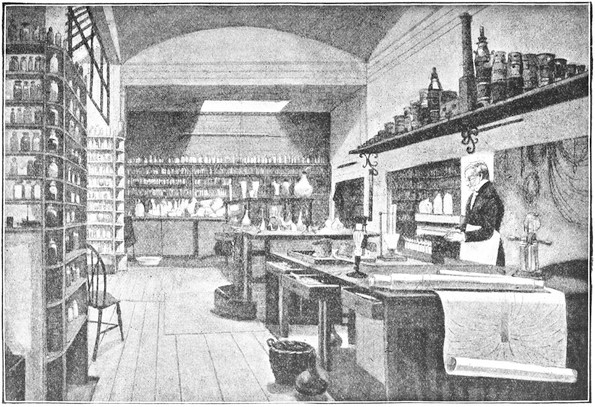
matters. The condition of his laboratory at this time
may be gleaned from the following note in the Journal:—
“Objects much wanted in the laboratory of the Royal Institution:
cleanliness, neatness and regularity.
“The laboratory must be cleaned every morning when operations
are going on before ten o’clock.
“It is the business of W. Payne to do this, and it is the duty
of Mr. E. Davy to see that it is done and to take care of and keep
in order the apparatus.
“There must be in the laboratory pen, ink, paper, and wafers,
and these must not be kept in the slovenly manner in which
they are usually kept. I am now writing with a pen and ink
such as was never used in any other place.”
Then follows a list of articles wanting, “including
most of the common metallic and saline solutions.”
“The laboratory is constantly in a state of dirt and confusion.
“There must be a roller with a coarse towel for washing the
hands and a basin of water and soap, and every week at least a
whole morning must be devoted to the inspection and ordering of
the voltaic battery.”
It would be interesting to know the comments of
the persons named in this note as to the cause of the
dirt and confusion which reigned in the laboratory.
Davy was perfectly reckless with apparatus; with him
to think was to act, and he frequently had half a dozen
experiments going on simultaneously, upon disconnected
parts of the same inquiry. Anyone who has had the
opportunity of seeing his laboratory notes, or of glancing
over the rough drafts of his memoirs, which have been
preserved by the pious care of Faraday, will appreciate
the significance of the remarks upon his writing materials.
His usual method of erasure was by dipping his finger
in the ink-pot; and, if we may be pardoned the use of
the colloquialism, he was simply “Death on pens!”