With Humphrey’s return from Hainault the second phase of his life ends
and the third begins. His early life had been that of a soldier; he had
celebrated the death of his brother by making a bid for the position of
an independent prince; now he was to devote the rest of his days to
political intrigue, and it is perhaps in this last phase that his career
assumes its greatest interest. Undoubtedly his actions during the
minority of his nephew have more importance in the history of his
country than those of his earlier years, and from them we are enabled to
realise more clearly the various threads of his policy and the governing
influences in his life. Henceforth Humphrey’s whole energies are devoted
to English politics. His discarded Duchess may flit across the stage,
for a brief moment he may revert to his early participation in the
French war, but these are merely unimportant incidents in a busy
political career. The rest of his life, too, is entirely moulded by the
opposition he experiences. The spirit which had inspired the limitation
of the Protector’s power was to meet him at every turn, and throughout
the next twenty years all English history was to find its central theme
in the great struggle between the Duke of Gloucester and the Beaufort
faction. Barely six months after his departure from England, Humphrey
had returned to find preparations being made for the holding of
Parliament, and it is probable that he had timed his departure from
Hainault so as to be present at this meeting, fearing lest some hostile
move should be made against him in his absence. On April 27 the young
King was brought up from Windsor, and, being met at the west door of St.
Paul’s by Gloucester and Exeter—the protectors of his kingdom and his
person respectively—was lifted out of his chair by them and escorted to
the choir, where he was ‘borne up and offred.’[596] Three days later he
was present at the opening of Parliament, that his uncle might remember
that he was the servant, not the master of the realm.[597]
1425] ATTITUDE OF THE COUNCIL
After so inglorious and impolitic a proceeding as his recent campaign
Humphrey might well have expected criticism of no light kind from the
strong faction opposed to him, and if we are to believe the French
chroniclers, such criticism he did receive at the hands of the
Council,[598] but no traces of this are to be found in the official
records. Nay more, there is ample evidence that the Protector’s
influence both in Parliament and Council was considerable. Not only in
the face of a revenue deficit of £20,000 did Parliament grant him a loan
of 40,000 marks to be paid within four years, but the Lords of the
Council agreed to act as sureties for its repayment;[599] in a dispute
between the Earl Marshal and the Earl of Warwick for precedence
Parliament decided in favour of the former, who was not only a supporter
of Gloucester, but had also commanded his troops in Hainault;[600]
finally the wardship of the estates which devolved on the young Duke of
York by the death of the Earl of March was given to the Protector.[601]
It seems hardly credible that Gloucester would have been given so much,
or have championed his friend so successfully had his influence not been
predominant. That he had met with some opposition cannot be doubted,
for the six months’ power enjoyed by the Bishop of Winchester during his
nephew’s absence was not likely to make him content with a secondary
position, and therefore bitter, and undoubtedly justified, criticism was
probably levelled at Humphrey by his rival. It may be that high words
passed between them; at any rate it was not to be long before their
mutual recriminations became a danger to the state. It is about this
time, therefore, that the struggle between the two chief men in the
kingdom passed from the stage of political rivalry to that of personal
competition. Gradually Gloucester and Beaufort become bitter personal
enemies, and the state of distrust inaugurated at the beginning of the
reign, now becomes a contest which the full bitterness of individual
dislike tends to increase every day. Henceforth no stone is left
unturned by either of the men to damage the position and reputation of
his rival.
1425] JACQUELINE DESERTED
Nevertheless there is no evidence that Gloucester’s Hainault policy had
reaped that universal condemnation in England which it so richly
deserved. Bedford, it is true, saw the danger of alienating Burgundy,
and he had done his best, first to avert the provocation of his anger,
and secondly to minimise the effects of that provocation, but even he
seems to have felt considerable sympathy for his brother,[602] and
perhaps he remembered that the late King might be held largely
responsible for the turn of events. Englishmen generally seem to have
looked with kindly eyes on this mad expedition, for there was about it
some of the glamour of mediæval romance in appearance if not in reality,
whilst Jacqueline herself had won golden opinions in England, where her
unhappy lot had obtained universal sympathy.[603] For Gloucester,
however, the romance of his marriage with Jacqueline, such as it had
been, was quite worn off, and he had already transferred his affections
to the lady who was to bring him far greater disaster than did his
foreign bride. Amongst Jacqueline’s ladies-in-waiting there had been a
certain Eleanor Cobham, daughter of Reginald Cobham of Sterborough in
Kent,[604] and she had accompanied her mistress to Hainault. When
Humphrey had returned to England he had brought her with him, and it
seems that it was about this time that she became his paramour.[605] At
any rate Hainault ambitions play henceforth but a very small part in
Humphrey’s life, for though we shall find that later he took some steps
to send aid to his unfortunate wife, yet he never showed the slightest
inclination to return to her side, a fact which caused no small scandal
at a later date.
Meanwhile at Mons things had been going ill for Jacqueline. Her husband
had no sooner turned his back, than the Brabanters rose again, and the
citizens of Mons, unmindful of their recent promise, refused to support
her.[606] On June 6 she wrote a most pathetic letter to Gloucester,
telling him how the citizens had come to her on the third of that
month,[607] and had shown her a treaty signed by the Dukes of Brabant
and Burgundy, uniting her dominions under the rule of the former, and
confiding the care of her person to the latter. In spite of her
entreaties all help had been refused her, and she pointed out how her
sufferings were due to the love she bore her English husband, begging
him therefore to come to her help, though he seemed to have forgotten
her existence.[608] In a second letter of the same date she alluded to a
suggestion made by Gloucester that she should once more flee to England,
a course which she declared it was now too late to adopt. Indeed, this
was soon proved to be the case, for these letters were intercepted by
Burgundian emissaries,[609] and within five days she was being conducted
a prisoner to Ghent.[610]
1425 DUEL WITH BURGUNDY FORBIDDEN
Though Jacqueline’s letters never reached their destination, the news of
her imprisonment soon came to England, and Parliament promptly showed
its sympathy with her by petitioning that ambassadors should be sent to
treat with Burgundy for the release of ‘my Ladies’ persone of
Gloucester,’[611] and at the same time the Chancellor was empowered to
draw up letters-patent under the great seal appointing the
queens-dowager of England and France, and the Duke of Bedford as
mediators between Burgundy and Gloucester, with a view to the
abandonment of the duel that had been arranged.[612] To neither of these
provisions would Humphrey make any objection, for though he had not been
the challenger in the matter of the duel, yet he had doubtless welcomed
it as a way of securing his retreat, and had never intended to take it
seriously; at any rate he made no preparations for the fray, whilst his
opponent had gone into strict training, and was having special armour
made for the occasion.[613] This attitude on the part of Duke Philip
points to a strong personal dislike of Gloucester, a dislike which dated
probably from the days when he had been slighted at St. Omer;
nevertheless, it is strange that he had ever thought that such a duel
would be allowed to take place. Bedford, ever ready to appease the
strife which had arisen over this Hainault affair, gladly undertook the
duty assigned to him by Parliament, and when in September he summoned a
council of arbitration to meet at Paris, his brother willingly nominated
the Bishop of London as his representative thereat, whilst Burgundy
grudgingly appointed the Bishop of Tournay to guard his interests.[614]
Bedford tried to avert the duel as eagerly as he had endeavoured to
reconcile the conflicting claims of Brabant and Gloucester earlier in
the story of the Hainault struggle,[615] and his efforts were assisted
by a papal Bull, which forbade the personal combat in no measured
terms.[616] Armed with this authority, the council at Paris decided on
September 22 that a perusal of the letters written by the two parties in
the dispute convinced them that neither side had any right to demand
satisfaction from the other,[617] a decision which disgusted the
Burgundian envoy, but which afforded entire satisfaction to Gloucester’s
representative.[618]
From this time forward Gloucester seems to have abandoned all idea of
securing his hold on the government of his wife’s inheritance. He did
not resign all claim to Holland and Hainault, nor did he refrain from
occasional assistance to Jacqueline, or from attempts to secure the
recognition by Rome of the legality of his marriage; but he had come to
realise that personal intervention on the Continent would mean
political extinction at home, where he needed all the prestige of his
popularity amongst the commonalty and the power conferred by his
position and lineage to withstand the manœuvres of his great rival,
Henry Beaufort. For Beaufort was entrenched in a strong position. A man
of determined will and restless energy, with powerful family
connections, of royal blood, if not in the line of succession, and well
versed by long experience in the affairs of the kingdom, he stood in
marked contrast to his nephew, who was lacking in resolute purpose, and
had spent most of his active life in the French wars, with few
opportunities of gaining political experience. Above all, whilst
Beaufort was constantly lending money for purposes of state, Gloucester
was equally constant in his demands for royal loans or an increased
salary, a fact which gave the former an immense financial hold on the
kingdom. Such a power as that wielded by the Bishop of Winchester was
not to be despised, nor was it to be left unopposed by one who aspired
to be the chief governing power in the state; but there was yet another
reason which impelled Humphrey to confine his main efforts towards
maintaining and improving his position in England, the roots of which
lay in his own character. When he had set out light-heartedly to assert
his right to control the dominions of Jacqueline, he had thought it to
be an easy task. He now knew that it was only by a prolonged effort that
he could succeed in Holland and Hainault. Such an effort he was totally
incapable of making, for he had none of that determination which
characterised his father and at least two of his brothers. Brilliant and
versatile as he was, these qualities preordained him to prefer a life of
political intrigue to that of hard fighting against a firm and steadfast
foe. His fickle nature delighted in the kaleidoscopic changes of party
warfare, and to that warfare he devoted the best part of the rest of his
life, forgetting his dreams of foreign dominion in that strife where the
interests of the moment predominated. He was a child of circumstance,
and lived only for the passing moment, and as such he found his true
milieu in the faction fights which preceded the Wars of the Roses.
1425 EXPEDITION TO HAINAULT
Yet while he devoted himself mainly to matters of English politics,
Humphrey did not abstain from all interference in Hainault affairs.
There was no question with him of abandoning an enterprise fraught with
danger to his country. So long as Jacqueline could keep up the struggle,
he would encourage her, in the hope that some day he might reap the
advantage, and it was in this spirit that he wrote to Martin V.,
complaining that the divorce decree against Brabant had not yet been
granted, and urging him in the interests of Europe generally to hasten
the matter to a conclusion favourable to the Countess.[619] At the same
time the situation in Hainault looked more promising. The exertions of
English ambassadors to secure Jacqueline’s release had been rendered
unnecessary by her escape from her captors,[620] and she had signalised
her regained freedom by a victory over her assailants at the little
village of Alfen. The Duke of Brabant was rendered still more anxious by
rumours which reached him to the effect that a force of some 20,000
strong, under the personal leadership of Gloucester, was about to
reinforce his enemies, that the Scotch King, in remembrance of his
recent marriage alliance with the House of Lancaster, was coming with
8000 more, and that contingents from Ireland and the English army in
Normandy were destined to join the victorious troops of his militant
Countess.[621] The exaggeration of this report was obvious, but,
nevertheless, a force was being collected in England, and towards the
end of the year it sailed under the leadership of Lord Fitzwalter, in
all some thousand men. In the early days of 1426 these troops landed on
the coast of Zealand, only to be almost annihilated with the majority
of Jacqueline’s native troops in the neighbourhood of Zierikzee by the
Burgundian forces. The remainder straggled back to England, having
‘prevayled nothing.’[622]
1425] THE BEAUFORT QUARREL
Before this expedition had sailed, however, Gloucester was entirely
absorbed in affairs nearer home. The rivalry between himself and
Beaufort, which had been simmering ever since the Protector’s return,
now boiled over, and for a moment threatened civil war. The Chancellor
had made great efforts during his short period of government to
strengthen his own hands, welcoming Gloucester’s absence abroad as an
opportunity for weakening his power. Some disorderly riots and seditious
manifestations in London had afforded a pretext for inducing the Council
to place one Richard Wydeville in command of the Tower,[623] and he had
used this appointment to strengthen his position in the capital, where
he was notoriously unpopular. He gave Wydeville strict injunctions that
he was to admit no one ‘stronger thanne he’ within the Tower, and later
mentioned the Protector as one of those who must be excluded, pointing
to his popularity in the city as evidence of his seditious
intentions.[624] It was not likely that such proceedings would pass
without a protest from Gloucester, and there is every reason to
believe—from an undated entry in the minutes of the Council, which
records a meeting held towards the end of the third year of the
reign—that the quarrel between the two rivals had become acute by the
July or August after his return. We learn from this that an ordinance
was being prepared for the consideration of the next Parliament, which
required that every peer should take an oath not to disturb the King’s
peace by revenging by force any ill done to him, but to have recourse to
‘pesible and restful weyes of redress.’ At the same time an oath of
secrecy and a promise to give honest advice without obstructing any
matter under discussion was exacted from all who sat at the Council
board.[625] All this tends to prove that the struggle between the two
claimants for power was already raging fiercely.
Nevertheless, we find no actual disturbances recorded till the Bishop
roused Gloucester’s suspicions by filling Southwark, where his house was
situated, with Lancashire and Cheshire archers.[626] Then, fearing lest
he should be attacked by this force and taken unprepared, the Protector
sent a message post-haste to the Mayor and Aldermen, asking them to be
on their guard for fear lest an attack on the city should be made from
the other side of the river. The message found the civic magnates at the
banquet with which they were wont to celebrate the election of the new
Mayor, but they promptly acceded to Gloucester’s request, and the city
was carefully guarded all through that night, as though a siege was
imminent.[627] This was on October 29, the day after the feast of St.
Simon and St. Jude,[628] and on the morrow events justified the
Protector’s precautions, for a large body of Beaufort’s men appeared
outside the gate on the south side of London Bridge about eight or nine
o’clock in the morning, and were surprised to find all entrance
forbidden them. Nothing daunted, they waited till more of their fellows
had come up, and then proceeded to attack the gate ‘with shot and other
means of warre,’ attempting by these means to force an entrance into the
city.
The news that the Chancellor was in arms against their beloved Duke
Humphrey spread like lightning amongst the citizens, and within an hour
all shops were shut, and the streets leading to the bridge were thronged
by men willing and anxious to keep the bishop out, and to resist the
‘King’s enemies.’ So determined was this opposition that the attempted
assault was abandoned, and it was with the greatest difficulty that the
Mayor restrained the angry citizens, who wanted to sally out and exact
vengeance for the presumptuous attack, whilst the Archbishop of
Canterbury and the Duke of Coimbra—one of Gloucester’s Portuguese
uncles—offered their services as mediators. This self-imposed task
proved no sinecure, and eight times did they ride backwards and forwards
between the two parties ere peace was secured, and Beaufort had to be
content with his side of the river, whilst the Protector remained in
possession of the city.[629] ‘All London a rose with the Duke a yenst
the forsaide Bysshope,’ writes a contemporary chronicler,[630] and
indeed Gloucester had reason to be grateful for the support of the
citizens at a critical time. It was not the rabble—as Beaufort later
declared—which rose to champion him, but the sober burgher class,
headed by Sir John Coventry, their Mayor, that had produced the
discomfiture of the Chancellor, and that ever henceforward formed the
most important section of Gloucester’s supporters. The tone of the
London chroniclers also suggests, that the action of Beaufort was
considered by them at least as a direct blow dealt both at the city and
at the peace and security of the kingdom at large, and that in
supporting Gloucester the citizens were taking a line which was
patriotic both as regards their city and as regards the nation.
1425] BEDFORD SUMMONED TO ENGLAND
The truce between Humphrey and his uncle could not be a final settlement
of the bad blood that had been aroused, and on All-hallows Even[631] the
latter wrote to Bedford in hurried, but emphatic, terms, urging him to
come to England without delay, ‘for by my troth,’ he wrote, ‘if you
tarry, we shall put this land in adventure with a field,[632] such a
brother you have here; God make him a good man.’[633] He forgot to
mention that it was he that had taken the first step to ‘put this land
in adventure with a field,’ for even as he had been the first, in the
days when the Protector’s privileges were being arranged, to provoke
that duel for power which, in its later manifestation, was to develop
into the Wars of the Roses, so was he now the first to appeal to armed
force as a means of emphasising the righteousness of his cause. The
statement that Gloucester made the first move to arms cannot be
substantiated.[634] It was against the force which Beaufort had already
mustered in the suburbs of Southwark that he appealed to the Mayor of
London, and in so doing he acted as any wise Protector of the kingdom
would have done, when he saw the capital threatened by the armed
retainers of a too powerful subject. Moreover, while Beaufort’s force
was specially organised, Gloucester was prepared with no retainers to
protect himself or his ambitions, but in the time of need he was forced
to appeal on the spur of the moment to the loyalty of the citizens. In
point of fact, too, the first hostile move was made by the Bishop, for
the action of the Mayor in guarding the gates of the city was merely a
defensive precaution, unknown to the Beaufort retainers, who did not
expect to meet with any resistance when they tried to cross the bridge.
Thus both the hostile intent and the hostile action originated with the
Chancellor, while the support given to the Protector, apart from the
guarding of the gates overnight, was entirely spontaneous on the part of
the great mass of the citizens.
The fact that Beaufort so promptly appealed to the arbitrament of
Bedford has also been counted unto him for righteousness,[635] whereas
it merely displays the cleverness of his play in the game of politics.
From Bedford he might hope for support, since the folly of the Hainault
campaign would tend to make the Regent in France suspicious of his
brother’s actions, and ready to believe that the fault of the recent
disturbances lay with him. Moreover, no one knew better than Bedford the
usefulness of the Bishop’s purse, and the impolicy of alienating one who
could always produce ready money, while Humphrey had no such claim to a
statesman’s consideration. Beaufort also had nothing to lose, and a
possibility of much to gain, by this appeal. Public opinion in London
had spoken against him; it is more than probable that this feeling
extended outside the city, and for the time at least he had to
acknowledge defeat. On the other hand, if it is true that the Protector
refused to formulate complaints against his opponent when asked to do so
by envoys from his brother,[636] it was only natural that he should
adopt such an attitude. He looked on himself, both by right of birth and
by right of the will of Henry V., as the lawful Protector of England,
and though he was compelled to accept the restrictions imposed on him by
Parliament, he was not likely to acknowledge the supremacy of his
brother more than he could help. To indict Beaufort before Bedford would
not only be a confession of weakness, but also, in his eyes, an insult
to his position. By law as well as by right he was Protector in England
so long as Bedford remained in France, and under the circumstances he
could recognise no superior tribunal; he had no wish to bring Bedford to
England to settle the matter, and thus be compelled to take the second
place. Though this attitude was undoubtedly selfish, and based on too
high an opinion of his own importance, it does not therefore prove that
in the quarrel with Beaufort he was in the wrong.
1425] RETURN OF BEDFORD
For the time being Gloucester’s power was undisputed. On the same day
that the letter of summons to England was despatched to Bedford the
Council met at the Protector’s own house,[637] a fact which has its
significance. It was probably with the consent of the Council that the
Protector, with the Duke of Coimbra, journeyed down to Eltham on
November 5, and brought the young King back to London to strengthen the
hands of the executive there.[638] The same day yielded another
illustration of Gloucester’s influence, when the Council, in
consideration of his ‘great necessity,’ agreed to lend him five thousand
marks on promise of repayment, when the King should reach his fifteenth
year,[639] a sum probably used for the expedition to Hainault already
described. Beaufort, it is to be presumed, took no part in these
transactions, but was compelled to view his rival’s success in silence,
eagerly awaiting the return of Bedford, who on December 20 landed on
English soil. By virtue of his return Bedford became Protector of the
kingdom, receiving the salary of eight thousand marks a year, which in
his absence had been enjoyed by his brother,[640] who now was reduced to
the rank of first councillor to the King, with an income of three
thousand marks only.[641] The Bishop of Winchester hastened to meet
Bedford, and together they entered London on January 10, proceeding at
once to Westminster, where the new Protector was lodged in the King’s
palace, while the Chancellor lay near by at the Abbey, desiring to keep
watch over his nephew, lest any influence hostile to himself should be
brought to bear on him.[642] So successfully did he put his case and
justify the policy of his appeal to the Regent in France, that Bedford
showed marked hostility to his brother, and when the citizens of London
came to greet him on the morrow of his arrival, and presented him with a
pair of ‘silver gilt basins, they received but a cold reception, in
view of the hostility they had recently shown to the Chancellor and his
proceedings.[643]
1426] COUNCIL AT ST. ALBANS
Already steps had been taken to summon Parliament, which was to meet on
February 15 at Leicester,[644] the choice of this town being probably
due to the Chancellor’s fears that in London public opinion would be too
strongly against him, and in the meantime vigorous attempts were made to
effect a reconciliation before the meeting took place. On January 29 a
Council was held under the presidency of Bedford at St. Albans, whence a
deputation, consisting of the Archbishop of Canterbury, the Earl of
Stafford, Lords Talbot and Cromwell, and Sir John Cornwall, was sent to
Gloucester, who had refused to attend the meeting, though he might have
counted on the support of public opinion in the neighbourhood of his
chosen abbey. This deputation was commissioned to inform the Duke that
another Council was to be held at Northampton on the 13th of the next
month, and to offer him a pressing invitation to attend there, as the
matters in dispute between him and the Chancellor were to be discussed
with a view to a reconciliation, assuring him that ‘justice and reason
shal duely and indifferently be mynystered unto him in all things that
he hath said or shal say as for occasion or matter of the displesaunce
or hevynesse abovesaid.’ To the demand which Humphrey had made, that as
a condition of his coming the absence of his opponent must be assured,
the Council gave a decided refusal, pointing out that there was no
danger of a riot between the retainers of the respective parties, as the
Bishop had agreed to restrain his men, and the King would ‘settle such
rewle’ that peace would be maintained throughout the town. It is,
however, probable that Gloucester feared more the hostile bias in
Bedford’s mind produced by the machinations of his uncle, than personal
violence to himself, and preferred a direct appeal to the Lords in
Parliament, with whom his influence was much stronger than it had been
earlier in the reign, to a judgment by the Council, now under the
domination of his opponents.
This changed attitude of the Council, which before Bedford’s landing had
been controlled by Gloucester, is seen in a secret instruction to the
deputation. Should the Duke steadily refuse to go to Northampton under
the assurances mentioned above, the commissioners were empowered to add,
that at the request of Bedford and the Council Beaufort had promised to
dismiss some of his men, and only bring such as were fitting for his
position, on condition that Gloucester should do likewise. It is very
strange that this condition should be kept in the background, and only
produced under compulsion, for it seems a natural concession, and one
which could only be refused by a man who was not acting in perfect
honesty. If the Council had suspected the large retinue of the Earl of
March in 1423, why should not the Chancellor’s evidently large body of
retainers incur the same suspicion? It would be, of course, absurd to
suggest that, had Gloucester gone to Northampton, the drama of 1447 at
Bury St. Edmunds would have been anticipated; the mere presence of
Bedford would refute such a suggestion; but this ‘card up the sleeve’
policy does not speak well for the honesty of those who adopted it.
If after their last magnanimous offer Gloucester still persisted in his
refusal to attend if Beaufort were present, the messengers of the
Council were to point out that it would be unreasonable in Gloucester,
even if he were the King—surely a malicious insinuation—to refuse any
man a hearing, and also that if he wished ‘to be esed as towards his
griefs,’ as the Council assured him was their honest intention, it must
be done either by an act of justice, or by a reconciliation, either of
which required the presence of both parties. Moreover, to Gloucester’s
demand that the Chancellor should resign the custody of the seals, it
was answered that this was an attempt to coerce the King—for no
official was ever dismissed except by the King’s wish, by his own
request, or owing to some fault proved against him.[645] In their
refusal of this request the Council were undoubtedly justified, and
there is much that is wise and statesmanlike throughout the
instructions, due undoubtedly to the influence of Bedford. But there is
also ample evidence of Beaufort influence, and we cannot blame
Gloucester if he regarded this communication more as a manifesto from
his opponents than as a genuine offer of arbitration, and refused to go
to Northampton, preferring to wait till the Parliament should be
summoned at Leicester. One thing should not pass unnoticed in this offer
of the Council. Though the Bishop had summoned Bedford from France,
Gloucester had now assumed the rôle of accuser. It was as such that he
was to appear at Leicester, having herein outmanœuvred his opponent,
who, thinking to act on the aggressive, had been compelled to fall back
on a defensive attitude.
1426] PARLIAMENT OF LEICESTER
The Parliament which met at Leicester on February 18,[646] has been
handed down to posterity as the ‘Parliament of Battes,’ because, as all
weapons had to be discarded by the members and their retainers, they
came armed with staves and ‘battes,’ which did not come under the
category of weapons.[647] No allusion was made to the quarrel in the
Chancellor’s opening speech, although it was the most important matter
before the assembly, and indeed it seemed at first as though there would
be little progress made in the work of the session. For ten days nothing
was done; the Speaker was not even chosen; and during that time
Leicester must have been the scene of much diplomacy and intrigue, of
which we have no record. At length on the 28th the Commons took the
initiative by sending up a petition to the Lords, asking them to take
steps to heal the divisions which had occurred in their body,[648] a
request which was answered by a promise, made by the peers on March 4,
to deal honestly between Gloucester and the Bishop.[649] The consent of
the two parties to this mediation had now to be secured, and at the
urgent request of Bedford the Duke consented, three days later, to
submit all his grievances to a Commission, composed of Archbishop
Chichele, the Dukes of Exeter and Norfolk; the Bishops of Durham,
Worcester, and Bath; Humphrey, Earl of Stafford; Ralph, Lord Cromwell,
and William Alnwick, Keeper of the Privy Seal and Bishop-elect of
Norwich, though it was provided that any matter touching the King was to
be referred to the Council.[650] Beaufort gave a similar consent.[651]
This Commission could not have been more fairly chosen. The Archbishop,
if slightly inclined to resent the ambitions of his brother of
Winchester, was eminently impartial and well versed in the art of
pacification; the two Dukes each represented one of the rivals, for
whilst Exeter was the brother of the Bishop, Norfolk was the friend of
Gloucester;[652] Lord Cromwell was inclined to the Beaufort
faction,[653] but the bishops were mostly impartial, though probably the
Bishop of Bath was another of Beaufort’s followers.[654]
It was with his usual easy confidence that Gloucester proceeded to draw
up his indictment of the Chancellor. He complained that Beaufort had
instructed Wydeville to refuse him entrance to the Tower, though he was
Protector of the realm, and had afterwards shielded this man from the
consequences of this action. Nay, more, Beaufort had plotted to
undermine the Protector’s power by attempting to remove the King from
Eltham, thinking to secure thereby a hold over the government of the
kingdom. At the same time he had hindered Gloucester from going to
frustrate these plans by barricading the Southwark end of London Bridge,
and posting armed men in the houses of the district, thus trying to kill
the Protector and disturb the King’s peace. Further, Gloucester accused
his adversary of maligning him to Bedford in his letter of October 31 by
saying that he was harassing the Kings subjects. Not content with the
recent misdemeanours of the Chancellor, his accuser made an excursion
into past history, and brought up an old story that an attempt had been
made on the life of Henry V., when Prince of Wales, by a man who
confessed himself Beaufort’s agent, and together with this was joined
the incompatible, but more likely story, that Beaufort had advised the
same Henry to assume the crown whilst his father was lying dangerously
ill.[655]
1426] INDICTMENT OF BEAUFORT
The tenor of these accusations at once establishes the motive of the
quarrel. From them it is evident that Gloucester looked on the whole
matter as a personal question, and did not realise that there was a
possible constitutional aspect of the case. There was nothing which
betrayed the statesman in this indictment, which merely complained of
insults to his dignity, attacks on his position, and concluded with
impertinent statements as to the past career of his rival. Throughout it
showed considerable ingenuity, but at the same time it betrayed an
inability to understand the constitutional pose which the better
politician of the two had assumed. In Beaufort’s answer the refutation
of the very first accusation shows the different methods of the two men.
Though his policy was one of mere self-seeking, the Bishop of Winchester
knew how to use the language of the new constitutional theories which
had developed under the two preceding Lancastrian kings. He asserted
that in the Tower incident he was fully justified in the advice he had
given Wydeville not to admit the Protector within its walls. He declared
that before the Hainault expedition it had been decided in Council, in
the presence of Gloucester, to garrison and provision the Tower, but
that this had never been done; that during the absence of the Protector
certain seditious risings, levelled, it would seem, mainly against
foreigners, had disturbed the peace of the capital, and that Wydeville
had been placed in command of the Tower to strengthen the hands of the
Executive. Such being the case, Gloucester on his return had ingratiated
himself with the citizens by sympathising with them for having a castle
fortified against them in this manner, and had done his utmost to
stultify the action of the Council in this matter. Moreover, a question
of privilege had been raised by the refusal of Humphrey to deliver up a
certain Friar Randolph who had been committed to the Tower on a charge
of treason, and whom the Protector had removed from the Lieutenant’s
custody, declaring that his command was a sufficient warrant of
discharge for the custodian of the prisoner, ‘in the which thing above
seyd yt was thought to my lorde of Winchestre that my seyde lorde off
gloucestre toke upon himsylff fferrer thanne his auctorite stretched
unto, and causid him fforto doute and drede, leest the Toure hadde be
stronge he wolde have proceded fferther.’[656]
The arguments thus used by the Bishop in reply to this charge are
specious to a degree, and appealed to principles of ministerial control,
an attitude which has stood him in good stead with the historians of a
democratic age. Nevertheless, this favourable appearance was but
skin-deep. The Chancellor had had practically complete control of the
kingdom whilst Gloucester had been abroad, and now he was disgusted to
find that his precedence was no longer recognised. If the title of
Protector was anything beyond a name, its holder was entitled to enter a
royal castle at his will, and no plea of expediency could be pleaded by
a Chancellor who took upon himself to deny such a right. The truth which
lies beneath the fair exterior of the reply to this first charge is on
careful examination quite evident. Beaufort feared that, in spite of the
strict limitations put upon his power, Gloucester would prove to be
stronger than had been expected, and his instructions to Wydeville were
dictated by no fears for the safety of the kingdom, but fears for the
permanency of his own ascendency in the councils of the nation. The
stories about the Londoners and the traitor friar were in all
probability true, but those who would sympathise with Beaufort as leader
of the constitutional party against the encroachments of the Protector
can here find no arguments to support their theory, for he had worked in
opposition to his own chief, and had persuaded an officer to disobey his
superior. Only so far as all who oppose governments are called
constitutionalists can this term be applied to the Bishop of Winchester
and his party. On the other hand, it seems hard to understand why
Gloucester should deliberately give a handle to his opponent by removing
Friar Randolph from custody. This action, if not exactly illegal at this
time, was undoubtedly unwise, though it may be that some unexplained
reason—possibly the Protector’s known affection for the unhappy Queen
Joan, whose confessor and alleged accomplice Randolph was[657]—impelled
him to take it.
1426] BEAUFORT’S ANSWER
The answer to the second and third counts, which accused Beaufort of
attempting to secure the King’s person for his own ends, and of
preventing Gloucester from going to visit his nephew at Eltham, give us
a further insight into the events of the famous Tuesday on which the
retainers of the Chancellor came to blows with the Londoners. If we are
to accept Beaufort’s version of the matter—and it is to some extent
corroborated by the terms of Humphrey’s accusation—the trouble between
the two princes had been brewing for some time. The Chancellor declared
that as early as the time when the last Parliament was sitting he had
been warned that Gloucester was contemplating a personal attack on him,
and that certain of the London citizens of the baser sort had announced
their intention of throwing him ‘in Temyse, to have tauht him to swymme
with wengis.’ Furthermore, on the Sunday which preceded the call to
arms, a deputation from the Council had waited upon the Protector to
know whether it was true that he bore the Chancellor ill-will, and if
so, the reason of his so doing; and Gloucester had acknowledged the
truth of the report. With an assumed air of innocence Beaufort recounted
how the city had stood to arms all through the Monday night, and had
assumed a threatening attitude towards him, although, as we know, both
he and his men were ignorant of this till they attempted to cross the
bridge on the following morning. On the Tuesday, it appears, the
Protector had also wished to cross the river with a company of three
hundred horse provided by the civic authorities, to go to Eltham to see
the King, and the Chancellor had prevented this by force of arms,
defending this action by saying that his rival wished to remove the King
from his present abode without securing the consent of the Council—an
act which he declared to be illegal and high-handed to the last
degree.[658]
Thus both parties accused the other of the same intent with regard to
the King, but as Beaufort on his side pointed out, and it was equally
true from the point of view of his rival, no useful end was to be
attained by securing the King’s person.[659] There was no obvious
felonious intent in the Protector wishing to visit the child for whom he
was acting, and no objection was taken by the Council to his removal to
London on November 5. Beaufort’s assumed constitutional fears as to the
danger attending his removal from Eltham are discounted by his
declaration that the possession of the young King’s person was for him a
useless burden. The truth seems to be that Gloucester, established in
London, and with the citizens espousing his cause, was in so strong a
position that Beaufort felt he must do something to counteract it. He
therefore collected troops, and failing to effect an entrance into the
city, was determined that at least Humphrey should not cross to his side
of the river. The fundamental reason for the quarrel was the rivalry of
two ambitious men, each desirous of governing the kingdom, but of the
two Beaufort was undoubtedly the aggressor. It was he that had appealed
to force to aid his cause, and though he declared that he considered the
kingdom in great danger from Duke Humphrey, it never occurred to him to
summon Bedford from France to restore order till he himself had been
worsted in his attempt at armed interference. Humphrey cannot be
accused of provoking the appeal to arms. His modest escort of three
hundred men was no large force in view of the existence of an enemy on
his road, also it was quite uncharacteristic of him to appeal to such
means. In spite of his stormy political career, in no case do we find
him making any appeal to force of arms. He was by nature a political
schemer, but he had seen too much of war on a grand scale, and the
disasters which militant parties bring on themselves as well as on their
country, to make use of such methods. Beaufort, on the contrary, was
turbulent where his opponent was factious; he dabbled in the pomp and
the language of war, and was far more ready to bring the country to the
venture of a ‘field’ than the party opposed to him. It was Beaufort, not
Gloucester, who was responsible for the first blood spilt in that great
struggle for the control of the incapable Henry vi.’s policy, the last
stages of which neither were to live to see.
Beaufort’s answer to the accusation of plotting against Henry IV. and
Henry V. was a denial, and an offer to stand his trial on this
count;[660] but the rights of the case are of no importance here, for
this was only a diplomatic move on the part of the Protector to blacken
the other’s character. The Bishop’s justification of his remarks in his
letter to Bedford, however, have considerable interest. He stated that
in it was to be found proof of his desire for a good government of the
kingdom, and of his anxiety to escape provoking a civil war, arguments
which came ill from one who had tried force and had failed; but his
chief point was that Gloucester had encouraged rather than restrained
the seditious action of some of the London artisans, who had resisted
some wage regulations made by the mayor and aldermen with the consent of
the Council.[661]
This last reply was a skilful move intended to discredit Gloucester’s
case by proving the disreputable character of his supporters, but we can
hardly believe that the civic authorities would so loyally have
supported any one who had encouraged a disregard of their decrees.
Nothing speaks more strongly for the fact that the Protector, rather
than the Chancellor, stood for the cause of good government than the
undivided support which the long-headed, peace-loving burgesses of
London gave to the former. In point of fact, both Gloucester and
Beaufort were ambitious men, and neither was over-burdened with
principles. Yet we must not forget that the Protectorate was in the
hands of Gloucester, and that the Bishop, as Chancellor, was attacking a
power which was legal, though to him obnoxious. He had inspired the
limitations of the Protector’s power at the beginning of the reign; he
had secured that the absent brother should be supreme; and he resented
the discovery that, after all, Gloucester was not a mere subject for his
Chancellor’s diplomacy, and that he was supported by a strong party in
the nation. Beaufort’s action here was a bid for power, not a protest
against bad government; and, while in no way praising the Protector for
an enlightened policy, it would be unfair to brand his government of the
nation as corrupt and merely turned to his own advantage, because an
ambitious man strove to occupy the position which he held. Throughout
the struggle there was no question of principle, whether moral or
constitutional; it was merely a fight as to who should govern England.
1426] RECONCILIATION
The arbitrators adopted a policy of conciliation. In accordance with
their award of March 12, the Bishop of Winchester solemnly declared in
Parliament that he had always borne true allegiance to Henry IV., Henry
V., and Henry VI.; and, in answer, Bedford, in the name of the King and
Council, declared him to be a true and loyal subject. Next, the Bishop
swore that he had no designs on the ‘persone, honour, and estate’ of
Gloucester, who replied, ‘Beal Uncle, sithen ye so declare you such a
man as ye say, I am ryght glad yat hit is so, and for suche I take
yowe.’ After these formalities the two opponents shook hands.[662]
Though this award allayed the difficulties of the moment, the
reconciliation thus brought about rang hollow, and there still remained
much ‘prive wrath’ between the two men.[663] It was considered
impossible for both to remain in office, and the day after the award
(March 13) Beaufort resigned the Seal, and the Bishop of Bath followed
on the 18th with his resignation of the Treasurership.[664] Thus
Gloucester had secured a decided victory, and, for the time at least, he
was free from Beaufort factions. A really strong man would never have
permitted matters to reach the pitch they had attained, but we must not
allow any of his later actions to colour our opinion of his behaviour at
this time. He cannot be said to have invited the contest, and it is a
revelation to those who remember only the discredited politician of
later years, that there was a time when he could command the support of
a strong section of the community and resist a deliberate and
well-planned attack. Doubtless much of his success was due to the
prestige of the position which he held, and to the fact that there was
an instinctive dread—well justified in the light of subsequent
events—of any change of government. To remove Gloucester from the
Protectorate, though he only held it during the King’s pleasure, would
be to cause a disastrous struggle, if not civil war.
Gloucester was victorious, and his position was naturally strengthened
thereby. After the great ‘Debaat’ between him and Beaufort had been
brought to a peaceful conclusion, little more was done in Parliament
before the Easter adjournment beyond filling the vacant offices. John
Kemp, Bishop of London, was made Chancellor, and Lord Hungerford
succeeded the Bishop of Bath as Treasurer,[665] appointments to which,
it must be presumed, Gloucester made no objection. However, the time was
to come when Humphrey would class Kemp only second to Beaufort among his
most prominent opponents. On the 20th of March Parliament was prorogued
till the 29th of the following month, and Gloucester left Leicester
forthwith, intending, it would seem, to spend Easter at London or
Greenwich. On the 22nd he passed through St. Albans, whence the monks,
to show their pleasure at the discomfiture of the Bishop of Winchester
and the success of their patron, escorted him as far as Barnet, where he
spent the night; on his return journey to Leicester for the reopening of
Parliament he spent three nights at the abbey.[666] Nothing of
administrative importance occurred during this second session, but on
Whit-Sunday a great ceremony was made of the knighting of the young King
by his uncle Bedford. Immediately afterwards Henry himself knighted
thirty-six other young men, including Richard, Duke of York. Amongst
these new knights we find the six-years-old Earl of Tankerville,
Gloucester’s future son-in-law, and Reginald Cobham, his future
brother-in-law.[667] A week later steps were taken to ensure the seven
years’ truce with Scotland which had been made two years earlier. It
seems that the borderland between the two countries had been the scene
of considerable disturbances, and to check these a strong commission was
appointed to preserve the truce and punish infractions of it. At the
head of this commission stood the Duke of Gloucester.[668] On June 1
Parliament was dissolved.
1427] THE COUNCIL ASSERTS ITS RIGHTS
Bedford was in no hurry to leave England, for he remained fifteen months
in the country, and during this time the government was in his hands.
Gloucester took no active share in the administration, and he seems to
have lived in retirement, only emerging to attend the obsequies of the
Duke of Exeter at St. Paul’s early in January 1427.[669] Almost
immediately after attending this ceremony he fell ill, and was still
confined to his ‘inne’ when a Council was held on January 18 in view of
the approaching departure of Bedford, who was especially asked to attend
this meeting. It was opened by a speech from Chancellor Kemp, now
Archbishop of York, in which, after some complimentary remarks, he
broached the reason for this invitation. He enlarged on the
responsibility for the good governance of the kingdom which lay on the
lords spiritual and temporal assembled in Parliament, or, when
Parliament was not sitting, on the Council, showing how, though the King
was titular sovereign, his youth compelled the full weight of government
to fall on the Council, except in so far as Parliament had given
definite and special powers to the Protector. He reminded Bedford that
the Council might be called in question for the government and for the
use of its authority, and under the circumstances they could not do
their duty unless they were ‘free to governe by the said auctorite and
aquite hem in al thing that hem thought expedient for the King’s behove
and the good publique of the said roialmes.’ Thus, though they had no
desire to curtail the Protector’s privileges of birth or position, the
Council, realising that their rights were being infringed, demanded of
him a declaration of his policy, and a promise to abide by the
arrangement under which he held office.[670] Bedford, with a suspicious
readiness, thanked the Council for their plain speaking, and declared
himself ready to be ‘advised, demened and reuled’ by them in all things,
asking them to point out any defects in his conduct, and then proceeding
unasked to take an oath on the Testament to abide by their
decisions.[671]
Gloucester, ‘being deseased with syknesse,’ was not present at this
meeting, so on the following day the Lords of the Council visited him at
his ‘inne,’ and repeated to him what they had said to his brother. They
feared that a favourable answer was not so likely in this quarter, for
they remembered his answer to certain ‘overtures and articles’ they had
recently laid before him, and how ‘sayng and answeryng as he had doon at
divers tymes afore,’ he had declared that if he had done anything
disloyal he would answer to none but the King himself when he came of
age. They reminded him of this answer, and further remarked how they had
heard that he had said, ‘Let my brother governe as hym lust whiles he is
in this land, for after his going overe into Fraunce I will governe as
me semeth good.’ They then recounted the proceedings of the day before,
and laid great stress on Bedford’s gracious answer to their request.
Thus confidently expecting a like answer from him—so they assured
him—they asked to know his intentions.[672]
1427] GLOUCESTER AND THE COUNCIL
Gloucester found himself in an awkward position. He had evidently been
so elated by his victory over Beaufort that he had been more incautious
than usual, and while in no way interfering with the government of his
brother, had unwisely asserted his intention to profit by his success.
Bedford was too wise not to be alarmed at this avowed policy, not merely
because he could not trust the judgment of Gloucester, but also and
mainly because he saw that it would raise such opposition, that the
dissensions he had just appeased would again recur. It is more than
probable that he had instigated the action of the Council, and had
taken advantage of Gloucester’s indisposition. His prompt acceptance of
the proposals proves that they were not unexpected, and the fact that he
had taken an oath to be governed by the Council would make it
practically impossible for one who was merely his substitute to refuse
his consent. Thus everything was safely arranged and carried out before
Gloucester knew anything about it. There was no jealousy of his brother
in this action of Bedford’s; he knew the temper of the kingdom and the
dangers with which it was threatened, better probably than any man
living; he saw that Beaufort and Gloucester with their selfish policies
were almost equally dangerous, and while he was moving one from the
scene of his activities,[673] he desired to warn the other, who could
not be removed, of the folly of his course. Beaufort’s influence, though
his reputation in the country at large had doubtless suffered by his
defeat at Leicester, was still no negligible quantity, and there is
every reason to suppose that he still retained the partial confidence of
Bedford. It may be that it was absolutely on his own initiative that
Bedford took this action, but it was prompted by the distrust of his
brother which Beaufort had instilled into his mind—a distrust, be it
owned, which Humphrey had done little or nothing to remove.
Gloucester was compelled to make the best of his diplomatic defeat. His
absence from the Council meeting had put all protest out of the
question, and he thanked his visitors for having come to ‘advertize hym’
as they had done, and begged them always to treat him so in the future.
If in any way he should break the law of the land, he would submit to be
‘corrected and governed by them,... and not by his owne wit ne
ymaginacion.’ He even digressed into instances of the advantage of this
course, and the disasters which might ensue from a contrary attitude.
In conclusion he solemnly promised to be governed by the Council in
everything which touched the King, even as Bedford had promised.[674]
That this was only a temporary attitude of conciliation was to be proved
before very long.
Having done his best to secure the safety of England, Bedford turned his
attention to France, where the defection of Brittany had not improved
the outlook. On March 19 he set sail, taking with him the Bishop of
Winchester, whom he thought it best not to leave in England. As far back
as the previous May Beaufort had obtained leave from the Council to go
on a pilgrimage,[675] and he now availed himself of this permission,
probably at the instance of Bedford, who had prepared a sop for his
dignity. On the Feast of the Annunciation (March 25) the Duke and
Duchess of Bedford were present in the Church of Our Lady at Calais,
when the Bishop of Winchester was created a Cardinal by the authority of
a Bull of Martin V., and the Duke with his own hands placed the
long-coveted hat on the new Cardinal’s head.[676] This honour had been
long desired by Beaufort, and indeed the original Bull of creation dated
from the days of the Council of Constance, but Henry V. supported
Archbishop Chichele in his objection to the presence of a Cardinal
Legate in England.[677] Now at last the necessary permission had been
given, and while Bedford applied himself to the French wars, Beaufort
went off as Papal Legate to wage war on the revolted Hussites in
Bohemia.
1427] RESULT OF BEDFORT’S INTERVENTION
Whether this additional dignity conferred on the Bishop of Winchester
was calculated to advance the peace of England may well be doubted.
Bedford had worked hard to restore peace between the various parties in
England; he had produced a compromise which tended to favour Humphrey;
he had as a counter-blast secured a definite acknowledgment by the
Protector of the authority of the Council; finally he had greatly
strengthened the hands of the Protector’s enemy by giving him the
prestige and power which attached to the cardinalate. His action in
England had all the vicious characteristics of a compromise. Even as in
war a victory won by either side inevitably leads to a third battle, so
in politics the successes won alternately by Gloucester and Beaufort
must open the way to another conflict. It could not be expected that the
new Cardinal would spend the rest of his life out of England, his
political proclivities were too strong for this, and on his return he
would almost inevitably reopen the old struggle which had nearly
resulted in civil war. Bedford accurately diagnosed the disease from
which England was suffering, but he failed to prescribe the right
remedy. The only hope of peace lay in the crushing of one of the rivals,
and though this might have been impossible, it was not even attempted.
Each was in turn humbled, but only to such an extent as to make him
still more ambitious, and the sole definite bit of policy to be found in
Bedford’s action in England was the emphasising of the power of the
Council and the developing of those constitutional theories of
government, which by reason of their precocity were bound to bring
disaster both to the kingdom and the dynasty. Bedford’s interference in
English politics had no healing effect; it only postponed the coming
struggle by the temporary diversion of Beaufort’s ambitious energies to
the Hussite war. On the latter’s return the substitution of the
cardinalate for the chancellorship was not calculated to weaken his
position, whilst the strengthening of that of the Council would tend to
induce Gloucester to use all the means in his power to undermine its
authority.
1427] SUPPRESSION OF LAWLESSNESS
Meanwhile in England Gloucester had been seriously ill, and it was not
till April that he was sufficiently recovered to journey to St. Albans;
there on St. Mark’s Day, escorted by the usual procession headed by the
Abbot, he gave thanks for his recovery, and presented his gift of
gratitude on the High Altar.[678] Having visited the cell of Sopwell, he
returned to Langley.[679] Here he busied himself in the affairs of the
kingdom, being made Justiciar of Chester and of North Wales on May 10,
an office which he was allowed to delegate to a substitute for whose
actions as well as his own he must answer to the King.[680] Indeed,
Gloucester seems to have been very energetic in executing his duties as
Protector, and to have turned to the administration of the government
that restless energy, which circumstances and his own ambitious nature
had drawn lately to less worthy occupations. In June we find him at
Norwich to strengthen by his presence the hands of the justices who had
to try a case of lawlessness which had gone unpunished during the
disturbed state of affairs in official circles. On the last night of
1423 certain felons to the number of eighty or more had attacked the
house of John Grys of Wighton in the county of Norfolk, and he being
‘somewhat heated with wassail,’ had been dragged out to a gallows a mile
away, where with his son Gregory and a servant he had been butchered for
lack of a rope to hang them. It would seem that the two principals in
this outrage had been Walter Aslak and Richard Kyllynworth, who tried
after this to establish a reign of terror in Norfolk, and so threatened
William Paston by manifestoes openly posted in public places, that ‘the
seyd William, hese clerkes and servauntz by longe time after were in
gret and intollerable drede and fere.’ Paston had indicted these men
before Gloucester as Protector, and on April 5, 1425, the matter had
been referred to arbitration. The award of the arbitrators had been
ignored by Aslak, and under the protection of Sir Thomas Erpingham he
had further annoyed Paston at the Parliament of Leicester. Gloucester
now presided in person at the trial of the offenders, and six men were
condemned for this outrage and put to death.[681]
Before the end of the month the Protector was back in London, holding a
council, at which matters of some moment were up for discussion. The
truce with Scotland for which Gloucester was one of the guarantors had
not been very well observed, and the question of heresy had also come to
the fore.[682] Shortly before Gloucester’s visit to St. Albans a certain
William Wawe—latro mirabilis the chronicler quaintly calls him—had
attacked the neighbouring nunnery of Sopwell and plundered its contents.
Rightly or wrongly this was considered to be part of a Lollard scheme of
opposition to the Church, and it was as a heretic as well as a
‘wonderful robber’ that Wawe, after a period of confinement at St.
Albans, was arraigned before Gloucester in London. We cannot in any way
judge of the rights of the case, as we have only a very one-sided
account of the event, but it is quite possible that it was more the
heated imaginations of the ecclesiastics, who had not forgotten the
incidents connected with Oldcastle, than any real heretical inclinations
on the part of the prisoner, which produced the charge. Wawe was
condemned and hanged.[683]
In these two cases of summary judgment we find displayed a side of the
Protector’s character which has been given but scant justice by
historians. Though crafty and self-seeking, Gloucester was in no sense
turbulent. His justice thus meted out cannot be dismissed as a standard
of ethics to which he himself did not conform. We have no instance in
which he appealed to brute force except when he was compelled to do so,
for in the case of the quarrel with Beaufort he was not the aggressor,
nor can we believe the stories of armed conspiracy which surround his
mysterious death. His energy was devoted at this time at least towards
keeping the peace. We have seen his recent journeys into the country
districts to settle matters which might cause disturbance, and in
September he was at Chester,[684] whither he had probably gone in his
capacity as Justiciar of that district, not being content to leave his
duties there to a delegated representative, as the terms of his
appointment had allowed. As Protector he meted out justice impartially,
and though he may have helped to shatter the foreign policy of his
country, his home government shows a strange contrast to the other more
prominent but by no means more essential incidents of his life. It is,
however, by the terms of his Hainault policy that he has been judged, a
policy which, with all its far-reaching consequences, occupied but a
small part of his life, and to the last stages of which we must now
refer.
Whilst Gloucester had been devoting his time to the assertion of his
personality in English politics, Jacqueline had been carrying on her
uphill struggle against the superior forces and the boundless resources
of the Duke of Burgundy. Her English husband, though his attention was
devoted to other matters, was still prosecuting his cause at the Court
of Rome, and even during the stormy days of the Parliament at Leicester
we find a reference to his attempt to secure a recognition of the
legality of his marriage.[685] But all hope of papal favour was now very
remote, for at this very time we find an edict, issued on February 27,
1426, by the papal commissioner who was examining the case, declaring
the desertion of Brabant by Jacqueline to be quite illegal, and
committing her to the care of her kinsman Amadeus of Savoy until the
ultimate decision was given by the Pope.[686] Though this edict had not
the authority of a papal Bull, yet it showed which party the decision of
the Pope would favour, and the chroniclers agree in taking this date as
the final decision of the matter.[687] Nevertheless pressure was still
brought to bear on the Pope, and in October of the same year the English
Council agreed to desist from prosecuting the Bishop of Lincoln under
the act of Præmunire, on condition that he should do his utmost to
expedite the cause of the Duke of Gloucester at Rome.[688]
1427] JACQUELINE SEEKS ASSISTANCE
Jacqueline had no intention of returning to her former husband, or of
resigning herself to the keeping of her kinsman of Savoy, and in view of
the greater difficulties which now attended her owing to the defection
of some of her none too numerous supporters, she turned her thoughts
again to the country which had befriended her in the past, where dwelt
the man whom she claimed as her husband, though he seemed to have
forgotten her existence. From Gouda, where she was making a last
desperate resistance against her enemies, she sent Lewis de Montfort and
Arnold of Ghent to the Council in England with a letter which was
written on April 8, 1427. She recalled therein the friendship of Henry
V., and assured them that he would never have left her to her fate; she
begged for help, comme pour femme desolée, and begged them to lay her
sad plight before her husband, and induce him to come to her help, or at
least to send her some assistance.[689] She had evidently given up hope
of any spontaneous support from Humphrey. She no longer wrote to him
personally, as she had done earlier, and she realised that her only hope
of relief was to lay stress on the moral obligation laid on the nation
by the action of Henry V. In answer to her letter ambassadors were sent
from England, bearing an answer written in the name of the King, and to
this Jacqueline replied agreeing to the desire for peace expressed by
Henry VI., but pointing to Burgundy’s unreasonableness as an impossible
bar to any pacific arrangement. Again she asked for help in the name of
Henry V.’s friendship for her.[690]
1427] ENGLISH SYMPATHY FOR JACQUELINE
Before this last letter had been despatched a change had come over the
state of affairs. The Duke of Brabant had brought his poor mean life to
an end in a halo of sanctity,[691] and the Duke of Burgundy could no
longer wage war in his name. This was no obstacle to the unscrupulous
Philip, who declared that, as formerly, he had been the regent of John
of Brabant in his wife’s dominions, so now he was by inference regent
for that wife herself. The dummy which had stood as an excuse for
interference in Hainault was now removed, and we can see the state of
affairs clearly, untrammelled by diplomatic fictions. All along, in
point of fact, the struggle had been between Jacqueline and her powerful
cousin, now it was so in theory also. Under these altered conditions the
Countess made yet another appeal to the English Council on June 6,
alluding to the recent events, and imploring assistance.[692] At the
same time she sent ambassadors with written instructions both to the
Council and to Gloucester.[693] Letter and messages were delivered
towards the end of June,[694] and at length these constant appeals began
to make an impression. Gloucester began to bestir himself, seeing that
he would probably have public opinion on his side, and that he was free
from the interference of Bedford. He appealed to Parliament for the sum
of 20,000 marks to enable him to equip an army to assist
Jacqueline,[695] and this body replied willingly to the request by
petitioning the Council to take steps to alleviate her position, whether
by treaty or some other means, laying stress on the perilous position in
which she found herself, as recorded in letters both to her husband and
to the estates of the realm; they also backed up Gloucester’s request
for 20,000 marks. The matter was seriously considered by the Council,
and it was ultimately decided that 9000 marks should be granted to
Gloucester, 4000 marks of which was to consist of the immediate payment
of half his yearly salary as Protector, the other 5000 marks being a
grant for the maintenance of his Duchess.[696]
This money was given for a definite purpose, and for that purpose alone;
it was to furnish an expedition to Holland, which should relieve and
garrison the towns which still remained obedient to Jacqueline. Part of
the forces were to be told off to escort the Countess to England, whilst
the remainder were to stay behind in Hainault and protect such places as
they had relieved. Under no conditions were they to act on the
offensive, or attack any place in Holland, Hainault, or Zealand held by
any one but Jacqueline. As though they feared that the money would not
be directed to its destined use, the Council arranged that it should be
paid to two persons appointed by Gloucester to receive it, with the
proviso that if no soldiers could be induced to go, the receivers were
to hold the money for the King’s use, while all soldiers that were
enlisted were to be paid directly by them.[697]
Thus, though a grant was made, it was hedged in with conditions which
betray no desire on the part of the Council to assist Gloucester to a
continental dominion. Jacqueline had an undoubted claim on the sympathy
of Englishmen, and a desire for her safety was expressed on all sides,
yet under the circumstances it was not desirable, from the point of view
of English politics, that she should be enabled to prolong her
resistance to Burgundy. The visit of Bedford to England had not been in
vain, for it had taught Englishmen the danger of Burgundian
complications, and the necessity for refraining from undue intervention
in the politics of Hainault. This money for armed assistance to
Jacqueline was not intended to prolong the struggle, but to procure a
peace between the opposing parties in Hainault; the terms on which the
grant was made plainly indicate that it was her safety only that was to
be procured; she was to be removed and brought back to an asylum in
England. No thought of helping Humphrey lay therein. As the husband of
the lady he was to carry out the commission, but it was made impossible
for him to extract any territorial or monetary advantage therefrom.
However galling this position might be to Gloucester, he began to
prepare an army to fulfil the commands of the Council, and he received
ready support from the Earl of Salisbury. This famous general had been
distinguishing himself in the wars in France; he had served with
distinction under Henry V.; at Verneuil he had been conspicuous for his
bravery,[698] and since then he had established a great military
reputation. He was now ready to put his abilities at the service of the
Duke of Gloucester, for he had sworn to avenge himself on Burgundy who
had seduced his wife, and he was joined under Humphrey’s banner by many
of the chief men of the kingdom.[699] From this readiness to undertake
hostilities against Burgundy we may gather that the ill-will between
Philip and his English allies was not entirely due to the reckless
action of Gloucester, and that there were many who were ready to help
on the discomfiture of a man who had done little to make his alliance
effective, and who more than once had intrigued with both parties in
France in the hope of securing some personal advantage.
1427] INTERVENTION OF BEDFORD
This expedition to Hainault was not, however, to take place. Ten days
after they had agreed to grant Humphrey the 9000 marks, the Council
wrote to Bedford and explained what they had done. They described how
strong was public opinion in favour of Jacqueline, and how they had
determined to give her support, but they besought the Regent of France
to do his utmost to bring about peace by inducing Burgundy to abstain
from his wrongful oppression of the Duchess of Gloucester and her
husband.[700] Bedford was naturally dismayed at this news. Knowing
Philip as he did, he realised that even purely defensive interference by
English troops in Hainault would be regarded as an unforgivable act of
hostility. At the best of times Burgundian fidelity to the English
alliance hung by a mere thread, and with this excuse nothing would
prevent Philip from coming to an agreement with the Dauphin, in favour
of whom public opinion in France was slowly turning. To prevent such a
result he promptly answered the Council’s letter, stating that Philip
was ready to treat with Gloucester, and pointing out the dangers which
would attend English intervention in the matter; the King was young, and
the alienation of Burgundy under these conditions was very undesirable,
and might bring terrible disasters on the English cause in France.
Moreover, it was not fair to condemn Philip unheard, and, in any case,
the rights of the matter must be decided in Rome and not in London.[701]
He also wrote to Humphrey, declaring his affection for him in the most
brotherly terms, and begging him in the name of England’s safety not to
carry out his mad intention, but to listen to the advice of those who
wished him well. At the same time he offered to use all his influence to
bring about a peace, which would not reflect in any way on his brother’s
honour.[702] Not content with letters, he sent over ambassadors to
impress on the Council the impolicy of allowing Gloucester to go to
Hainault, and to procure, if possible, the abandonment of the idea.[703]
Meanwhile he turned his attention to Duke Philip himself, who was
already busy preparing forces to resist the expected invasion.[704] A
meeting between the two Dukes at Lille proved abortive, but since the
expedition had been delayed in spite of a protest from Jacqueline
received in September,[705] and no signs of its approach were apparent,
a truce with the promise of a future settlement was at length concluded
between Burgundy and Gloucester at Paris.[706]
1428] GLOUCESTER CENSURED
Thus Humphrey allowed the year to close without having done anything to
help the lady who could hardly be called his wife, and on January 9 in
the new year the Pope finally issued a Bull, whereby the marriage of
Jacqueline with Brabant was definitely recognised as valid, and any
marriage contracted by the former in the lifetime of the latter was
declared to be illegal.[707] Gloucester was weary of the whole affair.
He had not protested against Bedford’s opposition to the last projected
expedition to Hainault, for he had given up all hope of a continental
dominion from the day when he first turned his back on Hainault. He was
too deeply occupied in asserting himself in English politics to trouble
his mind over a matter which had passed so entirely out of his
thoughts, and his preparations in answer to the grant of 9000 marks had
been spiritless and unconvincing. Now, though Jacqueline lodged a
protest against the final decision of the Court of Rome, he took no
action, and on March 17 procured the cancelling of the bonds of the 9000
marks loan of the previous year.[708] This callous behaviour with regard
to his former wife seems to have shocked his contemporaries. On March 8
the Mayor and Aldermen of London appeared before Parliament, and said
that they had received letters from Jacqueline, whom in defiance of the
papal Bull they called Duchess of Gloucester as well as Countess of
Holland and Zealand, in which she appealed to them for help. They
declared that the nation ought to rescue her, and said that they were
ready to help within reason.[709]
More definite than this implied censure on Gloucester was another scene
enacted within the precincts of Parliament about this time.[710] A woman
from the Stocks Market,[711] which occupied the present site of the
Mansion House, and was so called from the stocks which stood there, came
openly into Parliament, bringing with her some other London women, and
handed letters to Gloucester, the two Archbishops and other lords there,
censuring the Duke for not taking steps to relieve his wife from her
danger, and for leaving her unloved and forgotten in captivity, whilst
he was living in adultery with another woman, ‘to the ruin of himself,
the kingdom, and the marital bond.’[712] The women of London at this
time were apt to assert their right to a voice in public matters. In the
very next year we find the wives and daughters of the citizens of
Aldgate taking the law into their own hands, and killing a Breton
murderer by pelting him with stones and canal mud in spite of the
intervention of the constables who were escorting the prisoner to the
coast.[713] In this case the victim of the murderer was an old widowed
lady who had shown him much charity, and it would seem that it was only
in matters which affected their own sex that the London women took an
interest. The story of the women’s petition to Parliament is handed down
to us in the pages of a chronicler of the friendly house of St. Albans,
though the entry has been cancelled by another hand; it therefore helps
us to understand the intense sympathy felt in England for Jacqueline,
when the men and women of London both came to censure their ‘Good Duke.’
It is possible that news of the ultimate declaration of the Court of
Rome had not yet reached England, for we find Jacqueline termed Duchess
of Gloucester in an official document of March 18 in this year,[714] but
this did not detract from the blame which the Duke had incurred by his
neglect of the woman whom he had claimed as his wife for the last six
years. We cannot but find the censure of the market-women well deserved.
In the hope of increasing his possessions and his power Humphrey had
made a questionable marriage with Jacqueline, but this could be forgiven
him if, when he had done so, he had been loyal to his wife, who at one
time at all events had loved him for himself. It was not the perception
of the political complications which would result from further action
that restrained him, but the realisation that the prize was not worth
the energy needed to win it, coupled with the fact that he had become a
slave to what was perhaps the one real passion of his life.
1428] ELEANOR COBHAM
We have seen how Gloucester was accompanied home from Hainault by one of
Jacqueline’s English ladies-in-waiting, and how he had fallen a victim
to her charms. Eleanor Cobham was of great beauty, so the gossiping
Æneas Sylvius tells us, whilst Waurin bears testimony to her wonderful
charm and courage,[715] but her honour had been besmirched before
Gloucester made her acquaintance.[716] Notwithstanding this, she had
gained a complete ascendency over her royal lover, to whom she had
probably borne two children by this time, and the superstition of the
age did not hesitate to say that it was through potions provided by the
Witch of Eye that this ascendency had been secured.[717] Throughout
these last years it had been the attractions of this woman that had
caused Gloucester to forget Jacqueline, and he now carried his
infatuation so far as to marry her. Freed from all obligations to his
former wife by papal decree, he hastened to legalise his relations with
Eleanor, whence ‘arose shame and more disgrace and inconvenience to the
whole kingdom than can be expressed,’ says a contemporary
chronicler,[718] whilst a later writer says, ‘and if he wer unquieted
with his other pretensed wife, truly he was tenne tymes more vexed by
occasion of this woman—so that he began his marriage with evill, and
ended it with worse.’[719] Monstrelet also looks askance at the
marriage,[720] and even the poet Lydgate raised his voice against the
‘Cyronees,’ who tempted
‘The prynci’s hert against al goddes lawe
Frome heos promesse truwe alle to withdrawe
To straunge him, and make him foule forsworne
Unto that godely faythfull truwe pryncesse.’
[721]
Eleanor was an ambitious woman, who had undoubtedly had this end in
view, but that she had been used by Bedford and Beaufort as a counter
attraction to Jacqueline is a statement supported by no evidence, and
merely suggested by the dramatic instinct of a poet. There was nothing
unusual in this action of Gloucester’s, and if he married his mistress,
it was no more than his grandfather had done before him. Even if he did
not encourage the marriage, Beaufort could not object to it, for what
claims he had to legitimacy were based upon such a union.
Henceforth the history of Jacqueline ceases to be bound up with that of
Gloucester, and a few months later she was compelled to agree to a
treaty with Burgundy, whereby she acknowledged the illegality of her
former marriage. Bereft of her English husband, her life assumed a
calmer aspect, and for the remaining years that she had to live she
could not regret the loss of one for whom she had suffered so much, and
from whom she had received so little.
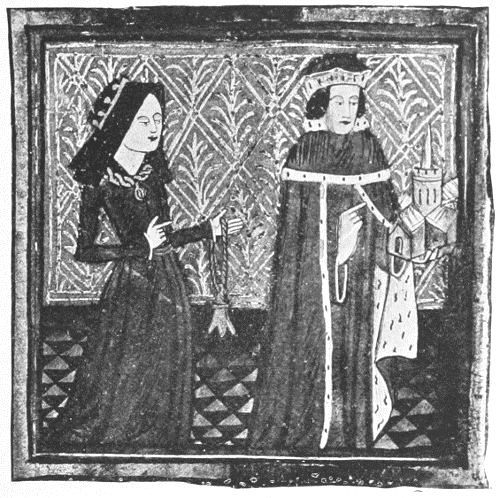
The Duke of Gloucester and his wife Eleanor being
received into the fraternity of St. Alban’s Abbey.
1428] THE PROTECTOR’S POSITION
While Jacqueline was making her last stand against her enemies, and
sending her last appeals for help across to England, Humphrey was
occupied with ambitions far nearer home and totally unconnected with his
now forgotten Hainault policy. The Parliament of 1427, which had been
opened by the little King in person on October 13, had been prorogued on
December 8 by the Protector on the authority of letters-patent from the
King,[722] and on both occasions the subordination of the Protector to
the rules laid down for him were thus fully emphasised. Gloucester began
openly to resent these limitations of his power, and even before the
adjournment he had made some protest against the merely nominal
privileges which he enjoyed.[723] No notice had been taken of this
protest, and he was therefore left to reflect on the matter during
the recess. Christmas he spent at his favourite monastery, and the St.
Albans chronicler tells us of the splendid style in which he celebrated
the Feast. When Epiphany was past, he moved on to Ashbridge near
Berkhampsted for a stay of three days, and thence he returned to London
for the reopening of Parliament.[724] His mind was made up. In spite of
the previous ignoring of his protest, he now, on March 3, requested that
the Lords should define his powers, and did so in such a way as to imply
a demand for more extended rights and privileges than he at present
possessed. He declared his intention of abstaining from attendance in
Parliament till this matter was settled, and arrogantly declared that
during his absence other questions might be discussed but not
settled.[725]
The motive underlying the request is evident. Bedford was safely
employed in the French wars and in Burgundian negotiations; Beaufort was
also absent, and it seemed to Gloucester to be an ideal time to
strengthen his hands against the Cardinal. Possibly he had been betrayed
into the belief that he held the ascendency in Parliament by the
alacrity with which that body had sanctioned the recent loan to him.
Short-sighted as before, he could not distinguish between sympathy for
Jacqueline’s sad plight and sympathy with his personal ambitions, and he
did not realise that other men’s memories were longer than his. In point
of fact he could not have chosen a worse time for this attempt to secure
increased power in the kingdom, for the Lords would have less
compunction in refusing anything to the ‘Good Duke’ at a time when his
conduct was being openly censured even by his London supporters, than
when his popularity was not under a shadow. As it was, the demand
produced the inevitable result. The Lords took their stand on the
arrangements made in the first Parliament of the reign, recalling how
at that time Humphrey had claimed the government of the kingdom, both by
right of birth and by the right of the will of Henry V., how records had
been searched and precedents consulted, with the result that the claim
was found to be unsupported by any legal authority, whilst the right of
Henry V. to give away the government of the country after his death was
also found to have no legal basis. Yet for the sake of peace and to
‘appese’ Gloucester, he had been made chief councillor of the King as
long as Bedford remained abroad, and to distinguish him from the other
councillors the name of ‘Protector and Defender’ was ‘devised’ for him,
which should not ‘emporte auctorite of governaunce of ye land,’ but
merely carry with it a personal duty to provide for the defence of the
kingdom both from external and internal dangers, giving him therewith
certain powers which were enumerated at the time. That was the intention
of Parliament five years ago, and beyond this the Lords would not now
go; indeed at the time Gloucester had agreed to the arrangement. In
Parliament Humphrey had no rights beyond those of any other duke, and it
was merely as Duke of Gloucester that he was summoned there. The Lords
declared themselves surprised at his recent demands, and they told him
pretty bluntly that he must be content with such power as he had got,
even as was Bedford. In conclusion they expressed a hope that he would
take his seat in Parliament, and make no more ado about his position
there.[726]
Nothing could show us more plainly than this the suspicion in which were
held any attempts by Gloucester to monopolise the governmental power,
and the surprisingly advanced state of constitutional theory. Yet we
must not be tempted to dismiss this incident merely as an indication of
Humphrey’s ambition, and of the patriotic endeavour of Parliament to
maintain constitutional government in the face of expiring despotism.
Humphrey’s ambitious nature is, of course, beyond dispute, but among his
motives there may have been some hope of giving the kingdom a strength
it lacked under the present government. It is a platitude to say that
under the Lancastrian kings England had advanced in constitutional
theory much further than in administrative efficiency. The elements of
constitutional monarchy had been attained, and they are nowhere better
expressed than in the answer to Gloucester’s demands, but parliamentary
government at this time was not what we understand by that term now. The
Parliament of Henry VI. was not representative of the kingdom in the
modern sense of the word; it was largely a reflection of the desires of
the English nobility, or rather of a certain dominant clique therein.
The government of this clique had not proved a blessing to England, and
we have already seen something of the lawlessness and disorder of the
kingdom generally. In September of the following year the Chancellor in
opening Parliament was very despondent about the moral state of the
country, declaring that acts of lawlessness and oppression were everyday
occurrences, and arose from the absence of any real administration of
justice.[727]
To Humphrey was given all the hard work of keeping the peace, with none
of the rewards for those labours, or the prestige which would make his
influence efficient. As it was, the divisions in the government had
disastrous effects; the country was not ready for a divided sovereignty.
The only remedy for this state of affairs was that the central power
should be in the hands of one man, who should make his personality felt
at a time when personality had far more influence on men’s minds than
any theory of government. We cannot suggest that Humphrey was the ideal
man to exert this personal power, yet we must not forget his past
attempts to administer the law for the benefit of the injured, or his
later efforts to prevent sedition and internal strife. He could not
belong to the House of Lancaster without inheriting some of the
administrative qualities of his family; to this was added his popularity
with the people, and his position as a member of the royal family. Owing
to this position his influence must be great, and it would have been to
the advantage of the country that this influence should be exerted on
the side of law and order, rather than at the head of a discontented
opposition. On paper the theories contained in the Lords’ reply were
excellent, but in practice they needed a more advanced state of society
than that which obtained in fifteenth-century England. The country,
though it knew it not, was on the eve of a civil war of the worst kind,
and a man untrammelled by the limitations of a none too wise oligarchy
might have saved it many years of bloodshed. Humphrey was not a strong
character, yet with his advantages of birth to support him, he was no
weaker than any other individual of the time in England, and far
stronger than the divided rule of a Regency Council.
As a mitigation of the rebuff of this refusal to increase his powers,
Gloucester was granted the payment for forty-eight days’ service in
1415, which had hitherto been refused by the officials of the
Exchequer;[728] and when Parliament had ceased to sit he went off to
Merton, where he kept the Feast of Easter.[729] The King meanwhile was
taken to keep the Feast at Hertford, where he was visited by Warwick,
who had been brought back from France to fill a post wherein he might
act as another check on the power of the Protector.[730] The death of
the Duke of Exeter in January 1427 had left the post of tutor to the
King vacant, and hitherto this vacancy had not been filled. Now,
however, fearing that in the absence of an authorised tutor Gloucester
might influence his royal nephew, the Council determined to give to
Warwick the place of Exeter, thus fulfilling the wishes of the late King
in this respect, though they had lately refused to do so in the matter
of the Protectorate. On June 1 the writ empowering Warwick to exercise
the office of tutor to Henry VI. was signed by Gloucester and eleven
other Lords of the Council.[731]
1428] DISTURBANCES IN THE MIDLANDS
In the same month we find Humphrey hearing petitions in the Star Chamber
at Westminster with other members of the Council,[732] but he was called
away shortly afterwards to settle a dispute which threatened the peace
of the Midlands. From some paltry retainer’s quarrel a feud had sprung
up between John Mowbray, Duke of Norfolk, and John Holland, Earl of
Huntingdon, and matters had gone so far that each had collected a
considerable force, and a pitched battle seemed imminent. Hearing of
this the Protector hastened to leave London, and on August 19 reached
St. Albans, where the monks greeted him with the usual joyful
processions. He did not, however, delay here, but the next morning,
having paid his respects to the Holy Martyr, he set off in the direction
of Bedfordshire, so that he might get in touch with the two opponents,
and probe the reasons for their quarrel. Though an actual fight was
averted, no settlement could be arranged, as the Duke of Norfolk refused
to appear before the Protector.[733] Here again we find an instance of
the undesirable effects of government by the Privy Council. Both Norfolk
and Huntingdon were councillors, and naturally resented the interference
of a man whose power in the government was subordinate to theirs, but
their feelings of patriotism and responsibility were not enough to
induce them to keep the peace which they were supposed to enforce on
others. No better example could be found of the emptiness of
constitutional theory in those days of turbulence and violence.
Finding himself powerless to restore peace in Bedfordshire, Gloucester
turned south, and by way of St. Albans reached London, where he prepared
to welcome his old rival Beaufort on his return from the Continent.[734]
This was the Bishop of Winchester’s first appearance in England as a
cardinal, and he was met on September 1 outside London by the Mayor and
citizens ‘reverently arrayed in red hoods and green vestments. The
Abbot of St. Albans and many of the regular clergy were there also to
meet him, but of the bishops his Lordship of Salisbury was the only
representative.[735] Gloucester cannot have received the Cardinal with
unalloyed pleasure, for he thoroughly disapproved of the policy which
had allowed the acceptance of the cardinal’s hat. However, he joined in
the official reception, when the Cardinal rode into the city with that
pomp and magnificence which he loved so well.
1429] BEAUFORT’S CARDINALATE
The year passed to its close without further incident, though on
November 19, the Eve of St. Edmund, King and Martyr, we find the
Cardinal again seizing the opportunity of displaying his newly acquired
dignity. A solemn procession round the city was headed by Beaufort,
accompanied by the two Archbishops, the Mayor, and the Protector
himself, who, for the time, seems to have been on good terms with his
uncle.[736] As Christmas drew near, Gloucester went down to Greenwich,
there to celebrate the festival in the house which he had acquired after
the death of the Duke of Exeter, and which he was later to transform
into a famous palace.[737] But with Beaufort in England once more, he
was on the lookout to curb the power of his old antagonist, and the
opportunity was offered him by the cardinalate which the latter had
accepted.
It has been said that Beaufort made ‘the great mistake of his life’ when
he accepted this dignity;[738] at all events it gave the Protector an
excuse for attacking him. He had come back from the Continent with a
papal commission to raise men and money for the crusade against the
Hussites, and he was permitted to make an expedition to Scotland for
this purpose.[739] During his absence Gloucester raised the question as
to whether he had not vacated his bishopric by accepting the cardinal’s
hat, since it exempted him from the jurisdiction of the Archbishop of
Canterbury,[740] and on his return the Cardinal, in order that the
matter might be settled forthwith, petitioned the King to be allowed to
exercise his functions as prelate of the Garter, by right of his
bishopric of Winchester, at the approaching Feast of St. George, the
patron saint of the Order and of the kingdom. The matter was discussed
before the King at Westminster on April 17, and the peers, prelates, and
abbots present agreed to ask the new cardinal to refrain from attending
the festival on this occasion at any rate.[741]
By thus playing on the fears of the majority of Englishmen, who looked
with great dislike on any one who even seemed to suggest papal
interference in the country, Gloucester had made a skilful, if somewhat
revengeful, move, but we must not forget that Beaufort had taken the
first step that led to the state of mutual mistrust which prompted this
action. For the time Gloucester held the ascendence over his rival, and
in the hope of getting him out of the country again, raised no objection
to the permission granted to the Cardinal to raise forces for the
campaign against the Hussites,[742] and this in spite of the fact that
Bedford was asking for reinforcements. However, the defeat of the
English at Patay on the same day that the permission to Beaufort was
given could not be overlooked, and the Cardinal was induced to lead his
forces to the help of Bedford, and to postpone his crusading zeal.[743]
In June he crossed the Channel and landed in France.[744]
1429] CORONATION OF HENRY VI
Bedford, however, wanted more than reinforcements. In the face of the
French successes under the influence of the enthusiasm engendered by the
Maid of Orleans, and the favour with which Frenchmen generally were
beginning to look on the hitherto despised cause of the ‘King of
Bourges,’ it was necessary to do something to rehabilitate the
Lancastrian cause in France. It was with this object that the Regent
earnestly asked the English Council to send the little King to be
crowned at Paris.[745] When Parliament met on September 22 it agreed to
comply with this request, and preparations were rapidly made so that
Henry’s coronation in England might first take place. Gloucester
naturally took a large share in these preparations; it was always with
zest that he arranged a great function. On October 10 he was appointed
to act as Steward of England for the occasion,[746] whilst he was
allowed to appoint a deputy to perform his duties as Great
Chamberlain.[747]
It was on St. Leonard’s Day, Sunday, November 6, that the coronation
took place, shorn of some of its glories by reason of the haste with
which preparations for it had been made. Archbishop Chichele, assisted
by the Cardinal Bishop of Winchester, who had returned from France for
the occasion, performed the ceremony, which ended with a banquet in
Westminster Hall, such as Gloucester had supervised nearly ten years
before on the occasion of Queen Catherine’s coronation.[748]