At about this period of her history Canada threatened
to become that against which Washington had warned his
countrymen, a slave to inveterate antipathies. The mass
of the people were violently for or against each person,
cause or abstract question, in turn; and naturally, the
times being critical, weak men went to the wall and those
who were by nature autocrats came to the front, and in
their way did the best of work. Sir John Colborne, St.
Eustache notwithstanding, was the right man in the right
place; his severe acts were not committed either thoughtlessly
or wantonly. Each was useful in his own way as
circumstances and a narrow orbit permitted. After Sir
John came Prince, MacNab and Drew. None of them hated
in a small, toothy way; there was nothing of the schemer
about any one of them. It was a word and a blow. And
although at one time it seemed as if the most prominent of
them, Prince and MacNab, had given force to the saying
that the man who commits a crime gives strength to the
enemy, the two events in which they figured—as criminals
or heroes according to prejudice—and which nearly caused
a great war, were the means of putting down the rebellion.
The Caroline, and the prisoners who were “shot
accordingly,” showed that the iron heel could stamp, that
the iron hand was better without the glove.
Following closely upon Gallows Hill came the occupation
of Navy Island and the burning of the Caroline.
“What,” asked Canada, “is meant by Neutrality?”
and Jonathan, smoothing the rough edges of his meaning
in poesie, replied:
“Excite fresh men t’invade that monarch’s shore,
And fill a loyal country with alarms,
And give them men, with warlike stores and arms,
Encourage brigands and all aid supply;
I guess that’s strict, downright Neutral-i-ty!”
At the foot of the terrible three hundred and thirty-four
feet of water-leaps taken in the last thirty-six
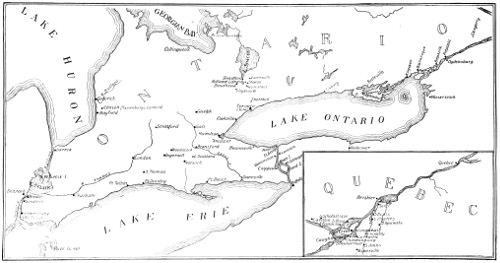
miles of the river-bed of the Niagara, lay Navy Island,
only a mile and a half above the cauldron, and within
three-quarters of a mile of the worst of the mysterious
strugglings and throes of the rapids. This, with several
other small islands, forms a strait and two channels, and
lies within a half-mile row of the Canadian shore. The
Canadian boatman, intrepid as he is, knows the meaning of
that sound, which is ocean at its maddest—a rolling sea
heralding a coming storm that is born in the countless
million tons of clear, deep green water and milk-white
bubble, bubble, toil and trouble, which leap into the
appalling confusion below.
Here, on December 13th, was run up the patriot flag,
with its twin stars supposed to represent “the Canadas—two
pretty provinces, like two pretty daughters kept in
durance vile by an old and surly father; they will either
soon elope, or be carried off nolens volens.”
The Provisional Government, set up on this Juan Fernandez,
where Mackenzie hoped soon to be monarch of all
he surveyed, had also its seal, which showed, besides the
twin stars, a new moon breaking through the surrounding
darkness—the Egyptian night of Canadian thraldom—with
the legend, “Liberty—Equality.” Luckily, the third
word from their French model was missing, for they did
fall out and scratch and fight in a way to serve any local
Watts with themes. At Gallows Hill nothing would
satisfy Mackenzie but the Governor’s head. So now there
was an issue of money, and a proclamation, the latter
offering five hundred pounds for the apprehension of Sir
Francis Bond Head, “so that he may be dealt with as
appertains to justice.” “Would you as it were dethrone
him and bring him to the block,” had queried Rolph some
time before, in his well-known and clever serio-comic supposititious
trial of that dignitary. The commissions issued
were embellished with an eagle and other insignia of
patriotism, the eagle lifting a lion in his claws and evidently
about to fly away with him, the legend “Liberty or
Death.”
It looked as if the would-be Cromwell, after he had
“Come in with a rout, kicked Parliament out,
Would finish by wearing the Crown.”
His coadjutor from the United States was Rensselaer
van Rensselaer. Together, they were dubbed Tom Thumb
and Jack-the-Giant-Killer. Van Rensselaer, a naturally
handsome man, under thirty, looked much older from dissipation,
“A lean and bloated dram-drinker, a spectacle his
nose,” called by his countrymen Rip van Winkle the Second,
who spent his time on Navy Island in the double occupation
of drinking brandy, of which he always had a bottle
under his head at night, and writing love-letters. By his
own account he spent his days plodding “four weary miles
through mud and water” round their little republic to
dispose of recruits and to erect defences; was prostrate,
haggard and careworn, and, when about to partake of a
much-needed meal, would be called away to receive a boat-load
of visitors and leave it untouched. By the account of
others, he bade fair, like Lord Holland in his epitaph, to
be drowned sitting in his elbow-chair, or properly speaking
camp-stool, for furnishings were meagre on Navy Island.
The New York Courier and Enquirer had the honesty, in
the recapitulatory articles which all border events called
out, to say, “It is idle in this matter to affect concealment
of the fact that the present Canadian rebellion
receives its chief impulse and encouragement from the
United States.” No wonder then that a Canadian sheet
should say: “Marshals, governors and generals were on
the look-out for patriots; but one such in charge met a
number of the last en route to Navy Island hauling a piece
of ordnance. ‘Where are you bound for?’ said the gentle
general. ‘Oh, we are only going to shoot ducks,’ said
they, and they were allowed to proceed.”
The Attorney-General said that the wording of Marcy’s
and other messages deprecated the invasion of Canada in
an “Oh-now-don’t” kind of appeal, which, read between
the lines, meant “Go on like good fellows—do just as you
like.”
“The doors were opened,” writes a patriot, “and the
patriots told to help themselves.” Ten pieces of State
artillery were given up on the strength of the following
note, a fine compliment to General Winfield Scott’s literary
reputation—than whom no finer military man in any
service ever stepped:
“Buffalo Head Qr., Jan. 18, 1838.
“Col. H. B. Ransom, Commander-in-chief, Tonawanda.
“Pleas sen on those pieces of Canon which are at your
place; let the same teams come on with them.
“Your in hase,
“W Scott Commander in Chief on the
“Frontier of Niagara.”
There was no forgery, for the patriot guard was W.
Scott, afterwards, by the way, a candidate for presidential
honours.
New York papers could not see any similarity between
the Rebellion and the Revolution; and as to comparing
leaders, “why, it was likening barn door fowls to soaring
eagles.” But in case of the pother ending in war, a correspondent
of the Toronto Palladium says, “There would
not be a house left to smoke, nor a cock to crow day,
within ten miles of the shore on the banks of navigable
rivers—and a finger-post might be set up, ‘Here the
United States was.’”
As for volunteers, they were as plentiful as United
States arms, and comprised all sorts and conditions of
man and boy. Two thirty-six pounders, one eighteen-pounder,
two thousand stand of arms, one hundred cannon
balls, five hundred musket cartridges, is the enumeration of
one contribution; and only the state of the roads prevents
one contributor setting out with a six-pound brass
cannon. An old gun is actually sent with the message,
“If you want cannon we are ready to cast them for you.”
An ex-member of the New York Legislature, with two
certified captains, goes with a letter to Van Rensselaer,
to talk over what measures sentries, presumably of an
arsenal, might take to furnish material without infringing
the law; and D. M’Leod writes, “Arms in abundance
can be had for the asking.” Another friend sends
blankets and arms; one old man, a follower of Murat,
asks a cavalry commission for his son, a lad of nineteen,
adding pathetically, “I am now old and poor, but if you
will grant my request I will send you my son, the last
descendant of a noble line of warlike commanders of
France.”
A blacksmith in Buffalo had an order for nine hundred
creepers, other artisans were busy at daggers and bowie
knives, and a Mr. Wilkinson furnished five hundred
pounds of boiler cuttings as a substitute for grape-shot.
Canadians were used to this kind of ammunition. Away
back in 1758 the Highlanders wounded at Carillon had
died of cankered wounds from the broken glass and jagged
metal used instead of “honest shot.”
“An empty hand, a stout heart, and a fair knowledge
of military tactics,” blankets, boots and shoes, one hundred
and seventeen loaves of bread, eight tons of grape-shot,
two loads of beef, pork, and bread, together with
“some gentlemen well equipped for fight,” one hundred
muskets, four loads of volunteers, swell the original
twenty-six men who accompanied Mackenzie and Van
Rensselaer at first, when the frame of a cannon, upon
which Mackenzie had sunk inert and spirit-broken till
aroused by some false alarm, is the only defence mentioned.
But, undaunted, “Push off!” had been the cry
of this handful. A proclamation was issued, drawing
attention to the country in front which was languishing
under the blighting influence of military despots,
strangers from Europe; an end forever was promised
to the wearisome prayers, supplications and mockeries
attendant upon our connection with the lordlings of the
Colonial office, Downing Street, London; the time was
favourable, owing to the absence of the “hired” red-coats
of Europe; and ten millions of acres of fair and fertile
lands were at the disposal of the Provisional Government,
to be divided into portions of three hundred acres, which,
added to one hundred dollars in silver, would be the reward
of those who would bring this glorious struggle to
a conclusion.
“And though slavery’s cloud o’er thy morning hath hung,
The full tide of freedom shall beam round thee yet.”
Besides Van Rensselaer, the aid was announced of
Colonel Sutherland and Colonel Van Egmond. Alas, the
latter, a good and true man, who was worthy of a better
fate than the one he earned by meddling in misunderstood
politics of a foreign country, was by then suffering agonies
in Toronto gaol; and Sutherland—as true-bred coward as
ever turned back—was destined for the tender touch of
Colonel Prince a little later. When proposal was subsequently
made to exchange Sutherland for Mackenzie, it
drew the following query from an American paper, “What
should they do with him if they had him, and why not
give up Mackenzie to the Canadians in payment for the
custody of Sutherland?” Clearly the possession of Sutherland
was a poor boast; he was a mark for his countrymen’s
contempt from the time he paraded the streets of
Buffalo, preceded by a fife and drum, enlisting volunteers,
until he disappears from the scene. The Buffalonian, when
giving a detailed account of thefts committed by the
patriots, from cannon to cabbages, says: “The patriot army
have also robbed an uncommon quantity of hen-roosts.
In these exploits Brigadier-General Sutherland is chiefly
conspicuous for his gallantry in the attack and skill and
expedition in retreating.”
Robert Gourlay, then at Cleveland, Ohio, wrote his
opinion of the fatuity of this course direct to Van Rensselaer.
Several of his letters are condensed into, “Never
was hallucination more blinding than yours. At a moment
of profound peace, putting on armour, and led by
the little editor of a blackguard newspaper, entering the
lists of civil broil, and erecting your standard on Navy
Island to defy the armies of Britain! David before Goliath
seemed little, but God was with him. What are you
in the limbo of vanity, with no stay but the devil?
Mr. Hume is a little man, and you less.” He adds,
alluding to the famous letter, “That his four years of
residence in the United States had let him see things far
worse than European domination. You call yourself a
patriot, and fly from home to enlist scoundrels for the conquest
of your country. This is patriotism with a vengeance.”
Mackenzie, like Gourlay, had a great aptitude in calculating
the difficulties they were powerful enough to create.
But neither of them, in his own case, counted on possible
consequences.
At the finish of his proclamation Mackenzie has a prophecy:
“We were also among the deliverers of our
country.” But he further says, “Militiamen of 1812, will
ye rally round the standard of our tyrants? I can scarce
believe it possible.”
Already that standard was floating before his eyes from
one of the tallest pines, and around it were gathered MacNab,
Drew, and a host of others whose own arms or their
fathers’ had been borne in 1812,—two thousand five hundred
Canadian farmers, most of them delaying, when called,
for nothing but the clothing in which they now stood.
Bayonets glittered in the sun, and, on horseback as usual,
Sir Francis trotted up and down, reviewing with pardonable
pride the troops, white, red, and black, which had
rallied round that flag.
“Canadians, rally round your Head,
Nor to these base insurgents yield,”
had been the cry of a Tory paper.
“I wonder how that rebel crew
Could clap their wings and craw, man,”
says another. But Sir Francis had one discomforting
answer to his appeal for aid against Navy Island. Mr.
Absalom Shade, of Galt, replied that not a few there
declined to enter into any such frontier service; while
many in the Paisley Block, though not allying themselves
with Mackenzie, would have seen “Governor and Governor’s
party drowned in the depths of the sea and not a
solitary cry of regret for them.”
But Sir Francis had his friends. (Toast): Sir Francis
Bond Head—the noble champion of our rights—distinguished
alike for every virtue which constitutes the gentleman
and the scholar, whose name adorns a bright page in
the History of Upper Canada. (Tune: “Britons Strike
Home”).
Gallows Hill over, the Canadian muse took her lyre in
hand and sang, with a Scotch accent forbye:
“Oh, did ye hear the news of late,
Which through the Province rang, man,
And warned our men to try the game
They played at Waterloo, man.
All destitute of dread or fears,
Militia men and volunteers
Like lightning flew, for to subdue
The rebel loons and crack their croons,
And pook their lugs and a’, man.
Lang life to Queen Victoria,
Our Governor and a’, man!
We’ll rally round Britannia’s flag,
And fecht like Britons a’, man.”
Sir Francis, in the account he has given us, seems to
have been so taken up with the moral lesson of the
panorama before him, making a book out of the running
brook of Niagara and a moral out of everything, showing
his chemical analysis of the comparative advantages of
monarchical and republican institutions, speculating on the
mutating effect of hard shot on the latter and the thickness
of the hide of the American conscience and the thinness
of skin which covered American vanity, that he
forgot to fight. “Waiting calmly on the defensive,” he
called it, emulating a commander at Fontenoy, nicknamed
The Confectioner, who, when asked why he did not
move to the front, replied, “I am preserving my men.”
The usually alert and active Canadian volunteer was occasionally
balanced by one more likely to damage himself or
his comrades than the enemy. A young clergyman,
newly ordained, arrived in Canada about the time of the
Rebellion. As he had as yet no charge he thought it only
proper to take part in the fray, of course on the loyalist
side. A musket was placed in his hands, but he had to
apply to someone wiser than himself to know what should
go in first. He was stationed on the Niagara frontier in
mid-winter, where the beauties of nature made him forgetful
of all else. Instead of keeping “eyes front” he used
them in star-gazing, fell into the hands of the rebels, and
narrowly escaped being shot as a spy. He escaped by the
intervention of a person who happened to know him.
A central blockhouse, several batteries, and most imposing
earthworks could be seen through the telescope;
but as the island was for the most part covered with wood
it was hard to approximate its strength. The main camp
of huts was on the other side and on Grand Island—a
large island some ten miles long, belonging to the United
States, and on which a certain Major Noah, of New York,
years before had laid the foundations of the city of Ararat,
intending to raise there an altar. Across the channel was
a portion of the army of sympathisers and the general
hospital, the latter transformed into an ark of refuge.
From this island, United States property, the loyalist
reconnoitering parties sent out in small boats were fired
upon, as minutely recorded by Lieutenant Elmsley, who
also states, “On our coming abreast of Fort Schlosser I
distinctly saw two discharges of heavy ordnance from a
point on the main shore on the American side, not far
from that fort. As soon as our boats had passed the firing
ceased.” The two vantage points of the lesser island and
Canadian mainland were near enough for threat or challenge
to be thrown across, and from the Battle Ground
Inn, just opposite Navy Island, such encouraging sentences
as “We’ll be over at you one of these days,” were wafted
over. An idle threat so far. Chases after the balls of the
enemy as they bounded along, laughter and cheers, made
the place more like a playground than a battle-field, a
state of inaction which continued for a fortnight.
Part of Sir Francis’ “moral” inward conflict was
through the very evident desire on the part of his black
militia, many of them scarred and mutilated from their
slave-life, to be up and doing on the land from which they
had made their escape. They were a formidable looking
set of men, powerful, athletic; and as they stood about him,
yellow eyes, red gums and clenched ivory teeth making a
fine combination of colour, terrible possibilities seem to
have crossed his mind. So also with the Indian contingent.
They did not like the Long Knives across the water—a
name not originally Kentuckian, but straight from the
time of good King Arthur. But there was what Sir
Francis calls an unwholesome opinion in Downing Street
that it would be barbarous to use them as allies against
American citizens. It had been said that Canadians
were only a trifle less handy at scalping than the allies
were, and there were still tales extant of scalping scenes
at the time of the Conquest, and later. He managed to
satisfy the Indians, however. The honest red countenances
glowed, the feathers on their heads gently waved, as
they communed among themselves, and presently a disconcerting
warwhoop arose, at first like the single yelp of a
wolf, but gathering in volume until every scalp upon the
island must have quivered.
The following extracts from letters sent from Chippewa
by Captain Battersby to his home show how slowly
matters progressed:
“Pavilion Hotel, 26th December, 1837.—MacNab arrived
yesterday with a large accession of force. Boats
have been brought up from Niagara and preparations are
making for an attack, which if made at all will, I think,
take place in a day or two....
“Chippewa, 28th December.—No attack has yet been
made, but the preparations are going on. We are procuring
boats from Dunnville, St. Catharines and Niagara,
forty or fifty seamen have arrived, and there are two
captains in the navy and four lieutenants, ... so that you
see our means are augmenting fast. We are most deficient
in artillery, but I believe some heavy guns are on their
way. There was some firing yesterday from the island,
but no effect except wounding a horse. It is said that the
Governor has sent up orders not to attack the island by
boats, but to dislodge the enemy by artillery and bombardment.
At any rate I am glad to see that our leaders are
going on cautiously and do not intend making an attack
until they have sufficient force. A part of the 24th Regiment
is said to be on its way here, and I shall be very glad
to see them—they will be invaluable as a support and
rallying point to our raw militia.... I will write again
when I can, but such is the hurry and confusion that it is
difficult to find time and place.
“30th December, 9 p.m.—You will hear before this
reaches you of the burning of the steamboat on the
American side of the river. It took place about midnight,
and was a very gallant enterprise, as those who achieved
it were mostly young, inexperienced lads, gentlemen
volunteers from the militia; very few of them could even
row decently, and many of the small boats employed had
not even rudders.... I was in one of the boats, but
owing to not having men who could row, and the boat
being heavy, I lost sight of the others in the dark ... and
obliged to return. I have no doubt that this affair will
make a great noise in the United States; in fact I know
it already has at Buffalo.... I don’t think that an
immediate attack is contemplated, though we are going on
with our preparations and shall have boats enough fitted
and ready in two or three days. One company of the 24th
Regiment came in on the morning of the day I last wrote
you.... To give you an idea of the way we go on,
yesterday night when the boats were manning for the
attack a whole squad of people I knew nothing about
came down armed to the teeth, and I really thought at
first they would have attempted to take possession of my
boat by force that they might go themselves.
“January 4, 1838.—The Lieut.-Governor is here and
preparations are still going on for the attack. I have
now, however, no fear for the result, as several heavy guns
have been brought up, two mortars and a large quantity
of Congreve rockets. Our boat force is also increasing
rapidly and will soon be equal to whatever is required....
I believe two or three companies of the 32nd will
take part in the attack whenever it is made. We are
going to move to-night with the boats two or three miles
above the island, for the purpose of dropping down with
the current when the attack is made.
“January 8th.—The time of attack is as doubtful as
ever. We are going on still with our preparations, but
owing to the paucity of materials and the terrible state of
confusion in which we are, our progress is very slow. There
has been a constant thaw here and some rain for the last
fourteen days, and the roads are in a state absolutely
indescribable. I can safely say that I am floundering in
six inches of mud and water from morning till night. I
cannot ask for leave of absence for a day, for numbers of
the seamen are already discontented and would willingly
seize such a pretext for leaving us. We are living in the
utmost filth and discomfort.
“January 11th.—Here we are still in the same degree
of uncertainty as when I last wrote.... More artillery
and troops are expected.... I think myself that no
attack will take place for two or three weeks, but it is
very likely that we shall endeavour to check their communications
with the United States, by means of armed boats,
in which case my services would be as necessary as if the
island were attacked.... It is now more than a fortnight
since I have had my clothes off, night or day. More or
less firing takes place between our batteries and those of
the enemy every day, and though there are always crowds
of gazers on our side, yet to my astonishment only two
men have as yet been hurt, although the shot fall a good
quarter of a mile past our batteries. I think the commanding
officer very much to blame for allowing such
crowds to put themselves in danger merely to gratify an
idle curiosity. The Buffalo papers state the loss on the
island to have been eleven men since the batteries first
opened. Great numbers of the militia have left and are
leaving this place, at which I am not sorry, as they are
entirely undisciplined and many of them disorderly.”
But Sir John Colborne to the rescue. His artillery,
officers, guns, mortars, Congreve rockets and stores
arrived, and a great stir went through the dissatisfied
lines.
The guard standing at Black Creek bridge had a very
bad toothache the night of December 29th, so bad that he
thankfully retired to the barracks at Chippewa, an old,
evacuated tavern, whose big cavernous fire-place, well filled
with blazing logs, gave much comfort to his aching jaw.
The men were lying about on straw, two and two under a
blanket, when in came Nick Thorne to ask if any one of
them would help him load up wood from the barrack yard.
Some great doings were on hand; he had the countersign;
the wood loads were to be used for a beacon light. Reed,
whose father, a U. E. Loyalist of 1796, had followed Brock
at Queenston, forgot his toothache.
The Caroline was a copper-bottomed craft, originally
constructed by the man known afterwards as Commodore
Vanderbilt, was intended to sail in the waters off South
Carolina, and her timbers were of live oak from that State.
She was converted into a steamer and brought up the
canals to Lake Ontario, had been used as a ferry at
Ogdensburg, and was then taken through the Welland
Canal for similar ferry purposes at Buffalo. She was
hired by the patriots on Navy Island to convey stores to
them from Fort Schlosser, an old military position of
French times, where neither fort nor village remained;
there was nothing but a tavern, which was the rendezvous
of the “pirate force” in coming and going. “Where
are you going?” queried someone similar to the gentle
general.
“To Dunkirk,” answered the Caroline’s master, Appleby.
“You mean eastward to Navy Island?” But this skipper
answered never a word, and a scornful laugh laughed
he.
The three lake schooners, each fitted with a gun and
intended to carry troops to the island when the long
deferred attack should be made, were still inactive. A
loyalist reconnoitering party was sent out to report upon
what proved to be the Caroline’s last trip. She had landed a
cannon and several armed men, and had dropped her anchor
east of the island. Expecting to find her still there it was
decided to “cut her out” that night. The process technically
known as cutting out is a naval one, conducted with
great secrecy and muffled oars, men and cutlasses, pistols
and boarding pikes, black night and plenty of blood, after
the manner of Marryat; always a dangerous business, but
in these circumstances, where their chart reported irresistible
currents and not half a mile above the Falls, a most
perilous enterprise. Luckily there was the right kind of
material at hand and to spare for it. They had but a few
small boats of about twelve feet in length, each pulling four
oars; it would be necessary to keep uncomfortably close
to the rapids in order to avoid observation from Navy
Island; the difficulties, did the men once quail, were so
great that the shortest way was to put them out of mind.
At four o’clock that afternoon Colonel MacNab and Capt.
Drew, R.N., stood on the lookout discussing the situation.
They saw the Caroline performing her duty of conveyance,
the telescope revealing the field-pieces and men.
“This won’t do,” said MacNab. “I say, Drew, do you
think you can cut that vessel out!”
“Oh, yes,” was the ready answer; “nothing easier. But
it must be done at night.”
“Well, then,” was the laconic order, “go and do it.”
That order “nearly fired the continent as well as the
Caroline.”
To quote the patriot chronicle, it was now that “an
insult, the most reckless, cowardly, and unwarranted that
was ever offered to a sovereign people, was given.”
Captain Drew was a commander on half pay, “elderly,
shortish, and stout,” who had settled in Woodstock in
1834 upon a beautiful farm, where he fondly hoped to end
his days in peaceful occupations of wheat-growing and
tree-planting. The Duke of Northumberland, who visited
him there, thought it the prettiest place he had seen in
Canada; and indeed Captain Drew and Major James
Barwick may be termed the pioneers of those—the Vansittarts,
Lights, De Blaquières, Deedes and others—who
formed the far-known aristocratic settlement of Oxford.
The midlands of England held nothing lovelier than these
homes scattered along the Thames, farms separated by
beautiful ravines, studded and fringed with elms and
noble maples, well built picturesque houses, wherein the
owners entertained after the manner of their class and
kind and spent much money. The stress of war in very
few years was to wipe out this community of blood, manners
and culture; but Captain Drew’s tenure, owing to
the cutting out of the Caroline, was to be shorter still.
The first thing to be done was to call for volunteers.
“Here we are, sir,” cried a hundred voices, “what are we
to do?” some of them from the contingent in the Methodist
chapel at Chippewa. “Follow me,” was the only answer,
for it was of first importance that no word could possibly
be conveyed to the island, and Drew says the men did not
know their errand until seated in the boats and off from
shore, taking their way via the little canal just above the
rapids. Rumours of any kind were quickly transmitted
to either side; one of the most ludicrous which had
recently come to the ears of the troops was that Mackenzie’s
people said the Tories of Toronto had managed to
smuggle a black cook into the patriot stronghold opposite,
and that presently all patriots would therefore die of
poison.
Each man of the boats’ crews had to be able to pull a
good oar, a condition not strictly carried out, as we see
from Captain Battersby’s letters, but there were some
experts, such as young Mewburn, who writes that he was
doubly manning a bow oar. Each man was furnished
with a cutlass and pistol. Most of them were young
fellows, some from that corps organized in King Street in
Hamilton by MacNab and called by him his “Elegant
Extracts.” One, young Woods, a curly-headed laddie,
U.E.L. to the heart’s core, good-naturedly gave up his
seat to a friend, Dr. Askin, and then found himself
likely to be left on shore. He appealed to his chief.
“Why, you d—d young scamp, if you want to be shot
give my compliments to Captain Beer and tell him to take
you in.” More easily said than done; but through
influence, and by being able to hide under a seat, he got
into a boat and lay on a pile of wet sand, with knees up to
his chin, palpitating with excitement, until the final moment
of departure. For time dragged tediously; they had to
give the Caroline an hour or two to settle herself for
the night, and they heartily wished that the moon would
do the same. “Hadn’t you better give me another,” said
our curly-headed laddie, referring to his pistol. “When
you have used that, you will find that you won’t want
another,” said his officer.
MacNab wished the Caroline to be brought to
Chippewa; Drew wanted her burnt and done for. By
half after eleven they had started, sent off with three
hearty cheers from those left behind, Thorne, Reed and
the others ready to light the fire which was to answer to
the blaze they intended to make, and, unnecessary precaution,
which would also serve as beacon to guide them back.
Once out, the men were told the service they were bent on
and offered the chance to return, the danger not being
burked. But no one took advantage of the offer. Some,
however, nearly had their course altered in spite of themselves:
“Robert Sullivan, one of the crew, called out,
‘Stop rowing, boys, for God’s sake—do you see where we
are—we are going straight over the Falls!’ ‘Silence!’
responded Lieutenant Graham, ‘or I will blow your brains
out. It is for me, not you, to give orders.’ ‘Oh, very
well,’ replied Sullivan, drawing his oar into the boat, ‘if I
am to go over the Falls, I may as well go without brains as
with them.’ Here we all joined in, and after hurriedly
representing to Graham the danger of our position we
began to pull up stream. A little longer and it would
have been too late.” The roar of the mighty cataract,
which awed and somewhat terrified them, had been previously
described by a patriot writer as the peal of the
funeral dirge of royalty in Canada.
Shots from Navy Island made the heart beat; and do
their best they were forced to cross the river diagonally.
“We are going astern, sir; we shall be over the Falls;”
but reassured by the light from the doomed steamer, by
which they could determine the drop down stream, they at
length all got together. The moon was yet too bright, and
they rested on their oars, dipping them enough to stem the
current. At last it was dark enough, and they were
alongside. “Boat, ahoy! boat, ahoy!—give us the countersign!”
“Silence!” said Drew, in a confidential tone,
“silence! don’t make a noise, and we’ll give you the
countersign when we get on board.” Once on deck, he
drew his sword, saying to the three men who were lounging
on the starboard gangway, “I want this vessel, and you
must go ashore at once.” Thinking he was alone they
took up their arms and fired at him, not a yard off. A
swing and a cut of the sword, and one patriot dropped at
the captain’s feet. Another trigger was pulled, the only
result a flash in the pan; there was a sabre-cut dealt on
the inside of the man’s arm, and the pistol fell. The
captain confesses to expediting this man and another
over the boat’s side with an inch of the point of his
weapon.
Meantime, three of the boats had boarded forward, and
a good deal of firing followed, the latter checked at once
by the captain, as he feared that in the dark friend might
be mistaken for foe, a fear soon realized. Returning, he
thought it wise to reconnoitre about the gangway between
the bulwark and the raised cabin. Here he was met by a
man who aimed at him a slashing cut, which he parried
and successfully pinned the cutlass against the cabin bulk-head.
“Holloa, Zealand,” said he, recognizing one of his
own men, a fine specimen of an old British tar, “what are
you about?” “Oh, I beg pardon, sir, I didn’t know it was
you!” said the zealous sailor, who, released, went to seek
legitimate prey. There was a good deal of cursing, clashing
of swords and shouting, and (it is said) a cry of “Show the
rebels no quarter.” On the contrary, as the men fussed
over the lamp, the window sashes and the forgotten
“carcass,” trying to coax a fire, one American heard them
say of himself, “What shall we do with this fellow?”
“Kill him!” suggested one; “No, take him prisoner!”
said a third; but their officer’s decision was that they did
not want prisoners, and the man was to be put ashore.
And the only person killed in the whole affair, Durfee, lay
on the dock, shot by a bullet which came from the land side.
Wells, the owner of the vessel, finding himself on solid
ground, made some good running, in spite of his assertion
that he was almost cut to pieces.
One tale of the day has it that another life was lost; a
volunteer was fired at by a patriot, and in retaliation beat
his assailant’s brains out; his own condition and that of
the butt of his pistol corroborated his story on his return
to the Canadian side. The matter for the extraordinarily
sensational accounts given by the American press was
chiefly furnished by Mackenzie.
Lieutenant Elmsley officered a guard on shore while the
vessel was cut from her moorings—not an easy thing to
accomplish, as she was made fast by chains frozen in the
ice; but a young fellow named Sullivan seized an axe,
cleared the chains, and set her free. This, Commander
Drew’s own story, is denied by a survivor, one of his lieutenants.
A lamp was placed in a basket used for carrying
Indian corn, cross-bars from the windows were torn off
and added to it, and the vessel was set alight in four
different places. The material especially brought for
this purpose, and known as a carcass, was at first quite
forgotten. Care had been taken to rouse all sleepers, had
any been able to sleep through such a scene; the invaders
were ordered to their boats; the flames shot out fore and
aft; and by this time Captain Drew found his stand on
the paddle-box too uncomfortable, as those driven ashore
had recovered from their surprise and the discharge of
their muskets was disagreeably close. It was equally uncomfortably
hot, and his gallant wish to be the last on
board nearly left him there as she drifted down the current.
He found a companion in a man emerging from
below who declared it too hot to live in there, and together
they got into the boat sent back for them, Drew’s shouts
fortunately having risen above the din. So far there was
no need for the beacon from the opposite shore; the
Caroline herself, like a great torch, glided beside them, or
rather they kept in the wake of her gold-dust covered
ripples, a fine target for the island guns; but the days of
bull’s-eyes were not yet. In spite of wounds the men rose
superior to fear of shot, content with the result of their
mission, and anxious to rejoin the cheering multitude that
waited for them on the Canadian shore. The illumination
made by burning vessel and beacon light threw every
pebble on the shore-line into bright relief. Drew’s account
states that no human ingenuity could have accomplished
what the Caroline so easily did for herself. When free
from the wharf at Fort Schlosser her natural course would
have been to follow the stream, which would have taken
her along the American shore and over the American
Fall; but she behaved as if aware she had changed
owners and navigated herself across the river, clearing the
rapids above Goat Island; she went fairly over the British
Fall of Niagara.4
An extract from one of the songs sung by the Canadian
volunteers will give an idea of the sentiments of the
singers:
“A party left the British shore,
Led on by gallant Drew, sir,
Who set the Yankee boat on fire
And beat their pirate crew, sir.
The Yankees said they did invent
The steamboat first of all, sir,
But Britain taught the Yankee boat
To navigate the Fall, sir.”
The Lewiston Telegraph on Saturday set this in type at
6 a.m.:
“We stop the press to announce the following horrible
intelligence which has just been communicated by two
gentlemen direct from the bloody scene:
“The steamer Caroline, which was lying at the landing
at Porter’s storehouse, was boarded this morning between
the hours of twelve and one by about eighty men, who
came in boats from the Canada side. The Caroline had
on board from fifteen to twenty of our sleeping and
defenceless citizens, who had lodgings on board. They are
believed to have been mostly citizens of Buffalo, who came
as lookers-on, with the expectation of witnessing the attack
upon the island. Every individual was butchered except
four, and three of these severely wounded. The engineer,
who was thrust through and put on shore, says that after
the bloody work was executed a small boy was found in
a closet, who begged for mercy but found none. The
Caroline was then towed out into the stream and sent over
Niagara Falls. Three cheers were given, and at the same
time beacon lights were raised at Chippewa. Our informant
saw the lifeless body of one person who was shot upon the
shore.”
For five years the question hung upon a thread whether
England and the United States should go to war or not.
It is always fair to give two sides of a question, but in the
one given by Clio and Melpomene it will be seen their
poetic license degenerates into something more than the
flowery taradiddle of the average verse-maker:
“Oh, what were the dreams, as they sunk to rest,
Of that devoted band,
Who lay, as a babe on its mother’s breast,
On the shores of their native land?
Breathed they of fire, or of streaming blood,
Or the thundering cataract’s whelming flood?
Strong manhood’s godlike form was there,
With his bold and open brow,
And age, with his wearied look of care,
And his floating locks of snow;
And the agile form of the stripling boy,
With his throbbing pulse of hope and joy.
They dreamed of the happy hours of home,
Of a blessed mother’s prayer,
Of the cherished wife in that sacred dome,
Of the lisping prattlers there;
And the stripling dreamed of his young love’s smile
When he left her bound for the fatal isle.
Oh, what was that dim, ominous sound,
That struck on the sleeper’s ear,
Yet roused him not from his rest profound
Till the unsheathed blade was near?
And it seemed as the air and the rocks were riven
By the slogan of death and the wild shriek given.
Oh, vain was the strife of the struggling few
With a well-armed murderous band;
For the gallant barque, with her blood-drenched crew,
Is floating from the strand,
And the young boy’s quarter cry it bore
To the purple wave, with his own heart’s gore.
On, wildly onward, sped the craft,
As she swiftly neared the verge;
And the demon guards of the black gulf laughed,
And chanted a hellish dirge;
And the booming waters roared anew
A wail for the dead and dying crew.
As over the shelving rocks she broke
And plunged in her turbulent grave,
The slumbering Genius of Freedom woke,
Baptized in Niagara’s wave,
And sounded her warning tocsin far
From Atlantic’s shore to polar star.”
A careful computation from pages of prose, almost as
flowery as the foregoing lines and oftentimes breaking
into rhyme from a very luxuriousness of idea and rhythm,
puts the lives aboard the Caroline at about ninety-nine
in number. Thirty-three were killed and missing; thirty-three
were towed into the middle of the stream when
the boat was fired, and with her went over the ledge;
there were also thrilling cries from “the living souls” on
board, plus “wails of the dying,” presumably thirty-three
cries and thirty-three wails, all gliding down the resistless
rapids to perish by “the double horror of a fate inevitable.”
On the day following the cutting out five hundred
men were told off to complete the work by driving the
filibusters off the island, the three schooners, with
boats and barges, being sufficient transport. “But
what shall we do if a shot strikes our boat—we must
either drown or go over the Falls,” was a query which
sent Captain Drew off on another hazard. He pulled up
stream in a four-oared gig, within pistol shot of the island,
to see if the enemy’s field-piece was equal to hitting a
boat which moved fast through the water. So far the
casualties from the red-hot shot sent skipping along the
Canadian shore were the death of young Smith of Hamilton,
who, lying in a barn on some hay, had part of his
thigh carried away and some ribs broken, and an old
sailor named Millar who served Captain Luard’s guns,
and had his leg taken off. Millar asked to see his leg,
gave three cheers for the Queen, and died.
A twenty-four pounder, mounted on a scow, battered
the point where the guns of Van Rensselaer were most
active. Drew’s expedition brought upon themselves both
musketry and field-pieces, at first innocent of all aim, but
suddenly so improved that one shot made ducks and
drakes on the water, just clearing the gunwale, and passing
between Drew and his strokesman. This was from
no amateur, but owed its precision to the hand of a
young West Pointer—possibly of the “empty hand, stout
heart, of fair military tactics” letter. Van Rensselaer
has left it on record that the only moments of excitement
to him in this episode were when the first gun was
fired from the island, and when this boat’s crew, at early
dawn, made its way in safety round them; so that Drew’s
temerity was not without reward. These patriots had
“kissed their rusty muskets” and vowed they would never
lay them down until “the redemption of Canada was
accomplished.” A “sympathetic” account tells us that
the men so determined to do or die, in order to protect
themselves from temptation had taken the pins out of the
screws of the scows and burned their oars, resolved,
“If sons of Liberty can keep
resting-place but this,
Then here we’ll stand—or madly leap
Into the dark abyss.”
The outcome was a hurried departure by night after
they heard of the arrival of the 24th Regiment. The
brisk cannonade of about four hundred rounds from heavy
guns and mortars, and the armed schooners which effectually
kept them within their breastworks, were almost
enough without the rumour of the 24th.
When the Canadian force landed not a soul was to be
seen, and what had appeared formidable defence dwindled.
Apparently a second Gibraltar, it was found in military
parlance to be a bug-bear than which a greater never existed,
a conglomeration of batteries and hovels masked
with wood, a sickening spectacle of “looped and windowed”
wretchedness. The vaunted blockhouse citadel,
the barracks and the batteries, were but huts of trees and
sods and ill-constructed embankments; the only reward
for industry was an abattis of brushwood to prevent boat
invasion.
A man concealed in the woods now came out, white flag
in hand, and from him and two women found in a hut did
the Canadians get an account of life on “the fatal isle”
during the biting storms and pitiless rain of December, ’37,
and January, ’38. “Peas and beans dank as a dog,”
varied by feasts, the bones of which lay about with remains
of bread and barrels of beans yet untouched, had
been their food; the bushes about were eloquent, with
bits of rag sticking to them, of the quality of clothing;
these patriots, herded together like swine and sheep, left
behind them evidences of some stores, boots and shoes,
plenty of reading matter of the most virulent kind, all
mixed up with burst shells, splintered wood and dirty
straw. Some boots had the legs cut open, apparently to
strip wounded limbs, some were stained with blood; and
“a huge pile of unpicked bones, ... on a rough board
used as a table,” and the remains of beds made of pine
branches, gave further evidence.
Sir Francis paid the site a visit on the 17th, a wild and
boisterous day. He had the body of one man exhumed—shot
by a rifle, but his arms were pinioned. He had been
suspected as a spy. The susceptible Sir Francis, light as
his heart generally was, saddened at the sight of him.
Songs abounded for every part of the event, dates sometimes
making way for rhyme:
“They say he murdered one Durfee,
In December, ’39, sir;
And stole some candles and old boots,
And burnt the Caroline, sir.”
On the night of evacuation the soi-disant patriot army
surrendered their arms to the United States authorities and
disbanded their forces. The cannon belonging to the
State were returned in a scow to Fort Schlosser, and in
transit with the men on board came near following the
fate of the Caroline. The scow had fallen far down the
current and the men had given up their case as hopeless,
when a gale from the north-west sprang up, and, aided by
their blankets extemporized into sails, they were wafted
ashore.
A month before, when they had received these ill-gotten
guns, they slaughtered the oxen which drew them, and
paid for the beef and work by a due-bill on the future
Canadian Republic.
“No sooner was the Caroline in flames than a sudden
excitement prevailed; but it was the excitement of fear.
The women fled from the villages on the coast, people who
had fancied themselves bedridden decamped, and the citizens
of Buffalo evinced the greatest possible consternation
for the safety of their town.”
Captain Drew almost distanced Sir Francis in unpopularity
in certain quarters; but like him, among his
own was at once a hero. At St. George’s Day dinner
in Toronto, Captain Marryat, an old comrade of Drew’s,
gave the toast: “Captain Drew and his brave comrades
who cut out the Caroline.” The day after the
cutting-out, Drew, with MacNab, was burnt in effigy on
the ice at Detroit, and he saw himself advertised for in a
Buffalo newspaper at a reward of $500. He was hanged
in effigy—a compliment kept up on the anniversary for
several years; active attempts were made to assassinate
him, of so determined a nature that in the end the pleasant
Woodstock home was forsaken, and heroism was forgotten
when, forced to leave the country to preserve life to
wife and family, he found himself in England, where the
preservation of Canada was of interest on a large scale but
the reward of her preservers a matter of no moment.
Captain Marryat’s toast brought upon him, too, attentions
similar to those bestowed upon the subject of it. He was
burned in effigy in every town in the United States
through which his journey took him; his writings were
made into a bonfire in Lewiston, and in St. Louis his effigy
was decorated with a halter round the neck. Cincinnati
was the first place which dared to assert a difference. The
captain, whose mother was an American, had so far looked
on at his own cremation and at that of his child-literary
with calmness, smoking a cigar the while; but in Cincinnati,
at the dinner tendered him, he spoke out like a man,
a gentleman, and a person of force and humour, giving his
reasons for his opinions and actions and ashamed of
neither. He said that his motive in refusing private hospitality
was that he might leave himself freedom of speech;
and he finishes his deliverance, “If we are to burn all
those who differ with us in opinion, consider, gentlemen,
what a glorious bonfire would be made of the whole United
States.”
What touched him most deeply was part of his mail
matter,—five hundred anonymous letters which cost him
on an average fifty cents each to redeem from the post, and
of which he makes bitter though humorous complaint in a
long, published letter, supposed to answer his five hundred
correspondents in one coup-de-main and also his well-wishers,
whose missives followed him so persistently from
place to place, that he began to think it a combined attack
upon his purse from Van Buren and the Postmaster-General.
The destruction of the Caroline surprised everyone,
Americans, Canadians, even the chief actors; it let
loose the tongues of ministers and diplomats, and it
gave a great impulse to the outside movement of sympathisers
or patriots. The success of Drew’s action made
the last wary; but the howl of indignation, which for
a time was allowed to have some show of reason, served
as a cloak under which to add retaliation to what before
had been dubbed patriotism alone. Sugar Island, Bois
Blanc, and the schooner Anne followed in quick succession;
but the most direct outrage as result of it was that
against the Sir Robert Peel under the management of an
autocrat on the other side of the warfare, handsome and
distinguished looking as MacNab himself, determined as
Drew, uncompromising as Prince, with an air and halo of
romance over all his actions arising partly from his personality,
partly from the romantic beauty of his surroundings—the
redoubtable Bill Johnston, king of the Thousand
Islands.
General Van Rensselaer, in sash and epaulets, with his
encampment on Navy Island, backed by two or three
hundred vagabonds, making war upon Great Britain, was
a ridiculous person. But Bill Johnston, the buccaneer,
armed to the teeth, actuated by revenge for real injuries,
carrying out his threat to be a thorn in Great Britain’s
side, flying from island to island, a price set upon his head,
determined to sell his life at desperate cost, devoted to his
daughter and adored by his children, has a touch of
poetry about him which almost justified what he devoutly
believed himself—that it was a glorious thing to be a
pirate king. It is a come-down to have to admit that one
of his occupations was robbing the Canadian mails, when
he would take the clothes off the occupants of the coach
and beat whoever refused him, tie the coachman to a tree—as
he did between Gananoque and Kingston—and leave
the man there. He once captured a dragoon carrying
despatches, took the man and his horse to the lake shore,
shot the horse, put the despatch-bag in his boat, and let
the man find his way on foot to report himself to his
captain.
This was the personage concerning whom Silas Fletcher,
one of the refugees from Gallows Hill, wrote from Watertown
to Navy Island, that he was a man in whom it was
perfectly safe to confide, “a gentleman of intelligence,
equal to fifty ordinary men,” recommended for a commission
because he could “greatly annoy the Kingstonians,”
his influence so great that he could raise two hundred as
bold volunteers as ever drew trigger. Some of the sympathizers
had a faculty for arousing admiration; for about
this time a lady in Rochester, who kept a private school
where some Toronto girls were sent, allowed her pupils to
work a silken flag to be presented to the pirate force.
Johnston and his followers had many disguises. In
their attacks on isolated farm-houses it was their pleasure
to adopt the dress of ordinary sailors, and in their expedition
to the island of Tanti—a Canadian possession of
Lord Mountcashel, from which they took much plunder,
and where they left one farmer with three fingers and part
of a hand shot off—the whole mise-en-scène is absurdly
like “H. M. S. Pinafore.” From island to island, from
rock to the hidden fastness, keeping in the narrower channels
where inclined planes were cleverly constructed by
which to draw up their fast boats, the only clue to their
haunts was a surprise shot from some ambush or the
expiring embers of a lately deserted bivouac fire, or perhaps
a couple of barrels moored in the narrowest part of
Fiddler’s Elbow, innocent-looking infernal machines left
ready for the unwary.
French Creek—A-ten-ha-ra-kweh-ta-re, the place where
the wall fell down—Abel’s Island and some other points,
were his favourites; but Fort Wallace, a small islet at the
head of Wells’ Island, was his fastness, where, with a
dozen men, he boasted he could withstand two hundred.
The number of boats scattered up and down the islands
was popularly supposed to be one hundred, and the population
of this world of islets some thousand souls, all
under the sway of Johnston. Rinaldo, Robert Kidd and
Robert le Diable seemed centred in him. He could land
at Queenston unarmed and get the guard tipsy, and with
a few companions take off seventy stand of arms. But
his experience as smuggler and trader, and his exploits
when in the employment of the American Government
during the war of 1812, when he roamed all the lakes and
rivers, intercepting despatches, and when, his boat driven
in by a gale on the Canadian shore and his crew captured,
he could cross Ontario—at that point thirty-six miles wide—in
a bark canoe after a fortnight’s dodging of British
vessels, made such affairs as came to his hand in ’37 seem
bagatelles. In the early days he had at his command a
six-oared barge; now he and his four sons, the latter all
partaking of his own nature, powers and daring, did their
work in four row-boats of extraordinary speed, each boat
with a crew of eight or ten men and all armed to the
teeth. The boat used by Johnston himself was twelve-oared,
the swiftest of the fleet, twenty-eight feet by four
and a half, clinker-built and gay with paint. Black
bottom, white above, with a yellow streak six inches wide
below the gunwale, inside red, so light in weight that two
men could carry her with ease, but capable of accommodating
twenty armed men, this gay-looking craft flew his
own colours.
But for special use in deceiving British vessels a Stars
and Stripes lay ready to hand. Not that he was under
the protection of the latter; he was harried equally by
United States authorities and Canadian, his capture being
finally made by the former. The most interesting member
of his domestic group was his daughter, whom his ambition
was to make Queen of the Thousand Isles, a handsome girl of
nineteen, possessed of courage enough to manage her boat
alone, armed like her brothers, and skilful enough to keep
her father supplied with provisions on those exciting
occasions when he had to hide.
Bill Johnston and his followers were of more consequence
than all the men, Provisional Government, generals and
staff, on Navy Island; in the words of an American
newspaper, “This chap seems now to be conducting war
on his own hook.” Wells’ Island was the scene of his
reprisal for the burning of the Caroline; for all his own
grievance, such as the confiscation of his property on the
British side in 1812, he felt himself more than avenged.
The island, part of Jefferson county, had not more than
an acre of cleared land upon it, with a wharf used for
wooding the vessels which called there for fuel; the sole
building was one log shanty. When the Sir Robert Peel
drew in on the evening so important to her, May 29th,
1838, the woodman warned the captain that suspicious-looking
characters were inland. But the warning was
made light of, and the usual fueling programme followed.
All on board went to bed, and about ten o’clock thirteen
of the erstwhile sailors of the island of Tanti appeared in
their new scene as Indians, looking the part to perfection
in black, red and yellow paint. Their number had been
twenty-eight, but they had dropped down the river from
their camp on Abel’s Island, on the opposite side to the
wood station, and in crossing fifteen of the band had been
temporarily lost in a swamp. The debate whether this
left too small a number for the attack led to delay, but
Johnston decided that a baker’s dozen was a lucky number,
and that if this opportunity were lost another as favourable
might not offer itself. So the warwhoop, as good an
imitation as their painted semi-nudeness, was raised. One
discrepancy was the absence of tomahawks, replaced by
guns, and bayonets. The woods re-echoed to their howls,
and it was not long until captain, crew and passengers
were on deck.
Colonel Fraser, Mr. Holditch of Port Robinson, and
several others, had enjoyed their evening; they took wine
together, and then went to bed, their berths in a row.
Soon they heard a noise which they imagined to be a
scuffle among the crew; but in a twinkling five men stood
by the berths where they still lay, four armed with bayonets
and muskets and the fifth with a sword. At the command
to get up at once Mr. Holditch laid his hand upon Colonel
Fraser’s military coat, and the ruffian with the sword,
seeing the colour, called out, “He is a British officer—run
him through!” A general disowning of Her Majesty’s
uniform ensued, but a lively fight took place for possession
of the pocket-book, which contained a large sum of money.
After much kicking and knocking down most of the men
were forced into a small cabin, lighted by a skylight
through which muskets were pointed at them, keeping
them quiet until a panel was broken out of the door and
one by one they were allowed to leave. The women were
all driven on deck in their night-clothes; their cries were
distressing, but Captain Bullock, formerly of the St.
George, and the stewardess, contrived to mitigate circumstances
for them. The dramatic Sea-King was not going
to allow such an opportunity for the tragic to escape him.
As he knocked at the ladies’ cabin door a courageous
female tried to stop his further entrance, begging time to
dress. “Come with me,” said Bombastes, “come with me
and I will save you—THE NATIONS ARE AT WAR.”
It was a most inclement night, and they took refuge in
the shanty. There one of the brigands remarked that the
occupants of the Peel had got their deserts, whereupon
Captain Bullock knocked him down and dragged him out
by the throat. The amount of booty was not inconsiderable,
and as soon as the vessel was rifled of it she was set
on fire and allowed to drift. The mate must have been a
sound sleeper, as he knew none of the happenings until
rescue was nearly past. His shrieks for help came after
the pirates had departed and the passengers dispersed, but
some of the latter managed to reach him in a skiff. They
were barely in time, for he had to jump into the water so
badly burned that he had to be tended by the half-dressed
passengers all night.
It was supposed to be the intention to thus serve all
British steamers, so that Johnston’s whaleboats should
have no interference in St. Lawrence waters thereabouts
in piracy and invasion. In this particular instance, one
of the passengers, an Irishman, vigorously protested from
the island:
“The divil saze the likes of ye, ye’re worse than the
Connaught Rangers, wid yer injun naygur faces.”
“Remember the Caroline, Pat,” retorted a pirate.
“Is it Caroline Mahoney, ye mane?—sure it’s not at
the likes of you she’d be after lookin’.”
They essayed to get Pat on board, telling him to “come
and get his duds.” “Do ye think I’ll go aboard and see
myself kilt?” he asked. They then tried to get near him,
but with “Bad luck to ye, there’s two can play at that, me
darlin’,” he sped into the woods. One of the party was a
prisoner from Abel’s Island, and he was left to look after
Scanlan, one of the crew, who had been badly wounded in
the scuffle. By sunrise, while the Robert Peel still
burned, the pirates were back at Abel’s Island, washed
and clothed. The passengers were taken off Wells’ Island
by the U. S. steamer Oneida and left at Kingston.
After this the pirate boats were mounted with two and
three-pounders, while Johnston and his followers played
hide-and-seek with his pursuers, managing to elude two
steamboats, one schooner and a number of gunboats which
were doubling and cross-cutting in his wake.
When Governor Marcy, of New York, received information
of this act, which Johnston himself allowed to be
piracy, he went to the frontier and took active measures
to guard his own border from the retaliation which he
dreaded, and also to combine with the Canadians in
offering a reward for Johnston’s arrest. Such banditti,
like the cowboys of the Revolution, argued that it mattered
not who was plundered, provided there was booty to be
found. In the grandiloquent words of their own chronicle,
the Sir Robert Peel was “a burnt-offering to the shades
of the Caroline.” As to Canadian reprisals, there was
much talk of firing upon United States vessels wherever
found, an unjust opinion existing that they were at one
with “Admiral” Johnston’s crafts. But better sense
prevailed, and as one newspaper says, “Let their steamboats
depart from our shores in peace.” Such a Nunc
Dimittis, opening with an exhortation to high-mindedness,
“Men of Chatham! the eyes of Europe are upon you!”
was penned at Chatham, where the burning of an American
vessel was insisted upon as retaliation for a local act
of outrage.
The action taken by Sir George Arthur concerning the
indictment of similar outlaws elsewhere after they were
caught, treating them as prisoners of war, exasperated the
Loyalists; they claimed it was establishing a precedent for
all the Bill Johnstons and marauders, who were either
rebels in their own country or filibusters from the one
opposite: “This is, in fact, a bounty upon invasion, and
taken in connection with Mackenzie’s reward of 300 acres
of land, made it easy for a man to hedge with tolerable
assurance of not coming to grief either way.” “These be
indeed Liberal times.” What Bill Johnston thought of it
all may be seen from his proclamation, issued immediately,
after he had first openly paraded the streets of Ogdensburg
with his belt stuck full of pistols, dirks and bowie
knives:
“To all whom it may concern:
“I, William Johnston, a native-born citizen of Upper
Canada, certify that I hold a commission in the Patriot
service of Upper Canada as commander-in-chief of the
naval forces and flotilla. I commanded the expedition
that captured and destroyed the steamer Sir Robert Peel.
The men under my command in that expedition were
nearly all natural-born English subjects; the exceptions
were volunteers for the expedition. My head-quarters
was on an island in the St. Lawrence, without the jurisdiction
of the United States, at a place named by me
Fort Wallace. I am well acquainted with the boundary
line, and know which of the islands do and do not belong
to the United States; and in the selection of the
island I wished to be positive, and not locate within the
jurisdiction of the United States, and had reference to the
decision of the Commissioners under the sixth article of
the Treaty of Ghent, done at Utica, in the State of New
York, 13th June, 1822. I know the number of the island,
and by that decision it was British territory. I yet hold
possession of that station, and we also occupy a station
some twenty or more miles from the boundary line of the
United States, in what was Her Majesty’s dominions until
it was occupied by us. I act under orders. The object
of my movement is the independence of Canada. I
am not at war with the commerce or property of the people
of the United States.
“Signed, this tenth day of June, in the year of our
Lord one thousand eight hundred and thirty-eight.
“William Johnston.”
The result of the proclamation, which was published
in the American newspapers, was a reward offered by
Governor Marcy of $500 for the author’s arrest, $250
each for that of D. M’Leod and two others, and $100
each for the rest. The Canadian Government offered
£1000 for the conviction of any of them.
But it is a long lane that has no turning. The defeat
at Prescott once more sent the Johnstons and their followers
to the same retreats of the river intricacies. An
old soldier of the 79th was given the hazardous mission
to search them out; but the only result was a shot or
two from an unseen and vanishing enemy, and a specimen
of the finest tourmalin to add to his geological cabinet.
Bonnycastle put some of his staff with a band on board
a small steamer, ostensibly to visit the militia garrisons
of Gananoque, Brockville and Prescott, returning by night
in the hope that Johnston would attack them. With
excellent steering they escaped the infernal machines
moored for them, but saw naught of the enemy.
Sir John Colborne, with his one notion of government,
had a large body of sailors and marines forwarded from
Quebec harbour, then full of men-of-war, steamboats and
merchantmen drawn there by the arrival of Lord Durham.
A company of the 1st Frontenac Militia went to
the island of Tanti, and the border-town garrisons were
strongly reinforced with picked men. But Johnston only
laughed at them all, and scudded along in his mysterious
boat. About eight feet of the after-part of this craft was
decked, and on this he sat while he steered with an oar, a
red carpet-bag for his cushion seat. In the sight of one
party of pursuers from the steamboat Oswego they openly
pulled for the wreck of the Sir Robert Peel; when the pursuers
were within fifteen rods a white handkerchief was
waved and Johnston majestically rose from his carpet-bag,
drew from it the colours of the Sir Robert Peel, which he
let wave in the breeze and then gravely returned to the
bag. Another craft, evidently one of the fleet, darted up
a bay; the dark blue boat was made fast, and in a moment
the crew could be seen walking through the bushes, Indian
file, each with a large pistol in his right hand. In an interview
held at a few boat’s lengths with a deputation of
two, who were old acquaintances of his, Johnston said there
was one thing of which they might rest assured—he would
never be taken alive; that he was a fair mark to shoot at,
but not to dangle in the air. He might have quoted,
“To die for treason is a common evil,
But to be hanged for nonsense is the devil.”
He announced that at that moment he had two other
boats well manned and armed within signal view; that he sat
upon the colours of the Sir Robert Peel, and that he meant
to continue sitting on them “till they rotted.” The interviewers
could see for themselves that his boat was well
stored with muskets and small arms. When told that his
son’s wharf at French Creek was then patronized for wood
by one of the steamers, “he seemed much affected,” replying,
“I am glad to hear of it, or of anything else that can
benefit my family.”
At this time Johnston appeared a robust, athletic man,
absolutely fearless, about sixty years of age, a gray-headed,
hardy veteran, “a good friend and a terror to his enemies.”
He stated that whoever attacked him must bring his own
coffin, as he himself had no leisure for cabinet-making.
A simultaneous movement was made on him by a party
of British soldiers, and some of the 1st Regiment of American
Infantry under Captain Gwynn of the American
army. The men were conveyed in two steamboats, the
Experiment and the Telegraph, and in a gunboat under
Lieutenant Leary, R.N., the Bullfrog. They found two
of the bandits fast asleep in the cave, but on account of
the roughness of the surrounding country the attack was
not well concerted, and the rest of the band, including
Johnston, escaped. A quantity of arms and ammunition
was found in the cave, but a thorough search by the
soldiers, eighty in number and cutlasses in hand, revealed
no trace of them.
At another time, General MacNab with some fifty
United States soldiers, cruising about in search of this
will-o’-the-wisp, found the home but its occupant gone.
It proved to be a spacious cavern, into which they penetrated
about thirty feet, part natural cavity, part excavated
by labour, fit for dwelling-place for a large body of
men, and in the several rooms which it contained there
were signs of recent occupation.
Mr. James, an artillery officer of Ogdensburg, had met
with the loss of a brass six-pounder, pressed into the
patriot service during the excitement of the battle of the
Windmill. At the end of that affair, so disastrous to the
sympathisers, Bill Johnston suddenly disappeared from
the streets of Ogdensburg. Not long after this Mr. James’
wife was doing her marketing as usual, being one of the
few ladies who were not intimidated by the scare at the
waterfront. While chatting with friends whom she met
in the course of her morning’s walk, one said, “If you
knew where your husband is you would not be so full of
laughter.” Word had been brought into town that Bill
Johnston was in hiding in the woods near by, and two
parties, hurriedly got together, had gone off in search. One
party was composed of Charles T. Burwell and James, on
horseback, the other of United States soldiers who were
to meet the first at a given rendezvous. On arriving at
the place the two horsemen found young Johnston sitting
by the shore waiting for his father. After some resistance
young Johnston was taken, his boat seized and the oars
hidden. The capture of the father was not so easy. When
he caught sight of the three he rushed to where he expected
to find the boat, warning the townsmen to keep
off. Had he thought of it in time it would have been like
him to exclaim, “A boat! a boat! my kingdom for a
boat!” He had a pistol in each hand, but demurred to
use them, as his pursuers were “fellow-Americans.” After
considerable parley, when he realized that the second
party, momentarily expected by boat, would put him beyond
hope, he surrendered. But he stipulated that his son
should receive his arms, he himself to retain only four
small pistols and his bowie knife; he then quietly fell in
with James and Burwell for the return to Ogdensburg. A
very short walk brought them to the other party just
arrived, United States soldiers, a sheriff and deputy
marshall, to whom Bill Johnston was delivered. In spite
of the large sums offered as reward for his capture, the
testimony is that James’ share no more than reimbursed
the latter for the loss of the brass six-pounder, for the
safe custody of which he had been responsible. They
placed Johnston on a steamboat in government employ
under Colonel Worth, and so he disappears.
It was an epoch in the history of the peninsula of
Essex and Kent when Mr. Prince arrived in Canada.
Formerly these counties, “together with as much of this
province as is not included within any other district,”
extended northward to the boundary line of Hudson Bay.
Neighbourhoods were not then congested. Prince was
the first man of fortune who came to the district, which
he did in ’33, accompanied by wife, family and servants.
A man of fine presence and most genial manners, an
eloquent speaker, a sportsman and lover of agriculture,
he took to farming like the average Englishman, full of
good intentions and enthusiasm. He imported thoroughbred
stock and kept the finest of dogs. Although much
opposed to the stringent game laws of England he introduced
a bill for the preservation of game; it passed,
but came back amended, one of the additions being that
at no time should any animal be killed on the Lord’s Day.
Later, alluding to the discussions induced by his summary
proceedings with rebels and the hot debates on the battle
of Windsor, he never doubted but that the shooting of
such rancorous animals as wolves and Yankee pirates on
the Lord’s Day could be justified; whereat there was
laughter. For Sabbath-keeping in those exciting times
was more after the manner of Gwirzi, whose allowance
was a male and female daily, but who on Saturday night
killed two of each so that he might not profane the
Sabbath.
Prince had the true patriarchal spirit; was born to be a
leader of men, if withal, like Bottom, he could say, “My
chief humour is for a tyrant.” It was a time when a
tyrant or two did not come amiss on the Canadian border,
however unworthily at the metropolis th’ oppressor ruled
tyrannic when he durst. Prince came not long after the
time when the Western District gave sentence for manslaughter,
“to be burned in the hand and accordingly put
in execution before the court.” If this was justice in
times of peace there was not much room for the animadversions
with which he was covered—but not overwhelmed—when,
the Constitution suspended, revolutionary crimes
could scarce be put down save by revolutionary methods.
“MacNab and Drew, Arthur, Prince, Hagerman and
Robinson, are still alive,” said the press; each one of them
agreed with Blackstone that obedience is an empty word
if every man may decide how far he shall obey. There is
no doubt that the Sandwich-Windsor locality was in ’37-38
a seething caldron of unrest, distrust and dissatisfaction;
but above it all rides this overpowering personality:
“For the brave Prince still lives, and so do his men,
Who triumphed before and can do it again.”
“(Toast) ‘That brave, intrepid officer whose promptitude of
action turned the revelry of Yankee pirates in the western
frontier into a post mortem examination. May the sad
lesson prove a caution to the followers of Blue Beard.’
(Tune—‘The Brave Old English Gentleman’).”
“Of politics,” said he himself in one of the hundreds of
speeches which did much towards making his fame, “of
politics I shall say but little here. Mine have been before
you and the people of Upper Canada for the last five
sessions. I am in the true sense of the word a Constitutional
Reformer.” How far Brougham and others of
his old country critics agreed with him shall be seen hereafter.
His record in the Canadian House shows that he
was never amenable to party discipline himself, was classed
as “doubtful” by both parties, had hot fits of Liberalism
and Conservatism by turns; like a stiff old Englishman,
said he was prepared, as the barons at Runnymede, to
maintain his rights at all risks; with John Henry Boulton
came out as Independent, was a veritable Thorough in his
opposition to the Rebellion Losses Bill, and capped the
climax of his many-sided character by printing a petition
signed by “many respectable Canadians” to move an
address to Her Majesty praying that Canada might be relieved
from her “dependent state and allowed to become
an independent sovereignty.” By the time the last transpired
it behooved Robert Baldwin to stigmatize the petition
borne by the hero of ’37 as “quasi treasonable.”
In the neighbourhood of his home, the Park Farm, lay,
for some thirty or forty miles, the French village form of
settlement—the decent church, the pious priest, the civil
habitant; the French windmill, where habitant and U. E.
Loyalist took their grist in amity, still stood; the river
road had on its fringed border the pear trees of the Jesuit
fathers, standing like sentinels, to remind of Hennepin and
La Salle, and to keep alive the first explorer’s saying,
“Those who in the future will have the good fortune to
own this lovely and fruitful strait will feel very thankful
to those who have shown them the way.”
Every one knows how a carpenter, with foot each side
of a log, brings his adze down, first on one side with an
emphatic “Hah!” then on the other, with a second emphasis,
each stroke on alternate sides getting the same syllabic
ejaculation. In Lower Canada, tight in a box, most
precious of relics, some of the habitants—it is said—had
this most emphemeral of saintly leavings. Whether the
habitant of the Detroit and St. Clair brought with him
from the St. Lawrence the Hah of St. Joseph we do not
know; but he did bring with him most of the attributes
which make him the pleasant, interesting fellow he is, on
each river; good Catholic, good friend; true to his title,
for he came “habiter le pays,” no transient dweller he. Nor
does the spirit of “noblesse oblige” ever die. Long after
’37 a court dignitary found himself in a remote St. Clair
neighbourhood where tavern accommodation was not; his
host for the night was advised of the arrival, and the
dignitary drew up at the door of an unpretending house
whose owner was apparently a small farmer of simple
habit. The hall-door, opened wide in welcome, disclosed
an old man in antique jacket, small clothes and buckles,
whose fine white hair, lying on his collar, was stirred by
the night breeze. The dark hall-way made a fading background
for the old man and his ancient silver candlesticks,
as, with a light in either hand, he bowed profoundly, walking
backwards as his guest entered. The latter remonstrated
at the attention so shown him, but the courteously
spoken answer, in refined French, was, “Sir, I but follow
the custom of my fathers.”
Can the people in any part of Canada object to those
who remind them that this country has a history. Mr.
Prince was one of those who thanked Providence the land
was large enough for both. Almost without exception the
St. Clair French were Loyalist, and as sign of their good
faith were upholders of him. “What will the Government
think of us,” says Baptiste, in a skit issued during an
election contest, when Prince, an English Protestant, was
opposed by a Canadian Catholic, “when it will be known
in Toronto that we preferred any to Prince!!! We shall
all be looked upon as asses, who have selected one of their
own species in preference to any other.” When he voted
for Cuvillier as Speaker of the House, Prince trusted the
members of Lower Canada to hold out the hand of friendship;
and in perusing the records of many years’ proceedings
one finds continually that he seconds or is seconded by
the French members. He had a firm hold on the affections
of the people, the pleasant voice, smooth accent and
manly, handsome presence of more weight as an opponent
than any uniqueness in principle; his speeches owed as
much to their melody as to their matter.
He was a law unto himself when he came to be a constitutional
Reformer in military tactics—not unlike a Lower
Canadian legal contemporary who, told by the presiding
judge to refer to Pigéon, returned, “I do not need to refer
to Pigéon, Perrault” (himself) “is worth Pigéon any day.”
Perhaps, to take even higher comparisons, Prince had a
touch of Durham, and more than a touch of Colborne, in
him.
In the little town of Sandwich, since fitly named by a
local Rip Van Winkle the “City of the Dead,” an oldest
inhabitant will point out an unpretentious flat stone raised
from the ground by a few bricks. Underneath it lie the
mangled remains of the man over whose death and the
avenging of it a stir only second to the Caroline was
made.
“Sacred to the memory,” says the stone, “of Jno.
James Hume, Esq., staff assistant surgeon, who was inhumanly
murdered and his body afterwards brutally mangled
by a gang of armed ruffians from the United States, styling
themselves Patriots, who committed this cowardly and
shameful outrage on the morning of the 4th December,
1838, having intercepted the deceased while proceeding to
render professional assistance to Her Majesty’s gallant
militia engaged at Windsor, U.C., in repelling the invasions
of this rebel crew more properly styled Pirates.”
During the first year of the rebellion the dwellers
on the St. Clair frontier felt themselves aggrieved, as
not of sufficient interest at military headquarters.
They were particularly open to attacks from those who
were called pirates, brigands, outlaws and robbers,
from across the border, while singularly free from
“rebels” among themselves. They were so convinced that
the punishments meted out to offenders were not heavy or
frequent enough that they emphasized the opinion in
meetings called for the purpose of recording them, en passant
displaying a rich sense of their own heavy sufferings
“both by day and night, which can scarcely be described
and perhaps never be surpassed,” and they were incensed
at the respite accorded Theller and Sutherland, the two
aggressors at whose hands they had suffered most. They
were not to be conciliated by Sir George Arthur’s answer,
giving legal reasons for the kind of justice dealt to such
prisoners. That Lord Glenelg cautioned that every precaution
should be taken against any semblance of retaliation
upon the people who by their deeds were brought
within the operation of martial law; that in courts-martial
regular and not militia officers should preside; and that
great circumspection be exercised in regard to capital
punishment, had no weight with them. They deemed
their own “the circumstances of peculiar and pressing
urgency” which alone justified extreme measures, in Lord
Glenelg’s opinion, and differed from him heartily in “the
extent of punishment to which it may be necessary to subject
them, will be more safely estimated at a distance
from the scene of action.” They did entirely concur with
him in that “it was impossible for him at that distance to
give specific instructions.” Nor could they agree with Sir
George Arthur, that in spite of prearranged plunder, and
spontaneous outrages committed, the rebellion had political
motives only for its raison d’être. Those who had
been the plundered and were victims of outrage were for
shooting first and trying after; and at a public meeting
called to denounce past action of the patriots and lay down
rules for the future it was decided that all invaders—ruffians
who had not even the alleged right of being Canadians
who were rebelling for what seemed to them good
reason, but who came to murder, pillage and burn, under
pretence of “liberating” a country unwilling to be liberated—should
be treated as pirates; no quarter should be
given, and any commander who found himself in such a
position would be more than justified in acting on the
publicly expressed opinion of that meeting. When occasion
occurred and the right man for such work was
on the spot a certain portion of those who previously
represented public opinion found they could not endorse
their own words. Attorney-General Hagerman approved;
but then Lord Brougham said that although he might be
a good soldier the Attorney-General could not have been
much of a lawyer, or he never would have dared to say so.
The truly patriotic citizens of Windsor and Sandwich
recognized that God helps those who help themselves.
When Sir Francis sent all the forces out of the country
they began a good local militia organization, in which Col.
Prince took the lead. No portion of country could have
been more self-helpful and more patriotic than this section
found itself throughout. At the first meeting of magistrates
called, Mr. William Anderton, Collector of Customs,
was appointed commissary, and to James Dougall was
assigned the supervision of ferries. For arms and stores
there were no public moneys, but Mr. Dougall providentially
had a large sum put by in the Bank of Michigan to
make English purchase of goods for his next year’s trade.
This he freely placed at the public disposal, and flour and
pork, and all the arms available from Detroit friends, were
brought across, as secretly as might be, but the transport
was discovered just in time to allow Theller and one hundred
followers to see the boats move off. Cordwood sticks
were the only weapons available, and these were thrown
freely after the boats, which, however, they failed to
strike.
By December 3rd, ’38, the people on the Canadian side
had been for many nights in constant fear of another
invasion; horses were kept harnessed and saddled, arms
lay conveniently near those who dared go to bed, and some
prepared to turn night into day and made it their most
watchful time. The attitude of the whole place was that
of a modern fire-station, alert, ready, apprehensive. The
place was full of the usual internecine squabbles and
jealousies, only kept down by sense of a common danger;
Colonel Airey had been applied to for a company of
regulars, Major Reid of the 32nd had been sent to London,
and Colonel Prince in command, while on the alert
himself, thought that too many applications for assistance
savoured of cowardice, and contented himself with night
patrols and sentinels. The watch-fires of the patriots
could be seen at the bivouacs on the farms below Detroit;
friends, two of whom were to be among the killed, came
across to warn them, and watchfulness was redoubled.
That night was cold and dark, no moon, the very time
for the enemy’s purpose, and word was passed from tavern
to tavern on the American side to rendezvous at the wharf—with
arms and ammunition, “but to take no heed to
provisions.” They expected to find food in plenty. The
captain and crew of the Champlain did not care to violate
the neutrality laws, and kept out of the way; so a crew
selected from the patriots took the vessel across the river,
through many patches of drift ice, to a point about four
miles above Windsor. The command on landing was that
no noise should be made, the farmers were not to be
wakened, and to make for the barracks, which were
guarded by only a small force. Patriotic Mr. Dougall,
bank manager as well as trader, writes that he was roused
from his not too sound sleep by the sound of shots, saw
the flames of already burning barracks, hurried his wife
and family to a place of safety, and made his way to the
safe, where $20,000 was locked up. The old-fashioned
receptacle bristled with knobs, three of which had to be
shoved aside before the keyhole could be uncovered. He
shoved every knob on its entire surface and the keyhole
was lost; but eventually he got the money, secured it
about him, seized his gun, and went off towards Sandwich.
Those who were the dupes among the invaders
believed that once the protection of their presence was
announced the people would rise up to meet their deliverers
half-way in the effort to overthrow an obnoxious
form of government. The first man they saw in the early
morning light was hastening towards the barracks, evidently
someone from Detroit who had rowed over to give
the alarm. They fired and he fell, but the shot alarmed
the sleeping town, and there was an end to the intended
surprise. After that the old nine-pounder in the barrack
square, opposite St. John’s Church, gave a resounding
alarm, and as usual shattered the glass in the church and
Court House windows. In a short time a gallant resistance
had been made, and ammunition had given out;
burning brands were thrust inside the torn siding of the
wooden barracks by the brigands, who served themselves
materially by getting under the eaves of the building and
so out of range from the guns at the loopholes. Many
within made escape by a door at the back unknown to the
invaders, and those whom the heat forced to the other
entrance sold their lives dearly; some, shot or wounded,
were thrust back into the fire—in all a work of carnage
and atrocity. Four brigands were told off to take burning
brands from the barracks to set fire to the steamboat
Thames, which lay at the wharf. They did so, to the
slogan of “Remember the Caroline.” Never was there so
much trouble in lighting a fire. She was more obstinate
than the Caroline herself, but from bow to stern the flames
shot up, and the four incendiaries ran back to the barracks
to take their stand in the line, which prepared to place
itself in an orchard hard by, under Captains Putnam and
Harvell. Putnam, six feet four and hailing from Middlesex,
was said to be a grandson of the old general, Israel
Putnam; Harvell was known as the Big Kentuckian, a
man six feet two in height, weighing over two hundred
pounds, and with hair long on his collar; he was a remarkable
figure as he bore an enormous flag adorned with “a
large white star in a blue field—the lone star of Canada.”
The “lone star” is evidently poetic license; the flag bore
the ordinary two stars and crescent, as described by those
of each side. Those who had chief honour in routing this
band were Captain Sparkes and his company, who, uniformed
in scarlet, were little inferior to regulars. The
patriots aimed at the bits of bright colour, but in their
trepidation fired too high, and the balls went whistling
overhead; in a moment their own ranks were broken, and
the hundred under the pear trees dispersed in disorder,
as Captain Sparkes and his men came over an intervening
fence to let them taste the bayonet. The huge figure
of the lone star standard-bearer made surprising time
considering his own weight and the cumbersome colours,
which trailed behind him on the ground. “A hundred
dollars to whoever shoots the standard-bearer,” shouted
Mr. Jimmy Dougall in great excitement, and more than
one bullet tried for the reward.
Nothing but the gift of second sight can let one account
for the difference between the patriots’ tale of the Windsor
affair and the somewhat less hysterical loyalist one. The
latter chronicle says Harvell died at once, as indeed he
had every right to do; the former, which credits him with
being a veritable Davy Crockett, brave, honest, impulsive
and kind-hearted—very probably all true—says that he
dropped on one knee and fired at his pursuers; that the
fire was not returned, as no doubt they were anxious to
secure alive so handsome and formidable a foe. When
his ammunition was exhausted he drew a bowie knife, “or
more properly speaking, tremendous butcher cleaver,” from
his collar, which he brandished menacingly. This act
brought the order to fire; he was far too formidable in
appearance to be allowed to live, and he fell retaining his
hold on his staff. The enemy approached, says the patriot
historian, and demanded surrender. “Never!” said this
modern Fitz-James; “I have sworn never to fly mine
enemy, and never to surrender my neck to be broke upon
the scaffold. Come on—come one, come all!” At any
rate, to Ensign Rankin belonged the honour of capturing
the flag; that seems the one point upon which there is
unanimity of opinion. Many of the actors in this tragicomedy
of invasion and war shed their stage properties
as they fled, parting company with arms, accoutrements,
ammunition, even clothing.
Colonel Prince, who had been on the watch at the Park
Farm, passing an anxious night with a terrified and ailing
wife, had by now got word of what was happening. He
made his appearance in fustian shooting-jacket and wolf-skin
cap, no bad dress for the work before him, as he had
not time to assume his ordinary uniform. He at once
ordered the pursuit discontinued, upon which one shamming
dead man got up and ran into the woods. Some stragglers
in the militia fired at and killed him, and one of them, a
negro of a thrifty turn like the Scotchman in Galt, pulled
off the brigand’s boots and slung them over his gun; the
negro, in his turn, was to be taken by straggling pirates,
and again rescued. The retreat did not stop until the
place where the Champlain had been left was reached;
she had disappeared, and the heroes of the orchard were
constrained to drift about in canoes without paddles like
so many Mrs. Aleshines. They used the stocks of their
guns to sweep themselves ashore on Hog Island. But the
river was full of drifting ice, and Lieutenant Airey and
Captain Broderick, who had arrived from Amherstburg
with some of the 34th, a field-piece and twenty mounted
Indians from the Reserve, soon had the gun trained on
the canoes. Airey himself took aim; the first ball plunged
at the stern of a canoe, the second took off a man’s arm,
and the arm could be seen spinning over the water. One
patriot was killed outright; his comrades threw themselves
flat, with the exception of the steersman, who, bending as
low as he could, poled the unlucky canoe to shore. They
imagined that the third shot shattered the last canoe,
but its load was destined to illustrate the value of a
neutrality law. The men in it were captured by the
Brady Guards; were hailed, fired at and surrounded, in
due order; dropped their guns overboard and were found
unarmed; were taken on board the Guards’ vessel, dried
themselves, and were questioned by the officer as to what
they did in Canada, who set fire to the Thames—questions
easily evaded; went through the farce of a
second interrogation, were threatened with confinement,
were called some hard names, answered boldly, were
cheered by the onlookers; in a stern tone were ordered
ashore, where they were met by “amazingly cordial”
shouts; were escorted to public places of refreshment by
an ex-Senator, and, in a word, received the freedom of the
city of Detroit. Happy men to be there; for there was a
terrible retribution going on while their exciting canoe
race and triumphant entry were transpiring.
On the evening before this 3rd of December, a Dr.
Hume, assistant staff-surgeon—only child of Dr. John
Hume, of Almada Hill, Lanark, Scotland, in whose family
the medical profession was hereditary, the father being in
Egypt under Abercrombie, and a cousin-german surgeon to
the Duke of Wellington—dined at the house of a friend in
Sandwich. He wore his undress uniform, and during the
evening went to the Park Farm, partly to see the Colonel,
as times were exciting; partly to give professional advice
for Mrs. Prince, who was ill to distraction from nervous
fever; partly to prescribe for the Colonel himself, who “was
extremely ill and worn out by fatigue both night and
day;” and chiefly to see the third ill person in this afflicted
family, Miss Rudyard. Hume was a fair-complexioned
fellow, of easy and gentlemanly manner, with a look and
countenance peculiarly mild; altogether a pleasing personality,
handsome and distinguished-looking. On the morning
of the attack, he and Commissary Morse directed their steps
from the Park Tavern to where the sounds of firing came,
the former to tender his professional services. They rode,
the staff-surgeon still in uniform, and the horse in its
usual military trappings. Someone suggested that to be in
plain clothes might be safer, but he laughingly replied that
no one would touch a doctor. As the incendiaries returned
from burning the Thames they met the two. Hume
mistook them for Loyalists. A woman came out from her
house and warned him that they were a detachment of
patriots, but she was too late. The patriot account is
that their captain demanded Hume’s surrender. To his
question, “To whom shall I surrender?” came the answer,
“To the Patriots.” He then quickly dismounted, with the
uncomplimentary rejoinder, “Never, to a —— set of
rebels!” Then a dozen bullets pierced him. “Only part
of our force fired—the rest, among whom I was one, thinking
it quite unnecessary to go to extremes with so brave a
man.” The surgeon’s body told a different story. Colonel
Prince’s official despatch says that, not content with firing
several balls into him, the savages stabbed him in many
places with their bowie knives and mangled his body with an
axe. Another Loyalist appears to have been near enough
to call out, “Don’t shoot that man—he is the doctor!”
This interruption and their absurd query, “Then why does
he not surrender?” enabled him to slip past the corner of
a house under cover of which he tried to reach a friend’s.
The first man who fired must have been satisfied with his
aim, for he turned to a companion and said, “You may go
and take the sword, he won’t run farther.” At any rate,
he retreated, pistol in hand, facing his enemies. The
legends of the time say he was barbarously mutilated,
dismembered, and his heart cut out, and preparations made
to skin him, with a view to drumheads. It was said that
these barbarities were committed under the impression
that he was the dreaded Prince himself; this is now
contradicted by many, as are also some of the details of
the atrocities. There are those still alive who say they
saw his quarters hung on the fence pickets by these human
shrikes, and yet others who saw his body intact, as it lay
in Mrs. Hawkins’ store. Hume’s companion fared better;
he was shot at, but the balls passed through his hair.
Again to quote from the despatch: “Of the brigands
and pirates, 21 were killed, besides 4 who were brought
in just at the close and immediately after the engagement,
all of whom I ordered to be shot upon the spot, and which
was done accordingly.” Over the last thirteen words were
innumerable articles written, controversies begun which
nearly ended in bloodshed; they led to twelve challenges
to the duello from Colonel Prince to his detractors; to debates
in the Houses of Commons and Lords, where Pakington,
Labouchere, Brougham, the Duke of Wellington, Melbourne
and Normanby were to fight over again the famous
battle of Windsor; a reward was offered on the other side
of the river, for Prince’s body $800, for him alive $1,000;
the much beset Colonel had notices displayed on his farm
that none should venture there after dark, as he had
spring-guns and man-traps set to protect himself; and
lastly there was the court-martial.
Naturally such a story, horrible at first, grew as it travelled
and as time progressed. “John Bishop of St. Albans,
in a fit of jealousy, shot his wife and then himself,”
once wrote a French newspaper. “Jean, évêque de St.
Albans, dans un accès de jalousie a tué sa femme,” said the
first exchange; the next editor supposed that a married
bishop must be an Episcopalian—and next “The Protestant
bishop of St. Albans has killed his wife and then himself.”
In like manner ran the prisoner stories. One unfortunate
was commanded by an onlooker to run for his life, the
order to shoot having been already given. He did so,
with results that are sickening in detail. Before long
the four prisoners had developed into nine, who were
represented as running the gauntlet, Indian fashion, with
additions of further horror.
A prisoner of war is one captured in the course of acknowledged
and honourable warfare, and the legality or
illegality of the contest makes him a hero or a ruffian.
Previous to the fourth of December, ’38, in connection
with recent affairs a subject of frequent debate in the
Sandwich-Windsor neighbourhood was the hanging on the
spot, without the slightest form of trial, of a gang of
pirates, by Sir Thomas Maitland, in the island of Malta.
However, this summary proceeding on the marooners took
place a couple of days after the battle with them, and
what was sought for by the Canadians was a precedent
for shooting on the field without allowing time for justice
to mellow.
As the “Curiæ Canadenses” tells us, formerly
“These legal seats of divers ranks
Have limit to St. Laurent’s banks;”
by ’37,
“... all beyond, down to Detroit,
Becomes new ground for fresh exploit.”
The exploit of which these debaters, and Colonel Prince
in particular, complained was the decision made under the
“discouraging shade cast by Whig conciliation;” for at the
last court held in Sandwich, when he was prepared to prosecute
nine prisoners for murder, he found they, through some
point of law which he never could be brought to understand,
had become dignified as prisoners of war. As to
American citizenship and neutrality laws, it was asked
“What avail the speeches, messages, proclamations and
paper measures of the President, when unprovoked aggressions
of his people remain unpunished.” It was small
satisfaction to hear their friends in the neighbouring Republic
term the invaders but the roughscuffs of their
people; people—they had no people, they were the repudiated
of either shore. To term them prisoners of war legalized
the cause of the marauders and added hundreds to
their ranks. The Tories upheld Prince in his action anent
the Pelee Island prisoners “who escaped their just deserts
under the nickname of prisoners of war.” Never had he
appeared to better advantage than in his address to the
court as he declaimed, “I deny also the right of any person
of the Executive Council, the right of the Lieutenant-Governor,
the right of even Majesty itself, to step between
the accuser and those accused of murder, and to prevent
the incipient proceeding of an inquiry into the matter by
the grand inquest of the country.” But a few hours before
his eyes had been filled with the horror of Hume’s
body the young surgeon had been in his house, in
full possession of youth, health, strength and intelligence;
he turned over in the barracks the smoking
remains of what he believed to be his fellow-townsmen;
he saw the murdered negro; he was distracted with
thoughts of one very dear to him whose reason he feared
would be unhinged; arson and murder, rifle and torch,
the bowie-knife and axe of those whom he considered barbarians,
“a cowardly and scampering set of pirates,”
merited but one reward. He was in command, and he
set about putting his ideas into effect. The details of the
“shooting” are so shocking that it is better to omit them
here; and shocking or entirely justifiable, the tale as told
by historian or eye-witness differs throughout. If more
brutality than the case demanded was exercised, it was
rebuked by the mounted Indians who soon afterwards
brought in seven prisoners from the woods where an escape
had been attempted. The first cry was, “Bayonet
them!” “No,” said Martin, the Indian leader, “we are
Christians, we will not murder them—we will deliver them
to our officers to be treated as they think proper.” When
Prince saw them he ordered the waggon in which they sat
to be wheeled off the road, and as soon as it reached an
open spot in rear of the barracks, which still smoked, he
ordered that the prisoners should be shot. “For God’s
sake, don’t let a white man murder what an Indian has
spared!” was the entreaty, and Colonel Prince yielded
to it.
Head, once controverting the British idea that Indian
warfare was inadmissible in Canada, gave a supposititious
reply: “Our Indians never scalp us, never scalp each
other; and they have only scalped you because, in defiance
of the laws of nations, you invaded their territory to rob
them of their lands. If you think their habits of war
barbarous, learn in future to leave them in the placid
enjoyment of peace.” But the Indians were wiser than
Sir Francis in his rounded periods. The Hurons of Detroit
had seen the ships of Jacques Cartier, and reported great
dark animals with broad white wings spitting out fire and
uttering thunder—their first experience of cannon. The
cross planted at Gaspé had sent its lesson far inland by
1837, and the warrior in feathers and wampum could teach
the controllers of gunpowder by example.
Harvell, the tall Kentuckian, and twelve others were
buried in one grave in the lower corner of Colonel Baby’s
orchard; the body of General Putnam found a grave until
his wife and daughter came, had it exhumed, and took it
away.
Of the survivors who scattered themselves in the woods
some were discovered frozen, sitting at the roots of trees and
evidently famished ere they froze; some were found round
the miserable remains of a camp-fire, remnants of potatoes,
their only food, scattered about. Many had been wounded,
suffering tortures beyond hunger and cold. Of those taken
alive most were sent to Van Diemen’s Land, among them
a farmer who had joined the expedition haphazard at the
last moment when he was both drunk and reckless. His
wife and family could not trace what became of him; but
after the lapse of twenty years he made his escape to the
South Sea Islands, whence he returned to his former home,
to find his wife again married, his children grown up, and
his estate in due course of law divided among them.
Hardship and old age had so told on him there was small
fear of recognition; he obtained some small appointment,
never troubled his family, and worked an Enoch Arden
end to an existence spoiled by the sad freak of having
been a pirate for a day.
Some found shelter with the Irish and French peasants,
for although on the whole Loyalist both these nationalities
had quickly-moved sympathies. One of the escaping
“officers” threw himself on the protection of a big Irish
woman. “Are yez a Patriarch?” He told her he was a
Patriot. “Thin it’s yourself is safe enough; just hide in
the cellar and kape aisy.” It is said her husband was in
Prince’s employ to deliver all such up; “but bad luck to
me if ivvir he sets his eye on wan o’ thim.” This peasant
is said to have kept four such refugees for six weeks, so
well cared for that when they arrived in Detroit they were
“hale, fat and hearty as porkers.” “Now, my lads,” he
remarked to his guests, “you have a taste of how the
English use us poor Irish.” “Bad luck to thim,” chimed
in his wife; “my own dear fader was twelve years hid in
a rock for the fear av thim after the battle of Vinegar Hill,
and it’s meself carried his vittles till he died.” As for
Baptiste, his fine address was equal to the occasion. One
hunted creature, some troopers in hot pursuit, burst into
a neat little cabin where the Frenchman had risen but
madame had not. Taking in the situation at a glance,
he clapped a night-cap on the patriot’s head, popped him
into bed beside the astonished wife, and when the soldiers
entered, with elbows well in and palms extended he
shrugged his ignorance of any rebels—no one but his two
women-kind, les voilà! He gave the searchers directions
towards the bush, and in a short time had his patriot in
a canoe, well out in the river, bound for Detroit.
Next morning a large concourse of people, the officers of
the militia, Captain Sparkes’ company and a division of
Captain Bell’s under Ensign Powell, all in full uniform and
with arms reversed, preceded the corpse of the murdered
Hume to the churchyard. The Grenadier company of the
34th, drawn up before the Court House, presented arms, so
remaining until the procession had passed. The moaning
of the wind, the naked branches of the trees above the
open grave, the falling snow, were in unison with the
sadness of the onlookers; “Suffer us not for any pain of
death to fall away from Thee” came with a new meaning
to the hearers’ hearts; the words of the ever beautiful
ritual for the burial of the dead rose and fell from the
rector’s lips on the wintry atmosphere; “dust to dust,
ashes to ashes,” a volley of musketry, and the family
name of Hume was extinct. His fortune of some £20,000,
derived from his mother, passed to distant relatives.
The uproar which ensued after this series of tragedies
was not by any means all Loyalist-Rebel, nor yet pure
righteous indignation; party feeling, private spleen, and
the complexity of motives good and bad which enter into
any similar demonstration where the actors are human,
all had place. A man of extraordinary popularity is generally
a mark for jealousy. Across the river hatred of him
culminated in the action of “the waddling, twaddling
Theller,” who announced that he was coming over at the
head of two thousand men and would wash his hands in the
blood of John Prince. The patriots who had been saved in
the canoes told crowds of “Detroit’s most intelligent citizens”
the details of their truly thrilling escape, not only by
canoe, but from “the Indian and negro volunteers in the
Royal service, or from the more brutal Orangemen.” After
he was taken prisoner on the Anne, this Theller had experienced
the weight of Colonel Prince’s foot and knew the
measure of his speech. In the middle of what he terms a
refreshing and invigorating sleep he was waked by a kick
from “an individual of the name of John Prince, who had
run away from London, England, with plenty of golden
means to secure himself a retreat in the western wilds of
Canada,” where he strove to “imitate the manners of the
artificial nobility of his native land.” This individual
Prince “was thirsting for knighthood,” was dark, mysterious,
cruel, vindictive, plausible but to deceive, and—herein
lay his greatest crime and was the only item of truth
in Theller’s impeachment—spared no time, money, act, to
crush the hopes of the friends of Canadian rebellion. “His
friendly salute aroused me,” writes Theller; “he was
armed to the teeth. A brace of pistols and a tomahawk
graced his girdle; on his back was slung a double-barrelled
gun; a long cavalry sword dangled at his side, a wide-mouthed
blunderbuss in his right hand. His whole appearance
betokened malignity and determined vengeance.”
Under these circumstances Colonel Prince must be
excused for using his foot; clearly it was the only free part
of his anatomy. Some months before this trying pedal
performance, Theller on the dock at Windsor had taken
upon himself to lecture the Colonel, his “blessed privilege
as an American citizen” so to do, after Prince had been
similarly engaged with a French-Canadian whom he suspected
of disaffection. Theller knew, “by the restless
brilliancy of his eye, dastardly flashing like the electricity
of an approaching thunderstorm,” what he had to expect.
He quietly enough stepped on the ferry ready to leave for
Detroit, concluding, “Thus was I rescued for the first time
from the cherished revenge of this man!”
Between their last meeting and the battle of Windsor
Theller had made his wonderful leap for life from the
citadel at Quebec and was back in Detroit, ready to
inaugurate more mischief just when the attack was the
theme of every tongue there.
Perhaps the unkindest mention of the battle was the
report given, as the events progressed, by the Detroit
Morning Post, fresh from the wonderful spy-glass of the
reporter: “The infantry are evidently citizens and, as near
as we can judge by means of a spy-glass, are like men
employed in an unwilling service. They move at the rate
of two miles an hour, and have several times stopped, as
though irresolute about proceeding.”
In his own country Colonel Prince was more of a hero
than ever. His journeys were ovations. Hamilton,
Oakville, Chatham, and London testified to a general
appreciation. In Chatham “the incorporated companies
saluted him not only with arms, but with hearty cheers;”
at London the Union Jack was run up on his hotel, and fire
balls were thrown about to make the night brilliant; the
volunteers, under Colonel Burwell, came out to do him
honour, drawing from him a short, pithy address in which
he announced that should a similar opportunity occur a
similar result would follow, and his only regret was he
had given the much-talked-of prisoners a soldier’s death;
addresses, signed by hundreds of the District’s best residents,
testified to approval and continued respect; and by
the time he reached the House of Assembly he was greeted
with a burst of enthusiasm which was supposed to and did
represent the feelings of the majority of constituents as
well as of members.
“Let the journalists who can in their consciences vindicate
the conduct of Colonel Prince ... come out
boldly and say so,” was the challenge of those who did not
approve. It was taken up. The approval became more
emphatic, the friendly sheets were only sorry that he had
not shot “every single miscreant of the batch,” and it was
proposed to raise £50 to present him with a sword. The
Park Farm had a New Year visitation from Captain
Leslie and the officers of the Colonel’s battalion, Mr. Ross
carrying the ensign; healths were drunk, and Prince’s
came second only to Her Majesty in fervour, and continued
three times three. In his response the Colonel told them
that the disposition of those who were against him was
resolving itself into a conspiracy upon his fame, but he
meant to treat them as Sir Francis Bond Head had treated
the rebels—allow them to go the whole length of their
vain, inglorious and ungrateful measures, and “then he
would destroy them.”
Prince promised not a whit more than it turned out he
was able to perform.
About this time his Excellency Sir George Arthur took
the Erie border towns in one of his tours. Prior to his
arrival in Sandwich it was said that he was one of those
who disapproved of Prince. To fire the first shot, the
Colonel drew up the address which it was proposed to
present, and, assuming the possibility of fresh trouble,
foreshadowed results: “Certain, instant and inevitable
death at our hands will be their fate, without any recognition
of them as prisoners of war, or as any other sort of
prisoners.” Some delay occurred in the time of arrival,
and the address was sent to Toronto. When the Governor
did arrive, another, expressing very different sentiments,
was presented—which he demurred at receiving. The
people found he had nothing prepossessing in appearance,
“indeed, he is as indifferent a looking person as can be
imagined,” and all waited to see the result of the interview
with their beloved Colonel.
Immediately afterwards there appeared in Detroit
papers, and in large, closely printed hand-bills, an anonymous
and detailed narrative called “The Battle of
Windsor,” written on this side and printed across the
river. A copy signed by a militia colonel and twelve
others was sent to the Governor in Toronto, accompanied
by affidavits vouching for the truth of the charges therein
contained. At once a court-martial or court of inquiry
was instituted, composed of Lieutenant-Colonel Airey,
Major French of the 85th, and Major Deedes, of the 34th.
Never did people more speedily occupy a pit which they
had digged for others. The militia colonel had been proud
to preside at the meeting where summary measures and no
quarter were proposed and ratified; he was now proved to
have made bad feeling in the service by his literary composition;
to have exaggerated, and thereby lowered the
character of the service; to have aggravated the feelings
of hostility already rampant on either border—and he was
relieved of his commission. A meeting at once took place
between Prince and one of his late libellers, at
“A gentlemanly distance, but not too near,
If you have got your former friend for foe;”
shots were exchanged, the Colonel’s bullet lodged in his
adversary’s cheek, the latter’s weapon was discharged in
the air; and some dozen other challenges ensued. There
was also the duello by correspondence, when sharp things
were penned. Prince shook off his quondam friends, and
one of them smartly replied, “You are at perfect liberty
to cast off your quondam friends, as it may save them the
unpleasant trouble of doing the same by you.”
The huzzas of the triumphant after all this may be easily
imagined. His former townsmen in England set about getting
up a testimonial; he was dined in Toronto, and made
his usual triumphal progress home. The 85th were ready
to draw him to the Park Farm, substituting themselves
for his horses, and immediate preparation was made to
dine and wine him in Sandwich. A carriage with the
Dinner Committee was despatched to the Park Farm, preceded
by another carriage containing a band of music, all
under escort of the brave and loyal 2nd Essex Cavalry.
The “flag of our country” and the green and gold colours
of the Windsor volunteers floated over them; and on their
return with the guest the carriage was brought up by a
peremptory “Halt!” the cheering 85th set the horses free,
and in the midst of the shouting populace, and to the
inspiriting sounds of “See the Conquering Hero Comes,”
took him to the officers’ quarters. Here “God Save the
Queen” was struck up; and from the officers’ quarters the
way was led to the dinner, set in an arbour of oak boughs.
Then—the Queen, God bless her, nine times nine; the
Queen Dowager, Lord Hill of the army, and Lord Minto
of the navy, all lesser fry who had to be content with three
times three. The President called upon a hundred guests
“to fill to the very brim—which was done accordingly;”
John Prince, may long life and prosperity attend him—nineteen
times nine, and one cheer more.
So far so good; from Halifax to Amherstburg every
newspaper exploited him, every mail recorded fresh
triumphs; he had only to show himself to be cheered to
the echo. But he had yet to pass through the hands of
Lord Brougham.
The ex-Chancellor was ready to fight any number of
duels, rhetorical or conversational, of black-letter law or
black-mouthed insinuation, upon any conceivable occasion.
He now pounced upon the word outlaw and twisted it
through all the maze of meaning. The “mealy-mouthed”
Sir George Arthur’s opinion and the exculpation by court-martial
availed not; nothing but insanity could excuse
Colonel Prince. In his opinion he, Prince, was guilty of
murder; he had made assurance doubly sure by anticipation
of legal proceedings and results. That there was
great support given Colonel Prince throughout Canada,
advanced as a mitigating circumstance by Lord Ellenborough,
seemed but to justify the ex-Chancellor in his
sweeping condemnation. The Duke of Wellington drew
attention to the fact that it was not Colonel Prince’s commission
that was involved, or even his life alone, but the
conduct of the Upper Canadian government; that if all
alleged were true, another gallant friend of his, Sir John
Colbome, whose duty it was to have brought Colonel Prince
at once to court-martial and punish him, would have been
remiss, and (evidently) warming to his subject, his Grace
predicted that a system of retaliation would be followed,
that if Her Majesty had not the power to protect her
Canadian subjects the colony ought to be abandoned. “Is
there a single spot,” he asks, “except that on which a
soldier stands, in which Her Majesty’s authority is
enforced?”
Brougham’s reputation when travelling was that at
Inverness he was Conservative, but, changing his opinions
as often as his horses, he was downright revolutionary by
the time he reached Dundee; there at the full, at Edinburgh
he waned. By the time the Duke of Wellington
had finished Brougham’s sympathies were modified, and
he ends with an opinion that if the Government of the
United States had not power to repress such warfare they
could hardly be called a civilized nation.
Upheld by the Duke, with the approval of the
Imperial Parliament, rewarded by a commission in the
71st for his son—a gift straight from the hand of the
great man himself—Colonel Prince held his head high for
the rest of his life, took good care to keep out of Detroit,
fought his remaining enemies to the last, and might well
have said, “Honour and policy, like unsevered friends, i’
the war do grow together.” Always manly, he was ready
to meet his former vilifiers half-way in a reconciliation in
which Sir Allen MacNab, the Rector of Sandwich, Major
Lachlan and John Hillyard Cameron undertook the rôle
of mediators. All reflections contained in the skit upon
the colonel’s valour were withdrawn, and on his side he
expressed, in writing, his regret for his many hasty expressions.
It was, in fact, a true amnesty, in which each
party had to pay its own costs, for more than one bit of
litigation had begun.
Well might a temperate New York newspaper say,
“With all our hearts we wish those who feel themselves
oppressed in Canada might have the liberty they seek, if
they could get it without resorting to measures endangering
the peace of the whole Anglo-Saxon race.”
“Come, Mighty Must!
Inevitable Shall!
In Thee I trust;
Time weaves my coronal.”