HUMOUR, WIT, & SATIRE OF THE SEVENTEENTH CENTURY — RICHARD TARLTON. — HUMOUR, WIT, & SATIRE of the SEVENTEENTH CENTURY
BY THE SAME AUTHOR.
Crown 8vo, cloth extra, 7s. 6d. each.
A HISTORY OF THE CHAP-BOOKS OF
THE EIGHTEENTH CENTURY.
With Nearly 400 Illustrations Engraved in Facsimile of the Originals.
"Next to a collection of the chap-books themselves, nothing could give a better idea
of this branch of the popular literature of the eighteenth century than the volume before
us. The author's hope that he has 'succeeded in producing a book at once both amusing
and instructive' is fully justified; and his book is certain to remain the standard authority
on the subject, and to be consulted by every one who wishes to know what was read in
the cottage, and the roadside inn, and the village school in the eighteenth
century."—Academy.
"Mr. Ashton knows his subject well, and gives us not only the quaint prose or
verse and the still quainter cuts, but also all sorts of collateral information....
The book is a delightful contribution to the history of literature."—Graphic.
SOCIAL LIFE
IN THE REIGN OF QUEEN ANNE.
With 84 Illustrations.
"Mr. Ashton has selected an interesting subject, and has done justice to his choice.
There can be no doubt either of Mr. Ashton's diligence in collecting his
materials or of his good sense in refraining from intruding himself unnecessarily upon the
reader. We are grateful to him both for his industry and his reserve. Even a man who is
well versed in the diaries and correspondence of Queen Anne's time will find something that
is new to him in every chapter.... On these subjects, and on every curiosity of Queen
Anne's reign, Mr. Ashton has much to say, and he tells his story with good taste and
without unnecessary amplification. His volumes will serve a double purpose. They will
amuse the ordinary reader of the day, and instruct the student of English manners in
the habits of a time which has never failed to attract."—Academy.
"Mr. Ashton has produced, beyond a doubt, the most accurate and readable picture
of social life under Queen Anne that has yet been published.... The book can be
opened anywhere and read with pleasure and profit."—Morning Post.
"With commendable diligence Mr. Ashton has assembled a vast number of documents,
advertisements, and what not, which he has skilfully grouped in chapters
illustrating the education, food, dress, amusements, science, art, and manners of the time.
His book is, in fact, a valuable and trustworthy collection of mémoires pour
servir. In these pages the reader may wander at will in that lesser London of which Covent
Garden and Leicester Square were the centres. With Mr. Ashton's book all things are
feasible, provided the reader carry with him a decent amount of curiosity and a fairly
good memory. And as Mr. Ashton, with commendable and indeed unusual honesty, gives
chapter and verse for his statements, our pilgrim may be moderately sure that
his imaginings will possess a certain verisimilitude."—Athenæum.
CHATTO & WINDUS, PICCADILLY, W.
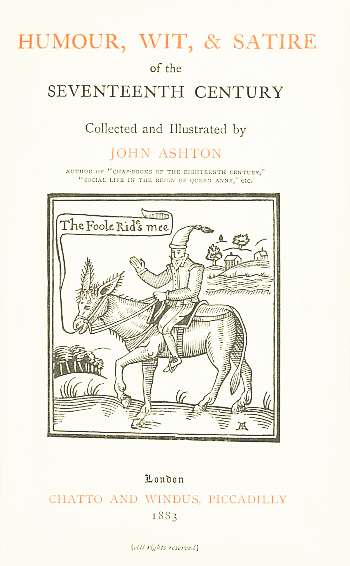
Tarlton's Jests, Edit. 1638.
Collected and Illustrated by
JOHN ASHTON
author of "chap-books of the eighteenth century," "social life in the reign of queen anne," etc.
London
CHATTO AND WINDUS, PICCADILLY
1883
All rights reserved
Printed byR. & R. Clark, Edinburgh.
Preface.
Our forefathers delighted to call their country "Merrie England;"
and so, in very truth, it was. All sorts of sports and
pastimes, such as no other nation can show, were then in use;
and even the elders, in their hours of relaxation, were wont to
exchange a merry jest with one another.
Perhaps some of their jokes lacked the refinement of the
present age, but they denoted a keen sense of humour. Many,
nay most, cannot be reproduced at the present day, and much
has this book suffered therefrom; and it is for this reason that
the jest-books and ballads of this century are so little known.
Some few have been printed in small editions, either privately,
or for dilettante societies; but they are not fit for general
perusal, and the public at large know nothing of them. This
is specially the case with the ballad literature of the century,
which is unusually rich. The Pepys, Roxburghe, Bagford,
Luttrell, and other collections, are priceless treasures; but I
know no publisher who would be bold enough to reproduce
them, in their entirety, for the use of the general public. By
this I do not wish to cast any slur, either on the modesty, or
morality, of our ancestors; but their ways were not quite as
ours.
The Bibliographical Reference, which forms an Appendix,
will show the wide range that the humour of this century
takes; and this does not exhaust the store by any means. In
it I have given, for the use of students, the British Museum
Catalogue number of every authority (to save trouble, should
they wish to refer to the books); and, to avoid the multiplicity
of footnotes, I have placed against each paragraph a number,
by means of which (on turning to the reference) the work
from which it was taken can at once be seen.
Political satire ought to be a work in itself, so that I have
but sparingly used it; and as religious satire hardly comes
within the scope of such a book as this, I have but just
glanced at it.
In every instance that I have found possible, I have given
the tunes of the ballads, taken from the books in which they
first appeared, such as The Dancing Master, and Wit and
Mirth; also, in two instances, where I could not thus find
them, I have taken them from The Ballad Literature and
Popular Music of the Olden Time, by W. Chappell, Esq.,
F.S.A.
If the perusal of this book gives a tithe part as much
pleasure and amusement to the Reader, as it did to me when
compiling it, I am more than content with my labour.
JNO. ASHTON.
Humour, Wit, and Satire of the Seventeenth Century. — On a drawer drunk. — Upon the weights of a Clock. — Nonsense. — Of Lynus borrowing.
[1.] There was a man that had been drinking so hard that
he could scarse stand upon his feet, yet at night he would
go home, and as he went through a green Meadow, neer a
hedge side the Bryers held him by the cloaths and the legs,
and he had thought that one had holden him, and would
have had him to drink more, and he said, Good fellow, let
me go, by my troth I can drink no more, I have drank so
much already, that I cannot go home; and there he abode
all the same night, and on the morrow went his Ways.
[2.]When Marcus hath Carrowst March beere and sacke,
[4.] A Justice of Peace overtaking a Parson upon the
Road, between London and Bow, told his Company that he
would put a Trick upon him: and so, coming up to him,
said, Sir, You don't follow your Master's Rule, for he was
content with an Ass, but you have a very fine Horse. The
Parson replyed, the reason was, because the King had made
so many Asses Justices, that a Clergyman could not get one
to Ride on.
[3.]Oh that my Lungs could bleat like butter'd Pease;
But bleating of my lungs hath Caught the itch,
And are as mangy as the Irish Seas,
That doth ingender windmills on a Bitch.
I grant that Rainbowes being lull'd asleep,
Snort like a woodknife in a Lady's eyes;
Which makes her grieve to see a pudding creep,
For Creeping puddings only please the wise.
Not that a hard row'd herring should presume
To swing a tyth pig in a Cateskin purse;
For fear the hailstons which did fall at Rome,
By lesning of the fault should make it worse.
For 'tis most certain Winter woolsacks grow
From geese to swans, if men could keep them so,
Till that the sheep shorn Planets gave the hint,
To pickle pancakes in Geneva print.
Some men there were that did suppose the skie
Was made of Carbonado'd Antidotes;
But my opinion is, a Whales left eye,
Need not be coyned all King Harry groates.
The reason's plain, for Charons Westerne barge
Running a tilt at the subjunctive mood,
Beckoned to Bednal Green, and gave him charge
To fasten padlockes with Antartic food.
The end will be the Mill ponds must be laded,
To fish for white pots in a Country dance;
So they that suffered wrong and were upbraded
Shall be made friends in a left handed trance.
[1.] There was three young men going to Lambeth along
by the Water side, and the one plaid with the other, and they
cast each others Cap into the water, in such sort as they
could not get their Caps again: but over the place where
their Caps were, did grow a great old tree, which did Cover
a great deale of the Water. One of them said to the rest,
Sirs, I have found out a notable way to come by them.
First I will make myself fast by the middle, with one of
your girdles unto the tree, and he that is with you shall
hang fast upon my girdle, and he that is last shall take hold
on him that holds fast on my girdle, and so with one of his
hands he may take up all our caps and cast them on the sand.
And so they did; but when they thought that they had been
most secure and fast, he that was above felt his girdle slack,
and said, Soft, sirs, my girdle slacketh; make it fast quickly,
said they, but as he was untying it to make it faster they fell
all three into the water, and were well washed for their pains.
And thus he gain'd, and I sav'd fifteene shilling.
The Woman to the Plow and The Man to the Hen Roost. — On a cowardly Souldier. — On a fly in a glasse. — Upon a Churle that was a great usurer. — The Devill and the Fryar. — On Battus.
[8.] The Marquess of Worcester, calling for a glass of
Claret wine, it was told him by his Physician, that Claret
wine was naught for his gout; What, said the Marquess, my
old friend Claret? nay, give it me in spight of all Physicians
and their books, it never shall be said that I forsook my
friend for my enemy.
[9.]A Chuffe that scarce hath teeth to chew his meate,
Heares with deafe ears, and sees with glassy eies,
Unto his grave his path doth daily beate,
Or like a logg upon his pallett lies:
Hath not a thought of God, nor of his grace,
Speaks not a word but what intends to gaine,
Can have no pitty on the poore Mans case,
But will the hart-strings of the needy straine:
Cries not till death, and then but gives a groane,
To leave his silver, and his golden bags,
Then gapes and dies, and with a little moane
Is lapped up in a few rotten ragges:
What will this Clunch fist leave upon his grave?
Here lies the Carkasse of a wretched Knave.
[4.] An Arch Wag speaking of the late dreadful Fire of
London, said Cannon Street roared, Wood Street was burnt to
Ashes, Bread Street was burnt to a Coal, Pie Corner was over
bak'd and Snow hill melted down.
[4.] A Highway man being to be hang'd in a Country
Town, Order was sent to the Carpenter to make a Gallows;
which he neglecting to do, the Execution was forc'd to be
defer'd, for which the Judge was not a little angry, who sending
for the Carpenter, asked him why he had not done it? Why
Sir, said he, I have done two or three already, but was never
paid for them; but had I known it had been for your Worship,
I would have left all other business to have done it.
[1.] There was a Fryer in London, which did use to go
often to the house of an old woman, but ever when he came
to her house, she hid all the meat she had. On a time this
Fryer came to her house (bringing certain Company with him)
and demanded of the Wife if she had any meat. And she
said, Nay. Well, quoth the Fryer, have you not a whetstone?
Yea (qd. the Woman) Marry, qd. he, I would make meat
thereof. Then she brought a whetstone. He asked her likewise
if she had not a Frying-pan. Yea, said she, but what the
devil will ye do therewith? Marry (said the Fryer) you shall
see by and by what I will do with it; and when he had the
pan, he set it on the fire, and put the whetstone therein.
Cocks body, said the woman, you will burn the pan. No, no,
qd. the Fryer, if you will give me some eggs, it will not burn
at all. But she would have had the pan from him, when that
she saw it was in danger; yet he would not let her, but still
urged her to fetch him some eggs, which she did. Tush said
the Fryer, here are not enow, go fetch ten or twelve. So the
good Wife was constrayned to fetch more for feare lest the
Pan should burn; And when he had them, he put them in
the Pan. Now, qd he, if you have no butter the pan will
burn, and the eggs too. So the good wife being very loth to
have her pan burnt, and the eggs lost, she fetcht him a dish of
butter, the which he put into the pan, and made good meat
thereof, & brought to the table, saying, Much good may it do
you my Masters, now may you say, you have eaten of a buttered
Whetstone. Whereat all the Company laughed, but the woman
was exceeding angry because the Fryer had subtilly beguiled
her of her meat.
The Unconscionable Batchelors of DARBY, — In Getam. — On Button a Sexton making a grave. — On Jack Wiseman. — Of a Woman's Kindnesse to her Husband. — Of Marcus.
or the
Young Lasses Pawn'd by their Sweethearts, for a large
Reckoning, at Nottingham Goose Fair; where
poor Susan was forced to pay the Shot.
12 James Bissel lived at the Bible and Harp, by the Hospital Gate, and
published between 1685 and 1695.
[1.] There was a Priest in the Country, which had christned
a Child; and when he had christned it, he and the clark were
bidden to the drinking that should be there, and thither they
went with other people, and being there, the Priest drunk and
made so merry that he was quite foxed,13 and thought to go
home before he laid him down to sleep; but having gone a
little way, he grew so drowsie, that he could go no further,
but laid him down by a ditch side, so that his feet did hang
in the water, and lying on his back, the Moon shined in his
face: thus he lay till the rest of the Company came from
drinking, who as they came home found the Priest lying as
aforesaid, and they thought to get him away, but do what
they could he would not rise, but said, Do not meddle with
me, for I lie very well, I will not stir hence before morning,
but I pray you lay some more cloathes on my feet, and blow
out the Candle, and let me lie and take my rest.
[4.] Two Sparks standing together in the Cloysters, seeing
a pretty Lady pass by, says one of them, There goes the handsomest
Lady that I ever saw in my Life; She hearing him,
turned back, and seeing him very ugly, said, Sir I would I
could in way of Requital say as much of you. Faith, says he,
so you may, and Lye as I did.
[1.] There were once too men that were both masterless
and moneyless, & one said to the other, What remedy canst
thou now find out, that we may either get some meat or
money? By my troth (qd. the other) I do know a very fine
shift, (& being very early in the morning they espyed a man
coming with Hogs). Lo, yonder cometh a man with Hogs,
and I will tell him that they be sheep, and I will cause him
to lay a Wager with me, whether they be Sheep or Hogs: &
I will cause the matter to be judged by the next man that
cometh, but then thou must go another way & meet with us;
when we demand of thee whether they be sheep or hogs, thou
must say that they be sheep. Then they separated themselves
the one from the other, and the one went to meet the man
that had the Swine, bidding him good morrow; the man
doing the like to him again. Then he said to the old man,
Father, where had you your fair sheep. What sheep qd the
man; these sheep that you drive before you: Why, qd the
old man, they are swine. What (qd. the other) will you make
me a fool? think you I know not Sheep from Swine? Marry
(qd. the old man) I will lay one of my Swine against what
thou wilt, that they be no Sheep. I hold thee my coat against
one of thy sheep qd. the other. I am content qd the old
man, by whom shall we be tryed? By the next man that
meets us. Content, said the old man; and then they perceived
the man coming being the fellow of the young man.
And when he came to them the old man requested him to tel
them what beasts those were? Why (qd. he) they be sheep,
do you not know sheep? I told him so (qd. the other young
man) but he would not believe me, so I laid my Coat upon a
Wager that they were sheep, and he laid me one of his sheep
against my Coat that they were Swine; and I won it have I
not? Yea (qd. the old man,) but God help me, I bought
them for Swine. And then the young man took one of the
fattest hogs he could find amongst them all, & carryed him
away, and his fellow went another way, as though he had not
known him, and the poore man returned again to the place
where he had bought them.
What became of him afterward I cannot tell: only thus
much I know, that he was deceived by those two crafty fellows
of one of his hogs. But they immediately met one the other
again, and sold the hog for Money, and rejoyced that they
fared so well (not knowing how to have otherwise sustained
their wants).
17 Of Humphrey Crowch or Crouch little is known, but we know he
published many ballads and books of the chap-book order; among the
former is the Mad Man's Morrice, and among the latter is England's
Jests refin'd. He certainly wrote from 1637 to 1687.
[8.]Jack Roberts was desired by his Taylour, when the
reckoning grew somewhat high, to have a Bill of his hand.
Roberts said, I am content, but you must let no man know it;
when the Taylour brought him the Bill, he tore it as in choler,
and said to him, You use me not well, you promised me that no
man should know it, and here you have put in: Be it known
unto all Men by these Presents.
[1.] A Certain Butcher was flaying a Calf at night and had
stuck a lighted Candle upon his head, because he would be
the quicker about his business, and when he had done, he
thought to take the same Candle to light him to bed: but he
had forgot where he had set it, and sought about the House
for it, and all the while it stuck in his Cap upon his head, and
lighted him in seeking it. At the last one of his fellows came
and asked him what he sought for? Marry, (quoth he) I look
for the Candle which I did flay the Calf withal. Why, thou
fool, qd. he, thou hast a Candle in thy Cap: and then he felt
towards his Cap, and took away the Candle burning, whereat
there was great laughing and he mocked for his labour, as he
was well worthy.
[4.] Just after the late Kings Restauration, when going to
Church came to be in fashion, an old Woman was advised by
her Neighbours to go to Church; for fear of being Presented,
she was resolved to go once a month to save her Bacon: So
Dressing herself very fine, she came into the Church, just at
the Expiration of the Letany, and the Parson having said, Lord
have Mercy upon us, and then the People Responding thereto,
she Cryed out aloud, I never was here before in my Life, and
since you make such a Wonderment at it I will never come
again.
21 This tune certainly was known in Queen Elizabeth's time, for it occurs
in her Virginal book, and Chappell says, "It probably took its name from
Sir John Packington, commonly called 'lusty Packington,' the same who
wagered that he would swim from the Bridge at Westminster, i.e. Whitehall
Stairs, to that at Greenwich for the sum of £3000. 'But the good
Queen, who had particular tenderness for handsome fellows, would not
permit Sir John to run the hazard of the trial.'"
22 Or St. Leger's round, was thought by Sir John Hawkins to be the
oldest country dance now extant, and is to be found in Queen Elizabeth's
Virginal book.
[4.] A Minister finding his Parishioners to be Ignorant,
was resolv'd to Examine and Instruct them at home; so
going to an Ancient Womans House, amongst other Questions,
he asked her how many Commandments there were? She
told him she could not tell: he told her there were Ten:
Whereat she replied, A Jolly Company! God Bless you and
them both together. Well, but, Neighbour, (says he) Do you
think you can keep these Commandments? Ah! God bless
you, Sir, (said she) I am a poor Woman, and can hardly keep
my self; I hope you will not put me to the Charge of keeping
any of the Commandments for you.
[8.] Master Mason of Trinity Colledge, sent his Pupil to
another of the Fellows to borrow a Book of him, who told him
I am loath to lend my Books out of my Chamber, but if it please
thy Tutor to come and read upon it in my Chamber, he shall as
long as he will. It was winter, and some daies after the same
Fellow sent to Mr Mason to borrow his Bellows, but Master
Mason said to his Pupil, I am loath to lend my Bellows out of
my Chamber, but if thy Tutor would come and blow the Fire in
my Chamber he shall as long as he will.
[6.]I heard that Smug the Smith for Ale and Spice,
[4.] A Minister going to one of his Parishioners he asked
her, who made her? She reply'd, She did not know: A
Child standing by, he asked him the same Question, who
Answered, God; whereupon the Parson Reproving the Old
Woman, told her it was a shame that she should be so Ignorant,
who had lived to those Years, and that little Child could
tell. Marry, quoth she, I am an old Woman, and have been
made a great while, and he was made but t'other day, he may
well tell who made him.
[1.] There was a man in the Country, who had not been
any far Traveller, and dwelt far from any Church except a
Church that was seven or eight miles from his house, and
there they never sung Mass nor Even song, but did ever say
it. And on a time he came to London, having never been
here before, & being in London he went to Pauls Church, &
went into the Chappel, where they sung Mass with Organs,
and when he heard the melody of the Organs and the singing
together, that he never heard before, he thought he should
have gone to Heaven by and by, and looked, and said aloud
that every one heard, O Lord, shall I go to heaven presently?
I would thou wouldest let me alone till I might go home and
fetch my white stick and black hood, and then I would go
gladly with thee. Where at all the people laughed heartily.
[15.] THE JOLLY WELSH WOMAN — On a Watch lost in a Tavern. — Of a Precise Taylor. — On a gentleman that married an heire privately at the Tower. — Of Galla's goodly Periwigge .
Who drinking at the Sign of the Crown in London, found a
Spring in her Mugg, for Joy of which hur Sung the
praise of Old England resolving never to return to Wales
again.
Tune of, Hey brave Popery &c.
Licensed according to Order.
There was an Old woman came out of North Wales,
And up to fair London her merrily Sails,
It was for her pleasure Cuts-plutter-a-nails
Sing O brave Welsh Woman, Jolly brave Welsh Woman,
Delicate Welsh Woman. O.
As soon as hur came into fair London town
Hur went to an Alehouse the sign of the Crown,
In order to tipple hur streight did sit down.
Sing O brave &c.
Hur being a weary and willing to rest,
Hur would not be one of the worst of the guest,
But call'd for a Pitcher of Ale of the best.
Sing O brave &c.
The Tapster then giving the Jugg in her hand,
The Welsh woman streight on hur feet she did stand,
And drank a good health to hur King of England.
Sing O brave &c.
Now while she had gotten the jugg at her snout,
And being both lusty, courageous and stout,
Hur gave it a tug, till hur swigg'd it half out.
Sing O brave &c.
The Tapster he see her to be of that strain,
And how she did tipple the Liquor amain,
Thought he, I will fill up thy pitcher again.
Sing O brave &c.
The jugg hur had plac'd on the Bench by her side,
To which the young tapster did cunningly slide,
And fill'd it as if it had been a full tide.
Sing O brave &c.
Now hur did not know how her pitcher did fill,
Therefore hur did say with a merry good will
Here's Tipple and drink, and her Pitcher full still.
Sing O brave England &c.
The praise of this Nation Cuts-plut her will sing,
Hur never had known such a wonderful thing,
The juggs in this land has a delicate Spring.
Sing O brave England &c.
Once more she saluted the lips of her Mugg,
And gave it a hearty and dextrous tugg,
The Tapster once more he did fill up her jugg.
Sing O brave England &c.
The Liquor up into her Noddle did steel,
The Floor with her feet hur hardly could feel,
So that hur began for to stagger and reel.
Sing O brave England &c.
Hur swore hur would never to Wales any more,
For hur has tasted Rich liquor good store,
The like in all Wales hur had neer drank before,
Sing O brave England &c.
Hereafter hur never will honour the Leek,
This was the best Nation as e're hur did seek,
Here's liquor of life that will make a Cat speak.
Sing O brave England &c.
In praise of this liquor, hur Cap up she flung,
For why, it Created an Eloquent Tongue,
Besides it will make an Old Woman look young,
Sing O brave Nappy Ale, Delicate Nappy Ale,
Dainty fine Nappy Ale.
[1.] In the country dwelt a Gentlewoman who had a
French man dwelling with her and he did ever use to go to
Church with her, and upon a time he and his Mistresse were
going to Church and she bad him pull the doore after him and
follow her to the Church, and so he took the doore betweene
his armes, and lifted it from the hooks, and followed his
Mistresse with it: But when she looked behinde her and saw
him bring the doore upon his back, Why, thou foolish knave,
qd. she, what wilt thou do with the door? Marry Mistresse,
qd. he, you bad me pull the doore after me. Why, qd. she,
I did command thee that thou shouldest make fast the doore
after thee, and not bring it upon thy back after me. But
after this, there was much good sport and laughing at his
simplicity and foolishnesse therein.
[8.] A Notorious Rogue being brought to the Bar, and
knowing his case to be desperate, instead of pleading, he took
to himself the liberty of jesting, and thus said, I charge you in
the Kings name to seise and take away that man (meaning the
Judge) in the red Gown, for I go in danger of my life because
of him.
'Tis certain her own hayr, who would have thought it?
She sweares it is her owne; and true she sweares,
For hard by Temple-barre last day she bought it.
So faire a haire, upon so foule a forehead,
Augments disgrace, and showes the grace is borrow'd.
[17.] Several Gentlemen were at dinner together, and one
of them was a Parson; among the Dishes one was a Pig, but
'twas very lean; Then they concluded that it was only fit
for the Parson, being a spiritual Pig, for it had no flesh upon it.
An Invitation to Lubberland. — Epitaph On an usurer. — In praise of the Black Jack 28
with
An Account of the great Plenty
of that Fruitful Country.
There's all sorts of Fowl and Fish,
with Wine and store of Brandy,
Ye have there what your Hearts can wish,
the Hills are Sugar Candy.
The Tune of Billy and Molly Or, The Journey-man Shoe maker
[4.] An ignorant Country Fellow coming along Paternoster
Row, had occasion to change a Half-Crown into small money,
and looking over a Grate which stood on the Stall, there sate
a large Monkey, whom he prayed to change his Money; the
Monkey took it and put it into the Till of the Compter, where
he had observed to be put, and then came and Grinn'd at the
Man, who, being in a passion, made a noise at the Door,
whereat the man of the Shop, coming into the Shop, asked
him what was the matter? Sir, said he, I gave your Son halfa Crown to change, and he will not give it me again, but laughs
at me, and will not give me one word of answer, tho I have
asked him for it many a time.
[8.] In Chancery, one time, when the Councel of the
parties set forth the boundary of the Land in question, by the
plot, and the Councel of one part said, we lie on this side my
Lord, and the Councel of the other part said, we lie on this
side. The Lord Chancellor Hatton stood up and said, If you
lie on both sides, whom will you have me to believe?
When the Bottle and Jack stands together, O fie on't,
The Bottle looks just like a dwarfe to a Gyant;
Then had we not reason Jacks to chuse
For this'l make Boots, when the Bottle mends shoes.
And I wish &c.
And as for the bottle you never can fill it
Without a Tunnell, but you must spill it,
'Tis as hard to get in, as it is to get out,
'Tis not so with a Jack, for it runs like a spout.
And I wish &c.
And when we have drank out all our store,
The Jack goes for Barme to brew us some more;
And when our Stomacks with hunger have bled,
Then it marches for more to make us some bread.
And I wish &c.
I now will cease to speak of the Jack,
But hope his assistance I never shall lack,
And I hope that now every honest man,
Instead of Jack will y'clip him John.
And I wish &c.
28 A bottle made of leather. Sometimes they were ornamented with
silver rims, and a silver plate with the owner's coat of arms thereon; but
generally they were very rough.
[18.] A melting Sermon being preached in a Country
Church, all fell a weeping, except a Country man, who being
ask'd why he did not weep with the rest? Because (says he)
I am not of this Parish.
[18.] A Country-man admiring the stately Fabrick of S.
Pauls Cathedral, asked Whether it was made in England, or
brought from beyond Sea.
The invincible PRIDE of WOMEN or The London Tradesman's Lamentation — On a little Gentleman and one Mr Story. — Epitaph on a Scrivener. — These following are to be understood two ways.
For the Prodigality of his Wife, which doth daily
pillage his Purse.
[4.] Two Persons who had been formerly acquainted, but
had not seen each other a great while, meeting on the Road,
one ask'd the other how he did; he told him He was very
well, and was Married since he saw him: the other reply'd,
That was well indeed: not so well neither, said he, for I have
Married a Shrew. That's ill, said the other. Not so ill
neither, said he, for I had 2000 Pounds with her. That's well
again, said his Friend. Not so well neither, for I laid it out
in Sheep, and they died of the Rot. That was ill indeed,
said the other. Not so ill neither, said he, for I sold the
Skins for more money than the Sheep cost. That was well,
indeed, quoth his friend. Not so well neither, said he, for I
laid out my money in a House and it was burned. That's
very ill, said the other. Not so ill neither, said he, for my
Wife was burned in it.
[8.] One was saying that his great Grandfather, and
Grandfather, and Father died at Sea. Said another that
heard him, and I were you, I would never come at Sea.
Why, saith he, where did your great Grandfather, Grandfather
and Father die? He answered, where, but in their beds?
saith the other, And I were as you, I would never come to bed.
[18.]John Scot so famous for his Learning, sitting at
Table with a young Gallant, was by way of Jest, asked by him
what Difference there was between Scot and Sot. To which
he presently reply'd Mensa tantum, that is the Tables breadth;
for the other sat just over against him.
The Devil's Oak:
or, his
Ramble in a Tempestuous Night, where he
hapn'd to Discourse with Men of
several Callings, of his own
Colour and Complexion.
Then up the Devil started, the Fryer was faint-hearted,
you may wink and choose the best:
For I am the Fryer, and thou art the Lyar,
therefore thou art my father;
I am a Doctor of Evil, and thou art the Devil,
the worser I hold thee rather.
A Collier and his Cart came by,
which coals he did use to carry.
And as soon as the Devil he did him espy,
he caused him awhile to tarry:
For why, I do think that with thee I must drink,
and he called for a glass of claret;
Now I find by thy smell, that thou camest from hell,
and I fear thou hast stole my chariot.
The next that came by was a Chimney Sweeper,
with poles, his brooms, and shackles,
What meanest thou, Man, the Devil he said,
that thou usest all those tackles?
I pry thee gentle Blade, tell me thy trade,
thy face it is so besmeared,
Hadst thou been so black, and no tools at thy back,
thou'dst have made me sore afraid.
Sir, a Chimney Sweeper I do profess,
although my trade's but mean,
It is for to sweep all dirty holes,
and to keep foul chimneys clean:
Then go to Hell, where the Devil doth dwell,
and he will give thee a piece,
God a mercy, old Dog, when I sheer my hog
then thou shalt have the fleece.
The next that came by was a tawny Moor,
and the Devil bid him see,
And he fleered on his tawny skin,
crying, Friend, art thou any kin to me?
For sure your skin doth resemble our kin,
therefore let us walk together,
And tell me how you do allow,
of this tempestuous weather.
Then the next that came by was a Gun-powder man,
which coales and brimstone sifted,
That in three quarters of a year,
himself had hardly shifted:
Then up the Devil rose, and snuffed his nose,
he could indure it no longer,
Cry'd, Away with this fume, 'tis not fit for the room
it will neither quench thirst, no, nor hunger.
I pre thee, gentle Blade, tell me thy trade,
as thou hast so strong a smell,
It is for to make gunpowder, he said,
for to blow the Devil out of Hell:
And if I had him here, his joynts would I tear,
he should neither scratch, no, nor bite,
I would plague the Devil, for all his evil,
and make him leave walking by night.
Then a Tinker worse than all the rest,
although he was not so black,
By chance as he came passing by,
with his budget on his back:
He cry'd, Yonder is the Devil's tree
let us see who dar'st go thither,
For it will sustain, from the wind and the rain,
or any tempestuous weather.
That shall be try'd, the Devil then he cry'd,
then up the Devil he did start,
Then the Tinker threw his staff about,
and he made the Devil to smart:
There against a gate, he did break his pate,
and both his horns he broke:
And ever since that time, I will make up my rhime,
it was called The Devil's Oak.
Printed for C. Bates,30 at the Sun and Bible, in Pye Corner.
30 Charles Bates, at this address (there were three contemporary C.
Bates), published in 1685.
[4.] A Wine Cooper in Mark Lane taking a Gentleman down
into his Cellar to Treat him, he, finding no Seat there for him
to sit on, asked him the reason of it; Why, says the Wine
Cooper, I will have no Man here Drink longer than he can
stand.
[16.]To Doctor Sheerhood how Sack makes one leane.
I marveld much last day what you did meane,
To say that drinking Sack will make one leane;
But now I see, I then mistooke you cleane,
For my good neighbour Marcus, who I tro,
Feares fatness much, this drinke hath plyde him so,
That now except he leane he cannot goe.
Ha, gentle Doctor, now I see your meaning,
Sack will not leave one leane, 'twill leave him leaning.
[8.] 0A debaucht Seaman being brought before a Justice of
Peace upon the account of swearing, was by the Justice commanded
to deposit his Fine in that behalf provided, which
was two shillings, he thereupon plucking out of his pocket a
half crown, asked the Justice what was the rate he was to pay
for cursing, the Justice told him six pence, quoth he then, A
Pox take you all for a company of Knaves and fools, and
there's half a crown for you; I will never stand changing of
mony.
The Long Nos'd Lass
is evidently traceable to Miss Tannakin Skinker, who was
born in 1618; but it is astonishing how widely spread is the
belief in "Pig faced Ladies." No doubt but there has been
some foundation in fact for it, for I am credibly informed that
not long since,31 a child, whose face bore a singular likeness
to a pig, was born in the City of London Lying-in Hospital
in the City Road—and not only survived its birth, but
is in all probability still living. In 1815 a pig-faced lady,
elegantly dressed, used to drive about London in her carriage;
but whether people were being hoaxed by one wearing a mask
is not known. George Morland painted a portrait of the
"Wonderful Miss Atkinson Born in Ireland, has £20,000
fortune and is fed out of a Silver Trough," and Fairburn
published an engraving of her. Miss Steevens, who founded
Steeven's Hospital at Dublin, is also credited with being pig-faced;
whilst pig-faced ladies used commonly to be shown at
fairs. But these were fictitious, as a quarrel in a caravan at
Plymouth, some years since, brought to light, when it was
shown that her ladyship was a bear whose face and neck had
been carefully shaved, whilst its head was adorned with a
wig with ringlets and a cap with artificial flowers. The
bear was securely fastened in a chair, and draped to imitate
a fashionably-dressed lady.
It is, however, with the contemporary monstrosity that
we have chiefly to deal, and a very rare tract in the Bodleian
Library32 gives "A certaine Relation of the Hog faced Gentlewoman
called Mistris Tannakin Skinker, who was borne at
Wirkham a Neuter Towne betweene the Emperour and the
Hollander, scituate on the river Rhyne. Who was bewitched
in her mothers wombe in the yeare 1618, and hath lived ever
since unknowne in this kind to any, but her Parents and a
few other neighbours. And can never recover her true
shape tell she be married &c. Also relating the cause, as it is
since conceived, how her mother came so bewitched.London.
Printed by J. O. and are to be sold by F. Grove,33 at his
shop on Snow-hil neare St Sepulchers Church." 1640.
This veracious history gives an account of various remarkable
births. "But I come now to humane Births, beginning
with those forraigne, and ending with the domesticke; about
the beginning of the Marsick Warre, one Alcippe, a woman of
especiall note, at the time of her childing, was delivered of
an Elephant; and another (whose name is not left unto us)
of a Serpent. In Thessaly, one was brought to bed of an
infant which had the shape of an Hypocentaure, and expired
the same day that it received breath," etc.
After thus paving the way for his own particular marvel,
the writer goes on: "I fall now immediatly upon the party
before propounded. In a place in Holland called Wirkham,
being a neuter Towne; as lying between Holland and those
parts belonging to the Empire, on the River Rhine, lived one
Ioachim Skinker, whose wife's name was Parnel, a man of
good revenue, but of a great estate in money and cattle; these
two having very loving lived together without any issue to
succeed them in their goods and inheritance: it being no
small griefe unto them, that either strangers, or some of their
owne ungrateful kindred should after death enjoy those
meanes, for which they had so laboriously travail'd: When
they were in their greatest despaire, it hapned thus, she found
herselfe conceived with childe, which was a greater joy and
comfort to her and her husband: But whether they were
unthankful for such an unexpected blessing, or what other
thing was the cause, I am not able to determine; but it so
hapned, that in the yeere 1618, she was safely delivered of a
Daughter, all the limbes and lineaments of her body well
featured and proportioned, only her face, which is the ornament
and beauty of all the rest, had the Nose of a Hog, or
Swine: which was not only a stain and blemish, but a deformed
uglinesse, making all the rest lothsome, contemptible and
odious to all that lookt upon her in her infancie.
"If the joy of the parents was great in the hope of a Childe,
how much greater may wee conjecture their sorrowes were, to
be the parents of such a monster: but considering with themselves
what Heavens would have, they had not power to
hinder, and studying (as farre as in them lay) to conceale
their shame, they so farre mediated with the Midwife and the
other women that were present at the delivery, that they
should keepe it as close and secret as it was possible to doe:
and they called the name of it Tannikin, which is as much in
English as Anne or Hannah. . . . . . .
. . . . .
"This prodigious birth though it was knowne to some few,
yet it was not made popular & spoken of by all, which the
Father and Mother for their owne reputations and credits were
very carefull to maintaine; so that it was never seene by any
(being an infant bare-fac'd) but vail'd and covered, and so
brought up in a private Chamber, both fed and taught by the
Parents onely; and her deformity scarce knowne to any of the
Servants: and as the daughter grew in stature, so the Father
also increased with wealth, so that he was accounted to be one
of the richest men in all that Country. . . . . . .
. . .
"It is credibly reported, that this Burgess wife having conceived,
an old woman suspected for a Witch came to begge
of her an Almes, but she being at that (time) busied about
some necessary affaires gave her a short and neglectfull
answer; at which she went away muttering to herselfe the
Divell's Pater noster, and was heard to say; As the Mother is
Hoggish, so Swinish shall be the Child shee goeth withall: which
is a great probability that the infants deformity came by the
malitious Spells and divelish murmurations of this wicked
woman; who, after, for the like, or worse practises both upon
men women and children whom she had bewitched unto
death, being brought within compasse of the Law; and after
to suffer at the stake; amongst many other things confessed
as much as I have before related; yet either out of her perverse
obstinacy would not, or else (the Devill forsaking her in
extreamity, as he doth all his other servants) in her deficiency
of power, could not uncharme her: yet by this means that
which was before kept so private, was now publickly discovered
to the World; insomuch that much confluence of
people came to see the progedy, which wearied the Father,
and cast a blush upon the cheekes of the good woman the
mother: some desirous to heare her speake, whose language
was onely the Dutch Hoggish Houghs, and the Piggs French
Owee, Owee, for other words she was not able to utter; which
bred in some, pitty, in others laughter, according to their
severall dispositions.
"Others were importunate to see her feede, then milke and
the like was brought unto her in a Silver Trough; to which
she stooped and eate just as a Swine doth in his swilling Tub;
which the more mirth it bred in the Spectators, increased in
the Parents the more Melancholy."
From this part the tract gets more and more romantic.
An astrologer was consulted, and he advised her being married,
when her cure might be effected. So the parents gave out
that she would have a dowry of £40,000 paid down on her
marriage. Then follows a list of her suitors, and after an
episode which has nothing to do with the matter in hand, the
tract winds up: "I should have spoken something of her
residing in or about London, as of her being in Black Friers,
or Covent Garden, but I can say little: onely abundance of
people doe resort to each place to enquire the truth: some
have protested they have seene her, by the helpe of their
acquaintance and give this reason why she will not as yet be
Constantly in one place, because the multitude is so great that
doe resort thither that they dare not be knowne of her abiding,
lest by denying the sight of her, they that own the house should
have it pulled down about their eares. Her portion is very
large, it being 40,000 pounds; she likewise goeth very gallant
in aparrell, and very courteous in her kind to all. And whoever
shall in Pamphlet, or Ballad, write or sing otherwise than
is discoursed of in this small Tract, they erre from truth: for
what is here discovered, is according to the best and most
approved Intelligence."
31 Some time between 25th June and 29th September 1881.
32 A wonderful lithographic facsimile by Francis Compton Price, Esq., is
in the British Museum, 12205. h., catalogued under the heading Skinker.
The Taylors, Millers, Tinkers, Tanners, and Glovers; with a great number of other
Tradesmen, dash't out of Countenance by a Sow-Ships
Beauty, to their great discontent, and
her perpetual trouble.
[17.] Says one, why is thy Beard so brown, and thy head
so white? Cause, says he, my head is twenty years older than
my beard.
[4.] A Tinker coming through Cornhill, and sounding
briskly on his kettle, Have you any Work for a Tinker? A
Grocer that thought to put a Jest upon him (there being a
Pillory near his door) bid him stop those two Holes, pointing
to the Pillory: to whom the Tinker smartly replyed, Sir, if you
will lend me your Head and Ears, I will find a Hammer and
Nails, and give you my Work into the bargain.
A Dialogue concerning Hair, between a Man and a Woman. — M. — W. — M. — W. — M. — W. — M. — W.
36 Prynne was especially exercised in his mind about this fashion, and
wrote a book called "The Unlovelinesse of Love Lockes, or a Summarie
discourse, proving the wearing and nourishing of a locke or love locke to
be altogether unseemly and unlawfull unto Christians" (1628), and also
"A Gagge for Long Hair'd Rattle Heads &c." (1646).
37 An allusion to the curly crops and fringe over the forehead then
worn by ladies.
[18.] A Papist asked a Protestant, as 'tis their usual Way,
where his Religion was before Luther. In the Bible, says he,
where yours never was.
[8.] A witty Rogue coming into a lace shop, said he had
occasion for some lace, choice wherof being shewed him, he
at last pitched upon one pattern, and asked them how much
they would have for so much as would reach from ear to ear,
for so much he had occasion for, and they told him for so
much; so some few words passing between them, he at last
agreed, and told down his money for it, and began to measure
on his own head, thus saying, One ear is here, and the other is
nailed to the Pillory in Bristoll, and I fear you have not so much
of this Lace by you at present as will perfect my bargain;
therefore this piece of Lace shall suffice at present in part of
payment, & provide the rest with all expedition.
MARK NOBLE'S FROLLICK; — Against Swearing. — One fighting with his wife.
who being
Stopp'd by the Constable near to the Tower, was
examin'd where he had been; whither he was going;
and his Name and Place where he dwelt: to which he
answered, Where the Constable would have been glad
to have been, and where he was going he dared not go
for his Ears, as likewise his Name, which he called
Twenty Shillings; with an Account of what followed
and how he came off.
41 A mark was a coin worth 13s. 4d., and a noble 6s. 8d.
[17.] A Gentleman ask'd a Shepherd, whether that River
was to be passed over or not: Yes, says he, but going to try,
flounc'd over head and ears. Why thou Rogue, says he, did
you not tell me it might be past over? Truly, Sir, says he, I
thought so, for my Geese go over and back again every day.
Han Infentory of the Couds of William Morgan, ap Renald,
ap Hugh, ap Richard, ap Thomas, ap Evan, ap Rice,
in the County of Clamorgan, Shentleman.
Imprimis. In the Pantry of Poultry (for hur own eating) One
creat Pig four Week old, one Coose, one Cock Gelding,
two Black puddings, three Cow-foots.
Item. In the Pantry of Plate, one Grid-iron, one Fripan, one
Tripan, three Wooden Ladle, three Cann.
Item. In the Napery, two Towel, two Table Cloath, four
Napkin, one for hurself, one for hur Wife Shone, two for
Cusen Shon ap Powell and Thomas ap Hugh, when was
come to hur House.
Hur Pantry
Hur Cattle
Hur Armory
Item. In the Wardrope, one Irish Rugg, one Frize Sherkin, one
Sheepskin Tublet,43 Two Irish Stocking, two Shooe, six
leather Points.
Item. In the Tary,44 one Toasting Shees, three oaten Cake,
three Pint of Cow Milk, one pound of Cow Butter.
Item in the Kitchen, one Pan with white Curd, two White pot,
two Red Herring, nine Sprat.
Item. In the Cellar, one Firkin of Wiggan, two Gallon sower
Sider, one Pint of Perry, one little Pottle of Carmarden
Sack, alias Metheglin.
Item. In the Armory of Weapon, to kill her Enemy, One
Pack Sword, two edge, two Welsh-hook, three long Club
one Cunn, one Mouse trap.
Item. In the Carden, One Ped Carlike, nine Onion, twelve
Leek, twelve Worm, twelve Frog.
Item. In the Leas-way. Two Tun Cow, one Mountain Calf.
Item. In the Common-field, Two Welch Nag, twelve long
leg'd Sheep, fourteen and twenty Coat.
Item. In the Proom Close, three Robin Run-hole, four Hare,
hur own Coods if hur can catch hur.
Item. In the Parn one half Heblet of Oate, seven Pea, two
Pean.
Item. In the Study (py Cot hur was almost forgot hur) One
Welch Pible, two Almanack, one Erra Pater,45 one Seven
Champions46 for St Taffy sake, twelve Pallat,47 one
Pedigree.
Item. In the Closet Two Straw hat, one louse.
Item. In the Ped. Two naked Pody, one Shirt, one Flannel
smock at hur Ped's head.
Item. More Cattle about the House. Two Tog, three Cat,
twelve Mouse (pox on hur, was eat hur toot Cheese) 1000
White Flea with black Pack.
Item. More Lumber about the House. One Wife, two Shild,
one call hur Plack Shack, and t'other little Morgan.
Item. In the Yard under the Wall, one Wheel, two Pucket,
one Ladder, two Rope.
This Inventory taken Note in the presence of hur own Cusen
Rowland Merideth ap Howel and Lowellin Morgan ap William
in Anno 1849,48upon the Ten and Thirtieth of Shune.
The above named William Morgan dyed when hur had
threescore and twenty years, thirteen Months, one Week and
Seven days.
A NOTE of some LEGACY of a creat deal of Coods,
bequeathed to hur Wife and hur two Shild, and all hur Cusens,
and Friends and Kindred in the Manner as followeth.
Imprimis. Was give hur teer Wife, Shone Morgan, awl hur
Coods in the Ped, over the Ped, and under the Ped.
Item. Was give to hur eldest Son Plack Shack, 40 and 12
Card to play at Whipper Shinny 4 Try to sheat hur
Cusen: besides awl her Land to the fule value of 20 and
10 shillings 3 groats per Annum.
Item. Was give to hur second Son, Little Morgan ap Morgan,
hur short ladder under the Wall in the Yard and two
Rope.49
Item. Was give to hur Cusen Rowland Merideth ap Howell
and Lewellin Morgan whom was made her Executor, full
power to pay awl hur Tet, when hur can get Money.
Seal'd and deliver'd in the Presence of Evan ap Richard,
ap Shinkin, ap Shone, hur own Cusen the Tay and Year above
written.
Licens'd and Enter'd.
London. Printed by and for W. O.50 and sold by the Booksellers.
[26.] A Person of Quality in this Kingdom, was one night
at Supper at Pickadilly house which was then an Ordinary and
great Gaming House, where he had bowled all day; and after
Supper he call'd for some Cheese, which it seems was very
thin and lean; then he ask't the Master of the House, where
those Cows went, of whose Milk that Cheese was made? He
told him they graz'd not far off; then he swore a great Oath
that he was Confident that they never fed in any other place
than his Bowling Alley, which was made good by the fatness
of the Cheese they now tasted of, for it cries Rub, rub, in the
eating of it, when 'tis so long a going down.
Another person of Quality also, in this Kingdom, amongst
other Gentlemen, did often meet at a Bowling Ally, which
stood next to the Church-yard; and the Parson of that
Church had this Benefit, That if any did swear there, he was
to have 12d for every Oath: This Person aforesaid, happened
to swear a great Goliah Oath, upon which the Parson
demanded 12d. which he gave him; and after that swore
many others, for which he paid 12d a piece; and then swearing
another, he demanded 12d as before; then he pluckt out
of his pocket a 20 Shilling piece and bid him give him 19s.
again. Sir, says he, I cannot. Why then, says he, take
it for
I intend to swear it out.
54 The alphabet, so called because in the old Horn books the letters,
which were of course in a row, commenced with a Cross. In Morley's
Introduction to Practical Music (printed 1597) is the following: "Christes
Crosse be my speed, in all vertue to proceede A. b. c. d. e. f. g. h. i. k.
l. m. n. o. p. q. r. s. and t. double u. v. with y, ezod & per se, con per se,
tittle, tittle est. Amen. When you have done begin again, begin again!"
[18.] A pleasant Fancy of an Italian by name Trivelino,
Who falling asleep one Day, with his Horse's Bridle twisted
in his Arm, another came who unbridled his Horse and got
away. Trivelino being awaked, and missing his Horse began
to feel himself about, saying Either I am Trivelino, or not: If
I am Trivelino my Horse is lost; If not, I have got a Bridle,
but know not how.
a. There began the Utopian accompt of years. Mor: Lib 1. circa
finem.
b.Endimion was a handsome young Welshman, whom one Luce
Moone lov'd for his sweet breath; and would never hang off his lips; but
he not caring for her, eat abundance of toasted cheese, purposely to make
his breath unsavory; upon which she left him presently, and ever since
'tis proverbially spoken (as inconstant as Luce Moone). The Vatican
coppy of Hesiod reades her name Mohun, but contractedly it is Moone.
Hesiod. lib 4. tom. 3.
And now assist me O ye (c) Musiques nine
That tell the Orbs in order as they fight
And thou dread (d) Atlas with thine eyes so fine,
Smile on me now that first begin to write.
c. For all the Orbes make Musick in their motion. Berosus de Sphera,
lib 3.
d.Atlas was a Porter in Mauritania, and because by reason of his
strength, he bore burthens of stupendious weight, the Poets fain'd that he
carried the Heavens on his shoulders. Cicero de nat Deorum. lib. 7.
(e) Pompey that once was Tapster of New June,
And fought with Cæsar on th' (f) Æmathian plaines,
First with his dreadful (g) Myrmidons came in,
And let them blood in the Hepatick veines.
e. There were two others of this name. Aldermen of Rome. Tit.
Liv. hist. lib. 28.
f.Æmathia is a very faire Common in Northampton shire. Strabo.
lib 321.
g. These Myrmidons were Cornish-men and sent by Bladud, sometime
king of this Realme, to ayd Pompey. Cæsar de bello. civili. lib. 14.
But then an Antelope in Sable blew,
Clad like the (h) Prince of Aurange in his cloke,
Studded with Satyres, on his Army drew,
And presently (i) Pheander's Army broke.
h. It seemes not to be meant by Count Henry but his brother Maurice,
by comparing his picture to the thing here spoken of. Jansen, de præd.
lib 22.
i.Pheander was so modest, that he was called the Maiden Knight;
and yet so valiant, that a French Cavaleer wrote his life, and called his
book Pheander the Maiden Knight. Hon. d'Urfee. Tom 45.
(k) Philip for hardiness sirnamed Chub,
In Beauty equall to fork bearing (l) Bacchus,
Made such a thrust at (m) Phœbe with his Club,
That made the (n) Parthians cry she will —— us.
k. This seems not to be that king that was Son of Amintas, and king
of Macedon; but one who it seems was very lascivious.
l.Bacchus was a drunken yeoman of the Guard to Queen Elizabeth
and a great Archer; so that it seems the Authour mistooke his halbert for
a forke.
m. This was Long-Megg58 of Westminster, who after this conflict with
Phillip followed him in all his warres. Justinian. lib 35.
n. These were Lancashire-men and sent by King Gorbadug (for this
war seemes to have been in the time of the Heptarchy in England) to the
aide of Cæsar. Cæsar. lib. citat. prope finem.
A subtle Gloworme lying in a hedge,
And heard the story of sweet cheek't (o) Apollo,
Snatch'd from bright (p) Styropes his Antick sledge,
And to the butter'd Flownders cry'd out (q) Holla.
o.Apollo was Cæsars Page, and a Monomapatan by birth, whose name
by inversion was Ollopa: which in the old language of that Country,
signifies as much as faire youth: but Euphoniæ Gratia, called Apollo.
Gor. Bec. lib. 46.
p.Styropes was a lame Smith's-man dwelling in St. John's Street; but
how he was called Bright I know not, except it were by reason of the
Luster of his eyes.
q.Holla, mistaken for Apollo.
Holla you pamper'd Jades, quoth he, look here,
And mounting straight upon a Lobsters thigh,
An English man inflam'd with (r) double Beere,
Swore nev'r to (s) drink to Man, a Woman by.
r. Cervisia (apud Medicos, vinum hordeaceum) potus est Anglis longè
charismus; Inventum Ferrarii Londinensis, Cui nomen Smuggo. Polydor.
Virgil. de Invent. rerum. lib. 2.
s. Impp. Germaniæ, antiquitus solebant, statis temporibus, adire
Basingstochium; ubi, de more, Jusjurandum solenne præstabant, de non
viro propinando, præsente muliere. Hic Mos, jamdudum apud Anglos,
pene vim legis obtinuit; quippe gens illa, longe humanissima morem
istum, in hodiernum usque diem, magna Curiositate, pari Comitate conjuncta,
usurpant. Pancirol. utriusque imperii. lib. 6. cap 5.
By this time grew the conflict to be (t) hot,
Boots against boots, 'gainst (u) Sandals, Sandals fly,
Many poor thirsty men went to the pot,
Feathers lopt off, spurrs every where did lie.
Cætera desiderantur.
t. It seems this was a great battail, both by the furie of it, and the
aydes of each side; but hereof read more in Cornel. Tacit. lib. de moribus
German.
u. This is an imitation of Lucan. "Signis Signa & pila" &c.
Pharsalia. lib. 1. in principio.
Cryes, friend, let's stay, this room is tollerable:
Why, that's the cause (quoth hee) I will not stay,
Is that the cause, quoth th' other? why, I pray?
To give a reason to you, I am able,
Because I hate to be in—Tollerable.
[26.] A Gentleman coming drunk to Bed over night, in the
morning could not find his breeches: then he knock'd for the
Chamberlain: Sir, says he, if you are sure you brought them in
with you, you had best search your pockets for them, for you lost
all your Money last Night out of your Pockets, it may be your
Breeches are got in there.
The cunning Northerne Begger — A contest at the Hoop-Tavern between two Lawyers . — Of inclosing a Common.
Who all the By-standers doth earnestly pray
To bestow a penny upon him to day.
[26.] One coming into New-Market to buy some Butter,
and there cheapened some; and the woman askt. 10d a pound:
then he smelt to it; What, says she, do you smell to it, it seems
you do not like my Butter: Yes, says he, but 'tis no better than
it should be. Then you'll buy none, says she: No, says he, for
a reason best known to myself. Then she askt him the reason,
and with much importunity he told her, 'twas because he had
no Money: Well then, says the Woman, take it for nothing, so
you'll pay me for it next time you come.
[4.] A Conceited Scholar that was lately come from Oxford,
drinking with two or three Gentlemen, at the Mitre Tavern
in the Poultrey, was very brisk and airy, and would needs be
forming of Sylogismes &c. One wise one was this, He bid
them fill two Glasses of Wine, which they did: now: says he,
I will prove those two Glasses to be three, thus, Is not here
one, says he? Yes, says the Gentleman. And here another,
that's two, says he; Yes, says the Gentleman again. Why,
then, says he, one and two is three, so 'tis done. Very well,
says the Gentleman, I'll have one Glass, and that Gentleman
shall have the other, and you shall have the third for your pains
in finding it out.
[4.] A Scholar of Oxford having wore out the Heels of his
Boots, brought them in his hands to a Cobler, and shewing
him them, said, O thou curious Artificer, that hast by no small
pains and study, arrived to the perfection of that exquisite art of
repairing the defects of old decayed Calcuments, affix me two
Semicircles to my Suppeditors. The Cobler stared upon him,
as if he would have looked him through; but a little recovering
himself, said, Before George, Sir, I understand not your hardLanguage: but if I put on two Heel pieces, I'll have a Groat
for them.
The same Scholar being asked by a Porter for a Gentleman's
Chamber in the Colledg, he directed him thus, you must
crucifie the Quadrangle, and ascend the Grades, and you will
find him perambulating in his Cubicle, near the Fenester. Pray
Sir, says the Porter, what is that Fenester? It is, replies the
Scholar, the Diaphonous part of an Edifice, erected for the Introduction
of Illumination, which so amazed the Porter, that at
first he did not know what to think, till recovering himself, he
went and enquired of another, who gave him plainer directions,
in more intelligible terms.
A Caution for Scolds or A True Way of Taming a Shrew. — On Galla going to the Bath . — On a farmer knighted. — Of Milo the Glutton.
She leaves uncovered still; what's that? her face.
[8.] There was one that died greatly in Debt, when it was
reported in some company, where divers of his Creditors were,
that he was dead; one began to say in good faith, then he
hath Carried five hundred ducates of mine with him into the
other world; and another of them said, and two hundred of
mine; and some others spake of several sums of theirs:
whereupon one that was amongst them said, Well, I see now,
that though a man cannot carry any of his own with him, into
the other world, yet he may carry other mens.
[17.] A Western Lady was very Hospitable to many
Gentlemen, and it happened a Knight came thither; and
being a great House-wife, early in the Morning she called to
her maids, and ask'd whether the Pigs were served; which the
Knight hearing, said before the Gentlewoman at dinner,
Madam are the Pigs served? Sir, says she, I know not
whether you have had your breakfast yea or no.
[26.] Some Gentlemen were sitting at a Coffee-house
together, one was asking what News there was? T'other told
him, There was forty thousand Men rose to day, which made
them all stare about, and asked him to what end they rose,
and what did they intend? Why faith, says he, only to go to
bed at Night again.
[18.] A Person of Quality owed a Gentleman a Thousand
Pounds. Meeting together in a fair Road, where both their
Coaches went a good rate; the first looking out of the Coach
called to the Gentleman, and begged a thousand Excuses.
And I beg, said the Gentleman presently, a thousand Pounds.
A Pleasant new Ballad you here may behold, How the Devill, though subtle, was guld by a Scold. — Solution. — On one in debt. — Scylla toothlesse .
That is a thorn; for a man went to the wood and caught
a thorn in his foot, and then he sate him down, and sought to
have pull'd it out, and because he could not find it out he
must needs bring it home.
[26.] A rich and covetous Councellor of this Kingdom,
that had an only Child, which was a Daughter and worth
£20,000. A young and handsome Gentleman of good Birth
though of no great Fortune; yet had so far insinuated himself
into the young Lady's Favour, that she promis'd him Marriage,
if he could get her Father's Consent. Immediately he comes
for London, and goes to her Father, and told him, That he
would give him £10 for a Fee if he could assist him in a
business which did much concern him: which was, That there
was a rich young Heiress in town, which had promised him
marriage if it could any way be made good by Law: Why,
says he, let her hire a Horse, and invite you to take her
away, and let her get up before, and you behind that it may
not be said that you rode away with her, but she with you,
and let her go to the Minister, and tell him, 'tis her desire to
be married to you, and to get a Licence accordingly; and
when you are married, then be sure to bed her, and I'll
warrant you she's your own. And this, says the Gentleman,
you'll avouch for Law? He told him, Yes. Well Sir, says
he, if you will set your Hand to it, I'll give you Ten Pounds
more; which he did. Immediately he goes into the Country,
and shews the young Lady what was done, and how 'twas
done; and she accordingly performed her promise, and
suddenly married and bedded; and having so continued a
week they both came to London, and came to her Father, and
fell down upon their knees to him, and craved his Blessing;
which made him at first fly into harsh Language; but the
Gentleman said, We have done nothing but what you avoucht
for Law, and have it under your hand. The Lawyer fearing
his Reputation might be brought in question, and seeing him
to be a handsome and well bred Gentleman, and of a good
family, clape both their hands together, and bid God bless
them; and then gave them a subsistence for the present, and
made over all to them after his death.
[4.] A Gentleman that had never been used to Wounds,
received a small scratch with a Sword in a Tavern Fray; at
which he was sadly frighted, and sent immediately for a
Chyrurgeon, who coming, and seeing the Wound but slight,
and the Gentleman in a great fear: for sport's sake pretended
great danger, and therefore sends his Man with great speed to
fetch him such a Plaister: Why Sir, quoth the Gentleman, is
the wound so dangerous?O Yes, replyed the Arch Chyrurgeon,
for if he don't make great haste, it will heal of it self, before he
comes.
[24.]Scylla is toothlesse; yet when she was young,
She had both tooth enough, and too much tongue:
What should I now of toothlesse Scylla say?
But that her tongue hath worne her teeth away.
The extravagances of male attire in Charles the First's time
justly called down the wrath of the Satirists, particularly of the
Puritan School. The Cavaliers, however, were only effeminate
in their dress, their gallant conduct in the Civil war proving
them to be men of mettle. The subjoined is so faithful in its
representation of the then height of fashion as to be almost
removed from caricature, still the letterpress evidently intends
it to be a satire as bitter as could be made by the Roundhead
who penned it, who naturally believed in "the Unlovelinesse
of Love Lockes."
The Picture of an English Antick, with a List of his ridiculous Habits and apish Gestures. — A new married Bride. — Of finding a hare. — In Richardum quendam, Divitem, Avarum.
Maids, where are your hearts become? look you what here is!
He that for sleepe, more than such sports did care,
Said, Goe your waies, and leave me heere alone;
Let them find hares that lost them, I lost none.
The next illustration is from a single sheet broadside
entitled "Englands Wolfe with eagles clawes, or the cruell
Impieties of Bloud-Thirsty Royalists, and blasphemous
Anti-Parliamentarians,
under the command of that inhumane Prince
Rupert, Digby, and the rest. Wherein the barbarous Crueltie
of our Civill uncivill Warres is briefly discovered. London:
Printed by Matthew Simmons dwelling in Aldersgate Streete.
1646."
This broadside scarcely comes within the scope of this
work, dealing as it does with the alleged cruelties committed
by the Cavaliers; but the engraving clearly is a political
satire, not only on the Cavaliers themselves, but on their extravagances
in dress.
[18.] If you ask why borrowed Books seldom return to
their Owners? this is the Reason one gives for it: Because
'tis easier to keep 'em, than what is in them.
[8.] There was a Painter became a Physician, whereupon
one said to him, You have done well, for before the faults of
your work were seen, but now they are unseen.
[26.] A Schoolmaster did always dictate to his Scholars.
H non est Litera, that is H is no letter; and on a time he
call'd one of the Scholars to him, and bid him heat the Cawdle,
and when he askt for it, the Scholar told him, that he had
done with the Cawdle as he bid him. What's that? says his
Master, Why Sir, says he, I did eat it. Sirrah, says he,
I bid you heat it with an H.Yes Sir, says he, But I did eat it
with Bread.
[32.] What is that that hath his belly full of man's meat
and his mouth full of dirt? Solution. It is an Oven when
it is full of bread, or pies, for that is man's meat, and the
Ovens mouth is then closed with dirt.
He would, well liquord, go through thick and thin.
Death put a trick upon him, and what was't?
The Cobler call'd for All, death brought his last;
'Twas not uprightly done to cut his thread,
That mended more and more till he was dead;
But since hee's gone, tis all that can be said,
Honest Cut-Cobler here is underlayed.
In political satire it was not to be expected that so
prominent a person as Prince Rupert, the son of James I.'s
own sister, could come off scathless; but it is somewhat
singular, and it shows the bitterness of the parties, that even
his pets, his poodle dog, and his monkey, should provoke the
satiric ire of the Roundhead writers. Both are historical,
and, thanks to Thomason, whose wonderful collection, known
as the "Kings Pamphlets," exists in the British Museum, the
materials of their history are easily accessible to the student.
The Prince's dog "Boy" was a white poodle, and it is somewhat
curious to note that poodles, over 200 years since, were
shaved so as to conserve the lionlike mane, although the
dandyisms of tufts on the legs and tail seem to have been
reserved for a later era.
"To him pudel."
'Roundhead Curr'
"Bite him, peper"
'Cauilier Dog'
His master must have had a special and peculiar affection
for "Boy," as he, and a tame hare, "which used to follow
him about & do his bidding with facility," were his solace
when imprisoned at Lintz in 1641. According to a writer,64
whose "Prince Ruperts diary" everybody would like to see,
it was a "beautiful white dogge," was given him by Lord
Arundell, and was "of a breede so famous that the Grand
Turk gave it in particular injunction to his ambassador to
obtaine him a puppie thereof." His nationality is given in a
tract [36] as being either of German or Finland breed, and he
must soon have become notorious, as Prince Rupert did not
come over to England after his release from prison until February
1642; and we find from the accompanying engraving
[36] that early the following year he was politically made use
of for party purposes.
In this dialogue, which is too lengthy for reproduction
here, it will be seen that he was already accredited with supernatural
qualities.
"Tobies Dog.... I heare you are Prince Ruperts white
Boy.
P. Rup. dog. I am none of his White Boy, my name is Puddle.
Tob. dog. A dirty name indeed, you are not pure enough for
my company, besides I hear on both sides of my eares
that you are a Laplander, or Fin land Dog, or truly no
better than a Witch in the shape of a white Dogge.
.....
Tob. Dog. You are of Brackley breed, better to hang than to keep.
Pr. Rup. Dog. No, Sirrah, I am of high Germain breed;
Tob. Dog. Thou art a Reprobate, and a lying Curre; you
were either whelpt in Lapland, or else in Fin land; where
there is none but divells and Sorcerers live."
This supernatural idea seems to have had its rise in Boy's
accompanying his master always, even on the battlefield,
enjoying a marvellous immunity from harm. There is a very
similar engraving to the accompanying, in a chap-book of
"The History of the Blind Begger of Bednal Green" [38],
where it does duty for "Young Monford Riding to the Wars,
where he unhapily lost his Eye sight."65 And I have no doubt
but that in this present work the engraving to "The Poets
Dream" is an old woodcut of Prince Rupert and his dog
Boy.
In another tract of the time [39] are plentiful allusions to
his being a witch. "Grumbling Sir, or counterfeit Lapland
Lady, I admire thy impudence in calling thyself a Lady: Art
thou a Lady and hast so much haire?... Thou wouldst
be a rough bed fellow for the Divell himself; if thou art not
a Divell thyself, thou hast conditions sutable to thy shape, for
thou doest snarle and bite at the Parliament, and hast learnt
that quality from other Popish Dogs; good thou canst do
none to the Prince, for that is contrary to the nature of a
Witch, which in some respects thou unjustly doest assume, but
in other conditions most fitly, for a Witch will dine or suppe
with a roasted crab squittering in the fire, or with a few boild
Onions and a draught of Buttermilke which one of her neighbours
gave her for fear more than for love, but thou doest
fare most deliciously of the rumps and wings of Capons, and
Kidneys, and art indeed better fed than taught. Besides a
Witch will lie upon an old straw bed with her house Cat which
seems instead of her bed fellow. But the Kings chair of state
and all the embroydered velvet stools are thy day couches,
where thou lyest and sleepest with thy malignant eyes half
open, and canst winke at small and great faults as thou doest
for occasion. But then thou art a Witch again in some conditions,
for they are overgrown with ugly gray hair which hangs
down about their shoulders, and so art thou, Boy. Witches
are ready to doe mischief, but can do no good, and such are
thy malignant qualities, Boy; Pardon me, for though our
gracious King loves thee, it is not as thou art a Witch but as
thou art Prince Robert's dog." And this attack on poor Boy
winds up with calling him "a very cowardly malignant cur,"
though he look like a lion.
Another tract [40] talks of "her cousen Prince Ruperts
with her white Tog, which as her Moderns hold is a Prince
disguis'd." And Cleveland [41] in his ode "to Prince Rupert"
sings to poor Boy's disadvantage, and holds him up as a bugbear.
"They fear the Giblets of his Train, they fear
Even his Dog, that four legg-d Cavalier:
He that devours the Scraps which Lunsford makes,
Whose Picture feeds upon a Child in Stakes.
Who name but Charles he comes aloft for him,
But holds up his Malignant Leg at Pym.
'Gainst whom they've several Articles in Souse;
First that he barks against the Sense o' th' House.
Resolv'd Delinquent, to the Tower straight;
Either to th' Lyons, or the Bishops Grate.
Next, for his Ceremonious Wag o' th' Tail;
But there the Sisterhood will be his Bail,
At least the Countess will, Lust's Amsterdam,
That lets in all Religions of the Game.
Thirdly, he smells Intelligence, that's better,
And cheaper too, than Pym from his own Letter:
Who's doubly pay'd (Fortune or we the blinder?)
For making Plots, and then for Fox the Finder.
Lastly he is a Devil without doubt;
For when he would lie down, he wheels about;
Makes Circles and is Couchant in a Ring,
And therefore score up one for Conjuring."
In a contemporary tract [36]Boy is accredited with being
invulnerable, and he had escaped the chances of war in a
remarkable manner. It would be a pity to curtail the extract,
as it shows well the political amenities of that age. "The
Challenge which Prince Griffins Dogge called Towzer hath
sent to Prince Rupert's Dog whose name is Puddle, daring him
to meet him at the Parish Garden this present Lent to try a
combate before the Worship full the Beares, who are appointed
to be their Judges in that Case.——Thou worme of Wickednesse,
fritter of Folly, spawne of doggednesse, and piece of
mungrele stuffe; in regard of thy base grumbling words and
bawling against thy betters. Besides that, is honest Pepper.
Tobies Dogge your match, no he is too milde for thee; thou
should have given notice of your Treaty and discourse to me
who am thy equall, thou shouldst have found enough of me,
for I will have thee know, that I eate as good Rumps and
Kidneyes as ever thou, base Cur, dost; when I have you at
the place appointed I will so rump you, and so frump you, that
I will leave you never a rumpe nor yet a kidney, no, not with
a heart as big as a hen or chickins: I doe now with open
mouth defie thee and all thy proceedings, and doe challenge
thee to meet me at the place before mentioned, there will I fight,
tug and teare thee in a single combate, where I mean to rend
thee in pieces, and be revenged on thee, base cur. And66
although I hear thou art impenitrable and likewise besmearedover with inchaunted oyle, so that no weapon, bullet nor sword
can enter thee to make thee bleed; yet I have teeth which I have
newly whetted shall so fasten and teare your German or Finland
hide limb meale, and then flea thy skin and hang it on
the hedg, and give thy pomperd flesh to those Iudges which
we are to fight before, (namely the Worshipfull the Bears), to
satisfie their hungry mawes this Lent; let me hear your dogged
answer, or else I will proclaim thee Coward in print, and set
thy name upon every whipping post &c.... Expect no
favour from mee, nor will I from you; I will end the difference.
I will have no Outlandish cur domineer in our Land. So saith
your Surley foe Towzer, and servant to Prince Griffin."
Long after poor Boy's death he was associated with Prince
Rupert, for instance [42]—
"See how the Sectists bustle now,
The Independents sturre.
London is tam'd say they; as once
Prince Rupert with his curre."
Boy at all events proved mortal, for he met with his death,
after escaping in many battlefields, at Marston Moor, on 2d
July 1644; and great rejoicings were made by the Puritan
faction over his death. One of the "King's Pamphlets" is
entirely devoted to him [43], and from this the accompanying
engraving is taken. Here poor Boy, who is environed by a
hail of bullets, is represented as being "killed by a Valliant
Souldier, who had skill in Necromancy." And to keep up the
idea of his supernatural birth a witch is standing by, lamenting.
The "Elegie" commences with "P. Ruperts Sorrow."
"Lament poor Cavaliers, cry, howl, and yelp.
For the great losse of your Malignant Whelp.
Hee's dead! Hee's dead: No more, alas, can he
Protect you Dammes, or get Victorie.
How sad that Son of Blood did look to hear
One tell the death of this shagg'd Cavalier,
Hee rav'd, he tore his Perriwigg, and swore.
Against the Round heads that hee'd ne're fight more."
It goes on with a fabulous supernatural pedigree of Boy.
"'Twas like a Dog, yet there was none did know
Whether it Devill was, or Dog, or no."
And after a long political diatribe it winds up thus—
"To tell you all the pranks this Dogge hath wrought,
That lov'd his Master, and him Bullets brought,
Would but make laughter, in these times of woe,
Or how this Curr came by his fatall blow,
Look on the Title Page, and there behold,
The Emblem will all this to you unfold.
The World's the Witch, the Dogge is the Devill,
And men th' Actors, that have wrought this evill."
So famous was Boy, that the different newspapers gave his
death as a special piece of intelligence [44]—"I may not omit
to tell you that Prince Rupert lost his Bever, and his horse,
and also his Dog was slain, and lay dead neere the Beanfield,
where divers affirme the Prince hid himselfe, after a little
service, till it was dark, and then he got to Yorke." Again
[45]—"As for newes from the North, I heare it further confirmed,
that the rumour which was here about Towne concerning
PrRuperts hiding himselfe in a Beane field, and for
which act hee is almost quite out of the Malignants bookes,
is acknowledged to be most certaine, Nay, and I myselfe have
heard it confessed from the mouths of some notorious Malignants:
It had beene brave, with a blood hound there to have
found him out, the plunderings, cruelties, Massacrings, rapes,
and bloodshed, which lie upon his conscience, and which
he cannot but beare about continually, must needs have
yelded a strong scent to betray him unto revenge. But
though his Necromantick Dogge, his Mephistophiles, was slaine,
yet he seemes he made a shift to get secure into Yorke, and
there to sweare the Townesmen into an opinion of his
Victory." And in another newspaper [48] he is mentioned
thus—"Amongst the dead Men and Horses which lay on the
ground, wee found Prince Ruperts Dog killed. (This is onely
mentioned by the way; because the Prince his Dog, hath been
much spoken of, and was more prized by his Master than
Creatures of much more worth.)"
A contemporary tract [46] (which is a dry political discussion,
and has nothing whatever to do with the title-page) furnishes
the accompanying engraving, which is exceedingly
graphic. Here we again see poor Boy, exactly as described,
lying "dead neere the Beanfield," which is represented with
preraphaelite fidelity. It is also hinted at in the engraving
which shows him being shot "by a Valliant Soulder, who had
skill in Necromancy," but in this one is introduced the head
of Prince Rupert, who is supposed to be there hiding.
His baggage fell into the hands of the victorious Parliamentarians,
and the satirist cannot help having a fling at the
Prince's Romish proclivities, as the contents of his sumpter
horses' baggage shows bulls, crucifixes, images, a bell, etc.
On this subject there is another satire [47]—"The Catholikes
Petition to Prince Rupert," from which the accompanying
engraving is taken.
But the Prince had another pet, a she monkey, and the
satirist must needs make that inoffensive animal a mark at
which to spit his spite, although nothing like the supernatural
powers of Boy were attributed to her. There are two portraits
extant of her, but I have only reproduced one, the dresses in
both cases being precisely similar, and may probably represent
her real costume [49]. In this tract she is described as—"I
never saw such a strange fashioned creature in my life; for she
hath a kind of Round-head as smooth as an apple, and if there
be any Round-head this Munkey is one, her brow is low and
wrinkled hanging over her little eyes; her nose thats flatt is
very short, her cheekes are leane and lanke, and her thin lipps
do hardly cover her teeth, the complection of her whole face
is swarthy, cover'd with hayre greene as mosse, and lastly she
hides her head in a black bagg, moreover
she weares a greene or yellow gowne trimmed
about with lace, & a girdle about her
middle by the which she is fastned to the
nave of a wheele, for the Prince is full of
feares and Jelousies that if she were loose
she would steale away into some wood and
live there upon nutts and apples.... Thus
P. Ruperts Monkey is a kind of old, little,
wrinkled, old faced, petulant, wanton, and
malignant gentlewoman ... that sometimes
rides upon the beast that is Prince Rupert's dog....
Prince Rupert's Monkey is a toy,
That doth exceed his dog called Boy,
Which through dogged folly,
Both Barkes and Bites,
But this delights
The Prince when's melancholy.
He puts sweetemeats and sugar plumbs
Into his Monkey's toothlesse gums,
Which open like an oyster,
For he doth esteeme
A wench I meane,
More than a Nun in a Cloister."
The colour of her dress is also described in a tract, before
quoted from [39]—"And Prince Roberts Monkey dare not come
thither, lest the Parliaments Bitch should tear her green coat
off from her back."
Her food is described in another tract [50]—"She would
eat no oatmeal, nor lome of walls to cure her infirmitie, but
the longest whitest sugar plums she could put into her mouth,
were most delightfull to her taste, and had such a ravenous
appetite to fruit that she would swallow all but the stones, and
having gotten a delectable bit in her mouth, she would onely
suck the juice out of it and then spit out the rest.... Moreover
this Monkey was and is by nature a notable plunderer
not onely of studdies and closets, into which, if she got, she
would teare the books, spill the ink, and eat the sweetmeats."
This is about all I dare reproduce about this pet of Prince
Rupert's, the remainder of these tracts being filled with political
allusions, which are somewhat hard to be understood now,
and of no interest to this book, the remainder being written
somewhat more coarsely than usual. But enough has been
said about them to show how the satirists of that age seized
upon any thing which they could turn to their purpose.
64 Memoirs of Prince Rupert and the Cavaliers, by Eliot Warburton.
Lond. 1849.
65 This is reproduced on p. 360 of "Chap Books of the 18th Century,"
by John Ashton. Lond. 1882.
Nor Cuffes, as true as this good light doth shine:
The Sattin Doublet and the Velvet Hose,
Are our Church-wardens, all the parish knowes.
The Bootes are John the Grocers of the Swan,
The Spurs were lent me by a Serving-man:
One of my Rings, (that with the great red Stone)
Insooth I borrowed of my gossip Joane.
Her husband knowes not of it gentlemen,
Thus stands my case, I pray shew favour then.
Why (quoth the theeves) thou needst not greatly care,
Since in thy losse so many beare a share:
The world growes hard, many good fellows lack
Look not at this time for a penny back.
Goe tell at London, thou didst meet with four,
That rifling thee hath rob'd at least a score.
67 The exact meaning of these garments seems to be in doubt. They
were probably some kind of skirt.
[52.] A lewd knave, a Cheater, espied a wealthy Priest, whose
purse was full of money, lately arrived in the City of Paris
out of the Countrey to buy necessaries, and with a bold face
saluted him, requested his aid in a small matter concerning
a man of his own calling. What's that, (quoth the Priest?)
It is, Sir, (quoth he) this. The Parson of our Towne hath
given mee money to buy a Surplesse, and I, having small
knowledge in it, would request your ayde in the Choyce of
a good one, making no question of your good skill. With
all my heart (quoth the Priest.)
Comming to the shop of sale, the Connicatcher called for
some choyce Surplesses, and desired the Priest to choose out
one of the best. Which done, intreated him to assay it,
whether it were in all points as it ought to be. The Priest
was nimble at his game, for it was his dayly exercise, but the
Cheater found fault with the making, bearing out such an
uncomly bulke at his right side. Oh (quoth the Priest) my
girdle and pouch is cause of that, and immediately loosed his
girdle and pouch, willing the Connicatcher to hold it till he
had better girded up the Surplesse as it ought to be. The
Connicatcher having as much as he desired suddenly leapt
out of the shop and ranne away as fast as he could with the
Priests girdle and pouch full of money. The Priest turning
about, and seeing his purse and money flying for religion (sic)
made all the haste he could in the Surplesse after the Connicatcher,
crying and calling Hold the Theefe, Hold the Theefe,
The Connicatcher cried out. Hold the Priest, for he is mad,
and will kill me: the shopkeeper followed as fast as he could
and cried, Stop the Priest, for he hath stolne my Surplesse.
The people halfe amazed at this accident, laid hold on the
Priest, but before he could declare his misfortune, the Connicatcher
was gone far enough, not to be caught again in haste.
Which caused much good laughter, and the Priest payed for
the Surplesse.
[17.] One that had sore eyes, was jeer'd by another that
was clear ey'd; who told him they were not so sore, but that
he could see a knave: It may be so, says he, but you must
look in a Glass then.
[18.] A Citizen telling a Courtier that he had just then
eased himself of a great Burden by paying a Debt he owed,
and that he could not apprehend how any Man could sleep
that was in Debt; For my part, answered the Courtier, I should
rather wonder how my Creditors can sleep, well knowing that I
shall never pay them.
[4.] A certain Knave asking a virtuous Gentlewoman,
jearingly, What was honesty? she answered, What's that to
you? Meddle with those things that concern you.
THE POETS DREAM 69 OR, The Great Out-cry and Lamentable Complaint of the Land against BAYLIFFS and their DOGS. — The dumbe wife recovered her speech. — A Courtier and a Scholler meeting.
Wherein is Expressed their Villanous Out-rages to poor Men; With a true Description of their Knavery and their Debauch'd Actions; Prescribed and Presented to the view of all People.
71 16th Dec. 1671. See the Kings Bench Prisoners Thanks to his
Majesty for their late Deliverance By his Majesties Most Gracious Act.
(82. l.8)/53 s. sh. fol.
[52.] A certaine Farmer had taken to wife a dumb woman,
and hearing of a great Magician lately come into England,
he tooke horse and rode to him, and demanded if there were
no help for a woman that had lost her speech. The Magician
answered, Yes, it is an easie matter, and told him hee must
take an Aspen leafe, and lay it under her tongue, and it
would instantly help her. The Farmer was joy'd with this
tidings, and returned in haste homewards, suspecting in himselfe
the vertue of his new receit, and therefore to make the
matter more sure, he tooke three Aspen leaves, and laid them
all three under his wifes tongue, who immediately began to
talk and prate very nimbly, and in the end, upon a very
small occasion to curse and raile downeright upon her husband,
as if shee had beene mad. The Farmer was now in a
peck of troubles, and posted in all hast to the Magician,
certifying him of this unhappy accident. The Magician
demanded if hee absolutely followed his counsell. The
Farmer answered No, for (quoth he) instead of one leaf I
have used three, hoping to make the matter surer. Marry
then, God help thee, (quoth the Magician) for it is an easie
matter to make a woman speak, but to make her hold her
tongue is past my cunning. Nay, all the devills in Hell could
never worke such a wonder. Whereat the Farmer much
grieved, departed.
[32.] What is that the more ye lay on, the faster it wasteth?
Solution. That is a Whetstone, for the more ye whet the less
is the Whetstone.
[8.] A seaman coming before the Judges of the Admiralty
for admittance into office in a ship bound for the Indies, was
by one of the Judges much sleighted, as an insufficient person
for that office which he sought for to acquire; till the Judge
telling him that he believed that he could not say the points
of his Compass; the Seaman answered, better than he could
say his Pater Noster: The Judge replyed, that he would wager
twenty shillings with him of that; so the Seaman taking him
up, it came to trial, and the Seaman began and said all the
points of his Compass very exactly; the Judge likewise said
his Pater Noster, and when he had finished it, he required
the wager according to the agreement, because the Seaman
was to say his Compass better than he his Pater Noster, which
he had not performed: nay hold, quoth the Sea man, the
wager is not finished, for I have but half done; and so he
immediately said his Compass backward very exactly, which
the Judge failing of in his Pater Noster, the Seaman carried
away the prize.
[17.] One having a very great Nose, and thin beard, was
told the shadow of his Nose did hinder his Beard's growth.
[26.] An Apothecary in Oxford spoke to a Country man
by way of Jeer to bring him some live Rats, and he would
give him eighteen pence a piece for them; and a fortnight
after he brought them; and then the Apothecary told him,
That he was provided the day before. The Country Fellow
seeing he was abused, was resolved to be quit with him,
saying, I am unwilling (seeing I have brought them) to carry
them back again; and told him he would take three pence
out in Physick at some time or other; and so opened his
Bag, and let them about the Shop, which did so whisk up and
down the Shelves, that in a little space they broke him about
forty Pots and Glasses, and could never get rid of them since.
Probatum est.
The Courtier said, (minding nought more than place)
Unto the Scholler, meeting face to face,
To take the wall, base men Ile not permit,
The Scholler said, I will, and gave him it.
[4.] A Lady going to Mass to present her Tapers, fixed
one to St. Michael, and another to the Devil that was at his
Feet. The Clerk seeing her, told her she did not well to
offer a Candle to the Devil. No matter, says the Lady, 'tis
good to have Friends every where; for we know not where we
shall go.
[8.] There was a gentleman fell very sick, and a friend of
his said to him, Surely you are in danger, I pray you send for
a Physician; but the sick man answered, It is no matter, for
if I die I will die at leisure.
75 William Evans, a Welshman in the service of Charles I. He was
7 ft. 6 in. high and at a masque at Whitehall drew Sir Jeffrey Hudson out
of his pocket. There used to be a bas-relief over Bull's Head Court in
Newgate Street, of "The King's Porter and Dwarf."
76 Dr. John Lambe was an impostor who early in the 17th century
practised fortune-telling, juggling, showing a magic crystal, and recovering
stolen goods. He was indicted at Worcester for witchcraft, after which
he removed to London, where he got into trouble, and he was finally
pelted to death by an infuriated mob on 13th June 1628. There is a
very rare pamphlet on this subject—"A brief description of the
notorious life of John Lambe, otherwise called Dr. Lambe, together
with his ignominious death, with a wood-cut of the populace pelting him
to death in the City of London." 4o 1628.
77 Banks was a Scotchman, and his performing horse had the rare
honour of being alluded to by Shakspeare ("Love's Labour's Lost" Act i.
s. 2). Moth says to Armado. "Why Sir, is this such a piece of study?
Now here's three studied, ere you'll thrice wink; and how easy it is to put
years to the word three, and study three years in two words, the dancing
horse will tell you." The horse was certainly wonderfully trained, and
is spoken of in Tarlton's Jests, as having picked him out as being the
biggest fool in the company. His tricks were marvellous, but perhaps
his most noted feat was riding up the steeple of St. Paul's in the year 1600.
This feat is mentioned in the following books. Decker's Dead-Tearme—Owle's
Almanack, 1618—The Meeting of Gallants at an Ordinarie, or the
Walkes in Powles, 1604—The Blacke Booke, 1604—Northward Hoe,
1607—Rowley's Search for Money, 1609—Decker's Gul's Horn-book,
1609—and His Jests to make you merie, 1607. The horse afterwards
went a continental trip, where he excited great wonder, and his high
training was put down to witchcraft. Indeed a rumour was spread about
that both he and his master were burnt for sorcery; but this was not so,
for in Charles I.'s reign mention is more than once made of Banks being a
vintner in Cheapside. The horse's name was Marocco, and there was a
very curious book printed in 1595, called "Maroccus extaticus or Bankes
Bay Horse in a Trance," etc.
[52.] A Country Tanner that was runing hastily through
Eastcheape and having a long Pike-Staffe on his shoulder,
one of the Butchers dogs caught him by the breech. The
fellow got loose, and ranne his pike into the Dogs throat, and
killed him. The Butcher seeing that his Dog was kill'd tooke
hold of the Tanner, and carried him before the Deputy, who
asked him, What reason he had to kill the dogge? For
mine owne defence (quoth the Tanner). Why, quoth the
Deputy, hast thou no other defence but present death? Sir,
quoth the Tanner, London fashions are not like the Countries,
for here the stones are fast in the streets, and the Dogs are
loose, but in the Country, the dogs are fast tied, and the
stones are loose to throw at them; and what should a man do
in this extremity, but use his staffe for his own defence?
Marry (quoth the Deputy) if a man will needs use his staffe,
he might use his blunt end, and not the sharp pike. True,
Master Deputy, quoth the Tanner, but you must consider, if
the Dog had used his blunt end, and runne his taile at me,
then had there good reason for me to do the like; but I vow
Master Deputy, the Dogge came sharpe at me, and fastned
his teeth in my breech, and I again ranne sharp at him, and
thrust my pike into his belly. By my faith a crafty knave,
quoth the Deputy, if you will both stand to my verdict,
send for a quart of wine, be friends, and so you are both
discharged.
[32.] What is the most profitable beast, and that men eat
least on? Solution. It is a Bee, for it maketh both hony
and wax, and yet costeth his master nothing the keeping.
[54.] Act 1. s. 6. Dame Purecraft. Win the fight Littlewit (her
daughter) John Little wit (a Proctor, Win's husband) Zeal of the land
Busy (a Banbury78 man suitor to Dame Purecraft.)
Purecraft. Now the blaze of the beauteous discipline, fright
away this evill from our house! how now Win the fight,
Child: how do you? Sweet child, speake to me.
Win. Yes forsooth.
Pure. Looke up, sweet Win the fight, and suffer not the
enemy to enter you at this doore, remember that your
education has bin with the purest; what polluted one
was it, that nam'd first the uncleane beast, Pigge, to you,
Child?
Win. Uh, uh.
John. Not I, o' my sincerity, mother; she long'd above three
houres, ere she would let me know it; who was it Win?
Win. A prophane blacke thing with a beard, John.
Pure. O! resist it, Win the fight, it is the Tempter, the
wicked Tempter, you may know it by the fleshly motion
of Pig; be strong against it, and its foule temptations, in
these assaults, whereby it broacheth flesh and blood, as
it were, on the weaker side, and pray against its carnall
provocations, good child, sweet child, pray.
John. Good mother, I pray you, that she may eate some
Pigge, and her bellyfull too; and doe not you cast away
your owne child, and perhaps one of mine, with your tale
of the Tempter: how doe you, Win? Are you not
sicke?
Win. Yes, a great deale John (uh, uh).
Pure. What shall we doe? call our zealous brother Busy
hither, for his faithfull fortification in this charge of the
adversary; childe, my dear childe, you shall eate Pigge;
be comforted, my sweet childe.
Pure. I meane i' the Fayre, if it can be any way made, or
found lawfull; where is our brother Busy? Will hee
not come? looke up, Child.
John. Presently, mother, as soone as he has cleans'd his
beard. I found him fast by the teeth, i' the cold Turkey
pye, i' th' cupbord, with a great white loafe on his left
hand, and a glasse of Malmesey on his right.
Pure. Slander not the Brethren wicked one.
John. Here hee is, now, purified, Mother.
Pure. O brother Busy! your helpe heere to edifie, and raise
us up in a Scruple, my daughter Win the fight is visited
with a naturall disease of women; call'd A longing to
eate Pigge.
John. I, Sir, a Bartholomew80 pigge; and in the Fayre.
Pure. And I would be satisfied from you, Religiously-wise,
whether a widdow of the sanctified assembly, or a widdowes
daughter, may commit the act, without offence to
the weaker sisters.
Busy. Verily, for the disease of longing, it is a disease, a
carnall disease, or appetite, incident to women: and as
it is carnall, and incident, it is naturall, very naturall:
Now Pigge, it is a meat, and a meat that is nourishing,
and may be long'd for, and so consequently eaten; it
may be eaten; very exceeding well eaten; but in the
Fayre, and as a Bartholomew-pig it can not be eaten, for
the very calling it a Bartholomew-pigge, and to eate it so,
is a spice of Idolatry, and you make the Fayre no better
than one of the high Places. This, I take it is the state
of the question. A high place.
John. I, but in a state of necessity, Place should give place
Mr Busy. (I have a conceit left, yet)
Pure. Good brother Zeale of the land, thinke to make it as
lawfull as you can.
John. Yes, Sir, and as soone as you can; for it must be, Sir;
you see the danger my little wife is in Sir.
Pure. Truely, I doe love my child dearely, and I would not
have her miscarry or hazard her first fruites if it might be
otherwise.
Busy. Surely, it may be otherwise, but it is subject to construction,
subject, and hath a face of offence, with the
weake, a great face, a foule face, but that face may have
a vaile put over it and be shaddowed, as it were, it may
be eaten, and in the Fayre, I take it, in a Booth, the
tents of the wicked: the place is not much, not very
much, we may be religious in midst of the prophane, so
it be eaten with a reformed mouth, with Sobriety, and
humblenesse; not gorg'd in with gluttony, or greedinesse;
there's the feare: for should she goe there, as taking
pride in the place, or delight in the uncleane dressing, to
feed the vanity of the eye, or the lust of the palat, it were
not well, it were not fit, it were abominable, and not
good.
John. Nay, I knew that afore, and told her on't, but courage,
Win, we'll be humble enough; we'll seek out the homeliest
Booth i' the Fayre, that's certaine; rather than faile,
wee'll eate it o' the ground.
......
Busy. In the way of comfort to the weake, I will goe, and
eat. I will eate exceedingly, and prophesie; there may
be a good use made of it, too, now I thinke on't; by the
publike eating of Swines flesh, to professe our hate, and
loathing of Iudaisme, whereof the brethren stand taxed;
I will therefore eate, yea, I will eate exceedingly.
78 A synonym for a Puritan, as Butler says in Hudibras—
[32.] What is it that goeth to the water, and leaveth its guts
at home? Solution. It is a pillow beer,81 for when it goeth
to washing, the pillow and the feathers be left at home.
[17.] Two Widdows sitting by the fire, were chatting
together of their dead Husbands; and one said, come, let us
have another candle, for my poor Husband lov'd light, God
send him Light ever lasting; and says the other; My poor
Husband lov'd a good fire, I wish him Fire everlasting.
[26.] A Young Country Fellow went a Wooing to a Country
Lass, and he had on then a speck and Span new Suit with
Silver Buttons also; and in all his Discourse with her, he used
all the Art he could, to have her take notice of his Buttons;
at last when he saw she would take no Notice of them at all:
Well, says he, these Silver Buttons keep me so warm: Yes,
says she, you had best lie in them all night, lest you should take
cold this frosty weather.
The poore man payes for all. — A Witty answer of a Countrey fellow.
[52.] A Country fellow walking London Streets, and gazing
up and down at every sight he saw, some mockt him, others
pulled him by the Cloake, in so much he could not passe in
quiet. He having as much wit, as the boyes knavery, thought
hee would requite them for their kinde salutations, with something
to laugh at, and to try their wits; and, comming to
Paul's gate, where they sell pinnes and Needles, the boyes being
very saucie, pulled him by the cloake, and one said. What
lacke you friend? another, What lacke you Countryman?
Quoth the fellow, minding to make himself some sport, I want
a hood for a Humble Bee, or a payre of Spectacles for a blinde
Beare: which so amazed the boy, that he had nothing to reply,
and the Countrey Man went laughing away.
[32.] What is that which 20 will goe into a Tankard, and
one will fill a Barn?
Solution. It is 20 Candles not lighted and one lighted.
[51.]A Sort of Clownes for loss which they sustain'd
By Souldiers, to the Captaine sore complain'd,
With dolefull wordes, and very woefull faces,
They Moov'd him to compassionate their Cases.
Good Sir (sayes one) I pray redress our wrong,
They that have done it, unto you belong;
Of all that eare we had we are bereft,
Except our very Shirts, theres nothing left.
The Captaine answer'd thus; Fellowes heare mee:
My Souldiers rob'd you not, I plainely see:
At your first speech, you made me somewhat sad,
But your last wordes resolv'd the doubt I had.
For they which rifled you left Shirts (you say)
And I am sure mine carry all away:
By this I know an errour you are in,
My Souldiers would have left you but your skin.
[4.] A brisk young Lady, seeing the Sheriff of a County
who was a comely young Man, wait upon the Judge who was
an old Man, was asked by one, which she had most mind to,
the Judge or the Sheriff? She answered, the Sheriff. He
asking the reason, she replied, That she loved Judgement well,
but Execution much better.
[52.] It chanced, on a Bartholomew-day, when men keep
Boothes in Smithfield, a Countrey Gentleman having some
Store of money (and no lesse honesty) about him, comming to
the Faire, would, amongst the rest needes view the pictures at
that time hanging in the Cloysters, where was then much
variety of postures, personages, stories, landskips, and such
like, which carieth away the Senses, to a kinde of admiration
for the present: and as he was thus gazing up and down, there
comes a nimble diver (as at that time there resorts many) and
closes with him, and quickly draws his purse forth of his
pocket, and away he hies him presently: the Gentleman mist
his purse, but knew not how to helpe himselfe. Going home
to his lodging, and pondering in his minde how either to
regain his losses, or to be revenged on the Pick-pocket, at
length he bethought himself of this device: he caused an
honest Taylor to sew a certain number of Fish hookes within,
and round about the mouth of his pocket; with the poynts of
the hookes hanging downward, and the next day hies him to
the same place, in another Countrey like habit, and baites his
Pocket with more money, and there he stood gazing againe at
the pictures, presently his former fish (or one of his fraternity)
closes with him again, and dives, which the Gentleman being
watchfull of, gives a slip aside and had presently strucke the
nibling fish into the hand, and feeling him fast, begins to goe
away, and the more he hastes away, the deeper the hookes
went into the Divers hand, Oh, (quoth the Pick-pocket) how
now Sir (quoth the Gentleman) what makes your hand in my
Pocket? Pull it out I say: Oh Sir (quoth he) I beseech you
be good to me: The people gathering together, imagined the
Gentleman had an inchanted Pocket, and that the fellow had
not power to pull forth his hand again, they would have him
before the Justice. No (quoth the Gentleman) Ile carry him
myselfe, so away he went (with the fellowes hand in his Pocket)
to a Taverne, with two or three of his friends, and told him
what he had lost there the day before, and unlesse he would
restore it, he would have him before a Justice: which match
the fellow for feare of hanging, willingly condescended to
surrender. And that ten pound, and ten shillings more
towards the mending of his Pocket: so the Gentleman being
well satisfied, ript forth his pocket, and away went the Cutpurse,
who had so much picking worke to get out of his hands,
he could not use his trade for a Moneth after.
[32.] I came to a tree where were apples, I eat no apples,
I gave away no apples, nor I left no apples behind me: and
yet I eat, gave away, and left behind me. Solution. There
were three apples on the tree, for I eat one apple, gave away
one apple, and left one. So I eat no apples, for I eat but one
apple, which is no apples, and thus I gave away no apples, for
I gave but one, and thus I left no apples for I left but one.
[8.] When Sir Thomas Moore lived in the City of London,
being one of the Justices of Peace, he used to go to the Sessions
at New-gate, where it fell out that one of the ancientest
Justices of the Bench was wont to chide the poor men whose
purses had been cut, for not being more careful; telling them
their negligence was the cause that so many cut-purses were
brought thither, which when Sir Thomas Moore observed him
so often to repeat at one time, especially; the night after, he
sent for one of the chief Cut-purses that was in prison, and
promised to save him harmless, and stand his friend too, if he
would cut the aforesaid Justices Purse the next day as he sate
on the Bench, and then presently make a sign of it to him:
the fellow very gladly promiseth him to do it the next day;
therefore, when they sate again, that Thief was called among
the first, who, being accused of his fact, said he did not doubt
but that he could sufficiently excuse himself, if he were permitted
to speak to some of the Bench in private. He was
therefore bid to chuse one who he would, and presently he
chose that grave old man, who then had his pouch at his
girdle, as they wore them in those dayes; and whilst he
whispered him in the ear, he cunningly cut his purse, and
then solemnly taking his leave, returns to his place. Sir
Thomas knowing by a private sign, that the business was
dispatcht, presently took occasion to move the Bench to
distribute some alms to a poor needy fellow that was there,
and for good example began himself to do it; when the old
man came to open his purse, and sees it cut away, and, much
wondering, said he was confident he brought it with him when
he came thither that morning, Sir Thomas replied presently,
What! will you charge any of us with felony? But his choler
rising, and he being ashamed of the thing, Sir Thomas calls
the Cut-purse and bids him give him his purse again, and
withal advised the good old Justice hereafter Not to be so bitter
a censurer of innocent mens negligence, when as himself could not
secure his purse in that open assembly.
A merry Jest of John Tomson and Jakaman his Wife Whose Jealousie was justly the cause of all their strife.
85 Edward Wright lived at Christ Church Gate, and published between
1620 and 1655, at which date he assigns to W. Gilbertson.
[17.] Two riding down a great hill together, one said, it
was dangerous riding down: No, says t'other, I will not light;
for I have but one pair of shooes, and I shall spoil 'em: says
the other, and I have but one neck, and I fear I shall spoil
that, and therefore I'l. light.
[52.] Three loytring companions that fell in company together,
domineered and swaggered so long, that all their
mony was quite consumed and gone. So being pennilesse,
and having little or no credit at all left, one of them said,
Wee are now in a faire taking: for we may, if we please
seek our Dinners with Duke Humphry. Nay, hold (quoth
the second) If I come where any presse of people be, I can
get mony enough for us all. And I (quoth the third) can
as easily assemble people. They were at that time not much
above two miles from a small Towne in Bark shire, where,
when as thither they came, there was a new Pillory, newly
set up, which the third of them seeing, steps to the Bailiffe,
and desires him to have the first turn at their new Pillory.
The Bailiffe, being a Butcher, was half amazed, and standing
a while musing, at the last asked counsell of his honest
neighbours, and they bad him set up the knave and spare
not. So he makes no more a doe, but up he went, and
when he was up, he looked about, and saw his two fellow
Cheaters busie with their hands in the holes of the Butcher's
aprons, where they put all their money. To it, to it (quoth
he) apace. The people laughed heartily to see him stand
there. At last, when he saw that his fellows had sped their
matters, and were going away, he said to the Bailiffe, Turn
the Pillory about, and now I will come down. So he, laughing
heartily, did. And when he was come down, the Bailiffe
said, now art thou an honest good fellow, and because thou
hast made us some sport, I will give thee a Teaster to drink;
and, thinking to take some money out of the hole of his
apron, he found there never a penny. Cockes armes, quoth
the Bailiffe, my money is picked out of my apron; and then
the rest of the Butcher's besides swore they had lost theirs
also. I hope, quoth the fellow, you do not think that I have it.
No, certainly, quoth the Bailiffe, I know well enough thou
hast it not; for thou wert on the pillory all the while. Why
then no harm, for I did it to make you merry, quoth the
fellow, and so went his wayes.
[59.] A Continuation of a Catalogue of Ladies to be set up
by Auction, on Monday the 6th of this Instant July.
Catalogues are distributed by the Booksellers of London
& Westminster.
First. He who bids most is the Buyer, and if any Difference
arises, she is to be put up again.
Secondly. That no Person shall bid less than £500 the
first Proposal, and always advance £100.
Thirdly. That all of them shall be bound up in Silks;
and if any shall happen to be otherwise, the Party that buys
them shall be at Liberty to take them away or leave them.
By E. Cl——r Auctioneer that sold the young Heiress
in Q—— Street.
£
1.
One brisk Underbuilt young Widdow near Temple Bar
1000
2.
A Buxome young Maid of 19 years of age, who stinks of powder, by the same Barr, provided her Father hath not given the £800 to the Poor, will be worth
2000
3.
A Vintner's Widdow, who formerly lived against St Dunstan's Church, by reason of her non-Reputation
500
4.
Three Sisters in Shier Lane very brisk, but 2nd hand, and go for Maids, each
800
5.
An old Maiden-Sempstress in Fleet Street.
500
6.
A Booksellers only Daughter in St Paul's Church Yard, if her Fathers Debts be all paid, value.
1600
7.
A rich Widdow, Humptback, and crooked Legs, who has buried 2 Husb.
1900
8.
A Country Farmer's Daughter, lately come to town, and lodges in Essex Street, a good face, but an ugly gate.
1100
9.
A famous Conventicler's Daughter, near Covent Garden, provided he has a good gathering this year, will give her
1500
10.
A Councellor's Daughter in the Temple, very well accomplished, only loves Brandy
2300
11.
An Irish Lady, very tall, aged 16.
2700
12.
A Soliciters Daughter, not streight but a good Face.
4000
13.
Two Sisters, tall handsome Women, lodging by Shooe Lane, each
1000
14.
A Plummers Daughter, in Fleet Street, brisk and airy, not to be bought under a Coach and 6.
1200
15.
A Taylor's Daughter in the same Court, with a Flaxen Tow'r to cover her Carret head, worth
800
16.
A Fat Widdow of St Brides Parish, she is but a little foolish, a Lumping Penny worth,
200
17.
An Ale house keepers Daughter in Bell-yard, worth (To advance a Cravat String of 18d each bidding)
0000
18.
A Barbers Wife near St Dunstans Church, lately divorced from her Husband, a pretty Woman, and fit for service. What you
please
19.
The Widdow of the Famous Dr S——fold, late Student in Physick Astrology and Poetry, besides her Talent in a Napkin. £200 per.
Ann.
20.
A young Orphan, Right Honourable by the Fathers side, and Right by the Mothers
[18.] An Author's House being on fire whilst he was poring
on his Books, he called to his Wife and bad her look to it.
You know, says he, I don't concern myself with the household.
[17.] One parting a Fray, was cut into the Scul: says the
Surgeon, Sir, one may see your brains: Nay then I'l be hang'd,
says he, for if I had had any brains, I had never come there.
[17.] A Gentleman losing his way galloping furiously over
the plow'd Lands towards Tame, and meeting one, said, Friend
is this the way to Tame? Yes Sir, says he, your Horse, if he
be as wild as the Devil.
THE VIRGIN RACE Or, York-shires Glory . — Quidam erat.
Being an Account of a Race lately Run at Temple-Newnham-Green;
None being admitted to run,
but such as were supposed Virgins. The first
that came to the two Miles-Race end, was to have
a Silver Spoon, the second, a silver bodkin, the
third a Silver Thimble, and the fourth Nothing
at all.
Printed for J Wright, J Clark, W Thackeray, and T. Passinger—
[61.] There were two good fellows of ancient society (who
had not seen one another in a great space of tyme) that one
morning very luckily met each other in Budge Row, and after
some signes of gladnesse to meet so happily, they agreed upon
a mornings draught, which lasted almost till noon, in which
time they were both sufficiently liquor'd. But their bellies
being fuller than their brains, they did resolve to bring up the
rear of that morning's action with a Cup of Canary; away they
went to the Swan Tavern at Dowgate, where for three hours
longer they sat pecking at one another, like two Game Cocks
at the end of a battaile, untill both their Eyes were in a very
glimmering Condition. In the mean time, whilst they were
thus toaping, there fell an exceeding violent and continuing
glut of Rain, so that it flowed up to the threshold of the
Tavern door, and no passenger could get over: By this time
my good fellows having call'd, and paid the reckoning, they
both came reeling to the door, and seeing so broad a water
tumbled down Dowgate, one of them swore it was the Thames,
and began to call a Sculler; the other being unwilling to
engage further, said he would take his leave, which he did
with so low a bending Complement, that his britch touching a
little too hard against the stump of a post which was behind
him, that it made him rebound into the middle of the stream
with his head forward. The unfortunate fellow was no sooner
in, but he began to stretch forth his Armes and Leggs to
swim; the other which stood upon the shore, cryed out lamentably
for the danger of his friend, and deploring the loss of so
good a fellow, and what loss his Wife and Children would
suffer in his death. But in conclusion (as the last word of
Comfort) he calls out to him in these words. Dost thou hear
Friend! Friend! if thou canst but Gaine Temple Staire's thou
wilt be safe, I warrant thee, unto which the swimming man
made reply. A pox of Gaine, I do not think of Gaine, if I
can but save myself, I care not.
[26.] A great German Prince, that was much addicted to
Drinking, had drank so much one day, that the next he was
very sick; then his Fool came in to him and askt him, why
he was so melancholly? he told him his Sickness was occasion'd
by drinking yesterday: Why then, says the Fool, if that be all,
I'll be your Physician; that is, if you are ill with drinking one
day, take a Hare of the same Dog. Well, says the Prince, and
what the second day? The Fool told him the same again:
And what the third day? the same too. And what at the
fourth? Why the same. We'll come to the purpose, says he,
and what the fifth day? Why Faith, says he, then you'll be
as arrant a Fool as I am.
Mercurius Matrimonialis or Chapmen for the Ladies lately Offered to Sale by Way of Auction.
(procured by one of their own Sex)
[62.]A Country Gentleman, who has a very delicate Seat
between 20 and 30 Miles off London, and a very considerable
Estate, a very Proper Comely Person, but not
very Witty.
A Linnen Draper near the Stocks Market, a very handsome
Genteel Man.
A Milliner on the Royal Exchange, much admired for his
Handsomness and Gentility.
A Clergyman near Exeter, but now in Town, a pretty Black
Man, a very good Scholar, proposes for a Joynture
£200 per Ann. in Free-land.
A Bookseller near the Exchange a very Sober Man, a Man
of a Good Trade, besides some Estate.
A Linnen Drapers Son in Cornhill, a very pretty genteel
Man, his Father a Man of a very good Estate.
A Goldsmith behind the Exchange—so, so.—
A Miliner in Cheapside, near the end of Bread Street, very
genteel but no conjurer.
For the Brewers Daughter, a Lace Man in Pater Noster
Row, who loves the smell of Malt and good Ale, of
good heighth and Stature, and Stomach answerable.
A Coffee Man, well lin'd with Broad Pieces of Gold, and
has a good Trade, a Widdower, wants a Bar keeper.
A lusty, stout proportion'd Man, had a good Estate before
the Fire,89 and is still fit for Woman's Service.
A Bookseller's Son in Paul's Church yard, an extream
Genteel man, and of the same kidney as the Mercer in
Covent Garden.
A Commission Officer, full of Courage, brim full of Honour,
a well proportion'd Man, and very beautiful and yet
wants Money.
An Apothecary near Bread Street Hill, a very genteel Man,
a Widdower.
A Young Gentleman now learning to Dance, wants a Wife
to guide him, his Estate £150 per Ann.
A Haberdasher's Son in Cheapside, makes a great Figure
in the World, his Education good, only wants a Wife,
or Place.
A diminutive Bookseller, very difficult in his Choice,
£5000 proves a Temptation to him.
A Mercer upon Ludgate Hill, Kin to a good Estate, his
Trade indifferent:
A young Merchant, whose Estate lyes on the Carriby
Islands, if his Cargo misses the French Fleet, he makes
a good Joynture.
An Ancient Gentleman now purchasing an Estate, wants
a rich Wife to stand by him.
A Goldsmith near the Royal Exchange, a Widdower, of a
very considerable Estate, besides a great Trade, will
make a good Joynture, and perhaps keep a Coach, he's
a very brisk Man.
89 Although this "squib" is not dated, this allusion makes it probable
it was written in Charles II.'s time.
[61.] A Gentleman who had constantly beene a good fellow,
meeting with some of his friends at a mornings draught, told
his Companions that, God forgive him, he went to bed like a
beast last night. Why? quoth they, were you so drunk? No,
quoth he, I was so sober.
Astrology (in the middle of the seventeenth century) was
beginning to fall into disrepute, and Butler, in Hudibras, as
well as Ben Jonson in The Alchemist, satirised unmercifully
both the science and its professors. The accompanying
engraving "The Astrologer's Bugg Beare" refers to an eclipse
of the sun, an event, which even at that time was considered of
dire portent. Take the title of one tract as a sample.
95"The
Shepherds Prognostication, Foretelling the sad and strange
Eclipse of the Sun, which will happen on the 29 of March
this present year 1652. which Eclipse will begin about eight
of the Clock in the fore noon, and so continue till past the
hour of eleven, which will be the dismallest day that ever was
known since the year 33, when our Savior Christ suffered on
the Crosse for the sins of Mankind, at which time the Seas
did roare, the earth did quake, the graves did open, the
temple rent from the top to the bottom, Luke 23. 45. And
there was a darknesse over all the Land. This Prediction also
foretells of many strange Presages and Passages which will
follow after that horrible Eclipse of the Sun, and what will
insue. With a perfect way whereby to avoid the insuing
danger. By L. P." (? Laurence Price.) And the contents
of the tract fully bears out its title.
But "L. P.," whoever he was, entered thoroughly into
the joke of the thing, and, when it was all over, wrote a book,
teeming with quiet satire, which was published on 9th April
1652, called—
The Astrologer's Bugg Beare.
[64.] In his little tract he chaffs the people most unmercifully,
yet very quietly, at times so much so that one
might almost think it written in earnest. For instance: "A
Usurer that was to receive money of a country man that was
his debter on that day, durst not to venter fourth of his
house; by which meanes the man rid forth out of London
and paid not in his moneyes, for which cause the Usurer was
about to cut his own throat, and had don it, if he had not bin
prevented by some of his Neighboures.
Some other Christians were so fearefull of what would
befall, that they sent their maids two dayes before Black
monday for to fetch in faire water in a redynesse to wash,
fearing that the ayre would infect the water.
Some tooke Medicines, Pils, and Antidotes, which was
administred unto them by a supposed out landish doctor,
which he had set bils for in severall places, caling his
Medicines, an Antidote against the tirrible Eclipes of the
Sun, so he got money, and they went away as wise as woodcockes."
Ben Jonson, in "The Alchemist" gives a very vivid and
amusing picture of an astrologer and his gull. Act 1,
Scene 3. Subtle (the astrologer), Face (his agent), Drugger
(a tobacconist).
[65.]Subtle. What is your name, say you, Abel Drugger?
Dru.This, and't please your Worship,
I am a yong beginner, and am building
Of a new shop, and't like your worship, just
At Corner of a Street: (Here's the plot on't.)
And I would know, by art, Sir, of your Worship,
Which way I should make my dore, by Necromancie.
And where my Shelves. And which should be for Boxes,
And which for Potts. I would be glad to thrive, Sir,
And, I was wish'd to your Worship by a Gentleman,
One Captaine Face, that say's you know mens Planets,
And their good Angels, and their bad.
Dru. Troth, Sir, I was speaking
Just as your Worship came here, of your Worship.
I pray you, speake for me to Mr Doctor.
Face. He shall doe anything. Doctor, doe you heare?
This is my friend, Abel, an honest fellow.
......
Sub. H'is a fortunate fellow, that I am sure on.
Face. Already, Sir, ha' you found it? Lo' the Abel!
Sub. And in right way to'ward riches.
Face.Sir!
Sub.This Summer
He will be of the Clothing98 of his Company.
And, next spring, call'd to the Scarlet.99 Spend what he can.
Face. What, and so little Beard?
Sub.Sir, you must thinke,
He may have a receipt to make hayre come.
But he'll be wise, preserve his youth, and fine100 for't.
His fortune lookes for him, another way.
Face. 'Slid, Doctor, how canst thou know this so soone?
I am amus'd at that!
Sub. By a rule, Captayne
In Metaposcopie which I doe worke by,
A certaine Starre i' the forehead, which you see not.
Your Chest-nut, or your Olive colourd face
Do's never fayle; and your long Eare doth promise.
I knew't, by certaine spotts too, in his teeth,
And on the nayle of his Mercurial finger.
Face. Which finger's that?
Sub.His little finger, Looke.
Yo' were borne upon a Wensday.
Drug.Yes, indeed, Sir.
Sub. The Thumbe, in Chiromantie, we give Venus;
The Fore-finger to Iove; the Midst, to Saturne;
The Ring to Sol, the Least to Mercurie,
Who was the Lord, Sir, of his Horoscope,
His House of Life being Libra. Which foreshew'd
He should be a Marchant, and should trade with Ballance.
Face. Why, this is strange! Is't not, honest Nab?
Sub. There is a Ship now, comming from Ormu's,
That shall yeeld him such a Commoditie
Of Drugs. This is the West, and this the South?
Drug. Yes Sir.
Sub.And those are your two sides!
Drug.I, Sir.
Sub. Make me your Dore, then, South; your broad side, West;
And, on the East-side of your shop, aloft,
Write Mathlaj, Tarmiel, and Baraborat;
Upon the North-part Rael, Velel, Thiel,
These are the names of those Mercurian Spirits,
That doe fright flyes from boxes.
Drug.Yes Sir,
Sub.And
Beneath your threshold, bury me a Loade stone
To draw in Gallants that weare spurres; The rest
Theyll seeme to follow.
In this play, too, Alchemy is scarified, as is also the
Puritanism of the age.
[52.] A poore man travelling from door to door a begging,
being lately come from Paris, a City in France, being invited
by hunger to a good simple Country Swain's doore, to aske
his almes; his wife asked him what he was, and from whence
he came? Quoth the fellow, from Paris. From Paradise
(quoth she) then thou knowest my old John there (meaning
her former husband) I, quoth the fellow, that I doe. I pray
thee (quoth she) how doth he doe? Faith (quoth the fellow)
poore, he hath meat and drinke enough, but wants cloathes
and mony. Alas, quoth she, I am sory for it, I pray thee
stay a little; and, running up into her Chamber, fetcht downe
her husbands new sute of cloathes, and five shillings in mony,
and gave it to the fellow, saying, I pray thee remember me to
my poore John, and give him this sute of clothes, and five
shillings from me, and wrapt them up in a Fardle,101 which the
fellow took, and away he went. Presently her husband came
home, and found her very pleasant and merry, singing up and
downe the house, which she seldome used to doe, and he
asked her the cause, Oh, husband, quoth she, I have heard
from my old John to-day, he is in Paradise, and is very well,
but wants clothes and mony, but I have sent him thy best
sute, and five shillings in mony. Her husband seeing she
was cozened, enquired of her which way the fellow went that
had them. Yonder way, quoth she: he presently took his
best horse, Hob, and rode after him for the clothes. The
fellow seeing one ride so fast after him, threw the clothes into
a ditch, and went softly forward; her husband overtaking the
fellow, said, Didst not see one go this way with a little fardle
of clothes at his back? Yes, quoth the fellow, he is newly
gone into yonder little Wood. Oh, hold my horse, quoth he,
whilst I runne in and finde him out. I will, quoth the fellow,
who presently, as soon as he was gone into the wood, took up
his fardell, leapt on horseback, and away he went: The Man
returning for his horse, his horse was gone; then going home
to his wife, she asked him if he overtook the fellow. I, sweet
heart, quoth he, and I have lent him my best horse to ride
on, for it is a great long way to Paradise. Truly, husband,
quoth she, and I shall love thee the better so long as I live,
for making so much of my old John. Which caused much
good laughter to all that heard it.
Printed for C. Passinger, at the seven stars in the
New Buildings on London-bridge—
[17.] A Miser having a sheep stolen from him, by a poor
man, would needs send him to Prison, saying there was not
so damn'd a Rogue in the World; Pray, Sir, said he, remember
yourself, and be good to me—
[4.] A Nobleman having a mind to be merry, sent for
his Chaplain, and told him, That, unless he could resolve
him these three Questions, he should be discarded, and
turn'd out of his Service; but if he cou'd, he shou'd have
Thirty Guinneys, and the best Horse in his Stable; So he
propos'd the Questions to him, which were these; First, what
compass the World was about?Secondly, How deep the Sea
was?And Thirdly, What he thought? The Poor Chaplain
was in a peck of Troubles, and did not know how to answer
them, or what to say, thinking them very unreasonable
Questions; so that all he could do was to desire a little
time to consider upon them, which the Earl granted. So he
going along the Fields one day very melancholy, a Cobler
of the Town, a Merry Fellow (who was very like the Chaplain,
both in Physiognomy and Stature) met him, and ask'd him
the reason of his sadness; which with some Reluctancy he
told him: O Sir, says the Cobler, don't be dejected, chear
up; I've thought of a device to save your Place, and get
you the Money and Horse too; but you shall give me Ten
Guinneys for my pains. So he agreed to't; and it was thus:
Says he, I'll put on your Cloaths, and go to My Lord, and
answer his Questions. Accordingly he went, and when he
came before him, he answer'd him thus: To the first Question,
What Compass the World was about? He answered, It was
four and twenty hours Journey; and if a man could keep pace
with the Sun, he could easily go it in that time. To the Second,
How deep the Sea was? He answer'd Only a stone's throw;
for cast it into the deepest place of it, and in time it will come
to the bottom. To the third (which I fancy your Lordship
thinks the most difficult to be resolv'd, but is indeed the
easiest) which is; What your Lordship thinks? I answer,
That you think I am your Chaplain, when as indeed I am butthe Cobler of Gloucester. The Nobleman was so pleas'd with
his witty Answers, that he perform'd his Promise to his Chaplain,
and gave the Cobler Ten Guinneys for his Ingenuity.
More foole than thou, the Staffe thou shalt him give.
Maister, (sayd he) upon my life I will;
But I doe hope that I shall keepe it still.
When Death drew neere, and faintness did proceed,
His Maister called for a Devine with speed,
For to prepare him unto Heaven's way.
The Foole starts up, and hastily did say,
Oh Maister, Maister, take your Staffe againe,
That proove your selfe the most Foole of us twaine;
Have you now liv'd some foure-score yeares and odd,
And all this time, are unprepared for God:
What greater Foole can any meete withall,
Than one that's ready in the Grave to fall,
And is to seeke about his soules estate,
When Death is op'ning of the Prison Gate?
Beare Witnesse friends, that I discharge me plaine;
Heere Maister, heere, receive your Staffe againe:
Upon the same condition I did take it,
According as you will'd me, I forsake it:
And over and above, I will bestow,
This Epitaph, which shall your folly show.
Heere lyes a man, at death did Heaven clayme,
But in his life, he never sought the same.
[26.] A Lady in this Kingdom hearing that a Lady, that
was a Person of Quality, did much long for Oysters, she then
sent a Foot-man of hers, that was an Irish Man, to the said
Lady with a Barrel of Oysters, and as he was going, he met
an Arch Wag by the way, who askt him whither he was
going? Then he told him: "O. Donniel, says he, you must
gut them before you go, or else they will Poyson the Lady;
I Predde,102 says he, show me how to do it. So the Fellow
took them and opened them, and took out all the Oysters
and put them into a Wooden Dish that was by, and then
put all the Shells again into the Barrell: Now, says he, you
may carry them, for they are all gutted: E. Fait,103 said
Donniel,
for this kindness, I'll give thee a pint of Wine out of the Vails
that I shall have of my Lady: but I know not how they
were accepted.
[32.] What is that no man would have, and yet when he
hath it, will not forgoe it?
Solution. It is a broken head, or such like, for no man
would gladly have a broken head, and yet when he hath it,
he would be loth to loose his head, though it be broken.
[67.]Mittitur in Disco, mihi Piscis ab Archiepisco
Po non ponetur, quia potum non mihi detur.
There was in a dish, sent me a fish, from an Arch bish
Hop I will not put heere, because hee sent me noe beere.
NEWES FROM MORE-LANE . — The Tune is, A Health to the best of Men . — Chronogramma. Anno 1628. obiit Georg IV s DVX B VC k I ngha MI æ — On Anne Angel marrying a Lawyer. — To my Booke-seller.
or
A mad, knavish, and uncivil Frolick of a Tapster
dwelling there, who buying a fat Coult for Eighteen
pence, the Mare being dead and he not knowing how
to bring the Coult up by hand, killed it, and had it
baked in a Pastie, and invited many of his Neighbours
to the Feast and telling of them what it was: the
Conceit thereof made them all Sick, as by the following
ditty you shall hear.
London, Printed for William Gammon, and to be sould in
Smithfield.
[61.] There fell a great dispute betwixt Jockey a Scotchman,
and Jenkin a Welch man, and the subject of it was about the
fruitfullnesse of their Countries, and thus Jockey began. There
was not a braver, fruitfuller Country in the world than Leith in
Scotland: The Welch man answered him again, Picot, that
was false, for there was no place so full of all sorts of fruite,
as was in Wales. Jockey replyed again, that he knew a piece
of ground in Scotland where the grass grew up so suddenly
that if you throw a Staff in it over night, in that time the
pasture would so over grow it, that you could not see it again
the next morning. But Jenkin hearing this, with a great
Scorne made him this answer, Py Saint Taffe that the
throwing so small a thing as a Staff was nothing, for (quoth
Shinkin) we have divers pieces of Cround in our Contry, that
if you turn your Horse into them, you shall not see him next
Morning.
[26.] Says a Fellow that had lost one of his Ears at
Newcastle, for no goodness 'tis thought; when one told him a
Story, 'Tis in at one ear and out at t'other. By my truth,
says the other, then there's a great deal of wonder in the
travel of these Tales, for thy two Ears be two hundred Miles
asunder.
[52.] A Certaine Gentleman in Lincolneshire, being also a
Justice of Peace, had an old servant many yeares called Adam
Milford, who upon a time came unto his Master, and desired
him, in regard that he had been his servant so many yeares,
hee would now give him somthing to help him in his old age.
Thou sayest true, quoth his Master, and I will tell thee what
I will doe. Now shortly am I to ride up to London; if thou
wilt pay my costs & charges by the way, I will give thee, ere
long, such a thing as shall be worth to thee an hundred pounds.
I am content, quoth Adam, and so payed for all their reckoning
by the way. Being come to London, hee put his Master in
mind of his former promise that he had made to him. What
did I promise thee anything? Yes, quoth Adam, that you
did; for you said you would give me that which should be
worth to me an hundred pounds, for bearing your Charges to
London. Let me see your writing, quoth his Master. I have
none, quoth Adam. Then thou art like to have nothing,
quoth his Master; And learne this of me, that when thou
makest a bargain with any man, looke thou take a Writing,
and beware how thou makest a Writing to any man. This
hath availed me an hundred pounds in my dayes. When
Adam saw there was no remedy, he was content; but when
they should depart Adam stayed behind his Master to reckon
with his Hostis, and on his Masters Scarlet cloake borrowed
so much mony, as came to all their charges he had laid out
by the way. His Master had not ridden past two miles, but
it began to raine apace: wherefore he called for his cloake.
His other men made answer that Adam was behinde, and had
it with him. So they shrowded them under a tree, till Adam
came. When he came, his Master said all angerly, Thou
knave, come give me my cloak: hast thou not served me
well, to let me be thus wet? Truely, Sir, (quoth Adam) I
have laid it to pawne for all your charges by the way. Why,
knave, quoth he, didst thou not promise me to beare my
charges to London? Did I? quoth Adam; I, quoth his
Master, that thou didst. Let's see, shew me your writing of
it, quoth Adam. Whereupon, his Master perceiving he was
over-reacht by his man, was fain to send for his cloak againe,
and pay the money.
There was a singular mania in this century for chronograms,
or making up dates out of words, which will be best
explained in the annexed example. Jas. Hilton, Esq., has
by dint of vast trouble and research, been enabled to collect a
large quantity of these, and his book104 (of which only a very
limited number were printed) will well repay the perusal of the
curious.
[5.]All things have savour, though some very small,
Nay, a box on the eare hath no smell at all.
[17.] One having a scoulding Wife, swore he would drown
himself. She followed him desiring him to forbear, or at least
to let her speak with him. Speak quickly then, says he:
Pray Husband, if you will needs drown your self, take my
counsel to goe into a deep place; for it would grieve my
heart to see you long a dying; with that the Fellow came
back again and went to the Indies.
[52.]Coomes of Stapforth hearing that his wife was drowned
comming from market went with certaine of his friends to
see if they could finde her in the River; he, contrary to all
the rest, sought his wife against the streame: which, they perceiving,
said, He lookt the wrong way. And why so? (quoth
he) Because (quoth they) you should look down the streame,
and not against it. Nay (quoth he) I shall never finde her
that way: for she did all things so Contrary in her lifetime,
that now she is dead, I am sure she will goe against the
streame.
[4.] Doctor Fuller overtook one MrWoodcock upon the
Road, falling into Discourse in a facetious manner, ask'd him
what difference there was between a Woodcock and an Owl,
(supposing Mr Woodcock had not known him). He wittily
replyed, That an Owl was Fuller in the Head, Fuller in the
Face, Fuller in the Eyes, Fuller in the Neck, and Fuller all
over.
[52.] A certain rich Farmer having lain long sick in Norfolk,
at last sent for a Physitian from the next Market Towne: who
when he came, he felt his pulses, and viewed his water, &
then told them, That he could by no means, nor physick
escape, the disease had so much power in his body, and so
went his way. Within a while after, by God's good help (who
is the only giver of all health) the man escaped and was well
againe, and walking abroad, being still very weak and feeble,
he met with his Physitian, who, being very sore afraid to see
him, asks him, if he were not such a Farmer; Yes, truely
(quoth he) I am: Art thou alive or dead? (quoth he) Dead
(quoth he) I am; and because I have experience of many
things, God hath sent me to take up all Physitians I can get:
which made the Physitian quiver and quake, and looke as
pale as ashes for feare. Nay feare not quoth the Farmer,
though I named all the Physitians, yet I meant thee for none:
for I am sure a verier dunce lives not this day, than thou art:
and then I should be a foole to take thee for one, that art
more fit to give dogges physicke than men, and so he left
him: but the Physitian never left quaking till he was out of
his Patients Sight.
[70.]Thou that mak'st gaine thy end, and wisely well,
106 Nares defines thus, "Termer, a person, whether male or female,
who resorted to London in term time only, for the sake of tricks to be
practised or intrigues to be carried on at that period;" as in Decker's Belman,
"Some of these boothalers are called termers, and they ply Westminster
Hall; Michaelmas term is their harvest, and they sweat in it harder than
reapers doe at their works in the heat of summer."
107 To wrap up spices or drugs. We should now say, "Send it to the
butterman."
[61.] Two gentlemen met upon the Road, betwixt Ware
and London, the one was a wild young Gallant who had more
means than Manners, the other a very grave discreet and
temperate Citizen of London; who considering his own yeares,
conceived that the younger man would give him the way, and
by continuing his speed resolved to trye the young Gallants
manners, until their Horses heads met. But the young fellow
crost expectation, and uncivilly demanded his way of the
elder; who replyed, Sir, since you will dispute it, I must tell
you, according to the rules of Civility, the Elder in our
Country have alwayes the way of their Younger: But the bold
Upstart answered him again, that his Horse would not give
way to a Foole. To which the old man replyed, But my
Horse will, and so resigned the way to my gallant.
[17.] A Lady was bragging that she had overthrown her
Enemy in Law: One of her Servants standing by, said, He
took a wrong Sow by the ear, when he meddled with your
Ladyship.
[17.] In a great Corporation in England, the Serjeants108
desired the Mayor they might have Gowns as formerly, for
which they had a president:109 Gowns, says the Mayor, and
why not Coats? So calling for a pair110 of Cards, said he
could cut off that Custom by a president also: he shewed
them the four Kings and four Queens in Gowns, but the four
Knaves all in short Coats.
108 These must not be confounded with that awful being, now legally
extinct, a "Serjeant learned in the Law;" but meant tipstaves, or
serjeants of the mace.
A Merry Dialogue between Thomas and John . in the praise and dispraise of Women and Wine. — Thomas — John — Thomas — John — Thomas — John — Thomas — John — Thomas — John — Thomas — John — Thomas — John — A Bovlster Lectvre.
Thomas against the Women doth contend,
But John most stoutly doth their cause defend;
Young and old read these lines that ensue,
You'l all confess that what I write is true,
I know no reason but that without dispute
This may as well be printed as sung to a Lute.
To a gallant delightful new Tune, well known among Musitioners, and in
Play-houses: Called Women and Wine.
[17.] A Welch man in heat of blood, challenged an Englishman
at Sword and Buckler; but the Englishman giving him
a lusty blow on the leg which vext him, he threw down his
Weapon, swearing Splut, was not her Buckler broad enough,
but her must hit her on the leg?
[52.] A Bulkin112 well knowne in divers places for his mad
conceits, and his couzenage, upon a time came into Kent to
Sittingborne; and in divers Villages there-about set up bills
that all sorts of people, young and old, that would come to
Sittingborne, on such a day, they should find a man there,
that would give a remedy for all kinds of diseases; and also
would tell them what would happen unto any of them in five
or Six yeares after: and he would desire but two pence a piece
of any of them. Whereupon came people of all sorts and
from all places: so that he gathered of the people that came
to the value of twenty pounds: and he had provided a Stage,
and set it up, and placed a chaire where he would sit: and
so, they being all come in, and every one set in order, he
comes to the gate, and takes the money from them that
gathered it, and bids them looke that good rule be kept, and
so they did: also hee bid them by and by sound the drumme,
and then he would begin his Orations. He, when they were
gone, with all haste gets him to the backe-side, and there
having his Gelding, gets upon his backe, and away towards
Rochester rides he, as fast as ever he could gallop. Now they,
thinking he had beene preparing of things in a readinesse,
sounded the drumme. The Audience looked still when he
would come, and staying one, two, or three houres, nay more,
thought sure they were cozened. Whereupon one of the
Company seeing a paper in the chaire on the Stage, tooke it,
wherein was written.
Now you have heard the sound of the drumme,
You may all depart like fooles as you come.
Whereupon the men falling to cursing and swearing, the
women to scolding, scratching, and biting, were fame to
depart like fooles indeed.
[26.] A Scholar coming home from Cambridge to his Father,
his Father askt him what he had learnt? Why Father, says he,
I'll prove that this Capon is better than the blessing of God.
How Zon, says he, come, let's hear it; Why thus, Father,
says he, nothing you know is better than the blessing of God,
and this Leg of the Capon is better than Nothing: Ergo.
[52.] In London dwelt a mad conceited fellow, which with
his wit lived with Gallants and domineered with good fellowes.
Not very long agoe, in Hay-harvest, he gets a Pitchforke on
his neck, went forth towards Islington in the morning, and
meets with two loads of Hay, comming towards the City to be
sold: for the which hee bargained with them that owned the
same, for thirty shillings. But whither shall wee bring them?
quoth they. To the Swanne by Smithfield, said hee. And so
went his way, and left them: then to the Swan he went, to the
good man of the house, and asked if he would buy two loades
of Hay? Yes, quoth the Inne keeper, where be they? Here
they come, quoth he. What shall I pay, quoth the In-keeper?
Foure Nobles113 a load, quoth the Make-shift. But at the last
they agreed for twenty shillings. When they were come, he
bad them unload the Hay. So while they were unloading of
it, hee came to the Inne-holder, and said, I pray you let me
have my money: for while my men unload, I will buy some
stuffe to have home with me. The Inne-holder was content,
and gave him money, and so hee went away. When the men
had unloaded their Hay they came and demanded their money.
I have paid your Master (quoth the Inne holder). What
Master? quoth they. Marry, quoth hee, he that bad you
bring the Hay hither. Wee know him not quoth they. Nor
I neither, quoth hee, but with him I bargained, and him have
I paid; with you I meddled not, and therefore go seeke him
if you will. And so the poore men were cozened.
While th'Husband seemes to sleepe but do'es not sleepe:
But she might full as well her Lecture smother,
For ent'ring one Eare, it goes out at t'other.
The accompanying quaint illustration shows the antiquity
of "Mrs. Caudle's Curtain Lectures."114
114 At p. 107 the very phrase is mentioned, "These need not feare to
have their shoulders besprinkled with Zantippee's livery; or to have
their breakfast chang'd into a Morning Curtaine Lecture."
[17.] A Taylor sent his bill to a Lawyer for money; the
Lawyer bid the Boy tell his Master, that he was not running
away (being very busie at that time). The Boy comes again,
and tells him he must needs have his money. Did'st tell him,
I was not running away? Yes Sir, but he bid me tell you,
that though you were not running away, yet he was.
[17.] A Schollar was lock'd out of Wadham Colledge, and
about ten a Clock he came and knockt; the Porter came to
the Gate, and told him the Warden had took up the keys with
him: Pray, says he to the Porter, go to the Warden, and tell
him I am here: Truly, Sir, says he, the Warden is angry with
me already, I dare not do it: but if you'll go your self, it may
be he'll give you the keys.
[5.]He's rich that hath great in-comes by the year;
Then that great belly'd man is rich, Ile swear:
For sure, his belly ne'r so big had bin,
Had he not daily had great comings in.
[26.] One meeting a mad Fellow that was drunk, ask't him
whither he was going? says he, I am going to the Tavern:
No, says t'other, that you are not; for Drunkenness is the way
to Hell, and thither you are going. Puh, says the Drunkard,
you are therein much mistaken; and I ne'r fear that, for I am
so drunk, that my Legs are not able to carry me so far; and
what need I go thither agen, for I came from the Devil118
(Tavern) but now.
118 In Fleet Street, close by where Temple Bar stood, now Messrs.
Childs' Bank.
PORTSMOUTH'S Lamentation — To one that desired me not to name him.
or
A Dialogue between Two Amorous Ladies, E.G.119 and D.P.120
120 Louise de Querouaille, Duchess of Portsmouth, a mistress of Charles
II. from whom are descended the Dukes of Richmond, died November
1734, aged 88. This ballad was evidently written soon after the king's
death in 1685.
It will be seen by the foregoing supposed portraits of Nell
Gwynne and the Duchess of Portsmouth (which, by the way,
do plenty of duty in other ballads) that the patching of this
age among women was in somewhat fantastic form, such a
patch as a coach and four not being unknown; but few know
that the mercers (or linen-drapers, as we now call them)
patched themselves in order to show the effect to their fair
customers. The annexed example shows one who holds a
lady's vizard, or mask, for they did not then wear veils, which
are quite a modern invention, together with a feather-fan and
some ribands, or, as the frontispiece of the book records,
divulging the secrets of the toilet.
Unfortunately this little penny book is generally too broad in
its humour to be reprinted; but one extract, which may be
reproduced, will suffice to show its quality:—"Come who
buys my new Fashion'd Periwigs, if there be any manner of
Single man, Widdower, or Batchelor that thinks his owne
naturall Haire not good enough for him, here is Jack in a box,
that will fit him to a haire, with all sorts of Periwigs, and all
sorts of colours and fashions, both long Haire, or short Haire,
Flaxen haire, or yellow haire, black, blew, red, tawny, browne,
or Abraham122 Colour, thats halfe Nits, and half Lice; or if
any bauld pated fellow among you that have lost his hair off
from his head, I have a Periwig for him of goodly long Haire,
that will hang downe and cover all his shoulders, and that
may serve to cover all his knavery: or, if any younger
Brothers that desires to have their naturall Haire that growes
upon their heads Dyed of another Colour? here are all sorts
of powders, of several colours and Fashions, that will doe the
trick gallantly."
122 Nares thinks that Abram-coloured hair is a corruption for auburn,
but it is just possible that, being a patriarch, very gray or white hair is
meant.
For, if thou shame, ranck'd with my friends, to goe,
I am more asham'd to have thee thought my foe.
[4.] A Scholar meeting a Countreyman upon the Road
rid up very briskly to him; but the Countreyman, out of
respect to him was turning off his Horse to give him the
Road, when the Scholar, laying his Hand upon his Sword,
said, 'Tis well you gave me the Way, or I'd——What wou'd
you have done? said the Countreyman, holding up his Club at
him—— Given it to you, Sir, says he, pulling off his Hat
to him.
[17.] One wondred there was so many Pick pockets about
London, seeing there's a Watch at every corner: Pah, says
another, they'd as willingly meet with a watch as any thing else.
What e're you please, I'le take your word for all.
I thank'd, took, gave my word; say then,
Am I at all indebted to this man?
[61.] A mad young Gallant, having rid as he feared, out
of his way, overtook a blunt Country fellow, and asked him,
which was the way to Salesbury? The Country man, intending
not only to set him right: but withall to know whether or no
he had committed any error in his way thither, asked him as
the manner is, from whence he came, to which the surly
Gallant answered, Why what is that to you, from whence I
came?You say true Master, quoth the Bumkin, It is nothing
to me from whence you come, nor whether you goe. So he walkt
away with his hands coupled behind him, and left the gentle
fool to study out his way to Salesbury.
To review, or even to largely quote from the dramatists
of the seventeenth century is not within the scope of this
work, but I cannot refrain (because they are so scarce) from
giving a sample of one of the "Drolls," as they were called—short
plays performed in booths at the fairs, and very often
abbreviated versions of the legitimate drama, as "Bottom the
Weaver," from A Midsummer's Night's Dream; "The Humours
of the Gravemakers," from Hamlet. In fact, as the preface
to the book [75.], whence the accompanying Droll is taken,
states, "The most part of these Pieces were written by such
Penmen as were known to be the ablest Artists that ever this
Nation produced, by Name, Shake-spear, Fletcher, Johnson,
Shirley, and others; and these Collections are the very Souls
of their writings, if the witty part thereof may be so termed:
And the other small Pieces composed by several other Authors,
are such as have been of great fame in this last Age, when the
publique Theatres were shut up, and the Actors forbidden to
present us with any of their Tragedies, because we had enough
of that in earnest, and Comedies, because the Vices of the
Age were too lively and smartly represented; then all that
we could divert our selves with, were these humours and
pieces of Plays, which passing under the Name of a merry
Conceited Fellow, called Bottom the Weaver, Simpleton the
Smith, John Swabber, or some such Title, were only allowed
us, and that by stealth too, and under pretence of Rope-dancing,
or the like; and these being all that was permitted
us, great was the confluence of the Auditors; and these small
things were as profitable, and as great get-pennies to the
Actors123 as any of our late famed Plays. I have seen the Red
Bull124 Playhouse, which was a large one, so full that as many
went back for want of room as had entred; and as meanly as
you may now think of these Drols, they were then acted by
the best Comedians then and now in being; and I may say,
by some that then exceeded all now Living; by Name, the
incomparable Robert Cox who was not only the principal
Actor, but also the Contriver and Author of most of these
Farces. How have I heard him cryed up for his John
Swabber, and Simpleton the Smith? In which he being to
appear with a large piece of Bread and Butter, I have frequently
known several of the Female Spectators and Auditors
to long for some of it: and once that well known Natural,
Jack Adams of Clarkenwel, seeing him with Bread and Butter
on the Stage, and knowing him, cryed out, Cuz, Cuz, give me
some, give me some; to the great pleasure of the Audience.
And so Naturally did he Act the Smith's part, that being at
a Fair in a Countrey Town, and that Farce being presented,
the only Master Smith of the Town came to him, saying, well,
although your Father speaks so ill of you, yet when the Fair
is done, if you will come and work with me, I will give you
twelve pence a week more than I give any other Journey-Man.
Thus was he taken for a Smith bred, that was indeed as much
of any Trade.
... Thus were these Compositions liked and approved
by all, and they were the fittest for the Actors to represent,
there being little Cost in Cloaths, which often were in great
danger to be seized by the then Souldiers, who, as the Poet
sayes, Enter the Red Coat, Exit Hat and Cloak, was very
true, not only in the Audience, but the Actors too, were
commonly, not only strip'd, but many times imprisoned, till
they paid such Ransom as the Souldiers would impose upon
them; so that it was hazardous to Act any thing that required
any good Cloaths, instead of which painted Cloath many
times served the turn to represent Rich Habits ... and
this painting puts me in mind of a piece I once saw in a
Country Inn, where was, with the best skill of the Workman
represented King Pharaoh with Moses and Aaron, and some
others, to explain which figures, was added this piece of
Poetry
Here Pharaoh with his Goggle Eyes does stare on
The High Priest Moses, with the Prophet Aaron.
Why, what a Rascal
Was he that would not let the People go to eat the Phascal.
The Painting was in every wayes as defective and lame as the
Poetry, for I believe he who pictured King Pharaoh, had
never seen a King in his life, for all the Majesty he was
represented with was goggle Eyes, that his Picture might be
answerable to the Verse."
We see by the above extract that much was not expected
in a Droll; and, verily, few could have been disappointed.
To modern taste the humour of the majority is too coarse;
and, therefore, I have been obliged to take, as an exemplar,
the most innocent of its class.
123 It is a curious fact that both Nares and Halliwell, in their glossaries,
describe Drolls as being puppet shows, when, as is shown, they were acted
by living people.
124 This theatre was in Clerkenwell, at the corner of what is now
Woodbridge Street, and here acted (in October 1617, if not again) Edward
Alleyn, the founder of Dulwich College. It is frequently mentioned in
contemporary books, notably by Prynne in his Histrio Martix, and by
Pepys in his Diary, 4th August 1660, and 23d March and 26th May
1662.
Acteon, three Huntsmen, Bumpkin, three Country Wenches.
Enter first Huntsman, and Bumkin.
1. Hunt. Why, what's the matter?
Bump. Nay, I know not; but every day my great Guts, and
my small Guts make such a Combustion in my belly, as
passes, and my Puddings, (like Lances) run a-tilt at my
heart, and make me queasie-stomacht.
1. Hunt. Canst thou not guess the reason of this trouble?
Bump. Yes, I think I can, and I'le be judged by thee, if my
case be not desperate. I have a horrible mind to be in
love.
1. Hunt. With whom?
Bump. With any body; but I cannot find out the way how
to be in Love.
1. Hunt. Why? I'le instruct thee: Cans't thou be melancholly?
Bump. Yes, as a Dog, or a Hog-louse; I could even find
it in my heert to cry presently.
1. Hunt. Canst thou sleep well?
Bump. I cannot tell, I never saw myself sleep.
1. Hunt. Is't possible that thou so long been an attendant
upon my Lord Acteon, shoulds't be to learn the way to
be in love.
Bump. I would it were not possible, on the condition thou
wert hang'd and quartered.
1. Hunt. I thank you, Sir. But Bumpkin list to me; This
day thou knows't the Maids and Young men meet to
sport, and revel it about the May pole: Present thy self
there, tell thy cause of grief, and I dare warrant thee a
Sweet-heart presently.
Bump. If thou cans't do that, Ile marry her first and learn to
love her afterwards.
1. Hunt. Hast hither,Bumpkin I'le go on before
(Exit)
Bump. And I will follow thee a dog trot. Is it not a pitty:
that a man of Authority as I am, having been chief Dog-Keeper
to my Lord Acteon this five years, being a man
so comely of person, and having such a pure complexion,
that all fair Ladies may be ashamed to look on
me, and that I should be distressed for a Sweet-heart?
Maypole I come.
And if the Wenches there encrease my pains
And scorn to love, i'le beat out all their brains.
(Exit)
Enter Huntsmen with three Country Wenches.
2. Co. Wench. Is it possible would Bumpkin be in love?
1. Hunt. Yes, if he knew but how, and for that sickness I have
undertaken to become his Doctor: For at the May Pole
meeting 'tis decreed, a Sweet-heart must be purchast,
come what will on't.
3. Co. Wench. Nay, if he be distressed, twenty to one he may
find charitable persons there. Come, strike up a Farewel
to Misfortune.
(Exit)
Enter Bumpkin.
Bump. That is a Dance that I could never hit of: pray desist
a woile, and hear my doleful Tale.
1. Co. Wench. He'l make us cry sure.
Bump. Be it known unto all men by these presents——
2. Co. Wench. An Obligation, we will be no witnesses.
Bump. Why then I'le hang my self.
3. Co. Wench. We will be witness then.
Bump. What, to my hanging? O' my Conscience, if I should
woo my heart out, I should never be the fatter for it.—Where's
your promise now?
1. Hunt. You have not yet exprest yourself; be plain, tell
them your grief; a remedy will follow.
Bump. If that be all, 'tis an easy matter, pray take notice that
I am in love—with somebody.
2. Co. Wench. Would I were she.
Bump. Why, so you are, if you have a mind to it.
2. Co. Wench. Why then, you are my own.
3. Co. Wench. Pardon me, Sister, I bespake him yesterday.
(They all hang about him)
Bump. Yes, marry did she
(Goes to her).
1. Co. Wench. But I was she that won him at the May pole.
2. Co. Wench. Was that the Cause you strove so for the
Garland.
Bump. What's that to you?(Goes to her.)
Would I had any of them in quietness.
3. Co. Wench. But yet I must have share.
1. Co. Wench. So must I too.
(All pull him)
2. Co. Wench. I will not part without the better half.
Bump. Then who shall have me whole? what—are you mad?
3. Co. Wench. Theres reason for a madness in this Case.
1. Co. Wench. I will not loose my right. Let go, I say.
2. Co. Wench. He shall be mine, or else he shall be nothing.
Bump. Away you burrs, why do you stick so on me? Now
by this hand, if nothing can perswade you, I'le drown
myself for spight, that you may perish.
(Horn)
1. Hunt. Hark, hark, my Lord Acteons warning piece; That
Horn gives us intelligence he doth intend to Spend this
day in hunting: Bumpkin why stay you? the hounds
will quarrel with you: we'l come after.
1. Co. Wench. Will you not stay, my Love?
Bump. I'le see you hang'd first, and by this hand, ere I will
be in love again, I will feed my hounds with my own
proper Carcase.
(Exit)
2. Co. Wench. Now he is gone, our dancing may go forward.
2. Hunt. My Lord Acteon stays, be quick, I pray.
3. Co. Wench. Quick as you will; the doing of it quick, makes
it shew the better.
(A Country Dance. Then Exeunt.)
Enter Acteon and Bumpkin.
Acteon. Be nimble, Sirrah.
Bump. Nimble? yes, as a bear that hath been lug'd to
purpose: if Love be such a troublesome Companion I
will entreat him to keep out of my Company.
Acteon. We consume the day.
Bump. They have saved me a labour.
Acteon. Fie, what mean you? The glory of the day calls us
to action.
1. Hunt. Sir, you may please to know, that yesternight I lodged
a boar within the neighbouring Forest.
Bump. Yes, Sir, and I lodged a Fox at a house hard by.
A pleasant new Ballad to sing both Even and Morne, Of the bloody murther of Sir John Barley corne . — How Tarlton tooke Tobacco at the first comming up of it .
London, Printed for John Wright,131 and are to be sold at his shop
in Guilt spurre Street at the signe of the Bible.
A very slight comparison with Robert Burns' poem on this
subject will show how much he was indebted to this version, having
plagiarised, almost verbally, in many parts.
131 A John Wright at the Bible, near Newgate, published between 1624
and 1627; but a J. Wright in Giltspur Street published from 1670 to 1690.
In the Roxburghe Ballads are three editions of this ballad, catalogued (?)
1650, 1690, 1730.
[77.]Tarlton, (as other Gentlemen used) at the first comming
up of Tabacco, did take it more for fashion's sake than otherwise,
& being in a roome, set between two Men overcome with
Wine, and they never seeing the like, wondred at it; and seeing
the vapour come out of Tarlton's nose, cryed out Fire, fire,
and then threw a Cup of Wine in Tarlton's face. Make no
more stirre, quoth Tarlton, the fire is quenched: if the Sheriffes
come, it will turne to a fine, as the Custome is. And drinking
that againe, Fie, sayes the other, what a stinke it makes, I am
almost poisoned. If it offend, saies Tarlton, let's every one
take a little of the smell, and so the savour will quickly goe:
but Tobacco whiffes made them leave him to pay all.
[78.] One hearing a Usurer say he had been on the pike of
Teneriff (which is supposed to be one of the highest hils in
the worlde) asked him why he had not stay'd there, for he was
perswaded hee would never come so neere heaven againe.
[32.] I consume my mother that bare me, I eat my nurse
that fed me, then I dye leaving all blind that saw me.
Solution. Meant of the flame of a Candle, which having
consumed both wax and weeke, goeth out leaving them in the
dark that saw by it.
The following shows the extent to which political satire
can be carried, and its wit and rarity must be my apology for
introducing it:—
The PARLIAMENTS X Commandements — The Parliaments PATER NOSTER. — The ARTICLES of the FAITH.
[79.]Thou shalt have no other Gods but the LORDS
and COMMONS assembled at Westminster.
Thou shalt not make any Addresses to the King, nor
yeeld obedience to any of his Commands; neither shalt thou
weare any Image either of him or his Posterity; thou shalt
not bow down unto him, nor Worship him, for Wee are jealous
Gods, and will visite such sinnes unto the third and fourth
Generation of them that hate us, and will not observe our
Votes, Orders, and Ordinances.
Thou shalt not take the Names of Us, your GODS in
vaine, for we cannot hold you guiltlesse that take our Names
in vaine.
Remember that thou keep holy the Fast Day, for that
is Our Sabbath; in it thou shalt doe no manner of Work, for
we have blessed that Day, and hallowed it.
Thou shalt neither yeeld Honor nor Obedience to the
King (thy Countries Father) or thy Naturall Father or Mother,
so Wee will make thy dayes long in the lands which we shall
take from the ungodly and wicked ones, to bestow upon thee.
Thou shalt Remove the Wicked One from his Throne,
and his Posterity from off the face of the Earth.
Thou shalt edify the Sisters, and abundantly increase
and multiply the Saints.
Thou shalt get all thou canst; part from nothing; doe
no right, take no rong, neither pay any Debts.
Thou shalt be a Witness for us, against whomsoever we
judge to be Wicked, that so We may cut them off, that the
Saints may enjoy abundance of all things.
Thou shalt enjoy thy Neighbours House, his Wife, his
Servant, his Maid, his Oxe, or his Asse, or any thing that
belongs unto him; Provided he first be Voted (by US) to be
a wicked or ungodly Person.
All these Commandements Wee require you, and every
of you with all diligence to observe; and We your
LORDS and GODS will incline your hearts to keepe
the Same.
Our Fathers, which think your Houses of Parliament to be
heaven; you would be honoured as GODS, because CHARLES
his Kingdome is come unto you; your wills must be done on
earth, as unto the God of heaven; you have gotten the day,
and dispose of our daily bread; you will not forgive any,
neither must you look to be forgiven; you lead us into rebellion
and all other mischiefs, but cannot deliver us from evil. Yours
is the Kingdom, the power and glory, Parliament everlasting.
Amen.
I Beleeve in CROMWELL, the Father of all Schisme,
Sedition, Heresy and Rebellion, and in his onely Son Ireton,
our Saviour, begotten by the Spirit in a hole, borne of a
winching Mare, suffered under a house of Office at Brainford,
he deserves to be drawn, hang'd and quartered, and to remain
unburied: for he descended into Hull, the third day he rose
up in Rebellion against his KING, and now sitteth at the
right hand of the gods at Westminster. He beleeves there is
no Holy Ghost, nor Catholique Church, nor forgiveness of
sins, but the Communion of the Sisters, the resurrection of his
Members, and Parliament everlasting. AMEN.
Ordered.—That these new Commandements, Pater Noster,
and Creed be read in all Parish Churches and
Congregations, throughout England and Wales.
[77.] In the Country where the Queenes Plaiers were
accepted into a Gentleman's house, the waggon unloading of
the apparell, the Wagoner comes to Tarlton & doth desire him
to speake to the Steward for his horses. I will saies he: &
comming to the Steward, Sir, saies Tarlton, where shall our
horses spend the time? The Gentleman looking at Tarlton
at that question, suddenly answered, If it please you, or them,
let them walke a turne or two, or there is a faire garden, let
them play a game or two at bowles in the Alley: and departs
thence about his other businesse. Tarlton commending the
sudden wit of the Steward, saith little. But my Steward, not
quiet, tels to the Gentlewomen above, how he had driven
Tarlton to a non plus with a jest, whereat they all did laugh
heartily: which a Serving man loving Tarlton well, ranne and
told him as much. Tarlton, to adde fuell to the fire, and loth
to rest thus put off with a jest, goes away and gets two of the
horses into the Garden, & turnes them into the bowling Alley,
who with their heeles made havocke: being the Gentleman's
only pastime. The Ladies above from a window, seeing
horses in the Garden Alley call the Knight, who cries out to
Tarlton, Fellow, what meanest thou? Nothing, Sir, saies he,
but two of my horses are at seven up, for a peck of Provender;
a foolish match that I made. Now they being in play at
bowles, run, run, your Steward may come after and cry rub,
rub: at which, though they smiled, yet the Steward had no
thankes for his labour, to set the horses to such an exercise, &
they could not blame Tarlton, who did but as he was bidden.
But by this Jest, oates and hay, stable room and all, was plenty.
[81.]Fast bind, fast find: my Bible was well bound;
A Thiefe came fast, and loose my Bible found:
Was't bound and loose at once? how can that be?
'Twas loose for him, although 'twas bound for me.
[78.] One sayd a prodigall was like a brush that spent it
self to make others goe handsome in their Cloathes.
[61.] A little crooked Gentleman had lately taken a very
fair house to dwell in, and having nobly furnished it, he invites
a friend of his who was a very merry man to see it, and to
judge of his bargaine: the Gentleman asked him what rent
he paid? The Crooked man answered him, that he gave an
hundred pounds for a fine, and fifty pounds a year. Quoth
his friend, I do not like your bargain. No! quoth the
crooked Man, I am told that it is a very good penny worth.
I am not of their mind, replyed his friend, for would any man
be so mad to give fifty pounds a year for a house, that he
cannot stand upright in. So they both laught, and went to
dinner.
[82.] Myselfe caried an old fellow by water, that had wealth
enough to be Deputy of the Ward, and wit sufficient for a
Scavenger; the water being somewhat rough, hee was much
afraid, and (in stead of saying his prayers) he threatened me,
that if I did drowne him, hee would spend a hundred pound,
but hee would see me hanged for it; I desired him to be
quiet and feare nothing, and so in little space I landed him
at the Beares Colledge on the Bank-side,134 (alias Paris Garden.)
Well (said he) I am glad I am off the water, for if the Boat
had miscarried, I could have swum no more than a Goose.
134 Paris Garden, Southwark, was a famous place for bear-baiting and
other sports.
[17.] There were three Brothers named Buck, and having
venison, made three Pasties; and one of those who were
invited was nam'd Cooke, and thinking to play upon the
Brothers, said, Here is Buck, Buck, Buck. True, says one of
the Brothers, Buck is good meat, but what says the Proverb;
God sends meat, and the Devil sends Cooks.
[4.] A Fool being very sick, and like to dye, one that went
to see him, went to comfort him, bidding him Chear up.
For if you dye, says he, four proper Fellows shall carry you to
Church: Ay but, quoth he, I had rather by half go thither
myself.
[52.] In Barnet was a young woman, that when her husband
lay a dying, sorrowed out of measure, for feare that shee
should lose him. Her father came to her, desiring her to be
contented: for he had provided her another husband, a far
more handsome man. But she did not onely continue in her
sorrow, but was also greatly displeased, that her father made
any motion to her of any other husband. As soone as her
other husband was buried and the Sermon was done, and
they were at supper, between sobbing and weeping, shee
rounded her father in the eare, and said, Father, where is the
young man that you told me should bee my husband? for
very shortly I purpose to be maried. At which her father
suddenly fell a laughing.
[82.] A Gallant in his youth was much addicted to dicing,
and many times when he had lost all his money, then hee
would pawne his cloake, and so goe home without either cloak
or coyne, which grieved the Lady his Mother very much: for
remedy whereof, she caused all his doublets (of what stuffe
so ever) to be made with canvasse painted backes, whereon
were fashioned two fooles, which caused the Gentleman ever
after to keepe his cloake on his backe, for feare two of the
three should be discovered.
[52.] There was an unthrift in London, that had received
of a Merchant certain Wares, which came to fifty pounds, to
pay at three moneths; and at three moneths. But when he
had it he consumed and spent it all: so that at the six moneths
end there was not any left to pay the Merchant: Wherefore
the Merchant arrested him. When he saw there was no
other remedy, but either to pay the debt, or go to prison,
he sent to a subtill Lawyer, and asked his Counsell how he
might clear himself of that debt. What wilt thou give me,
(quoth he) if I do? Five marks (quoth the other) and here
it is: and as soon as you have done, you shall have it. Well,
said the Lawyer, but thou must be ruled by my counsell,
and do thus: When thou commest before the Judge, whatsoever
he saith unto thee, answer thou nothing, but cry Bea,
still, and let me alone with the rest. So when he came before
the Judge, he said to the Debter, Dost thou owe this Merchant
so much money? Bea (quoth he). What, beast? (quoth he)
answer to that I aske thee. Bea (quoth he again.) Why,
how now? quoth the Judge, I think this fellow hath gotten
a sheeps tongue in his head: for he answereth in the sheeps
language. Why, Sir, quoth the Lawyer, do you think this
Merchant that is so wise a man, would be so foolish, as to
trust this Ideot with fifty pounds worth of ware, that can speak
never a word? No, Sir, I warrant you—And he persuaded
the Judge to cast the Merchant in his own suit. And so the
Judge departed, and the Court brake up. Then the Lawyer
came to his Client, and asked him his Money, since his
promise was performed, and his debt discharged. Bea (quoth
he.) Why, thou needs't not cry Bea any longer, but pay me
my money. Bea, (quoth he again). Why thou wilt not serve
me so, I hope, (quoth the Lawyer) now I have used thee so
kindly? But nothing but Bea could Master Lawyer get for
his paines, and so was faine to depart with a flea in his eare.
[5.]Dolens doth shew his purse, and tels you this,
It is more horrid than a Pest-house is;
For in a Pest-house many mortals enter,
But in his purse, one angell dares not venture.
[61.] An old merry Parson that lived in the old merry
dayes, being a little purblined by being a very good fellow
that would alwayes pay his Clubb,135 having sat up late on the
Satterday night, was a little unfitted in his eyes to read right
the next morning; turned to a Chapter in Exodus, the beginning
of the Chapter began thus, And God told Moses &c,
but, his eyes failing him, like a true Clubber he read thus,
And the Lord told Noses136 &c—
136 Counted heads, so that all should pay their due proportion.
[78.] Two Gentlemen talking in latin, in the presence of
a woman, she grew jealous that they spake of her, and desired
them to speake english that she might answer them, for she
said she was perswaded when men spake latin, although they
spake but two words, that still one of them was naught:
where upon one of the Gentlemen sayd presently, Bona mulier,137
she replyed, I know bona is good, but I'le warrant ye the
other word meanes something that's nought.
She counted her Chickens before they were Hatch'd.
Said she, if these Chickens five Capons do prove,
Capons be Meat which Gentlemen love;
Those Chickens she would sell to buy a Sow-Pig,
That it might have young ones e're it was big;
Then with her Pigs she would have an Ewe,
It may have Lambs not kill'd with the Dew;
And, as she was thinking to buy her a Calf,
Her Heels they flew from her a Yard and a half.
Her Heels kiss'd the ground, and up flew her Leggs,
Down came her Basket, and broke all her Eggs;
There lay her Pigs, her Chickens, her Lambs,
She could not have young ones unless she had Dams;
Thus Fortune did frown by a fall that she catcht,
Her Chickens prov'd Addle, before they were Hatcht:
Attend but a while, and I'le briefly declare,
Bad fortune did likewise fall to the Man's share.
And now the Man to the Market will go,
To see what Dame Nature on him will bestow;
He bought him five Eggs, thinking to Thrive,
And thus did the business finely contrive;
Said he, if these Eggs five Cocks they will frame,
And most of them prove to be Cocks of the Game,
So soon as their Spurs are long enough grown,
Then I may ingross a Cock Pit of my own.
Then may I have Gallants of every sort,
Both Lords, Knights and Squires, and all to see sport,
If they Fight bravely these Gallants to please,
I may come to get Means by the rearing of these:
And when I have done, I'll get me a rich Wife,
That I may live happy all days of my Life;
And in the Church we will be loving matcht,
But count not your Chickens before they are Hatcht.
And when he came home he set his Eggs by,
He could not get up, the Roost was so high;
But fetching a Ladder, that unhappy time,
It was his hard luck with his Eggs for to Climb;
These Ladders prove fatal to many a Man,
And are undone by them now and then;
So was this poor Man undone by a Fall,
Down comes the Basket, Man, Eggs and all.
There lay the poor Man with a fall almost Lame,
His Cock-Pits and Gallants, and Cocks of the Game;
The loosing of this grieved him to the Life,
Yet the grief it was more in the loss of his Wife;
All you young Men live vertuous Lives,
And think to get Portions now by your Wives;
Take warning by me before you are Matcht,
Pray count not your Chickens before they be Hatcht.
FINIS.
Printed for P. Brooksby at the Golden Ball in Pye Corner
near West Smithfield.
[17.] In Ireland, a Bag-piper coming for England with his
Snapsack on his shoulder, as he sate at dinner in a wood,
three Wolves began to accost him; then he threw one bread,
and another meat, and still they crept nearer to him; Upon
which, being afraid, he took his bagpipes and began to play,
at which noise the Wolves all ran away: A pox take you,
says he, If I had known you had loved Musick so well, you
should have had it before dinner.
[26.] A man was condemned the last Sessions to be
hang'd for a Robbery; but before and after he was condemned,
his careful, dear, and loving wife bid him take no
care; for she had took care that he should not die; which
made the man live more dissolutely than he would have done,
but for his wife's confidence; which Confidence she continued
to him till the night before he was to be hang'd; and then
she came to him and told him, That all the great Promises
made to her were come to nothing; for she could not procure
him a Pardon by any means whatever; which put the poor
man into such a Grief and Trembling that he was scarce
himself. Come, husband, says she, take Heart, for though I
cannot get you a Pardon, yet I'll tell you what I'll do for you;
I will make you an excellent Cawdle tonight, which will make
you sleep well, and another to morrow morning to comfort up
your heart before you are hang'd: for truly I believe it troubles
you as well as me, that I could not get your pardon; therefore
pass it by this once; but if ever you come to be hang'd again,
I'll warrant you, I'll get you pardon.
[52.] A Gentleman of Norfolk, as he was riding towards
London in the Winter time, and sitting by the fire side with
his Host, untill supper could be made ready, there happened
a Rabbit to be at the fire a rosting, which the Gentleman
perceived to bee very leane, as he thought. Quoth he unto
his Host, We have Rabbits in our Country, that one will drip
a pottle, and baste itselfe. The In-keeper wondred with
himselfe, and did think it to be a lie, but would not say so,
for manners sake, and because he was his guest: but, thinking
to requite him, Now truely, quoth he, it is very strange: but I
can tell you of as strange a thing as that: Which the Gentleman
was desirous to heare. Quoth he, I had as fine a
Grayhound as any was in England: and if I had happened to
goe abroad to my grounds, the Grayhound would alway go
with me. And sometime there would start out a Hare before
me, which my Grayhound would quickly catch. It fortuned
that my dogge died, and for very love that I bare to him, I
made me a bottle of his skin, to carry drinke withall, So, one
time in hay harvest, my folkes being making of hay in my
grounds, and the weather being hot, I filled my bottle with
Beere, to carry to them, lest they should lack drink. And as
I was going along, there starts a Hare out of a bush before
me: and as it was my custome, I cryed, Now, now, now.
My bottle leaping from my girdle, ran and catcht the Hare.
What, (quoth the Gentleman) me thinks that should be a lie.
Truly sir, said the In-keeper, so did I think yours was. The
Gentleman perceiving that he was requited for his kindnesse,
held himselfe contented.
[86.] The beginning of our late unnaturall broyles, was,
among other causes imputed chiefly to the imposition of Ship-money,
for which Mr Hambden was condemned in the
Exchequer in a penall Sume by the consent of ten of the
judges, who gave their opinion that that Taxe was legal, only
Judge Hutton, and Judge Crook declared against it, so that a
stop was put to the levying of it, whereupon a Countryman,
no friend to the prerogative, said Wittily, The King may get
Ship-money by Hooke, but not by Crook; but since that time
other taxes ten times heavyer have been taken from us by Hook
and Crook together.
[17.] A Country Farmer being sick, he and his Wife came
to a Doctor, who advised him to drink Asses Milk and Sugar
every morning, but if you can get no Asses milk come to me
and I'll help you to some: says his Wife to him, pray do you
think that the Doctor gives suck?
[61.] There was a Gentleman whose onely study and
practice was Manhood, as football playing, Wrastling, Pitching
the ball, throwing of Weights, Riding, and Fencing, in which
active practises he was so perfect, that he over match'd all men
that came neer him, insomuch, that he was the Glory of the
West of England, and he was the Conqueror of all men that
came to him, and grew froward that he could not find any man
fit to match him, but it happened that one day after hunting,
at a drinking Match in an Ale house, by chance he met a
North Countryman who was highly extolling a great Gamester
like himself in the North, who performed all exercises that
were manly, and a person that was an over commer of all that
durst engage him. The Western Gentleman desired his name
and habitation, which was soon told him. But when he heard
it, he was impatient of further delay, and therefore in order for
a Journey to him he provided himself of all conveniences, and
rid into the North, where with little enquiry he found the
Gentleman's house, and knocking at the gate, he was informed
by a Servant that his Master was in his Parke a mile off.
The Traveller returned thanks, and with his Horse in his hand
(guided by the Servants direction) he went to him, where he
found him mending of a pale. Now take notice that this
North Country Gentleman was a very stout man, but of very
few words; and the Western Gentleman of as many, who thus
began to accost him: Sir, I have intelligence that you are the
stoutest man in all the North, and I am as highly reputed in
the West, which hath provoked me to find you out, that we
may trye both our strength and our skill, so far that fortune
and time may Crown one of us, the only glorious man in
England. The North Countryman was still at his worke:
but heard distinctly all that he said: but returned no answer,
onely when the other had ended speaking, and expected a
reply the North Countryman comes fairly to him, puts his
hand under his twist,138 and pitcheth him over the Park pales;
the West Country man seeing him do that so easily, began to
think there was no contending with him, and therefore very
civilly, with his Hat in his hand, gave him a return in these
words, I thank you, Sir, heartily. Pray throw my Horse over too.
138 Cotgrave says "twist" answers to the French "fourchure," a fork,
or division, i.e. he caught hold of him between his legs.
[4.] A Lusty young Man in Somersetshire, after he had been
Married about four Months, grew very Lean and Feeble, so
that he cou'd hardly crawl a long; He, one day, seeing a
Butcher run over a Plough'd Field after a Mad Bull, ask'd him
the reason of it. Why, says the Butcher it is to Tame him:
O, says the Fellow, Let him be Married, let him be Married;
if that don't Tame him, I'll be hang'd.
The Scolding WIFE. — [85.] A Lampoon on the Greenwich Strowlers . — Upon Thorough-good, an unthrift.
[82.] A Cardinall of Rome had a goodly faire house new
built, but the broken brickes, tiles, sand, lime, stones, and
such rubbish as are commonly the remnants of such buildings,
lay confusedly in heapes and scattered here and there: The
Cardinall demanded of his Survayor wherefore the rubbish was
not conveyed away: The Survayor said that he proposed to
hyre an hundred Carts for the purpose. The Cardinall
replyed that the charge of Carts might be saved, for a pitt
might bee digged in the ground and bury it. My Lord, said
the Survayor, I pray you what shall wee doe with the earth
which we digge out of the said pit? Why, thou Coxcombe,
said the Cardinall, canst thou not dig the pit deepe enough,
and bury all together?
[77.] At Salisbury, Tarlton & his fellowes were to play
before the Maior & his brethren: but one of his company (a
yong man) was so drunke, that he could not; whereat Tarlton,
as mad angry, as he was mad drunke, claps me on his legs a
huge pair of bolts.140 The fellow dead asleepe, felt nothing.
When all was done, they convayed him to the Jayle on a
Man's back, and intreated the Jailer to doe God good service,
and let him lye there til he waked. While they were about
their sport, the felow waked, & finding himselfe in durance, &
the Jaile hung round with bolts and shackles, he began to
blesse himselfe, & thought sure in his drunkennesse hee had
done some mischiefe. With this hee called to know, but
none came to him; then hee thought verily his fault was
capitall, and that hee was close prisoner. By and by comes
the Keeper, and mooved him, that one so yong should come
to so shamefull a death as hanging. Anon, another comes,
and another with the like, which further put him in a puzzle.
But at last comes Tarlton and others, intreating the Keeper,
yet if it might bee, that they might see their fellow ere they
went. But hee very hardly was intreated. But at length the
poore drunken Signior cald out for them. In they come.
Oh Tom, saies Tarlton, hard was thy hap, in drunkennes to
murder this honest man, and our hard hap too, to have it
reported, any of our company is hang'd for it. O God, O
God saies the fellow, is my fault so great? then commend me
to all my friends. Well, short tale to make, the fellow
forswore drunkennes, if hee could escape, and by as cunning a
wile (to his thinking) they got him out of prison by an escape,
and sent him to London before, who was not a little glad to
be gone. But see how this iest wrought: by little and little
the fellow left his excessive drinking, and in time altered his
desire of drunkennes.
141 Was at feud. Minsheu gives its meaning "to join in a faction" and
its equivalent in French as "bander," "mutiner." Fleming translates
"bander" "to rise—to band against one."
[17.]John came to Thomas his house to speak with him:
but Thomas came to the door, and bid his Maid say he was
not at home, which John overheard; Two or three days after,
Thomas came to speak with John, and John looks out a
window, and told him he was not at home: Why do you say
so? do I not see you at home? Hey day, says John, I
believed your Maid you were not at home and you will not
believe me my own self.
[78.] One said a tooth drawer was a kind of unconscionable
trade because his trade was nothing else but to take away those
things whereby every man gets his living.
[61.] There was a Gentleman who had been very smartly
drinking at the Feathers Tavern in Cheapside, where there is a
very long entry from the street door to the Bar, and a drinking
roome by the way where were many civill persons with their
wives at supper, but their door was only shut to and not
latched; and this Gentleman staggering thorough, reeld against
this door, and fell head long into the Room, to the sudden
astonishment of the Company, who rise up and demanded the
reason of that rudenesse; the poor Gentleman with very much
adoe got up, and staggering with his hat in his hand he made
hard shift to cry them all mercy in these words, Gentlemen
and Ladyes, I pray excuse my boldnesse, and consider I am
not the first that have fallen into ill Company.
The following throws much light on the habits of people
in the reign of Charles II., and is valuable as it shows a phase
of life not often depicted.
Oh! assist me you Powers, who have Rhimes at command,
For I faith I've a weighty business in hand.
Of the late Greenwich Strowlers I'me now going to sing,
But all things in order—first, God save the King.
Hem; hem; now put we off to the matter,
On Easter Sunday, the Raskals took water;
Where landing at Greenwich, they agreed that a share
Should be settled o' th' Sculler, instead of his fare.
Then up they march'd to the sign of the Bull,
Where asking for Lodging, quoth the folks we are ful.
But we'el see for some for you, and so with that wheadle,
Ud's lid, exit's the Landlord, and enter the Beadle.
With that their Chief Actor begins for to bristle,
Quoth he, p'shaw waw, let the Beadle go whistle,
For I can; and he did, too, produce straight a Pattent,
That had the King's Hand and Seal, and all that in't.
Well this rub of fortune is over; but stay,
They call for a Reckning, theres six Pence to pay.
Now mark how damn'd fortune these Strowlers do's cozen,
They pawn all their stock to pay the half dozen.
But promising th' Host that he should Tricket free,
See their Plays every day, and his whole family.
He releases 'em straight, and now all the rabble
Marcht up to go lye in their Play house,—a Stable.
......
......
I confess they had never a Scene at all,
They wanted no copy, they had th' original.
For the Windowes being down, and most part of the roof,
How could they want Scenes when they had prospect enough.
Now we will suppose that Munday is come,
And the Play is proclaymed by beat of a Drum.
Faith, now you're supposing, let it be Tuesday morn,
For of Monday, I know no more than the child unborn.
It's said that they Acted not upon Monday,
Something was wanting, and so they lost one day.
They send unto London, what's lacking is gotten,
And so on the next day, w'ye all things did cotten.
The Prizes they took, were a Londoners groat,
A Gentleman's size,143 but his skipkennel's144 pot.
The Townsmen they let in for drink and good chear,
The School boys for peace, and the Seamen for fear.
On Tuesday at three a clock I was we'e 'em,
I kist their doorkeeper, and went in to see 'em.
Being enter'd an Actor145 straight brought me a stool,
Hee'd a held my cloak too, but I wa'nt such a fool.
The first that appear'd, when I was come in,
With her train to her ankles, was who but the Queen.
She civilly made me a curtsy and straight,
Retired to sit on her Fagots of state.
Then in came the King with a Murtherous mind,
Gainst his new married Queen, which when I did find,
I call'd him a side, and whispering in's Ear,
Desired him to fetch me a Flagon of Bear.
There's twelve pence, said I, take the rest for your pains,
Your Servant said he, Sir, sweet Mr Haines.
His Majesty, faith, I must needs say was civil,
For he took up his Heels, and ran for't like a Devil.
145 This is an allusion to the custom of the gallants sitting on stools
on the stage, so frequently spoken of by the dramatists of the sixteenth
century. Indeed Queen Anne found it necessary to issue two proclamations
forbidding people other than actors to go on the stage.
[52.] A Gentleman upon a time having a man that could
write and read well, rebuked him one day for idlenesse, saying,
If I had nothing to do, like thee, I would to recreate my wit,
set down all the fooles I knew. The fellow, making little
answer, tooke his pen and inke, and as his Master had wished
him, fell to setting down a Catalogue of the fooles that he was
well acquainted with: among whom, and first of all, he set
down his Master, who, reading his name, would needs know
the nature of his folly; Marry, quoth he, In lending your
Cozen twenty pound this other day: for I think he will never
pay you. Yea but (quoth his Master) what if he do pay me?
Then (quoth his man) I will put out your name, and put down
his for a foole.
[20.] A Gentleman in North Wales was standing in a Sunshiny
day, upon a high rock near the Sea-Side in those parts;
and as he was looking about, he saw an Island some Four
miles from the shore or there abouts, upon which Island he
spy'd two Hares playing one with another: Well, says he, are
you got over there now; for I am sure I cours'd you both
yesterday with my two Greyhounds, and then you shew'd me
a trick, but now I'll shew you one. So he went immediately
home, and fetch't his two Greyhounds, and a great Morter
piece which he had of a Thousand pound weight, which he
fastened between the two Dogs Necks; but he was forced to
fasten a Cord to it also, lest the Dogs might run away with it;
and when they had carry'd it to the Rock aforesaid, he charg'd
the Morter piece, and presently the two Greyhounds slipt into
it (for it seems they had been used to it) which two Greyhounds
he ram'd in very well, and then discharg'd the Morter
piece with no hurt at all to the Greyhounds (for you must
know he shot with white Powder) and it so happened that says
he, I protest t'ye Gentlemen (upon my honest word and Credit
'tis true) that the two Greyhounds each lighted upon a Hare
as they were playing, and then kill'd 'em and immediately left
the Island, and swam through the Sea with the Hares in their
mouths, which were one boil'd and t'other roasted for my
dinner. One ask't him what colour his Greyhounds were?
He swore they were both black before, but the White Powder
did so Change their Colour, that they were both turn'd grey;
and so from them all of their kind were called Grey hounds,
for their sakes to this day. They told him they thought this
probable enough to be improbable. O Gentlemen, says he far
be it from me to tell you a lie, for if you won't believe me,
pray ask my Dogs.
[77.]Tarlton having been domineering146 very late one night,
with two of his friends, and comming homewards along Cheapeside,
the Watch being then set, Master Constable asked, Who
goes there? Three merry men, quoth Tarlton. That is not
sufficient, What are you? quod M. Constable. Why, saies
Tarlton, one of us is an eye maker, and the other a light
maker. What saiest thou, knave, doest mocke me? the one
is an eye maker, the other a light maker, which two properties
belong unto God onely: commit these blasphemers, quoth the
Constable. Nay, I pray you, good M. Constable, be good in
your Office, I will approve what I have said to be true, qd.
Tarlton. If thou canst, saies the Constable, you shall passe,
otherwise you shall be all three punished. Why (qd. Tarlton)
this fellow is an eye maker, because a Spectacle maker, and
this other a maker of light, because a Chandler, that makes
your darkest night as light as your Lanthorn. The Constable,
seeing them so pleasant, was well contented. The rest of the
Watchmen laughed: & Tarlton with his two Companions
went home quietly.
[78.] One perswaded his friend to marry a little woman
because of evils the least was to be chosen.
[26.] A crafty Fellow being extremely in debt, and being
threatened by his Creditors, that they would have him, if he
was above ground, got himself into a Cellar, and there lay with
the Tapster; and being reproved for so doing, he told them
there's no fear of catching him there, because 'twas underground,
and they durst not break their Oaths, because they
swore they would have him above Ground.
THE UNFORTUNATE FENCER ; 147 or The Couragious Farmer of Gloucester-shire shewing How this huffing Spark went down into those Parts, Challenging any one at all sorts of Weapons; and at length (was) shamefully Conquer'd by a Country Farmer.
148 Philip Brooksby had two shops,—one, the Golden Ball, near Bear
Tavern, in West Smithfield; the other, Harp and Ball, also Golden Ball,
in Pye Corner.
149 J. Deacon lived at the Rainbow, near David's Inn, or St. Andrew's
Church, Holborn.
150 Josiah Blare's shop was the Looking Glass, on London Bridge.
151 John Back also lived on London Bridge, at the sign of the Black Boy.
[86.] King James with some of his Nobles having lost their
way in a Forest in the persuit of a Deer, came at last a hungry
to the side of the same Forest where they espied a little House;
thither hyed the King, and demanded first what victuals in the
House, then with some comfortable leysure the way; the good
wife sets before the King a good piece of powdered152 Beefe and
a bag pudding, the King and his Followers fell to eat heartily,
& having contented his hostess rid away: by the road side at
some distance, a boy presents himself scraping with his legs,
bare headed, whereon was a thick scald: Sirrah, said the Lords,
cover your head, have you never a Cap? where do you dwell?
In yonder Cottage an't please you (pointing to the place where
the King dined) I had a Cap yesterday, but to day my mother
made use of it for a pudding bag; Quoth the King, it did me
no harme in the eating, it shall do me lesse in thinking of it;
come, put on, and let us jog it down; but it stirred the
stomacks of his Traine.
[17.] One Pace a bitter Jester in Queen Elizabeth's daies,
came to Court: Come says the Ladies, Pace, we shall now
hear of our faults: No, says he, I don't use to talk of that
which all the Towne talks of.
[52.] A Worshipfull Gentleman in London, having on a
time invited divers of his friends to supper to his house, and
being at supper, the second course comming in, the first was
one of the Gentleman's own men, bringing a Capon; and by
chance, stumbling at the portall door, the Capon flew out of
the platter and ranne along the board to the upper end of the
table where the Master of the house sate, who making a jest
of it, said, By my faith it is well, the Capon is come first, my
man will come anon too, I hope. By and by came his man,
and takes up the Capon, and layes it in the platter, and sets
it on the board. I thank you Sir, quoth his Master, I could
have done so my self. I, quoth his man, it is an easie matter,
sir, for one to do a thing when he sees it done before his
face.
[17.] Some Tylers working on the top of the house, one by
chance dropt down through the rafters; Says one, I like such
a Fellow dearly, for he is one that goes through his work.
[26.] Another swore, that he in his Travels round about
the World, which he had encompast Three times and half in
Seven years time, but could not finish the other half, because
he fell very Sick, and so was forc't to return back agen; and
in his return, he came to a King's Court, but I cannot for my
life remember the place, because I have been in so many; and
there, says he, I saw a Lute of a very great bigness, and Thirty
Ells long, bating only three inches, and Three broad, and
swore that the least string upon it was bigger than his Thumb.
Then they askt him how it possibly could be plaid on? He
told them that a Man and his Wife that were Gyants (of which
there's abundance in that Country) had Two large Iron Bows,
made each with Eight Feet like Gridirons, with which he, and
his dear Consort (which I think is the best name for her now,
in regard of that Musick) scrat ore the strings; that is, she
on the Treble part, and He on the Bass, whilst Eight great
Mastiff Dogs ran up and down the Frets of the Lute, with
their bare feet, and stopt directly in Tune as they plaid; (but
you must conceive that these dogs were bred up to't, or else
'twere a thing impossible) to the admiration of all strangers
that were there; and the Case of that Lute served for a
kennel for the Eight Dogs to lie in: but it seems 'tis common
with them there, for they made nothing of it; and this he
made good by whole Volleys of thundering Oaths.
[5.] A fat house keeper makes leane Executors. The
Devill is not alwaies at one doore. He puls with a long rope,
that waights for anothers death.
Come buy this new Ballad, before you doe goe; If you raile at the Author, I know what I know. — To his Quill. — [128.] Caricature of different religious sects. 1646. — Adamite Seeker — Arminian Diuorcer — Anabaptist Iesuit
153 Published in 1620, and assigned his patent the same year. He is
also heard again of in 1642, when his patent was petitioned against, but unsuccessfully.
[82.] A Proper Gentlewoman went to speak with a rich
Mizer that had more Gowt than good manners, at her taking
leave hee requested her to tast a Cup of Canara: Shee
(contrary to his expectation) tooke him at his word and
thanked him. Hee commanded Jeffrey Starveling his man,
to wash a glasse, and fill it to the Gentlewoman. Honest
Jeffrey fill'd a great glasse about the bignesse of two Taylors
thimbles, and gave it to his master, who kist it to save cost,
and gave it to the Gentlewoman, saying that it was good
Canara of six yeeres old at the least, to whom shee answered
(seeing the quantity so small,) Sir, as you requested me, I
have tasted your wine, but I wonder that it should be so
little, being of such a great age.
[61.] There were two notable boon Companions which
when they were met were alwayes so indeared to each others
Company that very seldom an earlier houre than midnight
could part them, but when they were drunk they had two
troublesome infirmities, Jack could not goe nor Will could
not speak; therefore one night before they fell to drinking,
they made Articles of Agreement that when they were drunke
Will should carry Jack, and Jack should speak for
Will, and
after this agreement to drinking they went pell-mell, untill the
one was drunk, and the other lame: So after they had paid
the Reckoning, Will takes up Jack a pick-pack and carries
him to Ludgate, and being very weary sets him down in the
dark close by the prison. The Constable and Watch who
were within the Gate hearing a bustle, called out, saying, Who
goes there? Come before the Constable. Will could goe
well enough, but could not speak, so he went over to the
Constable, who examined him whence he came, and why he
was out so late, and where he lived; to which Will could
answer nothing, but make mouths: but Jack having his
tongue at liberty, as he was sitting in the blind hole, cryes to
the Constable, Sir, he cannot speak. Upon that the Constable
asked who was that which spake, and commanded him to
come before him; to which Jack made answer, Sir, I can't
goe, at which the Constable and Watch laught; Will took up
his load again and away they marcht.
[78.] One said Physitians had the best of it, for, if they did
well, the world did proclaime it, if ill, the earth did cover it.
[77.] Upon a time, as Tarlton and his Wife (as passengers)
came sailing from Southampton towards London, a mighty
storme arose, and endangered the Ship, whereupon, the
Captaine thereof charged every man to throw into the Sea
the heaviest thing he could best spare, to the end to lighten
somewhat the Ship. Tarlton, that had his Wife there, offered
to throw her over-boord: but the company rescued her; and
being asked wherefore he meant so to doe? he answerd,
She is the heaviest thing I have, and I can best spare her.
[4.] A Welshman that was condemned to be hanged, had
the benefit154 of Clergy granted to him, and so was burnt in the
Hand; which when it was doing, they bid him say. God
bless the King. Nay, says he, God bless hur Father and
Mother; for if they had not taught hur to read, hur might
have been hanged for all the King.
154 This plea was put in for mitigation of punishment, the person
presumably being a clerk or learned person, exemplified by his being able
to read, the punishment then being commuted to burning on the hand.
In later days it became a farce, as a bribe would have the effect of being
apparently branded with only a warm or cold iron.
[4.] One asking a certain Person how his friend came off
at the Sessions House? he told him he was to be Burnt in
the Hand; Pish, says the other, that's a small matter; for, for
a little Fee, the'll Burn him in the Hand with a cold Iron.
[26.] A Gentleman that had a great Wit, and well belov'd
among the great ones, and therefore invited often amongst
them; but it seems had a very sore Leg; he, being at a
Noble mans Table, greedily cat'd at a Goblet of Wine. Says
my Lord to him, Prithee Jack drink it not, for 'twill hurt thy
Leg. O my Lord, says he, take no care for my Leg, for I
have care enough of that, for I always drink o' the t' other side.
158 This ballad is supposed to be unique, and is the only known work
of Halliarg, who is not mentioned by Hazlitt.
159 The date of this ballad in the Museum Catalogue is 1610 (?).
[91.] A Bishop on a time examining one that sought to be
admitted into the ministery, asked him how many Sacraments
there were; to which question, he, after long pause, answered
there were 9; Nine, quoth he, how prove you that? Why,
quoth hee, there are 7 beyond sea, and two in England; at
which the B. laughing at his ignorance, yet grieved for his
folly, sent him away as worthily frustrate of his expectation.
[4.] A Man being ask'd whether his friend Tom, that was
lately dead, had left him any Legacy? No, faith, says he,
Not a Tester to drink his health.
[26.] In the Wars in Germany, between the Swedes and
them, there was so great a Frost one Winter, that Two Men
desiring to talk with one another, and one was on one side of
the River, and t'other on the other, and as they spoke one to
another, the Frost was so great, that it froze160 up their words,
which was not audible then, nor indeed (upon my reputation)
could not be heard till Nine days after, when it chanc'd to
thaw: which one of the company hearing said 'twas a brave
Country to speak Treason in; for whatsoever a Man said, a
Man could not be heard; Nay, the very lowings of the Bulls
and Cows were froz'n up also, that the owners had much ado
to find them to fodder them, for want of hearing them as
formerly. Nay, by your favour, says another, there is another
Country, which had as great a Conveniency to speak Treason
in as that had, from 1648 to 1660, and there one might speak
any sort of Treason, and was never call'd to an account for
it: Nay, the more Treason they spoke, they were the better
esteem'd; so that there was no need of a frost at that time in
England.
160 A somewhat similar story may be found previously, in Rabelais, and
some sixty years subsequently, in Baron Munchausen.
[52.] There was a notable drunkard of Rochester, whom
his wife perswaded as much as in her lay, to leave that Sinne;
but the more she spake the worse he was, and because she
controuled him, he would all to beat her, So she let him
alone; and because his use was still to stay out till almost
midnight, she went to bed, and bad her Maid tary up for him,
and make a good fire: and the maid did as her Mistresse
commanded. One night when he came home the Maid let
him in, and he stood by the fire and warmed himself; but his
head being too heavy for his body, down he fell into the fire
along. The Maid ranne crying, Oh Mistresse, Mistresse, my
Master is falne into the fire. No Matter, Maid (quoth she) let
him take his pleasure in his owne house, where he will
himselfe.
[82.] An unhappy boy that kept his father's sheepe in the
country, did use to carry a paire161 of Cards in his pocket, and
meeting with boyes as good as himselfe would fall to Cards at
the Cambrian game of whip-her-ginny,162 or English one and
thirty; at which sport, hee would some dayes lose a sheepe or
two: for which if his father corrected him, hee (in revenge)
would drive the sheepe home at night over a narrow bridge,
where some of them falling besides the bridge, were drowned
in the swift brooke. The old man being wearied with his
ungracious dealing, complained to a Justice, thinking to
affright him from doing any more the like. In briefe, before
the Justice the youth was brought, where (using small
reverence, and lesse manners) the Justice said to him, Sirrah,
you are a notable villaine, you play at Cards, and lose your
father's sheepe at one and thirty. The Boy replied that it
was a lye. A lye, quoth the Justice, you saucy knave, dost
thou give me the lye? No, qd the boy, I gave thee not the
lye, but you told me the lye, for I never lost sheepe at one
and thirty; for when my game was one and thirty I alwayes
wonne. Indeed, said the Justice thou saist true, but I have
another accusation against thee, which is, that you drive your
fathers sheepe over a narrow bridge where some of them are
oftentimes drowned: That's a lye too, quoth the boy, for
those that go over the bridge are well enough, it is onely those
that fall beside which are drowned: Whereto the Justice said
to the boys father, Old man, thou hast brought in two false
accusations against thy sonne for he never lost sheepe at one
and thirty, nor were there ever any drowned that went over
the bridge.
[82.] A Country fellow (that had not walked much in streets
that were paved) came to London, where a dog came suddenly
out of a house, and furiously ran at him: the fellow stooped
to take up a stone to cast at the Dog, and finding them all
fast rammed, or paved in the ground; quoth hee, what strange
Country am I in? where the people tye up the stones, and let
the dogs loose.
[93.]George (Peele), with others of his Associates, being
mery together at the Taverne, having more store of Coyne
than usually they did possesse; although they were regardlesse
of their silver, yet they intended for a season to be good
husbands, if they knew how to be sparing of that their pockets
were then furnished withall: Five pounds they had amongst
them, and a plot must be cast how they might bee merrie with
extraordinarie cheere three or foure dayes, and keepe their
five pounds whole in stocke: George Peele was the man must
doe it, or none, and generally they coniured him by their
loves, his owne credit, and the reputation that went on him,
that he would but in this shew his wit: and, withall, hee should
have all the furtherance that in them lay. George as easie, as
they earnest, to be wonne to such an exploit, consented and
gathered their money together, and gave it all to George, who
should be their purse bearer, and the other foure should seeme
as servants to George Peele and the better to colour it, they
should goe change their cloakes, the one like the other, so
neere as they could possible: the which, at Beelzebub's brother,
the Broker's, they might quickly doe: This was soone accomplished,
and George was furnished with his blacke Sattin suit,
and a paire of bootes, which were as familiar to his legges, as
the pillory to a Bakers or Colliers164 necke, and hee sufficiently
possest his friends with the whole scope of his intent, as, gentle
Reader, the sequell will shew. Instantly they tooke a paire of
Oares, whose armes were to make a false gallop no further than
Brainford, where their faire was paid to them so liberally, that
each of them the next tide to London, purchased two new
wastcoates, yet should these good benefactors come to their
usuall places of trade, and if they spie a better fare than their
owne, that happily the Gentleman hath more minde to goe
withall, they will not onely fall out with him that is of their
owne sweet transporters, as they are, but abuse the fare
they carrie with foule speeches, as, a Pox, or the Devill go
with you: as their Godfather Caron the Ferry-man of Hell
hath taught them. I speake not this of all, but of some that
are brought up in the East, some in the West, some in the
North, but most part in the South: but for the rest they are honest
compleat men, leaving them to come to my honest George;
who is now merry at the three Pigeons165 in Braineford, with
Sacke and Sugar, not any wine wanting, the Musicians playing,
my host drinking, my hostis dauncing with the worshipfull
Justice, for so then he was tearmed, and his Mansion house in
Kent, who came thither of purpose to be merry with his men;
because he could not so conveniently neere home, by reason
of a shrewish wife he had: my gentle hostis gave him all the
entertainment the house could afford, for M. Peele had paid
royally; for all his five pounds was come to ten groats. Now
George Peele's wit labors to bring in that five pounds there was
spent, which was soone begotten. Being sot at dinner, My
host, quoth George, how fals the Tyde out for London; not
till the evening, quoth mine Hoste, have you any businesse,
Sir? Yes, marry, quoth George, I intend not to goe home
this two dayes: Therefore, my Hoste, saddle my man a horse
for London, if you be so well furnished, for I must send him
for one bag more, quoth George, ten pounds hath seen no
Sunne this six moneths. I am ill furnished if I cannot furnish
you with that, quoth my Hoste, and presently sadled him a
good Nag, and away rides one of George's men to London,
attending the good house of his Master Peele in London; In
the meane time George bespeakes great cheare to Supper,
saying he expected some of his friends from London. Now
you must imagine there was not a peny owing in the house,
for he had paid as liberall as Cæsar, as far as Cæsar's wealth
went. For indeed most of the money was one Cæsar's an
honest man yet living in London: but to the Catastrophe.
All the day before, had one of the other men of George Peele
been a great soliciter to my Hostis, she would beg leave of his
Master he might go see a Maid, a sweet heart of his, so farre
as Kingstone, and before his Master went to bed, he would
returne againe; saying he was sure shee might command it at
his Masters hands. My kinde Hostis willing to pleasure the
yong fellow, knowing in her time what belonged to such
matters, went to Master Peele, and moved him in it: which he
angerly refused. But she was so earnest in it, that shee swore
hee should not deny her, protesting he went but to see an
uncle of his some five miles off. Marry, I thanke you, quoth
George, my good Hostis, would you so discredit me, or hath
the knave no more wit, than at this time to goe, knowing I
have no horse here, and would he, base cullian, go afoot?
Nay, good Sir, quoth mine Hostis, be not angry, it is not his
intent to goe afoot; for hee shall have my Mare, and I will
assure you, Sir, upon my word, he shall be here againe, to
have you to bed. Wel, quoth George, Hostis Ile take you at
your word, let him goe, his negligence shall light upon you.
So be it, quoth mine Hostis: so down goeth she, and sends
away civill Thomas, for so she cal'd him, to his sweet heart
backt upon her Mare: which Thomas instead of riding to
Kingstone, tooke London in his way, where, meeting with my
other horseman, attended the arrivall of George Peele, which
was not long after. They are at London, George in his
Chamber at Brainford, accompanied with none but one
Anthony Nit, a Barber, who Din'd and Sup't with him continually,
of whom he had borowed a Lute to passe away the
melancholy afternoone, of which he could play as well as
Banke's166 his horse. The Barber very modestly takes his leave;
George obsequiously bids him to supper, who (God willing)
would not faile. George being left alone with his two supposed
men, gave them the meane how to escape, and, walking in the
Court, George found fault with the weather, saying it was
rawish, and cold: which words mine Hostis hearing, my kinde
Hostis fetched her Husbands holiday Gowne; which George
thankfully put about him, and withall called for a cup of Sacke,
after which he would walke into the Meddowes, and practise
upon his Lute. 'Tis good for your worship to do so, quoth
mine Hostis: which walk George took directly to Sion,167
where, having the advantage of a paire of Oares at hand, made
this Journey to London, his two Associates behind, had the
plot in their heads by Georges instruction for their escape: for
they knew he was gone; my Hostis, she was in the Market
buying of provision for Supper: mine Hoste he was at Tables,168
and my two masterlesse men desired the maids to excuse them
if their Master came, for, quoth they, we will goe drinke two
pots with my Smug Smithes wife at old Brainford. I warrant
you, quoth the Maides. So away went my men to the Smith's
at old Brainford; from thence to London, where they all met,
and sold the Horse and the Mare, the Gowne and the Lute,
which money was as badly spent, as it was lewdly got. How
my Hoste and my Hostis lookt when they saw the event of
this; goe but to the three Pigeons at Brainford, you shall
know.
165 This sign, which exists at Brentford now, was that of a famous house
at that time. It is noticed in the old comedy of "The Roaring Girl, or
the Catchpole," thus—
"Thou art admirably suited for the Three Pigeons
At Brentford; I swear I know thee not."
And Ben Jonson in his "Alchemist" makes Subtle say to Doll Common,
"We will turn our course to Brainford, westward, if thou saist the word....
My fine flitter-mouse165a my bird o' the night, wee'll tickle it at the
pigeons." It has been suggested, with some show of probability, that this
sign took its origin from the three doves which Noah sent out from the
ark.
167 Sion House, now the seat of the Duke of Northumberland, is opposite
the western end of Kew Gardens.
168 Backgammon, or any other games played on the same board.
[94.] Two being in a Tavern, the one swore the other
should pledge him: why then, quoth the other, I will; who
went presently down the stairs, and left him as a pledge for
the Reckoning.
[91.] First my mother brought me forth, when shortly after,
I, the Daughter, bring forth my mother againe.
Resolution. Of water is first made ice, which afterwards
melts, and brings forth water againe, and so the daughter
brings forth the mother, as the mother first the daughter.
[77.] In the Country Tarlton told his Hostesse he was a
Conjurer. O, Sir (sayes she) I had pewter stolne off my shelf
the other day, help me to it, and I will forgive you all the
pots of Ale you owe mee, which is sixteene dozen. Sayes
Tarlton, To morrow morning the Divell shall help you to
it, or I will trounce him. Morning came, and the Hostesse
and he met in a roome by themselves. Tarlton, to passe the
time with exercise of his wit with circles and tricks, fals to
coniure, having no more skill than a dogge. But see the
iest, how contrarily it fell out: as he was calling out, mons,
pons, simul & fons, and such like, a Cat (unexpected) leapt
from the gutter window, which sight so amazed Tarlton, that
he skipt thence, & threw his Hostesse downe, so that he
departed with his fellowes, and left her hip out of joynt, being
then in the Surgeons hands, & not daring to tell how it
came.
[4.] One ask'd a Fellow if he would go into the Water
with him: No, says he, I'll never go into the Water till I
have learnt to Swim.
[26.] A Woman accidentally coming into the room where
they were, and hearing them speak of that Frost170 in Germany,
told some such stories; but when she saw the Company began
to scruple at the truth of it (which I wonder they did, if they
consider but her following discourse) then she up and told
them That her dear and loving Husband, peace be with him,
was in that great Frost, out late one night, which, truly, Gentlemen,
I believe was the occasion of his death; though he
lingred Fourteen or Fifteen years after it; he, I say, riding
that night, came to a Common, where were great store of
very good Cole-pits, insomuch that he fell down to the bottom
in one of them, and his Horse fell directly upon him; that it
was impossible at that time of night, and in such weather, to
be relieved in that great distress; and, having lain so for a
long time, and no hopes to be relieved at all, he presently
bethought himself, and immediately rose, and went to the
next Village, and there borrowed a Pickaxe and a Spade, and
then came back with 'em to the Pit, and first digged out himself,
and then his Horse, and so about Five a Clock in the
Morning came home; but so weary and so cold, that he could
not unbutton his Doublet: Nay, says she, after I had hope
(sic) him off with all his Cloaths: he was so benumb'd, that
I was forc'd to take a Warming Pan of hot Coles, and so went
all over his body, yet was he so cold, that he scarcely felt,
though the Warming Pan sometimes stood a pretty while
together in one place; which truly, Gentlemen, I was fain to
do for my Dear Husband: which confirmed them in the
belief of it, that it was as true as any of the rest, and gave her
thanks for it also, and so she made them half a dozen reverend
Courchys and bid 'em good by.
The Cobler call'd for's awle, death brought his Laste.
[82.] There was a Scottish Gentleman that had sore eyes,
who was counselled by his Physitians to forbeare drinking of
wine: but hee said hee neither could nor would forbeare it,
maintaining it for the lesser evill, to shut up the windowes of
his body, than to suffer the house to fall downe, through want
of repair.
[52.] In Gloucestershire dwelt one that cured frantick men
in this manner; when the fit was on them he would put them
in a gutter of water, some to the knees, some to the middle,
and some to the neck, as the disease was on them. So one
that was well amended, standing at the gate, by chance a
Gentleman came riding by with his Hawks and his Hounds.
The mad fellow called him, and said, Gentleman, whether go
you? On hunting (quoth the Gentleman.) What do you with
all those Kites and Dogs? They be Hawks and Hounds,
quoth the Gentleman. Wherefore keep you them? (quoth the
other). Why, (quoth he) for my pleasure. What do they cost
you a yeare to keepe them? Forty pounds (quoth the Gentleman)
And what do they profit you? (quoth he) Some ten
pounds (quoth the Gentleman) Get thee quickly hence, quoth
the fellow, for if my Master finde thee here, he will put thee into
the gutter up to the throat.
The next illustration is a scathing satire on the treatment
of the army in Ireland. Perhaps the tersest notice of the
history of this time is in The Chronological Historian, by W.
Toone. "16 Feb. 1646. The Parliament sent a Committee
to form the Army for Ireland.—The Commissioners found the
Army not inclined to obey them."
The humble Petition of us the Parliaments poore Souldiers in the Army of Ireland, whereof many are starved already, and many dead for want of Chirurgions.
[95.] That we the poor distressed Souldiery under the
Parliaments Service in Ireland, having heretofore served the
Parliament under the Lord Generall Essex, Valiant Massey,
and noble Sir William Waller, and the rest, &c, did in all
faithfulnesse, hardship and desperate service as ever any,
hazzard our lives and fortunes, and did according to order obey
and disband, then not so much as doubting of all our Arreares,
and now have almost served you two years in all integrity
and faithfulnesse both Winter and Summer, wet and dry,
frost and Snow, having no other bedding than the bare ground
for our beds, and the skies for their covering, and when dry
in the day and night, no other signe to drink at but the Sun
and Moone, and nothing but water, having no plenty, but
cold backs, hungrie bellies, and puddle water, and when sore
wounded, not a Surgeon to dresse us, or if a Surgeon, no
chest, nor salve, nor oyntments; and for bread many times
not a loafe of two pence under sixpence, and rotten Cheese
sent, not fit for a dog, and for butter, it went from London to
Dover, and mistook Dublin and went to Dunkirk, and for our
new Cloathes all made of the French fashion, and being too
little for any of us, were carried to France to cloath them,
hardly hats to our heads but what our haire growes through,
and neither hose or shooes, doublet or breeches, tearing our
Snapsacks to patch a hole to hide our naked and starved flesh,
and our swords naked for want of scabberds: Thus with our
backs without cloaths and our bellies without food, and not
a penny to buy anything, and the kernes having burnt all the
corne and destroyed all fit for succour, we forced to march
bare legged and bare footed, having neither fire nor food, we
perish in misery, and our Commanders being in a manner in
the same case, having nothing but good words to pay us with,
shewing us often your Orders upon Orders for our pay, plentifully
promising but not performing, and thus wee dropping
downe dead daily in our marching, and so feeble and so
weak, being not able to fight or do any more service without
some supply, but all like to starve and die in misery, when all
meanes is anticipated, and the Tax of 60000l. wholly ingrossed
by your Army from us, and your Souldiery quartered in Kings
houses, and clad Gentile like, and fed in Free-quarter to the
full, and lie in good beds, and take their pleasure and ease in
rest and peace.
We humbly desire our hungry bellies may once be filled,
and our naked backs be cloathed, and our legs and feet be
hosed and shooed, and our Surgeons once more fitted, and all
recruited with food to supply us once more, that we may go
out again to finish that work we have begun, and not to lie
like Drones to eat up others meat, and we do not doubt, but
with Gods blessing to give you a happy account of the Conquest
of the whole Land, and shall ever pray for a happy
Parliament.
174 A mixture of honey and water, boiled and fermented.
[52.] A notable yong Rogue, having plaid some notable
knavish pranke, was for the offence to be whipt, and as hee
was ready to be tied to the Cart, hee said to the Beadle that
should whip him; Here is ten Shillings for thee, I pray thee
use mee kindly, and deale not too cruelly with me: to whom
the Beadle promised great curtesie; but being tied fast to the
Cart, hee whipt him very severely. The fellow called unto
him, and bad him remember his promise: What knave (quoth
the Beadle) do'st prate and talke, and knowest not the Law.
Afterward being released he bethought himselfe how he might
be revenged on the Beadle, and seeing him stand in the
Market, pickes a pocket, and puts the purse into the Beadles
pocket, and goes to the fellow, from whom he had stolne the
purse, saying, Friend, do you misse nothing? who presently
cryed out, saying He had lost his purse. Yonder Beadle hath
it (quoth hee) and you shall finde it in his pocket, I saw him
take it. The man that had lost his purse goes unto the
Beadle, and apprehended him, for his purse, who utterly
denied he had it, neither knew of any such matter. But
being found about him, he was condemned to die for it. The
pick-pocket being imprisoned againe for some small fault
desired he might be hangman that day, and it being granted:
When the Beadle came to be hanged, Sirrah (quoth the pick
pocket) do you remember how you whipt me the other day
when I gave you ten shillings? I. (quoth the Beadle) I pray
thee forgive me, I am now ready to dye. I. sirrah (quoth hee)
thank me for it, for I pickt the purse and put it in your
pocket. With that the Beadle began to cry aloud, saying,
Hold, hold. What, knave, (quoth the pick pocket) do'st talke
and prate, and knowest not the Law. And so he turned him
beside the ladder.
[17.] A fat man riding upon a lean horse, was ask'd, Why
he was so fat, and the horse so lean? said: Because I look
to myself, and my man to my horse.
[4.] A Blind Minister coming to speak with a Gentleman,
the Gentleman's man came running to him, and told him that
the blind Minister was come to see him.
The very rare book from which the accompanying illustration
is taken is not of interest to the general reader. It is
a dialogue between the miller and those who bring their wives,
etc., to be ground young again; but the woodcut itself is very
curious as a caricature.
[26.] Another Fellow said that he had heard all their
stories, and did think at first that some of them had been
untruths, but now, says he, I am better satisfied; and I will
tell you what I know upon my own knowledge. I was once
in some company where I heard one of them say that to his
knowledge a Raven would live a hundred years: so the next
day I went and bought me one purposely to make a Tryal,
and put him into a Cage and taught him to sing; and I think
in my Conscience no Bird but a Raven could sing like him.
Well, says he, I kept this Bird above a hundred years; nay,
if I should say two hundred, I should not lie, (and fed him
all the time myself.) At last being very tame I turn'd him
out of the Cage and put him into a Room, where I had only
a Goose, but never a Gander for her: I know not how it
happened, but the Raven and the Goose fell in league together
(for you must know 'twas a Cock Raven,) and she
brought ten young ones, all coloured half black, and half
white; and those Five which were black towards the head
cry'd just like a Raven, and those that were white towards the
head, cry'd like Geese, and I eat one of the former, that was
black towards the head; and, if you'll believe me, I have had
ever since such a strange croaking in my Stomach, especially
if I see any Carrion, that 'tis a great disturbance to me: Nay,
one of my Neighbours upon some occasion call'd my Wife
Carrion; and though I did not love her before; yet ever
since I have had a great kindness for her. Then they told
him that the strangness of this story made it true, and the
Proverb makes it good, that is 'Tis not so strange as true.
The following caricature of Shrovetide, which has more
artistic merit than most similar productions, has a companion in
Lent, which, however, not being able to procure the original, I
do not give.
[93.]George (Peele) was not so merry at London with his
Capons and Claret, as poore Anthony the Barber was sorrowfull
at Brainford for the losse of his Lute, & therefore determined
to come to London to seeke out George Peele, which by
the meanes of a Kinsman that Anthony Nit had in London,
his name was Cuts or Feats, a Fellow that had good skill in
tricks on the Cards, and he was well acquainted with the place
where George's common abode was, and for kindred sake he
directed the Barber where he should have him, which was at
a blinde Ale house in Sea-cole Lane.176 There he found
George in a greene Jerkin, a Spanish platter fashioned Hat,
all alone with a Pecke of Oysters. The Barber's heart danc'd
within him for joy he had so happily found him; he gave him
the time of the day. George not a little abashed at the sight
of the Barber, yet went not to discover it openly; he that at
all times had a quicke invention, was not now behind hand
to entertaine my Barber, who knew for what his comming was.
George thus saluted him, My honest Barber, quoth George,
welcome to London, I partly know your businesse, you come
for your Lute, doe you not? Indeed Sir, quoth the Barber,
for that is my comming. And beleeve me, quoth George, you
shall not lose your labour, I pray you stand to, and eat an
oyster, and I'le go with you presently: For a Gentleman in
the Citie of great worship, borrowed it of me for the use of
his Daughter, that plays exceeding well, and had a great
desire to have the Lute; but, Sir, if you will goe along with
me to the Gentlemans house, you shall have your Lute with
great satisfaction, for had you not come, I assure you I had
sent to you; for you must understand that all that was done
at Brainford among us mad Gentlemen, was but a jest, and no
otherwise. Sir, I think not any otherwise, quoth the Barber,
but I would desire your worship, that as you had it of me in
lone, so in kindnesse you would helpe me to it againe. What
else, quoth George, Ile goe with thee presently, even as I am,
for I came from hunting this morning, and should I go up to
the certain Gentlemen above, I should hardly get away. I
thank you Sir, quoth the Barber, so on goes George with him
in his greene Jerkin, a wand in his hand very pretty, till he
came almost to the Alderman's House, where, making a
sodaine stay, Afore God, quoth George, I must crave thy
pardon at this instant, for I have bethought myselfe, should
I go as I am, it would be imagined I had had some of my
Lords hounds out this morning, therefore I'le take my leave
of thee, and meet thee where thou wilt about one of the Clock.
Nay good Sir, quoth the Barber, goe with me now, for I
purpose, God willing, to be at Brainford tonight. Saist thou
so, quoth George, why then I'le tell thee what thou shalt doe,
thou art here a stranger, and altogether unknowne, lend me
thy Cloake and thy Hat, and doe thou put on my greene
Jerken, and I'le goe with thee directly along. The Barber,
unwilling to leave him untill he had his Lute, yeelded to the
change. So when they came to the Gentleman's porch he
put on George's greene Jerken and his Spanish Hat: and he
the Barbers Cloake, and his Hat; either of them being thus
fitted, George knocks at the doore, to whom the Porter bids
heartily welcome, for George was well knowne, who at that
time had all the oversight of the Pageants, he desires the
Porter to bid his friend welcome, for he is a good fellow and
a keeper, Master Porter, one that at his pleasure can bestow
a haunch of Venison on you: Marry that can I, quoth the
Barber. I thank you Sir, answered the Porter, Master Peele,
my Master is in the Hall, pleaseth it you to walke in? With
all my heart, quoth George, in the meane time let my friend
beare you company. That he shall, Master Peele, quoth the
Porter, and if it please him he shall take a simple dinner with
me. The Barber gives him harty thankes, nothing doubting
Master Peele any way, seeing him knowne, and himselfe so
welcome, fell in Chat with the Porter. George Peele goes
directly to the Alderman, who now is come into the Court in
the eye of the Barber, where George after many complaints,
drawes a black paper out of his bosome, & making action to
the Barber, reads to the Alderman as followeth, I humbly
desire your worship to stand my friend in a sleight matter;
yonder hard favoured knave, that sits by your Worship's
Porter, hath dog'd me to arrest me, and I had no other
meanes but to take your Worship's house for shelter; the
occasion is but triviall, onely for stealing of a piece of flesh,
myselfe consorted with three or foure gentlemen of good
fashion, that would not willingly have our names come in
question. Therefore this is my boone, that your Worship
would let one of your servants let me out at the Garden doore,
and I shall think myselfe much indebted to your Worship.
The kind Gentleman, little dreaming of George Peele's deceit,
took him into the Parlor, gave him a brace of Angels, &
caused one of his servants to let George out at the Garden
doore, which was no sooner opened, but George made way
for the Barber seeing him any more, and all the way he went,
could not choose but laugh at his knavish conceit; how he
had guld the simple Barber, who sat all this while with the
Porter, blowing of his nayles; to whom came this fellow that
let George out. You whorson Keeperly Rascall, quoth the
fellow, dare you come any honest Gentleman in my Masters
house? Not I, so God helpe me, quoth the Barber, I pray
Sir where is the Gentleman Master Peele that came along with
me? Farre enough, quoth the Fellow, for your comming
neere him, he is gone out at the Garden doore. Garden
doore? quoth the Barber, Sir, I am no Keeper, I am quite
undone: I am a Barber dwelling at Brainford, and, with
weeping teares, up and told him how George had used him.
The servant goes in & tels his Master; which when he heard,
he could not but laugh at the first: yet in pitty of the poore
Barber, he gave him twenty shillings towards his losse. The
Barber, sighing, tooke it, and towards Brainford home he goes,
and whereas hee came from thence in a new Cloake and a
faire Hat, hee went home weeping in an old Hat, and a greene
Jerken.
The accompanying illustration is taken from a tract, in
itself of no literary merit or humour, but the picture is amusing,
representing a "Brown177 Dozen of Drunkards, ali-ass Drink-haros,
Jocoseriously descanted to our wine drunk, wrath
drunk, and zeale drunk staggering times."
176 This lane was between Snow Hill and Fleet Lane.
177 Most probably meant for a round dozen, or baker's dozen, as there
are thirteen depicted and thirteen characters in the tract.
[94.] A drunken fellow returning home towards evening,
found his wife hard at her spinning; she reproving him for his
ill husbandry, and commending herself for her good huswifery,
he told her that she had no great cause to chide, for as she
had been spinning, he came home all the way reeling.
Resolution A Coffin bought by another for a dead man.
[86.] One affirmed that he had been in a certain Country,
where their Bees were as big as our Sheep. This impudent
lye one began to examine, and therefore said, sure then the
Bee-hives must be of a huge bignesse; No, saith the other,
they are no bigger than ours; How then can they get in?
said one. This bogled178 the lyar like a Mouse in pitch; at
last he answered, let them whom it concerns look to that.
[52.] An untravelled Irish man intended to see England,
and arriving at London, chanced to light on a Barbers shoppe,
supposing by his cluster of Basons hanging at the door, it must
of necessity be some penny-pottage Ordinary: and, wanting
the language, entred the shop, and pointed to his mouth,
meaning some victuals to stay his hunger. The Barber
gathered by this signe, that the poore fellow had pain in his
teeth, and desired to have one pluckt out; willed him to sit
downe in his Chaire, and approached with his dismall instruments
towards the fellows chaps. The Irishman began to
wonder at this strange kinde of feeding, giving the Barber to
understand (so well as he could) he was never brought up to
that kinde of feeding, and with an unmannerly thrust bad him,
Avant.180 The Barber, half discontented, tumbled the Irish
man with his Chair upside down, who, sprawling on the ground
began to seeke after the doore, and made as much haste to
his lodging as he could: where, meeting with one of his
Countrymen, hee prayed him, of all loves, to depart this
Country of England, and returne to that worthy Ireland. For,
(quoth he) they be ill divels here, and no honest men, since
when a poore stranger makes shew of hunger, the knavish
Inhabitants will break out men's teeth like dogs, and so send
us to our Country again with never a tooth in our heads: which
caused much good mirth to all that heard it.
[17.] A great Lord being in the Tower was visited by some
other Lords; and being merry, one began the Kings health,
which he refused to pledge. They told him 'twould be ill
taken: Why truly, my Lords, saies he, I'll pray for the Kings
health, but drink for my own.
[4.] A gentleman ordr'd a Crane for Supper; but his Cook,
having a Sweetheart in a longing condition, cut off a Leg and
sent her; so the one Legg'd Crane was set on the Table,
which the Gentleman seeing, was enrag'd at his Cook; but
he, being an arch Wag, readily told the Gentleman that
Cranes had but one Leg, and avowed it with that Confidence,
that he gain'd upon his wise Masters belief; but he, resolving
to observe it as he was walking in the Fields one Frosty
Morning, he saw a flock of Cranes, and, sending for his Cook,
they held up one of their Legs under their Wings, as is
the Custom of those birds in the cool weather. So, says his
Cook, I hope your Worship is satisfied that they have but one
Leg; but the Gentleman going pretty near to them, cries
Cush, and frighted them up. Whereupon both Legs appear'd.
Look, says the Gentleman, they have now two Legs. Oh,
says the Cook, if you had cried Cush to that in the Dish, it
wou'd have had two Legs too.
[26.] A Gentleman that had bred up a Young Colt, and
had taught him many pretty pieces of Activity, but one among
the rest, that of leaping so well, that no Ditch or Hedg,
though never so broad or deep but he whipt over: nay, an
ordinary House was nothing with him, or small Country
Church also, but yet could never leap over the Steeple. It
fortun'd that the Gentleman having occasion to ride abroad
on him, came to a River that was about Twenty yards wide,
which you'll say was very broad; yet this poor beast leapt
with him to the very brink of the River on the other side, and
there by chance lighted upon a stump of a Tree which ran
into his Belly; which the Master seeing, alighted, and so left
the poor Beast in that condition, yet would not kill him, and
so went away. About six months after, this Gentleman was
riding that way with his Man, and as they rode, says his
Master, Don't you see something move yonder? Yes, says
he, I think I see a Tree go; and coming near to it, they put
aside all the Boughs, and there spied his late Horse, which he
thought had died there: so they cut off all the Boughs, which
were so many as to load almost three Carts, and then he took
the poor Beast home, and cur'd him of all but the stump of
the Tree which was in his Belly; and, indeed he need not do
it, for he receiv'd a great advantage by it every year; that is,
at least two or three load of Wood, which serv'd him to burn
in his Chamber; for he would never burn any other than
that, out of the love he bore to that poor beast of his. But
some that heard him tell it, thought it savour'd too much
of the Legend: Why, if you won't believe me, ask my Man,
who knows it as well as I, and shall swear it too, if you
please.
The following was written in 1646, and is a satire on the then feeling of the army. — I. — II. — III. — IV. — V. — VI. — VII. — VIII. — IX. — X.
[100.]No money yet, why then let's pawn our swords,
And drinke an health to their confusion
Who doe instead of money send us words,
Lets not be subject to the vain delusion
Of those would have us fight without our pay,
While money chinks, my Captain i'le obey.
I'le not be slave to any servile Groom,
Let's to the Sutlers and there drink and sing
My Captain for a while shall have my room,
Come hither Tom, of Ale two douzen bring,
Plac'd Ranke and File, Tobacco bring us store,
And as the Pots doe empty, fill us more.
Let the Drum cease, and never murmure more,
Untill it beat, warning us to repair
Each man for to receive of Cash good store,
Let not the Trumpet shril, ere rend the ayre,
Untill it cites us to the place where we
May heaps of silver for our payment see.
I come not forth to doe my Countrey good,
I come to rob, and take my fill of pleasure,
Let fools repel their foes with angry mood,
Let those doe service while I share the treasure:
I doe not mean my body ere shall swing
Between a pare of crutches, tottering.
Let thousands fall, it nee'r shall trouble me,
Those puling fools deserve no better fate,
They mirth's Apposers were, and still would be,
Did they survive, let me participate,
Of pleasures, gifts, while here I live, and I
Care not, although I mourne eternally.
I laugh to think how many times I have
Whiles others fighting were against the foe,
Within some Thicket croucht myself to save,
Yet taken for a valiant Souldier tho,
When I amongst them come, for I with words,
Can terrifie, as others can with swords.
Damme you Rogue if thou provoke my wroth
1 Canes qui multum latrant, raro mordent.
1I'le carve thee up, and spit thee, joynt by joynt
There's none that tasted of my fury hath,
But fear and tremble lest I should appoint
A second penance from them, when my brow
Is bent, marke how the rascalls to me bow.
Thus menacing I'm taken for to be
A man indeed, when I should fear to fight
With coward Thersites, and if that he
Were my Antagonist, but I delight
2 All manner of victuals.
To fight and pash dame Ceres treasure2
3 Wine.
To quaff Lyen's bloud3 I take great pleasure.
Proceed yee brethren, doe each other hate,
And fight it to the last, I wish the Wars
May ever untill doomsday prosperate,
And time nee'r see a period of the jars:
For I before like to a slave did live,
4 An ignominious name given the Danes
by English men, for their slothfull and lasie living.
Now like unto a Lurdain4 doe I thrive.
Fill us more Ale, me thinks thy lazie gate
Is slower than the Tortoise, make more speed,
An tha'st a Female of an easie rate
Lets see her, for my flesh doth tumults breed:
Run on, thoul't wish when that day comes thou must
Give an account, that thou hadst been more just.
[86.] A Country honest fellow upon the first coming out
of the Parliament coyne, taking it in his hand, and turning it
backward and forward; when he had read the circumscription
of it, said, Here are Crosses enough, I trow me, but how long
they shall last I know not, for I see here the Commonwealth of
England, and God with Us are not of one side.
[93.]George (Peele) on a time being happily furnished both
of horse and money, though the horse he hired, and the money
he borrowed: but no matter how he was possest of them, and
towards Oxford he rides to make merry with his friends and
fellow students: and in his way he tooke Wickham, where he
sojourned that night: Being at supper accompanied with his
Hostis, among other table-talke, they fell into discourse of
Chirurgerie, of which my Hostis was a simple professor.
George Peele observing the humour of my she Chirurgion,
upheld her in all the strange cures she talked of, and praised
her womanly endevour; telling her, he loved her so much the
better, because it was a thing that he professed, both Physicke
and Chirurgirie; and George had a Dictionary of Physicall
words, that it might set a better glosse upon that which he
seemingly profest: and told his good Hostis, at his returne he
would teach her something that should doe her no hurt; for
(quoth he) at this instant I am going about a great Cure as
farre as Warwick-shire to a Gentleman of great living, and one
that hath beene in a Consumption this half yeare, and I hope
to doe him good. O God (quoth the Hostis) there is a
Gentleman not a quarter of a Mile off, that hath beene a
long time sicke of the same disease: Beleeve me, Sir, (quoth
the Hostis) would it please your Worship e're your departure
in the morning, but to visit the Gentleman, and but spend
your opinion of him, and I make no question but the Gentlewoman
will bee very thankfull to you. I' faith (quoth George)
happely at my returne I may, but at this time my haste is such
that I cannot: and so good night, mine Hostis. So away
went George to bed; and my giddy Hostis, right of the nature
of most women, thought that night as long as tenne, till shee
was delivered of that burthen of newes which she had received
from my new Doctor: (for so hee termed himselfe). Morning
being come, at breake of the day, mine Hostis trudges to this
Gentlemans house, acquainteth his wife what an excellent man
she had at her house: protesting he was the best seene in
Physicke, and had done the most strangest cures that ever she
heard of; saying that if shee would but send for him, no
question he would doe him good. The Gentlewoman glad to
heare of any thing that might procure the health of her Husband,
presently sent one of her men, to desire the Doctor to
come and visit her Husband. Which message when George
heard, hee wondred; for hee had no more skill in Physicke
than in Musicke, and they were as distant both from him, as
heaven from hell. But, to conclude, George set a bold face
on it, and away he went to the sicke Gentleman; where, when
hee came, after some complement to the Gentlewoman, hee
was brought to the Chamber, where the ancient Gentleman
lay wonderfull sicke: for all Physicke had given him over:
George beginnes to feele his Pulses and his temples, saying,
hee was very farre spent; yet, quoth hee, under God I will
doe him some good, if Nature bee not quite extinct. Whereupon
hee demanded whether they had ever a Garden? That
I have, quoth the Gentlewoman. I pray you direct me
thither, quoth George. Where, when hee came, hee cut a
handfull of every Flowre, Herbe and Blossome, or whatsoever
else in the Garden, and brought them in the lapid181 of his
Cloake, boyled them in Ale, strained them, boyled them
againe, and when he had all the juyce out of them, of which
he made some pottle182 of drinke, he caused the sicke Gentleman
to drinke off a maudlin183 Cup full, and willed his wife to
give him of that same at morninge, noone, and night: protesting,
if any thing in this world did him good, it must bee
that: giving great charge to the Gentlewoman to keepe him
wonderfull warme: and at my returne, quoth George, some
tenne dayes hence, I will returne and see how hee fares: For,
quoth he, by that time something will be done; and so I will
take my leave. Not so, quoth the Gentlewoman, your Worshippe
must needes stay and take a simple dinner with mee
to day. Indeede, quoth George, I cannot now stay, my haste
is such, I must presently to Horse. You may suppose George
was in haste untill he was out of the Gentleman's house: for
hee knew not whether he had poysoned the Gentleman or not,
which made him so eager to bee gone out of the Gentleman's
house. The Gentlewoman seeing shee could by no meanes
stay him, gave him two brace of Angels, which never shined
long in his purse, and desired him at his returne to know her
house: which George promised, and with seeming nicenesse
took the gold, and towards Oxford went he, fortie shillings
heavier than he was, where hee bravely domineered while his
Physicall money lasted. But to see the strangenesse of this:
Whether it was the vertue of some herbe which hee gathered,
or the conceit the Gentleman had of George Peele, but it so
pleased God the Gentleman recovered, and in eight dayes
walked abroad; and that fortunate potion which George made
at randome, did him more good than many pounds that he
had spent in halfe a yeere before in Physicke. George his
money being spent, he made his returne towards London; and
when he came within a mile of the Gentlemans house, hee
enquired of a Countrey fellow how such a Gentleman did.
The Fellow told him, God be praised, his good Landlord was
well recovered by a vertuous Gentleman that came this way
by chance. Art thou sure of it? quoth George. Yes, beleeve
me, quoth the fellow, I saw him in the Fields but this morning.
This was no simple newes to George. He presently set spurres
to his Horse, and whereas hee thought to shunne the Towne,
hee went directly to his Inne: at whose arrivall, the Hostis
clapt her hands, the Oastler laught, the Tapster leapt, the
Chamberlaine ran to the Gentlemans house, and told him the
Doctor was come. How joyfull the Gentleman was, let them
imagine that have any after-healths. George Peele was sent
for, and after a Million of thankes from the Gentleman and
his friends, George Peele had 20 pounds delivered him: which
money, how long it was a spending, let the Tavernes in London
witnesse.
[52.] A Gentleman of Franckford in Germany, had borowed
of a Jew (of the same town) a thousand Duckets,185 and missing
his day of payment, he sought from time to time to absent
himself from his Creditor. Not long after, the Jew espied
him going into a Barbers shop, and ran presently and fetcht a
couple of Sergeants to arrest the debter, now at the Barbers a
trimming. Which done the Jew came and found the Gentleman
halfe shaved, and demanded whether hee would instantly
discharge his debt, or accept the arrest. The Gentleman being
driven to a non plus, caught sudden hold of his sword and
asked the Jew if hee would not attend till his beard was all
shaved? The Jew answered, Yea, with all his heart. Why
then, (quoth the Gentleman) Barber and Serjeants beare
witnesse what the Jew hath promised. Contented (quoth the
Jew.) Well, Barber, then I will not have my beard shaven
this twelve moneth. The Jew began to stamp, curse, and
ban, and finally procured the Sergeants to carry him before a
Governor, who, well considering the matter, dismissed both
the gentleman and the Jew, as both free men, without farther
challenge of debt, untill the Gentlemans beard was all shaven,
which till his dying day he never suffered. And the Jew lost
his money.
185 A coin struck by dukes: a ducat was worth in silver about 4s. 6d.,
in gold about 9s. 6d.
[17.] A new Mayors Wife of a Town in the West, came to
Church the first Sunday after her husband was chosen; and
just as she came into the Church, the people began to stand
up at the Creed; which the poor heart mistook, and took it
to be an honour done purposely to her; An't please God,
says she, I'll requite you all before my Husband goes out of
his Office.
[4.] A certain King being sick, one pray'd that he might
reign as long as the Sun and Moon should endure, and the
Prince his Son after him.
[4.] Some Scholars having a spight against their Master,
because of his Harshness to them, resolved to play him some
trick; so knowing him to be a very Curious neat Man, they
daubed the Railes of the Stairs with some Tar. Now the
Master coming down in the Dark, laid his Hands in it, which
set him into a terrible feu'd; so he call'd all his Schollars,
and took them into strict Examination; but, suspecting one
above the rest, he was very sharp upon him, urging him to
confess it, telling him he did it. The Boy utterly denied it;
but the Master was the more pressing upon him. Indeed,
said the Lad, with all the Asseverations imaginable, I did it
not, but if you please, I'll tell you who had a hand in it:
Hereupon the Master thought to have found out the Truth,
and so very eagerly asked him who? Your Worship, Sir, says
he: Whereupon he was dismissed, with the applause of all his
Fellows, for his Ingenuity.
[26.] In a discourse at Table, wherein they chiefly treated
of strange things, and one among them said, that he had a
piece of the Hawthorn Tree in a Box, which always bloom'd
on Christmass day for many years together, and at last was
robb'd of it by some of the Parliament Forces, and could
never get it again. Why, says one, how could it live and
bloom as you say without some earth, or the Sun's influence?
Why, says he, d'ye think if it have that vertue to bloom on
Christmass-day, that it had not the vertue also to bloom without
the help of the Sun or earth? and so let out some Oaths to
confirm it.
But another being by, to fit him in his Story; and to make
it appear to be truth (as you know it was) began to confirm
what t'other had said, with some Oaths too. For, says he, I
my self have seen that Haw thorn Tree bloom a hundred
Christmas-day, and if I were to say a Hundred more, I should
not lie; and I went once thither, when they were come to
the Berries, which were red, large and hard; and so took
some of them, and button'd me a Suit and Coat with it, as
the fashion is now (for you know our fashion in England for
Cloaths never alters) and when I and some others were at
Church together upon Christmass day in the morning, little
thinking of it, about Ten of the Clock precisely (he swore)
that the branches sprung out so fast and so thick, that he was
covered all over with them; insomuch that he lookt as if he
had been in a Wood, and so heavy they were upon him, that
he could not stir till one went out of the Church and fetcht
an Axe, and cut away all the Boughs, that he might see his
way out; and when they had done, he went home in this
posture to his lodging; and swore also, that there was as much
Wood cut off, as serv'd him all that Winter for fewel to his
Chamber; but however, says he, I had rather be at the charge
of the Wood than to be served so agen. But Gentlemen I
tell you this to confirm what that worthy Gentleman told you
before: whereas you were in doubt for a great while whether
it was truth or no: but I hope there's no doubt now: and so
swore it agen.
[78.] One demanded of a wild yong Gentleman the reason
why he would sel his land? who answered because he hoped
to go to heven, which he could not possibly do til he forsook
earth.
I have liv'd among books, yet am never the better:
I have eaten up the Muses, yet I know not a verse,
What student is this, I pray you rehearse?
Resolution, A Worme bred in a booke.
[18.] A Preacher, whose Sermons no body cared to hear,
intreated a Friend of his to come to hear him. But he
begged his Excuse, saying, that he was loth to disturb him
in his Solitude. Another who had not the luck to please his
Auditors; He did better last Year, said one. How can that
be? said another, for he did not preach at all. In that very
Thing he did better, reply'd the first.
[17.] One told a Bakers Son, that his Father was a Knave:
Truly, says he, Though I say it, that should not say it, my
Father is as honest a man as ever lived by bread.
the complaint of M. Tenter-hooke the Proiector , and Sir T homas Dodger the Patentee . 186
"I have brought money to fill your Chest
For which I am curst by most and least."
"Ov'r many yeare a scraping is left at a clap,
All thou hast gotten by others mishap."
If any aske, what things these Monsters be,
Tis a Projector and a Patentee:
Such, as like Vermine o're this Land did crawle,
And grew so rich, they gaind the Devill and all.
186 "On a broadside, entitled as above, is a woodcut, which represents
a 'Projector' who has a pig's (? fox's) face, a fox's ears, screws for legs,
and fish hooks for fingers, bears a measure of coal, and a barrel of wine on
his legs respectively, tobacco pipes, dice, roll tobacco, playing cards, and
a bundle of hay slung to his body, papers of pins on his right arm, and a
measure for spirits on his left arm, a barrel (? for soap or butter) and a
dredger, (? for starch) on the skirts of his coat.
"The introduction of screws here may be illustrated by the speech
of Alderman Chambers, who was prosecuted in the Star Chamber for
saying that merchants were more screwed up and wronged in England
than in Turkey; he was fined £2000."—Catalogue of Prints and Drawings
in the British Museum, No. 263.
192 Sedan chairs, which are said to have been introduced into England
in 1581, and first used in London in 1623. Sir Sanders Duncombe
obtained a patent, or privilege, for them in 1634.
[82.] A Mayor that was on hunting (by chance) one asked
him how hee liked the Cry: a pox take the Dogs, saith he,
they make such a bawling, that I cannot heare the Cry.
[82.] An old Justice was fast asleepe on the Bench when a
poore Malefactor was judged to bee hanged; at which word
the Justice suddenly awaked, and said to the Thiefe, My friend,
I pray let this bee a warning to you, looke you doe so no
more, for wee doe not show every man the like favour.
[94.] One seeing another wear a Threadbare Cloak, asked
him whether his Cloak was not sleepy, or no? Why do you
ask? said the other. Because, saith he, I think it hath not
had a Nap this seven years.
[93.]George (Peele) was invited one night by certaine of
his friends to supper, at the White Horse in Friday Street:
and in the evening as he was going, hee met with an old
friend of his, who was so ill at the stomacke, hearing George
tell him of the good cheere he went to, himselfe being
unprovided both of meate and money, that he swore he had
rather have gone a mile about, than have met him at that
instant. And beleeve me, quoth George, I am heartily sorry
that I cannot take thee along with mee, myselfe being but an
invited guest; besides, thou art out of Cloathes, unfitting for
such a company. Mary, this I'le doe, if thou wilt follow my
advice, I'le help thee to thy supper. Any way, quoth hee to
George doe thou but devise the meanes, and I'le execute it.
George presently told him what hee should doe; so they
parted. George (was) well entertained, with extraordinary
welcome, and seated at the upper end of the Table; Supper
being brought up, H.M. watched his time below; and when
he saw that the meate was carried up, up hee followes, (as
George had directed him) who when George saw, You whorson
Rascall (quoth George) what make you heere? Sir, quoth he,
I am come from the partie you wot of. You Rogue, quoth
George, have I not forewarned you of this? I pray you, Sir,
quoth hee, heare my Errand. Doe you prate, you Slave?
quoth George, and with that, tooke a Rabbet out of the Dish,
and threw it at him. Quoth hee, you use me very hardly.
You Dunghill, quoth George, doe you out face me? and with
that took the other Rabbet, and threw it at his head; after
that a Loafe; then drawing his dagger, making an offer to
throw it, the Gentleman staid him: meane while HM. got the
Loafe and the two Rabbets, and away he went: which when
George saw he was gone, after a little fretting, he sate quietly.
So by that honest shift, hee helped his friend to his supper,
and was never suspected for it of the Company.
[17.] Two Clerks belonging to one Church, and having
both of them sate up most part of the night, were both asleep
when Sermon was done: a man jogg'd one of them, and bid
him sing a Psalm, for Sermon was done. Sing, All People,
saies he: The other then awak'd, and hearing him say so said,
Hang all people, sing me the hundred Psalm.
[4.] One boasting of his Credit, said, He knew a Scrivener
that would lend him Fifty Pounds at any time, on his own
Bond, without either Scrip or Scrowl.
[26.] One told a Story that a Miller had a Horse for many
years together, whose name was Roan, and being tired with
working all day, poor Jade, slept soundly at night; which a
thievish fellow espying, flay'd off his Skin, whilest he slept, and
went away with it: But Old Roan when he awak't (though
'twas a bitter cold night) yet, poor thing, he came home to the
Mill door and neighed very loud, which the honest Miller,
hearing, awak't his Wife, and askt her whether that was not
the neighing of old Roan? Truly, Husband, says she, it is,
let us rise and see what's the matter with him; and when they
came out, they wondred to see him in such a pickle: Well
Husband, says she, since 'tis as 'tis, I'd have you kill Five or
Six of your Sheep (and tomorrow being Market Day, we can
sell their Flesh there) and take all the Skins and clap 'em hot
upon poor Roan; which he presently did, with his dear Wife's
help, and clapt them hot upon the Horse's flay'd Back; which
with the Cold night were presently froz'd on, and the Horse as
well or rather better in health than ever he was in his life, and
I am sure you'll say warmer: And this Horse, said he, they
kept for many years after, and every year it brought him
Thirty Tod194 of Wool: And I hope you will believe it; but if
you dont believe it, I pray take notice, that I am not bound to
find you stories and belief too. Then they all concluded it
was true—lie so.
[91.] What is that which produceth teares without sorrow,
takes his journey to heaven, but dies by the way, is begot by
another, yet that other is not begot without it? Resolution.
Smoake.
[103.] A Clipper195 being Sentenc'd to Death, when he came
to Tyburn, the Parson was very busie in preparing him for
another World, amongst other things he told the Criminal,
that it was no small Happiness to have had so much time to
Repent, that he might have died suddenly, and by many
Accidents, and so have been snatch'd away in a Moment, and
gone Headlong down to Hell; but that now he was almost
sure he shou'd go to Heaven, and lie in Abraham's Bosom;
Say you so, Sir, says the poor Patient, 'tis very good News, but
if you please you shall have my Place, for I had rather stay
here a little longer.
[17.] A Witch being at the stake to be burnt, she saw her
Son there; and being very dry, desir'd him to give her some
drink: No, Mother, says the Sweet conditioned Son, 'twill do
you wrong, for the dryer you be, you'll burn all the better.
[4.] A foolish young Esquire, being newly come to his
Estate (taking after the old Miser his Father, grew covetous.)
He hearing his Steward say, he had killed him a Bullock
against Christmas. What, said he, do you mean to undo me
by such extravagant Expenses? I will have but half a one
killed at a time.
[105.] When Scogin had broght to Oxford such things as he
had in London, hee lacked furres for his gownes, and Miniver
furres for his hood. Whereupon hee went to an Alderman in
Oxford, which was a Skinner, and said unto him, It is so that
I must proceed Master of Arts, at the next Act, and I have
bestowed my money at London, and now I have need of furres
(as you know) wherefore if I shall have of you as much as
shall serve me, I will content you with thankes. Then said
the Alderman, make your gownes and your hood, and send
them to me, and they shall be furred as other Masters be.
Then said Scogin, you shall have them within these two days,
and then I pray you make me a bill what I shall pay for every
thing. It shall be done, said the Alderman. When as the
gownes and hood were furred, he went to fetch them home,
and said to the Alderman, I pray you let me see my charge:
the bill was brought forth, and the sum did rise to sixe pound
and odde money. The Alderman said, When shall I have my
money? Scogin answered, within these seven weeks, or else
the next time that you and I doe meet after the said terme
set.198 The terme of time passed over, and the Alderman sent
for his money. Scogin said to the messenger, have me commended
to Master Alderman, and tell him when he and I doe
meet, I will content him according to my promise; so, on a
time, Scogin went to Korfax,199 and he espied the Alderman,
and then he returned backe. The Alderman made good
footing after him to overtake him and said unto him, Sir, you
said that you would pay me my money within seven weekes,
or else any time after that we did meet together. It is true,
said Scogin, my day is expired, but my promise is not broken;
No, said the Alderman, so that you pay me my money now.
Now, said Scogin, nay not so, wee meet not together yet, for
now you did but overtake me, and when we doe meet, you
shall have your money; but if I can, said Scogin, I will not
meet you this seven Yeares, if I can go backward. Wherefore
a plaine bargain is best, and in bargaines making, fast bind,
fast find.
199 Carfax, a place in Oxford, where four streets meet; supposed to be
a corruption of quatre voies.
[103.] A Gentleman having left a Bag of Money in a
Hackney Coach, besides an Advertisement in the Gazet, he
put up a paper at the Exchange, that he would give a sixth
part (viz £20) to the Coachman, if he would bring him his
Money; the Fellow, hearing of the offer, went to the Exchange
and writ on the Paper, Then shall I be the Loser, which was
all the Gentleman had for his Coin.
[26.] One swore most plentifully, That he saw a Lobster
kill a Hare upon Salisbury Plain; then they all began to think
indeed that was a lie, till he very discreetly told them how it
was; for the Lobsters that are taken at Weymouth, Southampton,
and upon the Sea-Coasts thereabouts, are presently convey'd in
Panniers into the Midland Country, and by the way on Salisbury
Plain did drop a very good Lobster, and a Hare a little
after, came close to the Lobster: which the Lobster feeling,
with his Claw presently catcht him fast by the foot, and so
kill'd him; and swore also that they put it into a Pie, and
both bak't together (but I don't mean with the skin and the
shell on) then you'd think't a lie indeed; and so sent up to
London, and eaten there.
Yet doth he eat, drink, talke, and sleepe profound,
Seeming to all men's judgements healthful found.
Then gesse the cause he thus to bed is drawne
What? think you so? may such a hap procure it?
Well; faith, 'tis true, his Hose is out at pawne,
A breechlesse chance is come, he must indure it:
His Hose to Brokers Jayle committed are,
His Singular, and only Velvet paire.
[17.] A man on his death bed bequeathed all that he had
to his three Sons; to the first he gave all his Land, for he
said he had been very dutiful, but he said he hoped his Father
would live to enjoy it all himself: To the second, he gave all
his money and goods, for he had been dutiful also, and he
wisht his father might live and enjoy it all himself: And to
the third, he said, Thou hast been a Villain, a Rogue, and a
Vagabond; I first give to thee the benefit of the Stocks, to
keep both thy legs warm; and next Bridwell, where thou
shalt dine upon freecost with MrLashington every day; and
then I bestow the Gallows upon thee at last: Truly Father,
says he, I thank you, and I hope you'll live to enjoy them all,
yourself.
[94.] One asked the reason why Lawyers Clerks writ such
wide lines: Another answered, It was done to keep the peace;
for if the Plaintiff should be in one line, and the Defendant in
the next, the lines being too near together, they might perhaps
fall together by the Ears.
[4.] MrNoy200 the Attorney General, making a Venison
Feast in a Tavern where Ben Johnson and some of his Companions
were Drinking, and he having a mind to some of the
Venison, wrote these Verses, and sent them to MrNoy
When all the World was drown'd,
No Venison could be found;
For then there was no Park:
Lo here we sit,
Without e're a bit,
Noy has it all in his Ark.
For the ingenuity of which, MrNoy sent him a good corner of
a Pasty, and half a Dozen Bottles of Sack to wash it down.
At another time, Ben Johnson intending to go through the
Half Moone Tavern in Aldersgate Street, was denied entrance,
the Door being shut: upon which he made these Verses.
Since the Half-Moon is so unkind,
to make me go about,
The Sun my Money now shall take,
the Moon shall go without.
And so he went to the Sun Tavern at Long Lane end, forsaking
the Half-Moon for this affront.
200 "Noy, when Whitlocke came to him about the Bill, advised with
him about the King's Patent concerning an association between England
and Scotland for fishing. Noy loved a little drollery, and gave Whitelocke
eleven groats out of his little purse. Here, said Noy, take these
single pence; and I give you more than an attorney's fee, because you will
be a better man than an Attorney-General; and this you will find to be
true. This was in 1629."—Lives of Eminent Sergeants at Law, by H. W.
Woolrych, Lond. 1869.
[91.] When I lived, I fed the living, now I am dead, I
bear the living, and with swift speed walke over the living.
Resolution. A Ship made of an Oake, growing, fed Hogs with
Acorns, now beares men, swims over fishes.
The English Irish Souldier With his new Discipline, new Armes, old Stomacke, and new taken pillage, who had rather Eate than Fight.
202 "A Jack a Lent" was a straw-stuffed image which was shot at,
beaten, thrown at, and otherwise ill-treated during Lent. It was supposed
to represent Judas Iscariot.
[93.] There was a Gentleman that dwelt in the West
Countrey, and had staid here in London a Tearme longer than
hee intended, by reason of a Booke that George (Peele) had to
translate out of Greeke into English: and when he wanted
money, George had it of the Gentleman, but the more he
supplyed him of Coine, the further off he was from his Booke,
and could get no end of it, neither by faire meanes, entreatie,
or double payment: for George was of the Poeticall disposition,
never to write so long as his money lasted; some quarter of
the Booke being done, and lying in his hands at randome.
The Gentleman had plotted a meanes to take such an
order with George next time he came, that he would have his
Booke finished. It was not long before he had his Company;
his arrival was for more money; the Gentleman bids him
welcome; causeth him to stay dinner, where falling into
discourse about his Booke, found it was as neere ended, as he
left it two moneths ago. The Gentleman, meaning to be gul'd
no longer, caused two of his men to binde George hand and
foot in a Chayre: a folly it was for him to aske what they
meant by it: the Gentleman sent for a Barber, and George
had a beard of an indifferent size, and well growne: he made
the Barber shave him beard and head, left him as bare of haire,
as he was of money: the Barber he was well contented for his
paines, who left George like an old woman in mans apparell:
and his voyce became it well, for it was more woman than
man. George quoth the Gentleman, I have always used you
like a friend, my purse hath beene open to you: that you have
of mine to translate, you know it is a thing I highly esteeme:
therefore I have used you in this fashion, that I might have an
end of my Booke, which shall be as much for your profit as
my pleasure. So forthwith he commanded his men to unbinde
him, and putting his hand into his pocket, gave him two brace
of Angels; quoth hee, Master Peele, drinke this, and by that
time you have finished my booke, your beard will be growne,
untill which time, I know you will be ashamed to walke abroad.
George patiently tooke the gold, said little, and when it was
darke night, took his leave of the Gentleman, and went directly
home: who, when his wife saw, I omit the wonder shee made,
but imagine those that shall behold their husbands in such a
case. To bed went George, and ere morning hee had plotted
sufficiently how to cry quid pro quo with his politick Gentleman.
George had a Daughter of the age of tenne yeeres, a Girle
of a pretty forme, but of an excellent wit: and she had George
so tutored all night, that although himselfe was the Author of
it, yet had hee beene transformed into his Daughters shape,
he could not have done it with more conceit. George at that
time dwelt at the Banke Side from whence this she-sinnow,203
early in the morning, with her haire dichevalled, wringing her
hands, and making such pittifull moane with shrikes and teares,
and beating of her brest, that made the people in a maze:
some stood wondring at the Childe; others plucked her to
know the occasion; but none could stay her by any meanes,
but on shee kept her journey, crying, O, her Father, her good
Father, her deare Father, over the Bridge, thorow Cheapside,
and so to the Old Bailey, where the Gentleman sojourned,
there sitting her selfe downe, a hundred people gaping upon
her, there she begins to cry out, Woe to that place, that her
Father ever saw it: she was a Cast-away, her Mother was undone:
till with the noise, one of the Gentlemans men comming
downe, looked on her, and knew her to be George Peeles
Daughter: hee presently runnes up, and tels his Master, who
commanded his man to bring her up. The Gentleman was in
a cold sweat, fearing that George had, for the wrong that he
did him the day before, some way undone himselfe. When
the Girle came up, he demanded the cause why she so lamented,
and called upon her Father? George his flesh and blood, after
a million of sighs, cried out upon him, he had made her Father,
her good Father, drowne himselfe. Which words once uttered,
she fell into a Counterfeit swoone, whom the Gentleman soon
recovered. This newes went to his heart, and he, being a man
of a very milde condition, cheered up the Girle, made his men
to go buy her new cloathes from top to toe, said he would be
a Father to her, gave her five pounds, bid her go home and
carry it to her mother, and in the evening he would visit her.
At this, by little and little she began to be quiet: desiring him
to come and see her Mother. He tels her, he will not faile,
bids her goe home quietly. So downe stayres goes she peartly,204
and the wondring people that staid at doore, to heare the
manner of her griefe, had of her nought but knavish answers,
and home went she directly. The Gentleman was so crossed
in mind, and disturbed in thought at this unhappy accident,
that his soule could not be in quiet, till he had beene with this
wofull widdow, as hee thought, and presently went to Blacke
Fryers, tooke a payre of Oares, and went directly to George
Peeles house, where hee found his wife plucking of Larkes, my
crying Crocadile turning of the Spit, and George pinn'd up in
a blanket, at his translation. The Gentleman, more glad at
the unlookt for life of George, than the losse of his money,
tooke part in the good cheere George had to dinner, wondred
at the cunning of the Wench, and within some few daies after
had an end of his Booke.
203 A woman very finely dressed. "Whereas she wont in her feathered
youthfulnesse to looke with amiable eye on her gray breast, and her speckled
side sayles, all sinnowed with silver guilles."—Pierce Penilesse his Supplication
to the Divell, by Thos. Nash. 1592.
[77.] There was a great huge man 3 yards in the Waste, at
S. Edmondsbury in Suffolk, that died but of late daies, (one
M. Blague by name) & a good kinde Justice too, carefull for
the poore; this Justice met with Tarlton in Norwich: Tarlton,
said he, give me thy hand; But you, Sir, being richer, may
give me a greater gift, give me your body! and imbracing him
could not halfe compasse him: being merry in talke, said the
Justice; Tarlton tell me one thing, what is the difference
betwixt a Flea and a Louse? Marry, Sir, said Tarlton, as
much and like difference, as twixt you and me; I like a Flea
(see else) can skip nimbly: But you, like a fat Louse creepe
slowly, and you can go no faster, were a Butcher's axe over
you, ready to knock you on the head. Thou art a knave,
quoth the Justice. I, Sir, I knew that ere I came hither, else
had I not been here now, for ever one knave (making a stop)
seekes out another: the Justice understanding him, laughed
heartily.
[17.] A Gentleman had a desire to hire two resolute Ruffians
to do some exploit upon one that had abused him: A little
after his man brings him two whose faces were slasht and cut:
No, says he, I'll have none of you, but if you can bring me
those men that gave you those wounds, they are for my turn.
[4.] A Sea Captain was invited to a Hunting Match, who
when he came home related what sport he had after this
manner: Our Horses, says he, being well Rigg'd, we man'd
them; and the Wind being at West South West, (Fifteen of us
in Company) away we stood over the Downs; in the time of
half a Watch, we spied a Hare under full Sail, we Tackt, and
stood after her, coming up close, she Tacks, and we Tackt,
upon which Tack I had like to run aground; but getting clear
off, I stood after her again; but as the Devil would have it,
just as I was going to lay her aboard, bearing too much Wind,
I and my Horse overset and came Heel205 upwards.
A Leicester-shire Frolick; Or , The Valiant Cook-Maid. — How Jacke by playing of the Whiting got his dinner. — Epitaph on a Scholler.
Being a merry composed Jest of Five Taylors that had been
at work till their Wages came to 5 pounds, likewise a merry
conceited Cook-maid that lived in the house, went to her
Master, and desired him to lend her a horse, and she would
venture her skill to take the 5 pounds from these five Taylors,
without either Sword or Pistol, in a jesting way, to make her
Master some sport and to show her valour: her Master loving
mirth more than sadness, agreed to it; so a Horse was sadled,
and other things to disguise herself, because she might not be
known: away she went (it being in the Evening) and met them
before they got home, with nothing in her hand but a black
pudding, the faint hearted Taylors delivered her their Money
very quietly, for fear they should a been shot through with a
Black Pudding, and what followed after is expressed in the
following Ditty.
The poor Taylor making his complaint to the Esquire
But here comes the cream of the jest,
those Taylors which was such Men,
After they'd stood pausing awhile,
then back they returned again;
They came with a pittiful tone,
their hair stood like men bewitcht,
To th' Gentleman they made their moan,
for their mony their fingers it itcht.
O this &c.
The Gentleman laugh'd in conceit,
how many was there said he,
Sure you were all men sufficient
to a beaten above two or three;
Truly we saw but one man,
the which took our Money away,
But we feared he had partakers in store,
or else he should never a carried the day.
O this &c.
He was well mounted upon a good steed,
and a Pistol that put us to studying,
You lye like all fools (quoth she)
it was but a black Hogs-Pudding;
Thus they the poor Taylors did jeer,
and the Cook-maid laugh'd in conceit,
That with nothing but a black Pudding,
and that five Taylors did beat.
O this &c.
Then straightway the Gentleman spoke,
what will you give then (said he)
To have all your money again,
and the face on't once more to see:
Quoth the Taylors we'l give the ton half,
and that's very fair you do know,
Altho' that we were such fools,
to part with our good silver so.
O this &c.
Then straitways he call'd for the Cook,
then the Taylors did laugh in their sleeve,
And set her to conjuring strait,
which made the poor Taylors believe;
That she by her art had it found,
and show'd them the place where it lay,
Which made the poor Taylors to smile,
so merry and jocand was they.
O this &c.
Here take half the money said they,
the which we did promise to you,
And for you we ever will pray,
for such Cook-Maids there is but a few;
I'le have none of your money she said,
as sure as i'me here alive,
One may know what Cowards you are,
to let a Hogs-Pudding to fright you all 5.
O this &c.
And thus the old Proverb is true,
nine Taylors do make but one man,
And now it doth plainly appear,
let them all do what they can;
For had they been stout hearted Lads,
they need not called for aid,
Nor afraid to tast of a Pudding,
nor yet be'n out-brav'd by a Maid.
O this &c
FINIS.
Printed for P. Brooksby, at the Golden-Ball, at Pye-Corner, near
West Smithfield.
206 This engraving is from another version, (C. 22 f. 2)/101
[105.] When the sicknesse was at Oxford, on a time
Scogin went out of Oxford, and did lye at S. Bartholemewes
by Oxford, and hee had a poore scholler to dresse his meat:
On a Friday he said to his scholler, Jacke, here is twopence,
goe to the market and buy me three whitings, the which his
scholler did; & when hee was come home, Scogin said,
Jacke, goe seeth me a whiting to my dinner: Jacke heard him
say so, and deferred the time, thinking hee should fare ill when
that his master had but a whiting to dinner. At last Scogin
said, doth the fish play? Jacke said, would you have one
play without a fellow? Scogin said, Jacke thou saist truth,
put another whiting into the pan. Then Jacke prepared his
fish to seeth them: then Scogin said, Jacke doth the fish play
now? Jacke said, I trow they be mad or else wood,207 for one
doth fight with the other, that I have much adoe to keepe
them in the pan. Then said Scogin, put the other whiting
betwixt them to break the strife. Jacke was then glad, thinking
he should get somewhat to dinner, and sod208 the fish and
had his part.
[26.] One swore pretty largely too, That he knew a Hare,
that after he was taken and garbaged,209 did give the Dogs a
chase for five or six miles together; then they cry'd out all
'twas a loud lie. No, says he, it can't be a loud lie, for it
seems you don't allow it. Yes, says they, we do allow it for
a lie. But, says he, I do avow it for truth, and thus it was,
for the Hare being tied to a Huntsman's Saddle in a string,
it happened that the string slips, and the Hare in the string
hung down between the Horses Legs upon the Ground, and
the Horse being mettlesome, gallopt away with the Hare at
his heels, and the Dogs marcht after; but the truth was, the
Man could not hold the Horse in: Nay then, say they, this
may be impossibly possible.
Another very sober Man told a story; That once he went
a coursing alone with a Grey hound Bitch, that was great
with Whelp; and, having started a Hare, it hapned the Hare
went through a Muse210 in a Hedg where a Carpenter had hid
his Axe, lying it seems with the edge upwards: and so the
Hare being with young, in going through that Muse, cut her
belly with the edge of the Axe; and then out started 8 young
Hares, and began to run immediately; but the Grey hound
Bitch suddenly following the Hare through the very same
Muse, by Chance Cut her belly also, and out came Eight
Whelps; which eight Whelps ran after the eight young Hares,
and the Bitch after the Old Hare and Kill'd em all. Now,
says he to them, Some nice people may take this for a lie,
but I think 'tis as probable as any of the rest, because the
wonder is greater: that there should be but just the number
of Eight Whelps, and Eight young Hares, and if true Probatum
est.
210 Or muset, a hole in a hedge through which game passes. Ed. Topsell
in his "Histore of foure footed beasts," Lond. 1607, says, "But
the good and aproved hounds, on the contrary, when they have found the
hare, make shew thereof to the hunter, by running more speedily, and
with gesture of head, eyes, ears, and taile winding to the hares muse," etc.
[82.] Seigneur Valdrino (paymaster to the Campe of
Alphonsus King of Aragon) a man exquisite in Courtship and
complement; as two or three were at strife laying Wagers
what Countryman he was; a blunt bold Captaine asked what
was the matter: why Captaine, said one, we are laying a wager
what Countriman my Lord Treasurer Valdrino is: Oh, said
the Captaine, I can tell you that, I am sure he was borne in
the land of Promise, for I have served the King in his wars,
these seven yeers without pay, and ever when I petition to
my Lord, he payes me with no coyne but promises, which
makes me half assured that hee is that Countryman.
[17.] A Gardener being to be hang'd, his Wife came to
give him his last kiss at the Gallows: Out, you Baggage, says
he, we are like to thrive well at the years end; there can't be
a meeting in all the Country but you'll be sure to make one—Go
home and weed, home and weed.
Resolution. A Bell, which when it is cast, is founded in
the ground.
[4.] Two young Oxford Scholars agreeing together to go
into an Adjacent Warren to steal some Rabbets; one being
to watch, and not to speak one word, and the other to Catch
them. So they being come to the place, he that watch'd,
cried out, Ecce Cuniculi multi; which noise frighted all the
Rabbets into their Burrows, whereupon the other was very
angry with him; Why, says he, who thought the Rabbets had
understood Latin?
[94.] A Gentleman that bore a spleen to another, meets
him in the street, and gives him a Box on the Ear: The
other, not willing to strike again, puts it off with a jest, asking
him whether it was in jest or earnest? The other answers,
It was in earnest: I am glad of that, said he, for if it had
been in jest, I should have been very angry, for I do not like
such jesting, and so pass'd away from him.
[103.] A Gentleman making Addresses of Love to a young
Lady, often swore by his Soul that he would be very faithful
to her, in keeping all the promises he had made; but however
failing in some small Matters, she was afraid to venture
on to a Marriage, lest he should deceive her in greater, which
he perceiving, said they would pawn her Soul upon it. Ay,
Sir, replyed the Lady, you must find out a better Pattern,
for that has been dipt so often, theres nothing more to be
lent upon.
[17.] A Gentleman stammering much in his speech, laid
down a winning Card; and then said to his partner, Ho,
sa, ay you now, was not this Ca-ca-card pa-a-ssing we-we-well
la-a-aid? Yes, says t'other, 'twas well laid, but it needs not
half that Cackling.
My Wife will be my Master: or , The Married-mans Complaint against his unruly Wife.
[93.] There was some halfe dozen of Citizens, that had
oftentimes beene solliciters to George (Peele), he being a Master
of Art at the Universitie of Oxford, that hee would ride with
them to the Commencement, it being at Midsomer. George,
willing to pleasure the Gentlemen his friends, rode along with
them. When they had rode the better part of the way, they
baited at a village called Stoken, five miles from Wickham;
good cheere was bespoken for dinner, and frolicke was the
company, all but George, who could not be in that pleasant
vaine that did ordinarilie possess him, by reason he was without
mony: but he had not fetcht fortie turnes about the
Chamber, before his noddle had entertained a conceit how
to money himself with credit, and yet glean it from some one
of the Company. There was among them one excellent Asse,
a fellow that did nothing but friske up and down the Chamber,
that his money might bee heard chide in his pocket: this
fellow had George observed, and secretly convay'd his gilt
Rapier and Dagger into another Chamber, and there closely
hid it: that done, he called up the Tapster, and upon his
cloake borrowes 5 shillings for an houre or so, till his man
came, (as he could fashion it well enough:) so much money he
had, and then who more merry than George! Meate was
brought up, they set themselves to dinner, all full of mirth,
especially my little foole, who dranke not of the conclusion
of their feast: dinner ended, much prattle past, every man
begins to buckle to his furniture: among whom this Hichcock
missed his Rapier: at which all the Company were in a
maze; he, besides his wits, for he had borrowed it of a speciall
friend of his, and swore he had rather spend twenty Nobles.
This is strange, quoth George, it should be gone in this fashion,
none beeing heere but our selves, and the fellowes of the house,
who were examined, but no Rapier could be heard of: but
George in a pittifull chafe, swore it should cost him fortie
shillings, but hee would know what was become of it, if Art
could do it; and with that he caused the Oastler to saddle
his Nag, for George would ride to a Scholler, a friend of his,
that had skill in such matters. O, good M. Peele, quoth the
fellow, want no money, heere is forty shillings, see what you
can doe, and, if you please, I'le ride along with you. Not so,
quoth George, taking his fortie shillings, I'le ride alone, and
be you as merry as you can till my returne. So George left
them, and rode directly to Oxford; there he acquaints a friend
of his with all the circumstances, who presently tooke Horse,
and rode along with him to laugh at the Jest. When they
came backe, George tels them he has brought one of the
rarest men in England: whom they with much complement
bid welcome. He, after a distracted countenance, and strange
words, takes this Bulfinch by the wrist, and carried him into
the privy, and there willed him to put in his head, but while
he had written his name and told forty: which he willingly
did: that done, the Scholler asked him what he saw? By
my faith, sir, I smelt a villainous sent, but I saw nothing.
Then I have, quoth he, and with that directed him where
his Rapier was: saying, it is just North East, inclosed in
Wood, neere the earth: for which they all made diligent
search, till George who had hid it under a settle, found it, to
the comfort of the fellow, the joy of the Company, and the
eternall credit of his friend, who was entertained with Wine
and Sugar; and George redeemed his Cloake, rode merrily
to Oxford, having Coine in his pocket, where this Loach
spares not for any expence, for the good fortune he had in
the happy finding of his Rapier.
[94.] One said the Midwifes Trade, of all Trades, was
most commendable, because they lived not by the hurts of
other men as Surgeons do; nor by the falling out of friends,
as Lawyers do; but by the agreement betwixt party and party.
[105.] On a time Scogin did send Jacke to Oxford to market,
to buy a penny worth of fresh herring. Scogin said, bring
foure herrings for a penny, or else bring none. Jack could
not get foure herrings but three for his penny; and when he
came home, Scogin said, how many herrings hast thou brought?
and Jacke said, three herrings, for I could not get foure for a
penny. Scogin said he would none of them: Sir, said Jacke,
then will I, and here is your penny againe. When dinner time
was come then Jack did set bread and butter before his
Master, and rosted his herrings, and sate downe at the lower
end of the table and did eate the herrings. Scogin said, let
mee have one of thy herrings, and thou shalt have another of
mee another time. Jacke said, if you will have one herring,
it shall cost you a penny. What, said Scogin, thou will not
take it on thy Conscience: Jacke said, my conscience is such,
that you get not a morsell here, except I have my penny again.
Thus contending together, Jacke had made an end of his
herrings: A Master of Arts of Oxford, one of Scogins fellowes,
did come to see Scogin, and when Scogin had espied him,
hee said to Jacke, set up the bones of the herrings before
me: sir, said Jacke, they shall cost you a penny. Then said
Scogin, what, wilt thou shame me? No, sir, said Jacke,
give me my penny again, and you shal have up the bones,
or else I will tell all. Scogin then cast down a penny to Jacke,
and Jacke brought up to Scogin the herring bones: and by
this time the Master of Arts did come in to Scogin, and Scogin
bad him welcome, saying, if you had come sooner you should
have had fresh herrings to dinner.
[26.] A confident bold Fellow at a Nisi prius in the
Country, having a Trial then in Law, and fearing that the
Trial would go against him, said to the Judge, My Lord, I do
not desire your Sentence now, but only your Opinion at the
present; and I will wait upon your Lordship for Judgment
at some other time. Well, says the Judge, if you'd only
have my Opinion now, why then my Opinion is, That if you
had had Judgment to be hang'd seven years ago, the Country
would have been more quiet than it is now. Well, my Lord,
says he, if this be your Opinion, then your Judgement and
mine doth not suit at all, so that I'le have nothing to do with
you, but go to another Judge.
Poor Robin's Prophesie, or The merry Conceited Fortune-Teller.
216 Guineas were made from the gold from the West Coast of Africa,
and were first coined in 1663, the African company having by charter
the right of stamping an elephant on the coin.
[110.] Evermore when Maister Hobson217 had any busines
abroad, his prentices wold ether bee at the taverne, filling there
heads with wine, or at the dagger in cheapeside, cramming
their bellies with minced pyes, but above al other times, it was
their common custome (as London prentises use) to follow
their maisters upon Sundays to the Church dore, and then
to leave them and hie unto the taverne, which Maister Hobson
on a time perceving one of his men to doe, demanded at his
comming home what the Preachers text was: Sir (quoth the
fellow) I was not at the beginning; what was in the middle
(quoth Maister Hobson) Sir, (qd the fellow) then was I asleepe:
said Maister Hobson againe, what then was the conclusion?
then Replyed his servant, I was come, Sir, away before the
end; by which meanes he knew well he was not there, but
rather in some tippling house offending Gods majesty, and
the lawes of the land. Therefore the next Sunday morning
after, Maister Hobson called all his servants together, and in
the sight of many of his neighbors and their prentises, tooke
a peece of chaulke, & chaulkd them all the way along to the
Church derectly, which proved a great shame to his owne
servants, but a good example to all others of like condition;
after this was never the like mesdemenour used amongst them.
217 He must not be confounded with the Cambridge carrier, whose
famous dictum has passed into a proverb, "Hobson's choice, that or none,"
that is, his inflexible rule was for his customer to take the horse he apportioned
to him or go without. Our Hobson may be best described in the
words of his editor:—"In the beginning of Queene Elizabeths most happy
raigne, our late deceased Soveraigne, under whose peaceful government
long flourished this our Country of England; There lived in the Citty of
London, a merry Citizen named old Hobson, a haberdasher of small wares,
dwelling at the lower end of cheapside, in the Poultry: as well known
through this part of England, as a Sergeant knows the Counter-gate, he
was a homely plaine man, most commonly wearing a button'd cap close to
his eares, a short gowne girt hard about his middle, and a paire of slippers
upon his feete of an ancient fashion; as for his wealth it was answerable
to the better sort of our Cittizens, but of so mery a disposition, that his
equal therein is hardly to be found; hereat let the pleasant disposed people
laugh, and the more graver in Carriage take no exceptions, for here are
merriments without hurt, and humorous jests savoring upon wisdome; read
willingly, but scoffe not spitefully, for old Hobson spent his dayes merrily."
[17.] One affirmed that he had seen a Cabbage so big, that
Five hundred men on hors back might stand under its shade;
and I for my part, says another, have seen a Caldron so wide,
That Three hundred men wrought therein, each distant from
the other twenty yards: Then the Cabbage-lyer ask'd him,
For what use was that Caldron? Says he, To boil your
Cabbage in.
[67.] A man excused ye beating of his wife, because she
was his owne flesh, saying, may I not beat mine owne flesh?
and she upon that excused ye scratching of him, saying, May
I not scratch mine own head?
To save his oath, they on their backs might bear him.
Of this good course the Vicker well did thinke,
And so they alwayes carried him to drinke.
[4.] The Lord Bacon going the Northern Circuit, a Fellow
that was try'd for Robbing, was very importunate with the
Judge to be favourable to him, telling him he was a kin to his
Lordship: Why, how so? said the Judge. Why answered the
Fellow, An't please your Lordship, your Name is Bacon, and
my name is Hog, and those two are alike. 'Tis true, said the
Judge; but you and I can't be kindred till you are Hang'd,
for Hog is never good Bacon till 'tis Hang'd.
[26.] Another Story was, That he being in a Low room,
with some Gentlemen a drinking a bottle of Ale; he saw the
Man of the House open a Bottle, and the Cork flew up with
such a Violence, that it strook his Hat off his Head, and after
that went through the Cieling of that Room and another Room
above that, which was two pair of Stairs high, and kill'd a Man
and his Wife as they lay in Bed, and from thence flew up into
the Garret, and they could not get it out with a Hammer and
Mallet.
Sir, says another, to make good your Story, which I saw
with my own Eyes, that being with some others in an upper
Room, one was then opening a Bottle of Ale, and the Cork
then flew up with such a violence thorow the Top of the House,
that it broke the Cieling and Tiles also, and kill'd a Kite as
he was flying just then over the House; and the hole was so
big which the Cork had made, that down fell the Kite thorow
the hole, and they, opening the Kite to see where she was
wounded, found two great Chickens in her Belly, which they
sold to pay for their Drink, and after that, would never drink
in any other Room in that House: but I don't know that it
ever hapned so agen; for these things, though there be truth
in 'em, don't happen every day so.
[103.] A Woman very much addicted to Tipling, and having
a Cup of a large size, out of which she usually drank, and in
which she never left a drop, her Husband chid her for it, and
said, It was not decent for a Woman to drink so great a
quantity: She told him, that the Virgin Mary being at the
bottom of the Cup, she could not but admire her beautiful
Face: upon which he broke that Cup, and bought her another
something less, with the Devil painted at the bottom of it;
however, She always swallowed up all the Liquor in it; and
being repremanded again by her Husband for her excessive
Drinking: Oh, says she, I do it because the foul Fiend should
not have one drop of it.
Printed for F. Coles, T. Vere, J. Wright, J. Clarke,
W. Thackeray,
and T. Passinger.
218 Used as a term of contempt for a publican, taplash being very small
beer, or the refuse of the casks.
[105.]Scogin on a time had two eggs to his breakefast, and
Jacke his scholler should rost them, and as they were rosting,
Scogin went to the fire to warme him, and as the eggs were
rosting Jacke said, Sir, I can by sophistry prove that here be
three Eggs. Let me see that, said Scogin. I shall tell you,
sir, said Jacke: Is not here one? Yes, said Scogin. And is
not here two, said Jacke? Yea, said Scogin, of that I am sure.
Then Jacke did tell the first egge againe, saying, is not this the
third? O said Scogin, Jacke thou art a good sophister. Wel,
said Scogin, these two eggs shal serve me for my break fast,
and take thou the third for thy labour, and for the herring that
thou didst give mee the last day. So one goode turne doth
aske another, and to deceive him that goeth about to deceive,
is no deceit.
[94.] A Gentleman Hawk'd in another mans ground, to
which the surly owner shew'd himself angry; at which the
Gentleman spet in his face. What is your reason for that?
said the Farmer. I cry you mercy, said the Gentleman, I
gave you warning, for I hawked before I spet.
[67.] A Scholar traveyling, and having noe money, call'd at
an Alehouse, and ask'd for a penny loafe, then gave his
hostesse it againe, for a pot of ale; and having drunke it of,
was going away. The woman demanded a penny of him.
For what? saies he. Shee answers, for ye ale. Quoth hee, I
gave you ye loafe for it. Then, said she, pay for ye loafe.
Quoth hee, had you it not againe? which put ye woman to a
non plus, that ye scholar went free away.
[93.]George (Peele) lying at an old Widdowes house, and
had gone on so farre on the Score, that his credit would
stretch no further: for she had made a vow not to depart
with drinke or victuals without ready money. Which George
seeing the fury of his froward Hostis, in griefe kept his
Chamber; called to his Hostis and told her, she should
understand that he was not without money, how poorely
soever he appeared to her, and that my diet shall testifie:
in the meane time, good Hostis, quoth he, send for such a
friend of mine. Shee did: so his friend came: to whom
George imparted his mind; the effect whereof was this, to
pawne his Cloake, Hose and Doublet, unknowne to his
Hostis: for, quoth George this seven nights doe I intend to
keepe my bed. (Truly hee spake, for his intent was that the
bed should not keepe him any longer). Away goes he to
pawne his apparell; George bespeakes good cheere to supper,
which was no shamble butcher stuffe, but according to the
place; for, his Chamber being remote from the house, at the
end of the Garden, his apparell being gone, it appeared to him
as the Counter; therefore to comfort himselfe he dealt in
Poultrie. His friend brought the money, supped with him:
his Hostis hee very liberally payed, but cavelled with her at
her unkindnesse: vowing that while he lay there, none should
attend him but his friend. The Hostis reply'd, A God's name,
she was well contented with it: so was George too: for none
knew better than himselfe what he intended; but in briefe
thus he used his kinde Hostis. After his Apparell and Money
was gone, hee made bolde with the feather bed hee lay on,
which his friend-ship convey'd away, having as villanous a
Wolfe in his belly as George, though not altogether so wise;
for that feather bed they devoured in two daies, feathers and
all, which was no sooner digested, but away went the Coverlet,
Sheetes and the Blancket; and at the last dinner, when
George's good friend perceiving nothing left but the bed-cords,
as the Devill would have it, straight came into his mind the
fashion of a halter; the foolish kind knave would needs fetch
a quart of sacke for his friend George; which Sacke to this day
never saw Vintners Cellar; and so he left George in a cold
chamber, a thin shirt, a ravished bed, no comfort left him, but
the bare bones of deceased Capons. In this distresse, George
bethought him what he might doe; nothing was left him; and
as his eye wandred up and downe the empty Chamber, by
chance he spied out an old Armour; at which sight George
was the joyfullest man in Christendome; for the Armour of
Achilles, that Ulysses and Ajax strove for, was not more
precious to them, than this to him: for hee presently claps it
upon his backe, the Halbert in his hand, the Moryon on his
head, and so gets out the backe way, marches from Shorditch
to Clarkenwell, to the no small wonder of those spectators
that beheld him. Being arrived to the wished haven he would
be, an old acquaintance of his furnished him with an old Sute
and an old Cloake for his old Armour.
[110.] Not farre from maister Hobsons house, there dwelled
one of those cunning men, otherwise called fortune tellers,
such cossoning219 companions, as at this day, (by their Crafts)
make simple women beleeve how they can tell what husbands
they shall have, how many children, how many sweetharts,
and such like: if goods bee stole, who hath them, with promise
to helpe them to their losses againe; with many other like
deceiptfull elusions. To this wise man (as some termes him)
goes maister Hobson, not to reap any benefit by his crafty
cunning, but to make a Jest, and tryall of his experience, so,
causing one of his servants to lead a masty220 dog after him,
staying at the Cuning mans doore with the dog in his hand,
up goes master Hobson to ye wise man, requesting his skil,
for he had lost ten pound lately taken from him by theeves,
but when and how he knew not well. The cunning man
knowing maister Hobson to be one of his neighbors, and a
man of a good reputation, fell (as he made showe) to conjuring
and casting of figures, and after a few words of incantation,
as his common use was, hee tooke a very large faire looking
glasse, and bad Maister Hobson to looke in the same, but not
to cast his eyes backward in any Case; the which hee did,
and therein saw the picture of a huge and large oxe with two
broad hornes on his head, the which was no otherwise, but as
hee had often deceitfully shewd to others, a cossoning fellow like
the cunning man himselfe, clothed in an oxe hide, which fellow
he maintained as his servant, to blinde the peoples eyes withall,
and to make them beleeve hee could shew them the Divill at
his pleasure in a glasse: this vision maister Hobson perceving,
& gessing at the knavery thereof, gave a whistle for his dog,
which then stayed below at the doore, in his man's keeping,
which whistle being no sooner hard but the dog ran up the
stayers to his maister, as hee had beene mad, and presently
fastned upon the poor fellow in the oxe hide, and so tore him
as it was pittifull to see. The Cunning man cried for the
passion of God take off your dog. No, (quoth Maister Hobson)
let the Divill and the Dogge fight, venture thou thy divill, and
I will venture my dog. To conclude, the oxe hide was torne
from the fellows backe, and so their knaveryes were discovered,
and their cunning shifts layd open to the world.
[94.] A Country fellow going down Ludgate Hill, his heels
by chance slipping from him, fell upon his Breech: one
standing by, told him that London Streets were stout and
scornful: It may be so, quoth he, yet I made them to kisse
my Breech, as stout as they were.
The London Ladies Vindication of Top-Knots: With the many Reasons that She shows for the Continuation of the same: As also proving Men to be as Proud as themselves.
To the Tune of, Here I love, There I love: Or, The two English Travellers.
Licensed according to Order.
[112.]Young Women and Damsels that love to go fine,
Come listen a while to this Ditty of mine,
In spight of all Poets, brave Girls, we will wear
Our Towers and Top Knots, with Powdered Hair.
I am a young Woman, 'tis very well known,
And I am resolv'd to make use of my own,
In spight of all Poets, brave Girls, we will wear
A Tower and Top Knot, with Powdered Hair.
They talk of a Calf which was seen in our dress,
But let us take Courage, Girls, nevertheless.
In spight of those Rumours, we'll constantly wear
A Tower and Top Knot, and Powdered Hair.
We are not such Fools to believe what they say,
'Tis fit that young Women should go fine and gay,
In spight of their Bugbears, brave Girls, let us wear,
Rich Towers and Top Knots, with Powdered Hair.
Were we to be Ruled by some sort of Men,
We should go like Women of Fourscore and Ten,
In spight of those Cox combs, brave Girls, we will wear
Rich Towers and Top Knots, with Powdered Hair.
Like Beautiful Angels we strive to appear,
The Hearts of our Husbands in order to cheer,
Then what is the Reason that we may not wear
Rich Towers and Top Knots, with Powdered Hair.
If we are the Pleasure and Joy of their Life,
Pray when can they take more delight in a Wife,
Then at the same time when rich Garments they wear,
With Towers and Top Knots, and Powdered Hair.
We see the young Misses and Jilts of the Town,
Have six Stories high, as they walk up and down,
Then pray tell me why should not honest Wives wear
Rich Towers and Top Knots, with Powdered Hair.
If we an't as Fine and as Gaudy as they,
Who knows but our Husbands might soon run astray,
Consider this, Women, and still let us wear
Our Towers and Topknots, with Powdered Hair.
It is but a Folly to tell us of Pride,
While we have these Arguments still on our side;
As long as we live we will flourishing wear
Rich Towers and Top Knots, with Powdered Hair.
Nay further I'le tell ye the case it is thus,
That all is not sav'd which is put in the Purse;
A Shopkeepers Lady she utters much Ware
When drest in her Top Knots, with Powdered Hair.
What Man would not have his Wife richly Array'd
When as he well knows it enlarges his Trade;
Come, come, I must tell ye, 'tis fit we should wear
Rich Towers and Top Knots, with Powdered Hair.
Sometimes when our Husbands are out of the way,
Pray tell me what huffing young Gallants will stay,
If that a fine Delicate Wife were not there?
Then Hey for the Top Knots, and Powdered Hair.
Some young-men may flout us, yet mark what I say,
There's no Woman living, now Prowder than they;
Observe but the many knick-knacks which they wear.
More Costly than Top Knots, or Powdered Hair.
Their Wigg, Watch, and Rapiers we daily behold,
And Embroidered Wastcoats of Silver and Gold;
Likewise, Turn up Stockings, they constantly wear
More Costly than Topknots, or Powdered Hair.
If Pride be a sin and a folly, why then
Han't we a far better Example from Men?
If Gaudy Apparel those Gallants do wear,
We will have our Top Knots and Powdered Hair.
Printed for P. Brooksby, J. Deacon, J. Blare, J. Black.
[103.] A Gentleman in a Town in Hartfordshire, being
much in Debt, was oblig'd to keep House close, a Bailiff who
had been promised a great reward to take that Gentleman,
having made several attempts in vain to snap him, at last
resolv'd upon one that he thought could not fail, so pretending
himself in dispair, came by the Gentlemans Parlor Window,
(which was next the Street, and where he sat Writing every
Day) and pulling out of his Pocket a Halter, made a Nooze,
and seemed as if he intended to Hang himself therewith; a
Grindstone was before the Door, upon which he got up, and
threw the Rope over a good Bough of the Tree, and fastned it,
and then put his Head in, concluding the Gentleman would
whip out, and so he should arrest him; but as the Devil would
have it, the Grindstone which stood firm like a Rock for him
to get up, tumbled down as soon as ever the Halter was about
his Neck, the Innocent, Unwary Gentleman seeing what past,
sallied out, to Cut the Rope, and save the Man; but the
Bailiff's Follower lying in Ambuscade, snap'd the Gentleman
as soon as ever he peept out, and carried him off, and let his
Master hang; who carried the Jest too far, and when the
Gentleman told the Bailiff's Follower that his Master would
soon be Dead if he did not cut him down—Let him be D—— said he,
I have got my Prize, and I shall have the Reward, and
my Masters place too.
[26.] A Man being very much diseas'd and weak, was bemoaning
himself to his only Son, whom he lov'd very well.
For, Jack, says he, if I stand, my Legs ake, if I kneel my
Knees ake, if I go, my Feet ake, if I lie then my Back akes, if
I sit my Hips ake, if I lean, my Elbows ake. Why truly,
Father, says he, (like a good dutiful Child) I advise you,
Father, to hang yourself an hour or two, and if that does not
do, then come to me again.
[67.] A Scholer being at a Parson's house, stole a Pig; the
Parson looking out at his window, spied him and said, Scholer,
Scholer, I'le none of that. Noe more you shall, quoth ye
Scholer, and ran away with it.
[82.] A Nobleman of France (as hee was riding) met with
a yeoman of the Country, to whom he said, My friend, I
should know thee, I doe remember I have often seene thee:
My good Lord, said the Countryman, I am one of your
Honors poore tenants, and my name is T. I. I remember
thee better now (said my Lord) there were two brothers of
you, but one is dead, I pray which of you doth remaine alive.
The aforesaid Nobleman having had a Harper that was
blinde playing to him after supper, somewhat late, at last hee
arose, and commanded one of his servants to light the Harper
downe the staires: to whom the Serving man sayd, my Lord,
the Harper is blind; thou ignorant knave, quoth my Lord, he
hath the more need of light.
[105.] When that Scogin had taught his scholler that hee
with helpe might be Sub deacon, he said to him, thou shalt goe
to take orders, and I will go with thee. And if thou dost
stand in any doubt, take heed to my booke, and give an eare
to me, and I will helpe thee as much as I can. When all they
that should take orders, were come to oppositions, Scogin did
come forth with his scholler. And the Ordinary did oppose
him with a verse of the Psalter; which was this, Moab,
Agareni, Gebal, Amon & Amalek, cum habitantibus Tirum.
Scogins scholler was blanke or amazed. Sir, said Scogin to
the Ordinary, you shall understand that Moab, Agareni, Gebal,
Amon & Amalek, cum habitantibus Tirum, were unhappy
fellowes, for they did trouble the children of Israel, and if they
trouble my scholler, it is no marvell: but now I doe tell thee,
my scholler, be not afraid of Moab, Agareni, Gebal, Amon &
Amalek, cum habitantibus Tirum, for I will stand beside to
comfort thee, for Moab, Agareni &c can do thee no harm for
they be dead. By reason that Scogin did so oft repeate these
words, the scholler did reade this verse aforesaid: and through
Scogins promise, the Ordinary was content that his scholler
should take Orders, and be Sub deacon. After this when the
orders were given againe, Scogin did speake to his schollers
Father, to send in a letter three or foure peeces of gold. The
Schollers Father was content so to doe; so that his son might
be Deacon. Then said Scogin to his scholler, thou shalt
deliver this letter to the Ordinary, when he doth sit in oppositions,
and as soone as he feeleth the letter, he will perceive
that I have sent him some money, and he will say to thee
Quomodo valet magister tuus? that is to say, how doth thy
Master? thou shalt say Bene: that is to say, well. Then will
he say, Quid petis? What thing doest thou aske? Then
thou shalt say, Diaconatum, to be a Deacon. Then the
Ordinary will say, Es tu literatus? art thou learned? & thou
shalt say Aliqualiter, somewhat. Now said Scogin, thou hast
no more than three words to beare in mind in Latine, which is
to say Bene, Diaconatum, and Aliqualiter. The father and
the scholler were glad that by Scogins letters & the money
he should be Deacon, & went to the oppositions, and delivered
his letter with the money. The Ordinary perceiving
money in the letter, said to the scholler. Quid petis? that is
to say, what dost thou aske or desire? The scholler remembring
Scogins words, that the first word was Bene, he said Bene,
that is, well. When the Ordinary heard him say so, he said
Quomodo valet Magister tuus? How doth thy Master? The
scholler said, Diaconatum that is to say Deacon. The Ordinary
did see he was a foole, & said, Tu es stultus, thou art a
foole: the scholler said Aliqualiter, that is to say, somewhat.
Nay, said the Ordinary not Aliqualiter, but Totaliter, a starke
foole. Then the scholler was amazed, and said, sir, let me
not goe home without mine Orders, and heere is another Angell
of gold for you to drinke. Well, said the Ordinary, on that
condition you will promise me to goe to your booke and
learne, you shall bee Deacon at this time. Heere a man may
see that money is better than learning.
[17.] In a wedding between a Gentleman of a great Family
and no Wealth, and a Widdow of great Wealth; says one This
is like a Black pudding; the one brought blood, and the other
Suet and Oatmeal.
[110.] In the beginning of Queene Elizabeaths raigne, when
the order of hanging out lanterne and Candlelight first of all
was brought up; the bedell of the warde where Maister Hobson
dwelt, in a darke evening crieing up and downe, hang out your
lantornes; using no other words. Whereupon Maister Hobson
tooke an empty lantorne, and according to the beadles call
hung it out. This flout by the Lord Maior was taken in ill
part, and for the same offence was sent to the counter; but
being released, the next night following, the beadle thinking to
amend his call, cried with a loud voice, hang out your lantorne
and Candle. Maister Hobson hereupon hung out a lantorne
and candle unlighted, as the beadle againe commanded, whereupon
he was sent againe to the counter. But the next night
the beadle being better advised, cryed, hang out your lantorne
and candle light, hang out your lantorne and candle light,
which maister Hobson at last did, to his great commendations,
which cry of lanthorne and candle light is in right manner used
to this day.
[94.] One observ'd it to be a good fashion that was worn
now a days, because the Taylors had so contrivd it, that there
was little or no Waste in a whole Suit.
BARNABIES SUMMONS: or, Paie your Groat in the Morning. — The WARRANT.
The illustration to this satire on drunkenness (which is
dated September 1652) is indebted for its point to the foxes,
it being then a cant term when a man was drunk to say he
was foxed; the geese denote the foolish behaviour of men
when under the influence of drink.
[113.] Intended for all Malaga Men, called Vintners, Sack
drawers, White wine, Claret, Rhenish, Bastard Sherry, or
Canary Blades, and Birds, together with all Ale Brewers, Beer
Brewers (alias) Hogshead fillers, Barrellers, Tapsters, or
Firkinners: As also for all Drawers, Tub Tapsters, Quaffers,
Huffers, Puffers, Snuffers, Rufflers, Scufflers, and Shufflers,
with Wine bibbers, Sack suckers, and Toast makers; not forgetting
other depending Officers of a lower Rank, of our
stumbling Fraternity, viz Bench whistlers, Lick-wimbles, Suck
spigots, Hawkers, Spewterers, Maudliners, Fox catchers, including
in the said Warrant as a Reserve, our true and trusty
Friends for the speedier effecting our designe and purpose, All
Vulcans, Crispins, Tinkers, Pedlars, and of late our endeared
friends, the Society of Upstart Printers, and Newes Mongers;
and excluding by special command, all Three peny Ordinary
Sharks, as Bakers, Weavers, Tailors, Usurers, Snip Eared
Scriveners, Presbyters, either English, Scotch, or Dutch, (but
stay there a little) for though the last of these be good for
nothing else, yet they are stout Drinkers and Drunkards; and
therefore if they please to tiple as formerly they have done,
and must doe now, they shall have the benefit of this our
Warrant, provided they neither drink all, nor too much; our
Warrant for the generall content of all Bonos Socios is set
out in maner and forme following, that all whom it may concern
(as it does too many) may, if they can stand, understand
it.
Gently, good Cozen.Execute your Warrant.Beware your Geese.
Know all men by these presents, that we, Sir Resolute Rednose,
of the Town of Taplow, in the County of Cumberland,
with our dear and trusty Cosins Sir Ferdinando Fiery Face,
Lord Sigismund Ruby Nose, together with our associates and
fellow Commissioners, Sir William Swill-boule, Sir Gregory
Toss-pot, Sir Thomas Spend-all, Sir Alexander Dry lips, Sir
Lewis Lick-Spiggot, Edward Barley, Thomas Maltster,
Richard Brewer, and Geffery Tapster Esquires &c. By vertue of a
Mandamus, or a fieri facias, issued unto us from the great
Wine Cellar in Bacchus Prerogative Court, near to Stumbling
Alley, from the Lord James Fill-Pot, and Signeur Jeronymo
Tap-lash, do Enact, appoint, and ordaine, that any and every
person, male or female, of what Countrey soever, being taken
so drunk, that they are without wit, sence, or reason, shall forthwith
pay to the under Officers herein named, viz, to John Bottle
nose, William Suck-all, Gerard Turn-Tub, and Jenkin ap
Morgan of Ale-ton, or to their Deputy, or Deputies, the full
and just sum of 4d without any resistance or delay upon the
next Morning; but in case of any of the Delinquents in the
Premises, shall be so ingenuous as to confesse their fault without
distraining, that then this Penalty shall not exceed above
2d. But in case the parties are resolved to ride the old ridden
Jade called Cut, or a Dog of the same Haire221 next morning,
without any remorse, and will presume to hunt the Fox againe,
that then our said Bayliffs, and Deputies are forthwith either
to joyne with them, or else to suspend the execution of this
our said Warrant, till he or they may be sober, which is much
feared will not quickly be effected; and therefore, for the
better and surer progresse herein, that Justice may be the
sooner executed, we enjoyn all Constables of Burroughs and
Parishes as well high as Petty, to be assisting to this our merry
Warrant, and do desire them if they or any of their substitute
Officers can find leasure from sleep, or their nodding benches,
to examine the Premises and Persons, to shew due respects
unto them, considering well that the case and cause not only
hath been their own, but suddenly and shortly will be again,
as soon as they can either meet with merry Company or good
moneys. Hereof they or any of them are not to faile at their
utmost perils.
To all Constables, Head boroughs,
and other petty Officers,
and stout Drinkers, whom this
specially concernes.
Given at our Mannour of
Flushing in the Full MooneTavern at Sun rising
[26.] One told a Story (which he swore was of certain as
you know all these things are,) For, says he, I was riding to
Saint Albans, and riding through a Lane, that was of stiff Clay,
as I was galloping, my Horses foot sticking in, pluckt off shoe
and hooff too, and so I gallopt on for three or four Miles; and
my horse never complained, that I never saw a horse gallop
so well on three legs in my life; at length he began to limp,
then I lighted to see what he ailed and found both shooe and
hooff gone; so, fearing to pay for the horse, got presently up
agen, and gallopt as fast as I could drive; and fortunately my
Horse leg lighted agen in the same place, and pull'd up hooff,
shoe and all, which was better fastened than when I came out;
and so I performed my journy, and got that night as far as I
rid.
[93.]George (Peele) was making merry with three or foure
of his friends in Pye Corner; where the Tapster of the house
was much given to Poetrie: for he had ingrossed The Knight
of the Sunne, Venus and Adonis, and other Pamphlets which
the Stripling had collected together; and knowing George to
be a Poet, he tooke great delight in his company, and out of
his bounty would bestow a brace of Cannes of him. George
observing the humour of the Tapster, meant presently to worke
upon him. What will you say, quoth George to his friends, if,
out of this spirit of the Cellar, I fetch a good Angell, that
shall bid us all to supper. We would gladly see that quoth
his friends. Content your selfe, quoth George. The Tapster
ascends with his two Cannes, delivers one to Master Peele, and
the other to his friends: gives them kind welcome: but George,
in stead of giving him thankes, bids him not to trouble him:
and beginnes in these termes: I protest, Gentlemen, I wonder
you will urge me so much; I sweare I have it not about me.
What is the matter? quoth the Tapster. Hath any one
angered you? No, faith, quoth George, Ile tell thee, it is this:
There is a friend of ours in Newgate, for nothing but onely the
command of the Justices, and he being now to be released,
sends to me to bring him an Angell: now the man I love
dearely well; and if hee want tenne Angels he shall have them;
for I know him sure: but heere's the misery, either I must goe
home, or I must be forced to pawne this; and pluckes an old
Harry-groat out of his pocket. The Tapster lookes upon it:
Why, and it please you, Sir, quoth he, this is but a groat. No,
Sir, quoth George, I know it is but a groat: but this groat will
I not lose for forty pound: for this groat had I of my mother,
as a testimony of a Lease of a House I am to possesse after
her decease; and if I should lose this groat, I were in a faire
case: and either I must pawne this groat, or there the fellow
must lye still. Quoth the Tapster, If it please you, I will lend
you an Angell on it, and I will assure you it shall bee safe.
Wilt thou? quoth George; as thou art an honest man, locke
it up in thy Chest, and let me have it whensoever I call for it.
As I am an honest man, you shall, quoth the Tapster. George
delivered him his groat; the Tapster gave him ten shillings:
to the Taverne goe they with the money, and there merrily
spend it. It fell out, some time after, the Tapster, having
many of these lurches,224 fell to decay, and indeede was turned
out of service, having no more coine in the world than this
groat, and in this misery, hee met George, as poore as himselfe.
O, Sir, quoth the Tapster, you are happily met; I have your
groat safe, though since I saw you last, I have bid great
extremitie; and I protest, save that groat, I have not any one
penny in the world; therefore I pray you, Sir, helpe me to my
money, and take your pawne. Not for the World, quoth
George: thou saist thou hast but that Groat in the world: my
bargaine was, that thou shouldst keepe that groat, untill I did
demand it of thee: I ask thee none. I will doe thee farre
more good; because thou art an honest fellow, keepe thou that
groat still, till I call for it: and so doing, the proudest Jacke
in England cannot justifie that thou art not worth a groat;
otherwise, they might: and so, honest Michael, farewell. So
George leaves the poore Tapster picking of his fingers, his head
full of proclamations what he might doe: at last sighing, hee
ends with this Proverbe
[67.] In a certaine towne there was a goose stolne, and it
could not bee found, out who stole it; so ye minister a while
after at service, bade all ye people kneele downe, who answered
I. (aye) Many did, but saith hee, he that stole ye goose doth
not. But I doe, quoth hee, and was taken.
[103.] An English Gentleman taking into his Service (in
pure Compassion) an Irishman, who was forc'd to leave his
Country upon his Conversion from the Romish (of which he
was a Priest) to the English Church: Employed him in
Errands, and sometimes let him follow him, to acquaint him
with the Town; and having staid at a Coffee House some time,
in expectation of a Man with whom he had Business, who not
coming, he left his Servant there, to tell him that he could
stay no longer, but was gone to such a Tavern. The Fellow
immediately run after his Master, and ask'd him What he should
say to the Gentleman if he should not come?
[110.] A poore begger man, that was foule, blacke, and
loathsome to behould, came on a time to Maister Hobson as
he walked in Moore feelds, and asked something of him for an
almes, to which Maister Hobson said, I prethee, good fellow,
get thee from me, for thou lookst as thou camst lately out of
hell. The poore begger man, perceving hee would give him
nothing, answered forsooth, Sir, you say true, for I came lately
out of Hell indeed; why didst not thou tarry there still? quoth
maister Hobson; nay, Sir, quoth the begger, there is no Roome
for such begerr men as I am, for all is kept for such gentlemen
Cittizens as you be: this wity answere caused Maister Hobson
to give the poore man a teaster.225
[82.] A Fellow having more drinke than wit, in a winter
evening made a foolish vowe, to take the wall of as many as
hee met betwixt the Temple bar, and Charing Crosse; and
comming neere the Savoy, where stood a Poste, a little distance
from the wall, the Drunkard tooke it for a man, and would have
the wall, beginning to quarrell and give the Poste foule words:
at which a man came by, and asked the matter, and whom he
spake to: hee answered hee would have the wall of that fellow
that stood so stiffly there: my friend, said the other, that is a
Poste, you must give him the way. Is it so, said the fellow, a
pox upon him, why did he not blow his horn?
[26.] Two Baboons being to be seen at their first coming
to London, abundance of Citizens and others did resort thither
to take a view of them, and did heartily laugh at their ugliness,
and the strange faces which they made; which a most motherly
and very discreet woman being present, did sharply thus rebuke
'em. "D'ye think you do well to laugh at strangers, who
understand not your Language, and if you were in their
Country, you'd take it for a great abuse, I warrant you, if they
should laugh at you."
[4.] King James Riding a Hunting in Essex, comes to a
Gate which he must go through, and seeing a Country Clown
at it, he says to him, Prethee, good Fellow, open the gate.
But he, knowing who it was, answered, No, a'nt please your
Grace, I am not worthy to be in that Office; but I'le run and
fetch MrJohnson, who is a Justice of the Peace, and lives a
Mile off, and he shall open it for your Grace: so he ran away
as fast as he could, and left the King to open it himself.
The French Dancing-Master AND THE ENGLISH SOLDIER. Or, the Difference betwixt Fidling and Fighting Displayed in a Dialogue betwixt an Englishman and a Frenchman .
Frenchman be de Gentil-man, he fidle, and he dance rare.
Englishman.
'Tis true, in dancing you do us excel,
But can you, as the English, fight as well?
When Mars unsheaths his Sword, and Canons roar,
And men lye welt'ring in their purple gore,
When Towns are burnt, and Cities are destroy'd,
To what use will your Dancing be employ'd?
Frenchman.
Begar he de great Fool to speak sush ting,
Brava, brava, de Dance, de Fidele, Sing;
No sush ting in de varle, to peepe, to dance,
To be dreass like de Madam, a le Mode France.
Englishman.
Brave Monsieur! gallant Monsieur! wondrous rare!
Fidling and fooling, none with thee compare!
Frenchman.
Begar, he be de Rogue, de Villain, de Carle,
To speak 'gainst de Dance, de brave ting in de varle;
Begar me do love it out of all de Cry,
Par ma foy he speak 'gainst it, tell loud lye:
France-man is de Gentilman in de high Sphere,
Vat is de Clown vas dis skip de Angleterre
De French Monsieur skip and leap like de Spright,
He caper and kick, is not dat a rare Shite?
Englishman.
A rare Shite 'tis indeed, I needs must say,
To see men skip like Puppets in a Play;
To act the Mimick, fidle, prate and Dance,
And cringe like Apes, is a le mode France:
But to be resolute, one to fight with ten,
And beat them, 's proper unto English men.
Frenchman.
Begar France man is couragio, feight like te Tiffell,
He kill, he slay, cutt men off de midle;
De brave Monsieurs, de Oliver, de Rowland,
Begar de feight as long as de could stand;
Amadis de Gaule, de Roy Charlemain,
De make blood run down like drops of de rain,
Begar, with new fashion so exc'lent! so rare!
No men in de varle wid de French make compare.
Englishman.
But Monsieur, have you never heard report
Of Poictiers, Crescy, and of Agen-court?
When France was drown'd with streams of Frenchmen's blood,
And English Valor could not be withstood?
Sixth Henry in Paris Crown'd in State,
And France (submissive) did on England wait.
When only Talbot's Name did bear such sway,
To make Ten thousand French men run away?
Is not France, and the Nation still the same,
Whom England did in all Encounters tame?
Have we not Hero's still who are endu'd
With Valor, (Stars of the first Magnitude?)
Yorks Duke, Brave Albemarle, equal to those
Our Ancestors, who French men did oppose?
With other Worthies of deserved Fame,
Make Frenchmen tremble for to hear their Name.
Frenchman.
Begar dis true, de English-man speak right,
France leave to Dance, and now de learn to Fight.
Adieu Monsieur.
London, Printed in the Year 1666.
[103.] A Nobleman often hunting, used to be always near
his Huntsman, who was an excellent old Servant, and one of
whom he priz'd, and was often familiar with; but at coming to
a Hedge or Ditch, he wou'd call him, Jack do you leap first.
Not I by G—, my Lord, (reply's he) do you go first and break
your Neck, if you please, I value mine a little more.
[82.] A Countrey woman at an Assize was to take her oath
against a party; the said party entreated the Judge that her
oath might not bee taken; the Judge demanded why he
excepted against her: my Lord (quoth hee) shee is a Recusant
or Romane Catholique, and they hold it in no matter
of Conscience to swear any thing against us. Come hither,
woman, said the Judge, I doe not thinke thou art a Recusant,
I am perswaded that for fourty shillings thou wilt sweare the
Pope is a knave: Good, my Lord, said shee, the Pope is a
stranger to mee, but if I knew him as well as I know your
Lordship, I would sweare for half the mony.
[116.] The following satire is given merely as a type:
From Commonwealth Coblers, and zealous State Tinkers,
From Speeches and Expedients of Politick Blinkers,
From Rebellious Taps, and Tapsters, and Skinkers.
Libera nos.
From Elephant Baptists, and their doughty free State,
From looking in Newgate through Reformation Grate,
And from their last sayings and Hempen-ruff Fate.
Libera nos.
From Papists on one hand, and Phanatick o' th' t'other,
From Presbyter Jack, the Popes younger brother,
And Congregational Daughters far worse than their Mother.
Libera nos.
From Religions that teach men to kill and to slay,
From faith that is coupled with the word Disobey,
And from Sectaries e'er having of another day.
Libera nos.
From Members that constantly quarrel with the Head,
And subjects that for Sterling, pay their Sovereign with Lead,
And preserve Kings and Governments by wishing them dead.
Libera nos.
From over short Parliaments, and over long,
From a selling our Birth rights for an old song,
And breaking Mag. Charta to make it more strong.
Libera nos.
From taking away Juries by Parliament Votes,
And securing from Popery by cutting of throats,
From a Beam in our Eye, to cure them of Motes.
Libera nos.
From "Vox"es, and factious saucy Addresses,
To repeal those good Laws of honest Qu. Bess'es
From Fanaticks rage, and the Popes God bless us.
Libera nos.
From a Bill that to take away Ale and Cake voices,
Robs all the old Freeholders, at Elections, of Choices,
And enables Fanaticks to make greater Noises.
Libera nos.
From the wisdom of Bedlam, and the anger of Fools,
From the whipping and learning of meeting house Schools
And the Exit of Traytors, and Commonwealth Tools.
Libera nos.
Of the following satire only a portion is given, as the
pamphlet (of ten pages) is too long to give in extenso:—
[117.] Received out of the Treasuries of the Excize, Customs
and the Exchequer £430,000.
Disbursed as followeth
The Accompt.
L.
S.
D
Imprimis.
For three and twenty long Cloaks, at
Seven Pounds Ten Shillings, per Cloak,
to cover the Committee226 of Safety's
Knavery.
243.
—.
—
Item.
For Six Dozen of large fine Holland Handkerchiefs,
with great French Buttons, for
the Lord Fleetwood, to wipe away the
Teares from his Excellencies Cheeks, at
Twenty Shillings per Handkerchief.
72.
—.
—
Item
Paid his young Daughters Musick-Master,
and Dancing Master, for fifteen Moneths
Arrears, due at the Interruption of Parliament
59.
5.
—
Item
For four rich Mantles for his Lady, two
lac'd and two embroidered, and a brave
New Gown, made to congratulate her
Husband's new Honor.
270.
—.
—
Item
Bestowed by her Order, upon the Journey
men Taylors, and given to him that
brought home and tryed on the said
Gown, seven pieces in gold.
7.
14.
—
Item
For an innumerable company of Pectoral
Rolls and Lozenges, to dry up his Excellencies
Rheum, at two pence a piece
30.
2.
2
Item
For two Rolls of Spanish Tobacco for
Colonel Sydenham, at twenty shillings
per pound, according to the Protectors
rate, and five black Pots to warm Ale in,
at twelve pence a piece, together with
ten Groce of glaz'd Pipes, at nine shillings
the groce.
45.
13.
4.
Item
For two gilt Horn bookes for his great son,
at two shillings, sixpence a piece
5.
—
Item
laid out for seven rich new Gowns, bespoke
at Paris for the Lady Lambert, to be worn
seven several dayes one after another, at
her Husbands coming to the Crowne,
every Gown valued at Sixty pound, one
with the other
480.
—.
—
Item
for Pins and Gloves for the said Lady
83.
9.
—
Item
for vamping Colonel Clarks Riding boots,
and for new Spur Leathers &c &c &c &c—
10.
—.
—
226 A committee of 23, which was inaugurated on 26th October 1659
to take upon themselves the exercise of the Government, till another form
of Government should be agreed upon, which they declared should never
be in single hands again, as a Chief Magistrate, a King, or even the House
of Lords.
Song. — The Mock.
Parody was almost unknown, but the following will serve
as an example:—
[105.] There was an olde woman that had but one tooth
in her head, & that did ake very sore, she went to Master
Scogin for remedy. Come with me, mother, said Scogin, &
you shall be healed by & by. He then got a packthreed, and
went to the Smiths forge with the woman, and he said to the
Smith, I pray you, heate me a Coulter in your Forge. I will,
said the Smith. Then he went to the old woman, and said,
Mother, let me see your tooth, and she did so: he took his
packthreed and bound it fast about the tooth, & tyed the other
end of the thred at the ring of the forge doore, whereat the
Smith used to tie his horses & mares, and when the Coulter
was glowing hot, Scogin tooke the Coulter and ran with it
against the old woman, saying; Why dost thou stand here like
an old mare? I will run thee through with this hot Coulter.
The woman being afraid, gave a braid227 with her head, and ran
her way, & left her tooth behind her. Scogin ran after the
woman, and she cryed out for helpe (for she was afraid that
Scogin would have burnt her.) The Smith ran after Scogin
for his Coulter, for he was afraid that Scogin would run away
with it.
[94.] One perswaded a Scholar that was much given to
rambling, and going abroad, to sell or put away his Cushion,
and it would be a means to make him sit harder to his study.
[26.] A Scholar in Oxford was often sent to by a Citizen
for Money, which he pretended was due to him, and finding
his answer not according to expectation he took the boldness
and went to him himself, and modestly said to him in private:
Sir, There's some Money betwixt you and I. Say you so, says
the Scholar, I pray where is it? we'll divide it if you please.
Sir, says he, I have taken your word for it hitherto. Truly,
says he, so you are like to do till you are paid.
[4.] A young lad being chid by his Uncle, for lying a Bed
so long in a Morning, telling him that such a one had found
a Purse of Money by rising early in the Morning: I, says the
Lad smartly, but he rose too early that lost it.
[110.] Maister Hobson on a time in company of one of his
neighbors, roade from London towards Sturbridge faire, so the
first night of there jorny they lodged at Ware in an Inne
where great store of Company was, and in the morning when
every man made him ready to ride, and some were on
horsbacke setting forward, the Cittizen, his neighbour found
him sitting at the Inne gate, booted and spurd, in a browne
studdy, to whome hee saide, for shame, Maister Hobson, why
sitte you heare, why doe you not make your selfe redy to
horsebacke, that we may set forward with company? Maister
Hobson replyed in this manner, I tarry (quoth he) for a good
cause. For what cause? quoth his neighbour. Mary, quoth
Maister Hobson, here be so many horses, that I cannot tell
which is mine owne, and I know well, when every man is
ridden and gone, the horse that remaneth behind, must needs
be mine.
[17.] A Puritan coming to a Cheese mongers to buy
Cheese, when he gave him a tast, he put his hat before his
eyes, to say Grace; Nay, says he, I see instead of tasting my
Cheese, you intend to make a meal of it.
[67.] A Company went to an Inne without money, when
ye reckoning was to be pay'd, one called his hostesse, asking
her what it was: she said two shillings. Then he askt her
what one should pay for bloodshed: she answered ten groats.
Then, said he, cut my finger and give me ye rest229 againe.
[52.] One Dromo, a certaine Tiler, sitting upon a ridge of
a House, laying on certaine roofe tiles, looking backe, and
reaching somewhat too far for a little morter, that lay by him,
fell backward and by good hap, fell upon a man that was
sitting under the house, whom with his fall he bruised to
death, but thereby saved his owne life. Not many dayes
after, a sonne of the dead mans, caused this man to be
apprehended for murther, and, having him before the Judge,
cried unto the Judge for justice: who asking the prisoner
what hee could say for himselfe, received this answer. Truly,
Sir, I never thought the man any hurt, neither did I thinke to
fall: but since it was my hap to hit upon him to save my life,
if it please your Lordship, I am contented that he shall have
justice; for my selfe, I had no malice to his father, though I
see he hath a great deale to me: but let him doe his worst, I
care not, I aske no favour: let him go up to the top of the
house where I sate, and I will sit where his father sate; let
him fall from the place as cunningly as hee can, and fall upon
mee to save his life, I will bee contented. The Judge seeing
the mans innocency, and how farre he was from intent of any
evill to the man whom he had slaine, willed the complainant
to take this course for his contentment: which he refusing,
was dismissed the Court, and the Prisoner thus by his wity
answer released.
[110.] There was a certaine farmer that lost forty pounds
betwixt Cambridge and London, and being so great a summe,
he made proclamation in all market Townes there abouts, that
whosoever had found forty and five pounds, should have the
five pounds for his labour for finding it, and therefore he put
in the five pound more than was lost. It was Maister Hobsons
fortune to find the same sum of forty pounds, and brought the
same to the baylive of Ware & required the five pounds for
his paines, as it was proclaymed. When the country farmer
understood this, and that he must needs pay five pounds for
the finding, he sayd that there was in the purse five and forty
pounds, and so would hee have his owne mony and five
pounds over. So long they strove, that the matter was
brought before a Justice of the Peace, which was one Maister
Fleetwood, who after was Recorder of London; but when
Maister Fleetwood understood by the bayleife that the proclamation
was made for a purse of five and forty pound, he
demanded where it was. Here, quoth the baylie, and gave it
him. Is it just forty pound? said Maister Fleetwood. Yes
truly, (quoth the bayleife) Here maister Hobson, sayd Ma.
Fleetwood, take you this mony for it is your owne, and if you
chance to find a purse of five and forty pound, bring it to this
honest farmer. That is mine, quoth the farmer, for I lost just
forty pound. You speake too late (quoth Maister Fleetwood).
Thus the farmer lost the mony, and maister Hobson had it
according to justice.
[67.] Mr. French the King's Fisher, beeing a Widower,
married a young woman, and shortly died, on whom one made
this distich.
By fish hee liv'd, by fish hee thriv'd,
He touched ye flesh, and so hee died.
[103.] An Alderman of Norwich, having a Maid servant
Married from his House, went two or three Years after to see
her, and ask'd (amongst other things) how many Children she
had? Truly Sir, says she, none. O Lord, replys he, what
should be the reason of that? I don't know, says the Woman.
Alas! adds the Old Fellow, now I remember me, your Mother
had none.
[105.] After a while Scogin came to London, hee married a
young woman, taking her for a maid, as other men doe.
At last he thought to prove his wife, and fained himselfe
sicke. Oh good wife, saies he, I will shew you a thing, and
if you will promise me to conceale it. She said, Sir, you may
tell mee what you will, I were worse than accursed, if I should
disclose your counsell: O wife, said Scogin, I had a great
pang to day in my sicknesse, for I did parbrake,230 and cast out
a Crow. A Crow? said shee. Yea, said Scogin, God helpe
me. Be of good comfort said she, you shall recover and doe
well. Well wife, said Scogin, goe to Church and pray for me:
shee went to the Church, and by & by one of her gossips met
with her and asked how her husband did. I wis,231 said she, a
sore sick man he is, and like to die, for there is an evill signe
and token in him. What is that, Gossip? said shee. Nay,
by gisse,232 I will not tell it to any man alive. What, said the
woman, you may tell me, for I will never bewray your
counsell. By gisse, said Scogin's wife, if I wist that you wold
keep my counsel, I wold tel you. Then said the woman,
whatsoever you doe tell, I will lay it dead under my feet.
Oh, said Scogins wife, my husband parbraked two Crowes.
Jesus, said the woman, I never heard of such a thing. This
woman as she did meet with another gossip of hers, shewed
that Scogin had parbraked three Crowes. So it went on from
one gossip to another, that ere Mattens were finished, all the
parish knew that Scogin had parbraked twenty Crowes. And
when the Priest was ready to goe into the Pulpit, one came to
request him and all the Parish to pray for Scogin, for he had
parbraked twenty Crowes. The Priest blessed him and said
to the Parishioners, I doe pray you pray for Scogin, for he is
in perill of his life, and hath parbraked 21 Crowes. By and
by one went to Scogin, and said, Sir, is it as it is spoken in the
Church of you? What is that, said Scogin. The Priest said
in the Pulpit that you parbraked 21 Crowes. Said Scogin,
what a lie is this? By & by the bels were told for sacring,
and Scogin hied him to Church, lustily and merry, and when
the men and women did see him in the Church, they looked
upon one another, and marvelled of this matter. After Masse,
Scogin asked what were they that they should bring such a tale
upon him. At last the matter was so boulted out, that the
original of the cause began at Scogins wife.
[17.] A poor Countrey Boy came up to London to be an
Apprentice to a Cobler, and seeing the Lord Mayors show,
and hearing that Sir Simon Eyre who formerly was Lord
Mayor, had been apprentice to a Shoemaker; one said to him,
Is not this a brave show: I, says the Boy, 'tis this we must all
come to.
[4.] A silly old fellow meeting his God son, ask'd whither
he was going? To School, said the Boy: That's well, said
he, there's a Penny for you; Be a good Boy, and mind your
Book, and I hope I shall live to hear thee Preach my Funeral
Sermon.
[94.] It was said by one, that a Hangman had a contemplative
Profession, because he was never at work, but he
was put in minde of his own end.
[94.] Why do Ladies so affect slender wastes, said one?
'Tis (replied another) because their Expences may not be too
great.
[67.] John Hall, beeing in a sheete (of printing, or writing)
called, Knave, is said to have Carried it to ye Vice Ch.(ancellor)
Dr Gouch to complaine, who beeing walking in his
garden, and vexed that hee would trouble him wth such a
frivolous matter, tare ye sheete & cast it abroad. John gathers
up all ye pieces: ye Dr demanded why? Hee answered, I
would bee loth to leave ye Knave in your worship's garden.
[94.] One commending a Taylor for his dexterity in his
Profession; another standing by, ratified his opinion, saying,
Taylors had their business at their fingers ends.
Printed for I. Deacon, at the Angel in Guilt Spur street,
without Newgate.
[110.] There dwelled not farre from Maister Hobson, two
very ancient women, the youngest of them both was above
three score yeares of age, and uppon a time sitting at the
taverne together, they grew at varience which of them should
be the youngest (as women, indeede, desier to be accompted
younger than they be) in such manner that they layd a good
supper, of the valew of twenty shillings, for the truth thereof,
and Maister Hobson they agreed upon to be their Judge of the
difference. So after Maister Hobson had knowledge thereof,
the one came to him, and as a present gave him a very faire
pidgion pye, worth some five shillings, desiering him to passe
the vardet233 of her side; within a while after, the other came,
and gave Maister Hobson a very faire grayhound, which kind
of dogges he much delighted in: praying him likewise to be
favorable on her side, wherefore hee gave judgment that the
woman that gave him the grayhound was the yonger, and so
she wonn the supper of twenty shillings, Which she perceiving,
came to him and sayd, Sir, I gave you a pidgion pie, and you
promised the verdit should goe on my side. To whome
Maister Hobson said, of a truth, good woman, there came a
grayhound into my house, and eate up the pidgion pye, and
so by that meanes I quite forgot thee.
[103.] A Soldier Quartering in Cambridge, often observ'd
a Young Country Wench that Sold Piggs a Market Days,
whereupon he went to her, and desir'd to see some of her
Pigs, she having several, he said, he would have one alive, so
she shewed him one that she had in a Bag. Well, Sweet
heart, said he, I live hard by, I will go and shew the Pig to
my Captain; if he like it, you shall have three shillings for
it, but in the mean time I will leave the Money with you;
thus having got the Pig tied up in the Bag, he went to his
Lodging, and put in a Dog in the Bag instead of it, and
returning quickly to the Damsel, said his Captain did not like
the Pig, and therefore she took the Bag without looking into
it, and gave him his Money again. Not long after came a
French man in haste to buy a Pig, and he not liking those
that were dead, would have a live One; Sir, said she, I have
one of the same bigness alive, the Price of it is three Shillings,
I will not sell it a Farthing Cheaper; well, said he, if you will
not, here is your Money, but how shall I carry it? Why, for
a Groat you shall have the Poke and all. Poke, what is dat?
said Monsieur. 'Tis a Bag. Is dat de Poke? well here's a
Groat. Thus away he goes with his Bargain home, but when
he comes to look in the Poke, he see the Dog, O de diable,
(said he) is dis de Pig? de Dible take me, if I do buy Pig in
de Poke agen.
[17.] Two Gentlemen riding from Shipton to Burford together,
and seeing the Miller of Burford riding softly before
on his sacks, resolved to abuse him; so one went on one side
of him, and t'other on the other, saying Miller, now tell us,
which art thou, more Knave or Fool? Truly, says he, I know
not which I am most but I think I am between both.
[105.] On a time as Scogin was riding to the Abbot of
Bury, hee asked of a Cowheard how far it was to Bury. The
Cowheard said twenty miles. May I, said Scogin, ride thither
to night: yea, said the Cowheard, if you ride not too fast, and
also if you ride not a good pace, you will be wet ere you come
halfe waye there. As Scogin was riding on his way, he did see
a cloud arise that was blacke, and being afraid to be wet, he
spurred his horse and did ride a great pace, and riding so fast,
his horse stumbled and strained his leg, and might not goe.
Scogin revolving in his mind the Cowheards words, did set
up his horse at a poore mans house, and returned to the Cowheard,
supposing that he had beene a good Astronomer, because
hee said, if you ride not too fast, you may be at Bury tonight,
and alsoe if you doe not ride fast you shal be wet ere you
come there. Scogin said to the Cowheard, what shall I give
thee to tell mee, when I shall have raine or faire weather?
There goeth a bargain, said the Cowheard: what wilt thou
give me? Scogin said, Twenty shillings. Nay, said the Cowheard,
for forty Shillings I will tell you and teach you, but I
will be paid first. Hold the money, said Scogin. The Cowheard
said, Sir, doe you see yonder Cow with the cut tail?
Yea, said Scogin. Sir, said the Cowheard, when that she doth
begin to set up her rumpe, and draw to a hedge or bush,
within an houre after we shall have raine: therefore take the
Cow with you, and keepe her as I doe, and you shall ever be
sure to know when you shall have faire weather or foule.
Nay, said Scogin keepe thy Cow still, and give me twenty
shillings of my mony. That is of my gentlenes saith the Cowheard,
howbeit you seeme to bee an honest man, there is
twenty Shillings.
JOAN'S Ale is New; 235 or :
A new merry Medley, shewing the power, the
strength, the operation, and the vertue that remains in
good Ale, which is accounted the Mother-drink of
England.
[17.] A Shoomaker thought to mock a Collier being black,
saying, What news from Hell? how fares the Devil? Faith,
says the Collier, he was just riding forth as I came thither,
and wanted nothing but a Shoomaker to pluck on his boots.
THE SCOTS HOLDING THEIR YOVNG KINGES NOSE TO YE GRINSTONE
Come to the Grinstone Charles tis now to late
To Recolect, tis presbiterian fate
You Couinant pretenders must I bee
The subiect of youer Tradgie Comedie.
"Stoope Charles."
Jockie
The date of this curious political caricature is 14th July
1651. It must be remembered that Charles II. was crowned
at Scone on 1st January 1651, and this satire deals with the
behaviour of the Scots towards their young monarch. It is
too long to give in extenso, but the following will give a fair
idea of its tenor. Above the illustration are printed these
lines:—
Jockey. "I. Jockey turne the stone of all your plots,
For none turns faster than the turne-coat Scots
Presbytor. We for our ends did make thee King, be sure
Not to rule us, we will not that endure.
King. You deep dissemblers, I know what you doe,
And for revenges sake, I will dissemble too."
On either side of the print is a long poem, of which I will
only give the commencement:—
"This Embleme needs no learned Exposition,
The World knows well enough the sad condition
Of Regall Power, and Prerogative
Dead, and dethron'd in England, now alive
In Scotland, where they seem to love the Lad,
If hee'l be more obsequious than his Dad.
And Act according to Kirk Principles,
More subtile than were Delphick Oracles.
For let him lye, dissemble, kill and slay,
Hee's a good Prince that will the Kirk obey," etc. etc.
[110.] Upon a new yeares day Maister Hobson sitting at
dinner in a Poets Company, or one, as you may tearme him, a
writer of histories, there came a poore man and presented him
a cople of orringes, which hee kindly tooke as a new yeares
guift, and gave the poore man for the same, an angell of goold,
and there upon gave it to his wife to lay it up among his other
jewels, considering that it had likewise cost him an Angel, the
which she did. The Poet sitting by, and marking the bounty
of Ma. Hobson for so small a matter, he went home, and
devised a booke contayning forty sheets of paper, which was
halfe a yeare in writing, and came and gave it to Maister
Hobson in dedication, and thought in his mind, that he, in
recompencing the poore man so much for an orringe, would
yeeld far more recompence for his booke, being so long in
studying. Maister Hobson tooke the Poets booke thankfully,
and perseving he did it onely for his bounty shewed for the
orringe given him: willed his wife to fetch the said orringe,
which he gave to the Poet, being then almost rotten, saying,
here is a jewel which cost me a thousand times the worth in
gould, therefore I think thou art well satisfied for thy bookes
dedication: the poet seeing this, went his way all a shamed.
[26.] A deaf Man was selling Pears at the Towns end in
St Gileses, and a Gentleman riding out o' th' Town, askt him
what 'twas a Clock? He said Ten a Penny, Master: Then
he askt him agen what 'twas a Clock? He told 'em indeed
he could afford no more. You Rogue, says he, I'll kick you
about the streets. Then says the man, Sir, if you won't,
another will.
[4.] A woman coming to a Parson, desir'd him to preach
a Funeral Sermon on her Son that was lately dead; the Parson
promised her to do it; but she desiring to know the Price of
his Sermon; he told her it was Twenty Shillings. Twenty
Shillings! says she, An Ass spoke for an Angel, and won't
you speak under Twenty Shillings? The Parson being a little
netled at her, told her she was better fed than taught. Sir,
says she, 'tis very true; for my Husband feeds me, and You
teach me.
[93.]George (Peele) was at Bristow, and there staying
somewhat longer than his coyne would last him, his Palfrey
that should bee his Carrier to London, his head was growne
so big, that he could not get him out of the stable; it so
fortuned at that instant, certaine Players came to the Towne,
and lay at that Inne where George Peele was: to whom George
was well knowne, being in that time an excellent Poet, and
had acquaintance of most of the best Players in England;
from the triviall sort hee was but so so; of which these were,
only knew George by name, no otherwise. There was not
past three of the Companie come with the Carriage, the rest
were behinde, by reason of a long Journey they had; so that
night they could not enact; which George hearing, had presently
a Stratageme in his head, to get his Horse free out of
the stable, and Money in his Purse to beare his charges up to
London. And thus it was: Hee goes directly to the Maior,
tels him he was a Scholler and a Gentleman, and that he had
a certaine Historie of the Knight of the Rodes; and withall,
how Bristow was first founded, and by whom, and a briefe237 of
all those that before him had succeeded in Office in that
worshipfull Citie: desiring the Maior, that he, with his presence,
and the rest of his Brethren, would grace his labors.
The Maior agreed to it, gave him leave, and withall appointed
him a place: but for himselfe, hee could not be there, being in
the evening: but bade him make the best benefit he could of
the Citie; and very liberally gave him an Angell, which George
thankfully receives, and about his businesse he goes, got his
Stage made, his Historey cryed, and hyred the Players Apparell,
to furnish out his Shew, promising to pay them liberally; and
withall desired them they would favour him so much, as to
gather him his money at the doore; (for hee thought it his
best course to imploy them, lest they should spie out his
knaverie; for they have perillous heads.) They willingly
yeeld to doe him any kindnes that lyes in them; in briefe,
carry their apparell in the Hall, place themselves at the doore,
where George in the meane time, with the tenne shillings he
had of the Maior, delivered his Horse out of Purgatorie, and
carries him to the Townes end, and there placeth him, to be
ready at his comming. By this time the Audience were
come, and some forty shillings gathered, which money George
put in his purse, and putting on one of the Players Silke
Robes, after the trumpet had sounded thrice, out he comes,
makes low obeysance, goes forward with his Prologue, which
was thus:
A trifling Toy, a Jest of no account, pardie.
The Knight, perhaps, you think for to bee I:
Think on so still; for why, you know that thought is free,
Sit still a while, I'le send the Actors to ye.
Which being said, after some fire workes that hee had made of
purpose, threw out among them, and downe stayres goes he,
gets to his Horse, and so with fortie shillings to London;
leaves the Players to answer it; who when the Jest was
knowne, their innocence excused them, beeing as well gulled
as the Maior and the Audience.
[82.] There was a faire ship of two hundred tuns lying at
the Tower Wharfe at London, where a Countryman passing
by, most earnestly looked on the said ship, and demanded
how old shee was. One made answer that she was a yeare
old. Good Lord blesse me, said the Countryman, is shee so
big growne in one yeere, what a greatnesse will shee bee by the
time she comes to my age?
[82.] Twelve Schollers riding together, one of them said,
my masters, let us ride faster. Why? quoth another, methinks
wee ride a good pace, I'le warrant it is foure mile an hour.
Alas, said the first, what is foure mile an houre amongst us
all?
[17.] A patient man coming home from work, but it seems
did not bring home to his Shrewish Wife so much money as
she expected; with that she flew about his ears, and did so
jole him! Good wife, says he, be quiet, for I would willingly
wear my bands without cuffs, if you please.
[105.] On a night Scogin and his chamber-fellow, and two
or three of the Bishops servants being merrily disposed, consult
how they might have good cheere and pay no money, and
every one invented a way as they thought best. At last Scogin
said, I have invented a cleanly shift. At the signe of the
Crowne against Peter's Church, is a new Tapster, which ere
this hath not seene any of us, and he is also purblind, so that
if he see us hereafter, he cannot know us. Therefore wee
will goe thither and make good cheere, and when we have a
reckoning, we will contend who shall pay all; then will I say
to avoid the contention, that the Tapster shall be blinded, and
we wil run round about him, and whosoever he catcheth first,
let him pay for all, and so we may escape away. Every man
liked Scogin's device best, so in conclusion they came thither,
and had good cheere, for they spared no cost: so that in the
end their reckoning drew to ten Shillings. Then as Scogin
had devised afore, they did. The Tapster was blinded, so
they ran round about him, and first Scogin got out, and then
another, so that at last they got all away, and left the tapster
groping in every place about the house for him that should
pay the shot. The master of the house being in a chamber
next to the place where they were, and hearing the stamping
that they made, came in to see what they did, whom the
Tapster caught in his armes, saying, Sir, you must pay the
reckoning. Marry, said his Master, so I thinke I must indeed,
for here is no body else to pay it. Then the Tapster and his
Master sought and enquired for Scogin and the rest, but they
could neither find them, nor heare newes of them.
[94.] Hangmen practice their cunning for the most part
upon good natur'd men, because they are ready to forgive,
before the hurt be attempted.
[4.] A Parson who had not much Wit to spare, seeing his
Son play roguish Tricks, Why, Sirrah, said he, did you ever
see me do so, when I was a Boy, as you are?
[4.] A Precise Fellow hearing much swearing in a Bowling
Green, said, For Shame Gentlemen, forbear, it is God's great
mercy the Bowling Green doth not fall on your Heads.
Nick and Froth; or The Good-fellows Complaint for want of full Measure.
Discovering the Deceits, and Abuses of Victuallers, Tapsters,
Ale Drapers; and all the rest of the Society
of Drunkard Makers, by filling their drink in false
Flaggons, Pimping Tankerds, Cans call'd Ticklers;
Rabbits, Jugs, and short Quarterns, To the Grand
Abuse of the Society of Good Fellowship.
Good Fellows Drinks their Liquor without flinching;
Then why should knavish Tapsters use such pinching.
Tune of, We'l Drink this Old Ale no more, no more.
[124.]All you yt are Free-men of Ale-Drapers Hall,
And Tapsters wherever you be,
Be sure you be ready to come at my call,
And your Knavery here you shall see.
A Knot of Good-fellows we are here inclin'd,
To Challenge you out if you dare,
A very sharp Tryal you're like to find,
Although it be at your own Bar.
Your Cheats and Abuses we long did abide,
But times are so wondrous hard,
That Loosers may speak, it cannot be deny'd,
Of our Measure we have been debar'd.
But now we'l show you a trick (you knaves)
And lay you open to view,
It's all for your Froth and your Nick (you slaves)
And tell you no more than is true.
If in a cold Morning we chance to come,
And bid a Good Morrow, my Host,
And call for some Ale, you will bring us black Pots
Yet scarce will afford us a Toast.
For those yt drink Beer, 'tis true as i'me here,
Your Counterfeit Flaggons you have,
Which holds not a Quart, scarce by a third part,
And yt makes my Hostis go brave.
But now Pimping Tankerds are all in use,
Which drains a Man's Pocket in brief,
For he that sits close, and takes off his Dose,
Will find that the Tankerd's a Thief.
Bee't Tankerd or Flaggon, which of them you brag on,
We'l trust you to Nick and to Froth,
Before we can Drink, be sure it will shrink,
Far worser than North Country Cloth.
When Summer is coming, then hey, brave boys,
The tickling Cans they run round,
Pray tak't in good part, for a Winchester Quart238
[26.] Certain Townsmen of Prisal, returning from a merry
Meeting at a certain Ale-House, met in the fields a Preacher,
who had lately made a bitter sermon against Drunkards, and
among other opprobrious words, called them Malt worms.
Wherefore they agreed to take him, and by violence compel
him to preach a Sermon, and his text should be Malt. The
Preacher, thinking it better to yield, than contend with them
in their cause, began his Sermon as followeth.
There is no preaching without Division, and this Text
cannot well be divided into many parts, because it is but one
word, nor into many Syllables, because it is but one Syllable.
It must therefore be divided into Letters, and they are found
to be four, vizM. A. L. T. These letters represent four
interpretations,
which Divines commonly do use thus. M. Moral,
A. Allegorical, L. Literal, T. Tropological.
The Moral Interpretation is well put first, and first to teach
you boysterious Men some good manners, at least, in procuring
your attention to the Sermon; Therefore M. Masters. A.
All. L. Listen T. To the Text.
An Allegory is when one thing is spoken of and another
thing meant; The thing spoken of is Malt, the thing meant
is the Oyle of Malt, commonly call'd Ale, which to you Drunkards
is so precious, that you account it to be M. Meat. A.
Ale. L. Liberty. T. Treasure.
The Literal sense is as it hath been often heard of heretofore,
so it is true according to the letters. M. Much. A. Ale.
L. Little. T. Thrift.
The Tropological sence applyeth that which is now to
somewhat following, either in this world, or in the world to
come; the thing that now is, is the effect which Oyl of Malt
produceth and worketh in some of you, viz M. Murther; in
others A. Adultery; in all L. Loose living: in many T. Treason,
and that which hereafter followeth in this world, and in the
world to come is M. Misery. A. Anguish. L. Lamentation.
T. Trouble.
I shall now come to a Conclusion, and withal, to perswade
you boysterious men to amend, that so you may escape the
danger whereinto many of you are like to fall, but I have no
hopes to prevail, because I plainly see, and my Text as plainly
telleth me, it is M. to A. that is a Thousand Pound to a Pot
of Ale you will never mend; because all Drunkards are L.
Lewd. T. Thieves; but yet for discharging my Conscience
and Duty, First towards God, and Secondly towards you my
Neighbours, I say once again, concluding with my Text, M.
Mend A. All; and L. Leave, T. Tippling: otherwise M.
Masters, A. All, L. Look for T. Terrour and Torment.
By this time the Ale wrought in the Townsmens Brains
that then were between Hawk and Buzzard,240 nearer sleeping
than waking, which the Preacher perceiving, stole away, leaving
them to take their nap.
[82.] An Apprentice in the market, did aske the price of
an hundred Oysters; his friend perswaded him not to buy
them, for they were too small. Too small, reply'd the Prentice,
there is not much losse in that, for I shall have the more
to the hundred.
[110.] Maister Hobson being still very good to poore and
most bountyfull to aged people, there came to him usually
twice or thrice a weeke, a silly poore ould blinde man to sing
under his window, for the which he continually gave him
twelve pence a time. Maister Hobson having one of his servants
so chorlish and withall so covitous that he would suffer
the blind man to come no more, unles he shared halfe his
benefit: the which the blind singing man was forst to give,
rather than loose all: after twice or thrice parting shares,
Maister Hobson had thereof intelligence, who consulting with
the blind man, served his servant in this maner; still he
looked for halfe whatsoever he got, so this at last was Maister
Hobsons guift, who gave commaundement that the blind man
should have for his singing three score Jeerkes with a good
whippe, and so to be equally parted as the other guifts were,
the which were presently given: the blinde mans were but
easie, but Master Hobsons mans were very sound ones, so
that every Jerke drewe blood; after this he never sought to
deminish his masters bounty.
[4.] Some Gentlemen coming into a Tavern, whose Sign
was the Moon, (where for a Fancy they sold nothing but Claret,
for which they were very noted, and had great Custom) called
for a bottle of Sack; whereupon the Drawer told them they
had none: At which, they, not a little admiring,241 as not knowing
the Humour, asked the Drawer the reason, who told them,
The Man in the Moon drinks Claret.242 The Fancy of which
pleased them so that they said they were resolved to be
sociable, and so called for each Man his Bottle to drink their
Brothers Health in the Moon.
242 There was a roystering drinking song with that title, which is not
very scarce; there is one in the Roxburghe Ballads. (C. 20, f. 7)/298.
"Our man in the moon drinks Clarret,
With powder-beef, turnep, and carret;
If he doth so, why should not you
Drink until the sky looks blew?"
[93.]George (Peele) once had invited halfe a score of his
friends to a great Supper, where they were passing merry, no
cheere wanting, wine enough, musicke playing: the night
growing on, & being upon departure, they call for a reckoning.
George swears there is not a penny for them to pay.
They, being men of good fashion, by no meanes would yeeld
unto it, but every man throwes downe his money, some tenne
shillings, some five, some more: protesting something they
will pay. Well, quoth George, taking up all the money; seeing
you will be so wilfull you shall see what shall follow: he commands
the musicke to play, and while they were skipping and
dancing, George gets his Cloake, sends up two Pottles of Hypocrist,
and leaves them and the reckoning to pay. They
wondring at the stay of George, meant to be gone: but they
were staide by the way, and before they went, forced to pay
the reckoning anew.
[26.] A Vintner being broke, was, it seems, forc'd to set
up an Ale house in the Suburbs, and being askt, why he did
discredit himself so much, to leave off Wine, to sell Beer and
Ale? He told him the chief reason was because he lov'd a
Countryman better than a stranger; for Beer and Ale are my
Countrymen, but Wine's a Stranger: but the Gentleman told
him he did not well, for he must make much of any Stranger
that comes within his gates: So will I that, says he, when I
get it within my gates agen; I'll make more of it than I did;
nay much more, because I would not break the Command.
[105.] On a time the Bishop would feast divers French
Lords, and hee gave unto Peter Achadus (Scogins chamber
fellow) twenty French Crownes to bestow at the Poulters, in
Feasant, Partridge, Plover, Quaile, Woodcock, Larke, and such
other: and because Scogins chamber fellow had great business
to do, he wrote all such things as he would have bought in a
bill, and desired Scogin to bestow the money, who was well
contented. When Scogin had this money, he imagined in his
mind how hee might deceive some Poulter, and so to have the
money to himselfe. At last hee came to a Poulter in Paris,
and said, sir, it is so that my Master the Abbot of Spilding
doth feast a great many of his friends, and I must have so
many of every sort of your wares as is mentioned in this bill,
therefore I pray you lay them out quickly, and let the Bill be
prised reasonably, and to morrow in the morning I will fetch
them, and you shall have your money. The wares were laid
out and prized, and the sum came to sixe pound and odde
money, then on the morrow Scogin did come to the Poulter,
and asked if everything were ready. Yea, said the Poulter,
and here is your bill reasonably prized. Then said Scogin,
let somebody goe with me for to receive your money: the
Poulter said, my wife shal goe with you. Scogin went to St.
Peter's Church, where there was a Priest that had on his Albe,
and was ready to goe to Masse: Scogin went to the Priest,
and said, Master, here is a woman that will not bee perswaded
that her Husband ought to be her Head, and I have brought
her to you, to the intent you should perswade her. The
Priest said he would doe what he could. I thanke you,
said Scogin. Then Scogin came to the woman, and said,
if you will have your money, come to my Master, and hear
what he doth say. Then Scogin came to the Priest, and said
Master, here is the woman, will you dispatch her after Masse
is done? Yea, said the Priest. Then said Scogin to the
woman, you heare what my master doth say, therefore I pray
you send me by some token, whereby I may receive the wares.
The woman sent him by a true token, and then Scogin did
hire two porters, and did fetch away all the wares from the
Poulters house, and did carry it to his chamber: when masse
was done, the Priest called the Poulters wife unto him, and
asked why she would not acknowledge her husband to be her
head? Why, said the woman, I cannot tarry to reason of
such matters, therefore I pray you to pay me my money, that
I were gone: Wherefore? said the Priest. The woman said,
for wares that your man hath received. What man? said the
Priest. He that spake to you when you went to masse. The
Priest said, he is none of my man, and he said to me, that
you would not bee perswaded that your husband ought to be
your head. What, master Abbot, said the woman, you shal
not mock me so, I must have 6 pound & 8 shillings of you
for wares that your man hath received, for you promised to
pay me when you went to masse. I am no Abbot, said the
Priest, nor none of my men never received anything of you,
nor I promised nothing when I went to masse, but that I
would perswade you to obey your Husband, who ought to
be your head, and so the Priest went his way. The woman
perceiving that shee was deceived, went home to see if Scogin
had received the ware, and he had received them, and was
gone an houre before. Then both she and her husband
sought for Scogin, but they could not find him.
[17.] A Citizen having married a Cockney, and he taking
her with him into the Country, to see his Friends, as they
were riding spyed a Willow tree on which abundance of Wants
or Moles were hung: O dear, says she, Husband, look what
a fine Tree here is; I never knew how they grew till now;
for it is a Black Pudding tree.
[82.] A man was very angry with his maid, because his
eggs were boyled too hard; truly, said she, I have made them
boyle a long houre, but the next you have, shall boyle two
houres but they shall be tender enough.
[26.] A Man in a bitter cold Winter night was passing
through the Street, and seeing all a Bed, and no Candle in
any Window neither; then bethought himself of this project;
for then he went up and down crying Fire, Fire, which made
several come to the Windows: They askt him where? where?
He told them that he did not know, for if he did, he would
go to't to warm himself; For, says he, I am devilish cold.
[82.] There was a lusty young Scholler preferred to a
Benefice in the Country, and commonly on Sundayes and
holy dayes after evening prayer hee would have a dozen bouts
at cudgels with the sturdiest youths in his parish: The Bishop
of the Diocesse hearing of it, sent for the parson, telling him
this beseemed not his profession and gravity, and if that he
did not desist from that unmeet kind of exercise, hee would
unbenefice him. Good my Lord, (said the Parson) I beseech
you to conceive rightly of mee, and I doubt not but my
playing at cudgels will be counted tollerable; for I doe it of
purpose to edifie the ruder sort of my people. How so, said
the Bishop. Marry, my Lord, (quoth the Parson) whatsoever
I do teach them at morning and evening prayer, I doe beat
soundly into their heads with cudgels afterward, for their better
remembrance.
[94.] He that buys a Horse in Smithfield, and does not
look upon him with a pair of Spectacles, before he buys him,
makes his Horse and himself a pair of sorrowful Spectacles for
others to look at.
[110.] Upon a time Maister Hobson lying in saint Albones,
there came certaine musitions to play at his chamber doore,
to the intent as they filled his eares with their musicke, he
should fil their purses with mony: whereupon he bad one of
the servants of the Inne (that waited upon him) to goe and
tell them that hee could not then indure to heare their musicke
for he mourned for the death of his mother, so the musitians
disapoynted of their purpose went sadly all away. The fellow
heard him speake of mourning, asked him how long agoe it is
since he buried his mother; truely (quoth maister Hobson) it
is now very neare forty yeares agoe. The fellow understanding
his subtilty, and how wittily he sent away the musitians,
laughed very hartely.
[52.] On a Winters evening a Country husband man went
to fetch his wives kine home to milk, and driving them into
the back side, hee forgot to shut the gate, and hee comes into
the house, sits him down by the fire side. The kine finding
the gate open, ranne trotting and lowing downe the durty lane,
toward the field, and the mans daughter looking forth at the
doore and seeing them, cries out to her mother, Faith my
father is a fine man, I think the kine are gone to the devill,
shall I goe after them? No (quoth her mother) daughter, you
are too forward: Let your father goe, he's fitter, he has his
hie shoone on.
[121.]Sir Francis, Sir Francis, Sir Francis his Son,
Sir Robert and eke Sir William did come,
And eke the good Earl of Southampton
March't on his way most gallantly;
And then the Queen began to speak,
Youre welcome home Sir Francis Drake.
Then came my Lord Chamberlain, and with his white staffe,
243 Sir Humphrey Gilbert was half-brother to Sir Walter
Raleigh, and
was a famous navigator of Elizabeth's reign. In 1583 he took possession
of Newfoundland, but his ship foundered on the voyage home, 9th
September 1584.
[82.] A Justice of the Peace was very angry with a country
yeoman, because hee came not to him at his first sending for
him; and after he had bountifully bestowed two or three
dozen of knaves upon him, hee said to him, Sirrah, I will
make you know that the proudest knave that dwels under my
command shall come before mee when I send for him. I
beseech your worship said the man, to pardon mee, for I was
afraid: afraid of what? said the Justice. Of your worship
answered the fellow. Of mee? said the Justice, why wast
thou afraid of mee? Because your worship lookes so like a
Lyon, said the man. A Lyon? quoth the Justice, when didst
thou see a Lyon? May it please your worship (the fellow
replyde) I saw a Butcher bring one but yesterday to Colebrooke
market, with a white face and his foure legs bound.
This fellow was a knave, or foole, or both,
Or else his wit was of but slender growth:
He gave the white fac'd Calfe the Lyons stile,
The Justice was a proper man the while.
[4.] One that was Born in the Parish of St Giles Cripplegate
said: When I dye, I'll be Buried in Cripple Church Yard,
an't please God I live.
[26.] A Notable Fellow, that, as 'tis said would not be
drunk above seven days in the week; and when he was
drunk was so besotted that he knew not what he did. Once
his Prentice was sent by his Wife to fetch him home, and
when he found him out, he found him reeling ripe also. And
as they came down Ludgate Hill, in a Moon-shiny night, saw
the reflection of the Bell-Savage sign post upon the ground,
and it seems took it for a Block, and went to lift his Leg over
it, his Prentice having him by the Arm for his supporter, askt
what he meant by that? Why, says he, to go over this Block.
He told him 'twas not a Block. What is it then? says he.
'Tis a Sign, says the Boy. What Sign, I prithee? Why
Master 'tis a Sign you are drunk.
[17.] One who was deep in debt, and forced to keep within
all day for fear of Serjeants and Bailiffs would yet at night
adventure abroad in some back Lanes and Alleys. Passing
one night through the Butchers Shambles, going in hast, one
of the Tenter Hooks catcht hold of his cloak. He thinking it
had been a Serjeant which had thus shoulder clapt him,
looking back, said, At whose Suit I pray you?
[105.] When Scogin should ride home againe, his bootes
were nought, and hee could not tell what shift to make. At
last he devised what he might doe: whereupon he sent his
man for a shoo-maker to bring him a paire of Bootes. The
shoo-maker brought the bootes, and when hee had pulled on
the right foot boote, and was pulling on the other boot, Scogin
said, it was marvellous strait, and that it did pinch his leg:
wherefore hee prayed him to carry it home, and set it on the
laste an houre or two: for (quoth he) I have a thing to write
that will hold mee two houres, and all that time I will sit and
write, & keepe this other boote on my leg still untill that be
ready. The shoomaker tooke the boot and went home, as
Scogin had bidden him. When the shoo maker was gone, hee
sent his man for another shoo maker, and caused one to pull
off the boot which the first shoo maker had pulled on. When
the other shoo maker was come, Scogin caused him to pull on
the left boot, and when hee was pulling on the right foot boot,
Scogin found fault with it, as he did with the first shoo maker,
and sent him away in like sort. When he was gone, hee
caused his man to make ready their horses, and hee pulled on
the boot againe, which the first shoo maker had left behinde
him, and so he rode away with the two bootes of two shoo
makers: shortly after, the shoomakers came and enquired for
Scogin, but hee and his man were gone, almost an houre
before.
[82.] Two Playsterers being at worke for mee at my house
in Southwarke, did many times patch and dawbe out part of
their dayes labour with prating, which I, being digging in my
garden did over heare that their chat was of their wives, and
how that if I were able (quoth one) my wife should ride in
pompe through London, as I saw a Countesse ride yesterday.
Why, quoth the other, how did shee ride I pray? Marry,
said hee, in state, in her Horslitter. O base, quoth the other,
Horslitter: I protest as poore a man as I am, I would have
allowed my wife a three-peny trusse of cleane Straw.
[26.]Henry Martin the great Rumper, for you know all
Martins are Birds, and he being so, flew so high before; but
after the King's most happy Restauration, was brought so low,
as to kneel at the Bar of the Lord's House; though 'tis
thought he never came into the Lords House before, unless it
were to see a handsome Girl there. But at the Lords Bar he
was askt what he could say, that Judgment should not pass
upon him? My Lords, says he, I understood that the King's
Proclamation extended to favour of life, upon rendring myself,
which I then did. And, withal, my Lords, I do let you to
know, and I do ingeniously confess it, that I never obey'd any
of his Majesty's Proclamations before, but this; and I hope I
shall not be hang'd for taking the King's word now.
[94.] One sitting by the Fire to take Tobacco, said the Fire
was his friend, and presently spit into it: To which one replied,
You do not well to quench your friends love by spitting in his
face.
[82.] A Justice of the Peace committed a fellow to prison,
and commanded him away three or foure times, but stil the
fellow intreated him. Sirrah, (said the Justice) must I bid you
bee gone so many times, and will you not goe? The fellow
answered, Sir, if your worship had bidden mee to dinner or
supper, I should in my poore manners not to have taken your
offer under two or three biddings; therefore I pray you blame
me not if I looke for foure biddings to prison.
[26.] King James being in his Progress at Woodstock in
Oxfordshire, the King, finding it to rain so one morning that
he could not ride a hunting, had got some Nobility and Gentry
together, resolving to be merry. And one humour was, that
the King having that morning a fine curvetting Horse given
him, which kind of Horse he never lik'd in his life, told them
that he that could tell the greatest lie should have that Horse.
So one told one lie, and another, another: and several had
told others, that there was great laughing; and just in the
midst of this mirth in comes a Country Fellow, complaining
to the King that some of his Servants had wrong'd him: Well,
well, says the King, we'll hear you of that anon; come, come
hither amongst us, and you must know that he that can tell
the greatest lie shall have that horse. Truly Sir, says he, an't
please your Grace, I never told a lie in all my life. With
that says the King, Give him the Horse, give him the Horse,
for I am sure that is the greatest lie that has been told to day.
[94.] A yong lascivious Gallant wanting money, could not
with his credit sell anything; yet his father being but lately
dead, at length was checkt by some of his friends for his loose
and extravagant life, and withal told him he had base and
beastly Associates that did draw him to ill houses. He, taking
this opportunity, answered, Truly, Friends, your Counsel is
very good, I will presently go sell my Coach and Horses.
[17.] One being desired to eat some Oysters, refused, saying
they were ungodly meat, unchristianly meat, uncharitable meat,
and unprofitable meat. And being demanded his reason why
he said it, he answered, They were ungodly meat, because they
were eaten without saying of Grace; unchristianly meat because
the Creature was eaten alive; uncharitable meat, because they
left no offal to the poor, and unprofitable meat, because most
commonly there was more spent upon them than the Oysters
cost.
[110.] Maister Hobson, and another of his neighbours, on a
time walking to Southwarke faire, by chance drunke in a house
which had the signe of Sa. Christopher, of the which signe the
good man of the house gave this commendation; Saint
Christopher (quoth he) when hee lived upon the earth bore the
greatest burden that ever was, which was this, he bore Christ
over a river. Nay there was one (quoth maister Hobson) that
bore a greater burden; Who was that (quoth the in keeper).
Mary, quoth Maister Hobson, the asse that bore both him and
his mother: so was the Inne keeper called asse by Craft.
After this, talking merely together, the aforsaid Inne keeper
being a little whitled245 with drinke, & his head so giddy that he
fell into the fire, people standing by, ran sodainely and tooke
him up; oh let him alone (quoth Maist. Hobson) a man may
doe what he will in his owne house, and lie where so ever he
listeth. The man having little hurt, with this sight grew
immediately sober, and, after, foxed Maister Hobson and his
neighbour so mightely, that comming over London bridge,
being very late, ranne against one of the posts, which Maister
Hobson thinking it to bee some man that had justled him, drew
out his dodgion246 dagger, and thrust it up into the very hilt
into the hollow post; whereupon verely hee had thought hee
had kil'd some man: so, running away, was taken by the
watch, and so all the Jest was discovered.
246 A dudgeon dagger was one having a boxwood handle.
[52.] A mad fellow newly married, had onely one young
child by his wife, of some quarter old, whom he dearly and
tenderly loved, but he was much given to good fellowship, and
she altogether addicted to sparing, & good huswifery: still
he used to come merry home from the taverne from his boone
companions, to her great griefe, she being as sparing of her
purse, as prodigall of her tongue, for she was little better than
a Scold, would oft upbraid him with his expences of money,
and time, and to be so often drunke was prejudiciall both to
his estate and bodily health, and that it were far better to spend
that at home in his house than in a Taverne; with such Matron
like speeches, always concluding her exhortations with a vow
that if ever he came home again in the like pickle she would
(happen what would come) fling the Child into the Moat (for
the house was moted round.) It happned shortly after, that
he revelling till late in a cold frosty Winter evening, she having
intelligence by her scouts where hee was, made no doubt hee
would come home flustred. She commands the Infant to
bee convaied to the farther part of the house, and to wrap the
Cat in the blankets, put it in the Cradle, and there sit and
rocke it. Presently comes her Husband, she fals to her old
lesson of quarrelling with him, and hee with her, ill words begot
worse, much lewd language past betwixt them. The woman
suddenly steps to the Cradle (having spied her advantage;) I
have long threatned thee a mischiefe, and that revenge I cannot
worke on thee (come doggs, come devills) I will inflict on thy
Brat in the Cradle; instantly snatched it up in her armes, and
ran with it to the Moat side, and flings it into the middle of
the water: the poore man much affrighted, leaves to pursue
her, and leaps into the water, up in mud and water to the very
chinne, crying, Save, oh save the child. Now waded he in the
Moat in a very bitter cold frost, till he brought out the Mantle,
and with much paine and danger comes to the shore, and still
crying, Alas, my poore childe, opened the Cloathes: At length
the frighted Cat cryed Mew, and being at liberty leapt from
betwixt his armes, and ranne away. The husband both amazed
and vexed, the woman heartily laughed at her revenge, and the
poore man was glad to reconcile the difference before she
would either give him fire or dry linnen.
[26.] A dear and Loving wife, that always bore a great
respect to her Husband, both in Sickness and in Health, and
now did make it appear to the very last. For when her dear
Husband was, in Essex, condemned to die, for a small matter
God knows, that is only for stealing four or five Horses, and
breaking up as many Houses; so this sweet loving Soul his
wife, hearing where he was, came and gave him a visit. Wife,
says he, you see what I am come to now, prithee pray for me,
and have a care to bring up our Children in the fear of God.
Husband, says she, as soon as I heard of it, you see I came
to you, and as you know I have always been loving to you, you
shall now find it at the last. Pray Husband, tell me, are we
to be at the charge of a Rope, or they, for I would have all
things ready to do you a kindness; for here I have brought
one forty Miles to do you a Courtesie, And so left the Rope
with him. Well, wife, says he, I thank you heartily, and pray
go home, and look after the Children. No, Husband, says
she, I have not come so far, but a Grace a God I'll see you
hang'd before I go.
[17.] A Countrey man passing by St Pauls Church, at such
time as it was turn'd from a House of Prayer, to be a den of
Thieves; I mean, an unsanctified Guard of Souldiers: He
seeing what manner of Cattle inhabited it, asked a Shopkeeper
hard by, If that place were Noah's Ark? Being asked the
reason of his demand, Because, said he, I see so many unclean
beasts therein.
[105.] When Scogin and his man had ridden ten or twelve
miles on their way, hee overtooke a Priest that was riding to
London, to pay his first fruits, with whom he kept company
untill he came to Stamford, and all that way as they rode,
Scogin made the Priest very good cheere, and would let him
pay no money, so that Scogin had but two shillings left: and
riding betweene Stamford & Huntington, Scogin complayned
him to the Parson in this sort: I marvell master Parson (quoth
he) how men doe when they want money, to get it? For when
I want money, I know not how to get any, except I should
steale. No, no, said the Priest, doe you not know that they
that serve God well, doe not want, and how that God promiseth,
that if you call upon him in your afflictions, that hee will helpe
you? You say well, master Parson, said Scogin, and rode
before; and when hee saw a faire place, hee kneeled downe
and lifted up his hands, and prayed to God, till Master
Parson and his man did overtake him, but nothing hee could
get. When they were come, hee told them he prayed, but
could get nothing. But (quoth he) I will try once againe, and
then if I can get nothing, both you, Master Parson and my
man shall helpe me to pray, for I doe not doubt but God will
helpe something, when hee heareth all our prayers. And then
Scogin did ride before againe, and when hee saw his place
convenient, hee alighted him from his horse and tied him to a
tree, and kneeled downe, and prayed as hee had done before,
until such time as they came to him. Then, said the Parson,
How do you now, Master Scogin? By my troth, said he, I
can get nothing; wherefore, alight, sirra, quoth he to his man,
and tie your horse to yonder tree, and then hee went to the
Parson, and took his horse by the bridle, and told him hee
must needes helpe him to pray. The Parson for feare durst
not say him nay, but alighted, and tooke his capcase247 from the
saddle bow, wherein was fifty pounds. Then Scogin asked his
man how much money hee had in his purse? He sayd, twenty
pence. By my troth, said Scogin, and I have but two shillings,
and how much have you Master Parson? said hee. The
Parson thought that if he had told him all, hee would surely
have borrowed a good part of it, and he said, five pounds.
Well, let us pray hartily, said Scogin, and then they kneeled
downe, and prayed for the space of halfe an houre; and Scogin
said, let us see whether God have heard our request, or no.
And then, he looked in his own purse, where was but two
shillings, and then he looked in his man's purse, where was
but twenty pence. Then Scogin came to the Parson, and said,
Now Master Parson, let us see what you have, for I doe not
doubt but God hath heard our prayers; and tooke the Priests
capcase and opened it, wherein was a bag with fifty Pounds in
it, which the Parson should have paid for his first fruits. Then
Scogin spread his cloake abroad, and poured out the money,
and when hee had told it, hee said, By Lady, Master Parson,
God hath heard our prayer; and then hee gave him five
pounds, and said, Master Parson, here is the five pound that
thou had before wee began to pray, and the rest we will have;
for I see that you are so well acquainted with God, that with
praying halfe an houre, you can get as much more: and this
will doe us great pleasure, and it is but a small matter for you
to pray halfe an houre. The Parson desired Scogin to let him
have the rest of the money, for hee said that hee did ride to
London to pay his first fruits. Well, said Scogin, then you
must pray againe, for wee will have this, and so they rode
away, and left the Priest behind them: and the Priest was
faine to ride home againe for more money.
[82.] In Queene Elizabeths dayes there was a fellow that
wore a brooch in his hat, like a tooth drawer, with a Rose and
Crowne and two letters: this fellow had a warrant from the
Lord Chamberlaine at that time to travell with an exceeding
brave Ape which hee had; whereby hee gat his living from time
to time at markets and fayres: his Ape did alwayes ride upon
a mastiffe dog, and a man with a drum to attend him. It
happened that these foure travellers came to a towne called
Looe in Cornwall, where the Inne being taken, the drum went
about to signifie to the people that at such an Inne was an
Ape of singular vertue and quality, if they pleased to bestow
their time and money to see him. Now the townsmen, being
honest labouring Fishers, and other painfull functions, had no
leasure to waste either time or coyne in Ape tricks, so that no
audience came to the Inne, to the great griefe of Jack an Apes
his Master; who, collecting his wits together, resolved to
adventure to put a tricke upon the towne, whatsoever came of
it; whereupon hee took pen, inke, and paper and wrote a
warrant to the Mayor of the towne as followeth.
These are to will and require you, and every of you, with
your wives and families, that upon the sight hereof you make
your personall appearance before the Queenes Ape, for it is an
Ape of ranke and quality, who is to be practised throughout her
Majesties dominions, that by his long experience amongst her loving
subjects, hee may bee the better enabled to doe her Majesty service
hereafter; and hereof faile you not, as you will answer the contrary.
&c.
This warrant being brought to the Mayor, he sent for a
shoomaker at the furthest end of the towne to read it; which
when he heard, hee sent for all his brethren, who went with
him to the Towne Hall to consult upon this waighty businesse.
Where after they had sate a quarter of an houre, no man saying
any thing, nor any man knowing what to say; at last a young
man that never had borne any office, said, Gentlemen, if I
were fit to speake, I thinke (without offence, under correction
of the Worshipfull) that I should soone decide this businesse;
to whom the Mayor said, I pray good neighbour speake, for
though you never did beare any office here, yet you may speake
as wisely as some of us. Then sir, said the young man, my
opinion is that this Ape carrier is a gybing scoffing knave, and
one that doth purpose to make this towne a jesting mocking
stocke throughout the whole Kingdome: for was it ever knowne
that a fellow should be so impudent audacious, as to send a
Warrant without either name or date, to a Mayor of a towne,
to the Queenes Lieutenant, and that he with his brethren, their
wives and families should be all commanded to come before
a Jack an Apes? My counsell is, that you take him and his
Ape, with his man, and his dog, and whip the whole messe or
murrinal248 of them out of the towne, which I thinke will be
much for your credit if you doe.
At which words a grave man of the towne being much
moved, said, My friend, you have spoken little better than
treason, for it is the Queene's Ape, and therefore beware what
you say; you say true, said master Mayor, I muse who bad
that saucy fellow come into our Company, I pray thee, my
friend, depart; I thinke you long to have us all hanged. So
in briefe hee was put out of the doores, for they were no company
for him. Well now, what is to bee done in this matter?
Marry (said another Senior) wee see by the Brooch in the
mans hat that hee is the Queenes man, and who knowes what
power a knave may have in the Court, to doe poore men
wrong in the Country, let us goe and see the Ape, it is but
two pence a peece, and no doubt but it will be well taken,
and if it come to the Queenes eare, shee will thinke us kinde
people that would shew so much duty to her Ape, what may
shee thinke wee would doe to her Beares if they came hither?
besides, it is above 200 miles to London, and if wee should
bee complained on and fetched up with Pursinants,249 whereas
now every man may escape for his two pence, Ile warrant it
would cost us ten groats a peece at the least. This counsell
passed currant, and all the whole drove of the townsmen, with
wives and children, went to see the Ape, who was sitting on a
table with a chaine about his necke, to whom, master Mayor
(because it was the Queenes Ape) put off his hat, and made
a leg, but Jacke let him passe unregarded. But mistris
Mayoresse comming next in her cleane linnen, held her hands
before her belly, and like a woman of good breeding, made a
low curtsie, whilest Jacke, (still Court-like) although (he)
respected not the man, yet to expresse his courtesie to his
wife, hee put forth his paw towardes her, and made a mouth,
which the woman perceiving, said, Husband, I doe think in
my Conscience that the Queenes Ape doth mock mee: whereat
Jacke made another mouth at her, which master Mayor
espying, was very angry, saying, Sirrah, thou Ape, I doe see
thy saucinesse, and if the rest of the courtiers have no more
manners than thou hast then they have all bin better fed than
taught: and I will make thee know before thou goest from
hence, that this woman is my wife, an ancient woman, and a
midwife, and one that might bee thy mother for age.
In this rage master Mayor went to the Inne doore, where
Jack an Apes tutor was gathering of money, to whom hee said,
Sir, doe you allow your Ape to abuse my Wife? No sir, quoth
the other, not by any meanes; truly, said the Mayor, there is
witnesse enough within that have seene him make mops and
mowes at her, as if shee were not worthy to wipe his shooes,
and I will not so put it up. Jack's tutor replyed, Sir, I will
presently give him condigne punishment; and straight hee
tooke his Flanders blade, his Whip, and holdinge his Ape by
the chaine, hee gave him halfe a dozen jerks, which made his
teeth daunce in his head like so many Virginal Jackes:250 Which
master Mayor perceiving, ranne to him, and held his hands,
saying, enough, enough, good Sir, you have done like a Gentleman,
let mee intreat you not to give correction in your wrath;
and I pray you and your Ape after the Play is done, to come
to my house and sup with mee and my wife.
248 Or all four of them. A corruption of murnival or mournival. The
"Compleat Gamester" says, "A Mournival is either all the aces, the four
kings, queens or knaves, and a gleck is three of any of the aforesaid."
250 A jack was usually made of pear tree, and rested on the back end
of the key lever. It had a movable tongue of holly working in a centre
and kept in its place by a bristle spring. A thorn or spike of crow quill
projects at right angles from the tongue. On the key being depressed, the
jack is forced upwards, and the quill is brought to the string, which it
twangs in passing. Queen Elizabeth's virginal has fifty jacks and quills.
[17.] King James keeping his Court at Theobalds,251 in a time
of some contagion, divers Constables with their watchmen were
set at several places to hinder the concourse of people from
flocking thither, without some necessary occasion: Amongst
others, one Gentleman (being somewhat in the Garb of a
Serving man) was examined what Lord he belonged unto?
To which he readily replyed, To the Lord Jehovah: which
words being beyond the Constables understanding, he asked
his Watchmen, if they knew any such Lord? They replyed
No—: However the Constable being unwilling to give distast,
said, Well, let him pass, notwithstanding; I believe it is some
Scottish Lord or other.
251 Is in the parish of Cheshunt, co. Hertford. Was originally the seat
of Lord Burleigh, whom Elizabeth frequently visited. It was used as a
hunting lodge by James I., and Charles I. often resided there. William
III. gave it to his friend Bentinck, Earl of Portland. In 1765 the remains
of the old palace were pulled down, and the new mansion is now the seat
of Sir Henry Meux, Bart.
[26.] A Gentleman having drank very hard at the Kings
Head Tavern, came Reeling out up Chancery Lane, and
chanced to Reel within the Rails of the Pump, and kept his
motion round so long that he was tired; whereupon, leaning
on the Rail he askt one that passed by, where he was; he told
him over against the Chancery. I thought so (says he) and
thats the Reason I think I shall never get out of this place.
[94.] A Welchman that had one of his own Countrey men
waiting upon him, went to see a Comedy, and drawing out a
Purse of gold and silver at the door, was espied by a Cut
purse and dog'd, who seated himself close by him, his servant
having all this while a careful eye towards his Master, and
jealous of the Cut purse, so that whilest his Master was minding
his sport, the Cheater got all his gold and silver out of his
pocket, and was about to be gone. The little Welchman's
blood rising at it, presently drew out his knife, and cut off his
ear, which made the fellow startle, and troubled with the
smart thereof, ask't what he meant by it? To whom the
Welchman replied, shewing him his ear in his hand, No great
harm friend, onely give hur Master hur purse, and I will give
hur hur ear.
[105.]Scogin waxing sicker and sicker, his friends advertised
him to make his Testament, and to shew where he would lye
after hee was dead: Friends, said Scogin, when I came into
this World, I brought nothing with me, and when I shall
depart out of this world, I shall take nothing away but a
sheet; take you the sheet, and let mee have the beginning
againe naked. And if you cannot doe this for me, I pray you
that I may be buried at the East side of Westminster, under
one of the spouts of the leads, for I have ever loved good
drinke all the dayes of my life, and there was he buried.
When the extreame pangs of death came upon Scogin, the
holy Candle was put in his hand to blesse himselfe. When
Scogin had done so, in surrendring thankes to God, hee said,
Now the proverbe is fulfilled, that he that worst may shall
hold the Candle, for ever the weakest is thrust to the wall.
On the syllable Con.
[17.] Dogs concurr, Steeples conspire, wheels converse,
Lawyers contend, and Nurses can tend too, Foxes consent,
Minors condescend, Women conceive, Apple mongers consider,
Millstones contrive, Prisoners congeal, Rope makers concord,
Scriveners condition, Faggotters combine, Jaylors confine,
Sick men consume, Drums convene, and Scolds can vex,
Commanders conduct, great Officers controul, Ducks can dive,
Mourners condole, Clouds condense, great Schollars convince,
Parishioners Congregate, Country Shoemakers contribute, viz
Countrey boot, Gamesters are concise which does not much
Conduce to their winning, grave Counsellors conceal, Cardinals
conclave, School boys construe, Countrey fellows conjoble,252
Judges condemn, Friars confess, Jesuites confute, and Friends
conferr together. Politicians consult, Blind men connive, and
Cutlers connive too. Proud men contemn, Disputants contest
together, Landlords confirm, and their Tenants can farm any
thing they let out; Bells convoke, that is call Vokes together,
Smiths contaminate, defile, that is do file, and I, like an
Epilogue conclude.
FINIS.
252 From con, together, and jobbernol, head. To concert, to settle, to
discuss.
APPENDIX. BIBLIOGRAPHICAL REFERENCE TO THE SOURCES WHENCE THIS BOOK WAS COMPILED.
[1.] C. 40, a. 11. The Sackfull of Newes. London. Printed by
Andrew Clark, and are to be sold by Thomas Passenger,253 at the Three
Bibles upon London Bridge. 1673 (B. L.)
(Return to p. 1, p. 3, p. 10, p. 15,
p. 17, p. 22, p. 28, p. 32)
[2.] Additional MSS. 12,049. Epigrams &c of Sir John Harington,
Knight.
[3.] E. 1617. Wit and Drollery, Jovial Poems. Never before Printed.
By Sir J. M. Ja. S. Sir W. D. J. D.254 And other admirable Wits—London.
Printed for Nath Brook255 at the Angel in Cornhill. 18 Jan.
1656 (? 1655 o.s.). Catalogued under P.(j.)
[4.] 12,316, a. 20. England's Jests Refin'd and Improv'd, being a
Choice Collection of the Merriest Jests, Smartest Repartees, Wittiest
Sayings, and most Notable Bulls, yet extant; with many New ones, never
before Printed &c. 3rd Edition London. Printed for John Harris,
at the Harrow in the Poultry. 1693. Catalogued H. C. (Humphrey Crouch).
[5.] 11,601, b.b. 23. Witts Recreations. Selected from the finest
Fancies of Moderne Muses. With a Thousand out-Landish Proverbs.
London. Printed for Humph. Blunden, at ye Castle in Cornhill. 1640.
Catalogued Wit.
[6.] 239, i. 25. Epigrams both Pleasant and Serious, written by that
All-Worthy Knight, Sir Iohn Harrington, and never before Printed.
London. Imprinted for John Budge,256 and are to be sold at his
shoppe at the south dore of Pauls, and at Britaines Burse257 1615.
(Return to p. 3, p. 16, p. 27,
p. 62, p. 81, p. 86, p. 96)
[8.] Grenville, 10,381. Witty Apothegms delivered at Several Times
and upon Several Occasions by King James, King Charls, The Marquess
of Worcester, Francis Lord Bacon, and Sir Thomas Moor. London.
Printed for W. R. for Matthew Smelt and are to be sold at his Shop next
to the Castle near Moorgate 1669.
[9.] Grenville, 10,374. Choice Chance and Change or Conceites in
their Colours. Imprinted at London for Nathaniell Fosbrooke, and are to
be sold at his shop in Pauls Churchyard at the signe of the Helmet, 1606.
[12.] 11,626, a. a. 36. Westminster Quibbles in verse: Being a Mock
to the Crab of the Wood, and to that Tune: or, a Miscellany of
Quibling,
Catches, Joques and Merriments. London. Printed for William
Cademan,258 at the Popes Head in the Lower Walk of the New
Exchange. 1672.
[13.] Westminster Drollery, the Second Part, being a Compleat
Collection of all the Newest and Choicest Songs and Poems at Court, and
both the Theaters. By the Author of the First Part, never Printed before.
London. Printed for William Gilbert at the Half Moon in St Pauls
Church-yard, & Tho. Sawbridge at the three Flower de Luces in
Little Britain 1672. (11,621, a. 45.)
(Return to p. 23, p. 27, p. 38, p. 43, p. 44, p. 56)
[14.] Wits Interpreter the English Parnassus &c. The 3rd Edition with
many new Additions By J. C(otgrave) London. 1671. (Grenville, 10,378.)
[17.] C. 40, b. 11. Oxford Jests Refined and Enlarged; being a
Collection of Witty Jests, Merry Tales, & Pleasant Joques. Collected by
Captain W. H.259 Native of Oxford. London. Printed for Simon Miller,
at the Star at the West End of St Paul's. 1684. Catalogued Hickes (W.)
[18.] Delight & Pastime or Pleasant Diversion for both sexes consisting
of Good History &c &c—London. Printed for J Sprint at the Bell,
and
G. Conyers at the Gold Ring, in Little Britain, over
against the Sugar Loaf. 1697. Price 1/. Catalogued M.(G.)
[24.] C. 40, a. 1. Wit Restor'd in severall select Poems not formerly
publish't. London. Printed for R. Pollard, N. Brooks and T.
Dring,260
and are to be sold at the Old Exchange, and in Fleet Street. 1658.
Catalogued Wit.
[25.] 1078, e. 2. Norfolk Drollery, Or a Compleat Collection of the
Newest Songs, Jovial Poems, and Catches &c—By the Author, M. Stevenson.
London. Printed for R. Reynolds,261 at the Sun and
Bible, and John Lutton at the Blue Anchor in the Poultry. 1673. Catalogued Stevenson.
[26.] Coffee House Jests Refined and Enlarged. By the Author of the
Oxford Jests. The Fourth Edition, with Large Additions. London.
Printed for Hen. Rhodes, next door to the Swan Tavern, near
Bride Lane in Fleet Street. 1686. Catalogued Coffee House Jests. 12,316, a. 15.
[32.] C. 40, a. 6. The Booke of Merry Riddles, together with proper
Questions, and witty Proverbs, to make pleasant pastime. No lesse
usefull than behoovefull for any young man or child, to know if he be
quick witted, or no. London. Printed for John Stafford,262 and
W.G, and are to be sold at the George near Fleetbridg. 1660.
A Dialogue or Rather a Parley betweene Prince Ruperts Dogge,
whose name is Puddle and Tobies Dog whose name is Pepper &c.
23
Whereunto is added the Challeng which Prince Griffins Dogg called
Towzer hath sent to Prince Ruperts Dogg Puddle, in the behalf of
honest Pepper Tobies Dog. Moreover the said Prince Griffin is newly gone to
Oxford to lay the Wager, and to make up the Match. Printed at
London for I. Smith 1643.
[41.] 11,609, c. 6. The Works of Mr John Cleveland &c—London.
Printed by R Holt for Obadiah Blagrave at the Bear and
Star, over against the little North Door in StPaul's Church yard 1687.
A Dogs Elegy, or Ruperts Tears264
for the late Defeat given him at Marston moore, neer York, by the Three Renowned Generalls
17
Alexander Earl of Leven, Generall of the Scottish Forces,
Fardinando Lord Fairefax, and the Earle of Manchester Generalls of the English Forces in
the North. Where his beloved Dog named Boy, was killed by a Valliant
Souldier, who had skill in Necromancy. Likewise the strange breed of
this Shagg'd Cavalier, whelp'd of a Malignant Water-witch; with all his
tricks and feats.
A CONTINUATION of Certain Speciall and Remarkable passages informed to the Parliament,
13
and otherwise from divers parts of this Kingdome, from Wednesday the 10th of Iuly, till Wednesday the 17.
of Iuly. 1644. Catalogued P. P. London. Special and Remarkable
Passages.
The Catholike's Petition to Prince Rupert showing The
ground of their Griefe, The force of their Constancie, and their hopes of Recovery.
4
With a Draught of a Proclamation presented to his Highnesse, for the
more speedy Recruiting his Army, destroying the Protestants, and gaining
a Crowne.
Prince looke about thee, here is much adoe,
'Tis time to looke, and lay about thee too;
Send obstinate offenders to their graves.
That neither will be Catholikes nor slaves.
Printed according to Order for G. B.266 August 1. 1644. Catalogued
Catholics.
A Continuation of true Intelligence from the English and
Scottish Forces, in the North, for the service of King and Parliament,
1
and now beleaguering York, from the 16th of June to Wednesday the 10th of July. 1644.
Wherein is given a full and particular Accompt of the
Battaile with Prince Rupert, and the Marquesse New Castle together with
the successe thereof. By Sim. Ash. Chaplaine to the Earle of Manchester,
and one of the Ministers of the Assembly. London. Printed for Thomas
Underhill, at the Bible in Woodstreet. 1644.
An exact description of Prince Rupert's Malignant She-Monkey, great Delinquent:
25
Having approved herselfe a better servant, than his white Dog called Boy.
Laid open in three particulars: 1. What she is in her owne shape. 2. What she doth figuratively signifie. 3. Her
malignant tricks and qualities. Printed for E. Johnson. 1642 (a misprint for 1643). Catalogued Ruperts.
The Humerous Tricks and Conceits of Prince Roberts
Malignant She-Monkey, discovered to the world before her marriage.
9
Also the
manner of her marriage to a Cavaleer, and how within three dayes space, she
called him Cuckold to his face. London, printed for T. Cornish. (There
is no date, but it must have been in the same year as [49.]) Catalogued
Rupert. Prince.
[51.] C. 39, e. 58. Doctor Merry-man: or Nothing but Mirth. Written
by S. R. London Printed for Samuell Rand, and are to be sold at his
Shoppe neere Holborne bridge. 1616. Catalogued R. (s.)
[52.] C. 40, c. 33. Pasquil's Jests with the Merriments of Mother
Bunch. Wittie pleasant, and delightfull. London. Printed by I. F. and
are to be sold by William Gilbertson267 at the signe of the Bible in
Giltspur-street.
(1650?)
[54.] 2044, g. Bartholomew Fayre: A Comedie, Acted in the Yeare
1614 By the Lady Elizabeths Servants, And then dedicated to King
Iames, of most Blessed Memorie. By the Author, Beniamin Johnson.
London. Printed by I. B. for Robert Allot, and are to be sold at the signe
of the Beare, in Pauls Church-yard. 1631.
[61.] 12,315, a. 11. Mirth in abundance. Set forth and made manifest
in many Jests, upon severall occasions, full of Wit and Truth. Contriv'd
to relieve the Melancholy, and rejoyce the Merry, to expell sorrow, and
advance Jollity. All of them New and Noble, free from Rayling, Baudery,
Blasphemy or Incivility. Collected and set together by a lover of lawfull
Mirth and true hearted Society. London. Printed for Francis Grove,
neere the Saracens Head on Snow Hill. 1659.
which were brought to passe upon that day which the Astrologers
pointed out for Black-Monday: Whereby wee may all see
and know that God's power is beyond man's expectation. Mark well and
take notice, it is worth your observation. Written by L. P. London.
Printed for Sicnarf Seloc, in the Yeare of the downfall of darke
Astrology, and are to be sold in Country and City, by honest, harmlesse people, that
love England and its Friends. Catalogued P.(l.)
[65.] 644. b. 56. The Alchemist written by Ben Ionson.
——Neque, me ut miretur turba, laboro:
Contentus paucis lectoribus.
London printed by Thomas Snodham268 for Walter Burre,269
and are sold
by John Stepneth at the West End of Paules. 1612.
[72.] Grenville, 16,427. Ar't asleepe Husband? A Boulster Lecture.
Stored With all variety of Witty jeasts, merry Tales, and other pleasant
passages; Extracted from the choicest flowers of Philosophy, Poesy,
antient and moderne History. Illustrated with Examples of incomparable
constancy, in the excellent History of Philocles and Doriclea. By
Philogenes Panedonius. London, Printed by R. Bishop, for Richard Best, and
are to be sold at his shop neare Graies-Inne-gate in Holeborne. 1646.
[75.] Grenville, 11,163. The Wits, or Sport upon Sport. Being a
curious Collection of several Drols and Farces, Presented and Shewn For
the Merriment and Delight of Wise Men, and the Ignorant. As they
have been sundry times Acted in Publique, and Private, In London at
Bartholomew, In the Countrey at other Faires. In Halls and Taverns.
On several Mountebancks Stages, at Charing Cross, Lincolns Inn Fields,
and other places. By Several Stroleing Players, Fools, and Fidlers, and
the Mountebancks Zainies with Loud Laughter, and great Applause.
Written I know not when, by several Persons, I know not who, But now
newly Collected by your Old Friend to please you. Francis Kirkman.274
London, 1672.
[77.] 12,331, b. 42. Tarlton's Jests. Drawne into these three parts.
1. His Court Witty Iests. 2. His found City Iests. 3. His Countrey-pretty
Iests. full of delight, Wit and honest Mirth. London. Printed by
I.H.275 for Andrew Crook, and are to be sold in Pauls Church-yard, at the
signe of the Beare. 1638.
[78.] C. 40, a. 22. Conceits, Clinches, Flashes, and Whimzies.
Newly studied, with some Collections, but those never published before
in this kinde. London. Printed by R. Hodgkinsonne for Daniel
Frere, and are to be sold at the signe of the red Bull in little
Brittain. 1639.
[81.] 11,623, a.a.a. 32. Epigrammes written on purpose to be read:
with a Proviso that they may be understood by the Reader, being Ninety
in Number: Besides two new made Satyres that attend them. By John
Taylor,276 at the Signe of the Poet's Head, in Phœnix Alley, neare the
middle of Long Aker, or Covent Garden. London. Printed in the
Yeare 1651.
[82.] 79, h. 22. "Wit & Mirth" in "All the Workes of Iohn
Taylor the Water poet being 63 in number, collected into one Volum by
the Author with sundry new Additions, Corrected, Revised, and newly
Imprinted. 1630.
[85.] 1078, g. 15. Covent Garden Drollery, or a Collection of all
the Choice Songs, Poems, Prologues and Epilogues, Sung and Spoken at
Courts and Theaters, never in Print before. Written by the refind'st
Witts of the Age. And Collected by A(lexander) B(rome). London.
Printed for James Magnes neer the Piazza in Russel Street. 1672. Catalogued
B. (a.)
[86.] 12,316, a. 27. Fragmenta Aulica, or Court and State Jests in
Noble Drollery. True and Reall. Ascertained to their Times, Places
and Persons. By T. S. Gent. London, Printed for H. Marsh277 at the
Princes Armes in Chancery Lane near Fleet street; and Jos. Coniers278 at
the Black Raven in the long Walk near Christ Church. 1662. Catalogued
S.(t. gent.)
[91.] 12,316, a.a. 7. A Helpe to Discourse. Or A Misselany of
Seriousnesse with Merriment. Consisting of witty Philosophicall, Gramaticall,
and Astronomicall Questions and Answers. As also Of Epigrams,
Epitaphs, Riddles, and Jests. Together with the Countrey-mans Counsellour,
next his yearley Oracle or Prognostication to consult with. Contayning
divers necessary Rules and Observations, of much use and consequence,
beeing knowne. Now the sixt time published, and much inlarged
by the former Authors W. B.279 and E. P.280 London. Printed by B. A.
and T Fawcet, for Leonard Becket, and are to be sold at his shop in the
Temple, neere the Church. 1627. Catalogued. B. (w.) and P.
(e.)
[93.] C. 40, d. 38. Merrie conceited Jests of George Peele281 Gentleman,
sometimes a Student in Oxford. Wherein is shewed the course of
his life, how he lived; a man very well knowne in the Citie of London,
and elsewhere.
Buy, reade and judge
The price doe not grudge;
It will doe thee more pleasure,
Than twice so much treasure.
London. Printed by G. P. for F. Faulkner,282 and are to be sold at his
Shop in Southwarke, neere Saint Margarets Hill. 1627.
A choice Banquet of Witty Jests, Rare Fancies, and Pleasant Novels.
2
Fitted for all the Lovers of Wit, Mirth, and Eloquence.
Being an Addition to Archee's283Jests, taken out of his
Closet; but never publisht by him in his life time. London. Printed by T. J. and are to
be sold by Peter Dring284 at the Sun in the Poultry 1660. Catalogued
Armstrong (a.) Jester.
[97.] 12,316, a. 43. The Merry Dutch Miller and New Invented Windmill.
Wherewith he undertaketh to grind all sorts of Women, as the
Old, Decreped, Wrinkled, Blear ey'd, Long Nosed, Blind, Lame, Scolds,
Jealous, Angry, Poor, Drunkards, W——, Sluts, or all others what
soever. They shall come out of his Mill Young, Active, Pleasant, Handsome,
Wise, Loving, Vertuous and Rich; Without any Deformity and
just suteable to their Husband's Humours.
The Rich for Money, and the Poor for nothing. Composed Dialogue
wise, for the Recreation of all those that are inclined to be merry, and
may serve to pass away an hour in a Cold winter night (without any great
offence) by a good fire side.
The Miller and the Mill you see
How throng'd with Customers they be:
Then bring your Wives unto the Mill,
And Young for Old you shall have still.
London. Printed by E. Crowch,285
for F. Coles,286 T. Vere,286 and
J. Wright.286 1672.
A Brown Dozen of Drunkards: (Ali-ass Drink-hards) Whipt, and shipt to the Isle of Guls:
14
for their abusing of MrMalt the
bearded son, and Barley-broth the brainlesse daughter of Sir John Barleycorne.
All joco-seriously descanted to our Wine drunk, Wrath drunk,
Zeale drunk, staggering Times. By one that hath drunk at St Patricks287
Well. London. Printed by Robert Austen on Addlin-hill. 1648.
[102.] 1076, m. 2. Humors Ordinarie.
Where a man may bee verie merrie, and exceeding well used for his six-pence.
At London. Printed by Edward Allde, for William Firebrand, and are to bee sold at his
Shoppe in the Popes head Alley, right over against the Taverne doore.
1607. Catalogued Rowlands. (s.)
[103.] 12,314, i. 31. Ingenii Eructus, or the Cambridge Jests,
being Youths Recreation &c. By W. B. London printed for William Spiller,
over against the Cross Keys in Red Lyon street, near the Fields, Holbourn,
1700. Price bound 1s/
[105.] 1080, e. 26. The First and best Part of Scoggins Jests.
Full of witty mirth and pleasant shifts, done by him in France, and other places:
being a preservative against melancholy. Gathered by Andrew Boord,
Doctor of Physicke. London. Printed for Francis Williams 1626.
[110.] C. 39, d. 2. The Pleasant Conceites of Old Hobson the merry
Londoner, full of humorous discourses, and witty merriments. Whereat
the quickest wittes may laugh, and the Wiser sort take pleasure. Printed
at London for John Wright, and are to be sold at his shoppe neere Christ
Church gate, 1607. Catalogued Johnson (r.)
An exact Accompt of the Receipts and Disbursements Expended by the Committee of Safety.
38
Upon the Emergent Occasions of the Nation. Delivered in by Mr R. Secretary to the said Committee, to
prevent false Reports, and prejudicate Censures. London. Printed for Jer. Hanzen. 1660.
[121.] C. 39, b. 39. Wit and Drollery, Joviall Poems: Corrected and
much amended with Additions, By Sir J. M. Ja. S. Sir W. D. J. D.288 and
the most refined Wits of the Age. London. Printed for Nath Brook, at
the Angel in Cornhil, 1661. Catalogued M. (e.) (The Editor of this
edition.)
[127.] 1078, e. 32. Wit and Mirth; or Pills to purge Melancholy.
Being a Collection of the best Merry Ballads and Songs, Old and New.
Fitted to all Humours, having each there proper Tune for either Voice
or Instrument, many of the Songs being a new Set. &c—London.
Printed by Will. Pearson, for Henry Playford. at his Shop in the Temple
Change. 1699.
(No entries)
[128.]
669, f. 10
Catalogue of the severall Sects and Opinions in England and other Nations,
111
With a briefe Rehearsall of their false and dangerous Tenents. Printed for R. A. 1647.
254 Sir John Menzies, James Smith, Sir William Davenant, and John Dryden. The
dedication and preface signed J. P., i.e. John Playford, a publisher and writer of
prefaces of that period.
255 Nathaniel Brook published between 1661 and 1668.
256 John Budge was in business in 1609, as one of the Roxburghe Ballads shows.
262 Published from 1631 to 1660. Mr. Halliwell reprinted this little book in 1866.
He says, "It is believed to be unique. It is an edition with many variations of the
old Book of Riddles alluded to by Slender." The copy in the British Museum has a
pencil note, "Cost me ten pounds unbound." It is in black letter.
263 This, as far as I can learn, is the only year of his publishing.
264 These (said to be the invention of Prince Rupert) are small pear-shaped bubbles of
glass, formed by dropping melted glass in water. They will bear a smart stroke on the
thick end, but if the thin end is fractured, which is done very easily, they are resolved
into a very fine powder, bursting with a slight explosion. These toys are easily
procurable.
272 I cannot find a separate edition of these Epigrams, although there is this entry in
the Register of the Stationers Company: "John Stepneth. 15to Maii 1612. Entred for
his Copy vnder th' (h)andes of master Nydd, and Th(e) wardens, A booke called, Ben
Johnson his Epigrams. vjd."
278 Or Conyers, was also in Fetter Lane, Duck Lane, on Holborn Hill, and at the
Anchor and Bible adjoining St. Peter's Alley, Cornhill, published 1682-1691.
SOME OF THE TUNES noted in this Book. — Sir Eglamore. See p. 9 . — Come Lasses and Lads. See p. 23 . — Sellenger's Round. See p. 68 . — Dumb, Dumb, Dumb. See p. 99 . — Sawney and Jockey. See p. 116 . — Stingo; or, the Oyle of Barley. See p. 124 , p. 276 . — Pegge of Ramsay; or, Watton Town's End. See p. 142 . — Upon a Summer's Day. See p. 159 . — Shall I lye beyond thee? or, Lulle me beyond thee. See p. 207 . — The Spinning Wheel. See p. 241 . — Cuckolds all a Row. See p. 255 . — The Leather Bottel. See p. 312 , p. 343 . — Ragged and Torn. See p. 327 . — There was a Jovial Beggar. See p. 386 . — Ioan's Ale is New. See p. 399 . — Love will find out the way. See p. 417 . — The Joviall Crew; or, A Beggar, a Beggar, a Beggar I'll be. See p. 424 . — Transcriber's Note:
Footnotes are numbered consecutively through the book, 1 to 288, and placed below the snippet/poem/article etc. to which they refer.
The other numbers in square brackets, e.g. [61.], are references to publications listed at the end of the book.
(Some numbers are used multiple times. Online readers could use the Back button, or Back arrow, to return from Endnotes.
'Return to p. ' numbers have been supplied as an aid for devices without Back buttons.)
Special Notes, (a. - u.), are specific to one poem. They are placed, as in the original, after each stanza.
Sidenotes are used for one poem, and are placed to the right of the text, in the margin.
Punctuation is somewhat irregular, and not always present. Opening quotes are not always closed, and sometimes the closing quote is many paragraphs after the opening quote.
Punctuation has not been regularised. Some punctuation is older style, as : for .
Some missing or damaged punctuation has been repaired.
The spelling is not necessarily consistent. A word or name can be spelt several ways in the same article. All logical variants have been retained.
'I' often means 'aye' (meaning 'yes'), even in the same sentence as 'I' the personal pronoun.
The spelling of this book is from the 17th Century, when modern spelling rules did not apply.
Apostrophes (of ownership) were usually absent.
Dashes frequently replace letters in censored words, leaving the astute reader able to guess the word, while not falling foul of officialdom.
Page 3: King Harry groates
Harry was King Henry; a groat was an old English silver coin, first coined by Henry III in 1249, and by Edward III in 1351.
Originally worth one penny, it later rose to the value of fourpence. The groat was revived between 1836 and 1856, and withdrawn from circulation in 1887
(from Collins New Age Encyclopedia, 1963).
Page 104: Pr. Rob. Dog corrected to Pr. Rup. Dog (printer's error).
Page 147: 'I'l.' sic. "and therefore I'l. light."
Page 150: 'I, i and J, j were often interchangeable:
Puss my aple gainst thy mouse jle lay
The gam's mine jf thast ne'r a trump to play
would perhaps today be written
Puss my apple 'gainst thy mouse I'll lay
The game's mine if thou hast ne'er a trump to play
but this book is 17th century....
Page 182: 'of his freind'. "Freind" was a normal 17th century spelling of 'friend'.
Page 268: [94*.] is as printed. The reason for the asterisk is unclear.
Page 275: 60000l. l is short for 'libra' (Latin) = £ (pound/pounds); so, £60,000.
Page 318, Footnote 201: 'Whitlocke' and 'Whitelocke' both occur.
Wikipedia favours 'Whitelocke', but both spellings have been retained.
Page 333: 'is' corrected to 'in'.
"the Hare went through a Muse211 in a Hedg where a Carpenter had hid his Axe,..."
Page 437 et seq.: Appendix. Traditional Printers had the luxury of being able to assign an absolute width to
the pages of printed books. The text of online books is of variable width, depending on the computer size or the mobile medium chosen by the reader.
Accordingly, entries containing British Museum reference numbers in the style of fractions may not wrap appropriately for some online or mobile devices.
It is practically impossible to render these entries at a correct width to suit all reading devices. Shorter, but readable lines were deemed better than overlaps.
Page 438: 'woood' corrected to 'wood
"Being a Mock to the Crab of the Wood, and to that Tune:"
Page 440: Printed for R. Jackson 1643.263; Printed for I. Underwood 1643.263
This is not an error: the same footnote (263 This, as far as I can learn, is the only year of his publishing.) would appear to apply to both publishers.