1
That there were cannibals in the Hinterland of Sierra
Leone in former days appears from the observations[1]
of William Finch, who visited Sierra Leone in August,
1607. This accurate observer states, “To the South
of the Bay, some fortie or fiftie leagues distant within
the Countrey, inhabiteth a very fierce people which
are man-eaters, which sometimes infest them.” This
clearly points to the Mende country, where the Human
Leopard Society was lately flourishing. Finch does
not, however, refer to anything but pure cannibalism.
In 1803 Dr. Thomas Winterbottom, the Colonial
Surgeon, Sierra Leone, wrote an account of the native
Africans in the neighbourhood of Sierra Leone, and,
after quoting and criticizing various authorities who
had alleged the existence of cannibalism in different
parts of West Africa, states (vol. i. p. 166) as follows:
“That this horrid practice does not exist in the
2neighbourhood of Sierra Leone, nor for many hundred
leagues along the coast to the northward and southward
of that place, may be asserted with the utmost
confidence, nor is there any tradition among the
natives which can prove that it ever was the custom;
on the contrary, they appear struck with horror
when they are questioned individually on the subject,
though at the same time they make no scruple of
accusing other nations at a distance, and whom they
barely know by name, of cannibalism.”
Joseph Corry[2] (1806) hints at human sacrifices,
but neither he nor Major Laing[3] (1822) heard anything
of cannibalism, whilst Harrison Rankin[4]
(1834), who appears to have made considerable
inquiry into the matter, and who speaks of “slavery,
cannibalism and polygamy” as being deemed domestic
virtues in the wilds of Africa, specifically mentions
the only definite and well-ascertained case of cannibalism
which came to his notice; it was the case of
a liberated resident (i.e. a native African liberated
from a captured slaver) who had wandered in the bush
and had killed another native for food. Rankin in
conclusion states, “In the heterogeneous commixture
of tribes in the British Colony, I discovered none
which doubted the practice of cannibalism, but none
of the established residents would plead guilty to the
charge themselves or admit it of their own nation.
They generally agreed in attributing it to the savages
of the river Bonny.”
3The first trace of human leopards appears in the
following quotation from Bishop Ingham’s “Sierra
Leone after a Hundred Years,” published in 1894.
The Bishop writes at p. 272: “The Temnes believe
that by witchcraft a man may turn himself into an
animal, and, in that form, may injure an enemy. A
man was burnt at Port Lokkoh in 1854 for having
turned himself into a leopard.” His lordship, who
went to Africa about thirty years and who wrote about
forty years after the event above mentioned, would
probably have heard of this fact through Christian
natives who (even if they had known the real reason
for the burning) would have been keen to put it to
the account of witchcraft; but taking into consideration
the frequent criticisms of Temne “boys”
at Gbangbama during the sitting of the Special
Commission Court that it was absurd to waste so
much time over the prisoners, but that we ought to
burn all the persons charged with human leopard
offences together with their villages and families, and
so stamp out the practice as it had been stamped out
in the Temne country, it seems more than probable
that the man was burned not for witchcraft but as a
human leopard.
The first definite reference to human leopards is
to be found in Banbury’s “Sierra Leone; or, the
White Man’s Grave,” 1888. At p. 183 he says:
“Secret cannibalism is also prevalent, though the
native punishment for this custom is death, and in
the Mendi Mission (an American society) they possess
the skin of a large leopard, with iron claws, which
4had once been the property of a man who, under this
guise, satisfied his horrible craving.” This clearly
refers to human leopard activity.
Mr. Alldridge,[5] who has had a long and intimate
acquaintance with the Mende tribes, is of opinion
that the Human Leopard Society is of no great age,
probably not more than half a century. All, however,
that can be said with certainty is that until
comparatively lately the operations of this society,
if it existed, were so limited or so secret that the
Society was unknown to Europeans, or indeed to
Africans who were in touch with Europeans.
In 1891 the report from the Mende country that
a number of cannibals had been burnt to death came
as a shock to the Executive. The existence of the
practice of cannibalism was known, but there was no
idea that there was cannibalism on such a large scale.
It seems that the inhabitants of the Imperri chiefdom
had suffered so heavily at the hands of the cannibals
that they complained to their chief. The complaints
becoming too numerous and too insistent to be
disregarded, the chief called a meeting, and the big
men of Gangama, Gbangbama, Yandehun, and other
towns and villages met at Bogo. Here the question
of cannibalism was discussed, and those present were
informed that a number of Tongo players[6] had been
summoned for the purpose of discovering the cannibals,
the guilty parties no doubt depending upon
their Borfima[7] and bribes to escape detection. On
the appointed day the Tongo players arrived. A
5huge fire was lighted, and the Tongo players were
directed to throw into the fire all persons whom they
found to be cannibals. One of the first to be cast
into the flames was the principal chief who had been
instrumental in calling in the Tongo players, and it
is asserted that as many as eighty persons were burnt
to death, a number of them anticipating their fate
and of their own accord throwing themselves into the
flames. A mercantile agent who visited Bogo shortly
after this terrible retribution reported that the spot
where the burning took place was a sickening sight,
with its heaps of white ashes and remains of human
bodies, whilst Mr. Alldridge, who held an inquiry
into the matter, says that the pyramid of calcined
bones which he saw at the junction of two roads just
outside Bogo was about four feet high.
But the Government could not view with indifference
such a crude and barbarous administration of
justice, and on the 5th May, 1892, issued the following
proclamation:
“Whereas from time to time in the Imperri
Country and elsewhere within the Colony of Sierra
Leone there have been native plays or dances commonly
called or known as ‘Tongo Play,’ whereby
some of the inhabitants of the said Colony have been
accused of and denounced as being ‘Human Leopards,’
or as guilty of various crimes and misdemeanours,
and upon such accusation and denouncement they
have been unlawfully burnt to death or otherwise
illegally punished:
“Now THEREFORE His Excellency the Administrator
of the Government of the Colony aforesaid
doth hereby publish, proclaim, and make known—
6“That from and after this date the play or dance
of the Tongo People commonly called and known as
‘Tongo Play,’ being contrary to law, must at once
cease throughout the Colony.
“That every Tongo person is hereby enjoined and
required to quit the Colony within twenty-one days
from the date of this Proclamation on pain of being
arrested, detained, and deported as a Political
Prisoner:
“That every person taking part in any ‘Tongo
Play’ or action resulting thereupon will be prosecuted
and punished according to law:
“And all the inhabitants of and sojourners in the
Colony are hereby enjoined to govern themselves
accordingly.”
With all dread of the Tongo players removed,
cannibalism burst out afresh towards the end of 1894,
and at the beginning of 1895 a number of murders took
place. It was then definitely ascertained that these
murders had been committed by members of a society
which afterwards became notorious as the Human
Leopard Society. To deal with this extraordinary
class of crime the Government of the Colony of Sierra
Leone decided that drastic and exceptional legislation
was necessary, and a Bill entitled the Human
Leopard Society Ordinance, 1895, was introduced and
passed as Ordinance No. 15 of 1895.
The object of the Ordinance was set out in the
preamble, which read as follows:
“Whereas there exists in the Imperri Country
a Society known by the name of the Human Leopard
Society formed for the purpose of committing murder:
“And whereas many murders have been committed
7by men dressed so as to resemble leopards and
armed with a three-pronged knife commonly known as
a leopard knife or other weapon:
“And whereas owing to the number of these
murders, and the difficulty of detecting the perpetrators
of the same, it is expedient to amend the law:
“Be it therefore enacted by the Government of
the Colony of Sierra Leone with the advice and consent
of the Legislative Council thereof as follows”:
Then followed provisions making it penal for any
person without lawful excuse to have in his possession
or keeping any of the articles mentioned in the
Schedule, viz.:
“(a) A leopard skin shaped so as to make a man
wearing it resemble a leopard;
“(b) A three-pronged knife; and
“(c) A native medicine known as ‘Borfima’”;
and under the Ordinance the police were given powers
where there was reasonable ground of suspicion to
arrest and to search without a warrant, and heavy
penalties were imposed for obstructing the police.
On the 9th October, 1896, a Protectorate was proclaimed
over that portion of the Hinterland of the
Colony of Sierra Leone which had hitherto been
merely under the control of the Colonial Government.
Up to this date, for more than half a century,
the Government of the Colony had claimed and exercised
the right of intervention in disputes which led
to intertribal wars or which interfered with the
trade routes from the interior, but beyond this and
the efforts made to stop slave-raiding there had been
very little interference with the Hinterland natives.
During the same year it was found necessary
8further to strengthen the hands of the Executive in
dealing with crimes committed by members of secret
societies, and the Human Leopard Society Ordinance
of 1895 was added to, provision being made whereby
any chief who was proved to have permitted or who
failed to report within a reasonable time any celebration
of Human Leopard Customs which had
occurred in any place under his control was liable to
heavy penalties.
Under the amended law the Governor-in-Council
was given power to order the arrest and detention of
chiefs when it was deemed expedient to do so for the
preservation of peace and order and the suppression
of the Human Leopard Society. Power was also
given to the Governor-in-Council to deport any such
chief from the British sphere of influence in Sierra
Leone. The reason for the latter enactment seems to
have been that it was considered impossible for the
Society to flourish without the connivance of at least
some of the chiefs in the part of the territory affected.
It appeared that while some chiefs had been most
active in their support of the Government, others had
given no assistance or had even put obstruction in
the way of investigating charges by refusing to deliver
up witnesses and by allowing them to leave the
country, with the result that in many cases it was
difficult to bring offenders to justice. Prosecutions,
however, took place from time to time for offences
against the Ordinance, and in a number of cases
convictions were obtained on capital charges as well
as in lesser offences against the Ordinance.
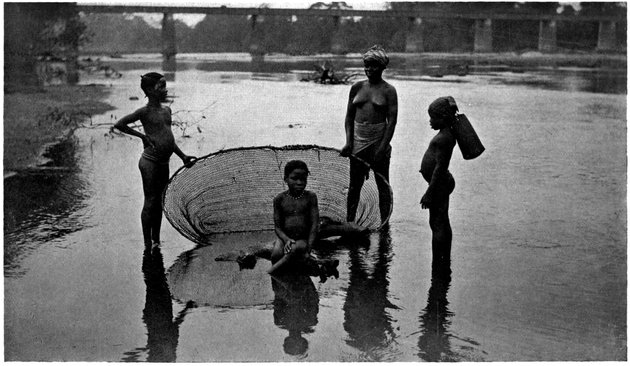
OBLIVIOUS OF HUMAN ALLIGATORS.
During investigations connected with the offences
committed by members of the Human Leopard Society,
9it came out that another secret society existed known
as the Human Alligator Society. This Society appears
to have been an offshoot of the Human Leopard
Society and the usual meeting-place of this new
society was in the vicinity of rivers where crocodiles
or as they are called locally alligators abound.
Thereupon the law was further amended in 1901,
and it was made a felony for any person without
lawful authority or excuse to have in his possession,
custody, or under his control an alligator skin shaped
or made so as to make a man wearing the same
resemble an alligator.
During the year 1903 a Circuit Court, presided over
by a judge who sat with assessors, was constituted,
and after that date all offences against the Human
Leopard and Alligator Society Ordinances were tried
by that Court. From that date up to the middle of
1912 there were before the Circuit Court 17 cases,
in which 186 persons were charged with murder
under the above-mentioned Ordinances; of these
persons 87 were convicted and sentenced to death,
and in many cases the sentence was duly carried
out publicly in the vicinity of the place where the
murder was committed.
In July, 1912, a murder took place at Imperri;
the murderers were disturbed at their work; a man
who was patently concerned in the murder, but was
not one of the actual murderers, was arrested; upon
this man’s shoulders the murderers threw the whole
burden of explanation. Unable to invent even a
plausible explanation, he made a clean breast and
gave the names of those implicated in the murder. In
the course of his explanation other murders were
10referred to and other names were mentioned, with
the result that further arrests were made, whilst
other members of the Society whom he named turned
King’s evidence. In this way the authorities obtained
information with respect to about 30 human leopard
murders since 1907, and between 300 and 400 persons,
including several paramount chiefs (Mahawas)
and a large number of sub-chiefs (Mahawurus), were
arrested. As in many cases no corroborative evidence
was procurable, the majority of these persons were
released, leaving 108, who were committed for trial.
To meet some of the difficulties which had arisen,
the Government thereupon brought forward two
Bills, one of which extended and strengthened the
existing law as to unlawful societies, whilst the other
set up a special court for the trial of persons charged
with offences connected with unlawful societies, and
authorized the deportation of persons who, although
acquitted by such court, were, in the opinion of the
court, a source of danger to the peace of the district.
The Attorney-General, in introducing the first Bill
into the Legislative Council of Sierra Leone, said:
“It will be within the knowledge of Honourable
Members of this Council that the operations of the
Human Leopard Societies in the Protectorate—chiefly
in the Northern Sherbro District—have been
lately very active.
“Not only have many murders been committed
this year in connection with the Human Leopard,
but murders which have been committed within the
last three or four years have only just come to light.
I can say that, so far as I know, there are over twenty
murders at least in connection with this Society
11perpetrated this year or within the last three or four
years just recently come to light. This is a very
serious state of affairs, and one that has to be dealt
with in a drastic manner. As far as my knowledge
of this Society goes, twenty years ago its operations
were confined to, not the big men of the Protectorate,
but lesser people; in fact, it was the paramount chiefs
who took part in trying to suppress the Society.
However, it seems as years have gone by, this state
of things has changed, either from natural inclination
or from force of circumstances, and the Society has
become too strong for the chiefs, with the result that
the paramount chiefs themselves have been drawn
into the Society and are now the leaders of it.
“Section 2 of this Ordinance gives the Governor
power, when any murder has been committed in
any chiefdom, to declare such chiefdom or any part
thereof to be a proclaimed district, and gives the
District Commissioner power to arrest anybody
therein. In the past the Government’s chief difficulty
has been to get evidence to substantiate a prosecution,
as it is generally after a long time that people
come forward to make statements about these murders,
and, owing to the intimidation practised by the influential
chiefs upon possible witnesses, the Government
have always encountered great difficulty in procuring
witnesses to bring to justice the perpetrators of the
crime. It will be seen by Section 2 the District
Commissioner has power to arrest any person whose
arrest and detention he may consider advisable in
the interests of justice; the first person he will
naturally arrest would be the chief of the district.
“This power seems drastic, but the circumstances
12of these murders are so exceptional that drastic
powers are required. Honourable Members will
remember that in the Principal Ordinance it is a
serious offence to be in possession of certain articles.
It is proposed to add three other articles which will
be seen detailed in Section 7. Up to the present, the
possession of certain articles has been necessary to
enable the District Commissioner to deal with persons
who are known to be active members of the Human
Leopard Society. It is now made criminal for a man
to be a member or to take any part in the operations
of this Society. These are the two chief points in
the Bill. Another addition is that by Section 5 which
gives power to the Governor to deport a man who has
been connected with this Society, and, if he is an
alien, to banish him permanently from the Colony.
As the District Commissioners have been obliged to
arrest a good many persons for whom it may not be
possible to formulate any charges, Honourable Members
will see from Schedule 9 that there is an indemnity
clause covering all the arrests which have been
made.”
The three articles mentioned by the Attorney-General
are described in the Ordinance as:
“(a) A dress made of baboon[8] skins commonly
used by members of an unlawful society;
“(b) A ‘kukoi’ or whistle commonly used for
calling together the members of an unlawful society;
“(c) An iron needle commonly used for branding
members of an unlawful society.”
13In introducing the Special Commission Court
Ordinance into the Legislative Council the Attorney-General
said:
“This Bill gives the Governor power to constitute
special courts for the trial of all offences under the
Human Leopard and Alligator Societies Ordinance,
1909, and also the Ordinance (the Human Leopard
and Alligator Amendment Ordinance, 1912) which
has just been read a second time. I may say that
the usual way of trying offenders in the Protectorate
is by the Circuit Court with three or four Native
Paramount Chiefs, but as a great number of these
chiefs are implicated and have been arrested in the
Protectorate, it is obvious that the services of many,
if any at all, will not be available. Moreover, there
are 64 persons under trial. It will take up too much
of the time of the Circuit Judge if all were sent for
trial before the Circuit Court. The Governor has the
power to appoint Commissioners, usually men who are
Senior District Commissioners. However, it is not
desirable to appoint Commissioners in the ordinary
way to try offences like these. Instead of the prisoners
being tried by the Circuit Judge in the ordinary way,
they will be charged before a special court of three
Judges.
“It is proposed in the Bill, which I may point out
will only be in operation for one year, to appoint a
Special Commission Court consisting of three persons.
Who they are or who they will be I cannot say; but
I can say that they must be either judges or barristers
of a British court.
“The Bill also provides that there must be
unanimity before a prisoner can be convicted. The
14procedure will be practically the same as that of the
Circuit Court, and all the procedure of the Circuit
will be followed.
“It will be observed in Clause 10 that the same
powers of deportation will be given to the Governor
when dealing with prisoners convicted by the Special
Commission Court as with those convicted by the
Circuit Court. By Clause 11 further power is given
to the Governor. Unfortunately, it sometimes
happens in these cases that there are several persons
who are more or less connected with these Societies,
but against whom there is no evidence; they will
be simply ordered to leave the Colony and will not
be allowed to return.”
The Colonial Office were fortunate in being able to
secure the services of an able and distinguished lawyer
and judge in the person of Sir William Brandford
Griffith, an Ex-Chief Justice of the Gold Coast Colony,
to be President of the Court, and he arrived in the
Colony from England on the 8th December, 1912.
15
Although it is impossible to say that the Human
Leopard Society is connected with the Poro, nevertheless
any account of that Society would be wanting
unless accompanied by some reference to the Poro,
one of the secret societies by which the natives of
the Sierra Leone Hinterland are educated and were,
until the British Government took over the administration
of the country, ruled. Mr. Migeod, in the
Journal of the African Society for July, 1915, ventures
the suggestion that Purrus Campus in Ptolemy’s
map of the second century may be no other than the
Latin for Poro bush; and everything points to the
custom being of great antiquity. The earlier writers
on Sierra Leone dwell almost exclusively upon the
predatory habits of the Poro and the danger of
trespassing into the Poro bush, but Major Laing
(1822), who travelled amongst the Hinterland tribes
to the north of Sierra Leone, also points to the fact
that it was the Poro which governed the country.
He says:
“Particular pieces of ground (generally eminences
covered with thick wood) are consecrated to the
Greegrees and held sacred. I have always seen those
16enclosures approached with reverential awe, and
have been informed that the smallest encroachment
upon them would subject the aggressor to the most
awful punishment from the Purrah, an institution
which is much dreaded by the whole of this unhappy
country. Their power supersedes even that of the
headmen of the districts, and their deeds of secrecy
and darkness are as little called in question, or inquired
into, as those of the inquisition were in Europe,
in former years. I have endeavoured in vain to
trace the origin or cause of formation of this extraordinary
association, and have reason to suppose
that it is now unknown to the generality of the
Timannees, and may possibly be even so to the
Purrah themselves, in a country where no traditionary
records are extant, either in writing or in song.
“In the early ages of the slave trade (which particularly
prevailed in this country) every nefarious scheme
was resorted to by the headmen for the purpose of
procuring subjects for the markets. It may be conjectured
that where liberty was so insecure concealment
not difficult, and the means of subsistence easy
to be procured, and when the power of the headmen
did not extend beyond the limits of their own town,
many individuals, whose safety was endangered,
would fly to the woods for protection; and as their
numbers increased, would confederate for mutual
support, and thus give rise to secret signs of recognition
and rules of general guidance. It may further
be supposed, that in a country divided amongst
numerous petty authorities, each jealous of the other,
such a confederacy may soon have become too
powerful for any probable combination against them;
17and being possessed of power would at length employ
it in the very abuses to which it had owed its own
origin.
“The headquarters of the Purrah are in enclosures
situated in the woods; these are never deserted by
them entirely, and any man, not a Purrah, approaching
them is instantly apprehended, and rarely ever
heard of again. The few who have reappeared after
several years of secretion have always become intermediately
Purrah men themselves; those who do
not again appear are supposed to be carried away
to distant countries and sold. The Purrahs do not confine
themselves always to the seizure of those who approach
their enclosures, but frequently carry off single
travellers, and occasionally whole parties, who are
imprudent enough to pass from one town to another
in certain districts without applying for an escort
from the body. To ensure safety, one Purrah man is
sufficient, who, while leading the party, blows a small
reed whistle suspended from his neck. At the
advice of Ba Kooro, I procured one of these persons
as a guide from Ma Bung to Ma Yasoo, the intermediate
country being thickly inhabited by the
Purrah. As we passed along, they signified their
vicinity to us, by howling and screaming in the woods,
but although the sounds denoted their neighbourhood,
no individual was seen.
“The Purrahs frequently make an irruption into
towns in the night-time, and plunder whatever they
can lay their hands upon—goats, fowls, cloths, provisions,
men, women, or children. On such occasions
the inhabitants remain shut up in their homes, until
long after the plunderers retreat. During the time
18that I was in the interior, I always had a sentry over
my quarters at night, for the protection of the baggage.
One night, the town in which we slept was visited
by the Purrah, and my sentinel remained firm at his
post. When the Purrah came up, an attack was made
upon him, but the application of the bayonet kept
them at a distance until I made my appearance, when
the Purrah, uncertain of their power over a white
man, scampered off; they were mostly naked and
unarmed, but a few had knives.
“The outward distinguishing marks of the Purrah
are two parallel tattooed lines round the middle of
the body, inclining upwards in front, towards the
breast, and meeting in the pit of the stomach. There
are various gradations of rank among them, but I
could never ascertain their respective offices; persons
said to be men of rank amongst them have been
pointed out to me with great caution, as the Timannees,
generally, do not like to speak of them; but I
could learn nothing further. Purrah-men sometimes
quit their retirement, and associate with the townspeople,
following employments of various kinds, but
no chief or headman dare bring a palaver against a
Purrah-man, for fear of a retributive visit from the
whole body. At stated periods they hold conventions
or assemblies, and on those occasions the country is
in the greatest state of confusion and alarm; no
proclamation is publicly made, but a notice from the
chief or headman of the Purrah, communicated by
signs hung up at different places, with the meaning of
which they are acquainted, is a summons to them to
meet on an appointed day, at a certain rendezvous.
Palavers of great weight, such as disputes between
rival towns, or offences of such magnitude as to call
for capital punishments, are always settled by the
Purrah—the headmen of towns not having at the
present day (whatever power they may have possessed
formerly) the lives or their subjects or dependents
in keeping. The Purrah may be therefore said
to possess the general government of the country,
and from the nature of their power, and the purposes
to which it is applied, they will probably be found
a most serious obstacle to its civilization.”[9]
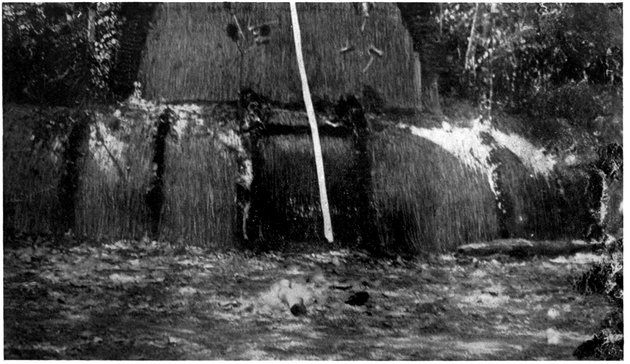
ENTRANCE TO A “PORO BUSH.”
19Every subsequent writer touches upon the Poro,
and gradually more information is gleaned as to its
object and procedure and the manner in which it
exercises its power. The fullest account is to be
found in Mr. Alldridge’s “The Sherbro and its
Hinterland” (1901). The Poro is for men only,
and it begins by training the youth of the country.
Boys between 7 and 20 are taken into the Poro
bush for several months. “The meetings of the
fraternity for initiation of new members always take
place in the dry season, from November to April,
as they are held in the Big Bush, a part of which is
sufficiently cleared and the ground cleaned. The
opening to the Big Bush is rudely constructed of
palm leaves, the entrance being through leafy bowers,
and the aperture serving for a doorway hung with
country mats. Inside, the place is separated into
compartments similarly divided by palm leaves—that
entrance also being hung with mats. The
whole is beneath the dense and overspreading foliage
of high trees, and is known as the Poro bush.”[10]
This Big Bush is usually much higher than the usual
20low bush of the country, and looks more like virgin
bush—a scarce commodity in Mende land. Here the
boys are taught and trained and initiated, here they
dance and sing after dark, and here they are imbued
with the idea of the power and authority of the Poro.
After some months of training the boy is placed in—
(1) The Messenger or servant class; or,
(2) The Mohammedan Mori[11] or the Devil men
class; or,
(3) The Chiefs’ class;
when further initiation and instruction suitable to
his class are given.
Until the British Government proclaimed a
Protectorate, the government of the country was
practically in the hands of the third class. The
chiefs would assemble in the Poro bush, they would
be sworn to secrecy, and then would discuss the matter
in hand; their orders would be issued and carried
out by the whole Society; any member in default
could be tried by a Poro tribunal inside the Poro bush,
condemned, and there put away.
Every member of the Human Leopard Society is
a member of the Poro, the main supporters of both
societies are the chiefs, the place of meeting for both
societies is the Poro bush—this suffices to show how
easily the Poro organization can be used, and no
doubt has been used, for many of the purposes of the
human leopards.
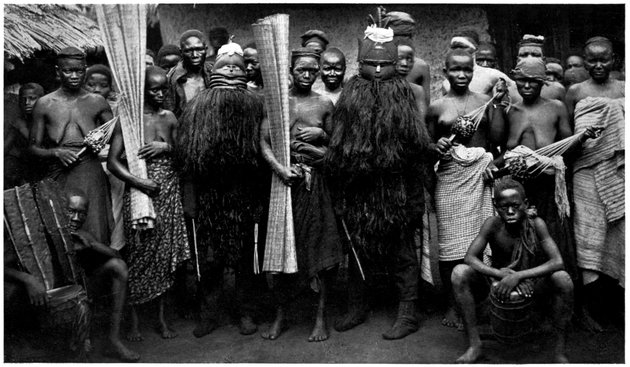
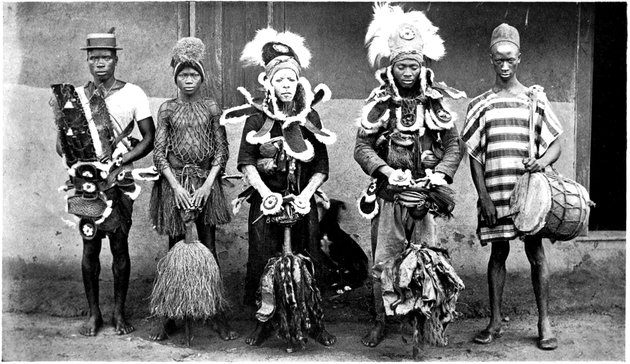
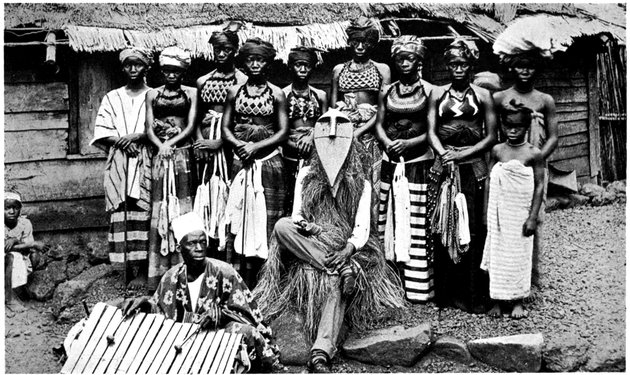
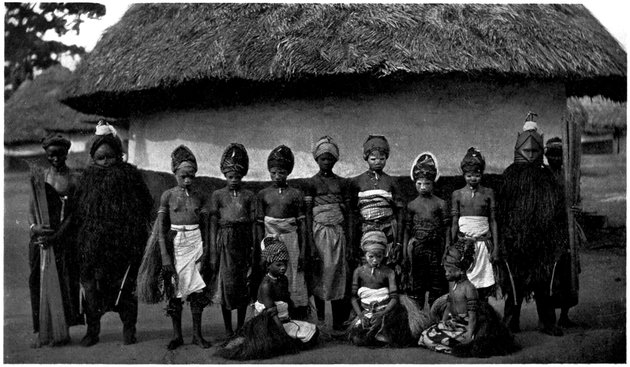
BUNDU DEVILS, SIERRA LEONE.
21
A quotation which Mr. Alldridge has been so good
as to allow from his “Sherbro and its Hinterland”
(pp. 156–159) with respect to the Tongo players
already alluded to will illustrate the atmosphere in
which the human leopards worked.
“Formerly when suspicious circumstances, such
as frequent sudden deaths, or the continuous disappearance
of individuals, as in the case of the victims
of the Human Leopards, arose and baffled the local
fetish, recourse was had to the terrible Tongo player
system, especially if cannibalism was thought to be
at the bottom of the mischief.
“To set this medicine going the intervention of a
most appalling fetish had to be invoked through a
class of medicine people from the upper country
called the Tongo players.
“As soon as the Tongo players had determined to
comply with a request from a chief, they sent out
their emissaries into his towns and villages to obtain
information concerning suspected people. When all
was ready the head of the Tongo, named Buamor
Neppor, attended by his two principal assistants,
Akawa (Big Thing) and Bojuwa (Great Thing) with
their following, arrived in the principal town and
proceeded to clear a space in the bush for their
encampment, where they made their fetish medicine.
This place of concealment was called Mashundu.
“In the investigation one village at a time was
dealt with. A messenger was despatched to call all
the men, women, and children to a meeting to be
held on an appointed day.
22“The meeting was held on a cleared space, called
the Korbangai, outside the town, to which the people
had been summoned. They were then drawn up
into line. Their names were called by a spy from
their own village, who was in the pay of the Tongo
players. Certain questions were asked. The names
of suspected persons were then submitted to the
medicine-men, hidden in the bush, who professed to
go through the ordeal by which the guilt or innocence
of these suspected persons might be determined.
The operator’s ordeal was the plunging his hand
into a cauldron of boiling oil and pulling out a piece
of hot iron. If the hand was burned, it was certain
proof of guilt; if not burned, of innocence.
“The victim thus being found out, he was brought
before the head Tongo player, who asked him if he
were prepared to pay money. If he were, time was
allowed for him to send to his family; meanwhile
he was detained and stocked. Having got as much
as they could out of the man and his family, an excuse
was made, and he was burned to death.
“On some occasions a Tongo play was held. The
players were arrayed in barbaric costume. They
wore a leopard-skin cap, the side flaps of which drooped
over the face, a leopard tail hung down from the
back of the cap, and a sort of door bell was attached
to the end. There was a leopard-skin jacket; the
wrists, elbows, and ankles were further adorned with
strips of leopard skin; the whole costume being
completed by short cloth knickers, trimmed with
leopard skin, and leopard-skin gaiters.
“The Tongo players came out and danced; the
headman and his attendant carried a knobbed staff
23set with sharp cutting instruments, called the Tongora,
which was loosely veiled with leopard skin.
“While dancing the headman and his two attendants
suddenly rushed up to the suspected persons
and dealt them heavy blows with the Tongora, blows
which may or may not have killed them at once;
but whether killed or not they were quickly taken
away and thrown on the fire.”
A word which was constantly heard before the
Special Commission Court was Borfima, the “medicine”
referred to in the Human Leopard Ordinance.
The word is a contraction of Boreh fima, medicine bag,
and is usually, but not invariably, tightly bound up
in a leather package. This package contains, amongst
other things, the white of an egg, the blood, fat, and
other parts of a human being, the blood of a cock,
and a few grains of rice; but to make it efficacious it
must occasionally be anointed with human fat and
smeared with human blood. So anointed and smeared,
it is an all-powerful instrument in the hands of its
owner, it will make him rich and powerful, it will
make people hold him in honour, it will help him
in cases in the White Man’s Court, and it certainly
has the effect of instilling in the native mind great
respect for its owner and a terrible fear lest he should
use it hostilely. An oath administered by the proper
person and with due ceremony upon Borfima is of
the most binding nature, and it was by means of
such oaths that great secrecy was obtained. But
the potency of this great fetish apparently soon
24evaporated. Owners of the Borfima found that their
riches did not increase as rapidly as they anticipated,
they lost cases in the Courts, expectations were not
realized with respect to adverse witnesses upon
whose hearts and livers and kidneys imprecations had
been showered—all this showed that the Borfima
had become weak and needed resuscitation with
fresh human fat and blood—and to obtain this human
fat and blood was the primary object of the Human
Leopard Society.
To give an idea of the mental outlook of the majority
of the natives before the Court, and so that some of
the difficulties under which the prosecution laboured
may be appreciated, allusion should be made to witch-doctors
and oaths.
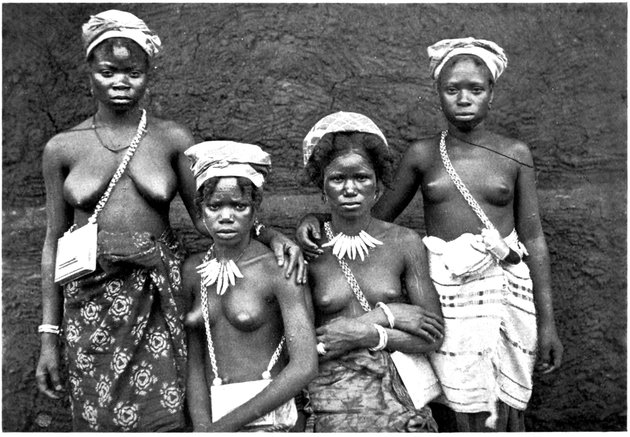
A witch-doctor holds a high position in a native
community, and is often able to accumulate great
wealth. The practice of this profession is usually
confined to certain families, the secrets of the profession
being handed down from father to son. Only
one member of the family practises at the same time,
although he may have a number of assistants who
are commonly members of his family. Some of these
witch-doctors profess to be able to name and trace
their ancestors back to a remote period. All the
followers of this profession are skilled herbalists and
have some knowledge of surgery, but they profess to
effect cures by the aid of witchcraft. If a native is
ill, it is said that he has been caught by some devil,
and it is the business of the witch-doctor to rid him
25of that devil. The witch-doctor knows that certain
devils dislike certain herbs, which, if administered to
the sick person, may have the effect of disgusting the
devil and making it fly away. A devil is frequently
caught and put into a bottle, and then it is for the
patient to say whether he will have it destroyed,
which can only be done by fire, or whether he will
allow it to be released and propitiated by various
offerings, and by such means transform it into a
friendly devil, which he can make use of to injure
some other person. The witch-doctor is frequently
employed by chiefs or other much-married men to
discover whether their numerous wives have been
guilty of acts of infidelity; they are also frequently
employed to discover the perpetrators of any crime
and the place of concealment of stolen property, and
it is extraordinary what successes they achieve, particularly
in discovering stolen property.
Another line of practice in which witch-doctors
excel is the “pulling of swears”—anglice, the removal
of oaths. When an oath is taken upon an ordinary
native “medicine,” it is possible for the oath-taker
to be absolved from the consequences of a breach
of his oath by engaging a witch-doctor, who, for a fee
proportionate to the potency of the “medicine” used,
will “pull the swear.” This is accomplished by
certain ceremonies performed with other “medicines.”
After the “swear has been pulled,” the first medicine
has, so to speak, its teeth drawn.
The “medicine” on which pagan Mende witnesses
26were sworn before the Special Commission Court was
compounded every Monday morning by the Court
interpreter, and consisted of a preparation of salt,
pepper and ashes mixed with water. A spoonful of
the mixture was taken by each witness when sworn;
if there were many witnesses, fresh “medicine” had
to be prepared later in the week. The oath administered
in the presence of the Court and repeated by
each witness was, in its English translation, as
follows: “I (name of witness) swear by this medicine
to speak the truth, the whole truth, and nothing but
the truth. Should I tell a lie, if I go to the farm may
snake bite me, if I travel by canoe may the canoe
sink, and may my belly be swollen. I swear by my
liver, my lungs, my kidneys, and my heart that,
should I tell a lie, may I never be saved, but may I
die suddenly.”
27
The Special Commission Court, consisting of Sir W.
B. Griffith, President, Mr. F. A. Van der Meulen, and
Mr. K. J. Beatty, commenced its sittings at Gbangbama
in the Northern Sherbro District on the
16th December, 1912.
Gbangbama is a town belonging to the Imperri
Chiefdom, and is situate in the heart of the Mende
country, having, within a radius of ten miles, several
towns where murders committed in connection with
the Human Leopard Society had recently taken place.
The Court was held in a large barri[12] specially
erected for the purpose. The prisoners were confined
in a number of huts surrounded by a stockade, and
were guarded by a company of the West African
Frontier Force. Several members of the Freetown
Bar were present for the purpose of defending various
persons to be tried by the Court.
The first two days were occupied chiefly with legal
questions raised by counsel on the cases before the
Court.
The first case dealt with was the one known as
the Kale Case, which occupied the time of the Court
for nearly a fortnight, and in which the evidence of a
28large number of witnesses was taken. Three men[13]
were charged with the murder in or about the month
of March, 1911, of a boy named Kalfalla, aged about
fourteen years. The murder took place at a village
named Kale, which is situated on the bank of the
Mongheri River opposite the town of Mongheri, both
of which places are within the Jong Chiefdom. The
accused were all headmen and men of importance in
the Chiefdom, and the deceased Kalfalla was the son
of one of them, and was at the time of his death in the
process of being initiated into the Poro.
The three boys who were put in the Poro bush at the
same time as the deceased gave evidence before the
Court, and described how they had been captured by
the Poro Devils and taken to a Poro bush at the town
of Senehun, which was under the control of an important
person who was described as the Kumrabai
(King-Maker) of the Jong Chiefdom. While they were
in the Senehun Poro bush, two of the accused came
to the Kumrabai and asked that these boys should be
allowed to go to the Kale Poro bush, so that they
should be available to assist in farm work. Permission
was at first refused, but eventually they were
allowed to go, where, in accordance with Poro
custom, they worked out of sight of all women. A
shimbek (i.e. a grass hut with grass walls) was built
in the Kale Poro bush for the boys, and for several
nights they slept in this shimbek.
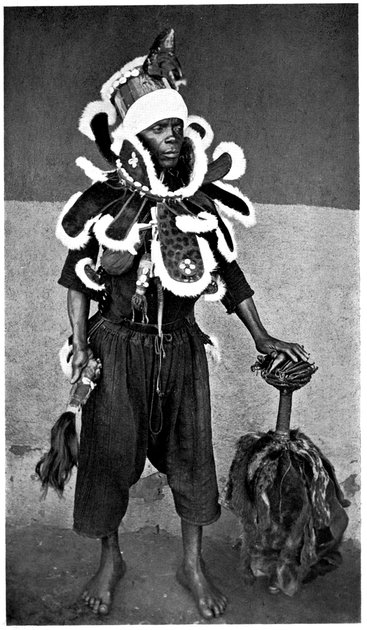
These three boys stated that one evening the
three prisoners, one of whom was the father of
the deceased, came into the Poro bush and told
29them that they were to come out of the bush that
night and sleep in the barri (a shelter with low walls)
at the back of a house belonging to one of the accused,
the deceased’s father. They described the position in
which they slept, how shortly before daybreak they
were awakened by a noise, and how they saw one of
the prisoners holding the deceased boy by the legs,
whilst another of them, who had a leopard skin over
the top of his head and hanging down his back, was
bending over the body. The boys raised an alarm,
and as the accused ran away they heard sounds
which resembled the pit-a-pat of hurrying feet, and
the impression created was that it was a large number
of persons who were running away from the barri.
Soon after this the father of the murdered boy again
appeared on the scene; he went immediately to the
barri and appeared to show grief on seeing that his
son was dead. His accomplices next appeared,
followed shortly afterwards by a number of other
men, who assisted in carrying the body to the Poro
bush. Arrived there the accused, together with some
other members of the Society, consulted together or,
as the witnesses described it, “hung head.” It was
agreed to bury the body at once, and the boys were
threatened that if they spoke about the matter
something bad would happen to them; that if they
were ever asked what had happened to the dead boy
they were to say that a snake had bitten him. The
eldest boy was also sworn on the Borfima not to
reveal what he had seen and heard. This boy
described the oath he took, which was to the effect
that if he revealed this matter and afterwards went
by water he would drown; if he went into the bush
30a snake would bite him; and if he walked on a road
thunder would strike him. He was further sworn
on his heart and on his kidneys that both would
wither away if he broke his oath.
The boys and several witnesses described the
wounds on the deceased, three of which were in the
throat, and the other on the chest. From the description
given of the wounds there could be no doubt
but that they were caused by some sharp instrument,
probably a knife, and could not have been
caused by a leopard’s claws. The accused, in
accordance with native custom, were compelled to
report the matter to the “Grand Master” of the
Poro, but contrary to native custom they did not
report until after the body was buried. At this
breach of custom the Kumrabai was annoyed, but
he allowed himself to be pacified with a “head of
money”—seven country cloths, valued at about
thirty shillings.
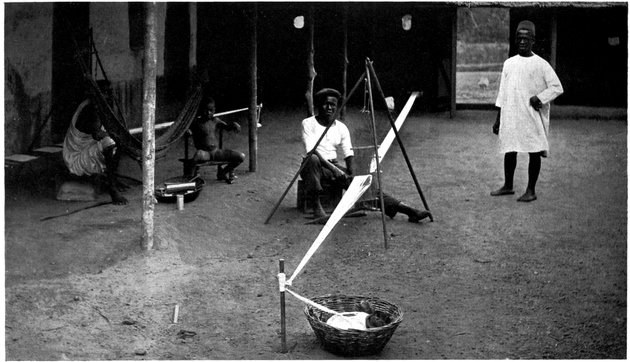
Two witnesses who confessed to being members
of the Human Leopard Society were called and gave
an interesting description of their initiation into the
Society. They had joined the Society at different
times, and belonged to different branches of it. One
belonged to the branch in the Imperri Chiefdom,
and the other to a branch in the Gallinas Chiefdom,
several days’ march distant, but their description
tallied in almost every detail regarding the initiation
ceremony and the objects of the sacrifice. A mark
is made on a candidate for initiation, usually on the
buttocks, so that it will be concealed by the loin
cloth, the usual and only article of dress worn by
the ordinary native in those parts. The mark is
31made by piercing the flesh with an iron needle, raising
it, and shaving off a thin slice of flesh. The wound
is then treated with a medicine known as Nikori,
which apparently has antiseptic qualities, and which
is made by grinding the bark of the wild ground nut.
The blood taken from the wound is put on the
“Borfima,” and the novice by this means becomes
what is spoken of as “joined or married to the
medicine,” and a full member of the Society. Meetings
are only held when the leaders of the Society
consider that the Borfima belonging to their particular
branch requires what is spoken of as “feeding”
or “blooding,” and this can only be done by
the killing of some person. Apparently one of the
rules of the Society is that a victim must be provided
by a member of the Society; usually, the person
called upon to provide the victim is a member who
has received some material advancement, such as
becoming a Mahawa (a paramount chief) or a
Mahawuru (sub-chief), as it is considered necessary
on such occasions to propitiate the Borfima, which
is looked upon as all-powerful for good or evil. When
it is arranged who is to provide the victim, a date is
fixed, usually four to six days later, a rendezvous is
decided upon, and the persons who are to do the
killing are selected. The second meeting is generally
fixed for just after dusk, usually in the Poro bush,
and the victim is either enticed to a place in the
vicinity of the meeting-place, or certain members
are appointed to do the killing in the town or village,
and convey the body to the Poro bush, where the
Borfima is first “blooded” and then the body is
divided up among the members, and, according to
32the evidence of the ex-members of the Society, the
flesh is either eaten raw on the spot or taken away
and cooked. To use the words of one of these
witnesses, “some like it raw, some roast, and some
prefer it boiled with rice.” The witnesses also
described how the members of the Society made
themselves known to each other by a movement of
the second finger across the palm of another person
in shaking hands, and also by a peculiar rolling of
the eyes. Both signs were demonstrated to the
Court. The witnesses examined certain marks in the
buttocks of the three prisoners, and alleged that
they were the marks made at initiation into membership
of the Human Leopard Society.
The following, somewhat interesting, point of
native custom was touched on in the evidence:
When a boy who is in the Poro bush dies, the body
is buried there, and his death is not announced to
the female relatives until after the Poro has “been
pulled” (finished). It is the duty of the Lakai (the
head-messenger of the Chiefdom and a high officer
in the Poro) and of him only to announce the death.
When the Poro is about to be “pulled,” all the
women who have sons in the Poro bush are made
to stand in a circle at the entrance to the town.
The Lakai is escorted by his retainers into the midst
of them. He carries an earthen pot, and if a death
has occurred among the Poro boys he dashes the
pot to the ground and breaks it at the feet of the
mother of the boy, and in this way announces to her
the death of her son. The women wail for some
hours, after which a funeral dance is given by the
parents or the nearest relatives of the deceased;
33and this dance may be kept up for several days and
nights, according to the wealth of the family of the
deceased, who provide the food and drink for the
occasion.
None of these ceremonies were performed in connection
with the death of the boy Kalfalla; but the
omission of these rites was not a matter to which
much weight could be attached, owing to the difficulty
of obtaining reliable information on matters
connected with the Poro, and the custom is only
mentioned incidentally.
The defence of the accused was that a bush leopard
had killed the boy. They admitted that they had
concealed this fact and had given out that it was
a snake-bite which had caused the death of the
deceased, but they said that their reason for doing so
was in order to save the father of the deceased, the
first accused in the case, from certain penalties which
he would have incurred had it come to the ears of
the Poro Headman that he had allowed a “bushboy”
who was still in the Poro to sleep in an open
place outside the Poro bush. The position, shape,
and character of the wounds were emphasized to
show that it must have been a bush leopard which
had caused them, and it was pointed out that it was
an offence against the law of the country for any
one to sleep in an open place exposed to danger,
such as the barri where the boys had been permitted
to sleep. The accused alleged that these “bushboys”
should not have been allowed to sleep out of
the Poro bush, and that it was an aggravation of the
offence that they had been allowed to sleep in an
open place like a barri; that the first accused, as
34head of the family, was the person on whom the
blame would have fallen; and that he, for these
reasons, persuaded the others to give out that it was
a snake-bite which had caused death. If this was
accepted, they urged, they would not be called on to
show the spot where the boy was injured, and they
added that the burial was hurried so that people
should know as little about it as possible. Had the
burial been delayed, the women might have got to
know, and that would have been a further offence
against Poro law. It was also submitted that it
was contrary to nature that the first accused would
have murdered his own son in such a cold-blooded
manner.
The prisoners were ably defended, but the arguments
put forward for the defence did not create
doubt as to the main facts deposed to by the witnesses
for the Crown.
From the evidence of the witnesses one thing emerged
conclusively—viz. that it was no bush leopard which
killed the boy, but that it was some person or persons
simulating a leopard who murdered him; and the
evidence of the other boys that they had heard the
pattering of many feet outside the barri when they
raised the alarm pointed to the fact that there were
a number of persons concerned in the murder.
The Court could come to no other conclusion than
that the murder was committed in connection with
the Human Leopard Society, and that the first and
second accused were the actual murderers of the
boy Kalfalla. These two men were found guilty of
murder and sentenced to death, and were publicly
executed at Mattru in the presence of the acting
paramount chief and a large number of his people
on the 25th January, 1913.
35The third accused, who had taken a prominent part
in concealing the murder, and who was proved to be
leading member of the Human Leopard Society, was
found guilty of being an accessory after the fact to
murder, and was sentenced to life imprisonment.
36
The second case dealt with was the one known as the
Imperri case. Fifty-four persons were charged with
the murder of a boy aged about twenty years. They
were also charged with being accessories after the
fact to murder and further with being members of
an unlawful society: to wit, the Human Leopard
Society.
The murder took place on 13th July, 1912.
The Crown Prosecutor, for want of evidence to
corroborate the story told by accomplices who had
turned King’s evidence, only proceeded against fifteen
of these persons on the capital charge.
The case was commenced on the 13th January
and the verdict was given on the 3rd March. Fifty-nine
witnesses gave evidence, and the notes of evidence
taken reached nearly a thousand foolscap pages.
The facts as alleged by the witnesses for the Crown
were as follows:
Very early on the morning of Sunday the 8th July,
1912, the leaders of the Human Leopard Society
met at some place near the town of Victoria, the
chief commercial town in the Imperri Chiefdom,
and decided to hold a general meeting of the Society
that same evening in the Imperri Poro bush. The
Santiggies (messengers) of the Society were despatched
37to warn members to attend, and about sixty of them
met that same evening.
They began to arrive at the rendezvous, which was
a clearing in the centre of the Poro bush, soon after
dark. There was only one path leading into this
clearing, which was surrounded with dense bush,
and on this path were stationed certain executive
members of the Society, who passed the members
along after they were satisfied as to their membership.
They proved this chiefly by the peculiar
handshake of the Society.
No lights were allowed at this meeting. Towards
midnight the President of the Society, who owed his
position to his being the most important man in the
Chiefdom, arrived with his staff, and after the names
and rank of the persons present were called, he proceeded
to address the meeting. He announced that
the object of calling members together was to discuss
and consider the question of providing food, or in
other words “blood” and fat, for their medicine.
That it was some time since the parent Borfima
was fed, and that it was necessary that their own
Borfimas should also be blooded and anointed.
A discussion then arose as to the means of providing
the necessary victim. One of the members
present was asked to supply a victim, and when he
demurred it was pointed out to him that it was his
turn to do so by the rules of the Society, and it was
suggested that the person to be supplied should be
his adopted son Yagba. Both this member and the
uncle of the boy Yagba protested strongly, a heated
discussion followed, and finally the two members
in question were informed that unless they immediately
38consented to give the boy asked for, either
one or both of them would take his place. Under fear
of this threat they consented.
It was then arranged that the members should
meet again on the Friday following, and both the
father and uncle of the promised victim were warned
that if the boy disappeared or there was any difficulty
about obtaining him one of them would be taken
instead. After nominating two of the members
to do the killing and others to convey the body to
the Poro bush the meeting was adjourned.
On the following Thursday a boy died in the town
of Imperri and his body was buried next day. In the
ordinary course of events there would have been a
funeral dance that evening, but fearing that it might
interfere with their projects, some of the members
of the Human Leopard Society secured its postponement.
As it grew dark that evening, the members of the
Society gathered together in the Poro bush. The
members deputed to do the killing were dressed in
their regalia of leopard skin.
As the evening wore on and the time for sleep came,
the boy Yagba, under instructions from his uncle,
spread his mat on the verandah of the latter’s house
and lay down and eventually went to sleep. About
midnight the two murderers arrived and crept on all
fours up to where Yagba was lying. One of them
held him while the other stabbed him in the neck
with a knife. Death was not instantaneous, and the
boy moaned and beat the ground with his feet. This
awakened some women and a youth who were in
the house, and their screams aroused the whole town.
An attempt was made by the two murderers to drag
the body away, but as a number of people rushed out
of their houses they gave up their attempt and fled
into the bush where they warned the others of what
had happened and got rid of their leopard-skin dress.
The members belonging to the town hastened to get
back to their houses before their absence should be
discovered.
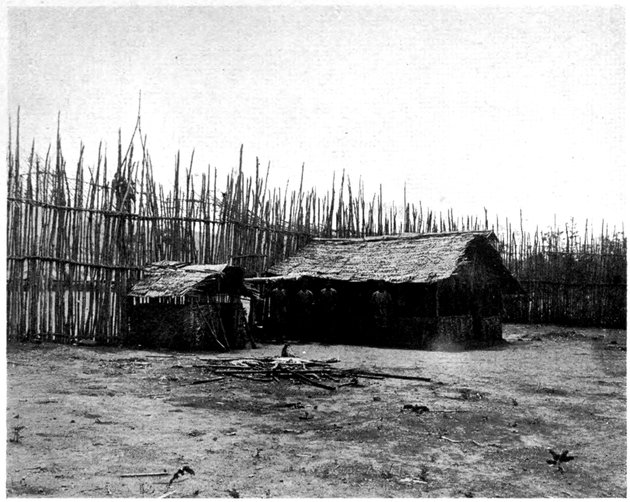
STOCKADE SURROUNDING GBANGBAMA PRISON AND GUARD HOUSE.
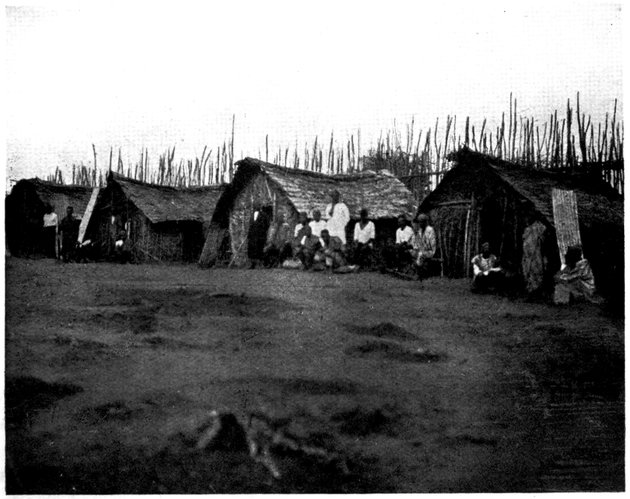
PRISONERS AWAITING TRIAL, GBANGBAMA PRISON.
39The townspeople collected round the body of the
murdered boy and kept saying to each other, “What
is this trouble?” “What has happened?” The
uncle of the boy, who had been beside him the whole
time and who appeared to be very upset at seeing
the body, said in reply to the questions on all sides
that koribrah (leopard people) had killed him. He
was taken aside by some of the accused, and the
seriousness of his admission pointed out to him.
He was told to say that owing to distress of mind he
did not know what he was saying, that what he
really meant to say was that it was a bush leopard
that had killed the boy, and that he himself had seen
two leopards rushing out of the town after the alarm
had been raised. He was promised a sum of money
if the matter was hushed up on the basis of the
death being attributed to a bush leopard, but it was
incidentally mentioned to him that if he did not
succeed in creating this belief the town would in all
probability lose another of its citizens, as their
Borfima had not yet been fed, and they would, in a
certain event, know where to look for a victim. The
story was then circulated that it was a bush leopard
that had killed the boy; and there was some confirmation
of this story by the statements of some women
40and boys who said they saw what looked like
a leopard running away after the alarm had been
given. From the evidence it appeared that these
people had mistaken the murderers in their dresses
of leopard skins for real leopards, which are numerous
in the vicinity.
About 6.30 the following morning the clerk to the
District Commissioner overheard a man at the town
of Gbangbama tell a friend that a bush leopard had
killed some one at the town of Imperri the night
before. The clerk immediately proceeded with some
police or, as they are called in the Protectorate, Court
Messengers to the town of Imperri, and arrived there
soon after 8 a.m. They were met by the chief men
of the town and taken to view the body of the boy
Yagba, several of the accused being present and
volunteering the information that a bush leopard
had killed the deceased. The Court Messengers, as
a preliminary step, took into custody all the people
who occupied the house where the deceased had
been killed, including the uncle of the boy. Meanwhile
a vigorous search was prosecuted to find the
spoor of a leopard, but none was to be found in or
about the town. His uncle was then taken on one
side by the clerk and Court Messengers and in view
of the nature of the wounds and the fact that there
were no signs of any leopard was asked to explain
how the boy had come by his death.
It was clear, owing to the nature of the wounds,
that no leopard had killed the boy; and, faced with
this fact and his admission of the night before, he
gave an account of the murder and the names of the
persons concerned in it. As many of these persons
41as could then be found were forthwith taken into
custody, the others were subsequently arrested, and
after a preliminary examination before the District
Commissioner all were committed for trial.
The chief testimony against the accused was that
of two accomplices who had turned informers. These
men confessed to being members of the Human
Leopard Society and as having been present at the
murders of several victims of the Society. They
gave evidence to the effect that all the accused bore
the mark of the Leopard Society. The mark on each
of the accused was pointed out during the hearing of
the case, but although there were certain peculiarities
about the mark, and although its position on the
person of each of the accused was in most instances
approximately the same, yet, owing to the fact that
the majority of them had other marks, similar in
shape and colour, some doubt existed as to whether
the marks pointed out were really the marks received
on initiation into the Society.
After hearing the evidence, no one could doubt
that a murder had been committed, and that that
murder had been committed by members of the
Human Leopard Society. Their plans miscarried,
they were disturbed at their work by the cries of the
occupants of the house; the actual murderers finished
their work, but those deputed to carry away the
body failed, the uninitiated in the village awakened,
and saw what had happened, and it was too late
to remove the body. The question then followed
as to whether the persons charged were those who
had actually committed or who had taken part in
the murder. The evidence of the accomplices was
42strong, but the chief difficulty in regard to the case
for the Crown was to obtain corroboration of the
evidence of these accomplices. In cases of this sort
where the principal men are bound together by the
bonds of guilt as well as of secrecy, where the victim
is provided by the head of the family, who, instead of
ferreting out the crime, uses all his influence to have
the matter hushed up, and where the whole people
cower down in dread of the terrible vengeance
threatened by the awe-inspiring Borfima, it is not to
be wondered at that it is exceptional to be able to
procure independent evidence. The relatives, even
the mother of the victim, will not come forward
willingly, and when such witnesses are forced to give
evidence they will only say what they think is non-committal,
and from that they will not budge. They
look upon the “medicine” as being responsible, and
hold the view that the members of the Society are
forced into killing a victim in order to “feed” the
Borfima.
In this case, however, many of the non-committal
statements pieced together formed important corroborative
evidence, and that, together with other
evidence, satisfied the Court as to the guilt of six of
the accused, who were found guilty of murder.
The sentence on four of them was publicly carried
out at the town of Imperri on 18th April, 1913. The
fifth and sixth, who were domestic slaves, were also
found guilty of murder and sentenced to death, but
the sentences, on the recommendation of the Court,
were afterwards commuted by the Governor-in-Council
to life imprisonment. The Lavari to the
principal accused was found guilty of being an accessory
after the fact to the murder and was sentenced
to life imprisonment.
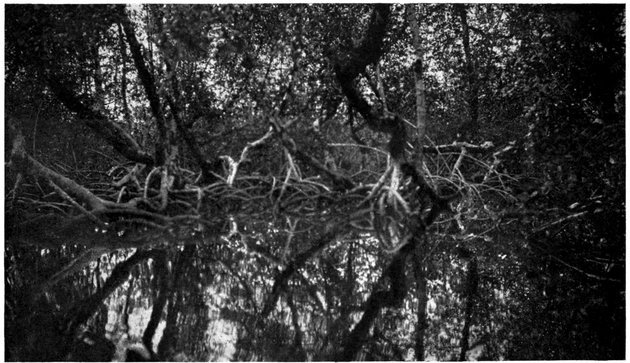
A NATURAL BRIDGE ON THE ROAD TO GBANGBAMA.
43There is little doubt that but for the chance overhearing
by the District Commissioner’s clerk that a
boy had been killed by a leopard this crime would
never have been brought to light. After a time,
when all trace of evidence had vanished, it would
have been given out that the boy had been killed
by a bush leopard. And this story would have been
all the more difficult to disprove from the fact that
in that neighbourhood leopards abound. Within
a few hundred yards of where the Court sat was
a leopard trap, whilst during the hearing of this
particular case at least two leopards were shot within
a mile of the Court barri.
44
The next case dealt with was the one known as the
Kabati Case, from the village where the murder took
place. In this and the following cases Lieut.-Colonel
H. G. Warren sat in place of Mr. Van der Meulen,
who proceeded on leave.
Originally fifty-six persons had been charged and
committed for trial on a charge of murder.
The person murdered was a young woman named
Mini, and the murder took place in or about the
month of May, 1911, at Kabati, a small village in the
Northern Sherbro District of the Protectorate.
As in the previous case, sufficient corroborative
evidence to support the stories told by accomplices,
who were the chief witnesses for prosecution, could
not be obtained, and the Crown Prosecutor decided to
proceed against only three of the prisoners, entering
a nolle prosequi on the capital charge against the
remainder. These latter were subsequently prosecuted,
and a number of them were found guilty of
being members of an unlawful society.
Of the three men proceeded against two were men
of importance in the Protectorate; the first accused
was a paramount chief or Mahawa, and the second
was a sub-chief or Mahawuru, the third accused being
a brother of the Mahawuru. The girl Mini was
45weak in intellect, but to what extent it was not easy
on the evidence to say. She was the niece of the
second accused, the Mahawuru, and for some time
prior to the murder had formed a member of his
household. The story told by the witnesses for the
Crown was as follows:
Some time toward the end of May, 1911, a meeting
of the members of the Human Leopard Society was
convened and held one evening at Mosenge, a deserted
village on the borders of the Imperri and the Jong
Chiefdoms, and was attended by most of the members
belonging to that particular branch of the Society.
Soon after dark the members began to arrive, and
after giving the countersign were admitted to the
meeting. A small fire was lighted, round which the
members sat. Three Mahawas or paramount chiefs
were present, and they with other big men of the
Society sat in front with their subjects, in order of
precedence, immediately behind them. When all
those summoned were assembled, the second accused—the
girl Mini’s uncle—was elected Mahein (presiding
officer) of the meeting. He first called the names
of all the principal men, who answered to their names.
The senior member then, in accordance with the custom,
said to the second accused, “You”—mentioning
his name—“have called a meeting of the members of
this Society, which should not meet except when
important business is to be done; we therefore look
to you now to tell us what that important business is.”
The second accused, after walking three times round
the circle, proceeded to address the meeting. He
said, “The spirits have spoken to me and told me
that unless we want something bad to happen to us
46we should put blood on our Borfimas when four days
and four nights have passed. I invite you all to
meet again, and at that meeting I myself will supply
a person whose blood will satisfy the hunger of the
Borfima.”
In answer to inquiry the second accused further
informed those present that the person he proposed
to give would be his niece Mini, whom he stated had
a devil in her. Then after some discussion as to how
the murder was to be carried out and after details
had been arranged the meeting broke up.
On the evening of the fourth day after this the
members of the Society reassembled at Mosenge, and
about sixty persons were present. When all the
expected guests had arrived, the second accused, who
was still Mahein, called over as before the names of
those present. It was arranged that they should
remain at Mosenge until it was sufficiently late for
ordinary villagers to have retired for the night.
Towards midnight a move was made in the direction
of Kabati, which was about three miles distant, and
on their arrival at the outskirts of the village they
were led to some bush, where they were told to sit
down. The second accused, who was the Mahawuru
of Kabati, and his brother then went into the village,
and were quickly followed by members wearing the
regalia in the form of the leopard skin of the Society.
The woman Mini had for some days previous to this
been sleeping alone in a room at the back of her
uncle’s house, at some distance from where his wives
and the other members of his household slept, and
one of his domestic slaves, who for the purpose of
performing menial acts had been made a member of
the Society, was placed on guard over her. On this
man signalling that all was well the second accused
went into the room and quickly awakened the girl,
who followed him down the bush path to where
the other members were waiting. She came quite
quietly, and did not appear to realize that anything
unusual was occurring. It was stated by persons
present that a firi (a horse tail elaborately decorated
with sebbehs) and an Aku (Yoruba) cap to which
more sebbehs (charms) were attached were then
produced by two important members of the Society,
and that a certain ceremony was gone through which
included the pointing of these things at the girl.
It was then announced that members present need
not feel any alarm in regard to what was going to
happen, as the ceremony performed would have the
effect of warding off suspicion and would assist them
in concealing what was going to happen that
night.
47It was alleged that the third accused then went
behind the girl and stabbed her in the side with a
large knife. She fell forward, and was immediately
seized by four men and hurriedly carried farther
along the path to a small clearing. The other
members of the Society fell in behind. The body
was deposited near where the Society’s “medicine,”
the Borfima, had been placed, and veins of the victim’s
throat were opened so that the blood might flow over
the “medicine.”
After the parent Borfima had been blooded, a few
persons who were sufficiently important to be able
to keep their own Borfimas advanced in order of
seniority and collected a few drops of blood on their
48“medicine” which they had brought with them
for that purpose.
Two men were then nominated to cut up the body.
The belly was first cut open and flapped over the
chest and the interior organs were removed. The
breasts were then cut away and given to one of the
Mahawas (chiefs), and part of the belly, the finger and
toe-nails and the scalp containing the hair were given
to the first accused. The heart was set aside to be
sent to an important and educated member, who was
represented at the feast, but who did not wish to be
present himself. The more important persons present
named in turn the particular piece of flesh they
wanted, and the remainder of the body was divided
among those of lesser importance. A fire was lighted,
over which a certain quantity of flesh was cooked,
but a number of the members appeared to have vied
with each other in seeing what quantity of raw flesh
they could eat. The bones, after being picked clean,
were left lying near the spot, and the “empty skull”
was thrown down an incline towards a stream some
twenty or thirty yards away.
On the 30th May, as near as could be calculated
by the phases of the moon as described by the witnesses,
the Lavari of the second accused approached
him and mentioned that he had a matter to discuss
with him in the presence of the other big men of the
town. A meeting was immediately called, and those
summoned assembled under a cocoa-nut tree near the
compound of the second accused, who, as has been
already stated, was Mahawuru or sub-chief of Kabati
village. The Lavari, who was an old man and of some
importance in the village, said that he had summoned
49those present, as it had been brought to his notice
that the girl Mini was missing; that apparently no
effort had been made to find her; that trouble had
been caused in the past by persons disappearing;
and that as they did not wish to be viewed with suspicion
by the Government Authorities they should
make every effort to trace the missing girl. The
second accused said that it was true that his niece
was missing, but that he did not know that there was
any occasion for alarm, as the girl was crazy, and
that she had disappeared before and had been found
without much difficulty; that she had probably
gone to her parents at the town of Yandehun; that
he was quite able to look after his own affairs, and
that if he had wanted the help of the people of the
town he would have asked for it; that he looked
upon it as officiousness on the part of his Lavari to
have interfered in a matter connected with his household;
and he added that there was nothing they need
do but “beg him” (apologize to him) for making a
lot of unnecessary trouble. That evening he left
the town and was absent for some days. On his
return he summoned the people together to the
village court barri and said that some one, whose
name he had not yet been able to ascertain, had been
to the village of Makelpe and had spread a report
that he had sacrificed his niece, and he angrily asked
who had done this. Of course every one denied having
said anything, and some discussion arose between
the people and himself as to why he had not told
them at the time of the disappearance of his niece.
One of those present expostulated with him for his
callous conduct in not having caused a general search
50to have been made immediately after it was noticed
that the girl was missing. To this he replied that
he had told certain persons; but these persons, on
being referred to, stated that it was not till after
they had commented on the girl’s disappearance
that he had mentioned anything about her being
missing.
At this meeting it was decided that all the young
men of the town should search the fakais (farm
villages) round about, and search-parties were then
and there formed. It should be mentioned in connection
with this meeting that a rumour had reached
the town that the disappearance of the girl had been
reported to the Government, and this probably
accounts for the strong action taken by the people
in expressing dissatisfaction with their Mahawuru.
Towards the evening of the same day, whilst the
people were searching, the sound of “bugles” was
heard, and two paramount chiefs arrived from opposite
directions with their followers simultaneously in
the town. One of these was the Mahawa or paramount
chief of Imperri; the other was the Mahawa
or paramount chief of Jong, and was the first accused.
It was about this time that the third accused disappeared
from the town. The two Mahawas (to give
them their native titles) announced that they had
been sent by the District Commissioner to investigate
the circumstances connected with the disappearance
of the missing girl, and they said that they had been
instructed to see that a proper search was made.
Before the Special Commission Court witnesses swore
that both these Mahawas were actually present at
the murder, but the people of the town of Kabati at
that time seem to have had no suspicion that either
of them was in any way connected with the disappearance
of the girl, or that they were members
of the notorious Human Leopard Society. The
Mahawas then ordered the arrest of all the big men
of the town, who, including the second accused, were
detained in a barri whilst the remainder of the
townspeople were instructed to continue searching;
but no trace of deceased was found that day.
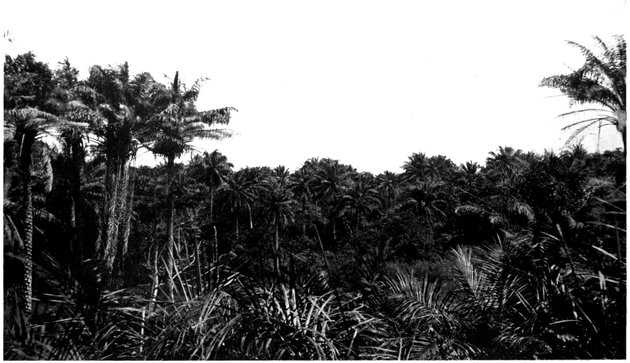
PALM FOREST, SIERRA LEONE.
51The next day search was continued and some bones
were found. The Mahawas went to see these bones,
which were less than half a mile from the town, and
every one appears to have agreed that they were the
bones of the missing girl.
Some of the people appeared to have had information
that the Assistant District Commissioner was
on his way from the town of Victoria, which was
then his headquarters, to visit the town of Kabati,
and he arrived there soon after the discovery of the
bones. He was taken to where the bones were along
a path that had been newly cut through the bush,
but he noticed what looked like an old path leading
from the place where the bones were found, and that
the bush round the spot appeared to have been
cleared at some recent date; this, however, was
explained by pointing to a farm on the other side of
the stream, and by saying the people had probably
come there to cut sticks to build a farm-house. He
noticed a black patch about a yard in diameter, and
remarked that there had been a fire there, but one
of the Mahawas (the first accused in the case) remarked
that that was where the body had rotted.
The Assistant District Commissioner stated in his
52evidence that on one side of the black patch were
some bones which looked like leg bones, and piled
on them were other small bones, and he said that from
their position they must have been so placed by human
agency. They were just as if people had been gathering
sticks. There were other bones scattered about
within a radius of fifteen yards; the bones were
dry, and he found no marks upon them; he thought
that the thigh bones were attached to the pelvis, and
the greater portion of the spinal column was intact.
He made a careful search for clothing and beads, but
there was no trace of any. He said that on the way
to the bones the first accused told him that the girl
was crazy and had gone into the bush and died.
After seeing the bones and ordering them to be
collected, the Assistant District Commissioner asked
for the skull, and was told that it was at the foot of
the hill near a stream just below the bones. He
went there with the first accused and others, and
found the skull at the edge of the stream in a spot so
exposed that it was visible for about twenty yards
inside the farm across the stream. The skull was
absolutely clean, bleached, and “perfectly dry.” At
the top of one jaw, level with the ear, the bone was
broken. There was no doubt in the minds of any
of the witnesses that these were the bones of the
girl Mini. No further trace of her was hinted at and
no cross-examination was directed to that point.
The Assistant District Commissioner then released
all the villagers who had been arrested except the
second accused, the uncle of the deceased. He also
held an inquiry into the circumstances of the girl’s
disappearance, and, as the result, took the second
53accused in custody to Victoria. Being unable, however,
to obtain any evidence to connect him with
the death of the girl Mini, the Assistant District
Commissioner placed the matter in the hands of the
Mahawa of Jong, the first accused, who found that
his Mahawuru, the second accused, had failed to
report the disappearance of his niece, and fined
him fifty pounds and deposed him from his
office of Mahawuru. There, for the time, the
matter ended.
In July, 1912, the Imperri murder already dealt
with took place. The murderers were disturbed at
their work, and one of their number on whom suspicion
was cast when called upon for explanation
admitted that it was a leopard murder, and mentioned
the names of several persons who were implicated.
He was brought to Gbangbama on the 15th July,
1912, having previously confessed to being a member
of the Human Leopard Society and as having been
present at the meetings where the murder was
arranged. A number of names were mentioned by
him in connection with this murder, and amongst
them was that of the second accused. Facts with
respect to previous murders were then elicited; but
although he mentioned a great many names he did
not mention those of the two Mahawas or paramount
chiefs as having been present at any of those murders.
This mentioning of names continued up to the 25th
July when his various statements were reduced to
writing. This writing was witnessed by the two
Mahawas concerned, who, up till that time, had
retained the confidence of the Government Officers.
On Monday the 29th July the District Commissioner
54had an interview with the informer for the first time
without the presence of the Mahawas, and something
was said which induced the District Commissioner
to order forthwith the arrest of one of them, the first
accused. At once Court Messengers were sent to
search his quarters in Gbangbama town. They
found in a box in his house a chewing-stick of a
peculiar kind, a cap with sebbehs (charms), and an
envelope containing human hair, and in a gown
hanging close to his bed they found a small packet
containing nine parings of human nails. His house
at Mattru was also searched, and there was found a
firi (i.e. a horse tail with cloth wrapped round the
handle) and another packet containing eighteen
parings of human finger and toe-nails. All these
articles he admitted were his property, with the
exception of the sebbeh cap.
In this case, too, evidence was given as to the
alleged leopard marks upon the three accused. But
this evidence as to marks broke down. In the first
place, the witnesses were not in agreement as to the
alleged leopard marks upon the accused; secondly,
the medical evidence was not convincing; thirdly,
some other prisoners were produced by the defence
with a number of marks which to the ordinary eye
more or less corresponded with the so-called leopard
mark, one of these men being literally covered with
small-pox marks, some of which were not unlike the
so-called leopard mark; fourthly, a mark produced
by the Government Medical Officer, in accordance
with the directions of one of the expert witnesses,
was quite unlike the so-called leopard mark; and
finally a number of girls and boys, whose ages ranged
55from seven to sixteen years, were produced by the
defence with marks,[14] as far as the ordinary person
could judge, exactly corresponding with the so-called
leopard mark.
There is little doubt that members of the Human
Leopard Society are marked on entering into the
Society, but such marks are so like the marks left by
wounds caused by accident or disease that it is not
possible for any ordinary person to distinguish, with
any certainty, the difference between them.
The defence of the first accused, the Mahawa of
Jong, was that the story of the informer, so far as he
was concerned, was absolutely devoid of truth, and
that at the time of the alleged murder he was suffering
from the effects of boils under his arm so that he
was unable to move about; he gave evidence per-porting
to show that the possession of the firi, the
chewing-stick, the nails and hair was perfectly lawful,
and stated that the sebbeh cap was neither his property
nor was it found in any of his boxes; whilst he
produced official testimony with a view to showing
that he was earnestly striving to eradicate cannibal
murder from his chiefdom.
Furthermore he alleged that the chief witness had
a special ill feeling towards him because of a land
dispute between the Kabati and Imperri people, and
that he had only mentioned his name in connection
with this matter after compulsion on the part of the
District Commissioner. He further stated that some
time after his election as Mahawa certain villages,
including Kabati, which had been a part of Imperri
56Chiefdom, were transferred to his Chiefdom. He
stated that it was well known that cannibal murder
was rife in these villages, but that it was unknown
in the other parts of his chiefdom. He pointed out
that to put a stop to cannibalism he had made certain
rules with regard to strangers reporting their presence
in villages, as to people not sleeping outside a house,
as to proper doors for houses and such like. He had
also assisted the Government in the Mochach murder
about September, 1910, and in the Sawura murder
in 1911, and had done what he could at the request
of the District Commissioner to elucidate the facts
in this very case. He drew attention to the fact that
the second accused had been handed over to him to
be dealt with in accordance with country law, and
that he was sent for by the Government Authorities
to assist in the Imperri case, when he did all he could
to elicit information from the very informer who was
now giving evidence against him.
The firi, he stated, was an heirloom and appurtenant
to his office, and witnesses for the prosecution admitted
that big Mahawas do possess firis, which are
used as the credentials of important messengers. He
explained that the chewing-stick was a present from
a Muhammedan to whom he had rendered some
service, and that the Arabic text found in the wrapper
was nothing more than an invocation that none but
seasonable words might drop from the lips of him who
used it.
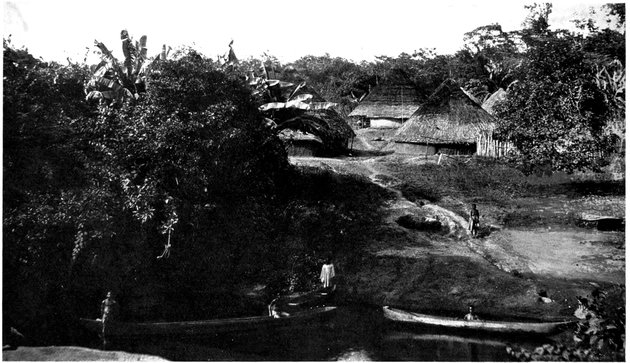
As to the hair found in his house, it seemed clear
that many persons, even educated persons in Freetown,
have a superstition about their hair being left
about, and take precautions to have it disposed of in
57such a way that nobody can get possession of it.
Strong “medicines” are supposed to be made with
human hair, and with this “medicine” injury can
be inflicted on the person from whom the hair was
obtained. He said that soon after he arrived at
Gbangbama he had his hair cut and that he kept it
pending his return to Mattru, where he intended to
have it destroyed. Finger and toe-nails also appear
to be capable of malevolent use, and should not be
left lying about; he said that he had cut his finger-nails
just before he left Mattru, and had put the parings
carefully in his gown, intending to get rid of them
later, but forgot about them, and that was how they
came to be in the pocket of his gown when his quarters
were searched. As to those found at Mattru, he
stated that the wife who assisted him when cutting
them must have put them away in the small box
in which they were found, that that box used to
stand upon his table, and that his wife must have
forgotten them, but that they were quite safe, as the
box was the one in which he used to keep his pocket
cash and was usually locked.
The sebbeh cap he denied the ownership of. He
stated that it belonged to an Aku or Yoruba medicine
man who came to Gbangbama about the same time
as himself, that this man placed the box containing
the cap in his house, and that the cap was not found
with his things, but in another box altogether. This
statement was to some extent supported by the fact
that the sebbehs when opened did not, as was expected,
contain Arabic texts, but only black powder
and tree bark, and he called as his witness the Yoruba
man to whom he alleged the cap belonged.
58The defence of the second accused, the girl’s uncle,
was that Mini was of weak intellect, and that during
a period of insanity she had wandered into the bush,
and, not being able to find her way out, had died
there. He stated that she first became insane after
the birth of her second child, and that she became
so violent that she had to be put in the stocks. He
said that he obtained and had given her some sacred
water and a charm which cured her for a time, that
she subsequently lost the charm and became insane
again, and could not be made to wear any clothes,
that he was absent from Kabati at the time she
disappeared, and that on his return he had made
every effort to find her.
The third accused’s defence was that he had left
Kabati about six weeks before the girl’s disappearance
and was absent in another chiefdom at the time
of her disappearance; that on the 10th June, 1911,
he arrived at Yandehun, where he had a “wife,” and
then for the first time heard of what had happened
in Kabati, whither he immediately returned.
The prisoners were defended by counsel, and forty-five
witnesses were examined in the case.
The chief witness for the Crown was the accomplice
who had turned informer. His evidence on one or
two points one could not help regarding with suspicion,
though on the other hand he gave his evidence freely;
he was quite open, there was little hesitancy, he did
not shelter himself under generalities, but was always
prepared to go into details. In view of the fact that
he had given evidence upon so many different occasions,
and that he had to keep in mind so many
different meetings, one was struck with the small
59number of inconsistencies, and every now and then
it was noticeable how two unconnected details fitted
in with the rest of the evidence; then the further he
was cross-examined the more truthful did his narrative
appear, matters which seemed doubtful at first
were cleared up, and at the end his evidence seemed
stronger than at the beginning, and formed a marked
contrast to the evidence of many of the other witnesses.
Finally an inspection of the locus in quo
tended to confirm his testimony. But this witness
being an accomplice, corroboration of his evidence as
to each of the accused was necessary before the
question could be considered as to whether or not
the accused were guilty of murder. There was ample
corroboration as to the circumstances of the murder,
and that it was committed by members of the Human
Leopard Society, but in addition to this it was necessary
that there should be corroboration of the evidence
of the accomplices as to the identity of each of the
persons charged.
On the question whether it was proved that the
first accused, the Mahawa or paramount chief, took
part in the murder of the girl Mini the Court was
divided and the majority were in favour of a verdict
of NOT GUILTY. This man was, however, deposed
from the chieftainship, and has, on the recommendation
of the majority of the Court, in accordance with
the provisions of the Special Commission Court
Ordinance, been expelled from the Colony and Protectorate
of Sierra Leone.
There was ample corroboration as well as strong
circumstantial evidence against the second accused,
the uncle of deceased, and he was found guilty of
60murder and publicly executed at Imperri on the
2nd June, 1913.
There was some doubt as to the identity of the
third accused. Another person of the same name
appears to have figured prominently in the conferences
of the Society. He was therefore found not guilty
and discharged.
61
This case was one which created exceptional interest
locally by reason of the fact that the accused was a
minister of religion and a man well known in the
Colony and Protectorate. He was connected with
the United Brethren in Christ Mission and had been
a minister of religion since 1878.
The accused, who was defended by four members
of the Freetown Bar, was first charged with the
capital crime of murder, but after some evidence had
been given the Crown Prosecutor realized that he had
not sufficient evidence to secure a conviction on that
charge, and intimated that he proposed to call no
further evidence, whereupon a formal verdict of
Not Guilty was recorded.
The accused was then proceeded against on the following
charges—(i) of being a member of the Human
Leopard Society on or before the 5th November,
1912, the date of the Human Leopard Amendment
Ordinance, 1912, and (ii) with having taken part
in the operations of an unlawful society on the
17th October, 1909.
The accused had apparently been well educated,
and whilst he was in the witness-box it was difficult to
conceive how a man of his stamp could possibly be
62connected with a cannibal society; on the other
hand, it was undisputed that he had permitted himself
to be elected Mahawa (paramount chief) of one
of the chiefdoms in the Protectorate, and had acted
in that capacity from 1899 to 1905, which connotes
much; and he stated that he only ceased to be
Mahawa after his trial upon a charge of cannibal
murder which took place before a judge and jury in
Bonthe in 1905.
The case for the prosecution depended chiefly upon
the evidence of two informers. Upon the depositions
their testimony was corroborated by the evidence of
two witnesses, one of whom was a petty trader and
the other a teacher in another branch of the United
Brethren in Christ Mission, but, as these witnesses
when before the Special Commission Court swore
that their previous statements were false, the case
for the prosecution was left to depend almost solely
upon the evidence of the two informers.
These two informers stated that towards the last
quarter of 1909 (cutting-rice time) a meeting of the
Human Leopard Society was called near Yandehun
for the purpose of arranging for a certain newly
appointed Mahawuru (sub-chief) to provide a victim
to celebrate his appointment. At that meeting a
number of important persons were present, and it
was settled that the Mahawuru should give a girl to
whom he stood in loco parentis, and that the murder
should take place on the evening of the fourth day
from that.
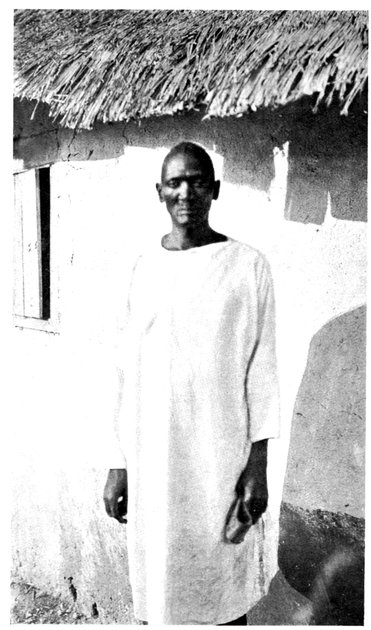
A SELF-CONFESSED CANNIBAL.
On the evening arranged the two informers and
many others arrived at the appointed place, the
Mahawuru enticed the girl to the spot, and he and his
63Lavari set upon her and killed her. Her body was
divided up and one of the informers was despatched
with a portion of the girl’s flesh to the accused and
another member who had not attended the meeting.
He handed over this flesh to this other member and
asked him to give the accused his portion.
The next morning the informer went to the town
of Victoria and saw the accused at the French Company’s
Factory, and informed him that he had been
sent to ask him whether he had received a share of
the “meat” that was sent for him, to which the
accused replied that he had received it. The informer
stated that the accused then said, “All right, I am
now going. I only came for that purpose,” and that
the accused then took the road leading in the direction
of Mobundo (New London), which is situated farther
down the river and is one of the starting-places
when going by water to Bonthe.
If that story was true, there could be no doubt
that the “meat” was a portion of the body of the
murdered girl, and an admission by the accused to
a member of the Human Leopard Society that he
had received such “meat” would have been conclusive
proof that he was a member of that Society.
Both the informers also stated that they saw one
of the witnesses, a petty trader, at the French Company’s
Factory on that particular occasion, and also
the school-teacher referred to. That was practically
all, apart from proof of the girl’s disappearance
at the time in question, that the prosecution
could prove at the trial.
Upon the depositions, however, the case was
much stronger. At the preliminary investigation in
64the District Commissioner’s Court the previous September
the petty trader referred to stated that about
two and a half years before September, 1912, early
one morning he saw one of the informers and the
accused coming out of the French Company’s Store.
He further said that he got the school-teacher referred
to to write a letter to a person at Moyamba, but he
did not actually connect this letter with the day on
which he saw the informer and the accused together.
He admitted that the school-teacher had written a
letter for him, that he took this letter to a person at
Moyamba, and that just before he started for Moyamba
with that letter he went to the French Company’s
Store to get some provisions; but he denied, when
before the Special Commission Court, having seen
either the informer or the accused there.
The school-teacher in his depositions at the preliminary
investigation in September, 1912, gave
important corroborative evidence. He there said that
the accused came to Victoria on the 17th October,
1909, and stayed the night with him; that the
accused went out about 9 p.m. and returned about
10 p.m. with two persons (who had since been
executed for leopard murder), and that these two
stayed with him for about a quarter of an hour;
that next morning the accused went to the French
Company’s Factory and came back to the house;
that he asked the accused to stay and preach for him,
but the accused said “No,” that he was in haste, as
the Government, since his previous trial, never allowed
him to come to Victoria, and the witness fixed the
date by saying that the petty trader came to him the
same morning to have the above-mentioned letter
65written. This letter was produced and identified, and
was dated 18th October, 1909. At this preliminary
investigation this witness, when cross-examined by
counsel for the accused, said further, “I am certain
that the accused slept at Victoria on the night of
October 17th, 1909.” He also said in cross-examination
that he was certain that accused came there
only for the purpose of collecting subscriptions for
the Mission to which he belonged, and that on this
occasion he got a subscription from at least one other
person besides himself. But before the Special Commission
Court all this was changed. The keystone
of the accused’s defence was that his collections at
Victoria were made on or about the 17th December,
1909, and that he only paid this one visit to Victoria
during the year 1909, and these two witnesses, when
before the Special Commission Court, made their
evidence fit in with this defence.
The school-teacher witness was married to a niece
of the accused, and both he and the petty trader
witness admitted having gone back on their statements
about seeing the accused in Victoria in October,
1909, after an interview with the son of the accused—who
was also connected with the United Brethren in
Christ Mission.[15]
The introduction of outside influences to vary the
evidence of important witnesses for the prosecution
gave rise to grave suspicion, but the net result so far
as the actual charges were concerned was that the
prosecution was left without corroboration of the
evidence of the accomplices.
66Had the only issue before the Court been the
charges recorded, it is possible that counsel for the
defence would not have called any witnesses, but would
have claimed a verdict upon the evidence; but the
Court drew attention to Section 11 of the Special
Commission Court Ordinance, 1912, which declared
that notwithstanding an acquittal, if the Court is of
opinion that it is expedient for the security, peace, or
order of the district that the acquitted person should
be expelled therefrom, the Court shall report to the
Governor, who may expel such person from the
Colony and Protectorate accordingly.
Counsel for the defence therefore decided not to let
the matter rest there, but to call evidence so as to
exonerate the accused completely if it were possible
to do so.
The accused himself first went into the witness-box
and proved by letters to persons connected with
his Mission in Freetown that in September, 1909, he
had arranged to make a tour of his district early in
October. He gave evidence to the effect that he
started on the 20th October, proceeded up certain
rivers some distance from Victoria, and that he
remained in those parts preaching and giving magic-lantern
entertainments, with the object of obtaining
subscriptions for his mission, until early in December,
when he came to New London (Mobundo), which he
reached on the morning of the 7th December, 1909.
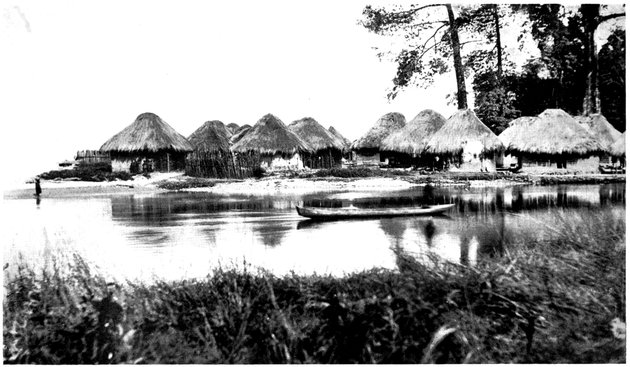
He related how he had gone to the school-teacher’s
house at Victoria and then to the French Company’s
Factory and then to one King, and how he had got
subscriptions, only spending an hour or two at
Victoria. He stated that he then walked to the outlying
67villages and obtained subscriptions from persons
named Nicoll and Cole, that he then returned to
New London, where he picked up his boat and started
home for Bonthe, which he reached early on the
morning of the 8th December. In corroboration of
his story he produced the subscription book which
he kept during the tour, and in which there can be
little doubt that the names of King, Powell, Nicoll,
and Cole written by themselves appear in their due
places after the subscriptions given during the earlier
period of the tour.
These subscriptions seemed to be perfectly genuine,
the entries of the names seemed perfectly genuine, the
whole book bore every appearance of being quite
genuine. King and Nicoll, two respectable traders,
proved their signatures in the book and said that
they put them there in December 1909. In some
details the evidence of King was inconsistent with
that of the accused and his boatman, but this pointed
to little more than that there had been no collusion.
Several servants of the accused were also called
as witnesses for the defence, and a number of discrepancies
were found to exist in the various accounts
given of the circumstances connected with the trip
to Victoria—a matter not without importance, as one
at least of these servants would probably have
accompanied the accused if he visited Victoria in
October as well as December.
One thing was quite clear: viz., that the accused
was at Victoria in or about December, 1909, and that
he then collected subscriptions. The question therefore
naturally arose as to whether his presence in
December was inconsistent with his presence there on
68the 17th and 18th October. There could be no doubt
that it was not. It is true that he had produced
evidence that he was only at Victoria once during
the year 1909, but this evidence was not of high value.
There was nothing to prevent the accused having
been at Victoria on the 17th and 18th October. His
letters to Freetown showed that he had intended to
begin his tour early in October, but his start was
delayed until the 20th. The first Human Leopard
meeting at Yandehun was, according to the prosecution,
on the 13th October; prominent members of
the Society would have had notice of this meeting
prior to the 13th October. Assuming that the
accused had such notice, he would have received it
just about the time he had originally meant to start,
and this would account for his start being delayed
until the 20th of October. And the view that he
made a surreptitious visit to Victoria for unlawful
purposes was strongly supported by the fact that the
witnesses for the Crown who testified to his visit had
been tampered with. Then the chain of facts worked
out by the prosecution connecting the witnesses
and the letter of 18th October with the accused’s
visit, though not sufficient to be of itself corroboration,
was significant confirmation of the story of the
informers.
The Court in giving judgment stated that, as the
accused was a man of education and a minister of
religion connected with a Missionary Society, they
had been slow to form an opinion adverse to him, but
that after careful and anxious consideration they
were unwillingly forced to the opinion that he was so
connected with the Human Leopard Society that it
69was expedient for the security, peace and order of
the District that he should be expelled from the
Colony and Protectorate of Sierra Leone; and this
was accordingly done.
This man, who was born in America, successfully
raised his American citizenship on the previous occasion
when he was indicted for cannibal murder.
The trial of a person residing in the Protectorate for
an indictable offence ordinarily takes place before
the Circuit Court Judge and assessors, who take the
place of a jury, the assessors being usually native
chiefs who sit with the judge and advise him on
questions concerning native law and custom. At the
close of the case the judge sums up to them as he
would to a jury, and they individually give their
opinion as to the guilt or otherwise of the person
being tried. The judge, although he is not bound
by their opinions, naturally attaches a good deal of
weight to them, but the final verdict is left entirely
with him. Non-natives, however, have the right,
when charged with a capital offence, to be tried by a
judge and jury in the Colony instead of the Circuit
Court Judge and assessors, and the plea to the jurisdiction
was successfully raised by counsel when the
accused was before the Circuit Court, on the ground
that he was an American subject and therefore a
non-native so far as the provision regulating the trial
of natives of the Protectorate was concerned. The
case was then transferred to Bonthe, where he was
found Not Guilty by a jury of educated natives.
After his acquittal he rejoined the United Brethren in
Christ Mission and went on a lecturing tour through
America on behalf of the Mission. One of the European
70members of the Mission who was present during
the trial of the case before the Special Commission
Court stated that he had heard him lecture in the
United States, and that by his eloquence and interesting
description of Sierra Leone he drew large
audiences and was successful in collecting a considerable
sum of money for Mission purposes. He is also
known in England, where he had many friends; on
several occasions he has been the guest of persons
in high position, to whom his trial upon a charge of
cannibal murder must have come as a most unpleasant
shock.
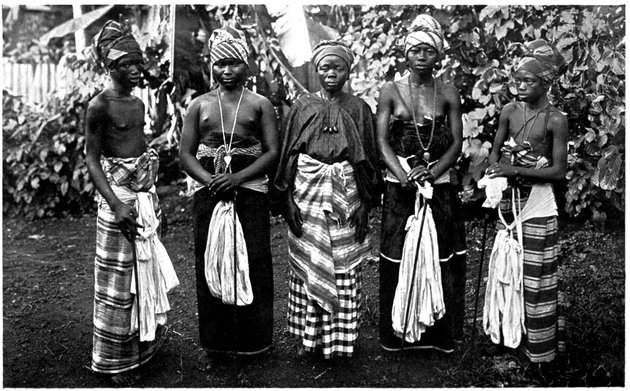
71
The first of these cases was one against an important
person who held high office in the Imperri Chiefdom.
The charge against him was that in or about the
month of July, 1912, he had in his possession without
lawful authority or excuse certain articles, to wit a
native medicine commonly known as “Borfima,”
and a “kukoi” or whistle, contrary to Section 2 of
Ordinance No. 28 of 1909 (The Human Leopard
Society Ordinance) as amended by Section 7 of
Ordinance No. 17 of 1912. There were two other
counts charging him with (i) the custody and (ii)
the control of the “Borfima” and “Kukoi” mentioned
above. The accused was a man of striking
personality, and appears to have exercised a great
influence in the Imperri Chiefdom.
The facts of the case were simple. In July, 1912,
it was stated by members of the Society who had
turned King’s evidence that he had been present at
several meetings of the Human Leopard Society and
had taken a prominent part in the preliminary arrangements
for securing various victims, and that he had
at these meetings produced the “mother” Borfima
of the Imperri Chiefdom. In these circumstances he
was arrested and his houses at Gbangbama and
Victoria were watched by Court Messengers.
72Early one morning the senior Court Messenger
saw one of the accused’s wives leave the house at
Gbangbama with a bundle. He followed her, and
when she saw that there was no escape she threw
the bundle down and ran away. This bundle
held, amongst other things, an iron pot containing
“medicine.”
The accused admitted that the “medicine” was
his, and made a statement as to how it had come into
his possession. This will be best described in his own
words: “I am a sick man. My sickness arose over
a dream. A snake swallowed me up to my waist.
I screamed and then awakened. In the morning I
was unable to move. My legs and body up to the
place where the snake had swallowed me became
‘dead.’ I remained like that for four years. I
heard that there was a Mori Man at a town called
Behol, and sent a messenger for him. I employed this
man to make a medicine for me and I paid him £3
for it. That is the sebbeh (charm) which was in the
pot which the Court Messenger took from my wife.
The Mori Man told me that I would not dream again,
and that the lassimo (medicine) would ward off ill-health
and bad dreams so long as I always kept it
with me. Ah! if he were not dead I would not be
here” (meaning that had the Mori Man been living
it would not have been in the power of the white
man to interfere with him).
The accused caused some amusement in Court by
describing how the senior Court Messenger brought
the sebbeh to Gombo-kabbo (“Fire in the grass,” the
native name for the Assistant District Commissioner),
and how he heard him shout out in a triumphant voice,
73which he imitated, “I have brought Daddy Borfima—come
and see!”
He likewise imitated the voices of the two ex-members
of the Human Leopard Society who were
witnesses against him. One of these men had a
deep voice and the other’s voice was just the reverse,
but this did not appear to present any difficulty to
this extraordinarily good mimic.
Evidence was given that he bore the mark of the
Human Leopard Society. His retort was that even
in England people have marks. He went on to say
that the people were beginning to say that the white
man “is bad,” but that it was not altogether the
white man’s fault, as he was being misled by the
persons who said they had been members of the
Human Leopard Society and now, to save themselves,
gave evidence for the prosecution. He gave one to
understand that words failed him to express his
contempt for these persons, and that if they had to
deal with them under native law they would know
what to do.
He described how the District Commissioner had
forced him to throw the Borfima into a fire made
for that purpose; and how he had protested against
this, stating that he had lost good money over its
destruction. He went on to pay a subtle compliment
to the Court by saying, “We were thinking in this
country that there were no judges in England until
you ‘daddies’ arrived.”
Although the accused very ably defended himself,
there was no doubt from the evidence of the witnesses
that the medicine in question was Borfima.
It was also proved very clearly that he was one of
74the leaders in the Human Leopard Society. Found
Guilty, and asked if he had anything to say why
sentence should not be passed on him, he replied:
“I am the cow with the short tail, God will drive
the flies away. The Judges, you, represent God.
You didn’t believe when I spoke of those men who
said they belonged to the Leopard Society. I see
the result now.”
A sentence of fourteen years’ imprisonment with
hard labour was passed on this man, who, even after
the passing of the sentence, had a last word of
protest and pathetic appeal. As he was leaving the
Court, he burst out, “I am an old man, fourteen
years is a longer time than I will live: Judges, if
you must have my life take it at once; the soldiers
are there with their guns to shoot”—the military
guard round the Court-house when the Court was
sitting.
It may be mentioned in connection with this case
that the prisoner, without any family influence, had
gained an ascendancy over the people of the Chiefdom
unequalled by even the Chief himself. Some years
ago he was tried for Leopard murder, but was
acquitted, and from that date he appears to have
been marked out as a person of distinction. It was
asserted that his “medicine” was sufficiently strong
to guard him against all bad trouble that might be
put upon him, and he was selected as the custodian
of the chief “medicine” of the Human Leopard
Society known as the “Mother Borfima.” When
fresh Borfima was made it was necessary that a small
portion should be taken from the parent Borfima,
and this formed the foundation for the new Borfima.
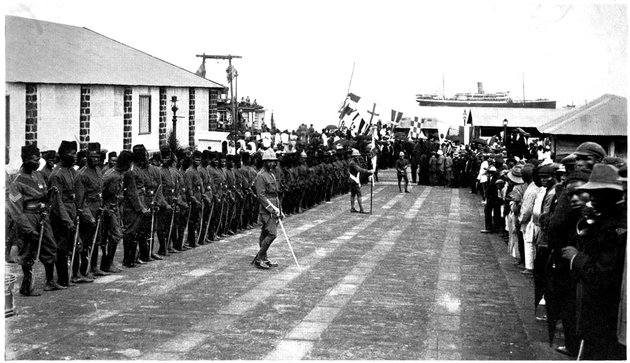
75Another interesting native was brought before the
Court in the person of a Chief from the southern
portion of the Protectorate near the Liberian frontier,
charged with a similar offence. The District Commissioner
obtained information that this man had
in his possession the “medicine” belonging to a
branch of the Society, and Court Messengers were
detailed to search his house, with the result that a
large quantity of “medicine” of various sorts was
discovered and produced before the Court.
The accused in his defence stated that he had been
one of the leaders of the “War boys,” who operated
with the British force during the 1898 Rebellion, and
that the “medicine” produced had been seized by
the War boys from the rebels and was afterwards
deposited for safe keeping in his house; that the War
boys had never returned to claim these curiosities or
trophies, and that the bags in which the “medicine”
had been kept had never been opened up until their
seizure by the Court Messengers. There was reliable
evidence that a portion of the “medicine” was Borfima,
and it was apparent that some of the leather
wrappings round it had recently been repaired.
From the evidence it was clear that the prisoner had
made use of the “medicine” for unlawful purposes,
and he was therefore found Guilty; but as he had
been a great warrior and had rendered valuable service
to the Government during the 1898 Rebellion,
a comparatively light sentence was passed on him.
Another Chief from yet another part of the country
was indicted for being in possession of Borfima
without lawful authority. There was also a second
charge against him of having in his possession a
76Kukoi, i.e. a special kind of whistle used for calling
together members of the Human Leopard Society.
Information reached the District Commissioner of the
Island of Sherbro during the month of August, 1912,
that the accused had Borfima in his possession. This
man was known to be of a rather truculent disposition,
and it was considered desirable that there
should be some show of force when his chief town was
visited for the purpose of effecting his arrest, as otherwise
some resistance might have been met with by
the officers detailed for this duty. An armed party
of the West African Frontier Force accordingly made
a surprise visit and surrounded his house, and effected
his arrest without any resistance being offered.
His house was then searched and a quantity of
“medicines” found which were produced in Court.
The accused admitted that the “medicines” belonged
to him, but stated that they had been left to
him by his predecessor, and that during his absence
on one occasion while he was in Freetown they had
been put in his dwelling-house, and that he, fearing
these “medicines,” had kept them locked up in a
leather bag. He further denied that any of the
“medicines” was Borfima. The witnesses for the
prosecution all stated that a portion of the “medicines”
was Borfima, and it was apparent that the
wrappings of this particular “medicine” had been
recently repaired.
The Court in delivering judgment pointed out that
the accused, by keeping this medicine in his possession,
gave himself and others the opportunity of
using it, and that there was satisfactory evidence to
show that it was not kept for curiosity or for
77any legitimate object, but for an unlawful purpose;
however, as there was no evidence to show that the
Borfima had been taken to the scenes of any of the
recent murders, and there was no reason to believe it
had, the Court took this into consideration in deciding
on the punishment to be imposed on the accused.
The sentence imposed was a term of two years’ imprisonment
with hard labour. The evidence regarding
the Kukoi (whistle) was not considered reliable, and
on this charge he was found not guilty.
A number of other cases besides those mentioned
occupied the time of the Court for some weeks, and
among them were a number of cases in which prisoners
were charged with being members of the Human
Leopard Society. As there were so many persons
under arrest on this charge, the Crown decided to
proceed only against the important men concerned.
Most of these men were defended by counsel, who
examined the witnesses for the prosecution at great
length, but in many cases they were unable to shake
their evidence. A number of these prisoners were
proved to have been present at various meetings of
the Society at which the details of several murders
had been arranged, and the Court in giving judgment
stated that on the facts proved such persons were
really accessories before the fact to these murders and
might on the evidence have been found guilty on the
capital charge had they been prosecuted for it, and
in those cases the Court felt compelled to pass the
maximum sentence of fourteen years’ imprisonment
with hard labour.
The only other case of interest was one in which a
man of some importance in his chiefdom was charged
78with having in his possession without lawful authority
a certain article, to wit an iron needle of a peculiar
shape used for marking on initiation members of the
Human Leopard Society.
The possession of this article is made an offence
under the Human Leopard Society Ordinance, punishable
with imprisonment up to fourteen years.
The case resolved itself chiefly into a discussion on a
point of law, the arguments in the case all turning on
the word “branding.”
The case for the prosecution was that iron needles,
made specially for the purpose, were used in the
following way: the needle was inserted under the
skin, the skin and flesh were raised, a razor then cut
under or over the needle in such a way as to make a
small wound from which blood flowed. A preparation
called Nikori was then placed on the wound, and
the result was a peculiar scar or mark. It was contended
that an iron needle used for that purpose could
be held to be a needle used for branding persons.
For the defence it was argued by counsel that
“branding” a person meant applying a hot iron to
his person, and that marking a person was not the
same as branding him; that the word “branding” by
itself contained the idea of burning, that the Statute
was a highly penal Statute giving exceptionally large
powers to the Executive and imposing a heavy punishment
for breach of its provisions. It was further
argued that the needle was not even for “marking”
members—that it was the razor which actually made
the mark; that although the needle might be used
in the process of marking it was no more used for
“marking” the person than the hand which held it.
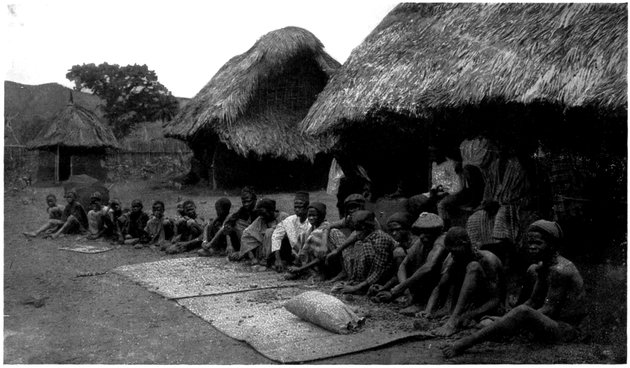
THE PRISONERS OF A NATIVE CHIEFTAINESS, CRACKING PALM-KERNELS.
79The Court held that the needle could not be held to
be used for “branding,” and found the accused not
guilty, and he was discharged.
The Crown Prosecutor entered a nolle prosequi in
the case of a number of other prisoners who had been
committed for trial but against whom he did not
consider that he had sufficient evidence to justify
him in proceeding further, and these men, so far as
the charges on which they were committed for trial
were concerned, were discharged from custody.
This completed the work of the Special Commission
Court, which, after sitting continuously from the
18th December, 1912, concluded its sittings on the
15th May, 1913.
80
Although the work of the Special Commission Court
was completed on the 15th May, 1913, there were at
that date a large number of persons still in custody
who had not been committed for trial, and who therefore
did not come within the purview of that Court.
It was decided that the District Commissioner should
hold an Enquiry under the Protectorate Ordinance
and report whether on the evidence given against any
of these men he considered such persons to be a danger
to the peace of the community.
The first enquiry made was in regard to charges
preferred against a number of men of the Imperri and
Jung Chiefdoms of being connected with the Human
Leopard Society. Evidence was given by informers
that all these men were members of or connected
with the Human Leopard Society, and mention was
made of a number of murders by the Society previously
unknown to the Authorities. Apart from the
evidence of the informers there was ample evidence
to show that a number of these men had actually
assisted members of the Society, and the Governor-in-Council
approved of the deportation of twelve
sub-chiefs and fourteen of the principle Headmen of
81the Imperri and Jong Chiefdoms from the Northern
Sherbro District.
The next enquiry was in regard to charges made
against thirty-six sub-Chiefs and principal men of the
Gallinas Chiefdom. Three informers gave evidence
that they had been members of the Human Leopard
Society and had, during their membership, been
present at a number of murders, each of these men
admitting having given a victim himself and giving
details regarding the sacrifices. They said that all
the persons who were the subject of the enquiry were
members of the Society, and specified the various
murders at which each of them had been present;
they also gave further evidence regarding the leopard
mark and exhibited the marks which they had received
on initiation.
One of the witnesses was a boy aged eighteen years.
His story was that one evening in the previous
year, as he was returning home from a visit to a
neighbouring village, night overtook him, and by
mistake he took a path leading to the Poro bush at
Powolu, where he fell into a number of people. He
spoke to them, but no one answered. He then got
afraid and commenced to run away, when he was
seized by some one who was assisted by several others
to make him a fast prisoner. He was then dragged
inside the Poro bush and a discussion took place,
which he was able to hear, as to whether they should
kill him or not. The majority of the members were
for immediately killing him in accordance with the
rules of the Society, but it was pointed out that
another victim had already been secured, and further
that as their prisoner was the son of a man of some
82importance his absence might give rise to some
awkward inquiries. It was therefore agreed to give
him the alternative of becoming a member of the
Society or of being immediately killed. The witness
stated that he agreed to join the Society. Borfima
was then brought, and the “big man” of the Society
explained to him that the Borfima was the “mother”
of the Society and should be treated with the greatest
veneration; that they were its children and therefore
brothers to each other, and in order to join him to
their brotherhood some of his blood had to be given
to the Borfima to drink; that when the blood was
taken from him he should bear the pain inflicted
bravely and should not utter a sound, as otherwise it
would displease their “medicine” and might result
in his being punished in some unexpected way. The
“Master” then marked him on the left buttock by
cutting a slice of flesh away and rubbing the blood
that exuded from the wound on to the Borfima. He
was then made to swear an oath on the Borfima not
to reveal the secrets of the Society, and was forced
to be present and witness the killing of a girl who had
been brought to the Poro bush, and was made to
eat some of the flesh of this victim.
Although there was no direct evidence apart
from that of accomplices, it was clear from the testimony
of independent witnesses that all these
persons were so connected with the Society as to
make it desirable to have them removed from the
Gallinas District, where it was stated they exercised
great influence over the people. All these
men, with the exception of eight sub-Chiefs who
absconded to Liberia, have since been deported to
the Karina and Koinadugu Districts of the Protectorate.
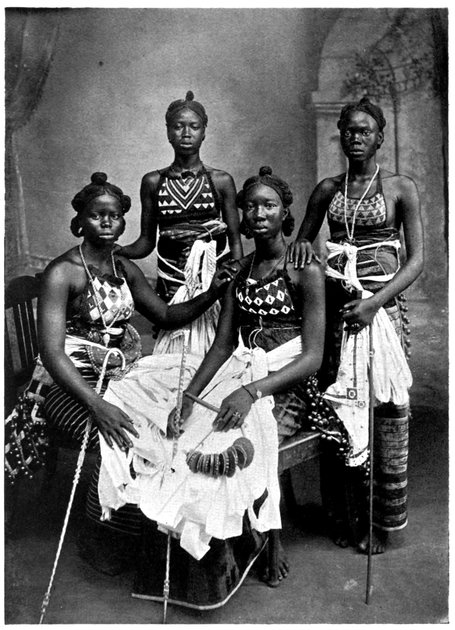
LADIES OF THE SIERRA LEONE HINTERLAND.
83Some light was thrown on the means used to
terrorize the ordinary members of the community
into keeping silence regarding anything they may
have heard concerning the crimes committed by the
Society. When it was discovered that the Government
officers were making enquiries regarding the
Society an attempt was made “to swear” the whole
country—that is, to put all the people under an
oath of secrecy. In one Chiefdom this was done
by swearing every one who was likely to be able to
give any information on a “medicine” called Tillah.
If a person breaks an oath on this “medicine,” even
though he does so unwittingly, the natives believe
that the medicine will catch him and will infect him
with a disease which first attacks his lips and nose,
which it eats away, and which eventually kills him.
There are a few lepers in this Chiefdom, and they are
pointed out as people who have broken, though perhaps
unintentionally, an oath taken on the Tillah.
Another exhibit which was produced in one of the
cases before the Special Commission Court was a
stone image which is looked upon by the Gallinas
people in the light of a Deity. It is known by
the name of Toniahun. The meaning of the word
Toniahun is “turn back to truth.” The figure has
been carved out from soapstone by some ancient
sculptor, and its features are more of the Arab than
the Negro type. No woman will look at this image
for fear of becoming sterile, and they cover their
eyes if they approach it. This figure, notwithstanding
its name, was apparently also used for swearing
84persons on—i.e. to force them to state that they
knew nothing of the Human Leopard Society—and
so great is the fear of the Society and the various
“medicines” employed by it that even the parents
of children who have been seized as victims cannot
be induced to assist the Authorities in bringing the
guilty parties to justice. Prior to July, 1912, no
case of Human Leopardism or cannibalism had ever
been reported to have taken place in the Gallinas
Country, and the Authorities had no reason to suspect
that any had taken place. It was not until after a
number of arrests had been made in other Districts
that it was brought to light that a flourishing branch
of the Human Leopard Society had existed in that
District for many years, and details of about a score
of murders were given by members of the Society who
had turned informers. Although the existence of the
Society must have been known to hundreds of people,
many of whom went about in terror of it, the fear of
the “medicines” of the Society acted as a sufficient
deterrent to keep the matter from the ears of all
Europeans in that part of the country, thus demonstrating
the fear that an ordinary native has of doing
or saying anything which might bring him into collision
with the members of the Human Leopard Society,
who might, with the aid of their “medicines,” punish
him in some fearful and unexpected way.
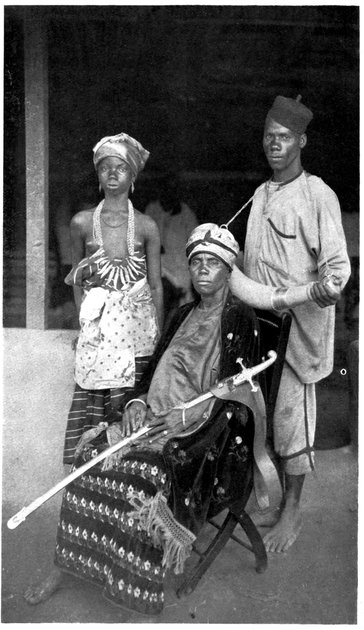
The fact that the majority of the persons who were
convicted or deported under the Special Commission
Court Ordinance were important members of the
Human Leopard Society must have the salutary
effect of breaking up for the time being this criminal
organization; nevertheless, unless vigorous measures
85are pursued and unless that part of the country is
more effectively policed, it is more than probable
that the killing of an occasional victim in order to
renew their fetishes will be continued. It must be
a gradual evolution, which will be brought about by
the natives of those parts coming more in touch with
European influence and gradually losing faith in
the potency of their “medicines.”
While the Special Commission Court was sitting
three murders occurred in the Koinadugu District,
which hitherto as far as official knowledge goes was
entirely free from cannibalism of any kind. According
to the evidence given by a number of witnesses,
the people of the Symira Chiefdom had a very vexed
question to settle in the selection from a number of
aspirants of a Paramount Chief as a successor to their
late Chief who died the previous year, and who left
no near male relative who could of right claim to
succeed to the Chiefdom; and it was suggested by
these witnesses that the victims were provided as
propitiatory offerings by candidates for the Chiefdom.
A small girl aged about seven years was killed at
Nerekora toward the end of December, 1912; two
days later another small girl about twelve years of
age was killed at Bafai; and early the following
month another girl aged about twelve to thirteen
years was killed at Nerekora. All these deaths were
at first attributed to attacks by bush leopards, but the
evidence given by various witnesses was to the effect
that these three girls were murdered by members of
the Human Leopard Society.
Another secret society known as the Human
86Baboon Society, which exists in one of the northern
Districts of the Protectorate, first came to notice
about five years ago, when a number of persons were
charged before the Circuit Court with the murder of
a small child. During the investigation connected
with the death of the child, it came to light that a
number of persons in the vicinity of Port Lokkoh in
the Karina District had banded themselves together
and had formed a society which has since become
known as the Human Baboon Society. In the case
mentioned no evidence could be obtained to corroborate
the statements of the informers, and the
accused were found not guilty and discharged from
custody.
During the month of May, 1913, a small girl was
killed near the village of Bokamp, and, according to
statements made by persons who turned informers,
she was murdered by members of the Human Baboon
Society. Their statements were to the following
effect: That this Society was formed about six
years ago, and consists of twenty-one members made
up of eleven men and ten women; that seven victims,
all young children, had been provided at various
times for the Society; that at their meetings one of
the members of the Society dresses himself in a Baboon
skin and attacks the victim with his teeth; that the
spirit of all members of the Society becomes centred
in the person who is for the time being wearing the
Baboon skin, which, when not in use, is kept in a small
forest, where it is guarded by an evil spirit, and that
the “Baboon” bites pieces out of the victim which
the other members of the Society devour.
The only explanation that the informers could or
87would give as to the objects of the Society was that
the founder of it had quarrelled with his tribal ruler,
who he alleged liberated one of the founders’ slaves
and placed him in authority over him; that he, the
owner of the slave, became so incensed that he
turned himself into a “witch” and induced others
to join him in doing “evil things.”
Objects and reasons other than those given by the
informers probably exist, but it is doubtful whether
they will ever be discovered.
The information in the hands of the Authorities,
however, appears to be sufficient to allow of effective
measures being taken to put an end to the existence
of this Society.