How loudly and boisterously the wind roared to-day across the low-hung,
cloud-smeared sky, driving the broken rack before it, warm and wet out
of the south! What a wintry landscape! leafless trees bending beneath
the onset of the wind, bare and streaming hedges, pale close-reaped
wheat-fields, brown ploughland, spare pastures stretching away to left
and right, softly rising and falling to the horizon; nothing visible but
distant belts of trees and coverts, with here and there the tower of a
hidden church overtopping them, and a windmill or two; on the left, long
lines of willows marking the course of a stream. The road soaked with
rain, the grasses heavy with it, hardly a human being to be seen.
I came at last to a village straggling along each side of the road; to
the right, a fantastic-looking white villa, with many bow-windows, and
an orchard behind it. Then on the left, a great row of beeches on the
edge of a pasture; and then, over the barns and ricks of a farm, rose
the clustered chimneys of an old house; and soon we drew up at a big
iron gate between tall red-brick gateposts; beyond it a paling, with a
row of high lime trees bordering a garden lawn, and on beyond that the
irregular village street.
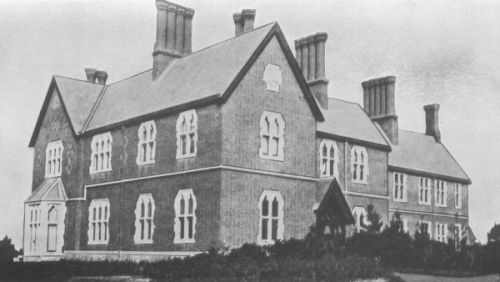
From the gate a little flagged pathway leads up to the front of a long,
low house, of mellow brick, with a solid cornice and parapet, over which
the tiled roof is visible: a door in the centre, with two windows on
each side and five windows above—just the sort of house that you find
in a cathedral close. To the left of the iron gate are two other tall
gateposts, with a road leading up to the side of the house, and a yard
with a row of stables behind.
Let me describe the garden first. All along the front and south side of
the house runs a flagged pathway, a low brick wall dividing it from the
lawn, with plants in rough red pots on little pilasters at intervals. To
the right, as we face the door, the lawn runs along the road, and
stretches back into the garden. There are tall, lopped lime-trees all
round the lawn, in the summer making a high screen of foliage, but now
bare. If we take the flagged path round the house, turn the corner, and
go towards the garden, the yew trees grow thick and close, forming an
arched walk at the corner, half screening an old irregular building of
woodwork and plaster, weather-boarded in places, with a tiled roof,
connected with the house by a little covered cloister with wooden
pillars. If we pass that by, pursuing the path among the yew trees, we
come out on a pleasant orchard, with a few flower-beds, thickly
encircled by shrubs, beyond which, towards the main road, lies a
comfortable-looking old red-brick cottage, with a big barn and a long
garden, which evidently belongs to the larger house, because a gate in
the paling stands open. Then there is another little tiled building
behind the shrubs, where you can hear an engine at work, for electric
light and water-pumping, and beyond that again, but still connected with
the main house, stands another house among trees, of rough-cast and
tiles, with an open wooden gallery, in a garden of its own.
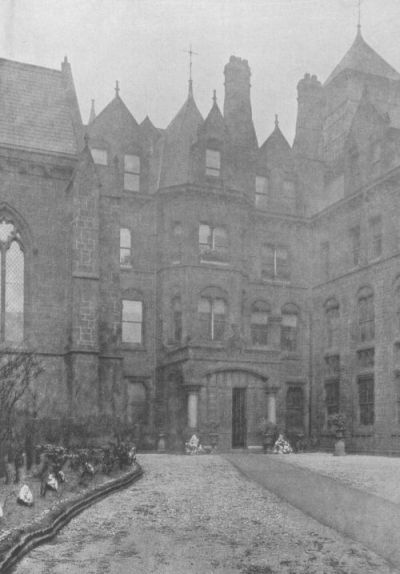
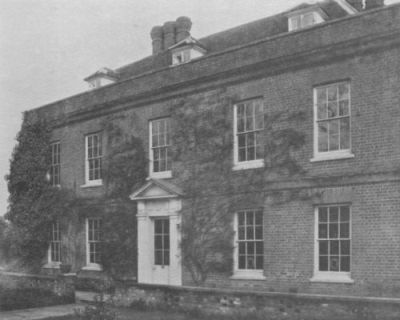 Photo by Bishop, Barkway
HARE STREET HOUSE
FROM THE FRONT 1914
Photo by Bishop, Barkway
HARE STREET HOUSE
FROM THE FRONT 1914
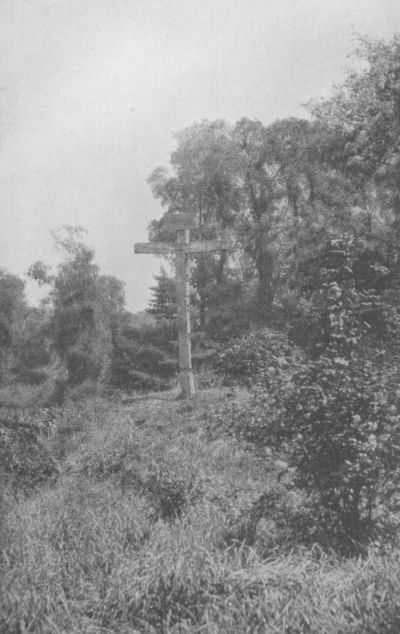
In the orchard itself is a large grass-grown mound, with a rough wooden
cross on the top; and down below that, in the orchard, is a newly-made
grave, still covered, as I saw it to-day, with wreaths of leaves and
moss, tied some of them with stained purple ribbons. The edge of the
grave-mound is turfed, but the bare and trodden grass shows that many
feet have crossed and recrossed the ground.
The orchard is divided on the left from a further and larger garden by a
dense growth of old hazels; and passing through an alley you see that a
broad path runs concealed among the hazels, a pleasant shady walk in
summer heat. Then the larger garden stretches in front of you; it is a
big place, with rows of vegetables, fruit-trees, and flower-borders,
screened to the east by a row of elms and dense shrubberies of laurel.
Along the north runs a high red-brick wall, with a big old-fashioned
vine-house in the centre, of careful design. In the corner nearest the
house is a large rose-garden, with a brick pedestal in the centre,
behind which rises the back of the stable, also of old red brick.
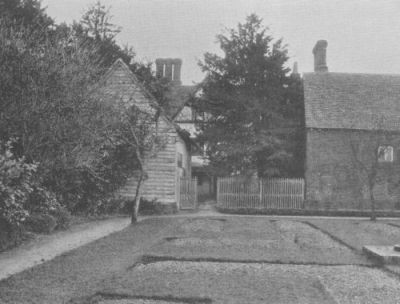 Photo by Bishop, Barkway
HARE STREET HOUSE
FROM THE GARDEN 1914
The timbered building on the left is the Chapel; in the foreground
is the unfinished rose-garden.
Photo by Bishop, Barkway
HARE STREET HOUSE
FROM THE GARDEN 1914
The timbered building on the left is the Chapel; in the foreground
is the unfinished rose-garden.
But now there is a surprise; the back of the house is much older than
the front. You see that it is a venerable Tudor building, with pretty
panels of plaster embossed with a rough pattern. The moulded brick
chimney-stacks are Tudor too, while the high gables cluster and lean
together with a picturesque outline. The back of the house forms a
little court, with the cloister of which I spoke before running round
two sides of it. Another great yew tree stands there: while a doorway
going into the timber and plaster building which I mentioned before has
a rough device on it of a papal tiara and keys, carved in low relief and
silvered.
A friendly black collie comes out of a kennel and desires a little
attention. He licks my hand and looks at me with melting brown eyes, but
has an air of expecting to see someone else as well. A black cat comes
out of a door, runs beside us, and when picked up, clasps my shoulder
contentedly and purrs in my ear.
The house seen from the back looks exactly what it is, a little old
family mansion of a line of small squires, who farmed their own land,
and lived on their own produce, though the barns and rick-yard belong to
the house no longer. The red-brick front is just an addition made for
the sake of stateliness at some time of prosperity. It is a charming
self-contained little place, with a forgotten family tradition of its
own, a place which could twine itself about the heart, and be loved and
remembered by children brought up there, when far away. There is no sign
of wealth about it, but every sign of ease and comfort and simple
dignity.
Now we will go back to the front door and go through the house itself.
The door opens into a tiny hall lighted by the glass panes of the door,
and bright with pictures—oil paintings and engravings. The furniture
old and sturdy, and a few curiosities about—carvings, weapons, horns of
beasts. To the left a door opens into a pleasant dining-room, with two
windows looking out in front, dark as dining-rooms may well be. It is
hung with panels of green cloth, it has a big open Tudor fireplace, with
a big oak settle, some china on an old dresser, a solid table and
chairs, and a hatch in the corner through which dishes can be handed.
Opposite, on the other side of the hall, a door opens into a long low
library, with books all round in white shelves. There is a big grand
piano here, a very solid narrow oak table with a chest below, a bureau,
and some comfortable chintz-covered chairs with a deep sofa. A perfect
room to read or to hear music in, with its two windows to the front, and
a long window opening down to the ground at the south end. All the books
here are catalogued, and each has its place. If you go out into the hall
again and pass through, a staircase goes up into the house, the walls of
it panelled, and hung with engravings; some of the panels are carved
with holy emblems. At the foot of the stairs a door on the right takes
you into a small sitting-room, with a huge stone fireplace; a big window
looks south, past the dark yew trees, on to the lawn. There are little
devices in the quarries of the window, and a deep window-seat. The room
is hung with a curious tapestry, brightly coloured mediæval figures
standing out from a dark background. There is not room for much
furniture here; a square oak stand for books, a chair or two by the
fire. Parallel to the wall, with a chair behind it filling up much of
the space, is a long, solid old oak table, set out for writing. It is a
perfect study for quiet work, warm in winter with its log fire, and
cool in summer heat.
To the left of the staircase a door goes into a roughly panelled
ante-room which leads out on to the cloister, and beyond that a large
stone-flagged kitchen, with offices beyond.
If you go upstairs, you find a panelled corridor with bedrooms. The one
over the study is small and dark, and said to be haunted. That over the
library is a big pleasant room with a fine marble fireplace—a boudoir
once, I should think. Over the hall is another dark panelled room with a
four-post bed, the walls hung with a most singular and rather terrible
tapestry, representing a dance of death.
Beyond that, over the dining-room, is a beautiful panelled room, with a
Tudor fireplace, and a bed enclosed by blue curtains. This was Hugh's
own room. Out of it opens a tiny dressing-room. Beyond that is another
large low room over the kitchen, which has been half-study,
half-bedroom, out of which opens a little stairway going to some little
rooms beyond over the offices.
Above that again are some quaint white-washed attics with dormers and
leaning walls; one or two of these are bedrooms. One, very large and
long, runs along most of the front, and has a curious leaden channel in
it a foot above the floor to take the rain-water off the leads of the
roof. Out of another comes a sweet smell of stored apples, which revives
the memory of childish visits to farm storerooms—and here stands a
pretty and quaint old pipe-organ awaiting renovation.
We must retrace our steps to the building at the back to which the
cloister leads. We enter a little sacristy and vestry, and beyond is a
dark chapel, with a side-chapel opening out of it. It was originally an
old brew-house, with a timbered roof. The sanctuary is now divided off
by a high open screen, of old oak, reaching nearly to the roof. The
whole place is full of statues, carved and painted, embroidered
hangings, stained glass, pendent lamps, emblems; there is a gallery
over the sacristy, with an organ, and a fine piece of old embroidery
displayed on the gallery front.
This is the house in which for seven years my brother Hugh lived. Let me
recall how he first came to see it. He was at Cambridge then, working as
an assistant priest. He became aware that his work lay rather in the
direction of speaking, preaching, and writing, and resolved to establish
himself in some quiet country retreat. One summer I visited several
houses in Hertfordshire with him, but they proved unsuitable. One of
these possessed an extraordinary attraction for him. It was in a bleak
remote village, and it was a fine old house which had fallen from its
high estate. It stood on the road and was used as a grocer's shop. It
was much dilapidated, and there was little ground about it, but inside
there were old frescoes and pictures, strange plaster friezes and
moulded ceilings, which had once been brightly coloured. But nothing
would have made it a really attractive house, in spite of the curious
beauty of its adornment.
One day I was returning alone from an excursion, and passed by what we
call accident through Hare Street, the village which I have described. I
caught a glimpse of the house through the iron gates, and saw that there
was a board up saying it was for sale. A few days later I went there
with Hugh. It was all extremely desolate, but we found a friendly
caretaker who led us round. The shrubberies had grown into dense
plantations, the orchard was a tangled waste of grass, the garden was
covered with weeds. I remember Hugh's exclamation of regret that we had
visited the place. "It is exactly what I want," he said, "but it is
far too expensive. I wish I had never set eyes on it!" However, he
found that it had long been unlet, and that no one would buy it. He
might have had the pasture-land and the farm-buildings as well, and he
afterwards regretted that he had not bought them, but his income from
writing was still small. However, he offered what seems to me now an
extraordinarily low sum for the house and garden; it was to his
astonishment at once accepted. It was all going to ruin, and the owner
was glad to get rid of it on any terms. He established himself there
with great expedition, and set to work to renovate the place. At a later
date he bought the adjacent cottage, and the paddock in which he built
the other house, and he also purchased some outlying fields, one a
charming spot on the road to Buntingford, with some fine old trees,
where he had an idea of building a church.
Everything in the little domain took shape under his skilful hand and
ingenious brain. He made most of the tapestries in the house with his
own fingers, working with his friend Mr. Gabriel Pippet the artist. He
carved much of the panelling—he was extraordinarily clever with his
hands. He painted many of the pictures which hang on the walls, he
catalogued the library; he worked day after day in the garden, weeding,
rowing, and planting. In all this he had the advantage of the skill,
capacity, and invention of his factotum and friend, Mr. Joseph Reeman,
who could turn his hand to anything and everything with equal energy and
taste; and so the whole place grew and expanded in his hands, until
there is hardly a detail, indoors or out-of-doors, which does not show
some trace of his fancy and his touch.
There were some strange old traditions about the house; it was said to
be haunted, and more than one of his guests had inexplicable experiences
there. It was also said that there was a hidden treasure concealed in or
about it. That treasure Hugh certainly discovered, in the delight which
he took in restoring, adorning, and laying it all out. It was a source
of constant joy to him in his life. And there, in the midst of it all,
his body lies.