The numbers refer to the Paragraph, not the Page.
| Introductory |
1 |
| Choice of Paper |
2 |
| Scoring |
3 |
| Barring |
4 |
| Clefs |
5 |
| Signatures |
6 |
| Notation of Rhythm |
8 |
| Placing of Notes |
14 |
| Rests |
15 |
| Dots |
20 |
| Stems |
22 |
| Hooks |
29 |
| Leger-Lines |
36 |
| Vocal Music |
37 |
| Open Score to Short |
41 |
| Short Score to Open |
47 |
| Extracting a Single Part from Score |
50 |
| Accidentals |
51 |
| Legibility |
52 |
| Facility |
54 |
| Copyright |
55 |
| Proof Reading |
56 |
INDEX, Page 53.
How to Write Music
Introductory.
1.—It is reasonable to expect that a
musician shall be at least an accurate
and legible writer as well as a reader of the
language of his Art. The immense increase in
the amount of music published, and its cheapness,
seem rather to have increased than decreased
this necessity, for they have vastly
multiplied activity in the Art. If they have not
intensified the necessity for music-writing, they
have increased the number of those by whom
the necessity is felt.
Intelligent knowledge of Notation is the
more necessary inasmuch as music-writing is in
only a comparatively few cases mere copying.
Even when writing from a copy, some alteration
is frequently necessary, as will be shown
in the following pages, requiring independent
knowledge of the subject on the part of the
copyist. (See e.g., par. 28.)
Yet many musicians, thoroughly competent as
performers, cannot write a measure of music without
bringing a smile to the lips of the initiated.
Many performers will play or sing a note at
sight without hesitation, which, asked to write,
they will first falter over and then bungle—at
least by writing it at the wrong octave.
The admirable working of theoretical examination
papers is sometimes in ridiculous contrast
with the puerility of the writing.
Psychologists would probably say that this
was because conceptual action is a higher
mental function than perceptual: in other
words, that recollection is harder than recognition.
The remedy is simple. Recognition must be
developed till it becomes recollection: the writing
of music must be taught concurrently with
the reading of it.
This was once the case: music-writing was a
necessary part of a musician's education. One
may be the more surprised at its falling
into disuse, inasmuch as phonography—in the
musical sense—is a distinctly pleasant occupation.
Without being either drawing or writing,
it partakes of the nature of both.
But many points in the writing of music
are not now considered to form part of the
Rudiments of Music, and are not included in
primers on the subject.
Hence the following pages.
While containing some matter which may
have escaped the attention of more advanced
musicians, they should, in an educational
course, either be used along with a Primer
on the Elements, or immediately follow it.
Choice of
Paper.
2.—The first matter to claim attention
in making a manuscript copy of
music is choice of the right kind of
music-paper. This will primarily be determined
by the number of staves each score requires.
Most paper contains twelve staves to the page.
This is a most convenient number, allowing for
a two-, three-, four-, or six-stave score.
Song-paper: three-stave score, two staves
being braced for the piano part, with a third for
the voice part. This latter is at a considerable
distance above the other staves, to allow room
for writing in the words.
Organ-music paper: three-stave score, two
staves braced for manual part, and another
underneath for pedal part.
Quartet-paper: four-stave score, no brackets
or clefs.
Quartet-paper with accompaniment: six-stave
score, two bracketed for piano part.
Full-score paper: much smaller than short-score
staves. Very useful for other purposes
where a small, narrow stave is required.
For piano and violin music, paper should be
chosen the staves of which are wide apart, to
allow of the large number of leger lines frequently
required.
Scoring.
3.—The paper chosen, the first use
of a pen will be in ruling the score-lines.
A “score” technically is as many
staves as are performed simultaneously: two in
pianoforte music, three in organ music, four in
an unaccompanied quartet, six in four-part
vocal music with piano accompaniment, and
so on. These staves have a line drawn down
their left-hand edge. Hence the name, from
their being scored through.
Their position always being at the left-hand
edge of the staves, and their length determined by
the number of staves, they may be drawn before
the length of the measures has been arranged.
Care must be taken when a page is ruled at a
time not to draw the score-line through more than
the necessary number of staves. Except in a full
score there will generally be at least two, and,
of course, very often more, scores to the page.
Barring.
4.—After the score-lines come the
bar-lines. And with the arranging
of these begins that careful mapping-out of the
whole work, neglect of which will lead to endless
annoyance and dissatisfaction.
Some music is so uniform that a given space
may be assigned to each measure, and consequently
a uniform number of measures to each
score, provided that there is no change of key
or time. In determining this space allowance
must be made (1) in the first measure of each
movement for the key and time signatures,
which may require a considerable space; (2)
in the first measure of each score for the key
signature: the time signature is only repeated
at the beginning of each movement or when the
time is changed; (3) regard must be had to
where a turn-over will come, some passages
allowing of this so much more easily than
others; (4) also to the number of measures
in the entire movement, otherwise a new page
may have to be added for only one measure!
(5) in vocal music careful regard must be paid
to the words as well as the notes. A syllable
will often require more space than a note,
consequently in very simple music the words
require more space than the music. In florid
compositions a syllable, on the other hand, is
often sung, not to several notes merely, but
to several measures, and the music requires
much more space than the words. In the former
case the author has found it a good plan to
write the words first, or at least a measure or
two of them, as a guide in estimating their
average length. But, while the words must not
be cramped, they must fall under the notes
to which they are to be sung, and as these notes
must occupy as nearly as possible their proportionate
part of the measure, the skilful
scribe will keep both words and music in mind
simultaneously. Where, however, in vocal or
instrumental music the measures vary greatly,
one having, perhaps, a single whole note and
the next thirty-two thirty-second notes, it is
necessary to plan each score separately, or
the end may be reached with too much space
for the last measure, but not enough for another
one. Carrying a measure from the end
of one score to the beginning of the next is not
practised now, as it once was.
Bar-lines are usually drawn through each
stave of vocal music separately, and in instrumental
music through as many staves as
belong to the same instrument or group of
instruments, e.g., through the two staves of a
piano part, and the four or five belonging to the
“strings” in a full score. These instrumental
staves are also usually connected by a brace
at the left-hand edge of each score thus:
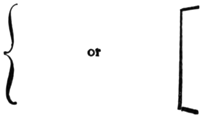
Fig. 1.
Uniform bar-lines may be ruled a page at a
time, if care be taken not to make the line continuous
through more than the required number
of staves. It is a fault which one commits
the moment watchfulness is relaxed, and entails
much scratching out. Where the measures vary
in length the ruling will most readily be done in
light pencil with a T square, and afterwards
inked. A single bar-line out of the perpendicular
will spoil the appearance of a whole page.
Clefs.
5.—The first actual musical characters
to be written are the clefs.
Misconception of the function of these is so
common, not among practical musicians only,
but on the part of elementary theorists, that a
few words of explanation are necessary. The
commonest fallacies are to suppose that if
clefs are the right shape their exact position
on the stave does not matter, and that their
position varies. Both suppositions are, to
quote a delightful Ruskinism, “accurately
false.” A clef identifies and originally was used
with a single line, and identifies others only
by their relationship to this. Hence its precise
shape is of less importance than its being on
the right line. Indeed, the shape of clefs has
varied so much that many able practical musicians
do not know that they were originally
simple letters, the treble clef a small “g,” the
bass clef a small “f.” From this beginning has
been evolved so elaborate a sign, sometimes
not merely covering all the lines of a stave,
but going beyond them, that it is necessary
to explain which line a clef is on. Thus the
“G,” or treble clef, is on that line which its
interior termination is on, and which it curls
round, touching it in all four times. The upper
part of the treble clef is sometimes kept within
the stave, but, as in the present examples,
more often rises above the stave. The point is
merely a matter of taste.
The C clef is on that line which has an oblique
or straight stroke, or pot-hook, above and below.
The F clef is on that line which its interior
termination is on, and which it curls round
either to the right or the left, and which has a
dot above and below.

Fig. 2.
And this position never varies. Whatever
line the F clef is on is F, however many or few
lines may be above or below it.
In olden days any clef line might be taken
with any number of lines above and below. For
instance, the F line with two lines below and
two above; or three below and one above.
This is not now done with treble and bass
clefs, which are only used with respectively the
top and bottom five lines of the Great Stave of
eleven lines. Hence care must be taken to
write the treble clef on the second, and the
bass clef on the fourth line of its stave. But it
is still customary to use the C clef, especially
in viola and trombone music, with both two
lines above and two below, making the alto
stave; and three below and one above, making
the tenor stave. These staves are also used in
old vocal music, and familiarity with them is
absolutely necessary in all advanced theoretical
examinations. The C clef, therefore, appears
to move, being sometimes on the third and
sometimes on the fourth line. Really it is
always on the same line, and it is the selection
of lines which varies. Hence the misdescription
of the treble and bass clefs as “immovable,”
the C clef as “movable.”
Note that all clefs are on lines; no clef is in a
space. This is because the first attempt to
accurately represent music to the eye was by
means of a single line with a letter at the beginning.
This was what has since become the
fourth line, the clef line, of the bass stave.
In pianoforte and organ music, high parts
for the left hand, or low ones for the right,
may be written either:
By means of leger lines (Fig. 3, a);
By changing the clef (b); or
By writing the part in the stave proper to the
other hand (c).
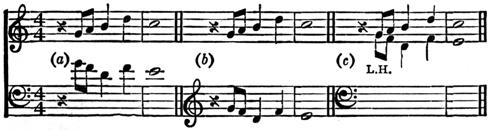
Fig. 3.
The example, of course, illustrates a high
part for the left hand.
The first method is the hardest to write and
read. There is not much to choose between
the second and third. If the third be adopted
care must be taken not to insert rests in the
vacant stave: their absence shows that the
hand is not resting.
When a part, in organ or piano music, though
mainly in its proper stave, begins with notes
more easily written in the other, the clef proper
to the part should be inserted, as showing its
general character, and immediately followed
by that in which the notes are most conveniently
written. Thus Fig. 3, b, if the first measure
of a composition, should have an F clef immediately
preceding the G clef in the left-hand
part.
A change of clef affecting the first note of
a score should be anticipated in the last
measure of the previous score, and repeated
in the measure affected. This is especially
the case in regard to the first score of a new
page involving a turn-over. In addition to
anticipating the clef, the old plan of inserting
a “direct” is to be recommended. See
Fig. 4.
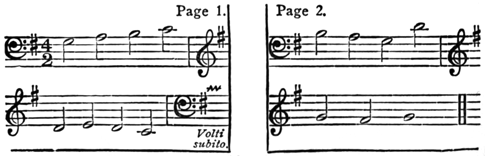
Fig. 4.
The signature should be repeated in the
changed clef. After a change of clef in the
middle of a score this is, of course, not necessary.
Signatures.
6.—Following the clef comes the key
signature. In printed music this is
repeated at the beginning of every score. As
preventing many mistakes the repetition is
desirable. But in manuscript music it is
very usual to repeat it only at the head of each
page. Common faults are:
(1) Placing the sharps or flats at the wrong
octave. The first sharp should, in the treble
clef, be on the top line, not in the bottom
space. And the second flat should be in the
top space, not on the bottom line. The customary
way of writing signatures is not, in the
writer's opinion, invariably the best. But
solecisms, though not in themselves inaccurate,
should be avoided as causing unnecessary trouble
and confusion.
(2) A perhaps commoner fault is in not
allowing sufficient space for the signature, and
therefore cramping it. Each sharp or flat
should be well to the right-hand of the preceding
one, never over or under it.
(3) Sharps, flats, and naturals, like clefs,
cover much more of the stave than the single
line or space which they govern. Not nearly
enough care is usually exercised to make the
center of the sharp, or the loop of the flat,
exactly correspond with this, as it should.
7.—The time signature need only be inserted
where there is a change of movement. In
common time there is a choice between the
numeral signature “4/4” and the letter signature
“C.” The latter is the more interesting
historically. Originally it was not a letter at
all; the monks, who originated modern musical
notation, called triple time “perfect” in honor
of the Blessed Trinity, and represented it
with the sign of perfection—a circle: common,
or quadruple time, they called imperfect, and
cut a slice out of the right-hand side of the
circle to represent imperfection. This printers,
not unnaturally, mistook for the initial letter
of “Common Time.” But the numeral signature
is rapidly superseding this, as showing the
exact value of a measure, and being in accordance
with the signatures of all other kinds of
time.
Notation of
Rhythm.
8.—Following the time-signature
come the notes. The guiding principle
in writing these is that their right
interpretation shall be apparent to the eye.
Two points are of paramount importance.
These are (1) the selection of the right characters
(this of course only affects those who are writing
original compositions or arrangements, not
mere copists), and (2) the correct placing of
these in the measure. The bare duration of a
note, its merely arithmetical value, can generally
be expressed in more ways than one. But
this is not sufficient. That way must be selected
which represents its rhythm, its correct accentuation,
to the eye. Simple forms of time, as
distinct from Compound, contain but few
pitfalls, and even an inexperienced writer is
not likely to go far wrong.
9.—It may be as well to warn such an one,
however, that it is not nowadays customary
to dot an unaccented note or rest. The dot
in this case would represent the succeeding
accented beat, and not represent it nearly as
significantly as does a tied note or separate
rest; compare a and b, Fig. 5.
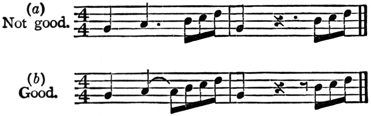
Fig. 5.
10.—Tied notes should not be employed
where a single note would represent the same
sound without misrepresenting the rhythm.
Their chief function is to represent durations
which cannot be represented by a single character,
such as five eighth notes.
11.—In pianoforte music a note is very
occasionally intended to be reiterated before
the first iteration has ceased to sound. This
is effected by allowing the key to rise sufficiently
to release the hammer, but not sufficiently to
reimpose the damper on the string. The second
sound therefore overtakes the first. (It is
comparatively easy on some pianos and very
hard on others.) As the sound, though periodically
reinforced, is continuous, the composer
indicates his intention by a tie. There is nothing
but one's judgment to distinguish this from
the ordinary kind of tie. The chief indication
is the employment of a tie where a single musical
character would otherwise have been better.
For instance, the following tied sixteenth notes
from the Adagio of Beethoven's Sonata, Op. 106,
could better have been represented by
eighth notes, had it not been for the intention
of overlapping iteration (Fig. 6).
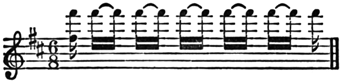
Fig. 6.
The ties commencing in measure 134 of
Beethoven's well-known Sonata Pastorale were
evidently regarded by Cipriani Potter as of
this order. As having been a personal friend
of Beethoven's he was likely to know. (The
great composer refers to him in corresponding
with Ries in 1818.) The duration of these
notes could not have been written otherwise than
by means of ties. The above test is therefore
inapplicable; this is evidently why, in the edition
edited by Potter, they are marked with a
tie plus a dot and horizontal stroke (Fig. 6a).
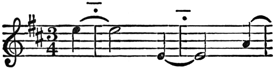
Fig. 6a.
Another indication is the tying of an unaccented
note to an accented one, thus obliterating
the accent if the tie be observed literally
(instances occur in Chopin's Valse, Op. 31, No. 1).
So much critical judgment, however, is
required to distinguish this treatment from that
proper to a tie, that composers would do well to
adopt some such method as Cipriani Potter's
to make their exact meaning clear.
This interpretation of a tie, according to which
the notes, since they overlap, are just not separated,
must not be confused with the mezzo-staccato
touch, also indicated with a slur, but
having dots also (in the case of a single note
indicated by a stroke with a dot), and which
means that the notes are to be just not joined.
In legato, of course, they should be neither separated
nor overlapping, but exactly contiguous.
12.—The commonest errors in simple time
are not in regard to notes, but rests. This is
because silence cannot be divided or syncopated,
and therefore that would often be quite right as
a representation of sound which is quite wrong
as a representation of silence. Thus a beat
should not be represented by two rests where one
would do, though it might be by two notes (see
a, Fig. 7). Nor one rest represent parts of two
beats (see b, Fig. 7). Nor one rest represent an
unaccented and an accented beat (see c, Fig. 7).
In triple time it is better to avoid a single rest
representing the latter and greater part of a
measure (see d, Fig. 7), indeed, it may be said that
half-note rests should not be used in triple time.
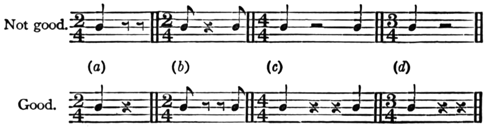
Fig. 7.
13.—But in compound time errors, if not
more numerous in kind, are much more common
anyway in regard to notes as distinct from rests.
A note should never be written which represents
a beat and part of another. The commonest
violation of this principle—and it is very common—is
in writing a dotted half note in six-eight
time; this divides the measure into three
thirds instead of two halves, by representing
a beat-and-a-third and two thirds of a beat
(see a, Fig. 8). A beat-and-a-third, if required,
should be represented by a note of the value of
a beat tied to one of the value of a third, never
by a single note equalling both—a half note in
this case (see b, Fig. 8). A similar principle
applies to rests. A measure's silence should be
represented by rests divisible into beats, not by
rests which fuse a beat and part of the next (see
c, Fig. 8). Two dotted quarter notes in twelve-sixteen
time are not so bad as a dotted half
note in six-eight time, as they correctly represent
the division of the measure into two halves,
but they misrepresent these halves as consisting
of three sixths of a measure whereas they rhythmically
consist of two quarters (see d, Fig. 8).
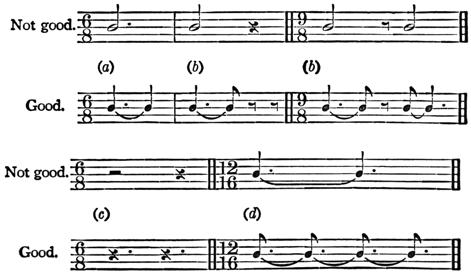
Fig. 8.
A twelve-sixteen measure of silence is much
easier to write, since it can be done by a single
whole note rest, which is also commonly used
as a measure-rest, irrespective of the value of
the measure. (Hence the German name taktpause.)
The six-eight measure of silence (see
c, Fig. 8) might also, of course, have been written
in the above way, or by quarter, eighth, quarter,
eighth rests in place of the dotted rests.
Placing of
Notes.
14.—The characters which will correctly
represent the given rhythm
having been determined, the second
point is the correct placing of them in the measure.
Mentally, at least, the measure should be
divided into as many equal portions as there
are beats in it. One well-known composer, it is
said, rules beat-lines in light pencil, as well as
bar-lines, in his full scores. In very elaborate
music this symmetrical arrangement cannot be
fully carried out; sixty-four sixty-fourth notes
cannot be written in the same space as one whole
note; and a whole note would look lost in the
space required for the sixty-fourth notes. But
simple music can be made quite symmetrical,
and in all music such beat-lines, actual or mental,
are an invaluable check and guide.
Each note should be placed in the left-hand
end of its space. This is for the simple reason
that music, like words, is read from left to right
and, roughly, space represents duration. Any
other arrangement is misleading, as may be
seen from old music, in which a note was often
placed in the middle of its space. The following
(Fig. 9) is an example from an organ work of
Rinck's (1770–1846).
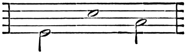
Fig. 9.
But for the fact that in open score half notes
below the middle line have their stems turned
down, even an expert would not improbably
suppose the time to be four half notes in the bar.
This is not the case, the time is two half notes
and the whole note is to be sounded simultaneously
with the two half notes.
“Confusion worse confounded,” is, so far as
the eye is concerned, hardly too strong a term
to apply to the results of this illogical method
when applied to polyphonic music. Compare
a and b, Fig. 10, in the former of which four
notes intended to be begun simultaneously are
no two of them in line, owing to each being in
the middle of its space!
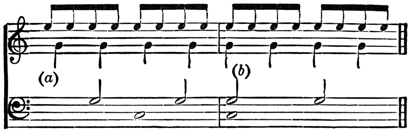
Fig. 10.
This practice was consistently carried out,
even when it involved writing a note on the bar-line!
or a note in one measure and its dot in the
next (see Fig. 11).

Fig. 11.
(Pianists will recall a modern instance, so
far as the dot is concerned, in a little exercise
in C major of Czerny's.)
The practice cannot have been due to the
non-invention of the “tie” or “bind.” For
though the first use of this is difficult to trace,
clear instances, in the form of a bracket, ︷,
occur in Morley's Practical Music, published
in 1597.
Rests.
15.—Rests, especially whole note
rests, when used for a whole measure,
are still very often illogically placed
in the middle of the space they represent. This
has been defended on the ground that they represent
silence or inaction, and that therefore no
error can arise from their appearance being deferred.
But a performer should be conscious of
the action or inaction of every voice or part.
If there be a seeming vacuum or hiatus, how is
he to know whether it is a note or rest which has
been omitted? If he concludes, from the absence
of any note, that a rest is intended, he can
only guess how long it will prove to be when it
does come. Therefore, in the writer's opinion,
rests should be located on the same principle as
notes. If it be not a profanation to say so, since
the example is from Bach, the rest in Fig. 12
would have been better placed at the beginning
of the measure. Let a sheet of paper be held
over the right half of the measure, and though
the player will be able to begin, he will not know
in how many parts the piece is written.
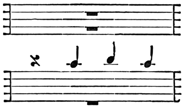
Fig. 12.
16.—In open score, that is, in writing a single
melody or part on one stave, it is usual to make
whole note rests below the fourth line, and
half note rests above the third. Quarter note
rests should be written exactly in the middle of
the stave. The crook of eighth note rests, and
the upper crook of shorter rests, is generally
placed in the third space, in the absence of any
reason to the contrary. The stems of rests are,
in manuscript music especially, better slanted
somewhat. This helps to distinguish them from
the stems of notes—in rapidly written manuscript
a not unimportant thing!
17.—There are two forms of quarter note
rest, the English, which is like the eighth note
rest but turned to the right-hand, and the
German, which is somewhat difficult to describe.
The German is far the better of the two as being
much more distinct from the eighth note rest.
It is, however, harder to write, and of the
slightly varying forms, perhaps the easiest is
that with a crook at each end of a very oblique
stem and which is thus very much like a reversed
letter Z (see the first example in Fig. 13).

Manuscript forms of German quarter note rest.
Fig. 13.
18.—In short score, that is, in writing two or
more parts or voices on one stave, the rests are
placed, not only in the top or bottom space of
the stave as may best indicate to which part
they apply, but above and below it, involving,
in the case of whole note and half note rests, the
use of a leger-line (see b, Fig. 14). This is
partly because the stems of all rests are turned
down, and therefore cannot be made, as the
stems of notes can, to indicate the part they
belong to by the direction taken. This, therefore,
has to be shown by their position on, or off,
the stave (see Fig. 14).
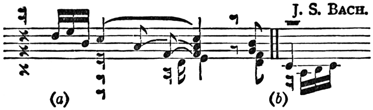
Fig. 14.
It will be seen that the lower eighth note rest
in the first example belongs to the same part
as the following sixteenth note rest, though by
no means on a line with it.
19.—In modern piano music which is not of a
strictly part-writing character, rests often represent
the absence, not of a part or voice, but of the
hand. If the notes, though representing as
many parts as the piece can be supposed to
possess, are all to be played by one hand, rests
are employed to represent the absence of the
other.
And in music which is of a part-writing character,
though the parts are incomplete, rests are
often not employed if both hands are engaged
(see Fig. 3, c, bass clef, supposing it to be of
more than two parts).
Bach rarely, if ever, employed rests to represent
the hand; with him they always represent
a voice. Thus in a melodic or one-part passage
divided between the hands, each playing alternate
groups, he used no rests to represent the
absent hand. These, appearing simultaneously
with the notes, would have implied a second
part. With him rests represent a living, though
absent, voice; in modern usage they frequently
represent, not music, but the way of playing it.
See Fig. 15, the first half of which is in two parts,
therefore rests represent the thirty-second note
silences; and the second half of which is in one
part, therefore no rests are employed though
only one hand is engaged at a time. It is from
a B flat Prelude in Bach's Well-tempered
Clavier.
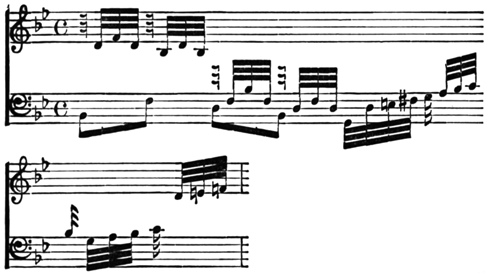
Fig. 15.
Dots.
20.—Dots are used in music for
three purposes: (1) as repeat marks,
(2) to indicate semi-staccato, (3) to
prolong a note one half. As repeat marks, they
may be placed in each of the four spaces of the
stave (which in the writer's opinion is the better
plan, as being less liable to confusion with time-dots),
or in the second and third spaces only,
in accordance with a modern custom. Staccato
dots and staccatissimo dashes, when two parts
are being written on one stave, should be placed
below the note if applying to the lower part, and
above if applying to the higher. In the case of
open score (a single part on one stave), they are
best placed on the side opposite the stem.
Time-dots, or those which prolong a note one
half, if applied to a note in a space, should be in
the same space as the note; if applied to a note
on a line they should be placed in the space
above, if the next note of the part is higher, and
in the space below if it is lower. The importance
of this usage is often overlooked. If it
cannot be called a rule, it is high time it was
made one! When two parts are written on one
stave, and a note is doubled, having two stems,
one up and the other down, to indicate this,
and in one part it is dotted, and in the other
not, it is impossible, apart from this rule, to
tell which part has the note dotted and which
not (except, of course, from the context, which
may expose any mistake). The following
example from Henry Smart's “Festive March in
D,” for the organ, appears to contain two dotted
half notes. It would probably be so read by
anyone playing the passage at sight. The context
shows that it is the eighth note not the
half note which is intended to be dotted. All
the dots except that to the last note but one
should have been in the space below the note,
where this is on a line.
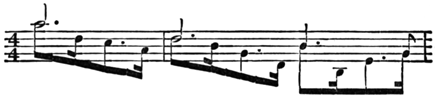
Fig. 16.
Logic would suggest that where a doubled,
that is a two-stemmed, note is dotted in both
parts or voices, two dots should follow one above
the other. This would, however, be awkward
when the note was in a space; and also when it
was on a line, if, as in the last group above, both
voices proceeded to a lower note (or both to a
higher). For according to the rule here being
considered, both dots would have to be in the
space below (or above).
There is another slight inaccuracy in the
above example which will be noticed later on.
Let the tyro try and find it!
21.—As regards distance from the note they
prolong, time-dots may be written either immediately
after such note, as in Fig. 16, or in
the part of the measure with which they synchronize,
as in the following excerpt from Sterndale
Bennett's piano study “The Lake.”
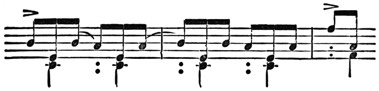
Fig. 17.
Elsewhere throughout the same study the
composer has placed dots immediately after the
note they prolong. Here, therefore, he seems
to have anticipated the objection that he was
dotting un-accented notes (see “Notation of
Rhythm,” Par. 9), and to refute it by showing
that there are in reality two series of accents in
each measure, at cross purposes with each other,
that, indeed, the alto, and tenor measures are an
eighth note behind the treble, though they could
not be written with separate bar-lines. This is
clear when the whole passage is seen. Observe
that the dot to the last note of a measure is
placed at the beginning of the next, to make the
overlapping clear to the eye. (Also that the
dots to the last alto and tenor quarter notes are
placed not in the space next, but in the space
next-but-one higher than the note they prolong.)
Dots are not infrequently placed thus—that
is, in or near the part of the measure with which
they synchronize—apart from any such purpose
as that just explained.
The dot made its first appearance in music
about A.D. 1300. Sometimes it had a tail
(“punctus caudatus”) and looked not unlike an
inverted comma. It did not, however, acquire
its present meaning till about a century later.
Stems.
22.—There is no rule as to the
length of stems, and they vary greatly.
The stems in a single group of notes are as often
as not of different lengths, according to the
position of the notes and the direction taken by
the hook. A common fault is to make them too
short, especially when the four hooks of a sixty-fourth
note have to be added. This, however,
is generally the result of a badly directed hook
(see a, Fig. 18).
23.—As to the direction they take there is a
definite rule. In open score (when one part
only is being written on a stave), the stems of
notes above the middle line should be turned
down, the stems of those below the middle line
should be turned up (see b, Fig. 18). The object
of this is to keep the stems within the stave and
prevent their sprawling above or below. The
ill-equipped writer betrays himself by nothing
more often than by sprawling stems.
The stems in a group of notes are generally
turned according to the direction of the first
note, or the majority. In a group containing a
wide skip they are often turned individually
according to the rule, involving opposite directions,
the hook being drawn between them (see
c, Fig. 18).
Five exceptions are common: (1) The stem of a
grace note is almost invariably turned upwards,
though according to Dr. Hullah it should be
turned in the direction contrary to that of the
stem of the principal note, for the sake of greater
distinctness (see d, Fig. 18). In “copy” for
the printer grace-notes are best written in red
ink. (2) In piano music when a single part, or
row of notes, is to be divided between the hands,
one playing one group and the other the next,
the stems of the right-hand notes are turned up,
and those of the left down (see Fig. 15, latter
half of measure). (3) Similarly in some organ
music, especially that printed in Germany,
pedal notes which are to be played by the right
foot have the stems turned up, those by the left,
down. (4) In vocal music, when a subsequent
verse, though having the same notes, requires
different time-values from the first verse, or a
translation requires different time-values from
the original language, the time-values required
by one verse or language have the stems of the
notes turned up, those required by the other
down (see e, Fig. 18, from Molique's oratorio
“Abraham”). (5) In music written on two
staves, when the notes of a single group skip
from one stave to the other, the hook is placed
between the staves, and the stems of the notes
on the lower stave are turned up, and of those
on the upper stave down, irrespective of their
relation to the middle line of the stave (see f,
Fig. 18, from the “Moonlight” Sonata).
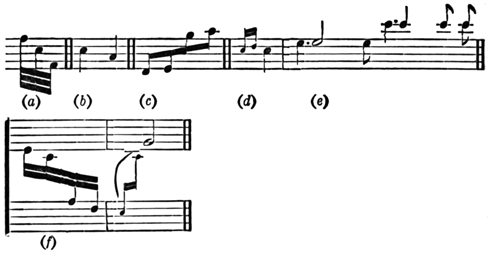
Fig. 18.
24.—In short score, that is when two parts
have to be written on one stave, the stems belonging
to the upper part should be turned upwards,
and those to the lower downwards.
Only by this means can the course of the parts
be made clear to the eye. When the parts cross,
the rule must be strictly adhered to: the note
belonging to the upper part, not the upper note,
must have the upward stem. To make quite
clear which note each stem belongs to, it is well
in this case to make the notes a little less close
together than they otherwise would be (see a,
Fig. 19, a well-known case from a chant by Sir
John Goss, where the tenor goes below the bass).
Sometimes more than two parts are written on
one stave; in this case the stems of two parts
must be turned the same way, and considerable
ingenuity is required to make the course of the
parts clear. Usually the middle part varies in
the direction of its stems. Simultaneous notes
are generally written not quite in a line with
each other, to allow of separate stems: the stems
are generally rather short, so as not to run into
each other, and the hooks of simultaneous
eighths and shorter notes do not concur. Two
measures from Bach's piano fugues will illustrate
these points (b and c, Fig. 19).

Fig. 19.
25.—The stems of rests are always turned
downwards.
26.—There is also a definite rule as to the side
of a note at which the stem should be placed:
stems turned upwards should be at the right-hand
side of the note-head, those downwards,
at the left. This rule is observed less in the
case of half notes than of shorter notes—for
what reason the writer is unable to say.
27.—At one time whole notes and shorter
notes were not round, but lozenge-shaped, the
longer notes being square, and the stem was then
in the middle, thus  . These gave way to
round notes about the seventeenth century.
Playford's well-known Whole Booke of Psalms,
published about 1675, was probably one of the
earliest books printed wholly with round notes.
. These gave way to
round notes about the seventeenth century.
Playford's well-known Whole Booke of Psalms,
published about 1675, was probably one of the
earliest books printed wholly with round notes.
28.—It follows from the foregoing rules that
even so apparently simple a task as transcribing
a part—soprano, alto, tenor, or bass—from a
short-score hymn or chant book into a choir
part-book is not mere copying. In the hymn
or chant book the stems of one part are all
turned the same way: in the part-book they
must be turned according to their relation to the
middle line.
Hooks.
29.—With one exception, hooks
should be made at the right-hand side
of the stem; they are therefore sometimes at the
same side as the note-head, and sometimes not.
30.—The exception is when longer and shorter
notes are combined in the same group. In this
case the hooks not common to the whole group
are invariably turned so as to lie within the
group, and, subject to this, if the group contains
more than one beat, so as to lie within
the beat of which they form part.

Fig. 20.
31.—Previous to 1660, each eighth or
shorter note had a separate hook or hooks.
But at the time of the Restoration, John Playford
substituted a connecting horizontal line
for the separate hooks of two or more eighths
belonging to the same division of the measure.
The device was copied by the Dutch, French,
and Germans. The Italians did not adopt it
till later. Thus, Marcello's Psalms, published
in Venice as late as 1724–27, have separate
hooks. (In an edition in the writer's possession,
published in 1757, united hooks are used, but
this is probably rather due to the venue than to
the later date.)
32.—Hooks in instrumental music must be
united in strict accordance with the laws of
rhythm (see “Notation of Rhythm,” pars. 8–13).
Thus, four eighth notes must not have the same
hook in Compound Time: they must be
grouped as three and one, or one and three, or
two and two, according to the position they
occupy in the beat they belong to. In three-four
time, six eighth notes may have one hook,
but in six-eight time they should preferably
have separate hooks of three eighth notes each.
Broadly speaking, the notes forming a single
beat of the measure should be united in one
hook, but very commonly two beats have one
hook between them, especially in four-four
time.
In the case of sixteenths and shorter notes,
the outermost hook often shows the half-measure,
and the inner hook or hooks the sub-division
into beats (see Fig. 21).

Fig. 21.
33.—So closely should the hooks follow the
rhythm, that where a phrase crosses the measure
beginning at the end of one measure, and ending
at the beginning of the next, the hook
crosses the bar-line too, uniting notes in different
measures (see a, Fig. 22). Notes may have the
same hook though separated by a rest (see b,
Fig. 22).
34.—The hook to a group of notes which ascends
or descends may either slant in the direction
taken by the notes, or may be straight (see
c, Fig. 22). In the writer's opinion slanted
hooks are preferable as being a better guide to
the eye. In manuscript music, when hooks
have to be drawn within the stave, and not
above or below it, they should invariably be
slanted when this is possible; otherwise they
are very apt to coincide with the stave-lines,
and fail of distinctness. A common fault is in
not making them thick enough. Notes are
sometimes “hooked” in accordance, not with
the rhythm, but with the hand which is to play
them (see d, Fig. 22). This is necessitated by
the usage with regard to stems in such cases
[see “Stems,” par. 22, exception (2)].
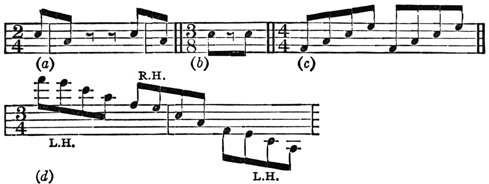
Fig. 22.
35.—In vocal music notes should not have
the same hook which are sung to a different
syllable (see “Vocal Music,” par. 37). Subject
to these exceptions, notes must be grouped
according to their rhythm.
Leger-lines.
36.—The appeal to the eye (see
“Notation of Rhythm,” par. 8, and
“Placing of Notes,” par. 14) must be maintained
as regards the pitch as well as the duration
of notes—their perpendicular as well as
their horizontal position. Consequently leger-lines
must be the same distance from the stave,
and from each other, as the stave-lines are one
from another. Carelessness in this matter is
very common and very confusing. How often
a lower note looks as though above a higher one,
because leger-lines are cramped together in one
case and too wide apart in another (see Fig. 23).
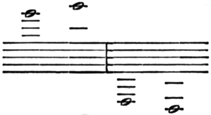
Fig. 23.
“Two things which are equal to the same
thing are equal to each other,” as Euclid says:
let leger-lines be equidistant with stave-lines,
and they will be level with each other.
But accuracy in the number of lines is of
more importance than the appeal to the eye,
and the appeal to the eye must of course not be
made a substitute for it. The context shows the
high note in Fig. 24 (which is several times
repeated) to have been intended for E, the position
of which, on the paper, it about occupies.
But, being on the first leger-line, it is A, and
would be were it a yard above the stave! (The
example is taken from a printed, not a manuscript
copy! The first two notes are evidently
intended as grace-notes, though the stems are
turned down; the stems in the second half of
the first measure should have been turned up.)
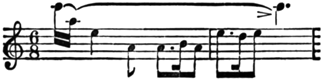
Fig. 24.
Vocal Music.
37.—In vocal music the singing of
one syllable to two or more notes is
shown in the case of whole notes, half notes,
and quarters, by a slur (see Fig. 25).

Fig. 25.
It will be seen from the above that a slur
does not dispense with the necessity for tying
consecutive notes of the same pitch, occurring
in a passage sung to one syllable. For an
apparent exception see a passage from Handel's
“But who may abide”:

Fig. 26.
But here, the repeated note occurring on a
strong accent preceded by a weak one, is evidently
intended not to be tied, but to receive
an emphasis. (Similar exceptions may be
found in “Every Valley.”)
In modern music, when all the notes of a measure
are to be sung to the same syllable, and there
is no likelihood of confusion, the slur is often
dispensed with. This is especially the case in
Mendelssohn's music.
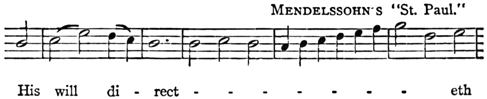
Fig. 27.
38.—Eighths and shorter notes, to which one
syllable is to be sung, should have a united hook,
provided that they belong to the same rhythmic
group; and separate hooks, though belonging to
the same rhythmic group, if sung to separate
syllables:
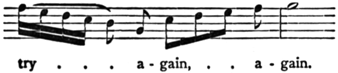
Fig. 28.
39.—Many writers place a slur over eighth
notes, as well as quarters and longer notes, when
sung to one syllable. But this is quite unnecessary
with hooked notes unless, as in the preceding
example, a syllable is sung to a whole group
and part of another, or parts of two groups.
Redundancy of slurs—very common in old
music—is confusing rather than helpful.
Intelligibility depends much upon getting the
syllables exactly under or over the notes to
which they are to be sung.
40.—Syllables sung to notes extending over
more space than themselves should be followed
by dots if forming a complete word, and by
strokes, or hyphens, if parts of a word. See
preceding examples.
Open Score
to Short
Score.
41.—In transcribing from open
score to short score, a single sound
sung by two voices simultaneously
beginning and ending at the same time, should,
if a whole note, be represented by two note-heads
linked; if a half note or shorter note, by
having two stems, one up and the other down:
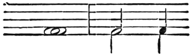
Fig. 29.
42.—Black notes, though of different lengths,
may have the same note-head if they begin at
the same time, the difference being shown in the
hook or hooks:
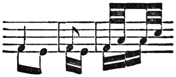
Fig. 30.
But a whole note and a half note must have
separate note-heads, since a stem would turn a
whole note into a half note; and a whole note
or half note and a quarter note must have
separate note-heads, since a note cannot be
white and black at the same time. In this
case the note-head of shorter duration must be
written first:

Fig. 31.
The rule is sometimes relaxed, and the longer
note written first, when the shorter note is the
first of a group.
Albeit a half note and an eighth, or other
hooked note, may have the same note-head,
provided this be that of the half note, because the
hook shows that in one part the note is intended
to be read as an eighth note. They cannot
have an eighth note-head because there is nothing
to distinguish the stem of a half note from
that of a quarter:
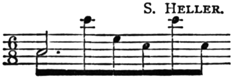
Fig. 32.
43.—Notes cannot have the same note-head
which begin at different times, even though they
end at the same time. This would involve
writing one of them in the wrong part of the
measure (see “Placing of Notes,” par. 14).
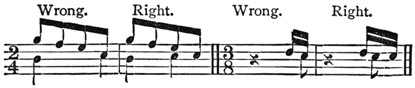
Fig. 33.
Hence, as a dotted quarter is a sixteenth
shorter than two dotted eighths and a sixteenth,
and therefore the final note does not begin at
the same time (though it ends at the same time)
in the treble and alto parts of the last group of
Fig. 16 (par. 35), the example is inaccurate.
It should have been written thus:
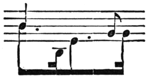
Fig. 34.
and would be so played were the passage given,
say, to two violins.
[The tyro must not mistake the above two
final note-heads, the longer of which comes
first, for a breach of the rule exemplified in Fig. 31
(par. 42), and which applies to two notes
which begin at the same time. Here the longer
note begins before the shorter one.]
44.—In part-music all the accidentals in an
open score will have to be reproduced in short
score. Each performer is only supposed to
read his own part, and cannot be assumed to
have seen an accidental in another part which,
had it been seen, would have rendered one in his
own unnecessary. Thus the sharps in Fig. 35
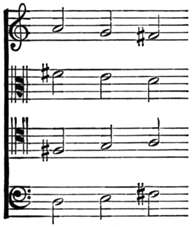
Fig. 35.
will remain in a transcription to short score,
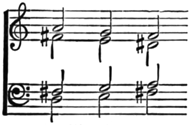
Fig. 36.
if intended for part-singers or players. (A
pianist or organist would not need the second
sharp in each stave, while probably preferring
it as a recognition of the part-writing character
of the music.)
45.—In music which is not part-writing, the
transcriber will have to use his discretion as to
the repetition of accidentals which have already
appeared in another “part” in the same measure.
The guiding principle will be to avoid the likelihood
of error on the part of a competent reader.
46.—Care must be taken to turn the stems of
half notes and shorter notes according to the
principles of short score, and not necessarily
as they are in the open score.
Short Score
to Open
Score.
47.—Co-relatively, in transcribing
from short score to open, it will occasionally
be necessary to put accidentals
in the latter which are not in the former.
The commonest form of this is probably in
extracting a single part, soprano, alto, tenor,
or bass, from an ordinary short score hymn or
chant book, and writing it in a part-book for
the particular voice. Thus, in transcribing the
tenor of the following extract from the hymn-tune
“Heathlands” into a part-book, it would
be necessary to insert a natural before the A.
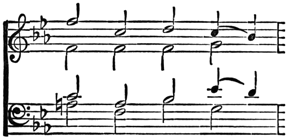
Fig. 37.
48.—Far more often, however, it is necessary
to omit naturals used to contradict an accidental
occurring in a part which is not being copied.
Thus, in the following extract from the tune
“Endless Alleluia,” the natural in both the
tenor and bass would be unnecessary were these
parts written out separately from the other
parts and each other.
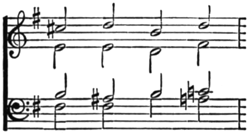
Fig. 38.
(The A sharp in the tenor of this extract suggests
C sharp so strongly apart from the rest
of the harmony, that the natural is almost a
necessity even had the previous treble C sharp
not been included. Not being required according
to rule, however, it should be enclosed in
brackets—a not infrequent, and very commendable,
device with careful writers, when an accidental
is desirable but not necessary according
to rule.)
49.—The stems, of course, must be turned up
or down according to their position above or
below the middle line, and not as in the short
score.
Extracting
a Single
Part.
50.—In copying out a single part
from a score, full or short, care must
be taken in abbreviating a number of
measures' rest. The usual way of doing this
is to write the number of measures over a single
measure, thus:
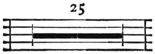
Fig. 39.
But if a pause occurs in any of the other parts
of the score this will not do. The number of
bars before the pause must be counted, and the
pause—or pauses—shown in the abbreviation as
follows, assuming it to occur in the thirteenth bar:

Fig. 40.
Accidentals.
51.—The necessity for inserting
accidentals in a part-copy which may
not appear in a short-score, has just been
pointed out. Yet the musical Hercules is beset
with a Charybdis as well as a Scylla. He may
be drawn into the bad and very irritating
modern habit of using accidentals which are not
really called for. Accidentals where unnecessary
are doubtless used with the object of
making assurance doubly sure. They have precisely
the reverse effect, besides being uncomplimentary—to
put it mildly—to the intelligence
of the performer. Sharps, flats, and naturals
which sometimes are foreign to the signature,
and sometimes duplicate it, cause confusion
where there was previously assurance. Bad
enough at all times, they are, when one is transposing
at sight, exasperating to the last degree.
An accidental is operative during the bar in
which it occurs, and no further, unless it inflects
the last note of a bar, and the next bar begins
with the same note. It is so usual, however,
to contradict an accidental in the bar next to
that in which it occurs, that this practice may
almost be said to have become a rule, breach of
which might cause uncertainty in all but the
clearest cases. This is no justification for the
absurd practice of some writers, of contradicting
an inflection the next time the same note un-inflected
occurs, however far off this may be!
As a rule, a natural should only be used where
the sharp or flat to be cancelled would not
have to be repeated were the inflection intended
to continue.
Legibility.
52.—A common cause of illegibility
in manuscript music is what may be
called a spider-like sameness in the web. Stems
and hooks—indeed sometimes stems and note-heads!—are
much of the same thickness and
blackness. Compare them in printed music,
and it will be seen that a dozen, perhaps a
score, of stems could be spun out of one hook.
53.—Should it be necessary to erase and rewrite
a note, the blurred effect too often resulting
may be almost entirely avoided by penciling
the correct note before tracing it in ink. This
produces a lead-lined groove and prevents the
ink from running.
Facility.
54.—Orthography is taught by the
careful making—drawing rather than
writing—of large letters. The formation of a
more rapid and individual hand does not come
till later. So with musical phonography. The
student, at whatever cost of time and patience,
must first acquire accuracy and clearness. Not
till these are gained must he think of rapidity
and ease. Hence the consideration of facility
has been deferred to the last.
Facility is well worthy of consideration, especially
on the part of those who have much music
to write. A little thought will often show how
a character may be made in one stroke, which
in any other way will take two or more, and
that without any loss of clearness.
Thus a half note can be made in one stroke
if begun at the point where the ring joins the
stem; that is, at the top of the ring for upward
stems, at the under part for downward stems.
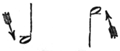
Fig. 41.
Quarter notes may be made in one stroke if
the head be begun first when the stem is upward,
and the stem first when the stem is downward.
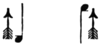
Fig. 42.
If this very simple expedient were more generally
known, the practice of writing downward
as well as upward stems at the right-hand side
of the note-head—never done in printed music—would
not be as common as it is. It should be
added that to make a quarter or half note satisfactorily
in one stroke, a pliable pen, fine, but
spreading under pressure, and rapidly recovering
itself, is necessary, otherwise the head will be
too thin or the stem too thick.
Eighth notes, especially those with downward
stems, are best made in two strokes. They can,
however, be made in one if begun at the bottom.
That is to say, those with upward stems must
be begun at the head, and those with downward
stems at the hook. This hook must be drawn
thin, if made thick the pen will scratch when
making the stem: if the head be made first the
pen ends at the wrong side for a downward stem.
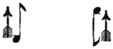
Fig. 43.
Each shorter note requires an additional
action.
The G clef can be made in one stroke if
begun at the innermost part of the curl, or at
the downward extremity. The F clef requires
three strokes, owing to the dots, each of which
takes one to itself.
The C clef requires four movements, so does
a sharp. A flat may be made in one stroke,
but is very apt to look like a half note. A
natural requires two movements.
Chords may be expeditiously formed, if with
downward stem, by making the top note, with
stem, first, and then adding the other notes.
Chords with upward stems should be begun at
the bottom.
(The joinings are purposely left imperfect to
show the method. The numbers show the order
of the four actions for the four notes.)
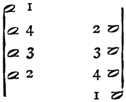
Fig. 44.
Copyright.
55.—A primer on musical orthography
is hardly complete without a
few words on Copyright. As long as
a work is in manuscript and copies are not
offered for sale it enjoys the same protection,
under the common law, as if properly entered
for copyright. It is an infringement of copyright
to copy, reprint, publish, or vend the
whole or any portion of a copyright work for
any purpose whatsoever. It is an infringement
to copy a hymn tune, a portion of an anthem,
orchestral parts, or to transpose a song; such
infringements can be prosecuted and the full
penalty exacted. It can be readily understood
that such copying deprives the composer or
proprietor of his just returns from the sales of
his work. To secure a copyright in the United
States of America it is necessary to print on
each and every copy, Copyright (date) by (name
of proprietor), and to send to the Registrar of
Copyright, Washington, D. C., two complete
copies with a fee of one dollar for registration
and a certificate under seal. The copyright is
secured for twenty-eight years from the date of
first publication with the privilege of a renewal
for twenty-eight years, provided that notice of
renewal is given the copyright office one year
prior to the expiration of the first term. Securing
an international copyright is usually
undertaken by the publisher, as are also such
matters as mechanical rights.
56.—When the finished composition is ready
for publication, a fair copy should be made and
care exercised to see that it is legible and correct
in every particular. A few suggestions as to
proofreading and correcting may prove useful.
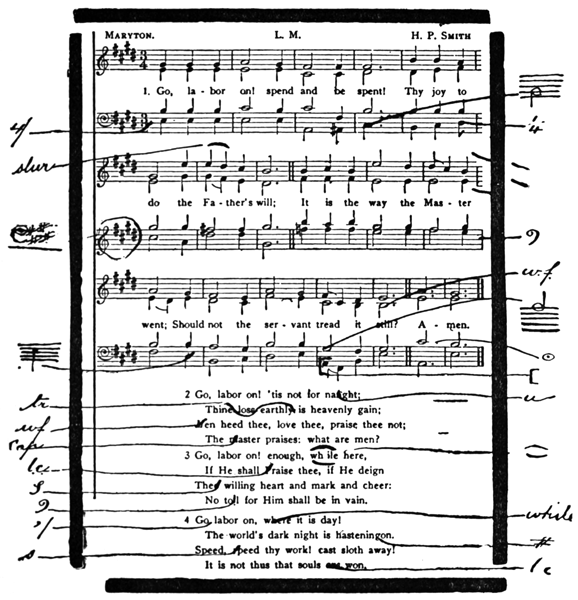
There are certain symbols in universal use
which are as follows:
 |
move over |
 |
close up |
 |
take out |
 |
space |
 |
turn over |
 |
wrong font |
 |
transpose |
 |
lower case |
These symbols should be marked on the margin
of the proof (see sample page), and no other
instructions are necessary. Notes are indicated
by their position on the staff not by their names.
The value of a note is indicated by a fraction.
Slurs are drawn in and indicated by the word
“slur.” Dots are encircled with a line to give
them prominence.