This series of books is written for all the people
and not for specialists only, though it is the work
of specialists who know how to explain their subjects
clearly and interestingly, without unnecessary
technicalities and with keen appreciation of the
popular and constantly increasing desire for scientific
knowledge.
The supreme importance of science in the wonderful
age in which our lot has been cast was demonstrated
with overwhelming force of conviction by
the events of the World War. If, as certain persons
assert, science may be accused of having rendered
war more destructive and terrible, yet, on the other
hand, no one can deny that it was science that saved
the world from sliding backward into an age of
despotism.
The true importance of science for everybody
arises from its rapidly increasing service in the
development of human industry in all its forms,
for industry is the mother of democracy.
Said Gabriel Lippman, the French physicist, inventor
of color photography, who died in the summer
of 1921: "For thousands of years science progressed
by groping and feeling its way, and coincidentally
industry got slowly on by guesswork; but within the
last century science has developed more than during
all preceding time, while industry has sprung upon
its feet and begun to march with the strides of a
giant."
Notwithstanding its immense importance and the
vast extent and complication of its application in
modern times, science is not really difficult for any
person of ordinary school education and of good
natural intelligence to comprehend, provided it is
presented in a clear, plain, common sense manner,
in popular language with illustrations drawn from
everyday life and experience. The much talked-of
methods of science are, after all, nothing more than
the methods of common sense, applied with systematic
care by minds disciplined to a high degree of
efficiency. And, in fact, the only practical difference
between the mind of a trained scientist and that of
any other intelligent person is that the scientist has
acquired a way or habit of looking at and thinking
about things and events, which enables him to get at
their inmost nature and meaning more swiftly and
accurately than he could do if he went to work in a
haphazard manner as, in truth, his forerunners
of the earlier centuries were obliged to do. The
pioneer must always work by rule of thumb, but
when he has exploited his field he knows better ways.
Each branch of science has its own particular
methods, but it is not necessary for the average
reader to study these special methods in order to
become able to grasp the facts and principles that
have been developed by them. The results are all
thrown into a common store—or should be if science
is to attain its utmost usefulness to humanity—and
from the common store the great public, the people
at large, should be enabled freely to draw. The
object of this series of books is to form such a store
of science for the people.
It may encourage those who look with some
degree of timidity upon the task of trying to understand
the great discoveries and achievements of
modern science to know that even the ablest scientists,
leaders in their own particular branches, do
not pretend, or attempt, to grasp the special methods
or the technicalities of any division of science except
that one in which their own work is done. They
stand, with regard to other branches, practically on
the same footing with the unscientific reader, having
over him only such possible advantages as
their special training in clear thinking and in the
intense application of the mental powers may
give them.
Besides, science is really the most interesting
thing in the world—outside of men and women—and
they would be less interesting, even to themselves,
if science had not transformed their lives as well
as their surroundings. If one of Voltaire's favorite
messengers from some other, wiser world had visited
our earth a few hundred years ago, or even only one
hundred, and should now repeat his call, he would be
amazed, and no doubt delighted, by the changes in
every feature of life and society which he would find
that science had brought about, as if by magic,
during the interval between his visits. He would be
likely to exclaim: "Some great teacher and trainer
from a more enlightened part of the universe must
have been here since I saw this world before. What a
marvelous new spirit he has imparted to these creatures.
Through him they have become more masterful
and more like sons of God."
See if you can find a single detail of your daily life
that is not affected by science, or upon which science
does not throw new light. It is fascinating to trace
out the scientific relations of the simplest things that
surround us, or the most ordinary occurrences and
incidents.
Start with your first awakening in the morning,
and you will perceive that there is not a thing that
you see, or that in any way attracts your attention,
that is not touched and illuminated by science, and
often in the most unexpected and delightful ways.
It is by considering these things that one may best
perceive how to use the volumes of this little library.
As you open your eyes in the morning you see a
bright glow through the window curtain, then you
know that the sun has risen.
But stop a moment. What does that mean—"the
sun has risen"? The sun has not "risen" at all.
But, one of the greatest facts of the science of
astronomy is illustrated before your eyes—a fact
that it took mankind thousands of years to find out.
You are standing in the astronomer's shoes now, if
you choose to wear them. This is a part of his field
of science. It took him a long time to convince
the world that the "rising" of the sun in the east
next morning after its "setting" in the west really
means that the globular earth has turned half way
over during the night. If this seems simple to you
now, it seemed very hard to comprehend to our
remote ancestors, who, though reasoning men like
ourselves, had not learned as much about the relativity
of motion as we now know, though even we may
be puzzled by some of the consequences that Einstein
has drawn from it. And a hundred other things
that astronomy has discovered about the sun and the
other suns, called stars, and the other worlds, called
planets, immediately rush to your mind, and you
turn to the volume on astronomy to read about them.
But this is only a beginning of the string of everyday
incidents that are rendered curiously interesting
as soon as their scientific relations and meanings
become evident to you. Science is right at your
elbow to raise questions and to answer them the
moment you step out of bed, and your mind begins
to work.
As you throw open the window to see what kind
of a day it is going to be, whether fair, or cloudy, or
rainy, cool or warm, you draw your conclusions
from the appearance of sky and air, but in doing
that you are entering another field covered by another
branch of science and included in our little
library—meteorology, or the realm of the air—and
you may be sure that the correctness of the conclusions
that you draw from the aspect of the clouds
and the feeling of the air will be greatly increased,
not only in certainty, but also in interest, if you
read what the students of this subject have learned
about the laws and the mysteries of the rains, clouds,
cyclones, barometric pressures, great winds and
genial breezes, great storms and little storms; in
short, the whole wonderful science of the atmosphere,
that invisible, yet powerful kingdom of
the air, which we are just beginning to annex
to our world of activities without regard to what
its natural occupants, the birds, think of such
an invasion.
Now you leave the window to begin making your
morning ablutions. You turn on a faucet and take
a drink, or plunge hands and face into the refreshing
liquid, so cool, lively, and invigorating. But a bird
or any four-footed animal may find just as keen
physical enjoyment in the touch and taste of the
water as you do. You, however, because you are a
thinking being, possess a source of enjoyment
from the touch and appearance of the water that is
not open to those humbler creatures, and that source
of enjoyment springs from the principles and facts
of another branch of science which the mere sight
of the running water may call to mind if you have
caught the spirit of these books—the science of chemistry,
whose early history is filled with that irresistible
kind of romance that pertains to the search for
Eldorado, or the strivings of the human spirit after
the powers of magic; for the realm of chemistry
was once a kind of semi-scientific dreamland, wherein
the "alchemists" delved at the same time for the
"philosopher's stone" which was to turn base metal
into gold, and for the wand of the magician which
would give to its possessor the boundless gratifications
of a Faust. Water is no mystery to the
lower animals, but it is a great mystery even yet
to the highest ones—ourselves—because we have
been enabled to analyze it. You cannot look at it
pouring from the faucet, and sparkling into bubbles,
without recalling the fact that it is composed of two
invisible, silent gases, and that chemistry tells us
not only how to make the water disappear by
taking those gases apart, but also how to form new
water by making the two gases combine. The mystery
is—why should this be so? It is a captivating
question, and the business of the book on chemistry
is to give you all possible light on the solution of
that question, and others of a like nature. You will
find, too, that the very latest chemistry has, strangely
enough, discovered a sort of justification for the
extravagant expectations of the ancient alchemists,
by finding a way in which one substance may actually
change, or be changed, into another, different
substance—one "element" taking the form of
another "element"—and also by getting clues to
the existence of marvelous locked-up energies in
matter, the release of which would give man
control over powers that could properly be called
"magical."
After finishing your toilet, with all the suggestions
and remembrances of chemical science that it has
produced, you start to quicken the circulation of
your blood by catching up a pair of dumb-bells, or
Indian clubs, or by pulling elastic cords, or banging
a leather ball with your fists, as if you meant to go in
for the championship of the world. Now, what
taught you the value of such exercises? You are
still on the ground of science, and you are practically
demonstrating the principles of another of its
branches—the science of health, or hygiene, which
is a part of the subject of medicine, taken in its
broadest signification, for, as the volume on that
subject will assure you, the greatest service that
this science can render to mankind is in teaching us
the laws of our physical existence, and indicating,
directly or indirectly, how all the functions of the
body may be kept in the best working order by
proper attention and exercise. You will find such
things pointed out in the several sciences that deal
with the body, such as physiology and medicine.
While you are making the leather ball strike the
ceiling with resounding whacks, your dog, excited
by the inspiring noise, bursts into the room, and
interrupts your exercise with his enthusiastic morning
greetings, expressed as energetically by his wagging
tail as by his joyous barks and licks, all anticipatory
of a lively morning run. He brings immediately
into your mind the thought of still another
division of science—zoölogy—to which you will devote
many pleasant half-hours of reading, for it is
full of most entertaining matter, as well as of matter
calculated to awaken profound and useful thought
concerning the relations of the many different members
of the animal world to one another, and especially
to their head and chief, man, to whom the
supervision of the whole was, according to the Bible
story, originally committed. Familiar as your dog
may be to you, there are a hundred particulars of
his family relationships, his descent from wild
ancestors, etc., which can only become known to you
through the studies that have been devoted to the
science of zoölogy by curious-minded investigators
from the times of Aristotle and Pliny down to our
own day, when we have seen an ex-President of the
United States wandering adventurously through
some of the remotest portions of the inhabited globe,
seeking fresh knowledge of, and personal acquaintance
with, the rarer kinds of wild animals, and hunting
down in their native wilds great beasts which
the Cæsars used to admire from the security of the
imperial seat, high above the bloody sands of the
Roman arenas. And this modern ruler, after having
laid down the political power intrusted to him by
fellow citizens, found no occupation so attractive as
that of adding something to the growing stores of
science.
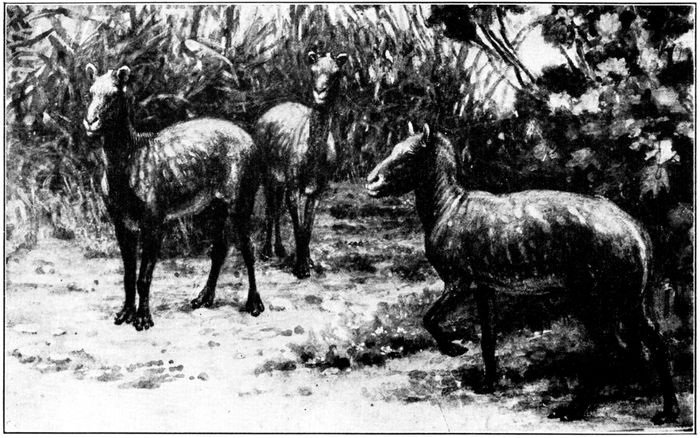
Painting, Chas. R. Knight. (American Museum of Natural History)
THE LITTLE EOHIPPUS. FROM WHICH THE MODERN HORSE DEVELOPED
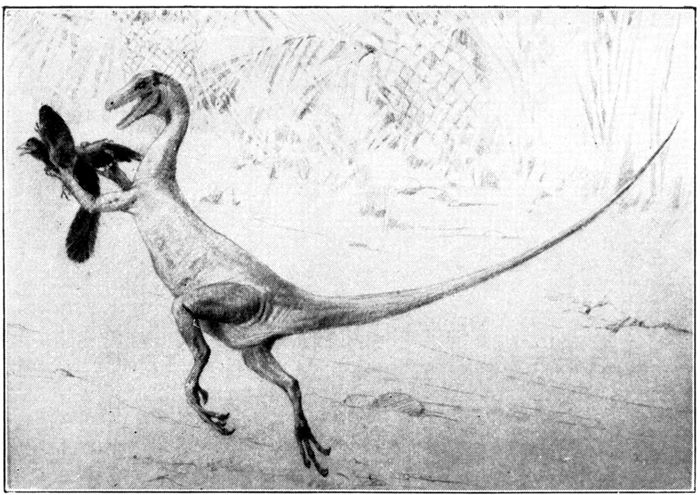
ORNITHOLESTES—PREHISTORIC ANIMAL OF AMERICA
Photo, Metropolitan Museum
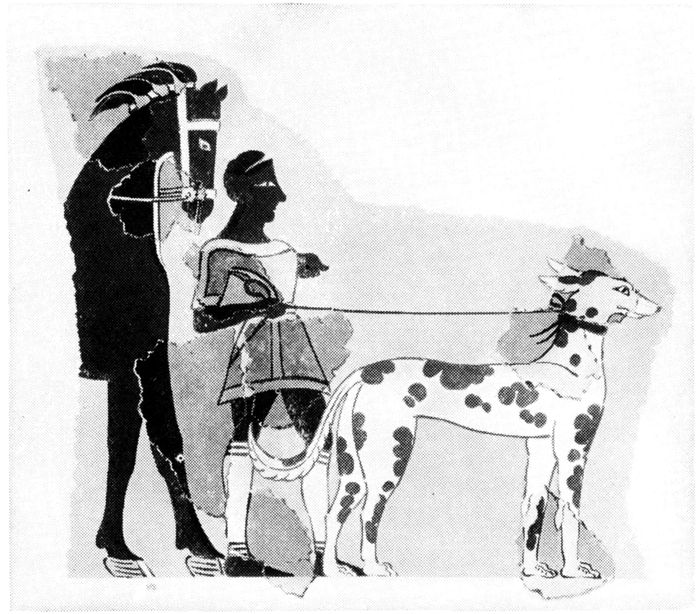
HUNTSMAN. HORSE AND HUNTING DOG OF LONG AGO
From an ancient Cretan fresco
Next, your stomach, awakened to its wants and
needs by the restored circulation resulting from your
lively exercises, reminds you of what will be at the
same time a pleasure and a means of sustained
strength for body and mind, your breakfast. Breakfast
properly comes under the supervision of the
science of physiology. It is also suggestive of mechanics
and physics, since it has to do with the
stoking of the furnace that keeps the bodily engine
up to its work. Here you are face to face with a
branch of science which you could no more safely
neglect than an engineer or a fireman could neglect
to learn the elements and principles underlying his
critically important occupation. One of the first
sciences to be systematically developed was that of
man's body, including its structure, or anatomy, and
its functioning, or internal action, physiology. You
will find that correct ideas on these subjects were
slow in being developed, yet even in the most
ancient times men were shrewd and wise enough
to understand the importance of knowing something
about their own bodies, in order to be able
to take proper care of them, and to deal with
wounds and sickness.
It was an old saying that "the proper study of
mankind is man." But that is a study which has
two main branches. The first covers the subjects of
physiology, anatomy, medicine, etc., while the second
relates to that even more intimate part of ourselves
which has ever been a fascinating mystery, and
which we call the mind, or sometimes the soul. This
is the theme of the science of psychology, whose
name comes from that delicate, inscrutable spirit,
Psyche, the Soul, which plays like a flitting sunbeam
through the magical atmosphere of Greek mythology.
Now, this subtle and exquisite science,
often more poetic and mystic than scientific in its
original character, presents itself in its more sober
and practical dress to you as soon as, having finished
your breakfast and prepared your bodily energies
for the day's work, you begin to meditate on the
problems of the day opening before you.
When you went to bed, perhaps your mind was
agitated by some important matter of business
through whose intricacies you could not clearly see
your way. You turned and tossed on your pillow,
and stated and restated the facts and arguments and
lines of reasoning, but all the while they became more
obscure and entangled until at last, in sheer exhaustion,
you fell into a troubled sleep. But this morning,
to your immense surprise and gratification,
without any effort on your part, and while you are
occupied with other things—putting on your clothes,
hitting the ball, playing with the dog, eating your
bacon and eggs, or what not—suddenly the elusive
clue or solution, so vainly sought the night before,
presents itself plain before you. In an instant, in
the twinkling of an eye, the troublesome problem is
solved, as easily and naturally as water runs down
hill, and you are provoked at yourself for having
been so dull and stupid as not to see it all before.
But not so fast! You were stupid, to be sure, but
it was not your mind's fault as you are now disposed
to think, but the trouble lay in your physical fatigue.
You were driving your brain too long without refreshment,
and it became like an engine whose oil
cups are empty. It could not receive and report the
impressions of thought.
Now this kind of experience comes many times
to many men and women, and it is the purpose of
the book on psychology in this series to make everybody
acquainted with the laws of the working of
our minds through our brains. Yet, how many of
those who are frequently puzzled by such things
are aware that there is a branch of science, one of
the most captivatingly interesting of all, devoted
especially to this subject? By studying the volume
on psychology you will get light on just such things
as so greatly puzzled you, and haunted you, before
the solution of your problem unexpectedly rose up,
as it were, and stood plain before you on the breakfast
table, after having for twenty-four hours resisted
your utmost efforts to master it, or even to
get an effective hold upon it. It is unnecessary to
speak of the immense importance to all human
beings of a knowledge of the laws governing the
manifestations of the mind, by taking advantage of
which they may get the most out of themselves with
the least loss of time and expenditure of effort.
Let us keep on further along the wonderful road
of science on which your feet begin almost unknowingly
to tread from the moment of your awakening,
and which they follow, often just as unconsciously,
until you fall asleep at the close of another day;
while, as we have just seen, even when we are asleep
our minds are not altogether inactive, and may even
secretly disentangle the puzzles of the day while our
tired brains are restoring themselves with slumber.
Perhaps you live in the suburbs of a city, or far
from the business center, and have to take a considerable
journey from your house to your place of
work or business. Maybe you go by automobile, or
by street car, or by a trolley route, or take a commuters'
train. In any event, whether you drive
your own car, or ride in one drawn by a motor or a
locomotive engine, you are brought face to face with
the science of physics, including, of course, not only
mechanics, but also, in our own day, electricity
and magnetism. If you glance at a steam locomotive,
puffing and blowing, and then at a smooth,
silent electric motor drawing a long train, and then
at a swift automobile winding and turning with
serpentine agility through crowds of slow horse-drawn
vehicles—in all cases your memory must
recall the long, hard road by which these things were
brought about, and you must be lacking in intelligent
curiosity if you do not resolve to know for yourself,
not only the history of these triumphs of human
invention, but the principles of action upon which
they depend. If you have a car, it would be a good
thing to drive it yourself and learn to take care of
its machinery yourself, for thus you would go far
toward mastering the elementary principles of the
science of mechanics, which has done more than all
other things combined to transform the face of the
world we live in. You cannot, of course, acquire all
this knowledge by practical experience, but by putting
together what you observe with what you read
in the volumes devoted to mechanics, physics, chemistry,
electricity, etc., you will find that every day
is a school day for you in which you have learned
something new, useful, and interesting, and something,
moreover, which every wide-awake person in
this wide-awake age ought necessarily to know, and
can know by pursuing such a course as that just suggested.
Your morning's ride to work will be transformed
into a delightful intellectual experience if
you prepare yourself by a little daily reading to
understand the construction and manner of working
of all the machines, engines, and mechanisms
presented on every side to your inspection.
But machinery is not everything in life. Suppose
that as you ride along your eye is caught by the great
beauty of the flower gardens by the roadside, their
blossoms bright in the morning sunshine and sparkling
with the yet undried dew, as if sprinkled with
diamonds. Perhaps your attention may never before
have happened to be called so strongly to these
objects, and possibly you have hitherto remained
almost unacquainted with the names and peculiarities
of some of the most common plants and flowers.
But this morning, for some accidental reason, which
may have a psychological origin, you are particularly
charmed with the brilliant sight, and you resolve
that you will be no longer ignorant of what could,
manifestly, give you so much pleasure, besides being
of unquestionable usefulness. When you return
home you will take up the volume on botany, and it
may lead you into a realm of mental delight previously
unknown to you.
If it is the springtime, you may be interested by
the sight of a tall, graceful tree, as lofty as a pine,
and as straight in trunk, with many exquisite blossoms
hanging from the pendulous stems on its great
limbs, fifty or more feet above the ground, as if it
were a flower garden in the air for the special delectation
of the birds. Having never heard of a flowering
tree outside the tropics, you feel a keen desire to
know what this one is, and thus a way of introduction,
founded on keen, personal interest, is opened
for you to the science of botany. And few persons
can take a ride, or a walk, anywhere in city or country
or park, without having attention attracted by
some unknown flower or plant, or tree, and without
becoming aware how much pleasure is lost, and how
much useful knowledge missed, by lack of the easily
acquired knowledge of these things, which anybody
can have by giving to it only that amount of time
which would otherwise be wasted almost as completely
as if the eyes were kept closed and the mind
dismissed from its home in the brain. More mysterious,
and not less fascinating than flowers and
trees, are the birds and insects that flit by on their
own errands. To explain them you have the volume
on zoölogy, the science of animal life. Botany and
zoölogy together go far to revolutionize the ordinary
man's ideas about the attractiveness of outdoor life.
For the cultivator of the soil, whether farmer,
gardener, or fruit grower, botany, of course, is the
queen of sciences—though he may not safely remain
ignorant of the others mentioned, which form a
brilliant court for his queen. In no direction has
science lately proved itself so indispensable as in
the application of botanical knowledge to the improvement
of agricultural operations of all kinds.
In France, always one of the richest of lands in this
respect, the government has since the war made
special provisions for placing instruction in botany
and plant physiology, and the results of all advances
in the science of the vegetable kingdom, before the
pupils of the primary as well as those of the secondary
and higher schools. Botanical reading and
study are encouraged in every possible way. One
of the most significant propositions for the extension
of this educational reform consists in the suggestion
that the schools in the country districts give much
more attention to the various branches of botanical
knowledge than the city schools do, for the purpose
not only of supplying instruction that will be of fundamental
practical use to the young people who grow
up on the land and are to make its cultivation their
life's occupation, but also of stimulating a love of the
country for itself, its scenes, its atmosphere, its
society, its amusements, and its simple, beautiful,
and healthful ways of life.
As your train, or car, rushes through a rock cut
where the roadway has been carried, without change
of level or grade, through the round back of a hill,
you may happen to see on the side walls of the
excavation curious striations, or cross checkings, of
the rock surface, or alternate strata, or layers, of
varying color and texture; some composed of
smooth-faced stone, of a dark, uniform color, and
others of coarse granular masses of variegated hue,
some of whose particles flash like microscopic mirrors
in the glancing sunlight that grazes the top of
the cut. Here, then, you are plunged into the
wonder world of the geologist and the mineralogist,
the subject of one of the most interesting of our
volumes. That man must indeed be dull of intellect
who does not feel a thrill of interest at the sight of
these signs and inscriptions, written by the ancient
hand of nature in the rocks, and telling, in language
far more easily decipherable than the hieroglyphics
of Egypt, the story of the gradual growth of this
round planet on whose surface we are confined, like
flies or ants, as it rotates and revolves in empty
space, circling with us around a star, ninety-three
million miles away, called the sun, which saw the
birth of our world and has ever since kept it warmed
and lighted with its rays.
In those layers of rock in the railway cut you see
the leaves of the book of geology, infinitely older
than the oldest scripture from man's hands, and
relating things that occurred in those far-off nights
and mornings of time that flitted over the globe ages
before the human stem had set off from the trunk
of terrestrial life. These geologic pages speak of
occurrences in the building of the world that happened
millions of years ago, and millions of years
apart, though they have left marks and vestiges that
the eye can discern as easily as if they had been the
work of yesterday. No observant person can ride
twenty miles through the country, especially in a
hilly region, without having the fundamental facts
of geology continually before him, and all that he
needs in order to comprehend these things is a little
preparatory reading, accompanied and followed by
intelligent thought and observation. Anybody to
whom all rocks look alike, and all hills the same,
needs a little awakening of the mind. He is one of
the persons had in view when this series was conceived
and written, and he has no occasion to feel
in the slightest degree offended by such a statement,
for the simple fact that probably ninety-nine one-hundredths
of his fellow citizens, and they among
the best in the community, are just as unfamiliar
with the plainest facts of geology as he is. Geology
is not a difficult science to master in its main outlines,
and there are few more fascinating when once
its drift is caught. Even the beginner in the reading
of the volume on geology, by seizing such chances of
observation as every ride or walk affords, may in a
very short time acquire the ability to read the history
of a landscape from its face, to recognize the work
of the glaciers in the great Age of Ice, to see where
ancient streams flowed, or where molten rock has
gushed up through the surface layers of the earth's
crust, and even to recognize on sight some of the
fossils, which are under everybody's feet in some
parts of the country, and which still retain the forms
of animals some of which were among the primal
inhabitants of the earth, whose lines have died out,
while others, though their individual lives expired
tens or hundreds of millions of years ago, bear in
their fossilized forms a close resemblance to modern
relatives and descendants whose generations still
flourish in the living world in this twentieth century
of man's latest historic era.
Presently, turning from the attractions of the outdoor
world, which seem just as entrancing the hundredth
time you look upon them as they did the first
time, particularly if you have cultivated the habit
not merely of noticing but of thinking and reading
about them, you take up the morning newspaper, in
which most of your companions of the car are
already deeply buried, and amid the political news,
the personal gossip, the inevitable exploitation of
the deeds of criminals, the foreign intelligence, and
the social gossip that falls under your eyes, your
attention is caught (this is an actual happening of
not long ago) by the headline: "John Daniel, the
orang-utan, is dead." This sounds odd. There has
been no animal's obituary in the papers since Barnum
lost his biggest elephant, and bequeathed its
skeleton to science. You read further and find an
interview with a professor about the human relationships,
or apparent relationships, of the anthropoid
apes, of whom "John Daniel" would probably have
been the acknowledged king if his relatives of the
woods could have understood the regard in which
he was held by his white-skinned and clothes-wearing
jailers. You will probably cut out that paragraph
and put it aside for further consideration,
remembering that there are at least three volumes
in your Popular Science set at home, that on
zoölogy, that on geology, and that on anthropology,
in which there will be an abundance of interesting
and authoritative matter bearing on this most important
subject—for important you will consider
it now that the death of a kind of caricature of
humanity in the zoölogical garden that had so long
amused the children as well as their elders with its
humanlike motions, habits, looks, and pranks, has
suddenly brought the whole question up among the
news of the day, affording you a new light on a
matter which you had hitherto thought to belong
exclusively to the field of the professors of zoölogy
and their students. Hereafter you will disposed
to take a broader view of all these things, and will
be in a better position to understand and enjoy the
discussions of learned scientists when they are interviewed
by newspaper men on subjects of this
kind. The inquiring spirit of the time requires this
concession even if in your private opinion there is no
real relationship between men and apes. And, without
regard to any such questions, you will find the
volume on anthropology immensely interesting and
informing.
Finally, as your morning's trip comes to an end,
your attention is recalled from the natural to the
mechanical sciences. You descend from your car or
train, to go to your office. Your now fully awakened
mind, alert to all the scientific relations of
everything about you, can no longer keep from
dwelling upon the underlying meanings of this marvelous
display of realized human dreams. With the
speed of the wind you are carried deep under the
city's pavements, inclosed in a little flying parlor,
in the midst of an artificial subterranean daylight,
far beyond the reach of the solar rays, emulating the
self-luminous creatures of the deep sea bottom; or
you go shooting past the window of third, fourth,
and fifth stories, or even above the levels of roofs,
and you cannot but reflect and marvel that electricity
does it all; electricity, that strange imp with blue
star eyes no bigger than pin points, and a child's
crown of little crinkling, piercing rays, which seemed
so amusing when you were at school in the old days
of frictional electric machines, when it was a great
joke to give the cat a shock and see her flee with a
squall, her hair standing on end in spite of herself.
But now electricity has become a giant of unrivaled
and terrific power, spurning the heavy-limbed Brobdingnag,
steam, from its swift path, and fast making
the world all its own—except its master, man,
who is still, however, half afraid of his new and
all-capable servant.
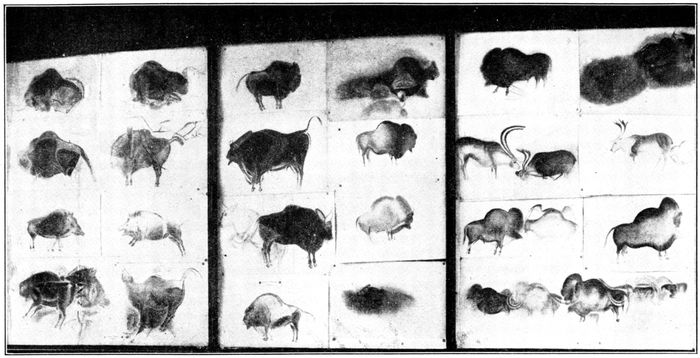
EXHIBITION OF COPIES OF PREHISTORIC PAINTINGS FROM THE CAVERNS AT ALTAMIRA, SPAIN
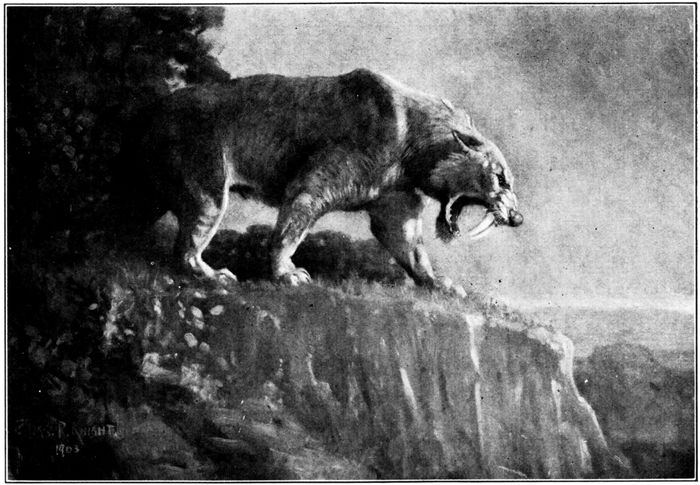
Painting by Chas. R. Knight. Photo, American Museum of Natural History
THE SABER-TOOTHED TIGER THAT ROAMED OVER NORTH AMERICA IN
PREHISTORIC TIMES
This modern genie of limitless power, conjured out
of his deceptive bottle, can do the smallest as well as
the greatest things for you. When, upon reaching
your office, you telephone to your wife that Mr. Blank
will be home to dinner with you, you cannot form
the slightest idea of how the miracle of distant
speech is accomplished unless you are either an
electrician yourself, or have read intelligently upon
the subject of the applications of electricity to the
motivation of all kinds of machinery, a subject to
which an entire volume is devoted in our series. It
would be a kind of shame and reproach to an intelligent
man to be ignorant of the way his telephone
works, and of the simple scientific principle on which
it is constructed. If telephones, and such things,
were products of nature and grew on trees, we might
be excusable for not knowing exactly their secret;
but being made by men, with the same limitations
as those that circumscribe us all, we ought at least to
understand them.
Thus, by a simple review of the series of common
happenings that arrive every day to everybody, we
perceive how intimately and indissolubly the various
branches of science treated of in this compact library
of science, are linked with all that we do, including
our most unconscious acts and our most habitual
subjects of thought. We have taken for illustration
the morning history of a person supposed to live
amid urban or suburban surroundings. Equally
illuminating would be that of an inhabitant of a
village or a rural district, and even more suggestive
in many respects. The dweller in the country is
brought into closer association with the infinitely
changing aspects of nature than the city dweller
enjoys. The simplest incident in the life of a person
living on a farm may be the beginning of a thread
of connection leading, like the clue of a labyrinth,
into the heart of some of the most marvelous departments
of science, and resulting in a mental revolution
for the fortunate person who follows out the
clue under such guidance as these volumes afford.
The writer has remembered from boyhood the indelible
impression made upon his mind by the finding
of an Indian arrowhead in a recently ploughed
field. The shapeliness of the beautifully chipped
piece of flint, almost as translucent at the edges as
horn, the delicate tapering point which, as if by
miracle, had remained unbroken probably since colonial
times, the two curious little "ears" carefully
formed on each side of the flat triangular base to
facilitate attachment to the head of the arrow, and
the thought, suggested by older persons, that this
weapon might actually have been used in some midnight
attack on a white settlement, made more terrifying
by the frightful Mohawk war whoop and the
display of the reeking scalps of human victims in
the glare of burning stockade and cabins—all these
things bred a keen desire to learn the particulars of
the history of the red warriors of the Five Nations,
the "Romans of the New World," and also to know
something about the life and customs of this strange,
savage race of mankind which continued to live in an
"age of stone" on a continent that had never known
civilization. No volume like that on the history
and development of man in this series existed at
that time; but if such a book had existed and had
fallen into the hands of the finder of the arrowhead,
it would surely have fascinated him more than
"Robinson Crusoe" did, because a boy can distinguish
as readily as a grown person the superior
interest of the true over the pretended, provided
that the true possesses the real elements of
romance.
So, too, the writer remembers having an interest
in mineralogy awakened in his mind, never to be
obliterated, by the sight of another plowed field, in
the southern skirts of the Adirondack Mountains,
whose freshly turned furrows glittered in the sunshine
with thickly scattered quartz crystals, some of
the larger and more perfect of which blazed across,
the whole breadth of the field, like huge diamonds,
and made the heart of the finder beat with an excitement
akin to that of the discoverer of a Koh-i-noor.
There were also some very curious "stone buttons"
which one could break out with a hammer from slate
rocks along the Schoharie Creek, and which, when
cracked open, were found to be composed of pyrites
that resembled pure silver—and sometimes gold—freshly
broken. Now, things of this sort are always
attracting the attention and awakening the curiosity
of children living in the country, but the real
pleasure and instruction that they might afford are
usually missed because of the lack in the family
library of popularly written books on the natural
sciences—a lack that we are trying to supply.
For city children and their elders, whose eyes are
constantly greeted, not by hills, creeks, ponds, rivers,
woods, and fields, but by sky-aspiring buildings,
railroads elevated on stilts, multiple-decked suspension
bridges, electric power houses, tunnels that
form a second city underground, and the thousand
marvels and splendors of electric illumination at
night, the volumes on physics, mechanics, and
electricity and magnetism have a more immediate
interest and value. What the children learn about
these things in school is far from sufficient to
satisfy their curiosity. They need books at home
to guide their inquiries as well as to answer
them. Only by that means can the diffusion of
scientific knowledge, and the popularization of the
scientific method of getting at the truth and the
meaning of things be thoroughly effected. Science,
as its history plainly demonstrates, progresses most
rapidly only when a great number of minds have
been led to concentrate their powers upon its problems.
Great genius, it is true, rides over obstacles;
yet consider how much further its energies might
have carried it if the obstacles had been more or less
completely removed in advance. Many a young man
has been led to a brilliant career, to the great advantage
of his country and his time, as a result of
the interest awakened in him by the clear statements
of a popularly written book on some branch of
science.
One of the difficulties that persons unfamiliar with
certain branches of science encounter in reading
about them arises from the excessive use of technical
terms, the lack of simple illustrative examples, and
also, sometimes, a lack of sympathetic appreciation
of the reader's difficulties. It has been a special
object of this series to avoid this trouble. Ordinary
textbooks are prepared for students in school and
are intended to be supplemented by the personal instruction
and guidance of a teacher, standing at the
pupil's elbow, or readily approachable. But the
reader who wishes to inform himself upon some progressive
branch of science after his school days are
over needs to have the teacher included in the book
itself.
Then, too, there are many persons who have no
comprehension of the great and gratifying power
that a knowledge of some of the elementary principles
and formulas of science bestows upon anybody
who may take the little trouble necessary to
master them, a trouble that does not imply a long
course of scientific study. The "man in the street,"
if he possesses these easy-working keys to knowledge,
can verify for himself some of the calculations
of scientists which, if he did not know how they were
done, would always remain for him in the category
of the mysterious achievements of genius.
To illustrate, let us take a simple example—that
of the Newtonian law of falling bodies. Many persons
would assume on the face of it that there was
nothing in this law that could have a particular interest
for them. But let us see. You will find in
the volume on physics that the law is stated thus:
S = ½gt2, i. e., "S equals one-half of the product of
g multiplied by t squared." As you look at it you
would, perhaps, as soon think of picking up a complicated
tool and trying to use it for some ordinary
purpose. Nevertheless, let us try. "S" in the formula
means the space or distance traversed by the
falling body, "g" means the velocity that the force
of gravity imparts in each successive second to the
body, and "t" means the time elapsed during the
fall. What the formula tells us, then, is that if we
observe the time during which the body is falling,
and then square the number of seconds involved
(multiply the number by itself), multiply this square
by "g," which is represented practically everywhere
on the face of the earth by the number 32, and finally
divide the whole by 2, we shall have the distance that
the body fell. This distance will be in feet, since the
number 32, representing "g," is in feet. Now, it
might be a matter of life and death, or at any rate
of mental discomfort against quietude of mind, to
have that rule in memory and to be able to apply it.
For instance, you are on your vacation and stopping
in a strange hotel, where they have put you in the
top story. On looking out of the window you
are dismayed at finding no fire escape, or other appliance
of safety, so that your only resource in case
of fire would be to make a rope out of the bedclothes
and let yourself down with it. But, how far is it to
the ground? How long should the rope be? Are
there sheets enough on your bed to furnish it? The
little formula about falling bodies will answer the
question for you in five minutes. First, you let some
small solid object drop from the window, and note
by your watch, or by counting seconds, which everybody
ought to teach himself to do, how long it takes
to reach the ground. You repeat the experiment
two or three times to make sure. Say the time comes
out three seconds. Very well, now apply the rule:
The square of 3 is 9, and 9 multiplied by 32 gives
288, and dividing by 2 you have 144 feet for the
height! It is to be feared that your bedclothes rope
would not be long enough; you had better send to
the office for something to supplement it. But if the
time of fall should be only 2 seconds, which is more
likely, except in skyscraper hotels, then the calculation
would give you 64 feet for the height, which you
might manage with the aid of the bedclothes.
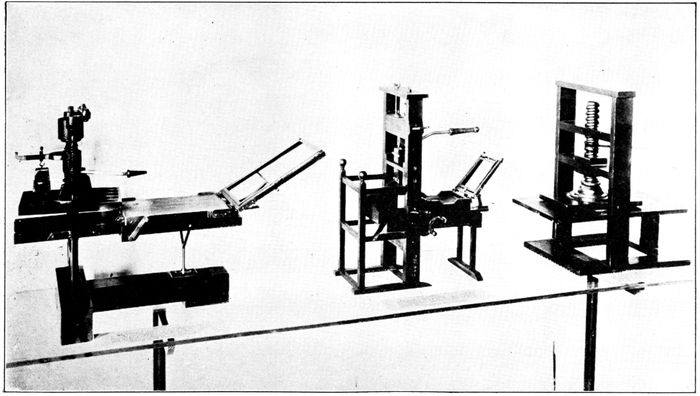
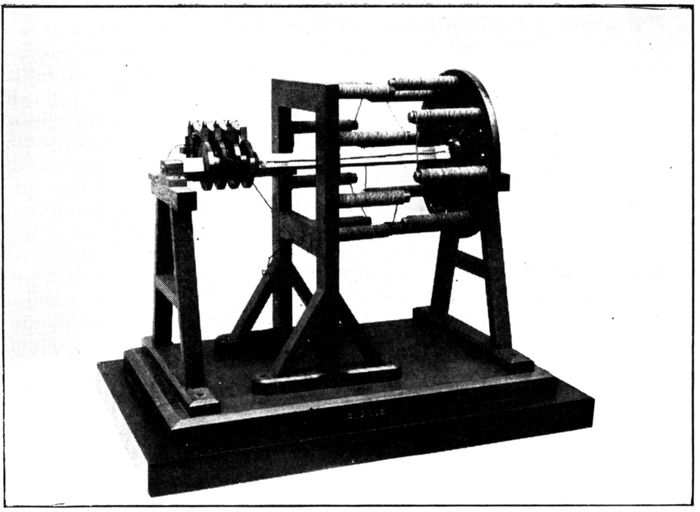
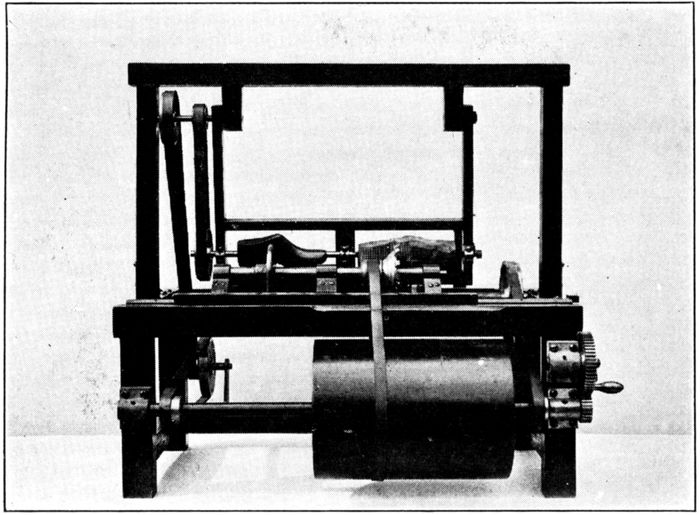
MODELS OF GUTENBERG'S PRINTING PRESSES
The models show three stages of development, the first of them at the right

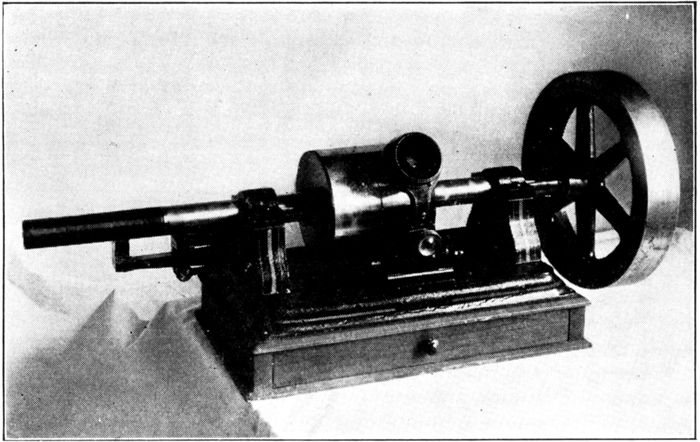
BENJAMIN FRANKLIN'S PRINTING PRESS
The original is now in the National Museum at Washington
This is only a single example among many that
could be given to show the usefulness and interest
of many of the formulas of science which the ordinary
reader looks upon as beyond the reach of any
person whose occupation leads him another way.
But cases of equal simplicity could be found in connection
with the subjects of electricity and magnetism,
chemistry, medicine, physiology, etc. Sometimes
it happens that a technical word contains its
own definition and explanation in a nutshell. A
striking instance of this will be found in astronomy,
in the word "light-year." The meaning of this word
stands forth on its face—it evidently expresses the
distance that light travels in the course of one year.
Now, since it is known by means of direct measurement
that light goes at the rate of 186,300 miles per
second, manifestly a light-year must be equivalent
to an enormous number of miles. In fact that number,
roundly stated, is no less than 5,860,000,000,000.
But to what marvelous regions of thought such a
term opens the way! Yonder star is 2,000 light-years
distant from the earth; then its light-waves
now entering your eyes left it when Julius Cæsar
was conquering Gaul, and have been speeding on
their way to the earth ever since! Another star is
found to be 5,000 light-years distant; then the light
by which you now see it started from the star when
Abraham set out from Ur of the Chaldees to settle
in the Holy Land, and has not found a resting place
anywhere in boundless space until just now when
its tiny waves break and expire on the retina of your
eye! Such treasures of knowledge and tonics to
thought are scattered all through the volumes of this
set, the purpose of whose publishers, editors, and
writers has been to accumulate such things in small
compass and in crystal clearness, for the use not
only of those who, after their school days are over,
still wish to keep abreast of the progress of science
in all its branches—as everyone should strive to do
in this most scientific of all ages—but also for those
who have hitherto not had the time, or the opportunity,
or perhaps even the desire, to make themselves
at home in the house of science.
It may be well to add a few words on the interrelation
of the different subjects treated in the
various volumes of the series. This will suggest to
the reader himself the best order in which to take
up the reading of the books. Naturally he will desire
to obtain both a clear general view of the whole
field of science, and also more detailed acquaintance
with its special parts, the amount of detail depending
upon his particular interest in a subject. For the
first purpose the preferable way would be to run
first over the brief account that follows in this
volume, of the history and development of science in
general, and then to take up the simpler and more
easily grasped branches.
But it should be firmly kept in mind that, fundamentally,
science is one, having in all its branches
but one aim and object, viz., the ascertainment and
demonstration of the exact truth of things as far
as human capacities are able to reveal and comprehend
such truth, and also but one method of procedure,
which is the method of common sense
trained to the utmost attainable exactitude in observation
and the greatest possible clearness and
precision of reasoning. Science properly so-called
confines itself to things that are subject to observation
by the senses and to verification by repeated
observation and experiment, while its reasonings
and predictions are based entirely upon the unvarying
sequence of the phenomena of nature, as they
display themselves before us.
Science is just as one and inseparable as life, or
as an organic being, and its divisions no more imply
lack of unity than do the various organs and limbs
of an animal, or a tree, or the different structural
parts of a building. Astronomy is not entirely independent
of geology, nor geology of botany, nor botany
of chemistry, nor any of these of physics, nor
physics of electricity and magnetism, nor the last
of physiology and medicine. Accordingly the question
where to begin in studying science is not one
that can be answered in the same way for everybody.
But the spirit is the same in all the branches.
Perhaps the best general indication of the order in
which a person who has no predilection for any one
branch of science should take up the various parts
is afforded by their historic development. This was
a result of the natural reaction of man's mind to its
surroundings. The things nearest to him, and most
immediately important, first attracted his attention.
The broadest division would be into the science of
things on the earth's surface; the science of things
above the earth, in the air and the sky; and the
science of things within the earth, concealed from
immediate view.
If we take these in their order they naturally subdivide
themselves as follows:
(a) Anthropology, the Science of Man and His Ancestors,
treating of his nature, origin, development,
division into races and tribes, society, industry,
etc.
(b) Zoölogy, the Science of Animal Life, treating
of the "lower animals," and of animal life in
general as distinguished from the kingdom of the
plants, although the related science of biology
deals with both plants and animals, its special
subject being the phenomena of life in its widest
sense.
(c) Botany, the Science of Plant Life.
(d) Geography, combined with Physiography, the
Science of the Face, or Superficies, of the Earth,
dealing with lands and seas, rivers and mountains,
political divisions, etc. This is covered in our
series by the volume on Physiography.
(e) In this compartment several branches of science
may be grouped, since they are all the product of
study of things encountered on the earth's surface.
They are:
Physics, the Science of the Forces of Nature,
dealing with the laws of the inanimate world
around us, including the phenomena relating to
solid, liquid, and gaseous bodies and substances.
Chemistry, the Science of Matter and Its
Changes, dealing with the atoms and their constituents,
and with the combinations of atoms
into molecules to form the various chemical elements,
etc.
Electricity and Magnetism, the Science of
Power, fundamentally underlying all other
branches, and through its investigation of the
nature of the constituents of atoms—the electrons—going
deeper into the constitution of
things than chemistry itself. In fact this science,
in some respects, blends with chemistry, although
it is quite separate when it deals with the mechanical
developments of electromagnetism.
Medicine, the Science of Health, Physiology,
the Science of the Body, Psychology, the Science of
Human Behavior, Mechanics, the Science of
Machinery, etc., also naturally fall into this
category of Things on the Earth.
(a) Astronomy, the Science of the Heavenly
Bodies.
(b) Meteorology, the Science of the Atmosphere,
rains, winds, storms, fair and foul weather, the
changes of the seasons, and essentially related
to the new and fast developing art of aerial
navigation.
(a) Geology, the Science of the Earth's Crust, or
shell; which also deals with the various stratifications
of the rocks, superposed one above another,
and containing in the shape of fossils, and other
marks, a wonderful record of the character and
development of the living forms that have inhabited
the earth during the long ages of the
past. Of course some of the phenomena dealt
with by geology are manifest on the earth's surface,
and others, like volcanoes and earthquakes,
hot springs and geysers, are partly subterranean
and concealed from sight and partly evident by
their effects on the surface.
(b) Closely associated with Geology are Mineralogy,
the Science of the Constitution and Structure of
Rocks and of Mineral and Metallic substances;
Vulcanology, the Science of Volcanoes, and of
earth disturbances in general; and the Science of
Mining, which has several branches, and forms
the basis of enormous industrial developments.
It is manifest, as before said, that the reader must
be his own best judge as to the precise order in which
to take up the perusal of the volumes in which this
immense mass of scientific knowledge is presented.
But, where there is no predisposition to choose one
subject rather than another, or where there is a
desire to follow, as nearly as may be, the natural line
of development of human knowledge, it would be
well to take first, after the history, the volume on
astronomy, a science that from the beginning has
had a peculiar power to awaken intellectual curiosity;
then that on anthropology; then the various
so-called "natural history" subjects, leaving the mechanical
and the more technical subjects for the last.
Or, the reader might first take up the subjects of
personal importance to every human being—Medicine,
the Science of Health; Physiology, the Science
of the Human Body; Psychology, the Science of the
Mind—every one of which is essential to the proper
care and preservation of life; and afterward study
the other branches in the order already suggested.