HOW TO USE A
GALVANIC BATTERY IN MEDICINE
AND SURGERY.
Mr. President and Gentlemen,
Preliminary Remarks.
When your Council did me the honour
to ask me to bring before you the subject of
Electro-therapeutics, I felt that the invitation was
addressed rather to the Hospital to which I am
attached than to myself, seeing that to it belongs
the merit of having been for some years the pioneer
and outpost, so to say, in this metropolis of the
scientific and methodical application of electricity
to the alleviation and removal of disease; and that
we are indebted to one of its distinguished physicians
for a remarkable investigation into animal
electricity, and the demonstration that much of
what we have been accustomed to attribute to a
“vital principle” may, in reality, be the effect only
of electrical charge and discharge[1] (a valuable contribution
to the correlation of the Physical Forces);
and to my predecessor for the discovery of the
special influence of voltaic currents in certain
forms of paralysis.[2]
As it is one of our objects in our practice here
to study the scope and the limits of electricity as
a remedy in disease, it seemed to me not inappropriate
to devote my first Lectures to electro-therapeutics;
and the more so, as few medical men
have a practical knowledge of the subject; and I
fear that the profession generally, through lacking
this practical knowledge, are to some extent
responsible for the utter and astounding recklessness
with which the laity—ever ready to rush in
where physicians fear to tread—are prone to apply
painful and dangerous electrization, not to themselves,
but to their suffering friends; while it is
still too common for the medical practitioner (as
quoted by Golding Bird upwards of forty years
ago) to consider that when his fiat has gone forth
“let the patient be electrified,” he has done all
that is necessary, while the patient usually carries
out this mandate by the purchase of a rotary
magneto-electric machine, and by using it according
to the directions of its maker, who is generally
about as well fitted to teach its application in
disease as is the maker of an amputating knife to
operate with it!
The almost complete absence in the medical
schools of the great hospitals of opportunities for
an adequate study of electro-therapeutics, the importance
of the subject, and the widespread attention
that it is awakening throughout the profession,
have also determined me to sketch as briefly as is
consistent with clearness the present position of
the science and practice of medical electricity, and
especially of its practice.[3]
Electricity, Gentlemen, is by no means one of
those remedies that, failing to do good, is little
likely to do harm. On the contrary, in injudicious
hands, it is potent for evil, while the benefit to be
derived from it is in exact proportion to the
judgment and care with which it is administered.
Moreover, the results of its employment are dependent,
more than with any other therapeutic agency,
upon the methods by which it is applied—methods
that should be familiar, not alone to a few specialists,
but to every practitioner.
Addressing you who are engaged in active
practice, with little time to devote to medical
electricity, it will, I think, be more acceptable for
me not to weary you with a tedious discourse
upon the elementary principles of electricity, for
the practical application of these matters concerns
rather the instrument-maker than the medical
practitioner, and I shall discuss none of them,
except incidentally, and with precise reference to
their application to medicine. Besides, we know
little of them, and I cannot forget that Faraday
said that “he once thought he knew something
about electricity, but the more he investigated it
the less he found he understood it.” Let us
then be content with its definition as a “Force,”
“pervading all nature, latent in every substance,
and liable at any moment to be excited by
mechanical or chemical means.”
Nor do I propose to make these Lectures in any
sense exhaustive, but, on the contrary, to include
in them only such information as is essential, and
such as you may readily, and without effort, retain
in your memory. I shall direct especial
attention to practical points which are of importance
to the successful use of electricity; for from
non-observance of small details of application
many failures have resulted, the treatment getting
a measure of discredit, which in strict justice should
have attached only to the operator.
In the present Lecture I shall consider instruments,
their construction and management, a dry
subject, but an essential one, the first requisite of
a good workman being complete familiarity with
his tools, lacking which he will be the victim of
constantly recurring annoyances and difficulties;
for although the present position of electro-therapeutics
is largely due to improved methods of
administration, these methods would be impossible
with faulty instruments, while, on the other hand,
the most perfect instruments require a certain
amount of skill and care in their management,
and some acquaintance with at least the mechanical
details of their construction; and without this
rudimentary knowledge it is also impossible to
usefully compare one instrument with another.[4]
My second Lecture will be devoted to the different
methods of applying electricity, and my third
and last to its uses in the diagnosis and treatment
of disease.
Varieties of Electricity.
We make use of three varieties of electricity in
medicine.
Firstly, of static or friction electricity, the electricity
of glass and amber, appropriately called
from its early investigator, Franklinism.
Secondly, of the electricity of chemical action,
Galvanism, or better, Voltaism, the “Constant
Current.”
Thirdly, of Faradism, the induced currents of
momentary duration, which are generated or
induced, in a coil of wire by the action upon it,
under certain circumstances, of a magnet, or of a
Voltaic current.
Franklinism, sometimes of the utmost value,
and far surpassing, in certain cases, any other form
of electricity, has some inconveniences in its
application, and has hitherto been little used but
by specialists. Recent improvements in Franklinic
instruments have, however, largely removed
these inconveniences, and have placed at the
general service of the profession a remedy of much
good and still greater promise. The fundamental
requisite in all Franklinic machines, consists in
the rotation of a glass plate against a leathern or
other rubber, and the accumulation of the resulting
electricity upon a metallic receiver, insulated
by a non-conducting support, usually of glass.
Franklinism
Discarding the primitive cylinder machine, now
long since disused, we will firstly consider the
plate machine in which the electricity arising
from the friction of the rotating glass plate against
the upper and lower cushions, is collected by two
brass arms and distributed to the brass conductor,
from which they branch out, and which is insulated
by a glass support.
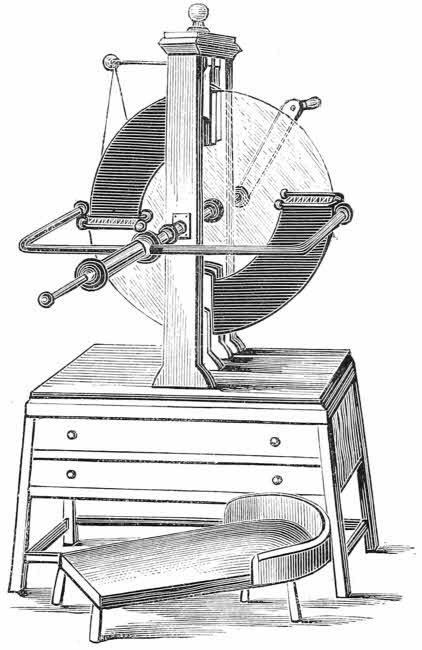
Fig. 1.
Plate Electrical Machine and Glass-legged Stool.
The machine should be fixed upon a firm stand
that it may be quite steady during rotation, and
be screwed to a heavy painted deal table, as is
shown in Fig. 1.
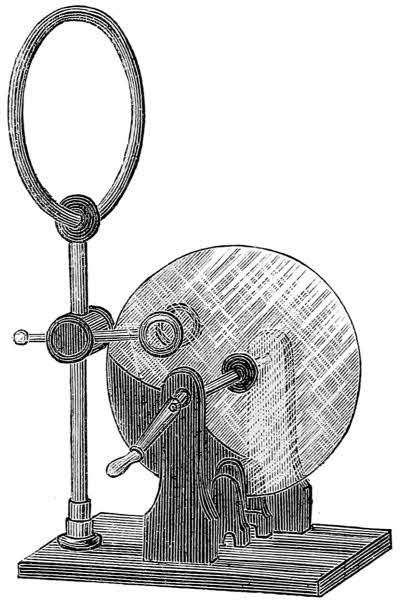
Fig. 2.
Winter’s Machine.
When very seldom used, and where expense is a
consideration, very fair results may be obtained
from a Winter’s machine with a plate of only
15 inches in diameter, and which is easily carried.
In this instrument, Fig. 2, the fact that the quantity
of electricity which may be accumulated upon
a conductor is dependent upon its size has been
most ingeniously applied, the surface of the conductor
being enormously increased by the insertion
into a large wooden ring of a core of thick
iron wire. Electricity accumulates upon the wire,
and is prevented from escaping by the insulating
wooden covering.
But in the daily or frequent use of Franklinism
it is essential, equally for the comfort of the
operator, as for the benefit of the patient, that the
most efficient apparatus should be provided. The
one delineated in Fig. 3, and which I habitually
use, is that known as Carrè’s, but I have modified
it by having attached to it a second accumulator,
or conductor (the first time, I am led to understand,
that such an improvement has been added
to any such machine). This arrangement admits
of the patient receiving the charge of either
positive or negative electricity—a condition said
by some physicians to be of primary importance.

Fig. 3.
Static Machine with Gas Engine and Insulating Stool.
There are other machines, but I do not propose
to weary you with their descriptions.
When any Franklinic apparatus is in use its
plate or plates should be evenly and uniformly
rotated, and it is much better to have this done
mechanically rather than by a man or maid-servant.
I use a “Bischoff’s” gas engine, shown to the
right hand in Fig. 3. It consists of a cylinder,
surmounted by a hollow column serving as a guide
to the piston. From the extremity of this column
there is a very long connecting rod which acts
upon the crank of the shaft of the fly-wheel and
driving-pulley. When the piston ascends it
draws in during four-tenths of its course a mixture
of air and gas from the pipes. A little before the
piston has ascended half-way a gas jet ignites the
mixture. There is a slight explosion without the
least effect on the sides of the cylinder, but sufficiently
strong to push the piston and cause it to
complete its course. In consequence of this movement
the piston is raised and acts on the connecting
rod, forcing it upwards and half turning the
fly-wheel. On account of the speed acquired, and
of the impulse given, the fly-wheel continues its
course by means of the crank and connecting rod,
and sends the piston to the starting-point again.
Then it ascends again, taking in a fresh charge of
air and gas, motion being imparted anew to the
driving shaft by every revolution of the engine.
An engine of 2-man power, with an altitude
from the ground to the top of the column of 4 feet,
and with a fly-wheel measuring 2 feet 6 inches in
diameter, is amply sufficient for every purpose. It
works evenly and without noise; it is absolutely
free from danger, and it is placed instantly in or
out of action by merely igniting or extinguishing a
single gas jet. But it is remarkable that no one seems
to have suggested—even before the gas-engine era—that
a “fly-wheel” with a pulley would obviate
the old difficulty of the unsatisfactory rotation of
the Plate machine. Going into a hair-cutter’s
shop I found the apparatus, figured to the left of
Fig. 4, standing in the shop to work the customary
“hair brushing machinery” instead of its
being, as is usual, fixed upon an upper floor. I
obtained one, and fitted it in the manner shown, to
a Carrè’s machine. The fly-wheel is so heavy that
it can be rotated by the operator without the aid
of an assistant, by his giving the handle an occasional
“swing round.” Its momentum then keeps
it revolving a sufficient number of times before the
next “swing” is required, to enable him to leave it
and attend to his patient. The manner in which
the band from it is attached to a small wheel in
rear of the Static machine is also shown in the
Figure.
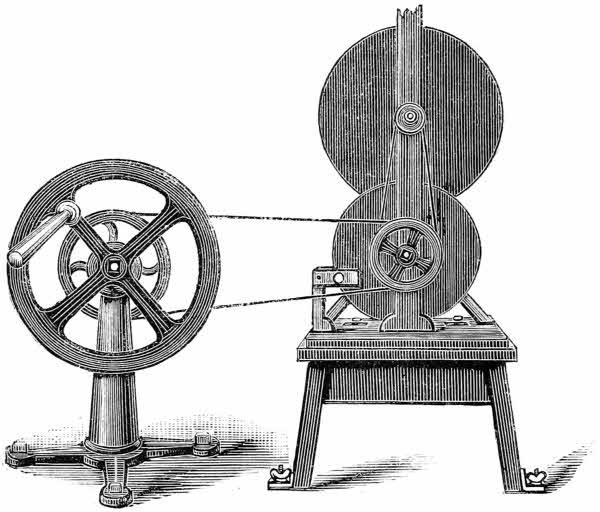
Fig. 4.
Fly-Wheel and Static Machine.
In Fig. 3 the patient is being “charged” with
positive electricity, or, as the electro-therapeutists
of fifty years ago would have said, “he is taking
an electro-positive bath,” by being insulated and
connected through the metallic rod held in his
hand with the accumulator upon which the
positive electricity is stored, while the negative
electricity is “run off” by a brass chain leading
from the negative accumulator to the ground.
If the process were reversed, the positive accumulator,
being connected with the ground, and the
patient with the negative one seen at the top of
the machine, he would be taking “an electro-negative
bath;” for we make him, as it were, a
part of each accumulator as the case may be; its
accumulated electricity passes to him and he becomes
charged. If the air were perfectly dry he
would continue (as he is insulated) in this charged
condition, but owing to its contained moisture the
electricity rapidly leaves him, and to maintain the
charge it is necessary that the plate of the machine
should be kept in constant rotation. Indeed, the
escape of electricity is so rapid that to get the best
action we must have a fire in the room, and before
use well rub the plate, the insulating supports, the
legs of the stool, and all the glass parts of the
apparatus with a warm and dry piece of flannel.
This is of importance, and however dry the day,
should as a rule never be neglected.
By smearing the inside of the cushions of the
machine with a little paste, composed of an alloy
of mercury and tin (technically known as
“amalgam”), mixed with a little tallow, the
amount of electricity is much increased, but care
should be taken not to smear the cushions with too
much, which had better be bought ready prepared.
A piece about the size of a small grape for
each of the cushions will be enough, and no more
need be added for two or three weeks. Always
scrape off old amalgam before adding new. The
cushions should be screwed sufficiently tight to
slightly “grip” the plate, and if it is found that
notwithstanding having rubbed the glass of the
apparatus as above directed, the instrument is not
supplying a sufficient quantity of electricity, remove
the cushions and warm them thoroughly.
It is impossible to be too careful that everything is
warm, clean, and dry, for the great obstacle that
exists against the extended use of Franklinism is
found in this difficulty sometimes present, from
neglect of the above precautions, in getting
efficient action. But even on a foggy day the
instrument, with proper care, may be made to act
well. The operator should also remember that
dust must be sedulously guarded against. A
few drops of petroleum may be sprinkled upon
the table, and their vapour condensing upon
the machine will aid in protecting it against
moisture.[5]
There will also be needed two or three lengths
of brass chain, or of copper wire, and a stool about
4 feet by 2 feet, with four glass balls or legs. A
stool of this size admits of a chair being placed
upon it, as in Fig. 3, and it will be also useful for
certain applications of voltaism, which will be
mentioned later on. Four glass jars are also needed
with which to insulate an ordinary couch.
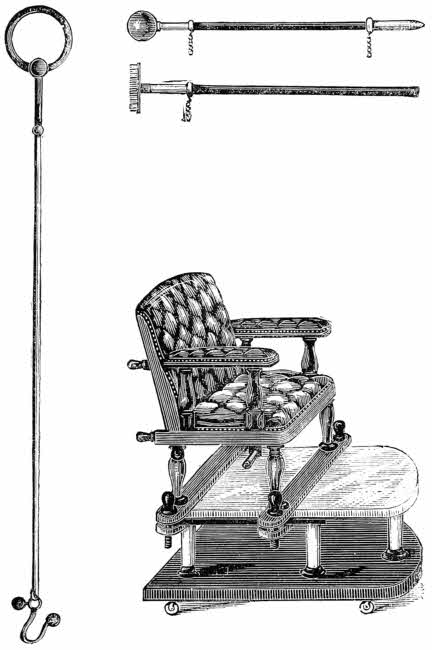
Fig. 5. Improved Dischargers and Connecting Rod.
Fig. 5a.
A chair, insulated by being screwed to
a glass platform, as in Fig. 5a, running on
castors, is an improvement upon the old-fashioned
glass-legged stool.
Franklinization by Sparks.
In Fig. 3, the electricity is escaping from
all points of the skin, but if it is desired to localize
somewhat this escape along the course of certain
nerve branches, or otherwise, but to avoid shock,
a brush may be slowly passed by the operator
almost, but not quite, in contact with the skin.
A series of rapid and successive reunions of the
electricity with each bristle of the brush takes
place, generating a current of cold air perceptible
to the patient. I habitually use for this application
an ordinary clothes-brush. If while in connection
with the conductor any object (the knuckles
will do) is brought sufficiently near to the patient
for his contained electricity to overcome the resistance
of the intervening stratum of air, he is
“discharged” with a spark. This is Franklinization
by sparks, and is accompanied by a certain
slight amount of “shock.”
In Fig. 5, improved “dischargers,” and a convenient
metallic connecting rod are shown.
The ball terminations of the dischargers should
vary in size, for within certain limits, the larger
the ball the more intense the spark; with the
pointed end the spark is very small; with the
discharger terminating in many small metallic
points still smaller, and with a similar discharger
made of wood, a luminous glow alone results, and
no spark.[6]
I shall discuss, in my third Lecture, the therapeutic
values of Franklinism.
Voltaism.
The Voltaic current is a continuous current.
Unless artificially interrupted, the electricity flows
in an unbroken stream until the battery is exhausted.
The current will gradually lessen in
power until it ceases, but there will be no break
in it, and no change in its direction, which is
uniformly from the positive to the negative pole.
|Points of distinction between the Voltaic and Faradaic Currents.|
It is important to recollect these points, for they
constitute the chief physical distinction between
the Voltaic and the Faradaic—or, as it is sometimes
called, the Induced current. This latter is
not, strictly speaking, a “current,” but a rapid
discharge or succession of momentary shocks, each
perfectly distinct in itself, and separated by an
appreciable interval of time from its fellows.
Voltaic Cells.
In electrization, a source of electricity is of
course necessary, and this is furnished by a cell
or cells, with contained elements and chemicals;
and, until a few years ago, it was impossible to
get a portable cell that remained always in order
and ready for use.[7]
Requisites of a Portable Battery.
The requisites of a portable battery are that it
should be really portable, always ready for use,
and little liable to get out of order. Such batteries
may be divided into two classes: firstly,
those in which the elements are either lowered
into the exciting fluid or the fluid is lifted to
them, as in the instruments of Stöhrer, Weiss,
and almost all other makers; and, secondly, those
in which the elements remain immovable in their
cells, and of these the Leclanché, the Gaiffe-Clamond,
and the chloride of silver, are to be generally
preferred to any of the first-named construction,
for they admit of the cells being so nearly sealed
up that no fluid can be spilt by any movement
except turning the battery quite upside down;
while the somewhat common accident with batteries
of the first-named construction—viz., destruction
of the plates by leaving them in the acid,
with its anything but agreeable result of a considerable
expense to replace them, is obviously
impossible. The only disadvantage they possess is
that when exhausted it is necessary to send them
to the maker to be recharged, while the owner can
keep the first-named variety in order himself.
Efficient cells are, however, but a first step to
the perfection of electrical apparatus, and the mechanism
by which the current is brought into use
and graduated, and the general accessories of the
instrument, are of at least equal importance. The
instruments which I am about to describe, have
been designed by myself, and may be obtained
from Mr. Hawksley, Surgical Instrument Maker,
Oxford Street. It is claimed for them that they
place at the service of the busy practitioner a
battery that with ordinary care (and no instrument
will remain in order without this) may
be kept upon his consulting-room table, always
as available to his service as his stethoscope or
ophthalmoscope.
Three kinds of batteries are constructed:—A
Voltaic battery, with any required number of
cells, from 15 to 100; a Faradaic battery; and a
Combined battery, uniting both Voltaic and
Faradaic currents.
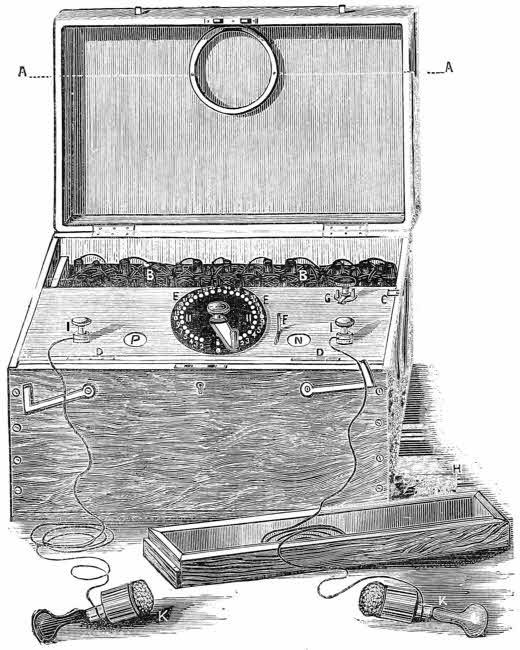
Fig. 6.
40-Cell Voltaic Battery.
A. Guard preventing the lid being shut, unless the needle of the
dial points to “0”, and the instrument is out of action.
B. Cells shown by the removal of the compartment, H, for
sponges and accessories.
C. Bolt to secure the element board, which moves upon the
hinges, D.
D, D. Hinges of element board.
E. Dial plate regulating the strength of the current. The
needle, when the battery is not in use, should cover the stud, “0,”
seen to its left.
F. Commutator of the poles. The poles, N and P, are seen
through holes cut in the element board.
G. Key by which the current can be shut “off” or “on,” without
change of position of the conductors. It can also be used by
vibrating it backwards and forwards as an “interrupter.”
I, I. Binding screws, to which are attached the conducting wires
and sponge-holders, &c.
The Voltaic Battery.
The Voltaic Battery (see Fig. 6, p. 20) has
its cells arranged in the interior of a mahogany
case, and in use they are hidden from view
and from danger, but I now partially expose
them by removal of the tray for holding the
sponges and accessories. Their connecting wires
are brought across the under surface of the
element board, which is made to move upon
hinges that, when necessary, the cells may be
examined, but at other times this element board
is held in position by a bolt, and it should never
be needlessly disturbed. These wires conduct the
current through the graduating dial, and the position
of the needle of this dial determines from
how many of the cells the electricity shall be
allowed to reach the binding screws, and from
them, by way of the conductors, sponge-holders,
or electrodes, the body of the patient,[8] or whether
it shall be entirely shut off, as is the case when
the battery is not in use, and when the needle
stands at “0” (Fig. 7). When the needle points to any
stud numbered on the dial, the number of cells
marked on that stud are brought into action, and
the needle is made just wide enough to touch one
of the studs before it breaks contact with the
preceding one, and thus the current may be
increased or decreased in power without shock, and
while the electrodes are held applied to the
patient; but if it were not so made a series of
painful shocks would be communicated whenever
the current was increased or decreased. Should
the needle, from forgetfulness, be left when out of
use in any other position than at “0,” a guard
upon the lid of the instrument prevents its
being shut, and the operator has his attention
called to his inadvertence. A Voltaic alternative,
or change of direction of the current, is sometimes
required in treatment, and the commutator of the
poles enables this to be accomplished without
alteration in the position of the conductors. By
pushing forwards or backwards the handle which
moves a lever working below the element board
the current is instantly reversed, and the alternation
of the letters “P” and “N” seen through
holes cut in the element board indicates at once
not only that there has been a change of poles,
but which pole is at the moment negative or positive;
whereas in all previous instruments, when
the poles have been changed, there has either
been no letter marking them, or this letter has
really been wrong, and one has had to remember
this; and under such circumstances, and examining
patients in rapid succession, momentary confusion
of the poles was very liable to occur, even
to a practised operator. A key enables the
current to be shut off or on without removal of
the conductors. Dirt is a non-conductor of
electricity, and the studs of the dial must be kept
clean with emery paper or plate-powder, as also
the under surface of the needle, key, and binding
screws, which unscrew to admit of removal. In
the daily use of a battery the chief work is usually
thrown upon the first half (say in a battery of
forty cells, upon the first twenty-five), and various
arrangements have been added to batteries by
ingenious instrument-makers to enable the operator
to vary his selection of the cells to be brought
into use, and thus to relieve the first half of his
battery, or, in other words, to equalize its work.
But this unequal work question is more a theoretical
than a practical evil; for if the initial cells
grow weaker a greater number can be placed in
use. I have carefully studied all the proposed
modifications, and have found in all of them
the remedy worse than the disease, unless the
graduating dial be doubled (an original suggestion
of my own), so that the initial cells of
one week may be made the terminal cells of the
next.
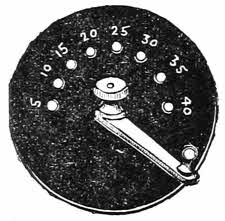
Fig. 7.
Graduating dial with needle at “0”.
When desired batteries can be constructed
with this double dial (Fig. 8),
but it adds to the complexity
of the instrument, and I do not myself
use it.
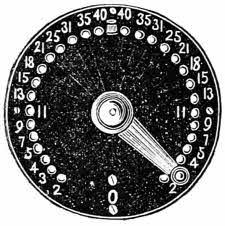
Fig. 8.
New form of Graduating Dial.
In Fig. 9 a similar battery is shown to that just
described; but the elements consist of carbon and
zinc, and are lifted into and out of a bichromate
solution. As it can be recharged by the owner
without the necessity of sending it to the maker,
it is especially suited for country and colonial
practitioners.
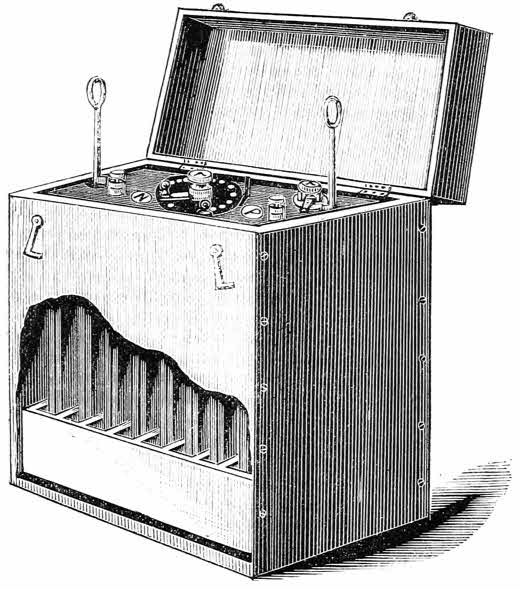
Fig. 9.
40-Cell Voltaic Battery with zinc and carbon elements, and
lifting apparatus.
Essentials of a Medical Voltaic Battery.
To recapitulate. The essentials of a medical
Voltaic battery are—
a. A constant supply of electricity of sufficient
quantity and quality.
b. A means by which this electricity may be
administered in measured doses.
c. A means by which the direction of its current
may be changed.
d. A means by which it may be instantly discontinued.
The Faradaic Current.
The Faradaic, induced, interrupted, or electro-magnetic
current, is the third form of electricity
employed in medicine. Faraday, as you will recollect,
discovered, that if two metallic wires were so
fixed as to be parallel and close to each other, but
not to touch; and that if then a current of Voltaic
electricity were sent along the first wire, another
current appeared in the second. This secondary
or induced current, as it is called in contradistinction
to the current, the primary or inducing current
sent along the first wire is only momentary,
but it appears again for a moment when the first
current ceases, but in a reverse direction. It is
most convenient to wind these two wires round
two reels, so as to form separate coils, and to place
the primary within the secondary coil. Each
single turn of the primary then acts not only on
the parallel turn of the secondary wire, but on all
the turns near it, and the power of such an apparatus
is much greater than that which would be
obtained by the same lengths of wire running side
by side in a straight line. Our two coils being
thus arranged, we pass through our primary wire
a succession of electrical currents, and in practice
this is accomplished by connecting its extremities
with a battery supplying a continuous current,
which by an ingenious mechanism we frequently
break or interrupt.
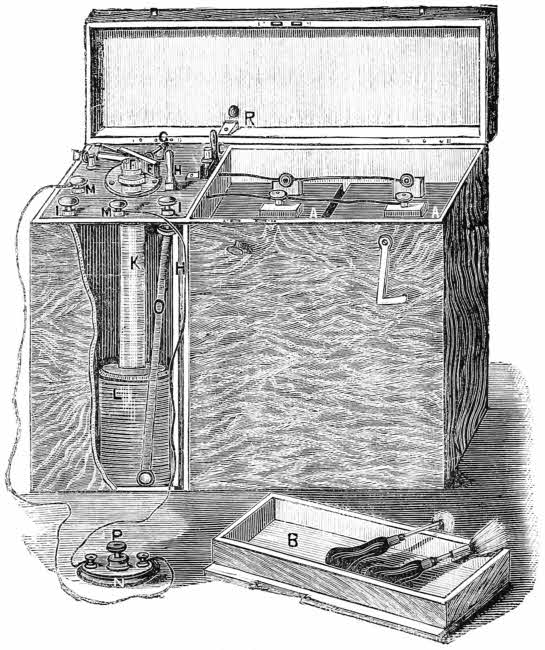
Fig. 10.
Faradaic Battery.
A. Cells shown by the removal of the compartment.
B. For conductors and accessories.
D. Screw regulating the pressure of a spring which modifies the
vibration of the hammer, E.
E. Hammer vibrating between the electro-magnet, F, and the
point of a platinized needle regulated by the screw, G.
F. Bundle of iron wires rendered an electro-magnet by the
passage of the Voltaic current from the cells, A, through the
primary coil, K, within which this bundle of wires is inserted.
G. Screw regulating position of a platinized needle.
H. The graduator, a stem to which is attached the movable
secondary coil, L. The front part of the case has been cut away
in the engraving, to show the construction of the induction
apparatus.
I, I. Binding screws for attachment of the conducting wires, &c.
K. The primary coil, fixed upon a pedestal. In the figure, the
secondary coil, L, is wholly withdrawn from the action of the
primary, and its strength of current depending entirely upon the
extent to which it covers the primary, it is evident that the height
which the graduator, H, stands above the element board will
exactly indicate this strength.
L. Movable secondary coil.
M, M. Binding screws for attachment of the pedal rheotome, N,
for slow interruption. These interruptions are made by the
pressure of the operator’s foot upon the spring, P, but in practice
they are very seldom wanted, and the fittings are only added to the
instrument when specially ordered.
O. A spring retaining the secondary coil, L, in any desired
position.
The Faradaic Battery.
The Faradaic Battery.—In Fig. 10 (see p. 29),
a Faradaic battery, worked by two Leclanché cells,
is shown; but I find it better to employ either
one or two ordinary bichromate cells instead of
the Leclanché, as the former can be kept in order by
the operator himself without much trouble. The
primary coil is fixed upon a pedestal, the secondary
is movable, and can be lifted over or thrust away
from the primary. The degree of action in the
secondary coil being proportionate to the extent
to which it is brought under the influence of
the primary, this arrangement admits of the
most perfect graduation of the current; and it has
been for some time in use in all well-constructed
instruments. The innovation I have made consists
in limiting the primary coil to its legitimate
purpose of induction, and rendering the secondary
alone available for application to a patient. I
have been long satisfied that therapeutically the
distinction between the primary and secondary
coil entirely consists in the greater tension of the
current of the secondary coil enabling it to penetrate
easily several thicknesses of muscle, but there
is no therapeutic indication that cannot be fulfilled
by this secondary coil; and at its lowest
power I have frequently applied it to the conjunctiva.
The rapidity of vibration of the interrupting
hammer is varied by increasing or decreasing the
distance between the point of the needle and the
electro-magnet by the protrusion or retraction of
the screw, of which the needle forms the end—that
is, by increasing or decreasing the space
through which the hammer passes in its vibration,
and also by altering the pressure of its spring, but
there is seldom therapeutic need for change of vibration;
and unless this exists it is better not to alter
the adjustment so long as the instrument acts well.[9]
After considerable use the point of the needle, and
the exact spot of the platinum disk of the hammer
against which this needle impinges, become oxidized,
causing weakening or stoppage of the current.
This platinum disk has been constructed to rotate,
and a hole has been drilled in its circumference (Fig. 11).
By inserting a little lever furnished with the instrument
into this hole, the slightest twist given
to the disk is sufficient to bring a new surface of
platinum into contact with the needle point. This
will usually be all that is required, but, if not, the
needle can be unscrewed, and its point cleaned with
emery paper. When in course of time the disk
becomes dotted over with spots of oxidation, the
screw fixing the hammer in position must be unscrewed,
the hammer lifted out, and its surface
similarly cleaned.

Fig. 11.
The Platinum Disk and Lever.
Induction currents are also produced in coils
of wire by the action upon them under certain
conditions of a permanent magnet—as in the
ordinary rotary magneto-electric machine—but
these machines may be discarded from our consideration,
for they are uncertain in action,
painful in application, and do not admit of exact
graduation.
An apparatus in which both currents are combined
is extremely convenient if it is so constructed
that either the Voltaic or Faradaic current can be
brought to the same terminals, thus avoiding the
trouble of changing the conductors—a point of the
greatest possible convenience when examining
patients for diagnostic purposes by both forms of
electricity, either in succession or alternately.
The Hospital Combined Battery.
In the Hospital Combined Battery (see Fig. 12),
constructed from my designs, the two currents are
thus united, and its details are precisely similar to
those of the separate batteries, with the exception
of the Dial being furnished with an additional stud
lettered Coil. When the needle points to this stud
the current from the Faradaic coil is brought into
action; when it points to the numbered studs,
the cells numbered thereon as in my Voltaic instrument,
and when it points to “0,” both currents
are shut off.
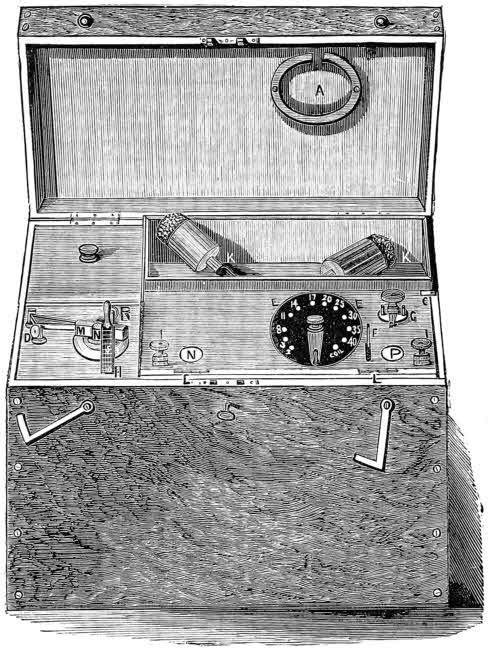
Fig. 12.
Hospital Combined Battery.
A. Guard block.
K. Tray for holding accessories.
E. Dial plate.
C. Bolt securing element board.
G. Key for interrupting current.
M. Hammer.
F. Commutator of the poles.
I, I. Binding screws for conducting wires.
L, L. Hinges of element board.
H. Graduator of coil.
N. Electro-magnet.
R. Screw regulating position of needle.
D. Screw regulating spring of hammer.
Other instruments, such as those of Stöhrer and
Weiss, are excellent, and were unsurpassed until
the invention and improvement of the Leclanché
and other cells. But I might talk upon instruments
for hours without exhausting the list; and
I have felt obliged to limit myself to a description
of those I believe best fitted to our requirements;
but it, of course, must be understood that my
further observations will apply equally to currents of
electricity furnished by any properly constructed and
reliable apparatus.
Accessories of the Battery.
We have now brought the electricity to the
terminals of our battery, and we must next consider
the best means of conveying it to the sponges,
conductors, or, as they are generally termed, rheophores
or current carriers, by which it is finally
applied to our patient.|Conducting Cords.|
Our first necessary accessory
is a conducting cord or wire, and it is of
the first importance that this should really be
what it is called—“a conductor”—for any fault or
break of connection in it will, of course, nullify the
best and most perfect battery. It must also be
sufficiently pliable, and be insulated by being coated
with some non-conducting material that the
electricity may not escape from it to any conducting
substance with which it may accidentally
come into contact. The conducting cords sold by
instrument-makers are sometimes not insulated at
all, and then they are quite useless, but they are
more commonly composed of several strands of
metallic wire of about the diameter of sewing
thread, the whole enclosed in some silken or woollen
material, and nothing can be better than these
latter when quite new. Their disadvantages are
that they become frayed after a little use, and are
liable to be constantly out of order, causing interruptions
in the current, while they will only fit
one kind of machine. I have had endless trouble
with them; and for some years I have used
nothing but thin copper wire, coated with gutta
percha in the same way as that known as “telegraph
wire.” This is perfectly insulated, sufficiently
pliable for all practical purposes; it is
cheap, and can be made to fit any sort of connection.
Its one disadvantage is, that it is liable
to break at the point where it is received into the
terminals of the battery, or the screw socket of
the rheophore. Should this happen, all that is
necessary is to scrape off the gutta percha coating
with a pocket knife for an inch from the broken
end, by which we get practically a new conducting
cord.
We have now considered fully the birth and
parentage of medical electricity, and we have conducted
it to within almost a hair’s breadth of our
patient. The various methods of applying it will
be considered in our next Lecture, which I trust,
Gentlemen, to render more interesting; but the
dry details we have been discussing are, I assure
you, essential as a secure foundation for a practically
useful survey of electro-therapeutics.