The rapid extension of the railway across the American Continent, and
the construction of lateral lines, have greatly diminished the volume
of travel with wagons, and other primitive modes, but have by no means
made an end of them. There is yet a large area without settlements,
and unprovided with the iron road, and for many years to come the
wagon of the emigrant and explorer will wend its way through the
wilderness. For those who contemplate pushing beyond the borders of
civilization, the writer presents this chapter.
The means of transportation available in frontier or wilderness
regions are wagons and pack-animals; the former are adapted to most
open and prairie countries, but in mountain regions it often happens
that the wagon cannot be used. The pack-animals in general use are
horses and mules; the latter are the surest of foot, especially the
Mexican variety, which is smaller than the American mule, and can live
where the latter would starve. Where snow is to be encountered horses
are to be preferred, as the horse will plod on through the drifts long
after the mule has given up in despair. The writer of "How to Travel"
has an unhappy recollection of crossing the divide between the
Arkansas and Platte rivers in the winter of 1860, when paths had to be
trodden in the snow for the mules before they would consent to go
ahead. Our horses kept on through snow that was nearly thirty inches
deep, but even when they had made a very good path it was difficult to
urge the mules forward.
The best pack-saddles for either horses or mules are of the "Grimsley"
pattern; they are open at the top, and covered with rawhide that
shrinks while drying, and is thus drawn straight. The Grimsley fits
well on the animal's back, and saves it from soreness longer than any
other form of saddle in use. The Indians have pack-saddles in the form
of "saw-horses," and the Mexicans use a leather sack like a mattress,
which is stuffed with hay, and has no projections for fastening the
load in place. In putting it on a mule they draw the belt so tight
that it seems to threaten to cut the poor brute in two, and certainly
must give him great pain. All the forms of pack-saddles, as well as
the best riding-saddles for frontier use, have broad girths of braided
horse-hair, that are far less likely to slip than any girth of
leather.
The proper adjustment of a load on a pack-saddle is a work of art that
can only be accomplished after long experience. In the first place,
the load must be accurately balanced, so that it will not have a
tendency to turn over, and, secondly, it must be lashed to prevent its
working 'loose, and scattering' itself along the trail. It is not
agreeable to find soon after leaving camp that your lashings have
loosened, and the load, which was your pride at starting, is being
distributed by the wayside. To add to the perplexity, the mule
invariably helps the business along by executing a waltz, and kicking
at imaginary dogs above the tree-tops. Men have been known to use
profane language on such occasions, but a mule never does.
At night the packs should be placed in a row and covered with the
saddles and saddle-blankets, to protect them from possible dew or
rain, and have them convenient for loading up in the morning. Great
care should be exercised to prevent the backs of the animals from
getting sore; the best preventive is a well-fitting saddle, but in any
case the backs of the beasts should be closely watched. If a horse or
mule is found to be sweating when unsaddled, it is well to allow the
saddle-blanket to remain until the skin is dry. Grease can be applied
to a spot that shows a tendency to soreness, and a piece of bacon-rind
may be tied on and left over night. It is not a good plan to wash an
animal's back immediately after unsaddling, and while he is hot and
sweating; the back should be allowed to cool completely before water
is applied.
A very important member of a pack-train, especially when it is
composed of mules, is the madrina, or bell-mare. She must be
chosen for her dignity and docility, and be ornamented with a bell
like the ordinary cow-bell of the eastern States. Its tinkle is a
great attraction to the mules, and wherever she goes they are sure to
follow. When the train is on the march she should be kept in front,
and when rivers are to be crossed she must be sent over first. The
affection shown by mules for the bell-mare is often very touching;
they will crowd around her and struggle for the privilege of rubbing
their noses against her sides, and, if she is accompanied by a colt,
they show as much fondness for it as girls do for a baby. Many are the
stories told by old plainsmen about the bell-mare, and the devotion of
the rest of the animals to her; she saves a vast deal of trouble, both
in camp and on the march, as she keeps the herd together when all
other means would fail.
For wagon travel on long and rough roads, where grain cannot be
obtained, oxen are preferable to mules or horses, as they have more
endurance, though they move more slowly. They keep in good condition
where horses and mules would give out, and in cases of emergency,
where the animals must be slaughtered for food, they make orthodox and
more attractive beef. Fifteen to twenty miles is a good day's journey
for an ox-team, while horses and mules can make from twenty to thirty,
if the roads are fairly good. Oxen are less liable to be stampeded by
Indians, and are easier to keep from straying; with a few days'
training they can be made to work under the pack-saddle if necessary,
and in South Africa pack-oxen are in general use. Anderson, who
traveled in South Africa, said he had an ox named 'Spring' that he
rode for two thousand miles, and found him an excellent beast under
the saddle. It is well for a long journey to have some cows along, as
they find their own food, and give milk, and, in emergencies, they may
be worked in the teams like oxen.
Wagons should be as light as possible, consistent with strength, and
the wood should be perfectly seasoned, in order to resist the effects
of the changes of the atmosphere. The wagon-body should be
water-tight, so that it will preserve its contents when fording
streams, and it can also be used as a boat where a river is too deep
to be forded. There should be a joint in the pole where it enters the
hounds, and the coupling pole should be movable; the joint will often
prevent the breaking of the hounds, and the movable perch enables a
part of the wagon to be converted into a cart, when a broken wheel or
axle prevents the further use of the entire vehicle. Every wagon
should have strong bows and a double cover of thick osnaburg to
protect the contents from the rain and dew. The bolts that connect the
running-gear should be riveted at the ends to prevent the nuts from
falling off, as the loss of a nut in the wilderness often leads to the
loss of the entire wagon.
The load of the wagon should be closely and securely packed, and
everything arranged to prevent chafing in the many jolts of the road.
Provisions for the journey should be in the most compact form, and not
a superfluous ounce of stuff should be taken along. Bacon and flour
are best carried in strong sacks, and all boxes and barrels must be
rejected, except one or two light flour barrels for getting water.
Sugar and salt must be in canvas bags with an outer covering of
India-rubber or oil-cloth, to prevent the moisture reaching the
contents, and tea and coffee require air-tight cans for their
preservation. Desiccated and canned vegetables are excellent; the
former deserve the preference on account of their more condensed form.
Citric acid and the essence of lemons should be taken on long journeys
where fresh vegetables cannot be obtained, as they are an efficient
anti-scorbutic, and it is well to have a few simple medicines in a
small box that ought to be kept in a corner of one of the wagons,
where it can be easily reached.
The personal outfit of a campaigner in the wilderness is not very
elaborate. White shirts should be discarded, and blue or red flannel
worn instead. The coat should be short and of some strong woolen
material, and the overcoat heavy without being stiff. The trowsers
should be thick and soft, and if the wearer intends to do any
saddle-riding he should have his nether garments "half-soled," or
reënforced with buckskin where they touch the saddle, and thus
preserve them from wear. An outfit for a campaign of a hundred days
might be about as follows:—
Overcoat, coat, and soft hat, one each, two flannel over-shirts, two
woolen undershirts, two pairs thick cotton drawers, four pairs woolen
socks, two pairs cotton socks, three pairs shoes, one pair strong
and high boots, one India-rubber poncho, and six colored silk
handkerchiefs. Then add castile soap for toilet purposes, and three
pounds bar soap for clothes, comb and brush, and tooth-brushes, and a
quantity of needles, thread, pins, buttons, beeswax, etc., in a small
bag of buckskin. By the way, don't forget a good quantity of buckskin
and an awl; they come handy in many ways for repairing harness,
clothing, saddles, shoes, and the like, and you will greatly miss them
if you forget them till too late.
For bed and bedding you want two blankets, a quilt, and a pillow,
the whole wrapped in a cover of India-rubber or painted canvas, which
can be spread on the ground at night to keep out the moisture. For
dining-room and kitchen you want for every six persons a camp-kettle,
a coffee-pot, a mess, a frying, and a bake-pan, all of wrought-iron.
Have an extra camp-kettle for accidents, and a bucket of
galvanized-iron for bringing water; don't trust to wood, as it is
liable to many accidents from which iron is secure. Your judgment will
tell you about knives, forks, and spoons; cups and plates should be of
strong tin, and the handles of the former riveted on, never soldered.
Pepper and matches should be in glass bottles, with close corks, and
kept in the safest place. Every horse and mule should have at least
two lariats, or picket-ropes, and every wagon needs an axe, and a
spade, and some S's, and extra chain-links for repairs.
So much for the outfit, to which you will add the firearms that suit
your fancy and the requirements of the region you are about to visit.
Those that use fixed ammunition are undoubtedly to be preferred, if
you can be sure of a sufficient supply of cartridges at all times, but
where this is not the case, it is best to adhere to the old-fashioned
Colt's revolver, loading with loose powder and ball. A Remington,
Winchester, or other cartridge rifle may be carried for rapid work in
fighting Indians, or killing large game, and a Colt's revolver, with
loose ammunition, will be a convenient thing for every day use and
ornament.
Now we are off, and must look out for ourselves. Provisions for our
sustenance are in the wagons, and we must think of food and water for
our riding and team animals. Make short and easy drives for the first
few days, till the teams get accustomed to their work, and then we
will increase the distance; we will not make more than half a dozen
miles the first day, and even if we only go a mile or two, and camp
just outside the town, we shall have gained so much. We will make our
marches in the early part of the day, have a long rest at noon,
especially if we are using oxen, and then go on again till sunset. We
must always camp near grass and water, and it is better to make a very
long drive than not to do so; if possible, we should have grass and
water at the noon halt, but, in case of necessity, we can do without
water, and then lengthen the afternoon march so as to reach it.
An old traveler will find water where the novice declares it does not
exist; none of the rules are absolutely infallible, and the shrewdest
will sometimes be disappointed. Observe the fresh tracks of animals,
and the flight of birds, and they will frequently lead to water,
especially the tracks of deer and mustangs. Examine the dry beds of
streams, and if they are sandy push a long stick or cane as far into
the sand as it will go; if you find it moist when you withdraw it, you
can be certain of water. Then dig a hole with your spade, and use an
empty flour-barrel for a curb, and if the hole is deep you can place
one barrel above another. In a little while the water will enter the
barrel, and you may draw from this improvised well all you need for
your party and your stock.
In countries where streams and springs are scarce, water may be caught
during showers by means of tents, awnings, wagon-covers, and even by
rubber overcoats. Drinking-water may be obtained where there are heavy
dews by dragging a blanket over the grass, and then wringing it out;
it is hardly necessary to add that the blanket should be a clean one.
Water from stagnant pools may be purified by thorough boiling, and
then mixing with powdered charcoal; in a muddy pond, it may be
partially cleansed by boring small holes in the lower half of a
barrel, filling it two-thirds full with layers of moss or grass, with
alternate layers of clean sand, if the latter can be had. Then place
the barrel in the pond till the top is nearly level with the surface;
as the water enters the barrel it will pass through the improvised
filter; and be found far purer than in its original state.
Always form your camp by the side of a river or stream of some kind,
if it is possible to do so, as you thereby make sure of plenty of
water for your stock; if in a hostile country, where attacks from
Indians are possible, have an eye to the defences of the position. A
peninsula in a river is the best place, as the water forms a natural
fortification, and you have only the neck of the peninsula to look
after; if you cannot find such a spot, take the place that most nearly
resembles it, and if you cannot do better, have the river or stream on
one side of you. If you camp away from water, select a spot so as to
have the crest of a hill on one side of you, where a lookout can be
stationed.
It is the custom for large parties traveling on the western plains of
the United States to arrange their wagons in a circle, or an oval,
with an opening at each end, at every halt. A yard is thus formed,
into which the stock may be driven to be harnessed or yoked. It may be
enclosed at night, or when hostile attacks are made, and, finally, the
yard, or corral, is an excellent redoubt from which to make a defense
against Indians. Many a train has been captured by neglecting this
precaution, and many another saved by observing it. No good captain of
a train will ever allow it to go into camp even for an hour without
forming the wagons into a corral. When the stock is driven in, the
openings at the ends of the corral may be closed by the simple
operation of stretching a chain across.
Where there is a scarcity of water, you will find you can get along
without it for many purposes for which at home it is considered
absolutely necessary. All your cooking and dining utensils can be
cleansed thoroughly without it; knives and forks by thrusting them
several times into the ground till every vestige of their recent use
is removed, and plates and pans by means of wisps of grass and dry
earth, joined to what is known in the Eastern States as
"elbow-grease." Great care should be exercised in regions where water
contains alkaline matter, as it induces diseases that require a long
time for curing.
Fuel is the great need of a traveler next to water. In a wooded
country he has no trouble in finding it, but he should never waste it,
no matter how plentiful. Never build a fire in a hollow log, or one
that is partially decayed, but clear a space of ground, and roll or
carry your fuel to it. When you move on in the morning put out the
fire, or encircle it, so that it cannot by any possibility spread and
cause damage. The danger of a hollow log is that the fire may smolder
there for days, or even weeks, and then break out; if the season is
dry, and the forests extensive, many acres and miles of country may be
burned over, and perhaps human lives may fall victims to your
carelessness.
In the open and treeless country the wilderness-traveler is often hard
pressed for the material for a fire. The most commonly used article is
the dry dung of buffaloes, known to the Canadian voyageurs as bois
de vache. It makes a hot fire, with very little smoke, and as the
animals haunt the valleys of the streams in search of the best grass,
they leave this material in the region of the camping grounds where it
is most needed. It is excellent for tinder, and with a burning-glass
and a piece of buffalo-chip you can get a fire in a few moments,
provided the sun is shining. In many parts of the world the dried
excrement of grass-feeding animals forms the only fuel of the
inhabitants or of travelers.
If you sleep near a fire at night, and the weather is so cold as to
render the heat desirable, always lie with your feet towards it; as
long as the feet are kept warm the rest of the body is likely to be
so, and with cold feet no one can be comfortable. Unless the
surrounding circumstances compel you to sleep with your boots or shoes
on be sure to remove them before you go to bed, as their absence makes
your sleep far more refreshing than it is with them.
When you arrive at a stream, on whose banks you intend to camp, but
which you must cross before proceeding on your journey, make the
crossing before you halt for the night. Streams rise suddenly, and it
often happens that what was a tiny rivulet at sunset is a roaring
torrent on the following morning, and it may be a day, or several
days, before it subsides. The rule here given is followed by all
experienced travelers on the plains of the great west.
When you break camp in the morning one of the party should remain
behind, after the wagons have moved away, and carefully examine the
ground to see that nothing has been forgotten. The members of the
party may take turns in this duty, or it may be assigned to one person
who should be held responsible for whatever may be lost by
forgetfulness. It will often happen that some article of camp equipage
has been left behind, and its absence is unknown until camp is formed,
at the end of the day's march. A thought B had put it in the wagon,
and B was certain that A had attended to it, or at least he should
have done so. Many a quarrel has been saved by this simple precaution,
and also many a deprivation, as the loss of a camp-kettle or
frying-pan, when it cannot be replaced, is a very serious matter.
Since the writer gave up the wilderness for civilized travel it has
always been his custom, after his trunks have been packed and locked
at a hotel, to renew his practice of olden times and go through his
room with the utmost care, examining every drawer of bureau or
washstand, and looking into every closet. Candor compels him to say
that once in a while he finds articles of greater or less value that
but for this rule he would have left behind.
One of the perplexities of travel in wild countries is the passage of
rivers. Shallow streams can be forded, and if the current is not
strong a depth of five feet may be passed without serious difficulty.
Many streams are full of quicksand, and in such case the rule is to
keep your team in constant motion after it enters the water. As long
as a man keeps moving on quicksand there is no danger, but whenever he
stops his feet begin to sink, and if he remains stationary he will
speedily find himself beyond his depth. The same conditions are true
of saddle or draught animals, and of the wheels of wagons. Where there
are quicksands horses should be led across, and to insure their going
steadily forward they should be allowed to drink all they wish before
entering the stream. Horses and oxen are more certain to go ahead
without halting than mules; the latter are apt to lie down and refuse
to move, exactly as they do in deep snow.
In a difficult ford the teams had better be doubled. The driver should
stand on the front of the wagon with a reliable whip in his hand, and
be assisted by one or more mounted men on each side of the team. It is
well also to have a mounted man ride ahead with a long lariat on
picket rope attached to the forward leaders of the team, so as to
direct their course. In a swift current the ford should be made
obliquely downwards if possible, so that the current can assist the
progress of the wagons.
In crossing a stream too deep for fording, boats or rafts may be
improvised from wagon beds, or they may be built on the spot. If the
current is swift a ferry must be made, and for this purpose (after the
spot for crossing has been selected) an expert swimmer goes over with
a fish-line or other slender cord in his mouth. By means of this cord
a strong lariat can be drawn over; it should be twice as long as the
width of the river, and fastened on each shore to a tree, or a wagon
tongue set in the ground if there are no trees. To make a ferry-boat
from a wagon-bed put it in the center of a wagon-cover or other strong
canvas, and then bring the edges up over the sides to the top; the
leakage will then be so slight that a man with a cup can easily keep
it free from water. The contents of the wagons can be passed in this
boat by means of the ferry rope, the animals can swim over, and the
empty wagons may be passed by fastening them down to the axles, and
attaching ropes to the tongue and also to the rear. They are then
drawn over by the men on the farther bank, and kept from drifting by
means of the rear rope.
If you are about to swim a stream with a horse it is not a good plan
to remain in the saddle, as your weight presses heavily on the animal
and restricts his movements. It is better to dismount, tie a cord
eight or ten feet long to his bridle, drive him into the stream, and
then grasp his tail and be towed over. If he tries to turn back you
can direct him with the cord or by splashing water towards his head.
If you do remain in the saddle give him a free rein, and do not pull
in the least, except when it is necessary to guide him. Horses and
oxen are better swimmers than mules; the latter are easily frightened
and may suddenly turn down stream, refusing all attempts to bring them
to land. They are also more liable to be drowned, and great care
should be taken that they do not get water in their ears; as soon as
you see a mule droop his ears you may know that he is in danger, and
the water should be removed immediately on reaching land, if you are
so fortunate as to get him there. For this reason never splash water
towards a mule's head, and do not make him jump into the water if
possible to avoid doing so.
An excellent ferry-boat may be made from a green or soaked hide of ox
or buffalo, or better still, from two or more hides. You will
generally find willows growing on the banks of the streams; gather
some of the smaller ones, sharpen the butts and drive them into the
ground, so as to form an oval figure of the size of your intended
boat. Then bring the tops together, weave slender willow rods among
the larger ones till the structure resembles a basket with a round
bottom, and have a specially strong willow running around all of them
near the ground, and firmly fastened, to make the gunwale of your
boat. If your boat is made of one hide stretch it over the basket and
sew it to the large rod around the top, and let the whole thing stand
a few hours in the sun to get dry; then cut off the rods where they
enter the ground and you have a boat that will carry four or five
hundred pounds with ease. For a larger boat, with two or more hides,
you want a more pretentious frame, a stout pole for a keel, and two
smaller poles for gunwales. This water vehicle is known on the plains
as a bull-boat, and can be easily constructed, provided the
traveler has a supply of willows, some green or soaked hides, and a
fair amount of common sense. Where a traveler expects to encounter
streams that cannot be forded he would do well to carry two or three
dried hides, and then he will have the material for covering a
bull-boat always at hand.
While we are speaking of hides, another use of them may be mentioned.
It often happens that emigrants, or settlers in a new country, wish to
salt a quantity of beef or other meat but have no cask or other
receptacle in which to place it. In this emergency dig a hole in the
ground, of such dimensions that the hide of the slaughtered animal
will just line it; then place the hide in the hole, with the flesh
side up, fasten the edges to the ground with wooden pegs, and you have
a salting cask that you may use, sans peur et sans reproache.
An animal's hide is also useful to bake him in, and in this way: Skin
and dress your game and then sew what you intend to bake into the
hide. Build a good fire in a hole in the ground with a sort of rude
oven of stones around it, and keep it going till the ground and stones
are hot. Now sweep out the ashes, throw in your roasting piece, cover
it with dry or green leaves, put back the hot embers as quickly as
possible, and then continue the fire long enough to cook the meat
beneath it. The writer has practiced this form of cookery on several
occasions and found the result very satisfactory.
If your supply of fuel is limited, and you have much cooking to do,
dig a narrow trench for the fire and place your kettles and pots above
it; make the trench with one end towards the wind, and build a small
chimney of stones or earth at the other end. Another way is to dig a
round hole a foot deep, and place the kettles in a circle on its
border, half of each kettle being on the ground and half over the
fire. If you lose all your kettles and frying-pans it is well to know
that you can improvise a frying-pan by taking two large flat stones
and laying one above another, with a few pebbles between to keep them
apart. Build a fire around them, and when they are well heated sweep
away all the ashes and put your slices of meat between the stones; you
will be well satisfied with the frying process that ensues.
But space is limited and we must pause. The writer could go on for
many more pages, giving advice to travelers in the wilderness, of
varying degrees of usefulness, and mainly drawn from his own
experience as a frontier campaigner years and years ago. But the
demands of the printer, and the interests of the non-migrating reader,
forbid an extension of the chapter. If more on the same subject is
desired it will be found in an eminently practical little volume
entitled "The Prairie Traveler," by Captain (since General) R. B.
Marcy; the author is thoroughly familiar with the subject, as any old
officer of the army can testify.
HANOVER
Fire Insurance Company,
No. 181 Broadway, New York.
| Cash Capital, |
$1,000,000.00 |
| Reserve for Re-Insurance, |
475,262.37 |
| Reserve for all other Liabilities, |
94,193.32 |
| Net Surplus, |
830,626.59 |
| Total Assets, January, 1881, |
$2,400,082.28 |
BENJAMIN S. WALCOTT, President.
I. REMSEN LANE, Vice-President and Secretary.
CHARLES L. ROE, Assistant Secretary.
Chesapeake & Ohio Railway.
LAID WITH STEEL RAIL.
The only route between the East and West via White Sulphur and
various other Springs and Pleasure Resorts in the beautiful and
picturesque mountains of Virginia and West Virginia.
Regular and Excursion Tickets on sale at all principal Ticket
Offices throughout the United States at lowest rates.
Sleeping Cars and all modern improvements.
☞ See Circulars of the Grand Centennial Celebration
at Yorktown, Va., in October, 1881.
H. W. CARR, Gen'l Eastern Agent,
229 Broadway, New York.
CONWAY R. HOWARD, Gen'l Pass. and Ticket Agent,
RICHMOND, VA.
FISK & HATCH,
And other desirable Investment Securities,
No. 5 Nassau St., N.Y.
Buy and sell all issues of Government Bonds, in large or small
amounts, at current market prices, and will be pleased to furnish
information in reference to all matters connected with investments in
Government Bonds.
We are prepared to give information in regard to first-class Railway
Securities and to execute orders for the same.
Buy and sell all marketable Stocks and Bonds on commission at the
Stock Exchange or in the open market.
Receive accounts of Banks, Bankers, Merchants, and others, and allow
interest on daily balances; and for those keeping accounts with us we
collect U.S. coupons and registered interest, and other coupons,
dividends, etc., and credit without charge.
☞ We give special attention to orders from Banks,
Bankers, Institutions, and Investors out of the city, by Mail or
Telegraph, to buy or sell Government Bonds, State and Railroad Bonds,
Bank Stocks, Railroad Stocks, and other securities.
FISK & HATCH.
FLEET.
Spain, Egypt, England, Erin,
Helvetia, The Queen, Italy,
France, Holland, Denmark, Canada,
Greece.
The Steamships of this line are amongst the largest in the
Atlantic service leaving the Port of New York. They have been
constructed by the most celebrated builders in Great Britain, and are
of great strength and power, and of beautiful model, enabling them to
make regular passage in all kinds of weather. They are built entirely
of Iron and Steel, except the merely decorative parts, and divided
into watertight and fireproof compartments, with steam pumping,
hoisting, and steering gear, and provided with fire-extinguishers,
improved sounding apparatus, and generally found throughout in
everything calculated to add to their Safety, and to the comfort and
convenience of Passengers heretofore unattained at sea.
One of the Steamers will sail from New York every Saturday for
Queenstown and Liverpool, and weekly from London direct, from Pier 39,
North River.
Rates of Passage, in currency:—To Queenstown and Liverpool,
$50 to $70. To London direct (Victoria Docks), $50 to $60; Excursion
Tickets, $100 currency. Steerage passage, outward, $26 currency.
Prepaid Tickets, $28, being $2 lower than most other lines.
For passage, Bank Drafts, Sovereigns, etc., apply to
F. W. J. HURST, Manager, Company's Offices,
Nos. 69, 71, and 73 Broadway, New York.
THE ANCHOR LINE STEAMERS are first-class in every respect, built
especially for Passenger Traffic; are safe, comfortable, reliable,
splendidly equipped, and in their appointments and accommodations are
not excelled by any other Line.
RATES OF PASSAGE FROM NEW YORK
To Glasgow, Liverpool, Londonderry, or Belfast.
| Aft Outside Berth, $80 |
{ FIRST CABIN. } |
Excursion |
$140 |
| Aft Inside Berth, $75 |
Tickets, available |
130 |
| Forward Berth, $60 |
for One Year, |
110 |
TO LONDON DIRECT.—First Cabin, $55 and $65; Excursion, $100 and $120,
according to location of Stateroom.
For Books of Information for Passengers, Rates of Passage, Cabin
Plans, etc., apply to
COMPANY'S OFFICES.
7 Bowling Green, New York.
96 Washington Street, Chicago.
7 and 9 State Street, Boston.
HENDERSON BROTHERS, Agents.
American Exchange in Europe,
(LIMITED.)
CAPITAL, ONE MILLION DOLLARS,
(In One Hundred Thousand Shares of Ten Dollars each, with power to
increase.)
Fully Paid-up Shares, $500,000.00.
| PRESIDENT, |
|
|
GEN'L MANAGER, |
| Joseph R. Hawley. |
|
|
Henry F. Gillig. |
| Financial Offices and Reading Rooms, |
} |
| Passenger and Railroad Offices, |
} |
449 STRAND, W.C. |
| Exchange and News Department, |
} |
| |
| Commission and Shipping Departments, |
} |
3 ADELAIDE ST., |
| Emigration and Land Branches, |
} |
CHARING CROSS, |
| Express and Storage Divisions, |
} |
LONDON, ENGLAND.
NEW YORK BRANCH OFFICE, 102 Broadway.
General Agent, W. C. BOONE.
Fiscal Agents, DONNELL, LAWSON & SIMPSON.
Branch Office of Commission and Shipping Departments,
50 BROADWAY, NEW YORK.
The General Object of This Company is to Advance and Protect
American Interests in Europe:
1st.—By establishing direct Business and Financial Relations between
every important business centre of the United States and the great
commercial and money centres of Europe.
2d.—By opening up and extending new markets in Europe for American
Manufactures and other Products, and Railroad, Mining, Landed, and
other Properties.
3d.—By promoting Emigration from England and other European countries
to the United States.
4th.—By aiding and protecting American Travel in Europe through the
extension of Financial Facilities to Travelers, and rendering other
necessary services.
5th.—By promoting European Travel to the United States, and through
the United States to Japan, China, Australia, etc.
TRAVELERS' CIRCULAR NOTES, available throughout the world, issued
without charge, for actual value in cash.
N.B. The Circular Notes issued by this corporation are secured by
deposit of United States Government Bonds.
LETTERS OF CREDIT issued either against deposit of cash, or
satisfactory guarantee of payment.
MONEY TRANSMITTED BY TELEGRAPH to all points.
DRAFTS issued at current rates on all principal cities of the world.
Henry F. Gillig, General Manager.
PARTIES GOING ABROAD SHOULD LEAVE
THEIR PROPERTY SAFELY INSURED.
Condition January 1, 1881, of
CONTINENTAL
Insurance Company,
100 Broadway, New York.
| Reserve for re-insurance of outstanding risks, |
$1,346,195.69 |
| Reserve ample for all other claims, |
286,387.95 |
| Capital paid in cash, |
1,000,000.00 |
| Unallotted Surplus [reserved for contingencies], |
306,135.77 |
| Net Surplus, |
1,000,000.00 |
| |
$3,938,719.41 |
| Deduct for future decline [if any,] in market values, |
50,000.00 |
| Total cash assets, January 1, 1881 |
$3,888,719.41 |
This Company conducts its business under the restrictions of the New
York Safety Fund Law. The two Safety Funds together equal $1,000,000.
| H. H. LAMPORT, |
|
GEORGE T. HOPE, |
| Vice-President. |
|
President. |
| B. C. TOWNSEND, Sec'y Agency Dep't. |
|
CYRUS PECK, Sec'y. |
| C. H. DUTCHER. Sec'y Brooklyn Dep't. |
|
A. M. KIRBY, Sec'y Local Dep't. |
| J. K. OAKLEY, Gen'l Agent. |
|
F. C. MOORE, Agency Manager. |
Mallory Lines.
BRAZIL, TEXAS, FLORIDA,
NASSAU, N.P., AND MATANZAS, CUBA.
The ONLY Direct Lines of Passenger Steamships from New York to TEXAS
and FLORIDA, and the only Steamship Lines to BRAZIL, NASSAU, N.P., and
MATANZAS, CUBA.
Brazil Steamers Sail 5th of Every Month
For St Thomas, Para, Pernambuco, Bahia, and Rio de Janeiro, connecting
at St. Thomas with Steamers for Porto Rico, Jamaica, and the Spanish
Main. Through rates and Bills of Lading given to Paranagua, Santa
Catherina, Rio Grande do Sul, Pelotas, and Porto Alegre.
Through Tickets Issued to All Points
reached by the Royal Mail Packet Company's Intercolonial Steamers, and
to Monte Video, and Buenos Ayres.
Texas Steamers Sail Every Saturday
For GALVESTON, giving through Freight and Passage Rates to all points
in Texas.
Florida Steamers Sail Every Friday
For JACKSONVILLE and FERNANDINA, FLA.
Pamphlets and Schedules mailed, and all information given upon
application to
C. H. MALLORY & CO., Agents,
Pier 20 East River, near Fulton Ferry, New York.
BEFORE LEAVING HOME
PROVIDE YOURSELF WITH A SUPPLY OF
Parker's Ginger Tonic.
The occasional use of this delicious medicine will prevent any
dangerous consequences from changing diet or water, and travelers will
find it an unequalled appetizer and an invigorant to the highest
degree, without intoxicating properties. It strengthens the Stomach,
Bowels, and Digestive Organs, builds up the system, is a sure remedy
for Sea Sickness, Dyspepsia, Dysentery, etc., and is the
BEST MEDICINE YOU CAN USE FOR
Restoring Health and Strength.
A bottle of this Tonic by keeping you in good health and spirits will
greatly increase the pleasure of any journey.
Sold by all Druggists at 50 Cents, and $1.00.
LARGE SAVING IN BUYING THE DOLLAR SIZE.
HISCOX & CO., Proprietors,
163 WILLIAM STREET, N.Y.
Floreston Cologne,
Is the most lasting, delicate, and fragrant of perfumes. As it
relieves Headache, Prostration, and Nervousness, often induced by the
fatigue of travel, it will be found an exceedingly refreshing and
delightful toilet companion.
Price, 25 Cents; Large Bottles, 75 Cents.
Manufactured only by HISCOX & CO., Chemists, New York.
Parker's Hair Balsam,
THE BEST, CLEANEST, AND MOST ECONOMICAL HAIR DRESSING.
Elegantly perfumed and made from materials that are beneficial to the
hair and scalp. Parker's Hair Balsam is far more satisfactory than any
other hair preparation. It
Never Fails to Restore Gray Hair
to the youthful color and beauty and is warranted to prevent baldness,
falling of the hair, and dandruff.
50 Cent and $1.00 Sizes at all Druggists.
HISCOX & CO., New York.
Is far preferable to the best brands of Soap.
It is a perfect emollient, keeping the skin smooth and soft under all
climatic changes and exposure.
It is delightfully Scented, and wears away slowly.
Its frequent use will remove tan, stains of all kinds, ink, and other
blemishes from the skin.
It will also completely remove grease and stains from garments, and
rust from metal.
EVERY TRAVELER SHOULD CARRY IT.
Each cake is wrapped in tinfoil, and a year's supply occupies but
small space.
Sold by all Grocers and Fancy Goods Dealers throughout America.
MANUFACTURED ONLY BY
FOR TRAVEL,
Nothing is so Refreshing and Invigorating
AS
NO NEW UNTRIED BEVERAGE, BUT HAVING AN ESTABLISHED PRESTIGE
CONFERRED BY THE
Royal Family, NOBILITY, GENTRY, AND PEOPLE OF GREAT
BRITAIN,
Consuming Annually Over Ten Million Bottles,
AND THE
INDORSEMENT OF HIGH MEDICAL AUTHORITY.
"The use of Zoedone is followed by all the refreshing and stimulating
effects of champagne without fear of intoxication or after injurious
reactionary effects. On the contrary the iron and phosphorus in
Zoedone combine to convert what would otherwise be an agreeable but
ephemeral stimulant into a valuable tonic."
PACKED WITHOUT STRAW.
$15 per case, Six Dozen Pints; $8 Three Dozen Pints.
Supplied by Wine Merchants, Grocers, Druggists.
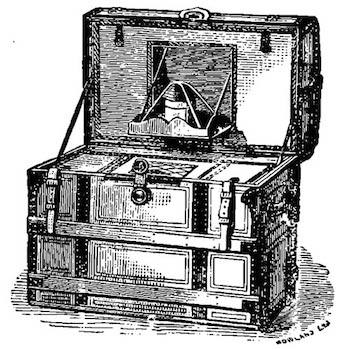
THE MOST RELIABLE
Trunks, Bags, Valises, &c.,
ARE MADE BY
CROUCH & FITZGERALD,
NEW YORK.
TRUNKS
For American Steamer and European Travel.
Extra Fine Quality of Traveling Bags, &c., &c.
Stores:
| 1 Cortland Street. |
(New Store,) |
| 556 Broadway. |
723 Sixth Avenue, |
| |
Below Forty-Second Street. |
☞ Send for Illustrated Catalogue.
BOOKS
FOR TRAVELERS.
American Publishing Co.,
HARTFORD, CONN.
Publishers of Mark Twain's Works:
"INNOCENTS ABROAD," "TRAMP ABROAD,"
AND OTHERS.
Josiah Allen's Wife's Books:
"BETSEY BOBBETT," "MY WAYWARD PARDNER," ETC.
BOOKS OF TRAVEL IN VARIOUS COUNTRIES,
MAKING VALUABLE GUIDE BOOKS,
By Thos. W. Knox, Bret Harte, and other
Popular Authors.
Books sent to any part of the World on receipt of price.
Address,
AMERICAN PUBLISHING COMPANY,
Agents Wanted. HARTFORD, CONN.
Millions of Dollars Saved
TO THE WASTEFUL PEOPLE IN THIS COUNTRY
BY THE USE OF THIS SAFE GUIDE.
The New York Tribune says: "For comprehensiveness and
precision, this book may be said to be unique."
The Boston Traveller says: "In her New Cook-Book, Miss Parloa
has rendered a good service to humanity."
The New York Times says: "It has no nonsense in it, and can
be recommended for general use."
The New Haven Journal says: "It is in many respects the best
book of its kind ever printed."
1 vol., 12mo, cloth, 430 pages, and 89 illustrations, $1.50.
Published by ESTES & LAURIAT, Boston.
For sale by all Booksellers. Sent postpaid on receipt of price.
TRAVELING COMPANIONS.
Before Starting on a Journey, Stow Away some Pleasant Novel in
your Satchel.
We invite attention to the following choice selection of Novels:
THE NO NAME SERIES.
Mercy Philbrick's Choice; Afterglow; Deirdrè; Hetty's Strange History;
Is that All? Will Denbigh, Nobleman; Kismet; The Wolf at the Door; The
Great Match; Marmorne; Mirage; A Modern Mephistopheles; Gemini; A
Masque of Poets. 16mo, Cloth, Black and Gold, price $1.00 each.
THE NO NAME (SECOND) SERIES.
Signor Monaldini's Niece; The Colonel's Opera Cloak; His Majesty,
Myself; Mrs. Beauchamp Brown; Salvage; Don John. Manuela Parédes (in
preparation). 16mo, Cloth, Green and Gold, price $1.00 each.
By the Tiber; a novel, by the author of "Signor Monaldini's
Niece."
The Head of Medusa; a novel, by the author of "Kismet" and
"Mirage."
Blessed Saint Certainty; by the author of "His Majesty,
Myself."
Uniform volumes, 16mo, Cloth, Black and Gold, price $1.50 each.
- My Marriage; a novel, 16mo, cloth, price $1.00.
- Irene the Missionary; a novel, 16mo, cloth, price $1.25.
- Moondyne; a story of the
Under-World, by John Boyle O'Reilly; 16mo, cloth, price $1.50.
- Sarah De Berenger; a novel,
by Jean Ingelow; uniform with "Off the Skelligs" and "Fated to be
Free"; 16mo, cloth, price $1.50.
These books can be procured of any Bookseller, or the Publishers will
mail them, post-paid, on receipt of price.
ROBERTS BROTHERS, Boston.
Books for European Tourists.
A SATCHEL GUIDE for the Vacation Tourist in
Europe. A compact itinerary of the British Isles, Belgium and
Holland, Germany and the Rhine, Switzerland, France, Austria, and
Italy. With Maps, Appendix, and Memoranda pages. Revised every year.
16mo, roan, flexible, $2.00.
"The book is indeed a model of perspicacity and brevity; all the
advice it gives will be found of immediate service. The 'Satchel
Guide' tells the reader how to travel cheaply without a sacrifice
of comfort, and this feature of the book will recommend it to many
Tourists."—Pall Mall Gazette.
SAUNTERINGS. By Charles Dudley Warner. $1.25.
"The book contains a little about England and France, more about
Switzerland and Holland, and a great deal concerning South Germany and
Italy. There is not a dull page in it."—Springfield Republican.
CASTILIAN DAYS. A very attractive book by John Hay, treating
the history, country, cities, people, and politics of Spain. $2.00.
THE LANDS OF SCOTT. By James F. Hunnewell. $2.50.
"It is a delightful epitome of the great author's life and works; the
reader being introduced to a detailed acquaintance with these, while
he is led through the localities which the genius of Scott has
celebrated."—Buffalo Courier.
OLD ENGLAND: Its Scenery, Art, and People. By Prof. James
M. Hoppin, of Yale College. 16mo, $1.75. Includes descriptions of
Derbyshire, Devonshire, the Lake Country, Cornwall, the Old Cathedral
Towns, and those Historic Scenes which most interest Tourists.
⁂ For sale by Booksellers. Sent postpaid on receipt of price
by the Publishers,
HOUGHTON, MIFFLIN & CO., Boston, Mass.
PEOPLE WHO KNOW "HOW TO TRAVEL,"
GO TO EUROPE BY
The State Line,
Composed of new and powerful first-class Passenger Steamers sailing
weekly between
NEW YORK, GLASGOW, AND LIVERPOOL.
EVERY THURSDAY FROM NEW YORK. SAFETY AND SPEED COMBINED.
By taking this route, excursionists will economize in expenditures and
yet enjoy all the comforts and luxuries of an ocean voyage, and a trip
through Scotland via rail to Liverpool free of cost.
No live stock carried on these steamers.
Passage and State-Rooms can be secured in advance by communicating by
letter or telegraph with Agents, or to
AUSTIN, BALDWIN & CO.,
| 164 Randolph St., |
Gen'l Agents, |
53 Broadway, |
| CHICAGO. |
NEW YORK. |
EXCURSIONISTS WHO MAKE PURCHASES ABROAD CAN SAVE TROUBLE AND EXPENSE
BY PLACING THEM IN CHARGE OF
The American-European Express.
(Established 1848.)
BALDWIN BROS. & CO., Proprietors,
53 Broadway, New York.
Parcels, packages, statuary, paintings, and valuables taken charge of
and forwarded to America with care and at very moderate charges.
Custom-house business attended to and goods delivered to any address
in Europe or America.
Principal Agencies.—H. Starr & Co.,
19 Australian Avenue, Jewin Crescent, London; J. & R. McCracken,
38 Queen Street, London; Lherbette, Kane & Co., 19 Rue Scribe,
Paris; Staveley & Co., 1 The Temple, Dale Street, Liverpool;
Lherbette, Kane & Co., 9 Rue de la Bourse, Havre; Matthias Rohde
& Co., Hamburg; J. H. Bachmann, Bremen; A. Warmuth, Berlin;
Maquay, Hooker & Co., Rome; Maquay. Hooker & Co., Florence; W.
J. Turner & Co., Naples; Guiseppe Scala, Naples; Carlo Ponti,
Venice; E. Ramirez, 16 Mercaderes, Havana; John Wallis, Cork; John
Wallis, 33 Bachelors' Walk, Dublin.
WHITE STAR LINE
United States and Royal
MAIL STEAMERS
BETWEEN
New York, Queenstown, and Liverpool.
| BRITANNIC, |
|
GERMANIC, |
|
ADRIATIC, |
| CELTIC, |
|
BALTIC, |
|
REPUBLIC. |
Sail from New York every alternate Thursday and
Saturday.
They are all of them, without exception, among the largest and finest
of ocean steamers, and were constructed with special reference to the
conveyance of passengers.
The saloon and staterooms are located in the midship section, where
but little motion is felt.
No Cattle, Sheep, or Pigs carried.
Rates of Passage as low as by any first-class line.
For inspection of plans, rates of passage, etc., apply at the
Company's Offices, 37 Broadway, New York.
R. J. CORTIS, Agent.
C. L. BARTLETT & CO., Agents for Boston.
BARRITT & CATTELL, Agents for Philadelphia.
A. LAGERGREN, General Western Agent, Chicago.
Fine Art in Jewelry.
 THREE centuries ago the Jewelers of Europe were Artists in every
sense of the word, and Artists of such taste and skill that their
works which have come down to us now command prices as utterly
disproportionate to the intrinsic value of the precious substances of
which they are made as the prices paid for the best works of the
Sculptor in bronze and marble are to the intrinsic value of the
materials out of which those works are hewn or moulded. Many such
Artists bequeathed legacies, since enormously increased in value, to
the Goldsmiths' Company for the purpose of keeping alive their art,
and the enlightened public of London are now beginning to insist that
these endowments shall be put to their legitimate use. We have no
Goldsmiths' Company in New York, but an hour spent in such an
establishment as that of Mr. THEODORE B. STARR, 206 Fifth Avenue, in
this city, will throw a great deal of light, for those who have eyes
to see, on the possible importance, hitherto almost unappreciated
among ourselves, of the æsthetic aspects of the beautiful industry by
which that great corporation has been built up in the mother country.
Mr. Starr has devoted himself steadily and successfully now for nearly
twenty years to artistic work in Jewelry, and the display which he
now makes of such work really deserves to rank among the most
interesting and instructive of our existing art collections. In the
choice and conservation of the more brilliant gems—for there is an
art in conserving as well as detecting the special perfection of
special gems as respects alike their surfaces, their crystallization,
and their color—Mr. Starr shows the taste and training of an Artist,
not less than in the skill and judgment with which he combines and
sets such gems.—New York World.
THREE centuries ago the Jewelers of Europe were Artists in every
sense of the word, and Artists of such taste and skill that their
works which have come down to us now command prices as utterly
disproportionate to the intrinsic value of the precious substances of
which they are made as the prices paid for the best works of the
Sculptor in bronze and marble are to the intrinsic value of the
materials out of which those works are hewn or moulded. Many such
Artists bequeathed legacies, since enormously increased in value, to
the Goldsmiths' Company for the purpose of keeping alive their art,
and the enlightened public of London are now beginning to insist that
these endowments shall be put to their legitimate use. We have no
Goldsmiths' Company in New York, but an hour spent in such an
establishment as that of Mr. THEODORE B. STARR, 206 Fifth Avenue, in
this city, will throw a great deal of light, for those who have eyes
to see, on the possible importance, hitherto almost unappreciated
among ourselves, of the æsthetic aspects of the beautiful industry by
which that great corporation has been built up in the mother country.
Mr. Starr has devoted himself steadily and successfully now for nearly
twenty years to artistic work in Jewelry, and the display which he
now makes of such work really deserves to rank among the most
interesting and instructive of our existing art collections. In the
choice and conservation of the more brilliant gems—for there is an
art in conserving as well as detecting the special perfection of
special gems as respects alike their surfaces, their crystallization,
and their color—Mr. Starr shows the taste and training of an Artist,
not less than in the skill and judgment with which he combines and
sets such gems.—New York World.
COLUMBIA BICYCLE.
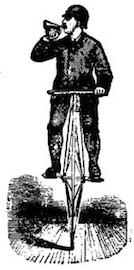 The permanence of the Bicycle as a practical road-vehicle is an
established fact, and thousands of riders are daily enjoying the
delightful and health-giving exercise. The beautiful model and elegant
appearance of the "Columbia" excite universal
admiration; it is carefully finished in every particular, and is
confidently guaranteed as the best value for the money attained in a
Bicycle.
The permanence of the Bicycle as a practical road-vehicle is an
established fact, and thousands of riders are daily enjoying the
delightful and health-giving exercise. The beautiful model and elegant
appearance of the "Columbia" excite universal
admiration; it is carefully finished in every particular, and is
confidently guaranteed as the best value for the money attained in a
Bicycle.
From the President of the Local Telegraph
Co.,
Philadelphia, Pa.
"I am familiar with the various methods adopted by enlightened nations
for healthful sports, agreeable pastime, and exercise, and I must say
that, in my opinion, a consistent use of the wheel far surpasses them
all, both for body and mind. The very marked improvements made by
yourselves and our English friends, in Bicycles, within the past year
or so, convince me that they will soon be no longer a luxury, but a
necessity." (Signed,) HENRY BENTLEY.
Send 3-cent stamp for 24-page catalogue, with price-lists and full
information.
THE POPE MFG. CO., 597 Washington St., Boston, Mass.
Established 1850.
INMAN LINE
United States and Royal Mail Steamers.
City of Rome, 8,300 Tons.
| |
Tons. |
|
|
Tons. |
| City of Berlin, |
5,491. |
|
City of Montreal, |
4,490. |
| City of Richmond, |
4,607. |
|
City of Brussels, |
3,775. |
| City of Chester, |
4,566. |
|
City of New York, |
3,500. |
NEW YORK TO LIVERPOOL,—THURSDAYS OR SATURDAYS.
LIVERPOOL TO NEW YORK,—TUESDAYS OR THURSDAYS.
RATES OF PASSAGE, $80 and $100, according to accommodation, all having
equal saloon privileges. Children between two and twelve years of age,
half fare. Servants, $50.
ROUND TRIP TICKETS, $144 and $180.
TICKETS TO LONDON, $7, and to PARIS $15 and $20 additional, according
to the route selected.
THE STEAMERS of this Line, built in watertight compartments, are among
the strongest, largest, and fastest on the Atlantic.
THE SALOONS are luxuriously furnished, have revolving chairs, are
especially well lighted and ventilated, and take up the whole width of
the ship.
THE PRINCIPAL STATEROOMS are amidships, forward of the engines, where
least noise and motion is felt, and all replete with every comfort,
having double berths, electric bells, and all latest improvements.
LADIES' CABINS and bath-rooms, Gentlemen's smoking and bath-rooms,
Barbers' shops, pianos, libraries, etc., provided.
MEALS SERVED a la carte.
These Steamers do not carry Horses, Cattle, Sheep, or Pigs.
For further particulars apply to
John G. Dale, Agent, 31 and 33 Broadway, New York.
Geo. A. Faulk, Agent, 105 South Fourth St., Philadelphia.
L. H. Palmer, Agent, 3 Old State House, Boston.
F. C. Brown, Agent, 32 South Clark Street, Chicago.
WM. KNABE & CO.,
112 Fifth Avenue,
NEW YORK.
204 and 206 W. Baltimore Street,
BALTIMORE, MD.
"GUION LINE."
United States Mail Steamers
SAILING WEEKLY
Between New York and Liverpool.
(CALLING AT QUEENSTOWN.)
These Steamers are built of Iron, in watertight compartments,
and are furnished with every requisite to make the passage across the
Atlantic both safe and agreeable, having bath-room, smoking-room,
drawing-room, piano, and library; also experienced Surgeon,
Stewardess, and Caterer on each Steamer. The staterooms are all upper
deck, thus insuring those greatest of all luxuries at sea, perfect
ventilation and light.
CABIN PASSAGE, $60, $80, and $100, according to Location, etc.
INTERMEDIATE.—This is a class that affords people of moderate means a
respectable way of traveling. Beds, bedding, wash-basins, etc.,
together with good food, separate dining-room from either cabin or
steerage being provided. Passage, $40 single; $80 round trip.
STEERAGE PASSAGE at Low Rates.
DRAFTS payable in Ireland, England, and Scotland at low rates.
Apply to
WILLIAMS & GUION,
29 BROADWAY, N.Y.
BROWN BROTHERS & CO.,
59 Wall Street, New York,
209 Chestnut Street, Philadelphia,
66 State Street, Boston,
AND
ALEXANDER BROWN & SONS,
Cor. Baltimore and Calvert Streets,
BALTIMORE.
BUY AND SELL BILLS OF EXCHANGE
ON
Great Britain and Ireland, France,
Germany, Belgium, and
Holland.
ISSUE COMMERCIAL AND TRAVELERS' CREDITS
IN STERLING, available in any part of the world, and
IN FRANCS, for
use in Martinique and Guadaloupe.
MAKE TELEGRAPHIC TRANSFERS OF MONEY
Between This and Other Countries,
Through London and Paris.
To Travelers.—Travelers Credits issued either against cash
deposited or satisfactory guarantee of repayment. In Dollars, for use
in the United States and adjacent countries; or in Pounds Sterling,
for use in any part of the world. Application for Credits may be
addressed to either of the above houses direct, or through any
first-class Bank or Banker.
HOUSES IN LONDON AND LIVERPOOL.
Messrs. Brown, Shipley & Co.
HATCH & FOOTE,
BANKERS,
No. 12 WALL STREET,
NEW YORK.
We buy and sell U.S. Bonds, execute orders in Stocks,
Bonds, and Miscellaneous Securities, and transact
a general Banking Business. Interest
allowed on deposits.
OREGON
Railway and Navigation Co.,
OWNING AND OPERATING THE
WALLA WALLA & COLUMBIA RIVER R.R.
OCEAN DIVISION.
The only direct Mail Line from
San Francisco to Portland, Oregon.
Carrying Wells, Fargo & Co's Express.
"GEORGE W. ELDER." "OREGON." "COLUMBIA."
Regular Steamships from Portland to San Francisco and return, every
Five Days until further notice.
Connections made at Portland, Oregon, for all points in Oregon,
Washington and Idaho Territories, British Columbia, and Alaska.
K. Van Oterendorf, Superintendent.
Columbia & Willamette Division.
Connecting with Northern Pacific R.R. at Kalama and Ainsworth; and
with Walla Walla and Columbia River R.R. at Wallula.
Geo. J. Ainsworth, Superintendent.
Walla Walla & Columbia River Railroad.
Connects at Wallula (on Columbia River) with Steamboats of O. R. & N.
Co. This Line, being rapidly constructed, is now open to Weston,
Oregon.
CONSIGN ALL FREIGHT "VIA OREGON RAILWAY & NAVIGATION CO."
H. VILLARD, President.
T. F. OAKES, Vice-Pres't and Gen'l Manager.
A. L. STOKES, General Eastern Passenger Agent,
52 Clark Street, Chicago.
To Travellers Visiting New York.
The International Exchange
AND READING ROOMS,
Madison Square, New York.
(Entrances 953 Broadway, and 185 Fifth Avenue, corner of 23d Street.)
C. A. O'ROURKE & CO., Proprietors.
Strangers to the United States, or to New York, can find at this
institution the information and facilities most useful to them. Among
the features of the establishment are:
1. The leading newspapers of the principal cities of the world are
kept on file. The latest issues of these journals are received by
every mail.
2. Information for travellers as to the places of interest in the
city, and how to visit them. Also in regard to travel, routes, cost,
etc., to all points of the United States, Canada, Mexico, the West
Indies, and South America. Accommodations secured in advance at
leading hotels in all cities. Interpreters and guides furnished.
3. Theatre, Railroad, and Steamship Tickets can be purchased at
regular rates. Diagrams of the seats, and Telephonic communications
with leading Theatres.
4. Foreign Money Exchanged.
5. Direct Telegraphic communication at regular rates with all parts of
the world.
6. The important news of the world, especially if of financial or
commercial interest, received at the Exchange and Bulletined.
7. Notification of Steamship arrivals, and of arrivals and departures
of Mails. Subscribers can receive their Letters at the Exchange.
8. Quotations of Railroad, Mining, Produce, and other Stocks, received
at the Exchange by telegraph.
Americans sojourning in New York en route to Europe can avail
themselves not only of the general advantages of the Exchange, but can
obtain information in regard to routes of travel, principal places of
resort, cost, etc., on the other side of the Atlantic.
The International Exchange counts among its annual subscribers a very
large number of the leading business and public men of New York.
Subscription price $25.00 per year, $10.00 per quarter, $5.00 per
month, payable in advance.
The Traveller, published weekly by the International Exchange
contains, besides matters of general interest, information in a
concise form most useful for travellers.
American Exchange in Europe,
(LIMITED.)
HEADQUARTERS FOR AMERICANS IN EUROPE,
AND
Post-Office Address for Travelers' Correspondence,
449 Strand, London, England.
PRESIDENT, Joseph R. Hawley. GEN'L MANAGER, Henry F. Gillig.
The following Particular Advantages for Travelers:
1st.—The largest number of American newspapers on file in Europe.
2d.—The only place in Europe where the directories of American cities
and towns can be found.
3d.—The only place where arrivals are published weekly, and
circulated throughout the world.
4th.—The only place where Travelers can obtain their Letters
Every Day in the year, and offering facilities to travelers for
correspondence with their friends.
5th.—The only place where the arrival of Steamers on both sides
of the Atlantic is made known by telegraph immediately on being
signaled.
6th.—The only channel for economical telegraphic communication
between America and Europe by a code containing innumerable phrases
specially compiled for travelers, and relating to domestic as well
as business matters.
7th.—The only place in Europe where all the leading American
newspapers are kept on sale.
8th.—The only place where there is a separate reading and writing
room for ladies.
9th.—The only place where all the lines of Steamers and Routes of
European travel are impartially represented; where
impartial information and advice on all subjects relating to
travel can be obtained; and where every requirement of the traveler is
supplied.
10th.—The only place of the kind in Europe managed exclusively by
Americans.
Over six hundred Newspapers, two hundred city and state Directories,
three hundred official State and Municipal Reports regularly filed in
the Reading Rooms of the Exchange.
Travelers' Branch open daily from 9 A.M. to midnight.
Passage Tickets issued available by any line of Steamers.
Freight and Parcels booked at through rates to all parts of the world.
Baggage and Goods Stored.
N.B.—Printed Addressed Envelopes can be obtained Free of Cost at
the Branch Office, 102 Broadway, New York, and at Hotels, Railroad and
Steamship Ticket Offices throughout the United States, Canada, and
Europe.
Henry F. Gillig, General Manager.
E. REMINGTON & SONS,
MANUFACTURERS OF THEIR CELEBRATED
MILITARY BREECH-LOADING RIFLES,
CARBINES and PISTOLS,
of which more than 1,500,000 have been sold to nearly every Government
in the World.
ALSO,
Long, Mid, Short-Range and Sporting
BREECH-LOADING RIFLES,
Which have won for themselves world-renowned reputation
for accurate shooting at Creedmoor, New York;
Dollymount, Ireland; Wimbledon, England;
Ontario, Canada, and many other ranges
throughout the civilized world.
LIKEWISE
Double and Single-Barreled Shot Guns
Equaled by few and inferior to none extant.
Revolving, Repeating and Single Shot Pistols;
ARMY, NAVY, POLICE, HOUSE AND POCKET SIZES,
ONE TO SIX SHOTS.
Cartridges, Loading Implements, Shooting Canes, Bullets, Primers,
Shells, Etc., Etc.
MANUFACTORY:
ILION, HERKIMER COUNTY, N.Y., U.S.A.
SALESROOMS:
283 Broadway, New York,
71 State Street, Chicago, Ill.,
21 So. Howard Street, Baltimore, Md.
LIGHTEN YOUR LABOR
BY USING
The Perfected Type-Writer.
SEE WHAT IT WILL DO.
FROM THE AUTHOR OF "HOW TO TRAVEL."
New York, March 4, 1881.
E. Remington & Sons:—Gentlemen:
In reply to your inquiry of yesterday I beg to say that I consider the
Type-Writer invaluable to any one who has a large amount of writing to
do. For clearing off an accumulation of correspondence on returning
from a journey it is admirable, and for preparing printer's "copy" it
is unrivaled. If I could not get another Type-Writer I would not
willingly take ten thousand dollars for the one I now have. It is
little more than two years since I bought it, and in all that time its
repairs have cost exactly fifty cents. Besides all my private
correspondence, magazine articles, and newspaper matter, I have
written four books with this machine and shall complete a fifth in a
few days. The saving of time to me is not far from 25 per cent., and
in this one item the Type-Writer has paid for itself several times
over.
Very truly yours,
THOS. W. KNOX.
MANUFACTURED AND SOLD ONLY BY
E. Remington & Sons,
PRINCIPAL OFFICES:
281 and 283 Broadway, New York.
BRANCH OFFICES:
38 Madison St., Chicago. 124 So. 7th St., Philadelphia.
LINDO BROS.
M. Crane,
53, 55, and 57 Park Place,
New York.
Electrotyping
and
Stereotyping
In all its Branches.
Fine Electrotypes from Engravings
a Specialty.
Specimens of work sent on application,
and
Satisfaction Guaranteed.
THE PERMANENT CURE OF CATARRH.
Rev. T. P. Childs' Treatment the Only Effectual Way.
CHILDS' CATARRH SPECIFIC
Is no new untried cure, but a Positive and Certain Remedy.
WE, ABOVE ALL THINGS, DESIRE TO ESTABLISH CONFIDENCE IN OUR TREATMENT,
SO THAT EVERY SUFFERER FROM CATARRH AND BRONCHITIS MAY FEEL CERTAIN OF
SUCCESS IN ITS USE.
193 E. Fayette St., Baltimore, Md., Dec. 20, 1879.
Rev. T. P. Childs.—I have the pleasure
of informing you that after a faithful use of your remedy for eight
weeks ending March 28, 1879, I am completely rid of a stubborn case of
catarrh of three years' standing—breathing tubes clear as a
whistle, appetite good, and digestion good.
Yours,
Thomas B. Hand.
Rev. T. P. Childs: Dear Sir—I think you
have the true theory and practice for cure of nasal catarrh, and also
for the treatment of respiratory organs. My throat is now so well
restored that I can lecture daily without any difficulty, and find no
difficulty whatever in preaching. You are at full liberty to use my
name for the benefit of others.
Yours very truly,
E. B. Fairchild, D.D., LL.D.,
Chancellor of the University of Nebraska, Lincoln, Neb.
WHAT THE EDITORS SAY.
"While not supposing that all cases of catarrh will be cured by the
prescription advertised, the publishers of the Illustrated Christian
Weekly, after diligent inquiry, have reason to believe that it has in
many cases proved effectual."—Illustrated Christian Weekly,
New York.
"The publishers of the Congregationalist, with multitudes of other
people, are somewhat suspicious of patent medicines as a rule, and
when we received the advertisement of Mr. Childs we at first declined
its insertion; but, on making inquiry, we received such satisfactory
replies, and one especially from a well-known Congregational pastor
not far from Rev. Mr. Childs, the proprietor of the medicine, that we
withdrew our objections."—Congregationalist, Boston.
CHILDS' CATARRH SPECIFIC will effectually and permanently cure any
case of catarrh, no matter how desperate. It can only be obtained at
Troy, Ohio. The treatment is local as well as constitutional, and
cannot be obtained at the drug stores. We especially desire to treat
those who have tried other remedies without success.
Child's Treatment of Catarrh, and for diseases of the Bronchial Tubes,
can be taken at home, with perfect ease and safety, by the patient. No
expense need be entailed beyond the cost of the medicine.
Rev. T. P. CHILDS, Troy, Ohio.
THE POLAND SPRING WATER
Has cured numerous cases of Bright's Disease of the Kidneys,
as well as other forms of disease resulting from Blood
Poison, such as Malarial Fever, Rheumatic
Fever, Dyspepsia, Constipation,
Gravel, Diabetes, Scrofula,
Dropsy, Etc.
Although an exceedingly pleasant water to drink, it possesses those
peculiar properties that restore to action the Kidneys, Liver, and
other Internal Organs that may have become sluggish in their
movements. Thus by cleansing the blood the body is restored to its
original vigor, and the complexion to its original freshness and
beauty. Were it more generally used there would be far less demand for
drugs and cosmetics.
The following gentlemen of this city will cheerfully bear testimony to
its remarkable curative qualities:
J. W. Pottle; S. Jacoby, 103 Broad Street; J. M. Schuyler, 114 Wall
Street; C. E. Blumenthal, M.D., 54 West 45th Street; W. G. Tuller and
Ira Thorn, Fifth Avenue Hotel; J. Munroe Taylor, 113 Water Street; C.
Y. Wemple, Vice-Pres't Manhattan Life Insurance Company; Root &
Childs, 87 Worth Street; J. B. Libby, of H. J. Libby & Co., White
Street; Deering & Milliken, 79 and 81 Leonard Street; G. N. Dickinson,
of Lee, Tweedy & Co.; A. A. Vantine, 827, 829, and 831 Broadway;
Edward Carroll, of Falconer, Carroll & Co.; C. P. Tooker, of Kiggins,
Tooker & Co., 125 William Street; John R. Ames, Board of Education;
George A. Dresser and Wm. Silver, Queens Insurance Company; W. H.
Scott, M.D., 8 East 41st Street; Henry C. Houghton, M.D., 44 West 35th
Street; H. K. White, 548 Broadway; Wm. H. Lindsley, 279 Broadway; M.
M. Stanfield, Victoria Hotel; Wm. B. Bogle, of Bogle & Lyles; I. F.
Slader, Brandreth House; F. J. Allen, Astor House; J. H. Small, 111
Front Street.
The undersigned have within their personal knowledge cases in which
Poland Spring Water has proved highly beneficial.
H. L. Bridgman. Thos. W. Knox
☞ For sale in large or small quantities by
O. HUTCHINSON, the Authorized Agent,
145 Nassau St., New York
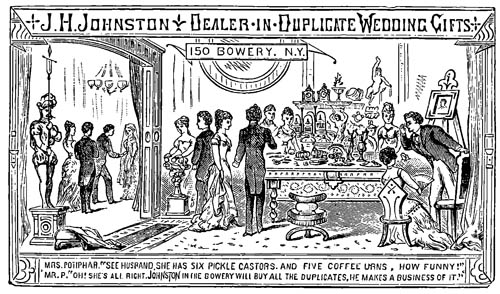
J. H. Johnston,
150 Bowery, New York,
Duplicate Wedding Presents,
SURPLUS SILVERWARE,
DIAMONDS, WATCHES,
JEWELRY, BRONZES,
AND PAINTINGS.
Inscriptions erased and Silverware refinished and sold
50 PER CENT. BELOW MANUFACTURERS' COST.
Constant Bargains in New and Second-hand
WATCHES.
FINE DIAMONDS BELOW PARIS PRICES.
ESTABLISHED OVER 30 YEARS,
Dealing only in Fine Goods. A visit to 150 Bowery will well repay the
curious, or those who want the best Goods at surprisingly low prices.
Tourjee's Tours,
FOURTH SEASON,
The most enjoyable, economical and successful excursion tours ever
planned to the
OLD WORLD.
All Travel and Hotels First-Class.
COMPANY SELECT.
Important additions to our former tours. Extra inducements without
extra charge. Early registration important. Parties contemplating a
visit to Europe should send for circular giving full particulars.
E. Tourjee,
Music Hall, Boston.
The following is from the Physicians' Pocket Manual and Year Book.
"Three years ago, he planned a new way of seeing the wonders of the
Old World, and what have now become famous as the Tourjee Excursions
are such as every intelligent person will heartily endorse.
The cost to each excursionist varies from $175 to $700, and these
figures include first-class transportation, hotel accommodations,
carriage drives, lunches and all incidentals. From the time he embarks
to the day he returns to New York, the tourist is not obliged to take
out an additional cent from his purse. We heartily endorse these
pleasant trips, and believe that they merit the appreciation of the
medical profession. In the previous excursions, quite a number of
eastern medical men participated, and several will have gone over the
ground again the present year. The advantages which they offer for
recuperation, both to physicians and patients, are unsurpassed, and
we hope that many a year will have passed before they shall be
discontinued. The old way of seeing the Old World has always had
many drawbacks; the new way affords thrice the benefit for less
than one-half the expenditure."
FRANK LESLIE'S ILLUSTRATED PUBLICATIONS.
RATES OF SUBSCRIPTION, POSTAGE PAID.
| WEEKLIES. |
| Frank Leslie's Illustrated
Newspaper—The only pictorial record of current events,
devoted to news, literature, art, and science, |
$4.00 |
| Frank Leslie's Chimney Corner—The best American family
journal, story paper, and home friend, |
4.00 |
| Frank Leslie's Lady's Journal—The highest exponent of
fashion and taste, |
4.00 |
| Frank Leslie's Illustrirte Zeitung—In the German
language. A weekly compendium of news and literature, |
4.00 |
| Frank Leslie's Boys' and Girls' Weekly—An illustrated
journal of amusement, adventure, and instruction, |
2.50 |
| |
|
| MONTHLIES. |
| Frank Leslie's Popular Monthly—The cheapest and most
attractive monthly magazine, |
3.00 |
| Frank Leslie's Sunday Magazine—The best pictorial
religious periodical, |
3.00 |
| Frank Leslie's Lady's Magazine—Regarded universally
as a fashion standard, |
3.50 |
| Frank Leslie's Pleasant Hours—Cheap and entertaining.
Devoted to fiction. Every article complete, |
1.50 |
| Frank Leslie's Budget of
Wit—Filled with intelligent humor, |
1.50 |
| |
|
| ANNUALS. |
| Frank Leslie's Illustrated Almanac
for 1881—A charming annual, with colored Plates, |
.25 |
| Frank Leslie's Comic
Almanac—A racy annual compendium of fun, humor, and
information, |
.10 |
The various publications of this house embrace a wide range of
popular reading. The illustrations are of the highest order, by
the most skilful artists. The literary matter is contributed by
authors and writers of great reputation and acknowledged popularity.
Most liberal outlays are made to secure the best talent in the
market, both instructive and amusing.
No "traveling agent" is authorized to collect money for our
publications. Remit by money-order, draft on New York, or registered
letter, at our risk. Address
FRANK LESLIE'S PUBLISHING HOUSE,
53, 55, and 57 Park Place, New York.
THE ASSOCIATED LINES
OF
Southern Railway Travel,
COMPRISING
PIEDMONT AIR LINE,
CENTRAL SHORT LINE,
ATLANTIC COAST LINE,
THE BAY LINE.
Concentration of control under One Management.
Special U.S. Fast Mail, and Double Daily Passenger Route.
SHORTEST LINES BETWEEN NORTH AND SOUTH.
Extended Pullman Sleeping-Car Service.
First-class equipment and all standard appliances.
New York, Philadelphia, Baltimore, AND Washington
TO
New Orleans, Mobile, Montgomery, Atlanta,
AND INTERMEDIATE POINTS; ALSO,
Charleston, Macon, Savannah, all points in
Southwest Georgia, and Florida.
IMMIGRATION.
Arrangements have been perfected by which a complete system of
settlers' and immigrants' fares from leading Eastern cities exist to
each station upon the lines of railways of this organization, and the
attention of immigrants and all persons seeking investments in the
Southern States is invited to exhibits soon to be published concerning
unimproved lands, improved farms, sites for manufacturing purposes,
supplies and location of growing hard woods, deposits of minerals,
metals, and building materials, together with facts of physical
attractions, accessibility to railway or water transportation, or
desirable markets.
Full information concerning the Lines, points reached, matters of
tickets, schedules, sleeping car reservations, etc., etc., to be had
on application to
306 Washington St., Boston.
838 Chestnut St., Philadelphia.
229 Broadway, New York.
511 Pennsylvania Ave., Washington.
AND ALL LEADING TICKET OFFICES EAST.
A. Pope, General Passenger and Ticket Agent.
"WING & SON"
Piano-Fortes
Possess all the delicate tone and action qualities claimed by the
leading makers. An inspection will surely prove the fact. The new
TREBLE REFLECTOR
(Wing & Son's invention,) gives a remarkable bird-like quality to the
HIGH TREBLE NOTES.
As to Prices.
This establishment can furnish a remarkable instrument in its musical
qualities and encased after a new and unconventional design for the
sum of $400.
Send for the reports of Hoffman and other celebrated Pianists
to the office of
1298 and 1300 Broadway, N.Y.
FOR MAGAZINES AND NEWSPAPERS,
AMERICAN AND FOREIGN.
SEND FOR OUR CATALOGUE,
NOW READY FOR DISTRIBUTION.
It gives CLUB RATES for all the prominent Publications, American
and English.
☞ We make the import of Foreign Periodicals, by mail
or otherwise, a specialty. The following are samples of our prices per
year, post-paid:
| ENGLISH. |
| Academy, |
$4.15 |
| Athenæum, |
4.30 |
| Agricultural Gazette, |
5.50 |
| Architect, |
6.00 |
| Boy's Own Paper, |
2.00 |
| Building News, |
6.50 |
| British Architect, |
5.75 |
| Chamber's Journal, |
2.50 |
| Chemical News, |
4.75 |
| Engineering, |
8.80 |
| English Mechanic, |
3.25 |
| Graphic, |
8.75 |
| Illustrated News, |
8.75 |
| London Times (Weekly), |
3.25 |
| Pall Mall Budget, |
7.40 |
| Punch, |
3.75 |
| Queen, |
9.25 |
| Saturday Review, |
7.40 |
| Spectator, |
7.40 |
| Art Journal, |
8.50 |
| Cornhill, |
3.60 |
| Fraser, |
8.00 |
| Hamerton's Portfolio, |
8.50 |
| London Society, |
3.60 |
| Contemporary Review, |
7.25 |
| Nineteenth Century, |
7.25 |
| Fortnightly, |
6.50 |
| Revue des Deux Mondes, |
14.25 |
| AMERICAN. |
| Harper's Magazine, |
$3.45 |
| Harper's Bazaar, |
3.45 |
| Harper's Weekly, |
3.45 |
| Harper's Young People, |
1.35 |
| American Architect, |
5.50 |
| American Journal of Science and Art, |
5.00 |
| Blackwood, |
3.45 |
| Contemporary Review (reprint), |
2.15 |
| Literary World, |
1.80 |
| Lippincott's Magazine, |
2.65 |
| Popular Science Monthly, |
4.35 |
| Appleton's Journal, |
2.65 |
| Sunday Magazine, |
2.65 |
| American Law Review, |
3.45 |
| New Englander, |
3.87 |
| Atlantic Monthly, |
3.45 |
| Scribner's Monthly, |
3.45 |
| St. Nicholas, |
2.65 |
☞ Librarians and Managers of Book Clubs and
Reading Associations are especially requested to notice this.
Time, Labor, and Money are saved by
ordering through our agency.
☞ Send for our Catalogue, giving prices of nearly Two
Thousand Periodicals, American, English,
French, and German, at club-rates. Free to any
address upon request.
ALBERT H. ROFFE & CO.,
11 BROMFIELD STREET,
BOSTON, MASS.
DAILY OCEAN EXCURSIONS TO
ROCKAWAY BEACH,
BY THE ENTIRELY NEW PALATIAL STEAMERS,
Grand Republic and Columbia.
Universally conceded to be the largest, finest, and best adapted
Excursion Steamers in the world, combining everything that contributes
to the safety, comfort, and luxury of pleasure seekers.
THE GRAND REPUBLIC,
With Band and the Columbia Glee Club,
| Leaves: |
| 22d Street, North River, |
at 10.00 A.M. |
| Pier 6, North River, |
at 10.20 A.M. |
| Jewell's Wharf, Brooklyn, |
at 10.40 A.M. |
| Leaving |
| ROCKAWAY, Upper Landings, |
at 4.00 P.M. |
| Lower Landings, |
at 4.30 P.M. |
THE COLUMBIA,
With Deverell's 13th Reg't Band and Concordia Glee Club, Cornet
Soloist, Xylophone, etc.,
| Leaves: |
| West 22d Street, |
at 9.00 A.M. and 2.00 P.M. |
| Pier 6, North River, |
at 9.15 A.M. and 2.15 P.M. |
| Jewell's Wharf, Brooklyn, |
at 9.30 A.M. and 2.30 P.M. |
DIRECT FOR ROCKAWAY BEACH.
| Leaving |
| ROCKAWAY, Upper Landings, |
at 5.30 P.M. |
| Lower Landings, |
at 6.00 P.M. |
The best order and discipline maintained. Ladies with Children are
perfectly safe in traveling under the care of the Captains, aided by
efficient Officers and a platoon of Police.
Passage Cards, 35 cents. Excursion Tickets, 50 cents.
Children from 5 to 12 years, Half-price; Under 5, Free.
THE MUTUAL LIFE
Insurance Company,
OF NEW YORK.
Nos. 144 and 146 Broadway.
F. S. WINSTON, President.
R. A. McCURDY, Vice-President.
Assets, January 1, 1881,
OVER
NINETY-ONE MILLIONS
OF DOLLARS.
COLONEL KNOX'S
Books of Travel.
The BOY TRAVELERS in the FAR EAST. Part I.
Adventures of Two Youths in a Journey to Japan and China. By
Thomas W. Knox. Illustrated. 8vo, Illuminated Cloth,
$3.00.
The BOY TRAVELERS in the FAR EAST. Part II.
Adventures of Two Youths in a Journey to Siam and Java. With
descriptions of Cochin-China, Cambodia, Sumatra, and the Malay
Archipelago. By Thomas W. Knox. Illustrated. 8vo,
Illuminated Cloth, $3.00.
These volumes will serve an admirable purpose in the education of our
young people.—N.Y. Herald.
That which Mayne Reid did for a past generation Col. Knox is doing for
readers of to-day. He is producing books of travel fascinating alike
for old and young.—N.Y. Journal of Commerce.
Great favorites with youthful readers.—Christian-at-Work, N.Y.
The best, most instructive, and pleasing books for boys ever
issued.—Boston Post.
Published by HARPER & BROTHERS,
Franklin Square, New York.
☞ Harper & Brothers will send any of the
above works by mail, postage prepaid, to any part of the United
States, on receipt of price.
"Whoever would derive the most information, enjoyment, and
satisfaction from travel, should always use the best Guide-Books."
OSGOOD'S AMERICAN GUIDE-BOOKS.
"These books contain everything which the traveler wants to know,
in precisely the shape he wants to have it."—Boston
Journal.
Arranged on the celebrated Baedeker plan, indorsed by all European
travelers.
The history, poetry, and legends of each locality, tersely and clearly
given.
Scores of maps, city plans, and panoramas.
Giving prices and locations of all hotels and boarding-houses, summer
resorts, and routes.
There are Four Volumes, bound in flexible cloth, and each of
about 500 pages, with many maps and plans.
New England, The Maritime Provinces,
The Middle States, The White Mountains.
"They are simply indispensable to tourists in the regions named;
and those who have sallied forth without them have omitted the
really most important part of their equipment."—Literary
World.
"As for accuracy, the amount of work done by the editor has been
enormous. To say that the books are better than any American books
of the sort that have hitherto appeared would be superfluous;
there is no comparison to be made between them and their
predecessors."—The Independent.
Revised Annually. Price $1.50 Each.
⁂ For sale by all Booksellers, or sent postpaid on receipt of
price, by the Publishers,
JAMES R. OSGOOD & CO., Boston.
Established 1801.
Broadway and Fulton St., New York.
NEVER was this paper more able, bright, and newsy than at
present.—St. Paul Press.
YOUNGER, fresher, and altogether a better newspaper than
ever.—Trenton Gazette.
EXCEEDINGLY welcome visitor to the evening companionship of reading
people.—Philadelphia Ledger.
VERY few American journals equal the Evening Post for
reputation and influence among thinking people.—Newspaper
Directory.
EVEN its advertising columns are jealously guarded against
questionable or objectionable advertisements.—Newspaper Guide.
NOW the ablest evening paper in the world. Faithful and accurate as a
newspaper.—Mohawk Valley Democrat.
ITS readers include a large proportion, if not a majority, of the
literary and business world.—N.Y. Daily Bulletin.
NOTHING is to be found in its columns which would exclude it from the
most refined family circle.—Pittsburgh Post.
GENERALLY acknowledged to be the door by which access is to be gained
to the New York homes.—Rowell's Newspaper Guide.
POLITICALLY it is the ablest and most independent journal of
republican proclivities in New York.—Philadelphia Times.
OUR contemporary's prosperity speaks well for its management, and for
the moral tone of its readers.—Newburgh Journal.
SUITED for the family circle as well as for the office of the man
interested in politics and news.—Pittsburgh Post.
THE EVENING POST has a very large circulation among the respectable
reading public of this city.—New York World.
Daily, $9; Semi-Weekly, $3; Weekly, $1.50.
Favorable Terms to Clubs. Specimen Copy Free.
The W. C. BRYANT CO., Publishers,
BROADWAY AND FULTON ST., NEW YORK.
THE NEW YORK TRIBUNE.
The Tribune is now spending more labor and money than ever
before to maintain the distinction it has long enjoyed of having the
largest circulation among the best people. It secured, and means to
retain it, by becoming the medium of the best thought and the voice of
the best conscience of the time, by keeping abreast of the highest
progress, favoring the freest discussion, hearing all sides, appealing
always to the best intelligence and the purest morality, and refusing
to cater to the tastes of the vile or the prejudices of the ignorant.
THE LIBRARY OF UNIVERSAL KNOWLEDGE, embracing Chambers' Encyclopædia
complete, omitting only some of the cuts, with extensive additions by
an able corps of American editors, treating about 15,000 additional
topics, thoroughly Americanizing the entire work, adding to it over 25
per cent. of the latest, freshest, and most valuable matter, the whole
making 15 handsome Octavo Volumes of 6 by 9½ inches in size,
printed in large type on good strong calendered paper, and neatly and
substantially bound in cloth.
We can offer this valuable work in connection with THE TRIBUNE as
follows:
| FOR $15. |
The Library of Universal
Knowledge complete in 15 octavo volumes,
substantially bound in cloth as above described,
and THE WEEKLY TRIBUNE 5 years to one subscriber. |
| FOR $20. |
The Library of Universal Knowledge
as above described, and THE SEMI-WEEKLY TRIBUNE 5
years to one subscriber. |
| FOR $19. |
The Library of Universal Knowledge
as above described, and ten copies of THE WEEKLY TRIBUNE
one year. |
| FOR $28 |
The Library of Universal Knowledge
as above described, and twenty copies of THE WEEKLY TRIBUNE
one year. |
For further particulars concerning this and other valuable premiums,
address
THE TRIBUNE, New York.
The Hartford (CONN.) Courant.
THE OLDEST NEWSPAPER IN AMERICA.
A REPRESENTATIVE JOURNAL OF NEW ENGLAND.
Established: Weekly, 1764; Daily, 1836.
| |
{ |
Joseph R. Hawley, |
| Hawley, Goodrich & Co., |
{ |
Wm. H. Goodrich, |
| Publishers. |
{ |
Chas. Dudley Warner, |
| |
{ |
Stephen A. Hubbard. |
New Courant Building, State St.
THE COURANT is the Oldest Newspaper in the United States, and, with
less than half a dozen exceptions, the oldest print in the English
language. It was founded in October, 1764, and has been published
uninterruptedly, under the same title, ever since.
Terms: Weekly, $1.50 a Year; Daily, $8.00.
THE BEST
ADVERTISING MEDIUM
IN THE STATE.
☞ Send for sample copies, which will be sent FREE.
Insure Your Life
IN AN
OLD AND STRONG COMPANY.
OF HARTFORD, CONN.,
Issues Policies upon all Desirable Plans at Rates Lower than those of
most Companies.
The Ætna Life Insurance Company.—In mentioning this Company
we must reiterate the well-known fact that it stands at the very head
of the list of life insurance companies. For thirty years it has stood
the storms of financial fluctuation, and now remains the strongest
life insurance company in the country. Its management is in the hands
of experienced and trustworthy men, as is shown by referring to the
condition of the Company shown by their statement of
affairs.—Hartford Journal.
STATUARY
IN
Granite,
Marble; AND
Bronze,
Artistic Memorials,
AND
Building Work
IN ALL KINDS OF GRANITE.
Original Designs and Estimates furnished Free on application.
WORK DELIVERED IN ALL PARTS OF THE COUNTRY.
ADDRESS
The New England Granite Works,
HARTFORD, CONN.
Quarries at Westerly, R.I.
BUY THE
"HARTFORD"
FOR DURABILITY, COMFORT, AND ECONOMY.
WARRANTED NEVER TO SAG.
NEVER TO LOSE ITS SHAPE.
NEVER TO MAKE A NOISE.
NEVER TO NEED A REPAIR.
The "HARTFORD" Mattress is durable. It will last a
life-time. One-third of every person's life ought to be spent
in sleep, hence the necessity for a perfect sleeping
arrangement. The "HARTFORD" Mattress affords the greatest
comfort; conforming to the body, it makes a most delightful
bed. The "HARTFORD" Mattress will never wear out or need a
repair. Requiring over the Mattress only a blanket or a very
light mattress, much is saved in the way of expense in not being
obliged to purchase heavy hair mattresses or other over-bedding. The
"HARTFORD" Woven Wire Mattress is free from the disagreeable
noises so annoying in the upright spiral spring. The "HARTFORD"
Mattress always keeps its shape, being as elastic and flexible after
fifteen years use as when first manufactured. Investigate its merits.
Buy only the genuine "HARTFORD." Take no other. Beware of
imitations and infringements. Every Mattress marked "HARTFORD."
For prices, catalogues, or any desired information,
ADDRESS
Hartford Woven Wire Mattress Co.,
Box 148, Hartford, Conn., U.S.A.
HENRY ROBERTS, Secretary.
"THE HARTFORD"
Sewing Machine.
THE LATEST PRODUCTION,
Combining all the BEST POINTS of former models of Machines
with new excellencies of its own.
The lightest running Machine ever made.
SIMPLE, STRONG, DURABLE.
The only High-Arm Machine making the "Pearl Stitch."
All Bearings of Steel or Forgings.
Self-Adjusting Tensions.
The Original and Simplest Cylinder Shuttle.
Elegant Ornamentation.
"THE GENERAL FAVORITE,"
For Shoemakers, Saddlers, Tailors, Etc.,
IS THE
STANDARD AMONG AMERICAN MANUFACTURERS.
Weed Sewing Machine Company,
Hartford, Conn., U.S.A.
ESTERBROOK'S
Steel Pens.
The Most Popular Pens in Use.
For sale by all Stationers.
Leading Nos. 048, 14, 130, 333, 161.
Samples and Catalogue on Application.
THE ESTERBROOK STEEL PEN CO.,
Works, Camden, N.J. 26 John St., New York.
N. P. FLETCHER & CO.,
Hartford, Conn.,
Publishers, and Manufacturers of the Celebrated
Fletcher Ink Extracts.
These preparations are soluble concentrated compounds, containing the
coloring matters and mordants used in the best Inks. By the addition
of water only, an Ink of beautiful color and fine quality is at once
produced. Invaluable for Travelers, as the dry and powdered
Extracts can be carried in small space and used at convenience. Used
for the last six years in the best Banks, Insurance Offices, and
Counting Rooms of the United States.
COLORS: Rose-Scarlet, Brilliant Green, Blue, Violet, and Black.
Full descriptive circulars mailed on application.
FAIRBANKS' SCALES.
The Worlds' Standard.
HIGHEST AWARDS, WORLD'S FAIRS.
| London, 1851. |
|
Philadelphia, 1876. |
| New York, 1853. |
|
Sydney, Australia, 1877. |
| Paris, 1867. |
|
Paris, 1878. |
| Vienna, 1873. |
|
Sydney, Australia, 1880. |
| Santiago, Chili, 1875. |
|
Melbourne, Australia, 1881. |
At the World's Fair in Paris, in 1878, Fairbanks & Co. received
seven medals, more than were awarded any other American
exhibitors; at the Sydney, Australia, World's Fair, in 1881, in
competition with manufacturers from the United States, Great Britain,
and France, they received a special award above all others; and
at Melbourne, Australia, World's Fair, in 1881, also in competition
with American, English, and French manufacturers, Fairbanks' scales
received the four highest awards.
The Cheapest Scale Manufactured!
QUALITY CONSIDERED.
Correspondence solicited. Price list furnished upon application.
OVER ONE MILLION OF THESE SCALES IN USE.
Principal Warehouse,
FAIRBANKS & CO., New York.
- FAIRBANKS & CO., Baltimore, Md.
- FAIRBANKS & CO., New Orleans.
- FAIRBANKS & CO., Buffalo, N.Y.
- FAIRBANKS & CO., Albany, N.Y.
- FAIRBANKS & CO., Montreal.
-
- FAIRBANKS & CO., London, Eng.
- FAIRBANKS, BROWN & CO., Boston, Mass.
- FAIRBANKS & CO., Philadelphia, Pa.
- FAIRBANKS, MORSE & CO., Chicago.
- FAIRBANKS, MORSE & CO., Cincinnati, O.
-
- FAIRBANKS, MORSE & CO., Cleveland, O.
- FAIRBANKS, MORSE & CO., Pittsburg, Pa.
- FAIRBANKS, MORSE & CO., Louisville, Ky.
- FAIRBANKS & CO., St. Louis.
- FAIRBANKS & HUTCHINSON, San Francisco.
Agent for Fairbanks' Scales in the Russian Empire,
J. BLOCK,
MOSCOW AND ST. PETERSBURG
LIBERAL AND IMPORTANT CONCESSIONS
IN LIFE INSURANCE CONTRACTS.
Examine the New Form of Policy
ISSUED BY
The United States Life Insurance Company,
Before Insuring Elsewhere.
NOTE THE LIBERALITY OF ITS TERMS.
After the premiums for three or more years have been paid, upon
receiving the required notice from the assured, the Company will
continue the Policy in force without further payments, for its
Full Face, for such a period as the Entire Reserve
will carry it.
Should the death of the insured take place during the continued term
of insurance as provided for above, the full face of the Policy will
be paid—no deduction being made for forborne or unpaid premiums,
excepting in the event of the death occurring within three years after
the default.
The new form of Endowment Policy provides: That if the
Entire Reserve is a greater sum than the single premium
required to carry the full amount of insurance to the end of the
Endowment term, the Excess shall be issued as a single
premium to purchase a pure Endowment, payable at the end of the term,
thus guaranteeing to the Policy-holder in every event the full value
of his Reserve.
No Surrender of the Policy is required—only a notice from
the Policy-holder, on blanks furnished by the Company.
After Three Years, all Restrictions and
Conditions in regard to travel, residence, occupation, and
cause of death are removed, thus making the Policies after three years
Incontestable for any Cause excepting Fraud.
All Forms of Life and Endowment Policies Issued.
THE UNITED STATES
Life Insurance Company in the City of New York,
261 Broadway.
OFFICERS.
- T. H. BROSNAN, President.
- C. P. FRALEIGH, Secretary.
- A. WHEELWRIGHT, Assistant Secretary.
- CHAS. H. MILLER, Cashier.
- GEO. H. BURFORD, Actuary.
- A. H. BUCK, Medical Director.
- JOHN P. MUNN, Medical Examiner.
- HEGEMAN & BUEL, Counsel.
BOARD OF DIRECTORS.
- Charles E. Bill, Banker, 13 Broad Street.
- Isaac N. Phelps, Banker, 45 Wall Street.
- Clinton Gilbert, Treasurer Greenwich Savings Bank.
- Wm. H. Bolles, Retired Merchant, Garden City, L.I.
- Henry W. Ford, Pres. Bank of the Republic.
- Edgar S. Van Winkle, Counsellor, 48 Wall Street.
- W. A. Ogden Hegeman, Counsellor, 261 Broadway.
- Thomas Gardiner, Retired, 13 East 62d Street.
- N. F. Graves, Pres. N.Y. State Bkg. Co., Syracuse, N.Y.
- D. Kellogg Baker, Provisions, 335 Greenwich Street.
- James Buell, Banker.
- H. K. Thurber, Wholesale Grocer, 116 Reade Street.
- P. Van Volkenburgh, Dry Goods, 62 Worth Street.
- Edward H. Ammidown, Dry Goods, 87 Leonard Street.
- Julius Catlin, Jr., Dry Goods, 132 Church Street.
- Jno. A. Livingston, Sugar Refiner, 91 Wall Street.
- Henry C. Hulbert, Paper, 13 Beekman Street.
- James R. Plum, Leather, 42 Spruce Street.
- George G. Williams, Pres. Chemical National Bank.
- Antony Wallach, Mfg. Jeweler, 11 Maiden Lane.
- Oliver P. Buel, Counsellor, 261 Broadway.
- Geo. W. Perkins, President Mercantile National Bank.
- Timothy H. Brosnan, President.
- Henry L. Clapp, Scales, 311 Broadway.
- Raphael Buchman, Clothing, 465 Broome Street.
- Edward Van Volkenburgh, Dry Goods, 62 Worth St.
- Charles P. Fraleigh, Secretary, 261 Broadway.
- John P. Munn, M.D., 50 East 31st Street.
THE
UNITED STATES MUTUAL
Accident Association.
Office, 409 Broadway, New York.
Incorporated Oct. 11, 1877.
$3.00 will procure a certificate of membership entitling the member to
$5,000.00 in the event of death by accident, and $25.00 weekly
indemnity for totally disabling injury. Over 4,000 Business Men now
members.
CHARLES B. PEET, President.
BOARD OF DIRECTORS.
- Chas. B. Peet, of Rogers, Peet & Co.
- Wm. Brinckerhoff, of Wm. Brinckerhoff & Co.
- E. E. Perry, with Wheeler & Wilson Manufacturing Co.
- William E. Tefft, of Tefft, Weller & Co.
- Ferdinand P. Earle, of Earle's Hotel.
- Decatur M. Sawyer, of Gowing, Grew & Co.
- Wm. Bro. Smith, 229 Broadway, New York.
- W. S. Gilmore, Crouch & Fitzgerald.
- Wm. Gibson, with Morrison, Herriman & Co.
- Leopold Wormser, with L. Levenson & Co.
- James S. Leeds, of Wm. T. Lloyd & Co.
- George C. Clarke, of Tefft, Weller & Co.
PORTABILITY COMBINED WITH GREAT POWER
Will show Objects Distinctly Two to Six Miles.
Spectacles and Eye-Glasses,
To Strengthen and Improve the Sight,
Adjusted to all Defects of Vision.
Catalogues sent by enclosing stamp.
SEMMONS, Oculist and Optician,
687 Broadway, New York.
Accident Department.
MUTUAL BENEFIT LIFE CO.
118 Asylum Street,
HARTFORD, CONN.
Accident Protection at Actual Cost!
ADMISSION:
$3 for any Amount up to $5000.
Future Expenses 25 cents per month as long as continued, and
assessments to cover losses only, at table rates.
ANY MAN HIS OWN AGENT.
Send for Application, which anyone may fill out, and return to Company
with fee.
WEEKLY INDEMNITY, $5 to $25.
☞ AGENTS WANTED EVERYWHERE.
THE TRAVELERS
Life and Accident Insurance Co.,
HARTFORD, CONN.
Oldest and Largest in America.
JAS. G. BATTERSON, President.
RODNEY DENNIS, Secretary.
| Cash Assets, |
$5,519,000 |
| Surplus, |
1,467,000 |
| Benefits Paid, |
5,650,000 |
GENERAL ACCIDENT POLICIES, by the year or month, written by Agents.
REGISTERED ACCIDENT TICKETS, one to thirty days, at Agencies and
Railroad Stations.
PERMIT FOR FOREIGN VOYAGE at slight addition to cost of ordinary
Policy.
| Accident Policies Written, |
650,000 |
| Accident Claims Paid, |
55,000 |
| Amount Paid for Accidents, |
$4,000,000 |
REGULAR LIFE INSURANCE, all best forms, with ample security, at Low
Cash Rates.
Transcriber's Note:
Minor typographical errors have been corrected without note.
Irregularities and inconsistencies in the text have been retained as
printed.
The 20 pages of ads preceding the title page were moved to the end of
the book.