Each Volume bound in Library Style. Cloth gilt, 2/- net.
By JAMES DOUGLAS STEWART.
How to Use a Library.
With Explanations of Library Catalogues, a Systematic Description of
Guides to Books, and a Guide to Special Libraries.
RE-ISSUED FROM “THE BOOK-LOVER’S LIBRARY.”
By HENRY B. WHEATLEY.
How to Catalogue a Library.
Contains various points and rules for making a Library Catalogue, and
discusses the principles involved, etc.
How to Form a Library.
Full of helpful and practical suggestions for the Bibliographer and
much that will both amuse and interest the book-loving reader.
How to Make an Index.
The various theories concerning Indexing are set forth, certain rules
are laid down and illustrated, whilst erroneous methods are exposed in
this volume.
By W. CAREW HAZLITT.
Gleanings in Old Garden Literature.
“A volume that may afford delight to a lover of gardens, even if he be
not a lover of books.”—Morning Post.
Old Cookery Books & Ancient Cuisine.
An historical sketch of the subject of cookery as supplied by the
earliest MSS. and Printed Cookery Books of this and other countries.
Studies in Jocular Literature.
A Popular Subject more closely considered.
LONDON: ELLIOT STOCK,
62, PATERNOSTER ROW, E.C.
A KEY TO THE FAMILY DEED-CHEST.
How to Decipher and Study Old Documents
Third Edition, Revised. Enlarged and Illustrated.
By E. E. Thoyts. Art cloth, 5/- net.
Some of the difficulties which beset any one who studies such
documents for the first time, unless he be an expert, are the
deciphering of the ancient and unfamiliar style of writing; the
peculiar abbreviations and signs which were used by our forefathers;
the quaint phrases and expressions and obsolete words occurring; the
arbitrary and old-fashioned spelling, which to the uninitiated are
always vexatious. It is to enable the more or less experienced student
to meet and cope with these and similar difficulties that this work
has been compiled, by one who has had considerable experience in
research.
LONDON: ELLIOT STOCK,
62, PATERNOSTER ROW, E.C.
FOR THE GENEALOGIST.
By WILLIAM H. WHITMORE, A.M.
ANCESTRAL TABLETS.
A Collection of Diagrams for Pedigrees so arranged that Eight
Generations of the Ancestors of any Person may be Recorded in a
connected and Simple Form.
Royal 4to, Quarter Roxburgh, gilt, 8/6 post free.
“A difficult plan to explain on paper, but is fascinatingly simple
when actually handled, as an American critic truly remarks—‘No one
with the least bent for genealogical research ever examined this
ingeniously compact substitute for the family tie without longing to
own it.’”—Reliquary.
I have endeavoured in this little book to give the amateur
pedigree-hunter the benefit of what I have personally found to be the
most valuable documents to search, and full instructions as to where
he can consult them, also the various steps to be taken in tracing a
pedigree, without unduly crowding his attention with names and classes
of documents which he may need to consult.
I have, however, added most of these in a later part of the book, so
that sufficient information should be obtainable within its pages to
meet the requirements of the average genealogical searcher in the
British Isles.
Various authorities have derived the word “pedigree” very differently,
and it is impossible to say anything definite as to its origin. One of
the most picturesque and possibly the most probable derivation is from
pied de grue—crane’s foot. Evidently this was intended as a
word-picture, the claws dividing from a bird’s foot being suggestive of
the different branches issuing from the parent stem in a pedigree. When
speaking of stems and branches, our thoughts are naturally directed to
trees—hence, of course, the expression a “family tree.”
Many nations have preserved the records of family genealogy in their
national archives; indeed, all have done this more or less, and all
honour to those who have been keenest in the matter, for a nation is
composed of families, and family or individual history or biography
helps to make the history of that nation, while heredity perhaps more
than environment tends to explain the complex character with which each
individual member of it is endowed.
The study of genealogy, therefore, is a useful one; but, apart from
such considerations, there are many who are personally interested in
their own ancestry, and would like to be able to trace pedigrees and
learn more of their family history; but the probability is that they
have not the slightest idea how to set about the work. Others may think
(however interested they might be in results) that the details
they would have to master must be necessarily dry as dust, and that the
search itself would run away with a great deal of money.
Well, though it is quite possible to expend large sums in
pedigree-hunting, it is by no means necessary to do so; and, though
some dry records may have to be plodded through, searches are in
general replete with interest. The reader may possibly be reassured on
both these points before laying down this little book, the especial aim
of which will be to show the amateur how he may become a successful
pedigree-hunter.
CHAPTER I FIRST STEPS IN PEDIGREE-HUNTING
The reader being anxious to trace his own or a friend’s pedigree, or to
look for some missing link in an ancestry—how should he set about the
work?
To do this more efficiently, and to save unnecessary expense, he
should first ascertain and set down whatever is already known on
the subject or can be discovered, before proceeding to record-searching.
We will suppose that he is interested in ascertaining the ancestry
of a certain man, whose father’s name is known and, perhaps, his
grandfather’s; but he cannot trace the pedigree farther back.
Also, presumably, he may know where this individual and, possibly, his
father and grandfather lived. From such data, however slight they may
be, his future knowledge is to spring—for he must work from the known
to the unknown. This is necessary in all genealogical searches.
Friends of the family can give him some little particulars—all of
which should be carefully noted down—and a visit to the place where he
locates the earliest known member of it, if practicable, might be very
advantageous.
If this is not possible at the moment, he should write to the vicar of
the parish, who, from the parochial entries, would supply information
at a moderate cost. There might also be tombstones, with names and
dates on them, which would help materially.
Some parish registers have been printed. The searcher should ascertain
whether the parish in which he is interested is among the number, and,
if so, whether the published entries have been brought down to the date
he requires, as in that event he might obtain the necessary information
in some large library free of cost. But he is scarcely likely to be so
exceptionally fortunate at the start, so will probably have to make the
requisite inquiries.
Before doing so, however, our pedigree-hunter should carefully consider
the surname of the individual in question. If he boasts of an
uncommon one, as say, for instance, Vandeleur, the chances are
that all the Vandeleurs mentioned in the same parish books will belong
to his family. If, however, he is a Smith—well, the Smiths are
not a very small tribe, and several of the name unrelated to each
other might appear in the same parish. To obviate the difficulties
which this would entail, our pedigree-hunter should be clear as to
the district in the parish or name of the house in which his ancestor
lived. But, if he does not know this, how is he to ascertain it?
Well, he probably will know it in the case of the latest of
his ancestors, say, his father or grandfather, and let him work from
that point. Failing this, a study of the family names in each district
should reveal the secret.
The surname itself, especially if the searcher has been able
to trace the ancestry some way back, should be carefully noted with
regard to the different forms in which it may appear, for in early days
there was a quite delightful variation in the spelling of names; so a
somewhat similar sounding name, if spelt differently, should not be
ruled out of court as having necessarily nothing to do with the matter,
the odds being generally on the other side.
Even if parochial registers supply no additional details to those
which friends have been able to give, their testimony may be of great
importance, for the recollections of old friends are more or less
traditional, and the golden rule to be most carefully observed by
genealogists, is
Verify your Information.
An honest searcher would never appreciate a “faked” pedigree; but it
is fatally easy to assume a certain point, and, working from that
assumption, to have all future details more or less incorrect.
No time should be considered wasted which is spent on verifying
information.
The searchers should not even take it for granted that all Peerages or
similar works are always correct; as a matter of fact, this is far from
being the case.
Even in the mystic circle of the Baronetage it is said that some
sixty claimants have appeared, whose titles, though received for long
unchallenged, cannot be fully verified.
Our late king recently ordered an official roll of the
Baronetage to be registered and kept.
This does not preclude, however, the pedigree-hunter from consulting
Peerages and works of Family History at libraries; indeed, this might
well be the next stage in his search. Let him look through his Library
Index, under the heading “Genealogy,” and consult works in it which he
thinks might bear on the matter in hand.
There are many such in all good libraries, a list of which will be
given later on; but, while the search is in its infancy and does not go
farther back than two or three generations, probably the Peerages (if
the family is of social position), with perhaps certain other printed
pedigrees and works on family history, such as Burke’s Commoners
and Landed Gentry, should suffice for the present.
But the golden rule in genealogy should always be remembered; and,
though the information thus derived may possibly be fairly correct,
many details may call for verification later in the search.
CHAPTER II WILL-SEARCHING — FOOTNOTES:
Having proceeded thus far, the great subject of Wills, which form one
of the strongest features in pedigree-hunting, should be now approached.
The searcher will presumably now have new ancestors to note; so, before
he starts will-hunting, he should have some idea as to how to record
them on a family “tree.”
And, as a help towards this, he cannot do better than provide himself
with a work by William Whitmore, entitled Ancestral Tablets.[1]
These are a collection of Diagrams and Pedigrees, so arranged that
eight generations of ancestors can be recorded in a manner which is
plain, simple, and easily understood. It is difficult to explain this
ingenious system on paper, but a glance at it is almost sufficient to
show its method of working.
The merest tyros in genealogy, or those more advanced in the study, will find these tablets invaluable, as they
do away with the difficulty of having to draw up a family tree for
themselves.
But, whatever kind of “tree” is adopted or worked out, the study of
wills should be productive of new ancestors with which to embellish it.
If working in London, Somerset House will be the happy hunting-ground
of the will-searcher, and in various parts of England there are
District Registries at which old wills are also kept.
Perhaps, in a sense, the searcher in Ireland has most need of all to
be grateful to the powers that be with regard to this aspect of his
pedigree work, for, practically speaking, all Irish wills can be found
in Dublin. The later ones are in the Probate Office, and the earlier,
with which searchers will be mainly interested, in the Dublin Record
Office, both these offices being situated in the “Four Courts.”
But, wherever he is working, the wills will naturally divide themselves
into those proved in the Prerogative and Diocesan Courts.
In England, up to 1858, wills were proved in the Prerogative Courts
of Canterbury and York, or were to be found in the various Diocesan
Courts. There were also a large number (nearly four hundred) of
“peculiar courts,” which were depositories of such documents. Later
wills are all kept at Somerset House, and a great number of earlier
ones, in ponderously bound volumes of copies, can also be consulted
there.
Suitable indexes are everywhere provided, and the searcher should study
the contents of these, under the name for which he is looking.
Let us suppose he has traced the ancestry of a family of the name of
Grey down to a certain Thomas Grey of Larchfield, Blankshire, who died
in 1790.
His next step is to find Thomas Grey’s father, and afterwards he will
trace his line farther back.
To do this, he will look through any Prerogative or Diocesan Indexes
connected with Blankshire, and then go through all wills of Greys of
Larchfield before 1790; and, if he is not acquainted with the names
of Thomas’ brothers and sisters (which might probably be needed to
fully identify Thomas himself), and he has not full details of his
later family history, he will also consult those of succeeding dates.
In fact, under any circumstances, he should certainly, at one time or
another, look through every will connected with the family in that
district.
If he discovers wills of Greys of Larchfield of the required date, one
of them will probably reveal Thomas’ parentage. Should he not find
such wills, or should they not reveal what he is looking for, he might
search for other wills of the name in the County of Blankshire, and
afterwards for wills in other countries, for in pedigree-hunting no
will which is possibly connected with the family should be ignored.
When all such wills proved in the Prerogative and Diocesan Courts
have been looked up, some degree of new information—probably a large
amount—will almost certainly have been acquired by the expenditure of
more or less time and trouble, as the case may be.
Here again, if the family name is an uncommon one, it would probably
take less time to trace the ancestry than if the name was Jones or
Smith, and here again the variations in the old spelling should be
remembered.
Also, it must not be forgotten that an individual sometimes adopts an
entirely different surname. This may not very frequently occur,
but the possible contingency should not be ignored.
An old Statute, 4 Edward IV., enacted that all Irishmen who
lived within the English pale (Dublin, Kildare, etc.) should adopt
an English surname, to be derived from the name of an office, trade,
place, or colour.
It may also be noted that a very uncommon Christian name
is often a great help to the searcher, as, if he comes across this
uncommon name in connection with the required surname, the chances are
that he is on the right track, and has discovered a new twig emanating
from the family tree.
Having searched through wills of the required surname (unless he has
been most singularly unfortunate), the pedigree-hunter, besides having
discovered new ancestors, will have come across many relations of the
family bearing other surnames. The wills of the most likely of these
should be consulted in the same way, as they may reveal much.
[1] Published by Elliot Stock, 62 Paternoster Row, E.C.
CHAPTER III PUBLISHED SOURCES OF INFORMATION
Having thus gone through what seem to be the most probable wills for
his purpose, the pedigree-hunter may profitably wend his way to a large
library, and consult printed authorities before he studies others in
manuscript.
There is no royal law about this, however; much will depend on where
he lives and what he is looking for, and, possibly, he may elect to go
daily from manuscripts to printed collections, and vice versa.
But this chapter will be devoted to information as to the probably most
useful printed books to consult.
There are many others which might also prove valuable, and a detailed
list of these will be found further on.
Assuming that the searcher, as suggested, has in the early part of his
quest looked up Peerages, books of Family History, etc., he may now
proceed to other volumes; but the Family Histories and Peerages should
always be accessible, for he will often need to refer to them again as
new names crop up.
Perhaps he might first consult Marshall’s Genealogists’ Guide,
which will give him directions (under the names of different families)
where he can obtain information about such.
Indeed, the number of printed books which might help form no
mean array. To name some of the most valuable of these:—
The Reports of the Deputy-Keeper are issued periodically, and
may prove a great assistance to the searcher. He should consult any
volumes which look promising, and he can judge of this from the indexes
connected with them.
The Deputy-Keeper of the Rolls in Ireland also issues Reports,
the information in which may be invaluable when Irish families are the
objects of a search.
Then, if looking “far back into other years,” at least, into somewhat
distant centuries, there are the Calendars of State Papers,
with their different series, which may reveal a good deal and are most
interesting reading on certain points. All have good indexes, by means
of which the name required can readily be traced.
The printed volumes of The Historical Manuscripts’ Commission
are mines of information as regards many subjects; but, of course,
every one cannot expect his ancestor to be mentioned there.
Foster’s Collectanea—“An index to the pedigrees in the
Herald’s Visitation and other MSS.,” these “other” also being
most valuable—is an important and yet disappointing book.
If the required name happens to begin with an A, Foster may prove a
veritable treasure-trove of information; but if the initial of the
patronymic comes much farther on in the alphabet—alas! Foster is of no
use; for his information, compiled in the most learned manner from a
variety of MSS. and other sources, was to be given alphabetically under
every different surname, but this proved to be a colossal task—too
colossal probably. At any rate, the work has stopped short in the
middle of the B’s.
Sims’ Index to the Pedigrees in the Herald’s Visitations in
the British Museum is not an up-to-date publication, yet is most
valuable if the pedigree-hunter is searching in the Museum.
Lancashire and Cheshire Records, by Walford D. Selby, may be
profitably consulted even by those whose ancestors are not connected
with these counties, for the information it affords is by no means
confined to them.
The valuable works of Sir Bernard Burke, all full of family lore, may
reveal much, besides what is to be learned from his Peerage
and Landed Gentry. His Commoners especially is of much
interest.
Walford’s County Families would prove useful in many cases,
and, if an Irish family is being looked up, O’Hart’s Irish
Pedigrees is a mine of information. But just a word of warning
here—some of this information certainly needs to be verified from
other sources before it can be accepted in its entirety.
If still considering Irish families, Pre’s Occurrences will give
eighteenth-century items of interest, but is more of the character of a
newspaper.
The Harleian Society Publications, as well as those of the
Record and Camden Societies, may prove of importance,
especially if somewhat far back information is desired, while for
details connected with the Elizabethan Age, the Cecil Papers are
invaluable. They are also most interesting reading.
The Miscellanea Genealogica et Heraldica, a ponderous and
important work, contains many copies of parish registers and monumental
inscriptions.
The Index Society’s Publications should not be overlooked,
nor those of the Society of Antiquaries, the Royal
Archæological Institute, and British Archæological
Association.
The Pipe Roll Publications may prove of value, and, if
the family is of French extraction, the works of the Huguenot
Society should be consulted.
The Historical Register, published from 1714 to 1738, may supply
details between those dates, while The Annual Register, which
began in 1758 and is still proceeding, should certainly be referred
to for the period required. It is especially useful on account of the
announcements of births, marriages, and deaths which are inserted
regularly.
Directories, which have appeared sometimes under different
titles for more than two centuries, may prove of assistance in tracing
names and addresses, especially if the searcher knows the most probable
districts in which to look. The first London Directory was printed in
1677.
Newspapers might also be searched, for they may supply just
the required link. The British Museum possesses a great number of old
newspapers; but if the pedigree-hunter is not searching in London, he
may also find in other libraries a fair supply to meet his demand. The
Dublin National Library, for instance, possesses a good store of early
newspapers.
A novice might scarcely think of consulting magazines with the
view of obtaining genealogical information, and he certainly would not
be likely to find what he requires in our popular monthlies; but from
certain journals of an earlier date a rich harvest might be reaped.
The Gentleman’s Magazine was started in 1731, and, though
it was discontinued in its earlier form, for some years up to the
last half-century, it will prove a happy hunting-ground for the
genealogical student, especially on account of its “obituary” and other
announcements.
An index to the greater number of its volumes has been published
separately, reference being given in it to the volumes supplying the
required information under each name.
The London Magazine was published from 1732 to 1786, and might
be looked up if information is required between these dates.
There are, besides these, certain magazines which are devoted
wholly or in a great part to genealogical matters, such as The
Genealogist, The Ancestor, which ran for some years, and
Notes and Queries. These might well be looked up on the chance
of their giving information about the object of the search.
The Hibernian Magazine, an eighteenth-century journal, is
especially valuable in the case of Irish families. The announcements
of births, deaths, and marriages have been printed separately in two
volumes, so they are what should be consulted.
CHAPTER IV MISCELLANEOUS MS. DOCUMENTS OF VALUE TO THE SEARCHER
We have already considered the subject of Wills and Parish Registers.
Besides these, there is a multitude of miscellaneous manuscripts from
which genealogical information can be gleaned; but what they are will,
in a certain degree, depend on where the pedigree-hunter is searching.
If in London, the treasures of the Record Office are at his disposal,
which MS. treasures claim a later notice to themselves. The Dublin
Record Office, in a lesser degree, will supply many somewhat similar
documents, while in Edinburgh he also can effect much.
So, in whichever of the British Isles he is located, certain MSS. are
at his disposal. To enumerate the most important of these:—
Records of legal matters often throw light on a dark subject.
For these, Chancery Bills, their Answers and Exchequer
Degrees, should principally be searched. Indexes to such Bills
must first be consulted, then the manuscripts themselves. This will
be rather a long task, as such documents are very numerous and often
lengthy, but the result can scarcely fail to be beneficial.
Assize Rolls, which give particulars of cases tried before
itinerating judges, may also reveal a good deal.
Deeds of various kinds, leases, etc., open up a wide field for
the searcher; in fact, more leisure time than is, as a general rule, at
most people’s disposal might profitably be employed on the Deeds alone.
Wills having been hunted up previously, it must not be inferred that,
when a man has died intestate, nothing further can be discovered about
his property or heirs.
In such cases, where personal estate is concerned, an administrator or
administratrix would be appointed, probably his widow or next-of-kin.
In the Administration Bond, to which the searcher should direct
his attention, it is very possible that the names of the children of
the deceased may be found; if not, the mere name of the administrator
may reveal a good deal. Indexes are, of course, procurable to all these
and similar documents.
Marriage Licences and Marriage Licence Bonds are often
profitable sources of information.
For nineteenth-century searches, Census Returns may be
consulted, and Hearth Money Rolls (referring to small taxes
levied on individuals) for those of earlier date—from 14 Charles
II. to 1 William and Mary.
These, or similar documents, can be found in whichever of the British
Isles the pedigree-hunter is searching; but others, which may possibly
also serve his purpose, can only (unless where copies exist) be
consulted in definite centres.
Heraldic Records, which comprise armorial information, important
pedigrees, funeral certificates, etc., are preserved in the College of
Arms, Queen Victoria Street, London, and there is a similar College of
Arms, presided over by the Ulster King of Arms, in Dublin Castle.
A most valuable library is connected with the College of Arms in
London, and, of course, the documents stored in the office itself are
of inestimable value.
All searches must be paid for, however; there are stated fees and
certain rules which cannot be infringed.
Monastic Bodies have often preserved intact their most valuable
records, and where such might prove useful, they will, in many cases,
be found accessible. These registers principally consist of Chronicles,
Registers, and Martyrologies. The two former would be found the most
generally useful, though, naturally, they presuppose that a somewhat
early date is required.
The records of Freemen and of Municipal Bodies may,
on occasions, prove of value; nor should those connected with
Grammar and Public Schools be overlooked.
The Registers of the various Diocesan Courts will supply information
about the Clergy, and the dates of their appointment to their
benefices will be found in a series of Institution Books, which
can be consulted in the Public Record Office.
For members of the Medical Profession the records of their
respective universities will supply information, and there is a printed
work, the Roll of the College of Physicians, by Dr. George Munk,
the Registrar of that College, which gives additional biographical
details.
Lists of members of the Royal College of Surgeons and of
Dental Practitioners can also be consulted.
Records connected with Barristers and the Bar are preserved in
Lincoln’s Inn, the Middle and Inner Temple, and Gray’s Inn.
For Attorneys and Solicitors reference should be made
to the Rolls and Catalogues of Attorneys, also the
Admission Books giving dates, names, and residences; the latter
extend from 1729 to 1848. These documents can be looked up in the
Record Office.
Here, also, the papers formerly preserved in the War Office are now
kept. This series, which is valuable if particulars connected with the
Army are required, dates from 1700, but its Muster Rolls only from 1760.
There are army lists and muster rolls to be found in other places also.
Sims (who has been referred to previously) enumerates these records,
and mentions where they are now kept.
Several old Navy Lists can be found in the British Museum, and
the Navy Office keeps registers of the officers and men, with date and
place of their deaths. The ages of the men are also entered.
Universities, though their lists of graduates are published,
have treasures of information only obtainable at first hand. So,
where one or more of these is likely to prove valuable, their
records should, if possible, be searched. These are principally the
Books of Admission to the different colleges, the university,
Matriculation Books, and the Degree Books.
These give details of parentage and many other items.
CHAPTER V HOW TO MAKE A FAMILY TREE
If the pedigree-hunter is wise, he will have provided himself with
Ancestral Tablets, by Whitmore, as has been previously
suggested. They simplify matters greatly.
But he may not have done this, or he may have occasion to jot down
his forbears on paper either for his own recollection or for the
information of others. Of course, this must often be done, and the
following is a simple method to adopt.
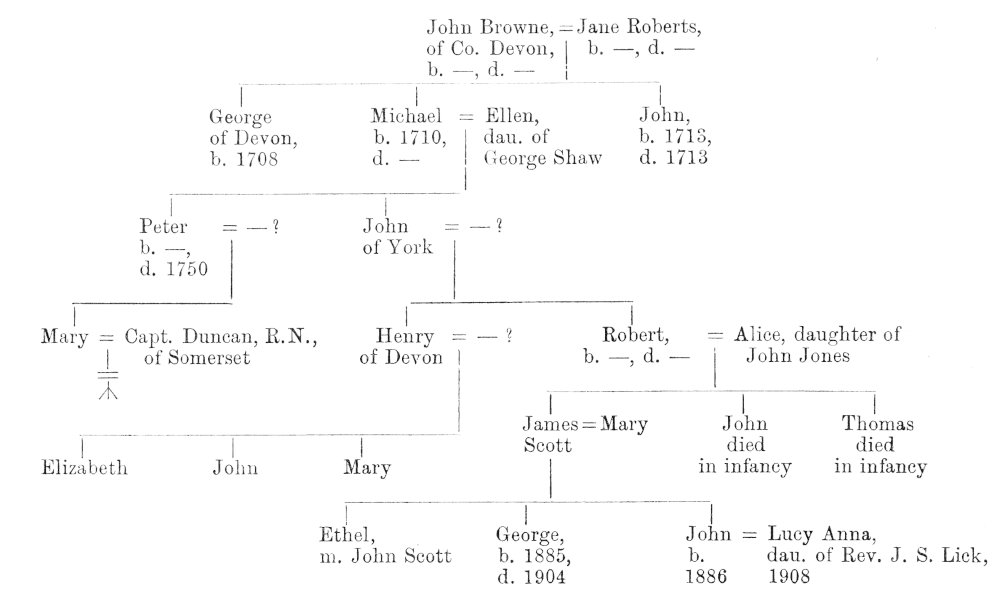
We will suppose his “tree” begins with a certain John Browne.
He might thus note particulars, leaving blanks in the way indicated
where information is not forthcoming.
The mark signifies that
all the children are not noted in his pedigree.
Sometimes an actual tree is drawn, with various branches
emanating from a parent stem. This is an interesting method, the
effect being clear, but the amateur might find its execution somewhat
difficult.
Again, the genealogist may have to write more in narrative form
particulars connected with his family tree. The following is an
illustration of how this may be done—
“John Browne was succeeded by his brother, James Browne, who was born
1st April 1661, married Sarah, daughter of Michael Jones of Wiltshire,
and died in 1735, leaving issue—
John, of whom presently.
George, alive in 1771.
Nicholas, b. 1710, d. —(?).
Bernard, married Mary Green, 1754.
Ellen, married —(?) Smith.
Elizabeth, b. 1705, married John Jones.
Abigail, married Peter Smith.
Mary, died in infancy.
Hannah.
Rose, died in infancy.
“The eldest son, John Browne, b. 1698, succeeded his father, James,
in 1735. He married, 1724, Isabella, daughter of Michael Spencer of
Devonshire, and had four sons and three daughters.”
CHAPTER VI ADDITIONAL NOTES ON PEDIGREE-HUNTING IN LONDON
While the greater part of what has already been written applies to
the pedigree-hunter in London as well as elsewhere, he has naturally,
as being located in the British metropolis, certain advantages which
cannot be enjoyed in other localities.
The Record Office.—Though the Irish Record Office is invaluable
to searchers in Ireland, the Record Office par excellence—that
in London—is, of course, best adapted to English research, and has the
custody of national documents of greater historical and antiquarian
interest.
It is free to searchers. The pedigree-hunter, on his first visit
there, will be pointed out two large Search Rooms, and will note with
satisfaction their comfortable appearance—also the walls lined with
bookshelves, all filled with indexes of various kinds.
By the help of some of these indexes he will probably discover
particulars as to the title and date of the document he wishes to
consult. If not, an application to one of the courteous officials in
charge will most likely throw all necessary light on the subject.
A docket will be given him to fill up containing the necessary
particulars, and the document itself will follow with very little delay.
The pedigree-hunter may be asked if he has a ticket entitling him to
search here. Such tickets have been rather lately introduced by the
Record Office authorities; before that, no restriction was placed on
a searcher, and this is almost a nominal one; he has merely to be
recommended by a householder.
If the searcher cannot produce the necessary ticket, he will be given
a form to fill up and get signed by the householder, which he will be
requested to send to the Record Office before his next visit.
On receipt of this form, duly signed, a ticket entitling him to make
researches there will be posted to him.
At the Record Office the pedigree-hunter will, of course, find most of
the various classes of miscellaneous MSS. which have been mentioned
as likely to be of greatest service to him. There, also, he might
consult hundreds of indexes which would not help his particular object
in the least, and he may indeed be bewildered by the vast stores of
antiquarian information so lavishly offered to him.
A most useful book, which he will find on the shelves, is
Scargill-Bird’s Guide to the Record Office. It enumerates the
various classes of documents stored there.
But the searcher may still be in doubt as to his individual case. If
so, and he, having looked up the various MSS. recommended, thinks
additional information might be forthcoming, he should then consult one
of the Record Office officials, stating the exact point on which he is
anxious to obtain information; probably the required document will be
in his hands a few minutes later.
The following classes of documents will be found the most generally
useful to the genealogical searcher in the Record Office: The State
Papers, Chancery and Exchequer Proceedings, The Parliamentary Surveys,
Feet of Fines, Royalist Composition Papers, Patent and Close Rolls.
The Heralds’ College.—The fees payable at the Heralds’
College are not exorbitant, and, of course, stores of armorial and
other genealogical information are preserved there. The London
pedigree-hunter has the advantage here also; for though he cannot,
as in the Record Office, search himself through all the requisite
documents, yet if he applies in person at the Heralds’ College (this is
called a personal search), the fee for information on a required point
will be five shillings; if the inquiry is made by correspondence, ten
shillings and sixpence.
The treasures of the Heralds’ Office are divided broadly into Records
and Collections. A general Record search costs two guineas, and a
search through Records and Collections five guineas.
Somerset House.—In this vast storehouse of documents the two
classes which will most appeal to the genealogist are the collection of
Wills and the general Registers.
Wills earlier than 1858 are found in the local Diocesan Registries,
and are in a variety of places scattered over England. Formerly, if
a person owned property in more than one diocese, his will would be
proved in the Archbishop’s Court. So wills were proved in Canterbury
Prerogative Court for all parts of England, and not merely locally.
All these Canterbury Prerogative wills are at Somerset House.
Some northern wills are at York for the same reason. But all wills
since 1858 are deposited at Somerset House.
In the Registrar-General’s office there, registers have been kept
regularly since 1837. The fees are not high. If, for instance, the
pedigree-hunter wants to ascertain the date of a certain birth, the
search through five years for one name costs five shillings.
To look up wills costs one shilling each, unless the searcher has a
free literary docket; particulars as to these literary permits will be
found in a later chapter.
The Middlesex Registry.—This Registry, situated in St. James’s
Street, contains all documents (since 1708) which affect land in
Middlesex.
Libraries.—The British Museum.—The London genealogist
is also especially fortunate with regard to libraries. Foremost of all
comes, of course, that at the British Museum. There not only is access
to the Great Reading Room free by ticket (on the recommendation of a
London householder), but the Newspaper Room and MSS. Department are
also free, and both are very valuable to the genealogist. The latter
is especially so, as it contains a store of manuscripts and Pedigrees,
Herald’s Visitations, and numberless miscellaneous documents.
Lambeth Library.—This is situated in Lambeth Palace, and
deserves to be more frequently visited by the genealogical student than
it is at present, for it contains many ancient pedigrees and important
manuscripts. Its contents are all old, and are divided into records and
printed books. There are seven distinct series of manuscripts, bound
in volumes—also very good indexes.
The pedigree-hunter will have the required volumes brought to him in
the Great Hall erected by Juxon, now used as a Reading or Search Room.
Heralds Office Library.—There is a library of genealogical
and armorial works and books bearing on such subjects at the Herald’s
Office, Queen Victoria Street.
The Guildhall Library.—Another London Library, where printed
books on genealogy can be had in abundance, is that of the Guildhall,
which ranks in this way only second to the British Museum Library.
CHAPTER VII THE PEDIGREE-HUNTER IN IRELAND
As has previously been intimated, the pedigree-hunter, if looking up an
Irish family, can discover almost everything he wants (if discoverable
at all) in Dublin.
So, even if living in some country district in Ireland, all he requires
is to locate himself for some time in the Irish metropolis.
There he will find, in the Dublin Record Office, the Wills and
Administrations which he needs, both Prerogative and Diocesan.
There he can revel in the Chancery and Exchequer Bills
and Answers which, apart from the direct object of his search,
very often supply most interesting and even amusing information.
Cause Papers, another variation of legal documents, are to
be found there; also Marriage Licence Bonds for the whole of
Ireland, and, indeed, nearly all the more important documents of the
various kinds enumerated in earlier chapters.
Besides these, the Dublin Record Office holds the greater number of
Irish Parochial Registers, either in the original or as copies,
both equally valuable to the searcher. This is a great advantage to
him, as he may find what he wants in the registers of a country parish
while searching in Dublin.
But many parishes still keep their registers in their own possession,
and have not forwarded any “parochial returns” to the Dublin Record
Office.
“Inquisitions post-mortem” and “ad quod damnum” of early dates can be
consulted there; they are written in Latin, and a novice would not
find them at all easy to decipher. The majority of them, however, have
been printed in ponderous old volumes, which can be studied by all
interested.
The pedigree-hunter should go through as many indexes of documents as
he can during his visits to this Record Office on the chance of coming
across something new and valuable.
There are bookcases lined with volumes of indexes round the walls
of the Search Room, and others, such as those required for Chancery
and Exchequer Bills—known as “Bill Books”—will be given to him on
application.
Though so much is discoverable at the Record Office, the Dublin
searcher must not confine his attention to it, as there are other
treasure-houses in that metropolis also.
He should certainly make his way to the Registry of Deeds in King’s
Inn, for there he will be sure to have valuable finds, and he can
search in the office all day long on payment of two shillings and
sixpence.
Indeed, the pedigree-hunter will be more than surprised at the number
of deeds under each name which the copious indexes display, and as a
separate index is issued (for each letter of the alphabet) for every
few years, a long time might be profitably spent in the Search Room of
the Registry of Deeds, and each successive visit there be increasingly
beneficial.
Therefore the searcher in Ireland must not forget to devote his
attention to the Registry of Deeds, King’s Inn, Dublin.
Nor should he fail to visit Trinity College, where he can peruse
Matriculation Entries, which supply the father’s name and other
particulars, to his heart’s content. No fees are charged for such
investigations.
And if the inquiries he wishes to make relate to early times, he may
find there also pedigrees of value, for fairly early pedigrees
of Anglo-Irish families, as well as other similar documents of interest
and importance, are preserved in T. C. D.
At the Castle, Dublin, he can visit the College of Arms,
Ulster’s Office, which, of course contains a vast store of genealogical
and armorial information.
The Betham MSS. are among the most important of such documents stored
there.
But pedigree-hunters are not admitted far into these hallowed
precincts; indeed, they are seldom now allowed to make personal
searches, as officials undertake the desired investigations for stated
fees.
The searcher may derive considerable benefit from visits to the
principal Dublin libraries.
The National Library contains the published works already
recommended, and has a most valuable stock of newspapers, some of which
date from far back in the eighteenth century. Besides this, the indexes
will show several out-of-print pamphlets and other papers of interest
to the genealogist.
Trinity College Library is of world-wide renown, being one of
the five British libraries to which a copy of every published book
must be sent. It possesses certain valuable illuminated MS. treasures
relating to early Irish history and ancient Irish families. Some
noticeable Irish wills are also here deposited. The library, as such,
is not open to the public; special permission may, however, be
given to read there, if approved by the authorities.
At Christ Church Cathedral a certain number of ancient deeds and
other documents have been preserved; particulars as to these can be
found in the Reports of the Deputy-Keeper.
These are the principal places in the Irish metropolis where
genealogical information can be obtained, and some of them may be found
by the searcher to be genuine treasure-houses. This is especially the
case with the Irish Record Office, which, as we have seen, preserves
most valuable documents of all descriptions.
But if any desirable Parochial Registers are not procurable
there, application should be made to the rectors of the parishes in
question.
The publications of the Parish Register Society of Dublin might
be consulted. The Irish Association for the Preservation of the
Memorials of the Dead has issued certain volumes which are most
valuable, as they record and reproduce the inscriptions on many old
Irish tombstones. The Journal of the Royal Society of Antiquaries
of Ireland, and the Journal of the Cork Historical and
Archaeological Society, should also prove valuable to the searcher
in Ireland.
CHAPTER VIII THE PEDIGREE-HUNTER IN SCOTLAND AND THE PROVINCES
The genealogist in Scotland will naturally direct his steps to
Edinburgh, where his happy hunting-ground will be the Old Register
House.
This, however, is not thrown open to all comers in the hospitable
manner experienced at the London Record Office, and application must
be made by the genealogist for a special permit allowing him to make
investigations in the Historical Search Department.
The General Register House consists of three buildings, and is divided
into the Old Register House and the New Register House.
Amongst the important records kept there, the following may be
especially mentioned:—
Crown Writs.—These are similar to English Letters-Patent. An
earlier series of these are known as Privy Seals, and date from 1498.
The Register of the Great Seal, containing various records from
1315.
Exchequer Records, dating from 1474, deal with matters relating
to revenue, rentals of townlands, etc., and may disclose points of
interest to the pedigree-hunter.
Privy Council Records.—These are of varied character and
importance. They consist of Acts, Warrants, State Papers, Royal
Letters, etc.
Last, though possibly to the genealogist they may be the most important
of all, we must mention:—
The Sasine Records.—By means of these the history of real
property in Scotland can be traced much more fully than is generally
possible in England or Ireland. The name “Sasine” is the Scottish
equivalent of the word “seizin”—the possession of land.
The Sasine Writs commence at different dates for various
districts and for the several shires in Scotland. All such registers,
however, are now superseded by the General Register of Sasines, which
commenced in 1869.
Wills, which are such an essential item in English and Irish
pedigree-hunting, are not quite so important in connection with
Scottish families, for up to 1874 a Scotsman could not devise land, so
his will could only deal with personalty. Still, of course, wills must
be looked up and noted in Scotland as they would be elsewhere.
Neither are Parish Registers so important a feature of
genealogical research in that country as in England. The reason of
this is that there was no early enactment there on the subject. So
register-keeping by the parochial authorities was, up to 1854, a
purely voluntary undertaking. Since this date a regular system of
registration, like that in vogue in England, has been carried out.
Scotland has, like its sister countries, its own Office of Arms.
This is known as the Lyon’s Office.
But, apart from the General Registry House, there are certain local
records in Scotland which might be consulted.
The principal of these are: The Books of the Sheriffs’ Courts,
The Books of the Royal Burghs, Ancient Episcopal Records.
There were no Herald’s Visitations for Scotland, but their Sasines
affect all the landed classes.
The records of the Scottish Universities supply information
which may be very valuable to the genealogist, in much the same way
as those in England and Ireland. These Scottish Universities are St.
Andrews, Glasgow, Aberdeen, and Edinburgh.
The Advocates’ Library, Edinburgh, is a very celebrated one,
and of printed books, such as have been recommended, the genealogist
should find a plentiful supply in any large library in Edinburgh or
Glasgow.
Perhaps our pedigree-hunter, when looking up a Scottish family, may
rejoice in the existence of the Clan system in Scotland.
Even if this is regarded as a mixed benefit, it has the advantage of
giving the genealogist a more limited nomenclature through which to
search.
Wales.—Welsh Families.—If by any chance our
pedigree-hunter is looking up a family of purely Welsh origin, he
may be somewhat puzzled by the family nomenclature, which is almost
entirely patronymic, and until rather lately the baptismal name of the
father often became the son’s surname!
Parish Registers exist in Wales just as in England and Ireland,
but very few of them have been printed.
There are also various Episcopal Diocesan Registers to be
consulted there.
Welsh Chancery Records were until lately kept distinct from the
various series in England.
Reference should be made to those of the Deputy-Keeper’s Reports
(these can be consulted in most good libraries) which concern Wales.
According to what district is required, they will give particulars
as to what documents should be searched and where to find them.
There are, for instance, Welsh Pedigrees and genealogical manuscripts
deposited in various libraries.
The Provinces.—The pedigree-hunter who is located in any
country part of England will almost certainly have to pay a visit to
the metropolis, either in person or by proxy, to ensure a successful
search. Still, while he is at home, some most important records may be
close beside him.
As has already been mentioned, Wills, which are not stored at
Somerset House, are kept in numerous depositories all over the land,
principally in the Episcopal Courts.
The country searcher may find that his Diocesan Registry, which perhaps
is close at hand, is just the place where he hopes to discover the most
promising wills.
Then as to Parochial Registers, he may find he is in a better
position to come across those he wants (should they date before 1837)
than if he were in London.
Register Bills, transcripts of parochial registers, should be
sent annually to the Bishop’s Registries, and may be found there.
However, there is no law enforcing this, so the duty is regarded, more
or less, as a voluntary one.
Consequently the searcher will probably have to visit the various
parishes or write to the vicars, and much may be discovered in this way.
In 1538, a decree was issued by Henry VIII.’s minister, Cromwell,
enacting that parish registers should be regularly kept. This order, if
carried out as it was intended, would have filled with joy the heart of
many a genealogist; but, alas, in early days especially, the rule was
often more honoured in the breach than in the observance. Still, the
pedigree-hunter should discover much valuable information at the parish
registries.
But besides the Probate, Diocesan, and Parochial Registers, if his
object is to find out particulars about a country family, he might
consult Municipal Documents, County Records, and should
refer to the Old Record Commission Reports of 1800 and 1837;
these are compiled from the returns made by custodians of records
throughout the country, and supply ample information in various
miscellaneous matters. They have been already mentioned.
Marriage Licences are sometimes a fruitful field for
discoveries. In the country these should be obtainable at the Episcopal
Registries. If those required are not to be found there, they may
probably be discovered at the Archdeacon’s Courts.
Of course, the searcher in the counties cannot have access to such
libraries as those in London and Dublin, unless, indeed, he happens to
be near Oxford, where the Bodleian Library is a storehouse of
antiquarian information.
The University Library, Cambridge, might also be of great value,
but it is not easy to get access within its precincts.
And, while in that neighbourhood, Caius College Library,
Cambridge, should not be overlooked, as it might supply some desirable
information.
Sundry genealogical details might also be obtained from the Officers
of the Clerks of the Peace, for counties, and from the Officers
of the Town Clerks, for boroughs.
CHAPTER IX THE WILL-SEARCHER IN ENGLAND
We have previously seen that wills in Scotland have not the same
evidential value as in other parts of Great Britain, that Irish wills
can be practically all found in Dublin, and that in London, Somerset
House is the depository where wills proved since 1858 have been kept,
as well as those proved in the Court of Canterbury, these latter being
not altogether restricted to testators who lived in that district. They
date from 1383.
There remain, however, the different wills proved in various parts of
the country; where exactly shall the searcher look for these?
The year 1858 was indeed an epoch-making year in this respect, for not
only was the enactment carried into force that future wills should be
deposited in Somerset House, but the old Diocesan Courts, where (as has
been previously stated) country wills were mainly kept, were superseded
by the District Registries. There nearly all the wills formerly in the
old Diocesan Courts are now preserved.
The following are the names of these, and practically all wills not
deposited in Somerset House, in Edinburgh, or in Dublin should be
procurable in one or other of these Registries:—
The last-named District Registry, that of York, is not exclusively
confined to wills of those who lived in the district; the others almost
universally are.
Each Registry, as a rule, comprises several of the suppressed Diocesan
and Minor Courts. They all date from early times, the latest being
those of Winchester and Wells, which contain no wills before 1660, and
the earliest that of Bury St. Edmunds, where the wills date from 1354.
When noting the contents of a will, the pedigree-hunter should put
down all particulars, even what at first sight might appear trivial,
as small items sometimes lead to great discoveries. The names of the
witnesses to a will, for instance, should never be omitted.
Of course, it is not necessary to copy a document in full, but its
contents should be noted somewhat in this way—
Will of John Browne, of . Proved in . (Give names of Court and date.)
Legatees.—(Here note names of all legatees, their addresses,
if given, and especially note particulars of any relationships
mentioned, all details of property devised, also any other points of
importance, if such occur in the will.)
Signed.—(Signature and date to be given here.)
Witnesses.—(Names of witnesses here.)
If there is a codicil, the contents, date of signature, and names of
witnesses to it should also be given.
The contents of all deeds, leases, and other documents should, as far
as this is practicable, be noted in a somewhat similar manner.
CHAPTER X AN ADDITIONAL LIST OF PUBLICATIONS WHICH MAY BE USEFUL WHEN TRACING A PEDIGREE
Chamberlain’s Angliæ Notitia; or, The Present State of Great
Britain, commenced in 1663, and was continued nearly every year
until 1755. If information is required between these dates as to the
professional or official classes, this will be found a valuable work to
consult.
The London Gazette supplies still more comprehensive records
with regard to the professions, learned and otherwise. Public
appointments are here notified, the conferment of honours, promotions
in the Church, Army, and Navy, etc. It commenced in 1665, and is now
issued twice weekly.
The records of local societies and local magazines may often profitably
be consulted.
Of the former the following are the most useful:—
The Antiquarian Societies of Batley and Bradford (Yorkshire),
also of Beverley, Heckmondwicke, Lancashire and Cheshire,
Newcastle-upon-Tyne, Isle of Man.
The Archæological Societies of Bristol and Gloucestershire,
Burton-on-Trent, Derbyshire, Durham, Essex, Kent, London and Middlesex,
Northamptonshire, St. Albans, Scarborough, Shropshire, Somerset,
Suffolk, Surrey, Sussex, Wilts, Worcester, and Yorkshire; the Cambrian
Archæological Society, the Somerset Record Society, and the Surtees’
Society, Durham.
The following local magazines may also be referred to:—
The Western Antiquary.
Notes and Queries, respectively issued for the following
districts: Bedfordshire, Devon, Fenland, Gloucestershire,
Northamptonshire, Cheshire, and Manchester.
Lancashire and Cheshire Antiquarian Notes.
The Manx Notebook.
The Palatine Notebook.
Where information is sought as to Members of Parliament, the
Blue Book Returns should be consulted, and a valuable official
work, Returns to Two Orders of the House of Commons (dated 4th
May 1876 and 9th March 1877) of the Names of every Member returned
to Serve in each Parliament from the Earliest Time to 1874.
Cave’s Parliamentary Register brings the list of members down
to 1741; The Chronological Register of Parliament from 1707 to
1807, by Robert Beatson, gives the required information between
these dates.
Besides the MS. authorities with regard to the Army and Navy which have
already been enumerated, printed books on the subject, especially if
the searcher is not looking for very early information, should not be
ignored. Of course there are, as every one knows, official Army
and Navy Lists, and a good deal of genealogical information may
be derived from other books, as especially as regards the Navy.
Notable amongst these are:—
A Naval Biographical Dictionary, by W. R. O’Byrne.
Biographia Navalis; or, Memoirs of the Officers of the Army from
1600, by John Charnock, 4 vols., 1794.
English Army-Lists, etc., 1661-1714, by Charles Dalton, 6 vols.,
1892-1904.
Lives of British Admirals, by John Campbell, 4 vols., 1779; new
edition, 8 vols., 1812-17; abridged edition, 1847.
Of the two works of the Old Record Commission, dated 1801 and
1837 respectively, the latter will be found especially useful, as it
contains returns from many of the various depositories of documents in
Great Britain, notably The Tower, Houses of Parliament, etc.
Cotton’s Fasti contains a store of information, biographical
and genealogical, about Church dignitaries, and certain searches
among parochial registers may be obviated by a perusal of Marshall’s
Parish Registers, for, as has previously been mentioned, a great
many of such are obtainable in print.
The International Genealogical Directory should be consulted, as
it contains much which might be of great importance to the searcher. He
should also make himself acquainted with the very useful genealogical
handbooks published by Mr. C. A. Bernau of Walton-on-Thames.
The number of County Histories increases rapidly, and the
pedigree-hunter should consult those which are connected with the
special districts in which he is interested.
From the Victoria County Histories to those compiled by private
individuals, all may be of more or less importance to the genealogical
student.
CHAPTER XI THE PAINS AND PLEASURES OF PEDIGREE-HUNTING — FOOTNOTES:
Is pedigree-hunting a dry and generally uninteresting matter, valuable
only for the information to be derived from it, or is it a source of
interest in itself, even if considered apart from its results?
To this, as to most questions, probably different answers could be
given. But the replies, if classified, might reveal the fact that,
though those who know little save in theory about genealogical work may
think it unattractive, others who have expended time and talents in the
pursuit almost universally agree that it is in itself—well, if not
fascinating enough to induce the investigator “to scorn delights and
live laborious days” (though this may be sometimes the case), still,
that it certainly approaches thereto.
Of course, a good deal depends upon the tastes of the searcher himself,
for if he takes up the work with energy he will certainly have to
count on many, at any rate, laborious hours; but the enjoyment
derivable from the pursuit should much more than compensate for these.
The great joy of the pedigree-hunter is the joy of discovery, and if he
sets about the work energetically he must discover something—yes, and
many things.
It is delightful to find a lost link in one’s own family history, and,
when doing this, the searcher will often unexpectedly come across a
store of information connected with other families in which he is
interested. Then there is the possibility of historical discoveries,
all perhaps springing from the fact of his electing to trace a certain
family tree, for historical characters were but men and women like
ourselves, and allied often to insignificant families.
I do not suggest that the pedigree-hunter can easily rival the recent
Shakespearean finds at the Record Office (the MSS. then brought to
light having lain there unnoticed during long centuries), for he
can only expect to get access to classified documents; yet by means
of these many interesting discoveries might be made, as well as the
definite family information which he requires be obtained.
But sometimes the discovery of a single missing link may elude the
searcher for long—if not for ever!—for ancestors have the knack
of being exasperatingly obstinate when they determine not to reveal
themselves to their descendants. Yet patience and perseverance should
in the end out-master this resolution, and during the search, though
some very dry reading may have to be undertaken and persisted in, a
great deal of interest must also necessarily crop up; for records are
by no means altogether dry reading, as the student of affidavits in the
Chancery and Exchequer Courts can testify.
Besides having to wade through many technical and uninviting-looking
documents, the pedigree-hunter may find considerable difficulty in
deciphering some of these MSS.
The novice, however, need not at the outset trouble himself very much
about this (unless he has from the beginning of his search to refer to
very ancient documents), because he can prosecute the greater part of
his work by means of authorised copies of the required documents, which
are usually handed to him in place of the original MSS. But where the
latter must be consulted and presents certain difficulties, officials
in charge usually show themselves both able and willing to help in the
matter.
Still, a facility in deciphering old MSS. is a valuable asset to the
pedigree-hunter, and may at times be almost a necessity.
Where such is the case, he cannot do better than consult a work
entitled How to Decipher and Study Old Documents,[2] by E. E.
Thoyts (Mrs. John Hauteville Cope), which will explain and smooth away
his difficulties in a wonderful manner. It has been styled A Key to
the Family Deed-Chest, and is so in truth.
These are some of the difficulties which arise in genealogical
searches, but are far counterbalanced by the results achieved.
Enthusiasm and patience are certainly necessary qualifications of the
successful pedigree-hunter, and endowed with these virtues he has not
much to fear, for the driest details seem replete with interest when
regarded in the light of dawning discoveries.
Nor can a pedigree-hunter work at genealogy alone; many fascinating
subjects, such as biography, history, and heraldry, must almost
necessarily more or less follow in its train, opening up a vista of
further interest and a field for new discoveries.
[2] Published by Elliot Stock, Paternoster Row, E. C.
CHAPTER XII HOW TO SAVE EXPENSE IN PEDIGREE-HUNTING
There is no doubt that if any one wishes to expend a small fortune in
record-searching he may find opportunity of doing so; if, on the other
hand, even shillings are an object to him, he can carry on his work for
very little expense.
The English Record Office, with its vast stores of information, is free
to all searchers; so are the British Museum Reading and MSS. Rooms;
also the other great London libraries.
At Somerset House, where so many of the wills are stored, the fees are
one shilling for each document searched. An ardent genealogist might
find that this ran away with a good deal of money; but if his object is
purely literary, as is so often the case with pedigree-hunters, then a
docket can be obtained entitling him to search gratuitously in Somerset
House at stated days and hours, as may be arranged.
The Dublin Record Office is not free to the public, the class of
documents it contains differing from those in the London Office. Irish
wills, as we have seen, are stored there, and the fee for the perusal
of any document is one shilling.
Here again, however, “the literary permit” can be obtained; it is
usually issued for a month at a time, and is renewable. But whether
there or in England, no free search is permitted, unless the required
documents are nearly a century old, and in every instance the search
must be undertaken with a purely literary object in view. If
the pedigree-hunter wishes to make good his claim to property, or
has any other legal project in his mind—well, he must pay for his
investigations.
For the Heralds’ Office, London, and the College of Arms, Dublin, no
literary dockets are issued; neither is the Registry House, Edinburgh,
free to all comers. Half a crown a day is charged at the Registry
of Deeds, Dublin, but this half-crown can cover a great amount of
searching.
Where parochial registries have to be consulted at the parishes
themselves, fixed moderate fees are charged. In some cases these
charges may be modified, or even abolished altogether, in favour of
a literary investigator; but this is a special favour, granted for
special reasons by the rector or curate in charge.
Literary free permits are, however, as we have seen, issued in
connection with most of the great offices where genealogical
information can be gleaned, and by the help of these far the greater
part of the pedigree-hunter’s work can be carried on almost free of
expense.
In certain other instances, where official fees are charged, literary
searchers are often most leniently considered, for in genealogical
matters a good deal depends on the pedigree-hunter himself, and a
system of red tapeism is not everywhere carried out.
For university and school details and entries the registers can often
be consulted absolutely free of cost, so the searcher with the narrow
purse has really little to fear financially when embarking on the
delightful task of pedigree-hunting.
CHAPTER XIII LAST WORDS
At the beginning of this work it was laid down as a golden rule that
pedigree-hunters should always, where practicable, verify their
information.
This is so important that it may be well to reiterate it at the close.
It is often easy to get information second-hand; but to make it his own
the searcher may have to exercise a good deal of patience and research,
and he must sometimes be prepared for disappointment.
Still, the result will more than repay him, for thus only can his work
be sound and satisfactory, and he has a wide field in which to search
for the verification of traditional details.
Most of the probably most helpful MSS. and publications have been
mentioned in this little book; but if the pedigree-hunter is roaming
among the documents in the Record Office or the British Museum, or
among the contents of a great library, let him look through the
various indexes and try to find out something new for himself. There
is a joy in discovery, even if it is only that of an unknown document,
and it is impossible to enumerate every work which might help all
cases, while new ones, of course, are constantly being added.
If the genealogist is not a student of Heraldry, he will find it both
interesting and probably advantageous to form some slight acquaintance
with this fascinating subject. The question of the Arms of a Family are
of more importance than its Crest and Motto, and through the knowledge
of what arms are, and have been, borne by it, the identification of
some of its members may be established.
But Heraldry is a wide subject, and many use arms and crests to which
they are quite unable to prove their right.
On the other hand, many who now occupy a humble station are lineal
descendants in the male line of ancient and historic families.
And, perhaps, our pedigree-hunter may be anxious to prove himself to be
of noble or even royal descent.
Some years ago an advertiser offered, for a certain fee, to prove to
his clients that they were descended from kings of England. Naturally
Truth the argus-eyed, spied this advertisement, and denounced
the seeming imposture. But when matters were explained to him,
Truth’s opinion somewhat altered.
The point in question is an interesting one. Every one, we may say, has
had two parents, four grandparents, eight great-grandparents, and so on
ad infinitum.
If the reader calculates the number of generations required to take
him back to the Norman Conquest, allowing thirty years for each (there
would be approximately twenty-eight), this will give him over a hundred
million ancestors alive in 1066!
This number will in reality be much lessened by the fact of
inter-marriages and relationships (so that the same individuals may
be ancestors on both the paternal and maternal sides), also by other
causes. But the fact remains that there was only a population of a few
millions in Great Britain at the time of the Norman Conquest, and our
ancestors at that date apparently consisted of a much greater number,
so that the probabilities are that almost every Englishman of either
Saxon or Norman ancestry must have been descended from every one living
in England at the time of the Norman Conquest, including the Conqueror
himself.
Of course, this works out also in another way, and makes us all
descended from the serfs as well as from the lords of the soil. Though
the matter may not be capable of demonstration, it is an interesting
point to consider.
A genealogist, however, is not satisfied with a pedigree which cannot
be proved, and if our pedigree-hunter thinks, either from the high
qualities with which he is endowed, or from the knowledge of noble
ancestors having adorned his family tree, that kings must have been
undoubtedly numbered among his forbears—well, of course, he
must make good his claim, perhaps even to royal descent in the male
line.
This probably will not be a matter which can be accomplished, but
he may possibly be able to prove that he is descended from English
kings—though not in the direct male line—provided that some of his
ancestors were of high social position.
As a matter of fact, the majority of our greater and lesser nobility
are of royal descent, and if our pedigree-hunter’s ancestors
were allied to such families, the descent in his case should be
comparatively easy to prove.
To help towards this, he might consult Burke’s Royal Descents
and Foster’s Royal Lineages; but if his family cannot claim
the honour of royal ancestry, the “kind hearts” which are “more than
coronets” may have been his proud heritage through a long line of
forbears. And, taking into consideration the millions of ancestors
which each noble lord has had, there cannot fail to have been some of
low degree from whom he has been descended in bygone centuries.
Some families rise in the social scale, others descend, and the
genealogist may come across numerous instances of the vicissitudes of
families.
Heirs to the highest of what were regarded as extinct titles have been
found occupying the very lowest positions in the social scale. Who
knows whether some unexpected stroke of fortune may not come across
our genealogical searcher. In fact, there are few limits as to the
possibilities which may arise in pedigree-hunting.