SPALDING’S OFFICIAL BASE BALL GUIDE (Spanish Edition)
Price 10c.
No. 2.
SPALDING’S OFFICIAL FOOT BALL GUIDE
Price 10c.
No. 6.
SPALDING’S OFFICIAL ICE HOCKEY GUIDE
Price 10c.
No. 7.
SPALDING’S OFFICIAL BASKET BALL GUIDE
Price 10c.
No. 7A.
SPALDING’S OFFICIAL WOMEN’S BASKET BALL GUIDE
Price 10c.
No. 9.
SPALDING’S OFFICIAL INDOOR BASE BALL GUIDE
Price 10c.
No. 12A.
SPALDING’S OFFICIAL ATHLETIC RULES
Price 10c.
No. 1R.
SPALDING’S OFFICIAL ATHLETIC ALMANAC
Price 25c.
No. 3R.
SPALDING’S OFFICIAL GOLF GUIDE
Price 25c.
No. 55R.
SPALDING’S OFFICIAL SOCCER FOOT BALL GUIDE
Price 25c.
No. 57R.
SPALDING’S LAWN TENNIS ANNUAL
Price 25c.
No. 59R.
SPALDING’S OFFICIAL BASE BALL RECORD
Price 25c.
Specially Bound Series of Athletic Handbooks
Flexible binding. Mailed postpaid on receipt of 50 cents each number.
No. 501L.
STROKES AND SCIENCE OF LAWN TENNIS
No. 502L.
HOW TO PLAY GOLF
No. 503L.
HOW TO PLAY FOOT BALL
No. 504L.
ART OF SKATING
No. 505L.
GET WELL—KEEP WELL
No. 506L.
HOW TO LIVE 100 YEARS
No. 507L.
HOW TO WRESTLE
No. 508L.
HOW TO PLAY LAWN TENNIS; HOW TO PLAY TENNIS FOR BEGINNERS
No. 509L.
BOXING
No. 510L.
DUMB BELL EXERCISES
No. 511L.
JIU JITSU
No. 512L.
SPEED SWIMMING
No. 513L.
WINTER SPORTS
No. 514L.
HOW TO BOWL
No. 515L.
HOW TO SWIM AND COMPETITIVE DIVING
No. 516L.
SCHOOL TACTICS AND MAZE RUNNING; CHILDREN’S GAMES
No. 517L.
TEN AND TWENTY MINUTE EXERCISES
No. 518L.
INDOOR AND OUTDOOR GYMNASTIC GAMES
No. 519L.
SPALDING’S OFFICIAL BASE BALL GUIDE
No. 520L.
SPALDING’S OFFICIAL FOOT BALL GUIDE
No. 521L.
SPALDING’S OFFICIAL BASKET BALL GUIDE
No. 522L.
GOLF FOR GIRLS
No. 523L.
HOW TO PLAY BASE BALL; HOW TO UMPIRE; HOW TO MANAGE A TEAM, ETC.
No. 524L.
SPALDING’S LAWN TENNIS ANNUAL
No. 525L.
HOW TO PITCH; READY RECKONER OF BASE BALL PERCENTAGES
No. 526L.
HOW TO CATCH; HOW TO BAT
In addition to above, any 25 cent “Red Cover” book listed in
Spalding’s Athletic Library will be bound in flexible binding for
50 cents each; or any two 10 cent “Green Cover” or “Blue Cover”
books in one volume for 50 cents.
ANY OF THE ABOVE BOOKS MAILED POSTPAID UPON RECEIPT OF PRICE
11-30-16
Group I. Base Ball
“Blue Cover” Series, each number 10c.
No. 1
Spalding’s Official Base Ball Guide
No. 1S
Spalding’s Official Base Ball Guide. Spanish Edition.
No. 202
How to Play Base Ball
No. 219
Ready Reckoner of Base Ball Percentages
No. 223
How to Bat
No. 224
How to Play the Outfield
No. 225
How to Play First Base
No. 226
How to Play Second Base
No. 227
How to Play Third Base
No. 228
How to Play Shortstop
No. 229
How to Catch
No. 230
How to Pitch
No. 231
How to Organize a Base Ball League
How to Organize a Base Ball Club
How to Manage a Base Ball Club
How to Train a Base Ball Team
How to Captain a Base Ball Team
How to Umpire
Technical Base Ball Terms
No. 232
How to Run Bases
No. 350
How to Score
No. 355
Minor League Base Ball Guide
No. 356
Official Book National League of Prof. Base Ball Clubs
No. 9
Spalding’s Official Indoor Base Ball Guide
“Red Cover” Series, each number 25c.
No. 59R. Official Base Ball Record (including College records)
Group II. Foot Ball
“Blue Cover” Series, each number 10c.
No. 2 Spalding’s Official Foot Ball Guide
No. 358 Official College Soccer Guide
“Red Cover” Series, each number 25c.
No. 39R. How to Play Soccer
No. 47R. How to Play Foot Ball
No. 55R. Spalding’s Official Soccer Foot Ball Guide
Group III. Tennis
“Blue Cover” Series, each number 10c.
No. 157 How to Play Lawn Tennis
No. 363 Tennis Errors and Remedies
“Green Cover” Series, each number 10c.
No. 1P. How to Play Tennis—For Beginners. By P. A. Vaile
“Red Cover” Series, each number 25c.
No. 2R. Strokes and Science of Lawn Tennis
No. 42R. Davis Cup Contests in Australasia
No. 57R. Spalding’s Lawn Tennis Annual
Group IV. Golf
“Green Cover” Series, each number 10c.
No. 2P. How to Learn Golf
“Red Cover” Series, each number 25c.
No. 3R. Spalding’s Official Golf Guide
No. 4R. How to Play Golf
No. 63R. Golf for Girls
Group V. Basket Ball
“Blue Cover” Series, each number 10c.
No. 7 Spalding’s Official Basket Ball Guide
No. 7A Spalding’s Official Women’s Basket Ball Guide
No. 193 How to Play Basket Ball
Group VI. Skating and Winter Sports
“Blue Cover” Series, each number 10c.
No. 6 Spalding’s Official Ice Hockey Guide
No. 14 Curling
“Red Cover” Series, each number 25c.
No. 8R. The Art of Skating
No. 20R. How to Play Ice Hockey
No. 28R. Winter Sports
No. 72R. Figure Skating for Women
Group VII. Field and Track Athletics
“Blue Cover” Series, each number 10c.
No. 12A Spalding’s Official Athletic Rules
No. 27 College Athletics
No. 55 Official Sporting Rules
No. 87 Athletic Primer
No. 156 Athletes’ Guide
No. 178 How to Train for Bicycling
No. 182 All Around Athletics
No. 255 How to Run 100 Yards
No. 302 Y. M. C. A. Official Handbook
No. 317 Marathon Running
No. 342 Walking for Health and Competition
No. 362 Track, Relay and Cross Country Rules of the National Collegiate Athletic Ass’n.
“Green Cover” Series, each number 10c.
No. 3P. How to Become an Athlete By James E. Sullivan
No. 4P. How to Sprint
“Red Cover” Series, each number 25c.
No. 1R. Spalding’s Official Athletic Almanac
No. 17R. Olympic Games, Stockholm. 1912
No. 45R. Intercollegiate Official Handbook
No. 48R. Distance and Cross Country Running
No. 70R. How to Become a Weight Thrower
Group VIII. School Athletics
“Blue Cover” Series, each number 10c.
No. 246 Athletic Training for Schoolboys
No. 331 Schoolyard Athletics
“Red Cover” Series, each number 25c.
No. 61R. School Tactics and Maze Running; Children’s Games
No. 66R. Calisthenic Drills and Fancy Marching and Physical Training for the School and Class Room
No. 71R. Public Schools Athletic League Official Handbook
Group IX. Water Sports
“Blue Cover” Series, each number 10c.
No. 128 How to Row
No. 129 Water Polo
No. 361 Intercollegiate Swimming Guide
“Red Cover” Series, each number 25c.
No. 36R. Speed Swimming
No. 37R. How to Swim and Competitive Diving
No. 60R. Canoeing and Camping
No. 38R. Field Hockey
No. 41R. Newcomb
No. 63R. Golf for Girls
No. 69R. Girls and Athletics
Group XI. Lawn and Field Games
“Blue Cover” Series, each number 10c.
No. 167 Quoits
No. 170 Push Ball
No. 180 Ring Hockey
No. 199 Equestrian Polo
No. 201 How to Play Lacrosse
No. 207 Lawn Bowls
“Red Cover” Series, each number 25c.
No. 6R. Cricket, and How to Play It
Group XII. Miscellaneous Games
“Blue Cover” Series, each number 10c.
No. 13 American Game of Hand Ball
No. 364 Volley Ball
“Red Cover” Series, each number 25c.
No. 43R. Archery, Roque, Croquet, English Croquet, Lawn Hockey, Tether Ball, Clock Golf, Golf-Croquet, Hand Tennis, Hand Polo, Wicket Polo, Badminton, Drawing Room Hockey, Garden Hockey, Basket Goal, Volley Ball Rules and Pin Ball
No. 49R. How to Bowl
No. 50R. Court Games
Group XIII. Manly Sports
“Blue Cover” Series, each number 10c.
No. 191 How to Punch the Bag
No. 282 Roller Skating Guide
“Red Cover” Series, each number 25c.
No. 11R. Fencing Foil Work Illustrated
No. 19R. Professional Wrestling
No. 21R. Jiu Jitsu
No. 25R. Boxing
No. 30R. The Art of Fencing
No. 65R. How to Wrestle
Group XIV. Calisthenics
“Red Cover” Series, each number 25c.
No. 10R. Single Stick Drill
No. 16R. Team Wand Drill
No. 22R. Indian Clubs and Dumb Bells and Pulley Weights
No. 24R. Dumb Bell Exercises
No. 73R. Graded Calisthenics and Dumb Bell Drills
Group XV. Gymnastics
“Blue Cover” Series, each number 10c.
No. 124 How to Become a Gymnast
No. 254 Barnjum Bar Bell Drill
No. 287 Fancy Dumb Bell and Marching Drills
“Red Cover” Series, each number 25c.
No. 14R. Trapeze, Long Horse and Rope Exercises
No. 34R. Grading of Gym. Exercises
No. 40R. Indoor and Outdoor Gymnastic Games
No. 52R. Pyramid Building
No. 56R. Tumbling for Amateurs and Ground Tumbling
No. 67R. Exercises on the Side Horse; Exercises on the Flying Rings.
No. 68R. Horizontal Bar Exercises; Exercises on Parallel Bars
Group XVI. Home Exercising
“Blue Cover” Series, each number 10c.
No. 161 Ten Minutes’ Exercise for Busy Men
No. 185 Hints on Health
No. 325 Twenty-Minute Exercises
“Red Cover” Series, each number 25c.
No. 7R. Physical Training Simplified
No. 9R. How to Live 100 Years
No. 23R. Get Well; Keep Well
No. 33R. Tensing Exercises
No. 51R. 285 Health Answers
No. 54R. Medicine Ball Exercises, Indigestion Treated by Gymnastics, Physical Education and Hygiene
No. 62R. The Care of the Body
No. 64R. Muscle Building; Health by Muscular Gymnastics
ANY OF THE ABOVE BOOKS MAILED POSTPAID UPON RECEIPT OF PRICE
11-30-16
Sincerely and swimmingly yours,
James H. Sterrett (signature)
HOW TO SWIM
Spalding “Red Cover” Series of
Athletic Handbooks
No. 37 R
A Practical Manual of Swimming by a
Practical Swimmer and a Guide
to the Novice as well as
the Expert
Showing the Easiest Methods of Learning to Swim, Dive
and Float, Various Kinds of Strokes, with Directions
and Illustrations for Acquiring the Crawl and
Trudge-Crawl Strokes. Also a Chapter
on Modern Life-Saving, and One for
Women and Girl Swimmers.
By
JAMES H. STERRETT
Organizer of the first American swimming club, authority on
swimming matters, and successful amateur coach.
REVISED AND ENLARGED EDITION
PUBLISHED BY AMERICAN SPORTS PUBLISHING
COMPANY New York City
Copyright 1917
by
American Sports Publishing Company
New York
James H. Sterrett
The author of this little volume originally compiled the
material at the request of the late James E. Sullivan, with
whom he was associated in Amateur Athletic Union affairs
for a great many years and therefore naturally takes a
more than passing interest in the book. With the great
advance that has been manifested in swimming, it became
necessary to make a thorough revision of the entire matter,
at the same time adding a new chapter in life-saving
methods which should prove invaluable.
While the author disclaims any attempt of self-laudation,
still for the benefit of the many who will read this
volume and would like to know his capability for assuming
to teach the modern methods of swimming, the following
letters, from prominent authorities on the sport, are
reproduced:
L. deB. Handley, New York Athletic Club.
“Jim Sterrett may be counted among the pioneers of swimming in
this country. He was called the ‘Father of American Swimming’
when I entered the field of competition 20 years ago. Sterrett’s prolific
pen, too, has done much to spread knowledge of developments. It
was in one of his books that I read the first technical discussion of
the principles of aquatic progression ever come to my notice, and his
numerous articles on all branches of watermanship have ever held
interest for me.”
Wm. E. Bernard, Jr., Swimming Coach, Girard College, Philadelphia.
“Mr. Sterrett is known from coast to coast as an authority on
swimming, as well as a successful amateur coach. He taught me
a lot ten years ago, and I am now successfully using his methods
in teaching boys at Girard College.”
William G. Friedgen, Philadelphia Turngemeinde.
“Through the early years of Mr. Sterrett’s connection with the
Philadelphia Swimming Club, which he organized in 1890, he was the
guiding spirit of that body of enthusiastic devotees of the sport, always
having in view the teaching and propagation of the art of natation
among its members, as well as to assist in similar development in
other organizations. He lent his aid to the Athletic Club of the
Schuylkill Navy and the Y.M.C.A., and was one of the original members
of the Swimming Committee of the Philadelphia Turngemeinde,
besides being instrumental in promoting many national and district
swimming tournaments, thus affording frequent opportunity for competitions.”
John W. Stevens, Swimming Instructor, First Regiment Pool, Philadelphia.
“As an expert authority on swimming, James H. Sterrett classes
among the foremost in the country, and I attribute my success in the
swimming world, both as a swimmer and a teacher, to him—being a
pupil of his when a boy, and a close follower of his methods as a
teacher. He is a never tiring worker in his endeavor to further the
interest in swimming and his advice and criticism is always in
demand.”
F. Vance Veith, Swimming Coach, Los Angeles A.C., California.
“In my early days of competition, Mr. Sterrett showed me a lot
about advanced swimming. I remember once how, in the Central Y.M.C.A.
of Philadelphia, before I became a professional swimming teacher,
Jim held himself up by the arms on the iron fence at the side of the
bath, and demonstrated the crawl kick for me, and then while in the
water, gave me some pointers which improved my speed over the 100
yards 10 seconds in two weeks’ practice. I use his methods now in
teaching, and owe much of my success to his precepts and examples.”
Thomas G. Whitaker, Coach, Missouri A.C., St. Louis, Mo.
“Mr. James H. Sterrett can truly be called the Nestor of American
swimming. Many times when the pastime took a slump, his unselfish
and disinterested efforts were largely responsible for its rehabilitation,
and only those who have known the man and come into personal contact
with him, know what he has done for the sport, and what it owes
him in this country. His kindly manner and encouraging advice has
helped many youngsters to achieve their ambition in the swimming
world.”
Andrew B. Kean, Charter Member P.S.C., Lansdowne, Pa.
“There are many of our present-day ‘crack’ swimmers who owe their
success to Jim Sterrett’s coaching. His advice to young swimmers is
always on tap. He is ever ready and willing to do what he can to
further the sport, and what he did for swimming in this part of the
country would fill a volume.”
Prof. Charles Holroyd, Swimming Instructor, Training School, Pittsburgh,
Pa.
“Jim Sterrett’s work for swimming during the past 25 years has
done much toward organizing the sport in this country. He has made
it possible for a number of expert teachers to secure positions, while
he himself has started many a young lad with the proper stroke, who
has afterward become a successful racer.”
Charles B. Durborow, America’s Long-distance Swimmer.
“I have had advice from numerous coaches in connection with my
training for long-distance events, but Mr. Sterrett has been tireless in
his interest in my swimming and has accompanied me on many of my
big performances, and has always been a steadfast and dependable
friend and adviser. I have closely watched his work as a coach of
speed swimmers, in which line he has been so successful.”
Gordon M. Mullen, Swimming Instructor, Hygeia Baths, Atlantic
City, N. J.
“James H. Sterrett, affectionately called ‘Papa Jim’ by his host of
friends, is the most liberal swimming philanthropist I ever met, always
ready to impart his expert knowledge to the ‘other fellow.’ He is
one of the few of the old school of swimmers who has kept right up to
date in the art. He taught me to swim all the strokes scientifically,
and I owe much of my success as a teacher to his helpfulness.”
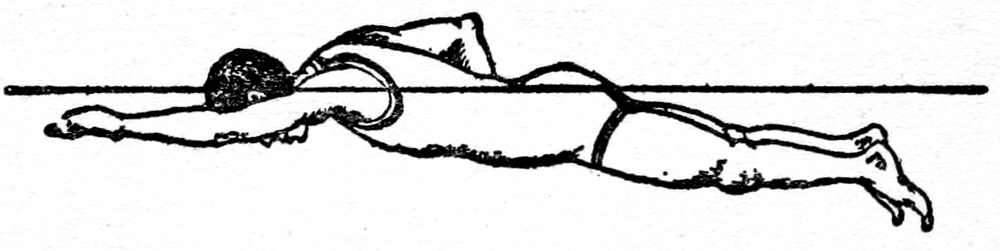
BREAST STROKE, SIDE VIEW.
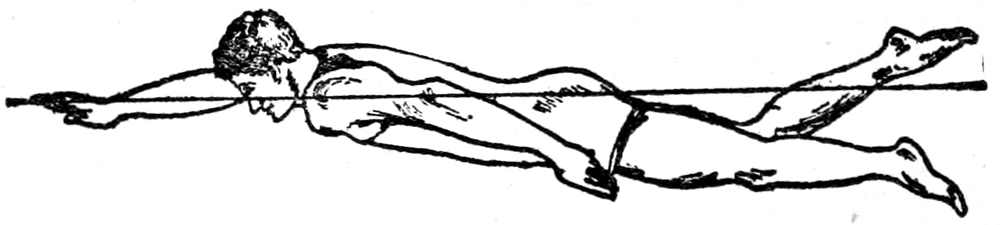
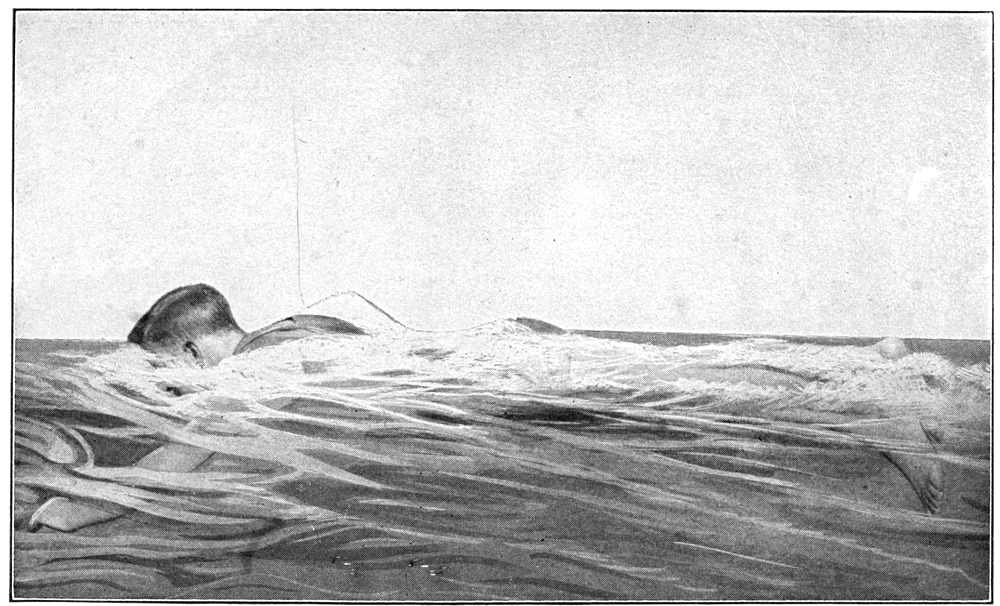
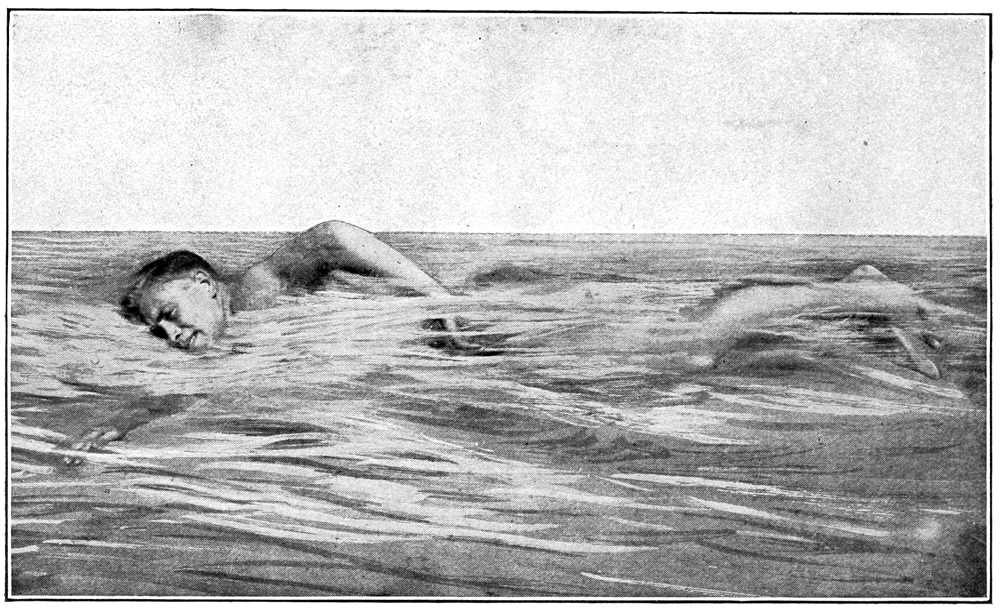
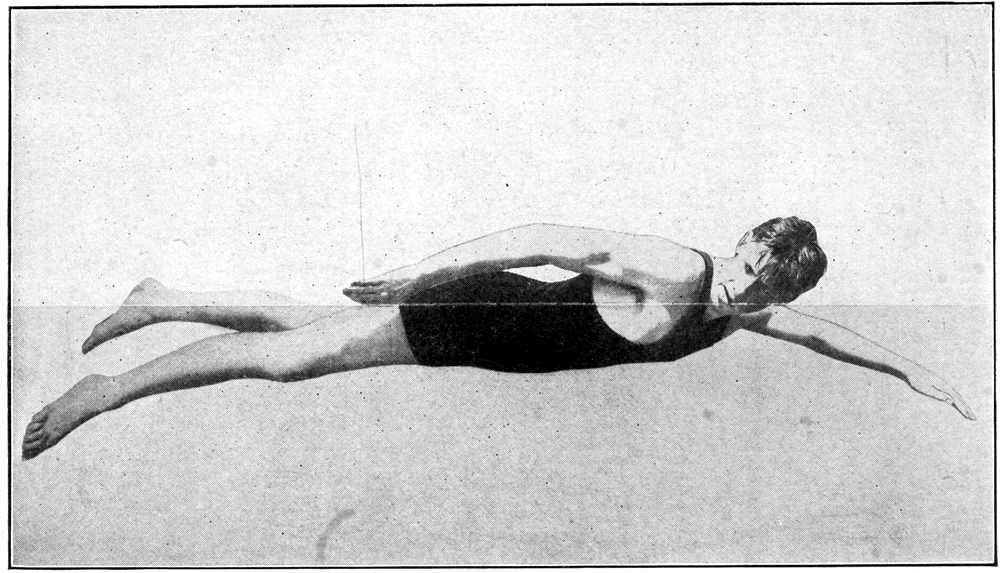
CRAWL STROKE, SIDE VIEW.
Swimming a Necessary Part of One’s Education — The Simple Method — Crawl Teaching Is Quickest — The Breast Stroke — Breathing — The Over-arm Side Stroke — Breast Stroke Elementary — Right Side for Illustration — The Pull Through — Keep on the Side — The Double-Over-arm or “Trudgeon” Stroke — The Stroke for Distance Work — Depends Upon Side — The Test of Breathing — The Crawl Stroke — The Important Point — The Leg Movement — The Recognized Methods of the Crawl Stroke
Some years ago it was not so easy to get people interested
in the art of swimming and to have them realize the necessity
of a knowledge of how to keep the body afloat and to
propel it through the water by means of the arms and legs,
in order to be able not only to save one’s own life but be
the means of rendering assistance to others in time of
danger and accident. Conditions have greatly changed in
this direction now, and swimming is on a strong wave of
popularity; in fact, the great mass of people of the United
States, both young and old, have taken up this pastime
with so much vigor and enthusiasm that it will not be long
ere this country, as in many other things, will lead all the
nations of the world in its educational interest in spreading
this useful accomplishment, as our competitive swimmers
are now leading the world in speed swimming and
skill in the water.
That swimming is healthful, splendid for development,
easily acquired and should be a part of one’s education and
taught in schools as being as necessary as reading, writing,
and arithmetic, is now generally admitted, and means have
been provided in nearly all the large cities whereby the
school children are given the proper facilities, under
careful and up-to-date instruction, to bring about the
desired end.
It is not our purpose in this book to go into any extended
details or give dry statistics, but to show by simple and
plain talks on the art and science of swimming and by
language that is clear and readily understood, with the
assistance of various pictures, the different positions in the
water in swimming the breast stroke, the over-arm side
stroke, the double-over-arm stroke (sometimes called the
Trudgeon), and the now generally accepted and famous
“crawl” stroke, as these four movements in the water practically
complete one’s swimming education and make their
possessor worthy of the title of an expert.
There has been considerable controversy among expert
swimmers and teachers as to whether it is best to learn the
crawl stroke first, or the breast stroke, and various competitive
tests have been made in order to let the exponents
of each principle prove, if possible, the superiority of one
method over the other, but no permanent deductions have
been arrived at; however, the author, aside from having
decided opinions himself in this matter, considers that
where one method has an advantage over the other, both
have their good points.
It is claimed that one can be taught quicker by a sort
of dog-paddle, sometimes spoken of as the crawl stroke,
and we will admit this to be so, but those who learn by
this route are seldom good swimmers until they master the
other strokes, while the breast stroke as an elementary one,
although being a little harder to grasp, on account of the
co-ordination of arms and legs, gives more confidence to
the beginner, and he or she will rapidly advance from this
point on, and even in the early stages will be able to swim
farther and with less effort than by the so-called crawl
method; however, if the beginner can grasp the Trudge-crawl
at the very start, the result will be much easier and
the advancement more rapid.
THE BREAST STROKE.
Beginning and Ending of Stroke.
THE BREAST STROKE.
Count of Two, Separating Legs, Toes and Knees Pointing Out.
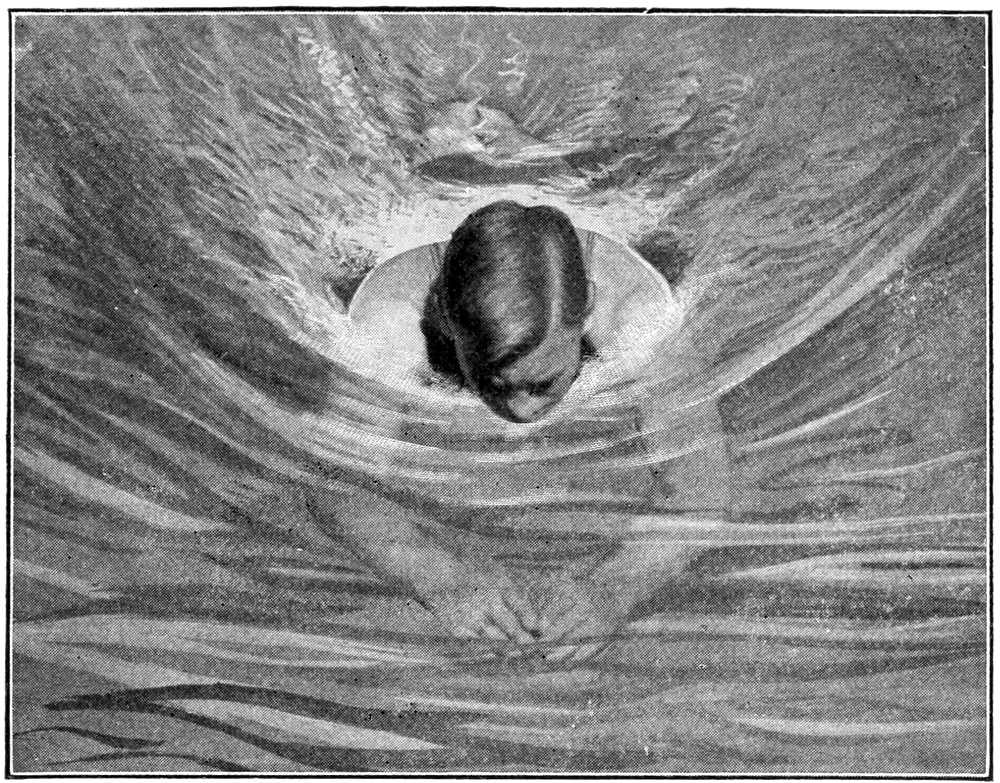
THE CRAWL STROKE.
Head-on View, Showing Position of Arms and Legs at Beginning
of Stroke.
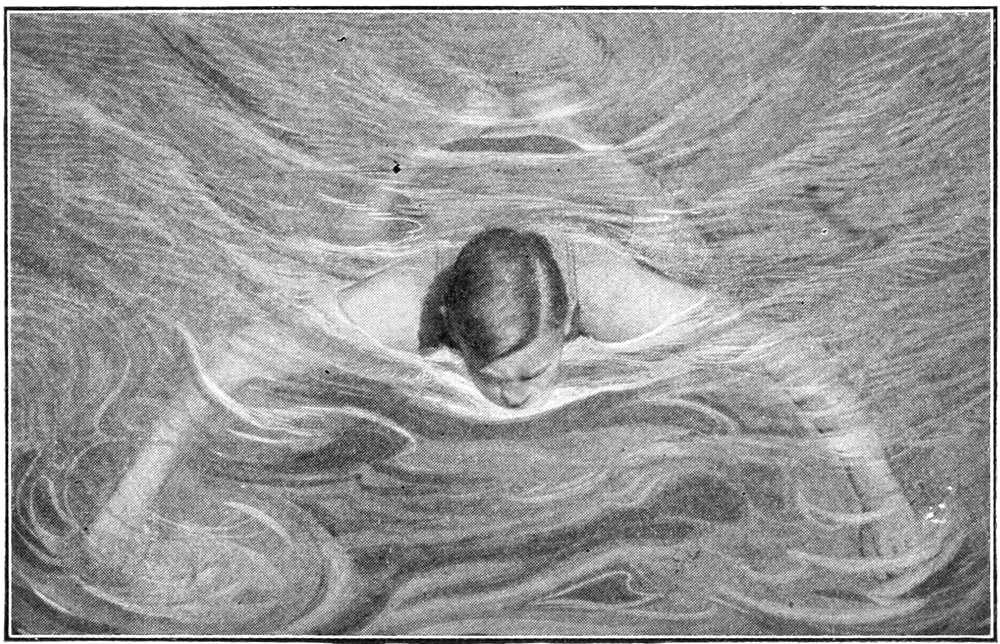
THE CRAWL, SECOND POSITION, EXHALING UNDER WATER.
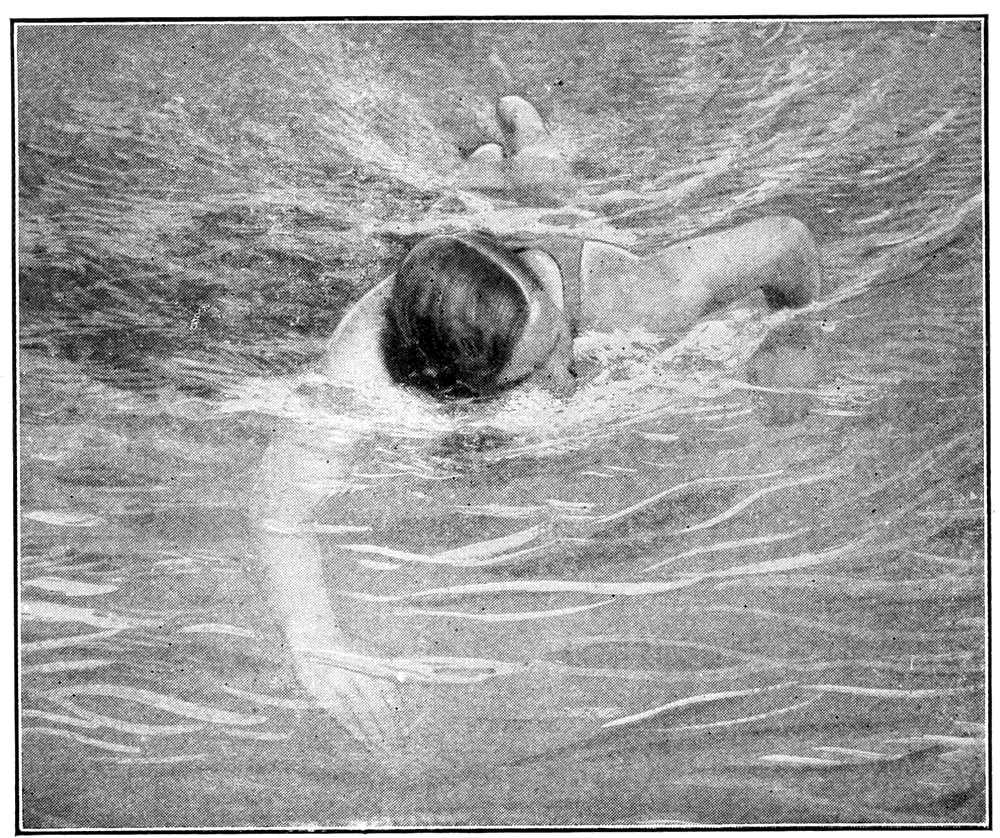
THE CRAWL, THIRD POSITION, TAKING A BREATH.
But, as we will show and explain both methods, the
reader who does not know how, can choose either one, and
if he is taught by a professional instructor, or some expert
amateur coach, it matters not which way he learns, so that
he accomplishes the first object—to keep the body afloat
and propel it by means of the arms and legs.
The very first thing you want to get in your mind, and
fasten it there firmly, is the fact that there are only three
things necessary to become a good swimmer—the proper
timing of the stroke, or what experts call the alternate
action or harmony (timing); breathing; and the ability
to relax; and when you have acquired these things—and
every one can master them—you will not only be able to
swim well and without effort, but go indefinite distances
in the water just as easily as walking on the land, and
swim as long as your vitality will permit and the lowered
temperature of the body will allow.
And now for the simple lessons, beginning with the
breast stroke.
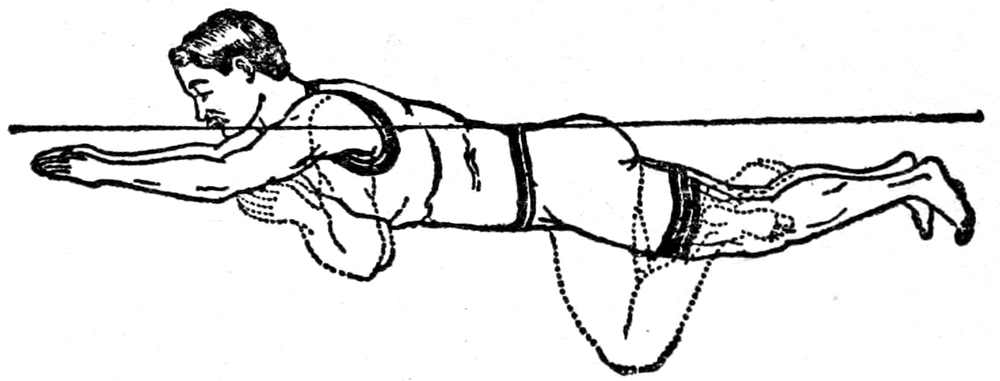
To swim the breast stroke the beginner lies flat on the
water, being supported by water wings, rubber life preserver,
or held up in shallow water by the hand of a friend
or instructor. The body, except the head and shoulders, is
submerged a few inches under the water, the arms and
legs outstretched in a line with the body, the hands, with
palms downward, touching. The toes, knees and feet
should be pointing outward.
When beginning the stroke it is best to make the movements
with three counts. At “one” the hands are parted,
describing a semi-circle, and at “two” are brought up under
the chin, the knees being simultaneously brought up under
the body, pointing outward, the legs being separated. At
“three” the hands are shot out in front of the body and
the legs whipped together, completing the full stroke, the
body being allowed to float for an instant before again
beginning the stroke, to get the benefit of the run as well
as a little rest between strokes.
At first the pupil may naturally keep the limbs tense in
going through these movements, and it is this, and holding
the breath, that tires, and not the muscular movements.
But you will soon loosen up after gaining a little confidence
and you will find how easy it is to float on and move
through the water. And now comes that all-important
part of all swimming—breathing.
Breathing plays the most important part in the art of
swimming; in fact, no one ever becomes a good swimmer
unless attention is paid to the matter of breathing, which
must be done with regularity and precision. This is especially
necessary when using the advanced or scientific
strokes and much of the speed and endurance in swimming
depend on a correct performance of this part of the
work. In breast swimming, the head and face being more
above the surface of the water than in the side strokes,
breathing is usually performed through the nose alone,
keeping the mouth closed in order not to take in any water.
But it is not long before those who breathe in this fashion
find out that the respiration is restricted, irregular and
jerky, and the swimmer soon gets “out of wind” and tires,
wondering why it is that he can only go such a short distance
before he is “played out.” To nothing else, so much
as breathing, is due the inability of those who can swim
to keep up the speed and regularity of movement for an
indefinite period.
Annette Kellerman, the wonderful Australian woman
swimmer, makes the matter of breathing very clear when
she says, “Take a quick gulp of air through the mouth and
let it ooze out slowly through the nose.” What could be
more simple in explanation? In swimming you breathe
entirely different from any other form of exercise, and you
will never swim well, easily or far, until you breathe as
described above and in unison with each stroke. It is
much better to take the quick breath through the mouth
and then submerge the head and exhale through the nose
under water, for once you have mastered this you have
learned the real secret of success in swimming.
Make the stroke easy, and in proper timing, or co-ordination,
breathe regularly and with precision on each stroke,
and, above all, do not keep the limbs stiff or rigid, but
relax, as swimming is not a matter of strength or force,
but skill.
Be patient and persistent and you will soon acquire an
art you can enjoy, with much physical benefit and great
pleasure, until extreme old age.
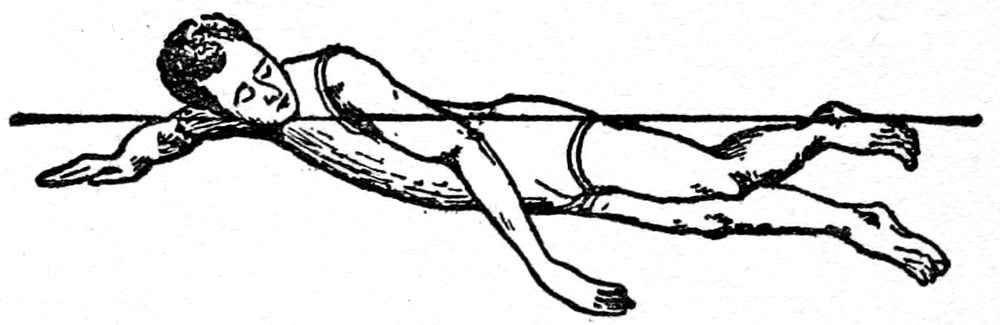
OVER-ARM SIDE STROKE, POSITION IN WATER.
DOUBLE-OVER-ARM (TRUDGE).
After the Roll, Exhaling Under Water.
Having mastered the breast stroke sufficiently to feel
comfortable in the water, the pupil is now ready to learn
the more advanced swimming strokes, and the best one to
take up next is the over-arm side stroke, a method by
which Joey Nuttall, of England, held all the world’s records
and won all the championship events from 100 yards
to one mile, defeating all comers and being unbeatable
throughout the world for over twenty-one years.
The over-arm side stroke is still one of the very best
methods, and is used by many of the world’s great swimmers,
particularly for long distance swimming, as it is not
only very easy and comfortable, but requires less exertion
than any of the other strokes, and one can glide along
smoothly and at a good pace and keep up the movements
for an almost indefinite period.
As in many other things where greater speed is required,
the over-arm side stroke gives better pace and a longer
run, because of the fact that the body, being on the side,
presents less resistance than when on the breast, and, by
minimizing the negative parts of the stroke, we get a
maximum amount of positive action, resulting in more
speed, with no greater effort.
The breast stroke is distinctly an elementary stroke, and
until a swimmer masters the over-arm side or the double
over-arm strokes he cannot be classed as a first-class performer
in the water, as these modern and up-to-date
methods are now recognized by all first-class swimmers
throughout the world, both for record-making performances
as well as for all-around swimming ability. These
strokes have been experimented with and brought to a
state of high proficiency in recent years by expert swimmers,
and are practical and useful in all kinds of water
and under every possible condition, requiring the least
energy and giving the best results, with little lost motion.
Before describing the over-arm side stroke, we wish to
emphasize the fact that the idea is to have a power working
continuously on the water, for as the over-arm is being
drawn through the water the legs are drawn up and the
under-arm is shot forward, and when the over arm extends
the legs are brought together, and the body moves through
the water with a continuous run, and, when the stroke is
properly timed, or the swimmer acquires the alternative
action, he glides along quick and fast from the power of
each stroke, without much loss of pace. It matters not
which side the swimmer lies on, as the side that comes
most natural will be found to be the better side, although
some people, being ambidextrous, can swim as easy on one
side as the other.
For the purpose of illustrating the lesson, we will
imagine the swimmer to be on the right side. At the
start of the stroke and on the count of “one” the lower
arm should be pulled steadily downward toward the hip,
but keeping it on the inside line of the body, and not
toward the back, which will keep the swimmer on his side
much like a cutter or yacht on her keel. The fingers
should be kept closed, with the thumbs touching and forming
a sort of spoon-shape, and used much like an oar in
the pull through the water.
When the under-arm stroke is finished the hand should
be turned quickly, palm upward, in order to have as little
resistance as possible, and pushed rapidly forward to the
point where it began. The over-arm stroke is started as the
downward part of the under-arm stroke is finished, and
should begin its downward course about six inches in front
of the face. The upper arm should be slightly bent to work
clear of the chest, with the palm and thumb pointing
downward and cuplike, to get the most from the pull.
When the upper arm is about opposite the shoulder in
its pull through the water the legs should be separated for
the leg stroke, and they should be in position for giving
the snappy kick when the hand leaves the water and the
kick should be completed and legs straightened out before
the upper arm is ready to begin the next stroke. The legs
are opened up and brought together simultaneously, the
upper leg being brought forward, the knee slightly bent,
and the foot kept in its ordinary position and not allowed
to hang free, the lower leg being bent backward, with the
heel toward the thigh and swinging on a hinge (so to
speak), so that there is little resistance. Both feet should
be kept near to the surface of the water, except at the end
of the stroke, when the right foot dips to come just under
the left.
Remember that you must keep on your side like a cutter.
You must not roll over on your breast, but keep in a
straight-line position, for, if you turn, or reach too far
ahead with the upper arm, you will throw yourself out of
position and lose the easy run.
And, as in all the other strokes, remember about breathing
and relaxing, the great factors in making you swim
easier, further and better than other swimmers. As the
under arm is drawn down, take the quick breath or gulp
of air through the mouth, closing the mouth and exhaling
through the nose until the completion of the stroke, and
then begin all over again. You will find that you do not
have to make any effort to keep your body afloat while on
the side, therefore you can relax more, and when you get
the stroke and the breathing and relaxing in harmony, it
will be dead easy.
Persist, practice daily and do not get discouraged, for
all of a sudden it will dawn on you that you have mastered
the stroke and will soon go through the movements
intuitively.
Once the swimmer has acquired the over-arm side stroke,
he is not only ready but invariably ambitious to swim the
double-over-arm stroke, and this desire is but natural, as
it can be readily seen that the latter method gives an
opportunity to increase one’s speed as well as to get a
more evenly balanced exercise from this form of stroke;
and here a word or two about swimming as an exercise
and for body development is in order, for it can be shown
that there is probably no other form of exercise that is
better for a uniform development of the body and which
brings all the muscles into play, including the heart and
lungs, than swimming.
The exercise of swimming has the effect of toning up
and quickening the whole muscular condition, making the
moving muscles pliant, responsive, and not bunchy and
hard, as in the case of some of the heavier athletic and
gymnastic pastimes.
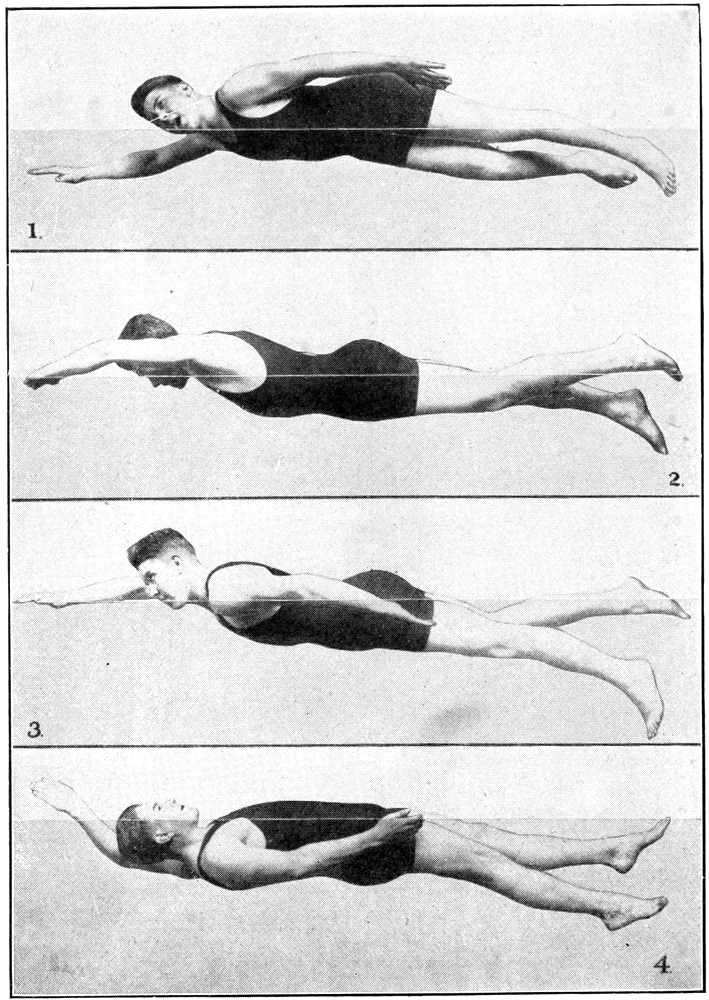
HERBERT VOLLMER, N. Y. A. C., SWIMMING THE TRUDGE-CRAWL.
1. Position for breathing; 2. Correct position for Crawl, showing arched back;
3. Overhand Stroke with Crawl Kick; 4. Back Overhand Stroke.
Photos posed by Teddy Cann of the New York Athletic Club and copyrighted by
American Press Association, N. Y.
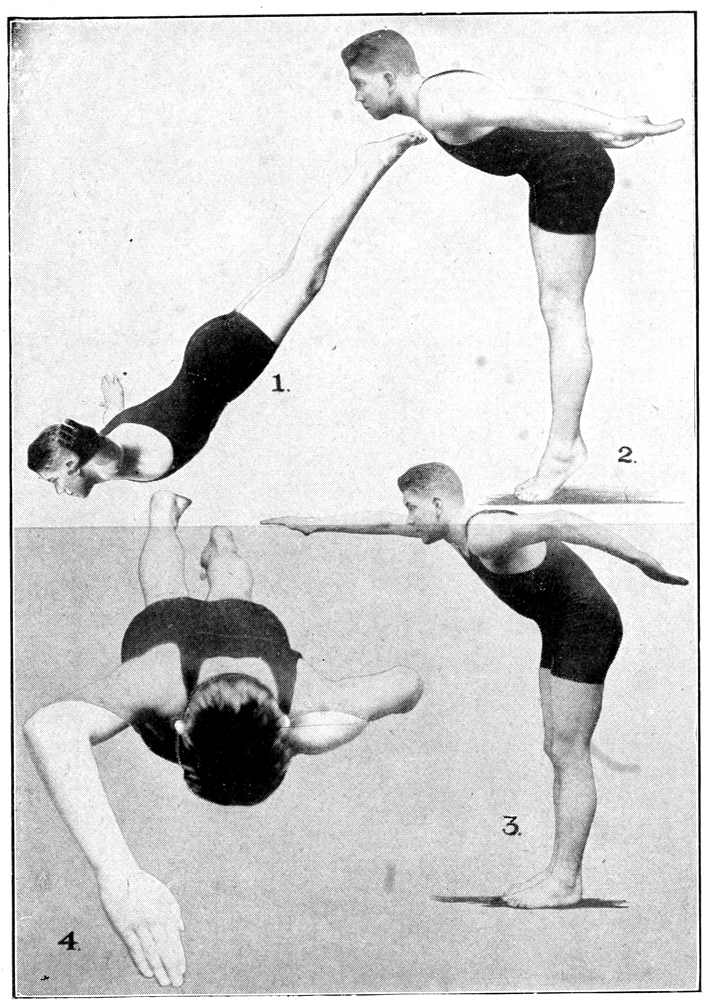
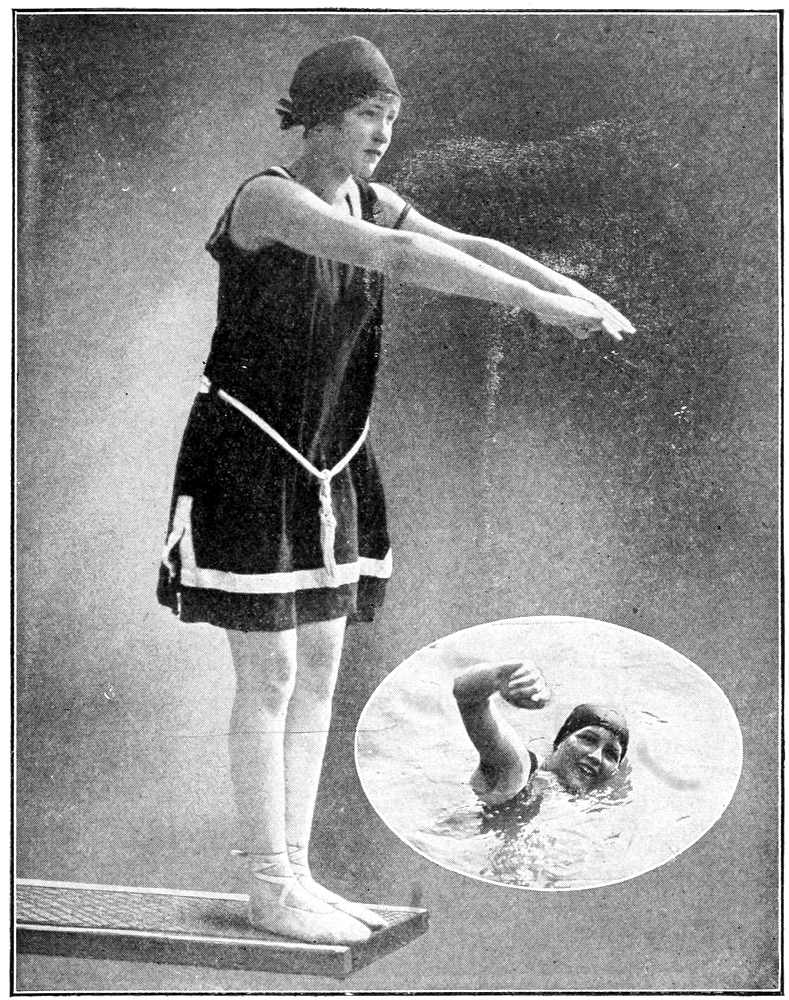
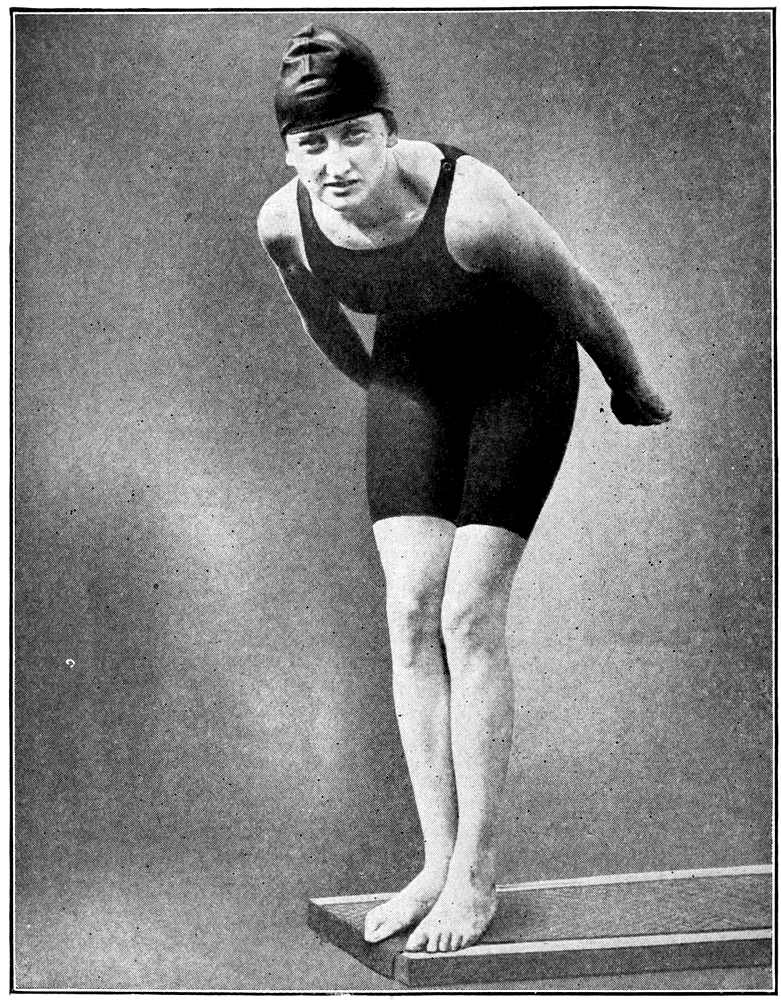
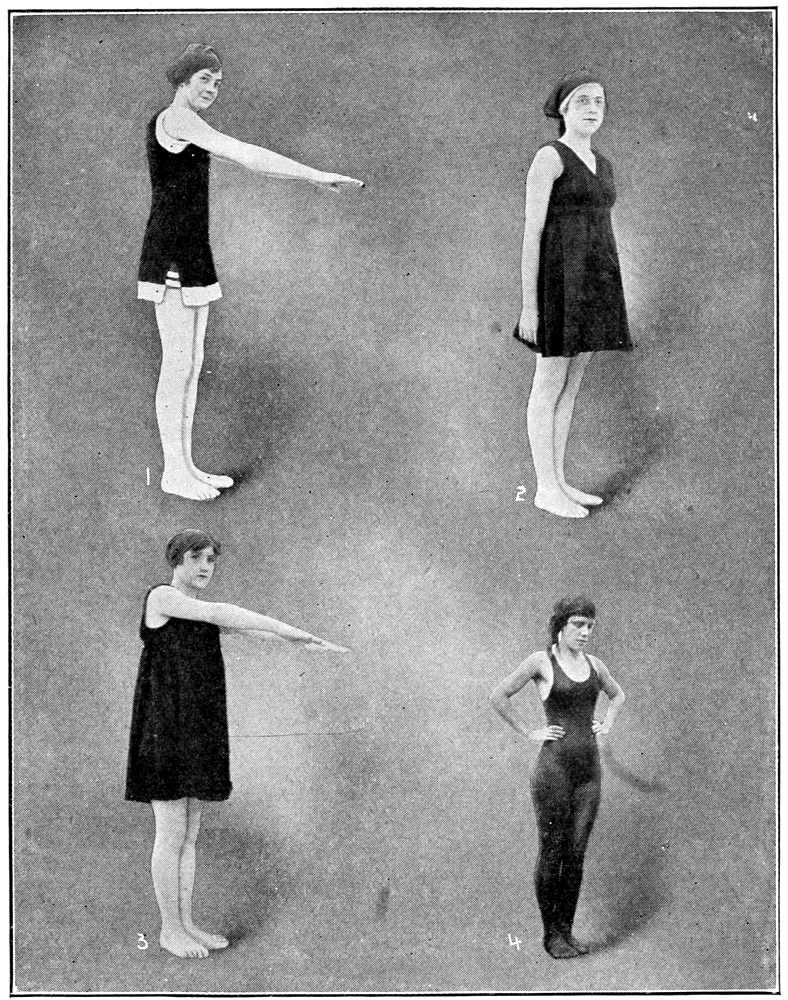
1. Correct position for Swan Dive; 2. Correct stand for Race Start; 3. This
illustration is only designed to show the Crawl Stroke position of the hands; 4.
Crawl Stroke (in action) position.
Photos posed by Teddy Cann of the New York Athletic Club and copyrighted by
American Press Association, N. Y.
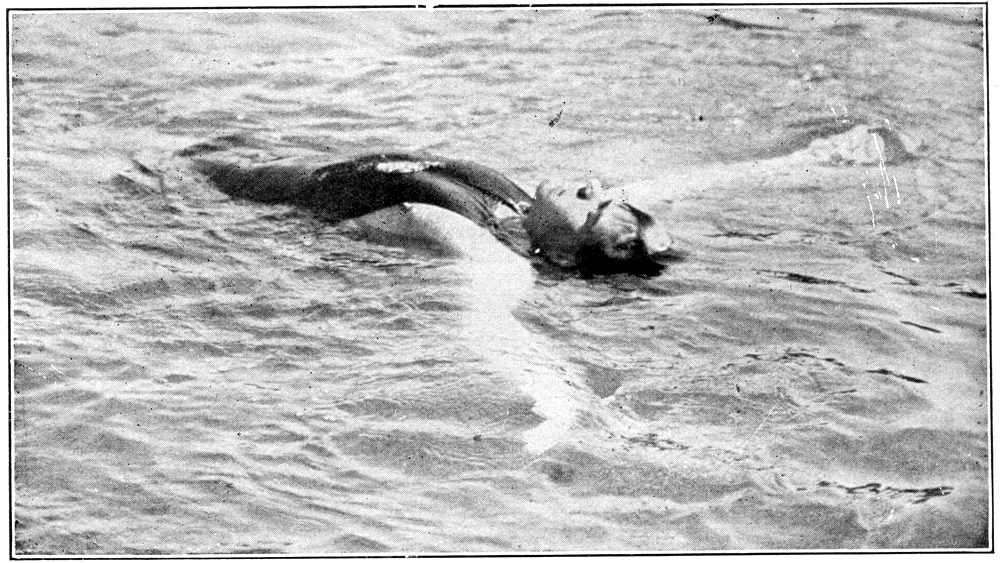
SWIMMING ON THE BACK, IN ACTION.
The double-over-arm stroke is more frequently referred
to as the Trudgeon, but nowadays this name is a misnomer,
as the original Trudgeon stroke was so called after
a man by that name had won an English 100-yard championship,
using the double-over-arm, or both arms out of
the water, but kicking a sort of leg motion like the breast
stroke action, a style not now approved of by modern
swimmers, because the scissors kick, as used with this
stroke, made the same way as in the over-arm side stroke,
has been found to be better, faster and more graceful in
action.
Before describing the movements of the double-over-arm
stroke, we will here remark that almost all the world’s
records for middle and long-distance swimming have been
made by this stroke, and some idea of the speed attained
can be formed by the following records, all made by
George Hodgson of Canada, one of the world’s greatest distance
champion swimmers, and the best exponent of this
method the writer has ever seen: 400 meters, 5 minutes
24 2-5 seconds; 1,000 meters, 14 minutes 37 seconds; 1,500
meters, 22 minutes; 1,600 meters, 23 minutes 28 1-5 seconds,
and one mile, 23 minutes 34 1-2 seconds. And at the
time the great swimmer made these records at the Olympic
games in 1912, he defeated all the fastest and best swimmers
and record-holders from all parts of the world, some
of them using the famous crawl stroke, thus proving himself,
as well as the stroke, to be the best in the world at
that time.
While it would not be literally correct to call the modern
Trudgeon stroke a “double-over-arm-side stroke,” yet that
is most nearly what the motions of the double-over-arm
approach, for you must first swim one part of the stroke
as a side-stroke movement, and then roll over partly on
the breast to get your other arm out of the water, thus
giving you more positive action and greater speed by getting
both arms out, than you would get from the single-over-arm,
in which one of the arms must be pushed under
and through the water, with the resistance such negative
action entails.
If you swim on the right side you begin the movements
of the double-over-arm stroke by diving into the water, or
pushing off on your side from the side or end of the tank,
or the shore, and, when at full length, with right hand
under the water and extended beyond the head, and the
left hand pointing backward, and at the count of “one,”
bring the right hand downward, on the inside line of the
body, and not behind the back, for this movement will
keep you on your side like a cutter, while if you pull
downwards and back of the body, you will be thrown on
your chest too soon and stop your run.
At the same time as the right arm is being drawn downward,
and on the same count of “one,” the left arm is
thrown forward out of and clear of the water, and at the
count of “two,” the left leg is drawn up to meet the left
arm as it comes down and through the water much like
an oar, and at “three” the legs are whipped together and
the body turned partly on the breast and the right arm
brought out of the water and thrown forward, the body
rolling to the right side again and repeating the same
movements. If you swim on the left side, of course you
must make the movements described to suit the opposite
arm and legs from those given in the description.
And now you are up to the point where it is a real test
of whether you have mastered the art of breathing, for this
stroke requires regular and automatic breathing, with
proper timing and precision on each stroke, before you will
be able to swim it easily and as comfortably as the other
strokes, because you cannot miss a breath or hold your
breath for any number of strokes, but must take the quick
gulp of air while on the side as the face is upturned just
as you draw the right hand down through the water, then
close your mouth, and exhale slowly through the nose
while the face is under water, until the stroke is fully
completed, or, in other words, breathe in harmony and in
timing with each stroke.
The double-over-arm, because of the submerging of the
face on each stroke, and because of the forced regularity
of breathing, and no effort being required to keep the
body afloat, is well adapted for swimming in rough water,
as the waves will not be so apt to dash in your face and
mouth at the wrong time, to disconcert you, and interrupt
the regularity of your breathing.
Charles B. Durborow, conceded to be the world’s greatest
distance endurance swimmer, uses the double-over-arm
stroke in making all his great long-distance swims, some
of which have never been made before or since by any other
swimmer.
The crawl stroke is undoubtedly the greatest stroke that
has ever been invented or discovered in connection with
the art of swimming, and until its adoption and subsequent
improvement by experimenting with it until it was
brought up to a high point of efficiency, the swimmers
of the world had practically reached their limit of speed
performances, having perfected the other strokes beyond
further improvement, and thus it was that they were
eager to take up the new-found method by which it has
been discovered that a person can go still faster through
the water.
And now, before describing the stroke and the action
of the arms and legs when swimming the crawl, as we
have done in our previous lessons, we will tell you the
secret of why this new method is so much faster than the
others, and the whole thing is a matter of eliminating
resistance, or minimizing the negative parts of the stroke
and getting a maximum amount of positive action; or, in
other words, doing the same thing as has been done in
many other things to produce greater speed—applying the
maximum of power while at the same time reducing
resistance to the minimum.
The crawl stroke originated in Australia, and Dick
Cavil, one of the members of that famous family of expert
swimmers, and one of the best all-around swimmers the
author has ever seen, told the writer that his brother,
“Tums,” in an argument with another swimmer as to
their relative ability, said he could tie his feet together
and then beat the other chap for a length of the pool, and
when the contest came off he made good his boast.
“Tums” Cavil always argued that the legs were not
of much use to him in fast swimming, and he believed
that they hindered other swimmers when going at top
speed, because in drawing them up and separating them
they stopped the run on the stroke, and he at once started
experimenting on this theory, with the result that a new
stroke was developed and launched on the natatorial world
and at once became popular, until now it is used by all
the fast swimmers of the world.
At the Olympic games in 1912, Hodgson, the Canadian
swimmer, beat all the fastest swimmers in the world at
middle distance swimming, using the double-over-arm
stroke, and Duke Kahanamoku, the Hawaiian, beat all the
short distance men of the world with the crawl stroke,
swimming 100 meters (109 1-3 yards) in 61 seconds, and
since then the big bronze-skin athlete, at his home in
Honolulu, swam 50 yards in 23 seconds and 100 yards
in 53 1-5 seconds, which shows how very fast he can go
through the water with the crawl stroke.
The most important thing to remember in swimming
the crawl stroke is the fact that the body should be kept
perfectly flat on the water, the face and head partly submerged,
the eyes preferably above the water and looking
straight ahead. The arms are alternately reached out at a
comfortable distance in front of the head, and on a direct
line with the body, not pointing out sideways, but, if anything,
pointing at the start of the arm stroke more nearly
to the center line of the body.
The catch on the water should be taken at the beginning
of each arm stroke, using the weight of the shoulders,
without over-reaching, to get a good leverage on the downward
pull. The arms must be brought straight down, stopping
the pull about on a line parallel with the shoulders,
and in recovering, describe a long oval, making sure that
before the power of one hand is fully expended the other
has taken up the motion, that it may be continuous, for it
is this regular and steady pull of the arms, and not the
thrash of the legs, that has the most to do with propelling
the crawl swimmer through the water.
Breathing while using this stroke is harder than the
other strokes, because the swimmer must not roll the body
out of its straight line; therefore, the head and shoulders
must be slightly turned in order to get the breath, which
can be taken after swimming two or three strokes, but
later on, when one has mastered the movements better,
breathing should be done on each stroke, exhaling slowly
under water.
The legs are moved up and down in a continuous action,
and not necessarily in co-ordination with the arms, the
motions being free from the hips and not from the knees,
keeping the legs straight, without having them bent much
at the knees (a fault almost all beginners have) and pointing
the toes out straight.
However, after the swimmer has mastered the leg action,
he can bend slightly at the knees, in order to get the sort
of propelling movements necessary to help move the body
in its steady pace through the water. But remember, the
legs do not play so large a part in the crawl stroke as the
arm movements, and are used mostly to keep them afloat
and accelerate the run, and the fellow who gets it into his
head that the more work and greater fuss he makes with
his legs the faster he will go, will soon find that he is
retarding his movements and not getting the full speed.
While there are definite and fixed movements for the
crawl, hardly two swimmers use the stroke exactly alike,
but all of them must nearly approach the proper position
in the water, get good balance, breathe regularly and with
precision on each stroke, and relax more in the crawl than
any of the other strokes, if a clean, easy movement through
the water is desired.
There are two methods of swimming the crawl stroke
that are generally accepted by expert swimmers and master
coaches, the one being referred to as the straight crawl,
where the swimmer lies very flat on the water, with but
very little roll in order to breathe, and uses a six-beat
kick, which the majority think is the best method for
sprinting, say, from 50 to 220 yards, and the other being
called the Trudge-crawl, using a four-beat kick, the under
leg being used with a short scissor or Trudge kick, and
the swimmer rolling more than on the straight crawl, and
the action of legs not being as fast, this latter method
is considered best for middle and longer distances.
L. deB. Handley of the New York Athletic Club, a recognized
authority on swimming matters, and a man who has
had a lot to do with the coaching of many good amateur
swimmers, both men and women, and who has spent considerable
time in connection with the study of the crawl
stroke, has proposed the following suggestion in connection
with the crawl method, which the author cheerfully
endorses:
“It has been my aim for several years to have universally
accepted a swimming nomenclature that would be descriptive,
in as much as possible, and I have classified the
strokes under the styles of: crawl, for a leg thrash of
even scope; single Trudgeon-crawl, for leg thrash with
one major and one or more minor kicks, and double
Trudgeon-crawl, for a thrash with two major kicks (double
rhythm) or two such kicks and minor ones; then add two,
or four, or six-beat, to indicate the number of movements
per full stroke. That gives to a swimmer a pretty clear
idea of a man’s stroke without further explanation, while
such names as Australian, American, rotary, etc., mean
nothing unless every detail is added.
Swimmers who want to take up a more thorough and
deeper study of the crawl stroke than given herein, should
read the “Symposium of the Crawl,” in “Speed Swimming,”
No. 36R of Spalding’s Athletic Library, price 25
cents.
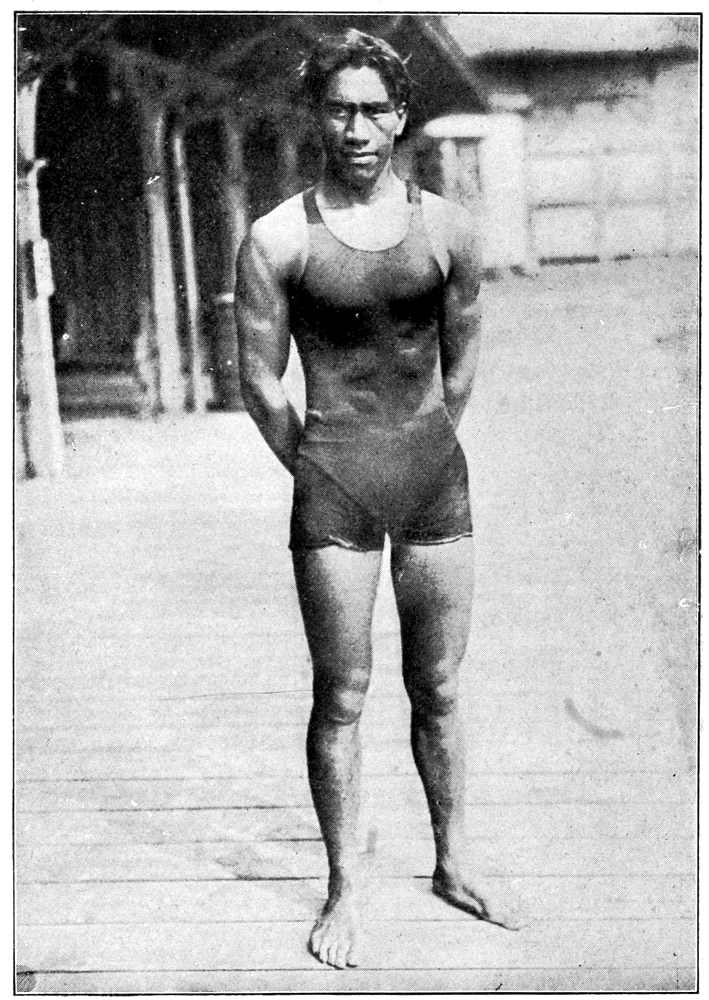
DUKE P. KAHANAMOKU,
Honolulu. H. I.; the Fastest Sprint Swimmer in the World.
LUDY LANGER,
Los Angeles Athletic Club, California; American Champion at 440
Yards, 500 Yards, 880 Yards and One-mile Swims.
H. J. HEBNER,
Illinois Athletic Club, Chicago; Back Stroke and All-Around Swimmer.
GEORGE HODGSON,
Montreal A. A. C.; Winner of 400 Meters and 1.500 Meters Swims,
Olympic Games, 1912, in World’s Record Time.
Training for Speed Swimming
There are many and various ways of training for speed
swimming, and it would require quite a volume to enumerate
them all. Dr. J. K. Shell has prepared for the
writer a form of training for swimming which not only
fully meets my approval, but it is so good that it is herewith
given:
“In training the only maxim for the successful racer is,
‘Don’t do too much.’ It is unnecessary to swim every day,
nor is it useful to go the entire distance at each immersion.
The aim is to strengthen the muscles, and have the powers
and functions trained to an excessive expenditure of power
without any deleterious after effects. The best plan for
either a one hundred yards or a mile man is to swim three
days a week at the pace he expects to race, at intermediate
distances, reserving the entire distances for the same day
on which the race will take place. The first week of training
should be given to running, punching the bag, some
hand ball, dumb bells, Indian clubs, pulley weights and
general gymnasium work.
“The second week commences the swimming work—go
slowly, pay the greatest attention to form, never mind
speed, but get your action fully automatic and working
with a conservation of energy. Do half of your distance
three times this week.
“The third week will see you going on with much greater
speed and easier action, and now commence the regular
practice of starting and sprinting.
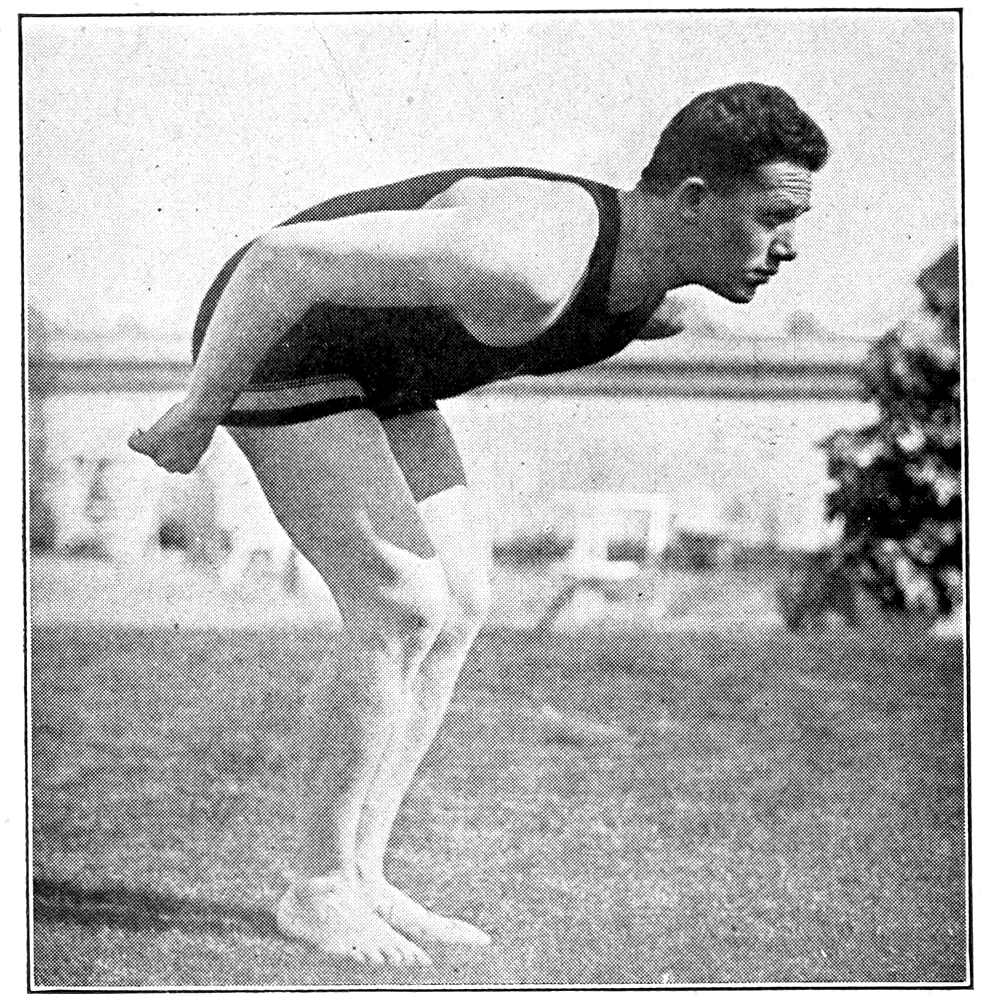
“Starting is but the action of a standing broad jump;
there should be but one spring, and that made at the report
of the pistol. Stand in the position taken in jumping, just
as you are ready to go off. Have the legs bent, the arms
back, the body leaning forward, and when the word is given
don’t straighten up and then spring, nor swing your arms
forward and then back and off, nor look at your competitors,
nor pick your course, but spring, and spring with
power and quickness far out, get the arms in front quick,
dive shallow, and get a stroke in under water, and be sure
to have your stroke ready upon reaching the surface. These
little points come in very important in a hundred yards,
and in a distance race give you an advantage of many feet
without any extra exertion; excepting that of thinking instead
of floating. This sprint and start may be practiced
on the intermediate days of swimming.
“During the third week increase your distance to three-quarters,
and endeavor to swim it clear through from start
to finish, not holding back for the sprint, but depending
upon your energy and spirit to sprint out the last 150
yards. The full distance should be swam not later than
one week before the race, and at very nearly your best
speed. Three days before the race do at your best speed
three-fifths of your distance, and rest quietly until the day
of the race, doing just enough exercise to keep yourself
pliant. On the day keep cool—don’t fret and worry. Don’t
think of a race or racing until you get on your mark, get
set, and spring—and strike the water and then swim hard
and steady clear through, and swim fair and true.
“The swimmer demands plenty of sleep at night, regular
and methodical. Be in bed each night by 10:30, and sleep
until morning; do not let anything disturb you; go to bed
to sleep, and sleep that sound sleep that swimmers usually
get. In the morning, take a few quick movements, a
splash off, a little walk, and a good nutritious breakfast.
In eating, use fully all seasonable vegetables, and I would
advise the use of a good modern cook’s products—except
the pastries and highly seasoned dishes. Roasts—beef,
mutton and game—and broiled steaks, filets and fish, fruit
and custards, all may be enjoyed. But eat slowly, masticate
well, and have good cheer wait on you.
“Have a friend—a trainer, a rubber or a mate—with you
in training, and never omit a good, hard, conscientious rubbing
and massaging and kneading of the muscles; let all
your muscles be pliant during this operation; and finally
recollect in racing, and in your actions, to be ‘always a
gentleman.’ Don’t jockey nor scold, nor be profane, but
swim, and ‘may the best man win.’”
In this connection the writer would call the attention
of every swimmer—whether he belongs to a college or not—to
the Official Intercollegiate Swimming Guide, published
annually in the Spalding Athletic Library series (No. 361,
price 10 cents) for the Intercollegiate Swimming Association.
This book contains not only articles of interest
concerning the happenings in the collegiate swimming
world, and records of same, but, each year, in addition,
contains special articles by leading authorities on some
important feature of swimming.
Touching and Turning
Touching and turning is a branch of swimming more
practiced for racing than for ordinary purposes. There
are several styles of touching and turning, but I will deal
with the one most easily mastered, and shall begin by
advising the learner to practice across the bath, from side
to side, and not to be in the slightest hurry. Master the
details of the turn by slow motions, nor need there be any
desire to lengthen the push until one knows that he is performing
all the motions perfectly. We assume that the
pupil is lying on the right side. He must, therefore, when
about three feet from the end of wall of the bath, have
finished the progressive movements of the left hand, which,
instead of being put into the water again to renew the
stroke, must be reached forward in advance of the head
until it touches the wall immediately above the water mark.
The palm of the hand is then placed flat against the side of
the bath, the hand being in a horizontal line, with the
fingers pointing to the right, which is the direction one
will turn to. The little finger is uppermost, and the thumb
downward. This done, the body is close to the side of the
wall, the knees are now bent, the body turned around by
pushing with the hand, that is on the solid wall, until the
feet are pressing on the wall and directly below this hand,
but, of course, under the surface of the water. The whole
body is now drawn up or crouched together, and is turned,
as it were, on its axis. It is under water, head and all.
The soles of both feet are placed hard against the wall, the
hands put together in front of the head, which is kept
between the arms, and the position of the body and limbs
should be straight, with the legs crouched up. Then, by a
strong movement of the legs, the body is pushed off
from the side as if shot from a catapult and straightened
out. Its position, when lying on the push, is the same
as when lying still, in plunging. From nine to fifteen
feet is the distance generally covered by the push off
before renewing the stroke. One must be especially careful
to guard against pushing off, even to the smallest
extent, stronger with one foot than the other, else
a slip may take place on the smooth tile work, and that
means a loss of perhaps a yard or two, and, in the case of
a competition, puts the swimmer off his course, or station,
and bumping against another swimmer and fouling are
likely to occur.
Ornamental Swimming
If there is any one thing more than another in connection
with the art of swimming that will show that a person
has mastered the watery element and is at ease at all times
in their foster sphere, it is a knowledge of ornamental
swimming. To be able to successfully and correctly make
any kind of a dive, to float in various positions at will and
to perform the multitudinous natatorial feats that are possible,
is an accomplishment that stamps the performer an
expert. We will, therefore, suppose that those who are about
to essay these difficult swimming movements have passed
the elementary and intermediate stages and have the ability
to float well. Without a knowledge of floating, or at least
the ability to control the buoyancy of the body when placed
in all manner of positions, it will be almost impossible to
make any success of ornamental swimming. Many of the
movements that seem remarkable to the uninitiated, however,
are not really hard at all, but can be accomplished
with practice, by being persistent and patient until finally
acquired.
Among the feats that are at all times interesting
and those that stamp the swimmer as being clever, are porpoise
swimming; sculling on the back, using hands only;
the running header; plunging, feet foremost; the sitting
jump; imitation of a torpedo; the back dive; revolving; the
twister; back somersault; marching on the water; the propeller,
and imitation of a bicycle rider.
Floating
Most people can float in salt water, no matter what may
be their build. In learning, the first movement is to gradually
throw the body on the back, arching the spine, keeping
the chest well inflated, crossing the arms over and back
on the head, the thumbs locked or fingers touching,
which latter movement tends to increase the expansion
of the chest and thus make the body more floatable.
If the legs are kept straight out and together the
beginner will find that their weight in this position, in
most cases, has a tendency to sink the body. This can be
overcome by drawing up the lower limbs and extending
them slightly apart and keeping them bent, which will have
the effect of more evenly balancing the body, and then,
later on, when the swimmer masters control of the breathing,
so that the lungs can be kept partly inflated all the
time, he will find that the legs can be gradually extended
until they are straight, when the position in the water
will be more graceful. Because of their lighter bony
structure and increased tissue, women learn to float
easier than men, while stout persons, being more floatable,
master floating quicker than slim people. But the
latter need not despair of learning, for the best floating and
the most graceful work I have ever seen of this kind has
been performed by comparatively slim people, who have
caught on to the proper equipoise of the body and overcome
the tendency of the legs to sink. Floating does not
properly belong to the elementary part of swimming, as
there is considerable skill required and much practice
needed before those who do not float naturally can accomplish
the art; but, as the ability to float means so much in
ornamental and scientific swimming, the novice is advised
to learn to float as soon as possible. Double floating is
much easier than single floating, as each of the two performers
aids the other in supporting the feet and lower
limbs, the parts that have a tendency to sink.
At the seashore nothing can be more pleasant than to go
out beyond the breakers and float on the back and be buoyed
up and down by the hidden power of the sea, and if one is
tired from battling with the strong waves, it is only necessary
to turn over on the back, a little farther out, on the
long swell of the big rollers, and get thoroughly rested
before coming in again.
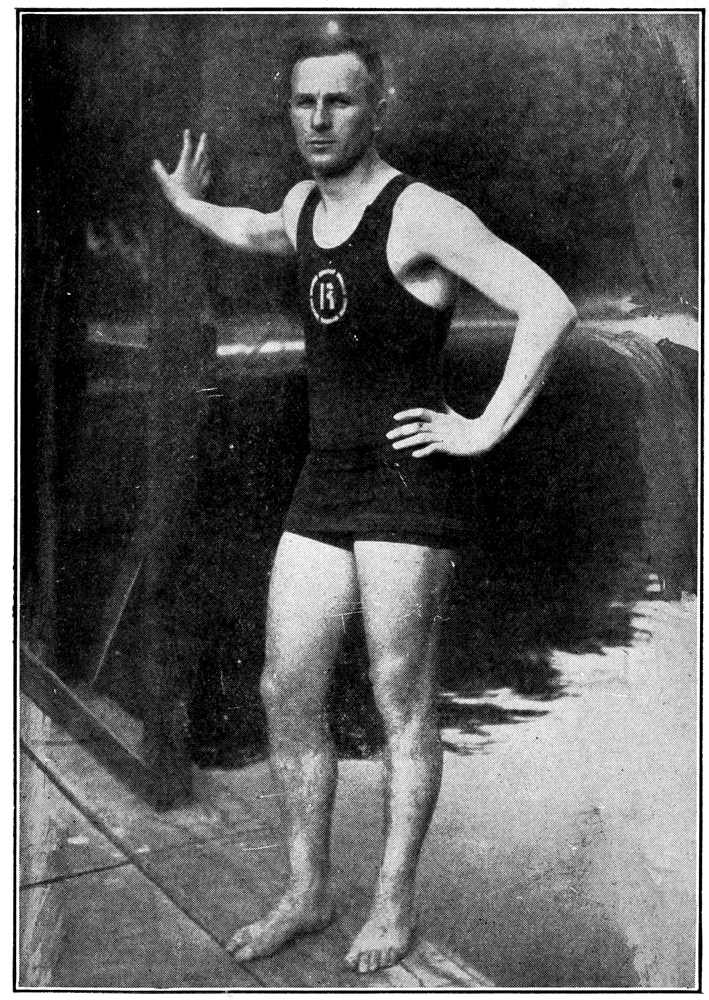
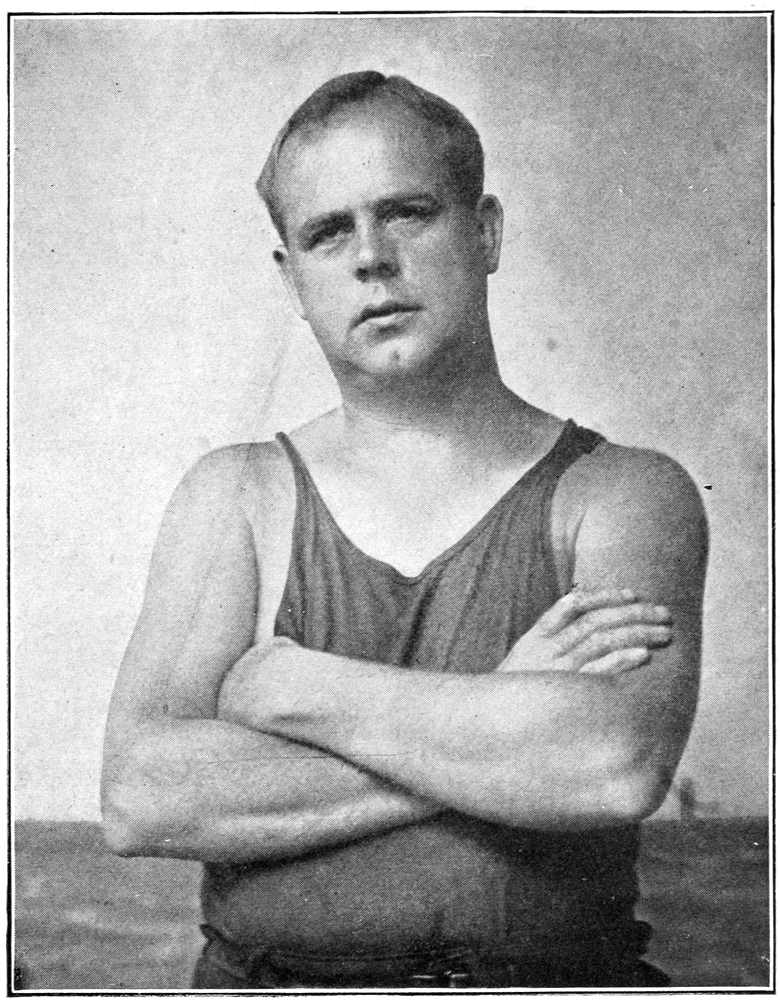
CHARLES B. DURBOROW.
Of Riverton, N. J.; the World’s Greatest Long-Distance Endurance
Swimmer.
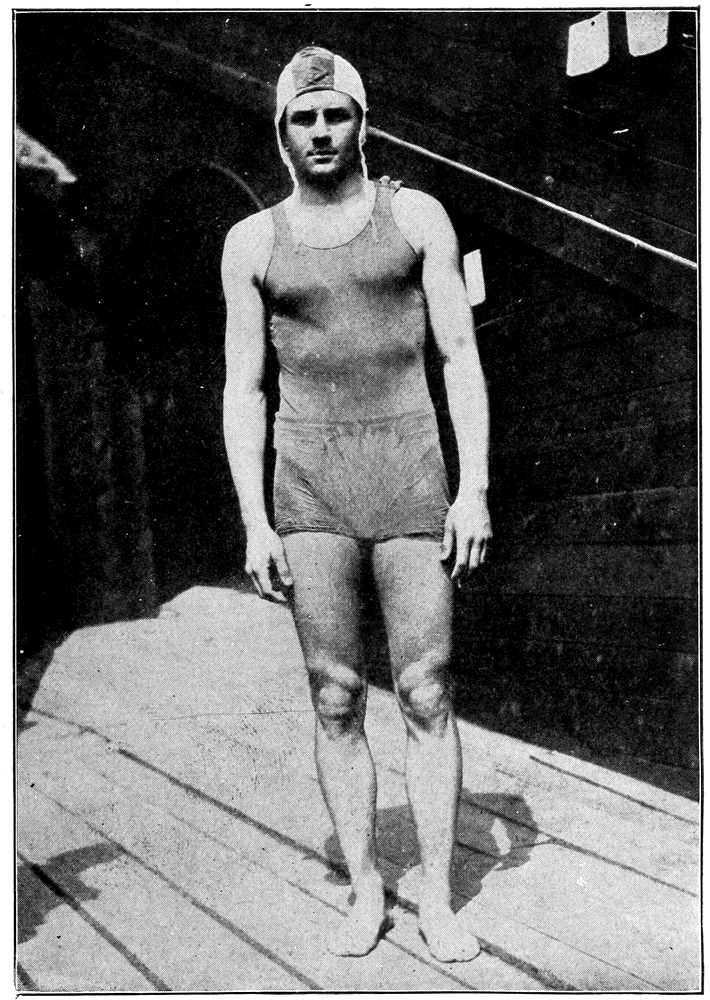
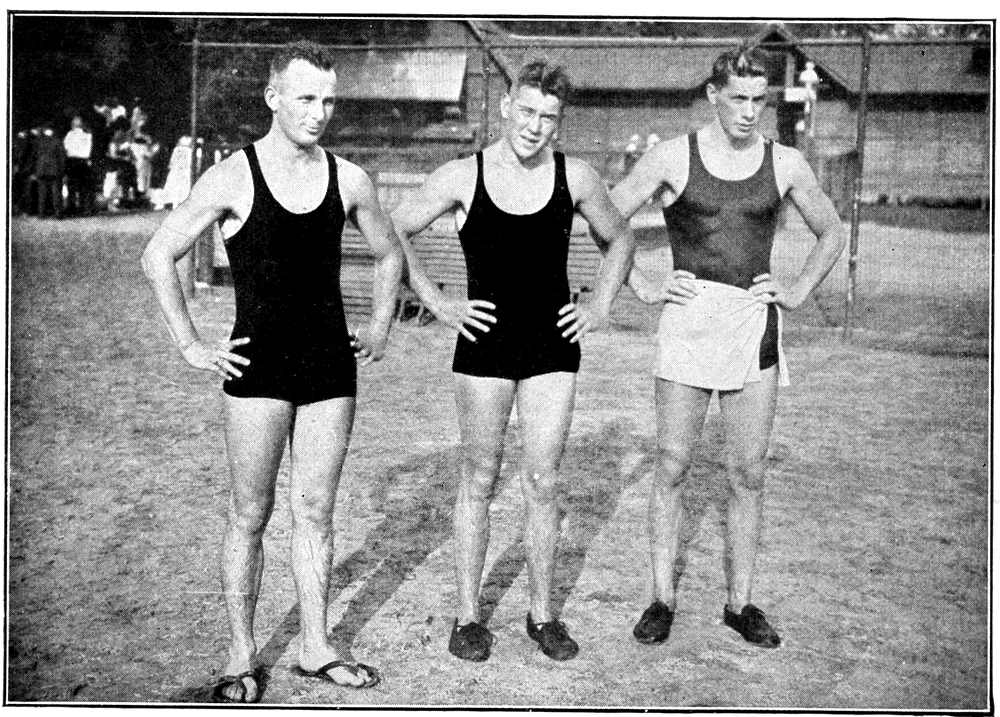
Ludy Langer, Los Angeles A. C.; Teddy Cann, N. Y. A. C.; Herbert Vollmer, N. Y. A. C.
THREE OF THE WORLD’S GREATEST SWIMMERS AND RECORD-HOLDERS.
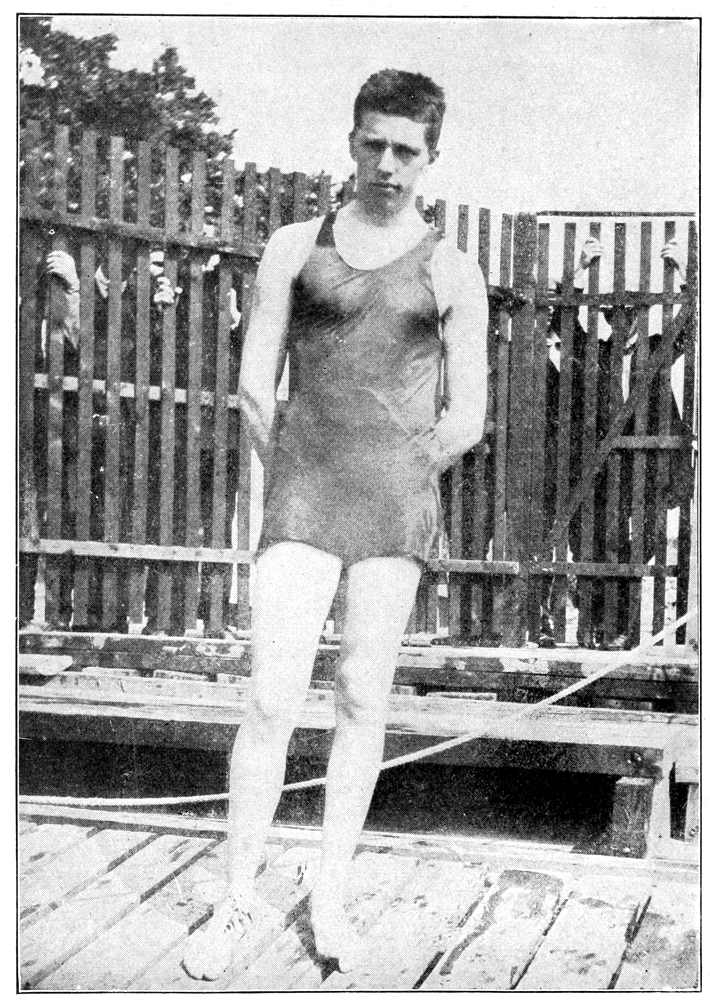
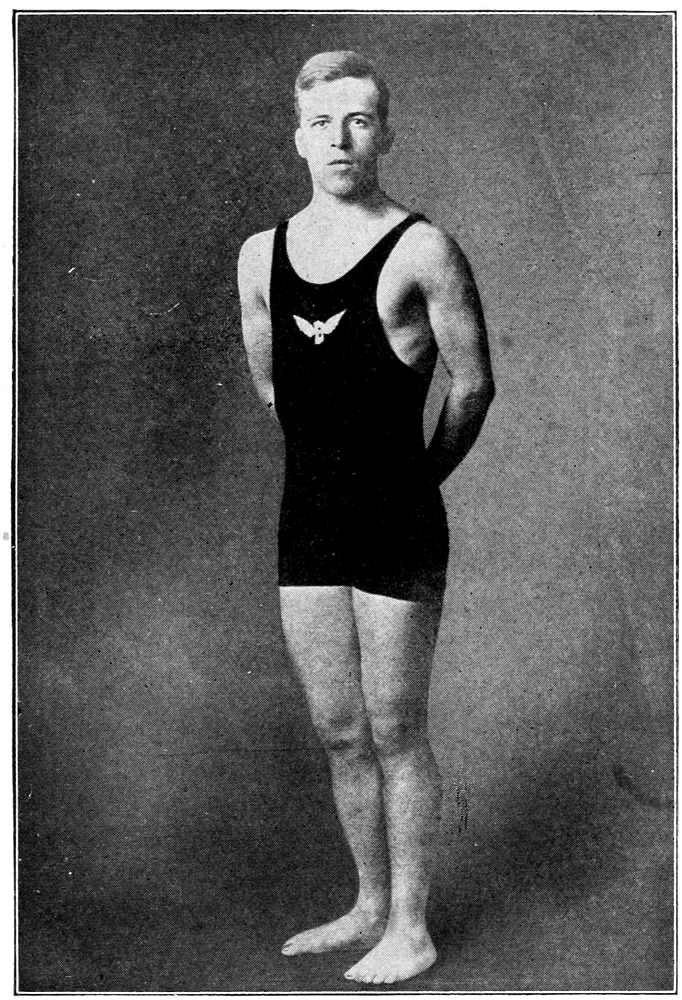
LEO HANDY,
Brookline (Mass.) High School. Greatest Scholastic Speed Swimmer
in the World. 100 Yards, 56 2-5s.; 220 Yards, 2m. 29 3-5s.
Princeton, N. J., February 12, 1916.
NORMAN ROSS,
Stanford University, California; 20 years of age (1916); 6 feet 1 inch;
207 pounds. 50 yards, 24 2-5 seconds; 100 yards, 56 seconds; 220
yards, 2 minutes 21 3-5 seconds; one mile, 23 minutes 22 seconds;
150 yards on back, 1 minute 56 seconds; plunge, 65 feet.
Diving — Shallow Dive — Running Header — Back Dive — Diving Feet Foremost — The Propeller — Marching on the Water — Swimming on the Back
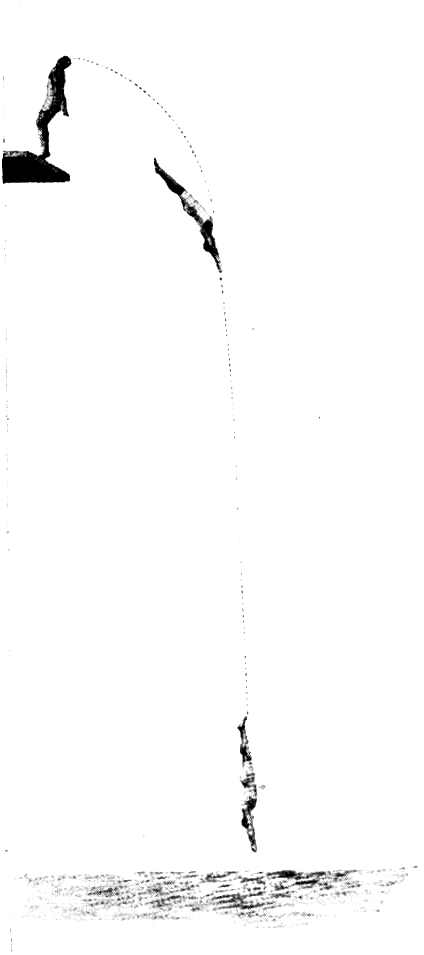
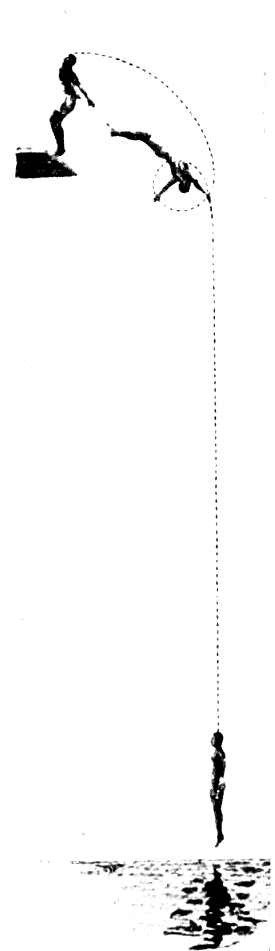
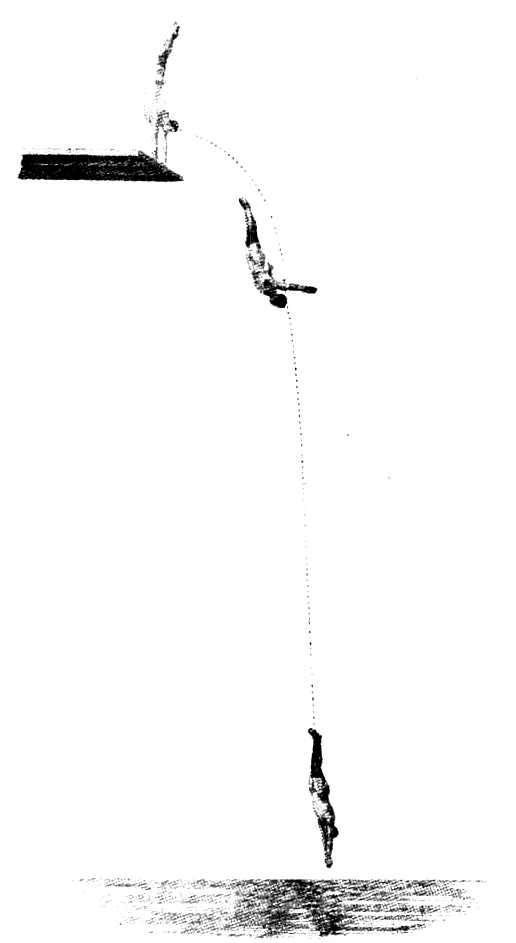
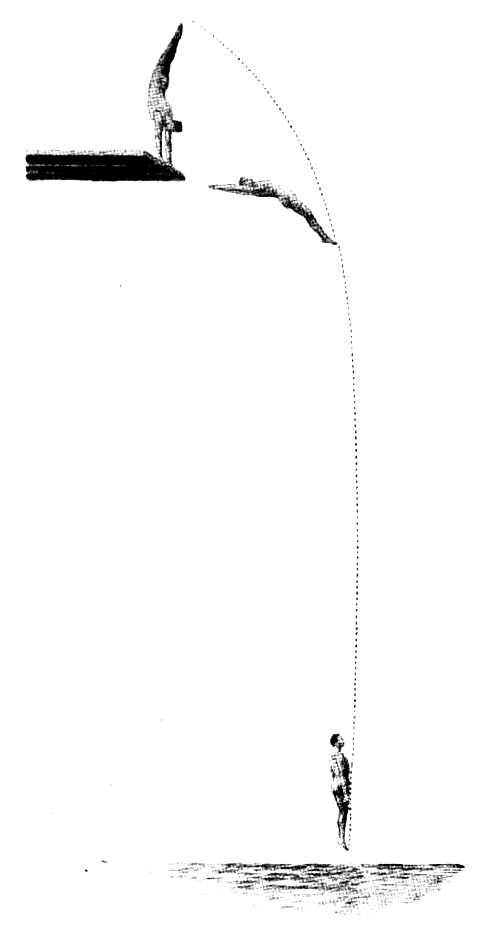
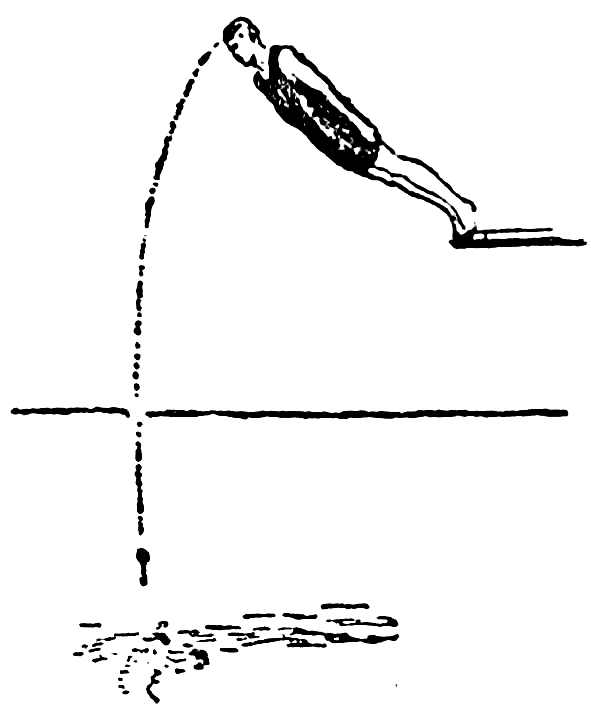
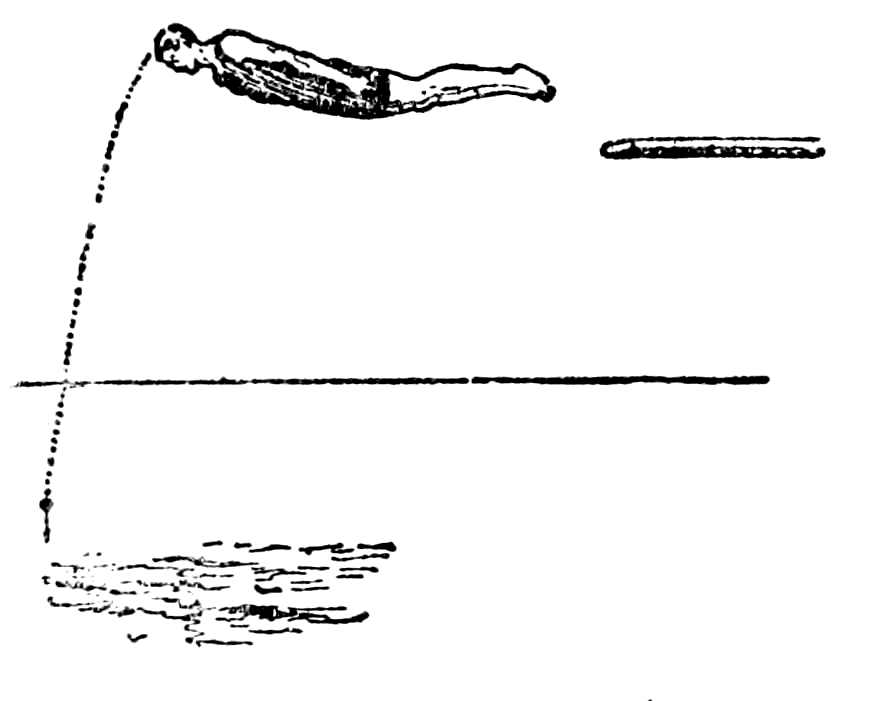
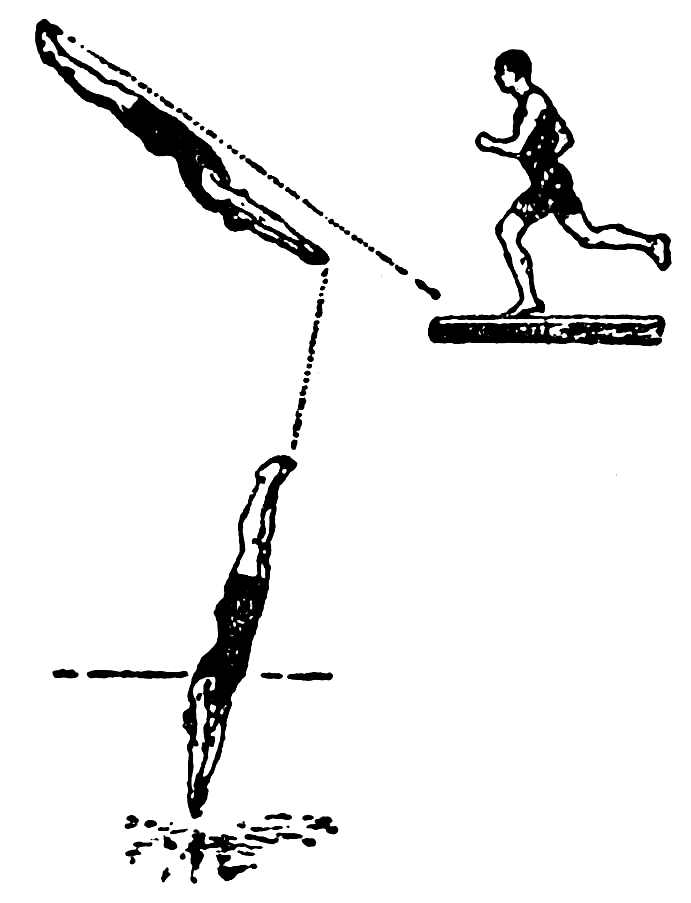
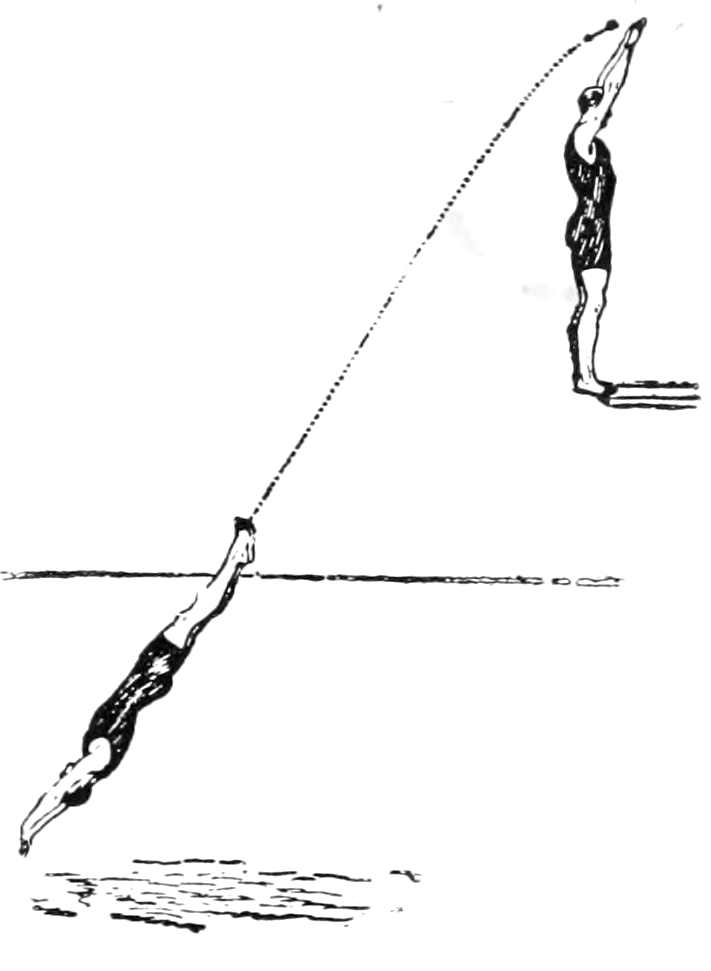
Diving is a necessary part of a swimmer’s knowledge,
and once the learner has mastered the simple strokes, there
is but one way to enter the water—head first. What is
known as the low or shallow dive is not only the best for the
beginner, but is useful when one advances to the racing
stage in their experience, while being the easiest to learn.
To make a good dive, stand perfectly erect, with the hands
first placed at the sides of the body, the position being the
same as you would assume when making a broad jump.
Then bend the legs slightly, draw the arms back of the
body and spring forward, getting the arms in front of the
head, palms downward, the thumbs touching, entering the
water with a shallow dive, keeping the feet and legs close
together, without bending at the knees while entering the
water. As soon as you make the plunge point the hands
upward and the body will come to the surface at once,
inclining always as the hands are pointed; for, if you
should point the hands downward, then the body would
descend. To learn to dive, a little confidence is needed
more than anything else, and after you have made your
first effort, which, on account of timidity, is usually a little
awkward, it will be a matter of a short time only when you
will catch on to the idea, after which you will never think
of jumping in the water, the pleasure and sensation attending
a dive always being fascinating. Of course, there are
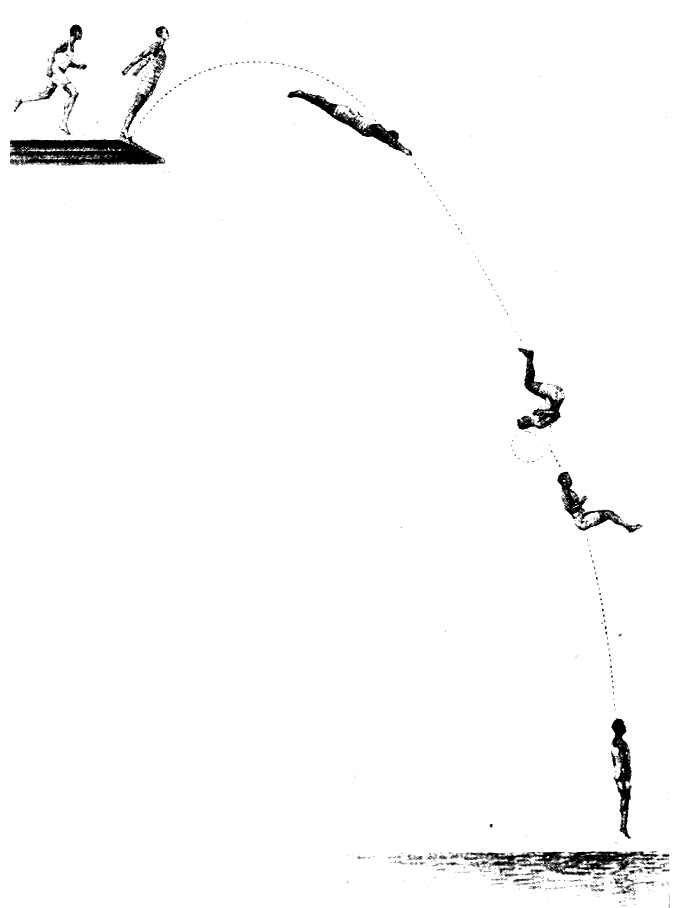
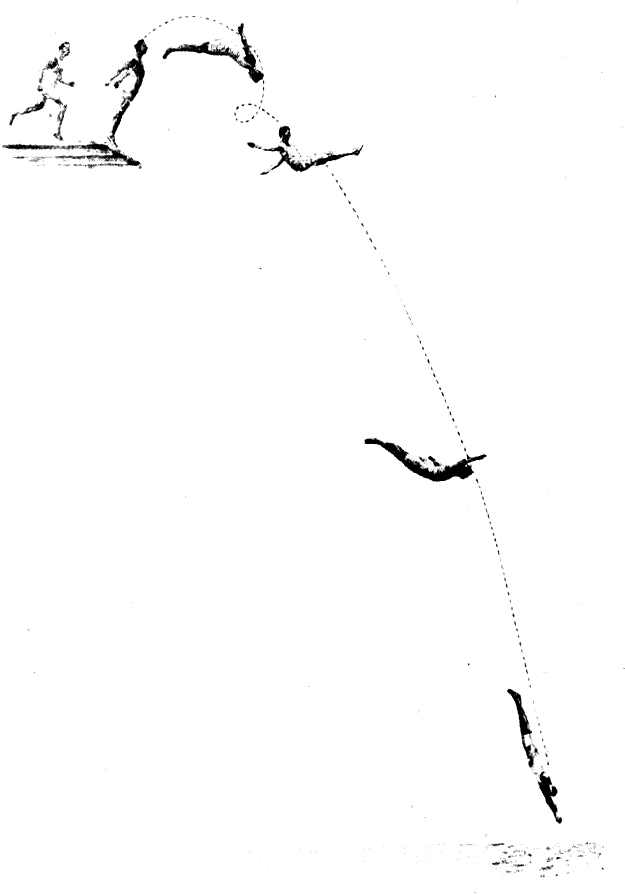
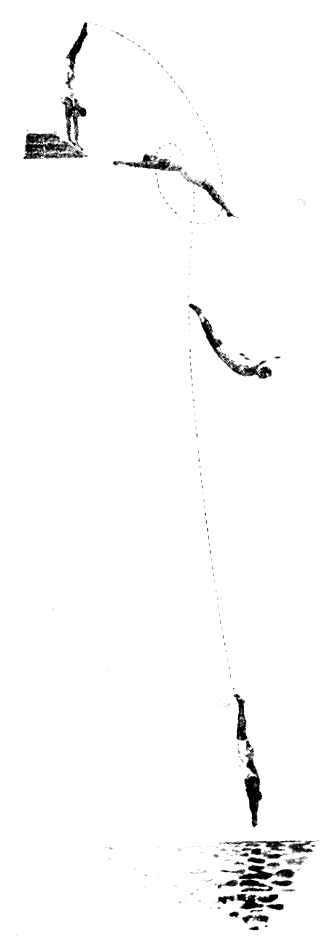
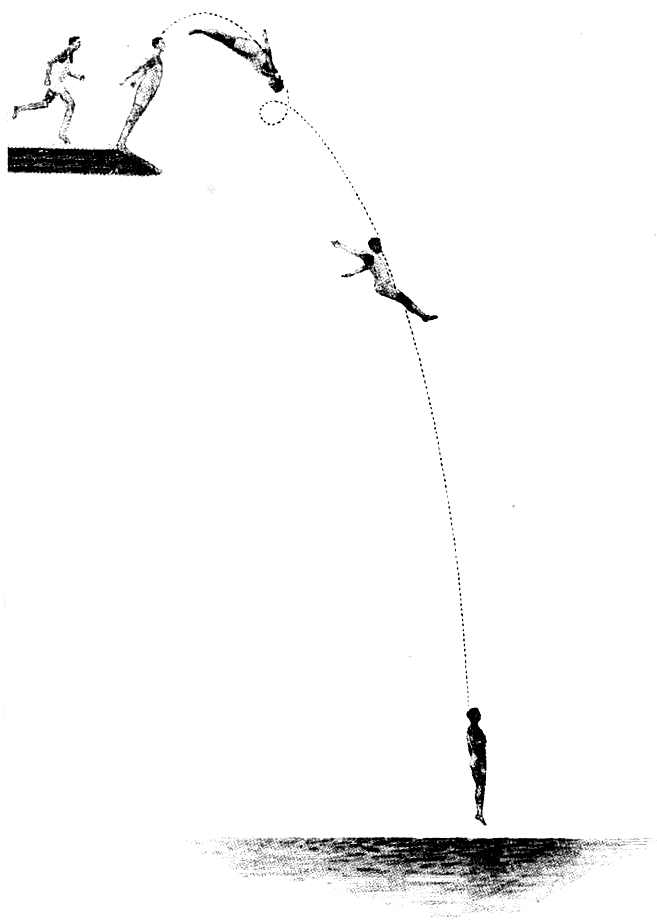
other forms of diving, such as the high dive, running
header, etc.; but these can be mastered later on, when the
pupil has advanced to a higher point in the art, when they
will be found to be easy of accomplishment, and you will
be ambitious to excel in all the various ornamental and
difficult water feats of the expert swimmer.
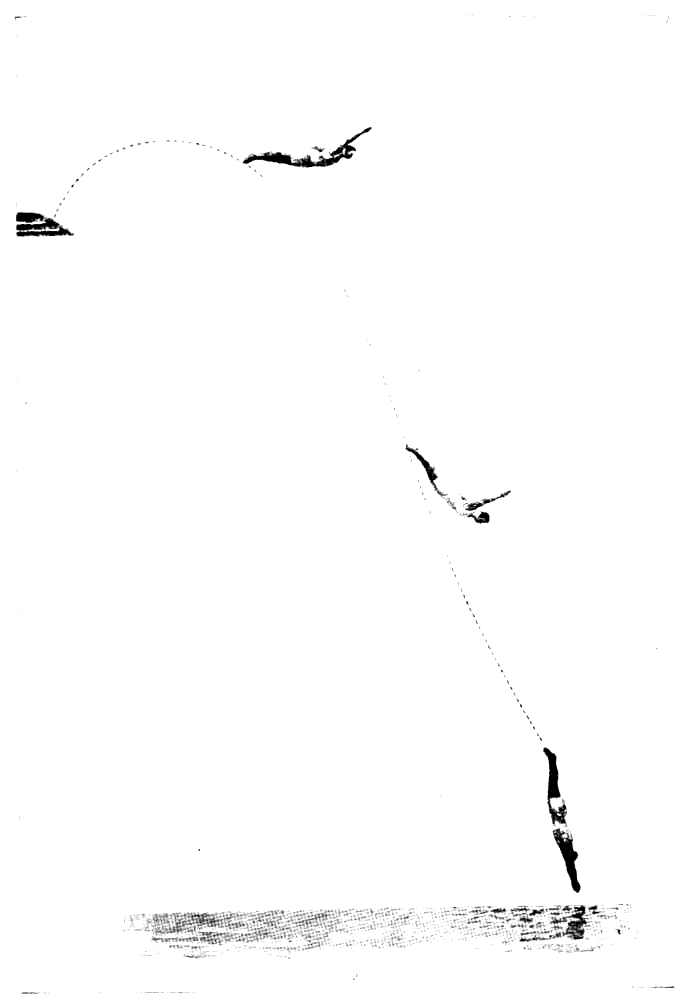
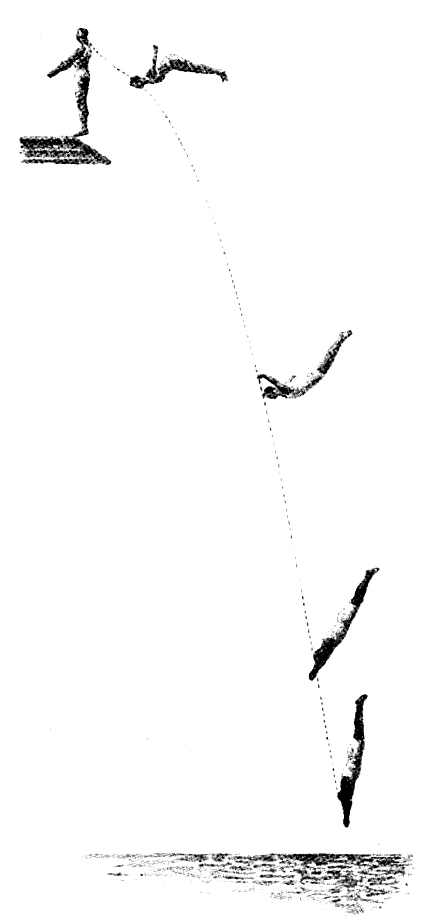
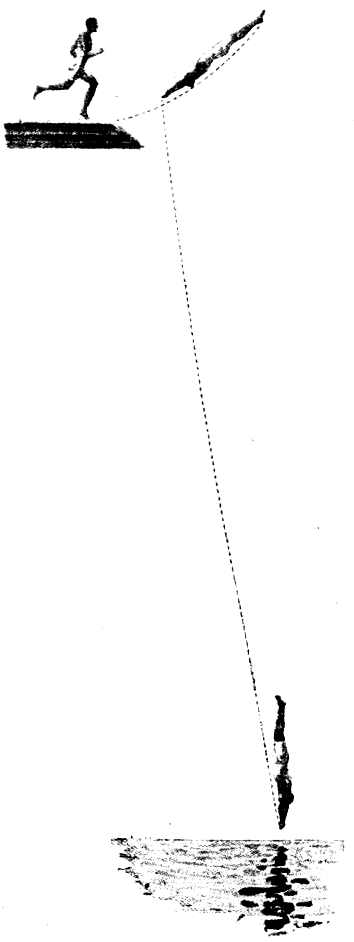
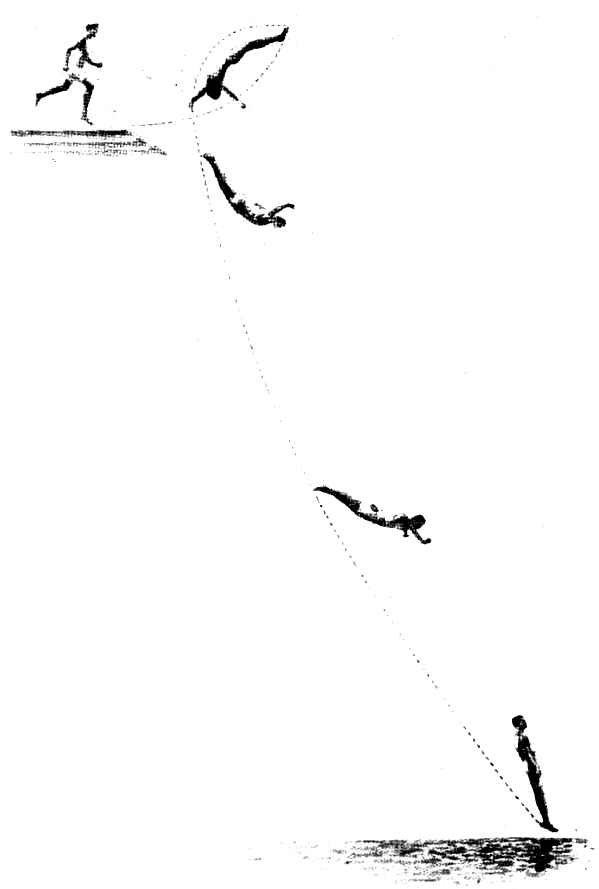
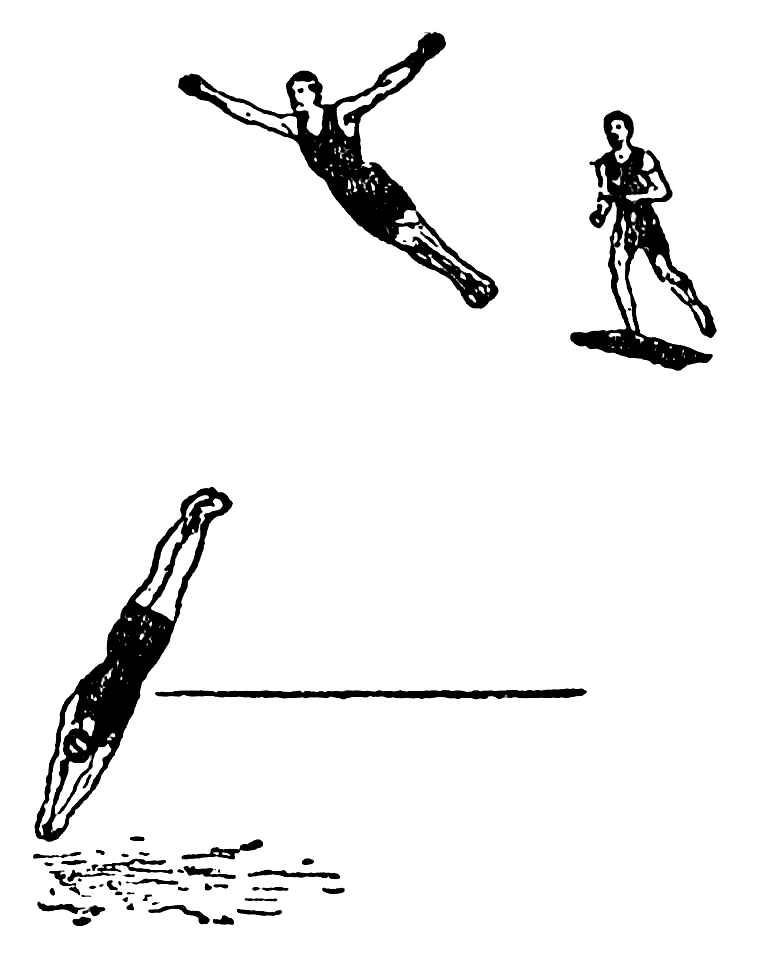
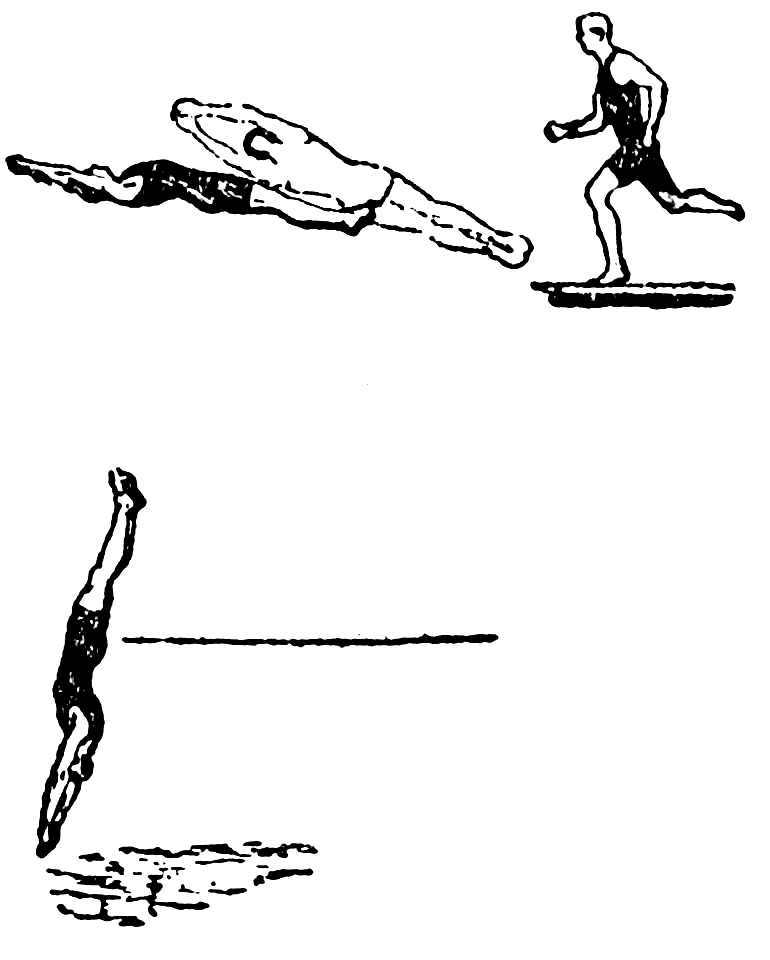
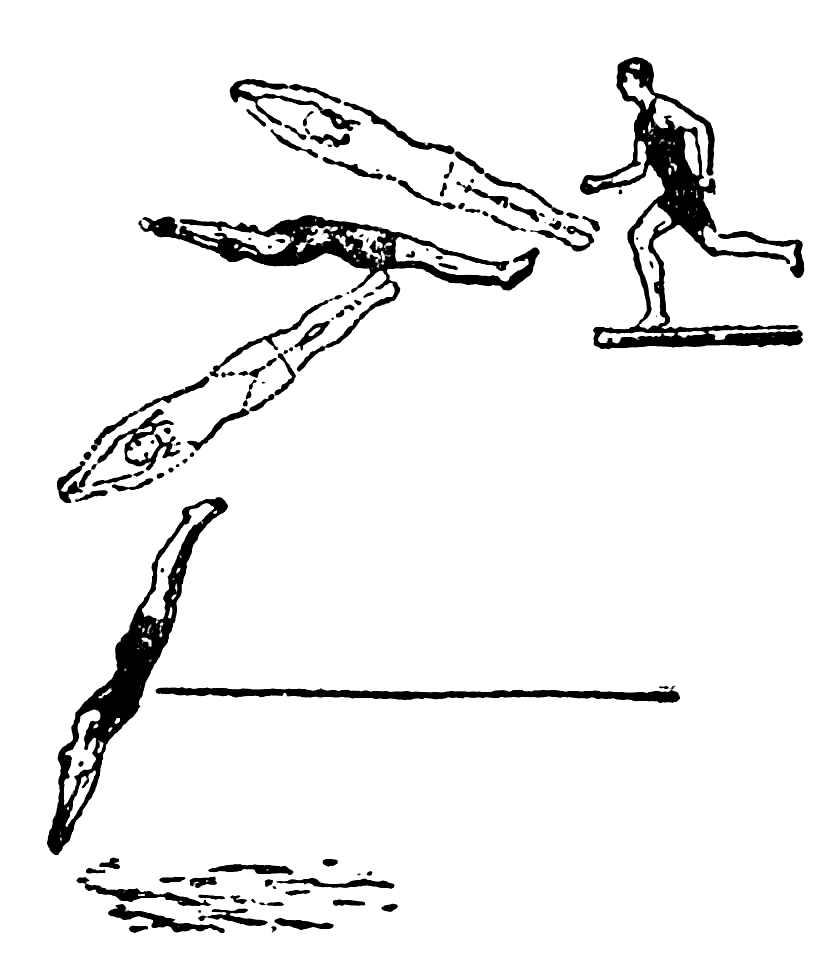
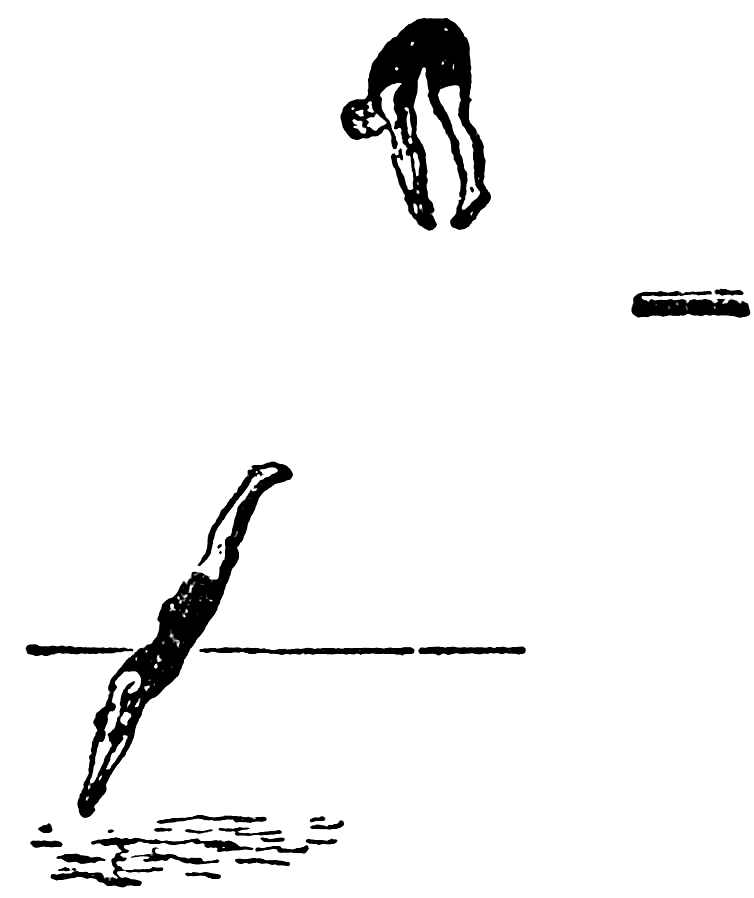
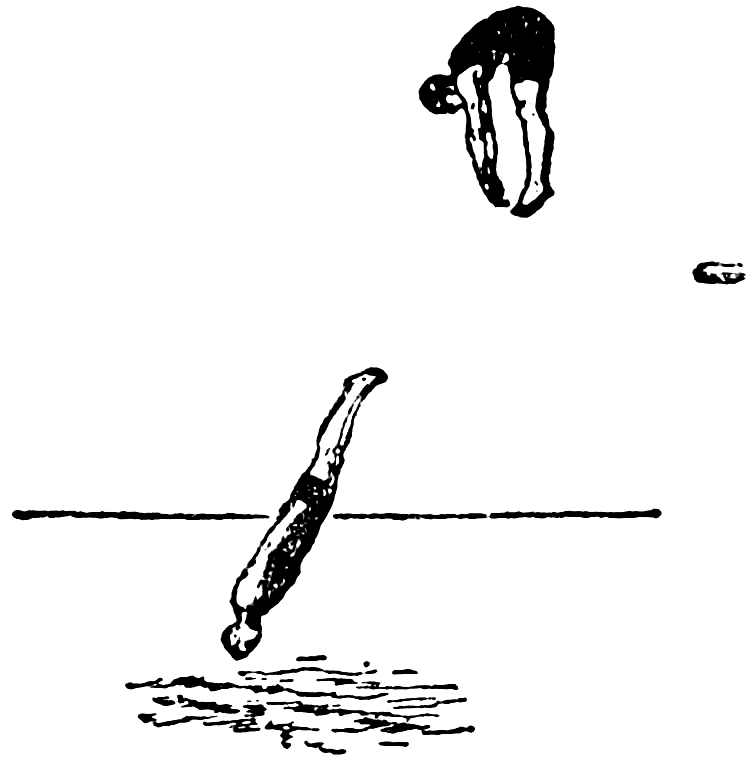
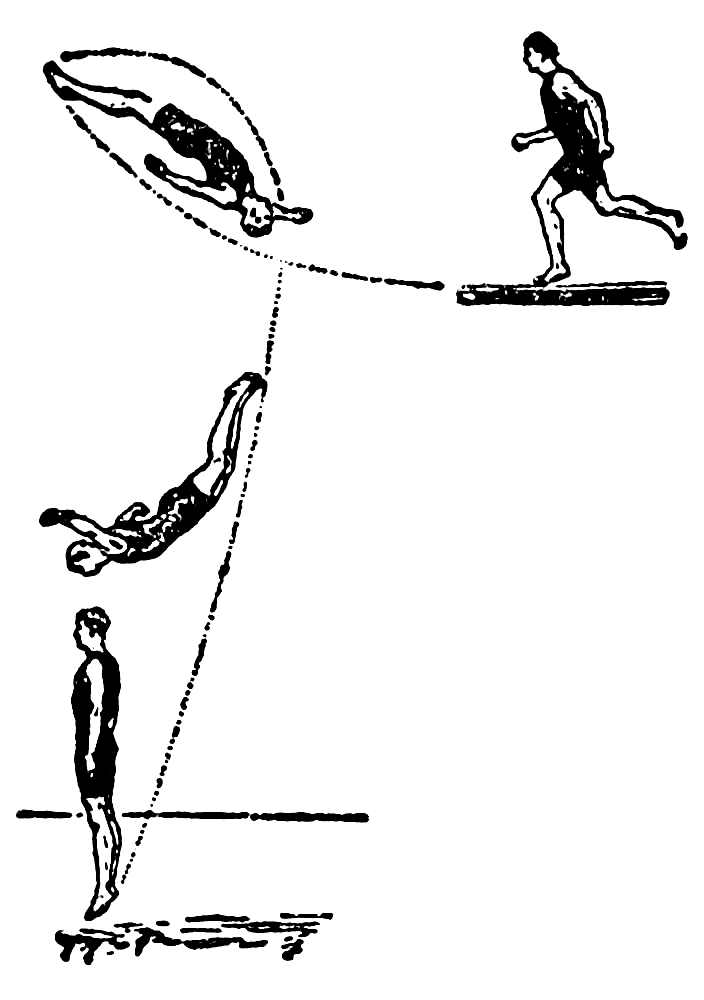
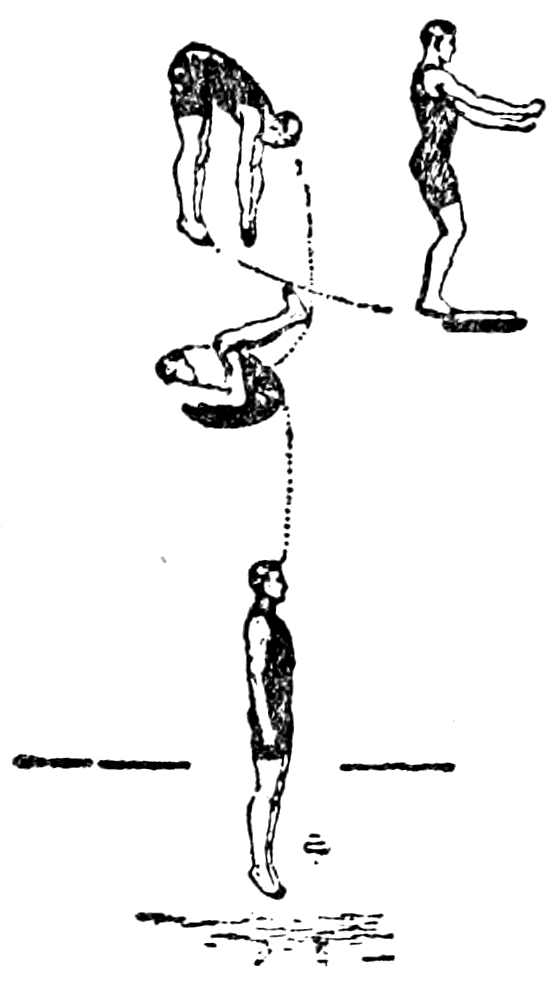
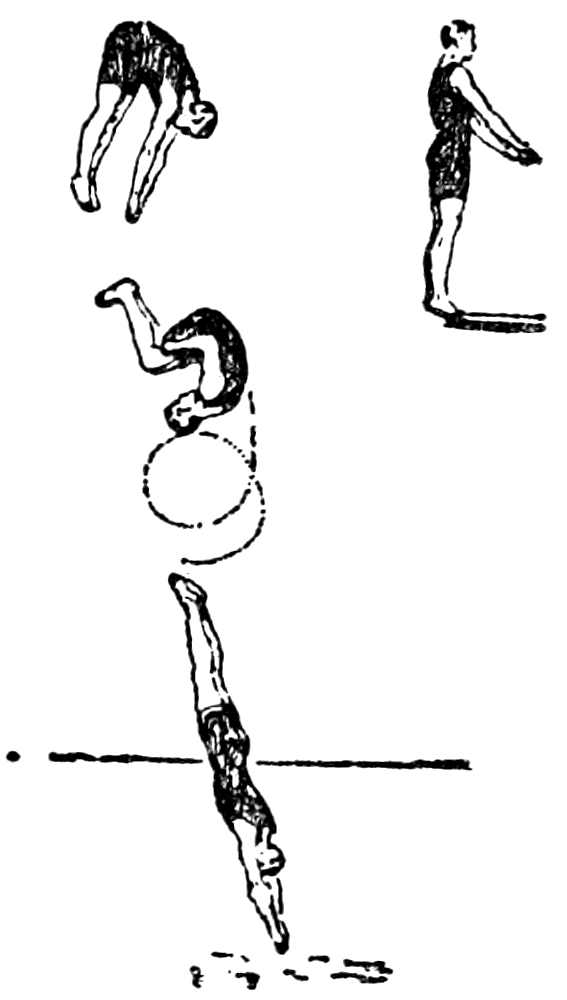
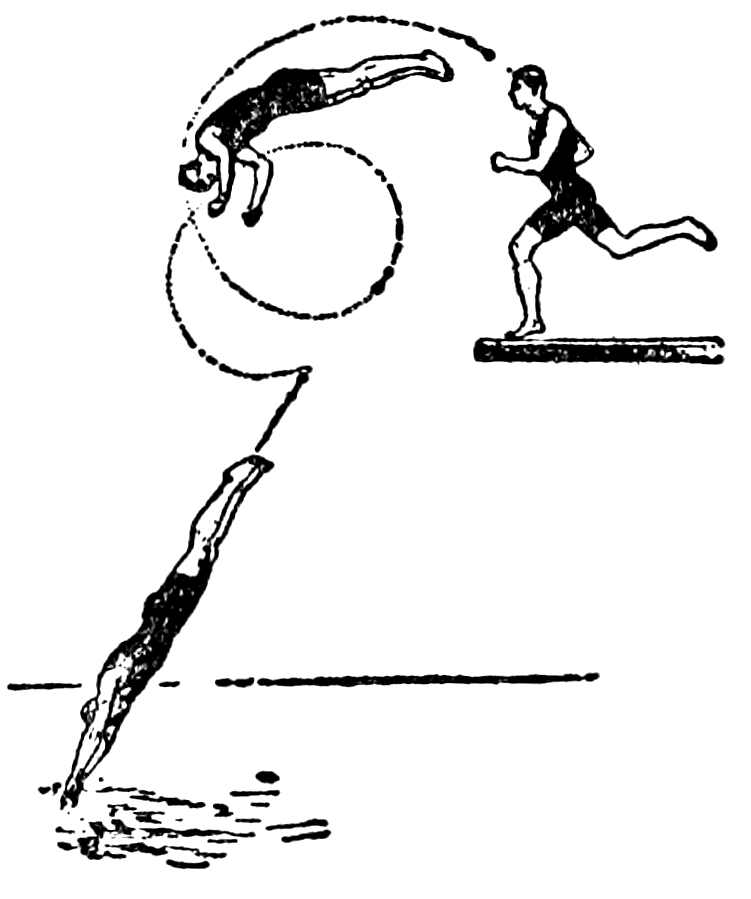
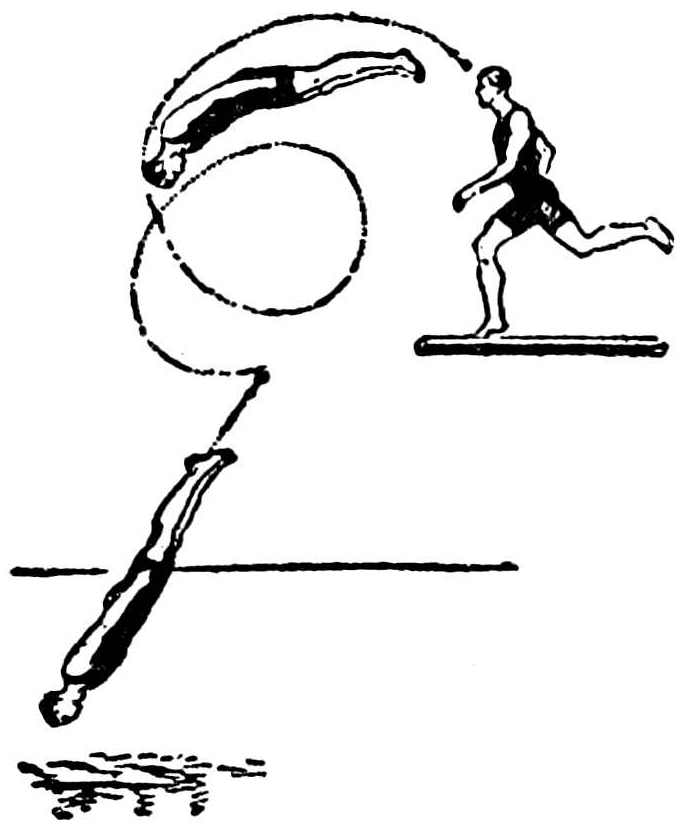
Probably the most interesting kind of a dive is known
as the running header. This kind of a plunge admits of
considerable artistic execution and finish, and to see a
good diver run and spring upward and forward into the air
and then poise and control the body, turning it in such a
manner as to enter the water gracefully, keeping all the
limbs rigid and cutting the water sharply like a knife,
without making any splash, is a great treat. The running
header is usually made from a spring-board, extending over
the water or from the end of the bath. The swimmer takes
a short run, similar to that taken by a high or broad
jumper, in order to give sufficient impetus or force to the
springing or forward movement. Then soaring upward
and outward he shoots through the air, keeping the body
straight until the declining turn toward the water is made,
when a sudden twist of the body is given and the diver
enters the water in a slanting position, keeping the upper
and lower limbs straight and close together, the arms
extended beyond the head, with the palms of the hands or
fingers touching in a wedge-like manner.
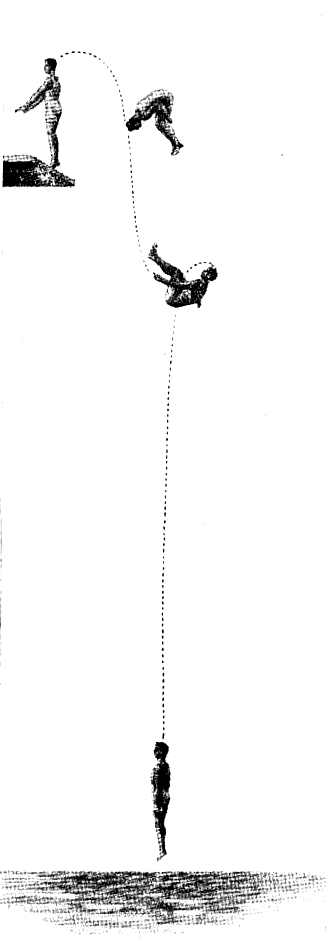
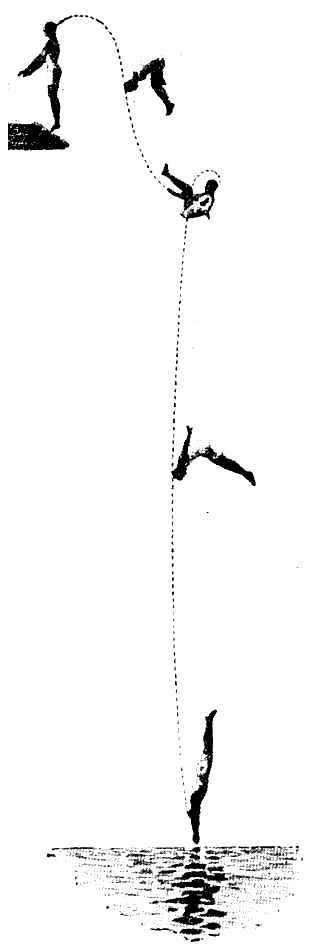
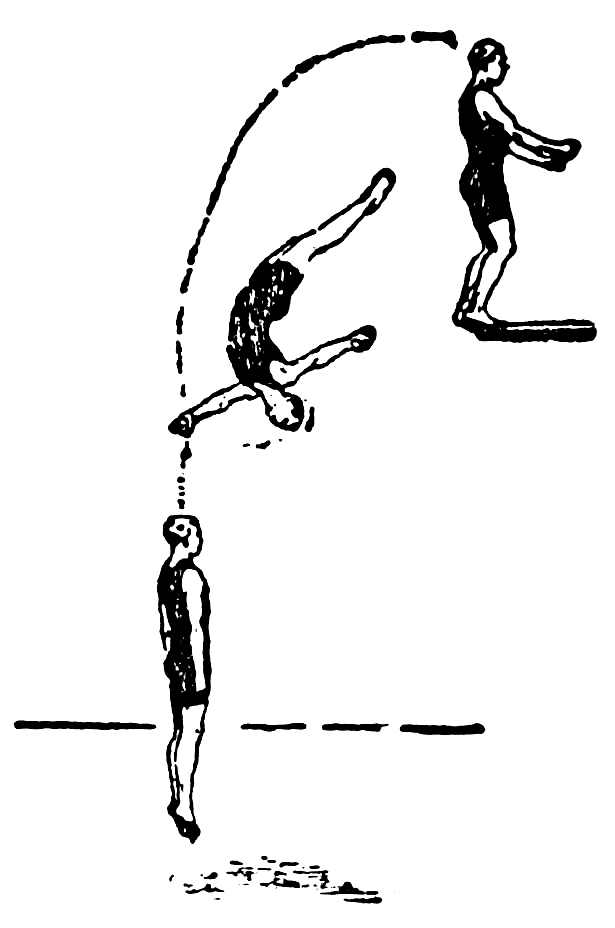
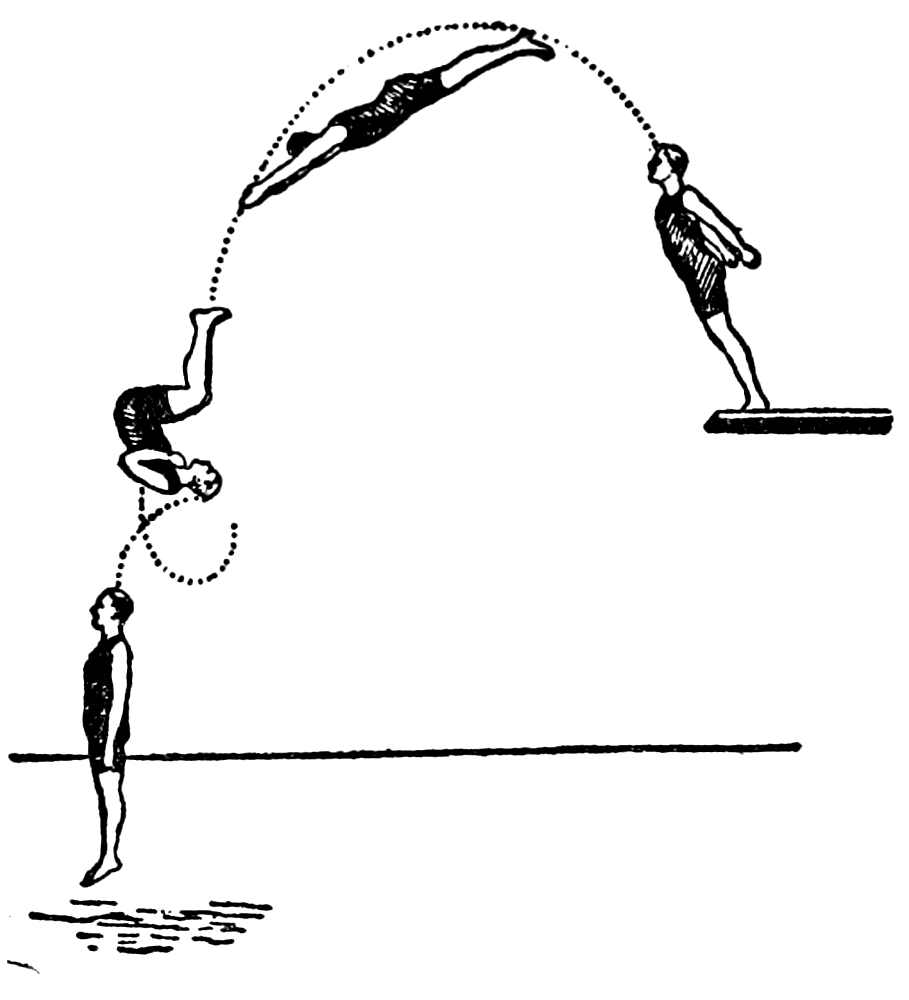
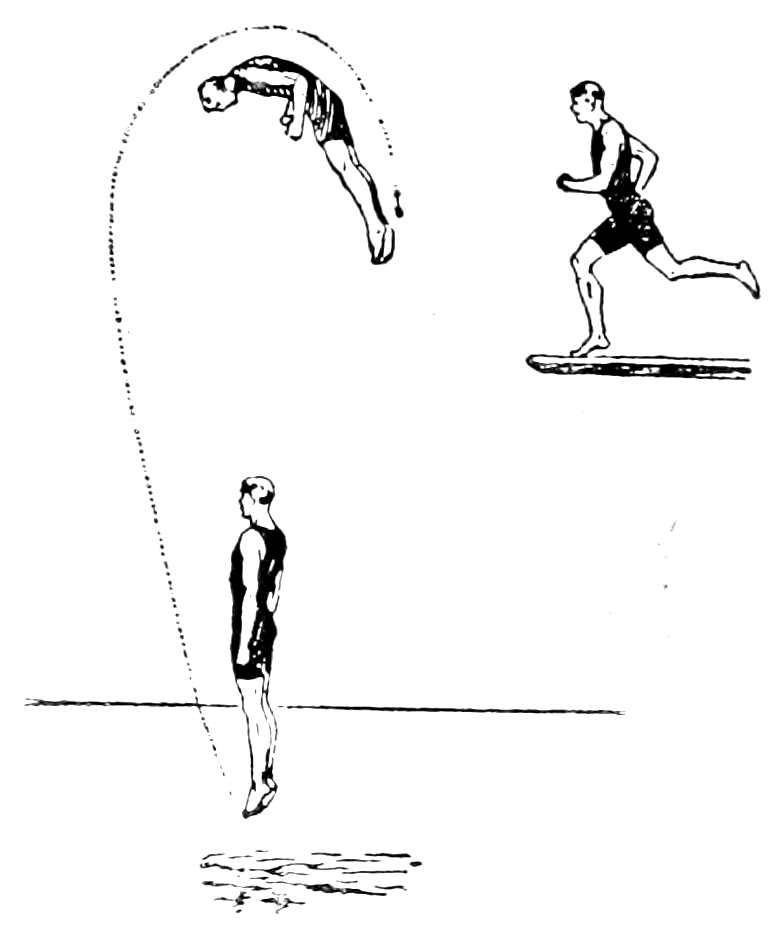
The back dive is always an interesting swimming feat. It
brings into play considerable gymnastic ability, but, on
account of the confidence the performer has as to the certainty
that the water will not hurt him much, barring a
slight sting to the flesh, should he come down flat on his
back, it does not require so much courage, in attempting
the first trial, as tumbling on land, in which the back dive
may be in a measure likened. While it is possible to make
a good back dive from a rigid base, it can be more artistically
made from the springing board. The diver stands
erect, with his back towards the water. The hands are first
held down to and close by the side. The person stands on
the edge of the pool on the diving board, resting on the
toes alone, the rest of the feet extended over the water. At
the movement of making the spring, the diver lowers the
body by bending the knees, while at the same time he
extends his arms back of the body and then by a quick
and sudden movement brings them forward, simultaneously
with throwing the head back and entering the water very
much the same as the forward dive. When properly done,
the back dive is a beautiful method of entering the water.
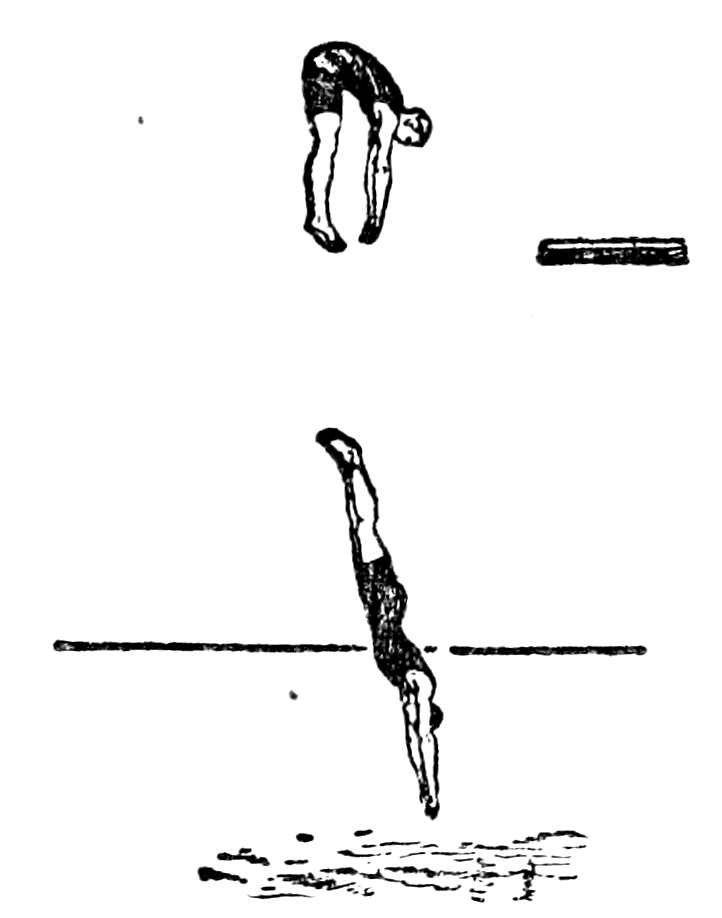
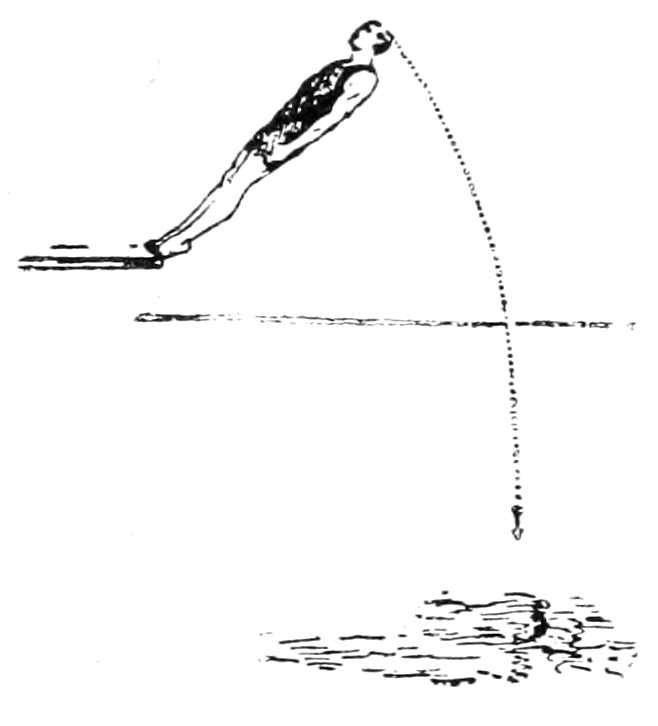
To enter the water, diving feet foremost, is a difficult
thing to do, but when such a plunge is nicely made it
usually comes in for a good share of merited approval.
Most of the ornamental and difficult swimming movements
are usually performed in tanks or at swimming gatherings,
where there is an audience, and the spectators, who know
very little about scientific strokes, are interested, amused
and entertained by these other performances, among which
none ranks higher than plunging feet foremost. As in
other forms of diving and plunging, the swimmer stands
on the edge of the pool or starting station, and, taking the
usual breath, leaps outward, feet foremost, much like jumping
in the water, throwing the arms behind and over the
head and entering the water feet first, instead of head
first. The body must be well thrown back, and the legs
straightened and kept perfectly rigid while entering the
water. One must jump well out and be sure to judge the
distance safely in order that there be no danger of striking
the upper part of the body on the ledge of the bath, pier or
wharf, as the case may be.
The number of ornamental feats in swimming is almost
unlimited, according to the ability and ingenuity of the
performer; but, in addition to the above-described movements,
such figures as porpoise swimming, where the expert
describes, by going under and over the water, the swimming
of a porpoise; imitation of a torpedo, the head and body
being submerged and the feet above the water, the swimmer
propelling himself with the hands, the feet alone showing
above the water; the back and front somersaults, which are
really swimming gymnastics; sculling on the back, using
feet and hands only; imitation of a bicycle rider, etc., etc.,
all of which can be mastered by a clever swimmer with
practice.
To perform the propelling trick it is necessary that the
swimmer be able to float well, for by that means the body
is supported in the water, while the hands, extended beyond
the head, the back of the hands pointing downwards, propel
the swimmer, feet foremost, through the water. Place the
body on or near the surface of the water as possible, lying
on the back, the feet and legs fully extended and close
together, the hands beyond the head, also in a straight line.
Then, by a vigorous sculling movement of the hands against
the water, the body is sent gradually but steadily forward,
the quick action of the hands against the water having the
same effect in driving the body forward as the propeller of a
boat. Some pretty turning movements like the directing of
the course of a boat with a rudder can be made by propelling
with one hand only or each alternately, as the case
may be, as, by sculling with the right hand, the body will
glide or take an opposite course, while the left hand movement
will direct to the right.
Until one sees the swimmer march on the water its title
is somewhat misleading. It is not a difficult method of
progression through the water, after one catches on to the
idea. Place yourself in a floating position, with the arms
folded across the breast or the hands crossed back of the
head, with the fingers locked. Then by bending the knees
and drawing up the legs slowly, one after the other, keeping
the toes pointed straight out in the upward movement,
so as to have as little resistance as possible against the
water. Straighten out the limb, turning the toes upward
toward the knee, making a downward stroke with the leg,
bringing the calf against the water with pressure enough
to draw the body along. The upward, or negative movement,
as we said before, must be slowly executed, while the
downward, or positive movement, should be performed with
some force against the water, the locomotion, feet foremost,
the alternate action being the same as in walking.
As it is not possible to get much power from the positive
movements, marching on the water is therefore not a
rapid means of gliding along.
Swimming on the back is one of the simplest of the
natatorial exercises, and one of the easiest methods to
learn, besides being absolutely necessary in life-saving, as
well as useful as a means of resting after swimming a
long while on the breast or side. The movements of the
legs are very much the same as in the breast stroke, except
that the knees are kept farther apart. The best way to
learn to swim on the back is to place yourself in the water
on the back, the same as you would when floating. This
position can be easily attained by holding the arms
straight down close to the sides, the hands pointing toward
the feet, and by giving a few sculling movements with the
hands, you will at once get into a good floating position.
Now slowly open the legs apart, while at the same time
extending the arms beyond the head and bring the legs
together with a vigorous kick, holding the arms beyond the
head for an instant until all the momentum from the kick
is expended. At the second movement the arms are brought
back to their former position, describing an arc and catching
the water with the palms of the hands somewhat like
an oar, which helps to send the swimmer ahead, repeating
the movements as before.
When tired, swimming on the back is useful as a means
of resting the muscles used in the other strokes.
Long-Distance Endurance Swimming
American swimmers have made some wonderful strides
in long-distance swimming and tests of endurance in the
past few years, until now our records over distance and
time immersions stand out prominently among the world’s
greatest watermen.
Over the very long and tiresome routes our swimmers
use various strokes, some of them relying on the breast
stroke, others using the over-arm side stroke, but most
of them stick to the double-over-arm stroke (sometimes
called the Trudgeon), the latter method affording an opportunity
for putting more continuous power to the stroke,
which makes for greater speed; besides, this method makes
the swimmer breathe regularly and with precision on each
stroke and is useful in both rough and smooth water.
Space will not admit of recounting the numerous performances
made by the various distance swimmers of this
country, but all the leading record authorities and writers
on swimming have agreed on Charles B. Durborow of
Riverton, N. J., the big Philadelphia bank clerk, as the
foremost long-distance and greatest mileage swimmer in
the world.
Durborow is thirty-four years old (1916); weight, 210
pounds; height, 6 feet; swims the double-over-arm stroke,
and has been swimming since 1907. He swims about
600 miles a year, and has covered over 5,000 miles in ten
years. In his training, particularly before he begins his
very long swims, he does a lot of rowing over long routes,
and generally rows about 2,000 miles a year. He is the
only swimmer who has ultimately conquered every swim
he ever tried. He never takes any nourishment during
a swim, and is always at his work the next day after a
big feat, none the worse for wear.
Among the hundreds of big swims made by Durborow,
the following record of ten of his greatest performances,
some of which have never been equalled by another swimmer,
stamp him as the leading distance swimmer in the
world:
Thirty-four miles, 12 hours and 44 minutes, from Arch Street wharf,
Philadelphia, to one mile below Market Street wharf, Chester, and
return to Washington Avenue wharf, Philadelphia, Delaware River,
July 10, 1910.
Ten miles, 7 hours and 59 minutes, from Flat Rock Dam to Conshohocken
and return, Schuylkill River, July 24, 1910.
Twelve miles, 5 hours and 53 minutes, from the million-dollar pier,
Atlantic City, N. J., across the mouth of Great Egg Harbor Bay, over
the bar to the beach, at Tenth Street, Ocean City, N. J., in Atlantic
Ocean, June 25, 1911.
Forty-two and forty-three-one-hundredths miles, 14 hours, 15 minutes
and 31 seconds, from Cape May, N. J., across the mouth of Delaware
Bay to Broadkill Shoals, Delaware, Atlantic Ocean and Delaware
Bay, July 1, 1912.
Thirteen miles, 8 hours, 12 minutes and 13 seconds, from the
Charlestown Bridge to Boston Light, Boston Harbor, July 27, 1913.
Thirty-two and one-half miles, 12 hours and 52 minutes, from
Walnut Street, Philadelphia, to one-eighth of a mile below Market
Street, Chester, Pa., and return to Washington Avenue, Philadelphia,
Delaware River, June 27, 1914.
Twenty-two miles, 8 hours and 46 minutes, from the Battery, New
York City, to Sandy Hook Beacon, Sandy Hook, N. J., New York
Harbor, July 19, 1914.
Twenty-six miles, 9 hours and 8 minutes, from Riverton, N. J., to
Bristol, Pa., and return to Riverton, N. J., upper Delaware River,
May 28, 1916.
Twenty-two miles, 8 hours and 42 minutes, from Cape Charles, Va.,
across the mouth of Chesapeake Bay to Cape Henry, Va., Atlantic
Ocean (swam outside the capes), June 23-24, 1916.
Thirty-six and one-half miles, 13 hours and 30 minutes, from
Market Street, Chester, Pa., to Penn Treaty Park, Philadelphia, and
return to Market Street, Chester, Pa., and then on the third tide to
Eddystone, Pa., Delaware River, September 9-10, 1916.
OLGA DORFNER.
Philadelphia Turngemeinde; American Champion Sprint Swimmer and
Record-holder.
CLAIRE GALLIGAN.
New Rochelle, N. Y.; American Champion Middle-Distance Swimmer
and Record-holder.
1. Gertrude Artelt, P. T. G.; 2.. Helen Pennepacker, P. T. G.; Middle
Atlantic champion diver; 3. Elizabeth Becker, P. T. G.; 4. Josephine
Bartlett, Metropolitan champion diver.
A QUARTETTE OF FAST GIRL SWIMMERS AND DIVERS.
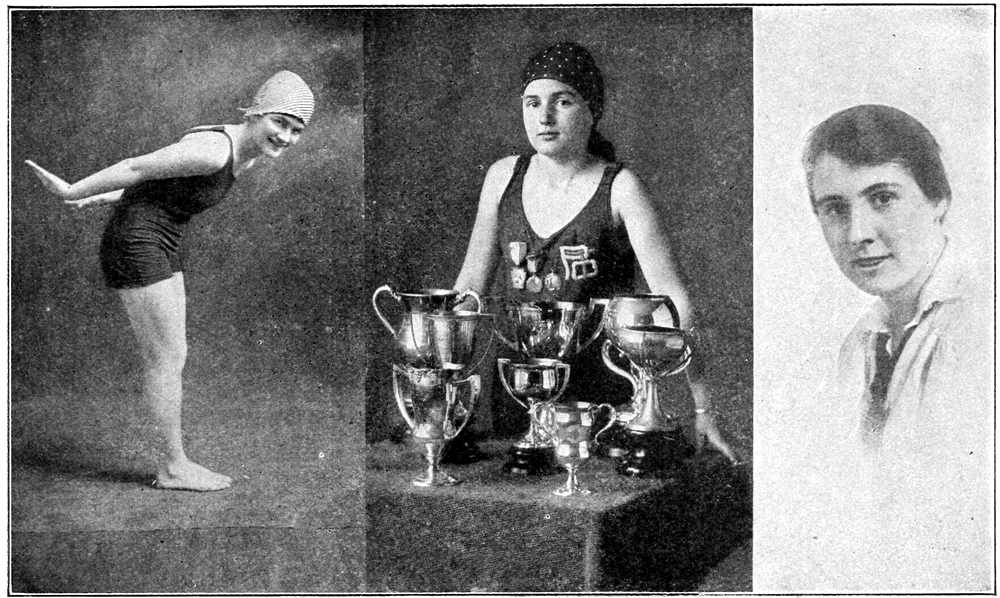
Left to right—Bessie Ryan, fast Philadelphia swimmer and frequent prize-winner; Florence
McLoughlin, First Regiment (Philadelphia), America’s greatest juvenile swimmer; Anna C. Kean,
Lansdowne, Pa., Ocean City to Atlantic City (in sea), 8h. 28m., and 26 miles, Delaware River,
11h. 8m. 41 2-5s.
Women and Girl Swimmers
Probably no other form of exercise or competitive sport
among women and girls has advanced so rapidly in the
United States as that of swimming, and with the recognition
of women swimmers by registration in the Amateur
Athletic Union, contests and championship events have
been held in various cities throughout the United States,
from the Atlantic to the Pacific, with the result that our
women swimmers are rapidly coming to the front in speed
swimming, and their records at various distances are very
close to the best world’s marks for those of their sex.
Women make better swimmers than men, when equally
skilled in the art, and while they do not quite approach
the speed times of the men, because of the difference in
muscular strength and power, they are more graceful than
men in the water, practice more frequently, make less
fuss about it, and get a lot of physical benefit from their
favorite pastime.
A woman, being of lighter bony structure, with more
flesh than a man in proportion to her size and weight,
and with a different physical formation of body, gets a
better equipoise in the water, with the result that most
all women float naturally; in fact, after they learn to
swim, very few of them have to make any effort to stay
on top of the water, which gives them a confidence not
usually seen among men swimmers; and, as nature has
endowed them with a much better circulation than men,
they are able to stay in the water and stand a lower temperature
than the opposite sex without getting chilled.
Miss Olga Dorfner of the Philadelphia Turngemeinde
has shown herself to be the fastest short-distance speed
swimmer in this country in contests up to 220 yards, at
which distances she has defeated all comers, and she holds
the American records over these routes. She swims an
excellent crawl stroke, and the following times, most of
them American records for women, shows her top class as
a sprint swimmer: 40 yards, 22 seconds; 50 yards, 29
seconds; 60 yards, 39 seconds; 80 yards, 53 seconds; 100
yards, 1 minute 8 4-5 seconds; 220 yards, 3 minutes 5 1-5
seconds.
Miss Claire Galligan, of New Rochelle, is the best middle
distance swimmer among our girls, having defeated all
the other aspiring contestants in races over 220 yards. Miss
Galligan has swam 100 yards in 1 minute 9 seconds; 220
yards in 3 minutes 4 1-5 seconds; 440 yards in 7 minutes
6 3-5 seconds; half mile in 15 minutes 15 2-5 seconds, and
one mile in 31 minutes 19 3-5 seconds. She uses a four-beat
Trudgeon-crawl stroke, and is almost certain to break
many more women’s swimming records, as she is increasing
in speed all the time.
Gertrude Artelt, Philadelphia Turngemeinde, is coming
on fast at sprint swimming, having now a record of 1 minute
13 2-5 seconds for 100 yards, while her team-mate,
Elizabeth Becker, from the same organization, has covered
220 yards in a race in 3 minutes 13 1-5 seconds, with very
fast times for the shorter distances.
Bessie Ryan of the First Regiment Swimming Pool,
Philadelphia, is a coming fast swimmer who invariably
wins a prize every time she competes. Her 100 yards
time is 1 minute 15 seconds, her 220 yards 3 minutes 35
seconds, and all this in her first year of competition.
Florence McLaughlin of the First Regiment Swimming
Pool, Philadelphia, was the most remarkable juvenile
swimmer and diver in this country and her many records
and prizes over all distances stamp her as a great
swimmer.
Miss Anna C. Kean of Lansdowne, Pa., swam from
Ocean City to Atlantic City, 12 miles in the sea, August
21, 1916, in 8 hours and 28 minutes, and on September
18, 1916, swam 26 miles in the Delaware River in 11 hours
8 minutes 41 3-5 seconds, this performance being the longest
swim ever made by a woman in the world under same
conditions.
Modern Methods of Life-Saving
It is often remarked by those who have a very limited
knowledge of swimming matters, that it is the good swimmer
who gets drowned. This is a very erroneous impression
and one that will not bear investigation.
It is the fellow who thinks he is a good swimmer and
who usually tries some fool-hardy stunt which he is not
competent to undertake, who loses his life. Besides, this
sort of chap may be a fair swimmer, but he does not get
any practice, and probably overeats before going into the
water, and goes far out beyond his depth, forgetting that
he has to come back again, and when his muscles and
wind, which are not accustomed to the extra tax, give out,
loses his head, gulps a big shipment of water, and then the
excitement strangles him and brings on heart-failure and
he is gone for good. He is not literally drowned, he is
shocked to death, for I mean to say it, and most medical
men and other experts competent to judge will bear out my
statement when I tell you that there are very few people
drowned in the water, and that most of the deaths occur
from heart-failure, as I have stated above, while the fact
that many of the drowning cases in the surf are found
floating face down, show that the shock has closed up the
epiglottis, and no water has penetrated the stomach or
lungs.
But until everyone who attends school is taught to swim
and be competent to take care of themselves in the water
under all conditions, life-saving must be part of the educational
work of swimming, in fact, made a strong feature of
natatorial instruction; therefore, it behooves the skilled
swimmer to learn the best ways to approach a person in the
water who may need help, and better still, to know how to
release one’s self from the death-grip of a drowning
person.
LIFE-SAVING—FRONT STRANGLE HOLD, HELD AT DISTANCE.
LIFE-SAVING—FRONT STRANGLE HOLD, HELD CLOSE.
LIFE-SAVING—BACK STRANGLE HOLD.
LIFE-SAVING—PITINOFF CARRY.
LIFE-SAVING—HEAD AND CHIN CARRY.
LIFE-SAVING—ARM RESCUE.
LIFE-SAVING—SCHAEFER METHOD OF RESUSCITATION.
The chief don’t that I would emphasize is that, unless
you are a good swimmer yourself, and know how to keep
cool in times of excitement such as when a boat overturns,
or some one is suddenly precipitated in the water, you
had better not attempt a rescue, for, while it is very commendable
to be a hero, unless you know what you are about,
two people will lose their lives instead of one. However,
if you are cool, and can swim well, to approach a person
in the right way, break any hold they may take on you,
and tow them into shore and out of danger, is but a
simple task, although if you have to go quite a distance,
it may tire you a lot, but you will have that glorious satisfaction
of having saved a life of a fellow brother.
In attempting a rescue, never approach a person from in
front, if you can possibly avoid it, and you invariably
can, unless you are in a boat with them and you are
suddenly thrown in the water, and coming up near someone
they may grasp you before you have time to get back
of them. Always get back of them and then it will be
easy to grasp them by the various holds that are herein
described, and by telling them to keep cool, easily tow
them to shore.
The most likely grip to be taken by the drowning person
is for them to grasp you by the wrists, if in front of them.
This is a very easy hold to break, for, by turning your
elbows up suddenly and your hands down and outward,
they will have to release because they have no clutch on you
but the thumb-hold. After effecting the releases, you
can turn the person around, so you will be back of them
and then bring them in by the holds here explained and
illustrated.
A most dangerous hold is for the person to grasp you
around the neck with both arms, and clutching you tight,
draw you very close to them in a strangle-hold. When
this hold is taken, you must put your right arm under
their left shoulder, placing your thumb and forefinger
tightly over their nose and shutting off the wind, while you
press your left hand against his back, drawing him to you
and pushing his head back. Be strong and rough about
it if necessary, as you will not hurt him, and very soon,
because he cannot get his breath, he will release his hold,
and then you must turn him around quickly on his back
and the rest will be easy, especially if you assure him
that there is no danger if he will not try to struggle.
Another hold that looks as if it might be very hard to
break is the back strangle-hold, where the excited one
grasps you from behind around the neck with both arms.
You must at once take hold of both of his hands with
your hands, throw your head back with all the force you
can, knocking him a hard blow on the nose with the back
of your head, and then by ducking your head down under
water, you will be able to get free, but you must keep
hold of one of his hands in order to turn him around as
in the other holds, in order not to lose your grip so you
can tow him to safety.
Towing the subject to shore, of course, is much easier
than breaking the holds. One of the very easy methods
is to grasp the person by the hair of the head, unless he
be bald, and as the body is easy to carry this way and
floats well, you can use both your lower limbs and one
arm to tow him to shore or to the upturned boat or canoe,
if the latter is near, for it is not wise to go further than
necessary, for someone will be very apt to come to your
assistance if you hold on to the craft, and numerous cases
are on record of the rescuer becoming exhausted when
having to carry a person very far.
If you are swimming with a friend or near another person
who gets tired, it is the easiest thing in the world
to help him, for all you have to do is to ask him to place
his forefingers of both hands upon your shoulders, he
lying on his back, his feet kept close together and between
your legs, and then you swim the breast stroke, and as
you have the use of all your limbs, the person will be very
easy to carry for a long distance, providing you swim easy
and slowly and do not try to hurry.
Another method of carrying is by the neck and arm
hold, where you turn the person on their side, grasping
them with one arm around and under the neck and over
their shoulder, to prevent them from struggling, and you
can then swim on your side, using one arm under water
and getting a side-stroke kick, having the person entirely
under your control, in a case where he might be struggling
to release himself.
More people’s lives are now saved annually than at any
time before in the world’s history, on account of the
advanced ideas now in vogue in connection with the resuscitation
of the apparently drowned, and with the latest and
best method now used, called the Schaefer method, it is
easier to bring the person who is recovered from the water,
when not submerged too long, back again to life by producing
artificial respiration, and restoring circulation, if
life is not already extinct.
As soon as the person’s body is recovered, he is placed
face down on the beach or some flat place, preferably
with the head at the lowest point, in order that any water
that may be in the stomach or lungs will be more readily
gotten out. The face is turned to one side, the tongue
pulled out and fastened by a rubber band, a string, or held
out by an assistant, so it will stay out and not fall back
again into the mouth and close up the passage-way. The
hands are extended straight out beyond the head. The
operator kneels down on one knee, grasps the sides of the
body just below the lower ribs, making pressure steadily and
firmly inwards and upwards, and releasing suddenly, the
idea being to make the lungs work something like a rubber
ball would act after pressure and on sudden release, or in
other words producing an artificial gasp, for the purpose
of bringing back respiration, for when this is accomplished,
the circulation will be restored, and by keeping the patient
warm and rubbing the limbs you will be able to bring the
apparently dead back to life.
The work of the operator must not be too quickly done,
but timed in keeping with your own or natural breathing,
and it is better to have another person ready to take up
the work when you are tired and thus work in relays, persisting
for a long time if necessary, or until medical help
can be obtained, for as long as there is life in the body,
even though animation be suspended, there is hope.
HIGH DIVE—PLAIN HEADER.
Backward header.
Backward somersault.
HIGH DIVE.
HIGH DIVE—ARMSTAND WITH HEADER.
HIGH DIVE—ARMSTAND WITH OVERBACK.
Competitive Diving — Regulations for Diving Competitions — HOW TO SCORE A DIVING COMPETITION. — SUGGESTIONS FOR SCORE CARDS.
The illustrations of various styles of diving have been
taken from the prospectus issued for the benefit of intending
competitors at the last Olympic Games, held at
Stockholm, Sweden, in 1912. The text for the regulation
of diving contests has been taken bodily from Rule
55 of the Amateur Athletic Union handbook.
The Amateur Athletic Union is the governing body of
amateur athletic sport in the United States and every
amateur swimmer who expects to enter in races or
competition of any kind should be registered with his
local association of the Amateur Athletic Union in
order to prevent being disqualified.
Instruction to Judges. In making awards for points
for each dive the judges shall have regard to the
character of the respective dive to be performed, and
shall take into consideration: The manner of the dive
(proper carriage, confidence and form), the force and
speed of the dive, the entrance into the water and how
the run or take-off is performed. When judging the
carriage the individuality of the diver should be taken
into consideration. The bearing in the air should be
natural, easy, supple and graceful. When performing
plain head dives, the head should be erect, back hollowed,
legs closed with feet turned back, arms supple and fingers
closed. The start should be made gracefully, with confidence
and in a bold manner; in running dives the force
and energy imparted should be considered. The entrance
into the water should be made without splashing
and with good carriage of the body.
For each dive each judge shall award points according
to the following scale:
Points.
Unsuccessful attempt
0
Bad dive
3
Fair dive
6
Good dive
8
Excellent dive
10
The judges may mark points and half points between
those mentioned in the above scale, but 10 shall be the
highest possible that can be awarded by any judge.
An unsuccessful attempt is one in which the competitor
has failed to perform the dive nominated.
In all jackknife dives the competitor should enter the
water within six feet from the take-off.
All head dives with arms by sides are ruled out.
Swallow and all other forms of straight front dives
are to be considered as plain front dives.
In all somersaults or jackknife dives with twists,
the somersaults or jackknives must be completed before
twisting.
Under observation of the foregoing conditions and
instructions in making their respective awards each
judge shall:
a. Write down his points for each dive performed by
each competitor according to the scale of points
named in point table above.
b. The points awarded by him for each voluntary
dive shall be multiplied by the points allowed for
the degree of difficulty in each case as specified
in the following diving tables.
c. After the total of points for each competitor has
been found and checked as being correct, each
judge shall place the competitors in the order in
which they finish on his diving card. He shall
give 1, to the diver scoring the greatest number
of points; 2, to the diver scoring the second greatest
number of points, etc. If two competitors score
the same number of points their place numbers
shall be added and each given one-half. For instance,
if two competitors receive the same number
of points, which is the second largest on the
diving card of a judge, their place numbers 2 and 3
shall be added, and each competitor shall receive
2½, and the next following competitor shall receive
the number 4. The place numbers given
to the respective competitors by each of the judges
shall be added together and the competitor showing
the lowest total of place numbers shall be declared
the winner. In case of a tie the point totals of all
the judges shall be added together and the competitor
whose total of points is greatest shall be the
winner of the tie.
A list of voluntary dives shall be submitted by each
competitor to the judges in writing before the beginning
of the competition. Changes in the list of voluntary
dives are not permitted. No competitor shall be permitted
to repeat any of his dives.
The Referee must ascertain before the beginning of a
competition that the depth of the water is sufficient to
insure the safety of the competitors.
Competitions or exhibitions of diving from a greater
height than 34 feet are prohibited.
The conditions of a diving competition, namely,
height of board, number of voluntary and compulsory
dives, and the character of the latter, must be stated
in entry blanks.
Fancy Diving from the Springboard. The board
shall have a length of 13 feet and shall be 20 inches wide
and shall be of the usual elastic character.
In championship meetings the height of the board
from the surface of the water shall be not less than 9
feet 6 inches, nor more than 11 feet.
The program for championships shall consist of the
following dives: Running front dive, back dive, running
forward jackknife, back jackknife and six voluntary
dives selected from the following table:
Standing.
Running.
1
—Backward spring and forward dive (half twist)
1.4
2
—Backward spring and backward dive (full twist)
2.0
3
—Forward spring with half twist and backward dive
1.5
1.6
4
—Forward spring with full twist and forward dive
1.8
1.8
5
—Forward somersault
1.5
1.5
6
—Forward 1½ somersault
1.6
1.6
7
—Backward somersault
1.5
8
—Backward 1½ somersault
2.2
9
—Forward double somersault
1.9
1.9
10
—Backward double somersault
1.9
1.9
11
—Backward spring and forward somersault
1.7
12
—Backward spring and 1½ forward somersault
2.0
13
—Forward somersault with half twist
1.6
1.6
14
—Forward 1½ somersault with half twist
2.2
2.2
15
—Forward 2½ somersault
2.3
2.3
16
—Flying Dutchman (forward spring with backward dive)
1.8
1.9
17
—Flying Dutchman somersault (forward spring with backward somersault)
1.7
1.7
18
—Flying Dutchman 1½ somersault
2.4
2.4
19
—Flying Dutchman with half twist
1.7
1.7
20
—Handstand dive
1.4
21
—Handstand dive with somersault
1.7
22
—Handspring dive with somersault
1.6
1.6
23
—Jackknife forward
1.5
1.5
24
—Jackknife backward
1.5
25
—Jackknife forward with half twist and back dive
1.8
1.9
26
—Jackknife forward with full twist and forward dive
2.2
2.2
27
—Jackknife backward with half twist and forward dive
1.9
28
—Jackknife backward with full twist and backward dive
2.3
29
—Backward dive
1.5
In competitions where a lower board is used, the board
shall be not less than 2 feet 6 inches or more than 4 feet
from the surface of the water and the voluntary dives
shall be selected from the following table:
Standing.
Running.
1
—Backward spring and forward dive (half twist)
1.4
2
—Backward spring and backward dive (full twist)
1.9
3
—Forward spring and backward dive (half twist)
1.5
1.6
4
—Forward spring and forward dive (full twist)
1.8
1.8
5
—Forward somersault
1.5
1.5
6
—Forward 1½ somersault
1.8
1.7
7
—Forward double somersault
2.2
1.9
8
—Backward somersault
1.5
9
—Backward 1½ somersault
2.2
10
—Backward double somersault
2.2
11
—Backward spring and forward somersault
1.9
12
—Flying Dutchman (forward spring and backward dive)
1.7
1.8
13
—Flying Dutchman somersault (forward spring and backward somersault)
1.8
1.8
14
—Handstand
1.2
15
—Jackknife forward
1.4
1.5
16
—Jackknife backward
1.5
17
—Jackknife forward and half twist
1.8
1.9
18
—Jackknife forward and full twist
2.2
2.2
19
—Jackknife backward and half twist
1.9
20
—Jackknife backward and full twist
2.2
21
—Backward dive
1.5
High Diving from a Firm Take-off. For high
diving competitions from a firm take-off the platforms
shall be 7 feet wide, fixed, free from spring and placed
at two heights, the first not less than 14 feet and not more
than 16 feet and the second not less than 24 feet and
not more than 27 feet above the surface of the water.
The program for championships shall consist of two
compulsory dives from the lower platform, namely,
one plain back dive and one backward somersault; and
two from the high platform, one running plain dive and
one standing plain dive, and six voluntary dives, to be
performed from the high platform and to be selected from
the following table:
Standing.
Running.
1
—Backward spring and forward dive with half twist
1.4
2
—Forward spring and backward dive with half twist
1.6
1.7
3
—Forward spring and forward dive with full twist
1.9
1.9
4
—Backward spring and backward dive with full twist
2.1
5
—Armstand
1.6
6
—Armstand and somersault
1.5
7
—Armstand backward fall dive
2.1
8
—Armstand with double somersault
2.2
9
—Backward dive
2.1
10
—Backward somersault
1.7
11
—Forward somersault
2.1
2.1
12
—Forward 1½ somersault
1.9
1.9
13
—Forward double somersault
2.2
2.2
14
—Forward 2½ somersault
2.3
2.3
15
—Backward 1½ somersault
2.4
16
—Backward double somersault
2.1
17
—Forward somersault with half twist
2.1
2.1
18
—Forward 1½ somersault with half twist
2.2
2.2
19
—Backward spring and forward somersault
1.8
20
—Backward spring and forward 1½ somersault
2.0
21
—Flying Dutchman
2.1
2.2
22
—Flying Dutchman somersault
1.9
1.9
23
—Flying Dutchman 1½ somersault
2.5
2.5
24
—Flying Dutchman double somersault
2.3
2.3
25
—Flying Dutchman with half twist
1.8
1.8
26
—Jackknife forward
1.4
1.4
27
—Jackknife backward
1.4
28
—Jackknife forward with half twist
1.9
1.9
29
—Jackknife forward with full twist
2.1
2.1
30
—Jackknife backward with half twist
2.0
31
—Jackknife backward with full twist
2.2
Plunge for Distance. The maximum height of take-off
for the plunge for distance shall be limited to eighteen
inches above the surface of the water.
A plunge shall be a standing dive, made head first
from an indicated firm take-off (i. e., diving base),
free from spring. The body is to be kept motionless—face
downward—and no progressive action to be imparted
to it other than impetus of the dive.
The plunge shall terminate, if the competitor has not
already raised his face above the surface of the water,
at the expiration of 60 seconds, or such time as may have
been previously announced by the promoting body. The
duration of such plunge shall be reckoned from the time
the competitor dives from the take-off.
At the finish of any plunge the competitor must leave
the water as quietly as possible. Anyone disturbing
the water so as to interfere with the progress of the
competitor following will be disqualified.
The distance traversed in a plunge shall be measured
along a straight line, at right angles to the diving base,
to a line parallel to the diving base, over the farthest
point reached by any portion of the competitor’s body
while fulfilling the above conditions.
In championship or level contests each competitor
shall be allowed three plunges, and the farthest plunge
shall win. In handicaps, the number of plunges shall
be left to the discretion of the promoting club.
When a competitor touches the side of the tank or
pool, his distance shall be taken and he shall be compelled
to stop.
A line may be made or painted along the bottom of
the pool or tank to enable the competitors to guide themselves.
Miscellaneous. A competitor in turning must touch
the end of the bath or course with one or both hands
before kicking off.
Standing upon the bottom in the shallow end of a
bath during a competition is only allowed for the purpose
of resting. Walking or jumping from the bottom
in the shallow end of a bath shall not be allowed.
The competitor in a handicap race who has the lowest
handicap shall have the choice of position.
Where two men are on the same mark they shall draw
for choice of position.
In case of a dead heat in a handicap the competitor
with the lowest handicap shall be declared the winner.
Where a dead heat occurs between two men on the same
mark the tie shall be decided by a swim-off on the same
day, or the one refusing to swim shall be given the next
lowest prize.
Choice of position shall be drawn for in races other than
handicaps.
When a trophy or prize is given to a club scoring the
greatest number of points in a meeting, the points shall
be counted as follows:
Points.
First in swim, plunge or dive
5
Second in swim, plunge or dive
3
Third in swim, plunge or dive
1
First in relay race
10
Second in relay race
6
Third in relay race
2
First in water polo
15
Second in water polo
9
Third in water polo
3
Blanks for voluntary dives to be supplied by the club
holding the competition. After filling them out and
signing them, competitors deliver them to the clerk of
the course. The announcer announces each voluntary
dive from these blanks when the respective competitor’s
turn comes, and the diving judges must see that the
dive nominated shall be performed. After the competition
these blanks are turned over to the diving scorers.
HIGH DIVE—FLYING SOMERSAULT FORWARD.
HIGH DIVE—ONE AND A HALF SOMERSAULT FORWARD.
HIGH DIVE—ARMSTAND WITH SOMERSAULT.
HIGH DIVE—ONE SOMERSAULT FORWARD.
HIGH DIVE—BACKWARD SPRING OUTWARD AND TURNING
INWARD WITH HEADER.
Backward spring outward and turning
inward with somersault.
Backward spring outward and turning
inward with 1½ somersault.
HIGH DIVE.
HIGH DIVE—ISANDER’S DIVE.
HIGH DIVE—MOLLBERG’S DIVE.
VOLUNTARY DIVES.
Number
Grade of
in Table
Description
Difficulty
1.
6
Forward, 1½ Somersault, standing
1.6
2.
7
Backward Somersault
1.5
3.
16
Flying Dutchman, standing
1.8
4.
16
Flying Dutchman, running
1.9
5.
8
Backward, 1½ Somersault
2.2
6.
25
Jackknife, forward, with Half Twist, standing
1.8
Competitor’s Signature: S. Jones.
VOLUNTARY DIVES.
Number
Grade of
in Table
Description
Difficulty
1.
15
2½ Forward Somersault, standing
2.3
2.
15
2½ Forward Somersault, running
2.3
3.
18
1½ Flying Dutchman, standing
2.4
4.
18
1½ Flying Dutchman, running
2.4
5.
14
1½ Forward Somersault with Half Twist, standing
2.2
6.
12
Backward Spring, 1½ Forward Somersault
2.0
Competitor’s Signature: W. Smith.
VOLUNTARY DIVES.
Number
Grade of
in Table
Description
Difficulty
1.
6
Forward, 1½ Somersault, standing
1.6
2.
12
Backward Spring, 1½ Forward Somersault
2.0
3.
16
Flying Dutchman, running
1.9
4.
16
Flying Dutchman, standing
1.8
5.
4
Full Twist, forward, running
1.8
6.
25
Jackknife, forward, with Half Twist, standing
1.8
Competitor’s Signature: J. Brown.
Plain header.
Falling dive forward.
Ordinary header forward (arms at sides).
Screw dive forward with half turn.
SPRINGBOARD DIVE.
Screw dive forward with one turn.
Pike dive forward.
Pike dive (arms at sides).
SPRINGBOARD DIVE.
Mollberg’s dive.
Isander’s dive.
Backward somersault.
SPRINGBOARD DIVE.
VOLUNTARY DIVES.
Number
Grade of
in Table
Description
Difficulty
1.
12
Backward Spring, 1½ Forward Somersault
2.0
2.
15
Forward, 2½ Somersault, running
2.3
3.
18
1½ Flying Dutchman, standing
2.4
4.
8
Backward, 1½ Somersault
2.2
5.
4
Full Twist, forward, running
1.8
6.
4
Full Twist, forward, standing
1.8
Competitor’s Signature: W. Black.
SCORE CARD AS FILLED OUT BY JUDGE AND
DELIVERED TO DIVING SCORERS
First Column for Each Name Only to be Used by Judge.
NAME
JONES
SMITH
BROWN
BLACK
1. Compulsory
Dive
7
9
8½
9½
2. Compulsory
Dive
8
10
9
9
3. Compulsory
Dive
9
10
9½
10
4. Compulsory
Dive
9
10
9½
10
1. Voluntary
Dive
7
2
9
7½
2. Voluntary
Dive
9
3
7½
7
3. Voluntary
Dive
8
1
10
5½
4. Voluntary
Dive
4
0
10
9
5. Voluntary
Dive
1
6
6
8
6. Voluntary
Dive
7
8
7½
7
Total
Place Number
Judge’s Signature: J. S. White.
Checked by...................................
SCORE CARD AS FILLED OUT BY DIVING SCORERS
The second column to be used for grade of difficulty for voluntary dives
to be left blank for compulsory dives. Last column to be used for result
of multiplication for voluntary dives, and on line of last compulsory dive
the total for all compulsory dives to be extended.
NAME
JONES
SMITH
BROWN
BLACK
1. Compulsory
Dive
7
9
8½
9½
2. Compulsory
Dive
8
10
9
9
3. Compulsory
Dive
9
10
9½
10
4. Compulsory
Dive
9
33.0
10
39.0
9½
36.5
10
38.5
1. Voluntary
Dive
7
1.6
11.2
2
2.3
4.6
9
1.6
14.4
7½
2.0
15.0
2. Voluntary
Dive
9
1.5
13.5
3
2.3
6.9
7½
2.0
15.0
7
2.3
16.1
3. Voluntary
Dive
8
1.8
14.4
1
2.4
2.4
10
1.9
19.0
5½
2.4
13.2
4. Voluntary
Dive
4
1.9
7.6
0
2.4
0.0
10
1.8
18.0
9
2.2
19.8
5. Voluntary
Dive
1
2.2
2.2
6
2.2
13.2
6
2.2
13.2
8
1.8
14.4
6. Voluntary
Dive
7
1.8
12.6
8
2.0
16.0
7½
1.8
13.5
7
1.8
12.6
Total
94.5
82.1
129.6
129.6
Place Number
3
4
1½
1½
Judge’s Signature: J. S. White.
Checked by McCarthy.
SUMMARY
NAME
JONES
SMITH
BROWN
BLACK
Points
Place
Points
Place
Points
Place
Points
Place
Judge WHITE
94.5
3
82.1
4
129.6
1½
129.6
1½
Judge GREEN
97.0
3
88.0
4
132.4
1
128.2
2
Judge ROSE
99.3
3
92.0
4
129.2
2
131.2
1
Total
290.8
9
262.1
12
391.2
4½
389.0
4½
Final placing Average Points
96.93
3rd
87.37
4th
130.4
1st
129.67
2nd
Scorers’ Signatures:
J. Wilson.B. Gordon.J. Van Dyke.
Brown and Black having the same total of place numbers, the
total of points decides the competition and Brown wins.
Pike dive with backward spring and
turning inward.
Pike dive with backward spring, turning
inward and somersault.
Pike dive with backward spring, turning
inward and 1½ somersault.
SPRINGBOARD DIVE.
Flying somersault forward.
One and a half somersault.
One and a half somersault (arms at sides).
SPRINGBOARD DIVE.
Forward somersault.
Falling dive backward.
Ordinary header backward.
SPRINGBOARD DIVE.
ACCEPT NO GUARANTEES
SUBSTITUTE THE SPALDING TRADE-MARKQUALITY
SPALDING WORSTED BATHING SUITS
All Styles Furnished in Sizes 28 to 46 Inches Chest Measurement.
Change Pocket in Trunks of All Spalding Bathing Suits.
No. 115 No. 111No. 614
No. 115. Sleeveless, extra quality fashioned worsted, with attractive striping,
solid colors and mixtures on skirt of shirt and bottoms of tights in
following colors: Black trimmed Gray, Brown and White stripe; Iron
Gray, White and Black Stripe; Navy trimmed Maroon, Cardinal and
White stripe. Suit, $7.00
No. 111. Quarter sleeve, striped worsted, full fashioned, best quality, in
following colors only: Gray trimmed White; Black trimmed Cardinal;
Navy trimmed White. Suit, $6.00
No. 110. Sleeveless, worsted, full fashioned, best quality. Plain colors only:
Navy, Black or Iron Gray. Suit, $6.00
No. 614. Sleeveless, fine worsted, striping on shirt and tights. Black, Cardinal
and White striping; Navy, Gray and White striping; Gray, Navy and
Cardinal striping; Iron Gray, White and Black striping. Suit, $5.00
No. 109. Sleeveless, fine quality worsted, solid colors only, either Black,
Navy Blue or Heather Mixture. Suit, $5.00
No. 195 No. LRNo. 100PC
No. 195. Sleeveless, fancy worsted, with attractive striping on shirt and
tights in following colors: Gray trimmed White; Navy trimmed White;
Black trimmed Red; Gray trimmed Navy. Suit, $5.00
No. LR. Improved Pacific Coast style (patented). Buttons over one
shoulder. Shirt attached to tights and tights cut away under skirt at
sides. Supplied in following colors: Black, Navy or Heather. Suit, $5.00
No. 100PC. Pacific Coast style; that is, one piece, but with skirt which
cannot be tucked inside of tights. Sleeveless, striped worsted, full fashioned,
best quality. In following colors only: Gray trimmed Navy; Navy
trimmed Cardinal; Navy trimmed White. Suit, $5.00
No. 600BS. Sleeveless, fine quality cut worsted with fancy striping on skirt
and tights, in following colors: Navy trimmed White; Black trimmed Red;
Black trimmed Green. Suit, $4.50
No. 600PCS No. 600PCNo. 601
No. 600PCS. Pacific Coast style, that is, one piece, with skirt which cannot
be tucked inside of tights. Sleeveless, striped, cut worsted. Colors: Navy
trimmed White; Black trimmed Red; Dark Gray trimmed White. Suit, $4.50
No. 600PC. Pacific Coast style, all in one piece, but with skirt which cannot
be tucked inside of tights. Sleeveless, fine quality cut worsted in plain
colors only; either Navy, Black, Gray or Maroon. Suit, $3.50
No. 601. Quarter sleeve, fine quality cut worsted in plain colors only: Navy,
Black or Maroon. Suit, $4.00
No. 600. Sleeveless, fine quality cut worsted, in plain colors only: Navy,
Black or Gray. Suit, $3.50
No. 300. Sleeveless, light weight worsted. Plain colors only: Navy,
Black or Gray. No special orders. Suit, $3.00
No. 300S No. 300PCSNo. 606
No. 300S. Sleeveless, worsted. Striping on shirt and tights. Colors:
Navy trimmed White, Black trimmed Red, Gray trimmed White. Suit, $3.00
No. 300PC. Coast style, one piece; skirt cannot be tucked inside of tights.
Sleeveless, worsted, plain colors: Navy, Black or Maroon. Suit, $3.00
No. 300PCS. Coast style, one piece; skirt which cannot be tucked inside
tights. Sleeveless, worsted. Striping on shirt and tights. Colors: Navy
trimmed White, Black trimmed Red, Gray trimmed White. Suit, $3.00
No. 200. Sleeveless, three quarters worsted, in plain colors only: Navy
or Black. Suit, $2.50
No. 28. Quarter sleeve, cotton, fashioned, mercerized trimming, in following
colors: Navy trimmed Red, Navy trimmed White. Suit, $1.50
No. P2S. Coast style, finest quality cotton, trimmed shirt and tights.
Colors: Navy and Red or Navy and White. Suit, $1.50
No. 606. Sleeveless, cotton, in Navy Blue, with either Red or White trimmings
on shirt and tights. Suit, $1.25
No. 605. Sleeveless, cotton, Navy Blue. Suit,$1.00
Shirt of
No. 3R Suit
Patent Combination Swimming Suit
Trunks of No. 3R Suit
No. 3R. Best quality
worsted, in solid color
only, either plain
Black, plain Navy Blue
or plain Gray. Shirt
has combination supporter.
Arm holes
extra large and shirt
fastens to trunks at side
with invisible catches,
making a tight fitting,
neat combination. White canvas belt, with
adjustable buckle, forms part of trunks, no
drawing tape to knot or break. Pocket for
change, etc., inside of trunks. Furnished in
regular length and extra long. Suit, $5.50
No. 2S
Expert Racing and Swimming Suits
No. 2S. Men’s. Good quality silk one-piece
suit. Navy Blue or Black. Buttons
over shoulders. Suit, $4.00 ✮ $43.20 Doz.
No. 2SL. Women’s. Otherwise same
as No. 2S. Suit, $4.00 ✮ $43.20 Doz.
No. 4R. Fine quality worsted. Made in
plain Navy Blue or plain Black. Buttons
over shoulders. Suit, $3.50 ✮ $37.80 Doz.
No. 2R. Mercerized cotton, silky finish.
Plain Black or Navy Blue. Buttons over
shoulders. Suit, $2.00 ✮ $21.60 Doz.
No. 1R. Men’s. Cotton. Plain Black or
Navy Blue. Snug fitting. Buttons over
shoulders. Suit, $1.00 ✮ $10.80 Doz.
No. 1RL. Women’s. Same as No. 1R. Supplied
also in Gray. Suit, $1.00 ✮ $10.80 Dz.
Spalding One-Piece Bathing Suits
No. 50. Sleeveless, cotton. Solid Navy
Blue. Button at shoulders. Suit, $1.00 ✮ $10.80 Doz.
Flannel Bathing Knee Pants
No. F. Good quality Gray or Navy flannel knee pants; fly
front; belt loops. Loose fitting and just the thing for those
who dislike bathing tights. Dry quickly.
No. 1
Pair, $2.75 ✮ $29.70 Doz.
Spalding Worsted Bathing Trunks
No. 2. Cut worsted, in Navy and
Black. Pair, $1.50 ✮ $16.20 Doz.
Cotton Bathing Trunks
No. 601. Navy Blue; Red or White
stripes. Pair, 60c. ✮ $6.48 Doz.
No. 602. Solid Navy Blue. Pair, 50c. ✮ $5.40 Doz.
No. 603. Fancy stripes. Pair, 35c. ✮ 3.78 Doz.
No. FL
Pat. Applied For
Spalding Bathing Slippers
No. FL. Extra high cut; best quality canvas shoes,
with special leather soles which will not
harden. Pair, $1.75
No. RS. Rubber sole; white
canvas tops. Pair. 75c.
The prices printed in italics opposite items marked with ✮ will be
quoted only on orders for one-half dozen or more at one time. Quantity
prices NOT allowed on items NOT marked with ✮
No. LC
Spalding Water Polo Balls
No. LC. Special leather cover water
polo ball. This style is used in
games under official rules. Ea., $6.00
No. 1. White rubber fabric. Inflated,
with key. Regulation size. Ea., $2.25
Official Water Polo Goal Nets
Made in accordance with official
rules Pair, $10.00
No.
WPC
Official Association Water Polo Cap
No. WPC. Used to distinguish swimmers
in match races, and to pick
out easily players on opposing teams
in water polo games, the caps being
made in a variety of colors.
Each, $1.50
Water Polo Guide
No. 129. Directions for playing;
official rules Each, 10c.
Bathing and Swimming Caps
No. S
No. SH. Extra heavy pure gum rubber;
large size; furnished in Black,
Tan or Red. Each, 75c.
No. DSC
No. S. Good
quality pure
gum rubber;
large size; Black,
Tan or Red.
Each, 35c.
No. 1. Bag, for one suit. Blue
mackintosh material, waterproof;
braid bound; glove clasp
snap fasteners. Handle for
carrying at top. Supplied in medium
and large sizes. Ea., 75c.
No. 2. Bag, for two suits.
Special design adjustable roll
effect. Blue mackintosh material,
waterproof; braid bound;
glove clasp snap fasteners.
Handle at side for carrying.
Supplied in medium and large
sizes. Each, $1.25
No. 2. Bag closed.
No. 2. Bag open.
Note ample size and convenient shape.
Canvas Bathing Belt
No. C. Made of white canvas, with metal buckle. Each, 60c.
PROMPT ATTENTION GIVEN TO FOR COMPLETE LIST OF STORES
ANY COMMUNICATIONS A.G. SPALDING & BROS.SEE INSIDE FRONT COVER
ADDRESSED TO US STORES IN ALL LARGE CITIESOF THIS BOOK
PRICES SUBJECT TO CHANGE WITHOUT NOTICE.For Canadian prices see special Canadian Catalogue.
Transcriber’s Notes
FOR OUR CUSTOMERS
THIS ORDER BLANK
IS FOR YOUR CONVENIENCE
YOU PURCHASED THIS BOOK AT
We also sell a complete line of Spalding
Athletic Goods as well as all the
books of the Spalding Athletic Library.
CONSULT THE FULL LIST
FOR OTHER BOOKS ON ATHLETICS
When ordering Athletic Goods use this
sheet. Simply tear it out along dotted
line, fill in your wants on the reverse
side, and mail it with the price as noted.
SEE THE OTHER SIDE
pg 13 Changed: we get a maximim amount to: we get a maximum amount
pg 20 Changed: discovered that a person can go stilll to: discovered that a person can go still
pg 47 Changed: best method now used, called the Schaeffer to: best method now used, called the Schaefer