Immediately after a bird is killed, the throat and nostrils
should be stuffed with tow, cotton, or fine rags, and a small
quantity wound round the bill to prevent the blood from
staining the plumage; but should any get on the feathers,
notwithstanding this precaution, the sooner it is removed the
better, which should be effected by a sponge which has been
merely moistened in water. Too much dispatch cannot be
used in removing the skin, if the bird is shot in a warm climate;
but, in temperate regions, the bird may be allowed to
cool.
Fig. 2.
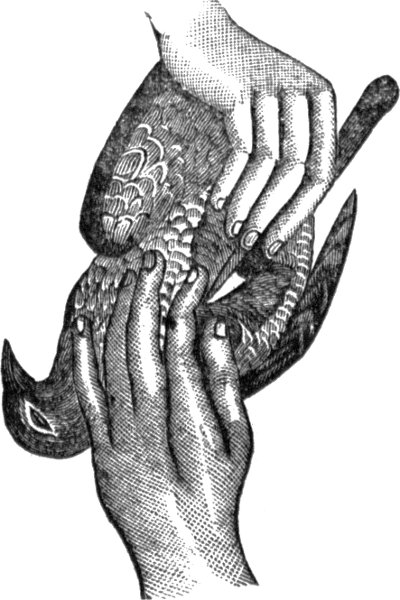
Manner of holding the hands in skinning a bird.
In proceeding to skin the bird, it should be laid on its back,
and the feathers of the breast separated to the right and left,
when a broad interval will be discovered, reaching from the
top to the bottom of the breast-bone. (See fig. 2.)
(See fig. 2 for the manner of separating the feathers and using
the scalpel.) A sharp pen-knife, or scalpel, must be inserted
at the point of the bone, and cut the outer skin from thence
to the vent, taking care not to penetrate so deep as the flesh,
or upon the inner skin which covers the intestines. The skin
will then easily be separated from the flesh; in larger specimens,
by the fingers, or, in smaller ones, by passing a small
blunt instrument betwixt the skin and body, such as the end
of the scalpel-handle; with this you may reach the back. The
thighs should now be pressed inward, as in the common method
of skinning a rabbit, and the skin turned back, so far as to
enable you to separate the legs from the body, at the knee-joint.
The skin is then pulled downwards, as low as the
rump, which is cut close by the insertion of the tail, as shown
in fig. 2, but in such a manner as not to injure its feathers.
The skin is now drawn upwards the length of the wings, the
bones of which must also be cut at the shoulder-joints; it is
then pulled up, till all the back part of the skull is laid bare,
when the vertebræ of the neck are separated from the head,
and the whole body is now separated from the skin. You
next proceed to remove the brain, through the opening of the
skull, for which purpose it may be enlarged by a hollow
chisel, or other iron instrument. The eyes must then be taken
out, by breaking the slender bones which separate the orbits
from the top of the mouth, in which you may be assisted by
pressing the eyes gently inwards, so as not to break them.
In skinning the neck great care must be taken not to enlarge
the opening of the ears, and not to injure the eyelids. The
whole of the flesh is next to be removed from the under mandible.
Fig. 3.
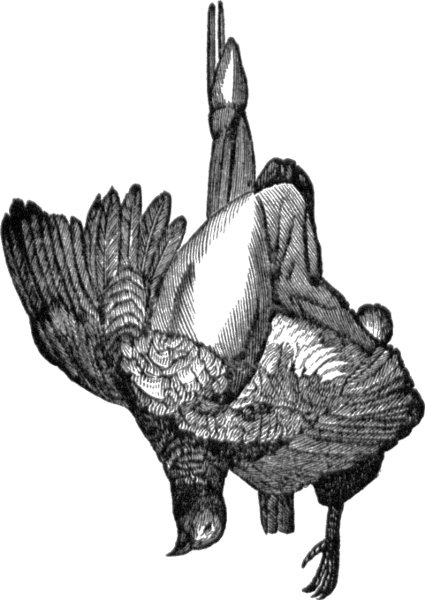
Bird suspended for skinning.
Several species will not admit of the skin being thus pulled
over their heads, from the smallness of their necks; some
Woodpeckers, Ducks, etc., fall under this description; in
which case a longitudinal incision is made under the throat,
so as to admit of the head being turned out, which must be
neatly sewed up before stuffing. The flesh from the head,
wings, legs, and rump, must then be carefully removed with
a knife, and the cavities of the skull filled with cotton or tow.
The whole inside of the skin, head, etc., must be well rubbed
with arsenical soap, or preserving powder, or spirit of turpentine,
or the solution of corrosive sublimate. When it is wished
to stuff the bird, it may now be immediately done, as it will
easily dry, if in a warm climate; but in low, damp countries,
it will require artificial heat to do it effectually.
When the skins are merely wished preserved, the bones of
the legs and wings should be wrapped round with cotton or
tow, so as to supply the place of the flesh; the skin is then
inverted and hung up to dry, after using the arsenical soap,
as above directed; before doing which, in larger birds, a
thread or small string may be drawn through the rump, and
passed up to the inside of the neck, and drawn through
the bill, to prevent the head from stretching too much by its
own weight. In larger specimens, where cotton or tow is
not easily to be met with, well-dried hay may be used.
The incision for removing the skin is frequently made under
the wings. This may be done with marine birds to advantage.
The Penguins and Divers may be skinned by making
the incision in the back.
The tongue should either be kept in the mouth, or sent
home separately with the birds.
The greatest care must be taken to prevent the fat and oily
matter, so common to sea-birds, from getting on the feathers;
pounded chalk will be found an excellent absorbent for applying
to these birds.
In sending home specimens of birds, they should be each
wrapped in paper, and closely packed in a box; and camphor,
preserving powder, and strong aromatics, strewn amongst
them, to prevent them from being attacked by insects; and
they ought to be kept in a very dry part of the vessel.
It is of the utmost consequence to know the color of the
eyes and legs of birds, and these things should be carefully
noted the moment they are killed; and it should also be mentioned
whether they are male or female; such a memorandum
ought to be attached to the birds by a ticket. The season of
the year in which the bird is killed, must also be mentioned.
It is also of much consequence to have good skeletons, and,
for this purpose, the carcasses may be sent home in a barrel,
either in spirits or a strong solution of salt and water.
Mr. Salt, while in Abyssinia, packed his bird-skins between
sheets of paper, and in the same manner as a hortus siccus,
or herbarium, and they reached England in perfect safety,
and made excellent specimens when set up. In warm climates,
the boxes should be well closed, and the seams filled
with warm pitch on the outside, to prevent the intrusion of
insects; and the inside should be supplied with camphor,
musk, or tobacco-dust, which will prevent the attacks of the
smaller insects.
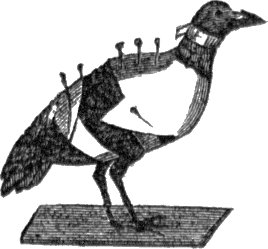
Till practice has given facility to the operator, it will assist
in keeping the feathers clean, if, as he opens the skin of the
breast, he pins pieces of paper or linen cloth on the outside,
but after a few trials this will be unnecessary.
Some of the marine fowls are so fat that there is much
trouble in separating it from the skin, and in warm weather,
great attention will be required to prevent it from running on
the feathers. As much as possible should be scraped off, in the
first place, with a blunt table-knife or palate-knife, and a quantity
of powdered chalk applied, to absorb what remains, which,
when saturated with the oily matter, should be scraped off
and a fresh supply used, after which a much larger proportion
of the preserving powder should be applied than in other
birds which are not fat.
When shooting on the sea-coast, if the ornithologist is not
provided with these requisites for absorbing the oil, which
flows quickly from any wounds of the skin, he will find dry
sand a tolerable substitute.
If, however, after every precaution, the oily matter should
get on the feathers, the sooner it is removed the better, as, in
birds where the plumage is white, if it is allowed to become
hardened it will produce a very disagreeable appearance;
and, besides, render that part particularly liable to the attack
of insects. There are several effectual methods of removing
the greasy stains; the first, safest, and best, is, by taking a
quantity of diluted ox-gall—or, where it cannot be commanded,
sheep’s-gall, or that of any other animal—mix it
with about double the quantity of water, and apply it with a
sponge to the place which the fatty matter has touched, when
it will immediately remove it. The next is by using a solution
of salt of tartar, or potash, or soda. This must be made
very weak, not exceeding half a tea-spoonful to a cup of
water, which will have the same effect as the gall. Whichever
of these are used, the place must be immediately afterwards
washed in pure water, so as to leave none of the gall
or alkaline substance remaining. The gall has a gummy
tendency, and will glue together the fibers of the feathers,
and, besides, it has a great attraction for moisture, and, in
humid weather, will become damp, and therefore produce
mold; the other alkaline substances must also be used with
much caution and quickness, because they have the power of
changing the colors of the plumage, so that they are most
useful in white plumage, and therefore should only be used on
colored feathers, where gall cannot be procured.
One general observation applies to the preservation of all
animal skins, which is, they must be made perfectly dry, so
that the sooner they are exposed to a free current of air the
better; and unless they are speedily and thoroughly dried, the
skin will become putrid and rotten, and the hair or feathers
will consequently fall off. If a skin is properly dried, soon
after it is killed, it will keep a considerable time without any
preservative whatever, only it will be the more liable to be
attacked by insects afterwards.
The following excellent general directions for skinning are
given by Mr. Waterton:—“While dissecting, it will be of use
to keep in mind, that in taking off the skin from the body, by
means of your fingers and little knife, you must try to shove
it, in lieu of pulling it, lest you stretch it.
“That you must press as lightly as possible on the bird, and
every now and then take a view of it, to see that the feathers,
etc., are all right.
“That when you come to the head, you must take care that
the body of the skin rest on your knee, for if you allow it
to dangle from your hand, its own weight will stretch it too
much.
“That, throughout the whole operation, as fast as you detach
the skin from the body, you must put cotton immediately
betwixt the body and it, and this will effectually prevent
any fat, blood, or moisture from coming in contact with the
plumage.
“As you can seldom get a bird without shooting it, a line
or two on this head will be necessary. If the bird be still
alive, press it hard, with your finger and thumb, just behind
the wings, and it will soon expire. Carry it by the legs, and
then, the body being reversed, the blood cannot escape down
the plumage and through the shot-holes. As blood will have
often issued out, before you have laid hold of the bird, find
out the shot-holes, by dividing the feathers with your fingers,
and blowing on them; and then, with your pen-knife, or the
leaf of a tree, carefully remove the clotted blood, and put a
little cotton on the hole. If, after all, the plumage has not
escaped the marks of blood, or if it has imbibed slime from
the ground, wash the part in water, without soap, and keep
gently agitating the feathers with your fingers, till they are
quite dry. Were you to wash them, and leave them to dry
by themselves, they would have a very mean and shriveled
appearance.
“In the act of skinning a bird, you must either have it upon
a table, or upon your knee; probably you will prefer your
knee, because, when you cross one knee over the other, and
have the bird upon the uppermost, you can raise it to your
eye, or lower it at pleasure, by means of the foot on the
ground; and then your knee will always move in unison with
your body, by which much stooping will be avoided, and lassitude
prevented.”
The first thing to be done in stuffing is to replace the skull,
after it has been well anointed with the arsenical soap, and
washed with the solution of corrosive sublimate inside. The
thread with which the beak is tied is taken hold of by the left
hand, and the head is repassed into the neck with the forefinger
of the right hand, while the thread is pulled on the opposite
side; and we are careful that the feathers, at the margin
of the opening, do not enter with the edges of the skin.
The bird is now laid on the table with the head turned towards
the left hand, and the legs and wings adjusted to their
proper situation. A flat piece of lead, about a pound in
weight, is laid on the tail, while the feathers of the margins
of the opening are raised by the forefinger and thumb of the
left hand, to prevent their being soiled. The inside of the
neck is now coated with the arsenical soap; flax is stuffed
into it, but not too tightly. The back and rump are anointed,
and the body should then be stuffed with tow, to about a third
of the thickness required, so that the wire may have a sort of
cushion to rest on.
Four pieces of wire are then prepared, of the thickness
proportionate to the size of the bird to be stuffed. The center-piece
should be somewhat longer than the body of the bird.
At about a fourth of its length a small ring is formed, by the
assistance of the round pincers or pliers, and the other end
is pointed with a file. This wire is oiled, and introduced
across the skull, and passed into the neck through the center
of the flax or tow with which it is stuffed—the ring being situated
toward the anterior part of the skull, for the purpose
of receiving the points of each of the wires that are passed
through the feet and thighs.
Fig. 4 to 7.
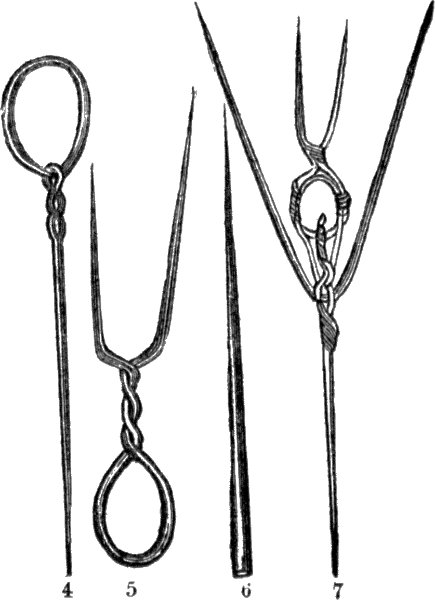
4, the oval and head-wires of a bird separated; 5, the
tail-bearers separated; 6, a leg-wire separated; 7, the body-wire,
the head-wire, the tail-bearer and legs connected.
The following is the mode in which this performance is
effected: A hole is bored with a brass awl, the caliber of the
wire which it is intended to use. The wire, which is to continue
in the leg, is passed across the knee, and brought out
interiorly, and, placing it into the ring above mentioned, the
same operation is performed on the other side. The extremities
of the wires of the legs, and the end of the central wire
beyond the ring, are all twisted together with flat pincers,
and then bent towards the tail. The tail-bearer is next
formed, which consists of the fourth piece of wire, with which
an oval is formed, by twisting the two ends two or three
turns, so that they may form a kind of fork, with the oval
nearly the length of the body of the bird; the two points of
the fork must be sharpened with a file, and near enough to
enable them to enter the rump, through which they must
pass, and their points will be concealed by the rectrices, or
large straight tail-feathers, while the oval is within the body
of the bird. If the bird is large, the tail-bearer must be
firmly attached to the interior wires, by twisting a small wire
several times round both. But unless the bird be large, it
may remain quite free.
All the parts of the skin at which we can come must be
thoroughly rubbed with preserving soap, the rump in particular,
which should, besides, be soaked with the solution of corrosive
sublimate. The stuffing is now proceeded with, by inserting
chopped flax or tow, till it has attained its proper dimensions.
The skin is brought together and sewed up, while
we take the greatest care to separate the feathers at every
stitch.
The orbits of the eyes are next finished, by inserting, with
small forceps and a short stuffing stick, a small quantity of
chopped cotton, while attention is paid to round the eyelids
properly. The glass eyes are now inserted, taking care to
place them properly under the eyelids. But, before fixing the
eye, a little calcareous cement must be used, to prevent them
from coming out. If any part of the nictitating membrane is
visible below, it must be pushed up with the steel point.
The stuffing of the bird being now completed, the next
thing is to place it either on a branch, or, if a bird which does
not sit on trees, on a piece of plank; whichever of these it is,
two holes are bored for the reception of the wires, which have
been allowed to protrude from the soles of the feet, for fixing
the bird (See fig 8.) These, of course, are pierced in such
situations as are necessary for the attitude or position of the
legs. The wires are put through these holes, and twisted so
as to secure the bird in its position. The attitude of the bird
will, of course, depend upon the fancy and taste of the operator,
and ought to be in conformity with the manners of the
birds in a living state.
The wire frame-work, above described, is the most simple
of any in its construction, and is better adapted for small
than large birds. Indeed, it will hardly suit those of the
larger species. The following is another method of constructing
the frame-work, which may be used either in large
or small birds:—
Like the former, it is constructed of four pieces of wire.
The center-piece should be double the length of the bird; it is
bent at a third of its length of an oval form, and twisted two
turns, the shortest end being passed into the oval, and then
raised against the longer end, so as to produce a ring at the
end, outside of the oval, large enough to admit the two wires
which pass from the feet to the inside of the bird. It is now
twisted a second time, and firmly united to the longer end,
which ought to be straight, with a sharp point, effected by
means of a file. As before directed, it is rubbed with oil, and
forced through the stuffing of the neck. It ought to be so
constructed, by measurement, that the oval part of the wire
shall be in the center of the body inside. The wires of the
feet and legs, as before directed, ought to be straight and
pointed, and passed through the soles of the feet as before.
When the point has penetrated, the other end of the wire may
be bent, so that by means of it we may be able to assist in
forcing up the remainder of the wire. The two internal ends
of the foot-wires are twisted together, and curved within, so
as to pass through the small circle or ring of the middle
branch above the oval, to each side of which they are now attached
with a piece of small string.
The tail-bearer is constructed on the same principles, and
attached in the same manner, as before described, and the
latter apparatus is introduced after the neck and back are
finished in the stuffing.
This practice of introducing the neck-wire, after the neck
is stuffed, was first adopted at the Jardin des Plantes at
Paris, and is now invariably adopted in that establishment in
preference to introducing it before the neck is stuffed. The
neck of a swan or other long-necked and large birds, are
even done so. It is unquestionably the best plan which has
hitherto been discovered, as it preserves the cylindrical shape
of the neck.
Mr. Bullock, of the London Museum, Egyptian Hall, had another
method of arranging the wires, which, after what we
have already said, will be easily comprehended by a reference
to figure 8, where we have given a figure of his mode. After
the skin is taken off and prepared, different-sized, nealed, iron
wires are procured, according to the size of the bird they are
to support. The skin is laid on its back without stretching
it; cut two pieces of wire, the one rather longer than the bird
and the other shorter, so as not to reach to the head of the
bird; twist them together, sharpen the ends of the longer by
means of a file, and pass one end through the rump and the
other through the crown of the head, near the base of the
bill. Care must be taken not to extend the neck beyond its
ordinary length—a very common fault in most preservers.
Lay a little tow along the back of the skin for the wire to
rest on, then take two other pieces of strong wire and file
them to a point at one end; these are passed through the
soles of the feet and up the center of the leg-bone, or tarsus.
When within the body, they are to be fastened to the first
wires by twisting them together, which, when accomplished,
may be supposed to represent the backbone. The wire
should be left two or three inches out of the soles of the feet,
to fasten them in a standing position, as before directed.
Two smaller wires are then passed through the wings, as in
the legs, and afterwards fastened to the back-wires a little
higher up than the leg-wires, taking care that no part of the
skin is to be extended beyond its natural position.
Fig. 8.
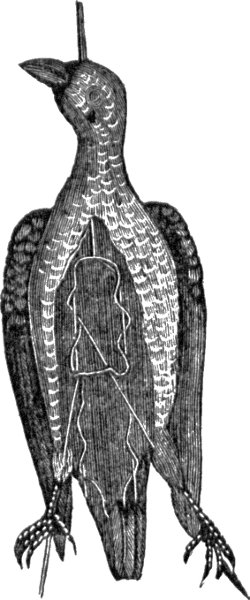
Mr. Bullock’s method of inserting the wires in setting up a bird.
A fair specimen being obtained, take common cotton wadding,
and with an ordinary paint-brush stick plug the throat,
nostrils, and, in large birds, the ears, with it, so that when
the skin is turned no juices may flow and spoil the feathers;
you must then provide yourself with the following articles:
A knife of this kind is very common; a pair of cutting pliers,
a pair of strong scissors, of a moderate size; a button-hook, a
marrow-spoon, and a hand-vise. With these, a needle and
thread and a sharpener of some kind, to give your knife an
occasional touch, you are prepared, so far as implements go.
Then provide yourself with annealed iron wire of various
sizes; some you may buy ready for use, some not; but you
can anneal it yourself by making it red hot in the fire, and
letting it cool in the air. Common hemp is the next article,
cotton wadding, pounded whitening, and pounded alum, or
chloride of lime; as to the poisons which are used, they will
be spoken of by and by. You should also have a common
brad-awl or two, and some pieces of quarter-inch pine whereon
to stand the specimens when preserved, if to be placed as
walking on a plane; if not, some small pieces of twigs or
small branches of trees should be kept ready for use, of various
sizes, according to the size of the bird; something of the form
of Fig. 9. Cedar, or common laurel cut in December, will be
found to answer best, but this must be regulated by fancy
and the requirements of the case; oak-boughs are sometimes
of a good shape.
Fig. 9.
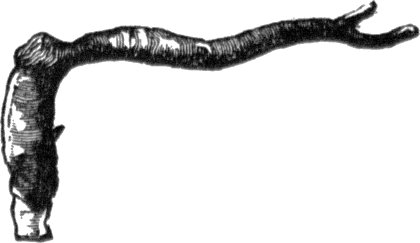
Branch for mounting a bird.
The best time for preserving specimens is in spring, because
then the cock birds are in the best feather, and the weather
is not too warm. In mild weather three days is a good time
to keep a bird, as then the skin will part from the flesh easily.
If a specimen has bled much over the feathers, so as to
damage them, wash them carefully but thoroughly with warm
water and a sponge, and immediately cover them with pounded
whitening, which will adhere to them. Dry it as it hangs
upon them slowly before the fire, and then triturating the
hardened lumps gently between the fingers, the feathers will
come out almost as clean as ever. To test whether the specimen
is too decomposed to skin, try the feathers about the
auriculars, and just above the tail, and if they do not move
you may safely proceed.
Lay the bird on his back, and, parting the feathers from
the insertion of the neck to the tail, you will find in most
birds a spare space. Cut the skin the whole length of this,
and, passing the finger under it on either side, by laying hold
of one leg and bending it forward, you will be able to bring
the bare knee through the opening you have made; and with
your scissors cut it through at the joint; pull the shank still
adhering to the leg till the skin is turned back as far as it
will go: denude the bone of flesh and sinew, wrap a piece of
hemp round it, steeped in a strong solution of the pounded
alum, and then pull the leg by the claw, by which means the
skin will be brought again to its place.
Fig. 10.
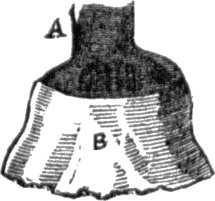
After having served both legs alike, skin carefully round
the back, cutting off and leaving in the tail with that into
which the feathers grow, that is, the “Pope’s nose.” Serve
the wing-bones the same as the leg, cutting them off close to
the body, and turn the skin inside out down to the head. The
back of the skull will then appear, and you will now find it of
advantage, as soon as you have got the legs and tail free, to
tie a piece of string round the body, and hang it up as a
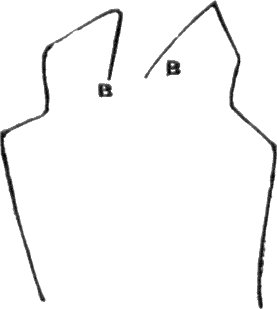
butcher skins a sheep. Make in the back of the skull a cut
of the annexed form, with your knife, which you can turn
back like a trap-door, and with the marrow-spoon entirely
clear out the brains; A representing the neck, and B the
skin turned back. Having done this, wash the interior of the
skull thoroughly with the alum, and fill it with cotton wadding.
The next operation requires care and practice—namely,
to get out the eyes. This is done by cutting cautiously
until the lids appear, being careful not to cut the eye
itself, and you can then, with a forceps, which you will likewise
find useful, pull each from its socket; wipe the orifice
carefully, wash it with the alum solution, and fill it with cotton
wadding. Cut off the neck close to the skull, wash the
stump, and the whole of the interior of the skin with the
alum, and the skinning is done.
Fig. 11.
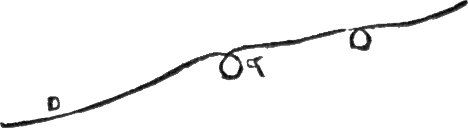
Wire bent for inserting.
Now comes the stuffing. The ordinary mode used by bird-preservers
is a simple one, and answers very well; there is a
French method, however, which has its advantages, and will
be adverted to hereafter. Take a piece of the wire suitable
to the size of the bird—that is, as large as the legs will carry—and
bend it into the following form, a representing the
neck, b, the body, and c, the junction of the tail, allowing
sufficient length of the neck for the wire to pass some distance
beyond the head, and being sharpened at each end,
which may be done by obliquely cutting it with the pliers.
Wind upon this wire hemp to the side of the bird’s body,
which you should have lying by you to judge from, and it
will present something of this appearance. You can shape it
with the hand, but be careful not to make it the least too
large; and, after you have finished it to your satisfaction,
you may singe it, as the poulterer would singe a fowl, which
will make all neat; but be particular to wind the hemp very
tight. Then take the skin, lay it on the table on its back,
and pass the wire at the head into the marrow where the
neck is cut off, through above the roof of the mouth, and out
at one nostril, and draw it up close to the skull; turn the
skin back, and draw it down over the hemp body, and pass
the wire spike, protruding at the lower end, through the flesh
upon which the tail grows, about the center, and rather below
than above. The skin may now be adjusted to the hemp body,
and sewn up, beginning from the top of the breast, and
being particularly careful always to take the stitch from
inside, otherwise you will draw in the feathers at every pull.
At first sew it very loose, and then, with the button-hook,
draw it together by degrees.
Fig. 12.
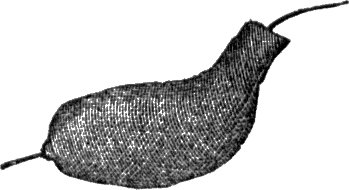
The hemp wound on the wire.
With the pliers cut two lengths of wire, long enough to
pass up the legs and into the neck, and leave something over
to fasten the bird by to the board or spray upon which it is to
be placed. The next operation requires some address and
great practice, namely, the passing the wire up the legs.
This is done by forcing it into the center of the foot, and
up the back of the legs, into the hemp body, through it obliquely,
and into the neck, until it is pretty firm.
Fig. 13.
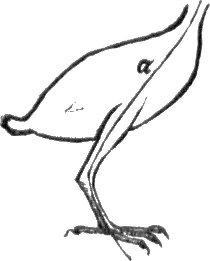
In doing this, you must remember the ordinary position of
a bird when alive, and, therefore, instead of passing the wire
the whole way within the skin of the leg, when you get to
the part where you have cut off the bone—that is, the knee-joint—pass
it through the skin to the outside, where the
knee would come naturally in the attitude of standing or
perching—it makes little difference which. This is essential,
because, if the wire be passed the whole way inside the skin,
it produces a wrong placing of the legs. Fig 13 will illustrate
this, a representing the line in which the wire should
run. The bird is now stuffed, and you may at once place it
upon a spray or board, as the case may be. In placing a
bird upon a spray, the first joint should be bent almost on a
level with the foot; and in placing a bird on a board, one
leg should be placed somewhat behind the other. If the
wings are intended to be closed, as is usually the case, bring
them into their place, which may be done by putting the fingers
under them, and pressing them together over the back;
you may then pass a needle, or large pin, of which you should
have a good supply by you, through the thick part of the
upper wing into the body, and so by the lower wing, and if
you allow these to protrude, you may fasten to one of them
a piece of thread, and wind it carefully and lightly round the
body, which will keep the feathers in their places, and this
thread should be kept on for a fortnight or three weeks, until
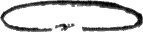
the bird is dry. The tail should be kept in its place, also, for
the same time, by a piece of thin wire bent over it, thus:
Fig. 14.
The only thing now to do is to put in the eyes. The color,
of course, depends on the bird, and these you may buy at any
fishing-tackle store. If you do not use eyes too large, you
will find little difficulty; the juice of the lids will act as a sufficient
cement. As to the mounting, I shall say nothing about
that now, but shall only advert shortly to a French method of
preserving which is more difficult, but has the advantage of
superior firmness. It is this: Measuring from the insertion of
the neck to the tail, make a wire frame of this form, the
measure taken being from A. to B.
Fig. 15.

Wire Used in French Method.
Upon this end wind hemp for the neck only, and place in
the skin in the same way as before directed, only that, instead
of one wire being passed through that in which the tail grows,
it is a fork that is passed through it. Having formed this
frame, fit on to it two legs, thus: and after the frame itself is
in the skin, pass these from the inside down each leg, instead
of from the outside, and fasten them on to the frame with the
pliers, by twisting the ends, B B, round the frame, C, in the
first figure.
Fig. 16.
The Wire Legs.
This will make all firm, and you can then fill the body with
cut hemp and sew up. One word as to the other preparations
used by bird preservers. These are either corrosive
sublimate or regulus of arsenic, which is yellow and of a consistence
like butter. As I have said before, in cold weather,
when there are no flies about, alum will do perfectly well; in
warm weather either of the two others may be used. I should
prefer the former—corrosive sublimate—as the other is “messy,”
and the chief object is to dry up anything which can be
attacked by flesh-seeking insects. When you have finished
your bird you can lay the feathers with a large needle—it is
as well to have one fixed in a handle and kept for this purpose—and,
tying the two mandibles of the bill together with
a piece of thread until the whole specimen has hardened and
dried, the work is done.