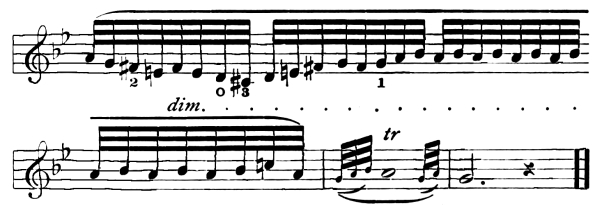
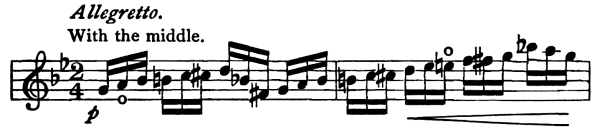
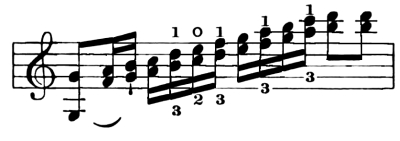
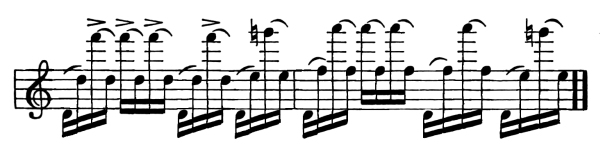
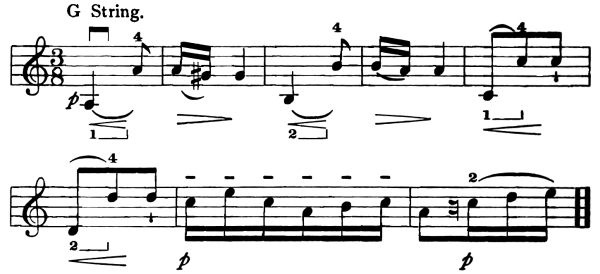
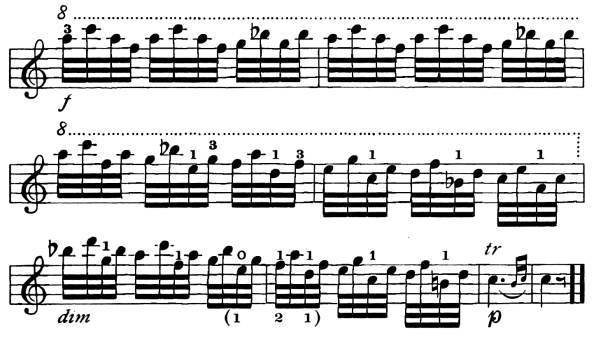
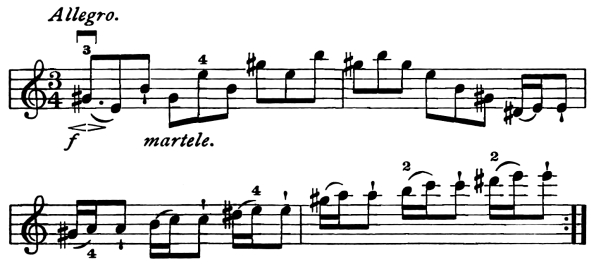
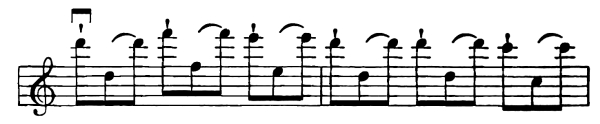
Few of the Fiorillo Études are played by the student strictly
according to metronome time. Not so with Rode. His Caprices are
often studied abroad for three years; and, by the time the student has
completed them, he plays them like finished pieces, at metronome time.
Often, too, the Rode Caprices are memorized, but the Fiorillo
Études rarely are. The Berlin school neglects Fiorillo to a certain
extent, but Halir, one of its best exponents, spends considerable
time in the study of them, giving to them the grace, vivacity, and
lightness of the French school when the text so demands, and also
striving for the breadth of the German school in pure cantabile work,
as found in slow movements. For intricate bowings Kreutzer, with the
supplementary Massart[7]
bowings, is adequate. Fiorillo’s Études, as previously stated,
cannot be studied in their order. Individual needs govern the teacher.
Perhaps one student may be studying Fiorillo, while, also studying the
more difficult trill and double-stop Études of Kreutzer. Some of
the Kreutzer Études have never been given to me by teachers. It is
equally true of Fiorillo. If I seemed to have a weak point in technic,
or if my bowings were stiff and angular, I returned to Kreutzer. I was
taught Kreutzer and Rode, over and over, in Berlin. Many of the Berlin
teachers say: “Get technic from the standard Concertos. Do not spend
too much time on technic pure and simple.” The question in the mind of
the Joachim School is “How is it possible for the Sevcik followers to
have a repertoire, when they are made to study technical works of such
length and seriousness as those of Sevcik?”
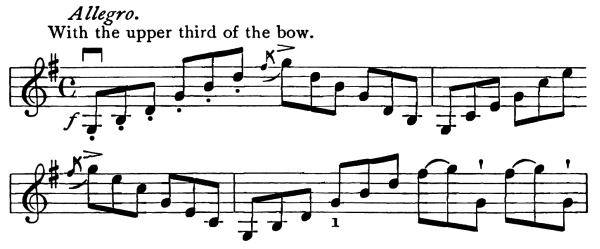
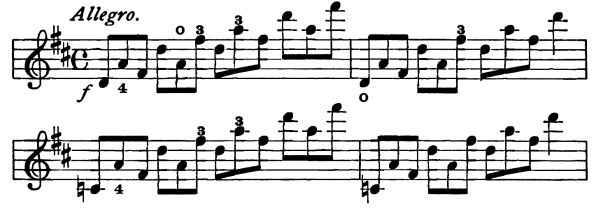
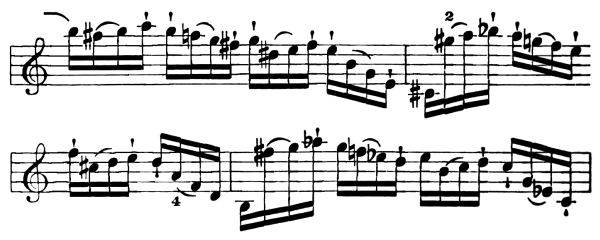
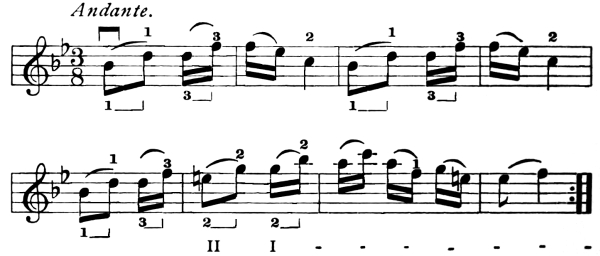
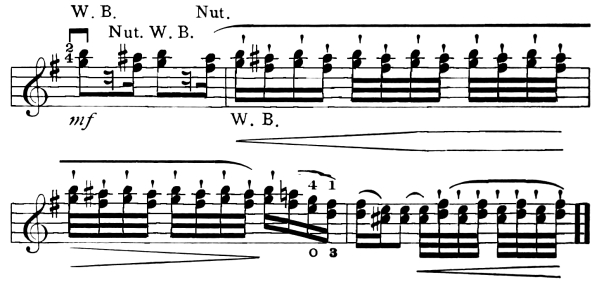
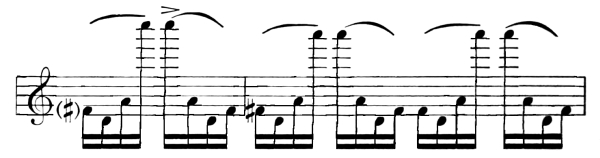
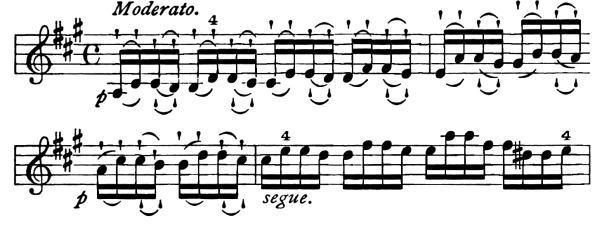
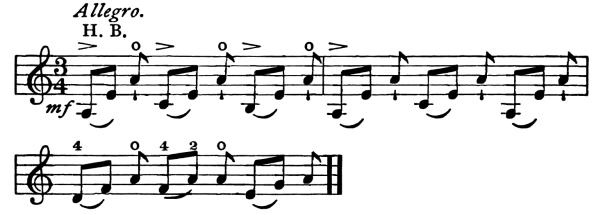
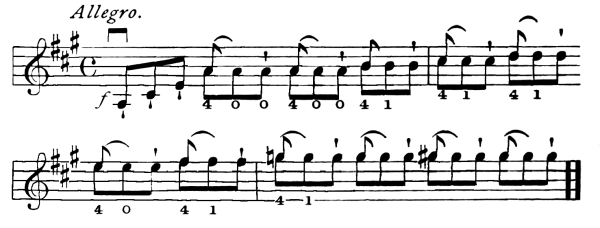
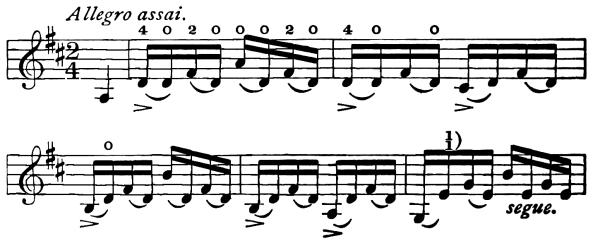
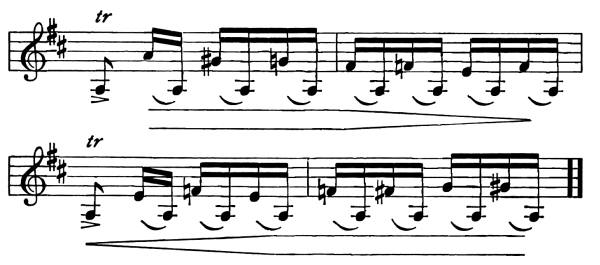
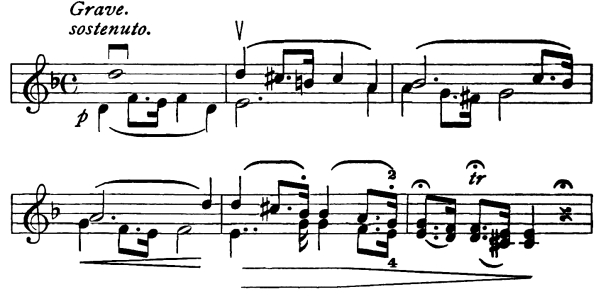
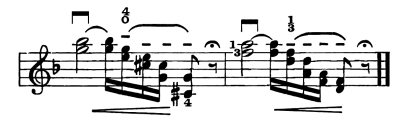
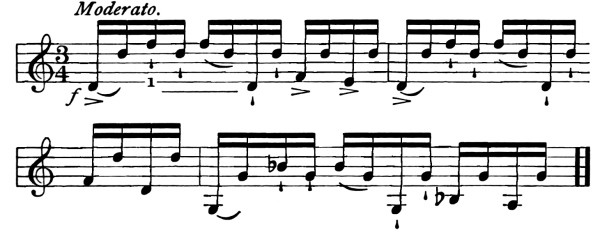
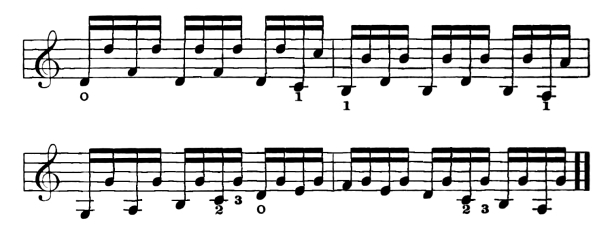
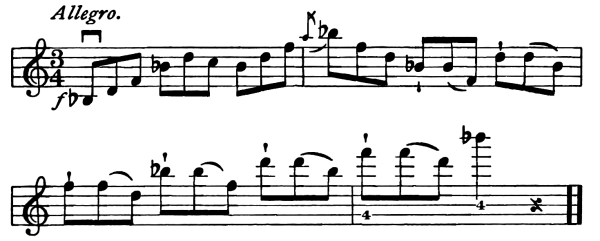
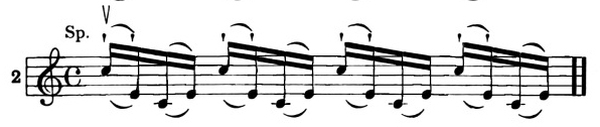
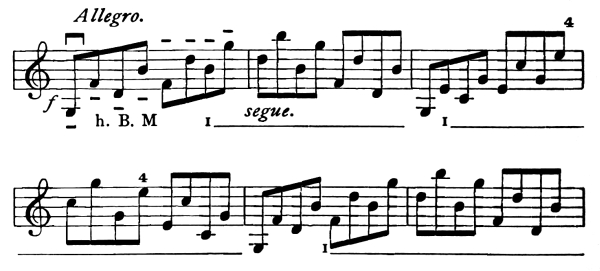
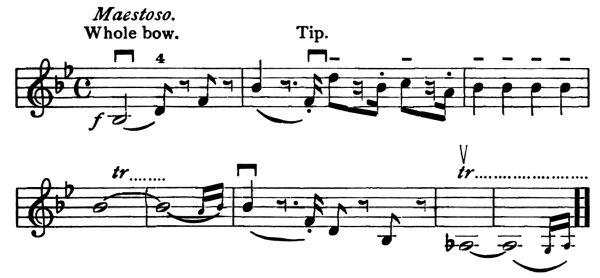
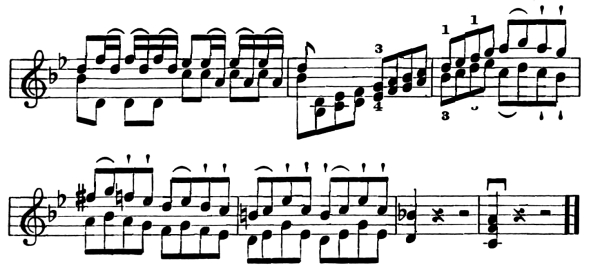
The twelfth étude of Fiorillo is not one in which technic is prominent.
Its object is mainly the freedom of the bow-arm. The fingers of the
left hand should be placed lightly over the strings, in readiness for
their movement. They should anticipate a change of position. If the
left hand is ready, bow technic is more easily secured. Note in the
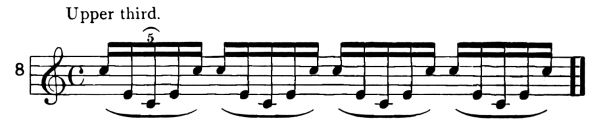
Hermann edition that the étude is marked forte. It should be played
lightly, the upper third of the bow being used. There should be no
marked contrasts of the legato and staccato; in fact, the staccato
mark is not to be interpreted as necessary in such études as this,
because the stroke is so free. It would be impossible to play this
étude forte in the upper part of the bow, and give it lightness and
grace. The short staccato also gives less breadth to the stroke. In
similar passages the length of bow used should be about uniform. Note
the inclination to cut the second note of a group of two tied notes in
anticipation of a single staccato note. This should be avoided. All
violin jerking of the bow on single first notes of a group should be
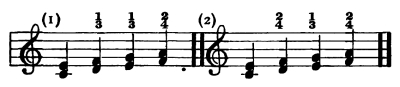
avoided. The student should be careful to slide the thumb well under
the neck of the violin in the fifth position passages. Do not move the
hand while in one position, in anticipation of the next position. Do
not depress the fingers in the fifth and sixth positions before passing
to the third.
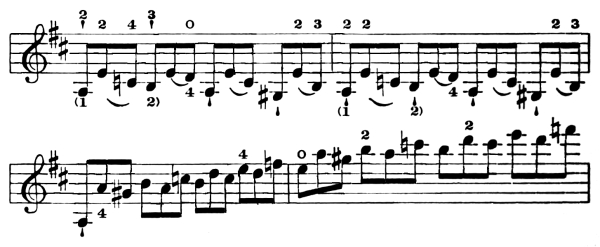
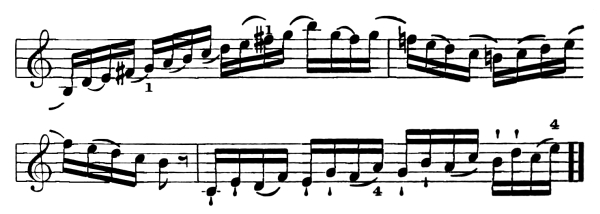
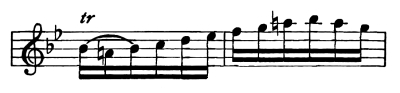
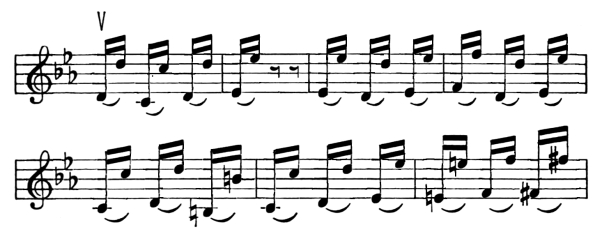
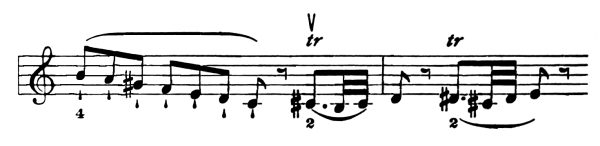
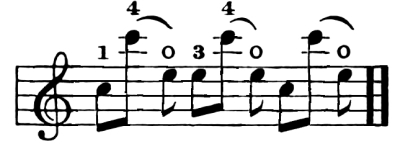
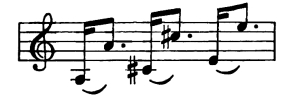
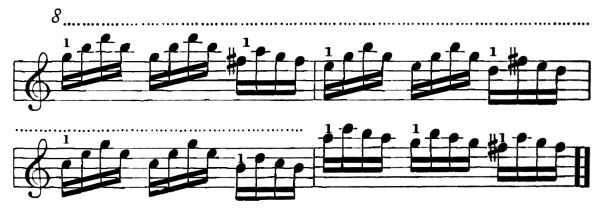
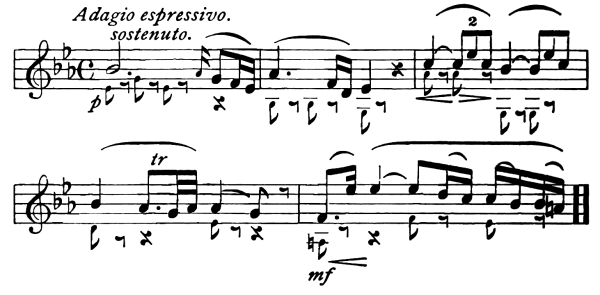
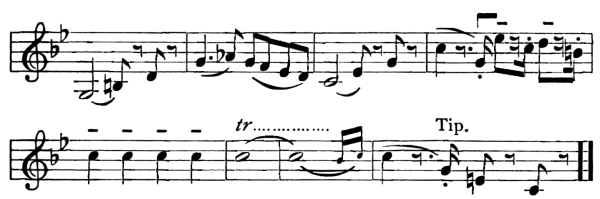
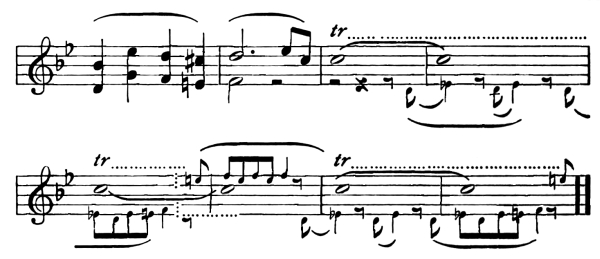
In this passage avoid forced attenuation:
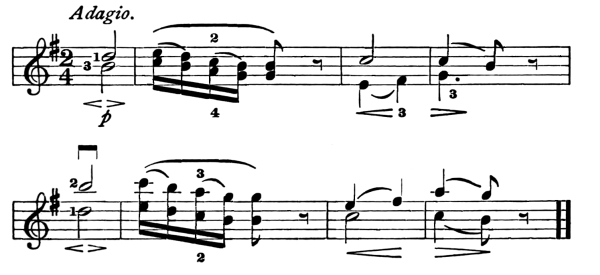
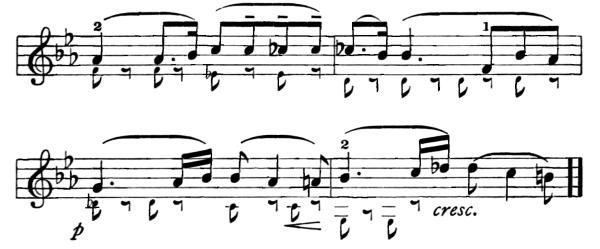
Continuous syncopation should be uniformly smooth and even. Nothing is
of such value to a violinist as a perfect command of the transition
from the third to the fifth position, and vice versa. Many faults of
technic arise from too much pressure of the thumb upon the neck of
the instrument, thus giving the player no freedom, and inducing a bad
habit of bending the thumb instead of strengthening it for the fifth
position. If extensions are to be made, slide the thumb a little
farther under the neck of the violin, and curve the fingers well.
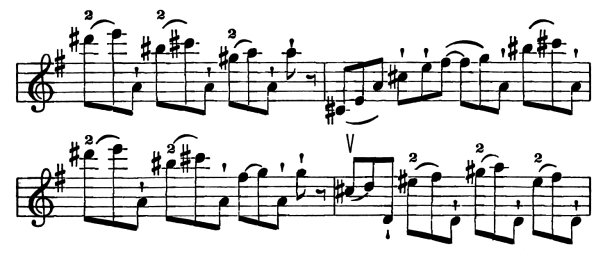
Note in the sixth line the fifth position passage on the A string.
Many players have to move the whole hand at this point, so that the fingers
may lie easy on the string. The hand should assume a position which
will enable the pupil to play with ease. The newer chin-rests, which
are wider than the former ones used, do not seem to enable one to hold
the violin with ease. The chin should rest on the edge of the chin-rest
rather than far in or on the tail-piece. The muscles at the back of the
head become cramped by gripping too hard. A little piece of chamois
leather placed between the left jaw and the chin-rest will prevent a
bruise of the flesh, the bane of professionals.
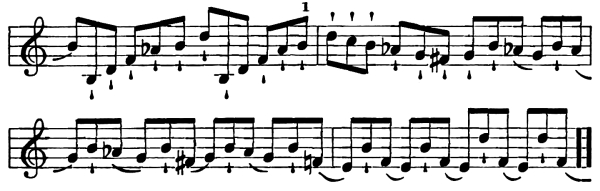
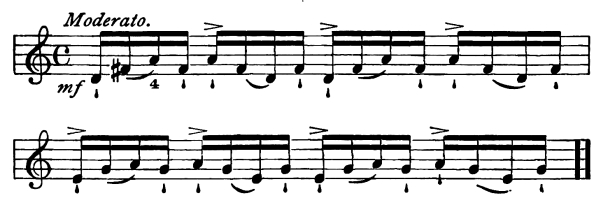
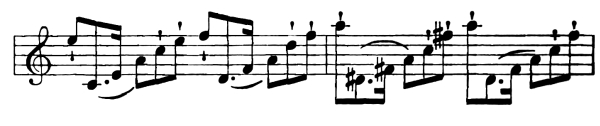
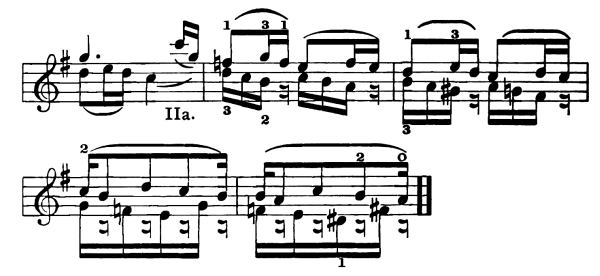
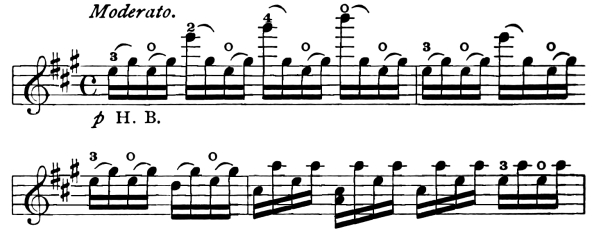
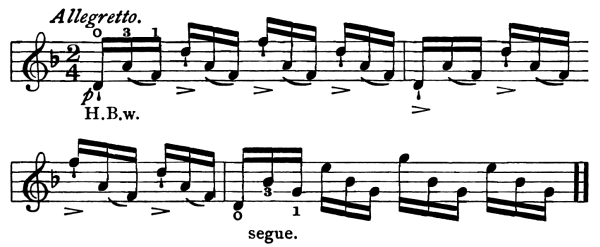
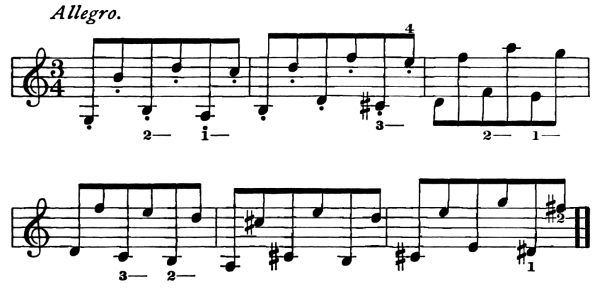
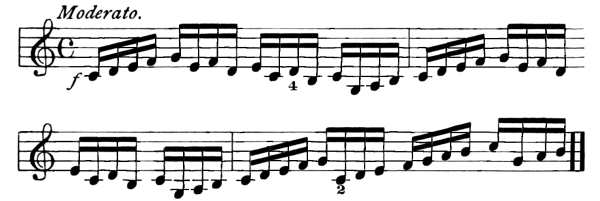
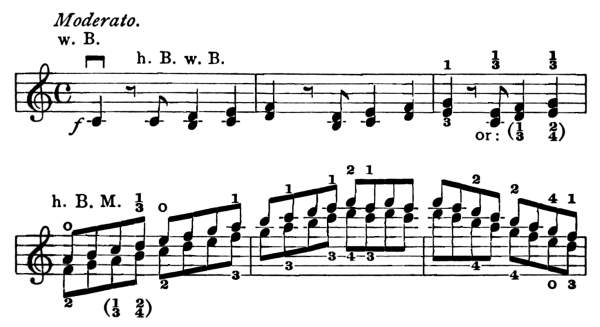
In the ninth line we have the form of bowing known as two cut and two
slurred notes. The notes that are cut are not to be played sharply
at the point of the bow. They are swung lightly along the strings,
using about one-third of the bow, the tempo being moderate. Again, the
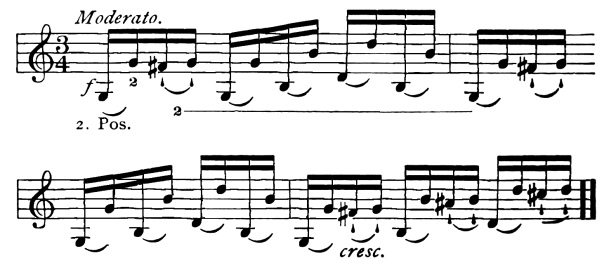
student must be cautioned against cutting the value of the second
slurred note in anticipation of a single staccato note:
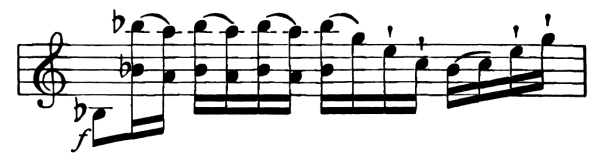
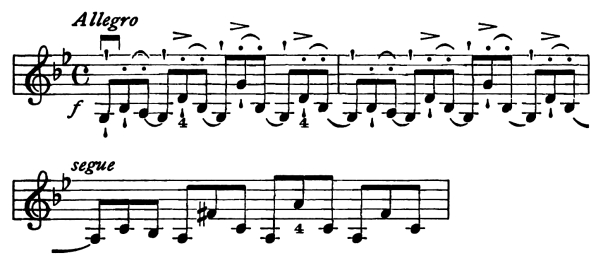
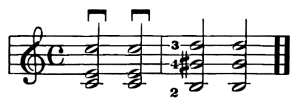
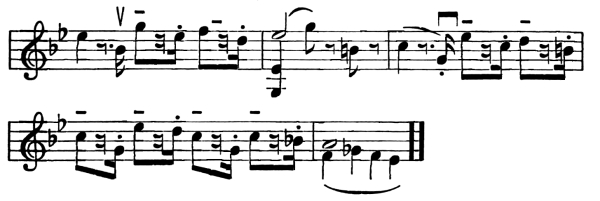
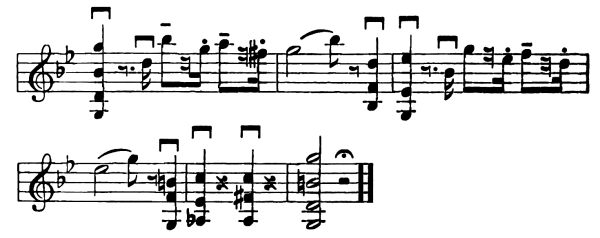
Note the forte passage in the lower half of the bow:
This should be played in a somewhat disconnected style in the first
half of the measure, with a strong accent on the first note of groups
of two. The latter half of the measure falls about in the middle of the
bow. A free stroke, not too short a staccato, is preferred.
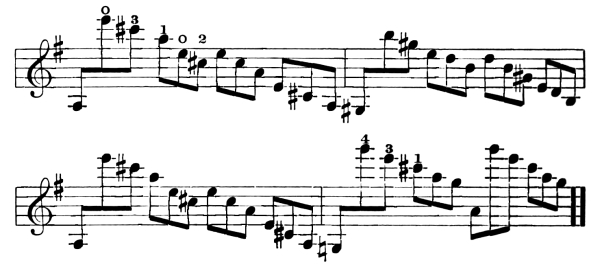
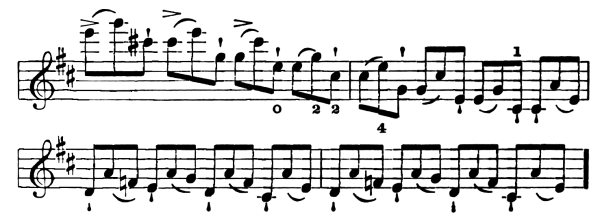
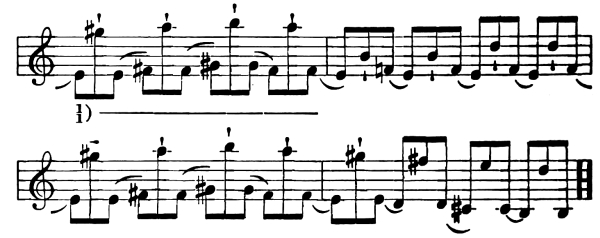
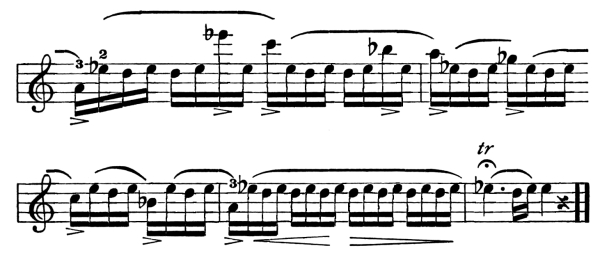
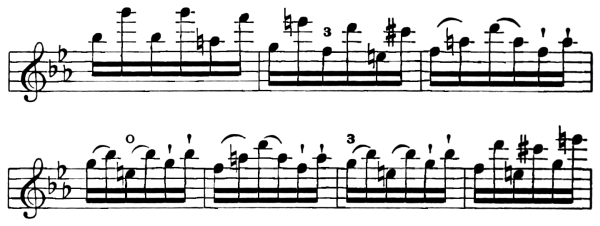
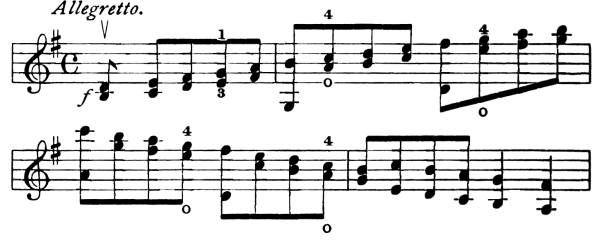
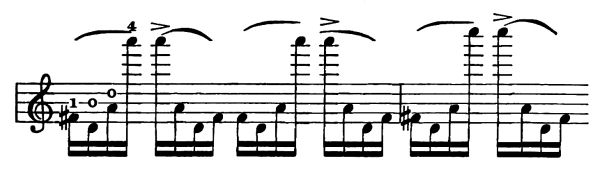
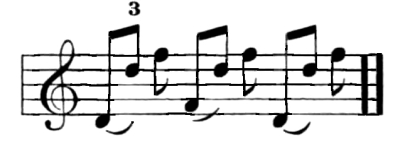
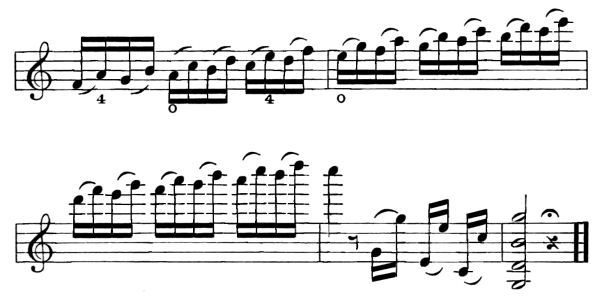
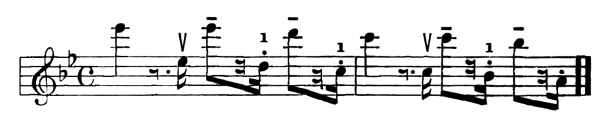
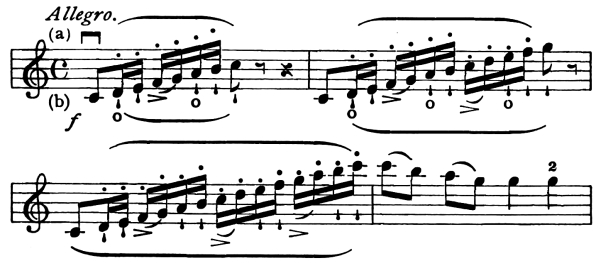
The tenth line opens with an arpeggio played forte with staccato and
legato strokes. The next similar passage is played pianissimo, in close
imitation as to style. All passages of this nature are smoother in
the upper part of the bow. Avoid forced accents or any movement which
interferes with free bowing:
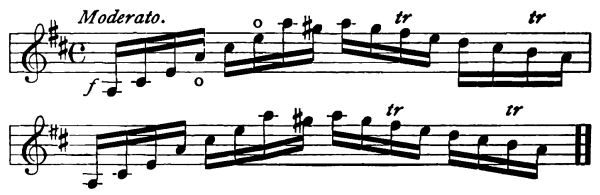
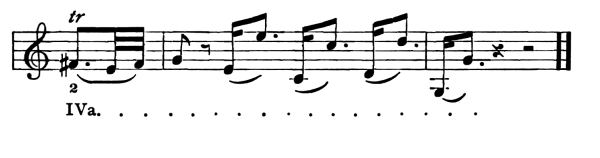
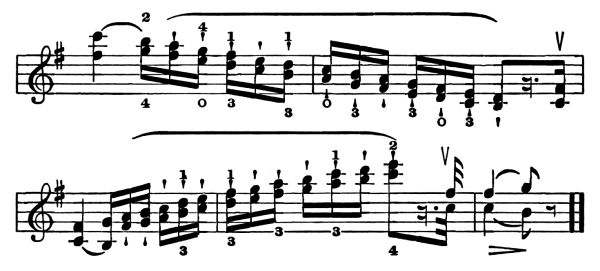
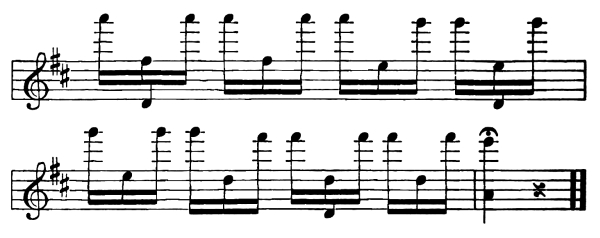
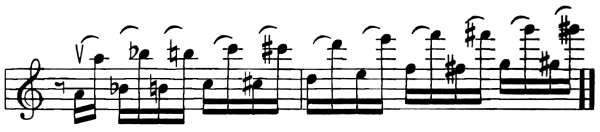
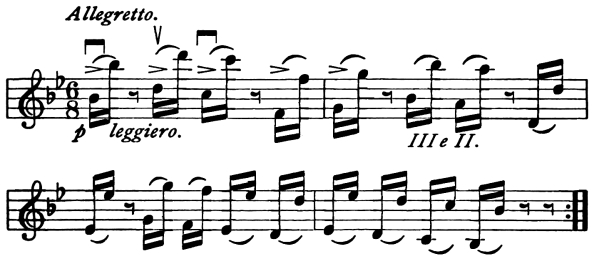
In the twelfth line a short legato passage is played in the upper half
of the bow rather than with the whole bow. When one passage closes with
down-bow, there should be no break in passing to the up-bow. Two notes
slurred lie in the upper half with as long a bow as the tempo will
allow. In passing from a long legato passage to a short one, it is
well to estimate so well that the part of the bow desired may come at
once under control. All passages requiring quick transitions on four
strings should be played as broadly and with as free a bow-arm as the
tempo will admit; in other words, too little bow gives no value to the
passage, while a light stroke with a longer bow is made more valuable.
Naturally, if the tempo is increased to allegro, we must remain near
the point of the bow. When four strings are required, the bow-arm
must be higher, and the distinction between a forearm stroke and a
pure wrist stroke must be well defined. In rapid legato passages all
pressure upon the bow-stick must be avoided.
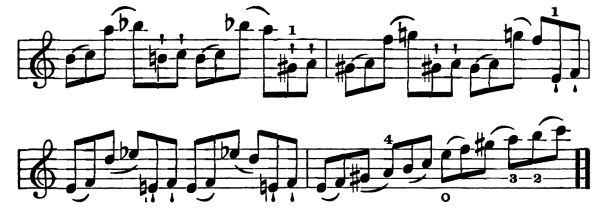
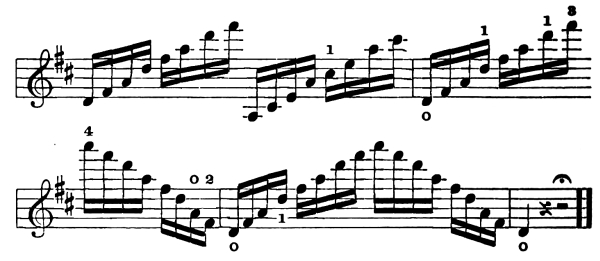
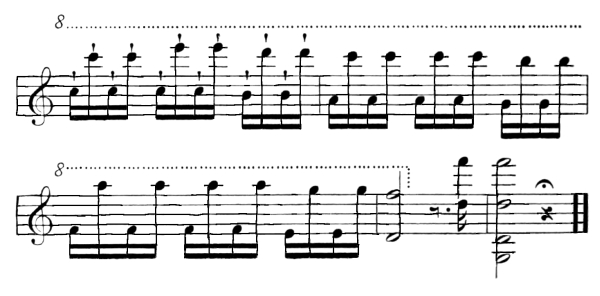
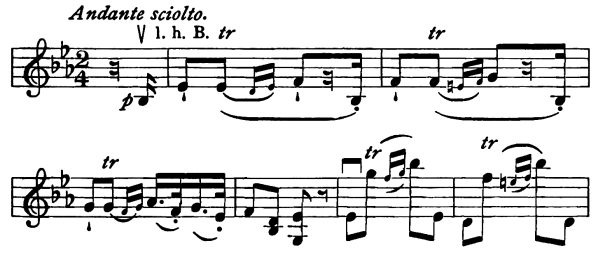
Keep the legato work that follows in the upper half of the bow,
avoiding pauses between bows, or unnecessary accentuation. Short
groups of slurred notes must be played near the point of the bow.
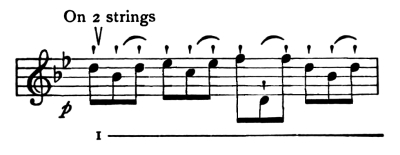
Short string-transfers are made with the wrist, and three or four
string-transfers with wrist and arm, the bow never being tilted on its
inner edge. Play on the outer edge of the hair as much as possible,
resting the bow on two strings, or as nearly so as possible. Do not
release the fourth finger from the bow-stick. Rest it at least against
the stick if not on it; all work, especially in the lower half of the
bow, demands this security of the hand. For string-transfers of this
kind, see Sevcik’s School of 4,000 Bowings, Parts III, IV, and V;
Casorti’s School of Bowing;[8]
the work of Hans Sitt, Op. 92;[9]
and the Kross Art of Bowing.[10]
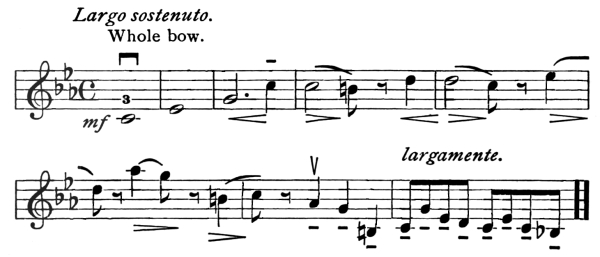
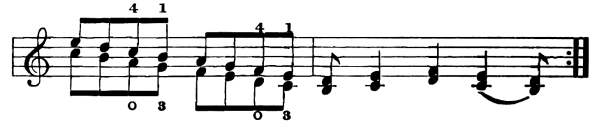
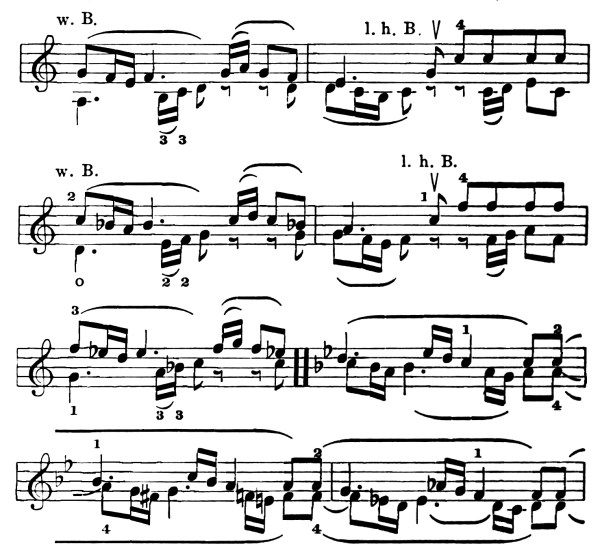
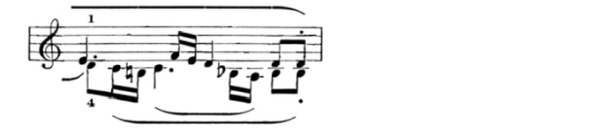
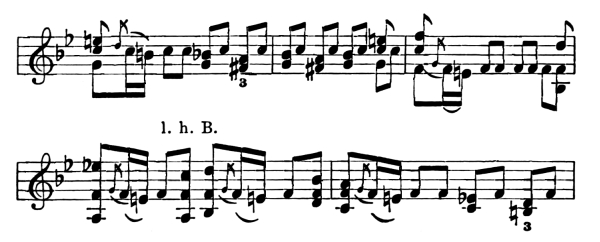
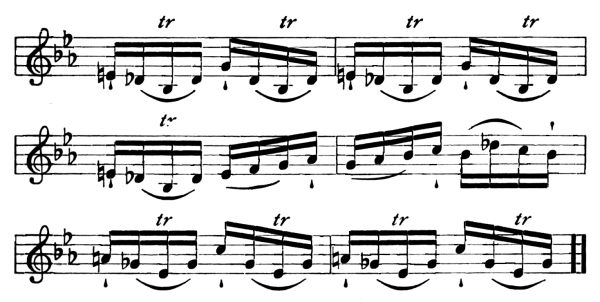
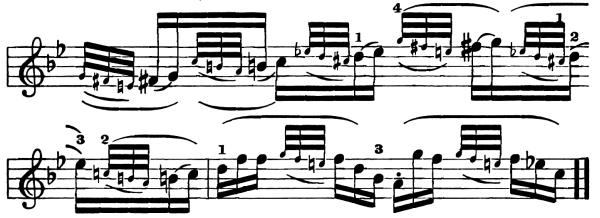
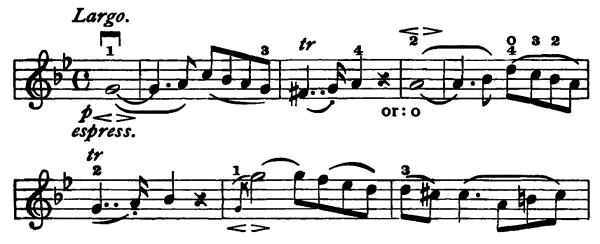
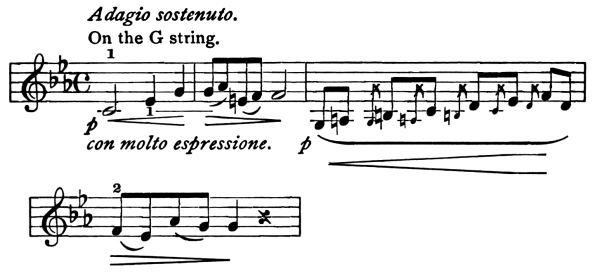
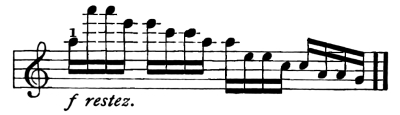
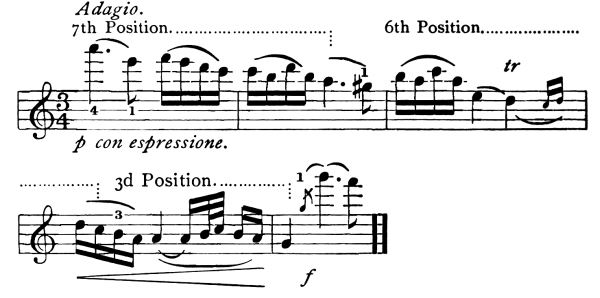
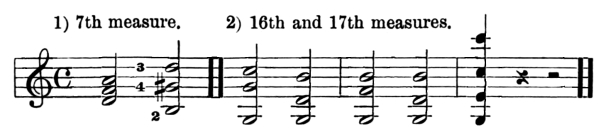
 to
 before the high
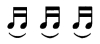 (last measure, second line.)