Putting on Skis.—Lay the skis side by side
on the snow.
In order to put on the right ski, place the
left foot on it just behind the binding as in Fig.
12, the toe of the boot being on the left side
of the ski and the heel on the
right. Your weight then holds
the ski steady while you push
the right foot well home and
fasten the binding. Now lift the
right foot and ski, stand them on
the left ski in a similar way, and
fasten that to the foot.
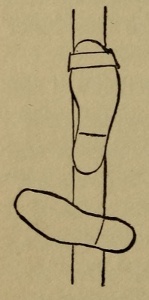
Fig. 12.
On a hill-side lay the skis
across the slope; stand below
them, and put on the lower ski
first, bringing the foot to it across
the front of the other leg.
On the Level.—The ski-runner moves on the
level with an action much like that of ordinary
walking, except that he does not lift his skis
from the snow, but slides them along it.
Hold your skis exactly parallel and as close
together as possible—not more than two inches
apart—and take a long, easy, lunging step, keeping
the knee of the advancing leg well over the
foot, and leaning the body well forwards (Plate I.).
Move the stick, or sticks, in time with the
opposite leg, giving a push at each, or at every
alternate stride, according as you carry two sticks
or one.
Slide as far as you can after the advanced foot
has received the weight, and don’t be in a hurry
to bring forward the other one.
The body must be swayed slightly from side
to side with each step in order to balance it
well over the ski which carries the weight.
If you wish to get up the greatest possible speed
on the level with two sticks, take three running—not
sliding—steps, swinging the sticks forwards
with the first two, and, at the third, giving a
push with both sticks, followed by a long slide.
Then do the same again, starting with the
other foot.
Uphill.—If the gradient is very slight, you
can slide straight uphill in just the same way
as on the level.
At a rather steeper gradient (the angle depending
on the slipperiness of the snow and
the skis) you will still be able to move in the
same way, but without the extra forward slide
after the weight has come on to the advanced ski.
If the slope becomes still steeper you will find
that the friction is hardly enough to make the
skis hold. The moment you feel they have a
tendency to slip backwards as the weight comes
on them, walk as upright as possible, even leaning
slightly backwards, so as to bring the weight on
the heels and throw a little tension on the toe-strap.
Shorten your stride, and, instead of sliding
the skis along the snow, lift their points six inches
or so into the air as you move them forwards (but
do not let their heel ends leave the snow), and
bring them down again in front of you with a
gentle but decided stamp.
In making this stamping movement, take care,
as you bring the foot to the ground, to stamp it
in a direction exactly at right angles to the
surface of the slope. The least suspicion of
pawing backwards, or lunging forwards, as the
ski touches the snow is sure to make it slip.
By moving steadily and carefully in this way
it is possible to walk up an appreciably steeper
gradient than the one at which the skis first
show a tendency to slip back. But it is no
use attempting to struggle or hurry; no amount
of effort will help you, and if you cannot do it
easily you cannot do it at all.
If the gradient becomes any steeper than
this—and except in the worst conditions of
sticky snow, the slope will still be quite gentle,
the skis will slip backwards in spite of all your
care. At the first sudden and unexpected back-slip
instinct will prompt you to throw yourself
forward, strike out with the back foot, and make
a sort of pawing movement with the advanced
one. If you do this, your skis will slip from
under you and you will fall on your nose. Do
nothing of the sort, therefore, but the moment
the ski slips lean right backwards, with a free
swing of the body, at the same time lifting the
slipping ski quickly round behind the heel of, and
to right angles with, the other ski, to stop you
(Plate II.). To proceed as before being
now impossible, you have the choice of three
different methods: zigzagging, herring-boning,
and side-stepping.
Zigzagging.—Turn more or less sideways to
the hill and then move forwards at a gradient
just easy enough to prevent back-slipping. The
skis are held as close together as possible, and
moved just as before; but now, instead of being
“flat” to the surface of the snow, they are
“edged” (cutting more deeply into it with the
edges which are nearest the hill) and one ski is
more or less above the other, according to the
steepness of the slope.
If the surface is very hard and icy, and the
skis cut in very little, less than half their
width may rest on the snow. In order to
lessen the muscular effort then needed to hold
the ankles vertical (see p. 28) press both knees,
especially the lower one, well over towards the
hill.
Hold the sticks in each hand, and use them
just as before, no matter how steep the slope.
If the slope be very steep, the stick on the
uphill side can be held shorter, but the two
sticks should never (except on a dangerous
slope) be put together and held across the
body with both hands, as a climber holds his
ice-axe. To do so will only get you into a bad
habit of leaning towards the hill and supporting
yourself with the stick, and will prevent you
from balancing yourself properly and walking
freely.
If only one stick be used, it should be carried
in the hand which is nearest the hill.
If a steep slope is so hard and slippery that nothing
will make the edges of the skis grip, hold
the point of each stick close against the downhill
side of each foot, move the sticks exactly in unison
with the feet, and dig their points hard into
the crust at each step. This gives a perfectly
firm support for the skis and answers the purpose
of climbing-irons. It is, however, very
seldom necessary.
Having found the steepest gradient which you
can negotiate without back-slipping, so adjust
your course across the hill that this gradient remains
constant. That is to say, if you come to
a spot which is steeper—no matter how slightly,
or for how short a distance—don’t dream of
trying to move on to it without altering your
course; but instantly turn more sideways to
the hill, so that although the direction of your
course is altered its gradient remains the same
as before. By this means only will you avoid
falling on your nose, or, at any rate, struggling
and slipping uselessly.
Nothing is more common than to see a beginner
making frantic efforts to cross a short
bit of steeper ground without altering his course.
He could attempt nothing more hopeless.
It is amazing how many exhausting struggles
and falls are usually needed to impress on a
learner the fact that it is utterly impossible for
him to advance even one single step on steeper
ground—however slight the difference in gradient
may be—without altering his course.
Of course if the slope becomes less steep, you
turn less sideways to the hill and mount it more
directly.
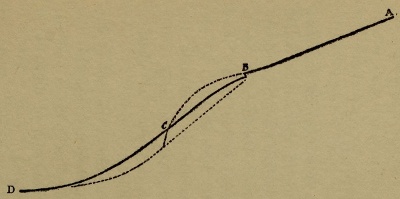
The diagram will, perhaps, help to explain the
proper way of moving uphill across ground of
varying gradient.
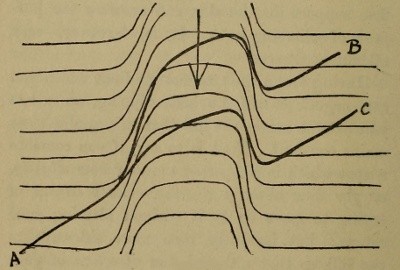
Fig. 13.
It represents a slope with a steep-sided gully
running down it. The conformation of the
ground is indicated by contour lines, as in a
map—i.e. imaginary horizontal lines running
along the side of the hill, with the same vertical
distance between each pair. Where, then, the
contour lines in the plan are far apart the slope
is gradual, and vice versa.
Since the direction of the fall of the slope is
everywhere at right angles with that of the contour
lines, its general direction only is shown by the
arrow; at either side of the gully its local direction
is, of course, nearly at right angles to this.
AB is the track of an experienced ski-runner.
Observe that (i) in general shape the line AB
resembles the contour lines; (ii) it never cuts the
same contour twice; (iii) when the contours are
far apart it cuts them at a blunter angle than
when they are close together. In other words,
the expert (i) makes a détour at the gully; (ii)
never loses any height that he has once gained;
(iii) moves steadily uphill at a constant gradient,
facing the hill more directly where it is less steep,
and vice versa.
AC is the track of a beginner. Trying to cut
across directly towards B he runs downhill into
the gully, but, being of course unable to climb
straight up the steep slope on the far side in the
direction of B, he has to bear away to the right;
and at C, when his track from A is quite as long
as the expert’s at B, he is not nearly so far up
the hill.
Remember that the variation of contour needs
just as careful attention in its smallest details
as in its main features, and must be negotiated
in exactly the same way. In climbing in this
way it is, of course, impossible to go on continually
keeping the same side to the slope (unless
the hill is perfectly conical in shape and quite
free from obstacles, allowing one to wind round
it to the top in a spiral). Having moved in
one direction for a time, you will eventually
have to turn round and begin a fresh tack.
To shuffle round, as you might do on the level,
is obviously impossible; for, whether you do so
facing up or downhill, the skis will at a certain
angle begin to run away.
The usual procedure is to make what is known
as a kick-turn.
The Kick-Turn.—Suppose that you have been
traversing the slope with the hill on your right
side and wish to make a fresh tack. Stop with
your skis pointing uphill at the angle at which
they have just been moving, and your sticks
resting close to each foot. Then put your weight
on the lower ski, and draw back the other, slightly
bending the upper knee and raising the heel (Plate
III.). Now swing your right leg from the hip
vigorously forwards and upwards, straightening
it completely as it rises, and turning up the toe
as hard as you can, as though trying to make a
very high kick. The leg must be swung freely,
not merely lifted. The result of this movement,
if made with confidence, will be to bring the ski
to an upright position with its heel resting in
the snow close to the bend of the other (Plate
IV.). If there is any hesitation, the knee is sure
to remain bent, and the toe to point forward,
the result of which will be that the heel of the
ski will catch in the snow before it has moved
far enough to the front.
The position in Plate IV. is only momentary.
As soon as the ski is standing on end in the
snow swing its point round to the right and downwards,
until the whole ski again rests on the snow,
pointing uphill in the opposite direction, but at
the same angle as before (Plate V.). During
this movement the heel of the right ski remains
in the snow where it was placed at first, and
acts as a pivot. The steeper and more slippery
the slope, and the less directly you have therefore
been climbing it, the narrower, obviously,
will have to be the angle between the skis in the
position of Plate V., but, if your joints are normally
supple, it is only on very steep or icy
slopes, when the skis have to be brought
nearly parallel, that you will find it much of a
strain to turn your feet and knees far enough
outwards.
Next shift the whole weight over on to the
upper leg, at the same time straightening it and
letting the other hang slightly bent; this movement
will lift the lower ski and stick just off the
snow (Plate VI.). Then straightening the left
knee and turning up the toe as hard as possible
(Plate VII., a), face towards the point of the right
ski and bring the left ski round to the side of
it (Plate VIII.). This time, however, make no
attempt to kick or swing the leg, as you did in
turning the right ski, but keep the left foot quite
close to the right as it moves round it. The only
difficulty here is to keep the point of the ski
from catching in the slope above you as it turns.
On a very steep slope, in order to avoid this,
you will have to change from the position of
Plate VI. to that of Plate VIII. very quickly,
straightening the left knee and turning up the
toe with a sudden jerk as you do so, and also
lifting the left hip as much as you can. This
will for a moment throw up the point of the
left ski much higher than if the movement were
made slowly. But if you try to lift the whole ski
high above the snow with knee bent and toe
dropped, or to swing the left leg away from
the other, the point is nearly certain to catch
(Plate VII., b).
The left stick is moved round with the left ski,
but the point of the other stays in the same
place throughout the turn; when only one stick
is carried it should, therefore, be held in the
hand which, before the turn, is the uphill one.
The sticks of course help to steady you, but you
should be able to turn without any stick in your
hand, and should learn to do so as soon as you can.
Having reached the position of Plate VIII.,
you can, of course, begin a fresh tack, at the end
of which you can make another kick-turn by
reversing the words right and left in these
directions.
The kick-turn, as I have described it, is made
with three distinct pauses at the positions of Plates
IV., V., and VI. Instead, however, of starting
the turn by standing the upper ski on end and
using its heel as a pivot, it is quite possible to
do so by just lifting it far enough for its heel
to clear the front of the standing leg, turning it
in the air, and bringing it directly to its final
position on the snow in one continuous movement.
By then lifting the lower ski the instant
the other comes to rest, and turning it without
any preliminary pause, you can make the whole
kick-turn so quickly that you hardly come to a
standstill between one tack and the next. On
a steep slope, however, it is always safer to begin
by standing the upper ski on end before turning
it, as otherwise its point is apt to catch in the snow
before it has reached the proper new position.
There is another very convenient modification
of the kick-turn which can be performed without
coming to a standstill at all.
As you come to the end of a tack with, say,
your left side to the hill, take a long step forward
with your right foot, placing the right ski
in front of the other one, pointing it uphill as
much as you can and edging it inwards (Fig. 14, 1).
Then, throwing the weight momentarily against
the right ski rather than on it (for if you actually
stand on it it will slip backwards), take a wide
step round to the left with the left ski, putting
it down so that it points as nearly as possible
in the direction of the new tack you are about
to start, with its heel quite close to the heel
of the other ski (Fig. 14, 2). As the left ski
comes to the snow, bring the right ski round
beside it (Fig. 14, 3) and walk on in the new
direction. The whole process must be carried
out quickly and accurately, for if there is any
hesitation about the first two steps you are almost
sure to slip backwards and fall on your nose.
It is, however, really very easy, except on the
steepest slopes, and is a great saving of time.
The position in the middle of the turn is much
the same as in “Herring-boning,” described later
(see Plate IX.). The sticks must be held up
out of the way of the skis.
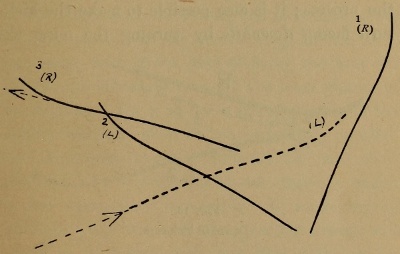
Fig. 14.
Another way of making the kick-turn is to go
backwards through the whole process first described.
After finishing a tack to the right,
for instance, you can move successively through
the positions of Plates VIIa., VI., and V., and
then lift the upper ski round to the position of
Plate III. By turning in this way, however,
you lose a little height instead of gaining it;
this method is, therefore, rather more suitable
for descending a hill in zigzags than for
climbing it.
All the above ways of turning are known as
uphill turns because one faces the hill during
the process; it is also possible to make the kick-turn
facing downhill by turning the lower ski
first. In order to prevent strain in the intermediate
position, this downhill turn should be
both started and finished with the skis pointing
downwards as much as possible (Fig. 15); this
makes it particularly convenient for joining two
downhill tacks. It can also, of course, be made
backwards as well as forwards, with a slight consequent
gain instead of a loss of height. In a
downhill kick-turn the skis have more room to
move freely, but the balance is much less steady
than if one faces the hill. On the whole, the
forward uphill turn first described is far the most
useful, but when you want to turn in cramped
corners, among trees and the like, you will
find it a great help to know several ways of
doing it.
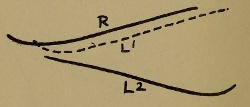
Fig. 15.
Downhill kick-turn.
Although, as I have said, the skis need never
be quite parallel at the middle stage of the turn,
you must take great care to bring the first ski
far enough round to prevent the least chance of
its slipping. On a steep or icy slope, where the
skis at this stage must be brought nearly parallel,
the kick-turn becomes difficult for the stiff-jointed;
I have even known two cases in which
it was apparently impossible. If, as is highly
unlikely, your case is similar, you can always roll
round on your back with your skis in the air—a
simple but snowy process.
If you dislike this, and if, though the joints of
your legs are stiff, the muscles are strong and
active (a not unusual combination), you can as
a last resource jump round, facing downhill
as you turn. The main difficulty in this is to
prevent the heels of the skis from catching in the
slope when half-way round, and the best way to
prevent them doing so is to jump as hard as possible
not directly upwards, but out from the hill,
so as to land below where you take off. In order
to bring round the skis close beside each other,
press the knees together throughout the jump.
Hold the sticks near their middles, and jump
from the toes, not the flat of the foot, with a free
swinging action, not a hurried jerky one. This
jump needs little skill and is easy enough on a
moderate slope, but on a steep one becomes very
hard work, for there the skis have less room to
turn, and a powerful spring is necessary. The
jump round, therefore, being most difficult under
the same conditions as the kick-turn, and much
more tiring, is hardly a satisfactory substitute
for it; I only mention it as a perfectly possible
one.
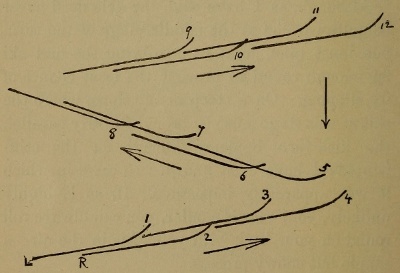
Fig. 16.
Zigzagging without turning.
The accompanying diagram, which is practically
the same as one in Mr. Richardson’s book,
“The Ski-Runner,” shows how, by walking
alternately backwards and forwards, one can
climb a steep passage, just wide enough to allow
zigzagging, without wasting time in turning
at the end of each tack. A description is
unnecessary. It is, of course, possible to make
the tacks of any length, but the number of
steps in each must always be an even one, as
the tack must be started with the upper foot and
finished with the lower.
Half Side-stepping.—In tacking uphill among
obstacles you may want to traverse at an angle
so steep that the skis would back-slip if you tried
to move straight forward in the ordinary way.
You will then have to step sideways as well as
forwards with each ski, the upper one starting
the process and the lower one being drawn up to
it, and then advanced. Fig. 17, a, shows the
track that will be left.
This must of course be done without pointing
the skis uphill more steeply than the angle at
which they could traverse in the ordinary way.
In lifting the upper ski sideways you are sure at
first to point it uphill too much (Fig. 17, b 3),
when, if it does not slip back at once, you will
tread on it with the heel of the lower ski at the
next step (Fig. 17, b 4). To avoid this, do your
best at first to place the upper ski horizontally
across the slope, lifting its heel well upwards and
away from the other, pointing the foot downwards
and inwards, and turning your body so as
to face a little downhill.
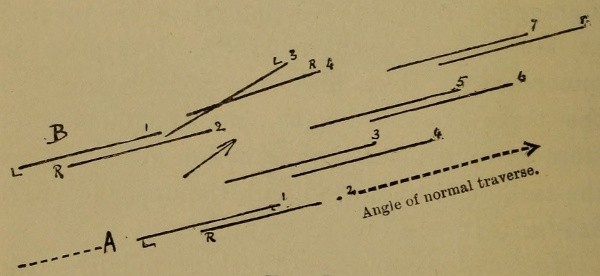
Fig. 17.
Half side-stepping; a right, b wrong.
On open ground, if the snow is so slippery
that the gradient of an ordinary straightforward
traverse has to be very slight indeed, this half
side-stepping can be used simply to save time.
Especial care must then be taken to place the
upper ski nearly horizontally. Half side-stepping
can be kept up for a long time without difficulty;
but it is more tiring than ordinary straightforward
traversing, and I think it is a waste of
energy to employ it constantly when there is no
special reason for it, as some runners are fond
of doing.
Side-stepping.—It is, of course, also possible to
side-step directly uphill with the skis quite horizontal,
as in Fig. 18,
but this, though very
easy, is such a tiresome
process that it is seldom
used except in narrow
passages where there is
room for nothing else, or for climbing short
slopes that are very steep and icy.
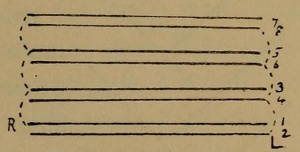
Fig. 18.
Side-stepping.
Herring-boning (Plate IX.).—This is the quickest
but far the most tiring way of going straight
up a steep slope. Stand with skis together
pointing as much uphill as they can without
slipping. Lift the upper ski, and, keeping the
feet close together, turn it until it points across
the hill in the opposite direction, but at the same
angle as before, with its heel across that of the
other. Then slide it forwards until it just clears
the lower one; stand up on it and draw up the
lower foot so that the skis are again crossed at
the back at the same angle as before, but with
the hitherto lower ski uppermost. You can now
take a new step in the other direction, and so on.[6]
Fig. 19 shows the track. The steeper the slope
the wider must be the angle between the skis
to prevent them from slipping back, but you can
always, if you find it difficult
to turn the feet enough outwards,
point the skis uphill
more steeply than would
otherwise be possible, by
simply throwing the weight
momentarily against rather
than on to each ski (see
p. 65), and keeping the feet
well apart the whole time
instead of bringing them together
between each step.
But though this is a quicker
method, it is a still more
tiring one than the first.
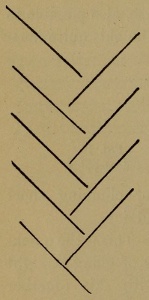
Fig. 19.
Herring-boning.
If the slope is steep, herring-boning is too exhausting
to be kept up for more than a short
time by anyone but a trained athlete, but on a
gradient which will allow the skis to diverge at
only a slight angle it is easy enough.
Getting up from a Fall.—If during any of
these manœuvres you should fall down, you may
find some difficulty in getting up again.
The first problem is to disentangle the skis,
if they have become jammed in a complicated
position.
The best way to do this is generally to begin
by moving your body as far away from them
as possible. If, for instance, you have fallen
with your head downhill, wriggle yourself still
farther downhill. Next lift your skis into the
air, either by rolling on your back and raising
the legs from the hips, or by rolling on to
your face and bending the legs backwards from
the knees. It is generally possible to free the
skis in this way, but occasionally one cannot
move without unfastening them first.
Having freed them, place them parallel in the
air, and roll round on your side so as to bring
them to the snow on the downhill side of you
and exactly at right angles to the fall of the
slope.
This is important, for, if they are pointing
either up or down hill, they will, of course, begin
to slip the moment you put your weight on
them.
If they are quite level, and your feet are
exactly below your body, you have merely to
push yourself up with the arm which is underneath
you and stand erect. If you want to
help yourself up with your stick, do not poke
it vertically into the snow and try to climb
up it, for if the snow is deep and soft you
will only plunge it farther in without getting
any resistance. Lay it horizontally on the snow,
and it will then give you enough purchase to
push up from.
On level ground it is harder to get up again
than on a hill side, owing to the difficulty of
getting the skis underneath one in order to get
to one’s feet. After freeing them and placing
them parallel, lie on your side, draw your knees
as close to your chest, and your feet as close
to your thighs as you can, lay your stick flat
under your side, and, with a vigorous push on
it, you ought to be able to get your weight
over the skis and stand up.
Never hurry, or try to struggle frantically
to your feet without any definite method. You
will merely exhaust yourself. It is impossible,
as a rule, to get up without going through the
various manœuvres that I have described, but
these take a very short time if they are performed
smartly and accurately.
This chapter is mildly theoretical, and may be
skipped by the reader who believes in nothing
that is not, in the ordinary sense of the word,
practical; for in it he will find no definite instructions,
but only a description of the behaviour,
under different conditions, of the skis
when in motion, and an attempt at an explanation
of it.
I advise him, however, to try to read it, for
I think that what I have to say here is, in a
broad sense, strictly practical. I am convinced
at any rate, that if, when I began ski-ing, some
one had given me the information which I am
about to try to impart, and which, for the most
part, I have slowly collected for myself, I could
have reached in a month the very moderate
degree of skill which it has taken me five seasons
or so to arrive at.
If the reader can thoroughly grasp the few
facts with which this chapter is concerned—and
he can take my word for the facts, whatever
he may think about my comments on them—he
will, I think, find it far easier to understand,
remember, and put into practice the instructions
which he will find in the subsequent chapters,
as to the various swings, turns, and other
manœuvres for controlling and steering the
skis, and keeping the balance while running
downhill.
Before proceeding any further, I had better,
in order to avoid any chance of being misunderstood,
explain certain terms of which I shall
constantly make use throughout the rest of the
book. These terms are the “edging” and “flattening”
of the skis, and the “inside” and
“outside” of a curve.
If any reader feels that an explanation of
these terms is an insult to his intelligence, I
can only assure him that such an explanation
has been necessary in the case of many of my
pupils.
The terms “edging” and “flattening” simply
have reference to the relation of the plane of
the ski’s sole with that of the general surface
on which it is resting, and do not refer to its
relation with a horizontal plane, or, in other
words, to its position in space.
Thus a ski is “flat” when standing in the
normal position on level ground; but, when
standing in the normal position on the side of
a slope, it is not “flat,” but “edged,” for in this
case the edge nearest the hill cuts deeper into
the snow than the other although the plane of
the sole is still horizontal. (Fig. 20, a and b.)
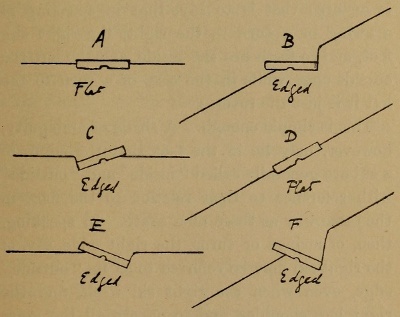
Fig. 20.
Edging and flattening.
The case is altered when the ski is inclined
sideways; on level ground a ski that is
inclined sideways is “edged” (c and e); but on
the side of a hill a ski when inclined sideways
so that the plane of its sole becomes parallel with
that of the surface of the slope, is not “edged”
but “flat” (d). When inclined to the opposite
side, however, it is, of course, “edged” even
more strongly than in the normal position (f).
The inside and outside of a curve mean, respectively,
the sides nearest to, and farthest
from, the centre of the circle of which that curve
is an arc; that is to say, that in speaking of
a swing or a turn to the right, the right ski,
foot, and so forth are the inside, and the left the
outside ones, while in the case of a turn to the
left it is just the reverse.
This is simple enough. A shade of ambiguity,
however, may lie in the fact that the edges of
a ski are generally called “inside” and “outside”
with reference to their relation to the foot, in
the same way as those of a skate. In speaking,
then, of swings or turns, the right edge, say, of
the right ski may be referred to as its “outside”
edge, even when the right ski itself, and the
right leg, shoulder, and so on are all the inner
ones in relation to the curve of the swing.
Now for the facts referred to above.
When a ski is pointed directly downhill and is
made to slide with its sole held flat on the snow,
it runs, if properly constructed, in a perfectly
straight line.
If it is then “edged” to one side it runs
round gradually to that side, the curved point
acting against the snow like a bow rudder and
drawing it to that side.
The steering effect, in theory, increases with
the edging until it reaches its maximum when
the ski is edged to a right angle. What happens
in practice is that though the edging and
the steering effect do increase together, there is
no use in edging the ski beyond a certain angle—less
than 45°—as, if that angle is exceeded, the ski
sinks deeply into the snow and refuses to slide.
If that angle is not exceeded, however, the
deeper the ski sinks into the snow (owing to
the softness of the latter) the greater is the
steering effect, for then a larger and more sharply
curved surface of the point comes into action as a
rudder.
If when going straight downhill the runner
“edges” his ski—we will suppose he has only
one—by simply leaning sideways, he will equally
simply fall down; but if he “edges” it without
leaning—if he edges it in relation to himself, so
to speak—it will begin to turn; that he then
leans sideways in order to keep his balance does
not make the turn sharper.
If the runner traverses the slope with his ski
held normally, as in Fig. 20, b, it will run
straight, for although it is then edged in relation
to the slope it is not edged in relation to him. If
he edges it in relation to himself it will turn
more or less according as the gradient of its
previous traverse has been steep or gradual.
When a ski running straight downhill is made
to turn by “edging,” the further it turns, and
the less directly therefore it points downhill, the
less abrupt becomes the curve of its course. This
curve, indeed, eventually becomes so gradual
that before the ski has turned far enough to point
horizontally across the slope and come to a standstill,
the line of its track is practically straight.
When, therefore, a ski, traversing directly at
a moderate gradient, is simply “edged” towards
the slope, there is no perceptible turning effect,
even if the runner does not lean inwards.
At first sight it might appear that the movement
of a ski when edged and travelling in
a curve would be precisely similar to that of a
skate, and so it is in a way.
Since the edge of a skate is, in shape, the arc
of a circle, a skate, when edged, cuts cleanly
round without side-slip, and so in a sense does a
ski, when simply edged, for its heel then follows in
the track of its point. An edged ski, moreover, like
a skate, turns more or less gradually, according
to the angle at which it is edged. But while a
skate, the edge of which is curved throughout,
touches the ice with only a very small part of
this edge, and is able to make a curve of very
small radius, a ski touches the snow with nearly
the whole length of its edge,
the greater part of which is
quite straight. This straight
part so far neutralises the
turning action of the curved
point, that a ski made to turn
simply by edging is unable to
make anything but a very
long and gradual curve—so
gradual, indeed, that for practical
purposes of steering the
edging of the ski, unaided, is
absolutely useless.
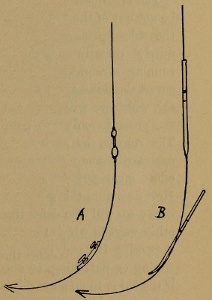
Fig. 21.
But though, contrary to
what one might expect, the
edging or flattening
of the skis may
practically be disregarded
as primary
factors in a turn, they are, as we shall see,
of the greatest importance as secondary ones.
Before a ski can be made to turn at all sharply,
its heel must be got out of the track of its point
and made to travel faster on a curve of its own
(as in Fig. 21, b). The ski as a whole, in fact,
must be made to side-slip more or less as well
as move forward.
The first question, then, is how the ski-heel is to
be got out of the track of the point in order that
the side-slip may start. If the ski is pointing
nearly directly downhill, whether flat and
running straight, or moving edged in a long
curve, there is—apart from the help of the other
ski, which we will leave out of the question for
the present—only one possible way of doing it.
The runner, by means of sudden—though not
necessarily more than a very slight—muscular
effort must jerk it more or less broadside on.
How he makes this effort need not be considered
here; we will also defer the consideration of the
other ways in which the side-slip may be started.
Supposing it has been started, it must then, by
edging or flattening, be encouraged to continue,
if the ski is to go on turning.
It depends on the quality of the snow as to
whether a ski side-slips more freely when flat
or when more or less edged. If the surface of
the snow is hard and icy, or if there is a mere
shallow layer of loose snow on a hard crust, a
ski will slip sideways either when quite flat
or when slightly or even strongly edged on the
side from which it is moving.
The flat position would in this case be the more
favourable if the hard surface were perfectly
smooth; this, however, it seldom is; it usually
has small projections which, when the ski is quite
flat, strike its side and check or stop it, while, if
the edge is raised, they strike its sole obliquely
and affect its motion but little.
The flat position, then, is not advisable as
an aid to side-slip even in the case of hard
snow; on snow of any other kind it is still
less advisable, for if the ski sinks deeply into
loose soft snow, or even but a little way into
dense soft snow or into a thin crust, it can
hardly be induced to side-slip at all when held
quite flat, while when more or less edged, it
can usually (if already in motion) be made to
do so without much difficulty.
The reason is not quite obvious, for at first
glance it would appear that the ski would meet
more resistance from the snow in the edged
position than in the flat, but this is not the
case, for, when the ski is edged, most of the
resistance is exerted obliquely against its sole,
and so tends to make the ski rise to the surface
of the snow and relieves the pressure. When,
however, the ski is flat, the resistance acts
directly against the side of it, and there is no
lifting tendency to diminish the rapidity with
which this resistance increases as the snow is
compressed.
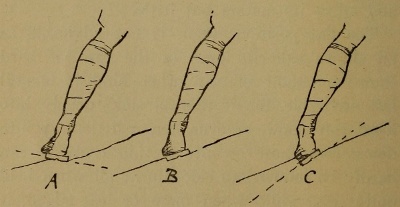
Fig. 22.
Moreover, since during a turn the runner must
lean inwards to keep his balance, the ski cannot
remain in its normal position in relation to the
leg unless it is more or less edged inwards (Fig.
22, a). That the leg and ski should remain
as nearly as possible in their normal relative
positions is an advantage, for the more nearly
they do so the less is the strain on the ankle.
If the weighted ski is held quite flat during
a turn in which it is outermost, that ankle is
placed in a very unstable position (Fig. 22, b),
and is liable to give way and so edge the ski
on that side towards which it is moving (Fig.
22, c); it will then cut more deeply into the
snow and be brought instantly to a standstill.
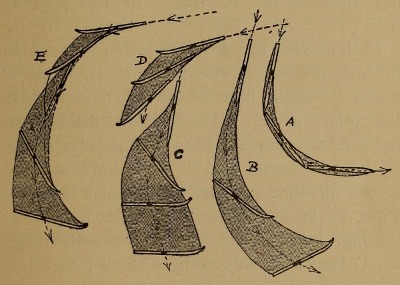
Fig. 23.
In all that I have said so far about side-slip,
I have assumed that the ski is moving more or
less broadside on, with its heel travelling outside
the track of its tip and its pivoting point
well forward, and this is what either one or
both skis actually do during the greater part
of any swing or turn; for, in turning, a ski
usually passes through the positions of either b
or c, Fig. 23. A ski may also, as, for instance,
in turning downwards from a slow traverse, move
so that the curve in which its point travels
is outside that of the heel (Fig. 23, d) and its
pivoting point is near the heel. In each of
these cases, though one end is side-slipping
faster than the other, both ends are slipping
to the same side, and the ski, as I have said,
has therefore to be edged to the opposite
side.
If, however, the ski begins to turn as in
d, and finishes as in b or c, it must of
course be edged first to one side and then to
the other, as in e, and for a moment be
flat. At this moment the pivoting point of the
ski is at its centre, and its heel is side-slipping
in one direction as much as its point is in the
other, as in a. If ever, therefore, a ski, in
turning, continues to pivot on its centre (Fig.
23, a) instead of only doing so for a moment, it
must obviously be held quite flat, as otherwise
either one end or the other will cut below the
surface of the snow and be checked suddenly.
Now the pivoting point of a ski is never
behind its centre except during a downward
turn, and the faster the runner is moving
before the turn, and the sharper the turn is
made, the more quickly this point moves to
the front; the only case, I believe, in which
it remains near the centre for an appreciable
time, and when, therefore, the ski has to be
held deliberately flat, being that of the outer ski
during a “steered” Christiania swing.
In order to facilitate side-slip, therefore, the
outer edge of the ski must usually be raised as
it turns or, even if at first the inner edge must
be raised, a change of edge must usually take
place almost immediately. The flat position, in
fact, must never be sustained—except, as I have
said, during a Christiania “steered” swing,
and even then only for a short time—it is
simply a necessary incident in a change of
edge.
In each figure in Diagram 23 the dotted line
with arrows shows the average direction of the
ski’s course at each point, and whether, therefore,
it must be edged or flat.
The foregoing remarks are an explanation of
how the edging or flattening of the ski can be
made to help the side-slip; the next thing is to
understand how the side-slip can be made to
help the ski to turn sharply.
If, when either standing still on the side of a
slope or running across it in the normal, edged
position, a ski is partially flattened, it will begin
to slip sideways—in the first case moving directly
downhill, and in the second obliquely, i.e. forwards
as well as sideways.
Now the foot stands on the ski at about halfway
between the front bend and the heel—that
is to say, about the middle of that part of the
blade which rests on the snow; and as long as
the runner’s weight is placed equally on toe and
heel, a ski in side-slipping will continue to point
in a direction parallel to that in which it was
pointing when the side-slip began.
When, however, the runner’s weight is placed
on the heel, that end of the ski will side-slip
faster than the other, and the farther the ski
slips the more it will point uphill; while when
the weight is placed on the toe the reverse will
happen.
Fig. 24 shows what will happen if a ski, when
(a, b, c) at rest on, or (d, e, f) running across a
slope, is made to side-slip with the runner’s
weight variously distributed. In this and succeeding
diagrams the blackened portions of the
skis are those on which the runner’s weight
is put.
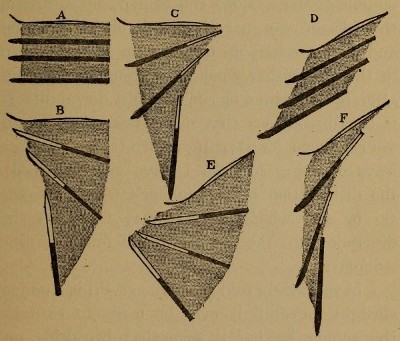
Fig. 24.
In a the ski slips broadside on downhill.
In b it gradually revolves as it slips, and
would finish by running downhill backwards if
its shape did not prevent it from doing so.
In c its rotation is reversed, and it finally runs
straight downhill.
In d it runs slightly sideways, but the direction
of its course is a straight line.
In e it turns uphill and at a certain point stops.
In f it at first turns and finally runs
straight downhill.
The side-slip can be stopped more or less
quickly at any stage by the runner strongly
edging the ski and at the same time again
equalising the distribution of his weight on it.
Whether the ski then runs on in the direction
in which it is pointing, or comes to a standstill,
of course depends on whether it is pointing
downhill or not.
It is obvious, then, that when a ski is in
motion across a slope the runner, by means of
the side-slip, can make it turn in either direction
and to any extent up to a certain limit, and can
in this way either come to a standstill, slightly
alter his direction, or run straight downhill. It
is equally obvious that no matter what means
are employed for starting a turn (there are more
ways of doing so than I have yet described),
the distribution of the runner’s weight on the
ski or skis which carry it may make all the
difference to the success or failure of the
manœuvre.
I have already said that when a ski is running
straight downhill it may be made to turn by
the runner jerking it somewhat broadside on.
He can of course do the same with the two skis,
but a simpler plan is for him to stand on one,
point the other more or less in the direction in
which he wants to go, and hold it so for a
moment. It is thus of course made to “stem”—in
other words, to side-slip—and, if the runner
then throws his weight on to its heel, it can,
as we have just seen, be made to turn still further,
the previously weighted one being again brought
parallel with it as it does so. A turn can also
be started from a traverse in the same way.
When one ski is held at an angle with the
other in order to start a turn in the above way,
the relative position of the two usually produces
some steering effect; the two skis in fact act
together something like a boat and rudder. To
say that one ski may be looked upon as the boat
and the other as the rudder is hardly accurate,
for the steering effect is at its greatest when,
as the runner’s weight is shifted from the ski
that is running straight ahead to the one that
is held sideways, it rests equally on both; at
which moment, since their area is equal, either
of the skis may equally well be looked upon as
the rudder or as the boat. If, however, it is
remembered that the boat steers the rudder no
less than the rudder steers the boat, and that
if the rudder is fixed in a certain position, it
and the boat together may be considered as
one solid object whose shape determines whether
and how it is able to turn, one may, by comparing
the skis with a boat and rudder, understand
whether and how, when held in various relative
positions, they are able to turn.
The diagram shows the skis as they are held
at the beginning of—a, a Telemark, b, a Stemming
turn, and c, a Christiania. It also shows
a boat turning to the left steered by both a bow
and a stern rudder.
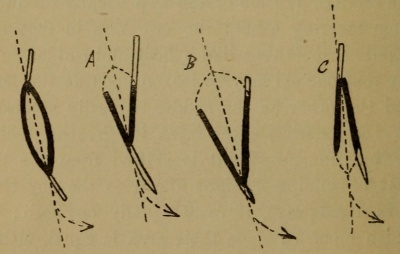
Fig. 25.
The darkened ski of each pair is the weighted one.
The steering action of the skis may be best
understood by considering the blackened parts
of each pair (in which the steering effect is
neutral) as the sides of a boat, and the light
point and heel of each pair as a bow and
stern rudder respectively. It will then be seen
that the boat is in each case helped to turn to
the left by the action of both rudders, or that
if it can in some way be made to turn to the
left without the help of the rudders, they will
at least not hinder it—than which, as a matter
of fact, little more can be said in the case of
the Telemark; though in the Stemming turn
there is a strong steering action while the skis
remain in this position, and a distinct, if weak,
one in the Christiania.
The principal factors, then, in the control and
steering of the skis are the edging or flattening
of them, the distribution of the weight on them,
and the placing of them in certain positions
in relation to each other. How these various
factors interact during the different swings,
turns, &c., will be explained more fully in subsequent
chapters, but before closing this one
I want to give some explanation of how a
turn on skis depends as to its character on
whether the ski at the moment of beginning
the turn is running straight down the hill or
across it, on whether the speed is high or low,
and the slope steep or gentle, and also on the
quality of the snow.
The accompanying diagram shows the successive
positions assumed by a ski (the leading
one, the other is not shown) during a turn to
the right, under various conditions.
The line passing through the middle of the
skis shows the curve on which the runner himself
travels during the turn; the line ending in a
double arrow shows the sort of curve on which
he would travel if the ski were able to cut
round without side-slip as a skate does. It will
be seen that if there were no side-slip he would
in every case move steadily to the right of
the line of his original course (shown by a
dotted line in the diagram), but that, on account
of the side-slip, the line on which he travels
sometimes moves only slightly to the right of
that line, even when the turn itself is a
sharp one, that sometimes it moves to the
left of it and then recrosses it, and that sometimes
it remains entirely on the left of it
throughout the turn. To understand how,
according to the conditions, the curve of the
runners actual course varies, is a great help
to the balance, for at first one’s instinct is to
balance the body as if the ski were cutting
round like a skate, i.e. to lean inwards too
much, which, of course, inevitably results in
a fall.
In every case the turn is supposed to be made
as sharply as the conditions allow. It will be
seen that on hard snow the runner, when travelling
fast, will skid almost directly sideways for
some distance from the spot where he actually
finishes turning.
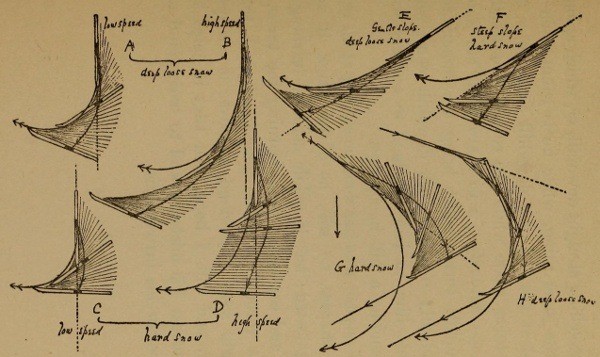
Fig. 26.
a, b, c, d are turns made while the runner
is travelling straight downhill, or, which amounts
to the same thing, while he is running on the
level at the end of a downhill slide. e, f, g, h
are turns made while the runner is descending
a slope obliquely. a to f are what are known
as uphill turns, which bring the runner to a
standstill; g and h are downhill ones, which
enable him to join one tack to another when
descending a hill in zigzags.
If anyone who has done no ski-ing at all reads
this chapter, he will, no doubt, think it very
complicated; but if, while actually learning to
ski, and especially while learning the turns, he
looks through it from time to time, I think
he will soon understand whatever is not quite
clear, and will, I hope, find that it helps him
to correct his mistakes and to understand and
remember his instructions.
Cleaning Skis.—Before attempting to start,
you must make sure that your skis will slide.
In thawy weather, or very strong sunshine, the
snow may stick to their under surfaces—so badly,
sometimes, that sliding is out of the question.
But it is seldom quite impossible to slide, and
under conditions which seem hopeless to a beginner
one can generally get started, if one knows
how to set about it. When once under weigh
the great thing is to keep moving, for the
moment the skis stop sliding the snow will stick
again, and the whole cleaning process described
below must be repeated.
In snow which is only slightly sticky you
need merely stamp your skis hard once or
twice, and rub them firmly backwards and forwards
on the hardened snow until you can feel
that they are quite slippery. Then slide off
at once.
If the snow sticks badly, the skis must be
scraped on each other (unless there are any
branches or hard objects lying about which will
do as well). To do this on level ground is easy;
on the side of a hill rather less so.
Suppose you are obliged to start your run on
the hillside and wish to scrape your skis.
First stand with your skis pointing across the
slope, and, by vigorously stamping or jumping,
make as hard a place to stand in as possible.
If you are standing with your right side to the
hill, and want to scrape the right ski, rest your
left ski on its right (inside) edge, lift round the
right ski, and put it across the other one, at right
angles to it, just behind the left foot and pointing
directly uphill. Then scrape it hard up and
down across the raised outer edge of the left ski,
bending the left knee well and crouching down
so as to get a long scrape from the heel right up
to the bend of the right ski (Plate XI.). When
the ski feels perfectly smooth, lift it round again
parallel to the other ski, and without resting it
on the snow for an instant stamp and rub it
backwards and forwards until it is as slippery
as possible and the snow beneath it as hard and
smooth as you can make it. Then, and not until
then, you can rest the ski on the snow, placing it
on its right (outer) edge and doing your best to
prevent its sole from touching the snow. Now,
with your weight on the right ski, but still
holding it well on its edge, face downhill, lift
round the left ski, put it across the heel of the
other one, pointing downhill, and, crouching well
down as before, scrape it clean on the inside
edge of the other (Plate XII.); this time it is
the heel of the ski which it is difficult to get
at. Then bring it round to the side of the right
ski, repeat the stamping and rubbing process,
and place it carefully on its inside edge. Now
start instantly. (How to do so is explained
later.)
If the snow is very bad indeed, it is best,
when on tour, before beginning the descent,
to take off the skis, scrape and wipe them
absolutely clean, and dry them thoroughly in
the sun or air—but not, if you can help it, by
standing them upright in the snow, for if they
are wet the water will run down and form ice at
the heel ends. Then wax and polish them well,
let their soles cool in the shade if they are warm
from the sun, and put them on. You will
probably be able to slide off without trouble; or,
if it is still necessary to scrape and rub them,
they will become clean more easily.
This scraping sounds an elaborate and wearisome
process, and so it is. Fortunately it is
not often necessary; but, when the snow is really
bad, it is an enormous saving of time and trouble
in the end to attend minutely to every detail,
and may be the only means of getting a run
at all.
It is not unusual to see a beginner refuse to
get his skis thoroughly clean, under the impression
that the slower pace will make things easier
for him. He could not make a greater mistake.
If he leaves any snow sticking to his skis they
will certainly move slowly (unless they refuse to
slide altogether), but they will do so with an
irregular, jerky motion which is ten times more
upsetting than the fastest movement of polished
skis.
Starting.—To start from the top of a hill is
a simple matter. You walk to the edge and
slide over in any direction you choose.
On the side of a slope, however, there is a
difficulty in starting a run straight downhill
owing to the fact that, as you move the skis
round, they begin to slide before you are facing
the way you wish to go.
One way to overcome this difficulty is as
follows: Suppose you are standing at right
angles to the fall of the slope, with the hill on
your right, and wish to start to run straight
downhill.
First move both skis round a little way, so
that, like the left ski in Plate XIII., they point
downhill as directly as possible without actually
slipping. Then, putting all the weight on the
left ski, lift the right ski and place it on the
snow, pointing straight downhill, its tip being
just in front of and below the tip of the other
one, as in the photograph. The weight should
still be on the left ski. If there is any sign of
slipping, you can stop it by turning the skis
on to their inside edges and pressing outwards
against them with the legs.
You are now quite steady and ready to start.
In order to do so you merely have to throw all
your weight on to the right foot and to lean well
forward, downhill. The right ski will at once
slide off, the right foot will strike and push
forward the point of the left ski, which will,
if left to itself, come round, and fall into what,
as will appear later, is its proper position close
to the side of the other.
Another simple and frequently used method
of starting downhill from the horizontal position
is to jump round. The same points are to be
noticed as when using a jump in the place of a
kick-turn. Bring the feet level, spring from the
ball of the foot, press the knees as well as the feet
together, hold the skis parallel, and don’t let their
heels drop. You must land leaning well forward,
so that the general direction of the body and
legs is at right angles to the slope, not vertical,
otherwise the skis will run from under you.
This jump round is easier than the first one
described, being only a quarter-turn, while the
other is a half-turn.
Straight-running.—As you begin to slide, place
yourself in the position of Plates XIV. and XV.,
which is the normal one for running downhill—skis
held in contact, so that they leave a single
track; one ski about a foot in advance of
the other; the advanced leg almost straight
at the knee, the other more bent; nearly all
the weight on the back foot; the inside of the
front knee pressed against the kneecap of the
other; body erect; arms hanging easily by
the sides; stick, or sticks, if carried, held clear
of the snow.
Hold yourself perfectly easily and without
stiffness, especially at the knees, which should
give to the inequalities of the ground. It is
far better to stand too loosely, and sway about
somewhat, than to keep every muscle tense.
You can keep the skis together without effort
by bending the knees and ankles well inwards,
so as to place the skis slightly on their inside
edges; they will then tend to run together
rather than to separate. Take the greatest care
to avoid any approach to a bow-legged position,
which would edge the skis outwards. There
should be no daylight visible between your knees
to a person standing in front of you.
If you should find the skis running wide apart
with the weight equally on both, don’t try to
force them together, but throw all your weight
on to one ski, and then you will be able to
move back the other quite easily to its proper
position.
Carry the stick, or sticks, as shown in the
photographs (Plates XIV. and XV.). On no
account hold a single stick (or the two sticks
placed together) in both hands. If you feel the
smallest tendency to do so, practise at first with
nothing in your hands.
This will save you from acquiring the habit
of falling into the deplorable attitude shown in
Plate XVI., or the almost equally bad one in
which the stick is held out in front transversely
like a balancing pole, ready for the teeth of
its owner if he happens to pitch forwards.
If their weight or length makes it difficult to
keep the sticks clear of the snow when held by
the ends, hold them rather nearer the middle, but
not much nearer or they will be more likely to
hurt you if you fall.
Don’t hold out the arms horizontally from the
shoulders, for that is tiring and ungraceful.
The knees, as I said, should give to small
inequalities of the ground; but as you are almost
sure instinctively to stiffen them a little when
you find yourself approaching a bump or hollow
which looks likely to upset your balance, it is
as well to bend or straighten them voluntarily
according to circumstances. As you go over a
mound, for instance, bend the knees and let
the body sink; if it is necessary to sink low,
raise the heel of the back foot and let more
weight fall on the advanced one. As you cross
a hollow, straighten the knees and rise as high
as you can. In this way the pressure of the
skis on the snow will vary but little and the
unevenness of the ground will scarcely be felt.
The feeling will be that of moving steadily
and smoothly along, lifting the skis over the
hillocks, and pressing them down into the
hollows. A spectator who can only see your
head and body should hardly know that the
ground over which you are moving is not perfectly
smooth.
In this way you can negotiate short variations
of gradient where the general angle of the
slope remains constant. In the case of larger
inequalities, or where the general angle of the
slope changes, you must alter your procedure.
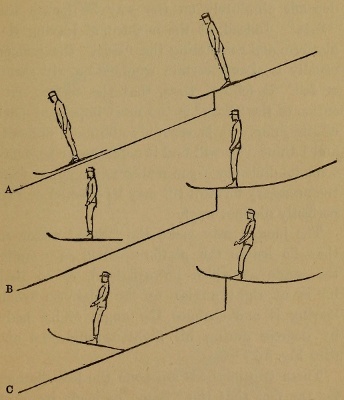
The line from your centre of gravity to its
point of support must always be at right angles
to the surface of the slope, so, where the ground
becomes steeper, you will have to lean more
forward, and less so where it becomes less steep.
But though you will have to tilt yourself forward
consciously as you pass on to a steeper
slope, you may safely leave to unconscious instinct
the backward lean in the opposite case.
If you try to lean backward consciously, you
are almost certain to overdo it and to sit
down.
There is a further safeguard in the case of
sudden changes of gradient, very rough ground,
snow of varying consistency which alternately
checks and accelerates the speed, and, in fact,
anything which makes it difficult to keep the
balance-that is, to drop into what is generally
known as the “Telemark” position (Plates XVII.,
XVIII., XIX.), because it is the one held during
the swing of that name.
To assume this attitude, you shift the weight
from the back foot to the advanced one, and
then sink down, leaning the body forwards,
bending both knees, and sliding the back ski
still farther back until its bend is level with
the leading ankle.
Practically all your weight should then be
upon the leading foot, and upon its heel, no
less than its toes. To make sure of this, the
advanced leg must be bent at the knee almost
to a right angle, and the knee must be kept
well forward, so that the leg, from the knee
downwards, will be at right angles to the ski,
no matter how steep may be the slope.
If the front foot is thrust forward in advance
of the knee, too much weight will fall on the
toe (unlikely as it may appear) and, moreover,
some weight will be thrown on the back foot,
which should carry next to none. Let the
back knee drop until quite close to the ski
(when crossing uneven ground it will very likely
touch it) and raise the heel of the back foot
as far as possible. That leg should then be
perfectly relaxed and easy. Keep the skis close
together as before, so that they leave a single
track, by edging them a trifle inwards and pressing
both knees, especially the back one, well inwards
so that, seen from in front or behind, they overlap.
Practise running in this position with either
foot leading, taking care to keep the weight
well on the front foot. It is an indispensable
accomplishment; and although at first it may
not seem so easy a position as the normal one,
it is such a help to the balance that later on
you must be on your guard or you may contract
the bad habit of running constantly in this
position when there is no real need for it.
In this position not only is the centre of
gravity lowered, but the base of support is considerably
lengthened, and the fore and aft
stability is thus enormously increased. By
means of it you will be able to move with
perfect steadiness over ground which would
almost inevitably upset you if you were to
stand up in the normal position.
In this, just as in the normal position, you
can consciously raise and lower yourself to allow
for uneven ground, by bending or straightening
the advanced leg; but this will seldom be
necessary, except for very abrupt inequalities.
Even sudden changes of speed have little
power to disturb your balance when you are
running in this attitude. If the gradient
suddenly becomes much steeper, as in Plates
XVIII. and XIX., you should give a determined
plunge forwards, as though trying to get ahead
of your skis. If, however, you are taken by
surprise, and run suddenly on to an invisible
icy patch or over a steep drop in bad light,
you will probably at the worst only find your
weight thrown on to the back foot, and will be
able to recover yourself. On the other hand,
if the speed is checked and you are thrown
forwards, the back foot will tend to rise into
the air, and, receiving the weight of the ski,
will most likely just save you. If the check is
so abrupt as to throw you right off your
balance forwards, you can often save yourself
by bringing, with a quick stride, the disengaged
back foot to the front to receive your
weight. Indeed you are almost sure to do so
instinctively.
Another position, which is employed by some
runners under circumstances such as I have
just described, is as follows:—
The runner crouches as low as possible, almost
sitting on the raised heel of the back foot; the
front leg, from the knee downwards, is perpendicular
to the ski, but its foot is not much
farther ahead than in the normal running
position; the back knee is pressed against the
inside of the front leg, just above the ankle.
This attitude is less tiring to hold than the
Telemark position, but is, I think, less of a safeguard
to the balance when the speed changes
suddenly or the ground is very rough.
All that I have just said has reference only
to the preservation of the balance in a fore and
aft direction. The question of lateral stability
is far simpler; on all ordinary occasions it is
sufficiently secured by keeping the skis as close
together, and so making as narrow a track as
possible.
The reason for this is not quite self-evident,
but is easily explained.
If a bicycle be ridden on bumpy ground, it
will not be tilted sideways as it crosses the
side of an undulation, and will have no tendency
to upset unless it actually side-slips.
A tricycle, on the other hand, or any vehicle
with a wide wheel-base, will under similar circumstances
be more or less tilted according to
the angle of the ground, and will, unless it
has a very wide wheel-base and a low centre
of gravity, be easily upset by a sudden transverse
variation in the angle of the ground,
especially when moving fast.
The diagram shows how a ski-runner when
holding his skis apart may be compared with
a tricycle, when holding them together with
a bicycle.
This is not quite a fair simile, for, while the
cases of the bicycle and of the ski-runner in
the single-track position
are exactly analogous, a
man with his skis apart
is not a rigid construction
like a tricycle, but,
by letting his knees give
and by swaying his body,
can adapt himself to the
change of gradient.
Still, the tendency is
always, especially in the
case of the beginner,
for the legs to stiffen
when they ought to
yield, and on this account
alone the single-track
position is the safer.
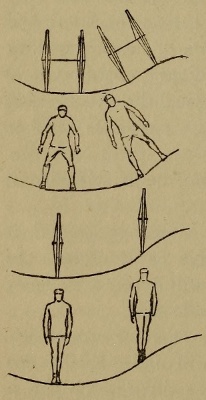
Fig. 27.
There are, moreover, two further objections—and
very strong ones—to separating the skis.
One is that it is impossible to run with the
skis apart without holding the feet about level,
instead of keeping one well ahead of the other.
With the feet level the runner has far less
stability in a fore and aft direction, and, without
support from his stick, can hardly hope to keep
his balance in the event of a very sudden change
of speed. The other objection is that when the
skis are separated each one has to be kept
straight independently. At a low speed it is
perhaps not very difficult to do this, but at
a high speed it is by no means easy, and,
of course, any divergence or convergence of the
skis is almost certain to cause a fall before it
can be checked.
When held against each other, however, the
skis, if properly made, will run perfectly straight
and need no attention at all. Obviously they
cannot converge, and the least inward pressure
or edging will prevent them from running apart.
The single-track position, then, has many
advantages. The only thing against it is its
unsteadiness in the event of side-slip. But
under ordinary conditions of snow, a ski, when
moving straight ahead, either directly down the
slope or obliquely across it, will show no tendency
to side-slip, not even when, in the latter
case, the slope is very steep (provided, of course,
the ski be held normally, i.e. edged). Under
such conditions you can always run with the
skis held close together in either the normal
or the Telemark position, and there can be no
excuse for deliberately separating them.
When running on a hard icy crust, however,
it is sometimes impossible to prevent the skis
from side-slipping. They are, of course, much
more apt to side-slip when moving across a slope
(especially a steep one) than when running
straight down it; indeed when traversing a steep
slope they may side-slip even in soft snow if that
is shallow and rests on a slippery crust. But
though they will generally run straight downhill
with absolute steadiness on snow that makes
them side-slip badly when traversing, the surface
may be so extremely slippery that they will
side-slip even in a direct descent owing to small
lateral undulations of the ground.
As soon, in either case, as the tendency to
side-slip becomes so pronounced that you are
really hopelessly unsteady in the single-track
position, you will, if you still want to run at
full speed, have to separate the feet more or
less and hold them about level. Do not separate
the feet more than just enough to steady you,
and do not do it at all until you are quite sure
it is absolutely necessary; try merely to separate
them a little for a moment when the side-slip
unsteadies you and to recover the normal position
instantly; some runners seem able to hold the
single-track position at any speed on the most
slippery snow—possibly by making imperceptible
jumps to one side or another as they feel the slip
begin.
When running with your feet level and apart,
your fore and aft balance will, of course, be more
precarious than in the normal position; you had
better, therefore, lower your centre of gravity
by crouching as low as you can with steadiness,
i.e. not so low that all your weight comes on
the heels or that they have to be raised at all.
In the level-footed position your best safeguard
in case of sudden changes of gradient or snow
consistency is not to lean backwards or forwards,
but to move the feet forwards or backwards, which
amounts to exactly the same thing but is a much
quicker process.
This may not be quite clear. Let me try to
explain. As I have already said, the line from
your centre of gravity to your point of support
must always be about at right angles to the
slope. Suppose then that you are running fast
down a slope with an abrupt mound in front of
you, instead of trying to readjust your balance
as you pass on to the mound by leaning suddenly
backwards, do so by still more suddenly doubling
forwards a bit at the hips and, so to speak, lifting
your feet forwards and placing them against the
mound to receive your weight. If, on the other
hand, you suddenly run off a gentle slope on to
a steep one, quickly hollow your back a little,
and, by straightening yourself at the hips and
bending your knees more, lift your feet backwards
and place them against the slope behind you.
By “lifting” the skis I do not mean actually
raising them from the snow, but only taking
the weight off them a trifle, and sliding them.
These movements are exactly the same as those
you would make if, when standing with your
feet tied together, you were pushed off your
balance either forwards or backwards and were
then to save yourself by a little jump in the
corresponding direction. Leaning backwards and
forwards, which as it is done principally on the
hinge of the ankles cannot be done quickly, may
be used as a preventive of loss of balance, but is
practically useless as a cure; this moving of the
feet, however, is particularly useful for the latter
purpose. If you try the two methods when
running quickly down a very undulating icy
path, you will soon decide in favour of the latter.
You can, of course, do the same thing when
running in steady snow with the skis together
in the normal position, but it is then simpler and
quicker to move one foot backwards or forwards
instead of moving both.
Although, as I have said, side-slip occurs more
readily when you are traversing a slope, you will
then find it far less upsetting than when you are
running straight downhill. When traversing in
normal position with the skis together, the upper
foot should lead and the weight be on the lower;
with the lower foot weighted it will take a
very sudden and pronounced side-slip to upset
you, for as the lower ski slips the upper will
receive the weight, and the sudden pressure will
probably make its edge hold long enough for
you to recover your balance. Moreover, you
will generally, when traversing, be running pretty
slowly (you can, of course, go as slowly as you
like by making the angle of your traverse a very
gradual one), which makes side-slip still less likely
to upset you. It is, therefore, hardly ever necessary
to traverse with your skis more than a few
inches apart.
If you wish to run a traverse at high speed
where the tendency to side-slip is very pronounced,
do not make violent efforts to prevent
it by edging your skis extra hard, but simply
keep them normally edged with your ankles,
and especially your knees, well over towards the
hill, and then let them side-slip if they want to.
Make no attempt to lean towards the slope, but
keep your weight well outwards and forwards,
imagine that you are making for a spot rather
below where your skis are pointing, and run as
lightly as possible, cultivating, if you can, a sort
of semi-sideways floating feeling, which is hardly
describable but which you will certainly recognise
if you do as I have told you.
Generally speaking, the harder and slipperier
the snow the more lightly you should try to run,
the softer the snow the more heavily you should
try to drive your skis into it.
You can entirely disregard the hard ruts of
ski tracks unless you are obliged to cross them
at a narrow angle. If you cannot help doing
this (which you should try to if running fast)
be ready, if one of the skis or both get turned
off their course, to lift one quickly and put it
straight again before you lose your balance.
You should never be afraid of lifting your skis,
especially on hard snow; by stepping about
quickly you can not only keep your balance even
when running fast, but can alter your course,
though in the latter case you must be careful
as you put the first-lifted ski to the snow again
to lift the other instantly, or they will run apart
for a moment and probably upset you. The
greater your speed, the less of course will be
the change of direction that you can make safely
in one step, but by pattering round quickly you
can turn fairly short when going at a good rate.
When running straight downhill in either
normal or Telemark position either foot may
lead, and you should change about, when practising,
until you find you can lead as easily with
one as with the other. When traversing in
normal position the upper foot should lead, in
Telemark position, the lower foot—that is to
say, that in traversing the weighted foot should
always be the lower one.
The more weight is carried by the lower ski,
the less difficulty will you find in keeping the
other one close to the side of it.
Should the upper ski show a tendency to run
uphill, away from the other, put no more weight
on it, but merely turn its inner edge slightly
downwards, and press on the toe, when it will
run back to its proper position.
If you have any difficulty in preventing it
from running downwards, and crossing the
other, you can slide it to the rear, and drop
into Telemark position, lower foot leading.
Although, generally speaking, you should avoid
all effort and hold yourself easily and loosely,
you must, when your balance is disturbed, make
every effort in your power to keep it.
One very often falls simply through expecting
to fall, and doing nothing to save oneself, when
a determination not to fall would carry one
through.
Don’t be afraid of running straight down the
steepest slope, provided the ground is open and
fairly smooth, the snow easy and safe,[7] and the
change of gradient at the bottom not sudden.
Remember that the pace does not go on increasing,
but attains its maximum in a second
or two. It is only while you are gathering way
that the sensation is at all alarming; when full
speed is reached—provided the ground be smooth—a
steep slope feels no more difficult than a
gradual one. If, however, there are any undulations—however
small—you had better run
down a steep slope in the Telemark position.
For though on a moderate slope you might
hardly notice them, or could allow for them as
directed above, on a steep slope the high speed
will very much increase their effect, and to run
over a small mound may shoot you into the air
if your legs happen to be rigid at the moment.
Whenever you are actually running freely and
not trying to put on the brake, or stop (explained
later), the very best safeguard to the balance is
a desire to go faster.
Should you not happen to want to go faster,
pretend you do, if you are not above such
childishness.
No amount of wanting, of course, will affect
your speed, but this mental attitude will enormously
increase your steadiness by removing the
fatal tendency to lean backwards.
Similarly, to wish to go slower will not make
you do so, but will very likely be the sole cause
of a fall.
Some such sentence as “This is very slow,”
repeated to oneself as one goes over any difficult
ground, is a more potent spell than might be
imagined.
If you wish to reduce your speed or stop, you
can, as a rule, if you are not going fast—and
sometimes even if you are—do so without altering
your course, by making one or both skis move
more or less broadside on. Although I am only
now about to describe the different ways in which
this may be done, you should begin to learn
them at the very outset—or even before you try
straight-running, if you are very nervous—and
should certainly not attempt to run very fast
until you can brake perfectly by every method
described in this chapter, and are fairly proficient
in the turns to be described later on.
Single-Stemming or Half-Snow-Plough.—For
this find a moderate slope on which the snow is
neither very soft nor so hard that you cannot
possibly traverse it without side-slipping—an
ordinary practice-ground in its normal state is
just the thing.
Stand with your skis horizontally across the
slope; weight the lower one; lift the upper, and
place it pointing steeply enough downhill to slide
perfectly freely, with its tip quite close to the
other’s, but far enough behind it for the upper
foot to be exactly above the lower one (Fig. 28).
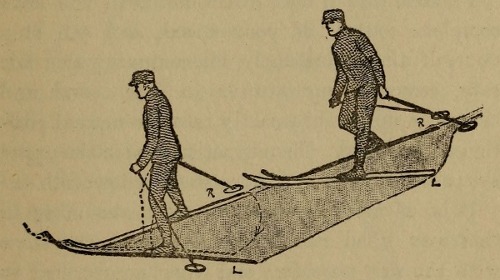
| Stopping. | Going. |
| L. Weighted and edged. | R. Weighted and edged. |
| L. Unweighted and flattened. |
Fig. 28.—Single-stemming or half-snow-plough.
Now lean towards the upper leg, and bend it
until your weight is on it, facing towards the
point of the upper ski and edging it. Then,
keeping the lower leg in exactly the same
position, bend its ankle outwards, and almost,
but not quite (see p. 83), flatten the ski. The
flattening of the ski will release you, and you
will slide off in the direction of the upper ski’s
point, pushing the lower ski, which must still
remain horizontal, forwards and sideways through
the snow—stemming with it in fact. You can go
as slowly as you like, or as fast as the conditions
permit, according as you keep the stemming ski
more edged and weighted or less. You can stop
suddenly by throwing your whole weight on to
the stemming ski, facing round towards its point,
and quickly bringing the upper ski beside it and
forward to the normal position.
Now make a kick turn (a downhill one for
choice), and repeat the process in the other
direction, stemming with the other foot.
Practise this in both directions until you have
complete control of your speed, and can stop
yourself almost instantly when moving at a fair
rate, remembering always to face round and
bring the upper ski smartly into the normal position
as you stop. Then practise it with the upper
ski pointing more and more steeply downhill.
It is, of course, possible to start stemming in
this way when running freely across the slope
with the skis together, and when accustomed to
doing it from a standstill you should also practise
this, but only when running at a moderate pace,
as there are steadier and easier ways of stopping
when running fast.
You must, as I have said, hold the lower foot
exactly below the upper one, because in that
position you can push along the stemming ski
with least effort, and most quickly throw the
weight on it if the other ski side-slips or you
want to stop suddenly. This means that the
more directly downhill you go the farther forward
you will have to hold the lower foot, and the
more, consequently, you will have to bend the
upper leg (in order still to keep the weight on
the upper ski), eventually having to lift its heel
and finally to sit on it, if you are to stem almost
or quite directly downhill, as
it is quite possible to do.
If you find you can do all
this fairly comfortably, by all
means do so; if, however, you
find that at a certain angle
your position on the upper leg
becomes very tiring or unsteady,
leave this manœuvre
and try stemming with both
skis, which is also called
Snow-ploughing.—Start
straight downhill, where the
slope is quite gentle, in the
normal running position. The moment you are
moving bring your feet level, put the weight
on both, raise the outer edges of the skis by
bending your knees inwards a little, and, without
letting the ski-tips separate, push their heels
as wide apart as you possibly can. The legs
must now be absolutely straight at the knees.
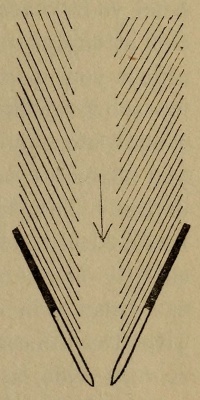
Fig. 29.—Double-stemming
or snow-plough.
The blackened parts are those which should be weighted.
If you keep your knees straight and ankles
relaxed the skis will travel nearly flat—they
should never, as I have said, be quite flat or
their outer edges will catch and trip you—and
there will be but little braking effect. If you
bend your knees inwards a little, and edge your
skis strongly, you will, if the slope is moderate,
reduce your pace gradually and stop. On very
icy snow, unless the slope is very gentle, you
cannot stop by snow-ploughing, however hard
you edge, but can only reduce your speed more
or less. The [V] position is then, however, a very
useful alternative to the position with the skis
slightly apart and parallel as a safeguard to
the balance in case of side-slip. It of course
gives the utmost lateral stability (if the straddle
is very wide, as it always should be), and the
straight knees prevent it from being in the least
tiring, while, when the skis are flattened, the
reduction of speed is hardly worth considering.
It is therefore usually preferable to the other
position, with its tiring crouch, unless the slope
is steep (and the speed therefore very high)
or the ground rough, when it becomes unsafe
on account, not only of its rigidity, but of its
greater fore and aft instability, for with the
legs in this position one cannot move the feet
quickly backwards and forwards in the way
described on p. 113. On ground neither steep
nor rough enough to make it unsteady, one
can, if the snow is hard, safely take the snow-plough
position quite suddenly when running
at full speed. This is very convenient if when
running in normal position one suddenly runs
on to an icy patch.
On hard snow, then, snow-ploughing is only
effective for braking purposes under certain conditions.
In soft snow, if that is at all deep, it is
almost useless—except for those who can make
an abnormally wide straddle—for if in soft snow
the skis are put in the [V] position, the inward pressure
of the snow against them is so great that
unless the legs can resist it almost directly they
are forced together at once, or, at the best, have
to let the skis run almost parallel, in which case
there is not much object in holding them apart
at all. If, however, you are one of the fortunate
few who can straddle more than three quarters of
their height and point their feet almost directly
inwards, you will find that snow-ploughing gives
you perfect control, even in soft snow, on all but
the steepest slopes, and that even there you may
be able to manage by throwing most of the
weight on one ski and making it slide nearly
broadside on while the other points almost
straight downhill, the line of your course
being still directly down the slope, and the legs
still straddled as widely as possible, and straight
at the knees. You will, however, only be able
to do this by paying particular attention to the
edging of the weighted ski, for if it is edged
either too much or too little it will not slide at
all when you try to move along slowly, and will
check you suddenly and throw you down when
you try to stop.
It is important to remember in snow-ploughing
that, whether you want to brake hard
or only slightly, the straddle must always be as
wide as possible; the speed should depend on the
flattening or edging of the skis, not on the angle
between them. Moreover, if when running free
with skis together you want to take the [V] position,
you must always—even if running fast—do
so as quickly as possible (not forgetting just
to lift the outer edges of the skis before you push
them out). Remember also that it is no use
putting the feet wide apart unless the tips of the
skis are close together (closer than Plate XX.
You can start snow-ploughing from a standstill
on a steep slope either by taking the position
of Plate XIII. and pushing the upper ski round
to the proper angle as you throw your weight
on to it, or simply by thrusting both sticks
into the snow below you and leaning on them
while you put the skis in position.
If, for structural reasons, you have only been
able to take an academic interest in the instructions
for snow-ploughing in soft snow, you can
now learn a manœuvre which will enable you in
soft snow of any depth to stem as gradually or
as steeply as you choose down a slope of any
steepness.
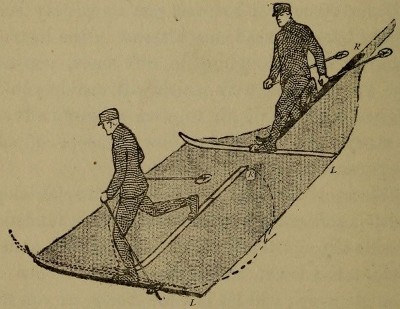
| Stopping. | Going. |
| R. Unweighted. | L. Weighted and edged. |
| R. Weighted. | L. Unweighted and flattened. |
Fig. 30.—Telemark-stemming.
Telemark Stemming.—Find a steepish slope
which is soft enough to prevent the least tendency
to side-slip. Stand with the skis horizontal.
Weight the lower, and place the upper one at
an angle which will let it slide freely, as you did
in learning ordinary stemming, but this time with
its front bend touching the lower ankle, and its tip
rather across the lower instep. Edge it normally,
kneel down on the front of it, and slide off by
flattening the other (Fig. 30). You are now
stemming in what is practically Telemark position;
the object of actually kneeling on the upper
ski is to save effort, which, of course, it does
completely. It also gives the utmost steadiness.
The centre of gravity being so low, you can in
this position stop yourself much more suddenly
with safety than you can in either snow-ploughing
or ordinary stemming, and can also more safely
take up the stemming position while running
freely—if, of course, you then take the ordinary
Telemark position and kneel right down first.
In order to stem straight downhill you must
place the upper ski at right angles to the horizontal
lower ski (you may have to get it in
position with your hand before starting from a
standstill on a steep slope); its point will then be
right across the front instep. The front leg will
be quite straight and the foot, of course, turned
right inwards—a position which may sound
awkward, but which most people find surprisingly
easy, especially on a steep slope. If you
want to stop suddenly, straighten—or rather,
diminish the bend of—the upper leg, lifting its
knee from the ski and throwing yourself well
forward on to the lower one. And always remember
to face round quickly towards its point
as you do so, and to bring the other ski smartly
to normal position by its side.
Telemark-stemming straight downhill is not
only easy in the softest snow, but also on
everything but the very hardest, no matter
how steep the slope.
This manœuvre, in fact, is an extremely useful
one (though neither I nor, I believe, any other
writer on ski-ing had the sense to realise its
value until Herr Bilgeri pointed it out), and
you should lose no time in mastering it—not
that it takes much mastering, for the average
beginner can do it with ease at the first
attempt. It is no use, however, for traversing,
either steeply or gradually, on hard snow,
for the upper ski is then very apt to side-slip
and upset the runner. Nor on very hard and
slippery snow is it suitable even for a direct
descent, as it is then difficult to hold enough
weight on the stemming ski to keep the pace
down. On this sort of snow, however, as long
as it gives any grip at all—and, when it does
not, it is no longer snow, but ice, for which skis
are not intended—you can descend the steepest
slopes either directly or obliquely with your speed
under perfect control by
Side-Slipping.—In order to side-slip straight
downhill you simply stand with your skis horizontal
and rather apart, and start by flattening
them a little and throwing your weight well
outwards, as if you wanted to go fast down
the hill, not slowly. You will then not go fast,
but will keep your weight over your skis and
be able by edging them again to check your
pace or stop when you want to. If you want
to stop suddenly, give a little jump and stamp
the ski edges hard into the snow. Do not be
too anxious to go slowly, or in the effort to
edge the skis extra hard you will probably
lean towards the slope, push them from under
you, and fall down. The skis must remain
horizontal as they slip; if they begin to turn
upwards or downwards, put weight on the toes
or heels respectively. If by weighting the toes
you make the skis point downwards a little
they will slide forwards as well as sideways,
and the more they are then edged the more
they will move forwards in comparison with
their sideway motion. By side-slipping, therefore,
you can traverse slowly at any angle you
choose if the slope is fairly steep.
You can also stop yourself by side-slipping if
you wish to when running a free traverse in
normal position. You merely have to make
the skis side-slip and instantly put your weight
on the heels until they turn uphill a little, when
you can again edge and stop them.
A little practice will make the whole manœuvre
almost instantaneous; it is then really a Christiania
swing (see p. 175), and, if the snow is not
very soft, is a far quicker and easier way than
ordinary stemming or stopping or checking the
pace for a moment. Throw your weight well
outwards to keep it over your skis as they
side-slip; your tendency at first will be to fall
towards the hill.
If you ever wish to make a stemming traverse
at a steep angle on a moderate slope where the
snow though hard is not quite slippery enough
for you to side-slip down it, you may be somewhat
at a loss. In the Telemark position you
will find a tendency to side-slip, and you may,
in the ordinary stemming position, with the
lower ski held horizontally and the weight on
the upper one, be unable to manage the necessary
squatting attitude comfortably. You can
then traverse in something between the ordinary
stemming and the snow-plough positions with
the upper ski edged outwards and pointing the
way you are going, but with the weight almost
equally distributed between it and the lower,
which points somewhat downhill instead of
horizontally and is held with its tip level with
the other’s, not ahead. The upper knee must
be bent, the lower straight.
We have so far talked only of hard and soft
snow, but the snow surface is sometimes a breakable
crust, into which the skis cut, and in which
no sort of stemming is possible. Your only way
of going slowly in this is to traverse at a very
slight angle; if you then want to stop, you must
step round—that is, you must lift the upper
ski, put it down again pointing horizontally
across the slope, and instantly lift the lower
and bring it down parallel with the first. Be
careful to throw your weight well upwards and
forwards as you put down the upper ski, and
not to let the lower remain on the snow for
a moment after the first has been brought to
it again; it is safest to give a little jump from
one to the other.
Either by stepping round, or by any sort of
stemming, you can of course make a change of
direction when traversing if the gradient of the
slope varies; as you pass on to steeper ground,
for instance, you can weight the heel of the
stemming ski for a moment until it is again horizontal,
at the same time flattening the running
ski a little and letting it slip down to the angle
at which it was pointing before. This is really
an embryo swing, as you will see later; one
important reason, in fact, for learning all the
methods of braking thoroughly is that they are
the elements of which the swings are composed,
each variety of swing or turn being either a
development of one method of braking, or a
combination of one with another.
When you become more expert you will not
often have to stem while traversing if the ground
is open, though even then you will often find
it convenient to brake in one way or other when
going straight downhill. In thick wood, however,
you will find it indispensable to be able
to go at a moderate speed in all sorts of snow
and at any gradient. It is also worth remembering
that to stem straight downhill at an
ordinary pace is a comparatively fast process.
It is not so pretty and needs much less skill,
but it is quicker than running freely in tacks
of an ordinary gradient and connecting them
by downhill turns (explained later).
When running down a narrow path or the
like it is sometimes impossible to brake effectually,
as there is not room to put the skis in a wide
[V] position or to Telemark-stem; it may then
be permissible to use the stick or sticks as an
aid. Plate XXI. shows a way of doing this.
The arm supported against the thigh gives a firm
purchase—firm enough, in my experience, to hurt
the wrist a good deal if the points of the sticks
catch something hard. This manœuvre is hardly
ever necessary unless the path is very icy; if
there is much of this, and you want to go slowly,
you may just as well walk with your skis on your
shoulder.
When you can do all that has been explained
so far, you may (if you have steadily refrained
from using your stick except as I have directed)
consider yourself quite a respectable ski-runner
in a small way. There will be nothing to prevent
you from going for any expedition of which the
uphill climb is within your powers, for whether
you are going uphill or downhill, there is no sort
of ground that cannot be negotiated by one or
other of the manœuvres that I have described.
But, though a perfectly efficient tourist, you
will not be a very fast one downhill until you
have learnt how to stop and steer yourself in
any sort of snow, when running fast, and will
tire yourself unnecessarily on steep or difficult
ground until you can run in zigzags without
coming to a standstill between each tack.
The different ways of doing these things are
described in the following sections.
I must here apologise for the extreme ambiguity
of ski-ing terminology, which, however, as I did
not invent it, I have not the moral courage to try
to improve. The term “stemming” may be
used in several different senses. In its narrowest
sense it means holding the skis in the [V]
position and braking with one of them. More
broadly it means braking with both in the [V]
position. It also means braking with the skis
in Telemark position. In fact in its broadest
sense it means any sort of braking except side-slipping
with the skis parallel.
In this sense almost any method of turning on
skis might, as we shall see later, be called a
“stemming” turn. The expression “stemming
turn,” however, is generally used in a special
sense to denote a turn during which the skis
are held in the [V] position with the feet nearly
level.
By means of a “stemming turn” you can, as
you already know, turn uphill or stop when
traversing; you can also do so from a direct
descent. You can, moreover, turn downhill from
a traverse until you face in the opposite direction
and run off on a new tack.
This turn is effected by putting the skis in a
more or less wide [V] position, and either simultaneously
or immediately afterwards weighting
and slightly advancing the one that is to be
outermost in turning. To show how in this as
in all turns the various factors of side-slipping,
with the weight variously distributed, combined
steering action of both skis, edging, &c., come
into play according to circumstances, it will
be necessary to describe in detail the two different
uses of the turn.
For practising these turns find a moderate
slope and snow in which it is easy to stem
when running straight downhill; a much trodden
practice-ground is the very thing.
Uphill Turn to the Left.—You already know
how to turn uphill from a traverse by stemming;
the following way of doing it is slightly simpler.
Traverse to the left at an easy gradient in normal
position, weight on right foot. When you want
to turn, draw the upper ski a little to the rear
(Fig. 31, 1) and then push the heels wide
apart, straightening both legs and putting all
the weight on the lower heel (Fig. 31, 2 and
3). As the lower ski begins to turn uphill, bring
the other one smartly to its side again in normal
position.
This is much the same thing as stopping
when stemming with the lower ski, as described
above (page 121), but is rather simpler, for the
uncomfortable crouching position necessary when
stemming with the lower ski is avoided, there
is no shifting of the weight from one ski to the
other, and the preparatory movement of drawing
back the upper ski can perfectly well be
made simultaneously with the actual turn.
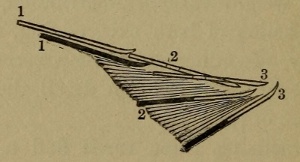
Fig. 31.—Uphill stemming turn to left.
The blackened parts are those which should be weighted.
To make an uphill stemming turn when running
across a slope in normal position is rather
a clumsy process, and it is quite unnecessary
to spend much time in practising it, for an
uphill turn from a traverse can be made more
easily and effectively by the Christiania swing,
in the way already explained, or the Telemark,
which will be described later. Just make sure,
however, that you can turn uphill in this way
from a traverse in either direction, and then
try the turn from a direct descent, as follows.
Run straight downhill in the stemming position
with the weight equally on both skis and the feet
as wide apart as possible, taking care that the
legs are quite straight at
the knee, and rigid (Fig.
32, 1).
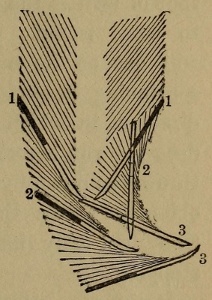
Fig. 32.—Uphill stemming turn to left.
The blackened parts are those which should be weighted.
In order to turn to the
left (most people find it
easiest to learn to turn to
this side first) you have
simply to throw all the
weight on to the heel of
the right foot and turn the
body to face the point of
the right ski. You will
begin to turn to the left, and as you do so the
left foot will involuntarily fall slightly to the
rear (2), when the steering action due to the
relative position of the skis will help the turn.
If you keep all the weight on the heel of
the right foot you will go on turning until
the right ski points slightly uphill, when you
will come to a standstill (3). As you do so,
be sure to bring the inner ski quickly to the
normal position.
This is extremely simple, and, if you keep
both legs quite straight and the feet wide
apart, you can hardly fail to do it correctly.
The mistake you are most likely to make is
that of letting the left knee bend as you begin
to come round. If it does so the left ski
will get on its outside edge, and, instead of
continuing to skid round, will only run in the
direction in which it is pointing, so that if it
does not run across the other (Plate XXV.), and
throw you down,[8] you will find yourself running
obliquely across the slope, stemming with the
right ski only instead of turning uphill and
stopping.
It is not sufficient, however, to keep the
inner leg straight, for unless at the same time
you keep nearly all weight off it, either the
left ski will get in front and you will begin to
face downhill again, or it will get too much on
to its inside edge, and will at least prevent you
from finishing the turn, even if it does not trip
you up.
As soon as you can turn to the left in this
way, learn to turn to the right, of course substituting
“right” for “left” and “left” for
“right” in the directions.
If, while running straight downhill, you turn
and come to a standstill in the way I have
described, you will, when you have stopped, find
yourself a certain distance to one side or the
other of your original course.
This may not always be convenient; you may,
for instance, want to stop while running down
an icy road, fenced on each side, and so narrow
that you have only just room enough to stem,
and would run into the fence if you swung to
one side in stopping.
In a case of this sort you can turn suddenly
and stop in your tracks in the following way:—
Suppose you are running straight downhill
in the double-stemming position; when you want
to stop, give a vigorous push with one foot—say
the left—and so throw all your weight suddenly
right outwards on to the heel of the right foot,
turning the body quickly well round to the left
as you do so. If this is done with force and
decision the right ski skids round quickly to a
horizontal position, and as it does so, the left ski
comes into the air, is lifted smartly round, and
brought down parallel with and close to the
other one. You then find yourself at a standstill,
facing to the left across your original track,
but without having moved to one side of it
(Fig. 33).
Just at first you may fail to do this properly
through giving a timid,
jerky push with the left
foot instead of a steady
thrust. This will prevent
your weight from going
sufficiently outwards over
the right ski, and the left
ski will come to the snow
again before you have had
time to lift it round to the
side of the other one and
before that one has had
time to skid round to right
angles with your course. After a very few trials,
however, you should be able to do it correctly,
and you will then find that no great force is necessary,
and that the movement need not even be
made particularly quickly provided it be done
with a free swing. In order to give the push you
must, of course, bend the inside knee slightly.
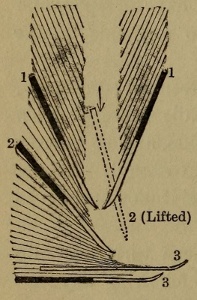
Fig. 33.—Uphill stemming turn to left.
The blackened parts are those which should be weighted.
Provided the inner ski is brought parallel to
the outer one, it does not matter if it comes to the
snow again before the latter has skidded round
to right angles, for then the turn can be finished
with both skis side-slipping together—that is
to say, the turn can begin as a stemming turn
and finish as a Christiania, a most useful combination
which is beginning to be known by the
dreadful name “Stemmiania,” which I only quote
in order to record my dislike for it.
This way of making the turn is practically
instantaneous, and is so convenient that when
you have once learnt it you will hardly ever use
the one I described first. By means of it you
can stop suddenly when moving at a very fair
rate, especially if you stem hard with both skis
well edged inwards just before making the turn.
Practise this movement without skis at first,
and then at a standstill with skis, on the most
slippery snow you can find, trying to make the
outer ski spin right round to right angles.
These uphill stemming turns enable you to
stop yourself wherever the quality of the snow
and the gradient allow you to hold the double-stemming
position while running straight downhill.
It is no use attempting to make them on
very steep slopes or in snow into which the skis
sink deeply; in either of these cases you will
have to stop yourself by means of the Telemark
or Christiania swings, described later.
I need hardly say that if you merely wish to
alter your course and not to stop yourself, you
can finish the turn at any point. You either
wait until the outer, weighted ski is pointing in
the direction you want to go, and then bring the
other ski parallel to it in the normal position
and run on at full speed; or, if you still wish
to brake, you turn rather farther until the
inner ski is in line with your intended course,
and then shift the weight partly or entirely to
that one and run on stemming.
Downhill Turn to the Left.—A turn made in a
downward direction in order to join one tack to
another when descending a hill in zigzags is often
called an “S” turn, on account of the shape of
the track left by a number of these turns made
in alternate directions (Plates XXVI., XXXIII.,
XLII.).
Any downhill turn, therefore, whether made
by the stemming turn or by any other means,
can be called an “S” turn. A good many people,
however, having never seen a downhill turn made
by any other means than the stemming turn—or
at least the awkward manœuvre which the
average runner imagines to be the stemming
turn—believe “S” turn and stemming turn to
be synonymous.
As will be seen later on, a downhill or “S”
turn can quite well be made by means of the
Telemark or Christiania
swings, the “S” having
no reference whatever to
stemming.
To avoid confusion, I
shall not use the term
“S” turn at all, but only
speak of a downhill turn.
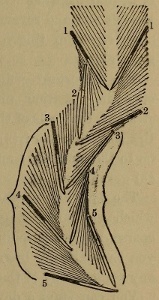
Fig. 34.—Downhill stemming turn to left (3, 4, and 5).
The blackened parts are those which should be weighted.
The best way to practise
the turn at first is to
run, as before, straight
downhill in the double
stemming position for a
few yards, then throw
the weight on the left
ski as if you meant to
turn uphill to the right
and stop (Fig. 34, 1 and 2), but just before the
left ski points horizontally across the hill,
transfer the weight to the heel of the right
foot, and face round to the left a little.
You will find yourself beginning to turn downhill
again—the left ski falling a little behind the
other as you do so—and by keeping the weight
on the right foot you will go round until you face
across the slope in the opposite direction (Fig. 34,
3, 4, and 5), when you can shift the weight to
the left foot and reverse the process.
By repeating this you will descend the hill in
short zigzags.
The important points are—(1) to hold the
stemming position unaltered with the knees
straight, the heels of the skis wide apart, and the
tips close together; (2) to throw the weight well
on to the outer ski; and (3) not to let the inner
ski get in front.
The last half of the turn, from the point at
which you are facing straight downhill, is, of
course, really an uphill one, identical with what
you have already learnt, and can be finished at
any point in any of the ways already described.
You can start a downhill turn, like an uphill
one, from the normal position while running
across a slope, and under these conditions the
turn is, as in the case of the uphill one, rather
less easy; this time, however, it is extremely
important to be able to do it, for this is by far
the most useful application of the stemming
turn, and you can in this way, provided the snow
be suitable, join one tack to another on a slope
of any steepness, where it would be impossible
to run straight downhill in double stemming
position.
Suppose you wish to start a downhill turn to
the left while running at a gentle gradient across
a slope in the normal position (i.e. with the
weight on the left foot and the right foot in
front), the first thing to do is to turn the right
knee and ankle inwards so as to lift the outer edge
of the ski as much as possible. Then, keeping
the point of the right ski ahead of the other,
push its heel uphill and out to the position of
2, Fig. 35, b, at the same time weighting the
toe of the left foot and slightly flattening that
ski, which will then begin to point downwards
and give the other more room to turn. As
they turn downwards push their heels wide
apart and throw your weight quickly outwards
so that a final thrust of the left leg sends it
full on to the right heel just as you face straight
downhill. Almost simultaneously lift the left
ski round to the side of the other and finish
the turn with the skis parallel.
As you lift the inner ski turn (not lean) the
body inwards just enough to face squarely
towards the point of the outer ski.
If you turn slowly there will be an interval
between the pushing round of the outer ski and
the final thrust of the inner leg during which
the skis will be equally weighted. If you turn
sharply while running fast the checking of the
outer ski’s speed as it comes broadside on will
throw the weight on it at once and lift the
inner ski without an effort.
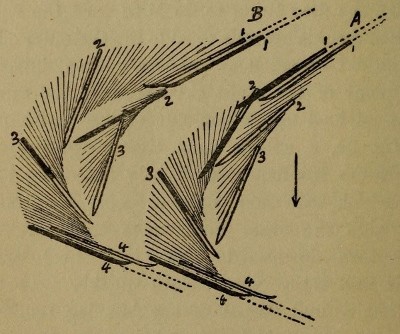
Fig. 35.—Downhill stemming turn to left (two methods).
The blackened parts are those which should be weighted.
It is also possible to make the turn by putting
the weight on the outer ski before it begins to
stem at all, and making it turn downhill by
pressing on the toe (as in Fig. 35, a). I used to
think this method the easier of the two, but
have changed my mind about it, and can only
apologise for leading people astray.
Up to this point you have been practising
on moderate slopes only, but it is on steep slopes
that you will generally have to use the downhill
stemming turn, and it is on steep slopes that you
should practise it the instant that you can do it
neatly on a gentle one.
You will then find a difficulty that has probably
not bothered you much so far. On a
steep slope, as you begin to turn downhill, the
increase of speed is sudden and considerable, and
if you do not compensate for this by throwing
the weight more and more forwards, the skis
will shoot from under you, and you will sit
down.
Don’t, however, begin leaning downhill too
soon, while still facing across the slope, for that
will throw the weight on to the inside (lower)
ski. Simply lean as far forwards over the front
of your skis as possible, so that as they turn
downhill your weight will be well over them.
The difficulty of leaning forward sufficiently
on a steep slope is partly due to the tendency
to stand with the weight vertically above the
feet, as one would do when walking downhill.
The very best plan for overcoming this difficulty,
and one which will make it infinitely easier for
you to perform the turn quickly and correctly,
is to keep your eyes fixed on the ground at your
feet while you are turning, and to imagine that
it is almost or quite level. You will then
naturally hold yourself at right angles to the
slope no matter how steep that may be.
You will find this downhill turn of very little
practical use on a steep slope until you can make
it quite shortly and sharply; for if you make
a long curve, the pace increases so much in the
middle of it that you are almost sure to lose
control, and fail to finish the turn, even if you
do not fall down.
The reason why to lift round the inner ski at
the middle of the turn is safer than to keep
it on the snow throughout is because the curve
is thus considerably shortened.
The act of suddenly throwing yourself very
far forward over the front of your skis as you
face downhill will make them hang back a little
for an instant—all the more so for the fact that
at this point the stemming action of both is
at its maximum—and at this moment it is easy
to give a push with, and then to lift round, the
inner ski.
Be careful, in lifting the ski round, to bring
it down again exactly parallel to the outer ski;
for the inner one, if it comes down pointing
towards the outer one, will instantly run across
it and upset you; while if pointing away, it will
run uphill and draw your feet apart with a jerk
that will probably have the same result.
Although, as I have said, you should turn the
body a little in throwing the weight outwards, it is
no use attempting to lean or swing it the way you
want to go. You must simply throw it forwards
and outwards—that is, rather away from where
you want to go. If you lean the way you want
to go you will simply put weight on the inner ski,
which will then either trip you up or make you
run away straight downhill instead of finishing
the turn. Indeed, paradoxical as it may sound,
you should, in a sense, try not to turn; manœuvre
your skis as I have directed, and try to keep a
straight course, turning sideways as you do so,
and you will probably come round without difficulty.
The faster you are running at the moment
of beginning the turn, the more difficulty you
will at first have in making it.
You had better, therefore, when learning it,
run at a gradient which will only just allow
you to keep moving smoothly (I am speaking
of the gradient of your course across the slope,
not of the gradient of the slope itself), otherwise,
before beginning the turn, you may be inclined
to stem with the lower ski in order to check the
pace, and, when the lower ski is put in stemming
position before the other is pushed round,
there is a tendency for the weight to get too
far back in the effort of starting the turn, which
then misses fire. If you are bound to slow up
before you begin the turn, do so by side-slipping
with both skis and turning a little uphill (i.e.
make a slight Christiania swing) as described in
the last section, p. 131.
On an icy and steep slope it is, of course,
especially necessary to make the turn very sharply
if you are not to lose control in the middle
of it. You can do this by running very slowly
before turning, and then quickly putting the upper
ski far round, and simultaneously weighting it
by means of what is practically a jump from the
other ski, which comes into the air almost before
the first is weighted, and is brought down
parallel with it almost instantly. This is well
worth practising assiduously, for it makes all the
difference to the safety of a turn on very steep
and icy ground.
Do not be contented until you can make a
short, sharp turn (both to right and left, of course)
with perfect steadiness, on the steepest slope
you can find. For although on steep slopes a
Telemark or Christiania swing is the best way
of making an uphill turn, there is no means so
reliable as the stemming turn for turning downhill,
no matter how steep the slope, provided the
snow is hard, or that, if soft, it is shallow. It
is almost useless, though, to attempt it in deep
soft snow. At the best you will probably only
get half-way round with an uncomfortable effort,
and then the inner ski will be forced back, and
come round after the other in Telemark position,
in which, as you will find later, it might just as
well have started.
At the worst you may be tempted to drag
yourself round with the stick in the position
shown in the photograph (Plate XXVIII.).
This position, which, I hope, is becoming less
fashionable, is the very essence of incorrectness
and awkwardness, and is an infallible sign
either of poor nerve or of bad teaching. Here
the weight falls principally on the inside ski
and the stick, instead of entirely on the outer
ski, while the skis are held parallel, or nearly
so, instead of in the [V] position. The general
position is a crouching one with the knees
bent, instead of an erect one with straight
and rigid legs; except for a feeble stemming
action of the outer ski, which is too much edged,
the turning effect is entirely due to the drag
of the stick. Those who make use of this
method generally refer to it as a stemming turn,
“S” turn, or Alpine curve, using either of these
terms in contradistinction to the terms “Telemark”
and “Christiania,” evidently under the
impression that an “S” curve can only be
made by stemming, and that by means of the
Telemark or Christiania it is only possible to
turn uphill and stop. The only correct title
for this manœuvre is “stick turn.”
When I say that this method is awkward and
incorrect, I do not merely mean that it is ugly,
for I suppose that to the unsophisticated eye its
attitude is no more ugly than the exaggerated
straddle of the correct stemming position. There
are two strong reasons for considering it execrable
in style and utterly to be avoided.
In the first place it is a waste of energy,
because it takes a considerable muscular effort
to make a turn in this way, even when the snow
is easy, and an exhausting one when it is not;
while by substituting correct methods one can
always turn without the smallest strain. The
second objection to it is that it is inefficient, for
by turning in this way it is impossible to make a
short curve, especially in deep soft snow; and
until a runner can turn sharply in snow of any
quality and on a slope of any steepness (I do
not say at any speed), he by no means can be
said to have proper control of his skis. I do
not for a moment deny that it is the easiest way
of turning, in the sense that it is the one requiring
the least skill. But any one who knows
what can be done by correct methods, who has
ordinary nerve, and who does not look on ski-running
solely as a means of locomotion, for which
a technique demanding the minimum of skill is
the one to be preferred, will shun the “stick
turn” as he would the pestilence.
Finally, let me remind you once more that in
stemming—and this holds equally good whether
you are turning or going straight ahead—the
skis should never be quite flat; their outer
edges must be lifted a little even when the snow
is easy, rather more so when it is not (see
p. 83).
To be quite accurate I ought to have said the
skis must not be kept flat, for obviously they
must during a downhill turn each pass through
the flat position, since their edging, on the tack
before the turn, is the reverse of what it is on the
tack that follows it. This change of edge, as a
matter of fact, constitutes one of the difficulties
of the turn. The outer ski makes the change
easily enough, for the outer ankle (which is bent
inwards in order to start the turn) does not have
to alter its position while the change of edge
takes place. But the inner ski, if kept on the
snow throughout the turn, is by no means easy
to manage at the moment that the change has to
be made. This ski remains on its inside edge
until nearly the end of the turn, and if allowed
to remain so for a moment too long is very apt to
catch on this edge and run across the other or
refuse to come round, especially on a steep slope,
if (as he should have done) the runner has made
a very wide straddle when facing straight downhill.
This difficulty is entirely avoided when the
turn is finished by the lifting of the inner ski
(the change of edge then taking place, so to
speak, in the air). Indeed, although this lifting
of the ski may sound somewhat acrobatic to any
one who has not tried it, it is really quite the
reverse. It needs far less adroitness than does a
neat and steady finish of the turn with the ski
kept on the snow, and is, in fact, not only the
quicker and more effective, but also considerably
the easier and safer of the two methods.
The runner can only make a true stemming
turn when going at a moderate pace. By finishing
it as a Christiania, however, he can turn either
uphill or downhill when going much faster. In
fact the sooner the skis are brought parallel, the
greater the pace at which the turn can be started;
at very high speeds only a trifling preliminary
stem being either necessary or safe.
From normal running position, right foot leading,
left weighted.
Bending and turning inwards right knee, ankle,
and foot, push heel of right ski outwards and
forwards to the widest possible stemming position—its
tip close to but ahead of the other’s—at
the same time slightly flattening the left ski and
pressing on its toe. As the skis turn downwards
push their heels wide apart, quickly shift your
weight forwards and outwards, and, with a push
from the inner ski, throw it full on the right heel
as you face straight downhill—at the same time
lifting the left ski quickly round to the side of
the other and finishing the turn with the skis
parallel.
When moving slowly this is to be done in two
motions; when moving fast, in one continuous
one.
Fix the eyes on the tips of the skis and try to
lean in that direction only, not inwards.
N.B.—The latter half of this turn is, of course,
really an uphill one, separate directions for which
are therefore unnecessary.
Although by stemming you can make either
up or downhill turns with perfect ease either on
a hard icy surface or in shallow loose snow, you
will find it very difficult, if not impossible, to make
a stemming turn in loose snow of more than a
certain depth or density—unless you drag yourself
round with the stick. By means of the
Telemark swing, however, you can easily make
turns in any sort of loose snow, and can do so
on any slope, no matter how steep it may be.
If you can already both run and stem in the
Telemark position, with either foot leading, you
will find it a very simple matter to learn the
swing. In fact you may be said to have learnt
it after a fashion, for to stop by Telemark stemming
is to make a clumsy Telemark uphill turn.
For practising this swing, find a moderate slope
where the snow is soft and, for choice, deep
or dense enough to make a stemming turn
difficult.
Uphill Turn to the Left.—Run at a gentle
gradient across the slope with the hill on your
left and the weight on the lower (right) foot,
not, however, in the normal position, with the
left foot advanced, but in the Telemark position,
with the right foot leading.
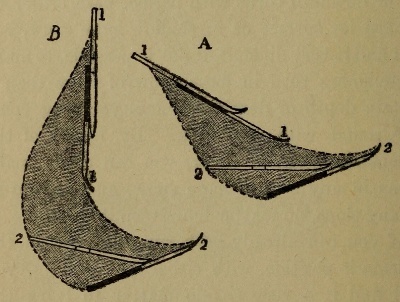
Fig. 36.—Uphill Telemark swings to left (a from a traversing,
b from a direct descent).
The blackened parts are those which should be weighted.
The left ski should then be so far back that its
bend is level with the right ankle, the left heel
should be raised, and the left leg perfectly relaxed,
with the knee nearly touching the ski. The
right knee should be perpendicularly over the
foot, and both knees be pressed inwards. This is
only preparatory, and you should, in this position,
be able to run directly across the slope at whatever
gradient you choose.
As soon as you are fairly under weigh, make
the swing as follows:
Turn the right knee and foot a little inwards,
placing the front ski slightly at an angle with
the other; at the same time edge the right ski
inwards and put the whole weight on the right
heel, pressing it down and trying to lift the
toes.
You will at once begin to turn uphill. The
moment you start turning lean more forwards
and face full towards the point of the front ski.
As you stop moving weight the toe of the front
foot, press the back knee inwards, and so bring
the skis parallel.
Unless you are on the look-out for it, you will
find a tendency, as you begin the turn, to lean
inwards (towards the hill), or backwards, putting
weight on the left foot, and at the same time to
straighten the right knee and relax the right
ankle, more or less flattening the ski (Plate XXX.).
As a result you will, if you do not fall inwards at
once, probably finish the swing in an awkward
straddled position, the right ski pointing uphill,
almost at right angles to the other ski, which will
not have altered its direction, and the weight on
both feet. Or else you will find that the weight
on the left ski will make it run up level with the
other again, which will prevent you from turning,
or across it, which will throw you down.
It will help you to avoid this inward lean
if you remember that, as explained on p. 82,
your right ski in turning does not cut round
directly as a skate does, but slips sideways as
well as forwards, and that, therefore, during the
swing your right foot, instead of moving more
and more to the left of your original line of
progress, will at first move to the right of, or
below it; and, if the hill is steep or the snow
shallow, will hardly be above it even at the end
of the swing. It is obvious, then, that if
you are to remain properly balanced on your
right ski, very little inward lean is necessary,
and the usual directions for leaning the body
inwards while making the swing are most
misleading. In fact, although one really has to
lean inwards when the turn has begun, the
instinct to avoid an outward fall makes one
overdo this to such an extent that at first it
is better to try to throw the weight rather to
the right and outwards, downhill (but well
forwards), in order to get the proper balance.
In the Telemark swing the edging of the
leading ski is an important factor in the turn,
and there is more forward motion in proportion
to the side-slip than in the stemming turn, which
is almost entirely a skidding turn. Indeed,
when the swing is made while running fast in
deep soft snow (which reduces the side-slip to
a minimum), the runner, as he comes at right
angles to his original course at the end of the
swing, may find it necessary to lean consciously
inwards, but only at the end—never under any
circumstances at the beginning of the swing.
In this swing, as in the stemming turn, it
is a mistake, when practising, to look the way
you want to go, as is sometimes advised. You
must only look the way you are actually going
at the moment—i.e. rather to the outside of the
point of the leading ski.
It is also useless to try to force the turn
by swinging the body or in any other way;
and, as in the stemming turn, it is better to
think nothing at all about turning, simply
confining your attention to the weighting and
position of the skis, and trying, in a sense, to
go straight on. The great thing at first is to
prevent the weight getting back on the back
foot.
There is, of course, no real necessity for running
in the Telemark position before beginning the
swing, but to do so whilst learning it gives you
less to think about when starting the turn.
As soon as you get a little accustomed to it
you can run in normal position with the upper
foot leading until you wish to turn, and can then
drop into Telemark position, lower foot leading,
and begin the swing simultaneously.
When you can make the swing to the left, run
across the slope in the opposite direction, and
learn to make it to the right in the same way
(of course substituting “left” for “right” and
“right” for “left” in the directions).
When you can do this, practise it to the left
again, this time running more directly downhill
than at first, and then in the same way to the
right, until you can at last swing to a standstill
either right or left when running straight
downhill (Fig. 36, b). But do not, at any stage,
run far before beginning to swing; get fairly
under weigh and make the swing, then run on
and do it again, and so on until you have gone
as far as you wish. In this way you will get
less climbing uphill in proportion to the amount
of practice.
It is at the end of a swing made when running
straight downhill that you are almost sure to
find it necessary to lean inwards if the snow is
deep and the speed high, but till you find a
distinct tendency to fall outwards you need not
concern yourself about it.
Of course, instead of coming to a standstill
at the end of a swing, you can, if you wish,
stop turning before the leading ski comes to
a horizontal position, and can run on obliquely
down the hill. In order to do this you have
only, as soon as the leading ski is pointing the
way you want to go, to shift the weight from
the heel to the toe, stand erect, and bring the
back ski to the front in the normal position.
As soon as you can swing both to left and
right when running straight downhill, learn to
make a downhill turn (“S” turn), which will
enable you to join one tack to another when
descending a slope in zigzags.
Downhill Turn to the Left.—In this use of
the swing the skis are held as before, and
weighted in much the same way, but there are
one or two points to be noticed.
Run across the slope at a moderate gradient
with the hill on your right, in Telemark position
with the right foot leading (or start in normal
position, and when you mean to turn, shift the
weight from left foot to right and drop back
the left ski).
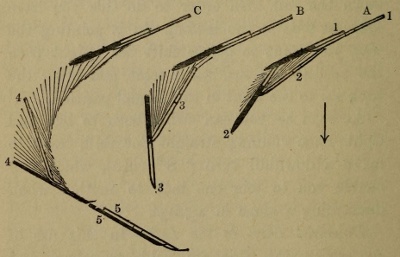
Fig. 37.—Downhill Telemark swing to left at various stages.
The blackened parts are those which should be weighted.
Then, lifting the outer edge of the right ski,
turn the right foot and knee inwards, and so
place the ski at a slight angle with the other, as
in starting an uphill swing. But, while in an
uphill swing this angle should be very slight
indeed and the body should immediately turn
towards the point of the front ski, in a downhill
swing the angle must be a trifle wider, and the
body must remain facing the point of the back
ski until both have turned far enough for the
front one to point nearly straight downhill. The
stemming of the front ski, in fact, and the combined
steering action of both, which in an uphill
turn should hardly be perceptible, should in a
downhill one be more pronounced. The weight,
moreover, must just at first be placed on the
toe of the front foot to help that ski to turn
downwards.
The moment you are fairly heading downhill,
throw the whole weight on to the heel of the
front ski, face towards its point, and finish the
swing as before (Fig. 37).
The faster you are running at the moment
of beginning the swing, the sooner you can
transfer the weight from the toe to the heel,
and face in the direction of the leading ski; in
fact, from a very fast traverse, a downhill Telemark
swing is practically made in exactly the
same way as an uphill one, the preliminary stem
of the front ski and the weighting of the toe
being barely perceptible.
In putting the weight on the toe at the
beginning of the swing, take great care not
to poke the foot forward, but to keep the knee
well over it; otherwise you are sure to take
the weight right off it.
Be on your guard also against the tendency
to try to start the swing by leaning to the left,
for, if you do this, you will either fall downhill or
get the skis apart. Simply lean well forward,
look in that direction only, and don’t think of
trying to turn, but rather try to go on across
the slope, letting your skis carry you round.
As you turn downwards of course the pace
increases, and you must lean more forward, but
you will find it less difficult to do this sufficiently
during the Telemark swing than during a stemming
turn. The great secret is to keep the right
knee well forward over the foot, to try to lean
over the front of the ski, and to keep your
eyes on the ground at your feet, trying to
imagine it flat, as I advised in the case of the
stemming turn.
The Telemark swing, when executed correctly,
at high speed, requires no sustained muscular
effort except that of holding the leading ski on its
inside edge and pressing down the heel. In deep
soft snow this is easy enough, if the knee is
well over the leading foot and all the weight
on that ski, but in shallow snow it is sometimes
difficult, at a high speed, to prevent the
ankle from bending outwards, which flattens
the ski and makes it skid outwards with an
irregular, jerky movement, leaving the weight
on the back foot. To prevent this, press the
knee in well, turn the outside of the foot hard
upwards, and press the toe upwards against
the toe-strap.
This will give the sensation of grinding the
inner side of the heel into the snow, and you
should try to increase the pressure as the swing
proceeds.
Strictly speaking, a very slight flattening of
the front ski hastens the start of an uphill swing
from a traverse. But this flattening should be
merely momentary, and it is so difficult to make
it so and instantly to edge the ski again that it
is safer to leave it out altogether.
Neither allow the back ski to come forward to
the normal position, nor weight it until the swing
is quite finished and you are either standing still
or running off in a new direction.
It may seem that, owing to the position, the
Telemark swing calls for more delicate balancing
than the other methods of turning. There is
really not so much difference, for in either the
stemming turn or, as will be seen later, in one
form of the Christiania swing, when these are
properly executed, the weight must for a time be
balanced almost entirely on one ski. It is, however,
more difficult to avoid a fall in case of an
error of balance or of unexpected side-slip in the
Telemark swing than in the Christiania or stemming
turns, for in the two latter the unweighted
foot is in a position to receive the weight and
help the balance, while in the former it can only
do so in a very slight degree. Moreover, it is
especially at the finish of the swing (when balancing
is most difficult), in the Telemark, that the
weight must be entirely on the one ski, while
both the Christiania and stemming turn can, and
should, be finished with the weight equally on
both. If, however, the Telemark is only employed
in soft snow of fair depth, the side-slip
will be slight and perfectly regular, and for that
reason will not disturb the balance much.
On an icy surface, or in shallow loose snow,
although it is easy enough to come round with
a Telemark swing, the irregular side-slip as the
swing ends makes it difficult to keep the balance;
but on snow of this kind, which is particularly
suitable for the stemming turn or Christiania,
there is no necessity to use the Telemark at all.
Practise this swing at first on a moderate
slope, and then on steeper ones, until you can
finally make short downhill turns on the steepest
slope you can find. But do not, at any rate at
first, waste time in trying to learn it where the
quality of snow makes it difficult.
If at first, through nervousness or bad balance,
you have much difficulty with the Telemark, you
can learn it by easy stages either (1) from a
standstill, (2) from the snow-plough position, or
(3) from Telemark stemming.
(1) Place yourself in the starting position of
Plate XIII. Throw your weight full on to
the heel of the right ski, pushing it a trifle
farther outwards as you do so, and sinking into
Telemark position as it slides off. If you almost
simultaneously face round towards its point and
bring the other ski to its side by pressing the left
knee inwards, you will swing round to the left to
a standstill almost before you have moved.
Or, holding yourself back with your sticks, you
can place your skis in Telemark position, both
pointing straight downhill. Then letting your
sticks go, you can swing round instantly to a
standstill.
(2) While snow-ploughing straight downhill,
throw the whole weight out on to the heel of one
ski, turning towards its point as you do so, and
dropping the other back into Telemark position.
A downhill turn, in the same way, can, as I have
already said, be started by snow-ploughing and
finished as a Telemark.
(3) To learn a downhill swing, traverse very
slowly in Telemark position, upper ski leading,
but kneeling down on and fully weighting the
lower ski, then turn the upper ski steadily as
far round as possible into Telemark stemming
position pointing downhill, immediately afterwards
shifting the weight gradually forwards on
to it, but not letting the angle between the skis
diminish until you are facing straight downhill,
when you can turn towards the front ski’s point
and bring the other round parallel.
I mention these kindergarten methods of
learning the swing because I have found them
really valuable for giving a nervous beginner
confidence, but, if you try them, you must remember
that to start the swing either from snow-ploughing
or pronounced Telemark stemming is
an exceedingly clumsy way of doing it, and only
possible at very low speeds.
There is always a suspicion of stemming at the
start of even an expert’s swing, and therefore, to
be quite accurate, the weight is never entirely on
the front ski at the outset, for it is of course
impossible to place the front ski at an angle with
the other without using the latter as a purchase,
and so weighting it slightly. But the whole
essence of a good swing, which can be made,
steadily and easily, at top speed, is that the
preliminary stem and consequent weighting of
the back ski is reduced to a minimum—is in fact
imperceptible, the runner’s weight coming on to
the heel of the front ski at the very outset and
being practically the sole factor in the turn.
By means of this swing it is even possible to
make turns in a breakable crust, if that is not
very thick, and if great care is taken to hold
and weight the skis correctly.
The bend of the back ski must always be
in contact with the front ankle. The back knee
must therefore be pressed slightly inwards even
when the skis are at an angle with each other.
Preparatory.—With the right foot leading
and weighted sink to a semi-kneeling position,
the right knee perpendicularly above the foot,
the left leg relaxed, the left heel raised, and the
left knee almost touching the ski, both knees
pressed a little inwards, the bend of the left
ski level with the ankle of the right foot, and
close against it.
Turn.—Turn right knee and foot inwards a
little, placing front ski at slight angle with the
other. As you do so (not later) lift outer edge of
right ski and put the whole weight on right heel.
As turn begins face towards point of front ski.
Lean more and more forwards throughout turn
and edge front ski harder.
At finish weight toe of front foot and press
back knee inwards, bringing skis parallel.
Fix your eyes on the front of the right ski, and
try to lean in that direction only, not inwards.
N.B.—A downhill turn is made in the same
way, except that, to start the swing, the toe of
the right foot must be weighted for a moment.
A Christiania is any turn in which the outer
ski does not lead, and the skis are not held convergently,
i.e. the skis may be either parallel or
divergent, and either held level or with the inner
leading.
This swing is, according to the purpose for
which it is used, and the state of the snow,
either an extremely difficult or the very easiest
way of turning or stopping.
It is easiest on a hard icy crust (not a
breakable one) either with or without a shallow
covering of loose snow, and therefore for learning
it one should find snow of this sort. Most
practice-grounds, trodden hard by ski-tracks,
are just the thing. The gradient is not so important,
for it is quite as easy to learn this
swing on a steepish slope as on a moderate one.
I have already shown (p. 138) how an uphill
Christiania may be started from a traverse by
side-slipping, and also how a stemming turn
may be finished as a Christiania (p. 143). The
following method is more generally useful, and a
steadier way of making the swing at a high speed.
Uphill Turn to the Right.—In the normal
position, run across the slope at a gentle
gradient with the hill on your right, your
weight on the left ski, the right ski about a
foot in advance.
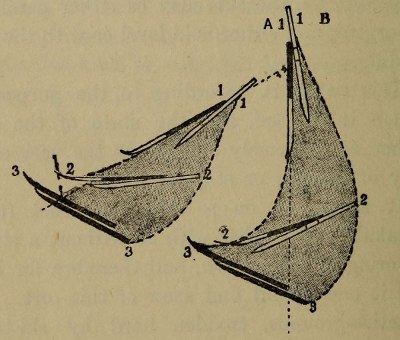
Fig. 38.—Uphill Christiania swing to right (a from a traverse,
b from a direct descent.)
The blackened parts are those which should be weighted.
When fairly under weigh lean well forwards,
bend the front knee, shift most of the weight
from the left foot to the right heel, and slide the
left ski about six inches farther to the rear,
turning its point slightly outwards, i.e. downhill,
so that it takes the position shown in
Fig. 38, a, 1, and at the same time flattening
it by bending the left knee and ankle well
outwards (Plate XXXIV.).
Owing partly to the steering effect produced
by the relative position of the two skis and partly
to the pressure on the heel of the right ski (a
very slight momentary flattening of which will
help the turn to start if it hangs fire at
all), you will instantly begin to turn uphill.
Immediately after beginning to turn press the
left ski quickly inwards and forwards again
to the normal position. As it again comes
parallel to the other it may be edged and its
left heel receive half the weight; until then it
must be kept flat.
If you do all this correctly you should come
to a standstill with the skis pointing more or
less uphill, in the normal position, right ski
leading (Fig. 38, a, 3).
The difficulty in this, as in all the turns, is, at
the start, to keep most of the weight on one ski
only. When, at the beginning of the swing, the
weight has once been shifted on to the right ski,
it must be kept there until the skis are brought
parallel again. It is in order to ensure doing this
that it is necessary to lean forwards, and keep the
right knee well over the foot. This may appear
likely to throw the weight on the toes, but the
tendency for that to happen is really less when
the leg is in this position than when it is
straighter. A slight lifting of the left heel
will lessen the tendency to throw weight on
that foot.
If much weight is put on the left foot it will
be difficult to hold the skis at the narrow angle
shown in the diagram, especially if the left ski
has not been flattened, but is still on its inside
edge. The skis, then, instead of turning together,
will probably run apart in the directions
in which they are pointing (Plate XXXVII.).
In this swing, as in the Telemark, the tendency
of the beginner is to lean too much inwards,
towards the hill. What I said in this connection
when describing the Telemark swing is equally
applicable here, and to save you from referring
back I will repeat it.
As explained on page 82, a ski can never cut
round like a skate, but slips sideways, in turning,
as well as forwards; and the shallower the snow,
the steeper the hill, and the higher the speed,
the greater is this side-slip. In making this
turn to the right, therefore, your right foot,
instead of moving at once to the right of the
line of your previous course, will at first move
to the left of, and below it; and, if the hill is
steep or the snow shallow, may still be on its
left even at the end of the swing, though the
fact that the points of the skis remain on the
other side of the line prevents this from being
apparent at first (Fig. 38).
It is obvious, then, that if you are to remain
properly balanced on your right ski, very little
inward lean is necessary, and the usual directions
as to leaning the body inwards while making the
swing are most misleading.
In fact, although one really has to lean inwards
when the turn has begun, the instinct to avoid
an outward fall makes one overdo it to such an
extent that at first it is better to try to throw
the weight rather to the left and downhill—but
forwards, not backwards, on to the left ski—in
order to get the proper balance.
One must try to encourage the side-slip, not
to check it; and the only way to do this is to
try to throw the weight slightly outwards, or,
at any rate, to guard against the least tendency
to lean in, as one instinctively is inclined to do
when the side-slip begins.
At the end of the swing the edging of the
skis stops the side-slip, rather suddenly if one
makes a sharp turn in soft snow, and it is
only then that any conscious effort should be
made to lean inwards, never at the beginning of
the swing.
It is useless to try to hasten the swing by
turning, leaning, or swinging the body; in fact,
as I have said before, if you try to turn at all
you are almost certain to fall. If, however, you
try to go straight on, simply holding the skis,
and distributing the weight as I have directed,
you will probably turn without difficulty.
When you can make the swing to the right,
learn to make it to the left in the same way, of
course substituting left for right, and right for
left in the directions. When you can do this,
practise it to the right again, this time running
more steeply downhill than at first, and then in
the same way to the left, until you can at last
turn to right or left when running straight
downhill (Fig, 38, b). But do not, at any stage,
run far before beginning to swing; get fairly
under weigh and make the swing, then run on
and do it again, and repeat this until you get to
the bottom of your practice slope. To run far
between each swing only gives you more climbing
in proportion to the amount of practice.
There is one thing to be noticed about making
the swing when running straight downhill. When
running across the hill the skis are edged in the
normal position, and the inner ski, which has to
be slightly edged at the start of the swing, is
therefore already about right. In running straight
downhill both skis are flat in the normal position;
it is therefore necessary, when turning to the
right, to edge the right ski a trifle in order to
begin the swing (Plate XXXV.).
The left ski is already flat; but to make sure
that it keeps so as the turn begins, slightly bow
the legs, turning both knees—especially the left—rather
outwards.
When running straight downhill preparatory
to swinging, always lead with the ski of the
side to which you mean to turn.
Downhill Turn to the Right.—So far you have
used the swing to make an uphill turn, in order
to bring yourself to a standstill.
When using the swing in order to make a
downhill turn, the skis are held in exactly the
same relative positions as before, and weighted
in much the same way, but it is necessary to
notice carefully one or two details.
Suppose you are running across the slope with
the hill on your left and wish to turn downwards
to the right and make a fresh tack. Your weight
in the normal running position is then on the
right ski, and the left ski is advanced.
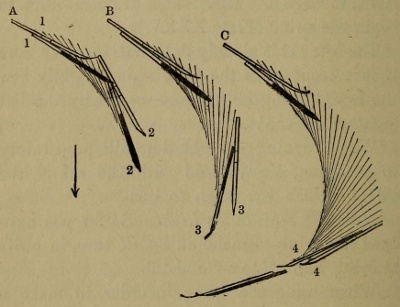
Fig. 39.—Downhill Christiania swing to the right at various stages.
The blackened parts are those which should be weighted.
In order to start the turn it is not necessary
to shift the weight, which is already on the right
ski; you have merely to turn the right knee
and ankle slightly outwards as before, and to
put the weight on the toe of the right foot, at
the same time sliding the left ski to the rear.
The right ski will now begin to point away from
the other and turn downhill (Fig. 39, a, 1, 1).
Take care to bend the right ankle only slightly
outwards, so that the ski is not actually edged
outwards, but only partially or completely flattened,
according as the slope is steep or gentle;
if there is any outward edging—or if the weight
is on the heel—you will fail to start the turn.
As the right ski begins to turn downwards,
take care that the angle between it and the
other one does not become too wide, but that
the left ski also begins to turn downhill (pressing
on it with the toes and partially flattening it by
bending the ankle inwards will enable it to do
so) before the right has assumed the position of
2 in the diagram. If you put much weight on
the left ski it will refuse to follow the other one
round, and will either get across the heel of it,
or run away from it and upset you.
The right knee and ankle are held in the same
position throughout the swing, and this will bring
the right ski on to its outside edge as soon as
it is pointing directly downhill (in a sense, indeed,
the right ski may be said to be “edged” throughout
the swing if that expression is merely used
to signify the depression of its outer edge and not
its relation to the surface of the snow).
The left ankle, however, after being bent a
trifle inwards, to start the swing, must, with the
knee, be bent more and more outwards as the
swing proceeds, in order to keep the left ski
perfectly flat until it can be brought back to
the side of the other one and edged inwards as
the swing ends.
As soon as you have turned so far that you
are facing straight downhill, shift the weight
from the toe of the right foot to the heel and
finish the swing as before. If you make a
downhill turn very sharply while running fast
you can shift the weight from toe to heel before
you are facing downhill—in fact almost immediately
after the turn has begun. In trying to
put the weight on the toe at the beginning of
the swing, take great care not to poke the foot
forward, but to keep the knee well over it, otherwise
you are sure to put some weight back on
the left foot.
Be on your guard also against trying to start
the swing by leaning to the right, for, if you
do this, you will either fall downhill, or will
find that the right ski refuses to turn downwards.
Simply lean, as before, towards the tip
of the right ski, look in that direction only,
and don’t think of trying to turn, but rather
try to go on across the slope.
As you turn downwards, of course, the pace
increases, and you must therefore lean more
forwards; the great thing is to keep the right
knee well forward over the foot, to try to lean
over the front of the ski, and to keep your eyes
on the ground at your feet, endeavouring to
imagine it flat, as I advised in the case of the
Telemark and stemming turns.
You will find this downhill turn of very little
practical use on a steep slope until you can make
it quite shortly and sharply, for, if you make
a long curve, the pace increases so much in the
middle of it that you are almost sure to lose
control and fail to finish the swing, even if you
do not fall down.
When performed in this way the Christiania
swing can be used for making either up or
downhill turns on practically any slope and in
any kind of snow except breakable crust. The
deeper, however, the skis sink into the snow, the
greater is the difficulty, not only because they
skid round less readily, but because it then needs
more force to hold the outer, back ski at a
narrow angle with the other owing to the
increased outward pressure of the snow. Unless
this ski is then held perfectly flat it will
instantly run apart from the other.
In the method just described the turn is
started by sliding back the ski which is to
be the outer one and pointing it away from
the side to which one is about to turn. Another
way of starting the turn is to slide forward
the ski which is to be the inner one and point
it towards the side one means to turn to. This
practically amounts to the same thing looked
at from another view; the relative position
of the skis is exactly the same, and there is
very little practical difference in the making
of the turn.
As I find that beginners learn the swing
more easily if told to do it in the first way,
I have given these directions first, but I should
have thought myself that the swing was easier
to understand, and therefore to perform, when
considered from this second point of view.
Before going any further let me warn the
reader, if he is a beginner, that the next three
pages or so are not strictly practical, but are
rather meant to elucidate the theory of the
swing. If after glancing at them the reader
does not feel very hopeful of enlightenment, he
may safely skip them.
I have so far talked about steering action
starting the turn. When the swing is looked
at from this second standpoint, one can say
that stemming action starts it—or rather
prepares for it.
Suppose, for instance, you are traversing to
the right at a gentle gradient, and wish to
turn uphill in this way. You are in the normal
position, left foot weighted, and right foot leading;
in order to prepare for the turn keep the left
ski edged normally and weighted, slide the right
a little farther forward, turn it rather away
from the other, i.e. point it about horizontally
across the slope (the gradient of your course
being very slight), and nearly flatten it by
keeping the right knee and ankle a little
inwards. What you are now doing is actually
stemming—divergent stemming, not convergent
like ordinary or Telemark stemming, but still
stemming; Christiania stemming if you like to
call it so. As long as you hold this position
with the left ski edged and weighted and the
body facing towards its point you will go
straight ahead at a reduced pace. You can
now stop either by stemming alone or by
stemming and turning.
(1) Keep the left (running) ski normally edged,
and gradually edge and weight the right stemming
ski more and more until you come to a
standstill without a change of front—a true
stemming stop, but awkward, because the skis
tend to run apart as the upper ski receives
the weight.
(2) You can stop more neatly by shifting the
weight all at once to the stemming ski, facing
towards its point as you do so and instantly
bringing round the lower ski—lifting it if you
like, or at any rate flattening it—to the side
of the upper. This is something between stopping
by stemming and stopping by a step
round. There is no swing about either process,
and although the last may be called a turn
because there is a change of front, it cannot
be more than a slight one, because one cannot
safely point away the upper ski at more than
a slight angle.
Apart from the question of speed, with the
increase of which the insecurity of any sort of
stemming always increases, you cannot, of course,
stop in either of these ways if traversing steeply
enough for the divergent upper ski to be no
longer pointing quite horizontally. You must
then do so either (3) by flattening the lower
ski, putting half the weight on the upper, holding
the divergent position until the consequent
steering action brings the upper ski horizontal
again, and only then putting the whole weight
on it and bringing the other parallel to it—a
pure “steered” turn, with the inevitable accompanying
drawback of the tendency of the skis
to run apart; or (4) by shifting the weight
all at once to the stemming ski—facing towards
its point as you do so, bringing the other
(flattened) quickly parallel to it, and instantly
weighting the heels of both (see p. 131), when
they will turn upwards in side-slipping and
come to a standstill. If before you make the
turn you only point the stemming ski at a
very slight angle away from the other, and
if you throw your weight on it and face towards
its point as, and not after, you point it outwards,
you will, by the method just described,
make what, for the sake of distinction, may
be called the “steered” Christiania in the best
way that it is possible to make it.
In coming to a standstill on a gentle slope
from a slow traverse by any of the methods
just described, you will find that the practical
differences between them are very small indeed;
but if running very fast you would find that
the first two were impossible, and the third
awkward and unsafe, but that by the last
(which, as I have said, is practically the same
as the method described at the beginning of
the chapter) you could, if your balance were
good, turn and stop with perfect ease and
steadiness. What I have called Christiania
stemming, though possible, is of so little practical
use that, in that respect, it is hardly
worth considering; but to understand how it
may be done, and its exact relation to steering,
side-slipping, &c., makes it so much easier to
master the difficulties of the swing, that I have
risked exasperating the reader by describing it
at length.
The upshot of all this is that when the
Christiania is made in either of the ways so
far described in this chapter, whatever steering
or divergent stemming there is in it should
be reduced to a minimum.
In this turn, by whatever method it is made,
the main difficulty—apart from the question of
balance—is in getting the turn started. If
once the heel of the leading ski can be got
fairly outside the track of its point, it is easy
enough to keep the turn going. It is the
starting of the turn that is the main object
of the divergent position of the skis; in fact,
although this position produces some steering
effect as long as there is any forward motion
at all, it produces less and less as the skis
move more and more broadside on, and is
only really efficient as the turn begins. This
divergent position, indeed, although on the
whole, I think, the best possible way of starting
the swing, becomes more hindrance than help
as the turn proceeds, owing to the accompanying
tendency, if most of the weight is on the inner
ski, for the outer one to run away from it; or,
if the outer ski is most weighted, for the inner
one to whip round at right angles and cross
the other’s heel (Plate XXXIX.). You should
be careful, therefore, not to let the skis point
much apart, and not to let them do so at all
for a moment longer than you can help, but
as soon as you are sure the steering has done
its work thoroughly, and the heel of the front
ski has fairly begun to side-slip, should quickly
bring the skis parallel, and carry through
the rest of the turn simply by weighting
both heels.
In the case of an uphill turn made while
running fast, you will generally find that the
skis can be brought together again almost
instantly. The separation of the skis is then
almost imperceptible, and no doubt many runners
do it quite unconsciously. The skis merely make,
as it were, a quick snip, like a pair of scissors.
In order to get the skis parallel, some people
find it easier, instead of keeping the outer ski
unweighted and pressing its point inwards
again, to shift most of the weight back and
out on to it, and so thrust its heel outwards.
The latter method puts the skis parallel a little
more quickly than the former, but is apt to get
them rather wide apart in doing so.
The two methods just described are, as I have
said, identical in principle; the divergent position
of the skis, with its accompanying steering
effect, being the main characteristic of each.
In each method, moreover—apart from the
question of balance—the only muscular effort
necessary (which should be very slight) is that
of checking and reducing the divergence of the
skis; the runner, as soon as the skis are parallel,
being carried round without any effort whatever.
A third method—the one usually taught—is
quite different in principle, being precisely
similar to a skating turn; that is to say, the
runner uses the inertia, or rather momentum,
of his upper body as a purchase from which,
by a muscular effort—though not necessarily
a great one—he throws both skis simultaneously
more or less athwart the line of his course;
the skis remaining parallel throughout and
acting practically as one. I said a muscular
effort—I ought rather to have said “two muscular
efforts,” for the movement which causes the skis
to turn, though it may be very slight, and may
then appear to the onlooker—and even feel to the
expert performer—quite simple, is really a compound
one that consists of two distinct parts,
and should be learnt as such.
Supposing you are running straight downhill
and want to make a turn to the right in
this way, the preparation is as follows: either
slightly advance the right ski, or hold both
skis level, place the weight equally on both,
edging them very slightly to the right, bending
the knees a little, keeping both them and the
skis in close contact, and leaning well forwards.
These relative positions of the skis and legs
are, if possible, held unaltered throughout the
swing.
You can now make the double movement that
produces the turn.
(1) Without letting your head turn or
straightening yourself up, swing the arms,
shoulders, and upper body well round to the
right. This swinging movement should be easy
yet decided, starting gently and increasing in
force as it proceeds—in fact, as Mr. Richardson
says, it should be made “crescendo,” not “sforzando.”
It should bring you to the position of
Fig. 40, a, right arm well back and left well
across the front of the body, which should be
leaning more to its right than in the drawing,
with the hips, therefore (to keep the centre of
gravity exactly over the skis), projecting more
to their left. At the instant that the swinging
movement of the arms and shoulders brings you
into the above position—i.e. just before the
movement reaches its extreme limit and while
its force is still increasing—make a sudden effort
to reverse it—that is, simultaneously make a
vigorous stroke to the left with the arms, and
jerk the hips and knees round to the right by
suddenly twisting the body at the waist.
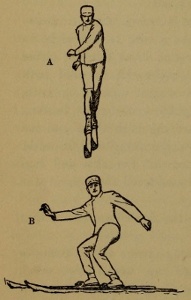
Fig. 40.—“Jerked” Christiania swing,
a before, b after turn.
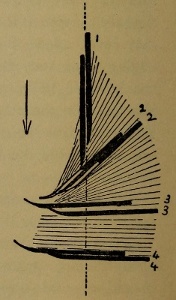
Fig. 41.
This reverse twist of the body has practically
no effect upon the shoulders—being there
neutralised (though this may not be obvious
at first sight) by the back-stroke of the arms—but
acts almost entirely on the hips, turning
them until they face even farther to the right
than did the shoulders at the end of their
previous swing. The result, therefore, of the
whole double movement, if made with force
and precision, should be that you find yourself
in the position of Fig. 40, b, or Plate XLIV.—the
skis having whipped round to right angles,
or thereabouts, with their original direction—and
that, after more or less side-slip, according
to your speed and the quality of the snow, you
come to a standstill.
In saying that this double movement should
be made with force, I do not mean that it should
be made violently. If the turn is to be made
very suddenly, so that the skis whip round
instantly to right angles, some force is certainly
necessary, for then the whole of the turning
movement of the skis is carried out by the
double muscular effort of the body and arms.
But this double effort—the swing of the shoulders
and the immediately following jerk of the hips—may
be, and indeed usually is, used merely to
start the turn by getting the heels of the skis
outside the track of their points; the rest of the
turn being carried through by the weighting
of the heels, in the same way that, as I have
already explained, the greater part of a steered
Christiania can so be carried through. In this
case the “swing-and-jerk,” which takes the
place of the “snip” of the skis in the other
method, may be an almost imperceptible effort,
the most obvious part of which is a slight twisting
of the hips. As absence of effort is of the
greatest importance in ski-ing, one may perhaps
say that in a sense this is the best way of
making the turn. But even though you may
seldom want to make the turn fully and instantaneously
it is extremely useful to be able
to do so in case of need, and if you have learnt
to complete a turn forcibly you will find it all
the easier to start one gently. If, however, you
never try to do more than start the turn with
a gentle swing-and-jerk, it is quite likely that
you will never do even that with real certainty—the
subtlety of a gentle movement making
it more difficult to learn correctly than a forcible
one. You are still more likely to be unsuccessful
if you leave out half the movement, as is sometimes
directed, and only try to swing the
shoulders, or to twist the hips, or if you try
to move both round simultaneously, or if, as
I myself used wrongly to direct, you treat the
double movement as two quite separate ones—a
merely preparatory turn of the shoulders with
a pause between it and the hip-jerk. Not that
the turn cannot be made in either of these ways;
it can in all, but only awkwardly with the help
of a good deal more force than would otherwise
be necessary. An expert making a “jerked”
Christiania—as this sort may perhaps be called,
since the jerk round of the hips and consequent
thrusting forward of the ski-heels is the crucial
part of it—whether he makes it powerfully or
gently, will do so with just the force needed and
no more; in other words, he will do it gracefully.
The essential points of the movement so made are—(1)
that it is a double one, (2) that the second
part of the movement follows the first without
the least pause, (3) that the force used, however
small, is gradually increasing in the first part,
sudden in the second, (4) that each part of the
movement is made with about the same strength;
for feebleness in the one part has to be compensated
for by undue violence in the other.
If these four conditions are complied with the
movement will usually need very little force.
You had better try this swing-and-jerk movement,
first without skis, on a smooth floor, then
with skis, but at a standstill, on the slipperiest
bit of hard snow you can find—slightly convex,
for choice, so that only the middles of the skis
rest on it—before trying it while actually
running. The first time you try it you will
probably find that, in spite of the many words
I have managed to use on it, it is just what
you would do by the light of nature if asked,
without letting your face turn, to hold your feet
together and make them turn suddenly as far
round to the right as possible. You will also
find that in order to do it quickly you will
be inclined to make the movement with a bit
of a jump, and this, in fact, is the best way
to do it when on skis. There should always be
some dipping of the knees with the swing and
the least suspicion of a spring with the jerk, just
sufficient to take most of the weight off the
skis for a moment and enable them to come
round with less effort from the body. This
spring may, if the snow makes it difficult to
start the turn, be made strongly enough to
lift the skis clear of it.
This is the only turn on skis in which the
arms are used as an aid to turning. In the
stemming turn, the Telemark, and the other
variety of the Christiania, the arms will very
likely wave about involuntarily to help the
balance, but as far as possible they should hang
quietly by the sides, a moderately expert runner
being able to make either of these turns
with his hands in his pockets or clasped behind
his back.
In this form of the Christiania, however, the
double swing of the arms—especially their
back-stroke—is the greatest help, for it practically
holds the shoulders at the end of their
swing, and enables the body muscles to use
them as a purchase from which to pull the
hips round. You can easily convince yourself
of the value of free and correct arm-action in
this turn if, after making it as I have directed,
you try to turn either with your arms tightly
folded, or clasped behind your back, or by
swinging them to the right only and then
holding them in the position of Fig. 40, a,
instead of bringing them back again.
It is naturally far easiest to make a turn in
this way on a hard smooth surface which allows
the skis to skid round freely. It is only on this
sort of snow, in fact, that the whole turn can be
jerked; in deep soft snow it is hardly possible
to do more than just start the turn by swing-and-jerking;
the heel-weighting must then do
nearly all of it. If this heel-weighting is not
timed and adjusted quite nicely, or if the skis
are edged at all hard before they have made
a considerable change of direction, the turn is
apt to miss fire altogether; it is therefore, I
think, a far less useful one to the average
performer than the “steered” variety, which
will almost always get him round somehow, even
if clumsily.
For anyone who can make both kinds perfectly,
the “steered” turn involves just as little effort
as the “jerked,” and I certainly advise the
beginner to get thoroughly accustomed to starting
his turns by “steering” before he learns to
“jerk” them.
I have only given directions for making the
“jerked” turn from a direct descent; “jerked”
turns, either uphill or downhill, can of course
be made from a traverse in just the same way.
Downhill turns are always rather more difficult
than uphill turns, whatever be the method of
turning; downhill “jerked” turns have the
added difficulty that if, as is generally the
case, the angle between the two tacks is a
small one, the skis have to be jerked round
farther than would usually be necessary in an
uphill turn, and the jerk therefore takes more
effort.
In snow which allows you to make a complete
jerked turn you can, if not running very fast,
practically stop dead, or change your course
instantaneously, by making the Christiania in
this way, for the edging of the skis, after the
turn has been made, stops the side-slip almost
before it has had time to begin.
If, on hard snow, you make a Christiania
(of any kind) sharply while travelling at a high
speed, you will often find that, after you have
come round, the side-slip, which will then be
very great, will be too irregular to allow you to
keep your balance without holding the skis
at some distance apart. Even a good runner
is sometimes compelled to separate his skis in
this way, but you should not do it if you can
possibly help it, and if compelled to, should
always bring the skis together as the side-slip
grows less, not for the look of the thing, but
because, though possible, it is difficult, if the skis
are apart, to start a swing instantly in the
other direction, as you may often wish to do.
The Christiania can also be started, as
Bilgeri and his school advise, and as I have
practically said already, from a very undeveloped
ordinary stemming turn. In order, for instance,
to make a swing to the left, one can
advance the right ski, push out its heel a
little, throw the weight on it, and face towards
its point, and can then, by instantly bringing
the left ski parallel and to the front and
weighting its heel as well as the other’s, finish
the turn as a Christiania. This is very easy
to learn, and, if the preliminary stem is reduced
to a minimum, is quite effective; but it is a
much less steady way of turning at a very
high speed than a Christiania started with the
inside ski leading, and high speed is the real
test.
Having said that a “jerked” Christiania is
like a skating turn, I think I had better insert
the following quotation from Mr. Richardson’s
“Shilling Ski-runner,” with the sentiment of
which I heartily agree. “The beginner should
remember that turns are only a means to an
end, and not, as in figure skating, an end in
themselves. The real object of all ski-ing
technique is to enable the runner to cross the
snow as fast as possible, with as little effort
as possible, and as safely as possible.”
Any beginner who has followed me through
this chapter on the Christiania swing will probably
think that a manœuvre which takes so
much description must be appallingly difficult.
I can assure him that it is nothing of the
sort. Indeed the expert, who does it instinctively,
will no doubt wonder why on earth I
have made such a fuss about it. I do not
think, however, that I could have said much
less and yet have given a really complete
explanation of how it may be done.
The only authorities, as far as I know, who
have said that there is more than one way of
making the swing, are Richardson and Hoek in
Der Skilauf; they do not explain the difference
in the making of it, but only in its
results, giving a diagram of the tracks of two
swings, one “gerissen,” and the other “gezogen,”
i.e. “torn” and “drawn,” which, I suppose,
are equivalent to “jerked” and “swung.”
Some writers having given directions for one
variety of the swing and some for the other;
their instructions at first sight appear so extraordinarily
contradictory that I am almost afraid
of confessing that I agree with them all, lest
the reader who knows something about ski-ing
should set me down as an amiable idiot. As
soon, however, as one understands the cause of
it, this contradictoriness is seen to be more
apparent than actual. The difficulty in realising
the existence of these variations of the swing is,
no doubt, due to the fact that between the pure
“jerked” Christiania at one end of the scale,
and the pure “swung,” “steered,” “drawn,” or
whatever one likes to call it, Christiania at the
other, there are an infinite number of gradations,
one of them being a form of the swing that is
often seen, in which the turn is started by a
slight jerk and a slight separation of the ski-points,
and is carried through by the weighting
of the heels.
When one is running across the hill an uphill
Christiania of any kind can be made with perfect
ease on any sort of snow short of breakable
crust; when one is running straight downhill it
is less easy, if the snow is very loose and deep;
while to make a downhill turn in deep loose
snow by means of a Christiania is decidedly
difficult, especially if the slope is steep, though
on hard snow and a moderate slope this downhill
turn is easy enough and safer than a stemming
turn, if the speed is at all high.
But although at first, when out on a run, you
will be wise if you only use the Christiania for
making uphill turns, and that on snow which
is easy for it, you should when practising keep
on trying it in deeper and deeper loose snow,
and should turn downhill as well as uphill, not
being satisfied until you can make fairly short
downhill turns in deep loose snow on a really
steep slope, as it is perfectly possible to do.
As in the case of the Telemark, the beginner
can of course learn to make an uphill “steered”
Christiania from a standstill by holding himself
back with his sticks while he places the skis in
the divergent position, and then letting himself
go and swinging round immediately. This is in
fact a very good way for him to begin to learn
it, for he can thus find out in a very short time
exactly how to hold his skis and distribute his
weight; nor need he be afraid of contracting any
bad habit by learning the swing in this way, for
though he may find it rather easier to learn the
Telemark by making it clumsily at first, he will
find nothing of the sort in the case of the
Christiania.
Before leaving the subject of the swings, let me
impress upon the reader that in every swing or
turn the runner at first starts the side-slip by
stemming or steering with one ski held at an
angle with the other or by moving both with
a jerk—in short, by a muscular effort, however
slight a one—and that having started the side-slip
he lets his weight do the rest, and is carried
round without any effort at all. It is the effortless
side-slipping that gives a well-made swing
its characteristic feeling and appearance.
The whole difference between a novice’s turn and
an expert’s is that in the former’s the preparatory
stemming or steering preponderates, in the latter’s
the finishing side-slip; and that, moreover, in the
novice’s swing the initial and final movements are
seen (and felt) to be distinct and separate, while
in the expert’s swing the preparatory movement
merges imperceptibly into the final side-slip.
The more the preparatory steering, stemming, or
jerking is eliminated, the more comfortable—I
will not say the easier—is the swing, and the
steadier the balance if the swing is made at high
speed.
In the preparatory stemming or steering the
weight is for a moment more equally distributed
on both skis than I have intended the beginner
to suspect from the previous directions. Even in
the Telemark, in which the weight is apparently
entirely on the leading ski both before and
throughout the swing, it is actually, at the
moment the front ski is turned inwards, half
supported by the back one. The same thing
happens at the moment the skis are made to
diverge in starting a “steered” Christiania. But
if the beginner makes any conscious effort to put
the weight back—unless, indeed, he tries to keep
it well forward—he will almost inevitably put it
entirely on the back ski, and in moving it on to
the leading ski as the swing proceeds will find
that his balance is liable to be disturbed. The
fact that the weight is always farther back than
he imagines is one which the beginner must
continually remind himself. In every uphill turn
the weight, which is at first, as I have just said,
about equally on both skis, is almost immediately
moved to the heel of the front foot—that is, it is
thrown forward, and as the swing finishes it is
thrown still more forward to prevent the ski from
turning too far uphill. In the directions for the
swings, therefore, the beginner should remember
that to weight first the heel and then the toe
does not, as a rule, mean to throw the weight first
backwards and then forwards, but to throw it
first forwards and then still more forwards.
Short Directions for an Uphill Christiania
Swing to the Right.—1. (“Steered”) for any
kind of snow except breakable crust.
Lean forwards and put all the weight on heel
of right foot, right knee rather bent and well
forward over foot, right ankle bent slightly
outwards, so as to lift the inner edge of right
ski; left ski about 18 inches to the rear, pointed
slightly away from the other, and flat.
This position starts the swing; as it proceeds
press the left ski smartly inwards and forwards,
so that it returns as soon as possible to the
normal position again, parallel to and touching
the right ski. As it does so, but not before, it
may be edged and receive half the weight;
unless parallel with the other, it must be
absolutely flat and almost unweighted.
Fix your eyes on the point of the right ski and
try to lean in that direction only, not inwards.
N.B.—A downhill turn is made in the same
way, except that to start the swing the toes of
both feet must be weighted for a moment.
2. (“Jerked”) for hard snow, or shallow
loose snow.
Preparation.—Press both knees and skis
together and (except before a downhill turn)
edge the latter slightly to the right; weight
on both and well forwards; knees rather bent,
feet level, or the right a little ahead.
Turn.—(1) Still stooping slightly, move arms,
shoulders, and upper body—not the head—well
round to the right with an easy but decided
swing. (2) Without the least pause simultaneously
reverse the twist of the body, make a
vigorous stroke to the left with the arms, and
jerk hips and knees round to the right. The
movement of (1) should be gradual, of (2) sudden,
but the force about the same in each. The skis
should whip round to right angles, or nearly so,
with their previous course.
If you can make the stemming turn and the
Telemark and Christiania swings, you will, under
most ordinary conditions of snow, be able to turn
or stop with ease under any circumstances.
Sometimes, however, you will encounter snow,
the surface of which is covered by a crust, not
thick enough to bear the runner’s weight without
breaking, but sufficiently so to make it impossible
for him to shear round through it even
with a Telemark swing (for when the skis cut
into a thick crust they will only run in a
straight line).
Under these circumstances the only neat and
quick way of turning or stopping is to do so by
means of a jump which places the skis more or
less broadside on to their original course, and this
is not such a difficult matter as perhaps it sounds.
This jump is made with the feet level, and the
skis close together and parallel, in just the same
way as a jump used for starting on the side of a
hill or as a substitute for the kick-turn. Pay
the same attention to the points of getting the
weight well on the toes before making the spring,
and of then crouching low and jumping with
a free, swinging action, not a timid, jerky one,
and be sure to press the knees together.
The skis should remain about parallel with the
surface of the snow throughout the jump; if the
jump is used for making an uphill turn, the points
of the skis must be well lifted, if for a downhill
one, their heels.
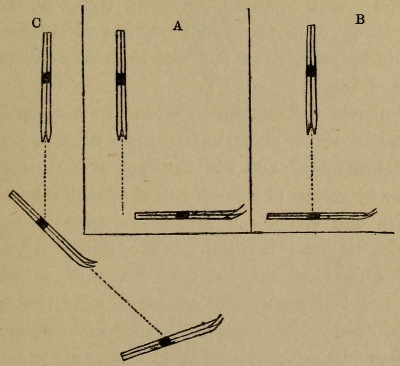
Fig. 42.
You will find it far easier to keep your balance
on landing, if you remember not to jump to one
side of your course (Fig. 42, a), but to come to the
ground with your feet as nearly as possible on
your original line of progress—though, of course,
pointing across it, instead of along it, and,
according to the speed at which you were
running, more or less ahead of the place where
you took off (Fig. 42, b).
The secret of using the jump round successfully
lies, not in the actual making of the jump,
but in knowing the safest and most effective way
of applying it.
Suppose, for instance, you are running either
across a slope or straight down it, at a very
moderate speed, and wish to stop, you can easily
do so by means of a jump round towards the hill,
which will bring you almost or quite at right
angles to your original course (Plates XLVII.
and XLVIII.). As you land you will naturally
have to lean inwards to compensate for the outward
throw. The amount of inward lean necessary
varies with the speed at which you are running
before the jump. When the speed is at all high
the inclination at which you would be safe from
an outward fall is so great that on landing after
the jump, if you were to make one, the skis would
almost certainly skid, and you would fall inwards;
while, if the skis did happen to hold, your legs
would not have enough strength to withstand
the shock, but would collapse under you.
When running at all fast, therefore, it is impossible
to stop with one jump. You must first
jump a little way round, so that you face less
directly downhill, and check your pace; you can
then jump again and stop yourself (Fig. 42, c).
In the same way, if you wish to jump round
instead of making a downhill turn, you must
either make your tacks at a gradient which will
keep down your speed sufficiently to allow you
to make the complete turn in one jump, or you
must check your pace before making the downhill
jump by turning slightly uphill with a
preliminary jump. This is exactly equivalent to
checking the pace by making a slight uphill
swing before making a downhill one.
The higher the speed, the slighter the change
of direction that one can safely make in one jump,
and at a very high speed it would, for this
reason, be impossible to stop even in two jumps.
There is nothing to prevent a runner from
stopping or making a downhill turn at the
highest possible speed by means of a series of
jumps, but a turn so made covers so much ground
that it is practically useless. This does not much
matter, however, for the kind of snow which
makes jumping round necessary is not such as to
tempt one to run very fast.
It is possible on a gentle slope, if the snow is
shallow, to use the skis like skates, striking out
with each alternately.
This needs little explanation. You have merely,
while running straight downhill, to lift one ski—say,
the right—and put it down again pointing
outwards from the other at a widish angle, their
heels being close together.
The moment the right ski touches the snow,
give a vigorous push backwards and to the left
with the left ski, at the same time throwing the
weight of the body well forwards and to the right
over the right foot. While sliding on the right
ski, bring the left forward and hold it close to
the other, but clear of the snow. You are then
ready to make a fresh stroke by putting down
the left ski and pushing with the right.
A series of such movements leaves a track
as in Fig. 43, a.
You will find it difficult at first to throw the
weight sufficiently forward and outward at each
stroke, especially if, instead of putting down the
ski on which you are about to slide exactly
level with the other, as you should do (Fig. 43, b),
you put it farther forward (c). This difficulty
will cause each stroke to become shorter and
shorter until it is impossible
to continue the
movement.
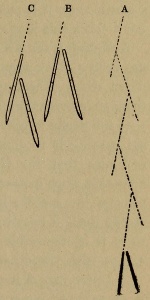
Fig. 43.
In practising, hold the
ski which is off the snow
parallel with and close to
the other one until you
are ready to make the
next stroke, and slide on
each foot at least far
enough to make sure that
your balance is perfectly
steady on it.
It has already been explained
how, by striking
out to one side only, one
can change one’s direction—for,
of course, the action of stepping round is
precisely the same as that of skating—and how
one can in this way steer or stop oneself in
breakable crust.
Skating, moreover, is one of the best possible
exercises for the balance, for it teaches one to
run steadily on one foot without the support
of the other, and on this account alone you
should by no means omit to learn it.
It is generally supposed that by skating down
a gentle slope it is possible to increase the speed,
but I think this is very doubtful.
A skating track is a zigzag one, and is therefore
not such a short way over a given distance as a
direct slide. Then, again, although each stroke
tends to increase the speed, it must be remembered
that the whole weight of the runner rests on one
ski, causing it to sink deeper and travel slower,
and also that the skis are travelling slightly
across the slope instead of straight down it, which
reduces the speed still more. Besides this, the
stroke itself is not directly in the line of motion,
since it is impossible to place one ski at right
angles with the other one.
A better way of increasing the speed downhill
is probably to lunge directly downhill with each
foot alternately, keeping the skis close together—an
exactly similar action to that of moving on
level ground. Pushing with the sticks will, of
course, make you go faster still.