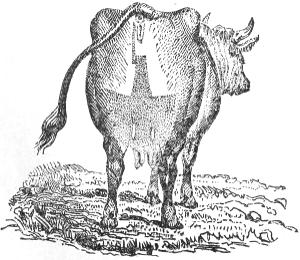
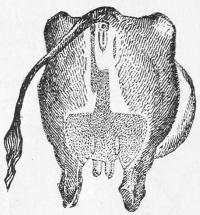
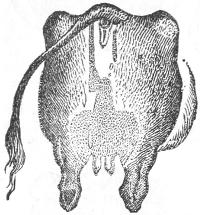
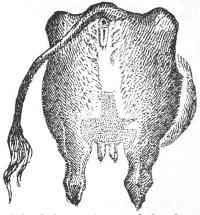
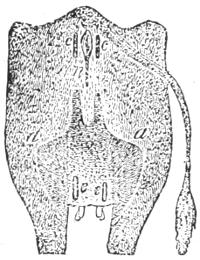
PREFACE.
The want has long been felt for a hand book which would simplify and
explain the invaluable discovery of Guenon, to enable any one to select
good stock. There can be no doubt if this discovery is made to be easily
acquired, that millions of dollars would be saved to the community by the
improvement of herds and a consequent reduction in the price of bovine
products, on account of the increased yield and the lower cost of raising it.
The State of Pennsylvania, in 1878, appointed a commission to test the
system and report upon it. As a member of that commission, we found
there was with many a superficial knowledge of the subject, with others
enough acquaintance with the system to destroy their faith in it, and with
nearly all a desire to obtain sufficient practical knowledge of the system
to enable them to judge understandingly and to practice it.
With a view to fill these wants, we have undertaken the explanation of
the system in the following pages to enable all to fill up their measure of
knowledge of the system, so that the superficial shall become thorough,
the doubting acquire new faith, and all see its merits the more they practice
and apply it.
We have accordingly given a sketch of M. Guenon and the progress of
his discovery; some extracts from his preface explaining his views; an
explanation of his system of escutcheon marks; a description of the various
escutcheons and their indications of value and quantity, and directions
how to practically apply them, together with the report of the Pennsylvania
Guenon Commission.
Believing that we have thus presented a comprehensive view of this discovery,
we trust every one into whose hands this work may come, will
patiently, book in hand, go into the farm-yard and judge of the value of
his stock by the rules here set forth, compare the results with his individual
knowledge of his stock, and fairly estimate the value of the system.
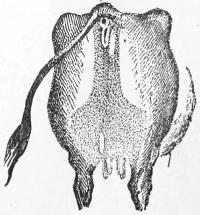
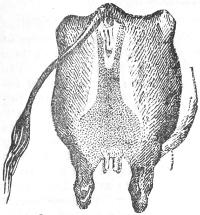
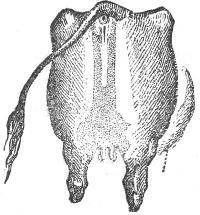
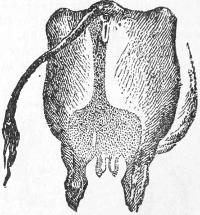
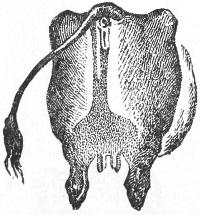
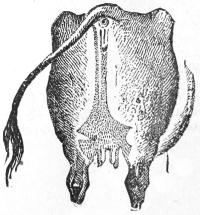
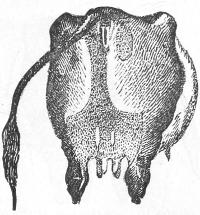
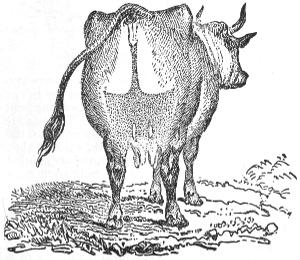
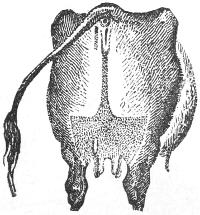
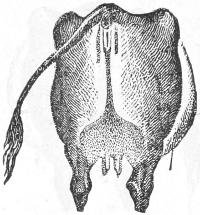
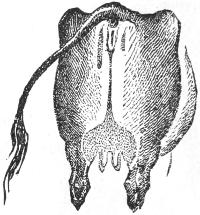
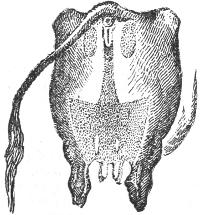
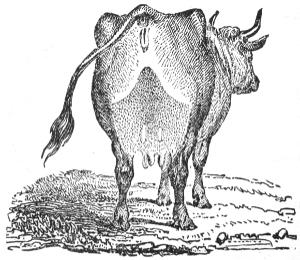
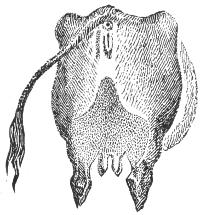
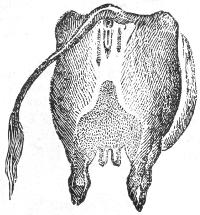
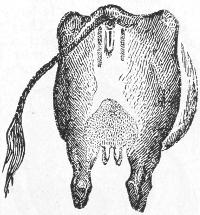
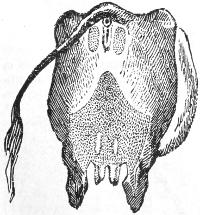
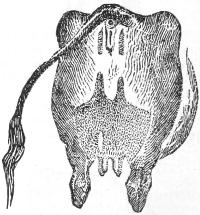
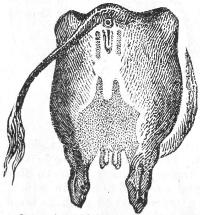
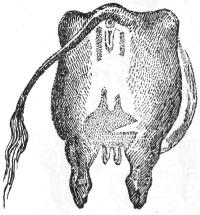
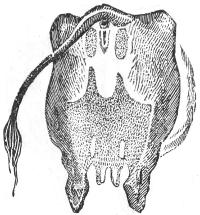
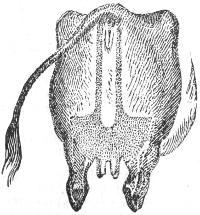
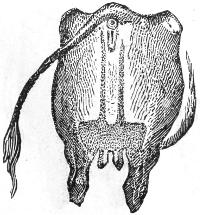
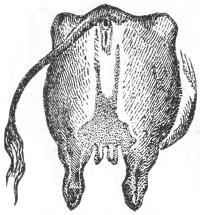
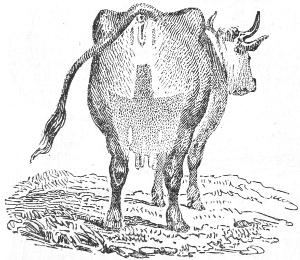
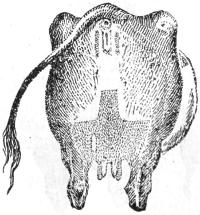
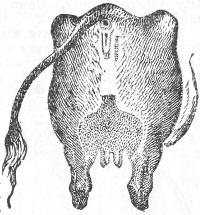
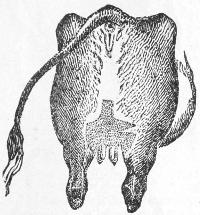
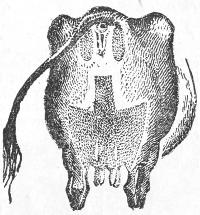
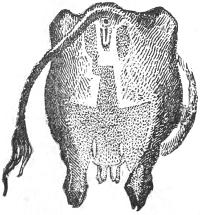
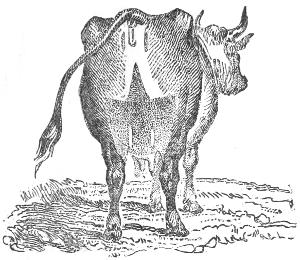
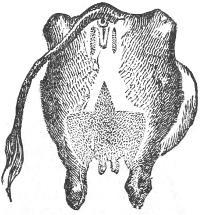
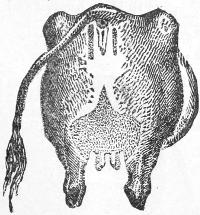
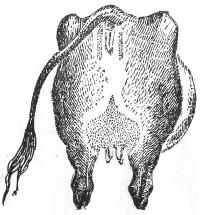
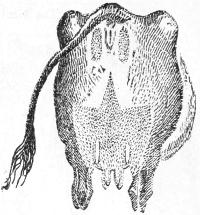
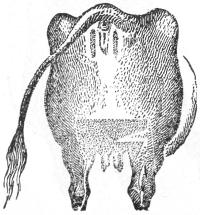
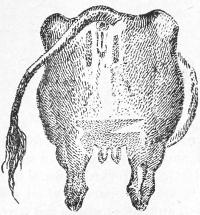
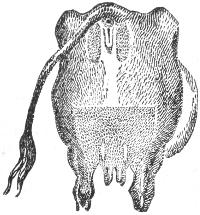
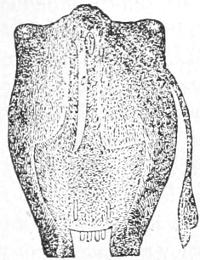
The illustrations of the escutcheons are photographed from Guenon’s
drawings in his last revised edition.
WILLIS P. HAZARD.
Maple Knoll, West Chester, Pa., September, 1879.
GUENON’S INTRODUCTION TO HIS NEW REVISED EDITION.
Error is propagated with the rapidity of lightning; before it every obstacle
disappears, and popular favor seems to welcome it. Truth, on the
contrary, is received with indifference, often even with doubt, suspicion,
and distrust. Indeed, how often have we not seen the author of a discovery
which, having been accepted and realized ought to have advanced
the public good and increased the general welfare, come into contact with
the hatred, the ignorance, and the envy, and thus become the laughter of
fools and the jest of the wise. To some the inventor seemed without good
sense; to others an ignoramus. Too feeble to struggle against all, he
died broken hearted, and left to his powerful antagonists the glory of
having, perhaps for ages, buried his discovery, and to those who bring to
perfection cities and fields the deprivation of a good up to that time unknown.
If more happy than those martyrs for a new idea, I should reach, at last,
that which concerns me, after twelve years of incessant struggles, to cause
the truth to appear to the eyes of all, I should have nothing more to desire.
Nothing would remain for me, except to bless the generous hearts
which shall have aided me in triumphing over routine and error; then on
quitting this world, only to bequeath the worthy men who have so bravely
encouraged and seconded my efforts, the task of simplifying my discovery,
and rendering my method popular to cause the analytical knowledge of
cattle to penetrate even into the most obscure hamlet, and while dividing
thus with me the glory of having done this good, their names will be held
in grateful remembrance by future generations; such has been the idea
which has guided every moment of my life, all the efforts of my mind.
For nearly twelve years, since I have given my method to the public,
through a first edition of my “Treatise on Milch Cows,” the savants and
the practitioners have been greatly prepossessed with it. When they have
seen me make a successful application before them of my system, by a
single inspection of animals which I saw for the first time, they have
expressed a lively surprise.
In the vegetable kingdom, skillful nurserymen have distinguished more
than eighty different orders of pears of summer, of autumn, and of winter;
each of these orders has its distinctive characteristics, as many for the
shape and the taste of the fruit, as for the time of ripening. And when a
tree-grower or an amateur is sufficiently skillful, he distinguishes marvelously
all these species one from another by a single inspection, and at
whatever time of year it may be. He knows equally well what exposure
it is necessary to give to each of them to obtain exquisite fruits.
My first studies had been directed toward arboriculture. I have practiced
with my father during many years. My principal occupation was
the cutting of trees, grafts, both splits and bandages, and by studying
vegetables, I had acquired the idea of and an insight into classifications.
I was better prepared thus for my work of classifying the bovine race,
a work which no one had ever tried, either theoretically or practically.
My classification of the characteristic signs, embraces all the races of
France and other countries, without distinction of sex or age.
Unknown, up to this day, although they have always existed, these
signs have escaped all the world, even the sagacity of the most celebrated
painters, as well as that of veterinary doctors of the highest reputations of
all times.
The appearance of my method should mark an era, for it opposes and
overturns all the prejudiced routines according to which people have
practiced up to this time.
It opens a new era in an art in its infancy, in a science whose first principles
even were unknown. I should then expound it with the greatest
detail.
This method is of the greatest simplicity, whatever has been possible
to be said of it, and whoever will become thoroughly familiar with the
escutcheon of the first order of each class, will be able to judge of all.
Escutcheons are ten in number. They extend, according to their class,
from the centre of the four teats to the level of the upper extremity of
the vulva, and may extend in breadth from the middle of the hinder surface
of one leg, to the middle of the hinder surface of the other. By their
form or configuration, escutcheons characterize and distinguish the ten
families which together constitute my classification. Behold, then, to
what is reduced, in reality, this pretended immense complication.
A special figure, placed at the end of each class, serves to indicate mongrel
animals.
Each of the classes or families is characterized by an escutcheon of
fixed form, always similar to itself, while one does not get out of that
class or that family, but variable in the dimensions of its surface. That
dimension or that surface should be estimated by square centimeters, but
that would be too complicated for the practical man; since it depends on
the size of the individual, it is estimated by the limits of the escutcheon
placed on the hinder part of the animal. The extreme limits are the
hams, the interior surface of the legs and vulva. The surface of the escutcheon,
of which the extent varies, has permitted me to divide each class
or family into six orders, for each one of which I assign, in taking account
of the shape, the quantity, the continuation, and the quality of the milk.
The escutcheon of the first order is the most developed; is also the best
marked. The escutcheon of each of the five other orders is similar in
form to that of the first order. It is, in some sort, only a proportionate
reduction—a diminutive. It is the escutcheon of the first order, with the
dimensions reduced or brought within less extended limits, reaching no
longer the hock nor longer covering the interior of the thighs, nor yet
reaching up to the vulva, remaining consequently at a distance greater or
less from these boundaries.
I have added to this new edition—
1st. Two new classes, sub-divided also into six orders, (the Left Flanders
and the Double Selvage.)
2d. Two varieties of escutcheons, having some similarity with the others.
3d. Finally, the classification of the bull.
These three additions, unpublished until now, complete and generalize
the system of characteristic signs, by which one can prove the absolute and
relative superiority or inferiority of each individual of the race.
These new forms of escutcheons were known to me at the time of the
publication of my first issue, and which I had already announced; but
they occurred so rarely in the races which were familiar to me, that I
thought they were not worth publishing.
But, now, since I have traveled so much, not only in France, but in foreign
countries, I have convinced myself that these classes occur much
more commonly in certain races than I had thought at first. I have felt
the necessity of putting them in my method, and have given them their
proper place.
In respect to the two new varieties of escutcheons, they are like an appendix
to the classification, and characterize the product of crossing between
different classes.
To state precisely their signification and to value their corresponding
milk product, it is necessary to compare these escutcheons with the order
of the class to which they are the most analogous.
When I shall have described the different families of true cows, as well
as their division into orders, the yield or the quantity of milk, their butyraceous
qualities, and the greater or less period of its duration of yield
during gestation, I will pass to the bastard cows, which, though perfectly
similar in form and color to others, differ essentially from them, for they
lose their milk as soon as they are pregnant.
This close resemblance is a source of errors to the most practiced judges.
Thus have I wished in the description of classification, to point out precisely
the distinctive signs by the aid of which one can easily recognize
them. After the study of bastard cows, comes the chapter of bull re-productors.
I have made plain, that in the classifications of bulls, I have reduced
to three the numbers of orders of each class, in order to bring the
application of the method to the most simple expression. The first will
comprehend all the bulls, the good re-producers; the second, the re-producers
of middling quality; the third, the bad re-producers. I mean by
bad, those in which fails the ability for the transmission of the lactiferous
qualities. As one sees, the characteristic signs with the males, as with
the females, have a significant value of the highest importance. With the
bull, they portray the re-productive qualities, and with the cows the lactiferous
qualities. The observers who will apply my system of one kind,
as rigorously for the males as for the females, will observe in the passage
of one order to the other, the same scale of proportion that this established
in the classification of the cows. Although the classification bears
more on the lactiferous or re-productive properties than on the others, it
is important to take in consideration all the other qualities that the individuals
can and ought to possess to be of an irreproachable organization.
The cows of the first and second order of each class, in all the races,
will always give in the same country, a greater abundance of milk than
those of inferior orders. To recognize the lactiferous produce of cows,
whatever may be their class or the locality that they inhabit, it suffices
simply to know the quality of the food which makes the habitual nourishment
of the cows in the place where they are kept.
In following in his appreciation, the degree of superiority or of inferiority
of the escutcheon, one will judge close upon the daily quantity of
milk that all the cows of the same country are apt to give, for one will
know then in what proportion all the figures of the classification should
be modified. A milk cow ought to be neither too fat nor too lean, to give
her maximum of milk. All confinements in a period of thinness is prejudicial
to the habitual produce. Even when the animal would have recovered
her strength, she will not recuperate so as to restore the quantity of her
milk; that can take place only after a year, and by means of a new calf.
A great milk cow, whatever may be her aptness for fattening, and her condition
of fat at the time of calving, becomes thin about fifteen or twenty
days after calving; the time of her rut is therefore less near than that of
a poor milk cow, because her vital forces are weaker. Witness the quantity
of her yield, which is only that of a cow of medium product.
One can compare a milch cow to a fruit tree, which gives more fruit this
year than the next. When the sap of the tree carries vigor to the development
of the fruit, the growth of the wood remains nearly stationary. When,
on the contrary, the tree gives but little fruit, the sap turns to the profit
of the wood, to give, after a repose of several years, a greater quantity of
fruit, and to continue thus by alternative successions.
It is the same with the cow, for it is seldom that her produce keeps the
same during three consecutive years, for the reason that, when the nourishment
absorbed by her turns to the profit of the milk, the milk is more
abundant; when, on the contrary, the nourishment goes to fat, the milk
diminishes.
The variations in the milk quantity should be justly attributed to the
influence of atmospheric circumstances of the seasons, which react on the
quality of hay and fodder in augmenting or diminishing the nutritive juices
of the food.
Cows which are fed in good pastures surpass the product which I have
assigned to their class and their order, while those which are in poor and
wet pastures have necessarily inferior produce, unless the latter have in
the stable nourishing food, more abundant and more succulent than they
are able to get for themselves out of doors.
If, for example, the well-fed cows, or those grazing on rich pasture
lands, should give as much as twenty to twenty-five quarts of milk per
day; these same cows, taken and fed on poor pasture, will give only about
ten or twelve quarts.
If, on the contrary, one takes the cows raised on a poor soil, transfers
them to rich pastures, the milk produce of these same cows will be superior
to that they gave in their original lands.
My readers should well understand that in the valuations of my classifications
that I have not pretended to assign a rigorous and absolute amount.
I have been only able to give an approximate figure to each class and to
each order, adopting the medium limit of the ordinary amount of the different
breeds of various localities.
The atmosphere, the care, and the different foods of each country, all
these different things exercise upon the animal, an influence favorable or
unfavorable, according to the nature of the soil.
There are many other circumstances which should be considered, and
which would disturb the harmony of the figures of my valuation and the
normal quantity. Such are, for example, the case of sickness, accidents,
&c. That is the reason I have adopted, in determining the quantity of
cows of each order, a medium figure, such as is shown in the classification.
I will also observe, relative to those animals to which I assign approximate
weight in the course of this work, that, following the customs of commerce,
of sale, and of butchers, this weight is dead weight, the animal being
deprived of the skin, intestines, head, feet, &c.
If, contrary to custom, I had acted otherwise, and had made the calculation
for the animal on the hoof, the figures given by me would present a
great difference, which would increase according to the amount of fat, sometimes
to double the weight.
The discovery which I have made of the value of the escutcheon is designated
by the contrary direction of the hair, and which had escaped the attention
of every one, even those most interested in gaining the knowledge
of it. It is necessary also to avow the effect produced by the change of
direction of the hair is not glaring on the animal. It is merely a difference
of luster, and the gloss on the surface of the escutcheon and the part of
the skin surrounding it. The hair of the escutcheon is finer, shorter, more
furry, and more silky. Its appearance, at the first glance, makes one think
this part of the animal has been shaved. Compared with the ordinary
hair, the skin of the udder appears to be more designed to be quicker seen
on the part where appears the escutcheon.
All animals of the bovine species, without excepting even wild animals,
are marked with an escutcheon, large, small, or medium, regular or irregular.
Their characteristic sign is transmitted with the generating germ.
I have not thought it necessary to say much on that portion of the
escutcheon which extends on the stomach of the beast towards the navel.
This addition has been thought useless. Enough is shown of the escutcheon
when she is standing.
In order to see well the escutcheons with all the fullness which my
sketches give them, it must be supposed that the udder of each cow is seen
at its greatest plenitude of milk, such as would separate the hind legs to
the greatest extent. In this way the escutcheon is seen as if the entire
skin of the animal was placed flat, or as if the envelope of the milk bearing
apparatus formed a plain surface, on which are drawn the elevations,
the depressions, and all that is not visible to the eye, without the aid of
hands or of movement of the cow, both that which is hidden at the further
side and in the folds of the udder and of the thighs of the animal on
foot.
In order to examine and to distinguish perfectly the escutcheon, one
should place himself behind the animal and make it advance some steps,
in such manner that the movements which it makes in walking should
show, one after another, the parts which one needs to see.
One can also, in passing the nails over the space occupied by the escutcheon
and leading the hand downward from above, in a manner contrary
to the rising hair, and ruffling it, recognize without difficulty its form and
its extent.
Theoretical explanations are always abstract and diffuse in their development.
My method may at first appear difficult and complicated, which,
indeed, pretended savans have chosen to affirm. Nevertheless it is not so,
and in order to comprehend it, it is sufficient to study it. It is with this
as with everything else, to know it is necessary to study and to practice.
The beautiful art which I am about to explain to agriculturists is most
easily acquired. Its technical dictionary is composed only of certain
words, of which the readers should, first of all, know perfectly the precise
signification.
These words are Escutcheons, Epis or Tufts ascending, and Epis or
Tufts descending. After he knows perfectly the different forms and the
importance of these characteristic signs, he will know the whole subject as
well as I do myself.
The Epis or Tuft, as one will see, participates with the escutcheon in the
distinction of the orders—it multiplies the sub-divisions. It seems at the
same time to complicate my method and to render it less accessible; but
I have not felt myself at liberty to omit it, since it has an incontestible
and important value.
If, among certain animals, the form and extent of characteristic signs
are not exactly those of the drawings, but a sort of intermediate between
the characteristic signs of two classes, he who applies the method should
approximate them to the drawing of the classification from which they
differ the least, and from that deduce the probable value.
To render my work perfectly clear, I had to enter into the developments
very much in detail. Nevertheless, so extensive are these details that I
believe I have given neither too many nor too few, and have confined myself
simply within the limits of the possible, the indispensible and the
useful.
And now, whoever my opponents may be, I proclaim boldly and without
fear, that the escutcheon is the only incontestible characteristic sign
that can enable one to discern, by simple inspection, the aptitude for milk
production of each animal.
All animals of the bovine species in good state of health, to which no
accident has happened, and whose escutcheons are of the first orders of each
class, will manifest always, and without exception, as much for the production
of milk as for generative ability.
Beauty of form, to my thinking, represents but an ideal, and although
one ought to take it into consideration, it is a simple accessory without
value of its own, when the question is that of the production of milk.
May I have been able to justify by this work the fruit of the experience
of my whole life, the honor done me by many agricultural societies in admitting
me to their membership, and by the government which has shared
the expense of this new edition, with the twofold purpose of encouraging
my efforts and facilitating the propagation of my method.
GUENON’S METHOD OF JUDGING OF THE VALUE OF STOCK. — On M. Guenon and his System. — The Escutcheon or Mirror. — The Progress of His System. — Imperfections and Tufts. — Of the Ovals. — Of the Bastards. — How to Apply the System Practically. — The Escutcheon. — The Shape of the Escutcheon. — Our Mode of Judging Stock. — Opinions of the System. — Objections to the System and to the Report of the Commission.
Fifty years ago there was dawning upon the world the first ray of a great
discovery. A star was rising in the agricultural world, which was about to
shed new light, and like many other valuable discoveries, it was made by
one among the lowly, and partly by chance. The author of this new discovery
has said, “Error flies with the rapidity of lightning, all obstacles
vanish before it. Truth, on the contrary, is admitted coldly, often even
with doubt, suspicion, and distrust.” It is owing partly to this, partly to
the fact that this new light was given to the world when the mind of
farmers were not ready to receive new ideas of progress as they now seek
them, and much to the fact that it was the invention of a foreigner described
in a foreign tongue. True a translation of it was made through the
medium of an American monthly magazine of agriculture; but it was one
of limited circulation. At that time the number of periodicals devoted
to that interest was few, and such new and important questions were not
thoroughly discussed and the knowledge of them placed in every farm-house
in the land, as it is at the present day. Shortly after the appearance of
M. Guenon’s treatise in the magazine, it was reprinted in book form, and
received the large circulation of sixty-five thousand copies, between that
time and now, and the book most probably sells better to-day than it did
then. By many who procured that book the subject was studied, and advantage
taken of its revelations, being stored away in the reader’s mind
for actual practice. By the great majority it was read, but not studied;
driven from it by the apparent complications of the system and the two
hundred sub-divisions of it; by many, perhaps, it was attempted to be put
into practice, but without their having given the subject that close investigation
which was needed to prove the system correct. It was mostly by
this class of persons, because the system was not found to be infallible,
that it was denounced and given up, even by men otherwise intelligent;
as if anything human could be infallible. Thus it is that by the ignorant
its revelations were received with incredulity, and by many of the intelligent
with doubt; but to the earnest seekers after practical information, it
has unfolded a mine of wealth, and they have proved the system by continuous
experience, and found it to be the most reliable mode of judging
of the value of every member of the bovine species.
It was a happy thought that suggested itself to the Pennsylvania State
Board of Agriculture, to have the system tested by uninterested parties.
But extremely difficult, it was, to obtain persons to make the test. For
those to whom application was made declined it on various grounds,
principally because, as Guenon himself has stated in his latest edition,
many pretended savans would endeavor to throw ridicule upon it; many
others would identify the gentlemen making the tests with it, as if it was
their system that they were testing; while not a few still more narrow-minded,
would think they were trying to humbug them. Thus it was
difficult to fill the places, which offered neither honor nor profit.
It will be seen, by these extracts, that the Governor appointed three
experts to test the system. This they did in the summer of 1878, examining
two hundred cows, jotting down their opinion of the yield, quality,
and time of each of them, and afterwards printing them alongside of the
reports of their owners, so that the public could form their own estimate
of the results of the examinations of the commission. They are here
reprinted, to show how it was carried out. Particular attention is called
to the examinations of the blanketed cows in Thomas Gawthrop’s herd.
It is proper we should inquire into M. Guenon, and the origin and development
of his system.
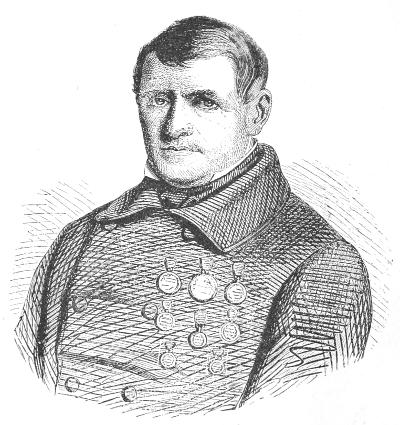
Monsieur François Guenon, a husbandman of Libourne, in France, was
the son of a gardener, and followed for sometime his ancestor’s trade. He
seems to have had a mind above those in his position. As we look at his
portrait, he appears to have a clear eye, a cool head, great determination,
firmness of character, a well-balanced mind, and with it all, a vigor of
constitution which buoys him up, and enables him to over-ride obstacles.
He says himself, he was of an observant turn of mind, fond of comparing
things, and deducing consequences from what he learned by observation
and comparison, particularly from the Book of Nature. Young,
ardent and healthy, with the vivacity of his race, he felt himself destined
for better things than those a gardener’s life would insure him. What
wonder then that his eye was keen to see, his mind to grasp and analyze
any new turn of thought that chance might throw in his way.
Like most self-made men, who have made their mark in life’s pilgrimage,
he set himself to work to improve himself—to acquire that which would
expand his mind, and fit it to receive any new inspiration, and be able to
develop it. He studied the works of the best writers on botany and agriculture;
and applied his knowledge by following up all the ramifications
of the vegetable kingdom, and studied their external signs, that distinguish
the different sorts, and ascertained their qualities and productiveness.
In France, they have few fences, and the cattle of a neighborhood are
driven to the grazing ground, and herded together, and, in turn, members
of each or several families, (the younger portion,) are put to watch that
the cattle do not stray out of bounds. Such companionship with their
stock makes the owners fond of them, and they are treated as pets, and
become very docile. When young Guenon was about fourteen years of
age, he would drive their cow to graze. His cow he was very fond of, and
could identify her among any number. She was a good milker.
In his authorized account of the discovery and perfection of his system,
Guenon uses the following language: “When fourteen years of age, I used,
according to country custom, to drive our only cow to the grazing ground.
I was very fond of her, and could have identified her among ever so many.
One day as I was whiling away the time in cleaning and scratching my old
companion, I noticed that a sort of bran or dandruff detached itself in considerable
quantities from certain spots on her hind parts, formed by the
meeting of the hair as it grew in opposite directions, which spots I have
since called ears, from the resemblance they often bear to the bearded ears
or heads of wheat or rye. This first attracted my attention, and I recollected
having heard my grandfather say that it was probable that there were external
marks on cows whereby their good qualities or their defects might
be known—just as we judge of the vital force of a plant and its qualities
by means of its leaves and lines in its skin. Reflecting on the subject, I
arrived at the conclusion that if in the vegetable kingdom there exists external
signs, whereby the good and the bad qualities of a plant can be positively
known, there ought to exist in the animal, or its kingdom, also, marks
whereby we may judge, by inspecting an animal, of its qualities, good and
bad, and I thought I had discovered one of these signs. I sought the
bearded ears or quirls, and scratched those spots in quest of dandruff, the
abundance or scarcity of this being what first engaged my attention. Every
new cow was compared with my own as a standard, and her superiority,
equality, or inferiority determined in my own mind. In the course of the
comparisons thus instituted by me, with reference to the dandruff alone,
which was at first the only thing that governed me, I had occasion to remark
that great diversities existed among cows in respect to the shape of
the bearded ears (quirls) which produced the dandruff. This suggested a
new train of reflection and observation, which resulted in my becoming
convinced that these shapes were the signs by which to distinguish cows,
and to know the good and bad qualities of every individual among them.”
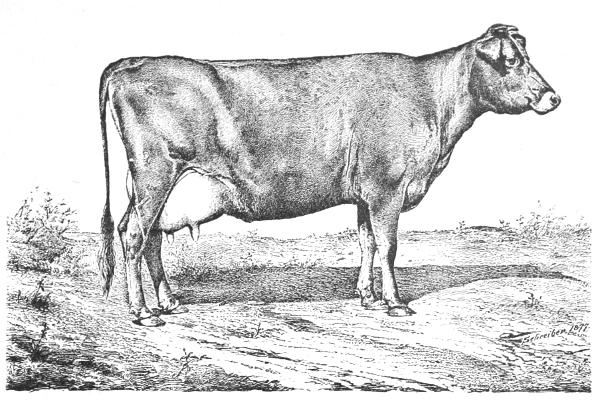
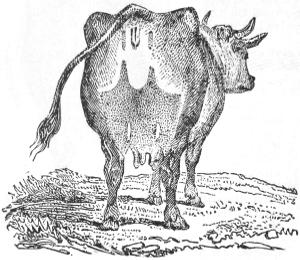
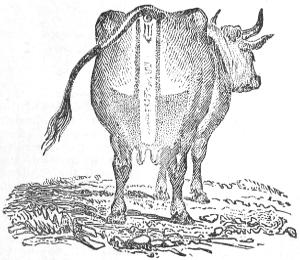
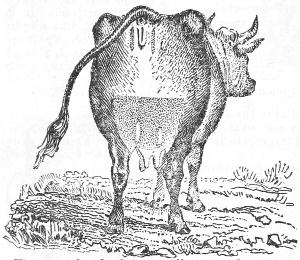
Imported Jersey Cow BLACK BESS.
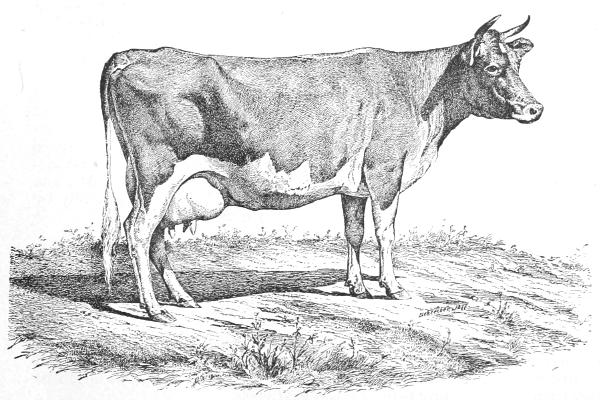
Imported Jersey Cow TIBERIA.
Belonging to C. L. Sharpless, Philadelphia.
In his original plan, Guenon divided these different shapes into eight
classes, each of which was sub-divided into eight orders. As he progressed
in his investigations, he afterwards added two more classes, and reduced
the orders to six in each class. These he supposed would cover all cases
which might come up for examination. He also divided cows into three
grades, which, in accordance with their size, he styled high, low, and medium.
From this it will be noted that Guenon, in classifying cows, was
governed first by the class, second by the order in the class, and finally by
their size. These classes he divided and named as follows:
| 1st |
class, |
or |
Flanders. |
| 2d |
” |
” |
Left Flanders. |
| 3d |
” |
” |
Selvage. |
| 4th |
” |
” |
Curveline. |
| 5th |
” |
” |
Bicorn. |
| 6th |
” |
” |
Double Selvage. |
| 7th |
” |
” |
Demijohn. |
| 8th |
” |
” |
Square Escutcheon. |
| 9th |
” |
” |
Limousine. |
| 10th |
” |
” |
Horizontal. |
The ten orders in each of these classes were simply designated by their
appropriate numerals. Each class was better than the succeeding one, and
each order better than the following one of the same class, but might be
better than the preceding order of the next class.
Of this seeming multiplicity of classes, orders, and sizes, Chalkley Harvey,
one of the commission appointed to test the system, writes thus:
“Now this may seem somewhat discouraging to your readers, but with all due respect
to Guenon, to whom all honor and praise should be accorded for his brilliant
discovery, I think that it may be so simplified that every farmer, dairyman, and dealer
can learn it all in a short time, and may find the study quite interesting. I began it
laboriously, supposing that a mastery of all the details was necessary to make it of any
use, but more than twenty years of constant application in practice has simplified it to
my mind, and has added a little, I think, to the original discovery. The substance of
Guenon’s discovery is that the milking qualities of any cow, of any breed, are indicated
by an outward sign that all may see and easily understand. The hair on a cow, as on
other animals, grows downward on the hind-quarters, but there is an exception to this
rule on the back part of the udder, where it usually grows upward. The first lesson
for a beginner is to notice this fact. Let him stand behind a quiet cow, and rub the
hair on the udder both ways until he sees or feels just what I mean. Guenon called
the surface that is covered by this upward growth the escutcheon; others have called
it the milk-mirror; but this is no improvement in any respect, and I shall name it as
Guenon did, for there is no real objection to that name, and there is serious objection
to making confusion by calling the same thing by different names. The escutcheon,
then, is that surface on the cow’s udder where the hair grows upward. But it is not
confined to the udder, it extends upward above the udder, often to the vulva, and outward
upon the thighs on both sides of the udder. (See Flanders cow, class first, order
first.) These escutcheons are different in size, in shape, and in quality, (quality
means the quality of the skin, and of the hair growing on it,) and these differences indicate
the different milking qualities of the cows, including quantity and quality of
milk, and the length of time they will give milk after being with calf. On the edges
of the escutcheon where the upward and the downward growths of hair meet, a feather is
formed, and this is most conspicuous on the back part of the thighs where escutcheons
extend that wide. If the hair is long, as it generally is in winter time, the observer
can define the limits of the escutcheon better by applying his hand, and smoothing the
hair to its natural place. He will now perceive that the hair on the escutcheon is
shorter and softer than elsewhere, as well as turned upward in its growth, and sometimes
nearly resembles fur.
“Let us now particularly consider the shapes and sizes of these escutcheons. There
is one general shape to which they conform, and that is that they are wider below than
above, and at or near the top of the udder they narrow in abruptly; some continue up
as far as the vulva, and even above it, and others but a little distance above the udder.
The size and shape of this upper part of the escutcheon is of less importance than
that of the lower part, but both must be considered—the larger the escutcheon the
better. All great milkers have very large escutcheons. In large ones the upturned
growth often begins on the belly, in front of the udder, extends along between the
teats and up the back part of the udder, over the whole width. Indeed, the udder
is not wide enough for it, and it encroaches on the thighs, where we may find the
hair having an upward growth on them, inside next the udder, beginning not far above
the hock joints, and running up as high as the wide part of the escutcheon extends
up the thighs, and which often terminates with corresponding curls in the hair at
the outlines, and the higher up and wider these are apart the better. Though the
extension of the escutcheon to the front part of the udder on the belly has been mentioned,
that is not a matter of practical interest in ordinary cases. All that needs to
be studied is plain to be seen by standing behind the cow. When the escutcheon is
small, it does not reach the thighs, and often does not cover the whole of the back
part of the udder. These differences in size can be distinguished at the first lesson
taken in the cow-yard, and when that has been done, the next thing is to consider
their shapes. A good escutcheon is symmetrical. The feathers on the two thighs are
at equal distance from the middle line of the body, and extend up to equal heights
on the back parts of the thighs. A broad and high escutcheon, (speaking now only of
the lower broad part of it,) that is alike on both sides, certainly indicates a superior
milker. There is nearly always another sign accompanying such an escutcheon, and
that is one or two ovals just above the hind teats, on which a fine coat of hair grows
downward. These may be large or small, may be one or two, and may be alike in
size, or unlike, but they are always good signs. Two are better than one, and the
larger and more uniform they are the better; they are almost always present on large
and symmetrical escutcheons. No escutcheon is ever first class if it has not one or
both, and one, at least, of good size. What constitutes ‘good size’ will be better
learned by a few observations than can be taught by inches, and I want to leave something
to the ingenuity of the learner, to make the study interesting.
“Now, let us consider the shape and size of that part of the escutcheon which I have
spoken of as the upper part; that is, the narrow portion that has its base on the top of
the lower and wider portions, and runs up toward the vulva. Sometimes, though very
rarely, this does not exist at all. Sometimes it is broad, and extends all the way up,
with perfect symmetry. Sometimes it terminates in a curved line, at a greater or less
distance up; and, indeed, it may be seen of almost any shape. As a sign of excellence,
the larger and more symmetrical it is, the better—but a good lower part of the
escutcheon is the main thing, and that, as a sign, can hardly be vitiated by any imperfection
of the upper part. When the lower part is very good, there is usually uniformity
in the part. A poor escutcheon is one that is small, or that is imperfect in
form.”
With his mind keenly alive to the pursuit of his investigations, he soon
perceived the difference in the shape of these quirls or marks in the hair.
We can imagine how, when he saw any cow with the same escutcheon as
his own had, he would eagerly and closely question the owner, and then
make his comparisons and deductions. Then, again, when he would see
variations from his cow’s escutcheon, whether larger or smaller, though of
similar shape, how he would study them over! When he would ask of the
owner such questions, directed by his knowledge of the cow’s marks, the
owner would stare, and think how the lad could know so well of his cow.
And then his secret exultation when the answers showed him that he had
judged aright! We can imagine this young enthusiast going on, from step
to step, filling up his leisure with his acquisitions of his new theory, which
was becoming fact, and growing into a system.
From his first step of discovering the dandruff, its scarcity or abundance,
to his noticing the great diversity existing among cows as to the shape of
the bearded ears or quirls, and being convinced these shapes were the signs
by which to distinguish cows, and then to make sure that the same mark
might always be relied upon as a positive sign of the same perfection or
defect; were all steps in the discovery that engrossed his whole mind. He
gave up his trade, traveled about, visiting cattle markets, fairs, and stables.
Conversing and cross-questioning all whom he could; fixing the results in
his mind, and getting the classification shaped out. He talked with farmers,
dealers, and veterinary men, ascertained their modes of judging of the
points of an animal, and found they were all by their own favorite signs
and marks. One looked to the udder, the horns, the hide, or the shape;
others to the hair, the veins, or something else; but none judged by the
signs which he had found out. All were uncertain. The most the best
judges could do would be to guess rightly, perhaps, three times out of five,
but none could tell how long a cow would milk. Perfecting his judgment
he would visit the same places and the same cows several times in a year,
to see how nature was operating upon the animals, and their changes of
character in the different periods of gestation, their treatment and food.
Of course, he soon began to put his theories to practical value, and he
dealt in cattle on his own account. This brought before him cattle from
Holland, Switzerland, Brittany, and other countries. This improved his
opportunities by proving to him that, no matter what country gave them
birth, all individuals possessing the same marks belonged to the same class
and the same orders; in short, that nature acted through uniform laws.
Variations would arise, from crossing two animals with different escutcheons,
from some defect in marking at the birth, from lack of development,
or from those freaks that nature sometimes plays. They always prove
stumbling-blocks in forming the judgment on some animals, and furnish
texts to the opponents of the system.
As Guenon continued his examinations, he found that his classes did not
afford a place for all animals, or rather that there were occasionally to be
found cows whose escutcheons while apparently belonging to one of these
classes, had at the same time, certain distinguished features which he
styled imperfect escutcheons. These Mr. Hazard, the secretary of the
commission, described as follows:
“The perfect escutcheon of each Class is the one which is in Order No. 1.
All variations from this are rated lower in the scale; these variations may
consist of a smaller size, therefore, the escutcheon would not be so broad
or high upon the thighs, nor so broad upon the vertical portion; they may
consist of the lack of ovals, which would place them below the first order;
they may consist of blemishes, which are tufts of hair growing alongside
of the vulva, or below it; or they may consist of strongly marked imperfections,
which may be cuts or slices taken out of the escutcheon; or, coarse,
harsh, wiry hair on the back and upper part of the udder. Finally, they
may be so decided as to place the animal among the bastards.”
Of the tufts, Guenon says all tufts encroaching on the escutcheon diminish
its value, except the oval ones on the udder; that is to say, they indicate
a diminished aptitude for yielding milk. The size and location of
these tufts make the animals descend one or more orders in the classification.
It is, therefore, important to attend to all the patches of descending
hairs which lessen the size of the escutcheon, whether these occur in
the middle of it or form indentations on the sides. These indentations,
partly concealed by the folds of the skin, are sometimes perceived with
difficulty. Many cows, which at first glance appear to be well-marked, on
close examination display their deficiencies, and want of this scrutiny
often causes mistakes in estimating the value of cows, and thus the system
suffers.
Guenon says the cause of the defects, as exhibited by the tufts on the
thighs, is that the veins situated beneath, on either side of the belly, have
a peculiarity; that they are contracted, and there is a small opening for it
where it pierces the abdominal muscles.
Sometimes there is an intermingling of two forms of escutcheons. This
depends upon the crossing between a cow of one class and a bull of another.
This is one of the difficulties to be encountered in precisely estimating
the value of the animal.
Guenon classified the seven tufts, into two kinds: Those on which the
hair ascends, and those on which it descends. Those with ascending hairs
are simply traces which encroach on the descending hair outside the escutcheon,
either on one side or beneath the vulva. Those with the descending
hair are on the escutcheon, and are five in number.
1. Epi ovale, oval tuft. These are situated on the udder, like those on
class one, two, three, four, order first. They are good signs, if of descending
fine hair, small, and regular. They are mostly seen on only the best
cows, though occasionally to be met with in some of the lower orders.
2. Epi fessard, ischiatic tuft. These are found on the vertical escutcheon
on one or both sides of the vulva, as in class four, five, orders two, three,
four; and very conspicuously in the bastards of class three, four, five, six.
They are of ascending hair, and never seen in first class cows, but in most
others to a limited extent.
3. Epi babin, lip-shaped tuft. This is only seen as a sign of deterioration
in the two first classes; it is made by descending hairs, and is a defect
for milking qualities. It is like a string hanging over the top of the vulva,
and making its outline a little below it on each side. It is seldom seen.
4. Epi vulvé, vulvan tuft. This is also a deteriorating sign; is a tuft of
descending hair directly under the vulva, as in class one, orders three and
four.
5. Epi batard, perinæal tuft. This is always a bad mark, as it exists
on otherwise good marked cows, and indicates a diminution of milk, as
soon as the cow becomes pregnant. It is seen on class one, bastard. A
cow is to be looked upon with suspicion that has this mark largely developed.
6. Epi cuissard, thigh tufts. These are diminutions of the escutcheon
by encroachment of descending hair, and denote a diminishing of the
quantity of milk, proportionate to their extent. See class one and two,
order four.
7. Epi jonctif, mesian tuft. The mesian or dart-like tuft, with soft silky
ascending hair, is rarely seen, and only in those classes in which the escutcheon
does not ascend to the vulva. It is like a V hanging beneath
the vulva, and is not fully represented in the plates, though class ten, order
two, shows it somewhat.
In these observations among cows, not only during their work as members
of the commission, but also in preceding examinations, Messrs.
Blight, Harvey, and Hazard noticed a series of marks, which they have
denominated thigh ovals. The plate showing the escutcheon of Mr. Hazard’s
Jersey cow furnishes one of the best illustration of these marks yet
met with by the commission. Where the vertical escutcheon joins and
widens out into the thigh escutcheon, there is usually a dip of a curved
shape more or less in extent. In the plate above alluded to these thigh
ovals descend nearly to the base of the udder. In their careful examination
of more than two hundred cows, the commission always found these
marks only on good cows.
In his examinations Guenon found cows of apparently each class with
certain variations in their markings which distinguished them and prevented
their incorporation into any class, and, yet the similarity gives
them a claim in their particular class. In all cases he claims to have noted
that cows thus marked would milk as well as other members of their class,
until they were got with calf, but as soon as this was accomplished, the
quantity of milk fell off rapidly. The commission claim it is this style
of marking which is most likely to deceive the superficial or amateur investigators,
and that these have caused the assertion that a poor cow may
be well marked, when in reality, if properly understood, she was not well
marked. This class of cows Guenon styled Bastards, and he practically
assigned to them a distinctive or seventh order in each class.
In 1822, Guenon seems to have first reduced his system to a classified
basis, and from that time until 1828 he appears to have given it much of
his time and attention. Having, as he deemed, sufficiently arranged and
tested his system, he, in 1828, applied to the academy of Bordeaux for a
public test of the correctness of his mode of judging of cows and their
milking value.
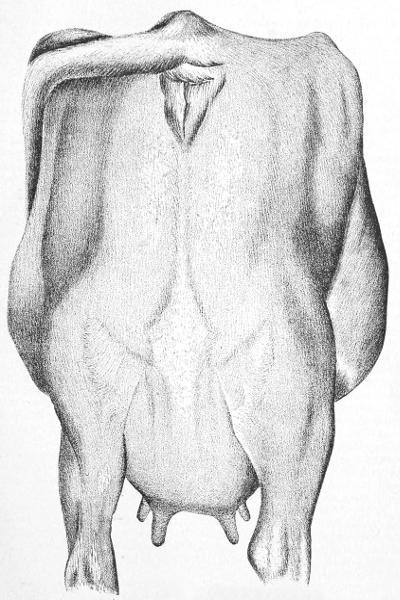
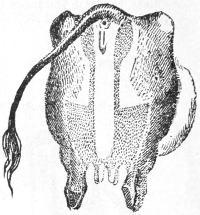
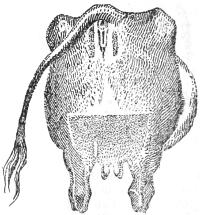
Escutcheon of ROSIE.
Thorough-bred Jersey Cow, belonging to Willis P. Hazard.
The following, from the proceedings of the academy, shows that Guenon
did not make his system common property. The minutes of the academy,
under date of June 3, 1828, contains the following record: “Mr. Francis
Guenon, of Libourne, possessor of a method which he deems infallible for
judging, by mere visual examination, of the goodness of milch cows, and
the quantity of milk which each can yield, has solicited the Academy to
cause the efficaciousness of this method to be tested by repeated experiments.
The case presented by this request was one of a secret method
of judging, which the possessor was not willing to reveal. On the other
hand, it seemed difficult to admit that the external sign, whatever it might
be, by which Mr. Guenon judges, could always bear a proportional relation
to the quantity of milk yielded by a cow. Nevertheless, the academy
deemed it proper to appoint a committee charged with making the examination.
Trials have been made with care, and under precautions necessary for
precluding all collusion. The cows used for the purpose belonged to three
different herds, and amounted to thirty in number, and the result has been
to establish, to the satisfaction of the committee, that Mr. Guenon really
possesses great sagacity in this line. So long, however, as his method shall
be kept secret, it cannot be judged of, nor rewarded by, the academy. Governed
by these considerations, the academy, having ascertained from Mr.
Guenon that he is willing to submit to every test that may be proposed, and
to disclose his secret, upon receiving a just indemnity, has referred him to
the prefect, and has engaged to recommend him to the favorable notice of
that magistrate, who is ever disposed to promote all that tends to improve it.”
From 1822 to 1827, it would seem that Guenon perfected and studied
his system, but it does not seem to have come promptly before the public,
until the agricultural society of Bordeaux took upon itself a careful investigation
of the whole system. From the detailed report of this committee,
appointed by this society to test the knowledge of Guenon, we take
the following as illustrating, not only the results reached by them, but also
the manner of conducting the examination:
“Every cow subjected to examination was separated from the rest. What Mr. Guenon
had to say in regard to her was taken down in writing by one of the committee;
and immediately after, the proprietor, who had kept at a distance, was interrogated,
and such questions put to him as would tend to confirm or disprove the judgment
pronounced by Mr. Guenon. In this way we have examined, in a most careful manner—note
being taken of every fact and every observation made by any one present—upward
of sixty cows and heifers, and we are bound to declare that every statement
made by Mr. Guenon, with respect to each of them, whether it regarded the quantity
of milk, or the time during which the cow continued to give milk after being got with
calf, or finally, the quality of the milk as being more or less creamy or serous, were
confirmed, and its accuracy established. The only discrepancies which occurred, were
some slight differences in regard to the quantity of milk, but these we afterward
fully satisfied ourselves were caused entirely by the food of the animal being more or
less abundant.
“The result of this first test seems conclusive, but they acquire new force from those
of a second trial in which the method was subjected to another test through M. Guenon
and his brother. Your committee, availing themselves of the presence of the latter,
caused the same cows to be examined by the two brothers, but separately, so that after
a cow had been inspected, and her qualities as indicated by the signs in question had
been pronounced upon by one of the brothers, he was made to withdraw; then the
other brother, who had been kept aloof, was called up, and desired to state the qualities
of the same animal. This mode of proceeding could not fail to give rise to difference,
to contradiction even, between the judgments of the two brothers, unless their
method was a positive and sure one. Well, gentlemen, we must say it, this last test
was absolutely decisive. Not only did the judgment of the two brothers accord perfectly
together, but they were in perfect accordance also with all that was said by the
proprietors in regard to the qualities, good or bad, of every animal subject to this examination.”
On the 26th of May, 1837, a similar test was made by the agricultural
society of Aurillac, whose committee, in their report, use the following language:
“Each cow was examined separately by M. Guenon, who wrote his notes upon her,
and delivered the paper closed to one of us. Immediately after, another member of
the committee questioned the owner of the cow, or the person in charge of her, in regard
to her daily yield of milk, its quality, and the time during which she continued
to give milk after being got with calf. The answers were taken down in writing, and
then compared with the notes written by M. Guenon. They were generally found to
accord, and proved to the satisfaction of your committee and of every one present, all
of whom attended with lively interest to these proceedings, that M. Guenon possesses
great sagacity in judging of cattle, and that his method rests upon a sure foundation.”
The Bordeaux committee added: “To the proprietors and to the lookers-on,
all this was very surprising for the examinations were as quickly made
as the results were certain. As to ourselves to whom the method was no
longer a secret, it was with renewed interest and astonishment that we
viewed the accuracy of the results. This system we do not fear to say is
infallible. We only regretted the whole society was not present.”
The committee further reported that Mr. Guenon had, after more than
twenty years observations and researches, discovered certain natural and
positive signs that were proof against all error, while the writers and professors
who have particularly occupied themselves with the bovine race,
can only indicate some vague signs for judging of the fitness of cows for
secreting milk. That this method is valuable, whether it tells the yield of
milk only, or indicates the improvement of breeds, which are liable to deterioration
from mismanagement in crossing, and that it is applicable not
to full-grown animals alone, but also to calves at as early an age as three
months. Thus it affords a sure means of forming a judgment of full-grown
animals, about which we might be misled on account of their form and
their parentage, and secures the improvement of herds by enabling us to
dispose of those calves which will not repay the cost of rearing them. We
shall thus no longer rear calves at great expense for two or three years
that should have been consigned to the butcher, nor sell calves that would
pay best to rear. If this system is pursued, only cows and bulls of best quality
will be kept, and in very few years how great will be the improvement
of our herds, and largely increased the cheapest and best of all foods,
milk, and the production of butter and cheese.
The committee of the Agricultural Society of Bordeaux, therefore, decreed
Mr. Guenon a gold medal, made him a member of the society,
ordered fifty copies of his work, and distributed one thousand copies of
their full report among all the agricultural societies of France.
The next public test Mr. Guenon submitted his system to, was that by the
Agricultural Society of Aurillac, and that society reported that Mr. Guenon
examined the herd of their president, of one hundred cows, from which
were selected designedly, the best, the moderately good, and the most indifferent
of the establishment. Upon each, Mr. Guenon pronounced with
precision, and his decisions corresponded almost invariably with the statements
of the persons in charge. The only variations were very slight
ones, in regard to the quantity given. But this herd was fed unusually
high, and Guenon was totally unaccustomed to the usages of the country
in feeding cattle, and this caused him to pronounce the yield a little less
than it really was. A proof of his system, for he declares the yield will
vary according to the feed and management, which all observant farmers
know to be the case. Mr. Guenon examined some of the cows a second
time, and also the calves, and those calves he assigned to the first orders
the cowherds said were from their best cows, that gave a great deal of
milk.
The notes of his reëxaminations corresponded exactly with his first
statements. The committee therefore awarded Mr. Guenon a gold medal,
made him a corresponding member, subscribed for twenty-five copies of
his book for each of the sub-societies, and distributed their report through
all the agricultural channels of France.
With these testimonials, the highest that could be procured in France,
Mr. Guenon went on with the publication of his book, which had a wide
circulation in every department of France. And he was finally granted a
pension for life of three thousand francs a year by the French government,
after the National Assembly’s committee on agriculture had given
the system a thorough test. In the presence of fifty of the most eminent
agriculturists, M. Guenon made his examinations, and judged correctly
of all but one of the quantity, of all but one of the time, and of all of the
quality; and the committee reported the results were altogether conclusive,
and that his discovery had reached to the dignity of a science. They also
declared the daily production of milk in France might be increased by
several millions of pints daily, and that the abundance and quality of milk
in the dams must contribute largely to the improvement of the progeny.
They voted him the pension, and invited him to deliver lectures in the
different veterinary, agricultural, and normal schools of the kingdom, and
before the different agricultural societies, as “the speediest and best means
of spreading the knowledge of this discovery,” and “to repair the time lost
in ridicule, doubt, or indifference—the inevitable preface to all under-takings
beneficial to humanity.”
In the foregoing account of Mr. Francis Guenon, it will be seen that, by
his indomitable perseverance in perfecting his system or method, he raised
himself from the ranks of a poor gardener’s boy to the position of a great
benefactor, and was presented with various medals and decorations, and a
large sum of money voted to him. Surely, such a brilliant position must
have been won entirely by merit, for he had neither means nor influence
to advance him into notice.
The ovals on the udder are spoken of by Guenon, and our experience
is that they are always indicative of a good yield; particularly, when they
are uniform in size and position, and of fine, soft hair, descending on the
udder. But there is another set of marks, which the Pennsylvania Guenon
Commission have denominated thigh ovals, which are an invariable indication
of a good cow, particularly when she is otherwise well-marked. Of
these, Guenon does not speak. Eusebius H. Townsend and Chalkley
Harvey were the first to call attention to them, and Charles L. Sharpless
has written of them. Our own cow, which took the premium over all the
Jersey cows, at the fall exhibition, in 1878, of the Chester County Agricultural
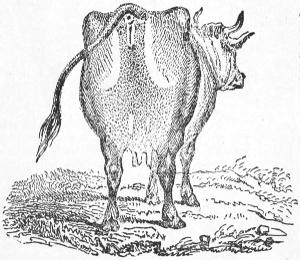
Society, has them most extraordinarily developed. As she is a
very thorough example of this marking, we have had the likeness made of
her escutcheon, and request the reader’s attention to it.
Guenon denominates those cows which give milk, much or little, so long
as they are not got with calf; but, when impregnated, begin to fall off in
their milk. The term he uses is batard, which means, in English, bastard,
spurious, of a mixed breed, mongrel. We should have preferred to call
them spurious cows, as the term bastard does not exactly express the
meaning we apply to that word; but, as it has before been translated
bastard, and is so known by many, we retain it.
The bastards are often the best looking cows; have finely developed
escutcheons, and many give a great deal of milk, some poor quality and
some rich; but, as soon as they are pregnant, they go dry very soon, or
fall off rapidly in their milk, while others give very little milk at all.
From their fine show, they deceive a great many, and Guenon cautions
buyers, as the most skillful will make mistakes. He has, however, given
a series of drawings, by which they can generally be discovered.
These bastards mostly conceive well, and the first time they are put to
the bull, they vary in the quality of milk they give like other cows. The
flow of milk is at its height during the first eight days after calving, though
of bad quality. It then diminishes a little, and keeps on at about the same
yield until she conceives again, when it diminishes again, more or less
rapidly.
To discover a bastard, consult the engravings which are given to each
class. To the first class, the Flanders, there are two kinds. The first,
which is the most common, has on each edge of the vertical escutcheon, a
feathery appearance, and where this is strongly marked by the down- and
up-growing hairs meeting, and they interlock and stand out from the skin,
and, besides, are harsh and wiry, and generally shiny, glistening, and looking
of lighter color, beware of them. The harsher, coarser they are, the
shorter time will the cow milk after getting with calf. The second kind
of bastards among the Flanders will have an oval on the vertical escutcheon,
generally near the middle part, of about two to three inches in
length, by one and a half to two inches wide, on which will be found coarse
wiry hair, and the harsher it is, and the larger the oval is, the sooner the
cow will cease to milk. It may often be discovered by the glistening appearance
of the hair on it.
On all the other classes, the bastard marks consist of two oval patches
of hair, one on each side of the vulva; and the larger they are, the more
pointed in shape, and the coarser and more wiry the hair on them, the
sooner the cow will cease to milk.
The importance of learning the bastard marks is very great, as the
buyer can safely avoid them, and leave them to those less skilled. While
he may buy the less showy looking cow for much less money, and get a
better animal than the unskilled man will obtain even for the higher price.
All animals are more readily judged correctly, and the system can be
learned more easily, in summer than in winter, both on old and young; for
then the winter coat of hair is off, and the hair is shorter, and the escutcheon
is more easily perceived. The skin, also, is more natural and soft,
and the hair is usually not so harsh to the feel; and the cows are cleaner,
and all marks or blemishes more quickly seen.
We will now proceed to apply the foregoing rules and hints practically.
In doing so, we may repeat some that has been before said, but it will only
impress it the stronger in the mind of the learner.
This classification embraced all the kinds of cows known to Guenon,
each individual escutcheon corresponding with one of the orders of those
classes. The class, the order and the size of an animal indicate her yield
of milk, and this will always be found to correspond with her escutcheon.
Every cow has an escutcheon which can be recognized, and according as
it is free from blemish or imperfection, just in that degree does she approach
perfection in her class.
Guenon, in the last edition of his work, has altered and simplified his
classification somewhat, for he divided it into ten CLASSES, and six ORDERS
to each class. He maintained his three grades of size. But our experience
shows that the cows in this country do not vary so much in size as they
probably do in France, for there they have the little Brittany cow, which
is very small but good, and, of course, they have also cows as large as our
Durhams or the Holsteins. Only this, bear in mind, that cows, as a general
rule, all other things being equal, will vary in their yield somewhat
according to their size; and in judging cows apply that rule, for it is part
of Guenon’s system, and they will vary in the quality according to the
breed. Well, then, for practical purposes, we need only study sixty escutcheons,
that is ten different shapes called Classes, and six grades to
each of those shapes, more or less perfect, which are called Orders. To
these must be added ten more for a Bastard to each class. And it is
really necessary to study perfectly only the first four orders of each class
and the Bastard marks, as it is not worth while to purchase or pay much
attention to any cows lower in the scale than the fourth order of any class.
And to simplify it still more, you will notice the thigh escutcheons of the
first orders have all nearly the same shovel shape, so that by remembering
this you need only study the vertical portions to readily place the animals
in their proper class.
The escutcheon was so-called, we presume, from its similarity to the
shape of a shield or escutcheon, and on a first-class cow it will be very
like it, and somewhat like a round-pointed shovel. On this escutcheon,
the hair will generally be of a different color from that bordering it, most
generally rather darker, always shorter, and more nearly resembling fur.
This difference in color is produced by the UP-growing hair contrasting
with the DOWN-growing surrounding it. The hair of the escutcheon should
be short, soft, and fine; and the skin very soft, like a kid glove, thin, and
oleaginous. And if the cow gives good rich milk, this skin will be of a
rich, golden, or nankeen hue. Often where you handle a skin of this character
the hands will feel oily, and soiled with rich dandruff.
The Escutcheon varies in shape, and Guenon named his ten classes from
their shapes.
The first class, he called Flandrine or Flanders, because it is the best,
and he named it from the best cows he knew, those from Flanders, or the
Flemish breed, and they had more of this shaped escutcheon than any
other breed; a quiet but sure proof of the truth of his system.
The second class he called Flandrine à gauche, because although it had
the Flanders shape, it was on the left flank, he called it therefore the
Left Flanders.
The third class are the Lisière, or The Selvage, from its appearance to
a selvage, or binding of a piece of cloth.
The fourth class are the Courbe-Ligne, or the Curveline, because their
escutcheon is lozenge-shaped, formed by a curved line which sides to the
right and left, and rises to about five or six centimeters from the vulva.
The fifth class he denominated Bicorne, or the Bicorn cow, because the
upper part of this escutcheon forks in two horns.
The sixth class, Double-Lisière, or Double Selvage, has an entirely arbitrary
name, and it is an odd freak of nature.
The seventh class is called Poitevine, or Demijohn, from a fancied resemblance
to some kinds of demijohns.
The eighth class is Equerrine, or Square-Escutcheon, as it is square at
the upward part.
The ninth class is the Limousine, as it was on a cow from that Province
that Guenon first saw this shaped escutcheon.
The tenth class is called Carrésine, or Horizontal, because the upward
part of the escutcheon is cut off squarely by a horizontal line.
To each of the above ten Classes, Guenon has placed six Orders,
which are variations of the escutcheon, formed by a reduced size and by
various imperfections. If the reader will remember always, that the first
class is better than the second class, and the second class better than the
third class, and so on down the scale, to the end of the classes, he will
have gained the first step in acquiring the system. Then the next point
to remember is similar, that is, that the first order of every class is better
than the second order of that class, and so on down the scale of the orders,
until the sixth. Then he must learn the different shapes; first, the
characteristic shape of each class, as represented by the first order of that
class, and connect with this, in his mind, the number of quarts a first-class
cow, in good feed and condition, should give, as represented by that escutcheon,
in her full flow of milk. Then he can next learn the variations
in size and shape from this pattern escutcheon, and that will enable him to
tell which order of her class to put her in, and that will then inform him
what quantity of milk she will give, and how long she will give it when
with calf. And we repeat here, it is necessary only to acquire the knowledge
of the first three or four orders of each of the ten classes, as if the
cow examined does not come within those orders, she is not worth examining
further nor keeping longer, nor certainly worth purchasing. Then
the learner must next acquire a knowledge of the distinguishing marks
which point out a Bastard cow, for an account of which marks, see under
that head.
Now all of this knowledge must, to put it into profit practically, be supplemented
by the careful examination of the hair and the skin, of the escutcheon,
and the udder: of the hair, whether it is short, fine, soft, and
furry; of the skin, whether it is soft and close-grained like a kid glove,
thin, oleaginous, and yellow or golden. For if the hair is harsh, and long,
particularly on the back part of the udder, it will shorten the time of
giving milk, and indicates a poorer quality. The more oily or greasy to
the feeling the skin of the udder and the perineum is, the more it indicates
good quality and richness of milk, for the oil or fat is there, showing it is
in the nature of that animal to give butyraceous milk. So with the color
of the skin, if it is golden it is indicative of rich milk, and the majority
think it will make a finer colored butter. There is one point more in
judging by the escutcheon, and that is its size and position, and the general
rule is, the higher up it is on the thighs, and the broader it is on the
thighs, together with the higher and broader it is on the perineum, even
up to the vulva, then the better it is. Then remember the escutcheon has
two principal parts, called the thigh escutcheon and the vertical escutcheon;
the thigh escutcheon extends over the udder and the thighs; and the vertical
is over the perineum or that part of the posterior which extends from
the udder up to the tail and above the vulva.
If the thigh escutcheon is high and broad, therefore very large, and extends
far outward on to the thighs, it indicates a large flow of milk. If the
vertical or upper part is broad and smooth, it indicates a prolonged flow of
milk.
If the thigh or lower portion of the escutcheon is narrow, the flow will
be proportionally small. If the vertical or upper part is narrow and
irregular, it is unfavorable to a prolonged flow.
Chalkley Harvey says further of these marks: “Imperfections, that is
blemishes of form, occur in considerable variety on both large and small
escutcheons. They are all certain evidence of a diminished value of the
cow as a milker. A small and imperfect escutcheon on a good cow, is
something I have never yet seen. Any want of symmetry in the form of
an escutcheon is an imperfection. The two sides should be alike. A small
but perfect escutcheon may be better than a larger one that is imperfect.
A very good one is both large and perfect.
“Thus far we have considered the escutcheon in reference to its form
and size alone, and may now say, that the quantity of milk depends on
these, but its quality is indicated by other signs, which we find to a great
extent in the same place. It is too well known to require any assertion,
that some cows give a large quantity of very poor milk, and others an
equally large quantity of rich milk. It is equally well known that some
cows give but little milk, though they yield a good quantity of butter;
and I repeat, that the signs indicative of these differences of quality are
found in the escutcheon, and they are easily recognized. If the skin in the
escutcheon is soft and oily, and particularly if it is of a rich yellow color,
(though this is more easily seen by examining the end of the tail,) suggestive
of “gilt edged” butter, that cow will give good milk. In such cases
we will find her hair soft and short. There may be some long hairs, too,
but the undergrowth will be as mentioned, and often has almost the quality
of fur. But if, on the other hand, the skin is white and dry, and the
hair thin and harsh, the cow gives poor milk. If her escutcheon is large
and symmetrical, she may give a large quantity of poor milk. The form
and size of the escutcheon indicate quantity, the skin and hair indicate
quality. These signs are true also as applied to bulls, being in such cases
a proper guide in the selection of animals to breed milkers from. My own
experience and observation, which has been considerable in the matter,
convinces me that cows inherit their milking qualities more from their
sires than from their dams; and it is probable that many who have been
disappointed in heifers raised from some favorite milkers, will be disposed
to agree with me. If this be true, then the Guenon method has an application
that must prove valuable to those who breed cows for dairy purposes.
Another interesting fact is, that we can discover all the signs on
a calf, and are thereby enabled to select with much certainty those that are
fit for the dairy, and to reject those that would be only a disappointment,
if raised for that purpose. Of course, a very small cow, with ever so good
an escutcheon, cannot be expected to give a very large quantity of milk,
and might be inferior in that respect to one having a less perfect one,
where the animal is of greater size. But in such cases, the small cow would
give much more in proportion to the cost of keeping. In all cases, therefore,
the size should be taken into account.
“There is a sign that may be mentioned here, (though it does not properly
belong to the Guenon system,) which is a very certain evidence that
a cow will give a large quantity of milk, though it expresses nothing in relation
to quality. It is the large size of the vein running forward from
the udder, on the belly, and just under the skin. This is called the milk
vein, and when it is very large and crooked, and enters the abdomen
through a hole that will allow the entrance of a man’s finger, it is, I repeat,
a sign that the cow will yield a large quantity of milk.
“The time that a cow will continue to milk after she is with calf, varies
in different cases—some ceasing almost as soon as pregnant, and others
milking up to calving. Generally the best milkers milk the longest. Hence
it follows, that a good escutcheon usually indicates continued flow as well
as large quantity. Those escutcheons that are not large at the base, but
that run up to the vulva symmetrical all the way, and pretty wide, indicate
a yield of milk up to the time of calving.”
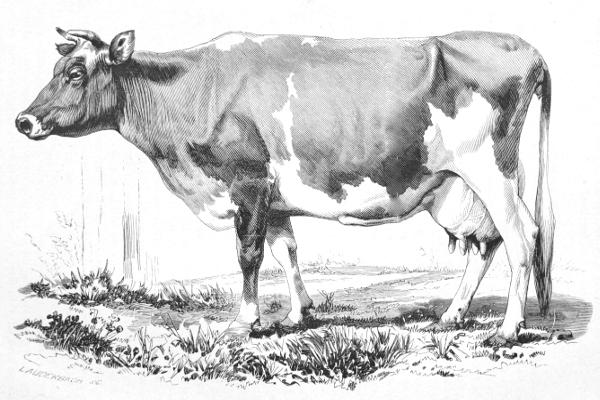
A PERFECT COW—DUCHESS—Imported Jersey, belonging to Chas. L. Sharpless.
The beauty of the Guenon system is, that it is an aid to all other modes
of selecting stock, and therefore, it gives a decided advantage to the person
who understands it over the one who does not. For instance, let two
buyers go into a herd, and let them be equal judges of stock, one of them
will be very apt to buy a bastard, while the other one would very positively
leave her alone, simply because the latter has a knowledge of the best and
surest mode of all modes of judging stock. And this knowledge does not
prevent him from using his half a dozen other modes of deciding its merits,
but aids them. So, too, in selecting a bull for a propagator, the believer
in Guenon will select one with a good escutcheon and a fine skin, while the
other will decide almost entirely by the form. And so with calves, the
one who selects calves by the Guenon marks will be pretty sure to have a
dairy of productive cows, while the other will have to dispose of some
unprofitable ones. The one makes money, because he is working intelligently
with every light of science, while the other is only guessing pretty
well.
We first look at a cow from the front, and see that she widens as she
gets back to her hips, or is wedge-shaped. Next we look at her side, and
we again see that she rises on her back and descends on the belly as she
goes back to the tail, or in other words she is wedge-shaped, too, from
this point of view. These two looks at her have enabled us to see that she
has a feminine appearance; that her head is small and neat in proportion
to her body, with a waxy small horn, a mild but large eye, a broad muzzle,
and that it is well set on her neck; that she has a good chest, and large
deep paunch, with large full ribs, fuller below and joined to a rather high
back bone; that is to say she has not the breadth of back we look for in a
beef animal. If the chine is double, it indicates a cow above the average; if
the chine is single, sometimes we can lay our three fingers in three depressions
in it at about the middle of it, showing that she is a loose rangy cow,
and fitted for her work. Now we will look at her udder and see that it
runs forward as level as possible to the belly, and that it is large, with
four good-sized, well-shaped teats slightly strutting from each quarter.
Now we gently approach her, and pat her to gain her confidence, and get
a chance to feel her hide, her milk veins, and examine her escutcheon. If
we find her skin is thin, soft, and greasy, with short fine hair, with rather
a furry nature, and showing the skin yellow under it; that her udder and her
perineum have soft thin skin, with very short furry hair; that her milk veins
are large, zig-zag, and knotty, entering the body with good-sized holes,
and particularly if this vein is double, extending and ramifying over the
udder well back in prominent veins, and if the veins extend over the perineum,
we may then, with great confidence, look for a large well-shaped and
formed escutcheon, marked first class, order first, by an oval on each side
of the back of the udder, and perhaps two thigh ovals or dips where the
vertical escutcheon rises from the broad or thigh escutcheon; and just to
finish and find all points corroborating, we will look on the vertical escutcheon
for some spots of oily lemon colored dandruff, and at the end of her
neat, lightly made tail to find some large yellow pieces of dandruff. We
don’t like to see it dry and brown; and as we step back from her, we
just give a parting look to see that her hips are rather large, bony, somewhat
drooping, that her capacious udder has room to project between her
legs.
Then, we feel sure that a loose, open made cow, rather pointed, or sharp
and well-defined, and the contrary of what we would look for in a flesh or
beef producing animal; with a skin mellow and yellow, covered with soft,
fine hair, and the nearer it comes to the quality and color of a first class
Guernsey or Jersey cow, breeds which have for hundreds of years been
bred for butter making, then we repeat we know she must be a good, rich
milker and butter maker; for we never saw a thick, hard skin cow, with
coarse, long hair, that was a good butter maker, or fit for anything but
giving poor milk, if a strong milker.
Our preference is for a medium sized cow, one that will dress five hundred
and fifty or six hundred pounds; and, as far as our observation goes,
a Jersey sire, with an Ayrshire dam, is the best cross for a milk and butter
cow, and the most profitable for the amount of food consumed; though
a Jersey or Guernsey sire to the milking stock of Durhams, or a Holstein,
or a large yielding native cow, will produce a better cow for butter than
the mother was.
To get thorough practice in valuing the escutcheon, take this book in
hand, and go into your dairy-yard; compare the escutcheon of each cow
with her picture in this book; see what it calls for time and quantity, and
then thoroughly test your cow; don’t guess at it, as most farmers do; and
make your own comparisons. Remember the size and class of the escutcheon
will give you the quantity and time; the skin and hair will give
you the quality; and always remembering the size of the cow, and of what
breed she is, for they must qualify your opinion somewhat.
A writer in the Country Gentleman of July 17, 1879, S. Hoxie, of Whitestown,
New York, so thoroughly expresses our experience and convictions,
that we are led to quote it:
“The writer has been acquainted with ‘the escutcheon theory’ ever since
about 1850. During this time he has been a practical dairyman in central
New York. At first he approached the study of the escutcheon as a doubter.
It seemed to him an absolute absurdity to claim a connection between the
growing of the hair and the production of milk, two functions so entirely
different.
“At first he examined the herd of cows which he helped milk every night
and morning, and was surprised to meet with so many proofs of the truth
of the theory. He then observed it upon other herds, and finally extended
his observations to various breeds under various circumstances. He was
at last compelled to come to the final conclusion that the theory, in the
main, was true, but that other points and conditions of the animal must
be understood in order invariably to reach a correct judgment:
“1. The breed modifies the quantity and quality of milk production.
This is so manifestly true that it needs no argument. A particular order
and class of escutcheon indicates a different quantity and a different quality
of milk on a Jersey than it indicates on an Ayrshire cow.
“2. The condition of care and feed to which different families of the
same breed have been accustomed during long periods modify milk production,
and must be taken into consideration. For instance, certain families
of Short-Horns have been cared for and fed through several generations
with the sole view of beef production; other families have been trained to
milk production. Escutcheons upon the former indicate far less quantity
of milk than upon the latter. Thus some families with very fine escutcheons
give very little milk. The escutcheons in such cases no doubt indicate an
original capacity that a few generations of proper treatment might awaken
and develop.
“3. The capacity and health of the digestive organs modifies the quantity,
and we also think the quality, of milk production. Cows with large,
healthy digestive organs will eat and properly digest more food, and give
good return at the pail, than one with opposite conditions of the digestive
organs. The former may sometimes give the larger quantity of milk,
though, indeed, possessed of the poorer escutcheon.
“4. The activity of the nervous system materially affects milk production.
This is often seen when the animal is unduly excited. The quiet dispositioned
cow that attends to feeding, and is not disturbed by any excitement
in the herd or in the surrounding fields, may have the poorer escutcheon,
yet give larger quantities of milk than the extremely excitable cow, with
the better escutcheon.
“Other conditions will suggest themselves to the observing and reflecting
man, that materially affect the quantity and quality of milk production.
“These modifying conditions do not disturb the true theory of the escutcheon.
Other things being equal, the escutcheon is indicative of the
quantity and quality of milk. Many are misled in estimating the value
of the escutcheon, because they have not the patience or the capacity to
observe the varying conditions. The escutcheon is of immense practical
value. It is easily seen the conditions of flesh do not change it, and animals
of all ages, above three months, may be examined by it, and their
milking qualities determined with a good degree of accuracy. Other
things being equal, the animal with the better escutcheon will invariably
make the butter maker. During nearly thirty years of observation, the
writer never observed a first class cow that had a poor escutcheon. The
escutcheon must be of great value to those who are breeding, and endeavouring
to improve thorough-bred cattle of the various milking breeds.
It offers a test that may be applied before milking age, and it may be applied
to males as well as females. Though the pedigree is ever so long,
and though it contains many good ancestors, the animal should be rejected
from the breeding herd, unless it has a good escutcheon.”
“One of the Farmers,” a regular correspondent of the American Agriculturist,
writes in the number for November, 1878:
“The Value of the Guenon Milk Mirror.—Taken with a good udder
and milk-veins, good digestive functions, and capacity for food, good health
and thrift, the Guenon milk mirror is a valuable indication of both the
quantity and duration of the flow of milk. This seems to be demonstrated by
the experience of thousands who have given the subject careful study, and
I have never yet met the man who ridiculed it, and called it “folly,” who
was able intelligently even to outline the prominent types. The number of
calves which do well or ill as milkers, very nearly as indicated by their
milk mirrors, is so large, that one of the principal practical uses to which
a knowledge of the Guenon system can be applied is in selecting calves to
raise, and, of course, to those who buy cows, it comes equally well in use.”
The American Association of Breeders of Dutch Friesian Cattle,
composed of some of the most practical and intelligent farmers of the dairy
region of central New York, have adopted a new set of rules for entry into
registry in their Herd Book, wisely making the performance at the pail one
of the necessary requirements. Thus, for a period of not more than twelve
months from date of calving, the cow under 2½ years of age must give 6,000
lbs. of milk; over 2½, and under 3½, 7,000 lbs; over 3½, and under 4½, 8,000
lbs; over 4½, 9,000 lbs; also, rule 8: No animal shall be admitted to registry
unless of the “milk form,” or of the “combined milk and beef form,”
of medium or of large size, without coarseness, and if a female, having a
well developed escutcheon, not below the 4th order of the 1st class, the 3d
orders of the 2d, 3d 4th, 5th, 6th, 7th, and 8th classes, the 2d order of the
9th class, or the 1st order of the 10th class of the Pennsylvania Commission.
With such a record, and with such marks, no one need take the
trouble to see the stock, but may safely order it, knowing exactly what
they are to receive.
George E. Waring, junior, says:
“If the escutcheon teaches anything it teaches the duration of the flow
of milk. This is its great value in connection with the Jerseys—a race
of small, rich, and persistent milkers. It does indicate quantity, it is true,
but not Dutch quantity, nor Ayrshire quantity; only Jersey quantity,
which is quite another affair. It indicates, in at least equal degree, the
continuance of the flow of milk. Indeed, this is the great value of Guenon’s
discovery. It is easy to judge of the present flow of milk in the
case of any given cow, but, so far as I know, there is nothing but the escutcheon
to tell us how long she will continue to milk after getting with
calf. If she has a first class escutcheon, I think we are safe in believing
that she will hold out well in her milking. If she has a very defective
escutcheon, we may depend on her to fall away very rapidly when a few
months gone, and to shut down entirely three or four months before calving.”
From an exhaustive and admirable treatise on the Ayrshire breed, by
John D. W. French, of North Andover, Mass., we make the following extracts
from his remarks on the Guenon system:
“Pabst, a German farmer of large experience, with a view to simplify
the method of Guenon, and render it of greater practical value, made five
divisions, or classes:—
- 1. Very good, or extraordinary.
- 2. Good, or good middling.
- 3. Middling, and little below middling.
- 4. Small.
- 5. Very bad milkers.
“Magne, the French writer, made a still further simplification, by making
four classes instead of five:—
- 1. The very good.
- 2. The good.
- 3. The medium.
- 4. The bad.
“In the first class he places cows, both parts of whose milk-mirror, the
mammary and the perinean, are large, continuous, uniform, covering at
least a great part of the perineum, the udder, the inner surface of the
thighs, and extending more or less out upon the legs with no interruptions,
or, if any, small ones, oval in form, and situated on the posterior face of
the udder. Cows of this class are very rare. They give, even when small
in size, from ten to fourteen quarts per day, and the largest size from
eighteen to twenty-six quarts a day, and even more. They continue in
milk for a long period.
“The second class is that of good cows, and to this belong the best
commonly found in the market. They have the mammary part of the
milk-mirror well developed, but the perinean part contracted or wholly
wanting. Small cows of this class give from seven to ten or eleven quarts
a day, and the largest from thirteen to seventeen quarts.
“The third class consists of middling cows. When the milk-mirror
really presents only the lower or mammary part slightly developed or indented,
and the perinean part contracted, narrow, and irregular, the cows
are middling. Cows of this class, according to size, give from three or
four to ten quarts per day.
“The fourth class is composed of bad cows. No veins are to be seen
either on the perineum or the udder, while those of the belly are very
slightly developed, and the mirrors are ordinarily small. These cows give
only a few quarts of milk a day, and dry up a short time after calving.
“Mr. C. L. Flint, in his work on ‘Milch Cows,’ says:—
“These classifications, adopted by Pabst, Magne, and others, appear to be far more
simple and satisfactory than the more complicated classification of Guenon. Without
pretending to judge with accuracy of the quantity, the quality, or the duration which
a particular size or form of the mirror will indicate, they give to Guenon the full credit
of his important discovery, as a new and valuable element in forming our judgment
of the milking qualities of a cow, and simply assert, with respect to the duration of
the flow of milk, that the mirror that indicates the greatest quantity will also indicate
the longest duration.
“My own attention was called to Guenon’s method of judging cows some eight or
ten years ago, and since that time I have examined many hundreds, with a view to ascertain
the correctness of its main features, inquiring, at the same time, after the views
and opinions of the best breeders and judges of stock, with regard to their experience
and judgment of its merits; and the result of my observations has been that cows
with the most perfectly developed milk-mirrors or escutcheons are, with rare exceptions,
the best milkers of their breed, and that cows with small and slightly developed
mirrors are, in the majority of cases, bad milkers.
“I say the best milkers of their breed, for I do not believe that precisely the same
sized and formed milk-mirrors on a Hereford, or a Devon and an Ayrshire, or a native,
will indicate anything like the same or equal milking properties. It will not do, in
my opinion, to disregard the general and well-known characteristics of the breed, and
rely wholly on the milk-mirror; but I think it may be safely said that, as a general
rule, the best marked Hereford will turn out to be the best milker among the Herefords,
all of which are poor milkers; the best marked Devon, the best among the Devons;
and the best marked Ayrshire, the best among the Ayrshires; that is, it will
not do to compare two animals of entirely distinct breeds by the milk-mirrors alone,
without regard to the fixed habits and education, so to speak, of the breed or family
to which they belong.”
“In my own herd of Ayrshire cows, the largest milkers have the best
escutcheons, and these cows have, in most cases, transmitted these marks
to their descendants. On the other hand, the cows with medium or poor
escutcheons have rarely transmitted to their calves better ones; but, generally,
of the same or lower class than the dams.
“Bulls.—Guenon’s second and hardly less important discovery was
that the bull had the same marks as the cow, only somewhat shorter and
narrower. Guenon bestows upon these marks the same name, ‘milk-mirror,’
which may be justified, in as far as the bull has greater influence
upon the sustaining or obtaining of an abundant yield of milk, as well as
the improvement of the breed.
“Some Testimony.—Mr. L. A. Hansen, of Bay St. Louis, writes, in a
letter to the Country Gentleman:
“I served my apprenticeship for three years on a dairy farm with two hundred cows,
performing all the labor appertaining to a farm, the same as one of the hired men.
After this, for twenty years, I had dairies of from eighty to one hundred and seventy
cows. Living in the best dairy country then known, and our butter commanding the
very highest market prices in London, England, (taking the premium at a butter exhibition
in London,) we considered it the best policy to buy our cows instead of raising
them, and I consequently had to purchase from twenty to thirty cows every year.
Having adopted the Guenon system as a helping guide in my purchases, I necessarily
examined more than a hundred cows annually, besides having under daily observation
my own cows and those of the neighboring dairy farms. Thus, I had continual
practice through a number of years. The classifications of the professor, mentioned
in my former article, were, with very rare exceptions, right. In the first two classes,
they did not fail once; in the lower classes, more frequently; but as the lower classes,
with their sub-division, are of no importance to the dairyman—only the two first being
fit for a dairy—the study of them becomes unnecessary, and it is of little avail if they
are minutely correct.
“As nothing in this world is perfect, we cannot reasonably expect the Guenon system
to be without defects; but, as already stated above, the imperfection is to be
looked for in that part which is immaterial for practical application. Under all circumstances,
as far as my experience goes, the Guenon theory will always remain a
valuable guide in selecting milk cows.”
“Mr. L. S. Hardin writes, in a prize essay:
“Very few, if any, modern writers upon cattle have accepted the complicated
theory of Guenon, while no two of them agree as to the extent in value of the escutcheon.
As a point of beauty, it should certainly be cultivated in the herd. As to its
practical value for indicating the milking qualities of the cow, my experience is that a
finely-developed escutcheon is rarely seen on a poor milker, while many excellent
milkers have very small or no escutcheons at all. In other words, its presence is a
good sign, while its absence is not necessarily a cause for distrust. Milk-veins, as an
indication for milking capacity, are of about the same value as the escutcheon.”
“The editor of the Jersey Bulletin, in commenting on this, says:
“We should be very glad to know of a cow, worthy to be called an ‘excellent milker’—duration
of the flow after becoming pregnant being one of the tests—which has no escutcheon
at all, or a very small one. As at present advised, we don’t believe she exists.
Most old cow men would say that, if the escutcheon is as valuable an indication
as the milk-veins, too much effort can hardly be made to extend knowledge concerning
it.”
“Henry Tanner, professor of agriculture, Queen’s College, Birmingham,
England, says, in a volume of prize essays of the Highland and Agricultural
Society:
“Some attention has also been given, within a few years, to a discovery, made by
Mons. Guenon, respecting ‘the escutcheon,’ as it is termed. Like many other persons,
he was carried beyond the boundary of discretion in his speculations, and thus his
valuable observations were for a time lost in the mist with which he enveloped them.
Sufficient is already known of its value, at least, to lead us to the conclusion that it is
worthy of more general knowledge.
“A very extended observation has proved that, other conditions being equal, the
modification of form presented by the escutcheon will lead to an estimation, not only
of the quantity of milk which the animal will produce, but also of the time during
which the cow will keep up the supply of milk.
“Without going into detail upon this point, I may briefly state that the larger the
extent of the escutcheon, the greater is the promise of milk, and also of its continuance,
even after the cow is again in calf. A cow may have a small escutcheon, and yet
be a good milker; but observation leads to the conclusion that, if she possessed a more
fully developed escutcheon, she would have been a better milker. It may be considered
a point of merit, not as deciding whether or not the cow is a good milker, but
rather as an additional indication which may be taken into consideration in conjunction
with other characteristic points. It is also desirable, in estimating the extent of the
escutcheon, to make full allowance for the folds in the skin; otherwise, a large escutcheon
may be taken for a small one. Besides the escutcheon, there are tufts of hair (epis)
which have a certain degree of value when seen upon the udder of the cow.”
“I presume there are many men who, although perhaps not caring a pin
for an escutcheon, yet consider themselves fully capable of selecting a good
milk cow. Now, although ignoring the escutcheon in their judgment, are
they not apt, in selecting an ideal cow of any particular milk breed, to
find a good escutcheon developed of one class or another?
“Perhaps it may be asked, if the Guenon system is a true one, why are
not the Short-Horns a great milk breed, for in them we often find very large
and perfect escutcheons?
“This question may be answered as follows: The Short-Horns were originally
a good milking breed; but, having been made particularly a beef
breed, the milking propensity or mammary system has in most families
been changed or bred out. Notwithstanding this change, they may retain
the escutcheon, not as a mark of quality, but as one of the characteristic
marks of the breed.
“All farmers are aware that a first-class milk cow may, by injudicious
feed and treatment, especially as regards milking, become a second-class
animal. Now, such a system, carried out generation after generation, must
certainly degenerate a milk breed, however good their marks and quality.
“Among the Short-Horns, probably the best milkers have good escutcheons;
but an Ayrshire cow, with an inferior escutcheon, might be found
to give more milk than a Short-Horn with a superior escutcheon, simply
because one breed has been bred especially for beef, the other especially
for milk.
“To show how breeding for a purpose through many generations may
ultimately change qualities, let us compare the Short-Horns with the Dutch
or Holsteins. The early Short-Horns, or the Teeswater breed, as it was
called, was of Dutch origin, or was certainly formed by crossing the native
cattle of England with stock imported from Holland. This breed was
originally considered remarkable for its milking qualities.
“The Dutch breed, bred for generations for the especial purpose of milk,
is to-day noted for large milkers, and among the cows may be found extraordinarily
developed escutcheons.
“The following extract, from a translation from the French of Magne
on milk cows, is apropos, as showing the difference between characteristics
of breeds and qualities of the animals:
“A long, fine head, narrow towards the horns, and a slender chest are given by most
writers as characteristics of a good milk cow. Now, in Flemish, Danish, Dutch, and
Brittany cows the fineness of head and chest is a characteristic of these races and not
the indication of particularly developed milking qualities, being met with alike in the
good and bad milkers of those races; whilst in some of the Swiss breeds, and especially
in those of St. Gervais, nearly all the cows, whether good or indifferent, possess a large
head and heavy chest. The farmers of Ariege, while showing us some remarkably
good cows, drew our attention to their strength of chest, ampleness of the dewlap, and
the volume of the head: these characteristics of race they mistake for qualities, observing
them in their best cows. On the other hand, it is to be remarked that cows with
fine heads are often inferior milkers. If fineness of head were a true proof of mammillary
activity, would not the cows of the Durham breed be amongst the best dairy
animals in the world? This characteristic cannot, therefore, be considered absolutely
appreciable, as much depends on the race to which a cow may belong. It is indicative
of milk only, because it is a remarkable point in those races which have produced
milk cows. Thus a characteristic of race has been mistaken for a sign of particular
qualities.”
“If, then, we should regard the escutcheon, as well as a fine head, one
of the characteristics common in the Short-Horn, it is not necessary to
consider it as an indication of any particularly developed quality. Although
probably the best milkers would have this sign, yet it might be regarded
as a latent sign of milking qualities which had been bred out by disuse.
The only fair way to judge of the value of the escutcheon in determining
milking qualities, is to consider its influence in the different breeds separately,
not comparing one breed with another. In judging grade cows,
characteristics and blood must have a certain influence on the judgment.
The general type of the animal must be considered.
“In the Ayrshire cow, we must regard the escutcheon, not as a special
characteristic of the breed, but as one of the signs denoting quality.
“If the time should come when it has become so universal a sign of
quality as to be considered a characteristic of the breed, then we shall have
approached much nearer perfection than at present.
“Admitting that the escutcheon theory is a failure, or at least that it has
failed as a test-mark of milk, have we any other mark or series of marks
that have invariably given better results?
“Magne says, that in Flanders, a cow is considered a good milker, ‘especially
when towards the middle of the spine the apophyses (or projections)
are separated or scattered so as to leave a space between of about
two finger-breadths,’ for the reason that, when the spine is thus formed,
the haunches are better spread, and the thighs and croup larger. The
other members of the body are also better developed, the basin is ampler,
and the organs placed in this cavity, as well as the udder, are more voluminous.
“Now, would our dairymen consider this a more certain indication of
milk, than a good escutcheon?
“Without regarding the escutcheon as an infallible sign of quality and
quantity of milk, I believe it to be one of the best indications of milk, that
nature has provided; but in the use of this system, we must consider:—
- 1. The breed.
- 2. The age.
- 3. The feed.
- 4. The treatment (present and past.)
- 5. The health.
“A good, not to say a thorough, understanding of the Guenon system,
cannot be obtained by casual observation, but only by the most painstaking
examination of many animals, extending over a long period of time.”
M. Guenon in his Treatise on Milk Cows, does not give any positive
reasons why the escutcheon is indicative of the yield. He rested content
with the fact, that he had proved it so before many learned men, and risked
his reputation upon publishing the facts. The system as far as we have
been able to trace it, has always been verified by those who have thoroughly
studied it, and tested it by extended practice according to the rules of Guenon.
The principal cavilers against it, either admit they have not constantly
pursued it, or show by their writings their lack of sufficient knowledge
of it. The report of the Pennsylvania commission has incited several
to write against the system. The principal paper produced was one read
before a meeting of the State Board of Agriculture, by Eastburn Reeder,
and which he had reprinted in several papers. Of this essay, it is sufficient
to say, he showed he had not studied nor practiced the system thoroughly,
and because he could not understand it and got befogged, he
quoted a large mass of scientific matter to show the system could not be
true. These attempts at argument are so quietly, but completely, set aside
in the essay of Prof. D. E. Salmon, D. V. M., on Contested Dairy Questions,
quoted below, that we shall not discuss them further. For we cannot
any more tell absolutely and positively why the escutcheon reveals
what it does, than we can tell why a black cow eating green grass, converts
red blood into white milk, than we can tell why the green grass grows. In
both questions at issue, we have certain facts and theories to guide our
reason and judgment about them, but we know nothing positive, and because
it is so, Mr. Reeder and Mr. Hardin won’t believe it is so or can be so.
In addition to what Mons. Magne, the eminent French veterinarian,
one of the most celebrated medical professors in France has written, Professor
Arnold, of Rochester says, when indorsing what Magne writes:
“The size of the escutcheon is regarded as the measure of the quantity
of blood supplied to the milk-producing vessels, and are evidence of their
capability of elaborating milk. In the same way, the veins take up the
blood, and carry it back in the milk veins which pass through the bag and
along the belly, and enter the body through one or more holes, on their
way to the heart. The size of these milk veins, and the holes where they
enter the body, vary with the escutcheon, and like it, give evidence of the
quantity of venous blood passing away, from and through the udder, and
they have the same significance with reference to quantity, as the supply
of arterial blood and the size of the escutcheon.”
Mr. Reeder also quotes the weights of cattle given by Guenon, and triumphantly
exclaims, whoever saw such small cows in this country? Guenon
distinctly quotes the weights, as net dead weight, or the animal deprived
of its head and horns, its hide, entrails, and feet, and gives the excellent
reason for it when he says: “If I had made the calculations for
the animal on the hoof, the figures given by me would present a great difference,
which would increase according to the amount of fat, sometimes
to double the weight.” Unfortunately, Mr. Reeder did not know enough
of Guenon’s facts to be aware of this clear statement, and supposed the
weights were live weight.
Again, he says the commission did not examine the stock correctly.
He would have looked at an animal, decided what escutcheon it had, or
“to which class and order she belongs, and then append the figures of
Guenon as the result. Any other mode of proceeding is not testing the
Guenon system.” Here again his lack of knowledge of the system is
shown; it would be exceedingly unjust to the reputation of Guenon, as he
distinctly declares the size, the age, the breed, the treatment, the season,
the period of gestation, &c., shall be fully considered. It is the judgment
of just such men passed upon the system, which have tended to throw any
doubt upon the merit of Guenon’s assertions. What would be thought of
the judgment of such a person, if told by a physician to administer three
things to a patient, and he gave but one, and the patient died, and he excused
himself by saying, “you told me to give him medicine, and I gave it.”
Then Mr. Reeder denies the value of the system for pointing out the
best feeders. The cow which gives the most butter, and which this system
will readily point out, will fatten the most rapidly when dried off; for
the butyraceous particles, which go to make the butter, will be diverted
from the milk and turn to fat on the animal.
Mr. Reeder objects to the report of the commission, that they “in some
cases failed to classify cows,” and “made incorrect classifications,” and
“in some cases gave different results from Guenon,” and lastly “the terms
employed to denote quantity, quality, and duration, are too vague, indefinite,
and unsatisfactory.” In all these objections, Mr. R., it will be readily
seen by any practicer of the system, shows his utter ignorance of the mode
of applying it.
Guenon says it is sometimes impossible to properly classify an animal,
owing to the effects of a cross, or some freak of nature. In such cases
they may be judged according to the escutcheon it the nearest resembles.
This the commission did, but of course could not classify them.
His judgment as to “incorrect classifications” we must pass by as of no
account, he not being any more capable of that than the commission.
The same may be said of “giving different results from Guenon.” That
is entirely a matter of judgment. Guenon says, judge of the cow by various
things and then the result will approximate the amount stated to each
escutcheon. Mr. Reeder says the amount set down to each escutcheon is
inflexible. We prefer to follow the skill of Guenon and not the ignorance
of Reeder, as it was Guenon we were appointed to test.
Finally, he objects to the terms employed to denote the significance of
the escutcheon. The great difficulty of the commission was to find herds
of which an accurate test of each animal had been made and kept. We
believe not one farmer in one hundred thousand has such a record. Yet
the commission are expected by such “infallible” advocates as Mr. R. to
tell the exact character of each cow, and that record is to be set down
alongside of the inaccurate record of the owner; and if they vary at all,
the commission are the ones at fault. The very terms Mr. R. objects to
were employed by us by special agreement with the owners, because they
hesitated to say how many quarts or pounds each of their cows gave. But
where there were such careful farmers as W. M. Large, M. Eastburn, J.
Pyle, and M. Conard, who gave quarts, and the commission gave quarts,
we would invite attention to the comparative reports as the best answer.
And even in Mr. R.’s own case we ask comparison, for the reason why the
commission are on most of his cows one or two quarts higher is easily accounted
for, because we did not learn until after the examination that he
was generally ranked by his neighbors a poor feeder, which would certainly
make the difference. In the cases of such fine herds as those of S.
J. Sharpless, Thomas M. Harvey, Thomas Gawthrop, and H. Preston, &c.,
the accounts were highly satisfactory to their owners and confirmed them
in the merits of the system. For the same reasons we object to his test
of “the system in other herds” as any proof of the merits of Guenon, for
it was his interpretation of the escutcheons that is given, and it would be
very unfair to judge Guenon as interpreted by one who is not an expert.
Mr. Hardin has written much against the system, but containing very
little argument, and no valid objection. We will endeavor to sift out of
the mass, any points made:
He thought there should be one “non-believer” on the commission, so
as to “make a fair and disinterested report.” What possible use he may
have been is a mystery, except to cavil at what perhaps he did not understand.
The commission simply put down what they interpreted the escutcheons
to indicate, and the owner stated what he knew of his stock. The
two accounts were brought together and compared. What more a non-believer
could have done, we are at a loss to conceive.
His process of examination was laid down thus: “To take down in
writing before you see the cows, the owners’ and milkers’ opinions of all
the cows to be tested.” “Make the owners and milkers, out of hearing of
each other, tell you the name of the cow, her age, how much milk she gives
when fresh, how much milk she gives a year, is her milk rich or poor; have
you ever tested the milk by measure, or otherwise to determine the amount
or its richness; what breed is she?” “Get a non-believer to make pencil
sketches of each escutcheon.” “The Governor to appoint two more on the
committee who are not believers.”
Now, having laid out this programme, he does not say what was to be
done with it. The inference was to be drawn, we suppose, that the many
escutcheons were to be engraved, and the public were to draw their conclusions
from them and the reports given by the owners and milkers, and
see how Guenon would stand the test. And what were the believing or
non-believing commissioners to do? Supervise the taking down of all
this? How, at once, this shows Mr. Hardin to know little or nothing of
the system! Like Mr. Reeder, he did not know that Guenon assigns many
other things to be thought of to form a correct opinion! Was it more
proof to be told by the owner all that any one could know about the cow,
and then say that corresponds with the escutcheon? Or did it put the
system to a severer test, to say to the owner, don’t tell me a word, and
then proceed to tell him all about a cow you never saw, simply from examining
her escutcheon? In one case, you are assisted to define the escutcheon
by the knowledge given you. In the other case, you define the cow’s
character by only the knowledge you can get from the escutcheon. No
better proof can be given of Mr. Hardin’s lack of practical knowledge
of the system.
Another objection he makes, and repeats several times, as being a very
strong one with him, is, why did not Guenon, and why do not the commissioners,
go to work and buy up all the best cows and sell them at a profit,
and thus get very rich. His cry is, why don’t they make plenty of money
out of it, if it is so valuable? Simply, because neither of them are in that
business, or care to be. But Mr. Harvey, a manager of the Delaware
county almshouse, in one year from taking this position, changed the
cows there, and increased the yield twofold from the same number of cows,
and has bought and sold all the steers and cows on his large farm for many
years solely by this system, and has grown wealthy.
He says in another article “feeling the modesty that naturally attaches
itself to benighted ignorance,” he “started out in the city in search of some
one who was learned on these subjects.” He found “a professor in our
medical institute,” “one of our most learned physicians,” and they proceed
together to canvass Professors Magne and Arnold’s theories and facts
about the formation of the escutcheon. The result of two such wise heads
(or of “benighted ignorance”) coming together, was that neither of them
ever heard of Professor Magne, and that his dictum was “opposed to all
the teachings of physiology.” The learned professor knowing as much
about a cow as he did of physiology. And it is such stuff as this which
forms the arguments of Mr. Hardin. Professor Salmon in his essay on
Contested Dairy Questions effectually settles these “learned” men.
We have devoted enough space to a writer, who finds it so easy to tear
down, but is never able to build up, a doubting Thomas, whose only mode
of judging a cow, he says is a crumple horn, a large udder, and to test
the milk every Monday for one year. What an amount of money the
farmers of America would lose annually if they followed his rules, and
what an amount they would save by following Guenon’s rules!
The following valuable essay is from the Country Gentleman of August
7, 1879:
Contested Dairy Questions.
By D. E. Salmon, D. V. M.
Several of our prominent dairy writers have been lately discussing the
more complicated questions of their department in a very energetic and
decided, if not in a scrupulously exact manner. Now, if these questions
are worth the time and space necessary for their presentation at length,
they are certainly of sufficient importance to receive candid and perfectly
truthful treatment; and, though these writers may not have intended to
give wrong impressions, their teachings can hardly be considered, in several
respects, as representing the present condition of knowledge on these
points.
Magne’s Theory of the Escutcheon.—In Mr. Eastburn Reeder’s essay
on the escutcheon—which is a valuable paper, though marred in the above
respects—there is an attempt at scientific argument in order to ridicule
the accepted value of the milk-mirror; and the assumed facts on which
this argument is based, are presented in such a positive manner that they
will probably be accepted, without further investigation, by the majority
of readers unless contested at once. The writer has hesitated to do this
in the hope that it would be done by some one else; but the truth is of
too much consequence to allow the matter to pass entirely without notice.
The first point to which I will call attention is the attempt to dispute
Magne’s opinion that the hair turns in the direction in which the arteries
ramify, and that the reversed hair on the udder and adjacent parts indicates
the termination of the arteries which supply the udder with blood.
When these arteries are large, he holds, they extend through the udder
upward and onward, ramifying on the skin beyond the udder, and giving
the hair the peculiar appearance which distinguishes it from the rest of the
surface. If these arteries are very small, they are not likely to extend
much beyond the udder, and, hence, form a small escutcheon; consequently,
a small escutcheon indicates a feeble supply of blood, and little material to
make milk of.
Now how is this combatted? The first argument is that “when Mr.
Hardin showed this paragraph to one of the most learned medical professors
at Louisville, Kentucky, he at once wanted to know who this Magne
was, and declared his name unknown in the annals of medical science.”
What are we to think of such a statement as that? Magne—member of
the French Academy of Medicine, formerly director of the Alfort Veterinary
School and professor of Lyons—unknown in the annals of medicine!
We are then asked if the arteries are not the same in all cows, and are
told that we might as well expect more bones or muscles as more arteries.
If Mr. Reeder will turn to Chauveau’s Anatomy—one of the best authorities
in the world—he will find, in general remarks on arteries, the following
statement, which I translate, not having the English edition: “Arteries
very often present variations in their deposition, which the surgeon
should keep in mind. These variations ordinarily concern the number,
the point of origin, and the volume of the vessels.” And if he will go
through the list of arteries, he will find examples given of each of these
variations.
Again, he asks, “how is it that the ramification of the arterial circulation
causes the hair to grow in one direction on one part of the cow’s body,
and in the opposite on other parts?” Not a very difficult question, if we
admit that arteries have such an effect, for they certainly do not all ramify
in the same direction.
In a revised edition of the essay, subsequently published, some important
points were added. Here we are told that “the arteries supplying
the udder with blood are called the mammary arteries, and their ramification
does not extend beyond the outer surface of the udder. Further down
the aorta, or main artery, another pair of arteries branches off, called the
femoral arteries. These supply the muscles of the thigh, or what we know
as the rounds of beef, with blood, and ramify upon the portion of the escutcheon
lying between them. Still further down, another pair of arteries,
called the gluteal arteries, leave the aorta, and are distributed through
the pelvic region, and ramify upon the extreme upper portion of the escutcheon.
Here we have at least three distinct systems of arteries ramifying
upon the escutcheon, and two of them most certainly have no connection
with the milk secretion whatever.”
Without attempting to point out all the errors of this description, we
will once more refer to Chauveau to settle the more important points.
The reader will find in that work that the femoral arteries have a branch
called the pre-pubic, which in turn has a branch called the external pudic,
from which the mammary artery branches. It will also be found that the
mammary artery “sends several divisions to the tissue of the udder, and
is prolonged between the thighs by a perineal branch, which terminates in
the inferior commissure of the vulva, after having furnished glandular and
cutaneous divisions.” Turning to the description of the gluteal arteries,
we find that they ramify in the gluteal muscles, which are at a considerable
distance from the perineum, and that nothing is said of their going
to the last named part.
Here, then, is complete and positive refutation of these arguments—not
by mere statements of my own, but by the words of a standard work, of
world-wide reputation, on the anatomy of these animals. Magne’s facts
are correct, then, whether his inferences are or not. The same artery that
supplies the udder with blood supplies the skin on which the escutcheon is
formed; and, more than this, the artery ramifies in the direction in which
the hair of the escutcheon grows. Is there any connection between the
two for all that? Who knows? A point or two to show that such a connection
is not beyond the possible may still be in place.
Erasmus Wilson, who has made a specialty of the skin and its diseases,
shows that the direction of the hairs on the anterior surface of the human
body is, commencing at a point near the arm-pit, downwards and slightly
inwards towards the umbilicus, and that below this point the direction is
upwards and inwards; so that the umbilicus “is the center of convergence
of four streams,” as he expresses it.
Now this disposition, complicated though it is, certainly resembles that
of the arteries—the branches from the axillary artery passing downwards
and inwards, while the epigastric arteries branch from the femorals near
the groin, and have a direction upwards and inwards. On the neck, the
direction of the hair is upwards and backwards; in front of the ear, it is
downwards and forwards; behind the ear, it is backwards—in each case
following the arterial ramifications. In addition, Tisserant and others in
France, who stand high as authorities, admit that the escutcheon continues
to increase in relative surface till the second or third milking—that is,
till the development of the udder, and, consequently, of the vessels supplying
it have reached their highest point.
In some cases, it must be confessed, the correspondence in question apparently
does not exist, but rather the opposite; and as the mammary artery
has substantially the same distribution with horses as with cattle, we
cannot see why the former should not be as plainly marked as the latter,
if the direction of the hair depends on the direction of the arteries.
But, it may be asked, in what possible manner could the one condition
influence the other? It must be remembered that physiology is still a growing
science, and that there are many things yet to learn, so that it is still
pardonable to confess ignorance. We know, however, that the cavity in
the skin surrounding the hair (hair follicle) is set in an oblique direction,
as well as the hair that emerges from it; the papilla at the bottom of this
cavity must also be inclined, and it is this that, in all probability, decides
the direction of the hair, as the growth of this takes place by additions of
cells from the surface of the papilla. Now, each papilla, or elevation, has
a vascular loop, or, as some say, a minute artery and vein, and one can
easily imagine how the direction of this minute artery might influence the
direction of the papillary summit, and, consequently, of the hair that grows
from it.
I do not say that this is the proper explanation, but I suggest it as one
way in which the correspondence might be accounted for. I do say, however,
that the evidence brought to bear on this point by Mr. Reeder can
have no influence in deciding the question, for the reason I have given.
Dr. Henry Stewart, the noted scientific and practical farmer and writer,
said lately; “I have for some time past been studying the nature of the
escutcheon physiogically and anatomically.” And he has “recently discovered
a still more satisfactory connection between the milking capacity
of a cow and the development of the escutcheon.”
“The milk-vein is an important mark of the deep-milking cow. But it
is not the veins, but the arteries, which supply blood to the system, either
for the production of tissue or the secretion of the milk. And yet the veins
are important because they bear a direct relation to the arteries, being the
return channels for the blood after it has fulfilled its functions; and so the
larger supply of blood conveyed by the arteries requiring a vein of large
capacity to return it, this vein is an ultimate indication of the vigor of the
circulation of the lacteal organs. The main artery which supplies these
organs is the subcutaneous abdominal [what Mr. S. says is commonly called
the milk-vein.] This important artery supplies a large part of the posterior
portion of the system, furnishing blood to the genital organs and the skin
covering these and the adjacent parts. The subcutaneous abdominal artery
is one of the two branches of the external pudic artery in the female, the
other being the mammary artery. This last is very voluminous and distributes
several main branches to the mammary glands and tissue, and also
by a prolongation between the thighs, supplies the inferior commissure of
the vulva and gives off many smaller branches, which spread into a network
among the glandular tissue and the cutaneous structure. Here is the
close connection, then, between the skin of the posterior part of the cow,
from the lower point of the vulva down between the thighs and around the
udder, and the udder itself. The same artery supplies all this portion of
the skin, furnishes the subaceous glands and the hair follicles, and the whole
cutaneous structure, and the hair also with blood, and also provides for the
demands of the milk-secreting organs. A vigorous circulation through a
voluminous arterial system ... gives a relatively vigorous milk
secretion, and, as well, a growth of hair, which curls and forms the well-known
peculiar structure of the escutcheon.”
C. L. SHARPLESS ON THE ESCUTCHEON.
We extract from our book on “The Jersey, Guernsey, and Alderney
Cow,” some remarks on the escutcheon, by Charles L. Sharpless, of Philadelphia.
We consider him one of the best judges, a most intelligent
breeder, and he has paid the highest price ever given for a Jersey cow in
this country. The portraits of Duchess, Rosa, Black Bess, Tiberia, and
the bull, Comet of M., bear out our assertion.
“There is no point in judging a cow so little understood as the escutcheon.
The conclusion of almost every one is, that her escutcheon is good,
if there be a broad band of up-running hair from the udder to the vulva,
and around it—see Fig. 1. These cows, with the broad vertical escutcheon,
are nearly always parallel cows; that is, with bodies long, but not
large, and with the under line parallel with the back. Their thighs are
thin, and the thigh escutcheon shows on the inside of the thigh, rather
than on its rear.
“Next comes the wedge-shaped cow, with the body shorter, but very
large, deep in the flank, and very capacious. This form does not usually
exhibit the broad vertical escutcheon, running up to the vulva, but with
a broader thigh may exhibit a thigh escutcheon, which is preferable to the
other, thus—see Fig. 2.
“In both vertical and thigh mirrors, where the hair runs down, intruding
on the udder, (as low as above the dotted lines,) as in Figs. 3 and 4, it
damages the escutcheon. If you find a cow with the hair all running down,
and between the thighs—that is, with no up-running hair—stamp her as a
cipher for milk-yielding.
“The artist has made the udders to Figs. 1, 2, 3, 4 the same size, while
in reality they will vary according to the escutcheon.
“There are times when the udder of a cow, with an escutcheon like Fig.
4, will be enlarged by non-milking, for the purpose of deception. It is
always safer to judge by the escutcheon, rather than by the large size of
the udder.
“The escutcheons of the best cows—those yielding the most and continuing
the longest—will be found to be those which conform to Fig. 2.
[Mr. S. alludes to the selvage: one of the best, and common among the
best cows. H.]
“The vertical escutcheon of Fig. 1, would not injure it; but if that ornamental
feature has to be at the expense of the thigh escutcheon, Fig. 2
is best as it is.
“Whenever an escutcheon is accompanied by a curl on each hind-quarter
of the udder, it indicates a yield of the highest order....
“So far we have noticed only the rear escutcheon, or that which represents
the two hind-quarters of the udder. The two front-quarters are
just as important, and should be capacious, and run well forward under
the body—see A. If the udder, in front, be concave, or cut up as in B,
indicating small capacity, it represents reduced yield.
“This front or level escutcheon is distinctly marked in the young heifer
or bull, and can be seen by laying the animal on its back. The udder
hair under the body all runs backward, commencing at the forward line
of the escutcheon—see dotted lines in Figs. 6, 7, 8. This dividing line is
very perceptible, from the fact that the hair in front of it all runs forward
towards the head of the animal, while the escutcheon, or udder hair, all
runs backward over the forward quarters of the udder, around and beyond
the teats, and ceases at the markings of the rear escutcheon, on and between
the thighs.
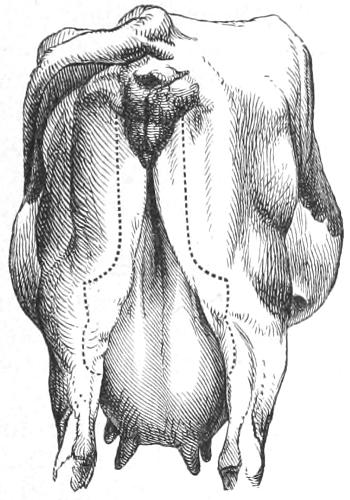
Fig. 1.
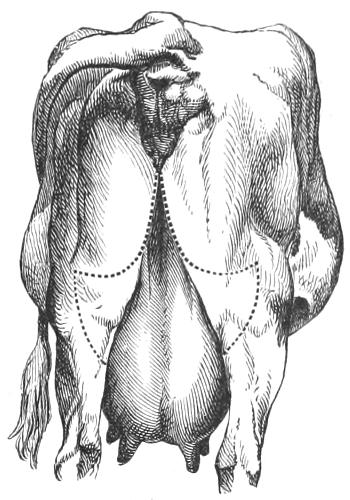
Fig. 2.
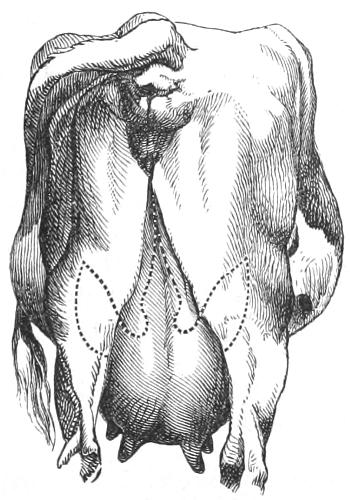
Fig. 3.
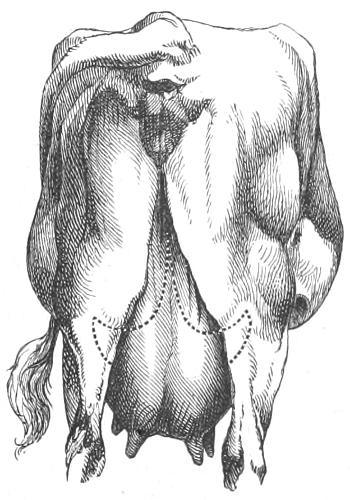
Fig. 4.
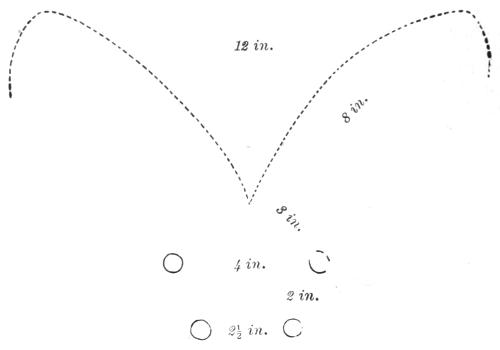
Fig. 6. LOTTIE STARR.—10 mos. old.
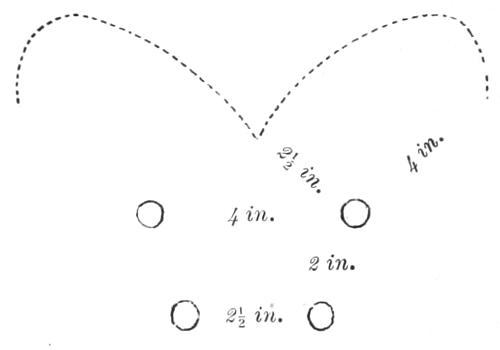
Fig. 7. SYLVA—10 mos. old.
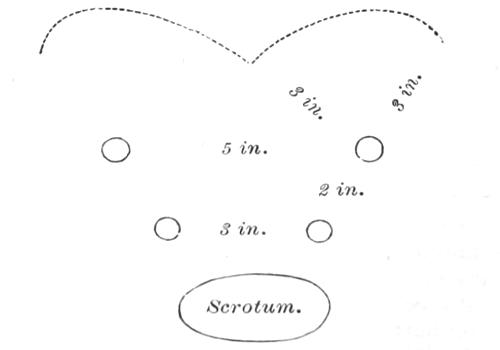
Fig. 8. COLUMBUS.—10 mos. old.
“The breadth and extent forward of this front escutcheon, indicates the
capacity in the mature animal, of the front quarters of her udder. In
some cases this front escutcheon will be found of twice the extent that it
is in others, and is evidence of that much more yield. The dimensions
on Figs. 6, 7, 8, are actual measurements—the first two of heifers, and the
last of a bull. If Fig. 7 represents four quarts as the yield per day of the
front quarters, Fig. 6 will represent eight, thus, if the rear yield is the
same, say four quarts in each cow, the total yield of Fig. 6 will be twelve
quarts, while that of Fig. 7 is but eight. This examination enables one
to see the size of the teats and their distance apart, and to test the looseness
and softness of the udder skin. It is marked precisely the same in
bulls, see Fig. 8, and can be easily examined at any age between one and
ten months.
“Udders of all shapes hold milk, and some homely ones hold a large
quantity. B, C, D, and E, at a glance explain their deficiencies, both of
shape, lack of capacity, and bad style of teats. In udder A, we have the
perfect shape....
“Many think that the escutcheon of the bull is of but little moment, so
that he is a good-looker. So far is this from being the case, that a bull,
with a mirror like Fig. 4. or worse, will stamp his escutcheon on, and to
that extent damage his daughters, out of cows with escutcheons as choice
as Fig. 2. In this way the daughters of some of the best cows come very
ordinary, while, if you use a bull marked like Fig. 2, he will make poor
escutcheons better, and will improve the best. His injury or benefit will
be doubled, according to the escutcheon markings under his body in front
of his scrotum. Hence the importance of the dam of a bull being unexceptionable
in her udder and escutcheon. Her qualities, inherited by her
son, will be transmitted to his daughters.
[Mr. Sharpless’ bull Comet of M. is one of the finest Jersey bulls we
ever saw, and his escutcheon is unexceptionable, being a perfect curveline,
the one most commonly found on bulls.]
“While careful as to escutcheons, we must not neglect the other essential
features of a good cow—the buckskin hide, the rich-colored skin, and the
fine bone. Let the hair be soft and thickly set, and let the skin be mellow.
This latter quality is easily determined by grasping between the thumb
and forefinger the skin at the rear of the ribs, or the double thickness at
the base of the flank that joins the stifle joint to the body, or that on the
inside of the rump-bone at the setting-on of the tail. Let the teats be
well apart; let them yield a full and free stream, and be large enough to
fill the hand without the necessity in milking of pulling them between the
thumb and forefingers. And let us ever keep in mind that the large yielder
must be well fed.”
Those who condemn Jersey cows as small yielders of milk and butter,
should listen to the story of “Rosa” as told by her owner, C. L. Sharpless.
She is five years old, is solid creamy fawn, and, combined with great volume
and bone, she is neat in the head and neck, and with fine legs. Her
dam was a small mouse-colored cow, and her sire’s dam a small fawn-colored,
neither of which would give over twelve quarts.
“We found we were making a good deal of butter, and as ‘Rosa’ looked
superbly, we determined to test her butter quality. We fed her per day
twenty pounds of hay, eight quarts of meal, and four quarts of carrots.
The meal was a mixture of good wheat bran and cornmeal, in the proportion
of four bushels of the former to one bushel of the latter. Her yield
the first day was sixteen quarts, the second day fifteen and a half quarts,
the third day sixteen quarts, and the next morning eight quarts; being in
all seven milkings, or half the week. Her milk was kept separate; was
skimmed after standing thirty-six hours, and made six and three fourths
pounds of butter, or thirteen and a half pounds for the week.
“As you place Rosa and Duchess side by side there are some points of
agreement and of difference that are of interest to notice. They are both
wedge-shaped, with large body—Duchess the more bony, but Rosa with
the greater rear volume, (broader hips, &c.) They both have neat heads
and necks, and fine bone. Duchess is, in winter, smoke-color, with brilliant
white, but not with black points. She has yellow hoofs and skin,
and her udder is rich yellow. Rosa has yellow hoofs, and yellow inside
her ears, but a pale skin and udder, and would be called a butter cow inferior
to Duchess, and yet she has just proved herself one half pound
greater. The color of it is the deepest—no coloring matter being used.
This upsets the theory that a yellow skin is essential for deep-colored
butter. Perhaps a safer way to put it is, that though a rich yellow skin
is evidence of butter quality, yet equally good quality may come from a
pale skin, provided the cow has yellow inside her ears.
“Again, as to vertical or rear escutcheons both these cows exhibit, the
broad part diminishes as it rises, until, when within six to nine inches of the
vulva, it is reduced to the breadth of not over an inch wide. Thus they
agree in their rear escutcheons, and they agree also in udders of great capacity,
these being deep and broad, and running well forward under the
body.
“There is a point on which they differ. The hair on Duchess is soft and
furry as a mole; that of Rosa is fairly fine, but still hair.
“So that in a word one can say soft hair, a large escutcheon, and a yellow
skin are desirable, but there may be choice cows not conspicuous, for either.
“To show how we sometimes let our best animals slip, I will add that
when Rosa was a heifer I was tempted to part with her for what seemed a
great price—$500. In about two weeks she had a heifer calf, for which
her owner was offered $150. When three years old she had a second
heifer, which he sold for $180; and when four years old she had a third
heifer calf, which he sold for $100. He then sold his place and all his
stock, and I bought her at public sale for $375 for her beauty. Her pale
skin deceived me as to her butter quality, and her, as I thought, deficient
escutcheon misled me as to her large yield. She now, as a five-year old,
has her fourth calf, which is a bull, and some two months old.
“In giving above her yield, I gave also her feed. Such is her constitution
and appetite that I think she would have eaten half as much more,
and in that way her yield might have been very much increased. It was
good enough as it was, particularly as there have been choice cows so
forced that, though the premium was won, the cow was lost. The winter
yield, on dry feed, of sixteen quarts is considered equivalent to eighteen
on grass.”
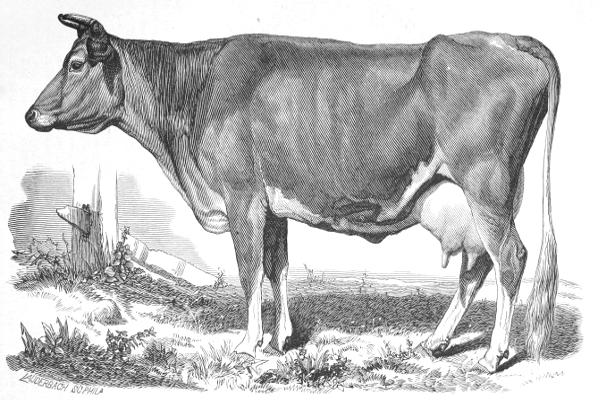
ROSA.—Imported Jersey, belonging to C. L. Sharpless.
DESCRIPTION OF THE CLASSES AND ORDERS. Prepared by W. P. Hazard , Secretary of the Pennsylvania Guenon Commission . — First Class. The Flanders Cow. — Second Class. Left Flanders. — Third Class.—Selvage. — The Fourth Class. Curveline. — The Fifth Class. The Bicorn. — The Sixth Class. Double Selvage. — The Seventh Class. Demijohn. — The Eighth Class. Square Escutcheon. — The Ninth Class. Limousines. — The Tenth Class.—Horizontal. — Effects of Crossing two Escutcheons.
In the following descriptions of the ten classes, and their sub-division
into six orders each, we give the quantity as stated, for a large-sized cow.
Not thinking it worth while to enter so minutely into his sub-divisions of
high, medium, and low cows. For instance, to class one, order one, he
gives to the high cow twenty-four litres, which is about equal to our twenty-four
quarts here; the litre being exactly two and one eighth wine pints.
To the medium cow he gives nineteen quarts, and to the low cow, fourteen
quarts, per day. The size of his high cow is five hundred and fifty to six
hundred and fifty pounds, dressed weight; the medium, three hundred and
twenty-five to four hundred and fifty pounds and the low, one hundred
and ten to two hundred and twenty-five pounds. As most of our cows
will range with the high cows, we have adopted the scale suitable to the
size, only the reader who practices the system must keep in mind that the
larger and more developed the cow, the more she will be likely to give than
the cow of smaller size.
Cows with this escutcheon
are the most
seldom found, except
among the most abundant
milkers. In the
first order they give
twenty quarts per day,
in the height of their
flow; that is to say,
from the time they have
calved until they are
pregnant again. Then
they diminish, little by
little, until their next
calving. It is best to
dry them off from four
to six weeks before
calving, to give them a
needed rest, and it improves
the calf.
Cows of the first class have a soft udder, with fine hair on it, rising until
it blends with similar hair growing upward on the thighs, above the hock,
and widening on the thick part of the thigh,
then narrowing, like in the engraving, until
it reaches the vulva, and being about two
inches on each side of it. The inner
parts of the thigh, and the vertical mirror
are usually of a yellowish or nankeen
color, with dark spots on them, from which
can be detached the dandruff. There are
two ovals on the udder, of fine short hair.
The second order of the first class are
similar to the first, but the escutcheon is
smaller; and on the right side of the vulva is
a tuft of descending hair about two and one
half inches long and one and one half inches
broad, and there is but one oval on the
udder. They yield eighteen quarts of milk
for a period of eight months.
The third order of the first class is
still smaller, and not quite so decided in
shape. It has also a semi-circular tuft below
the vulva of small size, of descending
hair, rather shining and of brighter color.
There is either only one oval on the udder,
or generally none.
Cows of the third order yield sixteen
quarts, and milk for six months.
The fourth
order of the
first class,
besides being still smaller, has narrower
thigh escutcheons, and lower down; also the
tuft under the vulva is quite long, about five
or six inches, which sometimes make the vertical
escutcheon terminate in a fork. This
tuft has more lustre and is whiter than the
hair around it. There is also a thigh tuft of
half oval shape on the right of the escutcheon,
about five inches high.
Cows of the fourth order yield twelve
quarts a day, and milk five months.
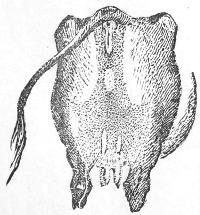
The Bastard Flanders have two marks
which distinguish them: 1. Some have on the
vertical escutcheon an oval tuft, about the
middle of it; this tuft has descending hair,
is about three inches long and two inches
wide, and the lustre of the hair makes it appear
as if it was whiter than that around it.
The larger the oval the sooner the milk will
fail, and the smaller it is the longer will she
milk. 2. Other Bastards of this class are
distinguished by the ascending and descending
hair interfering with each other on the
outlines of the vertical escutcheon, looking
feathery, or bristling like the beard of wheat.
The skin is fine and reddish, but there is no
dandruff. The larger the escutcheon, and the finer the hair, the more
abundant the milk; but when the hair is coarse, long, and thin, the yield
is small. Both kinds of Bastards of this class have every other appearance
of the best cows. And all Bastards of the first classes have the two ovals
on the udder.
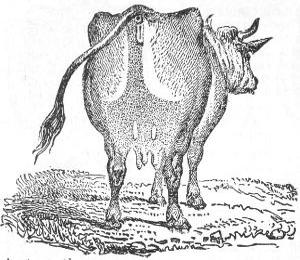
The cows of this class
are very similar to those of
the first class, though their
yield is rather less. The
vertical escutcheon is entirely
to the left of the vulva,
and the thigh escutcheon
on the right is broader
than that on the left. By
comparison with the first
class, these will be seen to
be very similar, but in each
order smaller; therefore, it
will not be necessary to describe
them separately, but
simply to state the yield.
Cows of the first order of
the second class will yield
eighteen quarts, and milk
eight months.
The second order of the second class have
the lip-shaped tuft to the left of the vulva,
and have one oval on the left of the udder.
Cows of this order give sixteen quarts, and
milk seven months.
The third order
has the
same shaped
escutcheon,
but more contracted,
and
the lip-shaped
tuft is larger
and whiter.
Cows of this order give fourteen quarts, and
milk six months.
The fourth
order has two
invasions of
the thigh escutcheon
by the down-growing hair, a semi-oval
one on the right, and a triangular one on
the left. These always indicate a reduced
quantity of milk.
Cows of the fourth order give ten quarts,
and milk five months.
The escutcheon of the Bastard Left Flanders
is known by this peculiarity. The developments
are larger and more irregular
on the top of the vertical escutcheon, and to
the left of the vulva; on the right is the
ischiatic tuft, quite large, from which the
hair is diverted in an almost horizontal direction.
The escutcheon of this
class commences above
the hock, runs up on the
thighs quite high, thence
it descends somewhat
from both sides to the
vertical portion, which
rises, gradually narrowing
to the vulva.
The first order of the
third class has an udder
with soft skin, and fine
downy hair, which, as
well as the thighs, are of
a yellow or nankeen cast
of color. There are two
ovals on the udder. Cows
of the first order give
nineteen quarts, and milk
eight months, and often will milk nine months,
not going dry unless made to.
The second order is similar to the first,
only of reduced size; it has a tuft to the left
of the vulva; and only one oval on the udder
on the left side; the hair of the escutcheon
is generally more glossy than that around it.
Cows of the second order give seventeen
quarts, and milk seven months.
The third order escutcheon curves downward
on each side of the vertical mirror,
which rises narrowing to a point at the
vulva; to the right and left of the vulva are
tufts, the one on the left being the longest;
on the left of the udder is sometimes an oval.
Cows of the third order give fifteen quarts,
and milk six months.
The escutcheon
of the
fourth order
is of similar
shape, but
still smaller;
but the tuft on left of the vulva is much
longer than on the right, and there is no
oval on the udder.
Cows of the fourth order give twelve
quarts, and
milk five
months.
The bastards of the third class have two
tufts, one on the right, and one on the left of
the vulva, about four to five inches long, and
one and one half inches wide. The smaller
they are, and the finer the hair on them, the
less rapid is the loss of milk. But if they
are large and have coarse hair, and are pointed
at each end, they prove the milk to be poor
and serous, and the cow will fail rapidly.
The Curveline cows are
very plenty, and are of a
very good grade, approaching
the first class.
The escutcheon is broader
than the last two classes,
in the upper part. Their
skin is of delicate texture,
and nankeen shade of color
on the escutcheon. The
higher and broader the
curved line rises toward
the vulva, which it never
reaches, the better it is.
There are two ovals on the
udder. Cows of the first order
of the fourth class give
19 quarts, and milk eight
months, and sometimes up
to their next calf.
The second order have the same shape
escutcheon, but more contracted. There
is but one, and sometimes no oval on the
udder. On the left of the vulva is a small
tuft.
Cows of the second order give seventeen
quarts, and milk seven months.
The third
order has a
smaller escutcheon,
with two
tufts by the
vulva, the
left longer
than the right, about four inches by one
inch wide. Sometimes an oval on the left
side of the udder.
Cows of the third order give fifteen
quarts, and milk six months.
The fourth order has a much smaller escutcheon,
reaching just above the udder.
The two tufts are larger alongside the
vulva, and the hairs bristle to each side.
On the right, the down-growing hair intrudes
somewhat upon the escutcheon.
Cows of the fourth order give twelve
quarts, and milk five months.
The Bastards
of the
fourth class
have a fine
appearance
of escutcheon,
but they are known by the tufts alongside
the vulva. If they have coarse bristly
hair, and of large size, say four to five
inches long, and one and a half in width,
they indicate a rapid loss of milk as soon
as pregnant, particularly if they are pointed
at each end.
The escutcheons of this
class in the vertical portion
end below the vulva
in an indented shape, presenting
the appearance of
two upright horns. Their
udders are of a saffron
color, delicate, with fine,
soft hair, and have much
dandruff.
The first order has two
tufts of small size along
the vulva, and two ovals
on the udder. They give
seventeen quarts, and
milk eight months.
The second order are similar to the first,
only smaller escutcheons, the vulva tufts
are longer, and there is but one oval on
the udder, on the left. The right horn of
the escutcheon is smaller than the left one.
Cows of the second order give fifteen
quarts, and milk seven months.
The third
order have
similar escutcheons
to the last,
but smaller,
while the
vulva tufts
are larger, there are no ovals, and there is
an invasion of the descending hair on the
right side. The right is two inches shorter
than the
left.
Cows of
the third
order give thirteen quarts, and milk six
months.
The fourth order have the same shaped
escutcheon, but smaller, with two tufts
alongside the vulva, larger than those on
the last. On the right of the escutcheon
is a triangular cut in the shape, made by
encroachments of the down-growing hair.
Cows of the fourth order give ten quarts,
and milk five months.
The Bastards of the fifth class have the
full escutcheon of the first or second orders,
but with two large tufts alongside the
vulva, which, according to their size, and
more or less pointed shape, and fine or
coarse hair, indicate the more or less stoppage
of the flow of milk.
The escutcheons of
Double Selvage cows differ
from those of Selvage,
or the third class, in that
the escutcheon is marked
in its whole length by a
strip of hair descending
and dividing it into two
equal portions. It is
bordered in its whole
length and at the extremity
by a double line of ascending
hair, which extends
the escutcheon up
to the vulva. Otherwise
it is like the selvage escutcheon.
The first order cows
have a fine udder, soft,
and covered with a silky
down; and its skin is yellowish or nankeen.
Cows of the first order give eighteen
quarts, and milk full eight months.
The second order have a similar escutcheon,
but smaller, and the separating strip
ends higher up. Cows of the second order
give sixteen
quarts, and
milk seven
months.
The third
order have a
still more
reduced escutcheon,
the descending strip terminating
at the udder.
Cows of the third order give fourteen
quarts, and milk six months.
The fourth order have an escutcheon
more broken in appearance, the two side
lines of the selvage terminate half way to the
vulva, and end off in lines of a feathery appearance,
the hair is coarser and more furry.
Cows of the fourth order give ten quarts,
and milk
five months.
Bastards
of the sixth
class have
the escutcheon
similar
to the first
class, but the
selvage lines terminate on each side of the
vulva in tufts of coarse and bristly hair;
the larger and coarser they are, the sooner
the milk will fail.
The first order of this
class has the skin of the
escutcheon of yellowish
color. The udder is fine,
and covered with a silky
down to the inside of the
thighs; and the dandruff
is soft and oily to the touch.
The shape is similar to the
selvage somewhat, only
the vertical mirror rises
broader and straighter,
and ends half way up to
the vulva, cut square off.
The broader and higher
this part is, the better the
escutcheon. The escutcheon
is not so high up on
the thighs as the previous
classes. There are two ovals on the udder,
and two small tufts of fine hair alongside the
vulva.
Cows of the first order give seventeen quarts,
and milk eight months.
The second order have the escutcheon lower
down and, of course, smaller in every way.
There are two tufts alongside the vulva, the
left one as large as in the first order, (two
and a half inches,) the right one only half as
long. There is one oval on the left of the
udder.
Cows of the second order give fifteen quarts,
and milk seven months.
The third order escutcheon is of different
shape, the lines converging downwards from
the vertical mirror, which is short, and cut
off square. The right side frequently has a
curved line from the descending hair invading
it. The vulva tufts are longer than in
the second order.
Cows of the third order give thirteen
quarts, and milk six months.
The fourth
order has the
escutcheon
still smaller.
The tufts
alongside the vulva are not so plain, but
the hair is coarse and bristly. There is a
triangular invasion on the right of the escutcheon.
Cows of the
fourth order
give ten quarts
and milk five
months.
The Bastards of this class have a good
escutcheon, but the tufts are large and of
coarse, bristly hair, and will fail according
to the size.
The first order of this
class have the same yellowish
color on the escutcheon
as other first
orders; the udder is
flexible, covered with a
short, fine down. The
escutcheon is much of
the shape of the Demijohns,
but the vertical,
as it rises, branches
square off to the left,
and ascends, straight
and narrow, to the left
side of the vulva. There
are two ovals on the
udder. The more the
square approaches the
vulva, and the finer the
hair, the greater quantity
is there of milk. Cows of the first order give seventeen quarts, and
milk eight months.
The second order have a similar escutcheon,
only smaller in every way. They have
two ovals on the udder, and a small tuft to
the right of the vulva.
Cows of the second order give fifteen quarts,
and milk seven months.
The third order
have the escutcheon
still
smaller; the lines
curving downward
at the corners;
one oval
on the udder, and
the tuft to the
right of the vulva, larger and of coarser hair.
Cows of the third order give thirteen
quarts, and milk
six months.
The fourth order
have the escutcheon
much smaller, the square is much
lower, and the upper part of it is formed of
bristly hair, and feathery looking; as is also
the tuft to the right. On the right side of
the escutcheon is an invasion of triangular
shape.
Cows of the fourth order give ten quarts,
and milk five months.
The Bastards
of the eighth
class are distinguished from those of the first
order by the tuft on the right, which is of
coarse and bristly hair, and the square terminates
also in the same hair.
The escutcheons of this
class, in ascending toward
the vulva, do so in the
shape of a spire, but stop
short about half way.
The first order has the
escutcheon of yellowish
color, with flexible udder,
covered with hair
downy and silky. The
shape is the same as the
seventh and eighth class,
except that the vertical
escutcheon ends in a
sharp point, like a spire
or arrow head. There are
tufts along each side of
the vulva, and two ovals
on the udder.
Cows of the first order give fifteen quarts, and milk eight months.
The second order is similar in the escutcheon,
but smaller, with but one oval on the
udder, and the vulva tufts larger, the left being
longer than the right.
Cows of the second order give thirteen
quarts, and milk seven months.
The third order
is again
smaller; the corners
rounded
downward; the
tufts larger; no
oval on the udder.
Cows of the third order give ten quarts,
and milk six months.
The fourth
order same
shape as the
last, but still smaller and more rounding.
The vulva tufts are of bristly hair, and
the left one is seven inches long.
Cows of the fourth order give eight
quarts, and milk five months.
The Bastards of the ninth class have a
good escutcheon, but are distinguished by
the large tufts of coarse, bristly hair alongside
the vulva.
The first order have a
dandruff of yellowish
color; the hair is short,
fine, and silky; the escutcheon
is lower down
from the vulva than the
other classes, and is cut
off by a horizontal line.
There are two ovals on
the udder; and two tufts,
about three and one half
inches long, on the sides
of the vulva.
Cows of the first order
give thirteen quarts, and
milk eight months.
The second order has a smaller escutcheon;
the vulva tufts are larger, the right shorter
than the left; there is but one udder oval;
in several of the orders of this class there is
a small streak of ascending hair directly below
the vulva.
Cows of the second order give ten quarts,
and milk seven
months.
The third order
have still
smaller escutcheons;
larger vulva
tufts, the one on the left of bristling hair,
four to five inches in length. The descending
hair encroaches on the escutcheon on the
right in a triangular shape.
Cows of the third order give eight quarts,
and milk six months.
The fourth order have still smaller escutcheons;
larger and coarser vulva tufts; and an
invasion on the escutcheon on the right in
triangular shape, and on the left of semi-circular
shape.
Cows of the fourth order give seven quarts,
and milk five months.
The bastards
of the tenth
class have the
escutcheons
large and good
shaped; but are
distinguished
by the tufts alongside the vulva, these tell
how long she will milk, by their size and
the grade of the hair on them.
Cross between the Selvage and Left Flanders.—The
cows bearing this character are easily recognizable
in certain breeds, and notably on those of the
north-east of France.
Cross between the Bicorn and
Selvage.—The Epi, or tuft, which
I termed jonctif, or mesian tuft, and
which is seen adhering under the
vulva, is a favorable sign, and can
be met with in those classes where the escutcheon
does not reach as high as the vulva.
Cows which bear one or the other of these two escutcheons,
are generally good milkers, and preserve
their milk as well as cows of the first order of each
class. These are the new escutcheons alluded to in
Guenon’s introduction, showing the effect of crossing.
ESCUTCHEONS ON BULLS. — Classification of Bull Reproducers.
Guenon applied his discovery to bulls to great advantage. He found
that bulls belonged to the same classes as cows, and had escutcheons similar,
but much smaller; these extend from the testicles upward toward the
anus. The importance of having a good bull becomes apparent when we
reflect that he “gets” from fifty to one hundred, annually, while the cow
is impregnated but once in the year. The escutcheons of the progeny of a
cow with good escutcheon will be much improved if the cow is coupled
with a bull well marked, and particularly if his escutcheon is the same as
that of the cow. Better have the two of different breeds, but of similar or
good escutcheons, than to have the bull with inferior escutcheon.
Of course, the higher up the escutcheon extends on a bull, and the broader
it is, the better it is, but we must not look for bulls to be so well-marked
as cows are, for they never are. To distinguish the bastard bulls from the
good ones, observe if there are any streaks of descending hair, and mixing
so as to be bristly. This indication will be a certain one in proportion to
the size of the blemish, and as that is in proportion to the whole escutcheon.
Guenon says: After having described, as I have done, all the classes of
cows, and taught to recognize the bastards, I pass to the characteristic
signs of the bulls re-producers, which can also be divided into orders and
classes; the signs are the same as for the females, but they are much more
restricted and of less extent.
With the males the escutcheon commences on the inside below the hams
and extends as far as the middle of the posterior surface of the leg, and
extends sometimes even to the anus of the superior orders in certain
classes.
Like that of cows, the escutcheon of bulls is modified by tufts.
The bulls whose escutcheons are similar in their form and size to cows
of the first order, possess a great ability for procreating good milk cows,
those on the contrary whose escutcheons are but little developed, produce
only those of poor yield.
A bull will be well marked, and a good reproducer when there is no interruption
of descending hair in the ascending hair on the escutcheon;
when the shape of the escutcheon is of large dimensions in proportion to
the size of the animal, and it is covered with very fine hair.
The bulls of which the escutcheon is small and covered with coarse hair
and irregular on the sides procreate bad milk cows, which give serous
milk.
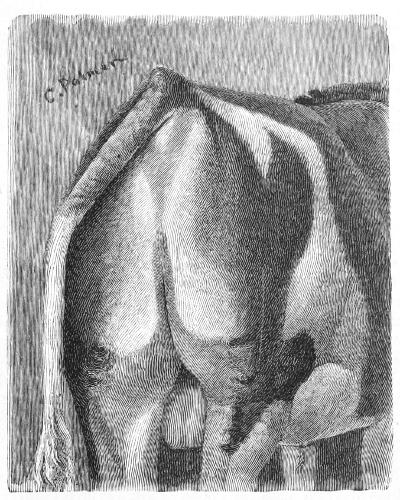
Escutcheon of Guernsey Bull RADLEY.
No. 209, A. G. H. B.
All interruptions in the ascending hair of the escutcheon by encroachments
of the descending hair on the right or left, in the lower part of the
thigh, indicate for their get a lower grade, and at a glance the inferiority of
the milk production.
The yellow or nankeen color of the skin of the escutcheon is always a
favorable sign.
The good reproducing bull will prove fecund until ten or fifteen years of
age, but it is a rare exception.
Any one may be grossly deceived if he judges only by the appearance
or the shape of the prolific qualities of a bull. Experience or observation
alone can show that he has maintained his early ability.
A vigorous bull, well fed, can serve one or more cows each day, but it
is of great importance that he shall not commence to serve until he is fifteen
or eighteen months old, otherwise he will be speedily exhausted and
deformed. The improving mark of his cross and his vigor will be speedily
shortened.
When the bull has attained the age of two and a half or three years,
the form alters, the hind-quarters become attenuated, the front quarter becomes
much enlarged, his neck enlarges and thickens, &c.
About this time, whether he is castrated or whether he is “twisted,” he
preserves always the altered form of the bull, and is less sought for work,
and in less request for butchering.
When the operations of castration and twisting are done too late, the
animal has less predisposition to fatten; his flesh is harder and tougher;
he is, however, in appearance in the same conditions of age, of quality,
and of nourishment, as those castrated earlier.
Often bulls, whose character is docile and gentle, become wild and furious
when they are used to serve.
In certain regions, to tame them, they put a ring of iron in their nose;
in others, where the good use of these rings is not known, they are obliged
to castrate or twist them. This operation suffices, generally, to control
their passion; but, if not, they are sent to the butcher.
There are for bulls, as for cows, ten classes or families; each class sub-divided
into several orders, and each order comprises three grades, high,
medium, and low.
I only admit, in each class, three orders. If one wishes to proceed in
the application with more rigor, he will follow the sub-divisions of the
classification of the cows. I will designate the three orders of each class
by the denominations of good, medium, and bad.
The signs indicating the qualities which render the bull likely to beget
good milk cows are placed, like those of the female, on the posterior parts.
They start from the bag, and rise up to the anus, covering, also, the genital
parts, and the scrotum.
With bulls, the escutcheons start from the anterior part of the bag, extending
inside, and upon the hams, projecting on the thighs; from there,
the curved lines, obtuse or acute, following the class, joining to the right
or the left under the anus.
The escutcheon, in all its extent, is shown by the fineness of the hair,
and the skin; by the color, more or less yellow, of the epidermis, and of
the particles of dandruff which can be detached.
The characteristic secondary signs of the females will also be found in
the males.
Bulls, like cows, have four and, sometimes, six false teats, which are
found before the bag, in the direction of the navel. These teats are small
and short.
Starting from the bag, one notices to the right and the left of the stomach
two veins resembling the two milk veins of cows. They are prolonged to
and pass a little in the direction of the navel, and terminate in a small
cavity.
Independent of the characteristic signs indicated above, the bull re-producers
should unite all the essential conditions which in each locality constitute
the type of the pure race. These conditions are:
1. The color of the hide preferred in that country.
2. A size proportioned to the race that they are to continue. A shape
and a frame usually accepted.
3. To be of the first order in each class, easily showing the power of
transmitting milking qualities.
4. Aptitude for fattening.
5. To be good for work.
6. To have a docile and patient character.
The evils of conformation, like the good qualities, are transmitted generally
by the act of generation. If it does not have the ability to do this,
one should quickly correct it.
Here the bovine race has been much neglected in all these respects. A
judicious choice, and a scrupulous attention is not always prevalent in selecting
a breeding animal; thus it results in a fatal re-generation, to which
it is time to put a stop.
Before giving the distinctive characteristics of the ten classes of bulls,
it will be useful to mention those classes which are oftener met in French
and foreign races; and also those which are more rare.
The classes which are most distributed, and which present the greatest
number of bulls, are in all races these three classes: 1. The Curved-line;
2. The Limousine; 3. The Horizontal.
The classes on the contrary, which present but a very small number of
subjects are in the following order:
- 4. Demijohn.
- 5. Bicorne.
- 6. Square-cut.
- 7. Selvage.
- 8. Left Flanders.
- 9. Double Selvage.
- 10. Flanders.
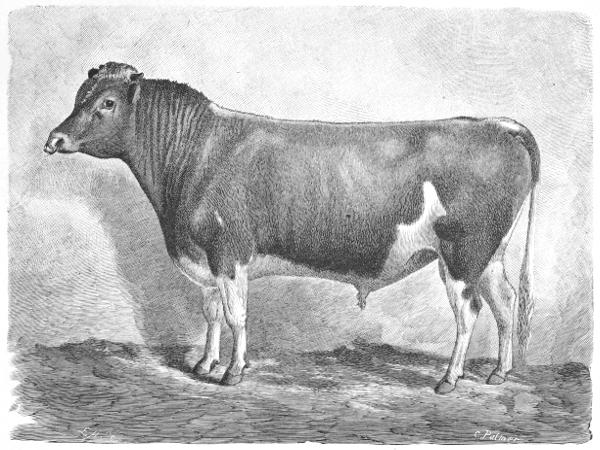
GUERNSEY BULL RADLEY, No. 209.
Property of S. C. Kent, West Grove, Pa.
The reason one finds so few good breeding bulls belonging to the first
class, is first, the small number of such animals compared to that of cows;
and next, the lack of knowledge of the best ones to keep. Oftentimes for
want of this knowledge, the best bulls were castrated for oxen or for fattening,
thus by chance, the poorest are often kept.
The best individuals have generally at birth, all the qualities which
characterize a superior animal. They are easily kept and fattened, for the
reason that their mother has much milk, and are soon ready for the butcher.
Inferior animals, on account of a smaller supply of milk, are thin, and
often malicious, of little value, and remain oftener in the hands of the
owner. Thus are sacrificed the good bulls, and the bad are kept. Therefore,
always select the choicest when they are young, to improve the race.
It will thus be seen, Guenon divided his bulls into three classes: The
good, the mediocre, and the bad. He also divided them into three sizes:
The high, the medium, and the low. But he makes no difference between
the three sizes of bulls in his description of the escutcheon. He describes
each one of the three principal orders, leaving to the practitioner to determine
the intermediate degrees between the good and the mediocre, and
between the mediocre and the bad.
We do not repeat his descriptions, as they are based upon those of the
cows of the same classes, and the engravings tell the whole story. We reproduce
the engravings of the good and mediocre. But very occasionally
is one of the “rare” ones observed, but he says the Curved-line is the most
usual, then the Limousine, and lastly the Horizontal. What we give is
quite sufficient for all practical purposes. We advise all to carefully select
their breeding animal, which will, in most cases, be from among what
he calls the “mediocre.”
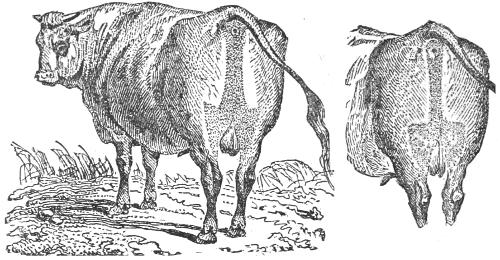
Class I.—Flanders Bull.
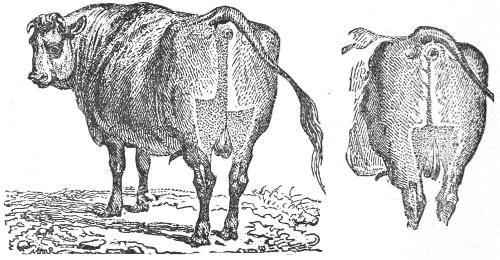
Class II.—Left Flanders Bull.
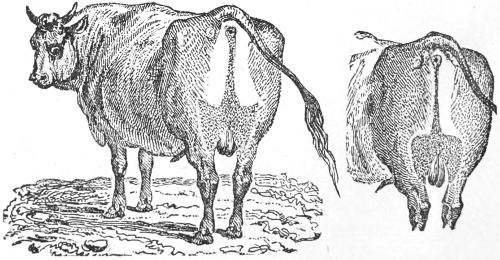
Class III.—Selvage Bulls.
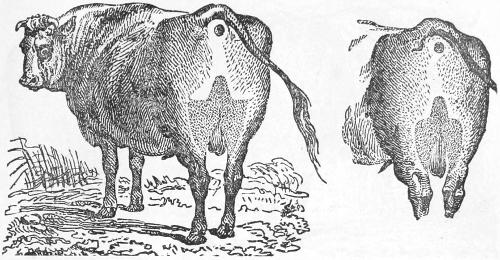
Class IV.—Curveline Bulls.
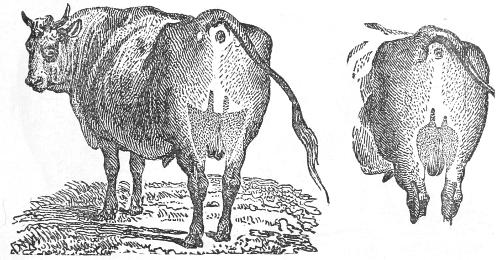
Class V.—Bicorn Bulls.
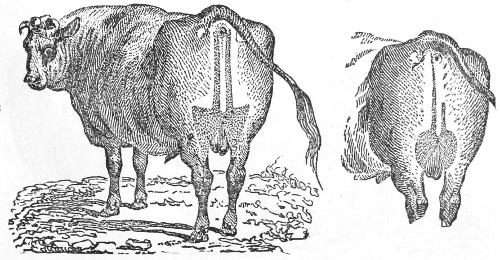
Class VI.—Double Selvage Bulls.
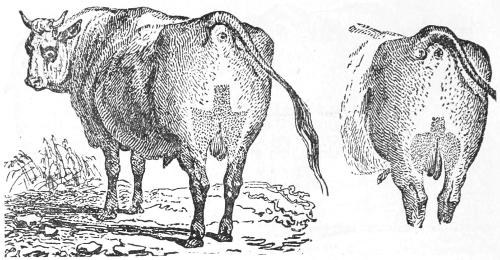
Class VII.—Demijohn Bulls.
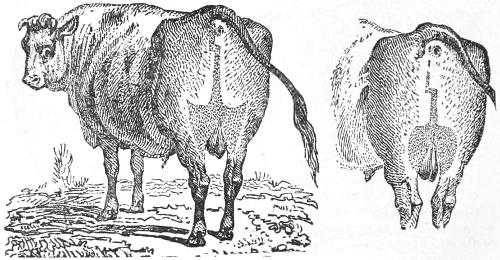
Class VIII.—Square Bulls.

Class IX.—Limousine Bulls.
REPORT OF THE PENNSYLVANIA GUENON COMMISSION. — The Commission at Barney’s Farm. — The Commission at Sharpless’ Farm. — The Commission at Strode’s Farm. — Examination of Thomas M. Harvey’s Stock of Jerseys and Guernseys, May 11, 1878. — Examination of William M. Large’s Herd, Chestnut Grove, Doylestown, Bucks County. — Report of the Examination of the Stock of Eastburn Reeder, of Rabbit Run Stock Farm, New Hope, Bucks County, Pa. — Examination of Eastburn Reeder’s Herd. — Examination of Moses Eastburn’s Cow, Beauty. — Examination of Colonel James Young’s Herd, at Middletown. — Examination of the Herd of William Calder, Esq., Harrisburg. — Examination of Several Herds near West Grove, Blanketed and Unblanketed, under the Supervision of a Committee of the Experimental Farm Club. — Commission’s Account of Milton E. Conard’s Cows : — Examination of J. & J. Darlington’s Cows, October 2d.
At the annual meeting of the Board held January 2, 1878, it was
“Resolved, That the president of the Board (His Excellency Governor
John F. Hartranft) be authorized and requested to appoint a commission
of experts, who shall inquire into and report upon the reliability of the
Guenon or escutcheon theory for selecting milking stock; said report to
be made to the secretary of the Board on or before the 1st of November
next.”
In accordance with this request, His Excellency Governor Hartranft
issued the following commission:
Commonwealth of Pennsylvania,
Executive Chamber, Harrisburg, April 24, 1878.
To George Blight, Esq., of the city of Philadelphia; Chalkley Harvey,
Esq., of the county of Delaware, and Willis P. Hazard, Esq., of the
county of Chester:
Gentlemen: I have the honor to inform you that you have been duly
appointed a committee by the State Board of Agriculture to investigate
and test “The Guenon Milk Escutcheon Theory,” and report the result
thereof to the secretary of said Board.
Jno. F. Hartranft,
Governor and President of the Board.
November 1, 1878.
To the Honorable Jno. F. Hartranft,
Governor and President of the Board of Agriculture:
Your Excellency: In compliance with the commission tendered us,
we beg leave most respectfully to report that we have visited a number of
herds and have examined two hundred cows, the result of which is herewith
submitted.
Having performed to the best of our ability the duty assigned us, we
beg leave to be discharged from further consideration of the question.
Respectfully yours,
George Blight, Philadelphia,
Chalkley Harvey, Chad’s Ford,
Willis P. Hazard, West Chester.
The Pennsylvania Guenon Commission having been appointed “to investigate
and test the Guenon or Milk Escutcheon theory, and report the
result thereof,” respectfully report that they have examined two hundred
cows, heifers, and bulls, and the result of their examinations has been to
convince themselves and others of the merits of the system, of its exceeding
value to the practical farmer; and they believe that if generally followed
for twenty years, the value of the neat cattle of the State would be
increased vastly, the amount of milk and butter produced would be much
larger, and the quality of both articles better, while the quality of the
meat would be improved. Having believed in and practised the system
for many years, they would add that their recent extended and careful examinations
and contact with a number of owners of all grades of stock,
has tended to confirm them more thoroughly in their belief. As an adjunct
to previous knowledge to assist purchasers or breeders of cattle in
getting or raising the best, and weeding out the poorest, they think it is
worthy of being acquired by every farmer. And they would recommend
their fellow farmers not to be dismayed at the apparent difficulties to be
surmounted in obtaining a knowledge of the system, as it is only absolutely
necessary to acquire a knowledge of the first four orders of each
class, and a few other points, to practically apply it, as all animals below
those grades are not worthy of being kept. Any intelligent man can
readily master the system, and soon become proficient in it by practice.
This knowledge, applied with the tests heretofore usually used, will enable
any one to become a good judge of cattle.
The manner of making up their account of each animal is to examine
the escutcheon and the udder, from which they place her in the class and
order nearest to those delineated by Guenon, and then estimate the quantity,
quality, and time that she will milk. These estimates must be, of course,
only approximate, as they are based upon the indications of the escutcheon,
the size of the cow, and her probable condition. As it is readily seen
that where estimates are based upon what the cow should do within three
months of her being fresh, it would be impossible to always grade the
exact value of all the cows in a herd, each of which is at a different period
of gestation, or in a different condition or state of health, and where also
the cow is affected by the way in which she is fed and cared for, by the
season, by the state of the temperature, and other circumstances. The
estimates are based upon what the commission thinks the cow would do
when all the conditions are favorable to her development, and where she
is properly fed and cared for. A record is made by the commission on
the spot. An account of the qualities of each head is drawn up by the
owner. Each is made at separate times, and without the knowledge of the
other party. Then the two accounts are copied off into parallel columns
for comparison. If the accounts agree in seventy-five per cent. out of one
hundred, it certainly must be presumed the system has sufficient value to
make it worthy of adoption by all farmers and breeders. As every farmer
knows the yield is much influenced by the feed, the care, the exposure,
and the treatment of the cows; therefore, a certain amount of allowance
must be made, for these various things will so alter matters, that no one
can tell to a quart, or a pound of butter, or to the week in time of milking.
In fact, every farmer knows neither the owner himself, nor his man, can
tell to a quart how much his cow or cows actually give, unless a daily
record is kept every day of every year. For even if he does keep such a
record, he will find the various circumstances named above affecting the
quantities in his record. Therefore the earnest seeker after truth, comparing
the statements made in the two columns, must not expect the two
to tally without some variations. The true spirit with which he must examine
these statements, will suggest itself in the question: Is this a system
by which I can judge of the value and quantities of a cow correctly?
Is this a system that will tell me the points of a cow, good or bad, more
correctly than by any other method? Let the candid inquirer weigh these
statements, and think if he knows of any method by which he can go into
a herd and surely pick out the best cows, and leave the poor ones to those
who judge not by this system. Every farmer has his own mode of judging,
but take the shrewdest and most practiced, can he avoid often the
bastards? What the commission find they can do, is that in a large
majority of the percentage of cases, they will give a good estimate of the
qualities of any animal. Their opinions of the time a cow will go, is
based upon what they think should be the treatment of all cows, viz.: that
every cow should have a rest of from four to six weeks, at least.
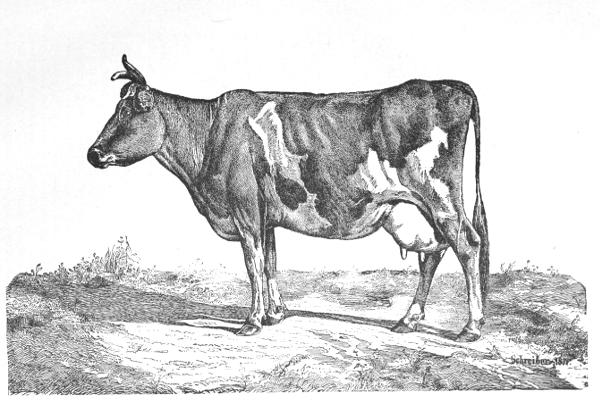
JERSEY COW NIOBE, H. R. 99.—Owned by Samuel J. Sharpless, Philadelphia.
Was awarded First Prize as the BEST Cow at the Centennial, 1876.
The members of the Guenon commission, visited the farm of John B.
Barney, on the 9th of May, 1878, and examined twelve cows, mostly Grade
Durhams, Grade Jerseys, and farm stock, and they were uniformly successful
in judging of said stock, with some difference of opinion on two of
them.
“I was present at the examination of twelve cows of my herd, and think the committee
were so uniformly successful in judging of the merits of the different cows,
with such slight variations of opinion between us, as to increase my belief in the Guenon
system being of great advantage to the farmers in selecting stock.
John B. Barney.
Chadd’s Ford, Chester county.”
May 16, 1878.
The commission visited the fine farm and herd of Jersey cows of Samuel
J. Sharpless, at Street Road station, West Chester railroad, May 10.
Present. Messrs. Harvey, Blight, Hazard, and Thomas J. Edge.
| Sam’l J. Sharpless’ Herd of Jerseys, as Reported by E. J. Durnall, Herdsman for S. J. S., May 10, 1878. |
Sam’l J. Sharpless’ Herd as Reported upon by Guenon Commission of the State, May 10, 1878. |
| No. 1.—Seven years. |
No. 1.—Curveline cow, second order. |
| Quantity, about 12 quarts a day. |
Quantity, if 14 quarts, doing well. |
| Quality, medium. |
Quality, good. |
| Milks about 10 months. |
Will milk ten months out of twelve. |
| No. 2.—Thirteen years. |
No. 2.—Flanders cow, third order. |
| Quantity, best. Gives 24 quarts 3 months after calving. |
Quantity, 16 quarts first three months. |
| Quality, second rate. Has made 11¼ pounds in a week. |
Quality, third rate. |
| Milks full up to time, except when she had twin calves. |
Dry two months. |
| No. 3.—Eleven years. |
No. 3.—Flanders cow, third order. |
| Quantity, medium. |
Quantity, 12 quarts; three months. |
| Quality, best. |
Quality, very good and rich. |
| Would go to her time. |
Dry six weeks. |
| No. 4.—Eight years. |
No. 4.—Flanders cow, second order. |
| Quantity, medium. |
Quantity, 14 quarts. |
| Quality, good; makes about 10 pounds. |
Quality, very fine. |
| Up to her time. |
Well up to her time. |
| No. 5.—Imported. Eleven years. |
No. 5.—Selvage cow, first order. |
| Quantity, about 17 to 18 quarts a day. |
Quantity, best; about 18 quarts. |
| Quality, best; makes 11 pounds per week. |
Quality, no question. |
| Up to her time. |
Milks up to her time. |
| No. 6.—Ten years. |
No. 6.—Flanders cow, first order. |
| Quantity, second rate. |
Superior milker. |
| Quality, medium. |
Quality, second class. |
| About two months short of her time. |
Milks up to her time; say six weeks. |
| No. 7.—Two years old. Had only first calf. |
No. 7.—Curveline cow, second order. |
| Quantity, medium. |
Quantity, medium. |
| Quality, good. |
Quality, too young for quality; say good. |
| Not fairly tested for time. |
Time, too young for test. |
| No. 8.—Four years. |
No. 8.—Selvage cow, second order. |
| Quantity, medium. |
Quantity, medium. |
| Quality, first class. |
Quality, good. |
| Up to calving. |
Up to her time; say six weeks. |
| No. 9.—From Niobe Third. Three years. |
No. 9.—Flanders cow, second order. |
| Quantity, first rate. |
Quantity, first class. |
| Quality, first rate. |
Quality, first class. |
| Up to her time. |
Well up to her time. |
| No. 10.—Imported. Four years. Had first calf at Centennial, in October, and made in seven days, 9 pounds 10 ounces. |
No. 10.—Decided to pass her. |
| Quantity, about 16 quarts. |
|
| Quality, excellent. |
|
| Up to time. Has been milking two years. |
|
| No. 11.—Ten years. |
No. 11.—Horizontal cow. |
| Quantity, second highest of herd; best. |
Quantity, first-class. |
| Quality, second class. Makes about 10 pounds. |
Quality, inferior. |
| Full up to her time. |
Milk up to eight months. |
| No. 12.—Four years. |
No. 12.—Flanders cow, third order. |
| Quantity, second rate. |
Quantity, light. |
| Quality, second rate; about 7 pounds. |
Quality, third class. |
| Milks to three months of her time. |
Three months short of her time. |
| No. 13.—Six years. |
No. 13.—Flanders cow, number two order. |
| Quantity, number one. |
Quantity, second class. |
| Quality, number one. |
Quality, first class. |
| Full up to time. |
Up to her time. |
| At seven months from calf gives 16 quarts. |
|
| No. 14.—Five years. |
No. 14.—Flanders cow, first order. |
| Quantity, promises fair. |
Quantity, good. |
| Quality, good. |
Quality, fair. |
|
Within a month of her time. |
| No. 15.—Four years. Of Niobe stock, the poorest. |
No. 15.—Flanders cow, second order. |
| Quantity, third rate; 6 quarts. |
Quantity, about 12 quarts. |
| Quality, good; second rate. |
Quality, not very fine. |
| Up to her time. |
|
| Dropped her calf. |
|
| No. 16.—Quantity, number one. |
No. 16.—Selvage cow, first order. |
| Quality, number one. |
First class every way. |
| Up to her time. |
|
| No. 17.—First calf. |
No. 17.—Flanders cow, second order. |
| Quantity, number one. |
Quantity and quality, fair. |
| Quality, number one. |
|
The commission and Mr. Durnall agree as to the best cow, selected
from the first six on this list—on the one side by the marks, and on the
other from his knowledge.
“Having compared the annexed account of the qualities of the seventeen cows of my
herd, examined by the State Guenon Commission, with the originals of the accounts as
given by both parties at separate times, and taken down upon the spot, I believe it to
be a true and faithful transcript of the original record of the examination.
Samuel J. Sharpless.”
Philadelphia, May 20, 1878.
“I was present at the examination of Mr. Sharpless’ herd of Jerseys, made on the
10th of May by the State Guenon Commission, and having examined the accounts of
the herd given by me, as hereto annexed, with the original entries of those given by
me, and also the accounts of the commission, with the original written opinions, do
certify that the annexed are faithful transcripts of the records made by each party at
separate times, and that the statements were unknown to each other.
E. J. Durnall,
Herdsman for Samuel J. Sharpless.”
Lenape Farm, May 20, 1878.
The members of the Guenon Commission visited the dairy farm of Marshall
Strode & Son, who have a large butter factory, and are celebrated
for their first-class butter, and they examined seventeen head of grade
dairy stock, and according to the testimony of Mr. Strode, who accompanied
them in their examination, were successful in judging according to
the Guenon system, fifteen cows out of seventeen examined. Viewed
May 10.
Present, Messrs. Harvey, Blight, Hazard, and Edge.
“Having been present when the members of the Guenon Commission examined
seventeen of our herd, and having witnessed the accuracy with which they determined
the quality of the stock inspected, we bear testimony to the fact that their judgment
was correct, according to our experience with the cows, in fifteen cases out of seventeen,
and even in these two they were partially successful. And we are more confirmed
in our previous belief in the value of the system, as we never buy a cow for a
good one that is not well marked. We run a dairy of seventy-one cows.
Yours truly,
Marshall Strode & Sons.”
East Bradford, May 15, 1878.
In this examination two cows which had already been examined and reported upon
by the commission were, without their knowledge, afterwards brought up for another
examination, in which their opinion as recorded, agreed almost exactly with the one
previously recorded, thus affording a strong proof of the value of the system. See
reports of No. 1, Betsy, and Nos. 4 and 20, Beauty. (Secretary of Board of Agriculture.)
This herd is one of the finest in the State. The cows are kept in good
condition, and being well fed, the yield is very large per head. Their product
is first class butter, and should bring the highest price in the market.
The commission examined, in addition
to the twenty-five cows on this
list, Mr. Harvey’s Guernsey imported
bull “Sir Champion,” which is thoroughly
well marked; perhaps, the
best marked bull in the country. The
value of his get is, therefore, very
decided. It shows most conclusively
the importance of a bull from good
milking stock, and that he should
have a good escutcheon. The importance
of a good sire to stamp his
qualities upon his descendants was
conclusively proved by Mr. Harvey’s
younger stock. The commission examined
a young bull of seven months
age, which was as perfectly and beautifully
marked as his sire, and as
nearly the same shape escutcheon as
his sire’s as could possibly be. Mr.
Harvey has since sold him for $100,
to Colonel R. M. Hoe.
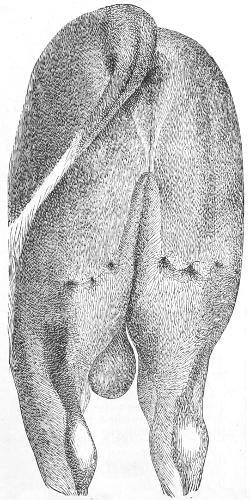
Escutcheon of Imported Guernsey Bull “Sir Champion.”
Nos. 9½ and 9¾ prove also the gain
to a herd from a well marked bull.
These were yearlings of Champion’s
get. No. 9½ was a great improvement
upon the mother, No. 9, Carrie,
of this list.
In the statements of the commission
as to quantity, they have not
mentioned the number of quarts, as
the amounts given by most of this
herd are superior to the generality,
even of Guernseys; and, owing to
good selection and careful handling
by their owner, the commission judge that the number of quarts would be
larger than usual.
| Stock of Thomas M. Harvey. Thomas M. Harvey’s Statement. |
Stock of Thomas M. Harvey. Opinion of the Guenon Commission. |
| No. 1.—Betsey. |
No. 1.—Betsey.—Jersey. Curveline, No. 1. |
| Quality, medium. |
Quality, first rate. |
| Quantity, 17 quarts. |
Quantity, first rate. |
| Never dry. |
Time of milking; up to her time. |
|
Second examination confirmed. |
| No. 2.—Nancy. |
No. 2.—Nancy.—Guernsey. Flanders No. 2. |
| Quality, first rate. |
Quality, first rate. |
| Quantity, 16 quarts. |
Quantity, first rate. |
| Will milk up to calving. |
Six weeks. |
| No. 3.—Claude. |
No. 3.—Claude.—Guernsey. Curveline, 3d. |
| Quality, first rate. |
Quality, first-class for rich milk. |
| Quantity, at first, 18 quarts; but at six months, 8 quarts. |
Quantity, not large. |
| Not inclined to go dry altogether. |
Dry three months. |
| No. 4.—Beauty.—(Worth.) |
No. 4.—Beauty.—(Worth.) Curveline, 1st. |
| Quality, first rate. |
Quality, first class. |
| Quantity, 20 quarts. |
Quantity, large. |
| Almost impossible to dry off. |
Close to time. |
|
Rëexamined—See report No. 20. |
| No. 5.—Zilla. |
No. 5.—Zilla.—Guernsey grade. Imperfect Selvage of low order. Irregularly marked. |
| Quality, medium.* |
|
| Quantity, 18 quarts. |
|
| Never dry. |
Will milk well for few months only. |
|
A good shaped cow. |
| No. 6.—Cherry. |
No. 6.—Cherry.—Half Jersey. |
| Quality, good. |
Good milk. |
| Quantity, 24 quarts. |
Milks profusely, and keeps herself thin on account of it. |
| Will milk on. |
|
| No. 7.—Echo. |
No. 7.—Echo.—Grade, Jersey. Selvage, 2d. |
| Quality, medium. |
Quality, medium. |
| Quantity, 20 quarts. |
Quantity, medium. |
| Does not go dry. |
Milks up pretty well. |
| No. 8.—Minna.—Guernsey. |
No. 8.—Minna.—Guernsey. Curveline, 2d. |
| Quality, first rate. |
Quality, good. |
| Quantity, 17 quarts. |
Quantity, good milker until within two months of calving. |
| Not inclined to dry. |
|
| No. 9.—Carrie. |
No. 9.—Carrie.—Strangely and imperfectly marked. |
| Quality, first rate. |
Quality, good. |
| Quantity, 10 quarts. |
Quantity, poor. |
| Will go dry two months. |
Dry up soon. |
| No. 10.—Gentle.—Jersey. |
No. 10.—Gentle.—Jersey. Selvage, 1. |
| Quality, first rate. |
Quality, first rate. |
| Quantity, 20 quarts. |
Quantity, large |
| Dry two months. |
Dry six weeks. |
| No. 11.—Mary.—Grade, Durham. |
No. 11.—Mary.—Grade, Durham. Flanders, 1. |
| Quality, medium. |
Quality, first class. |
| Quantity, 18 quarts. |
Quantity, good. |
| Dry two months. |
Dry six weeks. |
| No. 12.—Eugenie.—Jersey. |
No. 12.—Eugenie.—Jersey. Curveline, 2d. |
| Quality, medium.* |
Quality, first rate. |
| Quantity, 18 quarts. |
Quantity, large. |
| Does not dry. |
Dry two months. |
| No. 13.—Victoria.—Guernsey. |
No. 13.—Victoria.—Guernsey. Selvage. |
| Quality, medium.* |
Quality, medium. |
| Quantity, 20 quarts. |
Quantity, good while she milks. |
| No drying. |
Dry two months. |
| No. 14.—Jennie. |
No. 14.—Jennie. Ordinary stock. |
| Quality, good. |
Quality, not very rich, but good. |
| Quantity, 20 quarts. |
Quantity, good. |
| One month dry. |
Dry two months. |
| No. 15.—Maggie, 2d.—Young. |
No. 15.—Maggie, 2d.—Guernsey. Flanders, 3d. |
| Quality, medium.* |
Quality, very good. |
| Quantity, 10 quarts. |
Quantity, medium and continuous. |
| Dry two months. |
Dry two months. |
| No. 16.—Rocket. |
No. 16.—Rocket.—Grade, Jersey. Curveline, 2d. |
| Quality, medium. |
Quality, rich. |
| Quantity, 15, 20, to 25 quarts; variable. |
Quantity, good. |
| Dry three months. |
Dry two months. |
| No. 17.—Amy. |
No. 17.—Amy.—Kentucky Short-Horn. |
| Quality, good.* |
Quality, medium. |
| Quantity, 14 quarts. |
Quantity, poor. |
| Ten weeks dry. |
Dry three months. |
| No. 18.—Comly. |
No. 18.—Comly.—Guernsey. Selvage, 3d. |
| Quality, first rate. |
Quality, first rate. |
| Quantity, 15 quarts. |
Quantity, good and continuous. |
| Dry two months. |
Dry six weeks. |
| No. 19.—Kitty. |
No. 19.—Kitty.—Guernsey and Jersey grades. Bicorn, 2d. |
| Quality, first rate. |
Quality, first class. |
| Quantity, 16 quarts. |
Quantity, first class. |
| Dry six weeks. |
Milks well up. |
| No. 20.—Beauty. |
No. 20.—Beauty.—Guernsey. Curveline, 1st. |
|
Quality, first class. |
|
Quantity, first class. Milks well up. |
| Second examination. |
This is the second examination. |
| See No. 4. |
See No. 4. |
| No. 21.—Rosetta.—Guernsey, imported. |
No. 21.—Rosetta.—Guernsey, imported. Flanders. |
| Quality, first rate.* |
Quality, excellent. |
| Quantity, 18 quarts. |
Quantity, fair milker. |
| Does not go dry. |
Dry two months. |
| No. 22.—Duchess.—Guernsey. |
No. 22.—Duchess.—Guernsey, imported. Curveline, 2d. |
| Quality, first rate. |
Quality, medium. |
| Quantity, 20 quarts. |
Quantity, large. |
| Don’t go dry. |
Dry two months. |
| No. 23.—Bridget.—Guernsey grade. |
No. 23.—Bridget. Guernsey grade. Selvage, 4th. |
| Quality, first rate. |
Quality, good. |
| Quantity, 14 to 18 quarts. |
Quantity, poor. |
| Fails when pregnant. Does not dry altogether. |
Dry three months or ten weeks. |
| No. 24.—Fancy.—Guernsey. |
No. 24.—Fancy.—Guernsey. Selvage. |
| Quality, medium. |
Quality, medium. |
| Quantity, 16 quarts, and fails fast. |
Quantity, poor. |
| Dry three months. |
Dry two months. |
| No. 25.—Daffy.—Grade, Durham. |
No. 25.—Daffy.—Grade, Durham. Flanders, 1st. |
| Quality, medium. |
Quality, good. |
| Quantity, 22 quarts. |
Quantity, about 24 quarts. |
| Does not dry. |
Milks her full time. |
In the above account will be noticed a few with the mark * which Mr. Harvey said indicates that the
amount of milk given and the quality was largely increased by extra feeding.
“I was present at the examination of our herd of Guernseys, Jerseys, and grades, by
the Guenon Commission, on the eleventh of fifth month, 1878, and I have examined
their report and compared it with the originals written on the spot, (the contents of
which were before now unknown to me,) and I testify to the annexed report being an
accurate copy of the opinions recorded by them at the time of examination. The
statements made by me were handed to members of the commission on twenty-first
instant, and are as nearly accurate as my own knowledge, and that of the persons who
had the immediate care of the herd, and an interest in the proceeds of the dairy, could
make them.
Thos. M. Harvey.”
West Grove, 27th of 5th month, 1878.
“Having had the immediate care of the herd of Thomas M. Harvey, and an interest
in the proceeds of the dairy for six years, and being well acquainted with the merits
of each member of the herd, I can certify that the statements we have made to the
Guenon Commission are correct to the best of our knowledge and belief, and were
made more than a week after the commission had recorded their opinions; which
opinions were unknown to us until the present time. I have also compared the record
of opinions herewith with the originals, and find them to be a correct transcript of
them.
Clarkson Moore.”
“Having had the immediate care of the herd within alluded to, and an interest in the
proceeds thereof for the past eleven months, I can certify that I united with Clarkson
Moore in making the statement relative to the quality and productiveness of the cows
examined by the Guenon commission. I was from home when they were here, and
knew nothing of their opinions when we made up our statement.
Zebedee Haines.”
Fifth month, 28th, 1878.
“I was present on Saturday, March 11, 1878, at the farm of Thomas M. Harvey, when
the examination of that portion of his herd was made by the Guenon Commission,
from Nos. 10 to 25, inclusive, of their report. I have compared the original recorded
opinions of the commission with the report herewith, and find the latter correct.
N. J. Sharples,
President of the Experimental Farm Club.”
The commission, as represented by George Blight and Willis P. Hazard,
visited the beautiful farm of William M. Large, on the afternoon of May
31—on a very rainy, unpleasant day, and making the examination of stock
a very difficult duty. The stock is a valuable one of thorough-bred and
grade Short-Horns and is well fed and otherwise well cared for.
| Wm. M. Large’s Account of his Herd. |
Opinions of the State Guenon Commission. |
| No. 1.—Victoria. |
No. 1.—Victoria.—Short-Horn. Flanders, first order. |
| Quantity, 18 quarts. |
Quantity, about eighteen quarts. |
| Never tried her on butter but once, then made 10¾ pounds. |
Quality, good. |
| Goes dry two months to ten weeks. |
Up to her time—say one month. |
| No. 2.—Josephine. |
No. 2.—Josephine.—Thorough-bred Short-Horn. Flanders, second order. |
| The Doylestown Agricultural Society offered a premium of $25 for the cow that yielded the most butter; and also $25 for the cow that gave the most milk. The largest yield for a single week 16 pounds 3 ounces. Was tried five times during the year, two months apart; taking the average of the five consecutive trials, would make a trifle over 500 pounds. Awarded the first premium for butter, and second for milk. |
|
| Lost the record of pounds of milk. |
Quantity, eighteen quarts. |
|
Quality, very good. |
| Dry about one month. |
About one month dry. |
| No. 3.—Fanny Fern. |
No. 3.—Fanny Fern.—Flanders, first order. |
| Quantity, nineteen quarts. |
Quantity, twenty quarts. |
| Quality, never tried her butter production. |
Quality, first rate. |
| Goes dry five or six weeks. |
About up to time, (one month.) |
| No. 4.—Lettie. |
No. 4.—Lettie.—Selvage, fifth order. |
| Quantity nine quarts. |
Quantity, eight quarts. |
| Quality, never tried her butter qualities, but her milk is rich and good. |
Quality, second rate. |
| Goes dry about three months. |
Dry four months. |
| No. 5.—Norah. |
No. 5.—Norah.—Flanders, imperfect. |
| Quantity, fresh, gives seventeen quarts; holds to it well. |
Quantity, eighteen quarts. |
| Quality, has made 10 pounds butter in a week. |
Quality, good. |
| Goes dry about two months. |
Dry three months. |
| No. 6.—Lucy. |
No. 6.—Lucy.—Flanders, fourth. |
| Quantity, thirteen quarts. |
Quantity, fourteen quarts. |
| Quality, a less number of pounds will make a pound of butter than most of my other cows; think her milk extra good. |
Quality, good, very. |
| Dry some two months. |
Dry three months. |
| No. 7.—Bernice. |
No. 7.—Bernice.—Flanders, second. |
| Quantity, when fresh, about twelve quarts. |
Quantity, twelve quarts. |
| Quality, never tried her butter production. |
Quality, good. |
| Goes dry some three months, and has the credit of being the poorest cow in the herd. |
Time, eight months out of twelve. |
| No. 8.—Josephine 2d.—First calf. |
No. 8.—Josephine 2d.—Curveline, third. |
| Quantity, first calf, eleven quarts. |
Quantity, ten to twelve quarts. |
| Quality, never weighed her milk or tried her butter production. |
Quality, rich. |
| Cannot tell how long she will go dry. |
Goes to two months of her time. |
| No. 9.—Judith. |
No. 9.—Judith.—Flanders, first. |
| Quantity, seventeen quarts. |
Quantity, eighteen quarts. |
| Quality, on a trial after her first calf was taken away, made 2 ounces less than 8 pounds of butter, done up in lumps for market. |
Quality, good. |
| Goes dry six or seven weeks. |
Well up to her time (one month or six weeks.) |
“Having been present at the examination of my herd of Short-Horns, by the State Guenon
Commission, May 31, 1878, I certify this report is a correct copy of the original
records made on the spot, and at separate times; neither party having knowledge of
the other’s accounts.
William M. Large.”
Chestnut Grove, 7th month, 3d, 1878.
The commission visited the farm of Eastburn Reeder on Saturday,
June 1, and examined his stock of Jersey and Guernsey breeds in presence
of the proprietor and a number of members of the Solebury Farmers’
Club. Mr. Reeder’s account of his herd had been drawn up and placed in
the hands of J. S. Williams, Esquire, secretary of the Solebury Farmers’
Club, some ten days before the visit of the commission, and is printed
herewith.
The commission was represented by George Blight and Willis P. Hazard,
and part of the time by Captain J. C. Morris, of Susquehanna county,
at the request of Thomas J. Edge, secretary of the State Board.
Mr. Reeder, not having made in his report any statements of the quality
of the milk, except as regards the yield in butter, has sent the commission
the following condensed statement of what each cow gave on May 20:
| No. 1, Belle, |
10 |
quarts. |
| No. 2, Topsy, |
14 |
” |
| No. 3, Firefly, |
12 |
” |
| No. 4, Isabelle, |
8 |
” |
| No. 5, Marian, |
14 |
” |
| No. 6, Urania, |
12 |
” |
| No. 7, Florentia, |
10 |
” |
| No. 8, Paunacussing, |
8 |
” |
| No. 9, Lady Delaware, |
6 |
” |
| Total for nine cows, |
94 |
” |
| Yield of the herd, May 20, |
94 |
quarts. |
| Yield of the herd in seven days, |
658 |
” |
| Butter in seven days, |
67 |
pounds. |
| Quantity of milk to one pound of butter, |
9 55/67 qts. |
This statement of the number of quarts required to make a pound of
butter from Jersey and Guernsey stock, it will be seen, carries out the conclusions
of the commission, who estimated the quality of this herd, as
well fed and not too long milked stock of these breeds should give a pound
of butter to every nine quarts of milk.
“Having been present at the examination of my herd by the State Guenon Commission,
on Saturday, June 1, 1878, and having since examined their report by the original
record made on the spot by them, and compared it with my account of the herd,
handed to Mr. J. S. Williams, May 21, or more than one week before they made the
examination, I do certify that the accompanying report is correct and true.
Eastburn Reeder,
New Hope, Bucks county, Pa.”
Rabbit Run Farm, June 15, 1878.
“I certify that Eastburn Reeder handed me his account of his herd ten days before
the examination was made by the State Guenon Commission; that I was present with
others at the examination; that the two reports were compared in the presence of a
number, shortly after the examination, and were generally satisfactory; and that I
have now examined the accompanying reports by the two original records, made at
separate times as above mentioned, and have found them correct and true copies of
said original records.
J. S. Williams,
Secretary of the Solebury Farmers’ Club.”
June 15, 1878.
| Accounts of the Herd by Eastburn Reeder. |
Opinions of the Herd by the Guenon Commission. |
| No. 1.—Bell.—Age, 12 years. Grade, Alderney. Calved November 10, 1877. |
No. 1.—Bell.—Grade, Alderney. Flanders, 2d. |
| Greatest yield when fresh, 16 quarts per day. Yield May 20, 1878, 10 quarts per day. Butter, 8 pounds in seven days. |
Quantity, 18 to 20 quarts. |
| Tried February, 1875. |
Quality, fair. |
| Milks to one month of calving. |
Dry three to four months. |
| No. 2.—Topsy.—Age, 10 years. Guernsey. Calved March 9, 1878. |
No. 2.—Topsy.—Guernsey. Curveline, 2d. |
| Greatest yield when fresh, 18 quarts. Yield May 20, 1878, 14 quarts. Made 12 pounds in seven days. |
Quantity, 16 to 18 quarts. |
| Tried June, 1872. |
Quality, first rate. |
| Goes dry three months before calving. |
Dry two months. |
| No. 3.—Firefly, (1133.)—Age, 8 years. Jersey. Calved October 28, 1877. |
No. 3.—Firefly.—Jersey thorough-bred. Demijohn, 2d. Daughter of Niobe, 3d. |
| Greatest yield when fresh, 14 quarts. Yield May 20, 1878, 12 quarts. Averaged 6 pounds butter for forty weeks, from Sept. 1, 1872, to June 8, 1873. Greatest yield of butter in any one week since, 10½ pounds. |
Quantity, 12 to 14 quarts. |
|
Quality, medium. |
| Never goes dry; has been milked regularly since August 27, 1872. |
Dry two months. |
| No. 4.—Isabelle, (1935.)—Age, 6 years. Jersey. Calved September 19, 1877. |
No. 4.—Isabelle.—Jersey thorough-bred Flanders, 3d. |
| Greatest yield when fresh, 12 quarts. Yield May 20, 1878, 8 quarts. Made 9 pounds butter in seven days. |
Quantity, 16 quarts. |
| Tried October, 1877. |
Quality, first rate. |
| Milks to one month of calving. |
Dry one month. |
| No. 5.—Marian.—Age, 6 years. Guernsey. Calved February 15, 1878. |
No. 5.—Marian.—Guernsey. Curveline, 3d. |
| Greatest yield when fresh, 14 quarts. Yield May 20, 14 quarts. |
Quantity, 16 quarts. |
| Butter never been tested. |
Quality, first rate. |
| Milks to within one month of calving. |
Dry two months to three months. |
| No. 6.—Urania, (2793.)—Age, 5 years. Jersey. Calved January 30, 1878. |
No. 6.—Urania.—Jersey thorough-bred. Selvage, 2d. |
| Greatest yield when fresh, 12 quarts. Yield May 20, 12 quarts. |
Quantity, 14 quarts. |
| Butter never been tested. |
Quality, second rate. |
| Milks to one month of calving. |
Dry one month. |
| No. 7.—Florentia, (3518.)—Age, 4 years. Jersey. Calved January 1, 1878. |
No. 7.—Florentia.—Jersey thorough-bred. Curveline, 2d. |
| Greatest yield, 10 quarts. Yield May 20, 10 quarts. |
Quantity, 12 quarts. |
| Butter never been tested. |
Quality, second rate. |
| Milks to one month of calving. |
Dry one month. |
| No. 8.—Paunacussing, (5050.)—Age, 2 years. Jersey. Calved October 30, 1877. |
No. 8.—Paunacussing.—Jersey thorough-bred. Selvage, 2d. |
| Yield, May 21, 1878, 8 quarts. |
Quantity, 12 quarts. |
|
Quality, medium. |
| Duration yet to be ascertained. |
Dry two months, probably. |
| No. 9.—Lady Delaware, (5051.)—Age, 2 years. Thorough-bred Jersey. Calved January 3, 1878. |
No. 9.—Lady Delaware.—Jersey thorough-bred. Flanders, 3d. |
| Yield May 21, 1878, 6 quarts. |
Quantity, only milks out of two teats. |
|
Quality, medium. |
| Duration yet to be ascertained. |
Dry three months, probably. |
| Account of Moses Eastburn. |
Opinions of the Commission. |
| Cow, Beauty.—Age, 9 years. Calved March 20, 1878. |
Beauty.—Jersey. Curveline, 2d. |
| Greatest yield of milk per day about 17 or 18 quarts. Yield May 24, 1878, 16 quarts. Duration of yield of milk, ten months. |
Quantity, 18 quarts. |
| Quality of milk, 9 quarts to make a pound of butter. Butter made in eight and a half months, 302½ pounds. |
Quality, first class. |
|
Time, well up to her time. |
“This is to certify that I was present at the examination of my cow, Beauty, this first
of sixth month, 1878, by the committee to test the Guenon system, and find their report
to correspond with the within statement.
Moses Eastburn.”
Solebury, Bucks county.
The Commission visited the large farms of Colonel James Young, near
Middletown, and examined thirty-seven head of cows and heifers, among
which were some of the finest Jersey cows in the State. His whole stock
is well-fed and cared for, and are in fine condition. He supplies Middletown
with the best of milk. Colonel Young does not keep a record of
the performances of his cows, and the commission were therefore obliged
to examine the cows, and after making their record, to compare it, item
by item of each cow separately, with the knowledge of them had by his
very intelligent dairy-woman, who has charge of the cows and the milk,
and knows their characters as milk and butter producers well; also has a
record of the times of calving of all the cows. The estimates of the commission
agreed with hers, on all the hundred and eleven points, except
nine points, and where they differed, that difference was in two cases on
the quality, and in the other cases on the time. The commission attribute
their unanimity on this herd, to the careful selection and breeding
of Colonel Young, to his good feeding, and the excellent care that the animals
have. These points constantly looked after, maintain the excellence
of the herd, and as a consequence the escutcheons correspond, for, as the
colonel says, “he never saw a good escutcheon without being on a good
animal, and never saw a good animal without a good escutcheon.”
Middletown, November 1, 1878.
“We were present when the commission visited our farms, and examined the stock,
and we think they judged rightly of it, in nearly every case—we should say within
five per cent. of being entirely correct.
We have examined the account to be printed with the original record, and find it to
be correct and corresponding.
James Young,
James S. Young.”
The commission visited one of the farms of William Calder, near Harrisburg.
This gentleman has seven farms, containing nine hundred acres,
and keeps a variety of stock. On the farm visited, near the reservoir, the
commission examined eight head of grade stock, in very good order, on
good September pasturage. The dairyman, a very intelligent man, had
no record of the exact quantity and quality of the stock, but, as he
milked them himself, a knowledge of their general qualities; and upon
hearing the decision of the commission upon each cow, assented to the
character given of all of them, except on two points: on one as to yield,
and on another as to time. It was pleasing to notice the surprise and delight
expressed by him at the exhibition, of entire strangers to the herd,
of such accurate knowledge of them as the system showed it could give.
And he determined to acquire it forthwith.
The commission saw a very fine black grade cow, with the calf by her
side a perfect specimen of the Belted stock, though sired by a thorough-bred
Jersey bull—to be accounted for only by the fact that the cow had
been served by a Belted bull the third time before this one.
It had been stated by some that the commission used the ordinary means
of judging of the value of cows, in addition to the Guenon tests. This was,
of course, entirely denied by the commission; and as it was repeated in
the public print, the commission, to settle the matter in the minds of candid
men, offered to have any number of cows blanketed, so that only their
posteriors could be seen, and then judge of their escutcheons, provided a
committee should be present at the examination, view it closely, and give
a report. Thus pressed, the challenge was accepted, and there was appointed
a committee of five of some of the best farmers and dairymen
residing near the Experimental farm. It was also understood that any
could attend who wished to, and on the day of the examination three
of the committee were present, as well as a number of other farmers. The
commission examined the first five in the stable, blanketed, then two
unblanketed, then two blanketed, and the remaining four unblanketed.
The report of this committee is appended herewith. The cows were examined
on a farm of Thomas Gawthrop, near West Grove. Afterward a
number of cows were examined on several farms in the neighborhood, in
the presence of the committee. No longer time was required to form an
opinion on the blanketed cows than on the others, and the comparative
results can be judged from the accompanying tables.
The commission met them on the day appointed, at the farm of Thomas
Gawthrop, and in the presence of the committee (three being present,)
and of others, examined seven cows blanketed, and would have examined
more, but the committee said it was useless, as they could see, and had
full faith that only the escutcheon was considered by the commission. On
this farm thirteen head were examined, and the results are herewith given.
All then adjourned to the farms of Mark Hughes, Howard Preston, and
Everard Conard, and examined other stock in the presence of the committee.
The committee’s report will be found annexed, thus setting to rest
the charge that the commission were examining by any other than the
Guenon test.
| Thomas Gawthrop’s account of Cows Examined at Thomas Gawthrop’s Farm, September 20. |
The Guenon Commission’s Account of Cows Examined at Thomas Gawthrop’s Farm, September 20. |
| No. 1.—Victoria.—Grade, Jersey and Durham. |
No. 1.—Victoria.*—Grade, Jersey and Durham. Eight years. |
| Quantity, first. |
Quantity, first. |
| Quality, first. |
Quality, first. |
| A first-class butter cow, and milks well up to time. |
Up to her time. |
| No. 2.—Cecil.—Grade, Jersey. |
No. 2.—Cecil.* |
| Quantity, first. |
Quantity, first. |
| Quality, first. First-class for butter. |
Quality, first. |
| Milks up to time. |
Short eight weeks. |
| No. 3.—Nellie. |
No. 3.—Nellie.*—Demijohn, 1. |
| Quantity, second. |
Quantity, second. |
| Quality, second. |
Quality, first. |
| Dry from ten to twelve weeks. |
Short eight weeks. |
| No. 4.—Lucy.—Recently purchased. |
No. 4.—Lucy.*—Flanders, 2d. |
| Yields three months from calving thirteen quarts. |
Quantity, second. |
| Quality, first. |
Quality, first. |
|
Up to her time. |
| No. 5.—Lily.—Grade, Jersey. |
No. 5.—Lily.*—Grade, Jersey. Flanders, 2d. |
| Quantity, second. |
Quantity, second. |
| Quality, first. |
Quality, first. |
| Milks up to time. |
Dry four to six weeks. |
| No. 6.—Beauty.—Jersey. |
No. 6.—Beauty.—Jersey. Five years old. |
| Yields fourteen quarts per day. |
Quantity, third. |
| Quality, first. |
Quality, second. |
| Milks to within eight weeks of calving. |
Dry two months. |
| No. 7.—Darby.—Jersey. |
No. 7.—Darby.—Jersey. Flanders, 2d. |
| Quantity, fourteen quarts per day. |
Quantity, second. |
| Quality, first. |
Quality, first. |
| Almost impossible to turn dry, though never excelling in quantity. |
Dry four weeks. |
| No. 8.—Star.—Grade, three quarter Jersey. |
No. 8.—Star.†—Grade, three quarter Jersey. |
|
Flanders, 3d. |
| Yield with first calf from twelve to fourteen quarts per day, and milks well up to time. |
Quantity, second. |
| Quality, first class. |
Quality, first. |
|
Dry six weeks. |
|
Her Jersey blood helps to overcome some blemishes on her escutcheon. |
| No. 9.—Norah. |
No. 9.—Norah.†—Grade. |
| Quantity, first, |
Quantity, first. |
| Quality, first. |
Quality, first. |
| Dry from eight to ten weeks. |
Up to her time. |
| No. 10.—Sallie.‡ |
No. 10.—Sallie.—Grade. Twelve years. Flanders, 2d. |
| Quantity, second. |
Quantity, 2d. |
| Quality, second. |
Quality, second. |
| Goes dry eight weeks. |
Up to her time. |
| No. 11.—Dido.‡—Grade. |
No. 11.—Dido.—Grade. Left Flanders. |
| Quantity, twenty quarts. |
Quantity, first. |
| Second in quality. |
Quality, second. |
| Dry from eight to twelve weeks. |
Dry three months. |
| No. 12.—Molly.‡ |
No. 12.—Molly. Imperfect Flanders. |
| Yields about sixteen quarts per day. |
Quantity, second. |
| Second-class quality. |
Quality, second. |
| Dry from eight to twelve weeks. |
Dry ten weeks. |
| No. 13. Whiteface‡ |
No. 13.—Whiteface.—Grade. Curveline, 3d. |
| Second-class in quantity, fifteen quarts per day. |
Quantity, third. |
| Second quality. |
Quality, second. |
| Dry about ten weeks. |
Dry ten weeks. |
* These five cows were so blanketed, as to show only the escutcheon.
† These cows were also blanketed.
‡ The last four animals were not blanketed, but were driven up and examined by the commission
without any apparent reference to any marks, except the escutcheon. T. G.
| Mark Hughes’ Account of his Cows, September 20. |
Commission’s Account of Mark Hughes’ Cows. |
| No. 1.—Lacte. |
No. 1.—Lacte.—Jersey thorough-bred. Flanders, second. |
| Do not know the quantity of milk and butter per week, but gives very rich milk, and milks up to calving. |
Quantity and quality, first rate. Milks close to calving. |
| No. 2. Laura. |
No. 2.—Laura.—Jersey thorough-bred. Demijohn, 1st. |
| Quantity, twenty-four quarts milk per day. |
Quantity, first rate. |
| Quality, sixteen pounds butter per week. |
Quality, first class. |
| Has never been dry; begins to increase in milk about three weeks before calving, and cannot be turned dry. |
Milks up to calving. |
| No. 3.—Topsy. |
No. 3.—Topsy.—Grade, Jersey. Ten years. Curveline, 1st. |
| Quantity, twenty quarts milk per day. |
Quantity and quality, first rate. |
| Quality, makes thirteen pounds butter per week. |
|
| Will milk up to calving. |
Milks up to calving. |
| Howard Preston’s Account of His Cows. |
Guenon Commission’s Account of Howard Preston’s Cows, September 20. |
| No. 1.—Grade Durham. |
No. 1.—Flanders, 2d.—Grade Durham. |
| Quantity, second. |
Quantity, second. |
| Quality, second. |
Quality, second. |
| Milks up to her time. |
Up to time. |
| No. 2.—Grade Durham. |
No. 2.—Left Flanders.—Grade Durham. |
| Quantity, second. |
Quantity, second. |
| Quality, second. |
Quality, second. |
| Dry ten weeks. |
Dry two months. |
| No. 3.—Common stock. |
No. 3.—Grade stock.—Imperfect Flanders. |
| Quantity, second. |
Quantity, third. |
| Quality, second. |
Quality, second. |
| Dry eight to ten weeks. |
Dry eight weeks. |
| No. 4.—Grade Durham. |
No. 4.—Grade Durham.—Selvage, 2d. |
| Quantity, third, |
Quantity, second. |
| Quality, second. |
Quality, second. |
| Dry ten weeks. |
Dry ten weeks. |
| No. 5.—Common stock. |
No. 5.—Native stock.—Flanders, 3d. |
| Quantity, second. |
Quantity, second. |
| Quality, second. |
Quality, third. |
| Dry three months. |
Dry three months. |
| No. 6.—Grade Durham. |
No. 6.—Grade Durham.—Flanders, 3d. |
| Quantity, second. |
Quantity, third. |
| Quality, second. |
Quality, third. |
| Dry eight weeks. |
Dry six to eight weeks. |
| No. 7.—Grade Durham. |
No. 7.—Grade Durham.—Bicorn, 3d. |
| Quantity, second. |
Quantity, third. |
| Quality, third. |
Quality, third. |
| Dry ten weeks. |
Dry six to eight weeks. |
| No. 8.—Nelly.—Grade Jersey. |
No. 8.—Nelly.—Grade Jersey.—Flandrine |
|
a Gauche. |
| Quantity, second. |
Quantity, second. |
| Quality, second. |
Quality, second. |
| Dry eight weeks. |
Time, eight weeks. |
| No. 9.—Jessie.—Grade Jersey. |
No. 9.—Jessie.—Grade Jersey.—Selvage. |
| Quantity, second. |
Quantity, second. |
| Quality, second. |
Quality, first. |
| Milks up to time. |
Up to time. |
| No. 10.—Polly.—Grade Jersey. |
No. 10.—Polly.—Grade Jersey.—Flanders, 2d. |
| Quantity, first. |
Quantity, second. |
| Quality, first. |
Quality, second. |
| Milks up to her time. |
Up to time. |
| No. 11.—Lily.—Common stock. |
No. 11.—Lily.—Native stock.—Flanders, 2d. |
| Quantity, first. |
Quantity, first. |
| Quality, first. |
Quality, first. |
| Dry eight weeks. |
Dry four to six weeks. |
| No. 12.—Blush.—Grade Jersey |
No. 12.—Blush.—Grade Jersey. Curveline, 2d. |
| Quantity, first. |
Quantity, second. |
| Quality, first. |
Quantity, second. |
| Dry six weeks. |
Dry six weeks. |
| No. 13.—Topsy.—Grade Jersey. |
No. 13.—Topsy.—Imperfect Curveline.—Grade Jersey. |
| Quantity, second. |
Quantity, third. |
| Quality, second. |
Quality, second. |
| Dry three months. |
Dry three months. |
| No. 14.—Bonnie.—Common stock. |
No. 14.—Bonnie.—Flanders, 1st.—Native stock. |
| Quantity, first. |
Quantity, first. |
| Quality, first. |
Quality, second. |
| Milks up to her time. |
Up to her time. |
| No. 15.—Daisy.—Common stock |
No. 15.—Daisy.—Flanders, 3d.—Native stock. |
| Quantity, third. |
Quantity, third. |
| Quality, second. |
Quality, second. |
| Dry three months or more. |
Dry six weeks. |
| No. 16.—Katie.—Common stock. |
No. 16.—Katie.—Flanders, 2d.—Native stock. |
| Quantity, third. |
Quantity, second. |
| Quality, second. |
Quality, second. |
| Dry six weeks. |
Dry four to six weeks. |
| Joseph Pyle’s Statement of his Cows: |
Guenon Commission’s Account of Joseph Pyle’s Cows: |
| No. 1.—Fawn. |
No. 1.—Red Grade Cow—8 years.—Flanders, 2. |
| Quantity, 10 to 15 quarts. |
Quantity, 14 or 15 quarts. |
| Quality, very rich milk. |
Quality, second. |
| Dry from four to six weeks. |
Dry about ten weeks. |
| No. 2.—Fancy. |
No. 2.—Fancy.—Guernsey. Flanders, 3. |
| Quantity, 16 to 18 quarts. |
Quantity, 18 quarts when fresh, and will begin to reduce and stop two months short of her time. |
| Quality, milk very good quality. |
Quality, first. |
| Falls off sooner than most cows, and will go dry eight weeks. |
Will go two months dry. |
This cow had been previously examined, May 11, at Thos. M. Harvey’s
farm. Mr. Harvey had since sold her to Mr. Pyle. The following are the
two statements at that time:
| T. M. Harvey: |
Guenon Commission: |
| Quality, medium. |
Quality, medium. |
| Quantity, 16 quarts and fails fast. |
Quantity, poor. |
| Dry three months. |
Dry two months. |
| No. 1.—Lily.—Grade, Guernsey. Bicorn, 1. |
| Quantity, about 20 quarts. |
| Quality, first. |
| Milks up to her time. |
| No. 2.—Floyd.—Flanders, 1. |
| Quantity, 18 quarts. |
| Quality, very good. |
| Milks up to her time. |
This is a very correct description of my cows, Lily and Floyd.
M. E. Conard.
The above examination of our herds of cows, some of which were covered by a large
blanket, completely excluding from view every part of the animal except the escutcheon
and back part of udder, subjected the commission to the severest test that could
be applied; and agreeing, as their estimate of quality and quantity does, with our previously
written reports, leads us to think that in the hands of experts it would be a
valuable aid in judging the quality of dairy stock.
Thomas Gawthrop,
Everard Conard,
Howard Preston,
Mark Hughes,
Committee.
West Grove, 11 month 7, 1878.
The undersigned having been present at the examination of Thomas Gawthrop’s
herd of dairy cows, by the Guenon commission, on the 2d day of 9 month, 1878, am
free to say that, although most of the cows were blanketed from horns to tail, their estimate,
in a great majority of them, very nearly corresponded with the owners account
previously prepared.
M. E. Conard.
West Grove, Pa., 11 month 7, 1878.
Joseph Pyle would have signed had he been present at the examination. Expresses
confidence in the system.
T. G.
The commission visited the herds of Messrs. J. & J. Darlington, October
2, at Darlington station, on Westchester road, Delaware county. These
gentlemen make the finest butter and get the largest price in the market.
Their dairy is admirably arranged. They have farms of four hundred
and eighty acres, and have a herd of one hundred and sixty-seven cows.
They had selected about a fair sample of the herd in two lots of cows.
The first lot, from No. 9 to 33, was on one farm, and those numbered from
1 to 14 on the other farm. These gentlemen kept no test of the quality
of any cow’s milk, and have no exact record of the quantity given by any
cow; but as they are experienced dairymen, and thoroughly practical
men, they knew about what each cow was giving in milk, and about its
general quality, and sufficient to pronounce the grade of each cow, whether
first, second, or third class. Therefore, in their record they do not give
the exact record, as the committee would have desired, so as to compare
with their own estimates, but they give the general qualities of the cow,
and the two records must be compared from that stand point. Another
matter must be taken into consideration. The Messrs. Darlington are
liberal feeders, which accounts partly for their rich, tasty butter, and tends
to make their cows do full work. A standard of quarts for first, second,
and third class, upon which to estimate the qualities of the cows, was agreed
upon between the commission and Messrs. Darlington.
| J. & J. Darlington’s Account. |
Guenon Commission’s Account. |
| No. 9.— |
No. 9.—Grade Durham.—Bicorn, second. |
| Quantity, first. |
Quantity, second. |
| Time, six to eight weeks. |
Quality, second. |
| First-class cow. |
Time, four to six weeks. |
| No. 61.— |
No. 61.—Grade Durham.—Imperfect Flanders, third. |
| Quantity, second. |
Quantity, second class. |
| Time, six to eight weeks. |
Quality, second class. |
| Second class cow. |
Time, two months. |
| No. 4.— |
No. 4.—Grade Durham.—Flanders, third. |
| Quantity, third. |
Quantity, third. |
| Time, four to six weeks. |
Quality, second. |
| Third class cow. |
Dry one month. |
| No. 1.— |
No. 1.—Grade Durham.—Flanders, sec’d. |
| Quantity, first. |
Quantity, second. |
| Time, four to six weeks. |
Quality, second. |
| First-class cow. |
Up to her time. |
| No. 41.— |
No. 41.—Grade Durham.—Flanders. |
| Quantity, first. |
Quantity, first. |
| Time, four to six weeks. |
Quality, second. |
| First-class cow. |
Time, six weeks to two months. |
| No. 22.— |
No. 22.—Grade Durham.—Flanders, 2d. |
| Quantity, first. |
Quantity, first. |
| Time, four to six weeks. |
Quality, first. |
| First-class cow. |
Up to time, say four to six weeks. |
| No. 6.— |
No. 6.—Grade Durham.—Imperfect |
| Quantity, third. |
Flanders. |
| Time, six to eight weeks. |
Quantity, third. |
| Third class cow. |
Quality, second. |
|
Dry eight to ten weeks. |
| No. 7.— |
No. 7.—Grade.—Flanders, with bastard marks. |
| Quantity, second. |
Quantity, second. |
| Time, eight to ten weeks. |
Quality, second. |
| Second class cow. |
Up to her time, six weeks. |
|
Reëxamined, and shows bastard marks. |
| No. 67.— |
No. 67.—Grade Durham.—Imperfect Flanders. |
| Quantity, first. |
Quantity, first. |
| Time, four to six weeks. |
Quality, second. |
| First-class cow. |
Dry eight weeks. |
| No. 19.— |
No. 19.—Grade.—Selvage, third. |
| Quantity, third. |
Quantity, third. |
| Time, two to three weeks. |
Quality, second. |
| Third class cow. |
Dry eight weeks. |
| No. 32.— |
No. 32.—Durham.—Flanders, third, partly bastard. |
| Quantity, third. |
Quantity, second. |
| Time, two to three weeks. |
Quality, second. |
| Third class cow. |
Dry eight weeks. |
| No. 1.— |
No. 1.—Grade.—Flanders, third. |
| Agrees with the commission. |
Quantity, second. |
| Second class cow. |
Quality, second. |
| Dry about two months. |
Dry two months. |
| No. 2.— |
No. 2.—Grade.—Flanders, second. |
| Agrees with commission. |
Quantity, first. |
| First-class cow. |
Quality, first. |
| Dry four to six weeks. |
Dry four to six weeks. |
| No. 3.— |
No. 3.—Grade.—Imperfect Flanders. |
| Second class cow. |
Quantity, first. |
| Dry about six weeks. |
Quality, first. |
|
Dry six weeks. |
| No. 4.— |
No. 4.—Grade.—Flanders, second. |
| Agrees with committee. |
Quantity, second. |
| Second class cow. |
Quality, second. |
| Large milker, but fails too soon. |
|
| Dry from six to eight weeks. |
Dry six to eight weeks. |
| No. 5.— |
No. 5.—Grade, Durham. |
| Large milker. |
Quantity, second. |
| First-class. |
Quality, second. |
| Dry six to eight weeks. |
Dry eight to ten weeks. |
| No. 6.— |
No. 6.—Grade.—Horizontal, first. |
| Agrees with committee. |
Quantity, second. |
| Second class. |
Quality, second. |
| Dry three to four weeks. |
Dry four to six weeks. |
| No. 7.— |
No. 7.—Grade.—Curveline, second. |
| First-class in every respect. |
Quantity, second. |
| Best in the herd. |
Quality, third. |
| Dry four to eight weeks. |
Dry four to six weeks. |
| No. 8.— |
No. 8.—Grade, Durham.—Horizontal, first. |
| Agrees with committee. |
Quantity, second. |
| Good second class. |
Quality, second. |
| Dry four to six weeks. |
Dry four to six weeks. |
| No. 9.— |
No. 9.—Grade.—Flanders, a Gauche. |
| First-class. |
Quantity, second. |
| Dry four to six weeks. |
Quality, second. |
|
Dry six weeks. |
| No. 10.— |
No. 10.—Grade.—Flanders, second. |
| Agrees with commission’s. |
Quantity, second. |
| Second class. |
Quality, second. |
| Dry six to eight weeks. |
Dry six weeks. |
| No. 11.— |
No. 11.—Grade.—Double selvage.—Some bastard marks. |
| First-class. |
Quantity, second. |
| Dry about eight weeks. |
Quality, second. |
|
Dry ten to twelve weeks. |
| No. 12.— |
No. 12.—Grade.—Imperfect Flanders. |
| Agrees with commission’s. |
Quantity, first. |
| First-class. |
Quality, second. |
| Dry six to eight weeks. |
Dry six weeks. |
| No. 13.— |
No. 13.—Grade, Durham.—Flanders, third. |
| Agrees with commission. |
Quantity, third. |
| Third class. |
Quality, third. |
| Dry four to six weeks. |
Dry six to eight weeks. |
| No. 14.— |
No. 14.—Grade.—Flanders, second. |
| Agrees with commission. |
Quantity, first. |
| First-class. |
Quality, second. |
| Dry two to three weeks. |
Up to her time. |
We were present at the examination of our stock by the Pennsylvania Guenon Commission,
on October 2d, and have examined the accounts here rendered, with the original
written opinions, and find them to correspond. The accounts were given by both
parties without either knowing anything of the accounts of the other.
(Signed) J. & J. Darlington.
Having given the results of their work, the commission would now leave
the further solution of the problem to the practical dairymen of the State.
They, of course, expect that not only their report, but also the correctness
of the system, will be criticised; but if this criticism is conducted with a
spirit of fairness, and with a view to obtain the truth, they fully believe
the result will be favorable.
By direction of the commission.
WILLIS P. HAZARD,
Secretary.
ADDENDA. — The Breeding and Value of well-selected Butter Cows. — Table A. — Table B. — Table C. — Table D. — Table E.
The appointment of a commission by Governor Hartranft, in 1878, to investigate
and verify the theories of M. Guenon in judging and selecting
milch cows, has resulted in much good to the agricultural community. The
members of that commission, including Mr. George Blight, who acted upon
a similar committee in 1853, thoroughly imbued with the accuracy of the
system and the desire to extend its usefulness, have continued to explain
this mode of selecting cows whenever an opportunity offered. This has
been very frequent, and many hundred cows have been examined in public,
and the system explained in every section of the country.
It is fortunate that all other modes of judging cows do not militate
against M. Guenon’s views; they give the judge only a more certain mode,
and, if he has had much practice, a nearly infallible one. There are some
points which are in full unison with Guenon’s views, but do not appear in his
work, and may be spoken of as follows:
1st. All bovine animals have on the skin of the back a quirl in the hair,
which seems to be a sort of dividing line or point between the hair on the
front of the animal and that on the hinder portion. This should be found
in the center of the ridge of the animal, that is, equi-distant from the head
as from the root of the tail, and should be well defined, but of short fine
hair. Frequently it is to be seen on the shoulder; when there, coarse hair
is generally the accompaniment, and with that, a thick or tough skin, and
no great milking qualities, or if much milk is given, it is not for a long time,
nor is the milk of rich quality. The heaviest milkers have this mark, usually
on the middle of the back, and the richest, with short fine hair. In
short, the nearer the middle of the back, and the smaller the quirl and the
finer the hair, the most generally will the cow be the better milker and of
the richest quality. This mark Mr. Blight and myself have been testing for
a long time, and we feel now that we can recommend it as a very good additional
point to judge from.
2d. The tail should be long and squarely placed on the animal at the root,
and of thin fine quality, with a good curly or corkscrew switch, and the
bone of the tail should extend fully down to the knee and as much below
it as possible. The horns should be small, waxy, and crumpled inwards and
downwards a little. If they are long, they should be thin and sometimes
rather flat.
3d. Bulls; the same remarks apply to these. Their hind legs should resemble,
as much as possible, those of the cow, with great length between
the hoof and the first joint; this indicates their aptitude to beget heifer
calves and good milkers.
4th. On raising calves, proper nourishment should be given; if stinted,
the inferior parts develop to the injury of the better; the head and horns
will be out of proportion to the rest of the body.
We have frequently endeavored to show that one of the most important
advantages of Guenon’s system is, that it enables every owner of cows to
tell the good from the bad cows, and that by weeding out the poor ones,
and raising the tone of his herd, he will increase his profits, and if every
farmer in the State will do the same, the increased value of all herds, and
the increased results in profits, would amount to many millions yearly.
Pertinent to this subject, Mr. J. H. Walker, of Worcester, Massachusetts,
the owner of a very choice herd of Jerseys, embracing members of
the Alphea, Victor, and Pansy families, has prepared an article on the
Breeding and Value of Butter Cows, which proves, by tables showing
the net results of good and bad cows, the theory that good cows will pay
better than poor ones as an investment. We digest his remarks as follows:
In New England, a pound of butter can be made for less money than a
pound and a half of beef, taking the animals at birth or beginning with
animals two years old.
Taking any good herd of Jersey cows, old and young, from the time the
heifers first come in milk, and it will average to make two thirds as many
pounds of butter per annum as any person in New England can make in
pounds of beef, on any herd of any breed.
The beef is worth six to nine cents, and the butter from twenty to forty
cents.
Furthermore, every farmer should know what the difference is in the
actual value of the different cows he owns, rating their value upon the
money he gets for their product.
An ordinary cow will make about two hundred pounds of butter a year.
The tables are intended to show what the difference is in the value of different
cows for producing butter, taking as a basis the payment of thirty
dollars for a cow that will make two hundred pounds of butter per annum,
and for different amounts up to six hundred pounds per annum, assuming
that the cow will die at twelve years of age. The interest upon the first
cost of the cow, and on her product for each year, is compounded at the
rate of six per cent. per annum, up to the day it is assumed the cow will
die, taking no account of the value of the stock bred from her.
As long as every business is done upon the basis of interest on investments,
we must treat the question of values as applied to cows on that
basis. This is the only way to accurately prove the difference in value between
one cow and another.
If the cow cost thirty dollars, the keeping per annum twenty-five dollars,
and the butter sells for twenty-five cents a pound, the profits on the cows
will be as follows, viz:
| Paying |
$30 00 |
for a |
200 |
pound cow, |
he will get |
in ten years, |
$170 00 |
| ” |
189 97 |
” |
300 |
” |
” |
” |
235 03 |
| ” |
348 86 |
” |
400 |
” |
” |
” |
299 89 |
| ” |
504 39 |
” |
500 |
” |
” |
” |
363 11 |
| ” |
671 61 |
” |
600 |
” |
” |
” |
428 39 |
Including interest on all items, a farmer will make on each cow as follows,
(made on a basis of twenty-five cents a pound for butter, and twenty-five
dollars a year for keeping,) viz:
| Paying |
$30 00 |
for a |
200 |
pound cow, |
he will get |
in ten years, |
$195 73 |
| ” |
125 00 |
” |
300 |
” |
” |
” |
313 06 |
| ” |
250 00 |
” |
400 |
” |
” |
” |
374 15 |
| ” |
350 00 |
” |
500 |
” |
” |
” |
474 52 |
| ” |
450 00 |
” |
600 |
” |
” |
” |
595 91 |
Reckoning the annual cost of keeping at thirty-five dollars, and butter
at thirty cents a pound, reckoning interest on her cost, and on all receipts
from her, a farmer will make on each cow as follows, viz:
| Paying |
$30 00 |
for a |
200 |
pound cow, |
he will get |
in ten years, |
$182 87 |
| ” |
125 00 |
” |
300 |
” |
” |
” |
354 78 |
| ” |
250 00 |
” |
400 |
” |
” |
” |
483 49 |
| ” |
350 00 |
” |
500 |
” |
” |
” |
654 17 |
| ” |
450 00 |
” |
600 |
” |
” |
” |
811 59 |
On an annual cost of keeping of fifty dollars, and price of butter at thirty-five
cents:
| Paying |
$30 00 |
for a |
200 |
pound cow, |
he will get |
in ten years, |
$95 76 |
| ” |
125 00 |
” |
300 |
” |
” |
” |
318 39 |
| ” |
250 00 |
” |
400 |
” |
” |
” |
507 46 |
| ” |
350 00 |
” |
500 |
” |
” |
” |
744 20 |
| ” |
450 00 |
” |
600 |
” |
” |
” |
960 90 |
Assuming that each cow, costing at two years old the price named in the
tables, will die at twelve years old, the actual value of cows to practical
farmers, making annually the different amounts of butter named, is shown.
They show what the cow will make in the ten years, and also what a
farmer can afford to pay for each cow making the different amounts of
butter named. They show the different amounts the farmer, who buys one
of each of the cows named, paying the prices named for each of the five,
will make on each, provided no interest is reckoned on the price paid for the
cow, or on the butter made from her, during ten years.
These figures are certainly startling to any one who has not taken the
trouble to examine this subject, much more so to the farmer who never
figures carefully, and does exactly as his father did before him, without regard
to the altered circumstances that surround him.
The farmer who shakes his head wisely at his more enterprising neighbor,
and insists that cows making as much butter as is mentioned in these five
tables do not live and never did, should know that the thorough-bred Jersey
cows, Jersey Belle of Scituate, of the Victor family, made 705 pounds of
butter in twelve consecutive months; that Eurotas, of the Alphia family,
made 778 pounds of butter between November 12, 1879, and October 15,
1880, and dropped a heifer calf on November 4, 1880; that Pansy, sired
by Living Storm, dam Dolly 2d, sired by Emperor 2d, made in her four
year old form 574 pounds of butter in one year; that imported Flora made
511 pounds of butter in fifty weeks; that Countess made 16 pounds of
butter on grass only, when fourteen years old. These well-established
facts no intelligent, fair-minded man now disputes, and it is confidently believed
that many more Jerseys will make as much butter as have any of
those mentioned.
The question which at once suggests itself to farmers who are not satisfied
with their present animals, is that of capital. The answer is, “admitting
the above figures to be correct, I have no capital to pay the high prices
demanded for the best Jersey cows, and I must therefore forego that improvement
of my herd, which I know I ought to make.” Let us see if
this is so.
By any process of reasoning, the “bull is half the herd.” Each cow contributes
to one calf each year half its qualities. The bull contributes to
every calf produced in the herd half its qualities. Some horse-breeders
will talk only of the excellences of the stallion. Some farmers will talk
only of the excellences of the cows. Both are mistaken. The sire and
the dam, each contribute to their offspring, on the average, exactly the
same proportion of their excellences or defects.
Some bulls are so powerfully organized as to be able to stamp their qualities,
good or bad, on nearly every one of their progeny, as are some cows;
but these are the rare exceptions. Each contribute the same, as a rule. No
scientific investigator of the breeding problem, or careful breeder, would
any sooner select the offspring of a 600 pound butter cow, got by a bull
from a 200 pound butter family, than he would a heifer got by a full brother
to the 600 pound butter cow from a full sister to the 200 pound butter bull.
Using a bull from a 400 pound butter family, on heifers from a 200 pound
butter family, is just as likely to produce heifers that will make from two
hundred to four hundred pounds of butter annually, averaging a yield of
three hundred pounds; as the using of a bull from a 200 pound butter
family on cows of a 400 pound butter family, would be to reduce the yield
of some of the heifers to two hundred pounds, and the average to three
hundred pounds. The increasing the butter yield of the heifers from a herd
of cows one half by using a bull on them from a family or breed that make
twice as much, or the reverse, can be relied upon as certainly as any expected
result in the most uncertain of all business, namely: that of breeding.
If these statements are correct, what had a farmer better pay for a bull
from a 400 pound butter family, to use on his herd of ten 200 pound butter
cows, rather than use a bull from a 200 pound butter family?
It may be said that the keeping would cost more, because the higher bred
product must be kept better. There is some truth in this, but the better
keeping would affect favorably the poorer animals as well, and whatever
the extra feed would cost, it would carry the value of the average yield as
much above the figures we are making, as the extra feed would cost.
The ten 200 pound butter cows, in ten years would pay a profit of
$1,957 30. If the ten cows bred from them, by using the 400 pound butter
bull, would make half as much again butter at the same cost, the general
product would be increased by one half, and leave the sum to be deducted
for keeping the same, for if the two year old 200 pound butter heifer could be
raised for $30, so could the better bred one. The profit on each of them,
deducting $54 18, cost of cow, will be $484 64—on the ten, $4,846 40, and
on the 200 pound butter cows, the profits would be $1,957 30. The advantages
reaped by the farmer who has the product for ten years of heifers
bred by using the better bull, will be $2,889 10 more than on the 200 pound
butter cows.
If he paid for his bull $1,500, and the bull and all his cows died at twelve
years old, the farmer would be as well off as he would have been to have
used the 200 pound butter bull.
But there is no necessity of paying $1,500 for a 400 pound butter bull.
One hundred dollars will buy a Jersey bull, six weeks old, from a 400 pound
butter family, and he will be old enough to use in twelve months. The
$100 paid for him, at six per cent. compound interest, would amount to
$191 61, in eleven years. The profit on ten butter cows making three hundred
pounds over the ten cows making two hundred pounds in ten years, being
$2,800, by deducting the $191 61 for the bull that produced them, (counting
nothing for the 200 pound butter bull, for he is good-for-nothing,) the actual
advantage reaped by the farmer with intelligence and enterprise enough
to secure the better bull, in the ten years after his heifers come in, is over
$2,500 on the butter alone. The animals are counted of no value when twelve
years old, as the price got for those living beyond that age would average to
pay only for the losses caused by accident to animals before reaching that age.
These figures take no account of the skim-milk or buttermilk, for they are
nearly the same in either case, and will pay the taxes and for the care of
the animals; but there is one very important source of profit that is not
reckoned, and that is the extra value of the progeny, which is shown by the
following table, to be $17,424 48.
There must be no mistake made in procuring a Jersey bull calf.
Although, as a breed, they are twice to three times as valuable for butter
as common cows, yet any farmer who buys or uses a Jersey bull, because
he is a Jersey bull, will sorely repent his venture.
Buy a bull only from the very best families of Jerseys. They are cheaper
than the gift of an average good one.
The idea that it costs more to keep Jersey cows than common cows, or
that Jersey cows will not take on flesh, for beef, as readily as other breeds,
is true in one view, and very erroneous in another and more correct one.
What a Jersey eats, beyond a limited amount, increases the quantity and
richness of her milk, not her flesh, and the amount of flesh she carries is
proportionally less for any extra feed, because it does not make flesh, but
increases the butter globules in her milk. Again, any other breed can be
readily dried off at any time, and being dry, or giving but little milk, and
that of poor quality, they readily take on flesh, but a good Jersey is “dried
off” with great difficulty, and herein she greatly excels all other breeds.
Hundreds of Jerseys, milking twelve to sixteen quarts at their flush, hold
out so evenly, that they will give many more quarts of milk, and of double
the richness, in a year, than eighteen to twenty-four quart cows, of other
families, that are dry several months of the year.
It is the experience of every breeder of Jerseys that, being dry, they will
take on flesh as fast, with a given quantity and quality of feed, as other
breeds, not exclusively beef producers.
They are not good for beef, simply because they are good for butter.
From Jersey cows, a farmer in New England can make a pound of butter
worth thirty-five cents, with a less quantity of food than they now use to
make a pound and one half of beef worth nine cents.
If farmers think there is some error in these statements, they will, like
sensible men whose prosperity depends upon the result, sit down and figure
out the results for themselves.
Those who talk loudest against them, will hold on to a cow in their herd
that has a little Jersey blood in her; and if they put a price on her, it will
be from half as much again, to double that of the finer formed cow standing
beside her, guiltless of having any Jersey blood in her veins.
If there is an animal to be had any better than the bull any one is now
using, it ought to be secured at once. So with cows, but by all means change
at once for a better, any bull, however good.
It is not claimed for any of the tables herewith presented, that they show
absolutely the value of any cow to any farmer, but only that they are relatively
correct. Every man who consults them, must make his own adjustments
as to cost and receipts on any cow he owns. It is clear, that adding
a very little to the cost of keeping, and deducting a very little from the
price of butter, will show that any 200 pound butter cow brings her owner
in debt, each year. Again, there are probably hundreds of cows kept for
the dairy, that will not make two hundred pounds of butter in one year on
the same feed Jersey Belle of Scituate, had when she made seven hundred
and five pounds of butter in one year. It may be said that no allowance
is made for any accidents to which a cow is liable—to abort, to have a calf
die at birth, to injury, &c., and the thought is present that the loss on the
poorer animal is not so much, in that case, as on the better; but the better
is no more liable to such a case, and the loss is nearly the same proportionally.
But it is still true, that the nearer to absolute worthlessness animals
are, the less the loss, relatively and absolutely, their owner suffers in their
injury. Better remember, however, that “blessed be nothing” is not the
ejaculation of the healthful, the enterprising, and the successful, but of desperate
disease, incapacity, or idleness.
Showing the value of the progeny of a herd of 32 cows, that each make
300 pounds of butter annually, at the expiration of ten years, together with
the value of the butter the progeny will have made during the ten years.
Also showing the same on a herd of 32 cows, each making 200 pounds of
butter annually. No account is taken of the bull calves, for they are
worth nothing. No one can afford to use a bull, however good, if one is
to be had that is any better.
|
200 POUND BUTTER HERD. |
300 POUND BUTTER HERD. |
| On January 1st, of the year— |
The original herd of 32 will drop— |
Coming in milk at 2, will make butter— |
Value of butter at the end of ten years. |
Value of heifers at end of ten years. |
Total value of the heifers and their product. |
Value of butter at the end of ten years. |
Value of heifers at end of ten years. |
Total value of the heifers and their product. |
| 1881 |
16 heifers, |
8 years, |
$3,174 46 |
$160 |
$3,334 46 |
$6,973 12 |
$1,216 |
$8,189 12 |
| 1882 |
16 ” |
7 ” |
2,724 54 |
160 |
2,884 54 |
6,073 12 |
1,824 |
7,897 12 |
| 1883 |
16 ” |
6 ” |
2,247 04 |
320 |
2,567 04 |
5,117 92 |
2,432 |
7,549 92 |
| 1884 |
16 ” |
5 ” |
1,740 32 |
480 |
2,220 32 |
4,104 32 |
3,040 |
7,144 32 |
| 1885 |
16 ” |
4 ” |
1,202 72 |
480 |
1,682 72 |
3,029 12 |
3,040 |
6,069 12 |
| 1886 |
16 ” |
3 ” |
632 32 |
480 |
1,112 32 |
1,888 32 |
3,040 |
4,928 32 |
| 1887 |
16 ” |
2 ” |
208 64 |
480 |
688 64 |
980 48 |
3,040 |
4,020 48 |
| 1888 |
16 ” |
1 ” |
|
480 |
480 00 |
340 32 |
3,040 |
3,380 32 |
| 1889 |
16 ” |
yearling, |
|
288 |
288 00 |
|
2,000 |
2,000 00 |
| 1890 |
16 ” |
calf, |
|
96 |
96 00 |
|
960 |
960 00 |
| Product of the Second Generation. |
| 1883 |
8 heifers, |
6 years, |
$1,122 52 |
160 |
$1,283 54 |
$2,558 96 |
1,216 |
$3,774 96 |
| 1884 |
8 ” |
5 ” |
870 16 |
240 |
1,110 16 |
2,052 16 |
1,520 |
3,572 16 |
| 1885 |
8 ” |
4 ” |
601 36 |
240 |
841 36 |
1,514 56 |
1,520 |
3,034 56 |
| 1886 |
8 ” |
3 ” |
316 16 |
240 |
556 16 |
944 16 |
1,520 |
2,464 16 |
| 1887 |
8 ” |
2 ” |
104 32 |
240 |
344 32 |
490 24 |
1,520 |
2,010 24 |
| 1888 |
8 ” |
1 ” |
|
240 |
240 00 |
170 16 |
1,520 |
1,690 16 |
| 1889 |
8 ” |
yearling, |
|
144 |
144 00 |
|
1,000 |
1,000 00 |
| 1890 |
8 ” |
calf, |
|
48 |
48 00 |
|
480 |
480 00 |
| Product of the Third Generation. |
| 1885 |
4 heifers, |
4 years, |
$300 68 |
120 |
$420 68 |
$757 28 |
760 |
$1,517 28 |
| 1886 |
4 ” |
3 ” |
158 08 |
120 |
278 08 |
472 08 |
760 |
1,232 08 |
| 1887 |
4 ” |
2 ” |
52 16 |
120 |
172 16 |
245 12 |
760 |
1,005 12 |
| 1888 |
4 ” |
1 ” |
|
120 |
120 00 |
85 08 |
760 |
845 08 |
| 1889 |
4 ” |
yearling, |
|
72 |
72 00 |
|
500 |
500 00 |
| 1890 |
4 ” |
calf, |
|
24 |
24 00 |
|
240 |
240 00 |
| Product of the Fourth Generation. |
| 1887 |
2 heifers, |
2 years, |
$26 08 |
60 |
$86 08 |
$122 56 |
380 |
$502 56 |
| 1888 |
2 ” |
1 ” |
|
60 |
60 00 |
42 54 |
380 |
422 54 |
| 1889 |
2 ” |
yearling, |
|
36 |
36 00 |
|
250 |
250 00 |
| 1890 |
2 ” |
calf, |
|
12 |
12 00 |
|
120 |
120 00 |
| Product of the Fifth Generation. |
| 1889 |
1 heifer, |
yearling, |
|
18 |
18 00 |
|
125 |
125 00 |
| 1890 |
1 ” |
calf, |
|
6 |
6 00 |
|
60 |
60 00 |
| Total value of progeny from herd of 32 in 10 years, |
$21,226 58 |
|
|
$76,984 62 |
| Value of progeny, $2,405 77 on each 300 pound cow. |
| Value of progeny, $663 33 on each 200 pound cow. |
NOTICES OF THE PRESS.
“The whole system is very clearly laid down, so that any one, by practice and study,
may learn from this work how to use it. The arguments for and against are also set
forth, with proofs of the value of the system. Our dairymen would do well to study
the subject and be able to guess as well as the members of the commission on the
value of the cows examined by them.”—American Dairymen.
“In itself, the system is very simple, and, with care, easily understood; and, taking
into consideration its great importance, should be studied and acquired by all who are
directly or indirectly interested in farming, and as so many opportunities are offering
to obtain a practical knowledge of the method, there can be no excuse for ignorance any
longer. The system of judging the value of cows has become so thoroughly arranged
that with a little practice, enough can be learned from it in a short time to serve any
one making use of it, and thereby avoiding loss.
“The bulls are found marked with corresponding designs, as far as the sex permits,
which indicate unerringly their good and poor qualities; and thus by a wise use of
the knowledge acquired through the Guenon method, stock breeders can judiciously,
and with almost certainty, select their cattle for the purposes in view, either for milking,
butter-making, or beef, according to their desire, for all these results follow its
teachings.”—State Fair Daily.
“Mr. Hazard has given us a most interesting work upon a system that has gained
the respect and consideration of thinking farmers the world over.”—Farm and Fireside,
Springfield, Ohio.
“Mr. Hazard is, no doubt, the best posted supporter of the system in this country,
and may be regarded as authority. If his recommendations for the selection of dairy
stock are worthless then the whole Guenon system may be condemned as being utterly
fallacious. His book deserves careful attention from intelligent farmers.”—Bucks
County Intelligencer.
“In a majority of cases, the marks have been reliable, and this should incite all dairy
folks to know what is said about it.”—Meehan’s Gardner’s Monthly.
“It embraces a sketch of Guenon, and the progress of his discovery; extracts from
his preface explaining his views; an explanation of his system of escutcheon marks;
descriptions of the various escutcheons and their indications of value and quantity,
and directions how to apply them in practice, together with the report of the commission
of which the author served as secretary. Nearly one hundred illustrations are
given, those of the escutcheons being photographed from the drawings in Guenon’s
last revised edition.”—Country Gentleman and Cultivator.
“Remarkable as was M. Guenon’s method, and although his discoveries were duly
made known in this country, this is the first time that his methods have been compiled
for practical use. By the use of this little handbook, there can be no doubt, but that
farmers and stock raisers would save a vast amount of money. The explanations are
simple and easily followed, the numerous illustrations serving to elucidate the text.”—Boston
Evening Traveler.
“Beginning with a little sketch of the method of the birth of the system in Guenon’s
mind, the author goes on in a clear and concise manner to explain by plain language
and appropriate drawings, the various so called ‘milk mirrors’ and their values, being
properly understood, as aids in selecting good dairy stock. The various opinions of
those adverse to the ‘theory’ are fairly discussed, and the reports of various agricultural
societies which have from time to time investigated it are given, together with
the report of the Pennsylvania commission. Taken altogether, Mr. Hazard has succeeded
in making a very readable, interesting and valuable book, and one which,
whatever may or may not be the preconceived ideas of its reader, cannot fail to interest
and instruct him upon a subject which should be far better understood amongst farmers
generally, than it at present is.”—New England Homestead.
“A very valuable pamphlet. Mr. Hazard has devoted great attention and study to
the subject, with a view of rendering the system popular, and we happen to know
that his work is largely appreciated, especially by the farmers of New England, from
the number of orders received for the book. The discovery made by Mr. Guenon,
and the practical principles founded on it are invaluable, and the saving to the country
by its general knowledge will be very great. The State of Pennsylvania, in 1878, appointed
a commission to test the system and report on it. Mr. Hazard was a member
of the commission, and has added the results of much study and research. He has been
invited to lecture and present the subject at the annual meeting of the Massachusetts
State Board of Agriculture, at Greenfield, and has many invitations and engagements
in other places.”—Massachusetts Ploughman.
“This volume embraces all the essential matters in Guenon’s treatise. It is really a
valuable contribution to dairy literature.”—Southern Cultivator.
“Every farmer should study Guenon.”—Farm Journal.
“Dairymen and stock raisers should send for a copy.”—Rural Nebraska.
EXTRACTS FROM THE MUCH LARGER NOTICES OF THE WORK.
How to Select Cows; or, the Guenon System Explained. By Willis P. Hazard.
In no way is the march of improvement in agriculture more decided than in the
new discoveries and new methods of developing its resources. It is owing to these that
America is now the granary of the world, and, as years roll by, if the developments
of the next decade are as great in proportion as the last ones, no matter how extensive
the foreign demand, there will be an ample supply at still lower prices than at the
present. No branch of agricultural interests has changed so much and received such
an impetus, especially within the last five years, as the dairy. Entire new modes of
making butter and cheese and of setting milk have largely taken place of the old ones.
Competition in making dairy products becomes keener each year, and every process
by which the labor can be lessened, or the products be cheapened, meets with recompense.
The first step, however, is in the selection of good stock, for by it the product of the
herd is increased from twenty-five to thirty-three per cent., and, therefore, the profits
must be immensely greater. The old plan of our forefathers of judging of the value
of a cow by a crumpled horn and a large bag is now set aside by recent discoveries.
The most important and most reliable one is that of Mons. François Guenon, of Libourne,
France. After a series of experiments he was convinced there were outward
marks in the hair which were an indication of the yield and quality of all cows.
Patiently for many years he labored at forming his discoveries into a system, with
classes and orders of each variation. He was finally rewarded by the approval of all
the leading agricultural societies in France, and by that government with a pension
of three thousand francs.
The work of Guenon was partially translated and published in this country years
ago, but it was his first crude effort, and it presented the new science in so crude a
form as rather to dismay the learner than to invite him to master it. Last year the
State of Pennsylvania appointed a commission of three well-known agriculturists and
experts to test the system and report upon it. That report was printed and published
to the extent of twenty-five thousand copies, which but partially supplied the demand.
Messrs. Blight, Harvey, and Hazard examined the escutcheons of two hundred cows,
and interpreted them as regards the quantity, quality, and time of the yield of each
animal. Alongside of their statements the knowledge of the owner of each cow was
printed, and it is truly wonderful how accurately the character of each cow is given
by these gentlemen who had never seen the cattle before. The gist of their report
was that the system was invaluable and worthy of adoption by every farmer, and such
adoption would add millions of value to the improved herds of the country.
Upon the publication of this report, discussions took place in the leading agricultural
journals, and thus has been created a demand for more easily to be acquired
knowledge upon the whole subject. Willis P. Hazard, the secretary of the commission,
has prepared a complete treatise upon Guenon’s system, and it has been just
issued in a cheap form, for wide circulation.
Mr. Hazard in his book gives a sketch of the life of M. Guenon and the progress of
his system, and then fully explains it, so that in this simplified form any one can
quickly learn all the points so as to readily apply it. The opinions of others, both pro
and con, are introduced, argued, and answered, so that in this volume one gets a full
history and account of the system, and its practical application is made easy. There
is a profusion of engravings, photographed from Guenon’s designs, which thoroughly
elucidate the text and render it a valuable handbook which no farmer can afford to do
without, and which amateur agriculturists will find a most interesting development of
a wonderful discovery.—Philadelphia Inquirer.
“A gentleman well known among the dairymen, and who was appointed by the
Governor of Pennsylvania to investigate the value and practicability of the Guenon
system. He was induced to undertake the explanation of the system, which he has
very ably performed in this volume. The low price at which it is offered should induce
every one even in the smallest manner engaged in breeding or management of
cows to procure a copy of it.”—American Farmer, Baltimore.
“At the New York State fair, in September, 1879, Mr. Hazard applied the Guenon
system to a large number of cows of different breeds on exhibition, and told the
amount of milk each gave, as indicated by the escutcheon theory. A committee, with
Col. F. D. Curtis as chairman, was appointed to accompany him, and they state in their
report that he was generally accurate, not varying in any instance more than two quarts
in stating the daily average yield, and in most cases giving the amount exactly, and
also the time the cows would give milk. He made his estimate on the average daily
yield for the first three months after calving, on liberal feed. In one or two instances
he over rated the cows, but generally where there was any difference he was under
the amount stated by the owners. Mr. Hazard takes into consideration in his estimates
the size of the cow and her whole contour, as well as the character of the skin. His
round of observation is first the shape of the escutcheon, then the milk veins and
quality of the skin. He offered to have the cows blanketed and then tell their milking
capacity, but this was not done. It is fair to say that he judges mainly by the
escutcheon. The tests attracted a large circle of breeders, who were greatly interested
on account of the novelty and general accuracy.”—Col. Curtis in New York Tribune.