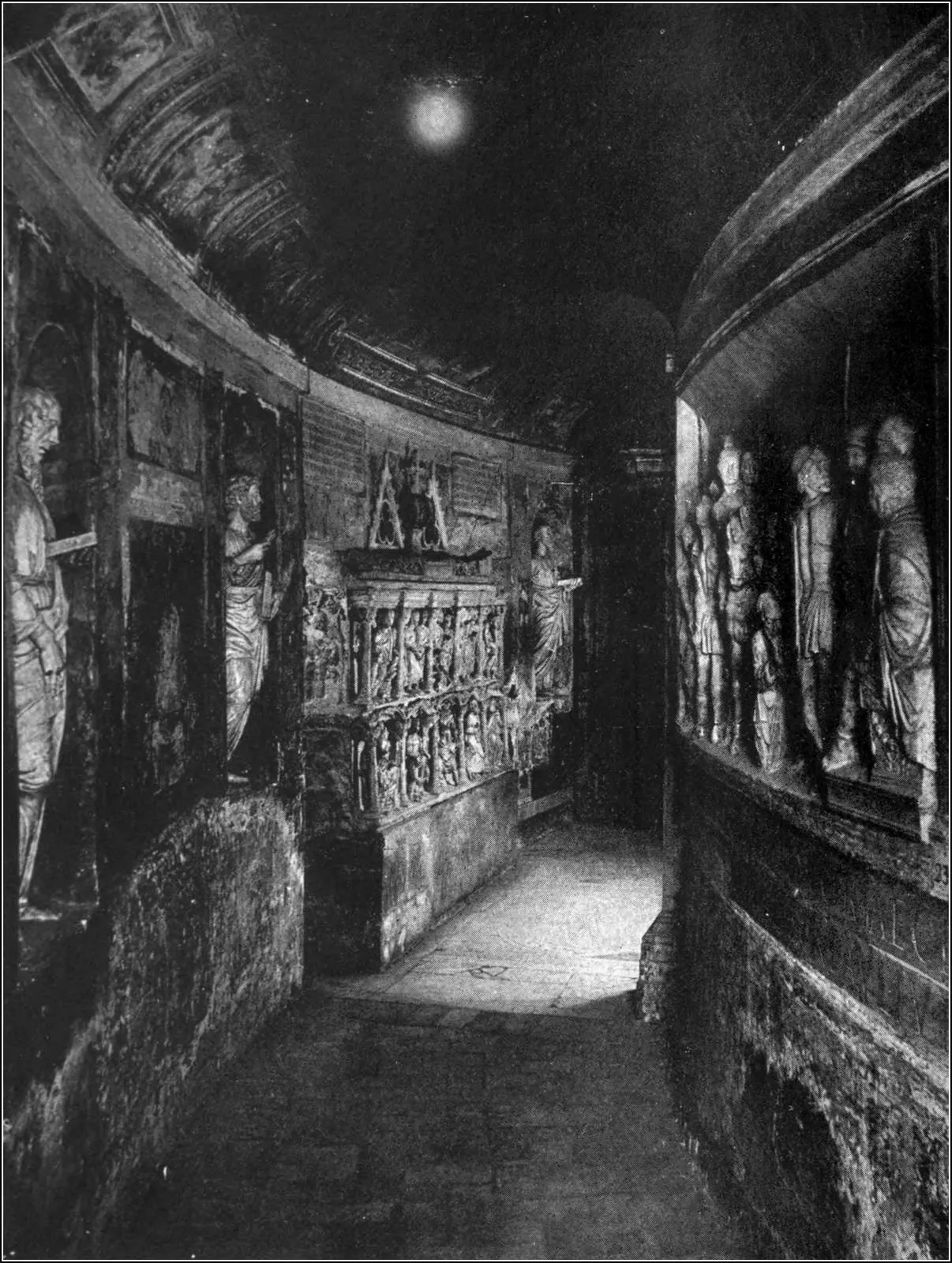
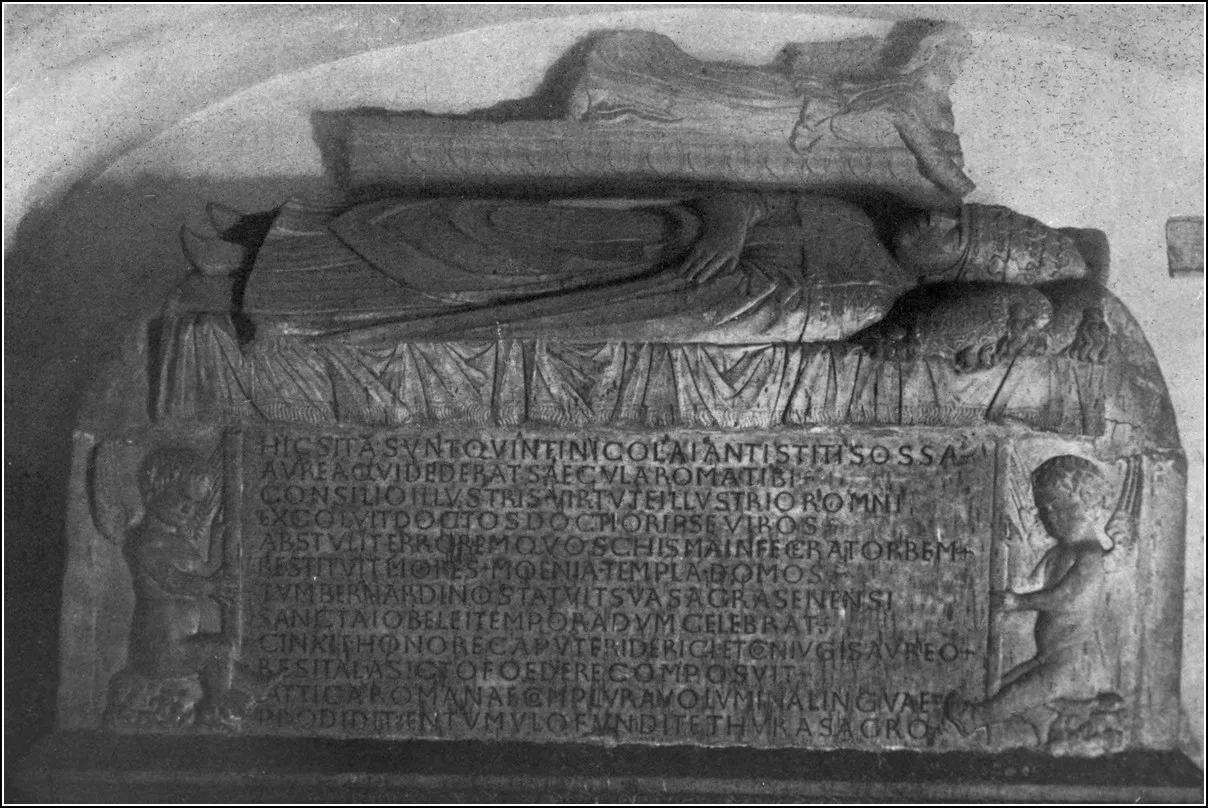
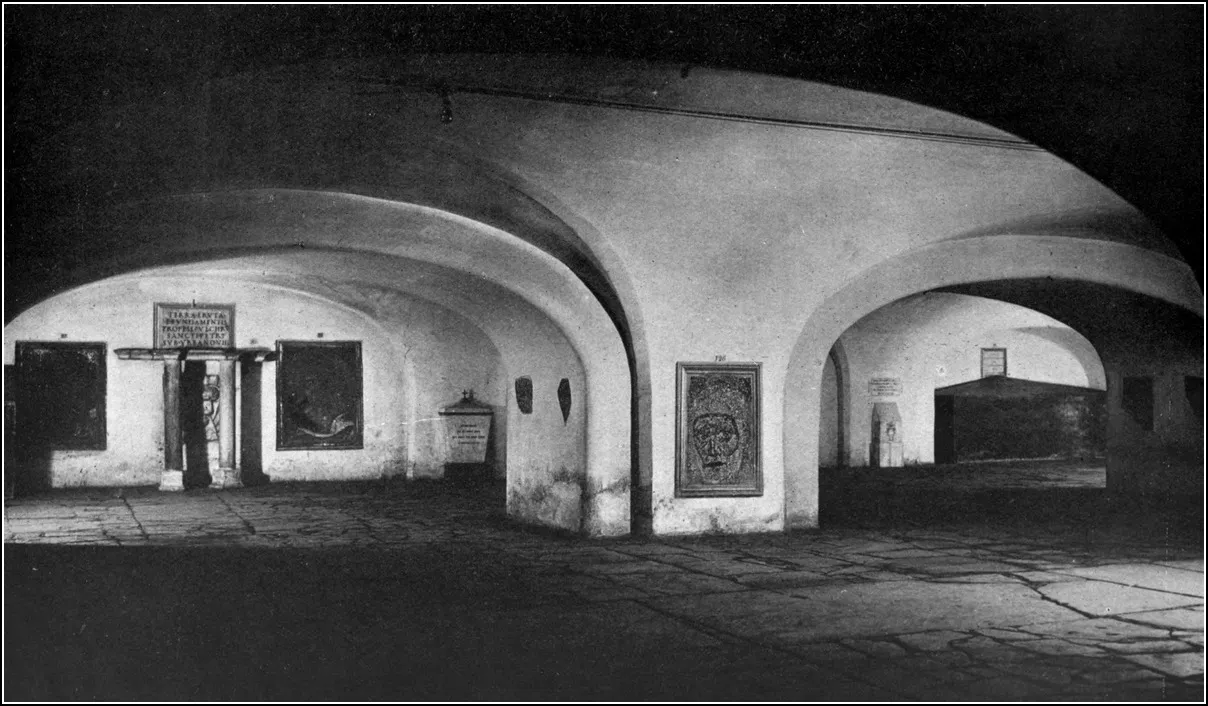
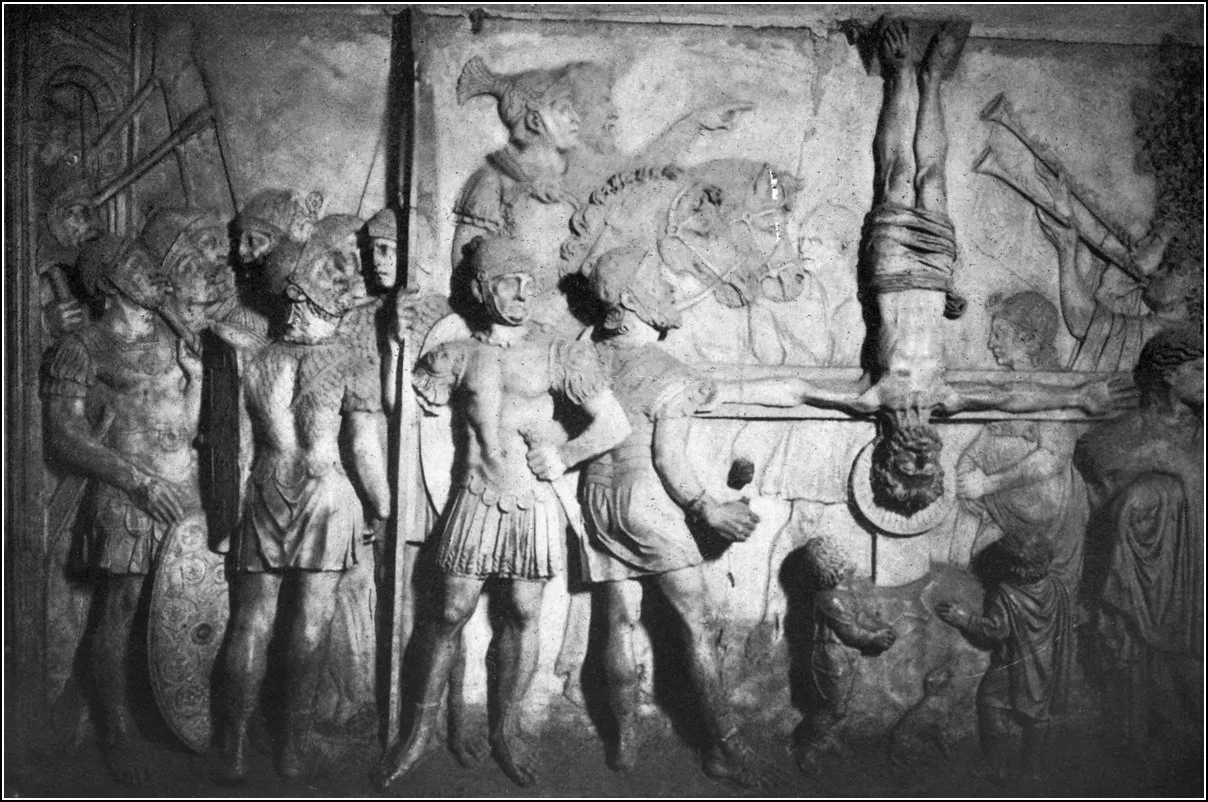
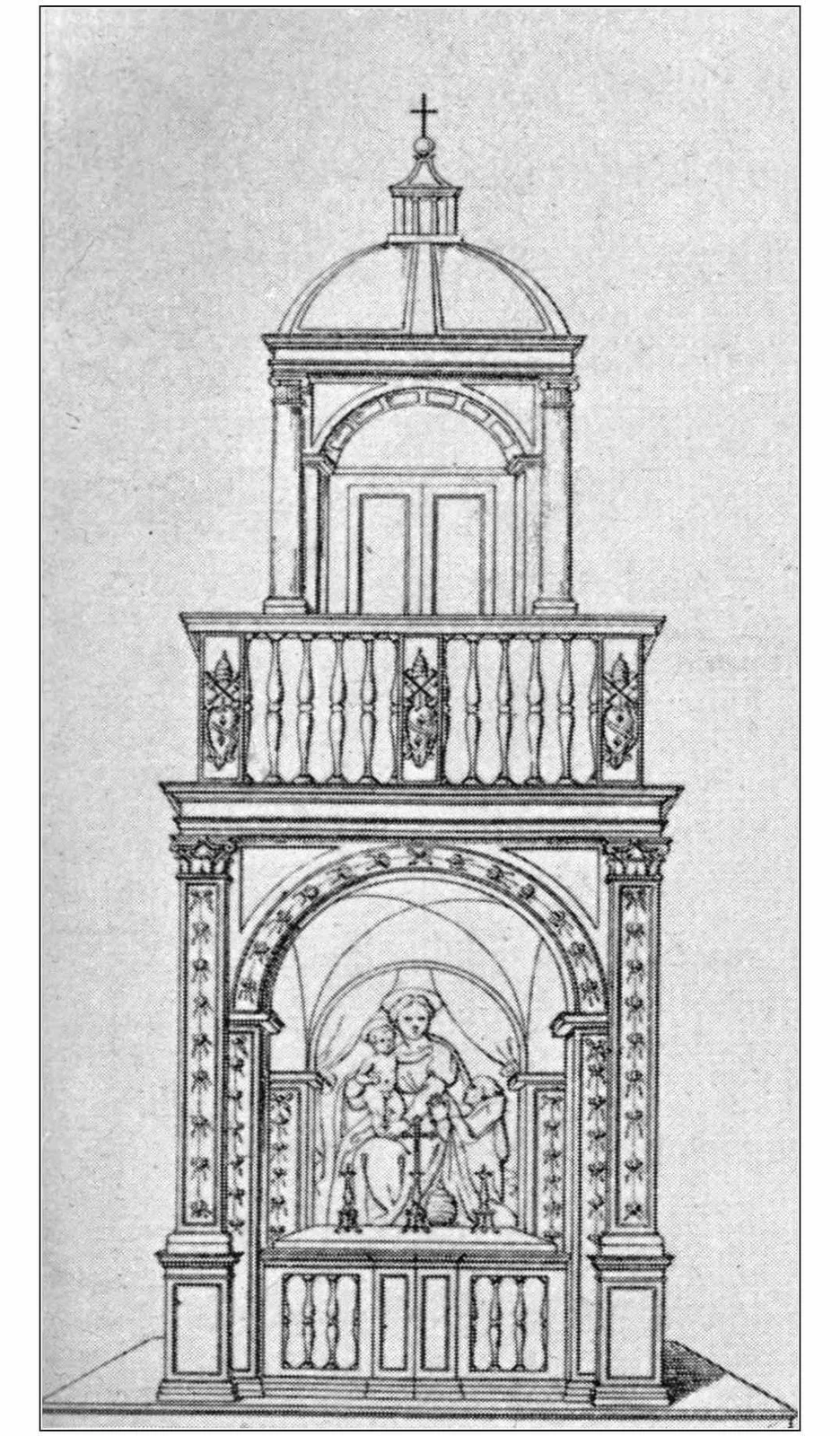
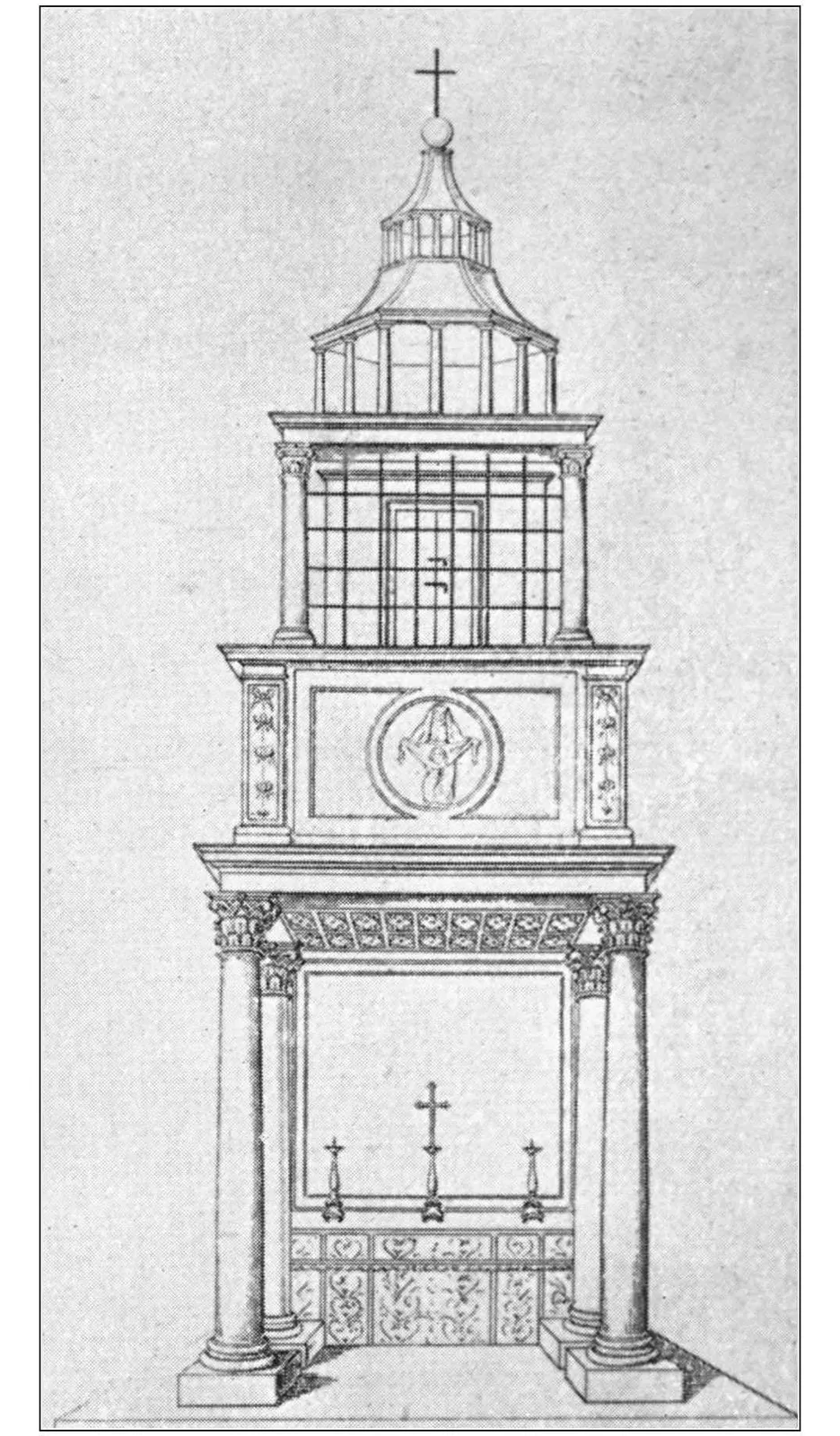
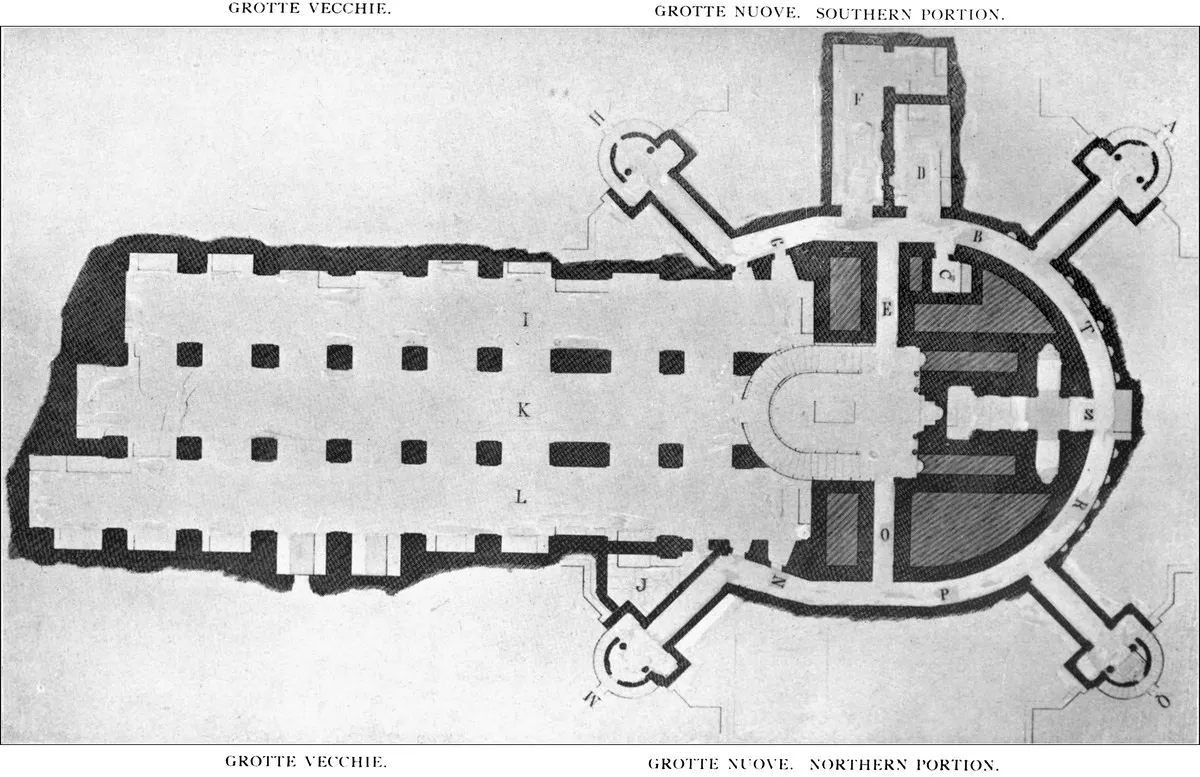
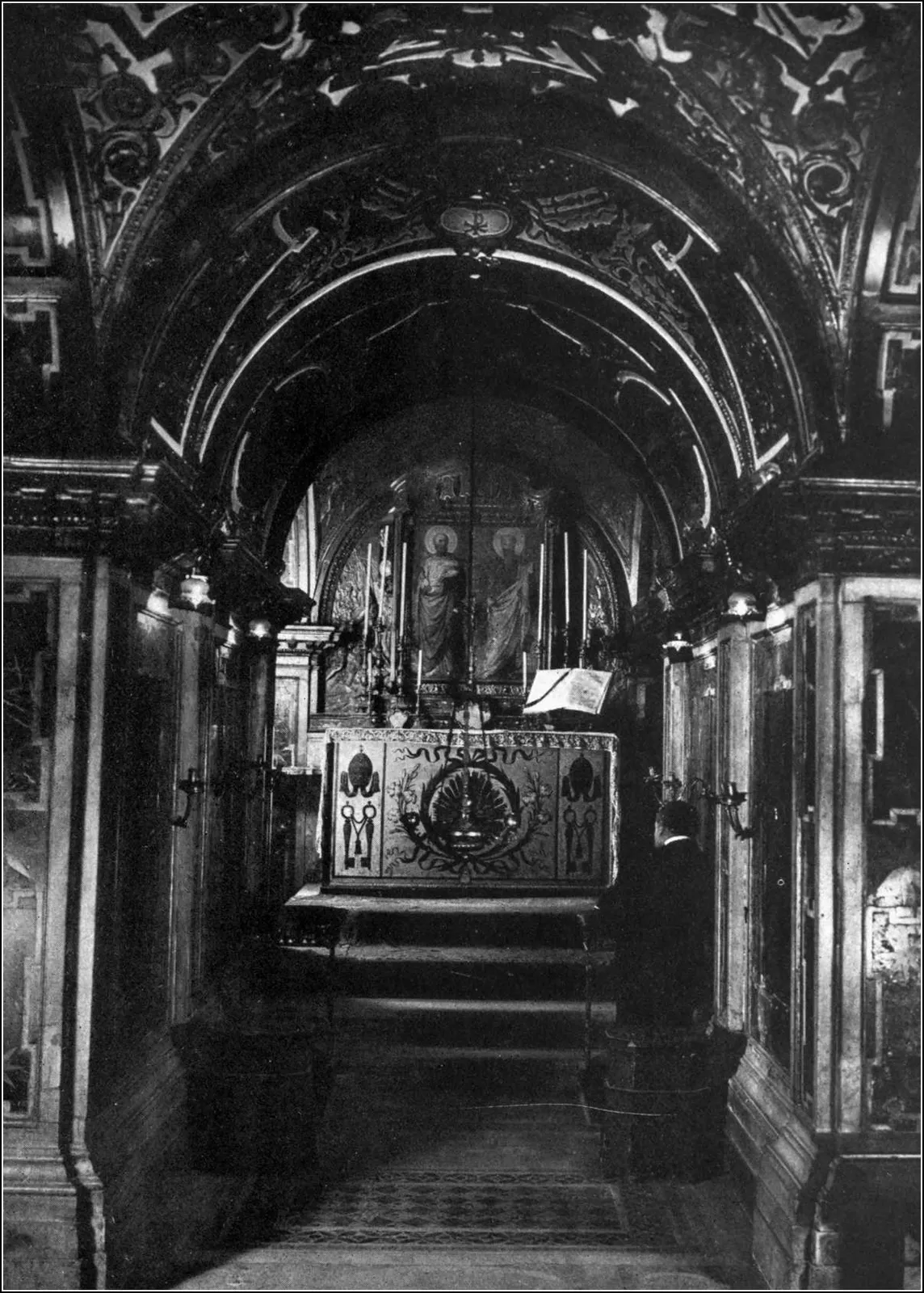
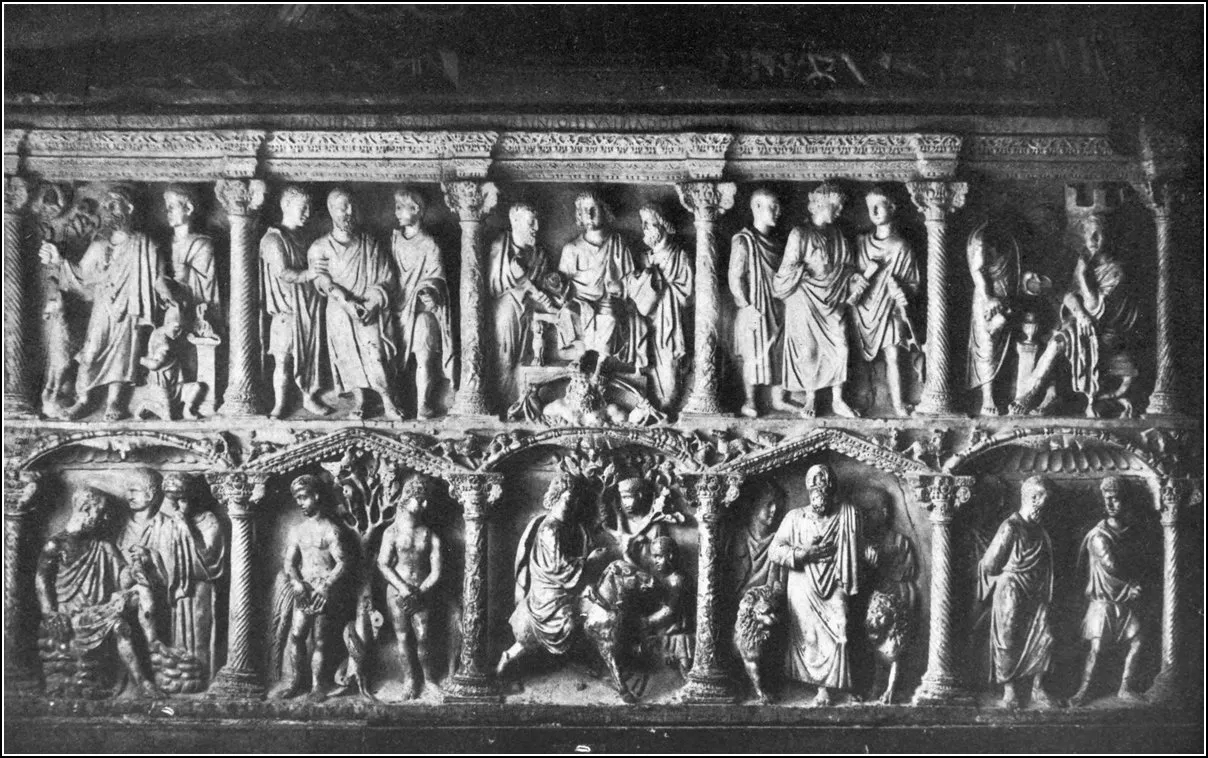
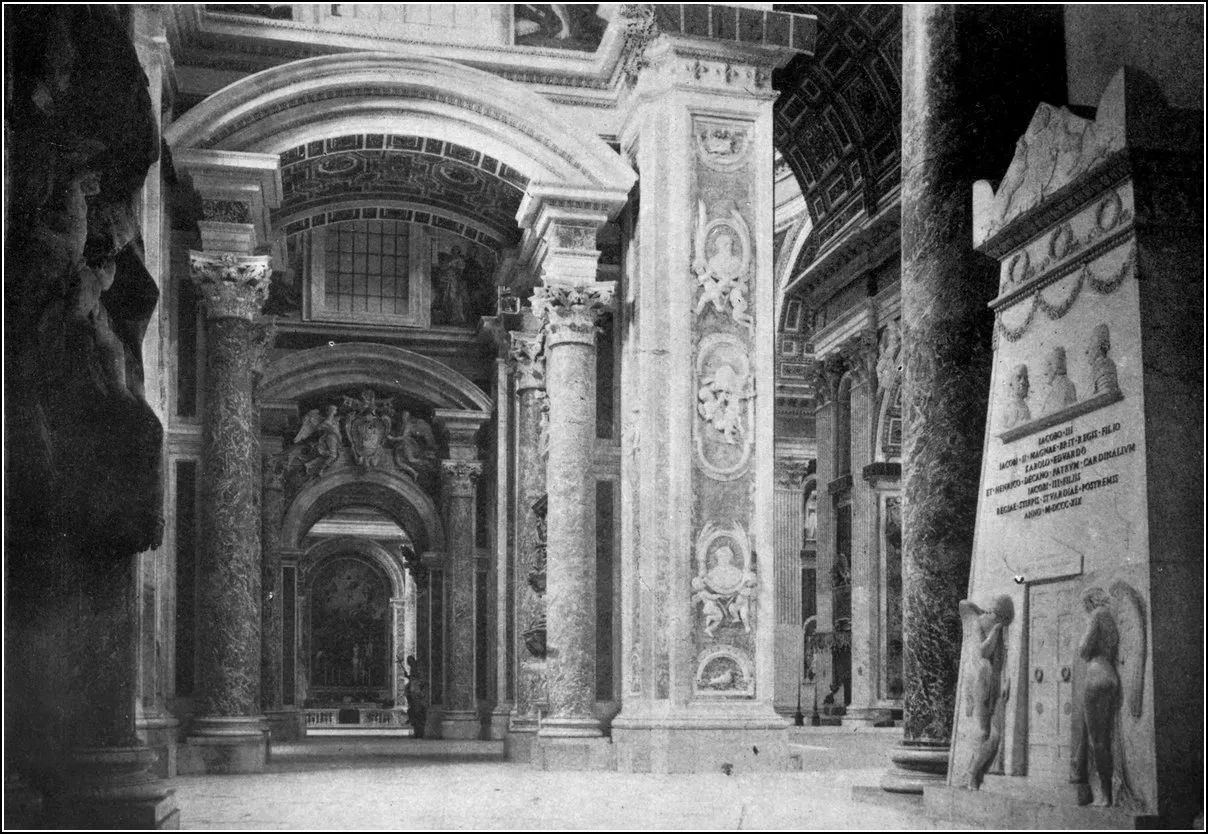
The Grotte Nuove of St Peter’s, showing the Confessio of Matteo
Pollaiuolo on the right and the light shining from St. Peter’s Tomb
upon the Sarcophagus of Junius Bassus.
BY DOUGLAS SLADEN
AUTHOR OF
“HOW TO SEE ITALY” “ORIENTAL CAIRO”
“SICILY, THE NEW WINTER RESORT”
“QUEER THINGS ABOUT JAPAN” ETC. ETC.
WITH SIXTY HALF-TONE PLATES AND A MAP
LONDON:
KEGAN PAUL, TRENCH, TRÜBNER, & CO. LTD
NEW YORK: JAMES POTT AND COMPANY
1914
PUBLISHERS’ NOTE
This volume gives the only description in
English of the Vatican, considered, not as a
collection of museums, but as the Royal Palace
of the Popes, since Mr. Sladen’s well-known
book, The Secrets of the Vatican, is now completely
out of print, and can never be published
again, part of it remaining in the hands of the
original publishers, Messrs. Hurst & Blackett,
and part having been transferred to ourselves.
This was because the chapters of the book
which related to the home-life of the Pope
necessarily need changing much oftener than
the parts which describe the Vatican Palace
itself. Those portions have been brought up to
date, and are published, with some very interesting
new matter included, by Messrs. Hurst &
Blackett, under the title of The Pope at Home.
The remainder of the book, likewise brought up
to date, and with certain interesting additions,
constitutes How to See the Vatican.
The illustrations are taken from photographs
of parts of the Vatican not usually
shown to visitors, reproductions of prints of
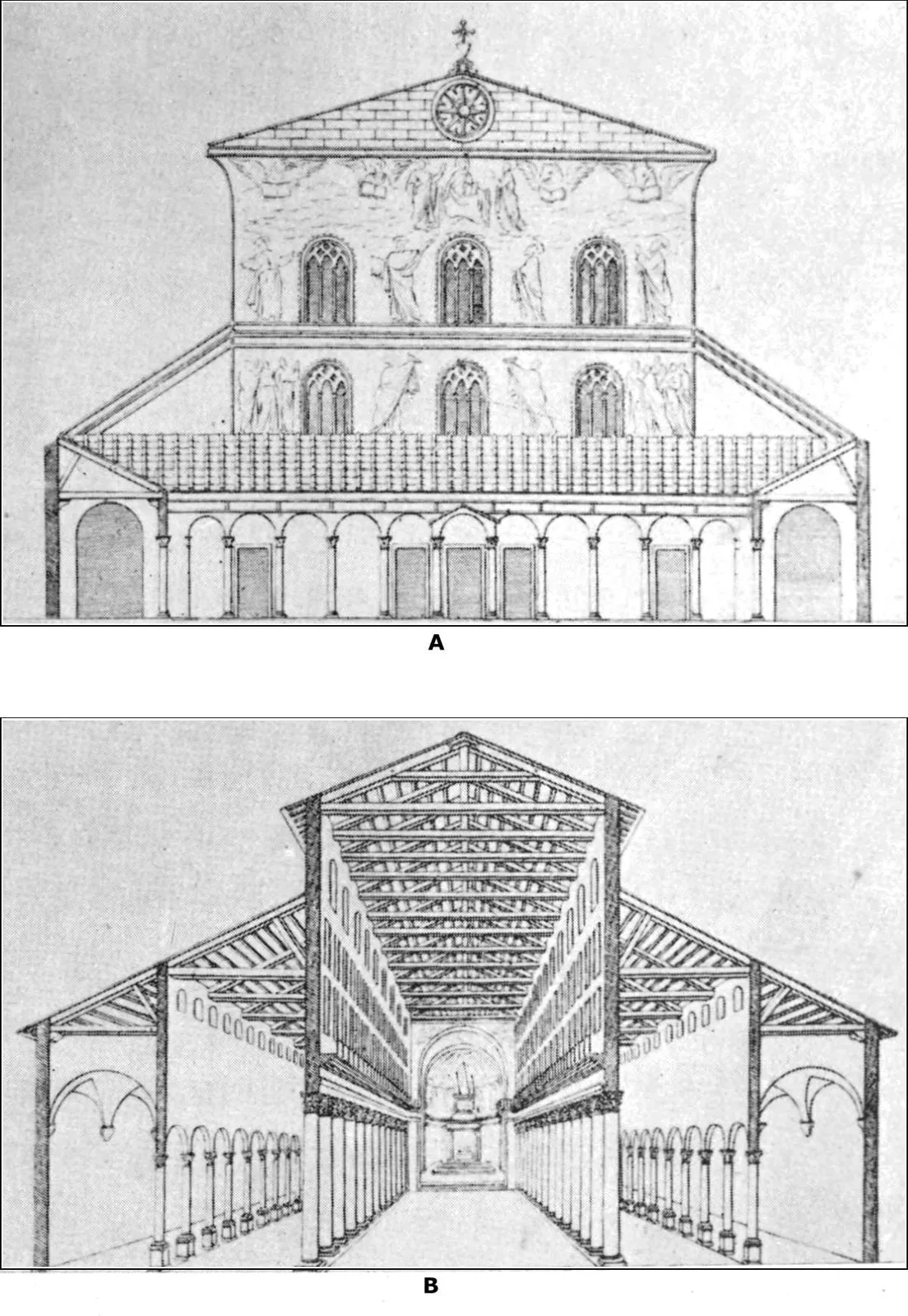
Old St. Peter’s and the treasures of the Crypt;
and various plans of the Vatican and the Crypt
to explain the gradual growth of the Palace and
Cathedral of the Popes from the date of St.
Peter’s Martyrdom—A.D. 67—to our own day.
It will be noted also that the museums,
picture galleries, and the like, for the reason
mentioned above, and to keep the book within
handbook limits, are only alluded to incidentally.
PREFACE
The word Vatican is familiar to travellers in
the signification of a place with museums of
matchless sculpture, and a gallery of paintings,
and a chapel whose paintings are yet more famous.
This does not help them to understand the first
signification. The number of English people who
have visited the Vatican Collections without
giving any thought to the Vatican beyond them
is very great. This is excusable because there is
no guide-book in English, and no adequate guide-book
in any language, to the Vatican as a Palace.
The reason is not hard to discover. In the
days before the cataclysm of 1870, when Pius IX.
was on the Papal Throne reigning like an Augustus,
the insatiable curiosity which characterizes readers
pampered by the gossip-loving periodicals of the
twentieth century had not demanded what we
call books of travel, meaning books of sight-seeing,
which are so popular now. And since 1870 the
Vatican has been in mourning.
For reasons pointed out in the Publishers’
Note, How to See the Vatican excludes those parts
of the Palace with which every visitor is familiar,
viz. the Sculpture Galleries, the Sistine Chapel,
the Stanze and Loggie of Raffaelle, and the
Pinacoteca. They are merely catalogued in the
opening chapter, in which I give the category of
the various chapels, chambers, courtyards, and
gardens which make up the Vatican. I take it
for granted that everyone is familiar with them,
and devote my space to introducing the British
and American publics to the neglected or usually
closed parts of the Palace, with the necessary
historical allusions.
I open with the story of the Vatican and the
Quintian Meadows from the days when the curly-haired
Cincinnatus left his plough to head the
armies of the Republic as Dictator. Then I tell
the story of the building of the world’s most
famous palace from the time of Pope Saint
Symmachus to the times of the three Popes of
exile who bore the devoted name of Pius—Pius VI.,
Pius VII., and Pius IX.; and give two chapters
to the reconstruction of Old St. Peter’s, built
by Constantine the Great, which lasted for more
than a dozen centuries; and three chapters to
that wonderful charnel-house of Gothic art in
Rome, the Crypt of St. Peter’s, whose pavement
is the actual floor of the Church of Constantine,
and whose vaults are strewn with the shattered
tombs of eighty-six Mediæval Popes.
It is into these chapters and the chapters on
Nicholas V., the Father of the Vatican Library,
the Mæcenas of the Papacy, the Apostle of
Learning, that history enters so much.
After these I deal with the Vatican Libraries,—old
and new,—the glowing hall and marvellous
manuscripts and antiques of the Library of Sixtus
V., and the Leonine Library, below it, by which
Leo XIII. fulfilled Nicholas V.’s ambition of making
the Vatican enlighten the world. I give a glimpse
of Montaigne in the Vatican Library. I say what
I know about the Archives from the time of Pope
Saint Damasus; and dwell on the beauty and
romance of the Vatican Gardens—the Pope’s
kingdom of this world. That is followed by a
number of shorter chapters on the byways of
the Vatican trodden by few feet—the Paoline
and Leonine Chapels, the Treasury of the Sistine
Chapel, the Pope’s private tapestry rooms and
personal apartments, the Sala Regia, the Sala
Ducale, the Loggia of Giovanni da Udine, the
Pope’s Coach-house, the Gallery of Raffaelle’s
tapestries, the Gallery of the Candelabri, the
Gallery of the Maps, the mysteries of the Sacristy
and the Dome of St. Peter’s; and I wind up with
the little-known Etruscan Museum and the Borgia
Apartments. The few who have crossed the
threshold of the Etruscan Museum may be glad
to cross it again with one who has visited most of
the Etruscan cities, half-buried in flowers and
turf, on hills in hidden valleys, which are the
delight and despair of the antiquarian. The
Borgia Rooms, now not so difficult to visit, are
included, not to give a detailed criticism of their
pictures, already so superbly treated by Ehrle
and Stevenson, and Ricci, but partly to convey
their effect as the most typically palatial part of
the royal Palace of the Popes, and partly to give
a number of interesting facts about them which
have never before appeared in English.
From the above it will be seen that I have
aimed at giving the traveller who goes to Rome
for sight-seeing, and the stay-at-home who has
to do his sight-seeing in books of travel, some
idea of the parts of the Vatican which are not
generally seen; either because the visitor does
not know where to look for them, or because
they are only shown as a special favour.
I am myself a Protestant, a member of the
Church of England. My idea of patriotism makes
it impossible that I should ever leave the Church
of my forefathers. But it is only upon the Rights
and the Independence of the Church that I have
strong feelings; the differences of dogma which
have grown up since it parted from the Church
of Rome do not concern me. I feel towards the
Church of Rome as an Anglophile American feels
towards England: I feel that I sprang from it. I
do not forget that I belonged to it, until the Middle
Ages, which are my special study and delight,
were ended. Its history and antiquities occupy
a great part of my thoughts, for I spend half my
life in Italy, and the days I have passed in Italy
have mostly been devoted to Church antiquities.
I regard the venerable Church, which has been
going like a clock since the days of the Apostles,
with the utmost affection and interest. Not having
been brought up in the Church of Rome, and
having a feeling of repulsion to all dogma, I
cannot hope to penetrate deeper than the outer
shell of that ancient and glorious institution.
But I hope that those who are members of the
Church of Rome will recognize the pleasure and
enthusiasm with which I study their antiquities
and monuments; and accept my assurance that,
if I have written anything which hurts their
feelings, I have not written it with any outspokenness
or levity that I might not have used
in writing of England. And England is my
religion.
Before closing this foreword I have to
make various acknowledgments. There are
many books to which I have to acknowledge
my indebtedness. First among these
comes Gregorovius’s great History of Rome in
the Middle Ages, translated by Mrs. Gustavus
W. Hamilton, and published by George Bell &
Sons (8 vols. in 13, £3 3s. nett). This book is
a fountain of inspiration to anyone who essays
to write about Rome in the Middle Ages. Not
only are its springs inexhaustible: the fountain
itself is so clear and beautiful that to take
draughts from it is a perpetual delight. The
smaller volume of Gregorovius, from which I
have made several quotations—the Tombs of the
Popes, translated by Mr. R. W. Seton Watson,
and published by Archibald Constable & Co.
(with whose permission these quotations have
been made)—I should not have used so much
but for the admirable English of the translation.
Other books of Messrs. Bell, to which I have
referred a few times, are Miss Mary Knight
Potter’s The Art of the Vatican, and Roscoe’s
Life of Leo X.
Mr. John Murray has published several books
which I have constantly before me. Besides
Murray’s Handbook to Rome, which has always
been recognized as one of the best in any language,
there are Sir A. H. Layard’s Handbook to the
Italian Schools of Painting, based on Kugler’s
handbook, sixth edition (2 vols., 24s. nett);
Dennis’s Cities and Cemeteries of Etruria (2 vols.,
36s. nett); Nielsen’s History of the Papacy in
the Nineteenth Century, 1907 (2 vols., 24s. nett);
and Mr. W. G. Waters’s Translation of the Journal
of Montaigne’s Travels, which contains some
interesting passages about the Vatican Library.
Dean Milman’s History of Latin Christianity,
published by the same firm, I have found of
very little use; it is too concentrated.
Messrs. Macmillan & Co. have brought out
valuable books on the subject. Lanciani’s four
earlier volumes, Pagan and Christian Rome,
Ancient Rome, the Destruction of Ancient Rome,
and Ruins and Excavations of Ancient Rome, all
of them published by this firm, are never off
my writing-table. Macmillan’s Handbook to Italy
and Sicily has a special value because in it the
towns are arranged alphabetically in gazetteer
fashion. Other books of this firm to which I
have occasionally to refer are Mr. Walter Lowrie’s
Christian Art and Archæology, Professor Bryce’s
phenomenal book, The Holy Roman Empire, and
those delightful books, Mrs. Oliphant’s Makers
of Modern Rome, and Mr. Marion Crawford’s
Ave Roma Immortalis. The essay entitled A
Survey of the Thirteenth Century, in Mr. Frederic
Harrison’s volume of essays, The Meaning of
History, which I keep on a shelf beside my volumes
of John Addington Symonds, I have found very
suggestive.
There are few publishers to whom I am more
indebted in the preparation of this work than
Messrs. A. & C. Black, who publish the admirable
Handbook to Christian and Ecclesiastical Rome,
by Misses Tuker and Malleson, which I have used
throughout for checking the information given
in French and Italian works. I have also referred
a few times to the large book on Rome
by the same ladies, which is one of the best
illustrated volumes in Messrs. Black’s colour
series; and Professor Middleton’s classic Remains
of Ancient Rome. Messrs. Black have also a
two-and-sixpenny guide-book to Rome, with
coloured illustrations, written by Mr. E. A.
Reynolds-Ball in 1906.
Mr. T. Fisher Unwin has four volumes in his
Story of the Nations series (price 5s. nett per
vol.): Rome, by Mr. Arthur Gilman, M.A. (6th
imp., 3rd ed.); The Papal Monarchy, by Dr.
William Barry; Mediæval Rome, by Mr. William
Miller; and Modern Rome, by Professor Pietro
Orsi—all of them useful for facts.
I have had constant occasion to refer to that
valuable book, Hare’s Walks in Rome, brought
up to date like Hare’s Days round Rome, by
Mr. St. Clair Baddeley, who has the responsible
position of representing the English subscribers
interested in the Excavation of the
Forum. Both these books are published by
Messrs. Kegan Paul, Trench, & Co. One of
the best books dealing incidentally with the
Vatican is Klaczko’s Rome and the Renaissance,
translated by Mr. John Dennie, very beautifully
brought out by G. P. Putnam’s Sons.
For one period of the Vatican Messrs. Duckworth
& Co.’s beautifully produced edition of
Mrs. Ady’s Raffaelle is useful.
There is a little about the Vatican Library
in Helbig’s Guide to the Public Collections of
Classical Antiquities in Rome, published by
Baedeker. Baedeker’s Central Italy is indispensable;
it is so extremely well arranged, so
sure to mention salient facts, like dates and
measurements, which one has occasion to check.
For the purpose of this volume I have not
had occasion to use much that very picturesque
book, Father Chandlery’s Pilgrim Walks in
Rome, published by the Manresa Press, though
I have found it most useful in the larger work
I am preparing about Rome. I understand
that much information about Old St. Peter’s is
scattered through Father Barnes’s large work
on St. Peter in Rome, which I have not seen.
One of the best accounts of the Pope’s apartments
to be found anywhere is in Zola’s Rome, of
which the English edition is published by Messrs.
Chatto & Windus, who are likewise the publishers
of the cheap editions of Charles Reade’s The
Cloister and the Hearth, into which Nicholas V.
comes; and Wilkie Collins’s Antonina.
Far the most interesting volume of gossip
about the Popes is Silvagni’s La Corte e la
Società Romana nei XVIII. e XIX. secoli, of
which a most spirited translation has been
published by Mrs. Frances Maclaughlin (Elliot
Stock).
A rather similar book is the late W. W.
Story’s famous Roba di Roma, sixth edition,
published by Messrs. Chapman & Hall, who are
also the publishers of Mr. Frederic Harrison’s
novel, Theophano, which has a great deal about
Rome and the Popes in the age of the Ottos.
As interesting as Roba di Roma, if not as Silvagni,
but, of course, written from a very
different standpoint, is Cardinal Wiseman’s Recollections
of the Last Four Popes and of Rome
in their Times, published by Messrs. Hurst &
Blackett.
Last in the list of English books I may mention
the translation of Dr. Ludwig Pastor’s
History of the Popes, published by Mr. John
Hodges, in the Catholic Standard Library, a
book as picturesque and packed with learning
as Gregorovius’s, if less succinct.
Finally, I may say that for all recent special
information on my subject I have had to go to
French and Italian books.
First, I must naturally mention the superb
works written by Messrs. Ehrle and Stevenson
on the Borgia Rooms, and Corrado Ricci on Pinturicchio,
in which much space is devoted to
the Borgia Rooms. Both of these noble works,
which cost five or six guineas apiece, were written
in Italian, but of the latter Mr. Heinemann has
brought out a superbly illustrated translation
with glorious coloured plates.
The house of Firmin-Didot et Cie have
brought out, at 3 frs. 50 centimes each, two most
valuable volumes containing contributions by
M. Georges Goyau, M. Paul Fabre, M. Pératé, and
the Vicomte Melchior de Vogüé, under the titles
of La Gouvernement de l’Église, and La Papauté
et la Civilization. The former is indispensable
to anyone who wishes to form a succinct idea of
the personnel of the Vatican; it is most lucidly
and attractively written; and it and the Vie
Intime de Pie X., by the Abbé Cigala, who is
by birth a noble of Turin, are the two most
interesting books on the Vatican which I have
read.
The Vie Intime is even more up to date than
the Gouvernement de l’Eglise; it is published
by Lethielleux et Cie, who also are the publishers
of M. Lector’s Le Conclave.
For the information about the Vatican and
St. Peter’s Crypt, which form a pièce de résistance
in my book, I am most indebted to the Éléments
d’Archéologie Chrétienne of Professor Marucchi,
the Pope’s archæologist, the de Rossi of the day,
and the Cryptes Vaticanes of Père Dufresne,
which was, until I brought out Old St. Peter’s and
St. Peter’s Crypt, the only book on the subject,
and is a mine of information.
I have left to the end Pistolesi’s magnificent
work, Il Vaticano, published eighty years ago in
eight huge folios, at the expense, I believe, of a
former Earl of Shrewsbury. Half my illustrations
are reproductions of the hundreds of
superb plans and plates in this book. Pistolesi
is what Americans would call the bed-rock,
upon which many of the later books about the
Vatican are founded, and its value is much enhanced
by the fact that, unlike most large Italian
works, it is well indexed.
I hope that I have not omitted any of the
works which have been valuable to me in the
prolonged studies which preceded the writing of
my book. If I have, I tender my most sincere
apologies to their authors and publishers. I
must conclude with a word of thanks to Miss
Heath Wilson, of the English Library in the
Piazza di Spagna at Rome, a valued friend,
who has given me much help by procuring for
me various materials not procurable in England.
What the Vatican consists of. Being a specific classification and explanation, with a numbered plan, for the first time given in English, of all the vast building—the largest in the world—known as the Vatican, which comprises the Palace of the Popes, six chapels, a dozen courts, many museums, sculpture galleries, and loggie; the Borgia Apartments; Guard-rooms, factories, libraries, gardens, etc. etc.; the famous Vatican Picture Gallery, tapestries, crypts, etc. etc.
Parts of the Vatican not generally shown to the Public.
III.
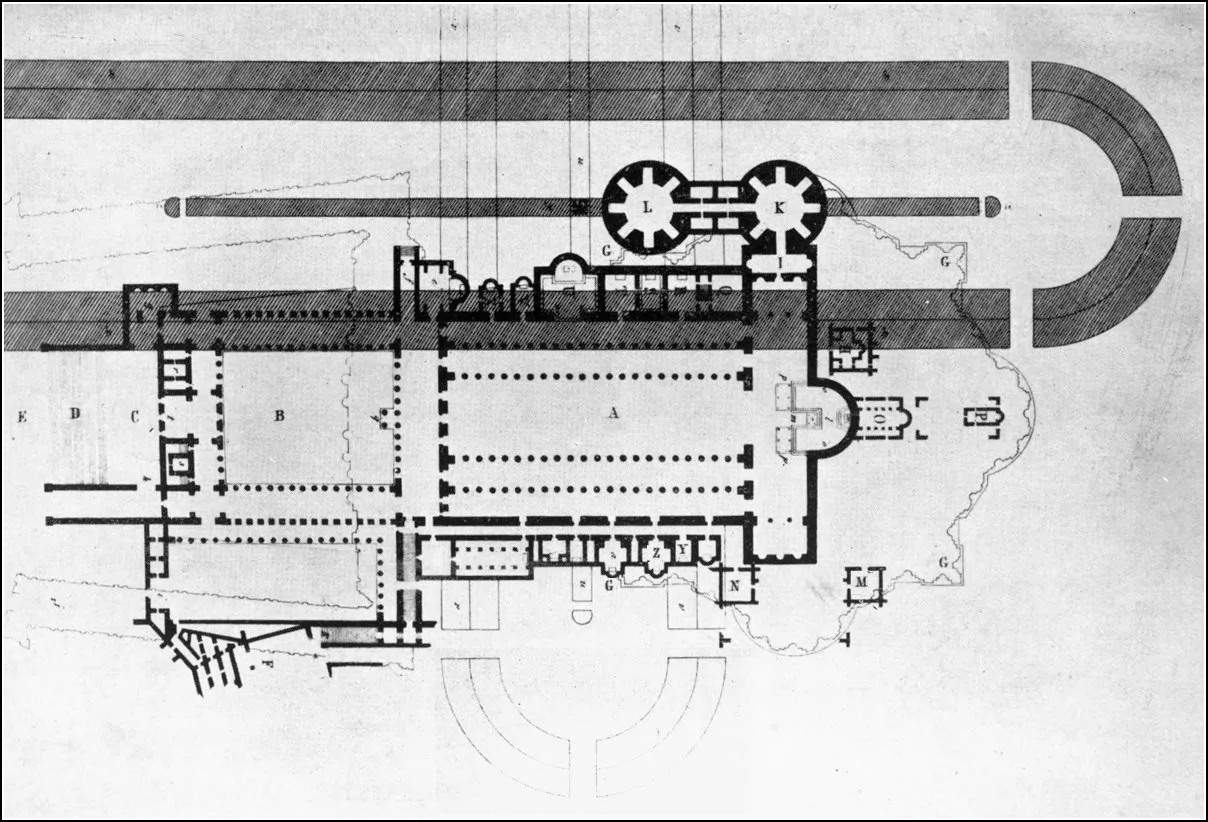
The Story of the Vatican Hill in ancient Roman times, when it was the farm from which Cincinnatus was called to be Dictator, and contained the Garden of Agrippina, the mother of Nero; and the Circus where St. Peter and other Christians suffered martyrdom
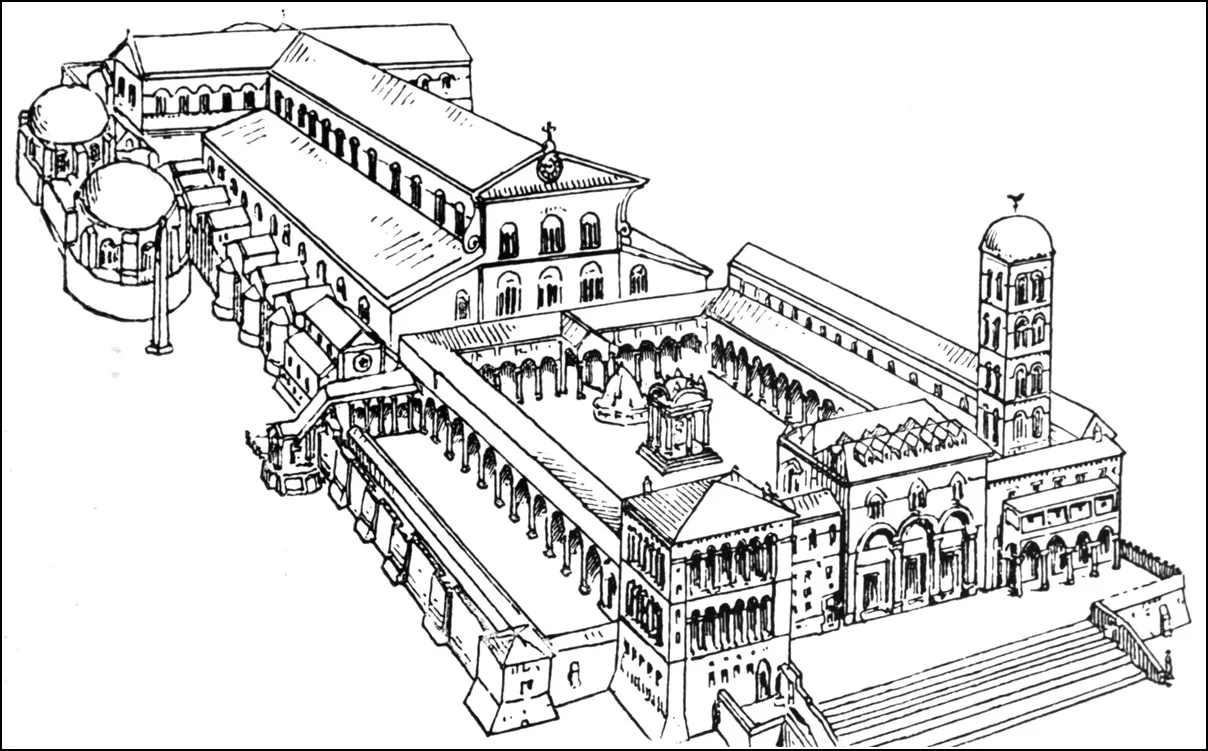
A Description of Old St. Peter’s, the great basilica founded by Constantine the Great, which existed for a thousand years before it was destroyed to make room for the present St. Peter’s. Never before fully described in any English book
The Grotte Vaticane, or Crypt of St. Peter’s; which contain the Tomb of St. Peter and the Tombs of the Popes, and Shrines from Old St. Peter’s. The Grotte Nuove, North Portion
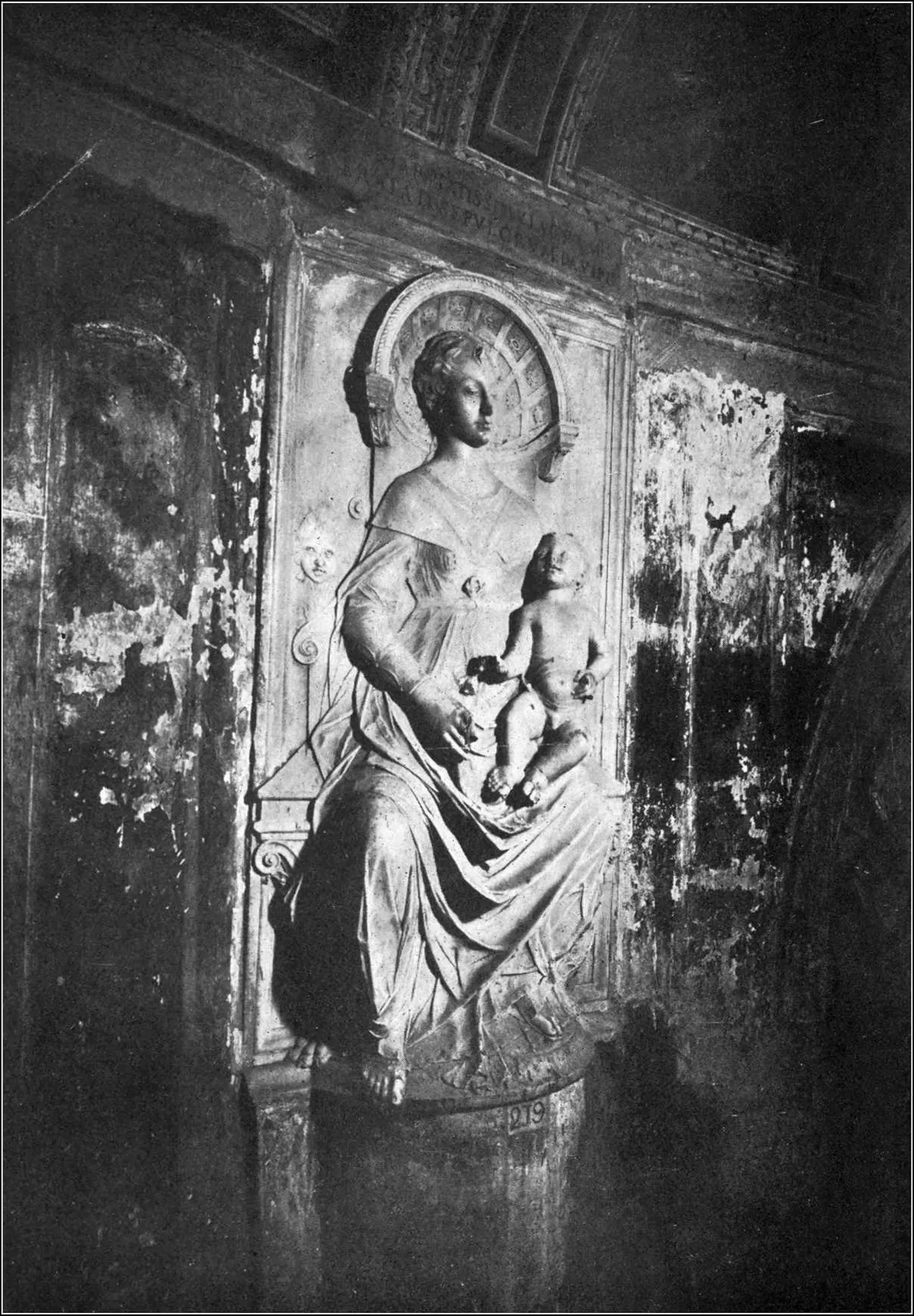
The Grotte Nuove of St. Peter’s. Showing the Confessio of Matteo Pollaiuolo on the right, and the light shining from St. Peter’s Tomb upon the Sarcophagus of Junius Bassus
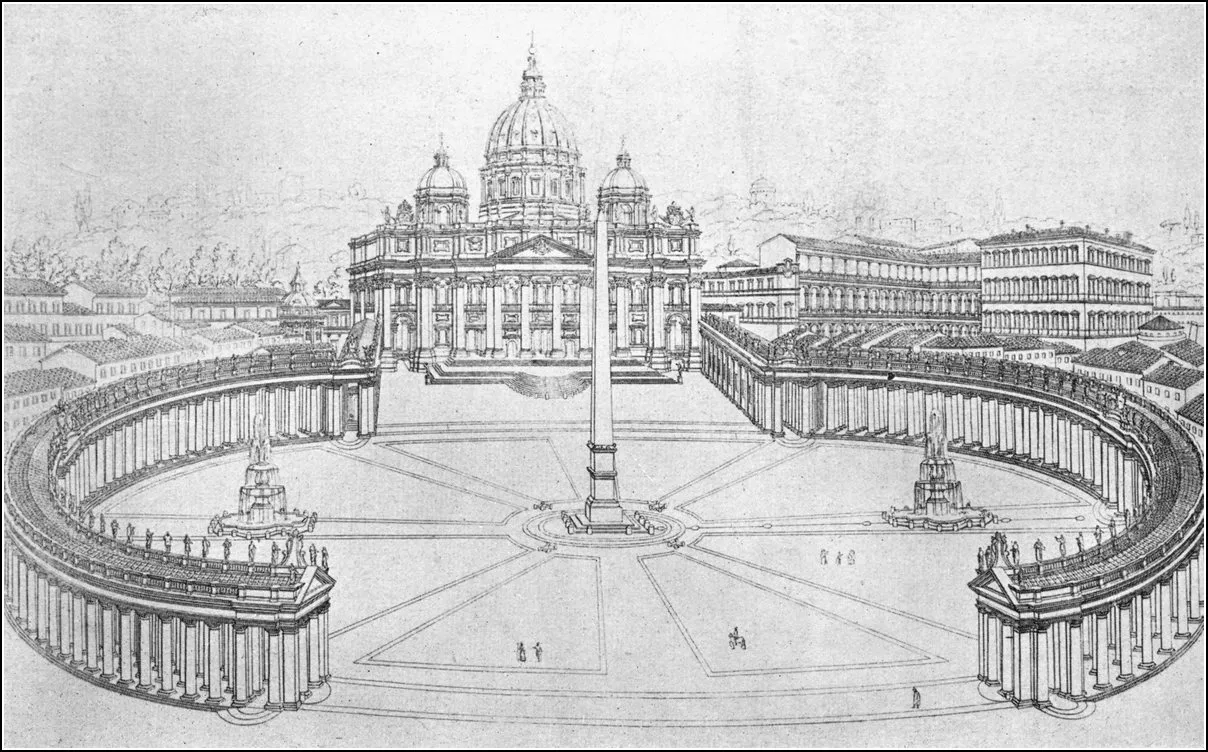
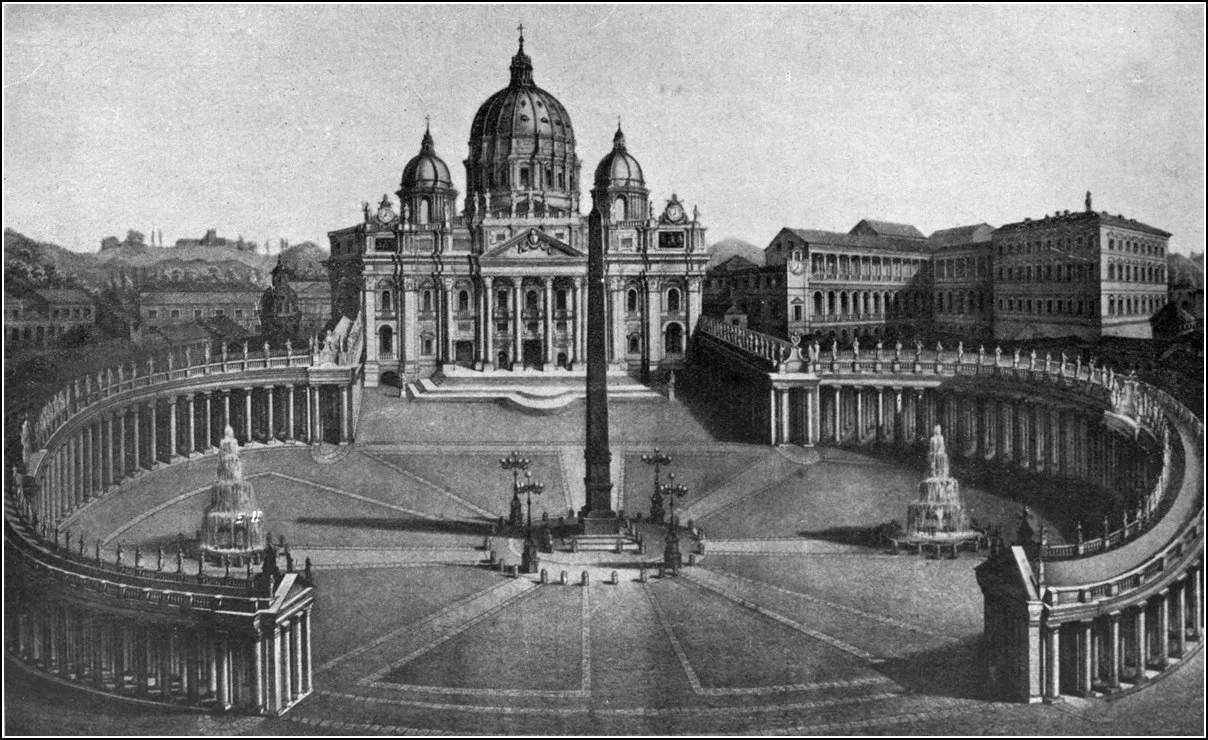
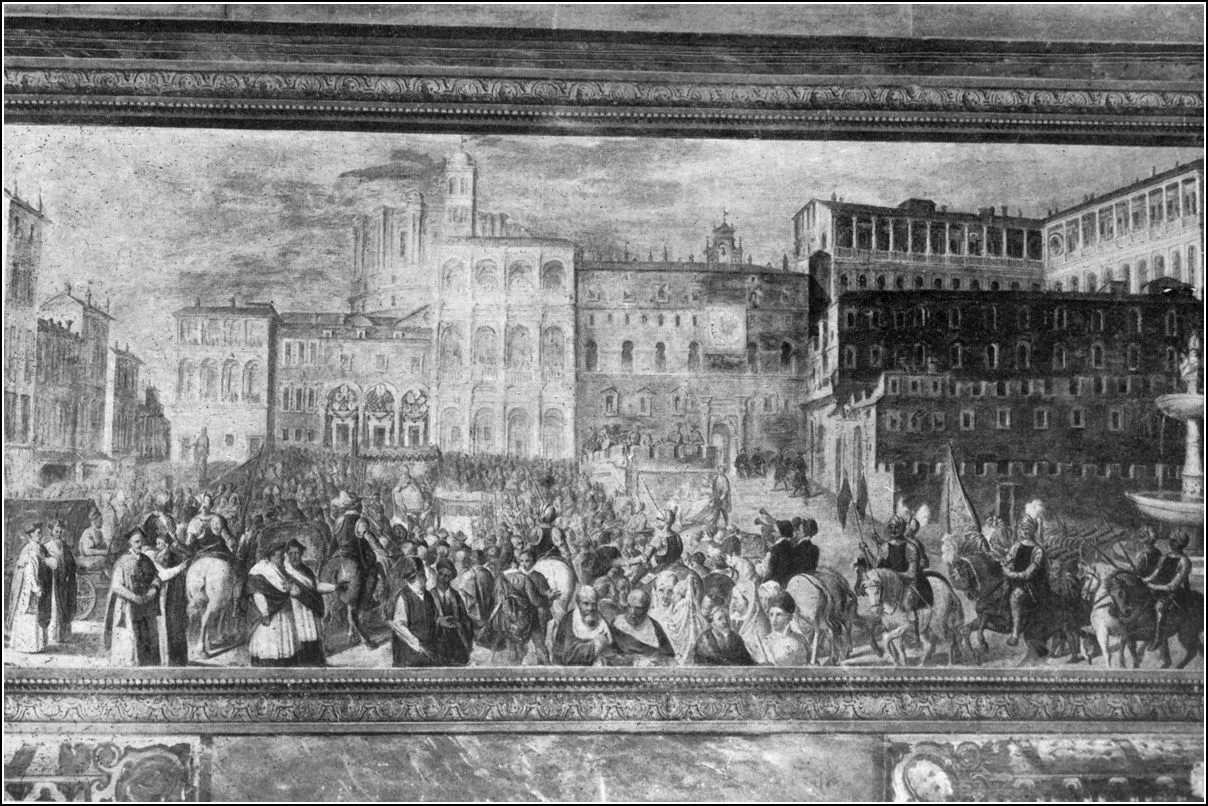
The Piazza of St. Peter’s as it is to-day; on the right, above the Colonnade, is the Palace of the Vatican, the right wing of which contains the apartments of the Pope
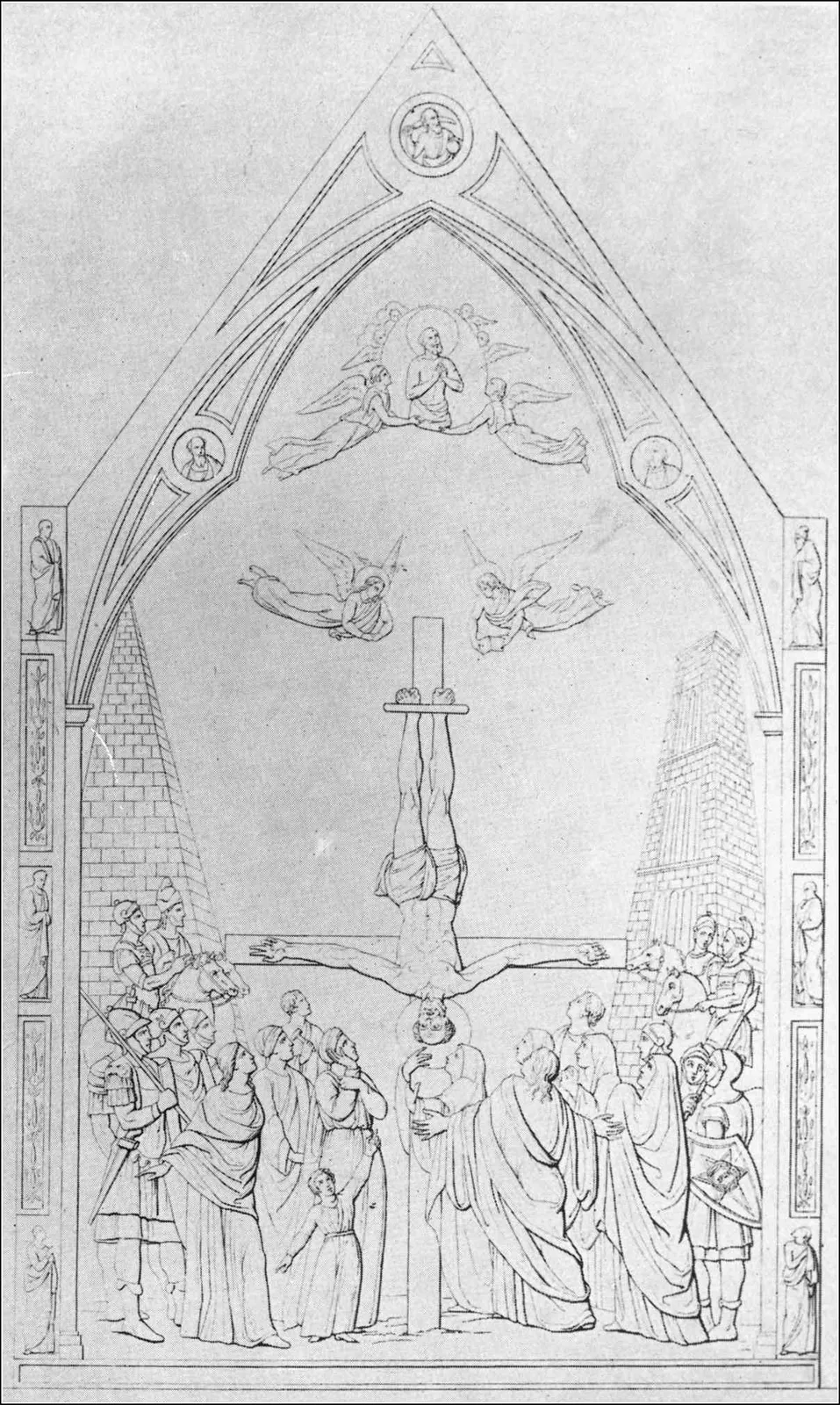
The Crucifixion of St. Peter—by Giotto—now in the Sacristy of St. Peter’s. The earliest known work of art in which the Tomb of Romulus and the Tomb of Caius Cestius are shown as the Duae Metae
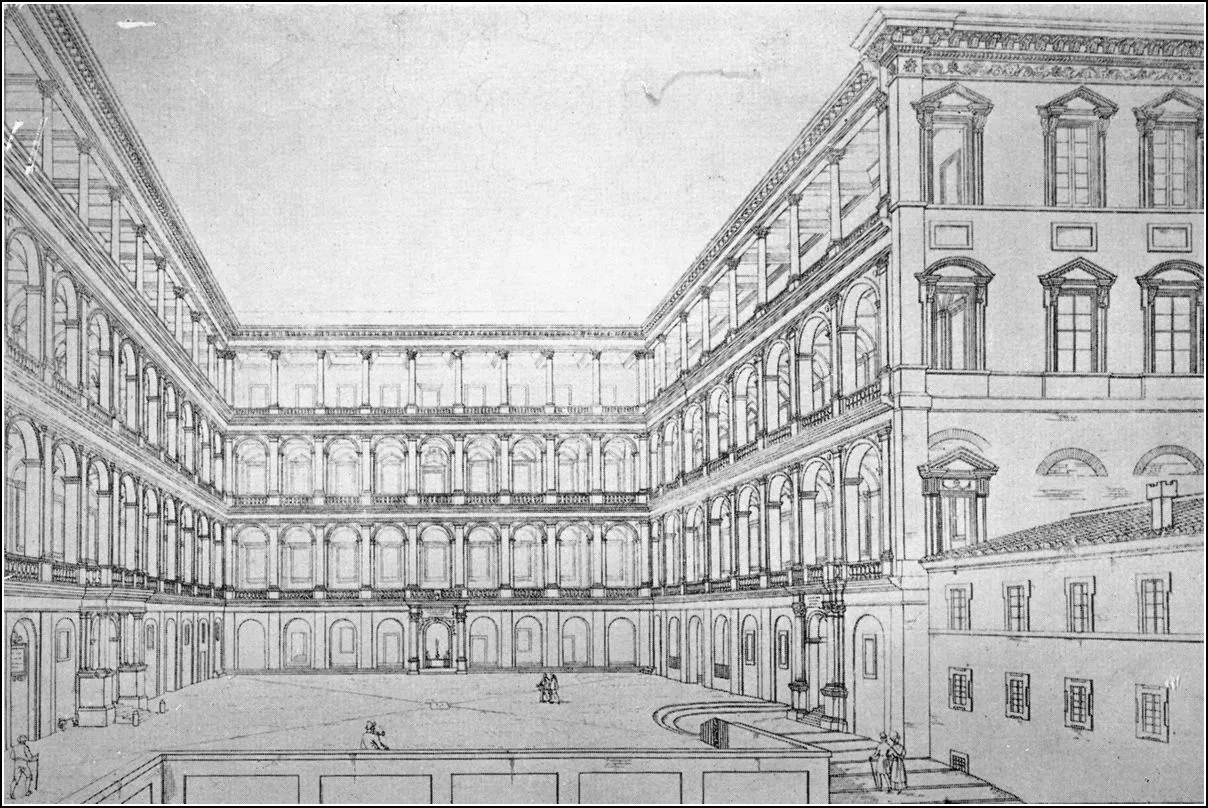
The Courtyard of S. Damaso before the arcades were glazed by Pius IX. Drawn and engraved by G. Fontana. The apartments of the Pope occupy the right wing
The Grotte Vecchie of St. Peter’s Crypt. Showing the Sarcophagus of the Old Pretender on the extreme right, and the urn containing the præcordia of Pius IX. next to it
Old St. Peter’s, with the procession transporting the body of St. Gregory the Great in the foreground, and the dome of the present church rising behind. Painted by P. Brill
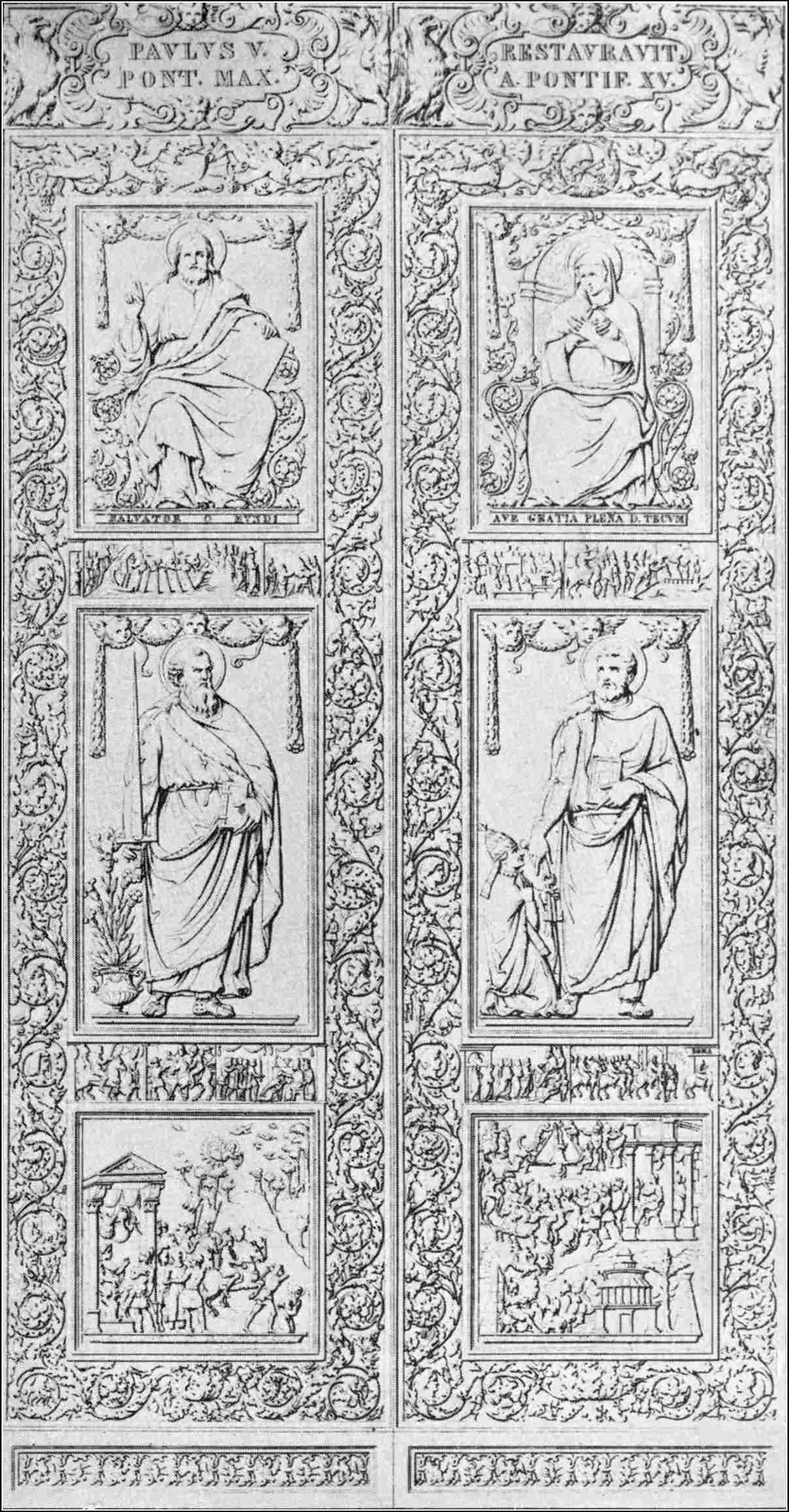
The bronze doors removed from Old St. Peter’s to the present Church. They were made by Filarete and Ghini, and the bottom right panel shows the Tomb of Caius Cestius and Tomb of Romulus at the Duae Metae
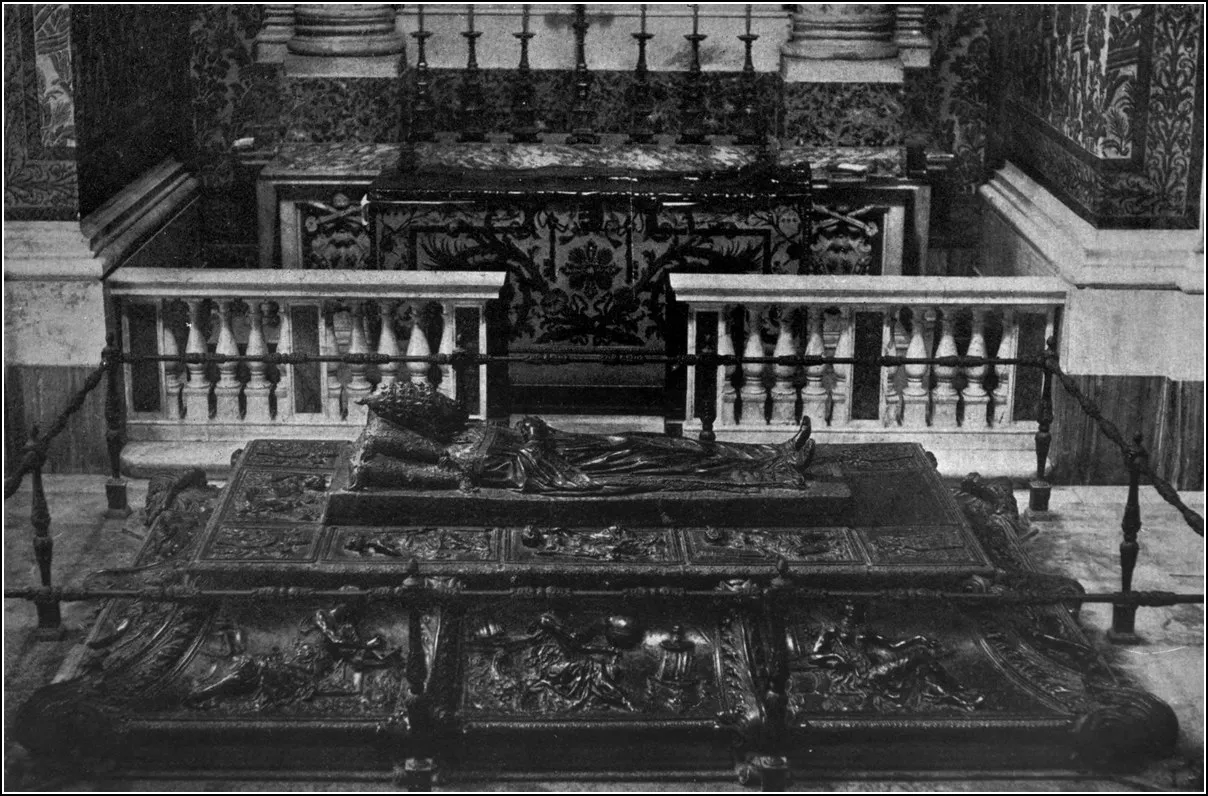
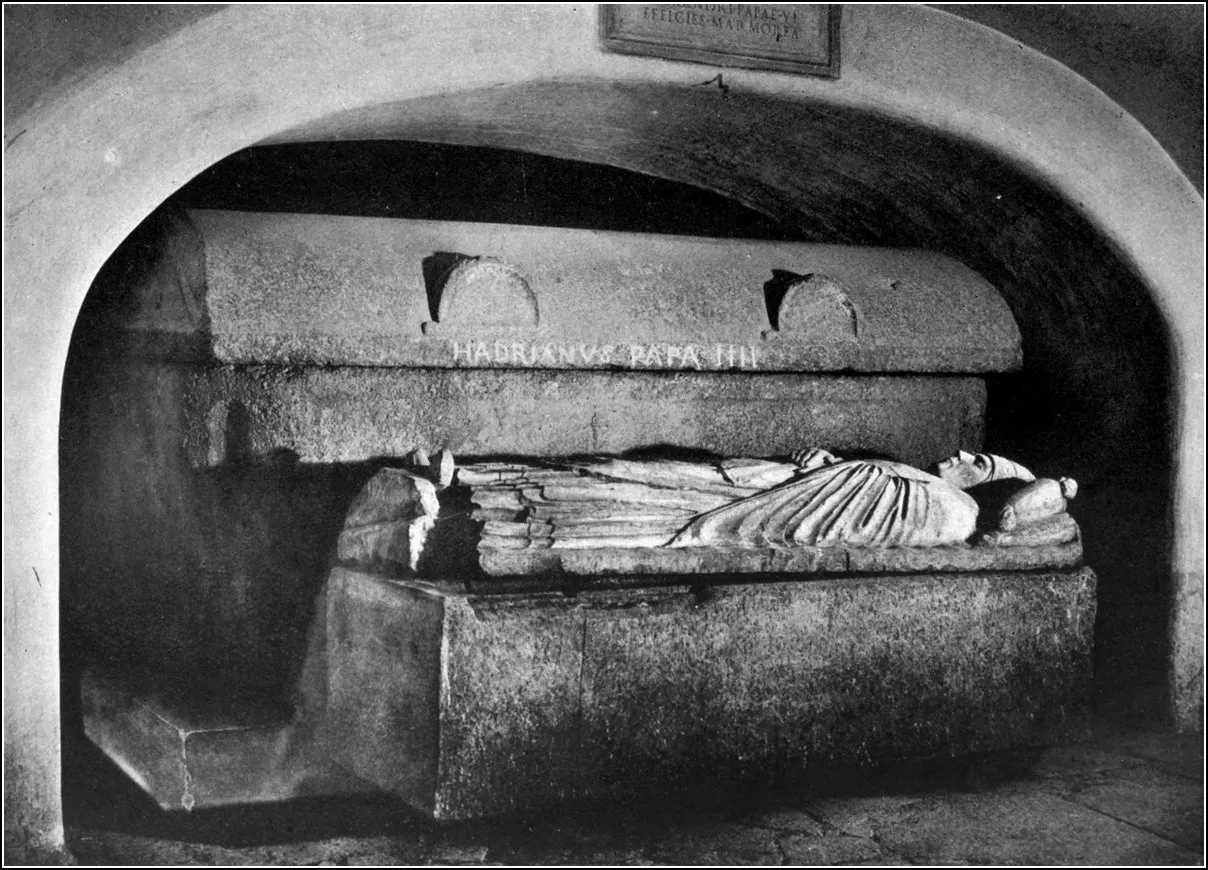
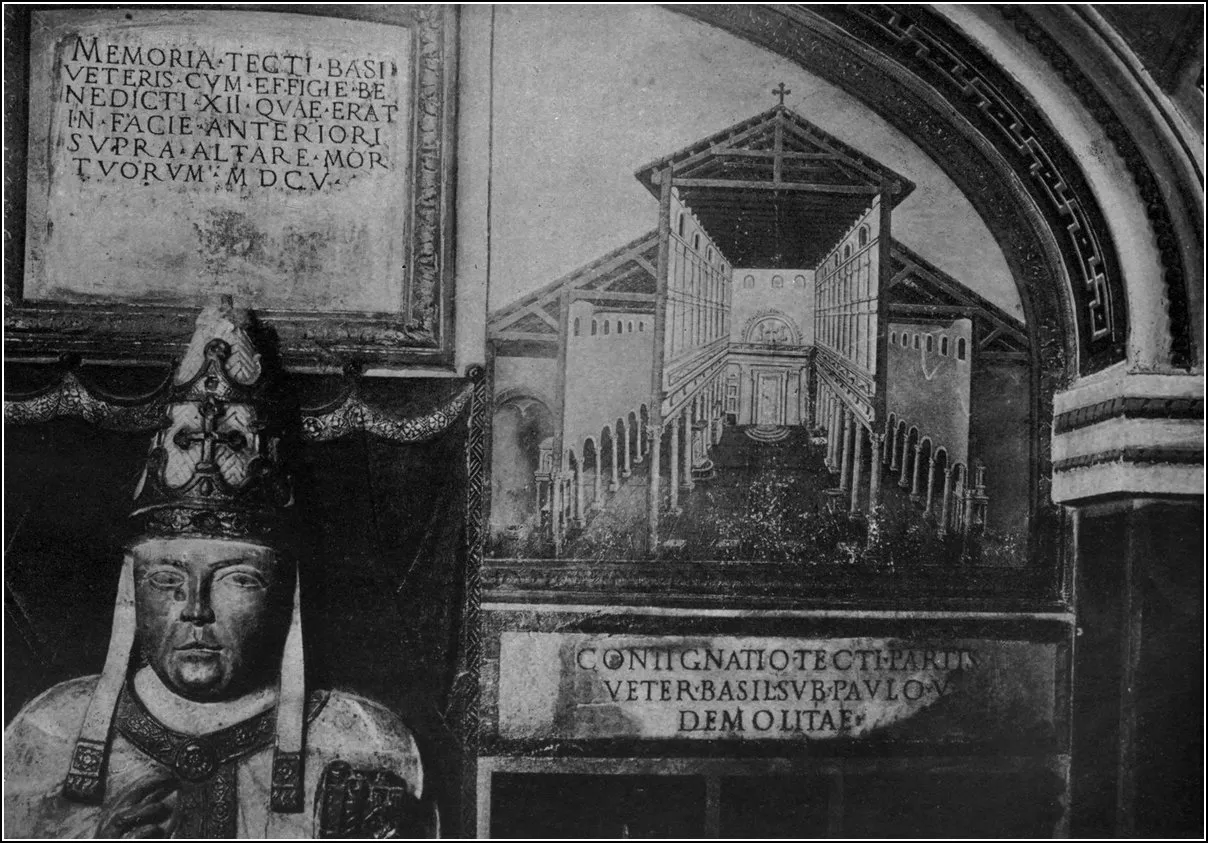
The Tomb of Hadrian IV., the only English Pope, behind; the Tomb of the Borgia Popes, Calixtus III. and Alexander VI., in front. The effigy is that of Calixtus III.
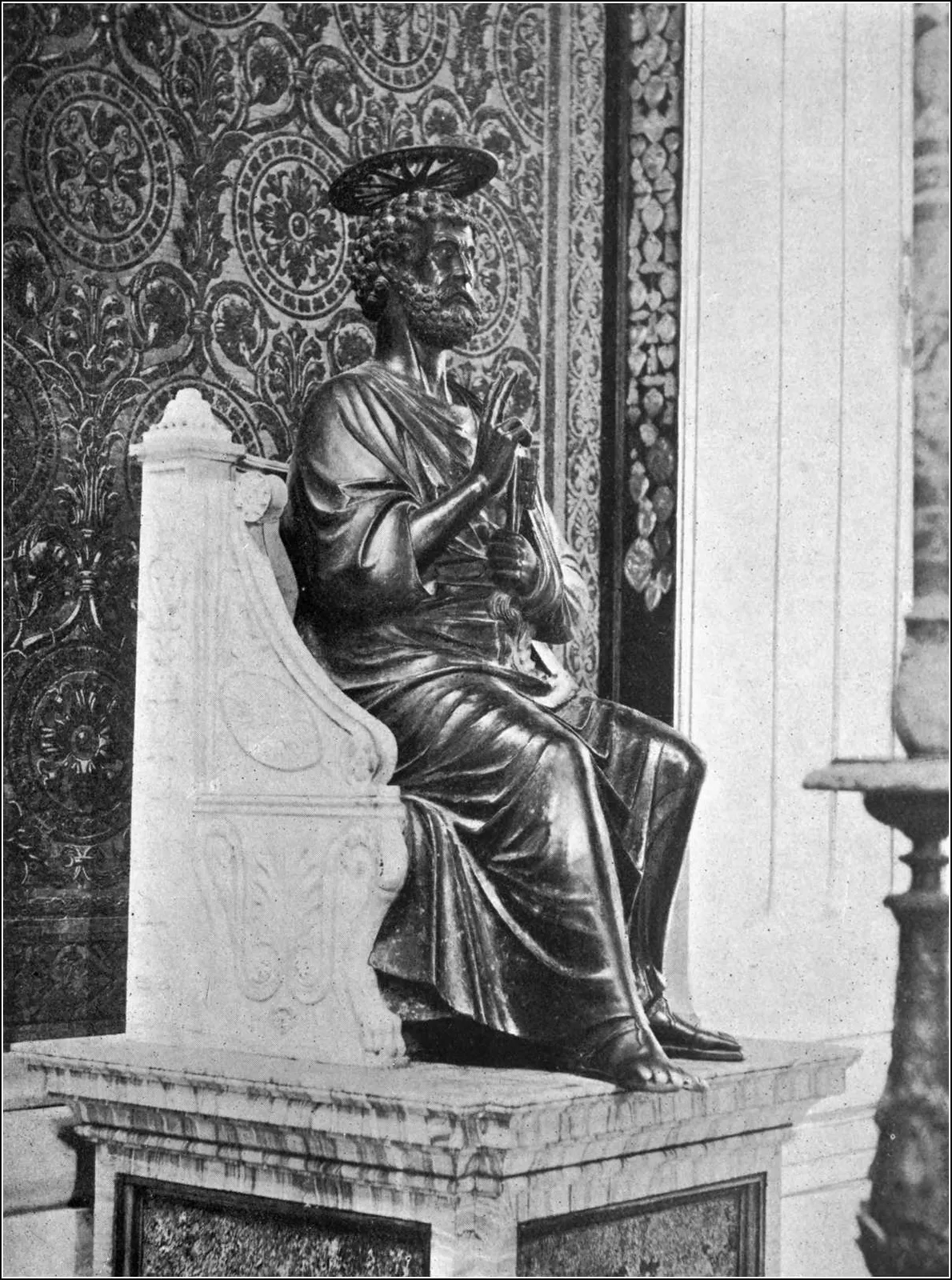
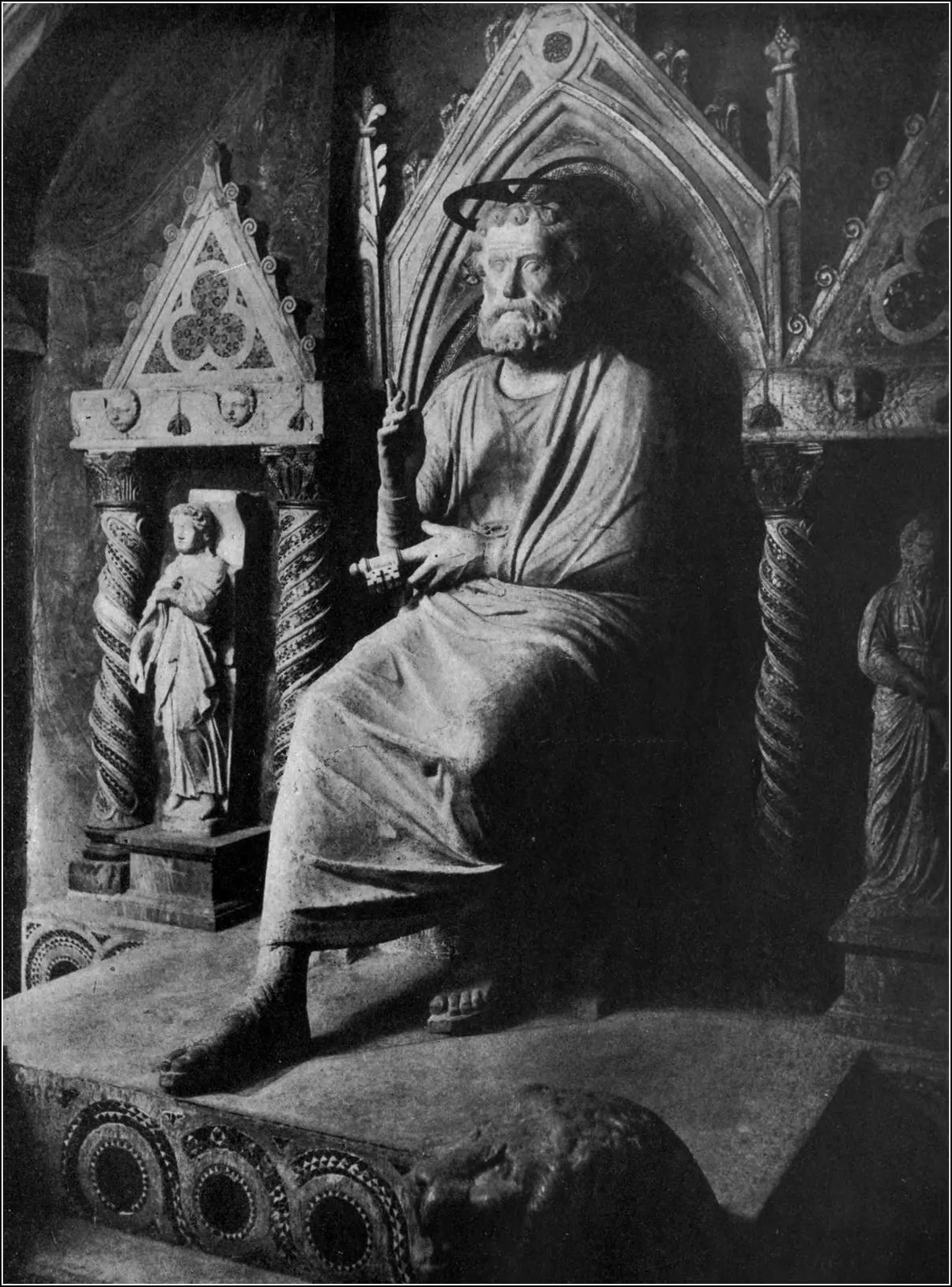
The Statue of St. Peter, from the Old Basilica, seated on the throne of Benedict XII. in the Chapel of S. M. della Bocciata in the Crypt of St. Peter’s
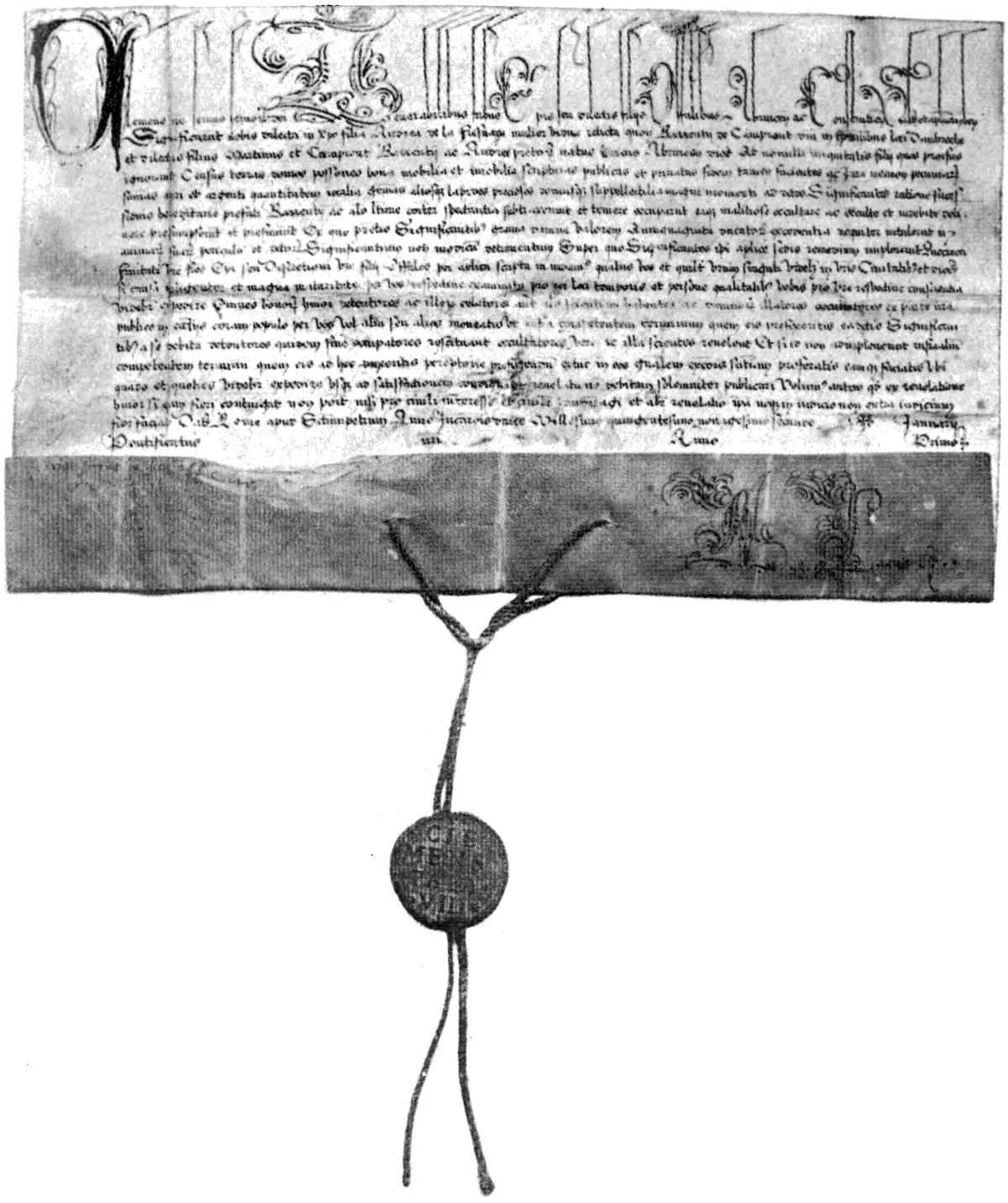
This is a Bull of Pope Clement VIII., dated “Rome at St. Peter’s in the year of the Incarnation of Our Lord, one thousand and five hundred and ninety-two on the Kalends of January in the first year of our Pontificate”
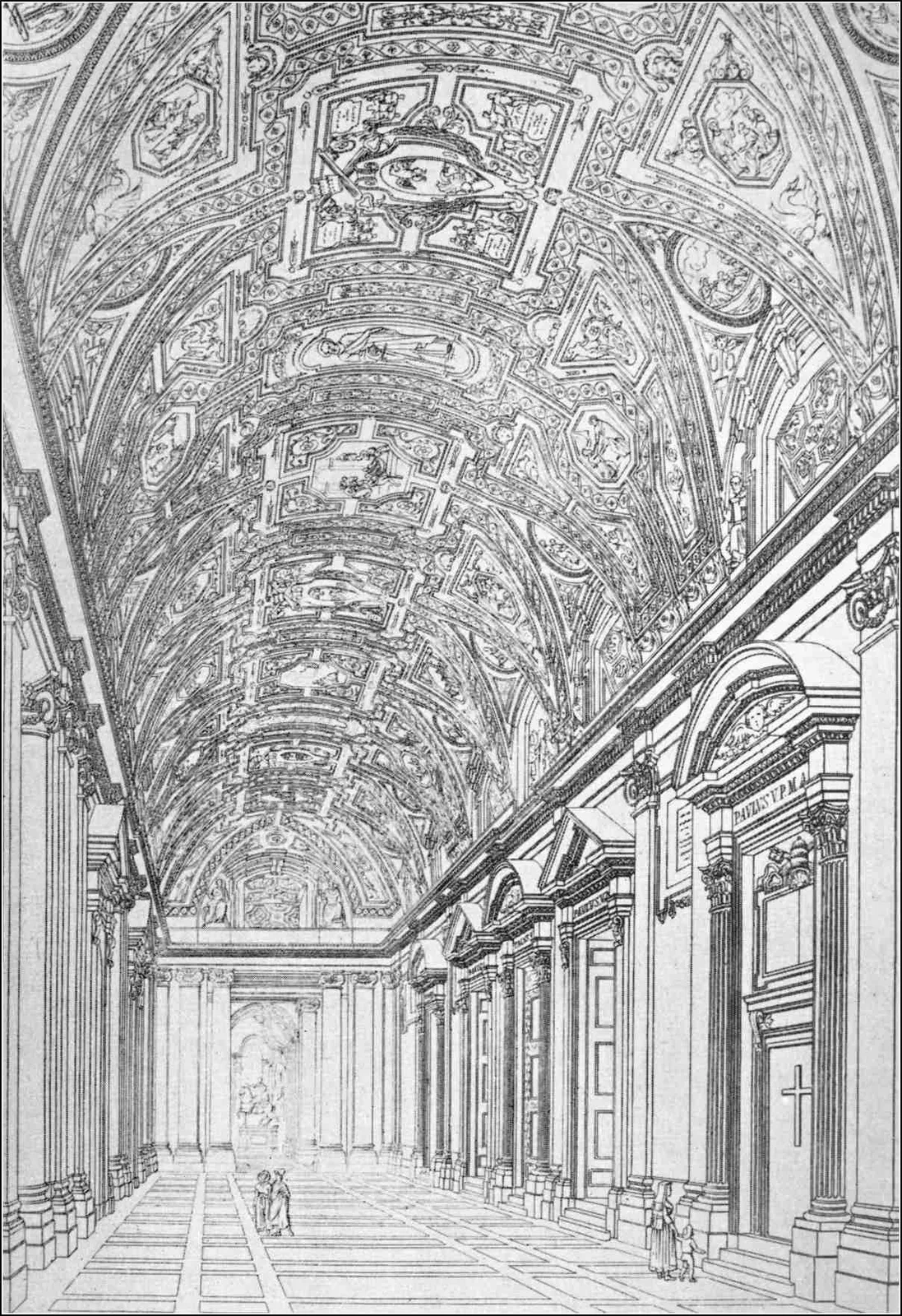
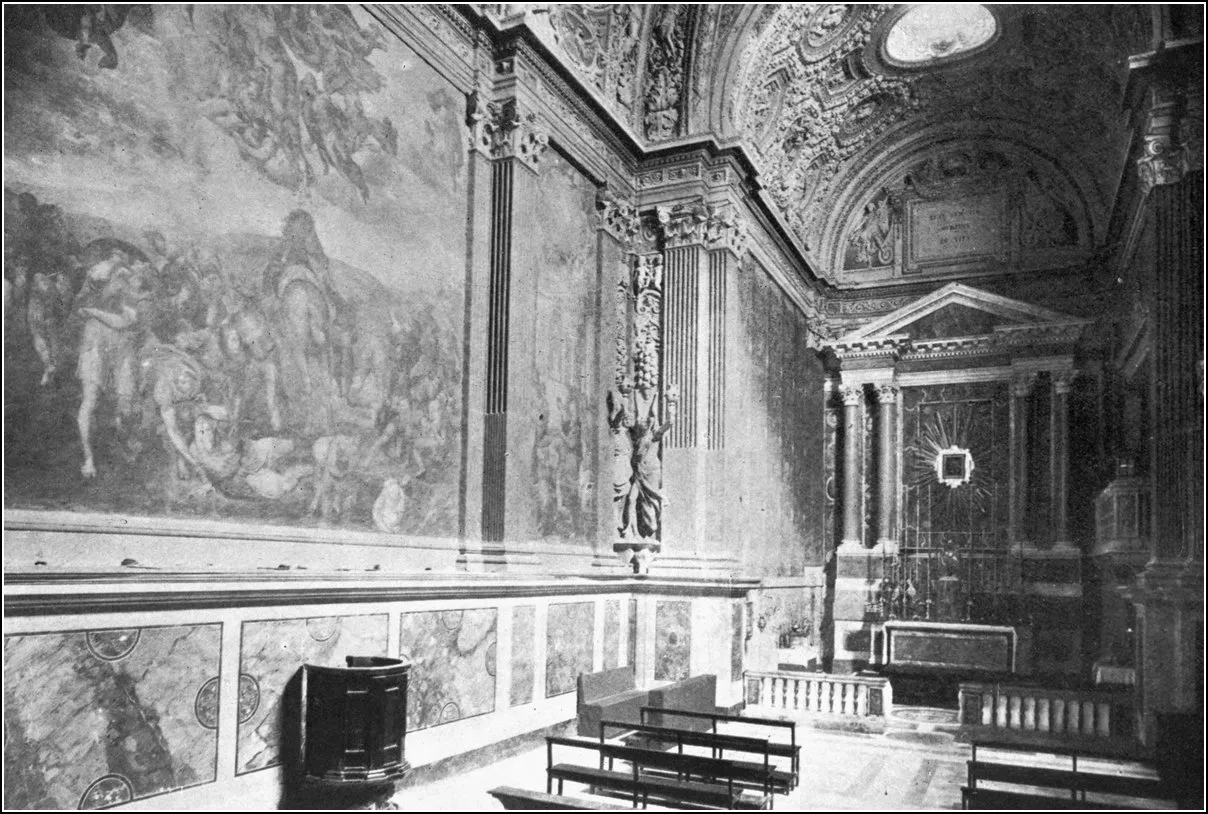
The Leonine Chapel, called also the Loggia of Paul V. and Sala della Beatificazione, from which the Pope goes into the Gallery of St. Peter’s to bless the people after his election; used also for Canonizations
CHAPTER I INTRODUCTION — CHAPTER II WHAT THE VATICAN CONSISTS OF
In this book I have traced the story of the Vatican
Hill and the Vatican Palace from their earliest
days. I have endeavoured to reconstruct Old
St. Peter’s out of the fragments that survive, and
have lingered long in the Crypt of St. Peter’s,
which, with its memories and remains of the
ancient basilica, is both as a monument and in
history the most important part of the Vatican.
My purpose in this volume has been to initiate
the British and American public in the sights of
the Vatican which visitors do not generally see.
I shall not take up their time by describing
again in detail the parts of the palace which are
already adequately described in a score of good
books. We shall need all our space for the
particular object we have in view.
Of all the secret places of the Vatican there is
none which fires the imagination of the visitor
more than the Garden of the Pope, so often called
his Eden. The allusion is inevitable—for at the
very gates of the Vatican, on the pinnacle of the
Castle of Sant’ Angelo, is the great Bronze Angel
with the drawn sword, whom the Pope will not
pass, because the tomb of the heathen Emperor
below is filled with the soldiers of the re-born
Rome, which dispossessed the Church of the
kingdom of this world. Once past this cordon,
he would be out of his dominions.
But the simile is incomplete, because the World
without, and not the Garden within, is the Eden
to which the Angel bars the way. Yet the garden
must be a very Paradise to the Popes, because it
is the only spot where they may listen, as Numa
Pompilius listened on this very hill, to the vaticinations
of Nature, the wise counsellor of the
weary brain.
In these narrow limits are wood and vineyard—a
classic garden buried from the wind and open
to the sun; the voices of falling waters; and
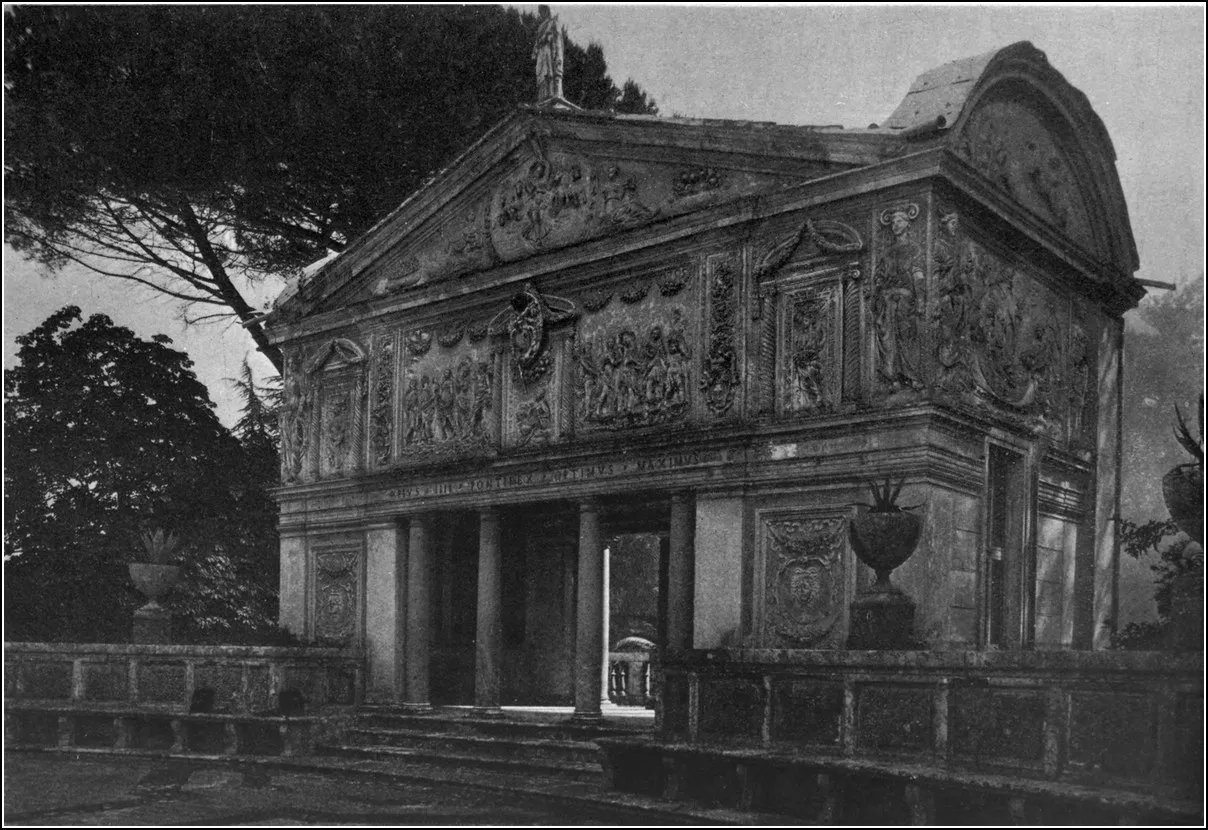
the garden-pavilion of the fourth Pius, with its
haunting beauty in the image of a Roman Emperor’s
pleasure-house. It is full of memories
of the saintly Carlo Borromeo—but it is easier
to credit it with the Meditations of Marcus
Aurelius.
How thankful must he be, whose feet never
pass beyond his gates, that in Italy the flowers of
the field assert their right-of-way to every nook
uncumbered with masonry. The shady groves,
where he walks, when the heat of the summer day
is a burden, have, in the bright leafless days of
Spring, a joyous carpet of violets and anemones,
squills as blue as Roman skies, and crimson
cyclamens which embalm the breeze.
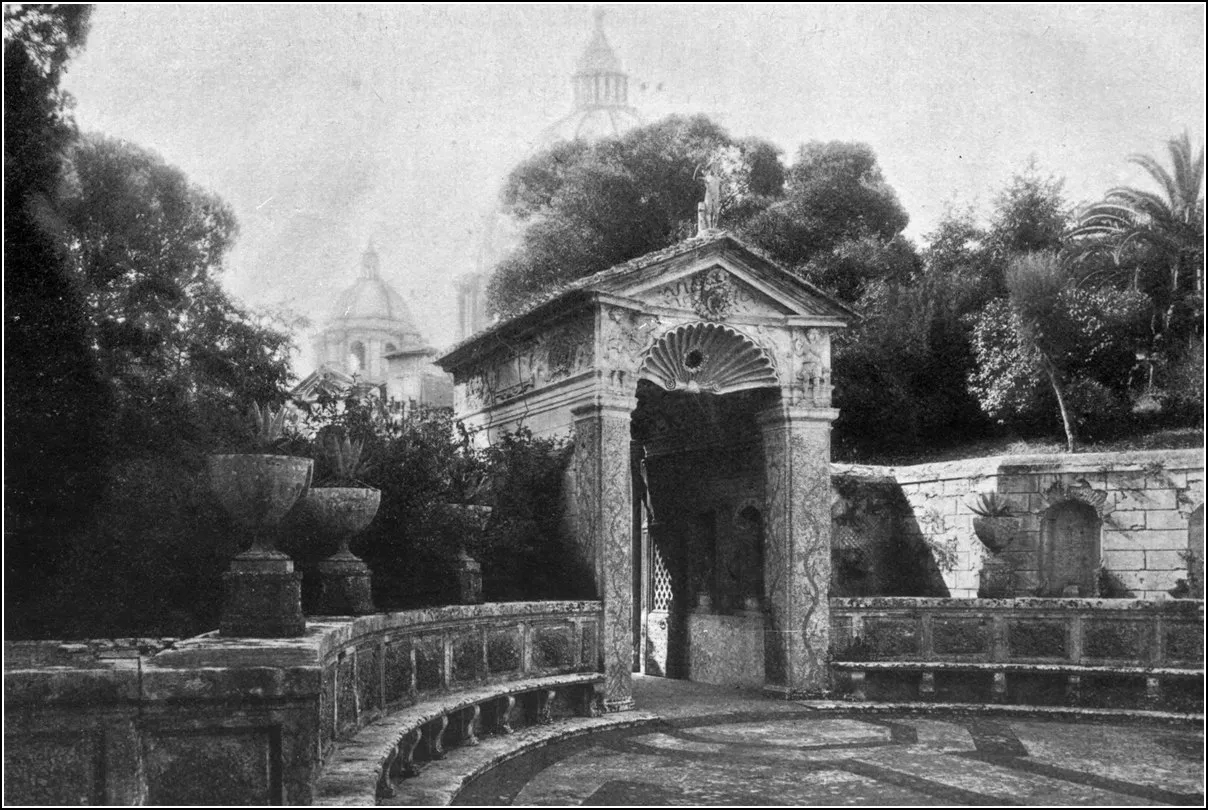
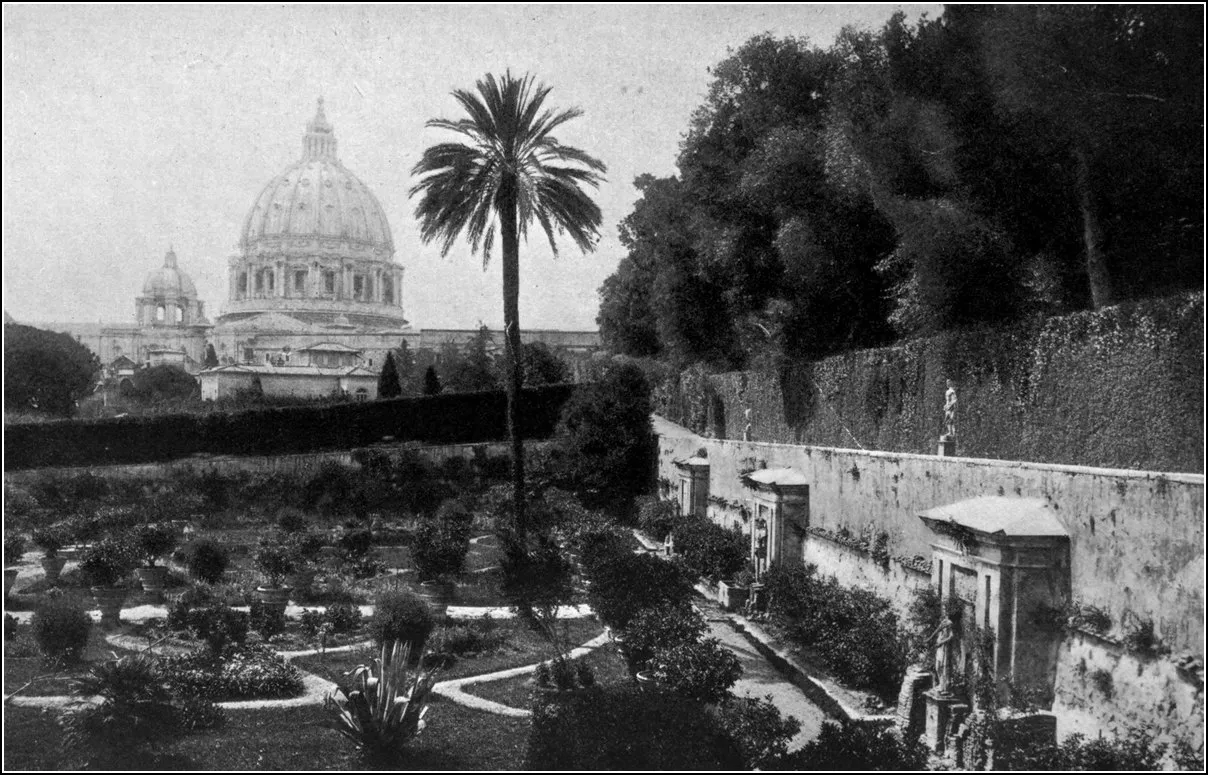
The Court of the Casino of Pius IV. in the Vatican Gardens.
But more than all these must he prize, as he
stands on the towered wall, built a thousand
years ago by the fourth Leo to guard the Holy
Hill from the heathen Saracen, the view of the
open road, of the spacious Campagna, and the
distant sea, which is to him the world—the Vineyard
where there is no cold shadow of Italian
Monarchy falling, as the shadow of Elijah fell
upon the sunshine of King Ahab.
Prosaic as may be the suggestions of the word
coach-house in unlovely London, romance lurked
till lately in the coach-house of the Popes,
shadowed by the stately stone-pines of his
Garden. For here were shown the trappings
with which the successor of St. Peter rode on his
white mule down the Sacred Way, climbed by the
Scipios and Cæsars in their Triumphs, to take
seisin of the Lateran, the chief Church of Christendom,
the proto-palace of the Papacy. That
great coach, all scarlet and gold, with the flying
and trumpeting cherubs, carried Pius IX., the
last of the Pope-Kings, in his royal processions,
surrounded by all the Papal Court on foot, on
the four great days of the year. Six huge white
horses drew it, and one of their postilions lived
to tell the tale among the relics of the former
grandeur.
In these days, when the Pope never drives
from the Vatican Gates, the coach-house has
surrendered its unneeded chambers to the Pope’s
pictures and the swelling Archives of the Vatican,
many of which made the lorn pilgrimage to
Avignon, in the years of the First Captivity; and
have only come back in these latter days.
From the archive rooms you step into the
noble Leonine Library, which Leo XIII. established
to receive all the printed books of the
Biblioteca Vaticana.
There is a pathos haunting the Leonine Library,
like that which stalks in the deserted halls of
Holyrood, for here the first of the Popes to wear
no earthly crown strove to carry on with undiminished
dignity the more than royal ambition
of the immortal Nicholas V., to make the Vatican
the light of the world, to maintain on its hill a
city that could not be hid.
He laid the foundation of not one new hall,
he added few books that were not printed in his
own Papal presses, but he turned the famous and
immemorial Library from a stagnant pool into a
stream of living waters, which should flow to the
ends of the earth. For he made the springs of
learning—the innumerable Archives—the priceless
manuscripts, the half-million of printed books
gathered in his own halls of study, mingle their
currents for every scholar, of whatever country or
creed, who thirsted for the river of learning, strewn
with golden sands for discoverers.
The new halls in which Pope Leo stored the
printed books are, in architecture, as they are in
virtue, the foundations of the noble Sala Sistina,
which is the outward and visible glory of the
Vatican Library.
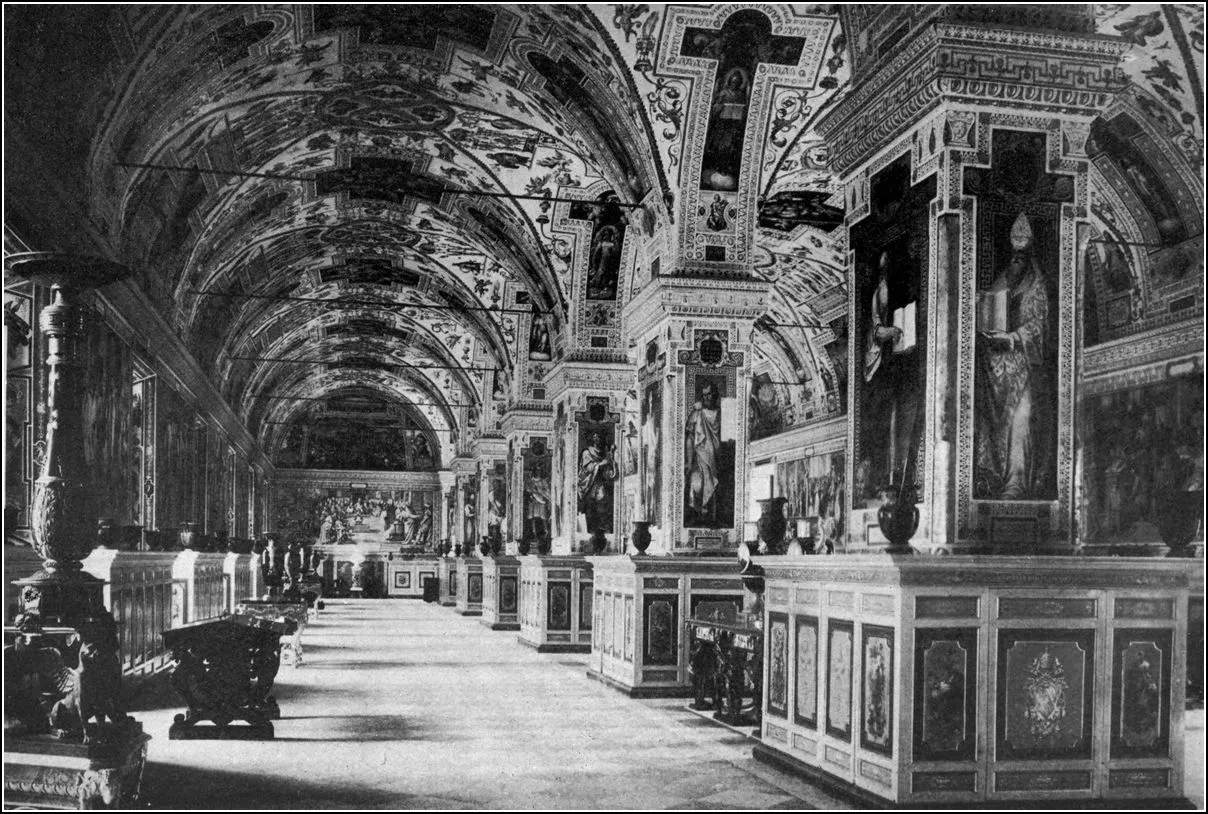
This vast hall, over two hundred feet in length,
frescoed with gay arabesques perpetuating the
designs which Raffaelle and Giovanni da Udine
copied from Nero’s Golden House,[1] when it was
first rescued from the earth of jealous centuries, is
at once the most brilliant and the most dignified,
though not the best in art, of the imperial Chambers
of Rome. In it, cased in glass, are the
most famous manuscripts in the world. It is
still the most princely of libraries as it was in
the days before the Spanish Armada, when the
superb Sixtus founded it. But when you are in
it you have no heed for him; your thoughts go
back another four generations to the fairy changeling
who was turned from a humble scholar—from
a poor priest who tolled bells—into the most
brilliant monarch who ever sat on the throne of
St. Peter. In that same year, 1447, when the
little Ligurian of Sarzana was turned by chance
into the head of Christendom, and burst upon an
astonished world as a rose opens in the night, the
great Ligurian city of Genoa gave birth to the
greatest of all the sailors and citizens who sprang
from the Republic of the Dorias.
Christopher Columbus was born just as
Nicholas V. became Pontiff. Truly the world
was promised, if not a Renaissance, a fresh dawn,
in which the clouds of Papal Schisms and Italian
Wars should lift for a day of matchless brilliance,
wherein the ships of Europe were to swim to
Africa, India, and America, and the writers of
Greece to come back across the Styx.
Few of the nine thousand manuscripts collected
for the most magnificent and munificent of the
patrons of learning by the great scholars of the
Mid Quattrocento, like Poggio Bracciolini, the
forerunner of Angelo Mai, but have gone the
way of all the earth like the eight resplendent
chests which contained his choicest treasures.
Splendour was the language in which Nicholas
would have the Vatican proclaim its message to
the world. And even of the buildings with which
he sought to make the Vatican Hill the rival of
the Palatine, only one cell remains in the glory
with which he clothed it—the tiny chapel which
glows with the masterpieces of Fra Angelico,
though it was Nicholas who built the walls of
the Appartamenti which Pinturicchio frescoed for
the Borgias, and of the Stanze which Raffaelle immortalized
for Julius II.
Of the thousands of marvellous manuscripts,
and the paintings of the Classic Age, gathered
in the Library, of the Vatican Codex and
the Nozze Aldobrandini, and the bits of Old
Roman life from the Catacombs, I speak in
their place.
The immortal grace of Raffaelle in the Stanze
and Loggie, the magnificence of Michel Angelo in
the Sistine Chapel, the masterpieces of the Vatican
Picture Gallery, even the visions of Greece in her
glory, which people the Sculpture Halls of the
transformed Villa of Innocent VIII., I pass by in
silent wonder, for they are not in the secret places
of the Vatican.
But it is not everyone who can effect a visit
to the Borgia Rooms which Leo XIII. rescued
from the tall bookcases of the library, and
restored to apartments for Princes. Here till
recently, like his forerunners when their high
office was first created, dwelt the Cardinal Secretary
of State amid the almost matchless splendour
of the halls which Alexander VI. caused to be
frescoed by Pinturicchio. The Borgia Apartments
are the most sparkling gem in the Vatican’s
golden crown of art.
Apart from the duty or the curiosity which
takes you to attend a reception of the Cardinal
Secretary, or the Maggiordomo in his apartments,
it is well to pay the visit to appreciate
the atmosphere of the Papal Court, its dignity,
tempered with approachability; its simplicity,
tempered by quiet richness; its unmistakable air
of a Royal presence.
Though it may be visited without leave, it is
only on one day in the week, and therefore, where
a hundred see the Apollo Belvedere, barely one
sees the storied arras richly dight, which Raffaelle
designed for Leo X. to hang under the frescoes
of the Sistine Chapel. These tapestries, woven
in the looms of Flanders four hundred years ago,
suffered from fire and sword in the evil days of
the Constable of Bourbon and his Protestant
Landsknechts, but they are still the world’s
premier tapestries: their colours still glow:
their genius is such that we can only think of the
Apostles in the forms in which Raffaelle created
them: and in the Gallery of the Candelabri,
which you visit with them, is a collection of
masterpieces.
Nor are these the only tapestries in the
Vatican, for there are two other rooms where the
Pope and his Cardinals robe, and State banquets
are held, and the officers of the Swiss Guard have
their mess, which are hung with the noblest
tapestries of the sixteenth century, some of them
woven for the profuse Farnese Pope, some from
the Gobelins looms, given by the Roi Soleil to
commemorate his betrothal—all reputed to be
priceless. Priceless, too, are some of the Papal
treasures in the sacristies of St. Peter’s and the
Sistine.
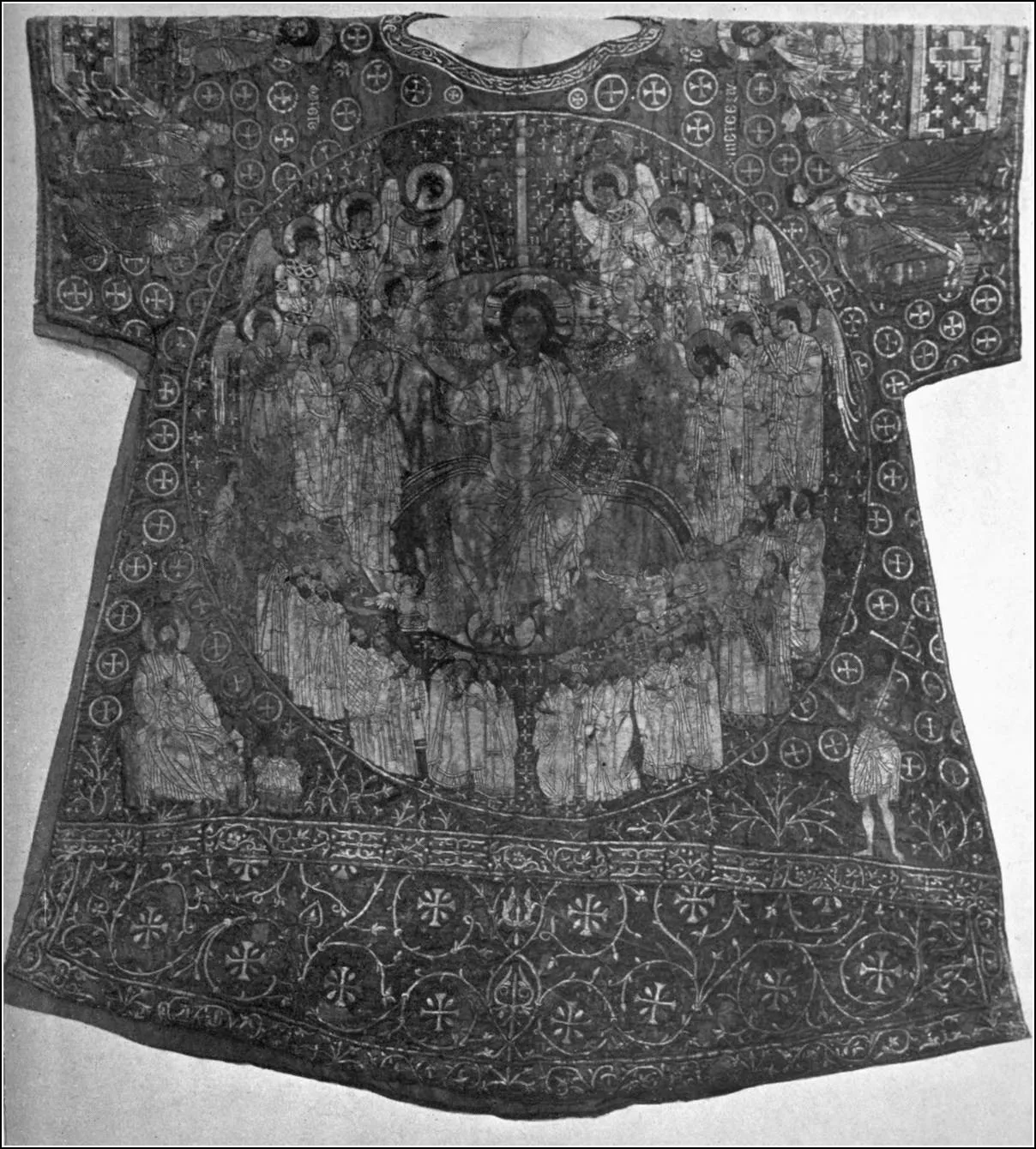
The Dalmatic of Charlemagne in the Sacristy of St. Peter’s.
The chief treasures in the Tesoro of St. Peter’s
are the dalmatic worn by Charlemagne when he
came to Rome a thousand years ago to be
crowned; and the candlesticks wrought by
Benvenuto Cellini to grace the High Altar when
the Pope is celebrating Mass. In the Sistine
Treasury are preserved the lace robe worn by
Boniface VIII. at the first Jubilee, six centuries
ago, and the first Golden Rose from which have
sprung all the Golden Roses conferred by the
Papacy on its benefactors. But here the special
treasures are lost in the marvellous richness of
the suites of robes worn by the Pope and the
Cardinals in functions of special state, such as
the black robes woven on gold in which the officiating
Cardinals stand round the catafalque of the
dead Pope, and the trailing robes, as rich and
white as snow, in which the Pope is borne into
St. Peter’s like a saint in glory, on his Sedia
Gestatoria.
Every visitor must needs enter the Vatican by
one of three entrances: by whichever he may
enter he must be dead of soul whose imagination
is not fired.
If it is the gate in the little pavilion, as graceful
as a Classical temple, which admits the unprivileged
to the Pope’s Garden, the Vatican Library
and the Museum of Sculpture, the Sistine Chapel
and Raffaelle’s Stanze and Loggia, he will be
met by a procession of the gods of Greece,
chiselled out of fair white marble in the workshops
of two thousand years ago.
If he stops and enters at the Portone di Ferro—the
iron gate at the foot of the hill—he is in the
oldest part of the palace, whose dark and frowning
towers, more in keeping with the fortress of
Avignon, rose in the age of the Borgias and della
Roveres; the tall, dour Swiss, who guard them,
still wear the motley liveries, and, on occasion,
the pikemen’s armour of the Middle Ages. On
either side, as he passes in, rise the Sistine Chapel
and the Palace of the Borgias—all of the fifteenth
century; and this is the way by which, in the
old days of the temporal power and pomp, the
Papal cortège issued.
To the stranger in the gates the chief entrance
of the Vatican must always be the great Portone
di Bronzo—the Bronze Gate, which opens on the
stupendous Piazza of St. Peter’s, and the temple-like
colonnade of Bernini.
Here, too, are the picturesque Swiss, and a
vista, more regal if not so ancient or historical.
The stranger will not heed the closely guarded
staircase on his right until he knows that it is the
Jacob’s ladder to the apartments of the Pontiff
himself. His eyes will be taken up with the
Scala Regia (the giant staircase, royal in name
as well as in magnificence), which leads up through
a stately colonnade to the Sala Regia—the
Royal Hall—where, surrounded by vast frescoed
triumphs of the Catholic Faith, beneath a fretted
ceiling as rich in gold as the waters of Pactolus,
the Pope-King was wont to receive the Ambassadors
of his brother Kings. The very passage
which leads off it is of such dimensions and
ambitions that it is called the Ducal Hall.
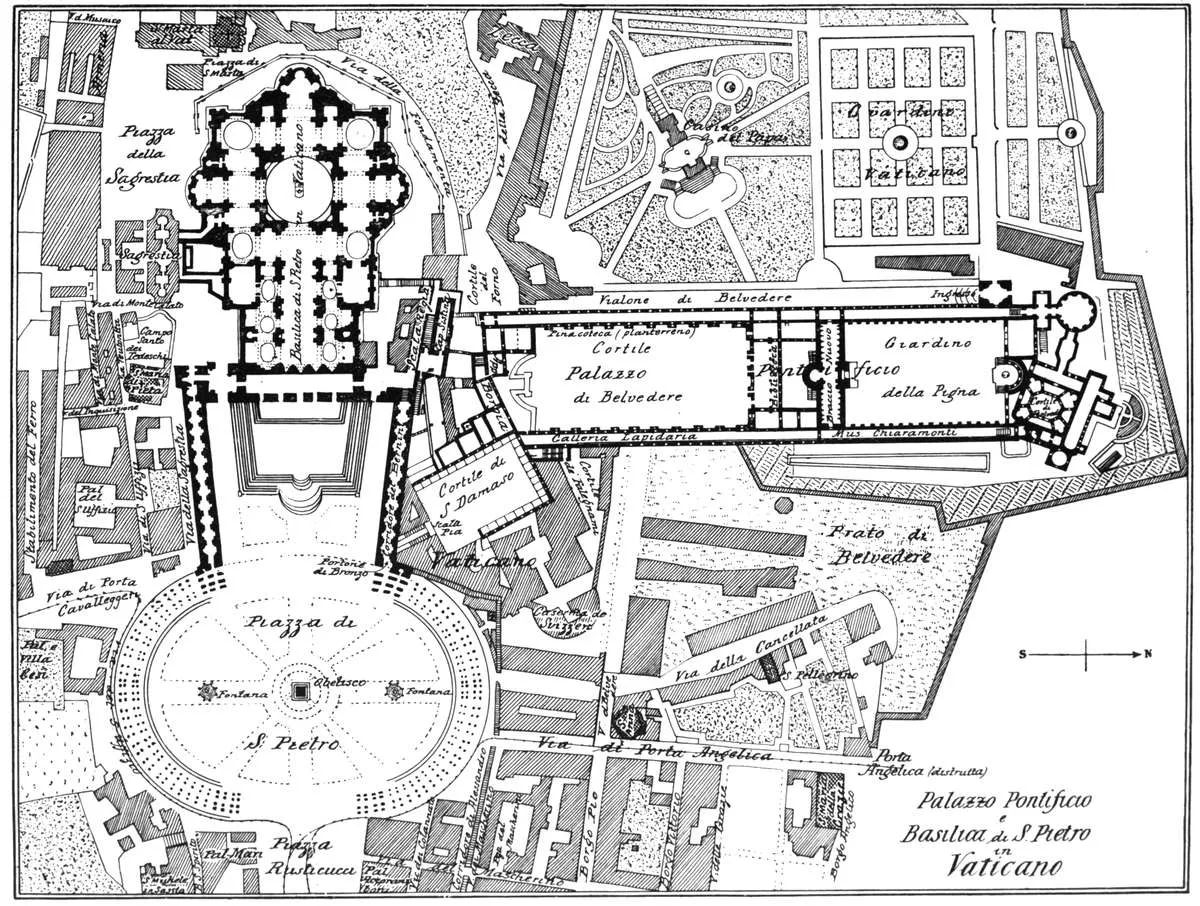
Map of the Vatican.
The Vatican is full of chambers with lofty and
romantic names—such as the Hall of the Beatifications,
where saints on earth are canonized; the
Gallery of Inscriptions; the Christian and Profane
Museums; the Hall of the Popes; the Hall of
the Madonna; the Hall of the Lives of the
Saints; the Hall of the Credo; the Hall of the
Sibyls (the last five in the Borgia Apartments)—not
one of which but is worth seeing, not one of
which but can be seen.
The Vatican, like Janus, the God of Rome, has
two faces. Seen from the one side it is the Pope’s
Kingdom; seen from the other it is his home.
On the first you may gaze on any weekday morning;
the second none may behold but those who
are bidden.
Who shall complain? There is little to observe
in the Pope’s apartments but his private
life—and that he who lives the life of the man
with the iron mask has a right to keep sealed
from observation.
Apart from the aura of Sanctity, apart from
venerable associations, this portion of the palace
has nothing to show within which would compare
with the work of the Borgias and della
Roveres. It is only three hundred years old,
and recent Popes have returned to Apostolic
simplicity.
But it contains a few noble chambers, like
the Hall of the Consistory, and is rendered impressive
by the atmosphere and the velvet-liveried
retainers of a Court.
What the Vatican lacks is architectural
nobility. When you gaze on the glowing vaults
of Raffaelle’s Loggia, the triple tier of arcades
which surround the superb Court of Saint
Damasus, even when you move in the gorgeous
baroque immensity of chambers like the Sala
Regia, you feel their majesty. But the Vatican
has neither the romantic splendour of Windsor,
nor the grandeur of the Louvre. It looks more
like a Parliament House than a Palace. Everyone,
who lifts his eyes to it, must wish that
Nicholas V. had lived to accomplish his gorgeous
visions, and had crowned the royal and holy hill
with ramparts and towers and soaring white
palaces till it rivalled the Palatine groaning
under the palaces of the Cæsars.
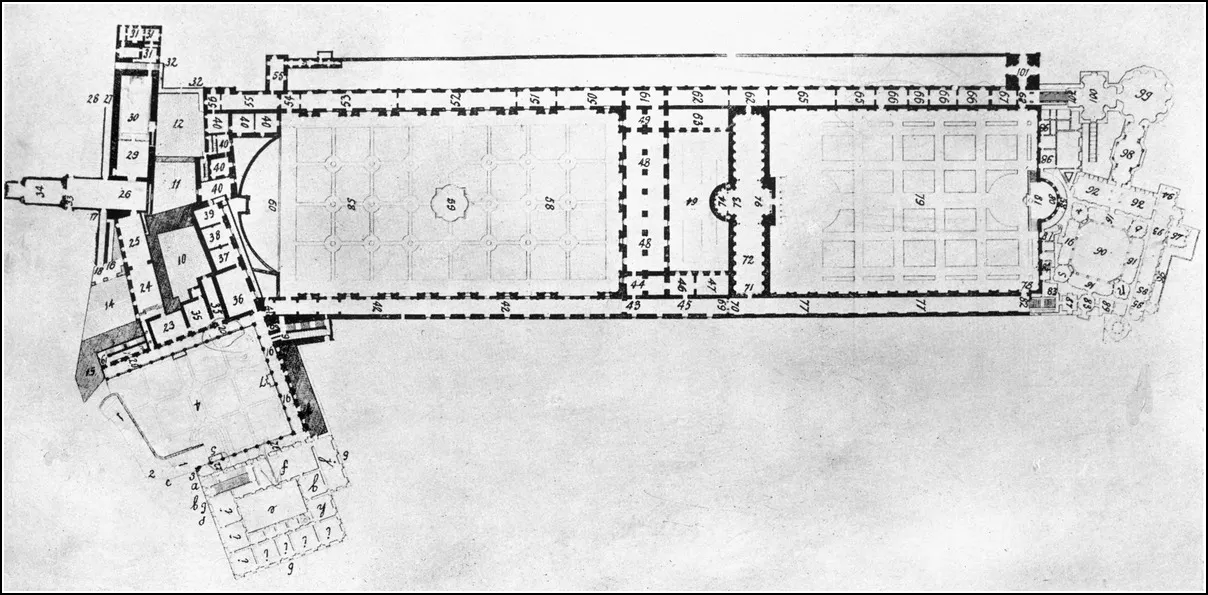
Ground Plan of the Vatican. From Pistolesi’s “Il Vaticano Descritto ed Illustrato.”
a.
}
See under 3.
b.
}
c.
}
d.
}
e.
Courtyard in the centre of the Pope’s apartments.
}
Comprised in 6.
f.
Sala Clementina.
}
g.
Hall of the Palafrenieri.
}
h.
First Anticamera.
}
i.
Pope’s private apartments.
}
j.m.
Omitted in plan.
}
k.
Room of the Swiss Guard.
}
l.
Hall of the Secret Consistories.
}
n.o.
Passage from the Loggia of Giovanni da Udine to the Sala Ducale.
p.
Cabinet of the Boxers (Canova’s).
}
In the Sculpture Museum.
q.
Cabinet of the Antinous.
}
r.
Cabinet of the Laocoön.
}
s.
Cabinet of the Apollo Belvedere.
}
1.
Scala Pia, leading from the Bronze Door to the Pope’s apartments.
2.
Apartments of the Maggiordomo.
3.
(a. b. c. d.) Various small courts on the south side of the Papal Palace.
4.
Cortile di San Damaso.
5.
State entrance to the Pope’s apartments.
6.
Actual palace of the Pope (e. f. g. h. i. k. l.)
7.
Algardi s Fountain.
8.
Passage leading to the Mosaic Factory.
9.
Stairs.
10.
Cortile del Pappagallo.
11.
Cortile del Portone di Ferro.
12.
Cortile della Sentinella.
13.
Passage and stair to upper floor and library.
14.
Courtyard of the Maresciallo of the Conclave.
15.
Courtyard of the Maggiordomo.
16.
Stairs to the Courtyard of the Maresciallo.
17.
Pedestal of the statue of Constantine the Great.
18.
Stairs from the Courtyard of the Maresciallo to the Sala Regia.
19.
Entrance to the first tier of the Loggie.
20.
Bramante’s arcades. (Raffaelle’s Loggie).
21.
Bramante’s arcades. (Raffaelle’s Loggie).
22.
Bramante’s arcades. (Raffaelle’s Loggie).
23.
Hall of the Paramenti.
24.
Sala Ducale.
25.
Sala Ducale.
26.
Sala Regia.
27.
Stairs leading to the Sala Regia.
28.
Stairs leading to the Vestibule of the Sistine.
29.
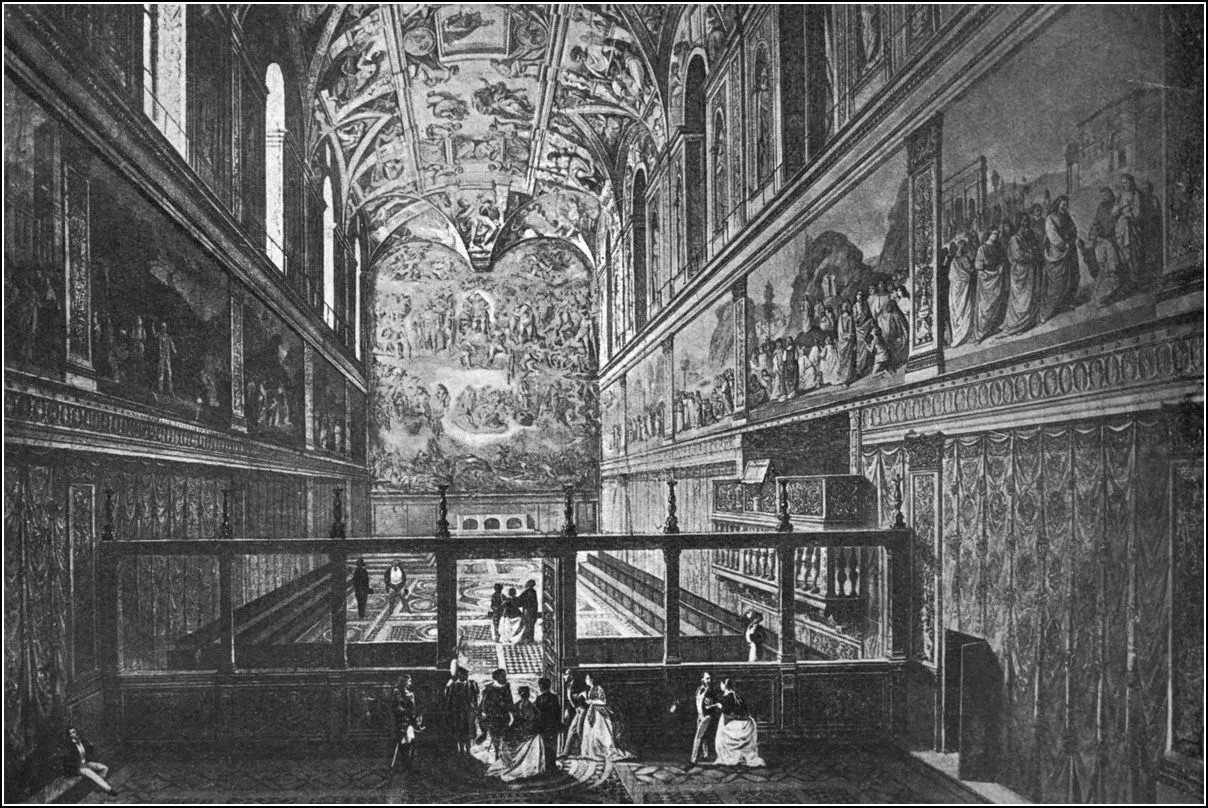
Sistine Chapel.
30.
Sistine Chapel.
31.
Treasury of the Sistine Chapel.
32.
Staircase leading from the Vatican to St. Peter’s.
33.
Entrance to the Cappella Leonina (Sala della Beatificazione).
34.
Cappella Paolina.
35.
(Long room.) Galleriola. Now the smoking-room of the Cardinals. (Square room.) Spogliatoio or Sala del Pappagallo.
36.
Borgia Rooms. Sala dei Pontifici. (Hall of the Popes.)
37.
Borgia Rooms. Sala dei Misteri. (Hall of the Mysteries.)
38.
Borgia Rooms. Camera della Vita dei Santi. (Hall of the Life of the Saints.)
39.
Borgia Rooms. Camera delle Arti e Scienze. (Hall of the Arts and Sciences.)
40.
Torre Borgia, containing the Hall of the Credo and the Hall of the Sibyls.
41.
Entrance to the Gallery of the Inscriptions from the Loggia of Giovanni da Udine.
42.
Gallery of Inscriptions.
43.
Entrance to the Library.
44.
The Writers’ Room.
45.
Small Reading Room.
46.
Room of the Papiri.
47.
Librarian’s Room.
48. 49.
Sala Sistina. The Great Hall of the Vatican Library.
50.
Salla della Bonaventura.
51.
Salla del Obelisco.
52.
Salla del Aristide.
53.
Museo Cristiano. (Christian Museum.)
54.
Hall of the Papiri.
55.
Hall of the Nozze Aldobrandini.
56.
Chapel of Pius V.
57.
Terra Cotta Room.
58.
Cortile del Belvedere.
59.
Fountain of the Cortile del Belvedere.
60.
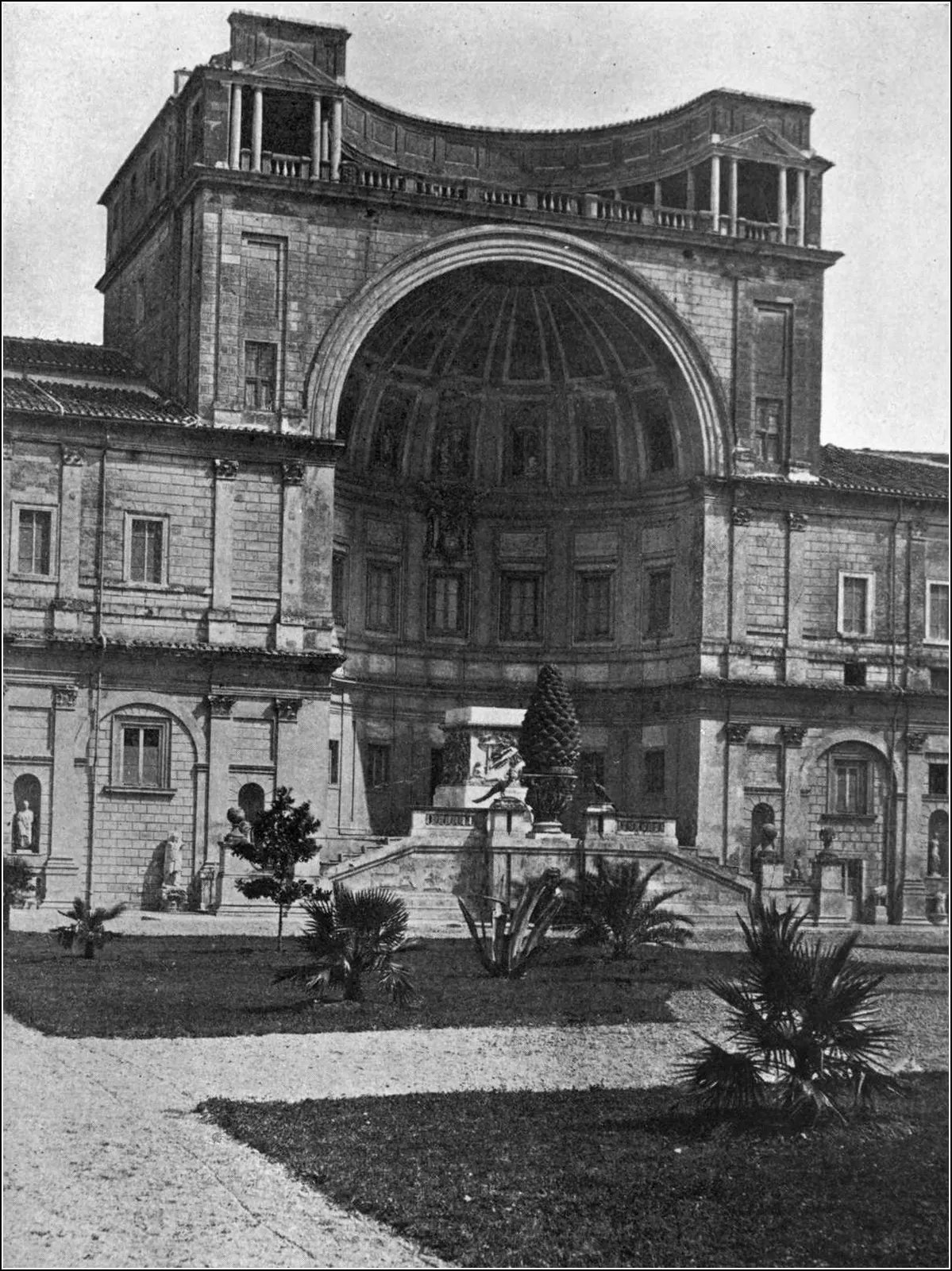
Esedra or Niccio of Bramante.
61.
Hall of the Vatican Manuscripts.
62.
Libraries of the Alexandrine Collection.
63.
The Archivio.
64.
The Vatican Printing Office.
65.
The Ottoboni Collection. The Capponi Collection.
66.
Borghigiana Collection. First two halls of the Vatican Library.
67.
Museo Profano. (Museum of Heathen Antiquities.)
68.
Visitors’ entrance to the Library.
69. 70.
Doors between the Chiaramonti Museum and the Gallery of Inscriptions.
71.
Entrance to the Braccio Nuovo from the Chiaramonti Museum.
72-76.
Braccio Nuovo.
77.
Chiaramonti Museum.
78.
Entrance to the Giardino della Pigna from the Chiaramonti Museum.
79.
Giardino della Pigna.
80.
The Esedra behind the Pigna.
81.
The Pigna or Bronze pine-cone from the atrium of Old St. Peter’s.
82.
Staircase from the Museo Chiaramonti to the Museo Pio-Clementino. (Sculpture Museum.)
83.
Entrance at the head of these stairs.
84-86.
Egyptian Museum. The Etruscan Museum is, roughly speaking, above it.
87.
Vestibule of the Torso.
88.
Vestibule of the Vase.
89.
Vestibule of the Meleager.
90.
Cortile del Belvedere (here signifying the Sculpture Gallery).
91.
Porticos of the Cortile del Belvedere.
92.
Sala degli Animali.
93.
Galleria delle Statue.
94.
Statue of Ariadne in the Galleria delle Statue.
95.
Sala dei Busti.
96.
Balcony outside of the Sculpture Galleries (closed).
97.
Gabinetto delle Maschere.
98.
Hall of the Muses.
99.
Sala Rotonda.
100.
Sala a Croce Greca.
101.
Il Padiglione. (The Pavilion Gate of the Sculpture Gallery.)
The Galleria dei Candelabri (leading into the Galleria
degli Arazzi and Galleria Geografica) has an entrance
near the Sala della Biga, and these three form the
upper floor of the long gallery of the Vatican Library.
The Coach-house of the Popes and the new rooms of
the Archivio are under the long gallery of the Library.
The Vatican Gardens face this gallery.
The Vatican Mosaic manufactory is under the Gallery
of Inscriptions.
The Leonine Library is under the Sala Sistina and
Reading Rooms of the Vatican Library.
[The numbers in brackets refer to Plan]
The Vatican, says Hare, in his Walks in Rome,
is the largest palace in the world. He gives its
measurements as one thousand one hundred and
fifty-one English feet long, and seven hundred and
sixty-seven broad. These measurements are,
with slight variations, repeated in other guide-books,
with the exception that in Baedeker’s
Central Italy it is further stated that the total
extent covered by the palace is thirteen and a
half acres, while in Baedeker’s Paris it is stated
that the Louvre and the fragment of the Tuileries
together cover forty-eight acres. And in any
case you have to ask to what these measurements
of length and breadth refer. From the left-hand
edge of the Sistine Chapel to the extreme
point of the Sculpture Museum, built out of
Innocent’s VIII.’s Villa Belvedere, the length
must be very much greater than eleven hundred
and fifty-one feet. For the long Gallery of the
Library alone measures a thousand and twenty
feet. But if the width be taken to refer to the
stretch from the back of the sacristies of the
Sistine Chapel to the back of the Papal apartments,
that may be approximately correct. It
is to be noted also that whereas Hare and Murray
each concede eleven thousand apartments, Baedeker
says that the number of halls, chapels, saloons,
and private apartments is more likely to come
to one thousand than to eleven thousand, while
Misson, who visited the Vatican intelligently, in
the reign of Queen Anne, says twelve thousand
five hundred. Be this as it may, all of them
concede twenty courts and eight grand staircases,
and Murray puts down the minor staircases at
about two hundred.
We must now consider the principal buildings
of which the Vatican Palace consists. The first
of the twenty courtyards is the Cortile di San
Damaso (4), standing at the head of the Scala
Pia (1), the Pope’s staircase, which leads up on
the right directly you enter the bronze gates.
It is the grand courtyard of the Vatican, officially,
for the apartments of the Pope, the apartments of
the Cardinal Secretary of State, and the entrance
to the library used by members of the Household
open off it.
A second courtyard (e) is in the centre of the
apartments actually occupied by the Pope. A
third, just to the south of the Papal apartments,
is called the Courtyard of the Grooms, Cortile dei
Palafrenieri (c). The fourth is the Court of the
Parrot (Cortile del Pappagallo) (10). It is situated
between the Sala Ducale (24, 25) and the Borgia
Rooms (36, 37, 38, 39), in the oldest part of the
Vatican Palace proper, built in the fifteenth century
by Nicholas V., Sixtus IV., and Alexander VI.
It is connected by a narrow passage with the
Court of the Iron Gate, the Cortile del Portone di
Ferro (11), which stands between the Sala Regia
(26) and the ante-chapel of the Sistine Chapel
(29) on one side and the Torre Borgia (40) on the
other. This again opens out of the Cortile della
Sentinella (12)—Court of the Guard—the place
where you always see a little knot of the Swiss
Guards in their picturesque uniforms as you
begin to climb the hill past the entrance of the
Picture Gallery to the Pavilion (100), which
admits you to the Sculpture Galleries, the Library,
and the Pope’s Garden, and all the other parts
of the Vatican to which admission can be secured
by payment.
As far as the exterior is concerned, this is by
far the most interesting part of the Vatican
Palace. Its lofty gateway and towers, with
their beetling machicoles, the heavy, overhanging
balconies, reminding one, with their forbidding
strength, of the rock-like Papal Palace of Avignon,
are full of the atmosphere of the fifteenth
century. There is a grimness in the very colour
of the old brown walls. The whole aspect gives
you an idea of the many-towered castle which
bore the name of the Vatican in the days of the
Old St. Peter’s—the one actual fragment of the
gigantic enceinte with which Nicholas V. proposed
to surround the Vatican Hill, filling its interior
with the Holy and Royal city which was to
exceed the Palatine of the Cæsars in the vastness
and splendour of its buildings, and to contain
such a library as would make it the focus of light
and learning for all Christendom, for all the
civilized world. Thomas Parentucelli, the little
man of Sarzana, did not live and work and dream
in vain, though the Popes are no longer kings of
the Earth, and of all his buildings on the Vatican
Hill only one tiny chapel, made heavenly by the
genius of Fra Angelico, remains perfect—though
even of his books but a handful are left. For the
Vatican Library is still the library of libraries,
where the originals that have given us our copies
of the classic writers of Greece and Rome almost
all lie. That is the outward and visible sign,
and added to that is the inward and spiritual
grace of learning and scholarship which has
rarely ceased to illuminate the Papal Court since
Nicholas V. gave it birth. He might well have
been figured as Moses drawing the waters of
learning from the dry rock with a stroke of his
rod—the pastoral staff.
Only separated from this old brown bit of the
Vatican by the building of Nicholas, which was
converted into the Borgia Apartments, is the
seventh courtyard (58), the Cortile del Belvedere,
which is divided from the ninth, the Giardino
della Pigna (39), by the Vatican Library, and the
Braccio Nuovo (72) of the Sculpture Galleries,
and the little court of the Vatican printing-office
(64), which must be counted the eighth.
The entire space occupied by the seventh,
eighth, and ninth courtyards, the Cortile del
Belvedere, the Giardino della Pigna, and the
Giardino della Stamperia, and the buildings
which divide them, formed one superb courtyard
in the building designed by Bramante at the
command of Pope Julius II., to connect the
Vatican Palace of his enemies the Borgias with
the villa or garden palace of Pope Innocent VIII.,
which received its name of the Belvedere from
its beautiful view. There is another little garden
or court, the tenth, in the centre of the Villa of
Innocent VIII., which now forms the principal
Sculpture Museum. This also is called the Cortile
del Belvedere. Of the remaining courtyards,
those of the Maresciallo of the Conclave (14),
and the Maggiordomo (15), abut on the Sala
Ducale, and that of the Archivi is on the far
side of the Pavilion by which you enter the
Sculpture Museum. But neither these nor the
Court of the Falegnami behind the Papal apartments
concern the general public—nor do any
other of the courts except the Cortile del Forno,
which lies at the back of St. Peter’s where you
turn up to the Sculpture Gallery.
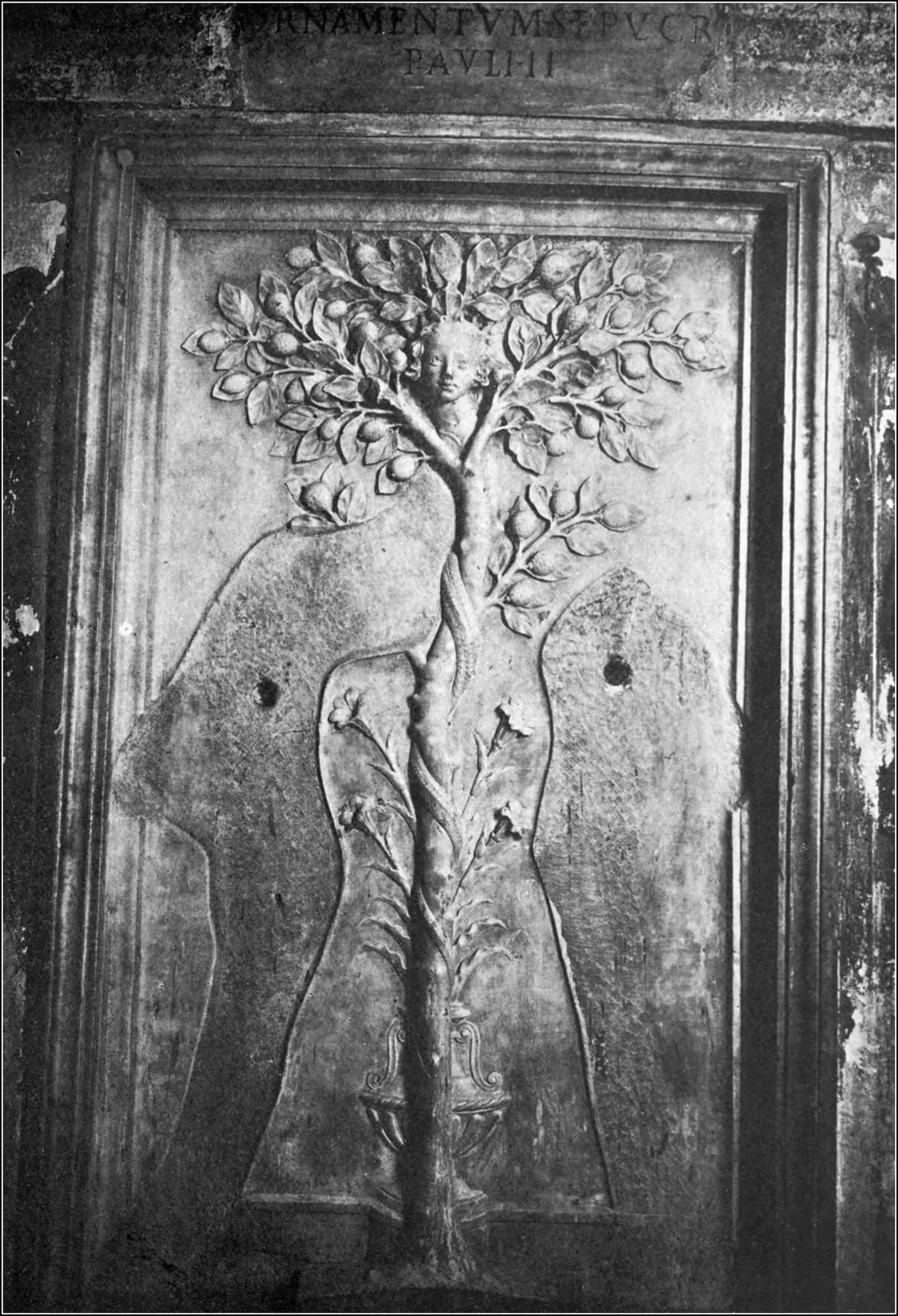
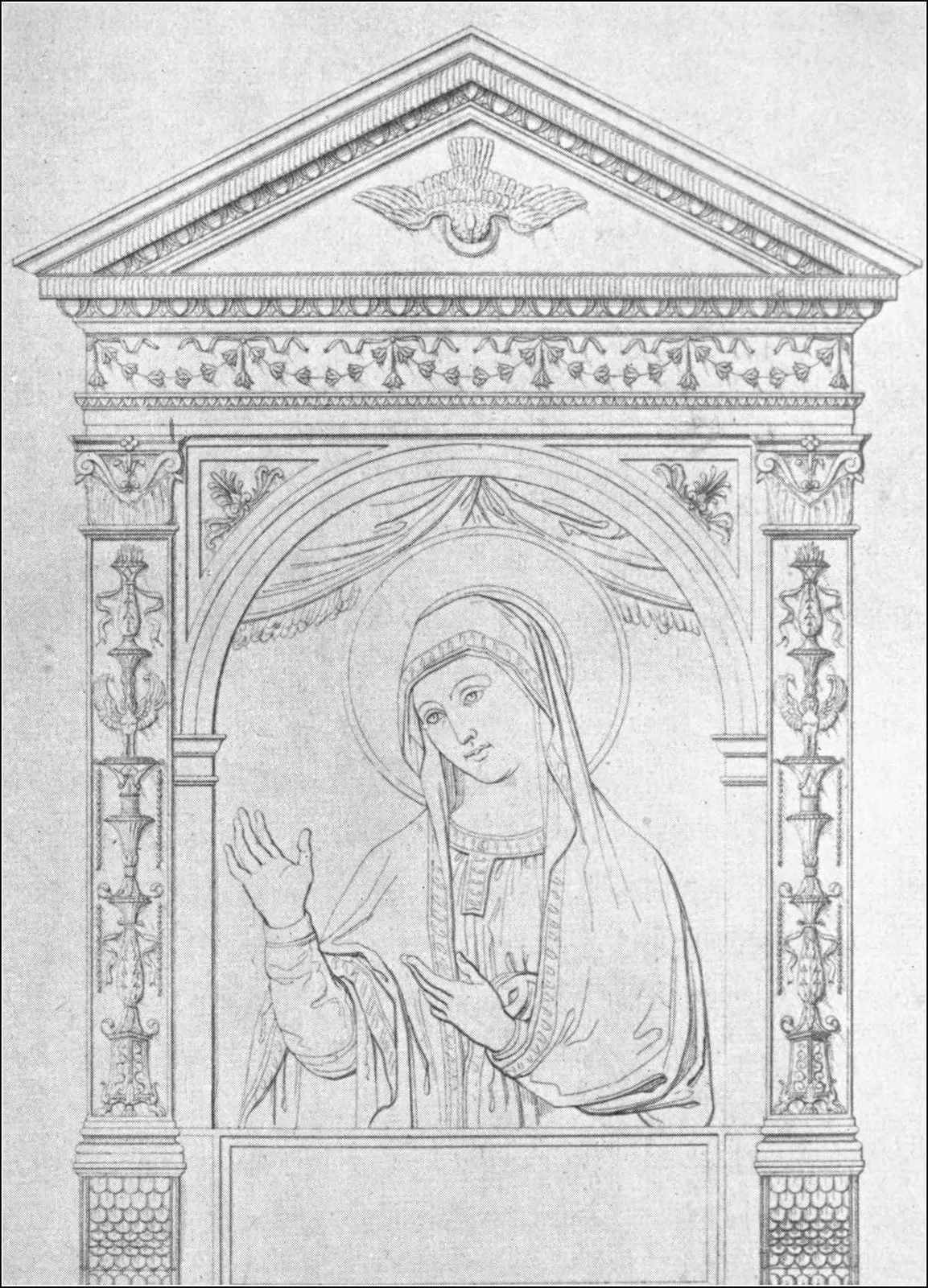
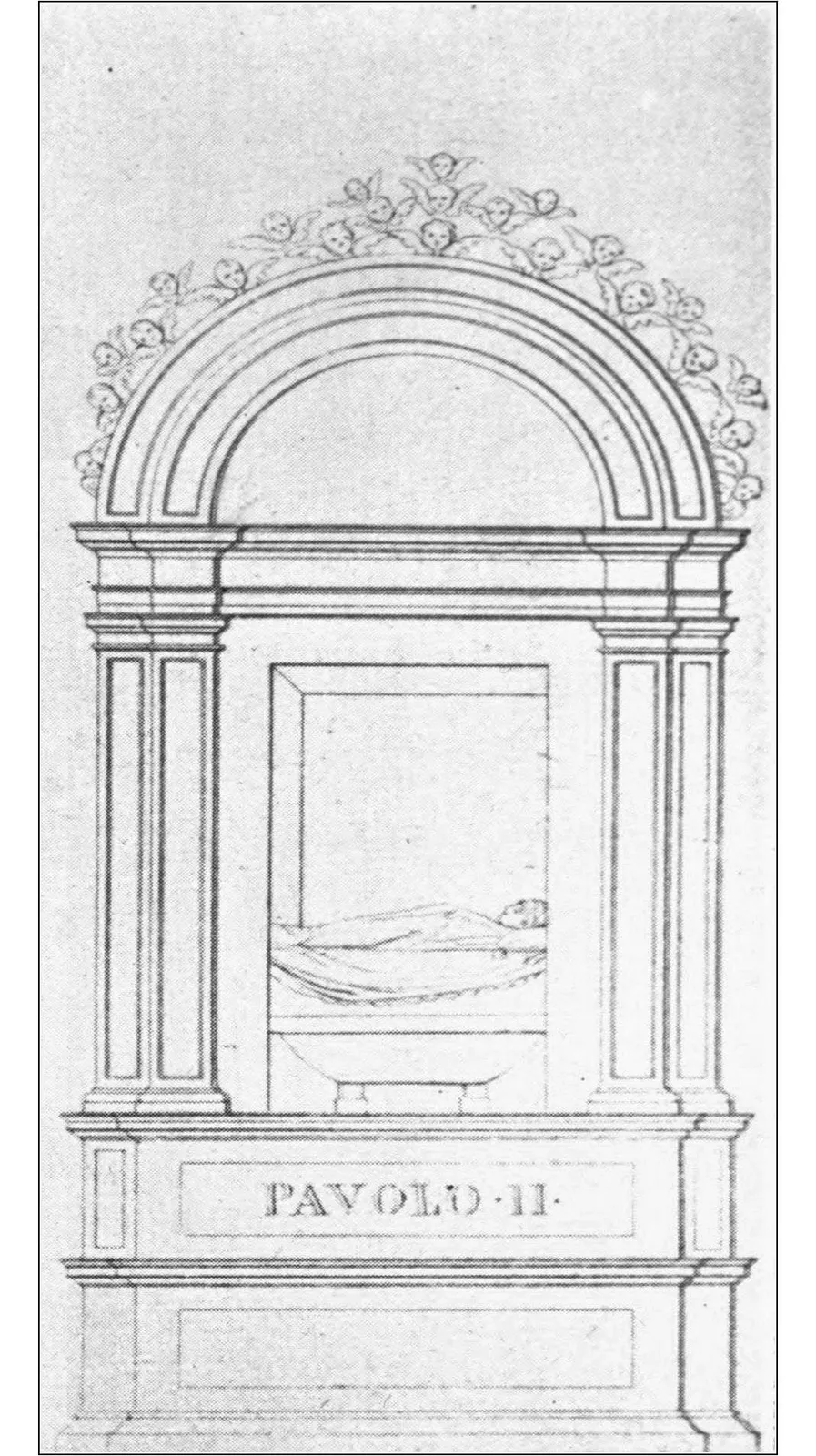
Charity. Carved by Mino de Fiesole for Paul II.’s Mausoleum, now in
the Grotte Nuove of St. Peter’s Crypt.
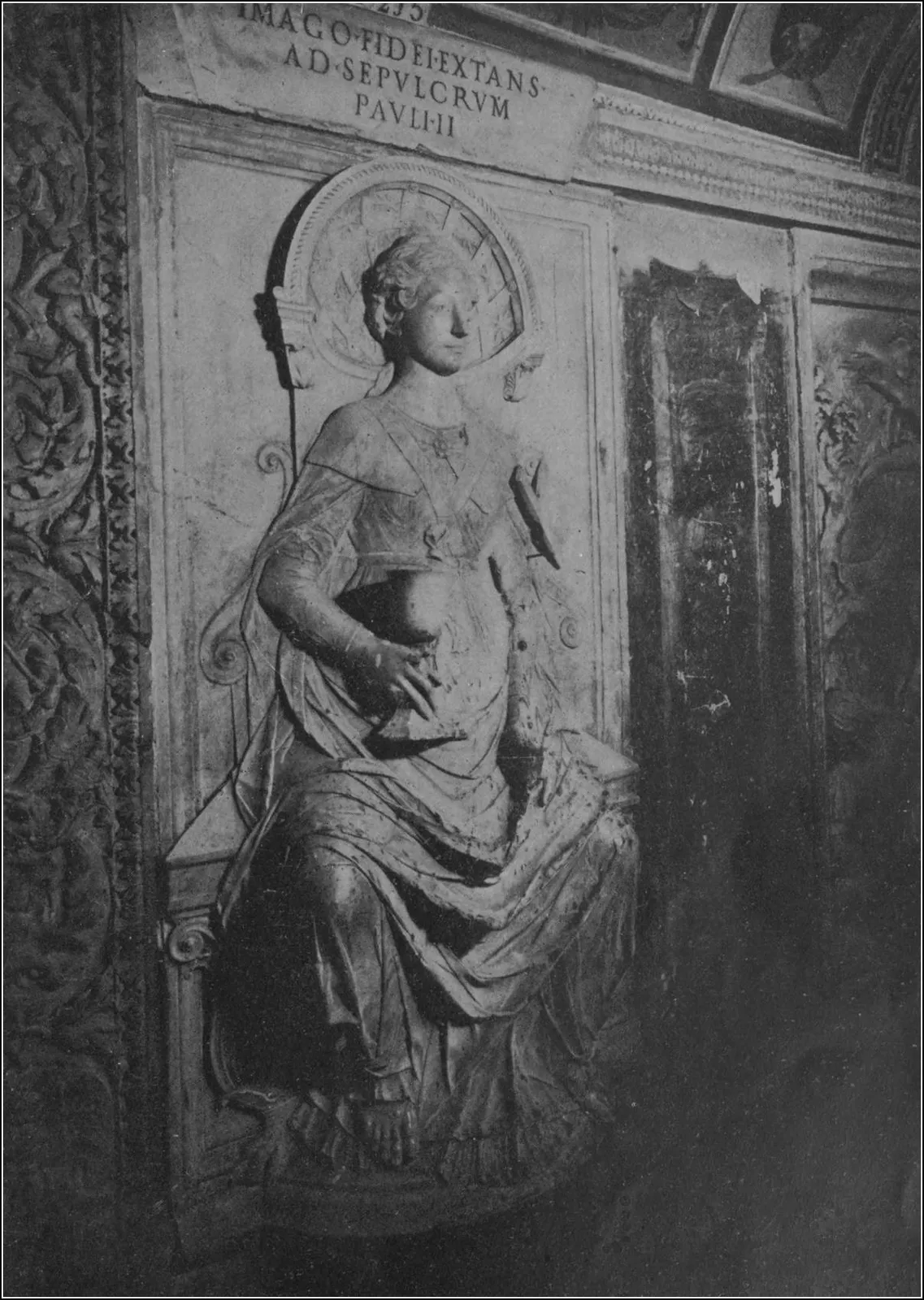
Faith. By Mino de Fiesole, in the Grotte Nuove in St. Peter’s Crypt.
The principal staircases of the Vatican are
the Scala Pia (1), the Scala Regia; the Scala
Nobile, which leads up to the Hall of the Biga
and the Etruscan Museum; the staircase to the
Museo Pio-Clementino; the great staircase on the
north side of the Courtyard of San Damaso; the
staircase which leads from the Sistine Chapel
down to St. Peter’s, and the staircase leading to
the Pope’s apartments up from the Courtyard of
San Damaso.
The great Scala Pia which sweeps up from the
Bronze Doors to the Courtyard of S. Damaso (and
consequently to the Pope’s apartments), receives
its name from Pius IX., who converted it from
an open staircase at the same time as he enclosed
the south side of the Courtyard of S. Damaso.
Half-way up it is the office of the Pope’s Maestro
di Camera, and at the top are the apartments of
the Maggiordomo, consisting of a large cloak-room,
fitted with tables on which visitors lay
their coats and hats, leading into a luxurious
apartment of the dimensions of a hall, where the
visitors wait and the principal secretaries have
their tables, and thence into the Maggiordomo’s
office itself.
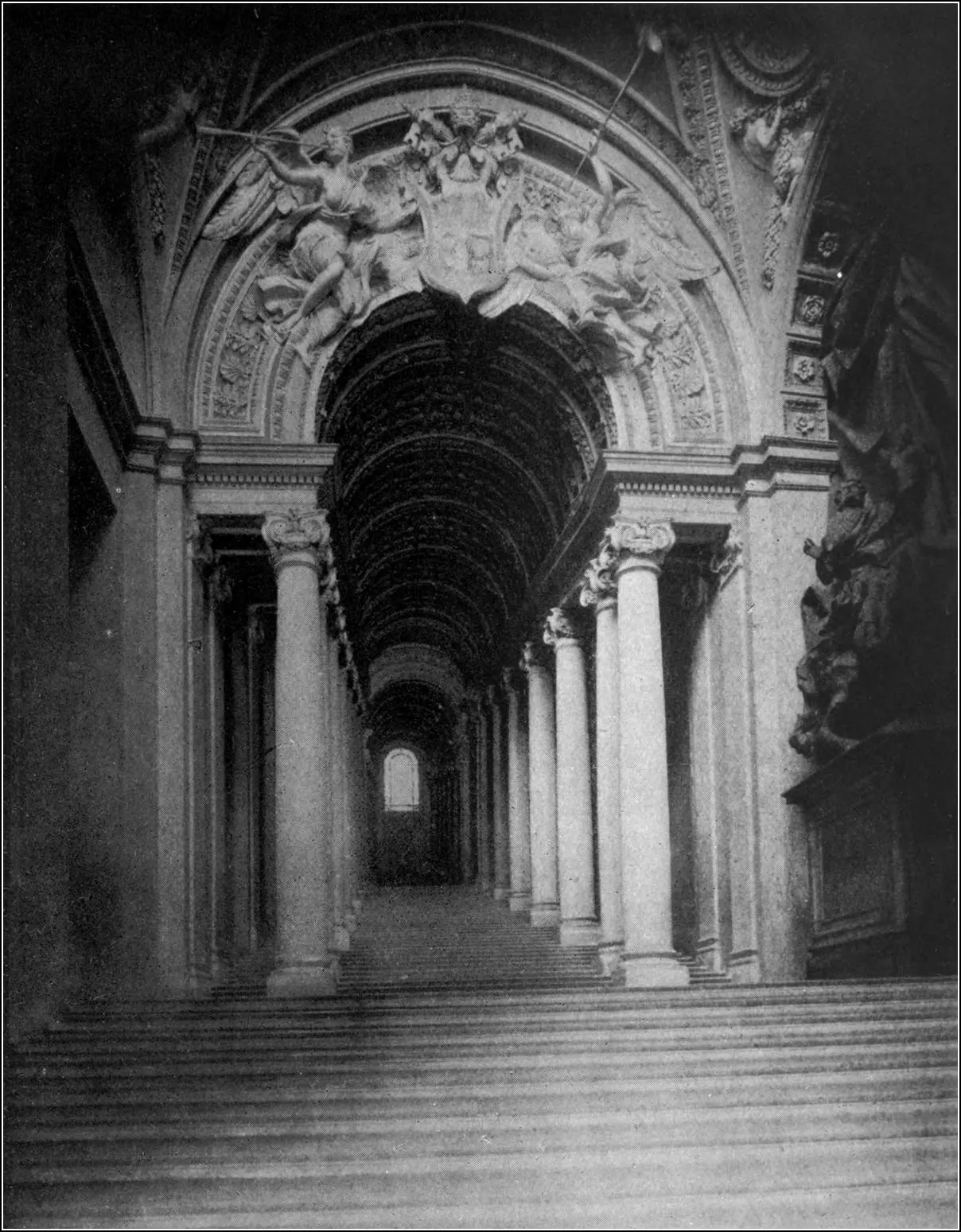
The Scala Regia is a mountain of stone,
claimed by ardent Roman Catholics to be the
finest interior staircase in the world. It was
designed, like the glorious colonnades of the
Piazza of St. Peter’s, by Bernini. It was ordered
by the Barberini Pope (Urban VIII.), but not
finished till the time of the Chigi Pope (Alexander
VII.), whose arms it bears.
It furnishes a magnificent prospect as it
mounts up from the Bronze Doors, the public
entrance to the Vatican, stretching away in a
long vista, commencing with a superb Ionic
colonnade; and it must not be forgotten that
Bernini also designed enormous gilt consoles for
the further decoration, and for the illumination
of his great staircase, which still exist but are
kept stored away; I allude to them elsewhere.
The stucco ornamentations above the arches and
on the ceilings which bear the arms of Alexander
VII. are the work of the sculptor Algardi and
have considerable beauty and elegance, though
they are not at all comparable to the work of the
Sicilian Giacomo Serpotta, who lived a hundred
years later, and, of course, may have been inspired
by Algardi. The other staircases will be described
as they come into the topographical plan.
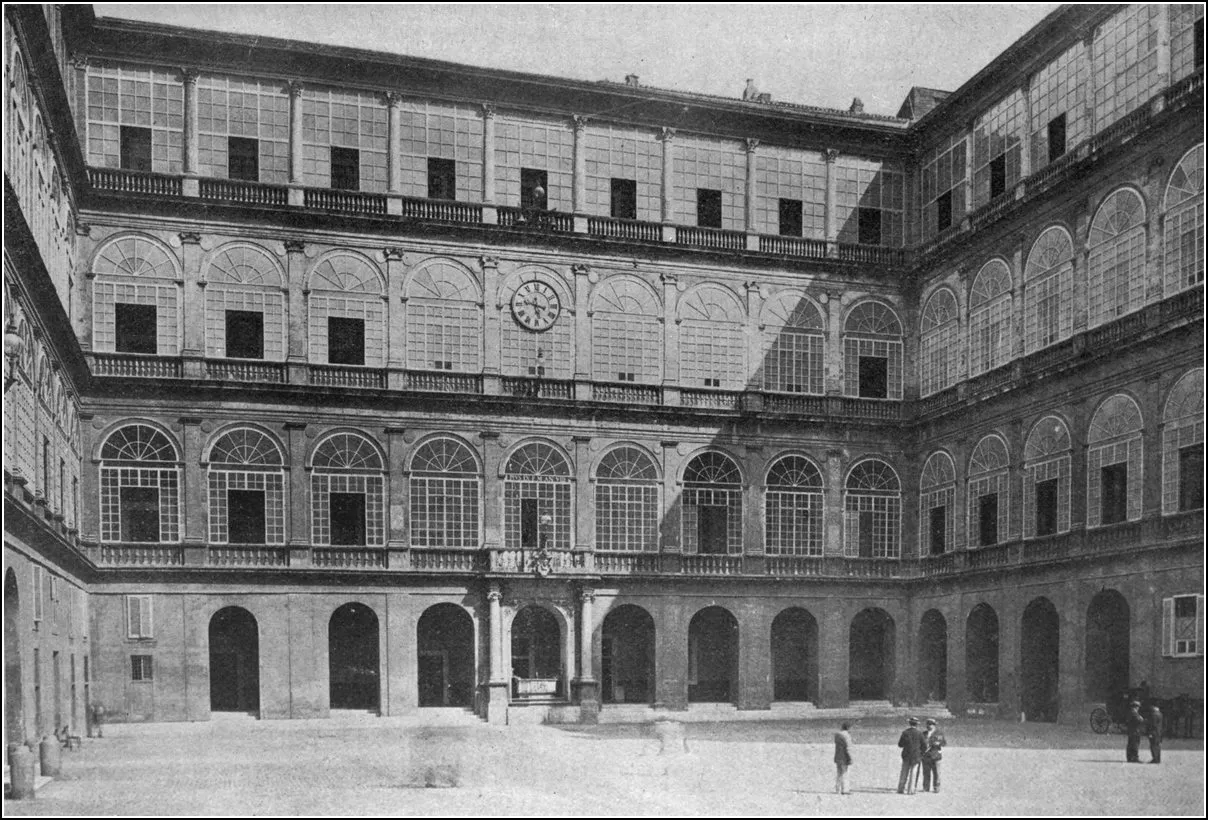
At the top of the Scala Pia, as I have said,
is the beautiful Cortile di S. Damaso (4), the royal
court of the Vatican, which, in its conception, was
one of the masterpieces of Bramante, though it
has been altered so considerably—particularly
under Pius IX.—that much of its original grace
is lost. Good old Pio Nono was, it must be confessed,
on the horns of a dilemma: on the one
hand he had Bramante’s most elegant arcades
(20, 21, 22) to consider, on the other hand there
were the frescoes of Raffaelle and Giovanni da
Udine, which were feeling the effects of four
centuries of semi-exposure to the weather. As
in the case of St. Peter’s and the Cortile del
Belvedere, Bramante was sacrificed to later
ideas. The airy and soaring effect of the triple
arcades with which he had surrounded the
Courtyard of S. Damaso was lost in the glass
screens with which the arches were filled. But
the frescoes benefited by the conversion of the
loggias into a sort of winter garden. The right
hand, or east side, of this court is taken up with
the apartments, said to be only twenty-two in
number, which Sixtus V. built round a minor
courtyard for the actual use of the Popes. Of
these the Pope’s library, study and bedroom,
private reception-room, and a sort of antechamber
to it (i, h, g), look south across the
Piazza of St. Peter’s over. Rome. The throneroom,
the private chapel and its anteroom, the
anteroom which leads into them and the second
public anteroom, occupy the east side of the
quadrangle. The Hall of the Grooms and the
first public anteroom occupy the north side, and
most of the west side is taken up with the state
entrance and the staircase and the fine Sala
Clementina (f), in which one of the three pickets
of Swiss Guards on duty at the Vatican is
stationed.
Out of this opens the Hall of the Bussolanti.
This is the name given to the lay attendants,
dressed in crimson velvet, who mount guard over
the Bussola—the door for keeping out draughts—which
gives access to the Pope’s private antechambers.
There are thirty-six Bussolanti. In
their hall, the laity who are admitted to an
audience with the Pope leave their hats and
coats and umbrellas. After passing the Bussola
you thread a series of antechambers, says Goyau.
“The first is guarded by gendarmes, and the
secretaries of Cardinals await here the return of
their masters. The second is in charge of the
Palatine Guards. Turning off to the right the
visitor, by a third hall decorated with tapestries,
reaches a fourth, in charge of the Noble Guards.
To the right a door which can be opened wide
gives access to the Chapel of the Holy Father.
And it is in this hall that you are stationed when
you are present at the Pope’s Mass. A fifth
room, called the Anticamera d’Onore, is adorned
with the Papal Throne. When you are granted
a private audience you attend in this room. It
is here that the Pope takes up his position to
receive important bodies of visitors; to receive,
at the New Year, or on the anniversary of his
coronation, the congratulations of the Prelates
and Cardinals; and to hear during Lent and
Advent the preachings intended for the Papal
Court. Two Camerieri d’Onore, one in a violet
habit, the other with spada e cappa, are on duty
in this antechamber. Before a door at the
bottom a Noble Guard is on duty. This door
admits to the Anticamera Segreta, reserved for
prelates who are at least Camerieri Segreti, and
for Cardinals. From this point you have only a
threshold to cross and you are at the feet of the
Pope.”
This is the easternmost portion of the Vatican
Palace, and under its shadow on the south side
are the Court of the Grooms, etc. The other two
sides of the Court of S. Damaso, which is the next
portion of the palace westwards, are taken up
with the Loggie of Raffaelle (20, 21, 22), completed
by him as the architect from the design of
Bramante. Only a limited number of the panels,
called Raffaelle’s Bible, because they are taken
from Bible history, are from Raffaelle’s hand;
but of great interest also are the stucchi and
arabesques executed by Giovanni da Udine, who
was the sole artist employed in the first-floor
gallery on the west side. I have told in another
chapter how he copied these arabesques from
the newly discovered baths of Titus; they have
the double merit of reproducing an ancient
Roman monument and being extremely graceful
and spirited. The Loggie of Raffaelle do not fall
within the scope of this book, for they are one
of the parts of the palace which everybody visits.
It is through Giovanni da Udine’s loggia that the
students who have the privilege of reading in the
Vatican Library, as well as the privileged inhabitants
of the Vatican, enter the Library,
passing along the Gallery of the Inscriptions
(Galleria Lapidaria), which is nearly seven hundred
feet in length and covered with five thousand
fragments of pagan and early Christian inscriptions,
sarcophagi and cippi, collected mainly by
Pius VII. when Napoleon had carried off all the
prizes of sculpture from the Vatican galleries,
though a few of them were collected by Clement
XIV. and Pius VI. Underneath this is the
atelier in which the famous Vatican mosaics,
upon which I have said a few words in another
chapter, are made. The Gallery of Inscriptions
(42) leads into the Chiaramonti Museum (77),
which I shall leave until I am speaking of the
Sculpture Galleries, to which it belongs. It also
received its present designation and use from
Pius VII.—the Chiaramonti Pope—and the two
together fill one of the two great wings, nearly
four hundred yards long, which Pope Julius II.
commissioned Bramante to build to unite the
palaces which stood in his day with the Villa of
Pope Innocent VIII. on the northern edge of the
Vatican Hill.
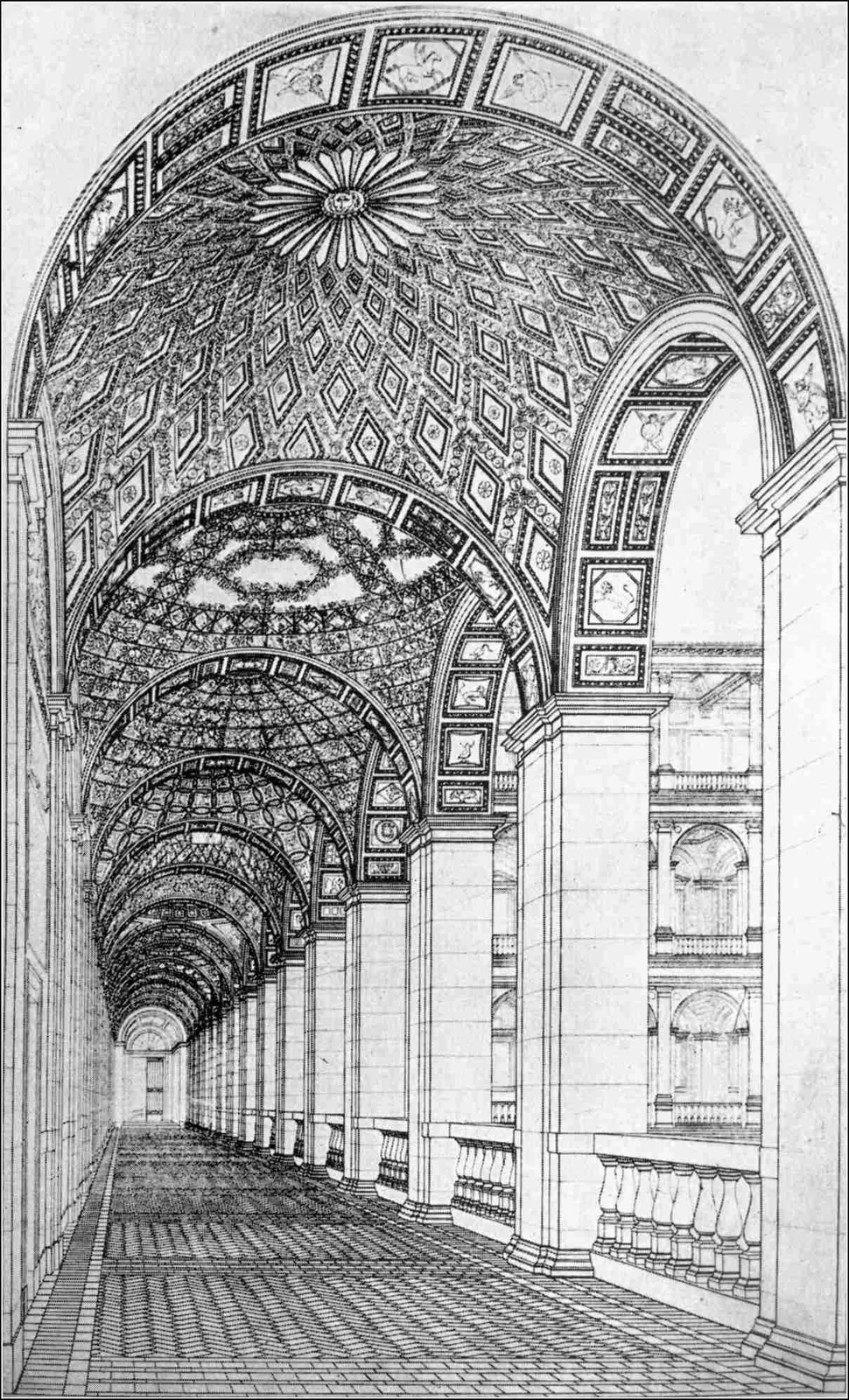
Giovanni da Udine’s Loggia before it was glazed. From Pistolesi’s “Il Vaticano.”
It is best to retrace our steps to the Loggia of
Giovanni da Udine, at the back of which are four
interesting rooms; the first and largest of the
Borgia Apartments, the smoking-room of the
Cardinals, called also the Galleriola, (35), or the
audience-room; the Spogliatoio, or Hall of the
Pappagallo (35), and the Hall of the Paramenti
(23). I have mentioned these in order from north
to south, but I will take the last, which is entered
through the Sala Ducale (24, 25), first. It is
singularly well named, for the term Sala dei
Paramenti might be applied with equal fidelity to
its being the room where the Cardinals put on
their sacerdotal robes for great functions, or its
being the room with the tapestry hangings with
the arms of the Farnese Pope, Paul III., 1534-1549,
which are said to be so priceless.
A door from the Sala dei Paramenti admits
into the Sala del Pappagallo, or Hall of the
Parrot, which contains the nuptial tapestries of
Louis XIV. and is the room set apart for the
Pope to robe in before he goes to functions in St.
Peter’s. Here the Cardinal Secretary of State
gives his state dinners, and here, in ordinary life,
the officers of the Swiss Guard dine. The long
gallery opening out of the end of this room, with
reclining benches along its side, after the manner
of the guard-rooms of Tunis, is the Galleriola,
now the smoking-room of the Cardinals.
The Borgia Apartments are now approached
through the Sculpture Galleries, but they have
a separate staircase in the north-west corner of
the Courtyard of S. Damaso. They formed for
some years the official residence of the present
Pope’s Prime Minister, the Cardinal Secretary of
State, and are the subject of a separate chapter.
The first of them—known as the Sala dei Pontefici,
or Hall of the Popes (36)—is much the
largest. Leo X. had the ceiling decorated with
mythological emblems by Giovanni da Udine
and Pierino del Vaga, pupils of Raffaelle. It is
impossible to believe that the lost Hours of
Raffaelle lie, as some have said, under these
frescoes, because Leo X. was far too great an
admirer of the work of Raffaelle to have allowed
a jot or tittle of it to be hidden.
This room is hung with magnificent French
tapestries of the sixteenth century, mostly representing
the story of Cephalus and Procris. Here
I must warn readers that all guide-books, except
the latest, are incorrect in the information which
they give about the Borgia Apartments, as they
have been subjected to so many changes. Even
Hare’s Walks in Rome, brought up to date by a
man who knows his Rome so well as Mr. St. Clair
Baddeley, states that they have been opened as a
kind of “Mediæval museum of the Papacy,” Museo
di Leone XIII. (Hare, 1905), while in Black’s
Guide to Rome (1906), it is repeated that they are
the “Mediæval museum of the Papacy,” and that
Room I. serves as the anteroom of the Swiss
Guard, while another guide-book places the
armoury in them. Until twenty years ago all
the printed books of the Vatican Library were
kept in them.
Coats and hats and umbrellas are left in the
Sala dei Pontefici (36), which leads into the second
of the Borgia Apartments, where the celebrated
frescoes by Pinturicchio, which rival his frescoes
in the Library of Siena, begin. This is called the
Hall of the Mysteries, or the Hall of the Madonna
(37). Here except in the hours during which the
public were admitted, one of the Cardinal’s secretaries
used to sit who received the cards of visitors
admitted for an audience. The regular reception
hours were after the Angelus. The exquisite
Annunciation is in this room.
From the Camera della Vita della Madonna
opens the Camera della Vita dei Santi (38), in
which the frescoes are glorious. For here are the
story of Santa Barbara; the infinitely lovely
picture of St. Catherine (Lucrezia Borgia) disputing
with the philosophers before the Emperor;
the San Sebastian; the Santa Susanna, and the
Isis and Osiris ceiling, selected to give the legend
of the bull Apis, the ox being the Borgia arms.
This is the waiting-room in which visitors used to
remain after the secretary has passed them until
the Cardinal sent for them, or more ordinarily,
came in person to call them; for the courtesy
and courtliness of the great Vatican officials is
exquisite.
The fourth room opening out of these is called
the Camera delle Arti e Scienze (39), where the
Cardinal held his audiences. This, again, has
superb Pinturicchio frescoes, representing the
Seven Liberal Arts.
From there a staircase of about a dozen steps
leads up into the Torre Borgia (40), where there
are two rooms, the first of which, with large oriel
windows, was the Cardinal Secretary’s study.
Just below the ceiling runs a fresco of the Apostles,
each holding his special portion of the Creed,
whence its name, “The Hall of the Credo.” The
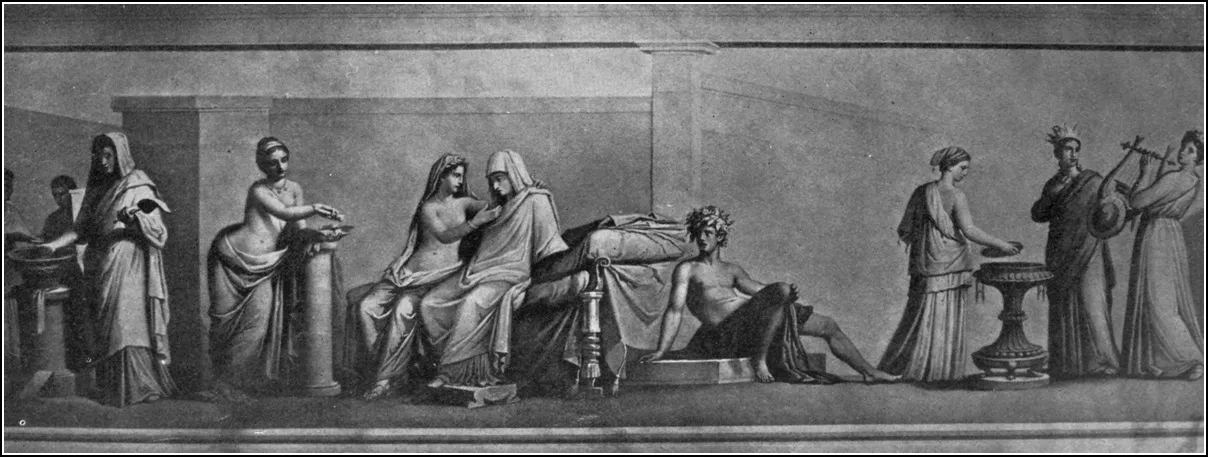
celebrated Nozze Aldobrandini, the finest antique
fresco known before the grand discoveries at
Pompeii, is no longer in this room, as stated in
Hare’s Walks in Rome, 1905. It is now in the
Vatican Library, where anyone can see it, whereas
these two rooms in the Torre Borgia were till
recently never shown to the public. The other
room in the tower, known as the Sala del Sibylle,
has an elaborately frescoed ceiling, and I believe
some fine tapestries, but I have not seen this room.
I am told that not even the Cardinal Secretary
has seen the bathroom in the suite of rooms
higher up in this tower, once occupied by
Cardinal Bibiena, the patron of Raffaelle, whose
niece was betrothed to the painter, and lies buried
by his side in the Pantheon; this was painted
by Raffaelle with mythological subjects. Something
in these beautiful frescoes offended the
prudery of Gregory XIV.’s advisers, and the
bath was taken away; and the pictures, which
were spared as being some of Raffaelle’s good
work, were covered up with wooden panelling to
turn the offending bathroom into a chapel. It is
said that the panelling has now been removed,
but I have not heard of anyone having been
allowed to see the pictures.
Over the Borgia Apartments are Raffaelle’s
Stanze. Admittance to them is by a staircase
turning off the Scala Regia of Bernini. After
passing through an anteroom and two small
rooms hung with modern pictures of miracles
and martyrdoms, you enter the Sala della Immacolata,
adorned with huge pictures of the
promulgation of the Immaculate Conception by
Pius IX., which contains in the centre the superb
gilt ark, presented to Pius IX. by the French clergy,
one of the finest pieces of modern cabinet-making.
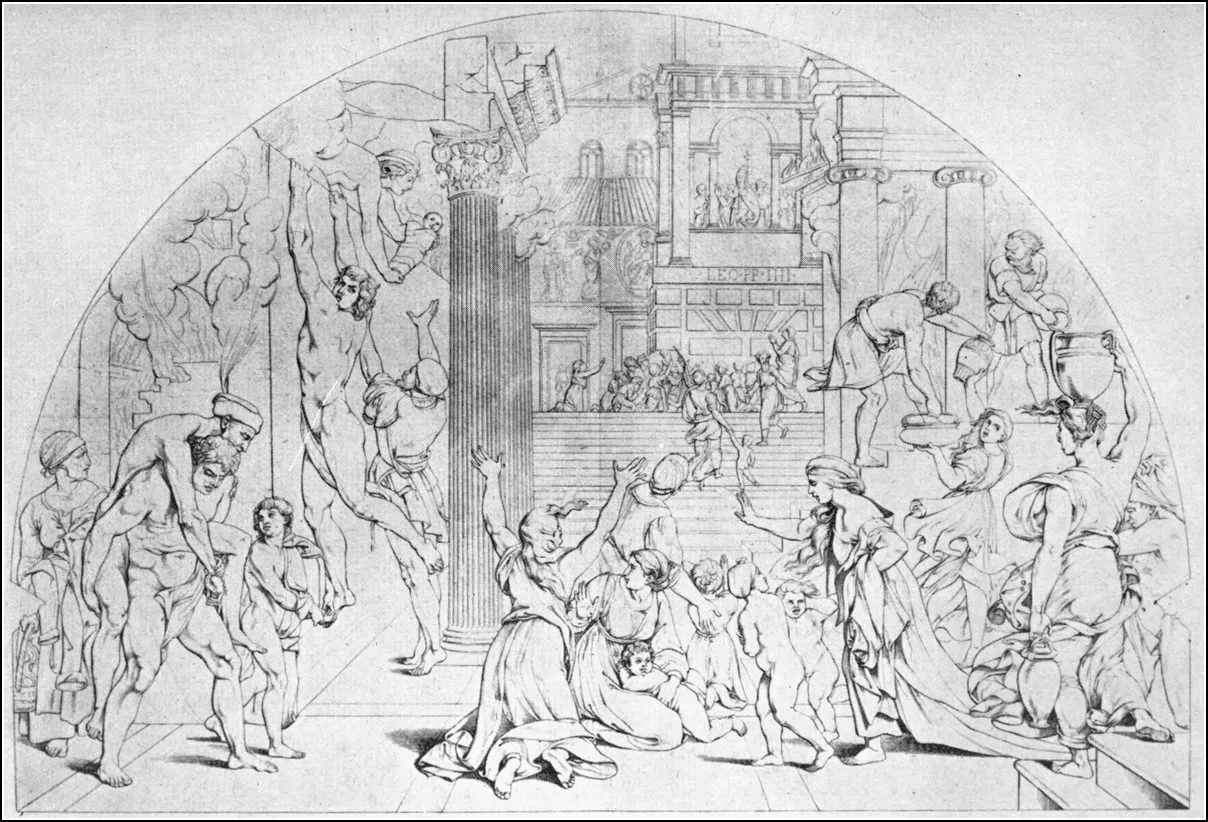
The Fire in the Borgo, from the painting by Raffaelle in his Stanze. Showing the Exterior
of Old St. Peter’s. From Pistolesi’s “Il Vaticano.”
From this you enter the Stanze, which represent
the highest triumph of Raffaelle. For
Sodoma, Perugino, Luca Signorelli, and other
great fifteenth-century masters had all but completed
the frescoing of these rooms when Julius
II. decided to have them re-frescoed by Raffaelle.
You cannot help wondering what became of their
feelings, if not of their work. The first Stanza
contains the Fire in the Borgo, the Coronation
of Charlemagne, the Defeat of the Saracens at
Ostia, and Leo III. justifying himself before Charlemagne.
These are all by Raffaelle. Perugino’s
pictures remain on the ceiling, and the mosaics
on the floor come from an ancient Roman villa.
This is called Stanza del Incendio. In the second
room, called the Stanza della Segnatura, the
arabesques of the ceiling are by Raffaelle. The
walls are covered by some of Raffaelle’s greatest
frescoes: the School of Athens, the Disputa,
and the Parnassus are in this room. The third
room, the Stanza d’Eliodoro, was (except the ceiling,
which was probably by Giulio Romano) entirely by
Raffaelle’s own hand. Here are the Liberation
of St. Peter, the Mass of Bolsena, the Expulsion
of Heliodorus, and the Repulse of Attila. The
fourth room, called the Sala di Costantino, is
by the pupils of Raffaelle, though preliminary
sketches had been made by Raffaelle for the Battle
between Constantine and Maxentius. The ceiling
is a great deal later; it was completed under
Sixtus V. (1585-1590). A door at the end of this
room leads into the old hall of the Pope’s grooms
(palafrenieri), which, according to Tuker and
Malleson, was entirely decorated in chiaroscuro
by Raffaelle, though the paintings have been
retouched and spoilt by Carlo Maratta and Zucchero.
Doors at the end to the left and right lead
into Raffaelle’s Loggie and the Chapel of Nicholas
V., which is one of the gems of the Vatican,
decorated with the masterpieces of Fra Angelico.
They were his last and most matured work,
executed 1450-1455, and can only be compared
to the brilliant Riccardi Chapel of Benozzo
Gozzoli at Florence.
After seeing Raffaelle’s Stanze and the Chapel
of Nicholas V., it is usual to proceed to the second
floor of the Loggie, which enclose the Cortile of
S. Damaso, known as Raffaelle’s Loggie, alluded
to above. After leaving them, more stairs are
ascended to the upper tier of the Loggie, which
were decorated with maps under Clement VII.
by Antonio da Varese. From this you entered
the anteroom of the former Pinacoteca.
The new Pinacoteca is on the road up to the
Sculpture Galleries; it was adapted from the
disused stables of the Pope. The pictures are
not very numerous, but include one or two of
the most famous paintings in the world, such
as Raffaelle’s Transfiguration.
I will suppose you to have finished your first
day’s perambulation of the Vatican by descending
from the picture gallery to the Bronze Doors,
though, unless accompanied by a very high
official of the Vatican Household, you would
never have been allowed to have seen all these
things one after another as convenience dictated,
or to descend this way.
On your way down you would have passed the
entrance to the Sala Regia and the famous apartments
which lead off it. It would have been
better to have passed them in any case, even if
you had had time to devote to them, for the right
way by which to approach the Sala Regia is to
enter the Bronze Gate and mount Bernini’s
magnificent staircase, the Scala Regia, so that you
may get a true impression of its magnificence.
The Scala Regia of the Vatican. Designed by Bernini.
The Sala Regia (26), called also the Aula
Magna, i.e. the Grand Hall, was built by Antonio
Sangallo the younger, for that rather baroque
Pope, Paul III., for the reception of the Ambassadors
of foreign Sovereigns. It is very
large and has a very ornate stucco ceiling by
Pierino del Vaga, though the stucchi over the
door are by Daniele da Volterra. The frescoes
of the Triumphs of the Popes are by Vasari, the
Zuccheri, and others. The room is over a hundred
feet long, fifty feet wide, and seventy feet
high. The door on the left admits to the Sistine
Chapel (30), which I need not describe, as it is
one of the parts of the Vatican usually visited by
sightseers.
The door opposite admits to the Sala Ducale
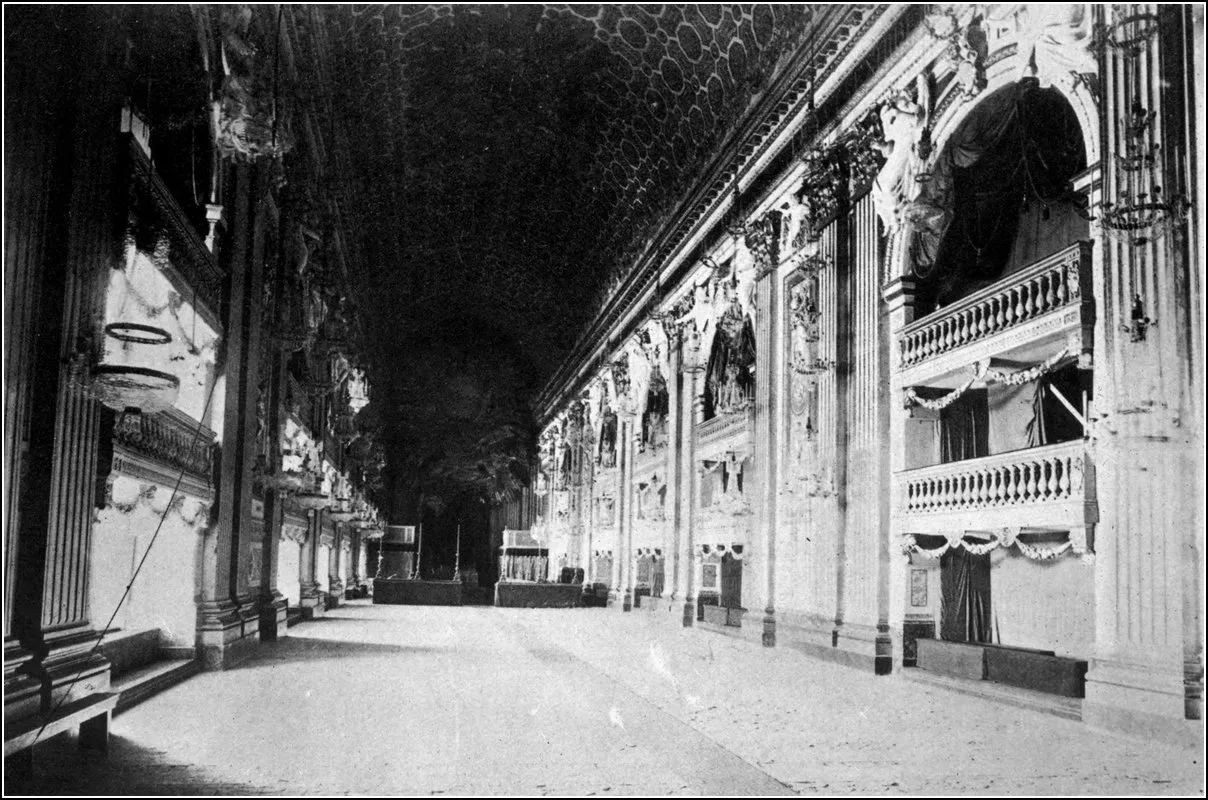
(24, 25), a very long, narrow low room, constructed
by Bernini, known as the Aula Minor;
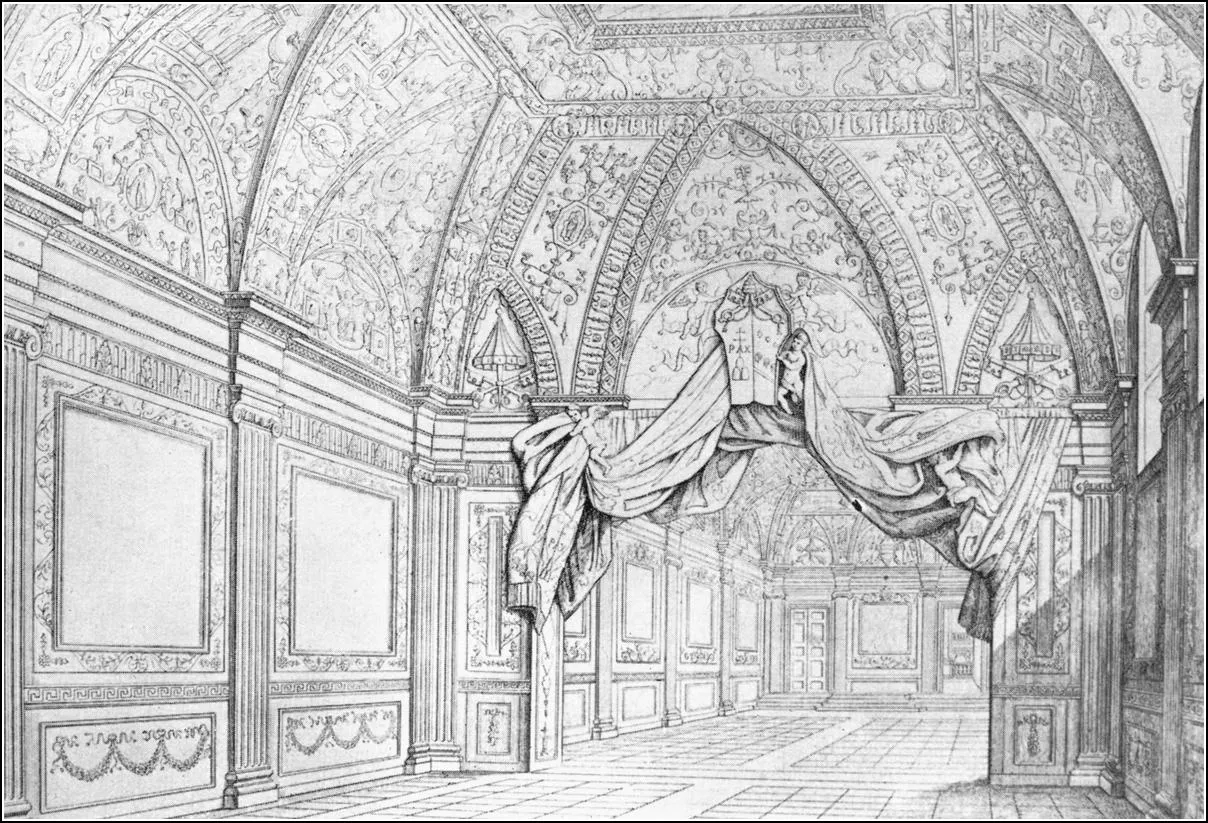
it is divided into two parts by an arch in the most
degraded style of art, composed of curtains and
cupids, also by Bernini. Through it the Pope
and his Cardinals go to functions at St. Peter’s
after robing in the Sala del Pappagallo and the
Sala dei Paramenti. And visitors who are lucky
enough to get permission to see these two rooms
have to approach them through the Sala Ducale.
Another door on the same side of the Sala Regia
as the Sala Ducale, leads down to the court of the
Maresciallo of the Papal Conclave (14).
Opposite this is the door which admits to the
Leonine Chapel in the Gallery, which runs over
the porch of St Peter’s, built by Carlo Maderno,
and hardly mentioned in any guide-book, although
it is of very great importance, as it gives
on to the gallery of St. Peter’s, from which the
newly-elected Pope blesses the people, and contains
the window over the Piazza from which he
used to bless the people before the loss of the
temporal power in 1870. It was converted into
a chapel by Leo XIII.
Between it and the Cappella Paolina (34),
which is entered by a door at the south-west
end of the Sala Regia, are a number of small
chambers, in which are stored the gilt consoles,
and other portable decorations designed by
Bernini for St. Peter’s.
The Cappella Paolina (34) is chiefly famous
for having two huge frescoes by Michel Angelo,
much restored by his pupils. It was built by
the same architect as the Sala Regia, and has
some of the best late stucchi in the Vatican.
Though the Sistine Chapel, being so well-known,
does not fall within the compass of this
work, it is necessary to traverse it, and pass
through a little door under Michel Angelo’s fresco
of the Last Judgment, to enter the succession of
small chambers (31) which form its treasury,
where the Pope’s vestments, the vestments for
the Cardinals on special occasions, the Popes’
tiaras, the Golden Rose, and other objects of
the highest interest are kept. At the back of
the Sistine Chapel a staircase (32) leads down
from the Vatican to St. Peter’s.
To see the remaining parts of the Vatican,
which include all the Museums and the Library,
the ordinary visitor has to cross the great Piazza
of St. Peter’s, and walk round three-quarters of
the Church, until he finds himself in the Cortile
del Forno, a quadrangular court, with a fountain
in the middle of it, which has St. Peter’s on the
one side and the Mint on the other. The Mint,
standing on a kind of a terrace, is territorially
not part of the Vatican: it is the one spot on the
Vatican Hill of which the Italian Government
took possession. The road which passes between
the two is the Via delle Fondamenta, along which
Pope Leo XIII. took that memorable drive which
was taken to mean coming out of his captivity,
referred to in another chapter.
Before passing under the arch to go up the
Vialone di Belvedere to the Sculpture Gallery,
glance to your right, where a group of fifteenth-century
buildings, tower and gateway and balcony,
brown and feudal-looking, arrest your attention.
At the entrance are sentries in the half-mediæval
dress of the Swiss Guard. That embattled gateway
admits to the Cortile della Sentinella (12);
one of the three places in the Vatican which has a
corps-de-garde, the state entrance to the palace
by which Kings and Cardinals and Ambassadors
enter to visit the Pope. This court, as I have
said, is bounded by the Sistine Chapel (30) on the
south, and on the north by the Chapel of Pius V.
(56), and the end of the Museo Cristiano. It
opens into a second court, known as the Cortile
del Portone di Ferro (11); bounded by the Sistine
Ante-chapel (29) and the Sala Regia (26) on the
south, and the Torre Borgia (40) on the north.
This is divided from the Cortile del Pappagallo
(10) by a wing containing two small halls—the
halls of the Noble Guard. The ground floor
rooms round these quadrangles are devoted to
various humble and prosaic uses. The chamber
on the first floor at the angle of the Vialone and
the Cortile della Sentinella is the Chapel of Pius V.,
with the Room of Small Cabinets beside it. Then
follow various rooms of the Christian Museum
of the Vatican Library; the Hall of the Christian
Paintings (55), the Hall of the Papiri (54), with
the Hall of the Nozze Aldobrandini (55) at right
angles to them, spanning the road, which has the
Room of the Terra-cottas leading off it, the
Christian Museum (53), properly so called, the
Hall of Aristides (52), the Hall of the Obelisk (51),
the Hall of the Bonaventura (50), the Hall of the
Vatican Manuscripts (61), the Libraries of the
Alexandrine Collection (62), the Ottoboni Collection
(65), the Capponi Collection (65), the
Borghigiana Collection (66), the first two halls of
the Library (66), and the Museo Profano (67).
The whole of these, from the Chapel of Pius V.
northwards, form the western long wing from
the old parts of the Palace to Innocent VIII.’s
Villa, and they are confronted all the way along
by the Pope’s private garden, separated from
them by the Vialone di Belvedere. In the whole
of this portion of the Vatican Library, nearly four
hundred yards long, you do not see a single book:
they are all manuscripts, and put away in presses
in the ancient Roman fashion; but you see a
good many museum objects. As far as it goes,
the Vatican Library would be one of the most
interesting museums in Rome if they only let you
stop an instant to take anything in. The rooms
underneath were constructed for coach-houses
and stables. Part of them has been converted
into the new Pinacoteca for the Pope’s pictures,
and some of the stables have been turned into
new chambers for the Archivio, or archive office.
The famous Aldobrandini Wedding in the Vatican Library. The finest picture
which has survived from Classical times.
I have spoken elsewhere of the enormous
Cortile,[2] between three and four hundred yards
long, which Bramante designed to fill the entire
space between the two long wings from the old
Palace to the Villa of Innocent VIII., of which
I have been describing the westernmost. It was
to have had a triple tier of the classic arcades in
which Bramante delighted; and would, without
doubt, have been the finest Cortile in Europe.
Tournaments and races were to have been held
in it. One could see in it the pagan mind of Pope
Julius II., purposing to match the Circus of
Caligula and Nero, out of which, owing to the
execution of St. Peter, the Vatican grew. At
the Palace end there was what the ancient Romans
called an esedra, a sort of open-air apse (60), in
which the Roman Emperors were wont to ensconce
themselves like gods in niches. There is one in
the Stadium of Domitian on the Palatine, and
another in the Baths of Trajan on the Esquiline.
Bramante designed his esedra to be a sort of
theatre. It is to be noted that bull-fights
have been held here. Jousting went on in the
Court of the Tournaments until the time of
Sixtus V., as long, in fact, as it went on anywhere.
The name applied to the arcades when
they were first built was the Porticus Julii. The
northern half, now the Giardino della Pigna,
was always the height of a terrace above the
southern half.
Sixtus V. spoiled for ever the conception of
Bramante by building the Sala Sistina (48) (his
magnificent new hall which was to receive the
Vatican Library) right across the middle of the
vast quadrangle; it is the Sala Sistina, two
hundred and twenty feet long, forty-eight feet
wide, and twenty-nine feet high, gorgeously
arabesqued, in which the visitor sees, in glass
cases, the most precious manuscripts of the
Vatican, and an alarming number of Sèvres vases,
presented to Pius IX. The rooms underneath
the Sala Sistina have at various times been given
up to armouries and stables, but Leo XIII., who
loved to ennoble his palace like the old Popes
before him, inaugurated the most sweeping and
effective changes in the Vatican Library since
the days of Sixtus himself. He was desirous of
taking the books out of the Borgia Apartments,
which, when he was elected to the Papacy, formed
the library of printed books. But he was even more
desirous to fulfil the aspiration of Nicholas V.,
by making the splendid Library of the Vatican a
light of the world, “a city set upon an hill.” He
gave the order for the rooms under the Sala
Sistina to be converted into a library to receive
all the printed books. The change was effected
with astonishing celerity, and when it was ready,
the whole two hundred and fifty thousand books
stored in the Borgia Apartments were transferred
to it in fourteen days by fifteen workmen. You
go down into the new library close to the entrance
of the Sala Sistina from the Gallery of Inscriptions.
I should have mentioned that before
you enter the Sala Sistina you cross the first of
a range of four small rooms. It is called the
writer’s room (44), but is chiefly used for sticks
and umbrellas, which must be left there. Out of
it open in succession the small Reading Room,
the Room of the Papiri (46), and the Librarian’s
Room (47).
At the far end of the New Library, adjoining
the Archives (the new rooms of which are on the
ground floor facing the Vatican Gardens), is
Cardinal Mai’s Library; and between the two
are three reading-rooms facing the Cortile del
Belvedere, and the Palatina, Aracœli, and Zelada
Libraries, facing the Cortile of the Stamperia, or
printing-office of the Vatican, which divides it
from the Braccio Nuovo; a new Sculpture
Gallery, which Pius VII. had built by Raffaelle
Stern in 1821, and which contains some of the
gems of the Vatican Collection. The Braccio
Nuovo forms the south side of the Giardino della
Pigna, the north side of which is the old Belvedere,
the Villa of Innocent VIII., which has been converted
into the Vatican Sculpture Museum. To
many people this is their favourite spot in the
whole Vatican, for it is here that the treasures
are amassed for which it is hardest to find a
parallel anywhere in the world—the inimitable
marble copies, executed in the first days of the
Christian Era, of bronze masterpieces of the
most glorious of the great sculptors, except
Phidias. Praxiteles, Myron and Polycletus are
all represented by superb copies.
You enter the Sculpture Galleries through the
gateway of the gracious little pavilion, called
il Padiglione (101), and ascend the first flight of
the beautiful and well-named Scala Nobile, which
takes you into the Sala a Croce Greca (100). As
everyone visits the Sculpture Galleries, I shall say
little of the contents of its various chambers.
From this you pass through the Sala Rotonda
(99) into the Hall of the Muses (98), and thence
into the Sala degli Animali, the Hall of the Animals
(92). So far you have no choice, but here
you can either walk straight into the court of the
Belvedere, in whose portico are four little cabinets
(p, q, r, and s), containing the Apollo Belvedere,
the Laocoön, the so-called Antinous, and Canova’s
immeasurably inferior statues: or you can turn
to your left into the Galleria delle Statue, Gallery
of the Statues, which contains, among its other
priceless treasures, the Ariadne, the Torso of
Hercules, the Apollo Sauroctonus, and the Genius
of the Vatican; and the Cabinetto delle Maschere,
Cabinet of the Masks (97), which has a balcony
to which the public are not admitted outside;
it opens off the Gallery of the Statues (93); the
Sala dei Busti, the Hall of the Busts (95), is at the
end. From thence you pass to three little
chambers called the Vestibule of the Torso (87),
the Vestibule of the Vase (88), and the Vestibule
of the Meleager (89); and the Museo Chiaramonti,
a hall of interminable length, stocked with the
worst statues in the Vatican Museum—those, in
fact, with which poor Pius VII. had to console
himself when Napoleon took all the best ones
away. Near the entrance is the door which
admits to the Giardino della Pigna (79), which is
now entirely closed to the public; but is interesting
as containing the bronze fir-cone or Pigna,
and the bronze peacocks which adorned the
fountain of the atrium of Old St. Peter’s. In the
small rooms running along the north side of the
Garden of the Pigna are the Egyptian Museum,
formed almost entirely of Egyptian objects found
in Rome.
When you regain the entrance to the Sculpture
Gallery, or rather, when you come back to
the landing of the Scala Nobile, you ascend
higher. First you will want to look into the
delightful little Sala della Biga, which occupies
the upper half of the pavilion through which you
enter. It gets its name from the beautiful,
though so much restored, marble chariot which
stands in the centre. All round this room are
exquisitely beautiful statues, several of them
amongst the finest in the collection.
A side-door admits to the Etruscan Museum,
the celebrated Museo Gregoriano, founded by
Gregory XVI., which contains the most precious
collection of ancient Etruscan remains in the
world. It is mainly over the Egyptian Museum;
and its display of Greek vases, mostly from the
tombs of the perished Etruscan city of Vulci,
is unrivalled. It had the choice over other
museums: in drinking bowls especially it is unapproachable.
Between the Hall of the Biga and the Etruscan
Museum is the entrance to the Galleria dei
Candelabri: a series of six halls, opening into the
Galleria degli Arazzi, which terminates in the
Galleria Geografica (the Gallery of the Maps),
which is five hundred feet long. The Arazzi are,
of course, the tapestries manufactured in Flanders
from the designs of Raffaelle and his pupils, and
the Galleria Geografica is part of the Pope’s own
apartments, to which it is very difficult to gain
admission. It leads, in fact, into the “Hall of
Papal Audiences”; and these galleries between
them constitute the upper story which covers the
whole length of the Long Gallery of the Vatican
Library—the whole length from Innocent VIII.’s
Villa to the Palace.
I have now mentioned all the most important
chapels, courts, staircases, halls and chambers in
the Vatican which the public has any reasonable
hope of visiting, or any object in visiting. The
rest of the rooms which go to make up the thousand
rooms of Baedeker, or the seven thousand of
Tuker and Malleson, or the eleven thousand of
Murray and Hare, are occupied by the large
population, estimated at two thousand and odd
persons, inhabiting the Vatican, and having for a
parish church the Cappella Paolina. There still
remain, however, a few buildings outside the
actual gates of the palace, but within the Vatican
precincts: such as the Palace of the Holy Office
(the Inquisition), and the Armeria, which, with
Castel Gandolfo and a few palaces and churches in
Rome, constitute the Pope’s kingdom.
The Mint, or Zecca, which, as I have said, was
taken possession of by the Italian Government,
is not difficult to see; it is open daily, but to see
the workshops one must apply to the Director for
an order.
St. Peter’s and the Vatican. The top wing on the right hand contains the apartments of the Pope.
From Pistolesi’s “Il Vaticano.”
The Piazza of St. Peter’s as it is to-day; on the right, above the Colonnade, is the Palace of
the Vatican, the right wing of which contains the apartments of the Pope.
CHAPTER III THE ORIGIN OF THE VATICAN
The Vatican is not one of the seven hills of Rome,
and, as Mr. Dyer points out in the Dictionary of
Greek and Roman Geography, it was even less a
part of the city than the Janiculum; it was not
included in the walls of Aurelian. The origin of
the name itself is uncertain. One theory is that
it was derived from Vates, a seer or prophet,
because the Romans gained possession of it from
the Etruscans through an oracular response—Vatum
responso expulsis Etruscis; another from
Vaticinia, which means prophecies or oracles.
Mr. Dyer, a very great authority, has even less
confidence in Niebuhr’s assumption that there
was an ancient Etruscan city there called Vatica
or Vaticum. The flat ground round it was called
the Campus Vaticanus; and it was here that
the great dictator Lucius Quinctius Cincinnatus
had his farm of four acres, the Prata Quinctia,
which have impressed their name on that portion
of the city.
As it is the first legend connected with this
famous site, I will quote the passage from Livy
which tells how the envoys found Cincinnatus
when they went to tell him that he had been
chosen Dictator in the crisis of the war with the
Sabines. “They sent for the consul Nautius,
yet not supposing him capable of affording them
sufficient protection, resolved that a Dictator
should be chosen to extricate them from this
distress, and Lucius Quintius Cincinnatus was
accordingly appointed with unanimous approbation.
Here they may receive instruction who
despise every quality that men can boast, in
comparison with riches; and who think that
those who possess them can alone have merit,
and to such alone honours and distinctions belong.
Lucius Quintius, the now sole hope of the people,
and of the Empire of Rome, cultivated a farm of
four acres on the other side of the Tiber, at this
time called the Quintian meadows, opposite to
the very spot where the duck-pond stands.
There he was found by the deputies, either
leaning on a stake, in a ditch which he was
making, or ploughing; in some work of
husbandry he was certainly employed. After
mutual salutations, and wishes on the part of
the commissioners ‘that it might be happy both
to him and the commonwealth,’ he was requested
to ‘put on his gown, and hear a message from
the senate.’ Surprised, and asking if ‘all was
well?’ he bade his wife, Racilia, bring out his
gown quickly from the cottage. When he had
put it on, after wiping the sweat and dust from
his brow, he came forward, when the deputies
congratulated him, and saluted him Dictator;
requested his presence in the city, and informed him
of the alarming situation of the army. A vessel
had been prepared for Quintius by order of
government, and on his landing on the other side,
he was received by his three sons, who came
out to meet him; then by his other relations and
friends, and afterwards by the greater part of
the patricians. Surrounded by this numerous
attendance, and the lictors marching before him,
he was conducted to his residence.” After he
conquered the Æquians, and on the sixteenth
day, Cincinnatus resigned the Dictatorship,
which he had received for the term of six
months.
Dyer points out that there were no buildings
in this quarter before the time of the Emperors;
and that almost the only one of any note in all
antiquity was a sepulchre—the tomb of Hadrian.
The second important mention we get of the
hill is that of Caligula building a Circus here for
racing in the gardens of his mother Agrippina.
The Circus in which St. Peter was crucified
should be called the Circus of Caligula, and not
that of Nero, who merely adopted it; though
its ruins in the Middle Ages were called the
Palace of Nero.
Tacitus tells us in his history that the district
was noted for its unhealthy air; while Cicero
says that its soil was unfruitful; and Martial
execrated its wine in an epigram: “Vaticana
bibis, bibis venenum” (“If you drink Vatican
wine you drink poison”).
At this point we must go to Lanciani, who
informs us that two roads issued from the bridge
called indifferently Vaticanus, Neronianus, or
Triumphalis, which spanned the river between
S. Giovanni dei Fiorentini and the hospital
of Santo Spirito. The Via Triumphalis, which
corresponds to the modern Strada di Monte
Mario, and the Via Cornelia, led to the woodlands
west of the city between the Via Aurelia Nova
and the Via Triumphalis.
Panvinio’s Plan showing the relation of Nero’s Circus to St. Peter’s, and Hadrian’s Circus
to his Tomb, now the Castle of Sant’ Angelo. From Pistolesi’s “Il Vaticano.”
The Circus of Nero, where St. Peter was executed, as reconstructed by G. Fontana.
From Pistolesi’s “Il Vaticano.”
When the Apostles came to Rome, in the
reign of Nero, the topography of the Vatican
district, which was crossed by the Via Cornelia,
was, says Lanciani, as follows:
“On the left of the road was a circus, begun
by Caligula, and finished by Nero; on the right,
a line of tombs built against the clay cliffs of the
Vatican. The Circus was the scene of the first
sufferings of the Christians, described by Tacitus
in the well-known passage of the Annals, XV. 45.
Some of the Christians were covered with the
skins of wild beasts, so that savage dogs might
tear them to pieces; others were besmeared
with tar and tallow, and burnt at the stake;
others were crucified (crucibus adfixi); while Nero,
in the attire of a vulgar Auriga, ran his races
round the goals. This took place 65 A.D. Two
years later the leader of the Christians shared the
same fate in the same place. He was affixed to
a cross like the others, and we know exactly
where. A tradition current in Rome from time
immemorial says that St. Peter was executed
inter duas metas (between the two metae).”
Inter duas metas is considered by scientific
historians to signify the spot marked by a square
stone just outside the Sacristy of St. Peter’s.
It was formerly marked by the obelisk,[3] which
now stands in the Piazza of St. Peter’s, and was
removed to its present position for Sixtus V. by
the architect Fontana in 1586.
This obelisk, says Lanciani, is the only relic
left of the famous Gardens of Agrippina, the
mother of Caligula. It is a monolith of red
granite, brought over from Heliopolis, and is the
only one which has not been thrown down since
the fall of the Empire. It is first called the
guglia, or needle, in a Bull of Leo IX., 1053, who
also calls it the tomb of Julius Cæsar, thinking
that the bronze globe at the top held his ashes.
Leo XIII. allowed a tablet to be put up on
the wall close by, declaring this to be the scene
of the execution; but he had not reckoned on
the clamour that would be provoked. There
was a tradition a few centuries old that it had
taken place on the spot marked by the Tempietto
of Bramante, in the cloister of the Church of
S. Pietro in Montorio on the hill called the
Janiculum in the time of Lars Porsena of
Clusium, and now called the Passeggiata Margherita,
and by other names. The monks of S.
Pietro in Montorio make a respectable income
out of selling dust from the sacred spot, and did
not relish the idea of losing it. S. Pietro in Montorio
is under the protection of Spain; and the
Spanish Ambassador to the Vatican was instructed
to demand the removal of the obnoxious tablet.
The Pope yielded, but scientific opinion has been
too strong, and the Vatican is soon to make a
pronouncement on the subject. The whole controversy
hangs upon the words, “Inter duas
metas.” St. Peter is recorded to have been
buried inter duas metas: common sense would
apply the words to the two goals of Nero’s Circus
in which he was executed; but the contention
of the monks of S. Pietro in Montorio can best
be understood from Professor Marucchi’s lucid
summarization, which I here translate: “According
to the Apocryphal Acts of St. Peter, which may
date as far back as the third or fourth century,
St. Peter was crucified ‘near the Palace of Nero—near
the Obelisk of Nero,’ and tradition adds,
‘Inter duas metas.’ Now there was no obelisk
on the Janiculum, but there was a celebrated
obelisk in the Gardens of Nero, not far from
the Temple of Apollo, and exactly between the
two metae of the Circus. Later on it was pretended
that the two metae must be looked for
in the two pyramids called the tombs of Romulus
and Remus; one was by the Porta S. Paolo
(this was what we now call the pyramid of Caius
Cestius), the other, which was destroyed in the
time of Alexander VI., stood near S. Maria
Traspontina.
“According to the Liber Pontificalis, St.
Peter was buried in the place of his martyrdom,
that is to say, at the Vatican. It was there, as we
know from other authorities, that the first victims
of Nero were buried in the year 64 A.D.
Monsignor Lugari pretends that the Janiculum
was the place especially set apart for
crucifixion.”
It is in vain that the partisans of the Janiculum
seek a proof in the direction near the Naumachia;
for, though it is true that there was a
Naumachia at the foot of the Janiculum, there
was another actually in the Gardens of Nero.
Marucchi says that the tradition in favour of S.
Pietro in Montorio was due to scholars who misinterpreted
documents, and that up to the fourteenth
century there was no important tradition
of St. Peter here.[4]
He has the great authority of Lanciani to
support him, who tells us that for many years
after the peace of Constantine, the exact spot
of St. Peter’s execution was marked by a chapel,
called the Chapel of the Crucifixion; that the
meaning of the name and its origin, as well as
the topographical details connected with the
event, were lost in the darkness of the Middle
Ages; that the memorial chapel lost its identity,
and was believed to belong to Him who was
crucified—that is, to Christ Himself; and that it
disappeared seven or eight centuries ago, about
the time when the words inter duas metas, by
which the spot was so exactly located, lost their
proper interpretation and began to be applied
to the tomb of pyramidal shape for which the
Latin word also is meta—the meta of Remus
being that which we now call the Pyramid of
Caius Cestius, and the meta of Romulus, a
pyramidal tower which once stood near the
Church of S. Maria Traspontina. There is a
curious monumental evidence of this on the
stone screens (preserved in the crypt) of the
Confessio of Old St. Peter’s, which Matteo
Pollaiuolo executed for Pope Sixtus IV. in the
middle of the fifteenth century. Père Dufresne,
in his Les Cryptes Vaticanes, says, “The
Apostle was put to death, according to ancient
documents, inter duas metas. Abandoning the
natural interpretation, one would see in these
metae, namely, that they are those of the Circus
of Nero; it was believed at the end of the Middle
Ages and during the Renaissance that they were
the Pyramid of Caius Cestius and a sort of tower
constructed near S. Maria Traspontina. These
two monuments are represented in the panel of
the martyrdom of St. Peter on each side of the
cross. The relatively modern tradition to which
they refer has no lack of partisans, but it is otherwise
difficult to sustain.” Dufresne adds that
there is the same confusion on the old Bronze
Doors of St. Peter’s with regard to St. Peter’s
martyrdom. These were made in 1445, by
Filarete and Simone Ghini, for Eugenius IV.,
whose reign was about forty years earlier than
that of Sixtus IV.
Lanciani goes on to show how the line of the
Via Cornelia can be traced by the classical
tombs discovered at various times along its
borders; and gives a very clear plan showing
how the Via Cornelia, in passing along the north
edge of the Circus of Nero and Caligula, cut right
through Old St. Peter’s east and west, intersecting
the Confessio just at the south of St. Peter’s
tomb. It must, in fact, have intersected the
site occupied by the chapel of St. Peter’s tomb
in the crypt to-day. The old tombs destroyed
by the Emperor Elagabalus, in fact, were on the
site of the nave of Old St. Peter’s, and were rediscovered
in the time of Paul V. scattered all
round the tomb of St. Peter. We need not
here enter into the disputed question whether
Linus, the second of the Popes, was buried near
St. Peter, though Lanciani accepts the evidence.
“It seems hardly possible for anyone to doubt
that St. Peter was buried here by Linus and
Anacletus, successively second and third Popes.”
Even Mr. Bernard W. Henderson, in his great
Life and Principate of the Emperor Nero, published
by Methuen & Co., allows that he was executed
on this spot; for he says that “the Church of
S. Pietro crowns the site of his martyrdom, as,
in Catholic belief, it enshrines, not the memory
alone, but also his holy relics. Tradition—and
in this respect it is absolutely worthy of all
credence—never varies in choosing Rome as
the city where he ended his life by his triumphant
death. Thither he had come but a few
months perhaps before his end. Thence he had
written his great Catholic Epistle, bearing undismayed
witness to the peril which threatened
all the Christians.” Mr. Henderson’s opinion is
of great value, because he can be most iconoclastic.
A few pages earlier he is ruthless in
disposing of the idea that St. Peter went to Rome
in 42 A.D. “Saint Peter, who vanishes from the
Scripture records between the years 42 and
51 A.D., going, says St. Luke simply, ‘to another
place,’ is held to have proceeded from Jerusalem
to Rome, there to have preached the Gospel and
founded the Roman Church some fifteen years
before his greater colleague St. Paul addressed
his epistle to that Church. None of these traditions
can be accepted as even probabilities.”
One thing must be remembered: that there
is no inherent improbability in the tomb having
survived. The Romans spared the tombs even
of Carthage, and, as Lanciani says, the privileges
which the Roman law allowed the sepulchres,
even of criminals, made it possible for the
Christians to keep these graves in good order with
impunity. Of the successive buildings which
grew up round the tomb of the Apostle I shall
speak in another chapter.
The Crucifixion of St. Peter—by Giotto—now in the Sacristy of
St. Peter’s. The earliest known work of art in which the Tomb of
Romulus and the Tomb of Caius Cestius are shown as the Duae Metae.
From
Pistolesi’s “Il Vaticano.”
CHAPTER IV THE STORY OF THE BUILDING OF THE VATICAN
The beginnings of the Vatican Palace are almost
lost in antiquity. But they may be traced back
historically to the Episcopia which Pope Symmachus
(498-514) erected. The buildings were
much enlarged by Innocent III. (1198-1216),
and, of course, by Nicholas III. (1277-1280),
who, Gregorovius says, may be regarded as
“the earliest founder of the Vatican residence in
its historic form.” As early as the beginning of
the sixth century the Vatican basilica was surrounded
by a mass of buildings, chiefly chapels
and mausoleums, but including one or two
monasteries. In the time of Stephen II. (752)
these were largely increased, and mingled with
houses for pilgrims and a multitude of people
who made a living by ministering to their wants.
As early as the days of S. Gregory III. (731-741)
there were three monasteries; and Stephen II.,
in 752, added a fourth, and built the bell-tower
of the atrium of the basilica, which he overlaid
with gold and silver. Gregorovius considers that
the belfry towers which form such a feature of the
basilicas of Rome began in the eighth century.
Stephen also restored the ruined tomb of the
wives of the Emperor Honorius, which stood
outside St. Peter’s by the present Sacristy, into
a chapel which he dedicated to S. Petronilla,
who is supposed to have been the daughter of
St. Peter. He left at any rate one of the graves
undisturbed, of which the contents were discovered
and ruthlessly destroyed under Paul III.,
as related elsewhere. Innocent III., one of the
greatest men who ever sat on the throne of
St. Peter, and who reigned from 1198-1216, continued
the buildings at the Vatican begun by his
predecessor, Celestine III. He not only enlarged
it, but surrounded it with walls and gate towers.
The Vatican, standing on a hill beside the
Tiber, and within strong walls erected by S. Leo
IV. (a magnificent fragment of which still remains
in the Vatican Gardens), was a much safer
residence for the Popes, when rioting was going
on, than the Lateran. So the Popes, from this
time onwards, made the Vatican their principal
residence. Innocent IV. (1243-1254), the arch-enemy
of the Emperor Frederick II., also enlarged
the Vatican. But the conception of the
Vatican, as we have it, must be attributed to
Nicholas III., Gian Gaetani Orsini (1277-1280),
and Nicholas V., Thomas of Sarzana (1447-1455).
The Orsini’s architects were two Florentines
named Fra Sisto and Fra Ristori. Gregorovius
tells us how “he made the approach to the
Vatican free, and planned the gardens, surrounding
them with walls and towers. His foundation
was called the Viridarium Novum, from which
the gate beside St. Peter’s received the name of
the Porta Viridaria. The feeling for nature thus
again woke, and for the first time for centuries
the Romans saw a park laid out.”
Soon after the removal of the Popes to
Avignon in 1308, the Lateran, which has always
been considered the Mother Church of the
Papacy, was destroyed by fire. Consequently,
when the Popes returned from their seventy
years’ exile at Avignon they took up their
residence at the Vatican, which has been their
principal residence ever since. Gregory XII.
(1406-1409), who had fortified himself in the
Vatican against Louis of Anjou and John XXIII.,
united the Vatican with Sant’ Angelo by a walled-in
passage. In the same year five large wolves
were killed in the Vatican Gardens.
Nicholas V., the simple scholar of humble
birth, who founded the Vatican Library and was
the first of all the Popes to appreciate and try
and preserve the glorious buildings which they
had inherited from ancient Rome, also conceived
the magnificent idea of making the Vatican Hill
rival the Palatine with its Imperial Palaces and
gardens. “The ruinous Borgo,” says Gregorovius,
“was to become a gigantic Papal city.
From a piazza in front of Sant’ Angelo, three
streets forming the Vicus Curialis were to lead
to the Piazza of St. Peter’s, with six great
porticoes, covered markets, workshops for
artists, and banks of exchange. He contemplated
the Pope and the entire Curia dwelling
in the most magnificent of palaces, a combination
of sumptuous buildings and parks. The
palace was not to have its equal on the earth.
He would even construct a theatre for the
Imperial coronations, a hall of Conclave, and a
theatre for spectacles. The Papal fortress was
to be entered through a splendid triumphal gate.
A new cathedral with a lofty cupola, in the form
of a Latin cross, with two towers in front of the
vestibule and spacious buildings at each side
for the clergy, was to be erected in the place of
the ancient basilica.”
It is difficult to gather from the documents
hitherto available how much Nicholas actually
built. None of his buildings remain except the
exquisite little chapel frescoed by Fra Angelico
with the story of S. Lorenzo, and part of the
wing which now bears the name of the Borgias.
The buildings of Paul II. (1464-1471), the
magnificent Venetian Pope who erected the
Palazzo di Venezia, have entirely disappeared.
But Sixtus IV. (1471-1484), the first of the two
della Rovere Popes, whose conceptions were
smaller, immortalized himself by his contributions
to the Vatican, for he built the Sistine
Chapel, whose walls he had frescoed by the
greatest masters of his day, Perugino, Pinturicchio,
Ghirlandajo, Botticelli, Cosimo Rosselli,
and Luca Signorelli.
It must be borne in mind that the end wall
over the High Altar now occupied by Michel
Angelo’s Last Judgment was originally filled
with three frescoes by Perugino. The Last
Judgment was not painted till more than half
a century after Pope Sixtus’s death, and Michel
Angelo did not begin the ceiling to which the
chapel owes its fame until twenty-four years
after that Pope’s death. But the exquisite
screen by Bregno, in the manner of Mino da
Fiesole, was executed for him. Gregorovius is
right in saying that this chapel, built in 1473, is
“more a hall than a chapel; simple to barrenness,
it seems nothing more than the beautifully
decorated scene for Papal functions. It breathes
no air of religious feeling. And only to its purpose,
and to Michel Angelo’s paintings, does the
Sistina owe the fact that it has become the most
celebrated chapel in the world.” Raffaelle designed
the tapestries, which bear his name, to fill
the bare spaces on the walls below the Fifteenth-Century
frescoes. When these, the most impressive
of all tapestries, were in their places, the tout
ensemble must have been almost beyond rivalry.
Sixtus IV. also built under his chapel a library
which was afterwards converted into a storehouse,
though it was considered, when he built
it, the most sumptuous in the world. Innocent
VIII. (1484-1492) had a beautiful villa constructed
for his use in the Vatican Gardens, as Pius IV.
and Leo XIII. did after him. Their casinos are
still used for their original purpose: this, which
was called the Villa Belvedere, was constructed
for him by Antonio Pollaiuolo about 1490, and
decorated with frescoes by Mantegna, which have
perished. It was about a quarter of a mile from
the Vatican Palace until Julius II. connected
them. Gregorovius calls it Innocent’s finest work,
and Innocent was a man of taste, and built a
good deal. His successor, the execrated Borgia
Pope, Alexander VI. (1492-1503), in the midst
of all his ambitions and excesses, found the time
and money to embellish the Vatican with one of
its greatest glories, the Appartamenti Borgia,
the suite of rooms embellished by Pinturicchio
with frescoes, which, as chamber decorations,
have no superiors, except the same artist’s glorious
frescoes illustrating the career of Pius II. in the
library of the Cathedral of Siena. His successor,
Pius III., survived his elevation for less than a
month, and then came the magnificent megalomaniac,
Julius II. (1503-1513), who packed all
the gigantic works of his Pontificate into a brief
ten years.
Sarcophagus of Nicolas V. in the Grotte Vecchie of St. Peter’s Crypt. The carvings of
Mino da Fiesole in the Crypt belonged to the Mausoleum over it.
In the period from the accession of Nicholas
V. to the death of Leo X. (1447-1521), a space of
seventy-four years, there were ten Popes, and all
except three of them had generous ambitions for
the extension and embellishment of the Vatican.
Pius III., Francesco Piccolomini, who was only
Pope for twenty-six days, cannot be counted.
Calixtus III., the first Borgia Pope, and Pius II.,
Æneas Sylvius Piccolomini, had an honourable
reason for suspending their building operations,
for the capture of Constantinople by the Turk
under Mahomet II. a few years before filled them
with apprehensions for the fate of Christendom,
unless fresh crusades could be organized by
leaguing all the Christian Princes. But the
spectre soon diminished when the Papacy entered
into a not very honourable treaty with the
Sultan Bajazet II. for detaining his brother and
rival for the throne, Prince Djem, as a sort of
state captive in the Vatican, in consideration of
a huge annual sum. Djem, when he was defeated
by Bajazet, fled to the Knights of St.
John at Rhodes, who had distinguished themselves
by defying the assaults of his brother.
The crafty Knights would not surrender him,
but undertook to keep him a prisoner if the
Sultan paid thirty-five thousand ducats a year
and promised to maintain a lasting peace with
Christendom. For greater safety the Knights
sent him to France, where he remained imprisoned
for nearly seven years, when Innocent VIII.
secured the custody of his person and the money
paid by his brother, in return for facilitating the
marriage of the King of France with the heiress
of Brittany, which did not up till then belong to
the French Crown, and by making the Grand
Master of the Knights a Cardinal. The Sultan
also presented to the Pope the Lance (head)
which claimed to be the actual weapon with
which the Side of Our Lord was pierced, and was
considered to be the genuine relic rather than
those previously shown at Paris and Nüremberg.
For the moment I am not speaking of St.
Peter’s, but of the Vatican Palace; but Julius II.,
Giuliano della Rovere, was responsible for the
gigantic features of both. It was he who joined
Innocent VIII.’s Villa Belvedere to the Vatican
by the Cortile of the Belvedere, which, before it
was intersected by the Library and the Braccio
Nuovo, was twelve hundred feet long. Bramante
was the architect: he designed the upper part
for a garden terrace, the lower for a tournament
ground. One cannot help being reminded of
the neighbouring Circus of Caligula and Nero,
out of which, as the place of St. Peter’s execution,
the whole Vatican group of buildings grew.
“The Piazza,” says Gregorovius, “was to be
surrounded with a beautiful portico with three
rows of pilasters, one above the other, and to
end in huge niches, an upper one for the Belvedere,
and a lower one with rows of seats for the
spectators of the games. Nicholas V. had already
entertained the idea of a secular theatre in the
Vatican, and would have had classic comedies
represented there. Julius II. would probably
instead have given the Romans combats with
animals and tournaments. Even later Popes
had games of chivalry celebrated in the courtyard
of the Belvedere, although not in the
theatre, as Julius II. had intended.”
Julius was so impatient to see this magnificent
conception carried out that he ordered the work
to be continued day and night, but he died when
only one portico was finished. And the masonry
had been so badly executed that in less than
thirty years the walls required a support, and,
half a century after that, the completion of
Bramante’s idea was rendered impossible by
Sixtus V. building the great hall of his library
right across the quadrangle.
But Julius also commissioned, and Bramante
built, the Cortile of S. Damaso, one of the most
wonderful in the world, for it is of vast size and is
surrounded on three sides by the triple arcades
of the Loggie, which Gregorovius calls the “most
successful imitation of the antique ... an unequalled
example of vigour, lightness, and grace.”
Some of them were frescoed by Raffaelle, and he
was the architect who completed them after
Bramante’s death. Julius II. is hailed as the
founder of the Vatican Museum; for not only did
he commence the collection in the Belvedere,
the converted Villa of Innocent VIII., but he enriched
it with his own statue of Apollo, named
after the Belvedere, with the Laocoön, with the
Torso of Hercules, and with the Ariadne. It
was for Julius that Michel Angelo executed his
immortal paintings on the roof of the Sistine
Chapel, which made it the most celebrated
chapel in the world. This was a task of
almost filial piety, for it put a finishing touch
on the chapel of the uncle, born Francesco
della Rovere, to whom Julius owed his elevation.
The Courtyard of S. Damaso before the arcades were glazed by Pius IX. Drawn and engraved
by G. Fontana. The apartments of the Pope occupy the right wing. From Pistolesi’s “Il Vaticano.”
The Court of S. Damaso—since Pius IX. glazed its arcades. The Pope’s apartments are to the
right, where the carriage is standing.
Leo X., Giovanni de’ Medici, had the same
magnificent and Mæcenatic tastes; it was he
who completed the Loggie of S. Damaso under
the direction of Raffaelle. It was he who had
ten of the designs intended for these Loggie not
executed in the Loggie, but in the Vatican
tapestries woven at Arras in 1514. They were
to hang on the walls of the Sistine Chapel below
the frescoes: they are now kept in the Galleria
degli Arazzi. Of them Gregorovius wrote: “In
these Raffaelle ascends from the idyl to the
drama in its loftiest and most exalted conception.
In artistic unity of treatment and vigour of
action, these designs surpass any of his works in
the Stanze, and are his most consummate and
grandest creations.” Raffaelle’s Stanze were
originally commissioned by Julius II., and completed
under Leo X. Raffaelle himself did not
live to complete his task.
Leo X. appointed Raffaelle architect of St.
Peter’s, and custodian of all the antiquities of
Rome and the city territory. It was in these
capacities that Raffaelle, who had a passion for
the monuments of antiquity, conceived the
famous scheme for making an illustrated plan of
the city, in which he was engaged at the time of
his death. He sets it forth in the letter long
attributed to that Conte Baldassare Castiglione
whose portrait painted by him is one of the chefs
d’œuvre of the Louvre. “There are many
persons,” says he, “Holy Father, who, estimating
great things by their own narrow judgment, esteem
the military exploits of the ancient Romans,
and the skill which they have displayed in their
buildings, so spacious, and so richly ornamented,
as rather fabulous than true. With me, however,
it is widely different; for when I perceive,
in what yet remains of Rome, the divinity of
mind which the ancients possessed, it seems
to me not unreasonable to conclude that many
things were to them easy which to us appear impossible.
Having, therefore, under this conviction,
always been studious of the remains of
antiquity, and having with no small labour
investigated and accurately measured such as
have occurred to me, and compared them with
the writings of the best authors on this subject,
I conceive that I have obtained some acquaintance
with the architecture of the ancients. This
acquisition, whilst it gives me great pleasure,
has also affected me with no small concern, in
observing the inanimate remains, as it were, of
this once noble city, the queen of the universe,
thus lacerated and dispersed. As there is a duty
from every child towards his parents and his
country, so I find myself called upon to exert
what little ability I possess, in perpetuating somewhat
of the image, or rather the shadow, of that
which is in fact the universal country of all
Christians, and at one time was so elevated and
so powerful, that mankind began to believe that
she was raised beyond the efforts of fortune
and destined to perpetual duration. Hence it
would seem that time, envious of the glory of
mortals, but not fully confiding in his own
strength, had combined with fortune, and with
the profane and unsparing barbarians, that to
his corroding file and consuming tooth they
might add their destructive fury; and by fire,
by sword, and every other mode of devastation,
might complete the ruin of Rome. Thus those
famous works, which might otherwise have
remained to the present day in full splendour and
beauty, were, by the rage and ferocity of these
merciless men, or rather wild beasts, overthrown
and destroyed; yet not so entirely as not to leave
a sort of mechanism of the whole, without ornament
indeed; or, so to express it, the skeleton
of the body without the flesh. But why should
we complain of the Goths, the Vandals, or other
perfidious enemies, whilst they who ought, like
fathers and guardians, to have protected the
defenceless remains of Rome, have themselves
contributed towards their destruction. How
many have there been, who having enjoyed the
same office as your Holiness, but not the same
knowledge, nor the same greatness of mind, nor
that clemency in which you resemble the Deity;
how many have there been who have employed
themselves in the demolition of ancient temples,
statues, arches, and other glorious works! How
many who have allowed these edifices to be undermined,
for the sole purpose of obtaining the
pozzolana from their foundations; in consequence
of which they have fallen in ruins! What
materials for building have been formed from
statues and other antique sculptures! Insomuch,
that I might venture to assert that the
new Rome which we now see, as large as it may
appear, so beautiful and so ornamented with
palaces, churches, and other buildings, is wholly
composed of the remains of ancient marble.
Nor can I reflect without sorrow, that even since
I have been in Rome, which is not yet eleven
years, so many beautiful monuments have been
destroyed; as the obelisk which stood in the
Alexandrian road, the unfortunate arch, and so
many columns and temples, chiefly demolished
by M. Bartolommeo della Rovere. It ought not,
therefore, Holy Father, to be the last object
of your attention, to take care that the little
which now remains of this the ancient mother of
Italian glory and magnificence, be not, by means
of the ignorant and malicious, wholly extirpated
and destroyed; but may be preserved as a testimony
of the worth and excellence of those divine
minds, by whose example we of the present
day are incited to great and laudable undertakings.
Your object, however, is rather to
leave the examples of the ancients to speak for
themselves, and to equal or surpass them by the
erection of splendid edifices, by the encouragement
and remuneration of talents and of genius,
and by dispensing among the Princes of Christendom
the blessed seeds of peace. For as the ruin
of all discipline and of all arts is the consequence
of the calamities of war, so from peace and public
tranquillity is derived that desirable leisure, which
carries them to the highest pitch of excellence.”
After this introduction, the author proceeds:
“Having, then, been commanded by your Holiness
to make a design of ancient Rome, as far as
it can be discovered from what now remains,
with all the edifices of which such ruins yet
appear as may enable us infallibly to ascertain
what they originally were, and to supply
such parts as are wholly destroyed by making
them correspond with those that yet exist, I have
used every possible exertion, that I might give
you full satisfaction, and convey a perfect idea
of the subject.”
Hadrian VI. (1522-1523), who succeeded Leo
X., was not an Italian at all; but he only lived
a year, and was succeeded by another Medici,
Clement VII. (1523-1534). It was in his reign
that the devastating sack of Rome under the
command of the Duc du Bourbon took place,
which did more damage to the precious monuments
of art and antiquity than any other catastrophe
which ever befell the city. For the invading
army included many Protestants. “The
Protestant Germans, under Fründesberg, considered
the smashing of images, the ransacking
of churches, the tearing of priestly vestments,
and the razing of convent and monastery as
part of their religious duty. They felt to the
elaborate paraphernalia of the Roman Church
much as the Early Christians did to the
stone and marble gods and temples of the
heathen. In each case the loss to art has
been the same.”
When the Imperial army withdrew, Clement
VII. came out of the Castle of Sant’ Angelo, behind
whose impregnable walls he had taken refuge,
and had Raffaelle’s Stanze finished by his pupils.
Clement VII. was succeeded by Paul III., Alessandro
Farnese (1534-1549), who commissioned
Michel Angelo to paint the Last Judgment in the
Sistine Chapel, for which three famous frescoes
by Perugino were destroyed. This was unveiled
in 1541. For the same Pontiff Michel Angelo
also painted the two great frescoes in the Paoline
Chapel, which, like that noble but baroquely
painted chamber, the Sala Regia, was built for
Paul by Antonio da Sangallo. Julius III. (1550-1555)
had a stately flight of steps made for the
Belvedere by Michel Angelo. Marcellus II. was
elected and died in that same year, 1555. Paul
IV. (1555-1559), Gian Pietro Caraffa, notorious
as the Pope who took the most active part in the
cruelties of the Inquisition, is also notorious for
having had clothes painted round the figures of
Michel Angelo’s Last Judgment during Michel
Angelo’s lifetime. In delightful contrast to him
was his successor, Pius IV., Giovanni Angelo de’
Medici (1559-1565); he ordered the great Court
of the Belvedere to be finished after the plans of
Bramante by Michel Angelo, who loathed the
very name of Bramante; for him was built the
exquisite garden-house of the Vatican, Pirro
Ligorio’s masterpiece, the Villa Pia, the nearest
to a classical building of any work of the Renaissance.
The Pavilion of the Casino of Pius IV. in the Vatican Gardens.
Pius V. was the last Pope canonized
as a saint; he was too much taken up with the
Turks to build much. It was in his reign that
the great battle of Lepanto was fought, which
so pervades the Gargantuan frescoes of sixteenth-century
Rome. In it the Venetian and Spanish
fleet, commanded by Don John of Austria, and
the Papal fleet, commanded by Mark Antonio
Colonna, sank ninety Turkish galleys and captured
one hundred and eighty, killed thirty
thousand Turks, and took ten thousand prisoners,
and freed fifteen thousand Christian slaves, with
the loss of only fifteen galleys and eight thousand
men. Gregory XIII., the Buoncompagni Pope
(1572-1585), was more than a maker of Calendars,
though it is for the Gregorian Calendar, which we
still use, more than three centuries later, that his
name is a household word. He built the Loggie
which connect the Loggie of Raffaelle with the
apartments occupied by the Pope, and was a
great patron of painters—Federigo Zucchero,
whom he employed on the Paoline Chapel;
Vasari, whom he employed on the Sala Regia,
and others. But his fame as an embellisher of
the Vatican is utterly eclipsed by that of his
successor, the famous Sixtus V., Felice Peretti
(1585-1590), the building Pope, with whom, in
his brief reign of five years, the Romans thought
that the Renaissance was beginning again.
Nothing pleased Sixtus V.; he wished to move
the obelisk near the Sacristy of St. Peter’s which
marked the site where St. Peter was crucified
into the centre of the Piazza in front of St. Peter’s.
It weighed nearly a million Roman pounds, but
Fontana, the architect, was given carte blanche,
and set about his task with eight hundred men,
one hundred and fifty horses, and forty-six
cranes. The story of its removal is one of the
most famous passages in Hare: “The obelisk
was first exorcised as a pagan idol, and then
dedicated to the Cross. Its removal was preceded
by High Mass in St. Peter’s, after which
Pope Sixtus bestowed a solemn benediction
upon Fontana and his workmen, and ordered
that none should speak, on pain of death, during
the raising of the obelisk. The immense mass
was slowly rising upon its base, when suddenly it
ceased to move, and it became suspected that
the ropes were giving way. An awful moment
of suspense ensued, when the breathless silence
was broken by a cry of ‘Acqua alle funi!’
(‘Wet the ropes!’), and the workmen, acting
upon the advice so unexpectedly received, again
saw the monster move, and gradually settle on
to its base. The man who saved the obelisk was
Bresca, a sailor of Bordighera, a village of the
Riviera di Ponente, and Sixtus V., in his gratitude,
promised him that his native village should ever
henceforth have the privilege of furnishing the
Easter palms to St. Peter’s. A vessel laden with
palm-branches, which abound in Bordighera, is
annually sent to the Tiber in the week before
Palm Sunday, and the palms, after being prepared
and plaited by the nuns of S. Antonio
Abbate, are used in the ceremonial in St. Peter’s.
The obelisk was formerly called ‘St. Peter’s
Needle’ (‘Aguglia di S. Pietro’). In the Middle
Ages it was believed that the bronze globe on the
summit contained the ashes of Julius Cæsar.”
The Ceiling of the Sala Regia.
It was Sixtus who built the wing of the
Courtyard of S. Damaso, which has been the
residence of the Popes ever since. It was Sixtus
who built the great hall of the Vatican Library,
two hundred and twenty feet long, which, with
its brilliant decorations in Pompeian style, is
one of the finest chambers in Rome. But it destroyed
the finest cortile in the world, the Courtyard
of the Belvedere built by Bramante to
connect the Villa Belvedere with the Vatican,
which it cut clean in half. It is the actual palace
of the Popes, built by Sixtus, though finally completed
by Clement VIII., Ippolito Aldobrandini
(1592-1605) (who condemned poor Beatrice Cenci
to death), and succeeded him after the brief
reigns of Urban VII. (1590), Gregory XIV. (1590-1591),
and Innocent IX. (1591)—it is that palace
which dominates the attention of the spectator
as he lifts up his eyes to the hill of the Vatican
from the Piazza of St. Peter’s. Clement VIII.
was also the Pontiff whose chance it was to gaze
upon the tomb of the Apostle when its vaulting
fell in while they were building the New St. Peter’s.
It was he who built the chapel in the crypt in
front of the tomb in the form of an inverted
cross, and erected the altar in that most sacred
place. He was succeeded for a few months by
another Medici, Leo XI. (1605), and then by Paul
V., Camillo Borghese (1605-1621), who built the
two great fountains in the Vatican Gardens and
cared for the fortunes of his family in a more
than usually open way. His successor, Gregory
XV., Alessandro Ludovisi (1621-1623), did nothing
for the Vatican; he devoted his energies to
promoting the Order of Jesus. He canonized
St. Ignatius Loyola and St. Francis Xavier, and
founded the Propaganda, which Gregorovius,
in his Tombs of the Popes, calls the largest
institution in the world. His name has been
given to the mushroom quarter of Rome, in
which new hotels and boarding-houses spring up
every day. But it was called, not after him, but
his nephew, Cardinal Ludovico Ludovisi. It was
he who founded the Ludovisi collection, including
the famous Juno, which has found its way to the
National Museum in the Baths of Diocletian.
Nor did he, as might have been imagined, found
the Università Gregoriana in the Collegio
Romano. That was founded by Gregory XIII.
in 1582. The next two Popes, Urban VIII. and
Innocent X., distanced all their predecessors in
their zeal for the endowment of their families.
Urban VIII., Maffeo Barberini (1623-1644), was
not only a nepotist; he was such a vandal in
tearing down ancient buildings to use their
materials in his own constructions, that Roman
wit coined the proverb, “Quod non fecerunt
Barbari, fecerunt Barberini,” which may roughly
be translated, “What the barbarians would not
do, the Barberini did.” But Urban VIII. may be
forgiven something for the magnificence of his
ideas. For he built the Barberini Palace, the
greatest ornament to Rome of all the vast buildings
erected by Popes or Cardinals, except
St. Peter’s itself. And he repaired the walls of
Rome, especially that part which surrounds the
Vatican Hill, with tremendous bastions, more
like the rocks of nature than the works of man.
And it was he who gave the original commission
for that hill of stone, the Scala Regia, the
enormous State staircase designed by Bernini
for the Vatican. Also the Barberini Library,
collected principally by his nephew, Cardinal
Francesco Barberini, purchased by Leo XIII.
for the Vatican Library, is worthy of mention
among the greatest collections which have gone
to form the Vatican Library. It was Urban
VIII., too, not Clement VIII., according to some,
who put the finishing touches on the apartments
founded by Sixtus V., which are the residence
of the Popes. At all events, he added to Sixtus
V.’s great work, the Vatican Library, in order to
house the Biblioteca Palatina, which had lately
been bequeathed to it. And it was he who
established the armoury in the rooms above the
library to keep his army properly fitted out,
just as he restored the walls of his capital against
invaders.
His successor, Innocent X., Giambattista
Pamfili (1644-1655), did little for the Vatican;
his designing sister-in-law, Olimpia Maldaichini,
who founded the gigantic wealth of the Pamfili
family, saw to that. His successor, Alexander
VII., the Chigi Pope (1655-1667), was public-spirited
enough. He will always be remembered
as the patron for whom Bernini erected the
glorious colonnade of the Piazza of St. Peter’s,
one of the very few works with which the megalomaniac
Popes succeeded in rivalling the megalomaniac
Emperors of Rome. It was he, too,
who completed the superb Scala Regia, where
he re-erected the famous bronze doors of Innocent
VIII., which had already been adapted by
Paul V. Another commission which he gave
to Bernini, the Sala Ducale, cannot be accorded
equal commendation—it is vulgar even for its
age. Clement IX., Giulio Rospigliosi, reigned
from 1667-1669; Clement X., Emilio Altieri
(1670-1676), Innocent XI., Benedetto Odescalchi
(1676-1689), Alexander VIII., Pietro
Ottoboni (1689-1691), Innocent XII., Antonio
Pignatelli (1691-1700), Clement XI., Giovanni
Francesco Albani (1700-1721), Innocent XIII.,
Michel Angelo de’ Conti (1721-1724), Benedict
XIII., Vincenzo Maria Orsini (1724-1730),
Clement XII., Lorenzo Corsini (1730-1740),
Benedict XIV., Prospero Lambertini (1740-1758),
Clement XIII., Carlo Rezzonico (1758-1769);
though these and others of the Popes added to
the Vatican collections, none of them made any
substantial additions to the buildings till Clement
XIV., Lorenzo Francesco Ganganelli (1769-1774),
who with his successor, Pius VI., Angelo Braschi
(1775-1799), converted the gardens of Innocent
VIII.’s Belvedere Villa into the Museo Pio-Clementino.
Giampietro Chattard’s Plan of St. Peter’s and its Portico. From Pistolesi’s “Il Vaticano.”
Pius VI. built from their foundations the Sala
degli Animali, the Galleria delle Muse, the Rotonda,
the Sala a Croce Greca, the Sala della
Biga, and the superb staircase that leads up to
it. Gregorovius, in his Tombs of the Popes,
draws dramatic attention to the tragic ends of
these two Popes: “In the year 1773 he (Clement
XIV.) annulled the Order of Jesus. As men
hinted, this was as good as if he had taken poison.
Soon afterwards his appearance altered, he
complained of pains in his vitals, he wasted
away like a shadow. ‘I am passing into eternity,’
he said, ‘and I know the reason why.’ On
September 22, 1774, he died at the age of sixty-nine.
His body became black immediately,
and decayed so rapidly that it was impossible
to lay out the body for the ceremony of kissing
his feet. And yet he had possessed an iron
constitution, such as seemed capable of lasting
till a hundred.
“But still more unfortunate than Clement
XIV. was his successor, Pius VI., Braschi. In his
reign occurred the dreadful catastrophe of the
French Revolution.
“Pius VI. reigned twenty-four years, from
1775 to 1799, seeing many changes and enduring
much. He has no tomb in St. Peter’s. His
body rests in the Grotte Vaticane, his heart at
Valence, where Napoleon raised a monument to
his memory. Only his statue—by Canova—kneels
upon the floor of the ‘Confession,’ and
will kneel there so long as St. Peter’s dome
endures above it. Gazing into its sombre depths
beyond the circle of ever-burning lamps, one
beholds in vague outline the figure of this luckless
old man. Who does not know how Pius VI.,
in the days of the Franco-Roman Republic, was
carried off forcibly from the Vatican, how place
after place received the friendless exile, and how
at length he died in a foreign land? And of the
many who wander to-day through the gorgeous
halls of the Museum Pio-Clementinum how few
remember, amid the endless profusion of ancient
masterpieces, the tragic fate of the two Popes who
reared it there as an eternal delight for mankind!
“Thus the eighteenth century closed upon
the Papacy in exile and despair.”
It is for poetical outbursts like this, as well as
for his vast erudition, that one haunts the beloved
pages of Gregorovius.
A much later writer, Mr. J. E. C. Bodley, in
his able little book on the great Vatican question
of our own day, The Church in France, talking
of this Pope, says: “The constitution was
never accepted by the Holy See. It was repudiated
by Pius VI., who was destined to die on
French soil, the victim of the Revolution. At
Valence, a picturesque city on the Rhone, which
thousands of English people rush past every
winter without stopping, the register of his death
may still be seen in the municipal archives, where
it is inscribed, after the manner of the time, as of
one, ‘Jean Braschi,’ who followed the profession
of ‘Pontiff.’”
Pius VI. not only established new ideals with
these beautiful halls of the Vatican Sculpture
Gallery, which were designed by Sermonetti;
he enriched them with two thousand fine specimens.
Hardly, Miss Mary Knight Potter reminds
us, had Pius got his collection into his
museum before the Treaty of Tolentino, 1797,
gave Napoleon the right of carrying them off
to France, where they were deposited in the
Louvre. And just a year later, on his refusal
to renounce his temporal authority, when General
Berthier entered Rome, he was taken prisoner
and carried to Siena, Florence, Parma, Piacenza,
Turin, Grenoble, and Valence, where he died a
year and a half after his deposition. Pius VII.,
the Chiaramonti Pope (1800-1823), was also one
of the great embellishers of the Vatican. He
founded the vast Museo Chiaramonti, in one of
the two great galleries which connect the transformed
Villa Belvedere with the original Vatican
Palace.
Here we have a vista, seemingly unending, of
statuary; the statues are not equal to those of
the Museo Pio-Clementino, but they are a monument
of his courage and love of art, for they are
what he collected to replace the depredations of
Napoleon. His also is the Gallery of Inscriptions
and the Egyptian Museum. It was he
who gave ten thousand scudi for the famous
antique fresco called the Nozze Aldobrandini,
now shown in the Vatican Library. And it was
for him that Raffael Stern built, in 1817, the
Braccio Nuovo, the plain gallery, more than two
hundred feet long, so admirably designed for its
purpose, which houses some of the best statuary
in the Vatican.
Like his predecessor, Pius VII. was carried
off a prisoner to France: he had asserted the
independence and neutrality of his dominions,
when ordered to expel the enemies of France
from his territory and their ships from his ports.
He refused to resign, and excommunicated the
invaders sent to compel him. He was taken
prisoner on July 5, 1809, and kept in France till
the 2nd of January 1814. He had already, in
1804, visited France, under strong pressure, to
crown Napoleon. After the French armies had
been driven from Germany, Napoleon endeavoured
to purchase a new Concordat, offering
the Pope the Papal possessions south of the
Apennines, but Pius refused to treat with him
except from Rome, which he entered on the 24th
of May 1814. It must have been with peculiar
satisfaction that, owing to the firmness of the
English, he saw all the magnificent statuary
taken from the Vatican to the Louvre by Napoleon
restored with the exception of a few minor statues,
the value of which was more than compensated
by the magnificent pictures which were sent back
from Paris to him, though they had been taken
not from him, but from various Italian churches.
With them he founded the famous Vatican
Gallery.
Pius VII. was succeeded by Leo XII., Annibale
della Genga (1823-1829), and Pius VIII., Francesco
Saverio Castiglione (1829-1831). Gregory XVI.,
Mauro Capellari (1831-1846), distinguished his
reign by two great works. He saved the ancient
town and monuments of Tivoli by creating a
tunnel and the most majestic of artificial waterfalls
to divert the waters of the Anio, which
threatened the Tibur of Horace with destruction,
and, by his patronage of the brothers
Campanari, and his establishment of the Museo
Etrusco in the Vatican, he did much for preserving
the memory of one of the most extraordinary
peoples who have perished off the face
of the earth—the Etruscans. Gregory was succeeded
by Pius IX., Giovanni Maria Mastai-Ferretti,
who reigned longer than any other
Pope, and was the first “to pass the years of
St. Peter.”
No Pope has impressed himself more on the
imagination of the Romans, for he loved the
splendid pageants which passed away with the
temporal power nearly forty years ago. And
he loved his capital, and did much for its monuments,
though he restored sometimes not wisely
but too well. His principal addition to the
Vatican was the completion of the Cortile of
S. Damaso, and the magnificent Scala Pia, which
leads up to the actual palace of the Pope.
Leo XIII., Gioacchino Pecci (1878-1903), made
one supreme contribution to the glories of the
Vatican by restoring the Borgia Apartments,
whose frescoes are, after those of the Cathedral
Library at Siena, the masterpieces of Pinturicchio.
These had for many years been almost invisible
owing to the tall bookcases in which the whole
of the printed books of the Vatican Library
were crowded. Leo XIII., as related in the
chapter on the subject, cleared out and entirely
reconstituted the apartments under the great
hall of the Vatican Library and various adjoining
rooms to form the new Leonine Library, which
now contains all the printed books. In conjunction
with this work he had the Borgia Apartments
restored by the art director of the Vatican,
Commendatore Ludovico Seitz, who must be
allowed to have carried out the work with
singular success. He showed such good taste,
such a laudable desire to alter as little as possible,
so much knowledge and delicacy in removing
whitewash and re-backing the frescoes. Pope
Leo also converted the Hall of Canonizations
into a chapel, and spent a great deal of money
on beautifying the floors and ceilings of the
Galleria degli Arazzi and the Galleria dei Candelabri.
The present Pope succeeded too recently for
his work to show much, but his broad-minded
and enlightened régime is certain to result in
important and permanent improvements, among
which he is contemplating a Museum of Old St.
Peter’s.
Exterior of Old St. Peter’s, Rome. Reproduced by permission from the
British Museum Guide to the Early Christian and Byzantine Antiquities.
CHAPTER V OLD ST. PETER’S
“From the Ælian bridge over the Tiber they
traversed the long colonnade which led to the
atrium of St. Peter’s, with its fountain and its
tombs of the Popes. There they witnessed the
Pope, John XIII., and his Cardinals receive the
Imperial party on the thirty-five steps of the
entrance. With martial surroundings and sacerdotal
pomp, the mighty Otto, his wife and son,
were conducted into the basilica of Constantine,
which had then been the venerated temple of
Rome for six centuries and a half.
“The Vatican Basilica of the tenth century
was, of course, wholly unlike the St. Peter’s
we see to-day. It was quite similar to the
restored Church of St. Paul’s fuori le Murà,
as we now see it, but it was some twenty feet
longer and a little wider, and had five naves
divided off by four rows of vast monolith columns.
There were ninety-six in all, of various marbles,
different in style and even in size, for they had
been the first hasty spoils of antique palaces
and temples. The walls, above the order of
columns, were decorated with mosaics, such
as no Roman hand could then produce or ever
restore. A grand arch, such as we see at the
older basilicas to-day, enriched with silver plates
and adorned with mosaic, separated the nave
from the chancel, below which was the tribune,
an inheritance from the prætor’s court of old.
It now contained the high altar and the sedile
of the Vicar of Christ. Before the high altar
stood the Confessio, the vault wherein lay the
bones of St. Peter, with a screen of silver such
as the Greeks called iconostasis, crowded with
silver images of saints and virgins. And the
whole was illuminated by a gigantic candelabra
holding more than a thousand lighted tapers.
“The Byzantine visitors were amazed to find
the Cathedral of Old Rome so utterly different
from their own Hagia Sophia at home. It
was nearly one hundred feet longer and not much
less in width. Its mosaics, its monoliths, and
its tribune resembled those of the great temple
of Justinian; but its flat roof, long aisles, rude
workmanship, and want of symmetry roused
contempt and pity from the cultivated taste of
the Greek artist. The basilica of St. Peter’s
was, indeed, but a crude adaptation of the
law courts of the Cæsars, whilst the Church
of the Holy Wisdom was one of the most
original creations in the whole record of human
art” (Frederic Harrison in Theophano: The
Crusade of the Tenth Century: a Romantic
Monograph).
I have it on the authority of the most influential
of the Cardinals that the Pope is thinking
of establishing a St. Peter’s Museum, like the
Opera del Duomo at Florence and Siena. As
this Museum must consist chiefly of the remains
of Old St. Peter’s, I shall endeavour to recall all
that is known of Old St. Peter’s, and to give
the best list I can of the remains of it which
are to be found in the crypt of the present church
and elsewhere. The most important paintings
of it are preserved in a little German capital,
where a Royal Abbess, who was too infirm to
make the pilgrimage to Rome, was accorded
the privilege of substituting visits to the church
or convent embellished with these paintings.
Various pictures of it, of course, exist in Rome;
and there is a contemporary model of it preserved
in the Vatican. But the chief recruiting-ground
we have for ideas for a Museum of Old St. Peter’s
is the crypt of the present church.
Until the present Pope’s reign the crypt of
St. Peter’s was to the ordinary traveller terra
incognita. It was as difficult to see as the
museum of the Torlonias, who, unlike the old
Roman nobility, rigidly exclude the public from
studying their art treasures. Leo XIII. for a
long time would allow no one to visit it without
his personal permission. He believed that
dynamiters wished to blow up St. Peter’s, though
it is difficult to think that so holy a place would
not be sacred even to a criminal in search of
advertisement. And a criminal, though regardless
of sacrilege, might be deterred by the
superstition, universally accredited, that some
stupendous misfortune would happen to him
who disturbed the grave of St. Peter.[5]
So firm is the belief, that no attempt has ever
been made to restore to public view the glorious
cross, weighing one hundred and fifty pounds,
and of the height of a man, made of pure gold,
which the Empress Helena, mother of Constantine
the Great, erected at the head of the
tomb, and which Clement VIII. (died 1605) saw
lying there, when a portion of the vault fell
in. Accompanied by Cardinals Bellarmin and
Antoniano, he examined it. He found that
it bore the inscription: “Constantinus Aug. et
Helena Aug. hanc domum regalem (auro decorant
quam) simili fulgore coruscans aula circumdat.”
He entertained at first the idea of clearing away
the ruins and exposing the tomb, but was
deterred, possibly by the superstition which is
now so universal at Rome, that even if the
Pope were to order the cross to be removed
into the projected Museum, no Roman would
take part in the work. Clement had the
opening hurriedly closed and covered with a
thick layer of masonry. This cross is the
most valuable example of its kind known to
survive.
In Leo XIII.’s day the crypt could only be
seen by torchlight, and it would have been easy
for a miscreant to have concealed himself in
its dark recesses; but the Vatican authorities
have now very wisely had it illuminated with
electric light, like the ancient Roman house of
S. Cecilia, preserved under her church, and one,
at least, of the catacombs. Only, though proper
persons are allowed to visit it, the regulations
are so puzzling that few people ever achieve
admission except under the wing of a high
ecclesiastic or a guide who lectures on the
crypt.[6]
The Grotte Vecchie of St. Peter’s Crypt, showing the Sarcophagus of the Old Pretender on the
extreme right and the urn containing the præcordia of Pius IX. next to it.
The crypt of St. Peter’s (known to Italians
as the Grotte Vaticane) is amazingly interesting,
for the Grotte Vecchie (old crypt), which extend
below St. Peter’s from the tomb to the entrance,
are actually part of the original basilica of
Constantine. You stand on the very pavement
trodden by the feet of Popes and Kings, and
millions of the faithful, for a thousand years.
In it are preserved the grand old Gothic tombs
of some of the greatest of the Popes, and in it,
fragrant with white roses laid on them by the
adherents of the lost cause, are the tombs of the
last three Stuart Kings,—James III., better known
as the Old Pretender; Charles III., better known
as the Young Pretender, or Bonnie Prince
Charlie; and Henry IX., better known as the
Cardinal of York,—unwieldy sarcophagi of painted
plaster. These unhappy and—with the exception
of the Cardinal of York—unworthy princes
rest here, and not beneath the elegant monument
by Canova of an angel with tired wings,
which George IV. had the good grace to erect
to their memory on the first pier of the nave
of St. Peter’s. When I say unworthy, I must
record this in James III.’s favour, that had he
seen fit to change his religion for the Crown of
England, he would have reigned longer than
any of our Sovereigns, not excepting Queen
Victoria, for he survived his father by more
than sixty-four years. Not many in the history
of the world have given up so much for their
faith.
The Grotte Vecchie, which fill the space
between the floor of Old St. Peter’s and the
present church, will hardly allow a tall man to
stand upright. Here are buried the brilliant
young Emperor Otto II., and such famous Popes
as Boniface VIII. (died 1303), Hadrian IV. (died
1159), Nicholas V. (died 1455), and Paul II. (died
1471). The fine sarcophagi of Pius II. (Æneas
Sylvius Piccolomini), the most courtly of the
Popes (died 1464), and of Alexander VI., the
fierce Borgia Pope (died 1503), do not hold their
bones; the latter never did. Hadrian IV. (died
1159), the only Englishman who ever grasped
the keys of St. Peter, lies in a mighty sarcophagus
of Oriental granite. Paul II., who had the finest
tomb of all the Middle Ages, fragments of which,
carved with incomparable grace by Mino da
Fiesole, fill up half the Grotte Nuove (new crypt),
lies in a plain sarcophagus, with its front quite
overwhelmed by the recumbent effigy on its lid,
and covered by an inscription as close as a
column of a newspaper. A very simple grave
holds the greatest of the patrons of literature,
Nicholas V. The Emperor Otto II. lies in a
plaster leviathan. Christina of Sweden, who
gave up her crown to be converted, and Charlotte
of Cyprus, who had been spoiled by the Egyptians
and an unnatural natural brother, and naïvely
asked the Pope to make them disgorge her
kingdom, lie under plain incised slabs. Only
one woman not a queen rests in Old St. Peter’s,
Madame Agnes, the Colonna who married a
Caetani.
The Grotte Nuove form the substructures
of the dome, and are more in the nature of a
museum than a cemetery. Most important in
them are the frescoes of the old basilica, and
some of its glories, like the shrine of the Holy
Lance. But there is a statue of St. Peter, older
and more beautiful than the statue worshipped
above. Its body was a Roman Consul, and its
head was changed in the early days of Christianity.
Near by are a beautiful inscription of
Pope Saint Damasus about the drainage of the
Vatican Hill;[7] and the exquisite bas-reliefs from
Nero’s Garden, which may have been the inspiration
of Mino da Fiesole, whose glorious sculptures,
executed for the vast mausoleum of
Paul II., fill, with the screen made by Matteo
Pollaiuolo for the Old Confessio, half these
Grotte Nuove. Mino never excelled his figure
of Faith, holding a chalice on Paul II.’s tomb.
Matteo, in his inspired moments, approached
Mino; in his uninspired moments he was no
better than his baroque successors. Beautiful,
too, are the mosaics on Otto’s tomb, and the
noble throne on which St. Peter sits in the
chapel of S. Maria della Bocciata.
What you can see of the tomb of St. Peter
in the crypt requires scant mention. You look
upon nothing ancient, hardly anything mediæval,
or worth remembering. It was inevitable that
all its ancient features should be sacrificed
to wealth and piety. Pope Clement VIII., to
whom it had been vouchsafed to see the Apostolic
tomb, lavished both upon the chapel which he
built over it in his gratitude.
I must say no more, till a later chapter, about
this rich museum of Old St. Peter’s; I must now
try and draw a picture of the basilica itself.
Like the Lateran, St. Paul’s Without the
Walls, S. Lorenzo Without the Walls, S. Agnese
Without the Walls, and SS. Pietro e Marcellino,
it was one of the six basilicas attributed to
Constantine the Great. No one of them has
been suffered to continue in anything like its
original state, and Gregorovius will not admit
that the evidence in favour of any of them
except the Lateran is more than presumptive.
He says, in vol. i. pp. 92-93 (Hamilton’s Translation):
“It is entirely unknown under what
Pope and Emperor the Church of St. Peter was
founded; but besides the unanimous voice of
tradition, all that can be gathered on the subject
from the Acts of the Church, added to the
testimony of the oldest chroniclers, lead us to
the conclusion that it dates from the time of
Constantine. The Liber Pontificalis states that
at the request of Bishop Sylvester the Emperor
erected a basilica to St. Peter in the Temple of
Apollo, and enclosed the body of the Apostle
in an irremovable coffin of bronze of Cyprus.
The Temple of Apollo in Vatican Territory is
certainly only known to legend; but later
excavations have shown that the Church of St.
Peter was founded near a sanctuary dedicated
to Cybele, whose rites were long celebrated in
Rome, and survived even after the time when
Theodosius knelt at the grave of the Apostle.
Legend relates that Constantine himself inaugurated
the foundation by turning the first
spadeful of soil, of which, moreover, he carried
twelve basketfuls, in honour of the twelve Apostles.
Whether the Circus of Caligula was already
destroyed, or whether this occurred during the
construction, we do not know; it is, at least,
certain that the basilica was built on one side
of the Circus and out of its materials. This site
was especially chosen for the Church of the
Prince of the Apostles as having, according
to tradition, been the scene of his crucifixion,
and further sanctified to Christianity by the
martyrdoms which it had witnessed under
Nero.”
Constantine, in 324 A.D., made Christianity
the official religion of the world, and his basilica
lasted with ever-increasing splendour till after
the Reformation. Eighty-six of the two hundred
and fifty-eight Popes were buried in it, and one
of them, Paul II., had the most glorious tomb
in all Italy. I can hardly conceive a supreme
artist like Bramante destroying it, but destroy
it he did. He deserves his nickname of “the
ruiner” (il Rovinante).
Filippo Bonanni’s reconstruction of the Basilica of Constantine.
A.—Exterior. B.—Interior.
The church at Rome which gives us the best
idea of Old St. Peter’s would be San Clemente,
if the Irish College kept the atrium open; but
San Clemente, for all its beauty and immense
antiquity, is a small affair. We can understand
Old St. Peter’s better by comparing it to the
basilica of S. Ambrogio at Milan. Gregorovius
has told us of “the broad flight of marble steps
leading up to the atrium, upon which was the
platform where St. Peter’s successor received
the successors of Constantine, when the latter
came to pray at the grave of the Apostle, or at
the later date to receive the Imperial Crown at
the hands of the Pope.” These admitted to a
superb atrium or fore-court, one hundred and
seventy feet long, and almost as wide, which was
encircled by a colonnade and opened into a huge
basilica over three hundred and thirty feet long,
consisting of a lofty nave terminating in an apse,
four aisles, and a transept, which projected
slightly beyond the aisles and divided the
nave from its apse. This transept was probably
raised above the level of the nave like the transept
of the great friar’s church of Santa Croce at
Florence, and made the church a “T” shape,
instead of cruciform, like our cathedrals. The
nave was enormously high, one hundred and
twenty-five feet, and lighted with a clerestory
above the architrave, which rested on nearly a
hundred monolith columns of the most precious
marbles taken from heathen temples. A double
aisle on each side was divided by a row of
columns: the roofs were of wood.
Of the original Constantinian Church Gregorovius
gives as unflattering a picture as Mr.
Frederic Harrison in his Theophano quoted
above: “The great church was erected in haste.
The execution and the workmanship were bad,
and the style from the first barbarous; the apse
and outer walls were built from materials collected
at random; the architrave, which rested
upon the columns within, was pieced out of
antique fragments, and even the ancient pillars
of marble or granite, ninety-six in number,
did not correspond in either capitals or bases.
Slabs of marble from the Circus, on which the
original inscriptions or Pagan sculptures still
remained, served for the threshold. We are
surprised to find in the earliest basilica of St.
Peter the characteristic peculiar to so many
of the present churches in Rome, namely, the
presence of Pagan relics in the shape of fragments,
and patchwork of ancient marbles. The
interior, which was entered by five doors opening
into five naves, was large and of imposing
dimensions. The light descended into the lofty
central nave through small arched windows
disclosing the rough rafters of the roof, and
flickered, now on a pavement formed of a patchwork
of ancient marbles, now on high walls as
yet unrelieved by mosaics.”
But in process of time the interior became a
glory of mosaics and marbles, and in the preciousness
of its materials, the flash of gold and mellowness
of colour, must have rivalled the two gems
of Christendom—St. Mark’s and the Royal
Chapel at Palermo. Its façade was decorated
with a mosaic representing the Lamb of God,
between animals symbolizing the Evangelists,
and at each end of its gable was a huge bronze
peacock, the emblem of immortality. According
to Klaczko, the atrium was filled with a profusion
of flowers and trees—palms, cypresses, olives,
and rose trees—and ornamented on all sides
with a handsome Corinthian portico. At the
right of the church door rose a slender and
lofty bell-tower, of the age of Charlemagne,
with a queer little pointed steeple. But the
great feature of the atrium was the famous
Cantharus, or fountain of lustration, in the
centre. “It was a magnificent fountain, surrounded
by eight porphyry columns, and protected
by a gilded roof, with a great display of
dolphins, peacocks, and dragons on it. A
colossal pine-cone in bronze, reputed to have
been brought from Hadrian’s mausoleum, formed
the core of the fountain.... Dante, to give a
measure of the formidable Nimrod, the founder of
Babylon, whom he encounters in the lowest circle
of the Inferno, says that the giant’s head appeared
to him ‘long and large as the pine-cone of St.
Peter’s in Rome, and the rest of him to correspond.’”
This pine-cone and the peacocks are still
preserved in the Garden of the Pigna, which is
surrounded by the Sculpture Galleries of the Vatican.
It was of this fountain that S. Paulinus of
Nola, quoted by Gregorovius (Hamilton’s Translation),
wrote: “Where the atrium expands into an
entrance hall, adorned by the fountain which,
refreshing our hands and lips with its welcome
flow, gurgles under the shadow of the massive
bronze cupola with its four pillars, forming a
mystic circle round the gushing waters. Could
there be any ornament more befitting the entrance
to the church, preparing, as it does, all who come
in for the sacred mysteries that await them?”
Pope Saint Damasus added a Baptistery to
the atrium in 366; we know from a poem of
Prudentius that it had very fine mosaics. In it
was placed the famous chair of St. Peter, which
has, since the time of Alexander VII. (1655-1667),
been preserved in the Tribune of St. Peter’s.
Another building outside the main basilica
was the famous Templum Probi, which occupied
approximately the site of the present sacristy,
and was the mortuary chapel of the Anicii, “the
celebrated senatorial family which had embraced
Christianity earlier than any other in Rome,”
and which numbered among its heads Gregory
the Great himself. Anicius Probus, four times
Prefect of Rome, who shared the Consulship
with the Emperor Gratian, the last great
Mæcenas of Rome, was buried in it in the
beautiful sarcophagus which is now preserved
in the Cappella della Pietà of St. Peter’s. Junius
Bassus, whose glorious sarcophagus is in the
crypt of the great basilica beside the tomb
of the Apostle, was also a member of the family.
Near this was the imperial mausoleum built by
the Emperor Honorius for his wives Maria and
Thermantia, the daughters of Stilicho, which
was turned by Pope Stephen II. into a circular
chapel in honour of S. Petronilla. I have
referred to it in the chapter on the Sistine
Treasure. “In the time of Honorius the ancient
basilica of St. Peter was a large and elongated
brick building, the gable of which, surmounted
by a cross, rose over the pillared, cloister-like
vestibule” (Gregorovius). It was Honorius who
persuaded the Emperor Heraclius to bestow
upon St. Peter’s the famous gilt bronze tiles of
the finest temple Rome ever had—that Temple
of Venus and Rome, of which the remains at the
end of the Forum still fill us with astonishment,
and which even the Vandals had spared. This
was the death-warrant of the Temple. “Its
tiles were removed to cover the roof of St.
Peter’s, and scarcely a Roman but rejoiced,
scarcely one who bewailed the ruin of one of the
finest monuments of antiquity” (Gregorovius).
Another great building Pope was Hadrian I.
(772-795), the friend whose name is inseparably
linked with that of the mighty Charlemagne,
by the famous epitaph preserved in the porch
of the present St. Peter’s: the Emperor aided
him generously in his benefactions. But he was
a restorer and embellisher rather than an
originator. His principal work was the restoration
of what must have been one of the finest
architectural ornaments of Rome—the great
portico which led from the Ælian bridge—remains
of which are still embodied in the
Bridge of Sant’ Angelo—up to Old St. Peter’s.
It was he who restored the mosaics of Old
St. Peter’s, and covered the floor of the shrine
with heavy tiles of silver and the walls of the
inner shrine with plates of gold embossed with
scenes from the Bible; overlaid the altar with
wrought gold; and erected statues in massive
gold to Our Saviour and the Virgin, St. Peter,
St. Paul, and St. Andrew. “Everything else,”
says Gregorovius, “was done with the same
lavish splendour. Tapestries of purple and gold
were hung between the columns of the nave
at festivals. At Christmas and Easter, on the
feast of each of the two Apostles, and on that of
the Pope, the huge lamp, known as the great
Pharos, or lighthouse, was lit. This lamp, which
hung suspended from the silver cross-beams of
the Arch of Triumph above the shrine, was also
the gift of Hadrian, and with its one thousand
three hundred and seventy lights well deserved
the name bestowed upon it.”
The Porch of St. Peter’s. From Pistolesi’s “Il Vaticano.”
The place of Pope Hadrian’s great portico as
an architectural link between the Tiber and St.
Peter’s is taken by the noble fifteenth-century
Archi-Ospedale di Santo Spirito, erected for
Sixtus IV. by Caprina—mellow old brickwork
filling the site of the inn for pilgrims which the
King of the West Saxons had erected for pilgrims
from England in 717, and which was burnt
twice, first by the Saracens, and afterwards by
Frederick Barbarossa. Vast numbers of Anglo-Saxon
pilgrims came to Rome: at least three
Saxon Kings died there.
The heroic but barbarous Cadwalla, King of
the West Saxons, in 689, after covering himself
with glory in war, determined to go to Rome
and be baptized by the Pope; he was baptized
under the name of Peter on Easter Eve, clad in
white and with a lighted taper in his hand, and
was buried in the atrium of St. Peter’s. His
epitaph is still in existence, and does not at all
tally with Professor Freeman’s judgment of him.
The example was contagious: only twenty years
later two other English Kings, Coenred of Mercia,
and Offa, King of the East Saxons, went to
Rome, not only to be baptized, but to give up
their crowns and possessions and become monks.
“Their long waving hair was cut off and dedicated
to St. Peter; their royal youth was buried
in the white frock of monasticism, and the
princes from Arthur’s heroic island deemed themselves
fortunate in being permitted to disappear
from sight, amid a swarm of obscure monks, in
one of the convents near St. Peter’s, with the
prospect of a grave in the atrium of the basilica,
and a place among the blessed in Heaven”
(Gregorovius).
But these monarchs are of small importance
compared with the great Alfred and the mighty
Canute, the most famous respectively of our
Saxon and of our Danish Kings, both of whom
visited Rome. Indeed, Alfred was there twice.
When he was four years old, his father, Ethelwulf,
sent him, it is thought in charge of St.
Swithin, the masterful Bishop and rainy Saint
of Winchester, to the Warrior Pope, S. Leo IV.,
who built the vast walls round the Vatican,
which still tower above the gardens of the Popes.
Leo not only took him for “Bishop’s son” or
godchild, but hallowed him as a King (which,
as Freeman says, was a curious proceeding,
considering that England had nothing to do
with Rome, and that Alfred was the younger
son; nor did it prevent three of his brothers
occupying the throne before him). Alfred returned
to England, but two years later, when
Ethelwulf, having made his country secure
against the Danes and given a tenth of his goods
to the Church, himself made a pilgrimage to
Rome, he took Alfred with him.
Ethelwulf allowed the Pope to crown him,
and determined, “for the welfare of his soul, to
send yearly to Rome, out of his private income,
the sum of three hundred marks, one hundred
of which were destined to fill the lamps of St.
Peter’s with oil on Easter Eve and the morning
of Easter Day, one hundred for the same service
at St. Paul’s, and one hundred were a present to
the Holy Father himself. From this annual
donation proceeded the so-called Peter’s penny,
or Romescot”[8] (Pauli).
He also rebuilt the “Saxon Schools,” which
had, as mentioned, twice been destroyed by fire,
and gave enormous gifts to St. Peter’s. Both
on his way there and his way back he stopped
at the Court of Charles the Bald, grandson of
Charlemagne, whose beautiful young daughter
Judith he married on the second occasion. Who
knows what seeds of greatness may not have
been planted in the mind of the child Alfred
by that double visit to Rome, and that double
visit to the Imperial Court? In Rome he stayed
for more than a year.
Rome seems at any rate to have had a profound
influence on Canute, who, as ruler of
England and the Scandinavian kingdoms, was
a more powerful monarch than either Pope or
Emperor. This was in the year 1027, when the
Emperor Conrad was crowned at St. Peter’s
at Easter, and walked from the church to his
palace between two Kings, Canute and Rudolph
of Burgundy, who were present at the coronation.
Canute, who was liberal in his gifts,
showed his influence by inducing the Pope to
free the English School at Rome from all taxes.
But the most remarkable feature about his visit
to Rome was the famous letter to the English
from Rome, which is one of the greatest letters
in all literature, and can only be compared to
the last testament of St. Louis, as he lay dying
of the plague at Carthage. From it we know
that Canute visited the tomb of St. Peter, and
was moved to the vow of repentance which
changed him to such a just King in the latter
part of his reign.
The coffers of the Pope were overflowing
with the offerings of the pilgrims. The Saxons
had a church, Santa Maria, on the site of S.
Spirito, and the church of S. Michele in Sassia,
though entirely rebuilt, is the church of the
Frisians.
In the eleventh and twelfth centuries St.
Peter’s, like the Pantheon, was often used as a
fortress. The great Pope Alexander III. stood
a siege of eight days in it from Frederick Barbarossa.
The atrium and the tower of Santa
Maria in Turri at the head of the staircase were
fortified. At the close of eight days the fortifications
were so battered down by Frederick and
his allies from Viterbo, that the garrison laid
down its arms to save St. Peter’s from destruction.
Then Frederick installed his Anti-Pope,
Paschal III.
The atrium and narthex were used for those
who were not full members of the Church—catechumens,
penitents, and others; the fountain
was for ablutions, like the fountains in the
courtyard of Turkish mosques and Japanese
temples. The nave and aisles were occupied at
services by the laity who were full members of
the Church; the raised transept by the clergy
and persons of distinction; the presbyters of
the Church sat on a circular bench running
round the wall of the apse; half to the right
and half to the left of the Bishop’s throne, which
occupied the exact centre, as it still does in more
than one of the Roman basilicas.
The Confessio, containing the tomb of the
martyr, generally sunk several feet below the
level of the floor, here as in S. Giorgio in Velabro,
and other primitive basilicas, stood just in front
of the apse. This is important, because the
tomb of St. Peter is, with the exception of the
floor of the basilica of Constantine, the only
part of Old St. Peter’s which exists undisturbed.
One must not imagine that the gold lamps
(nearly a hundred in number) which burn in
front of the burial-place of Peter, the rock upon
whom the Church is founded, or the glittering
oriental alabaster to be seen to-day, go back
to the times of the old basilica, much less of Constantine,
but the grille in front of the tomb,
though not Ancient Roman, is of respectable
antiquity, for it was put up by the last great
Pope but one, Innocent III. (died 1216), who
imposed his tyrannical will, not only on our
weak King John, but on the mighty Philip
Augustus of France, whom he separated from
his lovely and beloved Agnes of Méran: so was
the Fenestella Confessionis. Of the actual tomb
of St. Peter one can see nothing. It is more than
ever concealed since Clement VIII. had it walled
over. It occupies approximately the spot beneath
the Papal altar. Constantine had the
remains enclosed in a great coffin of gold-plated
bronze, and placed in a vault lined with gold,
beneath lamps which, like the lamps hung round
the Confessio of the present church, were never
extinguished. There was an altar above the
shrine, and over it rose a little temple on six
porphyry columns. This kind of temple over
the altar is a feature of most of the old basilicas
which have survived.
The word basilica is only properly applied
to the ancient Roman churches whose distinguishing
mark is the altar in the centre of the
church, at which the celebrant stands facing the
people, like the Papal altar in St. Peter’s. As
a consequence, basilicas have their High Altar
at the west end. In the Middle Ages, Klaczko
tells us, people were never weary of endowing this
tomb and altar with every imaginable splendour
of gold and gems; the numerous spoliations
they suffered from Saracen, and even Christian,
invaders, could not discourage the generous
piety of the faithful.
After the Saracen sack of the ninth century
S. Leo IV. covered the High Altar with plates
of gold set with precious stones and enamelled
portraits like the paliotto of S. Ambrose at Milan,
gave golden tables, one of which alone weighed
two hundredweight, a silver crucifix set with
diamonds and amethysts, weighing seventy
pounds, a silver ciborium, with columns weighing
three-quarters of a ton, and a cross of gold
encrusted with pearls, emeralds, and opals, which
weighed half a ton: not to mention vases,
censers, lamps of gold and silver, jewelled
chalices, lecterns of wrought silver, silver doors,
rare tapestries and hangings, robes and altar-cloths
of silk and velvet set with pearls and
precious stones and covered with golden embroideries.
It was nothing particular to have
a golden ciborium set with the most precious
stones. We know that Ethelwulf, the father
of King Alfred, bestowed gifts, consisting of a
gold crown of four pounds’ weight, two dishes
of the purest gold, a sword richly set in gold,
two gold images, silver-gilt Saxon urns, stoles
bordered with gold and purple stripes, white
silken garments for celebrating the Mass, decorated
with figures, and other costly articles of
clothing required for the services of the Church.
Narratives of the period never cease dilating
upon the immense treasures gathered there—tabernacles,
ciboria, crosses, vases, candelabra,
cherubs, and statues. There was a porphyry
balustrade, surmounted by alabaster columns
with an architrave of silver, decorated with
chalices, fleur-de-lys, and translucent vases; in
the centre there was an arcade surmounted by
a golden Christ, attended by tall silver angels.
The alabaster columns were spiral, and were
surrounded by carved vine sprays; according
to tradition they came from the Temple of
Solomon. It was these, says Klaczko, which
gave Bernini the idea of his frightful baldacchino
(three of them are preserved in the present
basilica). He believes that Giulio Romano’s
fresco in the Vatican Stanze, known as the
Donation of Constantine, is a representation of
the Old St. Peter’s. “The scene takes place in
the old basilica. In the background, in front
of the High Altar, there are visible the twisted
columns standing upon a stylobate, and supporting
an architrave from which are suspended
lamps. Is the production exact at every point?
This I should not dare to affirm; but it is the
work of Giulio Romano and his companions;
it dates from a time when the chancel was
yet standing.” Raffaelle evidently had this
balustrade in his mind in his tapestry of the
beautiful Gate of the Temple of Jerusalem.
The Donation of Constantine, by Giulio Romano and other pupils of Raffaelle, in the Stanze.
Showing the interior of Old St. Peter’s. From Pistolesi’s “Il Vaticano.”
Old St. Peter’s consisted then of a great
court, with a splendid fountain in its centre,
surrounded by a rich mass of vegetation, as sad
as cypresses and as gay as roses, in its cloister
garth; and with the cloister itself, like the
narthex, filled with the tombs of early Popes
and Kings. More than fourscore Popes were
buried in Sylvester’s basilica, and it was only after
the lapse of centuries that they were allowed to
crowd into the church. The early Christians
considered it irreverent to erect tombs in the
churches themselves: the ancient Romans did
not allow burials in the city bounds at all. St.
Peter himself was buried in the ancient Roman
fashion, alongside of one of the great roads
leading out of Rome, the Via Cornelia, selected
as the scene of his martyrdom.
The façades of both atrium and church
glittered with mosaics like the façade of Santa
Maria in Trastevere to-day. Against the exterior
there was an agglomeration of convents,
minor churches, hospitals, and houses, clinging
to it like barnacles to a rock which is submerged
at high tide. As this hive of buildings stood on
its lofty terrace, approached by marble steps and
backed by the towered and battlemented castle
of the Popes, in the fifteenth century, it was
an Italian Nüremberg.
Inside the church the number of mosaics is
inconceivable to those who have not seen St.
Mark’s or the Royal Chapel at Palermo, especially
noteworthy, as we know from the paintings
preserved of it in the crypt of St. Peter’s, being
those of the Holy Lance. The mosaics of the
great Triumphal Arch went back to Constantine,
who placed upon it the inscription which recited
the supremacy of St. Peter.
Five gates gave access to the nave and the
four aisles; the outside gate on the left was
called the Porta or Janua Judicii, by which the
dead were carried into the church. The massive
gate in the centre was called the Porta Argentea,
which was covered with silver plates. Next to
it on the right was the Porta Romana, which
was reserved for the Roman people; and on
the left the Porta Ravignana, or Ravennata,
because it was reserved for the inhabitants of
Trastevere descended from the garrison sent
from Ravenna by one of the Exarchs. The
outside gate on the right, the Porta Guidonea,
was used by the pilgrims.[9]
Old St. Peter’s, with the procession transporting the body of St. Gregory the Great in the foreground,
and the dome of the present Church rising behind. Painted by P. Brill.
Old St. Peter’s, with its atrium, was as long
as the great church of to-day, and its width was
not greatly less. It was venerable beyond all
other churches in the world, not only for its
hoary architecture, rich with the velvet touch
of a thousand years, and its avenues of tombs of
the great of the earth in mosaics and marbles;
it was rich beyond all other churches in relics
of martyrs and apostles, yes, even of the Saviour
Himself; and the gold and silver offerings of the
loyal and devout, which had accumulated in
the centuries since the last sack of Rome. It
was richest in sentiment and association, for it
had been Christianity’s Holy of Holies, where
the successors of St. Peter had been enthroned,
and had issued their messages to the world from
the time—almost the hour—that Constantine
made Christianity the religion of the Empire
over which he ruled. In it Gregory the Great
(died 604) was borne to the tomb inscribed with
the Conversion of England. In it Boniface VIII.
(died 1303), who died with unbeaten pride, was
laid in the incomparable sarcophagus by Arnolfo
di Lapo, which is still the glory of the crypt,
though the actual sarcophagus is all that remains
of his magnificent mortuary chapel: and in it
Innocent III. (died 1216), while smiting Europe
with a rod of iron, found time to leave noble
monuments in bronze and mosaic.
Old St. Peter’s was the outward and visible
sign of the Apostolic Succession. Here people
could tread the stones trodden by the Christians
in the day of Constantine, who exulted in the
fulfilment of the prophecy that the earth should
be the Lord’s.
It looked as if it had not been built by the
hands of men, but moulded by time. The holiness
which had accumulated in this building exceeded
even the holiness of the Temple of Jerusalem. So
many years, so many sacrifices, so many memories,
so many remains, of what was most sacred or
most famous had been garnered into it. It is
hard to believe that any Christian man would
have dared to lay his hand on the church where
nearly a hundred of the successors of St. Peter
had been laid in the expectation that there they
would rest till the Last Trump. But in the
fifteenth century, the melting-pot of the Middle
Ages, it began to be whispered that the old
church was worn out and must come down.
The best that can be said for those who repeated
it is that Nicholas V. (died 1455), the founder of
archæology, the first of all the Popes to love
and try and save the treasures of antiquity, of
which they were the heedless heirs, was convinced
by the arguments of the Florentine
architect Alberti,[10] and began to build a new
church round the old. He broke off his work.
Was it because his heart failed him?
Julius II. (died 1513) took up the work. To
him nothing was sacred but the prestige of the
Popes. He was, like Nero, consumed with a
desire to rebuild Rome on an unprecedented
scale, and by a curious coincidence St. Peter’s
stands on the site of the Gardens and Circus of
Nero. Nero was accused of burning Rome to
secure a site for his building operations. Julius
II. did not go so far; he only broke up the church,
which had been the cradle of Christendom for
nearly twelve hundred years, in such indecent
haste that the tombs of eighty-six of his predecessors
were reduced to rubbish heaps. He
could not even spare the masterpiece of Mino da
Fiesole, the mausoleum of Paul II.
With the destruction of Old St. Peter’s the
misfortunes predicted by the ancient superstition
for anyone who disturbed the tomb of
St. Peter seem to have overtaken the Papacy.
Old St. Peter’s was the tabernacle of all Christendom,
the present church is hardly more than the
tabernacle of Southern Christendom.
CHAPTER VI REMAINS OF OLD ST. PETER’S STILL SURVIVING IN ROME
Most of the remains of Old St. Peter’s are to be
found in the crypt of the present church, the
greater part of which, called by the Romans the
Grotte Vecchie, preserves the actual floor of the
old church intact. Another piece—a mosaic—belonging
to the chapel which John VII. (705-707)
built in his short reign to receive the Volto
Santo—one of the major relics of the present
church—is in the sacristy of S. Maria in Cosmedin.
Coarse as it may seem in its present position, it
nevertheless represents the most considerable
artistic achievement of the age.
Giotto’s (much restored) Mosaic, called the Navicella, in the Porch of St. Peter’s. From Pistolesi’s “Il Vaticano.”
The remaining fragments are mostly in the
present basilica. Important among them is a
part of the mosaic called the Navicella, designed
by Giotto in 1298, but restored out of all recognition.
It represented St. Peter walking on the
waters; and stood over the eastern entrance
of the atrium in front of the old basilica. There
are also three inscriptions which stood in front
of the old basilica—one of which is a grant of
indulgences by the strenuous old Pope, Boniface
VIII., on the occasion of the first jubilee,
1300; another, six hundred years earlier, records
the grant of certain olive gardens for supplying
the oil of the cathedral lamps by Gregory II.;
and the third—far the most interesting of the
three—is that erected by Charlemagne over the
tomb of Hadrian I., 772-795, which is thus
Englished by Mr. R. W. Seton Watson in his
translation of Gregorovius’s Tombs of the Popes,
published by Archibald Constable & Co., with
whose permission I reproduce it.
“Here has Pope Adrian found his rest—the Father of the Church,
The ornament of Rome, the immortal writer.
For him, to live was God; Piety was his law, his glory, Christ;
He was an apostolic shepherd, ready for every good deed.
He was noble by birth, and sprung from an ancient race;
Yet nobler far by reason of his holy merits.
The devout soul of this good Shepherd burned ever and in all places
To adorn the temples dedicated to God.
He heaped gifts upon the churches, and embued the people with the sacred dogmas;
To all he opened the narrow way to Heaven.
Generous to the poor, unequalled in piety, and instant in devout prayers for all men,
He was the glory of the City and the World;
By his doctrines, by his treasures, by the walls he built,
He raised thy citadels to honour, O noble Rome!
Death has not harmed him, since Death was conquered by the Saviour’s death—
Nay rather, Death has become the gate of a better life.
I, Charles, have writ these lines, in tears over my father.
O my father, my sweet love, for thee I mourn.
O forget me not! My thoughts are ever with thee.
Mayst thou abide with Christ in the blissful realms of Heaven!
Clergy and People alike loved thee with ardent love;
Thou alone wert loved of all, O best of Pontiffs.
Most illustrious of men, I link thy name and titles with my own—
I, Charles the King, thou, Adrian the Pope.
Ye who may chance to read these lines, say, with devout and suppliant heart,
‘Have pity upon them both, most merciful God!’
May this thy body rest in peace, beloved Father,
And may thy gentle soul joy with the saints of God—
Yea, till the last trump shall sound in thine ears.
Then rise with Peter, Prince of the Apostles, to behold thy God.
Thou wilt hear, I know, thy Judge’s clement voice,
‘Enter thou upon the great joys of thy Lord!’
Then most loving Father, be mindful, I beseech thee, of thy son!
And say, ‘Let this my son gain entrance with his father!’
O blessed Father, seek Christ’s heavenly Kingdom,
And thence aid with thy prayers thine earthly flock!
While yet the ruddy sun shines forth from his flaming chariot,
Thy praise, Holy Father, shall never cease on earth.
Pope Adrian, of blessed memory, reigned twenty-three years
ten months seventeen days, and died on the seventh of the
Kalends of January.”
It is needless to say that Charlemagne did
not write it himself, because he could not write.
It is generally assigned to the famous English
scholar, Alcuin, the most distinguished scholar of
the eighth century, who, from being master of
the cloister school at York, became the friend
of Charlemagne, and made his court a school
of culture for the hitherto barbarous Frankish
Empire.
The great bronze doors of the central entrance
of St. Peter’s, which are only open for grand
ceremonies, also belong to the old basilica. They
were completed by Antonio Filarete and Simone
Ghini in 1445; and, of course, refer to the
martyrdom of St. Peter and St. Paul. They are
chiefly interesting as portraying several classical
buildings which were then perfect, but have
since been destroyed, including the so-called
tomb of Romulus (Meta Romuli), one of the
landmarks on which the erroneous location of
St. Peter’s martyrdom was founded. From this,
called also, in the Middle Ages, the tomb of
Scipio—perhaps in order to connect the great
hero of Republican Rome with the chief of the
Apostles—were taken the vast blocks of white
marble with which Pope Donus paved the atrium
of St. Peter’s.
The Bronze Doors removed from Old St. Peter’s to the
present Church. They were made by Filarete and Ghini,
and the bottom right panel shows the Tomb of Caius Cestius
and Tomb of Romulus at the Duae Metae.
From Pistolesi’s
“Il Vaticano.”
Inside the Cathedral the bronze statue of St.
Peter, whose foot is kissed by the faithful, is
of high antiquity. By its style it cannot have
been the actual statue, as has been so often
asserted, of Jupiter Capitolinus; though it may
have been cast from it, as another legend asserts,
by S. Leo the Great, 440-461, since it is possibly
of the fifth century, as Platner and Bunsen are
ready to admit, though it is more like work of
the sixth century. Marucchi thinks that Leo
may have had the statue made out of gratitude
for his repulse of Attila. The statue stood
formerly in the oratory of St. Martin, afterwards
in the Chapel of SS. Processus and Martinian.
Paul V. erected it in its present position.
It is supposed to be the statue about which Pope
Gregory II. wrote to Leo the Isaurian, who had
threatened to destroy it, “That the people
would know how to defend it, and that he would
not be answerable for the blood that might be
shed.”
The bronze grille of the Confessio was given
by the great Pope Innocent III., who also ordered
the mosaics lining the little chamber behind,
which is right over the tomb of St. Peter, and
contains the golden casket made by Benvenuto
Cellini, used for the consecration of the pallium.
The great relics of the church, such as the
Volto Santo, or S. Veronica’s Handkerchief; the
Lance of S. Longinus, which pierced Our Saviour’s
side; the piece of the True Cross; and the Head
of St. Andrew, not to mention the relics of St.
Peter and St. Paul, were, of course, transferred
from the old basilica.
The story of S. Veronica’s Handkerchief is
best told by Gregorovius (Hamilton’s Translation),
vol. II. p. 198.
“Tiberius, afflicted with incurable leprosy,
one day informed the senators that, being
beyond the aid of man, he must have recourse
to Heaven. He had been told that a divine
magician, named Jesus, dwelt in Jerusalem, and
he ordered the patrician Volusian immediately
to repair thither and implore the renowned
physician to accompany him back to the Imperial
court. Storms delayed the arrival of the messenger
for a whole year; and on reaching Jerusalem,
Volusian was met by Pilate with regrets
that the Emperor had not sooner made known
his desires, as the magician had already been
crucified by the Jews. Volusian, unable to
execute his commission, thought himself fortunate
in obtaining a portrait of Jesus. Veronica, a
pious matron, had wiped the face of the Saviour
as he passed, overpowered by the weight of the
cross, and the Saviour, in return, had allowed
the cloth to retain the impress of His features.
Volusian conducted Veronica, and with her the
portrait, back to Rome, bringing Pilate in
chains on board the same vessel. When they
arrived in the presence of the Emperor, Tiberius
sentenced the ex-governor to lifelong exile in
the town of Ameria. The handkerchief he
ordered to be brought before him, and hardly
had he set eyes on it when he burst into tears,
fell on his knees in adoration, and immediately
recovered of his leprosy. He heaped wealth
upon Veronica, and had the handkerchief set
in gold and precious stones, and preserved in his
palace. He survived his recovery only nine
months—an interval which he spent in constant
prayer to the Saviour and in adoration of His
portrait.”
Gregorovius adds in a footnote, that the
Jesuit Landsberg assures us that the portrait is
true to life, and even discovers the print of the
blow inflicted by an impious soldier on the face
of Christ. He says that the legend is one of a
number which bring the Pagan Emperors into
Christianity, and attributes to the twelfth
century the legend which relates that Tiberius,
in consequence of his miraculous cure, ordered
Christ to be enrolled among the Gods, but
admits that Bishop Orosius, who lived seven
centuries earlier and who knew nothing of the
Handkerchief, informs us that Tiberius, on the
refusal of the Senate to enroll Christ among the
Gods, became suddenly transformed from an
amiable prince into a cruel tyrant.
Roman Catholic hagiologists recognize that
Veronica is a corruption of Vera Icon (the True
Likeness), and do not claim that the devout
woman was called Veronica. She is said to have
lived to be a hundred, and bequeathed the
Handkerchief at her death to Pope Clement, the
fourth Pope, who was elected 91 A.D. The
Popes kept it in their treasury till the time of
Boniface IV., at the beginning of the seventh
century. He gave it a shrine in the Pantheon,
where a chest is still shown with a Latin inscription
to this effect: “In this chest the Cloth
of the Passion of Our Lord Jesus Christ was
brought from Jerusalem to the Emperor
Tiberius,” though it obviously has no pretensions
to the necessary antiquity. John VII.,
about a century later, built the chapel for it at
St. Peter’s mentioned above. The S. Veronica
of the Hagiology is a fifteenth-century saint.
At the west end of the right aisle, in the
chapel of the Pietà, are several most ancient
objects. The first is the white marble column
called the Colonna Santa, one of the twelve
which ornamented the Confessio of the old
basilica. It is said, writes the Rev. H. W. Pullen,
to have been brought from the Temple of Solomon
at Jerusalem; and to be the one against which
the Saviour leaned when He disputed with the
Doctors. It is highly ornamented with wreaths
and spiral flutings, and is enclosed in a pyramidal
cage of ironwork. The marble well-mouth
which surrounds the base was added by
Cardinal Orsini in 1438.
On the opposite side of the chapel is a sarcophagus
of the same century as the famous
sarcophagus of Junius Bassus, which is one of
the chief glories of the crypt. It belonged to
Anicius Probus, who was also Prefect of Rome,
and was a member of the Anicii, the greatest
family in Rome at that period. This sarcophagus
was formerly used as a pedestal for the
baptismal font, and came from the mortuary
chapel, called the Templum Probi, which stood
on the site of the present Sacristy.
The monument of the Countess Matilda of
Tuscany, who was the chief founder of the
temporal power of the Popes, is on the pier just
by the next chapel—that of S. Sebastian. It
belongs, however, not to the date of her death in
1115, but to that of the removal of her remains
from Mantua to St. Peter’s in 1635 by Urban VIII.
It is the work of Bernini. In the next chapel,
that of the Holy Sacrament, through which the
Pope enters St. Peter’s from the Vatican, is the
gorgeous mediæval tomb of Sixtus IV., executed
by Antonio Pollaiuolo in 1493, which, in spite
of its rather decadent and quite irreverent
character, is one of the finest bronze monuments
in Italy. A little plain slab beside it marks the
tomb of the ambitious Julius II., the real founder
of the New St. Peter’s. The tomb of Sixtus,
who built the Sistine Chapel, though rich and
beautiful, is neither elegant nor good art. The
two spiral columns of Tyrian marble in this
chapel are like that in the chapel of the Pietà,
from the Confessio of Old St. Peter’s. In the
next chapel, the Cappella Gregoriana, is an ancient
image of the Madonna di Soccorso, dating from
1118, which was in Old St. Peter’s. Opposite
the left aisle of the tribune is the Madonna della
Colonna, consisting of a picture of the Madonna
and Child, painted on a column of Porta Santa
marble. I leave for fuller treatment below one
of the earliest and most precious monuments
preserved in the Cathedral,—the ancient Chair
of St. Peter, which is kept either in the costly
but hopelessly baroque monument, erected to
receive it by Alexander VII., or else, as some
say, in a safe in the wall behind. In any case
it occupies the centre of the tribune wall. The
Cappella Clementina, near the entrance to the
Sacristy, contains whatever remains there are,
after so many removals, of the body of St.
Gregory the Great. On a pier opposite the place
where the body of the late Pope is always laid,
until its new monument is ready, between the
Chapel of the Presentation and the Choir of the
Canons, is the tomb of Innocent VIII., erected
in 1492, which is really the finest mediæval
monument in St. Peter’s. Like that of Sixtus
IV., it is by Antonio Pollaiuolo. But his brother,
Pietro, collaborated in this monument, which is
in far better taste. It was Innocent VIII. who
built the villa in the Vatican gardens which
is now the Sculpture Museum. Gregorovius,
translated by Mr. Seton Watson, is perhaps a
little too hard on this sculpture. “Like the
Tomb of Sixtus, it is paltry and full of affectation.
The Pope lies upon a bronze sarcophagus, resting
on the pier. Above the tomb he is represented
once more, as in life, enthroned and raising his
right hand in blessing, while he holds in his
left the Holy Lance which came as a present
from the Sultan Bajazet. On either side the
niches of the pillars are filled with theological
and moral virtues—Faith, Love and Hope,
Justice, Courage, Moderation, and Wisdom.
The inscription acclaims Innocent as the unwearied
preserver of peace in Italy, and as the
glory of the new world which was discovered in
his reign.”
The Tomb of Sixtus IV. in the Chapel of the Holy Sacrament. This is the Chapel where
the dead Pope lies in state.
In the Baptistery close by is the font, a
magnificent piece of porphyry which is wrongly
claimed to have been the cover of the sarcophagus
of the Emperor Otto II., who died in
983. It is also claimed to have been the lid
of the sarcophagus in which Hadrian was
buried in the Castle of Sant’ Angelo; but it
is now considered to have formed part of
the sarcophagus of the famous, or infamous,
Crescentius, who was put to death by Otto III.
in 996. Crescentius, calling himself Consul or
Senator of Rome, on the plea of freeing the
Romans from the usurpations of Pope and
Emperor, and giving them local self-government,
seized the power himself. Otto, who was
sixteen, had him executed in the Castle of Sant’
Angelo and subjected his dead body to all manner
of ignominy and contempt. But the wonder of
the world, as his own generation calls him, says
Bryce in his Holy Roman Empire, died childless
on the threshold of manhood; the victim, if we
may trust the story of the times, of the revenge
of Stephania, the widow of Crescentius, who
ensnared him by her beauty, and killed him
with lingering poison. Otto III. was not, as one
guide-book states, buried in the crypt of St.
Peter’s; he is buried in the choir of the Cathedral
at Aix-la-Chapelle, where Charlemagne lies.
The Sacristy contains some remains of Old
St. Peter’s, such as the three panels from the
Confessio of Old St. Peter’s which were painted
by Giotto on both sides for Cardinal Stefaneschi.
The frescoes, by Melozzo da Forli, are not, of
course, from Old St. Peter’s, but from the church
of SS. Apostoli. In the Treasury of the Sacristy
is the celebrated Vatican Cross which bears
the name of the Emperor Justin II., 565-578,
for whom it was made; the wooden panelling,
representing Our Lord sitting between St. Peter
and St. Paul, cannot, as Marucchi, the de Rossi
of the day, points out, have been presented by
Constantine the Great, as the legend on it claims,
for it is clearly a work of the ninth century;
and the Slavonic inscription upon it has now been
deciphered, and declares it to have been presented
to the tomb of St. Peter’s by S. Cyril
and S. Methodius: Cyril was the church name
adopted by a noble Roman of Thessalonica,
named Constantine.
Of the famous relic of the Volto Santo,
Marucchi says that, although it is certainly
very ancient, there is no mention of it before
Bernard of Soracte in the eleventh century.
He adds that the reproductions of it are all
imaginary; on the original you can only see
a few faint traces.
I suppose that the most of the general public
imagine that the chair of St. Peter is the chair
in which his statue sits in the nave of his cathedral
for the faithful to kiss his foot, as the faithful
have kissed the foot of this venerable image
for twelve hundred years. This is not the chair
of St. Peter. Only once in a hundred years do
human eyes behold the chair which tradition
claims to have been used by the Apostle in
the meetings of the Earliest Church. Popular
tradition believes it to be enclosed in the
bronze chair, weighing, with its accessories,
a hundred and nine tons, constructed at a cost
of £24,000 by Bernini, for the rich Chigi Pope,
Alexander VII. (1655-1667), a miracle of bad
taste, one of the most vulgar monuments in the
cathedral, which stands in the centre of the tribunal
at the east end. It is not there, but in a
cupboard behind, high up in the wall, locked
with three separate keys, each kept by a different
functionary. I append the description given
of it by the chief ecclesiastical antiquary of
Rome, Professor Marucchi, Éléments d’Archéologie
Chrétienne. Professor Marucchi had the information
from Signor de Rossi, one of the most
famous of all Italian antiquaries, who was permitted
by Pius IX. to examine the precious relic.
The Statue of St. Peter in St. Peter’s. It dates from the 6th Century.
“The chair of St. Peter is the most important
relic of the Apostle after his tomb. Several
ancient testimonies make allusion to this monument.
Thus we have the words of St. Optatus
of Milevum, ‘Numquid potest dicere in Cathedra
Petri? quam nescio si vel oculis novit, et ad
cujus memoriam non accedit quasi schismaticus.’
And for the seventh century at least we have the
directions of the Itineraries. ‘There also near
the same road (the Cornelian) is the seat of the
Apostles.’ We do not know where this chair
was originally. I have shown in a recent study
entitled ‘Sedes ubi prius sedit S. Petrus’ that
we have reasons to place it in the catacomb of
S. Priscilla, from which it might have been
transported to the Vatican in the seventh
century. It has been supposed that it is the
same seat which served St. Peter in the House
of Pudens, the magisterial chair of Pudens; it
is an idea given for the first time in the seventeenth
century by Febeo. Altogether imaginary
things have also been said on the other side. It
has been pretended, for example, that this chair
was pagan. Lady Morgan has even affirmed
that the inscription carved on it is Arabic, and
contains a profession of the Mahometan faith.
Signor de Rossi was able to study it at his
leisure in 1867, when Pius IX. had it taken out
of the monument constructed to receive it by
Alexander VII. and had it exhibited in the
chapel of the Holy Sacrament. It is agreed
that the actual chair is not in the form of the
ancient curule chairs; it is Byzantine, and
seems to have been made towards the end of the
sixth century. Four or five little pieces much
eaten away are let into it—doubtless all that
remains of the primitive chair. The decorations
are of ivory and classic in character. They
represent the Labours of Hercules. They would
not have been allowed if the chair had been
original, or even if it had dated back to the
third or fourth century A.D. In the sixth they
could no longer have had any pagan significance.
I have discovered no trace elsewhere of the
Arabic inscription.”
Gregorovius, vol. i. p. 98 (Hamilton’s Translation),
says:—
“Bishop Damasus placed in the Baptistery
the chair which tradition, from the second
century onwards, had alleged to have been the
actual chair and seat of Peter. This remarkable
seat, the most ancient throne in the world, first
occupied by simple, unpretending bishops, then
by ambitious Popes, ruling nations and peoples,
still survives.... It is in reality an ancient
sedan chair (Sedia Gestatoria), to the now worm-eaten
oak of which additions have from time
to time been made in acacia wood.”
After taking the same view of the ornamentation
as Marucchi, he adds:—
“Beyond doubt this celebrated chair, if not
belonging to Apostolic times, is of very great
antiquity, though the suggestion that it may
be the Sedia Curulis of the Senator Pudens is
altogether untrustworthy.”
The most important remains of Old St.
Peter’s are to be seen in the crypt, most of
which, as I have said, formed part of the old
basilica. The most remarkable exception is the
so-called tomb of the Apostle to which I have
devoted much space in Chapter VII. You can
see nothing of the tomb; all you see is the
decadent altar which Clement VIII., who did
see the tomb (the only person, except two of
his Cardinals and a few of his workmen, who
had seen it for nearly eight hundred years),
erected between it and the eyes of future
generations. There is nothing in the Chapel of
the Tomb to detain you one moment, except
the infinite sanctity of the spot which was the
second cradle of Christianity. But the crypts
abound in fragments of the grand old basilica,
which was for more than a thousand years to
Christendom what the Temple of Jerusalem
was to the Jews. Right at the threshold of the
Chapel of the Tomb is the sarcophagus of Junius
Bassus, the young prefect of Rome who embraced
Christianity, and died in his year of grace, fifteen
hundred and fifty years ago, the one Christian
sarcophagus in St. Peter’s, if not in Rome, which
still holds the bones that were laid in it by the
mourners.
The Execution of St. Peter. Carved by Matteo Pollaiuolo for the Confessio of Old St. Peter’s,
now in the Grotte Nuove of St. Peter’s Crypt.
And all round this side of the tomb, occupying
perhaps almost the identical spot they occupied
in Old St. Peter’s, are the panels made to
ornament the Confessio by Matteo Pollaiuolo
for Pope Sixtus IV. These tell the story of the
martyrdom of St. Peter and St. Paul; for the
old basilica was dedicated to both saints.
On the opposite side of the semicircular passage
which constitutes this boundary of the new
crypt, are precious fragments of the High Altar
which Sixtus IV. erected over the Confessio;
twelve quaintly carved Apostles from the atelier
of Giovanni Dalmata, carved with the mediæval
suggestiveness the Japanese use in portraying
their sages.
Between the sarcophagus of Junius Bassus
and the entrance to the old crypt are the gems
of Old St. Peter’s, the masterpieces of Mino da
Fiesole carved to decorate the magnificent tomb
of the superb Venetian Pope, Paul II., including
the exquisite representations of Faith, Charity,
and the Original Sin.
Beyond that in the old crypt lie the tombs
of the Colonna-Caetani Princess and all the
Popes who were buried in Old St. Peter’s except
Gregory V., and one of the Borgias (seemingly
Calixtus III. rather than the terrible Alexander
VI.), whose uses we are beginning to
discover. Young Otto’s tomb close by, though
it may hold the bones of one who was the first
figure in the world nearly a thousand years ago,
has no value for us; it is as clumsy as a plaster
whale. The mosaics of the old church, saved
in the old crypt, are mostly of the coarsest kind;
but there is the stone, if its identity can be
established, on which the bodies of the martyrs
St. Peter and St. Paul were divided; and the
tombstone of Charlotte of Cyprus, who succeeded
to the kingdom of the Lusignans in 1458, just
too late to be associated with the immortal
discovery of printing in the Thirty-One-Line
and Thirty-Line Indulgences of Pope Nicholas V.
Here, too, is the epitaph of Amory de Montfort,
the weakling son of Simon de Montfort, who
was once dictator of England. He gave up the
heritage of the Counts of Toulouse to France;
he was taken prisoner by the Saracens in the
Holy Land; but he warred mightily against
the Albigenses, the defenceless heretics on his own
lands, making us feel how good was that day at
Evesham when the tall young Prince of England,
who was to be the conqueror of Scotland and
Wales, and to establish the manner of institutions
under which all the civilized world was to come
in the fulness of time, struck down his father’s
haughty and rebellious subjects, the party of
Montfort. The next inscription is almost the
most interesting heirloom we have in the crypt
of the Old St. Peter’s, the celebrated copy,
carved in marble, of the donation of the Countess
Matilda.
Few women have ever played so great a part
in the world as the Countess of Tuscany, who
founded the temporal power of the Popes by
supporting them with all her forces during her
life, and bequeathing her dominions to the
Holy See when she died. If she had held her
hand, even Gregory VII., the mighty Pontiff
who had been Hildebrand, must have gone down
before the violence of the Emperor Henry IV.,
who did penance to him at Canossa. But for
her, the Popes would have been no more than
patriarchs, with no force but those of sanctity
and righteousness—moral powers, awed by
violence, maintained by a willingness for
martyrdom.
The Tabernacle of the Holy Lance
in Old St. Peter’s. From the Fresco
in the Crypt.
From Pistolesi’s “Il Vaticano.”
The Tabernacle of the Volto Santo
in Old St. Peter’s. From the Fresco
in the Crypt.
From Pistolesi’s “Il Vaticano.”
In the south arm of the new crypt, close by
other precious memorials of the old church,
fragments, for example, of the ciborium in which
Innocent VIII. enclosed the prize of his life, the
Holy Lance sent to him by the Turkish Sultan,
are the mosaics from young Otto’s tomb, bas-reliefs
of exquisite beauty from the Gardens of
Nero, in whose Circus St. Peter was martyred;
and sketches of the old church itself and of its
various shrines, by those who had seen them
in their glory. The finest of the inscriptions
here tells us that Pope Saint Damasus drained
the Vatican Hill to provide the water for his
Baptistery; his drain is still perfect under the
courtyard of the palace which bears his name
beneath the windows of the Pope. Here, too,
are the inscriptions of the first four Leos, all
saints, and a portrait in mosaic of John VII.,
executed in his lifetime, and another panel of
the mosaics which made his chapel of the Volto
Santo the most famous building of his time.
Here, above all, is the beautiful throne of the
Avignon Pope, Benedict XII., who adopted the
triple crown to show the threefold nature of
the sovereignty of the Popes. His image is
there, strong, phlegmatic, almost Egyptian in
its massive strength. There is no throne in all
Rome as beautiful and majestic as his. On it is
seated an old, old statue of St. Peter a Roman
Consul presented with the Apostle’s head and
hands. Here is even the great stone cross which
stood upon the façade of the elder church; and
the exquisite bust of the eighth Boniface, by
Arnolfo himself. The statues of the Apostles
come from the tomb of Nicholas V., the founder
of the greatness of the Vatican.
And they all, as it were, lead up to that most
holy image of the Virgin, who stood in the
portico of the old church, and when she was
struck on the cheek with a stone, bled like a
human being. The stones where the blood fell
are here too, protected by iron bars, for the
lips and fingers of the faithful, if not the blood-drops
themselves, had worn the spots into holes
which threatened to consume the entire stones.
Truly Old St. Peter’s is in the crypt. When
we have permission to wander there we are
surrounded by the faith, as well as the monuments,
of the Middle Ages.
Plan of the Crypt of St. Peter’s. From Pistolesi’s “Il Vaticano.”
A. Pilone (Pier) and Cappella (Chapel) of S.
Veronica; it is here that visitors descend into the
Crypt. B. Southern Corridor of the Grotte Nuove
leading to the Cappella di S. Maria della Bocciata.
C. Cappella del Salvatorino. D. Cappella di S.
Maria della Bocciata. E. South Corridor leading
into the Confessio. F. Cappella di S. Maria detta
delle Partorienti. G. Southern Corridor leading
to the Grotte Vecchie. H. Pilone e Cappella di
S. Andrea (Pier and Chapel of St. Andrew). J. The
Colonna-Caetani Chapel. I, K, L. The three
Naves of the Grotte Vecchie. M. The Pier and
Chapel of S. Longinus. N. The North Corridor of
the Grotte Nuove, leading to the Grotte Vecchie.
O. The North Corridor of the Grotte Nuove, leading
to the Confessio of St. Peter’s. P. The portion
of the North Corridor of the Grotte Nuove which
contains the masterpieces of Mino da Fiesole. Q. Pier
and Chapel of St. Helena. R. Portion of the
North Corridor, the Grotte Nuove, which contains
the northern portion of the Confessio of Matteo
Pollaiuolo. S. The Chapel of the Tomb of St.
Peter, with the Sarcophagus of Junius Bassus
opposite its entrance. T. The portion of the South
Corridor of the Grotte Nuove which contains the
southern part of the Confessio of Matteo Pollaiuolo.
CHAPTER VII THE CRYPT OF ST. PETER’S — THE GROTTE NUOVE. NORTH SIDE
In theory, anyone can obtain permission to
visit the crypt of St. Peter’s nowadays. Still,
to get the permission involves a good deal
of delay and difficulty. For first you must
catch the Pope’s Maggiordomo at the Vatican,
and obtain his permission, and then you have
to get the further permission of another
Monsignor at the Secretariat of the Reverenda
Fabbrica di S. Pietro, in the Via di Aracœli,
more than a mile off; and they are both at
home only at rather inconvenient hours. If you
are short of time it is an economy to take a
ticket for a lecture on the Crypt of St. Peter’s.
A lecturer is allowed to stay longer in the
crypt than a person with an ordinary permesso;
when you are with a lecturer you do not
waste time in hunting out the principal objects
yourself; you are taken straight to them: and
there is so much to see that there is not a minute
to spare. The heads of various colleges for
priests also give lectures, but not often in
English, and admission to them is a favour.
Unless you are a privileged person you are
only allowed to remain in the crypt for half an
hour.
There are several entrances to the crypt;
that by which the public are now admitted is
at the foot of the pier in which the precious
relic of S. Veronica’s handkerchief is kept. In
the time of Misson, who visited St. Peter’s
in the reign of Queen Anne, the public were
admitted through the Confessio itself. He says:
“Under this altar (i.e. the High Altar) there is
a pair of stairs which leads to the chapel where
St. Peter’s body is pretended to be kept, and
to the other Holy Places in the vaults of this
church.
“At the entry to these grottoes I observed
a Bull engraved with marble (huc mulieribus
ingredi non licet, nisi unico die Lunae post Pentecosten),
by which women are forbidden to enter
the place, save only on Whit Monday, on which
day it is declared unlawful for any man to
come there; and whosoever shall act contrary
to either of these prohibitions is anathema.
These places are dark, and the sexton told us
that the order was occasioned by a certain
amorous adventure. There is an Indulgence of
seven years for every step of the stairs that
lead to St. Peter’s Chapel, granted to such as
descend them with due devotion.”
Note.—It was inevitable that, in the writing of this chapter,
I should constantly have to refer to Gregorovius’s Tombs of the
Popes and History of the City of Rome in the Middle Ages. In the
former I have always used the translation by R. W. Seton Watson,
of Ayton, published by Archibald Constable & Co., and in the
latter the translation by Annie Hamilton, published by George
Bell & Sons. You do not know Rome till you have read Gregorovius.
If tradition may be respected, the invisible
tomb of St. Peter, on which the whole mighty
edifice rests, was erected by Linus and Anacletus,
the second and third Popes, less than a hundred
years after the birth of Christ, not far from the
spot where the Apostle was crucified in the
Gardens of Nero. His tomb was erected as the
law ordained, on one of the roads which led up
to the city gate—the Via Cornelia. About two
centuries after, in 306 A.D., according to a
not very easily verifiable tradition, Constantine
the Great, who was not at all great in the
opinion of scientific historians, erected round the
Apostle’s tomb the great basilica which was to
be St. Peter’s, and the centre of Christendom
for more than a thousand years. This we now
speak of as Old St. Peter’s. The tomb, as was
usual with the tombs of martyrs in basilicas,
was a good deal below the level of the church;
stairs led down to it. But at an early period,
to protect the body of the Apostle from the
risk of being carried off by the barbarians, who
waxed bolder and bolder in their assaults on
Rome, the tomb was walled over.
About the year 1450, in the reign of
Nicholas V., it began to be rumoured that the
church was dangerous, probably because Nicholas,
who was the first of the Popes to appreciate
the treasures of antiquity which the Papal See
had inherited, was making a careful survey of
his inheritance. Nicholas was such a keen lover
of antiquities that much pressure must have
been brought to bear upon him before he consented
to the rebuilding of St. Peter’s. When
he had given his consent, plans were obtained
from two great Florentines, Leon Battista Alberti
and Bernardo Rossellino, brother of Antonio,
the heavenly sculptor: and Nicholas began to
build a new cathedral round the old. Not much
was done to it after his time until the accession
of Julius II. Julius II. was a great monarch, if
an indifferent priest; he suffered from megalomania
as badly as Caracalla or Diocletian.
Their gigantic baths may well have inspired
him with the idea of the New St. Peter’s, which
he entrusted to Bramante as architect. The old
building was torn down in such haste that no
care was taken to preserve the ancient monuments.
It is to be hoped for the sake of art
that Bramante yielded to force majeure. The
Romans nicknamed him “il Rovinante.” The
scanty remains of the tombs of the eighty-six
Popes who were buried in the old basilica show
the ruthless haste with which the work of
demolition was carried out.
The Temptation. Carved by Mino da Fiesole for Paul II.’s Mausoleum,
now in the Grotte Nuove of St. Peter’s Crypt.
With the building of the New and the demolition
of the Old St. Peter’s we are not much
further concerned here, for we have arrived at
the point at which we can understand the plan
of the celebrated Grotte Vaticane—the Grotte
Vecchie e Nuove, the old and new crypts of
St. Peter’s. The old crypt is, roughly speaking,
Old St. Peter’s to the height of six or seven feet
from the pavement, for Bramante, with a sublime
impertinence borrowed from the ancient Romans
(Did not Augustus build his house on the top
of the mansion of the silver-tongued Hortensius?),
made the old basilica the foundation for his
new church as far as it would serve. But it
was not broad enough for the vast Greek cross
which formed the ground plan of his design, so
he had to extend the foundations right and
left, and he made them in the form of crypts
to ensure dryness, since St. Peter’s is very little
above the level of the Tiber. These form the
New Crypts. You enter by the pier of S.
Veronica, where Julius II. laid the foundation
of the New S. Peter’s. At the bottom of the
steps galleries lead right and left; it is usual
to take the right-hand passage, but much better
to take the left, for the left brings you almost
directly to the chapel of the tomb of St. Peter.
Of the tomb itself you see nothing, because it is
walled over with masonry; the obstruction is
now much thicker than it was when erected to
baffle the barbarians if they tried to find St.
Peter’s body. In the year 1602 or 1603, when
they were making the foundations for the new
church, the vault over the tomb gave way and
the workmen saw it below them. It was easy
to recognize, because on it lay the old richly
chased cross of pure gold, one hundred and
fifty pounds in weight, deposited there by the
pious hands of the Empress Helena, the mother
of Constantine, who founded the original church.
As mentioned above, the Pope, Clement VIII.,
was summoned hastily, and came with Cardinals
Bellarmin and Antoniano. His first idea, very
wisely, was to clear away the obstacles which
prevented so blessed an object being seen now
that the advance of civilization made it impossible
to contemplate any risk of the profanation of
the shrine. He found himself confronted by a
superstition of unknown antiquity—the universal
belief at Rome that anyone who touched St.
Peter’s tomb would be struck dead. Yielding
to this, after making a careful examination, he
ordered the aperture to be closed, and a thick
layer of masonry to be built over it.
Père Dufresne, the chief authority on the
Vatican Crypt, says: “The tomb of the Apostle
occupies almost the centre of the space surrounded
by the new crypt. When approached from the
cathedral above, just inside the double bronze
door which faces the statue of Pius VI., is a little
oblong chamber in an apse. In the floor of this
chamber is a hollow in which are laid the pallia
before they are sent to the Archbishops. The
paving of the chamber has always been very
rich. The Liber Pontificalis speaks of the silver
plates of which it was formed; at the present
time it is made of gilt bronze. The chasings
represent a raying cross surrounded by the tiara,
the keys, and a dove. One of the squares made
by the arms of the cross, the upper one on the
right, is the door which covers the opening of the
cavity. In the time of St. Gregory the Great
the respect inspired by the Apostle’s tomb was
so profound that people hardly dared approach
it to pray or make the necessary repairs. Not
allowing himself to be stopped by tradition so
disquieting, Père Grisar made a detailed examination
of the tomb, his report having been
summarized as follows: The cavity is made
in masonry at the depth of little over a foot;
it communicates with a chamber, of which the
ceiling is formed by a slab of marble; this is
filled with the débris thrown into it by the order
of Clement VIII., when, in constructing the present
basilica, the sarcophagus of St. Peter is believed
to have been seen. A long rod of iron thrust
into the débris did not penetrate more than
half a yard. The slab of marble is pierced by a
square hole corresponding to the opening in the
cavity above. It has sagged; it is broken in
two parts which sink towards the middle, the
sides being secured with the masonry; the
opening is not of perfect regularity: only one
angle has its edges square, the others having
been damaged. All these details are difficult
to explain on the basis of accident; one is compelled
to think that violence has been used—for
example, on the part of the Saracens, when in
846 they occupied the Vatican basilica for several
days. However, this violence was manifestly
without success, since the slab is still fastened
to the walls to which it was originally fixed.”
Behind the chamber of the pallia there is a
chapel to which one has access through the
crypts: this occupies the exact position of the
ancient oratory called,
“Ad Caput Beati Petri.”
One may add that the little apse which faces
the statue of Pius VI. down in the Confessio, has
a thirteenth-century mosaic of Our Lord and a
seventeenth-century mosaic of St. Peter and
St. Paul; the former was erected by the great
Pope Innocent III., who also gave the beautiful
bronze grille. Formerly the Pope left a censer
in the cavity every year, and when the old one
was taken out distributed its contents among
the pious people who wished to have mementoes
of the Apostle, and objects which they brought
with them were sometimes permitted to be
lowered into the cavity so that they might be
blessed by touching the tomb of the Apostle.
The bronze door was given by the Pamfili Pope,
Innocent X., whose portrait by Velasquez in the
Doria Gallery is one of the finest portraits in the
world. The altar in the crypt was erected by
Clement VIII., the last person who saw the tomb
of St. Peter.
The sarcophagus is under the Papal altar,
and instead of corresponding to the exact centre
of the basilica, it is a little to the right, which
goes to prove that the architect of the Constantinian
basilica had to take into account a more
ancient monument with which he could not
interfere.
Chapel of the Tomb of St. Peter, in the Crypt.
The altar is almost over the Tomb.
The altar of Clement VIII. in the Chapel of
the Tomb in the crypt has the same ornamentation
as the floor of the little chamber above,
the reversed raying cross flanked by tiaras and
keys on each side, though I do not remember
that the dove is here: but other emblems are
introduced, such as lilies and a sword, laid
obliquely over the cross. Above the altar is a
mosaic of St. Peter and St. Paul, the remainder
of the lunette on each side being filled up with
gilt plaster reliefs of their respective executions.
The carpet in front of the altar has woven upon
it the inscription, “Principi Apost”; though none
of the details are good, the effect is rather rich,
as you come upon it through the sixteenth-century
arch which admits you into the chapel.
The chapel is in the form of a reversed cross to
commemorate the Apostle’s humility in praying
to be crucified head downwards, because he,
who denied His Lord, was not worthy of the
honour of crucifixion—crucifixion which with the
Romans was reserved for the worst criminals,
like our hanging. The chapel has a poor
seventeenth-century stucco roof, with panels
representing various miracles; its entrance is exactly
opposite the sarcophagus of Junius Bassus.
The altar is approached by three steps, and two
prie-dieux stand in front of it. Pilgrims and
others with special claims are occasionally permitted
to hold services here.
But when you leave this place, so infinitely
holy by its associations, you pass at once into
the kingdom of art. You find yourself in a
narrow gallery brilliantly lit by electricity, with
the panels of Matteo Pollaiuolo’s Confessio on
one hand, and the sarcophagus of Junius Bassus
and the fragments of Paul II.’s tomb on the
other. The memorial sculpture of ancient Rome
bequeathed nothing superior to the reliefs on that
sarcophagus; the bas-reliefs on the tomb of the
Venetian Pope are the masterpieces of Mino da
Fiesole—the Raffaelle of the sculptors of the
Middle Ages. Matteo Pollaiuolo is not to be
confused with the far better known Antonio
and Pietro; he is not even mentioned in the
great five-volume Dizionario Biografico Universale.
His work is hardly known outside of St. Peter’s.
At his best, in his low reliefs, he approaches
Mino, but much of his work is very inferior.
His Confessio, several feet high and many feet long
(the most important, as being the largest of the
complete monuments preserved in the crypt), once
encircled the approach to the Apostle’s tomb in
the old basilica. It deals with the trials and the
martyrdoms of St. Peter and St. Paul, but makes
no attempt to reproduce their traditional portraits.
The St. Paul of the late Roman frescoes
and the Byzantine mosaics has a narrow egg-shaped
face, with a very high forehead and a
parrot nose, and is quite bald. The St. Paul
of Pollaiuolo has a snub nose, a broad face,
and bushy hair and beard. But his St. Peter is
reasonably near to the Byzantine portrait, which
represents the chief of the Apostles as a man
with bluff features, a red face, and thick curly
white hair and beard. Two of the best panels
are those which represent their executions. In
the one St. Paul kneels bound before Nero, while
a soldier prepares to strike off his head; in the
other, St. Peter is being crucified head downwards.
Both have beautiful backgrounds in
very low relief. The horsemen and trumpet-blowers
behind the former are most delicately
carved; while the silhouette of a woman’s head,
and the two heralds blowing horns under an
oak tree in the latter, are even finer. Indeed,
that woman’s profile might well become a
favourite subject for reproduction.
The sarcophagus of Junius Bassus (numbered
231), opposite to the entrance to this chapel, is
considered the finest Christian Roman sarcophagus
which has come down to us. It is of
great beauty, though the figures are not very
well proportioned, the heads being too large.
It is, in fact, low art, but the grouping and
draperies have no little spirit and charm. It
is curiously Roman: there is not a particle of
Greek feeling about it. It is the more human for
that: the Greeks idealized; the Romans were
realistic. The Greeks have left us many exquisite
sculptures, but hardly any real portraits.
Roman portrait busts, on the other hand, are
almost innumerable.
The Sarcophagus of Junius Bassus in the Grotte Nuove of St. Peter’s Crypt.
For the moment I will not mention the sculpture
on the top of the sarcophagus shown in the
smaller reproduction; it does not belong to it,
but the exquisite cornice at the top of the large
reproduction is shown to belong to it by the
inscription even if it were not proved by its
homogeneity. It is supported by delightful
little sculptured shafts with very ornate capitals.
The first tableau shows the sacrifice of Abraham,
with Isaac bound on one side and the ram on
the other; the angel touching Abraham’s
shoulder stands behind Isaac. In the second
tableau St. Peter is denying Christ. In the
third, Our Lord is seated between two figures,
who may be St. Peter and St. Paul. In the
fourth, He is being led away to prison between
two Roman soldiers. It should be noticed that
Our Lord is represented as a young and beardless
man. In the fifth tableau, Pilate is washing
his hands. The upper range of tableaux is
divided from the lower by a truly remarkable
device. Over each of the lower tableaux is a
very ornate and debased arch, and the triangle
over the capital of each of the four centre
columns contains an allegorical representation
of a miracle. Two of them are Old Testament
miracles; two of them belong to the New
Testament, not reckoning the representation
of the Baptism of Christ. Two remarkable
features have to be noticed in these allegorical
sculptures. All the miracles, those of the Old
Testament as well as the New, are performed by
Our Lord; and all the figures are allegorized as
sheep or lambs instead of being human. In the
baptism John is a sheep and Our Lord a lamb.
The scenes represent respectively the passage of
the Red Sea; the water bursting from the rock
at the touch of Moses’ rod; the Multiplication
of the Loaves; the Baptism of Our Lord; and
the Resurrection of Lazarus.
The lower range of tableaux represent Job’s
wife offering her husband a loaf at the end of
a stick; Adam and Eve and the serpent in
Paradise; Jesus riding on the ass into Jerusalem;
Daniel between two lions in the lions’ den; and
St. Peter bound, being led away to prison.
Above the sarcophagus of Junius Bassus
may be seen two monuments in the form of a
pyramid and a globe, surmounted by a cross;
they had, of course, no connection with it.
They formerly decorated the top of the ciborium
erected by Innocent VIII. for the Volto Santo—i.e.
the handkerchief of S. Veronica on which
the features of Our Lord were impressed, which
is one of the most precious relics preserved
at St. Peter’s. The little cross is, however,
modern; it replaced a bronze crucifix carried
off by Innocent XI. The ends of the sarcophagus
are, as works of art, superior to the front;
their subjects are taken from real life, and
represent the four seasons. The genii amid the
grapes, the olives, and the corn, are executed
with great spirit. The sarcophagus exhibits the
naïve touch so often found in sculptures of the
Middle Ages: Job’s wife is holding her nose;
John the Baptist is represented as a sheep with
a paw on the lamb’s head.
There are comparatively few Early Christian
remains in the crypt which go back to the days
of the Roman Empire.
Far the most notable of these is this tomb
of Junius Bassus. It is of the fourth century A.D.,
and is a noble sarcophagus in the finest state of
preservation; it is, I think, the only tomb of
Early Christian times which still contains the
bones of the original occupant. The other early
sarcophagi—such as that which still contains
the bones of Hadrian IV., and those which once
contained the bones of Pius II. and Pius III.—are
Early Christian sarcophagi used a second
time. There are many examples of them in
Rome, and even pagan sarcophagi were often
used in the same way; the emblems sometimes
being converted and sometimes not. In Sicily
I have seen a sarcophagus which had been used
three times: first, for a Greek pagan, then for
a Christian martyr, and then for a Norman
Marquis of Geracé, who expected contact with
the bones of the Saint to help him to a resurrection
with the just, as the bones of Elisha brought
the body of the dead man to life when they
touched him.
Junius Bassus was Prefect of Rome, A.D. 359.
The pious author, and the only author who has
written about the whole of the crypt of St.
Peter’s—a priest of S. Sulpice at Paris—calls
him “the illustrious personage.” But though
twenty-one of his name come into Smith’s
Dictionary of Greek and Roman Biography,
he is not one of them. During his prefecture
he was converted, as one is informed by an
inscription engraved on his sarcophagus, and
he died the same year. His inscription runs:
IVN . BASSVS . V . C . QVI VIXIT ANNIS . XLII
MEN . II . IN IPSA PRAEFECTVRA VRBI NEOFITVS
IIT AD DEVM . VIII . KAL . SEPT EVSEBIO ET
YPATIO COSS.
The important words are those which tell
that he lived forty-two years and two months,
and went to his God a neophyte while he was
holding office as Praefectus Urbi.
Next to the tomb of Junius Bassus comes a
series of panels from the masterpiece of Mino
da Fiesole, the huge and gloriously beautiful
Mausoleum of Paul II., the brilliant Venetian
Pope who built the great Palazzo di Venezia.
It is to be hoped that the municipality of Venice
will show their appreciation of the honour done
their city by the present Pope (who was Patriarch
of Venice before his elevation to the Papacy),
by undertaking the re-erection of the tomb of
Paul II. in one of the chapels of the New St.
Peter’s, where it would be shown off to perfection.
A great number of its pieces have been
preserved, and the men who restored the exterior
of St. Mark’s could be trusted to insert the
missing parts to the complete satisfaction of
art lovers. The most beautiful of the figures
is that of Faith, numbered 215, holding a chalice,
and a cross now broken. One could not easily
conceive a face of more heavenly beauty; but
Charity, numbered 219, with an infant on her
knees, is hardly less exquisite. Besides the
beautiful single figures there are groups, one
of which represents the Resurrection of Our
Saviour, numbered 217, and another, the Last
Judgment, numbered 218, where Our Lord,
seated between St. Peter and St. Paul, and the
other Apostles, raises His right hand to pronounce
sentence. At His feet stands St. Michael, with
sword and scales, waiting to deliver judgment.
Two angels are sounding the Last Trump to
summon the dead from their tombs. On the
right of Our Saviour are the innocent; on His
left the guilty are conducted to Eternal Fire
by a demon. As fine as anything from the
tomb is the exquisite panel of the Temptation
in the Garden of Eden, numbered 209, in which
the figures of Adam and Eve have disappeared,
though one can trace their outlines; but the
serpent twined round the tree has the head of a
lovely human being. The group, numbered 205,
of God the Father borne up on a cloak surrounded
by cherub-like angels, is, with the
exception of the central figure, so inferior that
Mino obviously must have left its execution
to his pupils; this is acknowledged to be the
case. The Creation of Woman, on the other
hand, numbered 208, is considered to be the
work of Mino himself, though it is not at all
equal in beauty to the statue of Faith, or the
group of the Temptation in the Garden of
Eden. In any case, if this is the work of Mino,
it is possible that the figure of the Eternal
Father in number 205 is also from his hand.
The statues of St. Luke and St. John the
Evangelist, numbered 212 and 213, are also
assigned to this tomb. The figure of Hope,
numbered 216, which had wings to fly to Heaven,
and also belongs to the tomb, is not so beautiful
as the Faith or Charity, though it is a noble
piece of work: it is not by Mino da Fiesole, but
by Giovanni Dalmata. Père Dufresne says that
the group representing the Resurrection of Our
Lord, numbered 217, belongs also to the tomb
of Paul II., and not, as a modern inscription
states, to that of Calixtus III. This group has
much more of the charm of Mino da Fiesole
than the Last Judgment, numbered 218, but
experts pronounce it to be the work of a little-known
sculptor, named Argenti. Père Dufresne
points out that Mary being represented in the
attitude of weeping in the adjoining mosaic is
remarkable, as originally she was not represented
in this attitude.
The Creation of Woman. Carved by Mino da Fiesole for Paul II.’s Mausoleum,
now in the Grotte Nuove of St. Peter’s Crypt.
The piece of sculpture, numbered 214, which
Dufresne assigned to this tomb, is now considered
to be a part of the ciborium erected by Innocent
VIII. for the Holy Lance. It is pronounced to
be the work of Bramante and the celebrated
sculptor, Paolo Romano, who has such beautiful
works in the Church of S. Maria in Trastevere.
The exquisite alto-relievo in marble which came
from the ancient chapel of St. Blaise, numbered
204, one of the most beautiful objects in the
crypts, is also from the atelier of Paolo Romano.
The bas-reliefs, numbered 206 and 207, belonging
to the tomb of Cardinal Eroli, are by Giovanni
Dalmata. I mention this because there are not
many opportunities of studying this sculptor.
The statues of the Apostles, numbered 220, 225,
226, 227, 228, 230, 233, 234, 236, 237, and 238,
which are considered very fine, all came from
the ciborium erected at the back of the tomb
of St. Peter by Sixtus IV.
CHAPTER VIII THE GROTTE VECCHIE. EASTERN SIDE
As you step on to the floor of the old crypt you
are overwhelmed with a rush of emotion, for
you find yourself standing on the actual floor of
the basilica of Constantine. Almost immediately
on your left you enter a little three-cornered
chapel, which contains the remains of the only
woman of less than royal rank who is buried
in St. Peter’s—that of Madame Agnes, who
was born a Colonna and became by marriage a
Caetani, thus uniting two of the most princely
families in Rome; for while a Colonna is one
of the two Principi Assistenti al Soglio—the
Princes in attendance on the throne of the
Pope—the Caetani are, since the extinction of
the Conti, the premier family of the Roman
nobility. Women are only allowed in this chapel
on the day after Pentecost. When Misson
visited Rome in his celebrated voyage in the
reign of Queen Anne this was the only day on
which they were allowed into any part of the
crypt. The old crypt, which extends the whole
length of the nave, is extremely low, only six
or seven feet high, covered over by broad, round-barrelled
vaults, painted white.
The Marble Shrine of the Virgin now in the Crypt of St. Peter’s. From Pistolesi’s “Il Vaticano.”
If you walk straight past the Colonna-Caetani
chapel to the end, you will pass nearly
all the principal tombs which were saved from
Old St. Peter’s.
The first that you come to is that of Cardinal
Eroli, which bears his effigy and arms. Only the
sarcophagus remains here, but other portions of
his mausoleum are preserved in the crypt, the
most important of which is the relief of Our
Saviour in the act of blessing, which is alluded to
below. Cardinal Fonseca’s tomb is not important.
Eighty-six Popes were buried in the old
basilica, but nearly all their tombs were destroyed
by Bramante when he took down the old church
in that wild haste. I will allude to them in the
order in which you pass them. The Facchinetti
Pope (Innocent IX.) only reigned two months,
and died in 1591. The Cervini Pope (Marcellus
II.), a distinguished diplomatist, died in 1555,
after having been keeper of the Vatican Library
and one of the Presidents of the Council of Trent.
He was Pope only twenty-two days, and is
buried in a sarcophagus of the fourth century,
decorated with the figure of Our Saviour between
St. Peter and St. Paul. Innocent VII., the
Migliorati Pope, also had a brief reign, only a
couple of years (1404-1406); his ambition was
to restore the Roman University founded by
Boniface VIII. The sarcophagus of Urban VI.,
the Prignano Pope (1378-1389), has passed
through more vicissitudes than any in the
crypt. It was hard that his body should not
rest after such a stormy life. His bones are no
longer in it; they were emptied out by the
workmen who were building the dome when they
needed a trough for water. The lions which
formerly adorned the sarcophagus now adorn
the throne of St. Peter in the chapel of S. Maria
della Bocciata in the crypt. Gregorovius, in
The Tombs of the Popes, done into English by
Mr. Seton Watson so admirably, says: “That
the tomb of Urban VI., despite its absurd and
barbarous inscription, must have been truly
magnificent, is proved by the drawings of it
made before it was destroyed to make way for
the new church.”
Hare, page 526, says: “Next follows the
sarcophagus of Urban VI., Bartolommeo Prignano
(1378-1389), the sole relic of the magnificent
tomb of this cruel Pope, who is credited with
having walled up two or three of his Cardinals
while at Genoa during the Schism, and is believed
to have died of poison. It bears his figure, and,
in front, a bas-relief of him receiving the keys
from St. Peter.... Its epitaph runs thus:—
‘Here rests the just, wise, and noble prince,
Urban VI., a native of Naples.
He, full of zeal, gave a safe refuge to the teachers of the faith,
That gained for him, noble one, a fatal poison cup at the end of the repast.
Great was the schism, but great was his courage in opposing it,
And in the presence of this mighty Pope Simony sat dumb.
But it is needless to reiterate his praises upon earth,
While heaven is shining with his immortal glory.’”
This is the epitaph which Platina stigmatized
as “satis rustico et inepto”—uncouth and foolish.
Nicholas III., who died in 1280, the Orsini
Pope, was the rebuilder of the Vatican and the
chapel of the Sancta Sanctorum at the top of
the Scala Santa as it now is. Julius III., died
1555, the del Monte Pope, who has a plain altar
tomb bearing only his name, was the founder of
the charming Villa Papa Giulio near the Ponte
Molle, which is now the Etruscan Museum. He
was notorious for his nepotism; he created no
less than five of his family Cardinals. The tomb
of Paul II., the Barbo Pope, who died in 1471,
formed part of one of the most remarkable
monuments of the Middle Ages. His noble
mausoleum was the masterpiece of Mino da
Fiesole; the glorious fragments of it which
remain in the crypt have already been described.
If he was vain and luxurious, he was also noted
for his love of art and antiquities and the prestige
of the Papacy. In his Palazzo di Venezia he
made a magnificent collection of classical and
mediæval antiquities. When he died, his relative,
Marco Barbo, Patriarch of Aquileia,
commissioned Mino da Fiesole to execute his
famous monument, which included, according
to Père Dufresne, besides the sarcophagus,
statues of the Evangelists, the theological
virtues, and four Biblical scenes: the Creation
of Woman, the Original Sin, the Resurrection of
Our Lord, and the Last Judgment. Paul II.,
for whom Mino da Fiesole carved one of the most
beautiful tombs of all time, rests in a comparatively
low sarcophagus with a very long inscription
on it, flanked with two rather charming
little angels. The recumbent figure on the top
entirely overwhelms the tomb: it shows a very
tall and handsome man with statuesque features.
He is reputed to have been the handsomest of
all the Popes, and a malicious tradition relates
that his Cardinals had great difficulty in preventing
him taking the name of Formosus, the
Beautiful, as his new name when he was elected
Pope. “But,” says Gregorovius (Tombs of the
Popes, Seton Watson’s Translation), “the
Cardinals pointed out to him that the assumption
of such a title would seem a mere idle
allusion to his handsome figure. Men mocked at
his vanity, because he loved nothing better than
to show himself in processions, where he towered
above the heads of other men. He decked
himself out like a conceited woman before he
went to attend the solemn functions of the
Church. He squandered vast sums upon the
adornment of his person. He had sapphires,
chrysolites, smaragdi, diamonds, and pearls sent
to him from all parts of the world, that he might
adorn his mitre, and then displayed himself
in it before the populace as the handsomest of
all the Popes. Nicholas V. had collected manuscripts
for his library with the passion of a
humanist and an antiquary; Paul II., with equal
zeal, collected antique gems, medals, statues, and
works of art of every kind.”
The Mausoleum of Boniface VIII.
in Old St. Peter’s.
From Pistolesi’s “Il Vaticano.”
The Mausoleum of Paul II. in
Old St. Peter’s, from which the
Mino da Fiesole sculptures in the
Crypt were taken.
From Pistolesi’s “Il Vaticano.”
Paul II. was buried in this sarcophagus against
his own wishes, for he had had the gigantic
sarcophagus of S. Constantia, the daughter of
Constantine the Great, one of the two finest
pieces of porphyry in the world, removed from
the church at S. Costanza (a still uninjured
building, erected by Constantine himself in the
grounds of S. Agnese fuori le Murà) to his palace
of San Marco (now the Palazzo di Venezia), and
ordered that he should be buried in it.
Nicholas V., the Parentucelli Pope, who died
in 1455, the little plain scholar from Sarzana,
was the first of all the Popes to appreciate
the antiquities of ancient Rome. For the
revival of literature and art his was the most
glorious reign of the brilliant fifteenth century.
His death-bed speech, quoted by Père Dufresne,
is an index to the character of the Scholar-Pope
who founded the Vatican Library: “I found the
Holy Church desolated with wars and choked
with debts; I have reformed it and made it
strong; I have delivered it from schism; I
have reconquered its cities and castles; I have
not only freed it from its debts, but I have
raised for its defence splendid fortresses, such as
those of Gualdo, Assisi, Fabriano, Civita-Castellana,
Narni, Orvieto, Spoleto, and Viterbo. I
have embellished it by raising imposing monuments,
upon which I have lavished all the
resources of art, aided by the glitter of gold and
jewels. I have enriched it with books and
tapestries, vases of gold and silver and magnificent
ornaments, destined for Religion. And
though I have amassed all these treasures I have
not to reproach myself with cupidity or simony,
or love of presents, or avarice; on the contrary,
I have shown in every respect a noble liberality,
both in building and in my numerous purchases
of books, and in the impetus I have given to the
copying of Greek and Latin manuscripts, and in
pensions granted to learned men. That I have
been able to do all this I owe to the favour of
the Divine Creator and the state of peace which
the Church has enjoyed uninterruptedly during
my Pontificate.” Of Nicholas V., Gregorovius
(Tombs of the Popes, Seton Watson’s Translation)
says: “With Nicholas V., Thomas of Sarzana
(1447-1455), the most liberal of all promoters
of knowledge, the humanism of the century
actually mounted the Papal throne....
Nicholas V., during whose reign Byzantium fell
into the power of the Turks, rescued the treasures
of classic literature by transporting them from
thence to Rome, gave a fresh impulse to Greek
studies, and gathered round him such men as
Poggio Bracciolini, Gregory of Trebizond, Nicola
Perotto, Lorenzo Valla, Theodore of Gaza, and
Cardinal Bessarion. In the last year of his
Pontificate the art of printing made its appearance
in Rome, where it was hospitably received
by the noble family of the Massimi.
“It was the same Pope who founded the
Vatican Library, by despatching agents into
every country, charged with the purchase of
manuscripts. Lastly, he conceived the project—worthy
of the Flavian Emperors—of enlarging
the Vatican Palace into a Papal City,
an Apostolic Palatine Hill, and of converting
St. Peter’s into the mightiest temple of the world.
The realization of this scheme was reserved for
the daring mind of Julius II. But the latter,
though he inherited his colossal ideas from
Nicholas V., had no respect for the monument
of so honourable a predecessor. He allowed it
to perish during the demolition of the ancient
church, and thus only a few remnants have
been preserved in the Grotte Vaticane—statues
of the Apostles Matthew, James, and John,
figures of angels and other fragments.”
The founder of the noble study of archæology
rests in a beautiful altar tomb, though not equal
to that of Boniface VIII., which stands nearly
opposite to it. At the very end of the aisle is
the finest perfect tomb in the crypt—that of
the great Pope, Boniface VIII. (died 1303), the
last of the great Pontiffs like Gregory VII.,
Alexander III., and Innocent III., who tried to
rule the world. This, too, is an altar tomb by
the incomparable Arnolfo di Lapo,[11] with a recumbent
portrait figure which has hardly a
superior anywhere, and an exquisitely carved
pall. The face shows superb strength, and the
draperies of the tomb are beautiful. It is the
best tomb of the period in Rome in attitude and
in effect, down to the smallest detail, such as the
jewellery in his tiara. A shapely chapel rose
over it, of which fragments (including a portion of
the ciborium) are preserved close by. One bears
the arms of the Caetani, the premier family of
the Italian nobility, to which this Pope belonged.
The legend that he had died mad, biting his
hands and arms, is disproved by the condition
of his body, which was discovered in the time
of Paul V. when the new Cathedral was being
built. More than three hundred years after his
death, the body was found quite perfect, with
only the nose and lips decayed. It was opened
again in 1835, but only the skeleton remained in
full Pontifical costume. The inscription on his
coffin recorded the state of preservation when
the body was examined in 1835. Boniface was
the Pope who canonized St. Louis and instituted
the Jubilee to take place every hundred years: he
was a great patron of art and literature. Boniface
was the lifelong enemy of the Colonna; his
motto might have been “Delenda est Columna.”[12]
In his anxiety to root them out, he destroyed
the glorious old town of Palestrina and its great
Temple of Fortune, which had survived in an
almost perfect state from ancient times—the
finest temple in all Italy. The Colonna bided
their time, and when Philip le Bel of France
sent an army into Italy, they made a dash at the
grand old man of Anagni, who had fortified
himself in his native city. The citizens were
sullen and offered no resistance; then Sciarra
Colonna, the fiercest of the clan, subjected the
captive Pope to the humiliation of a mock
crucifixion between two thieves. Boniface
maintained his courage unshaken: he had
refused to fly or to disguise himself. “If I
die,” he said, “I will die a Pope.” The citizens
rallied to him; a truce was patched up; but
the shock had been too much for the old man,
and soon brought down his grey hairs to the
grave. Dante alluded to the incident in the
twentieth canto of his Purgatory.
“I in Alagna see the fleur-de-lys,
Christ, in His Vicar, captive to the foe.
Him once again as mocked and scorned I see,
I see once more the vinegar and gall,
And slain between two robbers hangeth He.”
Purgatory, Canto XX., 86-90.
Upon which Dean Plumtre gives the following
note: “The mockery and scorn, the wormwood
and the gall, of the Crucifixion were reproduced
by this new Pilate when he gave Boniface
into the hands of his enemies of the House of
Colonna.”
We know the features of the great and turbulent
and worldly Pope as well as any in the long
line of the successors of St. Peter; for we have
not only the noble effigy on his tomb, but two
erect contemporary portraits representing him
in his pride and prime. He sits still enthroned
in a stately esedra below the roof of his Cathedral
of Anagni. And in the Lateran we have a
portrait of him by Giotto himself, between two
Cardinals, proclaiming the first Jubilee.
Gregorovius, in his Tombs of the Popes (Seton
Watson’s Translation), sums up Boniface VIII.
thus: “He stood at the death-bed of the
thirteenth century, and saw the fourteenth born;
he is one of the great representatives of the
age of Dante. The mighty poet once appeared
before him as Florentine Ambassador; and in
the first Jubilee year of Rome, Giovanni Villani
conceived the plan of his chronicle, the greatest
triumph of Italian historical genius. It was in
the year 1300 that Boniface proclaimed this
festival, and we are still reminded of it to-day
by a precious memorial,—a picture of Giotto,
which is preserved under glass in the right
aisle of the Lateran. It represents Boniface
standing between two Cardinals, in the act of
announcing the Year of Jubilee. This Pope
was daring enough to renew once more the mighty
struggle between Church and State. In the Bull
Unum Sanctum, in which he laid claim to an
over-lordship above all Kings and countries, he
rashly bade defiance to the forces of nationality
hitherto latent, but invincible when once
awakened. In excommunicating Philip the Fair,
King of France, he raised up an enemy who
eventually worked his ruin.”
Following in immediate succession to the
tomb of Boniface come four others of the highest
interest. The first is that which should have
contained the bones of the gifted Pius II., who
died 1464, the most accomplished of all the
Popes, that Æneas Sylvius Piccolomini of Siena,
whose career fills the walls of the Library of
Siena Cathedral with that series of frescoes by
Pinturicchio which has no equal for beauty and
brightness. The tomb in which his bones were
to have been laid is a sarcophagus of the age
of the foundation of the old basilica. The
carvings, which are rather coarsely executed,
according to Dufresne, represent various Biblical
subjects. In the centre is Our Lord on a little
hill from which pour four rivers. At His feet
are miniature figures in the act of prayer, without
doubt the deceased persons for whom the
sarcophagus was originally intended; at the
side are the Delivery of Our Lord, and Our
Lord before Pilate. This sarcophagus was found
during the rebuilding in the foundations of the
older church. “Æneas Sylvius,” says Gregorovius,
in The Tombs of the Popes (Seton Watson’s
Translation), “was the son of a poor nobleman
of the family of Piccolomini in Siena, which
owed its greatness to his genius. His brilliant
talents alike as poet, courtier, and man of the
world, rapidly transformed him from a literary
adventurer into a man of wide fame and
popularity. In early life he was Secretary to
the Anti-Pope Felix V., and ambassador to the
Emperor Frederick III., who solemnly invested
him with the poet’s laurel crown, and whose
history Æneas wrote. At the Council of Basel
he eloquently championed the rights of General
Councils as opposed to those of the Roman
Pontiffs, but afterwards seceded to the party of
Eugenius IV., and laid the final foundations of
his good fortune as Secretary to three successive
Popes, while Calixtus III. raised him to the rank
of Cardinal. When eventually he succeeded the
latter on the Papal throne he renounced all the
traditions of his past life. During an all too
brief reign the cause that lay nearest to his
heart was the destruction of the Turkish power.
His ardent desire was to place himself at the
head of a crusading army, and he died with his
weapon already in his hand, full of warlike
enthusiasm, amid the din of arming hosts
assembled at the seaport of Ancona.”
Pius III., his nephew, who died in 1503, and
was the last Pope buried in Old St. Peter’s (for
his successor was Julius II., who demolished
the old basilica), had chosen for his tomb a
magnificent sarcophagus of the fifth century,
not sculptured like his uncle’s, but of majestic
solidity and simplicity. He reigned only twenty-six
days, but few Popes ever accomplished so
much in a month. His body rested here for a
hundred years, then his remains, and those of
his uncle, Pius II., were transferred to the
pretentious tombs in the Church of S. Andrea
della Valle. It was hard that Æneas Sylvius,
the humanist, should be the prey of vulgarity.
But there was appropriateness in the transference,
for the head of St. Andrew was brought
from Byzantium to Rome by Thomas Palæologus
during the reign of Pius II., and received
with ceremonies of extraordinary fervour and
splendour.
The Tomb of Hadrian IV., the only English Pope, behind; the Tomb of the Borgia Popes,
Calixtus III. and Alexander VI., in front. The effigy is that of Calixtus III.
The next tomb has special interest for the
English, for it is that of Hadrian IV., who died
in 1159, the only Englishman who ever sat on
the throne of St. Peter. He was born Nicholas
Breakspear, of poor parents, at St. Albans. He
showed the courage and capacity of his race,
for he put down the disturbances caused by
Arnold of Brescia with a firm hand, and adhered
to his refusal to crown the great Frederick
Barbarossa until the Emperor had done homage
to him by holding his stirrup like King Pepin
the Short. He was the first of the score of
Popes who held Court at Orvieto, and Orvieto
is full of grand old Romanesque houses of his
day. He is buried in a gigantic sarcophagus of
red Egyptian granite, majestic in its simplicity,
which must have been the coffin of an ancient
Roman, as is shown by the skulls of oxen which
are carved upon it. The sole inscription is
“Hadrianus Papa IV.” Not so very far from
his tomb, but in the centre aisle, is that attributed
to the extraordinary Alexander VI. (died 1503),
the wicked Borgia Pope, whose crimes to secure
the aggrandizement of his children, Lucrezia
and Cesare, fill so many pages of history and
fiction. If one may trust the kneeling portrait
in those exquisite Borgia Apartments which
he employed Pinturicchio to fresco, he was a
splendid specimen of manhood, physically. But
that portrait does not tally with the pious face
of the recumbent effigy on the tomb which he
is supposed to have occupied. Perhaps this
belonged to the uncle who paved the way for his
greatness, Calixtus III. (died 1458). Gregorovius,
in The Tombs of the Popes (Seton Watson’s
Translation), says: “The Borgia Pope has no
monument, not even a grave.... The sarcophagus
in the Vatican crypt, which is shown
as that of Alexander, also belongs to his uncle,
Calixtus III., whose full-length figure lies
above.... Throughout life he was favoured
by a boundless fortune. Nature had endowed
him with a majestic presence and a lively understanding.
The motives of his fearful crimes are
to be found, not so much in his ambition, as in
his sensuality and love for his bastard children.
His reign brought with it universal ruin; it
was the curse of Italy, which he delivered over
to the mercy of French and Spanish armies,
and the curse of the Church, in whose eyes his
Pontificate must remain an eternal disgrace.
And, indeed, a dreadful Nemesis was at hand.
The voice of Savonarola, it is true, was stifled
in the flames of the stake; but Luther still
lived, and no succeeding Pope has ever availed
to undo his mighty work.”
The bones of both of them lie in the church
of the Spaniards, S. Maria di Montserrato. So
universally was Alexander VI. execrated, that
no monument was erected over them until the
late Pope’s time, when there was an ebullition
of Spanish amour propre, which partly took the
shape of monumentalizing the notorious Borgia,
partly of insisting on the removal of the tablet
which showed the real place where St. Peter
was executed; because it injured the other
Spanish church of S. Pietro in Montorio, to
have doubts cast on the spot under the Tempietto
of Bramante, where, without any proper authority,
the monks maintained the execution
to have taken place. Both the Borgia Popes
were buried, until 1610, in the Chapel of S. Maria
delle Febbri. In a line with this tomb is that
of the great young Emperor, Otto II., an enormous
plaster erection, which one might almost call
a tumulus, painted to resemble porphyry; it is
about twelve feet long and four feet high, and
is said to contain an ancient sarcophagus, for
which the present font of St. Peter’s is wrongly
supposed to have formed the cover. It really
belonged to the tomb of the famous Crescentius,
Prefect of Rome, alluded to below. But Klaczko
says: “Stranger still were the destinies of the
tomb of the Emperor Otho II. The ancient
sarcophagus which held the mortal remains of
the young monarch until 1609—the year when
the last part of the old basilica was torn down—was
afterwards changed into a fountain to
adorn the Cortile of the Quirinale Palace; and
its superb lid, a colossal mass of red porphyry,
now inverted, is the baptismal font of St. Peter’s,
in the first chapel on the left of the entrance.
Let it be noted that this same porphyry lid came
from Hadrian’s mausoleum, and had probably
sheltered the ashes of that Ultra-Pagan Prince!”
Between the two at the end of the central
aisle is the tomb of Raymond Zacosta, the
Grand Master of the Knights of St. John of
Malta. Close by the tomb of Otto is that of
Gregory V., who was made Pope at the age of
twenty-three by his cousin, the Emperor Otto III.
He died after a brief reign, made strong by the
opposition of the famous Crescentius and the
Anti-Pope John XVI. He is buried in a costly
sarcophagus of the fifth century.
Gregorovius, in his Tombs of the Popes (Seton
Watson’s Translation), says: “Not far from
the grave of Otto stands the sarcophagus of the
first Pope of German origin—Gregory V.—Bruno
(996-999). It was erected by his cousin Otto III.
With him the Dark Ages came to an end, and
the era of the Hildebrandine reforms begins to
dawn. A fortunate accident has preserved his
coffin and its inscription; and its time-worn
characters, in barbarous Latin, make the past
live once more before us. It was an age full of
glory for the German nation, but dismal enough
in the history of the Eternal City. On April
29, 998, the Castle of Sant’ Angelo fell into
the power of the young Emperor, and with it
Crescentius, the forerunner of Arnold of Brescia
and Cola di Rienzi. For this daring Roman,
sprung from a noble Latian family, was the
first in the long series of patriots who sought
to free the city of their fathers from the tyranny
alike of Pope and German Emperor. He had
succeeded in expelling Gregory V., but Otto III.
ere long restored his favourite to power; and
the luckless champion of liberty was beheaded
in Sant’ Angelo, and his corpse hurled with
savage insults from the battlements.”
Gregory V. died young, like his kinsmen the
Ottos, after a troubled reign of less than two
years and a half; he was only twenty-seven
or twenty-eight. Otto III., who had loved him
with youthful enthusiasm, and had received
from his hands the Imperial Crown, had the
dead Pope interred close to Gregory the Great
in a white marble sarcophagus, covered with
rudely executed reliefs representing scenes from
Scripture.
“He who rests here, of noble eyes and countenance,
Was once called Gregory, fifth of the name.
His early name was Bruno, of the royal Frankish race,
The son of Otto and of Judith his spouse.
A German in speech, he was brought up in the city of Worms;
He yet mounted the Apostolic Throne, when young in years.
He reigned two years and almost eight months,
Dying when February had numbered thrice six days.
Generous to the poor, each Sunday he gave out vestments among them.
Careful to observe the Apostolic number.”
(Translated by R. W. Seton Watson in Gregorovius’s
Tombs of the Popes.)
All epitaphs and epigraphs make stiff reading
for a book which aims at interesting the ordinary
mortal; so I shall pass them by with the less
important pieces of sculpture and fragments of
mosaics.
Many people will recognize a strange coincidence,
if not an intention or an omen, in
the fact that the præcordia of Pius IX. repose
in the left aisle close to the tombs—enormous
and hideous arks of painted plaster—which
contain the bones of the last three Stuarts,—James,
the Old Pretender, Charles Edward,
the Young Pretender, and Henry, Cardinal of
York. These unhappy and luckless Princes rest
here and not beneath the elegant monument,
by Canova, which George IV. had the good
grace to erect to their memory on the first pier
of the nave of St. Peter’s.
The interior of St. Peter’s. Showing Canova’s monument to the last three Stuarts,
erected by George IV. when Prince Regent.
As I have mentioned, had James seen fit
to change his religion for the Crown of Britain,
he would have reigned longer than any of our
Sovereigns, not even excepting Queen Victoria.
For James II. died in 1701, and James III. just
lived into 1766. But though few in the history
of the world have given up so much for their
faith, he can hardly be canonized; Rome knows
him too well. For he spent the last half-century
of what Chambers calls his “fainéant, dissolute,
prayerful life” there. Charles Edward was
born at Rome in 1720, and died there in 1788.
His youth was chivalrous and splendid, but for
the last forty years of his life he was a miserable
drunkard.
Henry, created by his father Duke of York,
and by Benedict XIV., Cardinal, was the best of
the three. He was much loved at Frascati,
where he was Bishop, and celebrated for his
charity. While he enjoyed the revenues of the
two rich abbeys bestowed upon him through
the favour of the French Court he was wealthy.
When Charles Edward died, in 1788, he had a
medal struck, bearing this legend in Latin:
“Henry IX., King of England, by the Grace of
God, but not by the will of men.”
He lost his income from France by the
French Revolution, but relieved the necessities of
Pius VI. by selling his family jewels. In the last
years of his life, George IV., then Prince Regent,
and he, exchanged various amenities. George
gave him a pension of £4000 a year, and when
he died, an old, old man, in 1807, he bequeathed
to George the Crown jewels, carried off by
his grandfather from England a hundred and
nineteen years before—a record in the annals
of longevity. In 1819 the Prince Regent commissioned
Canova to erect the famous monument.
Charles Edward was buried first at Frascati,
where the Cardinal lived, but his remains were
translated to St. Peter’s. It is down in the
crypt that the adherents of the lost cause, the
protesting subjects of the fallen Stuarts, come
to lay their white roses; not on the tomb of him
who sacrificed so much and so long, but on that
of the graceless, graceful Charles Edward.
The Cardinal of York—was there ever a
more beautiful title?—was Arch-Priest of St.
Peter’s for fifty-six years.
Near the Stuart tombs is that of another
nomad, who gave up a throne for the Roman
Catholic religion, Christina of Sweden, the
daughter of the champion of the Protestants in
the Thirty Years’ War. She bequeathed to the
Vatican the splendid library her father had acquired
by the capture of Prague and other cities.
Almost in a line with the tombs of the Stuarts,
let into the opposite pier, is a porphyry slab,
on which tradition declares that Pope S. Silvester,
in 319, divided the bodies of St. Peter and St.
Paul to give part to each of the two basilicas
of the Vatican and the Ostian Way. But
Professor Marucchi, the antiquary to the Holy
See, rejects the tradition. Next to it is another
marble slab, called the accursed stone, on which
many martyrs are said to have suffered.
It was transferred from a church outside
the Leonine city to the Old St. Peter’s, where
it was placed by the side of the Chapel of the
Volto Santo. Near here also are a fine fragment
of the pavement of the basilica of Constantine
(proving that the floor of the crypt was the
floor of Old St. Peter’s), and the famous marble
copy of the donation of the Countess Matilda,
giving all her dominions to the Papacy. She
made the formal gift to a Legate of Pascal II.
in 1120, and this marble copy was erected close
to the tomb of St. Peter. The Countess is
buried in St. Peter’s, on the right side opposite
the Chapel of the Holy Sacrament. It was the
support of Matilda that enabled Gregory VII.
to humiliate the Emperor Henry IV. at Canossa.
The Castle of Canossa belonged to her.
In the floor close by is the tomb of Charlotte,
Queen of Cyprus and Jerusalem, who was dethroned
in 1458, and came to implore the Pope’s
aid in recovering her crown. Pius II. had the
good sense to recognize the impossibility, and
gave her a pension and a palace instead. There
are still in the Vatican Library books presented
to her.
CHAPTER IX THE GROTTE NUOVE. SOUTH SIDE
Here you enter the new crypt. Just at the
entrance there is a representation of the head
of St. Andrew, carried on a cloth by two angels,
erected to commemorate the acquisition of the
head of the Apostle from Constantinople by Pius II.
Gregorovius gives a wonderful description of its
reception in the seventh volume of his history:
“Rodrigo Borgia, afterwards Alexander VI.,
covered his palace with the most costly draperies,
and transformed the surrounding quarter into
a paradise resonant with music. The Pope
made a Latin speech to the head, in which he
said, ‘So thou comest at last, O most holy head
of an Apostle driven from thine abode by the
fury of the Turk. Like an exile, thou takest
refuge with thy brother, the Prince of the
Apostles. This is Alma Roma which thou seest
before thee, and which is dedicated to the most
precious blood of thy brother in the flesh. The
Romans, who are thy brother’s family, greet
thee as their uncle and father.’”
The Statue of St. Peter, from the Old Basilica, seated on the throne of Benedict XII.
in the Chapel of S. M. della Bocciata in the Crypt of St. Peter’s.
When the head was finally deposited near
St. Peter’s tomb, Cardinal Bessarion addressed
a discourse to St. Peter, in which he expressed
his conviction that the Prince of the Apostles
would avenge the outrages his brother had
received from the Turks, and that Andrew, as a
new protector to Rome, would unite the Kings
in a crusade. The head of St. Andrew is now
preserved in one of the piers of the dome.
All round here are fifteenth-century sculptures
belonging to the tombs of Nicholas V. and Innocent
VIII., and the famous altar and ciborium
which Innocent erected to receive the head of
the Holy Lance with which Our Lord’s side was
pierced, when it was sent to him by the Sultan
Bajazet. They consist of statues and medallions.
The lovely statues of the four doctors
of the Latin Church—St. Ambrose, St. Gregory,
St. Jerome, and St. Augustine—are said to have
belonged to the tomb of Calixtus III. Charming,
too, are the fifteenth-century medallions of the
Evangelists, which belonged to the ciborium of the
Holy Lance.
Just opposite the Chapel of S. Mary of the
Women with Child, is the famous inscription
of Pope S. Damasus, which gives its name to
the principal court of the Vatican. It is the
most beautiful inscription in the crypts. It is
disappointing to find that this stately epigraph
only refers to the drainage, which the saint,
with saving common sense, diverted from the
tombs to a place where it could be used for
a baptistery. S. Damasus lived in the first
century of the old basilica.
The fine ancient mosaics on the pier between
the entrance to this chapel and the adjoining
chapel of S. Maria della Bocciata came from
the tomb of poor young Otto II., who had such
high hopes of living to see the Millennium, and
died a mere boy in 983. The figure of Christ
reminds you of the great mosaic Christs of
Palermo, Monreale, and Cefalù, especially in the
action of the hand. Père Dufresne says that St.
Peter’s holding three keys is significant, without
doubt typifying the fact that the Sovereign
Pontiff exercises authority over the Church,
triumphant, militant, and suffering.
The Chapel of S. Maria Pregnantium is the
largest chapel in the crypt. Close to its door
is a beautiful bas-relief of Our Saviour blessing
the Innocents; a fragment of the tomb of
Cardinal Eroli, by Giovanni Dalmata, a sculptor
of ability who flourished about 1470-1480, concerning
whom, like Paolo Romano and Francesco
Laurana (who were approximately his contemporaries,
and the latter of whom executed busts of
conspicuous beauty and European fame), one can
practically find no details in works of reference.
The group by the Dalmatian is interesting,
because the head of Our Lord has the hair
raying out like sunbeams, as you have it on the
handkerchief of S. Veronica.
Opposite this is a fine inscription of Pope
Hormisdas, the Pontiff who reunited the Eastern
and Western Churches after they had been
separated for thirty-five years. The mosaic
angel by Giotto on the same wall is very lovely,
but it looks as if it had been restored by Guido
Reni or Carlo Dolce: it came from the wall
of the nave of Old St. Peter’s. Between it
and the window is another fragment of Matteo
Pollaiuolo’s screen, which went round the Confessio
of Old St. Peter’s; the piece which represents
Nero condemning the Apostles formed the
paliotto of the High Altar. As a representation
of Nero it is worthless. The sculptor tried to
make him finicking and comical, as a concession
to the religious prejudices of the times. Opposite
this is a beautiful inscription of the twelfth
century, a panegyric of S. Boniface IV., the Pope
who had the satisfaction of extorting from the
worthless Emperor, Phocas, a grant of the
Pantheon, which after due purification he consecrated
as S. Maria ad Martyres, transferring
to it thirty waggon-loads of the bones of the
martyrs from the Catacombs. From here a low
stair leads up into a smaller chapel, which
contains some most interesting objects: such
as the mosaic portrait of John VII., very like
the Ravenna mosaics; possibly also like its
subject, because the square nimbus shows that
it was executed in his lifetime. John holds a
representation of the oratory from which this
mosaic came in his hand. This is the oratory
which stood on the extreme left of the west
front of Old St. Peter’s, and was built in the
eighth century in honour of the Virgin. It was
also called the Oratory of the SS. Sudarium, and
the Oratory of S. Veronica, because the celebrated
relic of the Holy Face, which we call S. Veronica’s
handkerchief, and the Italians call the Volto
Santo, was kept there. It was destroyed in the
seventeenth century. Near this is a marble
tablet engraved with three prayers for the soul
of Gregory III., who died in 741, which were
written on marble after his death and placed on
his tomb. Opposite to this is a very holy spot,
where once reposed in the same tomb S. Leo I.,
S. Leo II., S. Leo III., and S. Leo IV. The first
S. Leo, the Great, stayed the hand of Attila; the
third crowned Charlemagne; the fourth was the
builder of the Leonine city. They all lie in
one of the transepts of the New St. Peter’s,
under the altar of St. Mary of the Column.
Near this is a twelfth-century picture of the
Virgin, which was in the old basilica. The
head is charming, but far more important is the
painting beside it of the façade, and the portico
of the old basilica, and of the Old Vatican.
Separated from the Chapel of S. Maria Pregnantium
by a wall is the Chapel of S. Maria della
Bocciata. On the right hand, as you enter it,
are some lovely arabesque bas-reliefs from the
Garden of Nero, which equal in loveliness anything
of the kind which has survived from
classical times. Who knows if they may not
have been preserved as having stood by the spot
where St. Peter met his death? Who knows
that Mino da Fiesole, who worked so much
for Old St. Peter’s, did not draw the inspiration
for his delicious bas-reliefs from them? In the
vault above them we have frescoes of some of
the most precious objects in Old St. Peter’s, such
as the shrine of the Holy Lance, erected by Pope
Innocent VIII., of which fine fragments remain
scattered about his crypt. Its splendour was
brief, for the Lance Head, with which tradition
said the side of the Saviour was pierced, was only
brought to Rome in 1492, the gift of the Sultan,
Bajazet II., sent as a diplomatic offering to
the Pope, who was very obligingly keeping his
brother and rival, Prince Djem, out of Turkey
in honourable captivity. The Prince is one of
the most notable figures in the frescoes of the
Borgia Apartments. There are also pictures
of the baldachin which was over the Volto Santo,
and the ciborium which contained the shroud
that wrapped Our Lord’s body; and some of
the most famous mosaics of the old church.
Underneath them is a thirteenth-century mosaic
which came from the Oratory of John VII.
Opposite this is one of the finest statues in the
crypt—that of Benedict XII., who died 1342.
The style and execution are noble; the sculptor
had quite an Egyptian inspiration. It is so
majestic, though it is not of full length, that it is
worthy of the Pope who founded the Palace of
Avignon, which, of all the work of human hands,
comes nearest to the rocks of God. Between it
and the door is a singularly beautiful monument,
a statue of St. Peter seated on a throne designed
for Benedict XII., with the lions at his feet which
once adorned the tomb of Urban VI. The throne is
the most beautiful in Rome. It consists of a sort
of triptych of three gables. The centre is occupied
by the seat, while in each of the sides is the
figure of an angel between two elegant little spiral
columns with ribbons of mosaic twined round
them. The base is inlaid with porphyry discs and
scrolls of the school of the Cosmati. The statue,
which is much older than the statue exhibited in
the church above for the adoration of the faithful,
was once a Roman Consul, but was given a
new head with a halo, and a new hand with keys.
Pope Benedict XII. and a fresco of Old St. Peter’s on a wall in St. Peter’s Crypt.
The Chapel of S. Maria della Bocciata, which
contains some of the gems of all the crypts,
takes its name from an image of the Virgin
which used to stand in the portico, whose face
bled when it was struck by pebbles. The two
stones, worn into holes, protected by bars underneath
it, are by some thought to have been worn
by the fall of the blood; but others say by the
fingers of the faithful touching the sacred spot.
The image now stands at the end of the chapel,
which contains such noble monuments. Opposite
the entrance is a little chapel dedicated to Our
Saviour, called the Salvatorino. On the pier at
the entrance of this chapel is the great marble
cross which crowned the façade of Old St. Peter’s
in the Middle Ages. Almost opposite its entrance
is a statue of St. James the Less, which
belonged to the magnificent ciborium erected by
Sixtus IV. at the back of the High Altar of Old
St. Peter’s. The other eleven Apostles are all
preserved in the Grotte Nuove. This statue
stands just by the entrance into the crypt from
St. Veronica’s pier.
It is well to leave these two chapels to the end,
because they are par excellence the museums
of Old St. Peter’s. And the reason why the
crypts are holy ground is because they are all
we have of the Old St. Peter’s, which was the
Temple of Christianity.
CHAPTER X NICHOLAS V. AND THE VATICAN
“Dans son règne trop bref de huit années il
dépassa par l’ampleur inouïe de ses plans tout
ce que les imaginations les plus ardentes avaient
pu concevoir.... Nicolas V. voulut égaler la
Rome papale à la Rome des empereurs; il la
voulut reine du monde. Roma caput mundi regit
orbis frena rotundi. Il fallait que cette fière
devise inscrite, deux siècles auparavant, par
Louis de Bavière en exergue de sa bulle d’or, fût
enfin pleinement réalisée: Rome centre de la
Renaissance, et mère de toute civilization! Seul
peutêtre des papes du quinzième siècle, Nicolas
V. fut poussé à ce puissant dessein par autre
chose que l’immensité d’un orgueil cherchant à
se combler, le désir effréné d’une gloire qui se
veut immortelle; il regarda plus loin et plus
haut” (André Pératé, Les Papes et les Arts).
The Vatican, like Florence, played a protagonist’s
part in the Renaissance. It cannot
be denied, I think, that it had its inspiration
from Florence, for Thomas of Sarzana, Tommaso
Parentucelli, the wizened little scholar born in
the last years of the fourteenth century, who
found himself at forty-nine, in the year of
grace 1447, the head of a liberal Christendom,
had, as he was climbing the ladder to the pinnacle
of earthly greatness, himself been a librarian and
copyist of manuscripts in Florence. While he
was climbing the ladder his eyes had ever rested
on the same rung as his hands instead of gazing
at the top. He had done the work of the day
without a thought above it, and when the mutual
jealousies of others had, to his utter astonishment,
lifted him to the throne of St. Peter as Nicholas V.,
he fulfilled a scholar’s ambitions and ladled out
with both hands to other scholars the wealth
which seemed as bottomless as the sea.
He gave a thousand crowns to Guarino for
executing a translation of Strabo for him. He
offered ten thousand gold ducats for a translation
of Homer; five thousand gold ducats for a MS.
of St. Matthew in the original Greek; while he
paid the greatest painters of his day from seven
to fifteen ducats a month. Scholarship has
never had such a Mæcenas as Nicholas V. When
scholars did not come to him of their own accord
he wrote to them to ask why.
Supreme events happened in the short reign
(it only lasted from 1447-1455) of the Little Man
of Sarzana. For in 1453 Mahomet II. accomplished
the long purpose of the Falcon of the
Prophet in conquering Constantinople; and in
1454 Europe at length achieved what Corea, a
century before, and China perhaps many centuries
before, had achieved, in the printing of books
from movable types.
Nicholas has left eternally recorded his wish
to help the cause of scholarship, for the first two
documents printed in Europe, bearing the very
date of that year—1454—were the Thirty-Line
and Thirty-One-Line Indulgences printed at
Mainz, by the order of the Pope on behalf of the
Kingdom of Cyprus against the Turks.
Unfortunately for the printers they did not
wend their way to Rome for another ten years,
when Nicholas had long lain in the stately tomb
of which the fragments are gathered up in the
crypt of St. Peter’s. Calixtus III., his successor,
was a man of a very different stamp; he could
only think of crusades. Pius II., who succeeded
him, had been, as Æneas Sylvius, one of the
greatest humanists of his age; but he, like Calixtus,
thought that everything should give way
to the paramount necessity of organizing a
Christian League against the Turks. Paul II.,
the luxurious Venetian who was elected in 1464,
was more interested in forming a museum. To
their eternal honour, the Massimi, who claim to
be the oldest family in Rome, and the lineal
descendants of Fabius Maximus, who saved the
city from Hannibal, though they are not ranked
as the oldest of the Roman nobility, received
the wandering printers into their grim ancient
palace, which still stands unchanged nearly
opposite the Church of S. Andrea della Valle.
Pius II., the humanist, lies buried in S. Andrea,
for the chief glory of his Papacy was the reception
of the head of the Apostle Andrew, which
the wily Greek, Thomas Palæologus, brought
with him, as a peace offering, when he arrived in
Rome as a refugee from the conquering Turk.
Alfarano’s Plan, showing how Old St. Peter’s and the present Cathedral rest
upon the Circus of Nero.—From Pistolesi’s “Il Vaticano.”
Nicholas V. tried to raise Christendom against
the Turks with indulgences, but he saw more
clearly another aspect of the case—the importance
of collecting the manuscripts carried away by
Greek refugees from Constantinople and other
conquered cities. He had two soaring ideas:
the Renaissance of the world by learning, and the
turning of the eyes of Christendom to a Vatican
which should outshine in magnificence the
Palatine of the Emperors. He once said that
his wish was to spend all that he possessed on
books and buildings: he did not dream then
that he would ever have anything to spend except
his health and his time; but when he was unexpectedly
elevated to the Papacy he was as good
as his word, and his ruling passion was strong
even in death. On his very death-bed he
addressed a Latin speech to his Cardinals, which
his biographer, Manetti, preserved, and the
historian, Pastor, has picked out for us. “Only
the learned,” says the Pope, “who have studied
the origin and development of the authority
of the Roman Church, can really understand
its greatness. Thus, to create solid and stable
convictions in the minds of the uncultured masses,
there must be something that appeals to the eye;
a popular faith, sustained only on doctrines,
will never be anything but feeble and vacillating.
But if the authority of the Holy See were visibly
displayed in majestic buildings, imperishable
memorials, and witnesses seemingly planted by
the Hand of God Himself, belief would grow and
strengthen like a tradition from one generation
to another, and all the world would accept and
revere it. Noble edifices, combining taste and
beauty with imposing proportions, would immensely
conduce to the exaltation of the chair
of St. Peter.” ... “If,” said Nicholas, “we
had been able to accomplish all that We wished,
Our successors would find themselves more
respected by all Christian nations, and would
be able to dwell in Rome with greater security,
both from external and internal foes. Thus it
is not out of ostentation, or ambition, or a vainglorious
desire of immortalizing Our name, that
We have conceived and commenced all these
great works, but for the exaltation of the power
of the Holy See throughout Christendom, and in
order that future Popes should no longer be in
danger of being driven away, taken prisoners,
besieged, and otherwise oppressed.”
Pastor quotes this to show the falsity of the
idea that love of fame guided Nicholas in all
his actions and was the true explanation of the
splendour of his court—his buildings, his library,
and his liberality to learned men and artists.
Gregorovius says that all Nicholas undertook
was directed towards exaltation; the one object
of his ambition was to increase his dignity and
authority by the visible splendour of its monuments,
and the intellectual influence it would
exert if it became the centre of the learning
of the world. I must quote the summary of
Nicholas’s plans which Pastor takes from
Manetti. “The tomb of St. Peter, actually
situated at the one extremity, was to be the
ideal centre of this grandiose plan. The opposite
extremity was to be formed, by a large square
in front of the Castle and Bridge of Sant’ Angelo.
From this square three straight and broad
avenues were to start, and terminate in another
vast open space at the foot of the Vatican Hill;
the central avenue was to lead to the basilica;
the one on the right to the Vatican Palace, that
on the left to the buildings facing it. These
streets were to be flanked with spacious colonnades
to serve as a protection against sun and
rain, and the lower stories of the houses were to
be shops, the whole street being divided into
sections, each section assigned to a separate
craft or trade. The upper stories were to serve
as dwelling-houses for the members of the Papal
Court; architectural effects and salubrity were
to be equally considered in their construction.
“The principal square, into which these
three streets were to run, and of which the
right side was to be formed by the entrance to
the Papal Palace, and the left by the houses of
the clergy, was to measure five hundred and
fifty feet in length and two hundred and seventy-five
in breadth. In its centre there was to be
a group of colossal figures representing the four
Evangelists, which was to support the obelisk
of Nero; and this again was to be surmounted
by a bronze statue of the Saviour, holding a
golden cross in His right hand. At the end of
the square,” continues Manetti, “where the
ground begins to rise, broad steps ascend to a
high platform, with a handsome belfry, adorned
with splendid marbles, on the right hand and
on the left. Between and behind these is a
double portico having five portals, of which the
three central ones correspond with the principal
avenue coming from the Bridge of Sant’ Angelo,
and the two side ones with the two other streets.
This quasi-triumphal arch leads into a court
surrounded with pillars and having a fountain
in the centre, and finally through this into the
church itself.
“All that the progress of art and science
had achieved in the way of beauty and magnificence
was to be displayed in the new St.
Peter’s. The plan of the church was that of
a basilica with nave and double aisles, divided
by pillars, and having a row of chapels along
each of the outermost aisles. Its length was
to be six hundred and forty feet, the breadth of
the nave three hundred and twenty, the height
of the dome inside two hundred and twenty;
this was to be richly decorated, and the upper
part of the wall was to be pierced with large
circular windows, freely admitting the light.
The high altar was to be placed at the intersection
of the nave and transepts, and the Papal
Throne and the stalls for the Cardinals and the
Court within the apse. The roof was to be of
lead, the pavement of coloured marbles, and
behind the church was to be a Campo Santo,
where the Popes and prelates should be interred,
‘in order that a temple, so glorious and beautiful
that it seemed rather a divine than a human
creation, should not be polluted by the presence
of the dead.’ An immense pile of buildings at
the side was destined for the accommodation
of the clergy.
“The Papal city, which, by its natural site,
was detached from the rest of Rome, was to be
fortified in such a manner,” says Manetti, “that
no living thing but a bird could get into it.
The new Vatican was to be a citadel, but at
the same time to contain all the elegance and
splendour of a palace of the Renaissance. A
magnificent triumphal arch was to adorn the
entrance. The ground floors, with spacious
halls, corridors, and pavilions, surrounding a
garden traversed by cool rivulets and filled with
fruit trees and flowers of all sorts, was to be the
summer habitation. The first floor was to be
furnished with all that was required to make
winter agreeable; while the airy upper story
was to serve as a spring and autumn residence.
The Papal Palace was also to include quarters
for the College of Cardinals, accommodation for
all the various offices and requirements of the
Papal Court, a sumptuous hall for the coronations
of the Popes and the reception of Emperors,
Princes, and Ambassadors, suitable apartments
for the Conclave, and for keeping the treasures
of the Church, several Chapels, and a magnificent
library.”
Pastor does not blame Nicholas for his share
in the destruction of Old St. Peter’s as much
as most writers—he quotes architectural evidence
to show that it had become unsatisfactory; but
surely it would have been a simple matter for
an architectural genius like Alberti to take
down the unsafe portions and rebuild them, if
measures less drastic were unavailing. I fear
that we must acknowledge that the glamour of
the Renaissance and the theories of Alberti had
fascinated Nicholas.
Of all the vast architectural works executed
for Nicholas only one, and that the smallest,
attracts the attention of most people—the little
chapel, built, according to one interpretation of
the documents, as his study, which is still called
the Chapel of Nicholas V., and was decorated
with the masterpieces of Fra Angelico, the
frescoes of the stories of St. Lawrence and
St. Stephen. Of all the pictures painted for
him by the greatest artists of his day, we have
practically nothing else left. And of the stained
glass, with which he so liberally embellished the
Vatican, doubtless in memory of the great
Florentine churches, I do not know of one inch
in existence. Not only St. Peter’s, but all the
rooms in the Vatican had painted windows.
The minor arts were equally recognized by this
Pope. “For many hundred years,” says a
contemporary writer, “so much silken apparel
and so many jewels and precious stones had not
been seen in Rome.”
Nicholas founded the first manufactory of
tapestries in Rome. The goldsmiths and gold
embroiderers, not only of Rome, but of Florence,
Venice, and Paris, were unable to keep pace
with his orders. The splendid vestments and
Church jewels and the superb magnificence of
the Church service were for the same purpose
as his architectural grandeur. Even in all the
lesser details of its accessories and details, says
Pastor, the Church was to reflect the splendour
of the heavenly Jerusalem.
It is significant of the character of Nicholas
that we so constantly meet the name of his
bookseller, Vespasiano da Bisticci. It was to
him that, when he was elected Pope, Thomas
of Sarzana said: “It will disturb the pride of
many that a priest who was only good for ringing
bells has been made Pope, and would the
Florentines have believed it?”
This Vespasiano not only sold books and
took orders for them to be copied in these last
days before printing burst upon the Western
world, but wrote little biographies of the famous
men of his time, chief among them Pope Nicholas.
The forty-five copyists produced two thousand
volumes in twenty-two months. Gregorovius
gives some of the prices of them:—
“A Bible costs from twenty-five to forty
gold ducats; a small copy of Cicero’s Letters
‘ad Familiares’ costs ten ducats; while Poggio
Bracciolini made Lionel of Este pay a hundred
gold florins for a copy of the ‘Letters of Jerome,’
and made the poet Beccadelli pay a hundred
and twenty ducats for a Livy which he had
copied himself.”
Poggio Bracciolini was one of the most
extraordinary figures of his time. For nearly
fifty years he was in the service of the Roman
Court, but he was hardly ever in Rome; he held
various ecclesiastical offices, but remained a
layman and seems to have taken no interest
in ecclesiastical affairs, though his duties as
Secretary made him take part in some of the
greatest events of ecclesiastical history, such
as the Council of Constance in 1414-1418, and
the Council of Basle in 1431-1443. When his
duties called him to Constance, says John
Addington Symonds, he employed his leisure
in exploring the libraries of Swiss and Swabian
convents, especially St. Gall. He recovered the
hitherto lost Quintilian and part of Valerius
Flaccus at St. Gall, and unearthed manuscripts
of Lucretius, Columella, Silius Italicus, and
Vitruvius, all of which he copied out with his
own hand and communicated to the learned.
Resolute in recognizing erudition as the chief
concern of man, he sighed over the follies of
Popes and Princes, who spent their time in wars
and ecclesiastical disputes when they might
have been more profitably employed in reviving
the lost learning of antiquity. “This point of
view is eminently characteristic of the earlier
Italian Renaissance. The men of that nation
and of that epoch were bent on creating a new
intellectual atmosphere for Europe by means of
vital contact with antiquity.”
It is small wonder that Nicholas V. determined
to get hold of him, and in spite of his merciless
attacks on the Church, recalled him to Rome,
where he employed him to write a scurrilous
attack on the Anti-Pope Felix. But Symonds
tells us that his most scurrilous attacks were
made on rival scholars like Filelfo and Valla,
that he used all the resources of a copious and
unclean Latin vocabulary to degrade the objects
of his satire, and ascribed to them without
discrimination every crime of which humanity
is capable. The most decent action of his life
was his generous tribute to Jerome of Prague,
the heretic at whose condemnation he was
present. Gregorovius sums him up in a few
brief sentences: “Poggio is the chief representative
of humanism; a man of many sides,
he lacked depth, and made Cicero his model.
To his contemporaries he seemed a genius of
eloquence; knowledge of art was alone wanting
to make him complete.” He also tells us that
one of the most widely circulated of his books
was his celebrated Facetiæ, a collection of indecent
anecdotes.
Nicholas was equally ready to be the patron
of Filelfo and Valla. Gregorovius has given
us a still more scathing portrait of Filelfo,
“whose life forms a true mirror of the period
of humanistic vagrance; a genuine type of the
sophist, egotist, and boaster, a vulgar courtier,
a marvellous slanderer, an insatiable pleasure-seeker,
but nevertheless an enthusiastic student
and an untiringly active virtuoso in the Professor’s
chair.”
Before he was twenty-two he was a Professor
at Venice, and at that age went to Constantinople
as the Secretary to the Venetian Legation. It
was there that he became equally great as a
Latin and Greek scholar. Seven years later,
after various diplomatic employments, he returned
to Venice with a beautiful Greek wife
and a valuable collection of Greek books. After
being a Professor at Bologna for two years he
went to Florence, and narrowly escaped assassination
from some people whom he had lampooned.
Being banished, he attempted to murder Cosimo
de’ Medici by the hands of a hired assassin.
He was a Professor at Bologna again for the
next ten years, then went to the court of Milan
for fourteen years, and in 1453, while on his
way to Naples to be crowned as poet by King
Alfonso, he passed through Rome.
Gregorovius says that he determined not
to visit Nicholas, whom he had assailed with
impudent demands for preferment in the Church
and the request to be made a Cardinal. But
he was sent for by the Pope and spent several
days with him reading scurrilous attacks on
Nicholas’s best friends. Nevertheless, Nicholas
appointed him a Papal secretary, and with his
own hand presented him with a purse containing
five hundred ducats. More than twenty years
after he took up a post at Rome under Sixtus IV.,
and was so charmed “by the city, its climate,
the wealth and beauty of life, and the freedom,
that he lamented that he had only come to
inhabit it at the end of his life.” Gregorovius
tells us how the world resounded with Filelfo’s
fame, and the important part played by his
innumerable writings in the sphere of Latin
learning. But he concludes with another of
his scathing summarizations: “Nevertheless,
they were able to secure him—who deemed
himself a demi-god—nothing more than the
‘paper-immortality’ of the library.”
The ablest of all these scholars was Lorenzo
Valla, who, if Paul IV. had been Pope instead of
Nicholas V., would have ended his days as a
heretic at the stake instead of as a Canon of
the Lateran. It was he who established the
spuriousness of the Donation of Constantine
which gave the Popes their temporal power.
He added that “if the donation were genuine
it would be already rendered null by the crimes
of the Papacy alone.” He said that the Popes
possessed no rights over Rome or the secular
state. He called the Papal Government “the
source of all evil, a rule of executioners and
enemies,” and called on Eugenius IV. to abdicate.
When Valla wished for a reconciliation Eugenius
would not forgive him, but Nicholas V., the
successor of Eugenius IV., was wise and generous;
he made him an apostolic secretary, although
he had attacked the Papacy with greater violence
than Wyclif, and reduced him to silence in a
characteristic way by keeping him hard at work
translating Herodotus and Thucydides, for which
no man living was more admirably fitted.
Nicholas, though, fine scholar as he was, he
knew no Greek, was nevertheless a patron of
Greek scholars. His liberal patronage of Manetti,
the famous Hebrew scholar, was rewarded by
Manetti’s enthusiastic biography, which has
made us so familiar with the greatness and
generosity of this remarkable Pontiff. Unfortunately
his chief Greek protégé was the
charlatan, George of Trebizond, who executed
various inferior translations for him. It was
not Nicholas, but his predecessor, Eugenius IV.,
who made the famous Bessarion a Cardinal.
Bessarion was a Greek, created Archbishop
of Nicæa in 1437 by John Palæologus, whom he
accompanied to Italy to bring about a union
between the Greek and Latin Churches. Failing
in this he passed over to the Latin Church.
He held various Italian archbishoprics, and
was titular Patriarch of Constantinople. He is
honourably immortal for making his Palace near
the Church of SS. Apostoli a court and refuge
for the Greek scholars exiled by the fall of
Constantinople.
Theodore of Gaza, to whom Gregorovius is
unwontedly gentle, as “the first scholar of his
time, as a model of humanism, and unblemished
virtue,” was a friend of Bessarion, who entered
the service of Nicholas V.
Nicholas—one of whose dreams in the foundation
of the Vatican Library was to render all
the treasures of Greek literature accessible to
Latin scholars—kept, says Pastor, the most
eminent humanists of the day—Poggio, Guarino,
Decembrio, Filelfo, Valla—labouring at these
tasks. I have mentioned his extreme liberality
to scholars. He paid Valla five hundred gold
scudi for his translation of Thucydides, and
Perotti five hundred Papal ducats as a first
instalment for his translation of Polybius. He
paid Manetti, the Hebrew scholar, six hundred
ducats a year, but Fra Angelico only fifteen
ducats a month for painting his chapel, and
Benozzo Gozzoli only seven ducats a month.
“Nicholas,” says Pastor, “was the most generous
man of a lavish age.”
Nicholas commissioned Manetti to translate
the whole Bible from the original Hebrew and
Greek, but his death prevented his plan being
carried out.
Nicholas, when he was a poor priest, was
always in debt with his purchases of manuscripts.
When he became Pope his tastes and
enthusiasms remained unchanged.
“A noble library,” says Pastor, “was to
form the crowning glory of the new Vatican.”
The idea of this library, by means of which
Nicholas hoped to make Rome the centre of
learning for all ages to come, was perhaps the
grandest thought of this great Pope, who was
“as admirable for his genuine piety and virtue
as for his many-sided culture. He wished to
place all the glorious monuments of Greek and
Roman intellect under the immediate protection
of the Holy See, and thus to hand them
down intact for future generations.”
Nicholas’s manuscripts, we are told, were
nearly all of them made on parchment and bound
in crimson velvet with silver clasps.
Besides the library he collected at the Vatican,
which is estimated at from 5000 to 9000 manuscripts,
he had a private library, mostly of profane
authors, of which one catalogue still exists.
We know from this catalogue that Nicholas V.
had over eight hundred Latin manuscripts kept
in eight great chests. The manuscripts in the
first were Biblical; in the second were of “The
Fathers”; in the third and fourth, those of
the great mediæval Doctors of the Church, like
Thomas Aquinas; in the fifth, of heathen
classics, as well as theological and historical
works, for here was kept Valla’s translation of
Thucydides mentioned above; in the sixth, of
works on Theology and the Canon Law; in the
seventh, chiefly of classical authors—among
them Livy, Cicero, Juvenal, Quintilian, Virgil,
Catullus, Terence, Pliny, Sallust, Horace, Ovid,
and a translation of Homer. The contents of the
eighth were mixed.
Voigt, quoted by Pastor, has given us a charming
picture of the little Scholar of Sarzana in
the days when he had become Pope. “It was
his greatest joy to walk about his library arranging
the books and glancing through their pages,
admiring the handsome bindings and contemplating
his own arms stamped on those that had
been dedicated to him, and dwelling in thought
on the gratitude that future generations of
scholars would entertain towards their benefactor.”
Nicholas was very particular as to the legibility
and accuracy of his copies, for he had
himself been a copyist in his Florentine days.
Of all the works of Nicholas V. there is only
one tittle which strikes the eye of the casual
visitor to the Vatican. Or, perhaps I should say,
one tiny gem, for, though minute in proportions,
it is in quality as perfect as anything in the
Vatican. I refer to the Chapel of Nicholas V.,
which is thought also to have been the study
mentioned in the Vatican account books of 1449,
decorated with intarsia wood, and gilt friezes
and cornices, and some paintings executed by
Fra Giovanni da Firenze (Fiesole) and his
pupils, and with two windows executed by Fra
Giovanni da Roma, a painter on glass, representing
the Blessed Virgin and SS. Stephen and
Lawrence. Pastor sees in these “almost a
certainty that this celebrated chapel and the
study mentioned in those books are identical,
the latter having been afterwards converted into
a private chapel for the Pope.” This Chapel of
Nicholas V. may, without injustice, be mentioned
in the same breath with the Riccardi Chapel at
Florence, the Borgia Rooms, and the Cathedral
Library at Siena, as one of the few frescoed
chambers of which the tout ensemble is as perfect
as a single picture. And apart from the perfection
and harmoniousness of the whole, we are
confronted, as no one can help acknowledging,
by the fact, that here Fra Angelico, then an old
man of sixty, rose superior to all his previous
efforts in making his figures more human and full
of character, while his colouring remained as
delightful as ever. It is said that one of the
pupils who assisted him was Benozzo Gozzoli,
the painter of the Riccardi Chapel at Florence.
Certainly the two chapels leave rather a similar
impression upon one. The frescoes deal with the
lives of St. Stephen and St. Lawrence, the two
saints who have a common grave in the Church
of S. Lorenzo fuori le Mura. “This chapel,”
says Kugler, “was for centuries consigned to
oblivion, so that Bottari, in the last century, the
door not being discoverable, made his entrance
by a window. Here the story of the two saints
is seen in a series on three of the walls, that
of St. Stephen occupying the upper course. A
Descent from the Cross by the master, above the
altar, is still covered with whitewash. These
remarkable frescoes evince a dramatic power
and a skill in composition and drawing hardly
shown by the master before, and prove that in his
sixty-first year he was in the vigour of his art.”
St. Lawrence. By Fra Angelico; in the Chapel of Nicholas V.
The painter has left us a portrait of his patron,
in the fresco of the Ordination of St. Lawrence
by Sixtus II. The humanist Pope, who wears
his own triple-crowned tiara in the place of the
crownless tiara Sixtus would have worn, breathes
an air of benignity which you feel must have
belonged to one who so generously carried out
the aspirations of his youth when the power
came to him.
Pératé, who sees in the “frescoes” of this
chapel the influence of the frescoes of Masaccio
in the Carmine of Florence, considers that
Nicholas V. was the builder of the Stanze, which
Raffaelle was to cover with his famous frescoes;
and points out that one of the last acts of
Nicholas’s life was to compose an epitaph which
was to go on the tomb of the gentle painter, Fra
Angelico, with whom he had been so closely
associated in the church of his order, the famous
Dominican Church of S. Maria sopra Minerva.
“Non mihi sit laudi quod eram velut alter Apelles,
Sed quod lucra tuis omnia, Christe, dabam,
Altera nam terris opera extant, altera caelo,
Urbs me Iohannem Flos tulit Etruriae.”
Fra Angelico came from Fiesole, three miles
outside Florence, but could any name fit Florence
so perfectly as that death-bed phrase of the
humanist Pope, who owed both his humanism
and his pontificate to Florence: Flos Etruriae—the
flower of Etruria.
Nicholas has been blamed for the unprecedented
magnitude of his projects. A modern
historian said: “The lives of twenty Popes, and
the treasures of Rhampsinitus (i.e. Rameses) would
be required to carry them out.” Pératé retorted
that he only wanted twenty years and an architect
of genius; and that since Alberti was the
forerunner of Leonardo da Vinci, he had the
genius, he only lacked the years.
CHAPTER XI THE VATICAN LIBRARY
The Vatican Library is the most famous in the
world on account of its ancient manuscripts, of
which it possesses about thirty-five thousand.
It owes its character, if not its inception, to
Nicholas V., who was as impressed with a veneration
for books as he was for the glories of Rome.
We have seen that he was the first of the Popes
to show any appreciation or care for the monuments
which he had inherited from the Emperors.
The world owes much to Nicholas V. But
for him we might have been without the classical
masterpieces of Rome, which were the inspirations
of the builders of the Renaissance. He gave
printing its first recognition in 1454, the year
before he died, by issuing the Thirty-Line
Indulgence and the Thirty-One-Line Indulgence,
on behalf of the Kingdom of Cyprus; and he
founded the Vatican Library almost simultaneously
with the first printing done in Europe by
the use of movable metal types—in other words,
simultaneously with the invention of printing.
The Vatican Library, which, as it is, contains
no less than four thousand five hundred books
published in the fifteenth century, might have
had a complete set of early printed books if it
had not been for the sack of Rome by the
Constable Charles de Bourbon in 1527. It is
impossible to exaggerate the importance of this.
It meant that there was a library belonging to
the wealthiest Monarch in Europe, intelligent
from the very nature of his office, started in time
to receive the first printed books. Historians
have not said enough of Thomas of Sarzana,
elected Pope as Nicholas V., who with his private
collection of nine thousand manuscripts[13] founded
the public library of the Popes.
His successors themselves thought so little
of him that they allowed his tomb, which was
only second in splendour to that of Paul II., to
be broken up when Old St. Peter’s was demolished
to make room for the new. He was only left
in the enjoyment of his sarcophagus. The
crypts are full of the fragments of his mausoleum.
His immediate successor, Calixtus III., though
he made some additions to his books out of
the volumes saved from the Turks at the fall
of Constantinople, allowed many of them to
be dispersed. And Pius II., learned humanist
though he was, did nothing much, in his short
reign of six years, for the library. From the
handsome Paul II. nothing would be expected;
nothing came. But Sixtus IV. (the first della
Rovere Pope) included it in his magnificent
ambitions, and located it in the suite under the
Borgia Rooms. He appointed the celebrated
Platina, the historian of the Popes, director,
and gave the library a definite endowment for
its maintenance. Platina’s appointment is the
more remarkable because at the time of it he
was still in the prison to which Sixtus’s predecessor
had consigned him for attacking him
in his writings.
Mrs. Oliphant, quoting the chronicler
Panvinio, whom she presumes to have worked
from Platina’s notes, speaks of Sixtus IV.’s
“making under his chapel a library, which was
the finest thing of all, for he there reinstated
Platina, who had been kept under so profound
a shadow in the time of Paul II., and called back
the learned man whom his predecessor had discouraged,
sending far and near through all
Europe for books, and thus enlarging the library
begun by Pope Nicholas, which is one of the
most celebrated the world possesses, and to
which he secured a revenue, ‘enough to enable
those who had the care of it to live, and even
to buy more books.’” This provision still
exists, though it is no longer sufficient for the
purpose for which it was dedicated.
All writers on the Vatican Library allude to
Melozzo da Forli’s famous fresco[14] in the Vatican
Picture Gallery (which is now transferred to
canvas), of Sixtus IV. founding the Vatican
Library, which, as we have seen, he did not do;
he was only the re-founder. Bishop Creighton,
in his History of the Popes, describes the picture
with his customary brevity and point: “The
Pope, with a face characterized by mingled
strength and coarseness, his hands grasping the
arms of his chair, sits looking at Platina, who
kneels before him, a man whose face is that of
a scholar, with square jaw, thin lips, finely-cut
mouth, and keen glancing eye. Cardinal
Giuliano stands like an official who is about to
give a message to the Pope, by whose side is
Pietro Riario, with aquiline nose and sensual
chin, red-cheeked and supercilious. Behind
Platina is Count Girolamo, with a shock of
black hair falling over large black eyes, his look
contemptuous and his mien imperious.” Mrs.
Oliphant points out that Cardinal Giuliano della
Rovere, afterwards the great Pope Julius II.,
Cardinal Riario, and Count Girolamo, who was
the Pope’s son or nephew, “a predatory baron,
working out a fortune for himself with a sword,”
were the three men for whom Sixtus IV. fought
and struggled and soiled his hands with blood,
and sold his favour to the highest bidder. “They
were all young, intoxicated with their wonderful
success, and with every kind of extravagance to
be provided for; they made Rome glitter and
glow with pageants.” Cardinal Riario covered
in the whole of the vast Piazza of the SS.
Apostoli, and hung it with tapestry for the
reception of Donna Leonora, the daughter of
King Ferrante; the Cardinal gave every one
of her ladies a washing basin of gold. The
next year he died, only twenty-eight years old,
“poisoned,” Infessura says; “and this was the
end of all our fine festa.”
Even Nicholas V. might be denied the title
of founder, for Paul Fabre tells us that Pope
Saint Damasus had a library, which was dispersed
in the persecutions of Diocletian, though
his books were not kept in the Vatican, but in a
vast edifice built to house them and the archives
near the Theatre of Pompey, which the Pope
dedicated to San Lorenzo. The name, and
probably the site, is still preserved in the Church
of S. Lorenzo in Damaso, which forms part of
the great Palace of the Cancelleria.
The present splendid building was erected
by Fontana for Sixtus V., who considerably
augmented the library in the year of the Spanish
Armada, 1588; it runs right across the gigantic
quadrangle of the Belvedere.
It has grown, not only by the purchases of
successive Popes, but by the absorption of
various libraries. In 1621, for instance, Duke
Maximilian of Bavaria presented Gregory XV.
with the Biblioteca Palatina, captured at the
fall of Heidelberg by his general, Tilly, in the
Thirty Years’ War. In 1658, the Chigi Pope,
Alexander VII., purchased for it, at the price
of ten thousand scudi, the Biblioteca Urbina
founded by the Duke Frederick of Montefeltro;
and some of the famous palimpsests from the
Benedictine Abbey of Bobbio; and, in 1690,
the Biblioteca Alexandrina, bequeathed to the
Ottoboni Library by the convert Queen Christina
of Sweden, which included the famous manuscripts
of the Abbey of Fleury and other important
French abbeys, as well as all the books
taken by her father, the great Gustavus Adolphus,
at Prague, Würzburg, and Bremen, amongst
them over two thousand Latin and nearly two
hundred Greek manuscripts. In 1746, under
Benedict XIV., it received a still greater number
of manuscripts by the acquisition of the Biblioteca
Ottoboniana, which included the famous Altemps
Library, purchased by Alexander VIII., the
Ottoboni Pope, in which there were three
thousand three hundred and ninety-one Latin
manuscripts, and four hundred and seventy-four
Greek. And in the same reign the Marchese
Alessandro Capponi bequeathed his priceless
manuscripts to it. Clement XIII., 1758, Clement
XIV., 1769, and Pius VI., in 1775, were
also important benefactors. In 1798, the French
carried off nearly five hundred manuscripts,
including the choicest artistic specimens. But
they were restored seventeen years later, with
the exception of a few from the Palatine Library,
which were returned to Heidelberg. Two years
after that, on the application of the King of
Prussia, at the request of Humboldt, the Pope
restored to Heidelberg no less than eight hundred
and forty-eight manuscripts in German, which
were of great value to German historians.
Pius VII. acquired for the Vatican the library
of Cardinal Zelada, in 1800; Leo XII., the
noble collection of fine art literature of Count
Cicognara, in 1823; and Gregory XVI. also
largely augmented the library. Pius IX., in
1856, added forty thousand books, etc., belonging
to Cardinal Mai. Lastly, in 1902, Leo XIII.
purchased the celebrated library in the Palazzo
Barberini for twenty thousand pounds. Everything
about the purchase redounds to the honour
of the late Pope; the library had been founded
by the family of a former Pope, the ambitious
Urban VIII. (Barberini), and the impoverished
Barberini family were no longer the right people
to have it. So Leo bought it. But there was
a difficulty in the shape of the aged librarian,
a priest; it was hard to deprive him of his
office. Leo took him over with the books, and
engaged to continue his salary as long as he
lived. More than that, he transplanted all the
bookcases, and the coats of arms which had
hung over them, and re-erected them in the
Vatican, where they still remain. The aged
priest has survived his patron.
The Vatican Library can be divided, roughly
speaking, into the old library on the first floor
and the new Leonine Library on the ground
floor, under the Sala Sistina. The upper floor
comprises, besides the Sala Sistina, a group of
rooms adjoining the Gallery of Inscriptions,
and the whole of the Long Gallery under the
Galleria dei Candelabri, degli Arazzi, and
Geografica. The rooms adjoining the Gallery
of Inscriptions are used for the librarian
and reading-rooms; the Sala Sistina and the
Long Gallery are used for show cases and the
presses in which the manuscripts are stored.
Practically all the printed books are now kept
in the Leonine Library, which adjoins the new
rooms of the Archivio, and was made out of
rooms which were originally an armoury and
rough magazine, and afterwards a stable, sixteen
years ago. So I was informed by Monsignor
Ugolini, the delightful, accomplished, and
erudite prelate who is the senior Scrittore of the
Vatican Library. Under Count Vespignani, the
architect, and Comm. Ludovico Seitz, the art
director of the Vatican, it was converted into
a library in a matter of months, and opened in
November 1898.
From the new library, which forms the subject
of a separate chapter, a door admits to the
Library of the Archives, which are under another
Cardinal and another administration. The
archives look like the Venetian archives preserved
in the convent of the Frari at Venice.
Before 1890, those who wished to consult the
archives had to make a giro of a kilometre to get
to them. Five years ago carriages and horses
passed through the Cortile of the Belvedere.
Before you leave the new library you have to
examine the facsimiles which have been printed
of some of the most famous manuscripts of the
Sistine Library. And do not omit to have a
look at the Barberini Library, where the dear
old priest, who was taken over with the library
by Leo XIII., will show you the books and the
triple coat of arms, and explain why Urban VIII.,
the Barberini Pope, had bees. They were not
bees at all, he explained, but I forget what he
said they were.
It is a rude shock after this to be taken over
the Sistine Library—that is, the Vatican Library
proper—by one of the custodi who conduct
parties round the Vatican in the usual brisk
way, quite devoid of intelligence. Try and get
an order to be taken round alone; it is both
humiliating and unsatisfactory to be trotted
round the galleries as a member of the general
public, for they form a highly important museum.
If you are obliged to go as a member of the
many-headed, you will have to wait for a party
to collect outside the door of the Museo Profano,
by the entrance to the Sculpture Galleries.
When the guide thinks there are enough of you—far
too many to have any chance of seeing
things properly—he lets you through. You
find yourself in the Museo Profano, established
by Pius VI., at the northern end of the long
arm of the library in the Hall of the Porphyry
Columns, to correspond with the Museo Cristiano,
established by Benedict XIV. at the other end.
It contains the jewels, and other precious pagan
antiquities, such as cameos, ivories, bronze
candlesticks, fibulae, and bracelets, of the celebrated
Carpegna collection. The prime curiosity
in one of the glass cases near the door is the
hair of a lady of the second century, preserved
by amianto—i.e. asbestos cloth, which for some
reason or other has wonderful powers of arresting
decay. There are also some dolls from the
Catacombs—such a human and unexpected
touch; and a vase cut out of amber.
The Museo Profano is the northern end of the
Long Gallery of the Vatican Library, which is
between three and four hundred yards long, and
terminates at the far end in the Chapel of S.
Pius V. Before proceeding further, I will point
out the extreme simplicity of the ground plan
of the library. It is in the shape of a “T,” with
its foot starting from the Gallery of Inscriptions,
its trunk crossing the courtyard of the Belvedere,
while its enormously long arms are formed by
the Long Gallery terminating in the Museo
Cristiano and S. Pius V.’s Chapel on the south,
and the Museo Profano and the entrance to the
Sculpture Gallery on the north. The trunk on
this floor consists of the Sala Sistina, and underneath
it is the new Leonine Library which contains
all the printed books. Sundry smaller
rooms are grouped round both floors at each end
of the trunk. And where the trunk joins the
arms is the Archivio, which also has rooms
underneath the Long Gallery. When you leave
the Museo Profano to traverse the half of the
Long Gallery which brings you to the west door
of the Sala Sistina, you pass through, in succession,
the Capponi, Ottoboni, Alessandrine,
and other collections of manuscripts, the last
being the so-called Hall of the Vatican Manuscripts.
The entire walls are lined with painted
presses, in which the manuscripts are kept hidden
away from sight, as the ancient Romans kept
theirs. You are now at the Sala Sistina, the
superb main hall of the Vatican described below.
It is perhaps just as well to go round once with
the crowd to have an opportunity of observing
the idiotic and perfunctory way in which the
public are conducted over what should be one
of the most interesting sights in the world—the
great Vatican Library. I should not like to say
that the official guides who show you over it
have no more knowledge of the subject, or
interest in it, than shopwalkers would have, but
they remind you of them all the time, and draw
your attention to the kind of things that would
appeal to shopwalkers most. Certain books
they are perforce obliged to show you, because
they are mentioned in Baedeker; but they
show far more animation when they are pointing
out the various enormous vases from the French
and German national potteries, with rich grounds
of green or blue, round a light panel with some
illustration connected with the giver or the
receiver; a view of Paris or Sans Souci, or a
portrait of Pius IX., or Leo XIII. These “presents-from-Brighton”
are altogether out of place
in the Vatican Library; or if they must be there,
should be passed over in tolerant silence. The
depth of the blue and the green or the sheen of
the enamel may be triumphs of the potter’s art,
but they are the kind of things which stupid
people would give to show that so much money
had been spent, and are nothing but a nuisance
when they take up valuable minutes in the
half-hour or so which the authorities consider
sufficient for racing you round the Vatican
Library. They are varied with the Sèvres china
and silver font used for baptizing the poor Prince
Imperial, which was presented by his father.
You forget the vulgarity and meretriciousness of
that in thinking of the undeserved fall, the pathetic
close, of the dynasty of the Third Napoleon.
These are varied by a large Oriental alabaster
vase, presented by the Khedive Ibrahim Pasha;
two granite tables, supported with bronze
figures of Hercules; a malachite cross, presented
by Prince Demidoff; a malachite vase,
presented by Czar Nicholas I., and a basin of
Scotch granite, presented by the Duke of
Northumberland to Cardinal Antonelli.
Among the wilderness of French and German
public porcelain are a Sèvres candelabra, presented
by Napoleon I. to Pius VII., whom he
carried off a prisoner to France; three Sèvres
vases given by Maréchal MacMahon to Pius IX.;
Berlin vases presented by Wilhelm I. of Prussia,
afterwards Emperor of Germany; and vases
presented by Charles X., President Grévy, and
President Carnot. The most enviable possession
of them all is the huge block of virgin
malachite, given by the Grand Duke Constantine.
But there are two notable vases of red Russian
quartz, presented by the Czar Alexander.
The hall in which these Royal mantelpiece
vases, only valuable, are exhibited has a singular
magnificence of effect. It is over two hundred
feet long, nearly fifty feet wide, and thirty feet
high, and is divided up the middle by six piers.
It was constructed by Domenico Fontana for
Sixtus V. in 1588, and paved with marble in the
time of Pius IX. These pillars and the roof are
decorated with frescoes in the Pompeian style,
by Scipione Gaetani and others; and its rich light
colouring and airy proportions make the Sala
Sistina one of the finest chambers in Rome.
But the walls have frescoes representing scenes
which introduce views of the various buildings
erected by that ambitious Pontiff, Sixtus V.,
which have little artistic merit. The room
contains a number of horizontal cases, with glass
tops and locked shutters to go over them, in which
are exhibited the principal manuscript treasures
of the Vatican. These include:—
The palimpsest of Cicero’s Republic, discovered
by Cardinal Mai, under a manuscript
of St. Augustine’s version of the Psalms, after that
famous work had been lost for many centuries.[15]
The celebrated Codex Vaticanus, a Bible of the
early part of the fourth century, containing the
oldest of the Septuagint versions of the Scriptures.
The celebrated Virgil of the Vatican, of the
fourth century, which belonged to Cardinal
Bembo, and has fifty-nine miniatures.
A Terence of the ninth century, with miniatures,
which belonged to Cardinal Bembo.
A Terence of the fourth century, the oldest
known.
A Plutarch, with notes by Grotius, from Queen
Christina’s Library.
The Breviary of Matthias Corvinus, King of
Hungary in the fifteenth century.
A Pliny, “with interesting figures of animals”
(Murray).
The Pontifical of Cardinal Ottoboni, with
illustrations by Perugino.
Autographs of Petrarch and Tasso.
A wonderful Dante, with miniatures by
Giulio Clovio, who was the pupil of Giulio
Romano, and a renowned miniature painter.
A palimpsest of Livy, Book IX., from Queen
Christina’s Library.
A Seneca of the fourteenth century, with commentaries
by the English Dominican Triveth.
The Menologium Grecum, or Greek Calendar,
tenth century, executed for the Emperor Basil.
“A fine example of Byzantine art, brilliantly
illuminated with representations of basilicas,
monasteries, and martyrdoms of various saints
of the Greek Church” (Murray).
A Byzantine manuscript of the four Gospels,
executed in 1128.
A Hebrew Bible from the Library of the
Dukes of Urbino. “The Jews of Venice offered
for this Bible its weight in gold” (Murray).
A Sketch of three Cantos of Tasso’s Gerusalemme
Liberata, and several of his essays and
dialogues in his own handwriting.
A Manuscript of Dante in the beautiful
writing of Boccaccio, which is signed Johannes di
Certaldo.[16]
A Latin poem, by Donizo, in praise of the
Countess Matilda, “with a full-length portrait of
that celebrated personage, and several historical
miniatures of great interest: among which are
the Repentance of the Emperor Henry IV. and
his Absolution by Gregory VII.” (Murray).
The Homilies of S. Gregory Nazianzen (1063).
Three autographs of Henry VIII.
Several manuscripts of Martin Luther.
To these Tuker and Malleson add the
following:—
A Bible, with miniatures by Pinturicchio,
from the Montefeltro Library.
The Acts of the Apostles, with beautiful
miniatures of the Apostles, presented to Innocent
VIII., by Charlotte, Queen of Cyprus, who is
buried in the crypt of St. Peter’s.
Part of a very ancient Bible, known as the
Codex Purpureus, written in silver upon purple
parchment, but with the name of Jesus always
written in gold.
The enormous Mexican Calendar, recently
published in facsimile.
The Autograph and some miniatures of Michel
Angelo.
A History of Dion Cassius.
A Life of the Fathers of the Rule of St.
Benedict, twelfth century, with miniatures.
A Sacramentary of the fifth or sixth century.
A Sacramentary of Boniface IX. (1389).
An Autograph of S. Thomas Aquinas, the
writing of which Montaigne laughingly compared
to his own.
The sixth-century Virgil known as the Romano.
The seventh-century Virgil known as the
Palatino.
A History of the Dukes of Urbino, with
miniatures by Giulio Clovio.
An Office of the Blessed Virgin Mary, with
miniatures by Giulio Clovio.
A Letter from the Emperor of Burmah to
Pius IX., enclosed in an elephant’s tooth.
The famous Vatican Library Book of Joshua,
according to Kugler (Italian Schools of Painting,
revised by A. H. Layard, third impression of
sixth edition, John Murray. 1902), is a parchment
roll of more than thirty feet long, entirely
covered with historical scenes. According to an
inscription upon it, it is not earlier than the seventh
or eighth century in date, though doubtless
copied from some work of the best Christian
time. It has the appearance of a carefully, but
boldly and freely, drawn sketch executed in few
colours. It differs greatly from the highly
finished splendour of the later Byzantine miniatures.
The whole is so spirited in its composition,
so beautiful in some of its motives, so rich in
invention, that Kugler assigns it the highest
place among the properly historical representations
of Early Christian times. He pronounces
the colours and weapons as still perfectly unique.
Joshua, he says, is always distinguished by the
nimbus, as are also the fine symbolical female
forms, with sceptres and mural crowns, which
represent the besieged and conquered cities.
For here, as in so many classical frescoes, the
whole landscape is expressed by symbols, such as
mountain and river deities. “The wildest action
is often most happily portrayed, though the
artist, of course, shows little knowledge either
of perspective or of the relative proportion of
the figures. The copyist of the later period
is discernible, almost solely, by his obvious
ignorance of the drawing of joints and extremities.”
The celebrated Virgil of the Vatican, No. 3225,
on the other hand, says Kugler, as an original
work of the fourth or fifth century, appears to
greater advantage, though in composition it
does not equal the Book of Joshua. “The
drawing displays a superabundance of motives
from the antique, though in the action of the
figures it is already very inanimate.”
The famous ancient Greek Calendar, called
the Vatican Menologium, says Kugler, “with its
four hundred and thirty splendid miniatures on
a gold ground (executed for the Emperor Basil,
the conqueror of the Bulgarians, 989-1025 A.D.),
is essentially a work of that period, and decidedly
one of the best known. Eight artists, whose
names recur from time to time, decorated the
separate days of this most costly of all Calendars
(extending, however, only to the half of the year)
with scenes from the Life of Christ, the Saints,
and the history of the Church—the latter in the
form of Synods. In the Biblical scenes, traces
of earlier motives occur, but the martyrdoms of
the Saints are really the work of the tenth century,
and, horrible as many of them are, they do that
century great credit; for though, in the single
figures, we discern a great want of life, yet the
composition is, upon the whole, well understood,
and here and there very animated. The Saints
are seen suffering martyrdom in various ways—dragged
to death by horses, burnt in the red-hot
effigy of a bull, crucified, drowned, scourged to
death, torn by wild beasts in the amphitheatre,
suspended by the feet, and so on, by which a
tolerably correct knowledge of action is shown,
though all idea of anatomy is absent. The
drapery and heads are somewhat stiff and conventional,
and the nude somewhat meagre, and,
moreover, disfigured by an ugly brick-red colour—the
result, perhaps, of an improper vehicle,
which has also lowered the colours. Far inferior
to these miniatures are those of the
Dogmatica Panoplia, in the Vatican, executed
for Alexis Commenus (1081-1118 A.D.), which
are only remarkable for stiff, gold-embroidered
garments, and weak decrepit heads. On the
other hand, a collection of sermons for the Feast
of the Virgin (in the Vatican), belonging to the
twelfth century, in which the initials consist
chiefly of animals, contains excellent compositions,
not only of an early character, but
also of that belonging to that century, and is
remarkable for great beauty of decorative
ornament. Another important manuscript of
the time of the Commeni, the Klimax of Johannes
Klimakus (in the Vatican), exhibits in small,
highly delicate, and clearly drawn compositions,
on a gold ground, the well-known allegories of
the Virtues as the steps leading to Heaven, and
of the Vices as those which lead to Hell. It is
interesting here to observe the new treatment in
the frequently recurring personifications of these
abstract subjects, which were formerly characterized
by form and attribute, and generally represented
looking on in silent dignity, while here
they appear only as small male and female figures,
explained by marginal inscriptions—the bad
qualities, however, being represented as negroes.
The actions are mostly expressed in a very awkward
manner, according to some prescribed system.”
The poem of Donizo in praise of Countess
Matilda of Tuscany, whose donation of her
lands to the Papacy allowed it to exist in its
present form instead of sinking to the level
of the Archbishoprics of Cologne or Treves, is
pronounced by Kugler to be chiefly of historical
interest, the execution being so very inferior.
The famous Urbino Bible of 1478 is, says
Kugler, obviously by some Florentine hand.
Of the Dante of Giulio Clovio, Kugler says
that “the paltry conceits of the allegories disturb
the otherwise excellent execution.”
But none of the manuscripts exhibited are
so rich in the personality of the writer as those
of our English King, Henry VIII. For here are
shown two letters of the King to Anne Boleyn;
and a dedication copy of the pamphlet against
Luther, which won him from Leo X., in 1521,
the title of Fidei Defensor—Defender of the
Faith—which is still borne by the Kings of
England on their coins. It was confirmed by
Clement VII., and indignantly taken away in
the light of subsequent events. The pamphlet
is entitled: “Assertio Septem Sacramentorum
adversus Martinum Lutherum,” by Henry VIII.,
printed on vellum at London in 1521, with the
King’s signature and the autograph inscription
on the last page but one,
“Finis, Henry Rex.
Anglorum Rex, Henricus, Leo Decimo, mittit
hoc opus et fidei testem et amicitiæ.”
That they should so prominently exhibit
these writings of our Henry VIII. and Martin
Luther as treasures shows how broad-minded
the Vatican authorities now are.
Besides the manuscripts and Sèvres and
Berlin vases, there are many notable objects
exhibited in the room, mostly offerings for
Leo XIII.’s Jubilee, such as the gold rock given
by the Emperor Francis Joseph of Austria, and
a beautiful Crucifixion, in which the crosses are
surrounded by a number of figures in white
glazed china, made at the Royal Saxon factories.
At the other end of the great hall you will enter
a room which reminds me strongly of the Bodleian
Library in general arrangement, colour,
and decoration. A number of interesting objects
are exhibited in it, and the portrait of Cardinal
Mai; but it is principally used for students
and the man who has charge of the umbrellas.
It is connected by the Long Gallery, which has
Pius VII.’s famous collection of ancient Roman,
Christian, and Pagan Inscriptions affixed to its
walls, with the Loggia of Giovanni da Udine
under Raffaelle’s Loggie. This gallery inspired
Fabre with one of his highest flights of enthusiasm:
“Toute la partie antérieure, depuis
le portique de Jean d’Udine, sur le cour Saint-Damase
jusqu’ à l’entrée de la Vaticane, devint
pour la Bibliothèque la plus royale avenue
que Sixte-Quint eût jamais pu rêver pour
elle.”
The Sala Sistina, or Grand Hall, of the Vatican Library.
You will then retrace your steps through the
Grand Hall (Sala Sistina) to the Long Gallery.
At the end you will turn to the left and reach
the Museo Cristiano, passing through the three
rooms marked on the Tuker and Malleson plan
as the Hall of the Bonaventura, the Hall of
the Obelisk, and the Hall of Aristides. The Vatican
Library statue of Aristides is very much
admired.
The Museo Cristiano contains, in Room I.,
a number of objects from the Catacombs, such
as lamps, gems, crosses, rings, bas-reliefs, in
ivory and wood and metal; diptychs and
triptychs of the twelfth and thirteenth centuries,
and works by Benvenuto Cellini. Room II. is
the Cabinet of the Papiri, dating from the fifth
to the eighth century, and mostly from Ravenna.
Room III. is full of valuable little paintings of
the Middle Ages, kept in glass cases, including
works of the thirteenth, fourteenth, and fifteenth
centuries, by Pietro Lorenzetti, Simone Martini,
Taddeo Bartoli, Capanna, Mainardi, Nuzi, Sano
di Pietro, Pinturicchio, Margaritone, etc. The
small altarpiece, with the Virgin and Child,
and numerous attendant figures, by Allegretto
Nuzi of Fabriano, dated 1365, is of special
interest, because this rare painter was the master
of Gentile da Fabriano, who painted the
celebrated picture of the Three Magi in the
Accademia delle Belle Arti at Florence, a picture
of world-wide fame alike for its beauty and
for its introduction of goldsmith’s work. On
the right of the entrance is a Russian Calendar
in the shape of a cross of cedar wood, with
miniatures (1650). These are not only valuable
little pictures by great masters, but extremely
interesting and beautiful, and ought to be exhibited
in the Vatican Picture Gallery. Kugler
mentions also one of them as the best specimen
of the Otranto school. He says: “The best
specimen—Christ in the Garden with the
Magdalen—in the Museo Cristiano in the
Vatican, bears the inscription, ‘Donatus Bizamanus
pinxit in Hotranto,’” and in describing
the Museo Cristiano, draws attention to “A
very ancient and much-restored mosaic, in the
Museo Cristiano in the Vatican, belonging possibly
to the third century, as giving us some idea of
the style of physiognomy which the heathens
attributed to Christ. It is a bearded head in
profile, agreeing pretty much with the type of
countenance given to the philosophers of that
period.”
Here they are thrown away; the shopwalker-guide
does not deign so much as a glance to
them; he is fully occupied with silver models
of cathedrals and monuments like the Lion of
Lucerne, and other totally useless but costly
objects given by mayors and corporations to
Leo XIII. for his Jubilee, in which the town of
Quito, in South America, took the lead. The
whole of these put together are not so interesting
as the toothcombs and fish counters for
playing games which came from the Catacombs.
And imagine the interest that would have
attached to a toothbrush from the Catacombs.
Who knows but what the Early Christians used
them? They are rather perishable things.
The Early Christians certainly had glass plaques,
because there are some in this museum.
If you let the guide have his way you would
hardly get a peep at the two rooms at the end
of the Museo Cristiano, which contain the
frescoes that until about a century ago, when
Herculaneum and Pompeii began to be opened
up, were the most important pictures that had
come down to us from the ancient world. The
most famous of these frescoes is the so-called
Nozze Aldobrandini, which was found on the
Esquiline Hill, near the Arch of Gallienus, in
the first years of the seventeenth century.
Cardinal Aldobrandini bought it, and it was for
many years in his villa. It was finally bought
by Pius VII. two hundred years later for the
sum of ten thousand scudi (crowns). The fresco
is supposed to have been a kind of frieze imitated
from an original of the time of Alexander the
Great. Helbig sees in it a peculiar charm,
through its simplicity, clearness, and grace, and
a reflection of the fine feeling of restraint that
obtained in the best Greek period.
To me the figures in it are like the figures in
almost every other classical picture that has
come down to us; they remind me of the
silhouettes cut out of black paper and touched
up with a few lines of white or gilt paint, which
satisfied our grandparents in the days before
the dire and positive efforts of early photography.
It is difficult to believe that Zeuxis painted
better than a primitive Japanese. Classical
paintings have little beauty, even of colour—even
from the wall-paper point of view. We
love to look at them for the glimpses they give
us of the life of the world when B.C. was passing
into A.D. Why has nothing survived to show
us if there were painters in Greece who could
depict men and women like the sculptors of
Tanagra and Myrina? These have told us
more about the human side of ancient Greece
with their little clay statuettes than we can
glean even from the immortal literature of the
Greeks. We are driven to the conclusion that
every decent painting must have perished, and
that our museums contain nothing better than
the work of artisan decorators employed by
house-builders.
There are two or three other fine groups of
ancient Roman frescoes in the same suite: such
as the wall paintings found in an ancient villa
at Tor Marancia, which Helbig calls a “Gallery
of ‘Mythical Fair Women,’ prominent for their
crimes and misfortunes in love.” He considers
them copies of good originals of stereotyped
subjects of Alexandrian art. Among them are
Pasiphaë; Scylla, the daughter of Nisos, King
of Megara, whose life depended on a purple or
golden lock in the midst of his hair. When
Minos was besieging Megara, Scylla, of course,
fell in love with him, and gave the lock to him,
with the result that Megara was captured and
Nisos slain. Among the other heroines are
Canace, who fell in love with her brother;
Myrrha, who fell in love with her father; and
Phaedra. Here, too, are the famous scenes
from the Odyssey, which adorned a large room
in a palace discovered in 1848; “along with
other paintings, now lost,” says Helbig, “they
formed a kind of frieze above the dado on the
walls; and they represent the adventures of
Ulysses among the Laestrygonians, in Circe’s
Island, and in Hades.” Besides these, the
frescoes from Ostia are also well worthy of
study.
The Library of the Vatican must have been
an enchanting place when the Popes were in all
their glory. To-day the parts generally shown
to strangers give you more the idea of a beautifully
arranged and uncrowded museum than a
library. The windows command views of the
various gardens of the Vatican—the sylvan
scenery of the Observatory Hill, and the
formality of the garden of the Pigna, whose
vast bronze pine-cone came from the atrium,
or garden court, that gave entrance to the Old
St. Peter’s.
Visitors and readers (who require the permission
of the Cardinal Secretary) are admitted
from Easter to June 20, from eight to twelve
o’clock, and from October to Easter, from nine
to one o’clock, on any day on which the library
is open. At present it is closed on Mondays,
Thursdays, and holidays. The library is closed
to the public between June and October.
CHAPTER XII THE VISITS OF MONTAIGNE AND MISSON TO THE VATICAN LIBRARY
The great essayist, Montaigne, when he made
his famous journey into Italy by way of Switzerland
and Germany in 1580 and 1581, kept a
journal of his travels, part of it dictated to his
secretary-valet, expressed now in the first, now
in the third person; part of it written with
his own hand.
He visited Rome, it will be observed, a few
years before the accession of Sixtus V., which
took place in 1585: the great Hall of the Vatican
Library built by that Pope, and called after
him, the Sala Sistina, in which the most valuable
manuscripts are now exhibited, was not erected
till three years after Sixtus’s accession, in the
year of the Spanish Armada, 1588.
I give here the few hundred words in which
Montaigne wrote his impressions of the Vatican
Library, as translated by Mr. W. G. Waters,
in the scholarly and delightfully illustrated
edition published in three volumes in 1903, by
Mr. Murray, under the title of The Journal of
Montaigne’s Travels.
“On the 6th of March I went to see the
Library of the Vatican, which is contained in
five or six rooms, all communicating one with
the other. There are many rows of desks, each
desk having a great number of books chained
thereto. Also, in the chests, which were all
opened for my inspection, I saw many manuscripts,
of which I chiefly remarked a Seneca and
the Opuscula of Plutarch. Amongst the noteworthy
sights I saw was the statue of the good
Aristides, with a fine head, bald and thickly
bearded, a grand forehead, and an expression
full of sweetness and majesty. The base is
very ancient, and has his name written thereupon.
I saw likewise a Chinese book writ in
strange characters, on leaves made of a certain
stuff much more tender and transparent than
the paper we use, and because this fabric is not
thick enough to bear the stain of ink, they
write on only one side of the sheet, and the
sheets are all doubled and folded at the outside
edges by which they are held together. It is
said that these sheets are the bark of a certain
tree, as is a fragment of ancient papyrus which
I saw covered with unknown characters. I
saw also the Breviary of Saint Gregory in
manuscript, which has no date, but the account
they give of it states that it has come down
from one hand to another from Saint Gregory’s
time. It is a missal not unlike our own, and
it was taken to a recent Council at Trent as an
authority for the ceremonies of our Church.
Next, a book by Saint Thomas Aquinas, containing
corrections made by the author himself,
who wrote badly, using a small character worse
even than my own. Next, a Bible printed on
parchment, one of those which Plantin has
recently printed in four languages, which book
King Philip presented to the Pope, according
to an inscription on the cover. Next, the
original manuscript of the book which King
Henry of England wrote against Luther, and
sent fifty years ago to Pope Leo X. It contains
a subscription and a graceful Latin distich, both
written by his own hand:
“‘Anglorum Rex, Henricus, Leo decime, mittit
Hoc opus, & fidei testem & amicitie.’
“I read both prefaces, one to the Pope and
the other to the reader. The King claims indulgence
for any literary shortcomings on the
score of his military occupations, but the style
is good scholastic Latin. I inspected the Library
without any difficulty; indeed, anyone may
visit it and make what extracts he likes; it is
open almost every morning. I was taken to
every part thereof by a gentleman, who invited
me to make use of it as often as I might desire.
“Our ambassador quitted Rome just at this
time without having ever seen the Library, and
he complained because pressure had been put
upon him to beg this favour of Cardinal Charlet,
and that he had never been allowed to inspect
the manuscript Seneca, which he desired greatly
to see. It was my good luck which carried me
on to success, for, having heard of the ambassador’s
failure, I was in despair. Thus it seems all
things come easily to men of a certain temper,
and are unattainable to others. Right occasion
and opportunity have their privileges, and often
hold out to ordinary folk what they deny to
kings. Curiosity often stands in its own way,
and the like may be affirmed of greatness and
power. In the Library I saw also a manuscript
Virgil in an exceedingly large handwriting, of
that long and narrow character which we see in
Rome in inscriptions of the age of the Emperors
somewhere about the reign of Constantine, a
character which takes somewhat of Gothic form
and misses that square proportion which the old
Latin inscriptions possess. The sight of this
Virgil confirmed a belief which I have always
held, to wit, that the four lines usually put at
the opening of the Æneid are borrowed, since
this copy has them not. Also, a copy of the
Acts of the Apostles, written in very fair Greek
golden character. The lettering is massive,
solid in substance, and raised upon the paper,
so that anyone who may pass his finger over the
same will detect the thickness thereof. We have,
I believe, lost all knowledge of this method.”
As he speaks of the Library being in five or
six rooms opening out of each other, it was probably
still in the rooms under the Sistine Chapel,
where it was placed by Sixtus IV. We know that
the manuscripts collected by Nicholas V. were
kept in chests, and that he had a Seneca of
which he was proud. Montaigne may have
seen some of his chests. The Aristides is still
considered one of the gems of the Vatican
Library collections. The papyri of the Library
are famous. The Saint Gregory is not Gregory
the Great, but St. Gregory Nazianzen: that
extraordinary compromise between a hermit and
a man of action, who, when he was at college at
Athens, was the intimate friend both of Basil
the Great and Julian, afterwards branded as the
Apostate: who was in his time both Archbishop
of Constantinople and a hermit in the desert:
whose writings at some times rose to such sublime
flights of poetry, such classical eloquence,
that he is in his inspired moments, in the words
of Chambers, “one of the first orators and most
accomplished and thoughtful writers of all times,”
though the mass of the enormous number of
writings he has left behind him are redundant,
pedantic, and heavy with far-fetched similes.
He was born in Cappadocia about 330 A.D., and
belonged originally to that extraordinary sect
the “Hypsistarians, worshippers of the Most
High, but also of the Fire, like the Persians, and
keepers of the Jewish Sabbath, and the law of
the purity of meats.”
St. Gregory comes prominently into Gaetano
Negri’s great Life of Julian the Apostate (Fisher
Unwin. Translated 1906).
The Council of Trent, to which Montaigne
refers, sat with certain interruptions from
December 13, 1545, to December 4, 1563.
Before I had read Montaigne’s description
of his visit to the Library, I had, in a preceding
chapter, drawn attention to the remarkable
prominence of Henry VIII.’s autographs
among the manuscripts chosen for exhibition
in the glass cases in the Sala Sistina.
The three famous Vatican manuscripts of
Virgil have been referred to in the last chapter.
I have not been able to find out anything
about Maximilian Misson beyond the fact that
he wrote A New Voyage to Italy, with curious
Observations on Several other Countries: as
Germany, Switzerland, Savoy, Geneva, Flanders,
and Holland: together with useful instructions for
those who shall travel thither, which was published
by Tonson and others in the reign of Queen Anne,
and dedicated to “The Right Honourable
Charles, Earl of Arran; Viscount Tullo; Baron
of Weston; and Claghernan, Captain of a
Troop of Guards: Lieutenant-General in the
Armies of Her Majesty.”
I quote from the fifth edition, published in
1739. Misson had more to say about the
Library than the rest of the Vatican and St.
Peter’s put together. He mentions the bequest
by Alexander VIII., the Ottoboni Pope, of nineteen
hundred manuscripts, which had belonged to
Christina, Queen of Sweden, who was given the
name Alessandra by Alexander VII. when she
declared herself Roman Catholic. He mentions
the pictures with which it (the Library) is filled
by various hands, representing “the Sciences,
Counsels, most celebrated Libraries, Inventors of
Letters, and some passages of the Life of Sixtus V.”
Father Norris, presumably an Englishman or
Irishman, was chief library keeper when he was
there, and became a Cardinal. He examined the
famous Codex of the Septuagint very closely,
and has left us an interesting note about it:
“As it was not long since I had much observed
the famous Septuagint Manuscript that
was then in the hands of Mr. Justel, Keeper of
the Royal Library in London, and which was
given, or rather sold, by the poor Patriarch
Cyrillus, etc., I was extremely desirous to see the
Codex Romanus (of the Vatican) which has been
printed, and with which the Alexandrian contends,
both for value and antiquity. I was extremely
surprised to find the Aspirates and the Accents
distinctly marked everywhere through the whole
Book, and even upon the Initial Letters. But
the Abbot Laur. Zacagna, Library Keeper under
F. Norris, and a person of great merit, told me
that he was inclinable to believe that those
Accents were added by a modern hand; and that
this very Hand had taken the Pains, as he believed,
to run over all the Characters through the whole
Manuscript with a Pen, atramento super imposito.
I remember his very words, to make the Accents
and the Letters appear to be of the same Ink.”
What has modern criticism to say to this?
Misson was a very sceptical person: he doubted
the authenticity of the ninth-century manuscripts
of Terence and Virgil, which are among the
treasures of the Vatican, and of which the much-improved
scholarship of the present day entertains
no doubts. To him, also, as to Montaigne,
a hundred years before, they showed the manuscripts
of King Henry VIII., as among the most
interesting things in the collection. They also
showed him a German Bible, pretended to be
in Luther’s own hand, which has a scurrilous
prayer in the same hand which convinced him
of its unauthenticity.
“I observed among the Manuscripts of the
last Age, written by, and to Cardinals, that in
them they style one another Messer Pietro,
Messer Julio. They also showed us, as they do
to all Englishmen, a little volume of fourteen
Letters from Henry VIII. to Anne of Bollen.
One is easily induced to believe what these
Gentlemen say, that these Letters are of the
King’s Own Hand, for the Writing is not fair.
I read two or three of ’em in French, and as
many in English. They are Love-Letters, full
of Dear Heart, Cruel Absence, and such Expressions,
but without any of what we call wit;
not that the King wanted it, but he did not write
those Letters with a Design to have them plac’d
among the curiosities of the Vatican Library;
no more than Scaliger ventur’d in familiar
Discourse, a Thousand things Uncertain; sometimes
ridiculous; which they have printed as
so many Oracles, in the little Book called
Scaligeriana. Next to the Love-Letters, they
have placed the King’s printed Book, the Title
of which is Assertio septem Sacramentorum,
against Martin Luther: an admirable Subject
indeed, for a King, or even any Body else to
write on! But HenryVIII. compos’d this book
no more than Cæsar did his Commentaries, or
James I. his Demonology. You may see what
Theod. de Beza has said of the pretended Book of
K. Henry, in his Life of Calvin. The Volume I
speak of, is the very same that was sent to the
Pope; and it is also sign’d and mark’d with a
flourish, by the King’s own Hand. This Prince
obtain’d of his Holiness by that holy Book,
as a Reward, or a Congratulation, the glorious
and well-deserv’d Title which cost him little, of
DEFENDER OF THE FAITH.
“Si quid Roma dabit, nugas dabit. Accipit
Aurum. Verba dat. et.
“They shewed me the German Bible which
you mention; which they pretend was translated
by Luther, and Written by his own Hand. But
the Credit of that story is destroyed by the
extraordinary prayer at the End of the Book,
which is of the same Hand with the Rest, and
cannot be the language of Luther. Thus it is
in the Original:—
“O Gott, durch deine gute,
Bescher uns Kleider und hute,
Auch mentel und rocke,
Fette Kalber und bocke,
Ochsen, Schafe, und Rinder
Viele weiber, wenig kinder
Schlette speis und trank
Machem einen das jahr lang.
“That is, O God, be graciously pleas’d to grant
us Clothes and Hats, Cloaks, and Gowns, fat
Calves and Goats, Oxen, Sheep, and Bulls, many
Wives, and few Children. Bad Meat and ill Drink
make Life uneasy. It must be acknowledged,
that they who would persuade us that Luther
was the Author of this Prayer, must have had
an earnest desire to make him pass for a Debauchee,
but not to be believed.”
CHAPTER XIII THE NEW LEONINE LIBRARY OF THE PRINTED BOOKS OF THE VATICAN
Leo XIII. was a very thorough man. More than
willing to restore to the Vatican, under proper
conditions, one of its greatest art treasures, he
determined at the same time to house the books
removed from the Borgia Apartments in a manner
more worthy of the premier library of the world.
At the same time he formed the really magnificent
conception of carrying out Nicholas V.’s
project of making the Vatican Library the focus
of European scholarship. No collection of
ancient manuscripts can compare with that
of the Vatican; and its archives have a value
which can hardly be exaggerated as materials
for the history of the Middle Ages. Pope Leo
determined to place both the manuscripts and
the archives at the disposal of scholars, and to
arrange the printed books in whatever way was
most convenient for reference to those who were
working at the manuscripts and archives.
He set a connoisseur to work to suggest the
most suitable sites to him, and as soon as the
present site was suggested saw its points. It
lies, roughly speaking, under the Sala Sistina,
the superb hall of Sixtus V., which cuts Bramante’s
vast Belvedere court in half. Ordinary visitors
who are going over the Vatican Library spend
most of their time in this magnificent chamber,
brilliantly arabesqued, and filled with glass cases
which contain the most famous manuscript
treasures of the Vatican. But only students,
or those specially privileged, descend to the
Leonine Library below it, which consists of eight
fine chambers, six under the Sala Sistina, one in
a room at the east end taken from the Vatican
Mosaic Factory, and one in the corresponding
room at the other end adjoining the Archivio.
Hardly any of the guide-books deign to notice
the existence of this new Leonine Library, which
contains all the printed books of the most famous
library in the world. And those which do mention
it, with one exception, practically ignore it.
The six chambers are so lofty and so admirably
suited to their purpose that you wonder
how Pope Leo had to his hand such a heaven-sent
suite for a library. But they present a
very different appearance now to that which they
presented when he chose them to receive the
Library of Printed Books from the Borgia Rooms.
They were at the time an armoury, though prior
to this some books had been stored here; they
had been stables; they were paved in the way
you would expect from such uses; and on the
north side the walls were, up to a considerable
height, below the level of the ground. In
May 1889, the Conte Vespignani, the architect
of the Vatican, set to work to convert these
rather unpromising premises into an ideal
library. First he attacked the Giardino della
Stamperia, which divided this large building
from the Stamperia, or printing-house, where
the Vatican Press still does its printing. He
lowered the level of the earth by a good many
feet; then he tore up the pavement of the
future library, and built what the Italians call
Vespai (literally, wasps’-nests—a cellular flooring),
under it to allow the air free circulation between
the floor and the soil. And this he re-covered
with the style of paving called alla Veneziana,
which is very close and compact, to prevent any
possibility of the damp rising from the ground.
The walls were then carefully plastered and
decorated with paintings which harmonized with
those of the Sala Sistina above. The result was
a complete success, and within two years every
printed book in the Vatican had been transferred
to the new Leonine Library.
The whole bears the impress of the personality
of this great Pope. At one end, where you
descend from the Vatican Library above, you pass
the noble statue of the late Pope’s favourite
Saint, S. Thomas Aquinas, which was sculptured
by Cesare Aurelio, and presented to Leo XIII.,
on the occasion of his Jubilee, by a subscription
from all the Roman Catholic seminaries in the
world. At the other end is an admirable statue
of the Pope himself. Quite close to the statue
of S. Thomas Aquinas, the greatest ecclesiastical
philosopher of the Middle Ages (remembered by
Englishmen chiefly as the most eminent of the
Nominalists, the rival of Duns Scotus, the Realist),
is the new Reference Library of Biblical Commentaries,
Protestant as well as Catholic, which is to be
the armoury of the future Aquinas against heresy,
and is already much used. The priests are encouraged
to come and study here. I saw them
studying, and was much struck by the proportion
of young men. The great room at this end,
transverse to the main building, contains the
latest acquisitions—the Terza Raccolta, and
the Ruland Library, which was bequeathed by
the famous bibliophile Canon, Antonio Ruland,
Librarian of Würzburg. The Prima, Seconda,
and Terza Raccolta are the three ancient collections
formed at various times in the Vatican.
In this library the students can go to the shelves
themselves.
The main building under the Sala Sistina is
one vast chamber divided into six bays by
jutting-out bookcases, which do not, however,
interfere with the vista extending from the
statue of the Pope to the statue of Aquinas.
The three bays to the south, which are naturally
the most cheerful, are used for a reference library;
the three bays to the north contain the famous
Palatine Library, captured by Piccolomini at
Heidelberg, and presented to the Vatican in
1623; the books from the Aracœli Library and
the Library of Cardinal Zelada, acquired in the
Pontificate of Pius VII., with the books comprised
in the Prima Raccolta and Seconda
Raccolta. The other transverse chamber, between
the statue of Leo XIII. and the Archivio,
contains the library of the famous Cardinal Mai.
If not luxurious, the rooms embody the very
latest improvements in the arrangement of
libraries. The bookcases are of iron, whilst
the shelves are lined with fragrant pine to keep
away moths and bookworms. One room is
devoted to a Library of Catalogues. For its
own catalogue the Library uses a card system,
managed in the latest way, in which the cards
are locked in, so that their order cannot be
disturbed without unlocking the case, though
they can be consulted with perfect ease.
In the days before the new Leonine Library
was formed, those who were studying the
Vatican archives had to walk about half a mile
to get to the Library of Printed Books if they
wished to refer to anything; and even the
students in the reading-room of the manuscripts
had a good long way to go before they could
get from the Library to the Borgia Rooms.
Leo XIII., in looking about for a location for his
new library, had it in his mind, above all things,
to find a site equally convenient as a reference
library for the students of the archives and the
students of the manuscripts. It forms an actual
passage between the two. No other site of
anything like equal claims could have been
found except in the great Sala Sistina itself;
and to have blocked that up with bookcases
would almost have been robbing Paul to pay
Peter.
In the reference room, called the Biblioteca
or Sala di Consultazione, are kept the works
which are most likely to be consulted by the
students of the archives and the manuscripts,
and it is a most notable collection. An offer
was made by the authorities to the various
Governments and learned bodies in all civilized
countries to exchange for their official publications
copies of the valuable Vatican documents
which Leo XIII. was having printed. Many of
them disclaimed all idea of exchange, and
hastened to present all their publications to the
Pope, partly as a compliment to that great man
on the completion of his great project, and partly
out of gratitude for the throwing open of the
Vatican archives and manuscripts to scholars
of all nations and creeds. The Government of
England, for instance, presented superbly bound
copies of all the volumes in the Chronicles and
Memorials of Great Britain and Ireland; the
Calendar of State Papers; the Calendar of
Documents of Scotland; the Register of the
Council of Scotland; the Exchequer Rolls of
Scotland, and Rymer’s Fœdera. The University
of Oxford followed suit. The Grand Duke of
Baden has been specially liberal, and the Czar,
the Emperor William, and the Emperor of
Austria have all contributed handsome donations.
All the English Catholic books published
during the reign of Leo XIII. have been presented
to it. It is said that all the English books
published in Leo XIII.’s Jubilee year were
presented. I do not know if all the good books
were presented, but an unconscionable number
of bad ones seemed to be there. I saw many
which appeared to me below the dignity of a
library like this.
Among the finest works contained in this
library are the splendid work on the Sistine
Chapel prepared by Steinmann, by order of the
Emperor Wilhelm of Germany, to commemorate
his visit to Rome. A high staging was erected
to take the photographs, from which the plates
were prepared, from the most favourable positions.
Another magnificent reprint is the reproduction
of the Virgil of the Fourth Century,
which is one of the most celebrated manuscripts
in the Vatican Library. This is published in a
wooden box.
One of the most interesting departments is
that entitled “Popes, Cardinals, and Rome,”
which is a collection of biographies of the first
and topographies on the antiquities, churches,
institutions, and civil and ecclesiastical offices
of the Eternal City. Especially noteworthy are
the two bookcases which deal with Italian
inscriptions, geography, heraldry, genealogy,
chronology, and palæography—such as the
Inscriptiones Christianæ of G. B. de Rossi.
Beyond Cardinal Mai’s Library is the Archivio,
the new rooms of which face the Vatican Gardens
and adjoin the Pope’s coach-house. The
Biblioteca di Consultazione is divided from the
Palatine, Aracœli, and Zelada Libraries by the
massive wall supporting the great piers which
divide the Sala above.
The work of transporting the quarter of a
million printed volumes which were housed in
the Borgia Apartments is described in La Nuova
Biblioteca Leonina nel Vaticano, by Monsignor
Ugolini, the senior Scrittore of the Vatican
Library.
The Borgia Apartments are on the first floor
of the north side of the two inner courtyards
which open out of the Cortile della Sentinella—the
courtyard in which the sentinels stand
under the wall of the Sistine Chapel, where the
road turns round from the back of St. Peter’s
to ascend to the entrance of the Sculpture
Galleries. The Leonine Library is, as I have
said, under the great Hall of the Vatican Library,
which is known as the Sala Sistina, and goes
right across the middle of the two long wings
which unite the part of the Vatican containing
the Borgia Rooms to the principal apartments
in the Museum of Sculpture. Between it and
the road which leads up to the Sculpture Galleries
is the Archivio, which has several new rooms
opening on to that road. It was decided to
lower the books from the windows of the Borgia
Apartments into the Cortile del Portone di
Ferro, and take them through the Cortile della
Sentinella; then to turn round and go up the
Stradone del Giardino, which divides the Vatican
Gardens from the Belvedere, till they reached
the Archivio, through which they were transported
to the Leonine Library.
In the Cortile del Portone di Ferro a solid
staging in wood was constructed, which was
built right up to the window of one of the rooms
in the Borgia Apartments which were to be
emptied. From above was fixed a crane to lower
the books gently into the courtyard below, from
which they could easily be transported on a
trolley to their destination. Twenty-seven
strong wooden cases made their appearance;
they were each of them about thirty inches long,
sixteen inches broad, and twenty inches high,
and easily moved by two handles fastened to
the sides. Their measurements were chosen so
that they could easily contain folio volumes on
the one hand, and could be easily moved and
taken out on the other. The number twenty-seven
was decided on after calculating the space
in the rooms, the capacity of the trolley, the
distance that had to be traversed, and the time
necessary for each workman to do the handling.
It was calculated that there would be nine at a
time in the Borgia Apartments to be filled, nine
in the new Library to be emptied, while the
trolley was carrying the other nine alternately
full and empty from one place to the other.
In order that the arrangement of the books in
the old Library should not be disturbed, orders
were given that, except in the case of folios,
all the books which came together in a shelf,
up to a certain measure, should be bound with
numbered straps, and laid in order in the boxes,
following the respective number preceding that
with which each one was marked. The boxes
were locked, and, in order to avoid any danger
of injury to the books, the insides of the boxes
were made soft with quilting; and the straps,
which are generally made of leather, were made
of cloth, three or four inches wide, in order
not to damage the bindings of the works, some
of which were very valuable. The work was
carried out with marvellous regularity, and
with singular rapidity, as well as with mathematical
precision; in such a way that, after only
fourteen days’ work, which fell between the
25th of May and the 11th of June, performed
by only fifteen workmen, with the assistance
of the scrivente and the other employees of the
library, the quarter of a million of volumes
which were stored in the Borgia Apartments
found themselves in the new Library arranged
in exactly the same order as they had been
before, without one book being damaged. Since
the printed books have been in the new Library
their number has about doubled.
Monsignor Ugolini was very broad-minded
in his remarks upon the Protestant books in
the Library of Biblical Studies. He pointed
me out quite a number; from Sir William
Smith’s Dictionary of the Bible and Christian
Dictionary, to the works of Bishop Ellicott and
Bishop Lightfoot. He replied freely to all the
questions I asked him, and showed much dignity
and humour in the excellent English in which
he couched his answers. An English Roman
Catholic lady, who was with me, pressed him
to show her the Index Expurgatorius, which, as
everyone knows, is the list of books which Roman
Catholics are forbidden to read. “No, my dear
lady,” he said. “It is much better for you
not to see it, then you can read whatever your
own judgment permits you to read, without
committing any offence.” Poor, dear lady, she
did not want such broad-mindedness; she
wished to mortify the mind as, in the Middle
Ages, she would have mortified the flesh!
In the new Library is preserved a writing-table
bought and bequeathed by the antiquary
de Rossi, one of the most celebrated explorers
of the Forum and Catacombs. On this table
Cardinal Mai, the most famous of the librarians
of the Vatican, transcribed from a palimpsest,
discovered by himself, on which St. Augustine’s
Commentary on the Psalms had been written,
the long-lost Republic of Cicero—not the only
one of Cicero’s works which he discovered.
Mai, who was born of poor parents in a village
near Bergamo, in 1782, was librarian of the great
Ambrosian Library at Milan before he was
appointed to the Vatican. He died Cardinal
Librarian of the Roman Catholic Church, in 1854.
An account of his work will be found in the
next chapter.
Some idea of the size of Cardinal Mai’s
library may be formed from the fact that the
first of the Borgia Rooms in which it was housed
required forty thousand tiles to cover its floor.
It is well for it to be under the guardianship,
in marble, of the greatest scholar of the Middle
Ages, the Angelic Doctor, who wrote the Summa
Theologiæ.
CHAPTER XIV THE ARCHIVIO
Paul V. must be regarded as the founder of
the Archivio of the Vatican, for it was he who
turned the suite of apartments which Sixtus V.,
when he was building the Vatican Library,
designed for the residence of the librarian, into
the Archivio.
The Popes began the systematic storage of
their archives as far back as Pope S. Damasus
(366-384), whose Archivio, roughly speaking,
occupied the site of the Cancelleria.
M. Paul Fabre, the great authority on the
subject, informs us that the Archives were soon
moved to the Lateran, because it was more
convenient to have the documents necessary
for deciding questions in the place where the
discussions were held, and the Lateran is between
a mile and two miles from the Archivio
of Pope S. Damasus. From the beginning of
the seventh century, when one speaks of the
Library of the Lateran it includes the Archives.
M. Fabre tells us that the Library at this time
was often called the Scrinium, a word which
means a convenient locked chest in which one
could put important documents—what we should
call deed-boxes—though from the allusions of
contemporaries the documents never seem to
have been kept locked. It is to this Library of
the Lateran that the Liber Pontificalis refers.
M. Fabre shows from the accounts of the Council
held in Rome in 649, that the Library must have
been very well arranged and catalogued, for it
is recorded that the chief of the notaries was
able to produce at once any document or volume
which was asked for. The name of this first
of the great Pontifical librarians was Theophylactus.
The departure of the Popes to Avignon broke
up the Lateran Library and Archives. They
were taken at first to Assisi for safety, but in
1339 the masterful Benedict XII. had the Pontifical
registers of the thirteenth century and a
large quantity of the archives taken to Avignon.
The rest of them were left in the Convent of
Assisi, where the bulk of them were gradually
and irredeemably lost. M. Fabre tells us that
Sixtus IV. transferred the most important
charters of the Holy See to the Castle of Sant’
Angelo, and that Leo X. transferred others
taken from the Biblioteca Segreta of the Vatican
there. “But the collection of documents,
enclosed at that time in bags of silk of various
colours, was small in comparison with those
which had been left at Avignon, and all that
had been produced by the daily business of the
Curia since the end of the Grand Schism, which
were dispersed in many places.” Without
mentioning the Biblioteca Segreta, supposed to
include the letters of Luther, there were the
Archives of the Camera Apostolica, of the
Gardaroba, of the Cancelleria, of the Apostolical
Secretaries, and of the Nuncios.
It was the ambition of Pius IV., and the dream
of S. Pius V., to bring them together in a single
institution; and Clement VIII., as a preliminary
of the execution of this grand design, had a very
fine circular hall in the top of the Castle of
Sant’ Angelo fitted with handsome presses, elaborately
decorated, which Marini saw destroyed
in 1799. Here he gathered all the scattered
collections and transferred a certain number
from the Vatican Archives. Paul V. (1605-1621)
ordered the fitting up of the Archivio of the
Vatican, mentioned in the beginning of the
chapter, and, from that time forward, no fresh
archives were sent to Sant’ Angelo. The documents
in the Biblioteca Segreta naturally formed
the kernel of the new Archivio. Michel Lonigo,
who had charge of the transfer to the new
Archivio, has left a detailed account of the
documents which form the basis of the new
Vatican Archivio. Gradually the Archivio of the
Vatican became the chief repository of the Papal
Archives.
Urban VIII., says M. Fabre, caused the Bulls
registered “par voie sécrète” from Sixtus IV. (1471-1484)
to Pius V. (1565-1572), to be transported
there from the Archives of the Secretaries-Apostolical;
and also from the Archives of the
Secretariat of the Briefs, registers, and minutes
of Briefs from Alexander VI. (1492-1503) to
1567; and added a certain number of volumes
which came from Avignon, and the correspondence
of the Nuncios of the sixteenth century,
which had lain till then in the Archives
of the Gardaroba; and Alexander VII. added
the papers of the Secretariat of State. Under
Alexander VII. the documents of the Nunciatures
were arranged in the upper floor in special presses,
and near them was formed another series with
the letters of Cardinals, Princes, etc. Clement XI.
instituted in the same room a series of Varia
Politicorum; and in Benedict XIII.’s time the
Canon de Pretis made an inventory of all these
various collections.
Pius VI. enriched the Archives with five
hundred large volumes recovered from Avignon,
and finally, in the month of May 1798, the
Archivist, Gaetano Marini, when he was ordered
by the French to give up the keys of the Castle
of Sant’ Angelo, obtained their permission to
transfer all the documents preserved there to
the Vatican Archives; this, thanks to the aid
and energy of the French soldiers, was effected
in a single day. Marini gave a further proof of
his capacity and intelligence by preserving at the
Vatican the exact order in which the documents
had been arranged at Sant’ Angelo. But all
this was upset by Napoleon’s transfer of the
Vatican documents to Paris in 1810, and their
restitution, owing to the good offices of the
English in 1817. After the death of Marini the
Archives, like the Library, were not kept in a
way that could be considered satisfactory, until
that great Pope Leo XIII., in his comprehensive
scheme to set his house in order, turned his
attention to them. He made immense additions,
including two thousand volumes of Papal Briefs,
added in 1883, and all the Archives of the Dataria
in 1888.
Leo also extended the accommodation of the
Archives by adding five rooms adjoining the old
Sala da Studio of the Archives. They face the
Vatican Gardens on the ground floor of the street
which leads up to the Sculpture Galleries, in a line
with the Pope’s coach-house. Two of these look on
and communicate with the room devoted to Cardinal
Mai’s library in the new Biblioteca Leonina.
This is a Bull of Pope Clement VIII., dated “Rome at St. Peter’s in the
year of the Incarnation of Our Lord one thousand and five hundred and
ninety-two on the Kalends of January in the first year of our Pontificate.”
It is, a widow and her son having complained that some inhuman sons of
iniquity were detaining part of the property of their husband and father to
the value of fifty ducats, the Pope commands the Bishops of the district to
order that within a fixed time the detainers of such property should appear
before them; and failing such appearance to give sentence against the
unlawful detainers and concealers.
(This Bull is now in the possession of the Author.)
Father Angelo Mai was appointed Chief-Assistant
of the Vatican Library when he was
thirty-seven. He held at the time a similar
position in the great Ambrosian Library at
Milan. “But whatever he had till now performed,”
says Cardinal Wiseman, in his Last
Four Popes, published by Hurst & Blackett, in
1858, “was eclipsed by the most fortunate and
brilliant of his discoveries, that of Cicero’s long-coveted
treatise De Republicâ. Petrarca, Poggio,
and Bessarion, with a host of elegant scholars,
had desired and sought in vain to see this treatise.
It had eluded every research. Under a copy of
St. Augustine’s Commentary on the Psalms Mai
discovered it, in large, bold characters, with its
title legible. I can well remember the commotion
which the announcement of this success
excited through the literary world in Rome. Of
course, it took some time to prepare the work
for publication. Indeed, I have heard from the
learned discoverer himself, that while new types
were being cast, and arrangements made for
publishing it through all Europe, he was busily
engaged in hunting out all the quotations of
Cicero’s work dispersed through the ponderous
tomes of subsequent writers—especially Fathers.
The very one whose own lucubrations had
shielded it from destruction, and covered it
with a patina or antiquarian crust such as often
saves a valuable medal, yielded no small number
of extracts, which either were found in the discovered
portions and so verified their genuineness,
or were absent from them and so filled up lacunæ.
“How often have I had that precious volume
in my hand, with the man whose fame it crowned
explaining to friends around him the entire
process of discovery, and the manner in which
he drew out order from the chaotic confusion
of its leaves. Indeed, seldom was it my lot to
lead any party to visit the Vatican Library,
while Monsignor Mai was librarian, without his
leaving his own pursuit to show us its treasures,
and not the least valuable of them, himself.”
Gregory XVI., wishing to employ his extraordinary
abilities in the service of religion, made
him secretary of the Congregation of the Propaganda,
but he was allowed to have the MSS. of
the Library at his house. “He did not confine
his industry to palimpsests, but drew from the
shelves of the Vatican, histories, poems, medical
and mathematical treatises, acts of Councils,
Biblical commentaries—in fine, works of every
age and of every class, classical, patristic,
mediæval, and even modern, not only in Greek
and Latin, but in Arabic, Syro-Chaldaic, and
Armenian. He re-established, under the auspices
of Gregory, the celebrated Vatican press, which
had formerly published the splendid St. Ephrem;
he had cast for it new sets of types, for various
alphabets, from the best models in old manuscripts;
and especially employed it in the printing
of the great Codex Vaticanus, which he
transcribed.”
Out of the manuscripts which he discovered,
he published between 1827 and 1838
“(1) Scriptorum
veterum nova collectio—a collection, in ten
huge quarto volumes, of writers, sacred and profane,
of every age.
“(2) Classici scriptores ex codicibus Vaticanis
editi, in ten volumes of smaller dimensions.
These two series closely followed one another.
The first began to be published in 1827, and the
second was closed in 1838.
“(3) Spicilegium Romanum, another series
in ten volumes, which he finished in 1844.
“(4) Nova Patrum Bibliotheca, of which only
six of the twelve volumes had appeared when
death brought his labours prematurely to a
close.”
He was appointed a Cardinal in 1838, at the
same time as Cardinal Mezzofanti, one of the
most famous linguists in history. He became
Cardinal-Librarian in 1853, a year before his
death.
Our Royal Society of Literature, in awarding
the gold medal in 1824 to this gentle scholar, the
most famous in the great roll of the librarians of
the Vatican, hailed him as “the Discoverer and
Restorer of Palimpsests.”
Cardinal Wiseman, who was his colleague in
the Sacred College for four years, has left us
a vivid picture of Mai’s labours.
“To drop figures, the peculiarity of Mai’s
wonderful discovery consisted in the reading of
manuscripts twice written; or, as they are more
scientifically called, palimpsests. A book, for
instance, may have been very properly catalogued
as containing the commentaries or
sermons of some abbot of the eleventh or twelfth
century, works of which there may be several
other transcripts in the library. Edited or not,
it is improbable that the volume has been,
or will be, looked into during a generation. But
the lens-like eye of a Don Angelo peers into it,
and it becomes a treasure-trove. The writer of
the Middle Ages had taken down from the shelves
a work which he considered of small value—perhaps
there were duplicates of it—some letters,
for instance, of a heathen Emperor to his tutor, and
scrubbed, as he thought, the parchment clean,
both of its inky and of its moral denigration, and
then had written over it the recent production
of some favourite author. It is this underwriting
that Mai scanned with a sagacious
eye; perhaps it was like the lines of a repainted
canvas, which, in course of time, came through
the more evanescent tints superadded, a leg or
arm cropping out through the mouth of an impassioned
head by the second artist; and he
could trace clearly the large forms of uncial
letters of the fourth or fifth century, sprawling
through two lines of a neatly written brevier.
Or the scouring had been more thoroughly
done; and then a wash of gallic acid revived
the pallid reed-strokes of the earlier scribe.
“Ingenuity, patience, learning, and immense
perseverance were requisite for the process.
Often only the unconnected passages were found,
half a sentence in one page, which the next did
not continue, but the rest of which might perhaps
be found in another manuscript three hundred
numbers off; sometimes portions of various
works were jumbled together under one later
production, upside down, back to back, like
shuffled cards, while perhaps not one page contained
the ‘Incipit,’ or the ‘Explicit feliciter
liber 1, de——’ so as to give a clue to what these
fragments contained. Learning was then, indeed,
necessary; for conjecture often gave the first
intimation of what had been discovered, from the
style, or from the sentence having been fortunately
embalmed, or petrified, by quotation in
some later author.
“In this way did Mai labour on, looking
through the tangled mass of confused materials,
catching up the ends of different threads, and
pursuing them with patient diligence, till he
had drawn each, broken or perfect as it happened
to exist. After one minor publication of a
translation, he began in 1813, and continued
till 1819, to pour out an unintermitting stream
of volumes, containing works or portions of
works, lost, as it had been supposed, irrecoverably.
Various orations of Cicero; the lost
writings of Julius Fronto; unpublished letters
of Marcus Aurelius, Antoninus Pius, Lucius Verus,
and Appian; fragments of speeches by Aurelius
Symmachus; the History of Dionysius of Halicarnassus
from the twelfth to the twentieth
books; inedited fragments of Philo; ancient
commentaries on Virgil; two books of Eusebius’s
Chronicles; the Itineraries of Alexander, and of
Constantius Augustus, son of the Emperor
Constantine; three books of Julius Valerius on
the actions of Alexander the Great; the sixth
and fourteenth Sibylline books; finally, the
celebrated Gothic version, by Ulphilas, of St.
Paul and other parts of Scripture; such
were the principal works recovered and published,
with notes, prefaces, and translations, by
this indefatigable scholar, in the period just
mentioned of six years. It was a work in which
he could have little or no assistance from others;
in fact, it was an art exclusively his own.”
His library he wished to bequeath to the
Roman clergy. But as he could not afford to
provide a building or endowment he gave orders
for it to be valued and sold, stipulating that
the Pope was to have first offer at half the valuation.
He was anxious that his collection should
be kept separate and bear his name. He stipulated
that every book should bear his arms.
His manuscripts were all bequeathed to the
Vatican. Pius IX. at once gave orders for the
Library to be purchased, and it was kept in
the first of the Borgia Apartments, the Sala dei
Pontefici, until it was removed to the chamber
which it now occupies in the end of the Leonine
Library—the link with the Archivio.
CHAPTER XV THE VATICAN GARDENS
I suppose there are moments when the Vatican
Gardens look as beautiful as you would expect.
I have not seen them at such a time. If I were
Pope and confined by my policy to a park of
a few acres, and a palace of eleven thousand
rooms, I should do my best to make that park
an earthly paradise; and one could do a great
deal with the Hill of Evil Repute, the Mons
Vaticanus. It is all ups and downs, and its
crest commands on the one side one of the
finest views of St. Peter’s and the Palace of
the Pope, and on the other looks far away into
the open country where the road runs down to
Viterbo under an avenue of monumental stone-pines.
The Vatican Gardens, known as the Boscareccio,
have little of the architectural nobility which
endears the gardens of so many dead and gone
Cardinals to us. The Fountain Garden in the
Villa Lante, beyond Viterbo, which was the
pleasure-house of the famous Cardinal Riario,
recalls the Book of the Revelation. It is such
a vision of water spread like a glassy sea, divided
up into jewels by flourishes of hoary masonry.
The Villa d’Este at Tivoli, built for Cardinal
Ippolito d’Este, the grandson of Pope Alexander
VI., and son of the beautiful Lucrezia Borgia,
might be the entrance to Paradise, with its
magnificent sweeps of broad and ancient steps
from terrace to terrace, green with the shade
of leaves that never fall, and glittering with the
crystal arcs of leaping water.
The sentiment of an earlier and more liberal
age allowed the society of fair women to the
Princes of the Church. Else, maybe, the Este
and Aldobrandini Cardinals had never built
those stairways of the gods which grace the
slopes of Tivoli and Frascati. The garden of the
Vatican lacks the pagan beauty born of a desire
to emulate the fairy temple of the blind goddess
Fortuna, piled up the hill of Palestrina, the
Præneste which rivalled Rome, till it was
sacrificed, not to the righteousness, but to the
revenge of Pope Boniface VIII., thirteen turbulent
centuries after Our Lord had preached His
Gospel of Peace.
But here, too, are the footprints of the
Classics, for the Popes have loved to remember
that they sat on the throne, not only of St.
Peter, but of the Cæsars. The twenty-first of
April, the birthday of Romulus, the first King
of Rome, or, at any rate, of his city, is observed
now as it was two thousand years ago.
The Pope’s classical garden is frigid in design,
though sunny in aspect. Its chief ornaments
are orange trees in tubs; royally prolific of
fragrant white blossom and golden orbs of
fruit; they are ranged along the lower terrace.
The garden itself looks like a puzzle put together
with gravel paths, box borders, and patterns of
flower-beds. The larger beds have emblems
and inscriptions executed in box—a tiara, for
example, with “Pio X.” on one side and “Pont.
Max.” on the other; or a Cardinal’s hat with
tassels and cords, or tortured lions. Here and
there is a small aloe or palmetto; here and
there a cluster of narcissus looking as if it had
been lost, and in one corner one palm tree as
solitary as the Pope. Really it is only the
oranges which light up the Pope’s garden, as
the oranges plucked from sunny groves, and
carried over the seas to be piled on a coster’s
barrow, illuminate the sad winter streets of the
poor people’s London on a Saturday night.
The Pope’s Classical Garden.
This is the bosom of the garden: it is
embraced by more beautiful surroundings. You
walk out from the Sculpture Gallery, for instance,
on to a fine terrace which looks across this
Chinese puzzle to the grandest view of St. Peter’s,
where you have the whole figure of the giant
dome, down to the bottom of its skirts, instead
of just its umbrella. That is all you see from
the Piazza, owing to the senseless and tasteless
gallery which some Pope, looking about for an
addition to his cathedral by which he might
immortalize himself, employed Carlo Maderna
to build over the noble porch which should have
been the climax of the superb colonnade of
Bernini.
Through the Sculpture Gallery and along
that terrace walks the Pope to the few green
acres which are all he has left of the kingdom
of this world, except certain sacred buildings in
Rome, and one pale villa on the Alban Hills,
which looks across the Alban Lake at Alba
Longa, the long white town whose inhabitants,
flying in terror from the dying volcano above it,
were the founders of Rome.
They say that if he has a mind the Pope can
walk a mile through his palace before ever he
sets foot in the open air. He would have to
follow the windings of the paths to walk a mile
in his garden kingdom. Along the wall of the
classical garden which faces the Vatican are
three shrine-like niches with appropriate statues;
and there are more statues on the wall silhouetted
against the close well-trimmed laurel hedge
enclosing the boschetto, the little wood which
is the only place where he who has the spiritual
charge of Christendom can see the works of
God, undistracted by the sight of the works of
man. The hedges are grand; the wood is old,
but not open enough to show the glory of the
wild spring flowers of Italy. Who is there who
has walked in April through the woods of the
Aldobrandini Villa from Frascati to Tusculum,
that can ever forget the fragrant cyclamens
spread like palls of crimson velvet, the violets,
the anemones, and the shyer peonies?
The Mons Vaticanus has many memories. If
it did not derive its name from that Vaticinium
or prophecy of Numa Pompilius, Cincinnatus
certainly was ploughing the prata below when
he was called to lead the armies of his country
as Dictator. Though the ashes of Julius Cæsar
were never in the bronze globe at the top of
the Obelisk, the profuse Caracalla had a palace
here. The road which led out of the city and
over its crest was bordered on either side with
the sepulchral monuments of dead citizens;
and among them rose the monument of St.
Peter himself (when he had been executed in
the Circus at the foot of the hill which formed
part of the Gardens of Nero), and the Mausoleum
of the daughters of Stilicho. Many a moral has
been drawn from the fact that Nero had his
pleasaunce on the accursed hill—for as such was
the Mons Vaticanus regarded for many centuries.
It was a favourite resort also of Nero’s predecessor
in the science of outrage, Caligula, and
the madman Elagabalus, who, on one occasion,
released thousands of poisonous snakes among
an audience assembled in the Circus on the
Vatican Hill.
On the most conspicuous part of the hill
rests a splendid fragment of the Leonine Wall,
built by S. Leo IV. in the middle of the ninth
century for the protection of the Leonine City
from the threatened invasion of the Saracens.
The magnificent towers are as fine in their way
as the vast circular keep built by the great
Lord Talbot of the Hundred Years’ War in the
Castle of Falaise. One of them is rather spoiled
by having Leo XIII.’s sham fifteenth-century
casino built against it. The casino is not shown
at all, though I understand that the interior
has been dismantled. Leo XIII. had a new
window inserted in the first story of the old
tower, and a tiny lift fitted to take him up into
it. It is said that he used the chamber for a
chapel. The wildest part of the garden is round
here, but it is not wilder than the Bois de
Boulogne.
The other tower is crowned by the Vatican
Observatory. “It stands one hundred and
eighty-seven feet above the sea,” says Lanciani,
“and commands an unlimited view over the
Campagna and the road; and is therefore
described as the ‘Turris unde mare prospicitur,’
in the early representations of the Vatican
group. It is now used as an observatory for
photographing the section of the heavens which
was allotted to the Holy See by the International
Astronomical Congress.”
The mighty bastions of Urban VIII.’s wall
recall the Spanish fortifications of Palermo.
Far below is a gigantic brick-field, so enormous,
with clay cliffs so towering, that it reminded
me of nothing so much as the yawning abyss
from which slate is hewn at the Delabole Quarries
in Cornwall. All the Vatican, and, if tradition
may be believed, the greater part of ancient
Rome, came from these colossal brick-fields.
Beyond them you see the open country.
Almost as noticeable as the fragment of the
Leonine Wall, which still crowns the crest of
the Vatican Hill, is the beautiful monument
put up by the French Catholics over a grotto
cut to imitate the Grotto at Lourdes. Over it
they have erected a charmingly elegant tower
and terrace; inside the cave is a blue-gowned
image of the Virgin, with three jets of water in
front of her. Pilgrims are invited to rest and
drink here. Leo XIII. granted the signal favour
of allowing this monument to be erected because
of the devotion of the authorities of Lourdes to
the Holy See. It is said that their offerings to
the Pope amount to a hundred thousand pounds
annually.
Leo XIII. had been a sportsman in his
mountain home. He kept a few deer, a pair
of ostriches, and a pelican (described as having
pink wings), to remind him of it. Pius X. has
banished them; it is alleged that they reminded
him too keenly of his own captivity, and that
he often gazes out of his windows with the
expression of an exile. A witty Cardinal, who
speaks English perfectly, informed me that the
only animals kept at the Vatican now are the
Papal Bulls.
It is a great shock to turn from the thousand-year-old
towers and wall of S. Leo IV., and the
tremendous rampart of Urban VIII., whose vast
height you can descry by peeping through the
loopholes, to the relics of that other Leo’s long
pontificate. He was rightly held in a veneration
seldom accorded to any human being. Even
Queen Victoria was less venerated; but their
standards of taste were about the same. His
little kingdom in the Boscareccio of the Vatican
was further from the kingdom of art than any
in Italy. The posts of his pergola were of
cast-iron, painted red; his favourite summer-house
was made of deal with a corrugated iron
roof which Mr. Humphreys would disown. In
the summer-house, behind a dilapidated curtain,
was a red velvet chair—an undress throne.
The Romans used to say that his wine was so
sour that it kept up the old tradition about the
wine of the Vatican Hill being poisonous. One
thing he had good, and that was the view of
St. Peter’s. He was high up, and he was close,
and he was on the best side—the dome seems to
fill the sky.
If it is too early for the fairest of the spring
flowers, you will see an undulating line of snow
running along the peaks of the pale blue Sabine
and Alban Hills. These form the background
of the monstrous dome, which is the hive of
Christendom—a hive with the bee-cells, those
thousands of chambers which form the Vatican
Palace, outside. Every queen-bee is a type of
the white-robed Pope who dwells in that Palace.
The Pope wears white: when he is being
elected three white Papal soutanes are made:
of a large size, a small size, and a middle size.
So of whatever size the new Pope is he can be
temporarily fitted while the Papal tailor is
making his clothes. These are much-prized
perquisites, and fall to the highest Cardinals.
At the end of the wild part of the gardens are
two great fountains; both of them the work
of Paul V., the Borghese Pope, who took the
marble from the Temple of Minerva in the
Forum of Nerva and the great columns of the
vestibule of Old St. Peter’s, to decorate his
famous Acqua Paola Fountain, the finest head
of water in Rome, which you pass on the way
to the Villa Doria. Paul V.’s mind seemed to
run to fountains.
The upper of his two fountains in the Vatican
Gardens, the Fontana dell’ Aquila, gets its name
from the Borghese crest, the great eagle of
plaster which perches on the top. Everything
about it is a sham except the water: the rocks
are as shamelessly made of stucco as the dragons
which peep out of their caves and the statues
which stand up to their necks in water. All
the plaster is beginning to disintegrate, half
hidden in decayed masses of maidenhair. The
whole thing looks like a wreck of the scenery
of a Wagnerian opera except the water; that
is deep enough to be blue. And, perhaps, once
upon a time on hot summer days, when the
cheeks of the nymphs were still round and
young, and the composition of the caves told
no secrets, the fountain may have been attractive
from other points of view than that of the
bather. It is, in truth, a chef d’œuvre of vulgarity.
The lower fountain, built in what Paul V. believed
to be mediæval style—the Fontana delle Torri—is
not so bad. The towers which gave it its
name have, at any rate, the merit of solidity,
but are spoiled by the kind of esedra in the
typical Cardinal’s style of architecture behind.
One gem there is in the Vatican Gardens, a
source of unfailing delight, the casino erected
for Pius IV., by Pirro Ligorio, in 1560. And
that is because nearly all the materials are
ancient Roman. The description of it forms
one of the best passages in Hare’s Walks in
Rome.
“The Casino del Papa, or Villa Pia, built by
Pius IV., with material taken from the Stadium
of Domitian (Piazza Navona), in the lower and
more cultivated portion of the ground, is the
chef d’œuvre of the architect, Pirro Ligorio, and
is decorated with paintings by Baroccio, Zucchero,
and Santi di Tito, and a set of terra-cotta reliefs
collected by Agincourt and Canova. The shell
decorations are pretty and curious. This villa
gives an admirable idea of a small country
house under the Roman Empire.
“During the hours which he spent daily in
this Villa, its founder, Pius IV., enjoyed that
easy and simple life for which he was far better
fitted than for the affairs of government; but
here, also, he received the counsels of his nephew,
S. Carlo Borromeo, who, summoned by him to
Rome in 1560, became for several succeeding
years the real ruler of the state. Here he
assembled around him all those who were distinguished
by their virtues or their talents, and
held many of the meetings which received the
name of Notti Vaticane—at first employed in
the pursuit of philosophy and poetry, but after
the necessity of Church reform became apparent
both to the Pope and S. Carlo, entirely devoted
to the discussion of sacred subjects. In this
Villa Pius VIII. and Gregory XVI. used frequently
to give their audiences.
“The sixteenth century was the golden age
for the Vatican, though a leaden one for the
Forum. Then the luxurious court of Leo X.
was the centre of artistic and literary life, and
the witty and pleasure-loving Pope made these
gardens the scene of his banquets and concerts;
and beneath the shadow of these cypresses in
a circle, to which ladies were admitted, as in a
secular court, he listened to the recitations of
the artificial poets who sprang up, like truffles,
under his protection.”
Lanciani calls it “a perfect image of an
ancient Roman country house.”
For those who are not privileged to enter
the Pope’s Garden, I may say that the Casino
Borromeo, or Casino di Pio Quarto, stands on
an exquisite little amphitheatre, with an inlaid
pavement and a graceful fountain in the centre,
oval like itself. It is surrounded by a low
parapet whose inner face has stone benches,
like the presbytery of a basilica. Its oval form
may have been suggested by the Stadium of
Domitian, whence the beautiful masonry of
which it is composed was taken. On the top
of the parapet stand charming vases filled with
fine aloes. The whole face of the casino and
the alcove opposite are covered with sculpture
and other decorations. The only building in
Rome whose façade shows such beauty is the
garden front of the great Villa Medici on the
Pincian Hill, built for Cardinal Ricci da Montepulciano,
twenty years earlier—soon likewise to
pass into Medici hands; Pius IV. was a Medici.
The whole conception of this casino of Pius IV.
(which has just the right vegetation round it—solemn
stone-pines, half-tropical shrubs) is
exquisitely poetical and beautiful, but Leo XIII.
considered it malarious, and built himself the
new casino attached to the Leonine Tower,
which I have described above. Mr. Marion
Crawford, a Roman Catholic, and a resident in
Italy for many years, writes thus of the old
Pope in his garden: “At the last, opposite the
iron turnstile by which visitors are counted,
there is the closed gate of the garden. It is
very hard to get admission to it now, for the
Pope himself is often there when the weather
is fine. In the Italian manner of gardening
the grounds are well laid out, and produce the
effect of being much larger than they really are.
They are not, perhaps, very remarkable, and
Leo XIII. must sometimes long for the hills of
Carpineto and the freer air of the mountains
as he drives round and round in the narrow limits
of his small domain, or walks a little under the
shade of the ilex trees, conversing with his
gardener or his architect. Yet those who love
Italy love its old-fashioned gardens, the shady
walks, the deep box hedges, the stiff little
summer-houses, the fragments of old statues at
the corners, and even the ‘scherzi d’acqua,’
which are little surprises of fine water-jets, that
unexpectedly send a shower of spray into the
faces of the unwary. There was always an
element of childishness in the practical jesting
of the eighteenth century.”
The Giardino della Pigna, which forms the
northern half of the vast courtyard projected
by Bramante, which Sixtus V. cut in half with his
building for the Vatican Library, is a cortile
rather than a garden, though it contains some
flower-beds. It is more interesting as containing
the celebrated Niccio or esedra of Bramante,
in front of which is mounted the great
bronze Pigna, which gives the garden its name,
and was the top of the fountain in the atrium
of Old St. Peter’s. The bronze peacocks, which
flank it, either came from the same fountain or
from the western façade of the church. Professor
Middleton, who is a very sound guide,
gives this latter origin for the peacocks, and
says: “This bronze fir cone was placed by Pope
Symmachus (498-514) in the centre of a very
handsome fountain which he had made to stand
in the middle of the open atrium in front of the
main entrances into Constantine’s Vatican Basilica
of S. Peter. It is shown in this position in
one of the frescoes in the Church of S. Martino
ai Monti, and probably remained there till the
old Basilica was destroyed by Pope Julius II.,
when he determined to build a new church of
still greater magnificence to hold his tomb by
Michel Angelo.”
There is no sufficient authority for the fresco
which represents the Pigna inside the church.
Hare says that Pope Symmachus removed it
to the atrium from the Lake of Agrippa in the
Campus Martius.
Here, too, is the Garden or Terrace of the
Navicella, so called from the bronze ship which
stands in it.
With this I must take leave of the Vatican
Gardens. I cannot quite echo the enthusiasm
of Hare when he wrote: “It is a most delightful
retreat for the hot days of May and June, and,
before that time, its woods are carpeted with
wild violets, anemones, and squills. No one who
has not visited them can form an idea of these
ancient groves, interspersed with fountains and
statues, but otherwise left to nature, and exemplifying
sylvan scenery, quite unassociated
with the English idea of a garden.” It may be
that the gardens have been denaturalizing since
his time, or that there was a certain baroquity
in his taste, which made him a little undiscriminative.
But I can conceive that the Giardini Vaticani
have been allowed to put off beauty from them
like a garment since the days when Pius IX.
rode on his white mule between these walls of
clipped laurel under the canopy of stone-pines.
Giardino della Pigna. Showing the Niccio of Bramante and the Pigna
(pine-cone) and peacocks which came from the Atrium of Old St. Peter’s.
CHAPTER XVI A VISIT TO THE COACH-HOUSE OF THE POPE: [17] PAPAL PROCESSIONS AND PAPAL MOSAICS
One feature of interest in the Vatican which
practically all guide-books omit, is the Pope’s
coach-house, underneath the long gallery of the
Library, which faces the Vatican Gardens and
connects the Sculpture Galleries in the converted
Villa Belvedere of Innocent VIII. with the old
part of the Vatican proper in which the Borgia
Rooms are situated. The visitor passes it on
his right as he ascends the hill to the Sculpture
Gallery. Only once since Pius IX. was deprived
of temporal power and shut himself up in the
Vatican has one of these carriages been seen,
with the Pope inside it, by the outside world,
and that was on July 15, 1890, when Leo XIII.
took a turn in his carriage on the road which
divides St. Peter’s from the Zecca (Mint). The
Mint is the one spot in the Vatican which was
seized by the Italian Government, and, as I
have explained elsewhere, Leo XIII. took this
giro to show that this road was part of the Vatican
precincts to which he limited himself.
There are a large number of Papal carriages,
all of which have had the arms—first of Leo
XIII. and then of Pius X., duly placed on their
panels, though neither of these Pontiffs has ever
used them. It has always been the custom for
each succeeding Pope to have the arms of his predecessor
removed from the coaches and his own
substituted. Very few of the carriages go back
beyond Pius IX., who liked to keep the fittings
of his position at a high pitch of dignity and
splendour. Probably many interesting old carriages
were taken away in his time as shabby,
or superannuated. A few of the carriages there
belonged to the splendour-loving Cardinal Bonaparte,
but all the others, which I saw, were
Papal. The cicerone who shows the coach-house
to the privileged persons who obtain the
special order necessary to visit it, is admirably
suited for the purpose. He is a portly, dignified,
intelligent man, who was one of Pius IX.’s
postillions, and has, I believe, the privilege of
driving the present Pope.
He began by pointing out with special pride
a plain black carriage, which looked like a station
brougham with a stamped gilt luggage-tray on
its roof. For this was the carriage which
Leo XIII. always used. All Pius IX.’s carriages
have the same peculiarity—a pair of gilt throne
arms fixed on the middle of the back seat, so
that this seat could only be used by one person.
Their floors are almost as high above the ground
as the floors of railway carriages. And as this
Pope lived to be eighty-five, they have an
elaborate arrangement for helping him to climb
into the carriage: a sort of folding ladder of four
steps, leather above and carpet below.
One or two of Pius IX.’s carriages are black;
the rest rise in an increasing scale of splendour,
chiefly achieved by scarlet and gold, to the
mezzo-gala and the grand-gala coach. The last
is a superb affair adorned with a couple of
cherubs of the Bernini family in the attitude of
running forward, and holding a tiara between
them as if they were dancing Sir Roger de
Coverley. The roof above them is decorated
with eight golden pines. The carriage itself was
covered with crimson velvet encircled with
ormolu ornaments; it has olive branches in
front. This carriage has no coach-box; its
six horses had postillions.
On the occasions of state for which Pius IX.
used his gala coach he was surrounded by his
whole court of Cardinals and Noble Guards
walking on foot. On the most ordinary occasions
he drove out with two Cardinals sitting facing
him. By his right hand was a sort of box which
his ex-postillion, who was showing us round,
told us he used for tobacco and so on.
This coachman quite saw the humour of the
situation when he began to tell us about a Sultan
of Turkey who wished to confer a splendid decoration
upon the Pope for diplomatic reasons, as
the Sultan Bajazet II. had presented the Pope
of his time with one of the most precious relics
in St. Peter’s—the Holy Lance. In the intervening
centuries opinion had grown stricter;
at the same time there was no wish to repel the
Sultan’s advances, so a compromise was made,
and the Grand Turk was allowed to confer a
decoration upon the Pope’s mule. He sent his
muleship a gorgeous crimson velvet saddle and
a caparison covered with diamonds. There was
further humour in the situation, for, although
the Sultan was only allowed to confer the diamonds
on the mule, the then Pope saw no harm
in borrowing the diamonds from the mule for the
decoration of his chalices, and replacing them
with paste. It was certainly better for the
grooms, who might have been tempted to try
the same expedient without using the diamonds
for chalices.
In a large glass case at the end are the gorgeous
crimson velvet and ormolu trappings used
for the six horses of the grand-gala coach. Here,
too, is the superb saddle of crimson velvet and
silver which was used for the white mule on
which the Pope rode in state to take formal
possession of the Lateran after his coronation.
This, as the postillion declared, was to typify
Our Lord’s entry into Jerusalem. Clement XIV.
(1769-1774) was the last Pope who went through
the ceremony on horseback, though Pius IX.
had a cavalcata. Contrary to the usual custom
he rode from the Quirinal and not the Vatican.
He took the route by the Piazza of the SS.
Apostoli, which was, and is still, surrounded by
the palaces of the great nobles. Silvagni lays
equal emphasis on the beauty and importance
of Felicia Barberini, wife of Prince Corsini, the
Princess Santa Croce, and Donna Ippolita
Boncompagni Ludovisi, the eighteen-year-old
wife of Prince Rezzonico, brother of the late
Pope. He notes that the populace were very
discontented because the Egyptian lions of the
Capitol on this occasion did not pour wine
instead of water, and because money was not
thrown among them, though these practices
always led to disorders and deaths. That sixty-six
thousand orders for ten loaves of bread each
fluttered among them did not at all compensate.
Starvation they did not mind; dissipation they
craved for. The decorations of the Capitol
sound curiously like those of to-day, except that
there was a throne covered with crimson damask,
and a baldacchino containing a portrait of the
Pope, for they consisted chiefly of the banners
of the fourteen Rioni and the crimson standards
of the Senate, bearing the armorial device of the
city of Rome—the S.P.Q.R. in heavy letters of
gold. While from all the windows of the three
palaces round the Capitol hung superb tapestries
and precious pieces of brocade and gold
embroidery. You may see the same on any
twenty-first of April still.
The route lay over the Capitol and along
the Forum, practically reversing the order of a
Roman Triumph along the Sacred Way. The
Forum, then called the Campo Vacchino, with
its broken elevations, was the principal point
for the crowd to see the spectacle, and even
there accidents occurred from crushing, in spite
of the proverbial gentleness and good nature of
an Italian crowd. Had they known that the
spectacle would never be seen in all its splendour
again what might not have happened? There
are no such pageants nowadays.
First came the horsemen with brass helmets
and gilt lances, dressed in crimson velvet and
gold lace, who were supposed to clear the way;
then came four gorgeous Lancie Spezzati, or
Knights of the Guard, two of whom marshalled
the procession while the other two patrolled
it; then came two great Nobles, the Grand
Herald and the Master of the Horse, followed
by the valets and mace-bearers of the Cardinals,
in scarlet cloaks embroidered with their masters’
arms in gold and silver, followed by their gentlemen-in-waiting
and other members of their
households, and the head-servants of the Quirinal
in red cassocks. All of these were in front
of the Papal litter, which was covered with
gorgeous draperies of scarlet and gold, and
drawn by ten white mules in trappings flashing
with the same costly metal, attended by
grooms in red coats with folded hoods. After the
litter came four mounted trumpeters heading
a procession of Chamberlains and Assistant-Chamberlains,
and Honorary Chamberlains of
various kinds (of whom there are hundreds), but
all of them in scarlet cloaks and hoods, conspicuous
among whom was the Maestro di
Camera. Then came the great Roman Nobles,
the heads of the princely houses of Odescalchi,
Albani, Giustiniani, Mattei, Altemps, Fiano,
Caffarelli, Salviati, and Anguillara, with their
pages and servants in gala dress. These were
separated from the Swiss Guard in their helmets
and cuirasses, armed with great two-handed
swords, by the four oldest Camerieri Segreti,
who each carried a Papal hat of crimson velvet
on a little spear with a velvet-covered shaft.
A long train of dignitaries of the Church preceded
Prince Colonna, Principe Assistente to the Papal
Throne and Grand Constable of the Kingdom
of Naples, who rode in flashing armour on a
superb Andalusian charger. He was followed
by the three Masters of Ceremonies in long
mantles on mules with purple Papal trappings,
and one of the Uditori of the Rota, carrying the
Papal Cross, leading a double line of Papal grooms
in red cassocks, armed with swords, between a
double line of Swiss Guards in helmets and
cuirasses and breeches and stockings of purple
silk, some of them armed with their halberds
and some with their two-handed swords.
This was to keep off the crowd, for here rode
the Pope upon his white palfrey, covered with
the gold-embroidered crimson velvet saddle cloth
which was shown us in the Pope’s coach-house.
The Pope wore a white cassock and rochet, and
a mozzetta of crimson velvet edged with ermine.
His stole was of gold bullion ornamented with
huge pearls, and he wore his Papal hat over his
skull-cap. He was attended by twenty-four
pages dressed in cloth of silver with long white
feathers drooping from their little skull-caps,
and white silk stockings. Their hair fell in curls
upon the shoulders; they were selected for
their beauty and their birth; they carried
various things for the use of the Pope, such as
an extra Papal hat, which the Pope might well
have required, as his horse fell with him just
by the Arch of Septimus Severus; they were
followed by masters of the streets in black gowns;
by more Lancie Spezzati, and mace-bearers
on horseback, and by the processional Papal
umbrella.
Immediately behind them came the Cardinal
Camerlengo, the famous Scipio Borghese, who
built the Villa Borghese, riding on a mule with
the purple Papal trappings, and wearing his
Cardinal’s hat; followed by a throne for the
Pope, carried by two splendid horses, and a
Sedia Gestatoria borne on the shoulders of the
Sediarii in their splendid scarlet liveries.
Then came the Cardinals riding two and two,
gorgeous in their scarlet gowns, but their mules
had scarlet trappings instead of purple; and
they wore their caps instead of their Cardinal’s
hats. Each of them was surrounded by gorgeous
lackeys, two a little in advance of the others
carrying gilt staves and the arms of their masters.
The most interesting figure among them was the
English Prince known as the Cardinal of York—and,
after his death, called Henry IX. of England.
After the Cardinals came the Patriarchs,
Archbishops, Bishops, and the great officers of
the Papal Curia; and after them came the
Papal carriage, all scarlet and gold, drawn by
six great white horses ridden by postillions;
followed by the great Nobles who were the Pope’s
Captains of the Guard and Standard Bearer,
and three companies of cavalry and cuirassiers;
the procession was closed by another detachment
of the Swiss Guard, with their glittering
helmets and cuirasses.
A stately pageant, consisting of the entire
chapter and clergy of the Lateran, with grand
processional cross and canopies, was awaiting
them in the Piazza of the Lateran, and a throne
had been erected in its vestibule.
In Italy vestments and liveries are faithfully
preserved; and if the Pope were to decide to come
forth into the world and signalize it by a cavalcata
to take possession of the Lateran, the pageant
could be reproduced almost identically, though it
is nearly a century and a half since that day.
Clement XIV.’s fall, which was considered
very unlucky at the time, in spite of the witticism
with which he turned it off, seemed prophetic,
for only six years afterwards he died a terrible
death, poisoned by some mysterious drug, the
effects of which are thus described by Silvagni,
translated by Mrs. Maclaughlin.
“Monsignor Caracciolo bears witness that,
some few days before his end, his bones wasted
and crumbled like the branches of a tree, which,
attacked at its roots, dry up, and fall off. Doctor
Derossi, and other medical men who assisted to
embalm the body, found it—these are their
exact words—‘with the face livid, the lips black,
the abdomen swollen, and all the skin covered
with purple blotches, the size of the heart greatly
diminished, and the muscles about the backbone
lacerated and decomposed.’ They used vast
quantities of perfumes and aromatics, but could
not subdue the unpleasant odours proceeding
from the corpse. The entrails, which were
enclosed in a casket, burst it open; and when
the dead man, after lying in state, was divested
of his Pontifical robes, great pieces of flesh
adhered to them, his hair remained fixed on the
cushion which supported his head, and all his
nails dropped off.”
Before 1870, when the Pope was deprived of
his temporal power and retired into the Vatican,
he used to make state progresses to the Church
of S. Carlo Borromeo on the fifteenth of
November; to the Church of S. Filippo Neri
on the twenty-sixth of May, which is the day of
that saint, called the Apostle of Rome; to the
Church of Santa Maria del Popolo on the eighth
of September, which is the feast of the Nativity
of the Virgin Mary; and to the Church of Santa
Maria sopra Minerva on the twenty-fifth of
March, which is the feast of the Annunciation
of the Virgin Mary—our Lady-Day. The arms
of Pius X., which appear on all the carriages,
are an adaptation of the Lion of St. Mark’s,
with a background of sea. He had no arms of
his own, as he was of humble birth, and when
he was told that he must use a coat of arms,
wished it to be adapted from the arms of his
beloved Venice. At the time of his election to
the Papacy he was Patriarch of Venice.
Yet more difficult to see than the Pope’s
coach-house is the Chapel of S. Pius V., which
is behind the hall of the Christian paintings in
the Vatican Library. I have not seen that.
Visitors are admitted to the Studio del
Mosaico, where the famous mosaics of the Vatican
are made, by an order. It is situated in the
basement of the other long hall which leads
from the Belvedere to the Borgia wing. Between
it and the Pope’s coach-house, enclosed with
these long arms, is the vast Cortile of Bramante,
which Sixtus V. spoiled irremediably by building
the Vatican Library across it. The Mosaic
Factory of the Vatican, in which it is said that
nearly thirty thousand different shades of the
vitreous composition used are stored, has a
unique place in the history of art. The lighting
of the great oven used for manufacturing these
mosaics is quite a function in the Vatican. It is
not often lit, because enormous quantities of
the various mosaics required are kept in store.
The artist stands in front of a frame on an
easel and inserts a mosaic here and a mosaic
there, in the portion of the picture he is executing,
as a printer inserts a type. He has the picture
he is copying by his side, and consults it very
carefully all the time. The Pope is constantly
having one or other of the Vatican masterpieces
copied for presentation, say to a cathedral in
Brazil. In the atelier they show you marvellously
fine designs in mosaics, especially of
flowers and fruit, which are hardly to be matched
even by the famous Doves of the Capitol
Museum. The mosaics in use are kept in desks
with glass lids, but otherwise very like the trays
in which printers keep their type. You have
more respect for a mosaic picture when you
have seen one manufactured; you realize the
enormous labour and artistic skill required.
As is well known, most of the great Italian
churches have some glorious paintings by the
great masters; but all the great pictures in
Rome would not be too many for decorating
the altars of St. Peter’s, and even with the
pictures which belong to various other churches,
but were sent to the Pope by mistake when the
sculptures which Napoleon had taken from him
were restored from the Louvre by the pressure
of the English after the battle of Waterloo,
there were not nearly enough of the highest
class and largest size for the adequate decoration
of St. Peter’s. So the walls above the altars of
St. Peter’s are not decorated with oil-paintings,
but with the finest possible mosaic copies of
them, each of which has taken from five to
twenty years to make. The mosaic copies as
pictures could not hope to rival the originals
by painters like Raffaelle, but in some ways
they are superior for the purpose they fulfil.
In the first place they can be left open to the
light: instead of the sunshine injuring them,
in a matter of five hundred years or upwards,
it improves them; and so St. Peter’s has none
of the unsightly curtains which disfigure other
churches. Instead, all its great pictures enter
into the general scheme of decoration; and
though isolated panels of mosaics cannot, like
those of Monreale and S. Sofia at Constantinople,
give the effect of the jewelled paradise
described in the Revelation, the glitter of the
mosaics of St. Peter’s is the crowning note in
that pageant of flashing marbles.
In St. Peter’s also, thanks to the mosaics,
one has, not only reproductions of the world’s
greatest pictures which belong to the Pope, and
could have been used in the absence of mosaics,
but also of the world’s masterpieces in other
cities, notably Florence.
The most ambitious work of the Mosaic
Factory of the Vatican is the mosaic-lined chapel
under the choir of S. Lorenzo fuori le Mura,
where Pius IX. lies buried. But I have always
thought that the deficiencies of the modern
mosaicists, compared with the great mosaic
masters of the Middle Ages, are more apparent
where they are working from independent designs
in this chapel than where they are making
incredibly perfect copies of oil-paintings. The
Mosaic Factory is entered from the far left-hand
corner of the courtyard of S. Damaso, which
you approach by the State Staircase on the
right as you enter the Bronze Door. The
permessi for entering it are obtained from the
Maggiordomo, Monsignor Bisleti, or his secretary,
whose office is at the top of these steps, before
eleven in the morning. The factory takes
commissions from outside; many churches have
pictures from it. Those who have orders are
allowed to see all the very interesting processes
of the manufacture.
Another Vatican industry is the weaving of
tapestries. Here, also, the atelier is allowed
to take commissions from outside.
CHAPTER XVII RAFFAELLE’S TAPESTRIES
The so-called tapestries of Raffaelle are by
some considered to be his masterpieces. Not
by any means all of the tapestries hung in the
Galleria degli Arazzi were designed by him.
It is said that the designs which come from his
hand were originally intended for the Scriptural
panels in his Loggie, but that Leo X. had ten
of them converted to this use.
Of the ten cartoons drawn by Raffaelle
in 1515 and 1516, and executed in tapestry at
Brussels, seven were purchased in Flanders by
Charles the First of England, and are now in
the South Kensington Museum. Baedeker says
that the cost of weaving the whole ten tapestries
came to seven hundred pounds,[18] though before
they were injured they must have been amongst
the most beautiful tapestries ever executed.
It is not surprising that they are damaged,
for they have had more than their share of
vicissitudes. They have been unlucky from the
very beginning. They were first hung on the
walls of the Sistine Chapel below the paintings
of the great fifteenth-century masters in 1519;
and had only been there eight years before they
were torn off the walls in the sack of Rome by
the Imperial Army under the Constable de
Bourbon, and carried away. They were not
recovered for twenty-six years. In 1798 the
French seized them and sold them to a Genoese
Jew, and it was another ten years before they
were repurchased by Pius VII.
The Sistine Chapel, where the election of the Pope takes place when it is held in the Vatican.
They are now hung in a gallery adjoining
the Galleria dei Candelabri and are shown on
Wednesdays. No order is necessary, but as
those who are only in Rome for a short time
have not always a Wednesday left free, these
glorious tapestries are a good deal neglected.
And glorious they are beyond dispute; even
now, when they are injured, their colouring
is rich and exquisite, and in them Raffaelle
reached his highest point in combining dignity
with simplicity—sublimity with obviousness.
Their dignity, their majesty, their beauty,
are beyond dispute, and if we except the beards
which were, I suppose, ordinary in that fantastic
age, the figures are as natural as if they had been
taken by instantaneous photography.
The figure of Our Lord in the tapestry of the
Calling of St. Peter must be reckoned with His
figure in Masaccio’s Render unto Cæsar, in the
Carmine at Florence, and His figure in Leonardo
da Vinci’s Last Supper, at Milan, as the three
noblest conceptions in painting of the Son of
God. Marvellous are the pathos, the humanity,
and the wisdom in the Divine Countenance. It
is hard to dispute the dictum of those who
pronounce this wonderfully beautiful and
majestically meditative figure Raffaelle’s masterpiece.
The truthfulness of type in the disciples
must also be acknowledged. They would be
Salvationists to-day. You can see their goodness,
their sympathy, their ardour, and in the
background all the gentle picturesqueness, not
of Palestine, but of Umbria.
In the Miraculous Draught of Fishes, the
absurdities are miraculous. The cranes stand
almost touching the boats; the boats are full of
sea-fishes: they are not large enough to hold
one man, let alone three. Your taste is not
offended; it is not a real fishing scene: the
accessories are a mere stage for the six figures,
five of which are sublime.
Hardly any of the tapestries appeal more
widely to the world than that of St. Peter healing
the paralytic at the beautiful gate of the Temple.
But the exquisite architectural conception of
this picture is said to portray no gate and no
temple, but the porch of the Old St. Peter’s,
founded by Constantine the Great, which
Raffaelle, the lover of antiquities, was privileged
to predecease. He died before it was torn
down by ruthless hands, after he had, in one of
the finest and most poetical of his works, caught
its immortal grace and imprisoned it in art.
This is perhaps the most beautiful of the
tapestries, though not the best.
If there be any more beautiful it is the
utterly pagan Sacrifice of Lystra, with its vista
of the world when it was young. As we look
into it, if we have a spark of imagination, we
are fellow-citizens of the Romans ere the old
religion had begun to pass, giving place to new.
If the ruins of Pompeii were suddenly recalled
into existence as the dry bones in the Vision of
Ezekiel were clothed with flesh, scenes such as
these would be before our eyes. And there
must be added the Areopagus, unconvincing in
its architecture, but with the most devout figure
in the whole of art claiming our attention in the
centre. In the corner is that wonderful fair
woman whose image is so stamped upon his
masterpieces that we know, without any superscription
of biographers, what she must have
been in his life.
The Death of Ananias; St. Paul in Prison
at Philippi during an earthquake; the Stoning
of Stephen; the Massacre of the Innocents
(with its wonderful woman’s head); and the
Conversion of St. Paul, are the other tapestries
from designs completed by Raffaelle. Tradition
has it that the designs of his pupils for the other
tapestries were in part due to him, but it is
difficult to believe this. That the Christ personating
a gardener, whose divinity is shown by
the halo behind His hat, should be a conception
of Raffaelle is incredible, though the gorgeous
background and the charming Etruscan tomb
might have been due to his suggestion. The
Adoration of the Magi, however—especially in
its treatment of the Virgin—is so beautiful that
Raffaelle may well have inspired it. In most
of the other tapestries there is some feature
which jars, such as the grotesqueness in the
Ascension, of which the colours are lovely; or
the jumpiness and gaudiness of the figure in
the Resurrection, which has such a beautiful
city background. But I must not criticize in
detail; indeed, I am not competent to do
so. I only call upon the visitor to Rome not
to miss this gallery—so seldom open—where
he passes down between walls hung with some
of the most majestic and human of the figures
of Raffaelle. It is delightful to let one’s eyes
rest on walls so mellow with the gentle fading
of rich colours, and to picture the Sistine Chapel
when these arrases hung down to the marble
pavement from the frescoes of Ghirlandajo,
Pinturicchio, Perugino, and Sandro Botticelli,
while they were as fresh and perfect as the
frescoes in the Library of the Cathedral of Siena.
It is wonderful how the figures of Raffaelle
stand out in these tapestries; they are almost
like friends who come up and speak to one as
one enters the gallery.
A word must be said for an art whose
significance we are only just beginning to grasp:
that of the designer of the little pictures which
border great pictures, or, tangled in arabesques,
are the sole ornament of a wall. We call these
Pompeian, denying that Rome was the mother
of any art but that of mosaic inlayers like the
Cosmati. But when we look at the little
tapestry pictures woven from the designs of
Giovanni da Udine here, and his little frescoes
and his reliefs in stucco in the Loggie of the
Vatican and the vaults of the Villa Madama,
we must allow them to be among the most
beautiful productions of the art of his period,
and since his inspiration came from the newly
unearthed and yet undimmed arabesques in the
Baths of Titus, we must allow the inspiration
taken from ancient Rome to be Roman. The
miniature art of Giovanni da Udine in painting
is suggestive of the miniature art which Mino
da Fiesole showed in his borders of sculpture.
This Gallery of the Arazzi gives us delightful
glimpses of this too little appreciated painter,
who died in the same year as Michel Angelo and
survived Raffaelle by half a century.
Adjoining the Galleria degli Arazzi is the Galleria
dei Candelabri. This is a beautiful chamber,
appropriately named, appropriately decorated,
appropriately arranged. Leo XIII. had it newly
decorated. There are many beautiful pieces of
statuary in it, but I shall not attempt to discriminate
between them here. I only pause to say
that this is a gallery which no one should miss.
The beautiful candelabri, with their exquisite
bas-reliefs—many of them dating from ancient
Roman times—are so charmingly displayed;
and the room has wonderful vases of the choicest
marbles and forms. The room has evidently
been as much considered as the precious objects
stored in it. In many ways it reminds one of
some of the halls in the Villa Borghese, which
do not look like portions of a museum at all,
but like chambers in a rich man’s house, in which
the pieces have been chosen from the point of
view of decorativeness. The ceiling is painted
with incidents in the Pontificate of Leo XIII.
and his favourite St. Thomas Aquinas, by the
hands of the artist Seitz, who restored the famous
Borgia Apartments; and the pavement is also
due to the late Pope’s munificence.
Out of this gallery opens the Galleria Geografica,
the Gallery of the Maps, a hundred and
sixty yards long, covered with maps of Italy and
its islands, designed by a Bishop of Alatri in the
days when he was a Dominican friar, Ignazio
Dante, and painted by his brother, Antonio.
The ceiling was painted by Tempesta, but neither
it nor the maps are of a character to make you
regret very much that you are unlikely to get
leave to go into it.
CHAPTER XVIII THE PAOLINE AND LEONINE CHAPELS
The ordinary entrance to the Vatican is that
known as the Bronze Doors at the end of the
right-hand colonnade round the Piazza of St.
Peter’s. This colonnade was the masterpiece
of Bernini, one of the few classical works of the
baroque period which really achieved their purpose
of rivalling the glories of ancient Rome. The
megalomania from which Bernini and his master
suffered could not ruin this as it ruined most of
his other works, for immensity is the chief element
in its majestic beauty.
Worthy of proceeding from such a temple of
the gods is the hill of stone called the Scala
Regia—the Royal Staircase, which leads from
the entrance to the Sala Regia, the Royal Hall.
The staircase, too (one of the finest in the world),
is Bernini’s work, and when carpeted and hung
with crimson and lit with the huge gilt wall-piece
candelabri, which can still be seen as you
go to the Leonine Chapel, it formed a most appropriate
setting to the brilliant pageants which
used to pass up it when the Pope was holding
high court.
The Sala Regia, from which you enter the Sistine
Chapel, the Sala Ducale, the Paoline Chapel, and
the Leonine Chapel, is a fine, well-proportioned,
brilliantly coloured chamber built by Antonio da
Sangallo, one of the architects of St. Peter’s. But
its gigantic pictures do not rise above the level
of good wall-paper. They represent various
triumphs of the Catholic Faith, such as the Battle
of Lepanto, by Vasari; the Absolution of the
Emperor Henry IV., by Gregory VII., after his
submission at Canossa, the work of the Zuccheri;
the Triumph of the Church in the Massacre of
St. Bartholomew, by Vasari; the Benediction
of Frederick Barbarossa, by Alexander III. at
Venice, painted by Giuseppe della Porta; and
the removal of the Papacy from Avignon under
Gregory XI. The ceiling was painted by Pierino
del Vaga.
The Sala Regia derives its name from being
used by the Pope to receive the ambassadors of
foreign Kings.
The Paoline Chapel, used by the Cardinals when they are in Conclave.
At one end of the Sala Regia is the Cappella
Paolina, built in 1540, also by Antonio da Sangallo;
it, too, contains frescoes by Federigo
Zucchero—good examples of that master. It
is used for great ceremonies like those of Holy
Week. It is very difficult for the tourist to get
admission to this chapel; it can only be done
through one of the priests attached to it, or
by attending one of the lectures which are
occasionally allowed by the Vatican authorities
to be given on this group of chapels. And the
Paoline Chapel is well worth visiting, because
it contains two undoubted frescoes by Michel
Angelo, of which Kugler, quoted by Hare,
says: “Two excellent frescoes, executed by
Michel Angelo on the side wall of the Paoline
Chapel, are little cared for, and are so much
blackened by the smoke of lamps that they
are seldom mentioned. The Crucifixion of St.
Peter, under the large window, is in a most
unfavourable light, but is distinguished for its
grand, severe composition. That on the opposite
wall—the Conversion of St. Paul—is still
tolerably distinct. The long train of his soldiers
is seen ascending in the background. Christ,
surrounded by a host of angels, bursts upon his
sight from the storm-flash. Paul lies stretched
on the ground, a noble and finely developed
form. His followers fly on all sides or are struck
motionless by the thunder. The arrangement
of the groups is excellent, and some of the single
figures are very dignified; the composition has,
moreover, a principle of order and repose, which,
in comparison with the Last Judgment, places
the picture in a very favourable light. If there
are any traces of old age to be found in these
works, they are at most discoverable in the
execution of details.” And Sir A. H. Layard,
in the revised edition of Kugler, says: “In
1549-50, when seventy-five years old, Michael
Angelo executed two frescoes in the Paoline
Chapel in the Vatican. They have been utterly
neglected, and so much effaced by the smoke of
candles as to be almost forgotten. The Crucifixion
of St. Peter under the window, though
seen with difficulty, is a grand and stern composition.
The Conversion of St. Paul on the
opposite wall is better seen.” The ordinary
visitor is not inspired with the same enthusiasm
about these frescoes. Daniele di Volterra, the
pupil of Michel Angelo who finished them, in
touching up St. Paul’s face forgot that he must
have been a young man at his conversion, and
gave him the grey beard and narrow forehead
of Michel Angelo’s Moses—a too sincere
form of flattery. But the upper part of the
Conversion of St. Paul is magnificent. The
long narrow chapel is gracefully proportioned,
and the plaster reliefs are unusually elegant for
Rome, though not at all equal to the exquisite
reliefs of the Sicilian Serpotta, the prince of
workers in plaster. There is a pathetic little
passage about these frescoes in Duppa’s Life of
Michael Angelo:
“Near to the Chapel of Sixtus,
in the Vatican, Antonio da San Gallo built
another, by the order of Paul III., which in like
manner is called after its founder, the Chapel
Paolina; and the Pope, being solicitous to
render it more honourable to his name, commissioned
Michel Angelo to paint the walls in
fresco. Although he now began to feel he was
an old man, he undertook the commission, and
on the sides opposite to each other painted two
large pictures, representing the Conversion of
St. Paul and the Crucifixion of St. Peter. These
pictures, he said, cost him great fatigue, and in
their process declared himself sorry to find that
fresco-painting was not an employment for his
years; he therefore petitioned His Holiness
that Perino del Vaga might finish the ceiling
from his designs, which was to be decorated with
painting and stucco ornaments; but this part
of the work was not afterwards carried into
execution.”
On the way up to the Leonine Chapel one
passes through various lumber-rooms, in which
are kept the sumptuous gold candle-brackets
designed by Bernini for the Scala Regia, and
various tabernacles and so on, for use in processions,
designed by him, all rather florid and
baroque, but good for large effects. The Leonine
Chapel, called also the Cappella della Beatificazione,
and the Aula Dei, was converted into a
chapel by Leo XIII.; it adjoins the Gallery of
St. Peter’s, into which it opens on the right-hand
side, while the windows on the left-hand side
look out on to the Piazza. It was the custom
of the Popes, until they lost their temporal
sovereignty and ceased to appear outside the
Vatican, to bless the people from one of the
windows of this chapel on their election. The
blessing is now delivered from the gallery to the
people assembled in St. Peter’s. This Chapel
of the Beatification has for its special functions
the canonizations and beatifications of Saints.
The decorations of the chapel are commonplace
and not very high art. Most of the room is
white, but the pilasters and ceiling are picked
out richly with gilt. The whole effect is more
that of a hall in a nobleman’s palace than of a
chapel. Do not look at the gilt and white cornice
and gilt and white ceiling of St. Peter’s from
the gallery, although they are said to have been
designed by Raffaelle. The cherubs, especially,
need to be seen from the floor of the basilica,
where distance gives them the requisite enchantment.
The Leonine Chapel, called also the Loggia of Paul V., and Sala della Beatificazione, from which
the Pope goes into the Gallery of St. Peter’s to bless the people after his election;
used also for Canonizations.
One does not regret the shortcomings of this
chapel, which is the interior of the gallery over
the portico of St. Peter’s, and hides all the beauty
of the dome when you are in the Piazza (an
architectural excrescence, erected by Maderna
for Paul V., that should never have been permitted),
because it will save an artistic Pope,
who has the courage of his convictions, any
qualms about taking it down and allowing the
glorious dome to be properly seen.
The Sistine Chapel, which leads off from the
Sala Regia, need not be described here: it is one
of the first places visited by everyone who goes
to Rome.
Opposite to the entrance of the Sistine Chapel
is the entrance to the Sala Ducale—a low narrow
corridor through which the Pope is carried in his
Sedia Gestatoria for the great ceremonies in the
Sistine Chapel, and formerly used for audiences
to foreign princes. Once when I was passing
through it there were Papal Guards being drilled
in it. Its decorations are among the worst in
the Vatican. Its ceiling is divided half-way up
the room by an arch, designed by Bernini out of
the bodies of two overgrown cherubs, and plaster
curtains; and just under the ceiling the walls
are decorated with a series of frescoes by a Fleming,
called Paul Brill or Bril, who flourished
in the last part of the sixteenth and the first part
of the seventeenth century.
In the Sala Ducale we get a couple of familiar
glimpses of the great Montaigne. In the Journal
of his Travels, translated by Mr. W. G. Waters
for Mr. John Murray, we read: “Thence he
went down to the Vatican to inspect the statues
set in the niches of the Belvedere, and the fine
gallery, now almost completed, which the Pope
is adorning with paintings of all parts of Italy.
He lost his purse and all therein, and deemed
this must have happened while he was giving
alms—as he did twice or thrice; the weather
was very rainy and unpleasant, and, instead of
returning his purse to his pocket, he must have
thrust it into the slashings of his hose. At this
time he diverted himself entirely in studying
Rome. He had at first engaged a Frenchman
as guide, but this fellow took himself off in some
ridiculous humour, whereupon M. de Montaigne
prided himself on mastering by his own efforts
the art of a guide. In the evening he would
study certain books and maps, and next day
repair to the spot and put in practice his apprenticeship,
so that in a few days he could have
shown his guide the way.”
It is to be noted that though the journal of
Montaigne speaks of him in the third person,
it was dictated by himself to his valet. Other
parts of the journal are written in the first person.
The Scala Ducale of Bernini in the Vatican. Drawn by G. Fontana. From Pistolesi’s “Il Vaticano.”
At the end of the Sala Ducale you come to the
Pope’s private tapestry rooms, which are back to
back with the Borgia Apartments. There are
two rooms, and the tapestries in the first are
claimed by the Vatican authorities to be among
the most valuable in the world. They fall into
three lots. There are four large pieces with the
arms of Paul III., the Farnese Pope (1534-1549),
which have glorious colouring almost as rich as
a picture of Ghirlandajo. Their subjects are
“Esther and Ahasuerus”; “The Judgment
of Solomon”; “The Story of Susannah”;
and “Joseph and his Brethren.” Their titles
are written under them. The richness of the
tapestries is almost inconceivable.
On the window wall there are two tapestries
not so good, one of them an Annunciation, which
reminds you of a picture of Federigo Baroccio
in the Vatican Gallery; the other is an Assumption.
On the wall to the right of the doorway where
you go in is a tapestry which the custode claims
to be the finest in the world. But to me it did
not seem so good as the large Farnese tapestries
mentioned above; it is mounted on a frame,
because the late Pope always had it placed over
the altar while he was saying Mass. It is executed
from a Crucifixion, rather in the manner
of Perugino, but spoilt by a touch of modernity.
However, one must not be too critical over a
work of art which was the inspiration of so great
a man as Leo XIII.
Over the doors hang other tapestries which,
the custode says, have been valued at over a
million francs each—that is, £40,000. To me
they did not appear so good as the tapestries of
the same period which Mr. Joseph Whitaker, of
Palermo, bought for less than a tenth of the price
less than ten years ago. The custode did not
seem to understand much about the tapestries,
and I think he was more influenced by pride in
his charge than by knowledge of it.
A door at the end of the chamber admits you
into a second chamber, of which the walls are
covered with the tapestries of his betrothal and
marriage, presented by Louis XIV. of France to
the then Pope. Here dine the fourteen officers
of the Swiss Guard, and here Cardinal Merry del
Val, the Pope’s Secretary of State, gives his
state dinners. All the dinners are given on that
long green baize table with a red silk valence,
which makes such an effective feature in the
room’s scheme of colour. Privates and non-commissioned
officers dine below in the Belvedere.
The marriage tapestry bears the inscription:
“The ceremony of the marriage of Louis XIV.,
King of France and Navarre, with the Most
Serene Infante, Marie Thérèse of Austria, eldest
daughter of Philip IV. of Spain.” Louis and his
wife are almost smothered in blue robes powdered
with fleur-de-lys.
Smaller tapestries separate this and the betrothal
tapestry from the great tapestry on the
end wall, representing the Baptism of Our Lord
by John the Baptist. It has a lovely high, rich
colouring, though the drawing is rather banal.
In this room the Pope vests himself when he
is going to officiate in a ceremony, under the
baldachin, with all the Cardinals round him.
The room is really a sort of annexe of the Borgia
Apartments.
The ceiling of 1576 has in its centre a picture
of the Pentecost, by Domenichino. Over the
door is the name of Urban VIII., the Barberini
Pope, in whose time, I suppose, the apartment
was decorated. The whole effect of both these
rooms is very rich. The room opens out into
the long, crimson-upholstered smoking-room of
the Cardinals, which has lounges along its walls
like a Tunisian guard-room. Zola says that the
Louis Quatorze tapestries are from designs
by Audran.
If you have one of the Vatican servants with
you, ask him to take you out through the Loggia
of Giovanni da Udine, instead of returning the
same way. Udine, a fellow-worker with Raffaelle,
lived 1487-1564, and he derived the inspiration
for the decoration of the Loggia from
the then newly discovered Baths of Titus, which
were wonderfully fresh and bright when they
were first exhumed.
They are chiefly arabesques of the style we
call Pompeian; and constantly repeated in them
you have the curious figure which occurs again
and again in the glorious stuccoes of the tombs
of the Valerii on the Latin Way—that of a
woman riding a sea-serpent or dragon with a
horse’s head.
The Loggia of Giovanni da Udine is below
Raffaelle’s Loggie and brings you out into the
Court of S. Damaso, almost opposite to the
entrance of the Pope’s private apartments.
CHAPTER XIX THE SISTINE TREASURY
The Vatican is full of treasures unsuspected by
the sightseer, such as the Farnese Tapestries and
the Treasury of the Sistine Chapel. So little is
the latter known, that neither Baedeker, Murray,
Macmillan, nor Chandlery mention it. But it is
more interesting than the Treasury of St. Peter’s,
because it is far more intimately connected with
the Pope. The reason for the silence is that so
few people have been permitted to see it. Its
existence is practically a secret. You are shown
over it by Don Giacomo, one of the Augustinian
brothers who have charge of the Paoline Chapel,
and from whom the Pope’s Sacrist is always
taken. Leave having been obtained from the
Papal authorities, you go to summon him in the
little house occupied by the brothers at the back
of the Loggia, frescoed by Giovanni da Udine,
which is under Raffaelle’s Loggia. The door is
always shut, but over it there is a square hatch
about twelve or fifteen feet from the ground, and
when you knock a smiling person puts his head
out of it and talks in the Roman dialect to you.
This is the cook of the brothers, who, after
proper explanations, summons Don Giacomo.
Then you pass through the Sala Ducale, with
its poor Pompeian frescoes by a painter named
Bril or Brill—Paul Brill, a Fleming, who died in
1626—and its still poorer plaster arch by Bernini,
into the Sala Regia. Bernini’s arch is made
of the bodies of cherubs. The Sala Regia is
huge and has huge frescoes of such subjects as
the Battle of Lepanto. The colouring reminds
you of the Duchess who is an artist and goes in
for high living and high thinking—it is high
rather than rich, and the painters have failed
to invest the frescoes with any elegance. Rome
abounds with vast sixteenth-century buildings,
and their principal halls are apt to be given up
to the Battle of Lepanto. One can see how the
Battle of Lepanto woke Europe from the nightmare
of a conquest by the Turks. The door
opposite to the Sala Ducale admits to the Sistine
Chapel. You pass through the exquisite white
marble screen of Mino da Fiesole without looking
at its lovely arabesques or gilded bars; you
do not raise your eyes to the ceiling of Michel
Angelo, though it is one of the wonders of the
world. You do not glance right or left at the
frescoes of Pinturicchio and Perugino, Sandro
Botticelli and Ghirlandajo, though you thread
your way between a hundred people who are
straining their eyes over the faded glories. You
may cast an eye on the tumultuous assemblage
which Michel Angelo conceived for the Last
Judgment, and which Daniele da Volterra was
commissioned to provide with clothes, because
you are admitted through a hole in its bottom
blocked by a door which is kept always locked.
Then, after a ramble through various anterooms
and upstairs, you arrive at the Treasury, which
fills several rooms. In the first is kept one
of the greatest treasures, the grand old linen
lace robe, overpoweringly heavy, worn in 1298
by Boniface VIII., the Caetani Pope. Though
this is the oldest object in the collection, the
Caetani are still the premier family in the Roman
nobility. In the same case is kept a gold brooch
several inches in diameter, with three golden
and pearl bosses, made in the shape of a Papal
tiara, presented to the Pope in 1888 to hold his
cope together. All round this room, at the backs
of the treasure cases, are hung the splendid gold
embroideries which the Grand Duke of Tuscany
gave to Clement VIII. In a drawer below are
kept Pius IX.’s white full-dress shoes, heavily
embroidered with gold, with four diamonds and
a large emerald in the centre. They seem to
be copied from the Rostrum in the Forum.
Here, too, you see the exquisite collection of
robes of all the famous kinds of lace, Genoese,
Venetian, English, Irish, and so on, one of the
most superb being the robe of Venetian point
worn by the Pope for the first time at the recent
consecration of fifteen French Bishops.
The most extraordinary object in the room is
the tall hat of red velvet, edged with gold brocade,
shaped like a Japanese Daimio’s hat, which the Pope
used to send to favoured individuals, though none
have been sent since 1837—the Cappello Ducale.
It has a pearl and gold tiara at the top. In this
chamber or the next is the tiara worn by Pius VII.
in his captivity, when Napoleon had deprived
him of all his jewels. It is made of cloth of silver
stretched over paper or leather, like all the other
tiaras, but instead of being encrusted with
magnificent gems, it is decorated with films of
precious stones as thin as paper, with a backing
of tinsel. Don Giacomo calls it all paper, so as
to make the most of the rigours of the captivity
at Savona and Fontainebleau. The whole room
is given up to gorgeous robes for Mass, some of
the crimson robes, heavily embroidered with
bullion, being absolutely lovely. In each case
is kept a suite for the Cardinals who assist the
Pope at the Mass, as well as for the Pope himself.
The most peculiar objects are the Pope’s stockings,
which look like the loose beef-boots worn by
the French Canadians in the backwoods, only
that they are made of crimson silk embroidered
with gold. If Popes wore trousers they would
go inside their stockings easily. Perhaps I should
convey my meaning more clearly if I said that
these full-dress Papal stockings were as wide
as the mackintosh bottoms which London policemen
wear over their trousers in wet weather.
The Pope has red shoes to match, made like
Pius IX.’s, but about two inches longer. They
cannot fit, because the gloves of the suite, which
are exactly like ladies’ riding gauntlets, also of
crimson and gold, only look about six-and-a-halfs.
Some zealots from Spain have also sent
the Pope pairs of marvellously embroidered
green satin shoes, and white satin shoes, quite
irrespective of size. They would have done for
Goliath, but are very gorgeous. It is a very odd
thing that the shoes of the Pope and of Hadrian’s
courtiers on the Rostrum in the Forum are of
the same rude latchet pattern which were worn
by working-men in England right into the nineteenth
century. The likeness is, of course,
accidental; the one being due to coarseness and
cheapness, and the other to the preservation of
an archaic type. In the case adjoining are two
robes presented to Leo XIII. for his Jubilee—one
of a lace of very fine silk braid, the other of fine
silver and gold net. There is yet another of
crimson silk, embroidered with real pearls, given
by the Roman ladies, but the pearls are of the
nouveau art grade.
Here, too, is the beautiful altar-front, of cloth
of silver embroidered with gold, which is always
laid on the altar in front of the Pope when he is
celebrating at great functions.
The most peculiar things of all are the Cardinals’
robes, made of cloth of gold and black silk,
which look like shot-brown silk. These they
wear at a Mass for a dead Pope. The living
Pope, for the time being, wears crimson; it
would not be right for him to wear mourning.
One large armoire is full of gorgeous cushions,
mostly of rich white silk embroidered with gold,
for the Pope to kneel on.
Then you go into another room, and, passing
a large collection of stoles enriched with beautifully
painted miniatures of Saints, come to the
glass case which contains the famous Golden
Rose. The Golden Rose is a complete rose-bush,
a foot and a half high, with about a dozen blossoms
of heavy, clumsy, not very well-made or
natural roses; but the foliage is of thin gold
leaf, like the garlands found in Etruscan tombs.
The bush stands in a rich, odd-shaped, silver-gilt
vase, as quaint as the vases of Tunis, two
feet high. It is always kept here as the sample
from which the Pope can order a copy on the
very rare occasions when he wishes to bestow
“the Golden Rose,” as our King bestows the
Order of “the Garter.” The last person who
received it is said to have been an American
woman who had given two million dollars to
the Pope.
The queer little silver boxes, mostly with
conical tops, inscribed ol., like chemists’ jars,
contain the chrism for (1) the sick; (2) catechumens;
and (3) confirmation.
The Pope’s tiaras[19] are made of cloth of silver
stretched over some stiff substance. They are
twelve or fifteen inches high, surrounded by
three crowns of golden leaves rather like arum
leaves, each with a costly gem in the centre,
coming out of a band three-quarters of an inch
wide, thickly studded with magnificent gems.
There are two visible here, the present Pope’s
and Pio Nono’s. Each is surmounted by a blue
enamelled ball, like the ball of St. Peter’s, and a
little diamond cross. Tiaras have strings like
Glengarry caps. Here is kept the Venetian point
robe given to Leo XII. for his Jubilee.
In this room is kept the faded scarlet hat worn
by Pius VII. at Fontainebleau in his captivity,
which has a long inscription devoted to it.
The first object which strikes you in the next
room is a magnificent processional cross, seven
feet high, made of silver gilt, adorned with
figures, enamelling, etc., presented by the late
Marquess of Bute. Here, too, is kept the magnificent
silver-gilt altar service given by Queen
Victoria to Leo XIII. for his Jubilee. Close by
is a model of the famous Cellini brooch of gold,
five inches in diameter, with a large diamond in
the centre—a cope brooch. A Princess Corsini
gave her wedding train, made of crimson velvet
with gold embroidery, to the Pope for his exhibition.
You live in an atmosphere of crimson silk
and gold embroidery here. In this room are some
wonderful pictures woven in silk. In an alcove
opposite, fourteen feet by ten, are about twenty of
the robes worn by the Pope on his Throne on
the Sedia Gestatoria; each contains twenty-five
metres of silk. They are about seven feet
long, so they have to hang very high, but they
are quite light compared with the embroidered
copes.
There are said to be seventy rooms of plate.
Everything here is plate, except Boniface VIII.’s
lace robe. This is because Napoleon carried
off all the Vatican treasures and only returned
the church plate. The gems and gold and other
jewellery disappeared.
Here I must point out the finger of Fate.
When Paul III. was building the Sacristy, he
came across the tomb of the Empresses Maria
and Thermantia, the two wives of Honorius;
their bodies were intact, and they still wore their
pearl robes, and were surrounded by many costly
feminine trinkets. Paul, one of the least saintly
of the Popes, was feverishly building St. Peter’s
to take the place of children as his posterity.
He was vulgar enough to melt down the gold,
forty pounds in weight, which he applied to the
building, but he kept the gems and put them in
his tiara. Napoleon cared nothing for Paul III.’s
tiara; it was broken up too, whereas if they had
been left in the Empress’s jewels, Napoleon would
certainly have preserved them as wonders of
the world, and they would have found their
way back to the Vatican. Paul’s own tomb,
too, in St. Peter’s—as if in retribution—has
felt the hand of the spoiler; two of its statues
are gone. There is nothing by Benvenuto Cellini
in the Sistine Treasury, and there are very few
other grand monstrances or crosses, but some of
those in the Pitti Palace may have come from
here, because the Papal plate there is so very
splendid. It is a curious change to pass from
this silent treasury of the dead Popes back into
the Sistine Chapel, where you see a Roman
crowd without a Roman in it, and are deafened
by earth’s many languages.
CHAPTER XX THE SACRISTY OF ST. PETER’S
I am not going to give a detailed account of the
magnificent and imposing Sacristy of St. Peter’s,
because it is open to anyone who cares to give
the Sacristan a small fee. Nothing is more surprising
to the untravelled Englishman than the
way in which anyone who is not absolutely
disreputable is allowed to stray into the sacristies
of Italian churches and cathedrals, even when
they are being used by robing and unrobing
priests. The sacristy is almost as open to the
public as the church itself. But I should be
wrong if I did not point out briefly certain objects
in the Sacristy of St. Peter’s which no one should
omit to see. It is entered by a door in the left
aisle; you go along an important-looking passage,
where you imagine that you must be trespassing,
until you reach the splendid octagonal Sagrestia
Commune, embellished with fluted marble columns
from Hadrian’s Villa. Four minor chambers
lead off this: the Sagrestia dei Canonici,
leading into the Stanza Capitolare—that is, the
Chapter House, on the left; and on the right the
Sagrestia dei Beneficiati, leading into the Treasury.
In the Chapter House are the only valuable
paintings left in St. Peter’s—namely, the panels
executed by Giotto for the Confessio of Old St.
Peter’s, and fourteen pieces of the celebrated
frescoes by Melozzo da Forli, which were formerly,
with some other pieces now in the Quirinal, in
the cupola of the Church of SS. Apostoli. It
must be remembered that until the loss of their
temporal power the Popes had the Quirinal
for their summer palace, so there is nothing
unnatural in their sending to each palace part
of the frescoes taken down in the rebuilding
of the Church of SS. Apostoli. These frescoes
of Melozzo da Forli[20] consist of angels playing
musical instruments, and heads of the Apostles.
The angels are perhaps the most beautiful figures
among all the paintings of Rome. They are very
spirited and exquisitely lovely, and Melozzo is
such a rare and magnificent master that no
opportunity should be lost of examining his
work. There are also a few pictures of later
painters of note. The traveller should not fail
to note the glorious Oriental alabaster in the
Sacristy; hardly anywhere will he see pieces
of such singular beauty. The Treasury of St.
Peter’s is not so interesting as the Treasury of
the Sistine Chapel, for the Popes, since 1870,
have used the latter so much more intimately
than the former; but there are certain objects
of great beauty and interest in the St. Peter’s
Treasury. The most beautiful, perhaps, are the
silver-gilt candlesticks sculptured by Benvenuto
Cellini, which are used for the Papal Altar of
St. Peter’s upon great occasions. They are not
examples of Cellini’s most delicate handiwork,
of which there are far finer examples in the Pitti
Palace at Florence; but one does not know how
much of the best Cellini work at the Pitti ought
not by rights to be in the Vatican. Michel
Angelo, also, is said to be responsible for the
designs of the candelabra in the Treasury. Here,
too, notice the beautiful chalice decorated with
precious stones, which was given by the last of
the Stuarts, the Cardinal of York, who was
Cardinal Priest of St. Peter’s for more than
half a century. What is vulgarly called the
Dalmatic of Charlemagne, and should be called
the Dalmatic of San Leone, i.e. St. Leo III.,
who crowned this monarch, is, writes Hare, said
to have been embroidered at Constantinople for
the coronation of Charlemagne as Emperor of
the West. But it is a production, in any case,
of the Byzantine artists in their best period.
The Holy Roman Emperors used to wear it
while serving as deacons at the Pope’s Altar
during their Coronation Mass. “It was,” says
Lord Lindsay, in his Christian Art, “in this
dalmatic—then semée all over with pearls and
glittering with freshness—that Cola di Rienzi
robed himself over his armour in the Sacristy of
St. Peter’s, and then ascended to the Palace of
the Popes, after the manner of the Cæsars, with
sounding trumpets and his horsemen following
him—his truncheon in his hand, and his crown
on his head.” According to Lord Lindsay, the
Saviour in glory is represented on the breast;
the Transfiguration on the back, and Christ
administering the Eucharist to the Apostles on
the shoulders. It is quite stiff, almost like the
hauberk of a knight, and not by any means so
rusty or threadbare as one would expect. Here,
too, are a ciborium by Donatello, and the Cross
of the Emperor Justin, with whom Pope Hormisdas
had the dramatic scene at the gates of Old
St. Peter’s. The tiara of dull silver kept here
belongs, not to the Pope, but to the miraculous
image of St. Peter, whose foot is kissed by so
many thousands annually in the nave of the
cathedral. I have been unable to obtain definite
information as to which tiara is alluded to by
Hare in the following passage: “In the Papal
tiara are set some of the jewels robbed in 1544
from the tomb and person of Maria, the wife of
Honorius, daughter of Stilicho. Originally the
Popes were only crowned with a low Phrygian
mitre decorated with two peacock’s feathers,
to which was added a single circlet of gold.
Benedict XI. [sic][21] (at Avignon) (perhaps Boniface
VIII.) added a second circlet, and Urban V. a
third. The peacock’s feathers are of good omen,
the flesh of this bird, according to S. Augustine,
being held to be incorruptible.”
The attendants say that these jewels were
carried off by the French and never returned.
Paul III.’s treatment of the mausoleum of the
wives of Honorius, when it was discovered in
extending the foundations for the new cathedral,
moves the indignation of even an ardent
Roman Catholic like Mr. Marion Crawford:
“In extending the foundations of the church,
Paul the Third came upon the bodies of Maria
and Hermania [sic], the two wives of Honorius,
the Emperor who ‘disestablished’ paganism
in favour of Christianity. They were sisters,
daughters of Stilicho, and had been buried in
their imperial robes, with many rich objects and
feminine trinkets; and they were found intact,
as they had been buried, in the month of February
1543. Forty pounds of fine gold were taken
from their robes alone, says Baracconi, without
counting all the jewels and trinkets, among which
was a very beautiful lamp, besides a great number
of precious stones. The Pope melted down the
gold for the expenses of the building, and set the
gems in a tiara, where, if they could be identified,
they certainly exist to-day—the very stones worn
by Empresses of ancient Rome.
“Then, as if in retribution, the Pope’s own
tomb was moved from its place.”
The archives of St. Peter’s are kept above the
Sacristy. All guide-books note, among many
other manuscripts, the life of St. George, with
admirable miniatures by Giotto, of which one is reproduced
in this volume (see List of Illustrations).
I have only touched lightly on the Sacristy
and the Treasury, and their principal objects of
interest, because sightseers so often omit to visit
them; not a few because they are unaware of
the courtesy with which sacristies are shown.
Miniatures by Giotto in a manuscript in the Library of the Canons of St. Peter’s. From Pistolesi’s “Il Vaticano.”
CHAPTER XXI THE DOME OF ST. PETER’S
Comparatively few people realize how easy it
is to ascend the dome of St. Peter’s, and to obtain
the necessary order for the ascent, which is given
at the office of the works (Reverenda Fabbrica
di San Pietro, via della Sagrestia, No. 8, on the
first floor). There seems to be no reason for the
formality of getting an order; it is given to any
respectable person as a matter of course, for
himself and party, not exceeding so many
persons. The dome can only be visited from
eight to eleven in the morning. You enter
through a door by the tomb of Maria Clementina
Sobieska, wife of the Pretender, which is almost
opposite the monument of the last three Stuart
Princes, and close to where you enter St. Peter’s.
The first part of the ascent is up a spiral inclined
plane, and it is very easy until you get to quite
the end of the ascent. Indeed, it is easy to the
extent of uninterestingness until you reach the
roof of the church and that part of the ascent
which is performed between the outer and inner
shells of the dome. The dome rises three hundred
and eight feet above the roof. It is four
hundred and four feet from the ground to the top
of the lantern; four hundred and thirty-five
feet to the top of the cross. Its diameter is
slightly less than that of the Pantheon; and
the spire of Rouen Cathedral is seventy feet
higher.
I made the ascent very early, so as to linger
a long time upon the roof of the great church,
with its bird’s-eye view of the Vatican and its
superb panorama of Rome.
There was a lady with me who firmly believed
in the San Pietrini—the children of St. Peter’s,
who are supposed to live in houses on the roof,
and who supply the steeple-jacks and the men
who swing themselves about the ceiling cornices
of St. Peter’s, making shots at the places they
want to repair until they hang on to them like
birds—a sight which makes you quite dizzy.
These people are said to live on the roof of St.
Peter’s all their lives, and hardly ever to leave
it, except when they go to do their marketing
and when they are plying their perilous trade.
I have the highest authority for declaring the
whole thing to be a myth. Moreover, there are
no houses on the roof of St. Peter’s. I made a
close examination when I was there last year.
In fact, there is hardly a single building on the
roof which is not an essential part of the church.
That these steeple-jacks, and the men who work
at a great height in the interior of St. Peter’s,
are the sons and grandsons and great-grandsons
of men who have served St. Peter’s in the same
way is pretty sure to be true. For it is a business
to which no one would be likely to aspire if it
was not in his family and in his blood. And
most of the people employed about the Vatican
are apt to have a hereditary connection with it.
But there are no San Pietrini living on the roof.
The roof of St. Peter’s makes quite a huge
Piazza; and the views from it over Rome are
very fine, especially that which carries the eye
across the Piazza of St. Peter’s between Bernini’s
superb colonnades to the Tiber and the Castle of
Sant’ Angelo, and the crowded roofs of the great
city, and the blue mountains behind. Yet how
this view would be enhanced if, in place of the
three mean streets which lead from the Tiber to
the Cathedral, we still had the colonnade, many
yards long, which led up to Old St. Peter’s. Perhaps
some day the municipality of Rome will
drive an avenue the whole width of the three
streets from the river to the Piazza.
The plan of the Vatican itself is better seen
from the gallery of the cupola. From it you
realize the majestic size of the Pontifical Palace;
the vastness of the original Cortile of the Belvedere;
the magnificent proportions of the Cortile
of San Damaso.
It is most eerie as you make the ascent to step
into the gallery which runs all round the dome;
unless you have a strong head you hardly dare
to look over the railings into the abyss below,
where Bernini’s swollen baldachin, which is
nearly a hundred feet high, looks like a drawing-room
clock. The mosaics of the dome look far
better from the floor of the Cathedral, for which
their effect was designed. Seen close to, they
are coarse and flabby; but it is easier, of course,
up here to study the way in which they fit in
with the vast conception of St. Peter’s.
In one part of the ascent you climb straight
up the inner dome—like a hill—up steps, of
course. When you come out on the gallery
from which you enter the staircase up to the
cupola it is highly interesting to look out on
the metalled surface of the dome, which has
rows of knobs used in supporting scaffolding and
illuminations. The great illuminations of the old
days seem to have been erected by steeple-jacks
without any thought of the risks arising from
the immense height. There was, indeed, need of
a hereditary caste of San Pietrini.
Only twenty people at a time are admitted
into the cupola, which is a sort of hollow copper
globe approached by a ladder-like staircase.
When you are inside you feel as if you are in a
great copper football with the seams showing,
which sways about quite disagreeably. It requires
strong nerves to stand on the floor of the
cupola; you feel as if you were going to topple
it over. Most people are quite glad when they
get back to the little outside gallery from which
they made the final ascent—seen from which
the exterior of the Sistine Chapel looks as plain
as a packing-case.
As is well known, Michel Angelo did not conceive
the dome in quite its present form; he
completed its drum and left the drawings and
models for carrying it up to the lantern. The
dome was actually finished thirty-six years later
by Giacomo della Porta; he changed the design
of Michel Angelo, which was much lower, flatter,
and heavier, like the dome of the Pantheon, to
something more after the style of Brunelleschi’s
beautiful dome on the Cathedral of Florence. It
is considered the finest of all domes; not only
for its gigantic size, but for its perfect proportions.
And it is hardly less remarkable for the
feverish haste with which it was built to gratify
the restless ambition of Sixtus V. “The actual
dome,” says Murray, “was begun on July 15,
1588, and completed in twenty-two months.
The Pope was so anxious to see it finished that
he devoted a hundred thousand gold crowns
annually to the work; and employed eight hundred
workmen upon it night and day.”
In that same month of July 1588, while the
Pope was inaugurating the apex of his mighty
Cathedral, Philip II. of Spain was inaugurating
the parallel mighty project to restore heretic
England to the Catholic Church. The Spanish
Armada left Ferrol for the conquest of England
within a week of the commencement of the dome
of St. Peter’s. Sixtus and Philip were working
together.
It was in the workmen’s haste to complete
the building that the tomb of Urban VI. was
violated, as told in another chapter. They
wanted a receptacle to hold water, and blandly
emptied his sarcophagus.
The ascent of the dome of St. Peter’s is a thing
which no visitor to Rome, whose health allows of
it, should omit. It is so gradual that it is no great
physical effort; and the experience it has to offer
one is unique. Though the first part of the
ascent is ordinary, the last part is as curious
as going down a mine: the views are astonishing,
and those who are insensible to vertigo
could not want a finer opportunity of testing
their nerves than by looking down on the floor
of the Cathedral from the highest point at which
they can get a peep of the inside. Before 1870
the illumination of St. Peter’s at the close of Lent
used to be one of the most splendid and animated
spectacles in Rome. Story has immortalized it
in his Roba di Roma.[22]
St. Peter’s. Plan showing how the Dome and the Shrine Galleries
of its piers are ascended. From Pistolesi’s “Il Vaticano.”
CHAPTER XXII THE BORGIA APARTMENTS — Sala I — Sala II — Sala III — Sala IV — Sala V and Sala VI
There are, as I have said, few parts of
the Vatican about which the information to
be found in English books is so incomplete
and incorrect as the Borgia Apartments;
most of them describe this splendid suite,
which is the official residence of the Cardinal
Secretary of State, as the Mediæval Museum of
the Papacy, or the Armoury, or the Guard-Room
of the Swiss Guard. What is more curious,
hardly any of them make any allusion to its
having been a library, though, from the days of
Gregory XVI. to well on into the reign of Leo XIII.,
it was the Vatican Library as far as the printed
books were concerned. The whole two hundred
and fifty thousand of them were crowded into
its narrow limits, and were so inconveniently
crowded that students could not work at them
properly. The walls up to the ceilings were
blocked with bookcases, and the books of the
various Collections, from which the great library
was formed, had got hopelessly mixed as far as
their source of origin was concerned, though they
were arranged according to their contents.
It is difficult for anyone who visits these
apartments in their present stately condition to
realize that, up to May 1891, the printed books
of the Vatican were all here.
Leo XIII., the most brilliant writer in Latin of
the two hundred and sixty-four Popes, was a
great lover of books, and wished to vie with
his predecessors’ achievements in adding to the
artistic glories of his palace. He listened eagerly
to the petitions which reached him from art lovers
begging for a restoration of the Borgia
Apartments. The paintings of Pinturicchio,
which had made their ceilings a blaze of beauty,
had, since the days of Gregory XVI., experienced
a great revival in popularity; in the last years
of the nineteenth century his fame had almost
rivalled that of Perugino.
These glorious works of art were completed,
though there is such an incredible amount, not
only of painting, but of stucco and papier-mâché
work in them (papier-mâché four hundred years
ago was turned to more architectural account than
it is now), in less than three years, 1492-1494. And
this, though Pinturicchio was under a contract at
the time to the Canons of Orvieto Cathedral.
David standing on the head of Goliath. On the ceiling of the Borgia rooms.
Alexander VI. was most anxious to occupy
the rooms which he had chosen for his apartments
in the old Papal Palace on the north side of the
quadrangle framed by the Sistine Chapel on the
south, and to which he was building a most important
addition, the Borgia Tower, where the
Hall of the Credo and the Hall of the Sibyls are
situated. This was, of course, to be his place of
refuge in case of the wars into which his imperious
and outrageous acts hurried him. It was
Alexander VI. who put the passage between the
Vatican and the Castle of Sant’ Angelo into its
present fortified condition, and, indeed, who
converted the Castle of Sant’ Angelo into a first-class
mediæval fortress.
But at the same time, says Ricci, he wished
everything to be of unparalleled grandeur and
brilliance. In which he succeeded, for Charles
VIII., King of France, a monarch of extravagant
notions, who dined with the Pope in these rooms
immediately after their opening, said he had never
seen their equal in palace or castle.
Of course, Pinturicchio, accustomed as he was
to working with feverish enthusiasm, could never
have accomplished such a magnum opus with his
own hands in two or three years. But he was
assisted by a number of pupils, including the
unidentified disciple of Perugino, who, after
himself, did the best work. Also, he did nothing
to the first and largest room, and is only partly
responsible for the fifth and sixth, the two tower
rooms. But the second, third, and fourth, which
present some of the most glorious masses of
colour in Italy, were entirely of his conception
and design, from the cornice upwards, and the
most beautiful of the great pictures, which fill
the lunettes, were painted by his hand. The
Dispute of St. Catherine with the Philosophers
is declared to be Pinturicchio’s masterpiece.
The beauty and gorgeousness of these rooms
completely satisfied the splendour-loving Pope,
as he himself acknowledged in the grant of lands
he made Pinturicchio in payment for them.
He gave him to understand, says Ricci, that
he was to consider the Apostolic Camera not a
little in his debt for the paintings in the Palace
and the Castle of Sant’ Angelo. “Industria et
maximo sumptu factis.”
But they proved an ill-omened acquisition,
for they were of the era when the French King,
Charles VIII., who alone could have checkmated
the ambitions of the vigorous Borgia, was invading
Italy. And the crowning tragedies of the
reign were interwoven with them, for it was here
that the pleasure-loving Pontiff heard of the
murder of his eldest son, Giovanni, by a younger
son, the monster Cesare Borgia; and it was here
that he heard of the savage attacks of Savonarola;
and it was here, says Ricci, that they
must have trembled at his death-rattle, when,
poisoned, perhaps dying, he measured in his
heart the abyss that was to swallow up his evil
house. It was here certainly that the old legend
of the devil coming for his soul was located.
In the centuries following the Middle Ages at
Rome, people seemed to have had no reverence
for monuments, however splendid, unless they
had built them themselves. Everyone knows
how Julius II. tore down Old St. Peter’s, and half
a hundred Cardinals tore down old basilicas to
replace them with baroque monstrosities. Considering
all things, it was a mercy that Julius II.
did not reduce the Borgia Rooms to a scrap-heap
the moment he came to the throne, so bitter was
his hatred of the Borgia Pontiff who meant to encompass
his death and had driven him into exile.
Their neglect and abuse must have set in early,
for Alexander VI. only died in 1503, and we find
Pius IV., when he was elected in 1559, rescuing
the Borgia Rooms, which had been terribly
knocked about; the Popes were using Raffaelle’s
Stanze on the floor above to get more light and
air, and these rooms were given up to the Cardinal
Nephews. After Sixtus V. had completed
the suite of apartments at the eastern end of the
Vatican, which are now occupied by the Pope,
the Borgia Rooms were abandoned altogether
except for emergencies. They suffered still
more in the seventeenth and eighteenth centuries,
when they were used for erecting the cells
in which Cardinals were confined when they
were in Conclave to elect a new Pope. And they
were also used for the meals of the various officials
assembled in the Vatican for the great ceremonies
of Holy Week.
In 1816 they suffered fresh violence when Pius
VII. drove nails into their walls to hang the
pictures returned from Paris, which had no proper
places of their own, because they did not belong
to him, but to various Italian churches. He did
not, of course, touch the great frescoes; since
they were painted on vaults of the ceiling they
were, fortunately, of no use for his purpose. The
rooms were of little enough use as it was, they
were so dark, although the marble Guelph crosses
and bars were removed from the windows. After
five years the pictures were removed and the apartments
became a museum of statuary; the walls
again suffered, for brackets were nailed up on them.
But the most mischief was done when the apartments
were turned into the Vatican Library, to
receive all the printed books, by Gregory XVI.
Monsignor Ugolini, senior Scrittore of the
Vatican Library, who wrote the excellent monograph
on the transference of the books from the
Borgia Apartments to the Leonine Library, to
which the books have been taken, gives this
date for the turning the Borgia Rooms into a
library, and he must be better informed than
Ricci on such a point. Ricci says that it was
Pius IX. who turned the rooms into a library to
receive the books of Cardinal Mai. When Leo
XIII. had the rooms cleared of the books and
their shelves, he found that the room was
“greatly damaged by old scratches, by the
fastening up of pictures in 1816, by the insertion
of brackets supporting busts and statuettes
in 1821, by the fastening up of the bookcases
put up by Pius IX., by the opening up of new
doors, and by the closing up of old ones” (Ricci).
The architect employed in the restoration was
the Conte Francesco Vespignani. The painter
was Commendatore Ludovico Seitz, the art
director of the Vatican Galleries. Nothing was
done that was not necessary; the repairs were
chiefly confined to the injuries on the walls, the
plaster, the frescoes, and the stucco. Former renovations
were allowed to stand. In some parts
of the roofs of Rooms V. and VI. the painting was
detached, the wall and plaster restored, and the
painting put on again with such accuracy as to
leave no mark except a faint white line, “which at
once disappeared at a light touch of the brush.”
No other retouching was allowed, so as not to
interfere with the authenticity of the work.
Most of the earlier retouching, according to
Ehrle and Stevenson, was done in the time of
Pius VII., though some was done when the rooms
were occupied by the Cardinal Nephews, especially
in the time of Pius IV. and Gregory XIII.
Ehrle and Stevenson claim that it is better to
have such restoration, because it covers the
worst damages in the original frescoes; for to
take them away would damage the frescoes still
further, and leave bare places; because, being so
old, they have their place in the artistic records
of the frescoes in the rooms, and because they are
recognizable at a glance, and, therefore, do not
interfere with the authenticity of the pictures.
The only considerable alteration of the pictures
in Seitz’s restoration was the painting over the
scratch on the Pope’s chin in the magnificent
portrait of Alexander VI., in the Sala dei Misteri,
which changed the whole character and effect
of the portrait.
Ricci strongly disagrees with most of their
opinions, though he admits the skill with which
Seitz executed his work.
In his superb book on Pinturicchio, published
by Heinemann at five and a half guineas, he
gives a most interesting account, translated from
Ehrle and Stevenson, of the way in which the
restorers got over the most difficult part of
their work, in making the lower walls, which
had sustained all the damage, decorative enough
to allow the apartments to be used for State
purposes. They are now occupied by the
Cardinal Secretary of State, as they were occupied
in the sixteenth century by the Cardinal
Nephews who performed the duties of that high
office. Their side walls had not only been
knocked about, but had been covered with
whitewash, which had to be removed throughout.
When it was removed, it was discovered that,
while in the first four rooms there were considerable
remains of the old decorations, in the fifth
and sixth there were no outlines of any kind except
the slightest possible trace by the north
window of the former. In the third room there
were only slight traces of decorations, just enough
to enable the main portions of the design and
colouring to be distinguished. In the first room
the remaining fragments were not in a condition
to be completed, nor to be left in situ as they
were found, without disturbing the whole effect.
In the second and fourth rooms the ornaments
of the walls were in moderately good condition
and afforded sufficient scope for the completion
of the missing portions.
In these two rooms, known as the Sala dei
Misteri and the Sala delle Arti Liberali respectively,
the bare walls have been restored with
the original designs throughout. But in order to
distinguish between the original and the restored
parts, the latter have been sketched in much
more brightly, or in neutral tints.
In the third room the remaining parts of the
old decorations, say these authors, sufficed for
the restoration of the principal parts of the
design and colouring, while the secondary parts
were left entirely to the restorer; the lower
part was throughout covered with panels of
intarsia work, almost contemporary with Pinturicchio,
and made for the rooms immediately
below the Borgia Rooms (said to have been used
for the Vatican Library by Sixtus IV.); the
upper part was covered with canvases, on which
what was left of the original decorations was
imitated and completed as well as could possibly
have been done.
In the first room canvases were employed in
the same way, and by a brilliant conception the
huge expanses of its walls were relieved by hanging
them with a superb series of large tapestries.
The walls of the fifth and sixth rooms were also
covered with canvases of the same description,
but here the painters had a more formidable
task before them, for all the original decorations
had perished; they had to devise designs in
harmony with the ceilings, with the few remnants
of painting round the north window, and with
the splendid old tiles left here and there on the
floor, made in the Spanish style so common in
Sicily, with the Borgia arms—the ox and raying
crown, for the motives.
It is not my intention in describing the Palace
rooms, which are among the most delightfully
gay and gorgeous of the world’s monuments, to
pause to inquire if Pinturicchio painted the whole
of the Pope’s mantle in that wonderful kneeling
figure of Alexander VI., or to discuss technicalities
at all. That is for artists to propound to
artists, a very small and depreciative audience.
I am not capable of writing for them, and I do
not wish to write for them; most of them go
through galleries looking out for faults, not
beauties, and though the chance of the humblest
living depends on it, they nearly always fail to
remember that art was made for mankind, not
for rival artists. I have a melancholy example
before me of the dangers of a little knowledge of
art. Writing about the Borgia Rooms, which
form admittedly one of the most beautiful ensembles
in the whole of art, it is only occasionally
that the author vouchsafes a saltspoonful of
praise; he is afraid of devoting one word to
enthusiasm.
That is not the way to write about the Borgia
Rooms. The ordinary visitors who go there
do not want to know if Pinturicchio and his
school drew hands well; they want to rise on
stepping-stones to higher things.
The first room, it must be admitted, leaves
you a little cold: but then it is not by Pinturicchio;
the designs on the roof are little
mythological plaques by two pupils of Raffaelle—Pierino
del Vaga and Giovanni da Udine,
both good humanists, however, who in other
places had delightful inspirations from the
Classic world with which they created late-born
and lovely visions of “Olympus’ faded hierarchy.”
The large noble tapestries round the walls,
with trophies of shining armour hanging between,
I take to be of the sixteenth century; they are
very fine and delicate, both in design and colouring;
they have just the faded reds and blues
which you get in the wonderful fifteenth-century
tapestries in the Musée Cluny, which have
established them as the tints par excellence for
tapestry. The faces are a little fuller than you
get in pictures and tapestries of the true Gothic
feeling. They have more of beauty and less of
romance in them, and, of course, have no suggestion
at all of the atmosphere of the story
of Cephalus and Procris, which they represent.
But they have the sumptuous beauty of their
great century, and play their part well in making
the first of the Borgia Rooms look essentially
the antechamber of a palace.
Then you step through a door into a second
room, the fine applicability of whose title you
recognize before your foot is off the threshold:
the Sala dei Misteri—the Hall of the Mysteries.
You are in Aladdin’s cave. There is nothing
like it in Rome outside of these precincts. The
Garden of Paradise in the ancient basilica of
S. Prassede is likewise all gold and colour, with
its mosaics of a thousand years ago, but it is
small, and its figures are cramped, almost
grotesque; the roof of the Farnesina, with
Raffaelle’s Cupid and Psyche spread over it,
lacks the richness of setting which these great
frescoes of Pinturicchio have in the moulding
and gilding of the Gothic ribs of the Borgias’
pleasure-house. There may be this or the other
fault to find with the work of Pinturicchio;
the faults need little finding in the work of
most of his pupils; but the fact remains that,
if one suddenly became a fairy prince and had
the choice of all the frescoes in the world for
the decoration of one’s pleasure-house, these
are the frescoes one would choose,—before the
more serious frescoes of the Library of Siena;
before the nobler frescoes of Raffaelle in the
rooms exactly above (the Stanze), which contain
the School of Athens, and the other tableaux
of that glorious suite; before the frescoes of
the Farnesina, more perfect, but with less to
nourish the eyes.
The frescoes in the second, third, and fourth
Borgia Rooms are not even rivalled by those
which make gems of the Chapel of Nicholas V.,
painted by Fra Angelico for the Vatican, and
the chapel painted for the Riccardi Palace at
Florence, by Benozzo Gozzoli. These, perhaps,
come nearest the Borgia Rooms among paintings,
but they are small, and lack the splendour
of the setting which the magnificent Borgia
gave to the frescoes of Pinturicchio. Perhaps
a better parallel could be found in the mosaics
of St. Mark’s, Venice, or the Royal Chapel at
Palermo.
For here in these Borgia Rooms I had, when I
visited him there, an overpowering feeling of
sensuous beauty curiously mingled with the
atmosphere of awe which emanated from the
residence of the highest personage but one in
Roman Catholic Christendom. I used to wonder
what the effect must be on his mind of constantly
regarding such wonderful beauty. One
day I met him and asked him. He parried the
question with equal simplicity or skill: “I
never have any time to look up.”
To imagine this second room, the Sala dei
Misteri, you must picture to yourself a room of
fair size, almost square, with a tiled floor and
a rich cornice running round it at about half
its height. Below the cornice the walls are
decorated with skilfully restored arabesques,
and their conventional patterns in fresco are
broken by sculptured Renaissance ornaments.
From the cornice springs an elaborate system
of intersecting vaults whose lunettes are filled
with glorious frescoes by Pinturicchio; the ribs
are moulded in gilt, with wonderful richness,
and the intervening spaces have little pictures,
together forming a blaze of gold and colour. The
large frescoes in this room are the Annunciation,
the Nativity, the Adoration, the Resurrection,
the Ascension, the Descent of the Holy Spirit,
and the Assumption of the Virgin. The finest
of them all is the Resurrection, in which there
is a superb figure of Alexander VI., the wicked
Borgia Pope, for whom these rooms were decorated,
regarding the Resurrection, a topic upon
which you would not have expected him, of all
men, to dwell with much satisfaction.
The portrait is a marvellous one; the very
hands speak. They are folded in the attitude
of prayer, but not of meekness; the whole
anatomy of the figure speaks, though it is
swathed in a great cloak stiff with gold and
gems; and though the head is bald and the
face fat, with double chin, long upper lip, and
parrot-like nose, the impression you get is of
calm strength, of a man who saw his end clearly
and grasped it without allowing his attention
to be drawn off by any conventions or excuses.
In his portrait the man who flung conventionalities
to the winds, and brooked no obstacle
to his projects for providing for his children,
does not look bad or merciless; it is true that
to represent him as such might not have been
pleasant for Pinturicchio. Here he looks only
a man not to be deterred. He was at all events
a wise patron of the arts, and he steered his
ship in the troubled sea of Italian civil wars
and intrigues with a manfulness which any
civil Prince of his time might have envied.
After all, he was quite up to the moral standard
of the gods of Greece—was very much the
Jupiter of the Vatican.
Were it only for this portrait of Alexander VI.,
a visit to the Borgia Rooms would be worth
making. But the three charming, youthful
figures kneeling below the broken marble sarcophagus
from which Our Lord rises, are of
the highest interest, for they are believed to
represent the three sons of Alexander VI., Jofre,
born in 1481, being the exquisite sleeping figure
in front. As Ricci points out, the halberd
head with the broken point beside him, and the
gash in the cuirass, broken across the chest,
containing the figure of a youth with a cap on
his head and his garments fastened with lacets,
must typify one of the many mysteries of the
Borgias. Pier Luigi, the eldest of the Pope’s
sons, had been dead for some years, so Ricci
suggests that it may signify that Jofre was
broken-hearted for his loss, and that the Pope
wished all four of his sons to come into the
picture. The beautiful boy with long golden
hair who kneels, holding a halberd, on the
opposite side of the sarcophagus to balance the
figure of the Pope, is the terrible Cesare Borgia,
who had not yet begun his murderous career.
The even more beautiful figure in ancient Roman
dress turning round is Giovanni Borgia, whom
Cesare murdered in 1497.
After the great portrait of Alexander VI., the
most notable feature in the Sala dei Misteri
is the Annunciation. Notice in it the exquisite
peace and humility in which Pinturicchio excelled,
and the wonderfully rich and elegant
Renaissance archway which encloses the vista
behind. The few technical faults the picture
may have do not detract from the main fact
that here you have a picture full and typical
of the loveliness of fifteenth-century Italy.
The figures in the Nativity, which, with
singular inappropriateness, is divided by the
Borgia Bull from the Annunciation, are to me
less beautiful. The Virgin has not to such a
high degree the wonderful grace of anatomy
which Pinturicchio contrives to suggest through
the rich clothing of his figures. But it has one
of his beautiful Umbrian landscapes behind the
classic porch with a thatched roof, which is his
conventional way of expressing the stable.
The Adoration of the Magi is not the work
of Pinturicchio. In the lunette of the Coming
of the Holy Ghost, though it is condemned by
art critics, and though much of it is the work
of another hand, is one of Pinturicchio’s purely
lovely conceptions. I do not venture to criticize
the art; I look for the beauty in these rooms.
And in the group to the spectator’s left are two
perfectly exquisite figures: the boy just appearing
in the centre and the boy with the outstretched
left hand; and what grace, what
lovely repose there are in the background!
In the lunette of the Assumption, beside the
empty sarcophagus full of flowers, which Pinturicchio,
Perugino, and Raffaelle used almost
identically, is a beautiful figure by the unidentified
disciple of Perugino. The Madonna,
seated in a mandorla, is surrounded by charming
Pinturicchio angels.
This room, which is called the Sala delle Vite
dei Santi, is even more glorious than the preceding,
for it contains the Disputa of St.
Catherine, which Ricci, with Italian cynicism,
suggests may have been selected by the Pope
because she was the protectress of illegitimate
children, and, as such, of great importance to
him. It is more certain that the subject was
chosen because St. Catherine came from Alexandria,
and his name was Alexander. The
Pope had the ceiling of this very room decorated
with the superbly painted story of Isis and
Osiris, because it pleased him to identify the
Bull Apis with the ox of the Borgias. This
wonderful ceiling is so rich and beautiful that
it is almost impossible to look into it properly.
Your eyes lose themselves in the richness of
the general effect, as they do when you are
inspecting a rich Byzantine paliotto. But the
details are exquisite; the child-figures especially
are purely lovely. All sorts of scenes will be
recognized, from the marriage of Isis and Osiris,
in the orthodox Christian fashion, to David
and Goliath, and Judith and Holofernes. Ricci
draws attention to the beautiful figure of a
putto riding a swan, and to the representation
of little field industries, such as ploughing and
the culture of apples, which Osiris taught, given
at the sides of his temple. The most striking
subject is the hewing of Osiris to pieces. The
ox in a litter, shaped like a temple, and carried
upon the shoulders of four men, is the triumph
of Osiris changed into the God Apis. Very
much of this glorification of the Borgia ox is
from the hand of the great master himself, and
its splendour is almost inconceivable; in fact,
some of the little pictures contained in it are
among the most beautiful creations of Pinturicchio,
who was one of the most prodigal
creators of beauty.
I will leave the St. Catherine to the end; it
would be an anticlimax to talk of the other
pictures after that.
I will commence with St. Sebastian, because
it is to me the most unattractive picture in the
room, with an interest chiefly antiquarian. It
has a beautiful background, remarkable as giving
a picture of the Colosseum, very much out of
drawing, but in much more its present condition
than one would have imagined. The oddest
thing about it is that, to make it “group”
better, Pinturicchio makes it appear to be
standing upon the Palatine, which he has introduced
so as to include the Church of St. Sebastian
on the Palatine. The picture has a beautiful
background, and artists point out that Pinturicchio
was more careful than usual of the
rules of composition.
The first picture you notice when you enter
is the Susanna and the Elders. This is a most
beautiful picture. The figure of Susanna is
chaste, humble, graceful, shrinking; and behind
the charming fifteenth-century Renaissance
fountain by which she stands is an equally
charming landscape. The monkey and the
rabbit sitting up in front give a little cynical
touch. The group in the background on one
side represent Susanna pinioned, being led to
execution; and, on the other side, the Elders
bound back to back being stoned. The landscape
is perfectly beautiful. The next picture
to the Susanna is the famous Santa Barbara
escaping from the tower in which she had been
imprisoned by her father. Here again is one
of Pinturicchio’s lovely backgrounds, with a
river running through it like the Thames below
Richmond Hill. The whole centre of the picture
is occupied by a tower in the style of the Venetian
Renaissance. The treatment of the picture is
allegorical. There is a split in the tower to
show how Barbara escaped; and though she
and her father are apparently only a yard or
two apart, their attitudes tell us that she has
already escaped, and that he is going, sword
in hand, on the wrong track. The delightful
young soldier in front of the tower is likewise
symbolic. The ordinary visitor does not trouble
about the symbolism: he is content that the
fleeing figure of Santa Barbara is one of exquisite
beauty and grace, and full of motion; and that
the landscape behind, in which she appears
again at a distance, is so beautiful. The Visitation,
in this room, is another delightful fresco;
the Virgin is one of his most beautiful figures,
and the background is incomparably lovely;
for in it we have an ancient Roman house, made
up of loggias, and from the little terrace on the
top of one of them an old woman and a fair-haired
girl are looking down upon the scene.
In the distance, throwing up the extraordinary
richness of the architecture, is one of those fair
Umbrian backgrounds; but after taking in all
these distant beauties one harks back to the
grace and exquisite humility of the Virgin.
There are few more gracious pictures in existence.
The child, in the corner behind Elisabeth and
the maidens, gives fresh proofs, which were not
needed, of the absolute lovableness of Pinturicchio
at his best. This picture is considered
to be wholly his own work. The Temptation
of St. Anthony, which comes between this and
the great picture, cannot be compared with this
as a whole; though the figures of the two
hermits and the three beautiful she-devils are
all considered to be by Pinturicchio. Of these
last Ricci says: “But we believe that Pinturicchio
is responsible for these three—at all
events for the design, if not for the execution—so
clearly are they creations of the master, alike
in attitude, costume, and arrangement of the
hair. It is true that the technical details, from
the hook-like curves in the folds to the tone of
the colours, differ from his, and are more in the
manner of Perugino. The three demon-women
have gentle and beautiful faces, with lips tight
shut and pouting as if to dart out kisses, dresses
varied and vivid of colour and rich in ornament,
the delicate hands of fine ladies, stretched out
with grace, one holding a little box; but instead
of feet they have the talons of birds of prey;
from their heads spring twisted horns; from
their shoulders green bats’ wings (the emblem
of vice ever since the time of Giotto). They
come, fawning and alluring, taking counsel
together as to their mode of attack, while St.
Anthony, turning his back upon them, calmly
talks of divine things with his companion.”
We now come to the great Disputa of St.
Catherine, which is considered Pinturicchio’s
masterpiece. I do not propose to enter into the
controversy as to which figure is supposed to
represent Prince Djem, the brother of the
Sultan Bajazet II., whom the Pope obligingly,
and in consideration of a large annual subscription,
kept a sort of prisoner in the Vatican,
though I should like to believe that he is the
superb figure on the white horse, as striking as
the figure of Aeneas Sylvius on the white horse
in the first of Pinturicchio’s frescoes in the
Library of Siena, and Benozzo Gozzoli’s figure
of Lorenzo de’ Medici in the Riccardi Chapel.
Few ordinary visitors will be interested in the
argument whether the other Greeks and Turks
are or are not derived from Gentile Bellini’s
studies: they will be satisfied with the magnificent
grouping of the picture; the gorgeous
Renaissance arch, adapted from the Arch of
Constantine, which fills the centre, and the very
peaceful and soft outlines of the landscape. The
colouring of the picture is immeasurably rich;
it is a regular feast of beauty. In front of the
Royal figure of the Emperor Maximian is the
youthful figure of Catherine, modest, but fortified
with innocence, making the points against
the fifty philosophers on the fingers of her hands,
which have much-faded golden fetters linking
them together. She is said to represent the
Pope’s daughter, the lovely Lucrezia Borgia,
though Lucrezia was very young at the time for
a figure on the borderland of girlhood and womanhood,
which has hardly any superior in the whole
of Italian painting.
Over the door by which you enter this room
from the third room, is the Madonna with the
Child, which is supposed to represent Giulia
Farnese, the mother of Alexander VI.’s youngest
son. The attitudes of mother and child have
rather a Byzantine stiffness, but their faces, like
those of the cherubs round them, are sweet and
gracious. The frame is of the gilded papier-mâché,
which so offended Vasari’s sense of fitness.
Ricci calls it one of the most lovely
Madonnas which Pinturicchio ever painted. With
regard to the question of the identity, Ricci
says: “Was Vasari alluding to this Virgin
when he said that Pinturicchio painted Giulia
Farnese over the door of a room, in the form
of Our Lady? Some are of that opinion. But
in this case, where is ‘the head of Alexander
adoring her’? And if the Madonna really
represents the fair friend of the Pope, how easy
it must have been for the painter to portray
a face which is one of the most usual types of
Umbrian beauty, and particularly characteristic
of his own art.”
The Sala dei Santi is a noble room: the designs
of the canvas screens, painted to cover its perished
walls, and the fifteenth-century intarsia
work brought up from Sixtus IV.’s Library,
harmonize well with the superb frescoes and the
gorgeous ceiling, from which they are divided by
a cornice of white marble, conventionalizing the
Borgia ox; which is supposed, like the other
white marble work of these apartments, to have
come from the atelier of Andrea Bregno.
No reproduction of the pictures in these apartments,
unless they are coloured like Ricci’s
great work, can do them justice; for it is the
glow of the gold, and the rich red raiment, and
the flowers on the sward, and the sky, which
constitute their chief marvel.
This room is known as the Sala delle Arti
Liberali, or the Sala delle Arti e Scienze, and I cannot
say that it is as attractive to me as the second
and third rooms for its frescoes; though its
wall-decorations are remarkable, alike for their
intrinsic beauty and the large amount of the
original decorations which are retained. But
the great old fifteenth-century mantelpiece
which decorates them did not originally belong
to this room; it came from the Castle of Sant’
Angelo, and was executed by Simon Mosca,
although it was designed by the great Sansovino.
This handsome room has rightly a palatial effect,
for it is here that the Cardinal Secretary of State
used to receive the ambassadors of the Princes
twice a week. The left-hand corner of the room
farthest from the window is where the Cardinal
sat, with his visitors seated along the two walls of
the angle.
Some of the old tiles of the floor are exhibited
in the cabinet of choice pottery in the right-hand
corner; the blocked-up door in the corner beside
it is said to lead to the room in which Alexander
VI. died, and which is now occupied by the Noble
Guard. The ceiling of this room is not to be
compared with that of the last in richness: its
decorations are conventional, but the frescoes
contain some lovely figures. Cut on the walls
by some servant is “W. Paulus III. Pont. Max. e
W. Farnesia Proles.” V V is the Italian way of
writing Viva (Long life); and Ricci points out
that the inscription must have been cut by some
member of the Conclave of October 1534, which
elected Paul III., the Farnese Pope. There is a
rich stucco cornice. In this room, more than
any other, the critics engage in a battle royal as
to the authorship of the various frescoes. The
reader will not thank me for attempting to judge
between them, nor have I the audacity to attempt
it. I shall only point out some of the features
which I have enjoyed in the various lunettes
which derive their subjects from the Trivium,
i.e. Grammar, Rhetoric, and Dialectics; and
the Quadrivium—Astronomy, Arithmetic, Geometry,
and Music, which were the foundations
of learning in the Middle Ages. The Dialectics
have a very rich architectural background;
notice the lovely figures, especially on the left-hand
side. Geometry has exquisite figures on
her right hand of the kind which give Pinturicchio
such a place in our affections. And Rhetoric,
which holds a sword in the right hand and
a glove in the left, has, as Ricci points out, the
best and the most delicate figure, by virtue both
of the beauty of her face with its opaline and
roseate colours and the grandiose simplicity of
her pose. One can see Pinturicchio’s hand here.
Arithmetic is very youthful and lovable; she has
such a pathetic droop of the mouth that she
looks like a sorrowful child. Is this to typify
that arithmetic is the science which we take at
the earliest age? She holds in her hand an
elegant Renaissance slate with figures, which is
well worthy of imitation for our own writing-tablets.
She is surrounded by fine groups of
figures, though not so fine as Ghirlandajo would
have made them; and is seated on a remarkable
throne with a sounding-board above it and a landscape
behind. The Grammar is not so good as
the others; it is supposed to be by the same
hand as the lunettes in the Hall of the Sibyls, the
sixth apartment. To me the other three lunettes
are still more striking. Astronomy, much
attacked by the critics, will appear to the ordinary
visitor a very noble conception. She is enthroned
on a little hill, which might well be the
outside of our globe; on either side of which,
situated against a bright landscape and sky, are
tall pines and cypresses. The youthful figures
on each side are of remarkable beauty, and like
the figures of Raffaelle in the School of Athens.
The Music is another delightful fresco. The
figure of the harper on her right must linger in
the memory; it is so graceful and romantic.
But the background is not good. Astrology, the
remaining lunette, has charming and sumptuous
figures.
The fifth and sixth rooms are in the Torre
Borgia, the tower built by Alexander VI., doubtless
as a refuge. Number V., which is approached
from Number IV. by a flight of about a dozen
steps, was used by Cardinal Merry del Val as his
study, and, as I have said above, is entirely redecorated
with skilfully made canvas screens, so
that the original walls have not been interfered
with in case a fresh examination of their perished
decorations should appear to be desirable.
These two rooms were not shown except by the
Cardinal himself to an occasional privileged visitor.
On the floor are some well-preserved specimens
of the old Borgia tiles with the ox and the raying
crown. Here, too, the ceiling has conventional
decorations as in the second room. “In the
tower room,” says Ricci, “Bernardino (i.e.
Pinturicchio) is only seen as a directing influence.”
In each lunette, with its yellow border
and many-coloured ornaments, is the half-length
figure of a Prophet or an Apostle.
According to a mediæval legend, the Creed
was composed by the Apostles before they separated
to preach the Gospel throughout all the
world, each writing an article. So to each is attributed
his own verse, which is inscribed on broad,
fluttering streamers. Ricci says that they were
painted by the same hand as the Grammar and
the Sibyls.
Sala VI. has a richer ceiling. Two of the Sibyls
have considerable charm, but they are obviously
not the work of Pinturicchio, and the visitors
are not likely to care for them.
In the story of the Torre Borgia above them
is the famous bathroom of Cardinal Bibiena,
wrongly called, says Layard, “Il Retiro del
Giulio II.” A former Pope is understood to
have had it bricked up on account of the amatory
nature of its charming mythological compositions;
and though they are said to have been
opened again under the more liberal régime of
the present Pontiff, certainly no visitor has been
permitted to see them; and it is said that not
even have any of the Cardinals seen them. But
Kugler had evidently seen it, for he gives this
description of it: “This room was decorated
in the antique taste—the walls of a dark red
ground, and with seven gracefully designed
compartments, each containing subjects alluding
to the power of Love. These were designed by
Raffaelle and executed by his scholars. The
birth of Venus, Venus and Cupid on dolphins,
and Cupid complaining to Venus of his wound,
are the most graceful. Beneath them, on a black
ground, are figures of Amorini, exemplifying the
various devices and varying progress of Love—one,
in a shell, drawn by butterflies; another in
a shell drawn by tortoises; a third harnessing
a pair of snakes; a fourth drawn by snails, etc.
On the ceiling are numerous designs, most of them
so injured as to be hardly visible. Cupid wrestling
with Pan, a charming conceit, is still seen.
Repetitions of these designs are found in a villa
erected on the ruins of the Palace of the Cæsars,
known as the Villa Spada (also as the Villa called
Santini, Magnani, Mills, etc., according to its
successive owners).” There are paintings by
Raffaelle in the Vatican yet more invisible, for
all trace of them has been lost. I refer to the
famous Hours of Raffaelle, of which garbled
copies are sold on postcards. No tenable theory
has been advanced as to where they may be.
The Borgia Apartments of the Vatican, for so
many years the library of the Vatican printed
books, are the chief rival of that other library
frescoed by Pinturicchio, the immortal Library
of Siena.
The Borgia Rooms are among the brightest
gems in the tiara of art which encircles the Vatican,
of which the Sculpture Gallery, with its
masterpieces of antiquity, the Sistine Chapel,
with its frescoes by Michel Angelo, and the rooms
which contain the frescoes of Raffaelle may
claim to be the three crowns.
Certainly none of these latter made such a
royal impression on my senses, as I entered
them, as the late official residence of the Cardinal
Secretary of State. It breathed the air of a presence.
Only five of us were admitted at a time, and
we were frozen into court manners by chilling servants,
who did not take our wraps, but motioned
us to deposit them in a corner. Then we
moved gently round, drinking in the superb proportions
of the room, examining its noble tapestries,
the elegant scholarship and manipulation
of its ceiling; this was the Sala dei Pontefici—the
Hall of the Popes.
Amazing as was the coup d’œil when I entered
the second room with its superb ceiling and frescoes,
I still had only an adequate conception
of the full effect of the ceiling when I had been
at one of the Cardinal’s receptions, where the
curtains are drawn and the whole blaze of electric
light is thrown upon the ceiling, bringing out
every facet of that jewel-like decoration.
Certainly the Borgia Rooms are the most Royal
in the Vatican; they were the fine flower of the
Pagan Renaissance in Rome.
Note by Professor Tani, the Principal Italian
Authority on the Antiquities of Rome.
22nd November 1913.
Corrado Ricci, in the Italian edition of his Pinturicchio,
demonstrates that Antonio del Massaro da
Viterbo, better known by the name of Il Pastura, was
the principal collaborateur of Pinturicchio in the
frescoes of the Borgia Apartments, and the following
are the noteworthy parts of the frescoes due to Il
Pastura (Il Pattura): “The Descent of the Holy Ghost,”
in the Hall of Mysteries; “The Assumption of the
Virgin” and the allegorical figures of Music and
Rhetoric, in the Hall of the Liberal Arts.
The armour of Julius II. and of the Bourbon have
been removed to other places in the Vatican, and
neither is on view. No furniture is left in the Borgia
Apartments, but in the first room there is a marble
bust of Leo XIII., and in the second, a bronze gilt
bust of Pinturicchio.
CHAPTER XXIII THE ETRUSCAN MUSEUM — LIST OF POPES
The Etruscan Museum of the Vatican is not a
forbidden land to which access can only be had
by influence; but as it is only open once or
twice a week, and is entered by an inconspicuous
side-door at the top of the stairs near the Sala
della Biga, it is to most people a terra incognita.
A vast pity this, for the Etruscan cities are to
Rome what Pompeii is to Naples. The Etruscans
themselves lost their separate existence in some
unmarked century between the reigns of Romulus
and Augustus; as the Celts lost their separate
existence in England at some unknown period
since the Norman Conquest: they melted into
Latins, and the Latins melted into Italians. But
in the hills, where nothing quite dies, the genius
of the race lived long and flowered in the artists
of Umbria and Tuscany; not only must those
who were born in Fiesole, like Fra Angelico and
the sculptor Mino, be accredited to Etruscan
Fæsulæ, but those who were born on the hills
around, or in the City of the Lilies in the Arno
Valley below—immortal Florence. Michel Angelo
was an Etruscan, if ever there was one; his
gloomy imagination, his love of the immense,
were essentially Etruscan. Etruscans would
have revelled in the Last Judgment. He was
almost as fond of Sibyls and Prophets as they
were of genii and augurs. Long after Etruscan
nationality was dead we find the augur who bade
Cæsar beware of the Ides of March bearing the
pure Etruscan name of Spurina; Perusia (Perugia),
Arretium (Arezzo), Cortona (always Cortona),
and Volaterræ (Volterra), all reflowered
in art, especially the first; illuminated by the
great names of Perugino and his pupil Raffaelle,
and Pinturicchio.
And if the Etruscan genius failed to reflower
at places like Tarquinii (Corneto), Caere (Cerveteri),
and other cities in the Roman Maremma,
and the cities of Etruscan birth round Viterbo,
it is because they were cities of the plain exposed
to the invasions of change.
It is the Etruscan Museum of the Vatican
which corresponds more than anything in Rome
to the Pompeian Museum at Naples. And the
numerous Etruscan cities round Rome can be
visited with very little more effort than Pompeii.
There are few cities in southern Etruria which
the railway service does not permit you to
visit in the day from Rome, and most of them
make delightful picnics. Veii is only a walk
from La Storta Fornella Station, twelve miles
from Rome. Caere, which gives us our word
ceremonies, is about an hour’s drive from the
Palo Station, between Rome and Civita Vecchia.
Tarquinii is less than an hour’s drive from the
Corneto Station, just beyond Civita Vecchia.
Vulci is near the next station, Montalto di
Castro. Norchia and Bieda, though nearer
Vetralla, must, like Castel d’Asso, be visited
from Viterbo; each is within a drive. There
are three Etruscan cemeteries within a walk
of Orvieto, but it is unnecessary to multiply
examples. Norchia, Bieda, and Castel d’Asso
have their cliffs cut into temple-like tombs;
and Norchia has, unlike most of the cities,
considerable Etruscan remains other than tombs
and city walls. Many of the cities in the
Maremma have fine Etruscan walls, some with
gates; but the best Etruscan tombs are at
Tarquinii and Cerveteri, and it is to their subterranean
tombs that we have to go for an
intimate acquaintance with the Etruscans. In
Rome there are other Etruscan Museums besides
the Museo Gregoriano at the Vatican—the Museo
Kircheriano and the Museum of the Capitol
both have fine Etruscan pieces; and the Villa
Papa Giulio is entirely devoted to an Etruscan
Museum. But the Museo Gregoriano is the
best and the most complete in Rome. And
outside Rome there are splendid Etruscan
Museums at Florence, Corneto, Volterra, and
Chiusi, the Volterra Museum being an especially
interesting one, for the light that its alabaster
sarcophagi throw upon the religion of the
Etruscans. The Etruscans seem to have been
a far more serious people than the Romans and
the Greeks; their minds ran much on the lot
that awaited the dead. Devils and angels seem
to have received from them the forms they
have retained through the subsequent stages
of art. Death, with his hammer, is frequently
portrayed on the tombs of Volterra: the dead
are often being conducted by a black or red
genius with wings and human limbs ending in
claws: sometimes he has an eagle beak. There
are also good genii, with wings; doubtless the
originals of our angels, though the supreme
beauty of the Winged Victory of the Greeks
eventually made it the standard type of angel.
The Etruscans had their Charon ferrying souls
across the river of death. One very curious
feature of their sarcophagi is that the presence
of a horse or a cart shows the passage of a soul.
Hooded carts, almost exactly like the carriers’
carts that ply in out-of-the-way parts of England,
still appear in the funeral scenes.
Ancient bronze chariot in the Etruscan Museum.
The Roman Museums are not so rich in
Etruscan sarcophagi as those, for example, of
Corneto and Volterra; but they have sufficient
to show the essential peculiarity, that the tombs
were bought ready-made except their lids. The
ready-made part seems to have been imported
from Greece, as London imports ready-made
tombstones from Tuscany nowadays. These are
frequently of beautiful execution, and more
often than not represent scenes from Greek
mythology or history. They are not, of course,
so interesting as the sarcophagi carved by native
workmen from the native designs, which deal
mostly with Etruscan religious subjects, such
as the after life, or funeral ceremonies, and tell
us much about the customs of that dead mysterious
race. The lids are, as a rule, of very
inferior workmanship: the head is sometimes
almost as big as the body; and they seldom
have any sort of elegance. Nor do they look
like portraits, though they were executed as
such; so many of them have the same round,
expressionless face and goggle eyes. There are,
of course, some splendid portrait effigies on
Etruscan tombs, of life size, as suggestive of
portraiture as a photograph, minute in details
of costume; but they are rare. Nearly all are
suggestive to us of levity, for the dead Lucumo
will either be petting his wife, or holding out a
wine-bowl, or sleeping off the drowsiness of a
feast, with an air of gorged content. The figures
are nearly always reclining on their elbows in
the attitude in which the ancients reclined at
their feasts; they used couches, not chairs.
Etruscan sarcophagi are generally made of
the brown volcanic stone called Nenfro, or of
alabaster, or of terra-cotta, the last two being
most frequent at Volterra and Toscanella respectively.
There is a laundry at Toscanella
which has about twenty splendid terra-cotta
sarcophagi, with life-size figures, lying about
its yard. This was the famous garden of the
Campanari, the excavators and dealers who
supplied most of the objects which are in the
Etruscan Museum in the Vatican. The Campanari
are dead, and their heir did not take the
trouble to remove the sarcophagi before he let
the property for its present homely use. The
gardens of Toscanella are full of Etruscan tombs,
brought to them as ornaments from the cemeteries
outside.
But to return to the Gregorian Museum.
One of its most interesting exhibits is the model
of an Etruscan tomb which contains three of
the stone couches characteristic of them; generally
about eighteen inches high, two or three
feet wide, and six or seven feet long. Where
a tomb has not been disturbed, armour, jewels,
even the soles of shoes, which are made of wood
with bronze casings, are found, lying just as
they have sunk when the body they contained
mouldered away. Sometimes the bones are left.
All sorts of articles of domestic use are found
either on the couch or on the ground within
reach of it, or suspended by nails from the
walls and roof, as we hang articles from a kitchen
dresser. There was a tomb belonging to Signor
Mancini at Orvieto, which has been left with
everything lying and hanging just as it was
found, as an exhibit to make money out of
tourists. Signor Mancini owned an Etruscan
cemetery, and whenever he made five hundred
francs out of admissions, or selling Etruscan
curios, he excavated another tomb. He had
turned his curious little palace into a curio
shop, though, like the best ladies’ hat shops,
there was nothing to reveal its business outside.
The Etruscans might have given the Early
Victorian builder his idea for pretentious imitations
in stucco. One of the finest tombs at
Cerveteri has imitations of shields, and caps,
and various utensils, on its walls, which on
examination proved to be stucco. This was,
perhaps, the dernier cri at Cerveteri before the
Etruscans left off being a nation.
The tombs of Norchia and Castel d’Asso have
noble exteriors; their façades are like Egyptian
temples cut out of the cliff, but their interiors
are of minor interest and importance compared
to those of Cerveteri and Corneto, the former
relying chiefly upon sculpture and architectural
ornaments, the latter upon painting. It is
computed that there yet remain more than a
hundred thousand tombs of the city of the
Tarquins, the noble Etruscan family which gave
kings to Rome. A vast number of them remain
undisturbed and unexplored. The tombs of
Caere and Tarquinii (Cerveteri and Corneto)
are not easy to find unless they have tumuli
over them, for they are deep down in the earth,
and the stairways cut in the rock which lead
down to them have long since been filled with
earth by the elements, if, indeed, they were not
filled in by their owners, like the tombs of
Carthage. The Etruscans, like the Romans,
seem to have buried their dead outside their cities.
Etruscan Museum in the Vatican, showing the armour worn by a Roman soldier,
and Etruscan shields, mirrors, and cauldrons.
The tombs of Cerveteri concern us here,
because one of them, the famous Regulini-Galassi
tomb, yielded the golden treasures which
are the glory of the Gregorian Museum; they
are, some of them, extremely fine and among
the most striking monuments of prehistoric
Italy. When I say prehistoric I do not mean
that they antedate the history of Rome, but
that no history has survived about them.
Except for the absence of paintings, they are
far more imposing than the tombs of Corneto,
both within and without. Above the soil many
of them have well-marked tumuli, here and
there with their bases encased in low walls.
Underground they frequently have more than
one chamber. Some have columns and arches
cut in the rock like the wonderful gallery of
tombs at Palazzolo Acreide in Sicily. Others
have regular houses in them, with rooms and
door-holes, and window-holes cut in the rock.
Some have more than one story; some are
surrounded by tiers or niches like a theatre,
on which fine sarcophagi are still standing to
show the uses to which they were put. One
tomb contains beautiful sarcophagi; one described
above has its walls covered with stucco
reliefs of the bronze articles used to furnish
earlier tombs. Some are like chapels in the
Catacombs. There is a marked likeness between
the pagan rock tombs of Sicily and the rock
tombs of Etruria.
The painted tombs of Corneto give us the
most interesting pictures which have come down
to us in Italy or Greece, for they are not only
mythological, but the best of them are taken
up with the life of the Etruscans. It is conjectured
that the banqueting and dancing, and
horse races and athletic sports, all of them,
formed part of funeral ceremonies. If this is
so, it increases the impression of the Etruscan
levity about death to which I alluded above.
But there are also fishing and hunting scenes,
from one of which we know that the Etruscans
used birds in fishing as the Chinese use cormorants
to-day.
Some of the most famous paintings in the
Corneto tombs have fortunately been reproduced
on the walls of the Gregorian Museum;
I say fortunately, because they have begun to
fade since they have been freed from the soil.
At least twenty of the painted tombs of
Corneto (Tarquinii) have been cleared out;
they have the stones which used to close them
in Biblical fashion replaced by a locked iron
door, whose key is kept by a Government custode:
there are innumerable others which have not
been cleared out. It is only the earth which
has been cleared out; the scorpions and serpents
remain. I counted thirty scorpions, looking
like black, baby land-lobsters, in one tomb;
they were hibernating in sight—serpents hibernate
out of sight. But the custode told us that
they always take refuge in the tombs from the
heat of the summer days. He described the
tombs as being alive with them. Timid people
can avoid this by visiting the tombs in winter,
which is really the best time, as the grass is
short; in the early summer it comes up past
your knees, thickly spangled with the most
glorious wild flowers; and then, if it rains,
nothing can keep you dry.
When you go down into a Corneto tomb there
are steps which lead you twenty or thirty feet
underground. The custode unlocks the door and
lights an acetylene flare: it does not look so
well in keeping with the tombs as the torches
or tapers, or Pompeian lamps, employed in
other tombs, but it is much more effective, for
by its glare you can see every inch of these
long, low, oblong chambers in which you can
barely stand upright.
They are cut out of the rock with slightly
concave ceilings, down the centre of which a
ridge in the shape of a beam is left. Only a
few of the Corneto tombs have any other attempt
at architectural ornaments, such as piers or
arches. For the most part the walls are left
perfectly flat and covered with frescoes like
Giotto’s chapels. The banqueting scenes are
the most interesting, for they have more of a
concerted picture about them; besides the
warrior who reclines on a couch caressing a
beautiful woman, there may be various attendants,
and all the paraphernalia of a feast. The
women have white flesh, the men red. You are
left in no doubt that women entered much more
publicly into the lives of the Etruscans than into
the lives of the Greeks.
Here in the museum you see a sick man being
waited upon, and the ceremonies being paid to
a corpse, with boxers, wrestlers, horse-racers,
and many men and women. But the splendid
figures of gods in the Grotto del Orco, the finest
of all Etruscan frescoes, are not reproduced.
The best of these Etruscan pictures show the
beauty of the women as the Pompeian frescoes
never succeed in doing.
There is one point at which the Etruscans
fire the most commonplace imagination—their
working in gold: there is no jewellery so beautiful,
apart from the effects produced by costly
gems, like diamonds, emeralds, rubies, and
pearls, as the typical Roman jewellery, which
is a direct imitation of the Etruscan. The
stones it employs are usually opaque stones of
moderate value, like lapis-lazuli, malachite, and
coral; it relies for its effects on fine, bright gold
with Etruscan chasing, and encrusted ornamentation
of roses, and so on, each made separately,
and delicately soldered on. Or it sometimes
abandons stones altogether, and reproduces, with
exquisite art, natural objects like rams’ heads,
crawling snails, or oak leaves and acorns.
The golden objects in the centre case of the
Gregorian Museum, like many of the finest
bronzes in the room, came from the Regulini-Galassi
tomb at Cerveteri, which Dennis, in
his Cities and Cemeteries of Etruria,[23] calls
the remarkable Pelasgic tomb at Cerveteri.
The most striking object in the case is a large
gold breastplate embossed with twelve bands of
figures—sphinxes, goats, flying horses, panthers,
deer, and winged demons; it suggests the sacred
breastplate of Aaron, the High Priest, described
in the Bible, which was to be “four square,
measuring a span each way.” It is an exquisite
piece of antique work in beaten gold. Its low
reliefs belong to the earlier Pelasgic, or Tyrrhene
style of Etruscan jewellery, which Signor Castellani
would not allow to be Etruscan, because it
was also found at Palestrina, Cumae, and elsewhere
in Italy, and in Egypt, Assyria, Phœnicia,
and the Crimea. Dennis, in his immortal book
on Etruria, says: “The materials employed
in this ‘Tyrrhene’ style are gold, silver, bronze,
amber, ivory, and variegated glass. The style
is easily recognized by its elegant form, the harmony
of its parts, and the purity of its design,
but chiefly by the marvellous fineness and
elaboration of its workmanship. The patterns,
which are always simple yet most elegant, and
admirably harmonious, are wrought by soldering
together globules or particles of gold, so minute
as hardly to be perceptible to the naked eye,
and by the interweaving of extremely delicate
threads of gold; and are sometimes, but sparingly,
interspersed with enamels. Tiny figures of men,
animals, or chimeras, exquisitely chased in relief
or in the round, form another and favourite
feature in the ornamentation. On a close inspection,
this jewellery astonishes and confounds
by its wonderful elaboration; at a little
distance it charms the eye by its exquisite taste
and the graceful character and harmony of its
outlines. In fact, it is the perfection of jewellery,
far transcending all that the most expert artists
of subsequent ages have been able to produce.
“To this style belongs the most beautiful
jewellery discovered in Etruria, and elsewhere
in Italy, such as the gold ornaments from the
Regulini-Galassi tomb, now in the Museo Gregoriano,
and those, still more beautiful, recently
found at Palestrina, and now exhibited at the
Kircherian Museum at Rome.
“Signor Castellani points out that the Hindoo
jewellery, even of the present day, bears no
slight resemblance to this ancient style. Though
inferior in execution, and betraying a decline of
taste, the method of soldering minute grains or
fine threads of gold, mixed with enamels, to
the object, is precisely that employed by the
Tyrrhenes of old.
“The genuine Etruscan jewellery, says
Signor Castellani, is very inferior both in taste
and execution to that of the Tyrrhene style,
of which it is a corruption. There is the same
sort of relation between these styles that the
works of the great painters of the cinquecento
bear to those of the following centuries. The
mode of workmanship is the same, yet the style
is so degenerated that it may be pronounced
barocco. No longer are there the minute granulations,
the delicate thread work, the charming
simplicity in form and design which mark the
earlier style. These are exchanged for forms
of greater breadth and fulness; the purity of
the lines gives place to the artificial and turgid,
and the whole, though it makes a more striking
appearance, has far less elegance, harmony, and
elaboration.
“Etruscan jewellery is of two descriptions,
domestic and sepulchral: the former most substantial
and durable, the latter very light and
flimsy—witness the wreaths of gold leaves found
encircling the helmets of illustrious warriors. The
amber, coloured glass, enamel, and ivory used
in the preceding style are rare in this, and give
place to gems—chiefly garnet, onyx, and cornelian.
Among the ornaments for personal use are
ear-rings of various forms and dimensions, large
fibulae and brooches, massive gold rings, lentoid
or vase-shaped bullae, agate scarabæi; but in all
these productions an inflated and artificial style,
marking the decline of the art, is conspicuous.”
He mentions a curious fact, that the manufacture
of this jewellery has never ceased to go
on in a little town of the Umbrian Marshes,
called S. Angelo in Vado. Its manufacture in
Rome probably had not begun in Dennis’s day;
but now it is one of the chief minor industries of
Rome, and in the last year or two the manufacture
of Etruscan tiaras of golden oak leaves,
or rose leaves, has, at any rate, spread to England
and America, and become quite a feature of the
season’s fashions. In this very treasure there
is a remarkable head-dress composed of two
oval plates united by broad bands, richly embossed,
and decorated with minute appliqué
figures of birds and lions. There are also
massive gold chains, necklaces, bracelets, ear-rings,
and fibulae, decorated with extraordinarily
delicate Tyrrhenian work; many rings, and a
portion of a gold veil or dress. Most of the
fibulae on brooches are in the form of gliding
snails. Rings with revolving scarabæi of engraved
cornelian were popular among the
Etruscans. Marvellous is the glitter of this
treasure buried for two or three thousand years.
Here, too, are many silver cups, saucers, and
bowls from the same tomb; some of them are
gilt inside, some are quite plain; others have
relief in repoussé work of processions and hunting,
pronounced to be a Phœnician imitation of
Egyptian work, but bearing Etruscan inscriptions.
From the same tomb came the bronze
couch near the door, doubtless used for a corpse;
four tripods, each supporting a huge caldron
of bronze with dragon’s head handles; six large
and four smaller shields, embossed with reliefs;
a huge incense burner, and other objects.
I do not remember if any of the splendid
mirrors preserved in the museum were found in
this tomb. Roughly speaking, they are almost
identical with the mirrors of silvered bronze
used by the ancient Greeks, Romans, and Carthaginians,
and the modern Japanese. In other
words, they are like circular hand-glasses with
a long handle at the bottom. Some of them
still retain traces of their silvering, but in
most cases the bronze is too much eaten away
to show it. The backs and edges are more
important than the fronts. The edges are
generally embossed in some way, or surrounded
with reliefs; the backs have either an incised
decoration of pictures cut in outline, like those
of the famous Præneste casket in the Kircherian
Museum at Rome, or reliefs; some, of course,
are plain. In one instance in this museum the
handle consists of a nymph who is holding a
smaller glass in her hand.
The mirror ornamented with a relief of
Aurora carrying the body of her son Memnon is
interesting, because some take it to be the original
of the Pietà of the Virgin holding the Body of
Our Lord.
But the crowning glory of Gregory XVI.’s
museum for the real antiquary lies in its matchless
collection of Greek vases and bowls. The
wealthy Etruscans, especially those of Vulci,
seem to have spent immense sums on importing
the finest products of the potteries of Athens
and Corinth. There are unique Corinthian pieces
here, and many gems from the potteries of the
Ceramicus. I shall not attempt to catalogue
even the most famous of them: I will only say
that for the study of Greek painting one can
find no more wonderful treasure-trove than
the vessels for water and wine of the Museo
Gregoriano; while for the study of forms of
perfect grace created by the potter, the Cylices,
or drinking-cups, in this collection are absolutely
matchless.
There are, of course, many vases of Etruscan
manufacture, imitating the Greek both in form
and decoration, but singularly inferior in grace.
I must confess that I have never been able
to properly appreciate Greek vase-paintings.
But of their importance what student could be
insensible? For, until the discovery of the
hoards of terra-cotta statuary at Tanagra and
Myrina, vase-paintings and a few reliefs in
marble were all we had to go upon for our knowledge
of Greek domestic life. Painting is not
like literature: in books the good writer omits
the obvious; in painting the good artist must
introduce the obvious or his picture is untrue.
The artist has to present the whole picture:
the author often only mentions exceptions.
The Greeks were especially liable to ignore
domestic details, because the men were so
undomesticated; they spent their entire day in
public. They lived at their gymnasium and
dined at their club; they were almost as averse
as Arabs to talking about the women of their
family. Except those of the Homeric age, you
might study all the Greek authors necessary
for public school and Oxford examinations
without coming across a single description of
the plan or etiquette of a Greek home. Nor
did the vase-painters consciously portray the
domestic life around them; but they constantly
represented the domestic life of their gods, and
they drew it from their own. I should have
mentioned the cinerary urns, some of which in
bronze, a foot or two long and high, give faithful
representations of Etruscan temples and houses,
especially interesting because those who are
familiar with Japan cannot fail to be struck
with the resemblance of the Etruscan temples
to those Shinto temples, which preserve the
primitive type, while one urn in the form of an
Etruscan house found at Chiusi might stand
for the representation of a Japanese residence
of to-day.
[Now counted as the 147th Pope for part of the year 1045; between two
Papacies of Benedict IX., who abdicated in 1044 and reigned
again for a short time in 1045, and in 1047-1048.]
A In the register of the patriarchal basilica of St. Paul’s Without the Walls we find: “St. Peter of
Bethsaida in Galilee, Chief of the Apostles; who received from Jesus Christ the Supreme Pontifical
Power, to transmit it to his successors, resided first in Antioch, then at Rome, where he met with his
martyrdom on the 29th of June, in the year 67 of our era.”
[4] In the last year of the thirteenth century Giotto painted for
Cardinal Stefaneschi a panel of the Crucifixion of St. Peter, which
is now preserved in the Sacristy of St. Peter’s, and reproduced
in this book on the opposite page. On it the Apostle is represented
as being crucified midway between the Meta Romuli and
the tomb of Caius Cestius (Meta Remi).
[5] Since writing these words the impossible has happened—an
anarchist, for no imaginable reason, threw a bomb at the
venerable and godly Pope who now occupies St. Peter’s Throne,
while he was celebrating at the Papal Altar.
[6] Information about these lectures can be obtained at Miss
Wilson’s English Library, 22 Piazza di Spagna, Rome.
[7] This is still in working order under the Court of the Vatican,
which bears his name. The Pope-Saint used it to supply his
Baptistery.
[8] In the time of Pope Marinus II., 942-946, a treasure of Peter’s
Pence—830 silver Anglo-Saxon pennies of Alfred, Edward the
Elder, Athelstan, Edmund Ironsides, etc.—was buried in the
Atrium Vestæ, doubtless then a portion of the Palatine, which
was occupied occasionally by the Popes for another six hundred
years after that time. This treasure was dug up in 1883,
and some of the actual coins are still to be purchased at
Rome.
[9] “Honorius covered the middle door of entrance with plates
of silver, 975 pounds in weight. This door was called the Janua
regia major or mediana, and from henceforward, also, on account
of its adornment, argentea. An ancient inscription in verse,
stating that Honorius had put an end to the Istrian schism, was
fastened to it, whence it follows that the work would not have been
executed until after the year 630. The inscription simply speaks
of the Pope as Duke of the people, Dux Plebis. The silver covering
of the door may probably have been adorned with chased
workmanship, since we can hardly suppose it to have been a
plating of simple metal” (Gregorovius).
[10] It is difficult not to execrate the memory of Alberti. In
technical knowledge of his profession he was a great architect:
he showed both restraint and originality in the style which he
evolved from a study of classical monuments, but like too many
other Italians, he was ready to sacrifice the most precious monuments
of antiquity to provide a platform upon which he could
strut. He wanted Old St. Peter’s to be destroyed, so that he
might have the building of the New St. Peter’s. “Here in 1457,”
says Gregorovius, “Alberti showed him his book on architecture,
the first of the kind since Vitruvius, and his views on art, hostile
as they were to Gothic architecture and Mediævalism, inaugurated
a new age in architecture, which began with Nicholas V.”
[11] Gregorovius must have confused the sarcophagus with
another, for in his The Tombs of the Popes he says: “In the
crypt of the Vatican, upon the lid of an ancient marble coffin,
tasteless and defaced by age, we may still trace the features of the
celebrated Boniface VIII. of Anagni,” but lower down he says
(Tombs of the Popes, Seton Watson’s Translation): “He was
interred in a chapel which he had himself designed and adorned
with mosaics, and a handsome tomb was erected to him there.
When this chapel was destroyed owing to the building of the new
basilica, by a strange stroke of fate, his corpse, still in good
preservation, was discovered on the 302nd anniversary of his
death. The dead Pope was clothed in pallium and planeta, and
wore white gloves embroidered with pearls, and a small white
mitre of woollen material; a sapphire upon his finger was not
worth thirty scudi. Boniface VIII. must have been unusually
tall, for his body measured seven and three-quarters palms;
according to the opinion of the doctors he was bald and beardless.
His coffin stands to this day in the crypt of the Vatican, and
above it he himself is represented in the attitude of death. The
head is handsome, severe, and noble in its outlines; it agrees
thoroughly with his portrait from the hand of Giotto, which also
shows a beardless face, finely ovalled. The head is covered with
a long mitre shaped like a sugar-loaf, on which two crowns are to
be observed. For this arrogant priest was the first to assume a
double crown, all previous Popes having borne only a single-crowned
mitre. Afterwards Urban V. added yet a third crown,
thus producing the famous triple tiara.” But Silvagni (La Corte
e la Società Romana nei XVIII. e XIX. secoli), and others,
attribute the third crown to the haughty Frenchman, Benedict
XII., 1334-1342.
[12] The Latin form of the name of the House of Colonna.
[13] Hare says five thousand. “The Public Library was begun
by Nicholas V., who collected five thousand MSS., the largest
collection which had existed up to that time since the dispersion
of the library at Alexandria. This Pope offered a reward of
five thousand ducats to anyone who would bring him the Gospel
of St. Matthew in the original tongue. And in his last moments,
characteristically thanked God for having given him a taste for
letters, and the faculties necessary for cultivating it with success.”
[14] “Melozzo’s fresco was transferred to canvas early in the
last century. Up to that time it had remained in its original
place in the Latin Hall of Sixtus IV.’s Vatican Library (now the
Floreria)” (Klaczko’s Rome and the Renaissance).
[15] A palimpsest is a parchment which has had its first writing
scraped off it, so that it can be used again. Murray says that this
is the oldest Latin manuscript in existence.
[16] Certaldo is a beautiful and interesting old town in Tuscany,
where Boccaccio lived; it forms the subject (with S. Gimignano)
of one of the monographs in Corrado Ricci’s Italia Artistica Series.
[17] Now converted into the Vatican Picture Gallery.
[18] But a note of Prof. Lanciani, inferior to no one as an authority
upon Rome, in his recently published work, The Golden Days
of the Renaissance in Rome, entirely dispels this picture:—
“A MS. volume in Prince Chigi’s library, marked H. ii. 22,
containing notes on the reconstruction of St. Peter’s, collected
by order of Pope Alexander VII., shows the following entry under
the date, June 15, 1515: ‘The Reverenda Fabbrica di San
Pietro to pay 300 ducats by order of Bernardo Bibbiena, Cardinal
of Santa Maria in Portico, to Raffaele da Urbino, on account of the
Cartoons for the Tapestries, which are to be forwarded to Flanders.’
Another sum of 134 ducats is registered on December 20, 1516,
to the same purpose. The drawing of the cartoons must have
required at least nineteen months of work, and yet the artist
received only 434 ducats in remuneration. As regards the
tapestries themselves, Vasari and Baldinucci pretend to establish
their cost at seventy thousand scudi; the author of the Vita di
Raffaele at sixty; Cardinal Pallavicino at fifty: all quite wide
of the truth, because Paride de’ Grassi, the Pope’s diarist, on the
first day they were exhibited in the Sistine Chapel, entered their
cost at two thousand scudi each.”
[19] “Now they built the Vatican for their habitation, and speedily
launched out into all the magnificence of the most magnificent
earthly court. Their temporal territory was very small, it is
true; but in the palmy days of the Middle Ages they held undisputed
spiritual sway over the whole of Europe; they drew their
enormous revenues from every Christian land under the sun, and
they made Kings to tremble beneath their frown, and nations to
quake under their excommunication. Thus it came to pass that
the Pontifical tiara was surrounded by a royal crown sparkling
with the most precious gems, to which Boniface the Superb (1294-1303)
added a second, and the haughty Frenchman, Benedict XII.
(1334-1342), a third, until the triple mitre, or ‘Triregno,’ became
the symbol of the greatest power the world has ever seen”
(Silvagni, La Corte e la Società Romana nei XVIII. e XIX. secoli;
translated by Frances Maclaughlin).
[20] There are others of these Melozzos at Loreto.
[21] Silvagni gives a different account of the tiara. See footnote 19
above.
[22] “The first illumination is by means of paper lanterns, distributed
everywhere along the architectural lines of the church,
from the steps beneath its portico to the cross above its dome.
These are lighted before sunset, and against the blaze of the
western light are for some time completely invisible; but as
twilight thickens, and the shadows deepen, and a grey pearly
veil is drawn over the sky, the distant basilica begins to show
against it with a dull furnace-glow, as of a wondrous coal fanned
by a constant wind, looking not so much lighted from without as
reddening from an interior fire. Slowly this splendour grows,
and the mighty building at last stands outlined against the dying
twilight as if etched there with a fiery burin. As the sky darkens
into intense blue behind it, the material part of the basilica
seems to vanish, until nothing is left to the eye but a wondrous,
magical, visionary structure of fire. This is the silver illumination:
watch it well, for it does not last long. At the first hour
of night, when the bells sound all over Rome, a sudden change
takes place. From the lofty cross a burst of flame is seen, and
instantly a flash of light whirls over the dome and drum, climbs
the smaller cupolas, descends like a rain of fire down the façade,
and before the great bell of St. Peter’s has ceased to toll twelve
peals, the golden illumination has succeeded to the silver. For
my own part, I prefer the first illumination; it is more delicate,
airy, and refined, though the second is more brilliant and dazzling.
One is like the Bride of the Church, the other like the Empress of
the World. In the second lighting, the Church becomes more
material; the flames are like jewels, and the dome seems a
gigantic triple crown of St. Peter’s. One effect, however, is very
striking. The outline of fire, which before was firm and motionless,
now wavers and shakes as if it would pass away, as the wind
blows the flame back and forth from the great cup by which it is
lighted. From near and far the world looks on—from the Piazza
beneath, where carriages drive to and fro in its splendour, and
the band plays and the bells toll—from the windows and loggias
of the city, wherever a view can be caught of this superb spectacle—and
from the Campagna and mountain towns, where far away,
alone and towering above everything, the dome is seen to blaze.
Everywhere are ejaculations of delight, and thousands of groups
are playing the game of ‘What is it like?’ One says, it is like a
hive covered by a swarm of burning bees; others, that it is the
enchanted palace in the gardens of Gul in the depths of the
Arabian Nights—like a gigantic tiara set with wonderful diamonds,
larger than those which Sinbad found in the roc’s valley—like
the palace of the fairies in the dreams of childhood—like the
stately pleasure-dome of Kubla Khan in Xanadu—and twenty
other whimsical things. At nearly midnight, ere we go to bed,
we take a last look at it. It is a ruin, like the Colosseum—great
gaps of darkness are there, with broken rows of splendour. The
lights are gone on one side of the dome—they struggle fitfully
here and there down the other and over the façade—fading even
as we look” (from Story’s Roba di Roma, 6th edition, Chapman
& Hall, 1871).
HOW TO SEE ITALY BY RAIL. With 160
Illustrations of the most beautiful places, cathedrals,
mosaics, sculptures, paintings, etc., and a new Railway
Map; also list of moderately priced hotels in every city.
Pocket Edition (Second Impression), small crown 8vo.
Library Edition, 8vo, buckram.
“As all men and women should see Italy before they die,
travellers cannot do better than pack Mr. Sladen’s volume in their
portmanteaux.”—Morning Post.
QUEER THINGS ABOUT JAPAN. Fourth
Edition. With a Life of the late Emperor. With Coloured
Frontispiece and 30 Full-page Illustrations. Demy 8vo.
QUEER THINGS ABOUT SICILY. By Douglas
Sladen and N. Lorimer. With 30 Full-page Illustrations.
New Edition. Demy 8vo.
KEGAN PAUL, TRENCH, TRÜBNER, & CO. LTD.
KEGAN PAUL & CO.’S
LIBRARY OF CATHOLIC HISTORICAL WORKS.
History of Rome and the Popes in the Middle Ages.
By Hartmann Grisar, S.J., Professor at the University of Innsbruck.
3 vols., profusely illustrated. Royal 8vo. Each 15s. net. The history
is brought down to the epoch of St. Gregory I.
“Dr. Grisar’s splendid history has long been the treasured possession of students of
mediæval art and Church history. We welcome its appearance in an English translation,
which has been executed with scrupulous care and with every advantage of type, paper, and
illustration.”—The Guardian.
The Lives of the Popes in the Middle Ages. By Rev.
H. K. Mann, St. Cuthbert’s Grammar School, Newcastle-on-Tyne.
Demy 8vo. Vol. I. in two parts, each 12s. net.; Vols. II.-X., Illustrated,
each 12s. net.
“The pictures are well drawn, the political and ecclesiastical situations well described,
the lights and shadows ably defined, and the reading made easy and pleasant.”—Dublin
Review.
The History of the Popes from the Close of the Middle
Ages. Drawn from the Secret Archives of the Vatican and other original
sources. By Dr. Ludwig Pastor, Professor of History in the University
of Innsbruck. Translated from the German by Frederick J. Antrobus
and Ralph Francis Kerr. 14 vols. Demy 8vo. Each 12s. net.
“The work is of the first importance, and must long remain indispensable for those who
wish to obtain a thorough knowledge of the life of the centre of Christianity at the time of its
greatest convulsion.”—The Guardian.
History of the German People at the Close of the
Middle Ages. By Johannes Janssen. Translated by M. A.
Mitchell and A. M. Christie. 18 vols. Demy 8vo. 25s. per set
of 2 vols. Index Volume, 12s. 6d.
Luther: A Biography. By Hartmann Grisar, S.J.
Authorised Translation. 6 vols. Demy 8vo. Each 12s. net.
“Not merely a book to be reckoned with; it is one with which we cannot dispense.”—Athenæum.
“There is no room for any sort of question as to the welcome ready among English-speaking
Roman Catholics for this admirably made translation.”—The Scotsman.
A Manual of Church History. By Dr. F. X. Funk, Professor
of Theology at the University of Tübingen. Translated from the
5th German Edition by Luigi Cappadelta. 2 vols. Demy 8vo. 20s.
Short Lives of Dominican Saints. By a Sister of the
Congregation of St. Catharine of Siena (Stone). Edited, with an Introduction,
by the Very Rev. Father Proctor. Demy 8vo. 7s. 6d. net.
“This book should form a welcome addition to Catholic libraries, and of course appeals
with special interest to all lovers of the Dominican Order.”—Catholic Book Notes.
Lourdes: A History of its Apparitions and Cures. By
George Bertrin, Professor at the Catholic Institute, Paris. Translated
by Mrs. Philip Gibbs, with a Preface by the Rev. Stanislaus St.
John, S.J. With 10 Illustrations. Demy 8vo. 7s. 6d.
Catalogue of Roman Catholic Publications free on request.
BROADWAY HOUSE, 68-74 CARTER LANE, LONDON, E.C.
Transcriber’s Notes.
Evident typographical and punctuation errors have been corrected
silently. Inconsistent spelling/hyphenation has been normalised.
Half-titles and reiterations of chapter titles have been
discarded.
A list of popes has been placed after the main text.
End of page footnotes have been sequentially numbered and gathered
at the end of the text.
Index entries referencing a footnoted page have been modified to
reference the relevant footnote.
To improve text flow, illustrations have been relocated between
paragraphs. Page numbers in the List of Illustrations may no longer be
relevant, but will link to the image location.
Cover art created for this eBook is granted to the public domain.