The student of Human Nature soon discovers
that among men, as among the animals,
there is to be observed a great variety of
"quality," and various classes of "temperament."
Among cattle we notice great differences
of form which differences indicate certain
qualities inherent in the beast. Certain
qualities are recognized by their outward
forms as being indicative of sturdiness, staying-qualities,
strong vitality, etc., which render
their possessor valuable for draught
oxen. Other qualities indicate the value of
another animal for meat producing. Others,
the production of large quantities of milk.
Others, prolific breeding. And, so on, each
set of qualities being recognized by its outward
form and being taken into consideration
by breeders. In the same way, breeders
recognize certain qualities in horses which
they take advantage of in breeding for the
strength of draught horses; the speed of
thoroughbred runners and trotters; the docility
and gentleness of driving horses and
saddle animals. The draught horse and the
thoroughbred runner or trotter may be easily
distinguished by the eye of the average person,
while it requires the eye of the expert
to distinguish other points and signs of quality
which prove the existence of certain traits
of temperament in the animal. The same is
true in the case of chickens and other fowls.
Some types are adapted for laying, others for
meat purposes, others for gameness, etc.
Not only the physical qualities but also the
temperamental traits of the beast or bird are
distinguished by the expert, and are taken
advantage of in breeding to develop and
evolve the indicated trait or quality.
Nearly anyone may distinguish the temperamental
difference between the savage
dog and the affectionate one—between the
vicious horse and the docile one. We know
at once that certain dogs may be approached
and others kept at a distance—that certain
horses are safe to ride or drive, and that
others are unsafe and dangerous. A visit to
a horse and cattle show, or a poultry and
pigeon exhibition, will show even the most
skeptical person that Inner States manifest
in Outer Form. And a little further study
and observation will show that what is true
of these lower animals is likewise true of the
human being. Men, like animals, may be intelligently
and scientifically classified according
to the general "quality" or "temperament."
While each individual is different in
a way from every other individual, nevertheless,
each individual belongs to a certain class
and may be labelled accordingly. A few outward
signs will indicate his class, and we
may confidently expect that he will manifest
the leading qualities of that particular class.
The first classification of the individuals
of the human race is that of Quality. Independent
of the various temperaments, although
in a way related to them, we find the
various degrees of Quality manifested by different
individuals. "Quality" may be defined
as the "degree of fineness." It is that
which we call "class" in race-horses;
"breed" in other animals and often "blood"
in men and women. Perhaps one may understand
the classification better if he will recall
the differences apparent between the mongrel
cur and the highbred dog; the "scrub" horse
and the thoroughbred; the common cow and
the carefully bred Alderney or other choice
variety; the ordinary barnyard fowl and the
prize-winner at the poultry show. It is an
intangible but real and readily recognized
difference, which however is almost impossible
to convey by words.
Men and women of the highest Quality are
essentially fine-grained, possessed of fine
feelings, refined natures, high tastes, and
manifest the signs of true natural refinement
and culture, which cannot be successfully
imitated by those who have acquired
merely the artificial manner and the outward
polish. One may possess Quality in a high
degree and still be ignorant of the forms and
little manners of so-called "polite society,"
and yet will be recognized as one of "Nature's
noblemen," and as a "natural gentleman."
Descending the scale we find lessening degrees
of the manifestation of Quality, until,
finally we reach the lowest degree of the
scale, that of low Quality. In this lowest degree
we find individuals showing all the outward
signs of being coarse-grained, vulgar,
of low tastes, brutal instincts, and manifesting
the signs of lack of refinement and culture.
Persons of low Quality are found in
all walks of life. Some of those possessing
wealth and education belong to this class,
and are never able to counterfeit the reality.
Quality is a matter of "soul," and not of
wealth, education or material advantages. A
greyhound and a hyena give us animal symbols
of Quality, high and low.
We meet many instances in which the individual
is of too high Quality for his environment,
occupation or place in life. Such individuals
suffer keenly and are to be pitied.
They incline toward high ideals and are
wounded and discouraged by the grossness
which they see on all sides. Those individuals
of an average degree of Quality of
course fit into the usual environment far
better than those above or below them in the
scale. We also meet individuals of low
Quality in surroundings in which they are
out of place—we see many instances of "pigs
in the parlor." These individuals, however,
find it much easier to descend to their own
level, than it is for the high Quality individuals
to ascend to theirs. The coarse man
finds but little trouble in meeting with boon
companions whose tastes are harmonious to
his. The person of extremely high Quality
may be said to have been born before his
time, while those of the lowest Quality are
atavistic and born after their time. Remember,
always, that Quality is an attribute of
"soul," and not of birth, wealth, or even of
education. We may find many "gentlemen"
of humble birth, small means and limited
education; and also many "educated pigs"
of high lineage and full coffers.
The Outer Form of Quality is shown by
the relative fineness of general structure,
and by the general form, appearance, manner,
motion, voice, laughter, and more than
all by that indescribable impression of "fineness"
and "distinction" which they produce
upon observing persons with whom they come
in contact.
It must be remembered that Quality is a
very different thing from intellectuality or
morality. A high Quality person may be immoral
and not specially intellectual, although
there is almost always a keenness of perception,
and almost intuitive recognition, in these
cases—the immorality is generally lacking in
coarseness, and is usually connected with
perversion of the æsthetic faculties. In the
same way, the person of low Quality often
may be moral according to the code, but will
be coarse in the manifestation of that virtue,
and may possess a certain low cunning which
with many persons passes for intellect and
"brains." In speaking of Quality, the words
"fineness" and "coarseness" come easily to
the mind and tongue and are perhaps the
terms most suggestive of the two extremes of
this attribute of the Man.
Next in the order of consideration we find
what is called Temperament. Temperament
is defined as: "That individual peculiarity
of organization by which the manner of acting,
feeling and thinking of each person is
permanently affected; disposition or constitution
of the mind, especially as regards the
passions and affections."
Hippocrates, the ancient Greek philosopher-physician
(B. C. 468-367) held to the
existence of four temperaments, which he attributed
to certain qualities of the blood and
the several secretions of the body such as the
bile, etc. While his theory was rejected by
later investigators, his classification continued
until very recently under the name of
(1) the Sanguine; (2) the Lymphatic or
Phlegmatic; (3) the Choleric or Bilious; and
(4) the Melancholic temperaments, respectively.
As a matter of general information
on the subject we herewith give the old classification
with the attributes of each class:
The Sanguine temperament was held to be
characterized by red or light-brown hair,
blue eyes, a fair or ruddy complexion, large
arteries and veins, a full and rapid pulse,
slight perspiration, impatience of heat, febrile
tendency, and lively and cheerful temper, excitable
passions, a warm, ardent, impulsive
disposition, and a liking for active pursuits;
The Lymphatic, or Phlegmatic temperament
was held to be characterized by light,
sandy, or whitish hair, light grey eyes, pallid
complexion, skin almost devoid of hair, flabby
tissues, much perspiration, small blood-vessels,
a feeble and slow pulse, want of energy,
lack of activity, deficient spirit and vividness;
The Choleric or Bilious temperament was
held to be characterized by black hair often
curling, black or hazel eyes, and dark but
ruddy complexion, hairy skin, strong full
pulse, firm muscles, great activity and positiveness,
strength of character, and an active
brain.
The Melancholic temperament was held to
be characterized by black hair, black or hazel
eyes, a dark leaden complexion, pulse slow
and feeble, and a disposition toward study,
poetry, literature, and sentiment.
Some later authorities added a fifth temperament,
called the Nervous temperament,
which was held to be characterized by a
medium complexion, large brain, small physical
frame, fineness of organization, thin hair,
finely cut features, quick lively disposition,
intellectual tastes and tendencies, sensitive
nature, high capacity for enjoyment and
suffering.
The latest authorities, however, discarded
the old classification and adopted one more
simple although fully as comprehensive. The
new classification recognizes three classes of
temperament, viz: (1) the Vital; (2) the Motive;
and (3) the Mental, the characteristics
of which are held to be as follows:
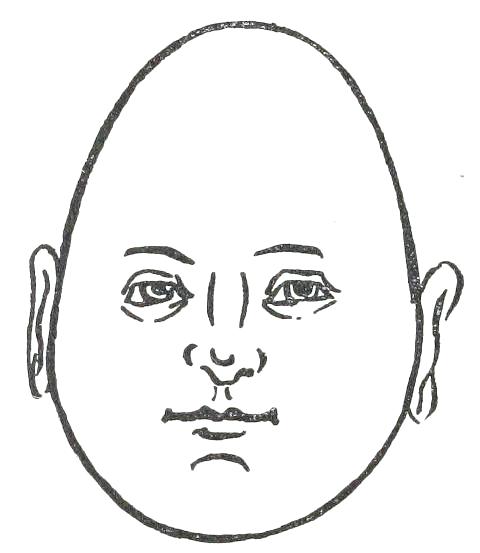
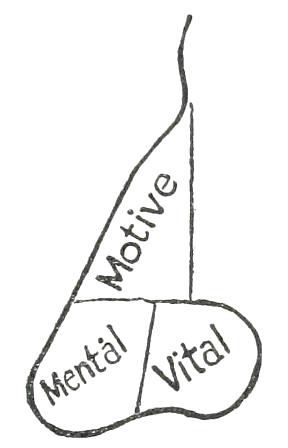
The Vital temperament has its basis in the
predominance of the nutritive system, including
the blood-vessels, lymphatics and the
glands. Its organs are the heart, lungs,
stomach, liver, bowels, and the entire internal
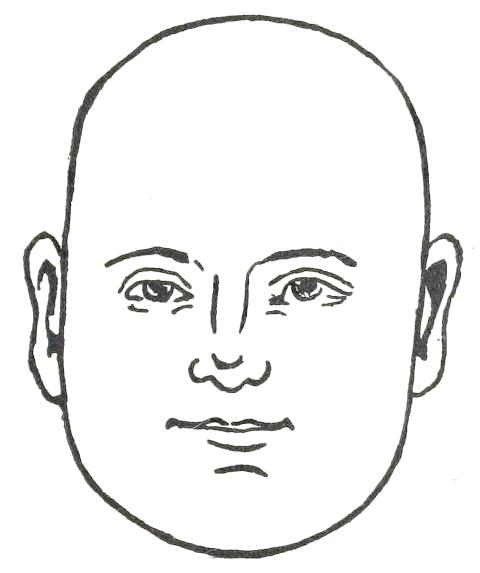
vital system. It is characterized by a large,
broad frame; broad shoulders; deep chest;
full round abdomen; round plump limbs;
short thick neck; comparatively small hands
and feet; full face; flushed and florid cheeks;
and general "well fed" appearance. Those
in whom it is predominant are fond of out-of-door
exercise, although not of hard work;
crave the "good things of life;" fond of
sport, games and play; love variety of entertainment
and amusement; are affectionate;
love praise and flattery; prefer concrete
rather than abstract subjects of thought; look
out for themselves; are selfish, but yet "good
fellows" when it does not cost too much physical
discomfort to themselves; usually enjoy
good health, yet when ill are apt to be very
weak; tend to feverishness and apoplexy, etc.
Persons of the Vital temperament may
have either fair or dark complexion, but in
either case the cheeks and face are apt to be
ruddy and flushed. Those of the dark type
are apt to have greater power of endurance,
while those of the light type are apt to be
more sprightly and active. This temperament
is particularly noticeable in women, a
large proportion of whom belong to its class.
This temperament furnishes the majority of
the good companions, sociable friends and
acquaintances, and theatre goers. A leading
phrenologist says of them that they "incline
to become agents, overseers, captains, hotel-keepers,
butchers, traders, speculators, politicians,
public officers, aldermen, contractors,
etc., rather than anything requiring steady or
hard work." We have noticed that a large
number of railroad engineers and policemen
are of this temperament.
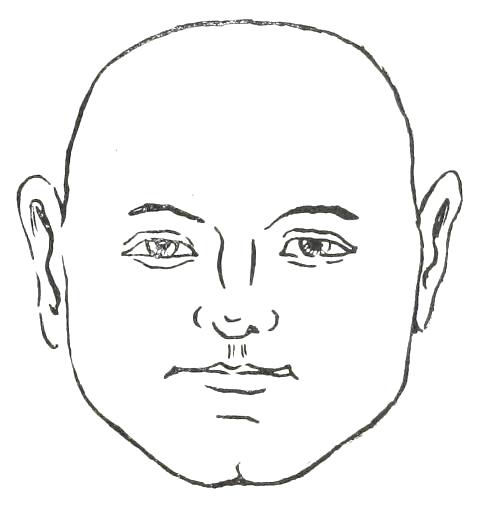
The Motive temperament has as its basis
the predominance of the motive or mechanical
system, including the muscles, bones and
ligaments—the general system of active work
and motion. Its organs are those of the entire
framework of the body, together with
those muscles and ligaments, large and small,
general and special, which enable man to
walk, move, and work. It is characterized by
strong constitution, physical power, strong
character, active feeling, and tendency toward
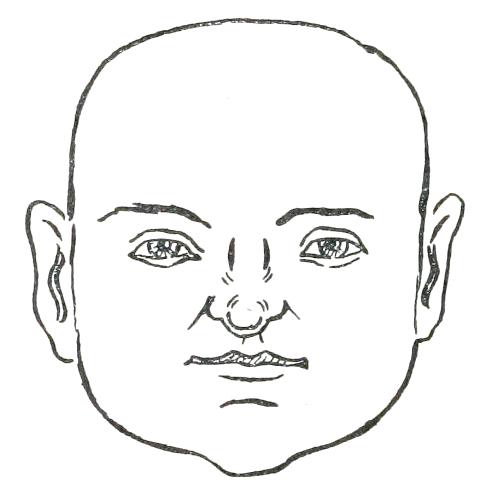
work; large bones and joints; hard muscles;
angular and rugged figure; usually broad
shoulders and deep chest; comparatively
small and flat abdomen; oblong face; large
jaw; high cheek-bones; strong large teeth;
bushy coarse hair; rugged features and
prominent nose, ears, mouth, etc. Those in
whom it is predominant are fond of physical
and mental work; are tenacious and try to
carry through what they undertake; resist
fatigue; are "good stayers;" are full of
dogged persistence and resistance; and are
apt to manifest creative effort and work.
Persons of the Motive temperament may
have either dark or light complexion. The
Scotch or Scandanavian people show this
temperament strongly, as also do a certain
type of Americans. The world's active
workers come chiefly from this class. This
temperament is far more common among
men than among women. The fighting nations
who have in different times swept over
other countries display this temperament
strongly. This temperament, predominant,
although associated with the other temperaments
has distinguished the "men who do
things" in the world's history. It's "raw-bone"
and gawkiness has swept things before
it, and has built up great things in all
times. Its individuals have a burning desire
to "take hold and pull," or to "get together
and start something." As the name implies,
this temperament is the "moving force" in
mankind.
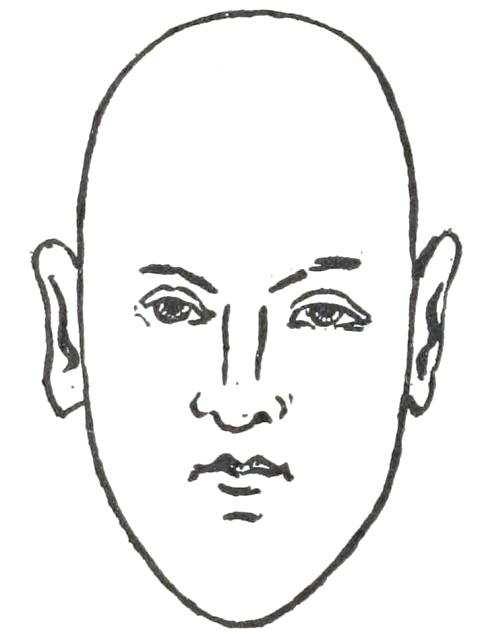
The Mental temperament has its basis in
the predominance of the nervous system, including
the brain and spinal cord. Its organs
are the brain, or brains; the spinal cord
with its connecting nerves—in fact the entire
nervous system, including the "sympathetic"
nervous system, the various plexi, and the
nervous substance found in various parts of
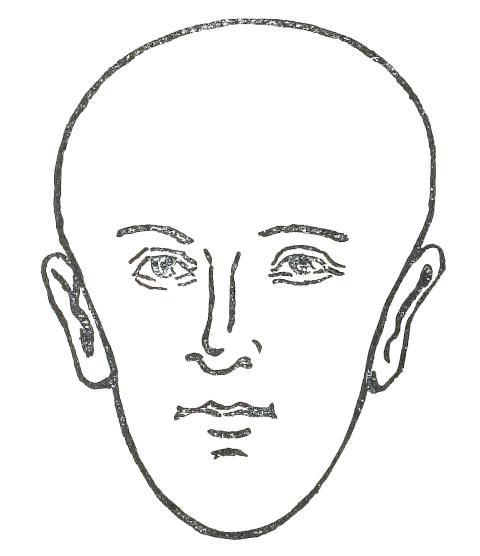
the body. It is characterized by a light
build; slight frame; comparatively large
head; quick movements; sharp features; thin
sharp nose; thin lips; sharp and not very
strong teeth; keen, penetrating eye; high
forehead and upper head; fondness for brain
work; disinclination for physical drudgery;
sensitive nature; quick perception; rapid
mental action; developed intuition; fine and
shapely features; expressive countenance,
expressive and striking voice, generally
rather "high-strung," vividness and intensity
of emotion and feeling, etc.
Persons of this temperament are apt to
be more or less "intense;" enjoy and suffer
keenly; are sensitive to reproach or criticism;
are inclined to be sedentary; take a pleasure
in "thinking," and often burn their candle of
life at both ends, because of this tendency;
and incline to occupations in which their
brains rather than their body is exercised.
They may be either of dark or of light complexion,
and in either case are apt to have
bright, expressive eyes. The impression
created by an examination of their physical
characteristics is that of sharpness. The
fox, weasel, greyhound, and similar animals
illustrate this type. Persons of this temperament
are apt to be either very good or
very bad. They run to extremes, and sometimes
execute a quick "right about face."
When properly balanced, this temperament
produces the world's greatest thinkers along
all lines of thought. When not properly balanced
it produces the abnormally gifted
"genius," between whom and the unbalanced
person there is but a slender line of division;
or the eccentric person with his so-called
"artistic temperament," the "crank" with
his hobbies and vagaries, and the brilliant
degenerate who dazzles yet horrifies the
world.
The best authorities agree in the belief
that the Balanced Temperament is the most
desirable. That is, the condition in which the
three temperaments balance each other perfectly,
so that the weak points of each are
remedied by the strong points of the others,
and the extremes of each are neutralized and
held in check by the influence of the others.
Prof. O. S. Fowler, the veteran phrenologist
says upon this point: "A well balanced organism,
with all the temperaments large and
in about equal proportion, is by far the best
and most favorable for both enjoyment and
efficiency; to general genius and real greatness;
to strength along with perfection of
character; to consistency and power throughout.
The Motive large, with the Mental deficient,
gives power with sluggishness, so that
the powers lie dormant; adding large Vital
gives great physical power and enjoyment,
with too little of the Mental and the moral,
along with coarseness; while the Mental in
excess creates too much mind for body, too
much exquisiteness and sentimentality for the
stamina, along with a green-house precocity
most destructive of life's powers and pleasures;
whereas their equal balance gives abundance
of vital force, physical stamina, and
mental power and susceptibility. They may
be compared to the several parts of a steamboat
and its appurtenances. The Vital is
the steam-power; the Motive, the hulk or
framework; the Mental, the freight or passengers.
Predominant Vital generates more
vital energy than can well be worked off,
which causes restlessness, excessive passion,
and a pressure which endangers outbursts
and overt actions; predominant Motive gives
too much frame or hulk, moves slowly, and
with weak Mental, is too light-freighted to
secure the great ends of life, predominant
Mental overloads, and endangers sinking;
but all equally balanced and powerful, carry
great loads rapidly and well, and accomplish
wonders. Such persons unite cool judgments
with intense and well-governed feelings;
great force of character and intellect with
perfect consistency; scholarship with sound
common sense; far seeing sagacity with brilliancy;
and have the highest order of both
physiology and mentality."
Professor Nelson Sizer, another high authority
said: "In nature the temperaments
exist in combination, one being, however, the
most conspicuous. So rarely do we find examples
of an even mixture or balance, that it
may be said that they who possess it are
marvellous exceptions in the current of human
society. Such an even mixture would
indicate a most extraordinary heritage; it
would be constitutional perfection. But,
once in a while, a person is met in whom there
is a close approach to this balance, and we
are accustomed to speak of it as a balanced
temperament, it being difficult to determine
which element is in predominance."
The experience of the older phrenologists,
which is verified by the investigations of the
later authorities, was that in the majority of
persons two of the temperaments are well
developed, the third remaining comparatively
undeveloped. Of the two active temperaments,
one is usually found to be predominant,
although in many the two are found to
be almost equally developed. But even in
the last mentioned instance one of the two
seems to have been more actively called forth
by the environment of the person, and may
therefore be regarded as the ruling temperament.
Arising from this fact we find the several
classes of Mixed Temperament, known,
respectively, as: the Vital-Motive; the Motive-Vital;
the Motive-Mental; the Mental-Motive;
the Vital-Mental; and the Mental-Vital.
In these classes the name of the predominant,
or most active temperament appears
first, the second name indicating the
temperament relatively undeveloped or inactive.
The Vital-Motive and the Motive-Vital
temperaments give the combination in which
is manifested physical activity and strong
vitality. Those of these temperaments are
adapted to out-of-door work, such as farming,
out-of-door trades, mechanics, soldiers and
sailors, and other occupations requiring
strong vital power and muscular strength
and activity. The physical characteristics
are the prominent bones and strong muscles
of the Motive, and well-rounded limbs and
"stout" forms of the Vital. When the Vital
predominates, there is apt to be more flesh;
when the Motive predominates there is apt
to be more ruggedness and muscular development.
The Motive-Mental and Mental-Motive
temperaments give the combination in which
is manifested the physical activity of the Motive
and the mental activity of the Motive
and the mental activity of the Mental—the
physical and mental characteristics of the
Vital being absent. The Mental element relieves
the Motive of some of its crudeness
and roughness, while the Motive relieves the
Mental of its tendency to get away from the
practical side of things. The strong frame
and muscles are balanced by the brain-development.
Those of this temperament make
good practical business men, physicians,
lawyers, scientists, explorers, and others who
have to work and think at the same time.
These people often manifest great executive
ability. When the Motive predominates, the
tendency is toward out-of-door occupations
in which the brain is used in connection with
bodily activity. When the Mental predominates
there is a tendency toward in-door occupations
in which active brain work is required.
These people have well-developed
heads, together with wiry, strong bodies.
Some of the most successful men have come
from this class.
The Vital-Mental and Mental-Vital temperaments
give the combination in which is
manifested many attractive traits which render
their possessor agreeable, companionable,
and at the same time bright and intelligent.
The Vital element gives a plumpness
to the form, while the Mental imparts a
brightness to the mind. This is the temperament
of many attractive women. The Mental
activity tends to counterbalance the Vital
tendency toward physical ease and comfort.
These people make good orators, after dinner
speakers, and agreeable society men and
women, actors, artists, poets, and popular
literary men. The respective predominance
of the Mental or the Vital, in this combination,
gives to this class somewhat of a variety,
but a little observation will soon enable one
to recognize the individuals belonging to it.
A certain combination in this class produces
the trait of "emotionality," or superficial
feeling and sympathy.
The student of Human Nature should pay
much attention to Temperament and the outward
indications of each class and sub-class,
for Temperament gives us much of our best
information regarding character and disposition,
in fact Character Reading depends materially
upon the interpretation of Temperament.