There are two conditions which will
make home weaving valuable. The first
is that the material, whether it be of
cotton or wool, should be grown upon the
farm, and that it could not be sold in the
raw state at a price which would make the
growing of it profitable. In wool crops
there are certain odds and ends of ragged,
stained and torn locks, which would injure
the appearance of the fleece, and are therefore
thrown aside, and this waste is perfectly
suitable for rug weaving.
In cotton there is not the amount of
waste, but the fibre itself is not as valuable,
and a portion of it could be reserved
for home weaving, even though it should
not be turned to more profitable account.
The next condition is that the time used
in weaving is also waste or left-over time.
If housekeeping requires only a quarter or
half of a woman’s time, weaving is more
restful and interesting, as well as more
profitable, than idleness; and in almost
every family there are members to whom
partial employment would be a boon.
There is no marketable value for spare
time or for individual taste, so that the
women of the family possessing these can
start a weaving enterprise, counting only
the cost of material at growers’ prices. If
they can card, spin, dye and weave as well
as the women of two generations did before
them, they have a most profitable industry
in their own hands in the shape of weaving.
If materials must be purchased the
profit is smaller, and the question arises
whether spare time and personal taste and
skill can be made profitable. This depends
entirely upon circumstances and
character. When circumstances are or
can be made favourable, and there is industry
and ambition behind them, domestic
weaving is a beautiful and profitable
occupation.
There are many neighbourhoods where
the conditions are exactly suitable to the
prosecution of important domestic industries—localities
where sheep are raised
and wool is a regular product, or where
cotton is grown and the weaving habit is
not extinct. This is true of many New
England neighbourhoods and of the whole
Cumberland Mountain region, and it is in
response to a demand for direction of
unapplied advantages that this book is
written.
I am convinced that the weaving of
domestic wool or cotton rugs might be
so developed in the mountain regions of
the South as to greatly decrease the
importation of Eastern ones of the same
grade.
An endless variety might be made in
these localities, the difference of climate,
material and habits of thought adding interest
as well as variety, and it is safe to
say that the home market is waiting for
them. Housekeepers have learned by
experience that a rug which can be easily
lifted and frequently shaken is not only far
more cleanly, and consequently safer, from
a sanitary point of view, than a carpet, but
that it has other merits which are of
economic as well as esthetic importance.
A rug is more durable than a carpet of
equal weight and texture because it can
be constantly shifted from points of wear
to those which are less exposed. It can be
moved from room to room, or even from
house to house, without the trouble of
shaping or fitting; and last but not least,
it brings a concentration of colour exactly
where it is needed for effect, and this is
possible to no other piece of house furnishing.
In short, there seems to be no bar to
its general acceptance, excepting the bad
floors of our immediate predecessors in
building.
It only needs that cost, quality and general
effect of the home-woven rugs should
be shaped into perfect adaptation to our
wants, to make them as necessary a part
of ordinary house-furnishing as chairs
and tables.
These three requirements are within the
reach of any home-weaving farmer’s wife
who will give to the work the same thought
for economical conditions, the same ambition
for thorough work and the same
intelligent study which her husband bestows
upon his successful farming.
As there is already one American rug
which fulfills most of these conditions, it
is well to consider it as a starting point for
progress. This is the heavy Indian rug
known as the Navajo blanket. Originally
fashioned to withstand the cold and exposure
of outdoor life, it has combined
thickness, durability and softness with
excellent colour and weaving and perfectly
characteristic design.
In the best examples, where the wool is
not bought from traders, but carded, spun
and dyed by the weaver, the Navajo
blanket is a perfect production of its kind,
and I cannot help wondering that the manufacture
of these rug-like blankets—some
of which are of great intrinsic value—should
have been so long confined to a
primitive race, living at our very doors.
The whole process of spinning, dyeing and
weaving could be carried on in any farmhouse,
using the coarsest and least valuable
wool, and by reliable and well-chosen
colour, good weight and careful weaving
bringing the manufacture into a prominent
place among the home productions of our
people.
One can hardly imagine simpler machinery
than is used by the Indians. It
is scarcely more than a parallelogram of
sticks, supported by a back brace, and yet
upon these simple looms an Indian woman
will weave a fabric that will actually hold
water.
The clumsy, old-fashioned loom which
is still in use in many farmhouses is fully
equal to all demands of this variety of
weaving, but there are already in the
market steel-frame looms with fly shuttles
which take up much less room and are
more easily worked. I was about to say
they were capable of better work, but
nothing could be better in method than
the Indian rug, woven on its three upright
sticks; and after all it is well to remember
that quality is in the weaver, and not in the
loom. The results obtained from the
simplest machinery can be made to cover
ground which is truly artistic.
As an example of what may be done to
make this kind of weaving available, we
will suppose that some one having an ordinary
loom, and in the habit of weaving rag
carpet, wishes to experiment toward the
production of a good yarn rug. The first
thing required would, of course, be material
for both warp and woof.
The warp can be made of strong cotton
yarn which is manufactured for this very
purpose and can be bought for about
seventeen cents a pound. This is probably
cheaper than it could be carded and spun
at home even on a cotton-growing farm.
The wool filling should be coarse and
slack-twisted, and on wool-growing farms
or in wool-growing districts is easily produced.
If it is of home manufacture, it
may be spun as loosely or slackly as possible,
dyed and woven without doubling,
which will be seen to be an economy of
labor. The single thread, slackly twisted,
gives a very desirable elasticity to the
fabric, because the wool fibre is not too
closely bound or packed. On the other
hand, if the wool as well as the warp must
be bought, it is best to get it from the spinning
machine in its first state of the single
thread, and do the doubling and twisting
at home. In this case it can be doubled
as many or as few times as it is thought
best, and twisted as little as possible.
The next and most important thing is
colour, and it is a great advantage if the
dyeing can be done at home. There is a
strong and well-founded preference among
art producers in favor of vegetable dyes,
and yet it is possible to use certain of the
aniline colours, especially in combination,
in safe and satisfactory ways.
Every one who undertakes domestic
weaving must know how to dye one or two
good colours—black, of course, and the
half-black or gray which a good colourist
of my acquaintance calls light black; indigo
blue equally, of course, in three shades of
very dark, medium and light; and red in
two shades of dark and light. Here are
seven shades from the three dyes, and when
we add white we see that the weaver is
already very well equipped with a variety
of colour. The eight shades can be still
further enlarged by clouding and mixing.
The mixing can be done in two ways, either
by carding two tints together before spinning,
or by twisting them together when
spun.
Carding together gives a very much
better effect in wool, while twisting together
is preferable in cotton.
Dark blue and white or medium blue
and white wool carded together will give
two blue-grays, which cannot be obtained
by dyeing, and are most valuable. White
and red carded together give a lovely pink,
and any shade of gray can be made by
carding different proportions of black and
white or half-black and white. A valuable
gray is made by carding black and
white wool together (and by black wool I
mean the natural black or brownish wool
of black sheep). Mixing of deeply dyed
and white wool together in carding is,
artistically considered, a very valuable
process, as it gives a softness of colour
which it is impossible to get in any other
way. Clouding—which is almost an indispensable
process for rug centres—can be
done by winding certain portions of the
skeins or hanks of yarn very tightly and
closely with twine before they are thrown
into the dye-pot. The winding must be
close enough to prevent the dye penetrating
to the yarn. This means, of course,
when the clouding is to be of white and
another colour. If it is to be of two shades
of one colour, as a light and medium blue,
the skein is first dyed a light blue, and
after drying is wound as I have described,
and thrown again into the dye-pot, until
the unwound portions become the darker
blue which we call medium.
In a neighbourhood where weaving is a
general industry, it is an advantage if some
one person who has a general aptitude for
dyeing and experiments in colours undertakes
it as a business. This is on the principle
that a person who does only one
thing does it with more facility and better
than one who works in various lines. Yet
even when there is a neighbourhood dyer,
it is, as I have said, almost indispensable
that the weaver should know how to dye
one or two colours and to do it well.
Supposing that the material, in the shape
of coarse cotton warp, black, red or white,
has been secured, or that a wool filling in
the colours and shades I have described
has been prepared for weaving; the loom is
then to be warped, at the rate of fifteen or
less threads to the inch, according to the
coarseness or fineness of the filling.
It is well to weave a half-inch of the
cotton warp for filling, as this binds the
ends more firmly than wool. Next to this,
a border of black and gray in alternate
half-inch stripes can be woven, and following
that, the body of the rug in dark
red, clouded with white. After five feet
of the red is woven, a border end of the
black and gray is added, and the rug may
be cut from the loom, leaving about four
inches of the warp at either end as a fringe.
If the filling yarn is of good colour, and has
been well packed in the weaving, so as to
entirely cover the warp, the result will be a
good, attractive and durable woolen rug,
woven after the Navajo method.
In this one example I have given the
bare and simple outline by following
which a weaver whose previous work has
been only rag carpet weaving can manufacture
a good and valuable wool rug. The
difference will be simply that of close warping
and a substitution of wool for rags.
Its value will be considerably increased
or lessened by the choice of material both
in quality and colour and the closeness
and perfection of weaving.
The example given calls for a rug six
feet long by three feet in width. To make
this very rug a much more important one,
it needs only to vary the size of the border.
For a larger rug the length must be increased
two feet, and the border, which in
this case must be of plain or mixed black—that
is, it must not be alternated with
stripes of gray—must measure one foot at
either end. When this is complete, two
narrow strips one foot in width, woven
with mixed black filling, must be sewed
on either side, making a rug eight feet long
and five in width. It is not a disadvantage
to have this border strip sewn, instead of
being woven as a part of the centre. Many
of the cheaper Oriental weavings are put
together in this way, and as many of the
older house-looms will only weave a three-foot
width, it is well to know that that
need not prevent the production of rugs of
considerable size.
Endless variations of this very simple
yarn rug can be made with variation in
size as well as in colour. Two breadths and
two borders, the breadths three feet in
width and the borders one foot and six
inches, will give a breadth of nine feet,
which with a corresponding length will
give a rug which will sufficiently cover the
floor of an ordinary room. If the centre is
skilfully mottled and shaded, it will make
a floor spread of beautiful colour, and one
which could hardly be found in shops.
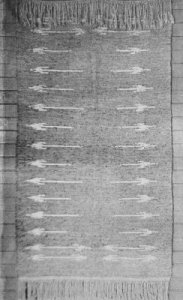
ISLE LA MOTTE RUG
The border can be made brighter, as well
as firmer and stiffer, by using two filling
threads together—a red and a black; or
an alternate use of red and black, using
two shuttles, will give a lighter and better
effect than when black is used exclusively.
After size and weight—or, to speak
comprehensively, quality—is secured in
this kind of simple weaving, the next
most important thing is colour. Of
course the colour must be absolutely
fast, but I have shown how much
variety can be made by shading and
mixing of three fast colours, and much
more subtle and artistic effects can be produced
by weaving alternate threads of different
colours. Indeed, the effects obtained
by using alternate threads can be
varied to almost any extent; as, for instance,
a blue and yellow thread—provided
the blue is no deeper than the
yellow—will give the effect of green to the
eye. If the blue is stronger or deeper, as
it will almost necessarily be, it will be
modified and softened into a greenish blue.
Red and white woven in alternate
threads upon a white warp will give an
effect of pink, and with this colour for a
centre the border should be a good gray.
Of course, alternate throwing of different
coloured yarns makes the weaving
go more slowly than when one alone is
used, and something of the same colour
effect can be produced by doubling, instead
of alternating. It is, of course, not quite
the same, as one colour may show either
under or over the other, and the effect is
apt to be mottled instead of one of uniform
stripes.
The end in view in all these mixtures is
variation and liveliness of colour, not an
effect of stripes or spots; indeed, these are
very objectionable, especially when in contrasted
or different colors. A deepening
or lightening of the same colour in irregular
patches, as will occur in clouded yarns,
gives interest, whereas if these cloudings
were in strongly contrasted colours they
would be crude and unrestful. For this
reason, if for no other, it is well to work in
few tints, and use contrasting colours only
for borders.
To show how much variety is possible in
weaving with the few dyes I have named,
I will give a number of combinations which
will produce good results and be apt to
harmonize with ordinary furnishing. By
adding orange yellow, which is also one of
the simplest and safest of dyes, we secure
by mixture with blue a mottled green, and
this completes a range of colour which
really leaves nothing to be desired.
No. 1. Colours black and red. Border,
alternate stripes of black and dark red, as
follows: First stripe of black, one and a
half inches; second stripe of red, one inch;
third stripe of black, one inch; fourth
stripe of red, one-half inch; fifth stripe of
black, three-quarters inch; sixth stripe of
red, one-half inch; seventh stripe of black,
half-inch; centre of light red clouded with
dark red; reversed border.
No. 2. Colours black and red. Border
one foot in depth, of black and red threads
woven alternately. Centre dark red,
clouded with light red. Woven six feet,
with one-foot border at sides as well as
ends.
No. 3. Colours red and white. Border
seven inches of plain red. Centre of red
and white woven alternately.
No. 4. Colours red and black. Border
black and red, threads woven alternately,
one foot in depth; centre of alternate
stripes, two inches in width, of dark red
and light red; eight feet in length, with
foot-wide side borders, woven with alternate
threads of red and black.
No. 5. Colours red and black. Border
eighteen inches in depth, of alternate red
and black, half-inch stripes. Centre of
dark red, clouded with light.
No. 6. Colours gray, red and white, to
be woven of doubled, slightly twisted
threads. Border one foot in depth at
ends and sides, woven of red and gray yarn
twisted together. Centre of red and white
yarn in twisted threads.
No. 7. Colours red and white. Border of
plain red, twenty inches in depth. Centre
in alternate half-inch stripes of red and
white.
No. 8. Colours blue, red and black. Border
four inches deep of black, two inches of
plain red, one inch of black. Centre of
clouded blue.
No. 9. Colour blue. Border eight
inches of darkest blue. Centre of clouded
medium and light blue.
No. 10. Colours blue and white. Border
of very dark and medium blue woven
together. Centre of blue and white yarn
woven together.
No. 11. Colours blue and white. Border
of medium plain blue. Centre of blue,
clouded with white.
No. 12. Colours blue and white. Border
of medium blue. Centre of alternate
stripes of one inch width blue, and half-inch
white stripes.
No. 13. Colours blue and white. Border
twelve inches deep of dark blue,
clouded with medium. Centre of alternate
threads of medium blue and white.
No. 14. Colours blue, black and orange
yellow. Border eight inches deep of black,
one inch of orange, two of black. Centre,
alternate threads of blue and orange.
No. 15. Border of doubled threads of
dark blue and orange. Centre of alternate
stripes of inch wide light blue and orange
woven together, one-half inch stripes of
clear orange and white woven together.
In the examples I have given, wherever
doubled threads of different colours woven
together are used, it must be understood
that they are to be slightly twisted, and
that the warping for double-filling rugs
need not be as close as for single filling.
Twelve threads to the inch would be better
than fifteen, and perhaps ten or eleven
would be still better. Doubled yarn of
different colours produces a mottled or
broken effect, and this can often be done
where the colours of the yarns do not quite
satisfy the weaver. If they are too dull,
twisting them slackly with a very brilliant
tint will give a better shade than if the
original tint was satisfactory, but in the
same way yarns which are too brilliant
can often be made soft and effective by
twisting them together with a paler tint.
Minute particles of colour brought together
in this way are brilliant without
crudeness. It is, in fact, the very principle
upon which impressionist painters
work, giving pure colour instead of mixed,
but in such minute and broken bits that the
eye confounds them with surrounding
colour, getting at the same time the double
impression of softness and vivacity.
These examples of fifteen different rugs
which can be woven from the three tints
of blue, red and orange, together with
black and white, do not by any means
exhaust the possibilities of variety which
can be obtained from three tints. Each
rug will give a suggestion for the next, and
each may be an improvement upon its
predecessor.


