Hints to Trappers.—The skins of animals trapped are
always valued higher than those shot, as shot not only make
holes, but frequently plow along the skin, making furrows,
as well as shaving off the fur. To realize the utmost for
skins they must be taken care of, and also cleaned and prepared
properly. Newhouse gives these general rules derived
from experience.
1. Be careful to visit your traps often enough, so that the
skin will not have time to get tainted.
2. As soon as possible after the animal is dead and dry,
attend to the skinning and curing.
3. Scrape off all superfluous flesh and fat, and be careful
not to go so deep as to cut the fiber of the skin.
4. Never dry a skin by the fire or in the sun, but in a cool,
shady place, sheltered from rain. If you use a barn door for
a stretcher (as boys sometimes do), nail the skin on the inside
of the door.
5. Never use preparations of any kind in curing skins, nor
even wash them in water, but simply stretch and dry them as
they are taken from the animal.
To Dress Beaver Skins.—You must rip the skin the same
as you would a sheep. Stretch it in all ways as much as possible;
then it is to be dressed with equal parts of rock salt
and alum dissolved in water, and made about as thick as
cream, by stirring in coarse flour. This should be spread on
nearly half an inch thick, and scraped off when dry, and repeated
if one time is not enough. This same process of dressing
applies likewise to otter skins.
To Trap Quail.—A quail trap may be any kind of coop,
supported by a figure 4. The spindle of the figure must
either be so made as to hold grain, or, what is better, some
grains of wheat or buckwheat are strung over a strong
thread with the aid of a needle, and tied to the spindle.
Quails and prairie hens easily enter a trap when the ground
is covered with snow. At other times it is rather difficult
to catch them.
To Trap Wild Turkey.—A wild turkey trap is made by
first digging a ditch; then over one end is built a rude structure
of logs, covered at the top.
The structure should not be tight, but, of course, sufficiently
close not to let the birds through. Indian corn is
scattered about and in the ditch, and inside of the pen. The
turkeys follow up corn in the ditch, and emerge from it on
the inside. Once there, the silly birds never think of descending
into the ditch, but walk round and round the pen,
looking through the chinks of the logs for escape that way.
To make all sure, the ditch should end about the centre of
the pen, and a bridge of sticks, grass and earth should be
built over the ditch, just inside of the pen, and close to the
logs; otherwise, in going around the bird might step inside
the ditch, and once there, it would follow the light and thereby
reach the outside of the pen.
To Catch Muskrats Without Traps.—It is a mystery to
many how muskrats, beavers, and other animals, are able to
remain so long under water, apparently without breathing,
especially in winter. The way they manage is, they take in a
good breath at starting, and then remain under water as long
as possible. Then they rise up to the ice and breathe out the
air in their lungs, which remains in a bubble against the
lower part of the ice.
The water near the ice is highly charged with oxygen,
which it readily imparts to the air breathed out. After a
time, this air is taken back in the lungs, and the animal
again goes under the water, repeating this process from time
to time. In this way they can travel almost any distance,
and live almost any length of time under the ice. The hunter
takes advantage of this habit of the muskrat in the following
manner. When the marshes and ponds where the muskrat
abounds are first frozen over, and the ice is thin and clear,
on striking into their houses with his hatchet, for the purpose
of setting his trap, he frequently sees a whole family
plunge into the water and swim away under the ice. Following
one for some distance, he sees him come up to recover
his breath, in the manner above described. After the animal
has breathed against the ice, and before he has time to take
his bubble in again, the hunter strikes with his hatchet directly
over him, and drives him away from his breath. In this
case he drowns in swimming a few rods, and the hunter, cutting
a hole in the ice, takes him out.
Bleaching Wool on Tanned Pelts.—Put an old pot or
other iron vessel in the bottom of a hogshead, and in the
vessel a roll of brimstone. Fasten near the top a stick or
two to place the skin on. The wool must be wet when hung
on the sticks. Heat an old iron red hot, or take live coals
to start the brimstone. When it is burning briskly, cover
the hogshead tight to keep the smoke in. If not white
enough, repeat the process.
The Esquimaux mode of tanning is very simple, and the
material employed the cheapest and cost accessible of any
used in the art, viz: the urine of man and beast. The skins
are prepared in the fur, and softened and tanned in urine,
which is usually kept in tubs in the porches of their huts,
for use in dressing deer, seal and other skins. They show
great skill in the preparation of whale, seal and deer skins,
and these, on the whole, are equal to the best oil skins made
in England. It imparts to them firmness and durability, and
makes them waterproof. The boots worn by the Esquimaux
are generally made from seal or walrus hides, and resist
the encroachments of water.
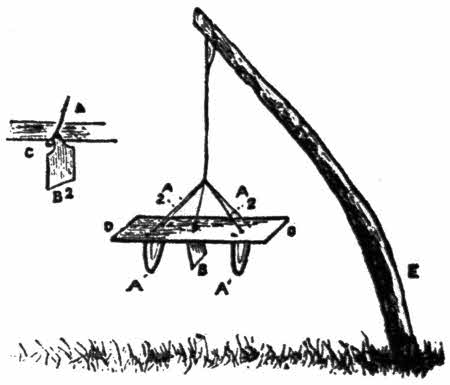
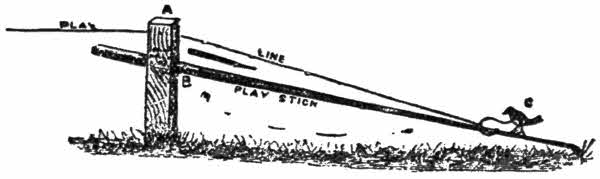
Hawk and Owl Traps.—To catch hawks or owls, take a
pole 20 feet long, to be set a short distance from the house
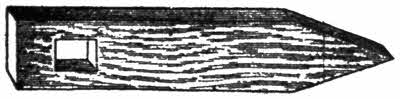
or barn or on the poultry house. Split the top so as to admit
the base of a common steel trap, which should be made fast.
When both trap and pole are set you may be sure of game of
some kind. These birds naturally light on high objects, such
as dead branches of trees or tops of stacks, and one should
use judgment about the place where he puts the traps. An
open field near the chicken yard is probably the best.
Domestic Manufacture of Furs.—The skins of raccoons,
minks, muskrats, rabbits, foxes, deer, cats, dogs, woodchucks
and skunks are all valuable. Handsome robes may be made
from the skins of the last two animals, and the writer has
seen fur coats made from the skins of woodchucks, well tanned,
dyed and trimmed, which were elegant as well as comfortable,
and no one but a connoisseur would be able to guess
their origin. Of the finer and nicer furs, beautiful collars,
muffs, cuffs, caps, gloves and trimmings may be made with
a little ingenuity and perseverance; and who would not feel
a greater satisfaction in wearing a nice article, from the fact
that it was something of their own manufacture—a product
of their own taste and genius?
Very handsome floor-mats are made by tanning sheep
pelts and dyeing them some bright color, which is done with
very little trouble; the art of dyeing is now so familiar to
almost every household. Furs may be dyed as easily as
woolen goods, notwithstanding the impression that it is an
art known only to the trade. Any dye that will color woolens
will also dye furs, only care must be taken not to have
the dye too hot, or the texture of the skin will be injured.
The mode of tanning usually followed by city furriers is to
rub the skins well with rancid butter, then tread them thoroughly
in a tub or vat, after which a large quantity of sawdust
is mixed with them, and the process of treading continued
until all the grease is absorbed, when they are finished
off by beating, working and rubbing with chalk and potter’s
clay, whipping and brushing. An old trapper practiced this
method with small skins, first washing with a suds of soap
and sal-soda to free them from grease, then rinsing in clear
water to cleanse them from the suds, then rubbing as dry as
possible, after which they were put in a mixture of two
ounces of salt to a quart of water, added to three quarts of
milk or bran-water containing one ounce of best sulphuric
acid, and stirred briskly for forty or fifty minutes; from this
they are taken dripping into a strong solution of sal-soda
and stirred till they will no longer foam; they are then hung
to dry, when they are very soft and pliable.
A very good and simple process in use among farmers is
to sprinkle the flesh side, after scraping it well, with equal
parts of pulverized alum and salt, or washing it well with a
strong solution of the same, then folding the flesh side together
and rolling it compactly, in which state it should remain
for eight or ten days; then it is opened, sprinkled with
bran or sawdust to absorb the moisture, and rolled up again,
and after remaining twenty-four hours, the process is completed
by a thorough rubbing and manipulation, on which the
pliability depends. Skins, when taken off, should be freed
from grease or flesh by thorough scraping, when they may be
dried, and left to await the leisure of the owner. Previous
to tanning they must be well soaked and wrung dry.
It is no extravagance to assert that every farmer’s family
may furnish their own fur collars, gloves, robes, and other
articles of dress and ornament, with trifling expense, from
the resources within their own reach; but from want of more
knowledge on the subject valuable skins are wasted or disposed
of for a mere fraction of their real value, and articles
of apparel that should be made from them are bought at extravagant
prices of fur dealers.
Indian Mode of Tanning Buffalo Skins.—The hard and
incessant labor that is necessary to properly “Indian tan”
a robe is not easily to realize unless one may see the work go
on day by day from the first step, which is to spread out the
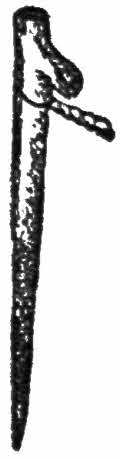
pelt or undressed hide upon the ground, where it is pinned
fast by means of wooden pins driven through little cuts in
the edge of the robe into the earth. The flesh side of the
robe, being uppermost, is then worked over by two and
sometimes three squaws. The tools used are very rude, some
being simply provided with sharp stones or buffalo bones.
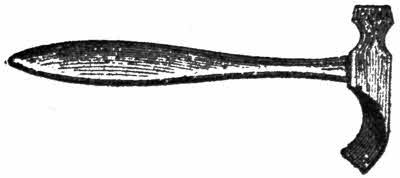
Others, more wealthy, have a something that much resembles
a drawing-knife or shave of the cooper. The work in
hand is to free the hide from every particle of flesh, and to
reduce the thickness of the robe nearly one half, and sometimes
even more.
This fleshing, as it is termed, having been thoroughly accomplished,
the hide is thoroughly moistened with water in
which the buffalo brains have been steeped. For ten days
the hide is kept damp with this brain water. Once each day
the hide is taken up and every portion of it rubbed and re-rubbed
by the squaws, who do not have recourse to anything
like a rubbing-board, but use their hands until it would seem
as if the skin would soon be worn off. There seems to be
no definite rule as to the length of time which the robe shall
occupy in curing. The squaw labors until the hide becomes
a robe, which may require the work of one week or two,
sometimes even more; but I think that ten days may be considered
as the average time which it takes to properly cure a
robe.
To Dress Deer Skins.—Put the skin into the liquid while
warm, viz: eight quarts rain water to one pint soft soap.
Warm it. Then punch the hide, or work it with a soft stick,
and let it lay one day. It is then to be taken out and wrung—rolled
between two logs—or even a wringing machine will
be better. Then stretch it until it is dry, in the sun is best,
or by a hot fire. Then oil it thoroughly with any oil convenient.
It should then be treated to the same bath of suds (heated
quite warm), and lay another day. Then pull it out and dry
as before. Any oil will do, but good fresh butter is better
than anything else. When the skin is dry rub it with ochre,
which will give it a splendid yellow color.
Tanning and Buffing for Deer Skin Gloves.—For
each skin take a bucket of water and put into it 1 quart of
lime; let the skin or skins lay in from 3 to 4 days; then
rinse in clean water, hair and grain; then soak them in cold
water to get out the glue; now scour or pound in good soap
suds for half an hour; after which take white vitriol, alum
and salt, one tablespoon of each to a skin; this will be dissolved
in sufficient water to cover the skin and remain in it
for 24 hours; wring out as dry as convenient, and spread on
with a brush 1/2 pint of currier’s oil, and hang in the sun
about two days; after which you will scour out the oil
with soap suds, and hang out again until perfectly dry;
then pull and work them until they are soft; and if a reasonable
time does not make them soft, scour out in suds
again as before, until complete.
The oil may be saved by pouring or taking it from the top
of the suds, if left standing a short time. The buff color is
given by spreading yellow ochre evenly over the surface of
the skin, when finished, rubbing it in well with a brush.
Dyeing for Buckskin, (Buff.)—5 parts of whiting to 2
parts of ochre (yellow), and mix them with water to a paste;
make into cakes and dry. When a dressed skin is dry, rub
one of the balls over the surface; rub the powder in. Take
a piece of sand-paper and raise a nap on the leather by going
over it. (Black.)—Take clear logwood; after it is dry use
copperas water to blacken it. Be careful and not use too
much. (Dark Brown.)—5 pounds of oak bark; 4 pounds
of fustic; 14 ounces of logwood. Use alum water (strong)
to make it strike in. (Drab.)—Mix blue clay with soft soap;
add blue vitriol to shade the color. It can be made any shade
you wish.
Dyeing for Morocco and Sheep Leather.—The following
colors may be imparted to leather, according to the various
uses for which it is intended. (Blue.)—Blue is given by
steeping the subject a day in urine and indigo, then boiling
it with alum; or it may be given by tempering the indigo
with red wine, and washing the skins therewith.
(Another.)—Boil elderberries or dwarf elder, then smear
and wash the skins therewith and wring them out; then boil
the elderberries as before in a solution of alum water, and
wet the skins in the same manner once or twice; dry them,
and they will be very blue. (Red.)—Red is given by washing
the skin and laying them two hours in galls, then wringing
them out, dipping them in a liquor made with ligustrum,
alum and verdigris; in water, and lastly in a dye made of
Brazil wood boiled with lye. (Purple.)—Purple is given by
wetting the skins with a solution of roche alum in warm
water, and when dry, again rubbing them with the hand
with a decoction of logwood in cold water. (Green.)—Green
is given by smearing the skin with sap green and alum
water, boiled. (Dark Green.)—Dark green is given with
steel filings and sal ammoniac, steeped in urine till soft,
then smeared over the skin, which is to be dried in the shade.
(Yellow.)—Yellow is given by smearing the skin over with
aloes and linseed oil, dissolved and strained, or by infusing
it in weld. (Light Orange.)—Orange color is given by
smearing it with fustic berries boiled in alum water, or, for
a deep orange, with turmeric. (Sky color.)—Sky color is
given with indigo steeped in boiling water, and the next
morning warmed and smeared over the skin.
Operation of Tanning.—The first operation is to soak the
hide, as no hide can be properly tanned unless it has been
soaked and broken on a fleshing beam. If the hide has not
been salted add a little salt and soak it in soft water. In
order to be thoroughly soaked, green hides should remain in
this liquor from 9 to 12 days; of coarse the lime varies with
the thickness of the hide. The following liquor is used to
remove hair or wool, viz: 10 gallons cold water (soft), 8
quarts slacked lime, and same quantity of wood ashes. Soak
until the hair or wool will pull off easily.
As it frequently happens it is desirable to cure the hide
and keep the hair clean, the following paste should be made,
viz: equal parts of lime and hard-wood ashes, (lime should
be slacked,) and made into a paste with soft water. This
should be spread on the flesh side of the hide and the skin
rolled up, flesh side in, and placed in a tub, just covering it
with water. It should remain 10 days, or until the hair will
pull out easily, then scrape off with a knife.
To Deoderize Skunk Skins.—To deoderize skunk skins or
articles for clothing scented, hold them over a fire of red
cedar boughs, and sprinkle with chloride of lime; or wrap
them in green hemlock boughs when they are to be had, and
in 24 hours they will be cleansed.
How to Shoot Snipe.—To the beginner no bird is more
puzzling, and, therefore, more difficult to shoot. Its flight
is most uncertain, most variable, and most irregular—rising
at one time as evenly as a lark, and flying close to the
ground with scarcely the slightest deviation from a straight
line; at another, springing from the ground as if fired from
a gun, and then flying in a zig-zag course to the right or left,
and, indeed, in every direction; and sometimes, again, rising
to a great height, and then going straight away with the
rapidity of lightning. And yet, with all these apparent difficulties,
when the knack is once acquired, it becomes comparatively
easy—indeed, is reduced almost to a certainty.
The great art in this kind of shooting is coolness, and to
avoid too much hurry. And, in this, as in every other kind
of shooting, the first sight is the best; the moment you are
“well on” your bird, the trigger should be pulled. In cross
shots, fire well before your bird. Contrary to the usual practice,
you should always walk down wind; the reason for this
is that snipe always rise against it. Sometimes snipe are
very wild, and at others will lie until they are almost trodden
upon. If there be much wind, your best chance is to “down
with them” as soon as they rise from the ground, or you
have little hope of getting a bag.
Preseveratives for Skins.—The best material for the
preseveration of skins of animals consists in powdered arsenious
acid, or the common arsenic of the shops. This
may be used in two ways: either applied in dry powder on
the moist skin, or, still better, mixed with alcohol or water
to the consistency of molasses, and put on with a brush.
Some camphor may be added to the alcoholic solution, and a
little strychnine will undoubtedly increase its efficacy. There
are no satisfactory substitutes for arsenic, but, in its entire
absence, corrosive sublimate, camphor, alum, etc., may be
employed.
Many persons prefer the arsenical soap to the pure arsenic.
This is composed of the following ingredients, arsenic, 1
ounce; white soap, 1 ounce; carbonate of potash, 1 dram;
water, 6 drams; camphor, 2 drams. Cut the soap into thin
slices, and melt over a slow fire with the water, stirring it
continually; when dissolved, remove from the fire, and add
the potash and arsenic by degrees; dissolve the camphor in
a little alcohol, and when the mixture is nearly cold, stir
it in.
The proper materials for stuffing out skins will depend
much upon the size of the animal. For small birds and
quadrupeds, cotton will be found most convenient; for the
larger, tow; for those still larger, dry grass, straw, sawdust,
bran, or other vegetable substances, may be used. Whatever
substance be used, care must be taken to have it perfectly
dry. Under no circumstances should animal matter,
as hair, wool, or feathers, be employed.
The bills and loral region, as well as the legs and feet of
birds, and the ears, lips and toes of mammals, may, as most
exposed to the ravages of insects, be washed with an alcoholic
solution of strychnine applied with a brush to the dried
skin; this will be an almost certain safeguard against injury.
Fishing with Natural Fly.—This consists in fishing
with the natural flies, grasshoppers, etc., which are found
on the banks of the rivers or lakes where you are fishing.
It is practiced with a long rod, running tackle, and fine line.
When learning this system of angling, begin by fishing close
under the banks, gradually increasing your distance until
you can throw your live bait across the stream, screening
yourself behind a tree, a bush, or a cluster of weeds, otherwise
you will not have the satisfaction of lifting a single fish
out of the water. In rivers where immense quantities of
weeds grow in the summer, so as almost to check the current,
you must fish where the stream runs most rapidly, taking
care that in throwing your line into those parts you do not
entangle it among the weeds. Draw out only as much line
as will let the fly touch the surface, and if the wind is at
your back it will be of no material service to you in carrying
the fly lightly over the water. In such places the water is
generally still, and your bait must, if possible, be dropped
with no more noise than the living fly would make if it fell
into the water.
Keep the top of your rod a little elevated, and frequently
raise and depress it and move it to and fro very gently, in
order that the fly by its shifting about may deceive the fish
and tempt them to make a bite. The instant your bait is
taken, strike smartly, and if the fish is not so large as to
overstrain and snap your tackle, haul it out immediately, as
you may scare away many while trying to secure one. There
are very many baits which may be used with success in
natural fly fishing, of which, however, we shall content ourselves
with enumerating some of the most usual and useful.
Wasps, hornets and bumble bees are esteemed good baits
for dace, eels, roach, bream and chub; they should be dried
in an oven over the fire, and if not overdone, they will keep
a long while.
How to Select Furs.—In purchasing furs, a sure test of
what dealers call a “prime” fur is the length and density of
the down next the skin; this can be readily determined by
blowing a brisk current of air from the mouth against the
set of fur. If the fibers open readily, exposing the skin to
the view, reject the article; but if the down is so dense that
the breath cannot penetrate it, or at most shows but a small
portion of the skin, the article may be accepted.
To Clean Furs.—Strip the fur articles of their stuffing
and binding, and lay them as much as possible in a flat position.
They must then be subjected to a very brisk brushing,
with a stiff clothes brush; after that, any moth-eaten parts
must be cut out, and be neatly replaced by new bits of fur
to match. Sable, chinchilla, squirrel, fitch, etc., should be
treated as follows: Warm a quantity of new bran in a pan,
taking care that it does not burn, to prevent which it must
be actively stirred. When well warmed, rub it thoroughly
into the fur with the hand. Repeat this two or three times;
then shake the fur, and give it another sharp brushing until
free from dust. White furs, ermine, etc., may be cleaned as
follows: Lay the fur on the table, and rub it well with bran
made moist with warm water; rub until quite dry, and afterward
with dry bran. The wet bran should be put on with
flannel, and the dry with a piece of book-muslin.
The light furs, in addition to the above, should be well
rubbed with magnesia, or a piece of book-muslin after the
bran process. Furs are usually much improved by stretching,
which may be managed as follows: to a pint of soft
water add three ounces of salt; dissolve; with this solution
sponge the inside of the skin (taking care not to wet the fur)
until it becomes thoroughly saturated; then lay it carefully
on a board with the fur side downward, in its natural disposition,
then stretch as much as it will bear, to the required
shape, and fasten with small tacks. The drying may be
quickened by placing the skin a little distance from the fire
or stove.
Fishing with Artificial Fly.—Artificial fly fishing consists
in the use of imitations of these flies and of other fancy
flies, and is unquestionably the most scientific mode of
angling, requiring great tact and practice to make the flies
with neatness and to use them successfully, and calling
forth as it does so much more skill than the ordinary method
of bottom fishing, it merits its superior reputation.
It possesses many advantages over bottom fishing, but at
the same time it has its disadvantages; it is much more cleanly
in its preparations, inasmuch as it does not require the angler
to grub for clay and work up a quantity of ground baits, and
is not so toilsome in its practice, for the only encumbrances
which the fly fisher has are simply a light rod, a book of flies
and whatever fish he may chance to catch; but there are
several kinds of fish which will not rise at a fly, and even
those that do will not be lured from their quiet retreat during
very wet or cold weather. It would be well if the young
angler could go out for some little time with an old experienced
hand, to observe and imitate his movements as closely
as possible.
To Prepare Sheep Skins for Mats.—Make a strong
lather with hot water and let it stand till cold; wash the fresh
skin in it, carefully squeezing out all the dirt from the wool;
wash it in cold water till all the soap is taken out. Dissolve
a pound each of salt and alum in two gallons of hot water,
and put the skin into a tub sufficient to cover it; let it soak
for twelve hours, and hang it over a pole to drain. When
well drained stretch it carefully on a board to dry, and stretch
several times while drying. Before it is quite dry, sprinkle
on the flesh side one ounce each of finely pulverized alum
and saltpetre, rubbing it in well.
Try if the wool be firm on the skin; if not, let it remain
a day or two, then rub again with alum; fold the flesh sides
together and hang in the shade for two or three days, turning
them over each day till quite dry. Scrape the flesh side
with a blunt knife, and rub it with pumice or rotten stone.
To Tan Sheep Skins.—Sheep skins, which are used for a
variety of purposes, such as gloves, book-covers, etc., and
which when dyed, are converted into mock Morocco leather,
are dressed as follows: They are first to be soaked in water
and handled, to separate all impurities, which may be
scraped off by a blunt knife on a beam. They are then to
be hung up in a close, warm room to putrefy. This putrefaction
loosens the wool, and causes the exudation of an oily
and slimy matter, all which are to be removed by the knife.
The skins are now to be steeped in milk of lime, to harden
and thicken; here they remain for 1 month or 6 weeks,
according to circumstances, and when taken out, they are
to be smoothed on the fleshy side with a sharp knife. They
are now to be steeped in a bath of bran and water, where
they undergo a partial fermentation, and become thinner in
their substance.
The skins, which are now called pelts, are to be immersed
in a solution of alum and common salt in water; in the proportion
of 120 skins to three pounds of alum and five pounds
of salt. They are to be much agitated in this compound saline
bath, in order to become firm and tough. From this bath they
are to be removed to another, composed of bran and water,
where they remain until quite pliant by a slight fermentation.
To give their upper surface a gloss, they are to be trodden in
a wooden tub, with a solution of yolks of eggs in water, previously
well beaten up. When this solution has become transparent,
it is a proof that the skins have absorbed the glazing
matter. The pelt may now be said to be converted into
leather, which is to be drained from moisture, hung upon
hooks in a warm apartment to dry, and smoothed over with
warm hand-irons.
To Trap Young Mink.—Mink Breeding.—Adult minks
are almost untamable, but young ones readily submit to
handling, and are easily domesticated. The time to secure
young minks is in May and June, when they begin to run with
their dams. The streams must be quietly watched for mink
trails, and these tracked to the nest.
When they leave the hole the old one may be shot, and
the young ones secured, or they may be dug out. Those
who own a breeding stock of minks ask high prices for
them; but trappers represent to us that it is an easy matter
to get the wild young ones. Habits.—A successful breeder
says that he does not attempt to tame the wild mink, but
only aims to supply for it in a small space all the necessities
of its natural instincts. He says the mating season commences
about the first of March, and lasts two weeks, never
varying much from that date.
The female carries her young about six weeks. In the
minkery, where diet, water, temperature, etc., are similar
with each animal, there is so little difference in the time of
mating and time of bearing young in different animals, that
five out of six litters dropped last spring, were born within
twelve hours of each other. The young are blind from four
to five weeks, but are very active, and playful as kittens.
The mother weans them at from eight to ten weeks old. At
four weeks the mother begins to feed them meat; this they
learn to suck before they have teeth to eat it.
The nests in which the young are born are lined by the
mother with some soft material, and are made in the hollow
of some old stump, or between the projecting roots of some
old tree, and always where it is perfectly dry. The nest is
located near pure running water, which the mother visits
twice every twenty-four hours. She feeds her young on frogs,
fish, birds, mice, crabs, etc., etc. The mink is from birth a
pattern of neatness and cleanliness, and as soon as a nest
begins to get foul and offensive, she takes one of the young
in her mouth, and depositing it in a clean, suitable place,
builds a nest about it, and then brings the balance of the litter.
She feeds and cares for them until they are three and a
half or four months old. When the young are weaned, about
the 10th of July, she builds her nest near the water, in which
the young soon learn to play. There are usually four in a
litter, though the number ranges from two to six. Towards
fall the mother separates them into pairs. One pair—or if
the number be odd, the odd one—is left in the nest; the other
pair or pairs, she places them often half a mile from each
other, and then seeks new quarters for herself.
The young soon separate, and each one catches his own
frogs, etc. They do not pair, but the male is a sort of rover
and free-lover. Minks are unsociable, petulant, vicious in
play, savage in war. Late in the fall they establish regular
runaways from one stream to another, and usually under
brush-fallen trees, weeds swale, and under banks—anywhere,
in fact, where they can avoid the sunshine, and escape the
chances of observation. The mink is a sure prophet, and
just before hard winter begins, he lays by a store of food for
the winter in safe places near his winter nests, of which he
has several. As the snows fall he burrows under the snow,
where he remains until about February, when his supply of
food is exhausted, and he is forced to seek further for food.
Management of.—Mink being by nature solitary, wandering
creatures, being seldom seen in company except during
the breeding season, are, therefore, impossible to be reared
successfully, if large numbers are kept constantly together,
therefore their inclosure should be a large one.
The male and female should be permitted to be together
frequently from the middle of February until the middle of
March. At all other times keep them entirely separate.
The young mink make their appearance about the first of
May. When wild in the woods they will seldom vary five
days from this time, but when kept in confinement there is
greater variation. About this season they should have
plenty of fine hay, which they will carry into their boxes to
make nests. A box three or four feet long and eighteen
inches wide is the shape they prefer. It should be placed as
far as possible from the water to prevent the mink from carrying
water and mud into it.
The young mink when first born are small and delicate,
destitute of any kind of fur, and much resembling young
rats. If the old mink is tame the young ones may be taken
out of the nest and handled when they are three weeks old.
They will soon learn to drink milk, and may feed every day.
At five weeks old they may be taken from the mother and put
into a pen by themselves, when they will soon become very
playful and pretty, and make much better mothers than they
would if allowed to run with the old ones.
The shelter should be in the shape of a long box, 5 or 6
feet wide, and 3 or 4 feet high, set upon legs, and with a
good floor and roof. Divide it into separate compartments,
6 feet long (or longer would be better,) the front of each
apartment to be furnished with a swinging door of strong
wire screen, with the hinges at the top, and a button or some
kind of fastener at the bottom. A trough 6 inches square,
made by nailing three boards together, should run the
whole length of the pen on the back side; one end of the
trough should be made several inches lower than the other,
so that the water can be drawn off. With this arrangement,
the water can be turned in at one end of the trough, and
drawn off and changed as often as desired. The lower end
of the trough should be a little deeper than the other, to prevent
the water from running over. Each apartment is furnished
with a box 3 feet long and eighteen inches wide. On
one side of the box and near one end is made a round hole,
2 1/2 inches in diameter, and provided with a sliding cover
so that by means of a stick it can be opened or closed from
the outside.
This is so the mink can be shut up when the pen is being
cleaned out. On the top of the box and at the other end
should be a door large enough to put in hay for the nest and
take out the young. It is necessary that they have abundance
of pure, soft water, fresh air, desirable shade and
plenty of exercise. These conditions secure to the mink a
good quality of dark fur and good health. Brush, weeds,
etc., are allowed to grow in the yard, but not near enough
the wall to admit of their climbing up and out.
In addition to the above directions for breeding mink, we
give the following experience of a gentleman in Vermont:
“I purchased one female and her litter of five, two males and
four females in all, and constructed a building of rough
boards, 10 by 4 feet, for a minkery. It had a floor tight
enough to prevent the escape of the animals, was properly
ventilated, and divided into six apartments, one of which is
an ante-room in which to step from the outside and close the
door. Water is supplied by a lead pipe running in at one
side through all the rooms, and out at the other into a
trough where small fish are kept, and occasionally given to
the minks.
“They were kept together until December the 18th, when
the males were put in an apartment by themselves. On the
10th of March each male was put in with a female, each pair
separate, and after a couple of days, one of the males was put
in with another female, and finally with the third. They were
separated about the 1st of April, each female being kept
alone and supplied with a suitable box, with warm material
for a nest. When it was supposed they were about to bring
forth their young, they were disturbed as little as possible;
anything to excite them at this time, should be avoided, for
when irritated, they will sometimes eat their young. The
first female put with the perfect male, brought forth seven,
one of which disappeared after they began to crawl around
out of their nest. The other two females had each a pair, all
of which (but the one mentioned) are now alive, fine, fat,
sleek fellows, and fully grown. They are very easily kept,
being fed once a day upon warm milk with wheat bread
crumbs—a quart sufficing for the whole lot, and once upon
fresh meat, care being taken not to over-feed.
“Any kind of meat and offal that is not too fat will answer.
They are very fond of beef liver, chickens’ heads and entrails,
woodchucks (being careful not to give them the gall
or the liver, which is poisonous), rats, mice, etc. They are
more easily cared for than one hog and much more cheaply
kept. Nothing was paid out for meat for them until after
1st July, when a contract was made with a butcher to leave
a bullock’s head once a week. I am confident that the increase
of the minkery would have been fully one-third more
if both the males had been perfect. I intend to keep them
in pairs hereafter. They are not easily handled, but struggle
when caught against their will and exude the thick fetid
substance from glands near the vent. They will bite severely,
but can be handled safely with thick buckskin gloves.”