In America, where they make the
best locomotive engines in the
world, they say that the life of
an engine is about twenty years.
That is, when they build an engine, they
know about how much work it will have
to do and what usage it is likely to have.
They know that the engine is strong enough
to do such work and stand such usage for
twenty years. So they say that the length
of the engine’s life is twenty years.
Now, a man’s body is, in its way, a
machine. It is made to do certain work,
and if it has the right sort of care, it
ought to be healthy and do the work required
of it, to the end of the man’s life.
8It is estimated that the natural life of a
man is seventy years. This little book is
intended to tell us how to live and something
about caring for our bodies so that
they shall last as long
as possible, and be ready
and able to do their work
in the world.
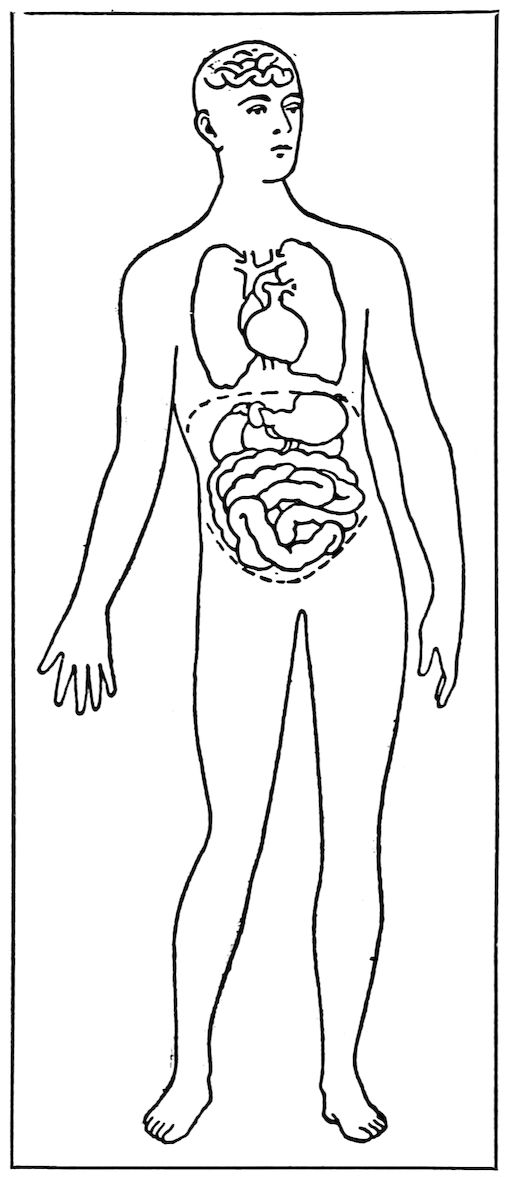
The Skull, Chest, and Abdomen.
In a general way, we
may compare the human
body to three closed boxes,
one above another. These
boxes are the skull, the
chest, and the abdomen.
Each one has its own
special contents, formed to
do a special work for the
body. The skull is a hard,
bony case made to contain
the brain. This is where
the mind lives, and it is part of the work
of the mind to take care of the body and
direct its movements. The brain maintains
a sort of telegraph station within
9itself. Wires, which we call nerves, branch
out from it to all parts of the body, and the
brain is constantly receiving messages over
these wires and sending others telling the
muscles what to do. For instance, if the
hand comes in contact with something hot,
a message instantly goes to the brain, telling
this fact. The brain sends back word
to take the hand away, and the hand is
withdrawn. But all this is done so quickly
that the hand seems to be withdrawn the
very instant that it comes in contact with
the fire. The skull is supported by the
backbone, which connects it with the second
closed box.
This second cavity is the chest, which
is really a sort of cage formed by the ribs,
the backbone, and the breastbone. In the
chest are the heart and the lungs. The heart
is an engine. Put your hand over it and
you can feel the steady throb of its beat,
day and night. It is working all the time,
whether you are awake or asleep. The
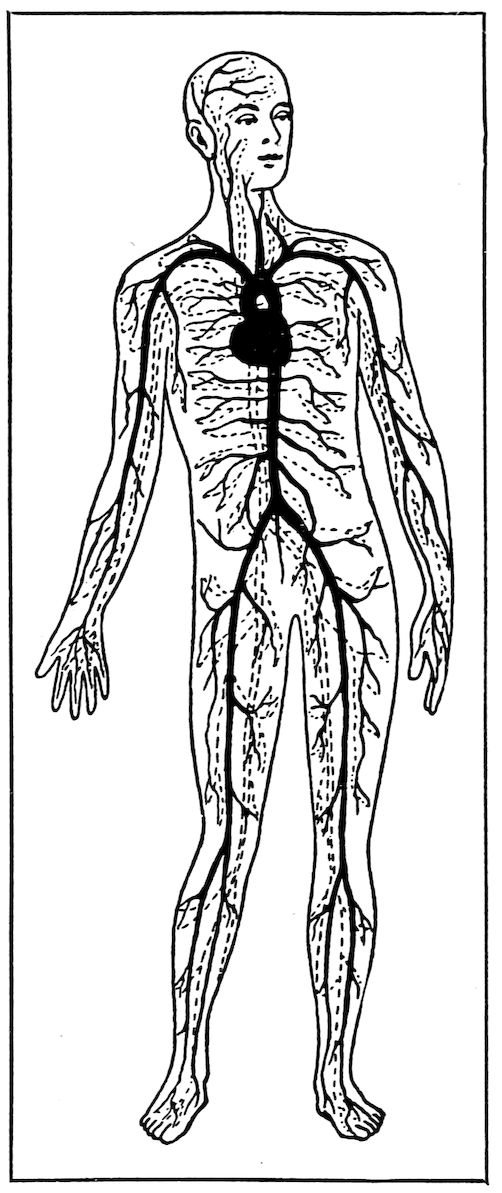
business of the heart is to send blood to all
10parts of the body. It does this by driving
the blood through tubes, called arteries
and veins, that go all over the body. The
arteries are deep down among the muscles,
but some of the veins are close to the
surface. We can see blue veins at the
temples and on the backs of our hands.
All the blood goes to every part of the
body once in two minutes.
The food which a person eats is acted
upon by the digestive fluids in the body
and is turned over and dissolved until it
becomes fluid itself. It is then taken up
by the blood and carried to different parts
of the body, so that each organ and muscle
gets what it needs. We shall learn, a little
later, just how the food gets into the blood.
We have seen that the heart sends the
blood out through vessels, which are called
arteries. This blood starts from the heart
bright red, full of fresh air and food for
the body. As it goes on its journey, each
tissue takes from it what is needed to keep
that part healthy, and at last the blood has
11given out all the good things with which it
was loaded. It no longer carries food and
fresh air, but is full of the
impurities taken in on
its journey. If something
were not done to cleanse
it, the man would die.
The Circulation of the Blood.
The blood is forced by the heart through the arteries (black lines), and returns to it through the veins (dotted lines).
The impure blood flows
from the arteries into the
veins through tiny canals.
The veins are tubes something
like the arteries, and
they usually lie beside the
arteries. They and the
arteries are like the two
tracks of a great railway
line, one going from the
main station, the heart,
the other coming back.
But the blood in the
veins is not like that in
the arteries. Instead of being bright red,
and healthy-looking, it is dark colored. It
flows more slowly, and it is full of impurities
12which it is carrying away from the body.
The veins carry this blood to the right side
of the heart, and the heart sends it to the
lungs. There are many blood vessels in the
lungs, and they are divided into branches
running in every direction through the lung
tissue. When we draw in a deep breath,
we fill the lungs with fresh air. This is at
once taken up by the impure blood in the
branching blood vessels. The impurities
are breathed out with the air that leaves our
lungs, and the blood once more becomes
bright red and full of new life. In this way
the blood is purified. Then it is sent back
to the heart, all ready to start out again
through the body. The whole journey is
made every two minutes.
The third box, which we call the abdominal
cavity, is separated from the chest by
a broad, thin muscle, the diaphragm. The
abdomen has a hard floor of bone, but the
walls are soft, being made up only of the
muscles and the lower ribs. In the abdomen
are the stomach and intestines, the liver,
13kidneys, and other organs of which we shall
learn later.
Food is carried from the mouth to the
stomach by the muscular tube which passes
through the chest just back of the breastbone.
This tube is called the esophagus.
With the mouth, the stomach, and the bowels,
it forms what is called the food canal.
As soon as the food enters the mouth, it begins
to turn from solid into liquid form, so
that the blood can take it up. We chew the
food, so that it may become mixed with the
saliva in the mouth; then it is swallowed and
goes into the stomach. This is a kind of sack
which holds about a quart. Just as saliva
is secreted in the mouth and acts upon the
food, so in the stomach there is a fluid called
the gastric juice, which aids digestion. The
gastric juice mixes with the food, dissolves
it, and makes it soft, so that it can pass
through the lower opening of the stomach
into the intestines. Here there are other
juices which dissolve still more of the food,
until at last it is all liquid and looks like
milk.
14Now it is taken up by the blood through
tiny canals that reach down into the intestines
and absorb it. But it is not really a
part of the blood yet. It must be changed
still further, so the blood carries it to the
liver. Here it is made a part of the blood,
and is able to nourish all parts of the body.
All the food that cannot be dissolved is
indigestible, and the body must get rid of it.
Some of it passes off as solid matter, by way
of the bowels; some is got rid of through
the urine; some goes out with the breath, as
we have seen; and a great deal goes off in
the perspiration. This is why we need to
bathe our bodies and to wash our clothing.
The perspiration brings the bad matter to
the surface, where it clings to the skin and
the clothing until it is removed by washing.
But this series of boxes, which we call the
head and trunk of the body, would be very
helpless without the legs and arms to carry
them about and to wait upon them. Taken
all together, the head, trunk, and limbs form
the body. The framework, which we call
15the skeleton, is made up of bones. These
bones are like the framework of a house,—they
keep the body upright and support the
muscles. In young people the bones are soft
and elastic. A baby often has falls that
would break the bones of a grown person,
but the baby’s bones are not broken because
they are not yet hardened. This is an advantage,
for children get a great many more
falls than grown people do, and it would be
hard for them if the bones were broken as
easily.
But if children’s bones do not break, they
bend, and it is easy for them to grow into
bad shape. If children do not sit up straight
they become round-shouldered, and many
children get into the habit of carrying one
shoulder higher than the other. Often, too,
they are careless about walking and sitting
properly.
16
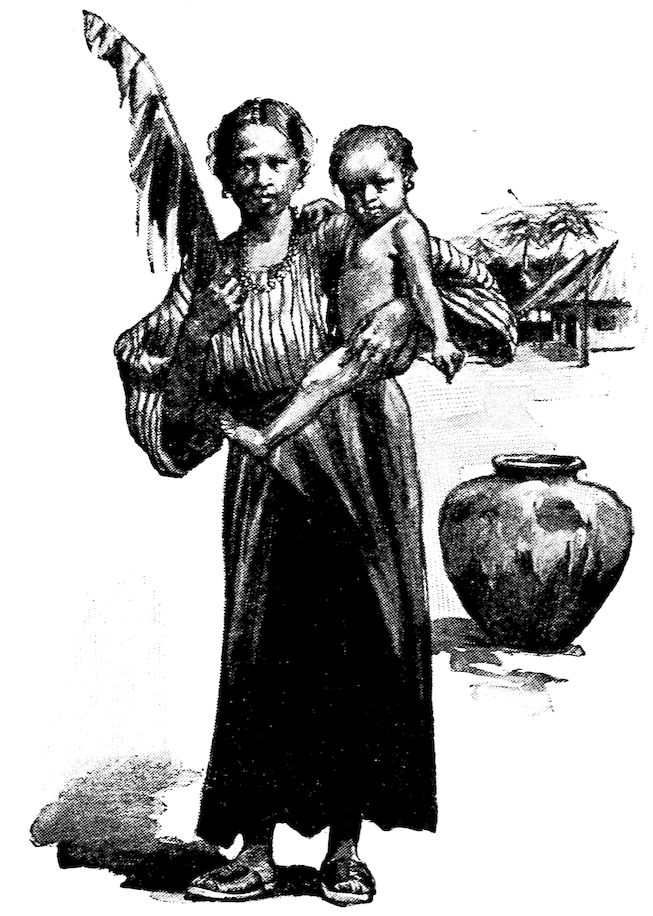
The Wrong Way to Carry a Baby.
In this country, where nearly all weights
are carried on the head, we rarely see a man
who does not carry his head and shoulders
well. He learns in childhood to keep his
shoulders even and to hold his head up. But
there is one custom of the country which
prevents the people from walking well. This
is the practice of carrying little children on
the hip. It is
bad for the children,
as it strains
the muscles of
the lower part of
the back, and
bends the soft little
bones so that
they do not grow
straight as they
naturally would.
It is bad, too, for
the person who
carries the child.
The body is thrown to one side, the weight
of the child presses the soft organs of the
abdomen downward, and the effect is often
serious. It is very bad indeed for one child
to carry another this way. Babies should be
carried in the arms, as European children are.
17When we walk, we should let the weight
of the body rest on the soles of the feet.
We should lift the foot free from the ground
and carry it straight forward when we
step. Some day, if you will study the difference
between the walk of a good horse
and that of a carabao, you will see how a
man should walk. The horse lifts his hind
foot, carries it straight forward, and sets it
down almost exactly in the print his front
foot made. The carabao lifts his hind foot,
swings it outward in an awkward curve,
brings it back into line, and sets it down in
much the same way as the horse. But he
loses a little time swinging it outward, and
he looks very clumsy, as well.
Now, some people, instead of walking like
horses, walk like carabaos. They scuffle
along the street with dragging steps, rolling
their hips, and swinging their feet outward,
just as these animals do. They look lazy
and clumsy, and as if they could hardly hold
their bodies together. People should learn
to walk well while they are young.
18The bones are covered with muscles, which
are what we mean when we say the flesh.
There are a great many muscles in the body.
They give it shape and move it about. When
we bend an arm or a finger, we do it by the
action of the muscles. The brain tells the
muscles how to act, as we have seen. It
sends messages along the nerves, and the
muscles obey. We can make our muscles
strong by exercise, but if we do not use them
enough, they will grow weak and soft.
How does the brain send messages to the different
parts of the body?
What does the heart do?
What does the blood take up from the body?
How does it get rid of impurities?
What becomes of food after it is swallowed?
How are the bones of a child different from those of
a grown person?
How does it hurt the bones to sit or stand badly?
Why should we sit up straight?
How ought babies to be carried?
Why is it hurtful to carry them on the hip?
What do we call the muscles?
What are their uses?
How can we make our muscles strong?
CHAPTER II. THE STORY OF WATER. — QUESTIONS.
19
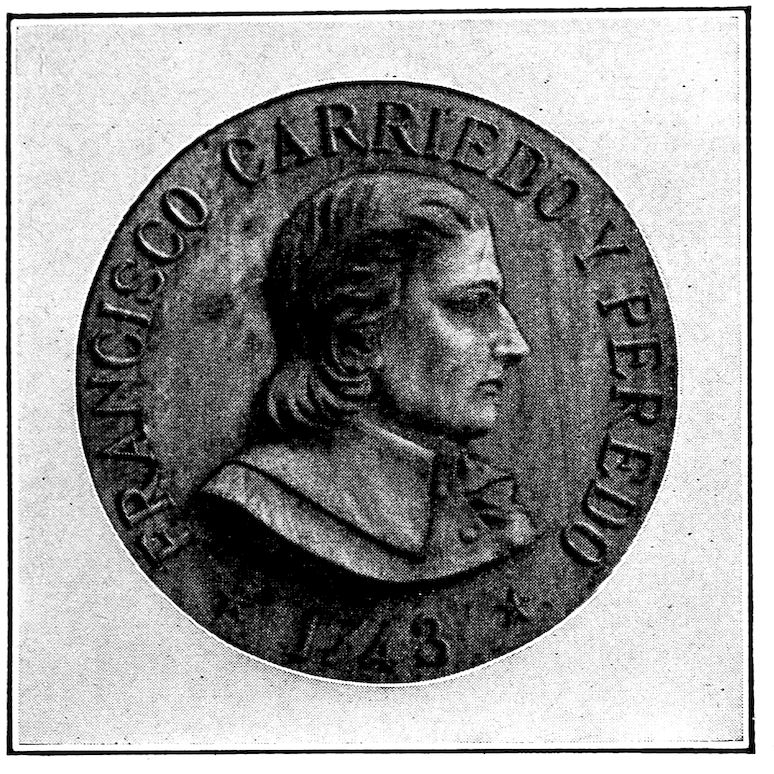
Governor-General Carriedo
Who gave Manila her waterworks.
Many years ago there was a wise
governor-general in the Philippine
Islands, who left a large
sum of money to the city of
Manila. This money was to be put out at
interest and allowed to increase, and in his
will the governor-general directed that when
there should be a large enough sum, it should
20be used to build waterworks for the city of
Manila.
Pumping Station, Manila Waterworks.
The waterworks were not built until a
hundred years after the governor-general
died. In 1872 another wise governor-general
came to the islands, and learning of
this money which had been left, he at once
set to work to provide the city with a water
supply. This was one of the best things
that ever happened to Manila. In the tropics
21nothing is more important than pure
water.
There is a great deal of water in the body.
In fact, three fourths of the body is made up
of water. It is in the blood, in the muscles,
and in the bones. There is even some water
in the enamel of the teeth, which is the
hardest substance in the whole body. The
digestive juices, the saliva, and the different
intestinal juices, all help to dissolve some
part of the food which we take. To obtain
this power to dissolve the food, they depend
upon water.
When a man is thirsty, it seems to him
that his throat is dry. But dryness of the
throat is only a sign by which the body makes
known its need. Thirst is the cry of the
fluids and tissues for water. It means that
some part of the body is suffering for the
precious fluid.
If we look at a drop of water under a
microscope, which magnifies it many times,
we shall see in the water a great number of
moving specks which are really little animals.
22The animals are so small that thousands of
them can live in a single drop of water as
happily as they could in a whole ocean of
room. They are called germs. Some of
them are wholesome: they help to keep the
water bright and sparkling and sweet, and
make it pleasant to the taste. But some of
them are very harmful: they produce many
kinds of disease, most of which cause death.
It is because of these germs that people,
particularly in tropical countries, have to be
so careful about the water they drink. The
purest water that we have is clean rain
water. This is the vapor which rises from
the earth and from the surface of the sea.
It ascends into the air until it strikes a current
of cold air, when it is turned into moisture
and falls as rain.
We can catch the rain water in cisterns
or other vessels; and this water we may
drink without boiling, if we are careful
to keep the cisterns clean. The cistern, to
be perfectly sweet, should be emptied and
cleaned at least once every two weeks.
23
The Wrong Place for a Well.
In this country nearly all the drinking
water comes from wells. Well water may
be very good, but the chances are that it is
full of impurities. The water from the wells
is rain water which has soaked into the
earth and has collected in the well. But the
earth is always full of impurities. It is like
a great sponge through which the water flows,
and the water is pretty sure to take up some
impurities as it sinks through the earth.
If a well is near an outhouse or stable, or
a place where cattle are kept, the water that
filters through this earth will carry with it
germs from these places. A well should
24always be on higher ground than any outbuildings.
It should be some distance from
the house, and no slops or anything emptied
from the house should be put near it. No
drainage of any kind should run near it.
In the city of Pittsburg, in the United
States, some years ago, there was an epidemic
of typhoid fever. Many thousands of people
died, and at last the legislature of Pennsylvania
appointed a committee to investigate
the cause of the epidemic. This committee
began to study the source of the city water
supply. They traced it far up the mountains,
many miles away, until they found a
certain little stream emptying into a large
river which supplied the city. Living on
the banks of this stream was a family where
there was a case of typhoid fever. The slops
from the house had been thrown into the
stream and had so poisoned the water that
thousands of people in far-away Pittsburg
died of typhoid fever.
In Manila there was once a great cholera
epidemic, during which more than thirty
25thousand Filipinos in the city and province
of Manila died; many Spanish people died
also. During the worst of the epidemic the
death rate was at least a thousand every day.
But only one Englishman died, and it is said
that his death was due to his own carelessness
in drinking impure water.
If everybody in the city had boiled and
filtered the drinking water, as the Americans
and the English did, nearly all of these thirty
thousand people would have escaped death.
What has been said of the impurities collected
by water passing through the earth is
especially true of the water which supplies
Manila. The ground all about the city has
been so long occupied by large numbers of
people, the drainage has been so poor and
so many impurities have been cast out, that
the soil for a great distance around the city
is a mass of decay. To stir up the earth, as
when digging and laying pipes, makes the
men who do it feverish and often ill, because
of the gases rising from the soil. We may
judge from this how bad the water must be
26that drains through the earth and is collected
in the wells of the city. Even the
water in the Carriedo water pipes cannot be
said to be pure. It comes from a river far
from the city. On the banks of this river
are many native villages, and the people
throw all sorts of refuse into the stream.
They wash their clothes in it, and bathe
themselves, their horses, and their carabaos
there. For this reason the water should be
purified before we drink it.
When the Americans first came to Manila
the city was not kept as clean as it is now.
This is one reason why there were so
many deaths in Manila, and because of the
high death rate, the Americans at once set
to work to clean the city. To do this cost
the lives of many American soldiers, who
died of fever caused by bad gases from the
earth; but since it was done, the death rate
in Manila is less than it ever was before.
But even yet the death rate is greater
than it would be, if everybody would
be careful about food and drink. The
27greater number of those who die are little
children. Indeed, one third of all the deaths
in Manila are of children who die of a single
complaint. This is the terrible fits from
which we so often see little babies suffering.
The fits are caused by trouble in the stomach
and bowels, arising from bad food and drink.
Sometimes the little one dies because it is
worn out by the pain it has suffered. Sometimes
the brain is affected by the stomach
trouble; but the true cause of death in every
such case is impure water or the wrong
kind of food. Most of the trouble comes
from the water which the children drink.
Not even a grown person ought to drink
water that has not been boiled. It is not
safe, for the germs of many of the tropical
diseases are found in the water. All of these
germs are killed by that degree of heat which
we call the boiling point. No less heat than
this will kill them.
It is not enough merely to heat the water;
it must really boil for at least five minutes
after it begins to bubble and simmer. It
28ought then to be strained through a clean
cloth and put at once into a banga or some
other of the jars used to contain water. The
jar should be clean, and should have a cover.
If it is hung in a draft of air, the water will
become cool enough to drink.
The jars used to hold water should be of
ware that will “sweat” after the liquid has
been in them for some time. That is, the
outside should be covered with beads of
moisture which have crept through the sides.
This sort of jar keeps the water cool and
lets the air get to it. Water, after it has
been boiled, is tasteless and flat, and until
it again takes up oxygen from the air, it is
not so pleasant to drink, or so digestible as
it was before boiling.
We have seen how important water is to
life, and we cannot have too high an idea of
the importance of its being pure. It is not
enough that water looks clear and sparkling.
It may look like crystal and yet be full of
poisonous germs. The only way to be certain
that it is pure is to boil it and then see
29that no further impurities get into it before
it is used.
What is thirst?
What is the proportion of water in the body?
What is the purest sort of water we have?
How does water become unfit for drinking?
How may it be purified and made fit to drink?
How should drinking water be kept?
CHAPTER III. ABOUT FOOD. — QUESTIONS.
30
Shall we go to market to-day?
Let us go to one of the large
new buildings that the government
has put up in Manila, to
be used as markets. They are well fitted
for this purpose. They have cement floors,
which can be washed every day, and clean,
well-built stalls, where goods are sold. The
floor of a market should be washed often,
and every bit of waste matter should be
carried off. If this is not done faithfully,
the food sold there spoils and becomes
unfit for use.
31
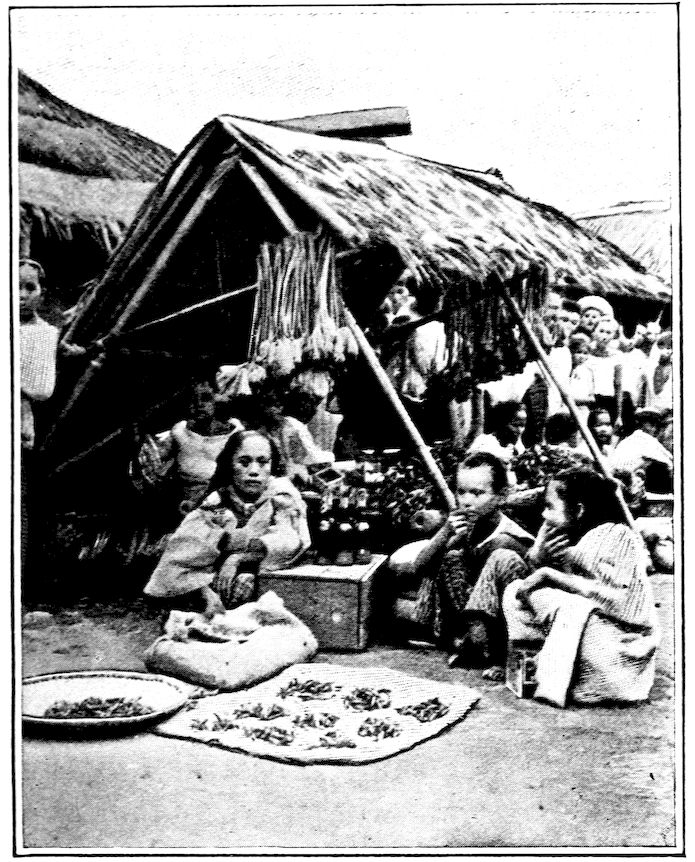
A Badly Arranged Market.
What quantities of fruit! It would take
a long time to count all these bunches of
bananas. The mangoes are in season now,
and look very tempting. It is not well to
eat too many of them at the beginning of
the season, however, and we should be sure
that those which we do eat are ripe and
sound. Unripe fruit is very hurtful, and so
is fruit which is too ripe, which has begun
to decay. Some of these bananas, for instance,
32are so black and so soft that no one
should think of trying to eat them. In
some countries a merchant who tried to sell
such fruit would soon find himself stopped
from selling any fruit at all. The law would
not allow him to offer poison for sale, and
decayed fruit is poison.
We will buy some of these sound, clean-looking
bananas, and a few oranges this
morning. We will choose oranges that are
of a fine, rich green, not too hard, but firm
and of good weight. Oranges that feel light
in the hand are dry and not wholesome.
Here are radishes and lettuce, for salad;
but if we buy these, we must be sure that
they are well washed in boiled water before
we eat them. There are little creatures, so
small that they cannot be seen without a
strong microscope, that live among the lettuce
and other green leaves. These tiny
creatures are the cause of the worst form of
dysentery. All sorts of vegetables which
we eat raw should be washed clean, and it is
of no use to wash them in unboiled water,
33as the amœba (which is the little creature’s
name) may be in that, too.
We need camotes to-day, and here are
some fine ones. We will not buy them, however.
Why? Do you not see that some one
has been chewing betel nut, and has spit
close beside them, and the camotes are all
spattered with the red stain?
It is a terrible thing that not even our
markets can be kept clean from this bad
habit of so many people. In some parts of
the world the man who spit upon the sidewalk,
the floor of a car, or in any public
building would be arrested and taken to
prison. This may seem to some a hard
punishment for what many people think is
a small offense. We know, however, that
many diseases are caused by this practice,
and the man who willfully does anything
which puts his fellows in danger from disease
does as great wrong as he who endangers
their lives in any other way.
Many people have catarrh, bronchitis, and
consumption; all such diseases can be given
34to others in this way. The air can become
poisoned, so that other people catch the
disease. People in older countries have
learned that if sick persons are careless
about spitting in public places, they often
endanger the lives of others; so it is quite
right to compel all to stop this bad habit
and to punish them if they continue in it.
Constant spitting is a bad habit in other
ways. The saliva is meant to help digest
the food. If one gets into the senseless
habit of spitting all the time, the saliva is
wasted and the digestion hurt. Then, too,
it is an uncleanly habit. It makes floors
and sidewalks filthy, and people who have
been well brought up always have a feeling
of disgust when they see any one spit in
public places. If one must spit, he should
do so in private, where no one need be disgusted
by his act. Certainly no one who has
regard for decency would ever spit upon the
floor of a market.
We should make sure that all vegetables
which we buy are fresh and in good condition.
35Food the least bit decayed should never be
eaten. It is very dangerous in this climate,
where people are more likely than in colder
countries to have trouble of the stomach
and bowels. Not even cooking will make
decayed vegetables fit to eat. The poison
in them irritates the lining of the food
canal and makes us sick. Besides, there is
very little nourishment in poor vegetables;
so that if they are eaten, the blood gets thin
and cannot feed the body.
Now that we have fruit and salad, we will
buy some camotes and gabi, and some squash,
here at this stall where everything seems so
clean. Some tomatoes, too, but we will not
buy any of the beans to-day; they seem soft
and flabby, and we may be sure that they
are not fresh.
Meat? Yes, by and by; but we shall do
better to get that elsewhere. It is bad for
meat to lie in the open air as it does here.
Meat should be killed at least twenty-four
hours before it is eaten, and if it is kept so
long, it must be on ice. Otherwise, it spoils
36in a very few hours. Meat should never be
left where flies can light on it, and you see
that the meat here is covered with flies.
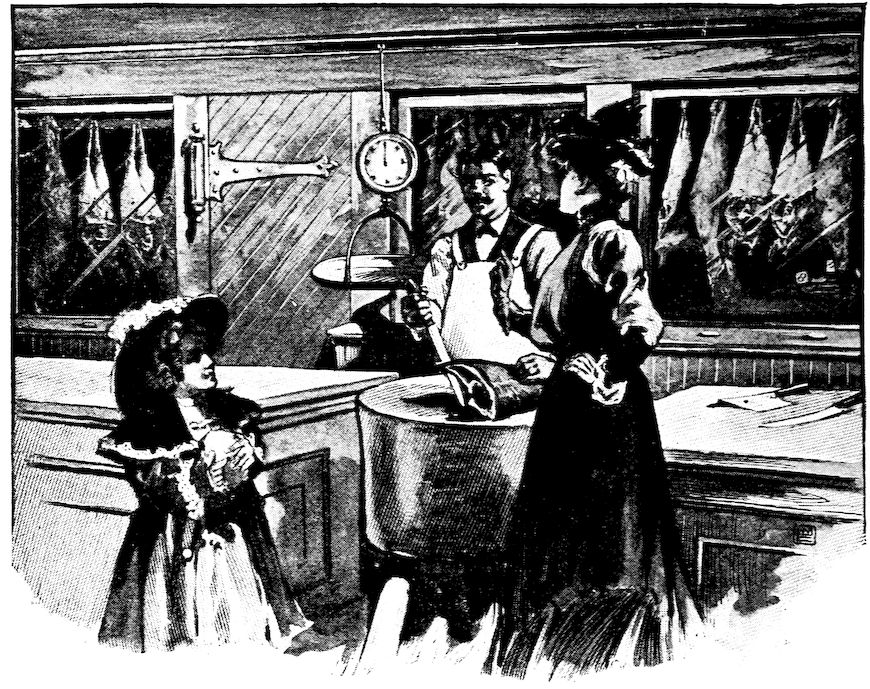
A Market as it should be.
Flies are great carriers of disease, and
often take germs from place to place on their
feet. Some of these flies may have just
left places where there is fever or cholera,
or smallpox, and they can easily leave
the germs of these diseases on the meat
37where they next alight. So you see we
should be very careful where we buy meat,
and what sort we buy.
There is plenty of poultry in the market to-day,—chickens,
ducks and pigeons, all alive,
and dealers all anxious to sell. If we buy
a chicken, we should get it home as carefully
as we can, and it should be allowed to rest
and get over its fright before it is killed.
Then it should be killed as quietly and
quickly as possible, as otherwise the meat
will be feverish and bad for food. It should
be killed some hours before it is needed for
food, so that the flesh may cool. To kill it
just before cooking, as is almost always done
in this country, is a very bad custom, as
flesh so killed is not wholesome.
Here are the fish stalls; and here are the
fish, most of them alive and flopping about.
Fish caught in the river should not be
bought unless they are alive; fresh-water
fish spoil so quickly that unless alive when
bought, they are not likely to be fit for food.
Deep-sea fish may be bought dead, and are
38safe to eat if the gills are bright red and the
scales clean and shiny. If the gills look dull
and bluish, we should never think of buying
the fish; for it has been out of the water too
long. Crabs and other shellfish should always
be bought alive, unless they are already
cooked and frozen, as we see them in the
cold storage house. Then they must be kept
on ice until they are made ready for the table.
But under the very best circumstances shellfish
should be sparingly used in this country,
as they are the cause of much trouble of the
digestion.
We will buy some rice to-day, but we must
look at it carefully first. Good rice is clean
and white. It is free from mold, and there
should be no musty smell about it. If it
has any such smell, we will not buy it, for
it is unfit for food. It ought not to be fed,
even to the chickens. Moldy and dirty rice
is a common cause of the disease called
beri-beri, which is so often fatal in tropical
countries.
Many people are not prudent about selecting
39and cooking their rice. They are careless
and often buy musty rice, nor do they cook
it long enough. They eat it half cooked,
and many people like it a little burned.
Prepared this way the rice is hard to digest,
and is irritating to the system and to the
food canal.
A grown man who is well and strong
needs a certain amount of food every day,
to keep him in health. The body requires
water, fat, sugar, and albumen, and some
mineral salts. Albumen is a substance rich
in food for the body, of which it makes up a
large part. The white of egg is almost pure
albumen, and therefore eggs are very good for
food. Milk, which is the only food very
young babies should have, contains all the
things which the body needs, and in just
the right quantities. It has water, sugar,
fat, albumen, and some mineral matter. Meat
has albumen and fat, but no sugar, and fish
is similar to meat in this respect.
Most of the sugar we take into the body
we really eat in the form of starch, but the
40saliva in the mouth turns the starch into
sugar. The secretions of the liver do this
also. Rice is a starchy food. It contains a
great deal of starch, and before we eat it,
it should be well cooked, so that it is soft
enough to be acted upon by the saliva and
turned into sugar; otherwise, the liver has all
this work to do. Corn, potatoes, meal, bread,
are all starchy foods, and we get with them
nearly all of the mineral substances needed;
but to most of our food we need to add a
little salt.
Bananas and other fruits, when they are
ripe, all have sugar, and in this country people
are fortunate in having the sugar cane to eat.
If one does not eat too much of this, it is
pleasant and wholesome, and it is very good
for the teeth; it makes them white and
keeps them healthy.
Besides what he takes in with his solid
food, a man should drink three pints of water
a day. If he drinks tea or coffee he will get
some water with these, and so will not need
so much, but three pints of liquid are needed
41daily to keep the body well. People in this
country drink also the sap of the cocoanut
tree and the water contained in the cocoanut
itself. These are both good and wholesome,
when fresh. But if they are not fresh, they
can do much harm. Why this is we shall
see in another chapter.
People who live in the tropics need less
fat than those in colder countries. Away in
the frozen north the Esquimaux eat great
quantities of fat meat and oil, and even
tallow, from which candles are made. They
need much fat to keep them warm. In the
tropics, on the other hand, people should eat
but little fat. Lean meat is good, especially
beef, but pork raised here is very unwholesome.
The pigs themselves eat all manner
of unclean things. They are the natural
scavengers of the country, and the food which
they eat makes their flesh unfit for us.
The flesh of the carabao is not so good as
beef. It gives really very little nourishment,
and is tough and dry. The mutton which is
grown in these islands is not so good as it
42might be if more pains were taken. Sheep
ought to be shorn twice a year, not only for
the value of the wool, but because it adds
to the comfort of the sheep and makes the
flesh better. Dry and salt meats are of little
value here, and they spoil quickly.
The fish of the Philippine Islands are rich
in albumen, which the body needs. They
should always be fresh, as we have seen, and
should always be eaten hot. Even cooked
fish, after it has grown cold, is not good for
food. It is likely to produce skin diseases
and certain kinds of poisoning. Many of
the shellfish cause this disease also, particularly
the crabs of these islands. In
fact, shellfish should all be used sparingly,
as they are not easy to digest and are often
the cause of diarrhœa and dysentery.
Babies and very young children ought to
be fed carefully in this country. Yet frequently
we see tiny babies eating fish and
meat, and often raw vegetables and green
fruit. The stomachs of such little children
are very small and weak. Their natural food
43is milk, and if we give them anything else
than this, we should choose it very carefully.
It should be the best that we can get, perfectly
clean, and easy to digest. Not until
people are more careful about these matters
will the children in the islands have a fair
chance to grow up to healthy manhood and
womanhood.
Why is fruit that is too ripe unfit to eat?
How do we select oranges that are fresh and good?
Why should we be careful to wash all fruit and
vegetables before we eat them?
Why is spitting in public places a filthy habit?
How may it be dangerous to others?
Why should meat not hang in the open air in tropical
countries?
How do flies carry disease?
Why is it injurious to eat meat that has just been killed?
Why is it not a good plan to buy dead fish?
Why are crabs and shellfish a poor sort of food?
What does good rice look like?
What kinds of rice should be avoided?
What sort of food and drink are best for the tropics?
How ought babies and young children to be fed?
CHAPTER IV. ALL AROUND THE HOUSE. — QUESTIONS.
44
The English people have a saying:
“Every man’s house is his castle.”
In his own house a man
ought to be safe, if he is to be
so anywhere, and there he ought to feel sure
that his family is safe. With his strong
right arm he will keep all enemies away;
will fight, if need be, for the safety of his
castle. It would be a very mean man who
would not do this. We should think even
a child a coward who did not help to defend
his home. But while we defend the front
door, we must not let enemies creep in at
the back. Now, the deadliest enemy of human
life in the tropics is dirt. We have to
fight hard against dirt of every sort. Let us
see, to-day, about building a house and keeping
our enemy out of it.
45Every country must have its own particular
kind of a house. The house suitable for
a cold country would not do at all in the
country where we are now. We do not
need walls built so as to keep out cold and
winds. We have no use for fires to fight
off frost and chill. But houses in countries
where the winters are cold and snowy
must have thick walls; they must have
carpets on the floors and heavy curtains at
the windows. There must be fires in the
houses, to keep people warm. If the houses
were not warm, people would suffer from
cold and many would die.
Nevertheless, while they do not need to
be built for warmth, our houses in the tropics
ought to be as carefully built as are the
homes in winter lands. That they are not
so built is one reason why so many little
children die here,—many more than in
America, for instance.
46
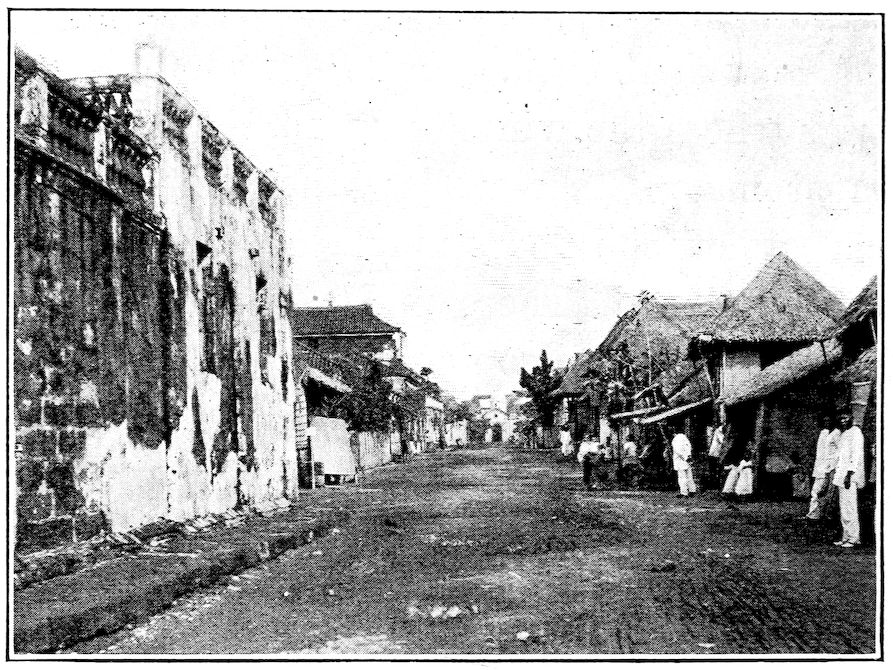
An Unhealthful Street.
Without pavement or gutters.
First of all, since we are to build a house,
we must have a good place for it. We will
not build on low land if we can help it.
Neither will we build near standing water.
We see a great many houses upon land that
is almost always wet, but they are very unhealthful
for the people who have to live in
them. If our house is to be a healthful place
for us, we must build it on firm land that is
well drained. Some day the whole city of
Manila, within the walls, will have to be
raised several feet higher than it is at present,
to get it far enough above the low, unhealthful
47land it now stands on. The streets
must be made wider, too, so that the sun
can shine upon the house walls. The narrow
streets are nearly always damp and
unhealthful. Manila will never be a healthy
place until these things are done.
But outside of the walls, and in the country,
we can pick our plots and prepare our
building sites. The fine, beautiful house and
the little nipa cottage can be equal in one
respect; that is, both can have clean, healthful
surroundings.
The living-rooms of houses in this country
should never be close to the ground.
The land on which a house stands should be
well drained and kept dry. This, however,
is not all that should be done to prepare
a building spot. In tropical countries bad
gases rise from the earth at night, and we
should do what we can to prevent these
from getting into the house. The ground
where the house is to stand should be dug
down at least a foot and filled in with hard
cement. This will keep it dry and prevent
48the earth-gases from rising through the
floors. Besides this foundation, the house
should have cement gutters running all
around it, to carry off surface water. The
foundation walls should rise from the
cement bottom to a height of at least six
feet.
The ground floor may be used as a place
to store carriages, furniture, and other things
of that sort; but it is unsafe to keep horses
or other animals there. All the bad odors
and gases from these rise, making the living
rooms above unhealthful.
The first floor of our house,—the floor on
which we mean to live, should be tightly
built, so as to keep out all drafts of air, and
to leave as few cracks as possible for insects
to crawl through. We shall get fresh air
enough if we have large windows that open
freely.
We are fortunate, in this country, in having
the beautiful thin shells with which our
window sashes are filled. These are much
better here than glass would be. They shut
49out the bright rays of the sun, while they
can be pierced with tiny holes, if need be,
to let in air when the window is closed.
Heavy shutters with slats are also good. If
we have these in the house, the windows may
be open, even at night, or when it rains.
The roof of our house is a very important
part. Most of the roofs in this country are
of nipa or bamboo. These make a good
protection against the sun’s rays, but they
need great care, and should be often renewed,
as the wind tears them so that they become
leaky. They catch and hold the dust, and
are always hatching-places for all sorts of
insects. The roof of split bamboo is cheap,
beautiful, and easy to make, but it is also
easily blown away by a high wind. If we
use it, we must fasten it with wire to the
rafters and walls.
Wood makes a very bad roofing material.
It decays quickly and is a poor protection
against the rain. Then, too, it can hardly be
built so that a great wind will not blow it
away. Many roofs are now built of zinc, and
50for some reasons this is good material to
make them of. If we have a zinc roof, however,
we must build a garret between it and
the living rooms,—a sort of air chamber for
the sake of coolness; for when the sun beats
down on the zinc roof, the metal gets very
hot. This sort of roof is useful for catching
rain water; after the first rain has washed
off all the dust and dirt, then we may collect
the rain water that falls from the roof into
our cisterns, and have a plentiful, pure supply
during the rainy season.
In early days roofs were covered with
half-round red tiles. We see a great many
of them still on old houses, but they are
heavy, and dangerous as well during the
typhoons and earthquakes that sometimes
visit us.
Perhaps the best of all roofs for this climate
are the ones covered with flat, broad
pieces of slate, secured by wire or nails to
boards and rafters underneath, but roofs of
this sort are expensive. It will probably
be best, therefore, for us to roof our house
51with zinc. If we have an airy garret between
it and the ceiling of the upper rooms,
it will be quite cool enough.
The rooms in our house will be very simple.
We shall not have any heavy, stiff
carpets on the floors, to catch dust and
breed disease. Nor shall there be moldings
or ornamental ledges along the walls, because
these also catch and hold the dust.
Our rooms shall be easy to keep clean.
What pictures and ornaments we have on
the walls shall be such as can readily be
reached and dusted. A room so decorated
that it cannot be kept free from dust and
dirt cannot possibly be beautiful.
The kitchen of a house anywhere should
be clean as can be, but particularly in this
country. It should be on the north side of
the house if possible, for the sake of shade.
We will not, however, have trees growing
very near it, even to shade it. They have
a saying in the tropics that “He who grows
a tree against his house invites death to his
door.” This means that dampness and shade
52made by the trees growing too near the
house breed disease and often bring death.
So we shall have no trees nearer our house
than twenty feet.
Nor shall any one be allowed to sleep in
our kitchen. It is a very unhealthful and
uncleanly custom to let the servants sleep
in the kitchen. There should be no sleeping
in a room where food is prepared. By
morning the air of a sleeping room is always
charged with bad matter given off from the
lungs of the sleepers. Sleeping rooms have
a chance for ventilation during the day, and
all these vapors are replaced by pure air.
But there is no time in the morning to
change the air of the kitchen. The food
must be prepared in the midst of all the
bad gases that have gathered there during
the night.
This brings us to think of what proper
sleeping arrangements should be. Not
enough attention is given to the subject in
this country. The nights are so hot that
people are careless. Many grown people
53and nearly all children sleep on or close to
the floor. This custom is a great source of
sickness. If the floor is of bamboo, the bad
air from the earth rises through it at night.
There is always a draft across the floor, from
doors and from windows, and from spaces in
the floor itself. When we are asleep the
body is relaxed, the pores of the skin are
open, and we are in every way less able to
resist chills and the bad effects of impure
air. Sleep is a condition of helplessness,
and we should protect ourselves in it.
A serious cause of disease, which people
are just beginning to understand, is the
mosquito. We have only lately come to
know that this insect is the direct cause of
the malaria which is so common, and so
dangerous, here. Malaria is a germ disease.
That is, it is a disease caused by germs
which get into the blood. The germ of malaria
is a parasite which lives on the body of
the mosquito. We can imagine how tiny it
must be when we know that a great many of
them find room to live on a single mosquito.
54Now, when the mosquito lights on a person
and bites him, these germs often get into
the little puncture which the insect makes
to draw blood. In this way they get into
the blood of the human being, and there they
increase in numbers very fast. They poison
the blood, the person becomes sick and
weak, suffers from headache and other pains,
and very often dies at last of malaria.
We may learn from these facts how important
it is that mosquito nets should be
used in this country. Even if a person
sleeps upon the floor, he should arrange some
sort of protection from the mosquitoes.
Every morning, the floors of our house
must be washed with water in which we
have put a little kerosene oil; one or two
large spoonfuls of oil will be enough for a
bucket of water. We should see that the
washing is carefully done. This washing
with kerosene will help to keep mosquitoes
away. It also tends to drive out ants and
other small insects. Kerosene oil is cleansing,
and helps to kill many of the germs
55that breed in corners and cracks. If it is
poured upon standing water, it will prevent
mosquitoes from breeding there. One ounce
of kerosene will spread out over fifteen
square feet of water, and this fact is made
use of in some countries in getting rid of
mosquitoes. It may be spread over the
surface of the water in cisterns without imparting
any taste to the water which is
drawn from below for drinking purposes.
Persons who have consumption ought
never to sleep in the same room with others,
particularly with children. Consumption
is catching. The germs which cause it are
breathed out by the victim, and other people
often inhale them and contract the disease.
A consumptive person should never spit on
the floor, and all discharges from the mouth
should be disinfected.
There are two other places about a house
in the tropics where our arch enemy, dirt,
may hide and slay us, if we are not on
guard against it. These are the sinks and
the cesspools, which receive waste from the
56bathroom, toilet, and such places. No refuse
matter ought to be thrown out about the
house, and no dirt should be allowed to
gather on the ground floor or in the court.
We cannot be too careful about this; for if
dirt does gather in these places, it is sure
to breed disease.
Decayed vegetables, fruit, and all leavings
from the kitchen should be carried away and
burned, or buried, or otherwise disposed of
where they can do no harm. Even the water
in which dishes are washed, or in which we
have bathed, should not be poured out on
the ground near the house. It should be
carried as far away as possible and emptied
in some waste place.
There are few sewers in this country.
Even those in Manila are scarcely worthy of
the name. Before long, steps will have to
be taken to have them in all cities in the
archipelago; for there is great need for them.
The fact that there are no good sewers makes
the question of cleanliness about the house
a grave one. If waste from the toilets is
57carried into the cesspools, there should be
plenty of running water with it for flushing;
it should be carried in pipes to the cesspool,
and at least once a day the water-closet
should be flushed with water in which there
is some good disinfectant. If, as is so often
the case, the closet is merely an outhouse
over a hole or vault dug in the earth, at least
five liters of a mixture of quicklime and dry
earth should be put into the vault every day.
Milk of lime is one of the best disinfectants
for use in this country. It is cheap, and
it not only disinfects waste matter, but destroys
bad odors. It is powdered quicklime
dissolved in water, about one liter of quicklime
to four liters of water. Another very
cheap, but reliable, disinfectant is made by
dissolving three drams of mercury bichloride
with three drams of ammonium chloride in
a bucket of water. This mixture can always
be kept in the house and a tabo or two of it
thrown down the closet seat whenever the
latter is used. It must be kept where little
children cannot meddle with it; but a child
58need not be very old to be wise enough to
use it when necessary and not to meddle
with it. Children, as well as grown people,
should feel in honor bound to take good care
of the house and to fight against dirt and
disease when these attack it.
The bathroom and water-closet of our
house should be kept as clean as can be.
They should be swept and washed every day,
and no soiled clothing or towels should be
allowed to lie about. Our enemies, the
mosquitoes, are very fond of hiding about
soiled clothing or that which has been worn
and is not soiled enough to be sent to the
laundry.
Soiled garments should be washed as soon
as possible after they are taken off. Right
here lurks one of the greatest foes to health
in this country. People are too careless
about the way their garments are washed.
The clothes often lie for several days in
baskets or bags before going to the laundry
or being washed. This is bad, as germs
breed quickly among them. It is harmful
59for clothes to be washed in pools or canals.
The water of standing pools or even of
the canals in the city is, more often than
not, full of disease germs.
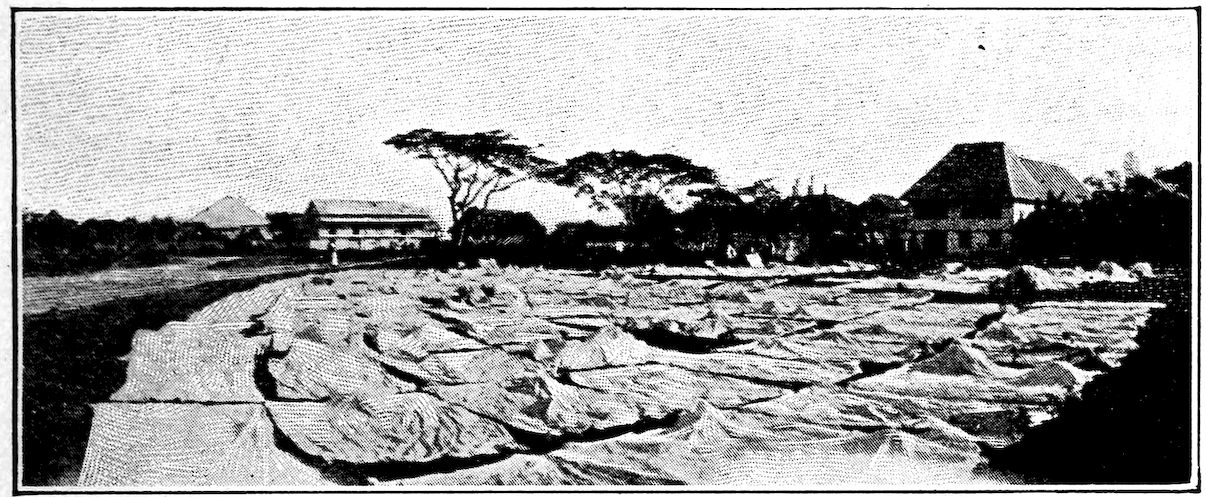
Clothes drying on the Ground.
To make matters worse, the clothes, when
washed, are laid out on the grass to dry. All
sorts of tiny creeping things are here; so
that while the garments look white and
clean, they may be full of wriggling life
from the water and from the ground,—creatures
too small to be seen without a
microscope, yet the cause, many times, of
the unpleasant skin diseases so common in
this climate.
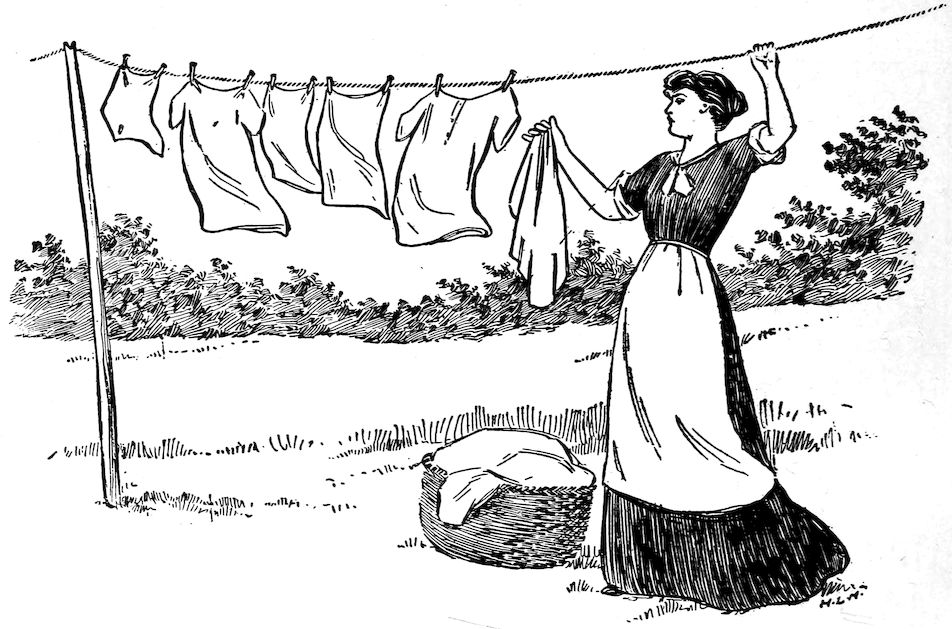
The laundry work of the family ought to
be done at home, and the clothes should be
60hung upon lines to dry. In other countries
clothes are boiled after first being washed
with soap, but this is not possible here;
probably it never will be possible. Yet
clothes can be washed with soap and water
and then leached,—that is, rinsed in lye
water. Wood ashes are easy to get, and
lye water—that is, water in which the
ashes have been soaked—will destroy all
germs. The clothes rinsed in it are as safe
as those which have been boiled.
The Best Way to dry Clothes.
Attention to all of these things means
61work for men and women, and for the boys
and girls who wish to feel that their
house is really their castle which they are
defending against unseen foes. These foes
are harder to fight than those who come
openly and slay with the sword. They are
more dangerous foes, moreover; for they
are about us always, and must be fought
daily. Otherwise, they will rob us of health,
of comfort, of sight; they will make us the
victims of disease which is ugly to look
upon and painful to bear. They even take
from us life itself, unless we are constantly
on guard to fight their great helper, the dirt,
which gathers about any neglected spot.
What sort of site should be chosen to build a home
upon?
How should the foundation be prepared?
Why is it unhealthful to live near the ground in the
tropics?
Why is it unwise to keep animals under the houses?
What is the best sort of roof in this country?
How should the kitchen be located?
Why should no one be allowed to sleep in the kitchen?
62Why is it not healthful to sleep on the floor?
How should the body be protected during sleep?
How do mosquitoes cause malaria?
How does the use of kerosene oil keep them away?
Why should consumptives never sleep in the room
with healthy persons?
How should refuse matter be disposed of?
What are some of the best cheap disinfectants?
How should clothes be washed?
How should they be dried?
CHAPTER V. OUR OWN SELVES. — QUESTIONS.
63
A human being is very wonderful.
Even the smallest baby
is entirely separate from all
the rest of the world. He is
a part of the great whole, but he has his
own life and separate being, just as much
as the greatest man in the world. If everybody
in the world did just what was right
excepting one man, both that man and the
rest of the world would suffer because of his
doing wrong. If all the rest of the world
were healthy and clean and he was not, the
cleanliness and health of all the others
would not save him from being dirty and
unhealthy. Each one of us must do all
that he can to help the rest of the world
to be good and healthy and clean. Now, the
first and greatest thing that any one of us
64can do toward this, is to do right and be
healthy and clean himself.
The human being is not only very wonderful,
but he lives in a wonderful body.
This body can do much and endure much.
It is very perfectly adapted to its use. If
man had not his reason to help him; if he
did not walk upright when all other creatures
crawl or go on all fours; if he did not
differ from the lower animals in any other
way than by having a thumb on each hand,
he would still be superior to them. All the
other large creatures are stronger than man,
but his skillful hands, with their thumbs,
make him master of them. These help him
to grasp and to hold, to make things for his
own use. He makes clothing to wear, houses
to shelter himself, and weapons with which
to defend himself.
Hundreds of years ago there lived a great
doctor, named Galen. He wrote one of the
first books ever written about the human
body, and he has left it on record that he was
obliged to believe that God lives; for none
65but divine power could have made so wonderful
a thing as the joint that turns the
human hand at the wrist. Yet this joint is
only one of the many wonderful things in
the body.
Now, to each of us is intrusted one of
these bodies to take care of, that it may do
our work for us. Our work is not just to live
for ourselves, but to do something useful in
the world; to help it all to be better because
we are here. So you see how very much
worth while it is that we should keep these
useful bodies of ours as well and strong as
we can.
Besides the outer garments in which we
clothe it, the body has a garment of its own.
This garment is never laid aside; and though
it is in constant use, it never wears out.
We call it the skin. The skin is meant to
protect the body. Lying close under it are
many nerve ends, delicate blood vessels, oil
glands, sweat glands, and other tiny organs
that are too small to be seen without a microscope,
but which are needed to keep the
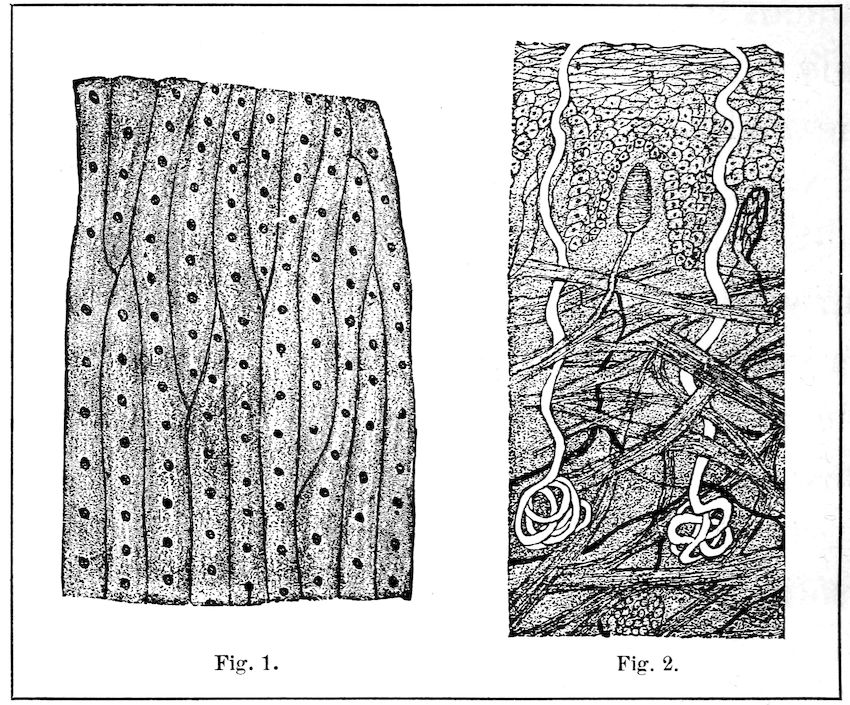
66body in good order. In the pictures which
are shown on this page, you will see how
these tiny organs look when they are many
times magnified.
The Skin Magnified
Fig. 1. Surface showing openings of pores.
Fig. 2. Side view of sweat glands and pores.
Now, like our outer clothing, this garment
of the body needs to be kept very clean.
You know that in this country when we
take exercise, or, during the heat of the day,
even without our taking exercise, the surface
67of the skin gets moist, little drops of water
stand on it, and even run down our faces
or make our hands wet. We call this
moisture perspiration, and say that we are
sweating or perspiring with the heat. The
drops of water come from openings in the
skin, which we call pores. These are little
tubes connecting with sweat glands below
the skin. You will see in the picture how
these sweat glands look, and how the pores
come to the surface.
The perspiration is not pure, clean water;
it contains many impurities which the lungs,
kidneys, and other organs have not cast
out from the body. It is the work of the
skin to help carry off these impurities, and
it does this by means of sweat glands and
pores. If the perspiration dries on the skin,
the impurities remain; they stop up the pores
and make the body unhealthy. It is to prevent
all this that we bathe often. Bathing
keeps the pores of the skin open and the
skin itself in a healthy condition. We use
soap because the skin secretes oil as well as
68perspiration. This oil is to keep it soft and
smooth, but it is needful that the excess of
it should be washed off with soap, in order
that the oil glands may not become clogged.
We should be very careful not to become
chilled when in a perspiration. We should
not plunge into cold water at this time.
Neglect of this rule often causes bowel
trouble, and is a great cause of the catarrh
and bronchitis so common among the Filipino
people. To keep it perfectly clean,
the body should be washed with soap once
a day. Just before noon is the best time to
bathe, or else about four o’clock in the afternoon.
One should never bathe right after
eating. If one takes a sponge bath with
water alone, immediately on rising, one feels
better all day, but, in this climate, the bath
with soap is needed as well. Babies and
very little children should be bathed with
soap and water without being plunged into
the bath. They are delicate, and unable to
withstand the chill that might result. Chills
are very dangerous, and a person should
69be careful in the rainy season not to get
drenched.
A person who has any kind of skin trouble
should be very careful not to give it to any
one else. He owes it to all others to take
pains about this. If he does not, he is not
a good citizen. He should be careful not
to use the towels that any one else is likely
to use, and his soiled clothing, when taken
off, should be disinfected before being sent
to the laundry.
The custom of going barefoot is a dangerous
one. The sole of the foot is a very delicate
surface; a great many nerves and blood
vessels center in the instep, and any injury
to these may produce the disease called
lockjaw, which usually results fatally. Even
if nothing so serious as this happens, the
foot is often injured by bruising or by other
hurts. The feet are susceptible to chill,
especially in the rainy season, when they
should be kept dry and warm. Disease is
often taken through the feet, especially such
diseases as the bubonic plague, and the different
70kinds of itch which are known in the
tropics. Aside from all these reasons why
we should dress the feet, it is an untidy practice
to go barefoot. The low shoes without
fastenings, into which so many Filipinos
thrust their feet, give people who wear them
an awkward, shuffling walk. A shoe which
fits the foot well and is fastened upon it so
that it does not flap at the heel is the only
one that should be worn out-of-doors, and
no shoes should be worn without stockings.
Every boy or girl who wants to be well
must take exercise. If we do not use our
muscles, they become weak and small. The
brain suffers as well. When we exercise we
not only strengthen our muscles, but we set
the blood in quicker circulation. The heart
must work faster; the lungs must expand
more; the food digests better and the brain
is clearer. The best sort of exercise is useful
work out-of-doors or about the house, but
boys and girls need to play as well as work.
All games that take them out-of-doors and
71make them move about actively are good for
them.
Many Filipino boys and girls do one thing
that is very hurtful; that is, they smoke.
The use of tobacco injures growing young
people. It stunts the growth, so that even
when grown they are small and weak. Boys
who smoke do not grow so fast or so large
as those who do not. Smoking injures the
memory and makes people heavy and stupid;
it makes them less inclined to take exercise,
and so the muscles become weak; it hurts
the digestion and makes the stomach weak.
Besides these things, it induces the constant
spitting so common in this country; and
we have seen how hurtful this waste of the
saliva is.
Chewing betel nut is even worse than
smoking. If all of the betel juice is not spit
out, some of it will be swallowed, and this
is very bad indeed, as the betel acts like a
poison on the system. So the betel chewer
must waste all the saliva that comes into his
mouth while he is chewing the nut. More
72than this, he stains the sidewalks and floors
with the filthy stuff, and makes himself ugly
to look at, as well as offensive to cleanliness.
It is to be hoped that the boys and girls who
study this book will never take up such a
disgusting habit.
Still another thing which is very bad for
the health in this country is the use of alcohol.
Alcohol is bad for the system; it irritates
the delicate lining of the food canal, and
hurts the liver and the kidneys.
We have said that tuba, the juice from the
cocoanut tree, is good and refreshing to drink
when just drawn from the tree; but in a few
hours after it is drawn changes begin to take
place in it. The greatest of these changes
we call fermentation; it is caused by tiny
vegetable growths, called ferments. These
are too small to be seen unless magnified,
but they float about in the air. They get into
the tuba, and, because there is something
there which they like and thrive upon, they
grow and increase in numbers very fast.
They separate the sugar of the tuba into the
73parts that make up sugar, and take from it
the part which they like. What is left forms
two other things. One is a poisonous gas,
called carbonic acid gas.
At one stage in the fermenting process,
there is a great deal of this carbonic acid gas
in the tuba, and that is what gives it its
dreadful taste when it first begins to work
or ferment. The other thing found in the
tuba is alcohol. If this were not distilled,
the tuba would simply go on working until
all the sugar was gone; then it would be as
sour as vinegar and disagreeable to drink.
But distillers heat it until it boils; the alcohol
rises and passes off into a vessel especially
prepared to receive it, and becomes the drink
called bino. This drink is really an active
poison to most people. If a man drinks much
of it he becomes crazy, his actions are dangerous
to society, and at last he has to be
kept in confinement. Often he does terrible
mischief under the influence of bino.
It is very fortunate for this country that
Filipinos know how dangerous it is to drink
74this stuff. Still, there are some weak and
foolish people who think that they can stand
it, and who drink it until they form a habit
which holds them in bondage.
None of the alcohol made in this country
is refined; therefore it is full of impurities
and very poisonous. Those who know the
climate agree that the less alcohol of any
sort one uses here, the better. Those soldiers
and others who let it quite alone are
the ones who best withstand the bad effects
of the tropics and keep well and strong.
Alcohol weakens the brain sooner than it
does any other part of the body. A person
cannot think clearly when he has had too
much; he cannot walk straight, and often a
man does things under its influence which
he never would do if he had not been
drinking it.
There are five different ways in which a
person can tell something of what is going
on around him. He can see, he can hear,
smell, or touch some things, and some he
can also taste. We call these five faculties
75of man the special senses. Each of these
special senses has its own home in the body,
its own organ to do its work. For instance,
the eyes see, the ears hear, the organs of
taste are in the mouth, those of the smell in
the nose, while the sense of touch is everywhere
in the body where there are any
nerves.
In this country the organs of the special
senses need great care. There are a
great many blind people here, who have
become blind because they have not understood
how to take care of the eyes. The
lids and the eyelashes are meant to protect
the eyes and keep out dust, to prevent insects,
etc., from getting into them.
Nature has taken wonderful pains to protect
our eyes, but we must do all we can to
help her. She has prepared a fluid which
washes the balls, but the outside of the eyes
as well should be carefully washed once or
twice a day, and wiped dry. We should be
very particular to wipe them on a clean
cloth. We should never use a towel that is
76used by any one who has any trouble with
the eyes or who has any skin disease. The
eyes should never be rubbed with the fingers.
When any foreign matters, as specks
of dust, or cinders, get into them, we should
go at once to some skillful physician to have
them removed. We should shade the eyes
from the direct rays of the sun. If we walk
out in the middle of the day, we should carry
an umbrella or wear a broad hat. We should
not strain the eyes, or use them when they
are tired or when the light is bad.
Alcohol is very bad for the eyes; it makes
them weak. The eyes of a hard drinker
become red and watery. Such a person may
often become blind. Tobacco, too, causes
dimness of sight, and has been known to
produce blindness.
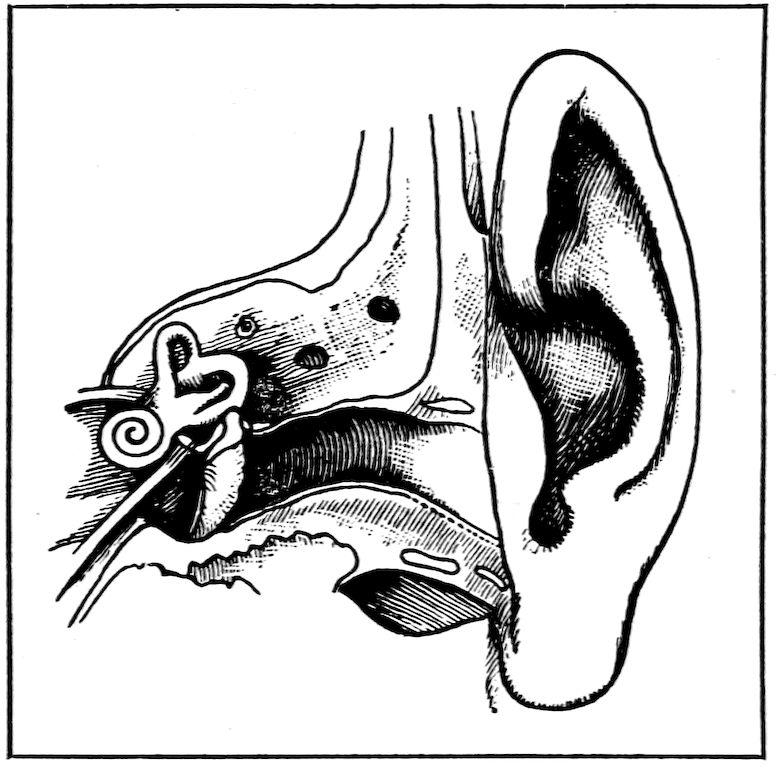
Strange as it may seem, the ears are even
more delicate than the eyes, and more readily
injured; and when hurt, there is less that
science can do for them. The outer ear only
catches sound and turns it inward. The
parts of the ear that really hear are deep in
77the head, where they can be well protected.
The little canal leading into the ear secretes
wax, which hinders insects from crawling
in. Sometimes they do get in, despite the
wax. In some parts of this country, there
are leeches that get into the ear. When
they do this they cause great pain and often
produce deafness. We should never try to
pick or lift anything
of this sort out of the
ear. The best way,
when anything alive
gets into the ear, is
to pour in a little
quantity of oil. This
nearly always causes
the creature which
has gotten in to back
out, in order to escape the oil. If, instead
of coming out, it is drowned, it must be
removed by some skillful physician.
The Ear.
Showing the drum and bones.
Nothing should ever be inserted in the
ear for the purpose of cleaning it except the
little finger. The ear should be washed
78very carefully with soap and water and
dried thoroughly. Sometimes, when swimming,
people get water into their ears. They
should shake it out at once, or the ears may
ache. Sometimes water that gets in this
way causes inflammation and cold, which
hurt the sense of hearing. No one should
ever strike another on the ear, even in play.
It is likely to cause deafness. What is
called the drum of the ear is a very delicate
membrane which receives the sound. This
is what really hears, and a blow on the side
of the head may rupture this membrane and
destroy the hearing.
The sense of smell is high up in the nose.
It is a very useful sense and warns us of
danger. We can often detect bad air by its
odor. We know whether food is good or
whether it is spoiled, by its smell.
We taste things with the tongue. Substances
which do not dissolve in water have
no taste. Even our food would have no taste
if it were dry. The saliva must dissolve it
before we can taste it. We can hurt the
79sense of taste by eating too fast, or by seasoning
our food too strongly with pepper and
other hot spices. Chewing the betel nut
helps to destroy the sense of taste, and so
does much use of alcohol. We need the
sense of taste to tell us whether food is good
or bad. Food which has a pleasant taste is
more easily digested than that which we do
not like.
The sense of touch tells us whether
things are hard or soft; it tells us when we
are hurt. It does this by the feeling which
we call pain. If we did not feel pain when
we were being injured, we might be killed
before we could know of our danger and protect
ourselves from it.
So we see how true it is that our bodies
are wonderful machines. But they are something
besides machines,—they are houses
in which the soul dwells, and as such they
are worthy of great care and honor. We
must keep them clean. It is our duty to
feed them right and guard them from injury.
We should be careful, too, never to injure
80them ourselves by putting them to uses not
clean and pure, or by making them accustomed
to things which are bad for them.
When we do any of these things, we hurt the
soul, as well as the body, and bring shame
upon ourselves and sorrow to others.
Why should we try to keep our bodies well and strong?
What is perspiration?
Why should we bathe often?
How should children be bathed?
When is the best time to bathe?
Why is it imprudent to go barefoot in the tropics?
Is smoking hurtful to boys and girls?
What does it do?
Why is betel chewing injurious?
How does alcohol affect those who drink it to excess?
What is its effect on the mind? On the eyes?
How do we tell what is going on about us?
What are the organs of the five senses?
How can we best take care of our eyes? Of our ears?
What tells us when we are hurt?
What is our duty toward our bodies?
CHAPTER VI. PUBLIC HYGIENE. — QUESTIONS.
81
One of the great questions in which
governments in all countries
are interested is how to keep
down the death rate in great
cities. In olden times there were many
plagues and epidemics. These often destroyed
thousands of lives. People did not
understand why the plagues came; they
used to think them punishments for sin, or
sent by some evil spirit out of hatred to
humanity. They did not know how to meet
them or how to take care of those whom the
plagues attacked, and so whole cities were
sometimes emptied by disease before which
the science of those days was helpless.
But now we have come to know that all
epidemics have natural causes. An epidemic
is always caused either by bad water or
82neglected sewers or poisonous gases arising
from long-gathered filth. In Europe and in
America every city has its system or systems
of sewers, its boards of public health
and of street cleaning. Great care is taken,
and enormous sums of money are spent, to
keep the cities clean, that the people may
be as healthy as possible.
Manila, the capital city of the Philippines,
is one of the largest cities on the Asiatic
coast. It has been, in the past, in very bad
condition because of filth. One of the first
things the Americans began to do when they
came here was to try to make the city clean,
so that it would be more healthful. This
was a very difficult thing to do, because of
the dirt which had been allowed to gather
during many years. It was also difficult
because of the way in which the city of
Manila is built. The ground is low and
marshy. Two feet below the surface of the
earth under the city, water is found almost
everywhere. This keeps the earth damp.
Those who built houses in the past knew
83this, so they laid cement floors in the basements
of their buildings.
But the cement floors were not made as
they should have been. Instead of digging
down into the earth and filling in the excavation,
builders spread the cement on the
surface of the ground and then built their
walls around this platform. The cement
which has been used here is not the best for
such a country as this. It is what is called
Roman cement, very porous, and not hard
and solid, as is the Portland cement in use in
America. The walls of the houses, as well
as the ground floors, were very often of this
cement.
If you take a lamp wick and hold one end
of it in oil, before long not only that end
but the whole wick is wet with the oil. This
is because the porous fibers of the wick have
soaked up the oil. Now, these porous walls
of the houses in Manila take up the moisture
from the earth, so that many of them are
completely soaked with water. When this
is the case, mold begins to grow on the walls.
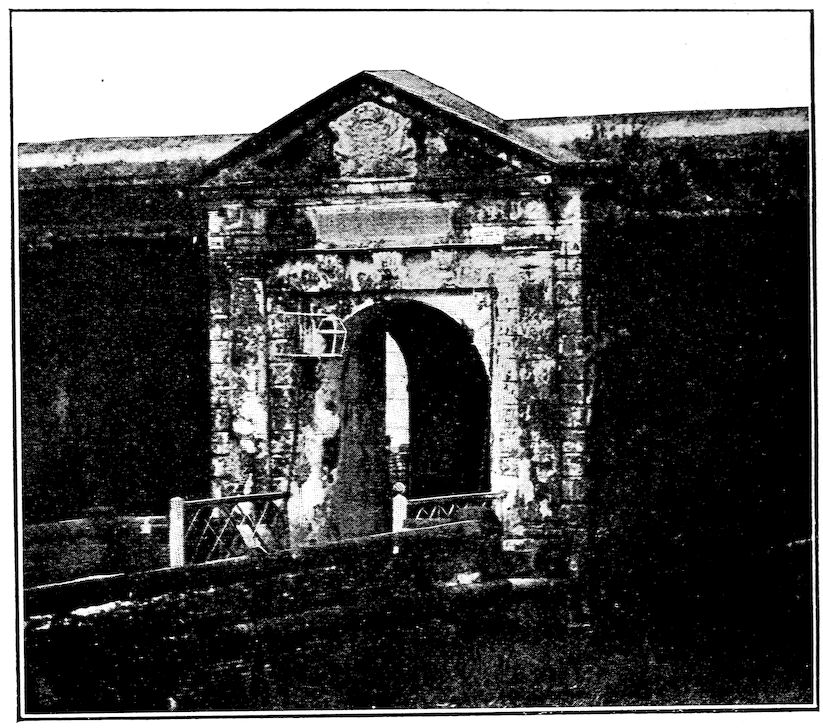
84It is not unusual to see walls quite overgrown
with green mold and moss that always
feels a little damp to the touch.
Gate covered with Unhealthful Mold.
This growth on the walls is a great hurt
to the health of people living in the houses.
It breeds disease, and keeps the moisture in
the walls, so that the houses are damp and
unwholesome. It is of no use to shut our
85windows at night, for the early morning chill
that we hope thus to shut out is in the walls
themselves. It is far better to leave the
windows open, that fresh air may come in
and drive out some of the poisonous vapors
that rise from the walls and creep into the
house. The walls of the house should be
kept clean of mold. They should be scraped
and whitewashed very often, and the green,
unhealthy growth kept down.
In the cities of Europe and America there
are great sewer systems to take the waste
and refuse from the houses and carry it far
from the city. The sewers empty into the
sea or into drainage canals, and thence to
points where the sewage can be destroyed
so that it will not endanger life. The city
of Manila has some sewers. We can see the
openings into them in the streets. They
are small, square openings, covered with
stone. But the sewers that run through the
streets empty into the open moat that surrounds
the walled city! It will become
necessary, before many years, to fill this
86moat, to save the people of Manila from being
killed by the gases that rise from it.
Damp walls, damp floors, damp rooms
close to the ground, make the very best sort
of places for dirt to gather. It is not enough
that walls should be scraped and floors
cleaned once in a while; they must be kept
clean all the time. This is why sanitary
inspectors go about the city to examine
houses and walls and report on their condition.
We should be glad that they do
this; for we know that if they are faithful
about it, the city will be more healthful
and many lives will be saved.
The dirt that gathers in the streets is of
many sorts. A great deal is made by the
horses and carabaos, mules and oxen, that
draw loads about the city. The wheels of
the vehicles, too, grind the stone pavement
to dust, and this is blown about by the wind.
Dead leaves drop from the trees, choke up
the gutters, and, left to themselves, will
make sodden masses of decayed vegetation
in corners. Waste paper blows about, and
87all sorts of unclean things are thrown into
the streets by careless people. It takes a
small army of laborers to keep the streets in
order. They go over the city with brooms,
shovels, and dust-boxes, and sweep and
gather up refuse and dirt. They put it into
carts and take it away to where it is loaded
upon barges and sent out to sea, or used to
fill in low places where it can do no harm.
There is a great deal that each of us can
do to help keep the streets clean. No one
should ever do anything that is likely to leave
any dirt about them. Banana and orange
peel should never be thrown on the sidewalk.
This is not only a dirty and untidy trick, but
often a bit of peel does serious mischief; a
person may step upon one, slip, and get a
very dangerous fall.
School children are the very best sort of
helpers to the street-cleaning department.
They can form what are called “Good-Government”
clubs or societies, to help.
They can keep a sharp lookout for careless
people who are about to throw paper or fruit
88parings into the street. When they see any
one doing this, they should not be afraid to
remind him that it is a dangerous and an untidy
thing to do. Most great cities now provide
sheet-iron boxes along the sidewalks to
receive all these things. We should have them
in Manila. The children could then point
them out to any one who needed to have
his attention called to them. If they saw
paper or peelings lying about, the boys might
pick them up, if no street-cleaner were near,
and put them into the boxes. We may be
sure that girls and boys who were thus careful,
never would do anything themselves to
make the city untidy. They would not throw
paper and peelings about, nor spit upon the
sidewalks. Even school children ought to
remember that they are growing up to be
citizens. They cannot begin too young to take
pride in their city or town or village and try
to make it one of the best-governed places in
the country. They should take pride in keeping
school buildings nice. Even if these
buildings are old, as so many are, at present,
89in the islands, they can still be kept so clean
that any one entering will know that the
pupils are self-governing, order-loving boys
and girls, who will some day be self-governing
and order-loving citizens.
The elements of good living are, after all,
very simple. If we would live long and keep
our bodies in condition to do their work, we
must be clean. We must have clean surroundings;
we must drink pure water and eat
clean, wholesome food. We must not eat
or drink things that will hurt us. We must
do nothing that will make our bodies less
fit dwelling-places for our souls. We must
be honest and kind, ready to help and to
take part in keeping everything about us
clean and well ordered. Thus we shall be
useful citizens, each ready to do his own part
to make this world the place it should be.
What are the causes of epidemics?
Why are damp walls and floors unhealthful?
Is it best, in this country, to sleep with our windows
closed?
90Where should sewers empty?
Why is the sewer system of Manila a bad one?
What sort of dirt gathers in the streets?
How can school children help to keep the city clean?
What should we all try to do if we would live long?
Why is it our duty to do these things?
TRANSCRIBER’S NOTES
Silently corrected typographical errors and variations in spelling.
Archaic, non-standard, and uncertain spellings retained as printed.