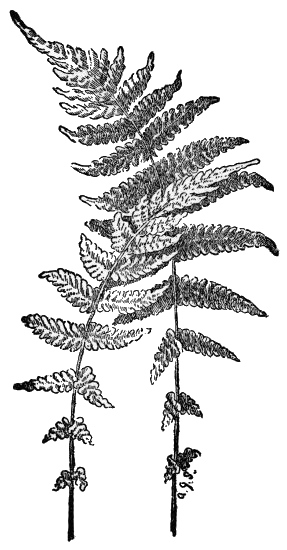
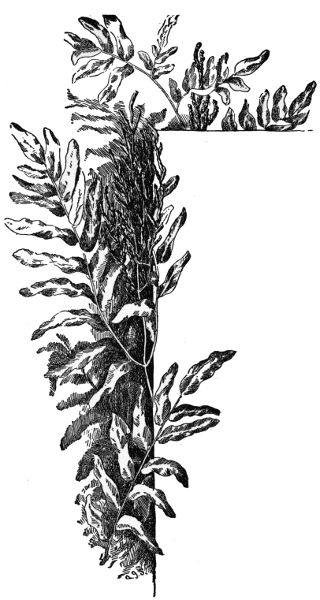
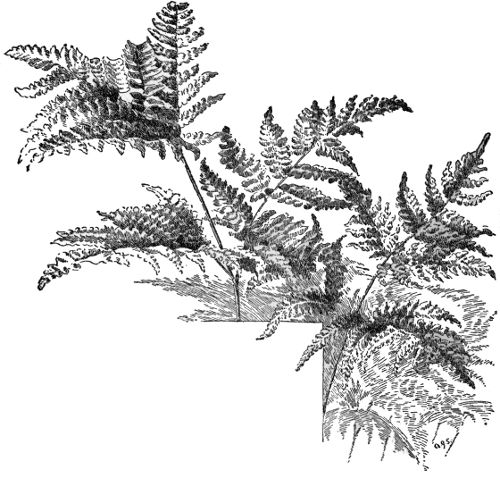
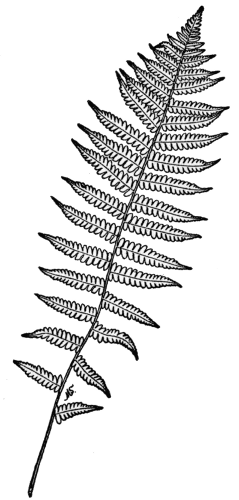
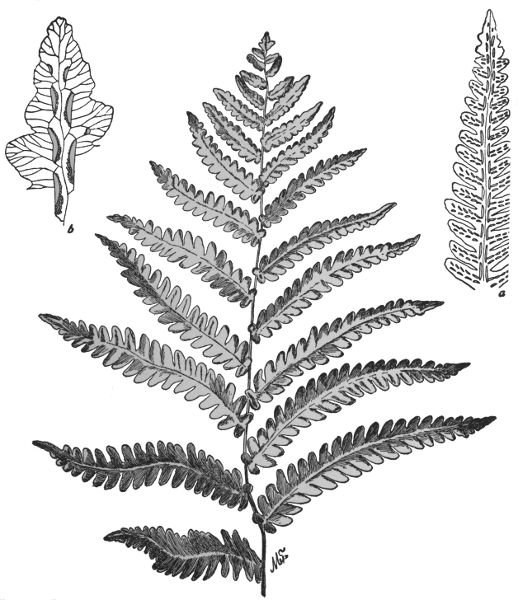
Aspidium Noveboracense (Dryopteris Noveboracensis)
Newfoundland to South Carolina, in woods and open meadows.
One to more than two feet high, with stalks shorter than
the fronds.
Fronds.—Lance-shaped, tapering both ways from the middle
pinnate; pinnæ lance-shaped, the lowest pairs shorter and
deflexed, divided into flat, oblong lobes which are not
reflexed over the fruit-dots; fruit-dots round, distinct,
near the margin; indusium minute.
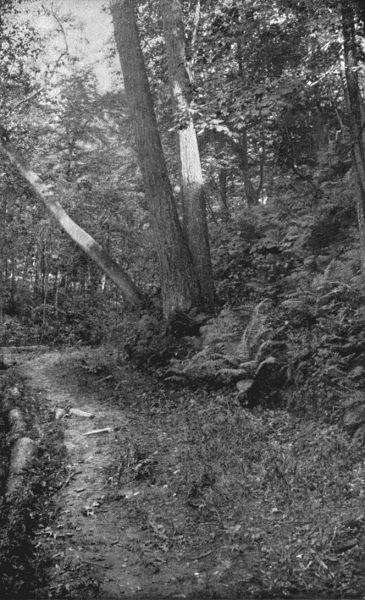
At times the pale-green fronds of the New York Fern throng to the
roadside, which is flanked by a tangled thicket of Osmundas, wild
roses, and elder bushes.
Again, they stay quietly at home in the open marsh or in the shadow
of the hemlocks and cedars, where they have fragrant pyrola and
pipsissewa for company, and where the long, melancholy note of the
peewee breaks the silence.
This plant is easily distinguished from the Marsh Fern by the
noticeable tapering at both ends of its frond, and by the flat instead
of reflexed margins to the lobes of the fertile pinnæ.
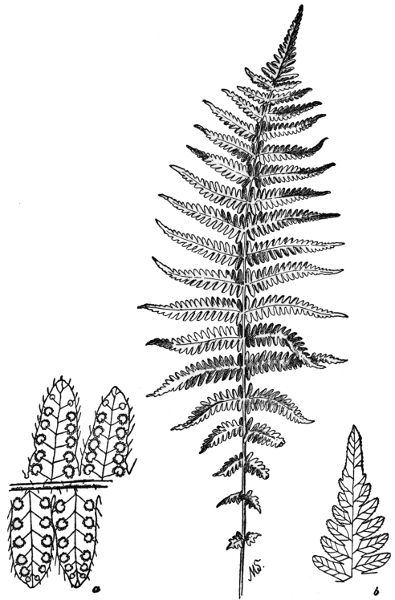
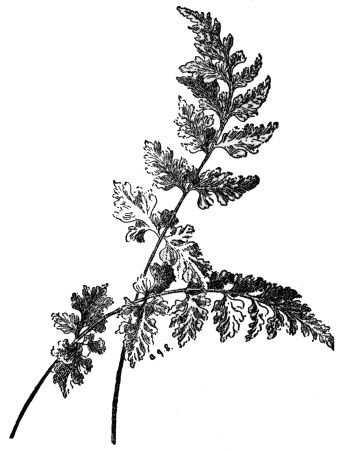
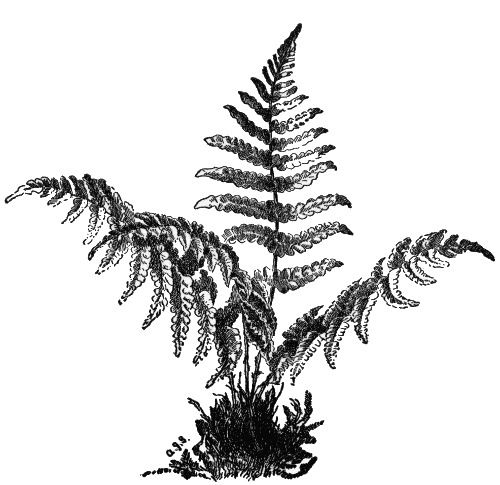
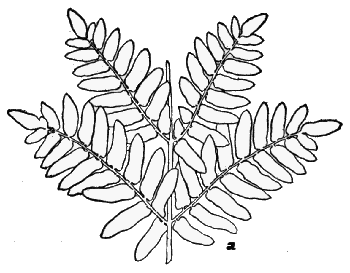
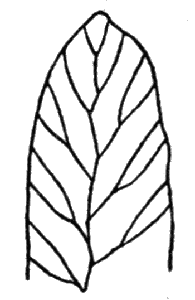
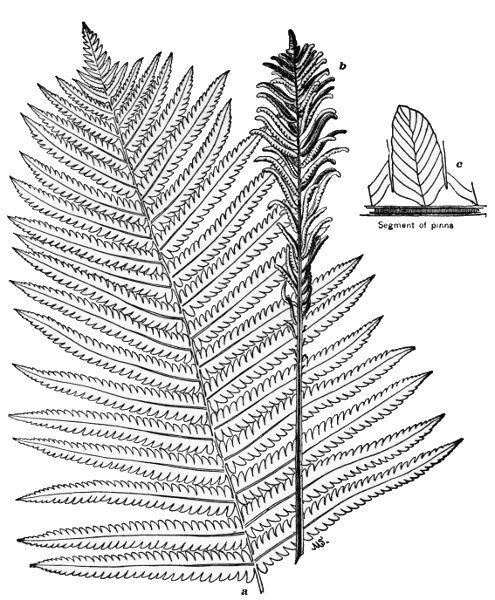
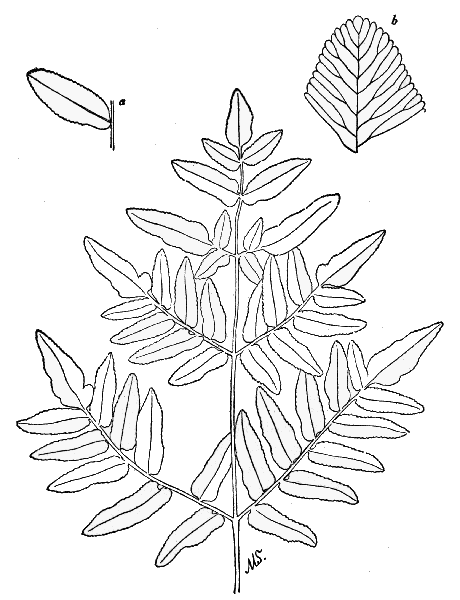
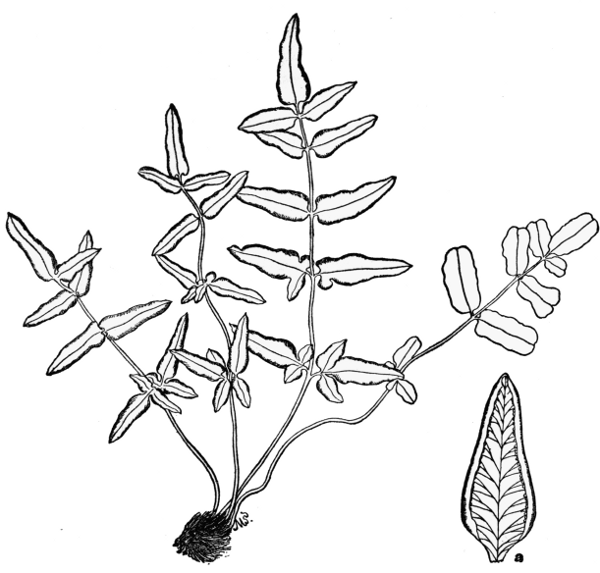
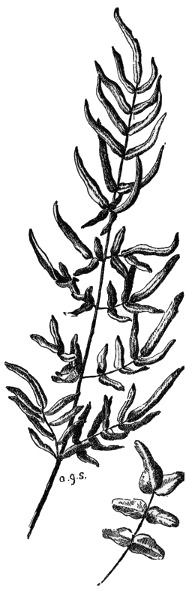
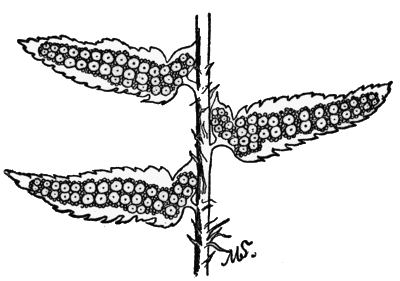
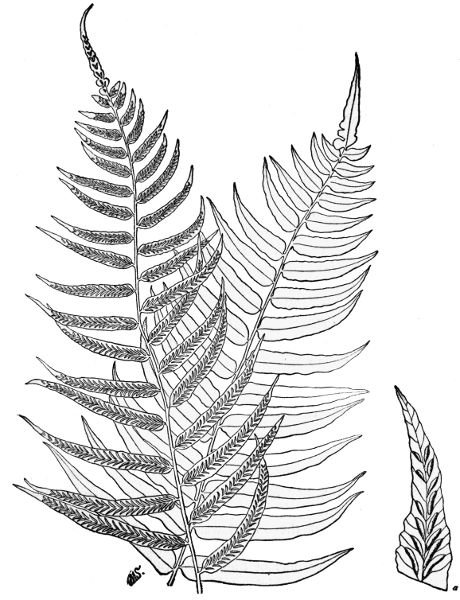
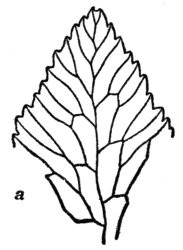
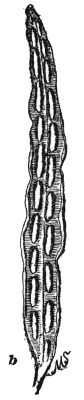
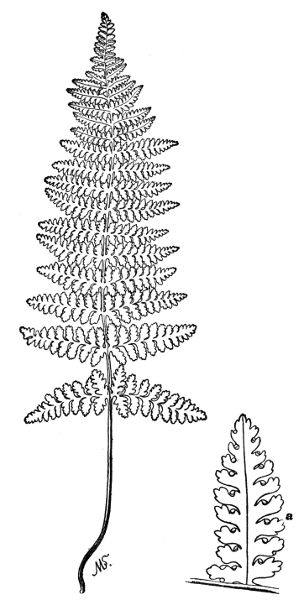
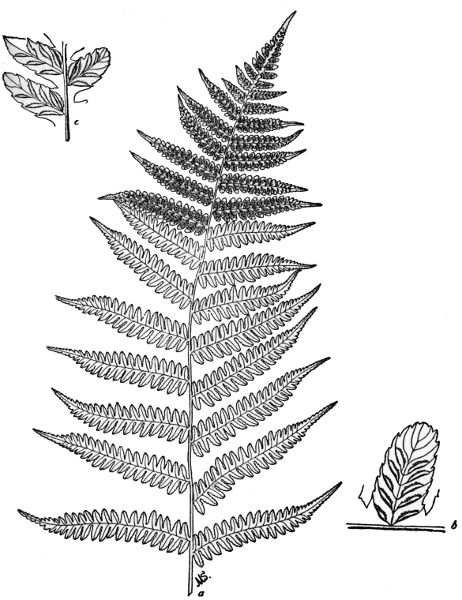
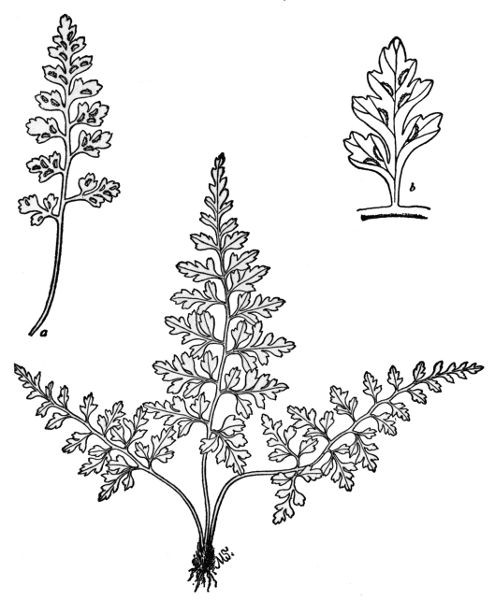
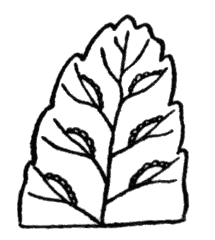
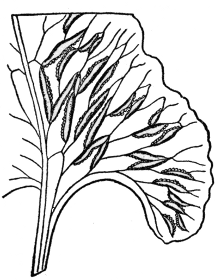
PLATE XXV
NEW YORK FERN
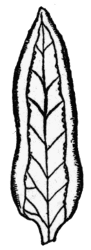
a Portion of fertile pinna
b Tip of pinna showing veining
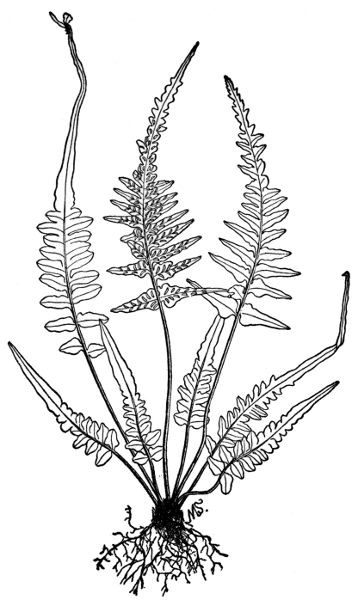
Aspidium Thelypteris (Dryopteris Thelypteris)
New Brunswick to Florida, in wet woods and swamps. One to
nearly three feet high.
Fronds.—Lance-shaped, slightly downy, once-pinnate,
fertile fronds longer-stalked than the sterile; pinnæ,
the lower ones hardly smaller than the others, cut into
oblong, entire lobes, which are obtuse in the sterile
fronds, but appear acute in the fertile ones from the
strongly revolute margins; veins once or twice forked;
fruit-dots small, round, half-way between midvein and
margin, or nearer margin, soon confluent; indusium small.
In our wet woods and open swamps, and occasionally in dry pastures,
the erect, fresh-green fronds of the Marsh Fern grow abundantly. The
lowest pinnæ are set so high on the long slender stem as to give the
fern the appearance of trying to keep dry, daintily holding its skirts
out of the mud as it were.
The plant's range is wide. As I pick my way through marshy inland
woods, using as bridges the fallen trunks and interlacing roots of
trees, its bright fronds standing nearly three feet high, crowd about
me. Close by, securing, like myself, a firmer foothold by the aid
of the trees' roots, I notice the flat,
mottled green and white
rosettes and the slender wands of flowers of the rattlesnake orchid.
In the open swamps beyond the fern's companion is another orchid,
the ladies' tresses, with braided spikes of white, and in this case
deliciously fragrant flowers.
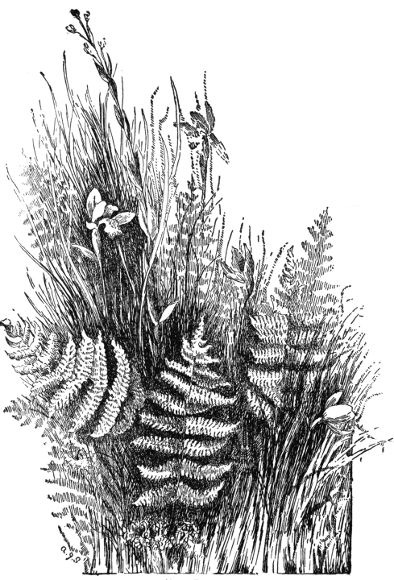
Marsh Fern
In open marshes near the sea I find this plant associating itself with
the violet-scented adder's mouth, with glistening sundew, and with
gaudy Turk's-cap lilies.
From the New York Fern it may be distinguished easily by the somewhat
abrupt instead of tapering base of the frond, by the strongly
revolute margins of the fertile frond, and by its long stalk.
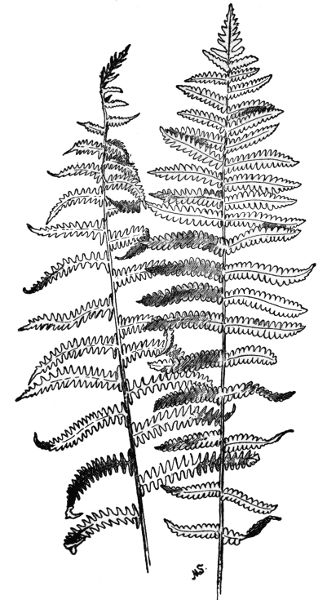
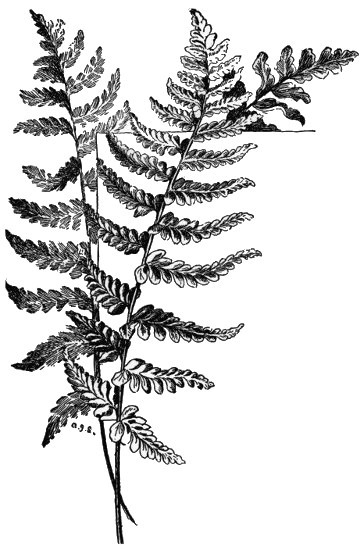
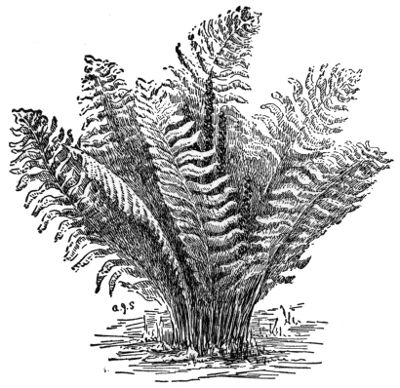
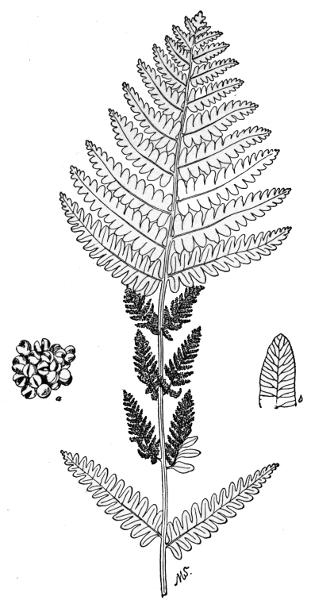
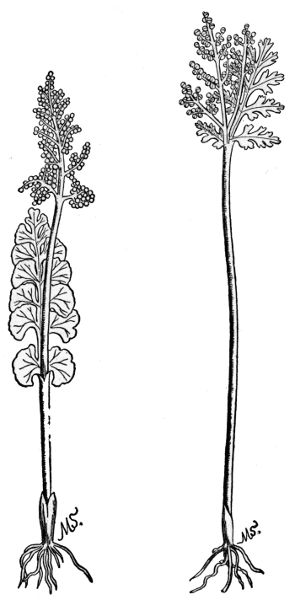
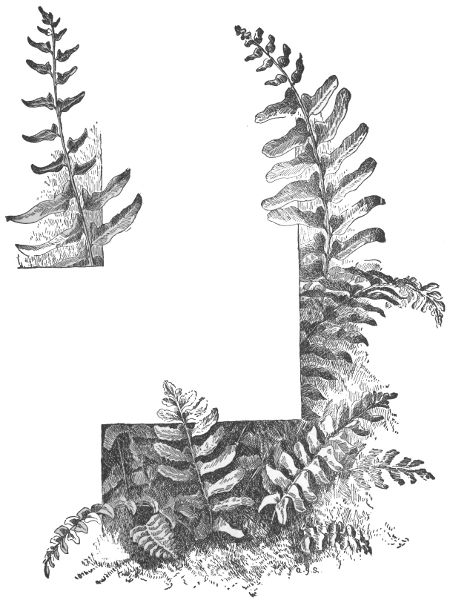
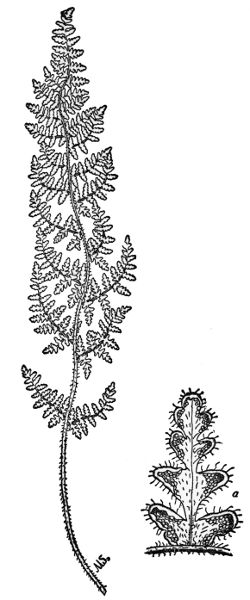
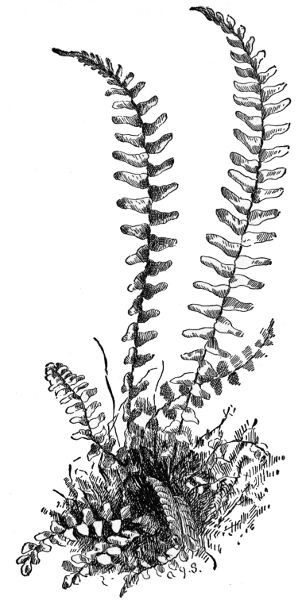
PLATE XXVI
MARSH FERN
Fertile frond
Sterile frond
From the Massachusetts Fern it may be distinguished by its forked
veins, the less revolute margins of the fertile frond, and by its
thicker texture and deeper green.
Aspidium simulatum (Dryopteris simulata)
New Hampshire to the Indian Territory, in wooded swamps.
One to more than three feet high.
Fronds.—Oblong-lance-shaped, little or not at all
narrowed at the base, rather thin, pinnate; pinnæ
lance-shaped, cut into oblong, obtuse segments, which are
slightly reflexed in the fertile fronds, veins not forked;
fruit-dots rather large, somewhat distant; indusium
"withering-persistent."
This species closely resembles the Marsh Fern. The less revolute
margins of the fertile frond, the simple veins, its thinner texture,
and its more distant fruit-dots aid in its identification. It is found
in woodland swamps from New Hampshire to the Indian Territory.
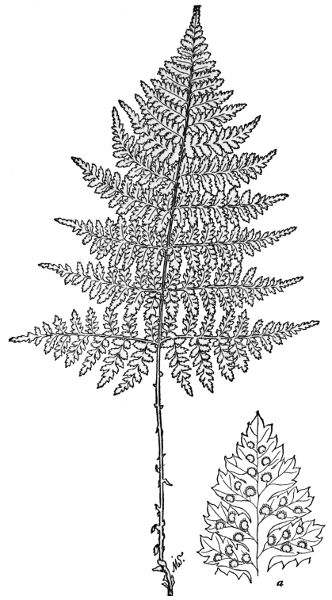
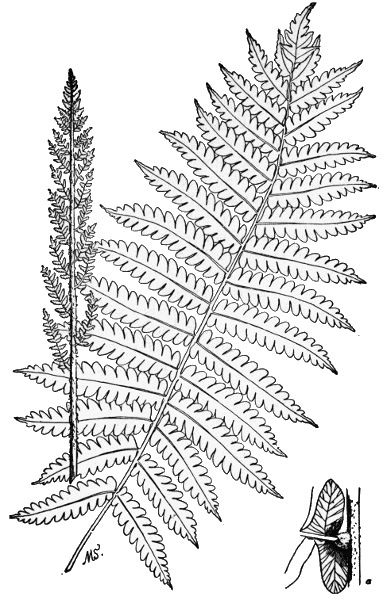
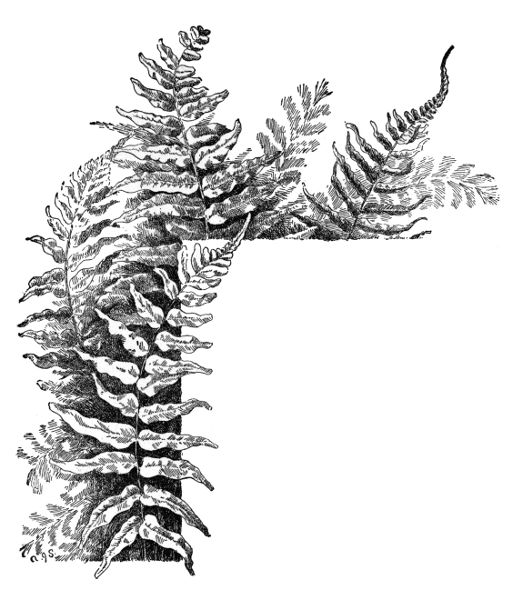
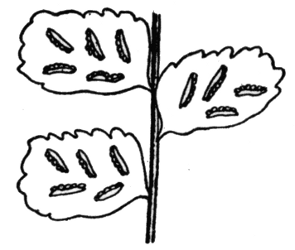
PLATE XXVII
SPINULOSE WOOD FERN
Aspidium spinulosum, var. intermedium
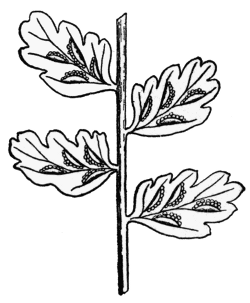
a Portion of fertile pinnule
Newfoundland to Kentucky. The common European type, rare in
North America. One to two and a half feet high, with stalks
having a few pale-brown deciduous scales.
Fronds.—Lance-ovate, twice-pinnate; pinnæ oblique to
the rachis, elongated-triangular, the lower ones broadly
triangular; pinnules oblique to the midrib, connected
by a narrow wing, cut into thorny-toothed segments;
fruit-dots round; indusium smooth, without marginal
glands, soon withering.
To my knowledge I have only seen this fern in the herbarium, it being
rare in this country. It is found, I have been told, chiefly toward
the tops of mountains. Its pinnæ are noticeably ascending.
Labrador to North Carolina, in woods almost everywhere.
Usually large, with somewhat chaffy stalks, having brown,
dark-centred scales.
Fronds.—Oblong-ovate, 2-3 pinnate; pinnæ
oblong-lance-shaped, spreading, rather distant, the lowest
unequally triangular, the pinnules on the lower side longer
than those on the upper side; pinnules ovate-oblong,
spreading, with oblong lobes thorny-toothed at the apex;
fruit-dots round; indusium delicate, beset with tiny
stalked glands.
This is the form of the species that abounds in our woods. Perhaps no
one plant does more for their beauty than this stately fern, whose
rich-green, outward-curving fronds spring in circles from fallen trees
and decaying stumps as well as from the ground.
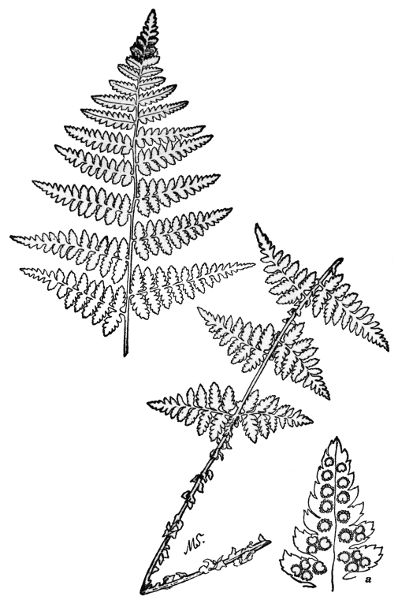
PLATE XXVIII
BOOTT'S SHIELD FERN
a Tip of fertile pinna
The plant varies greatly in height, breadth, and way of holding
itself. Sometimes the fronds stand three feet high, and are broad and
spreading. Again, they are tall, slender, and somewhat erect. Again,
they are not more than a foot high.
At its best it grows with almost tropical luxuriance and is a plant
of rare beauty, its fronds having a certain featheriness of aspect
uncommon in the Aspidiums.
Newfoundland to North Carolina, chiefly in the mountains.
Fronds.—Usually large, broader at base than in either of
the preceding species, ovate or triangular-ovate, oftenest
thrice-pinnate; pinnules lance-oblong, the lowest often
much elongated; fruit-dots round; indusium smooth.
This form of the Spinulose Wood Fern is distinguished chiefly by
its broader fronds and by the smooth indusia. As these indusia
can be seen satisfactorily only by the aid of a magnifying-glass,
there is frequently some difficulty in distinguishing this variety.
Occasionally it occurs in a dwarf state, fruiting when only a few
inches high.
Aspidium Boottii (Dryopteris Boottii)
Nova Scotia to Maryland, about ponds and in wet places.
One and a half to more than three feet high, with somewhat
chaffy stalks which have pale-brown scales.
Fronds.—Long lance-shaped, somewhat narrowed at base,
nearly or quite twice-pinnate; pinnæ, the lowest
triangular-ovate, upper longer and narrower; pinnules
oblong-ovate, sharply thorny-toothed, somewhat pinnatifid
below; fruit-dots round; indusium slightly glandular.
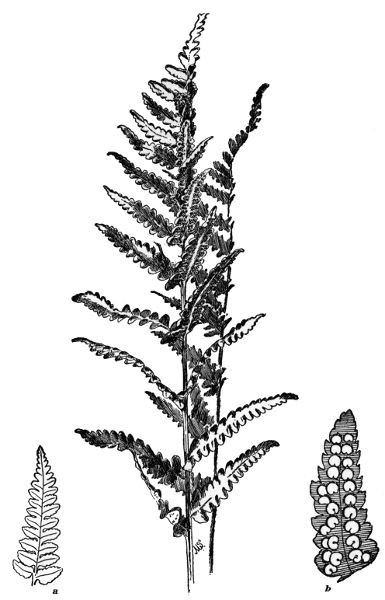
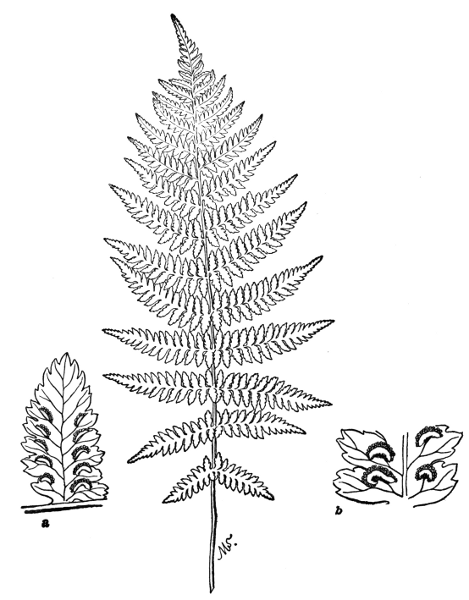
PLATE XXIX
CRESTED SHIELD FERN
a A pinna
b Portion of fertile pinna
Boott's Shield Fern is found in moist woods and near ponds. It is
distinguished by its long, narrow fronds and minutely glandular
indusium.
Aspidium cristatum (Dryopteris cristata)
Newfoundland to Kentucky, in swamps. One to more than three
feet high, with stalks which are chaffy, especially below,
and which have light-brown scales, stalks of sterile fronds
much shorter than those of fertile fronds.
Fronds.—Linear-oblong or lance-shaped, nearly
twice-pinnate, fertile ones taller and longer stalked
than the sterile; pinnæ (of the fertile frond, turning
their faces toward the apex of the frond) rather short,
lance-shaped or triangular-oblong, deeply impressed with
veins, cut deeply into oblong, obtuse, finely toothed
divisions; fruit-dots large, round, half-way between
midvein and margin; indusium large, flat.
In wet woods, growing either from the ground or from the trunks of
fallen trees, and also in open meadows, we notice the tall, slender,
dark-green, somewhat lustrous fronds of the Crested Shield Fern,
usually distinguished easily from its kinsmen by the noticeably
upward-turning pinnæ of the fertile fronds, and by the deep impression
made by the veins on their upper surfaces.
The sterile fronds are much shorter than the fertile ones. They are
evergreen, lasting through the winter after the fertile fronds have
perished.
Near the Crested Shield Fern we find often many of its kinsmen,
broad, feathery fronds of the Spinulose Wood Fern, more slender
ones of Boott's Shield Fern, great tufts made by the magnificent
bright-green fronds of Goldie's Fern, symmetrical circles of vigorous
Evergreen Wood Fern, and shining clusters of the Christmas Fern. All
these plants, belonging to the one tribe, seek the same moist, shaded
retreats, and form a group of singular beauty and vigor.
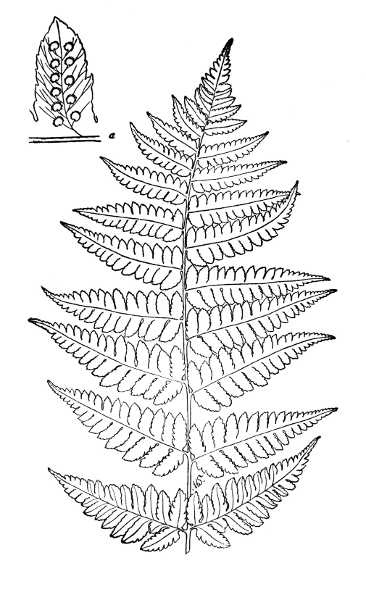
PLATE XXX
Part of CLINTON'S WOOD FERN
a Portion of fertile pinna
Aspidium cristatum, var. Clintonianum (Dryopteris
cristata Clintoniana)
Maine to New Jersey and Pennsylvania, in swampy woods. Two
and a half to four feet high.
Fronds.—Larger in every way than those of the Crested
Shield Fern, nearly twice-pinnate; pinnæ broadest
at base, cut into from eight to sixteen pairs of
linear-oblong, obtuse, obscurely toothed divisions;
fruit-dots large, round, near the midvein; indusium
orbicular, smooth.
This is a much larger and more showy plant than the Crested Shield
Fern. Its tall, broad, hardy-looking fronds are found in our moist
woods. While not rare it is exclusive in its habits, and cannot
be classed with such every-day finds as its kinsmen, the Marsh,
Spinulose, Evergreen, and Christmas Ferns.
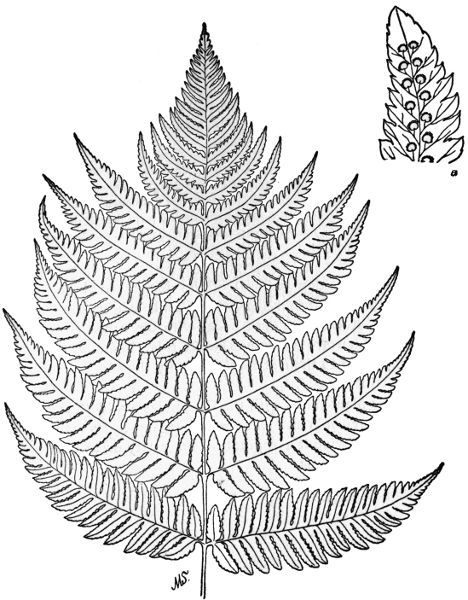
PLATE XXXI
Part of fertile frond of Goldie's Fern
a Portion of a fertile pinna
Aspidium Goldianum (Dryopteris Goldieana)
New Brunswick to North Carolina and Tennessee, in rich
woods. Two to more than four feet high, with stalks which
are chaffy near the base.
Fronds.—Broadly ovate, the early sterile ones much
broader in proportion and smaller, usually a foot or more
wide, once-pinnate; pinnæ pinnatifid; broadest in the
middle (the distinction from Clinton's Wood Fern), the
divisions, about twenty pairs, oblong-linear, slightly
toothed; fruit-dots very near the midvein; indusium
very large, orbicular.
In the golden twilight of the deeper woods this stately plant unfurls
its tall, broad, bright-green fronds, studded on their backs with the
round fruit-dots which are so noticeable in this Aspidium, adding
much to their attractiveness by the suggestion of fertility.
This plant ranks with the Osmundas and with the Ostrich Fern in size
and vigorous beauty. Its retiring habits give it a reputation for
rarity or at least for exclusiveness.
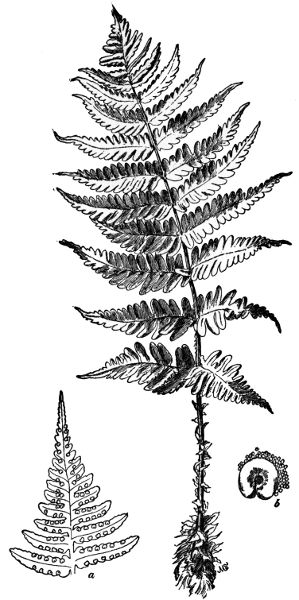
PLATE XXXII
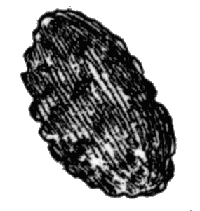
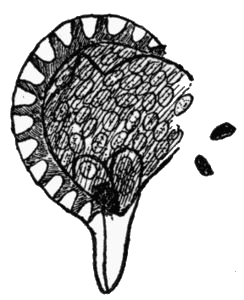
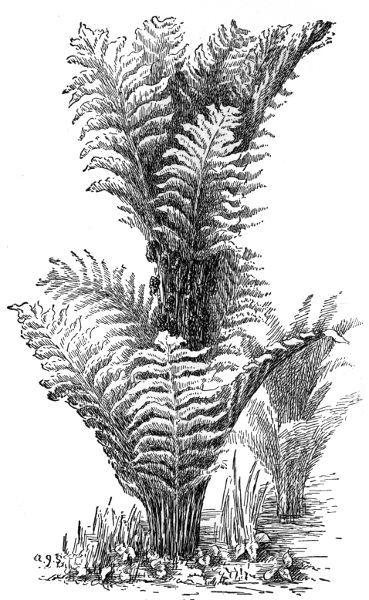
EVERGREEN WOOD FERN
a Tip of fertile pinna
b Magnified fruit-dot, showing indusium and sporangia
Aspidium marginale (Dryopteris marginalis)
Canada to Alabama, in rocky woods. A few inches to three
feet high, with more or less chaffy stalks having shining
scales.
Fronds.—Ovate-oblong, smooth, thick, somewhat
leathery, once or twice-pinnate; pinnæ lance-shaped or
triangular-ovate, tapering at the end, cut into pinnules;
pinnules oblong, entire, or toothed; fruit-dots large,
round, close to the margin; indusium large, convex,
persistent.
Above the black leaf-mould in our rocky northern woods rise the firm,
graceful crowns formed by the blue-green fronds of the Evergreen Wood
Fern. The plant bears a family likeness to the Crested Shield Fern,
but its conspicuously marginal fruit-dots identify it at sight.
It is interesting to read that it comes "nearer being a tree-fern than
any other of our species, the caudex covered by the bases of fronds
of previous seasons, sometimes resting on bare rocks for four or five
inches without roots or fronds" (see Eaton, p. 70). This peculiarity
in the plant's growth is often striking and certainly suggests the
tree-ferns of the green-house.
Frequently in this species I notice what is more or less common to
nearly all ferns, the exquisite contrast in the different shades of
green worn by the younger and older fronds and the charming effect
produced when the deep green of the centre of a frond shades away in
the most delicate manner toward its apex and the tips of its pinnules.
As its English title signifies, the Evergreen Wood Fern flourishes
throughout the winter. In one of the October entries in his journal,
Thoreau records his satisfaction in the endurance of the hardy ferns:
"Now they are conspicuous amid the withered leaves. You are
inclined to approach and raise each frond in succession,
moist, trembling, fragile greenness. They linger thus
in all moist, clammy swamps under the bare maples and
grapevines and witch hazels, and about each trickling
spring that is half choked with fallen leaves. What means
this persistent vitality? Why were these spared when the
brakes and osmundas were stricken down? They stay as if
to keep up the spirits of the cold-blooded frogs which
have not yet gone into the mud, that the summer may die
with decent and graceful moderation. Is not the water of
the spring improved by their presence? They fall back and
droop here and there like the plumes of departing summer,
of the departing year. Even in them I feel an argument for
immortality. Death is so far from being universal. The same
destroyer does not destroy all. How valuable they are,
with the lycopodiums, for cheerfulness. Greenness at the
end of the year, after the fall of the leaf, a hale old
age. To my eye they are tall and noble as palm-groves, and
always some forest nobleness seems to have its haunt under
their umbrage. All that was immortal in the swamp herbage
seems here crowded into smaller compass, the concentrated
greenness of the swamp. How dear they must be to the
chickadee and the rabbit! the cool, slowly retreating
rear-guard of the swamp army."
Aspidium fragrans (Dryopteris fragrans)
Northern New England to Wisconsin and northward, on rocks.
Five to sixteen inches long, with very chaffy stalks having
brown, glossy scales.
Fronds.—Lance-shaped, tapering to a point, nearly
twice-pinnate, fragrant; pinnæ oblong-lanceolate,
pinnatifid; fruit-dots round, large; indusium large and
thin.
The Fragrant Shield Fern thrives in a colder climate than that chosen
by many of its kinsmen. Though found in the White Mountains, in the
Green Mountains (where it climbs to an elevation of four thousand
feet), in the Adirondacks, and in other special localities of about
the same latitude, yet it is rare till we journey farther north. It
loves the crevices of shaded cliffs or mossy rocks, often thriving
best in the neighborhood of rushing brooks and waterfalls. Frequently
it seems to seek the most inaccessible spots, as if anxious to evade
discovery. Mr. J. A. Bates, of Randolph, Vt., writes that he first saw
this little plant through a telescope from the piazza of the Summit
House on Mount Mansfield on an apparently inaccessible ledge, the
only instance in my experience when the fern student has sought this
method of observation, suggesting "Ferns Through a Spy-glass" as a
companion volume to "Birds Through an Opera-glass." But even the most
carefully chosen spots are not safe from invasion, as Mr. Bates tells
us, for some unprincipled persons, having felled neighboring trees and
constructed a rude ladder, have succeeded in uprooting every plant
from the Fragrant Shield Fern Cliff on Mount Mansfield.
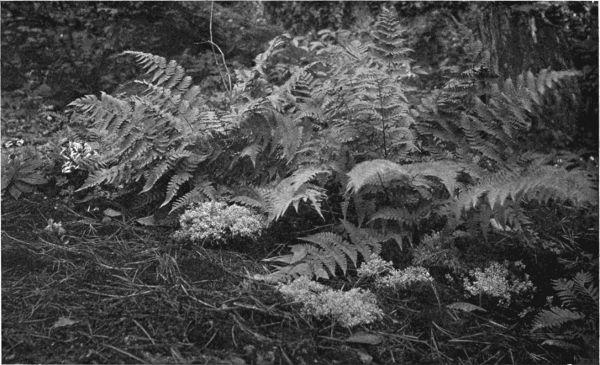
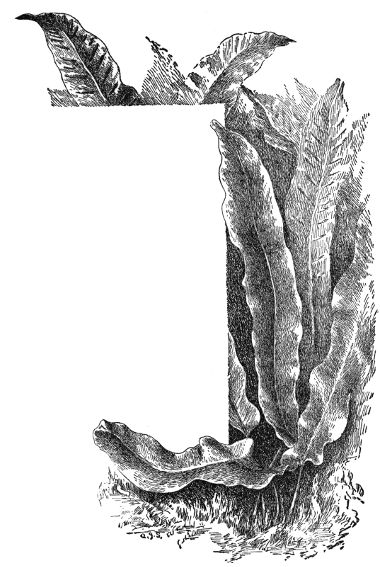
"Like the plumes of departing summer"
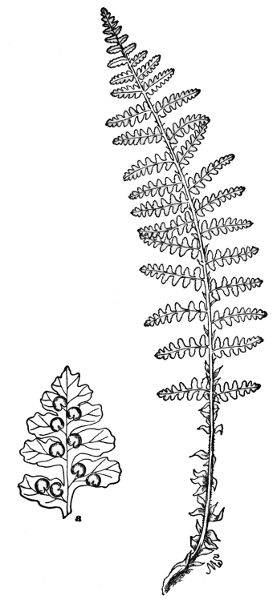
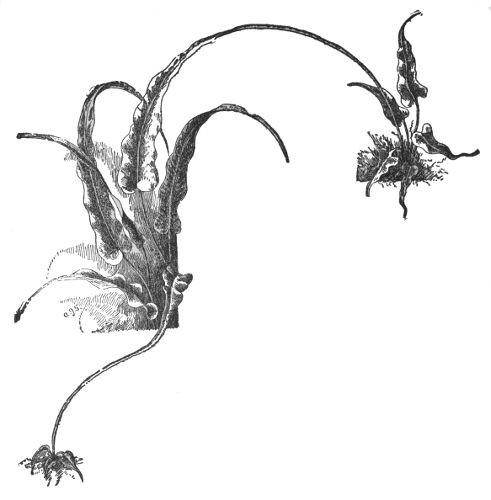
PLATE XXXIII
FRAGRANT SHIELD FERN
a Portion of fertile pinna
The fronds of the Fragrant Shield Fern grow in a crown and the fertile
ones fruit in great abundance.
Eaton writes as follows touching the fragrance of this fern and its
use as a beverage:
"The pleasant odor of this plant remains many years in the
herbarium. The early writers compare the fragrance to that
of raspberries, and Milde repeats the observation. Hooker
and Greville thought it 'not unlike that of the common
primrose.' Maximowicz states that the odor is sometimes
lacking. Milde quotes Redowsky as saying that the Yakoots
of Siberia use the plant in place of tea; and, having tried
the experiment myself, I can testify to the not unpleasant
and very fragrant astringency of the infusion."
The following delightful description of the Fragrant Shield Fern was
written by Mr. C. G. Pringle, and is taken from Meehan's "Native
Flowers and Ferns":
"In the several stations of Aspidium fragrans among the
Green Mountains which I have explored, the plant is always
seen growing from the crevices or on the narrow shelves of
dry cliffs—not often such cliffs as are exposed to the
sunlight, unless it be on the summits of the mountains,
but usually such cliffs as are shaded by firs, and notably
such as overhang mountain-rivulets and waterfalls. When I
visit such places in summer, the niches occupied by the
plants are quite dry. I think it would be fatal to the
plant if much spray should fall on it during the season of
its active growth. When you enter the shade and solitude of
the haunts of this fern, its presence is betrayed by its
resinous odor; looking up the face of the cliff, usually
mottled with lichens and moss, you see it often far above
your reach hanging against the rock, masses of dead brown
fronds, the accumulations of many years, preserved by the
resinous principle which pervades them; for the fronds, as
they disport regularly about the elongating caudex, fall
right and left precisely like a woman's hair. Above the
tuft of drooping dead fronds, which radiate from the centre
of the plant, grow from six to twenty green fronds, which
represent the growth of the season, those of the preceding
year dying toward autumn."
Aspidium aculeatum, var. Braunii (Dryopteris Braunii)
Canada to Maine, the mountains of Pennsylvania and
westward, in deep rocky woods. One to more than two feet
long, with chaffy stalks, having brown scales.
Fronds.—Thick, twice-pinnate; pinnæ lanceolate,
tapering both ways; pinnules covered with hairs and
scales, truncate, nearly rectangular at the base;
fruit-dots roundish, small, mostly near the midveins;
indusium orbicular, entire.
This fern is said to have been first discovered by Frederick Pursh in
1807 in Smuggler's Notch, Mount Mansfield, Vt. In the Green Mountains
and in the Catskills several stations have been established. It has
been found also in the Adirondacks and in Oswego County, N. Y., and it
is now reported as common in the rocky woods of northern Maine, and by
mountain brooks in northern New England.
Braun's Holly Fern is one of the numerous varieties of the Prickly
Shield Fern or A. aculeatum (D. aculeata).
Though few of our fern-students will have an opportunity to follow
the Prickly Shield Fern through all the forms it assumes in different
parts of the world, yet undoubtedly many of them will have the
pleasure of seeing in one of its lonely and lovely haunts our own
variety, Braun's Holly Fern.
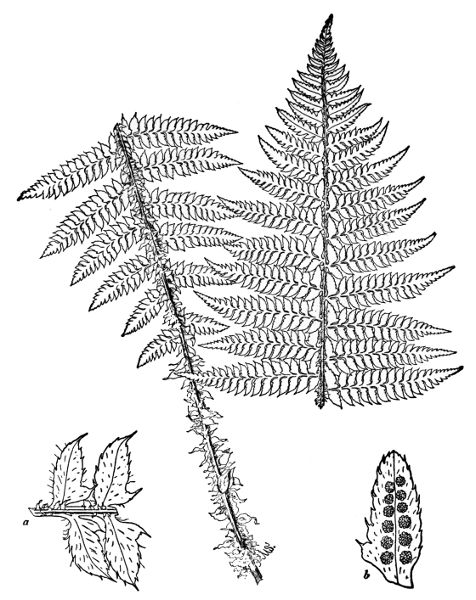
PLATE XXXIV
BRAUN'S HOLLY FERN
a Portion of pinna
b Fertile pinnule, indusia gone
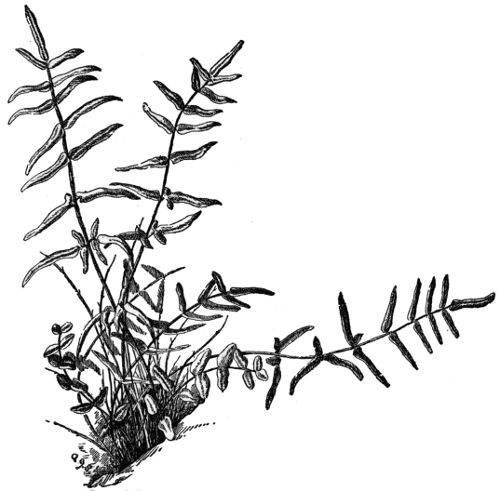
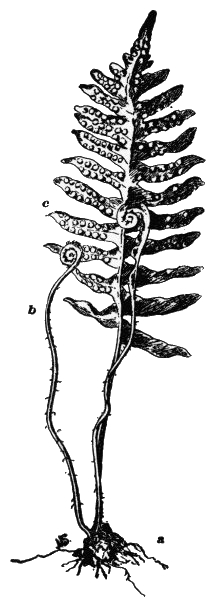
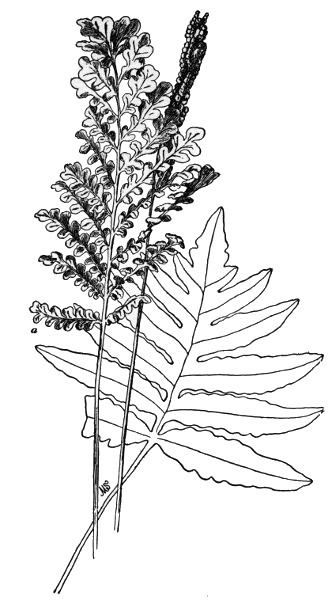
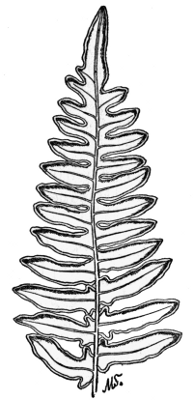
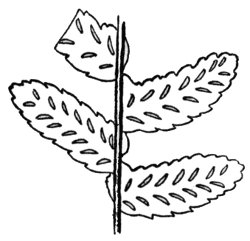
Polypodium vulgare
Almost throughout North America, on rocks. A few inches to
more than a foot high.
Fronds.—Oblong, smooth, somewhat leathery, cut into
narrowly oblong, usually obtuse divisions which almost
reach the rachis; fruit-dots large, round, half-way
between the midrib and margin; indusium, none.
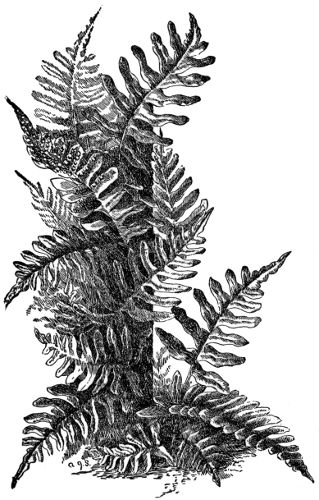
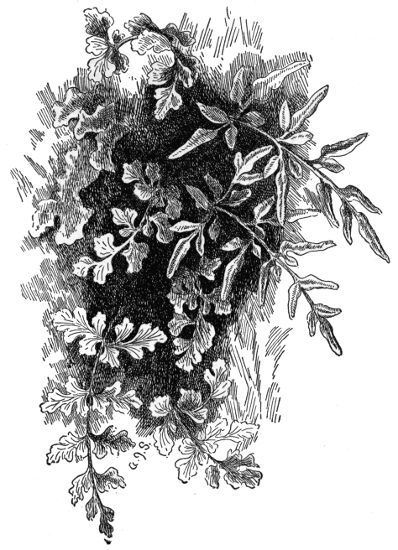
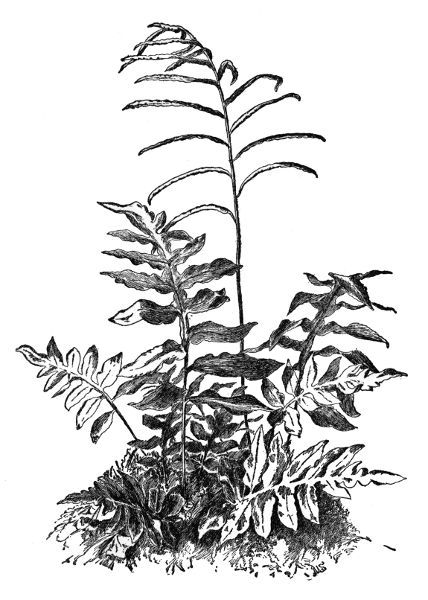
Polypody
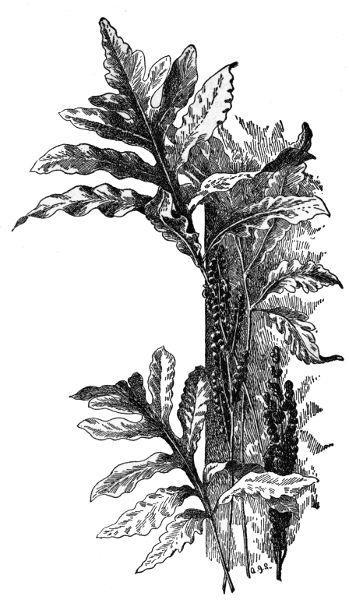
Strangely enough, the Polypody, one of our most abundant and
ubiquitous ferns, is not rightly named, if it is noticed at all,
by nine out of ten people who come across it in the woods or along
the roadside. Yet the plant has a charm peculiarly its own, a charm
arising partly from its vigor, from the freshness of its youth and the
endurance of its old age, partly from its odd outlines, and partly
from its usual environment, which entitles it to a more ready and
universal recognition.
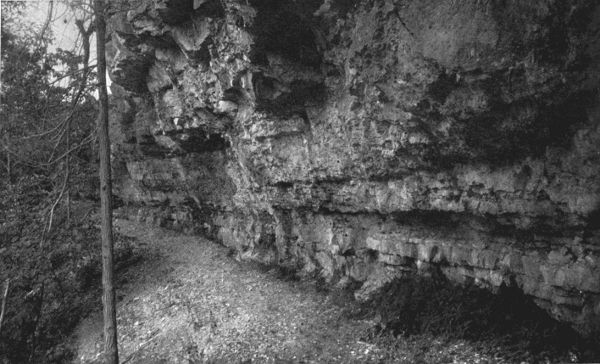
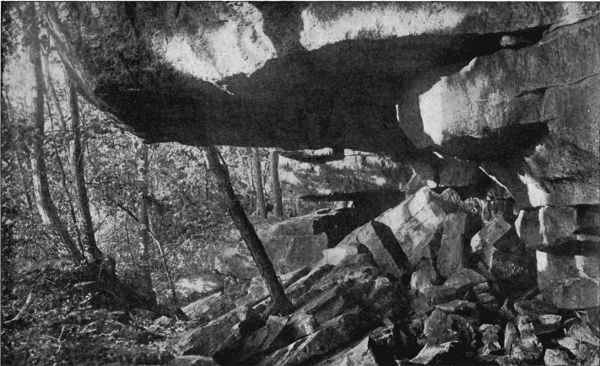
"The cheerful community of the polypody," as Thoreau calls it, thrives
best on the flat surfaces of rocks. I recall the base of certain great
cliffs where the rocky fragments, looking as though hurled from above
by playful giants, are thickly covered with these plants, their rich
foliage softening into beauty otherwise rugged outlines. Usually the
plant is found in somewhat shaded places. Occasionally it grows on the
trunks of trees and on fallen logs, as well as on rocks and cliffs.
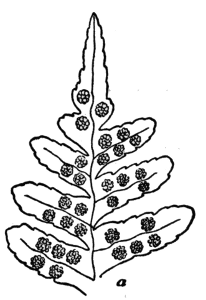
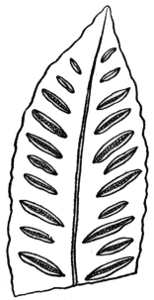
Tip of fertile frond
A few weeks ago I found its fronds prettily curtaining the cleverly
hidden nest of a pair of black and white creepers. It is with good
reason that these birds are noted for their skill in concealing their
dwelling-place. This special afternoon, when persuaded by their
nervous chirps and flutterings about the rocky perch where I was
sitting that the young ones were close by, I began an investigation of
my precipitous and very slippery surroundings which was not rewarded
for an hour or more. Not till I had climbed several feet over the
side of the cliff to a narrow shelf below, broken through a thicket
of blueberries, and pushed aside the tufts of Polypody which hid the
entrance to the dark crevice in the rocks beyond, did I discover the
little nest holding the baby creepers.
Thoreau writes of the Polypody with peculiar sympathy:
"It is very pleasant and cheerful nowadays, when the brown
and withered leaves strew the ground and almost every plant
is fallen withered, to come upon a patch of polypody ...
on some rocky hill-side in the woods, where, in the midst
of dry and rustling leaves, defying frost, it stands so
freshly green and full of life. The mere greenness, which
was not remarkable in the summer, is positively interesting
now. My thoughts are with the polypody a long time after
my body has passed.... Why is not this form copied by our
sculptors instead of the foreign acanthus leaves and bays?
How fit for a tuft about the base of a column! The sight
of this unwithering green leaf excites me like red at some
seasons. Are not wood-frogs the philosophers who frequent
these groves? Methinks I imbibe a cool, composed, frog-like
philosophy when I behold them. The form of the polypody is
strangely interesting, it is even outlandish. Some forms,
though common in our midst, are thus perennially foreign as
the growth of other latitudes.... The bare outline of the
polypody thrills me strangely. It only perplexes me. Simple
as it is, it is as strange as an oriental character. It
is quite independent of my race and of the Indian, and of
all mankind. It is a fabulous, mythological form, such as
prevailed when the earth and air and water were inhabited
by those extinct fossil creatures that we find. It is
contemporary with them, and affects us somewhat as the
sight of them might do."
Phegopteris polypodioides (P. Phegopteris)
Newfoundland to Alaska, south to mountains of Virginia, wet
woods and hill-sides. Six or eight inches to more than a
foot high.
Fronds.—Triangular, usually longer than broad (4-9
inches long, 3-6 inches broad), downy, especially beneath,
thin, once-pinnate; pinnæ lance-shaped, the lower pair
noticeably standing forward and deflexed, cut into oblong,
obtuse segments; fruit-dots small, round, near the
margin; indusium, none.
Of the three species of Phegopteris native to the northeastern
States P. polypodioides, commonly called the Long Beech Fern, is the
one I happen to have encountered oftenest.
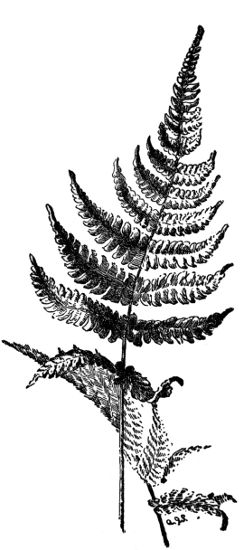
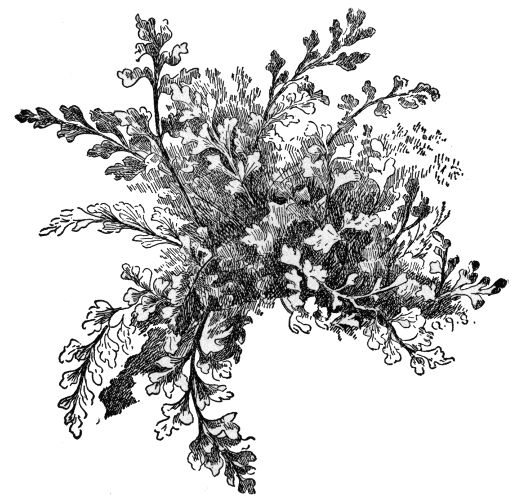
Long Beech Fern
It is a less delicate plant than either of its sisters, the effect
of the larger and older specimens being rather hardy, yet its downy,
often light-green, triangular frond is exceedingly pretty, with
a certain oddity of aspect which it owes to the lowest pair of
pinnæ, these being conspicuously deflexed and turned forward. This
peculiarity gives it a decided individuality and renders it easy of
identification.
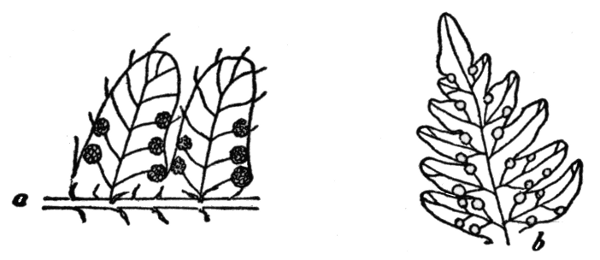
a Portion of pinna
b Tip of pinna
The Long Beech Fern I have found growing alternately in company with
the Oak Fern and the Broad Beech Fern. It loves the damp woods,
clambering over the roots of trees or carpeting thickly the hollows
that lie between.
Phegopteris hexagonoptera
Quebec to Florida, in dry woods and on hill-sides, with
stalks eight to eighteen inches long.
Fronds.—Triangular, as broad or broader than long,
seven to twelve inches broad, thin, slightly hairy, often
finely glandular beneath, fragrant, once-pinnate; pinnæ,
the large, lowest ones broadest near the middle and cut
nearly to the midrib into linear-oblong, obtuse segments,
the middle ones lance-shaped, tapering, the upper ones
oblong, obtuse, toothed or entire; basal segments of the
pinnæ forming a continuous, many-angled wing along the
main rachis; fruit-dots round, small, near the margin;
indusium, none.
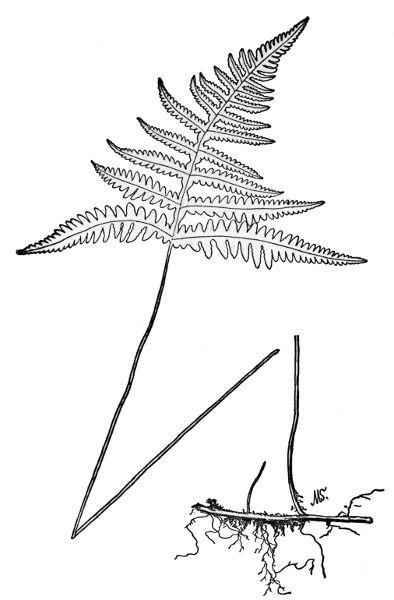
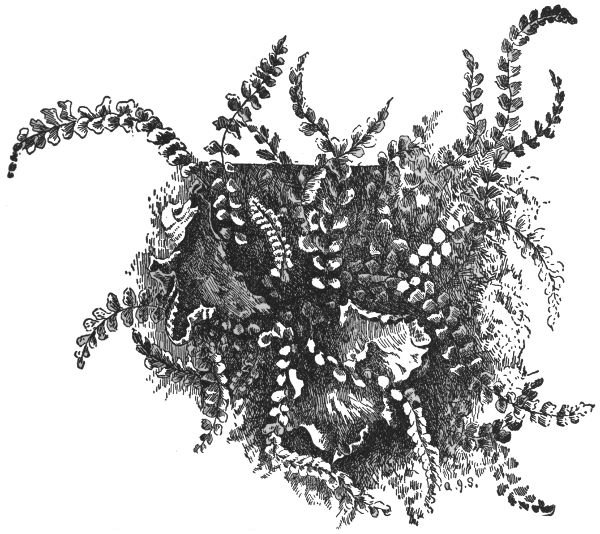
PLATE XXXV
BROAD BEECH FERN
In many ways this plant resembles its sister, the Long Beech Fern, but
usually it is a larger plant, with more broadly triangular fronds,
which wear, to my mind, a brighter, fresher, more delicate green. In
the Long Beech Fern the two lower pairs of pinnæ differ little in
length and breadth, while in the Broad Beech Fern the lowest pair are
decidedly larger and broader than the next pair. The wing along the
rachis formed by the basal segments of the pinnæ seems to me more
conspicuous in the latter than in the former.
The range of the Broad Beech Fern extends farther south than does that
of its two kinsmen, neither of which are found, I believe, south of
Virginia. It seeks also more open and usually drier woods. Its leaves
are fragrant.
Williamson says that its fronds are easily decolorized and that they
form a "good object for double-staining, a process well known to
microscopists."
Phegopteris Dryopteris
Northeastern United States to Virginia, west to Oregon
and Alaska, usually in wet woods, with stalks six to nine
inches long.
Fronds.—Usually longer than broad, four to nine inches
long, broadly triangular, the three primary divisions
widely spreading, smooth, once or twice-pinnate;
fruit-dots small, round, near the margin; indusium,
none.
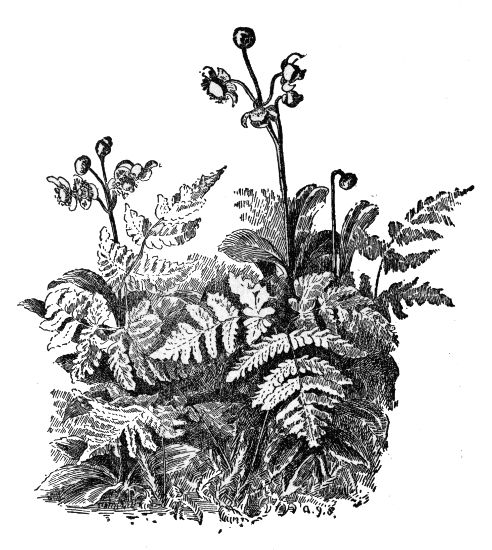
PLATE XXXVI
OAK FERN
So far as I remember, my first encounter with the Oak Fern was in
a cedar swamp, famous for its growth of showy lady's-slippers. One
July day in the hope of finding in flower some of these orchids, I
visited this swamp. It lay in a semi-twilight, caused by the dense
growth of cedars and hemlocks. Prostrate on the spongy sphagnum below
were hosts of uprooted trees, so overrun with trailing strands of
partridge-vine, twin-flower, gold-thread, and creeping snowberry,
and so soft and yielding to the feet that they seemed to have become
one with the earth. The stumps and far-reaching roots of the trees
that had been cut or broken off above ground, instead of having been
uprooted bodily, had also become gardens of many delicate woodland
growths. Some of these decaying stumps and outspreading roots were
thickly clothed with the clover-like leaflets of the wood-sorrel,
here and there nestling among them a pink-veined blossom. On others I
found side by side gleaming wild strawberries and dwarf raspberries,
feathery fronds of Maidenhair, tall Osmundas, the Crested and the
Spinulose Shield Ferns, the leaves of the violet, foam-flower,
mitrewort, and many others of the smaller, wood-loving plants. Among
these stumps were pools of water filled with the dark, polished,
rounded leaves of the wild calla, and bordered by beds of moss
which cushioned the equally shining but long and pointed leaves of
the Clintonia. Near one of these pools grew a patch of delicate,
low-spreading plants, evidently ferns. It needed only one searching
look at the broad, triangular, light-green fronds—suggesting somewhat
those of a small Brake—with roundish fruit-dots below to assure me
that I had found the Oak Fern.
Every lover of plants or of birds or of any natural objects will
appreciate the sense of something more exciting than satisfaction
which I experienced as I knelt above the little plantation and
gathered a few slender-stemmed fronds. One such find as this
compensates for many hours of fatigue and discomfort, or intensifies
the enjoyment of an already happy day. The expedition had justified
itself with the first full view of the solemn, beautiful depths of the
cedar forest. The discovery of the Oak Fern provided a tangible token
of what we had accomplished, and when finally we found the tall, leafy
plants of the showy lady's-slipper, without a single blossom left upon
them, our disappointment was so mild as to be almost imperceptible.
As is often the case, having once discovered the haunt of the Oak
Fern, it ceased to be a rarity. It joined the host of plants which
climbed over the mossy stumps and fallen logs, and at times it fairly
carpeted the ground beneath the cedars and hemlocks.
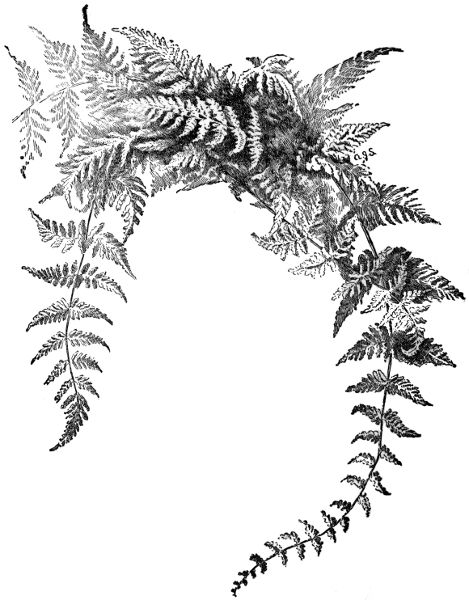
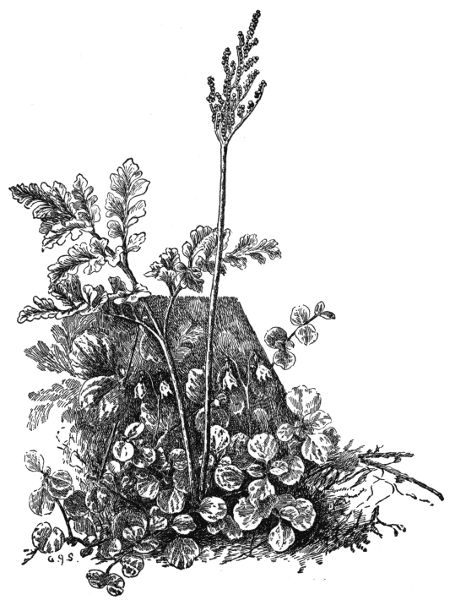
Bulblet Bladder Fern
Cystopteris bulbifera
Canada to Tennessee, on wet rocks, preferring limestone.
One to three feet long, with light-colored, somewhat
brittle stalks.
Fronds.—Elongated, lance-shaped from a broad base, often
bearing beneath large, fleshy bulbs, usually twice-pinnate;
pinnæ lance-oblong, pointed; pinnules toothed or
deeply lobed; fruit-dots roundish, indusium short,
hood-like, attached by a broad base on the side toward the
midrib, early thrown back and withering so that the mature
fruit-dots appear arched.
The Bulblet Bladder Fern is never more at home than when it grows
close to falling water, clinging to rocks dark and wet with spray. It
seems to reflect the very spirit of the waterfall, all its life and
grace, as it springs from the dripping ledges, clothing them with a
diaphanous garment of delicate green which vies with their neighboring
veil of white, now pouring over some rocky shelf a solid but silent
mass of pale luxuriant foliage, now trailing down the cliff its long,
tapering fronds, side by side with silvery strands of water, close to
tufts of wind-blown, spray-tipped harebells.
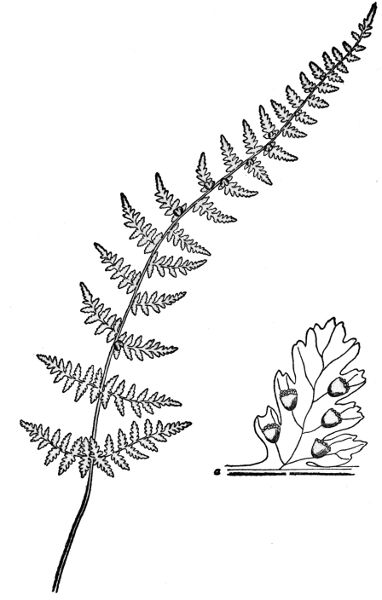
PLATE XXXVII
BULBLET BLADDER FERN
a Portion of fruiting pinna
Although the plant is never seen at its best save in some such
neighborhood as this, its slender, feathery fronds are always
possessed of singular grace and charm, whether undulating along the
dried rocky bed of a mountain brook or bending till their slender tips
nearly touch the rushing stream or growing quite away from the rocks
which are their natural and usual companions among the moss-grown
trunks and fallen trees of the wet woods.
I know no other fern, save the climbing fern, which is so vine-like
and clinging. In reality its stalk and midrib are somewhat brittle,
yet this brittleness does not prevent its adapting itself with supple
and exquisite curves to whatever support it has chosen.
In its manner of growth, as well as in its slender, tapering outline,
the Bulblet Bladder Fern is so individual that there can be no
difficulty in identifying the full-sized fertile fronds, even in the
absence of the little bulbs which grow on the under side of the frond,
usually at the base of the pinnæ. The sterile fronds are shorter and
broader in proportion, and not so easily identified.
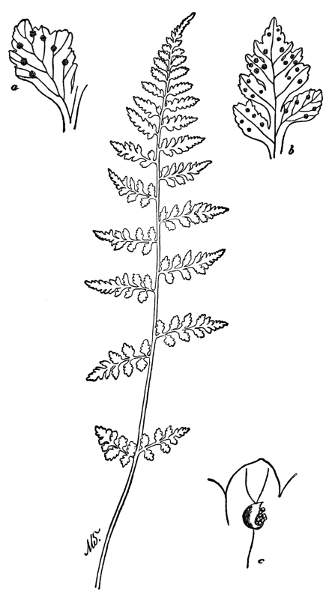
PLATE XXXVIII
FRAGILE BLADDER FERN
a Portion of fertile pinna
b Tip of fertile pinna
c Magnified fruit-dot showing indusium
Cystopteris fragilis
A rock and wood fern, found from Newfoundland to Georgia.
Six to eighteen inches long, with slender and brittle
stalks, green except at the base.
Fronds.—Oblong-lanceolate, thin, twice to thrice-pinnate
or pinnatifid; pinnæ lance-ovate, irregularly cut into
toothed segments which at their base run along the midrib
by a narrow margin; fruit-dots roundish, often abundant;
indusium early withering and exposing the sporangia,
which finally appear naked.
This plant may be ranked among the earliest ferns of the year. In May
or June, if we climb down to the brook where the columbine flings
out her brilliant, nodding blossoms, we find the delicate little
fronds, just uncurled, clinging to the steep, moist rocks, or perhaps
beyond, in the deeper woods, they nestle among the spreading roots of
some great forest tree. Their "fragile greenness" is very winning.
As the plant matures, attaining at times a height of nearly two
feet, it loses something of this first delicate charm. By the end
of July its fruit has ripened, its spores are discharged, and the
plant disappears. Frequently, if not always, a new crop springs up
in August. We are enchanted to discover tender young fronds making
patches of fresh green in every crevice of the rocks among which the
stream forces its precipitous way. Once more the woods are flavored
with the essence of spring. In our delight in this new promise we
forget for a moment to mourn the vanishing summer.
The outline of the Common Bladder Fern suggests that of the Obtuse
Woodsia. The two plants might be difficult to distinguish were it not
for the difference in their indusia. At maturity the indusium of the
Common Bladder Fern usually disappears, leaving the fruit-dot naked,
while that of the Obtuse Woodsia is fastened underneath the fruit-dot
and splits apart into jagged, spreading lobes.
The sterile fronds of the Slender Cliff Brake also have been thought
to resemble this fern, in whose company it often grows.
Williamson says that the Common Bladder Fern is easily cultivated
either in mounds or on rock-work.
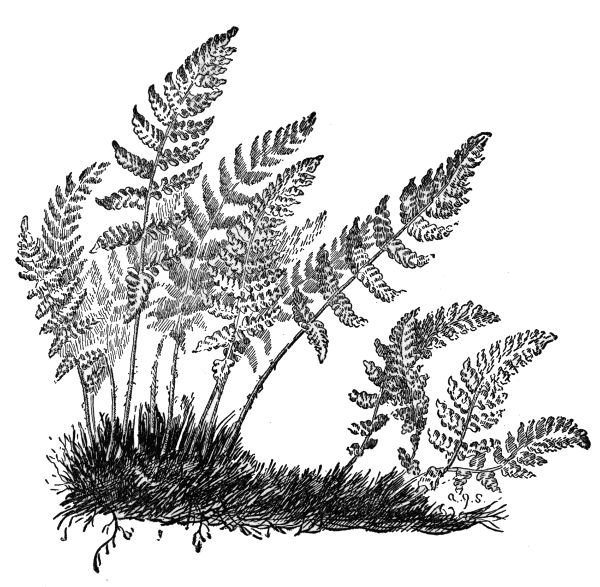
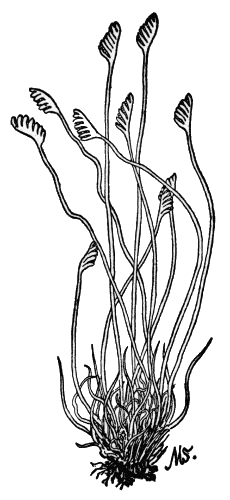
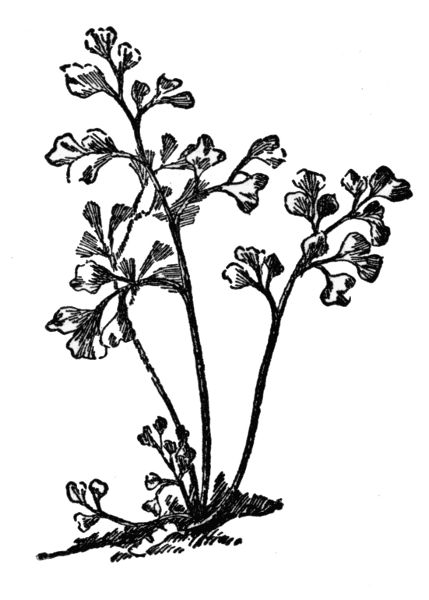
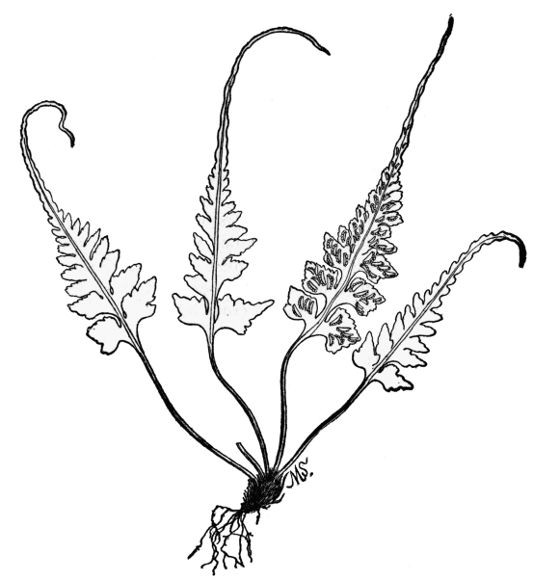
PLATE XXXIX
RUSTY WOODSIA
Woodsia Ilvensis
From Labrador and Greenland south to North Carolina and
Kentucky, usually on exposed rocks in somewhat mountainous
regions. A few inches to nearly one foot high.
Fronds.—Oblong-lance-shaped, rather smooth above, the
stalk and under surface of the frond thickly clothed with
rusty chaff, once-pinnate; pinnæ oblong, obtuse, sessile,
cut into oblong segments; fruit-dots round, near the
margin, often confluent at maturity; indusium detached by
its base under the sporangia, dividing into slender hairs
which curl above them.
Last Decoration Day, while clambering over some rocky cliffs in the
Berkshire Hills, I found the Rusty Woodsia growing in masses so
luxuriant to the eye and so velvety to the touch that it hardly
suggested the bristly looking plant which one finds later in the
summer.
This fern reverses the usual order of things, being gray-haired in
youth and brown-haired in old age, with the result that in May its
effect is a soft, silvery green. But even in August, if you chance
upon a vigorous tuft springing from some rocky crevice, despite its
lack of delicacy and its bristle of red-brown hairs or chaff, the
plant is an attractive one.
Environment has much to do with the charm of ferns. The first plant of
this species I ever identified grew on a rocky shelf within a few feet
of a stream which flowed swift and cold from the near mountains. Close
by, from the forked branches of a crimson-fruited mountain maple, hung
the dainty, deserted nest of a vireo. Always the Rusty Woodsia seems
to bring me a message from that abode of solitude and silence.
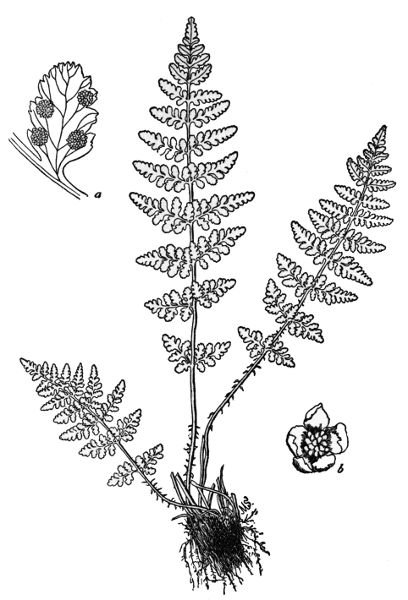
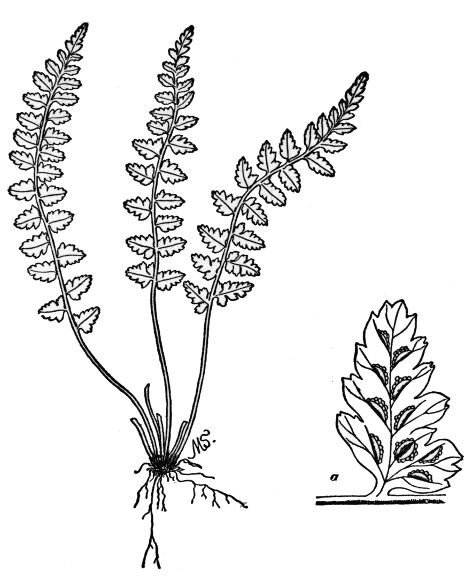
PLATE XL
BLUNT-LOBED WOODSIA
a Portion of pinna
b Fruit-dot magnified, showing indusium
Woodsia obtusa
Canada to Georgia and Alabama and westward, on rocks. Eight
to twenty inches high, with stalks not jointed, chaffy when
young.
Fronds.—Broadly lanceolate, nearly twice-pinnate;
pinnæ rather remote, triangular-ovate or oblong,
pinnately parted into obtuse, oblong, toothed segments;
veins forked; fruit-dots on or near the minutely
toothed lobes; indusium conspicuous, splitting into
several jagged lobes.
The Blunt-lobed Woodsia is not rare on rocks and stony hill-sides in
Maine and Northern New York. It is found frequently in the valley
of the Hudson. Though not related to the Common Bladder Fern (C.
fragilis), it has somewhat the same general appearance. Its fronds,
however, are usually both broader and longer, and its stalk and pinnæ
are slightly downy. Its range does not vary greatly from that of the
Common Bladder Fern, but usually it grows in more exposed spots and
sometimes basks in strong sunshine.
Meehan says the Blunt-lobed Woodsia is found along the Wissahickon
Creek, Penna., on dry walls in shady places. "One of its happiest
phases," he continues, "is toward the fall of the year, when the
short, barren fronds which form the outer circle bend downward,
forming a sort of rosette, in the centre of which the fertile fronds
somewhat erectly stand."
The sterile fronds remain fairly green till spring.
Woodsia hyperborea (W. alpina)
Northern New York and Vermont, and northward from Labrador
to Alaska, on rocks. Two to six inches long, with stalks
jointed near the base.
Fronds.—Narrowly oblong-lanceolate, nearly smooth,
pinnate; pinnæ triangular-ovate, obtuse, lobed; lobes
few; fruit-dots somewhat scattered; indusium as in W.
Ilvensis.
This rare little fern has been found by Dr. Peck in the Adirondacks
and by Horace Mann, jr., and Mr. Pringle in Vermont. In his delightful
"Reminiscences of Botanical Rambles in Vermont," published in the
Torrey Bulletin, July, 1897, Mr. Pringle describes his first
discovery of this species:
"I was on the mountain [Willoughby] on the 4th of August
and examined the entire length of the cliffs, climbing
upon all their accessible shelves. Among the specimens
of Woodsia glabella brought away were a few which I
judged to belong to a different species. Mr. Frost, to
whom they were first submitted, pronounced them Woodsia
glabella. Not satisfied with his report, I showed them to
Dr. Gray. By him I was advised to send them to Professor
Eaton, because, as he said, Woodsia is a critical genus.
Professor Eaton assured me that I had Woodsia hyperborea,
... another addition to the flora of the United States."
Later in the year Mr. Pringle made a visit to Smugglers' Notch on
Mount Mansfield, when he was "prepared to camp in the old Notch House
among hedgehogs, and botanize the region day by day." This visit was
rich in its results. The most notable finds were Aspidium fragrans,
Asplenium viride, Woodsia glabella, and Woodsia hyperborea.
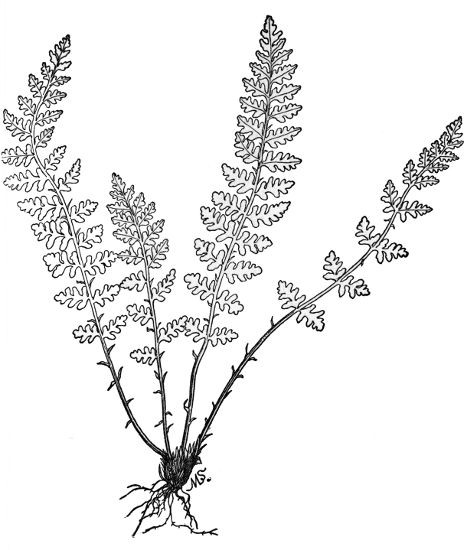
PLATE XLI
NORTHERN WOODSIA
Woodsia glabella
Northern New York and Vermont, and northward from Labrador
to Alaska, on moist rocks. Two to five inches long, with
stalks jointed at base.
Fronds.—Very delicate, linear or narrowly lanceolate,
smooth on both sides, pinnate; pinnæ roundish ovate,
obtuse, lobed, lobes few; fruit-dots scattered;
indusium minute.
The Smooth Woodsia closely resembles the Northern Woodsia, and one may
expect to find it in much the same parts of the country. In texture it
is still more delicate; its fronds are almost perfectly smooth, its
outline is narrower, and its pinnæ are but slightly lobed.
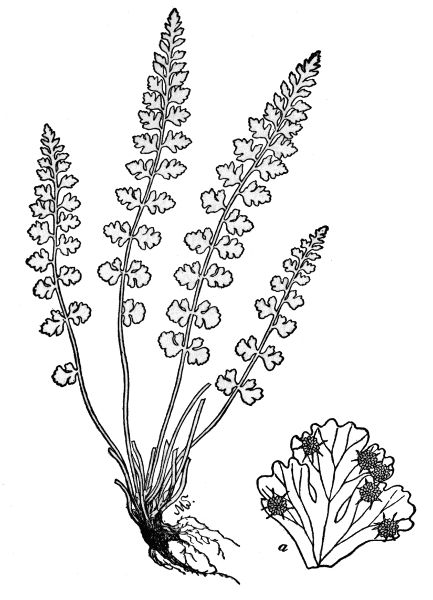
PLATE XLII
SMOOTH WOODSIA
a Fertile pinna
Mr. Pringle tells us that a letter from Mr. George Davenport, asking
him to look for Woodsia glabella, awakened his first interest in
ferns. His own account of these early fern hunts is inspiring in its
enthusiasm:
"In 1873 George Davenport was beginning his study of ferns.
A letter from him, asking me to look for Woodsia glabella
... started me on a fern hunt. The species had been found
on Willoughby Mountain, Vt., and at Little Falls, N. Y.;
might it not be growing in many places in Vermont? When I
set out I knew, as I must suppose, not a single fern, and
it was near the close of the summer. You can imagine what
delights awaited me in the autumn woodlands. I made the
acquaintance of not a few ferns, though it was too late
to prepare good specimens of them. In this first blind
endeavor I got, of course, no clew to Woodsia glabella.
The next summer the hunt was renewed and persistently
followed up. I found pleasure in securing one by one nearly
all our Vermont ferns. At the time I thought it worthy of
remembrance that a single field of diversified pasture and
woodland on an adjoining farm yielded me thirty species.
Although the two common species of Woodsia were near
at hand, Woodsia glabella was still eluding my search.
I sent a friend to the summit of Jay Peak in a fruitless
quest for it. Finally, on September 1st, I joined Mr.
Congdon at its old station on Willoughby Mountain, and made
myself familiar with its exquisite form.
"During the first two years of my collecting in earnest,
1874 and 1875, several visits were made to Camel's Hump,
the peak most accessible to me. In this way some time
was lost, because its subalpine area is limited, and
consequently the number of rare plants to be found there
is small. Yet, with such dogged persistence as sometimes
prevents my making good progress, my last visit to that
point was not made till the 20th of June, 1876. On that
day I clambered, I believe, over every shelf of its great
southern precipice and peered into every fissure among the
rocks. At last, as I was climbing up the apex over the
southeastern buttress, my perilous toil was rewarded by the
discovery not only of Woodsia glabella, but of Aspidium
fragrans.... There were only a few depauperate specimens
of each which had not yet succumbed to the adverse
conditions of their dry and exposed situation."
In the following passage Mr. Pringle describes his pleasure, some
years later, in the companionships fostered by a common interest in
his pet hobby:
"... my delight in this preserve of boreal plants was
shared with not a few genial botanists. Charles Faxon came
before any of us suspected that he possessed undeveloped
talent for a botanical artist of highest excellence.
Edwin Faxon followed his young brother, and with me made
the tedious ascent to Stirling Pond, a day of toil well
rewarded. Thomas Morong came, before the hardships of his
Paraguayan journey had broken him down.... Our honored
President came.... In those days, as now, ... he was
often my companion to add delight to my occupation and to
reinforce my enthusiasm.... The gentle Davenport came at
last to behold for the first time in their native haunts
many of the objects of his first love and study. When I
had found for him yet once more in a fifth Vermont station
(this was under Checkerberry Ledge, near Bakersfield) the
fern he at first desired, and, together with that, had
discovered within our limits three or four others quite
as rare and scarcely expected, I might feel that I had
complied with the request of his letter. But that letter
initiated a warm friendship between us and association
in work upon American ferns, which has continued to the
present time. During these twenty-three years of botanical
travel on my part my hands have gathered all but thirty-six
of the one hundred and sixty-five species of North American
ferns, and from the more remote corners of our continent I
have sent home to my friend for description and publication
sixteen new ones. Yet I trust that the fern hunt upon which
he started me in 1873 is still far from its close."
The above quotations illustrate fairly the enthusiasm aroused by a
pursuit which is full of peculiar fascination. Almost anyone who has
made a study of our native ferns will recall hours filled with delight
through their agency, companions made more companionable by means of a
common interest in their names, haunts, and habits.