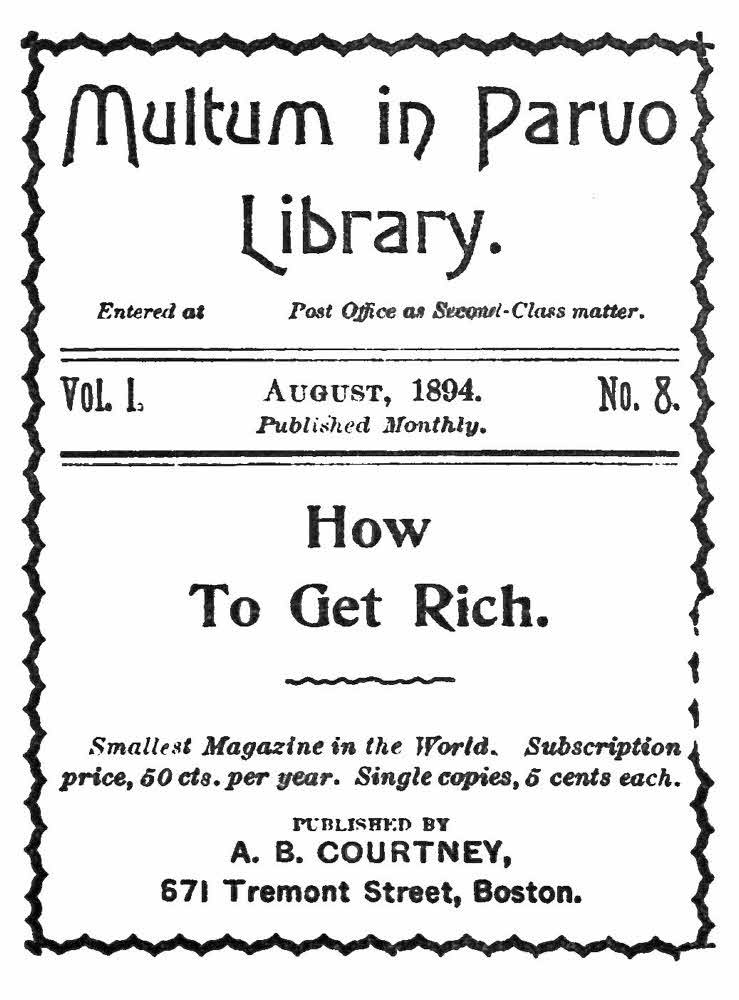
HOW TO GET RICH. Valuable Money-Making Secrets.
These recipes have sold for five dollars
each, and have been the foundations of
many good-sized fortunes.
This collection of recipes and formulas for
making various articles which are in constant
use in every household are, for the most part,
articles upon which very large profits are made,
both by manufacturers and dealers; some
things, which cost but two or three cents to
make, being retailed for as much as twenty-five
cents. We point out to you the proper
method to be pursued in the manufacture of
these various articles, and expect you to use
your own judgment and discretion in the matter
of putting them up for market, and exposing
them for sale. The goods, when ready for
market, may be sold either direct to consumers
at retail, or to store-keepers at wholesale.
Those who adopt the former method may canvass
from house to house, or establish a store
and sell therefrom. The various ingredients
required to compound all the different articles
for which recipes are here given may be purchased
at wholesale drug and grocery stores in
any of the large cities. Large fortunes have
been made upon the manufacture of single articles,
for which recipes are here given, and
there is no reason why any one may not acquire
a competency in the same way, providing
he has the necessary push and sagacity. Here
is an opportunity to be your own manufacturer,
your own wholesaler and your own retailer.
Given these advantages, you may
undersell those in the ordinary channels of
trade, and still make handsome profits; and
we trust that the information herein contained
may be the means of starting many a poor person
toward making a fortune or a good income.
Black Ink.—Ink, like soap, is something
everybody uses, and few people realize that
thousands of barrels of it are made and sold.
Recipe for making the best and most durable
black writing ink, as used by the leading penmen
of the United States and Canada.
To 2 gallons of strong decoction of logwood,
well strained, add 1 1/2 lbs. blue galls in coarse
powder, 6 ounces sulphate of iron, 1 oz. acetate
of copper, 6 oz. of pulverized sugar, and 8 oz.
of gum arabic; set the above on the fire until
it begins to boil, strain, and then set it away
until it has acquired the desired blackness.
The strong “decoction of logwood” is made by
boiling; use soft water, into which put two
ounces of logwood; strain after taking from
the fire.
The above ink properly made, according to
the above directions, is unsurpassed for elegant
writing of any kind. It flows freely from the
pen, turns to a deep black after writing, and
does not fade. Records written with it fifty
years ago are as legible as the day they were
put upon the paper.
Fig Candy.—Take 1 pound of sugar and 1
pint of water; set over a slow fire. When
done, add a few drops of vinegar and a lump
of butter, and pour into pans in which split
figs are laid.
Red Sealing Wax.—Purchase 4 lbs. shellac,
1 1/2 lbs. venice turpentine, 3 lbs. finest cinnabar
and 4 oz. venetian; mix the whole well
together, and melt over a very slow fire. Pour
it on a thick, smooth glass, or any other flat,
smooth surface, and make it into 3, 6 or 10
sticks.
Silver Ink.—Mix 1 oz. of the finest pewter or
block tin in shavings with 2 oz. quicksilver till
all becomes fluid; then add to it sufficient gum
arabic water to produce the proper consistency.
Yellow Ink.—A little alum added to saffron,
in soft, hot water, makes a beautiful yellow
ink.
Mucilage for Labels.—Dextrine, 2 ounces;
glycerine, 1 drachm; alcohol, 1 ounce; water,
6 ounces.
The Celebrated Chemical Compound.—Take
one pint of alcohol, 2 gills nitrous spirits ether,
2 oz. bicromate potash, 2 oz. powdered cinnamon,
2 oz. aqua fortis. Mix all the above together
and let it stand twenty-four hours and
it is fit for use. Bottle in ounce vials, and sell
for 25 cents. To extract grease stains, etc.,
from cloth, saturate with cold water, dip a
sponge in the liquid and apply it, and repeat if
necessary, and wash off with cold water.
Gold Ink.—Two parts mosaic, 1 part gum
arabic (by measure); mix with soft water
until reduced to a proper condition.
Green Ink.—Powder 1 ounce verdigris, and
put it in 1 quart of vinegar; after it has stood
two or three days, strain off the liquid.
Blue Ink.—Two oz. Chinese blue, 3/4 oz.
pure oxolid acid, 1 oz. powdered gum arabic,
6 pints distilled soft water; mix well and then
strain.
Purple Ink.—Eight parts logwood in 64
parts soft water, by measure, boil down to
one-half, then strain and add one part chloride
of tin.
Imitation Gold.—Sixteen parts platina, seven
parts copper, one part zinc. Put in a covered
crucible, with powdered charcoal, and melt together
till the whole forms one mass, and are
thoroughly incorporated together. Or, take 4
oz. platina, 3 oz. silver, 1 oz. copper.
Imitation Silver.—Eleven ounces refined
nickel, two ounces metallic bismuth. Melt the
compositions together three times, and pour
them out in ley. The third time, when melting,
add two ounces pure silver. Or take one-quarter
ounce copper, one ounce bismuth, two
ounces saltpetre, two ounces common salt, one
ounce arsenic, one ounce potash, two ounces
brass, and three ounces pure silver. Melt all
together in a crucible.
Florida Water.—Half pint proof spirits, two
drachms oil lemon, half drachm oil rosemary.
Mix.
Freckle Lotion.—Muriate of ammonia, one
drachm; cologne water, two drachms; distilled
water, seven ounces; mix and use as a wash.
It contains nothing injurious.
Windsor Soap.—This is made with lard. In
France they use lard, with a portion of olive or
bleached palm oil. It is made with one part of
olive oil to nine of tallow; but a greater part of
what is sold is only curd (tallow) soap, and
scented with oil of caraway and bergamot.
The brown is colored with burnt sugar or
umber.
To Make Maple Sugar without Maple Trees.—Though
the secret I am about to reveal may
seem very simple (when explained), I believe
there are few who would discover it of their
own accord. The value of the maple sugar
crop is considerable, and there is ready sale for
all that can be made. I was led by curiosity
to boil down a little butternut sap, one time,
with an equal quantity of maple sap, and the
result was, a sugar which I could not distinguish
from pure maple. I experimented further
and found that if a little common (cane)
sugar was added to the sap of the butternut, it
would do as well as an addition of maple sap.
I found that the sap of birch and several other
trees would also make, when a very little cane
sugar was added, a sugar which in looks and
taste exactly resembled maple. To be able to
make “maple” sugar from trees not heretofore
deemed valuable for the purpose is just so
much clear profit.
Traveller’s Ink.—White blotting paper is
saturated with aniline black, and several sheets
are pasted together so as to form a thick pad.
When required for use a small piece is torn off
and covered with a little water. The black
liquid which dissolves out is a good writing ink.
A square inch of paper will produce enough
ink to last a considerable writing, and a few
pads would be all that an exploring party need
carry with them. As water is always available
the ink is readily made. This is a perfectly
original and new recipe. Any enterprising
man can make a large income out of its manufacture.
Violet Ink.—1 oz. best violet aniline; dissolve
it in one gill of hot alcohol, stir, and
when thoroughly dissolved add one gallon of
boiling hot water; dissolve in the hot water 1 1/2
oz. white gum arabic. This will make the
most rich and beautiful ink of this color in existence;
will not fade or corrode steel pens, and
is not injured by freezing. An addition of 1 lb.
of sugar and 1/2 lb. glycerine will make an excellent
copying ink. This ink is usually sold
at $2 per pint bottle, $1 for half pint and 50
cents for gill bottle. It is worth an enterprising
man or woman $1,000. Do not bury it—use
it and make money out of it.
New York Barber’s Star Hair Oil.—Castor
oil, 6 1/2 pints, alcohol, 1 1/2 pints, oil of citronella,
1/2 ounce, lavender, 1/4 ounce. Mix well,
put in 4-ounce bottles; retail at 25 cents each.
Furniture Polish.—Equal parts sweet oil and
vinegar, and a pint of gum arabic finely
powdered. Shake the bottle and apply with a
rag. It will make furniture look as good as
new.
Artificial Gold.—This is a new metallic alloy
which is now very extensively used in France
as a substitute for gold. Pure copper, one
hundred parts; zinc, or, preferably, tin, seventeen
parts; magnesia, six parts; sal-ammoniac,
three-sixths parts; quick-lime, one-eighth part;
tartar of commerce, nine parts, are mixed as
follows: The copper is first melted, and the
magnesia, sal-ammoniac, lime and tartar are
then added separately, and by degrees, in the
form of powder; the whole is now briskly
stirred for about half an hour, so as to mix
thoroughly; and when the zinc is added in
small grains by throwing it on the surface, and
stirring till it is entirely fused, the crucible is
then covered, and the fusion maintained for
about thirty-five minutes. The surface is then
skimmed, and the alloy is ready for casting. It
has a fine grain, is malleable, and takes a
splendid polish. It does not corrode readily,
and for many purposes is an excellent substitute
for gold. When tarnished, its brilliancy
can be restored by a little acidulated water. If
tin be employed instead of zinc, the alloy will
be more brilliant. It is very much used in
France, and must ultimately attain equal popularity
here.
Baking Powder.—The following receipt is
the same as used in the preparation of the
standard baking powders of the day, and if put
up attractively will sell readily at the usual
prices. Take 1 pound of tartaric acid in
crystals, 1 1/2 pounds of bi-carbonate of soda
and 1 1/2 pounds of potato starch. Each must
be powdered separately, well dried by slow
heat, well mixed through a sieve. Pack hard
in tinfoil, tin or paper glazed on the outside.
The tartaric acid and bi-carbonate of soda can,
of course, be bought cheaper of wholesale druggists
than you can make them, unless you are
doing things on a very large scale, but potato
starch any one can make; it is only necessary
to peel the potatoes and to grate them up fine
into vessels of water, to let them settle, pour
off the water and make the settlings into
balls, and to dry them. With these directions
any one can make as good a baking
powder as is sold anywhere; if he wants to
make it very cheap, he can take cream of tartar
and common washing (carbonate of) soda, instead
of the articles named in the recipe, but
this would be advisable only where customers
insist on excessively low prices in preference to
quality of goods.
Babbit’s Premium Soap.—Five gallons of
strong lye, five gallons of water, five pounds of
tallow, two pounds of sal soda, half a pound of
rosin, one pint salt, one pint washing fluid.
Let this water boil, then put in the articles, and
boil half an hour. Stir it well while boiling,
and then run it into moulds: it will be ready
for use as soon as cold. The above is for 100
pounds of soap.
Royal Washing Powder.—Mix any quantity
of soda ash with an equal quantity of carbonate
of soda—ordinary soda—crushed into coarse
grains. Have a thin solution of glue, or decoction
of linseed oil ready, into which pour the
soda until quite thick. Spread it out on boards
in a warm apartment to dry. As soon as dry
shake up well so that it will pack easily into
nice, square packages. Label neatly. Pound
packages cost 7 cents, retail for 25 cents.
Patent Starch Polish.—Take common dry
potato or wheat starch, sufficient to make a pint
of starch when boiled. When boiled add one-half
drachm spermaceti, and one-half drachm
of white wax, then use it as common starch,
only using the iron as hot as possible.
Invisible Ink.—Sulphuric acid 1 part, water
20 parts; mix together and write with a quill
pen, which writing can only be read after heating
it.
Fine Peppermint Lozenges.—Best powdered
white sugar, 7 pounds; pure starch, 1 pound;
oil of peppermint to flavor. Mix with mucilage.
India Ink.—Ivory black ground into powder,
make into a paste with a few drops of essence
of musk, and one half as much essence of ambergris,
and then form into cakes.
To Preserve Flowers in Water.—Mix a little
carbonate of soda in the water, and it will keep
the flowers a fortnight.
Ginger Lozenges.—Mix with the white of
eggs four ounces of powdered ginger, two
pounds of white sugar, and one pound of
starch.
To Restore the Color of Black Kid Boots.—Take
a small quantity of good black ink, mix
it with the white of an egg, and apply it to the
boots with a soft sponge.
Color for Wicker Baskets, or any small
Articles of the Kind.—Dissolve one stick of
black sealing-wax and one stick of red in two
ounces of spirits of wine. Lay it on with a
small brush.
To Remove Stains from Books.—To remove
ink-spots, apply a solution of oxalic, citric, or
tartaric acid. To remove spots of grease, wax,
oil, or fat, wash the injured part with either,
and place it between white blotting-paper.
Then, with a hot iron, press above the part
stained.
To Clean Black Veils.—Pass them through
a warm liquor of bullock’s gall and water;
rinse in cold water; then take a small piece of
glue, pour boiling water on it, and pass the
veil through it; clap it, and frame to dry.
Instead of framing, it may be fastened with
drawing-pins closely fixed upon a very clean
paste or drawing-board.
To Clean a Marble Chimney Piece.—If the
marble is white, procure half a pound of pearlash,
one pound of whiting, and half a pound
of soft soap; boil all these ingredients together
until they attain the consistence of a thick
paste. When nearly cold, lay it upon the
marble, and let it remain on it for at least
twenty-four hours. Wash it off with soft
water, and polish with linen rags. Spirits of
turpentine is excellent for cleaning black
marble.
Oil Stains in Silk and other Fabrics.—Benzine
is most effectual, not only for silk, but for
any other material whatever. It can be procured
from any druggist. By simply covering
both sides of greased silk with magnesia, and
allowing it to remain for a few hours, the oil is
absorbed by the powder. Should the first
application be insufficient, it may be repeated,
and even rubbed in with the hand. Should the
silk be Tussah or Indian silk, it will wash.
Scarlet Ink.—Dissolve 1 oz. garancine of the
best quality in 1 oz. liquor ammonia; add 1
pint soft cold water distilled; mix together
in a mortar, filter and dissolve in it 1/2 oz. of
gum arabic.
Luminous Ink.—Shines in the dark—Phosphorous,
one-half drachm, oil cinnamon, one-half
oz., mix in a vial, cork tightly, heat it
slowly until mixed. A letter written with this
ink can only be read in a dark room, when the
writing will have the appearance of fire.
Brown Ink.—Take 4 parts powdered catechu
and put it in 6 parts soft water; let it stand for
half a day, shaking occasionally, then strain,
and to bring it to the proper consistency, add
sufficient of a solution of bichromate of potash,
1 part in 16 of water, all by measure.
Ink Powder.—One pound of nutgall, 7 ounces
copperas, 7 ounces gum arabic: this amount of
ink powder will make one gallon of good black
ink; to prevent it from moulding, powder two
or three cloves and mix with each pound of
powder.
Excelsior Hair Oil.—One gallon cologne
spirits 90 per cent. proof, add of the oil of
lemon, orange and bergamot, each a spoonful,
add also of the extract of vanilla 40 drops,
shake until the oils are cut up, then add one and
a half pints of soft water.
Commercial Writing Ink.—Galls, 1 ounce;
gum, 1/2 ounce; cloves, 1/2 ounce; sulphate of
iron, 1/2 ounce; water, 8 ounces. Digest by
frequent shaking until it has sufficient color.
This is a good durable ink and will bear diluting.
Indelible Ink.—For marking linen without
preparation. Nitrate of silver, 1 1/2 oz., dissolve
in 6 oz. of liquor ammonia fortis, archil
for coloring, 1 oz. Gum mucilage, 12 ounces.
The best extant.
Bristol’s Tooth Powder.—Prepared chalk, 1
pound; castile soap, 1/2 pound; powdered yellow
bark, 2 ounces; powdered gum myrrh, 2
ounces; powdered loaf sugar, 2 ounces; powdered
orris, 2 ounces. Mix well, after having
first pulverized the castile.
Cold Cream.—One pound of lard, three ounces
of spermaceti. Melt with a gentle heat, and
when cooling stir in orange-flower water, one
ounce, essence of lavender, twenty-six drops.
To Make Paint for One Cent a Pound.—To
one gallon of soft hot water add four pounds
sulphate of zinc (crude). Let it dissolve perfectly,
and a sediment will settle at the bottom.
Turn the clear solution into another vessel. To
one gallon of paint (lead and oil), mix one
gallon of the compound. Stir into it the paint
slowly for ten or fifteen minutes, and the compound
and the paint will perfectly combine. If
too thick, thin it with turpentine. This receipt
has been sold to painters as high as $100 for
the privilege to use the same in their business.
Almond Cream.—(There is nothing equal to
this cream for softening and whitening the
hands.) Mix honey, almond meal and olive oil
into a paste to be used after washing with soap.
Castile soap is best for use; it will cure a
scratch, or cut, and prevents any spot.
Cream of Roses.—Take one teacupful of
rose water, as much sub-carbonate of potash
as will lie on a shilling, and half an ounce of
oil of sweet almonds. Let all be well shaken
together until it becomes thoroughly mixed,
which will take some time. This is one of the
best face washes made, and is entirely harmless.
Excellent Pomade.—Three ounces of olive
oil, three-quarters of a drachm of the oil of almonds,
two drachms of palm oil, half an ounce
of white wax, a quarter of a pound of lard, and
three-quarters of a drachm of the essence of
bergamot. This pomade is excellent for
strengthening the hair, promoting the growth
of whiskers and moustaches, and preventing
baldness.
Superior Cologne Water.—Alcohol, one gallon;
add oil of cloves, lemon, nutmeg and bergamot,
each one drachm; oil neroli, three and
a half drachms; seven drops of oils of rosemary,
lavender and cassia; half a pint of spirits of
nitre; half a pint of elder-flower water. Let it
stand a day or two, then take a colander and at
the bottom lay a piece of white cloth, and fill it
up, one-fourth of white sand, and filter through
it.
Family Salve.—Take the root of the yellow
dock and dandelion, equal parts; add good
proportion of celandine and plantain. Extract
the juices by steeping or pressing. Strain carefully,
and simmer the liquid with sweet cream
or fresh butter and mutton tallow, or sweet oil
and mutton tallow. Simmer together until no
appearance of the liquid remains. Before it is
quite cold, put it into boxes. This is one of
the most soothing and healing preparations for
burns, scalds, cuts, and sores of every description.
Japanese Cement.—Immediately mix the best
powdered rice with a little cold water, then
gradually add boiling water until a proper consistency
is acquired, being particularly careful
to keep it well stirred all the time; lastly, it
must be boiled for a minute in a clean saucepan
or earthern pipkin. This glue is beautifully
white and almost transparent, for which reason
it is well adapted for fancy paper work, which
requires a strong and colorless cement.