Fencing is the art of using the small-sword, or
rapier. The small-sword has a straight blade,
about thirty-two inches in length outside the guard,
and is fashioned for thrusting only. Although it
is an art of the greatest antiquity, very great improvements
have been made in it during the last
half-century, chiefly by French masters, who excel
those of all other countries. This has been attributed
to various causes; by some to the agility
and acknowledged power of rapid physical action
possessed by this nation; by others, to their natural
vivacity and mental quickness. In my opinion,
however, a more direct and powerful cause may be
traced in the great encouragement and universal
patronage which it has ever received from every
grade of a chivalrous and military people. Every
regiment has its maitre d'armes, and every barrack
its fencing-school. Indeed, in so important a
light was the proper teaching of this art held, that
one of the French kings (Louis XIV.) granted letters-patent
to twenty eminent masters, who alone
were permitted to teach in Paris. When a vacancy
occurred, no interest and no favor could enable a
candidate to obtain this privilege: he had to fence
in public with six of these chosen masters, and if
by any of them he was beaten by two distinct hits,
he was considered unqualified to teach in the capital.
Independent of its value as the scientific use of
the sword—the gentleman's weapon of defense,
par excellence—fencing stands unrivaled as an
exercise; and it is in this sense that it will now be
treated. The most eminent physicians which this
country have produced, have all, in the most
earnest manner, recommended it to the attention
of the young. Thus, Dr. Clive says:
"Muscular exertion is essential in perfecting
the form of the body, and those exercises which
require the exercise of the greatest number of
muscles are the most conducive to this end.
Fencing causes more muscles to act at the same
time than most other exercises. It promotes the
expansion of the chest, and improves respiration,
whereby the functions of the most important
organs of the body are more perfectly performed."
Sir Anthony Carlisle uses similar language:
"According to my judgment, the exercise of
fencing tends to promote bodily health, and the development
of athletic powers. It is likewise apparent
that the attitudes and exertions of fencing
are conducive to the manly forms and muscular
energies of the human figure."
Again, Sir Everard Home, in still stronger
terms:
"Of all the different modes in which the body
can be exercised, there is none, in my judgment,
that is capable of giving strength and velocity, as
well as precision, to the action of all the voluntary
muscles of the body in an equal degree as the practice
of fencing, and none more conducive to bodily
health."
I shall give one more extract from another physician
of equal eminence, Dr. Babbington:
"I am of opinion that, in addition to the amusement
which this exercise (fencing) affords, it is
particularly calculated to excite in young persons a
greater degree of energy and circumspection than
they might otherwise possess; and it is obvious
that, in respect of health, that mode of exertion is
superior to all others, which, while it gives motion
and activity to every part of the body, produces
at the same time corresponding interest in
the mind."
Sir John Sinclair, Dr. Pemberton, &c., speak in
terms equally recommendatory.
To avoid all danger in the lessons and practice,
foils are substituted for real swords. Strong wire
masks are worn on the face, a well-padded glove
on the hand; and the upper part of the body, at
which alone the thrusts are aimed, is protected by
a strong jacket, the right side and collar of which
should be of leather.
The first movement a beginner has to learn, is
the manner of placing himself in the position
called
It is from this position that all movements are
made, whether offensive or defensive. Let the beginner
be placed with his knees straight, his feet
at right angles, heel to heel; the right foot, right
side, and face directed to the master. The body
must be held upright and firm, the arms hanging
down by the side, but easily and without constraint,
the left hand holding the foil a few inches
beneath its guard. Next, let him bring the right
hand across the body, and seize the foil-handle; by
a second movement, bring the foil above the head,
the hands separating as they ascend, until both
arms be nearly extended upwards and outwards.
Here pause. This may be called the first position
of the Guard.
These movements should be frequently practiced,
as they accustom the arms to move independently
of the body, flatten the joints of the shoulders, and
give prominence to the chest.
To arrive at the second position of the Guard,
the right arm, with the foil, is brought down to the
front, until the right elbow is a little above and in
advance of the waist; the fore-arm and foil sloping
upwards; the point of the foil being the height of
the upper part of the face; then, by a second movement,
the learner must sink down, separating the
knees, and stepping forward with the right foot
fourteen or sixteen inches; for, of course, the guard
of a tall man will be wider than that of a short
one. However, his own comfort in the position
will direct him as to the distance; and the general
rule is, that the knee of the left leg will jut over
the toes of the left foot, and the right leg from ankle
to knee be perpendicular. It is in this position
that he will receive all attacks from an adversary,
and from this position will all his own attacks be
made. Also in this position will he
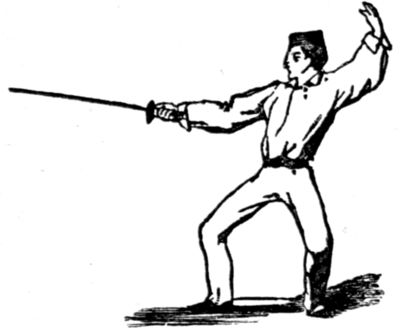
upon an adversary, when beyond hitting distance.
The step in the advance is usually about that of the
width of the Guard, although of course this would
vary with circumstances. The step is made by
advancing the right foot the distance I have
named; and on its reaching the ground, the left
foot is brought up, and takes its place. To
the reverse of the above movement is made.
The left foot takes the lead, stepping to the rear
about as far as the right had stepped to the front;
the right occupying its place on its taking up its
new position. The next movement,
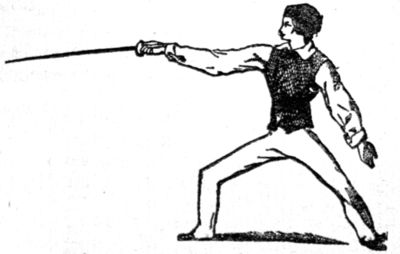
is a very important movement, and is rather difficult
to make properly, and fatiguing to practice.
Indeed, the first movements in fencing are the
most trying to the learner; and he must not be
discouraged if he fails to do them correctly at
first—practice only will give him this power. The
Longe is that extension of body which accompanies
every attack, and is thus made:—The right
arm is extended straight from the shoulder, the
arm and blade being on the same level; by a second
movement, the right foot is raised from the
ground, and a step made forward, about eighteen
inches in length, while the left remains firmly
planted in its place. At the instant that this step
is made, the left hand is allowed to fall within a
few inches of the left thigh, and the left knee is
stiffened back until the leg is perfectly straight.
The thigh of the right leg will now be in a position
nearly horizontal; from the knee downwards
perpendicular. Having executed the Longe, the
next movement to be made is
that is, to return from the position of the Longe to
that of the Guard, and is thus effected:—The left
arm is nimbly thrown up to its place, the right
arm drawn in, and the left knee re-bent. These
movements must be made at the same time, as it
is their united action that enables a person to recover
from so extended a position as the Longe
quick enough to avoid a thrust if his own attack
has failed.
These movements must be frequently practiced
before any others are attempted—the Guard, the
Advance, the Retreat, the Longe, and the Recover;
and when the learner has attained some proficiency
in them, he may begin the more delicate movements
of attack and defense. Of these I will now
speak.
It is customary for adversaries, on coming to
the Guard, to Engage, or to join blades, on what
is called the inside, that is, the right side; although
there are occasions on which it is advisable
to engage on the outside, or on the left; otherwise
called the Quarte or Tierce sides.
Two men thus opposed to each other will at once
perceive that there are two lines of attack open to
them, i. e. the line inside and the line outside the
blade—these, and no more. But these may be,
and in fencing are, subdivided into inside above
the hand, and inside under the hand, and the same
subdivision for outside. This gives four lines of
attack—or, to speak more simply, gives four openings
through which an adversary may be assailed.
Now, to protect each of these assailable points,
are four defensive movements, called
Each opening has its own parade or defense, and
each parade will guard its own opening, and,
strictly speaking, no other. The opening inside
above the hand is defended by two parades.
As its name imports, the first and most natural
parade is that of Prime. The action of drawing
the sword from its sheath is almost exactly the
movement made use of in the parade of Prime.
In this parade the hand is raised as high as the
forehead, so that the fencer can see his opponent's
face under his wrist. The blade of the foil is
almost horizontal, but the point is rather lowered
towards the ground. As this parade will throw
the right side of the body open to the adversary's
sword, it is good play to disengage from left to
right, and deliver a rapid thrust at the adversary,
in order to anticipate him before he can bring his
own sword round for another thrust. His point
will be thrown far out of line, so that he is behind-hand
in point of time.
This is a very useful parade for fencers of short
stature, as they can sometimes get in their blade
under their adversary's arm, after they have parried
his thrust.
The other parade is that of
It is thus formed. On the approach of the point
of an adversary's blade (and how these approaches
are made I will presently explain), the right hand
is moved a few inches—three or four will be
enough—across the body on the inside, the hand
being neither depressed nor raised, and the foil
being kept on the same slope as in the Guard.
This guards the body on the inside above the hand,
but (and here comes an important law in fencing)
the very movement which has guarded the body
on one side has exposed it on the other; this is the
case with all the simple parades.
Suppose, now, that the exposed part outside
above the hand were assailed, then the defense for
it is the parade of
It is formed by turning the hand with the nails
downwards, and crossing to the opposite side some
six or eight inches, the hand and point at the same
elevation as before; this will guard this opening.
If, however, the attack has been made under instead
of over the hand, then the proper parade would
have been seconde.
There is another method of parade called quarte
over the arm—which is executed by making about
the same parade as in Tierce, with this exception—first,
the hand is retained in its original position,
with the nails upwards, and secondly, the point is
not raised over the eye of the adversary.
It is rather more delicate than Tierce, but wants
its power and energy. The ripostes, or reply
thrusts, are made as they would have been had the
parade been that of Tierce.
is formed by turning the hand in the same position
in which it was turned for tierce, but the point of
the foil slopes as much downwards as in tierce it
did upwards; the direction and distance for the
hand to traverse being the same. Again, had the
attack been delivered at none of these, but at the
inside under the hand, then the proper parade
would have been
which, as its name expresses, is a half-circle, described
by a sweep of the blade traversing the
under line. Next comes the parade of
In this parade the hand is held as in Quarte; the
hilt of the foil is kept lower than that of the opponent:
the blade is almost horizontal, the point being
only slightly lower than the hilt, and directed
towards the body of the adversary.
Octave is extremely useful when the fencer
misses his parade of Demi-cercle, as there is but a
short distance for the point to traverse, and it generally
meets the blade of the adversary before the
point can be properly fixed. Moreover, it brings
the point so near the adversary's body, that he will
not venture to make another thrust until he has removed
the foil.
Thus I have enumerated, and partly explained,
the forms and uses of these four parades: they are
called Simple Parades, to distinguish them from another
set of defensive movements, called
I have said and shown that a man standing foil
in hand, in the position of the guard, is exposed in
four distinct places to thrusts from an adversary
within longeing distance. I have also shown that
he has a defense for each of these exposed places;
but if a man has but one defense for each assailable
part, then his adversary, knowing beforehand
what the defense must be, would be prepared beforehand
to deceive him. But if he has a reserve—if
he has a second defense for each part—then
the adversary cannot tell what the defense will be,
until his attack, false or real, is begun.
To meet this contingency, a second series of defenses
have been devised, which are of an entirely
different nature from the Simple Parades.
Again, as each of the simple parades is framed
to guard only one opening, it was found desirable
that the contre-parades should be of a more comprehensive
character. They are therefore devised
so that each is capable of protecting the entire
front. It is evident that this object could not be
attained without the sacrifice of quickness, because
a larger space must be traversed, and therefore
more time is occupied with a contre than a simple
parade.
To know one contre-parade is virtually to know
all, as they are all formed on the same plan. They
are all full circles in the position of hand and
direction of foil of the different simple parades; or
more clearly speaking, each simple parade has a
contre-parade; there are, therefore, four simple
and four contre-parades, which may be thus
arranged:
| Quarte | Contre de Quarte. |
| Tierce | Contre de Tierce. |
| Seconde | Contre de Seconde. |
| Demi-cercle | Contre de Cercle. |
I have said that a contre-parade is a full circle
in the position of hand and direction of blade of
its simple; thus, contre de quarte is made by retaining
the hand in the position of quarte, while
the foil describes a circle descending on the inside,
and returning by the outside to the place of its
departure. So with all the others, the foil following
the direction of the simple parade, of which it
is the contre. These complete the entire system
of defenses.
I now come to the movements of an opposite
nature, namely, the
and shall begin with the most simple of them. I
will again suppose two adversaries standing en
guard, within longeing distance of each other: now
the most simple movement that the attacking
party could make would be
to the outside or inside, according to his line of
engagement. I have, in describing the longe, in
effect described the straight thrust; it is but a
longe in a straight line, taking care, however, to
feel firmly the adversary's blade, but taking care
also not to press or lean on it during the delivering
of the thrust.
Next in character comes
This attack is made by dropping the point of the
foil beneath the adversary's blade, and raising it
on the opposite side, at the same time, rising with
the arm fully extended; on the completion of the
extension the longe is made and the thrust delivered.
is but a double disengagement, the first being but
a feint or false attack, to induce the adversary to
form a parade to cover the part threatened, for the
covering of one part of the body exposes the opposite;
the second disengagement is made to take
advantage of this exposure. The arm is extended
half-way on the first, and then wholly on the second,
to be immediately followed by the longe.
This is another variety of attack. Supposing
the adversary's blade to be firmly joined to yours,
when you wished to deliver a straight thrust, there
would then be danger of your falling upon his
point. This danger is avoided by giving a slight
beat on his blade the instant preceding your extension
of arm, of course to be followed en suite by
the longe.
The companion attack to this one is
The beat here takes the character of the first
disengagement in one-two, i. e. becomes a feint,
and is intended to induce the adversary to return
to the place he occupied when the beat was made.
You then immediately pass to the opposite side of
his blade in the manner described in the disengagement.
It will be seen that all these movements pass
under the adversary's blade. However, there are
certain situations in the assault, as a fencing about
is called, when an adversary is more assailable
over the point than under the blade; for this purpose
there is what the French call the coupe sur
peint, or
It is thus made:—By the action of the hand, and
without drawing it back at all, the foil is raised
and brought down on the opposite side of the adversary's
blade, the arm being extended during
its fall to the horizontal position, on attaining
which the longe is delivered.
is on the same principal as the one-two and the
beat and disengagement. On the adversary opposing
the first movement (the cut) with a parade,
the second movement (the disengagement) is made
to the opposite side, to be followed, of course, by
the longe, the extension of the arm being divided
between the two movements.
These attacks are called simple attacks, because
they may be parried by one or more simple parades,
according to the number of movements in the
attack. In fact, every attack can be parried, and
every parade can be deceived; it is the additional
movement last made which hits or guards.
Thus, you threaten by a disengagement to the
outside; your adversary bars your way effectually
by the parade of tierce; you make a second disengagement
to the inside, which is now exposed from
the very fact of the outside being guarded (for both
lines of attack cannot be guarded at the same time),
thus converting your attack into one-two; but if
your adversary parries quarte on your second movement,
your attack would be warded off. This can
be carried much further, but the above will, I think,
be sufficient to explain the nature of simple parades
and attacks.
To deceive a contre-parade, a separate movement,
called a
has been invented; it is very simple in principle, and
admirably answers the purpose. For instance if
you were to threaten your adversary by a disengagement
to the outside, and if, instead of tierce,
he parried contra de quarte, the double is then
made by your making a second disengagement to
the same side as the first, for it will be found that
his contra de quarte has replaced the blade in the
positions they occupied previous to your disengagement.
You will then have an opening, and may
finish the attack by the longe.
As all the contra-parades are on the same plan
and principle, so are all the doubles. Of course, it
is understood that you will make all the movements
of the double en suite, and without allowing
your adversary's blade to overtake yours.
The foregoing movements having been well practiced
in the lesson, the next step is that of all feints
and all parades, and may be practiced either with
a master or fellow-pupil. The practice consists of
one pupil standing on the defensive entirely, while
another assumes the offensive, and attacks him
with all the feints of which he is master, the other,
of course, defending with all his parades. It is
excellent practice, as it accustoms the pupil to
think for himself gradually, he having thus but one
set of movements to think about. He is therefore
enabled to make them boldly, without having to
encounter unknown movements from his adversary.
It also enables him to see the extent of his resources,
both for attack and defense. When he
can both attack and defend with some presence of
mind, he may then begin
that is, he may encounter an adversary, to attack
or defend as occasion presents. He is then left to
his own resources entirely. The following
given by a very eminent fencer and excellent
teacher, cannot fail to be of use:
"Do not put yourself on the position of the guard
within the reach of your adversary's thrusts, especially
at the time of drawing your sword.
"If you are much inferior, make no long assaults.
"Do nothing that is useless; every movement
should tend to your advantage.
"Let your movements be made as much within
the line of your adversary's body as possible.
"Endeavor both to discover your adversary's
designs and to conceal your own.
"Two skillful men, acting together, fight more
with their heads than their hands.
"The smaller you can make the movements with
your foil, the quicker will your point arrive at your
adversary's body.
"Do not endeavor to give many thrusts on the
longe, thus running the risk of receiving one in the
interim.
"If your adversary drops his foil by accident, or
in consequence of a smart parade of yours, you
should immediately pick it up, and present it to
him politely.
"Always join blades (if possible) previously to
another attack, after a hit is given."


