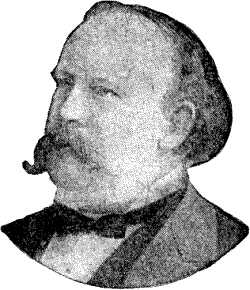
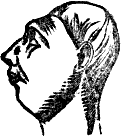
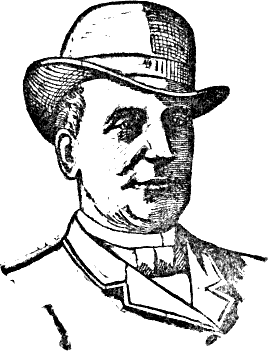
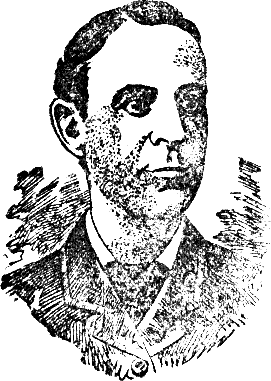
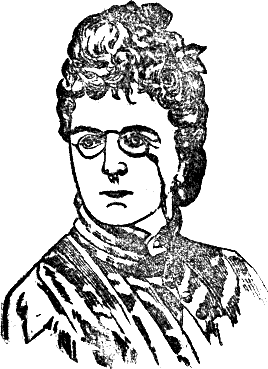
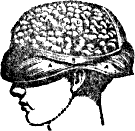
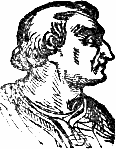
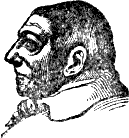
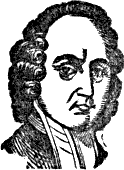
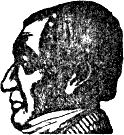
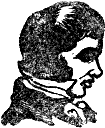
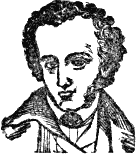
How Mental Characteristics are Displayed in Personal Appearance.
[From the Dallas (Texas) Times.]
“Now,” said Prof. Windsor to a representative of the Times last
evening at the Opera-house as they took seats commanding a view of the
audience, “if you’ll pay attention I’ll give you some points on
matrimony from a phrenological standpoint, illustrated with practical
examples from this audience:
“Notice that couple just behind the usher in the middle aisle. The
gentleman, as you see, is a brunette, tall, angular, with a prominent
Roman nose, and a firm step. He is one of our promising young attorneys,
as the papers say. An aggressive executive disposition is written in
every line of his face. He is not so noted for legal knowledge as for
his ability in handling the facts in the case. Notice his chin, which is
rather narrow, round, and projects well forward.”
“What does that signify?”
“An intense desire to love. His affections, like the rest of his
character, are aggressive and must find expression. His conjugality is
large and he will center all his affections on one beloved object.
“Now, notice the lady. She has taken the seat beside him, and the
average observer would not detect anything wrong, but I can see from
here that she does not enjoy his company. There is no compatibility
between them, and if they marry they can expect nothing but misery.”
“Upon what evidence do you base these conclusions?”
“Well, her temperament is similar to his, as you will see if you notice
her features and complexion; but that isn’t all. Notice her position.
The lines of her figure are all inclined away from him. She smiles at
his conversation, out of politeness, and is not conscious of the fact
that she is betraying her dislike by any act; but she is, nevertheless.
“Now notice that couple over there on the left, three seats back of the
one we have just observed. You see the lady is a blonde with a wide
forehead and a nose which has a regular curve from the root to the tip.
That is what we call the celestial nose, because it is always pointing
skyward and serves as a perpetual interrogation point. She can ask more
questions between the acts than her companion can answer in a fortnight.
Her chin is narrow and pointed, which signifies congenial love and a
wealth of affection which she is anxious to bestow on somebody. Her
companion, you see, is a semi-brunette with a rather wide head. He is
one of our prominent retail merchants and the lady is his fiancée.”
“What are the prospects for their future happiness?”
“Good. Notice that indentation in the middle of his chin, signifying an
intense desire to be loved, a passive form of the passion, but admirably
adapted to her equally strong desire to manifest the active form by
caresses and endearments. Notice how closely they sit together, the
lines of both figures inclining to each other. Why, you couldn’t put a
piece of tissue paper between their shoulders. His nose is slightly
modeled after the Roman type, and as hers curves the other way the
circle of adaptability is complete.”
“Is the nose reliable as an indication of character?”
“Always. Do you see that gentleman on the front seat with the pug nose?
Well, his character is equally undeveloped, as his friends will tell
you. The shortness of the organ from root to tip signifies a distressing
lack of executive ability.
“The lady beside him is much the better man of the two. She has
executive force enough for a whole family, and the fact is betrayed by
the strong features, large nose, wide head and firmly set jaws and
lips.”
“Does the mouth indicate as much character as the nose?”
“Yes, the character is written on every feature. You see that lady on
the second row of seats, back of our pug-nosed specimen? When she
smiles, her upper lip curls up on one side, and when her countenance is
at rest, her upper teeth are slightly exposed. That is the sign of
approbativeness, love
of applause, compliments, desire to attract
attention, etc. You can see the same element of character in the fact
that she inclines her head to one side nearly all the time. Her costume
is almost loud. Her voice certainly is, for we have heard it at this
distance several times.”
“Approbativeness is not a very desirable element of character, then.”
“That depends upon perversion. In the present instance it is turned to
bad account. The young lady is admirably adapted to the stage, and if
she would adopt that profession the very faculty of approbativeness
would be her most powerful stimulus in ambition to excel.
“Approbativeness is often mistaken for self-esteem. Do you see that
gentleman coming down the middle aisle? From his walk you would suppose
he owned most of Dallas. He displays a good deal of jewelry and is
evidently ‘stuck on himself,’ as the boys say. He is a well-known lawyer
of very moderate talent, and the fact is that self-esteem is very low in
his organization, as he is very deficient in dignity. That aggressive
display is an effort on his part to supply a deficiency of which he is
painfully conscious.
“His wife, who accompanies him, is very modest and apparently
unassuming in demeanor, but she has plenty of self-esteem and firmness,
and the result is that she is the controlling member of the firm. If it
were not for her large benevolence and suavity, which makes her a very
agreeable woman, he would be
badly henpecked. As it is, she uses more
tact than force, but he obeys implicitly, nevertheless.”
“What benefits do you claim, Professor, to result from the practice of
phrenology as applied to matrimony?”
“Simply the results of knowledge and observation in any direction. If
parties will walk into matrimony blindly, without observing or
attempting to discover the signs of character, the result is likely to
prove disastrous. It is the old story of ‘buying a pig in a poke,’ to
use an ancient Irish expression. In matrimony, as in everything else,
the best plan is to make your transaction with your eyes open, and if
your eyes are not sufficiently educated to discern the signs of human
character, then to avail yourself of professional skill, as you would do
in every other department of life.”
[From the Atlanta (Ga.) Constitution.]
“Is that my picture, or that of the Three-Dollar Shoe Man, you’re
studying so carefully?”
The speaker was a large, fine-looking specimen of American manhood, who
walked into The Constitution office yesterday.
A splendid head, placed firmly upon a Grover Cleveland neck, silken,
sandy mustache, and side
whiskers cut on the William H. Vanderbilt
pattern, and piercing blue eyes, which seemed to look straight through
you—these were the striking features of a rather striking face.
Then he introduced himself. It was Professor William Windsor, LL.B.,
“phrenologist and anthropologist.”
“I have been an active practitioner in my line,” said the Professor, in
answer to a question, “for many years now. For some time before that I
studied phrenology and practiced law, but in later years I have devoted
all my time to the active practice of that which I have now made my
profession. This is the first time I have been to Atlanta, though I am
very much of a Southerner. I was born in Kentucky, and my father was a
Virginian. He made a fortune on the Mississippi during the war, and
after that was over he left the river and moved to Wisconsin, where I
was educated. I graduated in law at the University of Wisconsin; but as
I lived several years in Texas, I consider that I am very much of a
Southerner.”
“And as to phrenology?”
“I love it. There is so much to it—so much more than many people
imagine. Of course, I am working for money, but above and beyond that is
the desire to do good to my fellow-men. How? Why, nobody has a better
opportunity of doing good than a conscientious phrenologist, for he can
look into a man’s character, into the inmost recesses of his heart, as
it were.”
“Is there anything in palmistry?”
“Oh, yes. There is no reason why character should not be read in any
feature. It can be read, I have no doubt, in the feet as well as in the
head and the hands, but the trouble would be in getting comparisons. You
couldn’t very well ask every man you meet to pull off his shoes, that
you might study his feet, but every man studies the character of his
neighbor as he reads it in his face. He may say he doesn’t believe in
phrenology, but, unconsciously, perhaps, he practices it.”
“You spoke of doing good. Can you give me an instance?”
“Hundreds of them, I am happy to say. By pointing out to people their
faults and how to correct them, I know I have done good. This year I was
out in Pueblo, Colo., where I had been three years ago. While there, a
young man called on me, and brought with him his wife. Upon my last
visit I had examined him, and had pointed out several things to him. One
was that he was too cautious. He is a young business man, and is one of
those fellows who are always afraid to take risks. I told him of this,
and then, at his request, told him of the sort of young lady he should
marry. Well, he found the girl and married her, and he told me he could
point out where he had made seven thousand dollars by following my
advice as to risks. That is only one instance; but I believe I have done
much good.”
“And anthropology?”
“That means the study of human nature. In its application it includes
man in all his physical, mental and social conditions. Phrenology is the
science of the mind—mental philosophy; anthropology is the science of
man—human philosophy. I contend that to the proper understanding of
these great subjects we must look for the solution of all social
problems.”
What a Specialist in Cranial Architecture Can Read—The Skulls of
the Cliff Dwellers[*] Viewed by the Light of Science and Tapers.
[Denver (Col.) Republican.]
At one of his lectures last week at Warren’s Academy, Professor William
Windsor, LL. B., delineated the character of a skull submitted to him by
one of the audience. The Professor recognized it instantly as that of
one of the Cliff Dwellers, and proceeded to give a description of the
individual to whom the skull belonged. A Republican representative who
was present, called on Professor Windsor at the Brunswick
yesterday.
“The Cliff Dwellers,” said Professor Windsor, “present a most
interesting study to the anthropologist. I have examined the collection
of relics on Larimer street, and I have here the skull I examined
Tuesday evening, as well as two others kindly loaned to me by the
proprietors of that collection.”
“Can you tell anything of the mental characteristics of the wearers of
these skulls, Professor?”
“Oh, yes,” said the phrenologist, smiling. “The skull is an absolute
index of the character, and, as long as it holds together, is a better
monument than ‘storied urn or animated bust’ to those who have the skill
to read it. The skulls of these Cliff Dwellers furnish us with much more
accurate information than the other relics, concerning their habits and
character.
“For example, one of their striking peculiarities is a decided talent
for music. Nearly every skull in the collection shows it. After I had
remarked this fact to the proprietor of the exhibit, Mr. McLoyd, showed
me a very well-preserved fragment of a flute which is in the collection.
The skulls of these people, however, bear a more eloquent testimonial to
their musical genius than this fragment of their musical instrument.
“The peculiar form of the Cliff Dweller’s skull is produced by some
custom of the tribe in binding the infant upon a board or other
substance. This is proved by the fact that the flatness of the back head
is uniformly at the same angle, and that the upper tables of the skull
give evidence of abnormal pressure. There is also in this collection one
skull which is an exception, and shows exactly the development we would
expect to find in a normal form when such pressure was not applied. The
skull is that of a young female, and in outline it is strikingly like
that
of the ordinary Caucasian skull. In fact, I would pronounce it a
Caucasian skull were it not for the structure of the superior maxillary
bone, which shows a radical departure from the type of either of the
five present races. The Cliff Dwellers are more like the Caucasian than
the Indian, and more like the Hindoo than either. That they possessed a
higher order of intellect than any Indian tribe of which we have
knowledge does not admit of doubt.
“The most striking peculiarity of these skulls is their delicate and yet
strong quality. The grain or texture of the bone is much more delicate
and fine than the average of Caucasian skulls that belong to the
uneducated classes. The illumination of the skull discloses some
interesting facts. It is well known to phrenologists that the skull is
thinner in those regions that are most constantly used in the mental
habits of the individual. The illumination of the skulls of these two
youths (here Professor Windsor inserted a lighted taper in each)
discloses a nearly uniform thinness of the entire skull, showing that
they exercised all the faculties of the mind. The skull of this old
warrior, however, presents a different appearance under the same test.
You will notice that the illumination is confined to that portion of the
skull lying around the base of the brain, and running highest in the
forehead. The conclusion to be drawn from this is that the individual
who once wore this skull was a man of very practical intellect. The
perceptive organs, the knowing and reasoning faculties, executive
ability
and the social organs of amativeness and friendship,
particularly the latter, are all bright and particularly well developed.
“The abnormal width of the Cliff Dweller’s skull through the middle
section, and the massive, dome-like forehead, is due in a measure to the
crowding forward of the brain from the pressure which produced the
flattening of the occiput. Any normal head with such a development would
show a thinness of the bone in that region, whereas the opacity of the
warrior’s skull is remarkable in that region. If we may take the skull
of this female, which has not been subjected to this pressure, as a type
of the race, we are justified in considering the Cliff Dwellers as a
people remarkably agreeable in traits of character. All the domestic
propensities which form the basis of the family relation, the love of
offspring, of friends and neighbors, are remarkably well developed.
There is a magnificent moral influence shown in the development of
conscientiousness, approbativeness and caution. The latter organ is so
large as to suggest cowardice, but these people undoubtedly lived in an
age when circumspection and eternal vigilance was the price of existence
as well as of liberty.
“I notice that the writer of the article on the Cliff Dwellers in last
Sunday’s Republican makes the statement that they apparently had
neither literature nor religion. He bases his assertions on the fact
that he does not find altars or writings among their possessions. But
appearances are against him. They
apparently had both, from the
structure of their skulls. The Cliff Dweller is largely endowed with the
artistic and constructive organs of the brain with an unlimited capacity
for invention and designing. Savage races far below him in these
qualities have literature, and it is unreasonable to suppose that having
these qualities both large and active, he did not use them. As to his
religion, the single exception to the uniform opacity of the warrior’s
skull above mentioned in the crown of the head is in the organ of
veneration. He did not have enough of spirituality and faith to supply a
Methodist camp meeting, but he undoubtedly reverenced the Great Spirit
and invoked the patronage of the god which he could comprehend. The
other two skulls show as good a development of the religious organs as
you will find in a general average of any Sunday-school in Denver. The
Cliff Dwellers were undoubtedly religious.
“In physical structure the Cliff Dweller presents a greater variety than
is found in any race except the Caucasian. Their warriors were
undoubtedly men of great endurance and strong physique with a good size
of body. There were also among them types of character delicate in the
extreme and possessing but little endurance. As a race they depended on
prudence rather than strength for safety. They were shrewd, circumspect
and diplomatic. In complexion they were darker than the Caucasian and
much lighter than the American Indian. In diet they were
almost if not
quite exclusively graminivorous, living on grain and eating that raw.”
“How do you tell that? Professor,” asked the scribe. “Isn’t that getting
things down very fine for so long a lapse of time?”
“Oh, no; just look at the teeth of all these skulls and you will see
that they are worn—even these young skulls which have not developed the
wisdom teeth have the molars half worn away. The canine teeth are almost
rudimentary in these skulls—in the carnivorous races of men they are
very large. The condition of these teeth could only be produced by such
a diet. If the Cliff Dweller had subsisted to any extent on meat or had
eaten his grain cooked, he would not have worn the teeth one-quarter as
much at the age of these younger skulls. Moreover, he did not use
tobacco, which also leaves its mark on the skull, in the deterioration
of certain organs of the brain, which, to the credit of the Cliff
Dwellers, are well developed.
“If it is true that—
‘The evil that men do lives after them,
The good is oft interred with their bones—’
it is equally true, that by resurrecting the bones we may read the
history of both the evil and the good.”
[Return to text.]
Henry W. Grady’s Character Analyzed by an Expert. What a Study of
the Mask and of Photograph Shows—His Wonderful Brain and its
Wonderful Capacity.
Atlanta Constitution.
“Yes, I have given the character of Henry W. Grady considerable study,
as I do in the case of all men who attract public attention by their
graces, gifts and accomplishments, or by the lack of those attributes.”
The speaker was Professor William Windsor, LL. B., phrenologist and
anthropologist, whose lectures last week at the Guard’s armory
interested the people of Atlanta in the study of human character.
“Mr. Grady has interested me ever since I first heard of him, and I had
looked forward to meeting him personally here in Atlanta this winter,
ever since my route was mapped out for the season. I feel a sense of
personal bereavement in his death, for his characteristics were as
vividly impressed upon my mind by the study I had made of the man as
others experience from personal contact.”
“Perhaps you can tell us something of the character of Mr. Grady as
viewed from the standpoint of your science that will be interesting,
Professor,” suggested a representative of The Constitution, and the
party of interested gentlemen drew more closely around the philosopher.
“Yes, indeed,” answered Professor Windsor, “but to me the contemplation
of the character of Mr. Grady, at this time, is too much like viewing
the wreck of a grand ship which was freighted with a precious cargo, and
trying to estimate the loss. There isn’t much comfort in it, except in
the fact that a correct estimate of the virtues and accomplishments of
such a man, at a time when the community is still shocked at the
calamity of his demise, is a powerful incentive to emulation on the part
of other and younger men.
“From the phrenological standpoint Mr. Grady’s characteristics present
an interesting study, while his known accomplishments are a wonderful
confirmation of the correctness of the theory upon which we estimate
mental power, namely, that size of brain is the measure of power, when
temperament, quality and health of body are sufficient to support the
brain. Comprehensive greatness is never manifested by a small brain. I
have been placed in possession of very accurate measurements of Mr.
Grady’s head through the courtesy of Mr. Frazee, the Atlanta
sculptor who has a cast of the face and forehead made from the body
of Mr. Grady, and hence strictly correct in dimensions. I have also had
the benefit of numerous photographs, in which the phrenological features
are distinctly preserved.
“Mr. Grady possessed a strong endowment of the
magnetic temperament
which gives a strong circulation of blood and a great activity of
mentality. His height and weight show him to have had sufficient
vitality to sustain his brain, and there was just enough of the electric
temperament in him to darken his eyes and hair and give him intensity of
feeling and action. His quality was exceedingly responsive and delicate,
and these attributes are necessary to the class of orators to which he
belonged.
“The size of his brain compares favorably with what is known of other
intellectual giants, as the following measurements will demonstrate. The
actual circumference of the head around the base of the brain was
twenty-four inches. The measurement from ear to ear over the top of the
head fifteen and a half inches, while the forehead measures from ear to
ear over the perceptives twelve and a half inches, and from the same
points over the region of sympathy fourteen inches. The massing of the
intellect, it will be seen, was in the upper portion of the forehead;
and that region shows a remarkable development of benevolence, suavity,
causality, comparison and imitation.
“The most remarkable development, however, is in the organ of
constructiveness, which gives a lateral expansion to the forehead which
is almost enormous. This faculty is necessary to the correlation of
thoughts and ideas, the construction of sentences and the formation of
schemes and plans. As an inventor, Mr. Grady was superb, and his large
sympathy would
naturally lead him to the invention of social plans and
philanthropic enterprises rather than machinery.
“His large language is indicated by the fullness under the eye. The
phrenological organ of language lies above and behind the eye, and when
large presses the eyeball forward and downward causing a fullness or
sack under the eye which is very prominent in Mr. Grady’s portraits. In
the power and scope of this feature he had more development than either
Webster or Ingersoll.
“His large suavity enabled him to use his language in a way that pleased
even his antagonists. Mr. Grady was emphatically combative, as shown by
full development behind and between the ears, where the cast measures
six inches in diameter, but it was the combativeness which showed itself
in force and energy rather than contention. His combativeness was
harnessed to his suavity, and he could be forcible and at the same time
persuasive.
“These qualities were re-inforced by remarkable firmness, as shown by
the measurement over the top of the head, where the development is a
half-inch in excess of that of Daniel Webster, and a quarter inch above
that of Napoleon Bonaparte. This characteristic is also shown in the
projection forward of the lower lip, caused by habitual compression in
the exercise of this faculty.
“In this connection, it is interesting to note a comparison of Mr.
Grady’s head with the measurement of other noted personages. Here is a
table
which I have compiled, and which you will find entertaining,”
continued the phrenologist, as he unfolded a paper with the figures
herewith reproduced:
| NAME. |
Size around
the head at
base of brain. |
Size from ear
to ear over top
of head at organ
of firmness. |
| Henry W. Grady |
24 in. |
15½ in. |
| Henry Clay |
23¼ " |
14¾ " |
| Daniel Webster |
25 " |
15 " |
| John Quincy Adams |
22½ " |
15 " |
| Thomas H. Benton |
23 " |
15 " |
| Napoleon Bonaparte |
23½ " |
15¼ " |
| Average |
23½ in. |
15 in. |
| Average of human race |
21 in. |
14 in. |
“From these figures,” continued Professor Windsor, “we may draw a
melancholy conclusion of the power Mr. Grady might have exhibited had he
lived to ripen into perfect development. It will be seen at once that
only one of these distinguished characters had the advantage of him in
size of brain at the base, and that is Daniel Webster, whose character
was more remarkable for ponderous greatness than brilliancy, and Mr.
Grady’s head rises a half inch higher than his in the moral region.
Between the two measurements there is a comparative difference of one
and a half inches, in the heads of Webster and Grady.
That inch and a
half marks the difference between the debauched sensuality of the ‘Lion
of the North’ and the moral graces of the ‘Apostle of the New South.’
“The extra inch in the basilar circumference of the head of Daniel
Webster was due to an enormous development of social propensities which
in his case carried him beyond a correct balance and resulted in
notorious licentiousness, because there was not enough of the moral
sentiments in the crown of the head to control them. Mr. Grady’s head,
on the other hand, was not remarkable in the development of these
propensities. He had enough of amativeness to give him a proper
appreciation of women and the delights of sociability, but his love
manifested itself more through the intellect than the passions, and his
social nature was of that diffusive character which manifests itself
in the formation of popular attachment rather than exclusive
friendships. There are many men undoubtedly to-day who pride themselves
on being among the intimate friends of the deceased who would be
surprised to know how many others have reason to entertain the same
feeling. When the social propensities are larger than Mr. Grady’s, the
possessor is likely to form such exclusive attachments that the energies
are expended in promoting the interests of individuals rather than those
of the masses.”
“From your view of the nature of the man, Professor, what would you
consider Mr. Grady’s chief fault?”
“The lack of self-esteem. That organ is one of the smallest in the whole
line of development, and was, unquestionably, his weakness, as it is
unfortunately of too many of our best men. He did not comprehend his own
importance, nor realize the value of his own personality. This defect is
directly chargeable with his illness and death. Had he possessed a
larger development of this organ, he would have been more cautious
concerning his health and personal exposure. There is a kind of
unselfish extravagance in this direction which leads to deplorable
results. A more selfish nature will husband its strength and escape
calamity. Had he realized his own value sufficiently, he would not have
gone to Boston on that fatal trip, and overtaxed his vitality. He did
not comprehend the dignity of his character on any occasion. His friends
say that he was as genial and approachable as a school boy, and that is
what I should expect to find in a head like his. We might have contented
ourselves, however, with a more distant manner and a more haughty
nature, for the sake of his self-preservation.
“There is profit in the study of human nature. We may contemplate the
characters of the great to arouse emulation, of the moderately endowed
to suggest improvement, and of the weak to guard against their failures.
Phrenology enables us to form correct estimates in each case, to praise
without flattery and to criticise without injustice. There is value in
the perpetuation of the physical forms of the illustrious dead
upon
‘storied urn and animated bust,’ as well as in polished granite and
enduring marble. For while these monuments cannot
‘Back to its mansion call the fleeting breath,’
still the inspired features and lines of development bear eloquent
testimony to the practicability of human improvement, just as
‘Lives of great men all remind us,
We can make our lives sublime;
And, departing, leave behind us,
Footprints in the sands of time.’”
A Scientist’s Theory of a Most Atrocious Crime—What Professor
Windsor Says of Hawes’ Mental Peculiarities—Insanity Which the
Courts Will Soon Recognize.
[From the Birmingham (Ala.) Age-Herald.]
Prof. William Windsor, LL. B., the noted specialist in phrenology and
medical jurisprudence, was seen by an Age-Herald reporter at the
Caldwell hotel last night, and in answer to interrogatories, made a
number of interesting statements concerning the Hawes tragedy.
Professor Windsor has had many years of experience as an expert in the
study of insanity in its various phases, and particularly in reference
to crimes
and their origin. He enjoys a national reputation in his
special lines of study, and his conclusions have the weight of
scientific authority.
In regard to the subject of discussion, he said: “I have been greatly
interested in the case of Dick Hawes ever since the publication of the
tragedy, and have made an exhaustive study, both of the man and the
circumstances of the case. Of course, in the mass of conflicting
statements contained in the evidence, it is impossible to know with
definite certainty just how the crime was committed; but the confessions
of Hawes and the testimony all agree that the man deliberately planned
and executed the murder of his family. Whether he had the bloody work
done or accomplished it with his own hands does not concern us so much
as the fact that motives and impulses existed in the mind of a husband
and father for the destruction of the lives of those he was bound to
protect, and that those impulses were sufficiently strong to accomplish
the execution of the crime.
“The study of the origin of these motives and impulses are highly
interesting, in view of the fact that they point to conditions of
society that are potent for the breeding of similar crimes.
“To my mind the key-note to the whole case is found in one of the
remarks made by Hawes while standing on the gallows, to-wit: ‘I want all
you boys to let liquor and vile women alone; see what it has done for
me.’
“A careful phrenological estimate of Dick Hawes
discloses the fact that
he was above an average in appearance, physique and mentality. His brain
is massive and of good quality, though uncultivated. It is not lacking
in the organs of benevolence, sympathy and agreeableness; in reason,
perception or reflection. He had sufficient caution and
conscientiousness to understand right and wrong, and the consequences of
both. There was enough of the affections and social qualities to make
him very attractive to women and children, as his history fully shows,
all of which is fully shown by the fact that he discharged the duties of
a responsible position for years, and commanded a reasonable degree of
respect. Such men do not commit crime while in a normal condition. It is
as physically impossible as it is for water to run up hill.
“When the domestic relations of such men are blasted by association with
prostitutes or by the unchastity of their own wives, a species of
insanity results, which completely reverses the ego or personality of
the man. I have observed hundreds of such cases, and have never seen an
exception to the rule. In scientific parlance his condition is known as
‘reversed amativeness,’ or a revolution of character, brought about by
an inflamed or abnormal condition of amativeness, the organ of sexual
love. As in a normal state this organ electrifies and strengthens every
natural affection, making every faculty more exquisitely perfect, so in
its inflamed or reversed state it leads to the entire obliteration of
every rational sentiment.
“The particular direction in which this obliteration may manifest itself
depends largely on the temperament of the individual and the
circumstances of the case. In some men it results in paralysis of the
energies, changing the character into shiftlessness. In other cases it
results in destroying the moral sense, but does not amount to positive
viciousness, while on the other hand it may result as it unquestionably
did in this case, in absolutely perverting the affections so as to
render the man incapable of the natural feelings of a husband and
father, and supplying motives which seem to be of the most inhuman
character. They are inhuman and unnatural, but in such cases it is not
correct to hold the man as responsible for the deplorable results unless
it is clearly proved that the mental unbalance was brought about by his
own acts, performed in a state of conscious free will. The law clearly
recognizes that the drunken man is insane, and holds him responsible for
his acts committed while drunk, if he became drunk through his own
volition. If the liquor is proved to have been forced down his throat or
he has been drugged by some one else and his mental balance dethroned
thereby, he is not responsible.
“It is a very nice question to decide in this Hawes case whether the
depraved condition alluded to was the result of his own acts or of his
domestic troubles. There is no doubt in my mind but that the species of
insanity referred to, existed in the mind of Hawes at the time of the
tragedy.
“It is a principle in medical jurisprudence that the more atrocious the
crime the stronger is the presumption of insanity in the perpetrator. It
is a fact wholly creditable to human nature that horrible crimes are
rarely, if ever, committed by persons in a normal state of existence.
The popular mind is not prepared to receive evidence of insanity in such
cases because of the revengeful feeling which naturally animates the
minds of men under such circumstances. And there is another difficulty
in the way of justice in the fact that this form of insanity is rarely
accompanied by such evidences of mania as the uninstructed would demand
as necessary to constitute insanity. The perverted state of the
affections and the judgment are not necessarily accompanied by the wild
ravings and glassy eyes of the lunatic. Emotional insanity of this type
is only temporary. It may, also, only affect a few faculties of the mind
necessary to the perpetration of the deed, while the mental balance of
nine-tenths of the man may remain undisturbed.
“The great fact remains, in any case, that by harlotry, licentiousness
and prostitution the grandest intellects are overturned and the most
harrowing discords produced in society. As long as society tolerates
conditions of ignorance in regard to sexuality, and fosters or permits
establishments having for their avowed purpose the excitement of the
passions and the obliteration of the virtues, we will continue to have
repetitions of tragedies similar to the case of Hawes.”
An Interview With Prof. William Windsor, LL. B., the
Distinguished Phrenologist, Lecturer and Traveler.
[From the Memphis (Tenn.) Appeal.]
For several years the citizens of Memphis have not had an opportunity to
hear a discussion of the principles of the science of phrenology, or
character reading. The announcement in yesterday’s Appeal of the
series of entertainments to be given in the Young Men’s Hebrew
Association Hall, by Prof. Wm. Windsor, LL. B., beginning to-night,
prompted a reporter to call at the Gayoso hotel last night, and send his
card to the Professor. He was cordially received by the Professor’s
wife, Mme. Lilla D. Windsor, a lady of elegant presence and charming
affability of manner, in their private parlors on the first floor, and
agreeably entertained until the Professor dismissed several who had
called for professional services.
“The science of phrenology,” said Professor Windsor, smiling, after the
usual greetings and upon learning the object of the visit, “is very much
misunderstood. It is a popular error to suppose that we depend upon an
examination of depressions and ridges in the cranium, commonly termed
‘bumps,’ when, in fact, a phrenological examination is based upon a
critical inspection of the entire physiological structure and condition,
including comparative development of size
and configuration of brain,
as I shall demonstrate in the lectures.
“Come this way,” said the Professor, leading to another apartment where
a uniformed employé was engaged in unpacking several enormous trunks.
“Look at these skulls. Here is the skull of a man executed at forty
years of age who murdered a family of six persons in Mississippi in
1842. Contrast it with this skull of a harmless old negress who died at
the comfortable age of 108, and you will see how much difference there
is in heads,” and the phrenologist demonstrated by actual measurement
that there was over four inches difference in comparative development.
He also exhibited to the reporter a number of other crania showing equal
diversity of growth.
“I shall exhibit these crania at the free lectures and demonstrate the
scientific principle upon which phrenology rests,” continued the
Professor, as he conducted the reporter through an inspection of the
outfit. “Here are the three smallest mummies in the world, besides many
other specimens which I use in my physiological lectures to the sexes
separately. I also use a number of portraits and diagrams in my lectures
on matrimony and physiognomy; but the real demonstration, of the utility
of the work is made in public examinations of leading citizens selected
by the audience. It is a fact that character can be read, and read
correctly, and if this be true, all that I claim for the science in
adapting young men, women and children to proper studies, professions,
trades, etc., follows
logically and as a matter of course. It also
follows that if one character can be measured scientifically, a proper
choice for associates in matrimony, business partnerships, etc., can be
indicated. It is the purpose of the lectures to demonstrate these facts
to the satisfaction of the public.
“The first lecture will be devoted to an exposition of scientific
principles, the second to the application of these principles in choice
of professions and trades, the third to the consideration of matrimony.”
“What shade of meaning do you attach to the word ‘anthropologist’ as
used by you, Professor?”
“The word signifies, in its broadest sense, a student of human nature.
In its application it includes man in all his physical, mental and
social conditions. Phrenology is the science of the mind—mental
philosophy. Anthropology is the science of man—human philosophy. To the
proper understanding of these great subjects we must look for the
solution of all social problems, concerning the mental, moral and
physical advancement of the race, or races, as the case may be.”
A pleasant half hour was devoted to conversation, when the reporter
withdrew. Professor Windsor is a gentleman of genial social qualities,
and scholarly in language and appearance. He possesses a magnificent
physique, which he claims to have gained by a strict conformity to his
rules of diet and habits of living. He weighs 200 pounds, uses no
stimulants—tea, coffee or tobacco—and prides himself on being able to
sustain fifteen hours per day of professional labor, made necessary by
his large practice and business management. He has just closed a
successful course of twenty-seven consecutive lectures in Kansas City,
and does not seem in the least fatigued. The Kansas City Star, in
referring to his closing lecture, speaks of it as one of the finest ever
delivered in that metropolis.
What a Noted Specialist Has to Say of It—Cranial Malformation
the Genesis of Much Crime Traced to Other Sources—An Interesting
Talk.
[From the Birmingham (Ala.) Age-Herald.]
Prof. William Windsor, of New York, is in the city. He has a reputation
that is almost international in his specialty; for, as a phrenologist,
his discussion of the physical conditions which lead to crimes, have had
a wide notoriety.
Chatting with an Age-Herald reporter last night, he gave a most
interesting and instructive talk on the noted crimes that have occurred
during the past ten years. Professor Windsor has studied most of the
criminals that have become prominent, and in a purely scientific way he
has gone back of the outward evidences of criminal depravity to
understand the physical and possibly hereditary conditions that brought
about the overt acts. His fund of information on this subject is almost
an inexhaustible one.
In discussing the Maxwell murder, he said: “I was in Texas at the time
of the St. Louis tragedy. A friend of mine sent me a picture of the
alleged murderer, with a request that I give my theory of the crime.
Like many newspaper cuts, it was decidedly unsatisfactory; but the man
who made it had caught enough of the likeness to enable me to know the
chief characteristics of Maxwell.
“Explaining the disadvantages under which I labored, I at once wrote to
him, and gave my theory of the crime; and when, at last, the matter came
out, I found that I was right.”
“Do you study every criminal case that comes under your observation?”
“Of course I do. A man who is alive to science can not help doing it.
Whenever I hear of a crime and learn the circumstances of its
commission, I at once begin to devote my own mind to the combination of
mental qualities which could have rendered it possible. Of course it is
impossible to understand how some of the terrible acts could have been
committed; but you would be surprised to know how much is
revealed by seeing either the man or a good portion of him.
“The mental characteristics of criminals have much to do with not only
the crimes they commit, but the manner in which they perpetrate their
deeds, and in a consideration of what has been accomplished, heredity
plays a strong part. Some men are born with an adeptness for crime of a
certain character.
Let the opportunity arise, and they yield to the
stress of circumstance and become guilty men. I have seen a number of
noted criminals who would not have been such, except for the unfortunate
circumstances that made them do an act which left them notorious.”
“How about these bank cashiers who keep skipping off to Canada?” was
asked.
“Well, there is one singular fact about them. The men who leave seldom
have acquisitiveness well developed. They have not a sense of values,
and when they are put in positions of trust, they fail to appreciate how
much is entrusted to them.”
“Then they go to squandering?”
“Yes, in one way that is true. They fail to appreciate their
responsibilities and take chances. Their carelessness soon tells, and
before they know it they are involved. This is the story of more than
half the defalcations that have been made public during the past decade.
It is not that the men were dishonest to begin with, but they did not
appreciate the value of the securities that were entrusted to them, and
by their laxity allowed themselves to become involved, and then yielded
to temptation through a sense of shame. There are not nearly as many men
who are criminals per se as the world believes.
“Many of the criminals so called are not responsible for their acts.
Their apparent moral obliquity is, in reality, a mental deficiency, for
which they are not any more to blame than you or I. I have seen men who
had been guilty—yes, even convicted of most
heinous crimes, who from
the very conformation of their heads revealed certain things that, to
say the least, should have been considered in mitigation of their
supposed guilt.
“I have made a study of criminals for years, and I think that it is safe
to say that in most cases that have come under my observation there were
either congenital or hereditary deformities to which the special
obliquity could be traced. Such has been the history of crimes in all
eras, and one only has to turn to the medical history of the world to
see that scientific men have even given greater cognizance to these
causes than can ever be brought before juries composed of men whose
training has not been such as to enable them to appreciate how much
these physical conditions have to do with the commission of crime.
“I see men every day who would be criminals if the stress of
circumstances forced them to it, and they would not be entirely
responsible for their action. Crime has more origin in the head than the
heart, and it is in the study of phrenology that we have the fact
revealed.”
Fritz Anschlag, a German Farmer in Los Angeles county,
California, in 1888 murdered Charles Hitchcock and wife, a highly
respected couple living at Garden Grove in that county, to obtain
possession of their farm, for which a deed had been executed to
him, but not delivered, awaiting payment. He was tried,
convicted, and sentenced to hang, but defeated the law by
committing suicide. An interesting feature of his case was the
receipt of a letter from his sister in Germany, before his trial,
informing him of the fact that she, his parents and all his
relatives had utterly disowned him and regarded him with no
sympathy whatever. As this was done before he was proven guilty,
and upon mere knowledge of the accusation, it is significant in
showing that the whole family were as deficient in the social
propensities as was Anschlag himself.
A Phrenologist Examines the Murderer’s Head.—The Brute Becomes
Angry at His Visitors, But Says Nothing—A Report of the
Examination.
[From the Los Angeles (Cal.) Express.]
This morning, through the kindness of Jailor Henry Russell, an Express
reporter was allowed to enter the cell of Fritz Anschlag, the condemned
murderer of Charles Hitchcock and wife, of Garden Grove, to witness an
examination of Anschlag’s head by Prof. William Windsor, assisted by his
wife. Jailor Russell swung open the iron door of the death-watch cell
and allowed the reporter and the Professor, accompanied by his wife, to
enter, and then followed himself.
As the little party entered the place of confinement, Anschlag looked
nervously around, and seeing
the visitors, frowned and mumbled some
incoherent words in German. The reporter was asked to speak to the
murderer in German and make known to him the object of the morning’s
visit. Anschlag at first was not willing to have his head examined, but
when assured it might be for his benefit, he readily consented.
Professor Windsor smoothed back Anschlag’s long straight hair from his
forehead and running his fingers through the murderer’s hair, began to
make an examination.
As the professor was going through the preliminary movements, the brute
trembled and turned color several times. During the examination
Professor Windsor would explain as he went along, and when finished,
kindly gave the reporter the following written report:
Anschlag’s head measures twenty-two inches around the base of the brain
and fourteen inches across the crown. His nature is peculiar in the fact
that the organs of the brain which deal with property values, and the
ability to make a living by ordinary transactions, are almost entirely
idiotic. He shows a fair development of memory and perception, but his
ability to reason upon moral questions of right and wrong, property and
the rights of others, and the consequences of his own acts, is almost
absolutely wanting. He is, in all respects, a moral idiot, and it is a
noteworthy fact that the most atrocious crimes are committed by this
class of criminal idiots. The
great difficulty in his case is in
getting the public or a jury to believe that a man may be capable of
reasoning on one point and displaying absolutely no power to think
correctly on the moral side of the question. The physical fact remains,
however, that to give Anschlag correct judgment on any question
involving property, ethics or the consequences of his own acts to
himself or others, his head would have to be enlarged at least an inch
in the occipital region and the posterior part of the crown.
A Scientific Estimate of the Murderer’s Brain—What Prof. William
Windsor, LL. B., the Eminent Phrenologist, Says of his Mental
Caliber—He Calls Him an Idiot—No More Moral Sense Than a
Dog—The Fault His Ancestors’.
[From the Los Angeles (Cal.) Tribune].
Prof. William Windsor, LL. B., the phrenologist whose lectures, in Los
Angeles, last January, excited such general interest, returned to the
city yesterday, en route for San Diego. He visited the jail yesterday
and made an examination of Fritz Anschlag, the noted murderer of the Mr.
and Mrs. Hitchcock. A representative of the Tribune called on
Professor Windsor at the St. Elmo and requested him to give the readers
of this journal the results of his examination of the man whose
atrocious crime has
absorbed the attention of the public ever since its
committal.
“Anschlag is a moral idiot,” said Professor Windsor, in answer to the
first interrogatory of the scribe. “He belongs to a class of beings who,
from the circumstances of birth and education, are destitute of the
requisite amount of sense necessary to form a correct judgment on moral
questions as well as many others.
“It is a popular error to suppose that phrenology depends upon ‘bumps,’
so called, or protuberances or hollows in the conformation of the skull.
The conclusions of the phrenologist are based upon estimates of brain
fiber, their quality and length from a point in the base of the brain
directly between the ears, to the surface. This measurement in different
heads will show a comparative difference of three or four inches in many
cases, though the heads may be smooth in contour and destitute of
‘bumps.’ Just look at these two skulls, for instance,” placing two
ghastly objects on the table, which, by actual measurement, differed
more than three inches.
“Does Anschlag’s head resemble either of these?”
“Not in all particulars. This,” holding up the broader of the two, “is
the skull of Andrew J. McCannon, executed in Mississippi, more than
forty years ago, for the murder of the Adock family, two adults and
three children. It is a case of moral idiocy more pronounced than
Anschlag’s.”
“What distinction do you make, Professor, in the
case of Anschlag or
this murderer, and a case of total idiocy such as we all recognize?”
“The difference is partly in degree, and partly in the fact that a man
may be idiotic in one faculty and have all or a majority of the other
faculties in the mind in good working order. Cases of color-blindness
furnish a familiar example. Color-blindness is not a defect of the eye,
but a defect of the brain. In other words, the party is destitute of the
sense of color, and it may be readily detected by a deficiency of brain
just above the eye.
“This head of McCannon shows a good development of the base of the
brain, giving fine energies and observation, but the entire upper story
is taken away. Anschlag, on the other hand, shows a good development in
front of the ears, sufficient memory, sympathy and observation to
display more than average intelligence on some points. The organs in the
back part of the crown and the occipital region generally, are almost
destitute of power, and render him incapable of comprehending social
relations, his duties towards others, or the consequences of his acts.
He can not form a correct judgment in regard to the rights of property,
and if he wanted anything he would steal it, without giving a thought to
the question of right or wrong. If he were questioned whether it were
right or wrong to steal or murder, he would answer ‘wrong,’ because he
has heard others say it was wrong, and he answers from memory alone. If
the question could be left entirely to his own judgment,
he would be as
absolutely incapable of solving it as a man who is color-blind would be
incapable of distinguishing shades of color.”
“If Anschlag’s head was as deficient in all points as he is in the
region behind the ears, what would be the result?” inquired the
reporter.
“It would be much the same as this,” replied the phrenologist, producing
a cast of the head of an adult idiot “destitute of all resemblance to
the head of a human being, and showing a short development of brain
fiber at all points. It is a noteworthy fact that the most revolting
crimes are generally committed by the insane and the morally idiotic
because their condition renders them incapable of understanding the
moral side of the question. A single life or a dozen lives which stand
in the way of their accomplishing a purpose, are regarded by them as
simply so many obstacles to be overcome, and if, as in Anschlag’s case,
the organs giving conscientiousness and fear of consequences are weak,
they will not hesitate to destroy life to carry out a design.”
“Do you consider Anschlag insane within the meaning of the law as to
responsibility for crime?”
“He is idiotic in the particulars mentioned, and is incapable of
exercising moral responsibility in any case. He is likely to commit
homicide upon any occasion which may seem to him to be expedient. I
would not hold him responsible more than I would hold a horse, dog, or
any other animal incapable of correct reason.”
“Where, then, would you fix the responsibility for the murder of the
victims?”
“Upon Anschlag’s parents and ancestors generally, and upon the condition
of society which permits marriages and sexual conditions in parents
which can not bring about other than deplorable results. Anschlag’s
condition is the result of ignorant violation of natural law on the part
of his ancestors, dating back for generations. Much could have been done
for him by a proper education. That it was not done is merely another
unfortunate link in a melancholy chain of calamities.”
Some Important Facts in Physiology Which Politicians Do not Take
into Account—The Lessons of the Recent Election Considered From
a Phrenological Standpoint—Characteristics of Some Leading Men.
[From the Dallas (Texas) News, Nov. 10, 1888.]
“There are some facts which play an important part in politics,” said
Prof. Wm. Windsor, the phrenologist, to a News representative last
night after the professor had dismissed his audience in Hill’s business
college hall after an interesting lecture on physiognomy, “which
politicians, as a rule, do not consider. Of course any man of
intelligence who plays long at the game of politics comes to possess a
certain kind of shrewdness in judging human nature; but very few
of
them are able to recognize and define the subtile constitutional
influences which predetermine the success or failure of the aspirant for
political honors. Such influences, however, exist, and other things
being equal, or approximately so, it is entirely possible to select, out
of a number of candidates, the ones who will succeed by sheer force of
physical attributes. There are men who are by nature qualified to lead
in great enterprises, and they owe their success in attracting the
support of their followers not so much to the development of intellect
and shrewdness as to the strong attachment arising from a large
development of the brain back of the ears in those regions which give
courage and social fraternity. After many years’ careful study of the
subject, I am positive in the opinion that a strong preponderance of the
electric temperament is of the greatest importance in the constitutional
qualifications of a man who assumes the task of a political race in
anything of higher moment than a county election. The magnetic
temperament seems to be particularly unfortunate in political contests.”
“What are the distinguishing characteristics of these temperaments?”
“The electric is the brunette, the magnetic is the blonde. Of the
former, General Harrison is a fine example; so were his ancestors, who
have played a conspicuous part in history. The electric temperament is
dark and swarthy in complexion, angular in configuration, tenacious and
strong in texture, and possesses a well-rounded back head, giving large
organs of social fraternity, courage, caution and self-reliance. In
General Harrison, these traits are somewhat softened by a superabundant
vitality, but the traits are all there. John A. Logan was a magnificent
type of this temperament. Abraham Lincoln personified it in all its
angularity and simplicity. Governor Ross, of this State, is strongly
marked with it; while, to come nearer home, your own Barney Gibbs is as
good an example of the vital phase of it as Lincoln was of the motive.
Nearly all the Presidents of the United States were strongly endowed
with this temperament, except Rutherford B. Hayes, who, on the contrary,
was a fine example of the magnetic. You will remember that he was a sort
of accidental President, anyhow, and that he was the result of a
compromise in his own party, in a convention in which several electric
temperament candidates had produced a deadlock. You will also remember
that his administration was characterized by no act of National
importance and that at its close he was relegated to an obscurity such
as has never befallen any other ex-President.”
“How about the National legislature?”
“Three-fourths of the members of Congress and a greater proportion of
the Senate are brunettes. The same rule holds good in State legislatures
as far as I have observed. The temperament which stands second best in
political preferment is the magnetic mental. Sam J. Tilden, Levi P.
Morton and Thomas A. Hendricks represent this type. It owes
its success
to the depth and intensity of its intellectual development, which
frequently creates a demand for its services in great emergencies. It is
characterized by brilliancy, integrity and the ability to accumulate a
barrel of money, which is also useful in political emergencies.”
“If the blonde is a failure in politics, wherein does he find his proper
sphere of usefulness?”
“The blonde is an organization of wonderful versatility and commands
influence and wins applause in vocations calling for spirit and vigor
displayed at short and frequent intervals, rather than for continued
tension on the nerves and muscles. He is warm, enthusiastic, generous,
impulsive, and deficient in the selfish propensities and in ambition. He
loves display and would like to have power, but is inadequate to the
continued effort and the endurance necessary to obtain it. He wields a
more potent influence in the pulpit, on the rostrum or in journalism.
George W. Peck, T. DeWitt Talmage and R. B. Hayes represent three
different types of this temperament all possessing these attributes.”
“What about Cleveland and Blaine?”
“Cleveland and Blaine are both examples of modified forms of the
Magnetic temperament, more marked in Blaine’s case than in Cleveland’s.
The student of politics will do well to observe that the defeat of
Blaine in 1884 and of Cleveland in 1888 were both due to defections from
their own ranks toward opponents of greater power in the particulars
mentioned.
Reasoning from purely physiological grounds, I believe
Cleveland would have defeated Blaine had he been renominated in 1888.
The study of human nature from any standpoint is interesting; doubly so
when viewed in the light of great events which ‘try men’s souls,’ in
fact, whether they be Presidential elections, the clash of armies or the
great discoveries of scientific students.
”
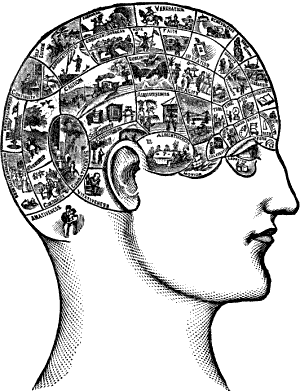
Larger image.
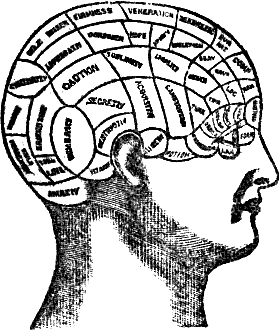
PHRENOLOGY SYMBOLIZED.
Copyright, 1895–
BY
PROF. WM. WINDSOR, LL. B., Ph. D.
The Symbolical Phrenological Head, Showing the Location of the organs of
the Brain.
←Contents
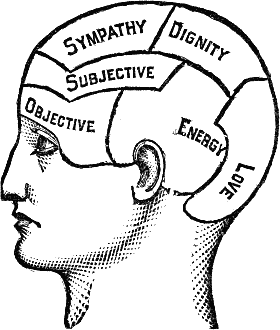
GROUPS OF ORGANS.
THE PHRENOLOGICAL EXAMINATION. — EXAMPLES OF PHRENOMETRICAL MEASUREMENTS. — EXAMINATIONS FROM PHOTOGRAPHS. — Information Required.
The Phrenological Examination is designed to show in an accurate and
scientific manner the size and development of Brain of the person
measured, and to furnish a basis upon which an accurate and reliable
knowledge of the character may be determined. The measurements can only
be correctly made by an expert familiar with the principles of
Phrenology. When these measurements are determined according to the
system, the Phrenologist is enabled to make a Complete Delineation of
the character,
describing the amount and kind of sense possessed by the
individual, his adaptation to a particular Business, Trade or
Profession, where that kind and amount of Intelligence is required, the
adaptation in Matrimony or Business Partnership, together with special
directions as to faults and how to correct them, health and longevity
and how to secure both. The expert must be able to judge the
Physiological Condition, Temperament and Organic Quality of the
individual with scientific accuracy, and these are important elements in
a scientific delineation of character.
Phrenological Examinations are said to be given orally when no record
is made of the conclusions of the examiner. A Phrenological Chart is a
blank prepared for concise written statements; and the chart filled out
is said to constitute a Delineation of Character.
Phrenometrical Measurements are given by means of the Phrenometer, an
instrument used for measuring the head, by which the exact form and size
of sections of the head can be reproduced upon diagrams prepared for the
purpose. This is the most valuable and reliable way of making an
examination.
A phrenograph is a written description of the character of an
individual, giving all the minute points and shadings of character in
the language of the examiner, and its value depends upon the perspicuity
and literary expression of the writer not less than upon his skill as a
phrenologist.
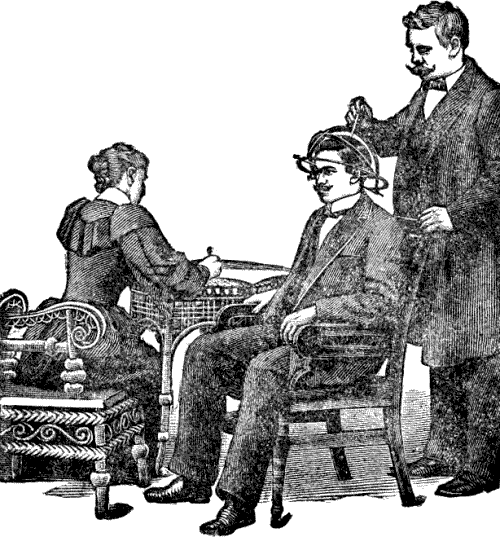
PROF. WINDSOR’S ASSISTANTS MAKING A
PHRENOMETRICAL SURVEY.
It must be evident from the foregoing that the value of the service
rendered by the phrenologist varies, as in all other professions,
according to his education and training, the instruments with which he
works, the elaborateness of the product and the adaptation of the
phrenologist to his own business.
The public should be warned against patronizing men who practice
Phrenology in a way that would bring any business into ridicule. Men who
are uneducated, who do not use the latest and best equipments, who have
never had any professional training, who do not comprehend professional
ethics or dignity, and who do not possess the elements of success in
their own characters, are hardly the ones to whom an intelligent man
would submit the most important questions concerning his own welfare
with the hope of receiving competent advice. But Phrenology has been
cursed with this class of quacks, perhaps even more than the profession
of medicine. And it is largely due to the stupendous blunders of such
pretenders that Phrenology is not recognized more generally by
intelligent scientists. Considered in its beauty and simplicity, it
certainly offers a more rational and practical system of mental
philosophy than has ever been otherwise formulated.
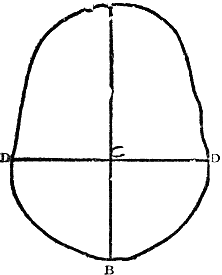
Fig. 1. COMBATIVE.
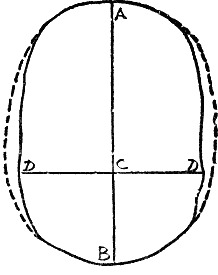
Fig. 2. NON-COMBATIVE.
Sections of base of brain, showing development of physical energy. The
dotted lines in Fig. 2 show the deficiency in alimentiveness,
executiveness and combativeness.
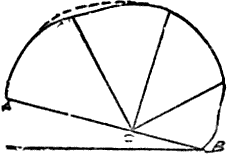
Fig. 3. NON-SYMPATHETIC.
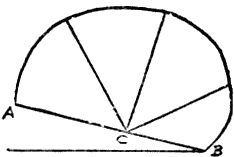
Fig. 4. SYMPATHETIC.
Profile sections showing development of sympathy and dignity. The dotted
line in Fig. 3 shows deficiency in Human Nature and Benevolence.
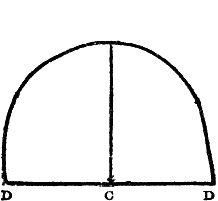
Fig. 5. MODERATE CAPACITY.
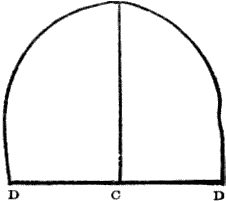
Fig. 6. GREAT CAPACITY.
Two sections of the region of subjective intellect, showing different
capacities of two individuals.
Phrenological examinations can be made from photographs with accuracy,
provided the photograph is a correct likeness, and some additional
information can be supplied. Owing to obvious difficulties, absolute
correctness cannot be guaranteed, but the results are sufficiently
valuable to justify the expedient wherever it is impossible to submit
the living head.
To obtain satisfactory results the photograph should be cabinet size,
and should show the form of the head and face as plainly as possible.
Very little can be told from a photograph when a hat is worn, or when
the personality is covered with millinery, wigs, bangs, uniforms, etc.,
etc.
A plain photograph, showing a three-quarter view of the face, is best.
Front views and profiles are valuable for some points and worthless for
others. When it is possible, a three-quarter view, front and profile may
all be submitted with good results.
The forms of examinations and charts from photographs and prices charged
for the service are the same as for the living subject, except that the
Phrenometer measurements cannot be given from a photograph, and an oral
examination cannot be given by mail.
Persons who have already been examined by me and who hold certificates
for Forms II, III or IV, may have opinions on Business Partnership or
Matrimony at one dollar for short opinions, and five dollars for the
elaborate form.
In all other cases prices are as follows:
| Business Chart and General Advice |
$ 5 00 |
| Business Chart and Adaptation in Matrimony |
10 00 |
| Adaptation in Matrimony only |
5 00 |
| Elaborate Phrenograph on all subjects |
25 00 |
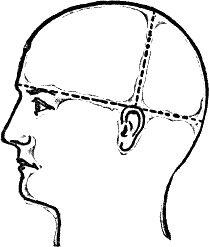
Take the following measurements of the head: Pass a tape measure around
the circumference of the base of the brain, passing just above the
eyebrows and just above the ears. This is called the basilar
circumference. Also measure the distance from the bottom of the orifice
of one ear to the corresponding point of the other, over the top of the
head at the highest point. This is called the trans-coronal
measurement. Then copy and fill out the following blank, and submit with
the photograph:
☞ Do not cut or mutilate this page.
When all the above points can be stated it is desirable that it should
be done. When it is impossible to do so, the blanks may be filled out in
part, and I will in all cases do the best that can be done with
information at hand. Address all correspondence on this subject to
DR. WILLIAM WINDSOR,
Box 66, St. Paul, Minn.
←Contents