The travel of to-morrow! It is a fascinating
subject, for, as we look backward
through the last century and see the marvellous
progress that has been made, it is impossible
to believe that now we have come to a standstill.
How then shall we travel in the future?
Will it be in some new form of railway train or
motor-car, with increased speed and added comfort?
Or shall we leave solid earth behind us
altogether and make our journeys in great airships
and aeroplanes?
We will begin with the more commonplace
methods, and consider the possibilities of improvements
and innovations in railway travel.
Lately a great deal has been said and written
about the mono-rail, and it seems quite likely that
alterations will take place in this direction, for a
single-line railway is comparatively cheap to construct,
and has many other advantages, among
them that of greatly increased speed. It is estimated
that this could easily reach two miles a
minute.
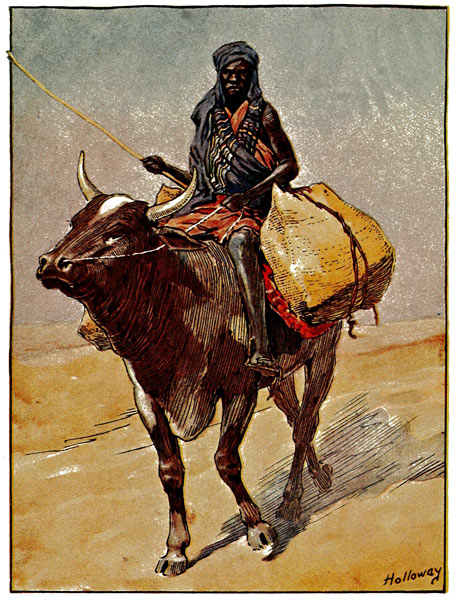
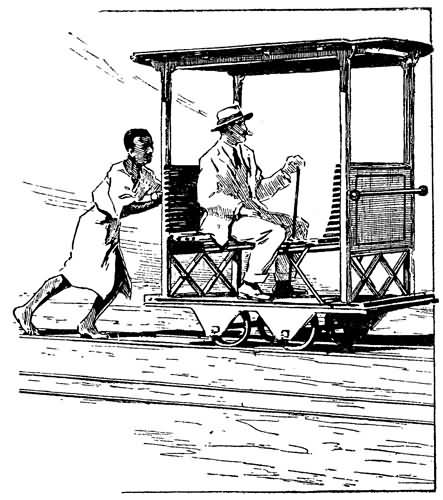
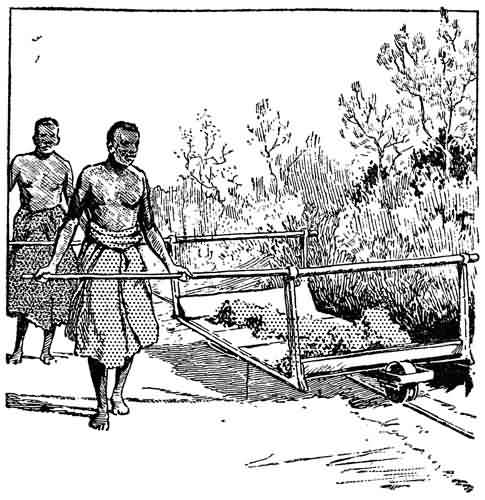
In Africa we saw a very primitive form of
mono-railway, and there is another in Algeria,
where the trucks or baskets filled with agricultural
produce hang on either side of a single line
and are drawn along by mules.
A real mono-railway with engines, railway carriages,
and trucks is already in existence in Ireland,
where it runs between Listowel and Ballybunion.
The line is raised some feet from the
ground, and is about 10 miles in length. The
engine is a very curious-looking machine, with a
boiler on each side and two funnels. This is
arranged so that the weight is evenly balanced.
There are also methods by which the trains on a
mono-railway may be steadied by means of a wonderful
contrivance called a gyroscope.
Closely allied to the single-line railway is the
hanging railway, which was first invented to carry
loads of merchandise or minerals across rivers or
over rough forest lands where an ordinary line
would be difficult and expensive to construct.
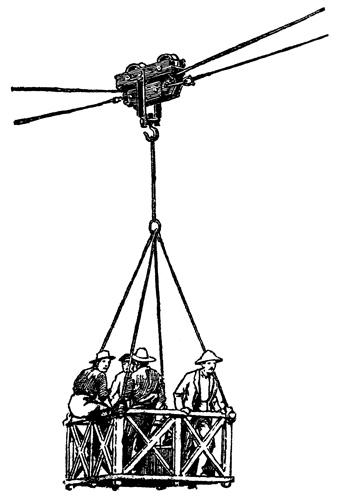
There is one of these hanging railways in
Rhodesia, where a strong wire crosses from bank
to bank of a river, and carries a chair-shaped seat
which can hold two passengers. This is dragged
backwards and forwards by means of a second
wire.
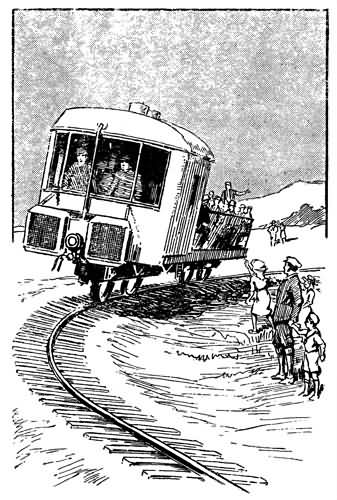
MONO-RAIL CAR, WITH GYROSCOPE.
Sometimes, instead of wire, rope is used, and
these rope railways can be seen in use at many
of the mines in South Africa.
Other and more elaborate railways in the air
have been made in Germany, and there is one for
passengers running between Barmen and Elberfield.
In this case the single rail is raised on high
trestles, and the carriage, which looks very much
like a large tramcar, runs along the line suspended
beneath the trestles.
Then, too, we may in the future have railways
that will take us across the English Channel,
either through a great tunnel or over a bridge,
reaching, as was proposed in 1884, from Folkestone
to Cape Grisnez.
A third plan that has been suggested for crossing
to France is that of a submarine bridge, upon
which a curious construction or platform would
run, and on this the trains themselves could be
taken from shore to shore, while still another
proposal was that large ferry-steamers should be
built, on the lower decks of which the trains could
be carried.
And now we will leave the earth and look at
the pictures of airships and the wonderful aeroplanes,
which, although improvements are being
made every day, can already travel at an almost
incredible speed and with a security that only a
little while ago would have been considered quite
impossible. Nowadays air travel is not only a
possibility but an accomplished fact, and it is hard
to realise that it has come about during the last
twenty years, and that before then practical flying
machines were unknown.
From very early times, however, inventors and
scientists have dreamed and experimented, and
no less than seven hundred years ago, Roger
Bacon, one of the most learned men of his day,
seems to have looked down through the centuries
and to have actually seen the aeroplanes with
which we are now familiar.
"There may be made a flying instrument," he
says, "so that a man sitting in the midst of the
instrument and turning some mechanism may
move some artificial wings so that they may beat
the air like a bird in flight."
It was a strange prophecy, but in those far-off
times—the dark ages we call them—men had
already fixed their hopes on flight, and school children
were trained in the use of wings as in that
of the globes.
We are not told what advantages this curious
accomplishment gave to the little boys and girls
of the thirteenth century, and, indeed, it may
have brought them ill-fortune, for in those days
inventors were often accused of witchcraft, and
new ideas were looked upon with suspicion. Even
centuries later, when the first balloons were causing
great excitement in England, many people
thought that it was wrong to spurn the laws of
nature by attempting to fly.
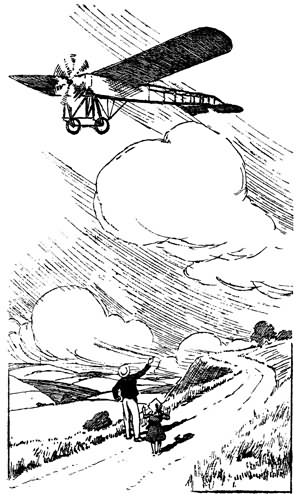
MONOPLANE, THE FIRST TYPE TO CROSS THE CHANNEL.
During the seventeenth and eighteenth centuries
some very strange flying machines were
made, and even before that time, in the reign of
James IV. of Scotland, we find that "The Abbot
of Tungland tuik in hand to flie with wingis."
The bold Churchman, however, did not succeed in
his rash venture, but fell from the wall of Stirling
Castle and broke his thigh.
In 1709 another monk planned a wonderful flying
ship which was to carry twelve men besides
stores of food, and about sixty years later a
Frenchman made himself "A whirl of feathers,
curiously interlaced and extending gradually at
suitable distances in a horizontal direction from
his head to his feet." In this eccentric costume
the would-be bird-man fluttered down from a
height of seventy feet and escaped uninjured.
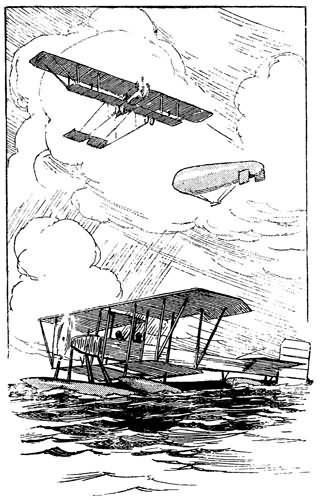
WATERPLANE, BIPLANE, AND SCOUT BALLOON.
The makers of balloons, meanwhile, met with
more success, and they bravely experimented with
their frail contrivances, which at first were filled
with heated air and necessitated a fire in the
basket-work car, fed with fuel of chopped straw.
As may be imagined, many accidents occurred,
but the inventors went on their way undaunted,
and in the middle of the nineteenth century we
find a man named Nadar constructing an enormous
balloon called the "Giant," which seems to
have been the forerunner of the great airships of
to-day. This monster would, we hear, have
exactly fitted into the dome of St. Paul's Cathedral.
It had a smaller balloon attached to it, and
below both a car fitted with wheels. This was
divided into compartments for the captain and
the passengers, with beds, baggage, and provisions,
while a printing office and a photographer's
room were included.
Nadar's ambitions, however, did not stop at this
marvel. Indeed, the "Giant" was only intended
to be a means of raising funds for the making of a
flying machine, which was to be called the aeronef
and have wings and a screw propeller.
The difficulty then, and for many years afterwards,
was to make an engine which at the same
time should be sufficiently strong and yet light.
It was not until another fifty years had passed
that this problem was solved and then we find
the modern aeroplanes and hydroplanes being
gradually developed and improved.
In 1909 a French aviator crossed the Channel
for the first time, and since then the progress has
been extraordinary, so that now we think little
of feats which a dozen years ago would have
been considered quite outside the bounds of
possibility.
Side by side with the aeroplanes, dirigible balloons
have been developed, and we can hardly
doubt that in the future this mode of travel will
come to be as safe and almost as commonplace as
our railways and motor-cars of to-day.
PRINTED IN GREAT BRITAIN BY
BILLING AND SONS, LTD., GUILDFORD AND ESHER
Uniform with this Book.
HAPPY HOMES
IN
FOREIGN LANDS
By A. A. METHLEY, F.R.G.S.
Illustrated, with colour and numerous black and
white illustrations by W. H. HOLLOWAY.
EVERY English child believes that a
British home is the nicest in the
world; but this interesting book contains
much that is fascinating and strange
in its descriptions and pictures of dwellings
in which boys and girls live in other lands.
LONDON
WELLS GARDNER, DARTON & CO. LTD.
3 and 4 Paternoster Buildings, E.C. 4
——and obtainable from all booksellers.——
Uniform with this Book.
THE ELF OF THE ORCHARD
By ALICE P. MOSS (MRS. NOWELL PRICE)
Illustrated by SYBIL BARHAM
ANIMAL TALES FROM AFRICA
By J. H. MACNAIR
Illustrated by H. ROUNTREE
THE SURPRISING STORY OF JOHN
ALEXANDER AND THE LITTLE MAN
By the DOWAGER COUNTESS OF JERSEY
Illustrated by GORDON BROWNE, R.I.
STORIES OF CHINESE HISTORY
By A. S. ROE
Illustrated by JANET L. GILMOUR
LONDON: WELLS GARDNER, DARTON & CO., Ltd.
NEW YORK: FREDERICK A. STOKES COMPANY
Uniform with this Book.
TWO ARE COMPANY
Or MADGE AND MAY AT WORK AND PLAY
By MRS. FIELD
Illustrated by F. D. BEDFORD
TALES FROM THE WOODS AND FIELDS
By GLADYS DAVIDSON
Illustrated by H. ROUNTREE
MORE TALES FROM THE WOODS
AND FIELDS
By GLADYS DAVIDSON
Illustrated by P. J. BILLINGHURST
THE ROBINS
By MRS. TRIMMER
Illustrated by H. ROUNTREE
THE SELF-WILLED PRINCE
By the REV. F. L. PAGET
Illustrated by JANET L. GILMOUR
LONDON: WELLS GARDNER, DARTON & CO., Ltd.
NEW YORK: FREDERICK A. STOKES COMPANY
Uniform with this Book.
VERY SHORT STORIES IN VERY
SHORT WORDS
By the HON. E. M. PLUNKET
With Illustrations by T. PYM
TINY TRUE TALES OF ANIMALS
Edited by MARY MACLEOD
Illustrated by H. ROUNTREE
AUGUSTUS
THE ADVENTURES OF A LITTLE BOY IN SEARCH
OF HIS OWN WAY
By the DOWAGER COUNTESS OF JERSEY
Illustrated by GORDON BROWNE, R.I.
FINIKIN AND HIS GOLDEN PIPPINS
AND OTHER STORIES FROM 'THE CHARM'
Edited by MARY MACLEOD
Illustrated in Colours by OLIVE ALLEN
CHILD'S OWN STORY BOOK
Illustrated by T. PYM
LONDON: WELLS GARDNER, DARTON & CO., Ltd.
NEW YORK: FREDERICK A. STOKES COMPANY
Uniform with this Book.
THE OLD OAK CHEST
OR
A BOOK A GREAT TREASURE
Illustrated by F. M. RUDLAND
WHAT SHEILA DID
THE ADVENTURES OF AN ONLY CHILD
By Mrs. C. J. BAKER
With Coloured and other Illustrations
TOMMY'S TINY TALES
By the DOWAGER LADY LEIGH
AND THE
HON. AGNES LEIGH
Numerous Illustrations in Black and White, besides Coloured Plates
LONDON: WELLS GARDNER, DARTON & CO., Ltd.
NEW YORK: FREDERICK A. STOKES COMPANY