WHILE every American citizen recognizes
the significance of the term “Old Glory” as
applied to the national flag, when and where and
by whom the nation’s emblem was christened with
this endearing and enduring sobriquet is a matter
of historic interest less understood.
In the early epoch-making period of the nation’s
history William Driver, a lad of twelve years,
native of Salem, Mass., begged of his mother
permission to go to sea. With her consent he
shipped as cabin boy on the sailing vessel China,
bound for Leghorn, a voyage of eighteen months.
On this first voyage the courageous spirit of
the youth manifested itself in a determination
to disprove the words of the ship’s owner, made
to him at the beginning of the voyage: “All
boys on their first voyage eat more than they
earn.”
In appreciation of the mettle shown by the
lad, the owner presented him, upon the return
from the cruise, with twenty-eight dollars in
silver, besides his wages of five dollars per month.
He carried the money to his mother, who wisely
admonished him to do the very best he could
under every circumstance, a charge he never
forgot.
His intrepid spirit brought the youthful mariner
rapid and deserved promotion. His eighteenth
year found him master of a vessel. Those
were hazardous days upon the sea, and more
than once his ship was subjected to indignity
and outrage incident to seafaring of that period.
But throughout a long career as master of a
merchantman the Stars and Stripes was never
lowered from the masthead nor sullied by defeat
or by dishonor.
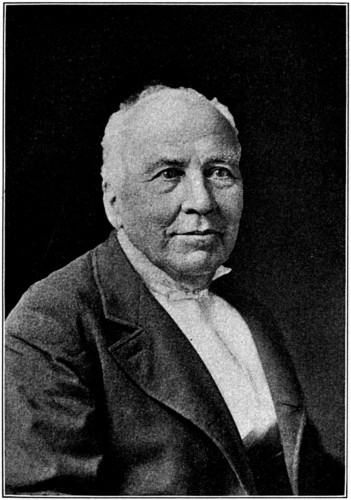 Captain William Driver.
The sailor, of all men, venerates his nation’s
flag. To him it is the visible and tangible token
of the government he serves, and in it he beholds
all the government’s strength and virtue. To
William Driver, therefore, the Stars and Stripes
typified the glory of the land and of the sea.
And seeing his nation’s symbol float dauntless
and triumphant above stress of every encounter
and happening upon the deep enkindled the
inherent love in his heart for it to enthusiastic
ardor, and in thought he called the flag “Old
Glory.”
A simple incident, but fraught with unread
meaning, gave the name into the nation’s keep,
albeit its formal christening and national adoption
was not to come until the soil beneath its folds
should be deep-dyed with the blood of conflict
between the land’s own countrymen.
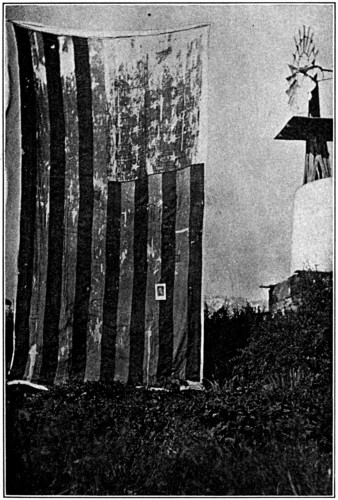
Photo of Original Flag.
“Old Glory.”
In 1831, as master of the brig Charles Daggett,
about to set sail for a voyage around the world
from Salem, Mass., Captain Driver was presented
by the citizens with a large bunting flag in commendation
of his services upon the sea and his
well-known love for his country’s emblem. This
flag, when presented, was rolled in the form of a
triangle, and the halyards bent. A young sailor,
stepping forward, said: “In ancient times, when
an ocean voyage was looked upon with superstitious
dread, it was the custom on the eve of
departure to roll the banner in form of a triangle.
When ready and bent like this, a priest stepped
forward and, taking the banner in his hand,
sprinkled it with consecrated water and dedicated
it to ‘God the Father, God the Son, and God
the Holy Ghost,’ turning the point of the triangle
upward at the name of each, thus calling on that
sacred unity of Creator, Redeemer, and Sanctifier
to bless the national emblem and prosper the
voyagers and their friends. The flag thus consecrated
was then hoisted to the masthead.”
With glistening eyes the captain watched the
hoisting of the flag; and as it fell into position at
the masthead of his ship and the colors unfurled
to the breeze, he shouted: “I’ll call her Old
Glory, boys, Old Glory!”
Cheer after cheer rent the air. The signals of
departure were sounded, the cables were cast
off, and the good ship set sail for foreign ports.
This was the ninth and most memorable voyage
made by Captain Driver. From the island
of Tahiti he rescued the suffering descendants of
the mutineers of the English ship Bounty, and at
risk of grave considerations turned his vessel
from her outlined course and returned them to
their beautiful and longed-for home, Pitcairn,
in the waters of the South Pacific, the settlement
of an island, which marks one of the memorable
events of English naval history.
Captain Driver made his last voyage around
the globe in command of the Black Warrior.
At the masthead flew his Salem flag, Old Glory,
to which he never referred but by that loving
pseudonym.
He left the sea in 1837 to become a resident of
Nashville, Tenn. He carried Old Glory with
him as a sacred relic, carefully deposited in a
heavy, brass-bound, camphorwood sea chest that
had accompanied him on all his voyages. On
legal holidays, on St. Patrick’s day (which was
his own birthday), and on days of especial celebration
in the Southern city Old Glory was
released from confinement and thrown to the
light from some window of the Driver residence
or hung on a rope across the street in a triumphal
arch under which all processions passed.
At the outbreak of the civil strife Captain
Driver avowed his Union sympathies and stood
openly for his convictions in the face of business
losses, arrest, and threatened banishment.
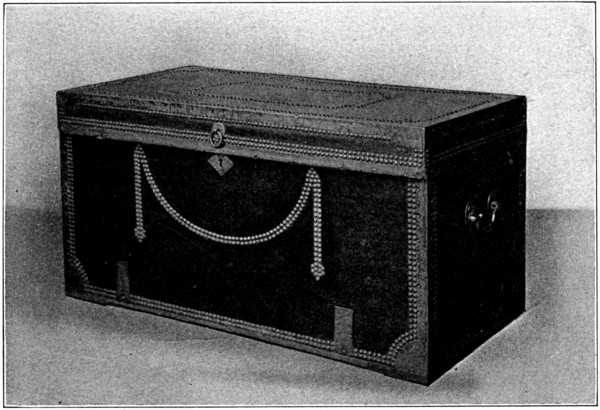 The Chest in which “Old Glory” Rested.
Just after the secession of the State he daringly
flaunted his Old Glory flag from his window;
then, fearing its confiscation (which his action
had rendered liable), he procured a calico quilt
of royal purple hue, and with the aid of two
neighboring women sewed it up between the
coverings and hid the quilt in his old sea chest.
Again and again the house was searched by
Confederate soldiers for this flag, but without
success.
Under the purple Old Glory rested. The
flag of the Confederacy waved above the Capitol;
and Nashville, in pride, prosperity, and splendor,
basked in the promise of ultimate victory to
the Southland.
But to a rude awakening this fancied security
was foredoomed. Suddenly, like the breaking
of a terrific thunderclap above the city, came
the awesome cry: “Fort Donelson has fallen!”
Fort Donelson fallen meant Nashville’s subjection.
Terror-stricken, the people rushed wildly
in every direction, and the most ill-founded
reports in the excitement gained ready credence.
It was announced that General Buell would
speedily arrive and open his batteries from across
the river, and that gunboats would lay the city
in ruins. Some of the citizens urged the burning
of the city, that no spoils might be left to the
enemy.
The fine suspension bridge across the Cumberland
was fired. The commissaries were thrown
open, and vast quantities of public stores, amounting
to millions of dollars, were distributed among
the inhabitants or destroyed. The archives of
the State were hurriedly conveyed to Memphis.
In the mad desire to escape an impending doom
of whose nature they were wholly ignorant,
residents vacated their houses and left priceless
furnishings a prey to the invading army. On
foot, on horseback, by wagon, by any available
means that best favored their flight, the crowds
surged out of the conquered city.
Notwithstanding the apprehensions of speedy
hostilities, it was a week later before General
Buell was encamped in Edgefield, opposite the
city. To him the mayor formally surrendered
Nashville. A proclamation was issued assuring the
inhabitants of protection in person and property.
Up the Cumberland steamed fifteen transports
and one gunboat—General Nelson’s wing of
the Union army. From the levee came the clamor
and shouts of men, the rattle of musketry, and
din of many feet. The Sixth Ohio was the first
regiment to land. Captain Driver was an interested
observer of the scene. “Now,” said he,
“hath the hour of Old Glory come!”
Lieutenant Thacher, of the Sixth, with a squad
of soldiers, left the regiment and escorted Captain
Driver to his home, a few blocks distant. They
wrested Old Glory from its hiding place and, with
the old mariner bearing the flag in his arms,
quickly rejoined the regiment.
Up the hill, amidst rattle of drum and sounding
trumpets, passed the bluecoats to the Capitol.
There a small regimental flag was being hoisted.
Suddenly a hush fell upon the waiting victors.
The figure of Captain Driver appeared high
against the dome of the Statehouse. The strains
of “The Star-Spangled Banner” burst upon the
ear; and amid cheers and cries of “Old Glory!
Old Glory!” that echoed to the distant hills the
old sea flag unfurled and floated above the top
most
pinnacle of the Capitol of Tennessee.
And thus Old Glory received her formal christening.
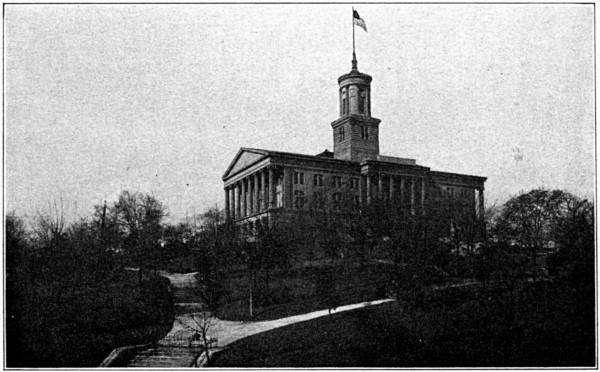 Amid cheers and cries of “Old Glory! Old Glory!” that echoed to the Distant
hills the old sea flag unfurled and floated above the topmost
pinnacle of the Capitol of Tennessee.
Amid cheers and cries of “Old Glory! Old Glory!” that echoed to the Distant
hills the old sea flag unfurled and floated above the topmost
pinnacle of the Capitol of Tennessee.
Swarming over the city, bent on various quests,
went the victorious Federals. Not so the old
sailor. The revered flag, flaunting the colors so
joyously above his head once more, was far too
weather-beaten, he feared, to withstand long the
stiff breeze blowing about the elevated site. Torn
to ribbons it must not be, howsoever good the
cause.
Quietly he watched and waited about the
grounds until after nightfall, when, under cover
of the darkness, he again ascended the dome,
rescued his beloved old flag, and swung in its
place a big merino one that had figured as a
campaign flag in 1840, when “Tippecanoe and
Tyler too” was the slogan of the Whig Party.
He then carried Old Glory to his home and laid
it tenderly away in the old sea locker so long
dedicated to its use.
Very gradually thereafter the pleasing appellation,
Old Glory, made its impress upon the speech
of the populace, until, in the later nineties, the
“Hoosier Poet” was moved to expression in
verse:
Old Glory, the story we’re wanting to hear,
Is what the plain facts of your christening were,
For your name, just to hear it,
Repeat it and cheer it, s’tang to the spirit
As salt as a tear.
And seeing you fly and the boys marching by,
There’s a shout in the throat and a blur in the eye
And an aching to live for you always or die;
And so, by our love for you floating above,
And the scars of all wars and the sorrows thereof,
Who gave you the name of Old Glory?
James Whitcomb Riley.
But to the query the sealed lips of the old
seaman answered not. For him had come the
higher summons.
Captain Driver’s death occurred in Nashville
in 1886. At the head of his grave, in the old
City Cemetery, stands a unique monument of his
own designing. Upon an old tree trunk, in stone,
appears a ship’s anchor and cable. At the top
of the anchor is inscribed the beloved pseudonym
of his heart’s own coinage, above him here, even
in his last sleep: “His ship, his country, and his
flag—Old Glory.” About his body when placed
within the casket was wrapped a United States
flag.
A few years prior to his death Captain Driver
placed his Old Glory flag in the hands of his elder
daughter, Mrs. Roland, of Wells, Nev., who was
then on a visit to him, saying brokenly as he
resigned it: “Take this flag and cherish it as I
have done. I love it as a mother loves her child.
It has been with me, and it has protected me in
all parts of the world.”
Worn and faded and tattered, this flag is still
in the possession of Mrs. Roland; and in her far
Western home it is displayed on patriotic occasions
and the story of its naming repeated. Another,
presumably the Whig flag herein mentioned, and
that, as has been shown, also flew over the Capitol
of Tennessee, was sent by Captain Driver,
upon request, to the Essex Institute, of Massachusetts.
Some confusion has of late arisen in
the public mind regarding the identity of the two
flags, it having been generally believed that the
original Old Glory was the flag in the Massachusetts
Institute. This impression is, however, doubtless
erroneous.
Notwithstanding a somewhat brusque address
and a marked individuality of speech and action,
Captain Driver was a man of warm and kindly
nature. Although a stanch Unionist, he lent a
ready and willing hand to the suffering ones of
the South. He married the first time Miss
Martha Babbage, of Salem, Mass. For his
second wife he espoused a Southern woman,
Sarah J. Parks, of Nashville, Tenn. Two of
his sons bore arms in the Confederate service.
One of these gave his life for the “lost cause.”
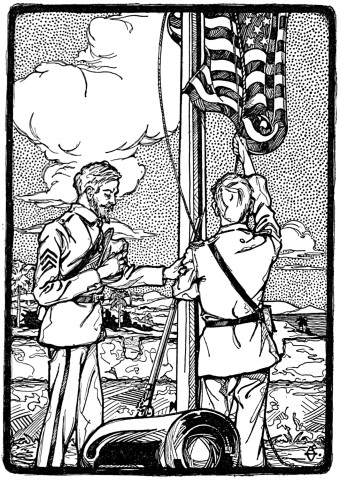
It remained for yet another conflict after the
civil strife to bring the name Old Glory into
general and popular use, for the blended ranks
of the Blue and the Gray opposed a common
foe. When the North and the South joined hands
against a foreign power and floated the Stars and
Stripes above the emblem of Spain upon the
island of Cuba, the flag of the Union became Old
Glory to every man of the nation.