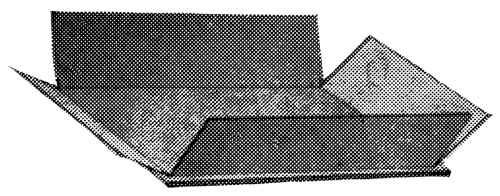
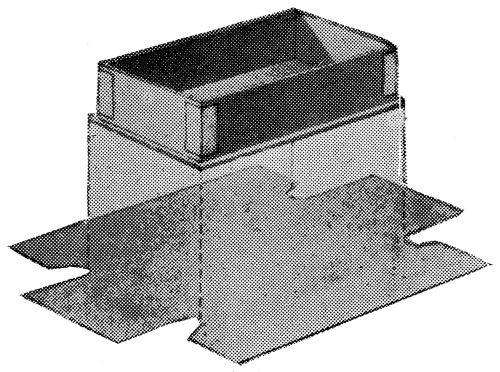
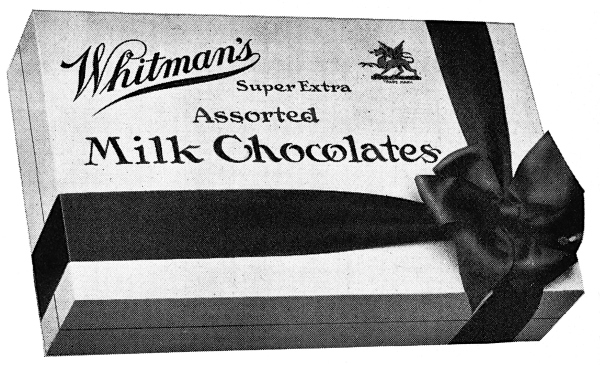
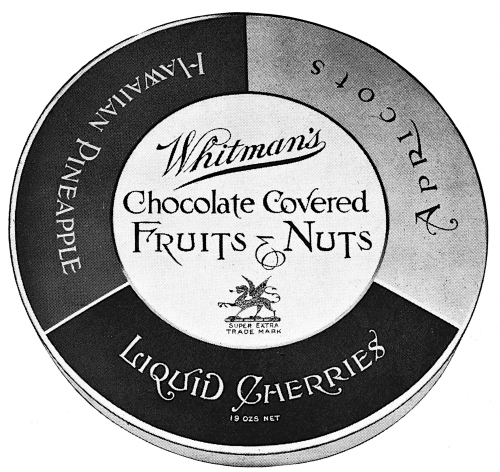
The Project Gutenberg eBook, How Paper Boxes Are Made, by Robert Francis
Salade
Note:
Images of the original pages are available through
Internet Archive. See
https://archive.org/details/howpaperboxesare00sala
A PRACTICAL AND INSTRUCTIVE BOOK TELLING
HOW THE BEGINNER MAY MANUFACTURE ALL
KINDS OF PAPER BOXES, WITH SPECIAL
CHAPTERS ON THE PRINTING DE-
PARTMENT FOR PAPER BOX
PLANTS, EMBOSSING, GOLD-
LEAFING, LABEL
WORK, ETC.
WITH 100 ILLUSTRATIONS
By ROBERT F. SALADE
Author of “Plate Printing and Die
Stamping,” “How to Make Cutouts,”
“Newspaper Men of the Night,” etc.
PUBLISHED BY The Shears Publishing Company LAFAYETTE, INDIANA 1920
Copyright, 1920
SHEARS PUBLISHING COMPANY
LaFayette, Indiana
LIST OF CONTENTS — CHAPTER I — QUALITY IS ESSENTIAL. — IMPORTANT QUESTIONS. — PLAIN “SET-UP” PAPER BOXES.
Introduction. Great Growth of the Paper Box Industry. The Field for Attractive and High Quality Boxes. Creating Orders by Submitting New Ideas for Boxes. Plain “Set-up” Paper Boxes—Kinds of Materials Used. How “Set-up” Boxes Are Made. Kinds of Machines Used, etc.
Plain “Set-up” Boxes (continued). Modern Methods of Working. Various Kinds of Cover Paper. Gold-Edged Paper Boxes. The Stokes & Smith Automatic Wrapping Machine. Extension Bottom Boxes. Properly Grouping the Machines to Save Time and Labor. Larger Size Paper Boxes With Flanges and Mitered Corners.
Plain Paper Boxes With Flanges. Effecting a Saving of Stock. How the Blanks Are Mitered. Efficiency in the Production of Hand-Made Paper Boxes. Kinds of Paste and Glue Used. Equipment Required for a Small Paper Box Plant. The Advantages of Specializing.
Druggists’ Pill and Powder Boxes. Round Pill and Powder Boxes. Round, Shouldered Pill Boxes With Projecting Edges. Plain, Round, Shouldered Magnesia Boxes. How the Tubes, or “Barrels,” for Round Boxes Are Made.
Druggists’ Pill and Powder Boxes (continued). Covering Paper for Round Boxes. Cutting Round and Oval Pieces of Box-Board for Tops and Bottoms. Oval Shouldered Pill Boxes With Projecting Edges. Round Face Powder Boxes With Dome Tops. The Doming Machine. Odd-Shaped Face Powder Boxes. Plain Oblong Powder Boxes. Sliding Boxes for Powders and Lozenges. Oblong Shouldered Powder Boxes. Square Shouldered Boxes. Square Telescope Boxes. Suppository Boxes With Partitions.
Candy Boxes. The Increasing Demand. Specializing in Fancy Candy Boxes. How the Machines May Be Arranged to Speed Production. Plain Paper Candy Boxes. Telescope Candy Boxes. Lacing. Shouldered Candy Boxes With Extension Tops and Bottoms. Trays for Candy Boxes. Flat Candy Boxes. Round Candy Boxes With Extension Edges. Large, Round Candy Boxes With Dome Tops. Large, Odd-Shaped Candy Boxes. Art Candy Boxes.
Miscellaneous Paper Boxes. Wedding, Party and Banquet Boxes. Jewelry Boxes. Handkerchief, Garter, Suspender, Necktie and Collar-Button Boxes. Cut-out Inserts. Cigarette Boxes. Stocking Boxes. Oyster and Ice Cream Boxes. Oyster Pails. Paper Dishes. Suit, Hat and Flower Boxes. Graining Board for Boxes. Round Hat Boxes. Suit Cases and Traveling Bags. Pocket Cigar Cases. Boxes for Hardware, Glass, Tools, Picture Frames, Toys, etc.
Folding Boxes and Cartons. Equipment Required for a Small Cutting and Creasing Plant. Kinds of Stock Used for Folding Boxes. Making the “Dummy” for a Folding Box. Kinds of Furniture Used in Blanking Out the Steel Rule Dies. Steel Cutting Rules and Creasing Rules. Work-Bench for the Folding Box Maker. Steel Rule Cutting and Bending Machines.
Folding Boxes and Cartons (continued). Making a Cutting and Creasing Die. Blanking Out the Steel Die. Making Steel Dies for Cut-Outs. Cutting and Creasing on Platen Presses. Making Ready a Steel Cutting and Creasing Die. Putting on the Feeding Guides. Corking the Steel Die Form. Feeding the Sheets of Box-Board. Stripping. Gluing Folding Boxes. The Gluing Machine. Cutting and Creasing on Cylinder Presses. Making Ready a Steel Cutting Die for Advertising Novelties, etc.
The Printing Department for a Box-Making Plant. Equipment Necessary for a Medium-Size Printing Department. Kinds of Machines. The Type Equipment. Hartford and John Thomson Platen Printing Presses. Cylinder Presses. The Kidder Automatic Printing Press. C. & P. Press With Miller Feeder. Kinds of Work Done in the Printing Department of a Paper Box Plant.
The Printing Department (continued). Time-Saving Suggestions. Printing in Gold Size and Bronzing Box Wrappers. Burnishing. Printing in Gold Ink. Gold Leafing for Box Wrappers. Embossing on Platen Presses. The Hartford Electric Plate Heater. Making the Male Die for Hot or Cold Embossing. Kinds of Composition Used for Male Dies. Making Ready for Embossing. Special Process for Printing Glazed Box Wrappers. Imitation Plate Printing and Steel Die Stamping. Patented Printing Base for Cylinder Presses.
Corrugated and Fibre Products. The Great Field for Corrugated Boxes and Paper Cans. The Making of Paper Cans. The Equipment Required for Making Paper Cans. How Corrugated Paper Boxes Are Made. Various Kinds of Machines Used. Regular Slotted Carton. Center Special Slotted Carton. Overlap Slotted Carton. Full Flap Slotted Carton. Half Slotted Carton With Separate Cover. Double-Wall Carton. Double Cover Box. Telescope Box. Double Lined Slide Box. Single Lined Slide Box. Double Slide Box. One-Piece Folder. Two-Piece Folder. Corrugated Paper Tubes. Partitions. Printing Cartons. The End.
WITHIN the last few decades the paper box
manufacturing industry of the United States
has grown to tremendous proportions, due of course
to the ever-increasing demand for paper boxes of
every kind imaginable. The manufacturers have kept
in steady progress with the times, and so efficiently
have they organized and managed the industry
that today it ranks among the largest and most important
in the country. The business is rapidly developing
on every side. New uses for paper boxes are
constantly being discovered. In many instances, paper
boxes, on account of their neatness, lighter weight and
economy, are taking the places of those made of wood
or tin.
Comparatively few people outside the industry
ever stop to consider the fact that the paper box business
has been responsible for the success of many
another business. Manufacturers of the many different
varieties of packaged-goods which are sold over the
counters of retail stores, advertising experts and salesmen,
know well that attractive, graceful paper boxes
help wonderfully in selling the goods. But, the buying
public in general gives little thought to this truth. With
the exception of advertising and first class printed matter,
handsome paper boxes today are one of the greatest
selling forces in business.
It has been only during recent years that manufacturers,
advertising men and salesmen have been giving
closer attention to the selling power of high grade
paper boxes. In days gone by the quality and appearance
of paper boxes received little consideration. Some
years ago, a plain, commonly-made box was considered
good enough for the purpose, but not so in these days.
In this age the average buyer would not be interested
in a nationally-advertised product if it were packed in
a mean-looking box, no matter how excellent the product
may be. This explains why we see such a large
number of display advertisements on bill-boards, in the
street cars, and in newspapers and magazines, including
the statement, “Packed in a Neat Box.”
In the present time, after a large manufacturing
concern has perfected all arrangements for making
perhaps, a new breakfast food, a new perfume, toilet
soap, candy, tooth paste, or some other desirable article,
the next step that is taken to market the product is in
organizing a good sales force. Then, the manufacturers
consult with one of the big advertising agencies for
the purpose of launching a national advertising campaign.
Among the first features of the campaign to receive
close study by the advertising experts is the
style and appearance of the paper boxes which are to
contain the product in question. Often, many different
shapes and colors for the containers are planned
and tested before the right design and color scheme
are decided upon. The broad-minded manufacturer
will not object to paying substantial prices for attractive
paper boxes any more than he would object to paying
high prices for advertising in newspapers and
magazines, as the advertising men can easily prove to
him the fact that beautiful paper boxes will help in
selling the goods.
This does not mean that any manufacturer could
succeed with the aid of attractive paper boxes in selling
anything that is not of good quality. He would
possibly sell an inferior article, by means of advertising
and appealing paper boxes, for a limited time, but
the public would soon learn whether the article was
good or not. But, the manufacturer of a high grade
product may always depend on good advertising and
attractive paper boxes to help him in making a success
of his business, and this is the point that the writer
wants to make clear to the reader. The psychology of
a handsome paper box is something wonderful. Women,
particularly, delight in buying candy, perfumes,
and many other things packed in beautiful paper boxes
and tied with colored ribbons. Men, too, derive pleasure
through buying goods packed in attractive boxes.
All of us like dainty packages, whether we admit the
truth or not.
When paper boxes are made and used for the
purpose of carrying goods to retail dealers, in cases
where the dealers unpack the merchandise and sell it
in loose form to the public, it is not necessary, of
course, to have such fine boxes as those which go into
the possession of the buying public. Large size shirt
and hosiery boxes, for example, seldom pass into the
hands of customers of retail stores. Boxes of this
class should be neat, strong and of good appearance,
but there is no reason for having them expensively
finished. The larger-size boxes which are to be found
upon the shelves of retail shops are usually covered
with glazed paper, in colors such as buff, red, light
blue, pink, etc. Store-keepers prefer boxes covered
with glazed, colored paper for the reason that colors,
and the high gloss of the paper help in making their
sales-room look attractive.
These are very important facts that every paper
box manufacturer must keep in mind, and the more
attention that is given to the aesthetic side of paper
box making, the better for the business in general.
The field for fine and fancy paper boxes, as well as
for plain boxes, is without limitations. It is a rich,
fertile field, and the manufacturer with new ideas
and good business management can “plant and grow”
all the orders for paper boxes that he may care to
handle.
The box-maker with ideas does not have to wait
for orders to come to him. Hundreds of manufacturers
in various lines of business are willing and ready
to consider suggestions in the way of unique and handsome
paper boxes which may mean increased sales of
the goods or articles that they are marketing. The demand
for “dust-proof,” “germ-proof,” “damp-proof,”
and the trade-marked folding paper boxes is without
end. Box-makers who are in a position to offer new-style
containers of this character will have no reason
for complaining about “slack seasons.” The fiber container
field also offers unlimited possibilities to the
manufacturer of fiber products.
This is the age of progress. Creative salesmanship
is now needed in every line of business. The
box manufacturer in these days must give more of his
time and thought than in the past to the subject of
creative salesmanship. He should work hand-in-hand
with merchants, sales managers and advertising experts
when big selling campaigns are being planned.
The United States is just entering the greatest period
of prosperity in the history of the country, and without
question the paper box industry is to enjoy its proper
share of this prosperity, but the box-maker who fails
in keeping abreast with the times will be in danger of
“falling by the wayside.”
Creative salesmanship, standard cost systems, efficient
plant management, and the matter of procuring
a sufficient supply of skilled labor are among the most
important questions of today which must receive deep
study from the box manufacturers in general. With
these serious questions in mind, the writer has
prepared this text book on the subject of Paper Box
Making for the purpose of helping the progress of the
industry in every way possible. Before attempting this
work, the writer spent considerable time in several of
the modern paper box factories, studying the mechanical
equipment, labor-saving methods, ordinary working
operations, etc. Several of the larger plants where
paper box machinery is designed and made, were also
visited. In this manner, valuable data for this book
were secured.
The main purpose of this book is to teach beginners,
or apprentices, the practical work of paper
box making. We are not so egotistical as to believe
that we can make a trained paper box maker with the
aid of printed matter, but at least we can try to offer
simple, practical information which we hope will be
helpful to beginners. We shall try to do our very
best in making the technical facts plain and understandable,
and if we succeed in giving the reader a
clear, general idea of how paper boxes are made, we
will be well satisfied.
May we suggest to employers, superintendents
and foremen in the paper box industry to place this
book in the hands of apprentices for study? It may
even be possible to present copies of the book to young
men and young women who are not working in the
industry, but who may desire, after reading this
volume, to engage in the interesting work of paper box
making. This is merely a suggestion, but it may be of
some value in gaining new apprentices.
This book will include information on Plain
Paper Boxes, Fancy Paper Boxes, Round, Oval
and Odd-shaped Boxes, Cutting and Creasing for
Cartons, The Label Printing Department, Fiber Containers,
and on other subjects of this character. It
would be almost impossible for anyone to describe all
of the many different kinds of plain, fancy and folding
boxes that are being made at the present time, so
we will merely describe the regular line of paper boxes
that are considered as standard in the trade.
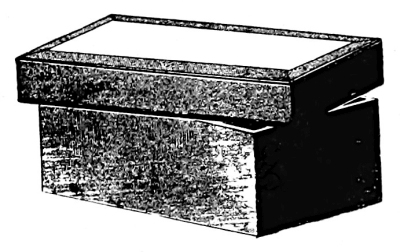
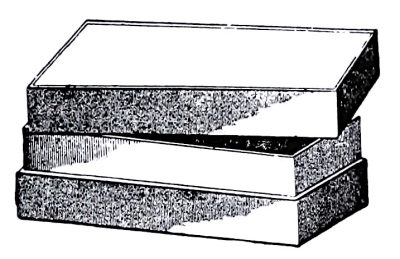
The term “set-up,” applies to paper boxes which
are covered with separate lids. Folding boxes do not
come under this term for the reason that they are
glued together at one side, and remain in flat form
until the time when they are used as containers, cut out
sections of the sheet then being folded to serve as
“lids.” In other words, a folding box is complete in
one piece, while a set-up box (a shoe box, for example),
is of two parts, the box and the lid.
A set-up box must be cut, creased, folded, stayed
and covered before it is complete. The lid also must
be cut, creased, folded, stayed and covered.
Various kinds of boxboard are used for the making
of plain paper boxes, but the three principal kinds
used are called “Chip-board,” “News-board” and
“Straw-board.” Chip-board is made from pulp
formed of all kinds of waste paper. News-board is
made from pulp formed of old newspapers. Straw-board
is made from straw. These three different
kinds of boxboard come from the paper dealers, or
from the mills, in various sizes and thicknesses to meet
all of the requirements of the box factory.
Chip-board is more generally used for all kinds of
plain paper boxes. It is of gray color, and it has rather
a rough surface. When the boxes are to be of good
quality, like a candy box for instance, the chip-board
is lined on one side with white news paper, or white
book paper. This lining is done before the boxboard
is cut and creased in shape for making the boxes.
Many of the larger box-makers do their own lining on
a special machine called the Parry Liner, which has
been designed especially for the purpose. Other box-makers
send the boxboard to outside concerns who
make a specialty of lining board for the trade.
Chip-board, news-board or straw-board, when
used for the making of ordinary boxes—shoe boxes,
for example—is not lined. Better-class boxes, such as
are used for holding collars and cuffs, silk shirts,
handkerchiefs, neckwear, writing paper, and “white
goods” of many varieties, should be lined with white
book paper.
The first step toward the making of a paper box
is in deciding on the proper measurements. The
specifications must indicate the length, width and depth
of the box, as well as the length, width and depth of
the lid. The length and width of a lid, for a plain
set-up box, must of course be slightly larger than the
length and width of the box. To ascertain the correct
sizes of both the box and its lid, the box-maker
first makes models, and after these have been approved,
the regular work of making quantities of the boxes is
commenced.
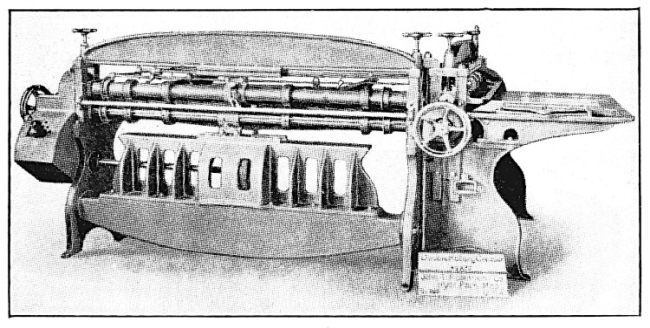
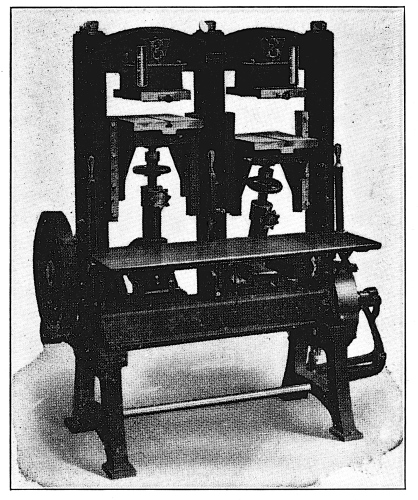
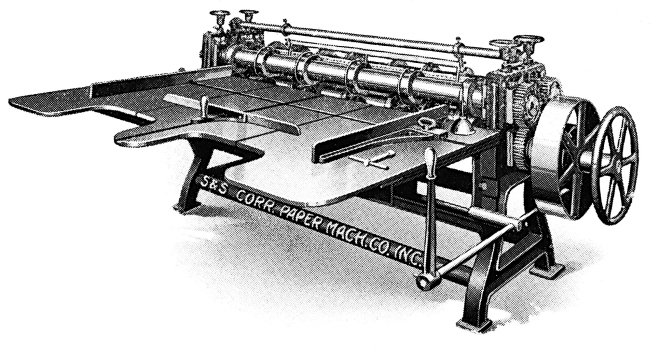
Robinson Double Rotary Cutter and Creaser.
The full-size sheets of boxboard are fed into a
scoring machine which cuts and creases the sheets to
the proper dimensions. Several pieces of board, of the
size required for the boxes, or lids, are cut from the
sheet with one operation. The machine is equipped
with a series of rotary knives and rotary scorers, which
can be moved and adjusted to the positions desired. The
rotary scorers are like dull knives, and are set up a
little higher than the cutting knives; thus they score
the sheet instead of cutting completely through it.
Single scoring machines, which score and cut the
sheets of boxboard in only one direction, are used
in some of the box-making plants. In other plants
double scoring machines, which score and cut the
sheets in both directions, are in service. The double
scoring machine is naturally a big time-saver on large
orders for the simple reason that it cuts and scores,
both ways, on the sheet without it being necessary for
the operator to feed the sheets through the machine a
second time.
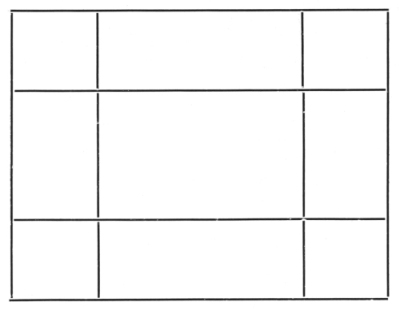
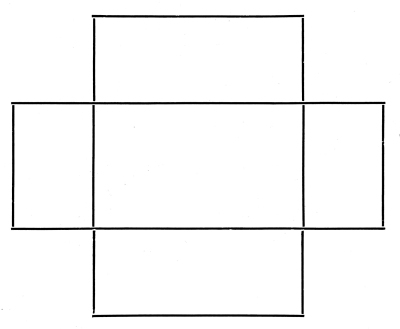
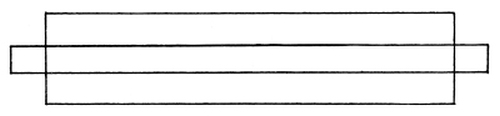
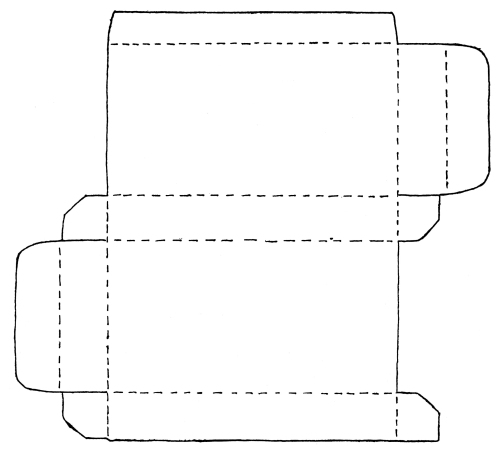
The cut and scored blanks, when in flat form
ready for cornering and folding, appear like this:
Figure 1. Showing blank for paper box, cut to proper size, scored,
but with corner-pieces not yet removed.
The next operation is in removing the corner
pieces from the blanks. This work is performed with
the aid of a cornering machine. There are single,
double and quadruple cornering machines in some of
the larger plants, but the single and double cornering
machines seem to be the most popular. The single
cornering machine removes only one corner from the
blank with one operation; the double cornering machine
cuts out two corners with a single operation and the
quadruple machine removes all four corners with one
operation.
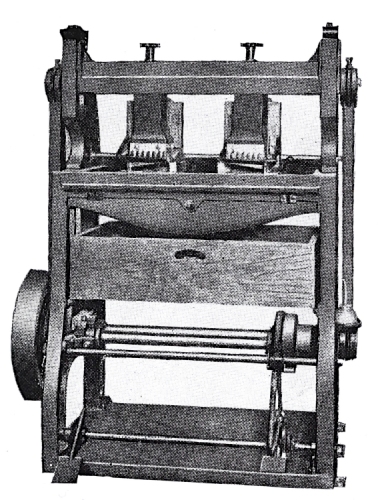
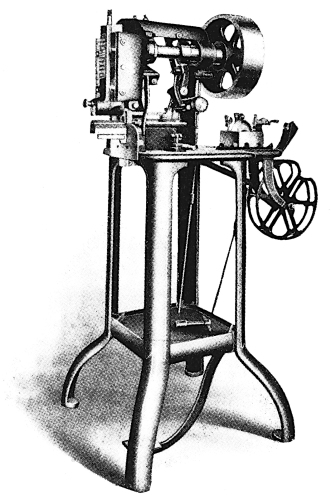
Power Double Cornering Machine.
The cornering devices are equipped with cutting
knives, arranged so that they may easily be adjusted.
The guides may be adjusted so that many different
sizes of corners may be cut out of the blank stock. As
many as twenty or more blanks may be placed under
the knives at one time. The double cornering machine
has two sets of knives and guides which are adjustable
to provide for the various sizes of blanks. In the same
manner the knives and guides of the quadruple
machine are adjustable to provide for many different
sizes of stock and also various sizes of corners.
When feeding the blanks into the single cornering
machine, it is necessary, of course, for the operator to
feed the sheet four times before all of the corner
pieces have been removed.
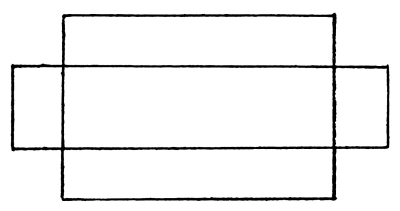
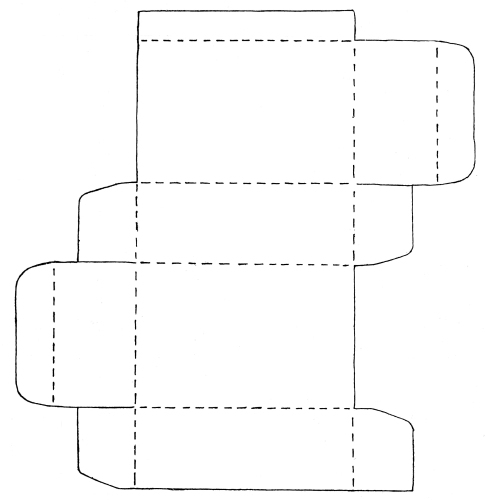
When the four corner-pieces have been removed
from a sheet of stock, the blank has the following appearance:
Figure 2. Showing blank for paper box, cut to proper size, scored
for folding, and with corner-pieces removed.
Some of the box-makers who make a specialty of
fine, small-size set-up boxes for the drug trade, jewelers,
etc., have machines which score the blanks, and
cut out the corner-pieces simultaneously. This device
is for small work only, and its principal advantage
is accuracy. When scoring and cornering small-size
blanks separately, it is often difficult to have this scoring
line in perfect alignment with the corners. On this
special type of scoring and cutting machine it is necessary
for the operator to feed one blank at a time. Cutting
and creasing of this kind can also be done on cutting
and creasing presses, with dies formed of steel
cutting and creasing rules. This process will be explained
in another article.
After the blanks have been cut, scored and the
four corner-pieces removed, the blanks are then bent
upwards on all four sides so as to put them in form
for the staying machine operation. Several of the
blanks can be bent partly into shape with one operation.
The operator of the staying machine then takes each
blank and properly shapes it into the form of a box
as the stay paper is applied to each corner. The staying
machine is equipped with a roll of narrow Kraft
paper which is gummed on one side. The machine is
also equipped with a water-pan and a roller which
moistens the gummed paper as it passes along. The
operator places one corner of the box in position on
the machine; the head of the machine descends and
affixes a strip of the stay paper on the outside corner
of the box. The operator then turns the box in rapid
succession while the machine “stays” the other three
corners of the box. The cutting of the stay paper to
the proper size is an automatic operation, and the device
can be adjusted to cut off any length of stay paper.
The stay paper placed on the outside corners of the
box, holds the box together.
Power Corner-Staying Machine.
In the case of very small boxes and lids, the stay
paper is attached by hand, although the machine is
adapted to small-size as well as large-size boxes.
CHAPTER II — PLAIN “SET-UP” BOXES (Continued) — SOME OPERATORS CARELESS. — TIME SAVING SYSTEM. — HOW WORK IS HANDLED. — SHOULD STUDY FLOOR PLANS.
AFTER the work of staying the corners of a
plain set-up paper box, and its lid, has been
completed, the next operations are to cover the sides
of the box, and the sides of the lid, with paper of
the desired weight, color and finish. The kinds of
paper which are generally used for covering plain
paper boxes are, white glazed, cheviot, and colored
glazed. This stock may be bought from the
manufacturers in either the form of large rolls, or in
the form of flat sheets. When the ordinary power
covering machine is used, the paper is applied to the
sides of the boxes from rolls of the proper width.
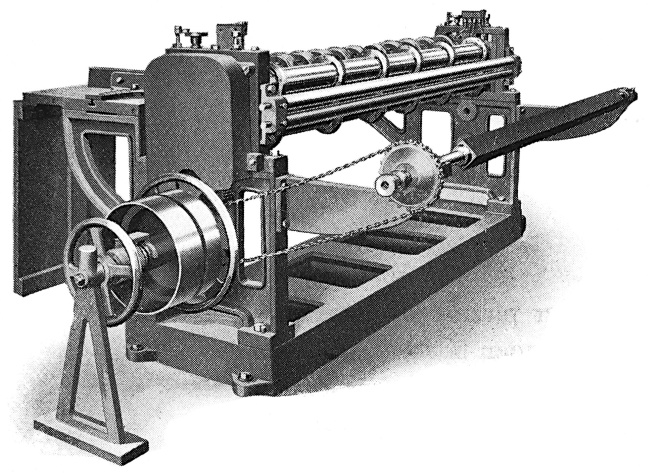
The slitting and rewinding machine is used for
the purpose of cutting the large rolls of paper into
rolls of various sizes. The cutting wheels on the
slitting and rewinding machine can be “spaced apart”
to any width required. They may be set as close together
as ½ inch apart. Conveniently located on the
machine is a steel bar containing a scale, marked off
into inches and fractional parts of inches. This scale
makes it an easy matter for the operator to fix the
slitting wheels in the positions wanted for cutting the
large roll of paper into smaller rolls. As the wide
sheet of paper unrolls and passes the slitters, the smaller
strips of paper are rewound on spindles.
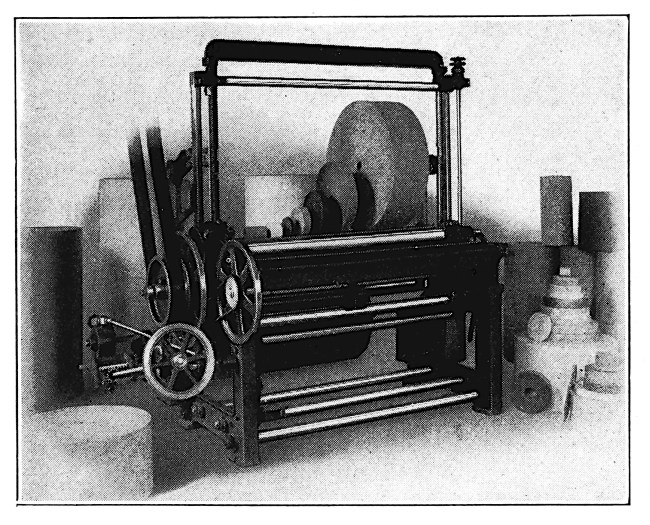
There are several good slitting and rewinding
machines on the market which may be operated by
hand or power, as desired.
Cameron Cutting and Rewinding Machine.
When the sides of paper boxes are to be covered
with the aid of a covering machine, a roll of paper of
the necessary size and kind is first placed on the
machine. The width of the roll of paper is about an
inch wider than that of the surface of the box which
is to be covered, for the reason that about one-half
inch of the paper is turned in and over on the inside
of the box, and about one-half inch of the paper is
turned in over the bottom of the box. One operator
attends to the covering operation, while another performs
the work of “turning-in.”
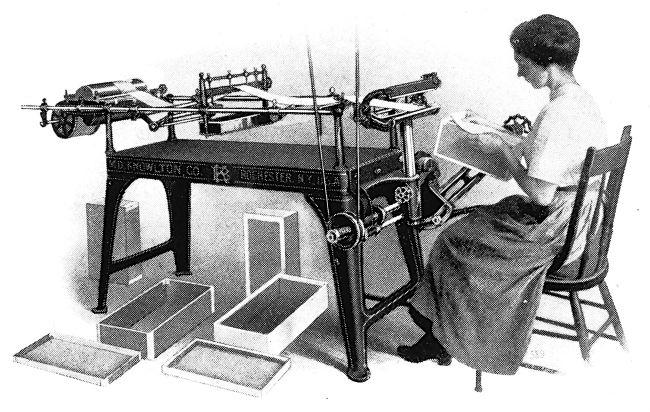
Knowlton Power Covering Machine.
The standard covering machine is equipped with
a glue-pan, heating apparatus, gluing roller, glue
scraper, a table, and a cut-off device. The gluing roller
revolves in the glue pot, in such a manner as to
apply the glue to one side of the paper as the paper
passes over the surface of the roller. The glue pan
may be heated by steam, gas or electricity. The scraping
device regulates the amount of glue applied to
the paper. When the machine is in action the operator
simply wraps the strip of paper around the four
sides of the box, allowing a “lap-over” of the paper,
at one corner of the box, of about one inch. Some
operators are careless, and they often allow “lap-overs”
of several inches of paper, which of course
results in considerable wastage of paper during the
course of a day. The carefully-trained operator will
try to save as much paper as possible. Another important
point which the efficient operator will consider
is in having the “lap-over” occur at one corner of the
box, and not in the center of one side of the box.
When the “lap-over” is made at one corner of the
box, the work looks neat and finished, but when the
seam is made on one side of the box, the work presents
a poor appearance.
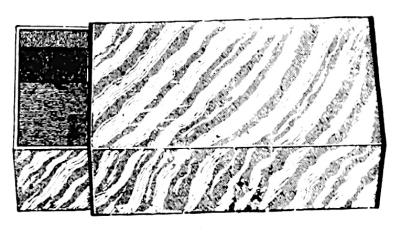
Long, narrow set-up paper box. Size, 3¹⁰⁄₁₆ × ⁴⁄₁₆ in. Used by
the medical profession for holding hypodermic needles.
It is also very important that the work of “turning-in”
should be done as neatly as possible. The
“turner-in” works on a table near the covering machine.
As the operator of the covering machine finishes wrapping
a box, it is passed to the second operator who
turns in the corners and edges of the paper. A wad
of cheese-cloth, or a soft, clean cloth of any kind, is
useful in the work of turning-in, the corners and
edges of the paper being rubbed down firmly and
smoothly. Some operators of covering machines also
use a cloth in smoothing the paper as it is applied to
the sides of the box. Others use merely the palm of
the hand. Attached to the machine is a receptacle
for holding tallow which many workers make use of for keeping their
hands free from glue. On the new model covering machines the cut-off
device is adjustable, up and down, by means of screws, and it can be
moved to and from the box-spindle in any desired position, without
it being necessary for the operator to leave his or her seat. The
cut-off device may be operated by hand by means of a lever.
In a large number of paper box making plants
tables are placed near the covering machines, and the
work of “turning-in” is done on these tables. Near the
covering machines are the topping machines. The
work is handled in such a manner, that one operator
passes the boxes on to another, until finally the boxes
and the lids are completed and assembled. The boxes
are then packed in cases ready for immediate shipment.
This system is the means of saving time, labor
and expense, as it makes it unnecessary for the operators
of the various machines to leave their seats. One
operator does the covering of boxes, the second operator
covers the sides of the lids; the third attends
to the work of “turning-in”; the fourth is in charge
of the topping machine. Girls or boys then assemble
the boxes and lids, and pack them in the cases.
Many set-up paper boxes, in addition to being
covered with white glazed, cheviot, or colored glazed
paper, are finished with gold-paper edges. Some have
a gold edge at the top of the lid, and a gold edge at the
bottom of the box; others have four gold edges; still
others are covered with colored glazed paper, and
have four edges of white glazed paper. Paper boxes
of this variety may properly be placed under the heading,
“fancy,” but we want to mention them here on
account of the edging-work being done on covering
machines in about the same way as plain covering
work.
Let us take the case of a gold-edged paper box
for example: The narrow roll of gold paper is placed
on the covering machine, along with the wider roll of
glazed, or cheviot paper. Both the gold strip and the
other strip are applied to the box, or lid, simultaneously,
the gold strip being placed underneath the main
strip. The main strip of paper is a size that when
applied to the box, or lid, (over the gold strip) it allows
the gold edging to show. Only the gold strip is
“turned in,” either over the top or bottom of the box,
or over the top and edge of the lid. With work of
this character the operator must be careful to have
the two strips of paper run straight and even as one
is glued over the other.
The topping machine operates much on the same
principle as the covering machine, and it is used for
applying paper to the tops of box-lids, after the sides
of the lids have been covered. The better class of set-up boxes
are covered on the bottom in addition to having the tops of their
lids covered, but ordinary, plain set-up boxes are not covered on the
bottom. The writer has before him a set-up box which had been used
for holding a dozen linen collars. The board for this box has been
lined with newspaper, making it neat and clean on the inside. The lid
is covered and topped with pale yellow glazed paper. The sides of the
box are covered with glazed paper of the same color as the lid, but
at the top the edges are trimmed with white glazed paper. The bottom
of the box is covered with white book paper. This is that kind of box
which should have the bottom covered, although the bottom piece of
paper is not absolutely necessary. Writing paper boxes should also be
covered on the bottom. The question of covering the bottoms of set-up
boxes should be determined by considering the general qualities of
the box, and the purpose for which it is to be used. There is no
reason for covering the bottoms of common set-up boxes.
One of the smallest set-up paper boxes manufactured. Size 1⁷⁄₁₆
× ⁷⁄₁₆ in. Sides ³⁄₁₆ in. Used by the medical profession.
One of the best power topping machines on the
market is that made by the Hobbs Manufacturing
Company, of Worcester, Mass. This machine has an
automatic cut-off device, and it is equipped, of course,
with a work table, glue pan, gluing roller, etc. A roll
of paper, nearly the same width of the lid, or box-bottom,
which is to be covered, is placed on the machine.
Glue is applied to one side of the paper as it is drawn
over the surface of the gluing roller. When the strip
of paper has been stretched across the top of the lid,
or the bottom of the box, the operator depresses the
adjustable lever at one side of the machine, and the
paper is cut off to the required size. On top of the
work-table is a locating projection which holds the
box in place. A locating gauge is also provided so
that the vertical adjustment of the table can easily be
made.
It is only fair to state that there are other efficient
topping machines in general use, some being operated
by hand, others by power.
Many set-up paper boxes, which are made for
heavy usage, such as for holding hardware, tools,
toys, glassware, etc., are wire stapled at the corners
instead of having the corners strengthened with Kraft
paper, or stay paper. Some box manufacturers are
making all of their set-up boxes with wire-stapled
corners. There are several wire stitching machines
now being made by well-known concerns which have
been especially built for use in the paper box industry,
and they have proved very satisfactory. The boxes
and their lids, after having been fastened at the corners
with copper, or wire devices, are covered and topped
with paper in the usual manner. The wire stitching
machine is operated in much the same way as the
staying machine, each corner of the box, and of the
lid, being “stitched” with wire in rapid succession. For
an exceptionally strong paper box which is to have
rough usage, the wire-staying will be found more
practical than paper-staying.
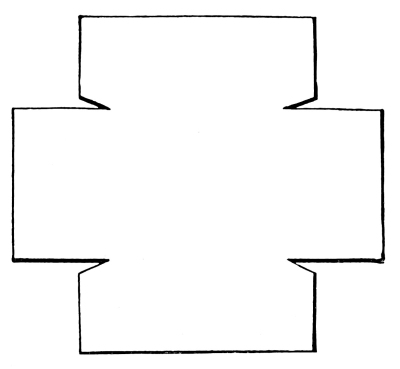
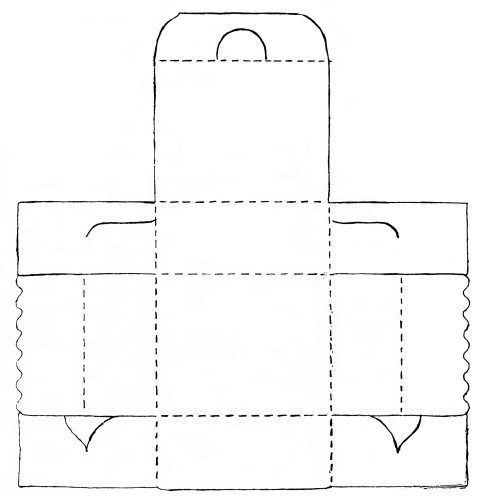
Figure 3. Diagram shows shape of wrapper used on Stokes
& Smith Wrapping Machine.
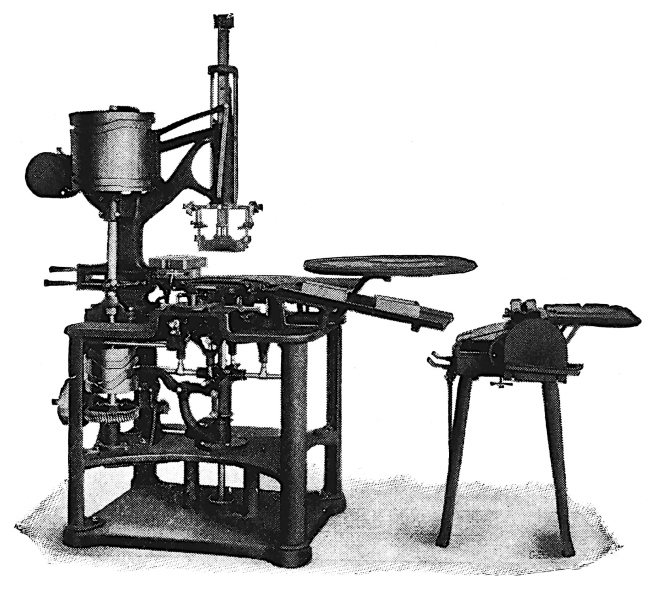
Perhaps the most remarkable machine ever invented
for use in the paper box industry is the Stokes
& Smith Wrapping Machine which automatically
places glued paper on all kinds of paper boxes. One
of the great advantages of this device is that it completely
wraps the box, or its lid, with a single sheet of
paper. In other words, it “covers” and “tops” at the
one operation. Flat sheets of paper, cut out at the
corners like the diagram shown on page 29 are necessary
when using this machine.
Stokes and Smith Wrapping Machine.
For cutting the sheets of paper to this special
shape, a Stokes & Smith Double Cornering Machine is
essential. The sheets are first cut square, or oblong,
to the size desired, and the odd-shaped corners are
cut out afterwards. The Double Corner Cutter will
cut two corners from a pile of the sheets simultaneously.
In about an hour’s time a sufficient quantity of the
wrappers can be cut to provide for a day’s run of work
on the Stokes & Smith Wrapping Machine.
Extension bottom boxes, or to use the old term,
boxes with “French edges,” may also be wrapped on
the Stokes & Smith device, but for this class of work
wrappers of still another shape than that shown by
Figure 3 are necessary. Again, for work of this character,
the machine must be equipped with an Extension
Bottom Covering Attachment. The change in the
shape of the wrappers is made by equipping the
Double Corner Cutter with the proper sub-presses,
knives, and dies.
Another advantage of the Stokes & Smith Wrapping
Machine is that it will apply printed or lithographed
wrappers to the paper boxes, therefore making
it unnecessary to have printed labels pasted on
the boxes after they have been covered. These facts
are not presented for advertising the Stokes & Smith
Company. In offering these facts we merely desire
to acquaint the reader with all that is new in the way
of paper box machinery, and were we to omit mention
of the Stokes & Smith Wrapping machine, we would
feel that this series of articles would not be complete.
In plants where this machine is in operation, the
work is handled as follows: First, the sheets are cut
square or oblong to the required size. Second, the
corners for regular paper boxes, or the corners for
extension bottom work, are cut from the paper. Third,
the wrappers are fed through a gluing machine, which
by means of rollers, places a thin coating of glue on
one side of the paper. Fourth, the sheets, with the
glue-side up, are placed on a revolving table which is
really a part of the wrapping machine. Fifth, from
the revolving table the operator of the wrapping
machine lifts up a wrapper with one hand, and with
the other hand takes an uncovered box, placing it
bottom down on the glued paper, being careful to see
that the bottom of the box is accurately centered between
the cut out corners of the wrapper. Sixth, the
box and wrapper are then placed on a form on the
wrapping machine. The action of the machine thereafter
is “almost human.” The box and its wrapper
pass down through a series of brushes and rollers
which draw the wrapper closely to the sides of the box,
neatly folding the paper at the corners and ends, and
turning in the edges of the wrapper on the inside of
the box. At the end of a complete revolution of the
machine the box emerges from the machine in a finished
condition.
In some of the larger paper box manufacturing
plants, where Stokes & Smith machines are being
used, a great deal of time is being saved by grouping
the machines, and by working the operators in teams.
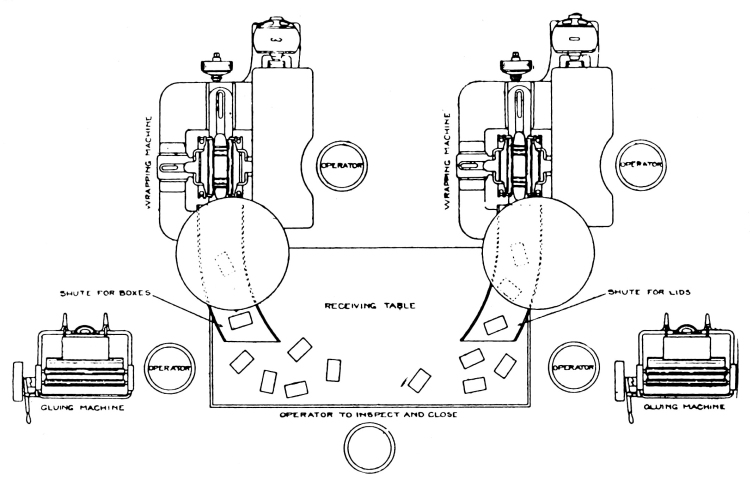
For example, two wrapping machines and two gluing
machines are so arranged that the boxes and the lids
are finished, inspected and assembled with all of the
work being done in one small “department.” In not
a few shops the boxes and lids are covered on machines
which are located a considerable distance apart,
resulting in a waste of time when the boxes and lids
are assembled. The accompanying illustration will
give the reader an idea of how the machines may be
properly grouped so as to eliminate unnecessary handling:
Figure 4. Illustrating how time and labor may be saved in the plant
by grouping the machines properly, and by working
the operators in teams.
Paper box manufacturers should devote time and
study to floor plans of this character. With the shorter
work-day being adopted in all parts of the country,
and with skilled labor becoming more scarce every
day, it behooves the manufacturer to work out plans
by which time and labor may be saved, and which will
make an increased amount of output possible. This may
be accomplished through following plans that will effect
real efficiency in the factory. No matter what kinds
of machines the manufacturer may be using, they may
be grouped in such a way as to make it possible for the
various operators to work closely together in teams.
Within the last few months the writer visited a
paper box making plant where the staying machines
were located at one end of a spacious room, and where
the covering machines were located at the other end
of the room. In about the center of the room the topping
machines were placed. Think of the great number
of unnecessary foot-steps which are made by the
workers in this shop during the course of a day! Consider
the large amount of time that is being wasted
every day in carrying the material from one machine
to another! The reader can readily understand that
by grouping the staying machines, the covering machines,
and the topping machines in small “departments,”
so to speak, the boxes and lids could be finished,
inspected and assembled simply by passing the
work from one operator to another as the different
processes are completed.
The larger sizes of plain paper boxes, such as
those used for holding envelopes, shoes, etc., are not
made from the same shapes of blanks as are used for
the making of the smaller sizes of boxes. In the majority
of cases the board used for the larger-size boxes
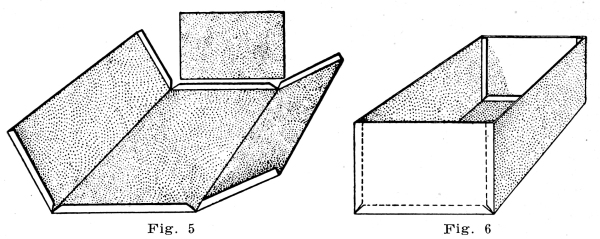
consists of three separate pieces. The main piece contains
flanges with mitered corners. After the main
piece of box-board has been cut to the required size,
and after it has been scored and the corners mitered,
the board is folded or bent to form the bottom and
two sides of a box, having flanges at either end. Separate
side pieces are then glued to these flanges, making
the box complete as to form. The principal reason
why the larger-size boxes are made in this fashion is
because it prevents wastage of box-board.
CHAPTER III — SIDE-SET PAPER BOXES. — HOW EFFICIENCY IS ACCOMPLISHED. — VARIOUS KINDS OF ADHESIVES. — MANY TWO-PIECE BOXES. — EQUIPMENT REQUIRED FOR SMALL PLANT. — ECONOMY IN POWER EQUIPMENT.
IF a single piece of box-board were to be used for the
making of a large-size set-up paper box, (a hat
box, for example) it would necessitate the cutting
out of four corner pieces which would be as large in
size as the two side walls of the box, therefore the
reader can readily understand that it would not be economical
to cut out corners of stock which is to be used
for the larger-sized boxes. Another advantage of the
side-set paper box is in the ends being stronger than
the ends of a one-piece box. While this strong feature
of construction would not been needed in a small-size
box—a pound size candy box, for instance—it is an
advantage for a larger size box such as is used for
holding 500 No. 10 envelopes.
For this kind of a box, the chip-board, news-board,
or straw-board is cut and scored to the size
required on either a single or double scoring and cutting
machine. This refers to the body-piece of the
box. The side pieces may be cut to the desired size,
in stacks of fifty or more sheets at a time, on an ordinary
power paper cutter, or of course, the side pieces
may be cut from large-size sheets of box-board on a
scoring and cutting machine, or on a rotary board cutter.
In many of the big paper box plants the rotary
board cutter is being used for neck-pieces, side-pieces
for side-set boxes, and for other plain cutting where no
scoring is to be done in connection with it. The main
advantage of the rotary board cutter is in the smooth,
clean edges left on the box-board after it has been cut
into the various sizes. The smooth, clean edges could
not be procured on an ordinary paper cutting machine,
but in the case of common paper boxes, the rough
edges of end-pieces would not be a serious matter.
For the better grade of boxes the edges of the end-pieces
should be smooth and free from small particles
of the board, especially when the box is to be covered,
as the rough edges would show plainly from under the
covering.
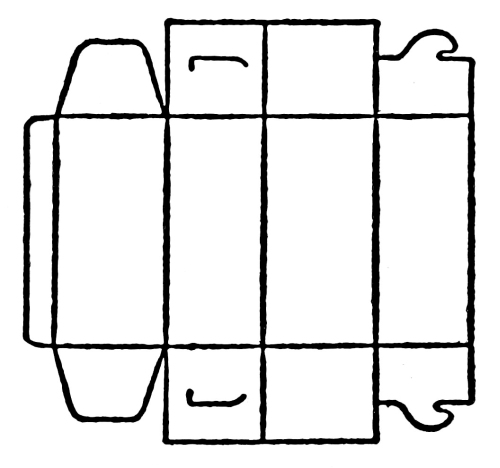
Fig. 5. Showing the construction of the flange style of paper box.
Note the mitered corners of the flanges.
Fig. 6. Shows the end-pieces glued to the flanges.
Mitering for stock that is to form the body-pieces
for side-set boxes is done on a machine such as the
Hobbs Duplex Corner Cutting and Mitering Machine
which is also used for cutting the corners for one-piece
set-up boxes. The Hobbs machine is so constructed
that two corners may be cut from box-board
on one side, and two miters cut from box-board on the
other side. In other words, it is a quadruple machine
which will permit two operators to work upon it at
the same time, the operator on one side doing corner
cutting, and the operator on the other side doing mitering.
Either side of the machine may be used independently
of the other, and all sizes of corners up to 3
inches, and all sizes of miters up to 1 inch in depth, can
be done by making the necessary adjustments of the
dies, sub-presses, and gages. The two miters may be
spaced as wide apart as 22 inches, and the two corners
as wide as 20 inches.
Some of the paper box manufacturers are making
the side-set boxes by hand, but the majority of
box-makers are using Ending Machines for this kind
of work. The hand method of construction is very
simple: The operators are seated on each side of a
long table; one operator “turns in” the flanges of the
body-pieces, and shapes them ready for receiving the
end-pieces; another operator applies glue to the end-pieces
and keeps a supply of the glued end-pieces, arranged
in rows, ready for the next operator who places
the body of each box on a form, and then applies the
end-pieces. It requires care for the operator to place
the end-pieces in true register with the bottom and
sides of the box. The scoring lines made for the
flanges are followed as guides for putting on the end-pieces
squarely. The form is simply a smooth block
of wood, the size of the interior of the box that is being
fashioned. The amount of work which a force of
skilled hand-workers can turn out during the course of
a day is really surprising.
Efficiency in the production of hand-made paper
boxes, as well as efficiency in the production of machine-made
boxes, is accomplished by keeping the
workers, or the machines, abundantly supplied with
material, and by having boys or girls carry the material
to and from the tables or machines, instead of having
experienced operators attend to such work. When a
force of operators start work at a table, or at a group
of machines, there should be a steady flow of material
to keep them constantly employed. This is the system
now being followed in the leading box-making factories,
and it is a system which should be adopted by every
box manufacturer, no matter how small his shop may
be. Keep your skilled help plentifully supplied with
material. Do not allow your best operators to waste
time in carrying stock from place to place when boys or
girls, with the aid of light trucks, can do this class of
work just as well.
This leads up to still another important suggestion
which we will offer to the manufacturers in general:
Do not keep your apprentices working for long
periods at menial tasks, such as carrying stock, sweeping
floors, running errands, etc. Push the apprentices
ahead as rapidly as possible. Train them to become
first-class box-makers.
A brief description of the Hobbs Automatic Ending
Machine will doubtless give the reader an idea of
how end-pieces are attached to the flanges of boxes
mechanically: This machine is equipped with a form,
pasters, a hopper and a feeder, all being adjustable to
provide for paper boxes of various sizes. The machine
is designed to apply end-pieces to the bottom and sides
of a box, causing the ends to adhere to the in-turned
flanges at either end of the box. The body of the box
is placed upon the form by the operator with the
flanges lying flat upon the surface. The end-pieces
are placed in a hopper, and the machine automatically
feeds the undermost end-piece forward, applies paste
to three edges as it is being fed, registers the end
accurately with the box-body upon the form, and then
presses the end-piece firmly to the flanges. This completes
the ending operation.
Various kinds of paste and glue are used for ending
work. White Dextrine is recommended for this
purpose by many box-makers. Stein, Hall & Company,
of New York City, make a Dry Ending Gum, as
well as Dry Gums for all classes of paper box work.
The “Mikah Cold Glues,” manufactured by the National
Glue and Gelatine Works, of New York City,
are also well recommended. There are other good
glues and pastes on the market.
In addition to the Hobbs Automatic Ending Machines
there are several other ending machines
in general use which are rendering first class
service. The Kingsbury & Davis Double Ending and
Quadruple Staying Machine is another “wonder-worker”
which is worthy of special mention. It is said that
one of these machines will do the same amount of work
that can be done on five single enders or stayers.
Some of the larger-size paper boxes which are constructed
with flanges and end-pieces, have a strong
linen thread running around the sides of the box, near
the top, for the purpose of strengthening the corners,
the paper covering of the box concealing the thread.
Other paper boxes with flanges and end-pieces, have
the corners stayed on the outside with Kraft paper in
the same way as the smaller-size set-up boxes. Others
still have the four top edges and the four corners of
the lid stayed with Kraft paper, also the four bottom
edges and the four corners of the box stayed with the
same material. This makes a box and lid of very
strong construction, and as a rule, a box and lid of
this kind are not covered with glazed paper, or in fact,
paper of any kind, the box-board being allowed to
show in its natural color. Many of the larger-size
envelope boxes are made in this manner, the corners
and edges stayed, but no covering paper applied to
either the inside or the outside of the box or lid.
Shoe boxes, in nearly all instances, are stayed at
the corners, and afterwards are covered with white
glazed paper of an inexpensive grade.
Although the great majority of paper boxes of
the larger sizes seem to be made on the plan of the
flange construction with separate end-pieces, there are
also many boxes made from two pieces of box-board—one
continuous side-piece, folded and joined at one
corner, and a “set-in” bottom-piece. A square-shaped
box containing a “neck”, such as is used by manufacturing
chemists for magnesia, etc., is often made on
this pattern. Writing paper boxes, and other boxes
which are high and square in form, are also made in
this way.
When a paper box is made on this plan—with
one continuous side-piece and a set-in bottom-piece—there
is practically no wastage of box-board, for the
reason that no corner-pieces are cut out of the stock
as would be the case with a one-piece set-up box. The
continuous side-piece is scored at three corners, and
is joined and stayed at one corner. The body is then
set on a form, of the same size as the interior of the
box, and while the body remains on the form, the
bottom-piece is set in. Strips of stay paper are then
pasted to the four edges of the bottom-piece, and to
the four bottom edges of the box, so as to hold the
body and bottom-piece together. When an extra
strong box of this design is wanted, gummed linen tape
is used instead of stay paper for holding the body and
bottom-piece together. Sometimes the stay paper, or
linen tape, is pasted on both the inside and the outside
of the box, along the edges of the bottom-piece and
body, for the purpose of making an exceptionally
strong box.
Paper boxes of the kind which have been described
in the last few paragraphs are usually covered,
after the staying material has been applied to the corner
and at the bottom of the box, with cheviot paper,
or with glazed paper in white or color. A large-size,
high and square box of this type looks particularly
handsome when covered with light gray cheviot paper.
The high, oblong box also makes a nice appearance
when covered with the cheviot. Trimming of white
glazed paper, at the top edges of the lid, and at the
bottom edges of the box, forms a good “color scheme”
with the cheviot paper, and the trimming enhances the
general appearance of the box.
When large-size paper boxes are made with either
flanges and side-pieces, or with continuous side-pieces
and set-in bottoms, the lid is made on the same pattern
as a lid for a plain set-up box, that is with cut-out
corners, and with the corners joined together with
staying material. In the case of a large-size “telescope”
box, however, the lid is made in the same way
as the box, the size of the lid being large enough, of
course, for the lid to fit over the sides of the box. A
“telescope” box is the kind generally used for holding
suits, coats, shirt waists, men’s underwear, etc. Boxes
of this class are usually low in depth, say about three
inches, and are therefore made with cut-out corners,
or with folding corners. Some telescope boxes, in the
larger sizes, are made as high as 12 inches, both the
box and the lid being formed of two separate pieces.
We shall endeavor to explain how folding suit boxes
are made in another chapter.
While holding an interview with a manufacturer
of paper box making machinery who has furnished
complete plants for many box-makers during the last
two decades, the writer asked the manufacturer to
mention the equipment that would be required for a
small paper box factory just starting in business. The
manufacturer answered that it would be difficult for
him to specify the kinds and sizes of the machines
necessary for a small new plant, without knowing
exactly the class of work which was to be produced.
The manufacturer explained, however, that for an
ordinary plant where a general line of plain set-up
paper boxes were to be made, the following equipment
would probably be sufficient in the beginning of the
venture:
One Single Scoring and Cutting Machine.
One Staying Machine.
Two 9-inch Covering Machines.
One 12-inch Covering Machine.
One 16-inch Covering Machine.
One 16-inch Topping Machine.
One Ending Machine.
One Single Corner Cutting Machine.
One Paper Slitter.
One 34-inch Paper Cutter.
Supplies of box-board, staying material, white and
colored glazed paper in 25-inch rolls, cheviot
paper in 25-inch rolls, paste, glue, etc.
The corner cutting machine may be equipped with
interchangeable dies for cutting round corners, miters
for box-bodies with flanges, and odd shapes of many
kinds, such as for example, corners for wrappers used
on Stokes & Smith machines. All of this work may
be done on the single cornering machine in addition to
the plain corner cutting for set-up boxes, but it would
be necessary to order the special dies as “extras,” as
they are not furnished with the regular equipment.
The machines mentioned may be operated by
either hand or foot power, or they may be equipped
for power fixtures. Power machines are recommended
as always being the most economical, as the
amount of work produced on power machines is far
greater than the amount of work produced by hand or
foot power. In many of the big paper box making
factories practically all of the machines are driven by
individual electric motors, which means that there is
no wastage of electric current when all of the machines
are not in motion. When individual motors are being
used in a plant, no overhead shafting or belting is
necessary. Overhead shafting and belting is often
responsible for dirt, dust or oil being thrown on expensive
material. When steam power, or a single large
motor, is used in a plant, it costs money for shafting
and belting, and it also costs something to operate the
shafting and belting before the power reaches the machines.
Belts often break and must be repaired while
the machines are standing idle. All of this expense
is eliminated by the individual motor system; it helps
in maintaining clean work-rooms, and it saves the
manufacturer a considerable sum of money on account
of the electric current being consumed only at points
where the machines are in operation. On occasions
when all of the machines are not running, there is a
certain reduction in the amount of current used. This
is not the case when a single large motor is in service.
It spends its power in driving shafting and belting
even when only one of the machines is in operation.
With the mechanical equipment which has been
suggested for the establishment of a small paper box-making
plant, and with a force of experienced operators,
the manufacturer would be in a position to produce
all kinds of plain set-up paper boxes such as are
used for confectionery, shoes, writing paper, collars,
envelopes, and so forth. As the business grows other
machines of greater capacity may be added to the
plant. In due course of time the manufacturer could
have a double scoring machine, and perhaps an automatic
wrapping machine, installed, but it would not be
advisable for the box-maker to invest money in such
machines unless he controlled enough business to keep
them constantly busy. It would be a mistake for the
manufacturer to buy an automatic wrapping machine,
or other extraordinary equipment, when he is not sure
of having sufficient work to provide for such equipment.
Practically all of the large and successful box-making
concerns are specializing in some particular
line. For example, one large company is specializing
on druggists’ pill and powder boxes. Another firm is
making fine candy boxes of all kinds. Still another
concern is making nothing except folding boxes. The
specialty line seems to be “the thing” in these days,
and one can easily understand why it would not pay a
manufacturer in attempting to make every variety of
paper boxes and folding boxes. It would be almost
impossible for him to properly equip his plant with
the machinery which would be necessary to handle all
classes of work. The folding box business is one
branch of the industry; the set-up box business is
another branch. Nevertheless, there are some cases
where the manufacturer of set-up boxes could add a
cutting and creasing department to his plant with advantage,
and there are also some instances where the
maker of folding boxes could enter the set-up paper
box field. But, in no case would it pay the manufacturer
to make all kinds of folding and set-up boxes.
As a general rule the box-maker should specialize in
some particular line.
CHAPTER IV — DRUGGISTS’ PILL AND POWDER BOXES. — ROUND PILL AND POWDER BOXES. — THE FINISHED BOX. — BOXES WITH PROJECTING EDGES. — EDGES LEFT EXPOSED. — SHOULDERED MAGNESIA BOXES. — PURPOSE OF HOLES — HOW THE “BARRELS” ARE MADE.
ONE of the most important branches of the paper
box industry is that which is devoted to the
manufacture of druggists’ pill and powder boxes. Only
a comparatively few concerns are engaged in the production
of these specialties, and at the present time
these firms are practically in control of this class of
business, for the reason that their plants have been especially
equipped for the production of this line. In
some instances these manufacturers have had special
machinery built for the particular needs of their factories.
While it is true that a great many of the small pill
and powder boxes are made by hand, by skilled workers
who have had long experience on this kind of work,
it is also a fact that large numbers of small pill and
powder boxes are being made on machines. In one
large plant, of Philadelphia, there are several specially-built
machines which are being used for the making
of round pill boxes of various sizes. The owners of
this plant will not allow strangers to see these machines
in operation; in fact, only certain loyal employes
of the firm are permitted to enter the department
where these machines are located.
Another concern, who for the last sixty years has
been making a specialty of druggists’ pill and powder
boxes, will not allow visitors in the mechanical departments
of the plant under any circumstances. All
“secrets” in the processes of manufacture are carefully
guarded, and only certain employes have admittance to
the work-rooms where round pill and face powder
boxes are put together. The manufacturers of pill and
powder boxes in general seem to have erected a “Chinese
Wall” around their industry, and they should not
be blamed for this, as in some instances the manufacturers
have spent thousands of dollars in perfecting
machines and processes, and these of course are their
own private property.
Nevertheless, the writer is of the opinion that no
manufacturer will lose anything by allowing visitors to
walk through all departments of his factory. Personality
in business and quality of product are things
which cannot be stolen. You cannot steal a man’s
ideas, or rather his brains. Consider the business
methods of the Curtis Publishing Company, of Philadelphia,
for example. This company is said to have
the best-equipped printing plant in the world. Doubtless
the reader knows about the superior quality of
The Ladies’ Home Journal, The Saturday Evening
Post, and The Country Gentleman—the three famous
magazines produced by the Curtis Publishing Company.
This company invites the public to go through
all departments of its wonderful plant. This great
$25,000,000 concern is not afraid of anybody stealing
its “secrets.”
“Competition is the life of trade.”
Through the courtesy of one manufacturer of
druggists’ pill and powder boxes, the writer was permitted
to see how this line of work is produced, so far
as the plant in question is concerned, and the writer
will attempt to explain the practical side of this work
in the following paragraphs. The reader will be particularly
interested in this subject, no doubt, when it is
mentioned that some of the facts presented have never
before appeared in print, to the writer’s knowledge.
This is a bold statement, but we believe that it is well
supported.
Round and oval paper boxes, especially the smaller
sizes such as are used for face powders, pills, capsules,
etc., are made by highly-skilled labor and this class of
work is considered to be the most difficult in the paper
box industry. Round work is far more intricate than
square-box work of any kind. It requires years of
practical experience for one to become a first class
round or oval box maker. Round work is an art, and
many of the fine pill and face powder boxes which are
seen in drug stores are beautiful works of art. The
greater portion of round and oval work is done by
hand, although as stated, some round pill boxes are
made on machines.
Round pill and powder boxes are made in a considerable
number of sizes and in a great variety of
colors and trims. Round pill boxes are made as small
as three-fourths of an inch in diameter and with a
depth as low as eight-sixteenths of an inch. Then
there is a full range of sizes all the way up to three
and five-sixteenths inches in diameter, and even larger.
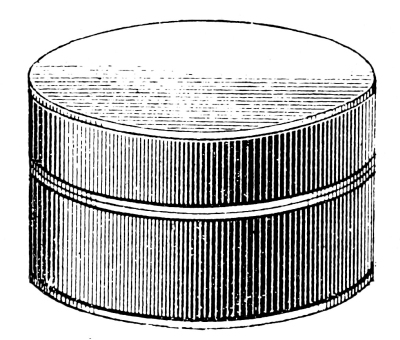
Plain, round, shouldered pill boxes are made from
two round pieces of box-board, two “rings” of equal
size, made from paper, and one larger “ring” which
forms the shoulder or neck.
Round Shouldered Pill Box—Covered with colored glazed
paper, leaving four white edges.
Note that a round box of this type does not have
projecting edges at the top of the lid and at the bottom
of the box. The round top and bottom pieces set within
the rings. The ring is first placed over a form; glue
is applied to the edge of the round piece of box-board,
and this is then set inside the ring. A strip of thin
trim paper—gold, white or colored—is then pasted
around the side of the ring, the strip of trim paper
being wide enough to extend slightly over the top of
the lid, or over the bottom of the box. This extension
of the trim paper helps in holding the round piece of
box-board to the edge of the ring and produces a
smoothly-covered edge.
Both the lid and the bottom of the box are made
in the same manner as described. After the trim-paper
has been applied to the sides and edges of the
rings, strips of white or colored glazed paper are then
pasted around the sides of the rings (over the trim-paper),
these strips not being as wide as the strips of
trim paper. The finished box shows four edges of the
trim, one at the top of the lid, one at the bottom of the
lid, one at the top of the box and one at the bottom.
The shoulder ring, or neck, is nearly double the
height of the ring which forms either the box or the
lid. Paste is applied to one edge of the neck-ring and
the neck-ring is then placed inside one of the box-rings,
the end containing the paste adhering to the bottom of
the box. It is well also to put a small portion of the
paste on the side of the shoulder-ring which goes down
inside the box. The lid, of course, fits snugly over the
neck.
Some round, shouldered boxes of this type are
covered on the inside with colored glazed paper, others
have merely the tops and bottoms lined with white
paper. In the latter case, the box-board used for the
round top and bottom pieces is lined on one side before
being cut into circles.
The rings for the lids, boxes and shoulders, when
made of white paper, are naturally white on the inside.
We will explain how the tubes for the rings and shoulders
are made later on.
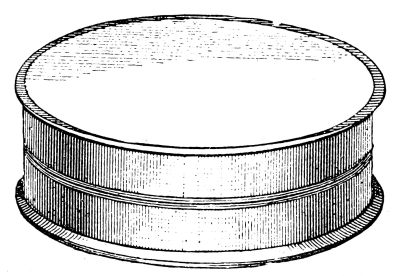
Round, Shouldered Projecting Edge Pill Box—Covered with
colored enameled paper, leaving four gold edges.
Round, shouldered pill boxes with projecting
edges are made in about the same way as the plain,
round boxes, with the exception that greater care must
be taken by the operator in wrapping the trim paper
around the projecting edges of the lids and boxes.
Particular care must also be taken in placing the round
pieces of box-board accurately in position over the
edges of the rings.
For trimming the edges of boxes with projecting
edges, light-weight paper having special stretching
qualities should be used. In the trade this stock is
known as “Round-work Glazed.” A. Hartung & Company,
of 506 Race street, Philadelphia, are in a position
to furnish this paper on special order. It can be supplied
in white, gold and in various colors. It comes in
rolls 24 inches wide.
Many expert operators on round box work are
capable of making boxes with projecting edges without
using forms for placing the tops and bottoms of the
boxes accurately into position. Some operators make
use of metal rings which are placed over the box-rings
after the round pieces of box-board have been attached
to the glued edges of the box-rings. According to the
size of the boxes being made, the metal ring’s outside
dimensions are the same as the diameter of the round
pieces of box-board. The inside of the metal ring fits
closely around the outside of the box-ring. By careful
manipulation with the fingers, the operator with
the aid of the metal ring, obtains an even margin on
the projecting edge all around.
Other operators do not use glue in applying the
edges of the rings to the round pieces of box-board,
the strips of trimming paper serving to hold the material
together firmly. The strip of trimming paper,
with paste applied to one side of it, is neatly wrapped
around the outside of a box-ring and around the edge
of the round piece of box-board. One edge of the trim
paper is then turned over the edge of the round piece
of box-board, and the other edge of the trim paper is
then turned over the edge of the ring. It requires experienced
fingers indeed to accomplish this tedious
work without causing the turned edges of the trimming
paper to wrinkle. “Practice makes perfect.” The
skilled operator can produce a surprising amount of
this class of work during the course of a day. The finished
product shows the trimming paper smoothly
wrapped around the boxes and lids, and where the
paper passes over the projecting edges of the boxes
and lids, not the smallest wrinkle in the paper is to be
seen. The turned-in edges of the trimming paper are
even and smooth.
The operator holds in proper position one of the
box-rings, and one of the round pieces of box-board,
as the trimming paper is applied. After the trimming
paper has been put on, strips of glazed paper, of the
color desired, are pasted to the sides of the boxes and
lids, leaving the edges of the trimming paper exposed.
Round, shouldered pill boxes with projecting
edges are made in many different sizes, some as small
as one and one-sixteenth inches in diameter, and with
a depth as low as one-half of an inch. These boxes
are trimmed and covered with papers of various colors,
and beautiful effects are obtained when correct
color schemes are chosen. White or gold trimming
paper harmonizes well with all other colors of paper.
A box covered with white trimming paper and bronze
enameled paper, leaving four white edges, forms a
pleasing color combination. Bronze and gold, light
blue and white, red and gold, light blue and gold, are
only a few of the many good color schemes which are
being used.
Some of the fine, round, shouldered pill boxes
with projecting edges are lined inside with silver, gold,
colored or tin foil paper. Some of these boxes are
covered entirely with gold paper, others are covered
entirely with white or colored paper. Others again are
covered with fancy embossed, or watered paper, after
gold or silver trimming paper has been applied.
The tops of the lids for these boxes are not covered
by the box-maker as a general rule. Druggists
who buy these boxes paste their own printed round
labels to the lids of the boxes as physicians’ prescriptions
for pills, capsules, etc., are filled.
One can form some idea of the large number of
round pill boxes which are being consumed in this
country when considering the number of drug stores
that are located in all sections of the United States.
The demand for high grade round pill boxes is constantly
increasing. At the present time, the supply of
fine, hand-made pill and powder boxes is not equal to
the demand, as only a few manufacturers are specializing
in this class of product.
Among the other kinds of small paper boxes which
are used extensively by pharmacists are plain, round,
shouldered magnesia boxes, as they are termed in the
trade. Round boxes of this variety are higher in form
than the pill boxes which have been described, and they
are used for holding other powders in addition to
magnesia. (Insect powder, for example). Some boxes
of this model have a depth of three inches, while the
diameter of the lid is one and fifteen-sixteenths inches.
Round Shouldered Magnesia Box—Covered with
colored glazed paper.
Round, shouldered boxes of this class are made
in about the same way as plain, round pill boxes, the
round pieces of box-board being glued to the inside
edges of the rings. In some instances, the sizes of the
rings for the lid and box are both the same. In other
cases the depth of the ring for the box is considerably
larger than the depth of the ring used for the lid.
The shoulder, or neck, for this kind of box consists
of a tube which is almost the same height as the
interior of the box. One edge of this tube is glued to
the bottom of the box. Some glue is also applied to
the side of the tube, so that it will hold firmly to the
inside of the box. On account of the neck on this
style of box being higher than the neck on a pill box,
some slight difficulty would be experienced in placing
the lid of the box over the neck. To overcome this,
a slit, running slightly on an angle, is cut into the neck
with a sharp knife. This slit causes a lap-over of the
neck, at the edge, making it an easy matter to slide the
lid on.
Before cutting the slits in the necks, some operators
punch small holes, with a bodkin or an awl, in
the sides of the necks, at a point where the length of
the slit is to be determined. The hole serves two purposes:
First, it acts as a guiding mark when the operator
cuts the slit; second, it has an influence on the
lap-over, allowing it to be moved freely as the lid is
placed over it.
Round, shouldered magnesia boxes are covered
with glazed or enameled paper, white or colored.
Trimming paper is seldom applied. When tubes, or
rings of white paper have been used in the construction
of these boxes, the covering paper for the side of the
box and side of the lid may be cut to widths that will
permit four white edges of the box to show. These
white edges make the box and lid appear as though
they had been trimmed with white paper. The reader
is to understand, however, that in the case of a round
box with projecting edges, it would be necessary to
apply trimming paper, before pasting on the regular
covering paper, as the trimming paper serves to hold
the round piece of box-board to the edge of the ring.
In the case where the tops and bottoms of plain,
round boxes are to be covered with glazed or enameled
paper, there are two methods of covering: One
method is in having one side of the box-board (which
is to be used for the tops and bottoms of the boxes)
covered with glazed or enameled paper before the box-board
is cut into round pieces. The other method is in
having round pieces of the paper, of desired size and
color, cut out with a die, and the round pieces of paper
are then pasted to the tops and bottoms of the boxes.
Labels for round magnesia boxes are usually
pasted to the sides of the boxes, and for this reason
the tops and bottoms of these boxes are frequently
covered with glazed or enameled paper, the same color
as that applied to the sides of the boxes.
As mentioned in a previous paragraph, some plain,
round boxes, not having projecting edges, are trimmed
on all four edges with “Round-Work Glazed Paper”
before regular glazed or enameled paper is applied to
the sides, but as a general rule, only round boxes with
projecting edges are treated in this manner.
To a person not familiar with the process of manufacturing
round and oval paper boxes, it would appear
that the sides of the boxes are formed of light-weight
cardboard, rolled to the required shape. Such
is not the case. The tubes, or “barrels” from which
the rings for the boxes are cut, are made of paper.
The tubes from which the shoulders or necks are cut,
are also made of paper. Manila stock is used for tubes
of the cheaper grade. Machine finished book paper is
used for tubes of good quality, and the tubes which are
used for the making of the finest face powder boxes
are constructed of white coated or enameled paper.
This will explain the beautiful gloss-white surface
which may be seen on the inside of expensive face
powder boxes.
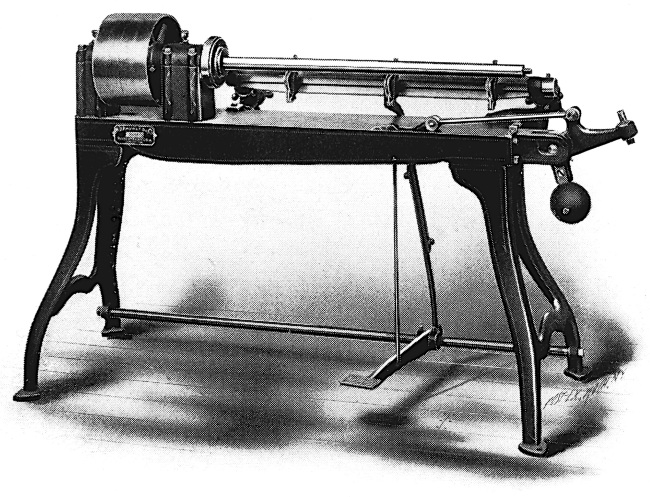
Knowlton Tube Cutting Machine.
The various kinds of paper used for the making
of tubes comes in rolls, and can be supplied by any of
the well known paper dealers in rolls of standard
widths. What is known in the printing trade as
50-pound manila, 50-pound machine finished book, and
80-pound enameled or coated-one-side, are the kinds of
paper generally used for making the different varieties
of tubes. These papers can be furnished in all of the
standard weights or thicknesses.
Parallel tube rolling machines are necessary for
this class of work. James Brown, Jr., & Sons, Manayunk,
Philadelphia, Pa., have invented a tube rolling
machine which is capable of turning out twenty-two
“barrels,” sixteen inches long, per minute. This machine
is equipped with a paste tank, a steel mandrel of the desired
size, a cut-off device, and a roll of the paper, say
sixteen inches wide. Adjustments can be made so as
to roll the tube to any required thickness. Three or
four complete revolutions of the mandrel are all that
are necessary for a tube which is to be used for small
pill boxes. Flour paste is recommended in making
tubes of the kind in question, but dextrine or any of
the patented cold glues on the market may be used for
the purpose.
CHAPTER V — DRUGGISTS’ PILL AND POWDER BOXES (Continued) — COVERING FOR ROUND AND OVAL BOXES. — CUTTING ROUND AND OVAL PIECES. — OVAL SHOULDERED PILL BOXES WITH PROJECTING EDGES. — ROUND FACE POWDER BOXES WITH DOME TOPS. — ODD-SHAPED FACE POWDER BOXES. — PLAIN OBLONG POWDER BOXES. — SLIDING BOXES FOR POWDERS AND LOZENGES. — OBLONG SHOULDERED POWDER BOXES. — SQUARE SHOULDERED BOXES. — SQUARE TELESCOPE BOXES. — SUPPOSITORY BOXES WITH PARTITIONS.
IN addition to manufacturing tube rolling machines
for the box-makers, James Brown, Jr. & Sons,
Manayunk, Philadelphia, are also making tubes for
the trade. Instead of manufacturing the tubes, or
“barrels,” for round boxes in their own plants, some of
the box-makers order the tubes made by concerns like
James Brown, Jr., & Sons. Afterwards, the box-makers
have the finished tubes cut into rings of the required
sizes, and assembled into boxes in their own
plants. There is an advantage, of course, in the box-maker
having his own tube rolling machines.
The finished “barrels” for round paper boxes are
cut into rings of various lengths on a rotary tube-cutting
machine which works somewhat on the principle
of a lathe. Some of the larger manufacturers of
round pill boxes have had special cutting machines
built for this purpose. Tube-cutting machines of this
kind are supplied by some of the larger manufacturers
of paper box machinery.
In some paper box factories, where small, round
and oval pill boxes are produced as a specialty, the
tubes are rolled by hand on forms of the required
sizes. After a tube has been rolled, it is placed on
another form to dry for about twenty-four hours before
being cut into small sections on a lathe. The
machine-made tubes are said to be just as satisfactory
as the hand-made tubes. All of the tubes are allowed
to dry thoroughly before cutting them into rings.
As previously mentioned, small round and oval
boxes are first covered with Round-work Glazed Paper,
having special stretching qualities. This stock
comes in rolls, 24 inches wide. A rotary slitting machine
is used for cutting the paper into widths of the
necessary sizes. The slitting and rewinding machine
cuts the large roll into strips, and these are rewound
into small rolls. The operators on the round and oval
boxes make use of the smaller rolls when covering
the boxes.
The glazed white or colored paper used for
finishing the boxes also comes in rolls, and the large
rolls are cut into sections, or different widths, on the
slitting and rewinding machine, in exactly the same
way as the Round-work Glazed Paper.
In some plants, small covering machines, of special
model, are used by the operators in applying the
paper to the sides of round and oval boxes. In other
plants, all of the covering work is done entirely by
hand, the operators working with paste, scissors, and
the small, narrow rolls of glazed paper. This is artistic
work, indeed, and it can be done only by experienced
operators.
The hand-operators work on spacious tables, and
these are provided with the tools, gluing-boards, paste-containers,
and all of the material necessary for the
making of the round and oval paper boxes. The operators
at intervals rub their fingers on small cakes of
bees’ wax to keep the fingers clear of paste or glue.
One operator continually works at covering the boxes
and lids; another works exclusively at finishing, or
rather, covering the sides of the boxes and lids with
strips of colored glazed paper; still another operator
inserts the necks in the boxes. The boxes and lids
are then assembled together, and the completed product
is afterwards packed in large-size paper boxes,
usually holding one gross each.
The round and oval pieces of box-board for the
tops and bottoms of the round and oval paper boxes are
cut to the proper sizes and shapes by means of steel
dies and a press. A steel die of the required size and
shape is placed over about a dozen pieces of box-board.
The die and stock are then placed under the
head of the press; powerful pressure is applied, and
the steel die cuts through the dozen or more pieces of
box-board, cleanly cutting out the disks or ovals as the
case may be. It is necessary, of course, to have a
steel die for each size and shape desired. The manufacturers
of small round and oval boxes have complete
sets of steel dies, suitable to all the standard
sizes of work, and these dies are kept in first-class
condition so that they are always capable of doing
sharp, clean cutting. Several different dies may be
put under a large press at one time. The square or
oblong pieces of box-board are cut to sizes to conform
with the various sizes of dies so as to prevent as much
wastage of stock as possible. A margin of about one-half
of an inch, all-round, will do for the average die.
Steel dies and die-presses can be furnished by any of
the large manufacturers of paper box machinery.
Oval shouldered pill boxes with projecting edges
are made much in the same manner as round shouldered
pill boxes with projecting edges, with the exception
that oval forms are used for properly shaping
the boxes and their lids.
The forms for the oval boxes are usually made of
hard-wood, and they are accurately cut and smoothly
finished so that the box and lid will fit nicely together.
The covering is done while the box, or the lid, remains
on the form. The regular rings, cut from the round
tubes are used, and these round rings are easily placed
over the oval forms. Extreme care must be exercised
by the operator when applying the Round-work Glazed
paper to the sides and projecting edges of the oval
boxes and lids. The work of setting in the necks is
comparatively simple.
Oval Shouldered Pill Box with Projecting Edge—Covered
with enameled paper, leaving four gold edges.
A particularly beautiful effect is obtained by first
covering an oval shouldered pill box (projecting edges)
with gold Round-work Glazed paper, and by then covering
the sides with white, buff, pink or blue glazed paper.
This leaves four gold edges. A striking color
effect is obtained by first covering the box and lid with
black paper, and then covering the sides with lavender
glazed paper. Purple and gold make another pretty
color scheme.
Among the most popular face powder boxes are
the round ones having domed tops. Boxes of this design
also have projecting edges. Some are covered
with fine, colored and embossed paper, leaving four
gold edges; others are entirely covered with gold paper;
others still have four white or gold edges and are
finished with colored glazed paper.
Face Powder Box with dome top—Covered with colored
enameled paper, leaving four gold edges.
Beck Doming or Embossing Machine.
The Charles Beck Company, of 609 Chestnut
street, Philadelphia, make a duplex embossing press
which has been designed especially for the “doming”
of tops for round or oval face powder boxes. It is a
hot press, and by means of brass male and female dies,
it shapes round or oval pieces of box-board into convex
forms for the tops of the boxes. The Beck Duplex
Embossing Press consists of two complete presses
which operate alternatingly. A set of dies is placed in
proper position in each press. The operator places a
box-top over the female die of one press, and as that
box-top is being embossed, the operator places another
box-top over the female die of the other press. In
this way there is always a box-top being embossed,
either on one press or the other. The box-top remains
between the heated dies long enough to be firmly molded
into a dome.
The printed labels for dome-topped face powder
boxes are pasted on the round or oval pieces of box-board
before the embossing is done, so that the labels
will have the same convex form as the box-board. The
covering is done the same as with flat-topped round
boxes with projecting edges.
Fancy face powder boxes are made in many different
sizes and shapes. Some have mirrors set in on
the inside of the lids, so that the lady using the powder,
when traveling, may see her face. Novelty boxes of
this kind are “irresistible” to the fair sex. They are in
great demand, and they bring high prices. Some face
powder boxes are square with round corners; others
have shapes like hearts, diamonds, etc. The odd-shaped
boxes usually have wide flanges, or French
edges, top and bottom, sometimes projecting as much
as one-quarter of an inch. The tops are embossed, or
are padded with cotton wadding before the covering is
applied. The covering often consists of fine embossed
paper, in rich colors like deep red, royal blue, purple,
gold, pink, and warm brown.
All of these boxes are made entirely by hand from
fine grades of cardboard, although the tops and bottoms
are usually of the ordinary box-board, covered on
both sides with glazed paper. Forms are used in making
the odd-shaped boxes, and the work is done by
highly-skilled operators who have had long experience
on the one line of product.
Small paper boxes of this variety are used extensively
by the drug trade for physicians’ prescriptions
calling for powders wrapped in papers.
Oblong Plain Powder Box—Covered with colored
glazed paper.
Boxes of this type are made from light-weight
Manila, news, chip or straw-board, and they are cut,
scored and folded in practically the same way as the
larger-size set-up boxes. There is a machine on the
market especially designed for cutting corners and
scoring blanks for small boxes of this variety. The
corner-cutting and scoring are done simultaneously,
so that the corners and scoring-lines will register accurately.
In fine hand-work, pieces of the glazed covering
paper are cut to the sizes needed. The strips of
paper are pasted around the sides of the boxes and lids,
and the edges of the paper are turned in, top and bottom.
Many small-size, square and oblong pill and powder
boxes are now being made by machines. The Improved
Brightwood Automatic Box Machine, manufactured
by the U. S. Automatic Box Machinery company,
of Boston, Mass., will make paper boxes as small
as 1 and ½ inches as well as boxes of larger sizes.
Another wonderful device is the Automatic Box Making
Machine, Model 33, manufactured by the New
Jersey Machine Corporation, of New York City. This
machine will automatically make a wide range of small
set-up boxes such as are used for cigarettes, cigars,
needles, pins, buttons, clips, pills, powders, jewelry,
garters, etc.
The small-size sliding boxes are also used liberally
by the drug trade, for powders, pills, lozenges, etc.
Sliding Box—Covered with gold embossed paper.
These boxes are made from light-weight manila,
news, chip or straw-board, both the box and the sliding
holder being covered with glazed paper, or fancy embossed
paper. In some instances, the edges of the slide
and box are trimmed, but in most cases plain covering
is done. The box proper is made the same as a small
set-up box. The sliding tops are made the same as the
necks for square or oblong boxes. Nearly all sliding
boxes are made by hand.
The sliding tops for this kind of boxes are first
made in long sections, being cut and creased on a regular
cutting and scoring machine to the desired widths.
The long sections are then cut into smaller pieces on
a machine like the Robinson Chopper, made by John
T. Robinson Company, of Hyde Park, Boston, Mass.
Necks for other styles of boxes are cut, scored and
“chopped” in the same manner.
After the long sections for the sliding tops have
been cut into the proper lengths, the covering is then
done. The pieces of cover paper are cut on a paper cutter
to the necessary sizes. The operator first pastes a
sheet of the cover paper around the sides of the slide,
leaving the edges of the paper projecting at each end of
the slide. Then, with scissors, the operator cuts the
projecting paper, at each corner, on an angle. The
edges of the cover paper are then turned in on the inside
of the slide. The box is covered the same as a
large-size set-up box, the edges of the paper being
turned in at the top and bottom. The corners of small
sliding boxes are not always stayed, the covering paper
being sufficient to hold the corners together.
Some sliding boxes are covered with white
“watered” paper; others are covered with glazed plaid
paper of various colors. Others, still, are covered with
calico paper, or with gold star paper.
Paper boxes of this model are generally used by
druggists for holding physicians’ prescriptions of powders,
but these boxes are also used for holding capsules,
tablets, etc.
Oblong Shouldered Powder Box—Covered with white
enameled paper, and having four gold edges.
These boxes are made from Manila, news, chip or
straw-board, of the lighter weights, and the side of the
stock which will appear on the inside of the boxes and
lids is first lined with white paper. Some of these
boxes are made the same as regular set-up boxes (with
the exception of the neck). Others are made with set-in
top and bottom pieces. The box-board for the inner
tops and bottoms of the best quality boxes are lined
with white enameled paper, the stock used for the sides
of the boxes is lined with plain white paper.
In the case of an oblong shouldered box having
set-in top and bottom pieces, forms, or blocks, are used
by the operators for holding the tops and bottoms into
position as the trimming paper and covering paper are
applied. The trimming paper is applied first, then the
covering paper is put on, leaving four edges of the
trimming paper exposed.
The necks, or shoulders, are first made in long
sections with the aid of a rotary cutting and scoring
machine. The long sections are then cut into the desired
lengths on a machine like the Robinson Chopper.
The outer sides of the necks are now covered with
white enameled paper, and after the paper has been
turned in over the inner sides of the necks, the necks
are then inserted in the boxes, held with glue at the
sides.
Small boxes of this style usually are covered on
the bottoms with white enameled paper. The tops of
the lids are not covered, the printed labels used by the
druggists serving as coverings. The boxes and lids
of shouldered boxes of this kind are both of the same
size. The trimming and covering is done in various
colors of paper.
The greater number of square and oblong shouldered
boxes have the tops and bottoms set in, instead
of the box and lid being formed of solid pieces of box-board,
for this reason: The sides for shouldered
boxes are made in long sections, and after the long
sections have been folded to the proper shape, and
stayed at one corner, (on the inside) the long sections
are cut into the necessary widths on a chopping machine.
Naturally, by this method, the “frames” for
the boxes and lids are all of the same square or oblong
size, on account of having been cut from the one size
material. This means that the lid and box register accurately.
Square shouldered boxes, for physicians’ prescriptions
of powders and pills, are almost as popular
in the drug trade as round boxes.
Square Shouldered Pill and Powder Box—Covered with buff
glazed paper, trimmed with four gold edges.
Practically all square shouldered pill and powder
boxes are made with set-in tops and bottoms. The
sides are first made in long sections. The long sections
are then cut on a chopping machine to the smaller sizes
necessary for the sides of the boxes. The small
“frames” are put on forms; the square blanks are set
in, and the trimming paper is applied which holds the
square pieces to the sides. The strips of covering paper
are then pasted around the sides. The necks are
made in long sections, afterwards being cut into the
required lengths. The stock used for the necks is lined
on the inner side with white paper. After the long
sections have been cut into smaller lengths, each small
section is covered on the outer sides with white enameled
paper, the paper being turned in over the edges
which will appear at the top of the neck. The necks
are then inserted in the boxes, held with glue at the
sides. The lids and boxes are both the same size, and
they register accurately over the neck.
An attractive color effect for a square shouldered
pill and powder box is obtained by first covering the
box and lid with red glazed paper, and then covering
the sides of the box and lid with green imitation wood
paper. This leaves four red edges showing.
Some square shouldered pill and powder boxes
have hinged lids, so that in the homes of sick people
the covers of different boxes cannot become interchanged,
and wrong directions on the labels of the covers
followed.
The telescope pill and powder box is also popular
in the drug field. The lid and box are both of the same
depth, and the lid fits down over the sides of the box.
A box of this type may be over-filled with capsules or
powder papers, the deep lid allowing for the extra
capacity.
Square Telescope Powder or Pill Box—Projecting edges at
bottom—Trimmed with gold paper, and covered
with colored glazed paper.
Telescopic boxes of this class are made the same
as small set-up boxes in cases where the box does not
possess an extension bottom. When the box has projecting,
or French edges, the sides are made in the
same way as the square shouldered boxes, with the
exception that the bottom piece of blank is not set within
the sides. In this case, the square blank is placed
against the edges of the body, in proper position, and
the operator wraps the paper in such a manner as to
hold the bottom-piece firmly to the edges of the sides.
Some telescope boxes have projecting edges trimmed
with gold paper, and the sides covered with white
enameled, or colored glazed paper. The inner sides
of the box and lid are usually lined with white glazed
paper.
Suppository Box—Covered with white enameled paper,
four bronze edges—Lined with tin foil.
Suppository boxes with partitions are made much
the same as square or oblong shouldered pill and powder
boxes, with the exception of the lids being deeper,
and the addition of the partitions. Some boxes of this
variety are hinged.
The stock used for the partitions
is usually lined on both sides with white enameled paper, or with
tin foil. The interior of the box and lid is also lined either with
white enameled paper, or with tin foil, to correspond with the
partitions.
The Charles Beck company, of Philadelphia, supply
a paper box-maker’s saw which is particularly
adapted to the work of sawing slots for partitions of
paper boxes. The E. G. Staude Manufacturing company,
of St. Paul, Minn., furnish the Junior and Standard
Slotters which are adapted to all kinds of slotting
work for paper box partitions. The Staude slotting
machines are equipped with automatic feeders, and
they are capable of turning out a great amount of
finished product very rapidly.
The edges of the partitions are glued to the sides
and bottoms of the boxes.
CHAPTER VI — CANDY BOXES — DEMAND FOR SWEETMEATS — SYSTEMATIC ARRANGEMENT OF MACHINES — PLAIN CANDY BOXES — TELESCOPE CANDY BOXES — LACING — SHOULDERED BOXES WITH EXTENSION TOPS AND BOTTOMS — TRAYS FOR CANDY BOXES — FLAT CANDY BOXES — THE DUPLEX SHOULDER-BOX PRESSER — ROUND CANDY BOXES WITH EXTENSION EDGES — ART CANDY BOXES — LARGE, ODD-SHAPED CANDY BOXES
ON account of the greatly increasing demand for
candy boxes of all kinds in every section of
the country, the writer thought it well to devote a
chapter to this important subject, and an attempt will
be made to explain the styles and construction of the
most popular models of candy boxes which are on the
market at the present time. It would be almost impossible
for one to describe all of the many different
kinds of candy boxes which are being made today, so
it is the writer’s intention to mention merely those
boxes that may be considered as standard in the trade.
Standardization of the styles and sizes of candy
boxes is something that is seriously needed in the paper
box industry, but standardization cannot always be
followed by the manufacturers of candy boxes for the
reason that the confectioners often want odd-shaped
and special sizes of boxes to make their product more
attractive to the public. It is a fact that a beautiful,
odd-shaped paper box helps greatly in selling expensive
candies, and even a “freak” box that is attractive without
being beautiful is nevertheless a powerful selling
agent. When the confectioner wants an out-of-the-ordinary
box, and is willing to pay the necessary cost,
the box-maker should give the confectioner what he
wants, but whenever possible to talk the confectioner
into using boxes of standard sizes, the box-maker
should do so, as the standard styles and sizes of candy
boxes will serve well for every practical purpose.
With the passing of strong drinks in this country
came a greater demand for sweetmeats from every
direction. Confectionery and ice cream parlors are
taking the places of liquor saloons in many instances.
New candy factories are being erected in almost every
town and city. American men and women are consuming
larger quantities of chocolates, chewing gum
and candies than ever before—they are paying high
prices for the best sweetmeats, and expensive grades
of confections are selling more rapidly than the cheaper
grades. All of this means more business for the
box-makers, and the box manufacturer who is in a position
to make fine candy boxes as a specialty may have
all of this class of work that he may care to produce.
Many box-makers are specializing in fancy candy
boxes. Their plants are equipped to handle this one
line of product to the best advantage. By making a
specialty of this line, a great deal of the work can be
standardized in such a way that the blanks, wrappers,
neck-strips, trimming paper, covering paper, extension
bottoms, etc., can be cut to standard sizes. The operators,
through working continually on the same styles
and sizes of boxes, soon become very efficient, and are
capable of producing a larger output than would be the
case in a plant that is not specializing on candy boxes.
All successful box-makers are specializing in some particular
kind of work, and this is a custom which should
be more generally followed in the trade.
On the next page is a diagram which shows a
systematic arrangement of machines for staying and
wrapping extension bottom boxes and lids, affixing two
laces in each box, and closing the boxes.
The extension bottoms are registered and attached
to the box and lid blanks by means of a Stokes &
Smith Extension Bottom Gauge, Model W.
The blanks are glued with a hand stencil and
are placed in the gauge with the extension bottoms,
after which they are delivered to the staying machine,
which is elevated on a portable platform.
After the staying operation the boxes and lids
are passed through a hopper to the operator of a Stokes
& Smith Wrapping Machine.
The operator of the gluing machine places the
glued wrappers upon a revolving table within convenient
reach of the wrapping machine operator.
Systematic arrangement of machines for Staying and Wrapping
Extension Bottom Boxes and Lids; Affixing Two Laces to Box, and Closing.
From the wrapping machine the lids are discharged
to a receiving table ready for closing. The
boxes are discharged to a hopper conveniently located
near the lacing machine operator, who applies the
two laces to each box and then passes it on to the receiving
table. The boxes are then conveyed to the
table on which the lids have been discharged, where
the boxes and lids are closed ready for packing.
This is one of the efficiency plans which is being
used in many large box factories with successful
results.
Plain Telescope Candy Box.
Plain candy boxes are made of chip-board, news-board,
or straw-board, the board lined on the inner
side with white news or book paper before being
cut up into blanks of various sizes. The board is cut
and scored to the required sizes on a cutting and
scoring machine. The corners are then cut out of the
blanks on either a single or double cornering machine.
The top of the lid is covered on a topping
machine. The corners of the box and lid are stayed on
a staying machine. The sides of the box and lid are
covered with white or colored glazed paper on a covering
machine.
Plain boxes of this type may also be covered
on the automatic wrapping machine, but in that case
the wrappers must be cut out at the corners as described
in a previous article. Either tight wrapping
or loose wrapping can be done on a Stokes & Smith
machine, or on an Alger Wrapping Machine.
Plain candy boxes are made in ¼, ½, 1, 2 and
5 pound sizes.
These are made in the same manner as plain set-up
boxes, with the exception of the lid which is as
deep as the box, and which sets down over the sides
of the box, permitting the box to contain an overflow
of candy. Boxes of this kind usually have the
lid loose wrapped, but many are tight wrapped, or are
covered in the regular way on covering and topping
machines.
Telescope Perfumery Box.
The loose wrapped candy box is very popular
on account of its artistic appearance. The same
wrapper tightly glued on the lid would not look as
well as the loose wrap. This statement applies to
telescope candy boxes. The loose wrap plan saves
a considerable quantity of glue, as the glue is applied
only to the margins of the wrapper.
The majority of telescope candy boxes are covered
on wrapping machines, although many are covered
by hand. The shape of this style of box is long
and rather narrow, so far as the smaller sizes are concerned.
They are made in ¼, ½, 1, 2 and 5 pound
sizes.
Paper lacing adds decidedly to the appearance of the
interior of a candy box, and it helps in making the
contents of the box look tempting. Nearly all good
candy boxes contain lacing for the reasons mentioned,
and some have lacing which is of excellent quality. In
some cases the box has two laces, one on either side,
and in other instances, a plain or fancy fly leaf on one
side.
The Stokes & Smith Lacing and Fly-Leafing Machine
is a very useful device on this class of work.
It will glue and insert laces or fly-leaves to the boxes
as fast as the operator can handle them.
A great deal of lacing and fly-leafing work is
still being done by hand operators, and one advantage
of the hand-work is that a pure white paste may be
used, while the machine requires glue to run properly.
On fine candy boxes sanitary white paste should be
used for the lacing or fly-leaves, as a yellow glue
would not look as clean.
Candy Box with Two Flyleaves and Two Laces.
The U. S. Lace Paper Works, Inc., of New York
City, supply many different varieties of lacing to the
trade. This paper may be run on the Stokes & Smith
Lacing and Fly-Leafing Machine, or on the Bird Fly
Machine. Sample books of the lacing will be furnished
on request.
Manufacturers of fine chocolates and candies are
using shouldered boxes with extension tops and bottoms
to a great extent as containers of this product,
and many boxes of this variety also have padded tops.
The boxes and lids are first made in the same way
as plain set-up boxes. Separate pieces of box-board,
about ¼ of an inch larger on all four edges than the
size of the box, are then glued to the tops of the lids
and to the bottoms of the boxes. After this has been
done, the boxes and lids are then wrapped with the
covering paper, the paper being turned in over the
top edges of the box and the corresponding edges of
the lid. The shoulder, or neck section is then set in the
box.
Candy Box with Extension Top and Bottom.
The John T. Robinson Company, of Hyde Park,
Mass., has designed an extension edge machine
which is especially adapted to this kind of work. The
machine automatically glues and places the blanks on
the tops and bottoms of the boxes, placing the blanks
accurately into position so that the margins are the
same on all four edges. Stacks of the blanks are
set in the machine which is equipped with a glue-fountain
and rollers for applying glue to one side of
the blanks. As the operator places a box or lid on the
form, an automatic feeding device moves the glued
blank to the box or lid in just the right position. This
machine is adjustable, of course, to blanks of various
sizes. The Stokes & Smith Extension Bottom Gauge
is another time-saving device for this kind of product.
Stack of Box Blanks with Bottoms Attached.
As mentioned before, the Stokes & Smith Wrapping
Machine is well adapted to the work of wrapping
candy boxes having extension edges, but when this
or any other wrapping machine is used for such work,
it is essential that the wrappers be cut out at the corners
to suit the requirements.
Box Ready for Staying.
In the case of a padded top for a candy box, this
top is applied after the cotton wadding has been put
on and covered. First, the cotton wadding is loosely
placed on the piece of box-board which is to form the
top. Second, a sheet of heavy paper, same size as the
wadding, is laid over the top of the wadding. Third,
the top is then wrapped with the covering paper,
turning in over the under-side of the top. Fourth, the
covered, padded top is now glued to the top of the lid
which has previously been covered on the sides. This
is said to be the most efficient method for making lids
with padded tops, although it is practicable to cover
the lid while the piece of box-board and wadding rests
upon it.
Development of the Wrapper.
Some expensive candy boxes in the larger sizes,
square or oblong, have extension edges as wide as ½
of an inch, but in such cases the box-board used for
the tops and bottoms should be of heavy weight so
that the wide, covered edges will not break easily.
Most extension edges on candy boxes average from ⅛
to ¼ of an inch.
Shouldered Candy Box Tied with Ribbon.
Many shouldered candy boxes with extension
edges have padded tops; are covered with fine colored
and embossed paper, and are tied together with silk
or satin ribbon of a color that blends well with the
color of the covering. When ribbons are used, the
ribbons are inserted between the bottom of the box
and the piece of box-board which forms the extension
edges, which means that the extension-bottom piece
must be glued to the bottom of the box after the ribbons
have been applied. The ends of the ribbons are
to be tied in large bows over the top of the lid after
the sweetmeats have been placed in the box. Or, the
ribbons may be in the form of loops, which slip over
the lid.
The shoulders, or necks, are made in long strips;
are folded and stayed at one corner, and are then cut
to the proper sizes for insertion in the boxes. The
cut sections of shoulder-strips are covered with glazed
paper, at the top edges, before being set in the boxes.
Box-board used for all good candy boxes is lined
on one side with white news or book paper before being
cut and scored.
Not a few of the better-grade candy boxes are
fitted with trays for holding the different kinds of
chocolates, etc., separately. Some of the larger-size
candy boxes have several trays, arranged either in
groups or in tiers. Others have merely one tray.
These trays are made of the ordinary, light-weight
box-board in the same way as set-up boxes, cut,
scored, cornered, stayed and covered with white
glazed paper. Before being cut, the box-board is
lined on one side with white paper.
Flat candy boxes are made as low as 1 inch, and
are made in various sizes. They are used for holding
single layers of chocolates, caramels, gum-drops, etc.,
and by reason of their long and wide shape they have
the appearance of holding more material than is actually
the case. The flat box of this type is usually
of the telescopic pattern, extension edge bottom, the lid
fitting down over the sides of the box, although many
are made without extension bottoms. Sometimes
small ends of ribbon are glued to the inner sides of
the lid, the ends of the ribbon
extending outside so that one may readily lift the low lid with the
aid of the ribbons.
Thumb-holes at the sides of the lids are advisable
with boxes of this kind. The thumb-holes are cut after
the lids have been covered. There are several thumb-hole
cutting machines on the market which are capable
of handling all varieties of such work.
The Stokes & Smith Company, of Philadelphia, is
manufacturing the Duplex Shoulder-Box Presser
which is a time-saving device for all kinds of shoulder-box
work. The use of this machine prevents the
sides of the boxes from pulling away from the shoulder,
and it also eliminates finger markings so noticeable
in hand-work.
This company also manufactures a Shoulder-Box
Gluing Machine which is intended for gluing the inside
of shoulder-boxes, and the device is a big time-gainer
over the ordinary hand method of gluing necks,
or shoulders.
All round candy boxes are made by hand by
skilled operators who have had long experience in the
one line of work. Practically all round candy boxes
are made with extension tops and bottoms, and have
shoulders, although some are being made with plain
tops and bottoms. The round, shouldered box with
extension edges is formed of four (4) pieces of box-board—two
disks, the side-piece, and the neck.
The disks are cut out to the proper sizes on a die-press
by means of round steel dies. When plain covering
paper is to be applied to the tops, or fancy covering
paper for that matter, this paper is also cut to
the necessary sizes and shapes with the aid of round
steel dies.
For the side-pieces of round candy boxes the stock
should be a quality of strong cardboard which will roll
easily into “rings.” The ring is held together at the
two ends with a strip of stay-paper, or linen, glued
to the inner side of the ring.
First, the ring is placed over a form to obtain
the proper round shape. Second, one of the round
pieces of box-board, which is to form the top or
bottom and extension edges, is placed to the edges
of the ring in accurate position. Third, the operator
then applies the covering paper, wrapping it around
the sides of the ring and turning over the edges of the
paper, top and bottom of the ring. The box and lid
are both covered in the same way, the paper holding
the round disks of box-board to the edges of the rings.
Fourth, a round piece of paper is pasted to the lid of
the box. Fifth, a slightly smaller ring than the one
forming the side of the box, and higher, is glued to the
inside of the box. This forms the neck, or shoulder.
The box is now complete.
Large Round Candy Box with Flat Top.
Plain, round candy boxes are made much in the
same manner, only the round disks of box-board are
inserted at the top edges of the rings. Boxes of this
model usually have shoulders, although some few are
made on the telescopic pattern, the lid being large
enough to fit down over the edges and sides of the box.
Through the courtesy of Jesse Jones Company, of
Philadelphia, the writer is able to furnish information
in reference to large round boxes with convex, or dome
tops—information which is very practical and valuable.
The Jesse Jones Company for many years has
been noted for the production of round and fancy
candy boxes and this concern has been successful in
building up an extensive business in this line.
Dome tops for large-size round boxes, such as the
five-pound size, for example, are made after the lids
and boxes have been covered. The finished boxes are
lined up on a spacious table. The lids are then inverted
and placed upside down over the top edges of the
boxes. Over the inverted lids soft, dampened pieces
of muslin are spread. Each inverted lid is then filled
with fine buck-shot, and while holding the buck-shot
the boxes and lids are allowed to stand in that condition
for several hours. The dampened muslin and
the weight of the buck-shot causes the top of the lid
to shape into an almost perfect convex form. This
is said to be the best process for doming the tops of
large round boxes. The lids for large-size oval or
odd shaped boxes can be domed in the same way. It
is necessary, of course, for the box-maker to have on
hand a considerable quantity of the fine buck-shot
when following this plan.
Some fine candy boxes are covered with silk or
satin, and on the tops of others are glued fancy “cut-outs,”
such as pictures of girl’s heads, yachts, flowers,
etc. Hand-painted designs, pictures, etc., are glued to
the tops of some of the larger-size boxes. There is
always a strong demand for beautiful candy boxes
of this kind, no matter how costly they may be. They
are particularly popular at Christmas time.
Beautiful Art Candy Box.
The picture contains a real feather.
The larger-size candy boxes, like the five-pound
size, are often made in the form of hearts, diamonds,
hexagon, octagon, square with round corners, oblong
with round corners, shamrocks, fans, keystones, shields,
and other figures. Nearly all boxes of this variety
have shoulders and extension tops and bottoms. The
pieces of box-boards for the tops and bottoms, whatever
the shape desired may be, are cut out by means of
steel dies, and the cover paper for the tops are also
cut out with steel dies, so that the paper will accurately
fit on the tops, or lids, after the other covering
work has been done.
Moreover, for fancy boxes of this class, smaller
pieces of box-board than the pieces used for the extension
tops and bottoms must also be cut out into the
shapes of hearts, diamonds, etc., to be used as formers
for the boxes and lids, as follows:
First, the strip of heavy cardboard for the side
of the box is stayed together at the ends, and the side-piece
is then placed around a form of a heart, diamond
or whatever the subject may be. This correctly forms
the sides of the odd-shaped box, but to keep the shape
permanently, the smaller piece of box-board is set in
at the top, and the sides of the box are then covered,
the edges of the covering paper being turned at the
top of the form so as to hold the set-in piece firmly.
The form may now be removed from the box, and the
covered extension-edge piece of box-board glued on.
The lid is constructed in the same way.
Another, and perhaps a better method is in placing
the side-piece on the form; setting in the bottom
or top-piece; gluing on the extension-edge piece, and
then covering the box in such a manner as to wrap the
edges of the covering paper around the sides and extension-edges.
The cut out piece of covering paper—a
heart, diamond, or whatever it may be—is then
pasted to the top of the lid.
It is to be understood that the side-pieces, and
the set-in top and bottom-pieces are lined on the inner
side with white or colored glazed paper before the
boxes and lids are made. In other words, the stock
is lined before being cut into the different shapes.
CHAPTER VII — MISCELLANEOUS PAPER BOXES. — WEDDING, PARTY AND BANQUET BOXES. — HEART SHAPED BOXES. — JEWELRY BOXES. — COVERED AND LINED. — GARTER, SUSPENDER, HANDKERCHIEF, NECKTIE AND COLLAR BUTTON BOXES. — CIGARETTE BOXES. — STOCKING BOXES. — OYSTER AND ICE CREAM BOXES. — SUIT, HAT AND FLOWER BOXES. — GRAINING BOARD FOR SUIT, HAT AND FLOWER BOXES, ETC. — ROUND HAT BOXES. — SUIT CASES AND TRAVELING BAGS. — POCKET CIGAR CASES. — BOXES FOR HARDWARE, GLASS, PICTURE FRAMES, TOOLS, TOYS, ETC.
IT is the writer’s purpose to devote this chapter to
miscellaneous paper boxes that are in popular demand
and which may be classed as specialty lines.
Important facts about the style and construction of
the various kinds of boxes will be given, and by carefully
studying this practical information, the reader
should be capable of making any of the boxes in
question. In some instances, however, it would be
necessary to employ the special machinery which will
be referred to.
For centuries it has been the custom for people
attending a wedding reception to receive individual
pieces of the wedding cake to take home as souvenirs.
It is a pretty custom and doubtless it will remain
in vogue until the end of time. Some brides simply
wrap the pieces of cake in fancy paper napkins, but
those who want to have things done right usually
place the bits of cake in fancy paper boxes so as to
prevent breakage. Some newly-weds go so far as to
have the names of the bride and groom printed or
die stamped on the lids of the boxes.
Wedding cake boxes are small in size, and are
made in the shape of hearts, diamonds, clover-leaf,
fans, etc. Small, plain, round, oval, square or oblong
boxes are often used for this purpose, but the odd-shaped
boxes mentioned are always the most popular.
In making a heart-shaped wedding cake box, for
example, the side-piece of cardboard is placed around
a heart-shaped form, after having been stayed together
at the two ends. The top-piece, cut out in
the shape of a heart of the proper size, is then inserted.
After this has been done, the sides of the
box are covered with fancy paper, the edges of the
paper being turned over at the top and at the bottom.
A heart-shaped piece of paper is then pasted on the
top of the lid. Both the lid and the box are made
in the same way—on forms—only it is not necessary
to cover the bottom of the box with a heart-shaped
piece of paper.
A box of this kind usually contains a shoulder,
both the lid and box being of the same size. The
shoulder-piece is set in after the box has been formed
and covered. The stock for the top and bottom pieces
is lined with colored or white glazed paper before
being cut out in the form of hearts. The stock for
the side pieces is also lined before being cut to the
essential sizes. This means that the box and lid are
lined on the inner sides before being made up as described.
When a heart-shaped box is to have an extension
top and bottom, the top and bottom pieces are put on
after the box lid has been made on the forms. The
heart-shaped pieces of boxboard which are to serve
as extension tops are about ¼ of an inch larger all
round than the pieces of heart-shaped board which
have properly formed the top of the lid and the bottom
of the box. The covering may be done after the
extension tops and bottoms have been attached, or
the covering may be done before they are attached,
but in the latter instance, it would be necessary to
cover the extension top and bottom pieces, and their
edges, before attaching them.
Other odd-shaped boxes, such as diamonds, clover-leaf,
fans, etc., and made on the same plan as the heart-shaped
box. Practically all boxes of this variety have
shoulders. Some have extension tops and bottoms,
others are made plain. The covering is done in fancy
colored, glazed, embossed, watered or gloss-white
paper. The box usually contains fine paper laces.
Fancy boxes of this class are frequently used at
parties in the same way as at wedding receptions, the
guests being presented with the boxes which are filled
with candies, nuts, or cake.
At many of the special banquets given by clubs,
business organizations and fraternal societies, ice cream
and other desserts are served in fancy boxes, thus
adding an unusual touch to the last course of the
dinner. These “banquet” or dessert boxes are made
in various odd shapes, and are also made square, oblong,
round or oval, and as a general rule, there are
no lids for the boxes which are covered with colored,
gold, silver, white or embossed paper. The inside of
a box, used for this purpose, should be lined with
plain white book paper, rather than with colored paper,
so that the coloring matter in the paper would not
transfer to the dessert. Two fine paper laces add an
artistic finish to a square, or oblong, box of this
variety. The square and oblong dessert boxes are
made in the same manner as plain set-up boxes, cut
out of a single piece of boxboard, the corners stayed
and the sides covered with colored or white glazed
paper.
Some concerns are making a specialty of jewelry
boxes and the field for this product is very extensive.
Many jewelers pack watches, rings, tie pins, dress
pins, clasp pins, lockets, belt buckles, cigarette cases,
match boxes, vanity cases, mesh bags, rosaries, fans,
fountain pens, etc., in pretty paper boxes of the proper
shapes, and not a few of these boxes are works of art.
The writer recently saw a small paper box for a
diamond ring, which cost the jeweler one dollar
apiece, the party who bought the ring paying for the
box, of course. The box in question was beautifully
covered with thin, dark green leather, and four edges
of the box were hand-tooled, the borders being finished
in goldleaf. The interior of the box was lined with
white satin, with billows and a rest for the ring formed
of the same material. The box also contained a shoulder
and the lid was hinged.
Some jewelry boxes are made in the regular set-up
style, others are made with shoulders. Round
and oval boxes are often used for watches, rings,
lockets, necklaces, etc., while long, oblong boxes are
used for tie pins, fountain pens, chains, gold pencils,
envelope openers, pen knives, dress pins, hair pins, etc.
Square boxes are adapted to silver and gold belt buckles,
ladies’ shoe buckles, match boxes, cigarette cases,
mesh bags, etc. The progressive jeweler carries a wide
assortment of fine paper boxes, of many different
shapes and sizes, so that he may have a box suitable
for any piece of jewelry, or novelty, sold. He will
even have sets of larger size boxes for holding silverware,
toilet articles, fans, cut glass, picture frames,
clocks, and so forth.
These details will convey to the reader an idea
of the great variety of paper boxes required by the
average jeweler. Many of the smaller boxes are covered
with white or colored glazed paper, and are lined
and padded with silk, satin, plush or velvet, of a tint
or color that will harmonize with the color or tint of
the box covering. One of the most beautiful paper
boxes ever seen by the writer was one of oval shape,
used for holding a costly pearl necklace. This box
contained a shoulder with the edges of the shoulder
covered with white glazed paper. The outside of the
box and lid was covered with golden-brown paper in
imitation leather. The interior of the box and lid
was lined with pale buff velvet, padded in the bottom
of the box in such a way as to form a resting place
for the string of pearls. Note the beauty of this
color scheme.
One prominent jeweler has a complete assortment
of paper boxes, all covered with light blue embossed
paper, and all lined with white satin paper, those for
rings, pins, etc., having padded rests formed of white
satin. The name-card of the jeweler is die stamped
in bronze blue ink on the lids, or wrappers for the
lids. The color effect is very pleasing. The wrappers
for lids of jewelry boxes are die stamped or printed
with the card of the jeweler before being pasted to
the lids.
Jewelry boxes seldom have extension edges. These
with shoulders, or necks, are made in about the same
way as the druggists’ pill and powder boxes, a description
of the construction work having been given
in another chapter of this series of articles. The
set-up box is made from a single piece of boxboard,
lined with white glazed paper, cornered, stayed and
covered with colored, glazed, white, watered or embossed
paper.
All paper boxes of this class are made on the
plain, set-up pattern, the lids extending down over
the sides. For example, a garter box is made from
one piece of light-weight boxboard, cornered, stayed
and covered with white glazed paper, while the lid is
covered with a printed or lithographed wrapper inscribed
with the particular name of the garter. We
refer to the well-known brands of men’s garters. Many
of these garter boxes contain holiday wrappers (for
Christmas gifts) handsomely done in bright colors,
and the lids have thumb-holes at two sides so that
they may be easily lifted.
Many garter, suspender, necktie and collar button
boxes are fitted with cut-out inserts for holding the
contents attractively. These cut-outs are of light-weight
folding cardboard and are produced on cutting
and creasing presses.
Suspender, handkerchief and necktie boxes are
often covered with fancy colored wrappers suitable for
the holiday trade. The designs on the wrappers are
printed or lithographed, and are usually applied to the
lids of the boxes with the aid of wrapping machines.
Some are loose-wrapped, others are tight-wrapped.
Not a few fine handkerchief boxes are covered with
colored or embossed paper, and hand-painted designs
appear on the lids. The stock for handkerchief, necktie
and suspender boxes is usually lined with plain
white paper before being made up. There is an increasing
demand for better quality boxes of this variety.
Numerous brands of cigarettes of the better quality
are packed in paper boxes of the set-up style, and
the lids in most cases are hinged to the boxes, the
hinge being formed of tape or linen. Cigarette boxes
of this type are usually made of light-weight boxboard,
and are equipped with shoulders. The inner side of
the boxboard is lined with white paper, and the stock
is then scored and cut so as to form long, oblong
strips after being folded and stayed. The strips are
then “chopped” up into small sections of the essential
sizes to make the sides for the boxes and lids. The
shoulders for the boxes are made in the same way.
The blanks for the bottoms of the boxes and for the
tops of the lids are cut to size on a rotary cutting machine,
although it is possible to cut the blanks, from
small piles of full-size sheets, on a regular paper cutting
machine, but for the sake of accuracy blanks
of this kind should be produced on a rotary cutter.
After the top and bottom pieces have been inserted,
the boxes and lids are covered with white or colored
glazed paper. The shoulders, or necks, are then put
in the boxes. Printed or lithographed labels are put
on the inside as well as on the outside of the lids.
When the boxes are to be hinged, the hinging material
is applied to the box and lid, on the inner sides,
before the shoulder pieces are set in the boxes.
Many cigarette boxes (not folding boxes) are
made on the same plan as the larger size set-up boxes,
the box and lid being cut from single pieces of cardboard;
creased, cornered, folded and stayed in the
usual manner, but when boxes that are made this way
have shoulders, the register of the box and lid is not
as accurate as in the case of the box and lid being
made from long folded sections.
Great quantities of paper boxes are continually
being consumed in the stocking industry for packing
the stockings in convenient lots for the trade.
The average box contains half a dozen pairs of
hose, or stockings, and often the retail dealer gives
the box to the buyer of half a dozen pairs, which
means that a box of this kind should be of good quality
and attractive to some extent.
Stocking boxes are all of the set-up type. Some
have shoulders, others are on the telescopic pattern,
some are made with ordinary lids. The stock is usually
lined with white paper. The covering is often
done with colored glazed paper. In some instances,
the edges of the lids and boxes are trimmed with
paper of another color. Sometimes fancy laces are
placed in fine stocking boxes. The label of the stocking
manufacturer is placed on one end of the box.
When putting on the lids of finished stocking
boxes, or in fact, when placing on the lids of any oblong
boxes, the operator can save time by setting
on the lid over the narrow way of the box, rather
than by placing the lid over the long way of the box.
Some concerns are making a specialty of ice cream
and oyster boxes, and special automatic machines are
used for printing, scoring and cutting the boxes to the
required specifications. Oyster and ice cream boxes
are made from Manila tag-board, and the inner side
of the board is given a coating of sodium silicate
(liquid glass) so as to make the boxes “water tight”
to a considerable extent. Boxes of this class may
be produced on cutting and creasing presses, with dies
made of steel cutting and creasing rules, but as stated,
this work is usually done on special machines having
great speed capacity. An oyster box is glued and
folded together, while an ice cream box is usually
wire-stitched at the sides, and is equipped with a
handle of tape. Oyster pails, and paper dishes are
also wire stitched. We refer to paper dishes used by
grocers for holding loose jelly, pepper sauce, lard, etc.
The oyster pails have wire handles. These specialties
offer a big field for the box maker who may also include
milk bottle tops in this line.
There is a promising field for numerous box makers
who would care to specialize in the manufacture
of suit, hat and flower boxes. We refer to folding
boxes of this variety which are made with lock corners
and slits, and which may be produced from single
pieces of box board in a very simple manner. The
Hobbs Creasing Machine, and the Hobbs Lock Corner
Cutter, have been especially built for this work.
On these devices the blank stock is creased and cut
in such a way that both the lids and boxes may easily
be folded together without staying, gluing or wire
stitching.
Plain suit, hat and flower boxes are made from
folding Manila boxboard and practically all of the
plain boxes are made on the telescopic pattern. No
covering is done.
Handsome effects are produced by graining boxboard
for suit, hat and flower boxes, etc. Jute or
Manila is generally used when graining is done.
Charles Beck Company, of Philadelphia, supply a
Rotary Printing Machine which has been designed
for producing various kinds of graining. This device
is equipped with an intaglio printing roller, inking
rollers, fountain, feed-board, etc., and the sheets of
boxboard are printed by the intaglio process on the
order of this illustration:
Example of Box Board Graining.
Different patterns of graining, imitation alligator-skin
and other designs can be produced on the Beck
machine by changing the intaglio cylinders which contain
the patterns engraved below the surface of the
cylinders. The printing cylinder is first inked all over,
some of the ink depositing in the engraved places on
the cylinder. The surface of the cylinder is then wiped
clean, leaving the ink in the engraved places. The impression
in the printing transfers the design in the
cylinder to the sheet of boxboard—steel plate printing,
as it were.
Large size suit and hat boxes are also made with
the corners folded in and the ends of the boxes folded
over, held firmly together by means of heavy wire
staples. Boxes and lids of this kind are made from
single pieces of jute boxboard, the blanks properly
creased on a creasing machine so that they will fold
readily into form. These boxes are usually of the
telescopic pattern; are comparatively cheap, and are
strong enough to withstand hard service.
Milliners and hatters dealing in the better grades
of hats are large consumers of round and oval hat
boxes. Some of the fine millinery boxes are covered
with fancy embossed, colored or striped paper, and
these are presented to the buyers of the hats. The
square-shaped hat boxes, however, are the most popular
on account of their lower cost, and of course
they are just as useful as the round and oval boxes.
The round or oval hat box is formed of a side-piece
and a set-in bottom-piece, the lid being made
on the same plan. The side-piece, after being stayed
at the two ends (on the inner side) is placed on a
round or oval form. The bottom-piece is then set in.
The turned-in edges of the covering paper serve to
hold the sides and the bottom of the box together.
After the sides of the lid have been covered, and the
edges of the covering paper turned in, a round, or
oval piece of covering paper is pasted to the top of
the lid.
Several of the larger paper box manufacturing
concerns are making suit cases and traveling bags
as a side line in addition to the regular lines of paper
boxes. These suit cases and traveling bags are of
the lower-priced variety, no genuine leather entering
into their production. The inside of the cases and
bags is of heavy chip-board, lined with leatherette
paper. The outside is covered with heavy “leatheroid.”
Iron frames are essential in the cases, and the
material is held together with copper or brass rivets.
This is a specialty line which should have the consideration
of many other box-makers who have plants
equipped for the production of such work.
Many cigar dealers furnish customers buying loose
cigars with paper cases for protecting the “smokes”
while held in the coat pocket. These cigar cases are
made of single pieces of Manila board, round cornered,
and folded so as to form a holder. The sides are
formed of strips of heavy paper, glued on the inner
edges of the Manila stock, and folded so as to allow
for expansion when the cigars are inserted in the
case. One long and narrow piece of Manila tag-board,
folded in the center, and two narrow strips of
Manila paper, each strip containing a center fold, make
the cigar case complete.
Any box-maker is in a position to manufacture
paper cigar cases of this kind. The stock can be cut
to the necessary sizes on an ordinary paper cutter,
and the round cornering can be done on a regular
round cornering machine. No creasing-work is essential,
as all of the folding can easily be done without
any creasing. The sides of the cigar cases may
be imprinted with the names of retail tobacco dealers
distributing them, or with the names of cigar manufacturers
who supply the cases gratis to the dealers.
The cases may be made and sold in large quantities.
There is always a strong demand for plain, common-grade
paper boxes, made on the set-up pattern,
for holding hardware, glass, picture frames, tools,
toys, books and any other things which do not call
for high-grade boxes. Plain boxes of this variety
should be made of heavy-weight chip-board, news-board
or straw-board, and the corners should be stayed
with tape or wire stitched. The creased edges of the
boxes and lids are often stayed on the outer sides with
the ordinary brown staying paper so as to prevent
breakage of the boxes and lids at the places where
creased. No covering of any kind is necessary. Paper
boxes of this class may be made up during slack seasons,
and they always find a ready market, especially
when they are moderately priced.
CHAPTER VIII — CUTTING AND CREASING FOLDING BOXES. — EQUIPMENT REQUIRED FOR A SMALL CUTTING AND CREASING PLANT. — KIND OF PAPER STOCK USED FOR FOLDING BOXES. — MAKING THE “DUMMY” FOR A FOLDING BOX. — KINDS OF FURNITURE USED IN MAKING DIES FOR FOLDING BOXES. — STEEL FURNITURE USED. — STEEL CUTTING RULES AND STEEL CREASING RULES. — THE WORK-BENCH FOR THE FOLDING BOX MAKER. — THE STEEL RULE CUTTER AND THE STEEL RULE BENDING MACHINE.
ONE of the most important branches of the
paper box industry is that devoted exclusively
to the making of all kinds of folding boxes and
cartons, and this branch of the business has been
growing wonderfully during the last few decades.
The manufacturers of folding boxes are in a class
by themselves, and as a general rule, they have nothing
to do with the making of set-up paper boxes, although
some of the larger plants are producing both
folding boxes and set-up boxes.
There are good reasons why it would not be advisable
for the average box maker to handle both
folding boxes and set-up boxes in his factory, and
the principal reason is the matter of mechanical equipment.
The folding box plant must be equipped with
machinery which cannot be used for the production
of set-up boxes, and in a like manner, the set-up paper
box plant calls for machines that cannot be used for
the manufacture of folding boxes. Another fact to
consider is that operators on folding boxes are usually
skilled only in that line of work, while operators on
set-up boxes know but little about the work on folding
boxes.
Henry Ford, the automobile king, declares that
specializing is the main reason for his great success
in business. Says Mr. Ford:
“Any manufacturer or merchant, to be successful,
must specialize. Do one thing. Do it well. Sell
at one standard price—and you’re just bound to succeed.”
Tooth Pick Carton.
No gluing required. Holds together when folded.
Plain lines represent steel cutting rules.
Dotted lines represent steel creasing rules.
There should be a “tip” here for many a box
manufacturer.
Folding boxes are now being used for holding
a great variety of merchandise such as, for example,
bottles containing medicines, cakes of soap, toothpicks,
tubes of tooth paste, bottles of perfume, many different
kinds of drugs, brushes, cough drops, cakes and crackers,
safety razor blades, powders of various kinds,
tools, grass seed, herbs, dried raisins, butter, spices,
rice, sugar, absorbent cotton, bandages, etc. This list
gives merely an idea of the many different uses for
folding boxes, and it would be possible to add to this
list hundreds of other articles which are packed in
paper cartons. The drug trade alone uses great quantities
of the smaller-size folding boxes for holding
pills, tablets, medical goods, etc. Countless numbers
of the larger size cartons are used for holding cereals,
cake, tea, dozen lots of cigarette packages, dry goods,
etc.
A folding box, or carton, is made from a single
piece of cardboard, cut and scored in such a manner
that it may easily be folded and glued together so as
to form a complete box. The cutting and creasing
dies are made by the box maker, from steel cutting
and creasing rules. The blank sheets of stock are
cut and creased, with the steel dies, on either platen
presses or cylinder presses. The cut out sheets are
then glued together at two ends on a gluing machine.
One Cutting and Creasing Press, size of platen,
14 × 22 inches.
One Cutting and Creasing Press, size of platen,
21 × 30 inches.
One Steel Rule Bending Machine.
One Steel Rule Cutter.
One Power Circular Saw.
One Power Jig Saw.
One Imposing Table.
One Power Gluing Machine.
Supply of Cherry and Black Walnut Board, in
strips of various widths for blanking out large steel
dies.
Supply of Laminated Wood for holding Steel
Cutting Rules in Odd-Shaped Dies, such as Circles,
Ovals, Hearts, etc.
Supply of Labor-saving Wood, Lead, Steel and
Iron Furniture, in assorted sizes, for blanking out
space in Steel Dies.
Supply of Steel (Hard) Cutting Rule, in full-length
strips.
Supply of Steel (Soft) Cutting Rule, in full-length
strips.
Supply of Steel Scoring Rule, in full-length strips.
Cabinets for holding Furniture.
Work Table, fitted with vise for bending Soft
Steel Cutting Rule.
Supply of Corks in assorted sizes.
Supply of Cork in strips.
LePage (or fish) Glue for make-ready on presses.
Box-Makers’ Glue for gluing Folding Boxes
on Gluing Machine.
Set of tools, including Pliers, Files, Hammer,
Mallet, T-Square, L-Square and Steel Straight-Edge.
With this equipment, the box maker would be
in a position to make all kinds of steel cutting and
creasing dies for every variety of folding boxes, also
all shapes of steel cutting dies for cut-outs of advertising
novelties, cardboard fans, odd shapes for fancy
boxes, etc. With this equipment, the box maker could
also manufacture all sizes and all styles of folding
boxes up to those requiring blanks of cardboard as
large as 20 × 28 inches. It is the writer’s purpose to
explain all the technical work necessary in the making
of the steel dies, made-ready on the presses, and other
practical work relating to the making of folding boxes,
cartons, advertising novelties and so forth, and if this
information is carefully studied and followed, the apprentice
in box making should have no difficulty in
producing all of the work in question.
The ordinary news-board, chip-board and straw-board,
such as used for the manufacture of set-up
boxes, is not adapted to folding boxes for the reason
that these boards have a tendency to break when folded.
The stock used for folding boxes includes Manila
tag-board, bristol-board, clay coated Manila, Manila-lined
board, and other kinds of pasted boards which
are tough and flexible. Coated box-board comes in
white, colors and tints. One side is coated in white,
color or tint, the other side being of Manila. When
the box is to be printed, the printing is done on the
coated side. This stock comes 500 sheets in a ream,
size 22½ × 28½, the weight running from 90 pounds
to 200 pounds per ream. This stock also comes in
rolls, and may be run in rolls on rotary printing
presses.
Among the well known firms who supply folding
box-board of all kinds, are the following: A. Hartung
& Company, of Philadelphia; Berton C. Hill Company,
of New York City; Baird & Bartlett Company,
of Boston, Mass.; C. L. LaBoiteaux Company, of Cincinnati,
Chicago, Cleveland and New York City, and
the White Pigeon Coated Paper Company, of White
Pigeon, Mich.
The “dummy,” or pattern, for a folding box is
the first requisite. For example, a carton is wanted
for holding a glass jar of cold cream. If any printed
matter, such as a booklet, directions for using the
cold cream, etc., is to be packed with the jar, inside
the carton, this must be considered when determining
the size of the folding box.
Attach the printed matter to the jar, held with
rubber bands. Then place two blocks of wood on
either side of the jar, the blocks and jar standing on
a table. The blocks should stand close to the jar
and its printed matter. Now lay a ruler across the
jar and blocks, and the ruler will give the dimensions
for the top and bottom of the box. Next, lay the jar
on its side, and set the two blocks at the top and
bottom of the jar. Span the ruler across the blocks.
This will give the dimensions for the height of the
box. This same method is used in taking the measurements
for all kinds of boxes.
By opening flat some carton which is nearly the
size and style of the new carton desired, the box maker
will have an idea of the layout for the die which
will be necessary for the new carton. Follow the
measurements taken with the aid of the blocks, and
with pencil, ruler, penknife and blank sheet of stock,
make up a dummy for the desired folding box. When
completed, the flat dummy will appear like this diagram:
This dummy will serve the box maker in measuring
off the sizes of steel cutting and creasing rule
which will enter in the construction of the die. Before
attempting to describe the building of the steel
die, however, the writer believes that it would be well
to give details about the furniture and other material
used in the building of the die, so that the reader will
become familiar with this material as it is handled in
the proper order. Later on complete information will
be given about the construction of the die, the make-ready
of the forms on the presses, “corking,” striping,
and so on.
Cherry, or black walnut, is excellent material for
blanking out large steel dies, as cherry and black walnut
are woods which are not greatly affected by atmospheric
changes. A soft wood, like white pine,
for example, would readily take moisture in damp
weather, expanding enough to throw the rules in a
die out of register with the make-ready on the press,
and this would mean damage to the make-ready as
well as changes in the sizes of the boxes which are
being cut out. The Cherry Lumber Company, of Cincinnati,
O., supplies first class cherry and black walnut
wood in strips, and from these strips the box
maker may cut the pieces of blanking-out furniture
to the sizes required for the steel die. This wood
is about ¹¹⁄₁₆ of an inch in thickness, which is the
right height to hold the steel cutting and creasing
rules firmly in a vertical position, and on extremely
heavy forms it would prevent possible bending of the
rules. The box maker uses a power circular saw in
cutting this wood to the wanted sizes. The sawing
must be done truly vertical, as even a slight angle
on the end or side of a piece of wood furniture would
cause the rule coming in contact with that end or side
to have the same angle, resulting in that rule cutting
lower than another rule which was absolutely true,
vertically, and it would also affect the face-size of
the die to some extent. This means that no furniture
for die-blanks should be cut with a hand saw, as
hand sawing is seldom accurate.
Showing one of the New Style Imposing Tables; iron top. Equipped
with complete fonts of wood furniture for locking up forms.
Also has racks for holding forms, or chases.
The box maker saves the pieces of cherry and
black walnut, when old dies are broken up, and these
pieces of wood are used again in building other dies.
Steel, iron and lead labor-saving furniture is also
largely used in the construction of steel dies, and in
many instances, series of small dies for drug cartons,
etc., are entirely blanked out with labor-saving lead
or iron furniture. What is called “improved metal
furniture” (lead) in the printing trade is very useful
for the box maker. This furniture comes
in many different sizes—standard sizes—and is
stored in cabinets which have compartments
for each size. Within a short time the box
maker becomes familiar with the standard sizes, and
when blanking out a die he can tell at a glance what
sizes of metal furniture are needed to fill in the blank
places. The sizes of this improved metal furniture
are known as “2 × 4 ems,” (pica); “3 × 4 ems,” (pica),
and so on up to the larger sizes. Often, the smaller
sizes of metal furniture are used in conjunction with
larger sizes of cherry or black walnut wood to fill
in the blank places of spacious dies.
Steel sectional furniture, notched at the ends, is
also used for building spacious steel dies. This steel
furniture (as well as the iron and lead furniture)
may be bought in regular fonts, or complete sets, from
the American Type Founders’ Company, Jersey City,
N. J., or from any of the printers’ supply houses.
These concerns also supply the cabinets for holding
the furniture conveniently. For the information of
those not acquainted with the printing terms, it is
explained that the term “point” in printing means 72
points to an inch. The steel sectional furniture comes
in 24-point width with 12-point notches at the ends;
36-point wide with 18-point notches; 48-point wide
with three 12-point notches; and 54-point wide with
two 18-point notches. It also comes in a full range of
lengths, all the way up to 24 inches long.
Showing Style of Patent Steel Furniture with interlocking
corners for forming hollow squares and oblongs.
With four pieces of this sectional furniture almost
any size square or oblong frame, up to 24 inches,
may be formed simply by putting the four pieces together.
The frame is used for blanking out a square
or oblong space in the die-form. At times several
squares and oblongs can be made in this way and
used instead of wood blocks or small pieces of metal
furniture. The steel sectional furniture is absolutely
accurate and it can be assembled very rapidly.
“Challenge” Improved Labor-Saving Metal Furniture,
with Chamfered Edges.
Plain iron furniture is to be had in a large number
of standard sizes, but the smaller sizes are used
by many box makers for blanking out portions of steel
dies, the larger spaces in the form being filled in with
blocks of cherry or black walnut. The iron furniture
is comparatively inexpensive, and it will stand hard
service for a life-time.
Showing style of Morgans & Wilcox Enlarged Iron Furniture.
Enlarged iron furniture comes in many different
sizes and is particularly adapted to blanking out extra-large
dies. The larger sizes of this material, such as
for example, 25 × 100 ems (pica), are very popular
with die-makers. In each piece of enlarged iron furniture
are two round holes, on the top so to speak,
enabling the die-maker to handle the piece of furniture
easily by means of the round holes. (Pica means 12
points in printing parlance.)
“Challenge” Labor-Saving Iron Furnitures.
Mammoth iron furniture is made on the order of
enlarged iron furniture, and it comes in pieces as
large as 60 × 120 ems (pica.) Round holes are in each
piece, making it light in weight and easy to handle.
Special cabinets are furnished for the enlarged and
mammoth furniture. The cabinets are subdivided for
holding the different sizes of material, and by looking
over the contents of these compartments, the die-builder
can see exactly what sizes of furniture is available
to suit the requirements of each die. The cabinets
save a great deal of time, as the die-maker does not
have to “sort out” the furniture from a “mixed” assortment
of sizes.
Showing Cabinet holding font of No. 3 Mammoth Iron
Furniture. Opposite side of Cabinet holds other sizes of Mammoth
Iron Furniture. This Cabinet also holds all standard
lengths of M. & W. Interlocking steel furniture.
In these days of high wages and short working
hours, the folding box maker should have a plentiful
supply of both wood and metal furniture, and the furniture
should be systematically stored in cabinets so
that the die-maker can work to the best advantage.
A plentiful assortment of improved metal furniture,
plain iron furniture, and enlarged or mammoth iron
furniture, in cabinets, will pay big dividends in any
folding box plant.
All dies used for cutting and creasing folding
boxes are constructed of steel cutting rules and steel
creasing rules, and with the proper material and devices,
the box maker will have no difficulty in building
his own dies to suit all requirements.
The apprentice in the folding box industry should
carefully note the fact that there are two kinds of steel
cutting rule—one kind is called “hard” cutting rule,
the other kind is known as “soft” cutting rule. The
hard steel cutting rule is used for all straight-line die
work which does not call for the rules being bent
into round, oval or odd shapes. The soft steel cutting
rule is used in all cases where rule-bending is to
be done. For example, a die having round corners
for the flaps of folding boxes would call for the use
of soft cutting rule in forming the round corners. All
odd-shaped dies, such as dies for cutting hearts, semicircles,
ovals, etc., are made of soft steel cutting rule
on account of the soft rule bending to the special
shapes easily. “Square” dies for cutting diamonds,
oblongs, crosses, keystone, and other straight-line work
of this class, are made of hard steel cutting rules.
The “hard” and “soft” steel cutting rule, and the
regular creasing rule, comes in strips from 24 to 30
inches long, and is sold by the foot. The standard
height of steel cutting rule is .923 in. The standard
height of steel creasing rule is .918 in. Both the
cutting and creasing rules are made in various thicknesses,
from 2-point size up to 6-point size, but the
2-point cutting and creasing rules will do for the
greater portion of all folding box work. The following
list will give the reader an idea of the standard
kinds of steel cutting and creasing rules:
Cutting RuleScoring Rule
No.
Description
Height
Thickness
A-10
2-point Hard Black Cutting Rule
.923”
.029”
A-11
3-point Hard Black Cutting Rule
.923”
.042”
A-12
4-point Hard Black Cutting Rule
.923”
.057”
A-13
6-point Hard Black Cutting Rule
.923”
.083”
A-14
2-point Hard and Polished Ctg. Rule
.923”
.029”
A-15
3-point Hard and Polished Ctg. Rule
.923”
.042”
A-16
4-point Hard and Polished Ctg. Rule
.923”
.057”
A-17
6-point Hard and Polished Ctg. Rule
.923”
.083”
A-18
2-point Soft Cutting Rule
.923”
.029”
A-19
2-point Hard Scoring Rule
.918”
.029”
The Simonds Manufacturing Company, of Fitchburg,
Mass., is a large manufacturer of all varieties
of steel rule for cutting, scoring or perforating. This
concern is in a position to furnish the folding box
maker with any kind of steel cutting or steel creasing
rule. The American Type Founders’ Company, of
Jersey City, N. J., or any of the printers’ supply
houses, will also furnish the box maker with steel
cutting or scoring rule.
A good, substantial work-bench, fitted with drawers,
tools, vise, steel rule cutter, etc., is an essential
for the folding box maker. The box maker who is
“handy” may readily build his own work-bench with
the necessary lumber, but for the information of those
who may not know about it, the American Type
Founders’ Company has a steel work-bench which is
very convenient for the purposes of a folding box
making plant. On request, this company will send
illustrated circulars describing this steel work-bench.
While it is possible for the folding box maker
to cut steel rules to all required sizes for dies on an
ordinary lead and rule cutter, such as is used in a
printing office, nevertheless the writer strongly advises
the installation of a “Hercules” Steel Rule Cutter
in the folding box factory. This device is made by
J. F. Helmold & Brother, of 1462 Hamburg street,
Chicago. It is especially built for cutting all thicknesses
of steel cutting, or steel scoring rule, to any
lengths wanted.
If the box maker desires to cut steel rule on an
ordinary printers’ lead and rule cutter, this device
must be kept in first class order, and the cutting must
be done in that part of the machine which is intended
to cut only heavy brass rule.
The “Hercules” Steel Rule Cutter.
The Multiform Rule Bender is an excellent device
for bending steel rule. It is made by the J. A. Richards
Co., of Kalamazoo, Mich. This concern also makes
steel rule cutters, combination rule benders, box maker’s
special saws, etc.
The “Eureka” Steel Rule Bender.
The “Eureka” Rule Press, or steel rule bender,
is another great time-saving device for any folding
box factory. This machine is made by J. F. Helmold
& Brother, of Chicago. This Rule Press, with
its equipment of molds, is capable of bending steel
rule to any of the odd shapes required in steel rule
dies for folding boxes or cartons.
Some die-makers do all of the steel rule bending
with the aid of a powerful vise and pliers of various
sizes. The steel cutting rule is heated by means of
a gas flame so that the rule may be bent more easily.
When working with the heated rule the die-maker
wears heavy canvas gloves to protect his hands from
the hot rule. After the heated rule has been bent to
the wanted shape, heat the rule again and immerse in
cod oil. This re-tempers the rule.
CHAPTER IX — CUTTING AND CREASING (Continued) — MAKING A CUTTING AND CREASING DIE — BUILDING THE DIE — WORKING CONDITIONS — ACCURACY REQUIRED — MAKING STEEL DIES FOR “CUT-OUTS” — CUTTING AND CREASING ON PLATEN PRESSES — MAKING READY A STEEL CUTTING AND CREASING DIE — THE KIND OF MAKEREADY THAT IS WORTH WHILE — PUTTING ON THE FEEDING GUIDES — CORKING THE STEEL-DIE FORM — FEEDING THE SHEETS OF BOX-BOARD — STRIPPING — GLUING FOLDING BOXES — CUTTING AND CREASING ON CYLINDER PRESSES — MAKING READY A STEEL CUTTING DIE FOR ADVERTISING NOVELTIES, ETC.
WE HAVE now described the machinery and
material which are essential for a modern
cutting and creasing plant, and with these matters disposed
of we will next take up the subjects of making
the steel dies, press-work, etc.
No matter what shape or size of a folding box or
carton which may be wanted, it will require both creasing
and cutting, and this means of course that both
steel scoring rules and steel cutting rules will be needed
in making the die.
Hard steel cutting rule is to be used for all
straight cutting lines in the die.
Soft steel cutting rule is to be used for all round
corners or odd-shaped sections of the die.
For the average folding box or carton 2-point
cutting and creasing rules will be thick enough for
their functions, but in the case of a large die for exceedingly
heavy-weight box-board, 3-point, 4-point,
or 6-point cutting and creasing rules will be found better
for the press-work than the 2-point rules.
The regular 2-point cutting rule, turned upside
down, or inverted, will serve as scoring rule, although
the special scoring rule, made for this purpose by the
manufacturers, will always produce the best results
on account of it having a rounded face instead of a
blunt face.
Steel die form from Simonds Mfg. Co.
On common-grade folding-box work, when the
stock is heavy and tough, some die-makers use inverted
cutting rules for scoring rules—usually old cutting
rules which have lost their sharp edges by long service
in other dies. By placing two 2-point inverted
cutting rules together a 4-point crease is obtained. By
placing three 2-point cutting rules together (inverted),
a 6-point crease is obtained. Wide creases of this kind
are needed only in heavy work, such as for example,
suit boxes, flower boxes and hat boxes in large sizes.
A 2-point crease, or rather a fine crease obtained
from standard 2-point scoring rule having a rounded
face, will do well for the great majority of folding
boxes.
Now for the building of the die, say a die for
cutting and creasing a carton for holding a medicine
bottle: Take the “dummy,” or an old carton of the required
size and form, and with the aid of a foot-ruler
find out the lengths and number of pieces of rule which
will be required for the die. Jot down the figures upon
a tablet. For example, you will need four long pieces
of 2-point scoring rule, all of the same length; four
short pieces of 2-point scoring rule, all of the same
length; then you will need four “L’s” for cutting flaps,
these “L” pieces to have slightly rounded corners and
to be made from soft steel cutting rule. Also will be
needed two pieces of soft cutting rule which are to
be bent in the form of a large “U,” these to be used
for cutting the folding top and folding bottom of the
carton. Other pieces of both scoring and cutting rule
will be needed to make the die complete, and with
careful application of the ruler, the correct lengths
may be ascertained.
After all of the various measurements of the
rules have been taken and marked down on the tablet,
the next step is to cut the rules on the steel rule cutter
to the essential sizes, following the measurements
which have been written down. The steel rule cutter
is equipped with a movable gage and this gage is
accurately set to provide for the cutting of each rule.
A number of the rules are cut to the same sizes. Your
figures on the tablet should tell how many pieces of
each size are wanted. It is really a simple matter to
cut the rules, but too much care cannot be taken in doing
the cutting accurately.
The pieces of soft steel cutting rule which are to
have rounded corners or odd shapes are now bent to
the proper forms on a rule bending press, or with the
aid of a vise. Extreme care should be taken in bending
the rules in such a way that none of the bended
lines are on an angle. In other words, each “bend”
should be truly vertical so that when the odd-shaped
rule lies in the die its cutting surface will be perfectly
level. One of the great advantages of the steel rule
bending press and its molds is that all rule bending on
this machine is done perpendicularly true. An experienced
die-maker can do wonders in rule bending with
an ordinary vise and a pair of pliers, but the beginner
will not find this work easy.
Steel die for Soap Container. Plain lines represent steel cutting
rules. Dotted lines represent steel scoring rules.
With all of the required number of pieces of cutting
and creasing rule cut to sizes and bent to the
proper shapes, the next step is to “set up” the die with
lead, steel, or iron furniture. In the case of a large-size
die, the main blanking-out is done with black
walnut or cherry furniture, but with a small-size die,
practically all of the blanking-out may be done with
labor-saving metal furniture.
Steel die form for Medicine Bottle Carton. Plain lines represent
steel cutting rules. Dotted lines represent steel scoring rules.
The die-maker should work upon the surface of
an imposing table. First, he places on the table the
chase in which the die is to be locked up. Second, he
fills in the chase with regular printer’s wood furniture,
leaving space in the center for the die, and placing
locking quoins near the top of the chase and on the
right-hand side of the chase. Third, the cutting and
creasing rules are set in the open space in the center
of the chase, filling in with metal or wood furniture.
Fourth, after the die has been carefully set and
blanked out, the entire job is locked up with the aid of
a quoin-key and the quoins.
Note these points: Printers’ wood furniture is
not as high as black walnut or cherry wood used inside
the die, and the printers’ wood furniture is only
used as locking-up material on the outer sides of the
die.
There are several varieties of printers’ quoins, but
the best quoins for the die-maker’s purpose are called
“Hemple Improved Quoins.” They are of iron,
wedge-shaped, and contain ridges which make them
hold tightly. By inserting a quoin-key between the
“teeth” of a pair of quoins, and turning the key one
way or the other way, the quoins are locked or unlocked.
The quoins should not be placed directly against
the sides of the chase, or against the sides of the wood
furniture. Small strips of reglet, 6-points wide, placed
on either side of each pair of quoins protects the wood
furniture from damage by the quoins, and prevents
loosening of the quoins at the sides of the chase.
An assortment of printers’ leads and brasses—2-point
leads and 1-point brasses, in the smaller sizes,
will be of great utility to the die-maker in blanking
out. A lead or brass, inserted here and there between
the furniture in the die, will often solve intricate construction.
Looks like plan for a monoplane, but is layout for steel die
form for small drug carton. Plain lines represent steel cutting rules.
Dotted lines represent steel creasing rules. As many as 24 complete
dies are run together in one large form.
The die should be blanked out so accurately that
when the quoins are tightened all material in the die
will “lift” without any of the furniture falling out.
After the form has been locked up, the die-maker rests
one end of the chase on a block of furniture. He
then strikes the ends of the fingers over all material
in the die to see if any parts of the die are loose. If
all holds firmly, the form is ready for press. If any
parts are found loose, the form is unlocked, and the
loose places are fixed up by inserting small strips of
manila paper between the loose pieces of furniture.
With the aid of a straight-edge, an L-square, or
a T-square, the die-maker tests all lines of the die to
ascertain if any rules are binding or out of register.
All defects of this nature must be corrected before the
die goes to press.
Intricate rule bending is made more easy by heating
the soft steel rule in a gas flame before bending.
When working with heated rule the die-maker wears
canvas gloves to protect his hands. To harden soft
rule, after bending, heat again and dip the heated rule
in fish oil.
Some box-makers, in addition to manufacturing
set-up and folding boxes, also make advertising “cut-outs,”
cardboard fans, wall-pockets, fancy calendars,
photograph mounts, and “set-in” forms for holiday
boxes for holding neckties, suspenders, garters, collar
buttons, etc. Work of this variety is also cut on cutting
and creasing presses, but the dies and make-ready
are different than the dies and make-ready for folding
boxes.
Steel dies for all kinds of “cut-outs” are made of
2-point cutting rules. For add shapes like hearts, fans,
fancy calendars, etc., “soft” cutting rule is used. For
straight-line work such as squares, oblongs, diamonds,
keystone and triangle, “hard” cutting rule is used.
The steel cutting rules for dies of this class are
inserted in laminated board, of three, four or more
plies, for the reason that laminated board will not warp
or be affected by atmospheric conditions.
Steel die form for cut-out from Simonds Mfg. Co.
The design, or several different designs, which
are to be cut out, are marked with pencil on the surface
of the piece of laminated board, which must be of a
size to accommodate the dies. These pencil lines are
then followed with a jig-saw, and in the grooves made
by the saw the steel cutting rules are inserted. The
die is then ready for press.
It should be mentioned, however, that it is possible
to build a plain “cut-out” die, like a square or
oblong, merely by cutting the rules to the proper sizes
and then blanking out the inside space with metal or
ordinary wood furniture. But, an odd-shaped “cut-out”
die should always be inserted in laminated board.
As many as half-a-dozen “cut-out” dies for cardboard
fans, advertising novelties, etc., may be placed in
rows in the one section of laminated board, and the entire
six articles may be cut simultaneously on the press.
Half-a-dozen dies for folding boxes, or more than
this number, can also be run together in the same form,
according to the size of the cutting and creasing press.
Hartford Cutter and Creaser.
Cutting and creasing for folding boxes can be
done successfully on platen printing presses of the
John Thompson and Hartford type, provided that a
printing press of this type be fitted with a steel platen
plate, and provided also that the inking rollers of the
press be removed. The steel platen plate is removable,
and is held to the platen of the press by means of
counter-sunk screws. When printing is to be done on
the press the platen plate is taken off.
The National Machine Company, of Hartford,
Conn., and John Thompson Press Company, of New
York City, both manufacture standard cutting and
creasing presses which are built especially for this
work. These presses, which are not designed for
printing purposes, are fitted with removable, steel platen
plates, and by having a number of these platen
plates, the folding box maker can save the makeready,
or “female dies” on the plates, and may keep them
stored away for future orders on the same kind of
work. In saving such “female dies” on the platen
plates, however, it would also be essential to save the
forms containing the steel cutting and creasing dies
so that all would perfectly register when the dies and
plates are again put on the presses.
This applies to making ready the die on a regular
Hartford or John Thomson cutter and creaser, and as
mentioned before, the form may have more than one
duplicate of the same die, if desired. For example,
the form may contain say eight complete cutting and
creasing dies, arranged together for cutting eight small
cartons from a single sheet of stock.
First, put on the steel platen plate, and see that
it is free from all old makeready material. Second,
take a sheet of chip-board, news-board or straw-board,
and cut it nearly the full size of the platen plate. Then
with LePage glue carefully spread all over one side of
the sheet of box-board, apply the sheet of box-board
to the surface of the platen plate.
John Thomson Cutter and Creaser.
Third, place the chase containing the die, or series
of dies, on the press. Fourth, with a small printer’s
hand inking roller and printers’ black ink, apply the
ink to all creasing rules in the form. Fifth, take a
sheet of the stock which is to be cut and creased, and
by slowly turning the fly-wheels of the press, take an
impression of the form on this sheet of stock. If all
of the cutting rules cut through the stock clearly, the
impression is right. If the cutting rules do not cut
sharply, more impression will be required, and this is
obtained by moving the slides holding the throw-off
bar up one or two notches. Do not move the slides
up more than one notch at one time, and keep moving
them, after taking additional impressions on blank
sheets of stock until finally the impression is rightly
adjusted.
The first inking of the form was for the purpose
of showing the positions of the creasing rules. Never
mind additional inking while the impression is being
adjusted. After the impression has been made right,
ink all of the creasing rules in the form again and then
take an impression of the form on the sheet of box-board
which has been glued to the platen plate. Now
comes the most tedious part of the makeready:
All of the inked creasing lines which appear on
the platen must be carefully cut out with a sharp makeready
knife. That is, the thin lines made on the sheet
of box-board on the platen by the inked creasing rules
must be cut away with the knife in long, narrow strips
so as to form the female part of the die. If the creasing
rules are 2-point size, cut away about 3-points; if
4-point creasing rule, cut away about 5-points; if 6-point
creasing rule, cut away about 7-points. In making
these grooves slightly wider than the size of the
creasing rules, the stock will press into the grooves
easily and will form the proper creasing or scoring.
Do not cut away any other parts of the sheet of
box-board which has been glued to the platen plate.
The steel cutting rules should cut into this sheet of
box-board.
Ordinarily, the counter-die, after having been
made in the manner described, would be completed,
but in the case of a long run of work, the following
additional makeready is done:
After the grooves have been cleanly cut, and after
all strips of the box-board have been removed from the
grooves, lay a sheet of plain white paper over the entire
counter-die and pull an impression of the form on
this sheet. Then turn over the sheet of paper; study
the detail of the impression and see if any of the cutting
and creasing rules are weak in certain places.
With a blue pencil mark rings around any of the weak
places which may appear. Then with a sharp knife,
flour paste and French folio paper, “spot up” all circles
made by the blue pencil with pieces of the French
folio. Some places, extra weak, may call for two or
three circles of the French folio. After the sheet has
been “spotted up”, loosen the counter-sunk screws in
the platen plate; lift off the plate, and with a small
quantity of flour paste attach the “spot-up” sheet to
the under-side of the platen plate in true position so
that it will register with the counter-die, or makeready
on the other side of the plate. Paste the “spot-up”
sheet, face up, to the under side of the plate. Then replace
the platen plate with the “spot-up” sheet under
it. This process of makeready is worth while on all
forms which are to have long runs, and it will cause all
of the weak cutting and creasing rules to have an even
impression. Strange as it may seem to the beginner,
the little pieces of French folio, when properly placed
under the platen plate, will do wonders in making a
die even. In the case of rules which have been in service
for some time, several “spot-up” sheets may be
needed under the platen plate, and in the case of worn
rules, the “spotting up” should be done with pieces of
book paper, or even with heavy Manila paper. An
exceedingly weak place will require a heavy piece of
paper under the platen plate.
The feeding guides may be of brass, wood or lead.
Pieces of 12-point printer’s brass rule, about two
inches long, make the best guides for heavy sheets of
box board. 12-point slugs, about two inches long, or
pieces of 12-point reglet, will serve well as feeding
guides for the general run of work. Rub brass or
lead slugs on a sheet of fine emery paper before applying
the glue, as the rubbing helps in making the guides
hold firmly. Use only LePage glue in attaching the
guides.
After the guides have been put on in the proper
position, fenders are then applied at the inner sides
of the two bottom guides, and one fender at the lower
end of the side guide. There are three guides, two at
the bottom and one on the left-hand side. The fenders
are formed of heavy-weight folding cardboard, or
of 1-point brass rule, about one-and-one-half inches
long. The fenders are used to prevent the sheets of
box-board from extending over the guides in the
feeding.
After the make-ready for a cutting and creasing
form has been completed, the form must be corked so
as to prevent the sheets of box-board from adhering
to the cutting rules as each impression is taken. One
good method of corking is gluing rows of small-size
corks to the wood furniture in the form, the rows of
corks placed on either side of all cutting rules in the
form. In the case of metal furniture, the corks are
glued to flat, solid places in the metal furniture, or
are inserted in the small, open places in labor-saving
lead furniture, as the case may be. The corks when
properly glued or inserted, should stand up about one-quarter-of-an-inch
above the steel cutting rules, so
that when an impression is taken on a sheet of box-board,
the corks will have force enough to “push”
the sheet off the cutting rules.
Another method of corking is that done with
long strips of cork, high enough for the purpose. These
strips of cork are glued on the metal or wood furniture
in the same way as individual corks are applied.
The Armstrong Cork Company, of Pittsburgh, Pa.,
can supply cork in strips made expressly for use on
cutting and creasing presses. Use LePage glue in
applying the corks, and put on plenty of strip cork, or
individual corks, so that the sheets will leave the form
without breaking.
The operator of a cutting and creasing press cannot
be too careful when feeding sheets into the press.
It is dangerous work, and the feeder must be constantly
watchful over his hands. Never reach the hand in
the press after a sheet which may stick to the form, or
after sections of a sheet which may have broken apart
in the cutting. Your hands are too precious to “take
any chances.” Keep corking the form until all sheets
leave the cutting rules without any difficulty. Bend the
sheets of box-board, in small lots, so that the shape
of the sheets makes easy feeding. Always be careful
when feeding, and keep your eyes on your work.
After the sheets of box-board have been cut and
creased, they are taken to the finishing room where
girls and boys do the stripping, which means removing
all waste material from the sheets. About fifty sheets
at a time are stripped. Intricate cut-outs, box-corners,
fancy shapes, etc., are “hammered out” with the aid
of a mallet. A small pile of the stock is laid over the
edge of a large wooden box, and with a blow of the
mallet the waste material falls out into the box.
There are several well-known gluing machines on
the market which are designed particularly for gluing
together folding boxes or cartons. The ordinary gluing
machine is fitted with a feeding table, a series of
steel rollers, a glue fountain and a gluing wheel. As
the operator feeds the sheets, hot glue is applied to the
flaps. The operator then folds each sheet so that the
glued flap is in the right position. The series of steel
rollers then press the glued flaps firmly together, completing
the operation.
Staude Gluing Machine
One of the best gluing machines on the market is
the “Staude Automatic,” made by the E. G. Staude
Manufacturing Company, of St. Paul, Minn. This
machine is fitted with a vertical stacker and other improved
devices which make it possible for the folding
box-maker to handle a wide range of work at high
speed.
Walter Scott Cylinder Press Equipped for Cutting and Creasing.
Another excellent gluing machine is known as the
“International,” made by the International Paper Box
Machine Company, of Nashua, N. H. This machine
is equipped with an electric counting device and other
improved features which make it a great labor-saver.
Spacious forms containing a large number of
steel cutting and creasing dies are being handled on
cylinder presses, and the dies and make-ready are
practically the same as for cutting and creasing on
platen presses. The Walter Scott & Company, of
Plainfield, N. J., manufacture special cylinder presses
for use on cutting and creasing forms, and on order,
these presses will be furnished with one- or two-color
printing attachments.
Cutting and creasing can be done on any style of
cylinder press, provided that the cylinder of the press
is fitted with a flexible steel sheet on the order of a
steel platen plate. The cylinder must be timed and
adjusted to provide for the steel surface sheet. These
changes should be made by an expert machinist.
Make-ready for cutting and creasing on a cylinder
press is practically the same as on a platen press.
This refers to a steel cutting die to be used only
for cut-outs, such as fans, inserts for set-up boxes,
fancy calendars, wall pockets, photo mounts, leather
goods, etc. All of this kind of work can be cut out on
a standard cutting and creasing press, or on a cylinder
press, from dies made of steel cutting rule. As mentioned
before, a die of this character does not contain
any creasing rules, and is set in grooves sawed in
laminated board.
The make-ready for a cutting die is altogether
different than the make-ready on a cutting and creasing
form. The make-ready is very simple. No counter-die,
or “female die,” is required. The cutting
rules merely strike the bare surface of the platen plate.
If desired, a sheet of chip-board, news-board or
straw-board may be glued to the surface of the platen
plate, but this is not necessary. The main thing is to
have the impression even, and of just the right strength
to make a clean, sharp cut of the stock.
The form is corked in the same manner as a form
for cutting and creasing.
Guides and fenders are glued to pieces of heavy
Manila paper which first have been glued to the surface
of the platen plate. The Manila paper is used
merely for holding the guides and fenders firmly.
In the case of the stock falling apart on the form,
after the impression has been made, file a few small
slots at various points on the edges of the steel cutting
rules. Use a three-edge file for this purpose.
The slots break certain places of the cutting rules, and
thereby prevent the stock from falling apart until it
reaches the stripping department. The small slots do
not mar the finished work.
Rough edges of cut-outs, such as fans, odd shapes,
advertising novelties, etc., are easily smoothed by taking
small piles of the cut-outs and rubbing the edges
with emery paper or sand paper.
CHAPTER X — THE PRINTING DEPARTMENT — EQUIPMENT SUGGESTED FOR A MEDIUM-SIZE PRINTING DEPARTMENT — IMPOSING TABLES. — TYPE EQUIPMENT — THE HARTFORD PRINTING PRESS — THE JOHN THOMSON PRINTING PRESS — THE MIEHLE CYLINDER PRESS — THE KIDDER AUTOMATIC PRINTING PRESS — THE MILLER AUTOMATIC FEEDER FOR CHANDLER & PRICE PRESSES — KINDS OF WORK DONE IN THE PRINTING DEPARTMENT OF A PAPER BOX FACTORY
NEARLY all of the larger paper box manufacturers
are operating their own printing departments.
Many of the smaller paper box-making concerns
are also operating private printing plants, and
when managed efficiently, the printing department is
a profitable investment for any paper box factory, large
or small.
The writer knows of several large printing concerns,
of New York City and Philadelphia, who are
specializing in the production of wrappers and other
printed matter for paper box manufacturers. All of
these printing establishments are continually busy,
and from all indications, are earning substantial
profits on their work. In fact, it is certain that these
printing concerns are making money on their specialty
lines, for they have been in business for a long time;
are paying their employes the standard scales of
wages, and are keeping their plants in first class physical
condition by installing new machines and labor-saving
devices immediately as they are placed on the
market. Now unless a printing firm is earning a fair
margin of profit on all of its product, certainly it
would not be in the financial position to do the things
which have just been mentioned.
If a printing company can afford to operate a
large plant, running almost exclusively on work for
paper box manufactures, there is no reason why the
box-makers themselves cannot make money by having
their own printing plants. The writer, however, has
heard some box manufacturers complain about not
earning any profits from private printing plants, and
in this article the writer will attempt to point out to
the box-makers the ways and means of profitably conducting
a printing department. With my eighteen
years experience as a practical printer and executive,
I feel that I am capable of offering information regarding
the printing business which should prove helpful
to paper box manufacturers in general.
It is my intention to suggest the newest material
and mechanical equipment for a printing plant rather
than material and machines which are not quite up-to-date,
and this will explain why I shall mention
such things as steel composing-room furniture, and
automatic feeders for platen presses.
One 14 × 22 Hartford, or John Thomson press,
equipped with individual motor.
One 10 × 15 Chandler & Price press with individual
motor.
No. 2005 Tracy Cabinet—Job Side.
One 10 × 15 Chandler & Price press, equipped with
automatic feeder and individual motor.
One 12 × 18 Chandler & Price press, equipped with
automatic feeder and individual motor.
One “Pony” cylinder press, equipped with individual
motor.
One Oswego, or Seybold paper cutting machine,
44-inch, fitted with individual motor.
One Bronzing machine—one of the new vacuum
models.
Roller Cabinets, Ink Cabinets, Drying Racks,
Stock Tables, etc.
Two or Three Steel Type Cabinets, each Cabinet
containing two tiers of Type Cases, Cases filled with
a well-selected assortment of Type Faces, suitable for
all kinds of box-maker’s printing.
No. 2005 Tracy Cabinet—News Side.
One Steel Imposing Table, fitted with galley
racks, drawers and chase racks on one side, and with
complete assortment of printers’ wood furniture on
the other side.
One Indexed Electrotype Cabinet.
Series of Cases for Leads, Slugs, Labor-saving
Metal Furniture, Brass Rules, Borders, Quads and
Spaces.
One Proof Press.
One Lead and Rule Cutter.
A printing plant, equipped with the machines
and materials mentioned in the foregoing, could be
classed as ideal. It would be adapted to any kind of
printing which may come to the paper box manufacturing
plant. The 10 × 15 and 12 × 18 Chandler & Price
presses, fitted with automatic feeders, would be capable
of handling long runs of wrappers at high speed,
while the Hartford (or John Thomson) press would
be engaged on fine color work, embossing, etc., and
the Pony cylinder press could be used for larger work,
printing cartons, two or more wrappers together on
one sheet, and so forth.
Steel composing-room equipment has been suggested
because of its great durability and improved
design, but hard-wood printers’ furniture, like that
made by the Hamilton Manufacturing Company, of
Two Rivers, Wis., and the Kramer Woodworking
Company, of Philadelphia, will serve just as well as
steel equipment in the average printing office. On pages
Nos. 161 and 162 are illustrations, showing front and
back views of the Tracy Type Cabinets (Hamilton
Manufacturing Co.) which are very popular in many
composing-rooms.
The new-style imposing tables are made from both
steel and wood. Both the steel and wood imposing
tables have planed steel tops. These tables come in
various sizes, and they are made in different styles so
far as the arrangement of drawers, galley-slides, letter
boards, chase racks, and lock-up furniture is concerned.
The following illustrations of a No. 4040
Hamilton Imposing table, made of hard-wood with
a steel top, shows the back and front views of the
table. Note the arrangement of the printers’ labor-saving
wood furniture, letter-boards, galley shelves,
chase rack and drawers:
No. 4040 Imposing Table (front view)
The time-saving advantages of an imposing table
of this design should be apparent to any intelligent
person. With a table equipped like this one, with
labor-saving furniture, letter-boards, etc., the imposition
man can lock-up form after form without finding
it necessary to walk away from the table for lock-up
material. On the letter-boards are kept standing
“live” forms ready for repeat orders. Hundreds of
small, live jobs are also kept standing on the galleys.
As the forms are locked up for the presses the chases
are placed in the chase rack, and from there the
pressman takes them.
No. 4040 Imposing Table (reverse side view)
It would be impossible to specify
type equipment which would be 100 per cent suitable for the printing
department of a paper box plant, for the reason that the requirements
of every printing department are different. It is safe, however, to
install popular type faces like Lining Gothic, Caslon Old Style,
Bodoni Bold, Caslon Bold, Cheltenham Bold, Goudy Bold, etc. Much of
the label and carton work handled in the box-maker’s printing office
is composed of heavy-face type, like Cheltenham Bold for example,
and that is why the bold faces mentioned have been suggested. Both
light-face and bold-face Gothic are always useful.
When buying display type of some good face it
is always advisable to buy weight fonts of the entire
series instead of job fonts. A weight font, say 25
pounds, will usually fill a job case, and give the printer
plenty of characters to work with, while a job font
contains only a few duplicates of each character.
Have only a limited number of good type faces,
but have plenty of each size and character. Also have
an abundance of 2-point leads, 6-point slugs, 12-point
slugs, quads, spaces and metal furniture. Labor-saving
brass rule—1-point face on 3-point body, is of particular
advantage for borders of labels, panels for box-tops,
etc.; 2-point face rule on 2-point body, and 6-point
face rule on 6-point body, are also very useful.
Running borders of artistic design, in 6-, 12-, 18- and
24-point sizes, are admirable for borders for box
labels of the larger size.
For the printed matter on the fronts of small-size
cartons, the box-maker will need a number of
small, compressed type faces, such as for example:
6-, 8-, 10-, 12- and 14-point Extra Condensed Cheltenham
Bold. Regular Condensed Cheltenham Bold,
in these same sizes, will also be found very useful.
Extra Condensed Gothic, in all sizes from 6-point to
72-point, is excellent for narrow-measure display
composition on carton work, narrow labels for boxes
and bottles, and so forth. These are facts which
must be carefully considered by every box-maker who
may be thinking of installing a printing plant.
Many small labels and fronts of cartons contain
“Direction for Use,” and other information printed in
very small type, and this means that the box-maker
having a printing plant must use a considerable quantity
of 5-point and 6-point body type. Old Style Roman
is a good face for this class of composition, and
it should be kept in open news cases on the top of
type cabinets so as to make the work of setting as
easy as possible for the compositors. It is the right
thing to keep all job type stored in dust-proof cabinets,
but in the case of small body type which is being
used frequently, it is advantageous to keep it in
open cases, despite the fact that open type cases are
“dust collectors.”
Hartford Platen Printing Press.
Much of the smaller work for labels and cartons
is of such an intricate character as to call for the use
of a great deal of small-size type, like 5-point Old
Style Roman, 6-point Extra Condensed Gothic, etc.
Often the forms must be spaced out with the greatest
care so as to make the forms fit small spaces. A complete
assortment of thin copper spaces, and of 1-point
brasses, laid out in small cases, will be found exceedingly
useful for the fine spacing referred to.
It would be a mistake for anyone to be under the
impression that box-makers’ printed matter is of the
common-place variety, for many of the wrappers, box-tops
and labels produced for fine candy boxes, rubber
goods boxes, holiday boxes and other boxes are
printed in the best style. The type forms and designs,
in many instances, are works of art. This means that
the compositor working in the box manufacturing
factory should be a high grade craftsman, capable of
producing first class display typography.
The typography for all box-makers’ printed matter
should be simple and beautiful and easy to read.
No ornaments, with the exception of borders, should
be used. Good, clear-cut type faces are better than
fancy type faces.
The Hartford platen printing press, made by the
National Machine Company, of Hartford, Conn., is
one of the best machines of its kind in the world, being
built expressly for the finest class of half tone
and color printing. By reason of its powerful construction,
the Hartford Press, in addition to doing printing,
is also capable of doing cutting and creasing. It may also
be used for embossing. It should be understood by the reader
that the National Company are making three different kinds of
presses—printing presses, cutting and creasing presses,
and embossing presses. The proper press should be used for each
particular class of work, but just the same, the Hartford printing
press is strong enough to do light cutting and creasing, and also
embossing, in addition to printing.
The Hartford printing press is well adapted to
spacious forms of type or plates for cartons, wrappers
and labels. Often, on this machine, two or more
wrappers, cartons or labels can be printed together
on one sheet of stock. On fine color work, pictures,
designs, etc., for art wrappers, the Hartford is especially
useful. This machine is also adapted to close-register
color printing on cardboard, as used for “set-in”
forms for holiday boxes, necktie boxes and suspender
boxes. The “set-in” forms, after being printed,
can also be cut out to the required shape on the Hartford
Printing Press.
This is another of the first-class platen printing
presses which is particularly suitable for the printing
department of a paper-box plant. The John Thomson
Printing Press is also known as the “Colt’s Armory”
press, and it is famous for excellent color and
half-tone work. The finest embossing, also light cutting
and creasing, can be handled on this machine.
For long runs of the finest close-register color work,
for “holly” wrappers, pictures, fancy wrappers, etc.,
there is no better machine than the John Thomson
press and many of these machines are being used on
work of this class.
John Thomson Printing Press
Many of the larger-size paper box wrappers,
printed in colors, and embossed in gold, are produced
on John Thomson printing presses, including the
embossed work. Advertising novelties, cardboard
fans, and other kinds of paper “cut-outs” are cut out
on these machines. Cutting and creasing for all kinds
of cartons are also done on the John Thomson printing
presses, although heavy cutting and creasing
should be done on regular cutting and creasing presses.
Later on the writer will explain how embossing
and gold-leafing are done on platen printing presses.
Miehle Pony Cylinder Press
Miehle cylinder presses are in successful operation
in many of the largest printing plants in America,
and the adaptability of these machines to the finest
half tone and color work is too well-known to require
comment here. It is enough to say that for the printing
departments of large paper box concerns, where
cylinder presses are needed, no better machines could
be installed than those made by the Miehle Printing
Press and Manufacturing Co., of Chicago.
The Miehle Pony Cylinder Press is very useful
for printing cartons, box wrappers, etc. Large Miehle
Cylinder presses are excellent for printing heavy color
plates as applied to the larger sizes of folding boxes,
such as cereal boxes, tea boxes, spice boxes and so on.
As many as a dozen of these cartons are printed on
the one sheet of stock, being cut apart afterwards.
Some of the larger manufacturers of both folding
boxes and cartons are making good use of Kidder
automatic printing presses in their printing plants.
In some instances the Kidder is being used for printing
cartons from large rolls of carton stock, and in
other cases the machine is running on big orders of
box labels printed from rolls of paper. Box labels
may be printed in one or two colors on a special Kidder
press, and the machine is equipped with a cutting
device for cutting the labels to correct size as they are
printed from the rolls of paper.
For complete information about these machines,
write the Kidder Press Co., of Dover, N. H.
Recently the writer entered the printing department
of a Philadelphia paper box manufacturing concern,
and there were seen three Chandler & Price
presses, equipped with Miller automatic feeders, running
on large orders of box wrappers. One press was
engaged in putting on the final color of a four-color
design for a box wrapper; the second machine was
running on a form printed in gold ink, and the third
press was operating on a plain, black-ink job.
Chandler & Price Press equipped with Miller Feeder. The picture
shows the feeder in operating position.
Two of these Chandler & Price presses were of
the 12 × 18 size, and the other machine was of the 10 × 15
size. The three Miller feeders were working at
high speed, feeding the blank sheets in the presses
with no difficulty whatever. One pressman, assisted
by a boy, was keeping these three platen presses continually
busy on long runs of the wrappers. His principal
work was in taking away the finished work, and
in putting up new piles of stock to be printed.
Under the old system of feeding platen presses,
it would have required one pressman and three young
men, or young women, to keep these three presses in
continual operation, but with the Miller feeders, the
same amount of work, (or even a larger output of
work) was being done by one pressman and one assistant.
Miller Feeders are now being made in three different
sizes—8 × 12, 10 × 15, and 12 × 18—by the Miller
Saw-Trimmer Co., of Pittsburgh, Pa. At the present
time they are made only for Chandler & Price
presses of the three sizes mentioned. These automatic
feeders will handle all weights of stock, from onion
skin paper to heavy cardboard, and they will feed
the sheets to close register for color printing.
It should be understood that the Miller Saw-Trimmer
Co. will supply the Miller Feeders separately,
so that the buyer may have the feeders applied
to C. & P. presses, or the company will furnish
complete “units,” consisting of the C. & P. press,
Miller feeder, ink fountain, counter, speed pulley,
motor, etc.
There is another automatic platen press feeder,
called the “Humana,” manufactured by The Humana
Co., of Newark, N. J.
For those not familiar with the special class of
work produced in the average printing department
of a paper box factory, the following information
should prove interesting and perhaps helpful:
The manufacture of fine set-up paper boxes,
such as candy boxes for example, would use the printing
department mainly for printing customers’ business
cards, designs, and pictures on glazed paper
wrappers. Here is a special field in itself, for there
are many different kinds of box wrappers, many of
them printed in colors, or printed, gold-leafed and embossed.
Many of the fancy wrappers contain beautiful
pictures, done in four or more colors, while other
wrappers have business cards printed merely in one
color.
Loose wrappers for toilet articles, perfumery,
and other things of this variety are often printed in
tints and colors. Some are done in colors and gold,
and after being printed, are embossed.
Many of the fine loose wrappers are applied to
both set-up boxes and folding boxes, and not a few
of them are works of art. By covering a rough set-up
paper box, or a cheap carton, with a handsomely-printed
loose wrapper, the appearance of the box is
wonderfully enhanced. This goes to show the great
utility of the right kind of printed wrappers.
The manufacturer of set-up boxes would also
have considerable demand for glazed labels, to be applied
to the tops of writing paper boxes, rubber goods
boxes, and so forth. In many instances, labels of
this variety are printed in several colors and gold.
Some of the fine set-up boxes are first tight-wrapped
with white or tinted glazed paper, and afterwards
fancy printed labels are pasted to the top of
the lids and to the sides of the lids.
The demand for holiday boxes, particularly the
kind loose wrapped with glazed paper containing
holly designs, pictures of pretty girls’ heads, etc., is
constantly increasing, and all of this variety of printing
would also be needed by the set-up box manufacturer.
The same manufacturer would perhaps require
printed partitions, cut out of box-board, for
inserts in neckwear boxes, suspender boxes and other
holiday boxes. These cardboard “set-ins” are often
printed with fancy designs in colors and gold.
In the printing department of a folding box factory
the style of printed matter would be different
from the fine wrappers and labels which have been referred
to. Here the major portion of printing would
be done on cartons, although plain labels would frequently
be needed for cartons.
Large-size cartons for cereals, tea, dried fruits,
spices, butter, cake, rice, powders, and medicine bottles
are often printed in several colors, no labels or
wrapper being needed. Other cartons have printed
labels applied to their fronts, while others still call
for printed wrappers of the “loose” style.
There is always a tremendous amount of printed
matter required by both set-up box-makers and folding-box
manufacturers, and therefore the average box-maker’s
print shop is seldom idle.
In the next chapter the writer will take up the
subject of practical printing as done in the box-maker’s
plant.
CHAPTER XI — THE PRINTING DEPARTMENT (Continued) — HAND BRONZING — PRINTING IN GOLD SIZE FOR BRONZING ON BOX WRAPPERS — BURNISHING — PRINTING IN GOLD INK — GOLD LEAFING FOR BOX WRAPPERS — EMBOSSING ON PLATEN PRESSES — MAKING THE MALE DIE, OR COUNTER DIE, FOR EITHER HOT OR COLD EMBOSSING — EMBOSSING COMPOUND — REGULATING IMPRESSION — SPECIAL PROCESS FOR PRINTING GLAZED WRAPPERS — IMITATION STEEL DIE STAMPING — PATENTED PRINTING PLATE BASE FOR CYLINDER PRESSES
ONE of the larger paper box manufacturing concerns
of Philadelphia is operating a printing
department in connection with its plant which is
equipped and managed in a highly efficient manner.
This printing department includes a complete
composing room, cylinder and platen presses of various
models and sizes, bronzing machines and paper
cutters. Many kinds of printed matter are being produced,
but the principal specialty consists of wrappers
for fine candy boxes. The business cards of candy
manufacturers are printed on these wrappers. Some
of the printing is done in straight colors like black,
blue, red, green, etc.; some is done in gold printing
ink. Other wrappers are printed in gold size and afterwards
finished in gold bronze, others still are
printed in gold size and afterwards finished with gold
leaf. Moreover, many of the fancy wrappers are
printed in beautiful designs in several different colors.
Usually, the wrappers containing business cards,
or designs, done in gold ink, bronze, or gold leaf, are
embossed after the gold had been applied. Some of
the business cards, or designs, printed in colors are
also embossed after the printing has been done.
Among the time-saving features in this plant are
two platen presses which produce bronzed wrappers
in connection with two bronzing machines. Running
between each platen press and each bronzing machine
is an endless conveyor which carries the freshly-inked
sheets from the press to the bronzing machine. In
other words, the feeder of the press lays the damp
sheets on the conveyor as the sheets are taken from the
press, and the conveyor automatically “feeds” the
sheets into the bronzing machine.
The old way of applying bronze powder to freshly-inked
sheets was in first printing the design in gold
size, and then sprinkling the bronze powder over the
design with the aid of a piece of raw cotton. This is
the old method of hand bronzing, and is still being
done in some printing offices which do not possess
bronzing machines. The hand process of bronzing is
slow and very unpleasant to the workers who apply
the bronze powder, the worker’s hands, face and clothing
soon becoming covered with the bronze which also
flies all over the work-rooms.
With hand bronzing, a table is moved near the
press where the gold size is being applied to the sheets.
At one end of the table is a box containing the bronze
powder. The workers who do the bronzing sit on
either side of the table. As the feeder of the press
removes the printed sheets he lays them on the table
where the bronzing is done. After the sheets are thoroughly
dry, all loose particles of the bronze powder are
wiped off by means of rubbing with raw cotton.
Fuchs & Lang Manufacturing Co. Bronzing Machine.
A first class bronzing machine is a necessity for
the printing department of a paper box plant where
bronzing is done to a considerable extent. The machine
dusts the sheets in addition to applying the
bronze, and no hand work is necessary other than
feeding the sheets into the bronzing machine. The
time-saving method of transferring the sheets from
the press to the bronzer, mentioned in the foregoing
paragraphs, makes it possible to operate the bronzing
machine without a feeder. The conveyor system is a
comparatively new idea, however, and the concern referred
to had the device built on special order. There
is no reason why any box-maker could not have the
same kind of device built for his purpose.
There are several good bronzing machines on the
market, and one of the most popular machines of this
kind is made by the Fuchs & Lang Manufacturing
Company, of New York City. This concern also supplies
all kinds of bronze powders in all shades, bronze
sizes, and all colors of regular printing inks.
Practically all of the printing ink manufacturers
will supply bronze powders and bronze sizes in any
quantity desired.
The printing plate, or form of type, is locked up
in a chase in the same way as any other form for
printing. Gold size—a special printing ink having a
“tacky” body, and usually light brown in color—is put
on the press. If the run is to be a long one, say 5,000
impressions or more, the size should be applied by
means of an ink fountain which will insure an even
flow of color.
Making ready for a form of this class is not difficult.
The tympan may consist of half a dozen sheets
of news or book paper, a sheet of fuller board (or
binders’ board), and one top-sheet of heavy manila
paper. The fuller board should be placed directly under
the Manila top-sheet, and the sheets of news or
book paper should be placed underneath the fuller
board. This is called a “hard” tympan, and it will
give better results in the printing than a “soft” tympan.
Start the make-ready with a weak impression,
and then add sheets of news or book paper, underneath
the fuller board, until the subject prints sharply
and distinctly on the stock used for the wrappers.
Highly glazed paper is generally used for box-wrappers
which are to be bronzed, and the heavy size
will often “lift” or “pick” the glazed surface of the
stock in printing. To overcome this trouble, add a
few drops of boiled linseed oil to the size, or a few
drops of 00 reducing varnish. Any of the printing
ink manufacturers can supply a reducing preparation
for this purpose. Only a few drops of the reducer
should be added to a quantity of the size as the size
will not hold the bronze powder when made too thin.
As the sheets are printed with the size, the bronze
powder should be applied immediately. No more than
a dozen or so sheets should be printed ahead of the
bronzing. Carry merely enough size on the press to
cause the type-form or plate to print clearly. An extra-heavy
flow of color will retard drying and will
cause a wastage of the bronze powder.
Bronzing may be done in rich-gold, pale gold, silver,
green, red, etc. Rich-gold bronze powder is the
most used for box wrappers. Fancy labels for perfume
bottles, face powder boxes, etc., are often bronzed
in green or red in addition to gold and silver.
Special bronze size, of the one color, will do for
all colors of bronze.
When it is desirable to have a brilliant polish on
bronzed subjects of box wrappers, burnishing is done
as follows:
After the wrappers have been sized and bronzed,
and after the printing is thoroughly dry, the rollers
and disc (or cylinder) of the press are washed clean
of the size. We refer to the same press which has
handled the form for the bronzing in question. The
rollers are then removed. About four extra sheets
of news or book paper are placed in the tympan, again
underneath the fuller board, so as to make a stronger
impression. The same plate or form of type which
has been used for the size remains on the press. The
bronzed sheets are then run through the press for the
second time, feeding them to close register. This second
“inkless” printing causes the plate or type-form
to polish the bronzed subject on the sheets.
Several of the leading printing ink manufacturers
are now making a special gold ink which gives a close
imitation of gold bronzing. The Sleight Metallic Ink
Company, of Philadelphia, is supplying an excellent
gold ink which is particularly adapted to glazed paper.
This ink is furnished in the form of a liquid and a
bronze powder, and the printer mixes a fresh quantity
of the gold ink for each job.
Printing in gold ink is done in the same way as
other printing, with the exception of having rather a
light impression, and the inking apparatus must be absolutely
clean before the gold ink is put on. Rollers
containing traces of regular printing ink, oil or grease,
will seriously affect the quality of the gold ink. Heavy
impression will cause the subject to press deeply into
the paper, and this in turn will cause the gold ink to
present a “ragged” appearance at the edges of type
characters, rules, borders, etc. A light impression allows
just the right amount of gold ink to transfer to
the surface of the paper.
When printing a long run of paper with gold ink,
the rollers and other inking parts of the press should
be washed about every two hours. Fresh color is then
put on, and this helps in keeping a bright color.
Gold leafing for printed designs on box wrappers
may be done with the aid of a platen press as follows:
First, a special size, made especially for gold leafing,
is required, and this size can be obtained from any
of the leading printing-ink manufacturers. This size
is used on the press in the same way as size for
bronzing.
The gold leaf layers, as they are called in the
trade, work on a table arranged near the press on
which the printing is being done. As the printed
sheets are laid on the table, single sheets of the gold
leaf are “shaken” from the books containing the gold
leaf, and the leaf is laid over the printed detail so
accurately that all parts of the printed design are minutely
covered. When one sheet of gold leaf is not
large enough to cover all of the detail, another sheet is
used to complete the work.
After the gold leaf has been applied to the wrappers,
some workers employ a common clothes wringer
in making the gold leaf adhere firmly to the printed
detail. The wrappers are simply run through the rollers
of the clothes wringer under heavy pressure.
Loose portions of the gold leaf are not rubbed off
the wrapper until after the printing is thoroughly dry.
Another method of making the gold leaf hold
firmly to the size is in running the wrappers through
the printing press after the leaf has been laid. In this
case, a quantity of blank sheets of news or book paper
are essential. The wrapper containing gold leaf is
again placed in the press, close to the feeding guides,
and over the detail, or gold-leafed design, a sheet of
the blank paper is spread. An impression of the form
is then taken on the blank sheet, causing the gold leaf
to press firmly to the size. This is said to be the best
process for gold leafing with the aid of a platen press.
After running the gold-leafed sheets through the
rollers of a clothes wringer, or for the second time
through a printing press, in the manner described,
loose portions of the gold leaf are rubbed off the sheets
with a piece of raw cotton.
In gold leafing of this class, the wrappers are
usually embossed after the gold leafing has been done,
producing a beautiful effect with the detail of the subject
standing up in bold relief.
Both hot and cold embossing can be done successfully
on regular platen presses of the Hartford and
John Thomson type, although there are special embossing
presses made especially for the work.
Hartford Electric Embossing Plate Heater.
The National Machine Company, of Hartford,
Conn., are making the “Hartford Electric Embossing
Plate Heater,” which may be used on all styles of
platen presses for hot embossing. As indicated by its
name, the Hartford Electric Heater, while on the
press, is heated by electric current supplied from the
regular wiring system in the plant. The female die,
or several female dies, are attached to the surface
plate of the Hartford Electric Heater by means of
Bunter-Post Registering Screws. By moving these
screws, the die or number of dies may be placed in any
position desired.
Hot (electric) embossing will produce more perfect
effects than ordinary cold embossing, although
cold embossing is good enough for the purpose of box
wrappers in many instances.
It should be understood that the Hartford Electric
Heater will do for both hot and cold embossing, as it
is an excellent device for holding and registering
embossing plates.
Cold embossing means simply that no heat is
applied to the embossing plates.
The embossing plate, or female die, is usually
made of brass, and it contains an intaglio reproduction
of the printed subject which is to be embossed. When
the embossing plate is to be used on a platen press in
the same way as a form of type, the plate is made type-high
and is locked up in a chase with furniture and
quoins in the usual manner. When the embossing
plate is to be attached to a patented base, like the Hartford
Electric Heater, the plate is not made type-high,
but just high enough to allow for the thickness of the
patented base.
The male die, or counter die, for either hot or cold
embossing, is made in the same way, as follows:
First, the inking rollers are removed from the
press. A regular embossing press, of course, has no
inking rollers.
Second, the chase (or patented base) containing
the female die is placed on the press. If an electric
heater is used, the electric current is turned on immediately
so that the embossing plate will become heated
while the counter die is being made.
Third, all tympan sheets are removed from the
platen of the press, and in place of these a sheet of
straw-board or news-board, about one inch larger on
all four edges than the sheet that is to be embossed,
is glued to the surface of the platen with LePage glue.
Both platen printing presses and regular embossing
presses of the Hartford or John Thomson type
have removable steel platen plates which are used for
either cutting and creasing work, or embossing work.
The counter die is made ready on the platen plate
instead of being made ready directly on the platen of
the press. When printing is done on a Hartford or
John Thomson press—a printing press—the steel
platen plate (held by counter-sunk screws) is removed.
On all other platen printing presses there is no
removable steel platen plate, and when cutting and
creasing, or embossing, is to be done, the counter die
is made directly on the platen.
In all cases of cutting and creasing, or embossing,
a sheet of straw-board or news-board is glued to either
the platen of the press, or to the steel platen plate, as
the case may be. The counter die is then constructed
on this sheet of straw-board or news-board.
Fourth, the next step in making a counter-die for
embossing is inking the face of the female die with
black printing ink, applying the ink with a hand roller,
and then printing an impression of the female die on
the sheet of straw-board or newsboard. This impression
will show where the embossing composition
is to be placed.
There are several good, “home-made” embossing
compounds in use which will give first class results.
One compound is made of sodium silicate, Alabastine,
and a small quantity of LePage glue, all mixed
together to form a body like soft putty.
Another compound is made of sodium silicate,
carbonated magnesia, and a small portion of LePage
Glue, mixed to the consistency of soft putty.
An ordinary compound for a small counter die
and a short run of embossing can be made of LePage
glue, a small portion of sodium silicate, and plaster of
Paris.
The first-mentioned compound is the best for
heavy counter dies and long runs.
Fifth, after the compound has been mixed with
the aid of a printers’ pallet knife, a thick layer of the
composition is spread over the printed subject on the
straw-board or news-board. Roughly, this layer of
composition should be about one-eighth of an inch
thick. Over this lay a sheet of French folio paper.
Work rapidly so that the composition will not harden
before an impression of the female die is taken on it.
Sixth, take a second sheet of French folio—a full
size sheet—and lay this over the first sheet, holding an
end of the second sheet of French folio in the right
hand as an impression is taken. Now run the press
slowly and pull half-a-dozen more impressions on the
large, loose sheet of French folio, moving the sheet
slightly as each impression is taken. The raised detail
of the counter die should by this time stand up
sharply.
Seventh, with a sharp make-ready knife cut away
all parts of the embossing composition which have
nothing to do with the detail of the subject. In other
words, scrape away all composition which forms the
blank edges of the counter die, working close to the
raised detail of the subject.
Near the raised, detail of the subject, cut away
the composition on a bevel.
Eighth, run the press at regular speed for about
five minutes, allowing all of the fine lines in the female
die to work up as perfectly as possible. After
the detail has been “pounded up” sharply in this way,
stop the press and with make-ready knife clear away
any additional composition which may have “squeezed
out” from the detail into the flat edges of the counter
die.
Ninth, take still another sheet of French folio,
large enough in size to cover the entire counter die,
including blank edges. Cover one side of this sheet
with a thin film of LePage glue, and then glue this
sheet over the surface of the counter die. Take a
number of impressions on this final sheet so that all
detail will again work up sharply.
Tenth, the counter die is now complete. Allow it
to stand and harden for a couple of hours before going
ahead with the regular embossing.
On either platen printing presses or regular embossing
presses of the Hartford or John Thomson
type the impression can be regulated by means of the
adjustable slides and nuts which hold the throw-off
bar in place. These slides are held with bolts in
notches, and by loosening the bolts, the slides can be
moved upward or downward in their notches, thereby
increasing or lessening the amount of impression for
each job. Before making a counter die on either a
Hartford or John Thomson press, first put on the
steel platen plate; glue on the sheet of straw-board,
and then regulate the impression by means of the
slides holding the throw-off bar. By inking and re-inking
the female die, and by taking impressions of
the die, on a sheet of news-board, the right amount
of impression can be obtained (moving the slides
accordingly), before applying the embossing composition.
On other styles of printing presses like the C. &
P., for example, the impression screws should not be
moved, but with a Golding press the impression can
be adjusted with the screws which are at the right-hand
side of the platen.
In a case of embossing where it is not advisable
to move the impression screws, it may be necessary
to glue two or more sheets of straw-board or news-board
to the platen to obtain sufficient impression before
applying the embossing composition.
The feeding guides for close-register embossing
can be made of three-em 12-point quads. Attach the
quads with LePage glue to the foundation board, following
the same positions held by the feeding guides
which had been used when the sheets were printed.
This helps in making perfect register of the embossing
with the printed subject. When printing the sheets,
mark the positions of the feeding guides on one of the
printed sheets. Use this marked sheet, and follow
the marks, when placing the feeding guides for embossing.
Rub the quads over a sheet of fine sand-paper before
applying glue. This roughens the surface of the
quads and helps the glue to hold them firmly to the
foundation board.
The embossing process described in the foregoing
is used for embossing all kinds of printed and
lithographed matter on either paper or cardboard.
When box wrappers containing holly designs printed
in colors, or lettering done in gold ink, gold leaf or
gold bronze, are embossed after being printed, the
effect is exceedingly beautiful. In the cases of gold
ink, gold leaf, or gold bronze, the embossing not only
raises the design in sharp relief but also serves in
polishing the gold in the same way as burnishing.
When printing plates or type forms on highly
glazed paper, for box wrappers, labels, etc., a beautiful
imitation of lithography may be had by following
this process:
Add to either black or blue ink a small quantity
of German blue powder—the kind that is carried by a
first class drug store but not the kind that is furnished
by the average paint dealer. The genuine German
blue powder will prevent black or blue printing ink
from “picking” or “lifting” the surface of glazed
paper in the printing, no matter how bold the face
of the plate or type may be. The German blue powder
also produces a soft, dull-finish effect in the printing
which makes the work appear like lithography.
Add to any shade of red ink a small quantity of
Vermilion powder for the same purposes mentioned.
Vermilion powder will also do for any shade of brown
printing ink.
Add to any shade of green ink a small quantity
of Paris green powder.
When adding any of the powders mentioned to
the printing ink, use a printers’ pallet knife for mixing
the powder into the ink. The mixing should be
done on a small sheet of glass or on a stone.
If the printing ink is too heavy in body after the
powder has been added, a small quantity of reducer
will be needed. Paste dryer, or a few drops of kerosene
will do.
Use a “hard” tympan for the make-ready, and
do not allow the press to stand idle for a long time,
as this kind of printing ink dries rapidly on the press
as well as on the stock.
Many wrappers for candy boxes, jewelry boxes,
etc. have the business card die-stamped upon them, the
stamping being done from steel dies on power plate
printing and die stamping presses. During the last
few years, however, a special process has been perfected
for producing imitation steel die stamping and
embossing on regular platen printing presses from
type forms or line engravings.
This new process calls for special printing inks
and powders, and also for a patented machine on which
the freshly printed sheets are “powdered” and heated,
causing the printed subject to stand up in relief in
the same way as steel die stamping or embossing.
Numerous box-makers are now using this process in
connection with the work of printing box wrappers
of the better grade.
With this process the sheets are first printed in
the same manner as ordinary printing, in black, color,
gold or silver, using the special compound instead of
ordinary printing ink or size. As the sheets are printed
they are fed one at a time into the powdering hopper
of the patented embossing machine. In the hopper
is a granulated resinous compound which adheres
to the printed detail. As the sheets are taken from the
hopper they are placed on a conveyor which carries
them through a heating oven, fusing the powder with
the ink, and causing the printing to raise like embossed
or die-stamped work. The entire operation is
very simple and the results are satisfactory.
There are several patented “imitation” embossing
processes now in use and one of the most efficient
is that supplied by A. Stokes & Co., of Cleveland, Ohio.
This machine is called the “Stokes’ Process Embossing
Machine, Model C,” and it will handle sheets up to 17
inches wide. The Stokes Co. furnish complete instructions
and all inks, powders, etc., necessary for this
process.
One of the best printing ink reducers on the market
is called “Reducol,” made by the Indiana Chemical
and Manufacturing Co., of Indianapolis, Ind. Reducol
is particularly adapted to all kinds of printing
inks used on glazed paper.
Large-size cartons for cereals, coffee, tea, medicine
bottles, etc., are printed from electrotype plates on cylinder
presses, and many of such cartons are printed
in several different colors. As many as a dozen or
more different plates are printed from at one time, the
stock being cut into smaller sizes after having been
printed, cut and creased. Cutting and creasing for
large sheets of this kind are done on other cylinder
presses like the Walter Scott cylinder press, for example.
Usually, the printing plates for work of this class
are attached to patented base, instead of being locked
up in forms in the ordinary manner. The patented
base allows for rapid adjustment of the printing plates
for close register color printing.
The Uprightgrain Printing Bases, made by J. W.
Pitt, Inc., of Bath, N. Y., are useful and economical
for all classes of folding box printing, and this base is
now being used in a large number of box-making
plants.
The Wesel Printing Base system, made by F.
Wesel Manufacturing Co., of Brooklyn, N. Y., is another
good base that is adapted to the highest grade
of register color printing.
When imposing large forms of half tones or electrotype
plates on patented base, no regular printers’
furniture is required, and the plates are placed in the
necessary positions in very short time.
CHAPTER XII — CORRUGATED PAPER PRODUCTS AND PAPER CANS — THE MAKING OF PAPER CANS — THE SLITTER AND REWINDER — THE SPIRAL TUBE WINDER — THE TUBE CUTTER — THE MOISTENER — THE DOUBLE-ACTING PUNCH PRESS — THE CRIMPING OR SEAMING MACHINE — THE SINGLE-ACTING PUNCH PRESS — WATER-TIGHT PAPER CANS — HOW CORRUGATED PAPER BOXES ARE MADE — ROTARY CUTTING AND SCORING MACHINES — THE LANGSTON CHOPPER — THE LANGSTON CARTON MACHINE — THE SLITTER AND RE-WINDING MACHINE — REGULAR SLOTTED CARTONS — CENTER SPECIAL SLOTTED CARTON — OVERFLAP SLOTTED CARTONS — FULL FLAP SLOTTED CARTONS — HALF SLOTTED CARTON WITH SEPARATE COVER — DOUBLE-WALL CARTON — DOUBLE COVER BOX — TELESCOPE BOX — DOUBLE LINED SLIDE BOX — SINGLE LINED SLIDE BOX — DOUBLE SLIDE BOX — ONE-PIECE FOLDER — TWO-PIECE FOLDER — CORRUGATED PAPER TUBES — PARTITIONS — PRINTING CARTONS
ANOTHER important branch of the paper box
manufacturing industry is that which is devoted
to corrugated paper products. This is a very large
branch of the industry and it is constantly growing
and expanding. With the perfection of paper cans
and big shipping boxes made of paper, new fields of
tremendous proportions have been opened to the manufacturers,
and the future for this business is glowing
with possibilities. The day may come when ordinary
wooden shipping boxes and tin cans will be “ghosts of
the past.”
Today we see hundreds of different kinds of
merchandise packed in large-size corrugated paper
boxes—the same kinds of merchandise which in other
times had been packed in wooden boxes. Today we
see many different kinds of food, powders, liquids,
etc., packed in paper cans—the same variety of goods
which formerly had been packed in tin cans. Every
day brings new uses for corrugated paper boxes, and
also for paper cans. During the last year or two
orders for these products have been increasing so
rapidly that some of the manufacturers have been unable
to keep up with the demand.
Corrugated paper boxes are now being used in
place of wooden boxes for such a great variety of
merchandise that it would be impossible to enumerate
all the uses. For example, the standard slotted carton
is made in different sizes up to a size where the gross
weight of the box and contents amount to 90 pounds,
and where the dimensions of the box, with length,
width and depth added, are 70 inches. A corrugated
box of this size will be accepted for freight shipment.
Some of the articles which a slotted carton may be
used for are: books, boots and shoes, butter, canned
goods in glass or tin, cereals, cigars and cigarettes,
coffee and tea, collars and cuffs, confections, dry goods
and clothing, electric lamps, glassware, hardware, mattresses,
patent medicines, small furniture, shirts, toys,
soap, etc. For certain articles, like mattresses, for
example, the dimensions of a corrugated box may be
as great as 100 inches for acceptable freight shipment.
Some of the advantages of these large corrugated
shipping containers over ordinary wooden boxes are:
light weight, the prevention of breakage to contents,
water and air-tight, easier to close and open and easier
to handle by all concerned. On account of the corrugated
container being firmly sealed with tape, the box
is practically safe from freight robbers who find it an
easy matter to “lift” the cover-boards of a wooden,
nailed box. This is one of the many reasons why
corrugated containers are now being used extensively
for export shipments.
Paper cans are now being used in place of tin
cans for cereals, tea and coffee, spices, baking powder,
cleansing powder, tobacco, snuff, salt, gas mantles,
drugs, etc. Paper cans are more economical than tin
cans; are more sanitary, lighter in weight, and are
easier to open by the consumer.
Paper Cans and Cores made on Langston equipment.
The mechanical equipment necessary for a medium-size
plant for making all kinds of paper cans,
mailing tubes, cores for toilet paper, etc., is as follows:
One slitter and rewinder, one spiral tube winder, one
tube cutter, one moistener, one double-acting punch
press with automatic feeder.
For the manufacture of paper cans with tin tops
and bottoms, the following additional equipment would
be essential: One single-acting press, one crimping
machine.
All of these machines, and also accessories, tools,
and extra parts, are manufactured by the Samuel M.
Langston Company, of Camden, N. J., and other well-known
concerns who make a specialty of paper can
machinery. The Westchester Machine Sales Co., of
New York City, is manufacturing a paper can seamer,
used for attaching tin tops or bottoms to spiral or
straight wound paper cans. The Max Ams Machine
Company, of Bridgeport, Conn., is specializing in machines
used for attaching ends to round, oval or oblong
fibre containers.
(Note: Every different diameter of a paper can
requires a different diameter mandrel for both the
tube winder and the tube cutter, also a different size
die for the cover and bottom.)
The large paper manufacturers—those who specialize
in coarse papers—supply various kinds of paper
in large rolls which is suitable for the making of paper
cans. The Langston slitter and rewinder will handle
a roll of paper any width up to 48 inches (according
to the width of the machine) and will cut this paper
and rewind it into small rolls from one and one-half
inches to six inches wide. These small rolls are then
ready for the tube winder.
Langston Type “B” Slitter and Rewinder.
The Langston spiral tube winder will take two,
three or more small rolls of paper, from one and one-half
inches to six inches wide each, and will continuously
wind and glue the rolls of paper into long
tubes, of any diameter (according to the mandrel
used), from three-fourths of an inch to six inches in
diameter. This machine also cuts the long tubes into
any desired lengths from 11 to 40 inches.
Langston Spiral Tube Winding Machine.
Langston Tube Cutter.
The long tubes made on the tube winder, up to
39 inches long, are placed on the tube cutter which
cuts the tubes with a clean edge to any lengths wanted.
The paper which is to be used for tops and bottoms
of paper cans, must be moistened before going
to the punch press. The Langston moistener takes a
roll of paper, cuts it to the proper width, treats it with
a solution of soap and water, and rewinds the paper
ready for the punch press.
Langston Double-Acting Punch Press.
Moistened rolls of paper are placed on the double-acting
punch press (Langston) and the machine automatically
dies out and draws up the paper in the form
of lids and bottoms for the paper cans.
This device is used for attaching tin bottoms, or
sifter-tops, to paper cans such as are made for holding
scouring powders, etc. This same machine may be
used for bending over or shaping paper tops and
bottoms.
This is a simple construction machine made by
the Langston Company, and is used for making tin
tops and bottoms of all kinds for paper cans.
The operation of any of the machines mentioned
here in connection with the making of paper cans is
very easy.
The spirally-wound tube, which forms the body
of a paper can, may also be used for mailing tubes,
cores for toilet paper and cores for ribbon and thread.
To make an all-paper can water-tight, submerge
it in molten paraffine, or pour hot paraffine in and out
of the can. Paper, paraffined on one side, may be run
on the inside or on the outside of the can, or both, to
produce a moisture-proof container which will hold
semi-liquids for an indefinite time.
Some paper cans have slip-on covers and bottoms,
others have the top and bottom crimped on; others
still have a neck for the lid. Expensive types of paper
cans have spun-on ends, and many are made with
screw-on tin tops.
When printed or lithographed wrappers are carefully
applied to the paper cans, they cannot be told
from regular tin cans. Many wrappers for paper cans
are done in beautiful colors.
There are three different kinds of corrugated
paper in general use, and many of the larger manufacturers
of corrugated paper boxes have their own
machines for making the three kinds of corrugated
board referred to.
Unlined corrugated paper is usually made of
strawboard and is used for lining, covering and padding.
This paper is exceedingly useful in packing
glass, bottles, and other breakable goods, being used
as lining and padding in the shipping cases.
Single-face corrugated paper is made by gluing a
liner, or sheet of strong texture paper to one side of
the corrugations. The corrugated stock is made of
strawboard, newsboard or chipboard, and the liner
may be of heavy manila, news or chip stock, or of
other kinds of coarse paper which are strong in texture.
The standard length of rolls is 250 feet, and the
standard width is 36 inches, although this paper is
made as wide as 48 inches. Single-face corrugated
paper is used for making tubes for holding glass articles,
partitions for shipping containers, lining for
barrels and wood boxes, etc.
Langston Corrugating Machine
Double-faced corrugated paper consists of the
corrugated stock and two flat liners, one attached to
each side of the stock. The double-face board is
stronger than any other board of the same weight,
and it also serves as a cushion whenever anything
comes in contact with it. This board is made of
various kinds of stock, including strawboard, news
and chip, and the facing is also of various kinds of
strong paper. From double-face corrugated paper a
great variety of paper boxes, shipping containers, etc.,
are constructed. It is also used for partitions, liners,
padding, picture backing, and as protecting boards for
mailing printed matter, photographs, etc.
The Samuel M. Langston Co., of Camden, N. J.,
is a large manufacturer of all kinds of machinery for
making the corrugated board and its products. The
Langston corrugating machine for single-faced corrugated
paper is designed to make the single-faced paper,
complete, in big rolls of 250 feet each. The corrugation
is formed on this machine under pressure. Adhesive
sodium silicate is applied to the tops of the
corrugated paper while it is in the corrugating roll,
and the lining sheet, tempered over a steam-heated
roll, is stuck to the corrugated sheet under pressure.
The machine is equipped with a steam roll for moistening
and heating the straw sheet before it enters the
corrugating roll.
The Langston combined corrugator and double-facing
machine takes three rolls of paper and produces
in continuous operation double-faced corrugated
board, cut into sheets, trimmed, and scored one way,
if desired. It is equipped with a “Duplex” cutter,
making it possible to run two separate orders, each of
a different width and length, side by side.
Adhesive sodium silicate, such as that used in the
construction of corrugated paper, taping, etc., is supplied
by the Central Commercial Co., of Chicago, or
the Grasselli Chemical Co., of Cleveland, O.
S. & S. Corrugated Paper Box Machine Co. 4-Bar Rotary Creaser
and Scorer.
These machines are used for cutting and creasing
corrugated board to any size needed for the construction
of corrugated boxes and shipping containers, and
the machines are made in various sizes, one large
enough to handle a sheet 122 inches wide. The Rotary
cutting and creasing machine is made by the Samuel
M. Langston Co., of Camden, N. J., and machines of
the same style are also made by the Paper Products
Machinery Co., Inc., of Brooklyn, N. Y., and the
S. & S. Corrugated Paper Machinery Co., Inc., of
Brooklyn, N. Y. The concerns named also make all
kinds of machinery for corrugated paper box plants.
Langston Type “B” Cutter and Scorer.
The operation of the rotary cutting and scoring
machine is comparatively simple, and the cutting
wheels and scoring wheels are easily adjusted to any
position wanted.
This machine, built by the Samuel M. Langston
Co., of Camden, N. J., is a combined slitter, scorer,
chopper and rewinder, and is designed to handle
single-faced corrugated paper from the roll.
This device produces round, square, or octagon
shaped shells from single-faced corrugated paper, such
as are used as slip-ons over bottles. Round shells,
with the corrugation running lengthwise, are made by
feeding into the machine strips of corrugated single-faced
paper, which are folded and taped only, being
cut to length afterwards. Another style of Langston
carton machine is used for the production of square,
rectangular or octagon shells, which are folded, taped
and cut to length automatically.
Many of the larger plants devoted to the manufacture
of corrugated paper boxes are equipped with
a slitter and rewinding machine which is used for
transforming the large rolls of corrugated paper into
smaller rolls of required sizes. The Langston surface
or drum rewinder and slitter is one of the best machines
of this class on the market.
Regular Slotted Carton.
The regular slotted carton, made of double-face
corrugated board, is designed with two inner flaps
which do not meet at the center when folded, and also
with two outer flaps which do meet at the center when
folded. This is one of the most popular cartons in
general use. For shipment, the regular slotted carton
is sealed either by gluing down the flaps, or by covering
all outer joints, openings or seams with paper
sealing tape.
All kinds of staying material and paper sealing
tape, as used for sealing corrugated shipping containers,
are supplied by the larger manufacturers of paper
box machinery. Many of the paper houses also carry
this line.
Center Special Slotted Carton.
This carton is much the same as the regular slotted
carton, only the two inner flaps and the two outer flaps
all meet at the center when folded, forming a more
solid box, top and bottom, than the regular slotted
carton. The side special slotted carton is made on
this same plan, the flaps meeting at the side of the box.
Overflap Slotted Carton.
This container is made of double-face corrugated
board, and has four flaps at the top and bottom, the
inner flaps not quite meeting at the center and the
outer flaps overlapping about two inches.
The special overlap slotted carton is practically
the same design with the exception of the inner flaps
which meet at the center.
To provide additional strength at the top and bottom,
the full flap slotted carton has two full-size flaps
at the top and bottom which cover over one another.
The inner flaps do not altogether meet at the center.
Full Flap Slotted Carton.
The special full flap slotted carton is of this same
plan, only the inner flaps meet at the center, giving
three thicknesses of board at the top and bottom of
the box.
Instead of having four flaps at the top and bottom,
the half slotted carton has only four flaps at the
bottom, being covered by a separate lid in the same
manner as a set-up paper box. The cover is made of
the same kind of double-face corrugated board as the
container, and the corners of the cover are stayed.
The flaps at the bottom are sealed with sodium silicate,
or the joints are sealed with tape. For express shipment,
the cover may be tied on. For freight shipment,
the cover should be glued on, and completely sealed at
the edges with tape.
Half Slotted Carton with Cover Attached.
When an extra-strong carton is needed, the
double-wall box is recommended, especially for articles
in glass of the half-gallon sizes. This box is of the
same style as the regular slotted carton with the exception
that the sides and flaps are double thickness,
made of one sheet of double-face corrugated stock and
one sheet of single-face corrugated board, glued together.
In addition to being used for glass articles, the
double-wall box is also used for large and heavy goods
like mattresses, canned goods, etc.
Double-Wall Carton.
Double Cover Box.
The main advantage of the double cover box is
that it may easily be cut down to the level of the contents.
The part of the body which has been cut off
may be used as a box for other goods. Separate covers
are bought by the user and applied as needed. The
body of this type of box is made of a single piece of
double-face corrugated board, stayed at one corner.
The covers overlap, and are made the same as a lid
for a set-up paper box. The same kind of cover is
used for both the top and the bottom of the box, and
after the goods have been packed, the two covers are
glued to the body of the box and tape is wrapped
around the edges of the covers. Or, the covers may
be tied on in addition to being sealed at the sides.
The corners of the covers are stayed on the outside
with heavy cloth tape.
This style of box is popular for the shipment of
millinery, artificial flowers, men’s hats, etc.
The telescope box is made in various heights, and
consists merely of two sections on the plan of box
covers, one fitting down over the other. The corners
of the covers are stayed with cloth tape. Flat telescope
boxes of this class are often used for shipments of
books, pictures, lithographed paper cut-outs and similar
articles.
Telescope Box.
Double Lined Slide Box.
This container was formerly known as the
“Three-Piece Lambert Box,” and is composed of three
separate pieces. When put together, the three pieces
of this box provide a double wall of corrugated board
on every side. The inner slide is like one box fitting
within the other. This box is usually made in small
sizes and is adapted to the shipment of drugs, dolls,
toys, novelties, etc.
The single lined slide box is made of two pieces
of corrugated board, and it does not contain an inner
slide. The folding cover extends down over one side
of the box. Used for drugs, toys, dolls, etc.
This style of box is made much like the small slide
box used by druggists for pills, powders, etc. When
put together the double slide box has two thicknesses
of board on only two sides.
Double Slide Box.
The one-piece folder is made from a single piece
of double-face corrugated board, cut and creased in
such a manner that when folded up it forms a complete,
flat “box,” of any size arranged for. These
folders are delivered in flat form to the customer who,
after packing the goods, glues and seals each folder
according to freight requirements.
The two-piece folder is made in many different
sizes, and consists of two straight-cut sheets of corrugated
board which, when folded together, form a
closed box having four flaps at the top. The flat
pieces, which are scored, are sent to the customer who
folds and assembles them as needed.
Two-Piece Folder.
Corrugated paper tubes are very simple in construction
and are used for holding bottles, glass jars,
etc., protecting them from breakage during shipment
in cases. There are several different styles of tubes
as follows:
The single-face scored sheet is merely a square or
oblong piece of single-face corrugated board, scored
in three places in such a way that when folded and
sealed at one corner a plain tube is formed.
The double-face scored sheet is made of double-face
corrugated board, scored and folded in the same
manner as a single-face scored sheet.
The single-face tube is the same as a single-face
scored sheet, with the exception of being folded and
stayed at one corner ready for the customer’s use.
The double-face tube is a double-face scored
sheet, usually made with chipboard or strawboard
liners; scored, folded and joined together, ready for
the customer’s use.
Double-Face Tube.
Round tubes, and those of odd shape, are made
in the same way, of either single-face or double-face
corrugated board. The round tubes require no scoring.
All scored sheets and complete tubes are delivered
flat to the customer.
Partitions for re-shipping cases, and other kinds
of corrugated boxes used for holding medicine bottles,
etc., are made of both single-face and double-face corrugated
board. A special “gang saw,” for slotting
containers, or for sawing slots for partitions, is made
by Samuel M. Langston Co., of Camden, N. J. The
gang saws are also furnished by other manufacturers
of paper box machinery.
Re-Shipping Case.
Cuts of corrugated boxes shown herewith were
kindly furnished by the National Association of Corrugated
Fibre Box Manufacturers, Chicago.
Printing fibre and corrugated paper boxes is a
special branch of the paper box industry, and there
are several printing presses of different makes designed
particularly for this class of work. Many large
buyers of fibre and corrugated paper boxes have advertising
matter printed on the outside of the boxes,
and in numerous instances, the printing is done in two
or more different colors. The advantages of having
advertising matter printed on the shipping containers
are recognized by large manufacturers. For example,
many of the corrugated containers used for holding
tins and glass jars of smoking tobacco have attractive
advertising matter printed on all four sides.
Langston Multi-color Printing Press for Shipping Containers.
Among the most efficient printing presses which
are now in general service for printing fibre and corrugated
shipping containers are the F. X. Hooper
fibre printing press, made by the F. X. Hooper Co.,
Inc., of Glenarm, Md., and the Langston multi-color
printing press, made by Samuel M. Langston Co., of
Camden, N. J. Both of these machines are rotary
presses and are capable of producing great quantities
of work at high speed. The printing is done from
electrotype plates which are attached to the printing
cylinder of the press.
Any of the paper box machinery concerns mentioned
in this series of articles will send catalogues
and detailed information covering their machines upon
request.
Transcriber’s Note
The cover image was created by transcriber and placed in the public domain.
Inconsistencies in spelling and hyphenation such as
“box-maker”/“box maker” and “strawboard”/“straw-board” have been maintained.
Minor punctuation and spelling errors have been silently corrected
and, except for those changes noted below, all misspellings in the
text, and inconsistent or archaic usage, have been retained.
Page 25: “Attached to the machine is a receptable” changed to “Attached to the machine is a receptacle”.
Page 27: “The bettter class of set-up boxes” changed to “The better class of set-up boxes”.
Page 41: “The stock used for the partititions” changed to “The stock used for the partitions”.
Page 94: “the ends of the ribon” changed to “the ends of the ribbon”.
Page 118: “and you’re just bound to succeeed” changed to “and you’re just bound to succeed”.
Page 159: “keeping their plants in first class phyical” changed to “keeping their plants in first class physical”.
Page 165: “It would be impossible to specifiy” changed to “It would be impossible to specify”.
Page 169: “in additon to doing printing” changed to “in addition to doing printing”.
Page 195: “resinous compound which adhers” changed to “resinous compound which adheres”.
Page 201: “equipment necessary for a memium-size” changed to “equipment necessary for a medium-size”.