WHITMAN IN THE PRESENCE OF PRESIDENT TYLER
AND SECRETARY OF STATE DANIEL WEBSTER,
AND THE RETURN TO OREGON.
It has been an American boast that the President
of the United States is within the reach of the
humblest subject. This was truer years ago than
now, and possibly with some reason for it. Unfortunately
the historian has no recorded account of
the interview between the President, his Secretary
of State and Whitman. Whitman worked for posterity,
but did not write for it.
For his long journey over the plains in 1836 and
the many entertaining and exciting events we are
wholly dependent upon Mrs. Whitman, and for
the narrative of the perilous ride to save Oregon,
we are dependent upon the brief notes made by
Gen. Lovejoy, and from personal talks with many
friends. Whitman always seemed too busy to use
pencil or pen, and yet when he did write, as a few
recorded specimens show, he was remarkably
clear, precise and forcible. But while we have no
written statement of the celebrated interview, Dr.
Whitman, in many private conversations with
friends in Oregon said enough to give a fair and
clear account of it.
It will require no stretch of imagination in any
intelligent reader to suppose, that a man who had
undergone the hardships and perils he had, would
be at a loss how to present his case in the most
forcible and best possible method. He was an educated
man, a profound thinker; and he knew every
phase of the questions he had to present, and no
man of discernment could look into his honest eyes
and upon his manly bearing, without acknowledging
that they were in the presence of the very best
specimen of American Christian manhood.
Both President Tyler and Secretary of State
Daniel Webster, speedily granted him an audience.
Some time in the future some great artist
will paint a picture of this historic event. The old
pioneer, in his leather breeches and worn and torn
fur garments, and with frozen limbs, just in from
a four thousand mile ride, is a picture by himself,
but standing in the presence of the President and
his great Secretary, to plead for Oregon and the
old flag, the subject for a painter is second to none
in American history.
Some writers have said that Whitman "had a
chilling reception from Secretary Webster." Of
this there is not a shadow of proof. It has also
been asserted that Whitman assailed the Ashburton-Webster
Treaty. This much only is true, that
Whitman regarded the issues settled as comparatively
insignificant to those involved in the possession
and boundaries of Oregon; but he was
profoundly grateful that in the treaty, Oregon had
in no way been sacrificed, as he had feared.
Gen. Lovejoy says: "Dr. Whitman often related
to me during our homeward journey the incidents
of his reception by the President and his Secretary.
He had several interviews with both of
them, as well as with many of the leading senators
and members of Congress." The burden of his
speech in all these, says Gen. Lovejoy, was to "immediately
terminate the treaty of 1818 and 1828,
and extend the laws of the United States over
Oregon." It takes a most credulous reader to
doubt that.
For months prior to Whitman's visit to Washington
in diplomatic circles it was well understood
that there were negotiations on foot to trade American
interests in Oregon for the fisheries of Newfoundland.
Dr. Whitman soon heard of it, and
heard it given as a reason why the boundary line
between Oregon and the British possessions had
been left open and only the little dispute in Maine
adjusted.
According to all reports we can gather from the
Doctor's conversations, there was only one time in
the several conferences in which he and Secretary
Webster got warm and crossed swords. Secretary
Webster had received castigation from
political leaders, and sharp criticism from his own
party over the Ashburton Treaty, and was ready
to resent every remote allusion to it, as a give-away
of American interests. In defense of Secretary
Webster it has been asserted that "he had
no intention of making such an exchange." But
his well-known previous views, held in common by
the leading statesmen of the day, already referred
to, and openly expressed in Congress and upon
the rostrum, that "Oregon was a barren worthless
country, fit only for wild beasts and wild men,
gave the air of truth to the reported negotiation."
This he emphasized by the interruption of Whitman
in one of his glowing descriptions of Oregon,
by saying in effect that "Oregon was shut off by
impassable mountains and a great desert, which
made a wagon road impossible."
Then, says Whitman, I replied: "Mr. Secretary,
that is the grand mistake that has been made by
listening to the enemies of American interests in
Oregon. Six years ago I was told there was no
wagon road to Oregon, and it was impossible to
take a wagon there, and yet in despite of pleadings
and almost threats, I took a wagon over the
road, and have it now." This was the historic
wagon. It knocked all the argument out of the
great Secretary. Facts are stubborn things to
meet, and when told by a man like Whitman it is
not difficult to imagine their effect.
He assured the Secretary that the possibilities
of the territory beyond the Rockies were boundless,
that under the poorest cultivation everything
would grow; that he had tested a variety of crops
and the soil made a wonderful yield. That not
only is the soil fertile, the climate healthful and
delightful, but there is every evidence of the hills
and mountains being rich in ores; while the great
forests are second to none in the world. But it
was the battered old wagon that was the clinching
argument that could not be overcome. No
four-wheeled vehicle ever before in history performed
such notable service. The real fact was,
the Doctor took it into Oregon on two wheels, but
he carefully hauled the other two wheels inside as
precious treasures. He seems to have had a
prophetic view of the value of the first incoming
wagon from the United States. The events show
his wisdom.
Proceeding with his argument, Dr. Whitman
said: "Mr. Secretary, you had better give all New
England for the cod and mackerel fisheries of New
Foundland than to barter away Oregon."
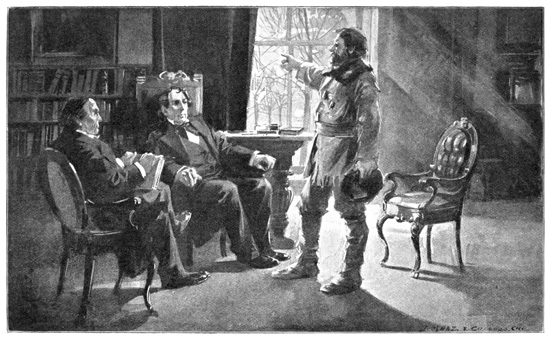
WHITMAN PLEADING FOR OREGON BEFORE PRESIDENT TYLER AND SECRETARY WEBSTER.
From the outset, and at every audience granted,
President Tyler treated Dr. Whitman with the
greatest deference. He was a new character in
the experience of both these polished and
experienced politicians. Never before had they
listened to a man who so eloquently plead
for the cause of his country, with no selfish
aim in sight. He asked for no money,
or bonds, or land, or office, or anything, except
that which would add to the nation's wealth,
the glory and honor of the flag, and the benefit of
the hardy pioneer of that far-off land, that the nation
had for more than a third of the century
wholly neglected. It was a powerful appeal to the
manly heart of President Tyler, and as the facts
show, was not lost on Secretary Webster.
The Rev. H. H. Spalding, Whitman's early associate
in the Oregon work, had many conferences
with Whitman after his return to Oregon.
Spalding says, speaking of the conference: "Webster's
interest lay too near to Cape Cod to see
things as Whitman did, while he conceded sincerity
to the missionary, but he was loth to admit that
a six years' residence there gave Whitman a wider
knowledge of the country than that possessed by
Governor Simpson, who had explored every part
of it and represented it as a sandy desert, cut off
from the United States by impassable mountains,
and fit only for wild animals and savage men."
With the light we now have upon the subject
the greater wonder is that a brainy man like Webster
could be so over-reached by an interested
party such as Governor Simpson was; well knowing
as he did, that he was the chief of the greatest
monopoly existing upon either continent—the
Hudson Bay Company. All Dr. Whitman demanded
was that if it were true, as asserted by Mr.
Webster himself, in his instructions to Edward
Everett in 1840, then Minister to England, that
"The ownership of Oregon is very likely to follow
the greater settlement and larger amount of population;"
then "All I ask is that you won't barter
away Oregon, or allow English interference until
I can lead a band of stalwart American settlers
across the plains: for this I will try to do."
President Tyler promptly and positively stated:
"Dr. Whitman, your long ride and frozen limbs
speak for your courage and patriotism; your missionary
credentials are good vouchers for your
character." And he promptly granted his request.
Such promise was all that Whitman required. He
firmly believed, as all the pioneers of Oregon at
that time believed, that the treaty of 1818, while
not saying in direct terms that the nationality settling
the country should hold it, yet that that was
the real meaning. Both countries claimed the territory,
and England with the smallest rightful
claim had, through the Hudson Bay Company,
been the supreme autocratic ruler for a full third
of a century.
More than half a dozen fur companies, attracted
to Oregon by the wealth flowing into the coffers
of the English company, had attempted, as we
have before shown, to open up business on what
they claimed was American soil; but, in every
instance, they were starved out or bought out
by the English company. The Indians obeyed its
orders, and even the American missionaries settled
in just the localities they were ordered to by
the English monopoly. In another connection we
have more fully explained this treaty of 1818, but,
suffice it to say, these conditions led Whitman to
believe that the only hope of saving Oregon was in
American immigration. It was for this that he
plead with President Tyler and Secretary Webster
and the members of Congress he met.
From the President he went to the Hon. James
M. Porter, Secretary of War, and by him was received
with the greatest kindness, and he eagerly
heard the whole story. He promised Dr. Whitman
all the aid in his power in his scheme of immigration.
He promised that Captain Fremont,
with a company of troops, should act as escort to
the caravan which Whitman was positive he could
organize upon the frontier. The Secretary of War
also inquired in what way he and the Government
could aid the pioneers in the new country, and
asked Dr. Whitman, at his leisure, to write out his
views, and forward them to him. Dr. Whitman
did this, and the State Historical Society of Oregon
did excellent service, recently, in publishing
Whitman's proposed "Oregon Organization,"
found among the official papers of the War Department,
a copy of which will be found in the appendix
of this volume.
In a Senate document, December 31st, viz., the
41st Cong., February 9th, 1871, we read: "There
is no doubt but that the arrival of Dr. Whitman,
in 1843, was opportune. The President was satisfied
that the territory was worth the effort to
win it. The delay incident to a transfer of negotiations
to London was fortunate, for there is reason
to believe that if former negotiations had
been renewed in Washington, and that, for
the sake of a settlement of the protracted controversy
and the only remaining unadjudicated
cause of difference between the two Governments,
the offer had been renewed of the 49th parallel to
the Columbia and thence down the river to the
Pacific Ocean, it would have been accepted. The
visit of Whitman committed the President against
any such action." This is a clear statement, summarizing
the great historic event, and forever silencing
effectually the slanderous tongues that
have, in modern times, attempted to deprive the
old Hero of his great and deserving tribute.
We will do Secretary Webster the justice to
say here, that in his later years, he justly acknowledged
the obligations of the nation to Dr. Whitman.
In the New York Independent, for January,
1870, it is stated: "A personal friend of Mr. Webster,
a legal gentleman, and with whom he conversed
on the subject several times, remarked to
the writer of this article: 'It is safe to assert that
our country owes it to Dr. Whitman and his associate
missionaries that all the territory west of
the Rocky Mountains and south as far as the Columbia
River, is not now owned by England and
held by the Hudson Bay Company.'"
Having transacted his business and succeeded
even beyond his expectations, Whitman hurried
to Boston to report to the headquarters of the
American Board. His enemies have often made
sport over their version of his "cool reception by
the American Board." If there was a severe reprimand,
as reported, both the officers of the Board
and Dr. Whitman failed to make record of it. But
enough of the facts leaked out in the years after
to show that it was not altogether a harmonious
meeting. It is not to be wondered at.
The American Board was a religious organization
working under fixed rules, and expected
every member in every field to obey those rules.
But here was a man, whose salary had been paid
by the Board for special work, away from his field
of labor without the consent from headquarters.
It is not at all unlikely that he was severely reprimanded.
The officers of the American Board had
no reason to know, as Christian people can see
now, that Whitman was an inspired man, and a
man about his Father's business. It is even reported,
but not vouched for, that they ordered
him to promptly repair to his post of duty, and
dismissed him with his pockets so empty, that,
when starting upon his ever-memorable return
journey across the plains, "He had but money
enough to buy only a single ham for his supplies."
One of his old associates who had frequent conferences
with Whitman—Dr. Gray—says: "Instead
of being treated by the American Board as
his labors justly deserved, he met the cold, calculating
rebuke for unreasonable expenses, and for
dangers incurred without orders or instructions
or permission from headquarters. Thus, for economical,
prudential reasons, the Board received
him coldly, and rebuked him for his presence before
them, causing a chill in his warm and generous
heart, and a sense of unmerited rebuke from
those who should have been most willing to listen
to all his statements, and been most cordial
and ready to sustain him in his herculean labors."
We leave intelligent readers to answer for themselves,
whether this attitude of this great and influential
and excellent organization has not been,
in a measure, responsible for the neglect of this
Hero, who served it and the Christian world with
all faithfulness and honesty, until he and his noble
wife dropped into their martyr graves? If they say
yea, we raise the question whether the time has
not been reached to make amends?
Dr. Barrows says, in his "Oregon and the Struggle
for Possession," "It should be said in apology
for both parties at this late day that, at that time,
the Oregon Mission and its managing board were
widely asunder geographically, and as widely separated
in knowledge of the condition of affairs."
Dr. Whitman seems to have assumed that his
seven years' residence on the Northwest Coast
would gain him a trustful hearing. But his knowledge
gave him the disadvantage of a position and
plans too advanced—not an uncommon mishap to
eminent leaders. As said by Coleridge of Milton,
"He strode so far before his contemporaries as to
dwarf himself by the distance."
He adds that:
"Years after only, it was discovered by one of
the officers of the American Board," that "It was
not simply an American question then settled, but
at the same time a Protestant question." He also
refers to a recent work, "The Ely Volume," in
which is discussed the question, "Instances where
the direct influence of missionaries has controlled
and hopefully shaped the destinies of communities
and states," and illustrates by saying, "Perhaps
no event in the history of missions will better
illustrate this than the way in which Oregon
and our whole Northwest Pacific Coast was saved
to the United States."
This covered directly the Whitman idea. It
was, as he before stated, a union of banners—the
banner of the cross, and the banner of the country
he loved. It took the spirit and love of both to
sustain a man and to enable him to undergo the
hardships and dangers and discouragements that
he met, from the beginning to the end.
From Boston, with an aching heart, and yet
doubtless serene over an accomplished duty, which
he had faith to believe time would reveal in its
real light, Dr. Whitman passed on to make a flying
visit to his own and his wife's relations. From
letters of Mrs. Whitman, it is easy to see that her
prophecy was true; "He would be too full of his
great work on hand, to tell much of the home in
Oregon." His visit was hurried over and seemed
more the necessity of a great duty than a pleasure.
But the Doctor's mind was westward. He had
learned from Gen. Lovejoy that already there was
gathering upon the frontier a goodly number of
immigrants and the prospect was excellent for a
large caravan. In the absence of Dr. Whitman,
Gen. Lovejoy had neglected no opportunity to publish
far and wide that Dr. Whitman and himself
would, early in the Spring, pilot across the plains
to Oregon, a body of immigrants. A rendezvous
was appointed, not far from where Kansas City
now stands, at the little town of Weston. But
they were in various camps at Fort Leavenworth
and other points, waiting both for their guide and
for the growing spring grass—a necessity for the
emigrant.
Certain modern historians have undertaken to
rob Whitman of his great services in 1843, by
gathering affidavits of people who emigrated to
Oregon in that year, declaring, "We never saw
Marcus Whitman," and "We were not persuaded
to immigrate to Oregon by him," etc. Doubtless
there were such upon the wide plains, scattered as
they may have been, hundreds of miles apart. But
it is just as certain that the large immigration to
Oregon that year was incited by the movements of
Whitman and Lovejoy, as any fact could be.
There is no other method of explaining it. That
he directly influenced every immigrant of that
year, no one has claimed.
True, old Elijah White had paved the way, the
year before, by leading in the first large band of
agriculturist settlers; but men of families, undertaking
a two thousand mile journey, with their
families and their stock, were certainly desirous
of an experienced guide. They may, as some of
them say, never have met Whitman. He was not
one of the free and easy kind that made himself
popular with the masses.
Then, besides all that, fifty years ago plains life
was an odd life. I have journeyed with men for
weeks, and even after months of acquaintance
have not known their names, except that of Buckeye,
Sucker, Missouri, Cass County Bill, Bob, etc.
Little bands would travel by themselves for days
and weeks and then, under the sense of danger
that would be passed along the line, and for defense
against depredations of some dangerous
tribe of Indians, they would gather into larger
bands soon again to fall apart. Some of these
would often follow many days behind the head
of the column, but always have the benefit of its
guidance.
That year grass was late, and they did not get
fully under way until the first week in June. Whitman
remained behind and did not overtake the
advance of the column until it reached the Platte
River. He knew the way, he had three times been
over it. He was ahead arranging for camping
places for those in his immediate company, or in
the rear looking after the sick and discouraged.
If some failed to know him by name, there were
many who did, and all shared in all the knowledge
of the country and road which he, better than any
other, knew.
In answer to historical critics of modern times
we quote Dr. H. H. Spalding, who says, in speaking
of the immigration of 1843:
"And through that whole summer Dr. Whitman
was everywhere present; the ministering angel
to the sick, helping the weary, encouraging the
wavering, cheering the tired mothers, setting
broken bones and mending wagons. He was in
the front, in the center and in the rear. He was in
the river hunting out fords through the quicksand;
in the desert places looking for water and
grass; among the mountains hunting for passes,
never before trodden by white men; at noontide
and at midnight he was on the alert as if the whole
line was his own family, and as if all the flocks
and herds were his own. For all this he neither
asked nor expected a dollar from any source, and
especially did he feel repaid at the end, when,
standing at his mission home, hundreds of his fellow
pilgrims took him by the hand and thanked
him with tears in their eyes for all that he had
done."
The head of the column arrived at Fort Hall
and there waited for the stragglers to come up.
Dr. Whitman knew that here he would meet Captain
Johnny Grant, and the old story, "You can't
take a wagon into Oregon," would be dinned into
the ears of the head of every family. He had
heard it over and over again six years before. Fort
Hall was thirteen hundred and twenty-three miles
from the Missouri River at Kansas City. Here
the Doctor expected trouble and found it. Johnny
Grant was at Fort Hall to make trouble and discourage
immigration. He was working under the
pay of the Fur Company and earned his money.
The Fur Company did not desire farmers in settlements
in Oregon.
Captain Grant at once began to tell them the
terrors of the mountain journey and the impossibility
of hauling their wagons further. Then he
showed them, to prove it, a corral full of fine
wagons, with agricultural tools, and thousands
of things greatly needed in Oregon, that immigrants
had been forced to leave when they took to
their pack-saddles. The men were ready, as had
been others before, to give up and sacrifice the
comforts of their families and rob themselves at
the command of the oily advocate.
But here comes Whitman. Johnny Grant
knows he now has his master. Dr. Whitman says:
"Men, I have guided you thus far in safety. Believe
nothing you hear about not being able to get
your wagons through; every one of you stick to
your wagons and your goods. They will be invaluable
to you when you reach the end of your journey.
I took a wagon through to Oregon six years
ago." (Again we see the historic wagon.) The
men believed him. They refused to obey Captain
Grant's touching appeal and almost a command
to leave their wagons behind. Never did an order,
than the one Whitman made, add more to the comfort
and actual value of a band of travelers.
One of a former company tells of a packing experience,
after submitting to Captain Grant's
orders. He says: "There were lively times around
old Fort Hall when the patient old oxen and mules
were taken from the wagons to be left behind and
the loads of bedding, pots and pans were tied on
to their backs. They were unused to such methods.
There would first be a shying, then a fright
and a stampede, and bellowing oxen and braying
mules and the air would be full of flying kettles
and camp fixtures, while women and children crying
and the men swearing, made up a picture to
live in the memory."
No one better than Whitman knew the toil and
danger attending the last six hundred miles of the
journey to Oregon. Col. George B. Curry, in an address
before the Pioneer Society of Oregon in 1887,
gives a graphic sketch, wonderfully realistic, of
the immigrant train in 1853. He says: "From the
South Pass the nature of our journeying changed,
and assumed the character of a retreat, a disastrous,
ruinous retreat. Oxen and horses began
to perish in large numbers; often falling dead
in their yokes in the road. The heat-dried wagon,
striking on the rocks or banks would fall to
pieces. As the beasts of burden grew weaker, and
the wagon more rickety, teams began to be
doubled and wagons abandoned. The approaching
storms of autumn, which, on the high mountains
at the last end of our journey, meant impassable
snow, admitted of no delay. Whatever of
strength remained of the jaded cattle must be
forced out. Every thing of weight not absolutely
necessary must be abandoned.
"There was no time to pause and recruit the
hungry stock, nor dare we allow them much freedom
to hunt the withered herbage, for a marauding
enemy hung upon the rear, hovering on either
flank, and skulked in ambuscade in the front, the
horizon was a panorama of mountains, the grandest
and most desolate on the continent. The road
was strewn with dead cattle, abandoned wagons,
discarded cooking utensils, ox-yokes, harness,
chairs, mess chests, log chains, books, heirlooms,
and family keepsakes. The inexorable surroundings
of the struggling mass permitted no hesitation
or sentiment.
"The failing strength of the team was a demand
that must be complied with. Clothing not absolutely
required at present was left on the bare
rocks of the rugged canyons. Wagons were
coupled shorter that a few extra pounds might be
saved from the wagon beds. One set of wheels
was left and a cart constructed. Men, women and
children walked beside the enfeebled teams,
ready to give an assisting push up a steep pitch.
"The fierce summer's heat beat upon this slow
west rolling column. The herbage was dry and
crisp, the rivulets had become but lines in the
burning sand; the sun glared from a sky of brass;
the stony mountain sides glared with the garnered
heat of a cloudless Summer. The dusky brambles
of the scraggy sage brush seemed to catch the
fiery rays of heat and shiver them into choking
dust, that rose like a tormenting plague and hung
like a demon of destruction over the panting oxen
and thirsty people.
"Thus day after day, for weeks and months, the
slow but urgent retreat continued, each day demanding
fresh sacrifices. An ox or a horse would
fall, brave men would lift the useless yoke from his
limp and lifeless neck in silence. If there was
another to take his place he was brought from
the loose band, yoked up and the journey resumed.
When the stock of oxen became exhausted, cows
were brought under the yoke, other wagons left,
and the lessening store once more inspected; if
possible, another pound would be dispensed with.
"Deeper and deeper into the flinty mountains
the forlorn mass drives its weary way. Each
morning the weakened team has to commence a
struggle with yet greater difficulties. It is plain
the journey will not be completed within the anticipated
time, and the dread of hunger joins the
ranks of the tormentors. The stench of carrion
fills the air in many places; a watering place is
reached to find the putrid carcass of a dead animal
in the spring. The Indians hover in the rear, impatiently
waiting for the train to move on that
the abandoned trinkets may be gathered up.
Whether these are gathering strength for a general
attack we cannot tell. There is but one thing
to do—press on. The retreat cannot hasten into
rout, for the distance to safety is too great. Slower
and slower is daily progress.
"I do not pretend to be versed in all the horrors
that have made men groan on earth, but I have followed
the "Flight of Tartar Tribes," under the
focal light of DeQuincy's genius, the retreat of
the ten thousand under Xenophon, but as far as I
am able to judge, in heroism, endurance, patience,
and suffering, the annual retreat of immigrants
from the Black Hills to the Dalles surpasses
either. The theater of their sufferings and success,
for scenic grandeur, has no superior.
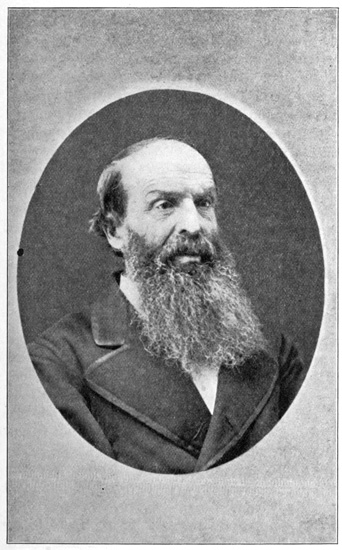
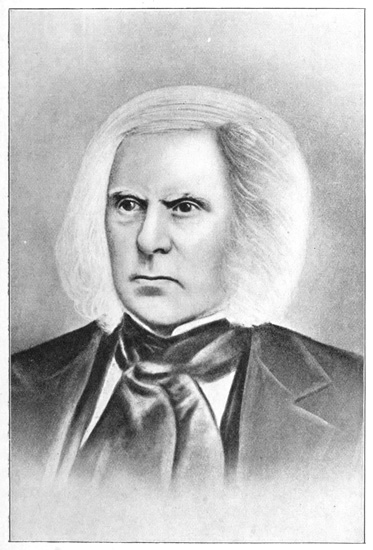
REV. H. H. SPALDING.
"The patient endurance of these men and women
for sublime pathos may challenge the world.
Men were impoverished and women reduced to
beggary and absolute want, and no weakling's
murmur of complaint escaped their lips. It is
true, when women saw their patient oxen or faithful
horses fall by the roadside and die, they wept
piteously, and men stood in all the 'silent manliness
of grief' in the camp of their desolation, for
the immigrants were men and women with hearts
to feel and tears to flow."
This, it will be observed, was a train upon the
road ten years later than Dr. Whitman's memorable
journey. He was a wise guide, and his train
met with fewer disasters. The Hon. S. A. Clarke
in his address tells how Whitman moved his train
across Snake River.
He says: "When the immigrants reached the
Snake, Dr. Whitman proceeded to fasten wagons
together in one long string, the strongest in the
lead. As soon as the teams were in position, Dr.
Whitman tied a rope around his waist and starting
his horse into the current swam over. He
called to others to follow him, and when they had
force enough to pull at the rope the lead team was
started in and all were drawn over in safety. As
soon as the leading teams were able to get foothold
on the bottom all was safe; as they, aided
by the strong arms of the men pulling at the rope,
pulled the weaker ones along."
The Snake River at the ford is divided into three
rivers by islands, the last stream on the Oregon
side is a deep and rapid current, and fully half a
mile wide. To get so many wagons, pulled by
jaded teams, and all the thousand men, women
and children, and the loose stock across in safety,
showed wise generalship.
We here copy "A Day with the Cow Column in
1843," by the Hon. Jesse Applegate, a late honored
citizen of Oregon, who was one of Dr. Whitman's
company in 1843. It is a clear, graphic
description of a sample day's journey on the
famous trip, and was an address published in the
transactions of the Pioneer Oregon Association
in 1876.
The migration of a large body of men, women
and children across the Continent to Oregon was,
in the year 1843, strictly an experiment, not only
in respect to the numbers, but to the outfit of the
migrating party.
Before that date two or three missionaries had
performed the journey on horseback, driving a few
cows with them. Three or four wagons drawn by
oxen had reached Fort Hall on Snake River, but
it was the honest opinion of most of those who
had traveled the route down Snake River that no
large number of cattle could be subsisted on its
scanty pasturage, or wagons taken over a route
so rugged and mountainous.
The emigrants were also assured that the Sioux
would be much opposed to the passage of so large
a body through their country, and would probably
resist it on account of the emigrants destroying
and frightening away the buffaloes, which were
then diminishing in numbers. The migrating
body numbered over one thousand souls, with
about one hundred and twenty wagons, drawn by
ox teams, averaging about six yokes to the team,
and several thousand loose horses and cattle.
The emigrants first organized and attempted to
travel in one body, but it was soon found that no
progress could be made with a body so cumbrous,
and as yet, so averse to all discipline. And at the
crossing of the "Big Blue," it divided into two columns,
which traveled in supporting distance of
each other as far as Independence Rock, on the
Sweetwater.
From this point, all danger from Indians being
over, the emigrants separated into small parties
better suited to the narrow mountain paths and
small pastures in their front.
Before the division on the Blue River there was
some just cause for discontent in respect to loose
cattle. Some of the emigrants had only their
teams, while others had large herds in addition,
which must share the pastures and be driven by
the whole body.
This discontent had its effect in the division on
the Blue, those not encumbered with or having
but few loose cattle attached themselves to the
light column, those having more than four or five
cows had of necessity to join the heavy or cow
column. Hence, the cow column, being much
larger than the other and encumbered with its
large herds, had to use greater exertion and observe
a more rigid discipline to keep pace with
the more agile consort.
It is with the cow or more clumsy column that
I propose to journey with the reader for a single
day.
It is four o'clock a. m., the sentinels on duty
have discharged their rifles, the signal that the
hours of sleep are over; and every wagon or tent
is pouring forth its night tenants, and slow kindling
smokes begin to rise and float away on the
morning air. Sixty men start from the corral,
spreading as they make through the vast herd of
cattle and horses that form a semi-circle around
the encampment, the most distant, perhaps, two
miles away.
The herders pass to the extreme verge and
carefully examine for trails beyond, to see that
none of the animals have been stolen or strayed
during the night. This morning no trails lead
beyond the outside animals in sight, and by five
o'clock the herders begin to contract the great
moving circle, and the well-trained animals move
slowly toward camp, clipping here and there a
thistle or tempting bunch of grass on the way.
In about an hour 5,000 animals are close up to
the encampment, and the teamsters are busy
selecting their teams, and driving them inside the
"corral" to be yoked. The corral is a circle
one hundred yards deep, formed with wagons connected
strongly with each other, the wagon in the
rear being connected with the wagon in front by
its tongue and ox chains. It is a strong barrier
that the most vicious ox cannot break, and in case
of an attack by the Sioux, would be no contemptible
entrenchment.
From six to seven o'clock is a busy time; breakfast
to be eaten, the tents struck, the wagons
loaded, and the teams yoked and brought up in
readiness to be attached to their respective
wagons. All know, when at seven o'clock the
signal to march sounds, that those not ready to
take their proper places in the line of march must
fall into the dusty rear for the day.
There are sixty wagons. They have been
divided into sixteen divisions, or platoons of four
wagons each, and each platoon is entitled to lead
in its turn. The leading platoon of to-day will be
the rear one to-morrow, and will bring up the rear,
unless some teamster, through indolence or negligence,
has lost his place in the line, and is condemned
to that uncomfortable post. It is within
ten minutes of seven; the corral, but now a strong
barricade, is everywhere broken, the teams being
attached to the wagons. The women and children
have taken their places in them. The pilot (a
borderer who has passed his life on the verge of
civilization, and has been chosen to the post of
leader from his knowledge of the savage and his
experience in travel through roadless wastes)
stands ready, in the midst of his pioneers and
aides, to mount and lead the way.
Ten or fifteen young men, not to lead to-day,
form another cluster. They are ready to start on
a buffalo hunt, are well mounted and well armed,
as they need to be, for the unfriendly Sioux have
driven the buffalo out of the Platte, and the
hunters must ride fifteen or twenty miles to reach
them. The cow-drivers are hastening, as they get
ready, to the rear of their charge, to collect and
prepare them for the day's march.
It is on the stroke of seven; the rushing to and
fro, the cracking of whips, the loud command to
oxen, and what seemed to be the inextricable confusion
of the last ten minutes has ceased. Fortunately,
every one has been found, and every
teamster is at his post. The clear notes of a
trumpet sound in the front; the pilot and his
guards mount their horses; the leading division of
wagons move out of the encampment and take up
the line of march; the rest fall into their places
with the precision of clock-work, until the post, so
lately full of life, sinks back into that solitude
that seems to reign over the broad plain and
rushing river, as the caravan draws its lazy length
toward the distant El Dorado.
It is with the hunters we will briskly canter
toward the bold but smooth and grassy bluffs
that bound the broad valley, for we are not yet in
sight of the grander, but less beautiful, scenery
(of the Chimney Rock, Court House, and other
bluffs so nearly resembling giant castles and
palaces) made by the passage of the Platte
through the Highlands near Laramie. We have
been traveling briskly for more than an hour.
We have reached the top of the bluff, and now
have turned to view the wonderful panorama
spread before us.
To those who have not been on the Platte, my
powers of description are wholly inadequate to
convey an idea of the vast extent and grandeur of
the picture, and the rare beauty and distinctness
of its detail. No haze or fog obscures objects in
the pure and transparent atmosphere of this lofty
region. To those accustomed to only the murky
air of the sea-board, no correct judgment of distance
can be formed by sight, and objects which
they think they can reach in a two hours' walk,
may be a day's travel away; and though the evening
air is a better conductor of sound, on the high
plain during the day the report of the loudest
rifle sounds little louder than the bursting of a
cap; and while the report can be heard but a few
hundred yards, the smoke of the discharge may be
seen for miles.
So extended is the view from the bluff on which
the hunters stand, that the broad river, glowing
under the morning sun like a sheet of silver, and
the broader emerald valley that borders it, stretch
away in the distance until they narrow at almost
two points in the horizon, and when first seen, the
vast pile of the Wind River mountains, though
hundreds of miles away, looks clear and distinct
as a white cottage on the plain.
We are full six miles away from the line of
march; though everything is dwarfed by distance,
it is seen distinctly. The caravan has been about
two hours in motion, and is now extended as
widely as a prudent regard for safety will permit.
First, near the bank of the shining river, is a company
of horsemen; they seem to have found an
obstruction, for the main body has halted, while
three or four ride rapidly along the bank of a creek
or slough. They are hunting a favorable crossing
for the wagons; while we look they have succeeded;
it has apparently required no work to
make it possible, while all but one of the party
have passed on, and he has raised a flag, no doubt a
signal to the wagons to steer their course to where
he stands.
The leading teamster sees him, though he is yet
two miles off, and steers his course directly
towards him, all the wagons following in his track.
They (the wagons) form a line three-quarters of a
mile in length; some of the teamsters ride upon
the front of their wagons, some march beside their
teams; scattered along the line companies of
women and children are taking exercise on foot;
they gather bouquets of rare and beautiful flowers
that line the way; near them stalks a stately greyhound
or an Irish wolf dog, apparently proud of
keeping watch and ward over his master's wife
and children.
Next comes a band of horses; two or three men
or boys follow them, the docile and sagacious
animals scarcely needing this attention, for they
have learned to follow in the rear of the wagons,
and know that at noon they will be allowed to
graze and rest. Their knowledge of time seems as
accurate as of the place they are to occupy in the
line, and even a full-blown thistle will scarce
tempt them to straggle or halt until the dinner
hour is arrived.
Not so with the large herd of horned beasts that
bring up the rear; lazy, selfish and unsocial, it has
been a task to get them in motion, the strong
always ready to domineer over the weak, halt in
the front and forbid the weaker to pass them.
They seem to move only in fear of the driver's
whip; though in the morning full to repletion,
they have not been driven an hour, before their
hunger and thirst seem to indicate a fast of days'
duration. Through all the day long their greed is
never sated nor their thirst quenched, nor is there
a moment of relaxation of the tedious and vexatious
labors of their drivers, although to all others
the march furnishes some reason of relaxation or
enjoyment. For the cow-drivers, there is none.
But from the standpoint of the hunters the
vexations are not apparent; the crack of whip and
loud objurgations are lost in the distance.
Nothing of the moving panorama, smooth and
orderly as it appears, has more attraction for the
eye than that vast square column in which all
colors are mingled, moving here slowly and there
briskly as impelled by horsemen riding furiously
in front and rear.
But the picture, in its grandeur, its wonderful
mingling of colors and distinctness of detail, is
forgotten in contemplation of the singular people
who give it life and animation. No other race of
men, with the means at their command, would undertake
so great a journey; none save these could
successfully perform it, with no previous preparation,
relying only on the fertility of their invention
to devise the means to overcome each danger and
difficulty as it arose.
They have undertaken to perform with slow-moving
oxen, a journey of two thousand miles.
The way lies over trackless wastes, wide and deep
rivers, rugged and lofty mountains, and it is beset
with hostile savages. Yet, whether it were a
deep river with no tree upon its banks, a rugged
defile where even a loose horse could not pass, a
hill too steep for him to climb, or a threatened
attack of an enemy, they are always found ready
and equal to the occasion, and always conquerors.
May we not call them men of destiny? They are
people changed in no essential particulars from
their ancestors, who have followed closely on the
footsteps of the receding savage, from the Atlantic
sea-board to the great valley of the Mississippi.
But while we have been gazing at the picture in
the valley, the hunters have been examining the
high plain in the other direction. Some dark
moving objects have been discovered in the distance,
and all are closely watching them to discover
what they are, for in the atmosphere of the
plains a flock of crows marching miles away, or a
band of buffaloes or Indians at ten times the distance
look alike, and many ludicrous mistakes
occur. But these are buffaloes, for two have
struck their heads together, and are alternately
pushing each other back. The hunters mount and
away in pursuit, and I, a poor cow-driver, must
hurry back to my daily toil, and take a scolding
from my fellow-herders for so long playing truant.
The pilot, by measuring the ground and timing
the speed of the wagons and the walk of his horses,
has determined the rate of each, so as to enable
him to select the nooning place, as nearly as the
requisite grass and water can be had at the end of
five hours' travel of the wagons. To-day, the
ground being favorable, little time has been lost
in preparing the road, so that he and his pioneers
are at the nooning place an hour in advance of the
wagons, which time is spent in preparing convenient
watering places for the animals, and
digging little wells near the bank of the Platte.
As the teams are not unyoked, but simply
turned loose from their wagons, a corral is not
formed at noon, but the wagons are drawn up in
columns, four abreast, the leading wagon of each
platoon on the left—the platoons being formed
with that view. This brings friends together at
noon as well as at night.
To-day, an extra session of the Council is being
held, to settle a dispute that does not admit of delay,
between a proprietor and a young man who
has undertaken to do a man's service on the journey
for bed and board. Many such engagements
exist, and much interest is taken in the manner
this high court, from which there is no appeal,
will define the rights of each party in such engagements.
The Council was a high court in a most exalted
sense. It was a Senate, composed of the ablest
and most respected fathers of the emigration. It
exercised both legislative and judicial powers, and
its laws and decisions proved it equal and worthy
the high trust reposed in it. Its sessions were
usually held on days when the caravan was not
moving. It first took the state of the little commonwealth
into consideration; revised or repealed
rules defective or obsolete, and enacted such others
as the exigencies seemed to require. The common
weal being cared for, it next resolved itself into a
court to hear and settle private disputes and
grievances.
The offender and the aggrieved appeared before
it; witnesses were examined and the parties
were heard by themselves and sometimes by counsel.
The judges thus being made fully acquainted
with the case, and being in no way influenced or
cramped by technicalities, decided all cases
according to their merits. There was but little
use for lawyers before this court, for no plea was
entertained which was calculated to hinder or defeat
the ends of justice.
Many of these Judges have since won honors in
higher spheres. They have aided to establish on
the broad basis of right and universal liberty two
of the pillars of our Great Republic in the Occident.
Some of the young men who appeared before them
as advocates have themselves sat upon the highest
judicial tribunal, commanded armies, been Governors
of States, and taken high positions in the
Senate of the Nation.
It is now one o'clock; the bugle has sounded,
and the caravan has resumed its westward journey.
It is in the same order, but the evening is far
less animated than the morning march; a drowsiness
has fallen apparently on man and beast;
teamsters drop asleep on their perches and even
when walking by their teams, and the words of
command are now addressed to the slowly-creeping
oxen in the softened tenor of a woman or the
piping treble of children, while the snores of teamsters
make a droning accompaniment.
But a little incident breaks the monotony of the
march. An emigrant's wife, whose state of health
has caused Dr. Whitman to travel near the
wagon for the day, is now taken with violent
illness. The Doctor has had the wagon driven out
of the line, a tent pitched and a fire kindled.
Many conjectures are hazarded in regard to this
mysterious proceeding, and as to why this lone
wagon is to be left behind.
And we, too, must leave it, hasten to the front
and note the proceedings, for the sun is now
getting low in the west, and at length the painstaking
pilot is standing ready to conduct the train
in the circle which he had previously measured
and marked out, which is to form the invariable
fortification for the night.
The leading wagons follow him so nearly round
the circle, that but a wagon length separates them.
Each wagon follows in its track, the rear closing
on the front until its tongue and ox-chains will
perfectly reach from one to the other, and so
accurate the measurement and perfect the practice,
that the hindmost wagon of the train always
precisely closes the gateway. As each wagon is
brought into position, it is dropped from its team
(the teams being inside the circle), the team unyoked,
and the yokes and chains are used to connect
the wagon strongly with that in its front.
Within ten minutes from the time the leading
wagon halted the barricade is formed, the teams
unyoked and driven out to pasture. Every one is
busy preparing fires of buffalo chips to cook the
evening meal, pitching tents and otherwise preparing
for the night.
There are anxious watchers for the absent
wagon, for there are many matrons who may be
afflicted like its inmate before the journey is over,
and they fear the strange and startling practice of
this Oregon doctor will be dangerous. But as the
sun goes down, the absent wagon rolls into camp,
the bright, speaking face and cheery look of the
doctor, who rides in advance, declare without
words that all is well, and that both mother and
child are comfortable.
I would fain now and here pay a passing tribute
to that noble and devoted man, Dr. Whitman. I
will obtrude no other name upon the reader, nor
would I his, were he of our party or even living,
but his stay with us was transient, though the
good he did was permanent, and he has long since
died at his post.
From the time he joined us on the Platte, until
he left us at Fort Hall, his great experience and indomitable
energy was of priceless value to the migrating
column. His constant advice, which we
knew was based upon a knowledge of the road before
us, was "travel, travel, travel—nothing else
will take you to the end of your journey; nothing is
wise that does not help you along; nothing is good
for you that causes a moment's delay."
His great authority as a physician and complete
success in the case above referred to, saved us
many prolonged and perhaps ruinous delays from
similar causes, and it is no disparagement to others
to say that to no other individual are the immigrants
of 1843 so much indebted for the successful
conclusion of their journey, as to Dr. Marcus
Whitman.
All able to bear arms in the party had been
formed into three companies, and each of these
into four watches; every third night it is the duty
of one of these companies to keep watch and ward
over the camp, and it is so arranged that each
watch takes its turn of guard duty through the
different watches of the night. Those forming the
first watch to-night, will be second on duty, then
third and fourth, which brings them all through
the watches of the night. They begin at eight
o'clock p. m. and end at four o'clock a. m.
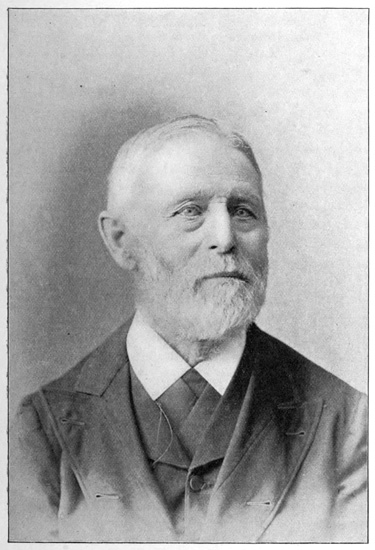
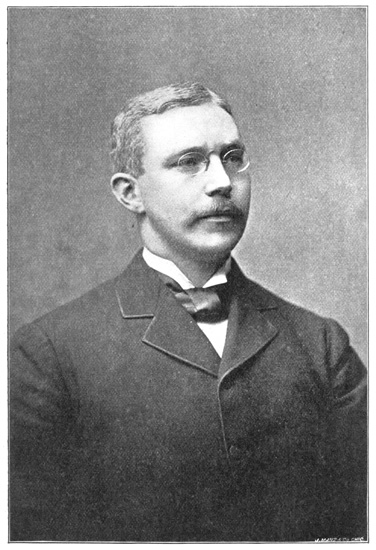
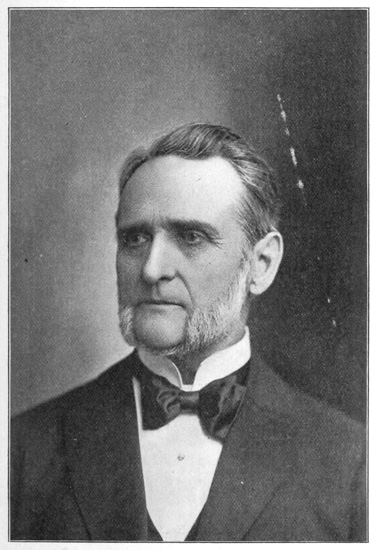
REV. CUSHING EELLS, D.D.
Founder of Whitman College.
It is not yet eight o'clock when the first watch
is to be set; the evening meal is just over, and the
corral now free from the intrusion of horses or cattle,
groups of children are scattered over it. The
larger are taking a game of romps; "the wee, toddling
things" are being taught that great achievement
which distinguishes men from the lower animals.
Before a tent near the river, a violin makes
lively music and some youths and maidens have
improvised a dance upon the green; in another
quarter a flute gives its mellow and melancholy
notes to the still night air, which, as they float
away over the quiet river, seem a lament for the
past rather than for a hope of the future.
It has been a prosperous day; more than twenty
miles have been accomplished of the great journey.
The encampment is a good one; one of the
causes that threatened much future delay has just
been removed by the skill and energy of "that good
angel" of the emigrants, Dr. Whitman, and it has
lifted a load from the hearts of the elders. Many
of these are assembled around the good doctor at
the tent of the pilot (which is his home for the
time being), and are giving grave attention to his
wise and energetic counsel. The care-worn pilot
sits aloof quietly smoking his pipe, for he knows
the grave Doctor is "strength in his hands."
But time passes, the watch is set for the night,
the council of good men has been broken up and
each has returned to his own quarters. The flute
has whispered its last lament to the deepening
night. The violin is silent and the dancers have
dispersed. Enamored youths have whispered a
tender "good night" in the ear of blushing maidens,
or stolen a kiss from the lips of some future
bride; for Cupid, here as elsewhere, has been busy
bringing together congenial hearts, and among
these simple people, he alone is consulted in forming
the marriage tie. Even the Doctor and the
pilot have finished their confidential interview and
have separated for the night. All is hushed and
repose from the fatigues of the day, save the vigilant
guard, and the wakeful leader who still has
cares upon his mind that forbid sleep.
He hears the ten o'clock relief taking post, and
the "all well" report of the returned guard; the
night deepens, yet he seeks not the needed repose.
At length a sentinel hurries to him with the welcome
report that a party is approaching, as yet too
far away for its character to be determined, and
he instantly hurries out in the direction seen.
This he does both from inclination and duty, for,
in times past, the camp has been unnecessarily
alarmed by timid or inexperienced sentinels, causing
much confusion and fright amongst women
and children, and it had been made a rule that all
extraordinary incidents of the night should be reported
directly to the pilot, who alone had authority
to call out the military strength of the column,
or so much of it as was, in his judgment, necessary
to prevent a stampede or repel an enemy.
To-night he is at no loss to determine that the
approaching party are our missing hunters, and
that they have met with success, and he only waits
until, by some further signal, he can know that no
ill has happened to them. This is not long wanting;
he does not even wait their arrival, but the
last care of the day being removed and the last
duties performed, he, too, seeks the rest that will
enable him to go through the same routine to-morrow.
But here I leave him, for my task is also
done, and, unlike his, it is to be repeated no more.
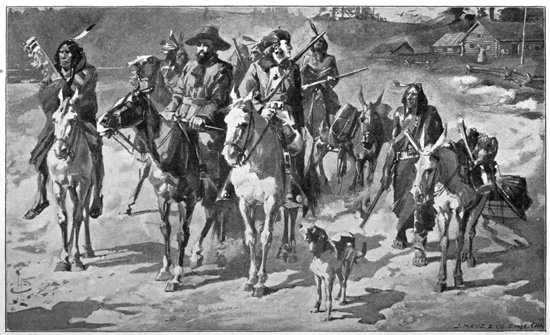
After passing through such trials and dangers,
nothing could have been more cheering to these
tired immigrants than the band of Cayuse and
Nez Perces Indians, with pack mules loaded
with supplies, meeting the Doctor upon the mountains
with a glad welcome. From them he learned
that in his absence his mill had been burned, but
the Rev. H. H. Spalding, anticipating the needs of
the caravan, had furnished flour from his mill, and
nothing was ever more joyously received.
Dr. Whitman also received letters urging him to
hurry on to his mission. He selected one of his
most trusty Cayuse Indian guides, Istikus, and
placed the company under his lead. He was no
longer a necessity for its comfort and safety. The
most notable event in pioneer history is reaching
its culmination. That long train of canvas-covered
wagons moving across the plains, those two
hundred campfires at night, with shouts and
laughter and singing of children, were all new
and strange to these solitudes. As simple facts in
history, to an American they are profoundly interesting,
but to the thoughtful student who views
results, they assume proportions whose grandeur
is not easily over-estimated.
But the little band has come safely across the
Rockies; has forded and swam many intervening
rivers; the dreary plains, with saleratus dust and
buffalo gnats, had been left behind, and here they
stand upon a slope of the farthest western range
of mountains, with the fertile foot hills and beautiful
green meadows reaching as far away as the
eye can see. The wagons are well bunched. For
weeks they have been eager to see the land of
promise. It is a goodly sight to see, as they file
down the mountain side, one hundred and twenty-five
wagons, one thousand head of loose stock, cattle,
horses and sheep, and about one thousand men,
women and children, and Oregon is saved to the
Union.
Who did it?
We leave every thoughtful, honest reader to
answer the query.