August 27, 1909—Latham, with monoplane, at
Rheims, flies to an altitude of 508 feet. (With
this record he won first prize for altitude.)
August 27, 1909—Delagrange, with monoplane, at
Rheims, flies 31 miles. (With this record he won
the eighth prize for duration of flight.)
August 27, 1909—Sommer, with biplane, at Rheims,
flies 37 miles. He won the seventh prize for distance.
August 27, 1909—Tissandier, with biplane, at
Rheims, flies 69 miles. (This record won for him
the sixth prize for distance.)
August 27, 1909—Lefebvre, with biplane, at
Rheims, flies 12.4 miles in 20 minutes and 47
seconds, exhibiting great daring and skill. (He
was fined for “recklessness.”)
August 27, 1909—Bleriot, with monoplane, at
Rheims, flies 25 miles in 41 minutes. (This record
won for him the ninth prize for distance
flown.)
August 28, 1909—Lefebvre, with biplane, at Rheims,
makes a spectacular flight for 11 minutes with
one passenger.
August 28, 1909—Curtiss, with biplane, at Rheims,
flies 12.4 miles in 15 minutes and 56 seconds,
winning the Gordon Bennett cup.
August 28, 1909—Bleriot, with monoplane, at
Rheims, flies 6.2 miles in 7 minutes and 48 seconds.
(With this record he won the first prize
for speed over course of 10 kilometres.)
August 29, 1909—Farman, with biplane, at Rheims,
flies 6.2 miles with two passengers, in 10 minutes
and 30 seconds, winning a prize.
August 29. 1909—Curtiss, with biplane, at Rheims,
flies 18.6 miles in 23 minutes and 30 seconds.
(With this record he won the first prize for
speed over course of 30 kilometres.)
August 29, 1909—Curtiss, with biplane, at Rheims,
flies 6.2 miles in 7 minutes and 51 seconds, winning
the second prize for speed over course of 10
kilometres.
August 29, 1909—Rougier, with biplane, at Rheims,
rises to a height of 180 feet, winning the fourth
prize for altitude.
August 29, 1909—E. Bunau-Varilla, with biplane,
at Rheims, flies 18.6 miles in 38 minutes and
31 seconds. (With this record he won the
eighth prize for speed over course of 30 kilometres.)
August 29, 1909—Orville Wright, with biplane, at
Berlin, makes several short flights.
August 29, 1909—S. F. Cody, with biplane, at Aldershot,
flies 10 miles with one passenger.
September 4, 1909—Orville Wright, with biplane,
at Berlin, flies for 55 minutes.
September 6, 1909—Sommer, with biplane, at Nancy,
France, flies 25 miles in 35 minutes. He
takes up a number of passengers; one at a time.
September 7, 1909—Lefebvre, with biplane, at Juvissy,
is killed by the breaking of his machine
in the air after he had flown 1,800 feet.
September 8, 1909—Orville Wright, with biplane,
at Berlin, flies 17 minutes with one passenger—Captain
Hildebrandt.
September 8, 1909—S. F. Cody, with biplane, at Aldershot,
flies to Farnborough and back—46 miles
in 1 hour and 3 minutes. This is the first recorded
cross-country flight in England.
September 9, 1909—Orville Wright, with biplane,
at Berlin, flies for 15 minutes with one passenger—Captain
Englehardt.
September 9, 1909—Paulhan, with biplane, at Tournai,
Belgium, flies 12.4 miles in 17 minutes.
September 9, 1909—Rougier, with biplane, at Brescia,
flies 12 minutes and 10 seconds, soaring to
a height of 328 feet.
September 10, 1909—Sommer, with biplane, at
Nancy, flies 18 miles, accompanying troops on
review.
September 11, 1909—Sommer, with biplane, at
Nancy, flies to Lenoncourt—24 miles.
September 11, 1909—Curtiss, with biplane, at Brescia,
flies 31 miles in 49 minutes and 24 seconds,
winning the first prize for speed.
September 12, 1909—Rougier, with biplane, at
Brescia, flies 31 miles in 1 hour 10 minutes
and 18 seconds, soaring to a height of 380 feet.
September 12, 1909—Calderara, with biplane, at
Brescia, flies 6.3 miles with one passenger, winning
a prize.
September 13, 1909—Paulhan, with biplane, at
Tournai, flies to Taintiguies and back in 1 hour
and 35 minutes.
September 13, 1909—Santos-Dumont, with monoplane,
at St. Cyr, France, flies 5 miles in 12
minutes, to Buc, to visit Maurice Guffroy, on a
bet of $200 that each would be the first to visit
the other.
September 15, 1909—Ferber, with biplane, at Boulogne,
France, flies to Wimeroux—6 miles in 9
minutes.
September 15, 1909—Calderara, with biplane, at
Brescia, flies 5.6 miles with one passenger, winning
the Oldofredi prize.
September 17, 1909—Orville Wright, with biplane,
at Berlin, flies for 54 minutes and 26 seconds,
rising to an altitude of 765 feet (estimated). He
afterward flew for 47 minutes and 5 seconds with
Captain Englehardt.
September 17, 1909—Santos-Dumont, with monoplane,
at St. Cyr, flies 10 miles in 16 minutes
across country.
September 17, 1909—Paulhan, with biplane, at Ostend,
Belgium, flies 1.24 miles in 3 minutes and
16 seconds, along the water front and out over
the sea.
September 18, 1909—Orville Wright, with biplane,
at Berlin, establishes a world record by flying for
1 hour 35 minutes and 47 seconds, with one
passenger—Captain Englehardt.
September 18, 1909—Paulhan, with biplane, at Ostend,
flies for 1 hour over sea front, circling over
the water; winning a prize of $5,000.
September 20, 1909—Rougier, with biplane, at
Brescia, broke the record for high flying by
reaching an altitude of 645 feet (official measurement).
September 20, 1909—Calderara, with biplane, at
Brescia, flies 31 miles in 50 minutes and 51 seconds,
winning the second prize for speed.
September 22, 1909—Captain Ferber, with a biplane,
at Boulogne, flies 1 mile, when, his engine
breaking in the air, his machine falls and
he is killed.
September 25, 1909—Wilbur Wright, with biplane,
at New York, flies from Governor’s Island around
the Statue of Liberty.
September 27, 1909—Latham, in monoplane, at
Berlin, flies 6.5 miles across country in 13 minutes.
September 28, 1909—Rougier, with biplane, at Berlin,
flies 31 miles in 54 minutes, soaring to an altitude
of 518 feet.
September 29, 1909—Latham in monoplane, at Berlin,
flies 42 miles in 1 hour and 10 minutes,
winning the second prize for distance.
September 29, 1909—Rougier, with biplane, at Berlin,
flies 48 miles in 1 hour and 35 minutes.
September 29, 1909—Curtiss, with biplane, at New
York, makes flights about the harbor from Governor’s
Island.
September 30, 1909—Orville Wright, with biplane,
at Berlin, soars to a height of 902 feet, making
a world record for altitude.
September 30, 1909—Latham, with monoplane, at
Berlin, flies 51 miles in 1 hour and 23 minutes.
October 1, 1909—Rougier, with biplane, at Berlin,
flies 80 miles in 2 hours and 38 minutes, winning
the first prize for distance and speed.
October 2, 1909—Orville Wright, with biplane, at
Berlin, makes a flight of 10 minutes’ duration
with the Crown Prince of Germany.
October 3, 1909—Farman, with biplane, at Berlin,
flies 62 miles in 1 hour and 40 minutes, winning
the third prize for distance and speed.
October 4, 1909—Orville Wright, with biplane, at
Berlin, soared to an altitude of 1,600 feet, making
a world record.
October 4, 1909—Wilbur Wright, with biplane, at
New York, flies from Governor’s Island to
Grant’s Tomb and back—21 miles in 33 minutes
and 33 seconds.
October 10, 1909—Curtiss, with biplane, at St.
Louis, Mo., makes several flights at the Centennial
celebration.
October 10, 1909—Paulhan, with biplane, at Pt.
Aviation, flies 21.5 miles in 21 minutes and 48
seconds.
October 12, 1909—Paulhan, with biplane, at Pt.
Aviation, flies 3.6 miles in 6 minutes and 11 seconds,
winning the prize for slowest flight.
October 16, 1909—Curtiss, with biplane, at Chicago,
makes exhibition flights at 45 miles per hour.
October 16, 1909—Sommer, with biplane, at Doncaster,
England, flies 9.7 miles in 21 minutes and
45 seconds, making the record for Great Britain.
October 16, 1909—Delagrange, with monoplane, at
Doncaster, flies 5.75 miles in 11 minutes and 25
seconds.
October 16, 1909—Cody, with biplane, at Doncaster,
flies 3,000 feet, when his machine is wrecked,
and he is injured.
October 18, 1909—Paulhan, with biplane, at Blackpool,
England, flies 14 miles in 25 minutes and
53 seconds.
October 18, 1909—Rougier, with biplane, at Blackpool,
flies 17.7 miles in 24 minutes and 43 seconds,
winning the second prize.
October 18, 1909—Farman, with biplane, at Blackpool,
flies 14 miles in 23 minutes.
October 18, 1909—Le Blon, with monoplane, at
Doncaster, flies 22 miles in 30 minutes, in a rainstorm,
winning the Bradford cup.
October 18, 1909—Count de Lambert, with biplane,
at Juvissy, flies 31 miles to the Eiffel Tower in
Paris, and back, in 49 minutes and 39 seconds.
October 19, 1909—Le Blon, with monoplane, at
Doncaster, flies 15 miles in a gale.
October 19, 1909—Paulhan, with biplane, at Blackpool,
flies 15.7 miles in 32 minutes and 18 seconds,
winning the third prize.
October 20, 1909—Farman, with biplane, at Blackpool,
flies 47 miles in 1 hour, 32 minutes, and
16 seconds, winning the first prize—$10,000.
October 20, 1909—Le Blon, with monoplane, at
Doncaster, makes a spectacular flight in a fierce
gale.
October 21, 1909—Count de Lambert, with biplane,
at Pt. Aviation, flies 1.25 miles in 1 minute
and 57 seconds, winning prize of $3,000 for
speed.
October 22, 1909—Latham, with monoplane, at
Blackpool, flies in a squally gale blowing from
30 to 50 miles an hour. When headed into the
wind the machine moved backward in relation
to points on the ground. Going before the wind,
it passed points on the ground at a speed of nearly
100 miles an hour. This flight, twice around
the course, is the most difficult feat accomplished
by any aviator up to this date.
October 26, 1909—Sommer, with biplane, at Doncaster,
flies 29.7 miles in 44 minutes and 53 seconds,
winning the Whitworth cup.
October 26, 1909—Delagrange, with monoplane, at
Doncaster, flies 6 miles in 7 minutes and 36 seconds—a
speed of over 50 miles an hour.
October 30, 1909—Moore-Brabazon, with biplane, at
Shell Beach, England, wins a prize of $5,000 for
flight with a British machine.
November 3, 1909—Farman, with biplane, at Mourmelon,
France, flies 144 miles in 4 hours 6 minutes
and 25 seconds, far surpassing his previous
best record of 112 miles in 3 hours 4 minutes
and 57 seconds, made at Rheims, and winning
the Michelin cup for duration and distance.
November 19, 1909—Paulhan, with biplane, at
Mourmelon, broke the record for height by ascending
to 1,170 feet, in a wind blowing from 20
to 25 miles an hour.
November 19, 1909—Latham, with Antoinette monoplane,
surpassed Paulhan’s record by rising to
an altitude of 1,333 feet.
November 20, 1909—Paulhan, with biplane, at
Mourmelon, flies to Chalons and back—37 miles
in 55 minutes.
December 1, 1909—Latham, with monoplane, at
Mourmelon, soars to 1,500 feet in a 40-mile
gale.
December 30, 1909—Delagrange, with monoplane,
at Juvissy, flies 124 miles in 2 hours and 32 minutes—an
average speed of 48.9 miles per hour,
surpassing all previous records.
December 31, 1909—Farman at Chartres, France,
flies to Orleans—42 miles in 50 minutes.
December 31, 1909—Maurice Farman, at Mourmelon,
defending his brother Henry’s record
against competing aviators, flies 100 miles in 2
hours and 45 minutes, without a fault. The
Michelin cup remains in his brother’s possession.
January 7, 1910—Latham, with Antoinette monoplane,
at Chalons, rises to height of 3,281 feet
(world’s record).
January 10, 1910—Opening of aviation meet at Los
Angeles, Cal.
January 12, 1910—Paulhan, Farman biplane, at
Los Angeles, rises to height of 4,146 feet.
(World’s record.)
January 17, 1910—Paulhan, Farman biplane, at
Los Angeles, flies 75 miles in 1 hour 58 minutes
and 27⅖ seconds.
February 7, 1910—First flight in South America.
Bregi, Voisin biplane, makes two flights near
Buenos Aires.
February 7, 1910—Duray, with Farman biplane, at
Heliopolis, Egypt, flies 5 kilometres in 4 minutes
and 12⅘ seconds. (World’s record.)
April 8, 1910—D. Kinet, with Farman biplane, at
Mourmelon, flies for 2 hours 19 minutes and 4⅖
seconds with passenger, covering 102 miles.
(World’s record for passenger flight.)
April 11, 1910—E. Jeannin, with Farman biplane,
flies 2 hours 1 minute and 55 seconds, at Johannisthal.
(German record.)
April 15, 1910—Opening of Nice meeting.
April 17, 1910—Paulhan, with Farman biplane,
flies from Chevilly to Arcis-sur-Aube, 118 miles.
(Record cross-country flight.)
April 23, 1910—Grahame-White, with Farman biplane,
flies from Park Royal, London, to Rugby
(83 miles) in 2 hours and 1 minute. Starting
again in 55 minutes, flies to Whittington in 1
hour and 5 minutes.
April 27, 1910—Paulhan, with Farman biplane,
starts from Hendon, London, at 5.31 P. M., flies
within 5 mile circle and continues to Lichfield,
arriving 8.10 P. M. (117 miles). Grahame-White
starts from Wormwood Scrubs, London, at
6.29 P. M., flies to Roade, arriving 7.55 P. M.
(60 miles).
April 28, 1910—Paulhan flies from Lichfield to
within 5 miles of Manchester, winning the £10,000
Daily Mail prize.
April 30, 1910—Opening of meeting at Tours,
France.
May 1, 1910—Opening of flying-week at Barcelona.
May 3, 1910—Wiencziers, with Antoinette monoplane,
twice circles the Strassburg cathedral.
May 6, 1910—Olieslagers, with Bleriot monoplane,
makes flight of 18 minutes and 20 seconds above
the sea at Barcelona, and over the fortress of
Monjuich.
May 13, 1910—Engelhardt, with Wright biplane, at
Berlin, flies 2 hours 21 minutes and 45 seconds.
(German record.)
May 15, 1910—Kinet, with Farman biplane, flies
2 hours and 51 minutes with a passenger at
Mourmelon, making the world’s record for passenger
flight.
May 15, 1910—Olieslagers, with Bleriot monoplane,
flies 15 miles over the sea at Genoa.
May 21, 1910—M. de Lesseps, with Bleriot monoplane,
flies from Calais to Dover in 37 minutes,
winning £500 prize offered by M. M. Ruinart.
May 28, 1910—G. Curtiss, with Curtiss biplane,
starts from Albany at 7.03 A. M., flies to Poughkeepsie
in 1 hour and 21 minutes (70 miles).
Leaves Poughkeepsie at 9.24 A. M., flies to Spuyten
Duyvil in 1 hour and 11 minutes (67 miles).
Rises again at 11.45, flies over New York,
landing on Governor’s Island at 12.03 P. M.
Wins prize of $10,000 given by the New York
World.
June 2, 1910—Rolls, with Short-Wright biplane,
leaves Dover at 6.30 P. M., crosses Channel to
French coast near Calais (7.15 P. M.), without
landing re-crosses Channel to Dover, flies over
harbor, circles Dover Castle, and lands at 8.10
P. M. Wins second Ruinart prize of £80.
June 14, 1910—Brookins, with Wright biplane, at
Indianapolis, reaches height of 4,380 feet.
(World’s record.)
June 25, 1910—In Italian Parliament 25 million
lire (about $5,000,000) voted for aviation in the
extraordinary estimates of the Ministry of War.
June 26, 1910—Dickson, with Farman biplane, at
Rouen, wins total distance prize of £2,000 and
the £400 for longest unbroken flight. Distance
flown, 466 miles.
June 27, 1910—M. de Lesseps, with Bleriot monoplane,
flies over Montreal for 49 minutes, covering
about 30 miles at height generally of 2,000
feet.
July 6, 1910—First German military aeroplane
makes maiden cross-country flight over Doeberitz.
July 26, 1910—M. de Lesseps, with Bleriot monoplane,
starting from Ile de Gros Bois in the St.
Lawrence, makes trip of 40 miles in 37 minutes.
August 1, 1910—Henry Farman takes up three passengers
at Mourmelon for 1 hour and 4 minutes.
August 5, 1910—Chavez, with Bleriot monoplane,
attains height of 5,750 feet. World’s record.
August 7, 1910—Lieutenants Cammerman and Villerme
fly together from Mourmelon to Nancy,
125 miles in 2½ hours, with a Farman biplane.
August 11, 1910—Drexel, with Bleriot monoplane,
at Lanark, beats the world’s record for height,
rising 6,600 feet.
August 27, 1910—First wireless telegram from a
flying aeroplane, sent by McCurdy from a Curtiss
machine in the air, at Atlantic City, N. J.
The sending key was attached to the steering
wheel.
August 28, 1910—Dufaux, with biplane constructed
by himself, flies over Lake Geneva, wins prize of
£200 offered by Swiss Aero Club.
August 29, 1910—Breguet, with Breguet monoplane,
makes a flight at Lille, France, carrying five passengers,
establishing world’s record for passenger
flight.
August 29, 1910—Morane, with Bleriot monoplane,
at Havre, beats world’s altitude record, reaches
height of 7,166 feet.
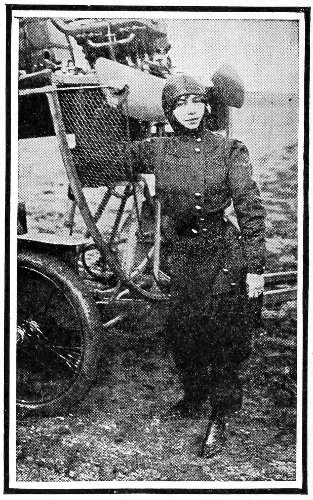
September 2, 1910—Mlle. Hélène Dutrieux flies
with a passenger from Ostend to Bruges, Belgium,
and back to Ostend. At Bruges she circled
around the famous belfry at a height of
1,300 feet, the chimes pealing in honor of the
feat—the most wonderful flight so far accomplished
by a woman.
September 3, 1910—M. Bielovucci lands at Bordeaux,
France, having made the trip from Paris,
366 miles, inside of 48 hours. The actual time
in the air was 7 hours 6 minutes. Strong head
winds blew him backward, forcing a landing
three times on the way. This is the fourth longest
cross-country flight on record, and makes the
world’s record for sustained speed over a long
distance.