Steve Mainwaring was a prisoner, and as he realised that fact a
thousand misgivings filled his mind. For to be taken by the French and
their Indians was not a fate which even the boldest of the British
courted.
"It may mean torture," he thought. "The French are not always able to
control their Indians, and even if they were always capable of doing
so, there are the backwoodsmen. We have heard what they are, and the
fugitives from our settlements have given us many a tale of their
ferocity."
No one, in fact, could guess in those rough days what pains were
awaiting him if he fell into the hands of the French, and if there had
not been sufficient evidence already, there was to be abundance in the
near future. But that was hardly required. The thousands of unhappy
settlers who had been driven from the forests and the backwoods were
full of tales of brutality, of cruelty on the part of French pioneers
and Indians alike. And it was a known fact that even if the French
were kindly disposed and desirous of treating their prisoners well,
they often had to stand aside and look on helplessly while the braves
who were their allies wreaked a terrible vengeance on the unhappy
people who had been captured. This was the price which New France had
too often to pay for the allegiance of these monsters.
"I have been taken in fair fight, and am a prisoner of war," Steve
said to himself. "That in itself should gain fair treatment for me.
But what is the use of worrying? I am cold, and have a severe pain in
my side. I suppose I have been wounded. Brothers, have you a blanket
with which to cover me? My blood runs cold with the frost and my
wound, and in a little while I shall be frozen."
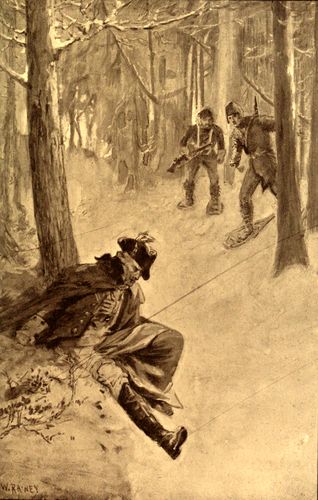
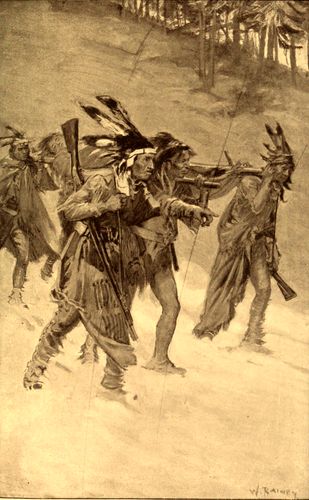
He spoke the last aloud, addressing himself to the Indians who carried
him, and speaking in the Mohawk tongue. All four instantly came to a
halt, there was a grunt from the leading man on the right, and then
Steve was gently laid on the ground.
"Cold, brother?" said the leader, a fine specimen of a brave, if the
faint light could be trusted. "We will give you a covering and see
to your comfort. Tell us, how comes it that you speak our tongue, or
rather, that of the Mohawks? Have you lodged in their wigwams?"
Steve answered with a nod. "I have lived and hunted with them," he
said feebly, for he was very weak. "They are firm friends of mine, as
are others of the Iroquois nation. They call me Hawk."
At that there was another grunt, a grunt which denoted approval and
the small amount of astonishment which the brave would permit himself
to express.
"Hawk. Yes, we have heard of you. Then you were the chief of those
whom we attacked a week ago?"
"I was. The fight was a fair and open one. The Hurons attacked boldly,
but were unfortunate. Those who fell were as brave as those who lived
to return to Ticonderoga."
This time all the bearers nodded their approval and grunted. For
these Indian braves, with all their faults, with all their ferocity
and their barbarous customs, had one redeeming virtue. They were
brave, and they respected bravery. It was the one great virtue after
which all strove, and if an enemy could speak well of their conduct,
then he was for the time being a friend. More than that, these wild
men of the backwoods, who had come so many miles to aid the French,
were accustomed, like other Indian nations, to make much of their
prisoners, provided they had fought with courage. A prisoner with
them was a man who had already shown fortitude, and who, by becoming
a prisoner, threw down the gage to his captors as it were, and boldly
asserted that if they were bold, he was still bolder, that if they
and their brothers could support hardship and pain amounting to the
acutest agony, he could support the fiercest pains which they his
captors could design. In fact, a prisoner was wont to boast loudly of
his own superiority, to defy his captors to make him flinch, and when
the time for the ordeal came, to endure hours of the most diabolical
torture, and finally the pangs of death without so much as a groan,
if possible with a smile of triumph on his quivering lips. And till
the time for torture arrived he was a brother and a man, deserving of
respect and attention, not a beast to be goaded and bullied and loaded
with chains.
"Our brother is weak," said the brave. "He shall have a covering at
once, and we will carry him with all comfort and care. The Hawk is
our friend. We have heard of him. There are braves with us who met
the Hawk and his brothers on the Mohawk river and down in the great
valley beyond. Yes, of a truth, the Hawk is known to us as a man of
bravery and energy." He went off over the snow at a swinging pace, and
presently his tall figure appeared again, while in his hands he bore a
huge rug of bearskin.
"This will keep the warmth in you, Hawk," he said kindly. "We will
wrap you in it till you are completely covered. Then your blood will
run again. You have lost much, brother. See, it is frozen on your
shirt."
Steve had not felt the place before, but was glad to hear the news,
for he reckoned that if there had been severe bleeding from his wound,
as seemed to have been the case, for he was very weak, the frost had
arrested further hæmorrhage, and perhaps saved his life. He submitted
while the Indians wrapped him in the skin rug, and then felt himself
lifted on their shoulders again. Very soon he was in a comfortable
glow from head to foot, and that, combined with his weakness and
weariness, caused his eyes to close, and he fell asleep. An hour or
more later a light flashed in his face, for the dawn had not yet
broken, and on looking round, he found that he was in a big hut, the
walls of which were constructed of whole timbers. The light flashed
from a candle lamp hanging to the rafters, and showed beside the
walls and roof of the hut, the figures of the four Indians standing
about him, and some twelve French soldiers and as many backwoodsmen,
the irregulars on the side of France. Someone was speaking in the
background, and for a time he listened to the words. Then some
familiar note in the voice struck on his ear, and he found himself
wondering who was speaking, wondering why the voice caused his heart
to flutter so and his pulses to beat.
"One captured, you say? Only one? Peste! Is this carrying out my
orders?"
There was a bang as the speaker's hand came down upon a table which
stood close to one of the walls.
"That is so, monsieur. One only was taken," came the answer, and by
dint of craning his head, Steve saw that it was a regular who spoke,
dressed in the familiar uniform of the French line, but now swathed in
warm furs, which, however, did not cover the chevrons, which showed
that he was a sergeant. "One only, monsieur," he repeated, as if
excusing himself.
"And for this fine capture you paid well no doubt. What was the price?
Come, I am asking you."
The voice was very calm now. There was a note of satire in it, and
those who listened could tell that the man who spoke was angry, that
his calmness was only the prelude to an outburst of temper. The
sergeant felt that, too. He drew himself up at attention, clapped his
pike close against his shoulder, and looked askance at his commander.
"The price, monsieur. There was one killed by this prisoner, and three
others who fell within the five minutes which followed. Yes, four were
killed altogether, one of these being a messenger."
"Ah! I hear. But there were three messengers. That was the
arrangement, friend, for if one were fool enough to be captured or
killed, then there were two left. You follow, sergeant? You give me
news of one of these fine fellows. I have been roused in haste, and
have come here expecting other news. You do not bring it. You have
only one beggarly prisoner to show. The whole tale, man. Let me have
it."
This time the speaker's rage got the better of him, and he thumped on
the table as an excited Frenchman might be expected to do, leaning far
over it till his face was within an inch of the sergeant's. Not till
then did Steve catch sight of his features, and when he did so, he
fell back with a scarcely suppressed groan. It was Jules Lapon, the
very man who had hunted him and his friends out of house and home.
"The whole tale, monsieur? You have heard it already, unless——"
"Unless what? Speak fool. I am but just out of my bed, and have
gathered nothing, save the fact that you have returned without a
single messenger."
"Then the news is still bad," came the faltering answer. "One
messenger was killed within four miles of this, while the hunter who
accompanied him as guide escaped unharmed. They were set upon near the
British fort, and they alone escaped. The other two messengers are
therefore accounted for. They were surrounded and attacked by hunters,
just as the two who escaped were suddenly followed and fired on at
this end of the lake. We put the enemy's numbers down at a dozen, and
of those we captured one. He is here, monsieur."
The sergeant having unburdened himself of a disagreeable tale,
endeavoured to distract his angry commander's attention from himself
and his failure to the prisoner, and succeeded. Jules Lapon scowled at
him for a little while, drumming with his fingers on the table. Then
he cleared a path for himself by savagely sweeping the soldiers aside,
and in a moment was standing over the prisoner.
"Bring a light and let us see the fellow," he growled. "Come, it is so
dark in this hole that one cannot see. Are you sure, sergeant, that
he is one of the enemy? You have done so well that perhaps you have
half-killed and then captured one of our own side. Mistakes are made
in the darkness."
"By white men, perhaps, monsieur," came the answer, an answer which
caused Jules to writhe. "Indians were with us, monsieur, and they are
not often in error."
"The lamp, man! Hold it higher, and pull that skin from his head. Ah!"
He started back as if he had been shot, and gripped instinctively at
the tomahawk which was thrust in his belt. For a moment he looked
thoroughly frightened, and then of a sudden his features assumed an
expression of triumph and hate and of the most diabolical malice all
intermingled till those who watched him were amazed and horrified. As
for Steve, he was utterly bewildered. He knew well that the meeting
between himself and this Jules Lapon would hardly prove a pleasant
one, for the relations between them were somewhat strained. He and his
friends had, in fact, obtained two consecutive victories over this
Frenchman and his band of Indians, and no doubt those successes had
roused the ire of Jules. But the tables were turned now, and had been
for some time. For if Jules had lost at first, he was the conqueror
now. He had turned Steve out of house and home, the settlement where
the hunters had lived so happily was his, by right of conquest if by
no other right, and now, to crown all, here was the Hawk his prisoner,
wounded and completely in his hands. Then why so much triumph and
hate?
"Ah. Then this is your prisoner. The only one you say, sergeant?"
The voice had become calm again. This Jules Lapon was now speaking in
even tones suggestive of kindness.
"That is true, monsieur. The only one. He is the Hawk, the leader of
those men whom we attacked a week ago. It is a fine capture."
"You have done well, sergeant. This man is of more value even than
that news could have been. He is wounded, you say?"
"There is a bullet lodged in his ribs, Monsieur. He bled much, and is
weak, so that we were forced to carry him. But he may have recovered
now, and will stand if we lift him to his feet."
At a sign from the sergeant, the Indians raised their prisoner, and
stood looking at him critically, wondering whether this pale face, of
whom they had heard before, would fail now, or whether he would have
sufficient courage to overcome his weakness. But they had little need
to fear the result, for though Steve was weak, as weak and weary as a
tired child, he had a determined spirit, and moreover felt intuitively
as if this was the supreme moment of his life, as if his future, his
safety in fact, depended upon his courage now. He set his teeth,
placed his feet well apart, and stood erect, his face towering above
that of Jules.
"The Hawk thanks the braves who carried him," he said, as steadily as
he could. "They treated him honourably, and though he has no gift to
make, he gives them thanks a thousand times."
"He is a man. We are satisfied," was the answer.
"He is more. He is a spy!"
Jules darted forward with a cry of delight, and snatched at Steve's
skin cap, to the top of which was attached an eagle's crest.
"Tell me, sergeant," he said, swinging round with an air of triumph,
"this prisoner was captured out on the ice. Had he a blanket?"
"Not when captured, monsieur. But all who supported him were dressed
so. They had the appearance of Indians."
"Then this Hawk is a spy," shouted Jules. "He and his men came in this
direction with one object. They came to spy, and in order to help them
they dressed as Indians, knowing well that they would pass as such
with a crest and a blanket about them, so long as the snow fell. This
is a most important capture. See that this man is guarded well, and at
dawn march out a firing party."
The sergeant brought his pike to his shoulder smartly as Jules swept a
path to the door and departed. Steve watched him go, and then stared
at the Indians and the soldiers and the backwoodsmen about him. He
was too weak to take in the full significance of that last command,
but vaguely wondered whether the firing party could be meant for him,
and whether he was to be executed. And as he wondered, he listened
to the chatter of those about him. It was evident that many of the
backwoodsmen, rough and brutal men as many were, who had become
tainted with the cruelty of the Indians, approved of the sentence.
They crammed tobacco into their pipes and smoked furiously, while they
acclaimed the decision of their leader with many an oath and with many
a glance at the prisoner. Some of the regulars were of their opinion
also, but not so the sergeant.
"Disguise! Spy!" he cried, some minutes later, having talked the
matter over with some of his comrades. "This brave lad whom we have
taken had no more idea of spying here than I have of setting a watch
at Fort William Henry. I'll be bound that he and his friends knew of
the messengers going to the English fort, and set a trap for them.
They guessed that an Indian dress might help their plans, and adopted
it. Why, the same is done here amongst ourselves. Even this commander
of ours, who shouts into one's throat, and orders all as if they were
dogs, dresses as a brave, ay, and goes out with a following of Hurons."
"Which does not alter the case as it stands, friend of the three
stripes," answered one of the trappers. "This leader of ours, a
backwoodsman like ourselves, fights in the garb that best suits him,
chancing capture. This fool here decks himself out in feathers, and is
captured. Both run the same risk. One is taken and shot as a natural
course, while the other, the smarter man, you understand, lives to
fight another day. As to shouting down a man's throat, there are some
dull dogs who want a deal of that, and still remain dull."
For a little while it looked as if the two would come to blows, for
the sergeant strode over to the trapper who had spoken, a flush of
anger on his face. But evidently he thought better of the matter,
turned to the Indians, and in a little while was accompanying Steve
out of the hut. Borne on the shoulders of the braves, the prisoner was
transferred to a second hut, where he was placed on a low couch.
"Whatever happens you shall have food and some attention, friend,"
said the sergeant. "I will leave the Indians to see to your wound,
while I myself get you some victuals. Cheer up. You have still a
friend or two left in the world."
He smiled kindly at our hero, and, taking a lamp, went out of the hut,
speaking a few words to the Indians as he went. The latter at once set
about tending to Steve's wound, for these sons of the lake and forest
were for the most part excellent surgeons. One placed a jar over the
fire, and blew at the embers till the flames roared round it. A second
crept from the hut, to return some ten minutes later with some soft
fleecy material, while beneath his arm he carried a bundle wrapped in
bark. Opening the last, he disclosed a heap of dried leaves, which he
commenced to pound between two stones, while some he even chewed. A
little water was added to the mass, and the whole worked into a soft
brown paste.
"The Hawk will let us see and tend this wound, well knowing that
we have had experience," said the chief who had already shown his
friendly spirit. "We will carry you close to the fire, so that you
will feel no cold. That is well. The Hawk has won our favour. He
does not flinch at the prospect of a death which would be an eternal
dishonour to even the most cowardly brave. Fear not. There are men
here who will see that this indignity is not allowed. If die you must,
there are other and nobler ways of taking the life of a prisoner."
Little did the fine fellow know what pangs he was causing our hero,
for to Steve, if he were condemned to die as a spy, shooting would be
infinitely preferable to the death by torture which the Indians would
inflict. He knew their customs well, and he told himself over and over
again that it would be better far to stand for one brief minute and
face the muskets than to be feasted for a day or more by these braves,
to be petted and praised by them, knowing full well that all the while
their preparations were being completed for the orgie of the morrow,
when all their diabolical ingenuity would be called into play to
provide a slow death for him, which in their opinion was alone worthy
of a warrior. Ugh! The very idea made him shiver.
"You are cold. Cover our brother with the skin again," said the chief.
"Now, let us remove the shirt, and see what harm has come to him."
Very gently they cut the leather shirt away and removed his clothing
till the wound was uncovered. By then the water in the jar placed over
the fire was comfortably hot, and with some of this and a portion of
the fleecy material the chief bathed the place till the nature of the
injury could be seen.
"Ah! The bullet struck beneath the arm, Hawk, and ran round the ribs.
It is here. I feel it beneath my fingers."
The chief ran the tips of his fine fingers over the ribs, and traced
the direction of the bullet from the entrance wound to the spot where
the hard mass could be felt to move under the skin.
"Some water, brother," he demanded. "Nay, hotter than that. Heat it
till it bubbles."
He sat patiently beside Steve while the jar was placed on the fire
again. And presently, when the water was boiling, he strode over to
it, and plunged the blade of his keen hunting knife deep into the
contents.
"The Hawk has felt pain before," he said. "He will not flinch. The
bullet shall be within my hand in less time than it takes to count the
fingers. Lie so. Now, Hawk."
Steve shut his teeth again, and never so much as winced as the keen
blade, wielded by a dexterous hand, cut down on the bullet. It was
extracted in a few seconds, and when Steve opened his eyes, there it
was in the chief's hand.
"Good," grunted the brave. "The worst is done. We will dress the wound
now."
Once more he had recourse to the jar of water. A wide piece of doe
skin was steeped in the boiling water first, and then, having been
wrung out, was made the receptacle for the brown paste already
prepared. The skin was then folded round, screwed up at the ends, and
again plunged into the water, and left there for a couple of minutes.
"It is ready," said the chief. "Squeeze the mass dry, and bring the
skin to me."
Up to that moment the wound had been smarting, particularly that
portion where the Indian had made use of his knife. But a minute
later, after the hot brown paste had been applied and covered by a
pad of the fleecy material, the pain disappeared, and Steve felt huge
relief. He was carefully bound up with long strips of doe skin, his
shirt replaced, and in a little while he was lying back on the couch,
expressing thanks to the Indians.
"Here is the food, and you look as if you could enjoy it," said the
sergeant, entering a little later. "Come, drink this stuff. It is hot
and steaming, and will put warmth into your body."
The kind-hearted fellow sat down and watched his prisoner eat and
drink. Then he propped his head up on the couch, drew the rug well
over him, and sat staring thoughtfully at his figure till Steve's eyes
closed and he slept.
"A fine lad, and one who fights stoutly for a lost cause," murmured
the sergeant, as he watched the sleeper. "To look at him as he lies
there, one could take him for one of our country, though he is bigger
and stouter than we are built. And he speaks French, too. Yes, I
remember that. It struck me as strange when I heard him answer this
Jules Lapon. Can it be that he is partly French, his mother perhaps
being one of our land? There have been many such marriages, and often
they have turned out well."
For a little while he lapsed into silence again, till his eye caught
the gleam of a long, thin streak of light which was pushing its way
through a chink in the roughly fashioned door. It was dawn, the hour
for the firing party, and the sergeant rose at once to his feet.
"We shall see," he said aloud, as he moved towards the door, but still
kept an eye on Steve. "This lad is a brave one, and I am taken with
him. That is strange now, for up to this an Englishman has been to me,
as to all my comrades, just an Englishman, fit to be slain if need be.
I have pitied them often, to be sure, for it is hard to see them given
over to these braves. But it is necessary to keep the Indians in good
temper, and, therefore, what is necessary should not be grumbled at.
Why is it that this young Hawk has gained my goodwill?"
He was of a reflective turn of mind, this French sergeant, and stood
again with his hand on the latch of the door, staring hard at Steve
and thinking aloud.
"Peste take it! Why is this? Ah! It must be this Jules Lapon. I have
hated him ever since he came to us, and more so now that he is our
commandant in the absence of the colonel. He is a hard man, or else he
would never order the execution of a white prisoner without some sort
of trial. I doubt that he has the power. The colonel could intervene,
if only he were not chained to his bed with a broken thigh. Mon
Dieu!"
He strode across the floor of beaten and frozen earth, and shook the
sleeper vigorously. His face was flushed, and there was an air of
excitement about him.
"Pardon, monsieur, but I wish to ask a question. Monsieur, you are
awake, and I ask pardon for disturbing you. But this is a matter of
importance."
Steve opened his eyes wearily, and acknowledged the presence of
the sergeant somewhat peevishly, for he had been enjoying a most
refreshing and dreamless sleep. He rubbed his eyes, stared at the
sergeant, and then caught sight of the streak of light penetrating
through the door. Then his senses returned with a rush, and he
remembered.
"The dawn, sergeant," he said. "Then this Jules Lapon will carry out
his purpose. I am ready. Help me to get to my feet."
"Not now, monsieur. I am about to go for the firing party, but wish
to ask an important question. Tell me, was it you who aided monsieur
le colonel, Colonel St. Arnould de Prossen, till a week ago the
commandant of this force?"
He waited for the answer eagerly, as if his own life depended on it,
and gave a cry of joy as Steve replied that it was he who had found
the unfortunate soldier, and who had had him carried on to the lake
and handed over to his friends.
"Then rest easy, monsieur. I go to the colonel, and we shall see if
this firing party assembles. Sleep again. Have I not said that you
have many friends? Even the Indians would save you now, not because
they wish to reserve you for torture, but because you have shown
bravery and much honour to themselves."
He pressed Steve gently back on to the couch, and raced from the hut.
A few minutes later he was knocking at the door of his colonel's
quarters, thumping on the logs with an energy which brought shouts
of anger from within, and very soon afterwards the squat figure of a
French soldier servant came to the door.
"Peste!" he exclaimed. "Are you mad, sergeant, to come and beat so on
the commandant's door? Go away before it is light enough for me to
recognise you. Go, I say, or I shall know you, and then there will be
trouble."
"Give way. I have important information for the colonel. Let me pass,"
gasped the sergeant, thrusting the man aside and pushing his way into
the hut. A moment or two later he was confronting the wounded officer,
and for some ten minutes the two were closeted together, much to the
amazement of the soldier servant.
"There, there, Armand, you must leave us," said the colonel, as his
valet rushed in after the sergeant with the intention of ejecting the
intruder. "Our friend has news for me. Withdraw. Come again when I
knock, and have no fear. Our friend is in his sober senses."
"I am glad that you have come to me, sergeant," he said, at the end
of their interview. "Glad to think there are some here who have kind
hearts still after all this bitter warfare. Not for worlds would I
have this lad injured, for he behaved with noble generosity to me. Go
now, summon your firing party, and march the squad to the hut where
this prisoner lies. If any dare give you an order to proceed with
this unjust and cruel execution, show this note. Though I am wounded
and incapable at the moment, I am still nominally, if not actively,
in command, and I will have my orders obeyed. Go, and I will follow
presently."
Half an hour later Steve awoke to the fact that men were gathering
outside the hut in which he lay. He could hear the tramp of their
boots on the frozen ground, and the ring of their muskets as they
stood at ease. The voice of the sergeant came to his ears as he gave
the commands. "Attention! Shoulder your pieces! Stand steady there,
lads, for Monsieur Jules Lapon comes to inspect you."
The door was thrown open, a gust of freezing air swept the apartment,
and there was Jules, muffled in furs, his face haggard and weary as if
he had some great weight on his mind which had kept him wakeful since
the arrival of the prisoner, two bright, hectic spots on his cheeks
and staring, blood-shot eyes which seemed to denote a fever. And
despite the cruel smile now on his lips, it wanted no acute observer
to see that this young man, with all his bravado, was hesitating as to
his course of action, not out of compassion for the prisoner, but for
fear of what might happen to himself. However, the sight of Steve's
calm face settled the question.
"You are ready, sergeant?" he asked curtly. "Good. Then bring out the
prisoner. There is a wall yonder, where you will set him up and shoot
him promptly. He is a dog and a spy, and should thank us for giving
him bullets instead of a noose."
"He will certainly not thank you for his life, monsieur. The lad is
too proud and too brave for that. He would not ask it of me, and much
less of you."
The words, spoken in the coldest and most cutting tones, caused Jules
to swing round and face the open. He flushed to the roots of his hair,
and then turned deathly pale, while, like the coward and bully he was,
his lips at once commenced to frame lies and excuses. For his superior
was there. Four soldiers stood before him, bearing a bed, on which,
warmly covered with skins, lay the long figure of the colonel.
"Have you no heart, man?" demanded the colonel fiercely. "Do you
not know that this prisoner was the leader of those men whom we
attacked last week? Yes, you know that, I see. Then it is also in your
knowledge that it is to that gallant youth that I owe my life. And yet
you would shoot him! You are suspended, monsieur. You will retire to
your hut till I can send you out of the fort. Sergeant, you will carry
monsieur the prisoner to my hut, where he will remain till completely
recovered. Tell off one of the men to wait on him."
The colonel fell back on his pillow, waved to his bearers, and was
gone without deigning to glance again at Jules Lapon. Then the
sergeant's voice was heard.
"Ground arms, my lads. Now pile them against the hut. Good. Enter now
and fetch monsieur. You will carry out the colonel's orders."
In a minute Steve was being conveyed across the open, while Jules
Lapon looked on as if dazed. Then he turned, rushed across to his own
dwelling, and broke the door open with a furious kick. He was beaten.
At the very last minute the life at which he had been aiming for so
many months now, for some subtle reason of his own, was saved, and
the prisoner, in place of standing up before the muskets of a firing
party, was being quartered in the colonel's own hut. Jules ground his
teeth with fury, and filled the bowl of his pipe with savage energy.