Belief in the evocation of the spirits of the dead is as old as Humanity.
At one period of the world’s history it was called Thaumaturgy, at another
Necromancy and Witchcraft, in these latter years, Spiritualism. It is new
wine in old bottles. On March 31, 1847, at Hydeville, Wayne County, New
York, occurred the celebrated “knockings,” the beginning of modern
Spiritualism. The mediums were two little girls, Kate and Margaretta Fox,
whose fame spread over three continents. It is claimed by impartial
investigators that the rappings produced in the presence of the Fox
sisters were occasioned by natural means. Voluntary disjointings of the
muscles of the knee, or to use a medical term “the repeated displacement
of the tendon of the peroneus longus muscle in the sheath in which it
slides behind the outer malleolus” will produce certain extraordinary
sounds, particularly when the knee is brought in contact with a table or
chair. Snapping the toes in rapid succession will cause similar noises.
The above was the explanation given of the “Hydeville and Rochester
Knockings”, by Professors Flint, Lee and Coventry, of Buffalo, who
subjected the Fox sisters to numerous examinations, and this explanation
was confirmed many years after (in 1888) by the published confession of
Mrs. Kane, nee Margaretta Fox. Spiritualism became the rage and
professional mediums went about giving séances to large and interested
audiences. This particular creed is still professed by a recognized
semi-religious body in America and in Europe. The American mediums reaped
a rich harvest in the Old World. The pioneer was Mrs. Hayden, a Boston
medium, who went to England in 1852, and the table-turning mania spread
like wild fire within a few months.
Broadly speaking, the phenomena of modern Spiritualism may be divided into
two classes: (1) Physical, (2) Subjective. Of the first, the
“Encyclopaedia Britannica”, in its brief but able review of the subject,
says: “Those which, if correctly observed and due neither to conscious or
unconscious trickery nor to hallucination on the part of the observers,
exhibit a force hitherto unknown to science, acting in the physical world
otherwise than through the brain or muscles of the medium.” The earliest
of these phenomena were the mysterious rappings and movements of
furniture without apparent physical cause. Following these came the
ringing of bells, playing on musical instruments, strange lights seen
hovering about the séance-room, materializations of hands, faces and
forms, “direct writing and drawing” declared to be done without human
intervention, spirit photography, levitation, unfastening of ropes and
bandages, elongation of the medium’s body, handling fire with impunity,
etc.
Of the second class, or Subjective Phenomena, we have “table-tilting and
turning with contact; writing, drawing, etc., by means of the medium’s
hand; entrancement, trance-speaking, and impersonation by the medium of
deceased persons, seeing spirits and visions and hearing phantom voices.”
From a general scientific point of view there are three ways of accounting
for the physical phenomena of spiritualism: (1) Hallucination on the part
of the observers; (2) Conjuring; (3) A force latent in the human
personality capable of moving heavy objects without muscular contact, and
of causing “Percussive Sounds” on table-tops, and raps upon walls and
floors.
Hallucination has unquestionably played a part in the séance-room, but
here again the statement of the “Encyclopaedia Britannica” is worthy of
consideration: “Sensory hallucination of several persons together who are
not in a hypnotic state is a rare phenomenon, and therefore not a probable
explanation.” In my opinion, conjuring will account for seven-eighths of
the so-called phenomena of professional mediums. For the balance of
one-eighth, neither hallucination nor legerdemain are satisfactory
explanation. Hundreds of credible witnesses have borne testimony to the
fact of table-turning and tilting and the movements of heavy objects
without muscular contact. That such a force exists is now beyond cavil,
call it what you will, magnetic, nervous, or psychic. Count Agenor de
Gasparin, in 1854, conducted a series of elaborate experiments in
table-turning and tilting, in the presence of his family and a number of
skeptical witnesses, and was highly successful. The experiments were made
in the full light of day. The members of the circle joined hands and
concentrated their minds upon the object to be moved. The Count published
a work on the subject “Des Tables Tournantes,” in which he stated that the
movements of the table were due to a mental or nervous force emanating
from the human personality. This psychic energy has been investigated by
Professor Crookes and Professor Lodge, of London, and by Doctor Elliott
Coues, of Washington, D. C., who calls it “Telekinesis.” The existence of
this force sufficiently explains such phenomena of the séance-room as are
not attributable to hallucination and conjuring, thus removing the
necessity for the hypothesis of spirit intervention. In explanation of
table-turning by “contact,” I quote what J. N. Maskelyne says in “The
Supernatural”:
“Faraday proved to a demonstration that table-turning was simply the
result of an unconscious muscular action on the part of the sitters. He
constructed a little apparatus to be placed beneath the hands of those
pressing upon the table, which had a pointer to indicate any pressure to
one side or the other. After a time, of course, the arms of the sitters
become tired and they unconsciously press more or less to the right or
left. In Faraday’s experiments, it always proved that this pressure was
exerted in the direction in which the table was expected to move, and the
tell-tale pointer showed it at once. There, then, we have the explanation:
expectancy and unconscious muscular action.”
1. Telepathy.
The subjective phenomena of Spiritualism—trance speaking, automatic
writing, etc.,—have engaged the attention of some of the best scientific
minds of Europe and America, as studies of abnormal or supernormal
psychological conditions.
If there are any facts to sustain the spiritual hypothesis, these facts
exist in subjective manifestations. The following statement will be
conceded by any impartial investigator: A medium, or psychic, in a state
of partial or complete hypnosis frequently gives information transcending
his conscious knowledge of a subject. There can be but two hypotheses for
the phenomena—(1) The intelligence exhibited by the medium is
“ultra-mundane,” in other words, is the effect of spirit control, or, (2)
it is the result of the conscious or unconscious exercise of psychic
powers on the part of the medium.
It is well known that persons under hypnotic influence exhibit remarkable
intelligence, notwithstanding the fact that the ordinary consciousness is
held in abeyance. The extraordinary results obtained by hypnotizers point
to another phase of consciousness, which is none other than the subjective
or “subliminal” self. Mediums sometimes induce hypnosis by
self-suggestion, and while in that state, the subconscious mind is in a
highly receptive and exalted condition. Mental suggestions or concepts
pass from the mind of the sitter consciously or unconsciously to the mind
of the medium, and are given back in the form of communications from the
invisible world, ostensibly through spirit control. It is not absolutely
necessary that the medium be in the hypnotic condition to obtain
information, but the hypnotic state seems to be productive of the best
results. The medium is usually honest in his belief in the reality of such
ultra-mundane control, but he is ignorant of the true psychology of the
case—thought transference.
The English Society for Psychical Research and its American branch have of
late years popularized “telepathy”, or thought transference. A series of
elaborate investigations were made by Messrs. Edmund Gurney, F. W. H.
Myers, and Frank Podmore, accounts of which are contained in the
proceedings of the Society. Among the European investigators may be
mentioned Messrs. Janet and Gibert, Richet, Gibotteau, and
Schrenck-Notzing. Podmore has lately summarized the results of these
studies in an interesting volume, “Apparitions and Thought-transference,
an Examination of the Evidence for Telepathy.” Thought Transference or
Telepathy (from tele—at a distance, and pathos—feeling) he describes
as “a communication between mind and mind other than through the known
channels of the senses.” A mass of evidence is adduced to prove the
possibility of this communication. In summing up his book he says: “The
experimental evidence has shown that a simple sensation or idea may be
transferred from one mind to another, and that this transference may take
place alike in the normal state and in the hypnotic trance.
* * The personal influence of the operator in hypnotism may perhaps be
regarded as a proof presumptive of telepathy.” The experiments show that
mental concepts or ideas may be transferred to a distance.
Podmore advances the following theory in explanation of the phenomena of
telepathy:
“If we leave fluids and radiant nerve-energy on one side, we find
practically only one mode suggested for the telepathic transference—viz.,
that the physical changes which are the accompaniments of thought or
sensation in the agent are transmitted from the brain as undulations in
the intervening medium, and thus excite corresponding changes in some
other brain, without any other portion of the organism being necessarily
implicated in the transmission. This hypothesis has found its most
philosophical champion in Dr. Ochorowicz, who has devoted several chapters
of his book “De la Suggestion mentale,” to the discussion of the various
theories on the subject. He begins by recalling the reciprocal
convertibility of all physical forces with which we are acquainted, and
especially draws attention to what he calls the law of reversibility, a
law which he illustrates by a description of the photophone. The
photophone is an instrument in which a mirror is made to vibrate to the
human voice. The mirror reflects a ray of light, which, vibrating in its
turn, falls upon a plate of selenium, modifying its electric conductivity.
The intermittent current so produced is transmitted through a telephone,
and the original articulate sound is reproduced. Now in hypnotized
subjects—and M. Ochorowicz does not in this connection treat of
thought-transference between persons in the normal state—the equilibrium
of the nervous system, he sees reason to believe, is profoundly affected.
The nerve-energy liberated in this state, he points out, ‘cannot pass
beyond’ the subject’s brain ‘without being transformed. Nevertheless,
like any other force, it cannot remain isolated; like any other force it
escapes, but in disguise. Orthodox science allows it only one way out, the
motor nerves. These are the holes in the dark lantern through which the
rays of light escape. * * * Thought remains in the brain, just as the
chemical energy of the galvanic battery remains in the cells, but each is
represented outside by its correlative energy, which in the case of the
battery is called the electric current, but for which in the other we have
as yet no name. In any case there is some correlative energy—for the
currents of the motor nerves do not and cannot constitute the only dynamic
equivalent of cerebral energy—to represent all the complex movements of
the cerebral mechanism.’”
The above hypothesis may, or may not, afford a clue to the mysterious
phenomena of telepathy, but it will doubtless satisfy to some extent those
thinkers who demand physical explanations of the known and unknown laws of
the universe. The president of the Society for Psychical Research (1894,)
A. J. Balfour, in an address on the relation of the work of the Society to
the general course of modern scientific investigation, is more cautious
than the writers already quoted. He says:
“Is this telepathic action an ordinary case of action from a center of
disturbance? Is it equally diffused in all directions? Is it like the
light of a candle or the light of the sun which radiates equally into
space in every direction at the same time? If it is, it must obey the
law—at least, we should expect it to obey the law—of all other forces
which so act through a non-absorbing medium, and its effects must diminish
inversely as the square of the distance. It must, so to speak, get beaten
out thinner and thinner the further it gets removed from its original
source. But is this so? Is it even credible that the mere thoughts, or, if
you please, the neural changes corresponding to these thoughts, of any
individual could have in them the energy to produce sensible effects
equally in all directions, for distances which do not, as far as our
investigations go, appear to have any necessary limit? It is, I think,
incredible; and in any case there is no evidence whatever that this equal
diffusion actually takes place. The will power, whenever will is used, or
the thoughts, in cases where will is not used, have an effect, as a rule,
only upon one or two individuals at most. There is no appearance of
general diffusion. There is no indication of any disturbance equal at
equal distances from its origin and radiating from it alike in every
direction.
“But if we are to reject this idea, which is the first which ordinary
analogies would suggest, what are we to put in its place? Are we to
suppose that there is some means by which telepathic energy can be
directed through space from the agent to the patient, from the man who
influences to the man who is influenced? If we are to believe this, as
apparently we must, we are face to face not only with a fact extraordinary
in itself, but with a kind of fact which does not fit in with anything we
know at present in the region either of physics or of physiology. It is
true, no doubt, that we do know plenty of cases where energy is directed
along a given line, like water in a pipe, or like electrical energy along
the course of a wire. But then in such cases there is always some material
guide existing between the two termini, between the place from which the
energy comes and the place to which the energy goes. Is there any such
material guide in the case of telepathy? It seems absolutely impossible.
There is no sign of it. We can not even form to ourselves any notion of
its character, and yet, if we are to take what appears to be the obvious
lesson of the observed facts, we are forced to the conclusion that in some
shape or other it exists.”
Telepathy once conceded, we have a satisfactory explanation of that class
of cases in modern Spiritualism on the subjective side of the question.
There is no need of the hypothesis of “disembodied spirits”.
Some years ago, I instituted a series of experiments with a number of
celebrated spirit mediums in the line of thought transference, and was
eminently successful in obtaining satisfactory results, especially with
Miss Maggie Gaule, of Baltimore, one of the most famous of the latter day
psychics.
Case A.
About three years prior to my sitting with Miss Gaule, a relative by
marriage died of cancer of the throat at the Garfield Hospital,
Washington, D. C. He was a retired army officer, with the brevet of
General, and lived part of the time at Chambersburg, Penn., and the rest
of the time at the National Capital. He led a very quiet and unassuming
life, and outside of army circles knew but few people. He was a
magnificent specimen of physical manhood, six feet tall, with splendid
chest and arms. His hair and beard were of a reddish color. His usual
street dress was a sort of compromise with an army undress uniform,
military cut frock-coat, frogged and braided top-coat, and a Sherman hat.
Without these accessories, anyone would have recognized the military man
in his walk and bearing. He and his wife thought a great deal of my
mother, and frequently stopped me on the street to inquire, “How is Mary?”
I went to Miss Gaule’s house with the thought of General M— fixed in my
mind and the circumstances surrounding his decease. The medium greeted me
in a cordial manner. I sat at one end of the room in the shadow, and she
near the window in a large armchair. “You wish for messages from the
dead,” she remarked abruptly. “One moment, let me think.” She sank back in
the chair, closed her eyes, and remained in deep thought for a minute or
so, occasionally passing her hand across her forehead. “I see,” she said,
“standing behind you, a tall, large man with reddish hair and beard. He is
garbed in the uniform of an officer—I do not know whether of the army or
navy. He points to his throat. Says he died of a throat trouble. He looks
at you and calls “Mary,—how is Mary?” “What is his name?” I inquired,
fixing my mind on the words David M—. “I will ask”, replied the medium.
There was a long pause. “He speaks so faintly I can scarcely hear him. The
first letter begins with D, and then comes a—I can’t get it. I can’t hear
it.” With that she opened her eyes.
The surprising feature about the above case was the alleged spirit
communication, “Mary—how is Mary?” I did not have this in my mind at the
time; in fact I had completely forgotten this form of salutation on the
part of Gen. M—, when we had met in the old days. It is just this sort of
thing that makes spirit-converts.
However, the cases of unconscious telepathy cited in the “Reports of the
Society for Psychical Research,” are sufficient, I think, to prove the
existence of this phase of the phenomena.
T. J. Hudson, in his work entitled “A scientific demonstration of the
future life”, says: * * “When a psychic transmits a message to his client
containing information which is in his (the psychic’s) possession, it can
not reasonably be attributed to the agency of disembodied spirits. * *
When the message contains facts known to some one in his immediate
presence and with whom he is en rapport, the agency of spirits of the
dead cannot be presumed. Every investigator will doubtless admit that
sub-conscious memory may enter as a factor in the case, and that the
sub-conscious intelligence—or, to use the favorite terminology employed
by Mr. Myers to designate the subjective mind, the ‘sublimal
consciousness’—of the psychic or that of his client may retain and use
facts which the conscious, or objective mind may have entirely forgotten.”
But suppose the medium relates facts that were never in the possession of
the sitter, what are we to say then? Considerable controversy has been
waged over this question, and the hypothesis of telepathy is scouted.
Minot J. Savage has come to the conclusion that such cases stretch the
telepathic theory too far; there can be but one plausible explanation—a
communication from a disembodied spirit, operating through the mind of the
medium. For the sake of lucidity, let us take an example: A has a relative
B who dies in a foreign land under peculiar circumstances, unknown to A.
A attends a séance of a psychic, C, and the latter relates the
circumstances of B’s death. A afterwards investigates the statements of
the medium, and finds them correct. Can telepathy account for C’s
knowledge? I think it can. The telepathic communication was recorded in
A’s sub-conscious mind, he being en rapport with B. A unconsciously
yields the points recorded in his sub-conscious mind to the psychic, C,
who by reason of his peculiar powers raises them to the level of conscious
thought, and gives them back in the form of a message from the dead.
Case B.
On another occasion, I went with my friend Mr. S. C., of Virginia, to
visit Miss Gaule. Mr. S. C. had a young son who had recently passed the
examination for admission to the U. S. Naval Academy, and the boy had
accompanied his father to Baltimore to interview the military tailors on
the subject of uniforms, etc. Miss Gaule in her semi-trance state made the
following statement: “I see a young man busy with books and papers. He has
successfully passed an examination, and says something about a uniform.
Perhaps he is going to a military college.”
Here again we have excellent evidence of the proof of telepathy.
The spelling of names is one of the surprising things in these
experiments. On one occasion my wife had a sitting with Miss Gaule, and
the psychic correctly spelled out the names of Mrs. Evans’ brothers—John,
Robert, and Dudley, the latter a family name and rather unusual, and
described the family as living in the West.
The following example of Telepathy occurred between the writer and a
younger brother.
Case C.
In the fall of 1890, I was travelling from Washington to Baltimore, by the
B. & P. R. R. As the train approached Jackson Grove, a campmeeting
ground, deserted at that time of the year, the engine whistle blew
vigorously and the bell was rung continuously, which was something
unusual, as the cars ordinarily did not stop at this isolated station, but
whirled past. Then the engine slowed down and the train came to a
standstill.
“What is the matter?” exclaimed the passengers.
“My God, look there!” shouted an excited passenger, leaning out of the
coach window, and pointing to the dilapidated platform of the station. I
looked out and beheld a decapitated human head, standing almost upright in
a pool of blood. With the other male passengers I rushed out of the car.
The head was that of an old man with very white hair and beard. We found
the body down an embankment at some little distance from the place of the
accident. The deceased was recognized as the owner of the Grove, a farmer
living in the vicinity. According to the statement of the engineer, the
old man was walking on the track; the warning signals were given, but
proved of no avail. Being somewhat deaf, he did not realize his danger. He
attempted to step off the track, but the brass railing that runs along the
side of the locomotive decapitated him like the knife of a guillotine.
When I reached Baltimore about 7 o’clock, P. M., I hurried down to the
office of the “Baltimore News” and wrote out an account of the tragic
affair. My work at the office kept me until a late hour of the night, and
I went home to bed at about 1 o’clock, A. M. My brother, who slept in an
adjoining room, had retired to bed and the door between our apartments was
closed. The next morning, Sunday, I rose at 9 o’clock, and went down to
breakfast. The family had assembled, and I was just in time to hear my
brother relate the following: “I had a most peculiar dream last night. I
thought I was on my way to Mt. Washington (he was in the habit of making
frequent visits to this suburb of Baltimore on the Northern Central R. R.)
We ran down an old man and decapitated him. I was looking out of the
window and saw the head standing in a pool of blood. The hair and beard
were snow white. We found the body not far off, and it proved to be a
farmer residing in the neighborhood of Mt. Washington.”
“You will find the counterpart of that dream in the morning paper”, I
remarked seriously. “I reported the accident.” My father called for the
paper, and proceeded to hunt its columns for the item, saying, “You
undoubtedly transferred the impression to your brother.”
Case D.
This is another striking evidence of telepathic communication, in which I
was one of the agents. L— was a reporter on a Baltimore paper, and his
apartments were the rendezvous of a coterie of Bohemian actors,
journalists, and litterati, among whom was X—, a student at the
Johns-Hopkins University, and a poet of rare excellence. Poets have a
proverbial reputation for being eccentric in personal appearance; in X
this eccentricity took the form of an unclipped beard that stood out in
all directions, giving him a savage, anarchistic look. He vowed never
under any circumstances to shave or cut this hirsute appendage.
L— came to me one day, and laughingly remarked: “I am being tortured by a
mental obsession. X’s beard annoys me; haunts my waking and sleeping
hours. I must do something about it. Listen! He is coming down to my
rooms, Saturday evening, to do some literary work, and spend the night
with me. We shall have supper together, and I want you to be present. Now
I propose that we drug his coffee with some harmless soporific, and when
he is sound asleep, tie him, and shave off his beard. Will you help me? I
can provide you with a lounge to sleep on, but you must promise not to go
to sleep until after the tragedy.”
I agreed to assist him in his practical joke, and we parted, solemnly
vowing that our project should be kept secret.
This was on Tuesday, and no communication was had with X, until Saturday
morning, when L— and I met him on Charles street.
“Don’t forget to-night,” exclaimed L— “I have invited E to join us in our
Epicurean feast.”
“I will be there,” said X. “By the way, let me relate a curious dream I
had last night. I dreamt I came down to your rooms, and had supper. E—
was present. You fellows gave me something to drink which contained a
drug, and I fell asleep on the bed. After that you tied my hands, and
shaved off my beard. When I awoke I was terribly mad. I burst the cords
that fastened my wrists together, and springing to my feet, cut L—
severely with the razor.”
“That settles the matter”, said L—, “his beard is safe from me”. When we
told X of our conspiracy to relieve him of his poetic hirsute appendage,
he evinced the greatest astonishment. As will be seen, every particular of
the practical joke had been transferred to his mind, the drugging of the
coffee, the tying, and the shaving.
Telepathy is a logical explanation of many of the ghostly visitations of
which the Society for Psychical Research has collected such a mass of
data. For example: A dies, let us say in India and B, a near relative or
friend, residing in England, sees a vision of A in a dream or in the
waking state. A clasps his hands, and seems to utter the words, “I am
dying”. When the news comes of A’s death, the time of the occurrence
coincides with the seeing of the vision. The spiritualist’s theory is that
the ghost of A was an actual entity. One of the difficulties in the way of
such an hypothesis is the clothing of the deceased—can that, too, be
disembodied? Thought transference (conscious or unconscious), I think, is
the only rational explanation of such phantasms. The vision seen by the
percipient is not an objective but a subjective thing—a hallucination
produced by the unknown force called telepathy. The vision need not
coincide exactly with the date of the death of the transmitter but may
make its appearance years afterwards, remaining latent in the subjective
mind of the percipient. It may, as is frequently the case, be revealed by
a medium in a séance. Many thoughtful writers combat the telepathic
explanation of phantasms of the dead, claiming that when such are seen
long after the death of persons, they afford indubitable evidence of the
reality of spirit visitation. The reader is referred to the proceedings
of the Society for Psychical Research for a detailed discussion of the
pros and cons of this most interesting subject.
Many of the so-called materializations of the séance-room may be accounted
for by hallucinations superinduced by telepathic suggestions from the mind
of the medium or sitters. But, in my opinion, the greater number of these
manifestations of spirit power are the result of trickery pure and
simple—theatrical beards and wigs, muslin and gossamer robes, etc., being
the paraphernalia used to impersonate the shades of the departed, the
imaginations of the sitters doing the rest.
2. Table-Tilting—Muscle Reading.
In regard to Table-Tilting with contact, I have given Faraday’s
conclusions on the subject,—unconscious muscular action on the part of
the sitter or sitters. In the case of Automatic Writing (particularly with
the planchette), unconscious muscular action is the proper explanation for
the movements of the apparatus. “Professor Augusto Tamburini, of Italy,
author of ‘Spiritismo e Telepatia’, a cautious investigator of psychical
problems,” says a reviewer in the Proceedings of the Society for Psychical
Research (Volume IX, p. 226), “accepts the verdict of all competent
observers that imposture is inadmissible as a general explanation, and
endorses the view that the muscular action which causes the movements of
the table or the pencil is produced by the subliminal consciousness. He
explains the definite and varying characters of the supposed authors of
the messages as the result of self-suggestion. As by hypnotic or
post-hypnotic suggestion a subject may be made to think he is Napoleon or
a chimney sweep, so, by self-suggestion, the subliminal consciousness may
be made to think that he is X and Y, and to tilt or wrap messages in the
character of X and Y.”
Professor Tamburini’s explanation fails to account for the innumerable
well authenticated cases where facts are obtained not within the conscious
knowledge of the planchette writer or table-tilter. If telepathy does not
enter into these cases, what does?
There are many exhibitions, of thought transference by public psychics,
that are thought transference in name only. One must be on one’s guard
against these pretenders to occult powers. I refer to men like our late
compatriot, Washington Irving Bishop—“muscle-reader” par excellence
whose fame extended throughout the civilized world.
Muscle-Reading is performed in the following manner: Let us take, for
example, the reading of the figures on a bank-note. The subject gazes
intently at the figures on a note, and fixes them in his mind. The
muscle-reader, blindfolded or not, takes a crayon in his right hand, and
lightly clasps the hand or wrist of the subject with his left. He then
writes on a blackboard the correct figures on the note. This is one of the
most difficult feats in the repertoire of the muscle-reader, and was
excelled in by Bishop and Stuart Cumberland. Charles Gatchell, an
authority on the subject, says that the above named men were the only
muscle-readers who have ever accomplished the feat. Geometrical designs
can also be reproduced on a blackboard. The finding of objects hidden in
an adjoining room, or upon the person of a spectator in a public hall, or
at a distance, are also accomplished by skillful muscle readers, either by
clasping the hand of the subject, or one end of a short wire held by him.
Says Gatchell, in the “Forum” for April, 1891: “Success in
muscle-reading depends upon the powers of the principal and upon the
susceptibility of the subject. The latter must be capable of mental
concentration; he must exert no muscular self-control; he must obey his
every impulse. Under these conditions, the phenomena are in accordance
with known laws of physiology. On the part of the principal,
muscle-reading consists of an acute perception of the slight action of
another’s muscles. On the part of the subject, it involves a nervous
impulse, accompanied by muscular action. The mind of the subject is in a
state of tension or expectancy. A sudden release from this state excites,
momentarily, an increased activity in the cells of the cerebral cortex.
Since the ideational centres, as is usually held, correspond to the motor
centres, the nervous action causes a motor impulse to be transmitted to
the muscles. * * In making his way to the location of a hidden object, the
subject usually does not lead the muscle-reader, but the muscle-reader
leads the subject. That is to say, so long as the muscle-reader moves in
the right direction, the subject gives no indication, but passively moves
with him. The muscle-reader perceives nothing unusual. But, the subject’s
mind being intently fixed on a certain course, the instant that the
muscle-reader deviates from that course there is a slight, involuntary
tremor, or muscular thrill, on the part of the subject, due to the sudden
interruption of his previous state of mental tension. The muscle-reader,
almost unconsciously, takes note of the delicate signal, and alters his
course to the proper one, again leading his willing subject. In a word, he
follows the line of the least resistance. In other cases the conditions
are reversed; the subject unwittingly leads the principal.
“The discovery of a bank-note number requires a slightly different
explanation. The conditions are these: The subject is intently thinking of
a certain figure. His mind is in a state of expectant attention. He is
waiting for but one thing in the world to happen—for another to give
audible expression to the name of that which he has in mind. The instant
that the conditions are fulfilled, the mind of the subject is released
from its state of tension, and the accompanying nervous action causes a
slight muscular tremor, which is perceived by the acute senses of the
muscle-reader. This explanation applies, also, to the pointing out of one
pin among many, or of a letter or a figure on a chart. The conditions
involved in the tracing of a figure on a blackboard or other surface are
of a like order, although this is a severer test of a muscle-reader’s
powers. So long as the muscle-reader moves the crayon in the right
direction, he is permitted to do so; but when he deviates from the proper
course, the subject, whose hand or wrist he clasps, involuntarily
indicates the fact by the usual slight muscular tremor. This, of course,
is done involuntarily; but if he is fulfilling the conditions demanded of
all subjects, absolute concentration of attention and absence of muscular
control—he unconsciously obeys his impulse. A billiard player does the
same when he follows the driven ball with his cue, as if by sheer force of
will he could induce it to alter its course. The ivory is uninfluenced;
the human ball obeys.”
1. Psychography, or Slate-Writing.
One of the most interesting phases of modern mediumship, on the physical
side, is psychography, or slate-writing. After an investigation extending
over ten years, I am of the opinion that the majority of slate-writing
feats are the results of conjuring. The process generally used is the
following.
The medium takes two slates, binds them together, after first having
deposited a small bit of chalk or slate pencil between their surfaces, and
either holds them in his hands, or lays them on the table. Soon the
scratching of the pencil is heard, and when the cords are removed a spirit
message is found upon the surface of one of the slates. I will endeavor to
explain the “modus operandi” of these startling experiments.
Some years ago, the most famous of the slate-writing mediums was Dr. Henry
Slade, of New York, with whom I had several sittings. I was unable to
penetrate the mystery of his performance, until the summer of 1889, when
light was thrown upon the subject by the conjurer C— whom I met in
Baltimore.
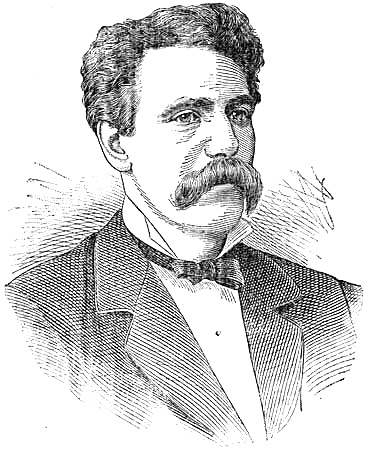
FIG. 2. DR. HENRY SLADE.
“Do you know the medium Slade?” I asked him.
“Yes,” said he, “and he is a conjurer like myself. I’ve had sittings with
him. Come to my rooms to-night, and I will explain the secret workings of
the medium’s slate-writing. But first I will treat you to a regular
séance.”
On my way to C’s home I tried to put myself in the frame of mind of a
genuine seeker after transcendental knowledge. I recalled all the stories
of mysterious rappings and ghostly visitations I had read or heard of. It
was just the night for such eerie musings. Black clouds were scurrying
across the face of the moon like so many mediaeval witches mounted on the
proverbial broomsticks en route for a mad sabbat in some lonely
churchyard. The prestidigitateur’s pension was a great, lumbering,
gloomy old house, in an old quarter of Baltimore. The windows were tightly
closed and only the feeble glimmer of gaslight was emitted through the
cracks of the shutters. I rang the bell and Mr. C’s stage-assistant, a
pale-faced young man, came to the door, relieved me of my light overcoat
and hat, and ushered me upstairs into the conjurer’s sitting-room.
A large, baize-covered table stood in the centre of the apartment, and a
cabinet with a black curtain drawn across it occupied a position in a deep
alcove. Suspended from the roof of the cabinet was a large guitar. I took
a chair and waited patiently for the appearance of the anti-Spiritualist,
after having first examined everything in the room—table, cabinet, and
musical instruments—but I discovered no evidence of trickery anywhere. I
waited and waited, but no C—. “Can he have forgotten me?” I said to
myself. Suddenly a loud rap resounded on the table top, followed by a
succession of raps from the cabinet; and the guitar began to play. I was
quite startled. When the music ceased the door opened, and C— entered.
“The spirits are in force to-night,” he remarked with a meaning smile, as
he slightly diminished the light in the apartment.
“Yes,” I replied. “How did you do it?”
“All in good time, my dear ghost-seer,” was the answer. “Let us try first
a few of Dr. Slade’s best slate tests.”
So saying he handed me a slate and directed me to wash it carefully on
both sides with a damp cloth. I did so and passed it back to him.
Scattering some tiny fragments of pencil upon it, he held the slate
pressed against the under surface of the table leaf, the fingers of his
right hand holding the slate, his thumb grasping the leaf. C— then
requested me to hold the other end of the slate in a similar fashion, and
took my right hand in his left. Heavy raps were heard on the table-top,
and I felt the fingers of a spirit hand plucking at my garments from
beneath the table. C—’s body seemed possessed with some strange
convulsion, his hands quivered, and his eyes had a glassy look. Listening
attentively, I heard the sound of a pencil writing on the slate.
“Take care!” gasped the conjurer, breathlessly.
The slate was jerked violently out of our hands by some powerful agency,
but the medium regained it, and again pressed it against the table as
before. In a little while he brought the slate up and there upon its upper
surface was a spirit message, addressed to me—“Are you convinced now?—D.
D. Home.”
At this juncture there came a knock at the door, and C—, with the slate
in his hand, went to see who it was. It proved to be the pale-faced
assistant. A few words in a low-tone of voice were exchanged between them,
and the conjurer returned to the table, excusing the interruption by
remarking, “Some one to see me, that is all, but don’t hurry, for I have
another test to show you.” After thoroughly washing both sides of the
slate he placed it, with a slate pencil, under a chafing-dish cover in the
center of the table. We joined hands and awaited developments.
Being tolerably well acquainted with conjuring devices, I manifested but
little surprise in the first test when the spirit message was written,
because the magician had his fingers on the slate. But in this test the
slate was not in his possession; how then could the writing be
accomplished?
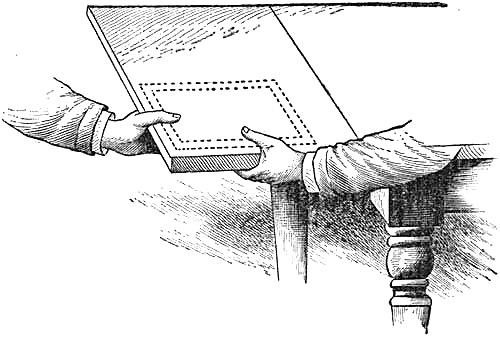
FIG. 3. THE HOLDING OF THE SLATE.
“Hush!” said C—, “is there a spirit present?” A responsive rap resounded
on the table, and after a few minutes’ silence, the mysterious scratching
of the slate-pencil began. I was nonplussed.
“Turn over the slate,” said the juggler.
I complied with his request and found a long message to me, covering the
entire side of the slate. It was signed “Cagliostro.”
“What do you think of Dr. Slade’s slate tests?” inquired C—.
“Splendid!” I replied, “but how are they done?”
His explanations made the seeming marvel perfectly plain. While the slate
is being examined in the first test, the medium slips on a thimble with a
piece of slate pencil attached or else has a tiny bit of pencil under his
finger nail. In the act of holding the slate under the table, he writes
the short message backwards on its under side. It becomes necessary,
however, to turn the slate over before exhibiting it to the sitter, so
that the writing may appear to have been written on its upper
surface—the side that has been pressed to the table. To accomplish this
the medium pretends to go into a sort of neurotic convulsion, during which
state the slate is jerked away from the sitter, presumably by spirit
power, and is turned over in the required position. It is not immediately
brought up for examination but is held for a few seconds underneath the
table top, and then produced with a certain amount of deliberation.
The special difficulty of this trick consists in the medium’s ability to
write in reverse upon the under surface of the slate. If he wrote from
left to right, in the ordinary method, it would, of course, reverse the
message when the slate is examined, and give a decided clue to the
mystery. This inscribing in reverse, or mirror writing, as it is often
called, is exceedingly difficult to do, but nothing is impossible to a
Slade.
But how is the writing done on the slate in the second test? asks the
curious reader. Nothing easier! The servant who raps at the door brings
with him, concealed under his coat, a second slate, upon which the long
message is written. Over the writing is a pad cut from a book-slate,
exactly fitting the frame of the prepared slate. It is impossible to
detect the fraud when the light in the room is a trifle obscure. The
medium makes an exchange of slates, returns to the table, washes both
sides of the trick slate, and carelessly exhibits it to the sitter, the
writing being protected of course by the pad. Before placing the slate
under the chafing-dish cover, he lets the pad drop into his lap. Now comes
a crucial point in the imposture: the writing heard beneath the slate,
supposed to be the work of a disembodied spirit. The medium under cover of
his handkerchief removes from his pocket an instrument known as a
“pencil-clamp.” This clamp consists of a small block of wood with two
sharp steel points protruding from the upper edge and a piece of slate
pencil fixed in the lower. The medium presses the steel points into the
under surface of the table with sufficient force to attach the block
securely to the table, and then rubs a pencil, previously attached to his
right knee by silk sutures, against the side of the pencil fastened to the
apparatus. The noise produced thereby exactly simulates that of writing
upon a slate. In my case the illusion was perfect. During the examination
of the message, the medium has ample opportunity to secrete the false pad
and the clamp in his pocket. Instead of having a servant bring the slate
to him and making the exchange described above, he may have the trick
slate concealed about him before the séance begins, with the message
written on it, and adroitly make the substitution while the sitter is
engaged in lowering the light. Dr. Slade almost invariably adopted the
first-mentioned exchange, because it enabled his confederate to write a
lucid message to the sitter.
An examination of the sitter’s overcoat in the hall frequently yielded
valuable information in the way of names and initials extracted from
letters, sealed or unsealed. Sealed letters? Yes; it is an easy matter to
steam a gummed envelope, open it, and seal it again. Another method is to
wet the sealed envelope with a sponge dipped in alcohol. The writing will
show up tolerably well if written upon a card. In a very short time the
envelope will dry and exhibit no evidence of having been tampered with.
And now as to the rest of the phenomena witnessed that evening in C—’s
room. The raps on the table top were the result of an ingenious, hidden
mechanism, worked by electricity; the mysterious hand that operated under
the table was the juggler’s right foot. He wore slippers and had the toe
part of one stocking cut away. By dropping the slipper from his foot he
was enabled to pull the edge of my coat, lift and shove a chair away, and
perform sundry other ghostly evolutions, thanks to a well trained big
toe. Dr. Slade who was long and lithe of limb, worked this dodge to
perfection, prior to the paralytic attack which partly disabled his lower
limbs.
The stringed instrument which played in the cabinet was arranged as
follows: Inside of the guitar was a small musical box, so arranged that
the steel vibrating tongues of the box came in contact with a small piece
of writing paper. When the box was set to going by means of an electric
current, it closely imitated the twanging of a guitar, just as a sheet of
music when laid on the strings of a piano simulates a banjo. This spirit
guitar is a very useful instrument in the hands of a medium. It may be
made to play when it is attached to a telescopic rod, and waved in
phosphorescent curves over the heads of a circle of believers in the dark
séance.
I shall now sum up the subject of Dr. Slade’s spirit-slate writing, (Fig.
3) and endeavor to show how grossly exaggerated the reports of the
medium’s performances have been, and the reasons for such misstatements.
No one who is not a professional or amateur prestidigitateur can correctly
report what he sees at a spiritualistic séance.
It is not so much the swiftness of the hand that counts in conjuring but
the ability to force the attention of the spectators in different
directions away from the crucial point of the trick. The really important
part of the test, then, is hidden from the audience, who imagine they have
seen all when they have not. Says Dr. Max Dessoir: “It must therefore be
regarded as a piece of rare naiveté if a reporter asserts that in the
description of his subjective conclusions he is giving the exact objective
processes.”
This will be seen in Mr. Davey’s experiments. Mr. Davey, a member of the
London Society for Psychical Research, and an amateur magician who
possessed great dexterity in the slate-writing business, gave a series of
exhibitions before a number of persons, but did not inform them that the
results were due to prestidigitation. No entrance fee was charged for the
séances, but the sitters, who were fully impressed with the genuineness of
the affair, were requested to submit written reports of what they had
seen. These letters, published in vol. iv of the Proceedings of the
Society, are admirable examples of mal-observation, for no one detected
Mr. Davey exchanging slates and doing the writing.
“The sources of error,” says Dr. Max Dessoir, in an article reproduced in
the “Open Court,” “through which such strange reports arise, may be
arranged in four groups. First, the observer interpolates a fact which
did not happen, but which he is led to believe has happened; thus, he
imagines he has examined the slate when as a fact he never has. Second, he
confuses two similar ideas; he thinks he has carefully examined the slate,
when in reality he has only done so hastily, or in ignorance of the point
at issue. Third, the witness changes the order of events a little in
consequence of a very natural deception of memory; he believes he tested
the slate later than he actually did. Fourth and last, he passes over
certain details which were purposely described to him as insignificant; he
does not notice that the ‘medium’ asks him to close a window, and that the
trick is thus rendered possible.”
Similar experiments in slate-writing were conducted by the Seybert
Commission with Mr. Harry Kellar, the conjurer, after sittings were had
with Dr. Slade, and the magician outdid the medium. The Seybert Commission
found none of Slade’s tests genuine, and officially denied “the
extraordinary stories of his performances with locked slates which
constitute a large part of his fame.”
Dr. Slade began his Spiritualistic operations in London in the year 1876,
and charged a fee of a guinea a head for séances lasting a few minutes.
Crowds went to see him and he reaped a golden harvest from the credulous,
until the grand fiasco came. Slade was caught in one of his juggling
séances and exposed by Prof. Lancaster and Dr. Donkin. The result was a
criminal prosecution and a sensational trial lasting three days at the Bow
Street Police Court. Mr. Maskelyne, the conjurer, was summoned as an
expert witness and performed a number of the medium’s tricks in the
witness box. The court sentenced Slade to three months’ hard labor, but he
took an appeal from the magistrate’s decision. The appeal was sustained on
the ground of a technical flaw in the indictment, and the medium fled to
the Continent before new summons could be served. He visited Paris,
Leipsic, Berlin, St. Petersburg and other cities, giving séances before
Royalty and before distinguished members of scientific societies; and
afterwards went to Australia. He made money fast and spent it fast, but it
took all of his ingenuity to elude the clutches of the police. In 1892, we
find him the inmate of a workhouse in one of our Western towns, penniless,
friendless and a lunatic.
Slade’s séances with Prof. Zoellner, of Berlin, in 1878, attracted wide
attention, and did more to advertise his fame as a medium than anything
else in his career.
Zoellner’s belief in the genuineness of Slade’s mediumistic marvels led
him to write a curious work, entitled, “Transcendental Physics,” being an
inquiry into the “fourth dimension of space.” Poor old Zoellner, he was
half insane when these séances were held! We have the undisputed authority
of the Seybert Commission for the correctness of this statement.
In Hamburg, Dr. Borchert wrote to Slade offering him one thousand marks if
he would produce writing between locked slates, similar to the writing
alleged to have been executed at the Zoellner séances, but the medium took
no notice of the professor’s letter. The conjurer, Carl Wilmann, with two
friends, had a sitting with Slade, but without satisfactory results for
the medium. “Slade,” says Wilmann, “was unable to distract my attention
from the crucial point of the trick, and threw down the slates on the
table in disgust, remarking: ‘I can not obtain any results to-day, the
power that controls me is exhausted. Come tomorrow!’” That tomorrow never
arrived for Wilmann and his friends; Slade did not keep his appointment,
nor could Wilmann succeed in obtaining another sitting with him. The
medium had been warned by friends that Wilmann was an expert professor of
legerdemain.
It was in 1886 that Slade created such a furore in Hamburg in
Spiritualistic circles. A talented conjurer of that city, named
Schradieck, after a few weeks’ practice succeeded in eclipsing Slade. He
learned to write in reverse on slates, and produced writing in various
colored chalks. Another one of his experiments was making the slate
disappear from one side of the table where it was held a la Slade and
appear at the opposite end of the table suddenly, as if held up to view by
a spirit hand. Wilmann describes the effect as startling in the extreme
and says Schradieck produced it by means of his left foot. After Slade’s
departure from Hamburg, spirit mediums sprang up like toadstools in a
single night. Wilmann in his crusade against these worthies had many
interesting experiences. He gives in his work “Moderne Wunder” several
exposes of mediumistic tricks, two of which, in the sealed slate line, are
very ingenious. The medium takes a slate (one furnished by the sitter if
preferred), wipes it on both sides with a wet sponge, and then wraps it up
carefully in a piece of ordinary white wrapping paper, allowing the
package to be sealed and corded ad libitum. Notwithstanding all the
precautions used, a message appears on the slate. It is accomplished in
this way. A message in reverse is written on the wrapping paper with a
camel’s hair brush or pointed stick, dipped in some sticky substance, and
finely powdered slate pencil dust is scattered over the writing. At a
little distance, especially in a dim light, it is impossible to discover
the writing as it blends very well with the white paper. In wrapping up
the slate the medium presses the writing on the paper against the surface
of the slate and the chirography adheres thereto, very much as the greasy
drawing on a lithographer’s stone prints on paper.
In the other experiment the medium uses a papier mache slate, set in the
usual wooden frame. A papier mache pad is prepared with a spirit message
on one surface; on the other is pasted a piece of newspaper. This pad is
laid, written side down, on a sheet of newspaper. After the genuine slate
has been washed, the medium proceeds to wrap it up in the newspaper, and
presses the trick pad, writing up, into the frame of the slate where it
exactly fits into a groove prepared for the purpose.
Since Dr. Slade’s retirement from the mediumistic field, Pierre L. O. A.
Keeler’s fame as a slate-writing medium has been spread broadcast. He
oscillates between Boston, New York, Cleveland, Philadelphia, Baltimore
and Washington, and has a very large and fashionable clientele. He
gives evening materializing séances of the cabinet type three times a week
at his rooms. During the day he gives private slate tests which are very
popular.
I had a sitting with him on the afternoon of April 24th, 1895. In order to
gain his confidence, I went as one witnessing a slate séance for the first
time, that is, I accepted his slates, and had no prepared questions.
I was ushered into a small, back parlor by the medium who closed the
folding doors. We were alone. I made a mental photograph of the
surroundings. There was no furniture except a table and two chairs placed
near the window. Over the table was a faded cloth, hanging some eight or
ten inches below the table. Upon it were several pads of paper and a
heterogeneous assortment of lead pencils. Leaning against the mantelpiece,
within a foot or so of the medium’s chair, were some thirty or forty
slates.
“Take a seat”, said Mr. Keeler pointing to a chair. I sat down, whereupon
he seated himself opposite me, remarking as he did so, “Have you brought
slates with you?”
“I have not,” was my reply.
“Then, if you have no objection,” he said, “we will use two of mine.
Please examine these two slates, wash them clean with this damp cloth, and
dry them.” With that he passed me two ordinary school-slates, which I
inspected closely, and carefully cleaned.
“Be kind enough to place the slates to one side,” said Keeler. I complied.
“Have you prepared any slips with the names of friends, relatives, or
others, who have passed into spirit life, with questions for them to
answer?”
“I have not,” I replied.
“Kindly do so then,” he answered, “and take your time about it. There is a
pad on the table. Please write but a single question on each slip. Then
fold the slips and place them on the table.” I did so.
“I will also make one,” he continued, “it is to my spirit control, George
Christy.” He wrote a name on a slip of paper, folded it, and tossed it
among those I had prepared, passing his hand over them and fingering them,
saying, “It is necessary to get a psychic impression from them.” We sat in
silence several minutes.
After a little while Mr. Keeler said: “I do not know whether or not we
shall get any responses this afternoon, but have patience.” Again we
waited. “Suppose you write a few more slips,” he remarked, “perhaps
we’ll have better luck. Be sure and address them to people who were old
enough to write before they passed into spirit life.” This surprised me,
but I complied with his wishes. While writing I glanced furtively at him
from time to time; his hands were in his lap, concealed by the table
cloth. He looked at me occasionally, then at his lap, fixedly. I am
satisfied that he opened some of my slips, having adroitly abstracted them
from the table in the act of fingering them.
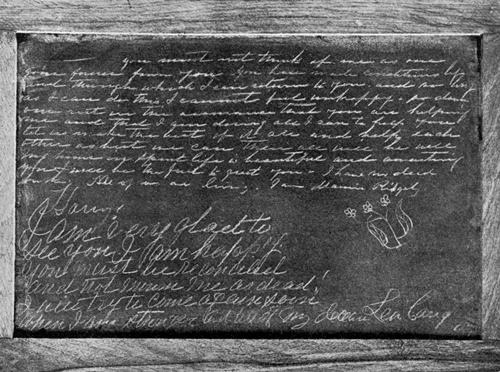
FIG. 4—SLATE WRITING.
He directed me to take my handkerchief and tie the two slates on the table
tightly together, holding the slates in his hands as I did so. I laid the
slates on the table before me, and we waited. “I think we will succeed
this time in getting responses to some of the questions. Let us hold the
slates.” He grasped them with fingers and thumbs at one end, and I at the
other in like manner, holding the slates about two inches above the table.
We listened attentively, and soon was heard the scratching noise of a
slate pencil moving upon a slate. The sound seemed directly under the
slate, and was sufficiently impressive to startle any person making a
slate test for the first time, and unacquainted with the multifarious
devices of the sleight-of-hand artist.
“Hold the slates tightly, please!” said Mr. Keeler, as a convulsive
tremor shook his hands. I grasped firmly my end of the slates, and waited
further developments. The faint tap of a slate pencil upon a slate was
heard, and the medium announced that the communications were finished. I
untied the handkerchief, and turned up the inner surfaces of the slates.
Upon one of them several messages were written, and signed. Other
communications were received during the sitting. After the first messages
were received, and while I was engaged in reading them, Keeler quickly
picked up a slate from the floor, clapped it upon the clean slate
remaining on the table, and requested me to tie the two rapidly together
with my handkerchief before the influence was lost. At a signal from him I
unfastened the slates and found another set of answers. The same
proceeding was gone through for the third set. The imitation of a pencil
writing upon a slate was either made by the apparatus, described in the
séance with C— in the first part of this chapter, or by some other
contrivance; more than likely by simply scratching with his finger on the
under surface of the slate. While my attention was absorbed in the act of
writing my second set of questions, he prepared answers to two of my first
set and substituted a prepared slate for the cleaned slate on the table.
I was sure he was writing under the table; I heard the faint rubbing of a
soft bit of pencil upon the surface of a slate. His hands were in his lap
and his eyes were fixed downwards. Several times I saw him put his
fingers into his vest pockets, and he appeared to bring up small particles
of something, which I believe were bits of the white and colored crayons
used in writing the messages. His quiet audacity was surprising. I give
below the questions and answers with my comments thereon:
First Slate. Fig. 4.
QUESTION.
To Mamie:—
Tell me the name of your dead brother?
(Signed) Harry R. Evans.
ANSWER.
You must not think of me as one gone forever from you. You have made
conditions by and through which I can return to you, and so long as I can
do this I can not feel unhappy. So dear one, rest in the assurance that
you are helping me, and that I am doing all I can to help you. Let us make
the best of it all and help each other as best we can, then all will be
well. My home in spirit life is beautiful and awaiting you. I will be the
first to greet you. I have no dead brother. All of us are living. I am
Mamie —. (The medium here cleverly evades giving a name by an equivoque.)
QUESTION.
To Len—
Tell me the cause of your death, and the circumstances surrounding it?
(Signed) Harry R. Evans.
ANSWER.
Harry! I am very glad to see you. I am happy. You must be reconciled, and
not mourn me as dead! I will try to come again soon, when I am stronger
and tell of my decease.—Len. (He again evades an answer.)
Second Slate. Fig. 5.
QUESTION.
To A. D. B.—
When and where did you die?
(Signed) Harry R. Evans.
ANSWER.
This all seems so strange coming back and writing just as one would if
they were in the earth life and communicating with a friend. What a
blessed privilege it is. I am so happy. Oh, I would not come back. It is
so restful here. No pain or sorrow. Dear, do not think I have forgotten
you, I constantly think of you and wish that you, too, might view these
lovely scenes of glorious beauty. You must rest with the thought that when
your life is ended upon the earth, I will be the first to meet you. Now
be patient and hopeful until we meet where there is no more parting. I am
sincerely, A. D. B. (No answer at all.) Observe error in first sentence:
“as one would if they were—.” A. D. B. was an educated gentleman, and
not given to such ungrammatical expressions.
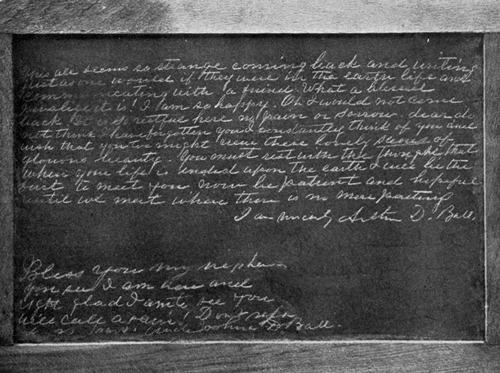
FIG. 5—SLATE WRITING.
Third Slate. Fig. 6.
QUESTION.
To B. G.—
Can you recall any of the conversations we had together on the B. and P.
R. R. cars?
(Signed) H. R. Evans.
ANSWER.
O my dear one, I can only write a few lines that you may know that I see
and hear you as you call upon me. I do not forget you. When I am stronger
will come again. I do not know what conversation you refer to in the cars.
B. G.
(Again evades answering. B. G. was very much interested in the drama, and
talked continuously about the stage.)
QUESTION.
To C. J.—
Where did you die, and from what disease?
(Signed) H. R. Evans.
ANSWER.
I know the days and weeks seem long and lonely to you without me. I do not
forget you; am doing the best I can to help you.
C. J.—.
(Still another evasion of a straightforward question. The lady in spirit
life to whom the question was addressed died of consumption in a Roman
Catholic Convent. She was only a society acquaintance of the writer, and
not on such terms of intimacy as to warrant Mr. Keeler’s reply.)
In one corner of Slate No. 2 was the following, written with a yellow
crayon: “This is remarkable. How did you know we could come?—H. K.
Evans.” Scrawled across the face of Slate No. 3, in red pencil, was a
communication from George Christy, Mr. Keeler’s spirit control, reading as
follows: “Many are here who——G. C. (George Christy)” (The remainder is
so badly written, as to be indecipherable.)
On carefully analyzing the various communications it will be observed that
the handwriting of the messages from Mamie—and B G.—are similar,
possessing the same characteristics as regards letter formation, etc. It
does not require a professional expert in chirography to detect this fact.
One and the same person wrote the messages purporting to come from Mamie
R—, Len—, B. G.—, C. J.—, and A. D. B. In fact, the writing on all
the slates is, in my opinion, the work of Mr. Pierre Keeler.
The longer communications were doubtless prepared beforehand, being
general in nature and conveying about the same information that any
departed spirit might give to any inquiring mortal, but, as will be
observed, giving no adequate answers to the queries, with the exception
of the last two sentences, which were written by the medium, after he
became acquainted with the tenor of the questions upon the folded slips.
The very short communications are written in a careless hand, such as a
man would dash off hastily. There is an attempt at disguise, but a clumsy
one, the letters still retaining the characteristics of the more
deliberate chirography of the long communications. A close inspection of
the slates reveals the exact similarity of the y’s, u’s, I’s, g’s, h’s,
m’s and n’s.
The handwriting of messages on slates should be, and is claimed to be,
adequate evidence of the genuineness of the communication, for are we not
supposed to know the handwriting of our friends?
Possibly Mr. Keeler would claim that the handwriting was the work of his
control “Geo. Christy”, who acted as a sort of amanuensis for the spirits.
If this be so, why the attempts at disguise, and bungling attempts at
that?
In the séance with Mr. Keeler, I subjected him to no tests. He had
everything his own way. I should have brought my own marked slates with
me and never let them out of my sight for an instant. I should have
subjected the table to a close examination, and requested the medium to
move or rather myself removed the collection of slates against the mantel,
placed so conveniently within his reach. I did not do this, because of
his well known irascibility. He would probably have shown me the door and
refused a sitting on any terms, as he has done to many skeptics. I was
anxious to meet Keeler, and preferred playing the novice rather than not
get a slate test from one of the best-known and most famous of modern
slate-writing mediums.
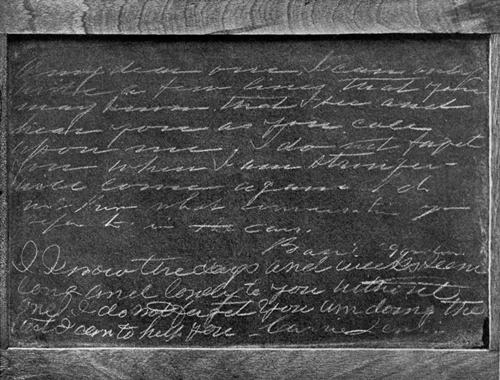
FIG. 6—SLATE WRITING.
After what has been stated, I think there can be no shadow of doubt that
the medium abstracted by sleight-of-hand some of the paper slips
containing my written questions, read them under cover of the table, and
did the slate-writing himself. All of these slate-tests, where pellets or
slips of paper are used, are performed in a similar manner, as will be
seen from the exposé published by the Society for Psychical Research. In
vol. viii of the proceedings of that association will be found a number of
revelations, one of which throws considerable light on the Keeler tests.
The sitter was Dr. Richard Hodgson, and the medium was a Mrs. Gillett.
Says Dr. Hodgson:
“Under pretence of ‘magnetising’ the pellets prepared by the sitter, or
folding them more tightly, she substitutes a pellet of her own for one of
the sitter’s. Reading the sitter’s pellet below the table, she writes the
answer on one of her own slates, a pile of which, out of the sitter’s
view, she keeps on a chair by her side. She then takes a second slate,
places it on the table, and sponges and dries both sides, after which she
takes the first slate, and turning the side upon which she has written
towards herself, rubs it in several places with a dry cloth or the ends of
her fingers as though cleaning it. She then places it, writing downward,
on the other slate on the table, and sponges and dries the upper surface
of it. She then pretends to take one of the pellets on the table and put
it between the two slates. What she does, however, is to bring the pellet
up from below the table, take another of the sitter’s pellets on the table
into her hand, and place the pellet which she has brought up from below
the table between the slates, keeping in her hand the pellet just taken
from the top of the table. The final step is to place a rubber band round
both slates, in doing which she turns both slates over together. She
professes to get the writing without the use of any chalk or pencil. Some
of her slates are prepared beforehand with messages or drawings. More
interesting, perhaps, because of its boldness, is her method of producing
writing on the sitter’s own slates. Under the pretence of ‘magnetising’
these she cleans them several times, rubs them with her hands, stands them
up on end together, and while they are in this position between herself
and the sitter she writes with one hand on the slate-side nearest to
herself, holding the slates erect with the other hand. Later on, she lays
both slates together flat on the table again, the writing being on the
undermost surface. She then sponges the upper surface of the top slate,
turns it over, and sponges its other surface. She next withdraws the
bottom slate, places it on top and sponges its top surface, keeping its
under surface carefully concealed. The final step, the reversal, is made,
as in the other case, with the help of the rubber band. Mrs. Gillett has
probably other methods, also. Those which I have described were all that I
witnessed at my single sitting with her.”
My friend, Dr. L. M. Taylor, of Washington, D. C., an investigator of
Spiritualistic phenomena, and skeptical like myself of the objective
phases of the subject, has had many sittings with Keeler for independent
slate-writing. One séance in particular he is fond of relating:
“On one occasion, after I had written my slips, folded them up, and tossed
them on the table, I said to Keeler who was obtaining his ‘psychic’
impression of them, ‘I wish, if possible, to have a spirit tell me the
numbers and the maker’s name engraved in my watch. I have never taken the
trouble to look at the numbers, consequently I do not know them.’ ‘Your
request is an unusual one,’ replied the medium, ‘but I will endeavor to
gratify it.’ We had some conversations on the subject that lasted several
minutes. Suddenly he picked up a slate pencil, and scrawled the name, J.
S. Granger on the upper surface of one of my slates; the two slates had
been previously tied together with my handkerchief and laid on the table
in front of me. ‘You recognize that name, do you not?’ asked Keeler.
‘Yes,’ I replied, ‘that is one of the names I wrote on the slips. J. S.
Granger was an old friend of mine who died some years ago. He was a
brother-in-law of Stephen A. Douglass.’ ‘If you wish to facilitate
matters,’ said Keeler, ‘place your watch on top of the slates, concealed
beneath the handkerchief, otherwise we may have to wait an hour or more
without obtaining results, and there are a number of persons waiting for
me in the ante-room. My time you see is limited.’
“I detached my watch from its chain, and placed it in the required
position. Keeler then took a piece of black cloth, used to clean slates,
and laid it over my slates. Finally he requested me to take the covered
slates and hold them in my lap. I took care to feel through the cloth that
the watch was still beneath the handkerchief. In a short time I was
directed to uncover the slates, and untie them, which I did. Upon the
inner surface of one of the slates the following message was written:
‘Dear Friend, Stephen is with me. I have been through that beautiful watch
of yours, and, if I see correctly, the number is 163131. On the inside I
see this—E. Howard & Co., Boston, 211327. And then your name as follows:
Dr. L. M. Taylor, 1221 Mass. Ave., N. W., Washington, D. C. Signed J. M.
Granger.’
“I then compared the name and numbers in my watch with those on the slate,
and found the latter correct, with the exception of one number. A relative
of mine was present in the room during this séance, and I showed her the
communication on the slate. Afterwards we passed the slate to Keeler who
examined it closely. When he handed it back to me, I was surprised to see
that the incorrect number was mysteriously changed to the proper one.”
This is a very interesting test, indeed, because of its apparently
impromptu character. I have seen similar feats performed by professional
conjurers as well as mediums. A dummy watch is substituted for the
sitter’s watch, and after the medium has ascertained the name and numbers
on the sitter’s timepiece, he succeeds in adroitly exchanging it again for
the dummy, thanks to the black cloth. The writing on the slate in the
above séance was evidently produced in the same way as that described in
my sitting with Keeler, after he had ascertained the name on the slip. The
name of Stephen, of course, was directly obtained from Dr. Taylor. Not
having been an eye witness of Keeler’s movements in the watch test, I am
unable to say how closely Dr. Taylor’s description coincides with the
medium’s actual operations.
In May, 1897, Mr. Pierre Keeler was in Washington, D. C., as usual. My
friend, Dr. Taylor, who was desirous of putting the medium to another
crucial test, wrote down a list of names on a sheet of paper—cognomens of
ancient Egyptian, Chaldean, and Grecian priests and philosophers—folded
the paper, and carefully sealed it in an envelope. He took ten slates with
him, all of them marked with a private mark of his own. Mr. Keeler eyed
the envelope dubiously, but passed no criticisms on the doctor’s
precautions to prevent trickery. The two men sat down at a table and
waited for the spirits to manifest. Dr. Taylor, on this occasion, was
absolutely certain that his slates had not been tampered with, and that
the medium had not succeeded in opening the envelope. In a little while
the comedy of the pencil-scratching between the tied slates began.
“Ah”, exclaimed the physician, “a message at last!” Then he thought to
himself, “can the medium possibly have deluded my senses by some hypnotic
power, and adroitly opened that envelope without my being aware of the
fact? But no, that is impossible!”
Mr. Keeler took the slates away from Dr. Taylor, and quickly opened them,
accidentally dropping one of them behind the table. In a second,
however, he brought up the slate, and remarked: “How awkward of me. I beg
your pardon,” etc. On the surface of this slate was written the following
sentence: “See some other medium; d—n it!—George Christy.” Dr. Taylor is
positive, as he has repeatedly told me, that this message was not
inscribed on his own marked slate, but was written by the medium on one of
his own. The exchange, of course, must have been effected in the pretended
accidental dropping of the doctor’s slate by the medium. This is a very
old expedient among pretenders to spirit power. All conjurers are familiar
with the device. Imro Fox, the American magician, uses it constantly in
his entertainments, with capital effect.
Dr. Taylor, unfortunately, did not succeed in getting possession of the
medium’s prepared slate. Another exchange was undoubtedly made by Mr.
Keeler, and the physician had returned to him his own marked slate. When
he got home that afternoon, and had time to carefully scrutinize his
slates, he found that they bore no evidence of having been written upon
at all. Having also examined these slates, I am prepared to add my
testimony to that of Dr. Taylor.
The reader will see from the above-described séance that unless the medium
(or a confederate) is enabled to read the names and questions, prepared by
the sitter, his hands are practically tied in all experiments in
psychology.
When investigators bring their own marked slates with them, screwed
tightly together, and sealed, the medium has to adopt different tactics
from those employed in the tests before mentioned. He has to call in the
aid of a confederate. The audacity of the sealed-slate test is without
parallel in the annals of pretended mediumship. For an insight into the
secrets of this phase of psychography, the reading public is indebted to a
medium, the anonymous author of a remarkably interesting work,
“Revelations of a Spirit Medium.” Many skeptical investigators have been
converted to Spiritualism by these tests. They invariably say to you when
approached on the subject: “I took my own marked slates, carefully screwed
together, to the medium, and had lengthy messages written upon them by
spirit power. These slates never left my hands for a second.” I will
quote what the writer of “Revelations of a Spirit Medium” says on the
subject:
“No man ever received independent slate-writing between slates fastened
together that he did not allow out of his hands a few seconds. Scores of
persons will tell you that they have received writing under those
conditions through the mediumship of the writer; but the writer will tell
you how he fooled them and how you can do so if you see fit.
“In the first place you will rent a house with a cellar in connection. Cut
a trap-door one foot square through the floor between the sills on which
the floor is laid. Procure a fur floor mat with long hair. Cut a square
out of the mat and tack it to the top of the trap door. Tack the mat fast
to the floor, for some one may visit you who will want to raise it up.
“Explain the presence of the fur by saying it is an absorbent of magnetic
forces, through which you produce the writing. Over the rug place a heavy
pine table about four feet square; and over the table a heavy cover that
reaches the floor on all sides. Put your assistant in the cellar with a
coal-oil stove, a tea-kettle of hot water, different colored letter wax
and lead pencils, a screw driver, a pair of nippers, a pair of pliers, a
pair of scissors and an assortment of wire brads. You are ready for
business.
“When your sitter comes in you will notice his slates, if he brings a
pair, and see if they are secured in any way that your man in the cellar
can not duplicate. If they are, you can touch his slates with your finger
and say to him that you can not use his slates on account of the
‘magnetism’ with which they are saturated. He will know nothing of
‘magnetic conditions’ and will ask you what he is to do about it.
“You will furnish him a pair of new slates with water and cloths to clean
them. You also furnish him paper to write his questions on and the screws,
wax, paper and mucilage to secure them with. He will write his questions
and fasten the slates securely together.
“You now conduct him to your séance-room and invite inspection of your
table and surroundings. After the examination has been made you will seat
the sitter at one side of the table with his side and arm next it. If he
desires to keep hold of the slates a signal agreed upon between yourself
and your assistant will cause the spirit in the cellar to open the trap
door, which opens downwards, and to push through the floor and into
position where the sitter can grasp one end of it, a pair of dummy
slates. This dummy your assistant will continue to hold until the sitter
has taken hold of it after the following performance:
“Your assistant lets you know everything is ready by touching your foot.
You now reach and take the sitter’s slates and put them below the table,
and under it, telling the sitter to put his hand under from his side and
hold them with you. He puts his hand under and gets hold of the dummy
slates held by your assistant.
“Your assistant holds on until you have stood the slates on end, leaning
against the table leg, and have got hold of the dummy. He then takes the
sitter’s slates below and closes the trap. He proceeds to open them, read
the questions, answer them and refasten the slates.
“You will be entertaining your sitter by twitching and jerking and making
clairvoyant and clairaudient guesses for him.
“When your assistant touches your foot you will know that he is ready to
make the exchange again, by which the sitter will get hold of the slates
he fastened. When you get the signal you give a snort and jump that jerks
the end of the slates from the sitter’s hand. He is now given the end of
the slates held by your assistant, and you will allow the assistant to
take the dummy. After sitting a moment or two longer, you will tell the
sitter to take out his slates and examine them if he chooses. Many times
they do not open the slates until they reach their homes.
“This, reader, is the man who will declare that he furnished the slates
and did not allow them out of his hands a minute.
“The usual method of obtaining the writing is for the medium to hold the
slates alone. When this is the case the medium passes the slates below,
and receives in return a dummy which he is continually thumping on the
under side of the table for the purpose of showing the sitter that the
slates are there all the time.
“It is not necessary that you should use a cellar to get this phase of
‘independent slate-writing.’ You could place your table against a
partition door and by fitting one of the small panels with hinges and
bolts, would have a very convenient way of obtaining the assistance of the
spirit in the next room. It is also possible to make a trap in a room that
has a wooden wainscoting.”
Before closing this brief survey of slate-writing experiments, I must
describe an exceedingly ingenious trick, indeed, bordering on the
marvelous. It is the recent invention of a Western conjurer, and solves
the problem of actually writing between locked slates by physical means.
The effect is as follows: You request the sitter to take two slates, wash
them carefully, and tie them together, after first having placed a bit of
chalk between their surfaces. Hold them under the table for a minute, and
then hand them to the sitter for examination. A name, or a short sentence,
in answer to some question, will be found scrawled across the upper
surface of the bottom slate. It is accomplished in this way. You take a
small pellet of iron or steel, coat it with mucilage, and dip it into
chalk or slate-pencil dust. This dust will adhere and harden into a
consistent mass, after a little while, completely concealing the metal,
and causing the whole to resemble a bit of chalk. Take this supposed
pellet of chalk from your vest pocket and place it between the slates;
hold the latter level beneath a table, and by moving the poles of a strong
magnet against the surface of the under slate, you can cause the iron or
steel to write a name or sentence, thanks to its coating of chalk dust. It
is better to use slates with rather deep frames, in order that the chalked
metal may write with facility. It requires considerable practice to write
with ease in the manner described above. The first thing of course is to
locate the position of the chalk between the locked slates. To enable you
to do this, place the supposed chalk in one corner of slate No. 1 before
covering with slate No. 2, or else exactly in the center of slate No. 2.
In this way you will have no difficulty in affecting the metal with the
magnet, when the slates are held under the table. There are various ways
of holding the slates; one, is to ask the sitter to hold one end, while
you hold the other, five or six inches above the table. The light is put
out, and you take the magnet from your pocket and execute the writing. The
noise of the magnet passing over the surface of the under slate serves to
represent a disembodied spirit as doing the writing.
2. The Master of the Mediums.
One of the most remarkable personalities serving as an exponent of
Spiritualism was Daniel Dunglas Home, the Napoleon of necromancy, and the
Past Grand Master of Mediums. His career reads like a romance. He lived in
a sort of twilight land, and hob-nobbed with kings, queens and other
people of noble blood.
“Something unsubstantial, ghostly,
Seems this Theurgist,
In deep meditation mostly
Wrapped, as in a mist.
Vague, phantasmal and unreal,
To our thoughts he seems,
Walking in a world ideal,
In a land of dreams.”
He wound his serpentine way into the best society of London, Paris,
Berlin, Rome, and St. Petersburg—“always despising filthy lucre,” as
Maskelyn remarks, “but never refusing a diamond worth ten times the amount
he would have received in cash, or some present, which the host of the
house at which he happened to be manifesting always felt constrained to
offer.”
This thaumaturgist of the Nineteenth Century was born near Edinburg,
Scotland, on March 20, 1833, and came of a family reported to be gifted
with “second sight.” His father, William Home, was a natural son of
Alexander, tenth Earl of Home. Strange phenomena occurred during the
medium’s childhood. At the age of nine he was adopted by his aunt, Mrs.
McNeill Cook, who brought him to America. He began giving séances about
the year 1852. Among the notable men who attended these early “sittings”
were William Cullen Bryant, Professors Wells and Hare, and Judge Edmonds.
Home had a tall, slight figure, a fair and freckled face—before disease
made it the color of yellow wax—keen, slaty-blue eyes, thin bloodless
lips, a rather snub nose, and curly auburn hair. His manners, though
forward, were agreeable, and he recited such poetry as Poe’s “Raven” and
“Ulalume” with powerful effect. He was altogether a weird sort of
personage. His principal mediumistic manifestations were rappings,
table-tipping, ghostly materializations, playing on sealed musical
instruments, levitation, and handling fire with impunity.
In 1855 he launched his necromantic bark on European waters. No man since
Cagliostro ever created so profound a sensation in the Old World. He wrote
his reminiscences in two large volumes, but little credence can be given
them, as they are full of extravagant statements and wild fantasies.
The London Punch (May 9th, 1868), printed the following effusion on the
medium, a sort of parody on “Home, Sweet Home:”
Through realms Thaumaturgic the student may roam,
And not light on a worker of wonders like Home.
Cagliostro himself might descend from his chair,
And set up our Daniel as Grand-Cophta there—
Home, Home, Dan. Home,
No medium like Home.
Spirit legs, spirit hands, he gives table and chair;
Gravitation defying, he flies in the air;
But the fact to which henceforth his fame should be pinned,
Is his power to raise, not himself but the wind!—
Home, Home, Dan. Home,
No medium like Home.
Robert Browning made him the subject of his celebrated satirical poem,
“Mr. Sludge, the Medium.”
Some of the most celebrated scientific and literary personages of England
became interested in his mysterious abilities, and among his intimate
friends were the Earl of Dunraven, Mary Howitt, Mrs. S. C. Hall, Prof.
Wallace, and Sir Edward Bulwer-Lytton. There is good authority for
believing that Home was the mysterious Margrave of Bulwer’s weird novel,
“A Strange Story.” Bulwer was an ardent believer in the supernatural and
Home spent many days at Knebworth amid a select coterie of ghost-seers.
The famous novelist relates that as Home sat with him in the library of
Knebworth, conversing upon politics, social matters, books or other chance
topics, the chairs rocked and the tables were suspended in mid-air.
When the medium was requested to exert his power and found himself in
condition, it is alleged, he would rise and float about the room. This in
Spiritualistic parlance is termed “levitation”. At Knebworth and other
places, some of the most prominent people of the day claim to have seen
Home lift himself up and sail tranquilly out of a window, around the
house, and come in by another window.
The Earl of Dunraven told many stories equally strange of performances
that were given in his presence. The Earl declared that he had many times
seen Home elongate and shorten his body, and cause the closed piano to
play by putting his fingers on the lid.
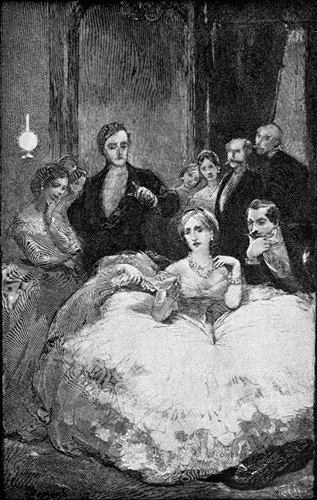
FIG. 7—HOME AT THE TUILERIES.
In the autumn of 1855 the famous medium went to Florence; there, also, the
spirit manifestations secured him the entree into the best society of
the old Italian city. In his memoirs he speaks of an incident occurring
through his mediumship, at a séance given in Florence: “Upon one occasion,
while the Countess C— was seated at one of Erard’s grand-action pianos,
it rose and balanced itself in the air, during the whole time she was
playing.” An English lady, resident at Florence, in a supposed haunted
house, procured the services of Home to exorcise the ghost. They sat at a
table in the sitting-room, and raps were heard proceeding from that piece
of furniture, and rustling sounds in the room as of a person moving about
in a heavy garment. The spirit being adjured in the name of the “Holy
Trinity” to leave the premises, the demonstrations ceased.
In February, 1856, the medium joined the retinue of Count B—, a Polish
nobleman, and went to Naples with his patron. From Naples to Rome was the
next step, and, in the Eternal City, the medium joined the Romish Church,
and was adjured by the Pope to abandon spirit séances forever. In 1858 we
find Home in St. Petersburg, where he married the youngest daughter of
General Count de Kroll, of Russia, and a goddaughter of the Emperor
Nicholas, the marriage taking place on Sunday, August 1, 1858, in the
private chapel attached to the house of the lady’s brother-in-law, the
Count Gregoire Koucheleff-Besborodko. It was a very notable affair, and
Alexander Dumas came from Paris to attend the ceremony. Home’s spirit
power which had left him since his conversion to the Roman Catholic faith
now returned in full force, it is said, and he saw standing near him at
the wedding the spirit form of his mother. In 1862 his wife died at the
Chateau Laroche, near Perigneux, France, and the medium repaired to Rome
for the purpose of studying sculpture. The reports of the spirit phenomena
constantly attending Home’s presence reached the ears of the Papal
authorities and he was compelled to leave the city, notwithstanding the
fact that he gave positive assurance that he would give no séance. He was
actually charged with being a sorcerer, like Cagliostro, an accusation
that reads very strange in the Nineteenth Century. This affair embittered
Home against the Church, and he abandoned Roman Catholicism for the Greek
Church.
After the Roman fiasco, the famous medium returned to England to give
Spiritualistic lectures and séances. A writer in “All the Year Round”,
gives the following pen picture of the medium, as he appeared in 1866:
“He is a tall, thin man, with broad square shoulders, suggestive of a suit
of clothes hung upon an iron cross. His hair is long and yellow; his teeth
are large, glittering and sharp; his eyes are a pale grey, with a redness
about the eye-lids, which comes and goes in a ghastly manner, as he talks.
When he shows his glittering sharp teeth, and that red line comes round
his slowly rolling eyes, he is not a pleasant sight to look upon. His
hands are long, white and bony, and on taking them you discover that they
are icy cold.” A suit of clothes hung upon an iron cross is a weird
touch in this pen picture.
Home about this time intended going upon the stage, but abandoned the idea
to become the secretary of the “Spiritual Atheneum”, a society formed for
the investigation of psychic phenomena.
One of the most notable passages in the life of the great medium was the
famous law suit in which he was concerned in England. In 1866 he became
acquainted with a wealthy lady, Mrs. Jane Lyons. In his role of medium she
consulted him constantly about the welfare of her husband in the spirit
world, and her business affairs. She gave him £33,000 for his services.
Relatives and friends of Mrs. Lyons, however, saw in Home a cunning
adventurer who was preying upon a weak-minded woman. A suit was instituted
against the medium to recover the money, and the case became a cause
celebre in the annals of the English courts.
In the autumn of 1871, Home, who before that time, had been quite a “lion”
at the court of Napoleon III and Eugene, followed the German army from
Sedan to Versailles, and was hand-in-glove with the King of Prussia. His
second marriage took place in October, 1871, at Paris, and after a brief
honeymoon in England he visited St. Petersburg with his wife, who was a
member of the noble Russian family of Alsakoff.
On the 21st of June, 1886, the great American ghost-seer died of
consumption, at Auteuil, near Paris, France. For years he was out of
health, and he ascribed his weakness to the expenditure of vital force in
working wonders during the earlier part of his career.
He was buried at St. Germain-en-Laye, with the rites of the Russian
Church. The funeral was a very simple one, not more than twenty persons
being present, all of whom were in full evening dress. The idea was to
emphasize the Spiritualists’ belief that death is not a subject for
mourning, but is liberation, an occasion for rejoicing.
The curious reader will find many accounts of Home’s invulnerability to
fire while in the trance state, notably those of Prof. Crookes, contained
in the proceedings of the Society for Psychical Research. In the March,
1868, number of “Human Nature,” Mr. H. D. Jencken writes as follows
concerning a séance given by the medium:
“Mr. Home, (after various manifestations) said, ‘we have gladly shown you
our power over fluids, we will now show you our power over solids.’ He
then knelt down before the hearth, and deliberately breaking up a glowing
piece of coal in the fire place, took up a largish lump of incandescent
coal and placing the same in his left hand, proceeded to explain that
caloric had been extracted by a process known to them (the spirits), and
that the heat could in part be returned. This he proved by alternately
cooling and heating the coal; and to convince us of the fact, allowed us
to handle the coal which had become cool, then suddenly resumed its heat
sufficient to burn one, as I again touched it. I examined Mr. Home’s hand,
and quite satisfied myself that no artificial means had been employed to
protect the skin, which did not even retain the smell of smoke. Mr. Home
then re-seated himself, and shortly awoke from his trance quite pale and
exhausted.”
Other witnesses of the above experiment were Lord Lindsay, Lord Adare,
Miss Douglas, Mr. S. C. Hall, Mr. W. H. Harrison and Prof. Wallace. Mr. H.
Nisbet, of Glasgow, relates (Human Nature, Feb. 1870) that in his own
home in January, 1870, Mr. Home took a red hot coal from the grate and put
it in the hands of a lady and gentleman to whom it felt only warm.
Subsequently he placed the same on a folded newspaper, the result being a
hole burnt through eight layers of paper. Taking another blazing coal he
laid it on the same journal, and carried it around the apartment for
upwards of three minutes, without scorching the paper.
Among the crowned heads and famous people before whom Mr. Home appeared
were Napoleon III and the Empress Eugénie, Queen Victoria, King Louis I
and King Maximilian of Bavaria, the Emperor of Russia, the King and Queen
of Wurtemberg, the Duchess of Hamilton, the Crown Prince of Prussia and
old Gen. Von Moltke. Alexander Dumas the elder, was a constant companion
of the medium for a long time, and wrote columns about him.
Napoleon III had two sittings with Home—and it is said Home materialized
the spirit of the first Napoleon, who appeared in his familiar cocked hat,
gray overcoat and dark green uniform with white facings. “My fate?” asked
Louis, trembling with awe. “Like mine—discrowned, and death in exile,”
replied the ghost; then it vanished. The Empress swooned and Napoleon III
fell back in his chair as if about to faint. The medium in his first
séance with the French Emperor succeeded only in materializing some
flowers and a spirit hand, which the Emperor was permitted to grasp.
Celia Logan, the journalist, in writing of one of Home’s séances at a
nobleman’s house in London, says:
“On this occasion the medium announced that he would produce balls of fire
and illuminated hands. Failing in the former, he declared that the spirits
were not strong enough for that to-night, and so he would have to confine
himself to showing the luminous hands.
“The house was darkened and Home groped his way alone to the head of the
broad staircase, where every few minutes a pair of luminous hands were
thrown up. The audience was satisfied generally. One lady, however, was
not, and whispered to me—she was a half-hearted Spiritualist—that it
looked to her as if he had rubbed his own hands over with lucifer
matches.
“The host stood near the mantel piece and had seen Home abstractedly place
a small bottle upon it when he left the room for the staircase. That
bottle the host quietly slipped into his pocket. Upon examination the next
day it was found to contain phosphorated olive oil or some similar
preparation.
“The host had declared himself to have seen Home float through the air
from one side of the room to the other, lift a piano several feet in the
air by simply placing a finger upon it, and had seen him materialize
disembodied spirits; but after the discovery of the phosphorus trick he
dropped Home at once.”
It is a significant fact that the medium while giving séances in Paris in
1857 refused to meet Houdin, the renowned prestidigitateur.
I shall now attempt an exposé of Home’s physical phenomena. Home’s
extraordinary feat of alternately cooling and heating a lump of coal taken
from a blazing fire, as related by Mr. H. D. Jencken and others, is easily
explained. It is a juggling trick. The “coal” is a piece of spongy
platinum which bears a close resemblance to a lump of half burnt coal, and
is palmed in the hand, as a prestidigitateur conceals a coin, a pack of
cards, an egg, or a small lemon. The medium or magician advances to the
grate and pretends to take a genuine lump of coal from the fire but brings
up instead, at the tips of his fingers, the piece of platinum. In a secret
breast pocket of his coat he has a small reservoir of hydrogen, with a
tube coming down the sleeve and terminating an inch or so above the cuff.
By means of certain mechanical arrangements, to enable him to let on and
off the gas at the proper moment, he is able to accomplish the trick; for
when a current of hydrogen is allowed to impinge upon a piece of spongy
platinum, the metal becomes incandescent, and as soon as the current is
arrested the platinum is restored to its normal condition.
The hand may be protected from burning in various ways, one method being
the repeated application of sulphuric acid to the skin, whereby it is
rendered impervious to the action of fire for a short period of time;
another, by wearing gloves of amianthus or asbestos cloth. With the
latter, worn in a badly lighted room, the medium, without much risk of
discovery, can handle red hot coals or iron with impunity. The gloves may
at the proper moment be slipped off and concealed about the person. A
small slip of amianthus cloth placed on a newspaper would protect it from
a hot coal and the same means could be used when a coal is placed in
another’s hand or upon his head.
As to the marvelous “levitation”, either the witnesses of the alleged feat
were under some hypnotic spell, or else they allowed their imaginations to
run riot when describing the event. In the case of Lord Lindsay and Lord
Adare, D. Carpenter in his valuable paper “On Fallacies Respecting the
Supernatural” (Contemporary Review, Jan., 1876) says: “A whole party of
believers affirm that they saw Mr. Home float out of one window and in at
another, while a single honest skeptic declares that Mr. Home was sitting
in his chair all the time.” It seems that there were three gentlemen
present besides the medium when the alleged phenomenon took place, the two
noblemen and a “cousin”. It is this unnamed hard-headed cousin to whom Dr.
Carpenter refers as the “honest skeptic.”
Many of Home’s admirers have declared that he possessed the power of
mesmerizing certain of his friends. These gentlemen were no doubt
hypnotized and related honestly what they believed they had seen. Again,
the expectancy of attention and the nervous tension of the average sitter
in spirit-circles tend to produce a morbidly impressible condition of
mind. Many mediums since Home’s day have performed the act of levitation,
but always in a dark room. Mr. Angelo Lewis, the writer on magic, reveals
an ingenious method by which levitation is effected. When the lights are
extinguished the medium—who, by the way, must be a clever
ventriloquist—removes his boots and places them on his hands.
“I am rising, I am rising, but pay no attention”, he remarks, as he goes
about the apartment, where the sitters are grouped in a circle about him,
and he lightly touches the heads of various persons. A shadowy form is
dimly seen and a smell of boot leather becomes apparent to the olfactory
senses of many present. People jump quickly to conclusions in such matters
and argue that where the feet of the medium are, his body must surely
be—namely, floating in the air. The illusion is further enhanced by the
performer’s ventriloquial powers. “I am rising! I am touching the
ceiling!” he exclaims, imitating the sound of a voice high up. When the
lights are turned up, the medium is seen (this time with his boots on his
feet) standing on tip-toe, as if just descended from the ceiling.
Sometimes before performing the levitation act, he will say, “In order to
convince any skeptic present, that I really float upwards, I will write
the initials of my name, or the name of some one present, on the
ceiling.” When the lights are raised, the letters are seen written on the
ceiling in a bold scrawling hand. How is it done? The medium has concealed
about him a telescopic steel rod, something like those Chinese fishing
rods at one time in vogue among modern disciples of Izaak Walton. This
convenient rod when not in use folds up in a very small compass, but when
it is shoved out to its full length, some three or four feet, with a bit
of black chalk attached, the writing on the ceiling is easily produced.
The magicians of ancient Egypt displayed their mystic rods as a part of
their paraphernalia, while the modern magi bear theirs in secret. A
tambourine, a guitar, a bell, or a spirit hand, rubbed with phosphorus,
may also be fixed to this ingenious appliance, and floated over the heads
of the spectators, and even a horn may be blown, through the hollow rod.
The materialization of a spirit hand which crept from beneath a
table-cover, and showed itself to the “believers,” was one of the most
startling things in the repertoire of D. D. Home, as it was in that of Dr.
Monck’s, an English medium. An explanation of Monck’s method of producing
the hand may, perhaps, throw some light on Home’s “materialization.” A
small dummy hand, artistically executed in wax, with the fingers slightly
bent, is fastened to a broad elastic band about three feet in length. This
band is attached to a belt about the performer’s waist and passes down his
left trouser leg, allowing the hand to dangle within the trouser a few
inches above the ankle. I must not forget to explain that to the wrist of
the hand is appended an elastic sleeve about five inches long. The medium
and two sitters take their seats at a square table, with an over-hanging
table-cloth. No one is allowed to be seated at the same side of the table
with the medium. This is an imperative condition.
“Diminish the light, please,” says the medium. Some one rises to lower the
gas to the required dim religious light necessary to all spirit séances.
“A little lower, please! Lower, lower still!” remarks the medium. Out the
light goes. “Dear, me, but this is vexatious! Somebody light it again and
be more careful!” he ejaculates. Under cover of the darkness the agile
operator crosses his left foot over his right knee, pulls down the wax
hand and fixes it to the toe of his boot by means of the elastic sleeve,
the apparatus being masked from the sitters by the table cloth until the
time comes for the spirit materialization. The three men place their
hands on the table and wait patiently for developments. Presently a rap is
heard under the table—disjointed knee of the medium,—and then mirabile
dictu! the table-cloth shakes and a delicate female hand emerges and
shows itself above the edge of the table. A guitar being placed close to
the fingers, they soon strum the strings, or rather appear to do so, the
medium being the deus ex machina. The cleverest part of the whole
performance is the fact that the medium never takes his hands from the
table. He quietly puts his left foot down on the floor and places his
right foot heavily on the false hand—off it comes from the left foot and
shoots up the trouser leg like lightning. The sitters may look under the
table but they see nothing.
An ingenious improvement has been made to this hand-test by an American
conjurer, one that enables the medium to produce the hand although his
feet are secured by the sitter. “Be kind enough, sir,” says the performer
to the investigator, “to place your feet on mine. If I should move my feet
ever so little, you would know it, would you not?” The sitter replies in
the affirmative. The medium, as soon as he feels the pressure of the
sitter’s feet, withdraws his right foot from a steel shape made in
imitation of the toe of his boot, and operates the spirit hand at his
leisure. After the sitting, he of course, inserts his right foot into the
shape and carries it off with him.
The production of spirit music was one of Home’s favorite experiments.
There are all sorts of ways of producing this music, the most ingenious of
which I give:
The apparatus consists of a small circular musical box, wound up by clock
work, and made to play whenever pressure is put upon a stud projecting a
quarter of an inch from its surface. This box is strapped around the right
leg of the medium just above his knee, and hidden beneath the trouser leg.
When not in use it is on the under side of the leg. On the table a musical
box is placed and covered with a soup tureen, or the top of a chafing
dish. When the spectators are seated, the medium works the concealed
musical box around to the upper part of his leg near the knee cap, and by
pressing the stud against the under surface of the table, starts the music
playing. In this way the second musical box seems to play and the acoustic
effect is perfect. Perhaps Home used a similar contrivance; Dr. Monck
did, and was caught in the act by the chief of the Detective Police.
Home during his séances on the Continent of Europe was accused of all
sorts of trickery. Some asserted that he had concealed about him a small
but powerful electric battery for producing certain illusions, mechanical
contrivances attached to his legs for making spirit raps, and last but not
least, as the medium states in his “Memoirs:” “they even accused me of
carrying a small monkey about with me, concealed, trained to perform all
sorts of ghostly tricks.”
People also accused him of obtaining a great deal of his information about
the spirits of the departed from tombstones like an Old Mortality, and
bribing family servants. A more probable explanation may be found perhaps
in telepathy.
There is one more phase of Home’s mediumship, the moving of heavy pieces
of furniture without physical contact, that must be spoken of. In
mentioning it, Dr. Max Dessoir, author of the “Psychology of
Conjuring,”[1] says: “We must admit that a few feats, such as those of
Prof. Crookes with Home, concerning the possibility of setting inanimate
objects in motion without touching them, appear to lie entirely outside
the sphere of jugglery.” In the year 1871, Prof. William Crookes, (now Sir
William Crookes) Fellow of the Royal Society, a very eminent scientist,
subjected Home to some elaborate tests in order to prove or disprove by
means of scientific apparatus the reality of phenomena connected with
variations in the weight of bodies, with or without contact. He declared
the tests to be entirely satisfactory, but ascribed the phenomena not to
spiritual agency, but to a new force, “in some unknown manner connected
with the human organization,” which for convenience he called the “Psychic
Force.” He said in his “Researches in the Phenomena of Spiritualism:” “Of
all the persons endowed with a powerful development of this Psychic Force,
and who have been termed ‘mediums’ upon quite another theory of its
origin, Mr. Daniel Dunglas Home is the most remarkable, and it is mainly
owing to the many opportunities I have had of carrying on my
investigations in his presence that I am enabled to affirm so conclusively
the existence of this force.” Prof. Crookes’ experiments were conducted,
as he says, in the full light, and in the presence of witnesses, among
them being the famous English barrister, Sergeant Cox, and the
astronomer, Dr. Huggins. Heavy articles became light and light articles
heavy when the medium came near them. In some cases he lightly touched
them, in others refrained from contact.
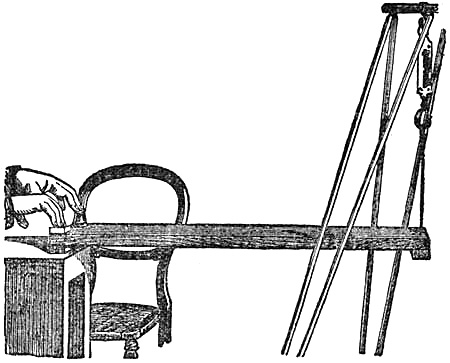
FIG. 8. CROOKES’ APPARATUS.
The first piece of the apparatus constructed by Crookes to test this
psychic force consisted of a mahogany board 36 inches long by 9½ inches
wide and 1 inch thick. A strip of mahogany was screwed on at one end, to
form a foot, the length being equal to the width of the board. This end of
the board was placed on a table, while the other end was upheld by a
spring balance, fastened to a strong tripod stand, as will be seen in
Fig. 8.
“Mr. Home,” writes Prof. Crookes, “placed the tips of his fingers lightly
on the extreme end of the mahogany board which was resting on the support,
whilst Dr. A. B. [Dr. Huggins] and myself sat, one on each side of it,
watching for any effect which might be produced. Almost immediately the
pointer of the balance was seen to descend. After a few seconds it rose
again. This movement was repeated several times, as if by successive waves
of the psychic force. The end of the board was observed to oscillate
slowly up and down during the experiment.
“Mr. Home now, of his own accord, took a small hand-bell and a little card
match-box, which happened to be near, and placed one under each hand, to
satisfy us, as he said, that he was not producing the downward pressure.
The very slow oscillation of the spring balance became more marked, and
Dr. A. B., watching the index, said that he saw it descend to 6½ lbs.
The normal weight of the board as so suspended being 3 lbs., the
additional downward pull was therefore 3½ lbs. On looking immediately
afterwards at the automatic register, we saw that the index had at one
time descended as low as 9 lbs., showing a maximum pull of 6 lbs. upon a
board whose normal weight was 3 lbs.
“In order to see whether it was possible to produce much effect on the
spring balance by pressure at the place where Mr. Home’s fingers had been,
I stepped upon the table and stood on one foot at the end of the board.
Dr. A. B., who was observing the index of the balance, said that the whole
weight of my body (140 lbs.) so applied only sunk the index 1½ lbs., or
2 lbs. when I jerked up and down. Mr. Home had been sitting in a low
easy-chair, and could not, therefore, had he tried his utmost, have
exerted any material influence on these results. I need scarcely add that
his feet as well as his hands were closely guarded by all in the room.”
The next series of experiments is thus described:
“On trying these experiments for the first time, I thought that actual
contact between Mr. Home’s hands and the suspended body whose weight was
to be altered was essential to the exhibition of the force; but I found
afterwards that this was not a necessary condition, and I therefore
arranged my apparatus in the following manner:—
“The accompanying cuts (Figs. 9, 10 and 11) explain the arrangement. Fig.
9 is a general view, and Figs. 10 and 11 show the essential parts more in
detail. The reference letters are the same in each illustration. A B is a
mahogany board, 36 inches long by 9½ inches wide, and 1 inch thick. It
is suspended at the end, B, by a spring balance, C, furnished with an
automatic register, D. The balance is suspended from a very firm tripod
support, E.
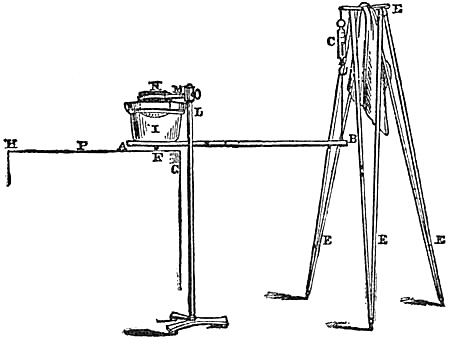
FIG. 9. CROOKES’ APPARATUS.
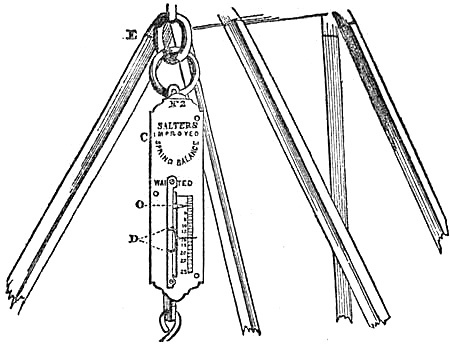
FIG. 10. CROOKES’ APPARATUS.
“The following piece of apparatus is not shown in the figures. To the
moving index, O, of the spring balance, a fine steel point is soldered,
projecting horizontally outwards. In front of the balance, and firmly
fastened to it, is a grooved frame, carrying a flat box similar to the
dark box of a photographic camera. This box is made to travel by
clock-work horizontally in front of the moving index, and it contains a
sheet of plate-glass which has been smoked over a flame. The projecting
steel point impresses a mark on this smoked surface. If the balance is at
rest, and the clock set going, the result is a perfectly straight
horizontal line. If the clock is stopped and weights are placed on the
end, B, of the board, the result is a vertical line, whose length depends
on the weight applied. If, whilst the clock draws the plate along, the
weight of the board (or the tension on the balance) varies, the result is
a curved line, from which the tension in grains at any moment during the
continuance of the experiments can be calculated.
“The instrument was capable of registering a diminution of the force of
gravitation as well as an increase; registrations of such a diminution
were frequently obtained. To avoid complication, however, I will here
refer only to results in which an increase of gravitation was experienced.
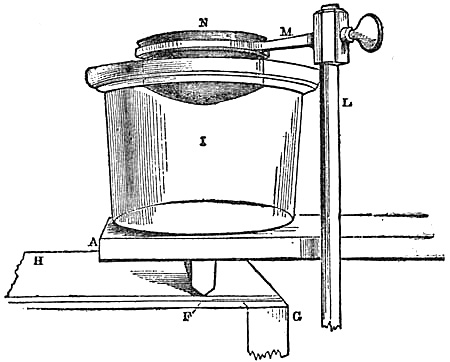
FIG. 11. CROOKES’ APPARATUS.
“The end, B, of the board being supported by the spring balance, the end,
A, is supported on a wooden strip, F, screwed across its lower side and
cut to a knife edge (see Fig. 11). This fulcrum rests on a firm and heavy
wooden stand, G H. On the board, exactly over the fulcrum, is placed a
large glass vessel filled with water. I L is a massive iron stand,
furnished with an arm and a ring, M N, in which rests a hemispherical
copper vessel perforated with several holes at the bottom.
“The iron stand is 2 inches from the board, A B, and the arm and copper
vessel, M N, are so adjusted that the latter dips into the water 1½
inches, being 5½ inches from the bottom of I, and 2 inches from its
circumference. Shaking or striking the arm, M, or the vessel, N, produces
no appreciable mechanical effect on the board, A B, capable of affecting
the balance. Dipping the hand to the fullest extent into the water in N
does not produce the least appreciable action on the balance.
“As the mechanical transmission of power is by this means entirely cut off
between the copper vessel and the board, A B, the power of muscular
control is thereby completely eliminated.
“For convenience I will divide the experiments into groups, 1, 2, 3, etc.,
and I have selected one special instance in each to describe in detail.
Nothing, however, is mentioned which has not been repeated more than once,
and in some cases verified, in Mr. Home’s absence, with another person,
possessing similar powers.
“There was always ample light in the room where the experiments were
conducted (my own dining-room) to see all that took place.
“Experiment I.—The apparatus having been properly adjusted before Mr.
Home entered the room, he was brought in, and asked to place his fingers
in the water in the copper vessel, N. He stood up and dipped the tips of
the fingers of his right hand in the water, his other hand and his feet
being held. When he said he felt a power, force, or influence, proceeding
from his hand, I set the clock going, and almost immediately the end, B,
of the board was seen to descend slowly and remain down for about 10
seconds; it then descended a little further, and afterwards rose to its
normal height. It then descended again, rose suddenly, gradually sunk for
17 seconds, and finally rose to its normal height, where it remained till
the experiment was concluded. The lowest point marked on the glass was
equivalent to a direct pull of about 5,000 grains. The accompanying
Figure 12 is a copy of the curve traced on the glass.
SCALE OF SECONDS.
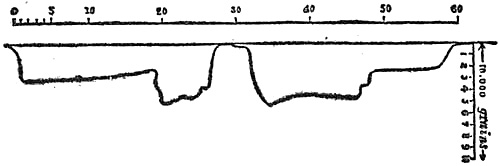
FIG. 12. DIAGRAM SHOWING TENSION IN CROOKES’ APPARATUS UNDER THE INFLUENCE OF HOME.
“Experiment II.—Contact through water having proved to be as effectual
as actual mechanical contact, I wished to see if the power or force could
affect the weight, either through other portions of the apparatus or
through the air. The glass vessel and iron stand, etc., were therefore
removed, as an unnecessary complication, and Mr. Home’s hands were placed
on the stand of the apparatus at P (Fig. 9). A gentleman present put his
hand on Mr. Home’s hands, and his foot on both Mr. Home’s feet, and I also
watched him closely all the time. At the proper moment the clock was again
set going; the board descended and rose in an irregular manner, the result
being a curved tracing on the glass, of which Fig. 13 is a copy.
SCALE THE SAME AS IN FIG. 12.
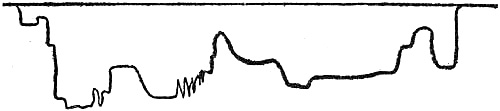
FIG. 13. DIAGRAM SHOWING TENSION IN CROOKES’ APPARATUS UNDER THE INFLUENCE OF HOME.
“Experiment III.—Mr. Home was now placed one foot from the board, A B,
on one side of it. His hands and feet were firmly grasped by a by-stander,
and another tracing, of which Fig. 14 is a copy, was taken on the moving
glass plate.
SCALE THE SAME AS IN FIG. 12.

FIG. 14. DIAGRAM SHOWING TENSION IN CROOKES’ APPARATUS UNDER HOME’S INFLUENCE.
“Experiment IV.—(Tried on an occasion when the power was stronger than
on the previous occasions), Mr. Home was now placed 3 feet from the
apparatus, his hands and feet being tightly held. The clock was set going
when he gave the word, and the end, B, of the board soon descended, and
again rose in an irregular manner, as shown in Fig. 15.
SCALE THE SAME AS IN FIG. 12.
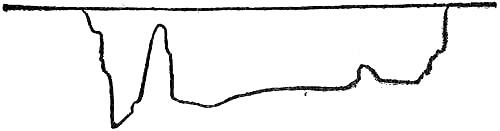
FIG. 15. DIAGRAM SHOWING TENSION IN CROOKES’ APPARATUS UNDER HOME’S INFLUENCE.
“The following series of experiments were tried with more delicate
apparatus, and with another person, a lady, Mr. Home being absent. As the
lady is non-professional, I do not mention her name. She has, however,
consented to meet any scientific men whom I may introduce for purposes of
investigation.
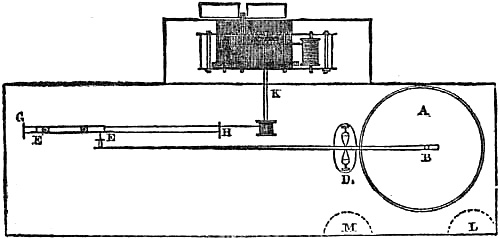
FIG. 16. SECOND CROOKES’ APPARATUS.
“A piece of thin parchment, A, (Figs. 16 and 17), is stretched tightly
across a circular hoop of wood. B C is a light lever turning on D. At the
end B is a vertical needle point touching the membrane A, and at C is
another needle point, projecting horizontally and touching a smoked glass
plate, E F. This glass plate is drawn along in the direction H G by
clockwork, K. The end, B, of the lever is weighted so that it shall
quickly follow the movements of the centre of the disc, A. These
movements are transmitted and recorded on the glass plate, E F, by means
of the lever and needle point, C. Holes are cut in the side of the hoop to
allow a free passage of air to the under side of the membrane. The
apparatus was well tested beforehand by myself and others, to see that no
shaking or jar on the table or support would interfere with the results:
the line traced by the point, C, on the smoked glass was perfectly
straight in spite of all our attempts to influence the lever by shaking
the stand or stamping on the floor.
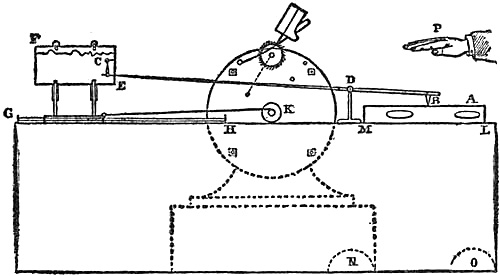
FIG. 17. SECTION OF APPARATUS IN FIG. 16.
“Experiment V.—Without having the object of the instrument explained to
her, the lady was brought into the room and asked to place her fingers on
the wooden stand at the points, L M, Fig. 16. I then placed my hands over
hers to enable me to detect any conscious or unconscious movement on her
part. Presently percussive noises were heard on the parchment, resembling
the dropping of grains of sand on its surface. At each percussion a
fragment of graphite which I had placed on the membrane was seen to be
projected upwards about 1-50th of an inch, and the end, C, of the lever
moved slightly up and down. Sometimes the sounds were as rapid as those
from an induction-coil, whilst at others they were more than a second
apart. Five or six tracings were taken, and in all cases a movement of the
end, C, of the lever was seen to have occurred with each vibration of the
membrane.
“In some cases the lady’s hands were not so near the membrane as L M, but
were at N O, Fig 17.
SCALE OF SECONDS.
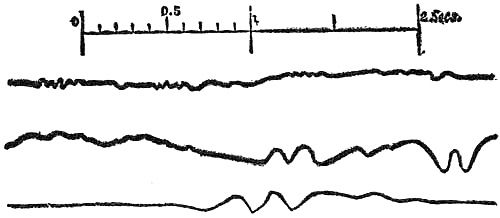
FIG. 18. DIAGRAM SHOWING TENSION IN CROOKES’ APPARATUS (FIG. 15 AND 16) OUTSIDE HOME’S INFLUENCE.
“The accompanying Fig. 18 gives tracings taken from the plates used on
these occasions.
“Experiment VI.—Having met with these results in Mr. Home’s absence, I
was anxious to see what action would be produced on the instrument in his
presence.
“Accordingly I asked him to try, but without explaining the instrument to
him.
“I grasped Mr. Home’s right arm above the wrist and held his hand over the
membrane, about 10 inches from its surface, in the position shown at P,
Fig. 17. His other hand was held by a friend. After remaining in this
position for about half a minute, Mr. Home said he felt some influence
passing. I then set the clock going, and we all saw the index, C, moving
up and down. The movements were much slower than in the former case, and
were almost entirely unaccompanied by the percussive vibrations then
noticed.
“Figs. 19 and 20 show the curves produced on the glass on two of these
occasions.
“Figs. 18, 19 and 20 are magnified.
“These experiments confirm beyond doubt the conclusions at which I
arrived in my former paper, namely, the existence of a force associated,
in some manner not yet explained, with the human organization, by which
force increased weight is capable of being imparted to solid bodies
without physical contact. In the case of Mr. Home, the development of this
force varies enormously, not only from week to week, but from hour to
hour; on some occasions the force is inappreciable by my tests for an hour
or more, and then suddenly reappears in great strength.
SCALE THE SAME AS IN FIG. 18.

FIG. 19. DIAGRAM SHOWING TENSION IN CROOKES’ APPARATUS (FIG. 16 AND 17) UNDER HOME’S INFLUENCE.
“It is capable of acting at a distance from Mr. Home (not unfrequently as
far as two or three feet), but is always strongest close to him.
SCALE THE SAME AS ON FIG. 18.
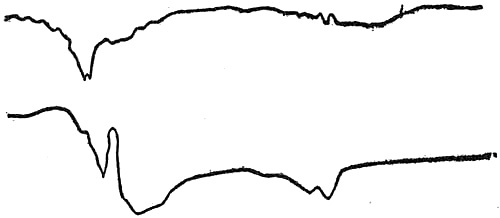
FIG. 20. DIAGRAM SHOWING TENSION IN CROOKES’ APPARATUS (FIG. 16 AND 17) UNDER HOME’S INFLUENCE.
“Being firmly convinced that there could be no manifestation of one form
of force without the corresponding expenditure of some other form of
force, I for a long time searched in vain for evidence of any force or
power being used up in the production of these results.
“Now, however, having seen more of Mr. Home, I think I perceive what it is
that this psychic force uses up for its development. In employing the
terms vital force or nervous energy, I am aware that I am employing
words which convey very different significations to many investigators;
but after witnessing the painful state of nervous and bodily prostration
in which some of these experiments have left Mr. Home—after seeing him
lying in an almost fainting condition on the floor, pale and speechless—I
could scarcely doubt that the evolution of psychic force is accompanied by
a corresponding drain on vital force.”
Sergeant Cox in speaking of the tests says, “The results appear to me
conclusively to establish the important fact, that there is a force
proceeding from the nerve-system capable of imparting motion and weight to
solid bodies within the sphere of its influence.”
One of the medium’s defenders has written:
“Home’s mysterious power, whatever it may have been, was very uncertain.
Sometimes he could exercise it, and at others not, and these fluctuations
were not seldom the source of embarrassment to him. He would often arrive
at a place in obedience to an engagement, and, as he imagined, ready to
perform, when he would discover himself absolutely helpless. After a
séance his exhaustion appeared to be complete.
“There is no more striking proof of the fact that Home really possessed
occult gifts of some sort—psychic force or whatever else the power may be
termed—than he gave such amazing exhibitions in the early part of his
history and was able to do so little toward the end. If it had been
juggling he would, like other conjurors, have improved on his tricks by
experience, or at all events, while his memory held out he would not have
deteriorated.”
Dr. Hammond’s Experiments.
Dr. William A. Hammond, the eminent neurologist, of Washington, D. C.,
took up the cudgels against Prof. Crookes’ “Psychic Force” theory, and
assigned the experiments to the domain of animal electricity. He wrote as
follows:[2] “Place an egg in an egg-cup and balance a long lath upon the
egg. Though the lath be almost a plank it will obediently follow a rod of
glass, gutta percha or sealing-wax, which has been previously well dried
and rubbed, the former with a piece of silk, and the two latter with
woolen cloth. Now, in dry weather, many persons within my knowledge, have
only to walk with a shuffling gait over the carpet, and then approaching
the lath hold out the finger instead of the glass, sealing wax or gutta
percha, and instantly the end of the lath at L rises to meet it, and the
end at L is depressed. Applying these principles, I arranged an apparatus
exactly like that of Prof. Crookes, except that the spring balance was
such as is used for weighing letters and was therefore very delicate,
indicating quarter ounces with exactness, and that the board was thin and
narrow.
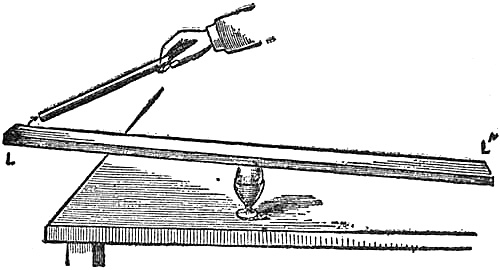
FIG. 21. DR. HAMMOND’S APPARATUS.
“Applying the glass rod or stick of sealing-wax to the end resting by its
foot on the table, the index of the balance at once descended, showing an
increased weight of a little over three quarters of an ounce, and this
without the board being raised from the table.
“I then walked over a thick Turkey rug for a few moments, and holding my
finger under the board near the end attached to the balance, caused a fall
of the index of almost half an ounce. I then rested my finger lightly on
the end of the board immediately over the foot, and again the index
descended and oscillated several times, just as in Mr. Home’s experiments.
The lowest point reached was six and a quarter ounces, and as the board
weighed, as attached to the balance, five ounces, there was an increased
weight of one and a quarter ounces. At no time was the end of the board
raised from the table.
“I then arranged the apparatus so as to place a thin glass tumbler nearly
full of water immediately over the fulcrum, as in Mr. Crookes’ experiment,
and again the index fell and oscillated on my fingers being put into the
water.
“Now if one person can thus, with a delicate apparatus like mine, cause
the index, through electricity, to descend and ascend, it is not
improbable that others, like Mr. Home, could show greater, or even
different electrical power, as in Prof. Crookes’ experiments. It is well
known that all persons are not alike in their ability to be electrically
excited. Many persons, myself among them, can light the gas with the end
of the finger. Others cannot do it with any amount of shuffling over the
carpet.
“At any rate is it not much more sensible to believe that Mr. Home’s
experiments are to be thus explained than to attribute the results of his
semi-mysterious attempts to spiritualism or psychic force?”
3. Rope-Tying and Holding Mediums.
THE DAVENPORT BROTHERS.
Ira Erastus and William Henry Davenport were born at Buffalo, N. Y., the
former on Sept. 17, 1839, and the latter on February 1, 1841. Their
father, Ira Davenport, was in the police detective department, and, it is
alleged, invented the celebrated rope-tying feats after having seen the
Indian jugglers of the West perform similar illusions. The usual stories
about ghostly phenomena attending the childhood of mediums were told about
the Davenport Brothers, but it was not until 1855 that they started on
their tour of the United States, with their father as showman or
spiritual lecturer. When the Civil War broke out, the Brothers,
accompanied by Dr. J. B. Ferguson, formerly an Independent minister of
Nashville, Tenn., in the capacity of lecturer, and a Mr. Palmer as general
agent and manager, went to England to exhibit their mediumistic powers,
following the example of D. D. Home. With the company also was a Buffalo
boy named Fay, of German-American parentage, who had formerly acted as
ticket-taker for the mediums. He discovered the secret of the rope-tying
feat, and was an adept at the coat feat, so he was employed as an
“under-study” in case of the illness of William Davenport, who was in
rather delicate health. The Brothers Davenport at this period, aged
respectively 25 and 23 years, had “long black curly hair, broad but not
high foreheads, dark eyes, heavy eye-brows and moustaches, firm set lips,
and a bright, keen look.” Their first performance in England was given at
the Concert Rooms, Hanover Square, London, and created intense excitement.
Punch called the furore over the spirit rope-tyers the “tie-fuss
fever,” and said the mediums were “Ministers of the Interior, with a seat
in the Cabinet.” J. N. Maskelyne, the London conjurer of Egyptian Hall,
wrote of them: “About the Davenport Brothers’ performances, I have to say
that they were and still remain the most inexplicable ever presented to
the public as of spiritual origin; and had they been put forth as feats of
jugglery would have awakened a considerable amount of curiosity though
certainly not to the extent they did.”
In September, 1865, the Brothers arrived in Paris, and placarded the city
with enormous posters announcing that the Brothers Davenport,
spirit-mediums, would give a series of public séances at the Salle Herz.
Their reputation had preceded them to France and the boulevardiers
talked of nothing but the wonderful American mediums and their mysterious
cabinet. Before exhibiting in Paris the Davenports visited the Chateau de
Gennevilliers, whose owner was an enthusiastic believer in Spiritism, and
gave a séance before a select party of journalists and scientific men. The
exhibition was pronounced marvellous in the extreme and perfectly
inexplicable.
The Parisian press was divided on the subject of the Davenports and their
advertised séances. Some of the papers protested against such performances
on the ground that they were dangerous to the mental health of the
public, and, one writer said, “Particularly to those weaker intellects
which are always ready enough to accept as gospel the tricks and artifices
of the adepts of sham witchcraft.” M. Edmond About, the famous journalist
and novelist, in the Opinion Nationale, wrote a scathing denunciation of
Spiritism, but all to no purpose, except to inflame public curiosity.
The performances of the Davenports were divided into two parts: (1) The
light séance, (2) the dark séance. In the light séance a cabinet, elevated
from the stage by three trestles, was used. It was a simple wooden
structure with three doors. In the centre door was a lozenge-shaped window
covered with a curtain. Upon the sides of the cabinet hung various musical
instruments, a guitar, a violin, horns, tambourines, and a big dinner
bell.
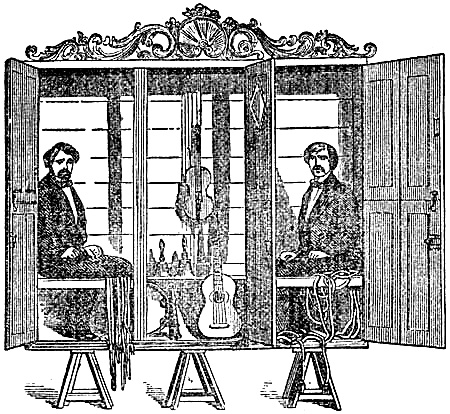
FIG. 22. THE DAVENPORT BROTHERS IN THEIR CABINET.
A committee chosen by the audience tied the mediums’ hands securely behind
their backs, fastened their legs together, and pinioned them to their
seats in the cabinet, and to the cross rails with strong ropes. The side
doors were closed first, then the center door, but no sooner was the last
fastened, than the hands of one of the mediums were thrust through the
window in the centre door. In a very short time, at a signal from the
mediums, the doors were opened, and the Davenports stepped forth, with the
ropes in their hands, every knot untied, confessedly by spirit power. The
astonishment of the spectators amounted to awe. On an average it took ten
minutes to pinion the Brothers; but a single minute was required for their
release. Once more the mediums went into the cabinet, this time with the
ropes lying in a coil at their feet. Two minutes elapsed. Hey, presto! the
doors were opened, and the Davenports were pronounced by the committee to
be securely lashed to their seats. Seals were affixed to the knots in the
ropes, and the doors closed as before. Pandemonium reigned. Bells were
rung, horns blown, tambourines thumped, violins played, and guitars
vigorously twanged. Heavy rappings also were heard on the ceiling, sides
and floor of the cabinet, then after a brief but absolute silence, a bare
hand and arm emerged from the lozenge window, and rung the big dinner
bell. On opening the doors the Brothers were found securely tied as
before, and seals intact. An amusing feature of the exhibition occurred
when a venturesome spectator volunteered to sit inside of the cabinet
between the two mediums. He came out with his coat turned inside out and
his hat jammed over his eyes. In the dark séance the cabinet was dispensed
with and the spectators, holding hands, formed a ring around the mediums.
The lights were put out and similar phenomena took place, with the
addition of luminous hands, and musical instruments floating in the air.
Robert-Houdin wrote an interesting brochure on the Davenports, (“Secrets
of Stage Conjuring,” translated by Prof. Hoffmann) from which I take the
following: “The ropes used by the Davenport Brothers are of a cotton
fibre; and they present therefore smooth surfaces, adapted to slip easily
one upon another. Gentlemen are summoned from the audience to tie the
mediums. Now, tell me, is it an easy task for an amateur to tie a man up
off-hand with a rope three yards long, in a very secure way? The amateur
is flurried, self-conscious, anxious to acquit himself well of the
business, but he is a gentleman, not a brute, and if one of the Brothers
sees the ropes getting into a dangerous tangle, he gives a slight groan,
as if he were being injured, and the instantaneous impulse of the other
man is to loosen the cord a trifle. A fraction of an inch is an invaluable
gain in the after-business of loosening the ropes. Sometimes the
stiffening of a muscle, the raising of a shoulder, the crooking of a knee,
gives all the play required by the Brothers in ridding themselves of their
bonds. Their muscles and joints are wonderfully supple, too; the thumbs
can be laid flat in the palm of the hand, the hand itself rounded until it
is no broader than the wrist, and then it is easy to pull through. Violent
wrenches send the ropes up toward the shoulder, vigorous shakings get the
legs free; the first hand untied is thrust through the hole in the door of
the cabinet, and then returns to give aid to more serious knots on his own
or his brother’s person. In tying themselves up the Davenports used the
slip-knot, a sort of bow, the ends of which have only to be pulled to be
tightened or loosened.”
This slip-knot is a very ingenious affair. (See Fig. 23.) In performing
the spirit-tying, the mediums went into the cabinet with the ropes
examined by the audience lying coiled at their feet. The doors were
closed. They had concealed about their persons ropes in which these trick
knots were already adjusted, and with which they very speedily secured
themselves, having first secreted the genuine ropes. Then the doors were
opened. Seals were affixed to the knots, but this sealing, owing to the
position of the hands, and the careful exposition of the knots did not
affect the slipping of the ropes sufficiently to prevent the mediums from
removing and replacing their hands.
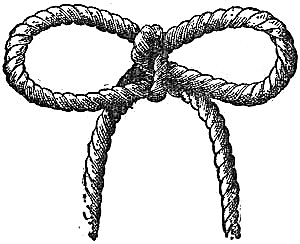
NO. 23. TRICK-TIE IN CABINET WORK.
In the dark séance, flour was sometimes placed in the pinioned hands of
the Davenports. On being released from their bonds, the flour was found
undisturbed.
This was considered a convincing test; for how could the Brothers possibly
manipulate the musical instruments with their hands full of flour. One day
a wag substituted a handful of snuff for flour, and when the mediums were
examined, the snuff had disappeared and flour taken its place. As will be
understood, in the above test the Davenports emptied the flour from their
hands into secret pockets and at the proper moment took out cornucopias of
flour and filled their hands again before securing themselves in the
famous slip-knots.
Among the exposés of the Brothers Davenport, Herrmann, the conjurer, gives
the following in the Cosmopolitan Magazine: “The Davenports, for
thirteen years, in Europe and America, augmented the faith in
Spiritualism. Unfortunately for the Davenports they appeared at Ithaca,
New York, where is situated Cornell University. The students having a
scientific trend of mind, provided themselves before attending the
performance with pyrotechnic balls containing phosphorus, so made as to
ignite suddenly with a bright light. During the dark séance when the
Davenports were supposed to be bound hand and foot within the closet and
when the guitars were apparently floating in the air, the students struck
their lights, whereupon the spirits were found to be no other than the
Davenports themselves, dodging about the stage brandishing guitars and
playing tunes and waving at the same time tall poles surmounted by
phosphorescent spook pictures.”
The Davenports had some stormy experiences in Paris, but managed to come
through all successfully, with plenty of French gold in their pockets.
William died in October, 1877, at the Oxford Hotel, Sydney, Australia,
having publicly denounced Spiritualism. Mr. Fay took to raising sheep in
Australia, while Ira Davenport drifted back to his old home in Buffalo,
New York.
Many mediums, taking the cue from the Davenports, have performed the
cabinet act with its accompanying rope-tying, but the conjurers
(anti-spiritists) have, with the aid of mechanism, brought the business to
a high degree of perfection, notably Mr. J. Nevil Maskelyne, of Egyptian
Hall, London, and Mr. Harry Kellar, of the United States. Writing of the
Davenport Brothers, Maskelyne says:
“The instantaneous tying and untying was simply marvellous, and it utterly
baffled everyone to discover, until, on one occasion, the accidental
falling of a piece of drapery from a window (the lozenge-shaped aperture
in the door of the cabinet), at a critical moment let me into the secret.
I was able in a few months to reproduce every item of the Davenports’
cabinet and dark séance. So close was the resemblance to the original,
that the Spiritualist had no alternative but to claim us (Maskelyne and
Cooke) as most powerful spirit mediums who found it more profitable to
deny the assistance of spirits.”
Robert-Houdin’s explanation of the slip-knot, used by the Davenports in
their dark séance, is the correct one, but he failed to fathom the mystery
of the mode of release of the Brothers after they were tied in the cabinet
by a committee selected from the audience. Anyone trying to extricate
himself from bondage a la Houdin, no matter how slippery and serpentine
he be, would find it exceedingly difficult. It seems almost incredible,
but trickery was used in the light séance, as well as the dark. Maskelyne,
as quoted above, claimed to have penetrated the mystery, but he kept it a
profound secret—though he declared that his cabinet work was trickery.
The writer is indebted for an initiation into the mysteries of the
Davenport Brothers’ rope-tying to Mr. H. Morgan Robinson (Professor
Helmann), of Washington, D. C., a very clever prestidigitateur.
In the year 1895, after an unbroken silence of nineteen years, Fay,
ex-assistant of the Davenports, determined to resume the profession of
public medium. He abandoned his sheep ranch and hunted up Ira Davenport.
They gave several performances in Northern towns, and finally landed at
the Capital of the Nation, in the spring of 1895, and advertised several
séances at Willard’s Hall. A very small audience greeted them on their
first appearance. Among the committee volunteering to go on the stage and
tie the mediums were the writer and Mr. Robinson. After the séance the
prestidigitateur fully explained the modus operandi of the mystic tie,
which is herein for the first time correctly given to the public.
The medium holds out his left wrist first and has it tied securely, about
the middle of the rope. Two members of the committee are directed to pull
the ends of the cord vigorously. “Are you confident that the knots are
securely tied?” he asks; when the committee respond “yes,” he puts his
hand quickly behind him, and places against the wrist, the wrist of his
right hand, in order that they may be pinioned together. During this rapid
movement he twists the rope about the knot on his left wrist, thereby
allowing enough slack cord to disengage his right hand when necessary. To
slip the right hand back into place is an easy matter. After both hands
are presumably tied, the medium steps into the cabinet; the ends of the
rope are pushed through two holes in the chair or wooden seat, by the
committee and made fast to the medium’s legs. Bells ring, horns blow, and
the performer’s hand is thrust through the window of the cabinet. Finally
a gentleman is requested to enter the cabinet with the medium. The doors
are locked and a perfect pandemonium begins; when they are opened the
volunteer assistant tumbles out in great trepidation. His hat is smashed
over his eyes, his cravat is tied around his leg, and he is found to have
on the medium’s coat, while the medium wears the gentleman’s coat turned
inside out. It all appears very remarkable, but the mystery is cleared up
when I state that the innocent looking gentleman is invariably a
confederate, what conjurers call a plant, because he is planted in the
audience to volunteer for the special act.
Ira and William Davenport were tied in the manner above described. Often
one of the Brothers allowed himself to be genuinely pinioned, after having
received a preconcerted signal from his partner that all was right, i.
e., the partner had been fastened by the trick tie, calling attention to
the knots in the cord, etc. The trick tie, however, is so delusive, that
it is impossible to penetrate the secret in the short time allowed the
committee for investigation, and there is no special reason for permitting
a genuine tie-up. Once in a great while, the Davenports were over-reached
by clever committee-men and tied up so tightly that there was no getting
loose. Where one brother failed to execute the trick and was genuinely
fastened, the other medium performed the spirit evolutions, and cut his
“confrere” loose before they came out of the cabinet.
The Fay-Davenport revival proved a failure, and the mediums dissolved
partnership in Washington. Kellar, the magician and former assistant of
the original Davenport combination, by a curious coincidence was giving
his fine conjuring exhibition in the city at the same time. His tricks far
eclipsed the feeble revival of the rope-tying phenomena. The fickle public
crowded to see the magician and neglected the mediums.
ANNIE EVA FAY.
One of the most famous of the materializing mediums now exhibiting in the
United States is Annie Eva Fay. She is quite an adept at the spirit-tying
business, and like the Davenports, uses a cabinet on the stage, but her
method of tying, though clever, is inferior to that used by the Brothers
in their balmy days. In the center of the Fay cabinet (a plain, curtained
affair) is a post firmly screwed to the stage. The medium permits a
committee of two from the audience to tie her to this post, and seal the
bandages about her wrists with court plaster. She then takes her seat upon
a small stool in front of the stanchion; the musical instruments are
placed on her lap, and the curtains of the cabinet closed. Immediately the
evidences of spirit power begin: the bell is jingled, the tambourine
thumped, and the sound of a horn heard, simultaneously.
The Fay method of tying is designed especially to facilitate the medium’s
actions. Cotton bandages are used, and the committee are invited to sew
the knots through and through. Each wrist is tied with a bandage, about an
inch and a half wide by a half yard in length; and the medium then clasps
her hands behind her, so that her wrists are about six inches apart. The
committee now proceed to tie the ends of the bandages firmly together,
and, after this is accomplished, the dangling pieces of the bandages are
clipped off. It is true, the medium is firmly bound by this process, and
it would be physically impossible for her to release herself, without
disturbing the sewing and the seals, but it is not intended for her to
release herself at all; the method pursued being altogether different from
the old species of rope-tying. All being secure, the committee are
requested to pass another bandage about the short ligature between the
lady’s wrists, and tie it in double square knots, and firmly secure this
to a ring in the post of the cabinet, the medium being seated on a stool
in front of the stanchion, facing the audience. Her neck is likewise
secured to the post by cotton bandages and her feet fastened together with
a cord, the end of which passes out of the cabinet and is held by one of
the committee.
The peculiar manner of holding the hands, described above, enables the
medium to secure for her use, a ligature of knotted cloth between her
hands, some six inches long; and the central bandage, usually tied in four
or five double knots, gives her about two inches play between the middle
of the cotton handcuffs and the ring in the post, to which it is secured.
The ring is two and a half inches in diameter, and the staple which holds
it to the stanchion is a half inch. The left hand of the medium gives six
additional inches, and the bandage on her wrist slips readily along her
slender arm nearly half way to the elbow—“all of which,” says John W.
Truesdell,[3] who was the first to expose Miss Fay’s spirit pretensions,
“gives the spirits a clear leeway of not less than 20 inches from the
stanchion. The moment the curtain is closed, the medium, under spirit
influence spreads her hands as far apart as possible, an act which
stretches the knotted ligature so that the bandage about it will easily
slip from the centre to either wrist; then, throwing her lithe form by a
quick movement, to the left, so that her hips will pass the stanchion
without moving her feet from the floor, the spirits are able, through the
medium, to reach whatever may have been placed upon her lap.”
One of Annie Eva’s most convincing tests is the accordion which plays,
after it has been bound fast with tapes and the tapes carefully sealed at
every note, so as to prevent its being performed on in the regular manner.
Her method of operating, though simple, is decidedly ingenious. She
places a small tube in the valve-hole of the instrument, breathes and
blows alternately into it, and then by fingering the keys, executes an air
with excellent effect.
Sometimes she places a musical box on an oblong plate of glass suspended
from the ceiling by four cords. The box plays and stops at word of
command, much to the astonishment of listeners. “Electricity,” exclaims
the reader! Hardly so, for the box is completely insulated on the sheet of
glass. Then how is it done? Mr. Asprey Vere, an investigator of spirit
phenomena, tells the secret in the following words: (“Modern Magic”). “In
the box there is placed a balance lever which when the glass is in the
slightest degree tilted, arrests the fly-fan, and thus prevents the
machinery from moving. At the word of command the glass is made level, and
the fly-fan being released, the machinery moves, and a tune is played.
When commanded to stop, either side of the cord is pulled by a confederate
behind the scenes, the balance lever drops, the fly-fan is arrested, and
the music stops.”
One of the tests presented to the American public by this medium is the
“spirit-hand,” constructed of painted wood or papier mache, which raps
out answers to questions, after it has been isolated from all contact by
being placed on a sheet of glass supported on the backs of two chairs.
It is a trick performed by every conjurer, and the secret is a piece of
black silk thread, worked by confederates stationed in the wings of the
theatre, one at the right, the other at the left. The thread lies along
the stage when not in use, but at the proper cue from the medium, it is
lifted up and brought in contact with the wooden hand. The hand is so
constructed that the palm lies on the glass sheet and the wrist, with a
fancy lace cuff about it, is elevated an inch above the glass, the whole
apparatus being so pivoted that a pressure of the thread from above will
depress the wrist and elevate the palm. When the thread is relaxed the
hand comes down on the glass with a thump and makes the spirit rap which
is so effective. A rapping skull made on similar principles is also in
vogue among mediums.
CHARLES SLADE.
Annie Eva Fay has a rival in Charles Slade, who is a clever performer and
a most convincing talker. His cabinet test is the same as Miss Fay’s, but
he has other specialties that are worth explaining—one is the
“table-raising,” and another is the “spirit neck-tie.” The effect of the
first experiment is as follows: Slade, with his arms bared and coat
removed, requests several gentlemen to sit around a long table, reserving
the head for himself. Hands are placed on the table, and developments
awaited. “Do you feel the table raising?” asks the medium, after a short
pause. “We do!” comes the response of the sitters. Slade then rises; all
stand up, and the table is seen suspended in the air, about a foot from
the floor of the stage. In a little while an uncontrollable desire seems
to take possession of the table to rush about the stage. Frequently the
medium requests several persons to get on the table, but that has no
effect whatever. The same levitation takes place. The secret of this
surprising mediumistic test is very simple. In the first place, the man
who sits at the foot of the table is a confederate. Both medium and
confederate wear about their waists wide leather belts, ribbed and
strengthened with steel bands, and supported from the shoulders by bands
of leather and steel. In the front of each belt is a steel hinge concealed
by the vest of the wearer. In the act of sitting down at the table the
medium and his confederate quickly pull the hinges which catch under the
top of the table when the sitters rise. The rest of the trick is easily
comprehended. When the levitation act is finished the hinges are folded up
and hidden under the vests of the performers.
The “spirit neck-tie” is one of the best things in the whole range of
mediumistic marvels, and has never to my knowledge been exposed. A rope is
tied about the medium’s neck with the knots at the back and the ends are
thrust through two holes in one side of the cabinet, and tied in a bow
knot on the outside. The holes in the cabinet must be on a level with the
medium’s neck, after he is seated. The curtains of the cabinet are then
closed, and the committee requested to keep close watch on the bow-knot on
the outside of the cabinet. The assistant in a short time pulls back the
curtain from the cabinet on the side farthest from the medium, and reveals
a sheeted figure which writes messages and speaks to the spectators. Other
materializations take place. The curtain is drawn. At this juncture the
medium is heard calling: “Quick, quick, release me!” The assistant
unfastens the bow-knot, the ends of the rope are quickly drawn into the
cabinet, and the medium comes forward, looking somewhat exhausted, with
the rope still tied about his neck. The question resolves itself into two
factors—either the medium gets loose the neck-tie and impersonates the
spirits or the materializations are genuine. “Gets loose! But that is
impossible,” exclaim the committee, “we watched the cord in the closest
way.” The secret of this surprising feat lies in a clever substitution.
The tie is genuine, but the medium, after the curtains of the cabinet are
closed, cuts the cord with a sharp knife, just about the region of the
throat, and impersonates the ghosts, with the aid of various wigs and
disguises concealed about him. Then he takes a second cord from his
pocket, ties it about his neck with the same number of knots as are in the
original rope and twists the neck-tie around so that these knots will
appear at the back of his neck. Now, he exclaims, “Quick, quick, unfasten
the cord.” As soon as his assistant has untied the simple bow knot on the
outside of the cabinet, the medium quickly pulls the genuine rope into the
cabinet and conceals it in his pocket.
When he presents himself to the spectators the rope about his neck
(presumed to be the original) is found to be correctly tied and untampered
with. Much of the effect depends on the rapidity with which the medium
conceals the original cord and comes out of the cabinet. The author has
seen this trick performed in parlors, the holes being bored in a door.
Charles Slade makes a great parade in his advertisements about exposing
the vulgar tricks of bogus mediums, but he says nothing about the secrets
of his own pet illusions. His exposés are made for the purpose of
enhancing his own mediumistic marvels.
I insert a verbatim copy of the handbills with which he deluges the
highways and byways of American cities and towns.
SLADE
Will fully demonstrate the various methods employed by such renowned
spiritualistic mediums as Alex. Hume, Mrs. Hoffmann, Prof. Taylor,
Chas. Cooke, Richard Bishop, Dr. Arnold, and various others,
IN PLAIN, OPEN LIGHT.
Every possible means will be used to enlighten the auditor as to
whether these so-called wonders are enacted through the aid of spirits
or are the result of natural agencies.
SUCH PHENOMENA AS
Spirit Materializations,
Marvelous Superhuman Visions,
Spiritualistic Rappings,
Slate Writing,
Spirit Pictures,
Floating Tables and Chairs,
Remarkable Test of the Human Mind,
Second Sight Mysteries,
A Human Being Isolated from Surrounding Objects
Floating in Mid-Air.
Committees will be selected by the audience to assist SLADE, and to
report their views as to the why and wherefore of the many strange
things that will be shown during the evening. This is done so that
every person attending may learn the truth regarding the tests,
whether they are genuine, or caused by expert trickery.
Do not class or confound SLADE with the numerous so-called spirit
mediums and spiritual exposers that travel through the country, like a
set of roaming vampires, seeking whom they may devour. It is SLADE’S
object in coming to your city to enlighten the people one way or the
other as to the real
TRUTH CONCERNING THESE MYSTERIES.
Scientific men, and many great men, have believed there was a grain of
essential truth in the claims of Spiritualism. It was believed more on
the account of the want of power to deny it than anything else. The
idea that under some strained and indefinable possibilities the spirit
of the mortal man may communicate with the spirit of the departed man
is something that the great heart of humanity is prone to believe, as
it has faith in future existence. No skeptic will deny any man’s right
to such a belief, but this little grain of hope has been the
foundation for such extensive and heartless mediumistic frauds that it
is constantly losing ground.
A NIGHT OF
Wonderful Manifestations
The Veil Drawn
So that all may have an insight into the
Spirit World
And behold many things that are
Strange and Startling.
The Clergy, the Press, Learned Synods and Councils, Sage Philosophers
and Scientists, in fact, the whole world have proclaimed these
Philosophical Idealisms to be an astounding
FACT.
YOU ARE BROUGHT
Face to Face with the Spirits.
A SMALL ADMISSION WILL BE CHARGED TO DEFRAY EXPENSES.
PIERRE L. O. A. KEELER.
Pierre Keeler’s fame as a producer of spirit phenomena rests largely upon
his materializing séances. It was his materializations that received the
particular attention of the Seybert Commission. The late Mr. Henry
Seybert, who was an ardent believer in modern Spiritualism, presented to
the University of Pennsylvania a sum of money to found a chair of
philosophy, with the proviso that the University should appoint a
commission to investigate “all systems of morals, religion or philosophy
which assume to represent the truth, and particularly of modern
Spiritualism.” The following gentlemen were accordingly appointed, and
began their investigations: Dr. William Pepper, Dr. Joseph Leidy, Dr.
George A. Koenig, Prof. R. E. Thompson, Prof. George S. Fullerton, and Dr.
Horace H. Furness. Subsequently others were added to the commission—Dr.
Coleman Sellers, Dr. James W. White, Dr. Calvin B. Kneer, and Dr. S. Weir
Mitchell. Dr. Pepper, Provost of the University, was ex-officio
chairman; Dr. Furness, acting chairman, and Prof. Fullerton, secretary.
Keeler’s materializations are thus described in the report of the
commission:
“On May 27 the Seybert commission held a meeting at the house of Mr.
Furness at 8 p. m., to examine the phenomena occurring in the presence of
Mr. Pierre L. O. A. Keeler, a professional medium.
“The medium, Mr. Keeler, is a young man, with well cut features, curly
brown hair, a small sandy mustache, and rather worn and anxious
expression; he is strongly built, about 5 feet 8 inches high, and with
rather short, quite broad, and very muscular hands and strong wrists. The
hands were examined by Dr. Pepper and Mr. Fullerton after the séance.
“The séance was held in Mr. Furness’ drawing-room, and a space was
curtained off by the medium in the northeast corner, thus, (Fig. 25):
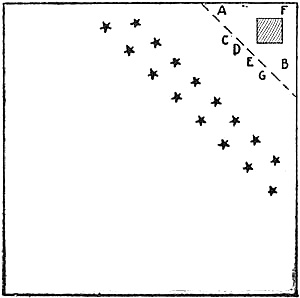
FIG. 25. PIERRE KEELER’S CABINET SEANCE.
“The curtain is represented by A, B; C, D and E are three chairs, placed
in front of the curtain by the medium, in one of which (E) he afterwards
sat; G denotes the position of Mrs. Keeler; F is a small table, placed
within the curtain, and upon which was a tambourine, a guitar, two bells,
a hammer, a metallic ring; the stars show the positions of the spectators,
who sat in a double row—the two stars at the top facing the letter A
indicate the positions taken by Mrs. Kase and Col. Kase, friends of Mr.
Keeler, according to the directions of the medium.
“The curtain, or rather curtains, were of black muslin, and arranged as
follows: There was a plain black curtain, which was stretched across the
corner, falling to the floor. Its height, when in position, was 53 inches;
it was made thus:
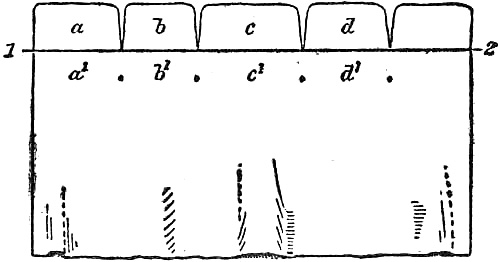
FIG. 26. PIERRE KEELER’S CABINET CURTAIN.
“The cord which held the curtain was 1, 2, and the flaps which are
represented as standing above it (A, B, C, etc.), fell down over A1, B1,
C1, etc., and could be made to cover the shoulders of one sitting with his
back against the curtain. A black curtain was also pinned against the
wall, in the space curtained off, partly covering it. Another curtain was
added to the one pictured, as will be described presently.
“The medium asked Col. Kase to say a few words as to the necessity of
observing the conditions, need of harmony, etc. And then the medium
himself spoke a few words of similar import. He then drew the curtain
along the cord (1, 2,) and fastened it; placed three wooden chairs in
front of the curtain, as indicated in the diagram, and, saying he needed
to form a battery, asked Miss Agnes Irwin to sit in chair D, and Mr. Yost
in chair C, the medium himself sitting in chair E. A black curtain was
then fastened by Mrs. Keeler over Mr. Keeler, Miss Irwin and Mr. Yost,
being fastened at G, between E and D, between D and C, and beyond A; thus
entirely covering the three sitting in front of the stretched curtain up
to their necks; and when the flaps before mentioned were pulled down over
their shoulders, nothing could be seen but the head of each.
“Before the last curtain was fastened over them, the medium placed both
his hands upon the forearm and wrist of Miss Irwin, the sleeve being
pulled up for the purpose, and Miss Irwin grasped with her right hand the
left wrist of Mr. Yost, his right hand being in sight to the right of the
curtain.
“After some piano music the medium said he felt no power from this
‘battery,’ and asked Mrs. E. D. Gillespie to take Miss Irwin’s place.
Hands and curtains were arranged as before. The lights were turned down
until the room was quite dim. During the singing the medium turned to
speak to Mr. Yost, and his body, which had before faced rather away from
the two other persons of the ‘battery’ (which position would have brought
his right arm out in front of the stretched curtain), was now turned the
other way, so that had he released his grasp upon Mrs. Gillespie’s arm,
his own right arm could have had free play in the curtained space behind
him. His left knee also no longer stood out under the curtain in front,
but showed a change of position.
“At this time Mrs. Gillespie declared she felt a touch, and soon after so
did Mr. Yost. The medium’s body was distinctly inclined toward Mr. Yost at
this time. Mrs. Gillespie said she felt taps, but declared that, to the
best of her knowledge, she still felt the medium’s two hands upon her arm.
“Raps indicated that the spirit, George Christy, was present. As one of
those present played on the piano, the tambourine was played in the
curtained space and thrown over the curtain; bells were rung; the guitar
was thrummed a little. At this time the medium’s face was toward Mrs.
Gillespie, and his right side toward the curtain. His body was further in
against the curtain than either of the others. Upon being asked, Mrs.
Gillespie then said she thought she still felt two hands upon her arm.
“The guitar was then thrust out, at least the end of it was, at the bottom
of the curtain, between Mrs. Gillespie and the medium. Mrs. Keeler drawing
the curtain from over the toes of the medium’s boots, to show where his
feet were; the guitar was thrummed a little. Had the medium’s right arm
been free the thrumming could have been done quite easily with one hand.
Afterward the guitar was elevated above the curtain; the tambourine, which
was by Mrs. Keeler placed upon a stick held up within the inclosure, was
made to whirl by the motion of the stick. The phenomena occurred
successively, not simultaneously.
“When the guitar was held up, and when the tambourine was made to whirl,
both of these were to the right of the medium, chiefly behind Mrs.
Gillespie; they were just where they might have been produced by the right
arm of the medium, had it been free. Two clothes-pins were then passed
over the curtain, and they were used in drumming to piano music. They
could easily be used in drumming by one hand alone, the fingers being
thrust into them. The pins were afterward thrown out over the curtain. Mr.
Sellers picked one up as soon as it fell, and found it warm in the split,
as though it had been worn. The drumming was probably upon the tambourine.
“A hand was seen moving rapidly with a trembling motion—which prevented
it from being clearly observed—above the back curtain, between Mr. Yost
and Mrs. Gillespie. Paper was passed over the curtain into the cabinet and
notes were soon thrown out. The notes could have been written upon the
small table within the enclosure by the right hand of the medium, had it
been free. Mrs. Keeler then passed a coat over the curtain, and an arm
was passed through the sleeve, the fingers, with the cuff around them
being shown over the curtain. They were kept moving, and a close scrutiny
was not possible.
“Mr. Furness was then invited to hold a writing tablet in front of the
curtain, when the hand, almost concealed by the coat-sleeve and the flaps
mentioned as attached to the curtain, wrote with a pencil on the tablet.
The writing was rapid, and the hand, when not writing, was kept in
constant, tremulous motion. The hand was put forth, in this case not over
the top curtain, but came from under the flap, and could easily have been
the medium’s right hand were it disengaged, for it was about on a level
with his shoulder and to his right, between him and Mrs. Gillespie. Mr.
Furness was allowed to pass his hand close to the curtain and grasp the
hand for a moment. It was a right hand.
“Soon after the medium complained of fatigue, and the sitting was
discontinued. It was declared by the Spiritualists present to be a fairly
successful séance. When the curtains were removed the small table in the
enclosure was found to be overturned, and the bells, hammer, etc., on the
floor.
“It is interesting to note the space within which all the manifestations
occurred. They were, without exception, where they would have been had
they been produced by the medium’s right arm. Nothing happened to the left
of the medium, nor very far over to the right. The sphere of activity was
between the medium and Mr. Yost, and most of the phenomena occurred, as,
for example, the whirling of the tambourine, behind Mrs. Gillespie.
“The front curtain—that is, the main curtain which hung across the
corner—was 85 inches in length, and the cord which supported it 53 inches
from the floor. The three chairs which were placed in front of it were
side by side, and it would not have been difficult for the medium to reach
across and touch Mr. Yost. When Mrs. Keeler passed objects over the
curtain, she invariably passed them to the right of the medium, although
her position was on his left; and the clothes-pins, paper, pencil, etc.,
were all passed over at a point where the medium’s right hand could easily
have reached them.
“To have produced the phenomena by using his right hand the medium would
have had to pass it under the curtain at his back. This curtain was not
quite hidden by the front one at the end, near the medium, and this end
both Mr. Sellers and Dr. Pepper saw rise at the beginning of the séance.
The only thing worthy of consideration, as opposed to a natural
explanation of the phenomena, was the grasp of the medium’s hand on Mrs.
Gillespie’s arm.
“The grasp was evidently a tight one above the wrist, for the arm was
bruised for about four inches. There was no evidence of a similar pressure
above that, as the marks on the arm extended in all about five or six
inches only. The pressure was sufficient to destroy the sensibility of the
forearm, and it is doubtful whether Mrs. Gillespie, with her arm in such a
condition could distinguish between the grasp of one hand, with a divided
pressure (applied by the two last fingers and the thumb and index) and a
double grip by two hands. Three of our number, Mr. Sellers, Mr. Furness,
and Dr. White, can, with one hand, perfectly simulate the double grip.
“It is specially worthy of note that Mrs. Gillespie declared that, when
the medium first laid hold of her arms with his right hand before the
curtain was put over them, it was with an undergrip, and she felt his
right arm under her left. But when the medium asked her if she felt both
his hands upon her arm, and she said, yes, she could feel the grasp, but
no arm under hers, though she moved her elbow around to find it—she felt
a hand, but not an arm, and at no time during the séance did she find that
arm.
“It should be noted that both the medium and Mr. Yost took off their coats
before being covered with the curtain. It was suggested by Dr. Pepper that
this might have been required by the medium as a precaution against
movements on the part of Mr. Yost. The white shirt-sleeves would have
shown against the black background.”
I attended a number of Keeler’s materializing exhibitions in Washington,
D. C., in the spring of 1895, and it is my opinion that the writing of his
so-called spirit messages is a simple affair, the very long and elaborate
ones being written before the séance begins and the short ones by the
medium during the sitting. The latter are done in a scrawling, uncertain
hand, just such penmanship one would execute when blindfolded.
The evidence of Dr. G. H. La Fetra, of Washington, D. C., is sufficiently
convincing on this point. Said Dr. La Fetra to me: “Some years ago I went
with a friend, Col. Edward Hayes, to one of Mr. Keeler’s light séances.
It was rather early in the evening, and but few persons had assembled.
Upon the mantel piece of the séance-room were several tablets of paper.
Unobserved, I took up these tablets, one at a time, and drew the blade of
my pen-knife across one end of each of them, so that I might identify the
slips of paper torn therefrom by the nicks in them. In a little while, the
room was filled with people, and the séance began; the gas being lowered
to a dim religious light. When the time came for the writing, Mr. Keeler
requested that some of the tablets of paper on the mantel be passed into
the cabinet. This was done. Various persons present received ‘spirit’
communications, the slips of paper being thrown over the curtain of the
cabinet by a ‘materialized’ hand. Some gentleman picked up the papers and
read them, for the benefit of the spectators; afterwards he laid aside
those not claimed by anybody. Some of these ‘spirit’ communications
covered almost an entire slip. These were carefully written, some of them
in a fine hand. The short messages were roughly scrawled. After the
séance, Col. Hayes and myself quietly pocketed a dozen or more of the
slips. The next morning at my office we carefully examined them. In every
instance, we found that the well-written, lengthy messages were inscribed
on unnicked slips, the short ones being written on nicked slips.”
To me, this evidence of Dr. La Fetra seems most conclusive, proving beyond
the shadow of a doubt that Keeler prepared his long communications before
the séance and had them concealed upon his person, throwing them out of
the cabinet at the proper moment. He used the nicked tablets for his
short messages, written on the spot, thereby completely revealing his
method of operating to the ingenious investigator.
The late Dr. Leonard Caughey, of Baltimore, Maryland, an intimate friend
of the writer, made a specialty of anti-Spiritualistic tricks, and among
others performed this cabinet test of Keeler’s. He bought the secret from
a broken-down medium for a few dollars, and added to it certain effects of
his own, that far surpassed any of Keeler’s. The writer has seen Dr.
Caughey give the tests, and create the utmost astonishment. His
improvement on the trick consisted in the use of a spring clasp like those
used by gentlemen bicycle riders to keep their trousers in at the ankles.
One end terminated in a soft rubber or chamois skin tip, shaped like a
thumb, the other end had four representations of fingers. Two wire rings
were soldered on the back of the clasp. This apparatus he had concealed
under his vest. Before the curtain of the cabinet was drawn, Dr. Caughey
grasped the arm of the lady on his right in the following manner: The
thumb of his left hand under her wrist, the fingers extended above it; the
thumb of his right hand resting on the thumb of the left, the fingers
lightly resting on the fingers of the left hand. As soon as the curtain
was fastened he extended the fourth and index fingers of the left hand to
the fullest extent and pressed hard upon the lady’s arm, relaxing at the
same time the pressure of his second and third fingers. This movement
exactly simulates the grasp of two hands, and enables the medium to take
away his right hand altogether. Dr. Caughey then took his spring clasp,
opened it by inserting his thumb and first finger in the soldered rings
above mentioned, and lightly fastened it on the lady’s arm near the wrist,
relaxing the pressure of the first and fourth fingers of the left hand at
the same moment. “I will slide my right hand along your arm, and grasp you
near the elbow. It will relieve the pressure about your wrist; besides be
more convincing to you that there is no trickery.” So saying, he quickly
slid the apparatus along her arm, and left it in the position spoken of.
This produces a perfect illusion, the clasp with its trick thumb and
fingers working to perfection.
This apparatus may also be used in the following manner: Roll up your
sleeves and exhibit your hands to the sitter. Tell him you are going to
stand behind him and grasp his arms firmly near the shoulders. Take your
position immediately under the gas jet. Ask him to please lower the light.
Produce the trick clasps, distend them by means of your thumbs and
fingers, and after the gas is lowered, grasp the sitter in the manner
described. Remove your fingers and thumbs lightly from the clasps and
perform various mediumistic evolutions, such as writing a message on a pad
or slate placed on the sitter’s head; strike him gently on his cheek with
a damp glove, etc. When the séance is over, insert your fingers and thumbs
in the soldered rings, remove the clasps and conceal them quickly.
EUSAPIA PALADINO.
The materializing medium who has caused the greatest sensation since
Home’s death is Eusapia Paladino, an Italian peasant woman. Signor
Damiani, of Florence, Italy, discovered her alleged psychical powers in
1875, and brought her into notice. An Italian Count was so impressed with
the manifestations witnessed in the presence of the illiterate peasant
woman, that he insisted upon “a commission of scientific men being called
to investigate them.” In the year 1884, this commission held séances with
Eusapia, and afterwards declared that the phenomena witnessed were
inexplicable, and unquestionably the result of forces transcending
ordinary experience. In the year 1892 another commission was formed in
Milan to test Eusapia’s powers as a medium, and from this period her fame
dates, as the most remarkable psychic of modern times. The report drawn up
by this commission was signed by Giovanni Schiaparelli, director of the
Astronomical Observatory, Milan; Carl du Prel, doctor of philosophy,
Munich; Angelo Brofferio, professor of physics in the Royal School of
Agriculture, Portici; G. B. Ermacora, doctor of physics; Giorgio Finzi,
doctor of physics. At some of the sittings were present Charles Richet and
the famous Cesare Lombroso. The conclusion arrived at by these gentlemen
was that Eusapia’s mediumistic phenomena were most worthy of scientific
attention, and were unfathomable. The medium reaped the benefit of this
notoriety, and gave sittings to hundreds of investigators among the
Italian nobility, charging as high as $500 for a single séance. At last
she was exposed by a clever American, Dr. Richard Hodgson, of Boston,
secretary of the American branch of the Society for Psychical Research.
His account of the affair, communicated to the New York Herald, Jan.
10, 1897, is very interesting. Speaking of the report of the Milan
commission, he says:
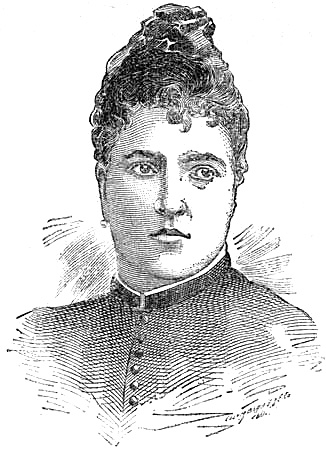
FIG. 27. EUSAPIA PALADINO.
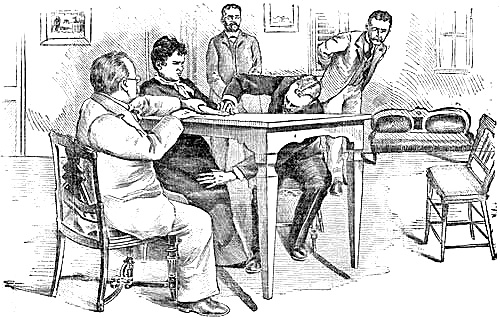
FIG. 28. EUSAPIA BEFORE THE SCIENTISTS.
“Their report confessed to seeing and hearing many strange things,
although they believed they had the hands and feet of the psychic so
closely held that she could have had nothing to do with the
manifestations.
“Chairs were moved, bells were rung, imprints of fingers were made on
smoked paper and soft clay, apparitions of hands appeared on slightly
luminous backgrounds, the chair of the medium and the medium herself were
lifted to the table, the sound of trumpets, the contact of a seemingly
human face, the touch of human hands, warm and moist, all were felt.
“Most of these phenomena were repeated, and the members of the commission
were, with two exceptions, satisfied that no known power could have
produced them. Professor Richet did not sign the report, but induced
Signora Eusapia to go to an island he owned in the Mediterranean, where
other exacting tests were made under other scientific eyes. The
investigators all agreed that the demonstrations could not be accounted
for by ordinary forces.
“I have found in my experience that learned scientific men are the most
easily duped of any in the world. Instead of having a cold, inert piece of
matter to investigate by exact processes and microscopic inspections, they
had a clever, bright woman doing her best to mystify them. They could not
cope with her.
“Professor Richet replied to an article I wrote, upholding his position,
and brought Signora Eusapia Paladino to Cambridge, England, where I joined
the investigating committee. In the party were Professor Lodge, of
Liverpool; Professor F. M. C. Meyer, secretary of the British Society for
Psychical Research; Professor Richet and Mr. Henry Sedgwick, president of
the society.
“I found that the psychic, though giving a great variety of events,
confined them to a very limited scope. She was seated during the tests at
the end of a rectangular table and when the table was lifted it rose up
directly at the other end. It was always so arranged that she was in the
dark, even if the rest of the table was in the light; in the so-called
light séances it was not light, the lamp being placed in an adjoining
room. There were touches, punches and blows given, minor objects moved,
some near and some further away; the outline of faces and hands appeared,
etc.
“When I came to hold her hands I found a key to the mystery.
“It was chiefly that she made one hand and one foot do the work of both,
by adroit substitution. Given a free hand and a free foot, and nearly all
the phenomena can be explained. She has very strong, supple hands, with
deft fingers and great coolness and intelligence.
“This is the way she substituted one hand for both. She placed one of her
hands over A’s hand and the other under B’s hand. Then, in the movements
of the arms during the manifestation, she worked her hands toward each
other until they rested one upon the other, with A’s hand at the bottom of
the pile, B’s at the top and both her own, one upon the other, between. To
draw out one hand and leave one and yet have the investigators feel that
they still had a hand was easy.
“With this hand free and in darkness there were great possibilities. There
were strings, also, as I believe, which were attached to different objects
and moved them. The dim outlines of faces and hands seen were clever
representations of the medium’s own free hand in various shapes.
“It is thought that if a medium was kept clapping her hands she could do
nothing with them, but one of the investigators found the Signora slapping
her face with one hand, producing just the same sound as if her hands met,
while the other hand was free to produce mysterious phenomena.
“I have tried the experiment of shifting hands when those who held them
knew they were going to be tricked, and yet they did not discover when I
made the exchange. I am thoroughly satisfied that Signora Eusapia Paladino
is a clever trickster.”
Eusapia Paladino was by no means disconcerted by Dr. Hodgson’s exposé, but
continued giving her séances. At the present writing she is continuing
them in France with a number of new illusions. Many who have had sittings
with her declare that she is able to move heavy objects without contact.
Possibly this is due to jugglery, or it may be due to some psychic force
as yet not understood.
F. W. TABOR.
Mr. F. W. Tabor is a materializing medium whose specialty is the trumpet
test for the production of spirit voices. I had a sitting with him at the
house of Mr. X, of Washington, D. C., on the night of Jan. 10, 1897. Seven
persons, including the medium, sat around an ordinary-sized table in Mr.
X—’s drawing room, and formed a chain of hands, in the following manner:
Each person placed his or her hands on the table with the thumbs crossed,
and the little fingers of each hand touching the little fingers of the
sitters on the right and left. A musical box was set going and the light
was turned out by Mr. X—, who broke the circle for that purpose, but
immediately resumed his old position at the table. A large speaking
trumpet of tin about three feet long had been placed upright in the center
of the table, and near it was a pad of paper, and pencils. We waited
patiently for some little time, the monotony being relieved by operatic
airs from the music box, and the singing of hymns by the sitters. There
were convulsive twitchings of the hands and feet of the medium, who
complained of tingling sensations in those members. The first “phenomena”
produced were balls of light dancing like will-o’-the-wisps over the
table, and the materialization of a luminous spirit hand. Taps upon the
table signalled the arrival of Mr. Tabor’s spirit control, “Jim,” a little
newsboy, of San Francisco, who was run over some years ago by a street
car. The medium was the first person who picked up the wounded waif and
endeavored to administer to him, but without avail. “Jim” died soon after,
and his disembodied spirit became the medium’s control. Soon the trumpet
arose from the table and floated over the heads of the sitters, and the
voice of “Jim” was heard, sepulchral and awe-inspiring, through the
instrument. Subsequently, messages of an impersonal character were
communicated to Mr. X— and his wife. At one time the trumpet was heard
knocking against the chandelier. During the séance several of the ladies
experienced the clasp of a ghostly hand about their wrists, and
considerable excitement was occasioned thereby.
It is not a difficult matter to explain this trumpet test. It hinges on
one fact, freedom of the medium’s right hand! In all of these holding
tests, the medium employs a subterfuge to release his hands without the
knowledge of the sitter on his right. During his convulsive twitchings, he
quickly jerks his right hand away, but immediately extends the fingers of
his left hand, and connects the index fingers with the little finger of
the sitter’s left hand, thereby completing the chain, or “battery,” as it
is technically called. Were the medium to use his thumb in making the
connection the secret would be revealed, but the index finger of his left
hand sufficiently simulates a little finger, and in the darkness the
sitter is deceived. The right hand once released, the medium manipulates
the trumpet and the phosphorescent spirit hands to his heart’s content.
Sometimes he utilizes the telescopic rod, or a pair of steel “crazy
tongs,” to elevate the trumpet to the ceiling. This holding test is
absurdly simple and perhaps for that reason is so convincing.
Mr. Tabor has another method of holding which is far more deceptive than
the above. I am indebted to the “Revelations of a Spirit Medium” for an
explanation of this test. “The investigators are seated in a circle around
the table, male and female alternating. The person sitting on the medium’s
right—for he sits in the circle—grasps the medium’s right wrist in his
left hand, while his own right wrist is held by the sitter on his right
and this is repeated clear around the circle. This makes each sitter hold
the right wrist of his left hand neighbor in his left hand, while his own
right hand wrist is held in the left hand of his neighbor on the left.
Each one’s hands are thus secured and engaged, including the medium’s. It
will be seen that no one of the sitters can have the use of his or her
hands without one or the other of their neighbors knowing it. As each hand
was held by a separate person, you cannot understand how he [the medium]
could get the use of either of them except the one on his right was a
confederate. Such was not the case, and still he did have the use of one
hand, the right one. But how? He took his place before the light was
turned down, and those holding him say he did not let go for an instant
during the séance. He did though, after the light was turned out for the
purpose of getting his handkerchief to blow his nose. After blowing his
nose he requested the sitter to again take his wrist, which is done, but
this time it is the wrist of the left hand instead of the right. He has
crossed his legs and there is but one knee to be felt, hence the sitter on
the right does not feel that she is reaching across the right knee and
thinks it is the left knee which she does feel to be the right. He has let
his hand slip down until instead of holding the sitter on his left by the
wrist he has him by the fingers, thus allowing him a little more
distance, and preventing the left hand sitter using the hand to feel about
and discover the right hand sitter’s hand on the wrist of the hand holding
his. You will see, now, that although both sitters are holding the same
hand each one thinks he is holding the one on his or her side of the
medium. The balance of the séance is easy.”
An amusing incident happened during my sitting with Mr. Tabor. Growing
somewhat weary waiting for him to “manifest,” I determined to undertake
some materializations on my own account. I adopted the subterfuge of
getting my right hand loose from the lady on my right, and produced the
spirit hand that clasped the wrist of several of the sitters in the
circle. Mr. X— asked “Jim” if everything was all right in the circle,
every hand promptly joined, and the magnetic conditions perfect. “Jim”
responded with three affirmative taps on the table top. I congratulate
myself on having deceived “Jim,” a spirit operating in the fourth
dimension of space, and supposedly cognizant of all that was transpiring
at the séance. Once, when the medium was floating the trumpet over my
head, I grasped the instrument and dashed it on the table. He made no
further attempt to manipulate the trumpet in my direction, and very
shortly brought the séance to a close. No written communications were
received during the evening.
4. Spirit Photography.
You may deceive the human eye, say the advocates of spirit
materializations, but you cannot deceive the eye of science, the
photographic camera. Then they triumphantly produce the spirit
photograph as indubitable evidence of the reality of ghostly
materializations. “Spirit photography,” says the late Alexandre Herrmann,
in an article on magic, published in the Cosmopolitan Magazine, “was the
invention of a man in London, and for ten years Spiritualists accepted the
pictures as genuine representations of originals in the spirit land. The
snap kodak has superseded the necessity of the explanation of spirit
photography.”
To be more explicit, there are two ways of producing spirit photographs,
by double printing and by double exposure. In the first, the scene is
printed from one negative, and the spirit printed in from another. In the
second method, the group with the friendly spook in proper position is
arranged, and the lens of the camera uncovered, half of the required
exposure being given; then the lens is capped, and the person doing duty
as the sheeted ghost gets out of sight, and the exposure is completed. The
result is very effective when the picture is printed, the real persons
being represented sharp and well defined, while the ghost is but a hazy
outline, transparent, through which the background shows.
Every one interested in psychic phenomena who makes a pilgrimage to the
Capital of the Nation visits the house of Dr. Theodore Hansmann. For ten
years Dr. Hansmann has been an ardent student of Spiritualism, and has had
sittings with many celebrated mediums. The walls of his office are
literally covered with spirit pictures of famous people of history,
executed by spirits under supposed test conditions. There are drawings in
color by Raphael, Michel Angelo, and others. In one corner of the room is
a book-case filled with slates, upon the surfaces of which are messages
from the famous dead, attested by their signatures.
In the fall of 1895, a correspondent of the New York Herald interviewed
Doctor Hansmann on the subject of spirit photographs, and subsequently
visited the United States Bureau of Ethnology, where an interview was had
with Mr. Dinwiddie, an expert photographer. Here is the substance of this
second interview, published in the Herald, Nov. 9, 1895.
“Dr. Hansmann’s collection of ‘spirit’ photographs is most interesting.
There is one with the face of the Empress Josephine, and on the same plate
is the head of Professor Darius Lyman, for a long time Chief of the Bureau
of Navigation. The head of the Empress Josephine has a diadem around it,
and the lights and shadows remind one of the well known portrait of her.
On another plate are Grant and Lincoln, Among his other photographs Dr.
Hansmann brought out one of a man who was described to me as an Indian
agent. Around his head were eleven smaller ‘spirit’ heads of Indians. In
looking at the blue print closely it seemed to me as if I had seen those
identical heads—the same as to light, shade and posing—somewhere before.
“I was aided at the Bureau of Ethnology of the Smithsonian Institution by
Mr. F. Webb Hodge, the acting director, who on looking at the blue print
named the Indians directly; several of the pictures were of Indians still
alive. This, of course, immediately disposed of the idea of the blue
print Indians being spirits.
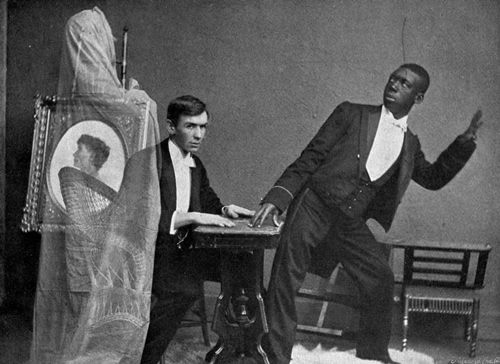
FIG. 29—SPIRIT PHOTOGRAPH.
[Taken by the Author.]
“Moreover, Mr. Dinwiddie produced the negatives containing the identical
portraits of these Indians and made me several proofs, which on a
comparison, feature by feature, light for light, and shade for shade, show
unquestionably that the faces on the blue print are copies of the
portraits made by the photographer of the Bureau of Ethnology.
“Mr. Dinwiddie asked me to sit down for awhile, and offered to make me
some spirit photographs. This he did, and the results obtained may be
considered as far better examples of the art of ‘spirit’ photography than
those of the medium, Keeler.
“The matter was very simply done. Mr. Dinwiddie asked one of the ladies
from the office to come in, and, she consented to pose as a spirit. She
was placed before the camera at a distance of about six feet, a red
background was given her, so that it might photograph dark, and she was
asked to put on a saintly expression. This she did, and Mr. Dinwiddie gave
the plate a half-second exposure. Another head was taken on the other side
of the plate in much the same manner. After this was done the other or
central photograph was taken with an exposure of four seconds, the plate
being rather sensitive.
“The plate was then taken to the dark room and developed. The negative
came out very well at first, and the halo was put on afterward, when the
plate had been dried. The halo was made by rubbing vignetting paste on the
back, thus shutting out the light and leaving the paper its original hue.
The white shadowy heads which are frequently shown in black coats, and
which the mediums claim cannot be explained, are also done in this manner
with vignetting paste, the picture being afterward centred over these
places, which will be white, the final result showing soft and indefinite,
and giving the required spiritual look.
“Mr. Dinwiddie did not attempt to produce the hazy effect, but this is
very easily accomplished in the photograph by taking the spirit heads a
trifle out of focus. He claims that all of these apparent spiritual
manifestations are but tricks of photography, and ones which might be
accomplished by the veriest tyro, if he were to study the matter, and give
his time to the experiment. It is only a wonder that the mediums do not do
more of it.
“The photograph mediums have always claimed that they were set upon by
photographers for business reasons, but Mr. Dinwiddie is employed by the
government and has no interests whatever in such a dispute.”
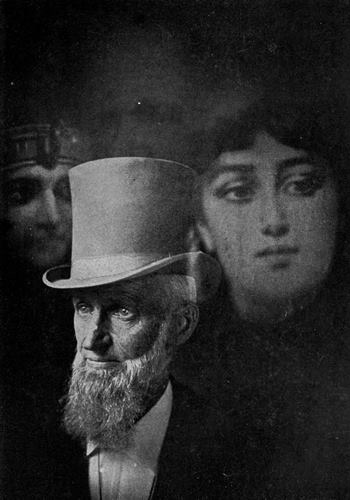
FIG. 30—SPIRIT PHOTOGRAPH BY PRETENDED MEDIUM.
The eminent authority on photography, Mr. Walter E. Woodbury, gives many
interesting exposes of mediumistic photographs in his work, “Photographic
Amusements,” which the student of the subject would do well to consult.
Fig. 30, taken from “Photographic Amusements” is a reproduction of a
“spirit” photograph made by a photographer claiming to be a medium. Says
Mr. Woodbury: “Fortunately, however, we were in this case able to expose
the fraud. Mr. W. M. Murray, a prominent member of the Society of Amateur
Photographers of New York, called our attention to the similarity between
one of the ‘spirit’ images and a portrait painting by Sichel, the artist.
A reproduction of the picture (Fig 31) is given herewith, and it will be
seen at once that the ‘spirit’ image is copied from it.”
5. Thought Photography.
During the year 1896 considerable stir was created by the investigation of
Dr. Hippolyte Baraduc, of Paris, in the line of “Thought Photography,”
which is of interest to psychic investigators generally. Dr. Baraduc
claimed to have gotten photographic impressions of his thoughts, “made
without sunlight or electricity or contact of any material kind.” These
impressions he declared to be subjective, being his own personal
vibrations, the result of a force emanating from the human personality,
supra-mechanical, or spiritual. The experiments were carried on in a dark
room, and according to his statement were highly successful. In a
communication to an American correspondent, printed in the New York
Herald, January 3, 1897, he writes: “I have discovered a human, invisible
light, differing altogether from the cathode rays discovered by Prof.
Roentgen.” Dr. Baraduc advanced the theory that our souls must be
considered as centers of luminous forces, owing their existence partly to
the attraction and partly to the repulsion of special and potent forces
bred of the invisible cosmos.
A number of French scientific journals took up the matter, and discussed
“Thought Photography” at length, publishing numerous reproductions of the
physician’s photographs; but the more conservative journals of England,
Germany and America remained silent on the subject, as it seemed to be on
the borderland between science and charlatanry. On January 11, 1897,
the American newspapers contained an item to the effect that Drs. S.
Millington Miller and Carleton Simon, of New York City, the former a
specialist in brain physiology, and the latter an expert hypnotist, had
succeeded in obtaining successful thought photographs on dry plates from
two hypnotized subjects. When the subjects were not hypnotized, the
physicians reported no results.
FIG. 31—SIGEL’S ORIGINAL PICTURE OF FIG 30.
As “Thought Photography” is without the pale of known physical laws,
stronger evidence is needed to support the claims made for it than that
which has been adduced by the French and American investigators. “Thought
Photography” once established as a scientific fact, we shall have,
perhaps, an explanation of genuine spirit photographs, if such there be.
6. Apparitions of the Dead.
In my chapter on subjective phenomena, I have not recorded any cases of
phantasms of the dead, though several interesting examples of such have
come under my notice. I have thought it better to refer the reader to the
voluminous reports of the Society for Psychical Research (England). In
regard to these cases, the Society has reached the following conclusion:
Between deaths and apparitions of dying persons a connection exists which
is not due to chance alone. This we hold as a proved fact.
The “Literary Digest,” January 12, 1895, in reviewing this report, says:
“Inquiries were instituted in 17,000 cases of alleged apparitions. These
inquiries elicited 1,249 replies from persons [in England and Wales] who
affirmed that they themselves had seen the apparitions. Then the Society
by further inquiries and cross-examinations sifted out all but eighty of
these as discredited in some way, by error of memory or illusions of
identity, or for some other reason, or which could be accounted for by
common psychical laws. Of these eighty, fifty more were thrown out, to be
on the safe side, and the remaining thirty are used as a basis for
scientific consideration. All these consisted of apparitions of dead
persons appearing to others within twelve hours after death, and many of
them appearing at the very hour and even the very minute of death. The
full account of the investigation is published in the tenth volume of the
Society’s Reports, under the title, ‘A Census of Hallucinations,’ and
Prof. J. H. Hyslop, of Columbia College, wrote an article giving the gist
of the report and his comments in the ‘Independent,’ (December 27,
1895), from which I cull these few notable paragraphs:
“‘The committee which conducted the research reasons as follows: Since the
death rate of England is 19.15 out of every thousand, the chances of any
person’s dying on any particular day are one in 19,000 (the ratio of 19.15
to 365 times 1,000). Out of 19,000 death apparitions, therefore, one can
be explained as a simple coincidence. But thirty apparitions out of 1,300
cases is in the proportion of 440 out of 19,000, so that to refer these
thirty well-authenticated apparitions to coincidence is deemed
impossible.’
“And further on:
“‘This is remarkable language for the signatures of Prof. and Mrs.
Sidgwick, than whom few harder-headed skeptics could be found. It is more
than borne out, however, by a consideration which the committee does not
mention, but which the facts entirely justify, and it is that since many
of the apparitions occurred not merely on the day, but at the very hour or
minute of death, the improbability of their explanation by chance is
really much greater than the figures here given. That the apparition
should occur within the hour of death the chance should be 1 to 356,000,
or at the minute of death 1 to 21,360,000. To get 30 cases, therefore,
brought down to these limits we should have to collect thirty times these
numbers of apparitions. Either these statistics are of no value in a study
of this kind, or the Society’s claim is made out that there is either a
telepathic communication between the dying and those who see their
apparitions, or some causal connection not yet defined or determined by
science. That this connection may be due to favorable conditions in the
subject of the hallucination is admitted by the committee, if the person
having the apparition is suffering from grief or anxiety about the person
concerned. But it has two replies to such a criticism. The first is the
query how and why under the circumstances does this effect coincide
generally with the death of the person concerned, when anxiety is extended
over a considerable period. The second is a still more triumphant reply,
and it is that a large number of the cases show that the subject of the
apparition has no knowledge of the dying person’s sickness, place, or
condition. In that case there is no alternative to searching elsewhere for
the cause. If telepathy or thought transference will not explain the
connection, resort must be had to some most extraordinary hypothesis. Most
persons will probably accept telepathy as the easiest way out of the
difficulty, though I am not sure that we are limited to this, the easiest
explanation.’
“Professor Hyslop then proceeds to consider the effect of the committee’s
conclusion upon existing theories and speculations regarding the relations
between mind and matter, and foresees with gratification as well as
apprehension the revolt likely to be initiated against materialism and
which may go so far as to discredit science and carry us far back to the
credulous conditions of the Middle Ages. He says:
“‘The point which the investigations of the Society for Psychical Research
have already reached creates a question of transcendent interest, no
matter what the solution of it may be, and will stimulate in the near
future an amount of psychological and theological speculation of the most
hasty and crude sort, which it will require the profoundest knowledge of
mental phenomena, normal and abnormal, and the best methods of science to
counteract, and to keep within the limits of sober reason. The hardly won
conquests of intellectual freedom and self-control can easily be
overthrown by a reaction that will know no bounds and which it will be
impossible to regulate. Though there may be some moral gain from the
change of beliefs, as will no doubt be the case in the long run, we have
too recently escaped the intellectual, religious, and political tyranny of
the Middle Ages to contemplate the immediate consequences of the reaction
with any complacency. But no one can calculate the enormous effect upon
intellectual, social, and political conditions which would ensure upon the
reconciliation of science and religion by the proof of immortality.”
In my investigations of the physical phenomena of modern spiritualism, I
have come to the following conclusion: While the majority of mediumistic
manifestations are due to conjuring, there is a class of cases not
ascribable to trickery, namely, those coming within the domain of psychic
force—as exemplified by the experiments of Gasparin, Crookes, Lodge,
Asakoff and Coues. In regard to the subjective phenomena, I am convinced
that the recently annunciated law of telepathy will account for them. I
discredit the theory of spirit intervention. If this be a correct
conclusion, is there anything in mediumistic phenomena that will
contribute to the solution of the problem of the immortality of the soul?
I think there is. The existence of a subjective or subliminal
consciousness in man, as illustrated in the phenomena mentioned, seems to
indicate that the human personality is really a spiritual entity,
possessed of unknown resources, and capable of preserving its identity
despite the shock of time and the grave. Hudson says: “It is clear that
the power of telepathy has nothing in common with objective methods of
communications between mind and mind; and that it is not the product of
muscle or nerve or any physiological combination whatever, but rather sets
these at naught, with their implications of space and time.... When
disease seizes the physical frame and the body grows feeble, the objective
mind invariably grows correspondingly weak.... In the meantime, as the
objective mind ceases to perform its functions, the subjective mind is
most active and powerful. The individual may never before have exhibited
any psychic power, and may never have consciously produced any psychic
phenomena; yet at the supreme moment his soul is in active communication
with loved ones at a distance, and the death message is often, when
psychic conditions are favorable, consciously received. The records of
telepathy demonstrate this proposition. Nay, more; they may be cited to
show that in the hour of death the soul is capable of projecting a
phantasm of such strength and objectivity that it may be an object of
personal experience to those for whom it is intended. Moreover, it has
happened that telepathic messages have been sent by the dying, at the
moment of dissolution, giving all the particulars of the tragedy, when
the death was caused by an unexpected blow which crushed the skull of the
victim. It is obvious that in such cases it is impossible that the
objective mind could have participated in the transaction. The evidence is
indeed overwhelming, that, no matter what form death may assume, whether
caused by lingering disease, old age, or violence, the subjective mind is
never weakened by its approach or its presence. On the other hand, that
the objective mind weakens with the body and perishes with the brain, is a
fact confirmed by every-day observation and universal experience.”
This hypothesis of the objective and subjective minds has been criticised
by many psychologists on the ground of its extreme dualism. No such
dualism exists, they contend. However, Hudson’s theory is only a working
hypothesis at best, to explain certain extraordinary facts in human
experience. Future investigators may be able to throw more light on the
subject. But this one thing may be enunciated: Telepathy is an
incontrovertible fact, account for it as you may, a physical force or a
spiritual energy. If physical, then it does not follow any of the known
operations of physical laws as established by modern science, especially
in the case of transmission of thought at a distance.
It is true, that all evidence in support of telepathic communications is
more or less ex parte in character, and does not possess that validity
which orthodox science requires of investigators. Any student of the
physical laws of matter can make investigations for himself, and at any
time, provided he has the proper apparatus. Explain to a person that water
is composed of two gases, oxygen and hydrogen, and he can easily verify
the fact for himself by combining the gases, in the combination of H2O,
and afterwards liberate them by a current of electricity. But experiments
in telepathy and clairvoyance cannot be made at will; they are isolated in
character, and consequently are regarded with suspicion by orthodox
science. Besides this, they transcend the materialistic theories of
science as regards the universe, and one is almost compelled to use the
old metaphysical terms of mind and matter, body and soul, in describing
the phenomena.
It is an undoubted fact that science has broken away from the old theory
regarding the distinction between mind and matter. Says Prof. Wm. Romaine
Newbold, “In the scientific world it has fallen into such disfavor that
in many circles it is almost as disgraceful to avow belief in it as in
witchcraft or ghosts.” We have to-day a school of
“physiological-psychology,” calling itself “psychology without a soul.”
This school is devoted to the laboratory method of studying mind. “The
laboratory method,” says Roark, in his “Psychology in Education,” “is
concerned mostly with physiological psychology, which is, after all,
only physiology, even though it be the physiology of the nervous system
and the special organs of sense—the material tools of the mind. And after
physiological psychology has had its rather prolix say, causal connection
of the physical organs with psychic action is as obscure and impossible of
explanation as ever. But the laboratory method can be of excellent service
in determining the material conditions of mental action, in detecting
special deficiencies and weaknesses, and in accumulating valuable
statistics along these lines.
“It has been asserted that no science can claim to be exact until it can
be reduced to formulas of weights and measures. The assertion begs the
question for the materialists. We shall probably never be able to weigh an
idea or measure the cubic contents of the memory; but the rapidity with
which ideas are formed or reproduced by memory has been measured in many
particular instances, and the circumstances that retard or accelerate
their formation or reproduction have been positively ascertained and
classified.”
That it is possible to explain all mental phenomena in terms of physics is
by no means the unanimous verdict of scientific men. A small group of
students of late years have detached themselves from the purely
materialistic school and broken ground in the region of the supernormal.
Says Professor Newbold (Popular Science Monthly, January, 1897): “In the
supernormal field, the facts already reported, should they be
substantiated by further inquiry, would go far towards showing that
consciousness is an entity governed by laws and possessed of powers
incapable of expression in material conceptions.
“I do not myself regard the theory of independence [of mind and body] as
proved, but I think we have enough evidence for it to destroy in any
candid mind that considers it that absolute credulity as to its
possibility which at present characterizes the average man of science.”