FRENCH TOWNS
It is a drowsy little Burgundian town, very old and
ripe, with crooked streets, vistas always oblique, and
steep moss-covered roofs.... I carried away from
Beaune the impression of something autumnal,—something
rusty yet kindly, like the taste of a sweet
russet pear.
. . . . . . . . . .
At Le Mans as at Bourges, my first business was with
the cathedral, to which I lost no time in directing my
steps.... It stands on the edge of the eminence of the
town, which falls straight away on two sides of it, and
makes a striking mass, bristling behind, as you see it
from below, with rather small but singularly numerous
flying buttresses. On my way to it I happened to
walk through the one street which contains a few ancient
and curious houses,—a very crooked and untidy lane,
of really mediæval aspect, honored with the denomination
of the Grand Rue. Here is the house of Queen
Berengaria.... The structure in question—very sketchable,
if the sketcher could get far enough away from it—is
an elaborate little dusky façade, overhanging the
street, ornamented with panels of stone, which are covered
with delicate Renaissance sculpture. A fat old
woman, standing in the door of a small grocer's shop
next to it,—a most gracious old woman, with a bristling
moustache and a charming manner,—told me
what the house was.
. . . . . . . . . .
This admirable house, in the centre of the town,
gabled, elaborately timbered, and much restored, is a
really imposing monument. The basement is occupied
by a linen-draper, who flourishes under the auspicious
sign of the Mère de Famille; and above her shop the
tall front rises in five overhanging stories. As the house
occupies the angle of a little place, the front is double,
and carved and interlaced, has a high picturesqueness.
The Maison d'Adam is quite in the grand style, and I
am sorry to say I failed to learn what history attaches
to its name.
. . . . . . . . . .
I remember going around to the church, after I had
left the good sisters, and to a little quiet terrace, which
stands in front of it, ornamented with a few small trees
and bordered with a wall, breast high, over which you
look down steep hillsides, off into the air, and all about
the neighboring country. I remember saying to myself
that this little terrace was one of those felicitous nooks
which the tourist of taste keeps in his mind as a picture.
Henry James, A Little Tour in France.
 XV
XV
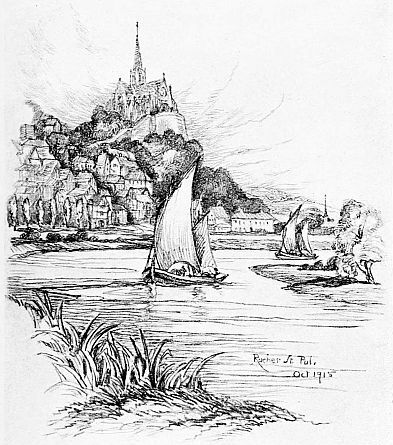
ROCHER-ST.-POL
The Town and the River Merle
A COUNTRY TOWN
They wake you early in this hilly town. It was
hardly light this morning when up and down through
all its highways went a vigorous drum beat. Reluctantly
peeking from the window to see the troops enter our
square I was disappointed to find that one regimental
drummer, marching unaccompanied and lonely, had
done all this mischief. What useful purpose did he
serve? After a brief respite and repose the noise of another
commotion came in with the morning air; a murmur
which grew and became a chatter and at last a din!
The next journey to the window showed that the morning
market was in full swing. Piles of fresh greens and
rich-colored vegetables were tended by gnarled old
peasant women sitting under widespread umbrellas of
faded colors. But what a pleasant air it was that came
through the opened sash; a mountain air with just that
faint flavor of garlic tinging it which presages something
satisfying to be found later. Strengthened for a time by
our coffee and rolls we wandered through these winding
streets. We saw the weather-beaten, leaden flèche of the
cathedral high on the hill, but for the time were satisfied
to study the many ancient houses which still remain.
Their fronts framed in dark oak with a filling of amber-colored
plaster topple over the public ways until they
almost meet. Here and there the oak beams are carved,
and grinning man or snarling monster regards you from
corbel or boss. In places too there are bits of old Gothic
detail and one doorway of true Flamboyant work.
There is the true poetry of architecture! In England
the Decorated Period gives you what is handsome, the
Perpendicular what is stately. In France the cathedrals
of Paris and of Rheims are splendidly serious and
correct; but if in Gothic work you seek imaginative,
unrestrained, carelessly free poetry it is to be found in
the flowing lines and exuberant fancy of the work of the
Flamboyant period.
 XVI
XVI
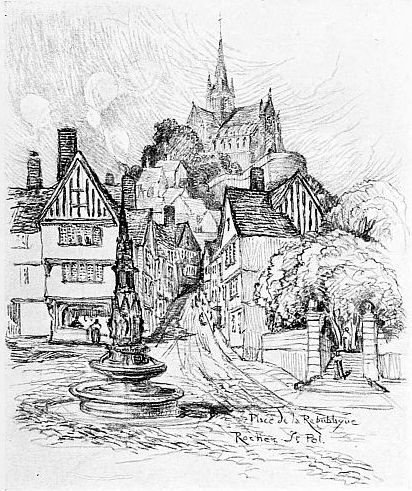
ROCHER-ST.-POL
La Grande Rue and La Place de la République
We found much needed restoration in the hors-d'œuvres,
the omelette, the cutlet, the salads and the
cheese of déjeuner,—and then followed coffee under the
awning of the café. Here we looked out on the Grand
Place which had now become sleepy, all signs of the
market and its business having disappeared. On it front
the Mairie, the Bureau des Postes, the Hôtel du Lion
d'Or and various centres of local commerce. We watched
our neighbors in the café; the colonel with clanking
sword in vigorous discussion with a local magnate; the
retired bourgeois who played a desultory game of billiards
or a deeply thought out match at dominoes. A
quiet square it was now, and, in the shade of its plane
trees, comfortable and at peace with the world, we fell
asleep and made up for the wakefulness of our earlier
hours.
Roberts, Letters from France.
OUR LADY OF THE ROCKS
High throned above th' encircling meadows fair
Our Lady of the Rocks holds queenly sway!
Bright kerchiefed peasants daily wend their way
With clattering sabots up the winding stair,
Pausing at each rude rock-hewn station, there
To bend the knee and many an Ave say.
Up, up they climb, their voices echoing gay
Till by the Virgin's shrine they kneel in prayer.
This is that "Jacob's Ladder" famed afar
To which the Kings of France made pilgrimage
Asking for favors both in Peace and War.
Well named!—for Heavenwards the way is tending,
And all these happy, pious folk presage
Angels of God ascending and descending.
H. L. P.
But, when so sad thou canst no sadder,
Cry, and upon thy so sore loss
Shall shine the traffic of Jacob's ladder
Pitched between heaven and Charing Cross.
So in the night my soul, my daughter,
Cry, clinging heaven by the hems,
And lo! Christ walking on the water
Not of Gennesaret but Thames.
Francis Thompson.
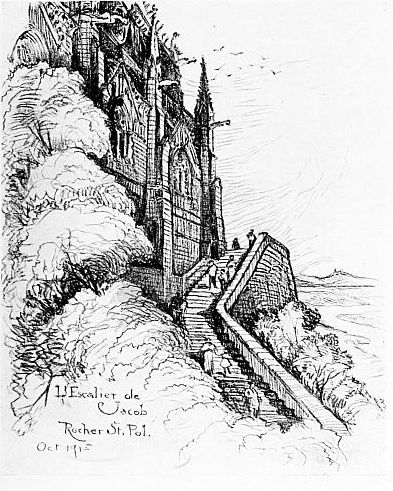 XVII
XVII
ROCHER-ST.-POL
L'escalier de Jacob
Oft have I seen at some cathedral door
A laborer, pausing in the dust and heat,
Lay down his burden, and with reverent feet
Enter, and cross himself, and on the floor
Kneel to repeat his paternoster o'er;
Far off the noises of the world retreat;
The loud vociferations of the street
Become an undistinguishable roar.
So as I enter here from day to day,
And leave my burden at this minster gate,
Kneeling in prayer, and not ashamed to pray,
The tumult of the time disconsolate
To inarticulate murmurs dies away,
While the eternal ages watch and wait.
How strange the sculptures that adorn these towers!
This crowd of statues, on whose folded sleeves
Birds build their nests; while canopied with leaves
Parvis and portal bloom like trellised bowers
And the vast minster seems a cross of flowers!
But fiends and dragons on the gargoyled eaves
Watch the dead Christ between the living thieves,
And, underneath, the traitor Judas lowers!
Ah! from what agonies of heart and brain,
What exultations trampling on despair,
What tenderness, what tears, what hate of wrong,
What passionate outcry of the soul in pain
Uprose this poem of the earth and air,
This mediæval miracle of song!
H. W. Longfellow.
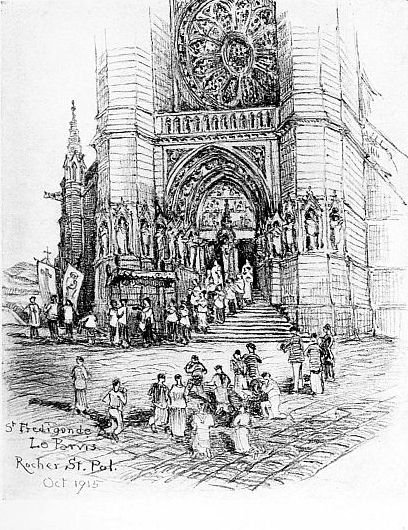 XVIII
XVIII
ROCHER-ST.-POL
Le Parvis de Ste Frédigonde
THE CATHEDRAL
Looking up suddenly, I found mine eyes
Confronted with the minster's vast repose.
Silent and gray as forest-leaguered cliff
Left inland by the ocean's slow retreat.
. . . . . . . . . .
It rose before me, patiently remote
From the great tides of life it breasted once,
Hearing the noise of men as in a dream
I stood before the triple northern port,
Where dedicated shapes of saints and kings,
Stern faces bleared with immemorial watch,
Looked down benignly grave and seemed to say,
Ye come and go incessant; we remain
Safe in the hallowed quiets of the past;
Be reverent, ye who flit and are forgot,
Of faith so nobly realized as this.
James Russell Lowell.
CHARTRES
All day the sky had been banked with thunderclouds,
but by the time we reached Chartres, toward four
o'clock, they had rolled away under the horizon, and
the town was so saturated with sunlight that to pass into
the cathedral was like entering the dense obscurity of a
church in Spain. At first all detail was imperceptible:
we were in a hollow night. Then, as the shadows gradually
thinned and gathered themselves up into pier and
vault and ribbing, there burst out of them great sheets
and showers of color. Framed by such depths of darkness,
and steeped in a blaze of mid-summer sun, the
familiar windows seemed singularly remote and yet
overpoweringly vivid. Now they widened into dark-shored
pools splashed with sunset, now glittered and
menaced like the shields of fighting angels. Some were
cataracts of sapphires, others roses dropped from a
saint's tunic, others great carven platters strewn with
heavenly regalia, others the sails of galleons bound for
the Purple Islands; and in the western wall the scattered
fires of the rose window hung like a constellation in an
African night. When one dropped one's eyes from these
ethereal harmonies, the dark masses of masonry below
them, all veiled and muffled in a mist pricked by a few
altar lights, seemed to symbolize the life on earth, with
its shadows, its heavy distances and its little islands of
illusions. All that a great cathedral can be, all the meanings
it can express, all the tranquillizing power it can
breathe upon the soul, all the richness of detail it can
fuse into a large utterance of strength and beauty, the
cathedral of Chartres gave us in that perfect hour.
Edith Wharton, Fighting France.
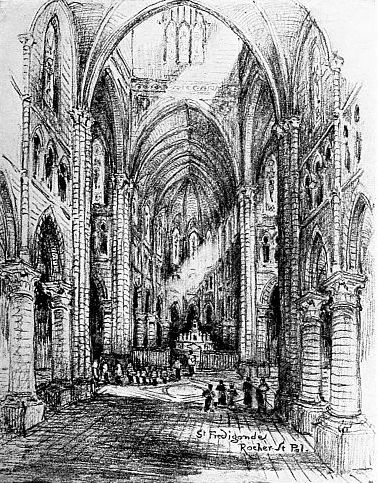 XIX
XIX
ROCHER-ST.-POL
Interior of the Church of Ste Frédigonde
AT HIGH MASS
Thou Who hast made this world so wondrous fair;—
The pomp of clouds; the glory of the sea;
Music of water; songbirds' melody;
The organ of Thy thunder in the air;
Breath of the rose; and beauty everywhere—
Lord, take this stately service done to Thee,
The grave enactment of Thy Calvary
In jewelled pomp and splendor pictured there!
Lord, take the sounds and sights; the silk and gold;
The white and scarlet; take the reverent grace
Of ordered step; window and glowing wall—
Prophet and Prelate, holy men of old;
And teach us children of the Holy Place
Who love Thy Courts, to love Thee best of all.
Robert Hugh Benson.
THE LAMP OF SACRIFICE
All else for which the builders sacrificed, has passed
away—all their living interests, and aims, and
achievements. We know not for what they labored, and
we see no evidence of their reward. Victory, wealth,
authority, happiness—all have departed, though
bought by many a bitter sacrifice. But of them, and
their life and their toil upon the earth, one reward, one
evidence, is left to us in those gray heaps of deep-wrought
stone. They have taken with them to the
grave their powers, their honors, and their errors; but
they have left us their adoration.
John Ruskin.
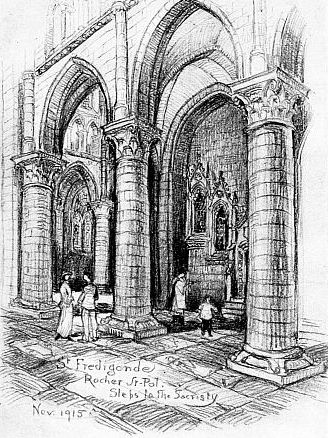 XX
XX
ROCHER-ST.-POL
Sacristy Steps in the Church of Ste Frédigonde
HUNTING THE STAG
We spent yesterday in the Forêt de C——. As the
Emperor had guests we were not admitted at the Château,
but we tramped for long through the woods. The
grassy roads run beneath the embowering beeches
straight from carrefour to carrefour. The gnarled and
twisted trunks give to each tree a personal character
and make it a master-piece of Nature. Of a sudden we
came on the Imperial hunt winding in gay procession
through the forest to its rendezvous. Hunting horns in
triple rings of brass encircled the leading horsemen.
From time to time we heard from them the familiar
strains which echo through the Latin Quarter at Mi-Carême.
Then followed in brilliant liveries a troop of
lackeys, grooms, and other servants, and the pack of
staghounds held in leash but sniffing and yelping. Next
came the hunters themselves on high-bred mounts and
in court costumes of ancient design. Lastly there were
barouches and landaus carrying the ladies of the Court
"en grande tenue." The sunlight flickering through the
beech branches enlivened this brilliant train as it
wound through the forest glades and disappeared down
a green allée.
We had continued our walk for scarce a mile when,
but a short distance from us, a stag crossed our path—stood
startled—with head erect,—and then with confident
leaps vanished in the forest just as the distant
hounds became aware of him and joined in a wild
chorus. In a few moments the pack came in a rush
across our path. Up the different allées rode the horsemen
in haste—asking of us news of the stag. We on
foot joined in the pursuit,—but at last the forest
swallowed one after the other, stag, and hounds, and
hunters, and the sound of dog and horn.
 XXI
XXI
ROCHER-ST.-POL
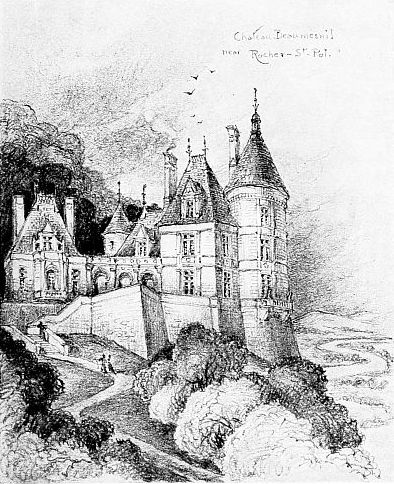
The Château Beaumesnil
On leaving the forest we passed the small Château.
Its conical turret roofs and lofty chimneys, and its
flashing finials and girouettes make a brave show above
the forest trees. The terraces overlook wide meadow
lands through which the river winds until it is lost in the
hazy distance.
Roberts, Letters from France.
CLOTILDE
In Geraudun were brothers three,
They had one sister dear;
The cruel Baron her lord must be,
And the fellest and fiercest knight is he
In the country far or near.
He beat that lovely lady sore
With a staff of the apple green,
Till her blood flowed down on the castle floor,
And from head to foot the crimson gore
On her milk-white robe was seen.
. . . . . . . . . .
Her robe was stained with the ruby tide
Once pure as the fleece so white;
And she hied her to the river-side
To wash in the waters bright.
While there she stood three knights so gay
Came riding bold and free.
"Ho! tell us young serving maiden, pray
Where yon castle's lady may be?"
"Alas! no serving maid am I,
But the lady of yonder castle high!"
"O sister, sister, truly tell
Who did this wrong to thee?"
"Dear brothers it was the husband fell
To whom you married me."
. . . . . . . . . .
The brothers spurred their steeds in haste
And the castle soon they gained.
From chamber to chamber they swiftly passed
Nor paused till they reached the tower at last
Where the felon knight remained:
They drew their swords so sharp and bright
They thought on their sister sweet;
They struck together the felon knight,
And his head rolled at their feet!
Translated by Louis S. Costello.
 XXII
XXII
ROCHER-ST.-POL
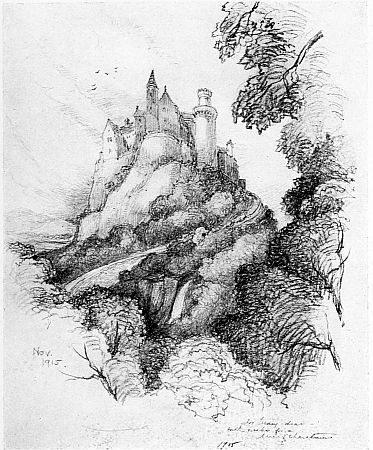
La Tour de la Dame Blanche