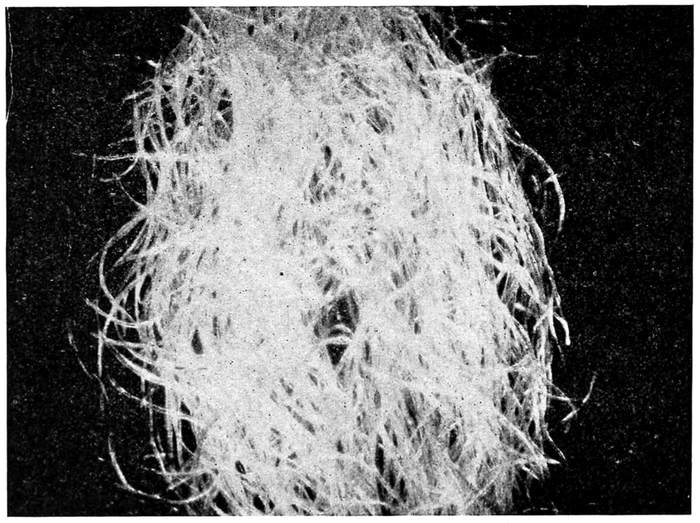
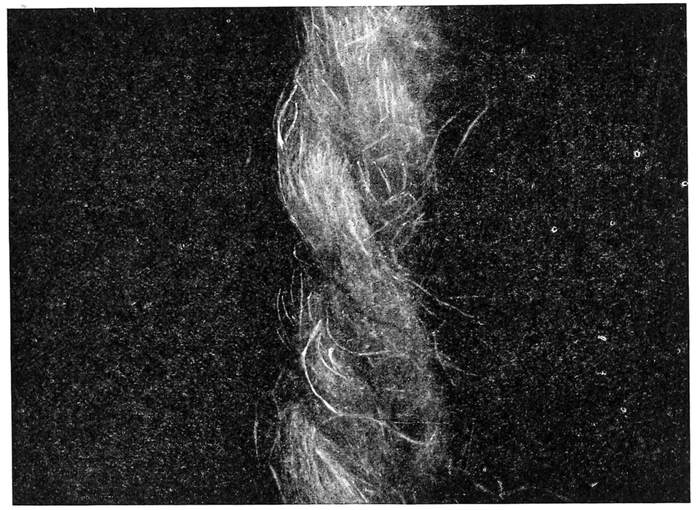
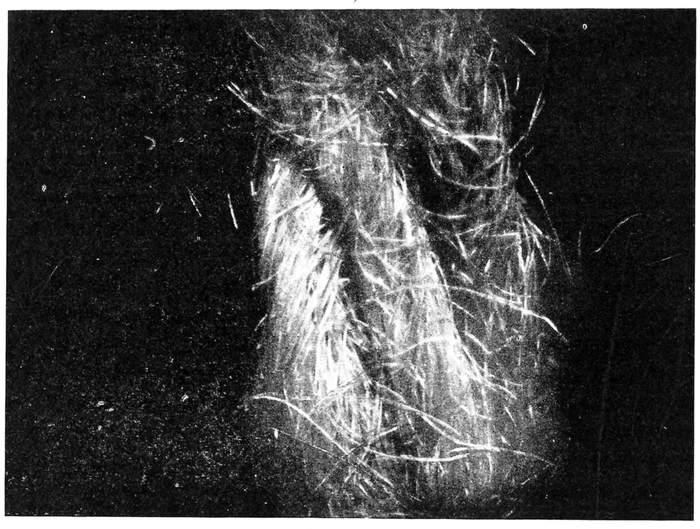
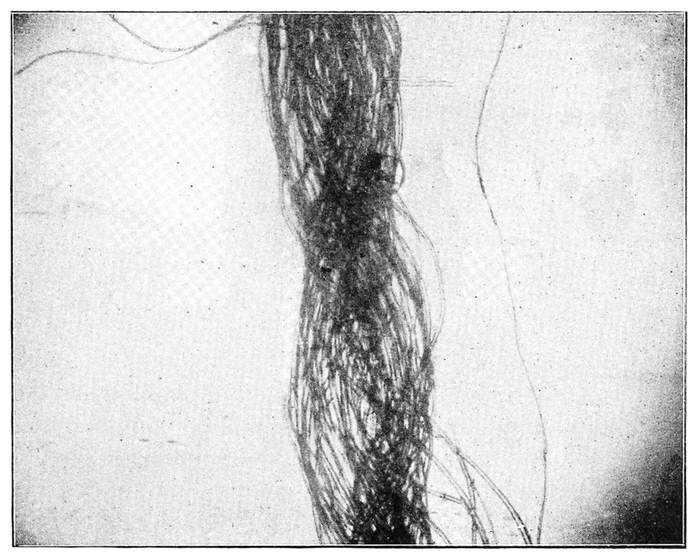
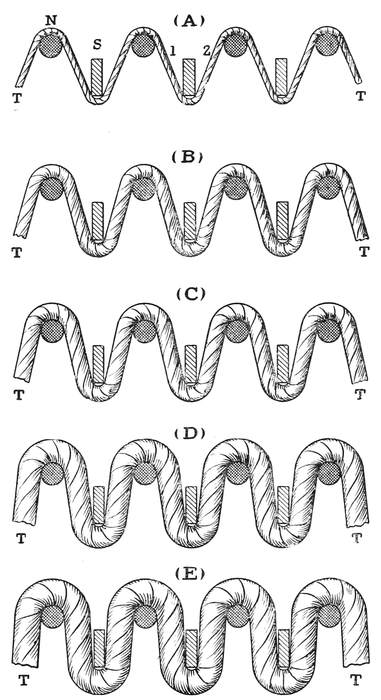
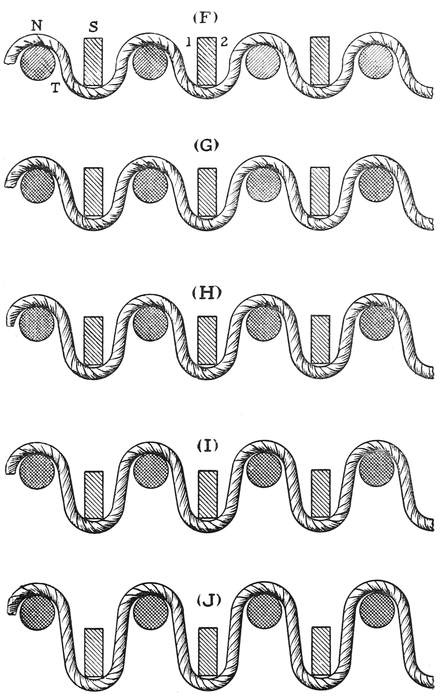
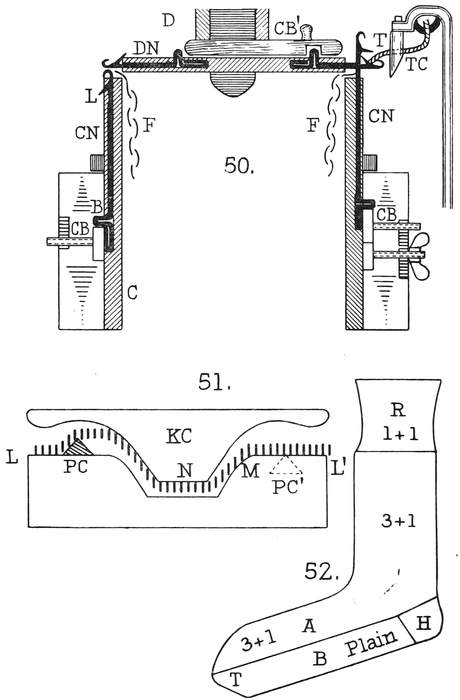
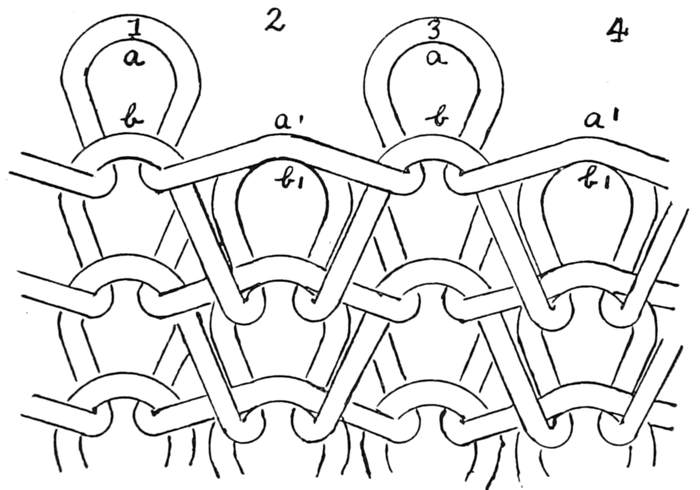
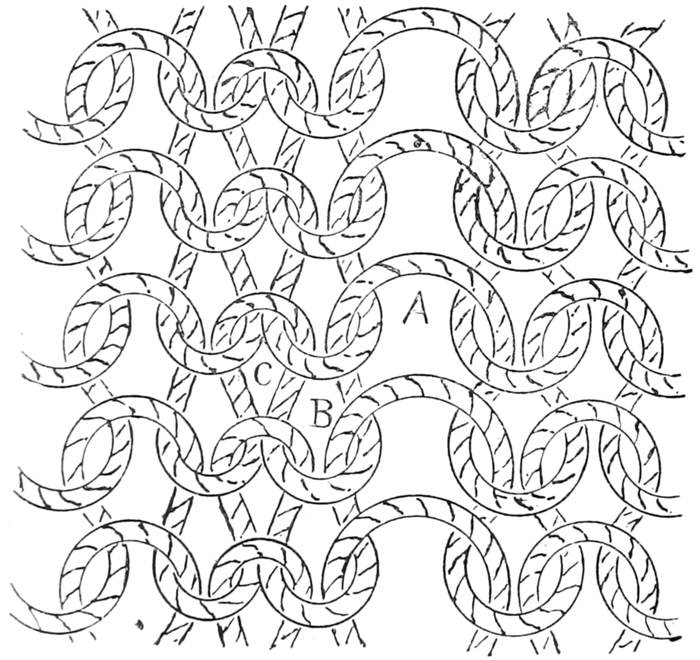
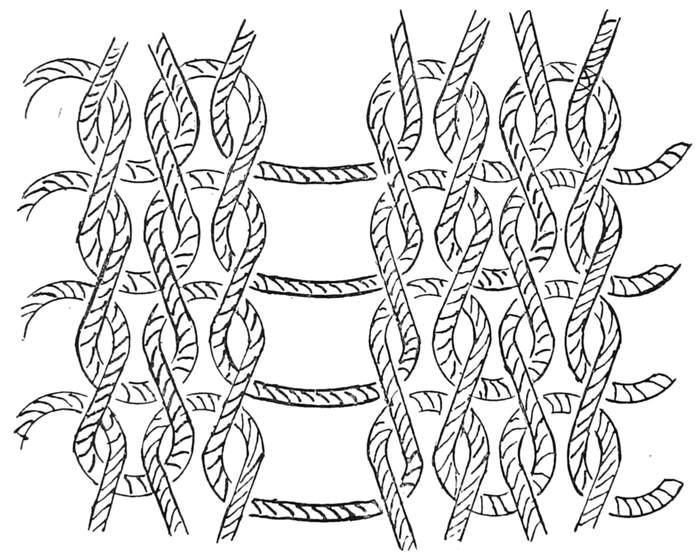
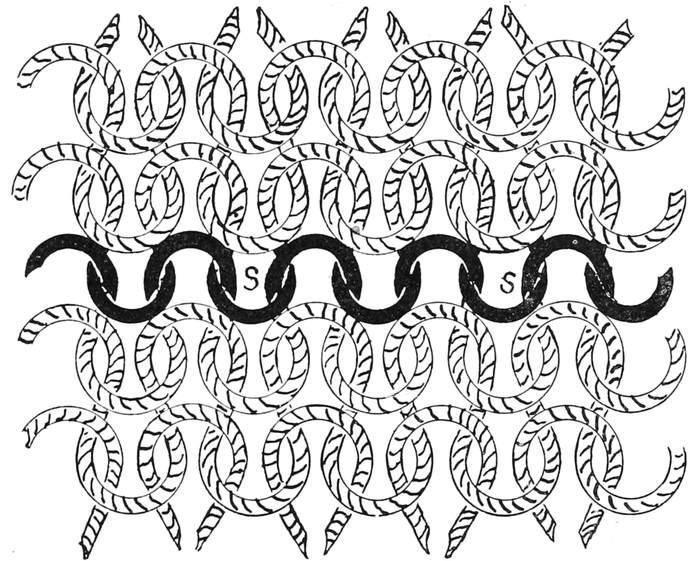
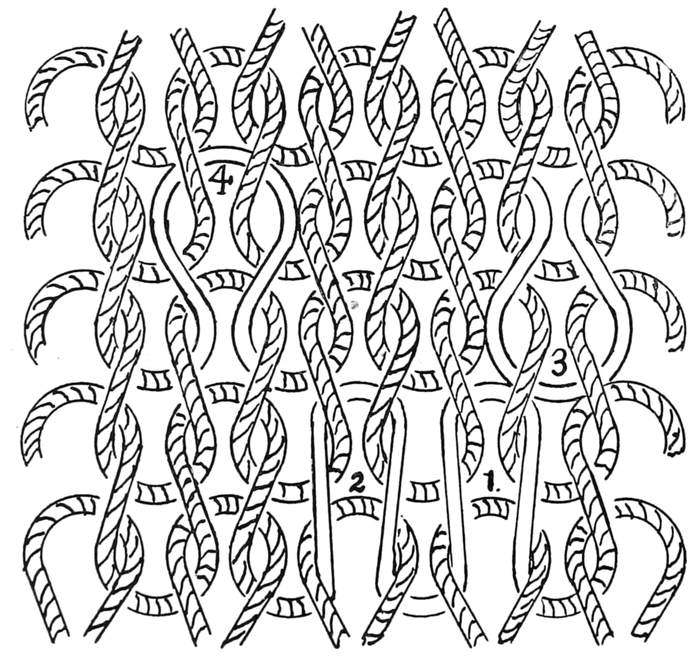
The cover image was created by the transcriber and is placed in the public domain.
i
PITMAN'S TEXTILE INDUSTRIES SERIES
Edited by Roberts Beaumont, M.Sc., M.I.Mech.E.
HOSIERY MANUFACTURE
iii
BY
WILLIAM DAVIS M.A.
Principal of the Buceleuch Technical Institute, Hawick.
WITH 61 ILLUSTRATIONS
including many original photo-micrographs.
LONDON: SIR ISAAC PITMAN & SONS, LTD.
BATH, MELBOURNE and NEW YORK
ivPrinted by Sir Isaac Pitman
& Sons, Ltd., London, Bath,
Melbourne and New York
PREFACE
v
This work is being issued at a period of unparalleled
development in the industry of knitted fabrics, when our
British manufacturers are straining every nerve towards
attaining a dominating position in this vital branch of the
production of textile goods. It is highly gratifying and full
of promise to note the spirit of enterprise which animates
our younger generation of manufacturers, and the keenness
and alertness which permeate the industry at the present
time. Increased concentration by our machine builders on
the numerous mechanical improvements being brought out
in rapid succession from time to time is certain to have a
great influence on the further expansion of the industry, and
has the effect of considerably extending the horizon to the
maker of knitted goods. With so many new firms springing
up in different parts of the country, there has arisen an
increased demand for books dealing with the knitting industry,
and this work is presented in the hope that it will do
something towards satisfying this widespread desire. The
study of looped fabric structure is wide in scope, and none the
less difficult because, on a first view, it appears simple and
elementary. The prospect of the maker of knitted goods of all
kinds, is further enhanced by the enormous production possible
on the present-day knitting machinery and on the fact that
the garments are made ready-to-wear. In this work an effort
is made to outline the principles underlying the technology
of the industry, and endeavours have been made to clarify
certain problems of fabric structure which require still greater
attention from the students of technology before they can
be regarded as solved. Emphasis has also been laid on the
fundamentals of the knitting process as performed on various
mechanisms, for, if these basic principles are clearly comprehended,
the foundation is securely laid for a further grasp
of the industry and its technology.
viSpecial attention is given to the structure and properties
of knitting yarns, for in this texture it can be said with truth
that the yarn is the fabric, seeing that the bulk of the productions
are made from the single thread looped upon itself.
Several problems relating to the weight of knitted fabric and
similar questions are fully demonstrated, and the formulae
explained from fundamental principles. A contribution is
also made to the difficult subject of the setting of looped
textures, generally so imperfectly understood in its theoretical
significance.
That this volume may contribute towards a fuller
knowledge of the technology of the knitting industry is the
earnest wish of the Author,
Yarn Testing for Counts-Conversion from one Count into Another-Formulae for Calculating the Weight of Knitted Fabric, allowing for varying Take-up of Yarn-Calculations for Width, Counts, and Courses per inch
Cotton, Mercerised, and Various Silk Yarns-Silk-and-Wool and Cotton-and-Wool Mixture Yarns-Cashmere, Angora Rabbit, Camel Hair, and Alpaca-Nettle Fibre Yarn
There has been in recent years an extraordinary development
in the scope and application of the knitted fabric which may
be traced to a variety of causes. The chief explanation of this
growth is to be found in the structure of the knitted fabric itself,
the qualities of which have made it pre-eminently suitable for
special departments of textiles. In its most elementary form
the knitted texture is composed of a series of loops hung in
rows one upon the other and constructed from the curvings
of a single thread which runs continuously through the fabric.
One set of loops is formed on the preceding row and any
particular stitch is dependent for its support on neighbouring
stitches above, below, and on either side of it; if the thread
becomes severed at any point the loops lose contact all round
and a considerable opening is incurred. This is its chief defect,
but also its outstanding advantage as a texture; it is a
defect to have the structure destroyed with the severance
of the single ground thread, but it is the mutual interdependence
of loops which accounts for its valuable stretch and
elasticity. By virtue of this elasticity it becomes eminently
suitable for articles of underclothing which have to be worn
in close proximity to the cuticle; the fabric is enabled to
yield to the slightest movement of any part and thus prevents
the wearer becoming uncomfortably conscious of the garment.
An inherent yielding quality of the loops causes the article
to stretch and adapt itself to minor irregularities of size and
shape; if a garment is not exactly to dimensions, it contracts
to a smaller or expands to a larger form. This property of
stretch must not be unduly taken advantage of to cover up
indifferent systems of manufacturing, but within certain limits
2the property is of great value for certain discrepancies. The
knitted fabric is essentially a weft fabric, the thread being
inserted crosswise into the texture after the manner of filling
so that the entire structure presents a horizontal appearance
which is most evident with ground-coloured stripes when the
different colours show themselves crosswise. This proves a
serious limitation to the scope of the plain knitted texture, for
the clothing trades have small use for horizontal effects as
compared with vertical coloured stripes. The knitted structure
is quite different in property to woven cloth where one
has two series of separate threads, one being termed the warp
and running longitudinally in the fabric, whilst the other
series is named the weft and is intersected with the warp in
the process of weaving. The warp threads are pre-arranged
to the correct length and in order of pattern on the warp
beam whilst the threads of weft are inserted consecutively
during the operation of weaving in the loom. This mode of
intersecting separate series of yarns at right angles to each
other causes the threads to exert a much firmer grip on each
other and the resulting fabric is remarkable for its strength
and rigidity. It is firm and durable in structure, and possessing
comparatively little stretch, it does not yield to the
ordinary strains to which it is subjected. It is pre-eminently
the fabric to be used for garments of outer wear which have
to stand the rough service of every-day life, where a combination
of friction, bending and abrasion subject the fabric to a
severe test of endurance. In the case of a knitted texture
there is a right and a wrong side, or face and back, the face
comprising the straight portions of the loops whilst on the back
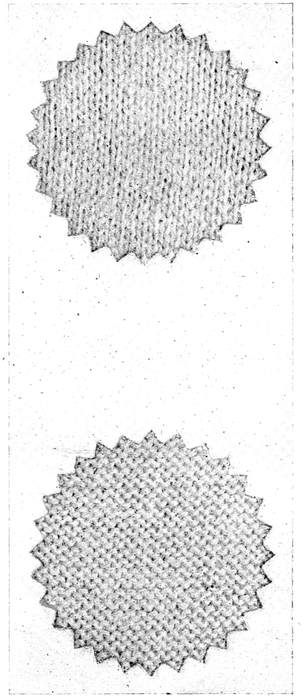
the curved loop portions predominate. Fig. 1 gives a view
of a plain knitted fabric showing the right side or the face of
the texture where the loops may be distinguished by a characteristic
V-shape, these Vs fitting into each other in a vertical
direction. This side of the fabric is always worn outermost,
as it presents the most even surface whilst it is also the most
perfect as all imperfections such as knots, etc., are drawn on
to the back of the cloth. Fig. 2 shows the same fabric on the
wrong side where it will be noted that the chief feature is a
series of interlocking semi-circles which have a distinctly
3crosswise determination given to them. The appearance on
the back is decidedly raw and uninteresting, the straightened
V-shaped portions of the
loops presenting a much
more attractive aspect.
On the other hand, most
rotary frames work their
fabrics with the back in
full view of the worker,
and in case of analysis it
is the wrong side of the
fabric which will yield
the most definite results
to the analyst, for by
examination of the curved
loops one can discern
more easily the character
of the pattern and the
nature of the ornamentation.
Figs. l and 2
Peculiarities of Knitted
Structure.—An examination
of the photo-micrograph
of the plain knitted
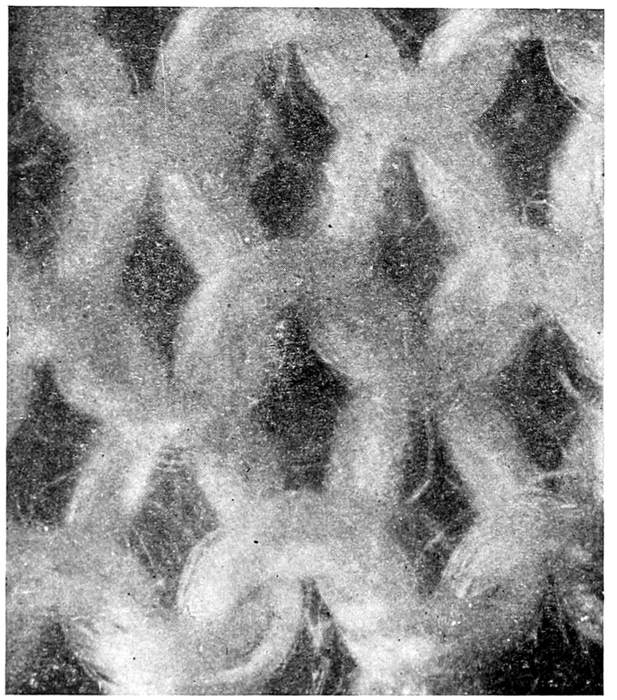
fabric (back view) shown
in Fig. 3 will demonstrate
that the loops are intimately
dependent on
each other and that the
slightest dislocation at
any part will at once
affect the adjacent area.
The knitted fabric is
extremely difficult to
make absolutely perfect,
because each stitch is worked on its own needle distinct from
its neighbour, and the slightest irregularity of yarn delivery
affects the whole stitch area concerned. If a loop is drawn
tighter than the normal at any point, then it is curtailed in
4size and the adjacent loops have to enlarge themselves to fill
out the allotted space. In the woven fabric a missing thread
usually influences that portion of the fabric only, but if the
main thread of a knitted structure be broken, the entire cloth
may be disintegrated with the slightest pull. The interspaces
between the loops shown in Fig. 3 are intimately connected
with the elastic property, because if the spaces are closed up
by tight knitting, the elasticity is considerably reduced, if,
on the other hand, the spaces are too large, the fabric loses
its equilibrium and a slight pull will cause it to lose its form.
An exception to this may be found in the light-weight fabrics
so much in demand in recent seasons for wearing in an intermediate
position in winter whilst in summer they are worn
outermost for lightness. These are purposely knitted flimsy
in texture so as to economize material and for summer they
are quite elegant and serviceable when manufactured in
attractive colourings. For winter use they are possessed of
a heat-retaining property which would not be expected from
their bulk, but to attain the best results they must be worn
under a fabric of stronger and more durable construction.
The theory of these surprising results is that free interspaces
act as so many air chambers which contribute to non-conductivity
of heat by the garment. Face veils are usually
very flimsy structures, but on account of the "still layer" of
air retained in the vicinity of the face the heat is effectively
retained just as if a fabric of much heavier construction were
employed.
Fig. 3
5This property should be fully investigated in a scientific
manner in the light of increased cost of raw materials which
has now become vital to the manufacturer and his public.
In many circles weight of cloth is synonymous with warmth,
but experience has shown that this is not the case and that
the warmest garments are not always the heaviest. The
latest converts to the light-weight article are the clothing
departments of the services where, as a result of war experience
they have altered many specifications to include fabrics
much lighter in weight; formerly no gauge or sett could be
too coarse and thick for their requirements, but now the
products of all gauges in the equipment of the hosiery manufacturer
are utilized. Now the matter is being brought more
fully to the notice of the manufacturer on account of the great
rise in the price of raw materials when it is essential to extract
the utmost farthing of utility from every ounce of material.
If we can more fully requisition the services of the "still layer
of air" in this regard it will prove an inexpensive medium of
clothing.
Knitting Trade Definition.—The meaning of the term
hosiery has undergone a great expansion during the past decade
and its present meaning is an eloquent testimony to the
enormous growth which the trade has recently experienced.
Originally the term had reference chiefly to articles of footwear,
it was in this regard that the utility of the knitted
stitch was first recognized. The feet form a delicately
susceptible part of our anatomy and require special care in
fabric selection. In walking the muscles and tendons of the
6foot are in constant action and it is of vital importance to the
comfort of the individual that the footwear should be worked
in the most suitable fabric. To have footwear in the woven
texture is unthinkable if from no other reason than the seams
which would be necessary, and to have one of these located
at the heel or along the sole of the foot would render the
wearer unable to walk in a very short period. There is further
the matter of perspiration which occurs so profusely at the
pedal extremities, and the knitted texture above all others
is adapted to that intimate sort of interaction between skin
and fabric which is required for the absorption of perspiration.
It laps it up and gives it back again gradually in the form of
vapour. In a fabric of less absorbent qualities the article
would soon fill with moisture and giving rise to wetness cause
considerable discomfort to the wearer. The term hosiery
has greatly outgrown its original significance as applied to
footwear only and now embraces underwear, articles used for
intermediate garments and an increasing range of garments
suited for outer wear. There are now very few departments
of clothing into which the knitted texture has not penetrated.
For outer garments it is not always advisable to employ the
knitted texture in its entirety because it obviously does not
possess all the properties needed, but great progress has been
made in the direction of giving greater stability by a judicious
use of the more rigid woven texture at given points. For
example, in the knitted vest trade the garment edges are
often bound with tapes of woven stuff, whilst the linings are
invariably made from these materials. Incidentally the
colour of these reinforcing materials is so chosen as to harmonize
with the ground so that the whole garment is enhanced
in general appearance. Similarly it is found that the plain
knitted loop is neither heavy nor close enough to give adequate
comfort for an outer garment, which deficiency has been
attended to by the hosiery machine builders who have made
such improvements on the machines as will enable much more
yarn to be inserted in a given space. This increases the sett
of the loops and the weight and rigidity of texture, so that
fabrics may now be obtained which are almost equal to the
woven fabric in resistant properties. Such modifications of
7fabric structure usually result in a pattern with a prevailing
one-sided effect, the wrong side being deficient in appearance
and style. The ordinary plain knitted stitch per se has little
scope for ornamentation unless special machines are employed
and where embellishment is required on a plain garment it
often takes the form of added pieces of crochet.
Figs. 4, 5, 6 and 7
Crochet Work.—This is particularly useful in the trade for
children's garments where many factories employ crochet
workers who ornament the edges by crochet patterns worked
in the same yarn. For the very tiny articles of this class it
is often found uneconomical to employ machines, and in certain
districts large numbers of such garments are produced
by the hand crochet workers where the greatest freedom of
loop selection is possible. The operation of hand crochet is
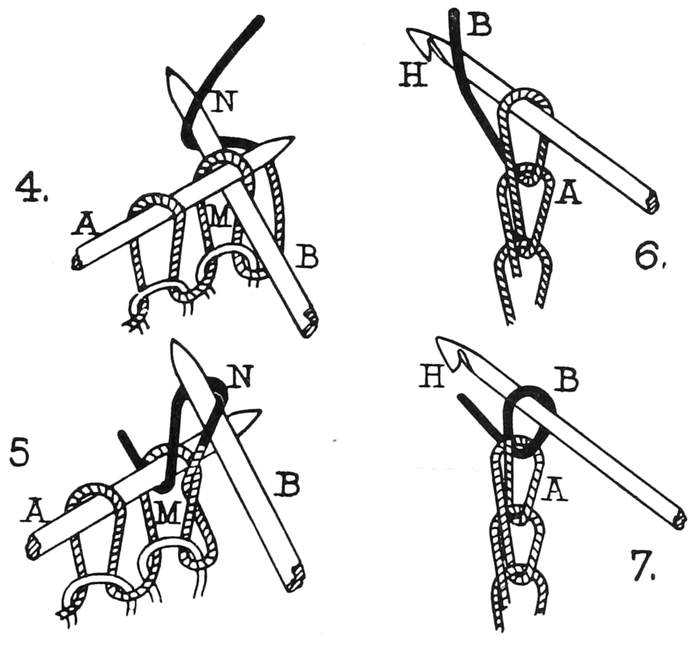
illustrated in Figs. 6 and 7 where the hook is marked H;
in Fig. 6 the hook with loop A upon it is about to grip a
portion of the new yarn B, and in Fig. 7 this has been drawn
8through the old loop to add a new one to the chain. In this
way one can have on a garment effects which could only be
produced by changing to several types of machines, and when
articles are small this changing is not economically sound.
There are still a considerable number of these crochet workers
in various parts of the United Kingdom notably in rural
districts of Ireland and in various districts of Scotland and
England. Many large firms have a number of such hands
attached as an outside staff and they are useful for scrutinizing
fashion publications and producing stitches with hand
pins which may with good results be adapted to machine-made
goods. They have subsidiary departments where
customers are supplied with articles of distinctly novel character
and for which they are prepared to pay enhanced prices.
The freest of all mediums of ornamentation in this class is
undoubtedly the crochet, and articles are often ornamented
with distinctly elegant results by the use of the crochet hook.
By this means yarn same as the ground is employed so as to
render it homogeneous and elegance of pattern is due to the
fact that the worker can select any point of the fabric for a
new move of the pattern. We may have one style being
worked at this point and an inch farther up a distinctly
different pattern can be evolved. In many rural districts the
workers have attained remarkable skill in pattern origination
due to their life-long devotion to the handicraft; from the
art view-point it is hoped that they will continue to secure
such an outlet for their work as will reward their skill and
devotion. It is admitted that such products may not hold
their own in fierce competition of the open market, but "Man
does not live by bread alone," and it is hoped that public
taste for such artistic productions may be maintained and
developed in contrast to the strictly utilitarian; the aesthetic
sense is one which the British as a nation sadly lack.
CHAPTER II Knitting and Weaving
9
Compared with the weaving branch of textiles the knitting
industry has several outstanding advantages which are now
being widely recognized. In weaving it is necessary to have
a considerable amount of tackle and supplementary attachments
if the fancy pattern trade is to be conducted. The
knitted texture is essentially a one-sided composition, but
when effects such as lace work, tuck stitches, or coloured
styles are introduced these are notable on account of their
effectiveness. For any of the machines used in the fancy
departments of the knitting trade such as the Jacquard flat
knitter, the lace or pearl machines, designs are in every case
extremely effective, for minor alterations of the patterning
devices produce a result which is at once distinctive and fancy
elements show almost their full quota on the face. In the case
of woven fabrics the loom and a complicated set of cards
and shafts are needed to produce a figure of the most moderate
dimensions. Colours in the ordinary twills only show about
50 per cent. of their effectiveness and the surface of the texture
remains for the most part uniform. The producer of
woven goods has an advantage in that he can make most
forms of texture on one loom which he can alter in setting
and tackle so as to give any degree of fineness or variety of
design. The maker of knitted goods requires a series of
entirely different machines in order to produce a full range
of patterns and individual machines show but small variation
in texture and weight. For any particular type of machine
he requires to instal a series varying in the sett or gauge of
the needles if a representative range of textures suitable for
the changing seasons has to be devised. The average maker
of knitted goods has to produce garments ready for the
wearer, which renders his task more complicated, for he has
to produce garments in full ranges of size and shape, thus
combining the functions of fabric and garment producer.
10This has the advantage of enabling him to establish a more
direct relationship with the wearer of his garments and most
firms are adopting the policy of going direct to the retail, one
which has had a most stimulating effect on the trade. This
personal contact with the shopkeeper who places the goods
in the hands of the wearer brings the manufacturer into close
contact with the trend of public demand.
Hand Knitting.—The war period witnessed a remarkable
revival of hand knitting which arose from a desire to send
comforts to soldier relatives, and the enormous quantities of
articles produced in this way greatly helped our men to withstand
the rigorous conditions of active service in winter.
The usual articles were scarves, gloves, knitted helmets, but,
above all, thick warm socks. Knitting was performed on all
occasions and it proved a great comfort to many who had
relatives in dangerous situations. Knitting acts as a soothing
tonic, and there is the added satisfaction of producing something
of direct usefulness whilst the skilful hand knitter may impart
touches of elegance and distinction not possible by machine.
If hand knitting is to be skilfully performed it is necessary to
give attention to the size of the knitting pins and that of
the yarn in relation. The gauges of knitting pins or needles
are recognized in this country by a series of numbers quoted
by all instruction books dealing with the subject, Walker's
bell-shaped knitting gauge being largely used by those who
make hand knitting an occupation of leisure. This is cut
bell-shaped in bright polished metal, the various numbers
corresponding to the size of the openings in the gauge. The
full range of gauges runs from 1 to 24 and the needles are
named after these according as they fit the various apertures.
The coarsest knitting-needle in general use is termed 1 and
is of such a thickness that it will pass through the space marked
1; knitting-needle number 2 will exactly fit opening number
2 and so on till gauge 5 is reached. The apertures gradually
decrease in size till the smallest recognized hand knitting-needle
is termed 24 gauge. Thickness of needle must correspond
to the size of yarn or, in other words, the yarn must
suit the thickness of needle. It is the needle which determines
the interspaces in the fabric, for a certain proportion must be
11allowed if the fabric is to possess the required elasticity and
stretch. This property is essential to good wearing service,
for if loops are stiff and stodgy in construction, due to over-tight
knitting or meagre allowance of space, the fabric will not
yield to the movements which occur in wear and will more
rapidly give way under strain. The thicker the yarn the
larger the space required and vice versâ, so that the needle
determines the space which is to be allowed for any particular
set of loops and should bear a definite relation to the thickness
of yarn.
The Knitting Process.—The elementary operation of knitting
by hand may be followed by referring to Figs. 4 and 5, which
illustrate the stages and show the method in which the loops
hang on the hand knitting pins. In this case flat work is
being produced, the needle A being shown with the row of
loops upon it whilst the needle B is being used to form a new
row. The thread N is seen to continue from the loops already
made and the pin B is being pushed through the end loop
M so that it may catch a piece of the thread N and form a
new loop similar to M. This is in the act of completion in
Fig. 5 where a new piece of thread N has been drawn through
and the old loop M is about to be discharged from needle A,
this being replaced by a new loop N now hanging on needle B.
This operation is continued stitch by stitch until all the loops
spread on needle A are replaced by new loops transferred to
needle B. When this is complete needle A is stripped of its
stitches, and then is used to re-transfer the stitches from B
back again to itself. By this operation it will be seen that
the knitting operation as performed by hand on two pins is
an alternate process; you transfer stitches from a needle
working from right to left as in Fig. 4, and at the next course
you work from left to right transferring the stitches back again.
In this we do not obtain perfectly plain fabric but what is
known as the garter pattern or one and one pearl-stitch. If
it is desired to make plain work on two hand pins, the worker
in turning the direction of knitting must push the needle
into the old stitch in the reverse direction so as to effect a
cast-off same as in the previous course. For the making of
hose and half-hose on hand knitting-needles at least three
12pins are necessary to enable us to knit in circular form so as
to produce the article to fit the foot. A more convenient
method of knitting in a circle is to use four pins with the idle
stitches evenly distributed over three of these pins and using
the fourth to transfer in the manner already described. In
this way each needle in turn is released and is used as the
operating pin to form and transfer the loops in knitting.
Even if the pins are correct in gauge in relation to the size
of the yarn it is easy to make defective material or texture
should the loops not be worked at a proper tension. Slack
knitters and tight knitters are known according as they work
with the thread slack or tight; in this it is well to strike the
happy medium, too slack tension makes working to correct
size very difficult, whilst too tight work reduces the speed of
knitting and the wearing qualities of the article. Correct
tension is generally in the region of that which gives reasonable
freedom of motion to the knitter.
Branches of the Knitting Industry.—The Cut-up Trade.—The
manufacturer of knitted goods has not only to produce
the fabric but in most cases completes the garments ready for
wear and has thus to act as manufacturer and tailor combined.
By the cut-up trade is meant that branch where the
garments are made by cutting the component pieces from a
roll or web of cloth similar to the manner of a tailor of outer
garments. This branch is usually associated with the cheaper
grades of the knitted industry because the cutting can be done
in standard sizes, many plies at one and the same time using
automatic cutting devices such as the circular electric machine.
Similarly the making-up and trimming of the garments is
performed on the principle of mass production where output
is based on a large number of articles being produced in exactly
the same manner and to a standard type. In recent years
the relative advantages of the cut method of manufacture as
compared with other systems have undergone some modification.
In the first place we have the waste which is a heavy
item in the cut branch, for no matter how skilfully the pieces
may be carved from the plies of fabric there is always a considerable
number of waste pieces at corners, etc., which it is
not possible to utilize. The problem of waste has become
13more serious since materials have risen so much in value and
has tended to augment the price of such goods on the market.
On the other hand, one of the great objections to the cut
method of manufacture lies in the kind of seam or join used
to piece the various sections together because owing to the
frayed edges of severed loops, the seamer has to secure a hold
several stitches from each edge and this gives rise to a bulky
portion at the join which in underwear particularly proved
a serious obstacle to comfort. The activities of machine
makers have, however, in recent years been concentrated on
devising methods of seaming which will minimize these deficiencies,
and there are now several machines such as the flat-lock,
which in place of taking the stitches so far from each
edge introduce a number of threads to form a kind of bridge
of texture of their own with the edge loops. This makes a
secure join and at the same time gives a seam of little more
than normal bulk.
The Full-Fashioned Trade.—As the term indicates, this
section applies to articles made to the shape of the body
these pieces being complete units with perfect selvedges which
are afterwards united to form a garment where the edges are
joined with comparatively little bulk of seam. The best
examples of the full-fashioned trade are the garments produced
on the Cotton's Patent Rotary frame which is built to
work as many as twelve full width articles at the same time.
This capacity of multi-production proves one of the strong
points of the fashioned trade because the articles being worked
identically effects a considerable reduction on the cost of making.
Also the seam or join is made with selvedge loops which are
perfect in formation so that the worker can use the end two
loops as supports for the seaming thread which is of the same
material as the garment and is thus inconspicuous and at the
same time gives the correct elasticity. With the cut-up seam
as at present practised clean-surfaced yarns have to be employed
to the number of eight or more, and these are usually
in white cotton which on a coloured garment at once proclaims
its origin. In seaming fashioned goods each selvedge
loop is joined to a corresponding stitch on the other side by
the method termed "point-to-point" seaming, and under
14present conditions the slowness of this method and its greater
cost has led many manufacturers of full-fashioned to reconsider
seriously their position. The cup seamer can in many
cases give a three-fold production and this is now being
employed with success in such branches as the fashioned-hose
trade. For high-class underwear, however, the point-to-point
system still holds its own as being the best adapted for the
work, and efforts are being made to have this type of machine
accelerated to give increased production.
In the novelty trade such as that of knitted coats the
articles are so varied in style and shape that they have to be
fashioned singly on a hand machine, and it is being recognized
that the full-fashioned system is too expensive if the firm is
to do trade on a large scale. To increase production in such
goods, therefore, the articles are often cut from knitted web
separately to the style and shape desired and seamed on one
or other of the mechanisms now being improved to give a
suitable join for such goods. The distinct difference lies in
the method of cutting which is individualistic so that full
expression can be given to shape and modifications of fashion.
To work the full-fashioned branch of the hosiery trade requires
an enormous outlay for equipment, as these multi-garment
machines run to a high figure and have to be installed in a
series of gauges so as to present a sufficiently large assortment
of textures to the market. For the cut-up trade, on the other
hand, we can obtain a large quantity of fabric from a few
circular frames; what remains is to cut the material to shape
and trim and finish the garments.
The Seamless Branch.—This embraces another very important
class of knitted fabrics which are produced for the most
part without joins or seams and ready to fit the wearer. As
most garments are circular in form this requires a plant of
circular frames, or the flat knitter may be adapted for the
making of circular fabric. The best example of this section
is that of the hose and half-hose, or stockings and socks, which
are required circular in form. Also large quantities of seamless
gloves are placed on the market each season, these being
worked with the fingers in the form of small circular bags to
accommodate the fingers. Seamless fabric for hose and half-hose
15is of special value because any irregularities of texture
instantly make themselves uncomfortably evident in footwear.
The seamless hose trade is done on machines of small diameter
with the needles arranged in circular form, and where suitable
provision is made for the addition of pockets to accommodate
the heel and toes. From machines of larger diameter are made
garments such as nightdresses where the fabric is produced in
the form of a large circular sack, a length of which is taken
to form the body whilst similar circular pieces are produced
on machines of smaller diameter for the sleeves. The practice
of making garments of the sweater or "Jumper" class
on circular frames is on the increase especially since machine
types have been evolved which can make rib, plain, pearl and
striped fabrics on one and the same machine with a suitable
arrangement for narrowing. It stands to reason, however,
that this method of making body garments does not allow of
great accuracy of fit and that the greatest scope lies in garments
which by their nature are of a loosely fitting description. At
the same time the advent of the rib stitch in such machines
enables the fabric to be given a latent amount of elasticity
which can be utilized to fit the form of a slender person,
whilst it can be stretched to accommodate an individual of
more portly build.
CHAPTER III Latch Needle Knitting
16
The latch needle is one of the indispensable instruments
of the knitting industry, as was abundantly proved during the
war period when shortage of needles threw large numbers of
useful knitting machines into disuse, whilst inferior needles
accounted for a great drop in efficiency. There is a great
variety in form of the latch needle, but they are similar in
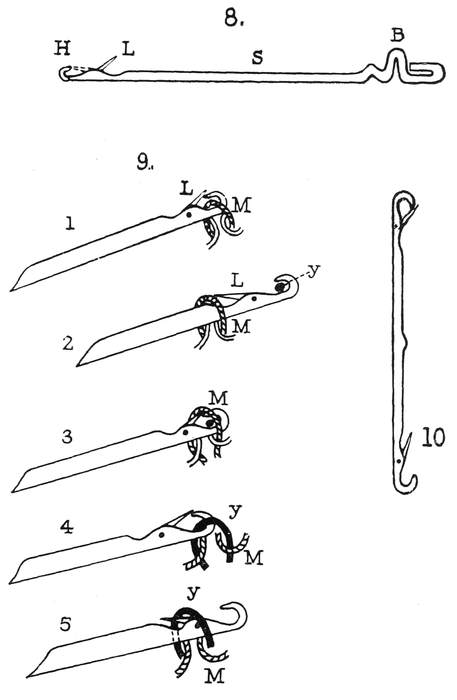
essential features. A sketch of a normal type is given in
Fig. 8 where the various parts are lettered thus: H = hook
at the left extremity of the needle, L = latch, S = stem
or shank of the needle, B = needle butt or heel, as it
is often termed. The latch moves on a pivot from the
dotted position when it shuts the hook to the normal
position when the hook is open. The stem or shank varies
in proportion of length according to the class of machine in
which it is employed, whilst there is also a large diversity of
forms of the needle heel or butt usually in the direction of
strengthening by adding extra metal to withstand friction
for large scale knitting.
17
Figs. 8, 9 and 10
18Loop Formation with Latch Needles.—The matter of loop
formation is of the greatest interest and importance in any
study of knitting and is shown in detail by means of a series
of sketches, 1 to 5 in Fig. 9, illustrating the operation at the
various stages. This will be useful in studying any knitting
frame, for an apparently complex piece of machinery may be
quickly reduced to intelligible dimensions if the observer has
a grasp of the process of loop formation. All machines using
the latch needle, and they are many and varied, form their
stitch on exactly the same principle, and when this is understood
considerable progress has been made towards a thorough
comprehension of the whole. Sections 1 to 5 of Fig. 9 represent
the successive stages in stitch making, the needles being
shown at the angle usually found in the flat knitting machine
of the Lamb type. In Diagram 1 of the series the needle is
shown in its normal non-operative position with the latch
closed and the loop M inside it. In all knitting a division
must be maintained between the old loop and the new yarn.
In Diagram 2 the needle rises, and in so doing the old stitch
M opens the latch L and passes on to the stem and the new
yarn marked Y is in the act of being seized by the hook of
the needle. In Diagram 3 the needle is noted to have sunk
lower in position so that the old loop M closes the latch with
the yarn Y inside, and the old loop covers the latch as shown.
This stage is termed the "landing of the stitch" and in
Diagram 4 the needle is noted to have dropped still farther,
so that the old loop is pushed over the needle extremity and
the new yarn drawn through the old loop M to form a complete
stitch. Precautions have to be taken in the machine
mechanism to have the old loop properly discharged over the
needle end and the new yarn completely drawn through.
When this is complete the needle again rises in its position
as in Diagram 5, and in so doing the yarn inside the hook
moves downwards and opens the latch preparatory to a new
course of stitches.
Diagram 10 illustrates another important form of the latch
needle known as the double-headed needle as it has a hook
at each extremity. This instrument forms the basis of utility
of a series of different machines such as the rib hose frame
and the pearl knitter. In these cases the needle moves from
one knitting stage into another discharging its loop from the
upper or lower hook according to the pattern of the rib or
pearl fabric.
The Flat Knitter.—One of the best known machines using
the latch needle for its loop formation is the flat knitter which
has an extensive use in the knitting industry. The scope of
work produced on the flat knitter is truly wonderful and its
great versatility of application accounts for its immense
popularity. In addition to plain fabric it can make a large
variety of fancy and reinforced stitches, which provide great
extension to the textural scope of the knitted fabric, allowing
it to be employed for a wider diversity of uses. Various
colours can be introduced in stripe formation, and with attachments
of Jacquard character or by the use of the double-headed
19needle the range of patterns is further diversified. In
regard to making full-fashioned goods almost every form
of garment can be made on it-pants, shirts, hose and
half-hose, coats, vestings, caps and gloves, are only a few of
the garments procurable. These can be fashioned by the
worker to the required form and an interpretation can be given
to symmetry and style of the human form. It has found an
extensive application as a hand machine to the making of
seamless gloves being used by the most progressive firms in
the trade, and with the application of power it can be adapted
with considerable success to the making of goods in the bulk.
Hand machines are moderately priced so that to start a
knitting factory with such a plant is not a really formidable
proposition, quite a respectable equipment being procurable
for a few hundred pounds; many a prosperous firm owes its
initial successes to the adoption of the flat knitter and from
this they have been able to launch larger schemes of development
in the knitting business. With new starters in this
trade to-day the flat knitting machine nearly always figures
prominently when there is lack of capital, and on this basis
quite a sound foundation may be laid.
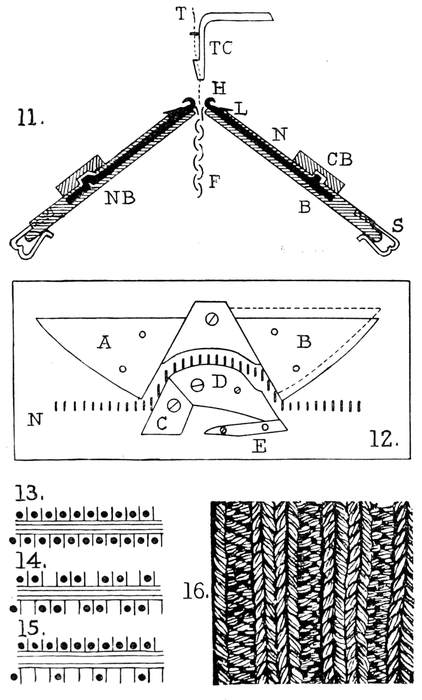
A diagrammatic side view of the Lamb flat knitting machine
is shown in Fig. 11 where the foundation of the machine consists
of two needle beds or stages marked NB which are
cut with tricks or grooves into which the needles are placed
as shown, each side being a duplicate of the other. The
needle is marked N and on it will be recognized such essentials
as the latch L, the hook H, the butt or heel B working inside
the cam-box CB. The thread T passes from its bobbin
through the eye of the thread-carrier TC and the needle is
pushed into its position in the cam-box by the spring marked
S shown at the extremity of the needle beds. The fabric is
marked F and is noted to pass down through the centre of
the machine whilst at its extremity is attached a set of weights
which act as a means of drawing the fabric from the needle
ends as they are formed and if the needles are not being
sufficiently well cleared the amount of weight is increased.
The weights have to be raised from time to time to a higher
position in contact with the fabric as it is being worked.
20
Figs. 11, 12, 13, 14, 15 and 16
21Interior of Cam-box.—In this machine the principal functional
part is the cam-box CB, and from this the knitting
action is imparted to the needles. On this account a full
view is given in Fig. 12 of the set of cams used in the knitting
machine made by Messrs. W. and J. Foster of Preston. This
set of cams is placed on each bed right and left and the constituent
parts are indicated as follows. Parts A and B are
termed the knitting cams, whilst the parts C, D and E combine
to form what is known as the knock-up cam. The part
E is a fixture, whilst the needle path is indicated curved,
and through this the needle butts N are seen to be passing.
From the previously-given description of the making of loops
on the latch needle it should not be difficult to note that the
cams working on the needle butts in the needle path combine
to raise the needles to secure the yarn from the thread-carrier
and, having received the yarn, the needles are pulled down
again to complete the loop by drawing the new yarn through
the old loop. The cams have a side-to-side motion and pass
over the needle bed from right to left and again from left to
right. In so doing they operate as follows: when the cam-box
is passing from right to left the needle heels are made to
ascend the left side of C and D and are drawn down again
by the inside of cam B; when the action is reversed and the
cam-box is drawn from left to right, the needle heels pass up
the right side of cam D and are drawn down again by
passing along the inside of cam A, this alternate action being
repeated during the process of making plain work on the flat
knitting machine.
The Rib Stitch.—One of the outstanding advantages of the
flat knitter is the facility with which all kinds of rib stitches
can be made, and this is due to the arrangement of the needle
beds, where the needles of one side make their stitches in a
direction contrary to those in the opposite side. In making
rib work both sets of needles in back and front beds are in
action at the same time; when the thread is supplied to the
needles those on the back rise equally with those on the front
and receive their share of yarn to form their own loops. Now
it is clear that the knitting action on the right-hand needle
is opposite in effect to that of a left-hand needle, this being
22expressed by the form of the knock-over of the stitch; the
right-hand needles discharge their stitches to the left, whilst
the left-hand needles discharge their stitches towards the
right. It is this combination of stitches discharged in opposite
directions which gives rise to the rib stitch which is such a
valued adjunct to all forms of knitted texture. This difference
in the direction of loop discharge causes one set of needles
to form back-fabric stitches whilst the opposite needles knit
right-side fabric stitches. The normal flat knitter has its
two needle beds cut one-and-one, as shown in Fig. 13, each
bed has accommodation for the same number of needles,
these being set so as to pass up the centre between the opposite
series. This is termed a one-and-one arrangement and the
resulting fabric is known as the 1-and-1 rib stitch, one row of
loops in a vertical direction appears as wrong-side fabric
stitches, whilst the alternate rows work out as right-side
fabric loops. This explains the great increase of elasticity
found in rib texture as compared with plain because back-fabric
stitches are always seeking the back. In their normal
position they virtually pass to the back, only being visible
on the face when stretch is applied in the width. The yarn
in crossing from face to back and vice versâ undergoes a greatly
increased amount of intersection which contracts the whole
fabric in the width. This property is of the greatest practical
value in garment manufacture, because the extremities are
usually finished with a few inches of rib which enables the
article to secure a firmer hold on the limb or part of the body
and thus serves to keep it in position. The rib stitch is also
an indispensable foundation of a number of textures which
weigh much heavier than the plain, as it enables a greater
weight of yarn to be inserted and the fabric is thereby increased
greatly in bulk.
Tension and Weight.—The texture of a fabric on any given
knitting machine can be varied according to a number of
factors and of these quite an important one is the length of
loop drawn by the needle. An examination of Fig. 11 will
show that the needle beds on the flat knitting machine are
stationary and that the needles during stitch formation draw
the yarn over the top ends of the beds and obviously the
23length of the loop will depend on the distance which the
needle is drawn below the edge of the needle bed, this distance
being determined by the adjustment of the knitting cams A
and B shown in Fig. 12.
Cam B is shown in a dotted position raised so as to draw
a shorter loop and the length of the loop can be varied according
to the height of either knitting cams A or B within certain
limits. If the loop is drawn too long, that is, if the knitting
cam is set too deep, the yarn may not stand the strain and
breakage will result; on the other hand, if the loop is too
short the fabric will appear stodgy in character.
Patterns Produced.—This type of knitting machine has an
extensive range of patterns and textures which can be obtained
and amongst the first variations possible are those which
result from an alteration of the needle arrangement. The
normal setting is to have one needle in the front stage for one
in the back stage, and these being arranged alternately give
the ordinary 1-and-1 rib stitch. This is shown in Fig. 13,
where the upper row of small circles represents the needles
in the back bed or stage whilst the lower row gives those in
the front stage. The next, Fig. 14, shows the needles in
exactly the same sett except that the needles have been
arranged to give the 2-and-2 rib pattern, this being shown
in diagrammatic enlargement in Fig. 16 at the side. The
third sett of needles given in Fig. 15 represents the arrangement
for a 3-and-1 rib pattern where every third needle only
is allowed to remain in the front stage whilst the back stage
retains its full complement. From these examples it will be
clear that by altering needles in this way to any scheme a
large variety of rib effects may be produced, nor need the
arrangement be uniform throughout the width, for the borders
may be in one pattern and the ground or interior in another.
Novel effects in imitation of lace work may also be produced
by leaving a needle out of one or other of the beds which
makes an opening in the fabric which can be manipulated to
give an effect of a lace-like character.
24
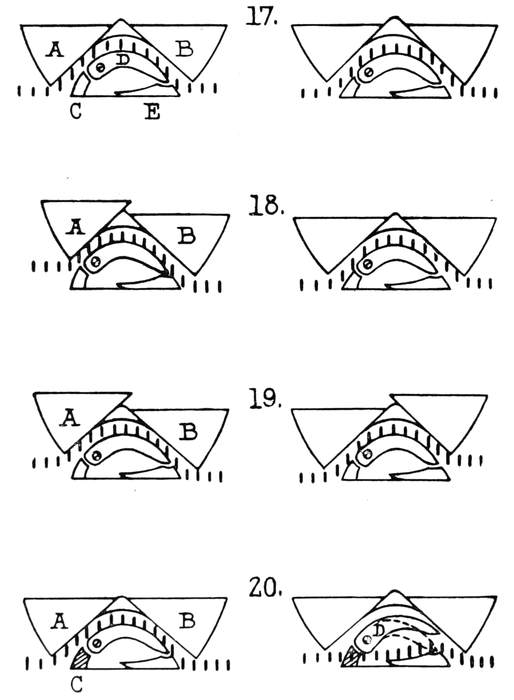
Figs. 17, 18, 19 and 20
25Manipulation of Knitting Cams.—Figs. 17 to 20 have been
prepared to illustrate the manner in which the cams are
altered to give certain well-known stitches in the flat knitting
machine, and the construction is the same as Diagram 12,
with corresponding letters for the various parts. On the left
of the plate are arranged the cams as in the front bed whilst
the right-hand arrangement gives the set of the cams in the
back. In Fig. 17 the two beds are shown arranged for plain
rib work where both back and front needles are in action at
the same time. Fig. 18 shows the cam setting in front and
back beds for making the well-known half-cardigan or royal
rib which has played such an important part as the stitch
for cardigan jackets supplied to the troops during the war
period. It will be seen that on the front bed cam A is raised
into what is termed a tucking position, that is, the needles
are pushed up by D to receive the thread but are not drawn
down far enough to have their loops discharged over the
needle ends. At the same time the cams in the back bed
are set for plain work and the needles there knit as usual at
every course. The real stitch, however, does not appear until
the direction of knitting is reversed, because the needles on
the front bed are again pushed up to receive a second thread
and on this occasion are drawn down the full distance by B
to knock off the stitches. This means that on the front bed
stitches are formed in double threads after every two courses
whilst the back discharges its loops at every course, which
enables a much greater weight of yarn to be inserted into the
texture, making it more rigid and stable. The cams in Fig.
19 are arranged in front and back beds to produce the polka
or full cardigan stitch, where double courses are worked on
both front and back. This may be clear if we consider the
cam arrangements as illustrated moving first to the right
when the stitches on the front bed are "tucked" whilst those
on the back bed knit to the position of cam A. In reversing
the knitting to proceed to left, two yarns are drawn through
in the front needles whilst no discharge takes place on the
back. In this way the knitting occurs on the cardigan rib
plan on both front and back needle beds and the resulting
fabric is much heavier in weight than half-cardigan and when
taken from the machine shows a strong tendency to expand
in width owing to the yarn seeking to take up a more expanded
position. The full cardigan stitch tends to be loose in
26character, the weight of material is greatly increased over plain
1-and-1 rib, but there is a lack of structural firmness and
cohesion. In Fig. 20 the part C of the cam comes into the
picture as being necessary to give circular work on the flat
knitting machine. This can be drawn up out of action in
both front and back beds by a small finger lever, and an
examination of this arrangement will show that in going to
the right the needles of the front bed will knit as usual, but
in reversing, as shown on the right of Fig. 20, the needles
pass completely under part D owing to the absence of part C
and knitting is not performed; the cam portion D is
raised by a spring to allow the needles to pass over the dotted
position. It will thus be seen that to make circular work we
arrange the cams on the front bed so that they will knit in going
to right but miss in going to left, whilst in the opposite bed
the reverse holds good. Thus a course of loops is made on
the front with the back not knitting, alternated by a course
made on the back with the front not knitting. The fabric's
being worked from one yarn causes the loops to be joined at
the edges and so a continuous length of circular webbing is
produced.
CHAPTER IV Types of Knitting Yarns
27
The qualities necessary for knitted goods have already been
outlined as applied to the fabric, but if ideal results are to be
secured, the yarns require to possess certain specific features
of their own, for the most efficient textures can only be got
by combining the qualities of yarn and fabric. The range of
yarns covers a wide variety of material and systems of manufacture
and the type selected depends entirely on the use to
which it has to be applied; price is its primary consideration,
and whether required for outer, intermediate or under garments
is also important. Speaking generally, the knitting yarn
should be open in texture, full in handle, and the material
should be soft and comfortable to the touch. Except for
some classes of outer wear the thread should have a plentiful
proportion of surface-projecting fibres which are of value in
covering raw loop formation.
Woollen Spun Yarns.—Yarns spun in the woollen system
are still used to a considerable extent in the knitting trade,
such having large scope in the more moderate priced qualities.
The yarn is produced by the ordinary methods of woollen
yarn spinning, the wool being teased, scribbled, carded, condensed
and spun into threads on the woollen mule. The
combined effect of these operations is to give a yarn which
has its constituent fibres crossing and re-crossing at every
angle so as to give a melange of fibres, confused at first sight
only because these are arranged in a yarn regular in diameter
and compact in structure. Carding and spinning are done in
the grease so that goods made from them require a more
liberal scouring and fulling. The best known type in the
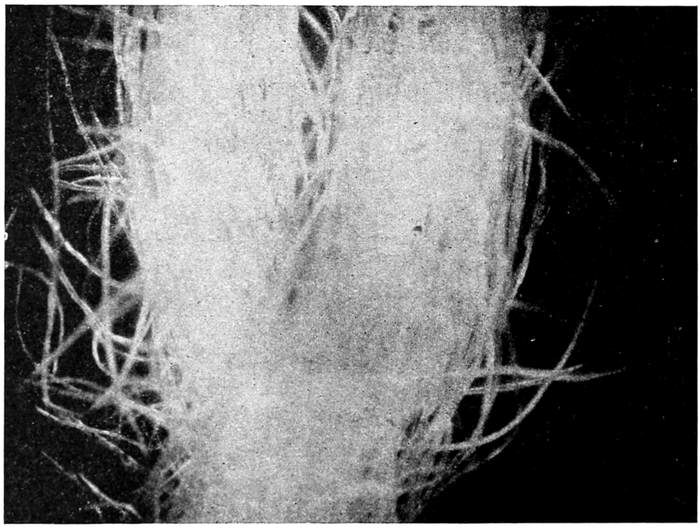
coarse variety of woollen-spun yarns is, perhaps, the wheeling,
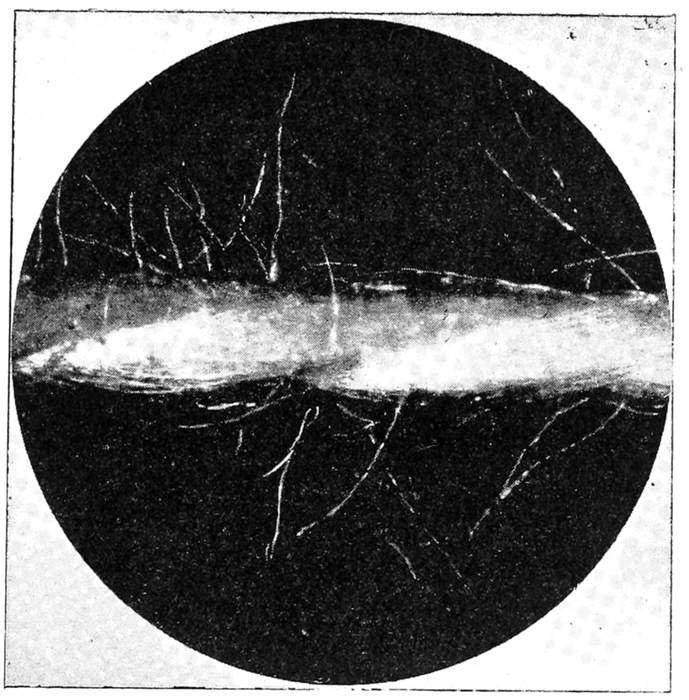
which is illustrated by means of photo-micrograph, Fig. 21,
and given in the form of two-ply, but large numbers are
used in three or more ply for goods of the coarsest gauge.
The name Wheeling is probably derived from the early days
28of hand spinning on the wheel when the wool grown on the
farm was dealt with by the farmer's daughter by means of
the distaff and spindle. In this type of yarn the wool fibres
were spun as they hung on the distaff, and the chief care of
the spinster was to draw them out so as to present as even a
strand as possible to the torsion of the whorl. The single
yarns were therefore rather irregular, but these deficiencies
were to a large extent overcome subsequently by folding two
or three plies according to the weight desired. In the days
of hand spinning it was deemed most easy to specialize in
one uniform thickness of ground thread and obtain the thicker
counts by twisting these threads two or more ply. The
wheeling yarns as made to-day partake very much of the
same character; they are spun from the coarser grades of
wool where long and short fibres are used promiscuously, all
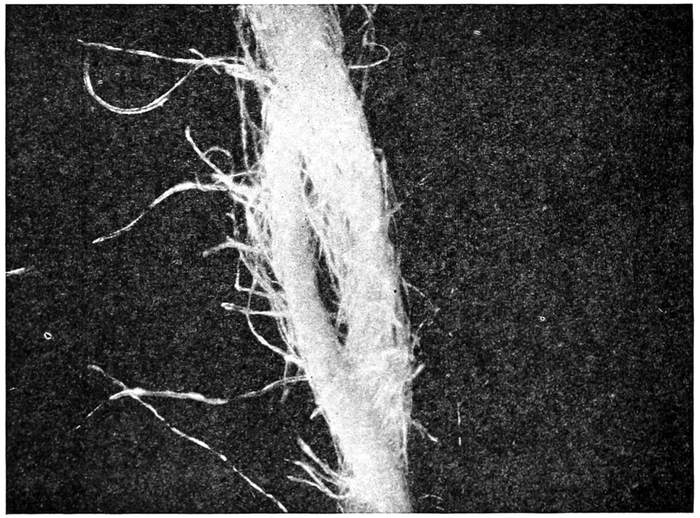
of which features may be noted by an examination of photo-micrograph
21 which gives the thread original magnified
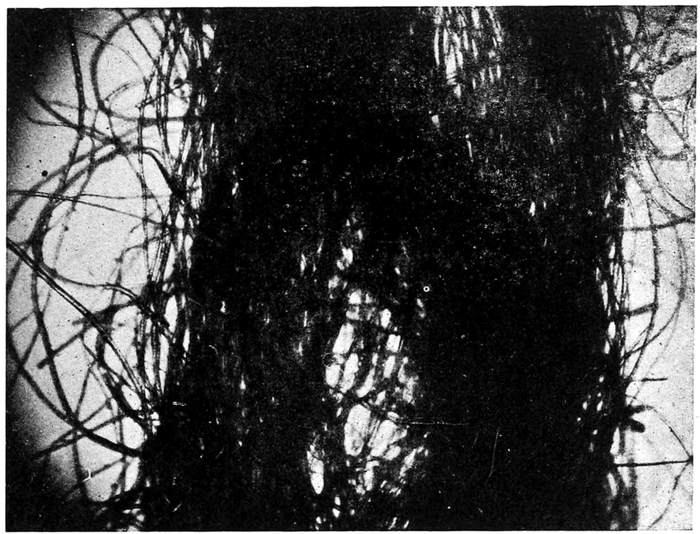
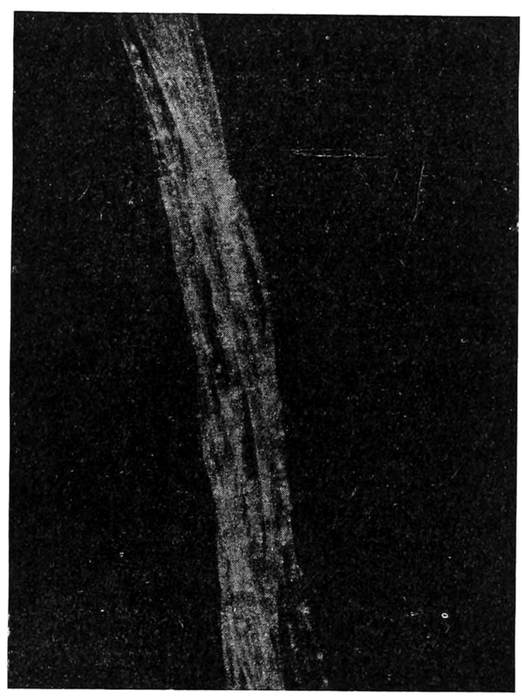
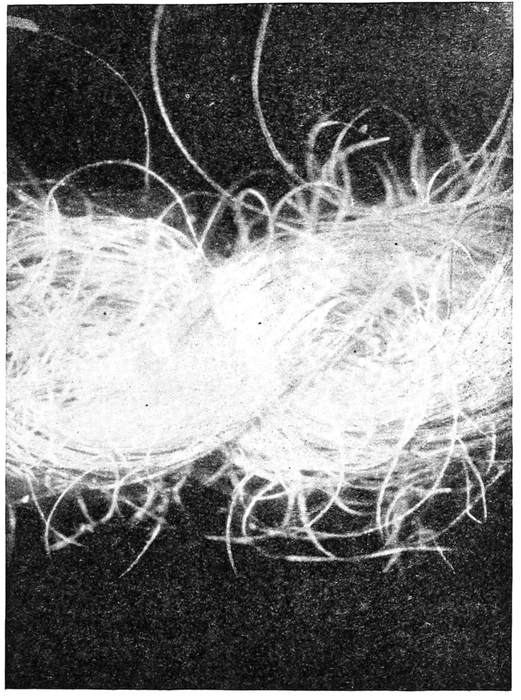
forty-fold. Fig. 22 gives a similar enlargement under the
microscope of a yarn of the same class as used for utility wear
at a moderate price, this yarn is three-fold and is spun on the
woollen system with fibres showing in every variety of angle.
The three-ply yarn shows very dense and gives a garment in
a coarse gauge with considerable weight and of most serviceable
character; it is found very adaptable for thick woollen
socks for artisan wear.
Fig. 21
29
Fig. 22
Lamb's Wool Yarns.—The term lamb's wool as used in
the knitting industry does not confine its connotation to the
product of the lamb during its first six months of growth,
although such yarns would naturally be included in the first
scope of the term. Naturally the growth on the lamb during
the first half-year is of the softest description and greatly
esteemed for many classes of knitted goods where a kindly
feel is of the utmost value. The term has to-day a much
wider definition, and includes yarns spun from the shorter
staples on the woollen system, so that such goods are well
covered with surface material and further offer a good basis
30for brushing on the teasles or gig, thus increasing the softness
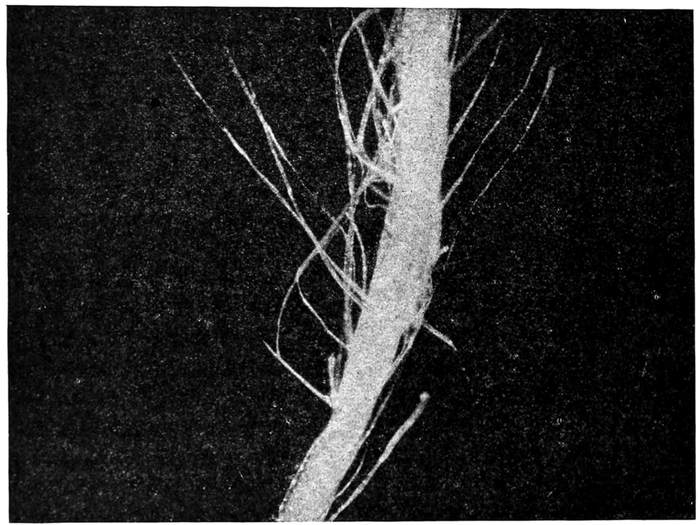
considerably. Fig. 23 gives a photo-micrograph of one
of the finer classes of lamb's wool yarns where the crossing
and re-crossing amongst the constituent fibres is very well
displayed along with the loose open form of the thread. The
openness of texture proclaims this variety as being eminently
suitable for the underwear branch of the business and these
made into garments of moderate price give excellent service.
In this sample the fibres are very regular in diameter,
the thread is well constructed and will be sound in respect
of absorbent quality.
Fig. 23
Shetland Yarns.—This is another example of a designation
employed in the knitting trade which has wandered far from
its original meaning. The name has primary reference to
yarns and fabrics produced from the material taken from
the Shetland breed of sheep which give wool of excellent
soft handling properties. These wools occur in natural
colours, brown, grey and black being found in addition to the
31predominating white. The fibre is soft, exceedingly agreeable
to handle, and has been largely used for the industry from the
pioneer days of the hand knitting. The word Shetland as now
known in the trade has shown a distinct tendency to deteriorate
in connotation and most generally means yarns of coarse
character, carded and spun on the woollen system with a
certain proportion of fibre of nondescript character mixed.
These fibres are usually dark in colour and mixed along with
the white wool give a tint known as "Natural"; the tints
are most serviceable for utility undergarments in regular wear
as they obscure soiling and allow of longer inter-laundry
periods. Pure white articles are quickly soiled, the "Natural"
garments can give a longer period of usefulness without
sacrificing real cleanliness. In times of scarcity of material
and in absence of laundry facilities, these natural coloured
garments prove distinct aids to economy. Formerly the
natural tint in a garment was at once a sign of inferiority and
low grade, but now wools of expensive character are mixed
with 5 to 10 per cent. of freshly-dyed fibre of pleasing effect
to give better service. There has latterly been a tendency
to increase the proportion of dark-coloured fibres and give a
wider colour expression; in place of the ordinary brown,
fawn and grey, other varieties bolder in aspect are utilized.
Fig. 24
2-PLY SHETLAND NATURAL YARN SHOWING DARK FIBRES INTERMIXED
32Fingering Yarns.—The term fingering is widely known in
the trade and is a clear reference to the era of hand spinning
on the wheel when the fibres were drawn through the fingers
preparatory to the addition of torsion, this "fingering" being
a domestic attempt to establish a certain amount of parallelism
amongst the fibres. Wools of longer staple were employed
for these productions which may be regarded as the prototype
of the modern worsted thread. The attempt to render
the fibres parallel by hand cannot be completely successful,
but the worker rejected the shorter material which was not
incorporated in the thread, whilst the longer residual fibres
were spun with rather more twist than was usual with pure
woollen yarns. The fingering yarn as now known is spun
from the better classes of medium-stapled wool and is usually
found in three or four-ply for the better class woollen hose
trade. It gives a good quality article which felts less than
the woollen spun and has increased durable qualities, the
three-ply giving a considerably augmented strength to the
article. The principle of worsted spinning as practised in
the Bradford district for weaving yarns is not suitable for the
knitting industry. As a rule the twist is too hard, and even
with slack twist the structure is scarcely suitable, not being
open enough and having too little surface fibre. A fingering
yarn largely used for the footwear trade is given in photo-micrograph
at Fig. 25, where the thread is noted to be three-fold;
the single strands show a firm twist, but at the same
time there is visible a fair percentage of surface material
which makes the yarn suitable for covering the interstices
and contributing to fabric consistency. The qualities of this
particular yarn have been tested by long experience in use
and have proved ideal when the right kind of wool is used
as foundation.
33
Fig. 25
Fig. 26
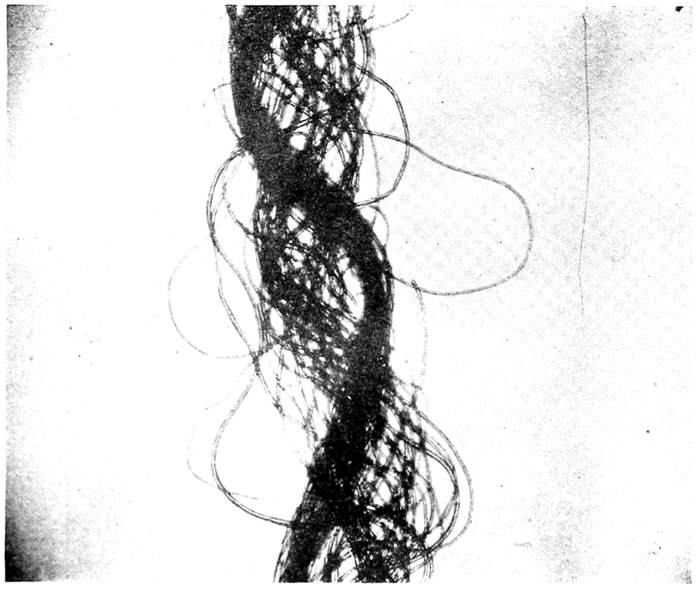
34Worsted Underwear Yarns.—A view of a typical yarn as
used for the light-weight underwear branch of the knitting
business is given in Fig. 26, which represents a two-fold hosiery
yarn used for light-weight shirts and pants, but more particularly
for ladies' garments. Extreme fibre parallelism is the chief
feature of this yarn structure, the fibres being meticulously
pulled into line with each other by the teeth of the comber.
The next points important to observe are the spaces shown
between the individual fibres which ensure adequate ventilation
and absorbency, along with the requisite elasticity.
The twist in the single is very slight and the strength is
obtained by folding the two single strands together. At the
same time a sufficiency of surface material is present to insure
correct cover for the loops so as to remove rawness of structure
and impart a "skin" to the cloth.
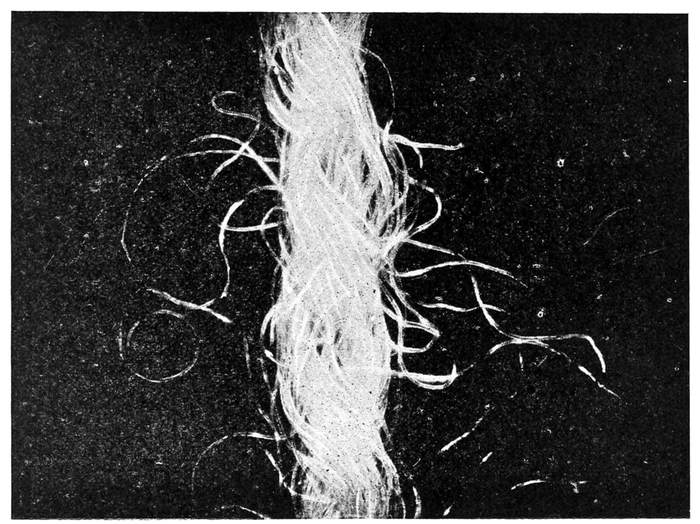
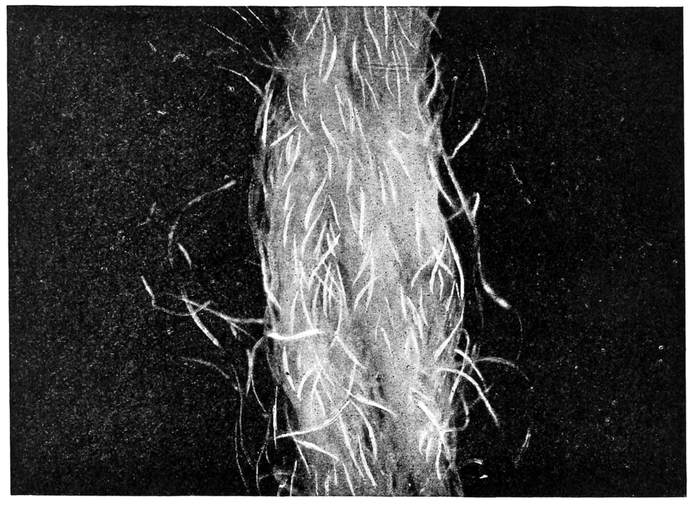
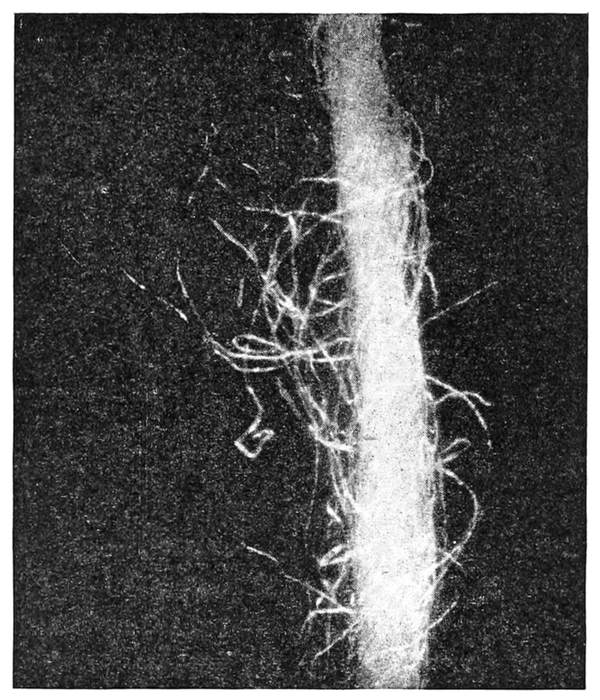
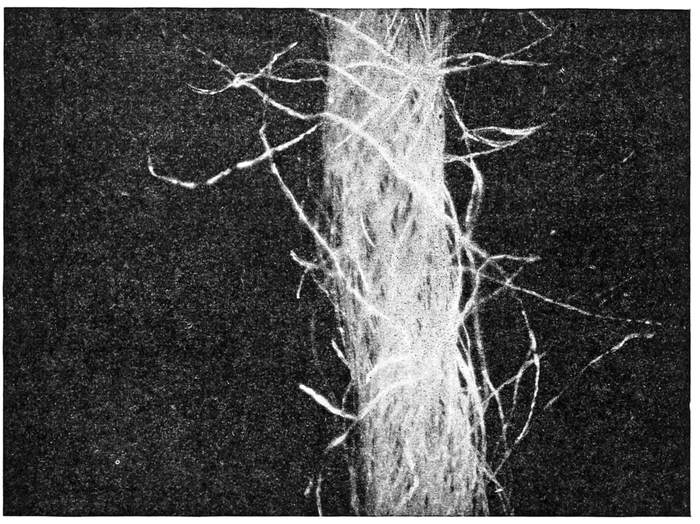
The yarns illustrated in micro-photos 27 and 28 may be
regarded as typical structures employed for the great bulk
of the trade in underwear, these being samples of the widely-known
dry-spun yarns on the French system. As compared
with the method of producing worsted yarns in the weaving
trade, this system of dry spinning is so called because no oil
is added to the sliver in preparation; the system of combing
adopted deals with shorter and less valuable wools and moderately
priced yarns are feasible. Openness of character is best
secured by imparting twist on the ordinary woollen mule,
where the thread is torsioned intermittently in long lengths,
during which operation a certain proportion of the fibres are
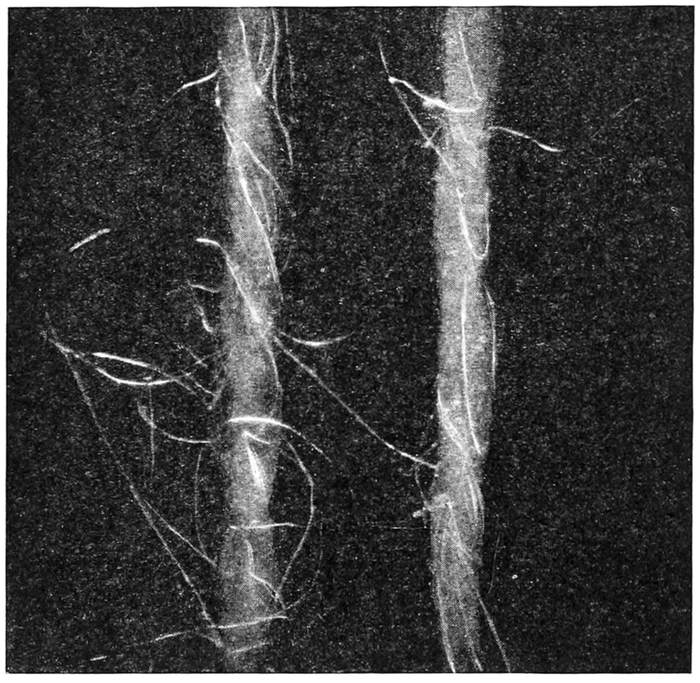
thrown to the surface, as clearly shown in Fig. 27. The yarn
is two-ply with a fair twist in the two-fold, whilst the singles
have quite a small amount of torsion. The extraneous
material prominent in this sample 27 is a valuable feature
in the success of the yarn for the knitting trade. Fig. 28
gives a view of a thread of the same character but rendered
denser in form on account of its three-fold character. This
is an excellent sample of a yarn giving splendid service in
wear and the production of which has caused a most flourishing
spinning industry to be established in continental countries.
35
Fig. 27
Fig. 28
36In this prosperity it is hoped the British spinner will participate
more fully in the future, because it is a branch which
lends itself to enormous production on a large scale, the usual
way of doing the trade being for one mill to concentrate on
few counts so as to have a minimum alteration in the setting
of machinery. In addition the spinner requires to instal the
right kind of combing plant which, it is satisfactory to learn,
can be made very efficiently in this country; the British
machine builder has risen to the occasion, and it is to be
hoped that the spinner will follow quickly in his wake and
prove equal to the enormous call for this class of yarn. These
yarns are often referred to in the trade variously as botany
yarns, or cashmere yarns, although the latter is in reality a
misnomer, having original reference to the product of the
Cashmere goat indigenous to the Himalaya Mountains in
Northern India.
CHAPTER V Counts of Yarn
37
Within recent years a great improvement has been effected
in the matter of yarn numbering for the hosiery trade.
Formerly a number of systems were in vogue which were
distinctly local in their character and application, but these
now tend to confine themselves to the standards common
to other branches of textiles. Most yarns can be
classed under the worsted, cotton or silk systems; woollen
yarns spun on the Borders of Scotland are based on the
Galashiels counts, whilst those from Yorkshire are counted
on the skein system. Artificial silk yarns are numbered on
the denier system which has come into greater prominence
recently in connection with the growth of artificial silk goods
on the market. The more irrational and arbitrary methods
of numbering yarns are rapidly declining in use and the great
majority of yarns now supplied are given in one or other of
the systems named.
Worsted Yarns, including those coming under the term
cashmere, botany and mohair are numbered on the worsted
system which has its basis in the number of 560-yd. hanks
which weigh 1 lb. of 16 oz.
Cotton Yarns, including those spun from a mixture of cotton
and wool under the term merino, and spun silk are estimated
on the number of 840-yd. hanks which weigh 1 lb. of 16 oz.
There is a reservation in the case of two-fold silk yarns, the
counts giving the exact number whether single, two-fold, or
three-fold.
Woollen Yarns.—Alloa is an important centre of hosiery
yarns spinning, and a system used in this locality is based on
the equivalent of the number of 240-yd. hanks which weigh
1 lb.
Woollen yarns spun on the Scottish Borders are calculated
on the Galashiels method which is equivalent to the number
of 200-yd. hanks in 1 lb. The Yorkshire woollen skein system
38is based on the number of yards per oz. which, brought into
line with others, gives a basis of the number of 256-yd. hanks
which weigh 1 lb. Leicester lamb's wool system is equivalent
to the number of hanks of 176 yd. each in 1 lb.
Silk Yarns.—In addition to the spun silk yarns mentioned
as being counted on the basis of the cotton hank of 840 yd.,
what is known as the Organzine silk system is given by the
number of yards per oz.
Tram silk is calculated on the weight in drams of 1,000 yd.,
and in the case of artificial silk yarns the counts are gauged
by the weight in deniers of 520 yd. There are 1,600⁄3
or 533⅓ deniers in 1 oz.
Yarn Testing for Counts.—This subject has been taken up
with greater interest by hosiery manufacturers, who are now
installing suitable apparatus for conducting the important
test as to whether a yarn is up to standard in regard to counts.
Variation in the yarn size at once reflects itself in the weight
per dozen garments, the usual trade basis, and with increased
prices of yarns these tests are likely to become more prevalent
in the future. Compared with the weaving trade the question
of gauging the size of a yarn by the method of inspection
and handling is by no means effective on account of the loose
nature of many knitting yarns; in general they appear to have
much less weight than their diameter would lead the observer
to suppose. In weaving yarns the twist is much more decided
in effect, but in hosiery materials accurate estimation can
only be performed by making a calculation based on the
weight of a given length of the sample. A number of simple
devices are on the market whereby the counts of yarn can be
accurately determined by weighing a given number of threads
cut to a certain template according to the yarn system, and
these instruments are being largely employed in cases where
the overseer is too busy to give the matter personal attention.
An intelligent yarn foreman, however, prefers the method of
weighing off a given length of the thread and finding the
counts by direct calculation or by the aid of an assimilating
table. He can also devise short ways of making the calculation
of counts adapted to the class of yarns being handled in
39greatest numbers, and these do not depend for their accuracy
on any accidental mechanical factors.
Let it be supposed that the custom in a factory is to test
a yarn by unravelling a length of 20 yd. and finding the weight
of this in grains. In each calculation the proportion will be
repeated of finding the number of yards in 1 lb. or 7,000
grains. Again, if the prevailing counts be worsted, then this
will involve 560 in each calculation as in the following example.
Example 1.—On unreeling a yarn it is found that a length
of 20 yd. weighs 10 grains, find the counts in worsted.
By proportion, if there are 20 yd. in 10 grains, the yards
in 1 lb. or 7,000 grains will give the yards per lb. This
obtained, we divide by 560 the length of the worsted hank
to obtain the counts thus—
20 × 7,000
= 25's worsted counts of yarn.
10 × 560
Example 2.—A worsted hosiery yarn is tested and 20 yd.
are found to weigh 35 grains, find the counts.
20 × 7,000
= 7⅐ worsted counts.
35 × 560
If these two examples be observed it will be noted that for
every calculation of this type such as a yarnman might be
expected to make frequently, the common numbers are
20 × 7,000 560
= 250. These will occur in every calculation of
this kind and this gives a short method of getting the result,
for in place of using these three factors we take the resultant
250 as shown and divide the weight of grains into it.
Example 3.—Find the counts of a cashmere hosiery yarn,
20 yd. of which weigh 24 grains.
Following the method indicated we can obtain this result
at once by dividing 250 by 24 = 10·4 counts cashmere.
The other counts met with frequently is the cotton or
merino system where the hank number is 840 and the value
in all such calculations is given by the numbers—
20 × 7,000
500
=
or 166⅔.
840
3
40Example 4.—Find the counts of a merino yarn of which
20 yd. weigh 14 grains.
Taking the value 500⁄3 divide it by 14, thus—
500
= 11·9 counts.
3 × 14
Similarly, if working with dram weights and a standard
length of 20 yd. we should devise a value for the figures constantly
recurring and this would greatly simplify the calculation
of the counts.
Example 5.—Find the counts in Galashiels or Scotch woollen
system of a yarn, 20 yd. of which weigh 2 drams.
The first step is to find the yards in 1 lb. = 16 × 16 = 256
drams, and then divide by the hank length of 200 yd.—
20 × 256
= 12·8 cut Scotch woollen.
2 × 200
In all calculations of this character the numbers
20 × 256 200
will occur and these reduced give a value of 25·6 which is
taken as the constant and for all similar calculations the
weight in drams is simply divided into this value to obtain
the result.
Example 6.—Find the counts in Scotch woollen of a yarn,
20 yd. of which weigh 1·25 grains.
Taking the value as 25·6, this is divided by 1·25 = 20·4 cut
woollen.
Sufficient has been given to show that it is comparatively
easy to calculate counts of yarns regularly coming into the
yarn store where we have a few standard hank lengths to
consider along with the values obtained for each type of
calculation met with in practice. Tables in each can be
constructed from which the counts of yarn may be seen at a
glance, the only work being to find the weight of the test
length.
Yarn Conversion.—When two or more yarn classes are used
in the same garment it is necessary for purposes of calculation
to translate the counts into one or other of the systems, the
most common system for choice. Thus, in cotton and wool,
41or silk and wool twist yarns, it may be necessary to make a
calculation for counts and this cannot be affected unless both
yarns are in the same denomination. The rule is to multiply
the given counts by its own hank length and divide by the
hank length of the yarn required.
Example 7.—Change 2/40's merino counts into worsted and
Yorkshire skeins. 2/40's merino = 20's single, and by the
rule—
20 × 840
= 30's worsted.
560
To convert into skeins counts the hank length is 256, and
the formula is given by—
20 × 840
= 65·6 skeins.
256
Example 8.—Change 24/24 Scotch woollen into Alloa and
skein systems. 24/24 = 12 cut single.
12 × 200
= 10's counts Alloa.
240
12 × 200
= 9·4 skeins counts.
256
Example 9.—Find the equivalent of 40/2 spun silk in worsted
and skeins counts. In silk the number is always the
exact counts whether it be folded two or more ply. Thus,
we have it stated as—
40 × 840
= 60's counts in worsted.
560
40 × 840
= 131·25 counts skeins.
256
Example 10.—Find the yards of yarn in 3 lb. of 2/48's
worsted and ¼ oz. of 60/2 spun silk respectively.
In 2/48's worsted 24 × 560 = yards in 1 lb., ∴ 24 × 560 × 3
= 40,320 yd. in 3 lb. 60/2 spun silk = 60 × 840 = yards in
1 lb. or 16 oz., and to obtain the length in ¼ oz. divide by
4 × 16—
60 × 860
= 787·5 yd.
4 × 16
Weight of Knitted Fabrics.—These calculations lead to
examples where the weight of knitted fabric has to be found.
42The ordinary plain knitted loop in which the bulk of textures
is worked consists really of a weft structure, that is, the
yarns run predominantly crosswise, and are intersected with
the preceding loops in the manner already described. In
determining the weight of a given length of plain knitted
fabric we require various factors, these being taken as they
are on the frame. It is essential in the first place to know
the counts of yarn employed, and the number of courses
inserted per inch into the fabric, and again it is essential to
know the width at which the fabric is being worked on the
machine. Finally, it is necessary to estimate what is known
as the "take-up," for the yarn is pushed into curved formation
which "takes up" yarn about twice the width of the
fabric by the intersecting of the yarn over the needles and
this has a very definite influence on the weight.
Example 11.—Find the weight of 10 yd. of knitted fabric
made from 2/20's worsted yarn with 18 courses per inch at a
width of 32 in. on the needles. The take-up is 2, that is, to
form one course of loops, a length of yarn equal to twice the
width is required.
If the question of take-up be ignored for the moment, let
the yarns be inserted as weft threads crosswise in the fabric
and we shall have in 1 in. of cloth 18 courses or threads each
32 in. wide. This gives
18 × 32 36
= yards of yarn in 1 in. of cloth or
18 × 32 × 36 36
yards of yarn in 1 yd. of cloth × 10
for 10 yd., but from the yarn counts we know that the size
is such that 2/20's worsted = 10 × 60 = yards in 1 lb., so
that dividing the latter by this number of yards will give the
weight of the fabric in pounds, thus—
18 × 32 × 36 × 10
= 1·03 lb. as the weight of 10 yd. of fabric.
36 × 10 × 560
But this is the weight if the yarns are straight in the fabric,
which they are not, for there is a take-up of 2, that is, the
weight has to be doubled—
1·03 × 2 = 2·06 lb. weight.
From this concrete example may be derived a formula which
43can be applied to all cases where the sufficient particulars
are given, and following the above example we obtain—
Example 12.—
Courses per in. × width × length × take-up
= weight in lb.
counts × basis
In this statement let the courses per inch or the sett be
represented by S, the width by w, and the weight by W,
counts = C, basis = B, length = L, from which we obtain
the following equation—
Example 13.—
S × w × L × T
= W,
C × B
or-
S × w × L × T = W × C × B.
From this it follows that given any six of the seven factors
we may obtain the seventh by substitution of values. Some
of these possibilities are of academic interest only and are
seldom required in practice, but a few examples may be given
of the use of this formula.
Example 14.—Find the weight of 200 yd. of knitted webbing
worked from 2/40's cashmere yarn with 28 courses per inch
to a width of 48 in. with a take-up of 1·75.
Substituting as in formula 12—
28 × 48 × 200 × 1·75
= 42 lb. weight.
20 × 560
Example 15.—Calculate the weight of fleecy fabric worked
one thread 2/30's worsted yarn on face with 12 skeins yarn
on back; the worsted has a take-up of 1·75, whilst the back
yarn take-up is 2. There are 24 courses per inch of each
thread, the length is 150 yd. and the width equivalent to
60 in.
For this example it is most expeditious to work out each
yarn separately according to formula 12. For the face yarn
the items will be stated thus—
24 × 60 × 150 × 1·75
= 45 lb. weight,
15 × 560
for the woollen—
24 × 60 × 150 × 2
= 140·6 lb. woollen.
12 × 256
44These added give 45 + 140·6 = 185·6 for the total weight
in pounds.
Example 16.—Find the weight of a fabric plated as follows—
1-40/2 spun silk with take-up of 1·75
1-2/32's merino with take-up of 2·25
Length 320 yd., 24 courses per inch, 60 in. wide.
For the silk the counts 40/2 are taken as 40's single—
24 × 60 × 320 × 1·75
= 24 lb.
40 × 840
For merino—
24 × 60 × 320 × 2·25
= 77·14 lb. Total 101·14 lb.
16 × 840
Example 17.—Find the merino counts of yarn to produce
72 yd. of fabric 56 in. wide, 18 courses per inch, 24 lb. of
material with a take-up in knitting of 2½.
The formula for this type of calculation can be derived
from that given for finding the weight, all items being the
same except that the weight is substituted for the counts.
Following formula 12—
18 × 56 × 72 × 2½
= 9's counts single or 2/18's.
24 × 840
Example 18.—Calculate the yarn counts in the Alloa system
for a fabric 180 yd. long with 14 courses per inch, 66 in. wide,
the take-up is 2 and the weight 24 lb.
14 × 66 × 180 × 2
= 57¾ Alloa.
24 × 240
Example 19.—Estimate the skein counts for a fabric 200 yd.
long, 80 lb. in weight, 60 in. wide, 12 courses per inch, with
a take-up of 2·25.
12 × 60 × 200 × 2·25
= 15·8 skeins counts.
80 × 256
Example 20.—Give the worsted counts to reduce the weight
to 60 lb. for example 19.
12 × 60 × 200 × 2·25
= 9·6 worsted or 2/19's approx.
60 × 560
Example 21.—Calculate the length of knitted fabric which
45can be secured from 30 lb. of 2/42's cashmere, 22 courses per
inch, 63 in. wide, take-up 1½.
This is obtained from formula 13 and may be stated thus—
weight × counts × basis
= length.
courses × width × take-up
30 × 21 × 560
= 170 yd. approx.
22 × 63 × 1½
Example 22.—Find the length per 100 lb. obtained in 2/30's
merino, take-up 1·75, 21 courses per inch, 64 in. wide.
100 × 15 × 840
= 535·7 yd.
21 × 64 × 1·75
Example 23.—Find the length of rib fabric with a take-up
of 3 obtained from 100 lb. of 20/20 Scotch woollen counts,
15 courses per inch, 60 in. wide.
100 × 10 × 200
= 74 yd.
15 × 60 × 3
Example 24.—Find the width at which a fabric will require
to be worked to use 80 lb. of 2/16's worsted counts, take-up
2½, length 240 yd., 18 courses per inch.
This formula is identical to that used to find the length,
except that the length is substituted for the width—
weight × counts × basis
= width.
courses × length × take-up
80 × 8 × 560
= 33·19 in. wide.
18 × 240 × 2½
Example 25.—Find the width for a cotton fabric weighing
40 lb., 120 yd., 2/32's counts, 21 courses per inch, take-up is
2½.
40 × 16 × 840
= 85·3 in. wide.
21 × 120 × 2½
Example 26.—Find the courses per inch required for a fabric
worked in 18 skeins, 60 in. wide, take-up 175, 120 yd., 50 lb.
weight. This is obtained from the same formula as Examples
24 and 25 except that the width is substituted for courses
per inch.
50 × 18 × 256
= 18·3 courses per inch.
60 × 120 × 1·75
CHAPTER VI Folded Yarns
46
An interesting series of calculations useful to the knitting
industry can be built up in connection with the methods of
finding the resultant single counts of two or more yarns
folded together. The counts of twist yarns is in the first
instance of special application to the spinner, but there are
many circumstances in which they may be useful in the yarn
store of a hosiery factory. When two yarns of the same
counts are twisted, the resultant equivalent single counts is
obtained by dividing by 2, but when the yarns vary in size
the proceeding is rather different. A common fault is to
add the two counts together and divide by 2, but this gives
a result which is entirely wrong. For purposes of comparison
it is useful to have the equivalent single counts when two or
more yarns are folded together, but the special interest to
this branch lies in using two single yarns to take the place of
one, in cases where supplies of the first material have run
short. It is then of practical importance to have the two
substitute yarns chosen from those in stock so that they
approach as nearly as possible the size of the original.
Example 27.—Find the counts of 60's and 40's folded
together. This example can be used to build up the formula
from first principles. Take for convenience 60 hanks of the
highest counts and twist this with an equal length of 60
hanks of the second counts stated thus—
60 hanks of 60's counts weigh
1
lb.
60 hanks of 40's counts weigh
1½
lb.
60 hanks of folded thread =
2½
lb.
therefore, 60 divided by 2½ gives 24 hanks of folded yarn in
1 lb. which is the counts 24's.
To find out a shorter rule for estimating the counts of a
two-fold thread, let the first counts be represented by A, and
the second counts by B, and let R be the resultant counts of
47yarns A and B folded together. Following the concrete
example 27, it may be stated generally thus—
Example 28.—
A hanks of A counts
=
1
lb.
A hanks of B counts
=
A⁄B
lb.
A hanks of folded yarn
=
1 + A⁄B
lb.
The resultant counts R is obtained thus—
A
1 + A⁄B
= R,
but
A
A + B
1 +
=
B
B
and making the fraction proper we obtain the rule—
AB
= R.
A + B
Stated in words the rule is "To find the resultant counts
of two threads folded together, multiply the two counts
together and divide by their sum."
It often happens that a counts of a given size is required
from two single yarns as in the frequent case of yarns running
down before the contract for goods has been delivered. In
such instances the resultant counts required is known and
given one of the constituent singles, the other can be obtained
by the rule: "Multiply the two counts together and divide
by the difference." This can be proved in a general way
from the last-found formula—
Example 29.—
A × B
= R
A + B
in this equation the following also holds good
AB =
R (A + B)
AB =
AR + BR
A B - BR =
AR
B (A - R) =
AR
AR
B =
A - R
48Similarly, if A is the missing counts of the two-fold yarn,
the rule for A can be proved thus—
AB =
R (A + B)
AB =
AR + BR
AB - AR =
BR
A (B - R) =
BR
BR
A =
B - R
Examples in folded yarns.
Example 30.—Find the counts of 64's, 48's and 32's yarns
folded together, and also give average when they are used
separately one thread of each size in a garment. From the
formula proved in Example 28 we have the following, taking
the highest counts as starting-point—
64 hanks of 64's counts weigh
1
lb.
64 hanks of 48's counts weigh
1⅓
lb.
64 hanks of 32's counts weigh
2
lb.
64 hanks folded yarn weigh
4⅓
lb.
therefore—
64
= 1410⁄13 × 3 = 444⁄13 counts.
4⅓
In the hosiery trade such yarns are more often used separately
than folded together, when the more useful problem is
to find the average counts of the three threads which is obtained
by multiplying this result by the number of threads in the
set, in this case 3.
Average counts = 1410⁄13 × 3 = 444⁄13 average.
Example 31.—Give the resultant equivalent single counts
of a silk and wool yarn composed of one thread of 2/40's
worsted folded with a thread of 60/2 spun silk, also give the
weight of each material in 110 lb. of garments and state the
price ratios of worsted and silk respectively, taking the silk
at 12s. 6d. per lb. and the worsted at 5s.
For the counts calculations both yarns have to be expressed
in the same denomination and let the worsted system be
49taken. Transferring 60/2 silk, the counts is 60's as it stands
and the transfer is made thus—
60 × 840
= 90's.
560
To find the counts formula 28 can be used, that is,
multiply the two counts together and divide by their sum—
90 × 20
90 × 20
180
=
=
= 164⁄11.
90 + 20
110
11
To obtain the weight ratio the calculation had better be
worked thus—
90 hanks of 90's
= 1
lb.
90 hanks of 20's
= 4½
lb.
90 hanks twist
= 5½
lb.
90 ÷ 5½ = 164⁄11 as before.
For the weight proportion the total is given as 110 lb.,
which has to be divided in the ratio of the weight column,
that is, of a total of 5½ lb., 1 lb. is silk and the remainder
worsted—
1
× 110 = 20 lb. silk.
5½
4½
× 110 = 90 lb. worsted.
5½
For the price let the weight column be again used—
1
lb. silk @ 12/6
= 12/6
4½
lb. wor. @ 5/-
= 22/6
5½
lb. twist
= 35/-
35/- ÷ 5½ = 6⁄4¼ per lb.
also 5⁄14 of cost is due to silk and 9⁄14 due to worsted.
It is quite evident that this method of procedure yields
results of the utmost interest and value to the maker of knitted
goods.
Example 32.—Find the counts of 48's cashmere folded with
30's merino. Answer in merino system.
Change 48's cashmere into merino—
48 × 560
= 32's.
840
50Using the rule as in (28)—
32 × 30
32 × 30
=
= 1515⁄31.
32 + 30
62
Example 33.—Find the resultant counts of 2/32's cashmere
or worsted folded with 21's skeins counts. State answer in
skeins system.
Transfer worsted to skeins—
16 × 560
= 35 skeins.
256
By one method the counts is given by—
35 × 21
35 × 21
=
= 13⅛ counts skeins.
35 + 21
56
In this connection it might be useful to have the weight
proportion of each, also the average counts if the two threads
are not folded but placed side by side. Let the price of the
2/32's be 7/6 per lb., and that of the 21's skeins, 3/-per lb.,
when the cost per lb. of the combination is obtained as
follows—
35 hanks of 35's
= 1
lb. @ 7/6
=
7/6
35 hanks of 21's
= 1⅔
lb. @ 3/-
=
5/-
35 hanks of folded
= 2⅔
lb.
=
12/6
For the counts
35⁄2⅔
= 13⅛ if folded, but if separate, number
× 2 will give the average counts 13⅛ × 2 = 26¼ average
counts.
The weight percentage of each constituent in the garment
is stated thus—
1
1⅔
× 100 = 37½ % worsted.
= 62½ % skeins.
2⅔
2⅔
For the average price 2⅔ lb. = 12/6 = 4/8¼ per lb.
Example 34.—Find in Scotch system the resultant and
average counts of 36/36 Scotch with 2/40's cotton.
Bringing the cotton to Scotch counts—
20 × 840
= 84 cut,
200
51by the rule—
84 × 18
= 14·82 counts, or × 2 = 29·6 average counts.
84 + 18
This rule can be applied twice in succession to find the counts
of a three-fold yarn.
Example 35.—Find the counts of 80's, 40's and 20's folded
together and give the average counts if they are used separately
in a garment, one thread of each.
Taking 80's and 40's the resultant counts of these two is
secured by the usual method—
80 × 40
80 × 40
80
=
=
or 26⅔ counts.
80 + 40
120
3
This is now folded with the remaining counts 20, in a similar
operation—
26⅔ × 20
= 113⁄7 resultant counts or × 3 = 342⁄7 average counts.
26⅔ + 20
This result can be verified by the original method—
80 ÷ 80
= 1
80 ÷ 40
= 2
80 ÷ 20
= 4
80 hanks
= 7 lb.
80 ÷ 7 = 113⁄7 × 3 = 342⁄7 average.
Example 36.—Give all useful particulars for the following
combination of yarns in a garment—
1 - 2/42 wor.
@
5/6
per lb.
1 - 12's cotton
@
3/6
per lb.
1 - 80/2 silk
@
15/-
per lb.
Bring the worsted to cotton counts and the three yarns
will then be in a like denomination—
21 × 560
= 14's cotton.
840
Arranging these for the resultant counts, price and weight
relationships—
80 ÷ 80
=
1
lb. @
15/-
= 15/-
80 ÷ 14
=
5·7
lb. @
5/6
= 31/4
80 ÷ 12
=
6·6
lb. @
3/6
= 23/1
80 hanks
=
13·3
lb.
= 69/5
5280 ÷ 13·3 = 6·1 counts if twisted, and × 3 = 18·3 counts
average.
69/5 ÷ 13·3 = 5/2 per lb. folded.
By computation from the table of prices it is found that
21·4 % of cost is due to silk
45·1 % of cost is due to worsted
33·5 % of cost is due to cotton.
For the weight percentage the proportions are taken from
the weight column—
1
5·7
× 100 = 7·52 % silk.
× 100 = 42·8 % worsted.
13·3
13·3
The remaining figure 49·68 % cotton is obtained by
subtraction.
Example 37.—Find the useful particulars for a plated fabric
composed of 2/20's worsted @ 8/6 per lb., 10's cotton @ 4/-
per lb. The cotton yarn appears on the back and has 50
per cent. more take-up than the face.
10 × 840
= 15's worsted.
560
15 plus 50 % of 15
= 22½
÷ 15
=
1½
lb. @ 4/-
= 6/-
15 plus 0
= 15
÷ 10
=
1½
lb. @ 8/6
= 12/9
3
lb.
= 18/9
15 ÷ 3 = 5's counts. 18/9 ÷ 3 = 6/3 per lb.
From the column of weights it is seen that this is divided
equally between the two yarns; although the cotton is finer
in diameter, yet the weights are made equal by extra take-up
in loop formation.
Example 38.—A garment order is being executed from
2/42's yarn which runs short, 2/60's is in sufficient stock,
and it is required to find what counts used with this will give
the same weight of garment on the frame. Applying the
difference rule—
2/60's
= 30's
30 × 21
30 × 21
=
= 70's.
2/42's
= 21's
30 - 21
9
Example 39.—Given two counts 48's and 24's in stock,
find the third yarn needed to twist with these to obtain a
53counts equivalent to 10's single. The first step is to fold the
two yarns together by the addition rule—
48 × 24
= 16's.
48 + 24
Then by the difference rule—
16 × 10
160
=
= 26⅔ Ans.
16 - 10
6
Example 40.—40's and 30's worsted are yarns in stock,
find a third thread to fold with these to make a three-fold
counts = 10's.
40 × 30
40 × 30
=
= 17⅐ counts of the two yarns folded.
40 + 30
70
Using the difference rule—
17⅐ × 10
= 24's Ans.
17⅐ - 10
To provide proof use the ordinary method of folding—
40 ÷ 40
= 1
lb.
40 ÷ 30
= 1⅓
lb.
40 ÷ 24
= 1⅔
lb.
40 hanks
= 4
lb.
40 ÷ 4 = 10's counts.
If the third thread were wanted in another quality such as
cotton, the answer would be secured by transfer—
24 × 560
= 16's cotton
840
or-
24 × 560
= 52½ skeins.
256
Example 41.—Find the particulars for a fabric containing
three yarns used, one of each in succession, where the take-up
of each thread varies in the fabric as shown. This take-up
of different yarns in knitting is frequently neglected in
54calculations, but obviously should be carefully taken into
account for it has a very direct influence on the weight.
1 - 40's yarn with take-up of 1·25 for normal fabric.
1 - 30's yarn with take-up of 1·50 for normal fabric.
1 - 12's yarn with take-up of 2·25 for normal fabric.
We proceed by stating the length of hank in the ratio of
the various take-ups thus—
225 hanks of 12's
=
18·75
lb.
150 hanks of 30's
=
5
lb.
125 hanks of 40's
=
3·12
lb.
125 hanks normal
=
26·87
lb.
Working out percentages in the usual way from the column
of weights we find that—
40's yarn = 11·4
% of weight.
30's yarn = 18·6
% of weight.
12's yarn = 70
% of weight.
Example 42.—2/24's worsted yarn has been used for an order
and runs out before completion of the weight required; sufficient
weight of 16's is in stock, find the nearest counts which
must be used along with this to give a fabric of the same
weight as the original; 2/24's = 12's.
Using the rule of differences—
16 × 12
= 48's.
16 - 12
The ratio of weights can be found thus, 48's and 16's—
48 hanks of 48's =
1 lb.
48 hanks of 16's =
3 lb.
4 lb.
That is, out of a total of 4 lb. one-quarter is of the finer counts
48, whilst the remaining three-quarters is of the second counts
16's. By making this calculation it will be seen whether
there is a sufficient weight of each yarn to complete the order.
Example 43.—As a substitute for solid 2/22's yarn in a
garment it is proposed to use one thread of 18's and a second
yarn of suitable size to give the same weight. Find this
55yarn and state the ratio in which the two will occur in the
garment.
By the rule of differences—
18 × 11
18 × 11
=
= 282⁄7 counts.
18 - 11
7
For the weight of each, this can be done quite simply by
adding the two counts and taking the relative proportions
inversely—
18
+ 282⁄7
= 462⁄7.
18
× 100
= 388⁄9 % of 282⁄7 counts.
462⁄7
282⁄7
× 100
= 61⅑ % of 18's counts.
462⁄7
This last example shows clearly that the weight of the
constituents varies inversely according to the yarn counts,
the higher the counts the lower the weight and vice versâ.
The matter is more prominent in problems where a resultant
counts is given with two weight ratios, the counts to produce
these being sought by calculation.
Example 44.—A garment is required equal to 12's counts
composed of two yarns where one-third of weight is on the
face and two-thirds on the back. Find two counts which
will fulfil these conditions.
The counts are inverse to the weights; if the proportion
had been direct we should have stated: ⅓ of 12's, but seeing
that the ratio is inverse we state: 3⁄1 of 12's = 36's for one
yarn.
The other thread is ⅔ of 12, which inversely gives 3⁄2 of 12
= 18. For proof—
36 × 18
= 12's counts.
54
Example 45.—Find two yarns one having one-fifth of the
weight and the other four-fifths to give a resultant counts
= 12's.
⅕ of 12, inverse
= 5⁄1 × 12
= 60's counts.
⅘ of 12, inverse
= 5⁄4 × 12
= 15's counts.
These counts are 60's and 15's and they together produce a
thread = 12's.
56Example 46.—A three-fold yarn is equal to a counts of 8's,
the first thread gives one-seventh of the weight, the next
three-sevenths and the next four-sevenths, find each counts
in the folded thread.
7⁄1 × 8 = 56's. 7⁄3 × 8 = 18⅔. 7⁄4 × 8 = 14's.
Example 47.—A fabric with an average counts of 20's is
required in two materials, one giving two-fifths of weight and
the other three-fifths, find the counts of each.
5⁄2 × 20 = 50's. 5⁄3 × 20 = 33⅓.
CHAPTER VII Bearded Needle Knitting
57
The type of knitting instrument employed is responsible for
a convenient division of the industry according as the machines
are fitted with the latch or the bearded needle. The latch
needle has already been described when it was observed to be
independent in action. Each needle is free to prepare and
complete its own loop, this being done in rapid succession as
the cams traverse the heels or butts. In bearded needle
knitting the process is quite different, and a number of separate
parts require to co-operate with the needle for stitch formation.
Fig. 29 gives a clear view of the construction of the bearded
needle, also known as the spring needle, consisting of a piece
of steel wire specially tempered with one end bent over into
the form of a spring or beard. The stem of the needle is
marked S, the beard is indicated by B, and the stem has a
groove D into which the beard is pressed during loop formation.
It is satisfactory to learn that this branch of needle
manufacture has always been efficiently carried on by the
British maker. The needle is usually fixed in what is termed
a lead into which it is cast in a molten condition, each such
frame having its corresponding mould according to gauge.
The lead is used as the basis of gauge for the frame and each
lead as a rule has two needles cast in it for the great majority
of machines of this character. These leads are fixed together
in a bar which lifts in sections, and to replace any needle the
clamp is unscrewed, the lead lifted out, and a new one inserted
in its place.
58
Figs. 29, 30, 31, 32, 33
59Stitch Formation on Bearded Needles.—The process of stitch
formation by means of the bearded needle is indicated in the
series of diagrams 30 to 33, which represent the operation as
performed on a modern rotary frame of the Cotton's Patent
type. The needle is much less independent in action than
the latch variety, and to complete the making of the loop
several auxiliaries are indispensable. Of these the most
important are the presser P which in this system is stationary,
and the sinker S with its throat A and its nose B. For the
knock-over of the loop is required the aid of the discharging
piece DP which is also stationary. In Fig. 30 the needle is
seen in the act of descending, having just received the thread
T from the yarn-carrier and which thread has entered under
the open beard B of the needle. At this stage the loops of
the fabric F are seen hanging on the needles down on the
stem and under the nose B of the sinker. Fig. 31 shows
the next operation where the needle drops still farther and
moving towards the left has its beard pressed into the groove
D, just after which the needle descends still farther and receives
the old loop from the needle stem on to its closed beard or
spring. The stage shown in Fig. 32 is known as knocking
over or discharging where the needle is noted to have moved
to the right away from the presser, whilst it has also sunk
still farther between the discharging pieces DP. These latter
perform their function solely by reason of their position, and
act as supports or rests for the stitches as they are drawn
down between the pieces as indicated. In this it is very
important that the needle should draw the new stitch properly
through the old one as any defect in knocking-over results
in faulty fabric. In Fig. 33 the needle is seen to be rising
once more into the normal position ready to receive another
supply of yarn from the thread carrier. The stitch-forming
process is so important that it may be well to summarize the
whole operation under various headings.
Laying the Yarn.—This operation is performed by the thread-carrier
in the usual manner and it draws its thread across the
sinker throats from one side of the frame to the other, regular
delivery of thread being most important at this stage.
Sinking the Loops.—This operation is illustrated in Fig. 30
where the sinker is noted to have pushed the thread already
supplied and is sinking it over the stems, every second needle
being dealt with in this way.
Dividing the Loops.—The sinking of the loops in the normal
frame takes place on every second needle only, and the yarn
thus supplied is distributed equally over all the needles in
the process of dividing. In this what are termed the dividing
60sinkers are brought forward in a body and spread the yarn
equally over all the needles. In the operation of sinking and
dividing the part of the sinker most in use is the throat, marked
A, and this is the point where wear most rapidly occurs due
to the friction of the yarn. Wearing is accelerated in the
case of stiff yarns being worked on the machine and sinkers
have to be specially tempered or hardened to give adequate
service.
Pressing and Landing.—These two operations are performed
in close succession and are illustrated in Fig. 31. At this
stage the presser comes largely into the picture, and in itself
is simply a piece of steel fixed in front of the bar in which the
sinkers work. The needles tilt somewhat to the left and push
their beards against the presser, so that the beards enter the
grooves marked D in Fig. 29, and at almost the same instant
the old loops pass on to the beards or are landed. Obviously
the timing of the pressing and the landing of the loop is of
the closest description; the spring is pressed into the groove
and in an infinitesimal space of time the needle moves downwards
and the old loop slips on to the pressed beard. Immediately
this is completed the needle leaves the presser and the
beard springs back to its former position once again. In
pressing a great strain is thrown on the beards of the needles,
and if the metal is soft or devoid of elasticity defective knitting
at once results.
Knocking-over or Discharging.—This operation is shown in
Fig. 32, and consists in drawing the new yarn through the
old loop and throwing off the latter to take its place in the
fabric. The new yarn is pulled through the former stitch
and the main factor in discharging is the downward sweep
of the sinker in relation to the position of the knocking-over
bit DP. These are arranged in a kind of stationary comb
and act as a rest to the loops whilst the needle is making its
descent. Again, it is seen that correct drawing through of
the loop is of the utmost importance for successful stitch
formation, and knitting is impeded if stitches which should
be thrown into the fabric remain on the needle stems undischarged.
It will be seen that the loop-forming process with the
61bearded needle as agent is carried through in a series of
operations, all of which must be perfectly co-ordinated and
timed in relation to each other. When it is essential to
secure the highest results in regard to fabric texture, the
bearded needle machine is chosen in preference to the ordinary
form of latch needle machine. The method of using sinkers
for loop formation induces greater uniformity of stitch as the
thread is accurately served out to the needles, and kept under
perfect control from start to finish of the operation. One
great difference between this and latch needle knitting is
that the course of loops is made as a whole, and after sinking
they are divided, pressed, and discharged at the same time
across the entire width.
Knitting on the Hand-frame.—Hand-knitted fabrics may
have two meanings attached to them, they may be worked
entirely by hand on the knitting pins where each stitch in
the article is formed by hand. Again, hand goods may be
worked on the hand-frame, the earliest form of knitting
machine, where the actual operations of sinking, knocking-over,
etc., are performed mechanically by a series of movements
performed by the hands and feet. Fig. 34 gives a
view of the functional parts of a hand-frame directly connected
with the elementary operation of knitting. This is a
side elevation showing a complete jack, sinker, etc. The
action of stitch formation is identical whether made on the
hand-frame or power machine, the sequence being sinking,
dividing, pressing, landing, and discharging of the loops.
In the Fig. 34 the various parts are marked as follows: N =
needle, NB = needle bar, NL = needle lead, B = needle
beard, P = presser, T = thread, TC = thread-carrier, S =
sinker, FB = falling bar, J = jack, JW = hole for jack wire,
SC = slurcock, V = spring; on the sinker S the following
parts may be distinguished: 1 = small nose or neb, 2 =
large nose, 3 = sinker throat, K = sinker belly.
Working of the Parts.—To form a course of loops the parts
mentioned combine their action in the knitting operation,
and some further explanation may be given of the manner
in which this is executed on the hand-frame. The thread T
proceeds from a bobbin at the side of the frame and passes
62through the eye of the thread-carrier TC, as shown by the
dotted line. The thread-carrier has an alternate motion from
left to right and from right to left and at the same time the
slurcock has its side-to-side movement in the wake of the
thread-carrier, being timed to run just a little behind. The
action of the slurcock SC is to strike the tails of the jacks J
and tilt them up so that the sinker drops on to the yarn which
has just been placed over the stems of the needles and pushes
the yarn a short distance between them. The part of the
sinker acting at this stage is the small nose 1, whilst the fabric
marked F and its stitches hang in the sinker throats 3. The
sinkers are then drawn forward in a body by handle bars in
which the sinker tails are placed, and this action pushes the
sinker loops under the beards B of the needles N. When this
is completed the presser marked P is drawn firmly down on to
the beards of the needles and the sinker with a further movement
to the right pushes the old loops so that they cover the
beards. When the old stitches have been completely and
securely landed in this fashion, the presser releases its hold
on the beards or springs; the sinkers are drawn still further
to the right and, with an upward sweep of their bellies marked
K, the old loops are thrown over the needle ends and the
new loops drawn through. The sinkers are then pulled well
down in front of the machine to secure the loops in their
throats 3, and with a push are again replaced on the stems
of the needles previous to re-commencing all over again.
The jack is fulcrummed at the point marked JW which is a
hole through which a wire is passed, called the jack wire;
the spring V is important in fixing the position of the jack
when in its non-operative position and keeps all sinkers in
line until the sidewise action of the slurcock releases them
and causes the fall of the jacks. The slurcock SC is drawn
from side to side by what is termed the slur wheel, which
oscillates, and a separate cord on this wheel makes the thread-carrier
perform a similar motion from side to side. The
falling bar FB is rather important in that it determines the
size of the loop sunk on the frame. Obviously when the
jacks are released they are free to fall a certain distance, and
this distance determines the length of loop sunk between the
needles of the machine. The longer the loops, the lower are
the jacks allowed to fall, whilst a higher adjustment of the
falling bar FB produces a shorter loop. The needle N is
shown to be fixed in the needle lead NL, which in turn is
fixed in the needle bar NB. These are arranged along the
bar with a given number clamped under a metal piece, and
when a needle breaks this clamp is removed at that region
only which obviates needles being uncovered for the whole
width. Other points in the mechanism arrangement to note
are that the needles are horizontal and fixed, whilst the
sinkers are vertical and jacks horizontal. The presser is
moveable and the fabric proceeds downwards, there being a
winding roller to take up the fabric.
63
Figs. 34 and 35
64The hand-frame is rapidly disappearing from our knitting
establishments, although this is rather due to a decline of
apprentices willing to learn the business than lack of work.
Some firms of good standing in the trade still experience an
insistent demand for real hand-frame goods, as they are
unrivalled in point of quality and wearing properties. It is
not strictly true that the hand-frame makes fabrics of so
much better quality than the power machine, but owing to
the higher cost of working on the hand-frame as compared
with the power machine, it is futile to make inferior or low-grade
materials by hand. Experts declare that no fabric is
equal in textural excellence to that produced on the hand-frame.
The old stocking-maker was a skilled craftsman, who in
the course of years established a close sympathy between
himself and the machine he was working; he could interpret
its moods of facile operation. Certainly he learned how to
humour the machine according to the nature of the material
and in the great subtleties of "meeting the presser" and
consequent knocking-over of the loops he acquired the skill
of imparting to the article a "skin," which the connoisseur
declares to be absent from the automatic machine-made
product. The hand-frame worker was a skilled artist in the
respect of shaping articles to the fit of the individual and his
pride was that any person, however far removed from the
normal, could be provided with a garment exactly suitable
to his form.
65The Power Frame.—It is outside the scope of this work to
give in detail all the various knitting mechanisms, but it is
important for the reader to have a clear idea of how the
knitting process is conducted on several standard machines,
for when these basic principles have been mastered they can
be applied quickly to elucidate the method of operation of
almost any variety of machine in the whole wide range of the
hosiery machine builder. The hand-frame as invented by
Lee held its own in the forefront of the industry for many
decades and was undoubtedly a work of genius, for it was
practically perfect from the start, as succeeding efforts at
improvement produced little change in the hand-frame as
such. Even after automatic machine knitting was introduced,
the machine followed closely upon the hand-frame
type, all the leading features such as sinkers, jacks and needles
being placed exactly as in the hand machine, except that the
motions were produced by a series of shafts, cams and belts.
The first big advance in knitting with the bearded needle
on an automatic machine was made possible by the invention
of William Cotton of Loughborough, which in its present-day
form is one of the most efficient means of knitting. It is the
system universally adopted for the full-fashioned trade where
the garments are worked correct to size and shape, twelve
full-sized garments being possible on one machine. The chief
functional parts of this machine operated during loop formation
are given in detail in Fig. 35 where, for purposes of comparison,
the corresponding parts have been lettered similar
to the parts in the hand-frame sketch. Briefly stated these
are: N = needle, B = needle beard, NL = needle lead, NB =
needle bar, S = sinker, P = presser, SB = sinker bar, J = jack,
SC = slurcock, T = thread, TC = thread-carrier, DP =
discharging piece, CB = catch bar, NP = narrowing points.
It will be noted that this machine presents a great difference
in arrangement as compared with the hand-frame, the
needles being vertical, whilst in the hand-frame they are
horizontal. Hand-frame needles are stationary in every
respect whilst the needle bar of the power frame has a finely
graduated series of movements in vertical and horizontal
directions compounded to give a series of delicate sweeps in
66stitch-forming. The sinker is horizontal and not attached
to the jack, the presser is rigid, whilst the fashioning points
marked NP are placed above the machine and can be brought
down over the needle beards for loop transference.
Knitting Operations.—The general principles of loop formation
on this machine have already been described in reference
to Figs. 30 to 33. The central feature of the frame is the
main shaft on which is located the cams for giving the needle
bars, catch bars, etc., their various motions. In stitch-making
the thread-carrier and slurcock move across the frame from
left to right and back again alternately, the carrier proceeding
a little distance in front of the slurcock. The slurcock has
the effect of pressing against the ends of the jacks to push
forward the sinkers which in turn press into the yarn just laid
over the needles to form a series of loops over the needle stems.
The jack sinkers are arranged alternately in the machine so
that the dividing sinkers are pushed forward in a body and
the loops equally divided over the needle stems. At this
stage the needle bar cam operates and the needles descend
in a body so as to allow of the sinker loops passing under
their beards, the needles then immediately move to the left
to push their beards against the presser P placed in front of
the sinker bar SB. Beneath the sinkers on the right are
placed the knocking-over bits or the discharging pieces DP,
and on the comb formed by these blades the fabric F rests
with the loops of the last course down on the needle stems.
When the needles have been pressed and the stitches landed
on to the needle beards, a further downward movement of
the needle bar is made to allow the stitches to be discharged
at the needle extremities, with the arms of the new stitches
resting on the edges of the knocking-over bits. When this is
done the needles rise again to their former position as was
described in detail in connection with Figs. 30 to 33. An
important feature of this mechanism is the catch bar marked
CB which has the work of controlling the action of the sinkers
and dividers during loop formation. The catch bar, as is
noted by the shape, fits into the groove at the sinker ends
and when it assumes this position it is able to work the sinkers
as desired for loop formation.
CHAPTER VIII Setting of Knitted Fabrics
67
By the setting of a fabric is meant the closeness in which the
loops are knitted in the fabric, and this question also bears
reference to the weight of the fabric and its density. The
first item which affects the setting is the gauge of the frame,
that is, the closeness with which the needles are set in the
machine and a firm producing a full range of knitted goods
requires to instal a range of machines from fine to coarse.
In machines of the Cotton's Patent type the gauge is given
by the number of leads which occupy 3 in., there being as a
rule two needles cast in the lead. Twice the gauge number
gives the needles on 3 in., and to obtain the needles per inch
we divide by 3. In other words, the needles per inch are
equivalent to two-thirds of the gauge number of the machine.
From 8 to 12 gauge is considered coarse, from 14 to 20 gauge
is medium, whilst the fine numbers range from 20 to 40 gauge.
At the one end of the scale we have gauges on which the
coarsest kinds of military articles are worked, whilst at the
other are numbers suitable for the finest silk-knitted hosiery.
Thus the work produced from a 16-gauge frame is termed
16-gauge fabric, that from the 30-gauge is termed 30-gauge
texture. Between these extremes, however, there is a certain
variation of texture possible on each frame according as the
yarn is heavy, medium or light, and within certain limits
fabrics of different weights may be forthcoming from one and
the same machine.
Texture Variation on Individual Frames.—Fig. 36 gives a
series of diagrams which, if examined, will throw light on the
interesting question of variation of set on any one gauge of
machine. The diagram represents the conditions on a frame
of the Cotton's Patent type where the needles are shown in
shaded circles marked N and given in end section, whilst the
sinkers are noted to pass between these and are marked S.
The rope-like structure which envelops these indicates the
68thread and is marked by T, the whole diagram representing
the action of sinking the loops on any spring needle machine
where the sinkers are pushing the thread between the needles
to provide the material for loops. In all the diagrams marked
A to E the dimensions of the stitch-forming parts such as the
sinkers and needles are constant in size and the variation
occurs entirely in the thickness of the yarn. In diagram A
it will be noted that each needle space, that is, from one
needle to the next, is divided thus: needle, space for yarn;
sinker, space for yarn. Between each needle, therefore, we
have needle, yarn, sinker, yarn in sequence, and this order
persists throughout the frame. It will thus be seen that we
have various factors of variation, the first being in the relative
spacing of sinkers and needles, this proportion being determined
by the machine builders. Strange to say all machines
of the same type do not have the spacing arranged in the
same proportion, different makers adopting a somewhat
varying practice in this regard. From the point of view of
the machine constructor he has to decide on relative measurements
which give the greatest strength to the parts, the
sinkers have to be of the size which will make them sufficiently
stable in working and make wear and tear the lowest possible.
69
Fig. 36
70Yarn Variation.—The real foundation of this problem lies
in the way in which the yarn can be increased in size for any
given frame gauge, and the counts can be varied within certain
limits to give widely-differing results. If the spaces
marked 1 and 2 of Diagram A in Fig. 36 be noted, it will be
seen that the whole matter depends on the way in which these
are filled by the yarn. If the spaces are but sparsely occupied,
then the setting of the loops will of necessity be slack,
and the texture will suffer owing to the yarn not being bulky
enough to fill up the interspaces. The interspaces are in the
first instance created by the presence of the parts, and for a
normally good texture the yarn closes up to a considerable
extent after the fabric has left the needles. If the space
exceeds a certain ratio, the resulting texture is loose and open
in appearance and of little value for ordinary clothing purposes.
True, such texture may be useful in what are termed
gauze varieties, where the thickness of the yarn is diminished
out of all proportion to the gauge, and the fabric has an
appearance which is so loose that the loops cannot be supported
in their usual symmetrical form. Diagram B of Fig.
36 shows a further stage in the yarn thickness where the
relationship between the yarn size and the gauge is approaching
normal and under certain circumstances would give quite
satisfactory results in summer or light-weight goods. The
succeeding three diagrams C, D and E show a graduated
thickening of the yarn where the thickness is increased from
normal condition to that in which the yarn is too thick for
the gauge. Diagrams C, D, and E mark the transition from
light-weight to normal and from normal to heavy-weight
textures. In Diagram E the yarn is already occupying all
the available space, and to extend the thickness further in
relation to the gauge would give rise to unsatisfactory results
in the texture. Even in Diagram D the yarn is approaching
the stage where it is uncomfortable to work, for if a certain
amount of free space be not allowed, the loops are stiff and
crowded together in too little space. The weight of the fabric
is undoubtedly increased, but owing to the congested state
of the loops little or no interaction is possible amongst them
and the cloth becomes stodgy in character. It may happen
that the thickness of yarn is increased to make stouter fabrics
and more durable, but when the thickness of yarn has exceeded
a certain proportion of space, we have increased weight with
a great reduction in elasticity. The net result is to lower
the wearing value of the texture, for what is gained in dead
weight is lost in elasticity. In the wearing properties of the
knitted fabric elasticity is a most important item, and unless
there is a modicum of this property the fabric is seriously
reduced in durability. In addition to this, grave injury is
done to the working parts of the machine by making "full"
fabrics, because the extra strain imposed on sinkers and
needles augments the depreciation of the mechanism.
71
Fig. 37
72Effect of Yarn Quality.—In studying the correct size of
yarn suitable for any particular gauge of frame, the nature
of the yarn and its quality and structure have to be taken
into consideration. In regard to material a great point is
whether the yarn is made from wool, cotton or silk. Woollen
yarns have a considerable proportion of material of open
character which adheres but loosely to the core, and are
eminently suited for knitted goods, but their character makes
it difficult to determine what the exact diameter is. Silk
yarns, on the other hand, appear at the opposite end of the
scale, for these are fine in diameter and comparatively dense
in body and clear in surface, so that they are best accommodated
in very fine gauges. Cotton yarns may be said to have
intermediate properties in this regard, they are dense in
structure and even in diameter with a comparatively small
amount of surface material. Woollen textures are usually
set more openly and at increased width in the frame to allow
of a thickening of the fabric in scouring and milling, but as
cotton does not exhibit this tendency to felt in anything like
the same degree, it is set much more tightly on the frame,
for it requires to receive its necessary consistency when it
leaves the machine without depending on augmentation of
thickness in the scouring and milling process. All knitted
fabrics worked in the plain stitch contract at once on leaving
the needles, the rib stitch contracts most. In the case of the
tuck varieties there may sometimes be an increase in width
if the yarns are heavily worked on the frame, heavy working
upsets the equilibrium of the knitted stitch, and this pressure
it seeks to relieve by spreading out in the width. In determining
the yarns suitable for any gauge, allowance has to be
made for the nature of the material and the structure of the
yarn. For instance, a woollen yarn spun on a tight principle
might appear too thin for a given gauge, whilst another yarn
of similar weight but fuller in handle would appear to fill the
gauge exactly. It will be seen from these points that it is
extremely difficult to lay down rules for setting yarn on any
particular gauge of machine, but with practical experience in
any branch of manufacture we may arrive at a rule which
may be applied with confidence for any particular class of
goods. We can also say with fair definiteness what size of
yarn will be too light to give a good structure on any particular
gauge whilst we may also determine the counts which
is too heavy. The frame-worker is a good judge of its
suitability by noting the way it works on the needles.
73Variation in Loop Length.—In describing the structure of
various systems of loop formation it was mentioned that the
texture of the fabric worked on any particular gauge of frame
could be regulated according to the length of loop drawn on
the needles of the machine. This is performed on the flat
knitting machine by raising the cams for a shorter loop, and
lowering them so as to draw a larger loop. When the loop
is shortened it means that a larger number of courses can be
inserted per inch and so the weight is increased. When the
loop is lengthened it makes the fabric looser in texture,
and although the yarn drawn by a course of loops is
longer than for any individual course of short loops, the
take-up of yarn for the tight fabric is amply compensated
for by the increased number of courses per inch which can be
inserted. It is a mathematical problem of considerable
interest as to what the difference actually is; if we lengthen
the loop a greater weight of yarn is necessary to provide a
course of stitches, in making the work stiffer we reduce the
weight of yarn required for any particular course but increase
the number of courses per inch. Variation of yarn tension
for making slack or stiff work can only be done to a limited
extent in any particular gauge, but it is a very useful method
of varying fabric texture. If the tension is not correct, the
fabric is lacking in character and this deficiency is at once
reflected in the quality.
The point may be better understood by a reference to the
diagram given in Fig. 37 where the set of the needles and
sinkers with their relative thicknesses is the same as in Fig.
36. In Fig. 36 the yarn varies in thickness according to the
various stages illustrated, in Fig. 37 the thickness of yarn
remains the same throughout but with a difference in the
length of loop drawn. The process is illustrated in five stages
beginning with F, where the tension is stiffest and the loop
shortest, and culminating at J where the tension is slackest
and the loop longest. At first sight these would appear to
be reversed in their effect, and Diagram J would seem to give
the heaviest fabric seeing that it has a greater length of take-up
per course drawn. It must, however, be clearly understood
that this shorter take-up enables a greater number of individual
74courses to be inserted per inch, so that the apparent loss is
amply compensated for by the increase in the courses.
In Fig. F the loop drawn is the shortest possible and the
sinkers S push the yarn T below the needles N. In Fig. G
a slight lengthening of the loop is observable and this stage
may be regarded as intermediate between stiff and medium
setting of the courses. In stage H the loop is further extended
between the needles and may be considered a normal form of
loop sinking. In Fig. I a corresponding lengthening takes
place, marking the intermediate stage between normal and
slack texture, whilst in J the loops are formed for a slack
fabric which will give a texture known in the trade under
the name of gauze often used for light-weight goods.
Courses and Wales.—A woven fabric consists of two series
of threads, one termed the warp runs lengthwise in the cloth,
whilst the second series called the weft runs crosswise. The
knitted fabric cannot be so exactly described because the
plain stitch is in reality a weft fabric having its threads
inserted crosswise in the texture and termed courses. At the
same time the horizontal courses have vertical features known
under the name of wales; the stitches are formed on needles,
and from one needle to the next comprises a wale. Wales
are measured in the width generally by the number per inch,
whilst the courses are similarly measured in the length. In
woven goods a normal well-balanced structure known as a
square cloth has the number of warp threads per inch equal
to the number of weft threads per inch, but this relationship
does not hold good for the knitted structure. In the hand-frame
times statements were always made out on the assumption
that fabrics were worked "to the gauge," that is, a
12-gauge frame Cotton's type would have 12 courses per inch,
and an 18-gauge would have 18 courses per inch. If this be
analyzed it will be found equivalent to a 50 per cent. increase
of the courses per inch over the wales, because the wales per
inch are equivalent to needles per inch and, as was mentioned
previously, the needles per inch = two-thirds of the gauge.
In a fabric worked to the gauge we have 50 per cent. more
courses than wales per inch, that is, a fabric with 12 wales
per inch would have 18 courses per inch and so on. Present-day
75practice does not bear out this setting, for the courses
per inch usually fall short of a 50 per cent. increase over the
stitches per inch. Thus for a normal texture in 18-gauge
there are 12 needles per inch, or equivalent to 12 wales per
inch. If this were worked to the gauge we should have 18
courses per inch, but in general present-day practice about
15 to 16 is more usual. A 24-gauge fabric has 16 needles or
wales per inch, and this worked to the gauge would give 24
courses per inch, but in general practice 20 to 22 would be
nearer the figure. This is a point which has to be carefully
considered in regard to making out designs for knitted fabrics
which have to be ornamented, because if the effect has to be
represented on squared paper the horizontal squares should
exceed the vertical squares by about 50 per cent., so that the
figure may present a true picture of the actual size of design.
Yarns Suitable for Gauge.—The matter of evolving a general
rule for finding the yarn which will be suitable for a certain
gauge of machine is full of difficulty as will be understood
when the elusive elements of the knitted texture are fully
realized. In the woollen underwear trade a rule followed in
practical working is that for the Cotton's Patent frame, the
yarn suitable for any gauge is the worsted yarn number two-ply
the same as the gauge. Thus for a 16-gauge 2/16's yarn
would be considered suitable, for 2/20's yarn we should select
a 20-gauge frame and so on. As has been pointed out, however,
each frame has a short series of yarn sizes which can be
worked on it, each giving a result which will be suitable for
specific purposes. This rule whilst a useful guide for medium
gauge machines goes wrong in the extremes, that is, in the
extremely coarse and the extremely fine. For example, on
40-gauge it is usual to work yarns much finer than 2/40's
worsted, whilst on the 12-gauge frame, 3/12's worsted for stiff
military fabrics is often worked.
CHAPTER IX Various Knitting Yarns
76
A large variety of yarns other than pure woollens are
employed for knitted goods and there is no branch of the
textile industry where such free use is made of materials of
different type and character. For the plain knitted stitch in
particular "the yarn is the fabric" and the qualities of touch
and handle as well as colour form the chief features sought
after in the yarn.
Cotton Yarns.—Yarns spun from cotton are utilized for a
large selection of the trade in knitted articles which perform
an indispensable function in clothing. When examined with
the naked eye cotton yarns can be distinguished by their
dense structure, the fibre is soft when in fibre form, but when
spun into yarns takes a firm structure. Cotton yarns used
for knitting are usually spun with as slack a twist as is consistent
with strength, and an effort is made to throw a considerable
portion of fibre to the surface of the thread. When
examined under a low-power microscope much useful information
may be gained by scrutiny of the lie of the fibres and of
the way in which they dispose themselves. A photo-micrograph
of a fine counts of cotton yarn used in knitting is given
in Fig. 38 where the fibres are noted to be densely packed
in the yarn with copious material round the surface to enable
the thread to cover up the loop interspaces. From this
sample also may be noted the twisted appearance common
to all cotton fibres; the single fibres have an irregular twist
like a twisted ribbon. This distorted aspect of the fibre is
one of the best means of distinguishing this material, and
when the feature is noted, it is a sure sign that cotton is
present. Another evidence which confirms this is the peculiar
manner in which the fibres dispose of themselves, they appear
disjointed, form sharp corners and shoot away at steep angles.
Wool fibres in a yarn appear curved and dispose of themselves
in elegant waves, whilst cotton strands strike out in divergent
directions. Fig. 39 gives another view of a type often employed
for cotton knitted goods, this being a single thread of
long stapled cotton loosely twisted so as to give a soft full
handle. This character of thread is often employed for the
so-called fleecy underwear where the soft yarn is raised or
brushed on the teasles to give an effect extremely pleasant
to the touch. In this example the fibres are shown freely
scattered from the core of the yarn, and a closer examination
of them will show that they have the sharp angles and the
spiral twists just referred to as being indicative of the cotton
fibre.
77
Fig. 38
TYPE OF SINGLE COTTON YARN OF FINE COUNTS USED FOR HOSIERY
Fig. 39
SINGLE LOOSE TWISTED COTTON YARN USED FOR BACKING
78Mercerized Cotton Yarn.—Mercerized cotton is largely
employed in knitted goods of the fancy class where the great
lustre of the material imparts effectiveness to the fabric.
The usual type of mercerized thread used in knitting is two-ply
and hard twisted, with the surface fibre singed off so as
to give an uninterrupted reflection of light. The yarn is
mercerized usually in the hank when the hanks of yarn are
stretched tightly over poles and then immersed in a strong
solution of caustic soda. In a short time the cotton swells
and becomes lustrous, approaching silk in general appearance,
and this effect is augmented by the evenness of the surface
of the thread. This type of yarn lends itself to the production
of brilliant colours and is admirably adapted to such
articles as knitted coats, scarves and other types of the fancy
trade in knitted goods, being best suited for summer wear
on account of their coolness.
Artificial Silk.—The application of artificial silk or wood
pulp to the manufacture of knitted goods has been extensively
made and gives results in every way brilliant in character.
The structure of this type is shown in photo-micrograph
40 which is a view of a single thread of artificial silk,
where it will be noted that the fibres are exactly parallel to
one another and there are no straggling members whatever,
each and all of them taking their place in the thread in a perfectly
parallel and orderly fashion. The substance from which
these yarns is produced is at first in a fluid condition and
is pressed through tubes in a container in very fine strands,
a certain number of which are run together to constitute
thread. This material is usually supplied two-fold for knitting
purposes and has been in great demand for the scarf and
knitted coat trade, where brilliance of shade and elegance of
appearance are outstanding features. Care must be taken
that the goods are correctly described, as the Silk Association
of Great Britain maintains a continuous campaign to have
these goods distinct in description from those of real silk.
One famous case hinged on the term art silk. If the word
art is written art. with a full-stop it is recognized as a contraction
for the word artificial, but without this period the
term art is misleading as indicating a variety of real silk and
as such constitutes a mis-description for which penalties are
provided.
79
Fig. 40
2-FOLD MERCERISED COTTON YARN USED IN KNITTING
Fig. 41
SINGLE THREAD OF ARTIFICIAL SILK YARN
80Spun Silk Yarns.—These yarns are produced in silk manufacture
from the cocoons which have been damaged so as to
cause the silk to be broken or torn. Such have to be prepared
and combed like other short materials and the resultant yarns
are in great demand for knitted goods. The perfect cocoons
have their fibres unravelled in continuous lengths, a certain
number of these being run together to form a single thread
of commerce. Artificial silk thread is similar in appearance
except that it is not possible to approach the real organzine
in fineness of fibre. The spun silk thread is elastic and
extremely useful in knitted articles, although its use is restricted
to specialities on account of the high price of the
product. Illustration 42 gives a photo-micrograph of a
common form of spun silk yarn which is two-fold in character,
with abundant surface material projecting at all angles. To
attain greater lustre and a cleaner yarn, these varieties are
often put through the process of gassing, that is, the yarns
are passed through a gas flame to have their loose projecting
filaments burned off. Fig. 43 gives a view of this same
thread where the surface fibre has been singed off and the
yarn made much more definite in effect. In the two illustrations
the surpassing sheen of the extremely fine filaments
is clearly visible; when examined still more closely they give
the appearance of lustrous glass rods with very little variation
in their structure, absolute plainness being the characteristic.
81
Fig. 42
2-FOLD SPUN SILK KNITTING YARN
Fig. 43
GASSED SPUN SILK THREAD
Silk and Wool Knitted Articles.—The free use of pure silk
yarns is rendered prohibitive in many branches of the trade
on account of the enormous price of the yarns, and generally
for knitted goods it is not possible to produce a garment of
sufficient weight for normal use. If silk is employed for the
entire fabric, much of it is lost by intersecting on the back,
only a tithe of the material being visible on the face. There
is no real advantage in having silk on the back of the texture,
and fuller effectiveness and greater comfort and weight are
attained by bringing a heavier material on to the back, preferably
a woollen thread with the silk showing on the face
only. The back woollen thread by its bulk gives greater
proportional weight and at the same time pushes the silk yarn
prominently on to the surface and enables it to exhibit its
full lustre. This is certainly the most effective way of obtaining
the utmost utility from the silk material in the texture.
The silk and wool hosiery folded yarn is also employed largely
for these goods, one yarn of silk being folded in a loose twist
82with one thread of woollen. In some cases the silk yarn is
organzine, in others it is two-fold spun silk, but as a general
rule the woollen constituent is composed of wool in the single
yarn only, and this loosely spun to give an open effect. This
type of silk and wool yarn forms the basis of an important
branch of knitted underwear and such garments present an
intermediate position between the plain variety of woollen
garment and the more costly pure silk article. Fig. 44 gives
a view of a typical sample of this class of yarn, being a single
thread of organzine silk folded with a single pure woollen
yarn. The dense member of the twist is clearly seen to be
the silk thread of the organzine variety, because the constituent
fibres are continuous and run parallel with each other.
Contrasted with this the woollen yarn is free and open in
structure, the most suitable type of wool being medium to
long staple. In this yarn the lustre and neatness of the silk
imparts an elegant appearance to the fabric, whilst the open
structure of the woollen thread removes the baldness of the
yarn and adds the essential fullness to the handle as well as
softness and warmth. In many cases the organzine silk
thread is replaced by the ordinary type of two-fold spun silk
yarn and the thickness of the woollen neighbour greatly
increased over what is here noticeable. In almost every case
for such fabrics the silk yarn constituent is pure white and
very attractive results accrue if the woollen thread is folded
dyed in some bright shade, such as blue, red or green. The
lustrous silk yarn with its whiteness tones down the strong
colours in a highly pleasing manner and the entire production
is of the most elegant description and deservedly a favourite
with many classes of wearers.
Fig. 44
SILK AND WOOL KNITTING YARN
83Cotton and Wool Mixtures.—Just as we obtain articles of
intermediate qualities by adding silk and wool together, so
by combining cotton and wool results are obtained which
blend the peculiarities of each material. For many wearers
pure wool underwear proves rather an irritant to the skin,
the crispness making itself felt on a tender cuticle. On the
other hand, garments worked entirely from cotton do not
possess anything like the power of heat retention as is the
case with the pure wool article, and in the important matter
of elasticity and absorbency cotton as much inferior to the
wool. When the two materials are blended, the resultant is
warmer than pure cotton and not so warm as wool, whilst
the blended article stands mid-way in absorbency and does
not produce the same irritation to the skin as some varieties
of pure wool. In regard to whiteness the cotton and wool
blend is more satisfactory than many types of wool which
have to be bleached in a rather expensive method in order
to give similar whiteness. The addition of the cotton improves
the colour and obviates bleaching of the garment. Finally,
the blended article from cotton and wool is much more moderate
in price than the pure woollen garment. For winter its chief
drawback is a much lower clothing or heating power, and for
the summer its disadvantage is that it quickly fills with moisture
and renders the wearer uncomfortable until this moisture
has been radiated back again.
Merino.—The great bulk of fabrics of this class are embraced
84under the term merino, which denotes cotton and wool articles
where the materials have been blended in the fibre in a given
proportion. The normal yarn is composed of 50 per cent. of
each, but the range includes as much as 90 per cent. cotton,
with 10 per cent. wool, with 90 per cent. wool and 10 per cent.
cotton at the other end of the scale.
Fig. 45
SILK SINGLE AND COTTON AND WOOL MERINO FOLDED 2-PLY
If Fig. 45 be examined it will be noticed that it is in the
form of two-ply, one thread being composed of pure silk as
shown by its density and fineness, whilst the thicker yarn is
merino, that is, cotton and wool mixed in the fibre. The
presence of the cotton and the wool may both be detected
by an examination of the straggling fibres, the wool curving
and bending in its usual characteristic manner, whilst the
cotton fibres show their twisted convolutions and their furtive
breaks into angles. The usual kinds of merino yarns used
for underwear are folded two-ply, with a slack twist which
85seldom exceeds more than a few turns per inch. In spinning
such yarns it is sought to throw the wool to the thread surface
as far as possible so as to increase the comfort to the
wearer and give improved handle.
Fig. 46
SHOWING GRACEFUL CURLING PROPENSITIES OF A CASHMERE THREAD
Cashmere.—The general use of this term includes open spun
worsted yarns, used in underwear, but the original signification
is the product of the Cashmere goat which inhabits the
Himalayas. This material is natural coloured, the softest
kinds are of a sandy fawn shade and are largely employed
86in the knitting industry for scarves, gloves and vests. In
respect of soft, delicate handle real cashmere is without an
equal amongst textile materials, and this property alone
makes it eminently suitable for these branches in particular.
Angora Rabbit Fur.—The fur of the rabbit has recently
come into prominence for the knitting industry and many
new uses have been found for these materials. The product
of the Angora rabbit reared in large numbers in France has
been extensively used for knitted articles, notably gloves and
vests, where its surpassing qualities of delicacy of handle
have been greatly appreciated. One disadvantage of this fur
is that it readily contracts when steeped in water, where the
least scouring makes it almost vanish out of view. It is
extremely difficult to spin into yarns which will bear the
strains of knitting and of ordinary wear, the length of the
fibres is rather variable and large portions of the rabbit coat
consist of fibre of the most flimsy description, being perceptibly
swayed by the ordinary air currents of a room. It will
thus be seen that in employing this material the kind of
article to which it has to be applied must be kept carefully
in mind, and every effort should be made to utilize it where
it will be protected from contact with excessive moisture.
The article selected should not be one which encounters much
friction during its period of wear because one of the troubles
is that the loose floating fibres easily separate themselves
from the parent fabric. This sort of material taken from the
common rabbit is often vended in the shops in balls of thick,
loose spun thread which can rapidly be made into plain
stitch gloves, not very shapely but certainly having qualities
of novelty and comfort.
Camel Hair.—As the name indicates this material is secured
from the camel, large tufts of good quality fibre growing on
its chest and of a predominantly sandy tint, natural in hue.
This is used in its life shade for a large number of varieties
of knitted articles, perhaps its best-known use in knitting is in
connection with the scarf trade, whilst it is also found in
the knitted glove and cap industry.
Alpaca.—This is the product of the goat of the same name
which inhabits the Andes of South America and is very useful
87because of the large variety of colours in which it grows on
the fleece. These are sorted out into tones of approximately
the same depth and used for numerous other articles in the
knitting industry. The material in itself often appears rather
hard and cold for knitted goods, but the handle can be
improved by steaming which has the effect of permanently
softening the cell walls of the fibre. Very successful effects
are produced by folding a thread of one shade with a single
thread of another, and when these are brushed in finishing
they give melanged effects which are most attractive and
pleasing.
Peculiarities of Goat and Camel Hairs.—Materials such as
camel hair, alpaca and cashmere all have certain properties
in common. They have each two growths of material, one
on the surface consisting of long, strong beard hairs which
are rough in the extreme and quite unsuitable for manufacturing
purposes. Under this overgrowth and protected by it
is the variety which as a rule is much softer to touch and
shorter in staple; the long hairs are a great nuisance to the
manufacturer, but are in reality indispensable as they afford
much needed protection to the soft undergrowth during the
turbulent life of the goat. If they are not too coarse they
may be employed as the dark colouring element in natural
hosiery yarns, the browns and greys of alpaca being most
useful in this regard. These materials belong to the most
dirty class of materials used in knitting yarns, and it is very
necessary that they should be thoroughly cleaned before use.
Owing to the fact, however, that they are not dyed but
generally employed as they stand, they may not be scoured
so thoroughly as ordinary wool. The deadly germs of anthrax
are often present on these materials, this disease being frequently
transmitted to a worker handling the fleeces where
clots of blood produced by careless clipping are a grave
source of danger. There is also further evidence of uncleanness
in the specks of dandruff-like matter which are often
found sticking on the fibres of the yarn.
Like other branches of the textile industry, hosiery manufacture
has been the subject of numerous attempts at introducing
new and novel fibres heralded on to the market with
88much blowing of trumpets and exaggerated prospectuses.
This industry can absorb a greater variety of yarns, different
classes of materials than almost any other branch of textiles.
What has often been suggested as a sound commercial proposition
is that yarn made from the nettle plant should be more
extensively utilized. A thread made from fibre extracted
from the stem of the ordinary stinging variety is given in Fig.
47 which gives a thread quite suitable for many classes of
woven fabrics. The material, however, is not of suitably
agreeable handle for knitted goods and would only be employed
for this purpose in times of dire scarcity.
Fig. 47
YARN SPUN FROM NETTLE FIBRE
Requirements of the Fancy Trade.—In the chapter on woollen
underwear yarns the characteristics of material and structure
were discussed in relation to the trade in underwear. In this
chapter a number of materials have been referred to which
take their place in the what is known as the fancy trade for
outer and intermediate garments. If it is a question of the
89fancy stitches, it is required to bring out the features of these
with yarns clear in surface and neat in structure so that the
eye may follow the intersections of the yarns in the fabric.
The silk and artificial silk productions belong to the most
highly valued of the ornamental branches of the knitting
industry, and these may be utilized to bring out in the clearest
effect stitches such as shogged patterns, rib varieties and lace
designs where definiteness of stitch and brilliance of colour
combine to give results of a high value for elegant garments.
In the case of materials of camel hair, Angora fur or pure
cashmere class, the stitch as a rule is subsidiary, being
usually of the plainest description so as to allow of the fullest
display of the natural properties of the material. In the fancy
trade it is futile to employ features which compete with each
other for the attention of the observer. In a fancy-stitch
article the mono-colour should prevail; where the stitch is
simple the best ground is afforded for the display of several
colours in the goods.
CHAPTER X Hosiery Yarn Winding
90
In former chapters it has been pointed out that the knitted
stitch is apparently a simple structure, but on closer examination
a number of elements are discovered which together form
a complex whole. In the knitting operation the chief essential
is accuracy of loop formation and regularity of stitch right
along the entire width of loops in the course. If at any
point the thread is drawn slightly tighter than the normal,
this tightening is at once apparent in the formation of the
loops and a grave defect occurs which on account of its minuteness
is impossible to remedy in after operations. In the
knitting operation correct tension of thread is indispensable
to good quality fabric, and this again depends on an absolutely
uniform feed of yarn to the needles of the machine. In this
yarn supply one of the first essentials is a proper package for
the yarn and one which will insure that the thread unwinds
with absolutely even tension throughout. It is a very serious
matter indeed to the hosiery manufacturer if even slight
obstacles occur on the bobbin for these at once injure the
fabric quality. Another frequent cause of defects occurs by
what is termed the ballooning of the thread as it comes from
the bobbin, that is, the swing which the thread makes in
unwinding itself when it encounters the resistance of the air,
a matter which depends on the bulk of the thread and the
amount and nature of its surface fibre. It also varies according
as the bobbin is full or nearly empty with intermediate
stages of differential variation. So important is this matter
of uniform yarn feed recognized to be for first-class fabric,
that the Americans in particular have given the utmost
attention to yarn supply devices, by which the yarn is measured
into the needles by an arrangement which deadens all the
minor variations of tension before the yarn approaches the
sinkers and needles, and the amount fed into the needles is
measured absolutely level for each stitch. There is also a
91growing disinclination amongst manufacturers to undertake
the winding of yarn owing to the loss incurred by imperfect
work, and this branch is being more and more relegated to
the spinner who delivers the material in a form ready to work
on the frame. Of course in a varied class trade it will be found
impossible to eliminate the winding operation entirely, for
we have the problem of the conservation of small quantities
of yarn and their subsequent working into fabric. One of the
chief difficulties of the winding department is the correct
piecing of the ends with a minimum of waste and this department
has been largely left to young workers as their first job
in entering the factory. With the enormous rise in the prices
of yarns manufacturers are now recognizing that the operation
has developed from a subsidiary to a primary one, and better
results are being obtained by having the winding performed
by older and more experienced workers who have a correct
idea of the value of the material and are properly schooled
in the avoidance of waste. With inexperienced workers much
weekly loss is caused not only by the waste incurred in piecing
the ends but also because these knots are not properly secured
or are ragged in appearance. Very often they are quite firm,
but on account of their size are unable to pass through the
eye of the thread-carrier or if they do emerge successfully
from this ordeal the chances are that the sinkers will refuse
to take them in, and the needles bend or breakage of the
springs result. If the knot does get safely into the fabric,
the trouble is by no means finished, for if it is untidy in appearance
it lowers the quality of the fabric and reduces the saleability.
A frequent point of danger is the eye of the thread-carrier
which is fine in aperture, and unless the knot is of
reasonable size, it stands a strong chance of causing a press-off
on the machine, with loss of time in having the fabric
picked on again added to the loss due to stoppage of the other
machine sections. What is probably worse in effect is the
momentary tightening of the loops due to the knot being
caught in the eye of the thread-carrier which usually takes
the form of several inches of stitches attenuated in length compared
with the rest of the fabric and which constitutes an
instant blemish on the fabric texture quality. The chief
92waste in winding is made when piecing the two ends together
when it requires skill to perform the operation of knotting
with the finger tips so as to employ less material. The
primitive mode is to bring hands, wrists, and even the elbows
into play with a considerable amount of waste incidental to
the process. With yarns at 12/-per lb. a careless worker
can soon dissipate a considerable amount of money in waste
and it is advisable to have some form of checking the waste
made by any particular worker so as to form a proper estimate
of their individual efficiency.
The Winding Operation.—Sufficient has been stated to indicate
that the winding of yarn usually regarded as subsidiary
in other branches of textiles is a first essential in the knitting
business. An evenly-wound package is of great importance,
and in regard to the size of bobbin conditions are quite different
to those prevailing in the weaving trade. In weaving the
weight of the package is restricted to the capacity of the
shuttle, this being limited in size so that the weight may be
kept at the minimum required for throwing across the lay of
the loom. In knitting the position is more favourable, for
the bobbin or yarn package is usually stationary and the
thread is drawn from it to be fed into the needles of the frame.
For this it is naturally an advantage to have the package
as large as possible so as to reduce to the lowest minimum
the time required for changing from an empty bobbin to a
full one. To insure uniformity of yarn delivery to the needles
and sinkers it is essential to have a perfectly built bobbin,
and for the older types of winding frames, the usual shape was
a bobbin with a high centre where the yarn got frequently
caught in the grooves or on the bottom end. This primitive
system of yarn winding was not unsuitable for the coarser
types of knitting yarns in the stout gauges, and for this work
the older form of winder is found in many of our factories
even to-day. This machine has the advantage of being simply
constructed and easily manipulated by an unskilled worker,
and it is also rapid in action.
93
Figs. 48 and 49
94The Modern Hosiery Winder.—In the hosiery trade there
is practical unanimity as regards the type of machine most
suitable for the general purposes of a knitting factory, and
herewith in Fig. 48 is given a side view of a section of the
chief functional parts of a machine which enjoys a large
popularity with manufacturers as having proved itself immensely
suitable for general purposes. It is somewhat vaguely
known as the Foster winder, made with variations by a number
of firms, and through each the leading principles of construction
are the same. The bobbin is marked B, and is of the
type invariably employed in the underwear trade, this being
placed on a spindle where it is kept in position by a groove
which fits the shape of the metal part on which it rests.
Further down in the machine the friction wheel FW is attached,
this being in the form of a circular disc rotated by the driving
wheel marked DW. This wheel has its rim covered with
rough leather so that it can turn the wheel or disc FW and
so cause the bobbin B to revolve. In front of the bobbin is
a finger operated by the worker which has the effect of raising
the friction disc FW away from the driving wheel DW, thus
bringing the bobbin to a standstill. The yarn is indicated
by T which is seen to pass upwards from the hank H which
is stretched over the racers U. On the way to the bobbin
the thread passes successively between the plates of the yarn-clearing
apparatus YC, over the roller R, and then through
the eye of the guide G direct to the bobbin.
Bobbin Building.—The outstanding advantage of this
machine is the efficient manner in which the bobbin is built,
and in this process several factors have to be considered.
The thread guide G has a regular up-and-down motion for
the traverse, this upward and downward sweep being brought
about by the heart-shaped cam C which, by its revolving
action, causes the whole stage P to rise and fall, thus giving
a similar motion to the thread guide. Partaking in this
traverse is the spiral S with the wheel W, which has a ribbed
surface to preserve contact with the yarn level. The wheel
W has a finger V attached, which in turn works into the
spiral of rod S, and whenever the yarn rises to a certain level
on the bobbin, it comes into frictional contact with the ribbed
wheel which receives a turn sufficient to cause the wheel and
guide to rise higher on the spiral and with it the thread guide
also assumes a more elevated position. In this way the
95wheel W and the thread guide G travel from the lower end of
the spiral S to the other upper end during the operation of
filling a single bobbin. Up to this stage the action may be
detailed thus: the thread guide receives its traverse over a
certain distance of the bobbin by the action of the heart-shaped
cam C, this being denoted by the dotted positions
C1 for cam, K1 for stud, P1 for the stage, G1 for the guide,
and this motion proceeds regularly during the winding operation.
There is next the gradual rising of the guide on the
spiral rod caused by the turning of the bobbin B, the high
part of the bobbin B having friction with the ribbed wheel
W causing it to rise gradually on the spiral.
The Differential.—The final element in successful bobbin
building is the differential and the means of securing this
are ingenious in the highest degree. The driving wheel DW
with its rough leather rim works on the disc FW and causes
it to rotate, but the speed of rotation must vary according
as the upper or the lower part of the bobbin is being filled.
When the yarn is passing on to the bare part of the bobbin
as it does at the upper sweep of the traverse, one revolution
coils a very much smaller length of thread than it does at its
lowest position when the bobbin is full. The rate of winding
varies differentially according to the intermediate positions of
the thread, in the upward sweep of the traverse the speed of
the bobbin accelerates as the bare part is approached, whilst
on the downward sweep the speed of the bobbin decreases,
reaching its slowest when the full part of the bobbin is attained.
This differential is produced by a side-to-side movement of
the driving wheel DW over the rim of the disc FW, from the
outer rim and slowly towards the inner rim and vice versâ.
When the wheel is driving at its extreme position on the
outer rim the bobbin is running at its slowest, because the
driving wheel has a longer distance to traverse in order to
effect one bobbin revolution. When the driving wheel is
acting at its furthest position inwards the bobbin is at its
highest speed, and this takes place with graduated differences
in the intermediate stages of the process.
Yarn Clearing.—On most winding machines for the hosiery
trade are placed in front of each spindle for winding a pair
96of upright plates which comprise the yarn clearers YC, which
are regulated in their distance from each other by means of
a small screw. The thread clearer is shown in front section
in Fig. 49 where the plates are marked YC, their distance
apart being regulated to a nicety by the small screw marked
X operated by the two fingers. These thread clearers are
fixed there so that by passing the yarn through between them
on its way to the bobbin B, thick places, burrs, slubs, etc.,
may be removed from the yarns and extra large knots caught
between them. In other words, the function of the thread
clearer may be stated as a qualifying of the thread for its
passage through the thread-carriers into the needles and
sinkers of the knitting frame, and by removing these obstructions
in winding, subsequent trouble in knitting is avoided
and loss of time averted. In many hosiery factories, however,
it is noted that these clearers are by no means in general use,
and certainly if the yarn is in anything like clean condition,
it should be permitted to pass on to the bobbin in an unruffled
condition.
Damping.—Damping is one of the subsidiary operations of
hosiery manufacture which, apparently of little account,
may yet have serious consequences if neglected or improperly
performed. Manufacturers are divided as to the merits of
damping or lubricating as it is often called, and in many progressive
factories it is seldom if ever performed. The object
of damping is to soften those classes of woollen, silk and
cotton yarns which are deficient in pliability and do not allow
themselves to be formed into symmetrical loops. In the case
of woollen yarns some varieties are hard and unyielding, and
when knitted in loops they display small irregularities of
stitch which are known popularly under the term of pinholes.
These occur irregularly all over the texture and seriously
impair its quality and lubrication or damping is found
to have a beneficial effect by giving greater elasticity and
bending power to the thread. The lubricating or damping
agent varies according to the type of yarn, woollen yarns are
damped with an emulsion of oil and soap, lard is often used
for silk materials, whilst cottons are passed through cakes of
paraffin wax. For woollen yarns the lubricating is performed
97on the winding machine by passing the yarn through a lubricating
trough marked N, Fig. 48, the trough being half filled
with liquor marked L and in which the roller R is made to
revolve. The ideal emulsion for the damping agent is olive
oil and soft soap heated and mixed together to form an emulsion,
but the high cost of these commodities have placed
them out of the reach of practical work and now various
substitutes are employed. The roller R is made to revolve
in the damping solution by means of a band connected with
the side drive of the machine, and this brings a fresh supply
of liquor into persistent contact with the thread. The yarn
should be worked on the frame as soon as possible after winding,
for when the bobbin has stood for twelve hours or so
the liquor begins to lose its effect due to evaporation, and if
left standing overnight the effect of the damping may to a
considerable extent be lost on a yarn.
Evils of Damping.—The beneficial effects of damping dry
and hard woollen yarn is at once evident in the improved
nature of the fabric, but there are serious drawbacks to the
indiscriminate adoption of the process. Woollen yarn has
considerable hygroscopic capacity and it laps up this moisture
very greedily, altering its physical properties considerably in
so doing. One effect of damping is to considerably augment
the elasticity and stretch of the yarn and this induces variation
in the dimensions of garments, introducing an unstable
element which is very difficult to gauge accurately. The
sizes of garments tend to vary considerably, and difficulty is
experienced in seaming or joining them together to have
each side terminate equally. There are also differences in
the weight of the garments owing to the capacity which the
woollen fibre has of absorbing moisture far in excess of what
is recognized as essential, and the effect is to vitiate size
measurements. This gives rise to pants longer in one leg
than another, and one side of a seam going to a greater length
than the neighbouring one to which it has to be attached.
The lubricating materials supplied as substitutes have not
always proved suitable, for in many instances they fail to
emulsify, and if the oil is left to go on to the yarn by itself
it causes stickiness if the brand proves to be inferior or contains
98resinous substitutes. In the coarser varieties of hosiery
yarn which are spun in the grease, lubrication is not so essential,
as the yarn is quite pliable, but in the varieties known
as dry-spun where little or no oil is inserted in the sliver during
preparation, damping greatly improves the loop-forming
propensities. It would seem that a certain amount of fat is
essential to the fullest possession of the wool fibre of all its
important properties; in wool scouring the natural fat or
yolk of the material is extracted, and if this be not replaced
at a subsequent stage of spinning or knitting, the resilient
properties are seriously diminished. In dry spinning we have
greater cleanliness of yarn, but what is gained in cleanness
is lost in resilience and pliability, and to restore these physical
properties the natural oil or fat present in the cells of the
fibre is artificially replaced by a soap-oil emulsion. In the
case of silk it is often found that the crispness of fibre and the
frictional resistance cause the fibres to resist the curves of
looping and a form of electricity is generated during the contact
of the silk material with the needles of the frame. In
such cases when the quality of stitch is seriously impaired
the yarns are passed through cakes of lard on their way to
the winding bobbin which has the effect of greatly improving
the knitting qualities of the yarn, the loops being at once
transformed from half-made and rugged structures into
perfectly-arched specimens.
CHAPTER XI Circular Knitting
99
Knitting machines are divided into two classes according as
they produce fabric in flat portions or in circular shape. In
the methods of stitch formation already described the courses
of loops are constructed in a flat piece, whilst the circular
machine makes its fabric in circular form. This system of
fabric production has many advantages over the plain width
fabric and is indispensable for various branches of the hosiery
trade. In seamless articles such as hose and half-hose it is
an advantage to have them worked circular as this fits the
shape of the body part where they have to be worn. Also
large quantities of fabric are expeditiously worked on the
circular frame with big diameter head, these lengths being
often suitable for making into articles such as nightdresses
where the circle of fabric may be used for the body part.
The great bulk of fabrics made on large diameter circulars
are intended for the cut-up trade, and they are so made
because of the great advantages possessed by such frames in
point of speed. In flat rotary frames where the work is made
by an alternating motion of the thread-carrier from side to
side a principle of motion is utilized which has a certain
jerkiness as characteristic. With the circular principle of
motion there is an entire absence of jars and jerks in working,
the movement being steady and accurate, whilst the
addition of eight or more feeds to a machine makes an enormous
production possible. One of the most easily understood
forms of this type of motion is incorporated in the well-known
Griswold type of circular knitting machine used still in considerable
numbers in one or other of its modifications for the
footwear trade. An illustration of this class of knitting
machine is shown in section in Fig. 50, which is so arranged
as to give a side view of the cylinder which makes the plain
work and the dial as used for rib work. The machine is
constructed in a circle which for men's half-hose is about
1004¼ in. in diameter for a normal size, and the upright cylinder
marked C is fitted with grooves cut according to the set of
the article as it is fine or coarse. An average set of machine
is 84 needles in the 4¼ in. diameter, but there are as few as
64 in the cylinder for the coarse varieties, and up to 144 for
fine gauges of footwear. A section of the dial or ribber, as
it is often called, is shown crosswise at D with the cams at
CB1. The cylinder needles are indicated by CN whilst the
dial or ribber needles are marked DN. The thread-carrier is
shown on the right by TC, whilst the thread is recognized by
the letter T.
Movement of the Parts.—The upright cylinder receives its
rotatory movement by means of a handle at the side which
operates the bevel gearing to drive the thread-carrier and the
set of cams. The action of the cams is to give the needles
their up-and-down motion in loop formation, they move
round to work on the needle butts in succession, pushing
them up so that the hooks receive the thread from the carrier,
and drawing them down again so as to discharge and knock
over the loops. The thread-carrier and the cams are made
to revolve together by the turning of the machine handle,
or in the case of power machines this motion proceeds from
the drive of the frame. The machine may be worked without
the dial, using the cylinder needles only for knitting, in which
case plain stitch fabric is produced as would be required for
a plain hose article. When ribbed work is needed the dial
or ribber needles are set in connection with the upright cylinder
needles and are made to rotate with the cylinder so that the
dial needles share the thread with the cylinder needles. The
process of feeding the thread to both sets of needles is clearly
illustrated at the right-hand corner of Fig. 50, where the
thread T is seen to be proceeding through the eye of the
thread-carrier TC, when part of the thread is taken by the
cross needle issuing from the dial and part taken by the upright
needles working in the cylinder. The dial needles discharge
their stitches towards the right, whilst the cylinder
needles throw their stitches over to the left, and this alternation
in direction of the stitch discharge is responsible for
the ribbed effect in the fabric. The ribber needles radiate
from the centre of the dial outwards, whilst the cylinder
needles all stand parallel to each other in an upright circle.
The fabric F proceeds down the centre of the machine, as
shown, and is maintained at the correct tension by suspension
of weights in the hand machine, whilst for the power frame
we have an automatic motion for winding up the fabric as
it is produced.
101
Figs. 50, 51 and 52
102Stitch Formation.—The principle of stitch formation may
be understood from an examination of Fig. 51, which gives a
view of the type of cams found inside the cam box of the hand
machine. Except where it is required to knit the needle rests
on what may be termed the normal ledge, and it is only moved
from this position when the cams reach it to make it knit.
The normal ledge is indicated by L and L1, and whilst the
needle is resting on this part of the platform no motion can
result. To form the stitch the first stage is to have the
needle knocked above the general level of the needle hooks
to catch its share of the thread as it is being fed into the
needles, and this push-up is given by the small triangular-shaped
cam marked PC which raises the needles just sufficiently
above the normal height to receive their share of the
thread from the carrier. This done, the needle is at once
operated upon by the knitting cam KC, which is of the shape
shown so as to draw down the needle for the discharge of the
loop. The butts of the needles N are depressed by the knitting
cam KC, and when they have reached their lowest
extremity N they have discharged their loops completely.
The part M of the cam causes the needles to rise once more
into their normal inoperative position, where they remain
until the cams swing round to them again to resume the
knitting operation. On the right of Fig. 51 will be noted a
push-up cam in a dotted position PC1, and it should be explained
that this is for the case of reciprocal knitting such
as is required in making the heel or the toe of an article of
hose. In this we operate only one-half of the needles in the
cylinder, and in so doing cause the cams to move from side
to side in an oscillatory fashion. When the cams are rotating
in one direction push-up cam PC1 operates the needles, and
when the direction of knitting is reversed PC gives the needles
103their upward thrust to receive the yarn. From Fig. 51 it
will be clear that the depth of stitch drawn by the needle
depends on the adjustment of the knitting cam KC, and the
lower this is set the longer will be the loop drawn through.
If the loop is required shorter so as to accommodate a larger
number of courses per inch, the knitting cam is raised in its
adjustment so that a shorter stitch is the result. The dial
needles have a corresponding arrangement by which the
needles are drawn farther in to make a longer loop and for a
shorter loop are not pulled inwards to the same degree.
Making of a Ribbed Sock.—Fig. 52 gives a view of an ordinary
type of sock where the various sections are marked as they
are produced on the machine. A start is made with the rib
top marked R which in this case is 1 and 1 rib, that is, one
upright needle in the cylinder for every needle in the dial or
ribber, and when all these are in operation at the same time
1 and 1 rib work is formed on the power stocking-knitter.
Before beginning the rib top proper it is usual to make what
is termed a welt which consists in working a number of courses
in the upright needles only and letting the ribbed stitches
draw round so as to give a finished appearance to the edge.
On reaching the end of the rib top it is necessary to change
the needle arrangement for making 3 and 1 rib, and in the
case of the power-rib stocking-knitter every second needle in
the upper ribber cylinder which is in the same plane as the
lower one is made to slide into the lower cylinder, that is,
we have three needles in the lower cylinder for every needle
in the upper one. The 3 and 1 rib continues for the leg portion,
as shown by Fig. 52, when arrangements require to be
made for the heel-which has to be in the plain stitch and
continued for the sole of the foot and round the toe. To
effect the plain stitch for the heel, the front half of the dial
needles are made to slide into the lower cylinder and fashioning
for the heel is soon commenced. This is brought about by
reducing the needles in work at each side one at a time until
only about twelve needles are left in operation, when the
process is reversed and the needles again brought into knitting
position at each successive course until the full complement
is available. This action gives a nicely-rounded pocket for
104the accommodation of the heel, and at the same time it is usual
to introduce some form of reinforcing thread known as splicing,
which has the effect of considerably increasing the period of
wear of such articles. The plain stitch introduced for the
heel is continued for the sole, where the top of the foot A is
worked in rib stitch and the under portion B plain, as indicated
in the diagram. When the foot has been worked in
this manner to its full length, the reciprocating motion is
repeated for the making of the toe exactly as for the heel,
and several extra courses are inserted so that one article may
be kept separate from another, and the next sock is worked
exactly as the last. On the modern automatic rib sock
machine about seven dozen pairs of men's socks can be produced
by a single machine in a working day of eight hours,
and as one girl can mind a set of half a dozen machines, it
will be seen that the cost of production is infinitesimal when
compared with hand-driven machines or with the hand stocking-knitter.
One heavier item in the upkeep is the outlay
required for a skilled mechanic, who is most essential if the
machines are to be maintained in thorough working order,
and this expense is proportionately the greater if the manufacturer
has only a few machines in this department. It is
essential to instal a series of machines of adequate scope of
gauge and fineness to warrant the employment of a skilled
mechanic who can repair and keep them in constant working
order.
Full-fashioned Hosiery.—In addition to the large and
important branch of the footwear trade which is devoted to
the making of plain and ribbed articles devoid of seams and
which comprise a large and important section of the knitting
industry, we have other systems such as the full-fashioned
hosiery trade which produce varied types of footwear. For
full hose the length is greater, and as it has to cover the leg
of the wearer right over the knee, it requires to be shaped to
the fit of the individual. In the cheaper classes of hosiery
an effort is made to introduce a diminution in the width of
the leg towards the ankle by means of boarding, that is, the
stockings are made uniform in width till nearly the ankle
except for any small contraction which it is possible to effect
105by tightening the tensions. The woollen articles are stretched
on boards carved to the shape of the leg and when dried in a
heated chamber the natural plasticity of the wool enables
the articles to take up the shape they have been stretched
into, the wide portion of the leg stretches, whilst at the narrow
portion the width contracts. Obviously this device cannot
long stand the exigencies of wear, and after a short period of
service the lower leg portion begins to widen and the result
is most untidy. When one comes to consider the great trouble
involved in making an article true to shape, it will be realized
that such stratagems of quick manufacture mean a considerable
saving of time.
As the name implies, full-fashioned hosiery is worked on
the knitting frame in flat pieces which are afterwards seamed
or joined together to form the article as required. For a
full-fashioned hose in plain stitch, a rotary frame of the
Cotton's Patent type is employed, and they are made with
two articles in one normal division of the frame, that is, in a
12-at-once machine, for garment size we should be able to
make twenty-four articles of hose at one and the same time.
The leg is made uniform in width right down to the calf when
narrowings are performed according to the rate of diminution
required, but it is when the heel is reached that greatest labour
is expended. It is necessary to work the heel in two sections
at each side, and the foot sole is worked on to these pieces
for the lower portion, the upper part of the foot being a continuation
of the leg and the whole is secured by a seam along
each side of the foot. By this system of manufacture it becomes
possible to make a much more roomy and capacious
heel than is general on the automatic seamless machine, for
it can be made square-shaped and of any convenient size by
enlarging or contracting the heel portions.
This method of manufacture is termed the English heel,
but there is another system known as the French heel which
is also largely adopted for certain classes of goods. The real
test of these articles is to note the seam, which in the English
foot always occurs along each side of the foot and down the
back of the heel. In the case of the French foot the seam
occurs along the centre of the sole of the foot which is obviously
106an awkward arrangement from point of view of comfort.
The French style of foot is often employed for articles which
have clocking or embroidered patterns on them, whilst there
is also a saving of time in the process of making. The upper
and lower portions of the foot are made in one width and
afterwards folded over with only one seam along the middle
of the sole of the foot, whilst in the case of the English foot
the seam is double and occurs along each side of the foot.
It is interesting to be able to distinguish between these various
methods of making hosiery; for the article in which no effort
is made to fashion the leg on the frame the marking indicative
of narrowings for the leg will be entirely absent, and in their
place will be the temporary local thickening of the fabric
due to the increase in the number of stitches at that point.
In the case of the full-fashioned article, the shape will be
gradual and symmetrical, for the French foot only one seam
will be found along the centre of the foot, whilst in the English
variety a seam will occur at each side.
CHAPTER XII Colour in Knitted Goods
107
The part played by colour in knitted goods depends largely
on the use to which they have to be put and the variety of
garment in which they are employed. For undergarments
which are seldom noted in wear for general purposes, the
rôle of colour is slight and the prevailing tints are white,
cream or mixture varieties of the natural or tinted class.
The nature of the tint for undergarments is important, and
a connoisseur will be able to distinguish quite a number of
qualities in a white garment. The tint of a white article
depends on a number of factors, one of the chief being the class
of wool used in its production. Some wool classes are in themselves
whiter than others according to the place from which
the wool is obtained. Most types of merino wools give
materials of a splendid whiteness, whilst the majority of
home wools give a result which is more or less of a yellowish
nature; if sand particles are adhering in any quantity, the
result is to impart a reddy tint which is difficult to eradicate
in bleaching or scouring. The yellow tint, common to most
classes of wool, is not evident at first sight, and it is only by
comparison with bleached goods that the observer may be
able to tell the difference. For many purposes of ordinary
wear yellowish tinted goods are quite serviceable and are
sold under the designation of cream. This tint is the result
of a colouring pigment present in the medullary cells of the
material and can be removed by one or other of the various
methods of bleaching, but the yellow tinge may be greatly
increased by scouring in too hot liquor or using cleansing
agents which exercise drastic action on the wool fibre.
Similarly when the goods are in the hands of the wearer, the
yellow tint may be considerably increased in intensity if care
be not exercised in washing and if agents of the proper strength
be not employed. To preserve the whiteness of bleached
articles certain precautions have to be observed in scouring
108and these may be summarized as follows. The temperature
of the scouring liquor or the washing solution should not be
raised beyond what is absolutely necessary to effect a removal
of the dirt, for a high temperature produces a kind of melting
action on the goods which causes the internal scales of the
fibre to fuse to some extent, with the result that a permanently
yellow tinge is imparted. Next to the temperature, which
should be as close to the "lieu warm" as possible, is the
question of the nature and composition of detergents.
Launderers know that an application of a certain amount
of soda or alkali accelerates the scouring action and gives
to the liquor a certain softness which is rather misleading.
The softening experienced really constitutes a dissolving
action on the wool fibre which settles on the material when
dry a feeling of pronounced hardness. These two factors
combined with a high temperature of scouring liquor and an
excess of alkali or soda will destroy the quality of the purest
white and impart a permanently discoloured or faded yellow
appearance to the finest goods.
Natural Tinted Goods.—The simplest departure from pure
white undergarments is to be found in the well-known natural
coloured members of the knitting industry, which are usually
pants, shirts and combination garments. This is obtained
by an admixture with white of about 10 per cent. of coloured
fibre, and has the effect of increasing the serviceability of the
garments by allowing more extended intervals between the
washes. In their usual forms these blends or tinted shades
do not possess an aspect of attractiveness, the general run
being in dull brown, drab or cold bluish tint, but recently
there has been a tendency to brighten up the blends somewhat
and introduce an element of greater attractiveness to
the garments. There is not, however, great scope for colour
effect in such goods; little colour is wanted, as they seldom
come into vision.
Horizontal Stripes.—Unfortunately the knitted fabric as
such does not give great scope for the production of coloured
effects in the plain stitch because of its peculiar structure as
an essentially weft fabric. The thread is inserted crosswise
in the fabric, both vertical and horizontal elements of the
109structure being formed from one and the same yarn, and this
limitation must be carefully kept in mind when considering
the capacity of the fabric for showing colour. From the
inherent horizontal character of the fabric it is evident that
cross effects such as horizontal stripes of colour can be much
more expeditiously produced than effects of the vertical
variety. There is something jarring about a predominantly
horizontal series of colour stripes, for when these are made
into garments they show crosswise, whilst the prevailing
cast of the human figure is vertical. For the great bulk of
goods, therefore, cross stripes are quite unserviceable except,
perhaps, for the sporting jersey, where the object is to arrest
the attention of the observers and enable them to trace the
movement of individual players in the field. In most types
of knitting mechanism the cross colour effect is much more
easily produced than the vertical, because we have simply to
provide a colour for each thread-carrier and these are brought
into operation in succession according to the pattern required.
To overcome the inherent defect of the horizontal direction,
fabrics are often turned round a right-angle so that a horizontal
colour stripe becomes a vertical one, but this has the
disadvantage of turning the stitches on their side. The
stretch in length is greatly increased over the width, and such
garments show a tendency to elongate considerably during
their period of wear, whilst the elasticity in the width is much
reduced from the normal. In wearing such a garment the
tendency is for the fabric to go to length by reason of its own
weight combined with the action of the wearer in walking.
In considering patterns for horizontal striped goods, it
should be borne in mind that the average rotary frame has a
side-to-side movement of the thread-carrier, and that the
full extent of the motion requires two courses to complete,
once to the right and another to the left. If single courses
are inserted it means that one of the thread-carriers has to
be kept on the off side of the frame and special tackle requires
to be used to work odd courses on these machines. In making
out patterns for horizontal striped goods, the patterns should
be built as far as possible on evenly numbered courses, 2, 4,
6, etc., for in this way the thread-carrier for any particular
110colour can be brought back to the starting-point. The usual
way of indicating horizontal striped patterns is to detail each
colour and the number of courses in succession until the
whole pattern is complete. Thus we might have a pattern
as follows: 12 black, 6 white, 2 grey, 4 black, 12 white, 6
grey, 6 white. When colour patterns are written in this
fashion it may become a rather lengthy process in the case
of complicated arrangements such as are often required for
fine gauge goods, and for these it is a saving of time and
labour to arrange the colour scheme in the following manner—
Black
12
.
4
.
.
White
6
.
12
.
6
Grey
2
.
6
.
.
In this case the colours present in the effect are set down
one below the other as shown, and the pattern is indicated
by the figures in the columns beginning at the left-hand side
and reading downwards from top to bottom for each row,
when completed a start is made with the next row and
so on till the pattern is finished. The following gives another
example of a horizontal striped arrangement which embodies
several fancy colours—
Brown
16
8
16
.
12
.
.
.
Green
8
4
.
8
.
8
.
.
Yellow
.
2
6
.
4
.
4
.
Black
.
.
.
.
.
2
.
2
In this pattern there are 100 courses in one complete repeat
of the pattern, and to produce this a pattern chain would
require to be drawn out which by its projections would cause
connecting fingers to swing into the carrier as indicated by
the colours of the pattern. In all such patterns the colours
introduced are part and parcel of the fabric and in direction
run crosswise in the texture. Outer wear fabrics made
predominantly of cross stripe are not popular because of the
reasons already shown, but they are often used for trimming
garments, for borders of coats, cuffs and collars, and for fancy
shirts they are often quite effective. One point must be
borne in mind in selecting fancy colours in fine materials
such as silk, etc.; the size of the fancy yarn chosen has to be
approximately equal to that of the ground texture, or the
111fancy threads will cause a space more or less open to appear
in the fabric so as to spoil its amenity.
Vertical Stripes.—For most kinds of knitted articles the
vertical stripe is extremely difficult to produce without extra
tackle on the machine, and most examples of vertical lines
are produced by means of yarn inserted in addition to the
ground of the fabric, notably in the case of clocking introduced
in hosiery articles and vertical striped effects so popular in
the men's shirting trade. In both these cases the effect is
introduced as a form of embroidery worked as an addition to
the fabric, where the fancy yarn is made to exhibit itself
prominently on the face of the goods and only comes to the
back for purposes of intersection. The materials employed
for such colour effects are usually of the lustrous variety, silk
or mercerized cotton, and they are forced into prominence on
the face by the upward thrust of the ground yarn which they
cover. A feature of the vertical stripe effects produced on
Cotton's Patent frame is the variety of colours which it is
feasible to insert, for every extra thread introduced can be
of a different colour if necessary, as each yarn proceeds independently
from its own bobbin. In regard to the scope of
design, this is generally restricted to solid vertical stripes,
and very interesting and effective variations are produced by
a zig-zag motion given to the thread guides in knitting.
Tuck Work.—The term tuck is employed to indicate a class
of fabric where certain stitches are tucked in the cloth, that is,
they are not permitted to form their stitches in the ordinary
way but are retained on the needles to be worked in along
with the following stitch. This tucking of a yarn into another
stitch is performed by means of tuck pressers on bearded
needle machines, these pressers being cut so that during the
knitting operation the needles affected are left unpressed,
that is, they are not permitted to discharge their thread in
the normal manner but are held up on the stem of the needle
to be discharged as part of a second course of loops. Naturally
the omission of the pressing operation cannot be allowed for
long, because this would cause a conglomeration of unworked
yarn on the needle stems which would in a few courses lead
to disaster in the fabric; an essential of the pattern arrangement
112is to insure that the tucked stitches are cleared from
the needle stems after every two courses or so. On the hand
frame and the patent rotary machine tuck pressers are of the
form shown in Figs. 53 and 54, being the ordinary kind of
presser cut with spaces so that the needles which come under
the spaces of the presser are not pressed but have their yarn
retained on the needle stems. These stitch portions are
pushed back on the needles, and when the next yarn is fed
into them, the presser is moved along so that needles left
unpressed at the last course are now pressed and two yarns
are discharged in place of one. In the figures the points
marked N represent the needles, and in Fig. 53 the spaces
are noted to be over every second needle, 2, 4, 6, etc., whilst
the remaining needles, 1, 3, 5, etc., are pressed by the projecting
pieces. The odd numbered needles are being pressed
in Fig. 53 whilst the even needles are left unpressed. At the
next course the presser is moved one needle sidewise, so that
the even needles are pressed to discharge their double loops
whilst the odd numbered needles remain unpressed. The
third course sees further reversal of the presser back to start
again when the operation is repeated as before. In Fig. 54
is given another design for a tuck presser, this being termed
a 2 and 1 pattern, and every third needle is left unpressed
whilst the remaining two-thirds of the needles are pressed as
usual. This presser is also given a sidewise movement to
insure that the needles are cleared of their stitches every two
courses or so. The 2 and 1 presser and the 3 and 3 presser
are often used in conjunction with other patterns such as the
1 and 1 or 2 and 2 to form patterns more fancy in style and
character. Very effective patterns can be produced in colour
by working the 3 and 3 tuck presser in co-operation with the
1 and 1, whilst very effective designs may be made with 2
and 2 tuck presser and a plain presser alternately.
Fig. 53
Fig. 54
113
Figs. 55 & 56
Tuck Work on Circular Frames.—In frames employing the
spring or bearded needle arranged in circular machines which
are largely employed for the making of fabric in the roll, tuck
patterns can be produced by cutting the pressers in circular
form as illustrated in Figs. 55 and 56. In the French circular
frame, the presser consists of a plain circular disc which, by
reason of its adjustment, presses the beards or springs of the
needles as they revolve. Figs. 55 and 56 are the circular tuck
pressers which correspond to Figs. 53 and 54, that is, 1 and
1 and 2 and 1 pressers. In Fig. 55 the circumference of the
wheel is cut alternately in small spaces which come over the
beards and press them, and larger spaces which by the depth
of their incisions fit over the beards of the machine but do not
press them. The wheel receives its motion by the revolving
action of the needles in the circle, and the teeth have therefore
to be cut to the gauge required, that is, the setting of
the machine needles and the teeth in the wheel circumference
require to coincide. In Fig. 56 every third space is cut
large so as to grip the needle but not press it, whilst the
remaining two spaces are cut with small indentations so
that the needle will be pressed in the ordinary way. In
114circular frames there are several feeds, that is, the stitch-forming
apparatus is repeated two or more times round the
circumference of the machine which allows of a more convenient
arrangement being made for the discharge of the
unpressed loops. One way is to have a tuck presser and
a plain presser arranged alternately in the machine so that
there is a tucked pattern where the double stitches are discharged
every second course. If, in addition, there is a
different colour in each feed, we have an interesting colour
effect which is different with every type of pattern wheel
employed, whilst wheels can be cut with the greatest freedom
right round the edge according to a predetermined design.
What actually happens in the fabric with the use of tuck
pressers may be better understood by a reference to Fig. 57,
which is a diagrammatic enlargement of the pattern produced
by the 1 and 1 tuck presser illustrated in Figs. 53 and 55.
For the first course where needles 1, 3, 5, etc., are pressed to
knit the odd numbered needles are worked, and this state of
matters is represented in Fig. 57, where the needles are numbered
1 to 4 to correspond from left to right. Stitch 1 and
stitch 3 are pressed as usual and form their ordinary stitches
as given by the shape of the presser in Fig. 53, stitches 2 and
4 are left unpressed, and the yarn is noted to have fallen to
the lower position marked a1, whilst the knitted loops are
retained in their higher position a a. At the second course
b, b1, the position is reversed, the stitches on needles 1 and 3
being tucked or left unpressed whilst those on needles 2 and
4 are knitted as usual. This effect may be traced by following
the course of the thread marked b, b1, b, b1. From this diagram
it will be evident that the whole structure of the texture
is altered by the tuck presser, and that this will enable us to
insert a greater weight of yarn into the fabric because the
threads are not subjected to such a high degree of intersection,
and the result is to give a cloth of greater weight and consistency
suitable for a large variety of outer garments. Again,
it is evident that when two or more colours are employed,
novel and characteristic colour effects will result because of
the way in which it is possible to pass one colour to the back
at certain points and allow the other to show on the face and
vice versâ.
Fig. 57
115Check Designs.—By the structure of ordinary tuck work
illustrated in Fig. 57 it is clear that the threads have a considerable
mingling together, and the result will to a considerable
extent be a melange colour effect. In what is termed
check or press-off work in knitting a clear-cut colour effect
of reversible character is often desired, that is, when a block
of one colour is knitting on the face, the second colour is
made to float loosely on the back, and this arrangement can
be made to work with each colour in turn. To make such
designs on the circular frame we have two pressers, one cut
the reverse of the other, and these are used in succeeding
feeds of the machine, so that the needles pressed at one
feed have their stitches tucked at the next and vice versâ.
The whole matter of tuck check designs belongs to the higher
branches of designing of knitted fabrics. The term check in
the ordinary way consists of a vertical colour scheme combined
with a horizontal scheme of the same character, and
whilst these are possible in the knitted fabric their production
is somewhat difficult. Tartan hosiery can be produced in a
number of colours having the vertical elements working on
the embroidery system and with the corresponding cross
colour scheme working in the ordinary horizontal stripe, but
116these effects require great skill in manipulation owing to the
fact that the extra embroidery yarn is inserted over and above
the ground, and this tends to show more prominently than the
cross effects, and these require special treatment at the hands
of the colorist if the balance of the colour scheme has to be
preserved.
Spot Effects.—This type of colour effect is best produced on
the Jacquard flat knitting machine which is the ordinary flat
knitter with an attachment for making patterns of a raised
character. These raised or knop effects are produced on the
basis of the rib stitch where one needle bed is made to stop
knitting for a few courses during which time the opposite
side is making its loops as usual. The needle bed which does
not knit has its stitches drawn tight and this causes the loops
of the other bed to curve round and form an arched effect
which can be made the basis of a most interesting pattern
scheme. These raised or knop designs have the result of
causing an uneven reflection of light, the ridges give a full
reflection, whilst the light which falls into the hollows is dispersed
and broken so as to cause an interesting play of light
and shade. This is used to form novel designs on the flat
knitter with the aid of the Jacquard selective mechanism,
and when several colours are employed by means of the extra
thread-carriers, these can be made to form spot effects with
considerable facility. Here again the effects are very pronounced
and produced by quite minor alterations in the
machine mechanism.
CHAPTER XIII Colour Harmony and Contrast
117
It should be stated that there is a great need for a fuller
knowledge of the basic principles of colour harmony and contrast
in the knitting industry if the artistic qualities of the
knitted product are to be enhanced. Colours are too often
employed together without due regard being paid to their
suitability, and many knitted productions offend the aesthetic
sense in a very marked degree. This is easy to explain,
because for a long time the knitted industry was chiefly confined
to the manufacture of articles used for underwear and
as such did not require to be specially suitable in regard to
colour selection, the tints were of the most ordinary character
such as drabs, greys, naturals and whites. As the scope of
the knitted texture became enlarged and outer garments produced,
colour became more important, and those who had
previously handled the dull shades extended their activities
to the more highly-coloured varieties. The use of these garments
has now come to assume such an important rôle that
specialists in colour are required if the productions are to take
their proper place on the market. The chief defect of these
knitted productions has been their incongruous combinations
of bright, strong colours with tints delicate in hue; there has
also been too little appreciation of the relative weight of colour,
strong contrasting colours being used in too great proportion
to the more delicate variety.
Colour Theory.—Some useful hints regarding the use of
colour in knitted goods may be gleaned by a study of the
colour theory if the operator possesses the instinct to extend
the theories to cases which do not come strictly under the
technical definitions. According to the pigment theory of
colour, which is generally recognized as having the closest
application to textiles, three primary colours are given, namely,
red, yellow and blue. These are taken as basic or elementary
colours, which means that by combining these colours with
118each other in varying proportions and tinting with white or
shading with black, all other colours can be produced. The
general attributes of these colours may be given as follows—
Red is strong and vivid in its nature and at once arrests
attention by its power and striking effect on the retina of the
eye. It is symbolical of all the attributes of warmth, heat
and agitation of the senses, the red cloth incenses the bull,
whilst the red flag has also its associations of stirring character.
It is used as a signal for danger, and at the same time
is found in colour combinations where it is intended to produce
an influence of comfort and warmth, the reds and their
derivatives are found largely in articles intended for winter
wear as the prevailing aspect is that of warmth.
Yellow.—Yellow as a colour calls up visions of a rather
conflicting nature which are sometimes difficult to reconcile.
At its worst it is regarded as a symbol of the past and indicates
a glory that is faded and gone. When white deteriorates
in hue, its place is usually taken by a dirty tone of yellow,
whilst the yellow discoloured tinge of wool is the bane of many
departments of textile manufacture, necessitating expensive
bleaching operations. It is likewise the colour of the fading
leaf and denotes decaying life in the vegetable world. In its
sense as a primary colour, yellow has an entirely different
meaning and denotes brightness and gaiety as prevailing
characteristics, it is outstanding in the property of luminosity,
it is bright and attractive, and its use on gala days greatly
contributes to the festive spirit. Yellow by itself cannot be
said to occupy a prominent place in the knitting industry
except for the purposes of brightening up otherwise sombre
blends, when it is used in a limited quantity according to the
character of the ground. The colour in its modified form
such as salmon and canary shades prove very attractive for
the summer knitted coat and scarf trade; the most brilliant
derivatives of yellow have an enormous success in certain
years for the height of the summer season, these colours
being of a brilliance and gaiety which could never be permitted
in other departments of the textile industry. When
toned down to make tan shades, it has an extensive use in
all branches of the knitting industry.
119Blue.—Blue may be considered the great corrective of the
other two primary colours, and although inherently useful by
itself it is in combination with others that its full value comes
to be recognized. It stands in direct antithesis to the two
primary colours red and yellow, and in its primary form is
indicative of coldness and gloom combined with a certain
strength and harshness. On the other hand, when enlivened
by a tinting agent such as white, it becomes extremely bright
and stands out distinct from all other colours. When toned
with black its sombre qualities are intensified, particularly
that coldness and aloofness which makes it the recognized
official colour for formality and duty. It is by no means a
sociable member, and care has to be exercised in bringing it
into combination with other colours in a fabric, special regard
having to be given to its strength and intensity which in many
cases give rise to hardness of colour effect and displeasing
results in colour harmony.
Secondary Colours.—To produce the whole range of colours
from these three primaries in combination requires attention
to certain well-defined principles, and in dealing with the
possible combinations of a given number of colours, the total
number of permutations should be considered seriatim. If
they are selected in a haphazard manner, many of the best
colour effects may be overlooked. In regard to the primary
colours, only three permutations are possible, and each of
these combinations of the ordinary colours are two at a time,
namely, red with blue giving purple, red with yellow yielding
orange, and blue with yellow giving green. These combinations
hold good in various ways when adopted for blending
colours in yarns and fabrics. In the case of dyes the primary
yellow is blended with the primary blue to give the secondary
green, the result being quite clearly defined. When wool dyed
with primary red is blended fibre with fibre with wool dyed
primary blue, a melange of coloured fibres is obtained which
gives a green mixture effect, but there is a decided difference
in the quality of the green so produced in comparison with
dyes mixed in the dye bath. The general quality of colour
resulting is of a less defined character, if the melange be
examined at close range, the individual green and yellow
120fibres may be quite well distinguished, but a little way off
the predominant effect is green due to the mixing of the yellow
and blue in the eye. The third manner of blending is less
satisfactory in result although more readily performed, and
that is the twining of two coloured yarns together. A yellow
thread folded with a blue will produce a yellow and blue
beaded effect in the yarn, but when worked into the knitted
fabric the general result is green, provided the twist is not too
slack nor the gauge too coarse. The best example of this form
of colour blending is to be found in the basses of intermediate
colour found in the patterns of clan hosiery used by officers
and men of Highland regiments. If, for instance, the ground-coloured
basses are yellow and blue, there would appear solid
diamond squares of these colours with squares of melanged
colour intervening. The two ground colours are given a
slight twist on the winding frame by spooling the two yarns
together, the twist going on to the yarn when the threads are
issuing from the bobbin. The two solid colours twisted together
in this way make a result which is predominantly green
in aspect, although the marl character is not entirely concealed.
This system of colouring provides an explanation of
the fundamental harmony of such productions, for the yellow
element of the melange answers to the solid yellow diamond
and preserves contact with it, whilst the blue element of the
ground preserves liaison with the solid blue diamond squares
of the patterns. Although these patterns are built with
colours of primary or secondary character in strong contrast,
the groundwork of marl produced by twining the two bright
colours together preserves harmony between the strong ground
colours. These Highland patterns are very striking in hue,
but the basic harmony of colour here outlined has much to
do with their never-failing popularity for military as well as
civilian wear.
Qualities of Secondary Colours.—Yellow and red primary
colours mixed, blended or marled together give an orange
secondary, and it will be seen that a secondary unites the
qualities of the two primaries of which it is composed. Orange
is a most brilliant colour because it combines the strong and
arresting characteristics of red with the luminosity and brilliance
121of yellow. Orange and a number of its near relations in
the colour scale have an important rôle to perform in knitted
goods. Owing to its strength and intensity it has not a large
use for the ground of a garment, but employed as a fancy in
minute quantities it is distinctly effective. Thus it is employed
in collars, rosettes for belts, where the smallest tip of the
colour is often sufficient to give brightness and charm to a
composition which might otherwise be dull and feeble. With
suitable ground shades it may be found in certain seasons as
a covering for buttons where the small colour circle in
harmonious surroundings gives a very elegant result.
When red and blue are blended together the result is purple,
and this is a secondary colour which in many respects possesses
an individuality absolutely unique. Recalling the
strong and bright qualities of the red and the coldness and
strength of the blue, these qualities are effectively fused and
blended in the resulting purple. Real secondary purple has
a depth, richness, saturation and bloom which cannot be
approached by any other colour, the aggressive qualities of
the red are effectively subdued by the retiring qualities of the
blue, whilst in both is a strength of character which is the
basis of the undoubted handsomeness of the purple. There
is an air of quiet dignity about purple, qualities are held in
reserve which do not strike the eye at first sight, and these
undoubtedly form the basis of its use for ceremonial robes,
where it is desired to give the fullest expression to dignity,
pomp and power. Purple can be used with great effect as a
ground colour, but as such is difficult to blend with other
colours for good results, it is socially "stand-offish," and its
companions have to be carefully selected if harmonious and
helpful results are to follow. Purple and its near relations
heliotrope, mauve, etc., quickly respond to the brightening
effects of a pure white when combined in a garment, and
white edging greatly enhances the richness and gives it
increased brightness. Used with black it provides an effective
mourning combination as the black tones down the whole
colour aspect.
Green is also a secondary of considerable utility in the
knitted goods trade, and has qualities distinctly suitable for
122use in an extended capacity. The primal components are
yellow with blue, that is, the brightest primary blends its
qualities with those of the darkest primary colour and the
resultant is distinctly different from either of its components.
In examining a purple or an orange secondary, for instance,
the component primaries can always be distinguished, but in
green it is not always possible to detect the primary components
at a glance. The brightness and luminosity of the
yellow tone into the strength and coolness of the blue with
the result that the secondary green is cool and refreshing in
aspect and proves what has been termed a sociable blending
colour, it is not difficult to harmonize and is not too fastidious
as to its associates. Green is a colour which has to be used
very carefully because in itself it is not always suitable for a
ground, and is improved in association with other colours.
All secondary colours can be varied in quality according as
either of the two primary constituents is made to predominate
in the blend, and this quality is more marked in the case of
green than any other. The quality of the green can be varied
from yellowish green which has only a modicum of blue in it,
to a blue green where the yellow can only be traced with
difficulty. This range of greens is very extensive and undergoes
a great change in quality according as one or other of
the primary constituents is made to rule.
Colour Harmony.—The question of colour harmony is one
which requires a long experience to be efficient in, and rules
of theory can never replace the skill in blending colours, which
comes as the result of highly-trained natural talent. When
one examines the crude combinations of colour which are so
often placed on the market by the makers of knitted articles,
it is obvious that knowledge of the principles of colour harmony
as they are set forth in any book on colour would be
instrumental in avoiding many of the glaring defects which
have characterized certain branches of the knitting industry
in the past. These productions often violate every law of
colour harmony and are a grave menace to the prosperity of
the industry. The more progressive manufacturers are now
becoming fully alive to the importance of this subject, and
are taking trouble to engage the services of managers who
123have received a long and careful training in the blending of
colour and the art of garment production. In any branch of
the textile industry there is a large and important section
of colour effects which depend on the principle of colour
analogy, that is, the colours employed are of the same nature
in regard to quality and hue, but they differ in strength or
intensity, they are lighter or darker in hue. The best-known
examples of colour analogy are, of course, the greys, and
colour effects are produced by dark grey used along with
mid grey, or mid grey employed with light grey and so on.
At the upper end of the series the light grey can be graduated
into white, whilst at the lower end the dark greys can be
graduated into black. These colour combinations are always
in favour, and no matter what the prevailing shade may be
there is always a certain proportion of trade done in the
neutral tints. In the knitted coat trade are found grounds
of grey and variety introduced by having the garment bound
round the edges with white to brighten or with black to tone
down the ground. Another effective method is to have the
binding done in black and white striped fabric worked two
courses white with two courses black on the ordinary flat
knitting machine in a horizontal stripe, and these impart an
appearance of considerable smartness to the garment. A
large number of pleasing and serviceable articles are made
by folding white with black, or light grey with dark grey,
and working these together in the knitting machine. If the
yarns lend themselves to raising on the teasles of the gig, the
individuality of the separate threads is covered up and the
final effect is a pleasing grey. In addition to the folding of
greys with each other in a twist yarn, suitable contrasts may
be obtained by using various tints of lavender for the garments
as these harmonize with grey and black and white
combinations. What applies to the grey colour blends of
analogous effects also applies to the shades and tints of other
self colours. Very useful designs are obtained by having
various shades of brown in one and the same garment, the
edging often being of fawn to brighten up the articles, whilst
a garment of fawn ground may be effectively toned down by
a dark-brown scheme of colouring for the edges, tops of pockets,
124belts and cuffs. Greens are not great favourites for analogous
colourings, because if an article is too decidedly green it tends
to nauseate the wearer in a way which would not happen
with brown. A blue garment may be effectively designed
with trimmings of darker or lighter blue as the case may be;
also mauves, purples and heliotropes may be made the
foundation of pleasing colour schemes of analogy.
Colour Contrast.—Most foremen have a fairly good idea of
the methods of using colours in articles where the scheme is
mono-chromatic or one-coloured, but when it is a matter of
blending colours which are entirely different in character
and hue the difficulties begin. The most usual faults are
combining colours which can never harmonize so as to give
results agreeable to the aesthetic sense; colours are combined
which vary greatly in relative depth of hue, that is, light,
delicate shades are employed indiscriminately with colours
which are strong and decided in nature. In regard to colours
which should harmonize in a poly-chromatic or a multicoloured
combination, the basic principles of harmony as
enunciated by the colour theory may be of service in many
cases. In this connection it is necessary to define the complimentary
pairs of colours to be found in the range of primaries
and secondaries which have been already discussed. Whenever
two colours are placed together so as to fulfil the condition
of complementariness, all three primaries must be present in
the combination. Thus we have purple and yellow as a
complementary pair, the purple being composed of red and
blue with yellow as the remaining primary. When these two
colours are employed together the idea is that the harmonic
triad is complete and the result is pleasing, because the eye
perceives all the chief elements in a perfect colour circle. In
the same way red and green are regarded as complementary
because green being composed of yellow with blue, the remaining
primary is red which is found by combining these two
complementary colours together. The remaining complementary
pair are orange and blue.
Colour Separation.—The colour theory shows that complementary
colours produce an effect pleasing to the eye, and
this simple principle may be found quite a useful guide if the
125worker exercises discrimination in employing colours which
are as nearly as possible of the same depth of hue or of the
same weight of colour. Heavy, strong colours cannot be
employed successfully with colours which are delicate and
light in effect, or at least the quantity of the strong vivid
colours has to be reduced in proportion to the strength of the
light colour. If the relative weight of colour be carefully
considered, colours of varying intensity and weight may be
employed together with quite good results, but there are
members of the colour circle which can never harmonize when
placed in juxtaposition. In such cases a harsh and displeasing
result may be avoided by a judicious use of black or white
as separating agents, and the maker of knitted articles has
not sufficiently appreciated the saving grace of these toning
and tinting agents. They can be introduced quite simply on
the knitting machine by about two courses of black or two
courses of white inserted between the offending colours and
these have the influence of considerably modifying the harsh
effect to the eye of the observer. The result of two colours
placed in juxtaposition depends to some extent on the nature
of the stitch, colours which show indifferently when appearing
in continuous stripes may prove quite attractive when employed
in a fancy stitch where the colours intersect in
fragments.
Weight of Colour.—The weight of any colour is based on its
position in the colour scale as has already been mentioned,
any colour may be modified by the addition of white or of
black which is carried out either in the dyeing operation or
in blending of coloured wools. For any colour a scale of
weights may be determined according as it is a tint or a shade
of the colour. The tints can be so thin that they almost
approximate to white for delicate effects, whilst the shades
may be so dark that very little of the ground colour may be
discernible, the effect being almost black. When blending
colours, whether of the same quality or of different hue, regard
must be had to its position in this scale of tints or tones, for
fabrics where two colours are combined in equal quantities
the best results will be attained by employing them as nearly
as possible of the same weight, if one colour predominates
126over the other in strength or brightness, it should be used in
relatively less proportion to prove effective. If colours differ
greatly in intensity the more heavily toned colour should, as
a rule, be employed in relatively less proportion to the lighter
shade.
CHAPTER XIV Defects in Fabrics
127
In a former chapter the intricately delicate structure of the
knitted loops was described, and the causes of some of the
minor defects of stitch were outlined when the utmost importance
of a regular feed of yarn to the needles was emphasized.
Another important series of defects in knitted articles are
directly traceable to faults in the stitch-forming parts of the
machine, such as the sinkers and needles, and many imperfections
spring from faulty condition or adjustment of these
parts. The needle is perhaps the most delicate part of the
frame and constant attention has to be given to these if perfect
knitting has to be produced. Large firms find it to their
advantage to engage an operative for this special work alone,
he inspects all frames and his trained eye can soon detect the
slightest fault of needle alignment and he replaces faulty
needles by casting new ones. The pliaring of needles, as it
is called, is an important part of the work of a modern knitting
factory, and care to these machine parts is at once reflected
in the quality of the fabric produced on the frames. A constant
source of trouble in knitting is the beard or spring of
the needle, and if these are not properly hardened or tempered
their period of service is much shortened, because the beard
soon develops faulty action and refuses to spring back into
its former position after the removal of the presser. If the
beard has lost its spring the new yarn cannot be pushed
properly underneath, a common defect being for the stitch
to be halved, one portion of the thread going under and the
other half over the spring of the needle. These split stitches
cause small puckerings in the texture which seriously affect
its market value, and when the yarn is split in this fashion
the stitch at this point has only half its strength, the thread
gets broken and a hole is caused in the fabric. Another
defect in the needle occurs when the beard is working out of
its true position in a vertical direction, the beard in place of
128going straight into the groove lands a little to the right or the
left when it catches the yarn as it is drawn forward.
Fig. 58
Sinker and Needle Lines.—Sinker and needle lines are formed
vertically in the fabric and are due to needles and sinkers
being out of alignment in relation to their neighbours. If
the needle is raised above or depressed below the normal level
of the needle line, or if it is not in the exact central position
in relation to the needle at each side a defect will be formed,
which will show vertically in the fabric. A diagrammatic
view of this kind of fabric blemish is given in Fig. 58 where
the line is marked A and is formed by a vertical series of loops
of larger curves than those around. The sinker line and the
needle line are alike in general appearance except that the
sinker line affects the sinker wales and the needle lines the
needle rows. The needle at A has been pushed a little to the
left so that more than normal spacing occurs, and this
causes an extra length of yarn to be served to the stitch at
this point. It might be more correct to say that this extra
length is supplied at the expense of the neighbouring loops
129at B and C which are seen to be smaller than the normal.
The needle in moving to the left out of the true central position
between its neighbours enlarges the draw at one point,
but makes a corresponding contraction of the stitch at B
where the needle has to be content with a shorter piece of
the yarn. This is the basic reason why these lines are so
conspicuous, the regular spacing of the needles is departed
from and there is always a large-size loop side by side with a
shorter and more contracted stitch. The sinker line may
also be caused the same way and has the same general appearance;
if the sinker is not working in its true central position
between two needles there is a variation in the length of loop
which shows a line as before. In the case of the sinker, the
lines may be produced from another cause, and that is the
wearing of the sinker at its throat, the part employed for
pushing the yarn between the frame needles. This wearing
of the sinker throat will tend to reduce the size of the loop
at that point, because it will not be able to take a sufficient
length of loop when pushed forward. Similar defects are
caused if the sinker is rough, and another blemish is known as
"cutting," where the yarn is totally or partially cut through
as the sinkers push the yarn between the needles. Cutting
may be due to the push of the sinker being too great, or it
may be caused by yarn which is not strong enough to
stand the strain of loop sinking.
Other Defects.—A very common defect which will prove
disastrous if not remedied is given at Fig. 59, known popularly
as a "Jacob's Ladder." This will be noted to be due to a
stitch running down in a vertical direction and caused in the
first place by a breaking of the thread. Once this severance
has taken place the stitch loses its supports and unravels as
long as the least strain is imposed upon it. The method of
repairing this is to take the last perfect stitch in the run and
link it up with the slack thread of the course immediately
above until the whole fabric has been restored, the top stitch
being secured suitably to prevent a repetition of the unravelling.
This linking of the stitch can be done very rapidly by
an experienced hand with the aid of a turning hook which is
indispensable for repairing all defects in the knitted texture.
130If the loops get severed by a cross cut the process of repairing
the break is much more complicated and requires greater skill
to rehabilitate. The cut loops have to be unravelled to give
a perfect row of stitches on which to base the repair, and the
missing courses have to be entirely rebuilt by the needle of
the operative. In reconstructing those missing stitches, they
have to be formed as nearly as possible of the same size as
will correspond to the fabric gauge, and it requires years of
experience for a worker to acquire the ability to reconstruct
the fabric in such a way that the rent will be imperceptible.
In some hosiery districts the saleable quality of their products
is much reduced owing to faulty repairing of cross imperfections,
in many cases the practice prevails of simply drawing
the stitches tightly together and securing them. To repair
a large hole in a knitted structure the usual way is to patch
by cutting the broken part out in the form of a square running
directly crosswise with the loops and directly vertical with
the wales of the fabric. The patch is made from a piece of
fabric identical in gauge and texture with the ground fabric,
and the stitches are knitted to each other crosswise at the top
and bottom of the square, a perfect union being possible;
vertically the patch is seamed and joined to the ground fabric
by a row of ordinary sewing which is drawn round to the back
of the garment and which, if skilfully performed, gives but
little indication of the blemish. A worker skilled in this
branch of repairing knitted fabrics proves of the greatest
value to any knitting mill, and her efforts result in the salving
of large numbers of expensive garments which might otherwise
have to be disposed of at sacrificial prices.
Fig. 59
131
Fig. 60
Slurgalling.—This term is applied to several defects in
knitted fabrics which are the bane of hosiery manufacturing
and belong to the type of imperfections which it is extremely
difficult to repair, whilst in many cases it is not a practical
possibility. A few stitches of this kind of imperfection are
given herewith in Fig. 60, which is a diagrammatic enlargement
of the wrong side of the plain knitted loop where the defect
is shown plainly by means of the black coloured stitches
appearing crosswise in the fabric. It consists of a tightening
132of the loops due to a momentary increase of the tension of
the thread during knitting; the stitches become constricted
and at once injure the general amenity of the fabric. Even
minor variations in yarn tension will cause these crosswise
defects in the cloth, and they are so minute in their formation
that it is almost impossible to repair them. If any irregularity
creeps into the tensioning of the thread as the carrier
is moving from right to left as compared with its motion from
left to right, then the variation in the size of the loops may
be perceptible at alternate courses and occur right across the
fabric. Small obstructions on the yarn surface such as knots,
burrs or slubs, will produce a momentary catch on the aperture
of the thread-carrier and cause this cross constriction of
loops; a rough carrier nose is a fruitful source of trouble if
any grooves are being worn in the instrument. In some
machines a worn slurcock may be the cause of such
irregularities.
Fig. 61
133Stitches of Variable Symmetry.—These defects are illustrated
in various forms in Fig. 61, which gives a diagrammatic view
of the chief variations which are met with in single stitch
formation in the knitted texture. During knitting the yarn
usually forms itself into curved loops, but various conditions
have to be met if this curving has to be perfect. Should the
knitting yarn be lacking in yielding property curves will not
eventuate, but will be replaced by various distorted formations.
Very often the mechanical structure of the yarn makes
it impossible for the thread to fall out in nicely-shaped curves,
this taking place when the constituent fibres are tightly
arranged in the yarn or when they are composed of long
fibres drawn with meticulous precision in parallel order side
by side. A much more suitable thread is worked from shorter
materials which gives a freer scope of direction. This renders
the thread less rigid and makes it more amenable to loop
formation, whilst the beneficial effects of lubrication or damping
of dry yarn have already been referred to. Several typical
examples of these deficiencies are illustrated in Fig. 61 by
means of the stitches marked 1 to 4. Stitches 1 and 2 show
a mal-formation of loop due to a straightening of the yarn,
the fibres are too long and do not yield in loop formation.
With hard yarns which are thick for the gauge of the frame,
these straightened loops may occur six or eight together and
have the effect of tightening the fabric at that point, at other
times they take up a direction leaning to the right or the
left which greatly impoverishes the goods. The more usual
type of mal-formation is given in loops 3 and 4 where the
stitch, unable to content itself with the length of yarn allotted
to it, takes up an enlarged area. These are termed "pinholes,"
and when scattered all over a fabric seriously undermine
its value.
Manufacturers are often baffled by a plain fabric issuing
from the frame of the rotary type using bearded needles
which shows an effect like 2 and 1 rib, that is, there is a minute
opening after every second stitch which, by its general appearance,
resembles 2 and 1 rib, the space giving the impression
of the open part formed by the vertical row of loops which
go to the back of the texture. Wherever this is detected
134attention should be given to the dividing of the loops in the
machine. In stitch formation for an average bearded needle
machine the loops are first sunk over alternate needles, and
thereafter equalized or divided over all the needles. When
the equalization is not accurately performed, as is the case
when the divider sinkers are not pushed sufficiently between
the needle or are pushed too far, then the ribbed effect will be
produced. Another common defect occurs at the selvedge
consisting of a variable tension of the end loops, some being
large and others constricted. This may be due to the yarn
having too much play at the edge, so that the end two sinkers
are permitted to draw more than their quota of yarn for
stitch formation, which makes the edge raw and unsightly
and gives trouble in seaming when the quality of the seam is
variable owing to the different size of loop. The remedy for
this imperfection lies in an adjustment of the snappers which
exercise a drag on the thread just when the end sinkers show
a tendency to take more than their share of yarn.