The sale of the Hampton Court Stud is
the first noteworthy event of Her Majesty’s
reign. The step taken by the Queen’s
advisers, with Lord Melbourne, the Prime
Minister, at their head, was deeply regretted
by all interested in horse breeding, as one
seeming to imply that the national sport
would no longer receive the patronage of the
Throne. A respectful but strong memorial
against the sale was presented by the Jockey
Club, but without avail, and on October 25,
1837, Messrs. Tattersall disposed of the stud
before a crowded audience, which included
buyers from France, Germany, Russia, and
other foreign countries. The catalogue included
43 brood mares, which brought 9,568
guineas; 13 colt foals, 1,471 guineas; 18
filly foals, 1,109 guineas; and 5 stallions,
including The Colonel and Actæon and two
imported Arabs, 3,556 guineas.
Actuated by patriotic motives and unwilling
that so fine a horse should go abroad,
Mr. Richard Tattersall bought The Colonel
for 1,600 guineas; a price which was then
considered a very large one. The total
realised by sale of the stud, including a
couple of geldings, was 15,692 guineas.
Thirteen years later, in 1850, the clear-sightedness
of H.R.H. the Prince Consort,
saw that the dispersal had been a mistake,
and that year saw the foundation of a new
stud which flourished until 1894, when it was
sent to the hammer. Regarding this second
dispersal, it was urged that the stud did not
pay its expenses; and although it produced
The Earl, Springfield and La Flèche, good
judges, including the late General Peel, were
of opinion that the ground, on which for so
many years Thoroughbreds had been reared,
was tainted and therefore needed rest.
In 1840 the fifth Duke of Richmond
brought in a bill to repeal those clauses of
13 George II. which still remained on the
Statute Book limiting the value of stakes,
and this measure passed into law, not without
opposition (3 and 4 Vic. 5). Some
interesting evidence bearing on our subject
was given before the Select Committee on
Gaming which was appointed in 1844. Mr.
John Day gave it as his opinion that the
breed of horses had much improved during
the twenty to twenty-five years preceding,
the improvement being apparent in riding
and draught horses. Mr. Richard Tattersall
shared Mr. Day’s opinion as regarded improvement,
but thought fewer horses were
bred. About 1836 or 1837 farmers were in
such a state that they could not, or did
not think it worth while to breed; by
consequence the industry had fallen off
and there was a scarcity. Railways, in
Mr. Tattersall’s opinion, had affected the
market. “The middling sort does not sell
in consequence of railways; horses that
used to fetch £40 now bring £17 or £18.”
Riding horses sold better than the middling
class, but hunters did not fetch half the price
they did in former years.
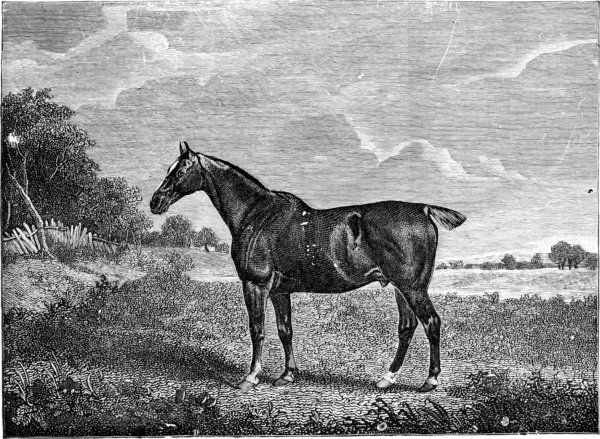
HUNTER SIRE COGNAC.
(From a Painting by J. E. FERNELEY, about 1826.)
The result of this investigation, as far as
the horse question is concerned, was briefly
summarised in the following passage of the
Third Report of the Lords’ Committee.
They thought it desirable that this amusement
should be upheld, “because, without
the stimulus which racing affords, it would
be difficult, if not impossible, to maintain
that purity of blood and standard of excellence
which have rendered the breed of English
horses superior to that of any other
country in the world.”
The last statement was borne out by Mr.
Tattersall’s evidence. He said that he had
sent horses to every part of the world except
China. America and the countries of Europe
have been purchasing the best stallions and
mares money could buy in England during
the last hundred years and more.
In 1845 the number of Queen’s Plates
stood at 51; 36 in Great Britain and 15 in
Ireland. In 1861 the scale of weights was
remodelled and made applicable to all the
Plates wherever run; and in the same year
it was enacted that “none of Her Majesty’s
Plates shall be run in heats.”
Some few abortive attempts to control
racing by law have been made since Her
Majesty’s accession. In 1860 Lord Redesdale
introduced into the House of Lords a
bill to stop light-weight racing by fixing the
minimum weight at 7 stone. This measure
was withdrawn, Lord Derby and Lord Granville,
also a member of the Jockey Club and
leader of the Liberal Party in the House of
Lords, promising on behalf of the Jockey
Club that that body was prepared to deal
with the matter; but nothing was done
in the direction indicated.
In May, 1870, Mr. Thomas Hughes, the
member for Frome, brought in a bill to
amend the laws relating to racing. This
bill proposed to make it unlawful to race
any horse or mare under three years old,
and to make the Queen’s Plates open only
to horses four years old and upwards.
Mr. Hughes, in introducing his measure,
said that between 1843 and 1868 the
number of two-year-olds running had increased
fourfold, while the number of races
of a mile and upwards had decreased, and
urged that the system which had grown
up tended to cause deterioration in the
breed of horses. As was well known at
the time, Mr. Hughes was indebted for his
facts and figures to Sir Joseph Hawley.
This bill was read a first time by 132
votes to 44, but was withdrawn in the
following July.
Great and radical changes had come over
the Turf during the twenty-five years mentioned
by Mr. Hughes, but they were only
incidental to the general process of Turf
development which has been going on since
the advent of the railway.
In 1836 the travelling van was first
used for conveying a horse from training
quarters to the race course. Lord George
Bentinck, who managed Lord Lichfield’s
racing stable, resolved at the last moment
to run Elis in the St. Leger, and astonished
the betting fraternity by producing him at
Doncaster in time for the race; to do this
he had borrowed a van which had been
constructed to carry fat cattle to Smithfield
Show. The fact that Elis won the St. Leger
to which he had been brought in this, then
novel, fashion no doubt did something to
stimulate the practice of transporting race
horses thus; but the van was gradually
superseded by the horse-box, which was
first employed for the purpose about 1840.
Railways, as they spread over the country,
did much to increase the number of meetings
held and to increase the numbers of
entries. We find that in the period between
1827 and 1837 the number of horses running
increased from 1,166 in the former
year to 1,213 in the latter; while during the
period between 1860, when railroads had
become numerous, and 1870, the number of
horses running rose from 1,717 in the former
year to 2,569 in the latter.
The development of the daily sporting
press and the spread of the telegraph system
have also contributed to the changes on the
Turf. By quickening the interest of the
people in racing, these factors have helped
to increase the attendance on race courses,
and at “gate money meetings,” to enhance
the funds at the disposal of promoters,
whereby the latter are able to offer in prize
money sums beyond the conception of our
grandfathers in the early years of the
century.
With the increase in the number of meetings,
of horses running and the value of
prizes, other changes have gradually crept
in. The Challenge Whip remains the
solitary survival of the old four-mile races.
The Whip, it may be well to remind the
reader, was originally the property of Thomas
Lennard, Lord Dacre, whose arms are engraved
upon it. Lord Dacre was created
Earl of Sussex in 1674 by Charles II.: he
was devoted to the Turf, and it is believed
that he left his Whip (a short, heavy, old-fashioned
jockey-whip with hair from the
tail of Eclipse interwoven into the ring on
the handle) as a trophy to be run for at
Newmarket. He died in 1715, but the first
race for the Whip does not appear to have
been run till 1756, when Mr. Fenwick’s
Match’em won from Mr. Bowles’ Trajan.
Gimcrack, Mambrino, Shark, Pot-8-os, Dungannon,
Thormanby, and many other famous
horses have run for the Whip. The course
is the Beacon, 4 miles 1 furlong 177 yards,
and the weight to be carried is 10 stone.
The tendency for years has been in favour
of short races at the expense of long distance
events. At the Newmarket Craven meeting
of 1820 there was one race of about three
miles, five races of two miles or over, twenty
of about one mile and two of under one
mile. At the Newmarket Craven meeting
of 1900 there were three races of about
one mile and a half, six of about one mile,
and eleven of five or six furlongs. The
necessity for breeding race horses that could
carry from ten to twelve stone twice or
thrice in an afternoon over a four-mile
course has disappeared altogether. In his
place we have the animal which can carry
seven stone over six or seven furlongs at a
pace that would probably have left Eclipse
hopelessly behind, but which is useless for
any purpose off the race-course.
The highly artificial existence to which
our race horses are now subjected, jealously
protected from change of temperature, and
“forced” in preparation to take part in two-year-old
races, has done much to impair
fitness to beget horses that will stand work
in the hunting field or on the road. This
is a result of the changes which have come
over the English Turf during the century.
We must, however, retrace our steps and
glance at the endeavours to improve our
horses which have been made within the
last thirty years.
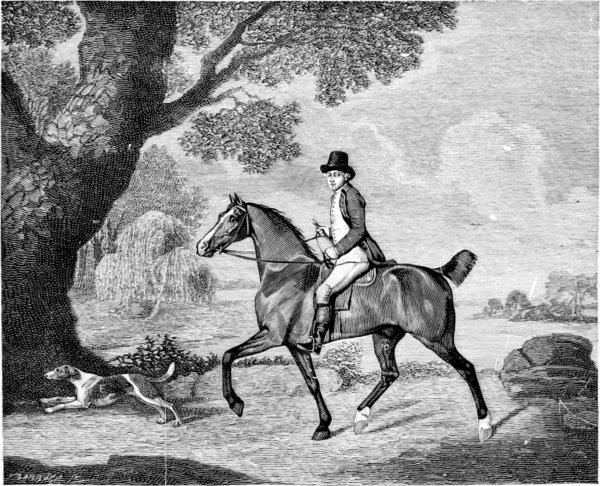
THE HACK HUNTER.
(From a Painting by GEORGE STUBBS, R.A., 1793.)
The year 1873 saw the appointment of
the Select Committee generally known as
Lord Rosebery’s Committee “to Enquire
into the Condition of the Country with
regard to Horses, and its Capabilities of
Supplying any Present or Future Demands
for them.” This committee did not consider
the question of Racing; their labours
during their sixteen sittings were restricted
to eliciting facts from the witnesses concerning
the breeding and supply of horses
of the generally useful stamp; and much
valuable evidence was given before them.
To summarise them briefly, the main points
of their Report were as follows:—
The Committee considered that so far
as the Army was concerned it seemed to
be admitted that the mounted branches
were never better horsed than they were
now: Mr. H. R. Phillips had given evidence
that Irish mares were chiefly used in the
Army. They were not prepared to recommend
the formation of Government breeding
studs on the Continental plan, deeming it
better that the military authorities should
continue to buy as private customers. They
did not recommend any check on the use
of unsound stallions, though admitting this
to be a great evil; to restrain owners of
unsound sires from offering their services
for hire would, they thought, be construed
as interference with individual liberty; but,
if practicable, they would have prizes given
at agricultural shows to sound stallions which
covered mares at a low fee.
They also recommended (and this was the
only one of their recommendations adopted
by the House of Commons) the abolition of
taxes on horses which operated as a deterrent
to farmers who would otherwise pay more
attention to breeding. The evidence given
before them showed that there appeared to
be no scarcity of Thoroughbreds: high-class
hunters had increased in price and
more in proportion than other horses, but
those who could afford to pay could
generally find what they required. There
was a general decrease in the number of
horses in England; the evidence pointed
to a great scarcity of agricultural horses,
and while the Cleveland Bay and old-fashioned
Hackney or Roadster had become
extremely rare, we had been obliged of late
years to look abroad for supplies of harness
horses.
The causes of deficiency in these breeds
were (1) the export of mares; (2) the increased
profits accruing to sheep and cattle
rearing, and (3) the increased demand for
horses, consequent on increased population
and augmented wealth, which produced a
relative scarcity. The Committee recorded
great improvements during the few years
preceding in Cornwall and Devon, where
formerly few horses had been bred.
The value of the work performed by
this Committee was much qualified by the
disinclination of its members to hear any
evidence which did not bear directly upon
Thoroughbreds and the production of saddle
horses. Perusal of the mass of evidence
given by numerous witnesses shows that
the Committee would hear little or nothing
in relation to the condition of Harness
Horse breeding, apparently holding that
very important department of the industry
as without the scope of their inquiry. It
is difficult to understand why this attitude
was adopted, but the published minutes
stand to prove that any witness who ventured
to comment upon harness horses and
the advisability of stimulating their production,
was not encouraged to give information.
What little evidence was accepted in
regard to harness horses showed the existence
of a growing demand for the best
Roadster stock in continental countries.
French, Italian, German and Austrian
breeders were fully alive to the value of
Hackney blood, and their agents coming
every year to England for the purpose
since about 1840 had purchased all the
good stallions they could find to foster and
promote the breeding of horses eminently
suitable for carriage artillery and transport
work.
Mr. J. East, of the firm of Phillips and
East, said that the French agents “buy the
very best mares they can get; you cannot
get them to buy a bad mare.” The late
Mr. H. R. Phillips stated in course of his
evidence that his firm sent “from thirty to
forty of these roadster stallions every year
to France and Italy and different countries;
they sent as many as they could procure.”
When asked how the number of Hackney
stallions exported at that date compared with
the number exported ten or fifteen years
previously (say about the year 1858), Mr.
Phillips replied that the foreigners had
always taken as many as they could get.
Horses of roadster stamp are not less
necessary to the efficiency of the British
army than to Continental armies; but while
the Committee displayed the greatest care
and assiduity in their investigations concerning
the causes of dearth in saddle
horses, they passed over the not less important
question of harness horse supply, as
though holding that a matter of no account.
It is to be regretted that the Committee
did not ask questions as to the enormous
number of mares purchased for France,
Germany, Russia and Austria, and also
enquire concerning the use to which the
mares are put in those countries. The
answers would have been instructive, for it
is now well known that fifteen out of every
twenty of them were medium and heavy
weight hunter mares—many of them stale
for riding to hounds, but in every other
respect suitable for breeding. These foreign
buyers had no prejudices: they bought the
mares with the view of breeding stock of
the type most suitable for the requirements
of their respective countries: the mares had
plenty of thoroughbred blood in their veins,
and it remained for breeders to select
stallions of the right stamp. Hence the
demand from all continental countries for
Hackney sires which began sixty years
ago and which has continued ever since.
How urgent was the necessity for attention
to this department of horse-breeding
was very fully demonstrated by Earl Cathcart
in a paper[17] which was published in the
Journal of the Royal Agricultural Society
of England about ten years afterwards.
Lord Cathcart adopted the practical method
of obtaining from friends who had long
experience, their opinions on the condition of
the breeding of horses other than thoroughbreds;
and the communications sent by these
gentlemen make up the bulk of the paper
referred to.
There was but one opinion among Lord
Cathcart’s correspondents who, it must be
noted, wrote quite independently of one
another. To briefly summarise their statements,
they deplored the disappearance of
the old-fashioned thoroughbred with bone
and stamina, and the disappearance of the
Cleveland breed and the Hackney of the
’thirties. Many influences had been at work
to bring about the regrettable change in the
stock of the country.
The spread of railways had put an end to
the demand for coach horses and roadsters,
and the men who used to ride everywhere
in the old days had given up their hardy and
enduring saddle horses for the more luxurious
seat in the train. At the same time buyers
from France, Germany, and other Continental
countries, having discovered the
willingness of English breeders to part
with their breeding stock if sufficiently
tempted, purchased every good mare money
could command.
Again, the craze for height had done
something to impair the merits of what
roadsters the foreigners left us. The Clevelands
were ruined by crossing with leggy
inferior thoroughbreds, whose sole recommendation
consisted in their height at the
shoulder and which were wanting in every
useful quality.
The value of the half-bred hunter was
also insisted on by Lord Cathcart’s correspondents—all
of them men who had right
to form an opinion. Mr. Sax Maynard,
who for fifteen years was Master of the
North Durham Hounds, laid stress on the
“wear and tear” qualities of the hunter
got by the old stamp of thoroughbred out
of the Cleveland mare, and conversely of
hunters got by Cleveland sires out of
thoroughbred mares. The superior speed
of the thoroughbred was admitted; but the
greater endurance of the half-bred hunter
in hilly country was a quality which gave
him a value which did not attach to the
pure thoroughbred.
Nothing more convincing could have been
compiled than this essay from several horse-breeding
correspondents. It shows clearly
how very great is the change which has
come over the principal breeding grounds of
England during the present reign.
In regard to the disappearance of horses
of the useful stamp for harness and saddle
it is not necessary to require evidence for
the reasons. When we remember how
enormous was the network of coach route
that spread all over the kingdom in pre-railway
days; and consider how vast were
the studs necessary to horse the mail and
passenger coaches, to say nothing of the
post-chaises preferred by people of means;
and when we think that the road-coach
survives now only in a few out-of-the-way
corners of the country, and is regarded as
an interesting relic of by-gone days where
it does exist, we can form perhaps a vague
idea of the extent of the change. About
the year 1830 upwards of 1,040 coaches
were running daily out of London alone.
We need not, thanks to “Nimrod” and
other chroniclers of the coaching age, remain
content with a vague idea of the number of
horses then in use on the roads. It is easy
to take a single route and reckon up the
stud required to work a coach running
thereon. The usual “stage” for a team
was from eight to ten miles, and making
due provision for rests, accidents, &c., the
proprietors estimated the needs of a coach
at one horse per mile “one way.” Therefore
a coach running from London to York,
200 miles, and back, required about 200
horses; from London to Edinburgh, 400
miles, and back, about 400 horses; from
London to Exeter, 175 miles, and back,
about 175 horses.
On roads where the passenger traffic was
heavy, coaches were numerous: as many
as twenty-five ran daily in the summer
during the ’thirties from London to Brighton.
The distance by road is about sixty miles,
whence it would seem that no fewer than
1,500 horses were used by the coach proprietors
on that route alone; probably more,
as competition was keen and the speed
maintained was hard upon horseflesh.
The average working life of a horse in
a fast road coach was about four years,
according to Nimrod. Hence the coach
proprietor found it necessary to renew one
fourth of his stud at a cost of from £25 to
£45 per head every year. Mr. Chaplin,
who owned five “yards” in London in the
’thirties, had upwards of 1,300 horses at
work in various coaches on various roads,
and would therefore have been obliged to
purchase about £11,375 worth of horses
every year.
When the railway banished the coach
from the highroad, which it did with considerable
rapidity, these great coaching
studs were necessarily given up, and a
market for horses of the most useful stamp
disappeared. An eminent proprietor gave
the qualities required in a road coach-horse
for fast work as follows: “First requisite,
action; second, sound legs and feet, with
power and breeding equal to the nature
and length of the ground he will work
upon; third, good wind, without which the
first and second qualifications will not avail
in very fast work for any length of time.
The hunter and racer are good or bad,
chiefly in proportion to their powers of
respiration; and such is the case with the
road-coach horse.”
The practical disappearance from our
country of such horses as those used in
the mail and ordinary coaches and in post
carriages was nothing short of a national
calamity. They were horses of the essentially
useful stamp, sound, hardy and enduring,
just such animals as are indispensable
for cavalry, artillery, and transport work on
a campaign. And though the full importance
of the loss which had befallen us was
evident, the difficulties in the way of retrieving
our position as breeders was not less
evident. The breeding of horses had ceased
to be remunerative, and as a natural consequence
men had ceased to breed them,
preferring to devote their energies and
capital to stock of a stamp for which they
could depend upon finding a market. Any
horses of the useful class that were produced
found their way, if worth having, into the
hands of foreigners, as we have seen.
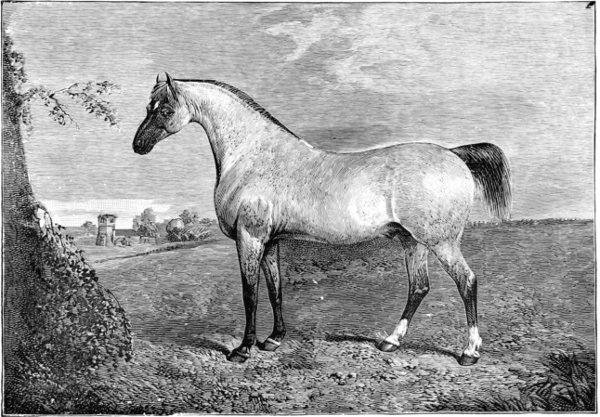
NORFOLK PHENOMENON (Foaled 1824).
In March, 1887, Lord Ribblesdale took
the matter up and in a very able speech
drew the attention of the House of Lords
to the question of the “Horse Supply for
Military and Industrial Purposes.” He rendered
a tribute to the work that was being
done by private persons and by societies
and associations, thanks to whose endeavours
the breeders of Shire horses and Clydesdales
were prospering. The brisk foreign demand
for British stock proved its merit, but so
long as halfbred horses suitable for remounts
and all useful purposes were as scarce as
they were, while we were importing horses
to the value of over a quarter of a million
sterling annually, including harness-horses
and match pairs of carriage-horses, we had
evidence that we were not breeding high
class horses up to the demand for our own
daily increasing needs.
He urged that the money given in Queen’s
Plates be diverted from its then use and
devoted to subsidising approved stallions,
which should serve at low fees; and that
large prizes should be offered from the
public purse for foals, yearlings, and two-year-olds.
As regarded military horses he
advised the purchase of two-year-olds to be
kept at maturing depôts till old enough to
take in hand; and in recommending the
system of direct purchase from the breeder
referred to the fact that direct purchase
was approved by Baron Nathansius, the
French Inspector General of Remounts, in
a letter which that officer had addressed to
the present writer.
Lord Ribblesdale paid me the compliment
of seeking my assistance in his task: and
in order to obtain the actual views of the
horse-breeding interest in England, Colonel
Sir Nigel Kingscote, Sir Jacob Wilson
and the writer met in February, 1887, and
drew up a series of questions.
These questions were printed and sent out
to between three and four hundred of the
best known horse-breeders in the Kingdom;
to all, in point of fact, whose experience
would lend weight to their views and whose
addresses could be secured. The principal
questions put were as follows:—
“Q. 1. Assuming that an annual Grant from the
Government of £5,000 be made for the encouragement
of the breeding of halfbred horses, to whom in your
opinion ought such grant to be entrusted for distribution?
Whether to a specially constituted Board
of Trustees or to any other body?
“Q. 2. Is it your opinion that the distribution of
the above Grant should take the form of a subsidy in
the shape of Premiums for Thoroughbred Stallions
covering at a moderate fee similar to those offered by
the Hunters’ Improvement Society at their Annual
Spring Show, and this year by the Royal Agricultural
Society at Newcastle?”
In answer to Question 1, 194 replies were
received in time for tabulation; of these 79
were in favour of the grant being distributed
by a specially constituted Board of Trustees;
60 were in favour of its distribution by the
Royal Agricultural, Hibernian and Caledonian
Societies; 33 preferred that the duty
should be vested in local and county societies,
and 22 offered no opinion.
Of answers to Question 2, 113 were in the
affirmative, 44 replied “No,” and partial
concurrence was expressed by 19; a few
gentlemen advised subsidising roomy halfbred
mares. The body of opinion so collected
and tabulated was placed in Lord
Ribblesdale’s hands about the end of April;
but not until August did opportunity occur
for him to ask in the House of Lords
whether the Government proposed to take
any action in the matter. He referred briefly
to the fact that the breeders of the Kingdom
had been circularised on the subject, but
omitted to support his enquiry by any
analysis of the very important and valuable
mass of expert opinion thus placed at his
disposal.
It is quite probable that during the months
which elapsed between receipt of the information
we had collected for him and the
date of his August speech, Lord Ribblesdale
had made use of them to influence the
Government in the desired direction; for
the speech appeared to be framed solely
for the purpose of affording Lord Salisbury
opportunity to declare the intentions of his
Government.
In brief, the Premier announced that it
was proposed to devote the money theretofore
given as Queen’s Plates to breeding; that this
sum, £3,000 a year, would be made up to
£5,000 by a small addition to the Estimates;
and that it was proposed to assign the duty
of administering the fund to an independent
Trust. The Royal Commission on Horse
Breeding was appointed, consisting of the
Duke of Portland, the Earl of Coventry,
Lord Ribblesdale, Mr. Chaplin, M.P., Mr.
F. G. Ravenhill, Mr. John Gilmour, Sir
Jacob Wilson and Mr. Bowen Jones; and,
acting in concert with the Royal Agricultural
Society, the Commissioners, in December,
1887, issued their first Report.
This document stated that only in recent
years had any further necessity arisen
to encourage breeding apart from private
enterprise; the scarcity of horses was due,
in their opinion, to the creation of large
breeding studs by foreign Governments, who
came to us for their stock and caused a
drain upon our resources.
The Commission reported “there was
little doubt that the Queen’s Plates had
failed to fulfil their purpose;” but perhaps
it had been nearer the mark to say that
the Royal Plates had ceased to fulfil their
original purpose, owing to the multiplication
of valuable stakes which reduced the Royal
hundred-guinea prizes to third-class rank and
rendered them useless as factors in the
encouragement of breeding. The Commission
recommended the abolition of the Royal
Plates and the application of the money
thereto devoted to a scheme of Queen’s
Premiums, under which sound and approved
thoroughbred sires should stand in specified
districts and under control of a local committee,
serve mares at a low fee. The
scheme was at once adopted, and has
worked well in practice.
The year 1896 saw the appointment of the
Royal Commission to Inquire into the Horse
Breeding Industry in Ireland. Though the
enquiry resolved itself into a comparatively
narrow issue, a very large amount of
evidence, much of it exceedingly interesting
and instructive, was recorded. In pursuance
of their policy of encouraging the breeding
of all live stock in Ireland, it was proposed
to send over selected stallions, thoroughbred
and roadster, for the use of owners of mares
in the horse-breeding districts. There was
much diversity of opinion on the propriety
of establishing hackney sires in a country so
famed for its hunters, and the principal
object of the Commission was to take the
opinions of experts on the proposed step.
While the majority of witnesses were
averse from the introduction of the hackney
sire, on the ground that the happy-go-lucky
methods of the small Irish farmer would
lead to intermingling of blood to the ultimate
deterioration of the Irish hunter, it was
generally acknowledged that the bone and
substance of the hackney was eminently
desirable in many districts to improve the
character of the local stock.
Could a workable system of mare registration
have been devised to prevent hunter
mares being sent to hackney sires in those
counties where hunter-breeding is a valuable
industry, there can be no doubt that the
introduction of such sires would lay the
foundation in Ireland of the breed of high
class harness-horses in which Britain is so
singularly deficient, and which could be produced
in Ireland with as much, if not greater,
success, as they are produced on the Continent.
Her Majesty’s reign has seen the rapid
growth of demands from every civilised
country in the world for British horses of
every breed, eloquent proof of the esteem in
which our horses are held abroad and of the
success which has attended our endeavours
to improve them.
We have, it must be confessed, “gone
back” in our department of horse-breeding;
the supersession of coaches and their
teams of fast and enduring horses by
railway traffic has brought about neglect
of this most useful stamp of animal. The
tens of thousands of coach horses formerly
required created a large and valuable industry,
and it is only in the natural order of
things that when railways made an end of
the coaching era that horse-breeders should
have turned their energies into new channels.
It is only within recent years that breeders
have recognised how much combined and
systematic endeavour can do to assist them
in their task of improving our several breeds;
and it is worth observing that the most important
societies for the promotion of horse-breeding
(apart from the General Stud Book)
were all founded in the short space of nine
years, one after the other, till at the present
day every breed is represented by a body
whose sole aim is to care for its interests.