There is a large class of excellent people who feel a
decided impatience at the very name of etiquette. “It
is all nonsense,” they say, and they will give you various
infallible receipts for getting on without such an
objectionable article. One admonishes you to be “natural,”
and your manners will leave nothing to be desired.
Another sagaciously defines politeness to be
“kindness kindly expressed,” and intimates that if your
heart is right your deportment cannot fail to be so too.
All these philosophizings, however, give little comfort
to the bashful young person just venturing into society,
for unfortunately few of us are so happily constituted
as always to think, much less to say and do, exactly the
right thing at the right time, and the most unobservant
presently discovers, very likely at the cost of no small
mortification, that the usages of society, even when apparently
arbitrary, cannot be disregarded with impunity.
In the etiquette of the saddle, however, common-sense
takes so decidedly precedence of the arbitrary and conventional
that no courageous, kind-hearted, and sensible
young girl, however inexperienced, need be afraid of
committing any fatal solecism. The reason of this is
that the element of danger is never entirely absent, and
that the importance of assuring the safety and comfort
of yourself and companions, to say nothing of lookers-on
and passers-by, or of the noble and valuable animal
you ride, far transcends that of observing any mere
forms and ceremonies.
Fashion at present, both in this country and in England,
requires that the whole riding costume be as simple
as possible, and entirely without ornament. Formerly
much more latitude was allowed, and very pretty
effects were produced with braid trimming across the
breast, a little color at the neck, and a slouched hat with
long feather or floating veil—witness the picture of the
Empress Eugénie when Countess Montijo, and many a
charming family portrait besides—but now fashion pronounces
all that sort of thing “bad form,” and a word
to the wise is sufficient. The habit itself must be quite
dark, or even black, perfectly plain in the waist, with
black buttons up to the neck, and with a scant, short
skirt only just long enough to cover the feet. The
cuffs and collar must be of plain linen, no color or flutter
of ribbon being anywhere permissible. The handkerchief
must not be thrust in the breast, but kept in
the saddle pocket, and if a veil is worn, it must be short
and black. The hair should be so securely put up that
it will not shake down, and that the hair-pins will not
work out. In the matter of the hat more freedom of
choice is allowed, and in the country almost anything
may be worn, but wherever there is any pretence of
dressing, the only correct thing is the regulation silk
“cylinder,” which, by-the-bye, usually looks better rather
low in the crown, and which is every way a pleasanter
and more serviceable hat than ladies who have never
worn one are apt to imagine. About the cutting of a
riding-habit, it may be remarked, there is nothing mysterious,
although one might think so from the way it is
often talked about, especially in the advertisements of
fashionable tailors, and there is no reason in the world
why any clever young girl should not make one for
herself if she chooses. The only eccentricity about it,
from the dress-making point of view, is the shaping out
of a place for the right knee, so that the skirt may hang
straight and not ruck up, and this can easily be managed
at home by improvising a horse with a couple of chairs
and a rolled-up rug, putting the saddle on it, and trying
the effect in place. Be careful to leave plenty of room
across the breast. A couple of straps should be sewn
inside in the proper place, so that the toe or heel of
each foot may be inserted to prevent the skirt from
rising and exposing the feet; and these straps should
not be strong, but, on the contrary, like all other parts
of the skirt, and particularly the facing, should be made
so as certainly to tear loose instantly in case of getting
caught in a fall. Before leaving the habit, we may remark
that the wearer should practise gathering it up,
holding it in one hand, and walking in it at home, and
if possible before a mirror. No petticoats ought to be
worn, but merino drawers, and easy trousers of the same
stuff as the rest of the habit. Beware of badly made
seams, which have a vexatious way, as many a masculine
wearer can testify, of pinching out a bit of skin at some
inopportune moment. The trousers should be cut away
a little over the instep, and fastened down under the
sole with straps, which may be either sewed on or attached
by buttons inside the band, in which case india-rubber
is the best material, being easy alike on buttons,
stuff, and fingers. Corsets should be worn as usual, but
never laced tight, and it would be better that they
should not have steel clasps or steel springs, which
might be dangerous in case of a fall. The boots should
be easy, broad-soled, low-heeled, and rather laced than
buttoned, as less likely on the one hand to catch in the
stirrup, and on the other to bruise the foot by chafing
against the saddle. The gloves should be strong, but
supple and easy, as it is important that every finger
should have free and independent movement. Tight
gloves not only benumb the hands in cold weather, but
always cause an awkward handling of the reins, and
may be positively dangerous with a fresh horse. As to
the relative merits of crop and whip, there is room for
difference of opinion. By many persons the former is
looked upon as a senseless affectation of English ways,
but the fact is that with a horse regularly trained to the
saddle it is more useful than a whip, as by its aid a lady
can “collect” her horse—that is, can make him bring
his hind-legs under him, in the same way that a man
does by the pressure of his calves. If, however, the
horse has never been trained, and is sluggish or wilful,
a whip may be more useful. Whichever of the two
produces the better results will have the more “workmanlike”
look and be in the “better form.”
It is undoubtedly much pleasanter and more exhilarating
to ride a good and handsome horse than a poor
and ugly one, a horse adapted to one’s size and weight
than one too large or too small, too heavy or too light;
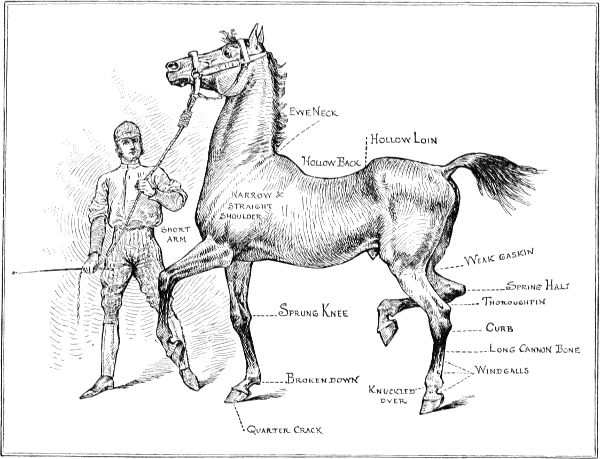
but none of these points are matters of etiquette. On
this whole subject etiquette makes only one demand,
but that one is inexorable—it is perfect neatness. A
lady’s mount must be immaculate from ear to hoof, in
coat and mane and entire equipment. It is in a great
degree their exquisite neatness that gives such an air of
style not only to English horsewomen, but to English
turn-outs of all kinds, which, nevertheless, have not
usually the “spick and span new” look of fashionable
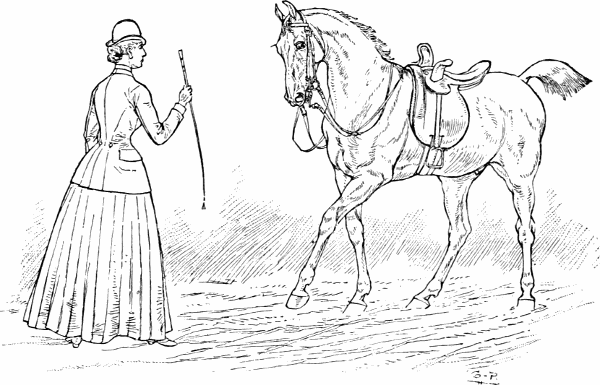
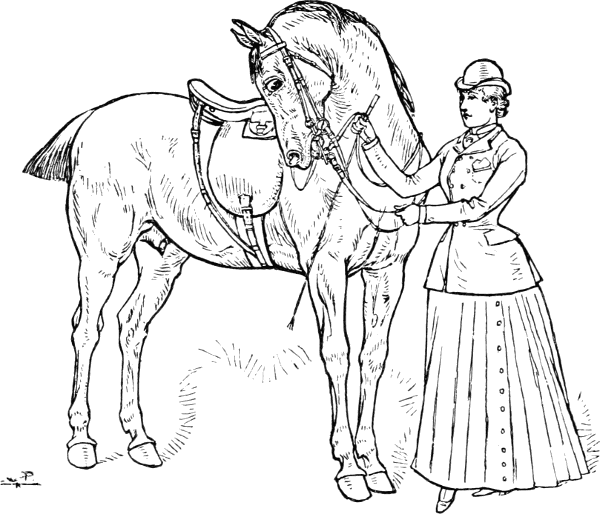
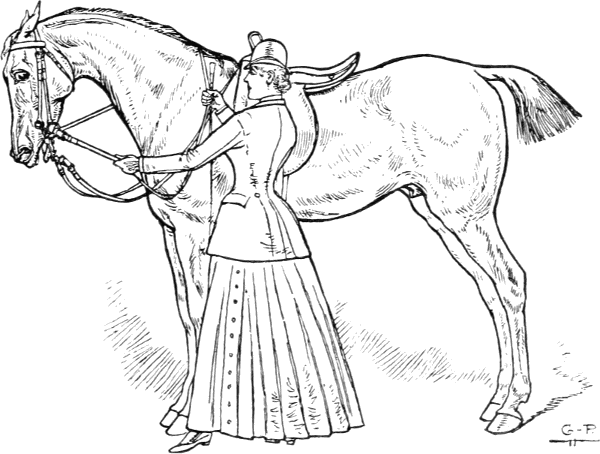
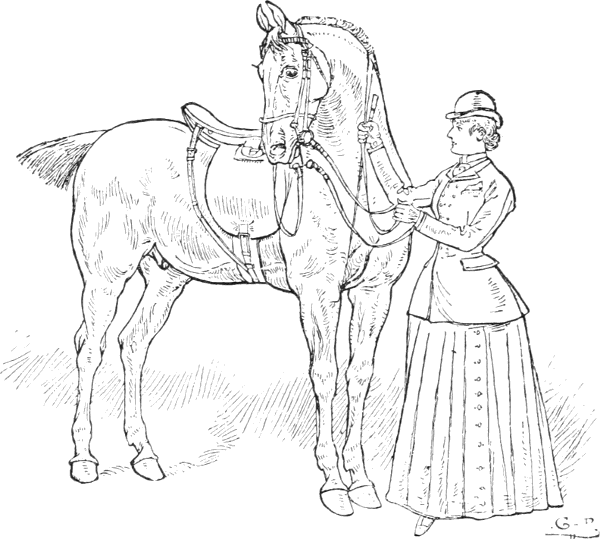
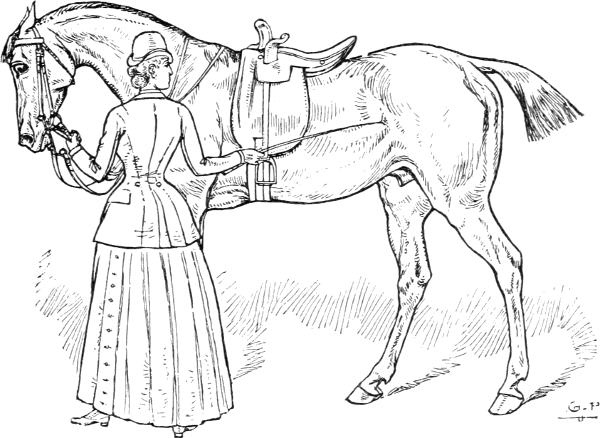
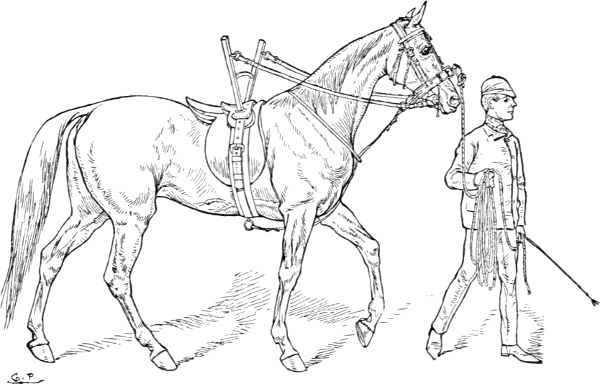
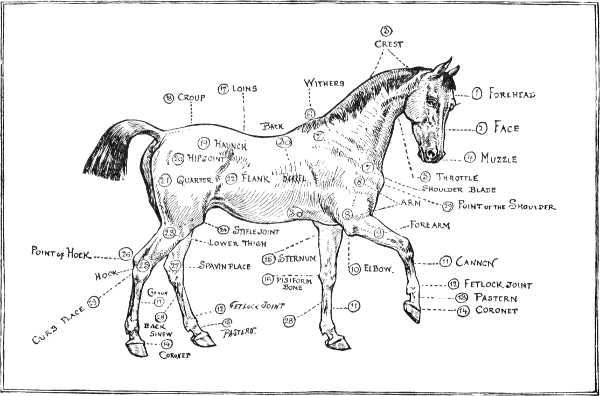
American equipages. On coming out, therefore, prepared
for a ride, take time to look your horse over swiftly,
but keenly, noting first that his eye and general appearance
indicate good health and spirits; secondly, that
he has been thoroughly groomed, his mane freed from
dandruff, his hoofs washed, but not blacked; thirdly,
that the saddle and bridle are perfectly clean and properly
put on. Every buckle should have been undone
and cleansed, the leather suppled, and the bright metal
polished; the girths, three in number—never fewer
than two—should be snug, but not tight enough to impede
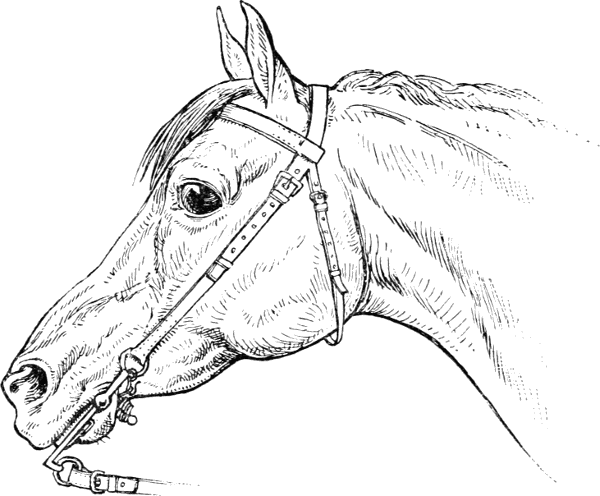
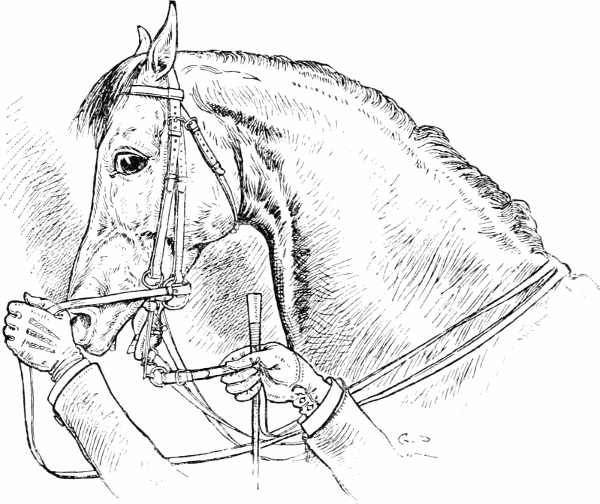
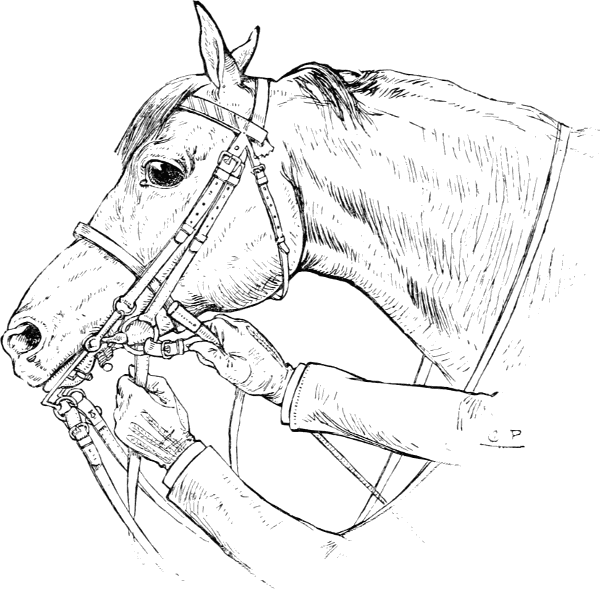
free breathing; the bits in their proper place, that
is to say, the snaffle just high enough up not to wrinkle
the corners of the mouth, and the curb considerably
lower, with its chain, which should pass below the snaffle,
lying flat and smooth against the skin in the chin
groove; finally, the throat-latch loose. While it is not
always wise to reprimand carelessness on the part of
your groom on the spot, it is well never to let it pass
unnoticed, while, on the other hand, it is a good plan
always to show appreciation of especial attention to
your wishes by a kind word or a smile.
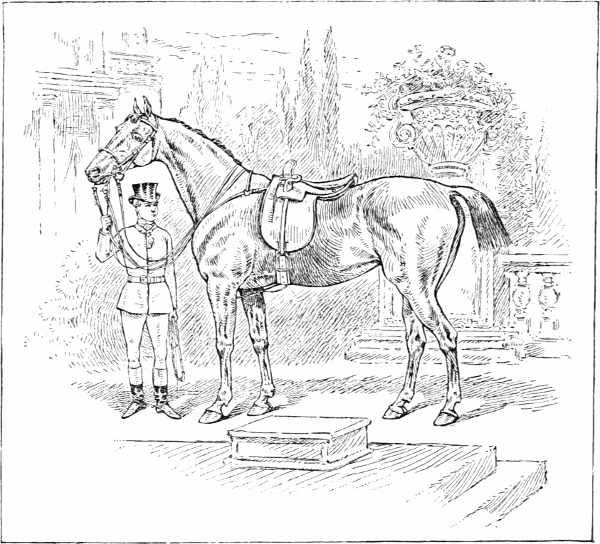
It is rather a trying ordeal for an inexperienced rider
to mount a tall horse from the ground, even when there
are no lookers-on, and many a one remains in bondage
to chairs and horse-blocks all her life long rather than
undertake it. The feat, however, is really so much easier
than it looks, and when well performed makes the
rider appear so agile and graceful, giving such an air of
style and savoir-faire to the departure, that it is well
worth every lady’s while to acquire it. The first requisite
is that the horse should stand still, and for this purpose
the attendant should have given him some preliminary
exercise, as the fresh air and bright light are so
exhilarating to a high-strung horse that he cannot at
first restrain his impulse to caper about. This preparatory
airing should be entered upon invariably as calmly
as possible, and begun at a walk, for a flurry at starting,
and especially the use of the whip, will often disturb a
horse’s nerves for hours, making him unpleasant if not
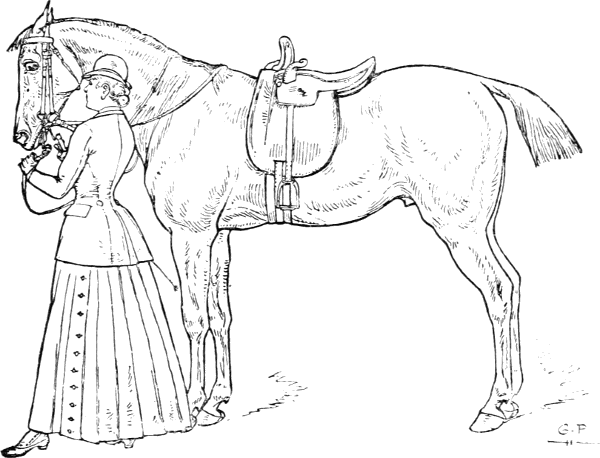
dangerous to ride. When the horse is brought to the
door, let the groom stand directly in front of him, holding
the bridle not by the rein, but with both hands by
each cheek, just above the bit. If he is a proud and
sensitive animal, do not rush up to him excitedly with
a slamming of doors and gates, nor allow any one else
to do so, but approach with gentle steadiness. Stand a
moment and look him over, give your orders quietly, and
pat his neck for a moment, speaking pleasantly to him
the while, so that he may get accustomed to your voice.
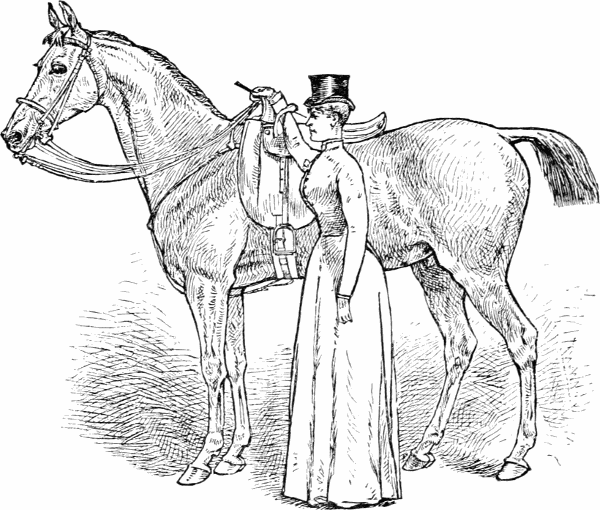
READY TO MOUNT.
Now standing with your right side a few inches from
the saddle, facing the same way as the horse, and with
your left shoulder slightly thrown back, place the right
hand on the second pommel, holding in it the whip, and
the reins drawn just tight enough to give a feeling of
the bit. Your attendant will stand facing you, and as
close as convenient, and will now stoop forward, with
his hands clasped and with his right forearm firmly supported
on his right thigh. Now with your left hand
lift your riding-skirt in front, and place your left foot
in his hands. Let go the skirt, rest your left hand on
his shoulder, and giving him the cue by bending the
right knee, spring up erect on the left foot, and, seating
yourself sideways on the saddle, place the right knee
over the horn.
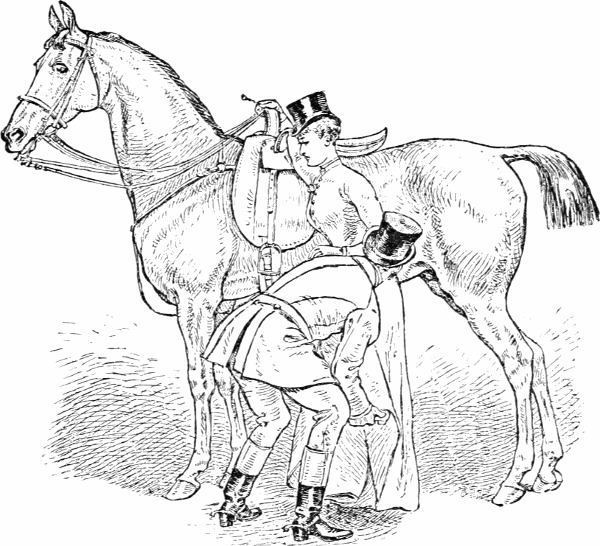
“ONE, TWO, THREE.”
If your attendant is unused to rendering such service,
you had better make your first essays in some secluded
place, in which you can instruct him where to stand,
just how high to lift your foot, and caution him to put
forth strength enough to support you steadily, without
lifting too violently. Do not be deterred by awkwardness
on his part or on your own from learning to mount
from the ground, for the more awkward, the better practice
for you. Your attendant will now lift your skirt
above the knee, so that it will hang properly without
dragging, and then disengaging the stirrup from beneath
the skirt, will place your left foot in it.
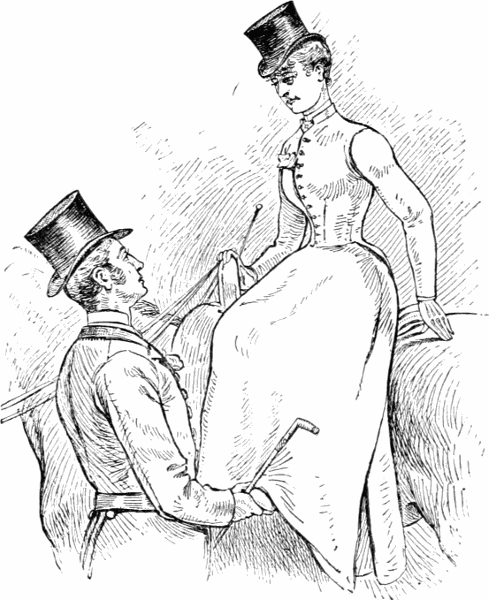
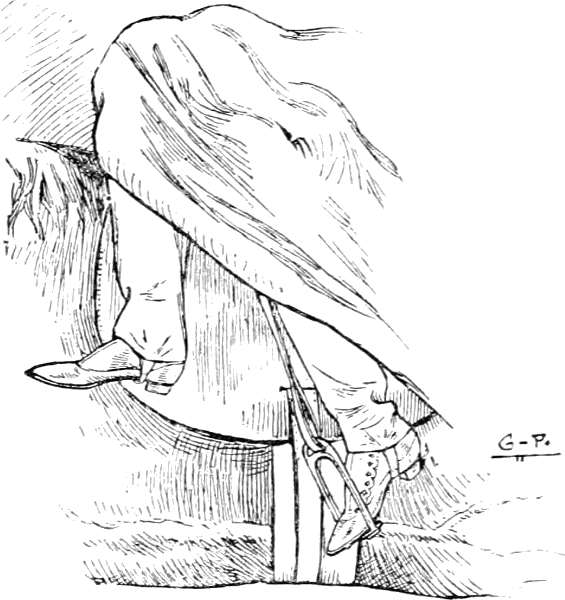
PLACING THE FOOT IN THE STIRRUP.
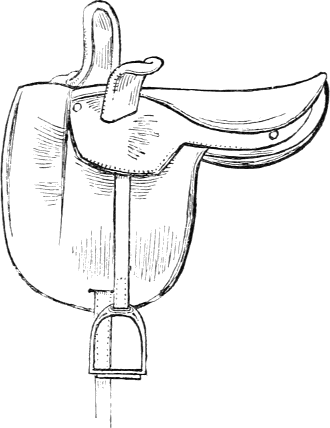
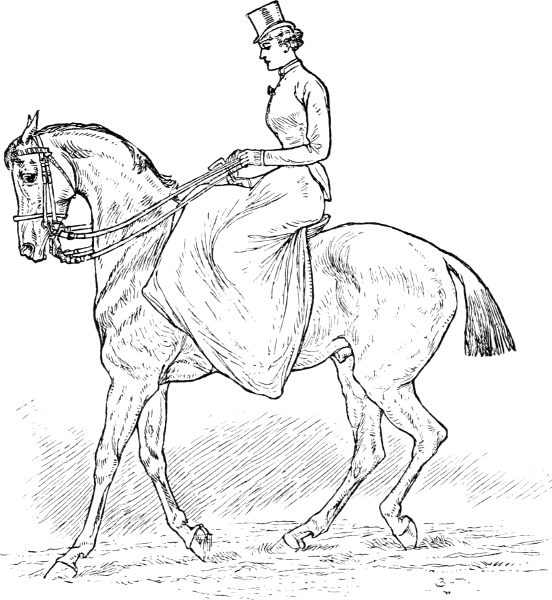
Too much care cannot be taken with the position in
the saddle, which should be exactly as shown in the following
cut. The left leg should invariably hang perpendicularly
from the knee, with the heel depressed,
and with the foot parallel with the horse’s side. The
length of the stirrup-strap should be such that the knee
thus is out of contact with the hunting-horn, but near
enough to be brought firmly up against it by raising the
heel. The right knee should rest easily but snugly over
the pommel, so as to grasp it in case the horse springs.
Neither foot should be allowed to sway about nor to
project so as to be seen awkwardly poking out the skirt.
If your clothing does not feel quite comfortable, rise in
your stirrup and shake it down, resting your hand, if
necessary, on your attendant’s shoulder, for it will be
very awkward should it become disarranged on the road.
Now put your handkerchief in the saddle pocket, take
the reins in the left hand, or in both hands, as you prefer,
and start the horse by a touch with the heel.
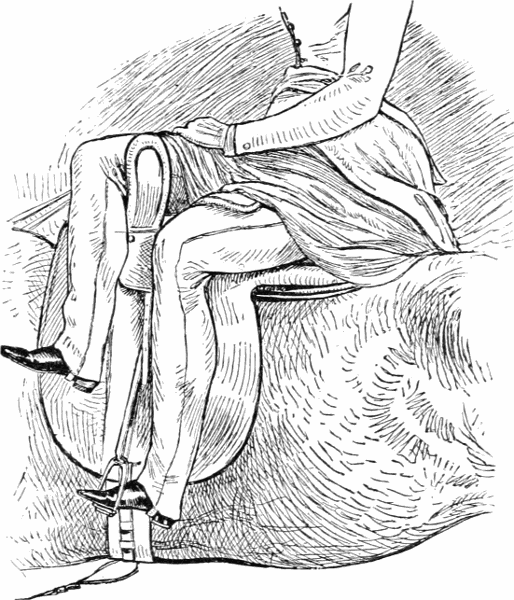
POSITION IN SADDLE.
It is, of course, the correct thing to mount from the
ground, if possible, but here again common-sense comes
so decidedly to the front that it is not too much to say
that the sole indispensable requirement of an enlightened
etiquette is good-nature. Certain it is that the eye
masculine will follow with pleasure, and perhaps with
some emotion, the movements of the young girl who
comes out bright and fresh, gives her horse a pat or two,
with a lump of sugar, as she glances him quickly over,
looks kindly at her stable-boy, and then skips gayly into
the saddle from a chair brought out by a maid, while
the same eye will rest quite unmoved, except by a spirit
of criticism, on the self-conscious and selfish damsel,
though she be put on in the most approved manner by
the smartest groom who ever wore top-boots. Mount,
then, from the ground, if you have some one to put you
on and some one to hold your horse; or, if the horse
will stand without holding, cautioning your escort—if
you are not sure of his expertness in such services—to
be sure to raise your foot straight up, and to give you
warning by counting one, two, so that you may be certain
to have the leg straightened before he begins to
lift, as otherwise the result may be the reverse of graceful.
When in the saddle, rise in your stirrup, as already
suggested, and smooth down your dress, meantime thanking
your escort and telling him how well he did it. This
smoothing down of the skirt it is a good plan to practise
frequently, first standing, then at a walk, then at a trot,
till you can do it deftly, almost without thought, for
there is no telling at what inopportune moment it may
become necessary.
To mount from the ground without assistance is a
feat which few ladies would voluntarily undertake. It
may be accomplished in an emergency, however, if the
horse is quiet and not too tall, by lowering the stirrup
sufficiently to reach it with the left foot, and springing
up with the aid of the hands, the left of which should
grasp the mane and the right the cantle of the saddle.
Do not put your horse in motion by a cut with the
whip, which would be trying to his nerves, nor by chirping
or clucking, which would be equally trying to the
nerves of your companions, but by a touch with the
heel, or a pressure between your heel on the left side
and your crop on the right. If other ladies are to be
mounted, move on so far that they will be in no danger,
either real or imaginary, from your horse’s heels, and
never at any time put him in such a position that he
can kick any one, or that you can get kicked yourself
by any other horse. If you have to turn about on starting,
try to do so by making your horse step around with
his hind-legs (in the technical phrase, pirouette renversée),
so as to avoid turning your back and presenting his
haunches towards any one with whom you may be talking
or from whom you are to take leave. To be able
to do this easily and gracefully you must have him well
“collected” and “light in hand.”
The next question that arises is on which side of her
escort a lady should ride. This point, so much discussed
and disputed in this country, is scarcely raised in England,
where the universal habit of turning to the left
makes it, under almost all circumstances, safer for her
to be on his left, in which position he finds himself always
interposed between his charge and any passing
vehicle, whether it come from before or from behind.
In this country, however, we have adopted—nobody
knows why, unless it is because the French do so—the
rule of keeping to the right, and yet without changing
our manner of riding and driving, so that the result is
often awkward and even dangerous. The teamster who
used to walk on the left of his horses, so as to lead them
out of the way when occasion required, still walks on
the left, which now puts him in the middle of the road;
the coachman still sits on the right, though the probability
of contact has changed over to the other side; the
lady’s seat is still on the left side of the horse, which
obliges her to choose between the danger of being
caught by passing wheels or crushed by the horse of
her escort. As there is no reason in the world, whether
in the conformation of the female form or of the horse
itself, or in the exigencies of equestrianism, that makes
it inherently more proper to sit on one side of the horse
rather than on the other, it seems strange that none of
our independent American ladies should have undertaken
to set the fashion of sitting on the right side.
The Princess of Wales always does so, for some special
reason. The Empress of Austria, who is well known as
one of the boldest and most graceful riders as well as
one of the most beautiful women in Europe, is said to
have saddles made in both ways, using them alternately,
and this plan is adopted by more than one of the noble
ladies of England who hunt regularly in the season,
with a view of preventing too constant a strain on the
same set of nerves, and possibly causing an unequal development
of the two sides of the person. However,
accepting the present feminine seat as a thing not to be
changed, the advantages in this country of riding on the
one hand of the escort or on the other are so equally
divided that the balance may incline to either side, and
a lady is always free to do about it as she pleases without
exciting remark. When riding on the right side,
the lady is protected from passing vehicles, and the gentleman
has his right hand free to assist her in any way,
even to taking her off her horse in case of necessity;
but if either horse were to shy towards the other, she
might get bruised, and she is always liable to an occasional
contact with her companion’s person, which may
not be pleasant. Children should certainly be kept on
the right, and so should any inexperienced or very timid
person; and at all times a gentleman should interpose
himself between the lady under his charge and danger
of any kind—as, for instance, reckless drivers, rude
strollers, or a drove of cattle. When riding on the left,
the lady is undoubtedly in a more exposed position, especially
if her horse is disposed to dance or shy at rattling
wagons and the like; but her escort, being able to
ride closer to her, is enabled more quickly and safely to
take the animal by the head, if necessary, and under all
circumstances he should hold his reins and whip in his
right hand, and in case of danger keep his horse well
“collected,” so as to be ready to act promptly and without
any show of excitement.
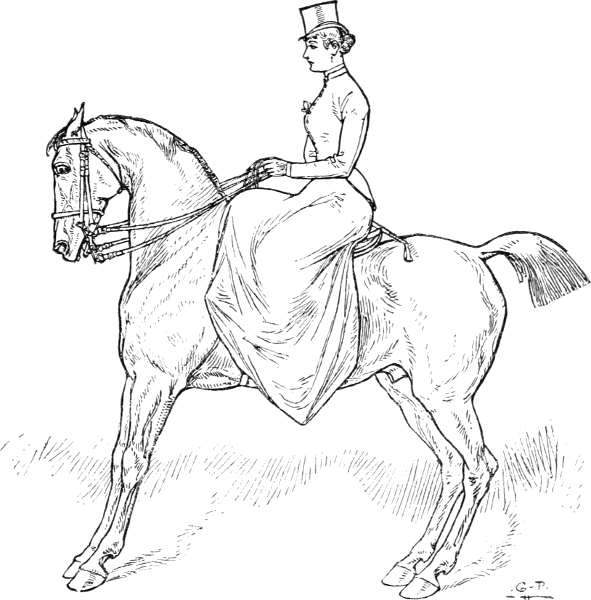
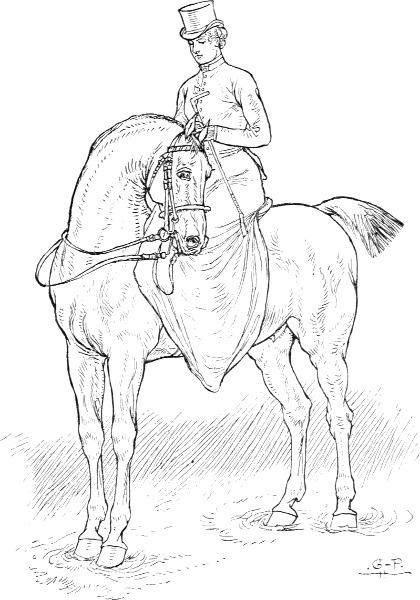
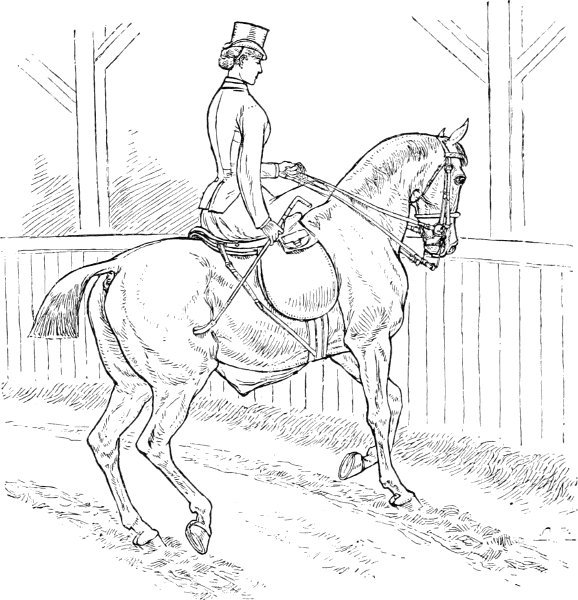
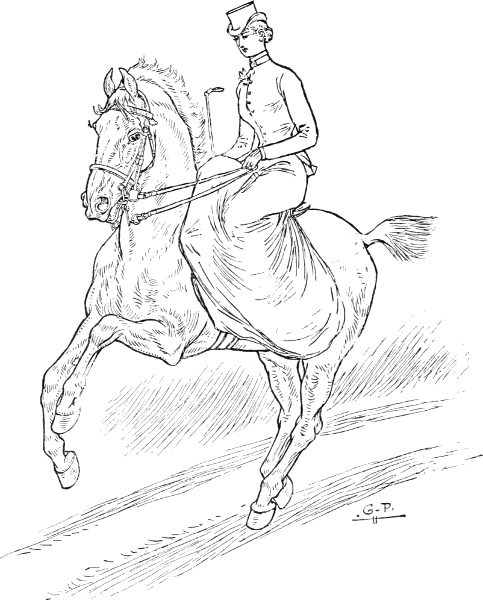
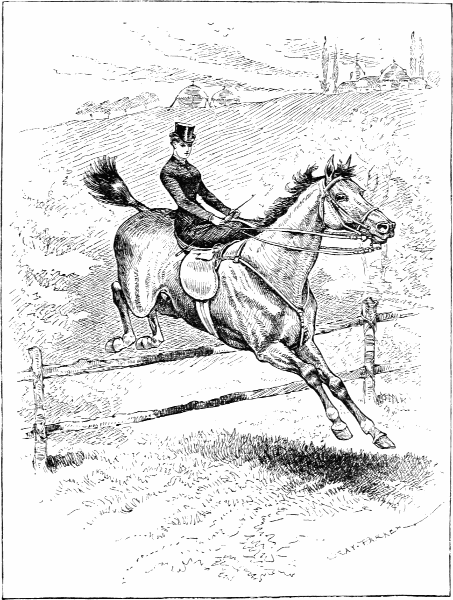
Position.—The lady’s position on horseback is so conspicuous
that the fact ought to stimulate the most indifferent
so to place and carry herself as to show her figure
to the best advantage, and this graceful carriage of the
person will be found to be the first step towards achieving
a firm and easy seat. The posture should be erect,
the back slightly hollowed, the breast thrown forward,
the chin drawn in so that the neck will be nearly vertical.
The lower limbs should rest easily but firmly in
their respective places, the left leg hanging perpendicularly
from the knee downward, with heel slightly depressed,
and foot parallel with the horse’s side, the right
toe raised a little
above the horizontal,
but not carried
far enough forward
to poke up the riding
habit. The seat
should be in the middle
of the saddle,
not on the right side
of it with the body
inclined to the left,
which is excessively
awkward, nor on the
left side with an inclination
to the right,
which is equally awkward,
and with the
additional disadvantage
of being sure
to cause saddle galls.
When the body is
consciously balanced
on the horse’s back,
when the shoulders
are equidistant from
his ears, and when
the eyes, looking between
said ears (an excellent habit), look straight along
the road, and not off obliquely to one side of it, then
the seat, whatever else it may not be, is at least in the
middle of the saddle.
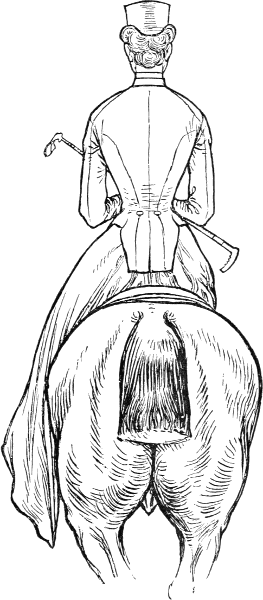
A SQUARE AND PROPER SEAT.
The Hand.—As to the manner of carrying the arms,
Colonel Hayes remarks that he has seen of late (in England)
some ladies sticking out their elbows, but that he,
for his part, decidedly approves of the old rule which
forbade that daylight should be seen between a lady’s
arms and body. The sight which annoyed Colonel
Hayes is not unknown in America, but probably most
observers correctly attribute it either to ignorance or
affectation. Certainly there is no reason for it, whether
practical or æsthetic, as the raising of the elbows lifts
the hands into a position in which the reins act less
correctly on the horse’s mouth, while substituting angles
for curves in the outline of the figure, and quite destroying
the air of well-bred repose which is one of the
great charms of a finished horsewoman. The arms
should hang naturally by the sides, with the hands, a
few inches apart, just above the knee, and as low as possible
without resting on it, the nails turned down, the
knuckles at an angle of forty-five degrees with the horizon,
the wrists bent inward so as to permit of a little play
of the wrist joint at each tug of the horse on the reins.
The Poise.—All this is not very difficult so long as
the horse keeps quiet, or even when he merely walks;
but how is this much-admired statuesque repose to be
preserved at the trot, the canter, the gallop, to say nothing
of incidental shying and capering? There is only
one answer to this question, and that is—practice. But
even practice is usually not sufficient without an accompaniment,
infrequent and not always pleasant, viz.,
frank and unflattering criticism; and every one who
really wishes to excel, and to merit the praises which as
woman she is certain to receive, will see to it that this
wholesome corrective is often at hand. Practice itself,
to be profitable, must be intelligent, and the cause of
any discomfort from the motion of the horse should be
sought out and removed. It will be found almost always
to result from involuntary muscular contractions,
especially of the waist, which should invariably be kept
supple, as it is to a slight play of loin and thigh that
the rider must look to prevent being thrown up by each
spring of the hind-legs in cantering or galloping.
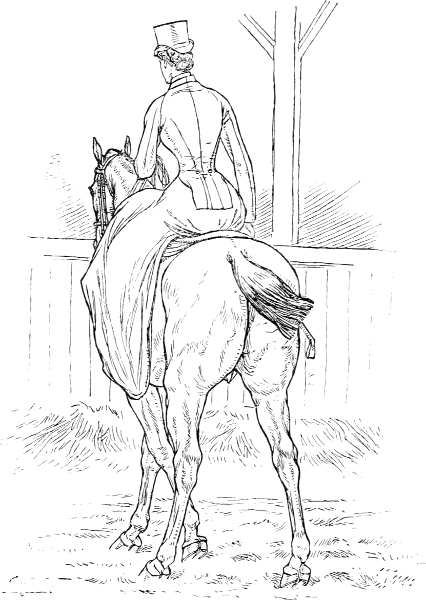
In rising to the trot, bear outwardly with the left
heel, which will keep the knee close against the saddle,
and prevent the leg from swaying about. At the same
time be careful not to rise towards the left—an awkward
but very common habit, which can be detected by the
plan already suggested of sighting between the horse’s
ears. Mr. Sidney says, “The ideal of a fine horsewoman
is to be erect without being rigid, square to the
front, and until quite at home in the saddle, looking
religiously between her horse’s ears. The shoulders
must therefore be square, but thrown back a little, so as
to expand the chest and make a hollow waist, such as
is observed in waltzing, but always flexible. On the
flexibility of the person above the waist, and on the
firmness below, all the grace of equestrianism, all the
safety, depend. Nervousness makes both men and
women poke their heads forward—a stupid trick in a
man, unpardonable in a woman. A lady should bend
like a willow in a storm, always returning to an easy
and nearly upright position. Nothing but practice—frequent,
but not too long continued—can establish the
all-important balance. Practice, and practice only, enables
the rider instinctively to bear to the proper side,
or lean back, as a horse turns, bounds, or leaps.” It is
evidently not simply pounding along the high-road
in a straight line on a steady nag which is here meant.
The following advice, given by a lady who is herself
an accomplished horsewoman, will furnish a clew to the
sort of exercise which will be really profitable. She
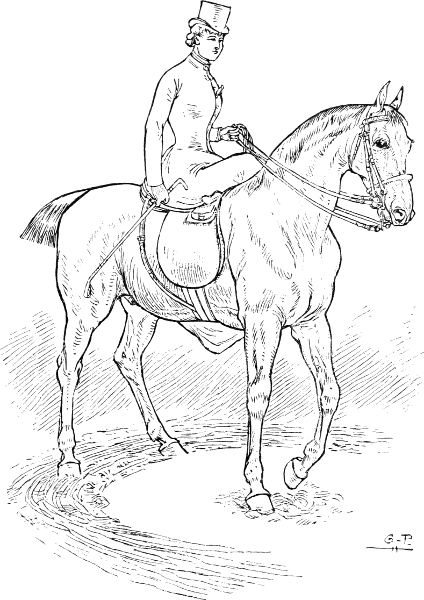
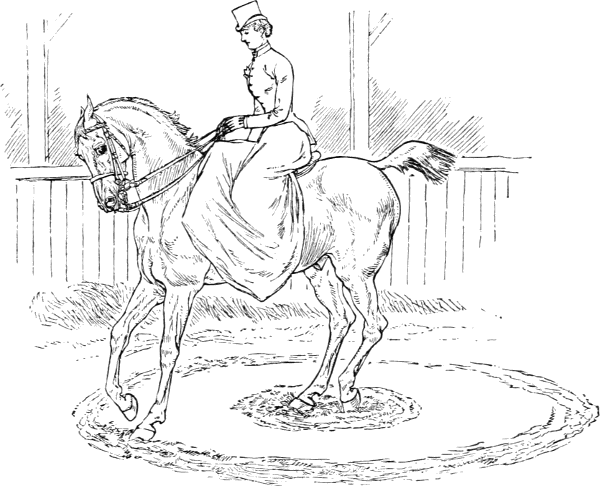
says, “Let the pupil practise riding in circles to the
right, sitting upright, but bending a little to the horse’s
motion, following his nose with her eye; beginning
with a walk, proceed to a slow trot, increasing the action
as she gains firmness in the saddle. When in a smart
trot on a circle to the right she can, leaning as she
should to the right, see the feet of the horse on the
right side, it may be assumed that she has arrived at a
firm seat.” Another excellent exercise is to lean over,
now to one side, now to the other, now in front, far
enough to observe the horse’s action, the motion of his
feet, and the regularity of his step.
If good-nature is the quality most essential to mounting
in a pleasing manner, that which will cause a lady
to shine most on the road is kindness. Such a statement
will perhaps bring a smile to the lips of some
dashing girl who thinks that she has other means of
pleasing, once mounted on a spirited horse, than the
practice of any of the Christian virtues; but the writer,
after many years’ experience with amazones both young
and old, believes it to be literally true. A lady who,
without weakness, is gentle and thoughtful, will have,
other things being equal, more sympathetic obedience
from her horse, a finer hand, a more supple seat, and
will bring him back fresher and her whole party home
in better spirits than one who is not. To begin with,
there is almost always one of the horses which is not
equal to the others, but keeps up with difficulty, and as
it is precisely that horse which should set the pace for
the rest, it is well to observe the capacity of the different
animals, and spare the feelings of any one of the
party who may be poorly mounted. One might hardly
suppose it necessary to mention so elementary a rule of
politeness as that which bids us, when we ride in company,
not to keep always in the best part of the road;
but horses are sometimes selfish as well as human beings,
and the selfish horse, like the selfish man, unless
he is prevented, will imperceptibly crowd his patient
companion into the ruts, when the rider will get the
credit or discredit of the action. Another too common
piece of thoughtlessness is the splashing at full speed
through mud puddles, the result of which is naturally
more apparent to one’s neighbors than to one’s self. If
to an equestrian, however, being splashed or spattered
is annoying, to a pedestrian it is nothing less than exasperating,
and such a one will look after the person
guilty of the rudeness with eyes of anything but admiration.
One cannot be too careful, indeed, when riding
near pedestrians, as they are decidedly susceptible under
such circumstances, and likely to take offence; and especially
is caution required where women and children
are concerned, for it is impossible to conjecture what
they will do if suddenly startled by the rapid approach
of horses. The writer saw, one afternoon, a nursery-maid
crossing Rotten Row with a baby-carriage (Anglice,
perambulator), and two children holding to her
skirts. When half-way over, a lady and three gentlemen
came galloping down, followed by two grooms.
The children scattered, the riders could not pull up, and
for an instant it seemed as if the little party were
doomed to destruction, as the horses appeared to pass
right over some of them. The English rule, not only
for country riding, but for the Park or other public
places (and an excellent one it is), requires a gentleman
to pull up and pass a lady, if alone, at a walk, whether
she be on foot or on horseback, and though more latitude
may be allowed a lady, yet she should not gallop
up suddenly behind another lady who is alone, as a
nervous horse might be so excited as to cause great uneasiness
to a timid rider. If you should unfortunately
produce such a result, by all means pause and express
regret, and if your horse is quiet, offer to ride for a few
minutes beside the sufferer—for so she may be called.
In passing on the road, the rule is, when meeting, to
keep to the right, but when overtaking, to pass to the
left, and in like manner, when overtaken, to keep to the
right, so as to leave the road free at your left. The
only exception to this rule is in the case of led-horses,
which, as they are often inclined to kick, should be
avoided by passing next to the one ridden. When approaching
a lady in a public place a gentleman should
always do so on the off or right side.
It is sometimes rather a nice point to decide when
assistance ought to be offered by a gentleman to a lady
with whom he is not acquainted, and, if offered, whether
it ought to be accepted. The following incident, recounted
by Sir Joseph Arnould in his “Life of Lord
Chief-justice Denman,” is interesting as showing how
such a question was discussed in what may certainly be
considered as among the very best society in England.
He says that on occasion of a visit which the Lord Chief-justice
paid to Walmer Castle, three years before the
Duke of Wellington’s death, in a conversation about
riding, the duke said, “When I meet a lady on horseback
I always stop, and if her horse seems troublesome,
offer to ride alongside her in the Row till it is quiet.
The other day I met a lady on a fresh, violent horse, so
I took off my hat and said, ‘Shall I ride with you?
My horse is perfectly quiet.’ She knew me, for she replied,
‘No, your Grace; I think I can get on very well.’
After she was gone, I felt sure it was Jenny Lind.”
“We all agreed,” adds Lord Denman, “that the great
singer should have accepted the services of the great
duke, whether she wanted them or not.”
It is better not to fight a restive horse unless you
have reason to be sure of victory, but rather get some
one to lead him past the object or into the road which
he may have taken it into his foolish head to object to.
If he is in “that state of nervous irritability known as
freshness” do not jerk the bit, but keep a steady, patient
bearing on it, speaking soothingly to him in a low
though steady voice, for his acute hearing will enable
him to perceive distinctly tones which are almost or
quite inaudible to your companions. Try not to have
an anxious expression of countenance, no matter what
he may do, but to look serene and smiling, as it will not
only be more becoming, but will undoubtedly react upon
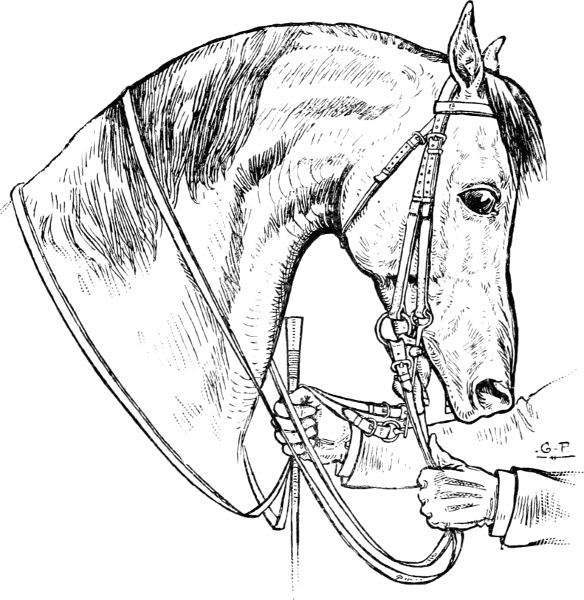
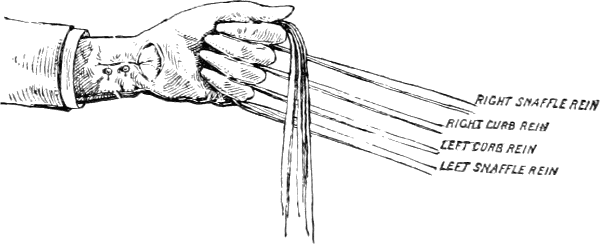
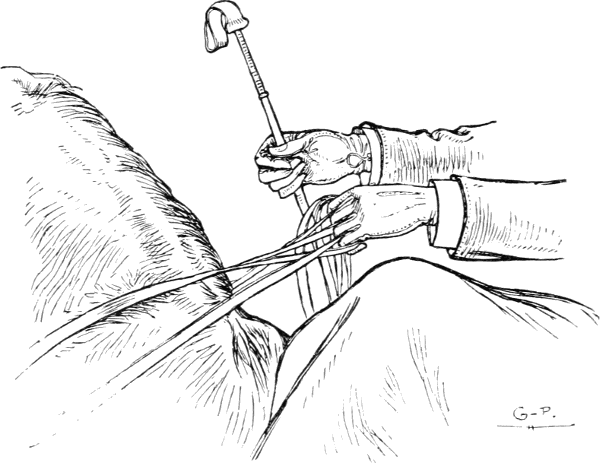
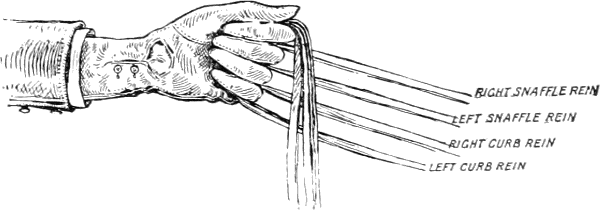
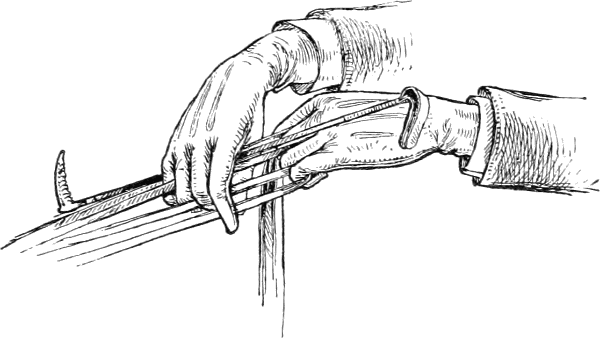
your own feelings. If he pulls, it is well to take the
slack of the right reins in the spare fingers of the left,
and vice versa, as this will give a firmer hold, and enable
you to shorten the reins without relaxing their
tension.
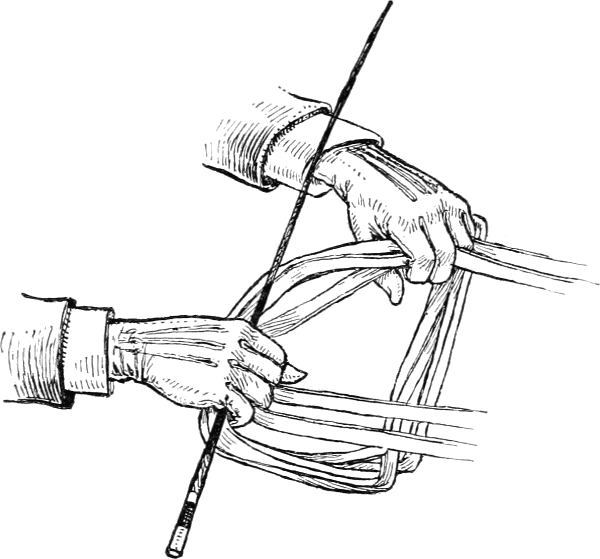
METHOD OF HOLDING THE REINS IN BOTH HANDS.
Always speak to your horse on approaching and on
leaving him, and also whenever he has tried especially
to please you, as your voice will soon come to have a
great influence over him. There is a story told of two
keepers in a zoological garden, one of whom was a favorite
with the animals, while the other, though a more conscientious
man, was disliked by them. The authorities,
curious to learn the reason, had them watched, and it
was found that the former always talked to the animals,
while the latter served them silently. Too much conversation
with one’s horse, however, is apt to get to be
a bore to one’s companions.
This should vary with the nature of the ground, as it
is dangerous to the horse, and consequently very bad
form, to ride fast on a very rough or hard road. If
slippery, a smart trot is safer than a slow trot or walk;
but if walking, by all means let the horse have his
head. If a steep place is to be descended, attack it at
right angles, and not obliquely, for, when going down
straight, a slip is likely to have no worse result than a
momentary sitting down on the haunches, whereas, if
going diagonally, it would probably bring the horse
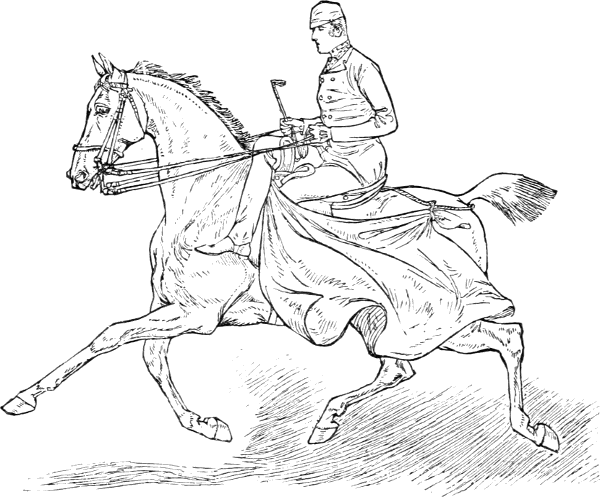
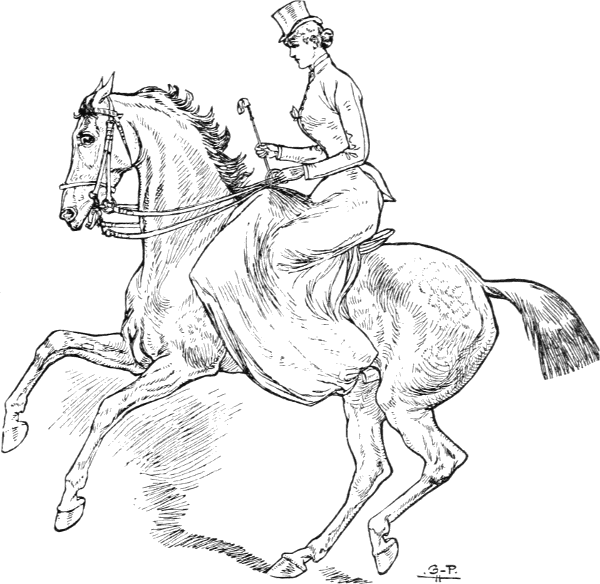
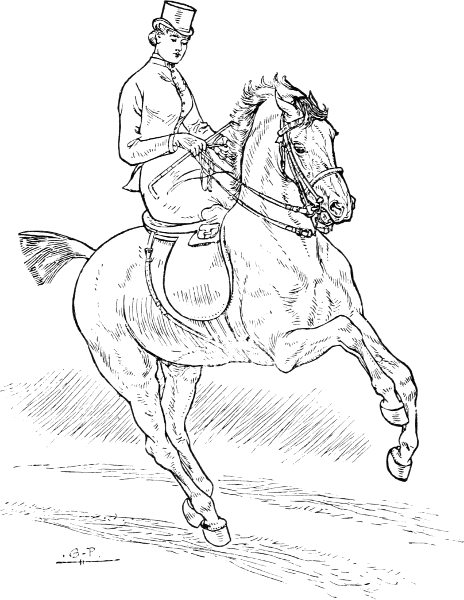
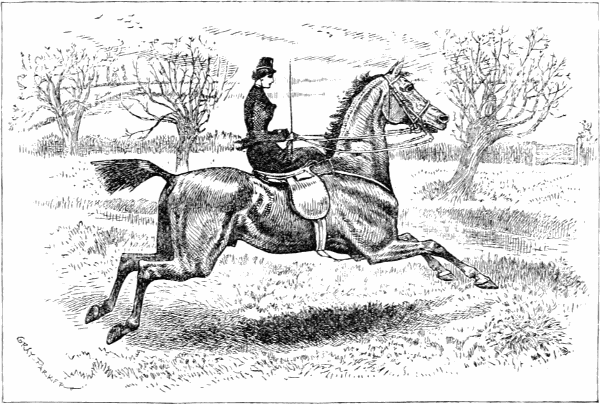
down flat. The canter, which is peculiarly the lady’s
pace, is much harder than the trot on the horse’s feet
and legs, especially on the leading foot and leg, and it
should be reserved for comparatively soft ground. The
lead with the right foot is easier for a lady, owing to
her one-sided seat, than that with the left, and it would
be considered awkward or ignorant for her not to start
off with the right, although during a long ride it is well
to change, so as to bring the strain upon a new set of
muscles.
Of course in turning you must always lead towards
the turn, that is, with the right foot in turning to the
right, and with the left in turning to the left. For instance,
if you have to round a corner to the right, and
are leading with the right foot, as will probably be the
case, you have nothing to do but to go on around, being
careful to choose good footing for your horse, and
avoiding particularly loose stones. If, however, you
are leading with the left, you must change, and you can
best do so in the following manner. As you approach
the critical spot, collect your horse with the curb, and
bring him to a trot; then, just as you reach the corner,
make him swerve slightly to the left and instantly give
the signal to canter, at the same time turning him
sharply to the right, pressing your heel against his side
back of the girth, and lifting the right snaffle-rein. It
is well to draw back the right shoulder also, so as to
throw your weight on his left side, and leave his right
leg free to make the long stride. As this is by no
means an easy operation for an unskilled rider, except
on a perfectly trained horse, I will give the directions
also in detail for the reverse process of wheeling to the
left. If your horse should be leading with the left foot,
you have, of course, no change to make. If, however,
you are, as usual, leading with the right, you must
“change the leg” to the left. As you draw near the
corner, moderate your speed and collect your horse with
the curb, bringing him to a trot. Then, just at the moment
of turning, sway his shoulders a very little to the
right, give the signal to canter by raising your hand,
and wheel sharply to the left, at the same time pressing
your crop against his right side back of the girth, and
raising the left snaffle-rein. While doing so, draw back
your left shoulder so as to throw your weight on the
right side. If he does not take the hint at once, do not
be discouraged, but practise him in some quiet place,
choosing, if possible, a corner where the turn is uphill;
and when he does well, pat him and make much of
him, for you will find that no one of your admirers is
more sensitive to your praises than he. This matter of
turning is well worth all the trouble it may cost you, as
it will give you a lively pleasure to find your horse’s
powerful limbs moving sympathetically to the gentle
impulses of a woman’s hand, and, besides, it lends an
air of style and savoir-faire which will be fully appreciated
by every looker-on who knows anything whatever
about riding. Be particular to lean over towards
the centre of the curve you are describing at an angle
proportionate to the speed, just as the horse does himself,
that is, leaning to the right side as he wheels to
the right, and to the left when he wheels to the left.
It is well not to let him cut off his corners, but to preserve
the same distance from the centre of the road,
just as if you were riding in company, and when this
last is the case be careful to keep exactly abreast both
on the straight road and on the turns, for there is nothing
that looks more countrified than to see riders straggling
along irregularly like a party of mechanics out for
a stroll on a Sunday afternoon.
It is well never to canter a carriage-horse unless you
know him well, and are sure he will not thus be rendered
unsteady in harness, and in like manner you should
be considerate of your escort or companions, and not
urge their horses beyond their proper gait. A good
way to do, if you are much the best mounted of the
party, is now and then, when the road is suitable, to
gallop on and return again. It looks well to see a lady
cantering beside a gentleman who is trotting; but the
reverse never seems quite good form, and especially
when it is evident that the gentleman’s horse is galloping
because he has been pushed off his legs.
A borrowed horse is an article which is looked upon
with very different eyes by the elderly people who generally
are the lenders, and the youthful riders that are
usually the borrowers, and many a man, and perhaps
many a woman too, remembers with shame and regret
how little were appreciated or deserved the favors of
this sort received in youthful days. A borrowed horse
should be scrupulously ridden exactly as the owner
wishes, and moreover the owner’s desires ought to be
respectfully ascertained in advance.
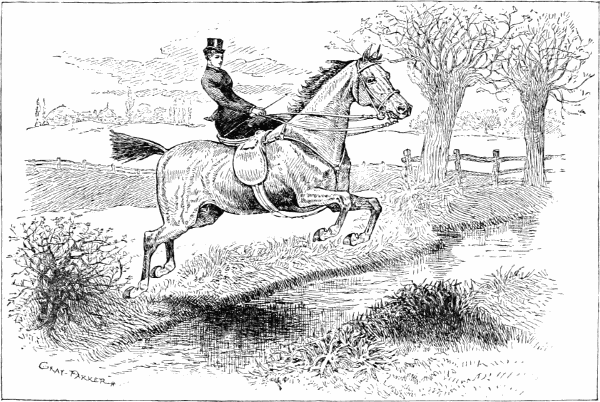
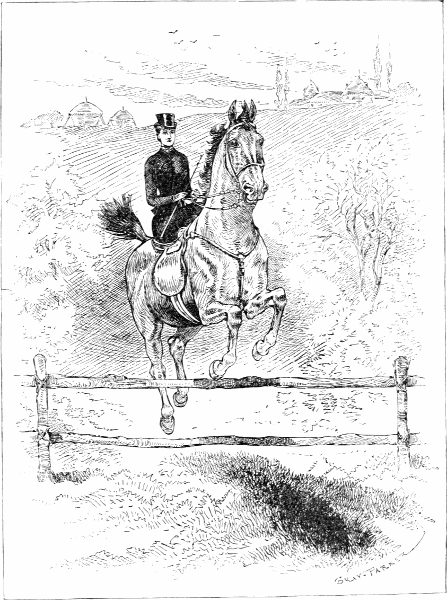
For cross-country riding the stirrups should be taken
up at least one hole, and the same is advisable in mounting
a strange horse. Another safe precaution, in the
latter case, is a running martingale, which will prevent
him from throwing up his head, as some horses have
the habit of doing, to the great annoyance of the rider.
There are two or three more practical suggestions
which may not be out of place here. The first and
most important is that it is exceedingly dangerous to
let a horse stand in a draught of air, or in a cool place,
or eat or drink, when heated. In ten minutes he may
be so crippled that he will never take a free step again.
Ferry-boats are notoriously bad places, and a horse
should never be taken on to them till quite cool. It is
not well to let your horse crop the leaves or grass, as
kind-hearted riders permit him to do sometimes, for it
soils his lips and bits, giving him a slovenly air, and you
run the risk besides of his wiping them on your habit
before you part from him. Avoid letting your horse
drink unless he really would be better for the refreshment,
as he can hardly do so without wetting the curb-reins,
making them stiff and dirty-looking.
The costume of the groom is too well known to require
remark further than that it should be scrupulously
neat. In the country, top-boots, etc., are by no means
de rigueur, and under many circumstances would savor
more of pretence than of real gentility. The groom
ought to be mounted on a strong and able horse, which,
if unused to the saddle, he should train at least so far
that he can with one hand, by the aid of his legs, force
it to take and keep any position. When accompanying
inexperienced riders his horse should be able to overtake
theirs easily. The distance at which he should
ride behind his mistress varies with circumstances—in
a crowded street his place being close behind her, while
in the Park or in the country he naturally falls farther
back, though never beyond easy call. If he is mounted
on a good saddle-horse, he should keep in his place, that
is, always at the same distance, galloping if necessary;
but if riding a carriage-horse, as is often convenient, he
should not, unless absolutely necessary, force the animal
beyond the fastest trot at which it looks well in
harness. He should never canter any horse unless instructed
expressly to do so, but should trot in a business-like
way, rising in his stirrups, or, if necessary,
should gallop, sitting straight, with hands low and feet
thrust home in the stirrups. In all cases he should look
straight forward, without appearing to notice what goes
on around him. Nothing looks in worse form than a
groom sitting lazily back on a cantering horse, and casting
glances at the admiring nursery-maids along the
way. When summoned to his mistress, he should touch
his hat to acknowledge receipt of the command, and
should ride quickly up on the off side, where he should
listen in a respectful attitude with eyes cast down, then,
touching his hat again, depart to carry out her orders.