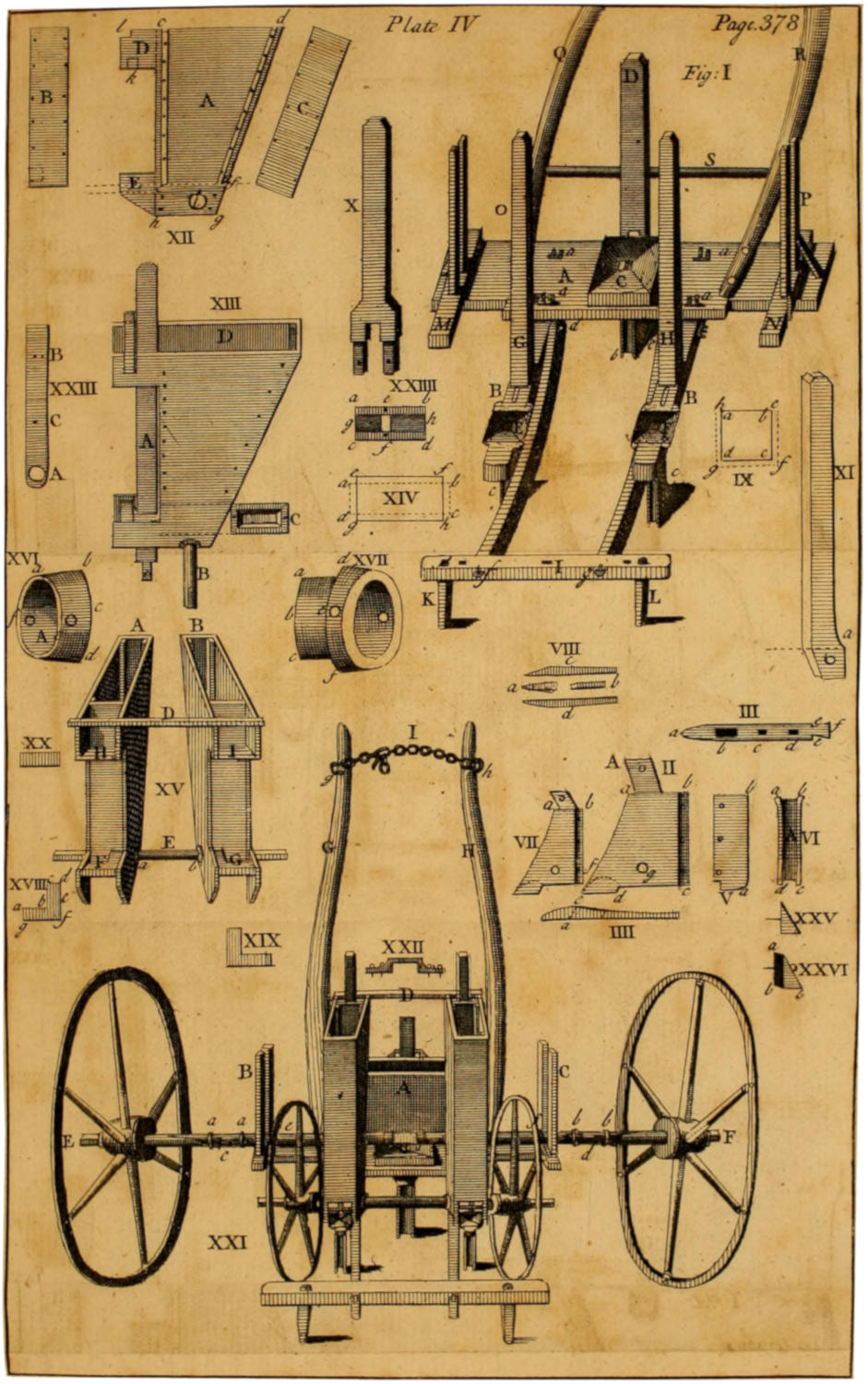
New original cover art included with this eBook is granted to the public domain.
OR,
An ESSAY on the PRINCIPLES
OF
Vegetation and Tillage.
Designed to introduce
A New Method of Culture;
WHEREBY
The Produce of Land will be increased, and the
usual Expence lessened.
Together with
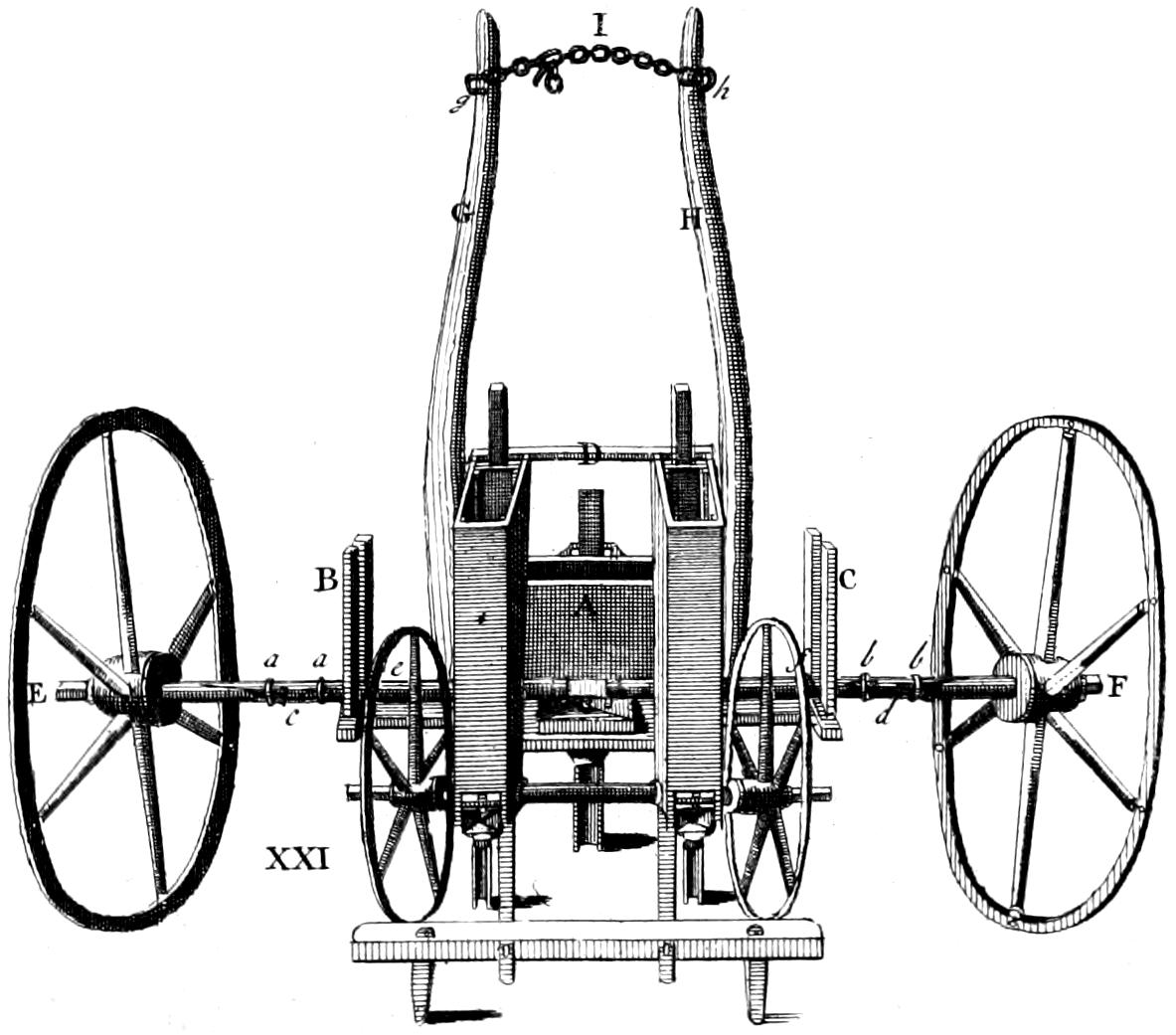
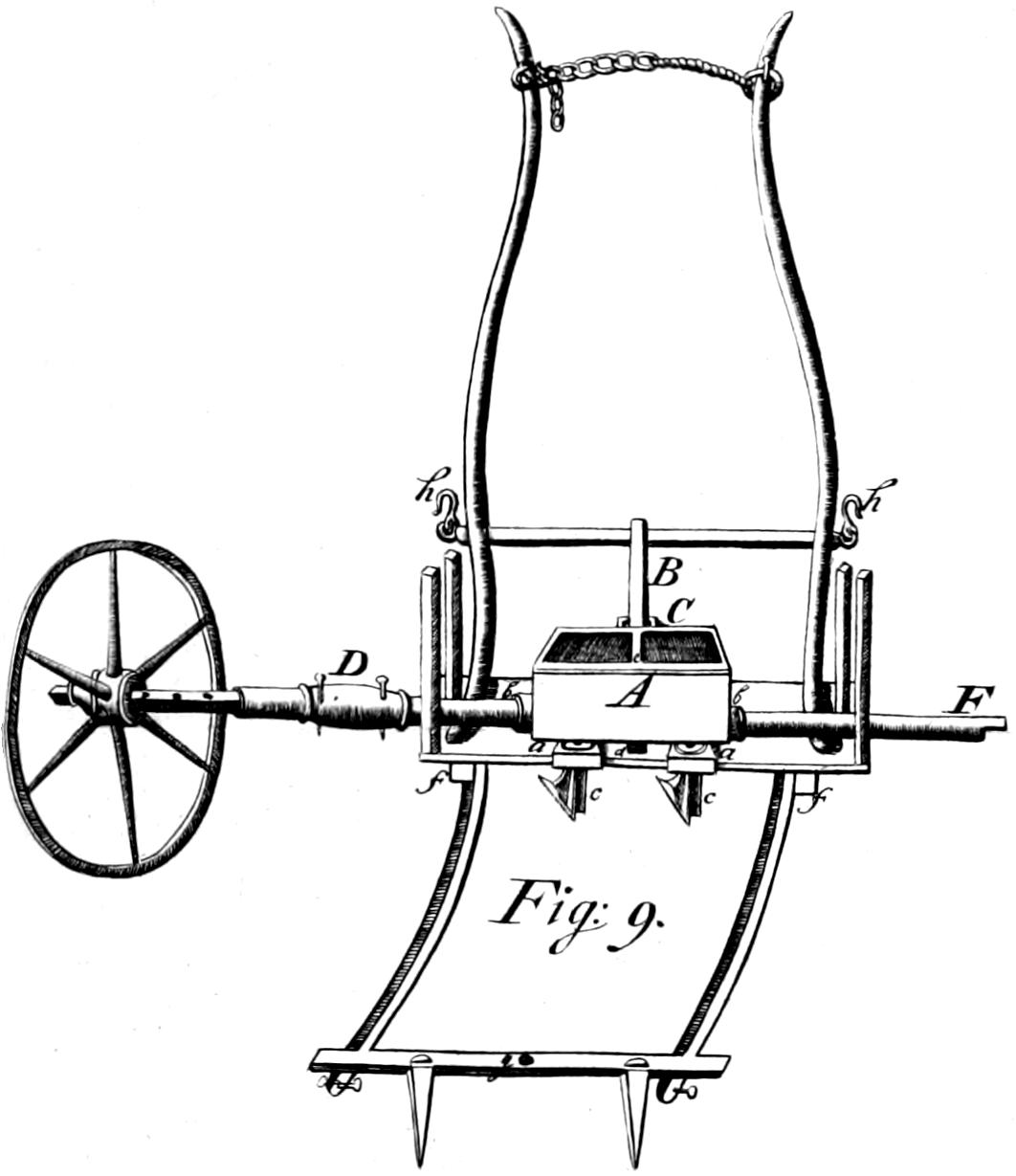
Accurate Descriptions and
Cuts of the Instruments
employed in it.
ByJETHRO TULL,Esq; Of Shalborne in Berkshire.
The Fourth Edition, very carefully Corrected.
To which is prefixed,
A New PREFACE by the
Editors, addressed to all
concerned in Agriculture.
LONDON:
Printed for A. Millar, opposite to Catharine-street
in the Strand.
M.DCC.LXII.
THE PREFACE .
As
Mr. Tull’s Essay on Horse-hoeing
Husbandry has been published some
Years, it may be presumed that
the World hath by this time
formed some Judgment of his Performance;
which renders it the less necessary for the Editors
of this Impression to say much concerning
it. For every Man who has attended to the
Subject, and duly considered the Principles
upon which our Author’s Method of Culture
is founded, is an equal Judge how far his Theory
is agreeable to Nature: Though it is but
too true, that few have made sufficient Experiments
to be fully informed of its Worth.
How it has happened, that a Method of
Culture, which proposes such Advantages to
those who shall duly prosecute it, hath been so
long neglected in this Country, may be matter
of Surprize to such as are not acquainted with
the Characters of the Men on whom the Practice
thereof depends; but to those who know
them thoroughly it can be none. For it is
certain that very few of them can be prevailed
on to alter their usual Methods upon any Consideration;
though they are convinced that their
continuing therein disables them from paying
their Rents, and maintaining their Families.
And, what is still more to be lamented,
these People are so much attached to their old
Customs, that they are not only averse to alter
them themselves, but are moreover industrious
to prevent others from succeeding, who attempt
to introduce any thing new; and indeed
have it too generally in their Power, to defeat
any Scheme which is not agreeable to their
own Notions; seeing it must be executed by
the same Sort of Hands.
This naturally accounts for Mr. Tull’s Husbandry
having been so little practised. But as
the Methods commonly used, together with
the mean Price of Grain for some Years past,
have brought the Farmers every-where so low,
that they pay their Rents very ill, and in many
Places have thrown up their Farms; the Cure
of these Evils is certainly an Object worthy of
the public Attention: For if the Proprietor
must be reduced to cultivate his own Lands,
which cannot be done but by the Hands of
these indocile People, it is easy to guess on
which Side his Balance of Profit and Loss will
turn.
This Consideration, together with many
others which might be enumerated, hath induced
the Editors to recommend this Treatise
once more to the serious Attention of every one
who wishes well to his Country; in hopes that
some may be prevailed upon, by regard either
to the public Good or their own private Interest,
to give the Method here proposed a fair and
impartial Trial: For could it be introduced into
several Parts of this Country by Men of generous
Principles, their Example might, in
time, establish the Practice thereof, and bring
it into general Use; which is not to be expected
by any other means.
It is therefore to such only, as are qualified to
judge of a Theory from the Principles on which
it is founded, that the Editors address themselves,
desiring they will give this Essay another
Reading with due Attention: and at the same
time they beg leave to remind them how unfit
the common Practisers of Husbandry are to pass
Judgment, either on the Theory or Practice of
this Method; for which Reason it is hoped that
none will be influenced by such, but try the
Experiment themselves with proper Care.
As a Motive to this, it is to be observed that,
although the Method of Culture here proposed
has made little Progress in England, it is not like
to meet with the same Neglect abroad, especially
in France; where a Translation of Mr. Tull’s
Book was undertaken, at one and the same time,
by three different Persons of Consideration, without
the Privity of each other: But afterwards,
Two of them put their Papers into the Hands
of the Third, Mr. Du Hamel du Manceau, of
the Royal Academy of Sciences at Paris, and of
the Royal Society at London; who has published
a Book, intituled, A Treatise of Tillage on the
Principles of Mr. Tull. The ingenious Author
has indeed altered the Method observed by Mr.
Tull in his Book; yet has very exactly given his
Principles and Rules: But as he had only seen
the First Edition of the Horse-hoeing Husbandry,
so he is very defective in his Descriptions of the
Ploughs and Drills, which in that were very
imperfect, and were afterwards amended by Mr.
Tull in his Additions to that Essay.
One of our principal Reasons for taking Notice
of this Book is, to shew the Comparison this
Author has made between the Old Method of
Husbandry and the New. By his Calculation
the Profits arising from the New, are considerably
more than double those of the Old. For,
according to him, the Profits of Twenty Acres
of Land for Ten Years, amount, at 10d. ¹⁄₂ per
Livre,
l.
s.
d.
By the Old Method, to 3000 Livres, or
131
5
0
}
Sterling.
By the New Method, to 7650 Livres, or
334
13
9
which makes a prodigious Difference in favour
of the latter. As this Computation was made
by one who cannot be supposed to have any
Prejudice in favour of Mr. Tull’s Scheme, it
will naturally find more Credit with the Public
than any Comparison made by Mr. Tull himself,
or by such as may have an Attachment to
his Principles.
It may probably be expected, that the Editors
should take Notice of such Objections as
have been made, either to Mr. Tull’s Theory or
Practice; but we do not know any that in the
least affect his Principles: They stand uncontroverted:
Nor are there any to the Practice,
which may not be equally urged against every
Sort of Improvement. One of the principal
which have come to our Knowlege is, its being
impracticable in common Fields, which make
a great Part of this Country, without the Concurrence
of every one who occupies Land in the
same Field. But doth not this equally affect the
Old Husbandry? For every such Person is
obliged to keep the Turns of plowing, fallowing,
&c. with the other Occupiers; so that if
any of them were inclinable to improve their
Lands, by sowing Grass-seeds, or any other Method
of Culture, they are now under the same
Difficulties as they would be, were they to practise
Mr. Tull’s Method. Therefore this is rather
to be lamented as a public Misfortune, than to
be brought as an Objection to the Practicableness
of that Method. Others object, that the introducing
this Sort of Husbandry is unnecessary,
seeing the Improvements which are made by
Grass-seeds are so considerable; besides, that
the Returns made by the Fold and the Dairy,
being much quicker than those of Grain, engage
the Farmer to mix Plowing and Grazing
together. But when this is duly considered it
can have no sort of Weight: for is it not well
known that, in those Farms where the greatest
Improvements have been made by Grass-seeds,
the Quantity of Dressing required for the Arable
Land often runs away with most of the Profit
of the whole Farm? especially when the Price
of Grain is low. And if this be the Situation of
the most improved Farms, what must be the
Case of those which chiefly consist of Arable
Land; where most of the Dressing must be
purchased at a great Price, and often fetched
from a considerable Distance? Add to this the
great Expence of Servants and Horses, unavoidable
in Arable Farms; and it will appear how
great the Advantages are which the Grasier
hath over the plowing Farmer. So that it is
much to be wished, the Practice of mixing the
Two Sorts of Husbandry were more generally
used in every Part of the Kingdom; which
would be far from rendering Mr. Tull’s Method
of Culture useless; seeing that, when it
is well understood, it will be found the surest
Method to improve both.
For although Mr. Tull chiefly confined the
Practice of his Method to the Production of
Grain (which is a great Pity), yet it may be extended
to every Vegetable which is the Object
of Culture in the Fields, Gardens, Woods, &c.
and perhaps may be applied to many other
Crops, to equal, if not greater Advantage, than
to Corn.
In the Vineyard it has been long practised
with Success; and may be used in the Hop-Ground
with no less Advantage. For the Culture
of Beans, Peas, Woad, Madder, and other
large-growing Vegetables; as also for Lucern,
Saintfoin, and the larger Grasses; we dare venture
to pronounce it the only Method of Culture
for Profit to the Farmer; seeing that, in
all these Crops, one Sixth Part of the Seeds now
commonly sown will be sufficient for the same
Quantity of Land, and the Crop in Return will
be much greater; which, when the Expence of
Seeds is duly considered, will be found no small
Saving to the Farmer.
Nor should this Method of Culture be confined
to Europe: for it may be practised to as
great Advantage in the British Colonies in
America, where, in the Culture of the Sugar-Cane,
Indigo, Cotton, Rice, and almost all the
Crops of that Country, it will certainly save a
great Expence of Labour, and improve the
Growth of every Plant, more than can be
imagined by such as are ignorant of the Benefit
arising from this Culture. And should the Subjects
of Great Britain neglect to introduce this
Method into her Colonies, it may be presumed
our Neighbours will take care not to be blameable
on this Head; for they seem to be as intent upon
extending every Branch of Trade, and making
the greatest Improvements of their Land, as
we are indifferent to both: So that, unless a
contrary Spirit be soon exerted, the Balance of
Trade, Power, and every other Advantage, must
be against us.
There have been Objections made by some to
Mr. Tull’s Method, as if it were practicable only
on such Lands as are soft and light, and not at
all on stiff and stony Ground. That it hath not
been practised on either of these Lands in England
we are willing to grant; but we must not
from thence infer that it is impossible to apply it
to them. For the Hoe-Plough has been very
long used in the Vineyards in many Countries,
where the Soil is stronger, and abounds with
Stones full as much as any Part of this Country.
However, though the Use of this Plough may
be attended with some Difficulties upon such
Land, for Wheat, or Plants of low Growth,
whose Roots may be in Danger of being turned
out of the Ground, or their Tops buried by the
Clods or Stones; yet none of the larger-growing
Plants are subject to the same Inconveniencies.
Besides, the stronger the Soil is, the more Benefit
will it receive from this Method of Culture, if
the Land be thereby more pulverized; which
will certainly be the Consequence, where the
Method laid down by Mr. Tull is duly observed.
But as most Instruments, in their First Use,
are attended with some Difficulty, especially in
the Hands of such as are indocile, the Hoe-plough
has been complained of, as cumbersome and unwieldy
to the Horse and Ploughman. But perhaps
this arises chiefly from the Unwillingness of
the Workmen to introduce any new Instrument:
Indeed, seeing little is to be expected from those
who have been long attached to different Methods,
the surest Way to promote the Use of it,
is to engage young Persons, who may probably
be better disposed, to make the Trial at their
first entering into Business; and then a little
Use will make it easy. It is proper to observe
here, that the Swing-plough, which is commonly
used in the deep Land about London, will
do the Business of the Hoe-plough in all Ground
that is not very strong, or very stony; and that
where it is so, the Foot-plough, made proportionably
strong, will completely answer all Purposes.
But it must be remembered, that when
these are used to hoe Corn, the Board on the
Left Hand of the Plough, answering the Mould-Board,
must be taken off; otherwise so much
Earth will run to the Left Side, as to injure the
Crop when it is low.
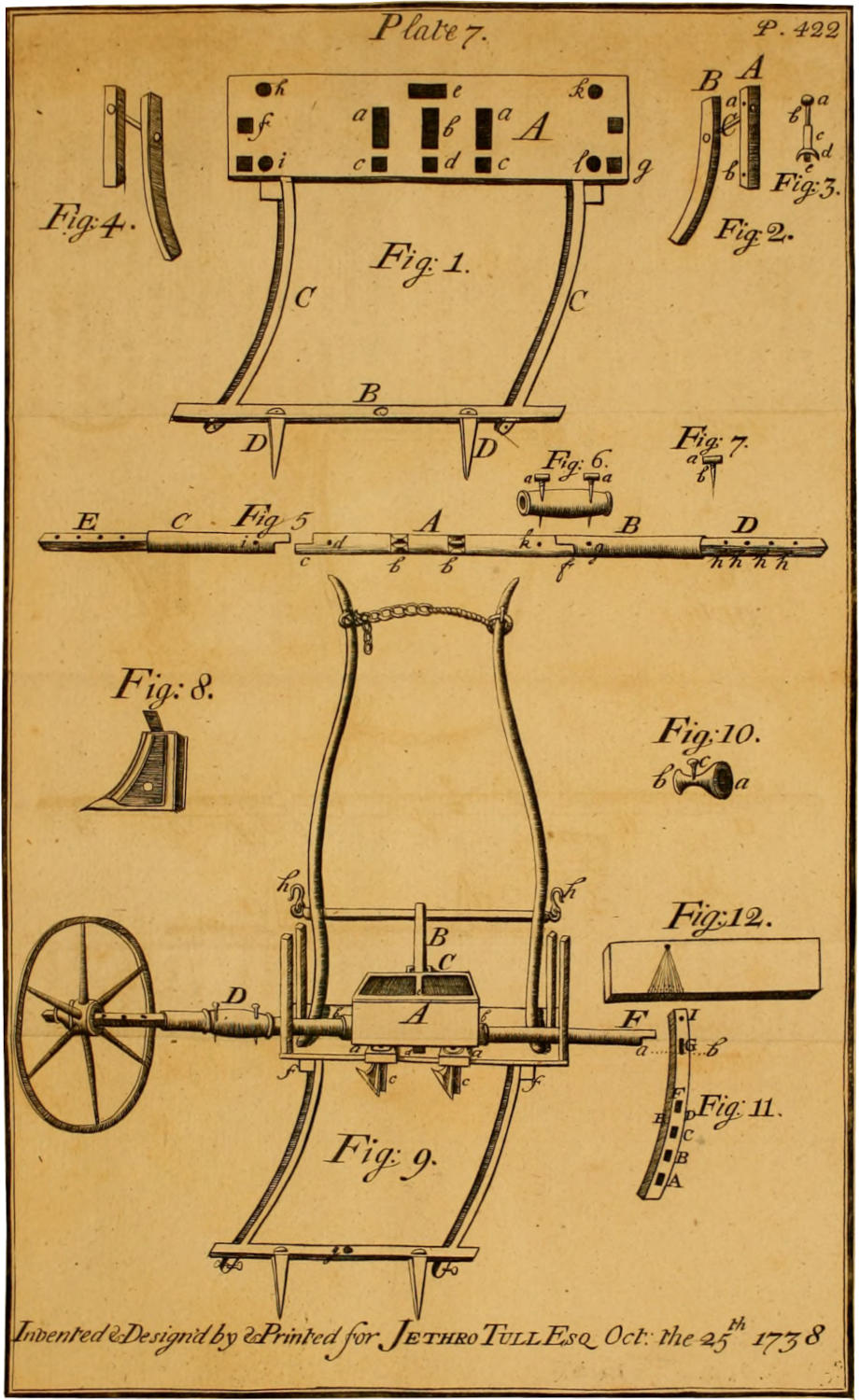
The Drills are excellent Instruments; yet we
imagine them capable of some farther Improvement.
Parallel Grooves, at about an Inch
asunder, round the Inside of the Hopper, would
shew the Man who follows the Drill, whether
or no both Boxes vent the Seed equally. By
an Hitch from the Plank to the Harrow, the
latter may be lifted to a proper Height, so as
not to be in the Way when the Ploughman turns
at the Headland. Two light Handles on the
Plank, like those of the common Plough, would
enable the Person who follows the Drill to keep
it from falling off the Middle of the Ridge. It
may also be useful, in wet Weather, to double
the Drills; by which means Two Ridges may
be sown at the same time, the Horse going between
them: For the Planks of Two Drills,
each Plank having one of the Shafts fixed to it,
may be joined End for End by Two flat Bars of
Iron, one on each Side, well secured by Iron
Pins and Screws; and, by corresponding Holes
in the Planks and Bars, the Distance between
the Drills may be altered, according to the different
Spaces between the Ridges.
The Alterations made by the Editors of this
Impression are little more than omitting the controversial
Parts of the Book, which were judged
of no Service to the Reader, as they no-ways affected
the Merits of Mr. Tull’s Principles.
But as he endeavoured to recommend his
Theory by drawing a Comparison between the
Old Method of Culture and the New, so we
beg leave to annex a Computation of the Expence
and Profit of each; for which we are
obliged to a Gentleman, who for some Years
practised both in a Country where the Soil was
of the same Nature with that from whence
Mr. Tull drew his Observations, viz. light and
chalky. And we chuse to give this the rather,
as it comes from one who has no Attachment
to Mr. Tull’s Method, farther than that he
found it answer in his Trials. We appeal to
Experience, whether every Article in this Calculation
is not estimated in favour of the Common
Husbandry; whether the Expence be not
rated lower than most Farmers find it, and the
Crop such as they would rejoice to see, but seldom
do, in the Country where this Computation
was made.
In the New Husbandry every Article is put
at its full Value, and the Crop of each Year is
Four Bushels short of the other; tho’, in several
Years Experience, it has equalled, and
generally exceeded, those of the Neighbourhood
in the Old Way.
An Estimate of the Expence and Profit of Ten
Acres of Land in Twenty Years.
I. In the Old Way.
First Year, for Wheat, costs 33l. 5s.viz.
l.
s.
d.
l.
s.
d.
First Plowing, at 6s.per Acre
3
0
0
Second and Third Ditto, at 8s.per Acre
4
0
0
Manure, 30s.per Acre
15
0
0
22
0
0
Two Harrowings, and Sowing, at 2s. 6d.per Acre
1
5
0
Seed, three Bushels per Acre, at 4s.per Bush.
6
0
0
Weeding, at 2s.per Acre
1
0
0
Reaping, Binding, and Carrying, at 6s.per Acre
3
0
0
11
5
0
33
5
0
Second Year, for Barley, costs 11l. 6s. 8d.viz.
Once Plowing, at 6s.per Acre
3
0
0
Harrowing and Sowing, at 1s. 6d.per Acre,
0
15
0
Weeding, at 1s.per Acre
0
10
0
Seed, 4 Bushels per Acre, at 2s.per Bushel
4
0
0
Cutting, Raking, and Carrying, at 3s. 2d.per Acre
1
11
8
Grass-Seeds, at 3s.per Acre
1
10
0
11
6
8
44
11
8
Third and Fourth Years, lying in Grass, cost nothing: So that the Expence of Ten Acres
in Four Years comes to 44l. 11s. 8d. and in Twenty Years to
222
18
4
First Year’s Produce is half a Load of Wheat per Acre, at 7l.
35
0
0
Second Years Produce is Two Quarters of Barley per Acre, at 1l.
20
0
0
Third and Fourth Years Grass is valued at 1l. 10s.per Acre
15
0
0
So that the Produce of Ten Acres in Four Years is
70
0
0
And in Twenty Years it will be
350
0
0
Deduct the Expence, and there remains clear Profit on Ten Acres in 20 Years by the Old Way
127
1
8
II. In the New Way.
First Year’s extraordinary Expence is, for plowing and manuring the Land, the same as in Old Way
22
0
0
Plowing once more, at 4s.per Acre
2
0
0
Seed, 9 Gallons per Acre, at 4s.per Bushel
2
5
0
Drilling, at 7d.per Acre
0
5
10
Hand-hoeing and Weeding, at 2s. 6d.per Acre
1
5
0
Horse-hoeing Six times, at 10s.per Acre
5
0
0
Reaping, Binding, and Carrying, at 6s.per Acre
3
0
0
The standing annual Charge on Ten Acres is
13
15
10
Therefore the Expence on Ten Acres in Twenty Years is
275
16
8
Add the Extraordinaries of the First Year, and the Sum is
297
16
8
The yearly Produce is at least Two Quarters of Wheat per Acre, at 1l.
8s.per Quarter; which, on Ten Acres in Twenty Years, amounts to
560
0
0
Therefore, all things paid, there remains clear Profit on Ten Acres in Twenty Years by the New Way
262
3
4
So that the Profit on Ten Acres of Land in
Twenty Years, in the New Way, exceeds that
in the Old by 135l. 1s. 8d. and consequently
is considerably more than double thereof: an
ample Encouragement to practise a Scheme,
whereby so great Advantage will arise from
so small a Quantity of Land, in the Compass of
a Twenty-one Years Lease; One Year being
allowed, both in the Old and New Way, for
preparing the Ground.
It ought withal to be observed, that Mr. Tull’s
Husbandry requires no Manure at all, tho’ we
have here, to prevent Objections, allowed the
Charge thereof for the first Year; and moreover,
that tho’ the Crop of Wheat from the Drill-plough
is here put only at Two Quarters on an
Acre, yet Mr. Tull himself, by actual Experiment
and Measure, found the Produce of his
drilled Wheat-crop amounted to almost Four
Quarters on an Acre: And, as he has delivered
this Fact upon his own Knowlege, so there is
no Reason to doubt of his Veracity, which has
never yet been called in question. But that we
might not be supposed to have any Prejudice in
favour of his Scheme, we have chosen to take
the Calculations of others rather than his, having
no other View in what we have said, than to
promote the Cause of Truth, and the public
Welfare.
The Wheat and Turnep Drill-Boxes, or the Drill-Plough complete,
mentioned in this Treatise, may be had at Mr. Mulford’s
in Cursitor-street, Chancery-lane, London.
CHAP . I. Of Roots and Leaves . — A Method how to find the Distance to which Roots extend Horizontally. — Remarks on the Mints, &c.
Since the most immediate Use of
Agriculture, in feeding Plants, relates
to their Roots, they ought to be treated
of in the first Place.
Roots are very different in different
Plants: But ’tis not necessary here to take notice of
all the nice Distinctions of them; therefore I shall
only divide them in general into two Sorts, viz.Horizontal-Roots,
and Tap-Roots, which may include
them all.
All have Branchings and Fibres going all manner
of ways, ready to fill the Earth that is open.
But such Roots as I call Horizontal (except of Trees)
have seldom any of their Branchings deeper than the
Surface or Staple of the Earth, that is commonly
mov’d by the Plough or Spade.
The Tap-Root commonly runs down Single and
Perpendicular[1] reaching sometimes many Fathoms
below.
[1]In this manner descends the first Root of every Seed; but
of Corn very little, if at all, deeper than the Earth is tilled.
These first Seed-Roots of Corn die as soon as the other Roots
come out near the Surface, above the Grain: and therefore this
first is not called a Tap Root; but yet some of the next Roots
that come out near the Surface of the Ground, always reach
down to the Bottom of the pulveriz’d Staple; as may be seen, if
you carefully examine it in the Spring time; but this first Root
in Saint-foin becomes a Tap Root.
This (tho’ it goes never so deep) has horizontal
ones passing out all round the Sides; and extend to
several Yards Distance from it, after they are by their
Minuteness, and earthly Tincture, become invisible
to the naked Eye.
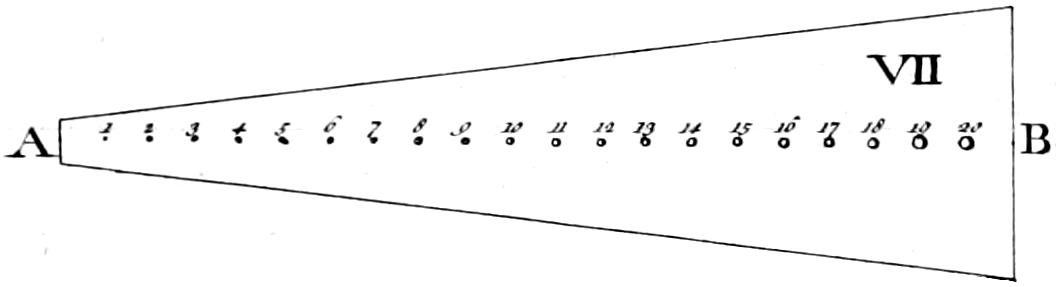
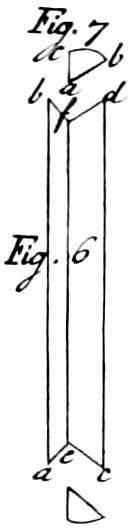
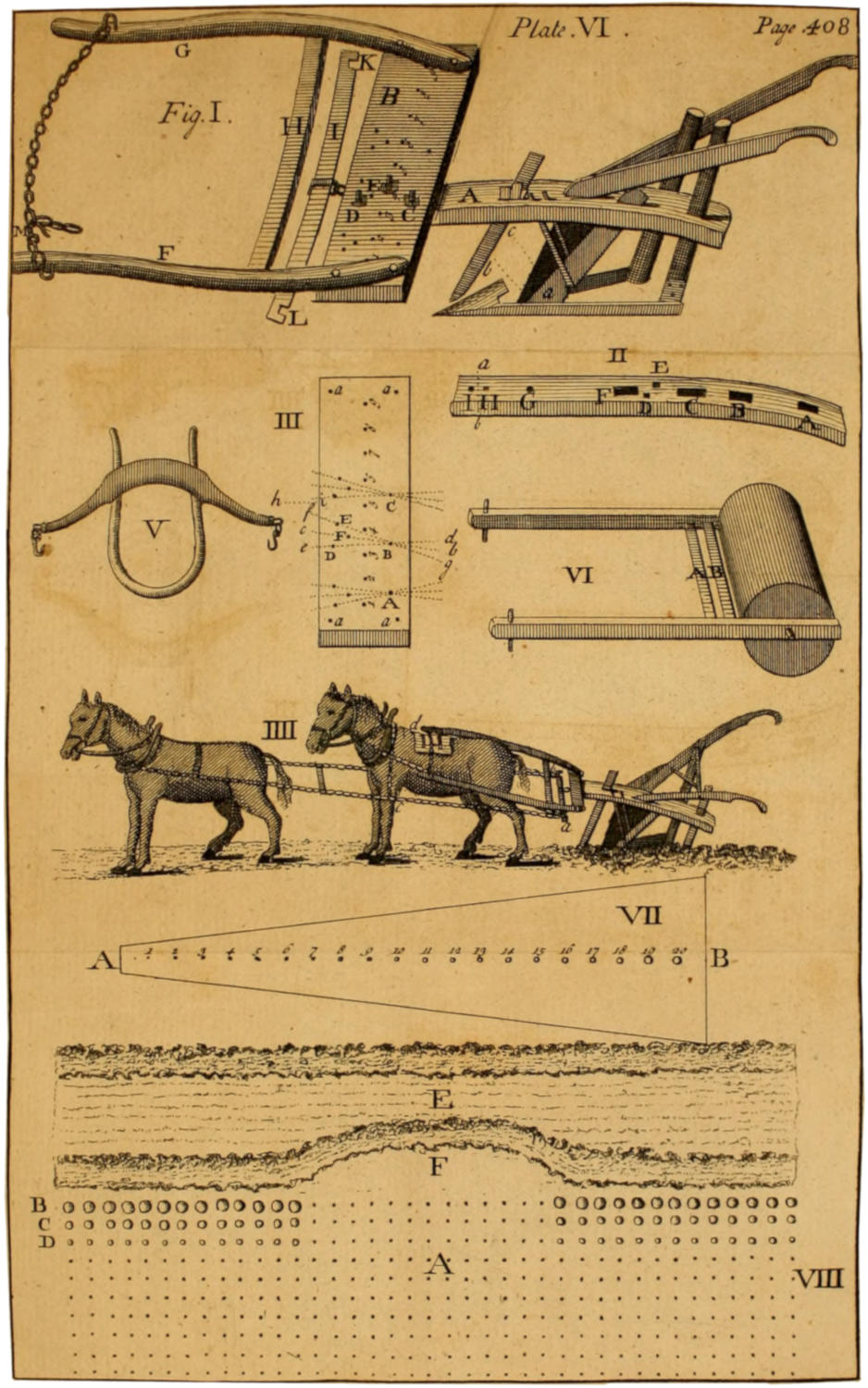
Pl. 6. Fig. 7. Is a Piece or Plot dug and made
fine in whole hard Ground, the End A 2 Feet, the
End B 12 Feet, the Length of the Piece 20 Yards;
the Figures in the middle of it are 20 Turneps, sown
early, and well ho’d.
The manner of this Hoing must be at first near
the Plants, with a Spade, and each time afterwards,
a Foot farther Distance, till all the Earth be once well
dug; and if Weeds appear where it has been so dug,
hoe them out shallow with the Hand-Hoe. But
dig all the Piece next the out Lines deep every time,
that it may be the finer for the Roots to enter, when
they are permitted to come thither.
If these Turneps are all gradually bigger, as they
stand nearer to the End B, ’tis a Proof they all extend
to the Outside of the Piece; and the Turnep 20 will
appear to draw Nourishment from six Feet Distance
from its Centre.
But if the Turneps 16, 17, 18, 19, 20, acquire
no greater Bulk than the Turnep 15, it will be clear,
that their Roots extend no farther than those of the
Turnep 15 does; which is but about 4 Feet.
By this Method the Distance of the Extent of
Roots of any Plant may be discover’d.
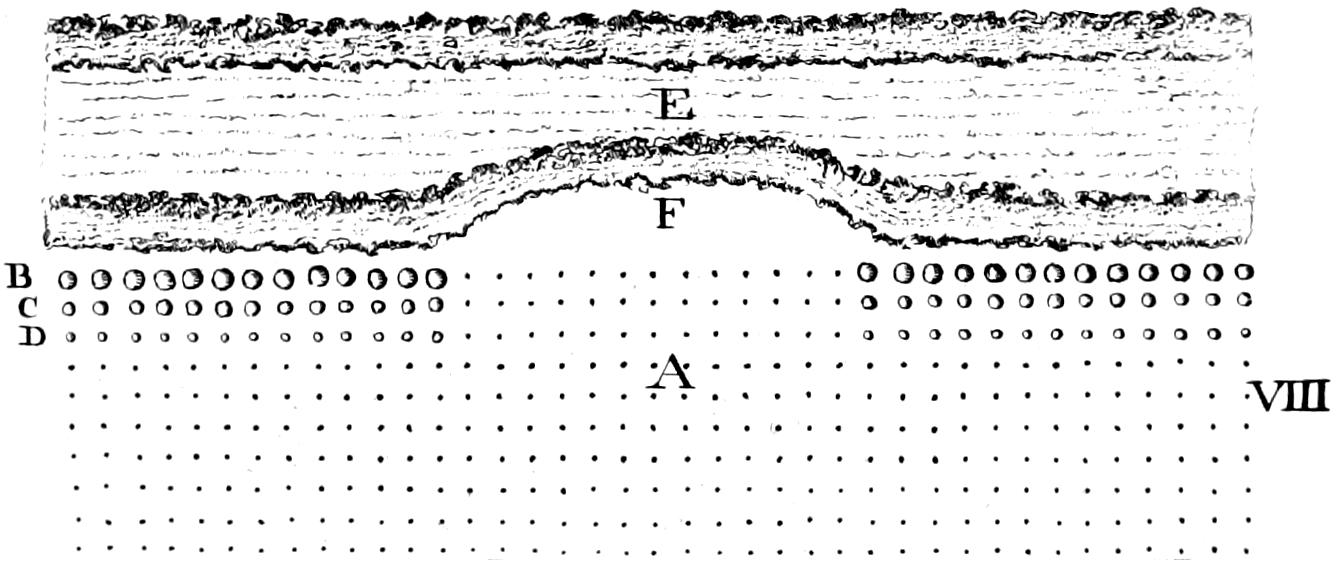
What put me upon this Method was an Observation
of two Lands (or Ridges) drill’d with Turneps in
Rows, a Foot asunder, and very even in them; the
Ground, at both Ends, and one Side, was hard and
unplow’d; the Turneps not being ho’d, were very
poor, small, and yellow, except the Three outside
Rows, B, C, D, which stood next to the Land (or
Ridge) E, which Land being plow’d and harrow’d,
at the time the Land A ought to have been ho’d,
gave a dark flourishing Colour to these three Rows;
and the Turneps in the Row D, which stood farthest
off from the new-plow’d Land E, received so much
Benefit from it, as to grow twice as big as any of
the more distant Rows. The Row C, being a Foot
nearer to the new-plow’d Land, became twice as
large as those in D; but the Row B, which was next
to the Land E, grew much larger yet[2].
[2]A like Observation to this on the Land E, has been made
in several Turnep Fields of divers Farmers, where Lands adjoining
to the Turneps have been well tilled; all the Turneps of the
contiguous Lands that were within three or four Feet, or more,
of the newly pulveriz’d Earth, received as great, or greater increase,
in the Manner as my Rows B C D did; and what is yet a
greater Proof of the Length of Roots, and of the Benefit of deep
Hoing, all these Turneps have been well Hand-ho’d; which is a
good Reason why the Benefit of the deep Pulveration should be
perceivable at a greater Distance from it than mine, because my
Turneps, not being hoed at all, had not Strength to send out their
Roots through so many Feet of unpulveriz’d Earth, as these can
through their Earth pulveriz’d by the Hoe, tho’ but shallowly.
This Observation, as ’tis related to me (I being unable to go
far enough to see it myself) sufficiently demonstrates the mighty
Difference there is between Hand-hoing and Horse-hoing.
F Plate 6. is a Piece of hard whole Ground, of
about two Perch in Length, and about two or three
Feet broad, lying betwixt those two Lands, which
had not been plow’d that Year; ’twas remarkable,
that during the Length of this interjacent hard
Ground, the Rows B, C, D, were as small and yellow
as any in the Land.
The Turneps in the Row D, about three Feet distant
from the Land E, receiving a double Increase, proves
they had as much Nourishment from the Land E,
as from the Land A, wherein they stood; which
Nourishment was brought by less than half the
Number of Roots of each of these Turneps.
In their own Land they must have extended a
Yard all round, else they could not have reach’d the
Land E, wherein ’tis probable these few Roots went
more than another Yard, to give each Turnep as
much Increase as all the Roots had done in their own
Land.
Except that it will hereafter appear, that the new
Nourishment taken at the Extremities of the Roots
in the Land E, might enable the Plants to send out
more new Roots in their own Land, and receive something
more from thence.
The Row C being twice as big as the Row D,
must be suppos’d to extend twice as far; and the
Row B, four times as far, in proportion as it was of
a Bulk quadruple to the Row D.
A Turnep has a Tap-Root, from whence all these
Horizontal Roots are deriv’d.
And ’tis observable; that betwixt these two Lands
there was a Trench, or Furrow, of about the Depth
of nine or ten Inches, where these Roots must descend
first, and then ascend into the Land E: But
it must be noted, that some small Quantity of Earth
was, by the Harrowing, fall’n into this Furrow,
else the Roots could not have pass’d thro’ it.
Roots will follow the open Mould[3],
by descending
perpendicularly, and mounting again in the same
manner: As I have observ’d the Roots of a Hedge
to do, that have pass’d a steep Ditch two Feet deep,
and reach’d the Mould on the other side, and there
fill it; and digging Five Feet distant from the Ditch,
found the Roots large, tho’ this Mould was very
shallow, and no Roots below the good Mould.
[3]A Chalk-Pit, contiguous to a Barn, the Area of which
being about 40 Perch of Ground, was made clean and swept; so
that there was not the Appearance of any Part of a Vegetable,
more than in the Barn’s Floor: Straw was thrown from thence
into the Pit, for Cattle to lie on; the Dung made thereby was
haled away about three Years after the Pit had been cleansed;
when, at the Bottom of it, and upon the Top of the Chalk, the
Pit was covered all over with Roots, which came from a Witch-Elm,
not more than Five or Six Yards in Length, from Top to
Bottom, and which was about Five Yards above, and Eleven
Yards from the Area of the Pit; so that in three Years the Roots
of this Tree extended themselves Eight times the Length of the
Tree, beyond the Extremities of the old Roots, at Eleven Yards
Distance from the Body: The annual-increased Length of the
Roots was near Three times as much as the Height of the Tree.
I’m told an Objection hath been made from hence against the
Growth of a Plant’s being in proportion to the Length of its Roots;
but when the Case is fully stated, the Objection may vanish. This
Witch-Elm is a very old decay’d Stump, which is here called a
Staggar, appearing by its Crookedness to have been formerly a
Plasher in an old White-thorn Hedge wherein it stands: It had
been lopped many Years before that accidental Increase of Roots
happened; it was stunted, and sent out poor Shoots; but in the
third Year of these Roots, its Boughs being most of them horizontally
inclined, were observed to grow vigorously, and the
Leaves were broad, and of a flourishing Colour; at the End of
the third Year all these Roots were taken away, and the Area
being a Chalk-Rock lying uncovered, round the Place where the
Single Root, that produced all these, came out of the Bank, no
more Roots could run out on the bare Chalk, and the Growth
of the Boughs has been but little since.
Wheat, drill’d in double Rows in November, in a Field well
till’d before Planting, look’d yellow, when about Eighteen
Inches high; at Two Feet Distance from the Plants, the Earth
was Ho-plow’d, which gave such Nourishment to ’em, that they
recovered their Health, and changed their sickly Yellow, to a
lively Green Colour.
So in an Orchard, where the Trees are planted
too deep, below the Staple or good Mould, the
Roots, at a little Distance from the Stem, are all as
near the upper Superficies of the Ground, as of those
Trees, which are planted higher than the Level of
the Earth’s Surface.
But the Damage of planting a Tree too low in
moist Ground is, that in passing thro’ this low Part,
standing in Water, the Sap is chill’d, and its Circulation
thereby retarded.
One Cause of Peoples not suspecting Roots to
extend to the Twentieth Part of the Distance which
in reality they do, was from observing these Horizontal-Roots,
near the Plant, to be pretty taper; and if
they did diminish on, in proportion to what they do
there, they must soon come to an End. But the
Truth is, that after a few Inches, they are not discernibly
taper, but pass on to their Ends very nearly
of the same Bigness; this may be seen in Roots growing
in Water, and in some other, tho’ with much
Care and Difficulty.
In pulling up the aforemention’d Turneps, their
Roots seem’d to end at few Inches Distance from the
Plants, they being, farther off, too fine to be perceiv’d
by ordinary Observation.
I found an extreme small Fibre on the Side of a
Carrot, much less than a Hair; but thro’ a Microscope
it appear’d a large Root, not taper, but broken
off short at the End, which it is probable might
have (before broken off) extended near as far as the
Turnep Roots did. It had many Fibres going out of
it, and I have seen that a Carrot will draw Nourishment
from a great Distance, tho’ the Roots are almost
invisible, where they come out of the Carrot
itself.
By the Piece F Plate 6. may be seen, that those
Roots cannot penetrate, unless the Land be open’d
by Tillage, &c.
As Animals of different Species have their Guts
bearing different Proportions to the Length of their
Bodies; so ’tis probable, different Species of Plants
may have their Roots as different. But if those which
have shorter Roots have more in Number, and having
set down the means how to know the Length of
them in the Earth, I leave the different Lengths of
different Species to be examin’d by those who will
take the Pains of more Trials. This is enough for
me, that there is no Plant commonly propagated, but
what will send out its Roots far enough, to have the
Benefit of all the ho’d Spaces or Intervals I in the
following Chapters allot them, even tho’ they should
not have Roots so long as their Stalks or Stems.
And this great Length of Roots will appear very
reasonable, if we compare the Largeness of the Leaves
(which are the Parts ordain’d for Excretion) with the
Smalness of the Capillary Roots, which must make
up in Length or Number what they want in Bigness,
being destin’d to range far in the Earth, to find out
a Supply of Matter to maintain the whole Plant;
whereas the chief Office of the Stalks and Leaves is
only to receive the same, and to discharge into the
Atmosphere such Part thereof as is found unfit for
Nutrition; a much easier Task than the other, and
consequently fewer Passages suffice, these ending in
an obtuse Form; for otherwise the Air would not be
able to sustain the Stalks and Leaves in their upright
Posture: but the Roots, tho’ very weak and slender,
are easily supported by the Earth, notwithstanding
their Length, Smalness, and Flexibility.
Plants have no Stomach, nor Oesophagus, which
are necessary to convey the Mass of Food to an Animal:
Which Mass, being exhausted by the Lacteals,
is eliminated by way of Excrements, but the Earth
itself being that Mass to the Guts (or Roots) of
Plants, they have only fine Recrements, which are
thrown off by the Leaves.
In this, Animal and Vegetable Bodies agree, that
Guts and Roots are both injured by the open Air;
and Nature has taken an equal Care, that both may
be supply’d with Nourishment, without being expos’d
to it. Guts are supply’d from their Insides, and
Roots from their Outsides.
All the Nutriment (or Pabulum) which Guts receive
for the Use of an Animal, is brought to them;
but Roots must search out and fetch themselves all
the Pabulum of a Plant; therefore a greater Quantity
of Roots, in Length or Number, is necessary to a
Plant, than of Guts to an Animal.
All Roots are as the Intestines of Animals, and have
their Mouths or Lacteal Vessels opening on their outer
spongy Superficies, as the Guts of Animals have
theirs opening in their inner spongy Superficies.
The Animal Lacteals take in their Food by the
Pressure that is made from the Peristaltic Motion,
and that Motion caus’d by the Action of Respiration,
both which Motions press the Mouths of the Lacteals
against the Mass or Soil which is within the Guts,
and bring them into closer Contact with it.
Both these Motions are supply’d in Roots by the
Pressure occasion’d by the Increase of their Diameters
in the Earth, which presses their Lacteal Mouths
against the Soil without. But in such Roots as live
in Water, a Pressure is constantly made against the
Roots by the Weight and Fluidity of the Water;
this presses such fine Particles of Earth it contains,
and which come into Contact with their Mouths, the
closer to them.
And when Roots are in a till’d Soil, a great Pressure
is made against them by the Earth, which constantly
subsides, and presses their Food closer and
closer, even into their Mouths; until itself becomes
so hard and close, that the weak Sorts of Roots can
penetrate no farther into it, unless re-open’d by new
Tillage, which is call’d Hoing.
When a good Number of Single-Mint Stalks had
stood in Water, until they were well stock’d with
Roots from their two lower Joints, and some of
them from three Joints, I set one in a Mint-Glass
full of Salt Water; this Mint became perfectly dead
within three Days.
Another Mint I put into a Glass of fair Water;
but I immers’d one String of its Roots (being brought
over the Top of that Glass into another Glass of
Salt-water, contiguous to the Top of the other Glass:
This Mint dy’d also very soon.
Of another (standing in a Glass of Water and Earth
till it grew vigorously) I ty’d one single Root into a
Bag, which held a Spoonful of dry Salt, adjoining to
the Top of the Glass, which kill’d this strong Mint
also. I found that this Salt was soon dissolv’d, tho’
on the Outside of the Glass; and tho’ no Water
reach’d so high, as to be within Two Inches of the
Joint which produc’d this Root: The Leaves of all
these were salt as Brine to the Taste.
Of another, I put an upper Root into a small Glass
of Ink, instead of a Bag of Salt, in the Manner
above-mention’d; this Plant was also kill’d by some
of the Ink Ingredients. The Blackness was not communicated
to the Stalk, or Leaves, which inclin’d
rather to a yellowish Colour as they died, which
seem’d owing to the Copperas.
I made a very strong Liquor with Water, and
bruised Seeds of Wild-Garlick, and, filling a Glass
therewith, plac’d the Top of it close to the Top of
another Glass, having in it a Mint, two or three of
whose upper Roots, put into this stinking Liquor,
full of the bruised Seeds, and there remaining, it kill’d
the Mint in some time; but it was much longer in
dying than the others were with Salt and Ink. It might
be, because these Roots in the Garlick were very small,
and did not bear so great a Proportion to their whole
System of Roots, as the Roots, by which the other
Mints were poison’d, did to theirs.
When the Edges of the Leaves began to change
Colour, I chew’d many of them in my Mouth, and
found at first the strong aromatic Flavour of Mint,
but that was soon over; and then the nauseous Taste
of Garlick was very perceptible to my Palate.
I observ’d, that when the Mint had stood in a Glass
of Water, until it seem’d to have finish’d its Growth,
the Roots being about a Foot long, and of an earthy
Colour, after putting in some fine Earth, which sunk
down to the Bottom, there came from the upper Joint
a new Set of white Roots, taking their Course on the
Outside of the Heap of old Roots downwards, until
they reach’d the Earth at the Bottom; and then, after
some time, came to be of the same earthy Colour
with the old ones.
Another Mint being well rooted from Two Joints,
about Four Inches asunder; I plac’d the Roots of the
lower Joint in a deep Mint-Glass, having Water at
the Bottom, and the Roots of the upper Joint into a
square Box, contriv’d for the Purpose, standing over
the Glass, and having a Bottom, that open’d in the
Middle, with a Hole, that shut together close to the
Stalk, just below the upper Joint; then laying all these
upper Roots to one Corner of the Box, I fill’d it with
Sand, dry’d in a Fire-shovel, and found, that in one
Night’s time, the Roots of the lower Joint, which
reach’d the Water at the Bottom of the Glass, had
drawn it up, and imparted so much thereof to those
Roots in the Box above, that the Sand, at that Corner
where they lay, was very wet, and the other three
Corners dry. This Experiment I repeated very often,
and it always succeeded as that did.
And for the same Purpose I prepar’d a small Trough,
about two Foot long, and plac’d a Mint-Glass under
each End of the Trough; over each Glass I plac’d a
Mint, with half its Roots in the Glass, the other half
in the Trough: The Mints stood just upon the Ends
of the Trough. Then I cover’d these Roots with pulveriz’d
Earth, and kept the Glasses supply’d with
Water; and as oft as the white fibrous Roots shot
thro’ the Earth, I threw on more Earth, till the
Trough would hold no more; and still the white Fibres
came thro’, and appear’d above it; but all seem’d
(as I saw by the Help of a coarse Microscope) to turn,
and when they came above-ground, their Ends enter’d
into it again. These two Mints grew thrice as
large as any other Mint I had, which were many,
that stood in Water, and much larger than those which
stood in Water with Earth in it: They being all of
an equal Bigness when set in, and set at the same time.
Tho’ these two, standing in my Chamber, never had
any Water in their Earth, but what those Roots, which
reach’d the Water in the Glasses, sent up to the Roots,
which grew in the Trough. The vast Quantity of
Water these Roots sent up, being sufficient to keep
all the Earth in the Troughs moist, tho’ of a thousand
times greater Quantity than the Roots which
water’d it, makes it probable, that the Water pass’d
out of the Roots into the Earth, without mixing at
all with the Sap, or being alter’d to any Degree. The
Earth kept always moist, and in the hot Weather
there would not remain a Drop of Water in the
Glasses, when they had not been fresh supply’d in two
Days and one Night; and yet these Roots in the
Glasses were not dry’d, tho’ they stood sometimes a
whole Day and Night thus in the empty Glasses.
These two Mints have thus liv’d all one Summer.
Tho’ the Vessels of Marine Plants be some ways fortify’d
against the Acrimony of Salt, as Sea-fish are, yet
the Mints all shew, that Salt is poison to other Plants.
The Reason why the Salts in Dung, Brine, or
Urine, do not kill Plants in the Field or Garden, is,
that their Force is spent in acting upon, and dividing
the Parts of Earth; neither do these Salts, or at least
any considerable Quantity of them, reach the Roots.
I try’d Salt to many Potatoes in the Ground being
undermin’d, and a few of their Roots put into a Dish
of Salt-water, they all died sooner or later, according
to their Bigness, and to the Proportions the Quantity
of Salt apply’d did bear to them.
By the Mints it appears, that Roots make no Distinctions
in the Liquor they imbibe, whether it be
for their Nourishment or Destruction; and that they
do not insume what is disagreeable, or Poison to them,
for lack of other Sustenance; since they were very
vigorous, and well fed in the Glasses, at the time
when the most inconsiderable Part of their Number
had the Salt, Garlick, and Ink offer’d to
them.
The sixth Mint shews, that when new Earth is
apply’d to the old Roots, a Plant sends out new Roots
on Purpose to feed on it: And that the more Earth is
given it, the more Roots will be form’d, by the new
Vigour the Plant takes from the Addition of Earth.
This corresponds with the Action of Hoing; for
every time the Earth is mov’d about Roots, they
have a Change of Earth, which is new to them.
The seventh Mint proves, that there is such a
Communication betwixt all the Roots, that when any
of them have Water, they do impart a Share thereof
to all the rest: And that the Root of the lower Joint
of this Mint had Passages (or Vessels) leading from
them, through the Stalk, to the Roots of the upper
Joint; tho’ the clear Stalk (through which it must
have pass’d) that was betwixt these two Joints, was
several Inches in Length.
This accounts for the great Produce of long tap-rooted
Plants, such as Lusern and St. Foin, in very
dry Weather: for the Earth at a great Depth is always
moist. It accounts also for the good Crops we have
in dry Summers, upon Land that has a Clay Bottom;
for there the Water is retain’d a long time, and the
lower Roots of Plants which reach it, do, like those
of this Mint, send up a Share to all the higher Roots.
If those Roots of a Plant, which lie at the Surface
of the Ground, did not receive Moisture from other
Roots, which lie deeper, they could be of no Use in
dry Weather. But ’tis certain, that if this dry Surface
be mov’d or dung’d, the Plant will be found to grow
the faster, tho’ no Rain falls; which seems to prove,
both that the deep Roots communicate to the shallow
a Share of their Water, and receive in Return from
them a Share of Food, in common with all the rest
of the Plant, as in the Mints they did.
The two last Mints shew, that when the upper
Roots have Moisture (as they had in the Earth in the
Trough, carried thither first by the lower Roots) they
impart some of it to the lower, else these could not
have continu’d plump and fresh, as they did for 24
Hours in the empty Glass. And I have since observed
them to do so, in the cooler Season of the
Year, for several Weeks together, without any other
Water, than what the upper Roots convey’d to them,
from the moist Earth above in the Trough[4]. I
know not what Time these Roots might continue to
be supply’d thus in the hot Weather, because I did
not try any longer, for fear of killing them.
[4]’Tis certain, that Roots and other Chyle Vessels of a
Plant have a free Communication throughout all their Cavities,
and the Liquor in them will run towards that Part where there is
least Resistance; and such is that which is the most empty, whether
it be above or below; for there are no Valves that can hinder the
Descent or Ascent of Liquor in these Vessels, as appears by the
growing of a Plant in an inverted Posture.
But it must be noted, that the Depth of the Glass
protected the Roots therein from the Injury of the
Motion of the free Air, which would have dry’d
them, if they had been out of the Glass.
In this Trough is shewn most of the Hoing Effects;
viz. That Roots, by being broken off near the Ends,
increase their Number, and send out several where
one is broken off.
That the Roots increase their Fibres every time
the Earth is stirr’d about them.
That the stirring the Earth makes the Plants grow
the faster.
Leaves are the Parts or Bowels of a Plant, which
perform the same Office to Sap, as the Lungs of an
Animal do to Blood; that is, they purify or cleanse
it of the Recrements, or fuliginous Steams, received
in the Circulation, being the unfit Parts of the Food;
and perhaps some decay’d Particles, which fly off the
Vessels, through which Blood and Sap do pass respectively.
Besides which Use, the Nitro-aerous Particles may
there enter, to keep up the vital Ferment or Flame.
Mr. Papin shews, that Air will pass in at the
Leaves, and out thro’ the Plant at the Roots, but
Water will not pass in at the Leaves; and that if the
Leaves have no Air, a Plant will die; but if the
Leaves have Air, tho’ the Root remain in Water in
vacuo, the Plant will live and grow.
Dr. Grew, in his Anatomy of Plants, mentions
Vessels, which he calls, Net-work, Cobweb, Skeins
of Silk, &c. but above all, the Multitude of Air-Bladders
in them, which I take to be of the same
Use in Leaves, as the Vesiculæ are in Lungs. Leaves
being as Lungs inverted, and of a broad and thin
Form; their Vesiculæ are in Contact with the free
open Air, and therefore have no need of Trachea, or
Bronchia, nor of Respiration.
CHAP . II. Of Food of Plants .
The chief Art of an Husbandman is to feed
Plants to the best Advantage; but how shall
he do that, unless he knows what is their Food? By
Food is meant that Matter, which, being added and
united to the first Stamina of Plants, or Plantulæ,
which were made in little at the Creation, gives them,
or rather is their Increase.
’Tis agreed, that all the following Materials contribute,
in some manner, to the Increase of Plants;
but ’tis disputed which of them is that very Increase
or Food. 1. Nitre. 2. Water. 3. Air. 4. Fire.
5. Earth.
I will not mention, as a Food, that acid Spirit of
the Air, so much talk’d of; since by its eating asunder
Iron Bars it appears too much of the Nature of
Aqua Fortis, to be a welcome Guest alone to the
tender Vessels of the Roots of Plants.
Nitre is useful to divide and prepare the Food, and
may be said to nourish Vegetables in much the same
Manner as my Knife nourishes me, by cutting and
dividing my Meat: But when Nitre is apply’d to the
Root of a Plant, it will kill it as certainly as a Knife
misapply’d will kill a Man: Which proves, that Nitre
is, in respect of Nourishment, just as much the Food
of Plants, as White Arsenick is the Food of Rats.
And the same may be said of Salts.
Water, from Van-Helmont’s Experiment, was by
some great Philosophers thought to be it. But these
were deceived, in not observing, that Water has always
in its Intervals a Charge of Earth, from which
no Art can free it. This Hypothesis having been
fully confuted by Dr. Woodward, no body has, that
I know of, maintain’d it since: And to the Doctor’s
Arguments I shall add more in the Article of Air.
Air, because its Spring, &c. is as necessary to the
Life of Vegetables, as the Vehicle of Water is; some
modern Virtuosi have affirm’d, from the same and
worse Arguments than those of the Water-Philosophers,
that Air is the Food of Plants. Mr. Bradley
being the chief, if not only Author, who has publish’d
this Phantasy, which at present seems to get
Ground, ’tis fit he should be answer’d: And this
will be easily done, if I can shew, that he has answer’d
this his own Opinion, by some or all of his own Arguments.
His first is, that of Helmont, and is thus related
in Mr. Bradley’s general Treatise of Husbandry and
Gardening, Vol. I. p. 36. ‘Who dry’d Two hundred
Pounds of Earth, and planted a Willow of
Five Pounds Weight in it, which he water’d with
Rain, or distill’d Water; and to secure it from any
other Earth getting in, he covered it with a perforated
Tin Cover. Five Years after, weighing the
Tree, with all the Leaves it had borne in that Time,
he found it to weigh One hundred Sixty-nine
Pounds Three Ounces; but the Earth was only diminish’d
about two Ounces in its Weight.’
On this Experiment Mr. Bradley grounds his Airy
Hypothesis. But let it be but examined fairly, and
see what may be thence inferr’d.
The Tin Cover was to prevent any other Earth
from getting in. This must also prevent any Earth
from getting out, except what enter’d the Roots,
and by them pass’d into the Tree.
A Willow is a very thirsty Tree, and must have
drank in Five Years time several Tuns of Water,
which must necessarily carry in its Interstices a great
Quantity of Earth (probably many times more than
the Tree’s[5] Weight, which could not get out,
but by the Roots of the Willow.
[5]The Body of an Animal receives a much less Increase in
Weight than its Perspirations amount to, as Sanctorius’s Static-Chair
demonstrates.
Therefore the Two hundred Pounds of Earth not
being increased, proves that so much Earth as was
poured in with the Water, did enter the Tree.
Whether the Earth did enter to nourish the Tree,
or whether only in order to pass through it (by way
of Vehicle to the Air), and leave the Air behind for
the Augment of the Willow, may appear by examining
the Matter of which the Tree did consist.
If the Matter remaining after the Corruption or
Putrefaction of the Tree be Earth, will it not be a
Proof, that the Earth remained in it, to nourish and
augment it? for it could not leave what it did not first
take, nor be augmented by what pass’d through it.
According to Aristotle’s Doctrine, and Mr. Bradley’s
too, in Vol. I. pag. 72. “Putrefaction resolves it
again into Earth, its first Principle.”
The Weight of the Tree, even when green, must
consist of Earth and Water. Air could be no Part of
it, because Air being of no greater specific Gravity
than the incumbent Atmosphere, could not be of any
Weight in it; therefore was no Part of the One
hundred Sixty-nine Pounds Three Ounces.
Nature has directed Animals and Vegetables to
seek what is most necessary to them. At the Time
when the Fœtus has a Necessity of Respiration, ’tis
brought forth into the open Air, and then the Lungs
are filled with Air. As soon as a Calf, Lamb, &c.
is able to stand, it applies to the Teat for Food, without
any Teaching. In like manner Mr. Bradley remarks,
in his Vol. I. pag. 10. ‘That almost every
Stem and every Root are formed in a bending manner
under Ground; and yet all these Stems become
strait and upright when they come above-ground,
and meet the Air; and most Roots run as directly
downwards, and shun the Air as much as possible.’
Can any thing more plainly shew the Intent of
Nature, than this his Remark does? viz. That the Air
is most necessary to the Tree above ground, to purify
the Sap by the Leaves, as the Blood of Animals is
depurated by their Lungs: And that Roots seek the
Earth for their Food, and shun the Air, which would
dry up and destroy them.
No one Truth can possibly contradict or interfere
with any other Truth; but one Error may contradict
and interfere with another Error, viz.
Mr. Bradley, and all Authors, I think, are of Opinion,
that Plants of different Natures are fed by a
different Sort of Nourishment; from whence they
aver, that a Crop of Wheat takes up all that is peculiar
to that Grain; then a Crop of Barley all that is
proper to it; next a Crop of Pease, and so on, ’till
each has drawn off all those Particles which are proper
to it; and then no more of these Grains will grow in
that Land, till by Fallow, Dung, and Influences of
the Heavens, the Earth will be again replenish’d with
new Nourishment, to supply the same Sorts of Corn
over again. This, if true (as they all affirm it to
be), would prove, that the Air is not the Food of Vegetables.
For the Air being in itself so homogeneous
as it is, could never afford such different Matter
as they imagine; neither is it probable, that the Air
should afford the Wheat Nourishment more one
Year, than the ensuing Year; or that the same Year
it should nourish Barley in one Field, Wheat in another,
Pease in a Third; but that if Barley were sown
in the Third, Wheat in the First, Pease in the Second,
all would fail: Therefore this Hypothesis of
Air for Food interferes with, and contradicts this
Doctrine of Necessity of changing Sorts.
I suppose, by Air, they do not mean dry Particles
of Earth, and the Effluvia which float in the Air: The
Quantity of these is too small to augment Vegetables
to that Bulk they arrive at. By that way of speaking
they might more truly affirm this of Water, because
it must be like to carry a greater Quantity of
Earth than Air doth, in proportion to the Difference
of their different specific Weight; Water, being about
800 times heavier than Air, is likely to have 800
times more of that terrestrial Matter in it; and we see
this is sufficient to maintain some Sort of Vegetables,
as Aquatics; but the Air, by its Charge of Effluvia,
&c. is never able to maintain or nourish any Plant;
for as to the Sedums, Aloes, and all others, that are
supposed to grow suspended in the Air, ’tis a mere Fallacy;
they seem to grow, but do not; since they constantly
grow lighter; and tho’ their Vessels may be
somewhat distended by the Ferment of their own
Juices which they received in the Earth, yet suspended
in Air, they continually diminish in Weight (which
is the true Argument of a Plant) until they grow to
nothing. So that this Instance of Sedums, &c.
which they pretend to bring for Proof of this their
Hypothesis, is alone a full Confutation of it.
Yet if granted, that Air could nourish some Vegetables
by the earthy Effluvia, &c. which it carry’d with
it[6]; even that would be against them, not for them.
[6]This is meant of dry Earth, by its Lightness (when pulveriz’d
extremely fine) carried in the Air without Vapour: For
the Atmosphere, consisting of all the Elements, has Earth in it in
considerable Quantity, mix’d with Water; but a very little Earth
is so minutely divided, as to fly therein pure from Water, which
is its Vehicle there for the most Part.
They might as well believe, that Martins and
Swallows are nourish’d by the Air, because they live
on Flies and Gnats, which they catch therein; this
being the same Food, which is found in the Stomach
of the Chameleon.
If, as they say, the Earth is of little other Use to
Plants, but to keep them fix’d and steady, there
would be little or no Difference in the Value of rich
and poor Land, dung’d or undung’d; for one would
serve to keep Plants fix’d and steady, very near, if
not quite as well as the other.
If Water or Air was the Food of Plants, I cannot
see what Necessity there should be of Dung or Tillage.
4. Fire. No Plant can live without Heat, tho’
different Degrees of it be necessary to different Sorts
of Plants. Some are almost able to keep Company
with the Salamander, and do live in the hottest Exposures
of the hot Countries. Others have their
Abode with Fishes under Water, in cold Climates:
for the Sun has his Influence, tho’ weaker, upon the
Earth cover’d with Water, at a considerable Depth;
which appears by the Effect the Vicissitudes of Winter
and Summer have upon subterraqueous Vegetables.
Tho’ every Heat is said to be a different Degree
of Fire; yet we may distinguish the Degrees by their
different Effects. Heat warms; but Fire burns: The
first helps to cherish, the latter destroys Plants.
5. Earth. That which nourishes and augments a
Plant is the true Food of it.
Every Plant is Earth, and the Growth and true
Increase of a Plant is the Addition of more Earth.
Nitre (or other Salts) prepares the Earth, Water
and Air move it, by conveying and fermenting it in
the Juices; and this Motion is called Heat.
When this additional Earth is assimilated to the
Plant, it becomes an absolute Part of it.
Suppose Water, Air, and Heat, could be taken
away, would it not remain to be a Plant, tho’ a dead
one?
But suppose the Earth of it taken away, what would
then become of the Plant? Mr. Bradley might look
long enough after it, before he found it in the Air
among his specific or certain Qualities.
Besides, too much Nitre (or other Salts) corrodes
a Plant; too much Water drowns it; too much Air
dries the Roots of it; too much Heat (or Fire) burns
it; but too much Earth a Plant never can have,
unless it be therein wholly buried; and in that Case
it would be equally misapply’d to the Body, as Air
or Nitre would be to the Roots.
Too much Earth, or too fine, can never possibly
be given to Roots; for they never receive so much
of it as to surfeit the Plants, unless it be depriv’d of
Leaves, which, as Lungs, should purify it.
And Earth is so surely the Food of all Plants, that
with the proper Share of the other Elements, which
each Species of Plants requires, I do not find but that
any common Earth will nourish any Plant.
The only Difference of Soil[7] (except the Richness)
seems to be the different Heat and Moisture it
has; for if those be rightly adjusted, any Soil will
nourish any Sort of Plant; for let Thyme and Rushes
change Places, and both will die; but let them change
their Soil, by removing the Earth wherein the Thyme
grew, from the dry Hill down into the watry Bottom,
and plant Rushes therein; and carry the moist Earth,
wherein the Rushes grew, up to the Hill; and there
Thyme will grow in the Earth that was taken from the
Rushes; and so will the Rushes grow in the Earth that
was taken from the Thyme; so that ’tis only more or
less Water that makes the same Earth fit either for the
Growth of Thyme or Rushes.
[7]As I have said in my Essay, That a Soil being once proper to
a Species of Vegetables, it will always continue to be so; it must
be supposed, that there be no Alteration of the Heat and
Moisture of it; and that this Difference I mean, is of its Quality
of nourishing different Species of Vegetables, not of the Quantity
of it; which Quantity may be alter’d by Diminution or Superinduction.
So for Heat; our Earth, when it has in the Stove
the just Degree of Heat that each Sort of Plants requires,
will maintain Plants brought from both the
Indies.
Plants differ as much from one another in the Degrees
of Heat and Moisture they require, as a Fish
differs from a Salamander.
Indeed Misletoe, and some other Plants, will not
live upon Earth, until it be first alter’d by the Vessels
of another Plant or Tree, upon which they grow,
and therein are as nice in Food as an Animal.
There is no need to have Recourse to Transmutation;
for whether Air or Water, or both, are transform’d
into Earth or not, the thing is the same, if it
be Earth when the Roots take it; and we are convinced
that neither Air nor Water alone, as such, will
maintain Plants.
These kind of Metamorphoses may properly enough
be consider’d in Dissertations purely concerning Matter,
and to discover what the component Particles of
Earth are; but not at all necessary to be known, in
relation to the maintaining of Vegetables.
CHAP . III. Of Pasture of Plants .
Cattle feed on Vegetables that grow upon
the Earth’s external Surface; but Vegetables
themselves first receive, from within the Earth, the
Nourishment they give to Animals.
The Pasture of Cattle has been known and understood
in all Ages of the World, it being liable to
Inspection; but the Pasture of Plants, being out of
the Observation of the Senses, is only to be known
by Disquisitions of Reason; and has (for ought I
can find) pass’d undiscover’d by the Writers of Husbandry[8].
[8]When Writers of Husbandry, in discoursing of Earth and
Vegetation, come nearest to the Thing, that is, the Pasture of
Plants, they are lost in the Shadow of it, and wander in a Wilderness
of obscure Expressions, such as Magnetism, Virtue, Power,
Specific Quality, Certain Quality, and the like; wherein there is
no manner of Light for discovering the real Substance, but we
are left by them more in the Dark to find it, than Roots are when
they feed on it: And when a Man, no less sagacious than Mr.
Evelyn, has trac’d it thro’ all the Mazes of the Occult Qualities,
and even up to the Metaphysics, he declares he cannot determine,
whether the Thing he pursues be Corporeal or Spiritual.
The Ignorance of this seems to be one principal
Cause, that Agriculture, the most necessary of all
Arts, has been treated of by Authors more superficially
than any other Art whatever. The Food or
Pabulum of Plants being prov’d to be Earth, where
and whence[9] they take that, may properly be
called their Pasture.
[9]By the Pasture is not meant the Pabulum itself; but the
Superficies from whence the Pabulum is taken by Roots.
This Pasture I shall endeavour to describe.
’Tis the inner or (internal) Superficies[10] of the
Earth; or which is the same thing, ’tis the Superficies
of the Pores, Cavities, or Interstices of the divided
Parts of the Earth, which are of two Sorts, viz.
Natural and Artificial.
[10]This Pasture of Plants never having been mentioned or
described by any Author that I know of, I am at a loss to find
any other Term to describe it by, that may be synonymous, or
equipollent to it: Therefore, for want of a better, I call it the
inner, or internal Superficies of the Earth, to distinguish it from
the outer or external Superficies, or Surface, whereon we tread.
Inner or internal Superficies may be thought an absurd Expression,
the Adjective expressing something within, and the Substantive
seeming to express only what is without it; and indeed
the Sense of the Expression is so; for the Vegetable Pasture is
within the Earth, but without (or on the Outsides of) the divided
Parts of the Earth.
And, besides, Superficies must be joined with the Adjective Inner
(or Internal) when ’tis used to describe the Inside of a thing
that is hollow, as the Pores and Interstices of the Earth are.
The Superficies, which is the Pasture of Plants, is not a bare
Mathematical Superficies; for that is only imaginary.
By Nature, the whole Earth (or Soil) is composed
of Parts; and, if these had been in every Place absolutely
joined, it would have been without Interstices
or Pores, and would have had no internal Superficies,
or Pasture for Plants: but since it is not so strictly
dense[11], there must be Interstices at all those Places
where the Parts remain separate and divided.
[11]For were the Soil as dense as Glass, the Roots or Vegetables
(such as our Earth produces) would never be able to enter
its Pores.
These Interstices, by their Number and Largeness,
determine the specific Gravity (or true Quantity) of
every Soil: The larger they are, the lighter is the
Soil; and the inner Superficies is commonly the less.
The Mouths, or Lacteals, being situate, and opening,
in the convex Superficies of Roots, they take
their Pabulum, being fine Particles of Earth, from
the Superficies of the Pores, or Cavities, wherein the
Roots are included.
And ’tis certain, that the Earth is not divested or
robb’d of this Pabulum, by any other Means, than
by actual Fire, or the Roots of Plants.
For, when no Vegetables are suffer’d to grow in a
Soil, it will always grow richer. Plow it, harrow
it, as often as you please, expose it to the Sun in
Horse-Paths all the Summer, and to the Frost of
the Winter; let it be cover’d by Water at the Bottom
of Ponds, or Ditches; or if you grind dry Earth to
Powder, the longer ’tis kept exposed, or treated by
these or any other Method possible (except actual
Burning by Fire); instead of losing, it will gain the
more Fertility.
These Particles, which are the Pabulum of Plants,
are so very minute[12] and light, as not to be singly
attracted to the Earth, if separated from those Parts
to which they adhere[13], or with which they are in
Contact (like Dust to a Looking-Glass, turn it upwards,
or downwards, it will remain affixt to it), as
these Particles do to those Parts, until from thence
remov’d by some Agent.
[12]As to the Fineness of the Pabulum of Plants, ’tis not unlikely,
that Roots may insume no grosser Particles, than those on
which the Colours of Bodies depend; but to discover the greatest
of those Corpuscles, Sir Isaac Newton thinks, it will require a Microscope,
that with sufficient Distinctness can represent Objects
Five or Six hundred times bigger, than at a Foot Distance they
appear to the naked Eye.
My Microscope indeed is but a very ordinary one, and when I
view with it the Liquor newly imbibed by a fibrous Root of a
Mint, it seems more limpid than the clearest common Water, nothing
at all appearing in it.
[13]Either Roots must insume the Earth, that is their Pabulum,
as they find it in whole Pieces, having intire Superficies of their
own, or else such Particles as have not intire Superficies of their
own, but want some Part of it, which adheres to, or is Part of
the Superficies of larger Particles, before they are separated by
Roots. The former they cannot insume (unless contained in
Water); because they would fly away at the first Pores that were
open: Ergo they must insume the latter.
A Plant cannot separate these Particles from the
Parts to which they adhere, without the Assistance of
Water, which helps to loosen them.
And ’tis also probable, that the Nitre of the Air
may be necessary to relax this Superficies, to render
the prolific Particles capable of being thence disjoin’d;
and this Action of the Nitre seems to be what is call’d,
Impregnating the Earth.
Since the grosser Vegetable Particles, when they
have pass’d thro’ a Plant, together with their moist
Vehicle, do fly up into the Air invisibly; ’tis not
likely they should, in the Earth, fall off from the
Superficies of the Pores, by their own Gravity: And
if they did fall off, they might fly away as easily
before they enter’d Plants, as they do after they have
pass’d thro’ them; and then a Soil might become
the poorer[14] for all the Culture and Stirring we
bestow upon it; tho’ no Plants were in it; contrary
to Experience.
[14]But we see it is always the richer by being frequently turned
and exposed to the Atmosphere: Therefore Plants must take all
their Pabulum from a Superficies of Parts of Earth; except what
may perhaps be contained in Water fine enough to enter Roots
intire with the Water.
It must be own’d, that Water does ever carry, in
its Interstices, Particles of Earth fine enough to
enter Roots; because I have seen, that a great Quantity
of Earth (in my Experiments) will pass out of
Roots set in Rain-water; and tis found that Water
can never be, by any Art, wholly freed from its
earthy Charge; therefore it must have carry’d in
some Particles of Earth along with it: But yet I
cannot hence conclude, that the Water did first take
these fine Particles from the aforesaid Superficies:
I rather think, that they are exhal’d, together with
very small Pieces to which they adhere, and in the
Vapour divided by the Aereal Nitre; and, when the
Vapour is condens’d, they descend with it to replenish
the Pasture of Plants; and that these do not enter
intire into Roots, neither does any other of the earthy
Charge that any Water contains; except such fine
Particles which have already pass’d thro’ the Vegetable
Vessels, and been thence exhal’d.
This Conjecture is the more probable, for that
Rain-Water is as nourishing to Plants set therein
as Spring-Water, tho’ the latter have more Earth
in it; and tho’ Spring-water have some Particles in
it that will enter intire into Roots, yet we must
consider, that even that Water may have been many
times exhal’d into the Air, and may have still retain’d
a great Quantity of Vegetable Particles, which it received
from Vegetable Exhalations in the Atmosphere;
tho’ not so great a Quantity as Rain-water, that
comes immediately thence.
These, I have to do with, are the Particles which
Plants have from the Earth, or Soil; but they have
also fine Particles of Earth from Water, which may
impart some of its finest Charge to the Superficies of
Roots, as well as to the Superficies of the Parts of
the Earth[15] which makes the Pasture of Plants.
[15]If Water does separate, and take any of the mere Pabulum
of Plants from the Soil, it gives much more to it.
Yet it seems, that much of the Earth, contain’d in
the clearest Water, is there in too large Parts to enter
a Root; since we see, that in a short time the Root’s
Superficies will, in the purest Water, be cover’d with
Earth, which is then form’d into a terrene Pasture,
which may nourish Roots; but very few Plants will
live long in so thin a Pasture, as any Water affords
them. I cannot find one as yet that has liv’d a Year,
without some Earth have been added to it.
And all Aquatics, that I know, have their Roots
in the Earth, tho’ cover’d with Water.
The Pores, Cavities, or Interstices of the Earth,
being of two Sorts, viz.Natural and Artificial; the
one affords the Natural, the other the Artificial Pasture
of Plants.
The natural Pasture alone will suffice, to furnish a
Country with Vegetables, for the Maintenance of a
few Inhabitants; but if Agriculture were taken out
of the World, ’tis much to be fear’d, that those of all
populous Countries, especially towards the Confines
of the frigid Zones (for there the Trees often
fail of producing Fruit), would be oblig’d to turn
Anthropophagi, as in many uncultivated Regions
they do, very probably for that Reason.
The artificial Pasture of Plants is that inner Superficies
which is made from dividing the Soil by Art.
This does, on all Parts of the Globe, where used,
maintain many more People than the natural Pasture[16];
and in the colder Climates, I believe, it will not
be extravagant to say, ten times as many: Or that, in
Case Agriculture were a little improved (as I hope to
shew is not difficult to be done), it might maintain
twice as many more yet, or the same Number, better.
[16]The extraordinary Increase of St. Foin, Clover, and natural
Grass, when their Roots reach into pulveriz’d Earth, exceeding
the Increase of all those other Plants of the same Species
(that stand out of the Reach of it) above One hundred Times,
shew how vastly the artificial Pasture of Plants exceeds the natural.
A full Proof of this Difference, (besides very many I have
had before) was seen by two Intervals in the middle of a poor
Field of worn-out St. Foin, pulveriz’d in the precedent Summer,
in the manner describ’d in a Note on the latter Part of Chap.
XII. relating to St. Foin. Here not only the St. Foin adjoining
to these Intervals recover’d its Strength, blossom’d, and
seeded well, but also the natural Grass amongst it was as strong,
and had as flourishing a Colour, as if a Dung-heap had been
laid in the Intervals; also many other Weeds came out from the
Edges of the unplow’d Ground, which must have lain dormant a
great many Years, grew higher and larger than ever were seen
before in that Field; but above all, there was a Weed amongst
the St. Foin, which generally accompanies it, bearing a white
Flower; some call it White Weed, others Lady’s Bedstraw: Some
Plants of this that stood near the Intervals, were, in the Opinion
of all that saw them, increased to a thousand Times the Bulk of
those of the same Species, that stood in the Field three Feet distant
from such pulveriz’d Earth.
Note, These Intervals were each an Hundred Perch long, and
had each in them a treble Row of Barley very good. The Reason
I take to be this, That the Land had lain still several Years
after its artificial Pasture was lost; whereby all the Plants in it having
only the natural Pasture to subsist on, became so extremely
small and weak, that they were not able to exhaust the Land of
so great a Quantity of the (vegetable) nourishing Particles as the
Atmosphere brought down to it.
And when by Pulveration the artificial Pasture came to be added
to this natural Pasture (not much exhausted), and nothing at
all suffered to grow out of it for above Three Quarters of a Year,
it became rich enough, without any Manure, to produce this extraordinary
Effect upon the Vegetables, whose Roots reached into
it. How long this Effect may continue, is uncertain: but I may
venture to say, it will continue until the Exhaustion by Vegetables
doth over-balance the Descent of the Atmosphere, and the Pulveration.
And what I have said of any one Species of Plants in this Respect
may be generally apply’d to the rest.
The natural Pasture is not only less than the artificial,
in an equal Quantity of Earth; but also,
that little consisting in the Superficies of Pores, or
Cavities, not having a free Communication[17] with
one another, being less pervious to the Roots of all
Vegetables, and requiring a greater Force to break
thro’ their Partitions; by that Means, Roots, especially
of weak Plants, are excluded from many of
those Cavities, and so lose the Benefit of them.
[17]None of the natural Vegetable Pasture is lost or injured
by the artificial; but on the contrary, ’tis mended by being
mix’d with it, and by having a greater Communication betwixt
Pore and Pore.
But the artificial Pasture consists in Superficies of
Cavities, that are pervious to all Manner of Roots,
and that afford them free Passage and Entertainment
in and thro’ all their Recesses. Roots may here extend
to the utmost, without meeting with any Barricadoes
in their Way.
The internal Superficies, which is the natural Pasture
of Plants, is like the external Superficies or
Surface of the Earth, whereon is the Pasture of Cattle;
in that it cannot be inlarg’d without Addition of
more Surface taken from Land adjoining to it, by
inlarging its Bounds or Limits.
But the artificial Pasture of Plants may be inlarg’d,
without any Addition of more Land, or inlarging of
Bounds, and this by Division only of the same Earth.
And this artificial Pasture may be increas’d in proportion
to the Division of the Parts of Earth, whereof
it is the Superficies, which Division may be mathematically
infinite; for an Atom is nothing; neither
is there a more plain Impossibility in Nature, than to
reduce Matter to nothing, by Division or Separation
of its Parts.
A Cube of Earth of One Foot has but Six Feet
of Superficies. Divide this Cube into Cubical Inches,
and then its Superficies will be increas’d Twelve
times, viz. to Seventy-two Superficial Feet. Divide
these again in like Manner and Proportion; that
is, Divide them into Parts that bear the same Proportion
to the Inches, as the Inches do to the Feet,
and then the same Earth, which had at first no more
than Six Superficial Feet, will have Eight hundred
Sixty-four Superficial Feet of artificial Pasture; and
so is the Soil divisible, and this Pasture increasable
ad Infinitum.
The common Methods of dividing the Soil are
these; viz. by Dung, by Tillage, or by both[18].
All Sorts of Dung and Compost contain some
Matter, which, when mixt with the Soil, ferments
therein; and by such Ferment dissolves, crumbles,
and divides the Earth very much: This is the
chief, and almost only Use of Dung: For, as to the
pure earthy Part, the Quantity is so very small,
that, after a perfect Putrefaction, it appears to bear
a most inconsiderable Proportion to the Soil it is design’d
to manure: and therefore, in that respect, is
next to nothing.
Its fermenting Quality is chiefly owing to the Salts
wherewith it abounds; but a very little of this Salt
applied alone to a few Roots of almost any Plant,
will (as, in my Mint Experiments, it is evident common
Salt does) kill it.
This proves, that its Use is not to nourish, but
to dissolve; i. e. Divide the terrestrial Matter,
which affords Nutriment to the Mouths of Vegetable
Roots.
It is, I suppose, upon the Account of the acrimonious
fiery Nature of these Salts, that the Florists
have banish’d Dung from their Flower-Gardens.
And there is, I’m sure, much more Reason to prohibit
the Use of Dung in the Kitchen-Garden, on
Account of the ill Taste it gives to esculent Roots
and Plants, especially such Dung as is made in great
Towns.
’Tis a Wonder how delicate Palates can dispense
with eating their own and their Beasts Ordure, but a
little more putrefied and evaporated; together with
all Sorts of Filth and Nastiness, a Tincture of which
those Roots must unavoidably receive, that grow
amongst it.
Indeed I do not admire, that learned Palates, accustom’d
to the Goût of Silphium, Garlick, la Chair
venee, and mortify’d Venison, equalling the Stench
and Rankness of this Sort of City-Muck, should relish
and approve of Plants that are fed and fatted by
its immediate Contact.
People who are so vulgarly nice, as to nauseate
these modish Dainties, and whose squeamish Stomachs
even abhor to receive the Food of Nobles, so little
different from that wherewith they regale their richest
Gardens, say that even the very Water, wherein a
rich Garden Cabbage is boil’d, stinks; but that the
Water, wherein a Cabbage from a poor undung’d
Field is boil’d, has no Manner of unpleasant Savour;
and that a Carrot, bred in a Dunghill, has none of
that sweet Relish, which a Field-Carrot affords.
There is a like Difference in all Roots, nourish’d
with such different Diet.
Dung not only spoils the fine Flavour of these
our Eatables, but inquinates good Liquor. The
dung’d Vineyards in Languedoc produce nauseous
Wine; from whence there is a Proverb in that Country,
That poor People’s Wine is best, because they
carry no Dung to their Vineyards.
Dung is observ’d to give great Encouragement to
the Production of Worms; and Carrots in the Garden
are much worm-eaten, when those in the Field are
free from Worms.
Dung is the Putrefaction of Earth, after it has
been alter’d by Vegetable or Animal Vessels. But
if Dung be thoroughly ventilated and putrefy’d
before it be spread on the Field (as I think all the Authors
I have read direct) so much of its Salts will be
spent in fermenting the Dung itself, that little of
them will remain to ferment the Soil; and the Farmer
who might dung One Acre in Twenty, by laying
on his Dung whilst fully replete with vigorous
Salts, may (if he follows these Writers Advice to a
Nicety) be forced to content himself with dunging
one Acre in an Hundred.
This indeed is good Advice for Gardeners, for
making their Stuff more palatable and wholesome;
but would ruin the Farmer who could have no more
Dung than what he could make upon his Arable
Farm.
For every Sort of Dung, the longer Time it ferments
without the Ground, the lesser Time it has to
ferment in it, and the weaker its Ferment will be.
The Reason given for this great Diminution of
Dung is, that the Seeds of Weeds may be rotted,
and lose their vegetating Faculty; but this I am certain
of by Demonstration, that let a Dunghil remain
Three Years unmov’d, though its Bulk be vastly
diminish’d in that Time, and its best Quality lost,
Charlock-seed will remain found in it, and stock the
Land whereon it is laid: For that Ferment which is
sufficient to consume the Virtue of the stercoreous
Salts, is not sufficient to destroy the vegative Virtue
of Charlock-seeds, nor (I believe) of many other
Sorts of Weeds.
The very Effluvia of animal Bodies, sent off by
Perspiration, are so noxious as to kill the Animal that
emits them, if confin’d to receive them back in great
Quantity, by breathing in an Air replete with them;
which appears from the soon dying of an Animal shut
up in a Receiver full of Air. Yet this seems to be the
most harmless of all sorts of animal Excrements the
Air can be infected with. How noxious then must
be the more fetid Steams of Ordure!
If a Catalogue were publish’d of all Instances from
Charnel-houses (or Cœmeteries) and of the pestiferous
Effects, which have happen’d from the Putrefaction
of dead Bodies, after great Battles, even in the open
Air, no body, I believe, would have a good Opinion
of the Wholsomeness of Animal Dung; for if a great
Quantity do so infect the Air, ’tis likely a less may
infect it in proportion to that less Quantity.
In great Cities the Air is full of these Effluvia,
which in hot Climes often produce the Pestilence;
and in cold Climes People are generally observ’d to
live a less time, and less healthfully, in Cities, than in
the Country; to which Difference, ’tis likely, that
the eating unwholsome Gardenage may contribute.
This Dung is a fitter Food for venomous Creatures[19]
than for edible Plants; and ’tis (no doubt) upon
Account of this, that dung’d Gardens are so much
frequented by Toads, which are seldom or never seen
in the open undung’d Fields.
[19]Mr. Evelyn says, that Dung is the Nurse of Vermin.
What can we say then to the Salubrity of those
Roots themselves, bred up and fatten’d among these
Toads and Corruption? The Leaves indeed are only
discharging some of the Filth, when we eat them;
but the Roots have that unsavoury infected Food in
their very Mouths, when we take them for our Nourishment.
But tho’ Dung be, upon these and other Accounts,
injurious to the Garden, yet a considerable Quantity
of it is so necessary to most Corn-fields, that without
it little Good can be done by the old Husbandry.
Dung is not injurious to the Fields[20] being there
in less Proportion: And the Produce of Corn is the
Grain. When the Leaves have done their utmost to
purify the Sap, the most refin’d Part is secern’d to be
yet further elaborated by peculiar Organs; then, by
the Vessels of the Blossoms, ’tis become double-refin’d,
for the Nourishment of the Grain; which is therefore
more pure from Dung, and more wholsome, than
any other Part of the Plant that bears it.
[20]Such Plants as Cabbages, Turneps, Carrots, and Potatoes,
when they are designed only for fatting of Cattle, will not be injured
by Dung, Tillage, and Hoeing all together, which will
make the Crops the greater, and the Cattle will like them never
the worse.
And common Tillage alone is not sufficient for
many Sorts of Corn, especially Wheat, which is the
King of Grains.
Very few Fields can have the Conveniency of a
sufficient Supply of Dung, to enable them to produce
half the Wheat those will do near Cities, where
they have Plenty of it.
The Crop of 20 Acres will scarce make Dung
sufficient for one Acre, in the common Way of laying
it on.
The Action of the Dung’s Ferment affords a
Warmth[21] to the Infant-plants, in their most tender
State, and the most rigorous Season.
[21]But though Dung in fermenting may have a little Warmth,
yet it may sometimes, by letting more Water enter its Hollowness,
be in a Frost much colder than undung’d pulverized Earth;
for I have seen Wheat-plants in the Winter die in the very Spits
of Dung, when undung’d drill’d Wheat, adjoining to it, planted
at the same Time, has flourish’d all the same Winter; and I could,
not find any other Reason for this, but the Hollowness of the
Dung; and yet it seemed to be well rotted.
But ’tis hard to know how long the Warmth of
this Ferment lasteth, by reason of the great Difficulty
to distinguish the very least Degree of Heat from the
very least Degree of Cold.
Under the Name of Dung we may also understand
whatever ferments with the Earth (except Fire); such
as green Vegetables cover’d in the Ground, &c.
As to the Difference of the Quantity of artificial
Pasture made by Dung without Tillage, and that
made by Tillage without Dung; the latter is many
Times greater, of which I had the following Proof.
An unplow’d Land, wherein a Dunghil had lain for
two or three Years, and being taken away, was planted
with Turneps; at the same time a till’d Land, contiguous
thereto, was drill’d with Turneps, and Horse-ho’d;
the other, being Hand-ho’d, prospered best
at the first; but at last did not amount to the Fifth
Part of the Till’d and Horse-ho’d, in Bigness, nor in
Crop. The Benefit of the Dung and Hand-hoe was
so inconsiderable, in comparison of the Plough and
Hoe-plough; the little Quantity of artificial Pasture
raised to the other, was only near the Surface, and
did not reach deep enough to maintain the Turneps,
till they arrived at the Fifth Part of the Growth of
those, whose artificial Pasture reach’d to the Bottom
of the Staple of the Land.
A like Proof is; that several Lands of Turneps,
drill’d on the Level, at three Foot Rows, plow’d,
and doubly dung’d, and also Horse-ho’d, did not
produce near so good a Crop of Turneps, as Six Foot
Ridges adjoining, Horse-ho’d, tho’ no Dung had
been laid thereon for many Years: There was no
other Difference, than that the three Foot Rows did
not admit the Hoe-plough to raise half the artificial
Pasture, as the Six Foot Rows did. The Dung plow’d
into the narrow Intervals, before drilling, could operate
no further, with any great Effect, than the Hoe-plough
could turn it up, and help in its Pulveration.
Dung, without Tillage, can do very little; with
some Tillage doth something; with much Tillage
pulverizes the Soil in less Time, than Tillage alone
can do; but the Tillage alone, with more Time, can
pulverize as well: This the Experiments of artificially
pulverizing of the poorest Land, as they are related
by Mr. Evelyn, fully prove.
And these Experiments are the more to be depended
on, as they are made both in England and Holland
by Persons of known Integrity.
This Truth is also further confirmed by those Authors
who have found, that High-way Dust alone is
a Manure preferable to Dung: And all these Pulverations
being made by Attrition or Contusion, why
should not our Instruments of Pulveration, in Time,
reduce a sufficient Part of the Staple of a dry friable
Soil, to a Dust equal to that of a Highway?
The common Proportion of Dung used in the
Field pulverizes only a small Part of the Staple: but
how long a time may be required for our Instruments
to pulverize an equal Part, it depending much upon
the Weather, and the Degree of Friability of the Soil,
is uncertain.
I have seen surprising Effects from Ground, after
being kept unexhausted, by plowing with common
Ploughs for Two whole Years running: And I am
confident, that the Expence of this extraordinary
Tillage and Fallow will not, in many Places, amount
to above half the Expence of a dressing with Dung;
and if the Land be all the Time kept in our Sort of
little Ridges of the Size most proper for that Purpose,
the Expence of plowing will be diminished one half;
besides the Advantage the Earth of such Ridges
hath, of being friable in Weather which is too moist
for plowing the same Land on the Level.
I have made many Trials of fine Dung on the
Rows; and, notwithstanding the Benefit of it, I have,
for these several Years last past, left it off, finding
that a little more Hoeing will supply it at a much
less Expence, than that of so small a Quantity of
Manure, and of the Hands necessary to lay it on,
and of the Carriage.
CHAP . V. Of Tillage .
Tillage is breaking and dividing the Ground by
Spade, Plough, Hoe, or other Instruments,
which divide by a Sort of Attrition (or Contusion)
as Dung does by Fermentation[22].
[22]Neque enim aliud est Colere quam Resolvere, & Fermentare
Terram. Columella.
And since the artificial Pasture of Plants is made and increas’d
by Pulveration, ’tis no Matter whether it be by the Ferment of
Dung, the Attrition of the Plough, the Contusion of the Roller,
or by any other Instrument or Means whatsoever, except by Fire,
which carries away all the Cement of that which is burnt.
By Dung we are limited to the Quantity of it we
can procure, which in most Places is too scanty: But
by Tillage, we can inlarge our Field of subterranean
Pasture without Limitation, tho’ the external Surface
of it be confin’d within narrow Bounds: Tillage may
extend the Earth’s internal Superficies, in proportion
to the Division of its Parts; and as Division is infinite,
so may that Superficies be.
Every Time the Earth is broken by any Sort of
Tillage, or Division, there must arise some new Superficies
of the broken Parts, which never has been
open before. For when the Parts of Earth are once
united and incorporated together, ’tis morally impossible,
that they, or any of them, should be broken
again, only in the same Places; for to do that, such
Parts must have again the same numerical Figures and
Dimensions they had before such Breaking, which
even by an infinite Division could never be likely to
happen: As the Letters of a Distichon, cut out and
mixt, if they should be thrown up never so often,
would never be likely to fall into the same Order and
Position with one another, so as to recompose the same
Distich.
Although the internal Superficies may have
been drain’d by a preceding Crop, and the next
Plowing may move many of the before divided
Parts, without new-breaking them; yet such as
are new-broken, have, at such Places where they
are so broken, a new Superficies, which never was,
or did exist before; because we cannot reasonably
suppose, that any of those Parts can have in all places
(if in any Places) the same Figure and Dimensions
twice.
For as Matter is divisible ad infinitum, the
Places or Lines whereat ’tis so divisible, must be, in
relation to Number, infinite, that is to say, without
Number; and must have at every Division Superficies
of Parts of infinite Variety[23] in Figure and
Dimensions.
[23]Their Variety is such, that ’tis next to impossible, any two
Pieces, or Clods, in a Thousand Acres of till’d Ground, should
have the same Figure, and equal Dimensions, or that any Piece
should exactly tally with any other, except with that from whence
it was broken off.
And because ’tis morally impossible, the same Figure
and Dimensions should happen twice to any one
Part, we need not wonder, how the Earth, every time
of Tilling, should afford a new internal Superficies
(or artificial Pasture); and that the till’d Soil has in it
an inexhaustible Fund, which by a sufficient Division
(being capable of an infinite one) may be produc’d.
Tillage (as well as Dung) is beneficial to all Sorts of
Land[24]. Light Land, being naturally hollow, has
larger Pores, which are the Cause of its Lightness:
This, when it is by any Means sufficiently divided,
the Parts being brought nearer together, becomes,
for a time, Bulk for Bulk, heavier; i. e. The same
Quantity will be contain’d in less Room, and so is
made to partake of the Nature and Benefits of strong
Land, viz. to keep out too much Heat and Cold,
and the like.
[24]’Tis of late fully prov’d, by the Experience of many Farmers,
that two or three additional Plowings will supply the Place
of Dung, even in the old Husbandry, if they be perform’d at
proper Seasons: and the hiring Price of three Plowings, after
Land has been thrice plow’d before, is but Twelve Shillings,
whereas a Dunging will cost three Pounds: This was accidentally
discovered in my Neighbourhood, by the Practice of a poor
Farmer, who, when he had prepared his Land for Barley, and
could not procure Seed to sow it, plow’d it on till Wheat Seed-Time,
and (by means of such additional Plowing) without Dung,
had so good a Crop of Wheat, that it was judg’d to be more than
the Inheritance of the Land it grew on.
The same Effect follows when they prepare Land for Turneps,
since they are come in Fashion, and sow them several Times upon
several Plowings, the Fly as often taking them off; they have
from such extraordinary Tillage a good Crop of Wheat, instead
of the lost Turneps, without the Help of Dung; hence double-plowing
is now become frequent in this Country.
The Reason why Land is enrich’d by lying long unplow’d,
is that so very few Vegetables are carried off it, very little being
produc’d; the Exhaustion is less than what is added by the Atmosphere,
Cattle, &c. But when ’tis plow’d, a vastly greater
Quantity of Vegetables is produc’d, and carried off, more than
by the old Husbandry is return’d to it.
But strong Land, being naturally less porous, is
made for a Time lighter (as well as richer) by a good
Division; the Separation of its Parts makes it more
porous, and causes it to take up more Room than it
does in its natural State; and then it partakes of all
the Benefits of lighter Land.
When strong Land is plow’d, and not sufficiently,
so that the Parts remain gross, ’tis said to be rough,
and it has not the Benefit of Tillage; because most
of the artificial Pores (or Interstices) are too large;
and then it partakes of the Inconveniences of the
hollow Land untill’d.
For when the light Land is plow’d but once,
that is not sufficient to diminish its natural Hollowness
(or Pores;) and, for Want of more Tillage, the
Parts into which ’tis divided by that once (or perhaps
twice) Plowing, remain too large; and consequently
the artificial Pores are large also, and, in that respect,
are like the ill-till’d strong Land.
Light-land, having naturally less internal Superficies,
seems to require the more Tillage[25] or Dung
to enrich it; as when the poor, hollow, thin Downs
have their upper Part (which is the best) burnt,
whereby all, (except a Caput Mortuum) is carried
away; yet the Salts of this spread upon that barren
Part of the Staple, which is unburnt, divide it into
so very minute Particles, that their Pasture will nourish
two or three good Crops of Corn: But then the
Plough, even with a considerable Quantity of Dung,
is never able afterwards to make a Division equal to
what those Salts have done; and therefore such burnt
Land remains barren.
[25]As for puffy Land, which naturally swells up, instead of
subsiding, tho’ its Hollowness is much abated by Tillage, yet it
is thought little better than barren Land, and unprofitable for
Corn: But what we usually call Light-land, is only comparatively
so, in Respect of that which is heavier and stronger. And this
Sort of Light land becomes much lighter by being ill-till’d; the
unbroken Pieces of Turf underneath undissolved, forming large
Cavities, increase its Hollowness, and consequently its Lightness:
I have often known this Sort of Land despis’d by its Owners,
who fear’d to give it due Tillage, which they thought would
make it so light, that the Wind would blow it away; but whenever
such has been thoroughly till’d, it never fail’d to become
much stronger than before; and considering that ’tis till’d with
less Expence than very strong Land, it is, for several Sorts of
Corn, found to be more profitable than Land of greater Strength
and Richness, that is more difficult to be till’d.
And I am apt to think, that this Sort of Light-land acquires
more Cement, by having its external Superficies often changed,
and exposed to the Dews, and other Benefits of the Atmosphere,
as well as by the Increase of (its internal Superficies, which is the
Surfaces of all the divided Parts of Earth, or) the Pasture of
Plants; the one being augmented by the other; i. e., that into
the more Parts the Earth is broken, the more Cement will it
attain, from the Sulphur, which is brought by the Dews.
Artificial Pores cannot be too small, because Roots
may the more easily enter the Soil that has them, quite
contrary to natural Pores; for these may be, and generally
are, too small, and too hard for the Entrance
of all weak Roots, and for the free Entrance of strong
Roots.
Insufficient Tillage leaves strong Land with its natural
Pores too small, and its artificial ones too large.
It leaves Light-land, with its natural and artificial
Pores both too large.
Pores that are too small in hard Ground, will not
easily permit Roots to enter them.
Pores that are too large in any Sort of Land, can
be of little other Use to Roots, but only to give them
Passage to other Cavities more proper for them; and
if in any Place they lie open to the Air, they are dry’d
up, and spoil’d, before they reach them.
For fibrous Roots (which alone maintain the Plant;
the other Roots serve for receiving the Chyle from
them, and convey it to the Stem) can take in no Nourishment
from any Cavity, unless they come into
Contact with[26], and press against, all the Superficies
of that Cavity, which includes them; for it dispenses
the Food to their Lacteals by such Pressure only: But
a fibrous Root is not so press’d by the Superficies of
a Cavity whose Diameter is greater than that of the
Root.
[26]Roots cannot have any Nourishment from Cavities of the
Earth that are too large to press against them, except what Water,
when ’tis in great Quantity, brings to them, which is imbibed by
the gentle Pressure of the Water; but when the Water is gone,
those large Cavities being empty, the Pressure ceases; and this is
the Reason, that when Land has few other but such large Cavities,
the Plants in it always suffer more by dry Weather, than in Land
which by Dung or Tillage has more minute and fewer large Cavities.
There may be some Moisture on the Superficies of large Cavities;
but without Pressure the fibrous Roots cannot reach it; and
very little or no Pressure can be made to one Part of the Root’s
Superficies, unless the Whole that is included be pressed.
If it be objected that a Charlock-Plant, when pulled up, and
thrown upon the Ground, will grow thereon; this proves nothing
against the Necessity of Pressure, &c. for the Weight of that Plant
presses some of its Roots so closely against the Ground, that they
send out (unless the Weather be very dry) new Fibres into the
Earth; and there they are pressed in all their Superficies; without
which Fibres the Plant doth not grow.
The Surfaces of great Clods form Declivities on
every Side of them, and large Cavities, which are as
Sinks to convey, what Rain and Dew bring, too quickly
downwards to below the plow’d Part.
The first and second Plowings with common
Ploughs scarce deserve the Name of Tillage; they
rather serve to prepare the Land for Tillage.
The third, fourth, and every subsequent Plowing,
may be of more Benefit, and less Expence, than
any of the preceding ones.
But the last Plowings will be more advantageously
perform’d by Way of Hoeing, as in the following
Chapters will appear.
For the finer Land is made by Tillage, the richer
will it become, and the more Plants it will maintain.
It has been often observ’d, that when Part of a
Ground has been better till’d than the rest, and the
whole Ground constantly manag’d alike afterwards
for six or seven Years successively; this Part that was
but once better till’d, always produc’d a better Crop
than the rest, and the Difference remain’d very visible
every Harvest.
One Part being once made finer, the Dews did
more enrich it; for they penetrate within and beyond
the Superficies, whereto the Roots are able to enter:
The fine Parts of the Earth are impregnate, throughout
their whole Substance, with some of the Riches
carried in by the Dews, and there reposited; until,
by new Tillage, the Insides of those fine Parts become
Superficies; and as the Corn drains them, they are
again supply’d as before; but the rough large Parts
cannot have that Benefit; the Dews not penetrating
to their Centres, they remain poorer.
I think nothing can be said more strongly to confirm
the Truth of this, than what is related by the
Authors quoted by Mr. Evelyn[27], to this Effect,
viz.
[27]In Pag. 17, 18, and 19, of his Phil. Discourse of Earth.
‘Take of the most barren Earth you can find,
pulverize it well, and expose it abroad for a Year,
incessantly agitated[28]; it will become so fertile as
to receive an exotic Plant from the furthest Indies;
and to cause all Vegetables to prosper in the most
exalted Degree, and to bear their Fruit as kindly
with us as in their natural Climates.’
This artificial Dust[29], he says, will entertain Plants
which refuse Dung, and other violent Applications;
and that it has a more nutritive Power than any artificial
Dungs or Compost whatsoever: And further,
that by this Toil of pulverizing, “’tis found, that
Soil may be so strangely alter’d from its former
Nature, as to render the harm and most uncivil
Clay[30] obsequious to the Husbandmen, and to
bring forth Roots and Plants, which otherwise require
the lighted and hollowest Mould[31].”
[29]Tho’ it may be impossible for the Plough to reduce the
whole Staple into so fine Powder, yet the more internal Superficies
it makes, the more Dust will be made by the Atmosphere in
Proportion; and great Clods perhaps are of no Use to Plants,
but by that Dust they let fall, being thence extricated by the insensible
Ferment of the nitrous Air; and the Surfaces of this artificial
Dust must receive such Operations from the Air, before
the utmost Fertility be obtain’d.
[30]But I take harsh uncivil Clay to be the least profitable of
any to keep in Tillage.
[31]To this Dust, Namque hoc imitamur arando ought to be
apply’d, and not to Putre Solum, which itself needs Tillage, as
well as strong Land: But it seems the Antients did not observe the
Difference between natural Pores (or Hollowness) and artificial
ones, tho’ it is very great; as is shewn in Chap. of Pasture of
Plants: ’Tis easier indeed to imitate this artificial Dust in hollow
than in strong Land.
’Tis to be suppos’d, that the Indian Plants had
their due Degrees of Heat and Moisture given them;
and I should not chuse to bestow this Toil upon the
poorest of Earth in a Field or Garden, tho’ that be
the most sure wherein to make the Experiment[32].
[32]This is the most proper Trial of the Effect of Pulveration
by pounding and grinding; but Land may be so barren, that Plough
or Spade may not be sufficient to pulverize it to that Degree,
which is necessary to give it the same Fertility, that Pounding in
a Mortar, or grinding betwixt Marbles (as Colours are ground),
can.
I never myself try’d this way of pounding or grinding,
because impracticable in the Fields.
But I have had the Experience of a Multitude of
Instances, which confirm it so far, that I am in no
Doubt, that any Soil[33] (be it rich or poor) can ever
be made too fine by Tillage[34].
[33]Land that is too hollow and light, having no Cement to
join its Parts together, tho’ in Nature they are capable of infinite
Division, yet in Practice the Plough cannot divide them to any
Purpose, unless they were first join’d, but glides through without
breaking them; being more like to the primary Particles of
Water against the Plough, which are broken by no Force, than
to Earth; it may be moved, but not broken by Tillage, and
therefore ought not to be reputed arable; nor does it indeed deserve
the Name of Land, but as the desart Sands of Lybia, to
distinguish it from Sea.
[34]According to some, this Rule is only general, and not
universal; for, say they, there’s a Sort of binding Gravel, that,
when it is made fine, will, by a sudden Dash of Rain, run together
like a Metal; and I have seen the same Accident in a particular
Sort of white Land; but this very rarely happens to the latter:
I never knew it above once, and that was after Barley was sown
on it; the Hardness was only like a very thin Ice upon the Surface,
which was some Hindrance to the coming up of the Barley,
until the Harrow’s going over it once or twice broke that Ice or
Crust, and then it came up very well.
I never had any other Sort of Land liable to this Misfortune:
therefore can say nothing to the Gravel in that Case, nor how
deep the Constipation may reach in it, nor what Remedy is most
proper to prevent the ill Consequence of it: But if there should
be two or three Exceptions out of One thousand Seventy-nine Millions
One thousand and Sixty different Sorts of Earth (see Mr. Evelyn’s
Terra, p. 2), ’twill be no great Matter.
But I think these are no real Exceptions against any Degree of
Pulverizing; for it only shews, that some Sorts of Land, tho’
very few, are subject by Accident to lose too soon their Pulveration:
And if the Fineness were no Benefit to that Land, such Loss
of it would be no Injury to it.
For ’tis without Dispute, that one cubical Foot of
this minute Powder may have more internal Superficies,
than a thousand cubical Feet of the same, or
any other Earth till’d in the common Manner; and,
I believe no two arable Earths in the World do exceed
one another in their natural Richness Twenty
Times; that is, one cubical Foot of the richest is not
able to produce an equal Quantity of Vegetables, cæteris
paribus, to Twenty cubical Feet of the poorest;
therefore ’tis not strange, that the poorest, when by
pulverizing it has obtain’d One hundred Times the
internal Superficies of the rich untill’d Land, it should
exceed it in Fertility; or, if a Foot of the poorest was
made to have Twenty Times the Superficies of a Foot
of such rich Land, the poorest might produce an
equal Quantity of Vegetables with the rich[35]. Besides,
there is another extraordinary Advantage, when
a Soil has a larger internal Superficies in a very little
Compass; for then the Roots of Plants in it are better
supply’d with Nourishment, being nearer to them on
all Sides within Reach, than it can be when the Soil
is less fine, as in common Tillage; and the Roots in
the one must extend much further than in the other,
to reach an equal Quantity of Nourishment: They
must range and fill perhaps above twenty Times more
Space to collect the same Quantity of Food.
[35]And very poor Land, well pulveriz’d, will produce better
Corn than very rich will do, without Manure or Tillage. The
Experiment may be made by paring off the Turf, and setting
Corn in the whole Ground that is very rich; and that will shew
how much the natural Pasture of the rich is inferior to the artificial
Pasture of the poor Land; but then the poor must have this
Proportion of Excess of internal Superficies continued to it, during
the whole Time of their Growth, which cannot be done without
frequently repeated Divisions of the Soil by Hoeing or Manure;
else it might require forty Times the internal Superficies at the
Time of Sowing, to keep twenty Times the internal Superficies
of the rich till Harvest: For although the rich is continually
losing some of its artificial Pasture, as well as the poor, yet by
losing this equally, they still draw nearer and nearer to the first
Inequality of their natural Pasture.
But poor Land, being lighter, has this Advantage, that it being
more friable than the strong, requires less Labour to pulverize it;
and therefore the Expence of it is much less, than in proportion
to the Excess of Poorness of its internal Superficies.
But in this fine Soil, the most weak and tender
Roots have free Passage to the utmost of their Extent,
and have also an easy, due, and equal Pressure every-where,
as in Water.
Hard Ground makes a too great Resistance, as
Air makes a too little Resistance, to the Superficies
of Roots.
Farmers, just when they have brought their Land
into a Condition fit to be further till’d to much greater
Advantage, leave off, supposing the Soil to be fine
enough, when, with the Help of Harrows, they can
cover the Seed; and afterwards with a Roller they
break the Clods; to the End that, if a Crop succeed,
they may be able to mow it, without being hinder’d
by those Clods: By what I could ever find, this Instrument,
call’d a Roller, is seldom beneficial to good
Husbands; it rather untills the Land, and anticipates
the subsiding of the Ground, which in strong Land
happens too soon of itself[36].
[36]This Injury the Roller does, is only when tis used to press
down the Earth after the Seed is sown; and is the greater, if
Land be moist; but the Rolling of it in dry Weather, when ’tis
to be immediately plow’d up again, is the most speedy Way to
pulverize the Soil; and the Harrow is then very useful in pulling
up the Clods, to the End that the Roller may the better come at
them to crush them.
But more to blame are they, who neglect to give
their Land due Plowing, trusting to the Harrow to
make it fine; and when they have thrown in their
Seed, go over it twenty Times with the Harrows[37]
till the Horses have trodden it almost as hard as a Highway,
which in moist Weather spoils the Crop; but on
the contrary, the very Horses, when the Earth is moist,
ought all to tread in the Furrows only, as in plowing
with a Hoe-Plough they always do, when they
use it instead of a common Plough.
[37]Nam veteres Romani dixerunt male subactum Agrum, qui satis
Frugibus occandus sit.
Sed ut compluribus Iterationibus sic resolvatur vervactum in Pulverem,
ut nullam vel exiguam desideret Occationem, cum seminaverimus.
Col. Lib. 2. Cap. 4.
CHAP . VI. Of Hoeing .
Hoeing is the breaking or dividing the Soil by
Tillage, whilst the Corn or other Plants are
growing thereon.
It differs from common Tillage (which is always
perform’d before the Corn or Plants are sown or
planted) in the Times of performing it; ’tis much
more beneficial; and ’tis perform’d by different Instruments.
Land that is before Sowing tilled never so much
(tho’ the more ’tis till’d the more it will produce) will
have some Weeds, and they will come in along with
the Crop for a Share of the Benefit of the Tillage,
greater or less, according to their Number, and what
Species they are of.
But what is most to be regarded is, that as soon as
the Ploughman has done his Work of plowing and
harrowing, the Soil begins to undo it, inclining towards,
and endeavouring to regain, its natural specific
Gravity; the broken Parts by little and little
coalesce, unite, and lose some of their Surfaces; many
of their Pores and Interstices close up during the
Seed’s Incubation and Hatching in the Ground; and,
as the Plants grow up, they require an Increase of
Food proportionable to their increasing Bulk; but on
the contrary, instead thereof, that internal Superficies,
which is their artificial Pasture, gradually decreases.
The Earth is so unjust to Plants, her own Off-spring,
as to shut up her Stores in proportion to their Wants;
that is, to give them less Nourishment when they
have need of more: Therefore Man, for whose Use
they are chiefly design’d, ought to bring in his reasonable
Aid for their Relief, and force open her Magazines
with the Hoe, which will thence procure
them at all times Provisions in Abundance, and also
free them from Intruders; I mean, their spurious
Kindred, the Weeds, that robb’d them of their too
scanty Allowance.
There’s no Doubt, but that one third Part of the
Nourishment raised by Dung and Tillage, given to
Plants or Corn at many proper Seasons, and apportion’d
to the different Times of their Exigencies, will
be of more Benefit to a Crop, than the Whole apply’d,
as it commonly is, only at the time of Sowing.
This old Method is almost as unreasonable as if
Treble the full Stock of Leaves, necessary to maintain
Silk-worms till they had finished their Spinning,
should be given them before they are hatched, and
no more afterwards.
Next to Hoeing, and something like it, is Transplanting,
but much inferior; both because it requires
a so much greater Number of Hands, that by no
Contrivance can it ever become general, nor does it
succeed, if often repeated; but Hoeing will maintain
any Plant in the greatest Vigour ’tis capable of, even
unto the utmost Period of Age. Besides, there is
Danger in removing a whole Plant, and Loss of Time
before the Plant can take Root again, all the former
Roots being broken off at the Ends in taking up
(for ’tis impossible to do it without), and so must wait
until by the Strength and Virtue of its own Sap
(which by a continual Perspiration is daily enfeebled)
new Roots are form’d, which, unless the Earth continue
moist[38], are so long in forming, that they not only
find a more difficult Reception into the closing Pores;
but many Times the Plant languishes and dies of an
Atrophy, being starv’d in the midst of Plenty; but
whilst this is thus decaying, the hoed Plant obtains a
more flourishing State than ever, without removing
from the same Soil that produc’d it.
[38]But when the Earth doth continue moist, many transplanted
Vegetables thrive better than the same Species planted in Seeds,
because the former, striking Root sooner, have a greater Advantage
of the fresh-pulverized Mould, which loses some of its artificial
Pasture before the Seeds have Roots to reach it. The same Advantage
also have Seeds by soaking till ready to sprout before they are
planted. To both these the Moisture of the Earth is necessary.
’Tis observ’d that some Plants are the worse for
Transplanting[39]. Fenochia removed is never so
good and tender as that which is not, it receives
such a Check in Transplanting in its Infancy; which,
like the Rickets, leaves Knots that indurate the Parts
of the Fennel, and spoil it from being a Dainty.
[39]As most long Tap-rooted Plants are; for I have often try’d
the Transplanting of Plants, of St. Foin and Luserne; and could
never find, that any ever came near to the Perfection that those
will do which are not removed, being equally single.
Tap-rooted Grasses and Turneps are always injured by Transplanting;
their long Root once broken off never arrives at the
Depth it would have arriv’d unbroken; as for this Reason they cut
off the Tap-root of an Apple-tree, to prevent its running downward,
by which it would have too much Moisture.
Hoeing has most of the Benefits without any Inconveniences
of Transplanting; because it removes
the Roots by little and little, and at different Times;
some of the Roots remaining undisturb’d, always
supply the moved Roots with Moisture, and the
whole Plant with Nourishment sufficient to keep it
from fainting, until the moved Roots can enjoy the
Benefit of their new Pasture, which is very soon.
Another extraordinary Benefit of the new Hoeing[40]
Husbandry is, that it keeps Plants moist in dry
Weather, and this upon a double Account.
[40]Hoeing may be divided into Deep, which is our Horse-hoeing,
and Shallow, which is the English Hand-hoeing; and also
the Shallow Horse-hoeing, used in some Places betwixt Rows,
where the Intervals are very narrow, as sixteen or eighteen Inches;
this is but an Imitation of the Hand-hoe, or a Succadaneum to it;
and can neither supply the Use of Dung, nor of Fallow, and
may be properly called Scratch-hoeing.
First, as they are better nourished by Hoeing,
they require less Moisture, as appears by Dr. Woodward’s
Experiment, that those Plants which receive
the greatest Increase, having most terrestrial Nourishment,
carry off the least Water in Proportion to
their Augment: So Barley or Oats, being sown on a
Part of a Ground very well divided by Dung and
Tillage, will come up and grow vigorously without
Rain, when the same Grains, sown at the same Time,
on the other Part, not thus enriched, will scarce
come up; or, if they do, will not thrive till Rain
comes.
Secondly, The Hoe, I mean the Horse-hoe (the
other goes not deep enough), procures Moisture to the
Roots from the Dews, which fall most in dry Weather;
and those Dews (by what Mr. Thomas Henshaw
has observ’d) seem to be the richest Present the Atmosphere
gives to the Earth; having, when putrefy’d
in a Vessel, a black Sediment like Mud at the
Bottom. This seems to cause the darkish Colour to
the upper Part of the Ground. And the Sulphur,
which is found in the Sediment of the Dew, may be
the chief Ingredient of the Cement of the Earth;
Sulphur being very glutinous, as Nitre is dissolvent.
Dew has both these.
These enter in proportion to the Fineness and Freshness
of the Soil, and to the Quantity that is so made
fine and fresh by the Hoe. How this comes to
pass, and the Reason of it, are shewn in the Chapter
of Tillage.
To demonstrate that Dews moisten the Land when
fine, dig a Hole in the hard dry Ground, in the
driest Weather, as deep as the Plough ought to reach:
Beat the Earth very fine, and fill the Hole therewith;
and, after a few Nights Dews, you’ll find this fine
Earth become moist at the Bottom, and the hard
Ground all round will continue dry.
Till a Field in Lands; make one Land very fine
by frequent deep Plowings; and let another be rough
by insufficient Tillage, alternately; then plow the
whole Field cross-ways in the driest Weather, which
has continued long; and you will perceive, by the
Colour of the Earth, that every fine Land will be
turn’d up moist; but every rough Land will be dry
as Powder, from Top to Bottom.
Altho’ hard Ground, when thoroughly soak’d with
Rain, will continue wet longer than fine till’d Land
adjoining to it; yet this Water serves rather to chill,
than nourish the Plants standing therein, and to keep
out the other Benefits of the Atmosphere, leaving
the Ground still harder when ’tis thence exhaled;
and being at last once become dry, it can admit no
more Moisture, unless from a long-continued Deluge
of Rain, which seldom falls till Winter, which is not
the Season for Vegetation.
As fine hoed Ground is not so long soaked by
Rain, so the Dews never suffer it to become perfectly
dry: This appears by the Plants, which flourish and
grow fat in this, whilst those in the hard Ground are
starved, except such of them, which stand near enough
to the hoed[41] Earth, for the Roots to borrow
Moisture and Nourishment from it.
[41]As when Wheat is drill’d late in very poor Land, so that
in the Spring the young Plants look all very yellow; let your
Hoe-plough, making a crooked Line, like an Indenture, on one
Side of a strait Row of this poor Wheat in the Spring, turn a
Furrow from it; and in a short time you will see all those yellow
Plants, that are contiguous to this Furrow, change their yellow
Colour to a deep Green; whilst those Plants of the same Row,
which stand farthest off from this indented Furrow, change not
their Colour till afterwards; and all the Plants change or retain their
Colour sooner or later gradually, as they stand nearer to, or farther
from it; and the other Rows, which have no Furrow near
them, continue their yellow, after all this Row is become green
and flourishing: But this Experiment is best to be made in poor
sandy Ground, when the Mould is friable; else perhaps the different
Colour may not appear until the Furrow be turn’d back to
the Row, having lain some time to be somewhat pulveriz’d (or
impregnated) by the Weather, &c.
This Experiment I often made on Wheat drill’d on the Level
before I drill’d any on Ridges.
The plowing one Furrow in sandy or mellow Ground makes a
Pulveration, which is enjoy’d first by these Plants that are the
nearest to it; and also delivers them from the Weeds, which,
though there may be very few, yet there is a vast difference between
their robbing the Wheat of its Pasture in the Row, and the
Wheat’s enjoying both that and the whole Pasture of the Furrow
also.
I never remember to have seen a Plant poor, that was contiguous
to a well-hoed Interval, unless overpower’d by a too great
Multitude of other Plants; and the same Exception must be made,
if it were a Plant that required more or less Heat or Moisture,
than the Soil or Climate afforded.
And I have been informed by some Persons, that
they have often made the like Observations; that, in
the driest of Weather, good Hoeing[42] procures
Moisture to Roots; tho’ the Ignorant and Incurious
fansy, it lets in the Drought; and therefore are afraid
to hoe their Plants at such Times, when, unless they
water them, they are spoil’d for Want of it.
[42]When Land is become hard by lying too long unho’d, the
Plough in turning a deep Furrow from each Side of a single Row
of young Plants (suppose of Turneps) may crack the Earth quite
through the Row, and expose the Roots to the open Air and Sun
in very dry Weather; but if the Earth wherein the Plants stand
be fine, there will be no Cracks in it: ’Tis therefore the delaying
the Hoeing too long that occasions the Injury. But to hoe with
Advantage against dry Weather, the Ground must have been well
tilled or hoed before, that the Hoe may go deep, else the Dews,
that fall in the Night, will be exhal’d back in the Heat of the Day.
There is yet one more Benefit Hoeing gives to
Plants, which by no Art can possibly be given to
Animals: For all that can be done in feeding an Animal
is, what has been here already said of Hoeing;
that is, to give it sufficient Food, Meat and Drink,
at the times it has occasion for them; if you give an
Animal any more, ’tis to no manner of Purpose, unless
you could give it more Mouths, which is impossible;
but in hoeing a Plant the additional Nourishment
thereby given, enables it to send out innumerable
additional Fibres and Roots, as in one of the Glasses
with a Mint in it, is seen; which fully demonstrates,
that a Plant increaseth its Mouths, in some Proportion
to the Increase of Food given to it: So that
Hoeing, by the new Pasture it raises, furnishes both
Food and Mouths to Plants; and ’tis for Want of
Hoeing, that so few are brought to their Growth and
Perfection[43].
[43]A Ground was drill’d with Ray-grass and Barley, in Rows
at Five Inches Distance from each other; it produced a pretty
good Crop of Ray-grass the second Year as is usual; there was
adjoining to it a Ground of Turneps, that were in Rows, with
wide Intervals Horse-ho’d; they stood for Seed; and amongst
them there was, in Room of a Turnep, a single Plant of Ray-grass,
which, being hoed as the Turneps were, had (in every one’s Opinion
that saw it) acquired a Bulk at least equal to a Thousand
Plants of the same Species in the other Ground; tho’ that vast
Plant had no other Advantage above the other, except its Singleness,
and the deep Hoeing.
I have seen a Chickweed, by the same means, as much increas’d
beyond its common Size; and a Plant of Mustard-seed, whose
collateral Branches were much bigger than ever I saw a whole
Plant of that Sort; it was higher than I could reach its Top, and
indeed more like a Tree than an Herb; many other sorts of Plants
have I seen thus increased beyond what I had ever observ’d before,
but none so much as those.
In what Manner the Sarrition of the Antients was
performed in their Corn, is not very clear: This
seems to have been their Method; viz. When the
Plants were some time come up, they harrowed the
Ground, and pull’d out the Weeds by Hand. The
Process of this appears in Columella, where he directs
the Planting of Medica to be but a Sort of Harrowing
or Raking amongst the young Plants, that the
Weeds might come out the more easily: Ligneis
Rastris statim jacta Semina obruantur. Post Sationem
Ligneis Rastris Jarriendus, & identidem runcandus est
Ager, ne alterius generis Herba invalidam Medicam
perimat.
They harrowed and hoed Rastris; so that their
Occatio and Sarritio were performed with much the
same Sort of Instrument, and differed chiefly in the
Time: The first was at Seed-time, to cover the Seed,
or level the Ground; the other was to move the
Ground after the Plants were up.
One Sort of their Sarrition was, Segetes permota
Terra debere adobrui, ut fruticare possint. Another
Sort was thus: In Locis autem frigidis sarriri nec
adobrui, sed Plana Sarritione Terram permoveri.
For the better Understanding of these two Sorts
of Sarrition, we must consider, that the Antients sowed
their Corn under Furrow; that is, when they had
harrowed the Ground, to break the Clods, and make
it level, they sowed the Seed, and then plowed it in:
This left the Ground very uneven, and the Corn
came up (as we see it does here in the same Case)
mostly in the lowest Places betwixt the Furrows,
which always lay higher: This appears by Virgil’s
Cum Sulcos æquant Sata. Now, when they used Plana
Sarritio, they harrowed Length-ways of the Furrows,
which being somewhat harden’d, there could be little
Earth thrown down thence upon the young Corn.
But the other Sort of Sarrition, whereby the Corn
is said Adobrui, to be cover’d, seems to be perform’d
by Harrowing cross the Furrows; which must needs
throw down much Earth from the Furrows, which
necessarily fell upon the Corn.
How this did contribute to make the Corn fruticare,
is another Question: I am in no doubt to say, it was not
from covering any Part of it (for I see that has a contrary
Effect), but from moving much Ground, which gave a
new Pasture to the Roots: This appears by the Observation
of the extraordinary Frutication of Wheat ho’d
without being cover’d; and by the Injury it receives by
not being uncover’d when any Earth falls on the Rows.
The same Author saith, Faba, & cætera Legumina,
cum quatuor Digitis à Terra extiterint, recte farrientur,
excepto tamen Lupino, cujus Semini contraria est Sarritio;
quoniam unam Radicem habet, quæ sive Ferro succisa
feu vulnerata est, totus Frutex emoritur.
If they had ho’d it only betwixt Rows, there had
been no Danger of killing the Lupine, which is a
Plant most proper for Hoeing. What he says of the
Lupine’s having no need of Sarrition, because it is
able of itself to kill Weeds, shews the Antients were
ignorant of the chief Use of Hoeing; viz. to raise
new Nourishment by dividing the Earth, and making
a new Internal Superficies in it.
Sarrition scratched and broke so small a Part of the
Earth’s Surface, amongst the Corn and Weeds, without
Distinction, or favouring one any more than the
other, that it was a Dispute, whether the Good it did
in facilitating the Runcation (or Hand-weeding) was
greater, than the Injury it did by bruising and tearing
the Corn: And many of the Antients chose rather
to content themselves with the Use of Runcation only,
and totally to omit all Sarrition of their Corn.
But Hoeing is an Action very different from that
of Sarrition, and is every Way beneficial, no-way injurious
to Corn, tho’ destructive to Weeds. Therefore
some modern Authors shew a profound Ignorance,
in translating Sarritio, Hoeing: They give
an Idea very different from the true one: For the
Antients truly hoed their Vineyards, but not their
Corn; neither did they plant their Corn in Rows,
without which they could not give it the Vineyard-hoeing;
Their Sarculation was used but amongst
small Quantities of sown Corn, and is yet in Use for
Flax; for I have seen the Sarculum (which is a Sort
of a very narrow Hoe) used amongst the Plants of
Flax standing irregularly: But this Operation is too
tedious and too chargeable, to be apply’d to great
Quantities of irregular Corn.
If they ho’d their Crops sown at Random, one
would think they should have made mad Work of
it; since they were not at the Pains to plant in Rows,
and hoe betwixt them with their Bidens; being the
Instrument with which they tilled many of their
Vineyards, and enters as deep as the Plough, and is
much better than the English Hoe, which indeed
seems, at the first Invention of it, to be designed
rather to scrape Chimneys, than to till the Ground.
The highest and lowest Vineyards are ho’d by the
Plough; first the high Vineyards, where the Vines
grow (almost like Ivy) upon great Trees, such as
Elms, Maples, Cherry-trees, &c. These are constantly
kept in Tillage, and produce good Crops of Corn,
besides what the Trees do yield; and also these great
and constant Products of the Vines are owing to this
Sort of Hoe-tillage; because neither in Meadow or
Pasture Grounds can Vines be made to prosper; tho’
the Land be much richer, and yet have a less Quantity
of Grass taken off it, than the Arable has Corn
carried from that.
The Vines of low Vineyards[44], ho’d by the
Plough, have their Heads just above the Ground,
standing all in a most regular Order, and are constantly
plowed in the proper Season: These have no
other Assistance, but by Hoeing; because their Head
and Roots are so near together, that Dung would
spoil the Taste of the Wine they produce, in hot
Countries.
[44]From these I took my Vineyard Scheme, observing that
indifferent Land produces an annual Crop of Grapes and Wood
without Dung; and though there is annually carried off from an
Acre of Vineyard, as much in Substance as is carried off in the
Crop of an Acre of Corn produced on Land of equal Goodness;
and yet the Vineyard Soil is never impoverished, unless the hoeing
Culture be denied it: But a few annual Crops of Wheat, without
Dung in the common Management, will impoverish and emaciate
the Soil.
The Vine indeed has the Advantage of being a large perennial
Plant, and of receiving some Part of its Nourishment below the
Staple; but it has also Disadvantages: The Soil of the Vineyard
never can have a true Summer Fallow, tho’ it has much Summer
Hoeing; for the Vines live in it, and all over it all the Year:
neither can that Soil have Benefit from Dung, because though by
increasing the Pulveration, it increases the Crop, yet it spoils the
Taste of the Wine; the Exhaustion of that Soil is therefore supply’d
by no artificial Help but Hoeing: And by all the Experience
I have had of it, the same Cause will have the same Effect upon
a Soil for the Production of Corn, and other Vegetables, as well
as upon the Vineyard.
All Vineyards must be ho’d one Way or other[45],
or else they will produce nothing of Value; but
Corn-Fields without Hoeing do produce something,
tho’ nothing in Comparison to what they would do
with it.
[45]Vines, that cannot be ho’d by the Ploughs, are ho’d by
the Bidens.
Mr. Evelyn says, that when the Soil, wherein Fruit-Trees
are planted, is constantly kept in Tillage, they
grow up to be an Orchard in half the Time they
would do, if the Soil were not till’d; and this keeping
an Orchard-Soil in Arable, is Horse-hoeing it.
In some Places in Berkshire they have used, for a
long time to Hand-hoe most Sorts of Corn, with
very great Success; and I may say this, that I myself
never knew, or heard, that ever any Crop of Corn
was properly so ho’d, but what very well answer’d
the Expence, even of this Hand-work; but be this
never so profitable, there are not a Number of Hands
to use it in great Quantities; which possibly was one
Reason the Antients were not able to introduce it into
their Corn-Fields to any Purpose; tho’ they should
not have been ignorant of the Effect of it, from what
they saw it do in their Vineyards and Gardens.
In the next Place I shall give some general Directions,
which by Experience I have found necessary
to be known, in order to the Practice of this Hoeing-Husbandry.
I. ’Tis necessary to know how deep we may plant
our Seed, without Danger of burying it; for so ’tis
said to be, when laid at a Depth below what ’tis able
to come up at.
Different Sorts of Seeds come up at different Depths;
some at six Inches, or more; some at not more than
half an Inch: The Way to know for certain the
Depth any Sort will come up at is, to make Gauges
in this Manner: Saw off 12 Sticks of about 3 Inches
Diameter: Bore a Hole in the End of each Stick, and
drive into it a taper Peg; let the first Peg be half an
Inch long, the next an Inch, and so on; every Peg
to be half an Inch longer than the former, till the
last Peg be six Inches long; then in that sort of Ground
where you intend to plant, make a Row of Twenty
Holes with the half-Inch Gauge; put therein Twenty
good Seeds; cover them up, and stick the Gauge at
the End of that Row; then do the like with all the
other Eleven Gauges: This will determine the Depth,
at which the most Seeds will come up[46].
[46]In the common way of Sowing tis hard to know the proper
Depth, because some Seeds lying deep, and others shallow,
it is not easy to discover the Depth of those that are buried: But I
have found in drilling of black Oats, that when the Drill-Plough
was set a little deeper for Trial, very few came up: Therefore
’tis proper for the Driller to use the Gauges for all Sorts of Seeds;
for, if he drills them too deep, he may lose his Crop; or, if too
shallow, in dry Weather, he may injure it, especially in Summer
Seeds; but for those planted against Winter, there is the most
Damage by planting too deep.
When the Depth is known, wherein the Seed is
sure to come up, we may easily discover, whether the
Seed be good or not, by observing how many will
fail: For in some Sorts of Seeds the Goodness cannot
be known by the Eye; and there has been often
great Loss by bad Seed, as well as by burying good
Seed; both which Misfortunes might be prevented
by this little Trouble; besides ’tis not convenient to
plant some sorts of Seed at the utmost Depth they
will come up at; for it may be so deep, as that the
Wet may rot or chill the first Root, as in Wheat in
moist Land.
The Nature of the Land, the Manner how it is
laid, either flat, or in Ridges, and the Season of
Planting, with the Experience of the Planter, acquired
by such Trials, must determine the proper Depths
for different Sorts of Seeds.
II. The proper Quantity of Seed to be drill’d on
an Acre, is much less than must be sown in the common
Way; not because Hoeing will not maintain as
many Plants as the other; for, on the contrary, Experience
shews it will, cæteris paribus, maintain more;
but the Difference is upon many other Accounts:
As that ’tis impossible to sow it so even by Hand, as
the Drill will do; for let the Hand spread it never
so exactly (which is difficult to do some Seeds, especially
in windy Weather), yet the Unevenness of
the Ground will alter the Situation of the Seed; the
greatest Part rebounding into the Holes, and lowest
Places; or else the Harrows, in Covering, draw it
down thither; and tho’ these low Places may have
Ten Times too much, the high Places may have
little or none of it: This Inequality lessens, in Effect,
the Quantity of the Seed; because Fifty Seeds, in
Room of One, will not produce so much as One will
do; and where they are too thick, they cannot be
well nourished, their Roots not spreading to near
their natural Extent, for Want of Hoeing to open
the Earth. Some Seed is buried (by which is meant
the laying them so deep, that they are never able to
come up, as Columella cautions, Ut absque ulla Resurrectionis
Spe sepeliantur): Some lies naked above the
Ground; which, with more uncovered by the first
Rain, feeds the Birds and Vermin.
Farmers know not the Depth that is enough to
bury their Seed, neither do they make much Difference
in the Quantity they sow on a rough, or a
fine Acre; tho’ the same that is too little for the one,
is too much for the other; ’tis all mere Chance-work,
and they put their whole Trust in good Ground, and
much Dung, to cover their Errors.
The greatest Quantity of Seed I ever heard of to
be usually sown, is in Wiltshire, where I am informed
by the Owners themselves, that on some Sorts of
Land they sow Eight Bushels of Barley to an Acre;
so that if it produce four Quarters to an Acre, there
are but four Grains for one that is sown, and is a very
poor Increase, tho’ a good Crop; this is on Land
plowed once, and then double-dung’d, the Seed
only harrow’d into the stale and hard Ground[47];
’tis like not two Bushels of the eight will enter it to
grow; and I have heard, that in a dry Summer an
Acre of this scarce produces four Bushels at Harvest.
[47]Stale Ground is that which has lain some considerable
time after Plowing, before it is sown, contrary to that which is
sown immediately after plow’d; for this last is generally not so
hard as the former.
But, in Drilling, Seed lies all the same just Depth,
none deeper, nor shallower, than the rest; here’s no
Danger of the Accidents of burying, or being uncover’d,
and therefore no Allowance must be made
for them; but Allowance must be made for other
Accidents, where the Sort of Seed is liable to them;
such as Grub, Fly, Worm, Frost, &c.
Next, when a Man unexperienced in this Method
has proved the Goodness of his Seed, and Depth to
plant at it, he ought to calculate what Number of
Seeds a Bushel, or other Measure or Weight, contains:
For one Bushel or one Pound of small Seed,
may contain double the Number of Seeds, of a
Bushel, or a Pound, of large Seed of the same Species.
This Calculation is made by weighing an Ounce,
and counting the Number of Seeds therein; then
weighing a Bushel of it, and multiplying the Number
of Seeds of the Ounce, by the Number of Ounces
of the Bushel’s Weight; the Product will shew the
Number of Seeds of a Bushel near enough: Then,
by the Rule of Three, apportion them to the Square
Feet of an Acre; or else it may be done, by divideing
the Seeds of the Bushel by the Square Feet of an
Acre; the Quotient will give the Number of Seeds
for every Foot: Also consider how near you intend
to plant the Rows, and whether Single, Double,
Treble, or Quadruple; for the more Rows, the more
Seed will be required[48].
[48]The narrow Spaces (suppose seven Inches) betwixt Double,
Treble, or Quadruple Rows, the Double having One, the Treble
Two, and the Quadruple Three of them, are called Partitions.
The wide Space (suppose of near five Feet) betwixt any Two
of these Double, Treble, or Quadruple Rows, is call’d an
Interval.
Examine what is the Produce of one middle-siz’d
Plant of the Annual, but the Produce of the best
and largest of the perennial Sort; because that by
Hoeing will be brought to its utmost Perfection:
Proportion the Seed of both to the reasonable Product;
and, when ’tis worth while, adjust the Plants to
their competent Number with the Hand-hoe, after
they are up; and plant Perennials generally in single
Rows: Lastly, Plant some Rows of the Annual
thicker than others, which will soon give you Experience
(better than any other Rule) to know the exact
Quantity of Seed to drill.
III. The Distances of the Rows are one of the
most material Points, wherein we shall find many
apparent Objections against the Truth; of which, tho’
full Experience be the most infallible Proof, yet the
World is by false Notions so prejudiced against wide
Spaces between Rows, that unless these common (and
I wish I could say, only vulgar) Objections be first
answer’d, perhaps no-body will venture so far out of
the old Road, as is necessary to gain the Experience;
without it be such as have seen it.
I formerly was at much Pains, and at some Charge,
in improving my Drills, for planting the Rows at
very near Distances; and had brought them to such
Perfection, that One Horse would draw a Drill with
Eleven Shares, making the Rows at three Inches and
half Distance from one another; and at the same
Time sow in them Three very different Sorts of
Seeds, which did not mix; and these too, at different
Depths; as the Barley-Rows were seven Inches asunder,
the Barley lay four Inches deep; a little more
than three Inches above that, in the same Chanels,
was Clover; betwixt every Two of these Rows was
a Row of St. Foin, cover’d half an Inch deep.
I had a good Crop of Barley the first Year; the
next Year, Two Crops of Broad-Clover, where that
was sown; and where Hop-Clover was sown, a mix’d
Crop of That and St. Foin, and every Year afterwards
a Crop of St. Foin; but I am since, by Experience,
so fully convinced of the Folly of these,
or any other such mix’d Crops, and more especially
of narrow Spaces, that I have demolish’d these Instruments
(in their full Perfection) as a vain Curiosity,
the Drift and Use of them being contrary to the true
Principles and Practice of Horse-Hoeing.
Altho’ I am satisfied, that every one, who shall
have seen as much of it as I have, will be of my
Mind in this Matter; yet I am aware, that what I am
going to advance, will seem shocking to them, before
they have made Trials.
I lay it down as a Rule (to myself) that every Row
of Vegetables, to be Horse-ho’d, ought to have an
empty Space or Interval of thirty Inches on one Side
of it[49] at least, and of near five Feet in all Sorts
of Corn.
[49]Note, We call it one Row, tho’ it be a Double, Treble, or
Quadruple Row; because when they unite in the Spring, they
seem to be all single; even the Quadruple then is but as one single
Row.
Observe, that as wide Intervals are necessary for perfect Horse-hoeing,
so the largest Vegetables have generally the greatest Benefit
by them; tho’ small Plants may have considerable Benefit from
much narrower Intervals than Five Feet.
The Intervals may be somewhat narrower for constant annual
Crops of Barley, than of Wheat; because Barley does not shut
out the Hoe-Plough so soon, nor require so much Room for
Hoeing, nor so much Earth in the Intervals, it being a lesser Plant,
and growing but about a Third-part of the Time on the Ground;
but he that drills Barley, must resolve to reap it, and bind it up
in Sheaves; for if he mows it, or does not bind it, a great Part
will be lost among the Earth in the Intervals: But ’tis now found,
that in a wet Harvest the best Way is not to bind up drill’d Barley
or Oats; but instead thereof, to make up the Grips into little
Heaps by Hands, laying the Ears upon one another inwards, and
the Stubble-ones outwards; so that with a Fork that hath Two
Fingers, and a Thumb, ’tis very easy to pitch such Heaps up the
Waggons without scattering, or wasting any of the Corn.
’Tis also seen, that when the Reapers take Care to set their Grips
with the But-ends in the Bottoms of the Intervals, and the Ears
properly on the Stubble, they will so stand up from the Ground, as
to escape much better from sprouting, than mow’d Corn.
In Hand-hoeing there is always less Seed, fewer
Plants, and a greater Crop, cæteris paribus, than in
the common Sowing: Yet there, the Rows must be
much nearer together, than in Horse-hoeing; because
as the Hand moves many times less Earth than the
Horse, the Roots will be sent out in like Proportion;
and if the Spaces or Intervals, where the Hand-hoe
only scratches a little of the upper Surface of them,
should be wide, they would be so hard and stale underneath,
that the Roots of perennial Plants would be
long in running thro’ them; and the Roots of many
annual Plants would never be able to do it.
An Instance which shews something of the Difference
between Hand-hoeing and Deep-hoeing is, That
a certain poor Man is observ’d to have his Cabbages
vastly bigger than any-body’s else, tho’ their Ground
be richer, and better dung’d: His Neighbours were
amaz’d at it, till the Secret at length came out,
and was only this: As other People ho’d their Cabbages
with a Hand-hoe, he instead thereof dug his
with a Spade: And nothing can more nearly equal[50]
the Use of the Horse-hoe than the Spade does.
[50]The Hoe-plough exceeds the Spade in this Respect, that it
removes more of the Roots, and cuts off fewer; which is an Advantage
when we till near to the Bodies of Plants that are grown
large.
And when the Plants have never so much Pabulum
near them, their fibrous Roots cannot reach it all,
before the Earth naturally excludes them from it; for,
to reach it all, they must fill all the Pores[51], which
is impossible: So far otherwise it is, that we shall find
it probable, that they can only reach the least Part of
it, unless the Roots could remove themselves from
Place to Place, to leave such Pores as they had exhausted,
and apply themselves to such as were unexhausted;
but they not being endow’d with Parts necessary for
local Motion (as Animals are), the Hoe-Plough suplies
their Want of Feet; and both conveys them to
their Food, and their Food to them, as well as provides
it for them; for by transplanting the Roots, it
gives them Change of the Pasture, which it increases
by the very Act of changing them from one Situation
to another, if the Intervals be wide enough for this
Hoeing Operation to be properly perform’d.
[51]The Roots of a Mint, set a whole Summer in a Glass,
kept constantly replenished with Water, will, in Appearance, fill
the whole Cavity of the Glass; but by compressing the Roots, or
by observing how much Water the Glass will hold when the
Roots are in it, we are convinc’d, that they do not fill a Fourth-part
of its Cavity; tho’ they are not stopp’d by Water, as they
are by Earth.
The Objections most likely to prepossess Peoples
Minds, and prevent their making Trials of this Husbandry,
are these:
First, they will be apt to think, that these wide,
naked Spaces, not being cover’d by the Plants, will
not be sufficient to make a good Crop.
For Answer, we must consider, that tho’ Corn,
standing irregular and sparsim, may seem to cover
the Ground better than when it stands regular in
Rows; this Appearance[52] is a mere Deceptio visus;
for Stalks are never so thick on any Part of the
Ground as where many come out of one Plant, or
as when they stand in a Row; and a ho’d Plant of
Corn will have Twenty or Thirty Stalks[53], in the
same Quantity of Ground where an unho’d Plant,
being equally single, will have only Two or Three
Stalks. These tillered ho’d Stalks, if they were
planted sparsim all over the Interval, it might seem
well cover’d, and perhaps thicker than the sown Crop
commonly is; so that tho’ these ho’d Rows seem to
contain a less Crop, they may contain, in reality, a
greater Crop than the sown, that seems to exceed it;
and ’tis only the different Placing that makes one
seem greater, and the other less, than it really is; and
this is only when both Crops are young.
[52]For the Eye to make a Companion betwixt a sown Crop
and such a ho’d Crop, it ought, when ’tis half grown, to look
on the ho’d Crop across the Rows; because in the other it does
so, in Effect, which way soever it looks; but whatever Appearance
the ho’d Crop of Vegetables (of as large a Species as Wheat)
makes when young, it surely, if well managed, appears more
beautiful at Harvest than a sown Crop.
[53]I have counted Fifty large Ears on one single ho’d Plant
of Barley.
The next Objection is, That the Space or Interval
not being planted, much of the Benefit of that Ground
will be lost; and therefore the Crop must be less than
if it were planted all over.
I answer, It might be so, if not Horse-ho’d; but
if well Horse-ho’d, the Roots can run through the
Intervals; and, having more Nourishment, make a
greater Crop.
The too great Number of Plants, plac’d all over
the Ground in common sowing, have, whilst it is
open, an Opportunity of wasting, when they are very
young, that Stock of Provision, for Want of which
the greatest Part of them are afterwards starv’d; for
their irregular Standing prevents their being relieved
with fresh Supplies from the Hoe: Hence it is, that
the old Method exhausting the Earth to no Purpose,
produces a less Crop; and yet leaves less Pabulum
behind for a succeeding one, contrary to the Hoeing-Husbandry,
wherein Plants are manag’d in all Respects
by a quite different Oeconomy.
In a large Ground of Wheat it was prov’d, that
the widest ho’d Intervals brought the greatest Crop
of all: Dung without Hoeing did not equal Hoeing
without Dung. And what was most remarkable,
amongst Twelve Differences of wider and narrower
Spaces, more and less ho’d, dung’d and undung’d,
the Hand-sow’d was considerably the worst of all;
tho’ all the Winter and Beginning of the Spring,
that made infinitely the most promising Appearance;
but at Harvest yielded but about One-fifth Part of
Wheat of that which was most hoed; there was
some of the most hoed, which yielded Eighteen
Ounces of clean Wheat in a Yard in Length of a double
Row, the Intervals being thirty Inches, and the
Partition Six Inches[54].
[54]The same Harvest, a Yard in Length of a double Row of
Barley, having Six Inches Partition, produc’d Eight hundred and
Eighty Ears in a Garden; but the Grains happened to be eaten
by Poultry before ’twas ripe, so that their Produce of Grains
could not be known: One like Yard of a ho’d Row of Wheat,
in an undung’d Field, produc’d Four hundred Ears of Lammas-Wheat.
A Third Objection like the two former is, that so
small a Part of the Ground, as that whereon the Row
stands, cannot contain Plants or Stalks sufficient for
a full Crop.
This some Authors endeavour to support by Arguments
taken from the perpendicular Growth of Vegetables,
and the Room they require to stand on; both
which having answer’d elsewhere, I need not say
much of them here; only I may add, that if Plants
could be brought to as great Perfection, and so to
stand as thick all over the Land, as they do in the
ho’d Rows, there might be produced, at once, many
of the greatest Crops of Corn that ever grew.
But since Plants thrive, and make their Produce,
in Proportion to the Nourishment they have within
the Ground, not to the Room they have to stand
upon it, one very narrow Row may contain more
Plants than a wide Interval can nourish, and bring
to their full Perfection, by all the Art that can be
used; and ’tis impossible a Crop should be lost for
want of room to stand above the Ground, tho’ it were
less than a Tenth-part of the Surface[55].
[55]Mr. Houghton calculates, that a Crop of Wheat of Thirty
Quarters to an Acre, each Ear has two Inches and a Half of
Surface; by which ’tis evident, that there would be Room for
many such prodigious Crops to stand on.
And a Quick-hedge, standing between two Arable Grounds,
one Foot broad at Bottom, and Eighteen Feet in Length, will, at
fourteen Years Growth, produce more of the same Sort of Wood,
than eighteen Feet square of a Coppice will produce in the same
Time, the Soil of both being of equal Goodness.
This seems to be the same Case with our ho’d Rows; the
Coppice, if it were to be cut in the first Years, would yield perhaps
ten Times as much Wood, as the Hedge; but many of the
Shoots of the Coppice constantly die every Year, for Want of
sufficient Nourishment, until the Coppice is fit to be cut; and
then its Product is much less than that of the Hedge, whose
Pasture has not been over-stock’d to such a Degree as the Coppice-Pasture
has been; and therefore brings its Crop of Wood to
greater Perfection than the Coppice-Wood, which has Eighteen
Times the Surface of Ground to stand on; The Hedge has the
Benefit of Hoeing, as oft as the Land on either Side of it is till’d;
but the Coppice, like the sown Corn, wants that Benefit.
In wide Intervals there is another Advantage of
Hoeing, I mean Horse-hoeing (the other being more
like Scratching and Scraping than Hoeing): There is
room for many Hoeings[56],
which must not come
very near the Bodies of some annual Plants, except
whilst they are young; but in narrow Intervals, this
cannot be avoided at every Hoeing: ’Tis true, that
in the last Hoeings, even in the middle of a large
Interval, many of the Roots may be broken off by
the Hoe-plough, at some considerable Distance from
the Bodies; but yet this is no Damage, for they send
out a greater Number of Roots than before; as in
Chap. I. appears.
[56]Many Hoeings; but if it should be asked how many, we
may take Columella’s Rule in hoeing the Vines, viz.Numerus
autem vertendi Soli (bidentibus) definiendus non est, cum quanto crebrior
fit, plus prodesse fossionem conveniat. Sed impersarum Ratio
modum postulat. Lib. 4. Cap. 5.
Neither is it altogether the Number of Hoeings that determines
the Degrees of Pulveration: For, Once well done, is Twice
done; and the oftener the better, if the Expence be not excessive.
Poor Land, be it never so light, should have the most Hoeings;
because Plants, receiving but very little Nourishment from the
natural Pasture of such Land, require the more artificial Pasture
to subsist on.
In wide Intervals, those Roots are broken off only
where they are small; for tho’ they are capable of
running out to more than the Length of the external
Parts of a Plant; yet ’tis not necessary they should
always do so; if they can have sufficient Food nearer
to the Bodies[57] of the Plants.
[57]All the Mould is never so near to the Bodies of Plants,
as ’tis when the Row stands on a high Six-feet Ridge, when the
middle of the Interval is left bare of Earth, at the last Hoeing;
for then all the Mould may be but about a Foot, or a Foot and
half, distant from the Body of each Plant of a Treble Row.
And these new, young, multiply’d Roots are
fuller of Lacteal Mouths than the older ones; which
makes it no Wonder, that Plants should thrive faster
by having some of their Roots broken off by the
Hoe; for as Roots do not enter every Pore of the
Earth, but miss great Part of the Pasture, which is
left unexhausted, so when new Roots strike out from
the broken Parts of the old, they meet with that Pasture,
which their Predecessors miss’d, besides that
new Pasture which the Hoe raises for them; and
those Roots which the Hoe pulls out without breaking,
and covers again, are turn’d into a fresh Pasture;
some broken, and some unbroken: All together invigorate
the Plants.
Besides, the Plants of sown Corn, being treble in
Number to those of the drill’d, and of equal Strength
and Bulk, whilst they are very young, must exhaust
the Earth whilst it is open, thrice as much as the
drill’d Plants do; and before the sown Plants grow
large, the Pores of the Earth are shut against them,
and against the Benefit of the Atmosphere; but for
the drill’d, the Hoe gives constant Admission to that
Benefit; and if the Hoe procures them (by dividing
the Earth) Four Times the Pasture of the sown during
their Lives, and the Roots devour but one half
of that, then tho’ the ho’d Crop should be double to
the sown, yet it might leave twice as much Pabulum
for a succeeding Crop. ’Tis impossible to bring these
Calculations to Mathematical Rules; but this is certain
in Practice, that a sown Crop, succeeding a large undung’d
ho’d Crop, is much better than a sown
Crop, that succeeds a small dung’d sown Crop.
And I have the Experience of poor, worn out Heath-ground,
that, having produc’d Four successive good
ho’d Crops of Potatoes (the last still best), is become
tolerable good Ground.
In a very poor Field were planted Potatoes, and, in
the very worst Part of it, several Lands had them in
Squares a Yard asunder; these were plowed four
ways at different times: Some other Lands adjoining
to them, of the very same Ground, were very well
dung’d and till’d; but the Potatoes came irregularly,
in some Places thicker, and in others thinner: These
were not ho’d, and yet, at first coming up, looked
blacker and stronger than those in Squares not dung’d,
either that Year, or ever, that I know of; yet these
Lands brought a good Crop of the largest Potatoes,
and very few small ones amongst them; but in the
dung’d Lands, for Want of Hoeing, the Potatoes
were not worth the taking up; which proves, that in
those Plants that are planted so as to leave Spaces
wide enough for Repetitions of Hoeing, that Instrument
can raise more Nourishment to them, than a
good Coat of Dung with common Tillage.
Another Thing I have more particularly observ’d,
viz. That the more successive Crops are planted in
wide Intervals, and often ho’d, the better the Ground
does maintain them; the last Crop is still the best,
without Dung, or changing the Sort of Plant; and
this is visible in Parts of the same Field, where some
Part has a first, some other Part a second, the rest
a third Crop growing all together at the same time;
which seems to prove, that as the Earth is made by
this Operation to dispense or distribute her Wealth to
Plants, in Proportion to the Increase of her inner
Superficies (which is the Pasture of Plants); so the
Atmosphere, by the Riches in Rain and Dews, does
annually reimburse her in Proportion to the same
Superficies, with an Overplus for Interest: But if that
Superficies be not increased to a competent Degree,
and, by frequent Repetitions of Hoeing, kept increasing
(which never happens in common Husbandry)
this Advantage is lost; and, without often repeated
Stercoration, every Year’s Crop grows worse; and it
has been made evident by Trials, which admit of no
Dispute, that Hoeing, without Dung or Fallow, can
make such Plants as stand in wide Intervals, more
vigorous in the same Ground, than both common
Dunging and Fallowing can do without Hoeing.
This Sort of Hoeing has in Truth every Year the
Effect of a Summer-fallow; tho’ it yearly produce a
good Crop.
This is one Reason of the different Effects Plants
have upon the Soil; some are said to enrich it, others
to burn it, i. e. to impoverish it; but I think it
may be observed, that all those Plants, which are
usually ho’d, are reckoned among the Enrichers;
and tho’ it be certain that some Species of Plants
are, by the Heat of their Constitution, greater Devourers
than those of another Species of equal Bulk;
yet there is Reason to believe, that were the most
cormorant Plant of them all to be commonly ho’d,
it would gain[58] the Reputation of an Enricher or
Improver of the Soil; except it should be such, as
might occasion Trouble, by filling it full of its shatter’d
Seeds, which might do the Injury of Weeds
to the next Crop; and except such Plants, which
have a vast Bulk to be maintained a long Time, as
Turnep-Seed[59].
[58]But this must be intended of the deep Horse-hoeing; for
Turneps that stand for Seed, are such Devourers, and feed so
long on the Soil, that tho’ they are Hand-ho’d, such a shallow
Operation doth not supply the usual Thickness of those Plants
with Pasture sufficient to raise their Stems to half their natural
Bulk; and they leave so little of that Pasture behind them, that
the Soil is observ’d to be extremely impoverished for a Year or
two, and sometimes three Years after them; but ’tis otherwise
with my Horse-ho’d Turnep-Seed; for I never fail’d of a good
Crop of Barley after it, sown on the Level in the following Spring,
tho’ no Dung hath been used on the Land where the Turnep-Seed
grew for many Years. And also my Barley Crops thus sown
after two successive Crops of Turnep-Seed without a Fallow between
them, are as good as those sown after a single Crop of it.
For I have several Times made these Turnep-Seed Crops annual,
that is, to have Two Crops of it in Two Years, which would in
the old Way require three Years, because this Crop stands about a
Year on the Ground, and is not ripe till Midsummer, which is
too late to get that Land into a Tilth proper to plant another
Seed Crop on it the same Summer; neither can the Soil be able
to bear such another Crop immediately after being so much exhausted,
and unplowed for a whole Year, except it be extraordinary
rich, or much dunged: However, Two Crops of Turnep-Seed
immediately succeeding one another, is what I never knew,
or heard of, except my own that were Horse-ho’d; and of these
the second Crop was as good as the first; their Stalks grew much
higher than they usually do in the common Way; and tho’ the
Number of Plants was much less, their Produce was so valuable,
that the Vicar’s Agent declared, he made Twenty Shillings per
Acre of his Tythe of a whole Field which he tythed in Kind.
The Expence of these Crops was judg’d to be answered by the
Fuel of the thresh’d Stalks. It must be noted, that the extraordinary
Value of these Crops arose, not from a greater Quantity
of Seed than some common Crops; but from their Quality, Experience
having brought this Seed into great Esteem, on account
of its being perfectly clean, and produced by large Turneps of a
good Sort, and of a proper Shape; for those that are not well
cultivated are very apt to degenerate, and then their Seed will
produce Turneps of a small Size, and of a long rapy ill Shape.
[59]Turneps run to Seed, not till the second Summer.
The wider the Intervals are, the more Earth may
be divided; for the Row takes up the same Room
with a wide, or a narrow Interval; and therefore with
the wide, the unho’d Part bears a less Proportion to
the ho’d Part than in the narrow.
And ’tis no Purpose to hoe, where there is not
Earth to be ho’d, or Room to hoe it in.
There are many Ways of Hoeing with the Hoe-Plough;
but there is not Room to turn Two deep
clean Furrows in an Interval that is narrower than
Four Feet Eight Inches; for if it want much of this
Breadth, one, at least, of these Furrows, will reach,
and fall upon the next Row, which will be very injurious
to the Plants; except of grown St. Foin, and
such other Plants, that can bear to have the Earth
pull’d off them by Harrows.
Thus much of Hoeing in general may suffice:
And different Sorts of Plants requiring different Management;
that may more properly be described
in the Chapter, where particular Vegetables are
treated of.
It may not be amiss to add, that all Sorts of
Land are not equally proper for Hoeing: I take it,
that a dry friable Soil is the best. Intractable wet
Clays, and such Hills as are too steep for Cattle
to draw a Plough up and down them, are the most
improper[60].
[60]For by hoeing cross the Hill, the Furrow turn’d against
the Declivity cannot be thrown up near enough to the Row above
it; and the Furrow that is turn’d downwards will bury the Row
below it.
That ’tis not so beneficial to hoe in Common-fields,
is not in Respect of the Soil, but to the old Principles,
which have bound the Owners to unreasonable
Customs of changing the Species of Corn, and make
it necessary to fallow every Second, Third, or Fourth
Year at farthest.
CHAP . VII. Of Weeds .
Plants, that come up in any Land, of a
different Kind from the sown or planted Crop,
are Weeds.
That there are in Nature any such things as inutiles
Herbæ, the Botanists deny; and justly too, according
to their Meaning.
But the Farmer, who expects to make Profit of
his Land from what he sows or plants in it, finds not
only Herbæ inutiles, but also noxiæ, unprofitable and
hurtful Weeds; which come like Muscæ, or uninvited
Guests, that always hurt, and often spoil his Crop,
by devouring what he has, by his Labour in Dunging
and Tilling, provided for its Sustenance.
All Weeds, as such, are pernicious; but some much
more than others; some do more Injury, and are
more easily destroy’d; some do less Injury, and are
harder to kill; others there are, which have both
these bad Qualities. The hardest to kill are such as
will grow and propagate by their Seed, and also by
every Piece of their Roots, as Couch-grass, Coltsfoot,
Melilot, Fern, and such-like. Some are hurtful
only by robbing legitimate (or sown) Plants of their
Nourishment, as all Weeds do; others both lessen a
legitimate Crop by robbing it, and also spoil that
Crop, which escapes their Rapine, when they infect
it with their nauseous Scent and Relish, as Melilot,
wild Garlick, &c.
Weeds starve the sown Plants, by robbing them
of their Provision of Food[61], not of their Room
(as some Authors vainly imagine); which will appear
by the following Experiment.
[61]A Tree of any Sort will spoil Corn all round it, in a large
Circle; half an Acre of Turneps has been spoil’d by one: Hereby
’tis plain, that Trees rob as Weeds; because ’tis not by their
Shadow, there being as much Damage done by them on the South-Side,
where their Shadow never comes, as on their North-Side:
Nor can it be by their dropping; for ’tis the same on the Side where
a Tree has no Boughs to drop over the Plants, when they are
also at a very great Distance from all Parts of the Tree, except
its Roots.
Let three Beds of the same Soil, equal, and equally
prepared, be sown with the same Sort of Corn. Let
the first of these Beds be kept clean from Weeds: In
the Second, let a Quantity of Weeds grow along with
the Corn; and in the Third, stick up a Quantity of
dead Sticks, greater in Bulk than the Weeds.
It will be found, that the Produce of the Corn in
the First will not exceed that of the Third Bed; but
in the Second, where the Weeds are, the Corn will
be diminish’d in Proportion to the Quantity of Weeds
amongst it.
The Sticks, having done no Injury to the Corn,
shew there was room enough in the Bed for Company
to lodge, would they forbear to eat; or else (like
Travellers in Spain) bring their Provision with them
to their Inn, or (which would be the same thing) if
Weeds could find there some Dish so disagreeable to
the Palate of the Corn, and agreeable to their own,
that they might feed on it without robbing; and then
they would be as innocent as the Sticks, which take
up the same Room with the Weeds.
The Quantity of Nourishment Weeds rob the
Corn of, is not in Proportion only to their Number
and Bulk, but to the Degrees of Heat in their Constitution;
as appears by the Instance of Charlock and
Turneps, mention’d in the Chapter Of Change of
Species.
’Tis needless to go about to compute the Value of
the Damage Weeds do, since all experienc’d Husbandmen
know it to be very great, and would unanimously
agree to extirpate their whole Race as intirely,
as in England they have done the Wolves, tho’ much
more innocent, and less rapacious than Weeds[62].
[62]If we consider the Crops they utterly destroy, and those
they extremely diminish; and that very few Crops escape without
receiving Injury from them; it may be a Question, whether the
Mischief Weeds do to our Corn, is not as great as the Value of
the Rent of all the Arable Lands in England.
But alas! they find it impossible to be done, or
even to be hoped for, by the common Husbandry;
and the Reasons I take to be these.
The Seeds of most Sorts of Weeds are so hardy,
as to lie sound and uncorrupt for many Years[63], or
perhaps Ages in the Earth; and are not kill’d until
they begin to grow or sprout, which very few of
them do, unless the Land be plow’d; and then enough
of them will ripen amongst the sown Crop, to propagate
and continue their Species, by shedding their
Off-spring in the Ground (for ’tis observ’d they are
generally ripe before the Corn); and the Seeds of
these do the same in the next sown Crop; and thus
perpetuate their savage, wicked[64] Brood, from
Generation to Generation.
[63]The Seeds of Lethean Poppy (call’d Red-weed) have lain
dormant 24 Years (the Land being, during that time, in St. Foin)
and then at first Plowing they came up very thick; this I have
seen, and so will many other Sorts of Weeds, when the Ground
has lain untill’d for an Age.
[64]The French call them, les Herbes Sauvages, & les mechantes
Herbes.
Besides, their Seeds never all come up in one Year,
unless the Land be very often plow’d; for they must
have their exact Depth, and Degrees of Moisture and
Heat, to make them grow; and such as have not
these, will lie in the Ground, and retain their vegetative
Virtue for Ages; and the common usual Plowings,
not being sufficient to make them all, or the
greatest Part, grow, almost every Crop that ripens
increases the Stock of Seed, until it make a considerable
Part of the Staple of such Land as is sown without
good Tillage and Fallowing.
The best Defence against these Enemies, which the
Farmer has hitherto found, is to endeavour their
Destruction by a good Summer-fallow: This indeed,
if the Weather be propitious, does make Havock of
them; but still some will escape one Year’s Prosecution.
Either by being sometimes situate so high, that the Sun’s
Heat dries them, or sometimes lying so deep, that
it cannot reach them; either way their Germination,
which would have proved their Death, is prevented.
Another Faculty secures abundance of them, and
that is, their being able to endure the Heat and Moisture
of one Year without growing; as[65] wild Oats,
and innumerable other Sorts of Weeds, will do; for
gather these when ripe, sow them in the richest Bed,
water them, and do all that is possible to make them
grow the First Year, it will be vain Labour; they
will resist all Enticements till the Second; that is,
if you gather them in Autumn, you cannot force
them to grow until the next Spring come Twelve-month;
and many of them will remain dormant
even to the next Year alter that, and some of them
longer.
[65]I have not try’d wild Oats by sowing them in a Bed myself,
but have been so informed by others; and my own Experience
hath frequently shewn me, that they will come up, after lying
many Years in the Ground; and that very few Sorts of Weeds will
come all up the first Year, as Corn doth: If they did, the Tillage
of one Year’s Summer-fallow might extirpate them.
By this Means, One Year’s Summer-Fallow can
have no Effect upon them, but to prepare the Soil
for their more vigorous Growth and plentiful Increase
the next Year after; and very rarely will the Farmer
fallow his Land Two Years successively; and often
the Dung, which is made of the Straw of sown Corn,
being full of the Seeds of Weeds, when spread on
the Fallows, incumbers the Soil with another Stock
of Weeds, as ample as that the Fallowing has destroy’d;
and tho’ perhaps many of these may not
grow the next Year, they will be sure to come up
afterwards.
The other old Remedy is what often proves worse
than the Disease; that is, what they call Weeding
among sown Corn; for if by the Hook or Hand
they cut some Sorts (as Thistles) while they are young,
they will sprout up again, like Hydras, with more
Heads than before; and if they are cut when full-grown,
after they have done almost their utmost in
robbing the Crop, ’tis like shutting the Stable-Door
after the Steed is stolen.
Hand-weeders often do more Harm to the Corn
with their Feet, than they do Good by cutting or
pulling out the Weeds with their Hands; and yet I
have known this Operation sometimes cost the Farmer
Twelve Shillings an Acre; besides the Damage done
by treading down his Wheat; and, after all, a sufficient
Quantity of them have escaped, to make a too
plentiful Increase in the next Crop of Corn.
The new Hoeing-Husbandry in Time will probably
make such an utter Riddance[66] of all Sorts
of Weeds[67], except such as come in the Air,
that[68] as long as this Management is properly
continued, there is no Danger to be apprehended
from them; which is enough to confute the old Error
of equivocal Generation, had it not been already
sufficiently exploded, ever since that Demonstration
of Malpighius’s Experiment. For if Weeds were
brought forth without their proper Seeds, the Hoeing
could not hinder their Production, where the Soil
was inclined naturally to produce them. The Belief
of that blind Doctrine might probably be one of the
Causes that made the Antients despair of finding so
great Success in Hoeing, as now appears; or else, if
they had had true Principles, they might perhaps have
invented and improved that Husbandry, and the Instruments
necessary to put it in Practice.
[66]A very pernicious, large, perennial Weed, like Burrage,
with a blue Flower, infested a Piece of Land, for Time out of
Mind: Hoeing has destroyed it utterly; not one of the Species
has been seen in the Field these Seven Years, tho’ constantly till’d
and ho’d.
[67]I have now a Piece of Wheat drill’d early the last Autumn
upon an Hill, fallowed and well pulveriz’d: Part of it was drill’d
with Wheat in double Rows upon the Level Nine Years ago,
Horse-ho’d, and the Partitions thoroughly Hand-ho’d to cleanse
out the Poppies, of which the Land was very full; the other
Part of this Piece was never drilled till this Year: The whole
Piece hath not been before this Winter Horse-ho’d. Now the Partitions
of the Part that was never any Way Ho’d, are so stock’d
with Poppies matted together, that unless they are taken out
early in the Spring, they will totally devour the Rows of Wheat;
but in the other Part that was ho’d so long since, there are now
very few Poppies to be seen. Both these Parts have had several
sown Crops of Barley together since, and have lain with St. Foin
these last Five or Six Years.
[68]And except also such Weeds, whose Seed is carried by
Birds, which is the most common Manner of transporting the
Seeds of Vegetables from Field to Field, against the Content of
the Owner: For Birds, whether great or small, do not care to eat
their Prey where they take it, but generally chuse some open
Place for that Purpose. ’Tis, I am persuaded, by this Means
chiefly, that a Vineyard or Field, made ever so clean from Grass,
will, in lying untilled a few Years, be replenished with a Turf of
that neighbouring Species of Grass, which best suits the Heat
and Moisture of the Soil: Yet there are some Species of Seeds
that Birds (at least such as frequent this Place) do not affect; else
the Burrage-weed (mentioned in p. 77.) would have appeared
again in my Field in some of the many Years since the Hoeing
has extirpated it there; for it grows plentifully in the unplowed
Way adjoining thereto.
The Seeds of some Weeds may be suspected to come in the
Air; as the Seed of the Grass that grew in the Cheapside, in the
Time of the Plague; but it might come from Seeds in the Dirt,
brought thither by the Feet of People and Cattle, and by the
Wheels of Coaches, Carts carrying Hay: Or otherwise continual
Treading might keep it from Growing; and when the Treading
ceased, ’tis no Wonder the Seeds should furnish the Streets
with Grass.
And I have observ’d on the Floors, two Stories high, of a lone,
ruinous, uninhabited House, being long uncover’d, a sort of Herb
growing very thick; I think it was Pimpernel, and believe that
its Seeds did not come thither in the Air; but in the Sand which
was mix’d with the Mortar that had fallen from the Cielings; and
’tis like there were few Seeds at first: Yet, these, ripening for
several Years, shed their Seeds annually, until the Floors became
all over very thick planted: Besides, Hay-seeds and Pimpernel
are too heavy to be carry’d far by the Air.
CHAP . VIII. Of Turneps .
As far as I can be inform’d, ’tis but of late Years
that Turneps have been introduc’d as an Improvement
in the Field.
All Sorts of Land, when made fine by Tillage, or
by Manure and Tillage, will serve to produce Turneps,
but not equally; for chalky Land is generally
too dry (a Turnep being a thirsty Plant); and they
are so long in such dry poor Land before they get
into rough Leaf, that the Fly is very apt to destroy
them there; yet I have known them succeed on such
Land, tho’ rarely.
Sand and Gravel are the most proper Soil for Turneps,
because that is most easily pulveriz’d, and its
Warmth causeth the Turneps to grow faster, and so
they get the sooner out of the Danger of the Fly; and
such a Soil, when well-till’d, and Horse-ho’d, never
wants a sufficient Moisture, even in the driest Weather;
and the Turneps being drill’d will come up
without Rain, and prosper very well with the sole
Moisture of the Dews, which are admitted as deep
as the Pulveration reacheth; and if that be to Five
or six Inches, the hottest Sun cannot exhale the Dews
thence in the Climate of England: I have known
Turneps thrive well in a very dry Summer by repeated
Horse-hoeings, both in Sand and in Land which
is neither sandy nor gravelly.
When I sow’d Turneps by Hand, and ho’d them
with a Hand-hoe, the Expence was great, and the
Operation not half perform’d, by the Deceitfulness
of the Hoers, who left half the Land unho’d, and
cover’d it with the Earth from the Part they did hoe,
and then the Grass and Weeds grew the faster: Besides,
in this Manner a great Quantity of Land could
not be managed in the proper Season.
When I drill’d upon the Level[69], at Three Feet
Intervals, a Trial was made between those Turneps
and a Field of the next Neighbour’s, sown at the same
Time, whereof the Hand-hoeing cost Ten Shillings
per Acre, and had not quite half the Crop of the
drill’d, both being measur’d by the Bushel, on Purpose
to find the Difference[70].
[69]’Tis impossible to hoe-plow them so well when planted
upon the Level, as when they are planted upon Ridges; for if
we plow deep near the Row, the Earth will come over on the
Left-Side of the Plough, and bury the younger Turneps; but
when they stand on Ridges, the Earth will almost all fall down
on the Right Side into the Furrow in the Middle of the Interval.
[70]And I have since found, that Turneps on the same Land,
planted on Ridges, with Six-feet Intervals, make a Crop double
to those that are planted on the Level, or even on Ridges with
Three-feet Intervals.
In the new Method they are more certain to come
up quickly; because in every Row, half the Seed is
planted about Four Inches deep[71]; and the other
Half is planted exactly over that, at the Depth of
half an Inch, falling in after the Earth has cover’d
the first Half: Thus planted, let the Weather be never
so dry, the deepest Seed will come up; but if it
raineth (immediately after planting), the Shallow will
come up first: We also make it come up at Four[72]
Times, by mixing our Seed, half new and half old
(the new coming up a Day quicker than the old): These
four Comings up give it so many Chances for escaping
the Fly, it being often seen, that the Seed sown over
Night will be destroy’d by the Fly, when that sown
the next Morning will escape, and vice versa[73]; or
you may hoe-plow them, when you see the Fly is like
to devour them; this will bury the greatest Part of
those Enemies; or else you may drill in another Row,
without new-plowing the Land.
[71]Turnep seed will come up from a greater Depth than most
other Sorts of Seeds.
[72]I have seen drill’d Turnep-seed come up daily for a Fortnight
together, when it has not been mixt thus, the old with the
new.
[73]I have had the first Turneps that came up all destroy’d by
the Fly; and about a Fortnight afterwards more have come up,
and been ho’d time enough, and made a good Crop.
This Method has also another Advantage of escaping
the Fly, the most certain of any other, and infallible,
if the Land be made fine, as it ought to be:
This is to roll it with a heavy Roller across the
Ridges, after ’tis drill’d, which closing up the Cavities
of the Earth, prevents the Fly’s Entrance and Exit,
to lay the Eggs, hatch, or bring forth the young
ones to prey upon the Turneps; which they might
intirely devour, if the Fly came before they had more
than the first two Leaves, which, being form’d of the
very Seed itself, are very sweet; but the next Leaves
are rough and bitter, which the Fly does not love: I
have always found the Rolling disappoint the Fly; but
very often it disappoints the Owner also, who sows
at Random; for it makes the Ground so hard, that
the Turneps cannot thrive, but look yellow, dwindle,
and grow to no Perfection, unless they have a good
Hoeing soon after the rough Leaves appear; for
when they stand long without it, they will be so poor
and stinted, that the Hand-hoe does not go deep
enough to recover them; and ’tis seldom that these
rolled Turneps can be Hand-ho’d at the critical Time,
because the Earth is then become so hard, that the
Hoe cannot enter it without great Difficulty, unless it
be very moist; and very often the Rain does not come
to soak it, until it be too late; but the drill’d Turneps
being in single Rows with Six-feet Intervals,
may be roll’d without Danger: For be the Ground
ever so hard, the Hand-hoe will easily single them
out, at the Price of Six-pence per Acre, or less (if
not in Harvest); and the Horse-hoe will, in those wide
Intervals, plow at any Time, wet or dry; and, tho’
the Turneps should have been neglected till stinted,
will go deep enough to recover them to a flourishing
Condition.
Drill’d Turneps, by being no-where but in the
Rows[74], may be more easily seen than those which
come up at Random; and may therefore be sooner[75]
singled out by the Hand-hoe; which is another Advantage;
because the sooner they are so set out, the
better they will thrive[76].
[74]Drill’d Turneps coming all up nearly in a Mathematical
Line, ’tis very nearly that a Charlock, or other like Weed, comes
up in the same Line amongst them, unless it be drill’d in with the
Turnep-seed, of which Weeds our Horse-ho’d Seed never has
any; there being no Charlock in the Rows, nor any Turnep in
the Intervals: We know, that whatever comes up in the Interval
is not a Turnep, though so like to it, that, at first coming up, if
promiscuously, it cannot easily be distinguished by the Eye, until
after the Turneps, &c. attain the rough Leaf; and even then,
before they are of a considerable Bigness, they are so hard to be
distinguished by those People, who are not well experienced, that
a Company of Hand-hoers cut out the Turneps by Mistake, and
left the Charlock for a Crop of a large Field of sown Turneps.
Such a Misfortune can never happen to drill’d Turneps, unless
wilfully done, be they set out ever so young.
[75]The sooner they are made single, the better; but yet,
when they are not very thick, they may stand till we have the best
Convenience of singling them without much Damage; but, when
they come up extraordinary thick, ’twill be much more difficult
to make them single, if they are neglected at their very first coming
into rough Leaf.
[76]Because such young Turneps will enjoy the more of the
Pasture made by the Plowing, and by that little Pulveration of the
Hand-hoe, without being robb’d of any Pasture by their own
supernumerary Plants.
Three or Four Ounces of Seed is the usual Quantity
to drill; but, at random, Three or Four Pounds
are commonly sown, which, coming thick all over the
Ground, must exhaust the Land more than the other,
especially since the sown must stand longer, before
the Hoers can see to set them out.
The Six-feet Ridges, whereon Turneps are drill’d
in single Rows, may be left higher than for double-row’d
Crops; because there will be more Earth in the
Intervals, as the single Row takes up less.
There is no prefix’d Time for planting Turneps,
because that must be according to the Richness of the
Land; for some Land will bring them as forward,
and make them as good, when planted the beginning
of August, as other Land will, when planted in May;
but the most general Time is, a little before, and a
little after Midsummer.
Between these Rows of Turneps[77], I have planted
Wheat in this Manner; viz. About Michaelmas, the
Turneps being full grown, I plow’d a Ridge in the
Middle of each of their Intervals, taking most of the
Earth from the Turneps, leaving only just enough
to keep them alive; and on this Ridge drill’d my
Crop of Wheat[78], and towards the Spring pull’d
up my Turneps, and carried them off for Cattle.
[77]As I have formerly drilled Wheat between Rows of Turneps,
so I have since had the Experience of drilling Turneps between
Rows of Barley and Rows of Oats: I have had them in the
Intervals between Six-feet Ridges, and between Four-feet Ridges,
and between those of several intermediate Distances; but which
of them all is the best, I leave at present undetermined. I shall
only add, that the poorer the Land is, the wider the Intervals
ought to be; and that, in the narrow, ’tis convenient at the Hoeing,
to leave more Earth on that Side of each Interval whereon
the Turneps are to be drill’d; and this is done by going round
several Intervals with the Hoe-Plough, without going forwards
and backwards in each immediately: But in the wide Intervals
the Earth may be equal on both Sides of them.
I will propose another Method of Drilling, which may be very
advantageous to those who sow their Barley upon the Level, and
sow Turnep-seed amongst it, at Random, as they do Clover;
which is, of late, a common Practice in some Places. The Barley
keeps the Turneps under it, and stints them so much, that they
are useful in the Winter or Spring, chiefly by the Food their
Leaves afford to Sheep, their Roots being exceeding small; and
for this small Profit they lose the Time of tilling the Ground,
until after the Turneps are eaten off; which is a Damage we
think greater than the Profit of such Turneps; To prevent
which Damage, they may drill them in Rows at competent
Distances, and Horse-hoe them, and set them out as soon as the
Barley is off: This will both keep the Ground in Tilth, fit for
another Crop of Spring Corn, and cause the Turneps to grow
great enough (especially if Harvest be early, and the Winter prove
favourable) for feeding of Sheep in a moveable Fold to dung the
Ground into the Bargain.
What induces me to propose this Improvement is, that a Gentleman
plows up his Barley-Stubble, and transplants Turneps
therein, and Hand-hoes them with Success. By the proposed
Way all the Expence of transplanting (which must be considerable)
will be saved; and the setting out cannot be more than an Eighth
of the Labour of Hand-hoeings; and I conjecture the Horse-hoed
Turneps may be as good; for they (though stinted) having their
Tap-roots remaining unmoved below the Staple of the Land,
their horizontal Roots, being supply’d with Moisture from the
Tap-roots, immediately take hold of the fresh-plowed Earth, as
soon as ’tis turned back to them; whereas the transplanted, having
their Tap-roots broken off, and their Horizontal Roots crumpled
in the Holes wherein they are set, must lose Time, and be in
Danger of dying with Thirst, if the Weather proves dry.
Also this Way seems better than the common Practice of sowing
Turneps upon once plowing after Wheat; because the Wheat-land
commonly lies longer unplow’d by Six or Eight Months than
Barley-land; and therefore cannot be in so good Tilth for Turneps
as Barley-land may, unless the former be of a more friable
Nature, or much more dunged, than the latter. Besides, these
Wheat-Turneps are uncertain, in Respect of the Fly that often
destroys them at their first coming up; which Misfortune happened
the Autumn 1734 to almost all that were sown in that
Manner.
I have observ’d, that Barley sown on the Level, and not hoed,
overcomes the Turneps that come up amongst it; but that Turneps,
which come up in the Partitions of Treble Rows of my
Ridges of Horse-hoed Barley, grew so vigorously as to overcome
the Barley. And this was demonstrated at Harvest in a long Field,
one Side of which had borne Turnep-seed, and the drilled Ridges
of Barley crossing the Middle of it; and both Ends of the Field
having Barley sown on the Level, one End of every Ridge cross’d
the Turnep-seed Part of the Field for about Ten Perches of their
Length.
I observed also, that the Turneps near the Edges of the Lands
of sown Barley, adjoining to the hoed Intervals, grew large, but
not so large as those in the Partitions on the Ridges, their Intervals
being hoed on each Side of them.
But different from this have I seen shattered Turnep-seed coming
up in the like Partitions of drilled Wheat, on the very same
Sort of Land, so miserably poor and stinted, that they scarce
grew a Hand’s Breadth high, when those Turneps which the Hoe
left in the Sides of the Intervals, and at the narrow Edges of the
unhoed Earth of the Interval Sides of the Rows of Wheat, grew
large; and the Wheat was good also: But I do not remember
how the middle Row of it succeeded.
This last Experience of the Turneps among the Wheat was got
by this Accident: The Wheat was drilled after drilled Turneps
on Ridges of a different Size. The Turneps were all pulled up
before the Ground was plowed for the Wheat; but as Turnep-seed
never comes all up the first Year, enough remained of this
to come up (though thinly) in the Wheat, to shew exactly where
every Row had been drilled; whereupon the Observation was
made.
[78]This Wheat, being thus drill’d on the new Ridges made in
the Intervals, betwixt the Rows of Turneps, being well Horse-ho’d
in the Spring, prov’d a very good Crop; it was drill’d in
treble Rows, the Partitions Seven Inches each.
When Turneps are planted too late, to have Time
and Sun for attaining to their full Bulk, some drill a
double Row on each Six-feet Ridge, with a Partition
of Fourteen Inches; but I am told, that in this
double Row the Turneps do not, even at that late
Season, grow so large, as those planted at the same
time in single Rows, tho’ the double Row requires
double the Expence in setting out; and there will be
less Earth ho’d by the Breadth of fourteen Inches of
the deepest Part of the Ridge, and consequently the
Land will be the less improv’d for the next Crop.
We need not to be very exact, in the Number[79] or
Distance[80] we set them out at; we contrive to leave
the Master-turneps (when there is much Difference
in them), and spare such when near one another, and
leave the more Space before and behind them; but
if they be Three Master-turneps too near together,
we take out the middlemost.
[79]The least Number will be the largest Turneps; yet we
should have a competent Stock, which I think is not less than
Thirty on a square Perch.
[80]The Distance need not to be regular; for when a Turnep
has Six Inches of Room on one Side, and Eighteen Inches on
the other Side, ’tis almost as well as if there was one Foot on each
Side: tho’ then it would be equally distant from the Two Turneps
betwixt which it stood.
Turneps that were so thick as to touch one another
when half-grown, by means of well Hoeing their wide
Intervals, have afterwards grown to a good Bigness,
and by thrusting against one another became oval,
instead of round.
’Tis beneficial to hoe Turneps (especially the first
Time) alternately; viz. to hoe every other Interval,
and throw the Earth back again before we hoe the
other Intervals; for by this Means the Turneps are
kept from being[81] stinted: ’Tis better to have
Nourishment given them moderately at twice, than
to have it all once, and be twice as long before a
Repetition[82].
[81]Because this alternate Hoeing doth not at all endanger the
Roots by being dried by the Sun; for whilst one half of the Roots
have Moisture, ’tis sufficient; the other Half will be supplied from
those; so that they will soon take hold of the Earth again after
being moved by the Hoe.
[82]Sometimes, when Turneps are planted late, this alternate
Hoeing suffices without any Repetition; but when they are
planted early, ’twill be necessary to hoe them again; especially
if Weeds appear.
Tho’ the Earth on each Side the Row be left as
narrow as possible[83]; yet ’tis very profitable to hoe
that little with a Bidens[84],
called here a Prong-hoe[85];
for this will be sure to let out all the Roots
into the Intervals; even such as run very nearly parallel
to the Rows.
[83]I do not think that we can go nearer to the Plants with the
Hoe-plough, than within Three Inches of their Bodies.
[84]We ought not to use the Bidens for this Purpose, before the
perpendicular Roots are as big as one’s little Finger.
[85]Some of these Prong-hoes have Three Teeth, and are
reckoned better as a Tridens than a Bidens; but this is only in
mellow Ground.
This alternate Way of Hoeing Plants that grow in
single Rows, is of such vast Advantage, that four of
these, which are but equal to Two of the whole
Hoeings in Labour, are near equal to four whole
Hoeings in Benefit; for when one Side is well nourished,
the other Side cannot be starv’d[86].
[86]But yet sometimes the Weeds, or other Circumstances, may
make it proper to give them a whole Hoeing at first.
Besides, where a great Quantity of Turneps are to
be ho’d, the last ho’d may be stinted, before the
first are finish’d by whole Hoeings.
In this alternate Hoeing, the Hoe-plough may go
deeper[87] and nearer to the Row, without Danger of
thrusting it down on the Left Side, whilst the Plants
are very small; because the Earth on the other Side
of the Row always bears against it for its Support:
But in the whole Hoeing, there is an open Furrow
left the first Time on both Sides of the Row, and
there is Danger of throwing it into one Furrow in
plowing the other; or, if the Row is not thrown
down, it may be too much dry’d in hot Weather, by
the Two Furrows lying too long open: Yet, when
the Turneps are large before Hoeing, we need not
fear either of these Dangers in giving them a whole
Hoeing; as I have found by Experience, even when
there has been left on each Side of the Row only
about Three Inches Breadth of Earth; tho’ it is not
best to suffer it to lie long open[88].
[87]This deep Plowing so near to the Row is very beneficial at
first; but afterwards, when the Plants are grown large, and have
sent their Roots far into the Intervals, it would almost totally disroot
them; and they, being Annuals, might not live long enough
for a new Stock of Roots to extend so far as is necessary to bring
the Turneps to their full Bigness.
Note, At the last Hoeing we generally leave a broad, deep
Trench in the middle of each Interval.
[88]But, if the Weather prove wet, we always suffer those
Furrows to lie open, until the Earth be dry enough to be turn’d
back again to the Row, without smearing or flicking together;
unless such Weather continue so long that the Weeds begin to
come up, and then we throw back the Furrows to stifle the Weeds,
before they grow large, tho’ the Earth be wet.
Dry Weather does not injure Turneps when Horse-ho’d,
as it does sown Turneps; the Hand-hoe does
not go deep enough to keep the Earth moist, and
secure the Plants against the Drought; and that is
the best Season for Horse-hoeing, which always can
keep the Roots moist[89].
[89]But if some Sorts of Earth have lain so long unmoved as
to become very hard before the first Hoeing, the Hoe, going very
rear to the Rows on each Side, may cause such hard Earth whereon
the Rows stand, to crack and open enough to let in the
Drought (i. e. the Sun and Air) to the Roots in very dry Weather.
In this Case ’tis best to Horse-hoe alternately, as is directed in
Page 86.
Dung and Tillage together will attain the necessary
Degree of Pulveration, in less time than Plowing can
do alone: Therefore Dung is more useful for Turneps,
because they have commonly less time to grow
than other Plants.
Turneps of Nineteen Pounds Weight I have several
Times heard of, and of Sixteen Pounds Weight
often known; and Twelve Pounds may be reckon’d
the middle Size of great Turneps: And I can see no
Reason, why every Turnep should not arrive to the
full Bigness of its Species, if it did not want Part of
its due Nourishment.
The greatest Inconvenience, which has been observ’d
in the Turnep-husbandry, is, when they are fed
off late in the Spring (which is in many Places the
greatest Use of them), there is not time to bring the
Land in Tilth for Barley; the Loss of which Crop
is sometimes more than the Gain of the Turneps:
This is intirely remedied by the drilling Method;
for, by that, the Land may be almost as well till’d
before the Turneps are eaten, or taken off, as it can
afterwards.
If Turneps be sown in June, or the Beginning of
July, the most experienced Turnep-Farmers will have
no more than Thirty to a square Perch left in Hand-hoeing;
and find that when more are left, the Crop
will be less; but, in drilling the Rows at Six Feet
Intervals, there may be Sixty to a Perch; and the
Horse-hoe, by breaking so much more Earth than
the Hand-hoe does, can nourish Sixty drill’d, as well
as Thirty are by the sowing Method, which has been
made appear upon Trial; but, I think, about Forty
or Forty-five better than Sixty on a Perch; and the
Number of Plants should always be proportion’d to
the natural and artificial Pasture which is to maintain
them; and sixty Turneps on a square Perch, at Five
Pounds each (which is but a Third of the Weight of
the large Size of Sheep-Turneps), make a Crop of
above Eighty Quarters to an Acre[90].
[90]I have had Turneps upon poor undung’d Land, that weigh’d
Fourteen Founds a-piece; but these were only such as had more
Room than the rest. I have seen a whole Waggon-load of
drill’d Turneps spread on the Ground, wherein I believe one
could not have found one that weighed so little as six Pounds; or
if the Rows had been searched before they had been pull’d up,
they would have weighed Seven or Eight Pounds apiece one with
another; we weighed some of them that were Thirteen, some
Fourteen Pounds each, and yet they stood pretty thick: There
might be, as I guess, about Fifty on a square Perch; but this
Crop was on sandy Land, not poor; and was dung’d the Third
or Fourth Year before; and had every Year a ho’d Crop of
Potatoes, or Wheat, until the Year wherein the Turneps were
planted.
When Turneps are planted late (especially upon
poor Ground), they may be a greater Number than
when planted early; because they will not have time
enough of Heat to enjoy the full Benefit of Hoeing,
which would otherwise cause them to grow larger.
The greatest Turnep-Improvement used by the
Farmer, is for his Cattle in the Winter; one Acre of
Turneps will then maintain more than Fifty of Meadow
or Pasture-ground.
’Tis now so well known, that most Cattle will eat
them, and how much they breed Milk, &c. that I
need say nothing about it.
Sheep always refuse them at first, and, unless they
have eaten them whilst they were Lambs, must be
ready to starve before they will feed on them; tho’,
when they have tasted them, they will be fatted by
them; and I have seen Lambs of Three Weeks old
scoop them prettily, when those of a Year old (which
are called Tegs) have been ready to die with Hunger
amongst them; and for Three or Four Days would
not touch them, but at last eat them very well.
In some Places, the greatest Use of Turneps (except
for fatting Oxen and Sheep) is for Ewes and
Lambs in the Spring, when natural Grass is not grown
on poor Ground; and if the artificial Grass be then
fed by the common Manner, the Crop will be spoil’d,
and it will yield the less Pasture all the Summer: I
have known Farmers, for that Reason, oblig’d to
keep their Ewes and Lambs upon Turneps (tho’ run
up to Seed) even until the Middle of April.
There are now three Manners of spending Turneps
with Sheep, amongst which I do not reckon the Way
of putting a Flock of Sheep into a large Ground of
Turneps without dividing it; for in that Case the
Flock will destroy as many Turneps in a Fortnight,
as should keep them well a whole Winter.
The First Manner now in Use is, to divide the
Ground of Turneps by Hurdles, giving them leave
to come upon no more at a Time than they can eat
in one Day, and so advance the Hurdles farther into
the Ground daily, until all be spent; but we must
observe, that they never eat them clean this Way,
but leave the Bottoms and Outsides of the Turneps
they have scoop’d in the Ground. These Bottoms
People pull up with Iron Crooks, made for that Purpose;
but their Cavities being tainted with Urine,
Dung, and Dirt from their Feet, tho’ the Sheep do
eat some of the Pieces, they waste more, and many
the Crooks leave behind in the Earth; and even what
they do eat of this tainted Food, can’t nourish them
so well as that which is fresh and cleanly.
The second Manner is, to move the Hurdles every
Day, as in the First; but that the Sheep may not
tread upon the Turneps, they pull them up first, and
then advance the Hurdles as far daily as the Turneps
are pull’d up, and no farther: By this Means there
is not that Waste made as in the other Way; the
Food is eaten fresh and clean; and the Turneps are
pull’d up with less Labour than their Pieces can
be[91].
[91]I have seen Three Labourers work every Day with their
Crooks, to pull up these Pieces, which was done with much
Difficulty, the Ground being trodden very hard by the Sheep;
when one Person, in Two Hours time, would have pull’d up all
the whole Turneps daily, and the Sheep would have eaten them
clean; but so many of those Pieces were dry’d and spoil’d, that,
after the Land was sown with Barley, they appear’d very thick
upon the Surface, and there could not be much less than half
the Crop of Turneps wasted, notwithstanding the Contrivance of
these Crooks.
The Third Manner is, to pull them up, and to
carry them into some other Ground in a Cart, or
Waggon, and there spread them every Day on a new
Place, where the Sheep will eat them up clean, both
Leaf and Root: This is done when there is Land
not far off, which has more Need of Dung, than
that where the Turneps grow, which perhaps is also
too wet for Sheep in the Winter; and then the Turneps
will, by the too great Moisture and Dirt of the
Soil, spoil the Sheep, and in some Soils give them
the Rot, yet such Ground will bring forth more and
larger Turneps than dry Land; and when they are
carry’d off, and eaten on plow’d Ground in dry
Weather, and on Green-swerd in wet Weather, the
Sheep will thrive much better; and that moist Soil,
not being trodden by the Sheep, will be in much the
better Order for a Crop of Corn. And generally
the Expence of Hurdles, and removing them, being
saved, will more than countervail the Labour of
carrying off the Turneps.
These Three Ways of spending Turneps with
Sheep are common to those drill’d, and to those sown
in the random Manner; but they must always be
carry’d off for Cows and Oxen; both which will be
well fatted by them, and some Hay in the Winter:
The Management of these is the Business of a
Grazier.
CHAP . IX. Of Wheat . — Of Partitions.
Tho’ all Sorts of Vegetables may have great
Benefit from the Hoe, because it supplies them
with Plenty of Food, at the Time of their greatest
Need, yet they do not all equally require Hoeing;
but the Plant that is to live the longest, should have
the largest Stock of Sustenance provided for it: Generally
Wheat lives, or ought to live, longer than
other Sorts of Corn; for if it be not sown before
Spring, its Grain will be thin, and have but little
Flour in it, which is the only useful Part for making
Bread. And when sown late in the Winter, ’tis in
great Danger of Death from the Frost, whilst weak
and tender, being maintained (as a Fœtus) by the umbilical
Vessels, until the Warmth of the Sun enables
it to send out sufficient Roots of its own to subsist on,
without Help of the Ovum.
To prevent these Inconveniences, Wheat is usually
sown in Autumn: Hence, having about thrice the
Time to be maintain’d that Spring Corn hath, it requires
a larger Supply of Nourishment, in proportion
to that longer Time; not because the Wheat in its Infancy
consumes the Stock of Food, during the Winter,
proportionably to what it does afterwards; but because,
during that long Interval betwixt Autumn and
Spring Seed-times, most of the artificial Pasture is
naturally lost, both in light and in strong Land.
For this very Reason is that extraordinary Pains of
fallowing and dunging the Soil, necessary to Wheat;
tho’, notwithstanding all that Labour and Expence,
the Ground is generally grown so stale by the Spring,
and so little of the Benefit of that chargeable Culture
remains, that, if Part of the same Field be sown in
the Beginning of April, upon fresh Plowing, without
the Dung, or Year’s Fallow, it will be as great or a
greater Crop, in all Respects, except the Flour, which
fails only for want of Time to fill the Grain.
Poor light Land, by the common Husbandry,
must be very well cultivated and manur’d, to maintain
Wheat for a whole Year, which is the usual Time
it grows thereon; and if it be sown late, the greatest
Part of it will seldom survive the Winter, on such
Land; and if it be sown very early on strong Land,
tho’ rich, well till’d, and dung’d, the Crop will be
worse than on the poor light Land sown early. So
much do the long Winter’s Rains cause the Earth to
subside, and the divided Parts to coalesce, and lock
out the Roots from the Stock of Provision, which, tho’
it was laid in abundantly at Autumn, the Wheat has
no great Occasion of until the Spring; and then the
Soil is become too hard for the Roots to penetrate;
and therefore must starve (like Tantalus) amidst
Dainties, which may tempt the Roots, but cannot be
attain’d by them.
But the new Method of Hoeing gives, to strong
and to light Land, all the Advantages, and takes
away all the Disadvantages, of both; as appears in the
Chapters of Tillage and Hoeing. By this Method the
strong Land may be planted with Wheat as early as
the light (if plow’d dry); and the Hoe-Plough can,
if rightly apply’d, raise a Pasture to it[92], equal to
that of Dung in both Sorts of Land.
[92]Because the Hoe may go in it all the Year, and the Soil
being infinitely divisible, the Division which the Hoe may make
whilst the Crop is growing, added to the common Tillage, may
equal, or even exceed, a common Dressing with Dung, as I have
often experienced.
About the Year 1701, when I had contrived my
Drill for planting St. Foin, I made use of it also for
Wheat. Drilling many Rows at once, which made
the Work much more compendious, and perform’d
it much better than Hands could do, making the
Channels of a Foot Distance, drilling in the Seed, and
covering it, did not in all amount to more than Six-pence
per Acre Expence, which was above ten Times
over-paid by the Seed that was saved; for One
Bushel to an Acre was the Quantity drill’d; there remain’d
then no need of Hand-work, but for the Hoeing;
and this did cost from Half a Crown to Four
Shillings per Acre. This way turn’d to a very good
Account, and in considerable Quantities; it has
brought as good a Crop of Wheat on Barley-stubble,
as that sown the common Way on Summer-fallow;
and when that sown the old Way, on the same Field,
on Barley-stubble, intirely fail’d, tho’ there was no
other Difference but the Drilling and Hoeing: It was
also such an Improvement to the Land, that when,
one Part of a strong whitish Ground, all of equal
Goodness, and equally fallow’d and till’d, was
dung’d and sown in the common Manner, and the
other Part was thus drill’d and hand-ho’d without
Dung, the ho’d Part was not only the best Crop,
but the whole Piece being fallow’d the next Year,
and sown all alike by a Tenant, the ho’d Part produc’d
so much a better Crop of Wheat than the
dung’d Part, that a Stranger would have believ’d by
looking on it, that that Part had been dung’d which
was not[93], and that Part not to have been dung’d
which really was.
[93]If the Dung did pulverize as much as the Hoeing, the
Cause must be from the different Exhaustion.
Scarce any Land is so unfit, and ill prepar’d, for
Wheat, as that where the natural Grass[94] abounds.
Most other sorts of Weeds may be dealt withal when
they come among drill’d Wheat; but ’tis impossible
to extract Grass from the Rows: Therefore let that be
kill’d before the Wheat be planted.
[94]One Bunch of natural Grass, transplanted by the Plough
into a treble Row of Wheat, will destroy almost a whole Yard
of it.
The Six-feet Ridges being Eleven, on Sixty-six
Feet, which is an Acre’s Breadth, ought to be made
Lengthways of the Field, if there be no Impediment
against it; as if it be an Hill of any considerable
Steepness, then they must be made to run up
and down, whether that be the Length or Breadth
of the Piece; for if the Ridges should go cross such a
Hill, they could not be well Horse-ho’d; because
it would be very difficult to turn a Furrow upwards,
close to the Row above it, or to turn a Furrow downwards,
without burying the Row below it; and even
when a Furrow is turn’d from the lower Row, enough
of the Earth to bury that Row will be apt to run
over on the Left-side of the Plough; unless it goes
at such a Distance from the Row, as to give it no
Benefit of Hoeing.
These Ridges should be made strait and equal:
And to make them strait[95] all good Ploughmen
know how; and they will, by setting up Marks to
look at, plow in a Line like the Path of an Arrow:
But to make the Ridges equal, ’tis necessary to mark
out a Number of them, before you begin to plow,
by short Sticks set up at each End of the Piece; and
then if one Ridge happen to be a little too broad,
the next may be made the narrower; for if the
Plough comes not out exactly at the second Stick, the
Two Ridges may be made equal by the next Plowing,
or by the Drilling; but if many contiguous
Ridges should be too wide, or too narrow, ’twill be
difficult to bring them all to an Equality afterwards,
without levelling the whole Piece, and laying out the
Ridges all anew.
[95]But if the Piece be of such a crooked or serpentine Form,
that the Ridges cannot well be plow’d strait the first Time, ’tis
best to drill it upon the Level; and then the marking Wheels
may direct for making the Row all parallel and equidistant;
which will guide the Plough to make all the Ridges for the next
and all the subsequent Crops, as equal.
The exact Height of Ridges, which is best, I cannot
determine[96]: A different Soil may require a
different Height, according to the Depth, Richness,
and Pulveration of the Mould. As Wheat covets
always to lie dry in the Winter, so there is no other
way to keep it so dry as these Ridges; for when they
are, after the first Hoeing, about Eighteen Inches
broad[97], with a Ditch on each Side, of almost a
Foot deep, the Rain-water runs off such narrow
Ridges as fast it falls, and much sooner[98] than
’tis possible for it to do from broad Ridges.
[96]I find by measuring my Wheat Ridges in the Spring, that
none of them are quite a Foot high; and some of them only Six
Inches; but I know not how much they have subsided in the
Winter; for they were certainly higher when first made.
[97]This is the Breadth the Ridges are generally left at, when
the Furrows are hoed from them, and thrown into the Intervals.
[98]Water, when it runs off very soon, is beneficial, as is seen
in water’d Meadows; but where it remains long on, or very near
the Bodies of terrestrial Plants, it kills them, or at least is very
injurious to them.
And the deeper the Soil, the more occasion there
commonly is of this high Situation; because such
Land is wetter for the most Part than shallow Land,
where we cannot make the Furrows so deep, nor the
Ridges so high[99], as in deep Land; for we must
never plow below the Staple. I see the Wheat on
these ho’d Ridges flourish, and grow vigorously, in
wet Weather, when other Wheat looks yellow and
sickly.
[99]If we should make our Ridges as high on a shallow Soil,
as we may on a deep Soil, there would be a Deficiency of Mould
in the Intervals of equal Breadth with those of a deep Soil.
The same wide Interval, which is ho’d betwixt
Ridges the First time, with Two Furrows, must have
had Four Furrows, to hoe it on the Level; or else
the Furrow, that is turn’d from the Row, would
rise up, and a great Part of it fall over to the Left-hand,
and bury the Row; but when turn’d from a
Ridge, it will all fall down to the Right-hand.
You must not leave the Tops of the Ridges quite
so narrow and sharp for Drilling of Wheat, as you
may for drilling Turneps; Wheat being in treble
Rows, but Turneps generally in single Rows[100].
This is our Method of making Ridges for the First
Crop of drill’d Wheat.
[100]A single Row taking up less of the Breadth, may be afforded
to have more of the Ridge’s Depth; because it leaves the Interval
wider.
But the Method of making Ridges for a succeeding
Crop, after the former is harvested, is best perform’d
as follows: In making Ridges for Wheat after
Wheat, you must raise them to their full Height,
before you plow the old Partitions, with their Stubble,
up to them; for if you go about to make the
Ridges higher afterwards, the Stubble will so mix
with the Mould of their Tops, that it may not only
be an Hindrance to the Drill, but also to the First
Hoeing; because if the Hoe-plough goes so near to
the Rows as it ought, it would be apt to tear out the
Wheat-plants along with the Stubble.
In Reaping, we cut as near as we can to the Ground[101];
which is easily done, because the Stalks stand
all close together at Bottom, contrary to those of
sown Wheat.
[101]When Wheat is reap’d very low, the Stubble is no great
Impediment; and I do this when I am forc’d to inlarge the
Breadth of my Ridges, or to change their Bearing, as I do when
I find it convenient for them to point Cross-ways of the Field instead
of Length ways; as if one End of it be wetter than the
other: For ’tis inconvenient, that one End of a Ridge should be
in the wet Part, and the other in the dry; because, in that Case,
we cannot hoe the dry End without hoeing the wet at the same
time; and whilst we attend for the wet Part to become dry, it
may happen, that the Season for hoeing the whole (if the Quantity
be great) may be lost.
I find this Stubble, when ’tis only mixt with the
Intervals, very beneficial to the Hoeing of my Wheat;
but I know not whether it may be so in rich miry
Land.
As soon as conveniently you can, after the Crop
of Wheat is carried off (if the Trench in the Middle
of each wide Interval be left deep enough by the last
Hoeing), go as near as you can to the Stubble with a
common Plough, and turn Two large Furrows into
the Middle of the Intervals, which will[102] make a
Ridge over the Place where the Trench was: But if
the Trench be not deep enough, go first in the Middle
of it with one Furrow; which with Two more
taken from the Ridges, will be three Furrows in each
Interval; continue this Plowing as long as the dry
Weather lasteth; and then finish, by turning the
Partitions (whereon the last Wheat grew) up to the
new Ridges, which is usually done at Two great
Furrows. You may plow these last Furrows, which
complete the Ridges, in wet Weather.
[102]’Tis the Depth and Fineness of this Ridge that the Success of
our Crop depends on; the Plants having nothing else to maintain
them during the First Six Months; and if, for want of Sustenance,
they are weak in the Spring, ’twill be more difficult to make them
recover their Strength afterwards so fully as to bring them to
their due Perfection. But Ploughmen have found a Trick to
disappoint us in this fundamental Part of our Husbandry, if they
are not narrowly watched: They do it in the following Manner;
viz. They contrive to leave the Trench very shallow; and then,
in turning the Two First Furrows of the Ridge, they hold the
Plough towards the Left, which raises up the Fin of the Share,
and leaves so much of the Earth whereon the Rows are to stand
whole and unplowed, that after once Harrowing there doth not
remain above Two or Three Inches in Depth of fine Earth underneath
the Rows when drilled, instead of Ten or Twelve Inches.
On a Time, when my Diseases permitted me to go into the
Wheat-field, where my Ploughs were at Work, I discovered this
Trick, and ventured to ask my chief Ploughman his Reason for
doing this in my Absence, contrary to my Direction. He magisterially
answer’d, according to his own Theory, which Servants
judge ought to be follow’d before that of him they call Master,
saying, That as the Roots of Wheat never reached more than Two
or Three Inches deep, there was no need that the fine Mould
should be any deeper. But those shallow Ridges, which were indeed
too many, producing a Crop very much inferior to the contiguous
deep Ridges, shewed, at my Cost, the Mistake of my cunning
Ploughman.
’Tis true, that People who examine Wheat-roots when dead,
are apt to fall into this mistake; for then they are shrivell’d up,
and so rotten, that they break off very near to the Stalk in pulling
up; but if they are examined in their Vigour at Summer with
Care, in a friable Soil, they may be seen to descend as deep as the
fine pulveriz’d Mould reacheth, though that should be a Foot in
Thickness.
I took up a Wheat-ear in Harvest that had lain on the Grass in
wet Weather, where the Wind could not come to dry it, which
had sent out white Roots like the Teeth of a Comb, some of
them Three Inches long: None having reached the Ground, they
could not be nourished from any thing but the Grains, which remained
fast to the Ear, and had not as yet sent out any Blade. ’Tis
unreasonable to imagine, that such a single Root as one of these,
when in the Earth, from whence it must maintain a pretty large
Plant all or most Part of the Winter, should descend no farther
than when it was itself maintained from the Flour of the Grain
only.
To make a Six-feet Ridge very high, will sometimes
require more Furrows; as when the Middle of
the Intervals are open very wide and deep, then Six
Furrows to the whole Ridge may be necessary, and
they not little ones; and the Season makes a Difference,
as well as the Size of the Furrows; for when the fine
Mould is very dry (which is best), it will much of it
run to the Left-hand before the Plough, and also
more will run back again to the Left after the Plough
is gone past it.
But when such Ridges have been made for Wheat,
and the Season continues long too dry for planting it,
and the Stubble not thrown up, we then plow one
deep Furrow on the Middle of each Ridge, and then
plow the whole Ridge at Four Furrows more, which
will raise it very high. This Way of replowing the
Ridges moves all the Earth of them, and yet is done
at Five Furrows.
The Furrows, necessary for raising up the Ridges,
must be more, or fewer, in regard to the Bigness of
them; because Six small Furrows may be less than
Four great ones. ’Tis not best to plow the Stubble
up to the Ridges, until just before Planting
(especially in the early Plowing); because that will
hinder the Re-plowing of the First Furrows, which,
if the Season continues dry, may be necessary:
Sometimes we do this by opening One Furrow in
the Middle of the Ridge, sometimes Two, and afterwards
raise up the Ridges again; and when they
are become moist enough at Top (the old Partitions
being plow’d up to them), we harrow them
once[103] (and that only Lengthways); and then drill
them.
[103]But if once be not sufficient to level the Tops of the Ridges
fit for the Drill to pass thereon, as it always will, unless the Two
hard Furrows lie so high, that all the Three Shares of the Drill
cannot reach to make their Channels, in this Case you must
harrow again until they can all reach deep enough. Also in some
Sort of Land, that when drilled late, and very moist, will stick to
the Shares like Pitch or Bird-lime, whereby the Channels are in
Part left open by the Drill-harrow, it must be harrowed after ’tis
drilled, because ’tis necessary in such Land to take off the common
Drill-harrow, in order for a Man to follow the Drill with a Paddle,
or else a forked Stick, with which he frees the Sheats of the adhering
Dirt; this Harrow being gone, much of the Seed will lie
uncovered, and then must be covered with common Harrows;
unless a Drill-harrow, which was not in Use when my Plates
were made, be placed instead of that taken off: This, with its
two Iron Tines, will cover the Seed in this Case much better than
common Harrows, and will be no Hindrance to cleansing of the
Sheats, the Legs by which this Harrow is drawn, being remote
from them, placed at near the End of the Plank; and note, that
the most proper Drill for this Purpose is one that has only Two
Shares, standing a Foot or fourteen Inches asunder: This Harrow
serves for taking up the Drill to turn it.
There is a Necessity of plowing the old Partitions
up to the new Ridges to support their other Earth
from falling down by the Harrowing and Drilling,
which would else make them level.
Our Ridges, after the First Time of Plowing,
excel common Ridges of the same Height; because
these, tho’ as deep in Mould at the Tops, have little
of it till’d at the last Plowing; but ours, being made
upon the open Trenches, consist of new-till’d pulveriz’d
Mould, from Top to Bottom.
’Tis a general Rule, that all Sorts of Grain and
Seeds prosper best, sown when the Ground is so dry,
as to be broken into the most Parts by the Plough.
The Reason why Wheat is an Exception to that Rule
is, because it must endure the Rigours of Winter,
which ’tis the better able to do, by the Earth’s being
press’d or trodden harder, and closer to it[104], as it
is when moved wet.
[104]’Tis for that Reason, that Farmers drive their Sheep over
very light Land, as soon as ’tis sown with Wheat, to tread the
(Top or) Surface of it hard: and then the Cold of the Winter cannot
so easily penetrate, to kill the Roots of the tender Plants.
If Wheat were as hardy as Rye, and its Roots as
patient of Cold, it might, no doubt, be sown in as
dry a Season as Rye is, and prosper the better for it,
as Rye doth. This will appear, if Wheat and Rye
be both sown in the same dry Season, after the Winter
is over.
But as Wheat requires to have the Earth lie harder
on and about it, in the Winter; so it also requires
more Dung (or somewhat else) to dissolve the Earth
about its Roots, after the cold Winter is past, than
Rye doth, whose Roots never were so much confined.
’Tis another general Rule, that all Sorts of Vegetables
thrive best, when sown on fresh till’d Ground,
immediately after ’tis plow’d.
Wheat is an Exception to this Rule also; for ’tis
better to plow the Ground dry, and let it lie till
the Weather moistens it (tho’ it be several Weeks),
and then drill the Wheat: The Harrows and the Drill
will move a sufficient Part of the Ground, which
will stick together for Defence of the small Roots,
during the Winter, the rest of the Mould, lying
open, and divided underneath until Spring, to nourish
them.
There is a Sort of binding Sand, that requires not
only to be plow’d dry, but sow’d dry also; or else
the Wheat will dwindle in the Spring, and fail of
being a tolerable Crop.
But what I mean by dry Plowing is, not that the
Land should always be so void of Moisture, as that
the Dust should fly; but it must not be so wet, as
to stick together[105]. Neither should we drill when
the Earth is wet as Pap; it suffices that it be moist,
but moister in light Land than in strong Land,
when we drill.
If the Two Furrows, whereon the treble Row is
to stand, be plow’d wet, the Earth of the Partitions
may grow so hard by the Spring, that the Roots
cannot run freely therein, unless there be Dung to
ferment and keep it open.
So we see, that a steep Bank, made of wet Earth,
will lie fast for several Years, when another, made
of the same Earth dry, will moulder, and run down
very soon; because its Parts have not the Cohesion
that holds the other together, it continues open, and
more porous, and crumbles continually down.
I have seen Trials of this Difference betwixt plowing
Dry, and plowing Wet, for planting of Wheat,
both in the Old Way, and in the Drilling Way, but
most in the latter; and never saw an Instance where
the Dry-Plowing did not outdo the Wet; if the
Wheat was not planted thereon before the Earth was
become moist enough at Top.
And strong Land, plow’d wet in November, will
be harder in the Spring, than if plow’d dry in August;
tho’ it would then have Three Months longer to
lie.
After Rain, when the Top of the Ground is of a
fit Moisture for Drilling, harrow it with Two light
Harrows, drawn by a Horse going in the Furrow
betwixt Two Ridges[106]; once will be enough, the
Furrow being just broken to level, or rather smooth
it for the Drill.
[106]Once Harrowing is generally enough, but not always.
If the Veerings[107] whereon the next Crop is to
stand, be plow’d dry, we may drill at any Time
during the common and usual Wheat-seed time, that
is proper for the sort of Wheat to be drill’d, and the
sort of Land, whether that be early or late, we may
drill earlier, but not later than the sowing Farmers.
But I have had good Crops of Wheat drill’d at all
Times betwixt Harvest and the Beginning of November.
[107]The Word veering is, I believe, taken from the Seamen,
and signifies to turn: It is the Ploughman’s Term for turning Two
Furrows toward each other, as they must do to begin a Ridge:
and therefore they call the Top of a Ridge a Veering; they call
the Two Furrows that are turn’d from each other at the Bottom,
between Two Ridges, a Henting, i. e. an Ending: because it
makes an End of plowing Ridges.
Our Intervals wholly consist of Veerings or Hentings; when
Two Furrows are turn’d from the Rows, they make a Veering;
when turn’d towards the Rows, they are a Henting, which is the
deep wide Trench in the Middle of an Interval.
For the Benefit of the middle Rows, ’tis better not
to drill Wheat on strong Land before the usual Season;
because the later ’tis planted, the more open the Partitions
will be for the Roots of those Rows to run
through them in the Spring: and yet, if the Earth
of the Partitions be plow’d very wet, tho’ late, they
may be harder at the Spring, than those which are
plow’d early and dry.
There is a Sort of Wheat call’d by some[108]Smyrna Wheat: It has a prodigious large Ear, with
many less (or collateral) Ears, coming all round
the Bottom of this Ear; as it is the largest of all
Sorts of Wheat, so it will dispense with the Nourishment
of a Garden, without being over-fed, and requires
more Nourishment than the common Husbandry
will afford it; for there its Ears grow not much
bigger than those of common Wheat: This I believe
to be, for that Reason, the very best Sort for the Hoeing
Husbandry; next to this I esteem the White-cone
Wheat, then the Grey-cone. I have had very good
Crops from other Sorts; but look upon these to be
the best.
[108]’Tis said to grow mostly in some Islands of the Archipelago,
and some Author describes it Triticum spica multiplici: There is
another Sort of Wheat that has many little Ears coming out of
Two Sides of the main Ear, but this is very late ripe, and doth
not succeed well here, nor is it liked by them who have sown it;
yet I have had some Ears of it by chance among my drill’d
Wheat, which have been larger than those of any common Sort.
I have not as yet been able to procure any of the Smyrna Wheat,
which I look on as a great Misfortune; but I had some of it
above Forty Years ago.
When Wheat is planted early, less Seed is required
than when late; because less of it will die in the
Winter than of that planted late, and it has more
Time to tiller[109].
[109]To tiller is to branch out into many Stalks, and is the
Country Word, that signifies the same with fruticare.
Poor Land should have more Seed than rich Land,
because a less Number of the Plants will survive the
Winter on poor Land.
The least Quantity of Seed may suffice for rich
Land that is planted early; for thereon very few Plants
will die; and the Hoe will cause a small Number of
Plants to send out a vast Number of Stalks, which
will have large Ears; and in these, more than in the
Number of Plants, consists the Goodness of a
Crop[110].
[110]A too great Number of Plants do neither tiller, nor produce
so large Ears, nor make half so good a Crop, as a bare competent
Number of Plants will.
Another thing must be consider’d, in order to find
the just Proportion of Seed to plant; and that is,
that some Wheat has its Grains twice as big as
other Wheat of the same Sort; and then a Bushel[111]
will contain but half the Number of Grains;
and one Bushel of Small-grain’d Wheat will plant as
much Ground as Two Bushels of the Large-grain’d;
for, in Truth, ’tis not the Measure of the Seed, but
the Number of the Grains, to which respect ought
to be had in apportioning the Quantity of it to the
Land.
[111]Our Bushel contains Seventy Pounds of the best Wheat.
Some have thought, that a large Grain of Wheat
would produce a larger Plant than a small Grain; but
I have full Experience to the contrary. The small
Grain, indeed, sends up its first single Blade in Proportion
to its own Bulk, but afterwards becomes as
large a Plant, as the largest Grain can produce[112],
cæteris paribus.
[112]Farmers in general know this, and choose the thinnest,
smallest-grained Wheat for Seed; and therefore prefer that which
is blighted and lodged, and that which grows on new-broken
Ground, and is not fit for Bread; not only because this thin
Wheat has more Grains in a Bushel; but also because such Seed
is least liable to produce a smutty Crop, and yet brings Grains as
large as any.
I myself have had as full Proofs of this as can possibly be made
in both Respects.
’Twas from such small Seed that my drill’d Lammas Wheat
produced the Ears of that monstrous Length described in this
Chapter. I never saw the like, except in that one Year; and the
Grains were large also.
And as full Proofs have I seen of thin Seed-wheat escaping
the Smut, when plump large grain’d Seed of the same Sort have
been smutty.
Six Gallons of middle-siz’d Seed we most commonly
drill on an Acre; yet, on rich Land planted
early, Four Gallons may suffice; because then the
Wheat will have Roots at the Top of the Ground
before Winter, and tiller very much, without Danger
of the Worms, and other Accidents, that late-planted
Wheat is liable to.
If it is drill’d too thick, ’twill be in Danger of
falling; if too thin, it may happen to tiller so late in
the Spring, that some of the Ears may be blighted;
yet a little thicker or thinner does not matter.
As to the Depth, we may plant from half an
Inch, to three Inches deep; if planted too deep,
there is more Danger of its being eaten off by Worms,
betwixt the Grain and the Blade[113];
for as that
Thread is the Thread of Life during the Winter (if
not planted early), so the longer the Thread is, the
more Danger will there be of the Worms[114].
[113]A Wheat plant, that is not planted early, sends out no
Root above the Grain before the Spring; and is nourish’d all the
Winter by a single Thread, proceeding from the Grain up to the
Surface of the Ground.
[114]Because the Worms can more easily find a Thread, that
extends by its Length to five or six Inches Depth, than one which
reaches but One Inch; and besides, the Worms in Winter do not
inhabit very near the Surface of the Ground; and therefore also
miss the short Threads, and meet with the long ones.
’Tis a necessary Caution to beware of the Rooks[115],
just as the Wheat begins to peep; for before
you can perceive it to be coming up, they will find it,
and dig it up to eat the Grain; therefore you must
keep them off for a Week or Ten Days; and in that
time the Blade will become green, and the Grain so
much exhausted of its Flour, that the Rooks think
it not worth while to dig after it.
[115]’Tis true, that Wheat which is planted early enough for
its Grain to be unfit for the Rooks, before the Corn that is left
on the Ground at Harvest is either all eaten by them, or by Swine,
or else grow’d, plowed in, or otherwise spoiled, is in no Danger:
but as this sometimes happens soon after Harvest, the Time of
which is uncertain, a timely Care is necessary.
Many are the Contrivances to fright the Rooks; viz. To dig
an Hole in the Ground, and stick Feathers therein; to tear a Rook
to Pieces, and lay them on divers Parts of the Field: This is sometimes
effectual; but Kites or other Vermin soon carry away those
Pieces. Hanging up of dead Rooks is of little Use; for the
living will dig up the Wheat under the dead ones. A Gun is also
of great Use for the Purpose; but unless the Field in Time of
Danger be constantly attended, the Rooks will at one Time or
other of the Day do their Work, and you may attend often, and
yet to no Purpose; for they will do great Damage in your Absence.
The only Remedy that I have found infallible is a Keeper (a
Boy may serve very well) to attend from Morning until Night;
when he sees Rooks either flying over the Field, or alighted in
it, he halloos, and throws up his Hat, or a dead Rook, into the
Air: upon which they immediately go off; and ’tis seldom that
any one will alight there: They, finding there is no Rest for them,
seek other Places for their Prey, wherein they can feed more
undisturbed.
This was the Expedient I made use of for preserving my present
Crop: It succeeded so well, that in Sixscore Acres, I believe
there is not Two-pence Damage done by the Rooks; but I had
two Boys (one at Four-pence, and the other at Three-pence a
Day) to attend them; because my Wheat is on Two Sides of my
Farm; the whole Expence was about Twenty Shillings. The
Damage I received by Rooks the last Year in a Field of Seventeen
Acres, was more than would have, in this manner, preserved my
whole Crops for Twenty Years running. I wish I could as easily
defend my Wheat against Sheep, which are to me a more pernicious
Vermin than the Rooks.
But the Rooks do not molest Wheat that is planted
before or a little after St. Michael; for then there
remains Corn enough in the Fields, which is left at
Harvest above-ground, that Rooks prefer always
before Corn which must cost them the Labour of
digging to find it.
I have now intirely left out the middle Row for
Wheat, and keep only to the double Row, for the
following Reasons.
It makes the cleansing from Weeds more difficult,
than when there is only a double Row.
The Hand-hoe cannot give near so much Nourishment
(i. e. pulverize so much Earth) in Two Seven-inch
Partitions, as it can in One Ten-inch Partition.
There is Four Inches less Earth to be pulveriz’d
by the Horse-hoe from the Surface of a Ridge that
has Two Seven-inch Partitions, than from a Ridge
that hath One Ten-inch Partition.
The Ridge must be almost twice as deep in Mould
for the treble as for the double Row, or else the
middle Row will be very weak and poor; and then,
according to the Principles, the whole Ridge will be
more exhausted, than by an equal Product produced
by strong Plants.
As the Ridges may be much lower that have only
the one Partition, so the Intervals may be narrower,
and yet have as much Earth in them to be pulveriz’d,
as in wide ones that are betwixt treble Rows;
because the Four Inches that are in the two Partitions
more than in the single Partition, being on the Top of
the Ridge, may have more Mould under them than
Eight Inches on the Side of a Ridge; and the Four
Inches, being in the Partitions, lose the Benefit of
Horse-hoeing.
Instead of using the middle Row as an Alloy, ’tis
better to plant such Sorts of Wheat as do not require
any Alloy to the double Row; and these are the
White-cone, and above all other Sorts the right Smyrna.
The White-cone Wheat must not be reaped so
green as the Lammas Wheat may; for if it is not
full-ripe, it will be difficult to thresh it clean out of
the Straw.
It happened once that my White-cone being planted
early, and being very high, the Blade and Stalk
were kill’d in the Winter; and yet it grew high again
in the Spring, and had then the same Fortune a Second
time; it lay on the Ridges like Straw, but sprung
out anew from the Root, and made a very good
Crop at Harvest: Therefore, if the like Accident
should happen, the Owner needs not be frighted at
it.
One thing that made Six-feet Ridges seem at first
necessary, was the great Breadth of the Two Partitions
(which were Eight Inches apiece), which, together
with the Earth left on each Side of the treble
Row not well cleansed by Hand-work, made Two
large whole Furrows, at the first Plowing for the
next Crop, that could not be broken by Harrows:
These Two strong Furrows, being turned to the Two
Furrows that are in the middle of a narrow Interval,
for making a new Ridge, would cover almost all the
pulveriz’d Earth, not leaving room betwixt the Two
whole Furrows for the Drill to go in. But now the
single Partition, and the Earth left by the Hoe-Plough,
on the Outsides of the double Row, making Two
narrow Furrows, and the one Partition being cleansed,
and deeper Hand-ho’d than those of the treble
Row were, or could be, are easily broken by the
Harrows; for, besides their Narrowness, they have
no Roots to hold their Mould together, except the
Wheat-roots, which, being small and dead, have not
Strength enough to hold it; and therefore that Necessity
of such broad Ridges now ceases along with
the treble Row.
When the Two narrow fragile Furrows are harrowed,
and mixed with the pulveriz’d Earth of the Intervals,
the Roots of the Wheat will reach it; and it is
no Matter whether the Crop be drill’d after Two
Plowings, in which Case the Row will stand on the
very same Place whereon the Row stood the precedent
Year, or whether it be drill’d after One or Three
Plowings; and then the Rows will stand on the Middle
of the last Year’s Intervals.
I cannot prescribe precisely the most proper Width
of all Intervals; because they should be different in
different Circumstances. In deep rich Land they may
be a little narrower than in shallow Land.
There must be (as has been said) a competent Quantity
of Earth in them to be pulveriz’d; and, when
the Soil is rich, the less will suffice.
Never let the Intervals be too wide to be Horse-hoed
at Two Furrows, without leaving any Part unplowed
in the Middle of them, when the Furrows
are turned towards the Rows.
Some Ploughmen can plow a wider Furrow than
others, that do not understand the letting of the Hoe-Plough
so well, can.
By making the Plank of the Hoe-plough shorter,
and the Limbers more crooked, we can now hoe in
narrower Intervals than formerly, without doing any
Damage to the Wheat.
I now choose to have Fourteen Ridges on an Acre,
and one only Partition of Ten Inches on each of
them. This I find answers all the Ends I purpose.
If the Partitions are narrower, there is not sufficient
room in them for the Hand-hoe to do its work effectually;
if wider, too much Earth will lose the Benefit
of the Horse-hoe.
The poorer the Soil is, the more Pulveration will
be necessary to it.
When a great Season of Wheat is drill’d, it cannot
be expected that much of it can be plowed dry, tho’
it is advantageous when there happens an Opportunity
for doing it; but by long Experience I find, that in
most of my Lands it does very well, when plowed in
a moderate Temper of Moisture.
It may not be amiss to harrow it once after it is
drill’d, which will, in some Measure, disappoint the
Rooks; besides covering the Wheat, if, perchance,
any should miss being covered by the Drill-harrow.
But these, and all Harrows that go on a Ridge, both
before and after it is drill’d, should be very light, and
fastened together in the common Manner; except
that the Pole must be fastened to each Harrow in two
Places; which keeps them both as level as if they
were One single Harrow: Otherwise the Ridges
would be too sharp at the Top, and the Partitions
would lie higher than the Rows, and some of their
Earth would be apt to fall on the Rows when it is
Hand-hoed.
By Means of this level Harrowing, there is left an
open Furrow in the Middle of the Interval, which
much facilitates the First Horse-hoeing.
But when, after a Crop is taken off, the Ridges
are plowed twice, as they may be where the one Partition
hath been well Hand-ho’d; ’tis better to harrow
the first-made Ridges in the common Manner;
because then some of the fine Earth, that is harrow’d
down, will reach to the middle of the Intervals whereon
the Ridges are to be made for Drilling: Or if there
should be time for plowing thrice, the Ridges of the
First and Second Plowings are to be harrow’d in the
common Manner also.
The Harrowing of Ridges must never be cross-ways,
unless they are to be made level for Cross-plowing,
in order to lay out the Ridges of a Breadth different
to what they were of before.
When you perceive the Ridges are too high, harrow
them lower by the described manner of Harrowing;
first with the heavy Harrows for harrowing out
the Stubble, and then with light ones, which may be
often, for making the Earth on the Ridges the finer
for Drilling, without throwing much of it down;
frequent Harrowings in this manner, not being injurious
like too much Harrowing on level Ground,
which is sometimes trodden as hard as the Highway
by the Cattle that draw the Harrows; for in harrowing
these Ridges, the Beast draws the Two Harrows,
and always treads in the Furrow between them
where there is none or very little Mould to tread
on.
The Price of Hand-hoeing of these double Rows
is a Peny for thirty Perches in Length of Row, which
amounts to between Eighteen and Nineteen Pence for
an Acre.
I should say, that in Hand-hoeing the Earth must
never be turned towards the Wheat; for, if it were,
it might crush it when young; neither could the
Partition be clean hoed.
The Hand-hoes for hoeing the Ten-inch Partition
have their Edges Seven Inches long; they are about
Four Inches deep from the Handle; if they were
deeper, they would be too weak; for they must be
thin, and well steeled. The Labourers pay for them,
and keep them in Order, for their own Use.
These Hoes must not cut out any Part of the
Two Rows, nor be drawn through them, as the Four-inch
Hoes sometimes may through the treble Rows.
If I am taxed with Levity in changing my treble
Rows for double ones, it will not appear to be done
of a sudden. In p. 132. I advised the Trial of both
Sorts: And now, upon fuller Experience, I find
the double Rows much preferable to the treble,
especially for Wheat.
When Gentlemen saw the middle Row on low
Ridges so much inferior to the outside Rows, they
were convinced of the Effect of deep Hoeing; for
they said, there was no other Reason for this so visible
a Difference, except the outside Rows standing
nearer to the pulveriz’d Intervals than the middle
Row did.
And when on high Ridges the middle Row was
nearly or quite as good as one of the outside Rows,
I was not convinced, that they were not diminished
by the middle Row, as much as the Produce of it
amounted to: And this I now find to be the Case;
for Four Rows of Oats, without a middle Row, produced
somewhat more than the same Number that had
a middle Row; Two of which treble Rows were
taken on one Side, and Two on the other Side of
the double Rows, purposely to make an unexceptionable
Trial. And it is, as far as I can judge, the
same in Wheat.
’Tis true, I began my Horse-hoeing Scheme first
with double Rows; but then they were different to
what they are now; for the first had their Partition
uneven, being the parting Space, whereby it was less
proper for Hand-hoeing, which I then seldom used,
except for absolute Necessity, as to cleanse our Poppies,
and the like. The Intervals also were too narrow
for constant annual Crops.
By all these Three Methods I have had very good
Crops; but as this I now describe is the latest, and is
(as it ought to be) the best; I publish it as such,
without Partiality to my own Opinions; for I think
it less dishonourable to expose my Errors, when I
chance to detect them, than to conceal them: And
as I aim at nothing but Truth, I cannot, with any
Satisfaction to myself, suffer any thing of my own
knowingly to escape, that is in the lead contrary to
it.
I have a Piece of Five or Six Acres of Land
which I annually plant with boiling Pease, in the
very same manner as Wheat; except that the Second
Horse-hoeing (which is the last) throws the Earth so
far upon the Pease as to make the Two Rows become
One. These Pease cannot be planted until after the
25th of March; else Two Horse-hoeings might not
be sufficient. The same Drill that plants Wheat plants
Pease; only sometimes we change the Spindle for one
that has its Notches a little bigger.
I drill no more Barley, because ’tis not proper to
be followed by a Crop of Wheat without a Fallow;
for some of the shattered Barley will live over the
Winter, and mix with the Wheat in the Rows, and
can scarce possibly be thence timely taken out, its
first Stalk and Blade being difficult to distinguish from
the Wheat; and this is a great Damage to the Sale
in the Market; and for the same Reason I plant no
more Oats.
The First Hoeing is performed by turning a Furrow
from the Row.
We are not so exact as to the Weather in the First
Hoeing; for if the Earth be wet, the Hoe-plough
may go nearer to the Row, without burying the
Wheat; and the Frost of the Winter will pulverize
that Part of the[116] Furrow, which is to be thrown
to the Wheat in the Spring, altho’ it was hoed wet.
[116]The Word Furrow signifies the Earth that is thrown out,
as well as the Trench from whence it is thrown by the Plough.
Neither is it necessary to be very exact as to Time;
but it must never be till the Wheat has more than
One Blade; and it may be soon enough, when it has
Four or Five Leaves, so that it is done before[117],
or in the Beginning of Winter.
[117]But if the Wheat is planted very late, it may not be hoeable
before the Winter is past; nor is there such a Necessity of
hoeing the late planted before the great Frosts are over, as there
is of the early-planted; for the later ’tis planted, the less time
the Earth has to subside, and grow hard.
Note, By Winter we do not mean only those Months that are
properly so reckoned, but also such other Months as have hard
Frosts in them, as January, February, and sometimes the Beginning
of March.
The greatest Fault you can commit in Hoeing, is
the First Time, when the Furrow is turned from the
Row, not to go near enough to it, nor deep enough.
You cannot then go too near it, unless you plow it
out, or bury it with Mould, and do not uncover it;
nor too deep, unless you go below the Staple of the
Ground.
Servants are apt to hoe too far from the Rows,
going backwards and forwards, in the Middle of the
Intervals, without coming near the Rows: This loses
most of the Benefit of Hoeing, and is very injurious
to the present Crop, and also to the Two succeeding
Crops; for then there will be a Deficiency of pulverized
Earth; and nobody can suppose, that the hoed
Earth can be of any Benefit to the Rows, before the
Roots reach into it; and when ’tis far off, few of the
Roots reach it at all; and those that do reach, come
there too late to bring the Plants to their full Perfection:
Therefore, if the First Furrow was not near
enough, nor deep enough, plow a Second Furrow
at the Bottom of the former, which will go deeper
than the First, and break the Earth more; besides
taking away from the Rows such unmoved Ground,
which the First Plowing may possibly have missed.
If this can’t be conveniently done soon after the First
Hoeing, do it before the Ridge is turned back in the
Spring.
Always leave the Furrows turned up, to make[118]
Ridges in the Middle of the Intervals during the
Winter; and then the hollow Furrows, or Trenches
next the Rows, being enriched by the Frost[119] and
Rains[120], the Wheat will have the Benefit of them
earlier in the Spring, than if the Trenches had been
left open in the Middle of the Intervals.
[118]Tho’ the Ridge in the Middle of the Interval should, for
Want of sufficient Mould, or otherwise, be too low to give Shelter,
yet there is generally some Earth falls to the Left of the
Hoe-plough, and lodges upon that Part which is left on the
Outside of the Row; which, notwithstanding that Part be very
narrow (as suppose Two or Three Inches), yet a small Quantity
of Earth lying thereon, so near to the outside Row, gives an extraordinary
Shelter to the young Wheat plants that grow in it.
Shelter is a great Benefit to Wheat; but yet Nourishment is
more: for in the Winter I see the Wheat-plants upon the most
exposed Part of the Ridge flourish, when single Plants in the
Bottom of the Furrow are in a very poor languishing Condition,
without any Annoyance of Water, they being upon a Chalk
Bottom.
[119]Frost, if it does not kill the Wheat, is of great Benefit to
it; Water or Moisture, when it is frozen in the Earth, takes up
more Room than in its natural State; this Swelling of the Ice
(which is Water congealed) must move and break the Earth wherewith
it is mixt; and when it thaws, the Earth is left hollow and
open, which is a kind of Hoeing to it. This Benefit is done
chiefly to and near the Surface; consequently the more Surface
there is, by the Unevenness of the Land, the more Advantage the
Soil has from the Frost.
This is another very great Use of the Ridge left in the Middle
of the Interval during the Winter; because that Ridge, and its
Two Furrows, contain Four Times as much Surface as when level.
This thus pulverized Surface, turned in in the Spring hoeing,
enriches the Earth, in proportion to its Increase of internal
Superficies, and likewise proportionably nourishes the Plants,
whose Roots enter it; and that Part of it wherein they do not
enter, must remain more enriched for the next Crop, than if the
Soil had remained level all the Winter.
[120]It is a vulgar Error that the Winter Rains do not enrich
the Earth; and is only thought so, because we do not see the Effect
of them upon Vegetables, for lack of Heat in that Season.
But some Farmers have frequently observed, that one half of a
Ground plowed up just before Winter has produced a Crop of
Barley as much better than the other Part plowed up at the End
of Winter, as is the Difference of a Dunging, even when there
has been very little Frost.
The outside Rows of Wheat, from which the Earth
is hoed off before or in the Beginning of Winter,
and left almost bare till the Spring, one would think
should suffer by the Frost coming so near them[121],
or for want of Pasture: But it appears to be quite
contrary; for where the Hoe has gone nearest to a
Row, its Plants thrive best: The Earth, which the
Frost hath pulverized, being within the Reach of the
young short Roots, on that Side of the Row, from the
Top to the Bottom of the Trench, nourishes them at
first; and before the Plants have much exhausted
this, as they grow larger in the Spring, the Ridge
from the Middle of the Interval is thrown to them,
having a perfectly unexhausted Pasture, to supply
their increasing Bulk with more Nourishment.
[121]In very light Land, perhaps, we must not hoe quite so
near to the Rows of Wheat, as in strong Land, for fear the Winter
should lay the Roots bare, and expose them too much to the
Cold; but then we may be sure, that, in this Case, the Roots will
reach the Interval at a greater Distance than in strong Land; yet
such very light Land is not proper for Wheat.
The Row standing as it were on the Brink of this
almost perpendicular Ditch, the Water runs off
quickly, or doth not enter but a very little Way into
this deep Side; so that, the Earth at the Plants being
dry, the Frost doth not reach quite to all their Roots
to hurt them, tho’ the Distance from the Air to the
Roots be very short; and dry Earth doth not freeze
as wet doth, neither is this Ditch much exposed to
the cold Winds.
The Spring-hoeing is performed after the great
Frosts are past, and when the Weather will allow it;
and then turn[122]
the Ridge from[123]
the Middle of
the Interval, to the Rows on each Side by Two Furrows
as near as can be, without covering the Wheat;
in doing which have regard to the Row only, without
looking at the Middle of the Interval; for ’tis
no matter if a little Earth be left there; the next
Hoeing, or the next save one[124], will move it.
[122]’Tis an errant Mistake of the Vulgar, when they imagine
that the immediate Benefit of fresh Earth to Plants is from that
Part which remains uppermost; for ’tis from turning the impregnated
pulverized Side downwards, to be fed on by the Roots, that
gives the Pabulum or Nourishment of the fresh Earth to Plants:
The other Side, being turned upwards, becomes impregnate also
in a little time.
[123]But note, that when we see Weeds coming up near the
Row in the Spring, we plow again from the Rows (and sometimes
can plow within one Inch of the Row) before we turn down
the Mould from the Middle of the Interval.
[124]If at the next Hoeing we turn another Furrow towards the
Row (which is seldom done), then ’tis the next that moves the remaining
Earth, left in the Middle of the Interval: But if the next
Hoeing be from the Row (as it generally is), then that covers
the Middle of the Interval; and then ’tis the next Hoeing after
that, that turns all the Earth clean out of the Middle of the Interval
toward the Rows.
As to how many times Wheat is to be hoed in the
Summer, after this Spring Operation, it depends
upon the Circumstances[125] and Condition of the
Land[126] and
Weather[127]; but be the Season as it
will, never suffer the Weeds to grow high, nor let
any unmoved Earth lie in the Middle of the Intervals
long enough to grow hard; neither plow deep near
the Rows in the Summer, when the Plants are
large[128], but as
deep in the Middle of the Intervals
as the Staple will allow; turning the Earth towards
the Wheat, especially at the last Hoeing, so as to
leave a deep, wide Trench in the Middle of each Interval.
[125]If the Land was not sufficiently tilled or hoed in the precedent
Year, it will require the more Hoeings in the following
Year.
[126]The poorer the Land is, the more Hoeings it should have.
[127]A wet Summer may prevent some of the Hoeings that we
should perform in a dry Summer.
[128]Our Hoeing deep near the Plants, when small, breaks off
only the Ends of the Roots; but after the Roots are spread far in
the interval, the greatest Part of them, being then on the Right-hand
Side of the Hoe plough, might hold fast on that Side, and
not be drawn out; and then the whole Roots would be broken off
close to the Bodies of the Plants: Therefore at the Second deep
Hoeing, that turns a Furrow from the Row in the Summer, we
go about Four or Six Inches farther off from the Roots than the
time before; but we go nearer or farther off, according to the
Distance of Time between those Two Hoeings: Yet we may hoe
shallow near to the Plants at any time, without Injury to their
Roots, but, on the contrary, it will be advantageous to them.
We augment our Wheat-crops Four Ways; not in
Number of Plants, but in Stalks, Ears, and Grains.
The First is, by increasing the Number of Stalks
from One, Two, or Three, to Thirty or Forty to a
Plant, in ordinary Field-land.
And we augment the Crop, by bringing up all the
Stalks into Ears, which is the Second Way; for, if it
be diligently observed, we shall find, that not half[129]
the Stalks of sown Wheat come into Ear.
[129]If a square Yard of sown Wheat be marked out, and the
Stalks thereon numbered in the Spring, it will be found, that
Nine parts in Ten are missing at Harvest.
I saw an Experiment of this in Rows of Wheat
that were equally poor: One of these Rows was increased[130]
so much, as to produce more Grains than
Ten of the other, by bringing up more of its Stalks
into Ears, and also by augmenting its Ears to a much
greater Bigness; which is the Third Way: For, whatever
Varro means by saying, that the Ears remain
Fifteen Days in Vaginis, ’tis pretty plain, that the
Ears are formed together with the Stalks, and will
be very large, or very small, in proportion to the
Nourishment given them[131].
[130]These Rows were drilled a Foot asunder, not hoed; and
were, by the Shallowness and Wetness of the Soil, very poor in
the Spring; and then, by pouring Urine to the Bottom of this
Row, it was so vastly increased above the rest.
[131]Like as the Vines, if well nourished, bring large Bunches
of Grapes; but if ill nourished, they produce few Bunches, and
those small ones; and many Claspers are formed, which would
have been Bunches, if they had had sufficient Nourishment given
them at the proper time.
The last and Fourth Way of augmenting the Produce
of Wheat-plants, is by causing them to have
large and plump Grains in the Ears; and this can no
way be so effectually done as by late Hoeing, especially
just after the Wheat is gone out of the Blossom;
and when such hoed Grains weigh double the Weight
of the same Number of unhoed (which they frequently
will) tho’ the Number of Grains in the hoed are only
equal, yet the hoed Crop must be double.
Thus, by increasing the Number of Stalks[132],
bringing more of them up into Ear[133], making the
Ears larger[134], and the Grain plumper, and fuller of
Flour[135], the Hoeing
Method makes a greater Crop
from a Tenth Part of the Plants[136] than the sowing
Method can.
[132]The same Plant that, when poor, sends out but Two or
Three Tillers, would, if well nourished by the Hoe, or otherwise,
send up a Multitude of Tillers, as is seen in hoed Wheat,
and sown Wheat.
[133]Mr. Houghton relates Eighty Ears on one single Plant of
Wheat, and a greater Number has been counted lately in a Garden:
Those Eighty, reckoned to have Fifty Grains apiece, make
an Increase of Four thousand Grains for one; but I have never
found above Forty Ears from a single Plant in my Fields; yet
there is no doubt, but that every Plant would produce as many as
Mr. Houghton’s, of the same Sort, with the same Nourishment;
But I should not desire any to be so prolific in Stalks, lest they
should fail of bringing such a Multitude of Ears to Perfection.
The Four hundred Ears, that I numbered in a Yard, were not
weighed, because they were told before ripe; and the greatest
Weight of Wheat that ever I had from a Yard, was the Product
of about Two hundred and Fifty Ears, and some of them were
small.
[134]I have numbered One hundred and Nine Grains in One
Ear of my hoed Cone-wheat of the grey Sort; and One Ear of
my hoed Lammas-wheat has been measured to be Eight Inches
long, which is double to those of sown Wheat. I have some of
these Ears now by me almost as long, the longest being given
away as a Rarity; and indeed ’tis not every Year that they grow
to that Length, and ’tis always where the Plants are pretty single.
But there is no Year wherein One Ear of my hoed does not more
than weigh Two of the sown Ears, taking a whole Sheaf of each
together without choosing. The Sheaves of the hoed are of a
different Shape from the other; almost all the Ears of the hoed
are at the Top of the Sheaf; but most of the other are situate at
the lower Part, or near the Middle of the Sheaf.
[135]Seed Cone wheat coming all out at the same Heap, planted
all at the same Time, and on Land of the same Sort adjoining
near together, the Wheat that was sown produced Grains so small,
and that which was drilled so very large, that no Farmer or Wheat-buyer
would believe them to be of the same Sort of Wheat, except
those who knew it, which were many. One Grain of the
drilled weighed Two of the sown, and there was twice the Chaff
in an equal Weight of the sown, being both weighed before and
after the Wheat was separated from the Chaff.
[136]The Fact of this nobody can doubt, who has observed the
different Products of strong and of weak Plants, how the one exceeds
the other.
The greatest Difference of having an equal Crop from a small
Number of strong Plants, and from a great Number of weak
ones, is, that the Soil is vastly less exhausted by the former than
by the latter, not only from the latter’s exhausting more in proportion
to their Number when young, and whilst each of them
consumes as much Nourishment as each of the small Number;
but also from the different Increase that a strong Plant makes by
receiving the same Proportion of Food with a weak one: For it
appears from Dr. Woodward’s Experiments, that the Plant which
receives the least Increase carries off the greatest Quantity of
Nourishment in proportion to that Increase; and that ’tis the
same with an Animal, all who are acquainted with fatting of
Swine know; for they eat much more Food daily for the first
Two Weeks of their being put into the Sty, than they do afterwards,
when they thrive faster; the fatter they grow, the less they
eat.
Hence, I think, it may be inferred, that a Plant, which, by
never having been robbed or stinted by other Plants, is strong,
receives a much greater Increase from an equal Quantity of Food,
than a Number of weak Plants (as thick ones are), equalling the
Bulk of the single strong Plant, do.
And this of the Doctor’s have I seen by my own Observations
confirmed in the Field in Potatoes, Turneps, Wheat, and Barley;
a following Crop succeeds better after an equal Crop, consisting
of a bare competent Number of strong Plants, than after a Crop
of thick weak ones, cæteris paribus.
Thus the hoed Crops, if well managed, consisting of fewer and
stronger Plants than the sown Crops of equal Produce, exhaust
the Ground less; whereby, and by the much (I had almost said
infinitely) greater Pulveration of the Soil, indifferent good Land
may, for any thing I have yet seen to the contrary, produce profitable
Crops always without Manure, or Change of Species, if
the Soil be proper for it in respect of Heat and Moisture; and
also as Crops of some Species, by their living longer, by their
greater Bulk, or different Constitution, exhaust more than others,
respect ought to be had to the Degree of Richness of the Soil, that
is to produce each Species: The Sowing and the Hoeing Husbandry
differ so much both in Pulveration and Exhaustion, that
no good Argument can be drawn from the former against the
latter: But tho’ a too great Number of Plants be, upon many
Accounts, very injurious to the Crop, yet ’tis best to have a competent
Number; which yet needs not be so exact, but that we
may expect a great Crop from Twenty, Forty, or Fifty Plants in
a Yard of the treble Row, if well managed.
All these Advantages will be lost by those Drillers,
who do not overcome the unreasonable Prejudices of
the unexperienced, concerning the Width of Intervals.
In wide Intervals, we can raise a good Crop with
less Labour, less Seed, no Dung, no Fallow, but not
without a competent Quantity of Earth, which is the
least expensive of any thing given to Corn; the Earth
of a whole good Acre being but about the Tenth
Part of the common Expence; and of indifferent
Land, a Twentieth; and such I count that of Five
Shillings and Six-pence per Acre.
The Crop enjoys all the Earth; for betwixt the last
Hoeing, and the Harvest, there remains nothing but
Space empty of Mould in the Middle of the Intervals.
’Tis an Objection, that great Part of those wide
Intervals must be lost[137],
because the Wheat-roots do
not reach it; but as we generally turn the Mould towards
the Row at the last Hoeings, there is no Part
of it above Two Feet distant from even the middle
Row, and Seventeen Inches from either of the outside
Rows.
[137]They do reach through all the Mould (as shall be
proved by-and-by); and yet may leave sufficient Pasture behind;
because it is impossible for them to come into Contact with all the
Mould in One Year; no more than when Ten Horses are put into
an Hundred Acres of good Pasture, their Mouths come into Contact
with all the Grass to eat it in one Summer, though they will
go all over it, as the Vine-roots go all over the Soil of a Vineyard
without exhausting it all; because those Roots feed only such
a bare competent Quantity of Plants, which do not overstock
their Pasture.
The Superficies of the fibrous Roots of a proper Number of
Wheat-plants bear a very small Proportion to the Superficies of
the fine Parts of the pulverized Earth they feed on in these Intervals;
for one cubical Foot of this Earth may, as is shewn in
p. 29. have many thousand Feet of internal Superficies: But this
is in proportion to the Degree of its Pulveration: and that Degree
may be such as is sufficient to maintain a competent Number
of Wheat-plants, without over-exhausting the vegetable Pasture,
but not sufficient to maintain those, and a great Stock of
Weeds besides, without over-exhausting it. And this was plainly
seen in a Field of Wheat drilled on Six-feet Ridges, when the
South Ends of some of the Ridges, and the North Ends of others,
had their Partitions Hand hoed, and cleansed of Weeds, early in
the Spring, the opposite Ends remaining full of a small Species
of Weeds, called Crow-needles, which so exhausted the whole Intervals
of the weedy Part of the Ridges, that the next Year the
whole Field being drilled again with Wheat exactly in the Middle
of the last Intervals, the following Crop very plainly distinguished
how far each Ridge had its Partitions made clean of those
small Weeds in the Spring, from the other End where the Weeds
remained till full-grown; the Crop of the former was twice as
good as that of the latter, even where both were cleansed of
Weeds the next Spring. This Crop standing only upon that Part
of the Mould, which was farthest from the Rows of the precedent
Crop, proves that the Roots, both of the Wheat and Weeds,
did enter all the Earth of the former Intervals.
It was also observable, that where the Partitions of Two of the
Six-feet Ridges had been in the precedent Year cleansed of
Weeds, and those of the adjoining Ridges on each Side of them
not cleansed, the Row that was the next Year planted exactly in
the Middle of the Interval between those two Ridges, was perceivably
better than either of the Two Rows planted in the Intervals
on the other Side of each of them: The Reason of which
Difference must be, that the Middle of the Interval, that was between
the Two cleansed Ridges, was fed on by the Wheat only,
and by no Weeds; but the other Two Intervals were fed on by
the Wheat on one Side, and by both the Wheat and Weeds on
the other Side of each.
There were, in the same Field, several Ridges together, that
had the Ends of their Rows of Wheat plowed out by the Hoe-plough,
and their other Ends cleansed of Weeds: This was done
on purpose, to see what Effect a Fallow would have on the next
Crop, which was indeed extraordinary; for these fallowed Ends
of the Ridges, being Horse-hoed in the Summer, as the other
Ends were, and the Intervals of them made into Ridges, the
following Year produced the largest Crop of all; this Crop was
received in 1734.
These several different Managements performed in this Field,
shewed by the different Success of the Crops in each Sort, what
ought to be done, and which is the best Sort of Management.
This Field indeed is some of my best Land; and by all the
Experiments I have seen on it, I do not find but that, by the
best Management, never omitted in any Year, it might produce
good annual Crops of Wheat always, without Assistance of Dung
or Fallow; but it would be very difficult for me to get Hands to
do this to the greatest Perfection, unless I were able constantly to
attend them.
The whole pulverized Earth of the Interval being pretty
equally fed on by the former Crop, ’tis no great Matter in what
Part of it the following Crop is drill’d: I never drill it but on
the Middle of the last Year’s Interval, because there is the Trench
whereon the next Year’s Ridge is made with the greatest Conveniency:
But there may be some Reason to suspect, that the
Plants of the Rows exhaust more Nourishment from that Earth
of the Intervals which is farthest from their Bodies, than from
that which is nearest to them: Since their fibrous Roots, at the
greatest Distance from the Rows, are most numerous, &c. by
these the Plants, when they are at their greatest Bulk, are chiefly
maintained.
It must be noted, that the above Experiments would not have
been a full Proof, if Weeds had been suffered to grow in the
Partitions of the Ends of those Ridges, in the Year wherein
the Difference appeared. It may also be noted, that a Mixture
and Variety of bad Husbandry are useful for a Discovery of the
Theory and Practice of good Husbandry.
And I have plainly proved, that the Roots of
Cone-wheat have reached Mould at Two Feet Distance,
after passing through another Row at a Foot
Distance from it, the Plants being then but Eighteen
Inches high, and but half-grown.
Farmers do not grudge to bestow Three or Four
Pounds in the Buying and Carriage of Dung for an
Acre; but think themselves undone, if they afford an
extraordinary Eighteen-penyworth of Earth to the
wide Intervals of an Acre; not considering that Earth
is not only the best, but also the cheapest Entertainment
that can be given to Plants; for at Five Shillings
and Six-pence Rent, the whole Earth belonging
to each of our Rows costs only Six-pence, i. e. a Peny
for a Foot broad, and Six hundred and Sixty Feet
long; that being the Sixty-sixth Part of an Acre[138].
[138]But the Vulgar compute this Expence of a Foot Breadth
of Ground, not only as of the Rent, as they ought, but as an
Eleventh Part of their own usual Charges added to the Rent.
And there is Land enough in England to be had, at the Rent
of Five Shillings and Six-pence the Acre, that is very proper for
Wheat in the Hoeing-Husbandry.
And if for constant annual Wheat-crops you make
fewer than Eleven Rows on Four Perches Breadth, you
will always increase the Expence of Hoeing; because
then Two Furrows will not Hoe One of those Intervals,
and you will also thereby lessen the Crops, but
improve the Land more: And if you increase that
Number of Rows, you will thereby increase every
Expence; for there must be Two Furrows to hoe a
narrow Interval, and an Increase of the Quantity of
Seed, and the Labour in uncovering, weeding, and
reaping; and also you will less improve the Land, and
lessen the Crops after the First Year.
If the Intervals are narrower in deep Land, tho’
there might be Mould enough in them, yet there
would not be Room to pulverize it.
If narrower in shallow Land, tho’ there were
Room, yet there would not be Mould enough in
them to be pulverized.
The Horse-hoe, well applied, doth supply the Use
of Dung and Fallow; but it cannot supply the Use of
Earth, tho’ it can infinitely increase the vegetable Pasture
of it, by pulverizing it, where it is in a reasonable
Quantity: Yet if the Intervals be so narrow, that near
all the Earth of them goes to make the Partitions
raised at the Top of the Ridges, there will be so little
to be pulverized, that you must return to Fallowing,
and to the Dung-cart, and to all the old exorbitant
Charges[139].
[139]The Objections against these wide Intervals are only for
saving a Penyworth or Two of Earth in each Row, or a few
Groats-worth of it in an Acre; by saving of which Earth they
may lose, in the present and succeeding Crops, more Pounds.
Eight Acres, Part of a Ground of Twenty Acres,
drilled with Intervals of Three Feet and an half,
brought a good Crop; but the Second Year, not
being hoed, the Crop was poor; and the Third
Crop made that Land so foul and turfy, that ’twas
forced to lie for a Fallow, there being no way to
bring it into Tilth without a Summer-plowing[140],
when the rest of the same Piece, in wider Intervals,
being constantly hoed, continued in good Tilth, and
never failed to yield a good Crop, without missing
one Year.
[140]This Narrowness of the Intervals, if the Damage of it be
rightly computed, would amount to half the Inheritance of the
Land; and was occasioned by the Wilfulness of my Bailiff, who,
drilling it upon the Level, ordered the Horse to be guided half a
Yard within the Mark, because he fansied the Intervals would be
too wide, if he followed my Directions.
In another Field, there is now a Sixth Crop of
Wheat, in wide Intervals, very promising, tho’ this
Ground has had no sort of Dung to any of these
Crops, or in several Years before them: The last
Year’s Crop was the Fifth, and was the best of the
Five, tho’ a Yard of the Row yielded but Eighteen
Ounces and Three Quarters; and the Third Crop
yielded Twenty Ounces Weight[141]
of clean Wheat
in the same Spot; but ’twas because the Spot where
the Twenty grew, was then a little higher than the
rest, which in Two Years became more equal; and
the thin Land was more deficient in that Third Crop,
than the thick Land exceeded the thin in the Fifth
Crop.
[141]Wheat, before Harvest, standing in Rows with wide Intervals
betwixt them, may not seem, to the Eye, to equal a Crop
of half the Bigness dispersed all over the Land, when sown in the
common Manner; and yet there is more Deceit in the Appearance
of those different Crops, whilst they are young, and in Grass:
We should therefore not judge of them then by our Imagination,
but as we do of the Sun and Moon nigh the Horizon, viz. by
our Reason.
Imagination often deceives us by Arguments false or precarious;
but Reason leads us to Demonstration, by Weights and Measures:
Yet this Prejudice will vanish at Harvest before weighing;
for then all those wide Intervals that were bare, will be covered
with large Ears interfering to hide them quite, and make a finer
Appearance than a sown Crop. But ’tis observed, that the Cone-wheat
makes the finest Shew, when you look on it length ways
of the Rows, both at Harvest, and a considerable time before
Harvest.
In the thick the Hoe-plough went deeper, and
consequently raised more Pasture there; but then it
went the shallower in the thin; and when the Land
became of a more equal Depth the Fifth Year, the
Plough and the Hoe-plough went deeper, all the
Piece being taken together; for the Crop could be but
in proportion to the different Pasture, allowing somewhat
for the more or less Seasonableness of the Year.
The Soil, in this our Case, cannot be supplied in
Substance, but from the Atmosphere. The Earth
which the Rain brings can do it alone, if it fall in
great Quantity; for by Water, ’tis plain, the Earth
which nourished Helmont’s Tree was supplied; for
the Tin-cover of the Box wherein it stood, prevented
the Dews from entering.
Dews must add very much to the Land, thus
continually tilled and hoed; for they are more
heavily charged with terrestrial Matter than Rain is,
which appears from their forcing a Descent through
the Air, when ’tis strong enough to buoy up the
Clouds from falling into Rain: And Dew, when
kept in a Vessel long enough to putrefy, leaves a
greater Quantity of black Matter at the Bottom of the
Vessel, than Rain-water does in a Vessel of the same
Bigness, filled with it till putrefied.
Dews at Land, I suppose, are first exhaled from
Rivers, and moist Lands, and from the Expirations
of Vegetables; most of the Dew which falls on it is
exhaled from untilled Land; but most of that which
falls on well tilled or well hoed Land, remains therein
unexhaled; so that the untilled Ground helps, by
that means, to enrich and augment the tilled: For if
an Acre be tilled for Two Years together without
sowing, it will become richer by that Tillage, than
by lying unplowed Four Years, which may be easily
proved by Experience[142].
[142]Non igitur Fatigatione, quemadmodum plurimi crediderunt,
nec Senio, sed nostra scilicet Inertia, minus benigne nobis Arva respondent.
Colum. lib. xi. cap. 1.
But then, as to Rain, the Sea being larger than all
the Land (and its Waters, by their Motion, becoming
replete with terrestrial Matter), ’tis not unlikely,
that more Vapour is raised from One Acre of Sea,
than from One hundred Acres of Land.
Some have been so curious as to compute the
Quantity of Rain, that falls yearly in some Places in
England, by a Contrivance of a Vessel to receive it;
and ’tis found, in one of the driest Places, far from
the Sea, to be Fourteen Inches deep, in the Compass
of a Year; in some Places much more; viz. at Paris,
Nineteen Inches; in Lancashire, Mr. Townley found,
by a long-continued Series of Observations, that there
falls above Forty Inches of Water in a Year’s time.
Could we as easily compute the true Quantity of
Earth in Rain-water, as the Quantity of Water is
computed, we might perhaps find it to answer the
Quantity of Earth taken off from our hoed Soil annually
by the Wheat.
But if Land sown with Wheat be not hoed, its
Surface is soon incrustate; and then much of this
Water, with its Contents, runs off, and returns to
the Sea, without entering the Ground; and in Summer
a great deal of what remains is exhaled by the
Sun, and raised by the Wind, both in Summer and
Winter.
Some there are who think it a fatal Objection, that
the more an Interval is hoed, the more Weeds will
grow in it; and that the Hoe can produce, or (as
they say) breed in it as many Weeds in one Summer,
as would have come thereon in Ten Years by the old
Husbandry. But by this Objection they only maintain,
that the Hoe can destroy as many Weeds in One
Summer, as the old Husbandry can in Ten Years.
And they might add, that since all Weeds that
grow where the Hoe comes, are killed before they
seed, and that few of those Which grow in the old
Husbandry, are killed[143] before their Seed be ripe
and shed; these Objectors will be forced to allow,
that our Husbandry will lessen a Stock of Weeds
more in one Summer, than theirs can do to the
World’s End; unless they believe the equivocal Generation
of Weeds, than which Opinion nothing can
be more absurd.
[143]Weeds cannot be killed before they grow, but will lie dormant,
as they do in our Partitions, and in their sown Land; and
while Seeds are in the Ground, they are always ready to grow
at the first Opportunity, and will certainly break out at one time
or other; so that preventing their coming, is only like healing
up a Wound before it be cured.
Some object against my Method of[144] weighing a
Yard, or a Perch in Length of a Row, saying, this
does not determine the Produce of a whole Field.
[144]I did not weigh this Yard, as different from the other Yards
round about it, for I had much Difficulty to determine which
Row I should chuse it in; when I was going to cut in one Row,
it still seemed that another was better, and I question whether I
did chuse the best at last.
Note, Whereas I often mention the Wheat of this Field to be
without Dung or Fallow, it must be understood of that Part of
the Field wherein my Weighings and other Trials were made:
because there was a small Part once fallowed Eight or Nine Years
ago, and a little Dung laid on another Part about the last Michaelmas,
after the Crop of Oats was taken off. But this being a
Year in which Dung is observed to have little or no Effect on
sown Wheat (my Dung being weak and laid thin), ’tis the same
here; for those Rows which are in the dunged Part, can hardly
be distinguished from the rest of the Rows which had not been
dunged: And yet the Ends of the Rows which were cleansed of
Weeds, are very distinguishable by the Colour of the Wheat,
though some are the Third, and some the Fourth Crop since the
Difference was made; and the whole Rows managed alike every
Year, from that time to this; so that here Un-exhaustion is more
effectual than Dung. This is certain, that neither Dung nor Fallow
hath been near the Part wherein my Experiments were made.
I answer, that they judge right, if the Produce of
the whole Field be not of equal Goodness; but if it
be not, it must be because one Part of the Field is
richer, or differently managed from the other Part:
For the same Causes that produce Twenty Ounces of
clean Wheat upon one Yard, must produce the same
Quantity upon every Yard, of a Million of Acres.
When the Crop of half a Field is spoiled by Sheep,
not hoed at all, or improperly, it would be ridiculous
to compute the whole Field together for an Experiment:
We might indeed weigh the poorest, to
prove the Difference of the one from the other, to
try (as they sometimes seem to do) how poor a Crop
we can raise; but my Design was, to try how good
a Crop I could raise with a Tenth Part of the common
Expence.
And I have often weighed the Produce of the same
Quantity of Ground[145], of all Sorts of sown Wheat,
both the best and the worst; but never have found
any of the sown equal to the best of my drilled.
Indeed we have none of the richest Land[146]
in our
Country within my Reach, that being not above One
Mile.
[145]I allow Two square Yards of their Crops to One Yard in
Length of my Treble Row.
[146]I am sorry that this Farm, whereon I have practised Horse-hoeing,
being situate on an Hill, that consists of Chalk on one
Side, and Heath ground on the other, has been usually noted for
the poorest and shallowest Soil in the Neighbourhood.
As a Yard in Length of my treble Row of the
Third successive Crop of Wheat, without Dung or
Fallow, produced Twenty Ounces of Wheat; which,
allowing Six Feet to the Ridge, is about Six Quarters[147]
to an Acre; and, allowing Seven Inches to
each Partition, and Two Inches on each Outside, is
in all Eighteen Inches of Ground to each treble
Row, and but just One-fourth Part of the Ridge.
Now, if, in the old Husbandry, the Crop was as
good all over the Ground, as it was in these Eighteen
Inches of the treble Row, they must have Twenty-four
Quarters to an Acre; but let them dung whilst
they can, they will scarce raise Twenty-four Gallons
of Wheat the Third Year, on an Acre of Land of
equal Goodness; and let them leave out their Dung,
and add no more Tillage in lieu of it, and I believe
they will not expect Three Quarters to an Acre, in
all the Three Years put together.
The mean Price of Wheat, betwixt Dear and
Cheap, is reckoned Five Shillings a Bushel[148];
and
therefore an Acre that would produce every Year,
without any Expence, Eight Bushels, would be
thought an extraordinary profitable Acre; but yet
a drilled Acre, that produces Sixteen Bushels of
Wheat, with the Expence of Ten or Fifteen Shillings,
is above a Third Part more profitable.
[148]’Tis commonly said, that a Farmer cannot thrive, who for
want of Money is obliged to sell his Wheat under Five Shillings
a Bushel; but if he will sell it dear, he must keep it when ’tis
cheap; And his Way of keeping it is in the Straw, using his
best Contrivances to preserve it from the Mice.
The most secure Way of keeping a great Quantity of Wheat,
that ever I heard of, is by drying it. When I lived in Oxfordshire,
one of my nearest Neighbours was very expert in this,
having practised it for great Part of his Life: When Wheat was
under Three Shillings a Bushel, he bought in the Markets as much
of the middle Sort of Wheat as his Money would reach to purchase:
He has often told me, that his Method was to dry it upon
an Hair-cloth, in a Malt-kiln, with no other Fuel than clean
Wheat-Straw; never suffering it to have any stronger Heat than
that of the Sun. The longest time he ever let it remain in this
Heat was Twelve Hours, and the shortest time about Four Hours;
the damper the Wheat was, and the longer intended to be kept,
the more Drying it requires: But how to distinguish nicely the
Degrees of Dampness, and the Number of Hours proper for its
Continuance upon the Kiln, he said was an Art impossible to be
learned by any other Means than by Practice. About Three or
Four and Twenty Years ago, Wheat being at Twelve Shillings
a Bushel, he had in his Granaries, as I was informed, Five thousand
Quarters of dried Wheat; none of which cost him above
Three Shillings a Bushel.
This dried Wheat was esteemed by the London Bakers to work
better than any new Wheat that the Markets afforded. His
Speculation, which put him upon this Project, was, that ’twas
only the superfluous Moisture of the Grain that caused its Corruption,
and made it liable to be eaten by the Wevil; and that when
this Moisture was dried out, it might be kept sweet and good for
many Years; and that the Effect of all Heat of the same Degree
was the same, whether of the Straw, or of the Sun.
As a Proof, he would shew, that every Grain of his Wheat
would grow after being kept Seven Years.
He was a most sincere honest Yeoman, who from a small Substance
he began with, left behind him about Forty thousand
Pounds; the greatest Part whereof was acquired by this Drying
Method.
For the Hand-hoeing they use Hoes of Four Inches Breadth,
very thin, and well steeled: Their Thinness keeps them from
wearing to a thick Edge, and prevents the Necessity of often grinding
them. Such Hoes are in Use with some Gardeners near London.
They need not be afraid of drawing these little Hoes across
the Rows of young Wheat to take out the few Weeds that come
therein at the early Hoeing; for whilst the Wheat-plants are small,
it may be an Advantage to cut out some of the weakest, as they
do of Turneps; for I perceive there are oftener too many Plants
than too few. But the thing that causes the greatest Trouble in
cleansing the Rows, is when the Seed is foul (i. e. full of Seeds of
Weeds): Therefore I cleanse my Seed-wheat by drawing it on
a Cloth on a Table, which makes it perfectly clean.
This Hand-hoeing should be performed about the End of
March, or Beginning of April, before the Wheat is spindled (i. e.
run up to Stalks); and if the Weather be dry enough, you may go
lengthways of the Ridges with a very light Roller to break the
Clods of the Partitions, whereby the Hoe will work the better.
If there should afterwards more Weeds come up, they must
not be suffered to ripen; and then the Soil will be every Year
freer from Weeds.
This Hand-hoeing of the Rows should be done at the proper
time, though it happen, by late Planting, that the Horse-hoe
has not gone before it; for it may be, that the Weather has kept
out the Horse-hoe: and the Earth may not be dry deep enough
in the Intervals for the Hoe-plough, but deep enough in the Partitions
for the Hand-hoe.
And the Expence of this Hand-work on the Rows would be
well answered, though there should not be one Weed in them;
and so it would be, if a second Hand hoeing were bestowed on
the Partitions of every Crop of Wheat not suspected of being too
luxuriant.
If after the last Horse-hoeing there should be Occasion for another
Hoeing of the Intervals, where the Narrowness of them,
and the Leaning of tall Wheat, make it difficult or dangerous to
be performed by the Hoe-plough; a slight shallow Hoeing may
be performed therein by the Hand-hoe with Ease and Safety, at
a very small Expence, which would be more than doubly repaid
in the following Crops.
If
any one doubts of the Efficacy of thus managing Wheat,
it can’t cost much to make proper Trials. But then Care must
be taken, that the Trials be proper. I do not advise any one to
be at the Expence of my Instruments for that Purpose, but to
imitate them in pulverizing, and all other directed Operations
by the Spade and common Hoes. His Ridges of Experiment
need be no longer than Six Feet. Instead of a Drill, make use
of a triangular Piece of Wood, Seven Feet long, and Four or
Five Inches thick, with one Edge of which make Channels, and
place the Seed regularly even into them by Hand, and cover it
with the same Piece of Wood; but if the Earth be so wet, as to
cling to the Piece, then make use of it only as a Ruler, whereby
to make the Channels strait with a Stick.
Let some of the Ridges have double Rows, others treble; and
let some have treble Rows half-way, and leave out the middle
Row in the other Half, to shew whether the double Row or the
treble Row produce a better Crop.
Then for the First time of Hoeing, the Spade must work with
its Back towards the Row. The Second time, in turning the
Earth to the Row, the Spade’s Face must be towards it. These
Two, and several other Hoeings should be deep; but when the
Roots are large (and the Hoeing is near the Plants), the Spade
must go shallow; and neither the Face nor the Back of it must
be towards the Row, except when the Earth is turned towards it;
and then the Face must be always towards it; but for the rest of
the last Hoeings, the Spade should work with its Face towards
one or other of the Ends of the Intervals, that the fewer of the
Roots may be cut off, and the more of them removed, and covered
again. Let the Spits be thin for the better pulverizing of the
Mould. The Hand-hoe will sometimes be useful in the Intervals,
as well as in the Partitions.
Four or Five Perches of Land may suffice for making proper
Trials.
The Expence of this will be little, though perhaps Ten times
more than that which is done by the proper Instruments for the
same Proportion of Land.
But I must give this Caution, that no Part of it be done out of
the Reach of the Master’s Eye; for if it should, he may expect
to be disappointed.
The richer the Land, the thinner it must be planted to prevent
the lodging of Corn.
The Master ought to compute the Quantity of Seed, due to
each Perch, at the Rate of Five or Six Gallons to an Acre, by
Weighing, &c. as I have shewn in my Essay.
I cannot commend more than Two Partitions in a Row, or
more than One, when the Intervals are narrow; because the
broader the Row is, the more Earth will remain unpulverized,
under the Partitions; too much of which Earth being whole,
will disappoint, at least, one of the Differences mentioned in my
xviith Chapter.
Indifferent Land I think most proper whereon to make the Experiment,
and the most improper for Corn is barren Land, as the
best brings the largest Crops.
To ascertain the Quantity of the Crop, take a Yard in the
Middle of a Ridge, and weigh its Produce.
Every Year leave one Interval unhoed, to prove the Difference
of that Side of a double or treble Row next to it, from the other
Side next to the hoed Interval.
But it must be noted, that the Spade doth not always pulverize
so much as the Plough, or Hoe-plough; therefore there may be
occasion for more Diggings than there would be of Horse-hoeings.
One of the Observations that put me upon Trials of wide Intervals,
and Horse work for Corn, was the following; viz. One
Half of a poorish Field was sown with Barley; the other Half
drilled with Turneps, the Rows Thirty Inches asunder, at the
proper Season, and twice hoed with a Sort of Horse-hoe contrived
for that Purpose (but nothing like that I have described);
the Drill, beginning next to the Barley, left an Interval of the
same (30 Inches) Breadth between the First Row of Turneps and
the Barley, which, being sown on large Furrows, came up in a
sort of Rows, as is common for Barley to come when sown on
such wide Furrows. This Interval between the Barley and the
Turneps had the same Hoeings as the rest, and had this Effect on
the broad Row of Barley next to it; viz. Each Plant had many
Stalks; it was of a very deep flourishing Colour, grew high, the
Ears very long, and, in all respects, the Barley was as good as if
it had been produced by the richest Land. The next Row of
Barley had some little Benefit on the Side next to the strong Row;
but all the rest of the Barley, either by the too late Sowing of it,
the Poverty of the Soil (not being in any manner dunged), or
else by the Coldness of the Land, or Coldness of the Summer,
or by all of these Causes, though pretty free from Weeds, was
exceeding poor, yellow, low, thin, and the Ears were very short
and small.
I intended to have taken the exact Difference there was between
the Produce of this outside Row, and one of those that stood out
of the Reach of the hoed Interval: But I was disappointed by
my Neighbour’s Herd of Cows, that in the Night broke in just
before Harvest, and eat off almost all the Ears of the rich Row,
doing very little Damage to the rest, except by treading it. It
must be from the different Tastes, the one being sweet, and the
other bitter, that they make their Election to eat the one, and refuse
the other.
This accidental Observation was sufficient to demonstrate the
Efficacy of deep Hoeing, which I look upon as synonymous to
Horse-hoeing.
I immediately set about contriving my limbered Hoe, finding
all other Sorts insufficient for the Exactness required in this hoeing
Operation: Those drawn in any other manner, when they
went too far from the Row, and the Holder went to lift the
Plough nearer, it would fly back again, like the Sally of a Bell,
and go at no Certainty not being subject to the Guidance of the
Holder, as the limber Hoe-plough is. The Michaelmas following
I began my present Horse-hoeing Scheme; which has never
yet deceived my Expectations, when performed according to the
Directions I have given my Readers. And the Practice of this
Scheme proves the Advantage of deep Hoeing, by the Ends of
the Ridges and Intervals; for there, whilst the drawing Cattle
go on the Headland that is higher, the Furrows are shallower, and
the Corn of the Rows is always there visibly poorer in proportion
to that Shallowness.
Another Proof of the Difference there is between deep Hoeing
and shallow, is in the Garden, where a square Perch of Cabbages,
the Rows of which are Three Feet asunder; the middle Row of
them having the Intervals on each Side of it deeply and well dug
by the Spade at the same proper time, when the rest of the Intervals
are Hand hoed; this middle Row will shew the Difference
of those Two Operations: But in this must be observed what I
have here before mentioned, of turning the Back of the Spade to
the Plants, to avoid the total removing them, especially in very
dry Weather.
This Experiment hath been tried, and always succeeds with
every one that has made the Trials.
But before any one makes his Trials of my Field-scheme, I
would advise him to be Master of the Treatise, by making an
Index himself to it: This will both direct him in his Proceedings,
and shew him the Rashness of those, who go into the Practice of
my Husbandry, without the necessary Preparation; for they that
do so now, seem to act as rashly, as they that went into it before
the Treatise was published. ’Tis reasonable to presume, that such
their Practice must be either different from, or contrary to mine.
This Index may be also useful for discovering Pretenders by an
Examination, without which, Gentlemen are liable to be imposed
on by them, as I am afraid too many have been; for amongst
all those who have undertaken the Management of my Scheme
for Noblemen, or others, I declare I do not know one Person
that sufficiently understands it: There may be some who have
seen, or perhaps performed, some of the mechanical Part; but I
don’t think it can be properly performed without a thorough
Knowlege of the Principles, which cannot be expected of such
illiterate Persons; and yet is necessary for the proper Applications
in different Cases, which cannot be distinguished by Pretenders:
Therefore, until the Scheme becomes common, the Management
must be under the Direction of the Master himself, or of one who
has past his Examination, and is faithful.
To the above Trials, I here add the following, together with
some Alterations of the former.
Gentlemen who can get the Smyrna Wheat, I advise to make
Trials of it in single Rows, of between 17 and 18 to an Acre, in
this Method; there being no Partitions, the Intervals will be of
the same Width as in the Ridges of 14 to an Acre, that have Partitions
of Ten Inches. Thus almost all the Earth of the Ridges
may be pulverized by the Hoe-plough in the Field, or by the
Spade in this Trial; and very little Hand-work will be necessary
for cleansing out the Weeds that come in the Rows, and on each
side of them. The Land will be the fitter for a succeeding Crop
of Wheat with less Harrowing. But this must be observed, that,
in regard to hard Frosts in Winter, and very dry Weather in
Summer, the alternate Hoeing described in the Chapter of Turneps
may be proper; lest the little Earth that may be left for the
Row to stand on, when the Furrows are turned from both Sides
of it, should not be sufficient to secure the Roots from the Injuries
that may happen to them by being exposed either to Frost or
Drought on both Sides of the Row at the same time.
In the Field, when the Ridges are all of an equal Breadth, the
best Way is to plant Two of the single Rows at once, by setting
the Two Beams of the Drill at the same Distance asunder, as each
of the Ridges is broad; and the Beast that draws it must go in
the Middle of the Interval, planting a Row on each Side of it;
but if the Ridges are very unequal, the Beast (a little Horse is
best) that draws the Drill must go on the Top of a Ridge, planting
one Row thereon; and the Drill for this Purpose is the same
as the Turnep-drill, except that the Beam-share, Seed-box, and
Spindle, are the same as those of the Wheat-drill; and ’tis but
to take off from the Wheat-drill one of its Beams, and place it
in the room of the Beam of the Turnep-drill, and placing the
Cross-piece of the Turnep-beam (see Plate 5.) on this Beam, and
also a short Wheat-hopper to be drawn by the Turnep-standards,
setting the Wheels near enough together; i. e. as near as the
Wheels of the Wheat-drill are, I mean those which plant Two
Rows.
Two Gallons of Smyrna Wheat I judge will be Seed sufficient
for an Acre, especially if planted early.
Planting one Row upon a Ridge, I think is the most advantageous
Method of all; but, not being able to get any Smyrna
Wheat (tho’ I have been often promised it), I have made no Trial
of it; and I do not believe the Plants of any other Sort of Wheat
are large enough for such single Rows.
I am not quite a Stranger to this Wheat; for I have seen the
Product of it, both in the Garden, and in the Field, above Forty
Years ago.
I am now making Trials, in order to know how much a single
Row of White cone Wheat will exceed half a double one: For
this Purpose, I cause one Row of the double, with the Partition,
to be dug out with a Spade, in Part of every Field, Two or
Three Yards in a Place: These I intend shall be hoed as the double
Rows are; and where the Hoe-plough doth not reach, the Spade
shall supply its Use.
I do not expect this single Row will equal the double Row;
but I am in no doubt but that it will produce more Grain than
half a double Row.
I cannot tell whether the Sort of Cone-wheat that sends out
little Branches on each Side of the Ear, might not succeed tolerably
well in single Rows; for its Ear is, when well nourished,
larger than the Ear of the White-cone; tho’ not near so large as
that of the Smyrna.
Another Experiment I propose to be made as a Trial for the
Satisfaction of such sceptical Gentlemen who may doubt the
Truth of what I have related in p. 27, 28. concerning the wonderful
Effect of deep Hoeing. In a Field of very poor old decayed
St. Foin, let Two or Three Perches be hedged in, in a
square Piece, and Two, Three, or more Intervals, of Three or
Four Feet wide each, be well pulverized by the Spade, leaving
between every Two of them, Two or Three Feet of the St. Foin
unmoved. Begin this Work in Summer, and repeat the Hoeing
pretty often, observing the Rules I have laid down for Hoeing
the Intervals of Wheat. Let not the Back of the Spade be turned
towards the unmoved St. Foin, from which it throws the Earth
at the First time of Hoeing; which is contrary to the First Hoeing
of Wheat with a Spade; because there would otherwise be
Danger of moving Wheat-roots; but there is no Danger of
moving the St. Foin Roots, unless you wholly dig them out:
Therefore the best Way for this Hoeing is to dig with the Back of
the Spade towards one or the other End of the Interval: This
cuts off the fewest Roots, and covers the most of them, and may
perhaps be sometimes best for Wheat also. When the Earth is
turned towards the St. Foin Rows, the Spade’s Face will be towards
them of course.
Be sure to leave Four or more Feet untouched next to the Hedge
that bounds the Piece, to the End that the Increase of the hoed
St. Foin may the more plainly appear by comparing its Plants
with those that are not hoed.
If the Plants are very thick, make them thinner on one side
of an Interval; and, on the other side, let them remain thick.
You will certainly find the thin Plants most wonderfully increased
in a Year or two, and the thick ones in proportion; and also the
natural Grass, and all other Vegetables that grow near to the
Intervals when they are well pulverized. I am confident mine,
thus managed by Ploughs, increased some to an Hundred, some to
a Thousand times the Size they were of before that Pulveration.
All the Methods I have here and elsewhere described for the
Field, I advise to be tried in these few Perches for Experiments.
I think some of those Ridges whereon one End is to be managed
differently from the other End, should be longer than Six
Feet; else the Roots of the Wheat and Weeds may so mix, and
draw Nourishment from one another in the Middle of the Ridge,
that the Difference of the Managements may not so plainly be seen
as when the Ridge is longer.
The few Perches of Land whereon any of the proposed Experiments
are to be made, should be bounded in with dead Hedges;
and should not be situate within Three or Four Poles of a live
Hedge or Tree.
The Three Instruments to be used in these unexpensive Trials,
are, the Spade, to supply the Use of the Plough and Hoe plough;
the Hand-hoe; and a Rake, instead of Harrows.
I don’t know that I ever had an Acre yet, that was
tolerably well managed in this Manner, but what
produced much more.
CHAP . X. Of Smuttiness .
Smuttiness is when the Grains of Wheat
instead of Flour, are full of a black, stinking
Powder: ’Tis a Disease of Wheat, which I don’t know
is usual any-where but in cold Northern Countries;
for if it had been common in Greece or Italy, there
would probably have been some Word to express it
by, in those Languages, as well as there is for the
Blight.
I take it to be caused by cold wet Summers; and
I was confirmed in this by several Plants of Wheat,
taken up when they were in Grass in the Spring, and
placed in Troughs in my Chamber-window, with
some of the Roots in Water. These Wheat-plants
sent up several Ears each; but at Harvest, every
Grain was smutty; and I observed, none of the Ears
ever sent out any Blossom: This Smuttiness could
not be from any Moisture that descended upon it,
but from the Earth, which always kept very moist,
as in the aforesaid Mint Experiment. The Wheat-plants
in the Field, from whence these were taken,
brought very few smutty Grains, but brought much
larger Ears than these.
Whatsoever the Cause[149] be, there are but Two
Remedies proposed; and those are Brining, and
Change of Seed.
[149]The largest grained, plump, fat Wheat, is more liable to
Smuttiness, than small-grained thin Wheat.
Brining of Wheat, to cure or prevent Smuttiness
(as I have been credibly informed), was accidentally
discovered about Seventy Years ago, in the following
Manner; viz. A Ship-load of Wheat was sunk near
Bristol in Autumn, and afterwards at Ebbs all taken
up, after it had been soaked in Sea-water; but it being
unfit for making of Bread, a Farmer sowed some
of it in a Field; and when it was found to grow very
well, the whole Cargo was bought at a low Price by
many Farmers, and all of it sown in different Places.
At the following Harvest, all the Wheat in England
happened to be smutty, except the Produce of this
brined Seed, and that was all clean from Smuttiness.
This Accident has been sufficient to justify the Practice
of Brining ever since in all the adjacent Parts, and
in most Places in England.
I knew Two Farmers, whose Farms lay intermixed;
they bought the same Seed together, from a very
good Change of Land, and parted every Load betwixt
them in the Field. The oldest Farmer believed
Brining to be but a Fancy, and sowed his Seed unbrined;
the other brined all his Part of Seed, and
had not a smutty Ear in his Crop; but the old Farmer’s
Crop was very smutty.
Wheat for Drilling must have no other Brine, than
what is made of pure Salt; for if there be any Brine
of Meat amongst it[150], the Grease will not suffer the
Wheat to be dry enough to be drilled.
[150]Urine also makes the Wheat so greasy, that it will not be dry
time enough to be drilled.
If Seed-wheat be soaked in Urine, it will not grow;
or if only sprinkled with it, it will most of it die,
unless planted presently.
The most expeditious Way of brining Wheat for
the Drill, is to make a very strong Brine; and when
the Wheat is laid on an Heap, sprinkle or lave it
therewith; then turn it with a Shovel, and lave on
more Brine; turn it again with a Shovel, until, by
many Repetitions of this, the Wheat be all equally
wet. Next, sift on Quick-lime through a Sieve;
turn the Wheat with a Shovel, and sift on more
Lime; repeat this Sifting and Turning many times,
which will make it dry enough to be drilled immediately;
and this has been found sufficient to preserve
uninfected Wheat from the Smut in a bad Year, the
Seed being changed.
To dry it, we use[151] Quick-lime (that is, unslacked),
which, beaten to Powder, and sifted thereon,
confines the Brine to the Surfaces of the Grains, and
suffers none of it to be exhaled by the Air: But
when Lime has been long slacked, and is grown
weak, ’tis unfit for this Purpose.
[151]But if this doth not afford Powder enough, the Pieces
must be slacked immediately before using; for if the Lime lie
long after it is slacked (especially that made of Chalk), it will
become weak, and lose most of its drying Quality.
Some Farmers use only to boil the strongest Quick-lime in Water,
with which, instead of Brine, they sprinkle their Wheat,
affirming it to be as effectual as that for preventing the Smut:
But this not being within the Compass of my own Experience,
I am doubtful of it; yet I wish it may be found effectual, because
it would save Trouble to the Sower, and more to the Driller.
Smutty Seed-wheat, tho’ brined, will produce a
smutty Crop, unless the Year prove very favourable.
For ’tis to be known, that favourable Years will
cure the Smut, as unkind ones will cause it: Else,
before Brining was used, and the bad Years had
caused all the Wheat in England to be smutty, they
must have brought their Seed from Foreign Countries,
or never have had any clean Wheat: Therefore
’tis certain, that kind Years will cure the Smut:
’Tis therefore to prevent the Injury of a bad Year,
that we plant clean Seed, and well brined.
But of the Two Remedies against Smuttiness, a
proper Change of Seed some think the most certain.
A very worthy Gentleman assures me, that since
he has found out a Place that affords a Change of
Seed proper to his Land, which is for these Ten
Years past, he never had a Smutty Ear in any of his
Crops (and he never brines nor limes it), tho’ all
other Wheat have been often smutty throughout his
Neighbourhood every wet Year, tho’ brined and
limed. He says, the Person who furnishes him with
this Seed, is very curious in changing his Seed also
every Year.
This gives a Suspicion, that our drowned Wheat
at Bristol might possibly be Foreign; and then might
not have been smutty the next Year, tho’ it had not
been soaked in the Sea-water.
The Wheat sown by the Two Farmers aforementioned
might be from a good Change of Land, but
the Seed not changed the precedent Year; and then
it might be no more infected, than what the Brine
and Lime did cure.
To know what Changes are best to prevent Smuttiness
of Wheat, we must consult the most Experienced;
and they tell us, that the strong Clay Land
is best to be sent to for Seed-wheat, whatever Sort of
Land it be to be sowed upon; a White-clay is a good
Change for a Red-clay, and a Red for a White.
That from any strong Land is better than from a
light Land; and the old Rhyme is, that Sand is a
Change for no Land. But from whatever Land the
Seed be taken, if it was not changed the preceding
Year, it may possibly be infected; and then there
may be Danger, tho’ we have it immediately from
never so proper a Soil.
The strongest Objection that has been yet made
against constant annual Crops of Wheat, is, that
those Grains of the precedent Crop which happen
to shed, and grow in the following Crop, will be
in Danger of Smuttiness, for want of changing those
individual Seeds.
All I can say in Answer is, that during these Five
Years, which is all the time I have had these annual
Crops, this objected Inconvenience never has happened
to me, even when a precedent Crop has been
smutty.
The Reason I take to be, that a Crop very early
planted is not so apt to be smutty; and if it be not
planted early, the Grains that are shed grow, and
are killed before, or at the time of planting the
next Crop. This saves a Crop following a smutty
one (which is always occasioned by bad Seed, or bad
Ordering); and when the former Crop was planted
with good Seed well ordered, the shattered Grains of
that may produce clean Wheat the Second Year;
and ’tis very unlikely, that any Breed of these
Grains should remain to grow in the Crop the
Third Year.
CHAP . XI. Of Blight . — First, Want of Nourishment . — Secondly, Want of Air . — Thirdly, Want of the Sun’s Rays .
Wheat is blighted at Two Seasons; First,
when in the Blossom; and then its Generation
is prevented and many of the Husks are empty
in the Ear, the Grains not being impregnated.
Secondly, Wheat is blighted, when the Grains are
brought to the time of their Maturity, but are light,
and of little Value for making of Bread; because
they are not well filled with Flour.
The First cannot happen in England by the Frost
because the Winters do not suffer it to grow so
much, as to come into Blossom before the Month
of June; but they are long continual Rains that rot
or chill the Blossoms, and prevent their Fertility.
Yet this is what seldom happens to any great Degree.
Wheat that grows in open Fields has some
Advantage from the Wind, that dislodges the Water
sooner from the Ears, than it can do in sheltry Places;
and Lammas Wheat does not hold the Drops of Rain
so long as the Bearded (or Cone) Wheat, which
received very great Damage by this sort of Blight in
the Year 1725, the like never having been heard of
before.
The Second sort of Blight, viz. from light Ears,
is that which is most frequent, and more general:
This brings the greatest Scarcity of Wheat. The
Cause is plainly Want of Nourishment to perfect the
Grain, by whatever means that Want is occasioned.
Several Accidents kill the Plants, or injure their
Health, and then the Grains are not filled; as
Lightning, the Effects whereof may be observed by
the blackish Spots and Patches in Fields of Wheat,
especially in such Years as have more of it than usual.
Against this there is no Defence.
The other Causes of the Blight, which are most
general, and do the most Damage, may, in some
measure, be prevented.
One Cause is the lodging or falling of Corn; for
then the Stalks are broken near the Ground, whereby
many of the Vessels are so pressed, that the Juices
cannot pass them; and then the free Circulation is
hindered; the Chyle cannot mount in sufficient
Quantity to be purified, and turned into Sap; the
Defect whereof makes the Plants become languid,
and only just able to live; they have Strength
enough to linger on to the time of their Period, as
in very old Age, but not to bring their Fruit, which
is the Grain, to its natural Bulk, nor to fill it with
Flour: and the sooner the Stalks fall, the less and
thinner the Grain will be.
Hence it often happens, that when Tillage,
Dung, and good Land have brought a Crop of
Wheat, that in the Months of April and May
promise to yield the Owner Five or Six Quarters
on an Acre, then in June it falls down, and scarce
affords Five or Six Bushels; and that perhaps is so
thin and lank, that the Expence of reaping and
threshing it may overbalance its Value.
That the falling down of Wheat does cause the
Ruin of the Crop, is well known; but what causes
it to fall, is not so plain.
And, without knowing the true Causes, ’tis not
likely that a Remedy should be found against the
Disease.
I take this Weakness of the Stalks, which occasions
their falling, to proceed from want of Nourishment,
want of Air, want of the Sun’s Rays, or
of all Three.
One Argument, that it lodges for want of Nourishment,
is, that a rich Acre has maintain’d a Crop
of Five Quarters standing, when another poorer
Acre was not able to support a Crop from falling,
which was but large enough to have brought Three
Quarters, if it had stood: and this in the same
Year, and on the same Situation. And ’tis very
plain, that if one Acre was twice as rich as the other,
it must be able to nourish Five Quarters better than
the other could nourish Three Quarters.
Air is necessary to the Life and Health of all Plants,
tho’ in very different Degrees: Aquatics, which live
under Water, are content with as little Air, as their
Companions the Fishes.
But Wheat, being a terrestrial Plant, (tho’ in Winter
it will live many Days under Water, whilst the
slow Motion of its Sap gives it little or no Increase),
requires a free open Air, and does not succeed so well
in low sheltery Places, as upon higher and opener
Situations; where the Air has a greater Motion,
and can more easily carry off the Recrements from
the Leaves, after it has shaken off the Dews and
Rains, which would otherwise suffocate the Plants;
and therefore the Leaves are made so susceptible
of Motion from the Air, which frees them from
the Dews, that would stop in the Recrements at the
Vesiculæ of the Leaves, but shaken down will nourish
the Plants at the Roots: The want of this Motion
weakening the Wheat, ’tis (as Animals in the like
sickly Case are) the more unable to stand, and the
more liable to be press’d down by the Weight of Rain-water,
and more unable to rise up again when down:
All which Evils are remov’d by the free Motion of
the Air, which shakes off both Dews and Rains, and
thus contributes to prevent the falling (or lodging) of
Wheat.
A great Quantity also of the Sun’s Rays is necessary
to keep Wheat strong, and in Health; and in
Egypt, and other hot Countries, it is not so apt to fall,
as it is when sown in Northern Climates, tho’ the
Produce of the South be the greatest[152].
[152]This proves that the Crop doth not lodge on account of
its Bigness.
It may be observ’d, that every Leaf is inserted
into a Sort of Knot, which probably delivers the Sap
to be depurated at the Vesiculæ of the Leaves, and
then receives it back again for the Nourishment of
the Plant, doing for that Purpose the Office of an
Heart: But the Sun with his Rays supplies the Part
of Pulse, to keep the Sap in Motion, and carry on
its Circulation, instead of the Heart’s Systole and
Diastole. Wheat, being doubtless originally a Native
of a hot Country, requires by its Constitution a considerable
Degree of Heat to bring it to Perfection;
and if much of that Degree be wanting, the Wheat
will be the weaker; and when the Solar Rays cannot
reach the lower Parts of the Stalks, the lowest Leaves
and Knots cannot do their Office; for which Reason
the Chyle must mount higher before it be made into
Sap, and there must be then a greater Mixture of
crude Chyle next to the Ground, as by the white
Colour it appears[153]. By this Means that Part,
which, if it had a due Share of the Sun’s Influence,
would be harden’d like a Bone or Spring, for the
Support of the Stalks, for lack of that, becomes
more like to a Cartilage, soft and weak, unable to
sustain the Weight of the bending Ear, which, having
its greatest Impetus against this Part, which is most
feeble to resist it, it yields, and lets it fall to the
Ground; and then the Grain will be blighted.
[153]But now I suspect this to be a Mistake, it being more likely,
that the white Colour of the Rind is owing to the Absence
of the Sun and free Air, than to the Chyle, as the Skin of those
Parts of our own Bodies that are concealed from them, is whiter
than of those which are exposed to them, though no Chyle-vessel
comes near our Skin.
There is also another Cause of the Blight; and that
is, the Wheat’s coming too late into Blossom. The
usual Time is the Beginning of June; and if it be
later, the Days shorten so fast after the Solstice, that
the Autumn of the Year hastening the Autumn of
the Wheat’s Life, the full Time of its Pregnancy[154]
is not accomplish’d; and then its Fruit, which is
the Grain, becomes as it were abortive, and not full-grown.
This Time betwixt the Generation, Blossoming,
and the Maturity of the Grain, is, or ought to
be, about Two Months.
[154]Ut enim Mulieres habent ad Partum Dies certos, sic Arbores
ac Fruges. Varro, Lib. 1. Cap. 44.
Mense Maio florent; sic Frumenta, & Ordeum, & quæ sunt Seminis
singularis, Octo diebus florebunt, & deinde per Dies 40. grandescunt
Flore deposito usque ad Maturitatis Eventum. Palladius,
Pag. 114, 115.
Quindecim Diebus esse in Vaginis, Quindecim florere, Quindecim
exarescere, cum sit maturum Frumentum. Varro, Lib. 1. Cap. 32.
But the different Heat that there is in different Climates, may
alter both the Time that Plants continue in Blossom, and the
Time betwixt the Blossoming and the Ripening.
Therefore ’tis advantageous to hasten, what we can,
the Time of Blossoming, and to protract the Time of
Ripening: And ’tis observ’d, that the earliest sown
Wheat generally escapes the Blight the best, because
it comes first into Blossom.
Feeding down the Wheat with Sheep prevents
the Blight, by doing what the Blight wou’d do, if
the Wheat fell down, i. e. causes the Ears to be
light[155].
[155]Heavy Ears never fall. If they did, that would not make
them light. Wheat falls sometimes whilst ’tis in Grass, and before
it comes into Ear; so far are the Ears from causing it to
fall. This was proved by my whole Crop the last Harvest, and
particularly by the Measured Acre, the Ears of which, tho’ prodigious
large and heavy, were none of them lodg’d, when those of
sown Wheat on the other Side of the Hedge were fallen down
flat, and lodg’d on the Ground.
And we find, that those who practise this Method
of feeding their Wheat with Sheep in the Spring, to
prevent the lodging of it, have most commonly their
Straw weak, and Ears light.
These, instead of making the Stalks strong enough
to support heavy Ears, make the Ears light enough
to be supported by weak Stalks. They know that
heavy Ears make the greatest Crop; and yet they still
hope to have it from light ones.
They cause the Blight by the very means they make
use of to cure it.
This feeding of Wheat much retards the Time of
its blossoming; and that it may blossom early, is one
chief End of sowing it early, to prevent the Blight.
But when it is fed, what the Plants send up next is
but a Sort of second or latter Crop, which has longer
to stand than the first would have required, and is
always weaker than the first Crop would have been;
and the longer time it has to continue on the Ground,
the more Nourishment is required to maintain it; and
yet, as has been shewn, the longer it has been sown,
the more the Earth has lost of its Nourishment; and
consequently, the Crop will be yet weaker, and in
more Danger of the starving Blight[156].
[156]I am sure, that whenever Sheep break into my drill’d
Wheat in the Spring, it lessens my Crop half, just as far as they
eat the Rows. There are several Reasons why Sheep are more
injurious to drilled Wheat than sown; I would not therefore be
understood to decry the Practice of seeding sown Wheat, when
the Thickness and Irregularity of its Plants make it necessary: I
have only endeavoured to shew, that that Practice is founded
upon a false Theory. For, if Wheat fell down by reason of the
Luxuriance of it; a Plant of it would be more likely to fall when
single, and at a great Distance from every other Plant, than
when near to other Plants, because such a single Plant is (cæteris
paribus) always the most luxuriant; and I have not seen such a
one fall (except Birds pull down the Ears), but have observed the
contrary, though its Ears are the largest.
The Subject I write on is Drilling and Hoeing, and of whatsoever
else I think relates to the Practice or Theory thereof;
which obliges me to advise against Drilling too thick upon any
Sort of Land; but more especially upon very rich Land: For
though I have no such Land, yet I apprehend, that a too great
Number of Plants may overstock the Rows, and cause them to
be liable to some of the Inconveniences of sown Wheat; and in
such a Case, perhaps, Sheep may be rather useful than prejudicial
to the drilled Wheat; but of this I have had no Experience:
And if it should be too thick, it will be owing to the Fault of
the Manager or Driller; but, I suppose, it might be a better
Remedy to cut out the superfluous Plants by the Hand-hoe, in
the manner that superfluous Turneps are hoed out.
The most effectual Remedy against the Blight is
that which removes all its Causes (except such extraordinary
ones as Lightning); as,
The Horse-hoe will, in wide Intervals, give Wheat,
throughout all the Stages of its Life, as much Nourishment
as the discreet Hoer pleases.
Air, being a Fluid, moves most freely in a right
or strait Line; for there the fewest of its Parts meet
with any Resistance; as a strait River runs swifter
than a crooked one, from an equal Declivity; because
more of the Water strikes against the Banks at
the Turnings, and is there somewhat retarded: and
the rest moving no faster than in the strait River, the
whole Stream of the crooked must be slower in its
Course, than that of the strait River.
The Air cannot pass thro’ sown Corn in a direct
Line, because it must strike against, and go round
every Plant, they standing all in the Way of its Course,
which must stop its Current near the Earth.
And the Air amongst sown Corn is like Water
amongst Reeds or Osiers in the Side of a River; it is
so stopp’d in its Course, that it almost becomes an
Eddy; and since Air is about Eight hundred Times
lighter than Water, we may suppose its Current thro’
the Corn is more easily retarded, especially near the
Earth, where the Corn has occasion for the greatest
Quantity of Air to pass: For, tho’ the upper Part of
the Wheat be not able to stop a slow Current of Air,
yet it does so much raise even a swift one, as to
throw it off from the Ground, and hinder it from
reaching the lower Parts of the Stalks, where the Air
must therefore remain, in a manner, stagnant; and
the thicker the Wheat is, where it stands promiscuously,
the less Change of Air can it have, tho’ the
greater the Number of the Stalks is, the more fresh
Air they must require.
But the confused Manner in which the Plants of
sown Wheat stand, is such, that they must all oppose
the free Entrance of Air amongst them, from whatever
Point of the Compass it comes.
Now it is quite otherwise with Wheat drill’d regularly
with wide Intervals; for therein the Current of
Air may pass freely (like Water in a strait River,
where there is no Resistance), and communicate its
Nitre to the lower as well as upper Leaves, and carry
off the Recrements they emit, not suffering the Plants
to be weakened, as an Animal is, when his Lungs are
forc’d to take back their own Expirations, if debarr’d
from a sufficient Supply of fresh untainted Air. And
this Benefit of fresh Air is plentifully, and pretty
equally, distributed to every Row in a Field of ho’d
Wheat.
Sown Wheat-plants, by their irregular Position,
may be said to stand in one another’s Light, for want
of which they are apt to fall.
’Tis true the whole Field of Plants receive the same
Quantity of Sun-beams amongst them, whether they
stand confusedly, or in Order: But there is a vast
Difference in the Distribution of them; for none or
the very least Share of Beams is obtain’d by those
Parts which need the greatest Share, in the confused
Plants. And when the crural Parts, that should support
the whole Body of every Plant, are depriv’d of
their due Share of what is so necessary to strengthen
them, the Plants (like Animals in the same Case) are
unable to stand.
But in drill’d Wheat, where the Plants stand in a
regular Order, the Sun-beams are more duly distributed
to all Parts of the Plants in the Ranks; for
which Way soever the Rows are directed, if they be
strait, the Rays must, some time of the Day, fall on
the Intervals, and be reflected by the Ground, whence
the lower Parts of the Wheat-stalks must receive the
greater Share of Heat, being nearest to the Point of
Incidence, having no Weeds to shadow them.
As to that Cause of the Blight, viz. the Wheat’s
dying before the full Time of its Pregnancy be accomplish’d;
the Hoe removes all the Objections
against planting early, and then it will blossom the
earlier: And it has visibly kept Wheat green a whole
Week longer, than unho’d Wheat adjoining to it,
planted the same Day.
The Antients were perfect Masters of the Vine-Husbandry,
which seems to have so engross’d their rural
Studies, that it did not allow them so much Reflection,
as to apply the Use of those Methods to the
Increase of Bread, which they had discover’d to be
most beneficial for the Increase of Wine. One Method
was, to hoe the Vines after they had blossom’d, in
order to fill the Fruit, as in Columella, Lib. iv. Cap.
28. Convenit tum crebris Fossionibus implere: nam fit
ulterior Pulverationibus. And if what Palladius says,
Tit. ix. be true of the Sarritions and Sarculations in
the Month of January, and that if Beans do twice undergo
that scratching Operation, they will produce
much Fruit, and so large as to fill the Bushel almost
as full when shal’d as unshal’d.
Faba, si bis sarculetur, proficiet, & multum Fructum
& maximum afferet, ut ad Mensuram Modii complendi
fresa propemodum sicut Integra respondeat.
This is to be done when Beans are Four Fingers
high, and Corn when it has Four or Five Leaves to
a Plant; even then the Harrowing-work, tho’ it tore
up some of the Plants, yet it was observ’d to do
Good against the Blight.
Si siccas Segetes sarculaveris, aliquid contra Rubiginem
præstitisti, maxime si Ordeum siccum sarrietur.
When the Antients observ’d this, ’tis a Wonder they
did not plant their Corn so as to be capable of receiving
this Benefit in Perfection. They might have
imagin’d, that what was effectual against the Blight,
when the Corn was in Grass, must, in all Probability,
be much more effectual when in Ear.
But the most general Blight that happens to Wheat
in cold Climates, is caused by Insects, which (some
think) are brought in the Air by an East Wind accompanied
with Moisture, a little before the Grain is
filling with that milky Juice, which afterwards hardens
into Flour. These Insects deposit their Eggs
within the outer Skin (or Rind) of the Stalks; and
when the young ones are hatched, they feed on the
Parenchyma, and eat off many of the Vessels which
should make and convey this Juice; and then the
Grain will be more or less thin, in Proportion to the
Number of Vessels eaten, and as the Insects happen
to come earlier or later; for sometimes they come so
late, that the Grain is sufficiently fill’d with the said
milky Juice before the Vessels are eaten; and then,
tho’ the Straw appear thro’ a Microscope to have its
Vessels very much eaten and torn, and to be full of
black Spots (which Spots are nothing else but the
Excrements of those young Insects), yet the Grain is
plump, and not blighted, there being an Observation,
That the early sown Wheat generally escapes this
Blight. And it has been seen, where one Part of a
Field is sown earlier than the other Part, without any
other Difference than the Time of sowing, that the
Grain of the latest sown has been much blighted, and
the Grain of the earlier has escaped the Blight, tho’
the Straw of both were equally eaten by the Insects.
Hence it may be inferr’d, that the Milk in the one
had receiv’d all the Nourishment necessary to its due
Consistence, before the Vessels were destroy’d; but,
in the other, the Vessels, which should have continued
the Supply of Nourishment for thickening the
Milk, being spoil’d before they have finish’d that
Office, it remains too thin; and then the Grain, when
it hardeneth, shrinks up, and is blighted; yet the
Grain of one and the other are equally plump until
they become hard: The Difference therefore is only
in the Thickness of the Milk, that in the blighted
being more watery than the other.
The chief Argument to prove, that these Insects are
brought by an East Wind, is, that the Wheat on the
East Sides of Hedges are much blighted, when that
on the West Sides is not hurt: And as to the Objection,
that they are bred in the Earth, and crawl thence
up the Stalks of the Wheat, because some Land is
much more subject to produce blighted Wheat than
other Land is; perhaps this Difference may be chiefly
owing to the different Situation of those Lands, as
they are opposed to the East, or to the West.
Another Cause why some Wheat is more blighted
than other Wheat on the same Land, is, the different
Condition in which the Insects find it; for the Rind
of that which is very strong and flourishing[157] is
soft and tender; into this they can easily penetrate to
lay their Eggs; but the Wheat that is poor and
yellow, has an hard tough skin (or Rind), into which
the Insects are not able to bore for the Intromission
of their Eggs, and therefore can do it no Mischief.
It would be in vain to advise to prevent the Blight,
by striving to make the Wheat poor; for tho’ Poverty
may preserve Wheat from this Blight, as well
as it does People from the Gout, yet that is a Remedy
which few take willingly against either of these Diseases:
But this, I think, might be possible to remedy
it, if we could, from the strongest Wheat, take away
so much Nourishment as to turn its Colour[158] a
little yellowish just before the Insects come[159] which
I suppose to be in June, after the Ear is out, or at
least fully formed.
[157]Some Sort of Land is more subject to this Blight than
others; in such, Lammas Wheat must by no means be drill’d late,
and too thin, lest it should not tiller till late in the Spring; and
then, for want of a sufficient Quantity of Stalks to dispense with
all the Nourishment rais’d by the Hoe, may become too vigorous
and luxuriant, and be the more liable to the Injury of the Blight
of Insects.
[159]Whither those Insects go, or where they reside, from the
Time of their eating their Way out of the Straw, until they return
the next Year, I cannot learn.
Yet this can only be done in wide Intervals; for,
unless the fine Earth can be thrust to some considerable
Distance from the Roots after they are cut off, they
will soon shoot out again, and reach it, becoming
more vigorous thereby.
In dry Summers this Misfortune seldom happens,
much Heat, and very little Moisture, being most agreeable
to the Constitution of Wheat; for then its Rind
is more firm and hard, as it is, on the contrary, made
more soft and spongy by too much Moisture.
The most easy and sure Remedy, that I have yet
found against the Injury of these Insects, is, to plant
a Sort of Wheat that is least liable to be hurt by them;
viz. The White-cone (or bearded) Wheat, which has
its Stalk or Straw like a Rush, not hollow, but full of
Pith (except near the lower Part, and there ’tis very
thick and strong): ’Tis probable it has Sap-Vessels
that lie deeper, so as the young Insects cannot totally
destroy them, as they do in other Wheat: For when
the Straw has the black Spots, which shew that the
Insects have been there bred, yet the Grain is plump,
when the Grey-cone and Lammas Wheat mixt with
it are blighted. This Difference might have been
from the different times of ripening, this being ripe
about a Week earlier than the Grey-cone, and later
than the Lammas: But its being planted together
both early and late, and at all Times of the Wheat-seed
Time, and this White-cone always escaping with
its Grain unhurt, is an Argument, that ’tis naturally
fortify’d against the Injury of these Insects, which in
wet Summers are so pernicious to other Sorts of
Wheat; and I can impute it to no other Cause than
the different Deepness of the Vessels, the Straw of
other Wheat being very much thinner, and hollow
from Top to Bottom; this having a small Hollow at
Bottom, and there the Thickness betwixt the outer
Skin and the Cavity is more than double to that in
other Sorts of Wheat; so that I imagine, the Insects
reach only the outermost Vessels, and enough of the
inner Vessels are left untouch’d to supply the Grain.
This Wheat makes very good Bread, if the Miller
does not grind it too small, or the Baker make his
Dough too hard, it requiring to be made softer than
that of other Flour.
A Bushel of this White-cone Wheat will make
more Bread than a Bushel of Lammas, and of the
same Goodness; but it gives a little yellow Cast to the
Bread.
Another Sort of lodging Blight there is, which
some call Moar-Loore, and mostly happens on light
Land. This is when the Earth, sinking away from the
Roots, leaves the Bottom of the Stalk higher than
the subsided Ground; and then the Plant, having
only these naked Roots to support it (for which they
are too weak), falls down to the Earth.
To remedy this, turn a shallow Furrow against the
Rows, when they are strong enough to bear it, and
when the Mould is very fine and dry; then the Motion
of the Stalks by the Wind will cause such Earth
to run through the Rows, and settle about the Roots,
and cover them[160].
[160]Some Land is very subject to the Misfortune of exposing
the Roots, and therefore is less proper for Wheat; for when the
Roots are left bare to the Air, they will be shrivelled, and unable
to support the Plants: And on such Land the Wheat plants have
all fallen down, though in Number and Bigness not sufficient to
have produced the Fourth Part of a tolerable Crop, if they had
stood. I am inclined to believe, that a thorough Tillage might be a
Remedy to such a loose hollow Soil; for ’tis certain to a Demonstration,
that it would render it more dense, and increase its specific
Gravity: But to enrich it sufficiently without Manure, the
Tillage must pulverize it much more minutely, and expose it
longer, than is required for the strongest Land: The Fold also will
be very helpful on such hollow Land.
I have never seen any drill’d Wheat so much spoil’d
by falling, as sewn Wheat sometimes is. The drill’d
never falls so close to the Ground, but that the Air
enters into Hollows that are under it, and the Wind
keeps the Ears in Motion. Notwithstanding all the
Precaution that can be used, in some unseasonable
Years Wheat will be blighted: I have known such a
general Blight, when some of my Lammas Wheat,
planted late on blighting Land, was blighted, amongst
the rest of my Neighbours, by the Insects, but the
Grain of the sown Wheat was vastly more injured
than that of the drill’d: The former was so light,
that the greatest Part was blown away in winnowing,
and the Remainder so bad, that it was not fit to make
Bread: The drill’d made as good Bread, and had
as much Flour in it, as the sown Wheat had, that
was not blighted; for the Grains of the drill’d were
much larger than those of the sown; being form’d to
have been twice as big as the Grains of Wheat generally
are, had they not been blighted.
CHAP . XII. Of St. Foin .
St. Foin, from the Country we brought it from,
is call’d French Grass: And for its long Continuance,
some having lasted Forty Years, ’tis call’d
Everlasting Grass, tho’ it be not strictly a Gramen.
’Tis call’d in French, Sain Foin, i. e. Sanum Fœnum,
from its Quality of Wholsomeness, beyond the
other artificial Grasses, green and dry. ’Tis also call’d
Sanctum Fœnum, Holy Hay.
’Tis a Plant so generally known to every Body,
that there is no need to give any formal Description
of that Part of it which appears above-ground, It
has many red Flowers, sometimes leaving Ears Five
or Six Inches long: I have measured the Stalks, and
found them above Five Feet long, tho’ they are commonly
but about Two Feet.
The Reason why St. Foin will, in poor Ground,
make a Forty times greater Increase than the natural
Turf, is the prodigious Length[161]
of its perpendicular
Tap-root: It is said to descend Twenty or
Thirty Feet. I have been inform’d, by a Person of
undoubted Credit, that he has broken off one of these
Roots in a Pit, and measured the Part broken off,
and found it fourteen Feet.
[161]There is a vulgar Opinion, that St. Foin will not succeed
on any Land, where there is not an under Stratum of Stone or
Chalk, to stop the Roots from running deep; else, they say, the
Plants spend themselves in the Roots only, and cannot thrive in
those Parts of them which are above the Ground. I am almost
ashamed to give an Answer to this.
’Tis certain that every Plant is nourished from its Roots (as an
Animal is by its Guts); and the more and larger Roots it has, the
more Nourishment it receives, and prospers in proportion to it.
St. Foin always succeeds where its Roots run deep; and when it
does not succeed, it never lives to have long Roots; neither can there
ever be found a Plant of it, that lives so long as to root deep in
a Soil that is improper for it: Therefore ’tis amazing to hear such
Reasoning from Men.
An under Stratum of very strong Clay, or other Earth, which
holds Water, may make a Soil improper for it; because the
Water kills the Root, and never suffers it to grow to Perfection,
or to attain to its natural Bulk. The best St. Foin that ever I saw,
had nothing in the Soil to obstruct the Roots, and it has been
found to have Roots of a prodigious Depth. If there be Springs
near (or within several Feet of) the Surface of the Soil, St. Foin
will die therein in Winter, even after it has been vigorous in the
first Summer; and also after it hath produced a great Crop in the
second Summer.
This Tap-root has also a Multitude of very long
horizontal Roots at the upper Part thereof, which fill
all the upper Stratum, or Staple of the Ground; and
of thousands of St. Foin Roots I have seen taken up,
I never found one that was without horizontal Roots
near the Surface, after one Summer’s Growth; and
do much wonder how Mr. Kerkham should be so mistaken,
as to think they have none such.
Also these Tap-roots have the horizontal ones all
the Way down; but as they descend, they are still
shorter and shorter, as the uppermost are always the
longest.
Any dry Ground may be made to produce this
noble Plant, be it never so poor; but the richest Soil
will yield the most of it, and the best.
If you venture to plant it with the Drill, according
to the Method wherein I have always had the
best Success; let the Land be well prepared before
you plant it. The Seed, if not well ordered, will
very little of it grow; therefore ’tis convenient to try
it in the manner mention’d in the Chapter of Hoeing;
where are also Directions to find the proper Quantity
and Depth to plant it at: I have observ’d, that the
Heads of these Seeds are so large, and their Necks
so weak[162], that if they lie much more than half an
Inch[163] deep, they are not able to rise through the
incumbent Mould; or if they are not cover’d, they
will be malted[164]. A Bushel to an Acre is full twenty
Seeds to each square Foot, in all I try’d; but there
is odds in the Largeness of it, which makes some
Difference in the Number.
[162]The Kernel or Seed, being much swollen in the Ground,
I call the Head: This, when it reaches above the Ground, opens
in the Middle, and is formed into the Two first Leaves; the Husk
always remaining at the same Depth at which it is cover’d: The
String that passes from the Husk to the Head, is the Neck;
which, when by its too great Length ’tis unable to support the
Head till it reaches to the Air, rises up, and doubles above it;
and when it does so, the Head, being turn’d with its Top downwards,
never can rise any higher, but there rots in the Ground.
[163]In very light Land the Seed will come up from a greater
Depth; but the most secure Way is, not to suffer it to be cover’d
deep in any Land.
[164]We say it is malted, when it lies above-ground, and sends
out its Root, which is killed by the Air. And whether we plant
bad Seed that does not grow, or good Seed buried or malted, the
Consequence will be much the same, and the Ground may be
equally understock’d with Plants.
The worst Seasons to plant it are the Beginning of
Winter, and in the Drought of Summer. The best
Season is early in the Spring.
’Tis the stronger when planted alone, and when
no other Crop is sown with it[165].
[165]The worst Crop that can be sown amongst St. Foin, is
Clover or Rye-Grass; Barley or Oats continue but a little while
to rob it; but the other artificial Grasses rob it for a Year or Two,
until the artificial Pasture is near lost; and then the St. Foin never
arrives to half the Perfection as it will do when no other
Grass is sown amongst it.
The Injury these Hay-crops do to the St. Foin is best seen
where some Parts of the same Field have them, and the other
Parts are without them.
If Barley, Oats, or other Corn sown with St. Foin,
do lodge, it will kill[166] the young St. Foin that is
under it: But then so great a Crop of Corn will
certainly answer the very little Expence of drilling the
St. Foin again, either the next Year, or as soon as
the Corn is off the Ground.
[166]When Barley, among which the St. Foin is planted in a
dry Summer, is great, there are few Farmers that know till the
next Spring, whether the St. Foin succeeds or not; because the
young Plants are not then visible; unless it be to those who are
accustomed to observe them in all the Degrees of their Growth.
I have seen a Field of Ten Acres of such, wherein, after the
Barley was carried off, nothing appeared like St. Foin; but
when by the Print of the Chanels I searched diligently, I found
the small St. Foin Plants thick enough in the Rows; they had no
Leaves, they being cut off by the Scythe; no Part of them that
was left had any Green Colour; but from the Plants there came
out many Sprigs like Hog’s Bristles, or like the Beard of Barley:
This whole Piece of St. Foin succeeded so well, that the Third
Year its Crop was worth Three Pounds per Acre, the Land being
good.
St. Foin drill’d betwixt Rows of Barley or Oats,
always is stronger than when drill’d amongst Corn
that is sown at random; and therefore is in less Danger
of being kill’d by the Lodging of the Corn;
neither is the Corn in Rows so liable to fall as the
other.
The Quantity of Seed to be drill’d on an Acre
will depend, in great Measure, upon the Goodness of
it; for in some bad Seed, not more than One in Ten
will grow; and in good Seed, not One in Twenty
will miss; which is best known by stripping off the
Husks of a certain Number of Seeds, and planting
the Kernels in Earth, in the manner directed for
finding the proper Depth to plant at, which, in this
Case, let be half an Inch: This being done, the
Quality of the Seed will be known. But until frequent
Trials have furnish’d Experience enough to
the Planter to know the Difference, let him observe,
that the following are good Signs; viz. The Husk
of a bright Colour, the Kernel plump, of a light-grey
or blue Colour, or sometimes of a shining black;
yet the Seed may be good, tho’ the Husk is of a dark
Colour, if that is caused by its receiving Rain in the
Field, and not by heating in a Heap, or in the Mow;
and if you cut the Kernel off in the Middle, cross-ways,
and find the Inside of a Greenish fresh Colour,
it’s surely good; but if of a yellowish Colour,
and friable about the Navel, and thin, or pitted, these
are Marks of bad Seed.
The Quantity, or rather Number of Seeds convenient
to drill, ought to be computed by the Number
of Plants[167] we propose to have for making
the best Crop, allowing for Casualties[168].
[167]Not that we need to be so exact as to the Number of
Plants, whether they be Two, Three, or Four hundred upon a
square Perch. Neither is it possible to know beforehand the precise
Number of Plants that may live; for sometimes the Grub
kills many, by eating off the first Two Leaves.
[168]Many even of the best of Seeds, both sown and drill’d,
are liable to Casualties, but not equally; for about Twenty-eight
Years ago, my Servants (being prime Seedsmen) had a Fancy in
my Absence to try an Experiment of the Difference betwixt sowing
and drilling of St. Foin; and in the Middle of a large Field
of my best Land they sow’d a square Piece of Three Acres, at
the Rate of One Bushel to an Acre, not doubting but, by their
skill in sowing even, it would succeed as well as if drill’d;
but it succeeded so much against their Expectation, that the
Land all round it, which was drill’d at the same Time, with
the same Proportion of the same Seed, brought extraordinary
good Crops of St. Foin; but the sow’d Part was so very thin,
that tho’ it lay still with the rest for Eight Years, it never was a
Crop, there not being above Three or Four upon a square Perch,
taking the Three Acres all together: Not that it can be supposed,
that the sown would always meet with so many Casualties as this
did; for then Eight Bushels sown to an Acre might have been too
thin, and much thinner than all the rest of the Field was, tho’
drill’d with only One Bushel to an Acre: And ’tis often seen,
that when an Acre is sown with seven Bushels of Seed, the St.
Foin is as much too thick, as that sown with One Bushel was too
thin.
I do not know, that of the many hundred Acres of St. Foin,
that have been drill’d for me, ever one Acre was too thin, except
when planted with Wheat: The young Plants were kill’d by the
Frost.
In drilling St. Foin not to be ho’d, and before the
Ploughs of my Drill were so perfect in making narrow
Chanels as they are now (for, when the Chanels
were open, they had Six times the Breadth, wherein
Part of the Seed was wasted), then my Quantity was
One Bushel to an Acre, sometimes Six Gallons.
But a single Acre (in the middle of a large Field
of St. Foin) being drill’d late in October, the frosty
Winter kill’d at least Nineteen of Twenty Parts[169]
of that Bushel. At first it made such a poor Appearance,
that ’twas by mere Accident, or it had been
plow’d up for a Fallow; but, missing of that, a few
Plants were perceiv’d in the Summer, which by their
Singleness grew so vigorous, and so very large, that
the Second Year of Mowing it[170] produc’d a Crop
double to the rest of the same Field, which was
drill’d in the Spring, with the same Proportion of
Seed, and none of it kill’d: tho’ all this Field was a
much better Crop than some that was sown in the
common Manner, with Seven Bushels to an Acre.
I have generally observ’d the thin[171] to make the
best Crop, after the First or Second Year.
[169]But I believe, there might remain alive Three or Four
Plants to each square Yard, standing single, and at pretty equal
Distances.
[170]But Note, This Acre was dunged, and in better Order than
the rest.
[171]But, notwithstanding I commend the Planting of St. Foin
thin, that most of the Roots may be single; yet I have Fields
that were drill’d with but Four Gallons of Seed to an Acre; and
yet the Rows being Seven Inches asunder, the Roots are so thick
in them, that the Ground is cover’d with the St. Foin Plants,
which seem to be as thick (in Appearance) as most sown St. Foin,
whereon Seven or Eight Bushels are sown on an Acre. And I
have other Fields that were drill’d with about Two Gallons of
Seed to an Acre (which is Five Seeds to each square Foot), the
Rows Sixteen Inches asunder, that produce better Crops, tho’ the
Ground be poorer. The drill’d St. Foin, being regular, is more
single, tho’ as thick as the sown; and for that Reason always
makes a better Crop, and lasts longer than the sown that is of
the same Thickness, but irregular.
I have also often observ’d in Lands of St. Foin,
lying dispersed in a common Field (but where there
was not Common for Sheep), and where the Ends of
other Lands kept in Tillage, pointed against the
Pieces of St. Foin, and the Horses and Ploughs turning
out upon the St. Foin[172] did plow and scratch
out a Multitude of its Plants; so that it was thought
to be spoil’d, and Law-suits were intended for Recompence
of the Damage; that afterwards this scratch’d
Part, supposed to be spoil’d, became twice as good
as the rest of the same Pieces, where the Ploughs did
not come to tear up any Plants.
[172]This Plowing and Scratching was a sort of Hoeing, which
helped the St. Foin by a small Degree of Pulveration, as well as
by making the Plants thinner.
The Reason why the single St. Foin Plants make
the greatest Crops, is, that the Quantity of the Crop
is always in Proportion to the Quantity of Nourishment
it receives from the Earth; and those Plants
which run deepest will receive most; and such as
are single will run deeper than those which are not
single.
Also the single do send out all round them horizontal
Roots, proportionably stronger and larger,
whereby they are better able to penetrate, and
extract more Nourishment from the Staple, or upper
Stratum, than the other can do, if there be a competent
Number; which is, when ho’d, fewer than any-body
imagines. ’Tis common to see a single St.
Foin have a bigger Tap-root than Twenty thick ones:
Their Length is in Proportion to their Bigness:
Therefore that single Plant may well be supposed to
have Twenty times more Depth of Earth to supply it,
than all those Twenty small Roots can reach to. And
tho’ these under Strata are not so rich as the upper;
yet, never having been drain’d by any Vegetable,
they do afford a very considerable Quantity of Nourishment
to those Roots which first enter them.
The small thick Plants are so far from equalling
the Product of the single, by their Excess of Number,
that the more they are, the smaller, shorter, and
weaker they become; less Nourishment they have,
and the less Crop they produce; and are soon starv’d,
decay, and die, unless reliev’d by the Expence of frequent
Manure, or that the Soil be very rich.
Single Plants exceed the other by a Multitude of
Degrees, more than a Giant does a Dwarf, in Strength,
as well as Stature; and therefore when natural Grass
happens to come, are so much the better able to shift
amongst it.
The single Plants seem also to exceed the other in
their Longevity; for ’tis observ’d, that all St. Foin
that has continu’d great for a good Number of Years
without Manure, has been so single, that the Owners
have determined to plow it up at the Beginning, for
the Thinness of it.
How long this may last by Culture, I can’t tell;
but undoubtedly much longer than without it; and
I can say, that I never knew a Plant of St. Foin die
a natural Death; the most common End of it is
Starving. And when an hundred thick Plants have
not the Nourishment which One single Plant has, ’tis
no Wonder that these (in a Croud[173] thus besieg’d
with Hunger) should be starv’d before it.
[173]Sown Plants, when too thick, are crouded on every Side;
but those that are drill’d, have always Room enough on Two
Sides of them; unless the Rows are too near together.
Another Advantage the single have, in respect of
Moisture: These reach to a Depth where that is never
wanting, even when the upper Stratum or Staple is
parch’d up, as appears by the Experiment of the
Mints, that if any Root of a Plant has Moisture,
that Root will communicate a Share to all the
rest. Hence it is, that, in the driest Summer, these
single Plants make a great Crop, when the other
yield next to nothing. I remember I once saw a
Farmer coming out of a Ground with a Load of St.
Foin Hay, which he assured me was all he could
find worth cutting, out of Forty Acres of this thick
sort, in full Perfection, Three Years after sowing: He
valued his Load at Three Pounds; but withal said it
came off so much Ground, that the Expence of
Mowing, Raking, &c. was more than the Value;
when, in the very same dry Summer, there was
Three Tun of St. Foin to an Acre in a Field[174],
where it was drill’d single and regularly.
[174]This was on rich deep Land in Oxfordshire; and the other
St. Foin, which was so poor, was on thin Slate Land near
Causham in Wiltshire in the Bath Road. It is now about Forty
Years since.
And I have often observ’d, that where the Plants
are thin, the Second Crop of them springs again immediately
after cutting; when Plants that stand thick
in the same Ground, spring not till Rain comes; and
I have seen the thin grown high enough to cut the
Second time, before the other began to spring.
The best way to find what Number of these Plants it
is proper to have on a Perch of Ground, is to consider
what Quantity of Hay one large Plant will produce
(for, if cultivated, they will be all such).
Without Culture these Plants never attain to a
Fourth Part of the Bulk they do with it: Therefore
very few have seen any one Plant at its full Bigness.
One Plant, well cultivated, has in the same Ground
made a greater Produce, than One thousand small
ones uncultivated.
But the Hay of a large single cultivated Plant will
weigh more than half a Pound; and 112 Plants upon
a square Perch, weighing but a Quarter of a Pound
apiece one with another, amount to Two Tun to an
Acre.
If St. Foin be planted on some sorts of Land early
in the Spring, and ho’d, it may bring a Crop the same
Summer; for I once planted a few Seeds of it on
sandy Ground in my Garden, at the End of February,
which produced large Plants above Two Feet
high, that went into Blossom the following June;
tho’ there was a severe Frost in March, which kill’d
abundance of Wheat, yet did not hurt these Plants:
This shews that St. Foin is a quick Grower, unless it
be planted on poor cold Ground, or for Want of
Culture.
And tho’ the poor Land, and ill Management generally
allotted to it, cause it to yield but One mowing
Crop a Year; yet it has yielded Two great ones
on rich sandy Land, even when sown in the common
ordinary matter.
Thin St. Foin cannot be expected to cover all the
Ground at first, any more than an Orchard of Apple-trees
will, when first planted at Thirty Feet Distance
from each other every Way; yet this is reckon’d a
proper Distance to make a good and lasting Orchard.
But if these should be planted at Three Feet Distance,
as they stand in the Nursery, it would not be more
unreasonable than the common Method of sowing St.
Foin is; and there would be much the same Consequence
in both, from covering all the Ground at first
Planting; except that the St. Foin, being abundantly
longer rooted downwards than Apple-trees are, has
the greater Disadvantage, when by its Thickness ’tis
prevented from growing to its full Bulk, and Length
of Roots[175].
[175]Horizontal-rooted Plants suffer no greater Injury by their
Pasture’s being over-stock’d than Cattle do; because their Pasture
lying near the Surface of the Ground, they have it all amongst
them: But St. Foin, and other long Tap-rooted Plants suffer yet
more, because great Part of their over-stock’d Pasture is lost by
them all, when they hinder one another from reaching down to
it, by shortening one another’s Roots, which they do when they
all become Dwarfs by reason of their Over-thickness.
The Difference is only this: People are accustom’d
to see Apple-trees planted at their due Distance: but
few have seen St. Foin planted and cultivated at the
Distance most proper to St. Foin; or ever consider’d
about it, so much as to make the necessary Trials.
I have constantly found, that, upon doubling any
Number of narrow Rows, having equal Number of
Plants in each Row, the Crops have been very much
diminish’d; and, upon leaving out every other Row,
that is, lessening the Number of Rows to half, the
Crops are increased; and where Two Rows are wide
asunder at one End of a Piece, and near at the other
End, the Plants are gradually less and less, as the
Rows approach nearer together.
We ought never to expect a full Crop of St. Foin
the First Year[176], if we intend to have good Crops
afterwards, and that it shall continue to produce such,
for the same Reasons that must be given for planting
an Orchard at other Distances than a Nursery.
[176]But when it has been planted on rich sandy Land, and
proper, it has produced very great Crops the first Year; but then
the Summer wherein it grew amongst the Barley, must not be
reckoned as the first Year.
The common Error proceeds from mistaking the
Cause of a great or small Crop.
Where the Spaces betwixt Rows are wide (if there
be not too many Plants in them) we always see the
St. Foin grow large, and make the greatest Crop;
but when ’tis young, or after cutting, we see room
(as we fansy) for more of such Plants, to make a yet
larger Crop; not considering that ’tis the Wideness
of those Spaces, and less Number of Plants, that
cause the Crop to be so large, there being more Pasture
for those Plants.
Where these Spaces are narrower, and the Rows
of equal Thickness, we see the Plants less when
grown, and that they make a less Crop; and yet
there seems to be room for more Rows, which we
fansy might make the Crop larger, not considering
that ’tis the Narrowness of those Spaces that causes
the Plants and Crop to be less, for want of sufficient
Pasture.
Thus, fondly increasing the Number of our Rows
and Plants, we bring our Crop (unless the Soil be
rich) to nothing, by too much over-stocking their
Pasture; and, if that Pasture be over-stock’d, the
Crop will be diminish’d more than in proportion to
that Over-charge; for perhaps ’tis not impossible to
prove (if we would be curious), that Plants, by
wanting a Fourth Part of their due Quantum of Nourishment,
will be diminish’d to half[177] of the Bulk
they would have attained to, had they been supply’d
with the other Fourth Part.
[177]When Plants have not their due Nourishment, they suffer
the more by Cold and Drought; so that want of Nourishment
diminishing their Growth One-fourth, Cold, or Drought, or
both, may diminish it another fourth.
I have observ’d ho’d St. Foin to grow more, and
increase its Bulk more, in Two Weeks, than unho’d
St. Foin in the same Ground (and without any other
Difference) hath done in Six Weeks; and the quicker
it grows, by being better fed, the sweeter and richer
Food it will make for Cattle, whether it be spent green
or dry[178].
[178]Cattle are the best Judges of the Goodness of Grass, and
they always choose to feed on St. Foin that is most vigorous,
and refuse that which is poor and yellow. And the richest
sweetest Grass will always make the best Hay; for the drying of
it does not change the Quality of the Grass.
At whatever Distance the Rows be set, if they
have too many Plants in them, the Crop will be very
much injured; and the greater the Excess is beyond
the just Number, the more void Space there will be
amongst them; because the smaller the Plants are, the
less Ground they cover.
I have had the Experience of drilling at all Distances,
from Thirty-three Inches to Seven Inches,
betwixt the Rows; and recommend the following
Distance, for the different Methods of drilling; whether
the St. Foin be design’d for hoeing, or not. As,
First, For Horse-hoeing, I think it is best to drill
double Rows with Eight-inch Partitions, and Thirty-inch
Intervals; which need only be ho’d alternately, leaving
every other Interval for making the Hay thereon.
Indeed I have never yet had a whole Field of ho’d
St. Foin; but have enough to shew, that Horse-hoeing
makes it strong upon very poor Land, and causes
it to produce two Crops a Year upon indifferent Land.
It is not necessary to hoe this every Year; but we
may intermit the Hoeing for three or four Years together,
or more, if the Land be good.
Whilst the Plants are small the first Year, Care must
be taken not to cover them with the Plough: Afterwards
there will be no great Danger, especially in Winter,
the Earth not being suffered to lie on them too long.
Secondly, For Hand-hoeing, drill the Rows Sixteen
Inches asunder, and single out the Plants, so as to
make them Eight Inches apart at least in the Rows,
contriving rather to leave the Master-plants, than to
be exact in the Distance: This must be done whilst
they are very young, or in Summer; else they will
come again that are cut off by the Hoe.
Lastly, when St. Foin is drill’d without any Intention
of hoeing, the best Way (I think) is to plant
single Rows, at Eight Inches Distance, with no
greater Quantity of Seed, than when the Rows are at
Sixteen Inches Distance; because, by this Method, the
same Number of Plants in the Rows, that are but
Eight Inches apart, will be much more single, than
those in the Rows at Sixteen Inches apart are, without
being set out by the Hoe.
Which of these Methods soever is practis’d, the
Land should be made as clean from all Grass, and as
well pulveriz’d, as possible, before Drilling.
The Tines of the Drill-harrow must exactly follow
the Shares, which leaving the Chanels open, the Tines
cover the Seed, some at Bottom, and some on each
Side; so that it is cover’d very shallow, tho’ it lies
deep within the Ground, where there is more Moisture,
than nearer to the upper level Surface: This
causes the Seed to come up in dry Weather; and yet
it is not in Danger of being buried by a too great
Weight of Mould incumbent on it.
But take heed that no other Harrow come on it
after ’tis drill’d; for that might bury it. I never care
to roll it at all, unless on account of the Barley; and
then only in very dry Weather, with a light Roller,
lengthways of the Rows, immediately after ’tis drill’d;
or else stay Three Weeks afterwards before it be
roll’d, for fear of breaking off the Heads of the
young St. Foin.
Be sure to suffer no Cattle to come on the young
St. Foin the first Winter[179],
after the Corn is cut
that grows amongst it; their very Feet would injure
it, by treading the Ground hard, as well as their
Mouths by cropping it; Nor let any Sheep come at
it, even in the following Summer and Winter.
[179]The first Winter is the Time to lay on Manure, after the
Crop of Corn is off; such as Peat-Ashes, or the like; because,
there being no natural Grass to partake of it, and the Plants
being less, less will supply them; and because, when made
strong in their Youth, they will come to greater Perfection:
But I never used any Manure on my St. Foin, because mine
generally had no Occasion for Manure before it was old;
and Soot is seldom to be had of sufficient Quantity in the Country;
and little Coal is burnt hereabouts, except by the Smiths,
whose Ashes are not good. The Price and Carriage of Peat-Ash
will be Ten Shillings for an Acre, which would yet be well bestowed
in a Place where Hay is vendible; but, by reason of the
great Quantity of watered Meadows, and Plenty of St. Foin,
Clover, and Hay, raised of late Years by Farmers for their own
Use, here are now few or no Buyers of Hay, especially these
open Winters; so that laying out Money in that Manner would
be in Effect to buy what I cannot sell. I think it better to let a
little more Land lie still in St. Foin, than to be at the Expence of
Manure; but yet shall not neglect to use it, when I shall find it
likely to be profitable to me.
One Acre of well-drill’d St. Foin, considering the
different Goodness of the Crops, and the Duration of
it, is generally worth Two Acres of sown St. Foin on
the same Land, tho’ the Expence of drilling be
Twenty Times less than the Expence of sowing it.
One of the Causes why St. Foin, that is properly
drill’d, lasteth longer[180] without Manure than the
sown, is, That the former neither over nor understocks
the Pasture; and the latter commonly, if not
always, doth one or the other, if not both; viz.
Plants too thick in some Places, and too thin in
others; either ’tis not single, but in Bunches; or if
it be single, ’tis too thin; it being next to impossible
to have the Plants come true and regular, or nearly
so, by sowing at random. Plants too thick soon exhaust
the Pasture they reach, which never is more than a
small Part of that below the Staple: When the Plants
are too thin, the St. Foin cannot be said to last at all,
because it never is a Crop.
[180]I have now a great many single St. Foin Plants in my
Fields, that are near Thirty Years of Age, and yet seem as young
and vigorous as ever; and yet it is common for thick St. Foin to
wear out in Nine or Ten Years, and in poor Land much sooner,
if not often manured by Soot, Peat-Ash, or Coal-Ash.
They who sow Eight or Ten Bushels of good Seed
on an Acre, in a good Season, among their Corn,
with Intent that by its Thickness it should kill other
Grass, reduce their St. Foin almost to that poor Condition
I have seen it in, where it grows naturally
wild without sowing or Tillage, upon the Calabrian
Hills near Croto: It makes there such a despicable Appearance,
that one would wonder how any body
should have taken it in their Head to propagate so
unpromising a Plant; and yet there has scarce been an
Exotic brought to England in this or the last Age,
capable of making a greater or more general Improvement,
were it duly cultivated.
Some think the Cytisus would exceed it; but I am
afraid the Labour of shearing those Shrubs by the
Hands of English Servants, would cost too much of
its Profit.
Luserne, requiring more Culture, and being much
more difficult to be fitted with a proper Soil, never
can be so general as St. Foin.
But now let us consider the best Methods of ordering
St. Foin for Hay and Seed. The Profit of St.
Foin Fields, arising from either of these Ways, is a
great Advantage to their Owner, above that of natural
Meadows; for, if Meadow-hay cannot have
good Weather to be cut in its Season, it can serve for
little other Use than as Dung, and yet the Expence
of mowing it, and carrying it off must not be omitted.
But if there be not Weather to cut St. Foin before
blossoming, we may expect it till in Flower, or may
stay till the Blossoms are off; and if it still rain on,
may stand for Seed, and turn to as good Account as
any of the former: So that it has Four Chances to
One of the Meadow.
The elevated, but not mountainous, Situation of
the dry Land whereon St. Foin is mostly planted,
renders it so commodious for making of Hay, that it
escapes there the Injury of Weather, when Hay in
low Meadows is utterly spoil’d.
On the high Ground the Wind will dry more in
an Hour, than on the Meadows in a whole Day.
The Sun too has a more benign Influence above, and
sends off the Dew about Two Hours earlier in the
Morning, and holds it up as much longer in the Evening.
By these Advantages the St. Foin has the
more Time to dry, and is made with half the Expence
of Meadow-hay.
But before the Manner of making it be describ’d,
the proper Time of cutting it ought to be determin’d;
and upon that depend the Degrees of its Excellence
(besides upon the Weather, which is not in our
Power); for tho’ all Sorts of this Hay, if well made,
be good, yet there is a vast Difference and Variety in
them.
The several Sorts may be principally distinguish’d
by the following Terms; viz. First, The Virgin.
Secondly, The Blossom’d. Thirdly, The Full-grown.
And, Fourthly, The Thresh’d Hay.
The First of these is best of all, beyond Comparison;
and (except Luserne) has not in the World its
Equal. This must be cut before the Blossoms appear:
For when it stands till full-blown, the most spirituous,
volatile, and nourishing Parts of its Juices are spent
on the next Generation; and this being done all at
once, the Sap is much depauperated, and the St. Foin
can never recover that Richness it had in its Virgin
State. And tho’, when in Blossom, it be literally in
the Flower of its Age, ’tis really in the Declension of
it. If it be said, that what is not in the Stalk is gone
into the Flower, ’tis a Mistake; because much the
greatest Part of its Quintessence perspires thence into
the Atmosphere.
And moreover, That all Vegetables are, in some
Degree, weaken’d by the Action of continuing their
Kind, may be inferr’d from those Plants which will
live several Years, if not suffer’d to blossom; but,
whenever they blossom, it causes their Death, tho’
in the first Year of their Life. For in Plants (as Dr.
Willis observes in Animals) Nature is more solicitous
to continue the Species, than for the Benefit of the
Individual.
Part of a drill’d St. Foin Ground was cut the Beginning
of May, before blossoming[181]; and from the
Time of cutting, until it was set up in Ricks, being
about Ten Days, the Sun never shone upon it[182];
but the Weather was misty: At last it was forc’d to be
carried together for fear of Rain, so green, that out
of the largest Stalks one might wring milky Juice;
yet by making the Hay up in several little Ricks, and
drawing up a great Chaff Basket in the Middle of each,
its Firing was prevented; but it look’d of a dark
Colour by heating; and was the very best[183] Hay
that ever I had.
[181]By cutting before blossoming, is not meant before any one
Blossom appears; for here and there a Bud will begin to open with
a red Colour long before the rest: Therefore, when we perceive
only a very few Blossoms beginning to open (perhaps but One of
a Thousand), we regard them as none.
[182]This also was an Advantage to this Hay; for Apothecaries
find, that Herbs dried in the Shade retain much more of their
Virtue than these dried in the Sun; but Farmers not having any
such Conveniency of drying their Hay in the Shade with Safety,
must always choose to dry it by the Sun; because in cloudy Weather
there is Danger of Rain; and therefore such excellent Hay
must be had by Chance; for to be well made in the Shade, it
must be in Danger of being spoiled or damaged by Rain.
[183]This Hay, so cut before blossoming, has kept a Team of
working Stone-horses, round the Year, fat without Corn; and
when tried with Beans and Oats mixed with Chaff, they refused
it for this Hay. The same fatted some Sheep in the Winter, in a
Pen, with only it and Water; they thrived faster than other Sheep
at the same time fed with Pease and Oats. The Hay was weighed
to them, and the clear Profit amounted to Four Pounds per Tun.
They made no Waste. Tho’ the Stalks were of an extraordinary
Bigness, they would break off short, being very brittle. This
grew on rich Ground in Oxfordshire.
The other Part of the Ground was afterwards cut
in the Prime of its Flower, and made into Hay by
the Heat of the Sun, without Rain or Mist: This
came out of the Ricks at Winter with a much finer
Colour, and as fine a Smell as the Virgin Hay; but
did not come near it in fatting of Sheep, or keeping
Horses fat at hard Work without any Corn, as the
Virgin Hay did.
This superfine Hay cannot well be had of poor
uncultivated[184]St. Foin: because that may not be
much above an Handful high, when ’tis in Condition
to be so cut; and would then make a very light Crop,
and would be a great while ere it sprang up again:
But the rich will have Two or Three Tun to an Acre,
and spring again immediately for a second Crop; so
that little or no Quantity would be lost by so great an
Improvement of its Quality. For ho’d St. Foin
upon a poor chalky Hill, cut at the same time with
that uncultivated on a rich Valley, does in dry Weather
grow again without Delay, when the Valley attends
a Month or more for a Rain, to excite its vegetative
Motion.
[184]I reckon Manure of Peat-Ashes, Soot, or the like, to be a
Culture.
This Hay the Owner (if he be wise) will not sell at
any common Price; but endeavour to have some of
it every Year, if possible, for his own Use.
The Second Sort of St. Foin Hay is that cut in the
Flower; and tho’ much inferior to the Virgin Hay, it
far exceeds any other Kind, as yet commonly propagated
in England; and if it be a full Crop, by good
Culture, may amount to above three Tun to an Acre.
This is that St. Foin which is most commonly made;
and the larger it is, the more nourishing for Horses.
I have known Farmers, after full Experience, go
Three Miles to fetch the largest stalky St. Foin, when
they could have bought the small fine leafy Sort of
it at home, for the same Price by the Tun.
The next and last Sort of St. Foin that is cut only
for Hay, is, the full-grown, the Blossoms being gone,
or going off: This also is good Hay, tho’ it fall
short, by many Degrees, of the other Two Sorts: It
makes a greater Crop than either of them, because it
grows to its full Bulk, and shrinks little in drying.
This gives the Owner a Third Chance of having
Weather to make good Hay, and spins out the Hay-Season
’till about Midsummer; and then in about a
Fortnight, or Three Weeks; after the Hay is finish’d,
the Seed is ripe. But, first, of the manner of making
St. Foin Hay.
In a Day or Two after St. Foin is mow’d, it will,
in good Weather, be dry on the upper Side: Then
turn the Swarths, not singly, but Two and Two together;
for by thus turning them in Pairs, there is a
double Space of Ground betwixt Pair and Pair, which
needs but once raking; whereas, if the Swarths were
turn’d singly, that is, all the same Way, suppose to
the East or West, then all the Ground will require to
be twice raked; at least, more of it, than the other
Way.
As soon as both Sides of the Swarths are dry from
Rain and Dew, make them up into little Cocks the
same Day they are turn’d, if conveniently you can;
for when ’tis in Cock, a less Part of it will be exposed
to the Injuries of the Night, than when in Swarth.
Dew, being of a nitrous penetrating Nature, enters
the Pores of those Plants it reaches, and during the
Night possesses the Room from whence some Part of
the Juices is dry’d out: Thus it intimately mixes with
the remaining Sap; and, when the Dew is again exhal’d,
it carries up most of the vegetable Spirits along
with it, which might have been there fix’d, had they
not been taken away in that subtile Vehicle.
If St. Foin be spread very thin upon the Ground,
and so remain for a Week in hot Weather, the Sun
and Dew will exhaust all its Juices, and leave it no
more Virtue than is in Straw.
Therefore ’tis best to keep as much of our Hay as
we can from being exposed to the Dews, whilst ’tis
in making; and we have a better Opportunity of
doing it in this, than in natural Hay; because the
bigger the Cocks are, the less Superficies (in proportion
to the Quantity they contain) will be exposed to
the Dew, and St. Foin may be safely made in much
larger Cocks than natural Hay of equal Dryness can,
which, sinking down closer, excludes the Air so necessary
for keeping it sweet, that if the Weather prevents
its being frequently mov’d and open’d, it will ferment,
look yellow, and be spoil’d. Against this Misfortune
there is no Remedy, but to keep it in the lesser Cocks,
until thoroughly dry. St. Foin Cocks (twice as big
as Cocks of natural Hay), by the less Flexibility of
the Stalk admitting the Air, will remain longer
without fermenting.
This being able to endure more Days unmov’d, is
also an Advantage upon another Account besides the
Weather; for tho’ in other Countries, People are
not prohibited using the necessary Labour on all Days
for preserving their Hay, even where the certainer
Weather makes it less necessary than here, yet ’tis
otherwise in England; where many a Thousand Load
of natural Hay is spoil’d by that Prohibition for want
of being open’d; and often, by the Loss of one Day’s
Work, the Farmer loses his Charges, and Year’s
Rent; which shews, that to make Hay while the Sun
shines, is an exotic Proverb against English Laws;
whereunto St. Foin being, in regard of Sundays and
Holidays, more conformable, ought to be the Hay
as proper to England as those Laws are.
But to return to our Hay-makers: When the first
Cocks have stood one Night, if nothing hinder, let
them double, treble, or quadruple the Cocks, according
as all Circumstances require, in this manner;
viz. Spread Two, Three, or more, together, in a fresh
Place; and after an Hour or Two turn them, and
make that Number up into one Cock; but when the
Weather is doubtful, let not the Cocks be thrown or
spread, but inlarge them, by shaking several of them
into one; and thus hollowing them to let in the Air,
continue increasing their Bulk, and diminishing their
Number daily, until they be sufficiently dry to be
carried to the Rick.
This I have found the most secure Way: Tho’ it
be something longer in making, there is much less Danger
than when a great Quantity of Hay is spread at
once; for then a sudden Shower will do more Harm
to one Acre of that, than to Twenty Acres in Cock.
And the very best Hay I ever knew in England, was
of St. Foin made without ever spreading, or the Sun’s
shining on it. This Way, tho’ it be longer ere finish’d,
is done with less Labour than the other.
Not only a little Rain, but even a Mist, will turn
Clover Hay black; but St. Foin will not with any
Weather turn black, until it be almost rotten, its
Leaves being thinner than those of Clover.
If St. Foin be laid up pretty green, it will take no
Damage, provided it be set in small round Ricks, with
a large Basket drawn up in the Middle of each, to
leave a Vent-hole there, thro’ which the superfluous
Moisture of the Hay transpires.
As soon as its Heating is over, these Ricks ought to
be thatch’d; and all St. Foin Ricks, that are made
when the Hay is full dry’d in the Cocks, ought to be
thatch’d immediately after the making them.
That which is laid up most dry’d, will come out of
the Rick of a green Colour, that which has much
heated in the Rick, will have a brown Colour.
The Seed is a Fourth Chance the Owner has to
make Profit of his St. Foin: But this, if the Hoeing-Husbandry
were general, would not be vendible in great
Quantities for planting; because an ordinary Crop
of an Acre will produce Seed enough to drill an
Hundred Acres, which would not want replanting in
a long Time.
The other Use then of this Seed is for Provender;
and it has been affirmed by some, who have made
Trials of it, that Three Bushels of good St. Foin
Seed given to Horses, will nourish them as much as
Four Bushels of Oats. When well order’d, it is so
sweet, that most Sorts of Cattle are greedy of it. I
never knew so much of it given to Hogs, as to make
them become fat Bacon; but I have known Hogs
made very good Pork with it, for an Experiment;
and being valued at the Beginning of their feeding,
and the Pork by the Score when the Hogs were kill’d,
which, computed with the Quantity of Seed they eat,
did not amount to near the Value of the same Seed
sold for sowing; that being Three Shillings per Bushel,
and the Profit made by giving it to the Hogs was but
Two Shillings a Bushel.
The Goodness of the Seed, and of the Hay out of
which it is thresh’d, depends very much upon the
manner of ordering them.
This thresh’d Hay, when not damaged by wet Weather,
has been found more nourishing to Horses than
coarse Water-meadow Hay; and, when ’tis cut small
by an Engine, is good Food for Cattle, and much
better than Chaff of Corn.
It requires some Experience in it, to know the most
proper Degree of Ripeness, at which the seeded St.
Foin ought to be cut; for the Seed is never all ripe
together; some Ears blossom before others; every
Ear begins blossoming at the lower Part of it, and so
continues gradually to do upward for many Days;
and before the Flower is gone off the Top, the Bottom
of the Ear has almost fill’d the Seeds that grow
there; so that if we should defer cutting until the top
Seeds are quite ripe, the lower, which are the best,
would shed, and be lost.
The best time to cut is, when the greatest Part of
the Seed is well fill’d, the first-blown ripe, and the
last blown beginning to be full.
The natural Colour of the Kernel, which is the
real Seed, is grey or bluish when ripe; and the Husk,
which contains the Seed is, when ripe, of a brownish
Colour. Both Husk and Seed continue perfectly
green for some time after full-grown; and if you open
the Husk, the Seed will appear exactly like a green
Pea when gather’d to boil, and will, like that, easily
be split into Two Parts. Yet St. Foin Seed in this
green Plight will ripen after Cutting, have as fine a
Colour, and be as good in all Respects, as that which
was ripe before Cutting: Some, for want of observing
this, have suffer’d their Seed to stand so long, till it
was all ripe, and lost in Cutting.
St. Foin Seed should not be cut in the Heat of the
Day, whilst the Sun shines out: for then much, even
of the unripe Seed, will shed in Mowing: Therefore,
in very hot Weather, the Mower should begin to
work very early in the Morning, or rather in the
Night; and when they perceive the Seed to shatter,
leave off, and rest till towards the Evening.
After Cutting we must observe the same Rule as in
mowing it; viz. not to make this Hay whilst the Sun
shines.
Sometimes it may, if the Seed be pretty ripe, be
cock’d immediately after the Scythe; or if the Swarths
must be turn’d, let it be done whilst they are moist;
not Two together, as in the other Hay aforemention’d.
If the Swarths be turn’d with the Rake’s Handle, ’tis
best to raise up the Ear-sides first, and let the Stub-side
rest on the Ground in turning; but if it be done
by the Rake’s Teeth, then let them take hold on the
Stub-side, the Ears bearing on the Earth in turning
over. But ’tis commonly Rain that occasions the
Swarths to want Turning[185].
[185]If the Swarths be not very great, we never turn them at
all, because the Sun or Wind will quickly dry them.
If it be cock’d at all[186], the sooner ’tis made
into Cocks, the better; because, if the Swarths be
dry, much of the Seed will be lost in separating them,
the Ears being entangled together. When moist, the
Seed sticks fasts to the Ear; but, when dry, will drop
out with the least Touch or Shaking.
[186]Sometimes when we design to thresh in the Field, we
make no Cocks at all, and but only just separate the Swarths in
the Dew of the Morning dividing them into Parts of about
Two Feet in each Part. By this means the St. Foin is sooner
dry’d, than when it lies thicker, as it must do, if made into Cocks.
There are Two ways of threshing it, the one in
the Field, the other in the Barn: The first cannot
be done but in very fine Weather, and whilst the
Sun shines in the Heat of the Day: The best Manner
of this is, to have a large Sheet pegg’d down
to the Ground, for Two Men with their Flails to
thresh on: Two Persons carry a small Sheet by its
Corners, and lay it down close to a large Cock, and,
with Two Sticks thrust under the Bottom of it,
gently turn it over, or lift it up upon the Sheet,
and carry and throw it on the great Sheet to the
Threshers; but when the Cocks are small, they carry
several at once, thrown upon the little Sheet carefully
with Forks; those which are near, they carry to
the Threshers with the Forks only. As fast as it is
thresh’d, one Person stands to take away the Hay,
and lay it into an Heap: And sometimes a Boy
stands upon it, to make it into a small Rick of
about a Load. As often as the great Sheet is full,
they riddle it thro’ a large Sieve to separate the
Seed and Chaff from the broken Stalks, and put it
into Sacks to be carried into the Barn to be winnow’d.
Two Threshers will employ Two of these little
Sheets, and Four Persons in bringing to them; and
when the Cocks are thresh’d, which stand at a considerable
Distance all round them, they remove the
Threshing-sheet to another Place. There belong to a
Set for one Threshing-sheet Seven or Eight Persons;
but the Number of Sheets should be according to the
Quantity to be thus thresh’d: The sooner these
thresh’d Cocks are remov’d, and made into bigger
Ricks, the better; and unless they be thatch’d, the
Rain will run a great Way into them, and spoil the
Hay; but they may be thatch’d with the Hay itself,
if there be not Straw convenient for it.
But the chiefest Care yet remains; and that is, to
cure the Seed: If that be neglected, it will be of
little or no Value[187]; and the better it has escap’d
the Wet in the Field, the sooner its own Spirits will
spoil it in the Barn or Granary. I have known it lie
a Fortnight in Swarth, till the wet Weather has turn’d
the Husks quite black: This was thresh’d in the
Field, and immediately put into large Vessels, holding
about Twenty Bushels each. It had by being
often wet, and often dry, been so exhausted of its
fiery Spirits, that it remain’d cool in the Vessels,
without ever fermenting in the least, till the next
Spring; and then it grew as well as ever any did that
was planted.
[187]But there is yet another Care to be taken of St. Foin Seed,
besides the curing it; and that is, to keep it from Rats and Mice
after ’tis cured; or else, if their Number be large, they will in a
Winter eat up all the Seed of a considerable Quantity, leaving
only empty Husks, which to the Eye appear the same as when
the Seeds are in them. A Man cannot without Difficulty take a
Seed out of its Husk; but the Vermin are so dextrous at it, that
they will eat the Seed almost as fast out of the Husks, as if they
were pulled out for them. I saw a Rat killed as he was running
from an Heap of it, that had Seven peeled Seeds in his Mouth not
swallowed; which is a Sign, that he was not long in taking them
out. They take them out so cleverly, that the Hole in the Husk
shuts itself up when the Seed is out of it. But, if you feel the
Husk between your Finger and Thumb, you will find it empty.
Also a Sackful of them is very light; yet there have been some so
ignorant and incurious as to sow such empty Husks for several
Years successively; and none coming up, they concluded their
Land to be improper for St. Foin.
But of Seed thresh’d in the Field, without ever
being wetted, if it be immediately winnow’d, and
a single Bushel laid in an Heap, or put into a Sack,
it will in few Days ferment to such a Degree, that the
greatest Part of it will lose its vegetative Quality:
The larger the Heap, the worse: During the Fermentation
it will be very hot, and smell sour.
Many, to prevent this, spread it upon a Malt-Floor,
turning it often; or, when the Quantity is small, upon
a Barn-floor; but still I find, that this Way a great
deal of it is spoil’d; for it will heat, tho’ it be spread
but an handful thick, and they never spread it thinner:
Besides, they may miss some Hours of the right
times of turning it; for it must be done very often;
it should be stirr’d in the Night as well as the Day,
until the Heating be over; and yet, do what they can,
it never will keep its Colour so bright as that which
is well housed, well dry’d, and thresh’d in the Winter:
For in the Barn the Stalks keep it hollow; there
are few Ears or Seeds that touch one another; and
the Spirits have room to fly off by Degrees, the Air
entering to receive them.
The only Way I have found to imitate and equal
this, is to winnow it from the Sheet; then lay a
Layer of Wheat-straw (or if that be wanting, of very
dry-thresh’d Hay); then spread thereon a thin Layer
of Seed, and thus Stratum super Stratum, Six or Seven
Feet high, and as much in Breath; then begin
another Stack; let there be Straw enough, and do not
tread on the Stacks; by this means the Seed mixing
with the Straw, will be kept cool, and come out in
the Spring with as green a Colour as when it was put
in, and not one Seed of a Thousand will fail to grow
when planted. A little Barn-room will contain a great
Quantity in this Manner.
I have had above One hundred Quarters of clean
Seed thus manag’d in one Bay of a small Barn. We
do not stay to winnow it clean before we lay it up in
the Straw; but only pass it through a large Sieve, and
with the Van blow out the Chaff, and winnow it
clean in the Spring.
This Field-threshing requires extraordinary fine
Sun-shiny Weather, which some Summers do not
afford at the Season, for threshing a great Quantity
of it; for ’tis but a small Part of the Day in which
the Seed can be thresh’d clean out. They who have
a small Quantity of it, do carry it into a Barn early
in the Morning, or even in the Night; whilst the
Dew is on it; for then the Seed sticks fast to the Ear:
As it dries, they thresh it out; and if they cure it
well, have thus sometimes good Seed, but generally
the Hay is spoil’d.
There is one Method of saving all the Seed good,
and the Hay too, by carrying it unthresh’d to the
Barn or Rick, in a particular Manner, tho’ it be a
great Quantity, more than can presently be thresh’d;
but must be laid up in Mows or Ricks, as Corn is.
Then if it be carry’d in, in the Dews or Damp, the
Hay is sure to be spoil’d, if not both Hay and Seed:
When ’tis taken up dry, the Seed comes out with a
Touch, and the greatest Part is lost in pitching up
the Cocks, binding and jolting in carrying home.
To avoid this Dilemma, a Person who happen’d
to have a great Crop of Seed on One hundred and
Fifty Acres together (and being by Weather delay’d
’till Wheat-harvest came on, so that most Labourers
went to Reaping) was forc’d to a Contrivance of
getting it in as follows; viz. Three Waggons had
each a Board with an Hole in, fix’d cross the Middle
of each Waggon, by Iron Pins, to the Top of the
Rades or Sides: There was a Crane which a Man
could lift, and set into the Hole in the Board, and,
having an Iron Gudgeon at the Bottom, which went
into a Socket in the Bottom of the Waggon, would
turn quite round: The Post of the Crane was Ten
Feet Four Inches long, its Arm Four Feet Eight
Inches long, brac’d; having a treble Pulley at the
End of it, and another to answer it with an Hook.
About Forty Sheets were provided, capable of
holding each One hundred and Fifty, or Two hundred
Pounds Weight of it; these had Knots or Buttons
at the Corners and Middles, made by sewing
up a little Hay in these Knots, as big as Apples, into
Part of the Sheet; for if any Buckle, or other thing,
be sew’d to a Sheet plain, it will tear the Sheet.
Half these Buttons have Strings ty’d to them; these
Sheets are spread among the Cocks, fill’d by Two,
and ty’d up by Two other Persons: There is also
a light Fir Ladder, wide at Bottom, the Top of it
fasten’d by a Piece of Cord to the brace of the Crane:
they hitch the Hook of the lower Pulley to a fill’d
Sheet, and by a little Horse at the End of the Pulley-rope,
draw it up sliding on the Ladder; ’tis up
in a Moment: Then the Man who is below, hitches
the Crook of the Pulley to the lower Round of the
Ladder, and the Loader above pulls up the Ladder
from the Ground, till the Waggon comes to another
Sheet. The Waggons are lengthen’d by Cart-Ladders
before and behind, for the more easy placing
of the Sheets. When about Twelve or Fifteen of
them are loaded, they have a Rope fix’d to the
Fore-part of each Waggon, which they bring over
the Top of all the loaded Sheets, and wrest it at the
Tail, to hold on the Sheets fast from falling off with
Jolting. Then the Loader pulls out the Crane, and
puts it into the next Waggon in the same Manner.
One Waggon is loading whilst another is emptying
in the Barn, by treble Pulleys likewise; because
’tis inconvenient to take it out of the Sheets by
Prongs; but the Pulleys will easily draw off Two or
Three Sheets together. One Waggon is always going
to the Field, or coming home. This Contrivance
makes more Expedition than one would imagine:
Three Loads have been loaded, and sent off,
in the same Time this way, that one Load of Hay
has been loading, binding, and raking off the Outsides
of it, in the next Ground, in the common
Way.
I will not relate the manner of making a Rick of
this Seed in its Hay, of monstrous Dimensions, by a
sort of Mast-pole Forty-four Feet high, with a Ten
Feet Crane at the Top, which made the same Expedition;
because I think, that where such a Quantity
is, Dutch Barns with moving Roofs are better. Such
a Rick is troublesome to thatch, and the Wind has
more Power to blow the Thatch off so high in the
Air, than if it were lower. Neither would I advise
any one to reserve much more St. Foin for Threshing,
than his Barn will contain; because tho’ sometimes
it brings the greatest Profit by Threshing, yet
some Years ’tis apt to be blighted.
I have been told by my Neighbour, that he had a
Crop of Five Quarters of St. Foin Seed on an Acre;
but the most Profit that ever I took notice of, was
on half an Acre, which was drill’d very thin, and
had no Crop of Corn with it; by which Advantage
it produc’d a good Crop of Seed the next Year after
it was planted, and the Third Year this Half-Acre
produc’d (as was try’d by a Wager) within a Trifle of
Two Quarters of Seed, which was sold for Two
Pounds and Ten Shillings: The thresh’d Hay of it
was sold in the Place for One Pound, and Two Quarters
of Chaff sold for Twelve Shillings; in all Four
Pounds and Two Shillings. There was also a very
good Aftermath, which was worth the Charges of
Cutting and Threshing: So that the clear Profit of
the One Year of this Half Acre of Ground amounted
to Four Pounds Two Shillings: And it was remarkable,
that at the same Time the rest of the same
Field, being in all Ten Acres, had a Crop of Barley
sown on Three Plowings, which (the Summer being
dry) was offered to be sold at One Pound per
Acre.
I believe the greatest Part of the St. Foin that is
sown, is spoil’d by being indiscreetly fed by Sheep[188];
which Damage is occasion’d merely by suffering
them to continue feeding it too long at a Time, especially
in the Spring; for then the Sap moves quick,
and must be depurated by the Leaves; and as the
Sun’s nearer Approach accelerates the Motion or Ferment
of the Juices, more Pabulum is receiv’d by the
Roots; but for want of Leaves to discharge the Recrements,
and enliven the Sap with nitro-aereous Particles
(the Sheep devouring the Buds continually as
fast as they appear), the St. Foin’s vital Flame (if I
may so call it) is extinguish’d; the Circulation
ceasing, the Sap stagnates, and then it ends in Corruption[189].
But let the Sheep eat it never so low,
in a short time, without continuing thereon, or cropping
the next Buds which succeed those they have
eaten, the Plants will recover and grow again as
vigorously as ever, and if with a Spade, in the Winter
you cut off the St. Foin Heads an Handful deep,
and take them away, together with their upper Earth,
the Wound in the remaining Root will heal, and send
out more Heads as good as those cut off, if those
second Heads be preserv’d from Cattle, until they
attain to a Bigness competent to bear Leaves sufficient
for the Use of the reviving Plants: Nay, I
have seen Plants of St. Foin cut off in the Winter a
Foot deep, and the Earth of that Depth taken away;
and the remaining Root recover’d, and grew to an
extraordinary Bigness: But this was preserv’d from
Cattle at first.
[188]I never suffer Sheep to come upon St. Foin, except betwixt
Mowing-time and All-Saints. And there is so much Danger
of spoiling St. Foin by the Fraud of Shepherds, that I knew
a Gentleman that bound his Tenant never to suffer any Sheep to
come thereon; and by this means his St. Foin continued in Perfection
much longer than is usual, where St. Foin is suffer’d to be
fed by Sheep.
[189]Natural Grass is not kill’d by constant feeding, because no
sort of Cattle can bite it so low as to deprive it of all its Leaves;
and ’tis, like Eels, more tenacious of Life than the rest of its
Genius, and will send out Leaves from the very Roots when reversed,
as is too often seen where turffy Land is plow’d up in large
Furrows.
I esteem St. Foin to be much more profitable
than Clover, because St. Foin is never known to do
any perceivable Damage to the Corn amongst which
’tis planted; but Clover often spoils a Crop of Barley[190];
and I have known, that the Crop of Barley
has been valued to have suffer’d Four Pounds per
Acre Damage by a Crop of broad Clover’s growing
in it in a wet Summer: In a dry Summer both Sorts
of Clover are apt to miss growing; and if it does
grow, and the next Summer (wherein it ought to be
a Crop) prove very dry, it fails on most sorts of
Land, tho’ it was vigorous enough to spoil the Barley
the Year it was sown; at best, ’tis of but very short
Duration, and therefore is not to be depended on by
the Farmer, for maintaining his Cattle, which the
broad Clover will also kill, sometimes by causing
them to swell, unless great Care be taken to prevent
it. The broad Clover is esteem’d a foul Feed for
Horses. The Hop Clover is gone out of the Ground
sooner than the broad Clover; I never knew it cut
more than once: Indeed Cattle are never swollen by
feeding on it; but then it affords but very little
Feeding for them, except the Land whereon it grows
be very rich.
[190]But this Damage may be prevented by drilling the Clover
after the Barley is an Handful high or more; for then the Barley
will keep it under, and not suffer it to grow to any considerable
Bigness till after Harvest; nor will this Drill, being drawn by
Hand, do any Damage to the Barley.
St. Foin is observ’d to enrich whatever Ground ’tis
planted on, tho’ a Crop be taken off it yearly.
Poor Slate Land[191], when it has borne sown St.
Foin for Six or Seven Years, being plow’d up, and
well till’d, produces Three Crops of Corn; and then
they sow it with St. Foin again.
[191]The Poverty of this sort of Land, lying upon Slate or
Stone, generally proceeds from the Thinness of it; and, if it were
thicker, it would be good Land: Much of this Earth, being dispersed
among the Crannies or Interstices of the Slate and Stone
to a great Depth, is reach’d by the Tap-roots of the St. Foin, but
cannot be reach’d by the Roots of Corn; and therefore, when
constantly kept in Tillage, is of small Value: Upon which Account
such Land is greatly improveable by St. Foin, even when
sown in the common manner.
Rich arable Land was planted with it, and mow’d
annually with very great Crops (’twas drill’d in Nine-inch
Rows, with Six Gallons of Seed to an Acre;
One Crop of it was sold at Four Pounds per Acre):
This, after about Seven Years, and in full Perfection,
was plow’d up by a Tenant, and continued for many
Years after so rich, that, instead of dunging or fallowing
it for Wheat, they were forc’d to sow that
upon Barley-stubble, and to feed the Wheat with
Sheep in the Spring, to prevent its being too luxuriant.
But ’tis to be noted, that the Land must be well
till’d at the breaking up of old St. Foin, or else the
First Crops of Corn may be expected to fail: For I
knew a Tenant, who, the last Year of his Term,
plow’d up a Field of St. Foin, that would have
yielded him Three Pounds per Acre; but, thinking to
make more Profit of it by Corn, he sow’d it with
White Oats upon once Plowing; and it proving a dry
Summer, he lost his Plowing and Seed; for he had
no Crop of Oats, and was forc’d to leave the Land as
a Fallow to his Successor.
Many more Instances there are of this Failure of
the Crop of Corn after St. Foin has been broken up,
and not well till’d.
When St. Foin is grown old, and worn out, as ’tis
said to be when the artificial Pasture is gone, and the
natural Pasture is become insufficient for the Number
of Plants that are on it, to be maintained; and is so
poor, that it produces no profitable Crop, so that
the Ground is thought proper to be plow’d up, and
sown with Corn, in order to be replanted[192]; the
most effectual Way to bring it into Tilth speedily,
is, to plow it up in the Winter, with a Four-coulterd
Plough, and make it fit for Turneps by the following
Season; and if the Turneps be well ho’d, and especially
if spent by Sheep on the Ground, ’twill be in
excellent Order to be sown with Barley the following
Spring; and then it may be drill’d with St. Foin
amongst the Barley.
[192]Or if you perceive, that there is a competent Number of
Plants alive, and tolerably single; be they never so poor, you
may recover them to a flourishing Condition in the following
manner, without replanting: Pulverize the whole Field in Intervals
of about Three Feet each, leaving betwixt every Two of
them Four Feet Breadth of Ground unplow’d. When the Turf
of these Intervals, being cut by the Four coulter’d Plough, is
perfectly rotten, one Furrow made by any sort of Plough will
hoe one of these Intervals, by changing the whole Surface of it.
The poorer the Land is, the more Hoeings will be required; and
the oftener ’tis ho’d, with proper Intermissions the first Year, the
stronger the St. Foin will become, and the more Years it will
continue good, without a Repetition of Hoeing.
The Expence of this cannot be great; because the Plough, in
hoeing an Acre in this manner Nine Times, travels no farther
than it must to plow an Acre once in the common Manner.
I need not tell the Owner, that the Earth of these Intervals
must be made level, before the St. Foin can be mowed.
To return to the Benefit Land receives by having
been planted some Years with St. Foin: All the Experienc’d
know, that Land is enriched by it; but they
do not agree upon the Reason why.
They agree as to the Οτι, but not the Διοτι.
Some are of Opinion, ’tis because the St. Foin
takes a different Sort of Nourishment to that of
Corn: But that I think is disprov’d in the Chapter of
Change of Species, where ’tis shewn, that all Plants in
the same Soil must take the same Food.
Mr. Kirkham thinks St. Foin has no collateral or
horizontal Roots in the upper Part of the Ground
where the Plough tills for Corn; and therefore has
no Nourishment from that Part of the Soil which
feeds the Corn. This would be a very good Account
for it, were it not utterly contrary to Matter of Fact,
as every one may see.
But so far it is right, that large[193] St. Foin draws
the greatest Part of its Nourishment from below the
Reach of the Plough; and what Part it does receive
from the Staple is overbalanc’d by the Second Crop,
or After-lease, being spent by Cattle on the Ground;
different from Corn, which is very near wholly maintain’d
by the plow’d Part of the Earth, and is all
carry’d off.
[193]For large St. Foin, being single, has large Roots, and very
long, which probably descend Twenty Feet deep: Now, if we
allow Four or Five Inches the Depth of the Staple, to afford a
Supply equal to Two Feet below it, taking the lower Nineteen
Feet Seven Inches together, upon this Computation, the Part below
the Staple gives the St. Foin about Nine Parts in Ten of its
Sustenance.
For tho’ the under Stratum of Earth be much
poorer than the upper; yet that, never having been
drain’d by any sort of Vegetables, must afford considerable
Nourishment to the First that comes there.
And besides, in such Land whose Poverty proceeds
from the Rain’s carrying its Riches too quickly down
through the upper Stratum, the under Stratum must
be the richer[194] for receiving what the upper Stratum
lets pass unarrested.
[194]In light poor Land the Water carrying some impregnated
Earth along with it down lower than it does in strong Land, that
is more tenacious of such impregnated Particles, the under Strata
of strong Land are likely to be poorer than those of light
Land.
’Tis well known, that many Estates have been
much improv’d by St. Foin; therefore there is no
occasion to mention Particulars. Only I will take
Notice, that the First in England was one of about
One hundred and Forty Pounds per Annum, sown
with St. Foin, and sold for Fourteen Thousand
Pounds; and as I hear, continues, by the same Improvement,
still of the same Value. This is, I suppose,
the same that Mr. Kirkham mentions in Oxfordshire.
Another Farm of Ten Pounds per Annum Rent,
which, whilst in Arable[195], was like to have undone
the Tenant; but being all planted with St. Foin by
the Owner, was lett at One hundred and Ten Pounds
per Annum, and prov’d a good Bargain.
[195]These Estates consisted of thin Slate Land; which before
it was planted with St. Foin, was valued at two Shillings per Acre,
and some Part of it at One Shilling per Acre (as I have been inform’d);
and yet Oxen are well fatted by the St. Foin it produces.
If it should be ask’d, Why St. Foin is an Improvement
so much greater in England, than in other
Countries? it might be answer’d by shewing the
Reason why English Arable is of so much less Value
than Foreign[196] where the Land is of equal Goodness,
and the Corn produc’d of equal Price.
[196]’Tis doubtless from the extraordinary Price of English
Labour above that of other Countries, occasioned by English
Statutes being in this Respect different from all other Laws in the
World.
CHAP . XIII. Of Luserne .
La Luserne is that famous Herba Medica so much
extoll’d by the Antients.
The high Esteem they had of its Use appears by
the extraordinary Pains they bestow’d on its Culture.
Its Leaves resemble those of Trefoil: It bears a
blue Blossom very like to double Violets, leaving a
Pod like a Screw, which contains the Seeds about
the Bigness of broad Clover, tho’ longer, and more
of the Kidney-shape.
The Stalks grow more perpendicular than any of
the other artificial Grasses that I know, slender, full
of Knots and Leaves: ’Tis of very near an equal
Bigness from Bottom to Top: When cut, if vigorous,
the Stalks will spring out again from the Stubs,
immediately below where the Scythe parted them;
which makes them the sooner ready for another
Mowing; an Advantage which no other Grass has.
It has a Tap-root that penetrates deeper into the
Bowels of the Earth, than any other Vegetable she
produces.
Tho’ one Luserne-root be much more taper than
another towards the upper Part of it, ’tis sometimes
seen, that a single ho’d Plant of it has many of these
perpendicular Roots, some of them springing out
from the very Branches of its Crown.
Its Roots are abundantly longer than the Roots of
St. Foin: I have One that measures very near Two
Inches Diameter: Those which are higher than the
Ground have a Bark like a Tree. Upon this account,
and by its Stalks springing again just below the Place
where cut off, and by the woody Hardness of its Stalks,
when they stand too long without cutting, it seems
that Luserne is of a Nature nearly approaching to that
of a Shrub.
Luserne is the only Hay in the World that can
pretend to excel or equal St. Foin. I have known
Instances of the pinguefying Virtue of this Medica Hay,
that come up to the highest Encomiums given it by
the Romans; which being to the Vulgar incredible,
I forbear to relate, but leave to be confirm’d by the
Experience of others, when it becomes frequent in
England.
Luserne in Grass is much sweeter than St. Foin,
or any other artificial or natural Grass. This, when
ho’d, may be given to Cattle cut green, for Six
Months; but then Care must be taken to[197] prevent
their Swelling by its Lusciousness, and not to give
them too much at once, until they be accustom’d to
it.
[197]The Swelling of Cattle by eating too much green Luserne,
Clover, or Turnep-leaves, happens only to such as chew the
Cud, because they swallow more in less Time than other Cattle
do; and a large Quantity of such luscious Greens being swallow’d
by a Beast, fermenting to a great Degree, heats and rarifies
the internal Air, which by its Spring becoming too strong for
that Column of the Atmosphere that enters at the Trachea, it
presses the Lungs against the Thorax so closely, that the Weight
of the external Column is not of Force to open their Vesicles,
and then the Circulation of the Blood is stopt, and the Beast is
strangled.
Most Farmers know how to prevent the Swelling, so that now-a-days
it seldom happens; but when it does, there is an effectual
way of curing it, if taken in Time: They cut a Hole into the
Maw near the Back in a proper manner, whereat the rarified Air
rushes out, and the Lungs again perform their Action of Respiration.
The Quantities of Luserne Seed annually imported,
and sown without Success, not discouraging People
from continuing its Importation, shews there is more
need of a successful Way of Planting, than recommending
it in England.
I shall take Notice of some of the Reasons why I
conclude there is no Hope of making any Improvement
by planting it in England, in any manner practis’d
by the Antients or Moderns.
I wonder how any one should attempt to plant it
here, who has seen in Columella, and other Authors,
the Description of the manner the old Romans planted
it in. They chose out the very best Land, that
was both pinguis and putris; they dung’d and till’d
it to the greatest Perfection, and laid it out in Beds,
as we do for Onions or Asparagus; they sow’d it
very thick, for that miserable Reason of enabling it
by its Thickness the better to kill the Grass. The
Beds being harrow’d very fine before Sowing, which
was in the End of April; the Seed required to be
speedily cover’d, lest the Sun’s Heat should spoil it.
But with what Instrument must it be cover’d? For,
after Sowing, the Place must not be touch’d with
Iron. At medica obruitur non aratro, sed ligneis
rastellis. ‘Medica-feed is cover’d, not with the
Plough, but with little (or rather light) wooden
Harrows.’ Two Days Work (of a Team) were spent
on this Harrowing of one Acre. Some time after it
came up, they scratch’d it again and again with the
same wooden Instruments: This was call’d Sarrition:
Then by Runcation they weeded it over and over, Ne
alterius generis herba invalidam medicam perimat. ‘Lest
other Grass should kill it whilst it was weak.’ The
First Crop they let stand till some of the Seed shatter’d,
to fill the Ground yet fuller of Plants: After
that they might cut it as young as they pleas’d; but
must be sure to water it often after cutting. Then
after a few Days, when it began to spring, they repeated
their Runcation: and so continuing to weed out
all manner of Grass for the First Two or Three Years,
it used to bring Four or Six Crops a Year, and last
Ten Years.
English Gardeners make Forty Pounds of an Acre
of Asparagus, or Cabbage-plants, with half the Labour
and Expence that was bestow’d on an Acre of
Roman Medica.
We know not the Price Hay and Grass were at in
Italy, while the Roman Empire was in its Glory, and
Rome, then the Metropolis of the World, drew the
Riches of all Parts thither; its Price must be then
very high.
And the Romans had not only Servants, but plenty
of Slaves, for whom they had scarce sufficient
Employment: This might lessen the Expence of this
tedious Method of Planting, and ordering the Medica.
But when the Romans were brought down to
the Level of other Nations, and in Danger of being
Slaves, instead of having them; and the Lands of
Italy came to be cultivated by Italian Hands only;
they found something else more necessary to employ
them in, than the Sarritions, Runcations, and Rigations
of the Medica. Their Labour being bestow’d
in getting Bread for themselves, they substituted other
artificial Grasses of more easy Culture, in the room
of Medica, for the Food of their Cattle. They were
so bigotted to all the Superstitions of their Ancestors,
that they were content to lose the Use of that most
beneficial Plant, rather than attempt to cultivate it
by a new, tho’ more rational Method, when they
were become unable any longer to continue it by the
old.
Thus, as I take it, Superstition has chased Medica
from the Roman Territories, and so little of it is planted
there, that beyond the Alps I could not find one
whole Acre of it.
Luserne makes a great Improvement in the South
of France: There, when their low sandy Land is well
prepar’d, and very clean, they sow it alone, in
March, and at Michaelmas, as we do Clover: Their
sowing it at those Seasons is of a double Advantage:
First, it saves the Labour of watering it, which
would be impracticable for so many thousand Acres,
as there are planted. Secondly, Those Seasons being
much moister than that wherein the Romans sow’d it,
the Grub has Opportunity of eating more of it at
its first coming up; and often the Frost kills some
of it. By these Advantages the Ground is less over-stock’d.
The Summers there are much drier than in Italy,
so that the Sun scorches up the natural Grass, and
suffers it not to come to a Turf till after some Years;
and therefore has less need of Weeding.
But as that natural Grass increases, the Crops of
Luserne are proportionably diminish’d: And tho’
Luserne is said to last Ten or Twelve Years; yet it
is in Perfection only for a very few Years. Whilst it
is at best on their richest Land, and in a kind Summer,
they have at Seven Crops Ten Tuns to an Acre,
as I have computed them from the Relation of some
of the Inhabitants of Pezenas. This was extraordinary:
for I observ’d, that most of their common
Crops made a very thin Swarth.
When the Ground begins to be turffy and hard,
many of the Luserne-plants die, and the rest send up
very few Stalks: The People know this is the Destruction
of it, and therefore I have seen some of them,
in that Case, half-plow it, thinking thereby to destroy
the Turf: This does for a time much strengthen the
Luserne-plants; but it so much strengthens the Grass
also, that the Turf grows the stronger; and then
there is no Remedy but to plow it up, make the
Ground clean, and replant it.
In more Northern Climates, where it rains oftener,
the Ground sooner becomes hard; and in the Land
otherwise most proper for Luserne, the Grass grows
infinitely faster, and will be as strong a Turf in Two
Years, as in the hot Countries in Ten. Upon this
Account, about Paris, even near the Walls, they
plow up Luserne, and sow St. Foin in its room,
because that endures Grass and hard Ground better,
tho’ it brings but One Crop a Year, or Two at
most.
And in many Places in Franche Comtè and Switzerland,
I have seen Luserne in the Corners of Vineyards,
not above Two or Three Perches together, which
they will at any Expence have to cure their Horses
when sick; since they cannot obtain, by their Culture,
Quantities sufficient to maintain them as their ordinary
Food, there being too much Rain, and too little
of the Sun’s violent Heat, to prevent the speedy Increase
of Grass amongst it.
How then can we expect Success in sowing it in
England, where Rains are yet more frequent, and the
Sun is weaker? ’Tis not One Year in Ten, that the
natural Grass is here scorch’d up. In our rich Land
the Grass comes to a Turf very soon, and poor Land
will not by the common Sowing bring Luserne to any
Perfection, tho’ no Grass should annoy it.
I have here seen Part of a Meadow Breast-plow’d,
and, when the Turf was dead, dug up and planted as
a Garden: After it had been drill’d with Carrots, ho’d,
and made, in all Appearance, perfectly clean, it was
sown with Luserne, which came up and flourish’d
very well the First Year, and indifferently the Second;
but, after that, the Grass came, and the Luserne grew
faint; and in Three or Four Years time there was no
more left, but just to shew by here-and-there a single
poor Stalk, that there had been Luserne sown, except
one Plant of it, which was cleansed of Grass the
Third Year; and this recover’d, and sent up Abundance
of Stalks for Two Years after it; and then the
Grass returning, that Plant dwindled again.
I have often try’d it in the richest Part of my
Garden, and constantly find, that, however vigorously
it grows at the first, yet it soon declines, when the
Grass appears amongst it, which is always the sooner,
by how much the Soil (in England) is richer, unless
the Spade or Hoe prevent it.
Here have been also many Fields of a poorer whiteish
Soil sown with it, which are not very subject to
be over-run with Grass, as the rich Land is; and
tho’ these were so well till’d as scarce any Grass appear’d,
during the many Years the Luserne liv’d
therein, yet it never grew to any Perfection here
neither; nor was there any one Crop worth much
more than the Cutting, it was always so poor, thin,
and short. And, by what Intelligence I can get, all
Experience proves, that every Soil in this Island is too
rich, too poor, or too cold, for the Luserne Improvement
by the common Husbandry.
I believe every one will be confirmed in this, who
shall upon full Inquiry find, that, amongst the great
Quantities which have been sown in this Kingdom
in that manner, never any of it was known to continue
good and flourishing Three Years; and that,
on the contrary, never any one Plant of it in any
warm Soil, cultivated by the Hoeing manner, was
known to fail here, or in any other Country, as long
as the Hoeing (or Digging about it, which is equivalent)
was continued to it with proper Repetitions.
A Multitude of such hoed Plants have I known,
and are now to be seen in both poor and rich Lands:
Therefore it seems possible, that Thousands of English
Acres may be capable, by the Hoeing Culture,
to produce Crops of Luserne every Year for an Age.
For as the greater Moisture, and less intense Heat of
this Climate, are, upon the Accounts mentioned, injurious
to Luserne, yet this is only to such as is sown
and cultivated in the common Manner, because our
Climate, upon the very same Accounts, is very advantageous
to hoed Luserne.
In hot Countries, when the Summer is drier than
ordinary, the Sun so scorches it, that they have fewer
and much poorer Crops, than in moister Summers;
viz. only Four or Five, instead of Six or Seven; but,
in the driest Summer I ever knew in England, hoed
Luserne yielded the most Crops.
Our Summer Days are longer, have more of the
Sun’s Warmth, and less of his fiery Heat; he cherishes,
but never burns Luserne, or any other hoed
long Tap-rooted Plant in England.
The well hoed Earth, being open, receives and retains
the Dews; the benign solar Influence is sufficient
to put them in Motion, but not to exhale them
from thence. The Hoe prevents the Turf, which
would otherwise by its Blades or Roots intercept, and
return back the Dews into the Atmosphere, with the
Assistance of a moderate Heat. So that this Husbandry
secures Luserne from the Injury of a wet Summer,
and also causes the Rain-water to sink down more
speedily, and disperse its Riches all the Way of its
Passage; otherwise the Water would be more apt to
stand on the Surface, chill the Earth, and keep off
the Sun and Air from drying it: For, when the Surface
is dry and open, Luserne will bear a very great
Degree of Heat, or grow with a mean one. I have
seen this hoed Luserne, in a sheltry Place of my
Garden, so much grown in a mild Winter, as to be
measured Fourteen Inches and an half high at Christmas;
and a very large single Plant of it, which had
not been hoed for Two Years before, was laid bare
by digging out the Earth all around it a Foot deep,
to observe the Manner of its Tap-root; and then the
Earth was thrown in again, and the Hole filled up.
This was on the Twenty-seventh of September. Upon
this mellowing of the Soil about it, it sent out more
Stalks in October, than it had done in the whole Summer
before; they grew very vigorously, until a great
Snow fell in December, which also preserved the Verdure
of them, till that was melted away, and a black
Frost came after it, and killed those Stalks. It is
probable this Plant sent out immediately new fibrous
horizontal Roots, which did grow apace to extract the
Nourishment from this new-made Pasture, in proportion
to the quick Growth of the Stalks, which in
Summer have been measured, and found to grow in
Height Three Inches and an half in a Night and a
Day; this being almost One Inch in Six Hours.
And it has been my Observation, that this Plant,
in hot and cold Countries, thrives both with a much
greater, or less Degree of Heat and Moisture, when
it is hoed; for if it has Plenty of Nourishment, which
Hoeing always gives it, a very little Heat above, and
the Moisture alone (which is never wanting to the
deep Tap-root) suffice, and that Plenty of Food
enables it the better to endure the Extremes of either
Heat or Cold.
We need not much apprehend the Danger of English
Winters; for Luserne will endure those which
are more rigorous. In the Principality of Neufchâtel
the Winters are so severe, as to kill all the Rosemary
left abroad; yet Luserne survives them there: This
proves it more hardy than Rosemary, which is planted
for Hedges in England; and here is scarce twice in
an Age a Frost able to kill it.
I have one single Luserne-plant in a poor Arable
Field, that has stood the Test of Two-and-twenty
Winters, besides the Feeding of Sheep at all Seasons,
and yet remains as strong as ever. What Quantity
of Hay this Plant yearly produces, cannot be known,
because at those times that Cattle are kept from it,
the Hares constantly crop it, being sweeter than any
other Grass.
But this happens to be fortunately situate, where
’tis not altogether destitute of the Benefit of Hoeing.
’Tis in an Angle, where, every time the Field is till’d,
the Plough goes over it in turning from the Furrows
of one Land and one Head-land; but it is after the
Plough is lifted out of the Ground, and turned up
on one side, so that the Share only breaks the Turf
very small all around it, without plowing up the Plant:
Yet it has escaped it so narrowly, that the Fin of the
Plough-share has split it into Four Parts; Three of
which remain, and grow never the worse, but the
Fourth is torn off, and the Wound healed up.
By the extreme hard Winter that happened about
the Year 1708, or 1709, some of the Luserne in
Languedoc was killed: Yet this was no Argument of
its Tenderness, but rather the contrary; because then
all the Olive-trees and Walnut-trees were there killed,
tho’ the greatest Part of the Luserne escaped unhurt:
And I did not hear one Walnut-tree was killed that
Winter in England. Perhaps those in France, having
being accustomed to much hotter Summers, were unable
to endure the Rigour of the same Winter, that
could do no Harm to the same Species in England,
where our Winters do not seem to exceed some of
theirs in Cold, so much as their Summers do ours in
Heat. And since the Extremes are not so far asunder
here, the same Degree of Cold may to our Plants
seem tepid, which to those in Languedoc must seem rigorous,
differing a more remote Degree from the opposite
Extremity of Heat in Summer.
And, besides the Difference of Heat and Cold in
different Climates, there is another more necessary to
be observed; and that is, the Difference of the Hardiness
in different Individuals of the same Species:
The same Frost that kills a faint languishing Plant of
Luserne, will be despised by a robust one, which,
being well fed by the Hoe, becomes a Giant cloath’d
and fenced with a thick Bark, that renders it impregnable
against all Weather; its Rind is to it a Coat of
Mail or Buff, impenetrable by Frost: But the unhoed
is generally small and weak; its thin tender Bark exposes
it almost naked to the Frost; it being, for want
of a sufficient Pasture, starv’d and half-dead already,
’tis the more easily killed by the Cold.
I formerly lived some Years in Languedoc, where
are many Hundred Acres of Luserne; and I never
could find a very large Plant amongst it, unless in
such Pieces as had been plowed up, tilled, and sown
with Corn: Here indeed those Plants that remained
(as always some would do) grew to an extraordinary
Bulk; and One of those single tilled Plants did seem
to produce a greater Quantity of Stalks, than Twenty
of such as had not been plowed up; and as there were
no large Plants amongst the unplowed, so there were
no small amongst the plowed ones. The same thing
has been observed in all other Places where Luserne
has been plowed[198].
And in Wiltshire several Grounds of it stood some
Years without ever coming to a Substance to be of
any Value, tho’ the Land was whitish, and scarce any
Grass appeared amongst the Luserne; and therefore
its Poorness was thought to proceed from the Soil’s
being improper; but when it had been broken up,
and sown several Years with Corn, and afterwards
lain down with St. Foin, all the Luserne-plants which
remained (and they were many) grew large and strong,
shooting up a Yard in Height soon after the St. Foin
was cut; and if there had been a competent Number
of them undestroyed by the Plough, they would have
yielded Crops of an extraordinary Value, where before
Plowing it grew but few Inches above the
Ground.
It seems that in this sort of Land the Earth grows
stale, ere the Luserne arrives at a Tenth Part of its
Stature: But this is most remarkable, that Tillage
transforms those Luserne-plants from Dwarfs to Giants;
and then they are able to contend with, if not
conquer, so strong Plants as St. Foin is, tho’ before
Plowing they were unable to resist the Depredations
of a few hairy Spires of Grass.
Since Tillage can thus recover Luserne, after it has
long languished in the lowest Ebb of Life, and restore
it to Health, Youth, and Vigour, and augment its
Stature even after it has passed the Age of its full
Growth; to what Bulk would it arrive, regularly
planted, and hoed from its Infancy to Maturity without
any Check to stint it!
We can never know how poor a Soil will bear this
Plant, unless it be tried by the Hoeing Culture.
For ’tis wondrous how so great a Man as Dr.
Woodward should imagine, that Difference of Soil
should be the Reason why Apples in Herefordshire,
and Cherries in Kent, succeed better than in other
Places, when in truth they are seen to prosper as well
almost all over England, where planted, cultivated,
and preserved.
I believe Plants are more altered as to their Growth,
by being cultivated or not, than by Change of Climates
differing in very many Degrees of Latitude.
I say, in their Growth, not always in their Fruit; for
tho’ a Peach-tree, well cultivated in a Standard, will
grow here vigorously, and be very beautiful; yet
its Fruit will be of little Value, unless it be planted
against a good Wall: So Luserne, unless cultivated
upon a well exposed Gravel, will yield little Seed in
England.
The Soil to plant it on is either an hot Gravel, a
very rich dry Sand, or some other rich warm Land,
that has not an under Stratum of Clay, nor is too
near the Springs of Water; for, if the Earth below
be of a cold Nature, which I take to be occasioned
by its holding of Water, the Luserne will not long
prosper therein, of whatever Sort the upper Stratum
of Earth may be: This may be guessed at by the Vegetables
a Soil naturally produces, as Fern, and the
like; which, Mr. Evelyn observes, do indicate a Soil
subject to Extremities of Heat and Cold; and condemns
such a Soil as accursed. I agree to that Sentence,
as far as relates to Cold; but am not satisfied of
its abounding with Heat; and I am sure I know some
Land very subject to Fern, which is very far from
being barren, when well cultivated, and well suited
with Vegetables; but, from among these, Luserne
must be excluded.
Luserne in hot Countries grows best near Rivers,
where its Roots reach the Water, which helps to mitigate
the excessive Heat of the Climate; but here the
Heats are so moderate, that if Luserne-roots are in
Water (for ’tis that that makes Earth cold) it diminishes
too much the just Proportion of Heat, which
Luserne requires.
The natural Poorness of an hot Gravel may be compensated
by Dung, more Heat, and the Benefit of the
Hoe.
The natural Richness of the other sorts of Land
being increased by hoeing and cleansing it from
Grass, Luserne will thrive therein with the less Heat;
for what the Soil wants of one of these Two Qualities,
must be made up with the other; and it has
grown high in hoed rich Ground at Christmas, when
that in Land of an hotter Nature, but poorer, has
not been able to peep out, for want of more Nourishment:
So, if rich Land be clayey, very wet and cold,
tho’ very rich, it requires much Heat, for as high a
Growth of Luserne at Midsummer.
The best Season of planting it in England is in
April, after the Danger of Frost is over; for a small
Frost will destroy the whole Crop, when the Plants
first appear; and too much Wet, with cold Weather,
will rot the Seeds in the Ground; so that about the
Middle of April may be generally esteemed as the
best Season for sowing this Seed.
The hoed Plants of Luserne having larger Roots,
and yielding more Crops than those of St. Foin,
Reason seems to require, that the Number of the
former be less.
But, on the other hand, if we consider, that as
the Luserne-roots exceed the St. Foin in Bigness, so
they also do in Length, by as great a Proportion;
being generally less taper, and as they go deeper,
they have more Earth to nourish them; they also
require a better Soil, and more frequent Aids from
the Hoe; and, by their extraordinary quick Growth,
receive a speedier Relief from it, than the Roots of
St. Foin do.
Thus, if by reaching deeper in a better Soil, and
being more hoed, Luserne receives, from a square
Perch of Ground, Nourishment in a proportion
double to that whereby its Roots exceed those of St.
Foin in Bigness, then I do not see why we should
not leave the Number of Luserne-plants double to the
Number of those we leave in St. Foin.
But if the Excess of Nourishment were no more
than the Excess of Bigness of Roots, I think an equal
Number of Plants should be left in Luserne, and in
St. Foin: Yet since the hot or cold Constitution of a
Plant, and also the Quantity it can produce, ought
to be considered, as well as its Bulk, in relation to
the Nourishment it requires, more Trials are necessary
for determining the exact Number of Luserne-plants
proper to be placed on a square Perch, than
have been hitherto made.
Perhaps it will be thought heterodox to maintain
by any Arguments, that to err in falling somewhat
short of the just Number, is not of worse Consequence,
than exceeding it.
Where they stand at Four or Five Inches asunder
in the Rows, ’tis observed, that tho’ the Intervals betwixt
the Rows be wide, yet the Plants are much the
larger, and produce more that stand in the outside
Rows (the Ground without being clean); and especially
those at each End of the outside Rows, that
is, the Corner-plants, are largest of all. I need not
say, that had all the other Plants as much Room and
Tillage as the Corner ones have, they would be as
large, and produce each as much Hay; for those
which stand perfectly single in Places by themselves,
are seen to be larger, and produce more, than
those Corner ones; and of the larger and longer
Roots our Stock does consist, the more Nourishment
they are capable of taking, as has been shewn.
Where some Plants of the Luserne have been planted
Two Feet asunder, in poor dry Land, which was
kept clean from Weeds, and frequently digged, each
Plant has sent forth upward of Three Hundred Stalks,
and these have been Six or Seven Inches high by the
Middle of March.
And it must be likewise observ’d, that the Crop
will be produc’d in Proportion to the Nourishment
it receives; for if the most gigantic Luserne plant,
which, when pamper’d by the Hoe, has made a
Produce more like a Tree than an Herb, remains a
few Years without that or some equivalent Culture,
it will by little and little cease to produce more than
a few poor sickly Stalks, just to shew its Species; and
then, if this Culture be repeated, will recover its pristine
Strength, and yield as great a Crop as ever;
but, if that be longer omitted, will die: The Vastness
of its Root avails nothing, unless it has Food in proportion
to it.
Hence it appears, that the most fatal Disease incident
to Luserne is starving, and that rarely suffers
any of its Plants to arrive at the full Period of their
Growth or Age; it prevents their Fertility even in
the Prime of their Youth, and kills them before
they have liv’d out Half, or perhaps the Tenth Part,
of their Days. How long its Life might otherwise be,
nobody knows, unless a Plant could be found to
die when well fed; for when it is, ’tis so tenacious
of Life, that, I am told, beheading will not dispatch
it[199].
[199]But I have cut off the Heads of some myself to try, and
could not find that any one would sprout again, tho’ St. Foin will;
perhaps I tried at the wrong Season.
’Tis therefore necessary, that our Rows be plac’d
at such a Distance, as that their Intervals may be wide
enough for the Hoe-plough to raise an artificial
Pasture, sufficient to sustain the Number of Plants in
them.
Whoever shall make Trials of this Husbandry
(for that is all I propose to others), I would advise
them to begin with Rows that have Intervals of
Thirty-three Inches; for, if they begin with much
narrower Distances, they may be by that means disappointed
of Success: But tho’ they should afterwards
find a Way to hoe them at somewhat nearer
Distances; yet the Loss of a few Perches of Ground
would not be much; neither can they be wholly lost,
since the Roots of these Plants may be prov’d to extend
much farther horizontally, than from Row to
Row at that Distance. And the wider the Intervals
are, the more Earth will be till’d in a Perch of Ground;
because Six Rows, which will be therein at Thirty-three
Inches Distance, will admit the Hoe-plough to
till more Earth, than Nine Rows at Twenty-two
Inches Distance from each other: And, besides, ’tis
not proper, that every time of hoeing, the Plough
should come very near to the Plants, unless when
Grass comes amongst them; and then they may, in
Thirty-three Inch Spaces, be perfectly cleansed in this
manner: viz. Plow a good Furrow from each Side of
every Row; and then with Harrows, or other Instruments
proper for that Purpose, going cross them, you
will pull out both Earth and Grass from betwixt the
Plants; then, after a convenient Time, plow these
Furrows back again to the Rows; this will in a manner
transplant the upper Part of the Roots, and bury
the Grass, tho’ it be not dead, by lying open to be
dry’d by the Sun: Then harrow the Ground to break
it more, and to level it, and go once over it with a
very light Roller, to the End that the Hay may be
raked up the cleaner.
I am aware of the common Prejudice, which is,
that People, when they have never seen a Plantation
of these Plants in Perfection, are apt to form to
themselves the Idea of such small ones as they have
been used to see; and thence imagine it impossible
that this (tho’ a double) Number should be sufficient
to make a Crop. But they might, with equal Reason,
imagine the same of Apple-trees at a Year’s
Growth, which are less than these at the same Age;
and so plant a Thousand Trees in the Room proper
for one. The Antients direct the Planting of Seventeen
Cytisus Plants in a Perch of Ground; and I do
not believe, that ever those Seventeen could yield a
Crop equal to Two hundred Twenty-four Luserne-plants;
for as many Ounces of Hay as each of these
yields, so many Ton of Hay will one Crop of an
Acre produce: Thus by weighing the Product of one
Plant (supposing them all equal) the Quantity of the
Crop may be determin’d, and prov’d greater than
Fancy from their Number represents.
s.
d.
April 14. One single unho’d Plant of Luserne had Thirty-one Stalks, which,
by Silver-Money, weigh’d green
23
0
24. The same dried to Hay, weigh’d
6
6
14. The Stalks of one single ho’d Luserne-plant green, weigh’d
56
0
24. The same dry’d
14
6
14. Eighteen Inches in Length of a Row, being five indifferent Plants,
weigh’d green one Pound and an half Avoirdupois
24. Dry’d to Hay, it weigh’d
28
6
25. One Foot of an ho’d Row, being One hundred and Sixty Stalks of two
Luserne Plants of Six or Seven Years old, weigh’d Two Pound green
But the same dry’d, to the 9th of May, weigh’d no more than
31
6
Which last is about Three Tons to an Acre.
This I am certain of, that the least competent
Number of Plants will bring the greatest Number of
Crops: since I see the Stalks of a single ho’d Plant
grow higher in Fifteen Days, than one amongst near
Neighbours does in Thirty Days.
The greatest Difference between the Culture of this
and St. Foin is, that Luserne Rows should be more
grown, before the Plants be made single in them by
the Hand-hoe, lest the Fly should destroy some
afterwards, and then they might become too thin.
For Luserne is sometimes eaten by the Fly, as Turneps
are, tho’ St. Foin be never liable to that Misfortune,
if sown in a proper Season. Luserne must also be
more frequently ho’d[200], in some Proportion to the
more frequent Crops it produces.
[200]The Hoe-plough is the Instrument to bring it to Perfection:
but then I doubt it must lie still some Years, lest the plow’d
Earth injure the Hay that is made upon it; and when it is come
to a Turf, and the Luserne wants renewing, the Four coulter’d
Plough is the only Instrument that can prepare the Turf to be
kill’d, and cure the Luserne; which Plough must be used in the
following Manner: Turn its Furrows toward one Row, and from
the next; that is, plow round one Row, and that will finish Two
Intervals, and so on; and the next Plowing must be towards
those Rows, from whence they were turn’d the first time; take
care the first Furrows do not lie long enough on the Rows to kill
the Plants, which will be much longer in Winter than in Summer.
But you may leave every Third or Fourth Interval unhoed
for making the Hay on, which will be yet more beneficial, if the
Swarths in mowing should fall thereon. This unhoed Interval
may be plowed when there is Occasion, and another left in its
stead.
I shall not go about to compute the Difference of
Expence bestow’d in the Roman Culture and in this;
yet it will appear theirs was incomparably more
chargeable, and that the Excess of Charge was occasioned
by their Error in the Theory of Husbandry.
They sow’d it so thick, that the Plants must needs
be very small; and when Ten of them were no bigger
than one good single ho’d Plant would have been,
in the same Space of the Earth’s Surface, they could
have but a Ninth Part of the Earth’s Depth, which
the one would have had. The Defect of Depth
must be therefore made up, in some Measure, by the
extraordinary Richness of the Surface. Upon this
Account few Lands were capable of bearing Medica.
Their sowing it so late made the first Waterings necessary;
and the Shortness of the Roots required the
repeated Rigations, after the Crops were cut: For
Columella saith in Lib. ii. Cap. 11. Cum secueris autem,
sæpius eam rigato. But had it been cultivated by the
hoeing Method, the Tap-roots would have descended
as deep as a Well, and, from the Springs below,
have sent up Water to the Plants, besides what the
Hoe would have caused the horizontal Roots to receive
from Dews at the Surface above. At how much
a cheaper Rate Water is supply’d by these Means,
than by carrying it perhaps a great Way, and then
sprinkling it by Hand over the Beds, which were
made Ten feet wide between Path and Path for that
Purpose, let any one judge; as also what a laborious
Task it was to pick out the Grass with Fingers
from amongst it, in the hard dry Ground in the Summer,
after mowing the Crop, as Columella directs in
his foremention’d Chapter, which the Horse-hoe would
have done with Ease, at a Twentieth Part of that
Expence. However, since they saw the Medica was
as impatient of Grass as the Vineyards were, ’tis a
Wonder they did not give it the same Culture with
the Bidens, which would have been much better and
cheaper, than to cleanse the Medica with Fingers.
Indeed Fingers were made before the Bidens; but
sure the Effect of its Use in raising Juices to the
Vine, had inspired the Romans with more judicious
Speculations, than to give that for a Reason why they
ho’d the Medica with their Fingers, rather than with
the Bidens.
Oh! But this was made with Iron, and Medica
had, in those Times, an Antipathy to Iron; and
after it was sown, the Place must not be touch’d by
that Metal; therefore the Seed must not be cover’d
with a Plough, nor with Iron Harrows. But if they
had made Trials enough, to know that half an Inch
was a proper Depth to cover this Seed at, these Virtuosi
would have been convinc’d, that it had no less
Antipathy to these Instruments, of what Matter soever
they were made, if they bury’d it Five or Six
Inches deep, which the Plough must do, and the
Weight of Iron Harrows in such fine Ground not
much less. Had the Plough been all of Wood, the
Furrow would have lain never the lighter upon the
Seed; and if the wooden Harrows had been loaded
with a Weight capable of pressing it down as deep,
it would have been no more able to rise, than if it
had been buried with Iron Harrows: This Columella
seems to be sensible of, when he says, Rastellis ligneis;
viz. That it was not sufficient for them to be
made of Wood, unless they were diminutive; for
then they were light ones. ’Tis probable the Plough
suffer’d none to come up, and the heavy Harrows
very few, tho’ perhaps Plants enough, had they calculated
what Number were sufficient: But unless the
Ground were cover’d with them at first, it seems
they had not Patience to wait till the Plants grew
large enough, to fill it with a bare competent Number,
and thought it not worth while to weed and water,
what they fansied to be an insufficient Number.
’Twas expected that the Thickness of the Plants
should help to kill the Grass: Yet upon due Observation
’tis found, that when their excessive Numbers
have brought a Famine amongst them, they are forc’d
to prey upon one another; and tho’ the stronger survive,
yet even those are so weaken’d by Hunger,
that they become the less able to contend with Grass,
whose good Fortune it was, that Superstition would
not permit the Romans to interpose, by attacking it
with Iron Weapons.
I hope these Hints may be improv’d for the Abolition
of old Errors, and for the Discovery of new
Truths; to the end that Luserne may be planted in
a more reasonable Method than has been commonly
practis’d: And when the Theory is true, ’tis impossible
the Practice should be false, if rightly apply’d;
but if it fail of Success, the Event will be a
Proof either of a Misapplication, or that the Theory
is false.
Luserne should be order’d for Hay in the same
Manner as is directed for St. Foin in the foregoing
Chapter: But it must be observ’d, that Luserne is
more worsted by being suffer’d to survive its Virginity
before cutting; and therefore the richest and most
nourishing Hay is cut whilst the Stalks are single,
without any collateral Branches shooting out of them;
and when they are so, neither Blossoms nor even their
Buds appear. But of that sown in the old Fashion,
the last Crops, for want of a new Supply of Nourishment,
grow so slowly, that ere it is high enough to be
cut, the Blossoms are blown out, and the Stalks, tho’
very small, are become woody, hard, and dry, and
make the Hay nothing near so nourishing as that of
the first Crops.
But in that which is ho’d, the last Crops of it will,
by virtue of the greater Quantity of Nourishment it
receives, grow faster, and be of an Height fit to cut
before blossoming, and thence being as young and
vigorous, make as good Hay as the first Crops; so
that Hoeing does not only procure more and larger
Crops, but also better Hay.
This is most certain, that unless we can keep our
Luserne pretty clean from natural Grass, we cannot
expect it to succeed, let the Soil be never so
proper.
CHAP . XIV. Of Change of Species .
I. That Plants of the most different Nature feed on
the same Sort of Food.
II. That there is no Plant but what must rob any other
Plant within its Reach.
III. That a Soil which is proper to one Sort of Vegetable
once, is, in Respect of the Sort of Food it
gives, proper to it always.
If any one of these Three Propositions be true, as
I hope to prove all of them are, then it will follow,
that there is no need to change the Species of Vegetables
from one Year to another, in respect to the
different Food the same Soil is, tho’ falsely, supposed
to yield[201].
[201]For if all Plants rob one another, it must be because they
all feed on the same Sort of Food; and, admitting they do, there
can be no Necessity of changing the Species of them, from one
Soil to another; but the same Quantity of the same Food, with
the same Heat and Moisture which maintains any Species one
Year, must do it any other Year.
The common Opinion is contrary to all these (as
it must be, if contrary to any one of them): And
since an Error in this fundamental Principle of Vegetation
is of very ill Consequence; and since Dr.
Woodward, who has been serviceable in other respects[202]
to this Art, has unhappily fallen in with the Vulgar
in this Point; his Arguments for this Error require
to be answer’d in the first Place.
[202]By proving, in his Experiments, that Earth is the Pabulum
of Plants.
The Doctor says[203] ‘It is not possible to imagine
how one uniform, homogeneous Matter, having its
Principles, or original Parts, all of the same Substance,
Constitution, Magnitude, Figure, and Gravity,
should ever constitute Bodies so egregiously
unlike, in all those Respects, as Vegetables of different
Kinds are; nay, even as the different Parts
of the same Vegetable.’
‘That there should be that vast Difference in
them, in their several Constitutions, Makes, Properties,
and Effects, and yet all arise from the very
same Sort of Matter, would be very strange.’
Answer. ’Tis very probable, that the terrestrial
Particles which constitute Vegetables, tho’ inconceivably
minute, may be of great Variety of Figure, and
other Differences; else they could not be capable of
the several Ferments, &c. they must undergo in the
Vessels of Plants. Their Smalness can be no Objection
to their Variety, since even the Particles of Light
are of various Kinds.
But as the Doctor asserts, ‘That each Part of the
same Vegetable requires a peculiar specific Matter
for its Formation and Nourishment; and that there
are very many and different Ingredients to go to the
Composition of the same individual Plants;’
From hence must be inferred, that the same Plant
takes in very many and different Ingredients (and it
is proved, that no Plant refuses any Ingredient[204]
that is capable of entering its Roots. Tho’ the terrestrial
Particles which nourish Vegetables, be not
perfectly homogeneous; yet most of the various
Tastes and Flavours of Plants are made in and by
the Vessels[205].
[204]Dr. Grew, in his Anatomy of Plants, by microscopical
Inspection, found, that the outer Superficies of Roots was of a
spongy Substance; and ’tis well known, that no such Body can
refuse to imbibe whatever Liquor comes in Contact with it, but
will by its springy Porosity absorb any sort of Moisture.
[205]We are convinced, that ’tis the Vessels of Plants that make
the different Flavours; because there is none of these Flavours in
the Earth of which they are made, until that has enter’d and been
alter’d by the vegetable Vessels.
Doctor Woodward says, ‘That Water will pass
Pores and Interstices, that neither Air, nor any
other Fluid, will: This enables it to enter the finest
Tubes and Vessels of Plants, and to introduce the
terrestrial Matter, conveying it to all Parts of them;
whilst each, by means of Organs ’tis endow’d with
for the Purpose, intercepts, and assumes into itself,
such Particles as are suitable to its own Nature[206];
letting the rest pass on through the common Ducts.’
[206]If the Doctor’s Plants were so nice in leaving vegetable
Matter behind, quiet and undisturb’d, ’tis a Wonder they would
take up the mineral Matter, as, he says, they did, that kill’d
themselves with Nitre.
These Plants might, with much less Difficulty, have distinguish’d
the mineral Matter from the vegetable Matter, than they could
distinguish the different Particles of vegetable Matter from one
another, and must have been very unwise to chuse out the Nitre
(their Poison) from the Water and Earth, and to leave the vegetable
Particles behind; none of which could be so improper to
them as the Nitre.
It may perhaps be objected, that such like pernicious Matter
kills a Plant by only destroying its Roots, and by closing the
Pores; which prevents the Nourishment from entering to maintain
its Life; and that such Matter doth not itself enter to act as
Poison upon the Sap, or upon the Vessels of the Body, or Leaves:
But it plainly appears that it doth enter, and act as Poison; for
when some of the Roots of a Mint, growing in Water, are put
into salt Water, it kills the whole Plant, although the rest of the
Roots remaining in the fresh Water were sufficient to maintain it,
if the other Roots had been cut off at the Time they were removed
into the Salt Water; and also all the Leaves, when dead,
will be full of Salt.
Or if the Juice of wild Garlick-seed be made use of instead of
the salt Water, it will have the same Effect; and every one of the
Mint-leaves will have a strong Taste of Garlick in it.
Here then he says plainly, That each Plant receives
the terrestrial Matter in gross, both suitable and
unsuitable to its Nature, retains the suitable Particles
for its Augment, and the unsuitable lets pass through
it. And in another Place he says they are exhal’d
into the Atmosphere.
And this will appear to be the true Case of Plants;
and directly contradicts what he advances, in saying,
‘That each Sort of Grain takes forth that peculiar
Matter that is proper for its own Nourishment.
First, the Wheat draws off those Particles that suit
the Body of that Plant, the rest lying all quiet and
undisturb’d the while. And when the Earth has
yielded up all them, those that are proper for Barley,
a different Grain, remain still behind, till the
successive Crops of that Corn fetch them forth too;
and so the Oats and Pease in their turn, till, in fine,
all is carried off.’
In the former Paragraph he says, each Plant lets
pass through it the rest of the Particles that are not
suitable to its own Nature. In the latter Paragraph
he says, That each leaves the unsuitable all behind for
another Sort; and so on.
Both cannot be true.
If the latter were true, Change of Sorts would be
as necessary as it is commonly thought. But if the
former be true, as I hope to prove it is, then there
can be no Use of changing of Sorts in Respect of
different Nourishment.
If in this Series of Crops each Sort were so just
as to take only such Particles, as are peculiarly proper
to it, letting all the rest alone to the other Sorts
to which they belonged, as the Doctor imagines;
then it would be equal to them all, which of the
Sorts were sown first or last: But let the Wheat be
sown after the Barley, Pease, and Oats, instead of
being sown before them, and then it would evidently
appear, by that starv’d Crop of Wheat,
either that some or all of those other Grains had
violated this natural Probity, or else that Nature
has given to Vegetables no such Law of Meum and
Tuum[207].
[207]A Charlock could not rob a Turnep, and starve it, more
than several Turneps can do, unless the Charlock did take from
it the same Particles which would nourish a Turnep; and unless
the Charlock did devour a greater Quantity of that Nourishment
than several Turneps could take.
Flax, Oats, and Poppy, could not burn or waste the Soil, and
make it less able to produce succeeding Crops of different Species,
unless they did exhaust the same Particles which would have
nourish’d Plants of different Species: For let the Quantity of
Particles these Burners take be never so great, the following Crops
would not miss them, or suffer any Damage by the Want or Loss
of them, were they not the same Particles which would have
nourished those Crops, if the Burners had left them behind,
quiet and undisturbed. Neither could Weeds be of any Prejudice
to Corn, if they did draw off those Particles only that suit the
Bodies of Weeds, the rest lying all quiet and undisturbed the while.
But constant Experience shews, that all Sorts of Weeds, more or
less, diminish the Crop of Corn.
If these Things were, as the Doctor affirms, why
do Farmers lose a Year’s Rent, and be at the Charge
of fallowing and manuring their Land, after so few
Crops; since there are many more Sorts of Grain as
different from these and one another, as those are which
they usually sow?
They still find, that the first Crops are best; and
the longer they continue sowing, the worst the last
Crops will prove, be they of never so different a Species;
unless the Land were not in so good Tilth for
the first Crop as for the subsequent; or unless the last
sown be of a more robust Species.
This Matter might be easily clear’d, could we perfectly
know the Nature of those supposed unsuitable[208]Particles; but, in Truth, there is no more to
be known of such of them, than that they are carried
away by the Atmosphere to a Distance, according to
the Velocity of the Air; perhaps several Miles off,
at least, never like to return to the Spot of Ground
from whence the Plants have raised them.
[208]But we must not conclude, that these Particles, which pass
through a Plant (being a vastly greater Quantity than those that
abide in it for its Augment), are all unsuitable, because no one of
them happens to hit upon a fit Nidus: For since the Life of Animals
depends upon that of Plants, ’tis not unreasonable to
imagine, that Nature may have provided a considerable Overplus
for maintaining the Life of individual Plants, when she has
provided such an innumerable Overplus for continuing every
Species of Animals.
But suppose these cast-off Particles were, when
taken in, unfit for the Nourishment of any manner
of Vegetables: Then the Doctor must fansy the Wheat
to be of a very scrupulous Conscience, to feed on
these Particles, which were neither fit for its own
Nourishment, nor of any other Plant; and at the
same time to forbear to take the Food of Barley, Pease,
and Oats, letting that lie still and undisturb’d the while,
as he says it does, tho’ he gives no manner of Reason
for it.
’Tis needless to bring stronger Arguments, than the
Doctor’s Experiments afford, against his own vulgar
Opinion, of Plants distinguishing the particular Sort
of terrestrial Matter, that, he says, is proper to each
Sort of Vegetable, in these Words; viz. ‘Each Sort
takes forth that peculiar Matter that is proper for its
own Nourishment, the rest lying all quiet and undisturb’d
the while.’
He says, that great Part of the terrestrial Matter,
mixed with the Water, passes up into the Plant along
with it; which it could not do, if only the peculiar
Matter, proper to each Plant, did pass up into it:
And after he has shewed how apt the vegetable Matter
is to attend Water in all its Motions, and to follow
it into each of its Recesses; being by no Filtrations
or Percolations wholly separable from it; ’tis
strange he should think that each Plant leaves the
greatest Part of it behind, separated from the Water
which the Plant imbibes.
There are, doubtless, more than a Million of Sorts
of Plants, all of which would have taken up the
Water, and had each as much Right to its Share, or
proper Matter in it, as the Doctor’s Plants had; and
then there would be but a very small (or a Millionth)
Part of it proper to each of his Plants: And these
leaving all the rest behind, both of the Water wherewith
the Glasses at first were filled, when the Plants
were put into them; and also of all the additional
Water daily supply’d into them afterwards; I say, so
much more terrestrial Matter brought into these
Glasses, in Proportion to the added Water, and so
very small a Part as could be proper to each of his
plants being carried off; there must have remain’d in
these Glasses a much greater Quantity of terrestrial
Matter at the End of the Experiment, than remained
in the Glasses F or G, which had no Plants in them,
nor any Water added to, or diminished from them;
but the quite contrary appear’d. ‘And the Water in
the Glasses F and G, at the End of the Experiment,
exhibited a larger Quantity of terrestrial Matter,
than any of those that had Plants in them did. The
Sediment at the Bottom of the Glasses was greater,
and the Nubeculæ diffused thro’ the Body of the
Water thicker.’ Had the Cataputia insum’d, with
the Two thousand Five hundred and One Grains of
Water, no more than its proper Share of the vegetable
Matter, it could not have attained thence an Increase
of Three Grains and a Quarter, nor even the
Thousandth Part of One Grain. But he found ‘this
terrestrial Matter, contained in all Water, to be of
Two Kinds: The one properly, a vegetable Matter,
but consisting of very different Particles; some of
which are proper for the Nourishment of some
kind of Plants, others for different Sorts,’ &c.
This, indeed, would have been a most wonderful
Discovery, and might have given us a great Light,
if he had told us in what Language and Character
these proper Differences were stamp’d or written upon
the vegetable Particles; which Particles themselves,
he says, were scarce visible. Certainly it must be a
great Art (much beyond that of Dr. Wallis) to decypher
the Language of Plants, from invisible Characters.
But that this Dream may deceive none, except such
who are very fond of old Errors, there is an Experimentum
Crucis which may convince them; viz. At the
proper Season, tap a Birch-tree in the Body or Boughs,
and you may have thence a large Quantity of clear
Liquor, very little altered from Water; and you may
see, that every other Species of Plants, that will grow
in Water, will receive this; live and grow in it, as
well as in common Water. You may make a like
Experiment by tapping other Trees, or by Water
distilled from Vegetables; and you will find no Species
of Plants, into which this Water will not enter, and
pass through it, and nourish it too; unless it be such a
Species as requires more Heat than Water admits; or
unless the peculiar Vessels of that it has first passed
through, have so altered the vegetable Particles contained
in that Water, as that it acts as Poison upon
some other particular Species.
The Doctor concludes, ‘That Water is only the
Agent that conveys the Vegetable Matter to the
Bodies of Plants, that introduces and distributes
it to their several Parts for their Nourishment:
That Matter is sluggish and inactive, and would
lie eternally confin’d to its Beds of Earth, without
ever advancing up into Plants, did not Water, or
some like Instrument, fetch it forth, and carry it
unto them.’
That Water is very capable of the Office of a Carrier
to Plants, I think the Doctor has made most
evident; but as to the Office of such an Agent as
his Hypothesis bestows upon it, it seems impossible
to be executed by Water. For it cannot be imagined,
that Water, being itself but mere homogenial Matter,
void of all Degrees of Life, should distinguish each
Particle of vegetable Matter, proper and peculiar to
every different Species of Plants, which are innumerable;
and when ’tis to act for the Wheat, to find out
all the Particles proper to that sort of Grain, to rouse
only those particular Sluggards from their Beds of
Earth, letting all the rest lie quiet and undisturbed
the while. This Agent frees the Wheat-Particles
from their Confinement, and conveys, introduces, and
distributes them, and only them, into the several
Parts of the Wheat.
Since ’tis unreasonable to believe, that Water can
have such extraordinary Skill in Botany, or in Micrography,
as to be qualified for a sufficient Agent in
such an abstruse Matter, I conceive Water to be only
an Instrument or Vehicle, which takes up indifferently
any Particles it meets with (and is able to carry),
and advances them (or the Pabulum they yield) up
into the First Plant, whose Root it comes in Contact
with; and that every Plant it meets with does
accept thereof, without distinguishing any different
Sorts or Properties in them, until they be so far introduc’d
and advanc’d up into the vegetable Vessels,
that it would be in vain to distinguish them; for
whether the terrestrial Matter, Plants imbibe with
the Water, will kill or nourish them, appears by its
Effects; but which cannot be foreknown or prevented
without the Help of Faculties, which Plants are not
endow’d with.
Mr. Bradley seems to have carried this Error farther
than any Author ever did before; but he supports it
by Affirmations only, or by such Arguments (I cannot
say Reasons; for no Reason can be against any
Truth) as go near to confute the very Opinion he
pretends to advance by them.
He ascribes to Vegetables the Sense of Taste, by
which he thinks they take such Nourishment as is
most agreeable to their respective Natures, refuting
the rest; and will rather starve, than eat what is disagreeable
to their Palate.
In the Preface to his Vol. I. Page 10. of his Husbandry
and Gardening, he says, ‘They feed as differently
as Horses do from Dogs, or Dogs from
Fish.’
But what does he mean by this Instance, Vol. I. p. 39.
viz. ‘That Thyme, and other Aromatics, being planted
near an Apricot-tree, would destroy that Tree?’ Does
it not help to confirm, that every Plant does not draw
exactly the same Share of Nourishment?
I believe there is no need for him to give more Instances
to disprove his Assertion than this one. His
Conclusion, taken by itself, is so far right; viz. ‘That
if the Nourishment the Earth afforded to the Thyme
and Apricot-tree, had been divided into Two
Shares, both could not have had them.’
But this his Instance proves, That those Aromatics
robb’d the Apricot-tree of so much of its Share
as to starve it; and that they, tho’ of so very different
a Nature, did draw from the Earth the same
Nourishment which the Apricot-tree should have
taken for its Support, had not the Aromatics been too
hard for it, in drawing it off for their own Maintenance:
Unless he believes, that all the Juices of the Aromatics
were as Poison to the Apricot; and that,
according to my Experiment of the Mint, some of
their Roots might discharge some kind of Moisture
in dry Weather, given them by others, that had it
for their Use; and that the Apricot-roots, mingling
with them, might imbibe enough of that Liquor, altered
sufficiently by their Vessels, to poison and kill
the Tree.
But then, where was the Tree’s distinguishing
Palate? Why did it not refuse this Juice, which was
so disagreeable as to kill it? And as to his Notion of
Vegetables having Palates, let us see how it agrees
with what he affirms.
‘That ’tis the Vessels of Plants that make, by
their Filtrations, Percolations, &c. all the different
Tastes and Flavours of the Matter, which is the
Aliment of Plants; and that, before it be by them
so filtred, &c. it is only a Fund of insipid Substance,
capable of being altered by such Vessels, into any
Form, Colour, or Flavour.’
And Vol. I. p. 38. ‘The different Strainers, or
Vessels of the several Plants, growing upon that
Spot of Earth, thus impregnated with Salts, alter
those Salts or Juices, according to the several Figures
or Dimensions of their Strainers; so that one
Plant varies, in Taste and Smell, from others, tho’
all draw their Nourishment from the same Stock
lodged in the Earth.’ See Mr. Bradley’s Palates of
Plants, and the insipid Substance he allots them to
distinguish the Taste of, how they agree.
They must, it seems, within their own Bodies,
give the Flavour to this insipid Substance, before their
Palates can be of any Use; and, even then, ’tis impossible
to be of any Use, but in the manner of
the Dog returning to his Vomit.
They would have as much Occasion for the Sense
of Smelling, as of Taste; but, after all, of what Use
could either of the Two be to Plants, without local
Motion of their Roots? which they are so destitute of,
that no Mouth of a Root can ever remove itself
from the very Point where it was first formed, because
a Root has all its longitudinal Increase at the very
End; for, should the Spaces betwixt the Branchings
increase in Length, those Branches would be broken
off, and left behind, or else drawn out of their Cavities;
which must destroy the Plant. All the Branches,
except the foremost, would be found with their Extremities
pointing towards the Stem; the contrary of
which Posture they are seen to have: And if they
moved backwards, that would have much the same
Effect on all the collateral Branchings to destroy them.
Smell and Taste then could be of no manner of Use
to Vegetables, if they had them; they would have
no Remedy or Possibility to mend themselves from
the same Mouths, removing to search out other Food,
in case they had Power to dislike or refuse what was
offered them.
Therefore the crude Earth, being their Food, simple
and free from any Alterations by Vessels, remaining
insipid, cannot give, neither can Plants receive,
require, or make use of, any Variety from it, as Animals
do from their Diet. It would be lost upon them,
and Nature would have acted in vain, to give Smell
and Taste to Vegetables, and nothing but insipid
Earth for an Object of them; or to give them a
charming Variety of Relish and Savour in their Food,
without giving them Senses necessary to perceive or
enjoy them; which would be like Light and Colours
to the Blind, Sound and Music to the Deaf, or like
giving Eyes and Ears to Animals, without Light or
Sound to affect them.
The Mouths of Plants, situate in the convex Superficies
of Roots, are analogous to the Lacteals, or
Mouths, in the concave Superficies of the Intestines
of Animals.
These spongy Superficies of animal Guts, and
vegetable Roots, have no more Taste or Power of
refusing whatever comes in Contact with them, the
one than the other.
The free open Air would be equally injurious to
both; and if exposed to it, it would dry and close up
the fine Orifices in Guts and Roots: Therefore Nature
has guarded both from it.
Nature has also provided for the Preservation of
both Vegetables and Animals (I do not say equally)
in respect of their Food; which might poison them,
or might not be fit to nourish them.
The Security of Plants (the best that can be) is
their Food itself, Earth; which, having been altered
by no Vessels, is always safe and nourishing to them;
For a Plant is never known to be poisoned by its own
natural Soil, nor starved, if it were enough of it, with
the requisite Quantities of Heat and Moisture.
Roots, being therefore the Guts of Plants, have no
need to be guarded by Senses; and all the Parts and
Passages, which serve to distinguish and prepare the
Food of Animals, before it reach the Guts, are omitted
in Plants, and not at all necessary to them.
But as the Food of most Animals is Earth, very
variously changed and modified by vegetable or animal
Vessels, or by both, and some of it is made
wholsome, some poisonous; so that if this doubtful
Food should be committed to the Intestines, without
Examination, as the pure unaltered Earth is to Roots,
there would, in all Probability, be very few Animals
living in the World, except there be any that feed
on Earth at first Hand only, as Plants do.
Therefore, lest this Food, so much more refined
than that of Plants, should, by that very means,
become a fatal Curse, instead of a Blessing to Animals,
Nature has endowed them with Smell and Taste,
as Sentinels, without whose Scrutiny these various
uncertain Ingredients are not admitted to come where
they can enter the Lacteals, and to distinguish, at a
sufficient Distance, what is wholsome and friendly,
from what is hurtful; for when ’tis once passed out
of the Stomach into the Guts, ’tis too late to have
Benefit from Emetics; its Venom must then be imbibed
by the Lacteal Mouths, and mix with the Blood,
as that must mix with the Sap, which comes in Contact
with the Lacteals in the Superficies of Roots,
Nature having left this unguarded.
Yet Plants seem to be better secured by the Salubrity
and Simplicity of their Food, than Animals are
by their Senses: To compensate that Inequality of
Danger; Animals have Pleasure from their Senses,
except some miserable Animals (and such there are)
that have more Pain than Pleasure from them. But
I suppose, more Animals than Plants are poison’d;
and that a poisonous Animal is less fatal to a Plant,
than a poisonous Plant is to an Animal.
It being sufficiently proved, that every sort of Vegetables,
growing in the same Soil, takes, and is nourished,
by the same Sort of Food; it follows from
hence, that the beneficial Change of Sorts of Seeds
or Plants, we see in the common Husbandry, is not
from the Quality of the Sorts of Food, but from other
Causes; such as,
I.
Quantity of the Food.
II.
Constitution of the Plants.
III.
Quantity of the Tillage.
In Dr. Woodward’s Case, upon his Hypothesis, the
Three Proportions of Seeds, viz. Barley, Oats, and
Pease, might be sown all together in the same Acre
of Ground, the same Year, and make Three as good
Crops as if sown singly in Three successive Years,
and his Two Crops of Wheat in one Year likewise.
But every Farmer can tell, that these Three Proportions
of Seed would not yield half the Crop together,
as one would do single; and would scarce produce
more than to shew what Grains were sown, and which,
of the Sorts were the strongest and the most able
Robber.
Though this Failure would, in Truth, be from no
other Cause than want of the sufficient Quantity of
Food, which those Three Crops required; yet, perhaps,
the Doctor might think, that all Three Crops
might succeed together very well, taking each its
proper Nourishment, were it not for want of Room,
Air, and Sun.
I have been credibly inform’d, that on One Perch
of Ground there has grown a Bushel of Corn, which
is Twenty Quarters to an Acre. Mr. Houghton relates
Twenty-six, and even Thirty Quarters, of Wheat on
One Acre. There have certainly grown Twelve Quarters
of Barley to an Acre, throughout a whole Field:
Therefore, unless a Crop exceed the least of these, or
indeed the greatest of them (if the Relation be true),
a Crop cannot fail for want of Room; for one Acre
(be it of what Nature it will, as to the Soil of it)
must have as much room for a Crop to grow on, as
any other Acre.
Then there was room for all Dr. Woodward’s
Three Crops together, to produce as much as Three
common Crops do. Yet all these together will scarce
yield one Quarter of Corn, tho’ there is room, at
least, for Twelve.
The same Air and Sun that had Room to do their
Office to Mr. Houghton’s Acre, why should they not
have Room to do the same to Doctor Woodward’s
Acre, when the Three Crops growing on it at once,
through pretty good ones, might require less Room
than Mr. Houghton’s Crop did?
I perceive that those Authors, who explain Vegetation,
by saying the Earth imbibes certain Qualities
from the Air, and by specific Qualities, and the like,
do also lay a great Stress upon the perpendicular
Growth of Vegetables; seeming to fansy there is little
else necessary to a good Crop, but Room.
Mr. Bradley, in his Arguments concerning the Value
of an Hill, does implicitly say as much.
But if they would but consider the Diameters of
the Stems, with the Measure of the Surface of an Acre,
they would be convinced, that many, even of Mr.
Houghton’s Crops, might stand in a perpendicular
Posture upon an Acre, and Room be left.
One true Cause of a Crop’s failing, is want of a
Quantity of Food to maintain the Quantity of Vegetables,
which the Food should nourish.
When the Quantity of Food which is sufficient for
another Species (that requires less), but not for that
which last grew, to grow again the next Year, then
that other is beneficial to be planted after it.
The Second true Cause is from the Constitution of
Plants; some require more Food than others, and
some are of a stronger Make, and better able to penetrate
the Earth, and forage for themselves.
Therefore Oats may succeed a Crop of Wheat on
strong Land, with once plowing, when Barley will
not; because Barley is not so well able to penetrate as
Oats, or Beans, or Pease, are.
So a Pear-tree may succeed a Plum-tree, when
another Plum-tree cannot; because a Pear is a much
stronger Tree, and grows to a much greater Bulk; so
inclined to be a Giant, that ’tis hard to make it a
Dwarf; and will penetrate and force its Way thro’
the untill’d Earth, where the other cannot; being of
a weaker and less robust Constitution, not so well able
to shift for itself.
The Pear could penetrate Pores, that the other
could not. Mr. Evelyn says, in his Discourse of
Forest-trees, ‘That a Pear will strike Root thro’ the
roughest and most impenetrable Rocks and Clifts
of Stone itself.’ He says likewise, in his Pomona,
‘That Pears will thrive where neither Apple or other
Fruit could in Appearance be expected.’
I can scarce think, that a large Plant takes in
larger Particles than a small one, for its Nourishment:
If it did, I can’t believe, that the Thyme could
have starv’d the Apricot-tree; it must have left the
larger Particles of Food for that Tree, which probably
would have sufficed to keep it alive: I rather
think, that great and small Plants are sustain’d by
the same minute Particles; for, as the fine Particles
of Oats will nourish an Ox, so they will nourish a
Tom-tit, or a Mite.
Some Plants are of an hotter Constitution, and have
a quicker Digestion, like Cormorants or Pigeons,
devouring more greedily, and a greater Quantity of
Food, than those of a colder Temperature, of equal
Bulk, whose Sap, having a more languid Motion, in
proportion to the less Degree of Heat in it, sends off
fewer Recrements; and therefore a less Supply of Food
is required in their room. This may make some Difference
in the one’s succeeding the other; because the
hot-constitution’d leaves not enough for its own
Species to succeed again, but leaves enough for a
Species of a colder Constitution to succeed it.
But the Third and chiefest Cause of the Benefit of
changing Sorts is Quantity of Tillage, in proportion
to which the Food will be produced.
The true Cause why Wheat is not (especially on
any strong Soil) to be sown immediately after Wheat,
is, That the first Wheat standing almost a Year on
the Ground, by which it must grow harder; and
Wheat Seed-time being soon after Harvest in England,
there is not Space of Time to till the Land so
much as a second Crop of Wheat requires.
Tho’ sometimes in poorer Land, that is lighter,
Wheat has succeeded Wheat with tolerable Success;
when I have seen, on very rich strong Land, the first
Crop lost by being much too big, and one following
it immediately, quite lost by the Poorness of it, and
not worth cutting.
This was enough to satisfy, that the Tillage which
was so much easier perform’d in less Time, sufficed
for the light Land, but not for the strong: and, if
the strong Land could have been brought into as
good Tilth as the light (like as in the new Husbandry
it may), it would have produced a much better second
Crop than the light Land did.
From all that has been said, these may be laid
down as Maxims; viz. That the same Quantity of
Tillage will produce the same Quantity of Food in
the same Land[209]; and that the same Quantity of
Food will maintain the same Quantity of Vegetables.
[209]And cæteris paribus; for when the Land has been more
exhausted, more Tillage (or Dung) or Rest will be required to
produce the same Quantity of Food, than when the Land hath
been less exhausted. By Tillage is here meant, not only the
Number of Plowings, but the Degree of Division or Pulveration
of the Soil; or, if perchance the Soil is extraordinary much exhausted
by many Crops, without proper Tillage between them,
the greater Degree of Pulveration, by Plowing or Dung (which
is only a Succedaneum of Tillage), and also a longer Time of Exposure,
may be necessary to counterpoise that extraordinary Exhaustion.
’Tis seen, that the same Sort of Weeds, which
once come naturally in a Soil, if suffer’d to grow,
will always prosper in proportion to the Tillage and
Manure bestow’d upon it, without any Change. And
so are all manner of Plants, that have been yet try’d
by the new Husbandry, seen to do.
A Vineyard, if not tilled, will soon decay, even
in rich Ground, as may be seen in those in France,
lying intermingled as our Lands do in common Fields.
Those Lands of Vines, which by reason of some
Law-suit depending about the Property of them, or
otherwise, lie a Year or two untilled, produce no
Grapes, send out no Shoots hardly: the Leaves look
yellow, and seem dead, in Comparison of those on
each Side of them; which, being tilled, are full of
Fruit, send out an hundred times more Wood, and
their Leaves are large and flourishing; and continue
to do the same annually for Ages, if the Plough or
Hoe do not neglect them.
No Change of Sorts is needful in them, if the same
annual Quantity of Tillage (which appears to provide
the same annual Quantity of Food) be continued to the
Vines.
But what in the Vineyards proves this Thesis most
fully is, That where they constantly till the low Vines
with the Plough, which is almost the same with the
Hoe-plough, the Stems are planted about Four Feet
asunder, chequerwise; so that they plow them Four
ways. When any of these Plants happen to die, new
ones are immediately planted in their room, and exactly
in the Points or Angles where the other have
rotted; else, if planted out of those Angles, they
would stand in the Way of the Plough: These young
Vines, I say, so planted in the very Graves, as it were,
of their Predecessors, grow, thrive, and prosper well,
the Soil being thus constantly tilled: And if a Plum-tree,
or any other Plant, had such Tillage, it might
as well succeed one of its own Species, as those Vines
do.
’Tis observed, that White-thorns will not prosper,
set in the Gaps of a White thorn Hedge: But I have
seen the Banks of such Gaps dug and thrown down
one Summer, and made up again, and White-thorns
there replanted the following Winter, with good
Success.
But note, That the annual plowing the Vines is
more beneficial than the one Summer Tillage of the
Banks, the Vines having it repeated to them yearly.
I have, by Experience and Observation, found it to
be a Rule, That long Tap-rooted Plants, as Clover
and St. Foin, will not succeed immediately after
those of their own or any other Species of long Tap-roots,
so well as after horizontal-rooted Plants; but,
on the contrary, horizontal will succeed those Tap-roots
as well or better than they will succeed horizontal.
I confess, this Observation did, for a great while,
cheat me into the common Belief, That different
Species of Plants feed on different Food; till I was
delivered from that Error, by taking Notice, that
those Tap-roots would thrive exceedingly well after
Turneps, which have also pretty long Tap-roots,
though Turneps never thrive well immediately after
Clover[210], or St. Foin: I found the true Cause of
this Exception to that Rule to be chiefly the different
Tillage[211].
[210]But when Clover has been fed by Cattle, the Ground being
good, and well tilled, Turneps may thrive immediately after Clover:
Therefore this is an Exception to the general Rule.
[211]Very mellow rich Land is so full of vegetable Food, that
’tis an Exception to most Rules; and therefore I speak not of
that.
Land must be well tilled for Turneps, which also
are commonly hoed; they stand scarce ever above
Three-quarters of a Year, and are then fed on the
Ground; and then the succeeding Crop of Corn has,
by that means, the Benefit of twice as much Tillage
from the Hoe, as otherwise would be given to it;
and the Broad Clover, or St. Foin, sown with the
Corn (if the Corn be not so big as to kill it), will enjoy,
in its Turn, a Proportion of the extraordinary
Tillage, and of the Dung of Cattle, which feed the
Turneps, and thrive accordingly: But Broad Clover
and St. Foin, being perennial Plants, stand on the
Ground so long, that it lies several Years untilled;
so that Turneps, sown immediately after these, do
fail, for want of their due Tillage, for which there
is not sufficient time, by plowing often enough; because,
by the common Ploughs, it requires Two or
Three Years to make it fine enough for Turneps, or
for a Repetition of Clover, or St. Foin, in strong or
swerdy Land.
Another Reason why any Crop succeeds well after
Turneps (and besides their being spent on the Ground
where they grow) is their cold Constitution, by which
they are maintained with less Food than another Plant
of the same Bulk.
The Parenchyma, or fleshy Part of a Turnep, consisting
of a watry Substance, which cools the Vessels,
whereby the Sap’s Motion is very slow, in proportion
to the very low Degree of Heat it has, and
sends off its Recrements in the same Proportion likewise;
and therefore requires the less of the terrene
Nourishment to supply those Recrements.
This is seen, when a Bushel of Turneps, mixed
with a Quantity of Wheaten Flour, is made into
Bread, and well baked: This Bushel of Turneps
gives but few Ounces Increase in Weight, more than
the same Quantity of Wheaten Flour made into
Bread, and baked without any Turneps. This shews
there is in a Turnep very little Earth (which is the
most permanent Substance of a Plant); the Oven
discharges in Vapour near all but the largest Vessels:
Its earthly Substance being so small, is a Proof ’tis
maintained by a small Quantity of Earth: and, upon
that Account also, of less Damage to the next Crop
than another Plant would be, which required more of
the solid Nourishment to constitute its firmer Body,
as a Charlock does; for when a Charlock comes up,
contiguous to, and at the same time with a Turnep,
it does so rob the Turnep, that it attains not to be of
the Weight of Five Ounces; when a single Turnep,
having no more Scope of Ground, and, in all respects
(but the Vicinity of the Charlock), equal, weighs
Five Pounds, yet that Charlock does not weigh One
Pound.
And where Three Turneps coming up, and growing
thus contiguous, will weigh Four Pounds; a
Charlock joined with Two or Three Turneps, all
together, will be less than one Pound, upon no less
Space of Ground.
This Observation cannot be made, except where
Turneps are drilled in Rows; and there ’tis easy to
demonstrate, that a Charlock, during the time of its
short Life, draws much more Earth than a Turnep of
equal Bulk, from an equal Quantity of Ground[212].
[212]’Tis certain that Turneps, when they stand for Seed, suck
and impoverish the Ground exceedingly: For though they are of
a cold Constitution, and consequently consume less Food than
Plants of an hotter Constitution, and of the same Bulk; yet these
Seed-turneps being of so vast a Bulk, as sometimes Eighty Quarters
of their Roots grow on an Acre, and their Stalks have been
measured Seven Feet high, and their Roots having continued at
near their full Bigness for about Ten Months together, and then
carried off, they drain the Land more than a Crop of other Vegetables
of a less Bulk, and an hotter Constitution, and which
live a less time; or than Wheat, which, though it lives as long,
is very small, except in the Four last Months.
The true Cause why Clover and St. Foin do not
succeed so well after their own respective Species, or
that of each other, as Corn, &c. can, is, that they
take great Part of their Nourishment from below the
Plough’s Reach, so as that under Earth cannot be
tilled deep enough, but the upper Part may be tilled
deep enough for the horizontal Roots of Corn, &c.
towards which, the Rotting of the Clover and St.
Foin Roots, when cut off by the Plough, do not a
little contribute[213];
And there’s no doubt but that, if
the under Earth could be as well tilled for the Tap-roots,
as the upper Earth is for the horizontal, the
Tap-roots would succeed one another as well as the
horizontal would succeed them, or those of their
own Species, or as the Tap-roots do the horizontal.
[213]That the Rotting of vegetable Roots in the Ground doth
ferment therein, and improve it for horizontal-rooted Plants, I
am convinced by an Accident; viz. My Man had plowed off the
Earth close to the Rows in a Field of extraordinary large Turneps
designed for Seed. This Earth was neglected to be thrown
back to the Rows, until a severe Frost in the Winter came, and
killed the Turneps; upon which, in the Spring, the Field was
sown with Barley upon the Level, with only once plowing, and
that cross-ways of the Rows. The Turneps had stood so wide
asunder, that the Spot whereon each had rotted, appeared like
the Spot whereon an Horse had urined in till’d Ground, and was
of a deeper Colour, and much higher, than the Barley that grew
round those Spots; and yet none of it was poor. As the Roots
of Clover, and St. Foin, are very much less; yet the greater
Number rotting in plowed Ground must be of great Use to a following
Crop of Corn.
I will here relate Two Examples of this in St. Foin: The one
is, That a Field of Twenty-five Acres drilled with St. Foin, except
Three Acres in the Middle of it, which was, at the same
time, sown with Hop-Clover; after Eight Years the whole Field
was plowed up by a Tenant, and sown with Corn: The St. Foin
had been mowed yearly, as the Hop-Clover was not mowed at
all, but fed by Horses teddered (or staked) thereon the First and
Second Years; and after that had nothing on it but poor natural
Grass.
The whole Field was managed alike, when plowed up; but the
Three Acres produced visibly worse Crops of Corn than the rest
all round it, which had produced St. Foin.
The other Example or Instance was, Where an Acre, Part of
a Field, was, by a Fancy, drilled with St. Foin in single Rows,
about Thirty-three Inches asunder, but was never hoed: After
Seven Years it was plowed up with the rest of the Field cross the
Rows, and sown with Oats upon the Back Three Months after
plowing. These Rows were as visible in the Oats, as if the St.
Foin had been still remaining there: The Oats in the Rows where
the St. Foin had been, looked of a deep green flourishing Colour,
at first coming up, and until they were about half a Foot high,
and the Spaces between them looked yellowish; but afterwards
the Difference of their Colour disappeared, all the Crop being
very good. Upon this I imputed it to the Rotting of the Roots,
which by their Singleness were very large; and when the different
Colours disappeared, I suppose the Roots of all the Oats had
reached to the Benefit of the rotted Roots, which might also be
then spread farther into the Spaces; and I doubt not but that the
Rotting of Broad Clover-roots has the same Effect as of St. Foin,
for manuring of Land, especially when the Roots are large.
Some have objected against this Opinion, and say the Effect
was rather to be imputed to the Rows of St. Foin shadowing the
Earth under them, or else from their keeping the Earth under them
free from Couch-grass, of which the Intervals were full: But I
think it more probable, that the Couch-grass, having very long
horizontal Roots, might draw Nourishment from the Earth under
the Rows, and from the Intervals equally.
And as to the Shadow of the Rows, tho’, for the First and Second
Years, the St. Foin Plants were very large; yet, being afterwards,
for Five or Six Years, until plowed up, constantly fed
by Cattle, and being more sweet, was eaten very low, whilst the
Couch-grass remained intire in the Intervals, and shadowed them
more than the Earth of the Rows was shadowed by the St. Foin:
Besides, the rotten Turneps, which were freed from both these
Objections, had the same Effect on the Barley, as the St. Foin had
on the Oats.
The under Earth, in some time, is replenished by
what the Rains leave, when they sink through it;
and then Tap-rooted Plants may be there nourished
again, tho’ the upper Earth be drained by the Corn;
so that no Change is so beneficial, as that betwixt
Tap-rooted Plants, and those which have only horizontal
ones. The former are provided for by Rains,
though not so speedily as the latter are by Tillage and
Hoeing.
Pastures require no Change of Herbs; because
they have annually the same Supply of Food from
the Dunging of Cattle that feed on them, and from
the Benefit of the Atmosphere.
Meadows hold out without Change of Species of
Grass, tho’ a Crop be carried off every Year; the
Richness of that Soil, with the Help of the Atmosphere,
Dung of Cattle in feeding the After-Crop,
or else Flooding, from the overflowing of some
River, some, or all of which, supply the Place of
the Plough to a Meadow.
Woods also hold out beyond Memory or Tradition,
without changing Sorts of Trees; and this by
the Leaves, and perhaps old Wood, rotting on the
Soil annually, which operate as a Manure; because,
as has been said, Earth which has once passed any
Vessels, is so changed, that, for a long time after, it
does not retain its Homogeneity[214] so much as to
mix with pure Earth, without fermenting; and by
the Descent of the Atmosphere, the Trees shadowing
the Soil, to prevent the Re-ascent of what that brings
down; all this, resembling Tillage, continually divides
the Soil, and renews the Food equal to the Consumption
of it made by the Wood.
[214]Not that the Particles of Earth are strictly homogeneous,
but that they are much less heterogeneous, before they are altered
by Vessels, than afterwards.
And the last Argument I shall attempt to bring
for Confirmation of all I have advanced, is that
which proves both the Truth and Use of the rest;
viz. That when any Sort of Vegetable, by the due
Degrees of Heat and Moisture it requires, is agreeable
to a Soil, it may, by the new Horse-hoeing
Husbandry, be continued without ever changing the
Species.
CHAP . XV. Of Change of Individuals .
Seeds, in their natural Climate, do not degenerate,
unless Culture has improved them; and
then, upon Omission of that Culture, they return to
their first natural State.
As the Benefit of changing of Species of Seeds is
from Difference of Tillage, so the Benefit of changing
Individuals of the same Species appears to be
from those Causes which are, generally, themselves,
the Effects of different Climates, such as Heat and
Moisture, which may also vary very much in the
same Latitude and Neighbourhood; as the same
Mountain in the Country of the Mogul (related by
Mr. Evelyn, from Monsieur Bernier), on the South
Side produces Indian Plants, and on the North Side
European Plants, from different Exposures; and some
Land, retaining Water longer, is colder; some, suffering
it to pass down quicker, and by the Nature
and Figure of its Parts, causes such a Refraction and
Reflexion of the Sun’s Rays, which give a great
Warmth, as in Sand, and gravelly Grounds, that are
well situate, and have an under Stratum of some
Sort of hollow Matter, next under the Staple[215],
or upper Stratum, wherein the Plough is exercised.
[215]This hollow Matter lets the Water pass down the sooner
from the Surface, whereby the Staple or the Ground becomes the
drier, and consequently warmer.
This beneficial Change of Individuals seems rather
to be from the forementioned Causes, than from
Change of Food; and these Causes shew their Efficacy,
chiefly in the Generation or Fœtation of
those Seeds; as Flax-seed brought from Holland,
and sown here, will bring as fine Flax as there; but
the very next Generation of it coarser, and so degenerating
gradually, after Two or Three Descents,
becomes no better than the common ordinary Sort;
yet its Food is the same, when the Flax is fine, as
when ’tis coarse.
And so it is, when Individuals of Wheat are
changed: So Silk-worms, hatched and bred in France,
of Eggs or Seed brought from Italy, will make as
fine Silk as the Italian; but the Eggs of these laid
in France and their Issue, will make no better Silk
than the French; though their Food be from Leaves
of the same Mulberry-trees, when they make fine Silk
and coarse: Therefore ’tis from the Climate, where
the Eggs are impregnated, not where they have their
Incubation or Food, when hatched, and fed to their
Lives End, that this Difference happens.
Common Barley, sown once in the burning Sand
at Patney in Wiltshire, will, for many Years after, if
sown on indifferent warm Ground, be ripe Two or
Three Weeks sooner than any other[216],
which has
never been impregnate at Patney: But if sown a Degree
farther North, on cold clayey Land, will, in
Two or Three Years, lose this Quality, and become
as late ripe as any other.
[216]Barley is far from being improved by becoming rath-ripe;
for it loses more good Qualities than it gets by being sown at Patney:
’Tis so tender, that if it be sown early, the Frost is apt to
kill it; or if it be sown late in May, on the same Day, and in
the same Soil, with the same Sort of Barley that is not rath-ripe,
it will be much thinner bodied than the late-ripe; and besides,
if it happens to have any Check by Cold or Drought, it never
recovers it as the other doth, at what time soever it is sown. It
is now, I am informed, gone out of Fashion, and very few Farmers
have sown it of late Years. I know a little Parish, that,
I believe, formerly lost about Two hundred Pounds per Ann. by
sowing rath-ripe Barley: But long and dear Experience hath now
convinced them of their Error, and obliged them totally to disuse
it.
Indeed Patney is far from improving the Species of
Barley, except we think it improved by becoming
more weak and tender, and shorter-lived; which last-mentioned
Quality fits it for such Countries, where
the Summers are too short for other Barley to ripen.
The Grains or Seeds of Vegetables are their Eggs;
and the individual Plants, immediately proceeding
from them, have not only the Virtues they received
in Embryo (or rather in plantulis), but the Diseases
also; for when smutty Wheat is sown, unless the
Year prove very favourable, the Crop will be smutty;
which is an evident Token of mala stamina.
The smutty Grains will not grow; for they turn
to a black Powder: But when some of these are in a
Crop, then, to be sure, many of the rest are infected;
and the Disease will shew itself in the next Generation,
or Descent of it, if the Year wherein ’tis planted
prove a wet one.
Weeds, and their Seed, in the Fields where they
grow naturally, for Time immemorial, come to as
great Perfection as ever, without Change of Soil.
These Weeds, with Acorns, and other Masts,
Crabs, Sloes, Hips, and Haws, are thought to have
been, originally, the only natural Product of our
Climate: Therefore other Plants being Exotics, many
of them, as to their Individuals, require Culture and
Change of Soil, without which they are liable more
or less to degenerate.
But to say, that the Soil can cause Wheat to degenerate
into Rye, or convert, Rye into Wheat, is what
reflects upon the Credit of Laurembergius: ’Tis as
easy to believe, that an Horse, by feeding in a certain
Pasture, will degenerate into a Bull, and in other
Pasture revert to an Horse again; these are scarce of
more different Species than Wheat and Rye are: If
the different Soil of Wittemberg and Thuringia change
one Species, they may the other.
CHAP . XVI. Of Ridges .
The Method of plowing Land up into Ridges
is a particular Sort of Tillage; the chief Use
of which is, the Alteration it makes in the Degrees
of Heat and Moisture, being two of the grand Requisites
of Vegetation; for very different Degrees of
these are necessary to different Species of Vegetables.
Those Vegetables commonly sown in our Fields,
require a middle Degree of both, not being able to
live on the Sides of perpendicular Walls in hot Countries,
nor under Water in cold ones, neither are they
amphibious, but must have a Surface of Earth not
cover’d, nor much soak’d with Water, which deprives
them of their necessary Degree of Heat, and
causes them to languish. The Symptoms of their
Disease are a pale or yellow Colour in their Leaves,
and a Cessation of Growth, and Death ensues as sure
as from a Dropsy.
The only Remedy to prevent this Disease in Plants
is, to lay such wet Land up into Ridges, that the Water
may run off into the Furrows, and be convey’d
by Ditches or Drains into some River.
The more a Soil is fill’d with Water, the less Heat
it will have.
The Two Sorts of Land most liable to be overglutted
with Water, are Hills, whereof the Upper
Stratum (or Staple) is Mould lying upon a Second
Stratum of Clay;
And generally all strong deep Land.
Hills are made wet and spewy by the Rain-water
which falls thereon, and soaks into them as into other
Land; but being stopp’d by the Clay lying next the
Surface or Staple, cannot enter the Clay; and for
want of Entrance, spreads itself upon it; and as
Water naturally tends downwards, it is by the incumbent
Mould partly stopp’d in its Descent from
the upper towards the lower Side of an Hill; and
being follow’d and press’d on by more Water from
above, is forced to rise up into the Mould lying upon
it, which it fills as a Cistern does a Fountain (or Jet
d’Eau). The Land of such an Hill is not the less wet
or spewy for being laid up in Ridges, if they be
made from the higher to the lower Part of the Field;
for the Force of the Water’s Weight continued will
raise it so, as to cause it to issue out at the very Tops
of those Ridges; the Earth becomes a sort of Pap or
Batter, and being like a Quagmire, in going over it,
the Feet of Men and Cattle sink in till they come to
the Clay.
There are two Methods of draining such a wet
Hill: The one is to dig many Trenches, cross the
Hill horizontally[217], and either fill them up with
Stones loose or archwise, through which the Water,
when it soaks into the Trenches, may run off at one
or both Ends of them into some Ditch, which is lower,
and carries it away; then they cover the Trenches
with Mould, and plow over them as in dry level
Ground.
[217]For if they are made with the Descent, and not across it,
then they will be parallel to the Rills of Water, that run upon the
Surface of the Clay under the Staple (or upper Stratum of Mould),
and would be no more effectual for draining the Hill, than the
digging of one River parallel to another, without joining it in
any Part, would be effectual for draining the other River of its
Water.
This Method has been found effectual for a time,
but not of long Continuance; for the Trenches are
apt to be stopp’d up, and then the Springs break
out again as before: Besides, this is a very chargeable
Work, and in many Places the Expence of it may
almost equal the Purchase of the Land.
Therefore ’tis a better Method to plow the Ridges
cross the Hill almost horizontally, that their parting
Furrows, lying open, may each serve as a Drain to the
Ridge next below it; for when the Plough has made
the Bottom of these horizontal Furrows a few Inches
deeper than the Surface of the Clay, the Water will
run to their Ends very securely, without rising into
the Mould, provided no Part of the Furrows be
lower than their Ends.
These parting Furrows, and their Ridges, must be
made more or less oblique, according to the Form
and Declivity of the Hill; but the more horizontal
they are, the sooner the Rain-water will run off the
Lands; for in that Case it will run to the Furrows,
and reach them at right Angles, which it will not do
when the Ridges (or Lands) are oblique; and therefore
the Water’s Course cross the Lands will be
longer[218]. Every one of
these horizontal Trenches
receives all the Water from the Rills, or little Gutters,
wherein the Water runs betwixt the Mould and the
Clay; these are all cut off by the Trenches, which
receive the Water at their upper Sides, and carry it
away, as the Trunks of Lead plac’d under the Eaves
of a House do carry away the Rain-water.
[218]The natural Course of Water being downwards, it would
always run by the nearest Way to the Bottom of the Hill, if nothing
stopt it; but the Water runs from an Hill in Two Manners;
viz. Upon the Surface of the Staple, and upon the Surface of
the Clay that is under the Staple; that which runs under keeps
its strait Course from the Top to the Bottom of an Hill, under a
Ridge that is made exactly with the Descent of the Hill, except
that Part of the Water that rises up into the Mould, and a very
little that soaks into the Furrows, for when the Furrows are not
made exactly with the Descent, the more oblique they are to the
Descent, the longer will be the Water’s Course under the Ridges;
and the shorter, as they are nearer being at Right Angles to the
Descent. ’Tis also the same with the Water that falls upon the
Surface of the Ridges; for the more horizontal they are, the
shorter its Course will be from them to the Furrows, which carry
it off; and the less of the Water will sink into the Ridges, the
less oblique and the nearer to Right Angles to the Descent they
are made.
If there were no other Manner of plowing Ridges
on the Sides of Hills than what is commonly practised
on the Plains, this Method of leaving open Furrows
(or Drains on Declivities) would be impracticable;
because the Plough could not turn up the
Furrows against the Hill, and against the Ridge also,
from the lower Side of it: But the easy Remedy
against that Inconvenience is, to plow such Ridges in
Pairs, without throwing any Earth into the Trenches,
and then the Ridges will be plain a-top, and the
Rain-water will run speedily downward to the next
Trench, and thence to the Head-land, and so out of
the Field. These Trenches will be made, as well as
kept always open, by this plowing in Pairs; and is
abundantly more easy than the Way of plowing
Ridges singly. This plowing in Pairs prevents also
another Inconveniency, which would otherwise happen
to these horizontal Ridges; and that is, they being
highest in the Middle, the Rain-water could not run
freely from the upper Half of a Ridge towards the
next Furrow below it, but would be apt to sink in
there, and soak thro’ the Ridge; but when Ridges
lie in Pairs, the Water will run off from a whole
Ridge, as well as off the lower Half of a Ridge that
is plow’d singly, and highest in the Middle.
Note, That every time of plowing, the Pairs must
be changed, so that the Furrow, which had Two
Ridges turned towards it one time, must have Two
turned from it the next time: This Method keeps the
Surfaces of all the Ridges (or Lands) pretty near
even[219].
[219]Note, This cannot be done on an Hill, whose Declivity is
so great, that the Plough is not able to turn a Furrow against it.
But in this Case, perhaps, it may be sufficient to plow the Ridges
obliquely enough for the Furrow to be turned both Ways.
Farmers are at more Trouble and Pains to drown
such Land (it being common to break their Horses
Wind in plowing up Hill) than they would be at, if
they laid their Ridges in the abovesaid Manner,
which would effectually make them dry. Many
hundred Acres of good Ground are spoiled; and
many a good Horse, in plowing against the Hill, and
against all Reason, Demonstration, and Experience
too; which might be learned even from the Irish,
who drain their Bogs, and make them fruitful, whilst
some English bestow much Labour to drown and make
barren many of their Hills, which would more easily
be made dry and fertile.
I have observed, that those Places of such an Hill,
that, when plowed with the Descent, were the wettest,
and never produced any thing that was sown on
them, became the very richest, when made dry by
plowing cross the Descent. This shews that Water
does not impoverish Land, but the contrary; tho’,
whilst it stands thereon, it prevents the Heat which
is necessary to the Production of most Sorts of Vegetables:
And where it runs swiftly, it carries much
Earth away with it; where it runs slowly, it deposits
and leaves much behind it.
Though in all Places, where this Way of making
the Ridges cross the Descent of Hills is practised,
the Land becomes dry; yet very few Farmers will
alter their old Method[220]; no, not even to try the
Experiment; but still complain their Ground is so
wet and spewy, that it brings them little or no Profit;
and if the Year prove moist, they are great Losers
by sowing it[221].
[220]But some of late are convinced, by observing that an Hill
of mine has been made dry by this means for Fourteen Years
past, which before was always more wet and spewy than any
Field in the Neighbourhood; and from the time of inclosing it
out of an Heath (or Common), and the converting it to arable,
which was about Seventy Years ago, it had been reputed as little
better than barren, on account of its Wetness; and that it has
been the most profitable Field of my Farm ever since it has been
under this new Management. I have also another Field, that lies
about a Mile and an half from me: It doth not belong to the
Farm where I live, but was thrown upon my Hands, no Tenant
caring to rent it, because great Part of it was full of Springs, and
barren: This also, having been kept in Lands plowed cross the
Descent (which is but a small Declivity), is become dry: And
now the most prejudiced Farmers agree, that keeping the Lands
or Ridges of wet Ground always cross the Descent doth cure its
Spewiness. Hereupon some have attempted to put this Method
in Practice on their wet Land; and, after it has been well tilled
up Hill and down, have plowed it the last time for sowing of Wheat
in flat Lands cross the Descent; but by Mismanagement their
Furrows are higher at each End than the Middle, so that none
of the Water can run off either downwards or sideways, or any
other Way.
Had the Furrows carried off the Water at both or either of
their Ends, it might have been effectual, notwithstanding the
broad Lands, because their Ground hath a much less Declivity,
and is much less spewy, than my Hill was: They will doubtless
find their Mistake, and amend it, having a Precedent before their
Eyes; but if they had none within their own Inspection, I question
whether this Mismanagement might not discourage them
from prosecuting their Project any further.
[221]Remember, in making Ridges of all Sorts, and of whatsoever
Figure the Piece is, that no Ridge ought to have any more
Furrows at one End, than at the other End; for if there be, the
Plough must be turned in the Middle of the Piece, which will
cause the Land to be trodden by the Horses; but if each End have
an equal Number of Furrows, the Horses in turning will tread
only upon the Head lands, which may be plowed afterwards; or
if design’d to be Horse-ho’d, the Head-lands should be narrow,
and not plowed at all.
The Benefit of laying up strong deep Land into
Ridges is very great; tho’ there be no Springs in it,
as are in the Hills aforementioned.
This Land, when it lies flat, and is plowed sometimes
one Way, sometimes the other, by cross-plowing,
retains the Rain-water a long time soaking into
it; by that Misfortune, the Plough is kept out Two
or Three Weeks longer than if the same were in
round Ridges; nay, sometimes its Flatness keeps it
from drying till the Season of plowing, and even of
sowing too, be lost.
The Reasons commonly given against such Ridges
are these following.
I. They prevent the fansied Benefit of cross-plowing.
II. Farmers think they lose Part of their Ground, by
leaving more Furrows betwixt Ridges, than when
they lay their Land flat, where the Lands are made
much larger than round Ridges can conveniently
be; and because also the Furrows betwixt Ridges
must be broader, and lie open; but the other they
fill up by the Harrows.
The first of these I have already answered elsewhere,
by shewing, that Cross-plowing is oftener injurious
than beneficial.
The Second I shall sufficiently confute, if I can
make appear, that no Ground is lost, but much may
be gained, by Ridges.
What I mean by gaining of Ground, is the increasing
of the Earth’s Surface: For if a flat Piece be
plow’d up into Ridges, and if in each Sixteen Feet
Breadth there be an empty Furrow of Two Feet;
and yet, by the Height and Roundness of the Ridges,
they have Eighteen Feet of Surface capable of producing
Corn, equally to Eighteen Feet whilst the
Piece was flat; there will be one Eighth Part of profitable
Ground or Surface gain’d, more than it had
when level; and this, I believe, Experience will prove,
if the thing were well examined into.
But against this Increase of profitable Ground,
there is an Objection, which I must not call a frivolous
one, in respect to the Authors who bring it;
yet, I hope, the Desire of finding the Truth will
justify me to examine it; and the Arguments brought
to sustain it.
This Opinion of theirs is founded upon their Notion
(which I think very erroneous) of the perpendicular
Growth of Vegetables; and is, by Mr. Bradley, set
in its best Light, in his Vol. I. Pag. 8. usque ad Pag. 13.
and in his Cuts, representing Three Hills; but his
Arguments seem to be such as all Arguments are,
which pretend to prove a thing to be what it is not;
viz. Sophistical ones.
The Hypothesis he endeavours to prove, is in Pag.
8. thus: ‘An Hill may contain Four equal Sides,
which meet in a Point at the Top; but the Contents
of these Four Sides can produce no more, either of
Grain or Trees, than the plain Ground, upon which
the Hill stands, or has at its Base: and yet, by the
Measure of the Sides, we find twice the Number of
Acres, Roods, and Poles, which measure in the
Base, or Ground-plat; and therefore Page 9. Hills
are worth no more than half their Superficial Measure;
i. e. Two Acres upon the Side of the Hill to
pay as much as one upon the Plain, provided the
Soil of both is equally rich.’
To prove it, he gives an Example in Fig. III. of
Buildings upon an Hill; shewing, that the Two Sides
of the Hill will only bear the same Number of Houses,
that may stand in the Line at the Base.
This is foreign to the Question, of how much
Grain, or how many Trees, the Hill will produce.
For Vegetables, being fed by the Earth, require much
more of its Surface to nourish them, than is necessary
for them to stand on; but Buildings require no more
of the Surface but Room to stand on: Therefore no
such Argument, taken from Buildings, can be applied
to Vegetables.
This Argument of Mr. Bradley’s gives no more
Satisfaction to the Question about producing of Vegetables,
than a Grazier would do, being asked, how
many Oxen a certain Pasture-ground would maintain,
if he should answer, by satisfying you with the Number
of Churches which might stand thereon.
The like Answer, in effect, may be given to the
Argument in Fig. IV. of the Pales; only he has forgot
to shew, that to mound over the Hill would require
double the Rails, or double the Hedge-wood
(except Stakes) as to mound the Base; if it did not, the
Hill would be yet of the more Value, because thereon
more Surface might be fenced in at less Expence.
In his Fig. II. he gives no good Reason why the
Hill should not bear twice the Number of Trees as
the Base can do; for there is as much Room for
Two hundred Trees on the Hill, as for One hundred
on the Base, because he allows the Surface to be
double to that of the Base. He ought to measure
the Distances of the Trees on the Hill, by a Line
parallel to the Surface they grow on, as well as he
does the Distances of those below.
And suppose the Row at the Base, together with
the Surface they grow on, were rais’d up, so that it
should become parallel to half the Row on the Hill,
would not the Trees in the Base Row be twice as near
to one another as the Trees in the Hill Row are?
And suppose a Line had been ty’d from the Tops of
all the lower Trees, before the Row was so rais’d up
at one End, and then, after the Situation of the
Row was so alter’d, if by this Line the Trees should
be pull’d from being perpendicular to the Surface they
grow on, and made to stand oblique to that, and perpendicular
to the Horizon, as the upper Trees are;
would the Distances of the Trees from one another be
alter’d by this Change of Posture? No, for their Bottoms
would be at the same Distances, because not removed;
and their Tops, because the same Line holds
them, at the same Distances in both Postures.
Mr. Bradley’s Lines, drawn from the Trees below,
which are one Perch asunder, make the Two Rows
of Trees falsly seem to be at equal Distances, because
these Lines are parallel to each other: But this is a
Deceit; for, in Truth, the Distances of the Trees
are not measured by the Distances of those Lines, but
by the extreme Points at the Ends of the Lines[222];
and those Two Points above, where the Lines cut
the Row obliquely, and at unequal Angles are twice
as far asunder as the endmost or extreme Points below
are, where the Lines cut the Row at right Angles.
Hence may be inferr’d, that there is Room for twice
as many Trees to grow on the Hill as on the Base,
and twice as much Grain for the same Reason; because
there is twice the Surface for the Roots to
spread in. And since Mr. Bradley allows the Hill to
contain Two Perches to One of the Base, and the
Soil of both to be of equal Goodness; and yet affirms,
that the Two can produce no more of Grain or
Trees than the one Perch can; I cannot see, why
it should not be as reasonable to say, that Two Quarters
of Oats will maintain an Horse no longer, nor
better, than One Quarter of Oats, of equal Goodness,
will do.
[222]These upper Trees are measured by the unequal Length
of the Lines, not by their parallel Distance, as the lower Trees
are; therefore his Measure is a Quibble.
In Page 13. he concludes thus: ‘That Hills, in
their Measure, contain only as much profitable
Land as the Plain or Plat of Ground they stand
upon; and as a Proof of that, all Vegetables or
Plants have an erect Method of Growth.’
This Proof of Mr. Bradley’s is founded upon an
Argument which has no Consequence, unless it were
first proved, that the Surface of Earth could produce
and maintain as many Vegetables or Plants as could
stand thereon in an erect Posture; which Supposition
is as impossible, as that half an Acre should produce
and maintain an Hecatomb, without Mr. Bradley’s
teaching Oxen to live upon Air for their Food, as he
thinks Van Helmont’s Tree did.
All expert Husbandmen must needs be convinced,
that the greatest Crop of Vegetables that ever grew,
might stand in an erect Posture, upon a twentieth
(and I may say the Hundredth) Part of the Surface that
produced it; therefore there must be Nineteen Parts
for the Roots to spread, unoccupied by the Trunks,
Stems, or Stalks.
And tho’ it be true, that an Hill will support no
more of these, than its Base, when placed in an
erect Posture, close together, as in a Sheaf; yet
this close Position is only proper for them when they
are dead, and require no more Nourishment than
Houses and Pales do; and consequently require no
Room but to stand on. Therefore this Argument
of Mr. Bradley’s must not be admitted in vegetative
Growth, where there is always required Nineteen
times more Room in the Surface, for the Use of the
Roots, than what the Stems, Trunks, or Stalks, do
possess upon it: And the more Room there is for the
Roots, the greater Number of Plants may be produced.
Neither can I admit, that all Vegetables or Plants
have an erect Method of Growth; because the contrary
is seen in Chamomile, and divers other Vegetables,
which have an horizontal Method of Growth.
But what is more material to this Purpose, to be
observed, is, that all Vegetables have horizontal
Roots, and Roots parallel to the Earth’s Surface or
Superficies; and unless those Roots have a sufficient
Superficies of Earth to range in, for Nourishment
of a Plant, the Stem and Branches cannot prosper,
whatever be their Method of Growth above the
Earth; and if there be not a due Quantity of Food
for the Roots within the Earth, a very little Space
may contain the external Parts of Vegetables upon it.
From what has been said, I think we may conclude,
that Mr. Bradley’s Hill may produce more Vegetables
than the Base whereon it stands; and therefore
it is of more Value than half its superficial Measure;
i. e. Two Acres on the Hill are worth more than one
Acre on the Plain, the Soil being equally rich, as he
allows it to be, in his Case.
Now, indeed, whether Mr. Bradley might not
possibly be deceived in his Opinion of the equal
Richness of his Hill, and his Plain, I will not dispute:
I will only say this, that ’tis generally otherwise.
But where a Plain is plow’d up into moderate Ridges,
their Height being in proportion to the Depth of
the Staple, below which the Plough must take nothing
into the Ridges, the Soil is equally rich, whether it be
plowed plain, or ridged up. And as the Surface is in
the Ridges increased, there is nothing in all Mr.
Bradley’s Arguments, that shews, why that increased
Surface should not produce more Vegetables than the
same Earth could do whilst it was level.
There are other Reasons why it should produce
more when ridged[223], besides the Increase of Surface;
as,
I. ’Tis then more free from the Injuries of too
much Water.
II. ’Tis better protected against cold Winds; because
the Ridges are a Shelter to one another.
III. If the Surface be much exhausted, by too frequent
Sowing, the Ridges may be made just where the
Furrows were, and then the Surface will be intirely
changed.
[223]To the Three we may add a Fourth Reason, viz. the
raising the Thickness of the Staple in the Ridges, keeping the
Surface drier in wet Weather, and moister at the Bottom of the
Staple in dry Weather. And I have seen Barley that was drilled
on my raised little Ridges flourish in a dry Summer on the Brow
of my chalky Hill, and on my lowest Land in wet Weather,
when the Barley hand-sown contiguous to it on each Side those
Ridges, sown on the Level the same Day that the Ridges were
drilled, have looked yellow and sickly; and yet it is not wet
Land.
The following general Rules ought to be observed
about Ridges; viz.
That, as to their Height, regard must be had to
the Nature of the Soil, in its difficult Admission of
Water; for the greater that is, the greater Declivities
the Ridges should have; and then, if the Soil be not
deep, they should generally be made the narrower.
There is one thing which Mr. Bradley takes no
notice of; viz. That no more of the Rain, or other
Benefits of the Atmosphere, which descend perpendicularly,
can fall on an Hill, or on a Ridge, than
what would fall on the Base, or Ground-plot. But
’tis probable, that more of the fine Vapour, which
swims in the Current of the Air horizontally, does strike
and break against those Eminences, and so make an
Equivalent[224], except that it runs off more quickly.
[224]But though Ridges do alter or increase the Surface, the
Quantity of Soil or Earth remaining the same as on the Level,
and of no greater Depth than can be tilled, it may produce equal
Crops of Corn with the Level, and no more; except from the
Advantage the Ridges may give it in lying drier.
Notwithstanding all I have here said, in behalf of
Ridges, I must confess, that, for my Hoeing-Husbandry,
I should prefer Land that is naturally dry
enough, without a Necessity of being laid up in any
larger or higher Ridges than what may contain
Six Feet in Breadth[225], that Size being the largest
that is proper for the regular Operation of the Horse-hoe.
[225]Since the Printing of my Essay, I find, upon Trial, that
these narrow Ridges are as effectual as any for carrying the Water
off from my clayey Hill; and that they be made much less
horizontal than broad Ridges, whereby their Furrows are the
more easily turned upwards against the Declivity.
I have not tried any narrower Ridge than that of Six Feet upon
this Hill: But I have had full Experience of Five-feet and of
Four-feet Ridges upon other Land; and find that all Sizes of
these narrow Ridges are very advantageous, even where the Crop
is to be sown upon the Level; for fewer Furrows are necessary
for the Tilling of an Acre, when ’tis kept in such Ridges, than
in broad Lands; and after wet Weather the Ridges will be fit to
be plowed much sooner than level Ground.
CHAP . XVII. Of Differences between the Old and the New Husbandry. — II. Of the different Goodness of a Crop. — III. The Certainty of a Crop. — IV. The Condition in which the Land is left after a Crop.
In order to make a Comparison between the Hoeing-Husbandry,
and the old Way, there are Four
Things, whereof the Differences ought to be very
well considered.
The Condition in which the Land is left after a Crop.
The Profit or Loss arising from Land, is not to be
computed, only from the Value of the Crop it produces;
but from its Value, after all Expences of Seed,
Tillage, &c. are deducted.
Thus, when an Acre brings a Crop worth Four
Pounds, and the Expences thereof amount to Five
Pounds, the Owner’s Loss is One Pound; and when an
Acre brings a Crop which yields Thirty Shillings, and
the Expence amounts to no more than Ten Shillings,
the Owner receives One Pound, clear Profit, from this
Acre’s very small Crop, as the other loses One Pound
by his greater Crop.
The usual Expences of an Acre of Wheat, sown in the
old Husbandry, in the Country where I live, is,
in some Places, for Two Bushels and an half of Seed;
in other Places Four Bushels and an half; the least of
these Quantities at Three Shillings per Bushel, being the
present Price, is Seven Shillings and Six-pence. For
Three Plowings, Harrowing, and Sowing, Sixteen
Shillings; but if plow’d Four times, which is better,
One Pound. For Thirty Load of Dung, to a Statute
Acre, is Two Pounds Five Shillings. For Carriage
of the Dung, according to the Distance, from Two Shillings
to Six-pence the Load, One Shilling being the
Price most common, is One Pound Ten Shillings.
The Price for Weeding is very uncertain; it has sometimes
cost Twelve Shillings, sometimes Two Shillings
per Acre.
l.
s.
d.
In Seed and Tillage, nothing can be abated of
01
03
06
For the Weeding, one Year with another, is more than
00
02
00
For the Rent of the Year’s Fallow
00
10
00
For the Dung; ’tis in some Places a little cheaper, neither do they always lay on
quite so much; therefore abating 15s.in that Article, we may well set Dung and Carriage at
02
10
00
Reaping commonly 5s.sometimes less
00
04
06
Total
04
10
00
Folding of Land with Sheep is reckoned abundantly
cheaper than Cart-dung; but this is to be questioned,
because much Land must lie still for keeping a Flock
(unless there be Downs); and for their whole Year’s
keeping, with both Grass and Hay, there are but Three
Months of the Twelve wherein the Fold is of any considerable
Value; this makes the Price of their Manure
quadruple to what it would be, if equally good all the
Year, like Cart-dung: And folding Sheep yield little
Profit, besides their Dung; because the Wool of a
Flock, except it be a large one, will scarce pay the
Shepherd and the Shearers. But there is another thing
yet, which more inhances the Price of Sheep-Dung;
and that is, the dunging the Land with their Bodies,
when they all die of the Rot, which happens too frequently
in many Places; and then the whole Crop of
Corn must go to purchase another Flock, which may
have the same Fate the ensuing Year, if the Summer
prove wet; and so may the Farmer be served for several
more successive Years, unless he should break, and
another take his Place, or that dry Summers come in
time to prevent it. To avoid this Misfortune, he would
be glad to purchase Cart-dung at the highest Price, for
supplying the Place of his Fold; but ’tis only near Cities,
and great Towns, that a sufficient Quantity can be procured.
But, supposing the Price of Dunging to be only Two
Pounds Ten Shillings, and the general Expence of an
Acre of Wheat, when sown, at Three Shillings per
Bushel, to be Four Pounds Ten Shillings, with the Year’s
Rent of the Fallow;
The Expences of planting an Acre of Wheat in
the Hoeing-Husbandry, is Three Pecks of[226] Seed,
at Three Shillingsper Bushel, is Two Shillings and
Three-pence. The whole Tillage, if done by Horses,
would be Eight Shillings; because our Two Plowings,
and Six Hoeings[227], are equal to Two Plowings;
the common Price whereof is Four Shillings each;
but this we diminish half, when done by Oxen kept
on St. Foin, in this manner; viz. Land worth Thirty
Shillings Rent, drill’d with St. Foin, will well maintain
an Ox a Year[228], and sometimes Hay will be
left to pay for the Making: We cannot therefore allow
more than One Shilling a Week for his Work, because
his Keeping comes but to Seven-pence a Week round
the Year.
[226]Sometimes half a Bushel is the most just Quantity of Seed,
to drill on an Acre.
[227]But we sometimes plow our Six-feet Ridges before Drilling,
at Five or Six Furrows, which is a Furrow or Two more
than I have reckoned: But we do not always hoe Six times afterwards.
But it is better for successive Wheat-crops to bestow the
Labour of as many Hoeings as amount to three plain Plowings
in a Year, it being a greater Damage to omit one necessary Hoeing,
than is the Expence of several Hoeings.
[228]Or an Ox may be well kept Nine Months, with an Acre of
indifferent Horse-ho’d Turneps; and if we value them only at
the Expence and Rent of the Land, this will be a yet cheaper
Way of maintaining Oxen. Upon more Experience it is found, that
St. Foin Hay alone, or with a small Quantity of Turneps, is best
for working Oxen in the Winter; but a Plenty of Turneps with
the same Hay is better for fatting Oxen that do not work.
In plain Plowing, Six Feet contains Eight Furrows;
but we plow a Six-feet Ridge at Four Furrows,
because in this there are Two Furrows cover’d in the
Middle of it, and one on each Side of it lies open.
Now what we call one Hoeing, is only Two Furrows
of this Ridge, which is equal to a Fourth Part of one
plain Plowing; so that the Hoeing of Four Acres
requires an equal Number of Furrows with one Acre
that is plow’d plain, and equal Time to do it in (except
that the Land, that is kept in Hoeing, works
much easier than that which is not).
All the Tillage we ever bestow upon a Crop of
Wheat that follows a ho’d Crop, is equal to Eight
Hoeings[229]; Two of which may require Four Oxen
each, One of them Three Oxen, and the other Five
Hoeings Two Oxen each. However, allow Three
Oxen to each single Hoeing, taking them all one
with another, which is Three Oxen more than it
comes to in the Whole.
[229]But the Number of Oxen required will be according to
their Bigness and Strength, and to the Depth and Strength of the
Soil, which also will be the easier Draught for the Oxen, the
oftener the Intervals are hoed.
Begin at Five in the Morning, and in about Six
Hours you may hoe Three Acres, being equal in
Furrows to Three Rood; i. e. Three Quarters of an
Acre. Then turn the Oxen to Grass, and after resting,
eating, and drinking, Two Hours and an half,
with another Set of Oxen begin Hoeing again; and
by or before half an Hour after Seven at Night,
another like Quantity may be ho’d. These are the
Hours the Statute has appointed all Labourers to
work, during the Summer Half-year.
To hoe these Six Acres a Day, each Set of Oxen
draw the Plough only Eight Miles and a Quarter,
which they may very well do in Five Hours; and
then the Holder and Driver will be at their Work of
Plowing Ten Hours, and will have Four Hours and
an half to rest, &c.
The Expence then of hoeing Six Acres in a Day,
in this manner, may be accounted, at One Shilling
the Man that holds the Plough, Six-pence the Boy
that drives the Plough, One Shilling for the Six Oxen,
and Six-pence for keeping the Tackle in Repair. The
whole Sum for hoeing these Six Acres is Three Shillings,
being Six-penceper Acre[230].
[230]But where there is not the Convenience of keeping Oxen,
the Price of Hoeing with Horses is One Shilling each time.
When a Roller is used, which is less than a Hoeing, because
one Person to lead is enough, and that may be a Boy; and once
in an interval may suffice; then ’tis less Labour than half a Hoeing;
and for this we may well abate One Hoeing of the Eight.
They who follow the old Husbandry cannot keep
Oxen so cheap, because they can do nothing without
the Fold, and Store-sheep will spoil the St. Foin.
They may almost as well keep Foxes and Geese together,
as Store-sheep and good St. Foin. Besides,
the sowed St. Foin cost Ten times as much the Planting
as drill’d St. Foin does, and must be frequently
manured, or else it will soon decay; especially upon
all sorts of chalky Land, whereon ’tis most commonly
sown.
The Expence of drilling cannot be much; for as
we can hoe Six Acres a Day, at Two Furrows on
each Six-feet Ridge, so we may drill Twenty-four
Acres a Day, with a Drill that plants Two of those
Ridges at once; and this we may reckon a Peny Half-peny
an Acre. But because we find it less Trouble to
drill single Ridges, we will set the Drilling, at most,
Six-penceper Acre.
As every successive Crop (if well managed) is
more free from Weeds than the preceding Crop;
I will set it all together at Six-pence[231] an Acre for
Weeding[232].
[231]This is when the Land has been well cleansed of Weeds
in the preceding Crop, or Fallow, or both.
[232]This may be enough, if the Land be well cleansed the Year
before, and considering that several Years in such there is no Occasion
for Weeding at all: And as this Calculation is comparative
with the old Way, we should examine the Price of weeding the
sown Corn, which by the best Information I can get, was in the
Year 1735. about 4s.per Acre for Weeding of Barley; and of
Wheat, round about where I live, about 6s. and in Wiltshire,
15s.per Acre for their Wheat, amongst which much Damage
is done by the Weeder’s Feet, and yet some Weeds are left.
For a Boy or a Woman to follow the Hoe-plough,
to uncover the young Wheat, when any Clods of
Earth happen to fall on it, for which Trouble there
is seldom necessary above once[233] to a Crop, Two-pence
an Acre. One Peny is too much for Brine and
Lime for an Acre.
[233]But this Expence being so small, ’tis better that a Person
should follow at every Hoeing, where we suspect, that any Damage
may happen from any Earth’s falling on, or pressing too
hard against some of the Plants.
Reaping this Wheat is not worth above half as
much as the Reaping of a sown Crop of equal Value;
because the drill’d standing upon about a Sixth Part
of the Ground, a Reaper may cut almost as much of
the Row at one Stroke, as he could at Six, if the
same stood dispersed all over the Ground, as the
sowed does; and because he who reaps sowed Wheat,
must reap the Weeds along with the Wheat; but the
drilled has no Weeds; and besides, there go a greater
Quantity of Straw, and more Sheaves, to a Bushel
of the sowed, than of the drilled[234]. And since
some Hundred Acres of drilled Wheat have been
reaped at Two Shillings and Six-penceper Acre, I will
count that to be the Price.
[234]One Sheaf of the latter will yield more Wheat than Two
of the former of equal Diameter.
The whole Expence of an Acre of drilled Wheat.
l.
s.
d.
For Seed
00
02
03
For Tillage
00
04
00
For Drilling
00
00
06
For Weeding
00
00
06
For Uncovering
00
00
02
For Brine and Lime
00
00
01
For Reaping
00
02
06
Total
00
10
00
The Expence of an Acre of sowed Wheat is
04
00
00
To which must be added, for the Year’s Rent of the Fallow
00
10
00
Total
04
10
00
If I have reckoned the Expence of the drilled at
the lowest Price, to bring it to an even Sum; I have
also abated in the other more than the whole Expence
of the drilled amounts unto.
And thus the Expence of a drilled Crop of Wheat
is but the Ninth Part of the Expence of a Crop sown
in the common Manner.
’Tis also some Advantage, that less Stock is required
where no Store-sheep are used.
The Goodness of a Crop consists in the Quality of
it, as well as the Quantity; and Wheat being the most
useful Grain, a Crop of this is better than a Crop of
any other Corn, and the ho’d Wheat has larger Ears
(and a fuller Body) than sow’d Wheat. We can have
more of it, because the same Land will produce it
every Year, and even Land, which, by the Old
Husbandry, would not be made to bear Wheat at
all: So that, in many Places, the New Husbandry
can raise Ten Acres of Wheat for One that the Old
can do: because where Land is poor, they sow but a
Tenth Part of it with Wheat.
We do not pretend, that we have always greater
Crops, or so great as some sown Crops are, especially
if those mention’d by Mr. Houghton be not mistaken.
The greatest Produce I ever had from a single
Yard in Length of a double Row, was Eighteen
Ounces: The Partition of this being Six Inches, and
the Interval Thirty Inches, was, by Computation,
Ten Quarters (or Eighty Bushels) to an Acre.
I had also Twenty Ounces to a like Yard of a
Third successive Crop of Wheat; but this being a
treble Row, and the Partitions and Interval being
wider, and supposed to be in all Six Feet, was computed
to Six Quarters to an Acre. And if these Rows
had been better order’d than they were, and the
Earth richer, and more pulveriz’d, more Stalks
would have tillered out, and more Ears would have
attained their full Size, and have equall’d the best,
which must have made a much greater Crop than either
of these were.
But to compare the different Profit, we may proceed
thus: The Rent and Expence of a drill’d Acre
being One Pound, and of a sow’d Acre Five Pounds;
One Quarter of Corn, produced by the drill’d, bears
an equal Proportion in Profit to the One Pound, as
Five Quarters, produced by the other, do to the Five
Pounds. As suppose it be of Wheat, at Two Shillings
and Six-pence a Bushel, there is neither Gain
nor Loss in the one nor the other Acre, though the
former yield but One Quarter, and the other Five;
but if the drill’d Acre yield Two Quarters, and the
sow’d Acre Four Quarters at the same Price, the
drill’d brings the Farmer One Pound clear Profit, and
the sown, by its Four Quarters, brings the other One
Pound Loss. Likewise suppose the drilling Farmer
to have his Five Pounds laid out on Five Acres of
Wheat, and the other to have his Five Pounds laid
put on One dung’d Acre; then let the Wheat they
produce be at what Price it will, if the Five Acres
have an equal Crop to the one Acre, the Gain or
Loss must be equal: But when Wheat is cheap, as
we say it is when sold at Two and Six-pence a Bushel,
then if the Farmer, who follows the old Method, has
Five Quarters on his Acre, he must sell it all to pay
his Rent and Expence; but the other having Five
Quarters on each of his Five Acres, the Crop of One
of them will pay the Rent and Expence of all his
Five Acres[235], and he may keep the remaining
Twenty Quarters, till he can sell them at Five Shillings
a Bushel, which amounts to Forty Pounds,
wherewith he may be able to buy Four of his Five
Acres at Twenty Years Purchase, out of One Year’s
Crop, whilst the Farmer who pursues the old Method,
must be content to have only his Labour for his
Travel; or if he pretends to keep his Wheat till he
sells it at Five Shillings a Bushel, he commonly runs
in Debt to his Neighbours, and in Arrear of his Rent;
and if the Markets do not rise in time, or if his Crops
fail in the Interim, his Landlord seizes on his Stock,
and then he knows not how it may be sold; Actions
are brought against him; the Bailiffs and Attorneys
pull him to Pieces; and then he is undone[236].
[235]Or suppose a drill’d Acre to produce no more than One
Third of the sow’d Acre’s Crop, whose Expence is Five times as
much as of the drill’d, ’tis much more profitable, because a Third
of Five Pounds is One Pound Thirteen and Four-pence; and a
Fifth of the Rent and Expence being only One Pound, such
drill’d Acre pays the Owner Thirteen and Four-pence more Profit,
than the other which brings a Crop treble to the drill’d.
[236]Tho’ only Five Acres and one Acre be put, yet we may
imagine them Two hundred and Fifty, and Fifty to enrich the one,
or break the other Farmer.
The Certainty of a Crop is much to be regarded;
it being better to be secure of a moderate Crop, than
to have but a mere Hazard of a great one. The
Farmer who adheres to the old Method is often deceiv’d
in his Expectation, when his Crop at coming
into Ear is very big, as well as when ’tis in Danger
of being too little. Our hoeing Farmer is much less
liable to the Hazard of either of those Extremes; for
when his Wheat is big, ’tis not apt to lodge or fall
down, which Accident is usually the utter Ruin of the
other; he is free from the Causes which make the
contrary Crop too little.
A very effectual Means to prevent the failing of a
Crop of Wheat, is to plow the pulveriz’d Earth for
Seed early, and when ’tis dry. The early Season also
is more likely to be dry than the latter Season is.
1.The Advocate for the old Method is commonly
late in his sowing; because he can’t fallow his
Ground early, for fear of killing the Couch, and
other Grass that maintains his folding Sheep, which
are so necessary to his Husbandry: 2. And when ’tis
sow’d late, it must not be sow’d dry, for then the
Winter might kill the young Wheat. 3. Neither can he
at that time plow dry, and sow wet, because he commonly
sows under Furrow; that is, sows the Seed
first, and plows it in as fast as ’tis sown. If he
sows early (as he may if he will) in light Land, he
must not sow dry, for 4. fear the Poppies and other
Weeds should grow, and devour his Crop; and if his
Land be strong, 5. let it be sown early, wet or dry (tho’
wet is worst), ’tis apt to grow so stale and hard by
Spring, that his Crop is in Danger of starving, unless
the Land be very rich, or much dung’d: and then the
Winter and Spring proving kind, it may not be in less
Danger of being so big as to fall down, and be spoil’d.
6. Another thing is, that though he had no other Impediment
against plowing dry, and sowing wet, ’tis seldom
that he has time to do it in; for he must plow all
his Ground, which is Eight Furrows in Six Feet;
and, whilst it is wet, must lie still with his Plough.
7. When he sows under Furrow, he fears to plow,
deep, lest he bury too much of his Seed; 8. and if he
plows shallow, his Crop loses the Benefit of deep
plowing, which is very great. When he sows upon
Furrow (that is after ’tis plowed) he must harrow the
Ground level to cover the Seed; 9. and that exposes the
Wheat the more to the cold Winds, and suffers the
Snow to be blown off it, and the Water to lie longer on
it; all which are great Injuries to it.
Our Hoeing Husbandry is different in all of the
fore-mentioned Particulars.
1. We can plow the Two Furrows whereon the
next Crop is to stand, immediately after the present
Crop is off.
2. We have no Use of the Fold; because our
Ground has annually a Crop growing on it, and it
must lie still a Year, if we would fold it, and that
Crop would be lost; and all the Good the Fold could
do to the Land, would be only to help to pulverize
it for one single Crop; its Benefit not lasting to the
Second Year. And so we should be certain of losing
one Crop for the very uncertain Hopes of procuring
one the ensuing Year by the Fold; when ’tis manifest
by the adjoining Crops, that we can have a much
better Crop every Year, without a Fold, or any other
Manure.
3. We can plow dry, and drill wet, without any
manner of Inconvenience.
4. He fears the Weeds will grow, and destroy his
Crop: We hope they will grow, to the end we may
destroy them[237].
[237]For, before they grow, they cannot be killed; but if they
are all killed as soon as they appear, there will be no Danger of
their exhausting the Land, or re-stocking it with their Seed; and
’tis our Fault if we drill more than we can keep clean from Weeds
by the Horse-hoe, Hand-hoe, and Hands; the First for the Intervals,
the Second for the Partitions, and the Third for the
Rows: By the Two former, as soon after they appear as they
can; but by the last, when they are grown high enough to be
conveniently taken hold of.
5. We do not fear to plant our Wheat early (so
that we plow dry), because we can help the Hardness
or Staleness of the Land by Hoeing.
6. The Two Furrows of every Ridge whereon the
Rows are to be drilled, we plow dry; and if the
Weather prove wet before these are all finished, we
can plow the other Two Furrows up to them, until
it be dry enough to return to our plowing the first
Two Furrows; and after finishing them, let the
Weather be wet or dry, we can plow the last Two
Furrows. We can plow our Two Furrows in the
Fourth Part of the Time they can plow their Eight,
which they must plow dry all of them, in every Six
Feet; for they cannot plow part dry, and the rest
when ’tis wet, as we can.
7. We never plant our Seed under Furrow, but
place it just at the Depth which we judge most proper;
and that is pretty shallow, about Two Inches
deep; and then there is no Danger of burying it.
8. We not only plow a deep Furrow, but also
plow to the Depth of Two Furrows; that is, we
trench-plow where the Land will allow it[238]; and
we have the greatest Convenience imaginable for doing
this, because there are Two of our Four Furrows
always lying open; and Two plowed Furrows (that
is, one plowed under another) are as much more
advantageous for the nourishing a Crop, as Two
Bushels of Oats are better than one for nourishing an
Horse: Or if the Staple of the Land be too thin or
shallow, we can help it by raising the Ridges prepared
for the Rows the higher above the Level.
[238]Very little of my Land will admit the Plough to go the
Depth of Two common Furrows without reaching the Chalk;
But deep Land may be easily thus Trench-plowed with great Advantage;
and even when there is only the Depth of a single Furrow,
that may sometimes be advantageously plowed at twice.
9. We also raise an high Ridge in the Middle of
each Interval above the Wheat before Winter, to protect
it from the cold Winds, and to prevent the Snow
from being driven away by them. And the Furrows
or Trenches, from whence the Earth of these Ridges
is taken, serve to drain off the Water from the
Wheat, so that, being drier, it must be warmer
than the harrowed Wheat, which has neither Furrows
to keep it dry, nor Ridges to shelter it[239], as every
Row of ours has on both Sides of it.
[239]This is a Mistake; for the Ridges in the Middle of the
Intervals do not always, nor often in thin shallow Land lie high
enough to make a Shelter to the Rows, they being higher: But
when Wheat is drilled on the Level, ’tis sheltered by the Ridges
raised in the Intervals: But we never weed or hand-hoe Wheat
before the Spring.
The different Condition the Land is left in after a
Crop[240], by the one and the
other Husbandry, is
not less considerable than the different Profit of the
Crop.
[240]If indifferent Land be well pulverized by the Plough for
one whole Year, it will produce a good Crop: But then, if, instead
of being sown, it be kept pulverized on for another Year
without being exhausted by any Vegetables, it will acquire from
the Atmosphere an extraordinary great Degree of Fertility more
than it had before such Second Year’s Pulveration and Unexhaustion.
This being granted, which no Man of Experience can
deny, what Reason can there be why such a Number of Plants,
competent for a profitable Crop, may not be maintained on it the
Second Year, that may keep the Degree of their Exhaustion in
Æquilibrio with that Degree of Fertility, which the same Land
had acquired at the End of the First Year of its Pulveration, the
same Degree of Pulveration being continued to it by Hoeing in
the Second Year? Or why may it not produce annual Crops always,
if the same Equilibrium be continually kept? Two unanswerable
Reasons may be given why this Equilibrium cannot be
kept in the random Sowing, as it may in the Hoeing Method;
viz. First, In the former, the Land is by the Number of sown
Plants and Weeds much more (we may suppose at least Five times
more) exhausted: And, Secondly, No Pulveration is continued
to the Soil, whilst the Crop is on it; which is that Part of the
Year wherein is the most proper (if not the only proper) Season
for pulverizing. Therefore, allowing, that, in the random way,
a Soil cannot, for want of Quantity of vegetable Food, continue
to produce annual Crops without Manure, or perhaps with
it; yet that is no Reason why it may not produce them in the
Hoeing Culture duly performed.
A Piece of Eleven Acres of a poor, thin, chalky
Hill was sown with Barley in the common Manner,
after a hoed Crop of Wheat; and produced full Five
Quarters and an half to each Acre (reckoning the
Tythe); which was much more than any Land in all
the Neighbourhood yielded the same Year; tho’
some of it be so rich, as that One Acre is worth
Three Acres of this Land: And no Man living can
remember, that ever this produced above half such
a Crop before, even when the best of the common
Management has been bestowed upon it.
A Field, that is a sort of an Heath-ground, used
to bring such poor Crops of Corn, that heretofore
the Parson carried away a whole Crop of Oats from
it, believing it had been only his Tythe. The best
Management that ever they did or could bestow upon
it, was to let it rest Two or Three Years, and then
fallow and dung it, and sow it with Wheat, next to
that with Barley and Clover, and then let it rest
again; but I cannot hear of any good Crop that it
ever produced by this or any other of their Methods;
’twas still reckoned so poor, that nobody cared to
rent it. They said Dung and Labour were thrown
away upon it, then immediately after Two sown Crops
of black Oats had been taken off it, the last of which
was scarce worth the mowing, it was put into the
Hoeing Management; and when Three hoed Crops[241]
had been taken from it, it was sown with Barley,
and brought a very good Crop, much better than
ever it was known to yield before; and then a good
Crop of hoed Wheat succeeded the Barley, and then
it was again sown with Barley, upon the Wheat-stubble;
and that also was better than the Barley it used
to produce.
[241]These Three hoed Crops were of Turneps and Potatoes.
Now all the Farmers of the Neighbourhood affirm,
that it is impossible but that this must be very
rich Ground, because they have seen it produce Six
Crops in Six Years, without Dung or Fallow, and
never one of them fail. But, alas! this different
Reputation they give to the Land, does not at all
belong to it, but to the different Sorts of Husbandry;
for the Nature of it cannot be altered but by that,
the Crops being all carried off it, and nothing added
to supply the Substance those Crops take from it,
except (what Mr. Evelyn calls) the celestial Influences;
and that these are received by the Earth, in
proportion to the Degrees of its Pulveration.
A Field was drilled with Barley after an hoed Crop;
and another adjoining to it on the same Side of the same
poor Hill, and exactly the same Sort of Land, was
drilled with Barley also, Part of it after the sown Crop,
the same Day with the other; there was only this
Difference in the Soil, that the former of these had
no manner of Compost on it for many Years before,
and the latter was dunged the Year before: Yet its
Crop was not near so good as that which followed the
hoed Crop[242]; tho’ the latter had twice the Plowing
that the former had before drilling, and the same
Hoeings afterwards; viz. Each was hoed Three times.
A Field of about Seventeen Acres was Summer-fallowed,
and drilled with Wheat; and with the Hoeing
brought a very good Crop (except Part of it,
which being eaten by trespassing Sheep in the Winter,
was somewhat blighted); the Michaelmas after that
was taken off, the same Field was drilled again with
Wheat, upon the Stubble of the former, and hoed:
This Second Crop was a good one, scarce any in the
Neighbourhood better. A Piece of Wheat adjoining
to it, on the very same Sort of Land (except that
this latter was always reckoned better, being thicker
in Mould above the Chalk), sown at the same time
on dunged Fallows, and the Ground always dunged
once in Three Years; yet this Crop failed so much,
as to be judged, by some Farmers, not to exceed the
Tythe of the other: That the hoed Field has received
no Dung or Manure for many Years past, is
because it lies out of the Reach for carrying of Cart-Dung,
and no Fold being kept on my Farm: But I
cannot say, I think there was quite so much Odds
betwixt this Second undunged hoed Crop and the
sown; yet this is certain, that the former is a good,
and the latter a very bad Crop.
I could give many more Instances of the same Kind,
where hoed Crops and sown Crops have succeeded
better after hoed Crops than after sown Crops, and
never yet have seen the contrary; and therefore am
convinced, that the Hoeing[243] (if it be duly performed)
enriches the Soil more than Dung and Fallows,
and leaves the Land in a much better Condition
for a succeeding Crop. The Reason I take to be very
obvious: The artificial Pasture of Plants is made and
increased by Pulveration only; and nothing else there
is in our Power to enrich our Ground, but to pulverize
it[244], and keep it from being
exhausted by Vegetables[245].
Superinductions of Earth are an Addition
of more Ground, or changing it, and are more
properly purchasing than cultivating.
[243]This is more especially meant of Fallows in the common
Husbandry, and a moderate Quantity of common Dung, or the
Fold: And there may be such a poor Sand, or other barrenish
Soil, so subject to Constipation in the Winter, as to require Dung
when planted with Wheat, there being no general Rule without
Exceptions; and ’tis impossible for me to know the Number of
these Exceptions. Well it is for the Hoer, whose Land is of such
a kind, that he can keep it in Heart without Dung by Hoeing;
for when he has no Fold, he plows his Ground with Oxen, and
plants it mostly with Wheat, the Straw whereof being for other
Uses, he can make but very little Dung.
[244]These Two are all we have in our Power; for pulverizing
includes an Exposure to the Atmosphere; without which, I think,
it cannot be reduced to Particles minute enough, or have their
Superficies so impregnated as to become a fertile Pasture for
Plants. The Experiment related by Mr. Evelyn of artificial Pulveration,
seems to prove such an Exposure necessary; as also the
frequent turning (or incessantly agitating) that fine Dust for a
Year, before the barren exhausted Earth was made rich and prolific;
For, besides the Benefit of Pulveration and Impregnation,
Land is more enriched in proportion to the Time of Exposure,
during which it is free from Exhaustion, and continually receiving
from the Atmosphere: Therefore frequent Turning and Exposure
are both contained in the Words pulverize, and not exhaust; and
to comply with the latter, we should endeavour, that our Land
may be never exhausted by any other Plants than by those we
would propagate, and by no more of them neither, than what are
necessary for producing a reasonable Crop; which, upon full
Trial, will be found a very small Number in companion to those
that are commonly sown; and then, if the Supply from the Atmosphere
by Help of the Pulveration exceeds the Exhaustion, the
Land will become richer, tho’ constant Crops are produced of the
same Species; as in the Vineyards; and the Soil of these is so
much improved by a bare competent Exhaustion, and the usual
Pulveration, that after producing good annual Crops without
Dung, until Age has killed the Vines, they leave the Soil better
than they found it; and better than contiguous Land of the same
Sort kept in arable Field-culture.
By Pulveration are meant all the Benefits of it that accrue to
the Pasture of Plants; and by Exhaustion, all the Injuries that
can be done to that Pasture, except Burning. And as the Benefits
of Pulveration visibly continue for several Years, so do the Injuries
of Exhaustion; which appear by the Ends of some of my
Rows that have been cleansed of Weeds in their Partitions by the
Hand-hoe, and the other Ends of the same Rows not cleansed;
the Difference is visible in the Colour of the Wheat in the Third
and Fourth following Crops, equally managed; and this is no
more to be wondered at, than that Two unequal Sums, being
equally increased or diminished, should remain unequal, until an
Addition to the lesser, or a Subtraction from the greater, be
made; which, in case of the Soil, must be either by a greater
Pulveration, or a lesser Exhaustion. ’Tis by this that both Ends
of these Rows in time become equal: For tho’ Ten Plants that
produce an Ounce of Wheat, insume more Pabulum than one
Plant that produces the same Quantity (the Reason for which is
given in the Note on p. 121.); yet a Plant that produces Six or
Seven Drams, insumes less than one that produces an Ounce; for
a Plant which produces Six Drams of Wheat cannot be a poor
one, and therefore insumes no more Pabulum than in proportion
to its Augment and Product. Thus the Soil of those Ends,
which, by being doubly exhausted by Weeds and Wheat plants,
was made poorer, gradually recovers an Equality with the other
Ends, by being for several Years less exhausted than the other
Ends are by larger Plants, whilst the Number of Plants, and the
Pulveration of each, are equal.
To the Reasons already given there is another to be added,
why Horse hoed Wheat exhausts the Soil less than sown Crops,
where the Product of Wheat produced by each is equal: Which
Reason is, that the former has much less Straw than the latter;
as appears by the different Quantities of Grain that a Sheaf of
each of equal Diameter yields; one of the former yielding generally
double to one of the latter; for a Sheaf of the sown has
not only more small Under-ears, but also its best Ears bear a less
Proportion to their Straw than the other; for a Straw of sown
Wheat Six Feet high, I have found to have an Ear but of half
the Size of an Ear of drilled Wheat on a Stalk Five Feet high,
having measured both of them standing in the Field, and rubbed
out the Grain of them. This Difference I impute to the different
Supply of Nourishment at the time when the Ears are forming.
Thus the sown Crop exhausts a Soil much more by its greater
Quantity of Straw.
And this is one Reason why annual Crops of sown Wheat cannot
succeed as Crops of Horse hoed Wheat do. There must be
Dung and Fallow to repair the Exhaustion of the sown; neither
of which are necessary for Crops of the Horse-hoed.
[245]It may be asked, How ’tis possible that Eight Hoeings,
which are but equal, in Labour, to Two plain Plowings, should
so much exceed Three plain Plowings, as to procure as good or
a better Crop without Manure, than the common Three Plowings
can do with Manure, and enrich the Land also.
The Answer is, That each Hoeing of the Five or Six being
done to the Wheat-plants, though it does not clean plow the
whole Interval underneath, yet it changeth the whole external
Superficies (or Surface) thereof, whereby it becomes impregnate
by the nitrous Air, as much as if it were all clean plowed at the
time of every Hoeing, and the Weeds are as much stifled, or
suffocated.
Their One Year’s Tillage, which is but Two Plowings
before Seed-time, commonly makes but little Dust; and
that which it does make, has but a short time to lie exposed
for Impregnation; and after the Wheat is sown, the
Land lies unmoved for near Twelve Months, all the
while gradually losing its Pasture, by subsiding, and
by being continually exhausted in feeding a treble Stock
of Wheat-plants, and a Stock of Weeds, which are
sometimes a greater Stock. This puts the Advocates
for the old Method upon a Necessity of using of Dung,
which is, at best, but a Succedaneum of the Hoe;
for it depends chiefly on the Weather, and other Accidents,
whether it may prove sufficient by Fermentation
to pulverize in the Spring, or no: And it is a Question
whether it will equal Two additional[246]Hoeings, or
but one; tho’, as I have computed it, one Dunging costs
the Price of One hundred Hoeings.
[246]Additional, because there must first be several Hoeings to
make our treble Row equal to an undunged Six-feet Ridge of
sown Wheat.
When they have done all they can, the Pasture
they raise is generally too little for the Stock that
is to be maintained upon it, and much the greatest
Part of the Wheat-plants are starved; for from
Twenty Gallons of Seed they sow on an Acre, they
receive commonly no more than Twenty Bushels[247]
of Wheat in their Crop, which is but an Increase of
Eight Grains for one: Now, considering how many
Grains there are in one good Ear, and how many Ears
on one Plant, we find, that there is not One Plant
in Ten that lives till Harvest, even when there has
not been Frost in the Winter sufficient to kill any of
them; or if we count the Number of Plants that come
up on a certain Measure of Ground, and count them
again in the Spring, and likewise at Harvest, we shall
be satisfied, that most or all of the Plants that are
missing, could die by no other Accident than want of
Nourishment.
[247]And they have oftener less than Sixteen Bushels; and in
the Harvest 1735, a substantial experienced Farmer had no more
than Four Bushels of Wheat to an Acre throughout a Field of
Forty Acres, being robbed by Poppies; and I have known a Crop
that has amounted to do more than Two Bushels to an Acre, and
some Crops less, tho’ dunged and fallowed; so that, taking the
common sown Crops of Wheat one with another, they are thought
not to amount to Sixteen Bushels to an Acre, communibus annis.
They are obliged to sow this great Quantity of Seed,
to the end that the Wheat, by the great Number of
Plants, may be the better able to contend with the
Weeds; and yet, too often, at Harvest, we see a
great Crop of Weeds, and very little Wheat among
them. Therefore this Pasture, being insufficient to
maintain the present Crop, without starving the greatest
Part of its Plants, is likely to be less able to maintain
a subsequent Crop, than that Pasture which is not
so much exhausted.
When their Crop of Wheat is much less than ours,
their Vacancies, if computed all together, may be
greater than those of our Partitions and Intervals;
theirs, by being irregular, serve chiefly for the Protection
of Weeds; for they cannot be plow’d out,
without destroying the Corn, any more than Cannons
firing at a Breach, whereon both Sides are contending,
can kill Enemies, and not Friends.
Their Plants stand on the Ground in a confused
manner, like a Rabble; ours like a disciplin’d Army:
We make the most of our Ground; for we can, if
we please, cleanse the Partitions with a Hand-hoe[248];
and for the rest, if the Soil be deep enough to be
drill’d on the Level[249],
in treble Rows, the Partitions
at Six Inches[250], the Intervals Five Feet;
Five Parts in Six of the whole Field may be pulveriz’d
every Year, and at proper times all round the
Year.
[249]This is only put as a Supposition; for I have for these
several Years left off drilling on the Level, and do advise against
it; because altho’ Mould should not be wanting for the Partitions
in deep rich Land, yet it is much more difficult to hoe on the
Level than on Ridges.
[250]But when it is drilled upon Ridges, the Proportion is less,
by how much the Partitions, being thicker in Mould, contain
more than a Sixth-part of the whole Six Feet of Earth, and the
Proportion of unexhausted Earth will be alter’d likewise; and I
only mention these Distances to avoid Fractions.
The Partitions being one Sixth-part for the Crop to
stand on, and to be nourished in the Winter, one
other Sixth-part being well pulveriz’d, may be sufficient
to nourish it from thence till Harvest[251]; the
Remainder, being Two-thirds of the Whole, may be
kept unexhausted, the One-third for one Year, and
the other Third of it Two Years; all kept open for
the Reception of the Benefits descending from above,
during so long a time; whilst the sowed Land is shut
against them every Summer, except the little time in
which it is fallow’d, once in Three Years, and a little,
perhaps, whilst they plow it for Barley in the Winter,
which is a Season seldom proper for pulverizing the
Ground.
[251]This may be done, tho’ the Roots of a competent Number
of Plants run through the Whole, in the manner herein before
explained.
Their Land must have been exhausted as well by
those supernumerary Plants of Wheat, while they
lived, as by those that remain for the Crop, and by
the Weeds. Our Land must be much less exhausted,
when it has never above one Third-part of the Wheat-plants
to nourish that they have, and generally no
Weeds; so that our ho’d Land having much more
vegetable Pasture made, and continually renewed,
to so much a less Stock of Plants[252],
must needs be
left, by every Crop, in a much better Condition than
theirs is left in by any one of their sown Crops,
altho’ our Crops of Corn at Harvest be better than
theirs[253].
[252]Therefore, whenever a Soil receives more Supplies of fine
Earth from the Atmosphere, than is exhausted by all the Plants
that grow in the Soil, it becomes richer; but if the contrary, then
it becomes poorer.
[253]On an undung’d low Six feet Ridge, we have Three Rows,
Eight Inches asunder, all which being equal, during the Winter,
but each of the Two outside Rows at Harvest producing Ten
times as much Wheat as the middle Row doth, all Three together
produce a Quantity equal to One-and-twenty of this middle
Row. Now, supposing the Roots of this Row not to reach through
the outside Rows, so as to receive any Benefit from the ho’d Intervals,
then this Row might only be equal to one of Nine Rows,
which should have been drilled Eight Inches asunder on this
Ridge, and then our Three would only be equal to Twenty-one
of such Nine Rows. But since it can be demonstrated, that the
Roots of our middle Row do pass through both the outside Rows
far into the ho’d Intervals, we may well suppose it to be at least
double to what it would have been, if it had no Benefit from the
Hoeing, and then our Three will be equal to Forty-two of such
Nine unho’d Rows. Thus our Crop is Thirty-three in Forty-two
(or almost Four Parts in Five) increased by the Hoeing; for
though many Fields of Wheat have been drilled all over in Rows
Eight Inches asunder, it never has been judged, in Twenty Years
Experience, that a Crop so planted, though not ho’d, was, by its
Evenness and Regularity, less, cæteris paribus, than a Crop sown
at random.
They object against us, saying, That sometimes
the Hoeing makes Wheat too strong and gross,
whereby it becomes the more liable to the Blacks (or
Blight of Insects): But this is the Fault of the Hoer;
for he may choose whether he will make it too strong,
because he may apply his Hoeings at proper times
only, and apportion the Nourishment to the Number
and Bulk of his Plants. However, by this Objection
they allow, that the Hoe can give Nourishment
enough, and therefore they cannot maintain, that there
is a Necessity of Dung[254]
in the Hoeing-Husbandry;
and that, if our Crops of Wheat should happen to
suffer, by being too strong, our Loss will be less
than theirs, when that is too strong, since it will cost
them Nine times our Expence to make it so.
[254]As for the Quantity of vegetable Matter of Dung, when
reduced to Earth by Putrefaction, it is very inconsiderable, and,
of many sorts of Manure, next to nothing.
The almost only Use of all Manure is the same as of Tillage;
viz. the Pulveration it makes by Fermentation, as Tillage doth
by Attrition or Contusion; and with these Differences, that Dung,
which is the most common Manure, is apt to increase Weeds, a
Tillage (of which Hoeing is chief) destroys them, and Manure is
scanty in most Places, but Tillage may be had every-where. Another
Difference is, the vast Disproportion of the Price of Manure
and that of Tillage.
Note, As we have no way to enrich the Soil, but by Pulveration
of Manure, or of Instruments, or of both; so Nature has
ordain’d, that the Soil shall be exhausted by nothing, but by the
Roots of Plants.
A Second Objection is, That as Hoeing makes
poor Land become rich enough to bear good Crops
of Wheat for several Years successively, the same must
needs make very good Land become too rich for
Wheat. I answer, That if possibly it should so happen,
there are Two Remedies to be used in such a
Case; the one is to plant it with Beans, or some
other Vegetables, which cannot be over-nourished,
as Turneps, Carrots, Cabbages, and such-like, which
are excellent Food for fatting of Cattle; or else they
may make use of the other infallible Remedy, when
that rich Land, by producing Crops every Year in
the Hoeing-Husbandry, is grown too vigorous and
resty, they may soon take down its Mettle, by sowing
it a few Years in their old Husbandry, which will
fill it again with a new Stock of Weeds, that will
suck it out of Heart, and exhaust more of its Vigour,
than the Dung[255], that helps to produce them, can
restore.
[255]Dung made of the Straw of sown Corn generally abounds
with the Seed of Weeds.
There is a Third Objection, and that is, That the
Benefit of some Ground is lost where the Hoe-plough
turns at each End of the Lands: But this cannot be
much, if any, Damage; because about Four Square
Perch to a Statute Acre is sufficient for this Purpose;
and that, at the Rate of Ten Shillings Rent, comes
to but Three-pence, tho’ this varies, according as the
Piece is longer or shorter; and supposing the most
to be Eight Perch, that is but Six-penceper Acre;
and that is not lost neither; for whether it be of
natural or artificial Grass, the Hoe-plough, in turning
on it, will scratch it, and leave some Earth on
it, which will enrich it so much, that it may be worth
its Rent for Baiting of Horses or Oxen upon it. And
besides, these Ends are commonly near Quick-hedges
or Trees, which do so exhaust it, that when no Cattle
come there to manure it, ’tis not worth the Labour
of plowing it.
CHAP . XVIII. Of Ploughs .
By what means Ploughs and Tillage itself came
at first to be invented is uncertain; therefore
we are at Liberty to guess: And it seems most probable,
that it was, like most other Inventions, found
out by Accident, and that the first Tillers or Plowers
of the Ground were Hogs: Men in those Days,
having sufficient Leisure for Speculation, observ’d,
that when any sort of Seed happen’d to fall on a
Spot of Ground well routed up by the Swine (which
Instinct had instructed to dig in Search of their Food),
it grew and prospered much better than in the whole
unbroken Turf. This Observation must naturally induce
rational Creatures to the Contrivance of some
Instrument, which might imitate, if not excel Brutes
in this Operation of breaking and dividing the Surface
of the Earth, in order to increase and better its
Product.
That some such Accident gave Men the First Hints
of original Agriculture, may be inferr’d from the
very little (or no) Probability of its being invented
originally upon Arguments which might convince the
Understanding (by just Conclusions from Ideas of the
Earth and Vegetation) of any reasonable Grounds to
hope, that the Effect of increasing the Earth’s Produce
should follow the Cause of Tillage; or, in other
Words, why it should produce more when tilled than
when untilled. Therefore it is very unlikely, that
Men should begin to take Pains to till the Land
without any Sort of Reason why they did it. And
no such Reason could they have before the Invention,
as they had afterwards: For when they accidentally
saw that Effect follow that Cause, then they were
well convinced it did so. But tho’ this Argument,
viz. Tillage increases the Product of the Earth, because
it does, has been sufficient to continue the
Practice of Tillage ever since; yet it is impossible
for the Inventors to have had this Argument before
the Invention, in case it had been invented by Men,
and not fortuitously discover’d.
Had there ever been extant any other or better Arguments,
whereon this Practice, so useful to Mankind,
was founded; sure, some of all the great and
learned Authors, who have written on this Subject,
would have mention’d them. Philosophers, Orators,
and Poets, have treated of it in the same Theory by
which it was first discover’d, and by no other; viz.
Land produces more when tilled; and some seem to
say, the more it is tilled, the more it produces. It
does, because it does; not a Word of the Pasture of
Plants, or any thing like it. So that all the antient
Scriptores de re rusticâ have done, was only to keep
that Theory in the same Degree of Perfection in
which the first Discoverers received it.
The bristled Animals broke up the Ground, because
they used to find their Food there by digging;
Men till it, because they find Tillage procures them
better Food than Acorns.
The Reasons are the same for one and the other.
These Writers, asham’d to acknowlege so noble a
Discovery to be owing to so mean a Foundation,
make no mention of the true Teachers, but attribute
the Invention to Ceres, a Goddess of their own makeing;
she, as they pretend, first taught the Art of
Tillage. With this Fable they were so well pleased,
that they never attempted to improve that Art, lest
they should derogate from the Divinity of Ceres, in
supposing her Invention imperfect.
With what Instrument Men first tilled the Ground
we don’t know exactly; but there may be Reasons to
believe it was with the Spade, and probably a wooden
one, and very rough.
For whilst People liv’d on Acorns, there was no
need of the Smith; such Food required no Knives for
eating it, nor was it worth while to make Swords to
fight for it; and without Iron the Spade could not
be well hewn, or shap’d; but if it had been such as
it is at present, there never was any thing comparable
to it, for the true Use of Tillage. Yet the Spade
could not make that Expedition, which was necessary
when Tillage became general in the Fields; and
therefore in time the Spade came wholly to be appropriate
to the most perfect Sort of Tillage in the
Garden. Then the Plough supply’d the Place of
the Spade in the Field; and tho’ it could not (such as
it was) till the Land near so well, yet it could till
ten times more of it, and with less human Labour.
Why they did not improve the Plough, so that it
might also till as well as the Spade, seems owing to
their Primitive Theory, which gave no Mathematical
Reason to shew wherein the true Method of Tillage
did consist; viz. in dividing the Earth into many
Parts, to increase its internal Superficies, which is the
Pasture of Plants.
The Difference betwixt the Operation of the Spade,
and that of the common Plough, is only this; that
the former commonly divides the Soil into smaller
Pieces, and goes deeper.
How easy and natural it is to contrive a Plough
that may equal the Spade, if not exceed it, in going
deeper, and cutting the Soil into smaller Pieces, than
the Spade commonly does, I leave to the Judgment
of those who have seen the Four-coulter’d Plough.
The Plough describ’d by Virgil had no Coulter;
neither do I remember to have seen any Coulter in
Italy, or the South of France; and, as I have been
informed, the Ploughs in Greece, and all the East,
are of much the same Fashion: Neither is it practicable
to use a Coulter in such a Plough; because the
Share does not cut the Bottom of the Furrow horizontally,
but obliquely; in going one way, it turns
off the Furrow to the right Hand; but in coming
back, it turns it to the Left[256]. Therefore, if it
had a Coulter, it must have been on the wrong Side
every other Furrow: And besides, as the Handle
(for it has but one) always holds the Plough towards
one Side, with the Bottom of the Share towards the
unplow’d Land, it would cause the Coulter to go
much too low when it went on the Furrow-side, and
it would not touch the Ground, when it went on the
Land-side.
[256]Note, This Eastern Plough always goes forward, and returns
back in the same Furrow, making only one Land of a
whole Field: Though it turns its one Furrow towards the Right,
and the other towards the Left of the Holder; yet every Furrow
is turned towards the same Point of the Compass, as when we
plow with a Turn-wrist Plough.
’Tis a great Mistake in those who say Virgil’s
Plough had Two Earth-boards; for it had none at
all; but the Share itself always going obliquely, served
instead of an Earth-board; and the Two Ears, which
were the Corners of a Piece of Wood lying under
the Share, did the Office of Ground-wrests: This
Fashion continues to this Day in those Countries, and
in Languedoc.
This sort of Plough performs tolerably when
Ground is fine, and makes a shift to break up light
Land; and I could never find any other Land there;
I am sure none comparable to ours for Strength: And
it would be next to impossible, to break up such as
we in England call strong Land with it.
I do not find, that the Arable Lands about Rome
are ever suffered to lie still long enough to come to a
Turf; but I have observed in the low rich Lands in
the Calabria’s, subject to the Invasions of the Turks,
that there is Turf, and that these Ploughs go over
the Land Two or Three times before the Turf of it
is all broken, tho’ the Soil be a very mellow Sort
of Garden-mould. Having no Coulters to cut it,
they break and tear Turf into little Pieces. This
was done in the Month of November; and had I not
seen Men and Oxen at the Work, or had there been
Oaks in the Place, I should rather have thought that
Tillage performed by a Race of the first Teachers of
it, in muzzling Acorns, than by Ploughs. However,
the Mould being naturally very mellow, when
the Turf is broken with shallow Plowing, they can
plow deeper afterwards.
The English Ploughs are very different from the
Eastern, as in general the Soil is.
These, when well made, cut off the Furrow at
the Bottom horizontally; and therefore, it being
as thick on the Land-side as on the Furrow-side,
the Plough cannot break it off from the whole Land,
at such a Thickness (being Six times greater than the
Eastern Ploughs have to break off), and must of Necessity
have a Coulter to cut it off: By this means
the Furrow is turned perfectly whole, and no Part of
the Turf of it broken; and if it lie long without
new turning, the Grass from the Edges will spread,
and form a new Turf (or Swerd) on the other Side,
which was the Bottom of the Furrow before turning,
but is now become the Surface of the Earth, and
may soon become greener with Grass than before
Plowing; and often the very Roots send up new
Heads to help to stock the reversed Furrow, the former
Heads being converted into Roots, so that it is
doubly cloathed and braced on both Sides, or, as
it were, kay’d together, firm and solid, almost as a
Plank; it may be drawn from one Side of a Field
to the other without breaking, and might possibly
be made use of, instead of Virgil’s Crates Viminea,
for harrowing or smoothing of fine-tilled Ground;
but not without much Time, Labour, and Difficulty,
can it be made such itself.
If you plow whole strong turfy Furrows cross-ways,
as Virgil directs, and as it is too commonly practised,
the Coulter cannot easily cut them, because, being
loose underneath, they do not make a sufficient Resistance
or Pressure against its Edge, but move before
it, and so are apt to be drawn and driven up into
Heaps, with their Surfaces lying all manner of Ways,
and situate in all manner of Postures: So the Turf,
which is not turned, continuing in the open Air,
grows on, and with its vigorous Roots holds the
Earth fast together, and will not suffer the necessary
Division to be made, which would be, if the Turf
were rotten, and which is the End of all Tillage,
viz. to increase the Pasture of Plants.
Next, some have vast heavy Drags, with great long
Iron Tines in them; and tho’ these huge broken
Pieces of Furrows, being looser than before, require
keener Edges to cut them; yet these Drag-tines have
no Edge at all, but are as blunt as the Furrows they
should cut. These Drags draw them sometimes into
larger Heaps, leaving the under Stratum bare betwixt
them, only shaking off some of their Mould in tumbling
them about, and scratching their Surfaces,
without reducing them to a moderate Fineness, until
this ill-broken Land has, for above a Year, and
sometimes longer, entertained Ploughs, Cattle, and
Men, with a frequent laborious Exercise, for which
they are obliged to the one Coulter.
If the Soil be shallow, it may be broken up with a
narrow Furrow, which will the sooner be brought
in Tilth; but if it be a deep Soil, the Furrows must
be proportionably large, or else a Part of the good
Mould must be left under unmoved, and so lost; for
a narrow Furrow cannot be plowed deep, because
the Plough will continually slip out from the hard
Land toward the Right-hand, unless the rising Furrow
be of sufficient Weight to press the Plough towards
the Left, and keep it in its Work: The deeper
you plow, the greater Weight is required to press
it; so that the deeper your Land is, the worse (or into
the larger Furrows) must it be broken up with one
Coulter, insomuch that, if the Land be strong (as
most deep Ground in England is), it is a Work of
some Years to conquer it, after it has been rested.
And often it happens, that the excessive Charge of
this Tillage reduces the Profit of rich Land below
that of poor.
This gives an Opportunity to deceitful Servants,
of imposing upon their ignorant Masters. They
plow such deep Land with a small shallow Furrow,
to the end the Turf and Furrows may be broken, and
made fine the sooner; pretending they will plow it
deeper the next time (which is called Stirring), which
these Rogues know very well cannot be done, and
intend no more than that the Plough coming the
easier after the Horses, their Coats may shine the
better; and tho’ there be no Crop at Harvest, they
must have Four Meals a Day all the Year, and extravagant
Wages at Michaelmas, or at any time of the
Year, when they think fit to misbehave themselves.
This sort of Land must not be stirred, i. e. plowed
the Second time in wet Weather; for that will cause
the Grass and Weeds to multiply, besides the treading
the Ground into hard Dabs, &c. And, in dry
Weather, the Plough will never enter any deeper
than it went the first time; the Resistance below being
so much more than the Pressure above, the Plough
will rise up continually; or, if it goes deep enough
for the Weight of Earth to keep it down, another
Inconvenience will follow, which is that mentioned
by Columella, Page 47. Quod omnis humus, quamvis
lætissima, tamen inferiorem partem jejuniorem habet,
eamque attrahunt excitatæ majores glebæ; quo evenit,
ut infœcundior materia mista pinguiori segetem minus
uberem reddat. The vulgar English Phrase is, It
spaults up from below the Staple. Hence the treacherous
Plowman is secure of an easy Summer’s
Work, if he can persuade his Master to suffer him
to fallow the Ground with a shallow Furrow.
Another way to conquer a strong Turf is, to plow
it first with a Breast-plough, very thin; and, when the
Swerd is rotten, then plow it at the proper Depth:
But this Method is (besides the extraordinary Charge
of it) liable to other great Misfortunes. If the Turf
be pared up in Winter, or early in the Spring, it is a
Chance but the Rains cause it to grow stronger than
before, instead of its Rotting.
And if it be pared later, tho’ dry Weather do follow,
and continue long enough to kill the Turf, yet
this loses time; the Season of plowing is retarded;
for all the Staple still remains untilled; and, before
that can be well done, the Year is too far spent for
sowing it with Wheat, which is the most proper
Grain for such strong Land[257]; and few will have
Patience to wait, and plow on till another Wheat-seed
time. The dry Weather also, which in Summer
kills the Swerd, renders the Plowing obnoxious to
most or all the Evils afore-mentioned.
[257]Besides, most strong Land has Stones in it, which will not
admit the Use of the Breast-plough.
A Farmer inquires concerning the Four-coulter
Plough, as in the following Dialogue.
Farm. What must we do then? Must we have recourse
to the Spade for breaking up our rich, strong,
swerdy Land?
Resp. If you can procure Men to dig it faithfully
in Pieces, not above Two Inches and an half thick,
at the Price of about Eight Shillings per Acre, it
would do very well, and answer all the Ends of Tillage;
but, tho’ you bargain with them to dig it at
that Size for Three Pounds per Acre, you will find,
upon Examination, most of the Pieces or Spits,
which are dug out of your Sight, to be of twice
that Thickness. And no great Quantities can be
this way managed, altho’ the Price of Corn should
answer such an extravagant Expence.
Farm. Since it is so difficult to bring our strong Land
into Tilth, after it has rested, that it cannot be speedily
done by a Plough without a Coulter, or by one with a
Coulter, in wet Weather or dry, nor with a Breast-plough,
without a certain Expence, and an uncertain
Success, the Spade is too chargeable a Tillage for the
Field: It seems to me, upon the Whole, that we are
Losers by this inaratæ gratia terræ, unless we could contrive
some other Method of reducing it sooner, and with
less Charge, into Tilth; for I observe, that, when we
sow it upon the Back, the Corn and Grass (or Couch),
coming both together, exhaust the Ground so much, that
by that time we can (which is about Three Years) reduce
the great Lumps to a tolerable Fineness, it grows
full of Grass and Weeds (which we call Foul), and loses
that Fertility we expected it should acquire by Rest, becoming,
in our Terms, both out of Tilth, and out of
Heart.
Resp. If you know all this to be true, and that
without a Coulter you cannot break it up at all; and
that with one Coulter you cannot any way cut the
Furrow small enough, or less than Ten Inches broad;
why do not you cut it with Four Coulters, which will
reduce the same Furrow into Four equal Parts, of
Two Inches and an half each in Breadth, and of the
Depth of the Staple, tho’ that should be Two Spit,
or Sixteen Inches deep?
Farm. How can that be done?
Resp. Every jot as easily as with one Coulter:
For, before the Furrow is raised by the Share, it lies
fast, and makes a sufficient Resistance equally against
the Edges of all the Coulters; tho’, after it be raised
and loose, it yields and recedes every way, except
downwards; so that it cannot be cut by any Edge,
but such as attacks it perpendicularly from above, as
that of the Spade does.
Farm. This seems to me reasonable; and, having very
lately heard talk of this Plough, I would gladly know
more of it.
Resp. The Furrow, being cut into Four Parts, has
not only Four times the Superficies on the Eight Sides
which it would have had on Two Sides; but it is
also more divided cross-ways; viz. The Ground-wrest
presses and breaks the lower (or Right-hand)
Quarter; the other Three Quarters, in rising and
coming over the Earth-board, must make a crooked
Line about a Fourth longer than the strait one they
made before moved; therefore their Thinness not being
able to hold them together, they are broken into
many more Pieces, for want of Tenacity to extend to
a longer Line, contrary to a whole Furrow, whose
great Breadth enables it to stretch and extend from a
shorter to a longer Line, without breaking; and, as
it is turned off, the Parts are drawn together again by
the Spring of the Turf or Swerd[258], and so remain
whole after Plowing. Thus the Four-coultered Plow
can divide the Soil into above Twenty times more
Parts than the common Plough; and sometimes,
when the Earth is of a right Temper betwixt wet and
dry, the Earth-board, in turning the Furrows off,
will break them into Dust, having more Superficies
than is made by Four common Plowings; and it is
impossible there should be any large Pieces amongst
it.
[258]A swerdy Furrow cut off by only one Coulter, being
whole, is apt to stand up on its Edge, or lie hollow; and then,
being open to the Air, it does not rot; but when it is cut by several
Coulters, it has not Strength to support itself, it falls down,
lies close to the Earth under it, and, excluding the free Air from
the Turf, it soon becomes rotten. And for killing the Turf of
swerdy Land is the chief Use of the Four-coultered Plough: For
doing of which there is this Advantage, that as in a whole Furrow
there are often Strings of Couch-grass, Three or Four Feet
long; but, when cut by this Plough, there is scarce a String left
of one Foot long: And these Strings being apt to send out Roots
from every Knot or Joint, the shorter they are cut, the more
they will be exposed to the Air and Sun, which will kill them
the sooner.
Now, what a prodigious Advantage must the Influences
of the Atmosphere have upon these small
Parts, for making a further Division of them! Frost,
Water, Drought, and nitrous Air, easily penetrate to
their very Centers, which cannot in the largest of
them be more than one Inch and a Quarter distant
from their Superficies. This Advantage, with a few
subsequent common Plowings, performed in proper
Seasons, resolves the Earth almost all to a Powder.
The Swerd, some being immersed or buried and
mixed among so great a Proportion of Mould, is soon
rotten and lost; some of the Swerd lying loose a-top,
the Earth presently drops out of it; and then the
Roots are dried up, and die. Thus is the whole
Staple of the Ground brought into perfect Tilth in
a very short time beyond what the Spade ever does
in such swerdy Land.
Farm. What sort of Weather is best for using this
Plough?
Resp. Any Weather, except the Ground be so dry
and hard that the Plough cannot enter it; but it is
very proper to be done, when the Earth is so wet,
that by no means it ought to be plowed with any
other Plough; for it never can be too moist for this,
unless the Cattle which draw it be mired; because,
tho’ all the Cattle should not go in the Furrow, yet
their Treadings are cut so small by the Coulters, that
the Earth is not kept from dissolving, as when turned
off whole in common Tillage. ’Tis observed,
that the Incisions made by the Coulters on swerdy
Land, will not heal, or so close up, but that they
will open again by the next Plowing, though it be a
great while after. A Farmer who uses this Plough,
may till in all Weathers and all Seasons of the Year,
either in fallowing with this, which is best in wet, or
in stirring with the common ones, which must be
done in dry Weather; and when the Ground is broken
up with this, it may be stirred in the driest Weather
that can be, without the Danger of tearing (or spaulting)
up of the under Stratum along with the Staple,
because this is all broken before, and then no more
can rise with it; as it does to the Ruin of the Soil,
when in common Tillage they go deeper the Second
time than the First: Also, if there be a Necessity of
stirring some sort of Land when it is wet, it ought
either to be done with this Plough, or else with a
common one drawn by a single Row of Cattle treading
all in the Furrow; for tho’ some Land be very
fine, yet, when plowed by a double Row of Cattle
in wet Weather, it will be made into large Pieces by
the Treading, and perhaps not dissolve again in a
long time: Therefore it is better to be prevented.
Farm. I perceive this Plough lays the Foundation
for all good Husbandry; and there can be no other way
to bring Land into perfect Tilth in so short a Time, or
with so little Expence. And I am convinc’d, that no
Farmer ought to be without it, who desires to be free
from the Danger of his Land being ever out of Tilth:
But I have heard it objected, that it is harder to draw
than the common Ploughs; and that its Beam being longer,
upon account of the Four Coulters, it lies farther behind,
and comes harder after the Horses.
Resp. I must confess, there is something in that
Objection; for this Plough, being something longer,
may be a little the harder Draught; and also its
Weight and Strength must bear a Proportion to the
Length of it. But this small Increase of the Draught
would have been a much stronger (if not a fatal) Objection,
had that Custom been general, of Horses
drawing by their Tails, as ’tis said to have been formerly
in some Places; for then, perhaps, a sufficient
Strength of Horses could not be applied to the Plough.
But in Countries where Traces are in Use, every
Horse of the Team may draw the Plough equally,
and then there will be no other Inconvenience, besides
the adding one Horse, or keeping a stronger Team:
And he cannot be wise, who would lose the Profit
of his Land, for the Odds of sometimes adding a
Horse to his Plough. And I am very certain, that
this Plough requires a much less Strength of Cattle
to draw it in moist Weather, which is the most proper
to use it in, than to draw a common Plough in
the same Ground, and at the same Depth, in dry
Weather; and can seldom be used safely in any other.
And the Vulgar, who have always a wrong Cause
ready at hand to apply to every thing, impute that
Draught to the Fashion of the Plough, which ought
to be imputed to its going deeper; and this great
Depth at which ’tis capable of plowing, viz. Two
Spit deep, is one extraordinary Benefit of it, tho’ it
may, on Occasion, go as shallow as any.
The Draught is not so much increased by adding
Three Coulters, as may be imagined; for when the
Ground is moist, the Incisions are easily made by the
Edges; and when they are cut small, the Furrows
rise much more easily upon the Share and Earth-Board,
than if whole.
Farm. If this Plough be so beneficial, having so
many Advantages, and only the Two Inconveniencies,
one of requiring a little more Strength to draw it, and
the other its being unfit for dry hard Ground, I wonder
why it is not become more common?
Resp. It has been used with very great Success for
these several Years last past, but never like to be
common, unless it be described in a more geometrical
Manner, than any Plough has hitherto been; for the
Plough-wrights find it difficult enough to make a
common Plough with one Coulter to perform as it
ought, for want of the necessary Rules of their Art.
It is upon this Account that the Two-coulter’d Ploughs
are used in few Places, though they have been found
of excellent Use, and have been formerly common:
But, alas! when the Makers, who by their diligent
Study and much Practice had attained the Perfection
of their Art, died for want of learning to write their
Rules mathematically, and shew how the mechanical
Powers were applicable to them, the Art was in a
Manner lost, at the Death of those Artists; and then
the unskilful Plough-wrights, destitute of the true
Rules, were not able to make a Two-coulter’d Plough
to perform well, and then it was left off. Very
lately ’tis revived, since the Three and Four-coulter’d
ones have been used; from whence some have made
a Shift to take the Rules of placing Two Coulters
into a Plough, and they begin to be common again;
and, no doubt, will cease again as soon as the Rules
are forgot.
Page 291
Plate. I.
B.Cole. Delin. et Sculp.
’Tis strange that no Author should have written
fully of the Fabric of Ploughs! Men of the greatest
Learning have spent their Time in contriving Instruments
to measure the immense Distance of the Stars,
and in finding out the Dimensions, and even Weight,
of the Planets: They think it more eligible to study
the Art of plowing the Sea with Ships, than of tilling
the Land with Ploughs; they bestow the utmost
of their Skill, learnedly, to pervert the natural Use
of all the Elements for Destruction of their own Species,
by the bloody Art of War. Some waste their
whole Lives in studying how to arm Death with new
Engines of Horror, and inventing an infinite Variety
of Slaughter; but think it beneath Men of Learning
(who only are capable of doing it) to employ their
learned Labours in the Invention of new (or even improving
the old) Instruments for increasing of Bread.
The easiest Method of perpetuating the Use of
the many coulter’d Ploughs, and other newly-invented
Instruments of Husbandry, is by Models, i. e.
the Things themselves in little; and these may be all
portable even in a Man’s Pocket: Every Part must
be fully described, with the true Dimensions, and the
mathematical Reasons, on which their Contrivance is
founded. Directions also for using them must be given
at the same time that their Manner of making is described.
In some, the very Horses which draw must be
represented, to shew the manner of fixing the Horses,
and the Traces: Cautions against all the Errors that
may happen by the want of Experience in the Makers
or Users, must be given.
When this is done, and the Rules put into a Method,
the new Hoeing-Husbandry, in all its Branches, will be
much more easy and certain than the old; because
there are no mathematical Rules extant in any Method;
and a Man may practise the old random Husbandry
all his Life, without attaining so much Certainty in
Agriculture as may be learned in a few Hours from
such a Treatise.
The Rules, indeed, require much Labour, Study,
and Experience, to compose them; but when finish’d,
will be most easy to practise: Like the Rules for
measuring Timber; their Use is, at first Sight, easy
to every Carpenter, and to most Artificers who work
in Wood; but no illiterate Person is able to compose
those Rules, or to measure Timber without them.
CHAP . XIX. The Description of a Four-coulter’d Plough.
To describe all Parts of a Plough geometrically,
would require more Time and Learning than
I am Master of: Therefore leaving that to be done by
somebody else, who is better qualified for it, I shall
at present attempt little more than what relates to the
Three added Coulters.
In Plate I. Fig. I. is the Portrait of a common
Two-wheel’d Plough used in Berkshire, Hampshire,
Oxfordshire, and Wiltshire, and in most other Countries
of South-Britain; and is generally esteemed the
best Plough for all Sorts of Land, except such miry
Clays that stick to the Wheels, and clog them up, so
as they cannot turn round.
But they have, in some Places, a Contrivance to
prevent this Inconvenience; which is done by winding
Thumb-ropes of Straw about the Iron Circles of
the Wheels, and about the Spokes. The Wheels
pressing against the Ground, the Thumb-ropes are
distended on each Side: which Motion throws off the
Dirt, and prevents its sticking to the Wheels, which
it would otherwise do.
’Tis commonly divided into Two Parts; viz. the
Plough-head, and the Plough-tail.
The Plough-head contains the Two Wheels A, B,
and their Axis or Spindle of Iron passing thro’ the
Box C, turning round both therein, and in the
Wheels; the Two Crow-staves D, D, fastened into
the Box perpendicularly, and having in each Two
Rows of Holes, whereby to raise or sink the Beam,
by pinning up or down, the Pillow E, to increase or
diminish the Depth of the Furrow; the Gallows F,
thro’ which the Crow-staves pass at top, by Mortises,
into which they are pinned; G the Wilds with its
Links and Crooks of Iron, whereby the whole Plough
is drawn; H the Two-chain, which fastens the
Plough-tail to the Plough-head, by the Collar I at one
End, and by the other End passing thro’ a Hole in the
Middle of the Box, is pinned in by the Stake K;
L the Bridle-chain, one End whereof is fastened to the
Beam by a Pin, and the other End to the Top of the
Stake, which Stake is held up to the left Crow-staff,
by the With M, patting round it above, and under
the End of the Gallows below; or instead of this
With, by a Piece of Cord, and sometimes by the
End of the Bridle-chain, when that is long enough.
The Plough-tail consists of the Beam N: the Coulter
O; the Share P; and the Sheat Q; the Hinder-sheat
R, passing thro’ the Beam near its End; S the
short Handle, fastened to the Top of the Hinder-sheat
by a Pin, and to the Top of the Sheat by another
Pin; T the Drock which belongs to the right
Side of the Plough-tail, and whereto the Ground-wrist
V is fasten’d; as is the Earth-board, whose
Fore-part W is seen before the Sheat; and also the
long Handle X, whose Fore-part Y appears before the
Sheat, and is fasten’d to the Drock by a Pin at a, the
other End of which Pin goes into the Beam. Z is
the double Retch, which holds up the Sheat, and
passes through the Beam to be fasten’d by its Screws
and Nuts at b and c.
But without intrenching much farther upon the
common Plough-wright’s Art, whose Trade is his
Living, I’ll hasten to shew the necessary Difference
there is betwixt the common Plough, and the Four-coulter
Plough, beginning with Fig. 2. where it is
represented as standing upon a level Surface.
Fig. 2. And, First, The Beam differs in Length,
being Ten Feet Four Inches long, as the other Plough-beam
is but Eight Feet; it differs in Shape, as the
other is strait from one End to the other, but this is
strait only from a to b, and thence turns up of a sudden,
in the manner that is shewn in the Cut; so that
a Line let down perpendicular, from the Corner at a,
to the even Surface whereon the Plough stands, would
be Eleven Inches and an half, which is its Height in
that Place; and, if another Line were let down, from
the turning of the Beam at b, to the same Surface,
it would be One Foot Eight Inches and an half,
which is the Height that the Beam stands from the
Ground, at that Part; and a Third Line let down to
the Surface, from the Bottom of the Beam, at that
Part which bears upon the Pillow, will shew the Beam
to be Two Feet Ten Inches high above the Surface
in that Part.
From the End a, to the Back-part of the first
Coulter, is Three Feet Two Inches; from thence, to
the Back of the next Coulter, is Thirteen Inches;
thence to the Third, Thirteen Inches; and from thence
to the Fourth, the same. From a to b is Seven
Feet.
This Crookedness of the Beam is to avoid the too
great Length of the foremost Coulters, which would
be necessary if the Beam was strait; and then, unless
they were vastly thick and heavy, they would be
apt to bend, and the Point of the Fourth would be
at so great a Distance from its Coulter-hole, that it
would have the greater Power to loosen the Wedges,
whereby the Coulter would rise up out of its Work,
as it never doth when the Beam is made in this bending
Manner. This Beam is made either of Ash,
which is the lightest, or of Oak, which is the most
durable. Its Depth and Breadth may vary, according
to the heavier or lighter Soil it is to till; but this
before us is in Depth Five Inches at the first Coulter-hole,
and in Breadth Four Inches.
Fig. 4. Is the Sheat Q in Fig. 1. (broad Seven
Inches) with the Iron Retch on it, the left Leg of
which Retch must stand foremost, to the end that
the Edge of its Fore-part, that is flat, may fit close
to the Wood of the Sheat: This Retch holds the
Sheat fast up to the Beam by its Nuts and Screws;
as also doth a Pin driven into the Hole a, which
Hole being a small Part of it within the Beam, the
Pin being driven into the Hole, draws up the Sheat
very tight to the Beam. The principal thing to be
taken notice of here, is the Angle b c d, which shews
the Elevation of the Sheat; the Line c d is supposed
to be equal with the Bottom of the Share (or rather
with the plain Surface whereon it stands); when this
Angle at c is larger than of Forty-five Degrees, a
common Plough never goes well: In my Four-coulter
Plough I choose to have it of Forty-two or Forty-three
at the most.
Fig. 5. Is the Share; a is the End of the Point;
b is the Tail of the Share, long from a to b Three
Feet Nine Inches; c the Fin; d the Socket, into
which the Bottom of the Sheat enters; e a thin Plate
of Iron riveted to the Tail of the Share: By this
Plate, the Tail of the Share is held to the hinder
Sheat, as at d in Fig. 1. by a small Iron Pin with
a Screw at its End, and a Nut screw’d on it on the
inner or right Side of that Sheat. From a to f is the
Point, long about Three Inches and an half, flat underneath,
and round at Top: It should be of hard
Steel underneath. From f to c is the Edge of the
Fin, which should be well steeled; the Length of it
is uncertain, but it should never make a less Angle at
f than it appears to make in this Fig. The Socket
is a Mortise of about a Foot long, at the upper Part,
Two Inches deep: The Fore-end of this Mortise
must not be perpendicular, but oblique, conformable
to the Fore-part of the Sheat which enters it; the
upper Edge of which Fore-part must always bear
against the Sheat at e in Fig. 4. but if this End of the
Socket should not be quite so oblique as the Sheat, it
may be help’d, by taking off a little of the Wood at
the Point c.
Fig. 6. Shews the Share, with its right Side upwards,
in the same Posture as when it plows; whose
Side a b should be perfectly strait, but its under
Side at c, which is its Neck, should be a little hollow
from the Ground, but never more than half an
Inch in any Plough, and a Quarter of an Inch in a
Four-coulter Plough; so that the Share, when it is
first made, standing upon its Bottom, bears upon the
level Surface only in Three Places; viz. at the very
Point a, at the Tail b, and at the Corner of the
Fin d.
Fig. 7. Is the Share, turn’d Bottom upwards; and
shews the Concavity of the Fin at a; which must be
greatest in a stony rubbly Soil.
Fig. 8. Shews the Share, the right Side upwards,
but leaning towards the Left.
In placing of the Share rightly upon the Sheat,
consists the well going of a Plough, and is the most
difficult Part of a Plough-wright’s Trade, and is very
difficult to be shewn. Supposing the Axis of the
strait Beam, and the left Side of the Share, to be
both horizontal, they must never be parallel to each
other; for if they were, the Tail of the Share, bearing
against the Side of the Trench, as much as the
Point, would cause the Point to incline to the right
Hand, and go out of the Ground into the Furrow.
If the Point of the Share should be set, so that its
Side should make an Angle on the right Side of the
Axis of the Beam, this Inconvenience would be much
greater; and if its Point should incline much to the
Left, and make too large an Angle on that Side
with the Axis of the Beam, the Plough would run
quite to the left Hand; and if the Holder, to prevent
its running out of the Ground, turns the upper
Part of his Plough towards the left Hand, the Fin
of the Share will rise up, and cut the Furrow diagonally[259],
leaving it half unplow’d; beside, the
Plough will rise up at the Tail, and go all upon the
Point of the Share: To avoid these Inconveniences,
the strait Side of the Share must make an Angle on
the left Side of the Beam, but so very acute, that
the Tail of the Share may only press less against the
Side of the Trench than the Point does. This Angle
is shewn by the prick’d Lines at the Bottom of
Fig. 1. where the prick’d Line e f is supposed to be
the Axis of the Beam let down to the Surface, and
the prick’d Line g f parallel to the left Side of the
Share; but this Angle will vary as those Two prick’d
Lines are produc’d forwards to the Fore-end of a
long and a short Beam, keeping the same Subtense:
For Plough-wrights always take this Subtense at the
Fore-end of a Beam, whether it be a long Beam or
short one; and it is the Subtense e g, that determines
the Inclination the Point of the Share must have toward
the left Hand. Plough-wrights differ much in
this Matter; but, by what I can learn by those that
make the Ploughs I see perform the best, this Subtense
at the Fore-end of an Eight-feet Beam should
never be more than one Inch and an half; and by full
Experience I find, that whether the Beam be long or
short, the Subtense must be the same; for when my
Plough-wrights take this Subtense at Eight Feet from
the Tail, when they make my Four-coulter Plough,
whose Beam is Ten Feet Four Inches long, the Point
of the Share will incline too much to the Left, and
it will not go well until this Fault be mended, by
taking the same Subtense quite at the End of the
Beam; which makes the mentioned Angle more
acute.
[259]This is the greatest Misfortune incident to a common Two-wheeled
Plough, and happens generally by the Fault of the
Maker, though sometimes by the Plowman’s setting it so, that
the Point of the Share turns too much to the Left. I have seen
Land plowed in this manner, where not half of it has been
moved, nor better tilled than by Raftering, not only cut diagonally,
but also half the Surface hath remained whole, where
when the Earth that was thrown on it was removed, the Weeds
appeared unhurt on the unplowed Surface. In this Case, they
for a Remedy let the Plough to go deeper; and then, if it go
deep enough for the Fin to cut off the Furrow at a just Depth, the
Point will go below the Staple, which may ruin the Soil, unless
it be very deep.
When our English Ploughs go in this manner, they make much
worse Work than the Eastern Ploughs, that have no Coulter; for
these, contrary to ours, though they always cut their Furrow diagonally,
cut it thin on that Side from which it is turned, as our
bad Ploughs leave it thin on that Side towards which it is turned.
The Earth the Easterns leave by their Diagonal in one Furrow,
is taken off by the next; but ours leaving Part of their Furrow
behind them, on the Side next to the plowed Part of the Field,
come at it no more; but the other can plow cleaner, their Diagonal
being contrary to ours, which leaves the Trench deepest on
the Side next to the unplowed Part of the Field; but unless the
Fin of the Four-coultered Plough go parallel to the Surface of the
Earth, it will not plough at all; or will leave Two or Three of
its Four Furrows untouched.
Fig. 3. Shews the right-hand Side, and upper Side
of the Four-coulter Plough, of which V the Iron
Ground-wrist is shewn in Fig. 9. long Two Feet Five
Inches, deep at the End b Four Inches, and Three-eighths
of an Inch thick, except at the End a, where
it is thin enough to bend, so as to fit close to the
Share, as at e, in Fig. 6. The Ground-wrist has
Four small Holes near its End a, into one of which
goes a Nail, to fasten it to the Shear, thro’ the long
Hole in the Side of the Socket of the Share, as at
a, in Fig. 10. and then it will stand in the Posture
shewn by e f, in Fig. 6. From the Outside of the
Ground-wrist at f, to the Outside of the Share at b,
is Eleven Inches and an half, which is the Width of
the lower Part of the Plough-tail at the Ground; the
Ground-wrist has several Holes at the upper Side
of its broadest End, as at b, in Fig. 9. by which it
is nailed to the lower Part of the Drock T, as in
Fig. 3. which Drock with its Perforations is shewn in
Fig. 11.
Fig. 12. Is the Earth-board, with its Inside upwards;
the Notch a b shews the Rising of the Wood,
which takes hold of the Edge of the Sheat, to hold
it the firmer, to which it is fastened by the Holes c
and d; and at the other End it is fastened to the
Drock, at the Hole e. All which is seen as it stands
mark’d with W, in Fig. 3. But this Pin, with
which it is fastened to the Drock, is bigger in the
Middle than at each End; which prevents the Earth-board
from coming near the Drock: By this Pin,
the Earth-board is set at a greater or less Distance
from the Drock, as there is Occasion to throw off
the Furrow farther from the Plough at some times
than at others: It always stands considerably farther
out on the right Hand than the Ground-wrist does,
which is one Reason that the Drock is made crooked,
bending outwards in that Part.
The long Handle X is Fig. 13. long Five Feet
Four Inches, broad in the widest Part Four Inches,
pinned to the Sheat thro’ the Holes a b, and pinned
to the Drock through the Hole c.
The short Handle S is Fig. 14. and is long Three
Feet Nine Inches, pinned to the hinder Sheat (being
Fig. 15.) by the Hole a, and to the Top of the Fore-sheat
above the Beam by the Hole b.
The Handles are made so long, for the more easy
guiding of the Plough; but the lazy Ploughman is
apt to cut them off shorter, close up to the Plough,
to the end that, bearing his whole Weight thereon,
he may in a manner ride instead of walking; but if
he should thus ride on long Handles, he would tilt up
the Fore-end of the Beam, and raise the Share out of
the Ground.
The chief, and most indispensably necessary thing
to be observed, is, to place the Four Coulters in such
a manner, that the Four imaginary Planes described
by the Edges of the Four Coulters, as the Plough
moves forwards, be all of them parallel to each other,
or very nearly so; for if any one of them should be
much inclined to, or recede from, either of the other
three, they could not enter the Ground together. In
order to place them thus, the Coulter-holes must be
made through the Beam, in the manner as they are
shewn in Fig. 3.viz. the Second Coulter-hole is Two
Inches and an half more on the Right than the First,
the Third, Two and an half more on the right Hand
than the Second, and the Fourth, Two Inches and
an half more on the right Hand than the Third, conformable
to the Four Incisions or Cuts they are to
make in a Ten-inch Furrow: And because no single
Beam is broad enough to hold the Four Coulter-holes
at this Distance, we are forced to add the Piece shewn
in Fig. 16. The Second Hole is made Part in the
Beam, and Part in this Piece; the Third and Fourth
are made wholly in this Piece, in which a, b, c, are
the Ends of the Three Screws, which fasten the Piece
to the right Side of the Beam by their Nuts.
The Distance of Two Inches and an half, by
which each of the Three added Coulters stand more
to the right Hand than that immediately behind it,
must be reckoned from the Middle of one Hole to
the Middle of the other.
The Fore-part of every Hole must incline a little
towards the Left; so that the Backs of the Coulters
may not bear against the left Side of the Incisions
made by the Edges.
Each Hole, being a Mortise, is one Inch and a
quarter wide, with its Two opposite Sides parallel
from Top to Bottom; each of these Mortises, or
Holes, are long at Top Three Inches and an half, and
at Bottom Three Inches; the Back-part, or Hinder-end,
of each Coulter-hole is not perpendicular, but
oblique, and determines the Obliquity of the Standing
of the Coulter, which is wedged tight up to it
by the Poll-wedge i, Fig. 1. as all Coulters are.
Fig. 17. Is a Coulter; a b is its Length, being
Two Feet Eight Inches, before it is worn; e d is its
Edge, Sixteen Inches long; d c is the Length of its
Handle, Sixteen Inches; this is made thus long, at
first, to stand above the Plough, that it may be driven
down lower, according as the Point wears shorter;
this Handle is One Inch and Seven Eighths broad,
and Seven Eighths of an Inch thick, equally thro’
its whole Length: Its Breadth and Thickness might
be described by a rectangled Parallelogram.
In all Ploughs this first Coulter is, or ought to be,
placed in the Beam in manner following; viz. its
Back to bear against the Back of the Coulter-hole, its
right Side above to bear against the upper Edge of the
Coulter-hole, and its left Side to bear against the
lower Edge of the Coulter-hole; so that always Three
Wedges at least will be necessary to hold the Coulter;
the Poll-wedge before it, as at i, in Fig. 1. another
Wedge on the left Side of it above, and a Third on
the right Side underneath: The Coulter-hole must
be so made, that the Coulter standing thus across the
Hole, its Point may incline so much towards the Left,
as to be about Two Inches and an half farther to the
Left[260] than the Point of the Share, if it were driven
down as low as it; but it never ought to be so low
in any Plough: As to its bearing forwards, the Point
of the Coulter should never be before the Middle
of the Point of the Share: What Angle the Coulter
would make with the Bottom of the Share, may be
seen by the Posture it stands in, in Fig. 1. If it
should be set much more obliquely, it would have a
greater Force to raise up the Poll-wedge, and get
loose.
[260]I find that sometimes it is necessary in some of these
Ploughs for the Point of this Coulter to stand yet farther on the
Left of the Share’s Point.
The Three added Coulters should stand in the same
Posture with this already described, in regard to the
Inclination of their Points towards the Left: And
this is a very great Advantage to them; for by this
means, when the Fin is rais’d up, by turning the Handles
towards the Left, their Points do not rise out of
the Ground on the right Hand, as they would do
without this described Inclination towards the Left;
but in regard to their Pointing forwards, I find it
best, that every one of the Three should be a little
more perpendicular than that next behind it. So the
Coulter 4 stands the nearest to Perpendicular of any
of them. By this means there being more Room betwixt
them above than below, they are the more easily
freed from the Turf, whenever the Pieces, being covered
with a great Quantity of Couch-grass, or the
like, rise up betwixt them: which tho’ this seldom
happens, makes a Necessity for a Man, or a Boy, to
go on the Side with a forked Stick, to push out the
Turf and Grass, which might otherwise fill the Spaces
betwixt the Coulters, and raise up the Plough out of
its Work.
’Tis to be observed, that none of these Coulters
ought to descend so low as the Bottom of the Share,
except when you plow very shallow: ’Tis always
sufficient that they cut through the Turf, let the
Plough go never so deep in the Ground.
It is necessary also, that when you plow very shallow,
the Fin of the Share be broad enough to cut off
the Fourth Piece or Furrow; else that, lying fast,
will be apt to raise up the Ground-wrist, and throw
out the Plough: But when you plow deep, the Ground-wrist
will break off this Fourth Furrow, altho’ the
Fin be not broad enough to reach it.
Sometimes the First or left Furrow is apt to come
through betwixt the First Coulter and the Sheat, and
so falls on the left-hand Side of the Plough: This is
no Injury; but yet it is prevented, by letting the Second
Coulter stand a little higher than the Third;
and then the Second Furrow, holding the First at its
Bottom, will carry it over, together with itself, on
the right Side by the Earth-board; but yet never set
this, or any of the Three added Coulters, so high
that they may not cut through the Turf. But as for
the first Coulter, tho’ it should cut but an Inch or
Two within the Ground, the Share will break off the
first Furrow in raising it up.
Remember, as often as the Point of any Coulter
is worn too short, that you drive down the Coulter
with a large Hammer, carried for that Purpose; and
when it is driven low enough, fasten the Wedges
again, so as to keep the Coulters in their right Postures,
that their Incisions may be all of them equidistant.
Fig. 18. Is a Nut, with Two of its opposite Corners
turn’d up, by which it is driven round by a
Hammer, and has so great a Force, that Three of
them, with their Screws properly placed, hold the
Piece, Fig. 16. as fast to the Plough-beam, as if they
both were made of one Piece of Wood; but as
often as the Wood shrinks in dry Weather, the Nuts
must be screw’d farther on, both here and in all other
Places where they are used: particularly, those which
hold up the Retch; for if the Sheat should once get
loose, there is no Cure but by a new one.
Betwixt this Nut and the Wood, there should be a
thin Iron Bolster, about the Thickness of a Shilling,
broader than the Nut, to prevent the Nut from eating
into the Wood, especially when it is to be often screw’d,
as on the Retch of these Ploughs, and most of all on
the Hoe-plough; but sometimes we use a Piece of
Shoe-leather instead of an Iron Bolster.
Note, There must be Iron Plates upon all the
Coulter-holes both above and below, Three of which
are seen on the Piece in Fig. 16. There is no need
to say how they must be nailed on with many Nails
made for the Purpose.
Fig. 19. Is the Iron Collar, fastened to the Beam
by Two short Crooks A, B, which take hold of Two
short Pins driven into the Plough just behind the Second
Coulter-hole, one on one Side, and the other on
the other Side of the Beam. The Crook A is seen
on the left Side of the Beam near c, in Fig. 2. the
Crook B doing the same on the other Side of the
Beam, which is seen near a, in Fig. 3. C is the
Crook (for its Shape called a C) which holds the Tow-chain
to the Collar by the Link D, being Part of the
said Chain taking hold of its Fore-claw; the other
Claw taking hold of one of the Five Notches of the
Collar: This Collar is partly seen at d, in Fig. 2.
Both the Claws of the Crook (or C) turn upwards, so
that they cannot take hold of any thing that may rise
under the Plough: The Use of the Notches is to
help the Direction of the Point of the Share, which
has been described by the prick’d Lines under Fig. 1.
As the Point of the Share wears, it inclines a little
more towards the Right, and is remedied by moving
the Crook into a Notch nearer to the Left, which
will direct the Point a little more towards the Left:
This is more easy to be done here than in the common
Plough, whose Collar moves round the Beam: We
can, by changing the Crook from one Notch to another,
incline the Point of the Share towards the
Right or Left at Pleasure. The Length of each
Side of this Collar is a Foot long.
The Tow-chain is best seen in Fig. 3. where the
Link Y is that which passes thro’ the Box, and is pinned
in by the Stake, as has been shewn in Fig. 1.
which Stake is commonly nailed to the Box, to prevent
its rising up. When we would draw up the
Plough a little nearer to the Crow-staves, we take
hold of the Crook by a Second or Third Link.
Note, That the shortening of the Chain does also a
little incline the Point of the Share towards the Left.
Fig. 20. is the Iron-wilds. The Leg A is of one
Piece with that which has the Notch, and that passes
thro’ the Leg B by the Loop at a; both which Legs
pass thro’ the Box, and are pinned in behind it, by
the crooked Pins C, D. This Figure is seen with its
Crooks on it, both in Fig. 1. and Fig. 2.Note,
That the Holes in the Box, thro’ which these Legs
pass, must not be made at right Angles with the Box,
but must incline upwards, so that the Fore-part of
the Wilds may be higher than the Hinder-part, or
else the Upper-part of the Crow-staves would lean
quite back when the Plough is drawn. If the Beasts
that draw immediately next to the Plough be very
high, their Traces must be the longer; else they and
the Wilds making too small an Angle with the Tow-chain
at the Box, when they draw hard, the Wheels
will rise from the Ground, and be apt to overturn:
This Angle I suppose should not be less than of 160
Degrees, and the Angle made by the Tow-chain or
Traces that are drawn by the Cattle that go before
them, will make an Angle with the Tow-chain at
the Box yet much more obtuse. The Use of these
Notches in the Wilds is, to give the Plough a broader
or narrower Furrow: If the Links are moved to the
Notches on the right Hand, it brings the Wheels
towards the left Hand, which gives a greater Furrow;
and when the Links are moved towards the left
Hand, it gives a less Furrow, by bringing the Wheels
towards the right Hand.
The Distance betwixt the Two Legs of the Wilds
is Eight Inches and an half; the Length of the Legs
is Nineteen Inches. They must be of convenient
Strength. The Links being placed in Notches distant
from one another, prevents one Wheel from advanceing
before the other; which would happen, if the
Links were both in One Notch, or in Two adjoining
Notches, except they were middle Notches: These
Links are each Six Inches and an half long.
E is the Ring, by which the Two Links, and the
Two Crooks F and G, are held together, and on
which they all move.
The Height of the Wheels in Fig. 2. The left-hand
Wheel is Twenty Inches Diameter; the Diameter
of the right Wheel is Two Feet Three Inches;
the Distance the Wheels are set from each other at the
Ground, is Two Feet Five Inches and an half; the
Crow-staves are One Foot Eleven Inches high, from
the Box to the Gallows; they both stand perpendicular
to the Box, and the Distance between the Crow-staves
is Ten Inches and an half. The Pillow is pinned
up at its Ends by Two small Iron Pins, which
are chained to it, that if they drop, they may not be
lost. These appear in Fig. 1. and Fig. 2. The
Height from the level Surface, up to the Hole in the
Box, where the Tow-chain passes through it, is Thirteen
Inches (being Two Inches below the Holes of
the Wilds, on the Hinder-side of the Box); the
Height at the other End, where the Crook of the
Collar takes hold of the Pin in the Beam at c, in Fig. 2.
is Twenty Inches high above the same level Surface,
and shews how much the Chain descends forward, for
drawing down the Plough, and by which Descent
may be known what Angle the Chain would make
with the Surface, if it were produced forwards in a
strait Line; which is a thing material for the good
going of a Plough; and so is the Angle the Tow-chain
makes with the Beam: About the Middle of
this Tow-chain, there should be a Swivel, whereby
one End of the Chain may turn without the other.
When this Four coulter Plough is made, I would
advise, that it be tried with only the first Coulter, before
the other Three are put in; for if the Plough
does not go well with One Coulter, it is not likely it
should go well with Four; and I never yet have seen
or heard of any that went well with One Coulter, that
did not also go well with Four, being placed as is
here directed.
Plate II. P. 307
B Cole Delin et Sculp
The Proofs of a Plough’s performing well are
these; viz. If it makes a Furrow of an equal Depth
on the right Hand and on the left, and turns it off
fairly: If, in its going, the Tail of the Share, and
the Bottom of the Drock, bear against the Bottom of
the Furrow; and if it goes easy in the Hands of the
Holder, without pressing one Arm more than the
other; then the Plough is certainly a good one.
The Ploughman who is accustom’d to a Two-wheel’d
Plough, never suffers the Wheels to overturn, in
turning out at the Land’s End, from one Furrow to
another; for which Purpose, after he has lifted the
Plough a little round, he has a Knack of holding up
the Crow-staves with the End of the Beam, by pressing
his Hand hard against the Handle, whilst the
Plough lies down on one Side, until the Horses, the
Wheels, and the Plough, come near to a Line in the
Beginning of the Furrow; and then he lifts up his
Plough, and goes on.
CHAP . XX. Of the Drill-Boxes. — The Mortise . — The Setting-Screw .
The Drill is the Engine that plants our Corn
and other Seeds in Rows: It makes the Chanels,
sows the Seed into them, and covers them at the
same time, with great Exactness and Expedition.
The principal Parts of the Drill are, the Seed-box,
the Hopper, and the Plough, with its Harrow.
Of these the Seed-box is the Chief: It measures
(or rather numbers) out the Seed which it receives
from the Hopper: It is for this Purpose as an artificial
Hand, which performs the Task of delivering
out the Seed, more equally than can be done by a
natural Hand.
It is described, together with some of its Appurtenances,
in Plates 2 and 3.
As the Seed-box is the principal Part of a Drill,
so is the Mortise the principal Part of the Seed-box.
The following Descriptions shew how this Mortise
differs from a common Mortise.
Fig. 1. Plate 2. shews both the upper and lower
Edges of a Turnep-Seed-box, and the Manner how
they are posited one over another, a b c d is a rectangled
Parallelogram, and shews the upper Edges (or
Top) of the Mortise. e f g h, being a Figure of
the same Denomination with the former, is the lower
Edges (or Bottom) of the Mortise. The Line e h is
the Length of the lower Edge of the Hinder-end of
the Mortise. a d is the upper Edge of the Hinder-end
of the Mortise, and posited just over the lower Edge of
the same End. The Space between the Line a b,
and the Line e f, shews half the Excess whereby the
Bottom of the Mortise exceeds the Top in Breadth;
as the Space on the opposite Side, betwixt the Line
c d, and the Line g h, shews the other Half of that
Excess, both which Halves, taken together, shew
the whole Bevel (or Angle of Inclination) described
in Fig. 2. That Part of the Line a b, from the
Angle at b to the Line f g, which intersects it, shews
the Excess whereby the Top of the Mortise exceeds
the Bottom in Length.
Fig. 2. Is the Mortise cut down by its Four Corners,
and laid open. a b c d is a Trapezium, with
Two parallel Sides, and mark’d A, the right Side
of the Mortise; its opposite Side e f g h, mark’d B,
the left Side of the Mortise; the Areas of both being
true Planes[261].
[261]Take care that these opposite Sides be sure to be true
Planes, especially all that Part of their Areas, that is before the
transverse Axes of their Ellipses herein after described; for should
they be otherwise, the Bevel of the Mortise would be spoiled,
and so would the Ellipses, and the acute Triangles, on the Sides
of the Tongue; which how necessary they are to be true, is
shewn in the proper Place. Workmen are very apt to fail in this
when they file by Hand, and make these Sides of the Mortise
convex instead of plane. Therefore this might be done with
less Difficulty, and more Exactness, with a File placed in a Frame,
whereby it might move upon a true Level without rising or sinking
of either End.
d i k h Shew the Fore-end of the Mortise, mark’d C.
a l m e shew the Hinder-end of the Mortise, mark’d D.
a d h e shew the Bottom of the Mortise already described
in Fig. 1. If these opposite Sides and Ends
were all raised up, until the Angle at b join the Angle
at l, and that at m join f, and that at g join k, and
that i join c, the Top of the Mortise would be formed,
and the same with the Parallelogram a b c d, in
Fig. 1. and then the intire Mortise of the Turnep
Seed-box would appear in its true Form, standing
upon its Bottom.
This differs from a common Mortise, in that it is
impossible to fit it with a Tenon; because it is narrower
above, and shorter below, as in Fig. 1.
The Areas, or imaginary Planes, of the Top and
Bottom of the Mortise, are parallel to each other, but
not equal.
Its Two opposite Sides are equal, but not parallel,
by reason of their Inclination to each other upwards,
which is the Bevel hereafter to be described.
The Two Ends are neither parallel nor equal, because
the Hinder-end D is perpendicular to the Top
and Bottom, and the Fore-end oblique, and therefore
longer.
When Two opposite Sides, or Surfaces, are inclined
to each other upwards, I call that Inclination
a Bevel; but when they are inclined downwards, I
call it a Bevel revers’d.
The Line a e, being the Bottom, or Base, of the
Hinder-end D, by being longer than the Line l m,
shews that the Mortise is bevel.
The Two prick’d Lines m n and l o, with the
Line l m, and Part of the Line a e, make a rectangled
Parallelogram, which shews the exact Depth of the
Mortise, and forms on each Side of it a rectangled
Triangle, the one m e n, and the other l o a; which
Triangles being similar and equal, and their acute
Angles at l and m being each of Four Degrees, make
the whole Bevel, or Inclination of the Sides of the
Mortise, to be of Eight Degrees, their Hypothenuses
being the same with the Sides of the Mortise.
This End D, being raised up to its Place, will be
at right Angles with the Plane of the Top and of the
Bottom of the Mortise; which, being both rectangled
Parallelograms, prove that Bevel, or Angle of
Inclination, to be the same from one End to the
other of the Sides, which Sides are the Hypothenuses
of those Two Triangles: But this could not be proved
by the Triangles in the opposite End C; because the
Bases being the same with the other, and having their
Legs longer, the vertical Angles at k and i are more
acute. The Legs are longer; because the End C,
when in its Place, is not at right Angles with the Top
and Bottom of the Mortise, as the End D is.
The next thing to be described in the Mortise, is
the Bore, great Hole, or Perforation; which is best
shewn in the Side of a Mortise of a Wheat-drill,
being larger, as in Fig. 3. wherein c e b d is the
great Hole, and is a Section of an hollow Cylinder,
that passes through the Mortise, with its Axis parallel
to the Edges of the Ends of the Mortise: This
Cylinder, being cut by the Side of the Mortise obliquely,
and not parallel to its Base, is an Ellipse.
The prick’d curve Line is a Circle parallel to the
Base of the Cylinder, and the curve Line b d c e is
the Ellipsis; and this Curve is more or less elliptical
(or oval) in proportion to the Angle of Inclination,
or Bevel, of the Sides of the Mortise.
Of this Ellipse the longest Diameter (or Axis transversus)
b c is at right Angles with the upper and
lower Edges of the Sides of the Mortise.
Its shortest Diameter (or Axis rectus) d e, is the
Diameter of the Cylinder, bisecting the Axis transversus
at right Angles in the Centre a; and is in this
Figure one Inch and an half.
This Ellipse being concentric with the Circle, the
Letter a is the Centre of both.
The Semi-ellipsis c e b is the Part of chief Use;
and therefore the Edge must of Necessity be smooth,
and without Flaws, as must the Surfaces of the Sides
of the Mortise betwixt the Ellipse and the Fore-end.
The Tongue of the Seed-box (Plate 3. Fig. 1.)
differs from that in the Sound-board of an Organ
(from which I took the Idea of it) in Shape, in Situation,
and in the Manner of its being fix’d to the
Mortise.
The Tongue, in the Organ, is on its Surface a
long Square, or rectangled Parallelogram, a little
broader and longer than the Mortise (or Grove) it
shuts against; but this Tongue on its upper Surface,
which is here turned downwards, being a Plane, is a
Trapezium, of the same Shape with the Fore-end of
the Mortise just now described, except that the Tongue
has a less Bevel.
The Situation of that in the Organ is on the Outside
of the Mortise, which it shuts by its Spring
behind it, and opens immediately by the Finger of
the Organist pressing down the Key to let in the compressed
Air to its Pipes; but this Tongue is situate
within the Mortise of the Seed-box, and placed almost,
in a manner, diagonally; for, had it been placed
like the other, the Seed getting betwixt it and the
Edges of the Mortise, would not have given Way to
its Shutting (as the Air does to the other), but have
kept it always open; which would have render’d it
useless for sowing of Seeds.
The Manner of fastening the Organ-tongue to its
Mortise is by Parchment and Leather glu’d to its
Surface, and also to the Sound-board, at its End
which is opposite to that pressed open by the Key,
and shut by the Spring; but this our Tongue is held
within the Mortise, and moves on an Axis, which
passes thro’ its upper and narrower End, which Axis
is the Pin A (which must be exactly parallel to the
Edge of the End of the Mortise), and also thro’ the
Hole f in Fig. 3. in Plate 2. which is seen in its
Place at A in Fig. 3.Plate 3. and likewise through
both Sides of the Mortise near their upper Edges,
and as near the Fore-end of the Mortise as may be,
without the Tongue’s rubbing against the said Fore-end.
The Breadth of the Tongue must be conformed to
the Breadth and Bevel of the Mortise, and when it is
on its Axis, it being raised tight up as far as the
short prick’d Line l m in Fig. 3. Plate 2. being One-eighth
Part of the great Hole, and being there, you
see its upper Edges touch both Sides of the Mortise
by their whole Length: Then it is rightly made: and
by this touching both Sides of the Mortise tightly and
closely, when raised up to that Degree, it appears,
that the Two upper Edges of the Sides of the Tongue
are inclined to each other in an Angle that is more
acute, by about One-third, than is the Angle of Inclination
of the Sides of the Mortise.
Hence, when the Tongue is let down to its Place,
there will be on each Side of it an empty Space, betwixt
it and the Mortise, of the Form of a very
acute Triangle, whose vertical Angle is more or less
acute, according as the Tongue approaches nearer to,
or recedes farther from the Spindle.
This Fig. 1. Plate 3. is the brass Tongue with its
Back-side upwards. The Two outer Lines a b and
c d are the Edges of the upper Surface (tho’ turned
downwards in this Figure), which are inclined to each
other, as afore-mentioned; but the Two inner Lines
e f and g h are nearer to each other, whereby this
under Surface is narrower than the upper: Both must
be plain Surfaces, but the upper and its Two Edges
very free from Flaws, and smooth, or polished.
The Reason why the under Surface is narrower
than the upper, is to preserve the Bevel of the empty
Triangle: For though the Bevel of the Sides of the
Mortise would be sufficient for this, if both Sides
of the Tongue were sure to keep equally distant from
the Spindle; yet as the Tongue never is so tight on
its Axis, but that sometimes one Corner of it may
be nearer to the Spindle than the other, in this Case,
that Side which is nearest to the Spindle would reverse
that Bevel, so as to make the small empty Space that
is betwixt the Mortise and the Tongue, wider above
than underneath.
C C are the Two little Knobs that prevent the
Spring from slipping to either Side, and are at the
Distance from one another of the Breadth of the
Spring.
Fig. 2. shews one Side, and the Thickness of the
Tongue the other Side, being the same. a b shews
the polished Surface (being a true Plane), whereon
the Seed runs down to the Spindle. c d the Back-side,
which lies turned uppermost in Fig. 1.b e d
shews one End of the hollow Cylinder of the Tongue,
thro’ which its Axis passes.
The Length of the Tongue must be such, as will
reach lower than just to touch the Bottom of the
great Hole as a Tangent: for, if it be not longer
than that, it might happen, that when the Mortise is
empty of Seed, and the Tongue set up close, a
Wheel might, in Turning, or otherwise, go a little
backwards, and cause a Notch of the Spindle to take
hold of the End of the Tongue, and tear it out of
the Mortise: Therefore let the Tongue reach a little
below the Spindle, as the pricked Line g h, in Fig.
3. of Plate 2. doth.
As for the Posture in which the Tongue ought to
stand in the Mortise, it is shewn by the Three pricked
Lines in Fig. 3. Plate 2. where the pricked Line
g h makes an Angle of Forty-five Degrees, being
the nearest that it can stand to the Spindle; the
pricked Line i h makes a somewhat greater Angle,
and it is a mean (or middle) Distance from the
Spindle; and the pricked Line k h is supposed to be
its greatest Distance, where the Tongue makes its
greatest Angle with the Top and Bottom of the Mortise.
If the Tongue stood so obliquely as to make an
Angle much less than Forty-Five, the Tongue would
rise too much against the Bevel of the Mortise, and
the Spring would have the greater Difficulty in returning
it to its Place, when driven back by the Force
of the Notches.
And beside, when the Tongue stood wide from
the Spindle, there might be so much Room betwixt
it and the Sides of the Mortise, that some Seeds
might fall thro’ there.
The Steel Spring is D, properly placed upon the
Back of the Tongue, in Fig. 1. Plate 3.
At first, I made the Spring double, i. e. with Two
Legs, in Imitation of that in the Organ, and fastened
into its Tongue, much after the same manner as the
Spring of the Organ is into its Tongue or Flap,
which prevents the compressed Air from passing out
of the Sound-board, except whilst the Key is thrust
down by the Finger of the Player; but the Drill-spring
requiring to be of a vastly greater Strength
than that, I made it of Steel, of the Breadth of half
an Inch, instead of Brass Wire: This performed very
well, and several Drills are yet extant, that have only
this Sort of Springs: Yet I found there was great
Difficulty to set the Legs at their due Distance from
each other; for their Seasoning would alter them
from what they were, whilst the Steel was soft:
They also took up too much Room in the upper
Part of the Mortise. Then, to remedy these Inconveniencies,
I made it single, with only one Leg,
which by full Experience is found to be much better
than the double one; it does not contain a Fourth
Part of the Metal, and is most easily made, requiring
none of that Trouble and Nicety that the double
Spring doth. I shall therefore give a Description of
the single Spring only.
B, the End of the Screw, which holds the Spring
to the Tongue, thro’ a Hole near the upper End of
the Spring; D, the Middle, against which the End
of the Setting-screw bears.
Its Length is almost the whole Length of the
Tongue; the End E reaching very near to the
lower End of the Tongue, and the End B is as near
the upper End of the Tongue; as it can be placed
without touching the Cylinder of the Tongue.
The Breadth is usually about half an Inch; the
Thickness must be in proportion to its other Dimensions,
and according to the Degree of Stiffness required.
The longer it is, the thicker it must be, to have
the same Stiffness; but the broader it is, the thinner
it must be of the same Length; so that it is hard
to determine its Thickness. It is made stiffer or
stronger by being cut shorter; it is made weaker,
or less stiff, by filing or grinding it either thinner or
narrower.
The common Thickness is about that of a Shilling[262].
[262]Not quite so thick as a milled Shilling, but rather of an
old broad stamped Shilling, which is a little thinner.
The Degrees of Stiffness are measured in this
manner; viz. Fix Two Boards together, leaving a
Chink betwixt them, in one Place of an Inch long;
lay the Spring (when seasoned across this Chink) with
its Middle exactly over it; then put a String over
the Spring, which may pass with both Ends thro’
the Chink, and tie so much Weight to the Ends of
the String under the Boards, that will pull down the
Middle of the Spring, till it touch the Chink, and is
strait with both its Ends; This will shew the Degree
of Stiffness. But note, That the Spring must be
crooked, and bear only upon its Ends, with the hollow
Side upwards.
If ten or a dozen Pounds Weight pull it down to
the Board, it is a good Degree of Stiffness, for a
large Box: We are not confined to be very nice or
exact in the Degree of Stiffness; for by our Fingers
pressing it, we that are practised in it, know well
enough, whether a Spring be of a sufficient Degree
of Stiffness, without weighing it; but for such who
are unacquainted with them, it is best not to trust
to Guess, but Weights; and to adjust the Stiffness to
that of a Spring, that has been known to perform
well.
The Spring must bear against the Back of the
Tongue at each End, and lie hollow in the Middle:
But the Degree of Hollowness of the Spring is very
material; for thereon depends the Distance of the
Tongue’s Motion towards the Spindle by Force of
the Spring, and back again quite to the Setting-screw,
by the Seed that is pressed against it by Force of
the Notches, when they are moved by the Wheels;
because the more the Spring is curved, the farther
will it thrust the Tongue from its Middle, if its
Strength be superior to the Force that resists it, as
it ought to be when a Notch is passed and before the
next: This Motion of the Tongue is called its Play.
In order to measure the Distance (or Quantity) of
this Motion, we must consider, that the Tongue,
moving on its Axis above, describes with its lower
End the Arch of a Circle, the Chord of which Arch
is the Measure required.
To measure this by the Angle the Tongue makes
at its Centre, would be no Rule for making Boxes;
because some Tongues are longer, some shorter, in
proportion to the different Diameters of the Spindles
they move against; and yet the Play of the shortest
must be as much as that of the longest, that is, it
must describe as great an Arch at the Place of Pressure
(described in Fig. 3. Plate 2.); and therefore the
shortest Tongue would make the greatest Angle.
A short and easy Way, then, for a Mechanic to
measure, is thus: Screw in the Setting-screw until
the Tongue come within a quarter of an Inch of
touching the Spindle; then take out the Spindle,
and from the Centre of the Hole draw a Line on the
Side of the Mortise, perpendicular to the Tongue,
and at the Tongue’s Edge make a Mark with the
Compasses, or a Pen; then force back the Tongue
against the Setting-screw as far as it will go (that is,
until the Spring touch the whole Back of the
Tongue); produce the said Line to the same Edge
of the Tongue, or set the End of the Rule thereon,
and draw another Line, by the Rule, from the Mark
to the Edge of the Tongue, when farthest back, and
there make the second Mark. The Ruler used this
Way will shew both the Perpendicular, and the Measure.
But yet a quicker Way is, to set the Tongue, by
the Setting-screw up to the Edge of the Hole; and,
when it is forced back, measure from the Tongue
to the nearest Part of the Hole, which will ever be
a perpendicular Line drawn from the Centre of the
Hole to the Place of Pressure above-mentioned, and
make another Mark there: Now the Distance between
these Two Marks is the Measure (near enough)
of the Tongue’s Play at the Place of Pressure. Tho’
this Line drawn on the Side of the Mortise be not
exactly perpendicular to the Surface of the Tongue,
but only to its Edge; yet the Difference is next to
nothing, and not to be regarded.
If its Measure be a quarter of an Inch, it is what
Experience shews to be of a good Size for all Corn
and Peas; a little less is no Harm, but greater is the
most fatal Error, into which most of the Pretenders
to the making of this Machine have fallen; they give
the Tongue half an Inch, sometimes Three quarters
of an Inch Play. The Mischief of this Error is yet
farther increased, if the Spring be weak, if the Mortise
have too great a Bevel, or if the Angle made by
the Tongue at the upper Edge of the Mortise be too
acute.
When the Tongue has too great Play, the Seed
is apt to be turned out too fast, or else too slow,
in spite of the Driller. For when the Tongue is
set at its due Distance from the Spindle, and is thrust
quite back by the Seed pressed against it by the
Turning of the Notches; but the Spring being unable
to return the Tongue to its former Place at such
a Distance, at the time of passing the Intervals which
are betwixt the Notches; then the Space between the
Spindle and the Tongue being too open, the Seed is
sent down too fast.
To prevent that, they set up the Tongue to the
Spindle; and then, as often as the Spring happens
to overcome the Force of the Seed’s Pressure (as
sometimes it will), it is sent out too slowly.
The Inequality of the Running of the Seed makes
such Boxes useless, which the Expence of Two-pence
(for another Spring, or new Seasoning of that) at
most would rectify, if the Maker understood how
to mend his own Work. If time did permit, more
should be said on this Point, because I find it is the
Pons Asini of a Workman. Sometimes it may be
prevented, when the Spring is too hollow, and gives
too much Play. Screw the Screw, that holds it on
the Tongue, down closer, so that the lower Part of
the Screw’s Head press against the Spring, and thereby
force its Middle nearer to the Tongue, until you
find its Play lessened to its just Distance.
The Spring, remaining in this compressed State,
has lost the weakest, and retains only the strongest,
Part of its elastic Force. Therefore, if you find it
then too stiff, make it weaker by Filing or Grinding,
or else put another into its Place, which is honestly
worth no more than Two-pence.
This Holding-screw has a pretty broad Head, and
is screwed in by a Notch, like the Screw-pin of a
Gun-lock.
The Hole in the Spring must be somewhat bigger
than the Holding-screw, because the Spring must
have room to move and play thereon.
If the Middle of the Spring were against the Middle
of that Part of the Tongue, that is betwixt its
Axis and the Place of Pressure, the Distance of the
Spring’s Hollowness would be just half the Distance
of the Spring’s Play, to wit, the One-eighth Part of
an Inch; but as the Spring does not quite reach up
to the Axis, and reaches much below the Place of
Pressure, the Hollowness at the Place where the Setting-screw
bears against the Middle of the Spring at
D, is considerably nearer to the Place of Pressure
than to the Axis of the Tongue; this Hollowness of
the Spring at the Setting-screw may be something
more than the One-eighth Part of an Inch, to give
the Spring a Quarter of an Inch Play: but it seldom
has so much.
Fig. 4. in Plate 2. shews the Length and Thickness
of the Steel Spring of a Turnep Seed-box: This
serves both for a Tongue and Spring: It is made
first strait, and then the narrowest End of it is turned
round, till it reach to a, and forms the Cylinder A,
thro’ which its Axis passes; but is not welded or
joined to the other Part of the Spring at a: It is
placed in the Box with the Cylinder Part underneath.
The Face of this Spring is seen upon its Axis, mark’d
K. in Fig. 5. Its Axis is to pass thro’ the Hole E,
and screw into the Hole F, in Fig. 2. as is seen more
plainly at a in Fig. 9.
As the Top of every Tongue ought to be even
with the upper Edges of the Mortise, the Thickness
of the Cylinder of the Brass Tongue causes the Hole
in the Sides of the Mortise, into which it is held by
its Axis, to be far enough from the Edges of the
Mortise, to be bored and screwed without Danger
of breaking the said Edges; but the Spring of the
Turnep-drill being so very thin, there is some Difficulty
in making the Hole so high, and near the
Edges: To prevent which Danger, Fig. 7. shews
the End of a small hollow Cylinder of Iron or Brass,
of the Thickness of the Mortise; which, being put
into the Cylinder A, in Fig. 4. raises the Spring
higher above the Hole; so that it may be made as
low in a Turnep Mortise, as that is which holds the
Brass Tongue in the Wheat-drill. But we do not
always use this inner Cylinder[263]; but must then
take the more Care in boring the Hole, or else it will
burst out at the Edges of the Mortise.
[263]For, instead of this, we may use a Bit of Woolen Cloth of
the Breadth of the Mortise, glued on to the Bottom of the Hopper,
which, filling the Vacuity above the Steel Tongue, prevents
any Seed from running over it, though the Holes are bored as low
in the Mortise as if the Cylinder Fig. 7. were to be used.
Its Shape must conform to that of the Brass
Tongue already described.
The Degree of its Stiffness is known by weighing,
as has been directed for the other Spring; and being
laid with its Face downwards over a Chink, with a
small Piece of Wood of the Thickness of a Barley-corn
at Each end, and a String taking hold of its
Middle, and descending thro’ the Chink, the Weight
of Five Pounds, tied to the End of the String, will
just bend the Spring, till it touch the Edges of the
Chink; and this is the Stiffness of a Spring that has
performed well, for many Years, in drilling of Turnep-seed.
Fig. 6. is the Iron Setting-screw, which passes
thro’ the Hole in the Fore-end of the Mortise, Fig. 2.
and passes up to the Middle of the Spring by the
prick’d Line p q in the same Figure. The Use of
this Setting-screw is, to increase or diminish the Proportion
of Seed to be turned out by the Notches;
and this it does by forcing up the Spring and Tongue
(where there is one) nearer to, or farther from the
Spindle, whereby the Seed-passage is made wider or
narrower, as is shewn by the Three prick’d Lines in
Fig. 2. and Fig. 3.
Observe, that the prick’d Line p q, Fig. 2. (being
the Mortise of the Turnep-box) stands higher than
the same Line doth in Fig. 3. which is the Mortise of
the Wheat-box. The Reason of this Difference is,
because the Spring in the Wheat-box bears at its lower
End against the Tongue below the Seed-passage, and
at its upper End below the Axis of the Tongue,
whereby the Middle of that Spring is lower than the
Spring of the Turnep-box, which, being both Spring
and Tongue, bears against its Axis above, and against
the Seed-passage below; therefore its Middle is higher.
This Setting-screw should be placed perpendicular to
the Tongue when at its mean or middle Distance
from the Spindle, which may be supposed to be the
middlemost of the Three mention’d prick’d Lines.
This Setting-screw ought to be smooth and round at
its End, which bears against the Spring; for, if it
should have sharp Corners or Edges, the Spring
might be wounded by them, and in time might break
there, being press’d by every Notch that turns against
it; and, as I have computed it, a Spring undergoes
One hundred thousand of these Pressures in one Day’s
Work; and yet, in my whole Practice, I have had
only one Spring broken, and that was in drilling a
large Sort of Peas with a Wheat-drill, and was occasioned
by a jagged End of the Setting-screw,
which was not placed perpendicular to the Spring,
by which means the rough End of the Screw made
Scratches against it a Quarter of an Inch long, and
so deep, that the Spring broke off there: Let not this
Setting-screw be any longer than just to force the
Tongue up to the Spindle; for, if it should be longer,
an ignorant Driller might happen, by the Force of
the Screw, to break the Tongue, or its Axis; but
in the Turnep-drill, which has only a Spring instead
of a Tongue, the Setting-screw may be a Thread or
Two longer; because the Spring will yield a little to
it, after it touches the Spindle, and is sometimes of
Use in that respect, when the Notches are too large.
This Screw must be of such a Bigness, that it may
not be in Danger of bending; for if it should be
bent, it could not be screw’d up with any Certainty,
because its End, being crooked, would be below its
Place at one Half-turn, and above it at the other
Half-turn, and so the Spring might be set farther
from the Spindle instead of nearer, and nearer instead
of farther, by the Crookedness of the Setting-screw.
Its Head may be made with a Notch in it,
to be screw’d in with a Knife, or else with a Head
like a T, to be turn’d with the Fingers, which I think
is best, especially for a Wheat-drill; because as the
Brine and Lime, which stick on the Wheat, grow
drier, it will run faster; and therefore the Setting-screw
must be frequently screw’d in to lessen the Seed-passage.
The Seed-passage, or Place of Pressure, is where
the Seed passes down betwixt the Spindle and the
Tongue; and is in that Part where they are nearest
together; for there the Seed is press’d hardest by the
Force of the Notches, which carry it down: And this
Passage is higher or lower, as the Tongue stands
nearer or farther from the Spindle; for as it stands
wider, it becomes nearer to perpendicular to the Top
of the Mortise, and then the Seed-passage is higher;
and when it stands nearest to the Spindle, then the
Seed-passage is lowest. This appears in Fig. 3. by
the Three prick’d Lines a n, a o, and a p.
The Spindle, with its Notches, is best shewn where
it is large, and made of Wood, as that of the Wheat
Seed-box; it is a solid Cylinder that passes thro’, and
fills the great Hole, or hollow Cylinder, of the Seed-box;
it is of various Lengths, according to the
Distance its Wheels go asunder; it is always in large
Boxes the Axis of Two Wheels, and turns round
with them, as the Axis of the One Wheel of a
Wheelbarrow does with that: These Wheels, by their
Circumferences, measure out the Ground over which
they carry the Seed-box, and, by the Notches in their
Axis, deliver down the Seed equally, whether they
move swift or slow; because an equal Number of
Notchfuls of Seed will be deliver’d thro’ the Seed-passage
at each Revolution of the Wheels.
The Notches resemble those in the Hinder-Cylinder
of a Cyder-mill, which break the Apples by turning
against the Notches of the Fore-cylinder, as our
Notches turn against the Tongue; and bruise the Apples
which come betwixt them, as our Notches might
sometimes bruise soft Seeds, if the Tongue stood close
to the Notches, without any Spring behind it to give
Way to their Pressure, and return the Tongue again
to its Place, at every Interval betwixt Notch and
Notch.
The best Way, that I can think of, to shew the
making of these Notches, is by a Section of the
Spindle at right Angles, in the Middle of the Notches,
as in Fig. 4. of Plate 3. which is a Circle whose
Circumference is cut off by Six Notches; which
shew the different Sort of Notches, that increase or
diminish the Proportion of Seed to be carried thro’
the Seed-passage by them: The Length of the
Notches we never alter; but make them always parallel
to the Axis of the Spindle, and of the Length
of the Distance there is between the lower Ends of
the opposite Axes transversi of the Ellipses, or great
Holes, of the Mortise; for if any Part of the Surface
of the Spindle should be betwixt the End of a Notch
and the Hole, one or more Seeds coming betwixt
that Surface and the Tongue, might hold it open, and
prevent its pressing against the Notch, to hold the
Seed therein from falling without the Turning of the
Wheels.
This Proportion of Seed is alter’d by the Number
of Notches, and by their Depth or Breadth, or by
both. b c is the Depth of a Notch, which we call
its Side; and is that which takes hold of the Seed,
and carries it down thro’ the Seed-passage. The
Manner of cutting this is seen by its being a Portion
of the Radius A c. The Bottom of a Notch is made
in different Forms[264]:
As, first, it may be convex,
as is shewn by the curve Line b d. We may enlarge
the Capacity of this Notch, by taking off the Convexity
of its Bottom, as in the Bottom of the Notch
shewn by the Line e f; and if we would increase it
more, we make it concave, as g h.
[264]The convex Form is best for turning out a great Proportion
of Seed; because such a Bottom may be broader than one of
any other Form, in a Notch of the same Depth and Capacity;
and such a Notch, having its Capacity more in Breadth than Depth,
will be less liable to let fall any Seed without the Turning of
the Wheels, than a Notch that is deeper and narrower, except it
be very narrow, which it cannot be for throwing out a large Proportion
of Seed; for a great Number of Notches cannot have
altogether the same Capacity as a lesser Number of the same
Depth may. The concave Notch, if it were as broad as the
convex may be, would make the Interstice, that is before it,
liable to be broken out, and so Two Notches would become One;
but the Convexity of the other supports the Interstice like an
Arch, and for that Reason may be made to reach almost quite to
the Notch that is before it, without that Danger.
But of whatever Sort or Dimensions one Notch
is made, all the rest should be the same exactly; and
consequently, the Interstices (or Intervals) between
Notch and Notch, of which the Line f c, being an
Arch of the Circle, is the Breadth, must be equal[265],
and cannot be otherwise, if the Notches are all equal
and equidistant, as they appear in the adjoining Fig. 5.
which is a Section like the former, and shews Six Intervals,
with their Six Notches, of the Size wherewith
we drill St. Foin with high Wheels; but when we
would drill very thin, it is better to have but Four or
Five Notches instead of Six.
[265]But these cannot be equal, unless the Notches are all of
equal Breadth, and equidistant from one another; and if they are
otherwise, the Seed will not be equally delivered to the Ground.
Fig. 6. shews a Notch of the Spindle. a b is the
upper Edge of the Side of the Notch, being always
an acute solid Angle. c d is the Edge of its Bottom,
being always an obtuse Angle. e f is the Angle
made by the Side and Bottom, and is always shorter
than the aforesaid Two Edges, by reason of the
Obliquity of the Two Ends; this Angle is never
obtuse, except when the Bottom of the Notch is concave.
These Three Lines must be parallel to the Axis
of the Spindle.
Fig. 7. is one End of the afore-described Notch;
the Line a b being joined to the Line f d of Fig. 6.
and the Line a c, being joined to the Line b f in
Fig. 6. would be the End of that Notch in its proper
Posture; and then the Line b c, being an Arch
of the cylindrical Spindle, would be the Edge of the
upper End of the Notch. a b c, being the Area of
this End, is a Plane, and, when in its Place, makes
an Angle of Forty-five Degrees with the Axis of the
Spindle. The other End is the same with this in all
respects, except that, being opposite to it, it is inclined
to it in an Angle of Ninety Degrees, at the
bottom Angle of the Notch, at the Line e f in
Fig. 6.
Fig. 8. is a Notch lying with its Ends near it, and
is of the same Dimensions with those appearing in
the Seed-box, Fig. 3.
The Cover B appears with its upper Surface rightly
placed in the Mortise, in Fig. 3. of Plate 3. where
its Breadth is shewn to be the same with that of the
Mortise; but its Shape, and other Dimensions, are
best seen in Fig. 3. of Plate 2. where s t is its
Length, and reaches from the Hinder-end of the
Mortise, to within the Tenth of an Inch of the upper
End of the Axis transversus of the Ellipsis; its
greatest Depth is from v to w, and is made so deep,
that its Bottom, at w, bearing against the End of
the Mortise, may prevent its Point, which is at t,
from sinking down to touch the Spindle, which it
neither must do, nor be so high above it as to suffer
a Seed to pass between the Spindle and it, tho’ the Seed
is not apt to pass that Way, because the Notches throw
it forwards from the Cover. z is the Hole, thro’
which an Iron Screw-pin passes, and screws into the
opposite Sides of the Mortise, to hold it firm in its
Place: ’Tis made so thin betwixt x and y both for
Lightness, and that the Seed may come the more
freely to the Notches, without Danger of Arching
at that End. The Use of the Cover is to prevent any
Seed from falling down behind the Spindle.
Fig. 10. Plate 2. is the Fore-end of a Wheat
Mortise, with its Hole A, thro’ which the Setting-screw
is screw’d, and passes up to the Back of the
Tongue by the Line q r in Fig. 3.
Fig. 9. in Plate 3. is the hinder End of a Wheat
Mortise, which by its prick’d Lines, and the Two
right-angled Triangles they make, shews the Bevel
of the Mortise, and also its Depth; it also shews the
Difference of the Bevel of the Mortise, and that of
the Tongue, Fig. 1. which is placed against it:
These Figures having been already demonstrated in
the Description of the Turnep Mortise, and in these,
I need say no more of it, but that I think these last-mention’d
Figures sufficient Directions for understanding
and making the Mortise of a Wheat-drill.
Fig. 3. of Plate 3. exhibits to View a Wheat Seed-box,
with its Appurtenances, standing upon its
Bottom; B the Brass Cover; C the Tongue hanging
upon its Axis; c the End of the Iron Screw that
holds on the Spring, coming thro’ the Tongue, and
filed smooth with it; a, a, a, are Three Notches of
the Spindle, with their bevel Ends; b, b, are Two
Interstices betwixt the Notches.
Hitherto we have been speaking of the Parts
contained in the Wheat Seed-box; let us now come
to the Parts containing: As, first, d e f g is the upper
Surface of the Brass Seed-box, shewing the Top of
the Mortise, and what it contains; h h h, and h h h,
shew the Ends of the hollow Cylinder, and its Bases
coming out on each Side, farther than the Box; for
if it did not project farther out than the Sides of the
Box, the Surface of it would be so narrow, that it
would cut the wooden Spindle by the Friction made
between it and the Spindle; but the Surface, being
of this Breadth, never wears into the Spindle, but
makes it smooth and shining; i i i, and i i i, shew a
Portion of the wooden Spindle (of an Inch and an
half Diameter) coming out of the hollow Cylinder, on
each Side of the Brass Box.
The Spindle is kept from moving end-ways, by
Wreaths, in the same manner as the Axis of a
Wheelbarrow is; which Wreaths shall be described
together with the Hopper. k is the Hole by which
the Fore-end of the Seed-box is held up to the Bottom
of the Hopper, by a Screw and Nut. l is the
Hole where the Hinder-end of the Box is held up,
in the same manner as the Fore-end is. m n o p shew
where the Two Halves of the Seed-box are joined
together.
Fig. 10. shews the Outside of One Half of the
Brass Seed-box. A A A shew the Thickness of the
projecting Base of the hollow Cylinder, which is
made the thicker, to the end that the Hole may be
bored large, and made an Inch and Three Quarters
Diameter, when a Spindle that is to go therein is required
to be of that Bigness, by reason of its extraordinary
Length, as it is in the Fore-hopper of the
Wheat-drill. B C shews the Thickness of the Ends
of the Seed-box, whereby it is held up to the Bottom
of the Hopper; if they are not quite a quarter
of an Inch thick, they will be strong enough; especially
C, which is the hindermost, and which is never
pull’d down by the Turning of the Spindle, but is
rather raised up by it.
D is the Head of the Counter-screw, to be turn’d
by the Fingers, to press against the Side of the Setting-screw,
to keep it from turning of itself, when it is
worn loose.
E is the Hole for the Axis of the Tongue. F is
the Hole of an Iron Screw-pin, which both holds
the Cover to its Place, and also the Two Halves of
the Box together. G is the Hole for another Screw-pin,
which holds the Two Sides of the Box together.
H and I are Holes for Two other Screw-pins, which
likewise hold the Two Halves of the Box together,
and are placed one above, and the other below, the
Setting-screw; for otherwise that Screw, and its
Counter-screw, might force open the Joining of the
Box, and then the Setting-screw might be loose, and
the Bevel of the Box might be altered; but these
Screws, being one on each Side of it, prevent this
Inconvenience.
Fig. 8. in Plate 2. is one Half of a Brass Turnep
Seed-box, lying with its Inside uppermost, which
shews the left Side of the Mortise, and half the Fore-end,
and half the Hinder-end, of the Mortise, and
half of each Screw-pin Hole, by which it is held up
to the Bottom of the Hopper. A is half the Hole
of the Setting-screw, shewing in the Middle of it
the End of the Counter-screw. B is half the Hole,
by which the Steel Spring-cover is held in with a
Screw. All the other Holes are for the same Purposes,
as have been shewn in the Wheat Seed-box.
Fig. 9. is the whole Turnep Seed-box, standing
upon its Bottom; Part of its Steel Spring-tongue
appears in its Place, as also some of the Notches of
the Spindle; but more especially the Cover A, which
differs from the Cover of the Wheat Mortise, this
being a very thin Spring, whose lower End just
reaches to touch (but not to bear upon) the Spindle
at the upper End of the transverse Axes of the Ellipses;
the Mortise being filed away at the End, in
order that the upper End of this Spring, and the
Screw which holds it, may not lie above the upper
Surface of the Box. This Spring is made very weak,
to the end that, if by any Chance a soft Seed should
stick in a Notch, and be turned round, this Spring
might suffer it to pass by without breaking it. B, C,
are the Two Flanks or Sides, made necessarily of this
Breadth, for bearing against the Wood of the Bottom
of the Hopper, to prevent the Seed from falling out
betwixt the Wood and the Brass, and that the Hole
in the Hopper may be broader than this narrow Mortise
of the Seed-box. The left Flank B, being next
the wide Side of the Hopper, lies all open, except on
the outside of the pricked Lines, where it is covered
by the Wood of the End of the Hopper, when it is
screwed on to its Place; but the Flanch C, on the
right Side, will be all covered by the End of the
Box, that will stand upon it, and will reach to the
pricked Line that touches the Edge of the Mortise.
D is the End of the Setting-screw, appearing in its
Place with a Notch, whereby it is to be turned by a
Knife; but I think it better to have an End like a T,
to be turned with the Fingers. E is one End of the
hollow Cylinder, which projects beyond the Flanch,
that there may be more Room for the Crank to turn
(without striking against the End of the Hopper, or
against the Flanch) on the Outside of the Box or
Hopper; and for that, the longer this Cylinder is,
the better the Brass Spindle will turn in it.
Fig. 11. is the Spring-cover, with its Hole, whereby
it is screwed into its Place, as it is seen marked A,
in Fig. 9.
Fig. 12. is the Setting-screw pointing against its
Hole, its Head being flat, that it may be turned by
the Finger and Thumb.
Fig. 13. is the Counter-screw, to be turned in the
same manner.
Fig. 5. shews the Brass Spindle of the Turnep
Seed-box, and the Manner of turning it against its
Steel Tongue, or Spring; which Manner is different
from that of turning the larger Spindles for Boxes
of a larger Size, such as the Wheat Seed-box.
This Spindle[266], being but half an Inch Diameter,
is too small to be turned by the Two Wheels, as
the larger Spindles are; not only because it would be
in Danger of breaking by the Weight of the Hopper,
and by the Twisting (or Wrenching) of the
Wheels; but also because it would soon become loose,
by wearing the hollow Cylinder thro’ which it passes;
and it would be apt to open the Brass Flanches from
the Bottom of the Hopper, whereby the Seed might
run out, beside several other Inconveniencies; all which
are prevented by turning the Spindle in the manner
shewn in this Figure; for here the Spindle never
presses against the hollow Cylinder, with any greater
Force than that of its own Weight, which is so very
little, that the Friction made by it is next to nothing.
[266]I believe, if it were less by a Fourth or Third of its Diameter,
it might be better, as being more proportionable to the
Smalness of the Turnep-seed. I have had the Mortise much
wider; but it cannot well be made much narrower, whilst the
Tongue is of this Fashion; for this Steel Tongue, if narrower,
would either be too stiff, or else apt to break, nor would there be
Room in the Mortise for a sufficient Setting-screw to follow it.
But there is another Fashion, wherein a narrower Brass Tongue
has a broad Spring behind it; and when it is in this Manner, the
Mortise may be a Fourth of the Breadth of this. I have had
many of these when I made my Boxes in Wood; but cannot describe
them by these Cuts; neither are such narrow Mortises necessary,
unless it were for drilling Tobacco seed, Thyme-seed, or
some other Sort of an extraordinary Smalness.
A the Spindle, exactly fitting the Bore of the hollow
Cylinder; which, when it enters the said Cylinder
at its left End, in Fig. 9. will be stopped by the
Wreath B B B; which Wreath, being circular, is cast
on the Spindle, and is Part of it; the other End of
the Spindle will then appear without the right-hand
End of the said hollow Cylinder, at E in Fig. 9.
and is kept there by the Wreath Fig. 14. which is to
be put on upon the End of the Spindle, until it come
to the Shoulder at a, which Shoulder is exactly even
with the End of the hollow Cylinder; so that this
Wreath will touch the End of the said Cylinder by
its whole Surface. Then, to fix in this Wreath from
coming off, we make use of the Slider, Fig. 15. whose
Two Claws A, B, being thrust down by the Two
Notches of the Spindle, at b and c, until its other Part
C, which is perpendicular to its Claws, comes down
to the Flat of the Spindle, and environs one half of
the Hole, covering the Part of the Flat which appears
of a darker Colour; and then the upper Part of C,
in Fig. 15. makes one level Surface with the Flat D
of the Spindle; and then the Iron Fork E, being
screwed into the Hole F, holds down the Slider fast,
so that it cannot rise up; and then the Spindle, being
in its Place, will run round without moving endways,
being confined by these Wreaths.
The Spindle being thus placed, so that it may turn
easily, we place the Seed-box upon its Flanches with
its Bottom upwards; and then setting one sharp Point
of a Pair of Compasses, or some such Instrument,
upon the Spindle, within the Mortise, close to the
Edge of the Hole or Ellipse at the End of the transverse
Ax, turn round the Spindle, until the said Point
makes a Mark round the Spindle, which will be a
Circle; by the same means make such another Mark
at the opposite Ax; then unscrew the Fork, and take
out the Slider, pull off the Wreath, and take out the
Spindle, and cut the Notches between the Two said
Circles and Marks; the Edges of the Ends of the
Notches must be Arches of these Circles. These
Notches should differ from those already described in
the Wheat-drill, in nothing but the Smalness of their
Dimensions; their Depth should be about the Thickness
of a Turnep-seed, or something deeper. The
Breadth of their Bottoms is uncertain, and must be
greater or less according to their greater or less Number;
but we commonly have Seven or Eight Notches,
and make them about the Breadth in which they appear
in this Figure; but whatever their Number be,
they must be all equal, and so must all their Interstices.
G is the End of a wooden Spindle, thro’ which
passes the Iron Crank H, and is fastened to it by its
Screw and Nut, at d; Part of which Crank enters
the Wood at e, which prevents its Turning in the
Spindle.
This Crank, by its other End, passing thro’ the
Two Legs of the Fork E, and equally distant from
the Top and Bottom of it, turns the Spindle by the
Motion of the Wheel which is fixed on the other
End of the wooden Spindle. If this Crank were to
turn the Spindle by a single Pin, instead of this Fork,
the Seed could never be delivered out equally to the
Ground; for as soon as the Pin began to descend,
and decline from being perpendicular to the Horizon,
it would, by its own Weight falling down, turn the
Spindle half round in a Moment, and there remain
with its other End downwards perpendicular to the
Horizon under the Spindle, until the Crank reached
it there, and so no Seed would be turned out by one
Semicircle of the Wheel, and a double Proportion
would be turned out to the Land that was measured
by the other Semicircle; but the hinder Leg of the
Fork, bearing against the hinder Part of the Crank,
prevents this Inconvenience.
The Line f g is Part of the Surface of a Board,
thro’ which the wooden Spindle passes, and by which
it is held in its Place; as shall be shewn hereafter.
The Axis of this wooden Spindle ought to fall
into a Line with the Axis of this Brass Spindle; but,
unless Care be taken to prevent it, the wooden Spindle
will so much wear the Hole thro’ which it passes, and
be worn by it, as to have Room in the Hole to deviate
from this Exactness, and may descend so low,
that the Crank may come out of the Ends of the
Fork; and for this Reason it is, that the Fork is
made so long as it is; but when this wooden Spindle
does, by the Contrivances hereafter shewn, keep its
Axis in a Line with the Axis of the Brass Spindle,
or very nearly so, then the Legs of the Fork need be
no longer than half an Inch; and in that Case, the
Joint of the Crank, which is perpendicular to the
Spindle, must be shorter, or else descend deeper into
the Wood, so that its End, which turns the Fork,
may be in the Middle betwixt its Bottom and the
End of its Legs.
The Use of the other End of the Spindle is this:
When we have a mind that it should be turned by the
left Wheel instead of the right, we screw in the Fork
into the Hole I, and place a short Screw in the room
of the Fork, to hold down the Slider.
Note, It is not absolutely necessary, that the hollow
Cylinder, which appears on the Sides of the
Seed-box, should both, or either of them, project
farther than the Flanches; but I think it better that
it should do so, at least, on that Side which is next
to the Fork.
This Cylinder should be bored as true, and as even,
as the Barrel of a Fusil is bored: and the Edges and
Surfaces of its Ends must be smooth, and without
Jaggs, to the end that the Wreaths may turn glibly
against them.
The Figure or Shape of all Sorts of Seeds disposes
them, more or less, to form an Arch, when they are
pressed from above, and confined on all Sides.
The most effectual Way to prevent this is, to take
care, whenever many Seeds are to descend together
by their own Gravity thro’ a narrow Passage, that
such Passage be never narrower downwards than upwards;
but, on the contrary, that it be wider downwards,
on some or one of its Sides; in which Case,
if the Surfaces of all the Sides of this Passage be
smooth, it is impossible, that Seeds should of themselves
form an Arch therein.
On this Maxim depends the infallible Performance
of a Drill, and from hence are derived the Uses of
the Bevel of the Mortise: What I mean by the Word
Bevel, in general, has been already defined.
The Bevel of the Mortise of the Seed-box is that
Inclination of its Sides, whereby it is wider downwards,
and narrower upwards; by which means the
Seed is prevented from arching in the Mortise before
it descends to the Notches of the Spindle. And this
is the First Use of our Bevel; for this Arching might
happen in the Mortise, if the Planes of its Sides were
parallel to each other; and would be unavoidable, if
their Inclination were downwards, as it is upwards;
but these Planes opening downwards, the lower the
Seed descends, the more Room it has to expand; so
that the very Weight, which would otherwise cause
it to arch and stop, does by means of this Bevel force
it to descend to the Notches, and then it is safe from
all manner of Danger of stopping. The Ends of
the Mortise are at such a great Distance from each
other, and the Cover so very thin, as to lie almost
even with the upper Part of the Spindle, that the
Seed can never form an Arch that way; or, if it did,
the continual Motion of the Tongue would immediately
break it down at the Fore-end of the Mortise.
The Second Use of this Bevel is, that it gives
room for the Tongue to be in the same manner bevel,
tho’ in a less Degree: By this means, the Seed cannot
by any Impediment be stopped in its oblique Descent
to the Notches, from the Fore-end, and all that other
Length of the Mortise, along and upon the Surface
of the Tongue.
But if the Mortise had not this Bevel, the Tongue
could not have it; for then either the upper Surface
of the Tongue must have no Bevel at all, which
would destroy the Two empty Triangles which ought
to be on its Sides; or else it must have a Bevel the
contrary Way (i. e. a Bevel reversed), and be narrower
downwards than upwards, which would cause the
Seed to arch thereon, and hinder its free Descent to
the Notches.
A Third great Use of this Bevel is, that, besides
the Bevel of the Tongue aforementioned, it gives
place for Two empty Triangles, one on each Side the
Tongue, which have each its vertical Angle extremely
acute at the Axis of the Tongue, and have their
Bases at the Bottom of the Mortise, and of the
Tongue: These Triangles are also Bevels, which consist
of the Difference, or Complement, of the Bevel
of the Tongue, and that of the Mortise, the latter
being about One-third greater than the former; i. e.
One-third of the whole Bevel of the Mortise is divided
between these Two Triangles, to each a Sixth
Part; so that if the Angle of Inclination of the Sides
of the Mortise were Nine Degrees, then the vertical
Angle of each of these empty Triangles would be of
One Degree and Thirty Minutes, and Six Degrees,
would be left for the Bevel of the Tongue. And
these triangular Spaces help to secure the free Motion
of the Tongue, and free Descent of the Seed down
its Surface; because they permit no Impediment to
lodge in them, they being, by means of the Bevel
of the Mortise, wider downwards, both obliquely
and perpendicularly, so that no Dust, nor whatever
else happens to get in betwixt the Tongue and the
Side of the Mortise, can rest there; for it will be
immediately removed thence by the Motion of the
Tongue, and its own Gravity, and either thrown
perpendicularly down, or else obliquely to the
Notches, and the first Notch that takes it will carry
it out at the Seed-passage.
The Fourth Use of the Bevel is, that thereby the
Sections of the hollow Cylinder (before described) do
form Ellipses instead of Circles; which they must
have been, if cut parallel to the Bases of that Cylinder;
and the Sections must have been thus parallel,
had the Mortise been without any Bevel.
Now the Two Semi-ellipses, which are on the
Fore-sides of their longest Axes or Diameters, and
next to the Tongue, are opposite to, and do still
uniformly depart from each other, even from the
upper End of their said longest Axis, until they
arrive at the lower End of the same Axis, which is
below the Seed-passage, as its upper End is very near
the Cover.
This Opening of these opposite Semi-ellipses
makes it impossible for any thing, of itself, to get
into the remaining Parts of this hollow Cylinder,
betwixt them and the solid Cylinder, call’d the Spindle,
which turns continually therein, when the Wheels are
going: For you will see, that if you make a Mark
on the Spindle, close to the Side of the Mortise, at
the upper End of the longest Ax of the Ellipse; and
then turn the Spindle until this Mark come against
the lower End of the same Ax; and there make another
Mark on the Spindle, close to the Side of the
Mortise; and draw a Line from one Mark to the other,
parallel to the Ax of the Spindle, which will be the
Measure of that Part of the Bevel of the Diameter
of the Hole; every Point in this Line will, by an
intire Revolution of the Spindle, generate a Circle,
which will cut the Ellipse in Two Places, once on
the Foreside of its longest Axis, and once on the
Back-side or hinder Half of it; and that all these
Points, in this Surface of the Spindle, described by
these Circles, will enter the Hole, by the said hinder
Semi-ellipse, as the Spindle there turns upwards (as
it always does); and they will all again come out on
the fore Semi-ellipse, as they descend towards the
lower End of the said Ax of the Ellipse.
As these Points thus come out of the Hole, or
(if I may use the Expression) as they emerge, they
oppose every thing that would enter the Hole, they
still moving from the Hole, and push away from it
whatever they meet; nay, if any thing were in the
Hole, these Points (whereof this Surface consists)
would bring it out by this Semi-ellipse, which is always
press’d by the Seed when the Drill is at Work;
but as these Points immerge by the other Semi-ellipsis
which is behind the Spindle, they can carry with
them into the Hole nothing but Air, because the Cover
never suffers any thing else to come there from
above; and the Seed falls out of the Notches by its
own Gravity, just before it reaches the lower End of
the transverse Ax, being the Place where the opposite
Ellipses are farthest asunder; and none of it is ever
carried so far back as the hinder Semi-ellipses; and
therefore nothing can be carried into the Hole from
below.
Thus that Part of the Surface of the Spindle will
keep the Hole empty and clear, before ever any
Notches are cut; but when the Notches are made on
the Spindle, they have yet a much greater Force to
drive and expel whatever would enter the Hole, their
Shape being such as nothing can enter against their
bevel Ends; but what is at their Ends will be thrown
presently into the Mortise; insomuch that when a
Spindle has been too little for the Hole by a Quarter
of an Inch, that is, a sixth Part of the Diameter of
the Hole, it will perform very well in drilling large
Species of Seeds; and when the Mortise is run empty,
nothing at all is found in the Hole, it being thus
kept void and clean by the Notches.
Note, That what is here, and elsewhere, said of
the Ellipse of the one Side of the Mortise, must be
understood the same of its opposite Ellipse, on the
opposite Side of the Mortise.
All these Advantages accruing from this Bevel of
the Mortise, I believe that, without it, all Attempts
of making a Machine to perform the Work, which this
does, would have been vain.
There is also within the Mortise unavoidably another
Bevel, which is as the Reverse of the former,
and notwithstanding is as useful; and this Bevel is,
the Inclination which Part of the curvilineal Surface of
the Spindle, beginning a little above the fore End of
the shortest Diameter of the Ellipses, and descending
down to the Seed-passage, has to the lower Part of
the Surface of the Tongue opposite against it. These
Two Surfaces meeting one another below, when the
Tongue is set up close to the Spindle, form a mix’d
Angle, which stops up the Seed-passage, except
when a Notch comes against it.
When the Tongue is set from the Spindle, to the
Distance of several Diameters of one of the Seeds
that are to be drill’d, this revers’d Bevel causes the
Seed to arch at the Seed-passage, and stop there, till
the Notches force it thro’, which would, without this
Arching, fall out by its own Gravity, without the
Turning of the Wheels.
The Seed arches here the more firmly, the more it
is press’d upon by the incumbent Seed from above it;
and the former Bevel (which I call the Bevel of the
Mortise) permits the incumbent Weight to press the
harder on the Seed that is near the Seed-passage; and
this might be reckon’d a fifth Use of the former
Bevel: For as it prevents the Seed from arching in
any other Part of the Mortise, so it does, by the
same means, cause it to arch the more strongly at the
Seed-passage, which is sometimes (viz. when the
Tongue must be set wide) as necessary, as it is for
it to escape arching before it comes thither. And
the more strongly this Arch presses against the Tongue,
the more the Tongue by its Spring presses against it;
and this Pressure being reciprocal and equal, the Seed
cannot fall out spontaneously; for when the Passage
is thus wide, if you throw into the Mortise a few
Seeds, suppose Five or Six at a time only, they will
all pass through immediately, without any Motion
of the Wheels; but if you throw in a large Quantity
together, there will only a few of the lowermost fall
through, unless the Wheels do turn and throw them
down by the force of the Notches.
Indeed we do not care to set the Tongue so very
wide from the Spindle, unless it be when we are obliged
to plant a very much larger Proportion of Seed
than the Notches are design’d for, and when we have
no Opportunity of changing the Wheels for such as
are lower, nor of changing the Spindle for another
that has greater or more Notches in it.
Four-and-twenty Gallons of large Peas are as proper
a Proportion to drill on an Acre, as Six Gallons
of Wheat are.
There are divers Ways to vary (i. e. increase or diminish)
the Proportion of Seed; as, First, by the
Setting-screw, with which we can, without any Inconveniency,
set the Tongue so far from the Spindle,
as to permit one Round of the Notches to turn out
Four times the Quantity, as it will do when the
Tongue is set close up to the Spindle; and thus we
can vary the Proportion by innumerable intermediate
Degrees.
Next, if we would increase the Proportion yet
farther, we can inlarge the Notches; but we cannot
add to their Number, unless there be room to double
it, by making a new Notch between every Two;
but we cannot diminish the Proportion of Seed by
the same Notches, because they cannot be made lesser
or fewer.
If we would make any other Alteration in the Proportion
of Seed by the Notches, it must be done by
making another Set of them; which we may do, because
the wooden Spindle may have Three Rows of
Notches in it, of which we may use either, by moving
the Wreaths and Wheels towards one End or the
other of the wooden Spindle; as shall be shewn in
the Descriptions of the Hoppers.
But as for the Brass Spindle of the Turnep-drill,
we can have but one Set of Notches in it[267]:
And
therefore, tho’ we can increase the Proportion of Seed
by enlarging the Notches, or perhaps by doubling
their Number; yet we cannot lessen the Proportion
of Seed by the Notches, unless we have a new Set of
them, and that will occasion a Necessity of having
another Spindle; but, as to the Setting-screw of the
Turnep-drill, it will increase the Proportion of Seed
with the same Notches, much more than the Setting-screw
of the Wheat-drill will do.
[267]But by putting on a Wreath (that is a little broader than
the Mortise) upon the Spindle (made longer for that Purpose) we
can, by changing this Wreath from one End of the Spindle to
the other, have Two sets of Notches of different Sizes, and of
different Numbers in it: Or if we would have Three Sets, we
need only make Use of Two such Wreaths, and let the Spindle
be long enough to receive them. So we may use which Set we
please.
Tho’ several Sets of Notches may be useful to those who drill
many Sorts of fine Seeds different in Magnitude in a very great
Degree; yet I never found more than one Set of Notches necessary
in this Spindle.
Nor have I used any more than one Set of Notches in one Mortise
of any Sort; but in a wide Mortise, there may be made a
double Set of Notches, consisting of Two Rows, all of equal
Bigness, and half of the Length, and double the Number of a
single Row, one End of each Notch reaching to the Middle of
the Mortise, and pointing against the End of an Interstice, that
is between Two or its opposite Notches.
If ever there shall be Occasion for this Sort of Notches, it must
be when a great Proportion of Seed is to be drill’d by a small
Spindle, and low Wheels: The Smalness of the Spindle may
not, by a single Set, admit of a sufficient Number of Notches (of
a proper Bigness) in its Circumference; not that a double Set, by
its double Number, will throw down a greater Quantity of Seed
than a single Set of the same Width and Depth, but a less Quantity;
But it may be feared, that a very small Number of Notches
might not spread the Seed so much as to cause it to lie even in the
Chanels, one Notchful falling all to the Ground, before any of
the next Notchful reaches it, which would make Chasms or Gaps
in the Row of Corn or Legumes: This, such a double Number
of Notches will certainly prevent.
It would seem, that the higher the Wheels, the more need there
should be for this double Set of Notches: But it appears to be
otherwise; for the greater Distance the Seed has to fall, the more
it spreads, and strikes oftener against the Funnel and Trunk; and
by that means a Notch from high Wheels will, with the same
Quantity of Seed, supply a greater Length of the Chanel (or
Furrow) than a Notch will from low Wheels.
In all my Practice I never had any Occasion for such a double
Set of Notches, either with high or low Wheels, or even when
I drilled into open Chanels, without Funnels or Trunks to my
Drill-plough; and yet my Rows of St. Foin, and of Corn, were
always free from Gaps, being equally supply’d with Seed from
one End to the other.
If ever there is Occasion for more than a single Set, it must be
for Beans, for which also I think a large Spindle is better than a
double Set of Notches in a small one. The largest Spindle I
have known made, is of Two Inches and an half Diameter, and
that only for Horse-Beans.
The best Sort of Notches for a double Set are those which
have convex Bottoms; because such are less liable to drop their
Seeds without the turning of the Wheels, than any other Sort:
And a double Set must be in greater Danger of this, as the
Tongue is always hindered from pressing so closely against any
Notch, being held open by the Seeds on the opposite Interstice;
which is contrary to a single Set, where no Seed can lodge at
either End of a Notch, to hold open the Tongue, or hinder its
pressing against it.
Note, When I made my Boxes of Wood, I had double Boxes,
with a Partition between such a double Set of Notches; but never
made such in Brass, not knowing whether that Partition, by its
Thinness of hard Metal, might not cut the Spindle: Yet I never
found any Occasion for a double Row of Notches. I made those
double Boxes only for drilling Two Sorts of Seeds at once into the
same Chanel.
The other Way of varying the Proportion of Seed
in the same Boxes, is by the Diameter of the Wheels,
when we can alter them; for Wheels, of what Diameter
soever they are, must turn round all the Notches
at one Revolution; so that Wheels of Twenty Inches
Diameter will deliver out a third Part more Seed than
Wheels of Thirty Inches Diameter, into the same
Length of the Chanels; but we seldom have any
Occasion to alter the Wheels, unless it be on account
of planting a Species of Seed of a different Magnitude,
as the largest Sort of Peas, and small-grain’d
Wheat, or St. Foin Seed are.
These are all the Ways we have to alter the Proportion
of Seed, we drill with the same Seed-boxes;
these Two Sizes, already described, being sufficient
for all Sorts of Corn and Seeds which we commonly
sow, from Marrow-peas to Turnep-seed; but, for
drilling of Beans, the Boxes must be larger, and are
commonly made of Wood, the Spindle Two Inches
Diameter, or more, and the Boxes Two Inches wide:
Where note, That this Increasing of the Width of
the Mortise, from an Inch and an half, to Two Inches,
increases the Quantity of Seed to almost double; because
this Half Inch is all added to the Middle of the
Notches, where they are deeper than their Ends; the
Bevel of which takes up a considerable Part of the
Length of the Notches. For Beans, they also contrive
to have their Wheels as low as conveniently they
can. These Wooden Drills are now become common
in many Places.
The Wooden and Brass Seed-boxes differ not in
any of the most essential Parts of them; only the
Wooden Box must be thicker, as the Wood is not so
strong as Brass; the Spring is made strait instead of
crooked; and, being let into the Back of the Wooden
Tongue, bears against it at each End; and the Chanel,
into which it is placed, being made hollow in the
Middle, the Spring has its Play there, and must be
stiffer and have a little more Play in the Bean-drill,
than in any lesser Seed-box.
I, at first, made all my Seed-boxes of dry Box-tree
Wood, which performed very well, and are still
used: But, a few Years ago, a Gentleman advised me
to make them in Brass; the doing of which has put
me to a great deal of Trouble and Expence, for want
of understanding the Founder’s Art: Yet this I do not
repent, because they are, in some respect, better than
those made in Wood; especially to those who do not
well understand their Fabric; for, to such, the Swelling
and Shrinking of the Wood was inconvenient
in small Boxes: And I now am told, that they are
cast in London of the best Brass, at the Price of One
Shilling per Pound, and so smooth as to require very
little filing. And these Brass Boxes being also more
lasting than Wood, and not much more expensive,
when Workmen know how to make them, I think
it not worth while to give any particular Directions
for making them in Wood.
As to the Spindles of the Turnep-boxes, I have
often made them with a mix’d Metal, of half Pewter,
and half Spelter, which perform very well, and are
easily made; because this Metal will melt, almost as
soon as Lead, in a Fire-shovel, to be cast in a Mould;
but Brass will not melt without a Crucible.
The first Idea that I form’d of this Machine, was
thus: I imagin’d the Mortise, or Groove, brought
from the Sound-board of an Organ, together with
the Tongue and Spring, all of them much alter’d;
the Mortise having an Hole therein, and put on upon
one of the Iron Gudgeons of the Wheelbarrow;
which Gudgeon being enlarg’d to an Inch and an half
Diameter, having on it the Notches of the Cylinder
of a Cyder-mill, on that Part of it which should be
within the Mortise, and this Mortise made in the Ear
of the Wheelbarrow (thro’ which the Gudgeon usually
passes), made broad enough for the Purpose; this I
hoped, for any thing I saw to the contrary, might
perform this Work of Drilling; and herein I was not
deceived.
As for placing a Box over this Mortise to carry a
sufficient Quantity of Seed, it was a thing so obvious,
that it occasion’d very little Thought; and an Instrument
for making the Chanels, not much more; neither
for applying Two Wheels, one at each End of
the Axis, instead of the single Wheel in the Middle
of the Axis of the Wheelbarrow.
At first my Plough made open Chanels, and was
very rude, being composed of Four rough Pieces of
Planks, of little Value, held together by Three Shoots,
or Pieces of Wood, which held them at a Foot Distance
one from the other; These Pieces, being cut
sharp at Bottom, made the Chanels tolerably well in
fine Ground. But I soon contrived a Plough with
Four Iron Shares, to make Chanels in any Ground:
This drew a Hopper after it, having Four Seed-boxes
at its Bottom, carried on a Spindle by Two low
Wheels, which had Liberty to rise and sink by the
Clods that they pass’d over: The Seed-boxes delivered
their Seed immediately into the open Chanels.
Plate. 3
P. 344
W Thorpe sculp.
This Plough and Hopper were drawn by an Horse,
and the Seed, lying open in the Chanels, was covered
sometimes by a very light Harrow, and sometimes by
an Hurdle stuck with Bushes underneath it.
I soon improv’d this Plough to perform better,
and to make Six Chanels at once, and sometimes a
great many more.
This Plough and Hopper, with their Improvements
and Alterations, are shewn in Plates 4. and 5.
CHAP . XXI. Of the Wheat-Drill .
Fig. 1. in Plate 4. is the Drill-plough, which makes
the Chanels for a treble Row of Wheat, at
Seven-inch Partitions, and covers the Seed by the
Harrow which moves on its Beams. A, is the Plank,
Three Feet and an half long, Eight Inches and an
half broad, one Inch and a quarter thick; its upper
and under Surfaces are true Planes. B, B, the Two
Beams, each Two Feet Four Inches long, Two Inches
Three quarters broad, and Two Inches and a quarter
deep, standing under the Plank at right Angles with
it, and held up to it by the Four Screws and Nuts
a₂ a₂ a₂ a₂ the one
being at the same Distance from
the right, as the other is from the left End of the
Plank.
This Plough makes its Chanels by Three Sheats,
and their Shares and Trunks; the First or Foremost
of which Sheats stands under the Middle of the
Plank, with Part of it appearing at b; and is fully
describ’d in Fig. 2, where A is the Tenon, of a convenient
Size, Two Inches broad between Shoulder
and Shoulder, Three quarters of an Inch thick: It
is driven into the Plank thro’ a Mortise, and pinn’d
up by its Hole: It stands thus obliquely, and pointing
forwards, that it may stand the more out of the
Way of the Funnel. The Shoulder at a is a quarter
of an Inch. The hinder Shoulder, from the Tenon
to the Angle at b, is Three quarters of an Inch. The
Depth of the Back of the Sheat, and Thickness of the
Share, when it is on, from b to c, is Nine Inches and
a quarter; and the Angle at c must be a right Angle,
contrary to the Opinion of some, who fansy it ought
to be acute, supposing that when this Angle is right,
whilst the Seed is descending by the Back of the Sheat,
the Plough, as it moves forwards, would get before
the Seed, and so it might fall to the Ground behind
the Trunk; but this Mistake is for want of considering
the vast Disproportion between the Celerity of the
Seed’s descending near the Earth, and the slow Progress
of the Plough; the Seed descending at the Rate
of Sixteen Feet in a Second of Time, and the Plough
proceeding but about Three Miles an Hour, does not
advance the Thickness of a Seed, whilst it is falling
to the Ground by the whole Depth of the Sheat.
The Thickness of the Sheat is an Inch, at its upper
Part. The rest of it is to be no thicker than the
Breadth of the Share.
Fig. 3. is the Share, lying Bottom upwards. a is
its Point. b the Socket, Three Inches long, Seven
Sixteenths of an Inch broad. c is the Hole, by which
it is fastened up to the Sheat. d is another Hole,
which is never made use of, except when the Share,
being fasten’d up by the other Hole, inclines to either
Side; then we draw it right by a Nail driven into this
Hole. e, e, are Two very small Notches, into which
the Sides of the Trunk are jointed, to protect them
from being torn out by the Earth or Stones that might
rub against them, f is the Tail of the Share, which,
when it is in its Place, will make the right Angle before
described in Fig. 2. and from which Tail, to the Fore-part
of the Socket, is the Length of the Bottom of
the Sheat, viz. Six Inches and an half. The Breadth
of the Share Three quarters of an Inch.
Fig. 4. shews one Side of the Share. The prick’d
Line a e shews the Bevel of the Fore-end of the
Socket, the upper Edge of which must bear upon the
Fore-part of the Sheat below f in Fig. 2. and the
other Part of the Share will bear against the Bottom
of the Sheat, from d to c, and will be fastened up by
a flat Nail, passing thro’ the foremost Hole of the Share,
and entering the Hole g in the Sheat; which Nail
being bended in the said Hole (which Hole should be
at least an Inch Diameter) will hold the Share fast to
the Sheat; and, by unbending this Nail, the Share
may be easily taken off, upon Occasion, without damaging
the Sheat. Note, This Hole in the Share
ought to be wider below than above, and the Head
of the Nail of the same Shape; or else, as the Share
wears thinner, it might come off. The prick’d Line,
near the Fore-part of the Sheat, shews where a Shoulder
must be cut on each Side of it, because otherwise
the Sheat, being thicker than the Breadth of the Socket
of the Share, could not enter it: But take care, that
the Share do not bear against these Shoulders.
Fig. 5. is one Side of the Trunk, being a thin
Plate of Iron, and is often made of the Blade of an
old Scythe: It is to be riveted on to one Side of the
Sheat, to another of the same on the opposite Side,
by Three Rivets passing thro’ them both, with the
Sheat in the Middle of them; which Holes appear
both in the Plate and in the Sheat. These thus riveted
on do form the Trunk at the Back of the Sheat.
The whole Breadth of this Plate is an Inch and
Three quarters; but Three-eighths of an Inch being
riveted on to the Sheat, there remains but an Inch
and Three-eighths for the Trunk. The Length of
the Plate is the same with the Depth of the Sheat
and Share, except that it should not reach to the Bottom
of the Share, by about the Thickness of a Barley-corn,
to the end that it may not bear against the
Ground, as the Share doth. The Notch at the Bottom
of the Plate is that which answers the Notch in
the Tail of the Share: The Corner of the Plate at
a we make a little roundish, that it may not wear
against the Ground.
This Plate thus riveted on the Sheat, and another of
the same Form on the other Side opposite to it, compose
the Trunk, which is Fig. 6.a d is the Edge a b of
the Plate Fig. 5.b c is the like Edge of the opposite
Side of the Trunk. A is the Back of the Sheat,
which, together with the Tail of the Share when in its
Place, makes the Fore-part or Length of the Trunk.
The Thickness of this Back of the Sheat is the Width
of the Trunk; and from this Back of the Sheat to
the said Edges of the Plates, may be call’d the Depth
of the Trunk. The upper Ends of these Two Plates
a and b we spread open a quarter of an Inch wider,
for half an Inch down, than the rest of the Trunk,
for the more free Reception of the Seed from the
Hole of the Funnel: We likewise take care, that the
Two lower hinder Concerns of the Trunk do not incline
to one another, to make the Trunk narrower
than the Back of the Sheat, lest the Earth should be
held in by them, and fill the Bottom of the Trunk.
Fig. 7. is one of the hinder Sheats, and appears,
in part, at c in Fig. 1. It is fastened into one of the
Beams by its Tenon, which, being driven into a Mortise,
is pinn’d in by a Pin passing thro’ the Beam, and
the Tenon cut off even with the upper Surface of the
Beam: This Tenon stands more oblique than that of
the fore Sheat, that there may be the more Wood
between its Mortise and the Funnel, its hinder Shoulder
being short: Its fore Shoulder at a must be very short,
not above the Eighth of an Inch; but its Shoulder
b Three quarters of an Inch. The Tenon is also
shoulder’d on each Side, as well as before and behind.
The Thickness of this Sheat should be greater than
that of the Fore-sheat, because it is much narrower.
The Depth of this Sheat, is less than the Fore-sheat,
by the Depth of the Beam: It is, in all other respects,
the same with the Fore-sheat, except that it and its
Share are shorter. The Socket of this Share is but
an Inch and One-eighth long, its Breadth half an
Inch, and from the Fore-part of the Bottom of the
Socket to the End of its Tail, but three Inches. Its
Point from the Socket at Bottom is but Three quarters
of an Inch, whereas the Point of the Fore-share is an
Inch and Three quarters: There is but one Hole
whereby the Share is fastened up to the Sheat. Its
Trunk is no wider than the other; for we cut a Rabbet
on each Side of the Sheat, that the Plates, which
are the Sides of the Trunk, may come within Three
quarters of an Inch of one another. Its Tenon, being
narrower than the Tenon of the Fore-sheat, must be
thicker than it.
The other Hinder-sheat, and all its Accoutrements,
must be the same as this of Fig. 7.
The Workman must take care, that the Tenons of
the Sheats be not made cross the Grain of the Wood;
and therefore must make them of crooked Timber.
Fig. 8. shews how the Share is made of Four Pieces;
of which a is a Piece of Steel for the Point, its larger
End being cut bevel for the Shape of the Fore-end of
the Socket. b is a Piece of Iron for the other End
of the Share, from the Socket to the Tail: The other
Two Pieces c and d are the Iron Sides, which, being
welded on to the other Two Pieces, and cut off to
the Length, form the Share, with its Socket, more
exact than it can be made out of one Piece of Iron.
Now we return to the first Figure; where the Fore-sheat
being fix’d up at equal Distance from each End
of the Plank, and as near to the hinder Edges of it
as can be, allowing room for the Funnel C to stand
with the Fore-side of its Hole, to make one Surface
with the Back of the Sheat, and for the hinder Part
of the Trunk not to reach the Edge of the Plank,
there must be also room for the Fore-standard D to
stand perpendicular to the Plank, across the Tenon of
the Sheat.
This Standard being close to the Fore-side of the
fore Hopper, there must be so much room between
it and the Hole of the Funnel, that the Seed may drop
from the Seed-box into the Middle of this Hole.
Thus much for placing the Fore-sheat.
Next, for the Two hinder Sheats; they must be
placed at equal Distance from the Sides of the Beams,
and so near to the hinder Ends of the Beams, that
there may be room to make the Funnels in them, and
their Tenons to come up between their respective
Funnels E and F, and their respective Standards G and
H, which Standards must be set perpendicular to the
Beams.
The Distance of these Sheats from the Plank must
be such, that the Wheels of the hinder Hopper may
not strike against the Plank, nor against the Spindle
of the fore Hopper; and the Semidiameters of these
Wheels being Eleven Inches, there ought to be a Foot
between the Centre of each Wheel and the Plank; but
we sometimes cut Notches in the Plank, to prevent
the Circle of the Wheels from coming too near the
Plank.
For the nearer the hinder Sheats stand to the Plank,
the better; but these Beams may be placed nearer to,
or farther from the Plank, by their Screws and Nuts,
at Pleasure.
These Beams must be set at such a Distance from
one another, that the Shares may be Fifteen Inches
asunder from the Inside of one to the Outside of the
other.
To try whether all these Sheats and Shares are truly
placed, set the Plough upon a level Surface; and then,
if they be right, the Fore-share will touch the Surface
by its Point and Tail, and likewise the hinder Sheats
will do the same; except that some Workmen will
have it, that the Plough goes better, when the Tails
of the hinder Sheats are a Barley-corn’s Thickness
higher than their Points; and then their Tails will
want so much of touching the Surface.
The Shares must be all of them parallel to the
Beams, and consequently to one another.
The Chanel made by the fore Share and Sheat for
the middle Row, being at equal Distance between the
Two hinder Sheats, is cover’d by them, they raising
the Mould over the Seed from each Side of this
Chanel.
The Harrow I is drawn by the Beams, to which
it is fastened to their Insides at d and e, having each a
small Iron Pin, passing thro’ each End of the Legs of
the Harrow, and thro’ the Beams; each having a Nut
on the Outsides of the Beams, and being square in
the Beams, that they may not turn therein to loosen
their Nuts; but are round near their Heads, that the
Harrow may easily move thereon.
The round Ends of the Legs of the Harrow are
put thro’ its Head I, at the round Holes f and g;
and pinned in behind it, to the end that either Tine
of the Harrow may descend at the same time that the
other rises, where the Ground is uneven.
The Two wooden Tines K and L are pinned in
above the Head, and have each of them a Shoulder
underneath. They stand sloping; so that if they take
hold of any Clods, they do not drive them before
them, but rise over them. They are of a convenient
Length, to give room for the Harrow to sink and
rise, without raising up the Shares; and to give them
the more room to move: The Legs of the Harrow
are crook’d downwards in the Middle.
The Distance of these Tines from each other is
Twenty-two Inches; so that each Tine going Three
Inches and an half on the Outside of each Chanel that
is next it, fills it up with Earth upon the Seed, from
the Outsides of it; which causes the Rows to come
up something nearer the inner Sides of the Chanels,
than to the outer Sides, from whence the Earth is
brought into them by the Tines; and the Two outer
Rows by this means come up at Fourteen Inches
asunder, tho’ the Chanels were Fifteen Inches asunder.
This way of covering adds more Mould to the Top
of a Ridge; whereas, if the Chanels were covered by
Tines going within or between them, the Mould
would be thrown down from the Top of the Ridge:
And these Tines stand with their Edges and Points
inclining outwards, by which means they bring in the
more Earth to the Chanels.
If we find, that the Harrow is too light, we tie a
Stone upon it, to make it heavier; and sometimes we
fix a small Box of Board on the Middle of it, to hold
Clods of Earth for that Purpose.
The fore Funnel C has its upper Edges Two Inches
high above the Surface of the Plank. It is Five Inches
Square at Top; its Four opposite Sides being Planes
equally inclin’d to each other downwards, until they
end at the Hole in the Bottom of the Funnel, which
Hole is continued quite thro’ the Plank into the
Trunk. The Shape of this Hole is shewn in Fig. 9.
where the Four Lines a b, b c, c d, and d a, each
Line being Three quarters of an Inch, make a true
Square, and are the upper Edges of the Hole. The
Three prick’d Lines e f, f g, and g h, being each of
them longer than the former, tho’ as little as possible,
make the Three lower Edges of the Hole; which being
thus wider below than above, and having all its
Sides true Planes and smooth, it is impossible for the
Seed to arch therein. The fore Side of this Hole is
perpendicular to the upper and lower Surfaces of the
Plank, and, together with the Back of the Sheat,
makes one Plane Surface.
When we drill a large Species of Seed, as Peas or
Oats, we can make this Hole a full Inch square at
Top, and of the same Shape wider at Bottom; which
tho’ it be wider than the Trunk, except at its Top,
the Seed will not arch there, because there is room
behind, the Plates being broader than the Sides of the
Hole; for there can be no Arching in the Trunk,
unless the Seed were confin’d behind as well as on each
Side.
The Holes of our Funnels ought to be of the same
Shape with this described; tho’, as I am inform’d,
the Pretenders to the making of this Plough make
the Holes of their Funnels the Reverse of this; which
being wrong-way upwards, the Seed is apt to arch in
them, except the Holes are very large.
Of this Plough, Fig. 1. the Two hinder Funnels
E and F differ from the fore Funnel (which has been
described), first, in Dimensions; these not being so
deep, because they being made in the very Beams,
their upper Edges are in the upper Surface of the
Beams, and their Holes at the Bottom, being about
the Eighth of an Inch deep. The Depth of the
Funnels must want the Eighth of an Inch of the
Thickness of the Beams; but we make each Funnel
an Inch and a quarter broader at Top than its Beam,
by adding a Piece of Wood to each Side of its
Beam, which reaches down about half-way its Thickness;
and these Pieces being firmly fix’d on by Nails,
to the Sides of each Beam, the Legs of the Harrow
take hold of these Pieces, which are in the Inside
of these Beams. When the Plough is taken up to be
turn’d, the Man who turns it takes hold of the
Head of the Harrow with one Hand, and lays the
other upon the Hopper, or Spindle, to keep it level,
and to prevent either of the fore Wheels from striking
against the Ground, whilst the Plough is turning
round.
Another Difference there is between the Shape of
these hinder Funnels from that of the former, to wit,
That each fore Side of the hinder Trunks must not
be quite so oblique as the rest; because then the upper
Edge of these fore Sides might be too near the Tenons
of the Sheats, and there might not be sufficient Wood
betwixt them, to prevent the Sheats from being torn
out; a thing which has never happen’d, that I know
of. We sometimes make these hinder Funnels of a
roundish Shape, like a Cone inverted; except that the
Part which is next the Sheat, is not so oblique as the
rest, for the Reason already given.
The only Advantage proposed by this roundish
Shape is, that there is less Wood taken out than
from the square Corners, and therefore more Wood
for the added Pieces to be fastened to the Beams, than,
in the square Funnels.
M and N are Two Pieces of Wood, each Eleven
Inches long, Two Inches broad, and Two Inches
thick: These are screw’d on near each End of the
Plank, by Two Screws and Nuts each: They stand
parallel to the other Beams, and have each a double
Standard or Fork, O and P, in them, perpendicular
to the Plank; by which Standards the fore Hopper is
drawn and guided, in the manner as is seen in
Fig. 21.
These Standards ought to be braced (or spurr’d)
before and behind, and on their Outsides; they never
being press’d inwards, have no occasion of Braces
there: These are to be so placed, that when the Spindle
is in their Forks, it may be exactly over the Hole of
the Funnel, so that the Seed may drop into the Middle
of it, when the Plough stands upon an horizontal
Surface, the Spindle being also exactly parallel to the
fore Edge of the Plank.
Fig. 10. is D in the Plough Fig. 1. It is Two
Feet long, Two Inches broad in its narrowest Part,
and half an Inch thick in the thinnest Part, and Two
Inches at its Shoulders above the Plank. It is pinn’d
thro’ the Plank before the Funnel, having one of its
Legs on each Side the Tenon of the Sheat: It stands
perpendicular to the Plank: Its only Use is to hold
the fore Hopper from turning upon the Spindle, being
put thro’ a thing (Fig. 22.) like the Carrier of a
Latch, nail’d onto the upper Part of the fore Side
of the fore Hopper, in which thing this Standard has
room to play, or move side-ways, to the end that
either Wheel may rise up.
Fig. 11. is one of the hinder Standards, which
being placed in the Beam, as G or H, perpendicular
to it, is driven into a Mortise, and pinn’d into the
Beam. It has a Shoulder behind, and another before,
and a Third on its Outside; which Shoulders serve
instead of Braces, to keep it from moving backwards,
forwards, or outwards: It is Two Feet Four Inches
long, Two Inches broad, and an Inch thick: It is
placed with its broad or flat Sides towards the Sides
of the Beams. It is made so thin, because it should
have the more room for the Hopper to play on it;
and therefore must have its Strength in its Breadth.
The Part at a must stand foremost.
The Standards G and H are both alike, except as
they are opposite: Their Use is to draw, guide, and
hold up the hinder Hopper: They are to be placed
perpendicular to the Beams, and at equal Distance
from each Side of those Beams, and at such a Distance
before the Funnels, that when the fore Side of the
Hopper by its whole Length bears against the hinder
Surface of the Standards, the Seed may drop into the
Middle of both Funnels, the Plough standing upon
an horizontal Surface.
Be sure to take care, that the Sheats, Funnels, and
Standards, be so placed, that the Spindle of the Hopper
may be at right Angles with the Beams.
Q and R Part of the Limbers, which are also
called Shafts, Sharps, and Thills; from whence the
Horse that goes in them is call’d a Thiller. These
Limbers are screw’d down to the Plank, by Two
Screws and Nuts each. The Limbers are kept at
their due Distance by the Bar S; near each End of
which Bar, there is a Staple with a Crook underneath
each Limber, to which is hitch’d, or fastened, a Link
of each Trace, for drawing the Plough. This Bar
is parallel to the Plank, and Seven Inches and an
half before its fore Edge.
The Limbers must be mounted higher or lower at
their fore Ends, according to the Height of the Horse
that draws in them; and this may be done by the
Screws that hold them to the Plank, and by cutting
away the Wood at the Two hinder Screws, or at the
Two foremost Screws, or by Wedges.
Every Workman knows how to team the Limbers;
that is, to place them so on the Plank, that the Path
of the Horse, which goes in the Middle betwixt them,
may be parallel to all the Shares, and so that a Line,
drawn in the Middle of this Path, might fall into a
strait Line with the fore Share, standing on the same
even Surface with the Path; for otherwise the Plough
will not follow directly after the Horse, but will incline
to one Side.
The Use of the Trunks of this Plough is for makeing
the Chanels narrow, of whatsoever Depth they
are: But, without Trunks, the Chanels must be made
wide by Ground-wrists, which spread the Sides of
the Chanels wide asunder, to the end that they may
lie open for receiving of the Seed; and the deeper
they are, the wider they must be: By this Width of a
Chanel, the Seed in it is with more Difficulty cover’d,
and the Chanel fill’d with the largest Clods, and the
Seed comes up of a great Breadth, perhaps Three or
Four Inches wide, so that the Weeds coming therein
are hard to be gotten out.
To avoid these Inconveniences of wide Chanels, I
contrived Trunks like those described, except that
they were but Five or Six Inches high; and the Tops
of their Plates, bending outwards from each other,
form’d Two Sides of a Funnel; and the Wood between
the Two Plates, being cut bevel at the Top,
was as the fore Side of a Funnel to this Trunk: It
was open behind from Top to Bottom: The Wheels
were low, and the Seed-boxes narrow: The Seed in
these Chanels was easily cover’d, especially those Sorts
which were sown in dry Weather; for then the finest
Mould would run in, and cover the Seed, as soon as
the Trunks were past it.
The Seed in such a narrow Chanel comes up in a
Line, where the Row not being above a Quarter of an
Inch broad, scarce any Weeds come in it; and when
the Weather is dry, the Earth of the Chanel not lying
open to be dry’d, the Seed comes up the sooner.
I had Two Reasons for making of these Trunks
higher, as they are now used: The one was, to avoid
the too great Length of the Shares; and my other
Reason was, that with those low Trunks, and long
Shares, there could not be Two Ranks of Shares,
and their Hoppers in the Plough, which are necessary
for making very narrow Partitions, and absolutely necessary
for planting this treble Row of Wheat; for if
Three Shares for making the Seven-inch Partitions
were placed in one Rank, the Mould (which is always
moist or wet, when we plant Wheat) would be driven
before the Shares, there not being room for it to pass
betwixt them.
Fig. 12. is one End of the hinder Hopper laid
open. I call it one End (altho’ it be an intire Box
by itself) because this Hopper is supposed to have
its middle Part cut out, to have a clearer Sight of the
Plough, and fore Hopper; as is seen in Fig. 15. which
is the whole Hopper in Two Parts. In this Fig. 12,
A is the Inside of one End of the Hopper, made with
several Pieces of half-inch Elm-board nail’d on to
the Post c a, on the fore Side; which Post is a little
more than half an Inch square, and Seventeen Inches
and Three quarters long, being the Depth of that
Part of the Hopper which holds the Seed. B is the
fore Side of this Hopper; which must be nail’d on
to the said Pod, being of the same Length with it,
and Four Inches broad, and half an Inch thick; and
this is the Part which on its Outside goes against the
right-hand Standard of the Plough, when it is at
Work. The other Post b d, of the same Thickness
with the former, is nail’d in within half an Inch of
the opposite Edge of this End; to which Post also
C being nail’d, makes the hinder Side of this Part
of the Hopper. C is Four Inches broad, and half an
Inch thick; and both it, and the Post to which it is to
be nail’d, are something longer than its opposite Side,
because the Side B makes right Angles with the Top
and Bottom of the Hopper; but the hinder Side C
makes oblique Angles with the Top and Bottom of
the Hopper; and the Reason of this is, because when
the Hopper is full of Seed, it may be equally pois’d
on the Spindle; which it could not be without this
Bevel, unless the Bottom of the Hopper did come as
much behind the Spindle as before it; and that would
hinder the Person that follows the Drill, from seeing
the Seed fall out of the Seed-box into the Funnel;
and that Part of the Bottom which is before the Spindle
cannot be made shorter, because that Part of the
Seed-box which is before the Spindle, is (upon account
of its Tongue) much longer than the Part of it which
is behind the Spindle. ’Tis true that when the Hopper
is empty of Seed, it cannot be thus pois’d; but
then, being so light, it does not require it. e f g h is
a Piece of a Board, nail’d on to that Part of the End
A, which is below the Bottom of the Cavity which
holds the Seed, and is commonly plac’d a little cross
the Grain of the Board to which it is nail’d, and
serves to strengthen it, and keeps the Hole i from
splitting. The upper Edge e f of this added Piece
of Board is exactly the Length of the Bottom of
the Hopper, whereto the Brass Seed-box is fastened;
and this Bottom, together with its Seed-box under it,
being put into its Place, bears upon this Piece from e
to f, which holds Up the right Side of the Bottom,
and keeps it from sinking downwards; as the lower
Ends of the Two mention’d Posts, and the fore and
hinder Side B and C nail’d to them, prevent its rising
upwards.
The Manner of making the Hole i is as follows:
Place the Seed-box with its fore End at e, and hinder
End at f, with the Base of its Cylinder (or great Hole)
against this added Piece of Board, and its upper Edge
exactly the Height of the Edge e f; then, with a Pair
of Compasses put thro’ the Cylinder of the Seed-box,
mark round the inner Edge of its Base upon the
added Board; then take off the Seed-box, and find
the Centre of the mark’d Circle; and then with a
Tool call’d a Centre-bit, of the right Size, bore the
Hole quite thro’ the double Board; and this Hole will
be in the right Place, and of the same Diameter with
the Spindle; but in case there is to be a Brass Wreath
on that Part of the Spindle which is to turn in this
Hole, then the Hole must be bor’d of the same Diameter
with that Part of the Wreath which is to enter
it; and that may be perhaps near a quarter of an Inch
longer than the Diameter of the Spindle, upon which
it is fastened.
This End A, thus bor’d and shap’d, is a Pattern for
its Opposite, and for the other Two Opposites of the
other Cavity, which holds the Seed at the other End
of the Hopper.
When the Opposite of A (with the Two Posts
whereto the fore Side B, and the hinder Side C, are
nail’d, and having a like Piece of Board in its lower
Part with a like Hole in it) is added, and when the
Bottom (Four Inches broad), with its Seed-box under
it, is thrust in at f by the prick’d Lines, until it reach
e, bearing on one Side upon the Piece of Board e f g h,
and the other Edge of the Bottom bearing in like
manner upon the opposite Piece, then this Cavity of
the Hopper, which will contain about Two Gallons
of Seeds, will be finish’d.
Note, The Bottom must make a right Angle with
the Two fore Posts, having the Side B perpendicular
to it.
D is a Part of the Board which comes out farther
than the Hopper, in order to hold a Bar at k; which
being fastened there, and in like manner to the Opposite
of this Board, this Bar bearing against the fore
Part of the Standard, the Hopper and its Wheels are
in part drawn by it.
Into the Notch l is fastened one End of a long Bar,
which passes the whole Length of the Hopper, and
holds the upper Part of its Two Cavities in their
Places, as is seen mark’d D, in Fig. 15.
E is Part of the Board which comes before the
Hopper, and whereto one End of a Piece of Wood
is fastened by Nails or Screws, which bearing against
the fore Part of the Standard, and against its Inside,
the Hopper is in part drawn and guided by it, as
shall be shewn in Fig. 15.
Fig. 13. shews the Outside of the Figure last describ’d.
A is the Standard by which this End of the
Hopper is drawn, in the manner as it is here placed.
B is one End of the Spindle passing thro’ the Hopper
and Seed-box. C the Bottom, having the Seed-box
fastened on to it, with one Screw before, and another
behind, with their Nuts underneath, and the Heads
of their Screws very thin, and the Pins square at
Top, that they may not turn in the Wood; and
their Heads must either be let into the Wood, even
with the Surface, or else the Sides B C of the Hopper
must be cut for these Heads of the Screws to pass
in under them.
This bottom Board, which holds the brass Seed-box,
is Four Inches broad, and full half an Inch
thick, and at each End a quarter of an Inch longer
than the Seed-box: This Piece is first thrust in sliding
upon the Two added Pieces of Board, until its
fore End comes under the fore Side of the Hopper,
and its hinder End under the hinder Side; then setting
the Hopper with its Bottom upwards, the Spindle
being thro’ the Seed-box, and Holes of the Hopper,
we hold the Seed-box hard upon the Bottom, at equal
Distance from each End of it, whilst the Holes are
bored thro’ the Bottom, by the Holes at each End of
the Seed-box; and then the Screws, being put thro’,
screw on the Box; and when that is done, we make
a Mark upon the bottom Board, with the Compasses,
on each Side of the Brass Box, beginning from the
Ends of the Axis of the Tongue, reaching as far
backwards as is the Length of the Mortise: These
Two Lines or Marks are a Direction for cutting the
Hole in the Bottom of the Hopper, thro’ which the
Seed descends into the Seed-box; then we pull out
the Spindle, then draw out the Bottom, take off the
Seed-box, and cut the Hole in the Bottom in the
manner I will now describe in Fig. 14. where the Two
pricked Lines a b and c d are the lower Edges of the
Hole, and the same with the Two Lines mentioned
to be marked by the Sides of the Seed-box. The
pricked Line a d, being at right Angles with the Two
former, is the lower Edge of the fore End of the
Hole, and exactly over the Axis of the Tongue, and
parallel to it. The pricked Line b c is the lower Edge
of the hinder End of the Hole, which is just over
the hinder End of the Mortise, and parallel and equal
to the last-mentioned pricked Line: These Four
pricked Lines are the lower Edges of this Hole,
contiguous to the Seed-box. The Two Lines e f
and g h are the upper Edges of the Sides of the
Hole, which, being farther asunder than the lower
Edges, make the reverse Bevel of this Hole; which
may be determined by this, that the Surface between
these Two upper and lower Edges, being Planes, are
inclined to one another downwards, in an Angle of
about One hundred and Thirty Degrees. The Two
Lines e g and f h, at right Angles with the Two last-mentioned
Lines, make the upper Edges of the Ends
of this Hole; and, being nearer together, than the
pricked Lines under them, the plane Surfaces, betwixt
these Two Lines and those Two pricked Lines,
shew the Bevel of the Ends of these, which are inclined
to each other upwards in an Angle of about
Sixty-five Degrees.
This double Bevel effectually prevents the Seed
from arching in the Hole, before it gets into the
Mortise of the Seed-box; and also, the Two upper
Edges of the Ends of the Hole being nearer together
than the lower, there is the more Wood left between
these Edges and the Screws, which hold the Box to
the Bottom, whereby the Board is less apt to split.
Then the Box being screwed on to the Bottom, and
thrust again into its Place, the Spindle, passing thro’
both the Hopper and the Box, keeps the Bottom in
its Place: Then D, in Fig. 13. is the imaginary Plane
of the Top or Mouth of the Hopper, being a rectangled
Parallelogram, and parallel to the Bottom,
to which the fore End is perpendicular, and a rectangled
Parallelogram of the same Breadth.
Fig. 15. shews the fore Side of the whole hinder
Hopper, with its Two Cavities, and all its Accoutrements,
except the Wheels; the Two Ends A and B
being exactly alike, having each of them its Seed-box
at the Bottom, in the same manner as in the one has
been described. The Bar D holds together the upper
Parts of this double Hopper at a right Distance, which
is, when there is Ten Inches clear room betwixt the
Two single ones. The Spindle E, passing thro’ the
Whole, holds the Two single Hoppers by Four
Wreaths, at the same Distance below, as they are
held by the Bar above.
These Four Wreaths are screwed on to the Spindle,
to keep it from moving towards either End, as well
as to hold the Hoppers in their Places: Two of which
Wreaths are seen at a and b; and the other Two are
placed on the Outsides, as these Two are on the Insides.
Before we proceed any farther in this Figure,
it will be proper to shew the Wreaths, which are of
Two Sorts.
The one in Fig. 16. where A is its Hollow, which
is circular, and must be of the same Diameter with
the Spindle; and, being thrust on upon the Spindle,
till it touch the Board, is fastened to the Spindle by
a small Screw thro’ each of its opposite Holes, a b
shews the Breadth of this Wreath, whether it be made
of Brass or Wood: It is little more than half an Inch.
b c d is the Part of it that goes against the Board:
The Thickness of the Surface of this End which goes
against the Board, is a quarter of an Inch, if made
with Brass; but if with Wood, half an Inch; but
the Thickness of its other End a e f is less than its
End b c d, by which means the Screws are the more
easily turned in.
Fig. 17. shews the other Sort of Wreath, which
is always made in Brass: Its Cavity is a hollow Cylinder
like the former: When it is on the Spindle, its
End a b c is thrust into the Hole of the Board (made
wider for the Purpose) until d e f come close to the
Board, and stop it from entering any farther; then
we screw it on to the Spindle by the Holes, as the
other Sort of Wreath is described to be screwed.
This is the best Sort of Wreath; because it keeps
the Spindle from wearing against the Edges of the
Hole, and then the Spindle never has any Friction
against the Wood in any Part of it; but the other
Sort are more easily made (especially of Wood),
and the Spindle will last a great while in them; or if
it be worn out, the Expence of Three-pence or Four-pence
will purchase a new Spindle.
Now I must return to Fig. 15. where the Spindle
E having its Four Wreaths fixt on it, we turn it
round with our Hand, to see whether the Wreaths are
put on true; and when they are so, neither the Spindle,
nor the Hoppers, can move end-ways: Tho’ the
Spindle be pretty hard to turn round, the Wheels will
soon cause it to turn easily. Whilst the Spindle is in
this Posture, we turn the Hopper Bottom upwards,
and mark the Spindle for cutting the Notches in the
manner before directed; and then we take off the
Spindle, and cut the Notches, and also cut each End
of the Spindle square, up to a Shoulder at each End,
so that the Wheels may come easily on without knocking
or thrusting; and then we return the Spindle to
its Place, and put on the Wheels, pinning them on
with each a long Nail, which being crooked at the
Ends, prevent it from falling out, but may be very
easily pulled out with the Claws of a Hammer; but
we must take care, that neither the square Ends of
the Spindle, nor the square Holes in the Naves (or
Hubs) of the Wheels (into which they enter), be taper;
for, if they are taper, the Wheels will be apt to
work themselves off.
The Piece of Wood, Fig. 18. is that which goes
over the Standard, and, being placed in the Hopper,
as F. in Fig. 15. draws that Part of the Hopper by
its Inside a b bearing against the fore Part of the
Standard; and that Part of it from b to c, being the
Breadth of the Standard, bears against its inner Inside,
to prevent the Hopper from going any farther towards
that End. This Piece of Wood is fastened to the
Boards of the Hopper, either by Screws or Nails:
This Piece, from d to e, must be of such a Thickness,
that the Standard, bearing against its Inside b c,
may be equidistant from each Board, to which this
Piece is fastened. The Part, or fore Side of this
Piece f g, must be the Length of the Distance between
Board and Board, to which it is fastened; and
that is exactly Four Inches. Its Thickness and Depth
must be such as may make it strong enough for the
Purposes intended.
The Piece marked Fig. 19. is the Opposite of the
former, and to be placed in the same manner, and
as it is seen marked G in Fig. 15. observing always,
that the Part of it, which holds the Hopper from
moving end-ways, must always be on the Inside of
the Standard; for, if these Pieces should bear against
the Outsides of the Standards, the Hopper could have
no Play upon them, nor could either of the Wheels
rise up without raising the Share (that was next to it)
out of the Ground; but, being thus placed, either
Wheel may rise without the other, and without raising
the Share.
I say more of this, because it is a Point wherein
young Workmen are apt to mistake.
Thus having shewn, in Fig. 15. how the Hopper
is guided and drawn at the lower Part, I come next
to shew how it is held and drawn at its upper Part;
for which the Piece of Wood, Fig. 20. being a competent
Breadth and Thickness, Four Inches long, is
fixt in between the Boards with Nails or Screws; and
is H in Fig. 15. The Standard passing up betwixt
this and the fore Side of the Hopper, its fore Surface
bearing against this Bar, and its hinder Surface against
the Hopper; so that the Hopper may rise and sink
easily upon the Standard at Top, being in the Middle
on the fore Side of the Hopper; there will be an equal
Distance of each Side, for either Wheel to rise, without
the Standard striking against the Sides of the
Hopper to hinder its rising. There is another Bar
equal to this, and has the same Office, at the other
End of the Hopper, marked I. Likewise the Bar D
is of the same Use with these mentioned short Bars,
and they help to strengthen one another.
When the Wheels are put on till they reach near
to the Wreaths, they will stand with their Rings, or
Circles, Two Feet Three Inches asunder.
We set them as near together as conveniently we
can; because when they are too wide, they are apt to
draw the Plough towards one Side of the Ridge; and
sometimes, when the Ridge is high, the Hopper might
bear upon the Funnels; and then the Wheels, being
carried above the Ground, would not turn to bring
out the Seed: And that these Wheels may come the
nearer together, their Spokes are set almost perpendicular;
so that the Wheels are not concave, as other
Wheels are. This Hopper is shewn, put on upon its
Standards, in its Place, in Fig. 21. where the mentioned
Bar D, which holds the Hopper together at
Top, is seen, as also the Four Wreaths, and likewise
the hinder End of the Seed-boxes standing over the
Funnels, with their Trunks underneath them. Here
also the back Part of the fore Hopper is seen, with
its Seed-box standing over the fore Funnel: Its
Mouth also is seen at A; as also the Top of its fore
Side held up by the thing (Fig. 22.) like the Carrier
of a Latch, with the Nails in it, which fasten it to
the Top of the fore Side of the Hopper, and give
room for either of its Wheels to rise.
This fore Hopper may easily be described by the
Figure of a Box, like the other already described, at
its Ends, which are of the same Shape with the Inside
of the Box, Fig. 12. but much lower, being Seven
Inches and an half deep, and Sixteen Inches long;
and the Breadth of its Bottom is determined by the
Length of the Seed-box, and a little wider at Top,
on account of the Bevel which poises it: It carries
no more Seed than one End of the hinder Hopper;
but it is capable of holding more; but we do not fill
it quite, lest some of the Seed should fly over in
jolting, its Mouth being so much longer than the
other.
This Hopper is kept in its Place, from moving
end-ways upon the Spindle, by a Wreath fixed to the
Spindle at each End of the Box, in the same manner
as has been described for holding the other Hopper.
The Wreaths most proper for this Purpose are the
Sort described in Fig. 17. but the other Sort described
in Fig. 16. and even made with Wood, will suffice;
but then we must take care to make the Hole at the
End of the Hopper of a considerable Thickness, that
it may not wear the Spindle, which, by reason of its
great Length, is the more liable to bend, and be cut
by the Edges of the Holes; which Cutting cannot be
prevented but by the Thickness of the Holes, or by
such Wreaths as that of Fig. 17.
We sometimes make this Hopper exactly like a
common Box, without any Part of its Ends descending
below the Bottom; and, in that Case, we place a
narrower Piece of Board at each End of the Hopper,
like that of Fig. 23. in which Figure, the Hole A
being put on upon the Spindle, the Piece of Board
is fastened on by a Screw and Nut thro’ the Hole B,
near the Top of the End of the Hopper, and by another
Screw and Nut thro’ the Hole C, near the Bottom
of the Hopper. Another such a Piece of Board,
fixed on in the same manner to the opposite End of
the Hopper, holds this long Hopper parallel to its
Spindle, that passes thro’ the Holes of these Two
Pieces, and thro’ the Brass Seed-box, which is fixed
up to the Bottom, in the Middle betwixt them.
There are Two Methods for letting the Seed pass
from a long Hopper into the Seed-box. The first is
that of cutting the Hole through its Bottom, in the
manner that has been shewn in Fig. 14. The other
is that which cannot be used in a Hopper so short as
the Boxes of our hinder Hoppers are; but in the
fore Hopper, or any other long Hopper, we can
place the Brass Seed-box to a Bottom made for the
Purpose, like that in Fig. 24. where there is a Piece
of Board on the fore Part of the Hopper from End
to End, as a b, and another on the hinder Part of
the Hopper, as c d. Then the fore Part of the Brass
Seed-box, being placed under the Piece a b, is screwed
up to it at e, and the hinder Part of the Seed-box
under c d screwed up to it at f; then the Bottom of
the Hopper, being open in the Middle, is shut by very
thin Boards, g and h, fixed up to the mentioned Pieces:
These Boards having their upper Surface even with
the upper Edges of the Brass Box, the Seed can no
way arch in coming into the Mortise of the Seed-box.
Whichever of these Two Methods be made use of,
in a long Hopper, the Bottom must be fixed to the
Two Sides, by small Bars of Wood of about Three
quarters of an Inch square, to which the Bottom and
Sides are fastened by Nails, in the manner that the
Ends and Sides of the hinder Hoppers are fastened to
their Posts, which stand in their Corners.
We take the same Method for cutting the Notches
in this Spindle, as has been described for cutting the
Notches in the other Spindle.
But observe, That the great Length of this Spindle
requires it to be the larger; and we make it of an
Inch and Three quarters Diameter, the other being
only an Inch and an half: We therefore bore the great
Hole or Cylinder of its Brass Seed-box a quarter
of an Inch in Diameter larger than of the Brass Seed-boxes
of the hinder Hoppers; and we commonly
make a Notch more in the Circumference of this
Spindle, because the Semidiameters of its Wheels
must be as much greater than of the hinder Wheels,
as is the Thickness of the Plank, and the Ends of
the Limbers which are betwixt this Spindle and the
upper Surface of the Two Beams.
We make all our Spindles of clear-quarter’d Ash,
without Knots or Crooks; and when they are well
dry’d, and made perfectly round, and of equal Diameter
from one End to the other, by the Prong-maker,
we pay a Peny per Foot for them at the
first Hand, and they will now-and-then have something
more for the largest Size; but we are only
curious to have the middle Part of this long Spindle
exact; for we graft on a Piece at each End, which
does not require any Exactness: The Graftings are
seen at a a at one End, and b b at the other End of
the Spindle (in this Fig. 21.) by Four flattish Iron
Rings driven on upon the grafted Parts, as they appear
under those Letters in the Middle. Between each Pair
of these Rings, we drive a small Iron Pin thro’ the
Joints at c and at d, to keep the Grafts from separating
end-ways; and if they are not tight enough, we make
them so, by Wedges driven in betwixt them and the
Spindle.
This fore Hopper is drawn by the Spindle, and the
Spindle is drawn by the Two double Standards B and
C, betwixt whose Forks it is placed, as appears in
this Figure; the Distance between each Fork, or
double Standard, being exactly the Diameter of the
Spindle, so that the Spindle may have just room to
rise and sink there, and no more.
The Hopper and Spindle are guided, or kept in
their Place, from moving end-ways, by Two Wreaths
screw’d on to the Spindle, the one at e, and the
other at f; each of which Wreaths, bearing against
the Surfaces of both the Legs of each double Standard,
on the Sides next to the Hopper, prevent the Spindle
and Hopper from moving towards either End;
and yet admit the Wheels, or either of them, to rise
and sink without raising either Side of the Plough,
contrary to what would happen, if the Wreaths were
placed on the Outsides of the Standards next to the
Wheels.
We make these Wreaths a little different from the
other Sort of Wreaths, which turn against the Holes;
we make them of a greater Diameter, lest they should
at any time get in betwixt the Legs of the double
Standards, in case the Standards should be loose, or
bend: Therefore we make the Diameter of each of
these Wreaths, at least, Two Inches and Three quarters:
We always make them of Wood, and of a peculiar
Shape, taking off their Edges next the Standards,
which Edges would be an Impediment to the Rising
of one End of the Spindle without the other. So
that, for making these Wreaths, we may form a Piece
of Wood of the Shape of a Skittle-bowl (or an oblate
Spheroid) having an Inch and Three-quarter
Hole bor’d thro’ its Middle, and then cut by its
Diameter (which is about Three Inches) in Two
Halves, each of which will be one of these Wreaths;
and they must be placed on the Spindle, with their
convex Sides bearing against their respective Standards.
The Diameter of the fore Wheels is about Thirty
Inches, as the Diameter of the hinder Wheels is about
Twenty-two.
The fore Spindle should be of such a Length, that
its square Ends, E and F, may come out Three or
Four Inches farther than the Hubs (or Stocks) of the
Wheels; so that there may be room to shift the
Wheels towards either End, for making several Sets
of Notches, for the Use of the Seed-box.
Observe, Tho’ the fore Hopper is drawn by its
Spindle, yet the hinder Spindle is drawn by its
Hopper.
The Reason of this great Distance between the
Two fore Wheels is not so much for their serving
as Marking Wheels to this particular Drill; which being
drawn only upon a Ridge, its Top is a sufficient
Direction for leading the Horse to keep the Rows parallel
to one another, if the Ridges are so; but if the
Wheels were much nearer together than they are, and
yet more than Six Feet asunder, the Wheels going on
the Sides of the next Ridges would be apt to turn
the Drill out of the Horse-path towards one Side,
not permitting the Drill to follow directly after the
Horse; and if the Wheels should stand at Six or
Seven Feet Distance from one another, then they
must go in the Furrows which are on each Side of the
Six-feet Ridge: This would occasion their Hopper
to bear upon the Plank, which would carry the Wheels
above the Ground, and no Seed would be turned out
of the Hopper, unless the Wheels were of an extraordinary
Height[268]; and the Height requir’d for
them would be very uncertain, some Furrows being
much deeper than others; but the Tops of contiguous
Ridges are generally of an equal Height,
whether the Furrows betwixt them be deep or shallow;
for we seldom make Ridges of an unequal Height
in the same Field: Therefore there can be no need to
change the Height of our Wheels, that are to go
upon the Middle of the Ridges; but if they went in
the Furrows they must be of a different Height
when used for drilling of high Ridges, from what
would be required when used for drilling low Ridges.
[268]Notwithstanding the Reasons given, and that I have never
used Wheels of such an Height as might be necessary for going
in the Furrows, yet it may not be amiss to try such; because with
them the Spindle needeth not to be more than half the Length of
one that is carried by low Wheels: And high Wheels will allow
the Funnel to be much larger, so that altho’ the Spindle go higher
from it, no Seed will drop beside a large Funnel; but there is
not room for a large one under low Wheels.
I did not think it necessary to describe the Manner of making
Drill-wheels any otherways than by shewing them in the Plates;
but I will observe here, that they are to be made very light: One
of mine, that is 30 Inches high, weighs Five Pounds and an half;
it has a Circle or Ring of Iron, whose Depth is half an Inch, and
its Thickness a quarter of an Inch; also very thin Iron Stock-bands
to hold the Nave or Stock from splitting. The Circle is
held on the Spokes by small flat Iron Pins on each Side; and each
Spoke has a Ring of Iron to secure its End from being split by
driving in of the Pins. We also make the Drill-wheels less
concave than other Wheels are.
One Reason why the hinder Shares are shorter than
the fore Share (and consequently the fore Part of their
Sheats less oblique) is, that they may be set the nearer
to the Plank; and I have had a Drill with Five Shares
in the Plank, Fourteen Inches asunder, and Four of
these hinder Sheats following in another Rank, whose
Shares were less than Three Inches long; so that their
Beams were set so far forwards, that one Hopper (by
a Contrivance that carried the Seed forwards to the
fore Rank, and backwards to the other Rank) supply’d
the Seed to both Ranks of Trunks, and
planted St. Foin in Rows Seven Inches asunder, when
the Ground was too rough to be planted with Rows
at that Distance by one Rank of Shares.
It may be objected, that the fore Part of these
hinder Sheats might not be oblique enough to raise
up the Strings of Roots or Stubble, which might come
across them in their Way; but this Inconvenience is
remedied by the greater Obliquity of the fore Sheat
(or Sheats), which clears the Way for the hinder
Sheats, by raising out of the Ground such Strings, &c.
which might annoy them; especially, in this Wheat-drill,
where the fore Share so clears the way of the
hinder Shares, that they can take hold of no String
in the Ground, except of the Ends of such which
the fore Share has loosen’d; and they hanging faster
in the Ground by their other Ends, the hinder Shares
slip by them without taking hold of them; and the
Harrow-tines, going after so near to the Chanels of
the hinder Sheats, by the same means escape also
from hanging in such Strings.
The Reasons for placing the One Share and One
Hopper before, and the Two behind, in this Wheat-drill,
are so many, and so obvious, that it would be
but losing of Time to mention them.
The Limbers G and H, we make of Aspen, Poplar,
or Willow, for Lightness; we make them as
small and light as we can, allowing them convenient
Strength; and the shorter they are, the more exactly
the Drill will follow the Horse, without the Hand of
him, that follows the Drill, whose chief Business is,
with the Paddle to keep all the Shares and Tines from
being clogged up by the Dirt sticking to them, and
also to observe whether the Seed be delivered equally
and justly to all the Chanels.
These Limbers should approach so near together
at their fore Parts, near the Chain, that there may be
none or very little room betwixt the Limbers and the
Horse; and therefore must be nearer together for a
very little Horse than for a great one: The Horse,
which I have used in all my Drills for these many
Years past, is a little one, about Thirteen Hands
high; and the fore Part of my Drill-limbers are Twenty
Inches wide asunder at the Chain.
At g on the Outside of the Limber G, is a small
Staple driven in, having one Link on it, which holds
a small Hook, which, taking hold of different Links
of the very small Chain I, raises or sinks the fore
Part of the Plough to different Heights. But take
care to set it at such a Degree, that the fore and
hinder Share may go equally deep in the Ground;
and when they do so, the fore Part of the Limbers
ought to be higher than the Traces which draw them.
At h in the Limber H, is driven another Staple,
which holds the other End of the Chain; or else, instead
of a Chain, we may make use of a Piece of
Cord, one End of which put thro’ this Staple, and
ty’d to the Limber, and a Piece of Chain of half a
dozen Links, fasten’d to the other End of such a
Cord, will serve as well as a whole Chain, for raising
and sinking the Limbers.
He who can by these Directions make this Wheat-drill,
may very easily make any other Sort of Drill,
for planting any Sort of Corn, or other Seeds that
are near about the Bigness of Seeds of Corn: He may
make it with a single Row of Sheats, by placing as
many of these fore Sheats as he pleases in the Plank,
which maybe longer or shorter, as he thinks fit; and
he may add a Beam betwixt every Two of them,
with a Sheat in it, like these hinder Sheats; and then
the Drill will be double, having Two Ranks of Shares.
But I must advise him never to make a Drill with
more Shares than will be contain’d in Four Feet
Breadth, that is, from the outermost on the right
Hand, to the outermost on the left Hand; for should
the Drill be broader, some of the Shares might pass
over hollow Places of the Ground without reaching
them, and then the Seed falling on the Ground would
be uncover’d in such low Places.
To a Drill that plants upon the Level, Marking-wheels
are necessary, to the End that every Row may
be at its due Distance: As in a Drill with Five Shares,
for planting Rows Eight Inches asunder, Four of the
Five cannot err, because Four equal Spaces are included
betwixt the Five Shares; but the Fifth (which we
call the parting Space) being on the Outside unconfin’d,
would scarce ever be equal, were it not kept
equal by the Help of the Marking-wheels. The Rule
for setting of these is thus: We compute altogether
the Five Spaces belonging to the Five Rows; which
being in all Forty Inches, we set the Marking-wheels
Eighty Inches asunder, that is, double the Distance of
all the Spaces, each Wheel being equidistant to the
Middle of the Drill, which Middle being exactly over
the Horse-path, when the Drill is turn’d, the Horse
goes back upon the Track of one of these Wheels,
making his Path exactly Forty Inches distant from
his last Path: By this means also the Rows of the
whole Field may be kept equidistant, and parallel to
one another; so that it would be difficult for an Eye
to distinguish the parting Rows from the rest.
But when Two different Sorts of Seed are planted,
suppose a Row of St. Foin betwixt every Row of
Barley, the Rows of which being Eight Inches asunder,
and the Barley drill’d by the fore Hopper into the
Chanels made by the five Shares, and the St. Foin
drill’d from the hinder Hopper into the Chanels
made by Six Shares, the Marking-wheels must be at
no greater Distance than those above-mention’d, where
there are only Five Shares; because one of the Six,
which are for the St. Foin, must always return in the
same Chanel, going twice therein; for One Row of
Barley would be missing, in case the parting Space
should be made by this Sixth Share; and that parting
Space would have no Barley in it. Therefore it is
a Rule, that whensoever Two Sorts of Seeds are drill’d,
the Rows of one Sort betwixt the Rows of the other
there must be an odd Share in the Drill, which must
go twice in one Chanel, and the Distance of the Marking-wheels
must be accounted from that Rank of
Shares which are the fewest: It must also be contriv’d
in this Case, that each outermost Seed-box must deliver
but half the Quantity of Seed that each of the
inner Seed-boxes do; because the outer ones going
twice in a Place, their Chanels would otherwise have
a Quantity of Seed double to the rest.
In a Drill that has Two Spindles, we place the
Marking-wheels on the foremost, which upon their
Account is the longest; but if we should use the
Wheels of the hinder Spindle as Marking-wheels,
then that must be the longest, and so the fore Wheels
(their Semidiameters being much longer than the
Semidiameters of the hinder Wheels, and their Spindles
shorter) would strike against the hinder Spindle,
unless it were set farther back than is convenient.
When Ground is harrow’d the last time before it
is to be drill’d, we contrive that the Harrows may not
go directly towards the same Point that the Drill is
to go, lest the Track of the Marking-wheel should
be exactly parallel with the Track of the Harrow-tines,
which might make it difficult to distinguish the
Track of the Wheel from that of the Harrow-tine.
He that has not a great Quantity of Ground to
plant with St. Foin, and does not plant it betwixt
Rows of Corn, will have occasion for no other Drill
than this Wheat-drill, describ’d in Fig. 21. He may
plant his Rows at Fifteen Inches asunder, by the hinder
Hopper, and its Shares, without removing them, the
fore Hopper being taken off; or else you may plant
Three Rows at Sixteen Inches asunder, by setting the
Beams, and their Seed-boxes and Hoppers, at Thirty-two
Inches asunder instead of Fifteen, equidistant
from the fore Share: and then the Marking-wheels,
which are those of the fore Spindle, must be Eight
Feet asunder; to wit, double to the Spaces of the
Three Shares, which are Three times Sixteen Inches
(or Four Feet); or you may set the Two hinder
Beams, &c. at what Distance you please, setting the
Marking-wheels to correspond with them; but then
the Harrow must be alter’d, and both its Legs and
Tines must change their Places in the Head, the Legs
for guiding it exactly, and the Tines to follow in all
the Three Rows, which will require a third Tine to
be added in the Middle, between the other Two.
But without any other Alteration than that of taking
off the fore Hopper, and that of lessening the Seed-passages
of the hinder Hopper by the Setting-screws;
my Man planted me several Acres of St. Foin with
my Wheat-drill Two Years ago, the Rows being all
Fourteen Inches asunder: It is now an extraordinary
good Crop.
In case the Shares, being only Three, should in
fine Ground go so deep as to endanger the Burying
of the Seed, the best Remedy to prevent this fatal
Misfortune is, to place a triangular Piece of Wood,
like those in Figures 25. and 26. the first of which
shews one Side thereof, with the Nail by which it is
to be nail’d into the lower Part of the Trunk, with,
its most acute Angle uppermost; the other in Fig. 26.
shews the same, and its Back-side a b, that is to be
nail’d to the Back of the Shear, being of the same
Breadth with it; its Bottom b c being the Breadth of
the Plates, on their Inside, the Angle c coming out
backwards, just as far as the Plates: The Depth of
this Piece from a to c is uncertain, because the Plates
of some Trunks are broader than of others. The
Use of this Piece is, to fill up the lower Part of the
Trunk; so that the Seed, dropping upon the oblique
Side of this Piece of Wood, may by it be turn’d
into the Chanel, after so much Mould is fallen in it,
as will sufficiently lessen its Depth, whereby the Danger
of burying the Seed is avoided: And such a Piece of
Wood placed into each Trunk, I think, is preferable
to Ground-wrists, which are commonly used for this
Purpose; because the Ground-wrists leave the Chanels
too wide and open.
But when only the Two hinder Sheats are used for
St. Foin, we can make their Chanels the shallower,
by sinking the Limbers by their Chain, so much as
that, the Plough bearing most upon the fore Share,
the hinder Shares will go the shallower.
When we drill hilly Ground, both up and down,
we cover the hinder Parts of all the Trunks, from
their Tops, to within Two or Three Inches of the
Ground, to prevent the Seed’s falling out far behind
the Trunk, in going up Hill; and this we do either
by a Piece of Leather nail’d to each Side of a Sheat,
the Middle of the Leather bearing against the hinder
Part of the Plates (or Trunk); or sometimes, instead
of Leather, we use Tin.
Every Trunk being thus inclos’d behind, we can
drill up and down an hill of a moderate Ascent; but
when it is very steep, we never drill any thing but
St. Foin on it, and that by a Drill made for the Purpose,
so very light, that a Man may carry it up the
Hill on his Back, and draw it down after him: This
Drill has Five or Six Sheats in one Row (with the
Harrow behind them). Their Shares being extremely
short, the Standards which draw the Hopper must be
set perpendicular to the Horizon, when the Drill is
coming down, rather than to the Surface of the Side
of the Hill: The Funnels must also correspond with
the Standards.
Some, instead of these Sheats, make use of hollow
wooden Harrow-tines, thro’ which the Seed descends:
But these I do not approve of; because where the
Ground is hard, and not fine, they rise up, and make
no Chanels for the Seed; and then it lying uncover’d
will be malted.
When a Drill has only one Rank of Shares, we
screw on the Harrow by its Legs, to the Inside of the
Two outside Sheats, as near as we can to their fore
Shoulders, leaving sufficient room for the Harrow to
rise and sink, in the same manner as when it is drawn
by the Beams.
B. Cole Sculps.
Plate IV
Page. 378
CHAP . XXII. Of the Turnep-Drill.
Plate
5. shews the whole Mounting of a
Turnep-drill. Fig. 1. is a Plough, but little differing
from the Drill-plough last mentioned. A, A, are
the Two Limbers, differing in nothing from the other,
except that they are lighter, not being above Two
Inches Diameter, behind the Bar: They are drawn in
the same manner as the other. Their Bar B is distant
from the Plank Three Inches, being shoulder’d at
each End, with a very thin flat Tenon, passing thro’
each Limber, and pinn’d on their Outsides, as at a a.
We do not pin in this Bar thro’ the Limbers, lest the
Holes should make these very small Limbers the
weaker in that Part. C, the Plank, Two Feet and
an Inch long, Five Inches broad, and an Inch and a
quarter thick. D, D, the Two double Standards,
or Two Pair of Standards, placed into the Plank
with Shoulders above, and Tenons pinn’d underneath
the Plank, and are Thirteen Inches high above it:
These serve for a Pair of Marking-wheels, when
Turneps are drill’d on the Level, to keep the Rows
all parallel, and at what Distance you please, by
setting them according to the Rule already laid down.
Sometimes we place the double Standards into the
Plank of the Wheat-drill, in the same manner that
these are placed.
We take off the inner Edge of each Standard at
the Top, as at b b and b b, for the more easy Admission
of the Spindle of the Marking-wheels into the Forks:
This Spindle is kept in its Place by Two of the same
sort of Wreaths, and placed in the same manner as
those describ’d for the fore Hopper of the Wheat-drill.
Such Marking-wheels are necessary for drilling upon
the Level; but not for drilling upon Ridges.
E is the Beam, Two Feet Two Inches and an half
long, Four Inches broad, and Two Inches thick: It
is thus broad, that the Screws which hold on the cross
Piece F, may be farther asunder: The Screws must
be placed as near as may be to the Outsides of the
Beam, and at equal Distance from each Side of the
cross Piece; by which means the Standards are kept
the firmer from Turning.
The Distance between the Plank and the cross Piece
is Eleven Inches. The Breadth of the cross Piece is
Two Inches and a quarter. This cross Piece is shewn
apart in Fig. 2. where its Two Standards A B, are each
Seventeen Inches long (or high), and each on its fore
Side and hinder Side One Inch and a quarter broad,
and nearly Three quarters of an Inch thick: They are
shoulder’d and pinn’d into the cross Piece at a b. The
cross Piece is Thirteen Inches and an half long, and
one Inch and a quarter thick in the Middle from c to
d; but for about an Inch on the Inside of each Standard
is Two Inches and an half thick, that the Standards
may have the more Wood to support them, and that
the Hopper, bearing upon the thicker Parts of the
cross Piece, may be held up above the Funnel, that
the Fork of the brass Spindle may not strike against
it, when the Plough is taken up to be turn’d, there
being a little more than a quarter of an Inch of the
Breadth of the cross Piece behind the Standard, for
the Hopper to rest on.
The whole Distance between the Standards is
Nine Inches and a quarter. The Standards must be
exactly perpendicular to their cross Piece: Their
Tops are drawn up each to a Point, as at e and f,
by which the Hopper is the more easily put on upon
them.
The Funnel, Sheat, Share, and Trunk, are the
same as those in the Wheat-drill, except a few Differences:
As G in Fig. 1. is the same as the fore
Sheat of the Wheat-drill, with its Accoutrements;
only it is lower, being but Eight Inches high from
the Bottom of the Share up to the Beam; and the
Plates of the Trunk are somewhat narrower: Its
Tenon passes thro’ the Beam, and comes up above it,
betwixt the Funnel and the cross Piece; and there is
pinn’d in thro’ its Hole above the Beam. There is
no want of Wood behind the Sheat, the Funnel not
being cut in the Beam, but placed upon it.
The Funnel is shewn apart in Fig. 3. and is Two
Inches deep, Four Inches square at Top; its Four
Sides terminating at an Hole in the Bottom, half an
Inch broad from a to b, and near an Inch long from
c to d, which Length is divided in the Middle, by
the upper Edge of a Brass Spout, which divides the
Hole into Two equal Parts (or Holes), each of which
is about half an Inch square; this Funnel being
screw’d on upon the Beam by Two Wood Screws,
entering at Two opposite Corners of the Funnel, as
at c d in Fig. 1. so that the Seed may drop from the
Seed-box upon the right Side of the Funnel at e,
which being about half an Inch distant from the Partition,
and equidistant from both Holes, the Seed
rebounding is pretty equally distributed to each of the
Holes.
The fore Part of the foremost Hole being equal
with the Back of the Sheat, the Beam being cut thro’;
so that the Back of the Sheat, and the fore Part of
the Hole thro’ the Beam, and the fore Part of this
Hole, make one plain Surface, whereby the Seed
that falls into this foremost Hole, descends to the
Ground, near the Back of the Sheat, thro’ the Trunk.
And the Seed which falls into the hinder Hole, is
convey’d obliquely backwards thro’ Part of the Beam,
by a short thin Brass Spout, whose Diameter in the
Inside is somewhat more than half an Inch; but the
fore Part of it, which divides the Two Holes, descends
first perpendicularly half an Inch, and then
turns off backwards, and there the Spout begins to
be round: Its joining is on its hinder Part, to the end
that the Seed, never running upon it, cannot be
stopp’d by it. The lower End of this Spout ends at
the lower Surface of the Beam, a little behind the
Plates of the Trunk, which Hole is seen at a in Fig. 4.
where this Hole delivers the Seed down into the
Spout A, when it is drawn up into its Place by the
String B drawn thro’ the Hole at b in the End of the
Beam, and there tied until it stand in the Posture in
which it is seen at f in Fig. 1.
The Shape of this Spout is better seen at Fig. 5.
where A is the Spout, Four Inches long, a full Inch
Diameter in the Inside: Its lower End is circular; but
its upper End B is cut at oblique Angles, so that when
it is drawn up to its Place, its Edges will touch the
lower Surface of the Beam, and inclose the lower
End of the other Spout within it: It is made of thin
hammer’d Brass (as is the other). The Edges of the
Piece of Brass, which make this Spout, are join’d on
its hinder Part, for the same Reason that they are so
in the other Spout. At b there is a Jag cut in one
of these Edges, and rais’d upwards, by which Jag the
String being tied on the Spout just below, is hindered
from slipping upwards.
Joining to the highest Part, and made with Part of
the same Piece of Brass, turn’d back from the End of
the Spout, is its Hinge C, near Three quarters of an
Inch long in its Hollow.
D is a thin Piece of Iron, half an Inch broad, and
a little longer than the Top of the Sheat, by which
the Spout is held up: This Piece of Iron is riveted
by a Rivet passing thro’ an Hole at c, and thro’ the
Sheat, just before the Trunk, and thro’ another Piece
of Iron on the opposite Side; both the Pieces of Iron,
with their upper Edges touching the Beam, being
thus riveted to the Sheat.
The Spout is pinned in by the Screw E, passing as
by the prick’d Line F thro’ the Hole G, and also
thro’ the Hinge C, and screw’d into the Hole of the
opposite Piece of Iron, corresponding with the Hole
G; and then it will appear as in Fig. 4.
Instead of these Pieces of Iron, we sometimes use
Pieces of Wood, a little broader and thicker, nail’d
on the Sheat.
The Use of this Spout is for carrying half of the
Seed backwards, so that it may drop upon the Chanel,
after the Earth is fallen into it: By this means
the Seed lying very shallow, being only cover’d by
a little Earth rais’d by the Harrow, by its Shallowness
comes up in moist Weather, sooner than the other
half, which lies deeper in the Ground; but if the
Weather be dry when planted, the deeper half, by the
Moisture of the Earth from the Dews, will come up
first, and the shallow half will not come up till Rain
come to moisten it; so that by the shallow or deep,
the Turnep-fly is generally disappointed.
Fig. 6. shews one of the Tines of a Drill-harrow
made of Wood: Its Edge a b is made roundish at b,
by which means it raises the Earth on its Sides; but
does not drive it before: This Edge from a to b is
Six Inches long; from b to c, being its Bottom, is
One Inch and a quarter; from c to d is the Back, an
Inch and an half thick at Top, gradually tapering
downwards to c, where it is half an Inch thick, being
shoulder’d all round: It has a flat Tenon A, which
passes thro’ a Mortise in the Harrow-head; the Length
of which Mortise is parallel with the Length of the
Harrow-head, into which it is held by a Pin, passing
thro’ the Hole of the Tenon, above the Harrow; as
may be seen in Fig. 7. at a; and its Fellow at b.
These Two Tines are Eight Inches asunder at their
Points, and Six Inches and a quarter asunder at their
upper Parts, just under the Harrow-head. The fore
Edge of the Tine A inclines a little to the Left, as
the Edge of the Tine B doth to the Right.
Fig. 8. shews one of the Legs of the Harrow.
At a is seen the round Tenon, which passes thro’ the
Harrow-head up to its Shoulder, and is pinned in thro’
an Hole of the Tenon just behind the Harrow-head;
upon this Tenon the Harrow-head may turn: The
other End has an Hole at b, thro’ which it is pinned
on to the Beam. The Length of the Leg from the
Shoulder at a, to the Hole at b, is Twenty Inches:
Its Thickness is an Inch and a quarter, and its Breadth
an Inch. The Two Legs are seen mark’d C, D, in
Fig. 7. They bend down in the Middle, to give the
Harrow the more room for rising and sinking; they
are parallel to each other, and distant a little more
than the Breadth of the Beam, that they may have
Liberty to move thereon, when one End of the Harrow-head
sinks lower than the other, by the Unevenness
of the Ground.
The Harrow is pinned on to the Beam by the Iron
Pin, Fig. 9. passing thro’ the Hole of the Leg at g,
and thro’ the Beam, and also thro’ the other Leg on
the other Side of the Beam, where the Screw at the
End of the Pin has a Nut screw’d on it. This Pin
is round from its Head all the Way thro’ the first
Harrow-leg, and thro’ the Beam; but all that Part
of the Pin, which is in that Leg against which the
Nut is screw’d, must be square; whereby that Part
being bigger than the round Part of the Pin, and
than the Hole in the last-mention’d Leg, cannot turn
in the Hole of that Leg; for if it did, the Nut would
be soon unscrew’d by the Motion of the Harrow; but
the Pin must have room to turn in the other Leg, and
in the Beam. This square Part of the Pin is seen
at a, Fig. 9. The whole Length of the Pin, from
its Head to the End of the square Part at a, where the
Screw begins, is of the Thickness of the Two Legs,
and of the Breadth of the Beam.
We sometimes set the Legs of the Harrow Two
Inches wider asunder, by making them each an Inch
thicker at their fore Ends in their Inside, and reaching
Five or Six Inches behind their Iron Pin: These
thicker Parts, bearing against the Beam, keep the
hinder Part of each Harrow-leg an Inch distant from
the Sides of the Beam, whereby the Harrow-legs are
Six Inches asunder, instead of Four, by means of
these added Thicknesses.
When a Drill is taken up to be turn’d, the Person
that does it, takes hold of the Harrow-head, and lifts
it up: The Legs of the Harrow, bearing against the
cross Piece, support the whole Weight of the Drill.
When the Harrow does not go deep enough, we
tie a Stone upon the Middle of the Harrow-head, by
a String that passes thro’ the Holes at h. All the Wood
of this Plough and Harrow is Ash, except the
Limbers.
The Hopper of the Turnep-drill is very different
from those already described. It consists of a Box
placed into the Middle of a Carriage; which Box is
described in all its Parts, lying open with their Insides
upwards in Fig. 10. A is the fore Side of the Box,
Five Inches and an half deep, and Six Inches and an
half long. B, the hinder Side of the Box, opposite
to the former, and of equal Dimensions.
Each End of the Box is made with Three Pieces
of Board, of which C the uppermost is Three Inches
and a quarter deep, and Five Inches long; which
Length is the Breadth of the Inside of the Box. The
End of the Piece C, when in its Place, stands against
the prick’d Line a b in the fore Side A; the other
End standing against the prick’d Lines in B, which
is opposite to, and corresponds with, the prick’d
Line a b; the fore Side, and hinder Side, being screw’d
to the Ends of this Piece by Four Screws.
The Piece D is Two Inches and a quarter broad,
and of the same Length with the Piece C, and screw’d
up to the Bottom of it with Two Screws, and then
its End will bear against the prick’d Line b c, and
that which is opposite to it in the Side B.
E is the lower Piece of this End, and an Inch and
a quarter broad: Its End is to stand against the prick’d
Line c d, and its other End at the opposite prick’d
Line in B. The Piece D must be screw’d upon the
upper Edge of the Piece E, as the Bottom F must
be screw’d up to its under Edge, which will stand
upon the prick’d Line e f. The Three Pieces G, H,
I, being opposite to C, D, E, and of the same Dimensions
with them, placed in the same manner,
make the other End of this Box. At g in the Bottom
F, appears the Hole which is over the Mortise of the
Brass Seed-box, the Shape and Size of which Hole
may be seen by the prick’d Lines upon the Flanches
B, C, of Fig. 9. in Plate 2. The foremost End of
which Hole reaches almost as far forwards as the
End of the Axis of the Tongue of the Brass Seed-box,
and its hinder End almost as far as the hinder
End of its Cover[269]. The Bottom F, being of the
same Length, with C, D, E, and their Opposites,
bears against the prick’d Line d h of the fore Side
A, and against the opposite prick’d Line of B. The
Length of this Bottom F is the Breadth of the Inside
of the Box, and its Breadth reaches to the outer Edges
of the Pieces E and I, being Three Inches and an
half.
[269]Commonly it reaches within half a quarter of an Inch;
but if it should only reach within a quarter of an Inch of them,
it would not have that ill Consequence at that Distance, as the
same Position would have in the large Seed-boxes; for, in them,
the Seed would, in such Case, be apt to bear against the Bottom
of the Hopper, and obstruct the Motion of the Brass Tongue,
which small Seeds cannot do in the Turnep-seed Box.
All the Jointings of these Pieces must be at right
Angles, and so close, that no Seed may run out at
them. All the Pieces are of Board, full half-inch
thick, except the Bottom, which is thinner.
Fig. 11. shews the Bottom of the Box with its
under Side uppermost, where the light Part A is the
Bottom-board, covering the Two End-boards, E and I,
in Fig. 10. The dark Parts B and C are the under
Sides of D and H, in Fig. 10. At a is the fore End
of the Brass Seed-box screw’d up to this Bottom-board.
At b is the hinder End of the Brass Seed-box
screw’d up in like manner, the outer Edge of the
Flanch of the Seed-box being even with the Edge of
the Bottom-board. The End of the Brass Spindle,
with its Fork, appears at C.
Fig. 12. shews this Box standing upon its Bottom,
with its hinder Side laid open. At a is the Hole in
the Bottom, under which the Brass Seed-box is fasten’d,
with small Iron Screws, square near the Heads, passing
thro’ the Bottom, and thro’ the Holes at each
End of the Brass Box, with their Nuts underneath.
The Pins must touch all the Sides of the Holes in
the Brass, to prevent the Seed-box from moving any
Way.
A is the fore Side of the Box. B the hinder Side
lying down. C is the Piece H of Fig. 10. which
makes a sort of Shelf in the Box at its left End. D
at the right End makes another like Shelf, underneath
which, the Fork of the Brass Spindle is turn’d by the
Crank in the End of the wooden (false) Spindle. By
means of these Shelves, there is room for the Two
wooden false Spindles to come the further into the
Carriage, without lessening the upper Part of the
Box. E and F are the Two Ends of the upper Part
of the Box, made by the Two Pieces G and C of
Fig. 10. When the hinder Side B is rais’d up, and
screw’d to these Ends, the Box is complete.
We put a Lid upon this Box, which is hing’d on
to its right or left End. This Box (having the Brass
Seed-box at its Bottom) is to be placed into the Middle
of a Frame or Carriage.
Fig. 13. shews the Inside of the Carriage lying
down. A is the hinder Side, Eighteen Inches long,
Dove-tails and all, and Six Inches broad. B the fore
Side of the same Length with the hinder Side, and
Eleven Inches broad. This Five Inches greater Breadth
than the hinder Part is, because a greater Height is
required on the fore Side, on account of the Hopper’s
being drawn, and the Plough held up by that and the
Pieces that must be fix’d to it. C, D, are its Two
Ends, Six Inches long, beside their Dove-tails, and
Six Inches broad. E and F are Two Pieces each Six
Inches long, whose Ends are to stand against the
prick’d Lines a b and c d of the hinder Side, and
their other Ends against the prick’d Lines in the fore
Side, which are opposite to these. The Breadth of
each of these Pieces is Four Inches: When they are in
their Places, their lower Edges come even with the
Bottom of the Carriage. Their Use is to support
the Ends of the Spindles which come just thro’ their
Holes, after each of them have passed their Hole at
its respective End of the Carriage.
All this Carriage is made of Board full half-inch
thick; The Ends C and D are made of double
Thickness by another Piece of Board added to each,
that covers all their Insides, except their Dove-tails.
These Boards with which they are lin’d, are nail’d to
them, with their Grain going a different Way, and
crossing the Grain of the Board at the End, either
at right or oblique Angles. This prevents the Holes
from splitting out, and makes the Holes of a double
Thickness; whereby the Spindle is the less worn by
them, in case there are no Brass Wreaths to enter
them.
The middle Pieces E and F are lin’d by their whole
Surfaces, in the same Manner as the Insides of the
Ends are lin’d.
When these Ends and middle Pieces are in their
Places, a wooden Cylinder, of the exact Diameter of
the Holes, is thrust thro’ all Four, to hold them exactly
true, whilst the Ends and middle Pieces are all screw’d
fast into their Places.
The prick’d Lines are drawn all round the Carriage,
thro’ the Centres of the Holes, and at equal Distance
from the Bottom of the Carriage, which is an Inch
and Three quarters, and the One-eighth of an Inch.
This prick’d Line is a Direction how high to nail on
the Ledgers G and H, whereon the Box is to stand;
and the Distance the upper Surface of the Ledger
must be above the prick’d Line, is the Semidiameter
of the Brass Spindle; and the Thickness of the Brass
Box above the Spindle, or which is the same thing,
the Distance between the Centre of the great Hole
of the Brass Seed-box, and the Plane of the Top of
its Mortise, being half an Inch and half a quarter,
strike a Line above the prick’d Line parallel to it, at
this Distance above, and then nail on the Ledger,
with its upper Edge at this Line. This, with its
opposite Ledger plac’d in the same manner, will support
the Box with the Axis of the Spindle of the Seed-box,
at equal Height with the Centres of the Holes
of the Carriage; so that if those Holes are parallel to,
and equidistant from the fore Side and hinder Side of
the Carriage, and the Axis of the Brass Spindle be
placed in the like manner parallel to, and equidistant
from the fore Side and hinder Side of the Box; then
when the Box is thrust down in its Place, upon these
Ledgers, and the wooden (false) Spindles are placed
into their Holes, their Axis will fall into a strait Line
with the Axis of the Brass Spindle, as they ought.
Fig. 14. shews the Carriage laid open. A is its
back Side lying down. B is its fore Side standing up.
C is the square End of the left (false) Spindle, whereon
a Wheel is to be put up to the Shoulders of the Spindle,
quite close to the Ends of the Carriage. This
Spindle, being an Inch and an half Diameter, is held
in its Place, and kept from moving end-ways, by Two
Wreaths; the one at a, bearing against the Inside of
the End of the Carriage, the other Wreath at b, bearing
against the left Side of the middle Piece; which
Wreath keeps the Spindle from moving towards the
right Hand, as the other does from moving towards
the left. D is the square End of the other wooden
Spindle, whereon a Wheel must be placed in the same
manner as the other Wheel. This Spindle is kept
from moving end-ways by Two Wreaths, in the
same manner as the other Spindle is; but this right-hand
Spindle, being that which turns the Brass Spindle
by its Crank, which enters the Fork, should have
its Wreaths of Brass, like those describ’d in Fig. 17.
Plate 4. Part of which Wreaths entering about Three
quarters of an Inch into the Hole of the End and
middle Part of the Carriage, being firmly screw’d on
to the Spindle, prevent the Friction that would otherwise
be betwixt the Wood of the Spindle, and the
Wood of the Holes; which Friction wearing the
Wood of both, would in time cause the Spindle to
be loose in its Holes, whereby its Axis would deviate
from the strait Line it should make with the Axis of
the Brass Spindle, and make an Angle with it; and
then the Crank would change its Place in the Fork at
every Revolution of the Wheels; and if the Hole
should be worn very wide, and the Spindle worn much
less, the Crank might let go the Fork; but when the
Wood is of this Thickness, and each Hole has Wood
in it, with its Grains pointing different ways, it would
be many Years before the Holes would become large
enough for this to happen, tho’ only wooden Wreaths
were used; and as to the Two Wreaths of the left
Spindle, they may be of Wood, because tho’ that
Spindle should grow loose, it is no Damage; for it
only serves to bear up that End of the Carriage; but
he that has this Sort of Brass Wreaths for the hinder
Hopper of a Wheat-drill, may take them thence, and
place them upon these Spindles, and remove them
again to the Wheat-drill when that is used; for that
and the Turnep-drill are very rarely, or never, used
at the same time.
E is the Iron Crank, plac’d into the false Spindle,
in the manner shewn at H in Fig. 5. of Plate 2. for
turning the Brass Spindle by its Fork; but take care
that the End of this wooden Spindle do not approach
nearer to the End of the Brass Spindle than the Distance
of half an Inch, left, if the inner Wreath should
grow loose, the wooden Spindle might bear so hard
against the Brass one, as to wrench the Seed-box down
from the Wood, and then the Seed might run out
betwixt the Seed-box and the Bottom to which it is
screw’d.
When the hinder Side A is screw’d up against the
Ends and middle Pieces, then the Box describ’d, being
thrust down into the Carriage, and standing upon
the describ’d Ledgers, and at that Distance from each
End of the Carriage, that the Seed may drop on the
Side of the Funnel, as is before describ’d; the Box
is kept in its Place by one Screw passing thro’ its Back,
and the back Side of the Carriage.
The Notch F is cut in the Bottom of the hinder
Side of the Carriage, up to the Bottom of the Ledger,
for the Convenience of seeing the Seed drop into
the Funnel.
The round Notch G is made in the Bottom of the
fore Side of the Carriage, to make room for one’s
Hand to go in there, and turn the Setting-screw
without taking off the Hopper from the Standards.
This Box and Carriage, so fix’d together, compose
the Turnep-hopper, which is drawn and guided, and
also holds up the Plough, by Two hollow Pieces of
Wood screw’d on to the Outside of the fore Part of
the Carriage; their Ends H and I appearing a little
above the Carriage.
One of these hollow Pieces of Wood is shewn in
Fig. 15. The Breadth of its Hollow must conform to
the Breadth of the Standards, which are One Inch
and a quarter broad; but we must allow about a
quarter of an Inch more in the Hollow for the Swelling
of the Wood. The Depth of the Hollow must be
the Thickness of the Standard that is to go in it,
allowing about the Eighth of an Inch for the Swelling
of the Wood. The Hollow should be a little deeper in
the Middle than at each End; because the Standard
ought not to bear against any thing, except at or near
the upper and lower Part of the Carriage. Altho’
the End of these Pieces come a little higher than the
Carriage in this Hopper, yet I think it is better that
these hollow Pieces come no higher than even with
the Top, nor descend any lower than even with the
Bottom of the Carriage; and then the Length of each
of these Pieces need be no more than Eleven Inches,
which is the whole Depth of the Carriage.
The Wood on each Side of the Hollow, sufficient
for the Holes a, a, a, a, must be about half an inch
broad. The best way for fixing them on, is whilst the
Standards are in them, placing a small Piece of Wood
at each Corner of the Hollow, betwixt the Standard
and the Wood, to the end that there may be no more
room on one Side of a Standard than on the other
Side; then screw them on (parallel to and equidistant
from their respective Ends of the Carriage) by Four
small Screws each, the one at c, c, c, c, and the other
at d, d, with Two below; the Heads of these Screws
being on the Inside of the Carriage, and their Nuts
on the Outsides of the hollow Pieces; then pull out
those little Pieces of Wood, that were to keep the
Standards in the Middle of the Hollows, whilst the
Holes for the Screws were bored, and then the Turnep-Hopper
is finished, and being put on upon the Standards
A, B, in Fig. 16. is ready to go to Work;
and in this Figure the whole Turnep-drill may be
seen as in the Prospect of a Person following it at
Work, except that this Figure has not the double
Standard, nor Marking-wheels; because we never use
them for drilling-Turneps, except it be on the Level,
which we very rarely do.
The Circles of the Wheels of this Hopper go Twenty
five Inches asunder; were they farther asunder, they
would not go so well upon the Ridges; or were they
nearer together, they might not hold up the Plough
so steadily, but that one Wheel might happen to be
rais’d from the Ground, by the descending of the opposite
Limber; and if it should happen to be the
Wheel that turns the Crank, no Seed would be deliver’d
out whilst the Wheel was rais’d above the
Ground; sometimes we use Wheels of Twenty-six
Inches Diameter, sometimes Thirty, and at intermediate
Diameters, with this Hopper.
The best Wood for making all Sorts of Hoppers
is Walnut-tree or Elm; our Beams and Standards we
make of Ash.
Plate. V.
P.392
B.Cole Delin et Sculp
What is meant by Wood-screws, are taper Screws
made with Iron, having very deep Threads, whereby
they hold-fast when screwed into Wood, and their
Points will enter into soft Wood without boring any
Hole for them into the Wood they are to take hold
of; but near their Heads they are round, and have
no Thread, and that Part of them must always be in
a bored Hole thro’ that Part of a Board that is to be
drawn close.
If the Standards should be much swollen by being
wet, it may be proper to anoint them with Soap.
In drilling, when the Wind is very strong, and the
Hopper goes high above the Funnel, the Seed might
be blown over it, if we did not take care to guard
it from the Force of the Wind; and for doing this
there are many Ways: Sometimes we nail a Piece of
Linen Cloth round the Ends, and the fore Side of the
Hopper; or else we nail on a Piece of old Hat, or
Shoe-leather, round the Edges of the Funnel, to raise
it higher; or if the Hopper go a great deal above the
Trunk, we nail up a Pipe of Leather to the wooden
Bottom of the Box, which Pipe, being about an Inch
wide at Bottom, protects the Seed from the Wind,
till it arrives so near the Funnel, that the Wind cannot
blow it over.
If we would have a long Hopper, to plant many
Rows at once, of Clover or other fine Seeds, it is
easy to make each of these wooden (false) Spindles
turn Two or Three Brass or Iron Spindles; but then,
as in all other Cases; where the same Hopper is to
supply more than one Chanel with Seed, each of its
Wheels must have Liberty to rise without the other,
as those of the hinder Hopper of the Wheat-drill
do.
CHAP . XXIII. Of the Hoe-Plough , &c.
Plate
6. Fig. 1. is the Hoe-Plough in a side
View. A is the Beam and Plough-tail, being
much the same with that of the common Plough described
in Fig. 1. of Plate 1. The Beam of such a
common Plough, being cut off, and screwed up to
this Plank, and its Limbers, might make a Hoe-Plough.
The Share of this, from its Tail to the fore
Part of its Socket, is Two Feet One Inch long, and
from thence to the End of the Point, Ten Inches and
an half: This is the Measure of the under Side of the
Share. B is the Plank, Two Feet Seven Inches and
an half long, Two Inches and an half thick, and
Nine Inches broad. C, D, are the Nuts of the Two
Screw-pins, which hold up the Beam to the Plank.
E is the Nut of the Draw-pin, which Pin has a
Crook underneath, whereto one of the Links of the
short Chain of the Whipper is fastened for drawing
the Plough; the only Use of this Nut is, to hold the
Pin from dropping out by its own Weight, and that
of the Chain and Whipper; but often, to avoid the
Trouble of screwing and unscrewing the Nut, we
supply its Use by a square Pin a little bigger than the
Hole, which we drive up by an Hammer, so tight,
that it may not drop out of itself; but can easily be
driven out by a few Blows of the Hammer, as often
as it is necessary to remove it into another Hole.
F, G, are the Two Limbers; they are screwed on to
the Plank by Four Screws and Nuts: The under Surface
of the Limbers by their whole Length are parallel
to the Plank, and to the upper Surface of the fore
End of the Beam, contrary to the manner of placing
the Limbers of the Drill Ploughs; because their Planks
being always parallel to the Bottom of their Shares,
if their Limbers were parallel to their Beams, as these
are, the fore Ends of their Limbers would not be
elevated higher than the Plank, but would go within
a Foot of the Ground, instead of being elevated
almost as high as the Horses that draw them; and
the upper and under Surfaces of this Plank must not
be parallel to the Share, but must make the same
Angle with it as its Limbers and Beam do.
These Limbers ought to crook outwards from each
other all the Way, till they come within about a Foot
of the Chain, much more than the Drill-Limbers
need to do; because the Middle of the Plank of the
Drill follows directly after the Horse, but the Middle
of the Plank of the Hoe-Plough very seldom does;
and therefore there must be the more room betwixt
these Limbers. Likewise there must be the more room
betwixt the fore Part of the Limbers, because oftentimes
the right Limber must be raised, and the left
depressed, in holding the Plough towards the left
Side (for if it should be held towards the right Side,
the Share would go upon the Fin, and its Point be
raised out of the Ground, unless it were on a Surface
that had a Declivity towards the Right). The Distance
between the fore Ends of these Limbers is
Two Feet Eight Inches.
The Strength and Stiffness of these Limbers must
be such, that there may be no Bending betwixt their
fore Ends and the Tail of the Beam; for if they be
too weak, so as to yield to the Weight of the Furrow,
the Point of the Share will descend into the Ground,
and its Tail will rise up, and then the Plough cannot
go well. The shorter they are, the stronger and
stiffer will they be, of the same Thickness. We may
make them just of such a Length, that there may be
room for the Horse before the Bar H (which holds
the Limbers at their due Distance). These are from
their Ends to the Bar, Four Feet Ten Inches long
and from thence to the Plank Ten Inches, and Three
Inches and an half square at the Bar.
I is the Whipper. K, L, are its Notches, whereunto
the Traces both of the Thiller, and of the
Horse next before him, are fastened. The Length
of the Whipper is uncertain; but when we hoe betwixt
Rows, when the Plants are grown high, we
make it as short as it can be, without galling the
Horse’s Legs by the Traces.
We set this Plough to go deeper or shallower by
the Chain of the Limbers; the changing of whose
Links to the Crook M has the same Effect as changeing
the Pins to different Holes of the Crow-staves of
a common Plough.
Fig. 2. is the Beam with its Mortise and Holes; its
Crooking down at the Tail is not very material; but
it causes the hinder Sheat to be a little the shorter below
the Beam, whereby it may be something the
lighter, and yet of the same Strength as if it were
longer. Its whole Length is Four Feet Ten Inches:
We make its Breadth and Thickness such, that it
may be as light as it can be without Bending. A is
the Mortise thro’ which the hinder Sheat passes. B is
the Mortise for the fore Sheat, upon which it is pinned
up. C is a Hole in the Beam, into which the End of
the left Handle being driven, holds it from moving,
and is the best Manner of fastening this Handle of a
Plough. D, E, are the Holes, thro’ which the Two
Legs of the double Retch pass, and are there held up
by their Nuts. F is the Coulter-hole. G is the hinder
Hole, by which the Plough is held up to the Plank.
H and I are the Two foremost Holes of the Beam,
thro’ one or the other of which passes the Pin which
holds the Beam to the fore Part of the Plank. These
Holes must be made as near together as they can be,
without Danger of splitting them one into another;
to prevent which there are several Ways: The one is
by driving in Two square Pins cross the Beam, under
the pricked Line a b, before the Holes are bored,
which will prevent the Grain of the Wood from being
forced out of one Hole into the other; or these Holes
may be plated with Iron above and below, which will
have the same Effect, and then there need not be
more than One Inch between Hole and Hole.
Fig. 3. is the Plank apart, which by its Holes, and
pricked Lines, shews the different Manner of placing
the Beam. a, a, a, a, are the Four Holes for screwing
down the Limbers to the Plank.
Supposing the Path of the Horse to be a strait Line,
and the pricked Line h i (which is at right Angles
with the Plank, and equidistant from each Limber)
to go exactly over it, without making any Angle on
either Side of it; then the Beam must be placed at
right Angles with the Plank, to the End that the
Share may go parallel to the Horse-path, excepting
that very small Inclination that its Point has to the left,
shewn by the pricked Lines in Fig. 1. of Plate 1. But
this Plough seldom follows the Horse in that manner.
The said pricked Line h i generally makes Angles
with the Horse-path; else when the Beam stood near
the left Limber, and the Draw-pin near the right
Limber in the Hole 9. (which it must do to keep the
Share parallel to the Horse-path) the Weight of the
right End of the Plank and its Limber would be too
heavy for the right Hand of the Holder to manage;
and if the Draw-pin be removed (suppose) to Hole 7.
the Parallelism of the Share with the Horse-path will
be lost, and the Point of the Share may be inclined
too much towards the Left; and when a Furrow is to
be plowed on the right Side of the Horse-path, the
Beam must be removed nearer to the Middle of the
Plank, and the Draw-pin must be placed on the left
Side of the Beam, suppose to the Hole 2. This will
bring the greatest Part of the Plank to the right Side
of the Horse-path; and then the Share, standing at
right Angles with the Plank, will make a very large
Angle with the Horse-path, and then the Plough will
not perform at all. Therefore it being necessary, that
the Share always go parallel to the Horse-path, and
often as necessary that the Plank go at oblique Angles
to the Horse-path; it follows then that the Beam stand
at oblique Angles with the Plank, to preserve the Parallelism
to the Horse-path; and this cannot be done
but by the Holes which are shewn under the pricked
Lines which cross the Plank.
The Holes A, B, C, are those to one of which
the Beam is screwed up by its Hole G, in Fig. 2.
These Holes are made as near to the hinder Edge of
the Plank, as they can safely be, without Danger of
tearing out; which is generally about an Inch distant
from the said Edge.
Every one of these Holes are answered by Three
others, near the fore Edge of the Plank, as the Hole
B has, at the fore Edge of the Plank, the Holes D,
E, F, D, E belong to the Hole I of the Beam
Fig. 2. These Two Holes are made as near together
as they can be without breaking into one another.
F answers the Hole H in Fig. 2. and is made between
D and E, as near them as safely it can.
When the Beam is screwed up at B and F, and
makes the same Angles with the Plank, as the pricked
Line b c doth; then the Draw-pin standing in the
Hole 8 or 9, will bring the Plough so much to the
Left, that the Share will point too much towards the
Right; then remove the fore End of the Beam to the
Hole D, and then the Beam will make the same Angle
with the Plank as the pricked Line c d, which may
bring the Share to be parallel to the Horse-path nearly
enough: But if the Draw-pin should be placed in the
Hole 1. then the Plank would go so much on the
Right of the Horse-path, that the Share would point
vastly too much towards the Left, standing in either
of these Two Positions: Therefore the foremost Pin
must be removed to the Hole E, and then the Beam
being at the same Angles with the Plank as the
pricked Line f g, it may be parallel to the Horse-path,
or so nearly, that by removing the Draw-pin
one Hole, it may be made perfectly so.
Note, That tho’ here are but Nine Holes for the
Draw-pin; yet we usually make many more in our
Planks: And sometimes by changing the Draw-pin
either Way into another Hole, tho’ that Hole be but
an Inch distant from the former, the Share is brought
right without any Inconvenience.
The Holes A and C have each of them their opposite
Holes, which (when the Beam is placed into either
of the Two) have the same Effect, for keeping the
Share parallel to the Horse-path, as the Hole B and
its Three opposite Holes have; and if either of the
Holes belonging to A, B, or C, should not bring the
Beam sufficiently oblique to the Plank, for the Share
to be parallel to the Horse-path, when the Draw-pin
is in some one particular Hole, then there may be another
Hole bored before, on the Right or Left, for
the fore Pin to pass thro’ by the Hole H of the Beam
Fig. 2. which will incline the Beam a little more to
the Right or Left, as occasion requires; and if none
of all these be sufficient, the Plank may be turned the
other Side upwards; and the Beam being fastened
there by the hinder Screw into any one of those Holes,
which were next to the fore Edge of the Plank before
it was reversed, there may be a new Set of Holes to
answer the fore Pin, of which that which was an hinder
Hole before the Plank was reversed, may be one.
These may set the Beam at different Angles from any
of the first Holes; so that there may be at one End
of the Plank Six Systems of Holes, Three on the
one Side, and Three on the other; and if we have a
mind to make yet more various Positions of the
Plough, we may turn the Plank, End for End, and
there make Six different Systems of Holes.
But, instead of turning the Plank, it would be
better to have a Fourth Hole in the Beam, standing
as near to the hinder Hole as H doth to the fore
Hole; to answer which Fourth Hole, there may be
Two Holes in the Plank, one at each Side of the hinder
Hole of every System at proper Distances, to set
the Plough still at more different Angles with the
Plank; and these, I believe, will be more convenient
for the Purpose than the different Holes in the
fore Part of the Plank, it being easier to remove the
hinder Screw than the fore Screw; because if the
Plank and Limbers are not held up by somebody,
whilst the fore Pin is out, their Weight will wrench
out the hinder Hole of the Plank by that Screw; but
whilst the hinder Screw is out, there is no need of holding
up the Plank, because its Weight, bearing upon
the Beam, cannot injure the foremost Hole, whilst the
Limbers bear upon the Horse. Upon this account,
I wonder we had not made the Holes, for changing
the Position of the Beam, at the hinder Part of the
Plank rather than the fore Part; which convinces me,
that new Instruments are seldom perfect in the Beginning.
We can also alter the Standing of the Beam, by
cutting away the Wood on one Side of an Hole, and
placing a Wedge on the opposite Side of the Pin.
The Holder may make some Alteration in the
Going of the Plough by the Handles.
The Reason we never set the Beam on the right
Half of the Plank is, that the Plough always turns
its Furrow towards the Right-hand; and the strait
Side of the Share and the Coulter never go so near
to a Row on the Right-hand, by the Breadth of Two
Furrows, as it does to a Row on the Left-hand.
If by the Drawing of the fore Horse or Horses,
the Plough should bear too hard upon the Thiller, it
may be helped by making a Row of Holes near the
hinder Side of the Plank, for the Draw-pin, instead
of those in the Middle; for the farther backwards
the Draw-pin is plac’d, the less will the Limbers bear
on the Thiller, especially when drawn by more Horses
than one; because the fore Horses draw the Limbers
more downwards than the Thiller doth, as may be
seen in Fig. 4.
Fig. 4. shews the manner how the Hoe-plough is
drawn, and how the Traces are fix’d to it. The Traces
of both Horses are fastened to the Notches of the
Ends of the Whipper at a and b. The Traces of the
Thiller by their fore Part are fastened to an Hook, or
Ring, on the Wood of the Collar, as is usual for
other Thillers; and the fore Part of the next Horse’s
Traces is fastened to his Collar in like manner; but
these Traces, being twice as long as those of the Thiller,
must be held up in the Middle by a Piece of Cord or
Chain, as at c, where one End of it is fastened to the
Trace, and passes over the Top of the Collar, behind
one of the Hames, and before the other to keep it
from slipping backwards or forwards; its other End
is fastened to the opposite Trace on the other Side, as
this End is at c. This prevents the Chain from
falling down, and getting under the Horse’s Legs in
turning; but beware that this String or Chain be not
so short as to hold up the Traces higher than their
strait Line; for that would press upon the Collar, and
gall the Thiller, besides occasioning the Plough to be
drawn too much upwards; for this drawing of the
fore Horse by a different Line from that of the Thiller,
is a great Advantage for keeping the Plough the firmer
into the Ground.
If there is another Horse, his Traces are fastened
at the Collar of the Second, in the same manner as in
drawing of a Waggon.
When we hoe betwixt Rows, where the Plants are
very high, as those of Turnep-seed, which are much
higher than the Horses, to turn a new Furrow up to
the Row, when there is a Trench in the Middle of the
Interval, where the Horses must go, we find it best
to place the Beam by the Holes B and E, in Fig. 3.
and the Draw-pin near the left Limber, which brings
the Tail of the Plough to the Right-hand, and the
fore Ends of the Limbers being towards the Left, the
End of the right Limber (by turning the Handles a
little to the Left) bears against the wooden Saddle at
d, and cannot hitch into or take hold of any of the
Plants to tear them. And that no Part of the Limber
may take hold of any Plant, we make it very smooth
from one End to the other; and cut off the Corner of
the Plank equal with the Limber, that the Plants may
slip by it without hanging in it, or being broken by it.
The Whipper standing towards the left End of the
Plank, its End b does not reach so far towards the
right as to take hold of the Plants, its End a being
over the Interval, where no Plants are; and to keep
its right End the more out of Danger of hurting the
Plants, we place the Hook of its Chain nearer towards
this End, by which means the left End, becoming
heavier, sinks lower, and raises the right End
higher; and the higher it is, the more secure the Plants
will be from it; because they are held off by the
Limber above.
This way my Turnep-seed has been ho’d, when
one would have thought it impossible for a Plough
and Horses to go betwixt the Rows without destroying
the Crop. Almost in this manner we give our
Wheat the last Hoeing, to turn the Furrow a Second
time towards the Row. When the Plants of the Rows
are very high, the Driver must go in the next Interval,
on the Left of the Plough; and the Holder has a Cord,
like the Reins of a Bridle, which he lays over the
End of the Draw-pin, which keeps it from falling
down, until he has occasion to use it for guiding or
turning the Thiller.
When we turn the Furrow from the Row (which
will then be ever on the left Side of the Plough), the
Plough must be set in a very different and contrary
Posture; but then the Plants commonly being low,
there is no Danger of the Whipper’s or Limber’s
hitching or taking hold of them; but the Driver must
take care, that he does not tread on them, nor suffer
any of the Horses to do so; and they of themselves,
when they are not blind, take all the Care they can
to avoid it; and I observe, that the Plants are oftener
injured by the Driver, than by the Horses.
’Tis in this last-mentioned manner of Hoeing,
when we go very near to the young Plants, the First
or Second time, that we must take care of burying
them with the Earth, which (especially when dry and
fine) is apt to run over to the left Side of the Plough;
this we can in great measure prevent, when the Ground
is clean, by nailing with Three or Four Nails a very
thin square Piece of Board to the Sheat, with one
Corner bearing at, or below, a, in Fig. 1. and its
other lower Corner bearing on the Back of the Coulter
on its left Side at b, its upper Corner reaching to
c or higher; its fore End is ty’d on to the Coulter by
a leathern Thong passing thro’ an Hole very near the
End of the Board. The lower Edge of the Board must
come no lower than the prick’d Line a, b, which,
at b, is just even with the Surface of the Ground, before
it is rais’d by the Share; for if this Board should
be set down too near the Share, the Plough would not
go; but, being set in this manner, it prevents the
Earth (when never so much pulveriz’d in the driest
Weather) from running over upon the Plants to bury
them, tho’ the Plough go very near them; except in
this case, we never use a Board, the Earth running over
to the left Side, being often advantageous in Hoeing;
for it changes more Surface of the Ground, than if it
went all to the right; and when in Summer we hoe
from the Wheat-rows, not going very near to the
grown Plants, this Earth that runs over the Share to
the Left, helps to mend such Places where the Furrow
was not thrown up close enough to the Row by the
precedent Hoeing.
The first time we turn a Furrow towards the Row,
the Horses go in the Trench near to it, and the
Plough stands on the left Side of the Horse-path,
almost in the same manner as when the Furrow is turn’d
from the Row; but we very often make use of a common
Plough, for throwing down the Ridge, which
has lain all the Winter in the Middle of the Interval.
One Wheel, going on each Side of that Ridge, holds
that Plough to a great Exactness for splitting this
Ridge into Halves, which the Earth-board, being set
out for that Purpose, throws up to the Row on each
Side of the Interval.
We also very often make use of the Two-wheel’d
Plough, for raising up the Ridges, whereon we drill
the Rows; not but that the Hoe-Plough will do every
thing that is necessary to our Husbandry: Yet the common
Ploughs being heavier than we usually make our
Hoe-Ploughs, they by their Weight, and Help of
their Wheels go a little steadier: and besides the Ploughmen,
being more accustom’d to them, prefer them before
all other, where their Wheels are of no Prejudice.
I never saw neater Ridges rais’d by any Plough,
than by the Hoe-Plough, nor finer Plowing; and I
believe that were it made as heavy, and as strong, it
would outdo the Swing-Plough, in plowing miry
Clays, where Plough-wheels cannot go; but I, haveing
no such Land, have never made any Hoe-Plough
heavy enough for it. However, I am convinc’d, by
the many Trials which I have seen, that no other
Plough can be used for every Horse-hoeing Operation,
so effectually as this I have now describ’d.
The making the Hoe-plough is not difficult for a
good Workman; and a few of the Holes for setting
the Beam are sufficient, provided they are made in
their proper Places, which is impossible for me to
describe exactly in a Number that is no more than
necessary; because the Distance the Plough must go
from the Horse-path on either Side, is uncertain, as
the Largeness or the Depth of the Furrow is; and
for that Reason, it is as impossible for me direct the
Ploughman to the particular Angles, at which his
Beam must be set with the Plank, to keep the Share
parallel to the Horse-path, as it is to direct a Fidler,
how far he must turn his Pegs to give his Strings their
due Tension for bringing them all in Tune, which
without a Peg to each String could never be done;
but when he has his just Number of Pegs, his Ear
will direct him in turning them, till his Fiddle is in
Tune; so the Ploughman by his Eyes, his Feeling,
and his Reason, must be directed in the setting his
Plough; but without a competent Number of Holes,
he can no more do it than a Musician can tune Four
Strings upon one Peg. And I am told, that some
Pretenders to making the Hoe-Plough have fix’d its
Beam to the Plank immoveable, which makes it as
useless for hoeing betwixt Rows, as a Violin with but
one Peg to its Four Strings would be for playing a
Sonata.
Fig. 5. shews the Sort of Yoke, that is us’d on
every Ox that draws in a single File, as they always
must when they work with the Hoe-plough; but after
they have been accustom’d to draw double (i. e. Two
abreast) they must be practis’d for about a Week to
draw single, before they are set to Hoeing; for otherwise
they will be apt to demolish the Rows, one running
off to the right-hand, expecting his Fellow to
come up with him on the Left, and another will run
off on the Left to make room for his Companion to
go abreast with him on the Right, endeavouring to
go in the manner in which they us’d to be placed for
drawing in Pairs.
I suppose I need not give any Caution about muzling
the Oxen when they hoe; because they will eat
the Plants as soon as they come an Inch above the
Ground, and that will shew the Necessity of it; but
there is no occasion to muzzle the Horses until the
Plants are grown as high as their Noses, when rein’d
up, as in Fig. 4.
Fig. 6. is an Instrument of Pulveration, which
might have been sufficiently describ’d by its Matter,
Weight and Dimensions, without any Portrait, were
it not to shew the particular Manner of drawing it,
being very different from that of a common Roller,
whose Frame is difficult to make, and costly; but
this, being only Three Feet long, is drawn by a
simple Pair of Limbers, held together, by the Two
Bars A and B, firmly pinn’d in at their Ends.
Its Gudgeons must not come out beyond the outer
Surface of the Limbers, lest they should take hold of
the Plants, when drawn in the Intervals; also the
hinder Ends of the Limbers, behind the Gudgeon,
should crook a little upwards, for the same Reason.
This Stone Cylinder is Two Feet and an half Diameter,
and weighs Eleven hundred Weight besides
the Limbers. It must never be us’d but in the driest
Weather, when neither the Plough nor Harrow can
break the Clods; and then being so very ponderous
and short, it crushes them to Powder, or into such
very small Pieces, that a very little Rain, or even the
Dews (if plentiful), will dissolve them.
I have had great Benefit by this Roller in preparing
my Ridges for Turneps. The Weather proving dry
at Midsummer (which is the best Season for planting
them), the Land was in Pieces like Horse-heads, so
that there was no Hope of reducing them fit for planting
with Turneps that Year; the Clods being so very
large, that they would require so many Vicissitudes of
wet and dry Weather to slack them; but this Instrument
crush’d them small, and the Plough following
it immediately, the Ridges were harrow’d and drill’d
with very good Success.
I have also made use of it for the same Purpose in
the Middle of a cloddy Field, where it pulveriz’d
the Clods so effectually, that the Benefit of it might
be plainly distinguish’d by the Colour and Strength
of the Two following Crops, different from the other
Parts of the Field adjoining on both Sides, whereon
the Roller was not drawn.
But crushing has such a contrary Effect from squeezing,
that if this Roller should be us’d when the Land
is moist, it would be very pernicious, by unpulverizing
it; of which I am so cautious, that sometimes I let
the Roller lie still for a whole Year together.
There is also a long triangular Harrow, which is
sometimes useful in the Intervals when the Earth is of
a right Temper betwixt wet and dry; but there is no
need to describe it, and I scarce use it once in Two or
Three Years.
The Diameters of the wooden and iron Pins and
Screws, with their Holes, and the Sizes of the Nails
to be made use of in all the describ’d Instruments, I
leave to the Discretion of the Workmen, who, if they
are Masters of their several Trades, cannot be ignorant
of such Matters.
Fig. 7. and Fig. 8. shew the Lands of Turneps
mention’d at the Beginning of this Work.
AN APPENDIX CONCERNING The making of the Drill , and the Hoe-Plough , &c. — Explanation of Plate VII. — An Appendix to Chap. IX. of Wheat, p. 138. containing Memoranda for the Practisers of this Husbandry.
To a Workman, who would make these
Instruments, I would add the following
Directions.
The First thing to be done for making
the Drill, is to place half a Sheet of Paper to the
Back of Plate 2. by pasting it on to its Margin; and
likewise another half Sheet to Plate 3. in the same
manner.
Then with a Needle prick through all the Out-lines
of A, B, C, and D, in Fig. 2. which will mark out
both Sides, and both Ends of the Mortise of the
Turnep Drill-box. Also prick through the Out-lines
of the great Hole in the middle of A, and of the
elliptical Hole in B. Also prick the little Hole at E,
in A; and at F, in B. Prick through the prick’d
Line p q, in B; which is the Line to which the Setting-screw
Fig. 6. or Fig. 12. that is to pass through
the Hole in C, must be parallel.
When the Paper is taken off, cut out of it the said
A, B, C, and D, by the Pricks made by the Needle.
Then cut the same in Pastboard, by laying these
Pieces of Paper thereon (because Pastboard, being stiffer
than Paper, will be more fit for the Use). Draw a
Line with Ink on the pricked Line, p q.
B. Cole. Delin. et Sculp.
Plate. VI.
Page.408
The Hole in C must be something larger than in
the Cut, because the Setting-screw must be so, being
best to be of Brass, which is less apt to rust than Iron,
of which Metal it was formerly made; but Brass,
being weaker, requires the more of it to equal the
Strength of Iron.
The Wreath, Fig. 14. is not necessary, because the
Slider, Fig. 15. is sufficient without it; but then care
must be taken, that the Edges of its Claws A B,
which rub against the Cylinder of E, in Fig. 9. be
taken off, to prevent their cutting it. This Slider is
sometimes made of Brass, and sometimes of Iron.
Thus the Workman will have the Sides and Ends
of the Turnep-mortise, which make the Whole of it,
whereby he may make it exactly in soft Wood.
Fig. 7. called the inner Cylinder, being put into
the Cylinder A, of the Steel Tongue, Fig. 4. whereby
the Holes for the Axis of the Tongue, being the
lower from the Top of the Mortise, do not only
secure the Edges of the Mortise from breaking out,
but also give room for the Flanches B, C, in Fig. 9.
to be made to reach as far forwards as the Axis of the
Tongue, and farther: Hereby the Hole, in the Bottom
of the Hopper, may be as wide at the fore End,
as at the pricked Line at the Letter B.
The Notches in the Spindle, Fig. 5. seem to appear
deeper than is usual for Turnep-seed; but I remember
I have drilled Furze-seed with a Turnep-drill without
altering the Notches. As for the Shape of these
Notches, they are so fully described in Fig. 6. and
Fig. 8. of Plate 3. that I can add nothing to that Description;
only that those being for the Wheat-drill,
the Size of Notches for the Turnep-drill must be lesser
in some proportion to the lesser Size of the Seed.
The Cover that prevents the Wheat from falling
down on the hinder Side of the Spindle, is one intire
Piece of Brass, which is marked B in Fig. 3. of
Plate 3. but the Shape of it, with its Hole whereby
it is held in by a Screw, is only seen in the Side,
Fig. 3. of Plate 2. and there described by pricked
Lines; and by pricking through them, the Shape of
the End of the Cover may be taken, which Cover
is of the same Shape from End to End.
The Joyner who cannot by these Additions, and
the Explanations of the Plates, make these Drills in
Wood, doth not deserve the Name of a Workman.
When he has once made them whole, he can easily
make them in Halves like Fig. 8. in Plate 2.
By these Halves the Founder will make his Moulds
proper for casting them in the best Brass. But in
these Halves for Casting, there must be no other
Holes, but the great Holes, and the Hole for the
Setting-screw.
The great Hole in the Mould must be largest at E,
in Fig. 9. Plate 2. and lesser in the Inside in Fig. 8.
for as it must be of a conical Shape for making the
Core, if it should be cast bigger within, when the
Whitesmith bores it (as he must) to an exact Cylinder,
the End E would be in Danger of bursting by
the Force of the Boring, as it is much thinner than in
the Mortise. And besides this, if there should be any
little Flaw in the Edges of the Hole within the Mortise
(which the Founder must avoid as much as possible),
it may perhaps be bored out by means of the Hole’s
being less there. The Hole must be something less in
the Mould than its proper Size, even where it is largest;
else it may happen, that in boring it to a true Cylinder
it may become too big. And I believe, in the
Cooling of the Brass, the Hole grows bigger as the
Spindle grows less.
For the Hole of the Setting-screw, lay on upon
the dark Part of Fig. 8. one of the Pastboard-sides;
and from the black Line p q, draw a Line coincident
to it as on the Brass, for making the half Hole A by;
and the other Half of it on the opposite Half-side.
These Pastboards will be very useful to the Whitesmith,
for directing him to find the Places where the
Holes for the Axis of the Tongue, and those for
screwing the Two Halves of the Mortise together,
are to be made. I advise against boring the great
Hole with a Tool (a Bit) with more than Four
Edges; for it would be apt to tear the Brass.
The great Hole of the Turnep-drill is bored with
Tools like those wherewith a Gun is bored. But the
Wheat-drill is bored with a Screw-stock, whose Edges
are made sharp for that Purpose, and may be set wider
or narrower at Pleasure: It is put into the Hole along
with an half-round Piece of Wood, the lower End of
the Stock being set fast in a Vice: The whole Seed-box
(for it must always be screwed together before it
is bored), being put on the End of the Stock (made
taper a little way for entering), is turned round it by
a long wooden Spanner, which hath a Notch in the
middle of it, to receive the whole Seed-box, in order
to bore it by turning it round upon the Stock.
The Brass ought to be of the best Sort, which will
be easy to file, and yet not mix with baser Metal.
The Seed-boxes may be cast whole by these Moulds;
but I prefer those that are screwed together, for several
Reasons, which I have not time now to write.
There is a Turnep Seed-box come to my Hands
that was made by Pretenders; I wish it is the only one
made in the same manner; for it is useless; the
Notches in the Spindle are much shorter than the
Breadth of the Mortise; at each End of the Notches
is a deep Chanel (as deep as the Bottom of the Notches)
quite round the Spindle, instead of a Mark, which
should be but just visible for cutting the Notches;
and instead of a tender Steel Spring, there is a strong
Piece of Iron without Elasticity. By means of this
Iron, the Machine grinds the Seed, instead of drilling
it.
What I shall here add concerning the Wheat-drill, is
some Alterations in Fig. 21. of Plate 4.viz. The fore
Share and Sheat must be left out for drilling Wheat,
up more middle Rows being used. And the Two
Beams B B in the Plough, Fig. 1. must be set to make
Chanels Ten Inches asunder. And the double Hopper,
Fig. 15. must be set nearer together, so as the Seed
may fall into the middle of the Funnels of the Beams.
Tho’ there is no Necessity of Marking-wheels for
guiding the Drill-horse upon Ridges; yet they are
very useful for holding the Drill steady, and to prevent
its tottering, which without the Marking-wheels,
and the fore Hopper, it is apt to do, when the Shares
stand so near together as Ten Inches; and on a narrow
Ridge one of the hinder Wheels might run off to
the Furrow, and draw the Shares after it, if the Drill
were not kept steady by the Marking-wheels, and by
their Hopper, which takes hold of the single Standard
by Fig. 22. as is seen in Fig. 21. in Plate 4.
But there should not be so much room in it on each
Side of the Standard, left the Plough by that means
should have too much room to totter, now the
Shares are so near together.
The Marking-wheels must be set at the Distance
of the Breadth of Two Ridges, which, as we now
make them, is about Nine Feet and an half from
Wheel to Wheel.
The Brass Box may be taken out of the fore Hopper:
And tho’ that Hopper be of no Use to the double
Row, except as is abovesaid; yet if there should
be Occasion to press the Marking-wheels deeper into
the Ground for keeping the Plough the more steady
in its Course, it may be usefully filled with Earth, or
other Matter, sufficient for that Purpose. And besides,
it may serve to plant Three Rows of St. Foin,
when the fore Share and Sheat are put in, and the
Beams and hinder Hopper set a Foot or Eighteen
Inches wider, and the Marking-wheels at their due
Distance, as is directed in the Essay. Thus the same
Drill may plant Wheat and St. Foin.
A Drill for the double Rows might be made with
a single hinder Hopper, instead of the double one.
And there is a Contrivance to supply the Use of the
fore Hopper for keeping the Plough steady, and
more easy to make than that Hopper; but this cannot
be described by Words without Cuts.
The Lime wherewith the brined Wheat is dried,
receiving some of the Salts from the Brine, will stick
in the Notches of the Spindle; yet never makes any
Stoppage to their Delivery of the Seed; but every
Year we clean the Notches from the Lime with a
Chissel, and, if it were done oftener, it would not be
amiss.
There is an Accident that may possibly happen,
but never to a careful Driller; viz. a large Clod may
some way be thrown into a Funnel of the Beam of
the Plough, either by a Wheel, or by the Paddle that
cleanses the Sheats from the Dirt that sticks to them
when the Earth is wet. This may stop the Wheat
from falling out of the Funnel into the Trunk; and
then, so far as the Plough, goes thus stopped, the
Chanel will have no Seed in it; but the Driller that
follows may take it out immediately, which if he
should neglect to do for never so little a Distance, he
ought to stop the Plough whilst he supplies the Chanel
with Seed from his Hand as far as it is empty. When
there is any Danger of this, as in very rough cloddy
Ground, it is best to take off the Drill-harrow, to the
end that the Chanel may lie open for receiving the
Seed from the Hand. But if the Ends of the Hopper
reach below the Funnels, and they are otherwise defended,
as they may be, this Accident can never happen.
When the Drill-harrow is taken off, the best way
for taking up the Plough to turn it, is to bore a Hole
of about half an Inch Diameter in the End of each
Beam behind the Funnels, and fasten a Withe into
these Holes; by which Withe the Driller very conveniently
takes hold with one Hand, and lifts up the
Plough, laying his other Hand on the Hopper to
keep it steady. This Method of taking up the Plough
hath been often used for the Wheat-drill, and for the
Turnep-drill; and in the latter the Hole in the one
Beam holds the Withe as well as do the Two Holes
in the former.
There are new Editions of some of these Engines,
which cannot be fully described without more Plates;
but since those already described are found by Experience
to be sufficient for the Purposes they were designed
for, new Editions of them are not necessary,
tho’ convenient in many respects.
Reason will easily make Additions to the Instruments
when they are necessary; as when more than
one Brass Spindle is to be turned by one or each Wheel
for planting Clover amongst Barley after it is come up.
’Tis done by a very light Plough, drawn by a Man:
It plants Four Rows at once Eight Inches asunder:
The Shares are very short and narrow, and so are the
Sheats and Trunks. ’Tis not difficult to put on a
Crank at the other End of the Brass Spindle, in the
same manner that the Handle that winds up a Jack
is put on, and to fasten it at the Hole at I in Fig. 5.
of Plate 2. This Crank must, at its first turning,
before it turns up towards the Letter H, of the same
Fig. be long enough to reach to within an Inch of the
Fork of the Second Spindle. Thus each Wheel may
turn several Spindles, and then this Drill may plant
many Rows of Seeds at once.
When you plant Rows nearer together than Eight
Inches, it is best that the Plough have Two Ranks of
Shares and Hoppers, else the Earth may be driven
before the Shares; but with Two Racks of them,
they will not be more apt to drive the Earth before
them in making Rows at Four Inches asunder, than
at Eight, when there is only a single Rank of Shares.
But I think this near Distance of Four Inches cannot
be proper for any Sort of Seeds, except Flax-seed;
and even for that Seed not necessary. If the Land
be made fine, a single Rank of Shares will go very
well to plant Rows at Seven Inches asunder.
I had formerly a Drill-Plough for drilling across
very high round Ridges for Hand-hoeing, where
Horse-hoeing is impracticable: It had no Limbers;
but it had little Ground-wrists to make open Chanels,
and had Handles behind it, whereby the Driller raised
up the Tail of the Plough, when it was passing the
Summit of the Ridge. There were neither Funnels
nor Trunks; for these would hinder the Seed from
falling into the Chanels, both by the Plough’s going
up and down the Ridge. The Hopper was drawn by
the Plough in such a manner, that in passing all Parts
of the Ridge the Wheels were not raised from the
Ground: The Chanels were equally supplied with
Seed throughout: It planted Four Rows at once, at
a Foot asunder. I used this Drill-Plough 30 Years
ago in Oxfordshire: I have no such Ridges here, nor
consequently any Occasion of such an Instrument;
and did not make Cuts of it, because it is not useful
for Horse-hoeing. I only mention it here for the
Benefit of those who have a mind to plant such Ridges
regularly with an Engine: I hope their own Reason
will enable them to contrive such a Plough, especially
now they have the manner of making the Drill,
Hopper, &c. shewn to them.
I have made a very material Addition to the Hoe-Plough,
of Plate 6.viz. At the fore End of the
Beam Fig. 2. is the Hole I, by which alone let the
Plough be drawn, leaving out the Hole H; instead
of the Hole G make a Mortise, Three or Four Inches
long, and as broad as the Thickness of the Iron Pin,
the End and Nut of which are seen at C, in Fig. 1.
This Pin should be more than half an Inch Diameter,
and square at that End that goes into the Mortise;
let the hinder End of the Mortise just appear behind
the Plank, when the Beam is at right Angles with it.
By means of this Mortise there may be many more
Holes through the Plank without Danger of splitting
into one another the Holes in the Beam, which must
answer those in the Plank.
Draw many Lines from the Middle of the foremost
Hole of the Plank to the hinder Edge of it, at (suppose)
a quarter of an Inch from one another there;
and then bore a Hole in that Part of each Line that
is least apt to break into the next Hole to it.
Every System of Holes in the Plank will have like
Benefit of being increased in their Number by the
Convenience of this Mortise; without which it is impossible
to have so great Variety of turning the Point
of the Share to make the Share go parallel to the
Horse-path.
The Board described in p. 403. we now use very
seldom in Hoeing of Wheat.
Fig.
1. shews the Plank and the Harrow of the
latest and best Drill-plough, most simple, and
accommodated to the present Practice of planting
double Rows.
A is the Plank, with all its Mortises and Holes;
b is the Mortise into which the Tenon of the fore
Sheat of the Drill-plough, for planting treble Rows,
was fastened; d is the square Hole for receiving the
Seed from a Hole of the same Shape and Size in the
Bottom of the Funnel.
When the Sheat is taken out of the Mortise b, and
another Sheat is made exactly the same with that,
place them in the Mortises a a, and make the Two
square Holes c c behind them, for their Funnels to
stand on. Make the Mortise e, which is to hold the
single Standard that is to hold up the fore Hopper in
the treble Drill, and in this to guide the Wheels also,
instead of Wreaths, that in the treble Drill are put on
the Spindle bearing against the Insides of the double
Standards; for in this the Shares being but Ten Inches
asunder, and at such a Distance from each of the
Wheels, that neither of them doth by rising lift up a
Share perceptibly; but if the Shares were wide asunder,
or there were more of them reaching nearer to
the Ends of the Plank, a Wheel might rise up, and
lift a Share out of the Ground, if guided by the single
Standard and Hopper, as in this. The single Standard
is shewn in Plate 4. Fig. 10. but this has no Fork
at its Bottom, as that has. This has only a single
Tenon, and is shouldered before, behind, and on each
Side, to hold it the more firm and steady, when tightly
pinned down by Two Pins underneath the Plank. The
Dimensions of this Standard are the same with those
of the other; but the Shoulders must not increase the
Thickness of the Standard any higher than the Tops
of the Funnels.
The Four other square Holes, viz.f with another
behind it, and g with one before it, are for the
double Standards, which are to be well shouldered,
or braced on the Side of each that is next to the
End of the Plank, and on the Outside. There is no
need of Shoulder or Brace on the Sides where the
Spindle is placed, or on the Side next to the Middle
of the Plank.
The Four round Holes hikl are those thro’
which the Four Pins pass that hold on the Limbers,
and the Piece A, in Fig. 2. and the other of the
same Sort in Fig. 4.
Fig. 2. and 4. shew how the Harrow’s Leg B is
held to the Piece A, by the Pin C. The Letters ab
shew the Holes through which the Pins do pass to
screw the Piece A up to the Plank, and the Limbers
for guiding the Harrow. This Piece A is somewhat
longer than the Breadth of the Plank; it is about
Two Inches thick, and Two and an half in Depth.
The Pin Fig. 3. goes through this Piece near the
Bottom of its fore End, whereby the Harrow tines
have the more room to rise up, without being held
down by the Legs pressing against the Plank.
Fig. 3. is the Pin C, of Fig. 2.a is its Head, b
its round Part, whereon the Harrow moves; c is its
square Part, that prevents its turning, which by the
Motion of the Harrow would unscrew the Nut d, and
cause it to come off of the Screw e, and be lost.
The Harrow is also shewn in Fig. 1. as it is guided
by the Pieces before described: B is its Head, that
holds the Tines D D, drawn by the Legs C C. Tho’
these Legs in Plano seem in their Middle to crook
sideways, yet when out of Perspective, their Middles
crook only downwards; which is to give the greater
Length to the Tines, and the more room for them to
move up.
Fig. 5. is the Spindle in Three Parts. A is the middle
Part, wherein are the Notches b b. This is best
to be of Oak, or some other hard Wood, in which
the Edges of the Notches are less apt to wear than in
softer Wood; but I have had a Set that have lasted
the Drilling of 120 Acres, when made of Ash. B
and C are the Two other Parts: D and E are their
Ends, whereon the Wheels are put. The Holes
h h h h, and the same in the other End under the
Letter E, are for setting the Wheels at different Distances,
in order for making new Notches, or for different-sized
Ridges: The Wheels are held in their
Places by long Nails put through some of these
Holes, and clenched upon the Iron Stock-bonds to
prevent their falling out. These Ends B and C need
not be cut to a Square; except just enough to prevent
the Wheels from turning on the Spindle.
These Three Parts are grafted together by Help of
the hollow Cylinder Fig. 6. which, being put on upon
the Joint f, of the Spindle Fig. 5. holds the Parts A
and B together by the Two Pins a a, passing through
the Cylinder near its Ends, and through the Holes
k and g.
This Joint may be in another manner; viz. One
Part of the Spindle may enter into the other by cutting
it to a square Peg of an Inch long, and ³⁄₄ths
Diameter, entering an Hole that fits it, at the End
of the other Part.
These Pins will be best to have Screws at their
Ends with Nuts to them; and then they need not be
so tight in the Holes, and may be the more easily
taken out, when the Part B is to be taken off for
avoiding Obstructions in drilling an outside Ridge.
The Cylinder is a Foot long, and about half an
Inch thick, bound with an Iron Ferrel at each End;
and if there were another in the Middle, it might be
the stronger.
Place the Cylinder on the Outside of the Spindle,
the Joint f being exactly against the Middle of the
Cylinder; and mark at each End of it, in order to
see when it is in its right Place; and after it is put on
and pinned, mark likewise on the Spindle the exact
Places of the Holes, for the more easy finding them
every Time the Cylinder is put on.
Another Cylinder must be on the Joint c, held together
by Pins passing thro’ the Holes i and d, in the
same manner, and for the same Purpose, as the other
Joint already described.
The Spindle ought to be of equal Diameter with
the Bore of the Seed-boxes, thro’ which it is to pass;
but this I find, needs not be quite an Inch and ³⁄₄ths;
it may want an 8th of it, even in this long Spindle.
Fig. 7. is one of the Pins which hold the Cylinder
in its Place, as has been said; a is its Head; b the
Stalk, which would be better to be a Screw at its
lower End, whereon to screw a Nut; but then the
Stalk must be square at the Head.
Fig. 8. is a Sheat with its Trunk and Share of the
Drill-plough, which has been described in Plates 4.
and 5. but the Shape of the Share, as it rises at the
Socket, is more plainly seen in this Figure.
Fig. 9. is the whole Wheat-drill, which at present I
use for planting the double Row. A is the Hopper,
rising and sinking on the single Standard B, which
holds it up. C is the thing like the Carrier of a Latch,
described by Fig. 22. in Plate 4. I need say no more
for describing this Drill, than to shew how it differs
from that described in Plate 4.viz. This Hopper
has Two of these Carriers, the one near its Top, like
the other; and another near its Bottom, which keeps
the Plough from rising at either End, without the
rising of either End of the Hopper, which is no Inconvenience
here; because the Two Shares, being
but Ten Inches asunder, are almost the same as one;
so that at the Distance the Wheels stand from each
other, the rising of one Wheel doth not lift up the
Share that is next to it perceptibly; as it would do
if the Shares were farther asunder, or the Wheels
nearer together.
This Hopper holds twice as much Seed as the
single fore Hopper did, viz. half a Bushel; and is
divided into Two equal Parts by the Partition e,
whereby the Driller sees whether the Seed is discharged
equally; and if he perceives that one Part
of the Hopper runs out faster than the other, he must
adjust them by the Setting-screws.
The Funnels a a, which receive the Seed from the
Hopper, and convey it down into the Trunks c c,
appear under the Hopper, as doth also Part of the
Hole d, whereon the Funnel stood when the fore
Hopper was single. D shews the Cylinder upon the
grafted Spindle at one End, as F shews where the
other End with its Cylinder and Wheel is taken off.
The Ends of the Piece A, which guide the Harrow,
appear behind the Plank at f f. At g in the Harrow-head
is a Hole exactly in the Middle between the
Tines, for tying on a Stone when the Harrow is too
light for the Soil. Note, This Hole must follow exactly
after the Middle of the Plank, i. e. between the
Two Shares at an equal Distance from each.
Observe, that the Legs of this Harrow go thro’
the Head on the Outsides of the Tines, as in the
treble Drill they go thro’ on the Inside of the Tines.
Instead of the wooden Tines, may be put in common
Iron Tines of a proper Length.
The Two Hooks whereby the Plough is drawn are
at h h. ’Tis best for the Ends of the Hooks to turn
upwards, so that the Links of the Chain-traces, that
are to be put on them, may not be apt to drop
off. Take care that these Traces be of an equal
Length, which may be easily made even by the Links
that are put on these Hooks.
Note, The Links of the Piece of Chain, whereby
the Plough is made to go deeper or shallower, may
be very small, and by no means in the Proportion
they bear to the Limbers in the Cut. There need not
be above Four or Five Links. If there be occasion
to raise or sink the Limbers more than that Number
will reach, the Cord may be tied longer or shorter on
the other Limber. And when there is not the Convenience
of Chain-traces, they may be supplied by a
few Iron Links at the Ends of Hempen Traces.
Fig. 10. is the Shape of a wooden Wreath, which
(when the Shares stand wider asunder, or when there
are more than Two of them, so that they come nearer
to the Ends of the Plank, this Wreath) is necessary to
be put on the Spindle, the End a bearing against the
Inside of the double Standards, and the End b being
towards the Hopper. ’Tis fixt to the Spindle by the
Screw c, which should not enter the Spindle above
half an Inch deep. There may be another like Screw
to enter in the same manner on the opposite Side of
this Wreath. There must be in this case another
Wreath the same of this to bear against the other
double Standards. And when these Wreaths are
used, the Hopper must have only the upper Carrier
C; the lower one must be taken off. But in this our
Drill for planting Wheat, no Wreaths must be on
the Spindle, except those at b b, which are to hold
the Hopper from moving endways. And these may
be of the Sort above described, the End a bearing
against the Hopper.
Fig. 11. is the Beam of the Hoe-plough described
in Plate VI. Fig. 2. with no other Alteration than
leaving out the Hole H, and the pricked Line between
it and the Hole I; and changing the Hole G
into a Mortise. The pricked Line a b represents the
hinder Edge of the Plank, behind which appears a
very small Part of a Mortise. See p. 415, 416.
At the Second Hoeing the Plough goes in the
Furrow of the First, making it deeper, and
nearer to the Wheat. The Third Hoeing fills up
this Furrow; and then, at the Fourth Hoeing, the
Plough goes in the same Place as the Second, turning
the Mould into the Interval. ’Tis remarkable that
though the Furrows of the Second and Fourth Hoeings
be deep, and near to the Rows, seeming to deprive
the Wheat of the Mould which should nourish
it, whereby one would imagine, that these Furrows
lying long open should weaken or starve it; yet it is
just the contrary; for it grows the more vigorous:
And it is the Observation of my Ploughmen, that
they cannot at these Hoeings go too near to the
Rows, unless the Plough should tear out the Plants.
Plate 7.
P. 422
Invented & Designed by & Printed for Jethro Tull Esq Oct: the 25th 1738
If I may presume to assign the Cause of this surprising
Effect, it is, in my Opinion, the following;
viz. This open Furrow has a double Surface of Earth,
which by the Nitre of the contiguous Atmosphere, is
pulverized to a great Degree of Minuteness near the
Row. The Roots that the Plough cuts off on the
perpendicular Side of the Furrow, send out new Fibres
to receive the Pabulum from this new-made Pasture;
and also Part of this superfine Powder is continually
falling down into the Bottom of the Furrow,
and there gives a very quick Growth to those Roots
that are next it, and a quick Passage through it into
the Earth of the Interval, where they take likewise
the Benefit of the other Side of this pulverized Furrow.
When it is said, that Air kills Roots, it must
not be understood, that it kills a Plant, unless all, or
almost all, its Root is exposed to it, as it is not in
this Case. Some think there are Roots that run horizontally
below the Plough into the Interval; but
of this I am not convinced.
’Tis not often that we hoe above Four times; and
then the Furrow is turned towards the Row at the
Third time only.
There being no Danger from these Furrows lying
long open, we are not confined to any precise Distance
between the times of Hoeing, for which we
need only regard the Weather, the Weeds, and our
own Convenience of Opportunity and Leisure.
’Tis an Advantage when these Furrows lie open
on each Side of the double Row till Harvest; for
then there need only Two Furrows to be plowed on
a Ridge to throw down the Partition in order for
planting the next Crop; but if at the last Hoeing
the Furrows are turned towards the Row, they must
be plowed back again after Harvest before the Partition
can be plowed: This requires double the time
of the other; and the sooner the Partitions are
plowed, the more time they will have to be pulverized
before they are replanted. Indeed this Advantage
is only when the Rows are to be planted where
they were the Year before; for this is rather a Disadvantage
when they are to be planted in the Intervals.
Whether these Furrows lying long open next the
Rows in very hot dry Climates may be prejudicial,
cannot be known, but by Trials.
As from the external Superficies of an Acre of
Pasture on a rich Soil, Animals take more Pabulum
than of an Acre on a poor Soil; so Vegetables take
more Pabulum from the internal Superficies of a rich
Acre than of a poor one; the Pulveration, or Superficies
of Parts, being equal. Seep. 44, 45.
From whence there is no Encouragement for making
Trials on very poor Land.
’Tis no great Matter whether the Rows are drilled
on the Partitions, or the Intervals; for the Crops of
a Field, Four Years successively drilled on the Partitions,
were very good. After the Partitions had
been plowed, and lain open till the Weather made
them pulverizable by the Harrows, and then turned
together by Furrows larger than those which opened
them, much Earth of the Intervals was mixed with
them. This is the strongest and lowest Ground I
have; and if there should be much wet Weather
after Harvest, it is so long in drying, that we take
the first Opportunity the Weather allows for planting
the Wheat, which is generally done in the above
manner, because it is the shortest; but, without
some such Reason to the contrary, I prefer planting
the Rows on the precedent Intervals.
My Field, whereon is now the Thirteenth Crop of
Wheat, has shewn that the Rows may successfully
stand upon any Part of the Ground. The Ridges of
this Field were for the Twelfth Crop, changed from
Six Feet to Four Feet Six Inches: In order for this
Alteration, the Ridges were plowed down, and the
whole Field was plowed cross-ways of the Ridges for
making them level; and then the next Ridges were
laid out the same way as the former, but One Foot
Four Inches narrower; and the double Rows drilled
on their Tops, whereby of consequence there must
be some Rows standing on every Part of the Ground,
both on the former Partitions, and on every Part of
the Intervals: Notwithstanding this, there was no
manner of Difference in the Goodness of the Rows,
and the whole Field was in every Part of it equal,
and the best, I believe, that ever grew on it. It has
now the Thirteenth Crop, likely to be very good,
tho’ the Land was not plowed cross-ways.
The proper Times for Plowings and Hoeings depending
upon the Weather, and other Circumstances,
cannot be directed but by the Reason and Experience
of the Practiser, as has been said.
The Number of Ridges being increased, as their
Breadth is now diminished, occasions somewhat the
more Plough-work, we likewise use more Handwork
than formerly; but the Profit of this increased
Labour is more than double to the Expence of it.
The Decline of the Woolen Manufacture furnishes
us at this time with Plenty of Hand-hoers and Weeders;
because they can earn much more by working
in the Field than by Spinning at home.
’Tis better to make Fifteen Ridges on an Acre,
than to leave any Earth unmoved by the Hoe-plough
in the Middle of the Intervals; but when Ploughmen,
by Practice, understand well to use the Hoe-plough,
they will plow the Intervals clean, tho’ the
Ridges are only Fourteen on an Acre.
Bearded Wheat is in this Country called Cone, and
that which has no Beard Lammas. I observed formerly
the Bread of White-cone had a little yellowish Cast,
which I now suspect was from the Mill-stones; for I
have seen it be very white these many Years, since
the Millers know better how to grind this Wheat.
Cone wheat Westwards yields Six-pence a Bushel more
than Lammas; but towards London the contrary.
The Reasons why a whole Field of Wheat doth
not produce a Crop equal in proportion to a Yard or
Perch cut, rubbed out, and weighed immediately
upon the Spot, may be, because the Grain of the
Field lying to sweat in the Mow, loses considerably
of its Weight and Measure. There is also some lost
in the Field by Reapers, and by Leasers; and some
is by Threshers thrown out of the Barn; and some
of them are found to have Contrivances to carry
home with them at Night, Part of the Wheat they
thresh in the Day. I say nothing of those Thieves,
who in Harvest rob the Field in the Dark; tho’ they
are not very uncommon.
I missed of making my proposed Experiment of
the single Row, after I had prepared for it by plowing
out one of the double in several Places for that
Purpose; but, in the Hurry of Harvest, they were
cut together with the rest, without making any Trial;
as should have been made, if my Illness had not
prevented my Attendance in the Field at the time of
Reaping.
The Practice and Instruments that are left off for
better in their room, as the Quadruple and Treble
Rows, &c. are still useful to be shewn, in order to
deter others from going into an inferior Method that
is now exploded; for some might think it an Improvement
of the double Rows, &c. by their own
Invention, if they should not know it had been already
tried.
INDEX . — Transcriber’s Notes
Artificial Pasture of Plants exceeds the Natural,
p. 27, &c.
Atmosphere, by Rain and Dews, reimburses the pulverized Earth,
70, 127
B
Barley, a hoed Plant of it produced Fifty large Ears,
65
The language used for this e-text is that used in the source document. Inconsistent, unusual and archaic spelling has been retained
(also of plant, proper and geographical names). The inconsistent numbering of Plates and individual Figures (some Roman, some Arabic numerals) has
not been standardised.
Page 8, ... (being brought over the Top ...: the closing bracket is lacking.
Page 16, ... (probably many times more than the Tree’s Weight ...: the closing bracket is lacking.
Page 215, ... (and it is proved, that no Plant refuses ...: the closing bracket is lacking.
Page 220, ... than remained in the Glasses F or G ...: these reference letters appear to refer to an illustration,
but there is no such illustration in the book.
Page 263-264, list of particulars: for this e-text the numbers 1-9 have been inserted where they appeared to correspond best to the
discussion on pages 264-266, not necessarily where the author placed them.
Page 298, ... V the Iron Ground-wrist is shewn in Fig. 9 ...: there are two items V in the drawing; the left-hand one is referred to here.
Page 345, ... the Four Screws and Nuts a₂ a₂ a₂ a₂ ...: they are given as simply a a a a in the illustration.
Page 358, description of Fig. 12: reference letters a, b and e are not visible in the illustration.
Page 381, ... which Hole is seen at a in Fig. 4. ...: the letter a is not visible in the illustration.
Changes made
Plates have been moved outside the text paragraphs. Footnotes have been moved and re-combined when printed over several pages.
Individual figures from the plates have been included where they are discussed in the text.
Some obvious minor typographical and punctuation errors have been corrected silently, as have some erroneously repeated words.
Page 15: ,Who dry’d Two hundred Pounds of Earth ... changed to ‘Who dry’d Two hundred Pounds of Earth ....
Page 24: ... Sir Isaac Newton think ... changed to ... Sir Isaac Newton thinks ....
Page 49: ... or a Succadaneum to it ... changed to ... or a Succedaneum to it ....
Page 81: ... you may hoe-plow them, when you the Fly is ... changed to ... you may hoe-plow them, when you see the Fly is ....
Page 87: ... as big as one's litle Finger changed to ... as big as one's little Finger.
Page 104: ... whereon the next Drop is to stand ... changed to ... whereon the next Crop is to stand ....
Page 121: ... that the sowing Method can. changed to ... than the sowing Method can.
Page 146: ... gives it litle or no Increase ... changed to ... gives it little or no Increase ....
Page 149: ... that which removes all its Cases ... changed to ... that which removes all its Causes ....
Page 157: ... And for its long Contiance ... changed to ... And for its long Continuance ....
Page 189: ... to prevent its being too luxuant changed to ... to prevent its being too luxuriant.
Page 195: ... sed ligneis rasteltis ... changed to ... sed ligneis rastellis ....
Page 215: closing quote mark inserted after ... even as the different Parts of the same Vegetable.
Page 219: Closing quote mark inserted after ... quiet and undisturb'd the while.
Page 259: ... at he could at Six ... changed to ... as he could at Six ....
Page 303: ... letting the Second Coulter stand a lighter higher ... changed to ... letting the Second Coulter stand a little higher ....
Page 346: reference letter A inserted in Fig. II.
Page 362: The Two Lines e h and f g, at right Angles with the Two last-mentioned Lines ... changed to The Two Lines e g
and f h, at right Angles with the Two last-mentioned Lines ....
Page 378: reference letter A inserted in Plate IV. Fig. II.
Page 385, Fig. X: right-hand reference letter E changed to F.
Opposite page 392, Plate 5 Fig. X: right-hand reference letter E changed to F.
Page 408: ... that is to pass thorough, the Hole in C ... changed to ... that is to pass through the Hole in C ....