THE CRUCIAL TEST OF CANADA’S MEN — WONDERFUL
STORY OF HEROISM AS TOLD BY SIR MAX AITKEN — A
REMARKABLE PERFORMANCE — QUIET PRECEDING
STORM — SECOND BATTLE OF YPRES — LINE NEVER
WAVERED — OFFICER FELL AT HEAD OF TROOPS — FORTUNES
OF THIRD BRIGADE — IN DIRE PERIL — OVERWHELMING
NUMBERS — PUT TO TEST — CAPTURE
OF ST. JULIEN — A HERO LEADING HEROES.
The fight of the Canadians at Langemarck and
St. Julien in April, 1915, makes such a battle story as
has sufficed, in other nations, to inspire song and
tradition for centuries. In the words of Sir John
French, the Canadians, by holding their ground when
it did not seem humanly possible to hold it, “saved the
situation,” kept the enemy out of Ypres, kept closed
the road to Calais, and made a failure of German
plans that otherwise were about to be successful.
The Canadian soldiers have indeed shown that they
are second to none. They were put to as supreme a
test as it would be possible for any army to meet with,
for they fought overwhelming numbers under conditions
that seemed to ensure annihilation. They fought
on, and failed neither in courage, discipline, nor
tenacity, although thousands of them fell.
The story of their unflinching heroism was told by Sir
Max Aitken, the record officer serving with the
Canadian division in France:
“The recent fighting in Flanders, in which the
Canadians played so glorious a part, cannot of course
be described with precision of military detail until
time has made possible the co-ordination of relevant
facts, and the piecing together in a narrative both
lucid and exact of much which, so near the event, is
confused and blurred. But it is considered right that
the mourning in Canada for husbands, sons or brothers
who have given their lives for the Empire should have
with as little reserve as military considerations allow
the rare and precious consolation which, in the agony
of bereavement, the record of the valor of their dead
must bring, and indeed the mourning in Canada will
be very widely spread, for the battle which raged for
so many days in the neighborhood of Ypres was bloody,
even as men appraise battles in this callous and life-engulfing
war. But as long as brave deeds retain the
power to fire the blood of Anglo-Saxons, the stand made
by the Canadians in those desperate days will be told
by fathers to their sons.
“The Canadians have wrested the trenches over the
bodies of the dead and earned the right to stand side
by side with the superb troops who, in the first battle
of Ypres, broke and drove before them the flower of
the Prussian Guards. Looked at from any point the
performance would be remarkable. It is amazing to
soldiers when the genesis and composition of the
Canadian division are considered. It contained no
doubt a sprinkling of South African veterans, but it
consisted in the main of men who were admirable raw
material, but who, at the outbreak of war, were neither
disciplined nor trained as men count discipline and
training in these days of scientific warfare. It was, it
is true, commanded by a distinguished English general.
Its staff was supplemented, without being replaced, by
some brilliant British staff officers. But in its higher
and regimental commands were to be found lawyers,
college professors, business men and real estate agents,
ready with cool self-confidence to do battle against an
organization in which the study of military science is
the exclusive pursuit of laborious lives.
“With what devotion, with a valor how desperate,
with resourcefulness how cool and how frightful, the
amateur soldier of Canada confronted overwhelming
odds, may perhaps be made clear, even by a narrative
so incomplete as the present.
“The salient of Ypres has become familiar to all
students of the campaign in Flanders. Like all salients
it was, and was known to be, a source of weakness to
the forces holding it, but the reasons which have led to
its retention are apparent, and need not be explained.
“On Thursday, April 22, 1915, the Canadian division
held a line of roughly five thousand yards, extending
in a northwesterly direction from the Ypres-Roulers
railway, to the Ypres-Poekapelle road, and connecting
at its terminus with the French troops. The division
consisted of three infantry brigades in addition to the
artillery brigades. Of the infantry brigades the first
was in reserve, the second was on the right, and the third
established contact with the allies at the point indicated
above.
“The day was a peaceful one, warm and sunny, and
except that the previous day had witnessed a further
bombardment of the stricken town of Ypres, everything
seemed quiet in front of the Canadian line. At
five o’clock in the afternoon a plan carefully prepared
was put into execution against our French allies on the
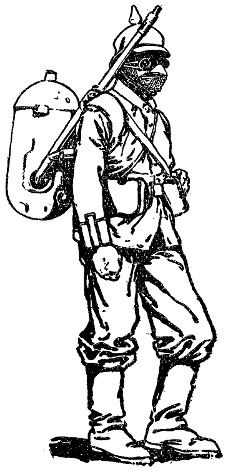
left. Asphyxiating gas of great intensity was projected
into their trenches, probably by means of force
pumps and pipes laid out under the parapets. The
fumes, aided by a favorable wind, floated backwards,
poisoning and disabling over an extended area those
who fell under their effect. The result was that the
French were compelled to give ground for a considerable
distance. The glory which the French army has won
in this war would make it impertinent to labor on the
compelling nature of the poisonous discharges under
which the trenches were lost. The French did, as everyone
knew they would do, all that stout soldiers could
do, and the Canadian division, officers and men, look
forward to many occasions in the future in which they
will stand side by side with the brave armies of France.
“The immediate consequence of this enforced withdrawal
was, of course, extremely grave. The third
brigade of the Canadian division was without any left,
or, in other words, its left was in the air. It became
imperatively necessary greatly to extend the Canadian
lines to the left rear. It was not, of course, practicable
to move the first brigade from reserve at a moment’s
notice, and the line, extended from five to nine thousand
yards, was not naturally the line that had been held by
the allies at five o’clock, and a gap still existed on its left.

Map Illustrating the Battle of Langemarck.
Shaded Portion Indicates German Gain.
“The new line, of which our recent point of contact
with the French formed the apex, ran quite roughly
to the south and west. As shown above, it became
necessary for Brigadier-General Turner, commanding
the third brigade, to throw back his left flank southward
to protect his rear. In the course of the confusion
which followed upon the readjustment of position, the
enemy, who had advanced rapidly after his initial
successes, took four British 4.7 guns in a small wood
to the west of the village of St. Julien, two miles in the
rear of the original French trenches.
“The story of the second battle of Ypres is the story
of how the Canadian division, enormously outnumbered,
for they had in front of them at least four
divisions, supported by immensely heavy artillery,
with a gap still existing, though reduced, in their lines,
and with dispositions made hurriedly under the stimulus
of critical danger, fought through the day and
through the night, and then through another day and
night; fought under their officers until, as happened
to so many, these perished gloriously, and then fought
from the impulsion of sheer valor because they came
from fighting stock.
“The enemy, of course, was aware, whether fully
or not may perhaps be doubted, of the advantage his
breach in the line had given him, and immediately
began to push a formidable series of attacks upon the
whole of the newly-formed Canadian salient.
“If it is possible to distinguish when the attack was
everywhere so fierce, it developed with particular
intensity at this moment upon the apex of the newly-formed
line running in the direction of St. Julien. It
has already been stated that four British guns were
taken in a wood comparatively early in the evening
of the 22d. In the course of that night, and under
the heaviest machine-gun fire, this wood was assaulted
by the Canadian Scottish, sixteenth battalion, of the
third brigade, and the tenth battalion of the second
brigade, which was intercepted for this purpose on its
way to a reserve trench. The battalions were respectively
commanded by Lieutenant-Colonel Leckie, and
Lieutenant-Colonel Boyle, and after a most fierce
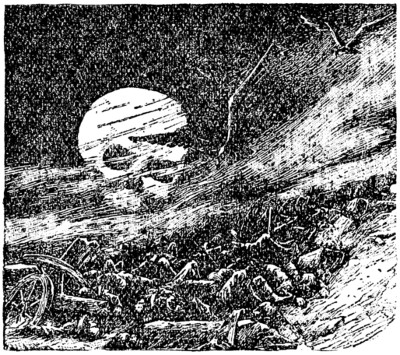
struggle in the light of a misty moon they took the
position at the point of the bayonet. At midnight
the second battalion, under Lieutenant-Colonel Watson
and the Toronto regiment, Queen’s Own (third battalion),
under Lieutenant-Colonel Rennie, both of the
first brigade, brought up much-needed reinforcements,
and though not actually engaged in the assault, were
in reserve.
“All through the following days and nights these
battalions shared the fortunes and misfortunes of the
third brigade. An officer, who took part in the attack,
describes how the men about him fell under the fire
of the machine guns, which, in his phrase, played upon
them ‘like a watering pot.’ He added quite simply,
‘I wrote my own life off,’ but the line never wavered.
When one man fell another took his place, and with a
final shout the survivors of the two battalions flung
themselves into the wood.
“The German garrison was completely demoralized,
and the impetuous advance of the Canadians did not
cease until they reached the far side of the wood and
entrenched themselves there in the position so dearly
gained. They had, however, the disappointment of
finding that the guns had been blown up by the enemy,
and later on the same night, a most formidable concentration
of artillery fire, sweeping the wood as a
tropical storm sweeps the leaves from a forest, made
it impossible for them to hold the position for which
they had sacrified so much.
“The fighting continued without intermission all
through the night and to those who observed the
indications that the attack was being pushed with
ever-growing strength, it hardly seemed possible that
the Canadians, fighting in positions so difficult to
defend, and so little the subject of deliberate choice,
could maintain their resistance for any long period.
At 6 A.M. on Friday it became apparent that the left
was becoming more and more involved and a powerful
German attempt to outflank it developed rapidly.
The consequences if it had been broken or outflanked
need not be insisted upon. They were not merely
local.
“It was therefore decided, formidable as the attempt
undoubtedly was, to try and give relief by a counter-attack
upon the first line of German trenches, now far,
far advanced from those originally occupied by the
French. This was carried out by the Ontario first
and fourth battalions of the first brigade, under Brigadier-General
Mercer, acting in combination with a
British brigade. It is safe to say that the youngest
private in the rank, as he set his teeth for the advance,
knew the task in front of him, and the youngest subaltern
knew all that rested upon its success.
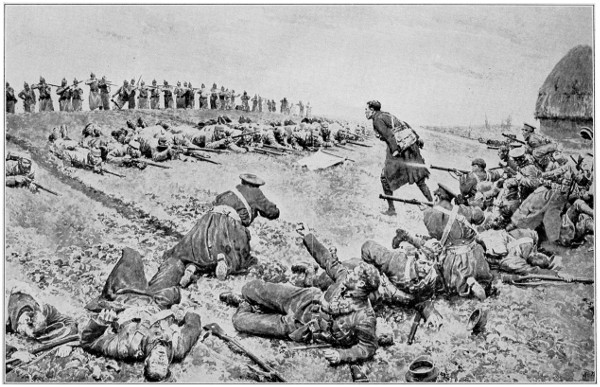
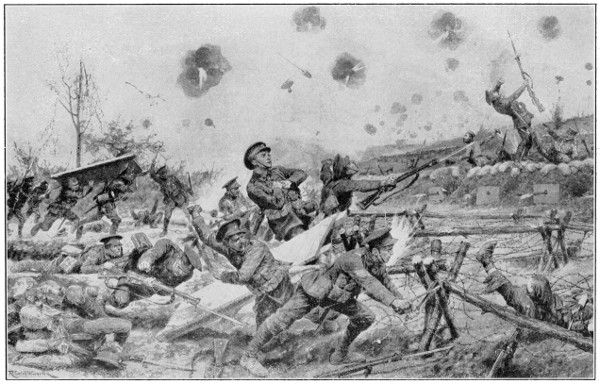
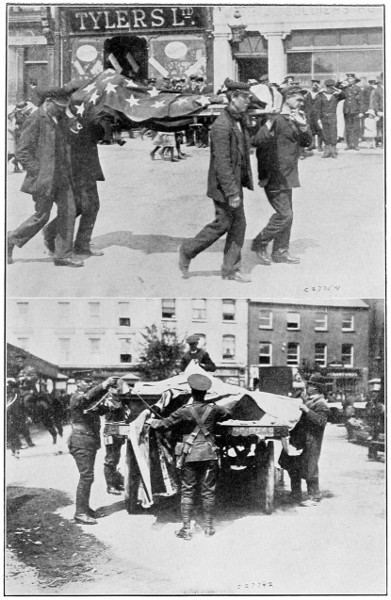
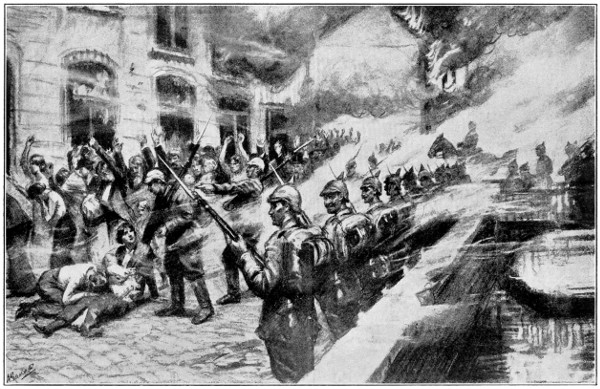
German Abuse of the White Flag.
An incident showing how a company of British soldiers were cut down by an ambushed enemy. The front rank of
Germans had been firing from behind a small ridge. In apparent surrender they stood up in a long row and held up
the white flag. The British advanced to receive their guns and take them prisoners, when suddenly the entire line
fell down and a second line arose from behind the ridge and immediately killed all the British company. (Sphere
copr.)
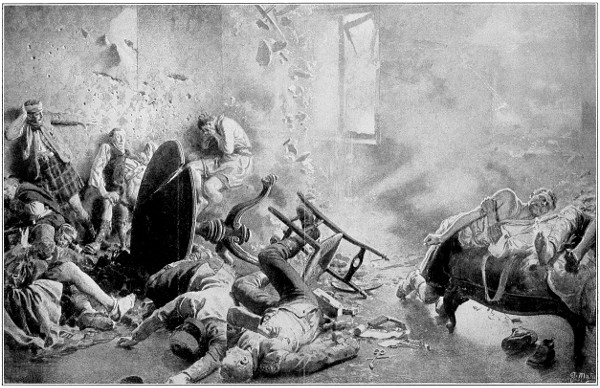
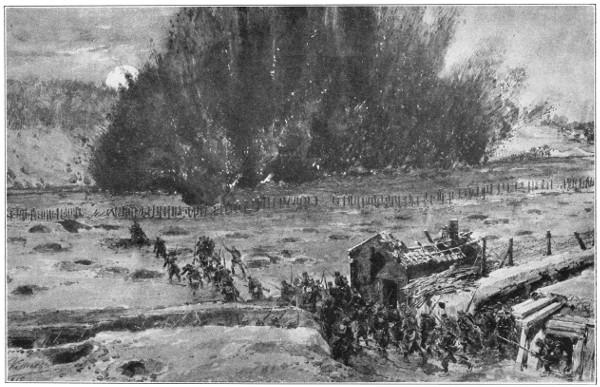
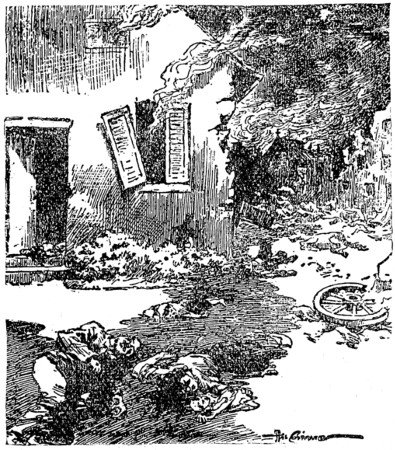
Terrible Effect of a German Shell on Wounded British Soldiers.
A party of wounded Highlanders were resting in a house on the bank of the Aisne River, where a doctor was
attending them. A German shell came through the window and the soldiers resting on the sofas and on the floor
were nearly all killed by flying fragments of shell. (Sphere copr.)
“It did not seem that any human being could live
in the shower of shot and shell which began to play
upon the advancing troops. They suffered terrible
casualties. For a short time every man seemed to
fall, but the attack was pressed even closer and closer.
The fourth Canadian battalion at one moment came
under a particularly withering fire. For a moment,
not more, it wavered. Its most gallant commanding
officer, Lieutenant-Colonel Birchall, carrying, after an
old fashion, a light cane, coolly and cheerfully rallied
his men, and at the very moment when his example
had infected them fell dead at the head of his battalion.
“With a hoarse cry of anger they sprang forward
(for, indeed, they loved him) as if to avenge his death.
The astonishing attack which followed, pushed home in
the face of direct frontal fire, made in broad daylight
by battalions whose names should live forever in the
memories of soldiers, was carried to the first line of
German trenches. After a hand-to-hand struggle
the last German who resisted was bayoneted, and the
trench was won.
“The measure of this success may be taken when it
is pointed out that this trench represented in the
German advance the apex in the breach which the
enemy had made in the original line of the allies, and
that it was two and a half miles south of that line.
This charge, made by men who looked death indifferently
in the face, for no man who took part in it could
think that he was likely to live, saved the Canadian
left. But it did more; up to the point where the assailants
conquered or died, it secured and maintained
during the most critical moment of all the integrity of
the allied line. For the trench was not only taken,
it was thereafter held against all comers, and in the
teeth of every conceivable projectile, until the night
of Sunday, the 25th, when all that remained of the war-broken
but victorious battalions was relieved by fresh
troops.
“It is necessary now to return to the fortunes of the
third brigade, commanded by Brigadier-General Turner,
which, as we have seen, at five o’clock on Thursday
was holding the Canadian left and after the first
attack assumed the defense of the new Canadian salient,
at the same time sparing all the men it could to form
an extemporized line between the wood and St. Julien.
This brigade also was, at the first moment of the German
offensive, made the object of an attack by the discharge
of poisonous gas. The discharge was followed by two
enemy assaults. Although the fumes were extremely
poisonous, they were not, perhaps, having regard to
the wind, so disabling as on the French lines (which
ran almost east to west), and the brigade, though
affected by the fumes, stoutly beat back the two
German assaults.
“Encouraged by this success, it rose to the supreme
effort required by the assault of the wood, which has
already been described. At 4 A.M. on the morning of
Friday, the 23d, a fresh emission of gas was made both
upon the second brigade, which held the line running
northeast, and upon the third brigade, which, as has
been fully explained, had continued the line up to the
pivotal point, as defined above, and had then spread
down in a southeasterly direction. It is perhaps worth
mentioning, that two privates of the forty-eighth
Highlanders, who found their way into the trenches
commanded by Colonel Lipsett, ninetieth Winnipeg
Rifles, eighth battalion, perished of the fumes, and it
was noticed that their faces became blue immediately
after dissolution.
“The Royal Highlanders of Montreal, thirteenth
battalion, and the forty-eighth Highlanders, fifteenth
battalion, were more especially affected by the discharge.
The Royal Highlanders, though considerably
shaken, remained immovable upon their ground.
The forty-eighth Highlanders, who no doubt received
a more poisonous discharge, were for the moment dismayed
and indeed their trench, according to the
testimony of very hardened soldiers, became intolerable.
The battalion retired from the trench, but for
a very short distance, and for an equally short time.
In a few moments they were again their own. They
advanced upon and occupied the trenches which they
had momentarily abandoned.
“In the course of the same night the third brigade,
which had already displayed a resource, a gallantry,
and a tenacity, for which no eulogy could be excessive,
was exposed (and with it the whole allied cause) to a
peril still more formidable.
“It has been explained, and indeed the fundamental
situation made the peril clear, that several German
divisions were attempting to crush, or drive back this
devoted brigade, and in any event to use their enormous
numerical superiority to sweep around and overwhelm
our left wing at a point in the line which cannot
be precisely determined. The last attempt partially
succeeded, and in the course of this critical struggle,
German troops in considerable, though not in overwhelming,
numbers swung past the unsupported left
to the brigade and, slipping in between the wood and
St. Julien, added to the torturing anxieties of the long-drawn-out
struggle by the appearance, and indeed for
the moment the reality, of isolation from the brigade
base.
“In the exertions made by the third brigade during
this supreme crisis, it is almost impossible to single
out one battalion without injustice to others, but
though the efforts of the Royal Highlanders of Montreal,
thirteenth battalion, were only equal to those
of the other battalions who did such heroic service, it
so happened by chance that the fate of some of its
officers attracted special attention.
“Major Norsworthy, already almost disabled by a
bullet wound, was bayoneted and killed while he was
rallying his men with easy cheerfulness. The case of
Captain McCuaig, of the same battalion, was not less
glorious, although his death can claim no witness.
This most gallant officer was seriously wounded in a
hurriedly constructed trench. At a moment when it
would have been possible to remove him to safety, he
absolutely refused to move, and continued in the
discharge of his duty. But the situation grew instantly
worse, and peremptory orders were received
for an immediate withdrawal. Those who were compelled
to obey them were most insistent to carry
with them, at whatever risk to their own mobility and
safety, an officer to whom they were devotedly attached.
But he, knowing, it may be, better than they, the
exertions which still lay in front of them, and unwilling
to inflict upon them the disabilities of a maimed man,
very resolutely refused, and asked of them one thing
only, that there should be given to him as he lay alone
in the trench, two loaded Colt revolvers to add to his
own, which lay in his right hand as he made his last
request. And so, with three revolvers ready to his
hand for use, a very brave officer waited to sell his life,
wounded and racked with pain, in an abandoned
trench.
“On Friday afternoon the left of the Canadian line
was strengthened by important reinforcements of
British troops, amounting to seven battalions. From
this time forward the Canadians also continued to
receive further assistance on the left from a series of
French counter-attacks pushed in a northeasterly
direction from the canal bank.
“But the artillery fire of the enemy continually
grew in intensity, and it became more and more evident
that the Canadian salient could no longer be maintained
against the overwhelming superiority of
numbers by which it was assailed. Slowly, stubbornly,
and contesting every yard, the defenders
gave ground until the salient gradually receded
from the apex near the point where it had originally
aligned with the French, and fell back upon
St. John.
“Soon it became evident that even St. Julien,
exposed from right and left, was no longer tenable in
the face of overwhelming numerical superiority. The
third brigade was therefore ordered to retreat further
south, selling every yard of ground as dearly as it had
done since five o’clock on Thursday. But it was
found impossible, without hazarding far larger forces,
to disentangle the detachment of the Royal Highlanders
of Montreal, thirteenth battalion, and of the
Royal Montreal Regiment, fourteenth battalion. The
brigade was ordered, and not a moment too soon, to
move back. It left these units with hearts as heavy as
those of his comrades who had said farewell to Captain
McCuaig.
“The German line rolled, indeed, over the deserted
village, but for several hours after the enemy had
become master of the village the sullen and persistent
rifle fire which survived showed that they were not yet
master of the Canadian rear guard. If they died, they
died worthy of Canada. The enforced retirement of
the third brigade (and to have stayed longer would
have been madness) reproduced for the second brigade,
commanded by Brigadier-General Curry, in a singularly
exact fashion the position of the third brigade
itself at the moment of the withdrawal of the
French.
“The second brigade, it must be remembered, had
retained the whole line of trenches, roughly five hundred
yards, which it was holding at five o’clock on Thursday
afternoon, supported by the incomparable exertions
of the third brigade, and by the highly hazardous
deployment in which necessity had involved that
brigade. The second brigade had maintained its lines.
It now devolved upon General Curry, commanding
this brigade, to reproduce the tactical maneuvers by
which earlier in the fight the third brigade had adapted
itself to the flank movement of overwhelming numerical
superiority. He flung his left flank round and his
record is that in the very crisis of this immense struggle
he held his line of trenches from Thursday at five
o’clock until Sunday afternoon, and on Sunday afternoon
he had not abandoned his trenches. There were
none left. They had been obliterated by artillery.
He withdrew his undefeated troops from the fragments
of his field fortifications, and the hearts of his men
were as completely unbroken as the parapets of his
trenches were completely broken. Such a brigade!
“It is invidious to single out any battalion for
special praise, but it is perhaps necessary to the story
to point out that Lieutenant-Colonel Lipsett, commanding
the ninetieth Winnipeg Rifles, eighth battalion,
of the second brigade, held the extreme left
of the brigade position at the most critical moment.
“The battalion was expelled from the trenches
early on Friday morning by an emission of poisonous
gas, but recovering in three-quarters of an hour, it
counter-attacked, retook the trenches it had abandoned
and bayoneted the enemy, and after the third brigade
had been forced to retire, Lieutenant-Colonel Lipsett
held his position, though his left was in the air, until
two British regiments filled up the gap on Saturday
night.
“The individual fortunes of those two brigades
have brought us to the events of Sunday afternoon,
but it is necessary, to make the story complete,
to recur for a moment to the events of the
morning.
“After a very formidable attack the enemy succeeded
in capturing the village of St. Julien, which has
so often been referred to in describing the fortunes of
the Canadian left. This success opened up a new and
formidable line of advance, but by this time further
reinforcements had arrived. Here again it became
evident that the tactical necessities of the situation
dictated an offensive movement, as the surest method
of arresting further progress.
“General Alderson, who was in command of the
reinforcements, accordingly directed that an advance
should be made by a British brigade which had been
brought up in support. The attack was thrust through
the Canadian left and center, and as the troops making
it swept on, many of them going to certain death, they
paused an instant, and with deep-throated cheers for
Canada gave the first indication to the division of the
warm admiration which their exertions had excited in
the British army.
“The advance was indeed costly, but it could not
be gainsaid. The story is one of which the brigade
may be proud, but it does not belong to the special
account of the fortunes of the Canadian contingent.
It is sufficient for our purpose to notice that the attack
succeeded in its object, and the German advance
along the line, which was momentarily threatened,
was arrested.
“We had reached, in describing the events of the
afternoon, the points at which the trenches of the
second brigade had been completely destroyed. This
brigade and the third brigade, and the considerable
reinforcements which by this time filled the gap between
the two brigades, were gradually driven, fighting every
yard, upon a line running, roughly, from Fortuin, south
of St. Julien, in a northeasterly direction towards
Passchendale. Here the two brigades were relieved
by two British brigades, after exertions as glorious,
as fruitful, and, alas! as costly, as soldiers have ever
been called upon to make.
“Monday morning broke bright and clear, and found
the Canadians behind the firing line. This day, too,
was to bring its anxieties. The attack was still pressed,
and it became necessary to ask Brigadier-General
Curry whether he could once more call upon his
shrunken brigade.
“‘The men are tired,’ this indomitable soldier
replied, ‘but they are ready and glad to go again to
the trenches.’ And so once more, a hero leading
heroes, the general marched back the men of the
second brigade, reduced to a quarter of its original
strength, to the apex of the line as it existed at that
moment.
“This position he held all day Monday. On Tuesday
he was still occupying reserve trenches, and on Wednesday
was relieved and retired to billets in the rear.
“Such, in the most general outline, is the story of a
great and glorious feat of arms. A story told so soon
after the event, while tendering bare justice to units
whose doings fell under the eyes of particular observers,
must do less than justice to others who played their
part—and all did—as gloriously as those whose special
activities it is possible, even at this stage, to describe.
But the friends of men who fought in other battalions
may be content in the knowledge that they, too, shall
learn, when time allows, the exact part which each
unit played in these unforgettable days.”