Occupations and Correspondence.—Literary Work.—Jephson
and the Stage.—Nature will Prevail.—Issues from the
Strawberry Press.—Fourth Volume of the Anecdotes of
Painting.—The Beauclerk Tower and Lady Di.—George,
third Earl of Orford.—Sale of the Houghton Pictures.—Moves
to Berkeley Square.—Last Visit to Madame du
Deffand.—Her Death.—Themes for Letters.—Death of
Sir Horace Mann.—Pinkerton, Madame de Genlis, Miss
Burney, Hannah More.—Mary and Agnes Berry.—Their
Residence at Twickenham.—Becomes fourth Earl of Orford.—Epitaphium
vivi Auctoris.—The Berrys again.—Death
of Marshal Conway.—Last Letter to Lady Ossory.—Dies
at Berkeley Square, 2 March, 1797.—His Fortune and Will.—The
Fate of Strawberry.
After the completion of Strawberry Hill
and the printing of the Catalogue, Walpole's
life grows comparatively barren of events.
There are still four volumes of his Correspondence,
but they take upon them imperceptibly
the nature of nouvelles à la main, and are less
fruitful in personal traits. Between his books
and his prints, his time passes agreeably, 'but
will not do to relate.' Indeed, from this period
until his death, in 1797, the most notable occurrences
in his history are his friendship with the
Miss Berry's in 1787-8, and his belated accession
to he Earldom of Orford. Both at
Strawberry and Arlington Street, his increasing
years and his persistent malady condemn
him more and more to seclusion and retirement.
He is most at Strawberry, despite its dampness,
for in the country he holds 'old, useless people
ought to live.' 'If you were not to be in
London,' he tells Lady Ossory in April, 1774,
'the spring advances so charmingly, I think I
should scarce go thither. One is frightened
with the inundation of breakfasts and balls that
are coming on. Every one is engaged to everybody
for the next three weeks, and if one must
hunt for a needle, I had rather look for it in a
bottle of hay in the country than in a crowd.'
'By age and situation,' he writes from Strawberry
in September, 'at this time of the year I
live with nothing but old women. They do very
well for me, who have little choice left, and who
rather prefer common nonsense to wise nonsense,—the
only difference I know between old
women and old men. I am out of all politics,
and never think of elections, which I think I
should hate even if I loved politics,—just as, if
I loved tapestry I do not think I could talk over
the manufacture of worsteds. Books I have
almost done with too,—at least, read only such
as nobody else would read. In short, my way
of life is too insipid to entertain anybody but
myself; and though I am always employed, I
must own I think I have given up every thing
in the world, only to be busy about the most
arrant trifles.' His London life was not greatly
different. 'How should I see or know anything?'
he says a year later, apologizing for his
dearth of news. 'I seldom stir out of my
house [at Arlington Street] before seven in the
evening, see very few persons, and go to fewer
places, make no new acquaintance, and have
seen most of my old wear out. Loo at Princess
Amelie's, loo at Lady Hertford's, are the
capital events of my history, and a Sunday alone,
at Strawberry, my chief entertainment. All this
is far from gay; but as it neither gives me ennui,
nor lowers my spirits, it is not uncomfortable,
and I prefer it to being déplacé in younger company.'
Such is his account of his life in 1774-5,
when he is nearing sixty, and it probably represents
it with sufficient accuracy. But a trifling
incident easily stirs him into unwonted vivacity.
While he is protesting that he has nothing to
say, his letters grow under his pen, and, almost
as a necessary consequence of his leisure, they
become more frequent and more copious. In
the edition of Cunningham, up to September,
1774, they number fourteen hundred and fifty.
Speaking roughly, this represents a period of
nearly forty years. During the two-and-twenty
years that remained to him, he managed to
swell them by what was, proportionately, a
far greater number. The last letter given by
Cunningham is marked 2665; and this enumeration
does not include a good many letters and
fragments of letters belonging to this later
period, which were published in 1865 in Miss
Berry's Journals and Correspondence. Nevertheless,
as stated above, they more and more
assume what he somewhere calls 'their proper
character of newspapers.'
During the remainder of his life, they were
his chief occupation, and his gout was seldom
so severe but that he could make shift to scribble
a line to his favourite correspondents, calling
in his printer Kirgate as secretary in cases
of extremity.[168] Of literature generally he professed
to have taken final leave. 'I no longer
care about fame,' he tells Mason in 1774; 'I
have done being an author.' Nevertheless, the
Short Notes piously chronicle the production
of more than one trifle, which are reprinted in
his Works. When, in the above year, Lord
Chesterfield's letters to his son were published,
Walpole began a parody of that famous performance
in a Series of Letters from a Mother
to a Daughter, with the general title of the New
Whole Duty of Woman. He grew tired of the
idea too soon to enable us to judge what his
success might have been with a subject which,
in his hands, should have been diverting as a
satire; for, although he was a warm admirer of
Chesterfield's parts, as he had shown in his character
of him in the Royal and Noble Authors, he
was thoroughly alive to the assailable side of
what he styles his 'impertinent institutes of
education.'[169] Another work of this year was a
reply to some remarks by Mr. Masters in the
Archæologia upon the old subject of the Historic
Doubts, which calls for no further notice.
But early in 1775 he was persuaded into writing
an epilogue for the Braganza of Captain Robert
Jephson, a maiden tragedy of the Venice Preserved
order, which was produced at Drury Lane
in February of that year, with considerable success.
In a correspondence which ensued with
the author, Walpole delivered himself of his
views on tragedy for the benefit of Mr. Jephson,
who acted upon them, but not (as his Mentor
thought) with conspicuous success, in his next
attempt, the Law of Lombardy. Jephson's third
play, however, the Count of Narbonne, which
was well received in 1781, had a natural claim
upon Walpole's good opinion, since it was based
upon the Castle of Otranto.[170] Besides the above
letters on tragedy, Walpole wrote, 'in 1775
and 1776,' a rather longer paper on comedy,
which is printed with them in the second volume
of his works (pp. 315-22). He held, as he
says, 'a good comedy the chef-d'œuvre of
human genius;' and it is manifest that his keenest
sympathies were on the side of comic art.
His remarks upon Congreve are full of just
appreciation. Yet, although he mentions the
School for Scandal (which, by the way, shows
that he must have written rather later than the
dates given above), he makes no reference to
the most recent development, in She Stoops to
Conquer, of the school of humour and character,
and he seems rather to pose as the advocate
of that genteel or sentimental comedy which
Foote and Goldsmith and Sheridan had striven
to drive from the English stage. When his prejudices
are aroused, he is seldom a safe guide,
and in addition to his personal contempt for
Goldsmith,[171] that writer had irritated him by his
reference to the Albemarle Street Club, to
which many of his friends belonged. It was
an additional offence that the 'Miss Biddy
[originally Miss Rachael] Buckskin' of the
comedy was said to stand for Miss Rachael
Lloyd, long housekeeper at Kensington Palace,
and a member of the club well known both to
himself and to Madame du Deffand.[172]
In the second of the letters to Mr. Jephson,
Walpole refers to his own efforts at comedy,
and implies that he had made attempts in this
direction even before the tragedy of The Mysterious
Mother. He had certainly the wit, and
much of the gift of direct expression, which
comedy requires. But nothing of these earlier
essays appears to have survived, and the only
dramatic effort included among his Works (his
tragedy excepted) is the little piece entitled
Nature will Prevail, which, with its fairy
machinery, has something of the character of
such earlier productions of Mr. W. S. Gilbert
as the Palace of Truth. This he wrote in
1773, and, according to the Short Notes, sent
it anonymously to the elder Colman, then
manager of Covent Garden. Colman (he says)
was much pleased with it, but regarding it
as too short for a farce, wished to have it
enlarged. This, however, its author thought
too much trouble 'for so slight and extempore
a performance.' Five years after, it was produced
at the little theatre in the Haymarket, and,
being admirably acted,—says the Biographia
Dramatica,—met with considerable applause.
But it is obviously one of those works to which
the verdict of Goldsmith's critic, that it would
have been better if the author had taken more
pains, may judiciously be applied. It is more
like a sketch for a farce than a farce itself; and
it is not finished enough for a proverbe. Yet
the dialogue is in parts so good that one almost
regrets the inability of the author to nerve himself
for an enterprise de longue haleine.
Between 1774 and 1780 the Strawberry Hill
Press still now and then showed signs of vitality.
In 1775, it printed as a loose sheet some verses
by Charles James Fox,—celebrating, as Amoret,
that lover of the Whigs, the beautiful Mrs.
Crewe,—and three hundred copies of an
Eclogue by Mr. Fitzpatrick,[173] entitled Dorinda,
which contains the couplet,—
'And oh! what Bliss, when each alike is pleas'd,
the Hand that squeezes, and the Hand that's squeez'd.'
These were followed, in 1778, by the Sleep
Walker, a comedy from the French of Madame
du Deffand's friend Pont de Veyle, translated
by Lady Craven, afterwards Margravine of
Anspach, and played for a charitable purpose
at Newbury. A year later came the vindication
of his conduct to Chatterton, already mentioned
at pp. 196-200; and after this a sheet of verse
by Mr. Charles Miller to Lady Horatia Waldegrave,[174]
a daughter of the Duchess of Gloucester
by her first husband. The last work of any
importance was the fourth volume of the Anecdotes
of Painting, which had been printed as far
back as 1770, but was not issued until Oct.,
1780. This delay, the Advertisement informs
us, arose 'from motives of tenderness.' The
author was 'unwilling [he says] to utter even
gentle censures, which might wound the affections,
or offend the prejudices, of those related
to the persons whom truth forbad him to commend
beyond their merits.'[175] But despite his
unwillingness to 'dispense universal panegyric,'
and the limitation of his theme to living professors,
he manages, in the same Advertisement,
to distribute a fair amount of praise to some of
his particular favourites. Of H. W. Bunbury,
the husband of Goldsmith's 'Little Comedy,' he
says that he is the 'second Hogarth,' and the
'first imitator who ever fully equalled his original,'—which
is sheer extravagance. He lauds
the miniature copying of Lady Lucan, as almost
depreciating the 'exquisite works' of the artists
she follows,—to wit, Cooper and the Olivers;
and he speaks of Lady Di. Beauclerk's drawings
as 'not only inspired by Shakespeare's
insight into nature, but by the graces and taste
of Grecian artists.' After this, the comparison
of Mrs. Damer with Bernini seems almost tame.
Yet her works 'from the life are not inferior to
the antique, and those ... were not more
like.' One can scarcely blame Walpole severely
for this hearty backing of the friends who had
added so much to the attractions of his Gothic
castle; but the value of his criticisms, in many
other instances sound enough, is certainly
impaired by his loyalty to the old-new practice
of 'log-rolling.'
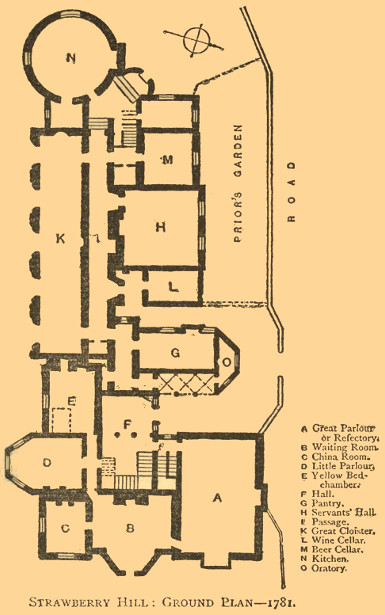
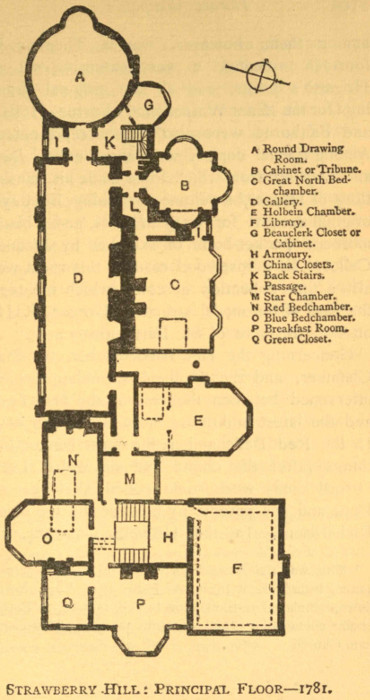
Lady Di. Beauclerk, whose illustrations to
Dryden's Fables are still a frequent item in
second-hand catalogues, has a personal connection
with Strawberry through the curious
little closet bearing her name, which, with the
assistance of Mr. Essex, a Gothic architect
from Cambridge, Walpole in 1776-8 managed
to tuck in between the Cabinet and the Round
Tower. It was built on purpose to hold the
'seven incomparable drawings,' executed in
a fortnight, which her Ladyship prepared, to
illustrate The Mysterious Mother. These were
the designs to which he refers in the Anecdotes
of Painting, and, in a letter to Mann, says
could not be surpassed by Guido and Salvator
Rosa. They were hung on Indian blue
damask, in frames of black and gold; and
Clive's friend, Miss Pope, the actress, when
she dined at Strawberry, was affected by them
to such a degree that she shed tears, although
she did not know the story,—an anecdote
which may be regarded either as a genuine
compliment to Lady Di., or a merely histrionic
tribute to her entertainer. 'The drawings,'
Walpole says, 'do not shock and disgust, like
their original, the tragedy;' but they were not
to be shown to the profane. They were, nevertheless,
probably exhibited pretty freely, as a
copy of the play, carefully annotated in MS.
by the author, and bound in blue leather to
match the hangings, was always kept in a
drawer of one of the tables, for the purpose of
explaining them.[176] Walpole afterwards added
one or two curiosities to this closet. It contained,
according to the last edition of the
Catalogue, a head in basalt of Jupiter Serapis,
and a book of Psalms illuminated by Giulio
Clovio, the latter purchased for £168 at the
Duchess of Portland's sale in May, 1786. There
was also a portrait by Powell, after Reynolds,
of Lady Di. herself, who lived for some time
at Twickenham in a house now known as
Little Marble Hill, many of the rooms of
which she decorated with her own performances.
These were apparently the efforts
which prompted the already mentioned postscript
to the Parish Register of Twickenham:
"Here Genius in a later hour
Selected its sequester'd bow'r,
And threw around the verdant room
The blushing lilac's chill perfume.
So loose is flung each bold festoon,
Each bough so breathes the touch of noon,
The happy pencil so deceives,
That Flora, doubly jealous, cries,
'The work's not mine,—yet, trust these eyes,
'T is my own Zephyr waves the leaves.'"
[177] Mention has been made of the intermittent
attacks of insanity to which Walpole's nephew,
the third Earl of Orford, was subject. At the
beginning of 1774, he had returned to his senses,
and his uncle, on whom fell the chief care
of his affairs during his illnesses, was, for a
brief period, freed from the irksome strain of an
uncongenial and a thankless duty. In April,
1777, however, Lord Orford's malady broke
out again, with redoubled severity. In August,
he was still fluctuating 'between violence and
stupidity;' but in March, 1778, a lucid interval
had once more been reached, and Walpole
was relieved of the care of his person. Of his
affairs he had declined to take care, as his
Lordship had employed a lawyer of whom
Walpole had a bad opinion. 'He has resumed
the entire dominion of himself,' says a letter
to Mann in April, 'and is gone into the
country, and intends to command the militia.'
One of the earliest results of this 'entire dominion'
was a step which filled his relative with
the keenest distress. He offered the famous
Houghton collection of pictures to Catherine
of Russia,—'the most signal mortification to
my idolatry for my father's memory that it
could receive,' says Walpole to Lady Ossory.
By August, 1779, the sale was completed.
'The sum stipulated,' he tells Mann, 'is forty
or forty-five thousand pounds,[178] I neither know
nor care which; nor whether the picture
merchant ever receives the whole sum, which
probably he will not do, as I hear it is to be
discharged at three payments,—a miserable
bargain for a mighty empress!... Well!
adieu to Houghton! about its mad master I
shall never trouble myself more.... Since
he has stript Houghton of its glory, I do not
care a straw what he does with the stone or
the acres!'[179]
Not very long after the date of the above
letter Walpole made what was, for him, an
important change of residence. The lease of
his house in Arlington Street running out, he
fixed upon a larger one in the then very
fashionable district of Berkeley Square. The
house he selected, now (1892) numbered 11,
was then 40,[180] and he had commenced negotiations
for its purchase as early as November,
1777, when, he tells Lady Ossory, he had
come to town to take possession. But difficulties
arose over the sale, and he found himself
involved in a Chancery suit. He was too
adroit, however, to allow this to degenerate
into an additional annoyance, and managed
(by his own account) to turn what promised
to be a tedious course of litigation into a combat
of courtesy. Ultimately, in July, 1779, he
had won his cause, and was hurrying from
Strawberry to pay his purchase money and
close the bargain. Two months later, he is
moving in, and is delighted with his acquisition.
He would not change his two pretty
mansions for any in England, he says. On
the 14th October, he took formal possession,
upon which day—his 'inauguration day'—he
dates his first letter 'Berkeley Square.' 'It
is seeming to take a new lease of life,' he tells
Mason. 'I was born in Arlington Street,
lived there about fourteen years, returned
thither, and passed thirty-seven more; but I
have sober monitors that warn me not to delude
myself.' He had still a decade and a half
before him.
Little more than twelve months after he had
settled down in his new abode, he lost the
faithful friend at Paris, to whom, for the space
of fifteen years, he had written nearly once a
week. By 1774, he had become somewhat
nervous about this accumulated correspondence
in a language not his own. For an Englishman,
his French was good, and, as might be expected
of anything he wrote, characteristic and vivacious.
But, almost of necessity, it contained
many minor faults of phraseology and arrangement,
besides abounding in personal anecdote;
and he became apprehensive lest, after Madame
du Deffand's death, his utterances should fall
into alien hands. General Conway, who visited
Paris in October, 1774, had therefore been
charged to beg for their return—a request
which seems at first to have been met by the
reply on the lady's part that sufficient precautions
had already been taken for ensuring their
restoration. Ultimately, however, they were
handed to Conway.[181] It was in all probability
under a sense of this concession that Walpole
once more risked a tedious journey to visit his
blind friend. In the following year he went to
Paris, to find her, as usual, impatiently expecting
his arrival. She sat with him until half-past
two, and before his eyes were open again, he
had a letter from her. 'Her soul is immortal,
and forces her body to keep it company.' A
little later he complains that he never gets to bed
from her suppers before two or three o'clock.
'In short,' he says, 'I need have the activity
of a squirrel, and the strength of a Hercules,
to go through my labours,—not to count how
many démêlés I have had to raccommode and
how many mémoires to present against Tonton,[182]
who grows the greater favourite the more people
he devours.' But Tonton's mistress is more
worth visiting than ever, he tells Selwyn,
and she is apparently as tireless as of yore.
'Madame du Deffand and I [says another letter]
set out last Sunday at seven in the evening,
to go fifteen miles to a ball, and came back after
supper; and another night, because it was but
one in the morning when she brought me home,
she ordered the coachman to make the tour of
the Quais, and drive gently because it was so
early.' At last, early in October, he tears himself
away, to be followed almost immediately
by a letter of farewell. Here it is:—
'Adieu, ce mot est bien triste; souvenez-vous
que vous laissez ici la personne dont vous êtes
le plus aimé, et dont le bonheur et le malheur
consistent dans ce que vous pensez pour elle.
Donnez-moi de vos nouvelles le plus tôt qu'il
sera possible.
'Je me porte bien, j'ai un peu dormi, ma nuit
n'est pas finie; je serai très-exacte au régime,
et j'aurai soin de moi puisque vous vous y
intéressez.'
The correspondence thus resumed was continued
for five years more. Walpole does not
seem to have visited Paris again, and the references
to Madame du Deffand in his general
correspondence are not very frequent. Towards
the middle of 1780, her life was plainly closing
in. In July and August, she complained of
being more than usually languid, and in a letter
of the 22nd of the latter month intimates that
it may be her last, as dictation grows painful to
her. 'Ne vous devant revoir de ma vie,'—she
says pathetically,—'je n'ai rien à regretter.'
From this time she kept her bed, and in September
Walpole tells Lady Ossory that he is
trembling at every letter he gets from Paris.
'My dear old friend, I fear, is going!...
To have struggled twenty days at eighty-four
shows such stamina that I have not totally lost
hopes.' On the 24th, however, after a lethargy
of several days, she died quietly, 'without effort
or struggle.' 'Elle a eu la mort la plus douce,'—says
her faithful and attached secretary,
Wiart,—'quoique la maladie ait été longue.'
She was buried, at her own wish, in the parish
church of St. Sulpice. By her will she made
her nephew, the Marquis d'Aulan, her heir.
Long since, she had wished Walpole to accept
this character. Thereupon he had threatened
that he would never set foot in Paris again if
she carried out her intention; and it was abandoned.
But she left him the whole of her
manuscripts[183] and books.
As his own letters to her have not been
printed, her death makes no difference in the
amount of his correspondence. The war with
the American Colonies, of which he foresaw
the disastrous results, and the course of
which he follows to Mann with the greatest
keenness, fully absorbs as much of his time
as he can spare from the vagaries of the
Duchess of Kingston and the doings of the
Duchess of Gloucester. Not many months
before Madame du Deffand died had occurred
the famous Gordon Riots, which, as he was
in London most of the time, naturally occupy
his pen. It was General Conway who, as the
author of Barnaby Rudge has not forgotten,
so effectively remonstrated with Lord George
upon the occasion of the visit of the mob to
the House of Commons; and four days later
Walpole chronicles from Berkeley Square the
events of the terrible 'Black Wednesday.'
From the roof of Gloucester House he sees
the blazing prisons,—a sight he shall not soon
forget. Other subjects for which one dips in
the lucky bag of his records are the defence
of Gibraltar, the trial of Warren Hastings, the
loss of the Royal George. But it is generally
in the minor chronicle that he is most diverting.
The last bon mot of George Selwyn or
Lady Townshend, the newest 'royal pregnancy,'
the details of court ceremonial, the
most recent addition to Strawberry, the endless
stream of anecdote and tittle-tattle which
runs dimpling all the way,—these are the
themes he loves best; this is the element in
which his easy persiflage delights to disport
itself. He is, above all, a rieur. About his
serious passages there is generally a false
ring, but never when he pours out the gossip
that he loves, and of which he has so inexhaustible
a supply. 'I can sit and amuse
myself with my own memory,' he says to
Mann in February, 1785, 'and yet find new
stores at every audience that I give to it. Then,
for private episodes [he has been speaking of
his knowledge of public events], varieties of
characters, political intrigues, literary anecdotes,
etc., the profusion that I remember is endless;
in short, when I reflect on all I have seen,
heard, read, written, the many idle hours I have
passed, the nights I have wasted playing at
faro, the weeks, nay months, I have spent
in pain, you will not wonder that I almost
think I have, like Pythagoras, been Panthoides
Euphorbus, and have retained one memory in
at least two bodies.'
He was sixty-eight when he wrote the above
letter. Mann was eighty-four, and the long
correspondence—a correspondence 'not to be
paralleled in the annals of the Post Office'—was
drawing to a close. 'What Orestes and
Pylades ever wrote to each other for four-and-forty
years without meeting?' Walpole asks.
In June, 1786, however, the last letter of the
eight hundred and nine specimens printed by
Cunningham was despatched to Florence.[184] In
the following November, Mann died, after a
prolonged illness. He had never visited England,
nor had Walpole set eyes upon him since
he had left him at Florence in May, 1741.
His death followed hard upon that of another
faithful friend (whose gifts, perhaps, hardly
lay in the epistolary line),—bustling, kindly
Kitty Clive. Her cheerful, ruddy face, 'all
sun and vermilion,' set peacefully in December,
1785, leaving Cliveden vacant, not, as we
shall see, for long.[185] Earlier still had departed
another old ally, Cole, the antiquary, and the
lapse of time had in other ways contracted
Walpole's circle. In 1781, Lady Orford had
ended her erratic career at Pisa, leaving her
son a fortune so considerable as to make his
uncle regret vaguely that the sale of the
Houghton pictures had not been delayed for
a few months longer. Three years later, she
was followed by her brother-in-law, Sir Edward
Walpole,—an occurrence which had the effect
of leaving between Horace Walpole and his
father's title nothing but his lunatic and childless
nephew.
If his relatives and friends were falling
away, however, their places—the places of the
friends, at least—were speedily filled again;
and, as a general rule, most of his male favourites
were replaced by women. Pinkerton,
the antiquary, who afterwards published the
Walpoliana, is one of the exceptions; and
several of Walpole's letters to him are contained
in that book, and in the volumes of
Pinkerton's own correspondence published by
Dawson Turner in 1830. But Walpole's appetite
for correspondence of the purely literary
kind had somewhat slackened in his old age,
and it was to the other sex that he turned for
sympathy and solace. He liked them best;
his style suited them; and he wrote to them
with most ease. In July, 1785, he was visited
at Strawberry by Madame de Genlis, who
arrived with her friend Miss Wilkes and the
famous Pamela,[186] afterwards Lady Edward Fitzgerald.
Madame de Genlis at this date was
nearing forty, and had lost much of her good
looks. But Walpole seems to have found her
less précieuse and affected than he had anticipated,
and she was, on this occasion, unaccompanied
by the inevitable harp. A later
visit was from Dr. Burney and his daughter
Fanny,—'Evelina-Cecilia' Walpole calls her,—a
young lady for whose good sense and
modesty he expresses a genuine admiration.
Miss Burney had not as yet entered upon that
court bondage which was to be so little to
her advantage. Another and more intimate
acquaintanceship of this period was with Miss
Burney's friend, Hannah More. Hannah
More ultimately became one of Walpole's
correspondents, although scarcely 'so corresponding'
as he wished; and they met frequently
in society when she visited London.
On her side, she seems to have been wholly
fascinated by his wit and conversational
powers; he, on his, was attracted by her
mingled puritanism and vivacity. He writes to
her as 'St. Hannah;' and she, in return, sighs
plaintively over his lack of religion. Yet (she
adds) she 'must do him the justice to say,
that except the delight he has in teasing me
for what he calls over-strictness, I have never
heard a sentence from him which savoured of
infidelity.'[187] He evidently took a great interest
in her works, and indeed in 1789 printed at
his press one of her poems, Bonner's Ghost.[188]
His friendship for her endured for the remainder
of his life; and not long before his death he
presented her with a richly bound copy of
Bishop Wilson's Bible, with a complimentary
inscription which may be read in the second
volume of her Life and Correspondence.
It was, however, neither the author of Evelina
nor the author of The Manners of the
Great who was destined to fill the void created
by the death of Madame du Deffand. In the
winter of 1787-8, he had first seen, and a year
later he made the formal acquaintance of, 'two
young ladies of the name of Berry.' They had
a story. Their father, at this time a widower,
had married for love, and had afterwards been
supplanted in the good graces of a rich uncle
by a younger brother who had the generosity
to allow him an annuity of a thousand a year.
In 1783, Mr. Berry had taken his daughters
abroad to Holland, Switzerland, and Italy,
whence, in June, 1785, they had returned, being
then highly cultivated and attractive young
women of two-and-twenty and one-and-twenty
respectively. Three years later, Walpole met
them for the second time at the house of a Lady
Herries, the wife of a banker in St. James's
Street. The first time he saw them he 'would
not be acquainted with them, having heard so
much in their praise that he concluded they
would be all pretension.' But on the second
occasion, 'in a very small company,' he sat next
the elder, Mary, 'and found her an angel both
inside and out.' 'Her face'—he tells Lady
Ossory—'is formed for a sentimental novel,
but it is ten times fitter for a fifty times better
thing, genteel comedy.' The other sister was
speedily discovered to be nearly as charming.
'They are exceedingly sensible, entirely natural
and unaffected, frank, and, being qualified to
talk on any subject, nothing is so easy and agreeable
as their conversation, nor more apposite
than their answers and observations. The eldest,
I discovered by chance, understands Latin, and
is a perfect Frenchwoman in her language. The
younger draws charmingly, and has copied
admirably Lady Di.'s gipsies,[189] which I lent,
though for the first time of her attempting
colours. They are of pleasing figures: Mary,
the eldest, sweet, with fine dark eyes that are
very lively when she speaks, with a symmetry
of face that is the more interesting from being
pale; Agnes, the younger, has an agreeable, sensible
countenance, hardly to be called handsome,
but almost. She is less animated than Mary,
but seems, out of deference to her sister, to
speak seldomer; for they dote on each other,
and Mary is always praising her sister's talents.
I must even tell you they dress within the bounds
of fashion, though fashionably; but without the
excrescences and balconies with which modern
hoydens overwhelm and barricade their persons.
In short, good sense, information, simplicity,
and ease characterize the Berrys; and this is
not particularly mine, who am apt to be prejudiced,
but the universal voice of all who know
them.'[190]
'This delightful family,' he goes on to say,
'comes to me almost every Sunday evening.
[They were at the time living on Twickenham
Common.] Of the father not much is recorded
beyond the fact that he was 'a little merry man
with a round face,' and (as his eldest daughter
reports) 'an odd inherent easiness in his disposition,'
who seems to have been perfectly
contented in his modest and unobtrusive character
of paternal appendage to the favourites.
Walpole's attachment to his new friends grew
rapidly. Only a few days after the date of the
foregoing letter, Mr. Kirgate's press was versifying
in their honour, and they themselves were
already 'his two Straw Berries,' whose praises
he sang to all his friends. He delighted in devising
new titles for them,—they were his 'twin
wives,' his 'dear Both,' his 'Amours.' For
them in this year he began writing the charming
little volume of Reminiscences of the Courts of
George the 1st and 2nd, and in December, 1789,
he dedicated to them his Catalogue of Strawberry
Hill. It was not long before he had
secured them a home at Teddington and finally,
when, in 1791, Cliveden became vacant, he prevailed
upon them to become his neighbours.
He afterwards bequeathed the house to them,
and for many years after his death, it was their
summer residence. On either side the acquaintance
was advantageous. His friendship at once
introduced them to the best and most accomplished
fashionable society of their day, while
the charm of their 'company, conversation and
talents' must have inexpressibly sweetened and
softened what, on his part, had begun to grow
more and more a solitary, joyless, and painful
old age.
His establishment of his 'wives' in his immediate
vicinity was not, however, accomplished
without difficulty. For a moment some ill-natured
newspaper gossip, which attributed the
attachment of the Berry family to interested
motives, so justly aroused the indignation of the
elder sister that the whole arrangement threatened
to collapse. But the slight estrangement
thus caused soon passed away; and at the close
of 1791, they took up their abode in Mrs.
Clive's old house, now doubly honoured. On
the 5th of the December in the same year, after
a fresh fit of frenzy, Walpole's nephew died, and
he became fourth Earl of Orford. The new
dignity was by no means a welcome one, and
scarcely compensated for the cares which it
entailed. 'A small estate, loaded with debt,
and of which I do not understand the management,
and am too old to learn; a source of law
suits amongst my near relations, though not
affecting me; endless conversations with lawyers,
and packets of letters to read every day
and answer,—all this weight of new business
is too much for the rag of life that yet hangs
about me, and was preceded by three weeks of
anxiety about my unfortunate nephew, and a
daily correspondence with physicians and mad-doctors,
falling upon me when I had been out
of order ever since July.'[191] 'For the other
empty metamorphosis,' he writes to Hannah
More, 'that has happened to the outward man,
you do me justice in concluding that it can do
nothing but tease me; it is being called names
in one's old age. I had rather be my Lord
Mayor, for then I should keep the nickname
but a year; and mine I may retain a little
longer,—not that at seventy-five I reckon on
becoming my Lord Methusalem.' For some
time he could scarcely bring himself to use his
new signature, and occasionally varied it by
describing himself as 'The uncle of the late
Earl of Orford.' In 1792, he delivered himself,
after the fashion of Cowley, of the following
Epitaphium vivi Auctoris:—
'An estate and an earldom at seventy-four!
Had I sought them or wished them, 'twould add one fear more,—
That of making a countess when almost four-score.
But Fortune, who scatters her gifts out of season,
Though unkind to my limbs, has still left me my reason;
And whether she lowers or lifts me, I'll try,
In the plain simple style I have lived in, to die:
For ambition too humble, for manners too high.'
The last line seems like another of the many
echoes of Goldsmith's Retaliation. As for the
fear indicated in the third, it is hinted that this
at one time bade fair to be something more
than a poetical apprehension. If we are to
credit a tradition handed down by Lord Lansdowne,
he had been willing to go through the
form of marriage with either of the Berrys,
merely to secure their society, and to enrich
them, as he had the power of charging the
Orford estate with a jointure of £2000 per
annum. But this can only have been a passing
thought at some moment when their absence,
in Italy or elsewhere, left him more sensitive
to the loss of their gracious and stimulating
presence. He himself was far too keenly alive
to ridicule, and too much in bondage to les
bienséances, to take a step which could scarcely
escape ill-natured comment; and Mary Berry,
who would certainly have been his preference,
was not only as fully alive as was he to the
shafts of the censorious, but, during the greater
part of her acquaintanceship with him, was,
apparently with his knowledge, warmly attached
to a certain good-looking General
O'Hara, who, a year before Walpole's death,
in November, 1796, definitely proposed. He
had just been appointed Governor of Gibraltar,
and he wished Miss Berry to marry him at
once, and go out with him. This, 'out of consideration
for others,' she declined to do. A
few months later the engagement was broken
off, and she never again saw her soldier admirer.
Whether Lord Orford's comfort went for anything
in this adjournment of her happiness, does
not clearly appear; but it is only reasonable to
suppose that his tenacious desire for her companionship
had its influence in a decision which,
however much it may have been for the best
(and there were those of her friends who regarded
it as a providential escape), was nevertheless
a lifelong source of regret to herself.
When, in 1802, she heard suddenly at the
Opera of O'Hara's death, she fell senseless to
the floor.
The 'late Horace Walpole' never took his
seat in the House of Lords. He continued,
as before, to divide his time between Berkeley
Square and Strawberry, to eulogize his 'wives'
to Lady Ossory, and to watch life from his
beloved Blue Room. Now and then he did
the rare honours of his home to a distinguished
guest,—in 1793, it was the Duchess of York;
in 1795, Queen Charlotte herself. In the
latter year died his old friend Conway, by
this time a Field-Marshal; and it was evident
at the close of 1796 that his faithful correspondent
would not long survive him. His
ailments had increased, and in the following
January, he wrote his last letter to Lady
Ossory:—
Jan. 15, 1797.
My dear Madam,—
You distress me infinitely by showing my idle
notes, which I cannot conceive can amuse anybody.
My old-fashioned breeding impels me
every now and then to reply to the letters you
honour me with writing, but in truth very unwillingly,
for I seldom can have anything
particular to say; I scarce go out of my own
house, and then only to two or three very
private places, where I see nobody that really
knows anything, and what I learn comes from
Newspapers, that collect intelligence from
coffee-houses, consequently what I neither
believe nor report. At home I see only a
few charitable elders, except about four-score
nephews and nieces of various ages, who are
each brought to me about once a-year, to stare
at me as the Methusalem of the family, and
they can only speak of their own contemporaries,
which interest me no more than if
they talked of their dolls, or bats and balls.
Must not the result of all this, Madam, make
me a very entertaining correspondent? And
can such letters be worth showing? or can I
have any spirit when so old, and reduced to
dictate?
Oh! my good Madam, dispense with me
from such a task, and think how it must add
to it to apprehend such letters being shown.
Pray send me no more such laurels, which I
desire no more than their leaves when decked
with a scrap of tinsel, and stuck on twelfth-cakes
that lie on the shop-boards of pastry-cooks
at Christmas. I shall be quite content
with a sprig of rosemary thrown after me, when
the parson of the parish commits my dust to
dust. Till then, pray, Madam, accept the
resignation of your
Ancient servant,
Orford.
Six weeks after the date of the above letter,
he died at his house in Berkeley Square, to
which he had been moved at the close of the
previous year. During the latter days of his
life, he suffered from a cruel lapse of memory,
which led him to suppose himself neglected
even by those who had but just quitted him.
He sank gradually, and expired without pain
on the 2nd of March, 1797, being then in his
eightieth year. He was buried at the family
seat of Houghton.
His fortune, over and above his leases,
amounted to ninety-one thousand pounds.
To each of the Miss Berrys he left the sum
of £4000 for their lives, together with the
house and garden of 'Little Strawberry'
(Cliveden), the long meadow in front of it,
and all the furniture. He also bequeathed to
them and to their father his printed works
and his manuscripts, with discretionary power
to publish. It was understood that the real
editorship was to fall on the elder sister, who
forthwith devoted herself to her task. The
result was the edition, in five quarto volumes,
of Lord Orford's Works, which has been so
often referred to during the progress of these
pages, and which appeared in 1798. It was
entirely due to Mary Berry's unremitting care,
her father's share being confined to a final paragraph
in the preface, in which she is eulogized.[192]
Strawberry Hill passed to Mrs. Damer for
life, together with £2000 to keep it in repair.
After living in it for some years, she resigned
it, in 1811, to the Countess Dowager of Waldegrave,
in whom the remainder in fee was
vested. It subsequently passed to George,
seventh Earl of Waldegrave, who sold its contents
in 1842. At his death, in 1846, he left
it to his widow, Frances, Countess of Waldegrave,
who married the Rt. Hon. Chichester S.
Parkinson-Fortescue, later Lord Carlingford.
Lady Waldegrave died in 1879; but she had
greatly added to and extended the original
building, besides restoring many of the objects
by which it had been decorated in Walpole's
day.