Introduction.—Birth and Parentage.—Education.—Appointments.—Travels.—Parliamentary
Career.—Retirement.—Fortune.—Strawberry
Hill.—Collections.—Writings.—Printing Press.—Accession
to Title.—Death.—Character.—Political Conduct and
Opinions.—The Slave-Trade.—Strikes.—Views of Literature.—Friendships.—Charities.—Chatterton.—Letters.
We offer to the general reader some specimens of
Horace Walpole’s correspondence. Students of history
and students of literature are familiar with this great
mine of facts and fancies, but it is too extensive to be
fully explored by those who have not both ample leisure
and strong inclination for such employment. Yet most
persons, we imagine, would be glad to have some acquaintance
with the prince of English letter-writers.
Many years have passed since Walter Scott pronounced
Walpole’s letters to be the best in our language, and
since Lord Byron declared them to be incomparable.
The fashion in style and composition has changed
during the interval almost as often as the fashion in
dress: other candidates, too, for fame in the same department
have come forward; but no one, we think, has
succeeded in setting aside the verdict given, in the
early part of our century, by the two most famous
writers of their time. Meanwhile, to the collections of
letters by Walpole that were known to Scott and
Byron have been added several others, no way inferior
to the first, which have been published at different
periods; besides numerous detached letters, which
have come to light from various quarters. In the
years 1857-9, appeared a complete edition of Walpole’s
letters in nine large octavo volumes.[1] The editor of
this expressed his confidence that no additions of
moment would afterwards be made to the mass of
correspondence which his industry had brought together.
Yet he proved to be mistaken. In 1865 came out Miss
Berry’s Journals and Correspondence,[2] containing a
large quantity of letters and parts of letters addressed
to her and her sister by Walpole, which had not
previously been given to the world, as well as several
interesting letters to other persons, the manuscripts of
which had passed into and remained in Miss Berry’s
possession. Other letters, too, have made their appearance,
singly and incidentally, in more recent publications.[3]
The total number of Walpole’s published
letters cannot now fall much short of three thousand;
the earliest of these is dated in November, 1735,[4] the
latest in January, 1797. Throughout the intervening
sixty years, the writer, to use his own phrase, lived
always in the big busy world; and whatever there
passed before him, his restless fingers, restless even
when stiffened by the gout, recorded and commented
on for the amusement of his correspondents and the
benefit of posterity. The extant results of his diligence
display a full picture of the period, distorted
indeed in many places by the prejudices of the artist,
but truthful on the whole, and enlivened everywhere
by touches of genius. From this mass of narratives
and descriptions, anecdotes and good-sayings, criticisms,
reflections and raillery, we shall endeavour to
make as representative a selection as our limits will
permit.
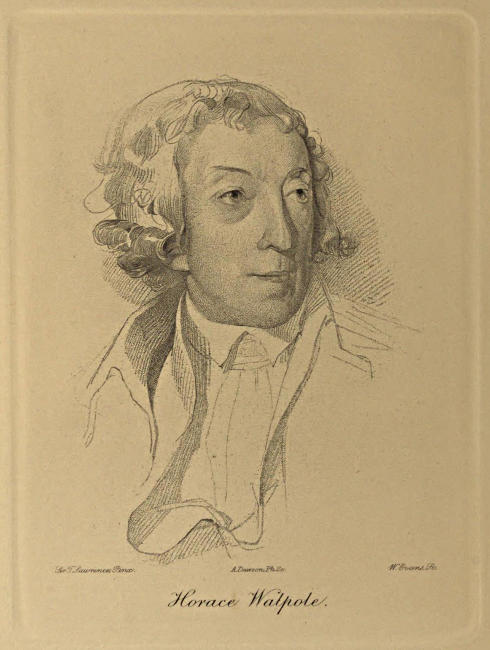
It is hardly necessary to say that Horace Walpole
entered life as the son of the foremost Englishman of
his time. He was born on the 24th of September, 1717,
O.S., and was the youngest of the six children whom
Sir Robert Walpole’s first wife, Catherine Shorter,
brought to her illustrious husband. This family included
two other sons, Robert and Edward, and
two daughters, besides a fourth son, William, who
died in infancy. Horace, whose birth took place
eleven years after that of the fifth child, bore no
resemblance, either in body or mind, to the robust
and hearty Sir Robert. He was of slight figure
and feeble constitution; his features lacked the
comeliness of the Walpole race; and his temperament
was of that fastidious, self-conscious, impressionable
cast which generally causes a man or boy to be
called affected. The scandalous, noting these things,
and comparing the person and character of Horace
Walpole with those of the Herveys, remembered that
Sir Robert and his first wife had been estranged from
one another in the later years of their union, and that
the lady had been supposed to be intimate with Carr
Lord Hervey, elder brother of Pope’s Sporus. Horace
himself has mentioned that this Carr was reckoned of
superior parts to the more known John Lord Hervey,
but nowhere in our author’s writings does it appear that
the least suspicion of spurious parentage[5] had entered
his thoughts. Everywhere he exults in being sprung
from the great Prime Minister; everywhere he is devoted
to the memory of his mother, to whom he raised
a monument in Westminster Abbey, with an inscription
from his own pen celebrating her virtue. And in the
concluding words of this epigraph, he repeated a
saying, which he has elsewhere recorded, of the poet
Pope, that Lady Walpole was “untainted by a Court.”
Walpole tells us that, in the first years of his life,
being an extremely delicate child, he was much indulged
both by his mother and Sir Robert; and as an instance
of this, he relates the well-known story, how his longing
to see the King was gratified by his mother carrying
him to St. James’s to kiss the hand of George I. just
before his Majesty began his last journey to Hanover.
Shortly after this, the boy was sent to Eton, from
which period we hear no more of Lady Walpole, though
she survived till August, 1737. In 1735, young Horace
proceeded from Eton to King’s College, Cambridge,
where he resided, though with long intervals of absence,
until after he came of age. On quitting the University,
he was in possession of a handsome income arising
from the patent place of Usher of the Exchequer, to
which he had recently been appointed, and which was
then reckoned worth £900 a year, and from two other
small patent places in the Exchequer, those of Clerk of
the Escheats and Controller of the Pipe, producing
together about £300 a year, which had been held for
him during his minority. All these offices had been
procured for him by Sir Robert Walpole, and were
sinecures, or capable of being executed by deputy.
Finding himself thus provided for and at leisure, the
fortunate youth set out on the continental tour which
was considered indispensable for a man of fashion.
He travelled, as he tells us, at his own expense; and
being well able to afford the luxury of a companion, he
took with him Thomas Gray the poet, who had been
his associate at Eton and Cambridge. The pair
visited together various parts of France and Italy,
making a stay of some duration at several places.
After a few weeks spent in Paris, they settled at
Rheims for three months to study French. They
lived here with their former school-mate, Henry
Seymour Conway,[6] Walpole’s maternal cousin; and
here appears to have been cemented the lifelong friendship
between Conway and Walpole which forms
perhaps the most honourable feature in the history of
the latter. At Florence, Walpole resided for more than
twelve months in the house of Horace Mann, British
Envoy to the Court of Tuscany, with whom he formed
an intimacy, which was maintained, from the time of
his leaving Italy until the death of Mann forty-five
years after, by correspondence only, without the parties
ever meeting again. Gray remained with Walpole at
Florence, and accompanied him in visits which he
made thence to Rome, Naples, and other places; but
at Reggio a dissension arose between them, and they
parted to return home by different routes. Walpole
subsequently took the blame of this dispute upon himself.
“It arose,” he says, “from Gray being too serious
a companion. Gray was for antiquities, I was for perpetual
balls and plays; the fault was mine.” According
to another account, Walpole had opened a letter addressed
to Gray. Whatever was the cause of the
breach, it was repaired three years later, and during
the rest of the poet’s life he continued on friendly
terms with his early companion.
Walpole reached England in September, 1741, just
before the meeting of a new Parliament, and at the
commencement of the Session took his seat as member
for Callington, in Cornwall, for which place he had
been elected during his absence. Sir Robert’s Government
was at that time in the midst of the difficulties
which soon afterwards caused its downfall. In February,
1742, the defeated Minister resigned, and was created
Earl of Orford. Horace, as was to be expected, took
no prominent part in the struggle. His maiden speech
was delivered in March, 1742, on a motion for an inquiry
into the conduct of Sir Robert Walpole during the last
ten years of his administration. The young orator was
received with favour by the House, and obtained a compliment
from the great William Pitt; but the success of
his effort, which is preserved in one of his letters to
Mann, must be attributed entirely to the circumstances
under which it was uttered. It does not appear that he
afterwards acquired any reputation in debate. Indeed,
he was generally content to be a listener. That he
was a constant attendant at the House, his correspondence
sufficiently proves, but he rarely took an active
part in its proceedings. He has recorded a dispute he
had with Speaker Onslow in his second Parliament.
In 1751 he moved the address to the King at the opening
of the Session, and five years later we find him
speaking on a question of employing Swiss troops in
the Colonies. In 1757 he exerted himself with much zeal
in favour of the unfortunate Admiral Byng. This, however,
was by argument and solicitation outside the
House. In like manner, some years afterwards, he
made strenuous, though vain, endeavours, at the conferences
of his party, to persuade them not to support
the exclusion of the King’s mother from the Regency
which was provided for on the first serious illness of
George III.
These are the chief incidents of Walpole’s public
career, although he remained in the House of Commons
for twenty-seven years. At the General Election of
1754 he was chosen for the family borough of Castle
Rising in Norfolk, but vacated this seat soon afterwards
in order to be a candidate for the town of King’s
Lynn, which had for many years returned his father to
Parliament. Horace continued to represent Lynn
until the Dissolution of 1768, when he took leave of his
constituents, and was no longer seen in Westminster
Hall. Perhaps the final reason for his retirement was
the failure of his friend Conway to retain a foremost
position in politics. After serving as Secretary of State
and Leader of the House of Commons under three successive
Premiers, Conway, through feebleness of purpose,
lost his hold upon office, and fell for some years into the
background. But with disappointment for his friend,
there must have mingled in Walpole’s mind a feeling of
dissatisfaction with himself. Few men acquire much
weight in Parliament who do not at least occasionally
take a share in its discussions; and Horace had more
than once found that his influence in the House was by
no means proportioned to his general reputation for
ability. He was therefore quite ready to withdraw when
Conway could no longer profit by his vote. Though at
all times a keen politician, and extremely social in his
habits, he was unfitted by nature for the conflicts of the
Parliamentary arena. Desultory skirmishing with the
pen was more to his taste than the close fighting of
debate. During more than half his life, the war of
parties was largely carried on by anonymous pamphlets,
and Walpole gave powerful help in this way to his
side; afterwards, when letters and articles in newspapers
took the place of pamphlets, he became an
occasional contributor to the public journals.
But Walpole found in art and literature the chief
employment of his serious hours. His reading was extensive,
the most solid portion of it being in the regions
of history and archæology. More engrossing than his
love of books was his passion for collecting and
imitating antiquities and curiosities of all kinds. His
ample fortune furnished him with the means of indulging
these expensive pursuits. The emoluments
of the Usher of the Exchequer greatly increased during
his tenure of that post: in time of war—and England
was often at war in those days—they were sometimes
very large. Walpole admits that in one year he received
as much as £4,200 from this source; and the Commissioners
of Accounts in 1782 thought that the annual
value of the place might fairly be stated at that sum.
There was an antique flavour about these gains which
gave Walpole almost as much pleasure as the money
itself. The duties of the Usher were to shut the gates
of the Exchequer, and to provide the Exchequer and
Treasury with the paper, parchment, pens, ink, sand,
wax, tape, and other articles of a similar nature used in
those departments. The latter of these duties, which was
said to be as old as the reign of Edward III. at least,
formed the lucrative part of the Usher’s employment,
as he was allowed large profits on the goods he thus
purveyed to the Crown. Obviously the income of such
an office, while varying with the financial business of
each year, must have steadily advanced on the whole
with the progress of the nation. Besides this place,
and the two other patent places before mentioned, in
all of which he continued until his death, Walpole
enjoyed for many years a principal share in the income
of the Collectorship of the Customs. Sir Robert
Walpole held the last appointment under a patent
which entitled him to dispose as he pleased of the
reversion during the lives of his two eldest sons, Robert
and Edward. Accordingly, he appointed that, after his
death, £1,000 a year of the income should be paid to
his youngest son Horace during the subsistence of the
patent, and that the remainder should be divided
equally between Horace and Edward. By this arrangement,
Horace at the age of twenty-seven—for his father
died in March, 1745—stepped into another income of
about £1,400 a year, which lasted until the death of his
brother Sir Edward Walpole in 1784. In his writings he
speaks, with becoming gratitude, of the places and emoluments
bestowed on him by his father as being a noble
provision for a third son. Having thus nobly provided
at the public expense for a child who had not yet shown
any merit or capacity, Sir Robert did not find it needful
to do much for him out of his private property. By
his will, he bequeathed Horace only a sum of £5,000
charged on his Norfolk estate, and a leasehold house in
Arlington Street. The greater part of the legacy remained
unpaid for forty years; the house Horace occupied
until the term expired in 1781, when he bought a
residence in Berkeley Square. As Walpole was never
married, it is not surprising that he died worth ninety-one
thousand pounds in the funds, besides other property,
including his town house just mentioned, and his
villa at Twickenham with its collection of pictures and
other works of art.
The fantastic little pile of buildings which he raised on
the margin of the Thames engaged his chief attention
for many years. He purchased the site of this in 1748,
there being nothing then on the land but a cottage, and
called it Strawberry Hill, a name which he found in one
of the title-deeds. He had taken a lease the year
before of the cottage, with part of the land, from Mrs.
Chenevix, a fashionable toy-dealer, and thus describes
his acquisition in a letter to Conway: “It is a little
plaything-house that I got out of Mrs. Chenevix’s shop,
and is the prettiest bauble you ever saw. It is set in
enamelled meadows, with filigree hedges:
‘A small Euphrates through the piece is rolled,
And little finches wave their wings in gold.’
Two delightful roads, that you would call dusty, supply
me continually with coaches and chaises: barges as
solemn as Barons of the Exchequer move under my
window; Richmond Hill and Ham walks bound my
prospect; but thank God! the Thames is between me
and the Duchess of Queensberry. Dowagers as plenty
as flounders inhabit all around, and Pope’s ghost is just
now skimming under my window by a most poetical
moonlight. I have about land enough to keep such a
farm as Noah’s, when he set up in the Ark with a pair
of each kind; but my cottage is rather cleaner than I
believe his was after they had been cooped up together
forty days. The Chenevixes had tricked it out for
themselves: up two pair of stairs is what they call
Mr. Chenevix’s library, furnished with three maps, one
shelf, a bust of Sir Isaac Newton, and a lame telescope
without any glasses. Lord John Sackville predeceased
me here, and instituted certain games called cricketalia,
which have been celebrated this very evening in honour
of him in a neighbouring meadow.”
Having completed his purchase, Walpole proceeded
to make improvements. His antiquarian studies
had inspired him with a fondness for Gothic architecture.
But his zeal was not according to much
knowledge, nor guided by a very pure taste. Gradually
the little cottage became merged in a strange
nondescript edifice, half castle, half cloister, with all
kinds of grotesque decorations. “The Castle,” so
Walpole called it, “was,” he tells us, “not entirely
built from the ground, but formed at different times, by
alterations of, and additions to, the old small house. The
Library and Refectory, or Great Parlour, was entirely
new-built in 1753; the Gallery, Round Tower, Great
Cloister, and Cabinet, in 1760 and 1761; the Great
North Bed-chamber in 1770; and the Beauclerk Tower
with the Hexagon Closet in 1776.” In a small cloister,
outside the house, stood the blue and white china
bowl, commemorated by Gray, in which Walpole’s cat
was drowned. On the staircase was the famous armour
of Francis I. In the Gallery, among many other treasures,
were placed the Roman eagle and the bust of
Vespasian, so often mentioned in their owner’s correspondence.
The buildings were no more substantial
in structure than they were correct in style. Much
cheap ridicule has been poured upon “the Castle,”
as “a most trumpery piece of ginger-bread Gothic,”
with “pie-crust battlements,” and “pinnacles of
lath and plaster.” Many of its faults and absurdities
must in justice be referred to the novelty of the
attempt to apply a disused style to the requirements
of a modern domestic residence. Walpole himself
was by no means blind to the flimsiness and
incongruities of his creation. He was rather indignant,
indeed, when a French visitor censured it as “non
digne de la solidité Anglaise;” but in his own description
of it he calls it “a paper fabric,” and speaks of
the house and its decorations as “a mixture which
may be denominated, in some words of Pope:
‘A Gothic Vatican of Greece and Rome.’”
With the help of Mr. Essex, who assisted him in designing
the later portions, he gradually learned the
depth of the architectural ignorance in which he and
the “Committee,” who were his first advisers, had been
involved at the commencement of his work. In short,
Strawberry Hill, child’s baby-house as it was, proved
the first step in the renascence of Gothic art.
As chamber after chamber was added to the Castle,
it became Walpole’s next care to fill them with fresh
antiques in furniture, pictures, bronzes, armour, painted
glass, and other like articles. “In his villa,” says Lord
Macaulay, “every apartment is a museum, every piece
of furniture is a curiosity; there is something strange in
the form of the shovel; there is a long story belonging
to the bell-rope. We wander among a profusion of
rarities, of trifling intrinsic value, but so quaint in
fashion, or connected with such remarkable names and
events, that they may well detain our attention for a
moment. A moment is enough. Some new relic, some
new unique, some new carved work, some new enamel,
is forthcoming in an instant. One cabinet of trinkets
is no sooner closed than another is opened.”
Of Walpole’s writings other than his letters, we do
not propose to offer any detailed account or criticism.
His earliest work, “Ædes Walpolianæ,” was published
as early as 1747; it was merely a description of his
father’s pictures at Houghton Hall, the family seat in
Norfolk. Among his next efforts were some papers
contributed in 1753 and following years to a periodical
work of the day, called The World.[7] Most persons
have read the “Castle of Otranto,” so warmly applauded
by the author of “Ivanhoe.” Most students
of art, we suppose, are acquainted with Walpole’s
“Anecdotes of Painting,” and his “Catalogue of
Engravers.” His “Catalogue of Noble and Royal
Authors,” though abounding in agreeable anecdotes, is
probably now consulted by few; and his “Historic
Doubts on the Life and Reign of Richard III.,” acute
and ingenious as it was, cannot detain anyone who is
aware of the recent researches on the same subject.
His “Reminiscences of the Courts of George I. and
George II.,” and his “Memoirs” and “Journals”
relating to the reigns of George II. and George III.,
are, and must ever remain, among the most valuable
historical documents of the eighteenth century. The
Reminiscences were written for the amusement of the
Misses Berry, and have been extolled with justice as
being, both in manner and matter, the very perfection
of anecdote writing. The rest of Walpole’s works,
including his tragedy of “The Mysterious Mother”—the
merits of which, whatever they may be, are
cancelled by the atrocity of the fable—are as nearly
as possible forgotten.
Not content with writing and collecting books, Horace
in 1757 established a printing press in the grounds of
Strawberry Hill. The first printer employed by him
was William Robinson; the last, Thomas Kirgate,
whose name will often be found in the following extracts.
The first work printed at this press was Gray’s
“Odes,” with Bentley’s Illustrations. Its other productions
include Walpole’s own Royal and Noble
Authors, Anecdotes of Painting, Engravers, and Tragedy;
his “Description of Strawberry Hill,” and “Fugitive
Pieces;” besides several works by other authors, such
as Bentley’s “Lucan,” Lord Herbert’s Life, a translation
of Hentzner’s “Travels,” and Lord Whitworth’s
“Account of Russia;” as well as small collections of
verses by sundry friends. These “Strawberry Hill”
editions are now scarce, and command high prices.
The rest of our author’s career may be summed up
in a few words. His eldest brother had died early, and
had been succeeded by an only son, whose profligacy
and occasional fits of insanity caused much trouble.
In December, 1791, when seventy-four years of age,
Horace became, by the death of this nephew, Earl of
Orford, which made little addition to his income, the
family estate being heavily incumbered. The inheritance
was far from welcome. In a letter to a
friend, he says he does not understand the management
of such an estate, and is too old to learn. “A source
of lawsuits among my near relations, endless conversations
with lawyers, and packets of letters to read every
day and answer—all this weight of new business is too
much for the rag of life that yet hangs about me.”[8] He
never took his seat in the House of Lords. He lived
for upwards of five years longer, in the full possession
of all his faculties, though suffering great bodily infirmity
from the effects of gout, to which he was long a martyr.
He died at his house, No. 11, Berkeley Square, on the
2nd of March, 1797, in his eightieth year, and was
buried at the family seat of Houghton. With him the
male line of Sir Robert Walpole and the title of Orford
became extinct. The estate of Houghton descended
to the fourth Earl of Cholmondeley, grandson of
Horace Walpole’s younger sister Mary, who married
the third earl of that ilk. Strawberry Hill was at its
founder’s absolute disposal, and he left it, as already
mentioned, to Mrs. Damer, Conway’s daughter, but
for life only, with limitations over in strict settlement.
“It is somewhat curious,” says his biographer, “as
a proof of the inconsistency of the human mind, that,
having built his Castle with so little view to durability,
Walpole entailed the perishable possession with a
degree of strictness which would have been more fitting
for a baronial estate. And that, too, after having
written a fable entitled ‘The Entail,’ in consequence of
some one having asked him whether he did not intend
to entail Strawberry Hill, and in ridicule of such a proceeding.”
Inconsistency, caprice, eccentricity, affectation, are
faults which have been freely charged against the
character of Horace Walpole. His strong prejudices
and antipathies, his pride of rank, his propensity to
satire, even his sensitive temperament, made him many
enemies, who not only exaggerated his failings, but
succeeded, in some instances at least, in transmitting
their personal resentments to men of the present
century.
As a politician, especially, Walpole has received
rather hard measure from the partisan critics on both
sides. A generation back, Whig Reviewers and Tory
Reviewers vied with each other in defaming his memory.
Macaulay and Croker, who seldom agreed in anything,
were of one accord in this. To Croker, of course,
Horace was just a place-holder who furnished a telling
example of Whig jobbery. To rake up all the details of
his places in the Exchequer, and his “rider,” or charge,
on the place in the Customs, to compute and exaggerate
his gains from each of these sources, to track him in
dark intrigues for extending his tenure of one appointment
and bettering his position in another; all this was
congenial employment for the Rigby of the nineteenth
century, as it would have been for his prototype in the
eighteenth. The motive of Macaulay’s deadly attack
is not quite so obvious. Walpole’s politics were those
of his father and of the old Whigs generally. While
in theory inclined to Republicanism—though he was
never, as he tells us, quite a Republican[9]—it was his
habit, on practical questions, to consider what course
the great Sir Robert would have taken under similar
circumstances. There seems nothing in all this to
excite the wrath of the most atrabilious Liberal. The
truth appears to be that, in the Whig circles of
Macaulay’s time, there existed a traditional grudge
against Horace Walpole. In the “Memorials of Charles
James Fox,” which were arranged by Lord Vassall-Holland,
and edited by Lord John Russell, both the
noble commentators speak of Horace in terms of undisguised
bitterness. Nor is the cause very far to seek. In
politics, Conway was under the dominion of Walpole;
and Conway, on more than one critical occasion, disobliged
the Rockingham faction, from which the modern
Whigs deduce their origin. “Conway,” says Lord
John Russell, writing of the events of 1766, “had been
made Secretary of State by Lord Rockingham, and
ought to have resigned when Lord Rockingham left
office; but Mr. Walpole did not choose that this should
be so.” Sixteen years later, Conway sat again in a
Cabinet presided over by Lord Rockingham, and when
that nobleman died, he again refused to resign. It will
be remembered that, on this occasion, the Cavendishes
and Fox quitted their places when the Treasury was
given to Lord Shelburne, instead of their own nominee,
the Duke of Portland, whose only recommendations
were that he was Lord of Welbeck, and had married a
daughter of the House of Devonshire.
In 1782, the Duke of Richmond, Conway’s son-in-law,
concurred with Conway in declining to desert the new
Premier; and we know that Walpole stoutly supported,
if he did not dictate, the joint resolution of his two
friends. Lord Holland tells us that Fox did not like
Walpole at all, and accounts for this dislike by suggesting
that his uncle may have imbibed some prejudice
against Walpole for unkindness shown to the
first Lord Holland. But this seems going needlessly far
back for an explanation. There can be no doubt that
Fox looked on Walpole as having assisted to thwart
his design of governing England in the name of the
insignificant Duke of Portland, and detested him accordingly.
Nor did subsequent events tend to soften
Fox’s recollection of this passage in his life, or of the
persons concerned in it. Had he overcome his jealousy
of Lord Shelburne, or had he succeeded in compelling
his rival to bow before the “wooden idol”—so Lord
John Russell himself calls Portland—which he had set
up, he would probably, in either case, have avoided
the ill-famed coalition with Lord North, which was the
main cause of his long-continued exclusion from power.
Walpole had spoken his mind very plainly on the
subject. “It is very entertaining,” he wrote, “that
two or three great families should persuade themselves
that they have an hereditary and exclusive right of
giving us a head without a tongue.”[10] And he told
Fox himself: “My Whiggism is not confined to the
Peak of Derbyshire.”[11] We can imagine with what
horror such utterances as these were received by the
believers in the Whig doctrine of divine right. No
wonder that Mr. Fox did not like Walpole. And what
Mr. Fox disliked was, of course, anathema to every
true Whig, and especially to an Edinburgh Reviewer
of 1833.
What do the complaints of Walpole’s political
tergiversation amount to? It was certainly not a wise
act of Horace to hang up in his bedroom an engraving
of the death warrant of Charles I. with the inscription
“Major Charta.” But the Whig essayist, while
reproving Walpole’s strange fancy that, without the
instrument in question, the Great Charter would have
become of little importance, might have recollected
that he had himself professed his inability to see any
essential distinction between the execution of the
Royal Martyr and the deposition of his son. Again,
there was inconsistency, no doubt, between Walpole’s
admiration of the Long Parliament, and his detestation
of the National Assembly; yet it should be
borne in mind that, in the midst of his disgust at the
excesses of the French Revolution, he protested that
he was very far from subscribing to the whole of
Burke’s “Reflections.” Why then should we be told
that “he was frightened into a fanatical royalist, and
became one of the most extravagant alarmists of those
wretched times?” We may surely ask on his behalf
the question which Macaulay put when the consistency
of his own master, Sir James Mackintosh, was impugned:
“Why is one person to be singled out from among
millions, and arraigned before posterity as a traitor to
his opinions, only because events produced on him the
effect which they produced on a whole generation?”
When the critic tells us that Walpole was a mischief-maker
who “sometimes contrived, without showing
himself, to disturb the course of Ministerial negotiations,
and to spread confusion through the political
circles,” we cannot avoid seeing in these words a
resentful reference to the part taken by Conway on
the occasions above referred to.
It was not Walpole’s fault that the party conflicts of
his time were mainly about persons. We have seen
the importance which Fox attached to these personal
questions. We may safely say that this great man’s
disapproval of Walpole’s conduct did not spring from
any difference on matters of principle. If Horace was
an opponent of Parliamentary Reform, this was an
open question among Fox’s most intimate associates.
If he objected to the enfranchisement of the Roman
Catholics, most Whigs of his time did the same. In
the dispute with America, as we shall see, he maintained,
from the first, the right of the Colonies to
liberty and independence. Nor did he retract his
expressions of sympathy with the American Republic
when the horrors of the French Revolution made him
a supporter of Tory policy in England and on the Continent.
He always lamented as one of the worst
effects of the French excesses that they must necessarily
retard the progress and establishment of civil
liberty.[12]
There were questions of social politics on which he
was far in advance of his times. “We have been
sitting,” he wrote, on the 25th of February, 1750,
“this fortnight on the African Company. We, the
British Senate, that temple of liberty, and bulwark of
Protestant Christianity, have, this fortnight, been considering
methods to make more effectual that horrid
traffic of selling negroes. It has appeared to us that
six-and-forty thousand of these wretches are sold every
year to our plantations alone! It chills one’s blood—I
would not have to say I voted for it for the Continent
of America! The destruction of the miserable inhabitants
by the Spaniards was but a momentary
misfortune that followed from the discovery of the New
World, compared with the lasting havoc which it
brought upon Africa. We reproach Spain, and yet do
not even pretend the nonsense of butchering these poor
creatures for the good of their souls.”[13] The sentiments
thus declared by Walpole nine years before Wilberforce
was born, he steadily adhered to through life. On this
point, at least, no one has ever charged him with any
wavering or inconsistency.
We will mention, before passing on to different
topics, one other matter on which Walpole shows a
liberality of feeling quite unusual at any period of his
life. In the summer of 1762, he writes: “I am in distress
about my Gallery and Cabinet: the latter was on
the point of being completed, and is really striking
beyond description. Last Saturday night my workmen
took their leave, made their bow, and left me up
to the knees in shavings. In short, the journeymen
carpenters, like the cabinet-makers, have entered into
an association not to work unless their wages are
raised; and how can one complain? The poor fellows,
whose all the labour is, see their masters advance their
prices every day, and think it reasonable to touch their
share.”[14]
In the domain of literature, Walpole’s opinions were
largely influenced by his social position and personal
connexions. He rated the class of professional writers
as much below as they have ever been rated above
their real deserts; and this may perhaps help to explain
the rancour with which he has been pursued by some
critics. He could see nothing wonderful in the art of
stringing sentences together. He met famous authors
daily in society, and did not find that they were wiser
or more accomplished than their neighbours. Most of
them showed to little advantage in the drawing-rooms
in which he felt his own life completest. Gray seldom
opened his lips; Goldsmith “talked like poor poll”;
Johnson was Ursa Major—a brute with whom Horace
declined to be acquainted; Hume’s powers of mind did
not appear in his broad unmeaning face, nor animate
his awkward conversation; even Gibbon made a bad
figure as often as any doubt was hinted as to the transcendent
importance of his luminous or voluminous
history. As for the novelists, neither Fielding nor
Richardson ever ascended to the sublime heights in
which Horace dwelt at ease. Stories circulated there
of vulgar orgies amidst which the biographer of Tom
Jones performed his police functions, and of requests
made by the author of “Clarissa” to his female
admirers for information as to the manners of polite
life. Walpole shrank from the coarseness of the one,
and smiled at the attempts of the other to describe a
sphere which he had never entered. We are not to
suppose, however, that Horace was as blind to the
gradations of literary rank as some would have us believe.
When he told Mann that The World was the
work of “our first writers,” instancing Lord Chesterfield,
Sir Charles Hanbury Williams, and other well-born
dilettanti whose names have now sunk into oblivion
or neglect, it is clear that he was speaking with reference
to the matter in hand. It did not occur to him
that great historians and poets would be likely or
suitable contributors to a series of light papers intended
for the macaronis of the hour. What he regarded as
the chief qualification of himself and his friends who
wrote for this fashionable journal was their familiarity
with the tone of the best society. For himself, Walpole
constantly disclaimed all pretence to learning or
exact knowledge of any kind, and, due allowance made
for the vanity of which undoubtedly he owned an
ample share, there seems no reason to question his
sincerity. We conceive, indeed, that his estimate of
his own talents and acquirements was much more
accurate than it has usually been considered. In all
that related to literary fame, his vanity showed itself
rather in depreciating the advantages which he had not,
than in exalting those which he possessed. If he did
not worship style, still less was he disposed to bow
down before study and research. Hence the low
esteem in which he held authors of all kinds. Some
excuses may be made for his disparaging criticisms.
The literati of his day were certainly eclipsed by the
contemporary orators. What writer was left in prose
or verse, on the death of Swift, who could compare with
Mansfield or the first William Pitt? Which of the
poets or historians of the next generation won the
applause which was called forth by the speeches of Fox
or Sheridan or the younger Pitt? If Fox and Sheridan
could obtain their greatest triumphs in the midst of
gambling and dissipation, and apparently without pains
or application, there was some apology for slighting the
labours of Robertson and the carefully polished verses
of Goldsmith. With the exception of Lord Chatham,
whom he strongly disliked, Walpole generally does
justice to the great speakers of his time, on whichever
side in politics they were ranged; if he gives no credit
for genius to the writers of the age, this was partly at
least because their genius was of no striking or signal
order. Judgment, sense, and spirit were Pope’s three
marks for distinguishing a great writer from an inferior
one, and these continued to be the criteria applicable,
even in the department of so-called works of imagination,
down to the end of the century.
Walpole, as in duty bound, was a professed worshipper
of Shakespeare and Milton, but we suspect that his
worship was not very hearty. It is clear that Pope
was the poet of his choice; and he seems to have
known every line of his favourite by heart. He admired
also the exquisite poetry of Gray, and this
admiration was no doubt sincere; but we are disposed
to think that it arose entirely from the early
connexion between Horace and the author, and from the
feeling that Gray, in some sort, belonged to him. Gray
was Walpole’s poet, as Conway was his statesman;
and the sense of ownership, which converted his
cousinly regard for Conway into a species of idolatry,
turned to enthusiasm for Gray’s “Odes” the critical
estimate which would otherwise, we feel sure, have
ended in a pretty strong aversion.
What Walpole said, rather uncharitably, of Sir
Joshua Reynolds, may, we fear, be applied with more
justice to Walpole himself. All his geese were swans,
as the swans of others were geese in his eyes. Conway
was a man of integrity and honour, an excellent soldier,
a fluent speaker, but he was a timid and vacillating
politician. That phase of their weakness which makes
the vainglorious pique themselves on having remarkable
friends, is certainly not unamiable, though it is
sometimes fatiguing. We all know the man who congratulates
himself on his good fortune in being the
associate of the versatile Dr. A., the high-souled Mr.
B., the original Mr. C., and so on. Had Horace
possessed a wife, he would have wearied all his
acquaintance with encomiums on her beauty, wit, wisdom,
and other matchless perfections. Having no wife
to celebrate, he chose to sing the praises of General
Conway, and sang them lustily, and with good
courage. This was the more disinterested, as Conway
appears to have been distinctly one of those persons
who allow themselves to be loved. There is no
questioning the genuineness of a devotion which undoubtedly
entailed on Walpole great sacrifices. The
time and labour which Horace bestowed in the service
of his friend’s ambition entitle him to full credit for
honesty in the offer which he made to share his fortune
with the latter, when, at an early stage of his career,
he was dismissed from his employments for opposing
the Ministry of the day.
This was not the only occasion on which Walpole
showed himself capable of uncommon generosity. He
made a similar offer to Madame du Deffand, when she
was threatened with the loss of her pension. That
clever leader of French society was not, like Conway,
a connexion of long standing, but a mere recent
acquaintance of Horace, who had no claim on him
beyond the pleasure she had shown in his company,
and the pity which her blind and helpless old age demanded.
In the event, the lady did not require his
assistance, but her letters prove that she had full confidence
in his intentions, notwithstanding the harshness
with which he sometimes repressed her expressions of
affection. The same temperament which made him
fond of displaying his intimacy with Conway, caused
him to dread the ridicule of being supposed to have an
attachment for the poor old Marquise. Hence arose
the occasional semblance of unkindness, which was
contradicted by substantial proofs of regard, and
which must be set down to undue sensitiveness on the
gentleman’s side rather than to want of consideration.
The coldness of heart with which Walpole is
reproached has, we think, been exaggerated. “His
affections were bestowed on few; for in early life they
had never been cultivated.” So much is admitted by
Miss Berry, a most favourable witness. But in society
generally, Horace appears to have shown himself
friendly and obliging. His aristocratic pride did not
prevent him from mixing freely with persons much his
inferiors in station. Miss Hawkins, daughter of the
historian of music, who for many years lived near him
at Twickenham, testifies to his sociable and liberal
temper; and Walpole’s own letters show that he was
at some trouble to assist Sir John Hawkins in collecting
materials for his work. The correspondence
between Horace and his deputies in the Exchequer
proves the kindly feeling that subsisted between him
and them; and also reveals the fact that he employed
them from time to time in dispensing charities which
he did not wish to have disclosed. And Miss Berry
records that, during his later life, although no ostentatious
contributor to public charities and schemes of
improvement, the friends in whose opinion he could
confide had always more difficulty to repress than to
excite his liberality.
His temper, says Sir Walter Scott, was precarious.
Walpole, we believe, would readily have pleaded guilty
to this charge. That he felt his infirmity in this respect
his Letters sufficiently show; he assigns it as the chief
reason why he preferred to live alone. Gray was not
the only one of his early friends with whom he
quarrelled. He became estranged at different times
from Ashton, another college companion; from Bentley,
whose taste and talent he had employed in decorating
his Castle; from George Montagu,[15] who, next to
Conway, was long his most intimate friend; and from
Mason the poet; not to mention other names. Whatever
blame may attach to Walpole for these ruptures,
it seems to be now pretty well agreed that in the
matter of Chatterton he was guiltless. On this subject,
we need only quote a few sentences from Scott.
“His memory,” says Sir Walter, “has suffered most on
account of his conduct towards Chatterton, in which
we have always thought he was perfectly defensible.
That unhappy son of genius endeavoured to impose
upon Walpole a few stanzas of very inferior merit, as
ancient; and sent him an equally gross and palpable
imposture under the shape of a pretended ‘List of
Painters.’ Walpole’s sole crime lies in not patronizing
at once a young man who only appeared before him
in the character of a very inartificial impostor, though
he afterwards proved himself a gigantic one. The
fate of Chatterton lies, not at the door of Walpole, but
of the public at large, who two years, we believe, afterwards
were possessed of the splendid proofs of his
natural powers, and any one of whom was as much
called upon as Walpole to prevent the most unhappy
catastrophe.”[16]
We turn from Walpole’s life and character to his
Letters. We have already mentioned the friends to
whom the earlier portion of these were chiefly addressed.
Other friends to whom he occasionally
wrote were Lord Hertford, Conway’s elder brother,
Lord Strafford, Cole, the antiquary of Cambridge,
and John Chute, with whom he had been intimate at
Florence. The names of some later correspondents will
appear as we proceed, of whom such an account as
may seem necessary will be given as they come before
us. Of the pains and skill with which the matter of
each letter is adapted to the person for whom it was
intended, our readers will be able to judge for themselves.
That the author had studied letter-writing as
an art, is a remark almost too trivial to be repeated.
It is hardly too much to say that he made it his chief
literary business. “Mine,” he said, “is a life of letter-writing.”
That he counted on being remembered by
his letters far more than by any other of his writings,
we hold to be as certain as any statement of the kind
can be. He had, we believe, gauged his powers
far more correctly than is commonly supposed, and
was satisfied that in this kind of composition, more
than in any other, he had produced something of permanent
value. He had studied closely the letters of
Gray and Madame de Sévigné, and formed his own
style from them. The letters of the latter were his
especial delight. He read them over until they became
part of his own mind. Nothing interested him so
much as a rumour that some fresh letters of “Notre
Dame des Rochers” had been discovered. It may be
too much to say, as Miss Berry has said, that Walpole
has shown our language to be capable of all the graces
and all the charms of the French of the great writer
whom he imitated. But, due allowance made for the
superiority of French idiom and French finesse in a
department where they appear to most advantage,
it may safely be affirmed that, if variety and interest of
topics be regarded as well as style, Walpole’s letters
are unrivalled. It was only by degrees that Horace
attained to the perfection of easy engaging writing.
His earlier letters betray signs of considerable labour.
It is said that a summary prepared beforehand of one
of his letters to Montagu was found in looking over
some of his correspondence. In later days he wrote
with the greatest facility, even carrying on a conversation
the while. But he continued to the last the
habit of putting down on the backs of letters or slips
of paper, a note of facts, of news, of witticisms, or of
anything he wished not to forget for the amusement of
his correspondents.