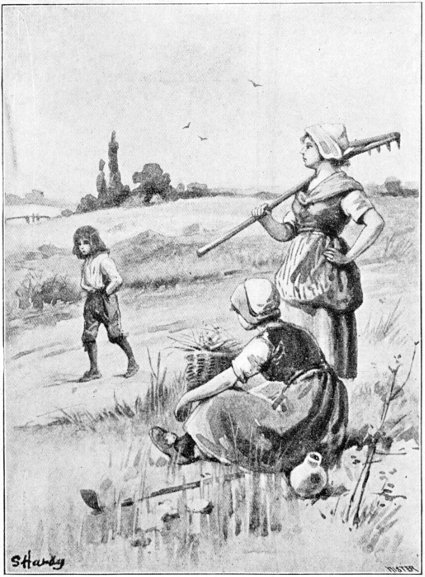
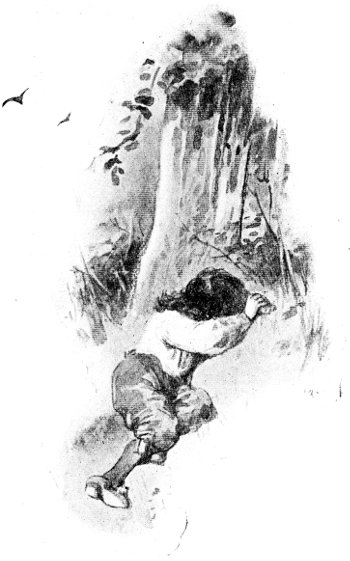
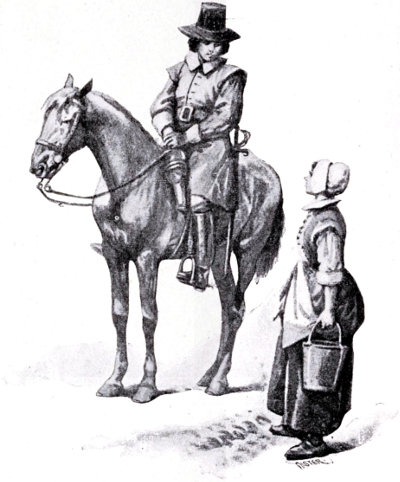
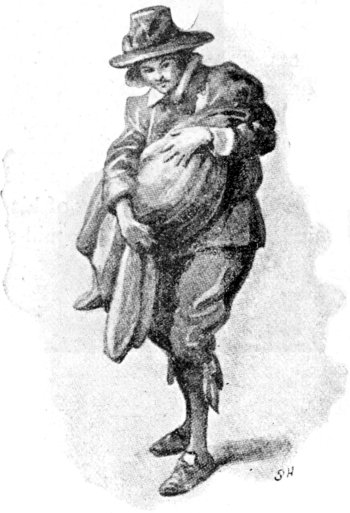
“With his dark locks and swarthy cheeks smudged
with dirt, the good folks took him for
some gipsy boy.”
Honor Bright
A STORY OF THE DAYS OF KING CHARLES
BY MARY C. ROWSELL
WITH TWENTY-THREE ILLUSTRATIONS
PHILADELPHIA
HENRY ALTEMUS COMPANY
Copyright, 1900, by HENRY ALTEMUS COMPANY.
CHAPTER I THE CEDAR ROOM
One fine autumn morning a long
time ago, a little boy lay
stretched in the broad seat of a latticed window, gazing earnestly
with his great dark eyes on the scene before him. The window was
the only one in the room, which was situated high up in a sort of
tower at the corner of a big old house.
The beautiful garden surrounding the house was laid out in
long terrace walks, with wide stone steps and balustrades, and
planted with smooth-shaven yew-hedges as thick and almost as
sturdy as walls, and the flower-beds carpeting the ground were
ablaze with glorious colors in the shadowless sunshine, for the great
bell in its wooden cote above the square red-brick gate-house was
ringing out midday. Bounding the garden on every side were
lofty walls, covered with the spreading branches of plum and pear
and apple trees, and the rich fruit gleamed red and tawny and purple,
bright as gems among the green leaves. Away beyond the garden,
far as eye could reach, stretched wood and dale and fair green
meadows, where the sheep cropped at the sweet turf and the cows
grazed, whisking away the tiresome flies with their great tails as
they moved slowly along. Here and there among the leafy hedgerows
and coppices, the little boy, whose Christian name was Charles,
could see from his lofty watch-place the gleaming of a stream
which wound like a silver ribbon on and on, nearer and nearer,
till it reached the little wood covering the wide, sloping banks which
shut in the road leading past the house. There for some distance
it was almost completely lost in the ferny brushwood, peeping out
again at last in a rush-grown pool. Thence hurrying onward, it
wound right round the walls of the house, so that to reach the
great nail-studded main door you had to cross a little one-arched
stone bridge.
Faster and faster, as he gazed upon this fair scene, the tears
brimmed up into the little lad’s eyes, until they rolled down his
cheeks—cheeks not very rosy or chubby, like those of most boys
and girls of eight or nine years old, which was the age of this boy,
but of a clear, naturally healthful brown, although just now they
looked a little wan. His hair was also dark, and fell in thick curly
locks upon the broad collar of Flemish lace covering his shoulders
to the top of the sleeves of his dark-green velvet surcoat. His face
was rather handsome, and, although there was an expression of self-will
about his lips, it was mingled with great good-humor, as if he
had a kind, generous nature, and might look merry enough when
there was anything to be merry about.
That, however, he at present considered as being very far
from the case; and at last his silent weeping broke out into
loud sobs, which grew only the louder the more he strove to
stifle them. They could be heard such a long way off that
they reached the ears of Lady Chauncy, the mistress of the house,
who was sitting at her needlework in her private room on the
floor below. She rose with a little impatient frown at being
thus disturbed, and taking from a side-table a small gilt cage,
which contained a fine blackbird or merle, as blackbirds were then
called, and carrying it with her, went up the stairs to the room
where the boy was.
First removing a stout wooden bar from across the door, she
lifted a bunch of big keys, hanging from her girdle, and, selecting
one of the keys, put it in the lock of the door, turned it, and entered
the room.
“What is the matter?” she said, as she carefully locked the
door behind her, and advanced a few steps into the room. She
was an oldish lady, with a yellowish wrinkled face framed tightly
in with a cap of fine linen in such a fashion that, if she had
any hair, none of it was to be seen. Her eyes were light green-gray,
and gleamed sternly, but not unkindly, under their thick
grizzled brows upon the boy, as at sight of her he slid down
from his corner, and went and sat in a large high-backed armchair.
He brushed away the tears from his eyes, but he made no answer,
and the lady had to repeat her question.
“What are you crying about? Are you ill?” she went on.
“Have you a headache, or a toothache—or any ache?”
“No, madam, not the merest finger-ache,” replied the little
lad, with almost a smile. “There is nothing—nothing at all amiss
with me,” and then, in spite of his grand words, a last lingering
sob broke up his speech. “I am only—only——”
“Only hungry—is that it?” she said, with a relieved look.
“Well, eating is the best cure for that, and your favorite dinner
will be here directly——roast beef; so dry your eyes.”
The boy’s face did not, however, grow much brighter, and Lady
Chauncy began to knit her stern brow again. “Come, come, your
Highness is hard to please to-day,” she went on; “what is amiss
with you to be so naughty and discontented? Pray what can you
lack? Where are your draughts, and your beautiful new horn-book,
and your brave new troop-horse which his Majesty brought
all the way from Cheapside in his own coach for you? You
ought to be happy as the day is long, with everything dainty and
to your taste to eat, and a soft bed, and the blue sky and the fair
scene to look at from this casement. What, tears again?” for
at these last words of Lady Chauncy’s the boy’s breath quivered
very much as if the sobs were going to burst out afresh. “Nay,”
she went on, “I’ll warrant they will dry up fast enough when
you see what I have here for you,” and, pulling off the cover of
the gilt cage, she placed it on the table. “William the gardener
caught this pretty bird to-day, and I have put it in this fine cage
and bring it you for a present. What do you say?”
The boy did not reply. He only looked hard at the captive
bird, and still the tears seemed swelling in his throat. “It is a
brave bird,” he said softly at last.
“Well, I am glad you are pleased with it,” said Lady
Chauncy, “but I must be going now—and hark,” for at this moment
there came a loud tap at the door, “there is Wynkin come with
your dinner,” and she turned and unlocked the door for a serving-man
who entered with a silver tray laden with plates and dishes,
and, entrusting him with the key of the door, she went out, closing
it carefully behind her.
Meanwhile the servant spread the snowy damask cloth on
the carved oak table and arranged the dishes, and having helped
the boy from the joint of roast beef, and poured out a goblet full
of clear golden cider from a silver flagon, he took up a place
behind Charles’s tall-backed chair, looking in a concerned, half-scared
sort of manner at the boy when, after a few mouthfuls, he pushed
aside the plate.
“Take it away,” he said.
“But your Highness has hardly eaten anything,” said Wynkin.
“No,” said Charles, “I can’t eat any more in this stifling cupboard
of a place. Could you now, Wynkin?”
Wynkin grinned. “I think I could,” he said, “if——”
“If what?”
“Well, if it was roast beef.”
“Don’t you have roast beef for dinner of a day?”
“Only on Sundays, your Highness. Week-days we have
mostly porridge for dinner, or, for a treat now and again, a sop in
the pan of barley-bread.”
“And what do you have for pudding?” inquired the Prince,
as Wynkin removed the thrust-aside plate and placed a dish of
quince tarts on the table all heaped up with whisked cream stuck
over with sugar-plums; “sweets, you know.”
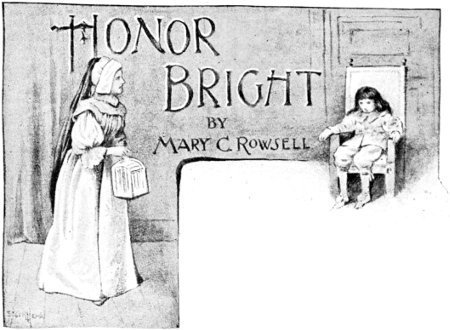
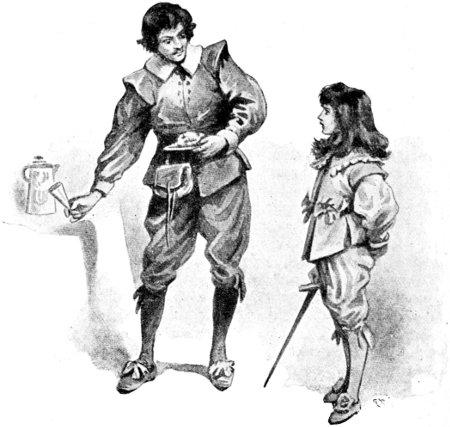
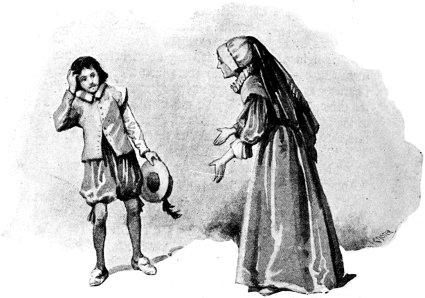
“At the sight of her he slid down from his
corner and went and sat in a large
high arm-chair.”
“Oh, we don’t have them at all, except at Christmas, which
comes but once a year, worse luck. A little sour buttermilk sometimes
perhaps, but sweet things, bless your heart, no.”
“Oh, yes, you do,” said Charles, with a merry twinkle in his
eye; “you have the sweetest thing of all—liberty.”
“Why, yes, that is true,” admitted Wynkin, gazing down sorrowfully
at the boy.
“And I wish I were you, Wynkin,” went on Charles, all the
clouds darkening his face again. “It’s dreadful to be a King’s son,
I can tell you; and treated as if I’d done something wrong, and I
haven’t—I haven’t.”
“No, of course not,” said Wynkin, in consoling tones. “It
isn’t possible, for the King can do no wrong, I’ve always heard say.
Every idiot knows that, and it isn’t likely his son can, particularly
his eldest son, the Prince of Wales, like you are.”
“I never thought of that,” said Charles, with a meditative air,
as he lifted all the whipped cream with his spoon from his tart and
swallowed it at a gulp. “I may do whatever I please and it won’t
be wrong. But there, that’s just it—I can’t do what I please.
How can I? I want to run and jump and bathe out in that
splendid pool there, and climb up those great tall fellows of trees
and—and—do all the things other boys do—for I’m not a baby
now—I’m turned nine—and it’s a shame, keeping me cooped up in
this mousetrap of a room. Oh, you know it is, Wynkin, and you
might say so, if you had a kind heart, but you haven’t—you are hard-hearted
and cruel, like the lords.”
“But they have to be cruel to be kind,” contended Wynkin.
“The King’s Majesty, God preserve him, has so many enemies—so
many who hate him.”
“Yes, I know, so ’tis said,” replied the boy, “and ’tis all very
well, Wynkin, but I can’t believe it. My father is so gentle and
kind. If ’tis true, ’tis because they don’t know him.”
“That may be so, your Highness. And ’tis just the business
of many of those who call themselves his Majesty’s friends to hinder
him from being known as—as you know him. And you see, there
are bad men about of all sorts and sizes and parties, who want to
get you away from him.”
“I’d be torn in pieces first,” said the child, his dark face
flushing.
“Yes,” said Wynkin, “that’s about what it would be. I’m
not certain but I think now there’s a price set upon your head.”
“What’s the good of it to anybody?” laughed Charles.
“Oh, well, there mayn’t, of course, be anything in it?”
“Inside my head?” laughed Charles still more merrily.
“In the talk, your Highness.”
“That is as it may be,” said Charles, “but there is more than
one idea inside my head, and the biggest is that I’m not afraid of
these evil persons; and the next is that if I can only get out of this
badger-hole of a room, I’ll let them know I’m not—and I’ll protect
my father from—where is my father just now, Wynkin?”
“He was in London a few days since.”
“Is mother with him?”
“Nay, I think she has gone to France, to fetch soldiers to
come over and fight for the royal cause.”
“Oh, that is all right, and when they come—now, Wynkin, look
here—I intend to go to my father and fight by his side. Oh, I
tell you I can—see,” and, seizing his little wooden toy sword, he
tipped his left fingers over his head and thrust out the weapon
with such a valiant air that Wynkin laughed heartily and said he
had never seen a finer copper captain.
“Nay, copper captain forsooth,” said Charles, flinging away
the sword, and seizing the long white stick which Wynkin carried as
his staff of office when waiting on the Prince. “I’ll show you
I’m no copper captain,” and he began to lunge about with it so
lustily that at last he gave Wynkin a sharp poke in the eye.
“Oh, dear,” cried the boy, throwing down the stick; and, springing
into the serving-man’s arms, he clung round his neck and stroked
his damaged eye. “I’m so sorry, Wynkin. It doesn’t hurt much,
does it—though it is going all red and black?”
“Nothing to talk about,” said Wynkin, “but you can cut and
thrust with the best of ’em. Feeling’s believing.”
“Yes,” said Charles proudly.
“A regular don at it you are,” went on Wynkin, as he began
to pile the dinner things together for taking away, “but I must
be going now.”
“Oh, don’t go,” pleaded the lonely boy.
“Needs must. I’ve got to be going up-stream with some corn
sacks, and the last harvest load’s being carried to-day, and all
hands are turned on.”
“Except mine,” sighed the Prince, gazing down sadly at his
little slender white hands. “It’s hateful. Now, Wynkin,” he went
on, turning suddenly with a commanding air upon the serving-man,
“listen to me. Give me that key immediately,” and he
pointed to the key which Lady Chauncy had entrusted to Wynkin,
and which the man had thrust into the breast of his jerkin in such
a manner that the handle peeped out. “I want it.”
“Oh, do you?” said Wynkin, most respectfully.
“Yes, and you must give it me immediately.”
“Faith, not I, your Highness. You’ll be trying to unlock the
door with it the next thing,” grinned Wynkin.
“Certainly,” replied Charles majestically. “That is the purpose
for which I require it.”
Wynkin’s broad smile grew broader than ever. “What next,
I should like to know,” said he.
“That is a matter that does not concern you,” replied the
Prince; “your manner is very disloyal. If you must know, I want
to get out.”
“Which is precisely what his Majesty has forbidden my lord
and my lady to allow you to do,” rejoined Wynkin, “and they
have given him their word of honor and solemn promise that
you shall not get out, and it’s because I have always been trusted
by my lord and my lady to abide by my word, and have never
broken faith to them, that they allow me to wait upon your
Highness,” and Wynkin took a long breath, for he was not used
to making such lengthy speeches. “Honor bright, you know,”
concluded he.
The young Prince made no reply. For a long time he stood
looking Wynkin full in the face with thoughtful-looking eyes, and
Wynkin returned the gaze, but whether his damaged eye hurt him,
or somehow a tearful choking kind of feeling in his throat troubled
him, it is certain that he turned away, and hurriedly gathering
the dinner things together on his tray, he went out, carefully
locking and barring up the door behind him.
CHAPTER II MINERVA’S NOSE
Charles stood listening
to Wynkin’s departing
footsteps down the
oaken staircase till the last
echo of them died out. Even
then perhaps he would not
have stirred, had it not been
for the merle, who suddenly
piped a plaintive note or
two in his cage, which
Wynkin had hung upon a
handy nail near the window.
“Ah,” cried Charles,
turning quickly to the bird,
“I forgot all about you.”
The merle looked at
him with his bright eyes,
in which there seemed to
the boy to be a sorrowful pleading expression.
“What is the matter, birdie, old fellow?” said Charles. “Are
you hungry? No; they would never have neglected to give you
seed and water, I am sure.”
And there, as he looked to ascertain, he found not only seed
and water to the very brim of the pannikins, but also, stuck between
the bars, a big piece of watercress, while at the bottom of the cage
was a large worm wriggling about. Nothing, in fact, was wanting
to the convenience and content of the tenant of the cage—in the
way, that is, of creature comforts—but his wings drooped forlornly,
and he looked very unhappy, nevertheless.
“Ah,” said the Prince, as he clambered on to the high window-seat,
and took down the cage, “I like you very much, you dear
little fellow; and I should like to keep you, for I am very lonely,
and you are most sweet company, and it is a very fine cage, isn’t
it? But you are breaking your merry heart in it, I am positive
you are, and you shall get out. Her ladyship may not approve;
she may even whip me for it, though I believe she mustn’t do
that, much as her fingers often itch for it, but I’m going to let you
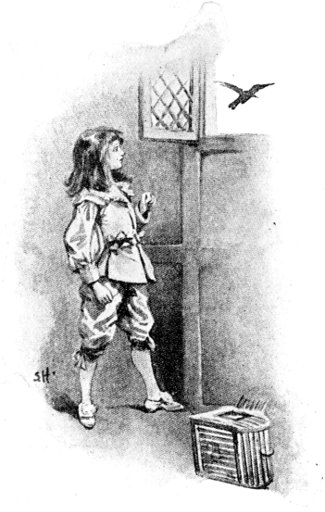
go,” and so saying, he unfastened the door of the cage, and set the
entrance against the open lattice. “There, go,” he went on, as for
an instant the bird perked his shiny head on one side, as if he
was listening intently to all Charles was saying to him, “fly away,
dear bird, and joy go with you, for outside you will find it again.”
And then with a flap of his wings, away flew the merle,
straight across the moat into mid-air, till he reached the bough of a
high elm not far off. There he settled, and opening his yellow
beak, he set up such a joyous song as never was heard—anyway,
inside a cage.
“I expect,” said Charles, looking into the cage again, and
poking the watercress stalk under the body of the worm, “that you
would rather wriggle down there among the flowers than in that
miserable sprinkling of sand,” and with that he flung the worm far
across the moat on to the grassy bank below. “Of course, if Master
Merle catches you again, you must settle the matter between you,
and it is certain he will be picking up an appetite again now, and
it will be ‘catch as catch can.’”
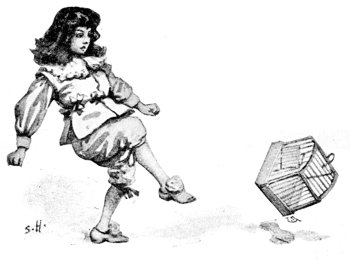
Then, putting the toe of his little silver-and-blue rosetted shoes
to the cage, he sent it flying to the other side of the room. That
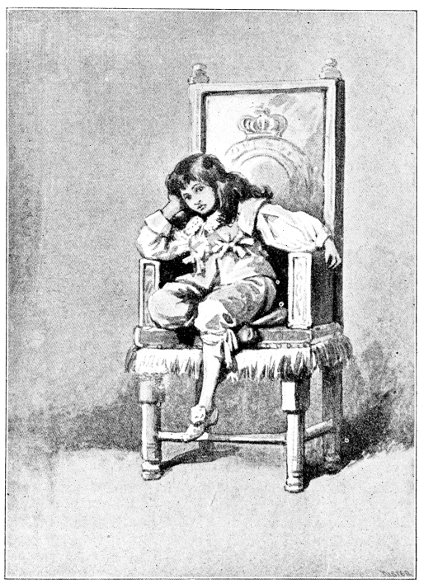
done, he dropped wearily down again in the great tall velvet chair,
and lolled back, a very picture of misery and discontent.
“Who’d imagine,” he muttered to himself, “that it was such a
horrid thing to be a Prince? I wonder if all Princes are so
wretched, or whether it is only Princes of Wales, like me?” Then
he yawned and lay with his eyes wandering listlessly round the
room, watching the rays of the afternoon sun as they poured in
at the lattice. The air felt stifling, for it was a small room,
considering, that is, that the house was such a large one; but
great mansions in those golden days, when Charles the First was
King, contained rooms of all sizes as well as all shapes. Rooms
were not merely four square walls, as mostly they are now, but
built as it might be into all sorts of passages and corridors and
staircase landings, now with a step or two up, now with a step
or two down. One reason for this was that, as time went on,
the owners of these big houses would add on a piece here, a
wing there, and the level of the old floors and the new floors
would not always exactly lie together, but it made the houses
much more amusing and snug to live in.
Such a queer hole-and-corner chamber was the old Cedar
Room, as it was called, in which little Charles Stuart, King
Charles the First’s eldest son, had been shut up for three weeks
past. The King himself, with his Court, had been in London,
but the Roundheads, who were the King’s discontented subjects,
and the Royalists, who were faithful to him, were glowing into
a red heat of rage with each other. It was no longer safe
for the little boy to be in London, and so the King had entrusted
him to the care of one of his most devoted friends and
counselors, who took him away at dead of night from London
to his home in Warwickshire, and nobody—not even the other
Royalists—was certain where the child was. Many thought that he
had been carried across the sea to France. It was not of much use
telling the boy that he had been taken away from his father and
mother for his good. The poor little lad was not old enough to
understand how this could be, and so he was very unhappy, and
he detested with all his might that old Cedar Room, and all that
was in it, though it was considered a vastly fine room, and a very
curious one. That, indeed, was one reason why Lady Chauncy, who,
for all her prim manner, was a most kind, motherly person, had
persuaded her husband to lodge the young Prince in it, “for besides
being so high up and remote,” said she, “the mannikins will
be huge and endless amusement for him, and make the time pass
more quickly till there is an end to all this pother, and the child
can get about again.”
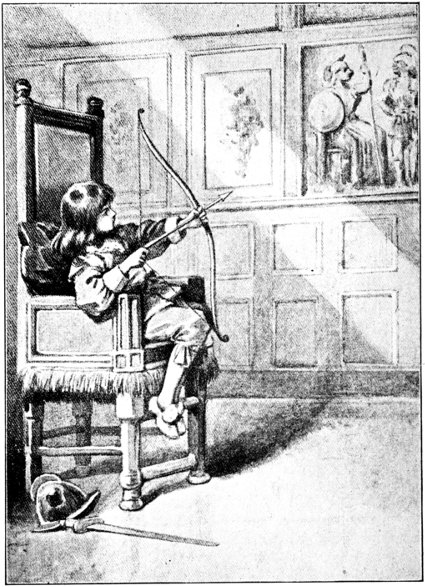
“When that sun-ray tips it with red, I’ll see
if I can’t hit it. I’ve hit a better
mark before now.”
Now, the mannikins, as her ladyship called them, were the little
figures carved on the panels of the walls all around the Cedar Room,
which was of a rather lop-sided shape, neither square nor oblong, but a
little of all three fitted into the uppermost part of an angle of the
mansion which jutted far over the moat. These panels were very
old, at least two hundred years, and the room was as ancient, but
its walls were as stout and sturdy as on the day they were made.
The panels were of Flemish carving, and they represented the gods
and goddesses of heathen mythology. There was Jupiter hurling
lightning from his throne, Juno with her peacocks, Vulcan hammering
away on his anvil, and Minerva sitting up very majestically in her
helmet and coat of mail, holding her shield. The faces, however,
of these far-famed personages were far from being like what Charles
had always imagined of them when his father had related tales
about them to him, as often he had done. According to this description
of them, which sometimes the King would read out loud to
him from the poetry-history of Homer, they were beautiful, even
glorious, to look upon, but these mannikins were as ugly and clumsy
almost as if they were made of gilt gingerbread. They were pretty
well as broad as they were long, dressed in jerkins, or muffled in
cloaks and full skirts, and their faces were almost all nose, that is
to say, where they had any at all, for many of the noses had stuck
out so far that they had got chipped off or worn flat. Why the
carver of all these gentry had made such a point of their noses
puzzled Charles, who for the first few days of his living in the Cedar
Room was certainly immensely amused with this silent, droll
company; but after a while he got cross with their dull faces.
“If they were real,” he said one day to Wynkin, “what blockheads
they would be!”
“And blockheads they are now,” had been Wynkin’s reply.
And if there was one of the wooden folk Charles found
more irritating than another, it was Madam Minerva. She sat up
so prim and cross-looking and her nose poking out from under her
helmet, bigger even than that of great Jove himself; or so it seemed
to Charles, as he lay listlessly watching the afternoon sun-rays
pouring in at the lattice, and listening half glad, half sad to the
piping of the happy merle in the elm-tree, and the voices of the
harvesters far down below in the fields.
How he longed to be with them and watch the loading of
those last sheaves into the big carts, and how stiflingly hot the
Cedar Room was, and how particularly forbidding and disagreeable
goddess Minerva there looked, and how uncomfortable and heavy
must be that scale armor of hers, and that shield, and the helmet,
not to speak of such a nose. Ah! And, stretching out his hand
over the arm of the chair, Charles picked up his toy bow, which
lay with his own gilt pasteboard cuirass and tin helmet and wooden
broadsword and other weapons on the floor, and setting the bow
with a bolt, he sat waiting. “Yes,” he murmured, with a wag of his
head, and setting his lips tight, “I won’t put up with her any
longer, her and her nose. And when that sun-ray
tips it with red, as in a minute or two it
will, I—I’ll see if I can’t hit it. I’ve hit a
better mark before now.” Then he waited and
watched, and the crimson gleams crept
on and on across the carved panels,
and—whizz! went the string, snapping
right back across Charles’s own nose
so sharply that it stung him and he
shut his eyes for a minute. When he
opened them he beheld a strange and
most unexpected
sight.
CHAPTER III THE DARK PASSAGE
The panel was turning round! slowly, but most surely turning
round, much in the way that a turnstile moves, as if on a
pivot or pin running from top to bottom of the wood.
Charles could hardly believe his eyes, which, indeed, after that
stinger from the bowstring, were for a minute or two not so trustworthy
as usual. He very soon, however, saw clearly enough that
the panel really was open, and now stood half-way inside the room,
half-way outside in the shadowy space beyond.
So amazed was he that for a short time he could not stir hand
or foot, and only stood staring at the panel. But if he had never
seen such a thing before, it was no great marvel, for not many
people had done so. He had not only heard of, but seen, panels
that lifted above into the walls, window-sash fashion, and panels
that slid back sideways into grooves, and in the hope that such
panels might be found in that room, he had spent hours in pushing
and shoving and poking about the edges and frameworks of the
carvings till his little fingers ached again. Then a hundred times he
had cried, “Open, Sesame!” as Ali Baba did, but nothing had come
of it. Yet now, here, in the most unexpected manner it had happened,
and accordingly, like people in general, big or little, when on those
rare occasions that which their heart most longs for comes to pass,
he stood as if he was dazed and unable to believe it true. He soon,
however, found his wits again, and slipping down from the chair, he
crossed the floor and peeped into the dark space, though gingerly
enough, lest the panel should think proper to snap to, and treat his
nose as badly as he had treated poor Minerva’s.
Then he carefully examined the condition of that good lady,
and found her to be not at all herself as he had hitherto had the
pleasure of her acquaintance. To
be sure she sat bolt upright as
ever, as far as her shoulders, but
her head hung down now all dingle-dangle.
Was her neck broken?
No; it was not as bad as that, it
was dislocated, and hung wobbling
by a sort of metal hinge to which
there seemed some wires and a
steel spring attached.
Well, certainly, thought Charles,
as he looked, those Flemish craftsmen
must have been very clever
fellows. He did not however
stop to think much about anything,
for the belfry over his head began
to sound with a terrific clangor
as he stood in the opening. Five
o’clock, and at five his supper was
always brought him, and after that
he had to go to bed. There was
not a moment to lose, and, after a very brief consideration he stepped
back into the room, and took off his doublet, putting it in a corner
of the window-seat. Being such sultry weather all he wore under
the doublet was the little shirt of fine cambric; then—but hark!
voices! Why, bless your heart, yes, the merle’s voice, and the harvesters
all rejoicing in the soft cool air which the waning day had
brought. Quite a little breeze, in fact, as it came rustling and
ruffling up from below to where Charles stood in the queer dark
nook outside the panel; but his eyes were growing accustomed to
the darkness now, and he could see that he was standing on the
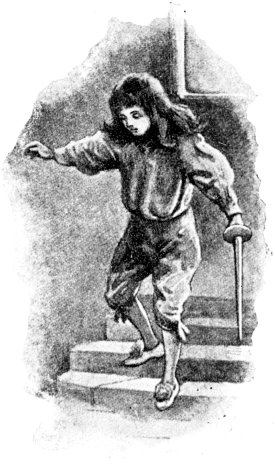
top of a staircase which wound down and down out of sight. There
was one thing he had forgotten, in all his excitement, and a thing
of the utmost importance too. His sword. He would not encumber
himself with his armor or other weapons, but as a soldier and a
gentleman his short sword he must have; and he went back again
and, picking it up from the floor, he stuck it into his belt, for he
needed both hands free. Then slipping out once more upon the
shelf of a landing, for it was no more, he drew the panel to. Had
he been able to see then on its other side, he would have seen
Minerva’s helmeted head pop up and settle itself all right and tight
on her shoulders, as if nothing had happened, but by that time he
was at the bottom of the staircase. It did not reach beyond a
turn or two, and ended in a long always-downward-winding passage
barely three feet wide and hardly higher.
Through this scudded Charles as well as he could, like a rabbit
in a burrow, always down and down, and twisting and turning,
guided by the glimmering of daylight which entered by little holes
pierced at few-and-far-between distances in the thick stone wall on
his left hand. Still on and on he went the downward way, till
at last the air began to turn from cool to clammy, damp, and cold,
and he stood still to listen, for there came a sound through the
deadly silence. It was the trickling of water, and he guessed he
must be close upon the moat.
The next moment he found his right hand was touching cold
moss-covered stone instead of dry wood as hitherto. His heart
fluttered like the wings of a bird, but he stepped on, feeling every
inch of the way. In this manner he descended several stone steps
that were slippery with ooze and felt jagged and crumbling under
his feet. At the bottom of the steps he found himself standing
on smooth and level ground, and, pausing to take breath, he listened
again. The water was over his head, he could hear it gurgling
slowly and solemnly on, and all round him was pitchy darkness,
but far on straight ahead he saw, or fancied he saw, a gleam of
reddish light.
Plucking heart of grace, he moved on again, and soon the fancy
became a certainty. It was the light of the sun now nearing the
end of his course, and it was piercing the bars of a grating. From
fluttering, Charles’s heart now stood still, for a great dismay seized
him. What if that grating closed in the passage? Why, then, since
he had noticed that there was no handle or mark of any kind at
the back of the panel in the Cedar Room, he would not be able to
open it, even if he dared to go back, and so he would be caught
like a rat in a trap! It wanted some courage to go on and make
certain, and only after a second or two he found it, and, groping his
way on, reached the grating, to find that it was as he had thought
so possible. The grating was just high and wide enough to allow
of a person getting out of it. It stood on the top of a steep narrow
flight of stone steps, and as Charles mounted these, the afternoon
sunlight broke upon it from the outside, and he saw that it was chained
and padlocked; but as he took hold of the padlock, it fell to pieces
in his hand, all eaten through and through with rust. Then he saw
that the links of the chain were equally useless, and as he gave the
grating a push they all rattled and fell helplessly to the ground.
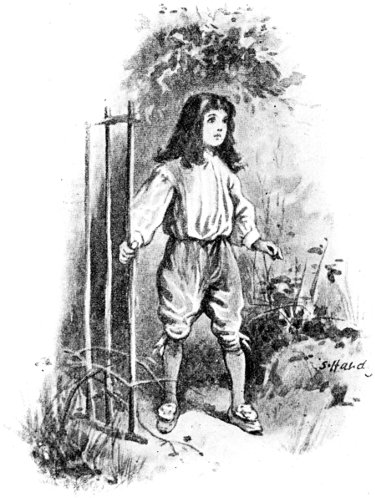
For a moment more the gate stuck hard, but with another
tremendous push of Charles’s shoulder, it yielded with a screech,
and swung back as far as a heap of mud and rotten leaves allowed
it to go, and this was far enough to allow of Charles’s slender little
body squeezing through.
When he got outside, he found himself—where? Ah! that was
the puzzle of it. That he was beyond the moat of course he knew,
but was he beyond the garden walls? If he was not—but he
was, a good way beyond, right out in the fields; for though he was
cooped up in a round sort of a bricked-in place like a well, and could
see nothing but a close tangle of gorse and bramble overhead, he
could hear the voices of the country folk, the neighing of horses,
and the creaking of wagon-wheels hard by. And all at once as he
listened the voices broke out in a loud cheery chorus. “Harvest
Home,” sang the men, women, and children, while dogs barked, and
the birds sang louder than ever:—
“Harvest Home!”
Merrily sing we all, “Harvest Home!”
And Charles knew that he was free.
CHAPTER IV A NIGHT JOURNEY
As the wagon-wheels creaked nearer and nearer, and the singing
of the merry-makers came past him, Charles had all the
work in the world to keep himself from leaping up out of the hole
to join them, they seemed so happy. He himself did not feel anything
like so happy as he had expected. He could not have laughed
in that light-hearted way as the children did, chasing each other
in and out of the gorse-bushes so near the edge of the hole that
he could have caught them by the ankles as they ran.
At last all had passed by, and the only sound to be heard was
the distant rumbling of the heavy-laden wagon-wheels down the hilly
lane, or could it be the roll of distant thunder? for as he peeped
over the edges of the hole he saw that the sun was setting in a
bank of nearly black clouds. When he thought, that he was quite
safe from being seen he scrambled up to the top of the hole,
and a strange sight he looked, for his velvet breeches and his shirt
and his face and hands were all one grimy drab color with the
cobwebby dust and dirt he had gone through. Really, if anybody
had spied him, there would have been no small difficulty in recognizing
the little Prince who always went so richly and tastefully
attired. No one, however, saw him as, taking one sharp look round,
he sped like a lapwing with bent head through the thick tall furze-bushes
covering the waste ground to the edges of the thicket beyond.
At the other side of the thicket ran the bright stream whose course
he intended to follow, as he knew that some miles ahead it joined
the river Thames.
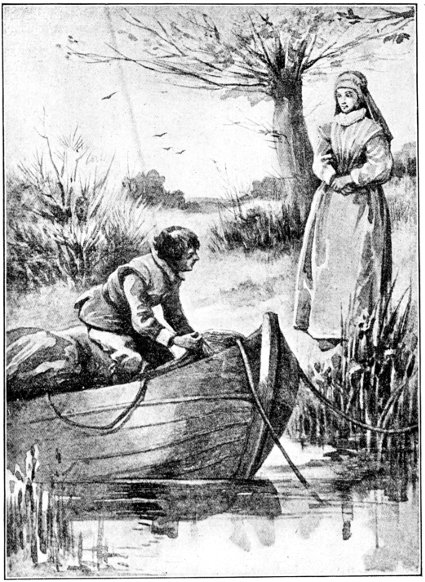
There, at the bottom of the broad steep-sloping bank he soon
reached, lay a largish boat tied by a rope to the stem of an elm-tree.
Charles’s heart leapt within him: that was just the thing he
wanted. Surely some kind woodland fairy must have placed it there,
as fairies do in story-books, for his convenience. The next minute
his delight faded out: another glance showed that the craft was
loaded rather heavily for its size with some wicker-baskets and a
small cask and a sack which peeped out from beneath a big
canvas covering, and of course to get in and row off, with all that
cargo aboard, would make him like a thief, so the plan was
impossible. While he was cogitating on this most difficult question
he heard voices, and voices that he knew well, too. No less than
those of Lady Chauncy and Wynkin, who seemed to be coming
through the trees. Charles turned all gooseflesh with dismay. To
make a run for it would, likely as not, land him right into her ladyship’s
stiff brocade skirts. There was not a minute to think, and
so he ran the other way down the bank faster than a rabbit, and
hey presto! with one leap he was at the bottom of the boat, and,
creeping under the canvas among the sacks.
Feeling as if his heart was really in his mouth, he listened to
what the lady and her serving-man were saying, and her ladyship,
who spoke first, seemed in one of her pleasantest humors.
“And so you are off, Wynkin,” said she; “well, the sooner the
better perchance, for I believe there will be a storm before morning,
and you have a long way to go, and your good father and mother
are, I doubt not, wearying to give you a welcome. You must tell
them that when his Highness hath been delivered safe back to his
Majesty out of our charge, you will tarry with them a longer time.
But now I shall look for you at midday to-morrow. Meantime I
shall wait upon the Prince entirely myself, since my husband desires
it. And so a good journey to you, and make my remembrances to
your parents, and I trust they will have good enjoyment of the
gallimaufries and the what-nots I beg their acceptance of, and that
your mother will find the red cloak warm and a good fit. Is all
well and securely packed in the boat, Wynkin?”
“Yes, madam,” replied Wynkin, making a low bow to his
mistress, though, of course, Charles was only able to imagine that.
“I have placed the cloak and the fresh butter, and the new-laid
eggs, and the manchets, all in their baskets between the sacks,”
and, stepping into the punt, he loosed the rope from the tree,
struck out into midstream, and away glided the punt to the music
of the river ripples.
“And so you are off, Wynkin; well, the sooner
the better perchance, for I believe there
will be a storm before morning.”
If Wynkin had only known what he was carrying away from
the Manor House along with his sacks and what-nots, as my lady
called them, he might have whistled other sort of tunes than the
jolly ones he indulged in as he punted on, on, till twilight darkened
into night, and Charles, cooped up between the sacks, could no
longer discern hedges from banks through the peephole he could
keep open for himself only with difficulty.
All of a sudden, just as he heard the distant church clocks
striking eight, a brilliant flash of lightning covered all he could see,
followed by a crash of thunder, and then down upon the canvas
covering pattered rain-drops as heavily as if they were crown pieces.
For a short time the hurly-burly was so terrific that he almost, if
not quite, wished himself back in the Cedar Room.
Just as the hurricane began to calm a little, Wynkin punted
towards the bank, which was now fringed by a row of pollard willows,
and he shouted to a man who was standing under them, “Is it
you, Dickon lad?”
“Ay,” answered the man, as he lent a hand to the punt, while
Wynkin jumped out of it. “A nice storm you be come in, brother
Wynkin.”
“Yes,” laughed Wynkin, “but ’tis giving over a bit now. Have
you got the cart?”
“Nay,” said Dickon; “old Dobbin’s so mortal afeard o’ lightning
that I wouldn’t bring him out, and I’ve trundled down the garden
wheel-barrer mysen, just to load with any small odds and ends you
may have with you, and in the mornin’ we can come down and
fetch the sacks, eh?”
“Right,” said Wynkin, “and here you are—catch,” and, stretching
his arm under the canvas without removing it, he drew out the
neatly packed baskets of good things which Lady Chauncy had sent
as presents to his parents. “Now then, help me to tow the punt
up alongside under the trees, and then we’ll be starting, for I’m as
wet through as a fish.”
Then in a few minutes they had the punt safely tied up to the
willow-stems, and away they went chatting cheerily as they trundled
the barrow over the bank into the wet road beyond. For the
first time Charles ventured to stir, creeping out from among the
sacks as quickly as his cramped limbs permitted, into the body of
the punt. He was chilled to the bone, and very hungry, and thought
longingly of that roast beef he had despised so much some hours
before, and he almost wished he had not left his doublet behind him.
Fortunately, however, in groping along, he tumbled right
down over something soft. It turned out to be the crimson frieze
cloak, which in the darkness and in the hurry must have dropped
out of the basket. How beautifully soft and warm and dry it felt!
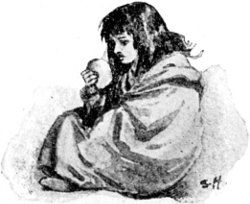
And with a cry of delight, Charles wrapped himself round in it from
his head to his little ice-cold feet, and then, as luck would have it,
out fell a manchet of the white bread, which must have caught in
among the folds of the cloak, and without more ado Charles took
a deep bite into it as he sat down in the bottom of the punt,
huddled up warmly in the cloak. “And then I must be on the
march,” he said to himself, cheered a little by the warmth and the
food, but before he had swallowed three mouthfuls, his eyelids
drooped heavily, his weary limbs
slackened, and he was fast asleep.
When he awoke, dawn was just
breaking fair and rosy over the
distant hills. He sprang to his feet
in affright, quite unconscious for the
moment where he was, but his wits
soon came back to him, and he
looked cautiously round across the
still, shadowy, low-lying banks. He
could now see that beyond the trees
stretched a gorse-covered common,
and between, alongside
the stream, wound a
road.
Drawing off the
cloak, he placed it back
under the canvas, though
rather reluctantly, for
the air was chilly.
Then, having made short
work of the morsel of
the white bread he
found in his fingers
when he first opened
his eyes, he mounted
to the edge of the punt
and sprang to the bank.
Reaching the road, he
walked on a little way,
looking cautiously every
step he took, but for
a good mile he did not
see a single human creature, though
the birds were singing lustily and
the bees and gnats were skimming
and skipping in the sunshine, for the morning
was lovely. But before long, however, the field
and farm workers began to be about, and in
spite of his best endeavors to dodge them by dropping in among
the hedgerows and the gorse-clumps, he was forced to face some of
them. They took little heed, however, of the little ragged boy, for
ragged enough he was in his down-trodden and sodden shoes, and
his fine white shirt and finest cloth gray breeches all gone to about
the same mud color. With his dark locks and swarthy cheeks
smudged with dirt and the juice of the blackberries he plucked and
ate hungrily as he hastened on, the good folk, if they noticed him
at all, took him for some gipsy boy. But his heart was beginning
to grow as heavy as his limbs, which were so weary that he could
hardly put one bruised and bleeding foot before the other. All his
merry adventure-loving thoughts were fading fast, and in their place
rose up the terrible fear that when he reached London the King,
instead of being rejoiced to see him, might be displeased. It was just
possible, and the more tired he got, the more possible somehow it
seemed, till at last he became terrified, for when his father was
angry, his frown made the hearts of even grown-up great lords
quake. All at once he fancied he heard voices calling, and overwhelmed
with terror and fatigue, he had just strength enough left
to hobble away into the wood which now ran along the roadside,
till he seemed quite hidden, and, huddling together into the hollow
of an old oak-tree, he sank down, sobbing bitterly.
CHAPTER V MOLLY
“What is the matter, itty boy? Why are you kying so?”
And while the voice spoke soft and sweet as the coo of
a dove, two little hands very gently, but firmly, clasped Charles’s
hands, which were covering his face, and tried to draw them away.
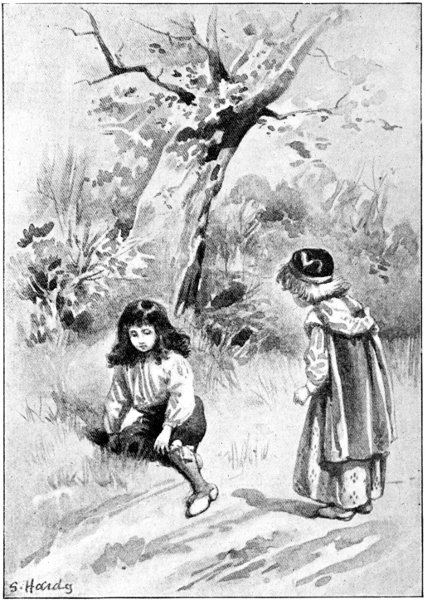
He looked up, and, rubbing the blinding tears from his eyes, he
beheld a little girl about six years old. She was a very chubby-cheeked
tot of a thing, with short golden curls running over her
head, and half covering her eyes, that were looking at him with
immense curiosity.
“Are oo a blackamoor?” she asked, shrinking back a step as
she saw his face.
“No,” said Charles, bursting into a merry laugh, “but I expect
I have rather a dirty face.”
She nodded. “Blacker than oor hands even. But what was
you kying for?”
“Well,” said Charles, “for one thing I—well, I’m dreadfully
hungry. I believe I could eat a horse.”
“Do you?” said the child, with a glad light in her eyes as she
opened a tiny satchel hanging on her plump arm, and taking from
it a splendid prancing horse with a king crowned riding on his back,
all made of gilt gingerbread. “I’s so glad—here’s a man on horseback
from Banbury Fair—can you eat him too?”
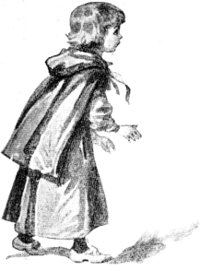
“Are oo a blackamoor?” she asked,
shrinking back a step as she saw his face.
“Truly yes, and thank you, little maid,” laughed her new friend,
taking the gingerbread from her tiny
fingers. “Why, ’tis the King! Long
life to his Majesty!” he added, as he
bit the man’s head off, and seemed to
enjoy it heartily. “What is your name,
dear?” he went on, with his mouth full.
“What is oors?” said she, with a
roguish twirl of her ripe red lips.
“Charles.”
“Ah, mine’s Molly—Molly Speedwell.”
“And whose little girl are you?”
“I’m the miller’s daughter of Oakside,
and there’s my home,” she went
on, pointing through the trees, and
Charles discerned a red-roofed, white walled cottage standing in a
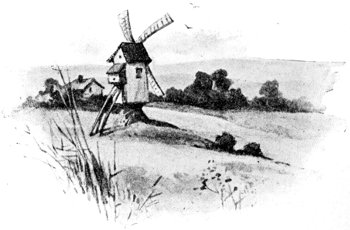
garden. Hard by, upon a high turfy mound, was a mill, whose sails
were whirling fast in the morning breeze. “And there’s the mill.”
“Oh,” said Charles, much disconcerted, “well, good-bye, little
girl.”
“Don’t go,” pleaded the child, the tears brimming into her eyes.
“Needs must—I’ve got to be in London as quickly as I can.
I’m going to see the King—” He stopped short and clapped his hand
upon his mouth.
“Then you may as well save yourself the journey, youngster,”
said a deep, manly voice behind him, with a laugh of amusement.
“The King is hundreds of miles away from London. He started
northward three days ago. And what, forsooth, can you be wanting
of the King?”
Charles turned dumb with confusion to see before him a man
white as a ghost from top to toe with flour. It was the miller,
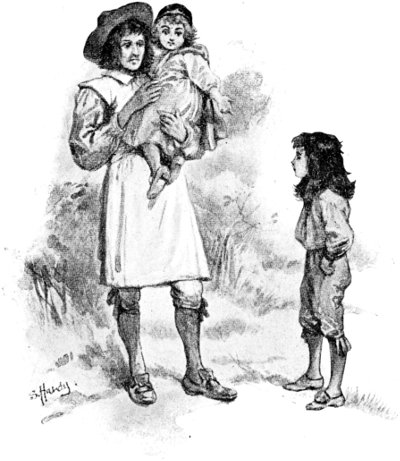
and taking up in his arms the little girl, who ran to him delightedly,
he went on, “What can a gipsy boy like you be wanting of
the King?”
“I am not a gipsy boy,” began Charles, “that is, I—I——”
“Always tell the truth,” said the miller. “Have you run away—from
your camp?” he added, when Charles did not answer.
“Where is the camp?”
“That’s just what I don’t know,” said Charles, who was thinking
always of the soldiers’ camp, while the miller had, of course, the
gipsies’ camp in his mind, as he looked at the little ragged boy,
whose face somehow pleased him, in spite of its grimy state.
“I can’t find it, and—and—” and the tears broke forth afresh,
“I don’t know what to do.”
And then Molly began to cry bitterly, “Poor itty boy,” she
sobbed. “He’s dot no home, daddy.”
“H’m,” grunted the miller, “and a lazy loon anyhow he is,
I’ll warrant.”
“No, faith, that I’m not,” contradicted Charles, with a flash of
indignation in his eyes.
“Would you like to work, if you’d the chance?” said the miller,
“at the mill here, for example?”
“Try me,” said Charles, looking longingly at the sails as they
twirled, dazzling as silver in the sunshine. Of all things in the
world, next to a colonel, he thought he would like to be a miller,
and have to do with those sails and great, fat sacks. “Only try me.”
“Very well, I will for a week,” said the miller, “but, mind
you, it isn’t play work. Come along. ’Tis a busy time, and I’ve
no objections to an extra hand, if he’s a good, honest one.”
Molly clapped her two little hands with delight, and trotted
off indoors to tell her mother all that had happened. And in an
hour there was a marvelous sight, for the blackamoor boy was
turned into such a whitymoor sort of a figure that there was
certainly less chance than ever of anyone recognizing him for the
little runaway Prince of Wales.
CHAPTER VI THE RED CLOAK AND THE BLUE ROSETTE
Meanwhile there was dire dismay at the Manor House when
Lady Chauncy entered the Cedar Room and found it empty.
She could not for a long time bring herself to believe her own eyes,
and when at last she was compelled to do so, she wrung her hands
and behaved almost like a frenzied creature. Both she and her
husband had believed the room to be the securest place in the
house, since the walls were of stone all round. That that one
square of stone had been cut out behind the panel with goddess
Minerva on it, nobody, in fact, had known for more than a hundred
years, when the Lord of the Manor House of that time perished
fighting for the White Rose, and the secret of the moving panel
had perished with him. That the young Prince could have got out
by the window was too terrible to think of. It seemed impossible,
moreover, for the lattice was barred, leaving but quite narrow spaces
between. Nevertheless, Lady Chauncy caused the moat to be
dragged, but happily, of course, to no purpose.
It all seemed like some dreadful conjuring trick. Lady Chauncy
did not know whether she was more glad or sorry that her husband
had not returned. About a fortnight hence he was to be
back, and the King with him, to fetch Charles away from the Manor
House. Meanwhile she hesitated to send information to his Majesty
of what had happened, because that would be spreading news which
the Roundhead party against the King would take advantage of,
and try to get the boy into their hands in order to drive a bargain
with King Charles. Could it be they, she asked herself in her perplexity,
who had spirited him away?
This was the terrible state of things Wynkin found when next
afternoon he returned to the Manor. He was the more troubled
by the thought that Lady Chauncy might imagine him to have
been untrue to his trust after so many years of faithful service.
“But what do you advise, Wynkin?” said her ladyship, impatiently
tapping the floor with the point of her silken slipper. “Do
say something,” she added, as Wynkin maintained a thoughtful
silence.
“Well, then, speaking what I think,” replied Wynkin, “it is
that I would advise your ladyship to get a good night’s rest.”
“Rest, forsooth. What next?”
“It is too late to be doing anything to-day.”
“And meanwhile?” cried Lady Chauncy despairingly.
“Meanwhile,” said Wynkin, “there is a good Providence over
us all.”
“Perhaps you are right,” said Lady Chauncy, as she rose and
went to her sleeping-chamber, but not to sleep.
When, however, the last light was out in the windows of the
Manor House Wynkin let himself out by a little postern of the
garden wall, and strolled onward by way of the bit of waste ground
till he reached the edge of the thicket, walking to and fro under
the trees by the dim light of the moon, cogitating deeply over a
curious circumstance which he had decided not to inform his
mistress of in too great haste, lest her hopes might be raised to no
purpose. The one very certain fact was that when he and Dickon
came that morning about six o’clock to unload the punt of the
sacks, he had found the crimson frieze cloak on the top of them,
all crumpled and mud soiled, and touched here and there with
marks like tiny finger-marks. In some dim fashion it made Wynkin
fancy that he began to see daylight. At all events, he suddenly
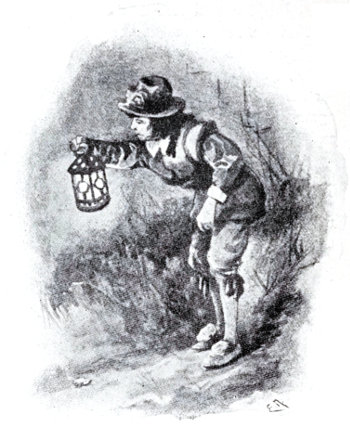
saw the light of a lantern dodging about before him among the
furze clumps—and as already more than a day had gone by since
Charles was missing, and such news spreads like wildfire in spite of
the utmost precaution, Wynkin was considerably disturbed at sight
of the light, which glanced now and again on the figure of a person
in a broad slouch-brimmed hat and shrouded in a long black cloak.
“Hullo!” he called, “who goes there?”
“Nobody,” replied a disagreeable squeaky sort of man’s voice.
“Anyway, ’tis no concern of yours.”
“We’ll soon settle that question, Master Jack o’ Lantern,” said
Wynkin, bounding down over the hillocks towards the figure. Not,
however, before the man, dropping the lantern right into the middle
of the gorse clump he was hovering over, was pelting off as quick
as his heavy cloak would let him.
In a minute Wynkin
would have laid
him by the heels, but
suddenly up rose a
tremendous flare, for
the lantern had fallen
open as it dropped
and the light had
caught the gorse,
and the strange part
of it all was that, as
the bush broke into
one huge flame, it
fell disappearing into
the ground, as if
there was a deep hole
beneath. Looking
down, that was
precisely what
Wynkin beheld,
a deep
hole, bricked
round, and in
one side a half-open grated door.
Looking regretfully enough after the fast-disappearing figure of
Master Jack o’ Lantern, Wynkin caught up the lantern and, setting
it straight, he jumped into the hole, where the bush was already
smouldering to nothing. He peered through the open grating, and the
next moment he passed in. “Where are we, I wonder?” he said
to himself, “and—hullo! what’s this?” he went on, as he nearly
set foot on something that glittered in the lantern gleam, bright
as a star.
It was a blue ribbon rosette, tied with silver cord, of the exact
pattern of the rosettes the little Prince was wearing on his shoes.
It was all sodden and soiled now with the mud it lay in, and
Wynkin picked it up as carefully as if it had been some little
wounded bird, and placed it inside his vest next his heart, which
beat fast with eager expectation. Then he hastened on, looking right
and left all the way he went, threading the windings of the narrow
passage, and up the twisting staircases, till at last he could go no
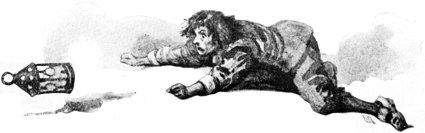
farther because the wooden panel barred his progress. “Oh, ho!”
again said he to himself, as he set his shoulder against the wood
and pushed it with so much more force than it required that it
flapped round before he could right himself, and he fell sprawling,
lantern and all, along the floor.
“By my faith!” he said, as he picked himself and the lantern
up, and stood looking round while he rubbed his shoulder, “it is
the Cedar Room!”
And then more clearly than ever Wynkin began to see daylight,
but all the same his face was very grave and anxious, for he was
vexed with himself that he had not first given chase to Master Jack
o’ Lantern, as he called him. “For what could he be wanting
skulking round the place like that for? Ill news flies apace, and I
doubt not the malcontents are aware already of the child’s escape.
Well,” he added more cheerfully,
“‘Hot boiled beans, and very good butter,
Ladies and gentlemen, come to supper.’
but for all the flare he made, he warn’t very warm, I fancy. The
boy is not in hiding hereabouts, if that red cloak means anything.”
CHAPTER VII HONOR BRIGHT
Ordinarily speaking, there is of course rarely much difficulty
in tracking little truant boys or even girls. Prince Charles
was not, however, a mere ordinary little boy. He was the King’s son,
and the people, who were beginning to think of fighting against
King Charles on account of displeasure with some of his ways of
governing, would have been very glad to get the child into their
power. They thought they would be able to make a better
bargain with the King, who would agree sooner to what they
demanded out of fear that, if he did not do so, they might harm
the little boy. There were good and just Roundheads, as those
discontented persons were called, who would not have lent their
aid or approval to such miserable and mean ways of settling matters,
and among the many of them was the miller of Oakside. He was
a strict Roundhead, and if the quarrel came to a fight, he was quite
determined that he would, if it was necessary, lay down his life for
what he considered the right and good cause, against the King.
Still he prayed and trusted that there would not be war in the
kingdom, and the sorry sight of Englishmen fighting with Englishmen.
It seemed too fearful, and he now went about his work with a
very grave face, though, in a general way, he was neither sad nor
sour-natured, but a brave, industrious, honest, cheery man.
When Wynkin was admitted next morning to Lady Chauncy’s
little sitting-room, he at once informed her of the past night’s adventures.
She was very much astonished at his discovery in the
Cedar Room. “’Tis certain,” she said, with almost a smile on her
troubled face, “that, as my husband so often hath said, ‘A fortress
is not stronger than its weakest part,’ which in this case appears,
from what you tell me, Wynkin, to be Minerva’s nose. But who’d
have thought it? and if your guess is correct about the red cloak,
as I am persuaded it is, that is the direction in which this most
naughty boy hath gone.”
And ere many days passed, Wynkin’s guesses became certainties,
for, after all, Oakside was only a very few miles from the village in
which his father and mother lived, for all Charles fancied he had
walked an immense long way that morning before he sat down and
sobbed under the oak-tree. Had the matter been merely one of
coming to Oakside, and fetching him away, the little runaway would
soon have been back again at the Manor, but it was not. There
were now spies, and a number of other evil-minded persons, loitering
for many miles round, ready to attack any of the Royalist folk,
as the King’s party were called, who should attempt to carry him
away from Oakside. While he was under the miller’s roof or in
his care, they did not dare to touch him, as the Miller himself
was a powerful Roundhead, and one who was much trusted and
very wise in his way.
Meanwhile, the miller’s boy turned out a capital boy for
such a small one. He was most diligent, rising with the lark,
and so obliging and obedient, and, though sad sometimes, he was
generally merry, singing at his work, and when the millwork was
done, he would fetch in water from the well for Mistress Speedwell,
and logs from the out-house for the great kitchen hearth-place, for
the evenings were beginning to grow chilly, and he played cat’s
cradle and spillikins with Molly, and cut out little men and women
and cows and dogs from paper, to her boundless delight, and the
miller, for all he was so silent, and even grim in his manner to him,
was forced to yield him a good word when Mistress Speedwell
would ask her husband if he did not consider that the shelter they
had given the poor forlorn gipsy lad had returned as a blessing on
themselves, for Mistress Speedwell did not know the truth, whatever
her husband might know, or whatever he might suspect.
The only fault Mistress Speedwell had to find with him was
that, though he kept himself very neat and spruce in the linen
jacket and breeches she made for him, he never could be persuaded
to wash the flour off his face. The reason he gave for this was
that millers were always white. It was the proper thing for them
to be so.
One evening she grew really angry about this, “Do you hear?”
she said, “I insist on you washing your face. When you came, it
was as black as a tinker’s, and then you had not been here a couple
of hours before you got it all over flour. If you do not do as I
bid you, I will take you and souse your head in the pail myself.”
“Please——” began the boy.
“Ah, please me no please,” she cried, turning to her husband;
“will you not have the urchin obey me?”
“You hear what you are bidden to do,” said the miller to the
boy, but he spoke rather unwillingly. And Charles crept off, daring
no longer to disobey.
“Ah, now,” said Mistress Speedwell, when he returned with his
brown cheeks shining like a warming-pan with the rubbing she had
bidden him not to be sparing of, and a deep flush from brow to
chin, “now we can look truth in the face,” and she was satisfied,
and settled quietly to her wheel; and Molly, who had been sorely
disheartened to hear her playmate scolded, smiled delightedly.
She thought it was the nicest boy’s face she had ever seen; but the
miller looked graver than ever, and only said “Umph!” as he
glanced over some letters he had received that day, and then sat
gazing in a very troubled manner into the fire.
The next evening soon after dark a solemn-looking, plainly-attired
gentleman rode up to the gate of the cottage and asked to
see Master John Speedwell. He was shown into the best room,
where he kept the miller talking for more than an hour, but the
interview did not appear to have been very satisfactory to the visitor,
who said to Speedwell, as he went away, “I trust that you will
come to see the error of your resolve. And,” he went on, when
the miller made no reply, “seeing that you are not rich——”
“No, I am a poor man,” said the miller, “but I hope always
to remain an honorable man, and I will give up the boy for no
money price.”
“Not even in the good cause?” scowled the stranger.
“The cause would be no longer good were I to do this that
you seek of me. So fare you well, sir, for by my honor, which I
have always kept bright and fair, I will deliver the boy only into
the hands to whom he belongs.”
“Well,” said the stranger, in deeply-angered tones, “you know
what to expect—I have warned you.”
“And though my house be stormed, and you should be able
to kidnap the boy—which I much doubt you shall succeed in
doing—I abide by what I have said,” replied the miller.
And so the stranger mounted his horse again, muttering and
grumbling till he was gone out of sight.
Then the miller returned to the kitchen, and sat down by the
fire alone. The rest of the little household were all abed. He
listened intently. For a long time there was no sound but the brisk
night wind stirring round the house, but as the village church-clock
struck eleven, there came a low tap on the lattice. The miller
rose, and, drawing aside the curtain, said in a low tone as he
opened the lattice, “Are you ready?”
“Ay, ready,” replied the person who tapped, dropping the folds
of the big cloak he was wearing from about his face, which was
Wynkin’s.
“’Tis well you are come to-night,” said the miller, “for my
house is threatened. They might even storm it to-morrow and
steal the Prince, for all my endeavor.”
“I dared not venture till to-night,” said Wynkin, “but I know
that this evening the coast is clear. They are all gone upon another
scent.”
“Come with me,” said the miller, and he led the way above
stairs. “Have you a horse?”
“Nay,” smiled Wynkin, “I have the punt; which is safer, since
it is less suspected, and it is freighted with half a dozen stout men-at-arms
under the canvas.”
“Take your treasure,” said the miller, as he unlocked a door,
and motioned Wynkin to approach the bed where the miller’s boy
lay sleeping soundly after his day’s fetching and carrying, “if indeed,
as I believe, it belong to your master.”
“Ay, truly it is our lost one,” murmured Wynkin, as he lifted
the sleeping child so gently in his arms that he did not stir, but
seemed only to breathe the more restfully as the trusty serving-man
wrapped his cloak close round him so that he could not be
seen. “Heaven reward you, Master Speedwell,” and, turning down
the stairway he sped out by the door, never stopping till he reached
the punt held fast alongside by many hands that stretched from
under the canvas covering. Then as the word was given, away, fast,
on and on glided the punt, and sleeping the restful sleep of a tired
child, the little Prince never stirred till far on towards morning just
before the breaking of the dawn, by which time he lay in his own
little carved bed in the Cedar Room shaded by its silken curtains,
and then Charles was too drowsy to understand much.
“Is that you, Wynkin?” he murmured, as at the sound of his
voice the serving-man came beside him, while Lady Chauncy and
Sir William, and a tall, dignified gentleman, who was the King, and
had but that night arrived at the Manor, drew back, lest they might
startle the boy. “Is it you, Wynkin, dear?”
“Yes, your Highness.”
“Ah! you don’t know what mighty strange dreams I’ve been
dreaming. All about windmills, and little tots of girls, and then,
oh, Wynkin, a terrible dark hole—so dark——”
“Think of that now!” interrupted Wynkin. “Well, if I were
you I’d wait and tell it all to-morrow.”
“Yes, and then I heard my father’s voice. I wish that wasn’t
all a dream, I can tell you.”
“Well, I expect that will be coming true before many days—perhaps
many hours—are over. But, go to sleep again now, won’t
you?”
“Yes. Is this the Cedar Room?”
“Certainly. You like the Cedar Room, don’t you?”
“Oh, yes. ’Tis well enough, but I don’t like the door of it to
be locked.”
“Oh, well, then we must talk to Lady Chauncy about it to-morrow,”
said Wynkin, as he stole a sly glance at her ladyship, who
smiled in her white prim frame of a cap. “It is a grave question,
and will have to be considered.”
“No, it will not,” said the Prince of Wales. “’Tis proper for
my wishes to be obeyed.”
“Well, if you promise not to run away, perhaps——”
“Run away—I do not want to run away. I——”
“You’d promise you wouldn’t?”
“Certainly.”
“On your honor?”
“Honor bright,” murmured
Charles as he fell asleep again.
It is hardly necessary to say
that Charles kept his word. The
favor he desired was granted him
after he had been summoned next
day to the presence of the King
and of Sir William and Lady
Chauncy in the dining-hall. Each
of them in turn pointed out to
him not only the terrible danger
he had exposed himself to by
running away out into the wide
world, but also the misery and
strife that had nearly come of it
for everybody—not by any means
least or last for good Master and Mistress Speedwell and the sweet
little maid Molly, who had been so kind and pitying of his plight.
After that Charles was permitted to leave the great shadowy hall,
and since the King and Sir William considered that he must have
suffered enough, and had shown himself brave as boys should be
under difficulties and privations, no more was said about the matter
by the King or by Sir William. Lady Chauncy, however, never
wearied for a long time of lamenting that she could not “give him a
good whipping as he deserved,” she said, “as much as any other
naughty little boy,” and to escape that was one of the very few advantages
Charles found in being the King’s eldest son, upon whom
at that time it was not accounted lawful to lay whipping materials
of any kind.
Till a short time after, when his father took him to London
with him, Charles had his freedom in the old house as far as his
given word allowed it him. As to Wynkin, he remained Charles’s
most trusty and well-beloved friend to the end of his long life.
Molly grew up to be a brave yeoman’s wife, and of winter
nights as she sat at her wheel and little, merry-faced, golden-haired,
blue-eyed children, like once she herself had been, were gathered
round her, she would relate the story of the gipsy boy who was
now King of England. As for the miller, he lived long and peacefully,
not mixing so much as of old in the affairs of the nation, but
attending to the grinding of his corn, and listening with a contented
mind to the music of the mill-sails, as they whirled in the wind.
[Transcriber’s note—the following changes have been made to this text: