“Some are born great, some achieve greatness, and some
have greatness thrust upon them.”
—Shakespeare, Twelfth Night
In 1951 the economy of Hong Kong set two memorable
precedents; it reached the highest level in the colony’s 110-year
history and then fell flat on its face. When the year ended, it
looked as if Hong Kong was finished as a world trading port.
Twelve months earlier all indicators had pointed toward a
continuing boom. Red China, frantically buying goods to
equip itself for the Korean war, had pushed the colony’s trade
volume to an all-time high of $1,314,000,000 in 1950. Buying
continued at the same furious rate until May 18, 1951, when
most of the trade was choked off by the United Nations embargo
on shipments to Red China. Even so, Hong Kong’s total
trade volume reached a new high of $1,628,000,000 in 1951.
The U.N. embargo administered the coup de grâce to
the crown colony trade with Communist China, but it was
only the last of a series of trade restrictions arising from the
Korean war. The United States embargoed all its trade with
Red China when the conflict broke out in June, 1950, and at
first included Hong Kong in the ban. The colony voluntarily
stopped its trade with North Korea in the same month and
banned a list of strategic exports to Red China in August, 1950.
In December, 1950, and March, 1951, the colony increased its
list of strategic items banned for export to China.
The cumulative effect of these restrictions, which were critically
important in checking Chinese Communist aggression,
was to push Hong Kong to the edge of economic disaster.
With the loss of the China trade, the colony lost half its export
market and about one quarter of its imports. This was the
trade which had always been the main reason for the colony’s
existence.
Prospects for reviving the China trade when the Korean war
was over did not look encouraging. Long before the embargoes
and restrictions had gone into effect, the Chinese had
begun to shift their trade from Hong Kong to Soviet Russia
and Europe.
Hong Kong had grown and prospered on its ability to receive,
process and reship the products of others, but its own
productive capacity was insignificant. With a few minor exceptions,
its industries—chiefly the building, repairing and
supplying of ships—existed to serve its trade. Its banks and insurance
companies, too, lived almost entirely on the colony’s
trade. Accordingly, when trade collapsed toward the end of
1951, the whole economy of the colony came crashing down
with it.
In the aftermath of the 1951 debacle, there was at first no
thought of substituting industry for trade. For a variety of
reasons, industry in the colony had never been developed independently
of trade. Certainly Great Britain had not established
the colony to produce goods which would compete with
English manufacturers. The Hong Kong market was too small
and its people generally too poor to support its own industries.
There was no tariff wall to protect the colony’s goods from
outside competition, and this factor alone had stifled several
early attempts to launch local industries.
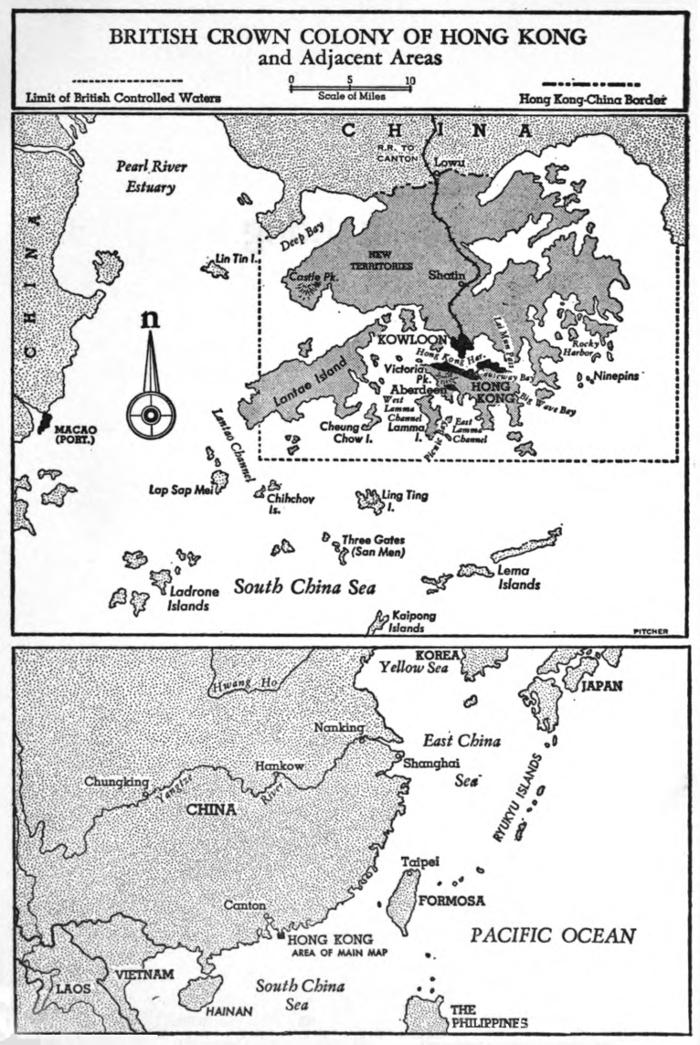
Many natural handicaps combined to make the colony a
most unlikely place for industry. Its mineral resources were
few and limited in quantity. It had no local source of power
to run a plant. Its water supply was chronically short of ordinary
needs and suitable land for factories was scarce and expensive.
The colony could not raise enough food nor provide
enough housing to take care of its potential factory workers.
And if anyone were imprudent enough to invest his money in
an expensive industrial establishment, how could he be sure
that the Reds would not move in and take it over, just as they
had grabbed the mills and plants of Shanghai?
The colony had a few assets worth noting, however. Its
government was stable and orderly, and had attracted a heavy
influx of capital from pre-Communist China and the shaky
regimes of Southeast Asia. Its banking, shipping and insurance
services were the most efficient on the mainland of Asia, and
its merchant community had well-cultivated connections with
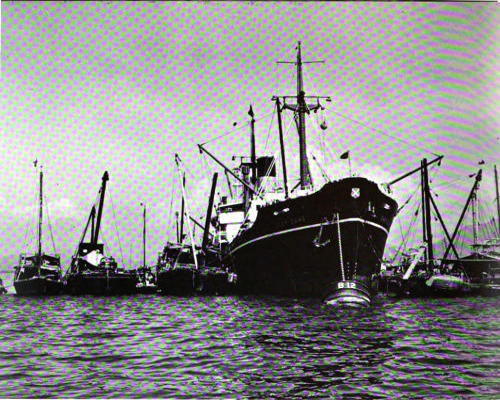
the world market. Its sheltered deep-water harbor was one of
the best in Asia.
The colony’s possibilities as a future industrial power were
further enhanced by an unlimited supply of cheap labor and
the immigration of skilled workers and experienced industrialists
from Red China. Its labor unions numbered in the hundreds,
but were so weakened by factional fights and political
objectives that they were unable to drive a hard bargain in
wage negotiations. Under Imperial Preference and the Ottawa
Agreements of 1932, colonial products paid a lower tariff rate
within the British Commonwealth than their foreign competitors.
Finally, any industry in Hong Kong could rely on one intangible
asset of unique value; the character of the average
Chinese workman. In most cases he was a refugee, uneducated
and penniless but determined to reestablish himself with any
job he could find. Having landed a job, he worked at it with a
diligence, energy and skill that astounded Western observers.
Although industry had accounted for a very minor part in
the colony’s economy before 1951, its beginnings go back to
the earliest years. Its first recorded product was the eighty-ton
vessel, Celestial, built and launched by Captain John Lamont at
East Point, on Hong Kong Island, on February 7, 1843. The
California gold rush of 1849 and the Australian gold strike two
years later caused a shipping boom in Hong Kong as scores of
sailing ships carried Chinese labor to work in the goldfields.
Shipbuilding expanded rapidly, a dry dock was constructed on
the island and a whole new industry of refitting and supplying
ships came into being. A foundry for the casting of ship
cannon was established in the same era when cannon were the
only valid insurance against South China’s coastal pirates.
A group of ship-repair yards was consolidated in 1863 as
the Hong Kong & Whampoa Dock Co., which subsequently
sold its Chinese facilities and established its headquarters at
Hung Hom, on Kowloon Bay. The Taikoo Dockyard & Engineering
Co. began operations at Quarry Bay, on the north
shore of Hong Kong island, in 1908. Between them, the two
yards have completed nearly 1,400 ships, ranging from large
cargo and passenger vessels to light harbor craft. Each company
employs about 4,000 men, which is still the largest number
employed by any Hong Kong industrialist.
These two companies, equipped to build 10,000-ton ships
and capable of repairing practically any ocean liner that enters
the harbor, remain the giants of local industry. But where they
and about two dozen smaller shipyards employed 28 percent
of the colony’s industrial workers in 1938, they now hire
around 3 percent. Theirs is not a declining industry, but it
has become a hopelessly outnumbered one.
The colony’s oldest export industry has a rather spicy history,
antedating the establishment of Hong Kong by at least
twenty years. A Cantonese hawker with an eye for trade discovered
that the roots of the ginger plant when boiled in syrup
had a strong appeal for British traders. Following the line of
the most susceptible palates, the merchant, Li Chy, moved his
ginger-preserving plant to Hong Kong in 1846. Some helpful
soul introduced the product to Queen Victoria, who was so
taken with its flavor that she made it a regular dessert at royal
banquets, and suggested that it be named the “Cock Brand.”
Whether or not the Queen’s intervention actually occurred is
open to question, but there is no doubt that preserved ginger
became a favorite English and European delicacy. Li Chy’s
Chy Loong Co. and a dozen eager imitators kept Caucasian
tongues tingling until 1937, when U Tat Chee, the Ginger
King, formed a syndicate to standardize quality and prices.
During the Korean war, the United States detected a perceptible
Marxist taint in the ginger that grew in Red China
and banned its importation. A more democratic strain was then
planted in the New Territories, and with suitable documentary
evidence, permitted to enter the United States. Preserved
ginger exports currently bubble along at 225 tons a
year, pleasing overseas tastes and being credited by the Chinese
with curing the lesser debilities of old age.
Sailing ships were insatiable rope-consumers, and from this
demand grew the Hong Kong Rope Manufacturing Co.,
formed in 1883, and still doing business in Kennedy Town at
the west end of Hong Kong Island.
The Green Island Cement Co., founded in Macao and transferred
to Hong Kong in 1899, drew most of its raw materials
from outside the colony to supply the local building industry.
After replacing a kiln and four grinding mills hauled away by
the Japanese in World War II, it got back into production in
time to ride upward with the postwar building boom.
The Taikoo Sugar Refinery Co., established in 1884, was
one of the first local companies to provide houses for its workers.
Extensively modernized in 1925, it prospered until the
Japanese looted and wrecked its plant so thoroughly that it
was unable to resume production until the fall of 1950.
A 55,000-spindle cotton mill made a pioneer beginning in
1898, but the unrelieved humidity of the climate damaged its
machinery and impaired its efficiency. Stiff competition did
the rest and it was out of business before World War II. Flour
mills and shell-button factories prospered for a time, then
wilted in the heat of competition.
As cattle country, Hong Kong is slightly superior to the
Sahara Desert. Nevertheless, Sir Patrick Manson, a doctor
who specialized in tropical medicine, decided to establish a
dairy company in 1886. He leased 330 acres of semi-vertical
pasture from the crown and his first herd of 80 cows
clambered and skidded around its dizzying slopes for a decade
until an epizootic of rinderpest exterminated them. A new
herd which soon outgrew its pasturage was stall-fed thereafter,
living on fodder grass hand-gathered by patient Chinese
women. Today’s herd includes about half the colony’s 3,000
dairy cows and is the chief domestic source of milk and butter.
The dairy company has proliferated into a nutritional
combine called The Dairy Farm, Ice & Cold Storage Co.,
which runs a chain of food stores, restaurants, soda fountains
and ice and cold storage plants.
The match-making industry, dating from 1938, offers a
gloomy illustration of Gresham’s Law. Factories were built
on Peng Chau, To Kwa Wan in eastern Kowloon and at Yuen
Long in the New Territories, turning out tiny, cheap wooden
matches. Factory equipment was primitive, wages low
and the matches, more often than not, splintery and unpredictable.
At its peak in 1947, the industry employed almost
1,000 workers, chiefly women. Then Macao entered the
market with still lower wages and skimpier matches. Every
box of Macao matches ought to bear the warning: “Take
Cover Before Striking Match,” but they far outsell the colony
product. They have also done a lot to stimulate the manufacture
of low-cost cigarette lighters.
Because of the colony’s habitual preoccupation with trade,
many of its industries existed for decades without attracting
much attention outside their own circle of customers. With
the collapse of trade in 1951, they assumed such unexpected
importance that they seemed to have been invented for the
occasion. Some of them, like the printing and beverage industries,
were a century old. Cosmetics, furniture manufacturing
and the fabrication of nails and screws dated from the
early 1900s. Three industries of considerable importance in
the export market—electric batteries and flashlights, rubber
footwear, and canned goods—had been around since the
1920s. Enamelware, electro-plating, machinery, tobacco, and
motion picture industries appeared during the depression decade,
and the leather industry emerged in 1947.
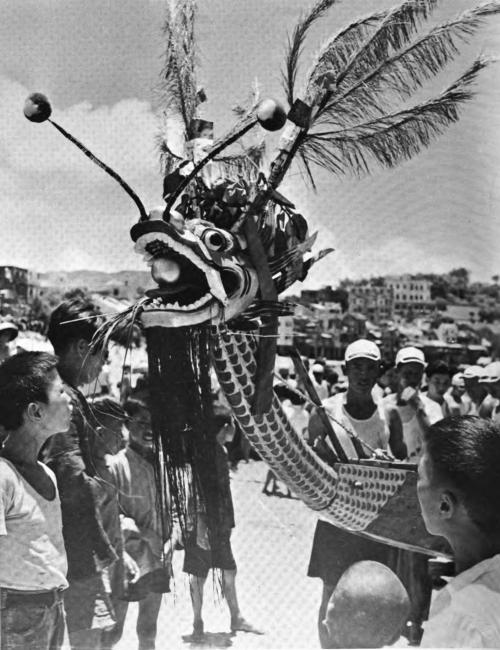
Cottage industries, or small enterprises operating out of the
home or a back-room workshop, are as old as Chinese civilization,
embracing everything from wood and ivory carvings to
musical instruments, jade, coffins, toys, beadwork, lanterns
and silk-covered New Year’s dragons. They average perhaps
a dozen employees each, and number in the thousands.
The colony government has kept a careful record of total
employment in registered factories (with 20 or more employees
and subject to government inspection) and recorded
workshops (15-19 workers and subject to inspection), but it
has never had a statistical record of the number of industrial
workers outside these two categories.
There are government estimates, but no precise figures, for
the number of persons working in cottage industries, or such
major industrial groups as building construction, engineering
construction, agriculture, fishing and public transport. Estimates
of the number of people working in shops, offices, and
other commercial establishments are even hazier.
A purely statistical assessment of changes in Hong Kong industry
that followed the 1951 trade collapse must necessarily
be limited to the registered and recorded industries. Luckily,
it has been the registered and recorded factories which most
clearly reflected the colony’s recent economic revolution.
Between 1947, when the postwar boom began moving, and
1951, when the U.N. embargo was imposed, the number
of registered and recorded industries rose from 1,050 to 1,961
and their employed force nearly doubled. The colony’s trade
had been shooting upward at almost the same rate, and the
Net Domestic Product (the total value of all its goods and
services) had increased by 75 percent.
The embargo halted the trade boom and reduced its volume
by almost one-third in 1952. Not until 1960 did the total
climb back to the record level of 1951. Colony traders,
abruptly cut off from the China mainland market, had to find
new markets or liquidate their accumulated stocks. Some
found new markets in Southeast Asia; others liquidated their
stock for whatever it would bring. Colony imports rose uncomfortably
above exports, investment capital began searching
around for better opportunities outside Hong Kong and
unemployment became an additional cause for anxiety.
One obvious need was to step up the colony’s export volume
at once. It was in this situation that the “poor relation”
in Hong Kong’s economy—its industry—came into its
own.
Despite its rapid postwar growth, the colony’s industry
had supplied only about ten percent of the products it exported.
In simple desperation, the traders invested their
Korean war profits in local industry. So also did the transplanted
Shanghai industrialists who had lost their factories to
the Chinese Communists but had retained their capital and
managerial skills. The effect on Hong Kong was basic and far-reaching.
After a two-year period of readjustment, the number of
industrial undertakings, or individual registered and recorded
manufacturers, increased at the rate of 500 a year. Employment
in the industries more than doubled; by the end of 1961,
the colony had 6,359 companies with 271,729 workers. The
climb continued into 1962.
Local industry, which had once contributed only ten percent
of the value of colony exports, contributed more than
seventy percent by 1962. Trade had made its comeback by
then, but it showed no sign of regaining the dominant position
it had occupied until 1952.
Entirely without warning and almost against its will, Hong
Kong had become a manufacturing center instead of an entrepôt.
New industries had cropped up from nowhere, taken a
firm hold and climbed to the most important positions in the
colony’s productive economy. A few of the old industries
had slumped, but most were expanding with the general prosperity.
During the uneasy two-year period of transition from trade
to manufacturing, the colony had to lay down two sets of
regulations to stabilize its trade relations with Japan and the
United States.
Japanese industry, swiftly reviving during the American
Occupation, began pouring cotton yarn and piecegoods,
household utensils and metalware into the Hong Kong
market. In 1952, Hong Kong imported four times more from
Japan than it exported to her. But the colony was less concerned
about export-import balances than it was over reducing
the Sterling Area’s adverse balance of payments with
Japan. Japanese imports were tightly restricted or suspended
from early in 1952 until the second half of 1953. Meanwhile,
local industries enjoyed a welcome breather from Japanese
competition, especially in their home market.
Restoration of trade with the United States was essential.
The volume of this trade had taken a steep dive after the U.S.
and U.N. embargoes on trade with China, and the United
States wanted no Communist products funneled through
Hong Kong, nor any Red Chinese raw materials fabricated in
the colony. The Hong Kong Commerce and Industry Department
and the U.S. Treasury Department finally worked
out a solution: the Comprehensive Certificate of Origin, covering
every kind of goods that might be suspected of Red
Chinese origin. Among these were silk, linen, cotton, jade,
furniture, Chinese antiques and handicrafts. Goods of North
Korean origin were similarly classified.
In enforcing the Comprehensive Certificate of Origin regulations,
the Commerce and Industry Department directly supervises
the raw material supply and the finished products of
the factories; in some cases, it seals the goods after examination
and keeps them under surveillance until they are exported.
Severe legal and administrative penalties are slapped
on manufacturers or dealers who are caught falsifying a Comprehensive
Certificate of Origin. The colony government
protects the validity of the certificates to insure trade relations
with its biggest customer, and because it gives the colony
a monopoly on certain goods for which Red China would
otherwise have the market sewed up. The most vociferous
critics of the Comprehensive Certificate of Origin are American
tourists who recoil from it as if they had been handed
two sets of income-tax demands for the same year.
With the road clear for industrial expansion, the response
was overwhelming, and more than half the growth came in
six light industries. Between 1948 and 1958, the six light-industry
groups showed these increases in employment: garment-making,
20,000; metal products, 13,000; cotton spinning,
11,000; cotton weaving, 9,000; plastic wares, 8,000; and rubber
footwear, 3,000.
At the end of 1961, registered and recorded industries employed
a round total of 272,000 persons, with 42 percent of
these workers concentrated in two categories; textile-making
with 69,000, and garment-making with 45,000. Metal products
were third in line with 28,000. Shipbuilding and ship-breaking
employed 13,000. Plastics, non-existent until 1947,
had separated into two major industries, plastic wares and
plastic flowers, with each employing around 13,000 workers.
Food manufacturing, printing and publishing, rubber products,
machinery, electrical apparatus and chemicals were the
other leaders. In the metal-products line, just one of its many
specialized products, the manufacture of flashlight cases, employed
more than 6,000 persons.
The success of Hong Kong’s light industries is typified by
three of its leaders in plastics, textiles and metal wares. The
Three Ts—H.C. Ting, P. Y. Tang and John Tung—were
prosperous Shanghai industrialists when the Chinese Communists
closed in on them. Each one managed to reestablish
himself in Hong Kong as the head of a major industry. Together,
they represent one of Red China’s unintentionally generous
gifts to the colony—the exodus of capital and management
skill. A whole new complex of tall, modern buildings
in the North Point section of Hong Kong Island called Little
Shanghai is a monument to this newly arrived capital.
H. C. Ting, managing director and principal owner of Kader
Industrial Co., Ltd. at North Point, began as a battery salesman
for a Shanghai factory, set up his own company, the Wei
Ming Battery Works, in 1925, and began tinkering around
in a laboratory to develop a long-lived battery. He picked up
his chemistry as he went along and painstakingly dissected
hundreds of messy cells until he evolved a really durable battery
that sold well. He branched into flashlights, bulbs and
carbon rods, survived the Japanese invasion of China and
planned to try his luck in the plastics industry after the war.
Foreign exchange limitations made it impossible to equip a
plastics factory in Shanghai, so he sent a group of his employees
to Hong Kong in 1947 with instructions to set up a plant.
The new factory was to include a cold-storage unit which
could cool and store plastics and also make ice for sale. It
was a dismal flop and Mr. Ting hurried down the following
year to untangle the snarls. He soon discovered that he had,
in effect, enrolled himself for a cram course in refrigeration
engineering, but he learned enough to make the plant pay.
Today the North Point plant, greatly enlarged, employs
1,300 people and makes 400 different plastic items. Its four-story
building of prestressed, reinforced concrete backs into a
rocky hillside which is being blasted away to make room for
a new ten-story plant. Mr. Ting trains all his own workers,
pays them straight wages instead of the usual piece-work rates
and hands out annual bonuses, in some instances, equal to ten
months’ pay.
Operating on the general premise that he’ll try anything
until he makes it work, Mr. Ting designs many of his own
products, and if he can’t find a machine to make it, designs
that also. One machine molds a plastic automatic pistol and
its bullets in a single operation; the model is so precisely fitted
that it works as smoothly as the original gun. Other machines
mold a pair of binoculars with one press, then equip it with
accurate lenses stamped out of clear Styrene plastic. A plastic
doll, including the eyes, is pressed out in seconds, but the mold
has been carefully developed from a hand-made clay original
that is reproduced first in plaster of Paris and then in polyester
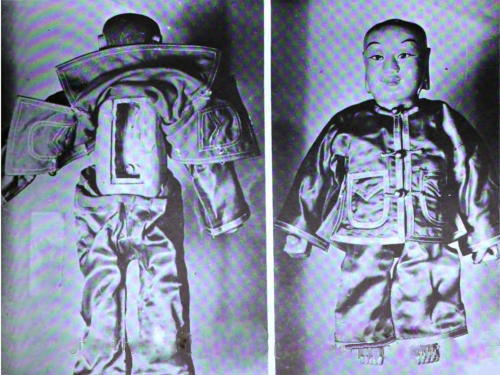
before the steel die is cut. Dressing the dolls keeps 100 girls
busy at Kader sewing machines. The plant works three shifts
daily, but Mr. Ting sleeps through one shift at his penthouse
on the roof. His latest venture is transistor radios, jointly undertaken
with a Japanese electrical appliance company.
“We can compete with anything except junk,” Mr. Ting
said. “If Hong Kong turns out quality products at reasonable
prices, we can gradually raise the living standards of our labor
to the level of other countries. It can’t be done overnight; they
tried it in Red China and failed.”
P. Y. Tang, head of the South Sea Textile Manufacturing
Co. at Tsuen Wan, is an engineering graduate of the
Massachusetts Institute of Technology and the largest producer
of cotton yarn and grey cloth in the colony. His main
plant covers nine acres along the waterfront and contains
45,000 spindles and 900 looms. Its employed force numbers
2,100.
Tsuen Wan, now an industrial center with more than
60,000 residents, was a village with a few huts and no roads
when Mr. Tang erected a pilot plant there in 1948. He had
brought 300 technicians and skilled workers, plus his own administrative
experience as managing director of the gigantic
Ching Foong Cotton Manufacturing Co. in Shanghai and
other cities of China.
Experience was not enough; Hong Kong had practically
nothing to help the mill get started—no cotton, power, spare
parts, skilled labor or parallel industries, such as weaving and
garment-making, that could use yarn and doth. There was no
local market and the humid climate quickly rusted the machinery.
Mr. Tang beat the rust problem and shaved his operating
costs by keeping the machines in continuous use, running
8,500 hours a year, compared with 3,700 hours a year in German
mills and 1,500 hours in English ones. He opened up new
markets for his prolific output in Great Britain, the United
States, Australia, Africa, and elsewhere. His early sales were
made at a loss, but with his markets established and Red China
knocked out of the market by the U.N. embargo, South Sea
sales and profits soared.
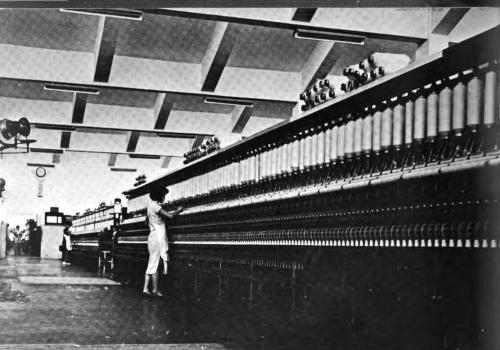
The main plant is completely air-conditioned, reducing
summer working temperatures by twenty degrees. The spindles
and looms, imported from Japan, England, Switzerland
and the United States, are the finest obtainable. Much of the
carding, combing, and sizing machinery is fully automatic,
tended by Chinese girls in their early twenties. Some of the
girls appear to be prematurely grey, but it’s nothing more
than loose cotton that has settled on their black hair; all wear
breathing masks to protect their lungs from floating cotton.
Every phase of the operation is under strict quality control,
preserving the uniform diameter of the yarn and testing its
tensile strength.
The South Sea plant sometimes disconcerts visiting textile
executives, who expect a Hong Kong textile mill to look
like an over-extended cottage industry. What they find here,
and in several other Hong Kong mills, is a streamlined efficiency
equal to the best in the world.
The young men and women employees, most of them single,
live in free dormitories near the plant, pay an average of
27 cents a day for meals and have a choice of Cantonese,
Shanghai or Swatow cuisine. They have workmen’s compensation,
a barber shop with electric hair-dryers for the women,
a vocational training program, and for high-performance
workers, a lounge and recreation center. The plant is non-union,
with a six-day, 48-hour week. Wages are slightly above
the colony average for a registered factory, ranging from
$1.38 to $2.25 a day.
Mr. Tang has been in the thick of the fight to protect the
colony’s textile industry from demands—especially clamorous
in England and the United States—that its exports be reduced.
“I just can’t see the wisdom of Western powers in restricting
Hong Kong textile exports,” he told David Lan, a reporter
for The China Mail, a colony daily. “We have no hinterland
or diversified industries to which refugees may turn from a
threatened textile industry.”
“From 1959 through 1961, total colony exports of cotton
piece goods were less than 5 percent of Great Britain’s production,
and 0.53 percent of United States output,” he stated.
“We are asking for no aid but only a fair chance to trade,”
he said.
John Tung, third of the alliterative industrial Taipans, has
been connected with the colony’s metalware industry since
1937. Like Mr. Tang, he was the son of a Chinese industrialist.
His father started the I. Feng Enamelling Company in Shanghai
shortly after World War I and established a Hong Kong
branch in 1937. John, working part-time for his father while
he attended the University of Shanghai, left both school and
job and founded his own firm, the Freezinhot Bottle Co., to
manufacture vacuum flasks. By 1940, he, too, set up a Hong
Kong branch. When the Communists expropriated Shanghai
industries, he moved to the colony to direct both the I. Feng
and Freezinhot branches.
The I. Feng enterprise prospered, and in the familiar
Hong Kong pattern, dozens of small operators rushed in to
cut some of the pie. By 1956 there were approximately 30 of
them in the field and Mr. Tung had to cut back his production.
The marginal companies went broke in the glutted
market, but I. Feng remained the largest in its line. Mr. Tung
proceeded to build the Freezinhot bottles by handling all the
manufacturing processes in his own plant, instead of the usual
practice of contracting them out, and successfully invaded
Japanese markets in Africa, Latin America and Southeast
Asia.
Like many other Hong Kong manufacturers, he set up subsidiary
companies outside the colony. Bet-hedging is widely
practiced among colony entrepreneurs; the economic climate
is unpredictable and no one wants to be caught flat-footed. In
the colony, Mr. Tung also runs a firebrick works, a marble
plant and a trading company, shuttling daily between his various
offices.
He takes a coolly realistic view of tomorrow’s prospects,
declaring that the market for enamelware and vacuum bottles
in underdeveloped countries will drop when hot running
water, electric percolators and refrigerators make his products
less useful, or the countries develop their own industries
to meet the need. He probably would not be offended if his
potential competitors subscribed to this pessimistic outlook.
Mr. Tung’s survival in the 1956 enamelware boom illustrates
a recurring weakness in the colony’s economy, the
perennial, headlong dash to make a fast dollar. The urge is
irresistible, with new industries coming over the horizon and
eager money lying in wait for them. At the first sniff of profit,
the money swarms into the latest bonanza, fresh companies
pop up like dandelions and products flood the market. Older
firms slash prices repeatedly to meet each competitive assault;
presently, the bottom falls out and half the old and new
companies disappear in a welter of bad debts. The frantic
cycle has swept through the apparel, film, glove, plastic
flower, and enamelware industries without losing any of its
momentum or lure. It is often and justly deplored, but in
Hong Kong it will always be difficult to find an investor panting
to turn a slow dollar.
The race for a quick profit careens along at a perilous pace
in the colony’s building industry, where the investor in a large
apartment or office building may get all his capital back within
four years, or go broke in six months. The industry moved
ahead at a moderate $25 million-a-year rate until about two
years after the post-embargo manufacturing boom began.
Then it took off, reaching a new record of $42,000,000 in
1959. In 1960 it shot up to $69,000,000, and held the steep
angle of climb into 1961.
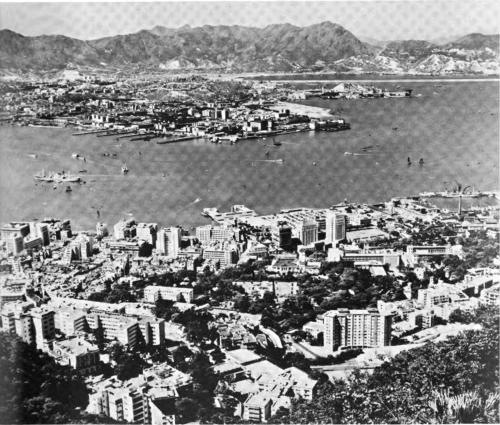
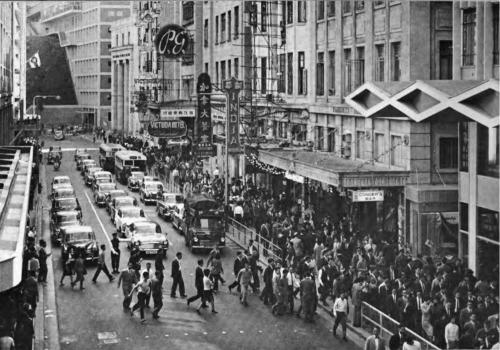
It is the building aspect of Hong Kong’s industrial spurt
that strikes every visitor at once. A skyscraper bank building
and two hotels, of 600 and 1,000 rooms respectively, are going
up in the central business district of Hong Kong Island. There
is hardly a square block in the main business area where there
is not at least one building under construction.
The transformation of the Tsim Sha Tsui section at the
tip of Kowloon Peninsula is even more startling. In the 1920s,
it was predominantly a quiet house-and-garden neighborhood
strung along both sides of Nathan Road, the main north
to south street. The Peninsula Hotel opened at the south end
of Nathan Road in 1928 to become the new social center of
the colony, and its Peninsula Court annex was added in 1957.
During the 1950s, Tsim Sha Tsui slowly became an area
of small hotels and luxury shops catering to tourists. An epidemic
of building fever swept over it in 1959, and the place
will never be the same again. Three huge hotels—the Ambassador,
Imperial and Park—opened in 1961 with a total of
1,025 rooms. Two years later, the 800-room President was to
join the Kowloon tourist parade. Tall apartment buildings,
reaching almost as high as their rents, and an assortment of
compact luxury hotels, sprouted through the thick crust of
tourists and shoppers. Guests at the top of the newly opened
Imperial Hotel looked down on a scene of general devastation
at the opposite side of Nathan Road; dozens of old structures
being demolished to make way for larger and more expensive
ones.
New hotels opening throughout the colony in 1963 will
add 3,368 rooms, doubling its tourist capacity. Many of them
will show the familiar marks of speculative building—undersized
rooms, insufficient elevator service, thin walls and
cracked masonry. The best hotels will stay the course, but the
merely flashy ones may be pulled through the same wringer
as the overly eager, overnight speculators in other industries.
The construction industry, which employs 160,000 people,
roughly estimated, was also active in less speculative projects.
From 1957 through 1961, it erected more than 200 factories,
many of them on reclaimed land. Government construction
on water-supply facilities, land reclamation, and
resettlement estates ran just over $40,000,000 in 1960-61,
and was scheduled to increase considerably in the next fiscal
year.
All of the large new hotels in Hong Kong were built to
serve a tourist trade which could scarcely have supported
three of them in 1940. For well over a century, Hong Kong
had about as much tourist appeal as the islands of Langerhans;
and in its early days, the English used to sing a derisive song,
“You can go to Hong Kong for Me.” In the popular mind, it
was associated with such disagreeable phenomena as rainstorms,
typhoons, floods, pirates, malaria, bubonic plague,
squalor and poisoners. Most of these scourges have disappeared,
but it took travelers many years to forget them.
People went to Hong Kong only on government or private
business or because, being either rich or retired, they had been
everywhere else and wanted to add one more odd-sounding
place to their itinerary.
Distance alone was a formidable obstacle; by today’s shortest
air route, Hong Kong is 10,611 miles from New York and
7,286 miles from London. It was much farther by ship, and
it took weeks to get there. Imperial Airways opened the first
regular airline service from Europe in 1936, and Pan American
World Airways started weekly transpacific flights in
1937. Early flights from New York or London still required
a week, more or less, and although faster piston-engined
planes gradually pared down the time, it took the introduction
of jet airliners in 1958 to cut the longest flights to
approximately 24 hours.
The new Kai Tak Airport, whose 8,350-foot runway juts
into Kowloon Bay on a strip of reclaimed land, opened on
September 12, 1958, six weeks earlier than the first oceanic
jet passenger service. Scheduled ocean liners and cruise ships
continue to call at Hong Kong, but four-fifths of all tourists
arrive by air at Kai Tak. More than 210,000 of them came in
1961, with Americans and residents of the British Commonwealth
comprising the two largest groups. Not included in
this total are the 132,000 members of the American armed
forces who had shore leave in the colony during 1961. For
many years they have been the largest group of colony visitors;
liberal spenders and generally law-abiding.
After ignoring Hong Kong effortlessly for decades, Americans
had their attention drawn to it by a variety of stimulants.
Hollywood motion pictures such as Soldier of Fortune,
Love Is a Many-Splendored Thing, The World of Suzie
Wong, and Ferry to Hong Kong were of varying artistic
merit, but they all helped the tourist business. Television, radio
and film personalities—Arthur Godfrey, William Holden,
Jack Paar, Ed Sullivan, and David Brinkley—presented documentary
reports on the colony. There was even a television
adventure serial about Hong Kong, but with the exception of
a few on-the-spot film clips spliced in for authenticity, it dealt
with people, places and customs unknown to any colony resident.
Tourism stands next to the textile industry as a source of
foreign exchange and it has created thousands of jobs for
hotel and restaurant workers, entertainers, guides and shop
clerks. Recognizing its economic value, the colony government
set up the Hong Kong Tourist Association a few years
ago. The association beams its Lorelei serenade to tourists overseas,
but in its own yard, it functions as a watchdog. Its warning
yip is brief: Don’t flim-flam the tourists, or you’ll kill a
$120 million-a-year industry.
Transportation facilities in and out of the colony are
equipped to handle any foreseeable increase in freight or passenger
traffic during the next few years. Seventy-six shipping
lines sail to 234 ports around the world. Nineteen airlines
operate out of Kai Tak, with the four busiest—Cathay Pacific
(chiefly regional), British Overseas Airways, Pan American
and Japan Air Lines—averaging two or more arrivals and departures
every day.
No one has the exact figures on how many people are employed
in all the industries of the colony beyond the registered
and recorded factories and including every category.
But 1,200,000 have some sort of job, whether working at
home, in factories, on farms, at sea or for the government.
Government employs about 50,000.
There is no minimum wage. Most workers are paid by the
day or on a piece-work basis. Normal daily wages of industrial
workers are 50 cents to $1.30 for the unskilled, $1.20 to
$1.70 for semiskilled, and $1.30 to $3.50 for skilled men.
Women get 30 percent less than men. Overtime is at time and a
quarter or time and a half, with the latter prevalent. Incentive
pay is given for good performance and attendance. Some
companies provide free or subsidized food to compensate
workers for cost-of-living jumps. A bonus of one month’s
wages is paid by many companies just before the Chinese New
Year.
As a rule the European firms and a few westernized Chinese
firms provide a cost of living allowance on top of the
basic wage. Yet in spite of rapid industrial expansion, inflation
has been slight; the index rose only 22 points between 1947
and 1961. The eight-hour day and six-day, 48-hour week are
observed by most European companies, but some Chinese
companies have an 11-hour day. Women and all workers
under eighteen are given a second rest day a week by law.
Many big companies, especially those dealing in textiles, provide
dormitories and free bedding for unmarried workers;
some house the families of married workers, and the government
encourages this practice by providing land for such
quarters at half the market price. A few companies provide
recreation rooms and free transportation to and from the
job. Workmen’s compensation insurance has been prescribed
by law since 1953. Women, as well as children under fourteen
years old, may not work between 8 P.M. and 7 A.M.
Hong Kong wages look tiny to an American worker who
earns more in an hour than a colony factory hand receives in
a day. But the chasm between the two standards of living is
not so vast. The Hong Kong worker takes the bus, streetcar
or ferryboat for less than two cents a ride; his lunch costs
about ten cents, and his month’s rent is under $5.00 if he lives
in a resettlement estate, and below $23 a month if he occupies
a low-income Housing Authority development unit.
There are 245 labor unions in the colony, but they lack biting
power in wage negotiations. Three have more than 10,000
members each: the seamen’s union; the spinning, weaving and
dyeing workers; and the motor transport workers. These
three, with the unions of the seafarers, workers in Western-type
employment, restaurant and café employees, government
workers and teachers, represent 40 percent of all union
membership. The unions split into a pro-Communist Federation
and a pro-Nationalist Council. The pro-Red unions are
strongest among seamen, public utilities, shipyards and textiles;
the anti-Reds are most influential in the building trades,
food and catering and numerous small industries. Only 25
of the 245 labor unions are free of political leadership. Collective
bargaining is generally confined to the transport, printing,
and enamelware industries, and to taxi drivers.
Most wages are set by agreement between the worker and
his employer; the agreement is verbal and follows no uniform
wage-scale. Family connections, references from friends, or
the contracting system are used to get jobs. Except in the large
shipyards and textile mills, the apprentice system is mostly a
matter of observation and imitation. Several private trade
schools train boys and girls in various jobs, and Hong Kong
Technical College and Hong Kong University teach engineering,
commerce and highly advanced technical specialties,
with the university giving a full range of professional training.
But when all are combined, they fall far short of the
demand.
The majority of the colony’s industrial workers impress
both employers and outside observers as industrious, purposeful,
capable and intelligent. They are unwilling to make
bold, independent decisions, some employers complain. On
the other hand, they are seldom encouraged to do so.
In the last few years, an increasing number of American
businessmen have found the risks and rewards of the colony’s
economy well worth their interest. The first American trading
concern, Russell & Co., was established there in 1850, but
the road was rocky, and Russell, along with several later
Yankee traders, faded out of the picture before 1900. About a
dozen American companies located agencies in Hong Kong
in the early 1900s. Most notable of these was the International
Banking Corp., which opened a Hong Kong branch in
1902; after a series of mergers and name changes it became a
major branch of the First National City Bank of New York,
occupying its own large building in the central financial district.
Except for First National City, Singer Sewing Machine Co.,
National Cash Register Co. and a few others, most of the
American offices were agencies or area representatives until
the last decade.
Anker B. Henningsen, a Montana-born businessman of
Danish ancestry, came to Hong Kong from China, where his
family had been in business since 1913. With his son A. P. Henningsen,
he heads a group of companies that distribute Coca-Cola
and other soft drinks, export and import women’s wearing
apparel, run a quality dress shop called Paquerette, Ltd.,
and act as agents for a number of American chemical, pharmaceutical
and manufacturing companies. They employ 300
people.
The older Henningsen’s father, a Danish immigrant to the
United States, had built a prosperous produce business in the
Northwest and later supplemented it by shipping eggs from
China to the U.S. Eggs came in by the boatload until his competitors
sabotaged the business by circulating the canard that
the Chinese eggs were hundreds of years old. Mr. Henningsen
turned then to Europe for his primary market, but his American
produce operations took a beating in the 1919 to 1921 depression.
A. B. went out to China in 1923 to start his own ice
cream and frozen-drink-on-a-stick business. He had to install
refrigeration units in all his retail outlets, working out of a
central plant with 3,000 employees. In cold months, he packed
and shipped eggs; in summer, he made and sold 125,000 frozen
suckers a day. Sticks for the suckers were stamped out of Idaho
pine planks, shipped from the U.S. in the form of heavyweight
packing crates to avoid lumber duty. It was no small
item; the Shanghai plant used 250,000 board feet of Idaho pine
a year.
In 1933 he set up a dairy business, imported 500 head of
American cattle and a full line of equipment for a modern
dairy farm. A few years later, Japanese bombers killed the entire
herd. He was president of the American Association and
the American Chamber of Commerce in Shanghai when he
and 1,500 other Americans were interned by the invading Japanese.
As head of the American business community, he was
permitted to organize a hospital, school and food facilities for
the prisoners. Repatriated to the United States in September,
1943, he operated a dried-egg plant for the Army during the
rest of the war. He returned to China after the war, and ran
produce and export companies until the Reds began to gain
control of the country. Liquidating his interests in China, he
came to Hong Kong and organized a soft-drink bottling
company in 1948.
He and his son extended branches to Japan, Korea and Taiwan,
but closed them down after a time, he said, because he
could not find executive personnel capable and willing to run
them. He expects Hong Kong to survive and prosper, despite
the ever-present threat from Red China.
“Hong Kong is China’s best source of foreign exchange,”
Mr. Henningsen says. “If the Reds took it over, the whole
economy would collapse, just as it did in Shanghai. The Communists
have mismanaged their food supply so badly that their
people can’t work. All they get to eat is a small rice ration, a
few vegetables, very little fish and no meat at all. If people are
underfed, they just die on the vine.”
Robert J. Newton, another native of the American Northwest,
has established his own prosperous business in the colony.
Born in Salem, Oregon, he worked as a construction engineer
in California, Hawaii and the Philippines. He made his
first Hong Kong visit in the early 1930s, found it easy to do
business with the people there and was deeply impressed by
the skill of its workmen. He returned to the colony often in
succeeding years.
He had made the building of boats his lifetime hobby, and
was frequently praised for the quality of his craftsmanship.
But it was not until the 1950s that he began to consider boat
construction as a possible business. His two sons, Whitney and
John, became his associates, with John heading a distributorship
for Bireley’s soft drinks. Whitney became the manager
of American Marine, Ltd., the boat-building yard established
by his father.
In 1958, the company set up operations in a tin-roofed shed
that was not much larger than a two-car garage. The yard site
was along the shore of an inlet on Clear Water Peninsula,
nearly five miles due east of Kowloon. Well away from other
industrial areas, it lay just across Junk Bay from the Chinese
Nationalist refugee settlement at Rennie’s Mill Camp.
American Marine, which produces pleasure boats for the
American market, outgrew its corporate cradle in a few
weeks; its present shed is 500 feet long and 300 feet wide, and
will be doubled in area during 1962. The company turns out
40 to 50 yachts a year, selling from $7,000 to $70,000 each.
Mr. Newton and his son are the only Americans in the company;
all of their 300 workmen are Chinese.
Mr. Newton’s basic assumption was that he could produce
a sailboat, modified luxury junk, motor sailer, or power
cruiser to the finest design specifications, ship it to the United
States as deck cargo on a freighter, and still undersell American
boat-builders by a fair margin. The idea appears to be
sound. His yard crew is working on 30 boats at a time and
expects to raise its annual output to 80 or 100 boats a year
when the enlarged shed has been completed.
Wood for his boats comes from many countries—Sitka
spruce, for spars, from the American Northwest; teak from
Thailand; and other hardwoods from Borneo and mahogany
planking from the Philippines. Engines and fittings come
from the United States. The largest of his boats to date is a
59-foot motor sailer, and all are built to the specifications of
American marine designers and architects such as Sparkman
& Stephens, Inc. of New York, and William Lapworth of Los
Angeles. It takes six to eight months to finish most boats.
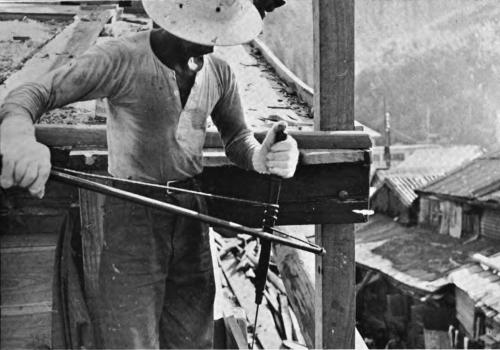
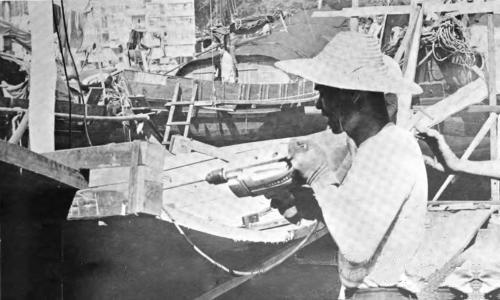
One problem he has, Mr. Newton explains, is training
Chinese workmen to use power tools. Ten years ago power
equipment was a great rarity in the colony; now American
Marine has 50 electric drills, planers, bandsaws and a bolt-threader.
Some of his workmen had never seen a power tool
before they were trained to use them at the boatyard. Whitney
Newton’s ability to speak Cantonese is helpful, but the
instructor has to proceed with the utmost caution in introducing
a greenhorn to a bandsaw.
American Marine builds a few modified junks, using American
equipment and finishing them like yachts. The three masts
of the typical Chinese junk are retained, but the rigging is
simplified and the usual ponderous rudder is greatly reduced
in size. They sell for $10,000 or more. The Newtons built one
for Don the Beachcomber, Hollywood restaurant owner.
Americans are often infatuated with the romantic outline of
a large working junk, but they would soon go aground trying
to handle its complicated sails.
American Marine follows the Chinese practice of paying
one month’s bonus to its workers at the New Year. Trucks
carry the men to and from work. A barracks and mess hall
accommodate those who live at the yard. The hamlet of Hang
Hau, half-destroyed by fire years ago and still in ruins, was
American Marine’s only neighbor in 1958. Now there is a mill
for cold-rolled steel and a ship-breaking shop, with the light-colored
buildings of Haven of Hope Sanatorium arrayed
along the hills of the opposite shore.
Mandarin Textiles, Ltd., best known in the United States
for its Dynasty line of high-styled women’s apparel, is also
directed by an American, Linden E. Johnson. Mr. Johnson,
who served with the U.S. armed forces in China during
World War II, stayed on to become a Shanghai textile executive.
When the Reds drove him out of China, he came to Hong
Kong and founded Mandarin with a Chinese partner who was
murdered by a fellow-Chinese in 1957. Mr. Johnson kept the
business going, completed an eight-story plant in Kowloon,
near Kai Tak, in 1958, and expanded it into one of the colony’s
finest tailoring and designing houses.
Mandarin, which makes the Empire line in cottons in addition
to the Dynasty silks and brocades, employs up to 1,300
workers. It provides a recreation room, catered meals and
classes in English for its work force. Most of its permanent
staff are highly skilled people, like the young sewing-machine
operator who stitches intricate rose and tea-leaf designs on
quilted fabrics at high speed, working from memory with unerring
accuracy. The cutters, tailors, and pressers are advanced
craftsmen, trained by long apprenticeship.
Mandarin introduces about fifteen new silk and brocade
patterns each year, originated by its own designer, Doris
Saunders, with such names as Cherry Blossom, Ivory Blue,
Sing Song and Garland. Its stockroom carries nearly 500 patterns,
including as many as eight different color variations on a
single pattern. Wives of visiting VIPs often tend to go haywire
when exposed to this exciting inventory, and have had to
be led or dragged away from the shelves. Most of the brocades
are woven by the Fou Wah mills in Tsuen Wan. Finished
garments are packed in waterproof paper and special
shipping boxes and sent to the U.S. by air express or sea
freight.
Mandarin keeps its finger on the high-fashion pulse through
its Dynasty Salon in the colony’s Hotel Peninsula, but it also
cagily remains in touch with a wider and less sophisticated
market by noting what the American sailors buy at its servicemen’s
outlet in Wanchai, where the fleet comes in.
Textiles have become the largest single factor in the colony’s
economy. Textile exports totaled $273.5 million in
1960, or 55 percent of the colony’s entire domestic exports. In
1961, textiles constituted 52 percent of all exports. The industry
employs 42 percent of all the workers in registered and
recorded industries. It has a capacity of 614,000 spindles and
18,700 looms.
All this is cause for rejoicing in Hong Kong textile circles,
but to textile producers in England, the United States and
Canada, it is a problem that becomes greater all the time. The
United States absorbed 31 percent of the colony’s textile exports
in 1960, and the British Isles were a close second with
26 percent. Textile exports to the United States took a sharp
drop in 1961, while those to the British Isles showed only a
slight decline.
There was much concern among Lancashire mill-owners
when Hong Kong cottons began to hit the English market.
American textile producers and textile union leaders joined in
a protest that was echoed with lesser volume by the Canadian
textile industry. In all three countries, textile men declared
that if they had to compete with Hong Kong’s low wage-scales,
they would be driven to the wall.
American textile producers have their own special complaints
against the Hong Kong industry. They point out that
because of the existing price differential, Hong Kong can buy
U.S. cotton at 8½ cents less per pound than American mills
can, and that the colony has been stocking up heavily on it.
In 1960, Hong Kong imported 55 percent of its raw cotton
from the United States. The U.S. textile men say that while
Japan’s textile exports have been held down by a five-year
quota limitation, Hong Kong has rushed in to sell America
the items that Japan agreed not to sell.
The demand for restrictions on colony textile exports to
the United States began in 1958. United States officials visited
the colony in 1959 with a proposal for a voluntary cut in the
exports. The Hong Kong garment manufacturers proposed a
three-year quota arrangement, starting in July, 1960, to hold
exports to the 1959 level, plus 15 percent on cotton blouses
and blouse sets, shorts and trousers, sport shirts, brassieres and
pajamas. American textile producers immediately rejected the
proposal as far too generous to Hong Kong competitors.
During the negotiations, American importers placed huge
orders with Hong Kong to get in ahead of the threatened limitations.
When the agreement blew up, they found an interesting
variety of reasons why they couldn’t accept most of
what they had ordered, such as late deliveries, and unsatisfactory
quality. Exports to the U.S. dropped and the decline persisted
into 1961.
In May, 1961, President Kennedy proposed an international
textile conference to work out some agreeable way to control
textile exports. The United States then suggested that Hong
Kong cut its textile exports at least 30 percent below the levels
of 1960. But the word “quota” had assumed a fearsome aspect
in Hong Kong because of a textile agreement involving
the colony, England, India and Pakistan. Hong Kong had
agreed to limit its exports to the British Isles, provided that
Pakistan and India would do the same. In 1961, the Hong Kong
industry began to suspect that India and Pakistan might jump
the traces, leaving the colony interests holding the bag.
A large section of the Hong Kong press is rabidly pro-textile
industry, and every American move toward textile controls
is headlined as a thrust at the heart of the colony’s principal
industry. Communist papers shoved their way into the
act by crying that American restrictions would starve the
refugee workers who left the People’s Republic of China to
escape that very fate.
After the July 1961 International Textile Conference at
Geneva, the Hong Kong government, following long bilateral
discussions with the U.S., agreed to limit its exports according
to the Geneva Textile Agreement, with July 1960-June
1961 as the base year, and dividing the affected export
items into 64 different categories. Starting date of the agreement
was October 1, 1961.
Meanwhile, the United States Tariff Commission began to
study the 8½-cents-a-pound cotton export differential at the
direction of President Kennedy. Genuinely alarmed, Hong
Kong business groups hired Dean Acheson, lawyer and former
American Secretary of State, to represent them before
the Commission and help to retain the price differential.
The textile volcano erupted again in March, 1962, when the
colony government, acting under the one-year agreement that
went into effect the previous October, banned eight categories
of textile exports to the United States. The Hong Kong Tiger
Standard, clamorous advocate of the textile interests, excoriated
the move as a prelude to economic ruin. Pandemonium
ran through the industry. The government ban was
lifted almost immediately. Prospects of a peaceful solution
seemed as poor as ever.
On September 6, 1962, the U.S. Tariff Commission voted
to retain the 8½-cent export differential and rejected a proposal
to raise the duty on cotton imports. This action coaxed
the Hong Kong manufacturers out of their sulks, but it sent
the American textile-makers into a fresh tantrum.
Hong Kong’s motion picture industry is one of the world’s
most prolific, and least-known, producers of feature films.
More than 300 feature-length pictures were made in 1961 by
its six major studios and scores of independent producers who
rented working space from the big studios. All were in Cantonese
or Mandarin, aimed at the Overseas Chinese market in
Taiwan, the Philippines, Southeast Asia and elsewhere. Mandarin
features are generally based on heroic or historical
themes, with rich costuming and elaborate sets; each one
takes 35 to 40 days of shooting and costs around $40,000. A
few Mandarin films have contemporary stories. Cantonese
films, usually drawing on time-tested plots from Cantonese
opera, can be run off in 10 or 15 days for less than $20,000 and
are more popular than Mandarin with the Hong Kong fans.
As might be guessed from their shooting schedule, many of
these quickies are rubbish. But the quality of the Mandarin
films has improved, and a few super-productions costing as
much as $175,000 are made every year. Hong Kong films have
won top honors at the East Asian Film Festival for the last
four years.
The Shaw Brothers, Run Run Shaw and Run Me Shaw, bill
themselves with typical cinematic restraint as The Greatest
Purveyors of Entertainment in the Far East, and are the kings
of the local industry. Late in 1961 they moved their Hong
Kong organization into a modern and elaborate studio at
Clearwater Bay in the New Territories. Its four sound stages
were to be increased to six within a few months, and its employed
force numbered several hundred, plus an equal number
of low-paid extras.
Lin Dai, twenty-six-year-old beauty and box-office queen
of the Shaw Brothers studio, took the 1961 best-actress
Golden Harvest Award. As the highest-paid star, she earned
$42,000 annually on a three-picture-a-year contract. A singer,
actress and dancer, she is stunning by any standards, East or
West, and the studio plans to release some of her best films in
the American art-theater circuit. Thus far, their American
audience has been restricted to Chinese-American viewers.
The Shaws, who also own studios in Malaya and a chain of
120 theaters in Southeast Asia, began operations in Hong Kong
three years after Grandview Film Co. founded the local industry
in 1933. After a slow start, the industry boomed in the
early 1950s, overexpanded and crashed, leaving only four companies
in the field by 1956. Pro-Nationalist studios such as
Shaw Brothers have no market in Red China, but there are a
number of Hong Kong film-makers who have a pro-Communist
slant. Shaw’s new studio can produce wide-screen
pictures, overcoming one of the handicaps that has limited the
growth of the industry in the colony. Generally speaking,
there is still plenty of room for technical and artistic improvement.
The 1961 Hong Kong census reported a total of 337,000
women in all the employed forces, yet women have played
a disproportionately small part in the direction of industry
and public affairs until the last twenty years or so. It
is not surprising that Chinese women were excluded from
public life, since they had few rights outside their homes until
the establishment of the Chinese Republic in 1911. But British
women, presumably well-educated and qualified to take executive
responsibilities, found few opportunities to do so. The fact
that Queen Victoria ruled the colony for the first sixty years
of its existence should have helped, but it didn’t. What influence
women had was unseen, and was exerted through their
husbands or other men.
Even today there is not one woman in the top echelon of
Hong Kong government, although women constitute about
one-twelfth of the government’s Class I and II administrative
staff officers (more than a third of these women are Chinese).
In nongovernmental posts, there are about ten women conducting
their own retail shops, chiefly in fashions, jewelry and
objets d’art. Rosalind Henwood, an American, heads an air
freight forwarding business.
There are about a dozen women of prominence in writing,
advertising and publicity. Two of them, Mrs. Beatrice
M. Church and Miss Elma Kelly, direct their own advertising
and publicity agencies. Mrs. Church, a former Far Eastern
correspondent for the London Daily Mail, survived Japanese
air attacks and ship-sinkings during World War II, served in
the SWANS, a women’s service affiliated with the British
Navy, and returned to Hong Kong to reestablish the pioneering
advertising and publicity firm she had founded with her
husband, Captain Charles Church. Captain Church, his health
shattered by Japanese tortures during imprisonment at Singapore,
died of the effects of his injuries in 1950. Mrs. Church assumed
sole control of the business, the Advertising and Publicity
Bureau, and has successfully operated it since then. Miss
Kelly, a native of Melbourne, Australia, began her career as
an analytical chemist. She also was a Japanese war prisoner before
setting up her own agency, Cathay, Ltd., in Hong Kong.
There are about 20 women executives and administrators
in private or semipublic health and welfare agencies. Women
staff officers in government health and welfare work number
approximately 150—by far the largest group of women in
civil-service staff posts. The colony has a small number of
women doctors, educators and lawyers, plus one architect,
but most women professionals in these fields are government
officers.
Women employed in art or cultural activities total about
fifteen, including several Chinese movie actresses. Miss Aileen
Woods, a colony resident for nearly forty years, is widely
known for her Down Memory Lane program over Radio
Hong Kong, which she conducted from 1947 to 1954. A
Japanese prisoner in Hong Kong during the war, she subsisted
on a semistarvation diet of rice, fish and boiled sweet-potato
leaves; her weight fell to 81 pounds and many of her fellow
prisoners died. Miss Woods, now seventy-five years old and in
excellent health, was honored by a personal visit from Princess
Alexandra of Kent during the Princess’s tour of Hong Kong
in November, 1961. She was awarded the Coronation Medal
in 1953, and the Member of the British Empire in 1958. She
still does occasional programs for Radio Hong Kong, a government
agency, and is regarded as the unofficial dean of the
colony’s working women, having begun her career as a
world-touring featured dancer in the Ziegfeld Follies and
other shows more than fifty years ago.
In private business and professional activities, as in government
staff positions, about one-third of the colony’s career
women are Chinese, and both groups of women have
achieved much greater prestige and success than any previous
generation of the colony’s women. Among the
Tanka fishing people of Hong Kong, women own most of
the fishing junks. On Po Toi, a small island southeast of Hong
Kong Island, a Chinese woman, who died in 1957, held the
rank of village elder; as such, she was the arbiter of all local
disputes, having an authority rarely given to women. Many
women in the colony hope that the lady from Po Toi will become
a trend-setter instead of a legend.
What are the prospects for Hong Kong industry and trade?
Among the many persons who have weighed these prospects
are three of the most influential men in the commercial life
of the colony: Hugh Barton, chairman and managing director
of Jardine, Matheson & Co.; Sir Michael Turner, chairman,
general manager and a director of the Hongkong & Shanghai
Banking Corp.; and John L. Marden, chairman of Wheelock,
Marden & Co. A listing of their combined directorships
would fill two closely printed pages, and it would be only a
mild exaggeration to say that they and the companies they
head are in everything of a business nature in the colony. Each
man also holds an important position in the colony government;
Sir Michael as an unofficial member of the Executive
Council, Mr. Barton as an unofficial member of the Legislative
Council, and Mr. Marden with unofficial membership in the
Urban Council.
Mr. Barton heads one of the oldest and most respected business
houses in Hong Kong, with financial or operational control
of companies in such diverse lines as real estate, shipping,
wharves, warehousing, insurance, utilities, textiles, transport,
engineering, airlines and trading. Jardine’s, as it is commonly
called, was deeply engaged in the opium trade during the
colony’s early years, but has long since turned to other interests.
One of its recent investments, the Jardine Dyeing & Finishing
Co., was established two years ago and now produces
two million yards of high-quality cloth per month.
Barton believes that if the United States drops the 8½-cents-a-pound
cotton export differential, most of the cloth produced
in Hong Kong will not be able to compete in the world
market. Of the 500 million yards of cloth produced annually
by Hong Kong, a relatively small amount is exported to the
United States.
However, Barton feels, removal of the 8½-cent differential
would cripple the local industry’s efforts to produce its cloth
cheaply enough to compete in the markets of Southeast Asia
and elsewhere.
“Many people urge the textile industry to accept tight controls
of its exports, or they want our textile producers to
diversify by going into new industries,” he says. “But the
imposition of such controls doesn’t fit the character of Hong
Kong, which has prospered because it is a free port with a
minimum of controls.
“Of course it is easy to advise diversification, but what about
the Shanghai textile industrialists who spent a lifetime becoming
experts in the business? The Hong Kong textile industry
is built on that knowledge, and it can’t be reconverted to some
other industry overnight,” Barton states.
He feels that some degree of diversification is certainly desirable,
but that Hong Kong cannot afford to drop its textile
industry.
“There is a fresh Indonesian market for low-grade textiles
produced here,” he says. “And there are many good markets
for Hong Kong’s made-up cloth.”
He points out that local industry in many lines was hit by
a 1961 substantial rise in shipping costs and port charges. In
turn, the shipping industry has taken a loss from the invasion
of the dry-cargo field by the super-tankers originally built to
ship oil. Freighters, tramp steamers, and ocean liners have all
experienced a drop-off in profits because of this invasion, he
declares. Many new nations, partly influenced by national
pride and prestige, have launched their own shipping lines,
further crowding and depressing the profit margins of existing
lines.
“Industrial production and tourism are our two lungs,”
Barton says of Hong Kong’s economy. “We not only have to
maintain our present employment levels; we must also find
jobs for thousands and thousands of young people in the next
few years.”
He cites one of the major discoveries of the 1961 census—that
40.8 percent of the total population of Hong Kong is under
fifteen years of age—as evidence of the coming demand
for new jobs.
Accustomed to economic upheavals, Jardine’s has adapted
itself to changed conditions by investing in growth industries,
and by developing new industrial sites at Tsuen Wan, Kwun
Tong and West Point. It is selling some of its land holdings to
finance a six-year modernization of the wharf operations of
the Hongkong and Kowloon Wharf & Godown Co. Its new
international ship terminal in Kowloon, costing $7 to $8 million,
will include a pier 1,200 feet long, and will have car parks,
shopping areas and a bowling alley.
Sir Michael Turner, head of the Hongkong & Shanghai
Bank, emphasizes that local industries, confronted with restrictions
in their export markets, must seek new markets for their
output.
“Our land and labor costs are rising,” Sir Michael says. “But
we must be able to compete with Japan, Formosa, and ultimately,
Red China. Red China can ignore costs and flood our
markets, as they did previously in shoes and textiles.”
Sir Michael has a limited faith in the doctrine that the
colony’s market problems can be solved by diversification of
its industries.
“Even diversification means that we’ll encounter resistance
in the new lines we enter.” He believes that the colony’s industries
must maintain quality and raise it where possible,
rather than lowering standards to compete with inferior products.
He says that Hong Kong has attracted investment capital
from all over Southeast Asia because of its exceptional political
stability, and because local industry was not disrupted
by union work-stoppages. He cites the traditional Chinese
dislike of regulation and regimentation as a factor inhibiting
the expansion of union power.
“The shortage of land and water is still our greatest limitation,”
Sir Michael says. “Land development is very costly,
and although the builder of an apartment house may recover
his costs in one year, that is not possible in the construction of
factories.”
He notes that the colony has a serious problem of “under-employment,”
rather than unemployment. He adds that the
colony’s predominantly young population would necessitate
a sharp increase in government spending for schools and hospitals.
Like Mr. Barton, he recognizes that thousands of additional
jobs must be ready for young people when they begin
moving into the employment market.
He regards the preservation of Imperial Preference as vital
to the colony in meeting Japanese competition, but he believes
that Hong Kong will not be injured by the European Common
Market if the colony’s economic needs are recognized
in the agreement.
Although the Hongkong & Shanghai Bank is commonly
viewed as the incarnation of everything British, its founders
included an American, two Parsees, two Germans and an Ottoman
Jew. For many years it has been a leader in employing
and training Portuguese office workers, accepting them on
individual merit instead of drawing a rigidly British line. The
bank celebrates its centennial in 1964.
John L. Marden is the chief executive of a company which
dates from 1933 under its present title, but has corporate
origins going back to the opening of the China trade. The
Wheelock Marden companies have interests in shipping, shipbuilding,
textiles, finance, aviation, land, insurance, merchandising
and many other lines.
Among Hong Kong’s industrial assets, Mr. Marden lists its
freedom from controls, its political stability, its low income
tax on individuals and corporations and its resistance to inflation.
It is his conviction that Hong Kong industry should concentrate
on quality products, and those which require a high
labor content. He cites transistor radios of the less complicated
type as an example of the colony’s high-labor products.
“I think we should emphasize that there is something more
at stake than profits,” Marden says. “The colony is seeking to
create 300,000 new jobs for the young people who will be
coming on the job market soon; if we can do this without appealing
for outside aid, then we’ve made a contribution to
the economy of the entire free world.”
In the past, he believes, colony industries just took orders
as they came. Now, in his opinion, the industries must develop
their own marketing facilities to discover what products are
needed, and then work to meet these needs. He feels that there
must be greater diversification if Hong Kong is to hold its
place in the industrial world.
These three men, like practically every leader in its industrial
and political community, are acutely conscious of the
many hazards that Hong Kong faces.
And not one of them acts or speaks as though he were not
solidly confident that Hong Kong will overcome its handicaps
and external dangers and go on to greater prosperity.