Now that the train had crossed the Rocky Mountains, most of the
passengers in the tourist car were becoming bored and restless. The
scenery was less absorbing; there was so much of it that even its
magnificence had begun to pall! Yet Harriet Holliday was still deeply
interested in everything. There were now only a few hours between her
and her destination, and she had begun to look at the solitary ranches,
wondering whether her brother's would look like them.
The train was passing across a seemingly endless desert, through ranges
of hills without a sign of life, without water, grass or trees to
break the monotony of sand and sagebrush. Once in a great while there
appeared a row of buildings that, Harriet decided, must be a town—a
few boxlike stores, a hotel with an imposing cement block front, a
straggling line of cabins, some turf-roofed huts, some tents—then
abruptly the gray solitude of the desert came into view once more.
Harriet thought of the clustering villages along the Connecticut
shore—the white-and-green houses sheltered by elms, the church spire
on the hill. Home seemed suddenly unutterably far away. A queer ache
surged up in her throat. She felt not only endlessly far in miles from
home, but in time, too—as if she had left the year 1912 behind her and
come somehow into the vanished days of the first pioneers. To keep back
the tears she glanced hastily up and down the car at the people who for
several days had been her companions and nearly all of whom had given
her glowing accounts of "the West."
A different promise had lured each, and each promise seemed golden.
One family had sold the railroad shares from which they had drawn an
income and had bought an apple orchard in Oregon. An old couple were on
their way to California to invest in an orange grove. A newly married
pair were on their way to a timber claim in Washington. A young public
school teacher had given up a good position in Chicago to take a
district school in Montana where she could homestead. Oddly enough, not
one of those to whom Harriet had spoken so far was expecting to settle
in Idaho.
Her roving glance came back along the seats. Just in front of her sat
a broad-shouldered young fellow, staring out of the window. Harriet
could see the boyish curve of his tanned cheek, his freckled nose and
his light brown hair. Until this moment she had not set eyes on this
young man. He must have got on at Ogden. While she was looking at him
he turned and met her inquiring brown eyes with a pair of steady blue
ones.
"This is Idaho," he said.
Then he blushed all over his tanned face. He had spoken as if the
barren ranges had been mountains of gold, the gray sagebrush desert a
vista of lakes and forests and gardens.
Harriet smiled. "Thank you," she said. "I'm glad to know." She was
silent a moment; then, curiosity overcoming her reserve, she asked,
"Have you any idea how much farther it is to Shoshone?"
"Say! You getting off there? It's the next stop." His blue eyes flashed
when Harriet said she was, and he went on: "Homesteaders are coming in
like rabbits round a haystack. If you're going to take up land you're
wise to come now, before the best of it is all filed on."
"Oh, I'm not going to settle," Harriet protested. "I've been teaching
but I have to rest my eyes so I've come out to visit my brother. He has
a ranch."
"You'll stay though! I'm just back from Chicago. Took a bunch of
cattle. I stayed East two months. Thought I'd like it. Not much! I'm
glad I've hit the brush once more." His glance went to the window and
seemed to feast hungrily on the gray plains.
Harriet looked out too, trying to see what he could find that lured him.
"You don't know where your brother's homestead is, do you?" he asked.
"There are two districts that fellows are coming into; one south of
those foothills yonder, the other on Camas Prairie."
"Yes. That's it, Camas Prairie. He sent me pictures of it. Here's one."
She had been looking at the photographs a few moments before and drew
it from her handbag.
"Well, what do you know about that!" the young fellow exclaimed as he
glanced at the three pictures. "That's Sage Hen Springs, all right.
There's the big quakin' asp that marks the section line. It's a
landmark for all cattle men coming across the prairie."
He laughed to himself as he handed back the pictures. "I was just
wondering what Joyce'll say when he finds some one has filed there.
He's a sheepman and he's used that glen there for a lambing place for
years. He's been meaning to put a man on there for two years anyhow.
Yes, sir, I'll bet he's mad when he finds he's lost it."
"Isn't there some other place near by?"
"No, ma'am. That's just it. Water is mighty scarce in these hills
anyhow, and Joyce knows the sheep have to have it."
"It's funny that he never took a homestead, living out here so long."
"Oh...." The young fellow hesitated. "He's got one," he said slowly,
"but he needs a whole lot more than that."
"But I thought a man could only homestead once," Harriet said in
surprise.
"That's right. But there's ways of crawling through the fence when the
gate's shut. I shouldn't wonder but he'll try to buy your brother out."
"Oh, Rob would never sell! He's going to raise cattle!"
"That's good money, all right; but if Joyce wants that water hole as
bad as I reckon he does, he'll put up a bunch of money for it. Well,"
he added, glancing out, "we're pretty near there."
Harriet began to collect her luggage and the young man rose. "My name's
Garnett," he said hesitatingly. "Maybe we'll meet up on the prairie."
"Oh, I hope so," Harriet said smiling, and held out her hand.
As the train pulled into the station she looked eagerly among the crowd
waiting on the platform, but did not see her brother. She had stepped
down upon the cindery track and was wondering what she had better do
when a voice exclaimed, "Hello, sis! Got here safely, did you?"
"Bobs!" Harriet turned quickly and then faltered. She had expected to
find a slim, pale boy, wearing glasses and very fastidious about his
collars and neckties. She was facing a big, sunbrowned man without
glasses, who wore overalls, a gray flannel shirt, a sheepskin vest and
huge laced boots; but he was smiling and he gripped her arm and kissed
her.
"Bobs!" she cried. "I didn't know you."
"Don't worry," Rob told her. "You won't know yourself either in six
weeks. Let's see. Got your traps? We'll go right over to Kenny's.
Supper'll be ready as soon as you've washed the cinders out of your
eyes. I've been so busy loading up for the ranch that I almost forgot
to meet the train."
"Kenny's," the old hotel of the cattle days before there had been a
town, stood just across the street, and every one who had left the
train appeared to be going there for supper. When Harriet and Rob went
in, a circle of miners, ranchers, sheep herders and cattle men had
already gathered around the big office stove. They were gossiping in a
cloud of tobacco smoke; another group hung over the clerk's desk.
Among them moved a big, red-cheeked woman, the hotel-keeper's wife. She
nodded to Rob. "How do, Mr. Holliday? Your sister's come, I see."
As Rob introduced Harriet to Mrs. Kenny, the good-hearted Irishwoman
held out her hand with words of welcome.
The big dining room was rigorously clean; the oilclothed floor almost
reflected the electric lights; plates and glasses shone; two trim
young women waited on the guests. But the guests themselves! They
were all men, dressed in what Harriet mentally called "workmen's
clothes"—overalls, flannel shirts, corduroy trousers, vests, but no
coats. Unshaved, weatherbeaten, scarred and lined by hard experience,
these men seemed as rough and repellent to the dainty, carefully reared
girl as the mountains of this stranger land. As she was eating her
supper, taking furtive glances down the long table, she heard a voice
at her shoulder and saw Rob turn to speak to an old man.
"Axcuse me, Holliday, but it's just a worrud I'm wantin' wit' yourself."
Harriet saw beside her a little, bent old man; his legs were bowed from
a life in the saddle and his neck was tanned and wrinkled from years of
weathering. He wore a much mended flannel shirt, a drooping vest, and
short overalls that revealed gray socks and congress gaiters much run
down at heel. Harriet thought that, except for his merry, honest face,
he looked very much like a tramp.
She was rather surprised when her brother introduced the old man to
her. After greeting her cordially he went on to explain to Rob that he
had not, after all, a fresh cow in the herd good enough to sell for a
milk cow, but that he would send out the heifers he had promised and a
cow that would be fresh in the fall. Then he turned to Harriet, wished
her "good luck" and moved away.
"Rob, do all the cowboys dress in that—well, shabby sort of way?"
Harriet asked as she and her brother left the dining room together.
"So that's what you didn't like!" said Rob. "Dan Brannan isn't a cowboy
though. He's one of the richest cattle men around here. Worth over a
hundred thousand, I've heard. That's why he can afford to wear old
clothes."
"He might at least be neat."
Rob laughed. "I'll remind you of that some day about two months from
now, when you've quit wearing starched shirtwaists."
As they were to start for the ranch early in the morning, they went to
bed soon after supper. Harriet fell asleep at once and did not wake
until a sharp tattoo rattled on her door.
"Roll out, sis," Rob was calling, "nearly six and we want to hit the
trail by seven."
When Harriet came down into the office, she found it thronged, and
humming with suppressed excitement.
"The sheriff has just come into town with two horse thieves," Rob
explained. "They rounded 'em up on the Malade river, just above here,
with a string of ponies. Another of the fellows got away after wounding
one of the sheriff's men. It must be cold hiding out in the foothills
this time of year. Well, let's eat and move on. We want to make the
Hyslop ranch before dark."
As they stepped out into the street after breakfast Harriet shivered.
"It's cold at night in the mountains all right," Bob admitted, "but
it's hot enough as soon as the sun gets up. You'll see."
Turning the corner to the livery stable he stopped and pointed to a new
farm wagon, ready loaded. "That's ours. You get up while I hitch and
we'll be off in a jiffy."
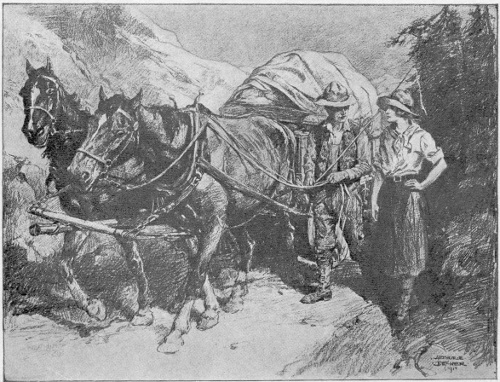
Harriet stared at the wagon in dismay. The sloping roof of canvas
that was roped over the load looked to her as insurmountable as one
of the snow-covered peaks the train had passed. The wagon seat had
been lifted from the sockets and was balanced on top of a bale of hay.
Several reels of barbed wire, a plow and her trunk gave Harriet a hint
of what company she might find herself in if the wagon should roll into
the ditch.
She managed, however, to get aboard. While she was watching her brother
hitch the team, a clatter of hoofs made them both look up.
"Why, hello, Jones!" Rob exclaimed. "When did you get in?"
"Oh, a day or two ago."
The man on horseback was small, slim and dark. A felt hat shaded his
eyes. He glanced at Harriet and said quick and low to Rob:
"Can I speak to you?"
Rob went across the road. The man on horseback leaned forward and began
to talk rapidly.
Harriet turned her face away, but now and then she caught a word, a
sentence: "if they get onto me," "my brand," "keep it quiet as you
can," "I wouldn't say anything at all." And then in a natural tone the
stranger said suddenly, "Well, see you later," and rode off.
Rob came back, finished hitching, climbed into the wagon and they
started. Harriet expected her brother to say something about the
mysterious young man; but although Rob began almost at once to talk,
asking all about their father and mother and the life at home since he
had left and speaking freely about his own experiences through the past
four years, he said nothing at all about the stranger. Harriet was
unable to restrain her curiosity.
"Was that a cowboy, Rob?" she asked.
"Who?"
"I mean that man on horseback who was talking to you."
"Oh! That?" Rob hesitated. "Jones, you mean? He's a fellow I've met. He
has some horses he wants me to take care of for a while." He stopped,
then after a moment added, "If any one asks when I'm not home, just say
I'm boarding them for a fellow." He stopped and after a few moment's
silence began talking of other things.
There was so much to see and so many questions to ask that Harriet soon
forgot about Jones. They were passing through one of the irrigation
tracts which marked the new development of the West. Wherever the
sagebrush had been cleared from a new piece of land, lay the smooth,
level acres: wheat, pasture, young orchard or stubble. The fields
were all of one size and were intersected squarely by the irrigation
ditches. The barns and dwellings of these ranches were always near the
road. Built of new unpainted boards, and unshielded by trees, they
glared crudely in the blazing sunshine.
"Pretty good-looking ranches some of these fellows have," observed Rob,
nodding toward a forty-acre stretch of young rye, green and flat as a
billiard table.
"But how ugly the houses are! And so small!"
"You've got your ideas cut to fit the regulation New England colonial
mansion, that's all. When I can afford a shack like that,—" he pointed
to the two-room cabin they were passing, "I'll think I'm rich."
"Bobby! The idea. Why, what do you live in now?"
"A tent. I only filed on my homestead this spring, you know, and
haven't had time to build. All last winter I was working for wages,
feeding cattle for Dan Brannan, getting a line on feeding my own—and
ever since I came in on to my land this spring after the break-up I've
been so busy getting my springs fenced that I haven't had time to sleep
scarcely. You can live in a tent for a while, can't you?"
"Why, of course!" Harriet hesitated, not wanting to hurt her brother's
feelings by being too critical. "But where do you keep the food and
such things? Is it safe to go away like this and leave it all open?"
"Sure. Who'd steal a few blankets and grub? My nearest neighbor is
eight miles away and nobody much passes except cow punchers and
sheepmen and they're honest, generally speaking."
Harriet was silent a moment, slowly putting this picture in place of
the one imagination had painted. "But won't the cows and sheep get into
the garden, spoil the hay or something?"
Over Rob's sunburned face came an embarrassed smile. "Sorry to say
there isn't any garden—yet."
"Oh!... Then you haven't a real farm?"
"No, indeed. Not what Easterners would call a farm, but it's worth a
lot. It's this way. You see those hills we're climbing up to? Well,
my place is over on the other side of them, a quarter section of
government land that looks about like this; covered with sagebrush
and bunch grass, but I've got some good springs. That's what makes
my land worth something. There are thousands of acres of government
land like this open to homesteaders, but worthless because there's no
water. So the man who owns water, by fencing it, keeps stock away and
controls the range near him. All this government land is free pasture;
but it's no good without water. There is water—small springs and
streams—scattered through the hills, enough to keep a little place,
forty acres or so. Those are what people from the East keep coming in
and taking up. Men will homestead so long as they can find water, for
there's plenty of good land."
"I see," Harriet said slowly, gazing ahead over the interminable miles
of gray-green brush and bright, new, wild grass to the jagged, black
lava summit of the foothills. "But why didn't you take some land down
here?" she asked, with a gesture toward the green-and-gold oasis made
by the irrigated land around them.
"Oh, this costs more. The land is cheap but the irrigation water is
brought in and you have to pay a lot for that. Besides, this isn't a
stock country and that's what I'm after. A fellow ought to make good
with all that free range."
Harriet made no answer and for several minutes they rode in silence,
the creak of the wagon suggesting many things.
"I meant to tell you all this when I wrote to you," Rob began abruptly.
"But honestly, Harry, there was so much that was more important to
say that I forgot about the tent and how many miles to the next ranch
and so on. I'm so used to living that way that I didn't realize how
you might take it. As soon as mother wrote about your eyes, and how
discouraged you were at having to give up teaching, I sat down and
wrote right off the bat for you to come. It seemed as if it would be
the real thing to have you out here this first year on the place.
It'll be more like camping than farming. I can't raise a crop until
the land's cleared and we ought to get time for lots of fishing and
shooting trips up into the Sawtooth forest. The climate is great—not a
drop of rain for months at a time. You'll like it, I'm sure. Still, if
you don't you can go back any time."
"Of course I'll like it," Harriet, or "Harry," as Rob had always called
her, said hurriedly, for she had caught the note of disappointment
in her brother's voice and felt a prick of self-reproach at being
so critical when Rob had thought only of the benefit to her and the
happiness it would be for both of them at being together again.
Although Rob was five years older than his sister they had always been
chums through childhood, had written to each other regularly while they
were away at separate schools and had never lost interest in each
other's work. As soon as Rob had decided to stay in the West he had
looked forward to having Harry come out to live with him.
As the morning passed the sun grew hot on their backs. Harry took off
her coat and wished for a parasol. Rob with his hat over his eyes
slouched forward comfortably and gave his attention to the team. "Rock!
Move up there," he ordered. "Get out of that, you! Hit the collar,
there, Rye! Keep in the road!"
The last few days of travel had tired Harry more than she realized
and now the slow motion of the wagon and the unbroken silence of the
desert proved very restful to her. The green of budding sage, of buck
brush and rabbit brush and new bunch grass melted into a soft mantle
spreading over the world as far as she could see. At long intervals
they passed immense flocks of sheep scattered through the brush and
among the rocky buttes.
"Who takes care of them?" Harry asked. "I should think their owners
would be afraid to leave so many alone."
"They're being taken care of. See that tent up there?" Rob pointed to
a patch of white canvas a mile away. "The Mex brings the band out to
their feed ground early in the morning, leaves the dogs on guard and
then goes back to his tent and sleeps half the day. He won't have to
bother with the sheep until it's time to move them to their bedding
ground for the night."
"What's a 'Mex'?"
"Oh, short for Mexican. So many of the sheep herders are Mexicans and
Bascoes nowadays that people call them all 'Mexes.' That stick up
there with the rag on it marks the line between his range and the next
herder's and neither of them can cross it to feed. The sheep are all on
their way to the reserve now, in the mountains on the other side of the
prairie. They stay here in the foothills as long as the grass lasts,
then work north. That's when our trouble begins. I expect they'll
bother us a lot, since I haven't finished fencing."
"Why, I thought you said you had fenced," Harry exclaimed.
"Just the main springs. Not the whole hundred and sixty acres."
"It must be hard to tell where your land begins and ends," Harry
laughed thoughtlessly.
"Oh, I guess I know what's mine," Rob said rather dryly. "It takes
considerable wire and posts to get around that much land and money to
buy 'em. I had to work like a steer this winter so as to have some cash
to put into the place. To comply with the homestead law I've got to
have a house built before next winter and clear and plow just so much
land. Besides the glen that's fenced, there's two miles of fencing
and cross fencing for corral and garden. I'll have to work outside
for wages too, to get my feed for next winter; hay and grain for the
critters and groceries for you and me."
As he told off the items slowly in a matter-of-course way, Harry
realized what a big thing it was he had undertaken. Although he had
joked about it, she knew he did not consider it a small one by any
means, and for a time she felt not only disappointed by the contrast to
what she had expected, but vaguely oppressed.
There was too much else to think of, however, to brood over that. As
the day waned they climbed steadily higher. The road became rougher.
Often Harriet held her breath as the horses scrambled over a lava
ridge, lurched down into a wallow of mud and struggled out only to
strike a worse spot farther on. At the top of each rise Rob paused to
breathe the team. Several times he and Harriet got down and walked
beside the wagon.
"Tired?" he asked. "It's tough the first time you come over this trail,
but you'll get used to it."
"I don't mean to travel it often enough."
"You may have to," Rob warned her. "When I'm too busy to go to town
I'll send you."
Harry looked back at the rough trail and laughed. "As if I'd travel
this rough road alone!"
It was after six o'clock when they topped the last rise and, saw
ahead in the shadow of the great cañon walls the string of buildings,
haystacks and corrals of the Hyslop ranch.
"We'll camp here, outside the fence," Rob said, as he turned off into
the brush and pulled up beside the stream flowing from a fissure in the
cañon wall.
It was growing colder now, a dry, clear cold that stirred Harriet's
blood and made her realize how hungry she was. While Rob unhitched and
fed the team she gathered dry sticks for the fire.
Soon coffee, bacon, and canned beans were on the fire, and, with tin
plates in their hands, the two hungry travelers sat down with sighs
of anticipation. Harry had taken a first mouthful, when suddenly she
pointed. "Look! What is it?"
Rob turned, and saw in the darkness the gleam of yellow eyes. "A
coyote!" he exclaimed, overturning his plate as he scrambled to his
feet. "If only I had my rifle with me now!"
He snatched up a bit of blazing sagebrush to fling at the animal,
which, oddly enough, had not fled.
"Why, it's a dog!" Harry cried suddenly.
Trembling with fear, yet unable to resist the smell of food, the little
animal crawled forward until he was close to the fire.
"It's starved, that's what's the matter," declared Harry, who had put
down her plate and was coaxing the dog close enough to pat it. "Just
feel his poor bones. And look at his foot, too. He's been beaten nearly
to death."
"He's hardly more than a puppy. He must belong to some of these herders
round here. Brutes some of 'em are. I've heard they'll beat a dog to
death if they get mad at him. And they'd even tie up a horse without
food or water all day and night. You'd better turn him loose, Harry. If
he should belong to a 'Mex' the fellow'll be around after him."
"I'll wait till he comes."
She put down a plate of food for the dog who devoured it with mad
hunger. Then he crawled into the shelter of the canvas which Rob had
let down beside the wagon as a windbreak, and lay there until supper
was finished and the beds unrolled. When Harry lay down in her roll of
quilts, the little, black, sheep dog crept up beside her.
"You dear thing," she murmured. "Whoever owned you didn't deserve to,
and I'm going to keep you."
For a few moments she was conscious of her strange, new surroundings:
the cañon walls, thousands of stars above her, the monotone of the
stream. The next she knew daylight was pouring into the cañon, Rob was
cutting brush for the fire and the black puppy, shivering silently, was
watching her with one eye.
Harry reached out and drew him up beside her. "I'm certainly going to
keep you, you little black rascal. You're as black as Othello. There!
That's your name."
After breakfast when they were ready to start she lifted the dog up
into the wagon. "He can ride, can't he, Bobs?"
Rob smiled but answered gravely: "Honestly, I'd turn him loose, Harry.
If you want a dog I'll get you one, in fact we'll have to have one to
work for us. But it's risky picking up one that may belong to some
crazy sheep herder. You don't realize what these fellows are. Nearly
every one of them is off his nut from living alone, and if they do get
a notion you're trying to do them out of anything, like as not they'll
have it in for you."
"Oh, Bobs! Please don't make me leave him," Harry begged. "See him look
at me."
"All right. But don't get scared when some 'Mex' begins to look at him."
"Scared! Just refer any one that wants him to me."