DEAR JOHN: Your economical reasons for using shingles would justify
cheap jewelry and rag carpets. Try to be consistent. I should object
to slate on a log-barn or shingles on a stone-house. I hope you
furnished your honest carpenter with a stout jack-knife, and required
him not only to lay the shingles right side up, but to lay the upper
ends close together, leaving them apart at the butt. Gutters are
troublesome truly, but often indispensable; there is no resource but
to have them thoroughly made. Poor ones are worse than none. Those
that hang independently of the cornice are safest for cheaper
buildings, but should be treated as an essential feature; that is, you
should not complete the cornice without a gutter and afterwards
disfigure it by a sloping spout having no apparent kinship to the rest
of the finish.
The problem of warming and ventilating is easily solved for those who
desire its solution sufficiently to make the necessary appropriations.
One quarter of what is commonly spent for vanity and deceit will be
ample. Most men and women, at least the unthinking, prefer fashionable
show rather than health! A fearful statement, but sadly true. There is
doubtless more danger from impure air than from cold. Our senses warn
us quickly of the latter; the prompting of knowledge is needed to
guard us against the former,—of a practical knowledge unfortunately
rare. Men, women, and children are dying daily through ignorance and
indifference on this subject. There is hardly a school-house to be
found in which the murder of the innocents is not continually
rehearsed, hardly a church in which the spiritual elevation resulting
from attendance therein is not counterbalanced by an equal physical
depression, and rarely a hall or lecture-room wherein an audience can
even listen to a physiological discourse on the fatal effects of
impure air without experimentally knowing that they are listening to
solemn truth; while as to the dwelling-houses, the homes of the dear
people, it requires no bloodhound's scent to distinguish them one from
another! The moment the front door is opened to me, I am assailed by
the odor peculiar to the establishment. It may be tuberoses or garlic,
mould or varnish, whitewash, gas, lamp-smoke, or new carpets, a
definite and describable or an indefinite and indescribable fragrance,
but it is sure to be something besides pure fresh air.
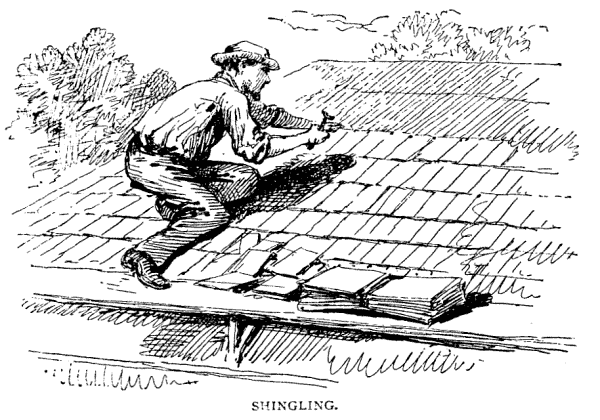
Let me give you first a suggestion for summer ventilation. Did you
ever shingle the south side of a barn on a calm, hot, sunny day in
July, thermometer at ninety degrees in the shade? Did you ever lay
your hand on a black slate or tin roof exposed to the direct rays of a
midsummer sun? Have you ever, at the close of some hot, labor-spent
day in August, sat out of doors until the evening air became
deliciously cool, and then climbed to your attic dormitory, there to
spend a sleepless night in perspiration and despair, anathematizing
the man who built and the fate which compelled you to occupy such a
chamber of torment?
Now, there is no good reason why the rooms immediately under the roof
of a house should be any more uncomfortable on account of heat than
those of the first story. Nay, more, by the simplest application of
common-sense, these upper rooms may be so coolly ventilated that the
hotter the sun pours his rays upon the roof the more salubrious shall
be your palace in the sky. And this I call a triumph of genius, making
the seemingly destructive wrath of the elements to serve and save us.
M. Figuier tells us with just how many hundred thousand horse-power
the sun, by the caloric of its beams, operates upon the surface of the
earth. I cannot tell precisely how much force is spent upon the roofs
of the houses that cover so much of the good mother's bosom in certain
localities, but I know that it is wonderfully great, and that rightly
controlled it will make the space immediately under these roofs cool
instead of hot.
And this is the way to cause the heat of a burning sun to cool the
attic chamber: Make the space between the rafters on the sunny sides
of your building as smooth and unobstructed as possible. Arrange
openings into the outer air at the lower end of each, simple or
complex, according to your taste and ability. Provide also means for
closing the same in cold weather. Be sure that these spaces, or flues,
are enclosed either by lath and plaster, or by smooth boards, quite to
the highest part of the roof, whether your rooms are finished to the
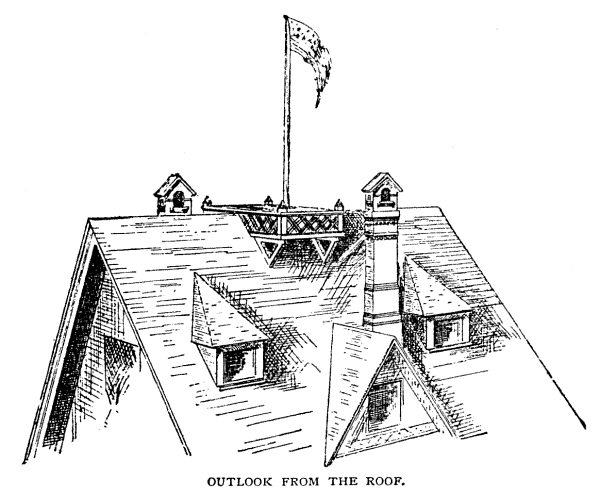
top or not,—and provided with an abundant outlet at the top. This may
also be as simple as the dorsal breathing-holes of a tobacco barn,
gorgeously imposing as an Oriental pinnacle, or it may be a part of
the chimney; only let it be at the very summit, ample, and so arranged
that an adverse wind shall not prevent the egress of the rising
currents of air. Mind this, too; it is by no means the same thing to
let these flues open into a loft over the attic rooms, with windows in
gables or other outlet.
Now, do you not see that as soon as the sun has warmed the flues,
there will be a stiff breeze blowing, not over the roof, but really
between the roof and the house, and the hotter the sun the stiffer the
breeze; in the words of one who has tried it,—"a perfect hurricane."
That is, the lath and plaster, or sheathing, which forms the inner
roof, is shaded by a canopy of slate, shingles, or tin, and fanned by
a constant breeze as cool at least as the outer air. But we can do
vastly better than that. Instead of opening the lower ends of these
flues to the outer air, they may be extended wherever the needs of the
house require, or its construction will allow.
Let me remind you, under the head of general principles, that there is
no such thing as "suction." Of course, you know it when you stop to
think, but bear it in mind, and wherever the motive-power seems to be
applied on which you rely to lift the column of air, remember that if
raised at all it must be raised from the bottom. Maybe you will
discover room for a moral here.
This summer ventilation is simple enough, and relates rather to
comfort than to health. The great question in building, for New
England and similar climates, is, indeed, how to keep our houses warm,
and, without great expenditure of fuel, have a constant change of air.
As you suggest, we have learned that wood costs eight or ten dollars a
cord instead of the mere labor of cutting and hauling; hence we have
shut the mouths of the old-time fireplaces, mouths that it would cost
a fortune to feed. We find the value of building-timber increasing
every year; so we make thinner walls, lined outside and inside with
paper, and have cold houses, no fresh air, anthracite coal, and
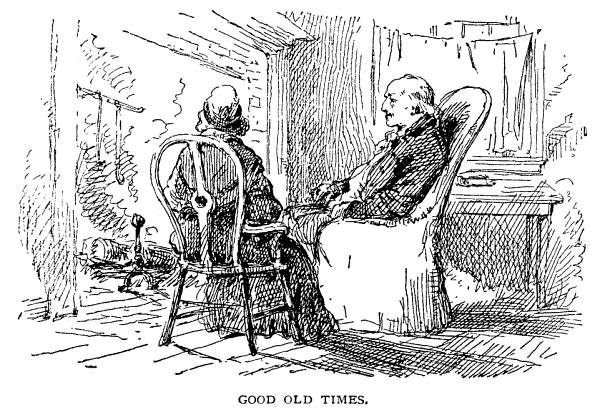
disease. Our grandfathers carried foot-stoves to church, where they
sat and shivered, sometimes with the cold, sometimes at the doctrines.
We have warm air and stale. Let us hope our children will have warmth
and freshness for body and soul. They, in their homes, had big
fireplaces, loose doors, rattling windows, cracks in the walls, and as
they lay in bed looked at the stars through the chinks in the roof, or
felt the snow blow on their cheeks which were ruddy with health and
vigor. We have cylinder stoves, double windows, tight walls plastered
and papered, and pale faces.
Yet we build and furnish more wisely than our ancestors. They
ventilated because they couldn't help it, couldn't afford to build as
we do, and could afford to burn an acre of woodland every year.
It is no light task you have set me preliminary to an honorable
discharge. Next to theology and government finance there is no subject
on which the doctors differ and dogmatize as in this matter of warming
and ventilating, most of them preferring that the universe should
suffocate rather than their pet theories and furnaces be found
wanting. (I'm not speaking of the theologians.)
Let me restate a few general principles, simple and obvious, yet so
important that we must not risk forgetting them. Air runs away with
heat fast enough if allowed to move. Confined it is a more effectual
barrier than granite walls and plates of steel. Hence the spaces in
the wall should not extend its whole height unless for local
ventilation. Cut them off surely at each floor, and as much oftener as
you please; also make the floors tight and warm. Deafen with mortar if
you can afford it, and do not allow the open spaces between the
floor-timbers to extend unbroken through the house, or fail to close
them between the rafters when the ceiling of the highest story is
above the plates. If you wish to warm the entire house, it will be
good economy to lath and plaster along the under side of the rafters
quite to the ridge-pole. Finally put on your double windows, and you
are ready for winter quarters.
In theory, the house being once warmed, the temperature within should
scarcely change, even if the fire goes out. Practically, the walls
cannot hold this subtile caloric, however scientifically they are
padded. There will be crevices, too, though the prince of joiners
builds your house, through which the warm air will escape. But
replenishing this inevitable loss would be a small matter, if the
breath of life were a needless luxury. Unless, however, we are willing
to suck poison into our veins with every breath we draw, slow but
sure,—poison expired from our lungs and emanating from our bodies,
poisonous gases liberated by the combustion of fuel, poison dust and
decay from the waste of inorganic material,—we must have a
never-ceasing supply of fresh air around us everywhere and always. Now
this incoming fluid, cold as ice, eats fuel like a hungry giant, yet
we must receive it with open arms, and, as soon as fairly warmed, send
it off through the ventilating flue, bearing whatever noxious
elements may chance to be afloat, and, of course, much of the warmth
we love and buy so dearly. We have then to supply these three sources
of loss. Obviously for economy the two former must be prevented to the
utmost, the latter rigidly controlled.
Thus far, except the old fogies who don't believe in ventilation, we
can all travel together harmoniously. Now our way divides, the doctors
begin to differ, and the patients begin to die.
The first fork is at the two modes of warming, direct and indirect.
The former includes stoves of all sorts,—sheet or cast iron,
porcelain, soapstone, brick or pottery, box or cylinder, for wood or
coal, air-tight, Franklin, "cannon," or base-burner, parlor cook or
kitchen cook, charcoal basin, warming-pan or foot-stove,—anything in
which you can build a fire. It includes open grates and fireplaces,
ancient or modern, large or small; it includes steam-pipes, hot-water
pipes, and stove-pipes; and last, but not least, steam-radiators, than
which it has never entered into the heart of man to conceive anything
more surprising and unaccountable,—flat, pin-cushiony things, big as
a bedquilt, dangerous-looking hedgehoggy affairs, some huge and
bungling, others frail and leaky, but radiators still. In brief, the
heating apparatus, whatever it may be, stands in the room to be
warmed.
By the indirect mode it is enclosed in a chamber more or less remote,
commonly called a furnace, and made of brick, sheet-iron, or wood
lined with tin. Into this chamber cold air is admitted from some
source, and escapes by its own levity, usually through tin pipes, to
the rooms where the heat is needed. Sometimes it is driven out by
mechanical means.
The advocates of the latter indirect mode claim for it many
advantages. It is apparently clean. There are no ashes to be taken
up, no hearths to sweep, no andirons to polish, no stoves to black.
One fire will warm the entire house if well arranged, and, for a trump
card, there may be a supply of fresh air straight from the north pole,
but agreeably warmed, constantly entering the room.
The objections are less numerous but more weighty. The liability to
imperfect construction and careless management often makes a furnace,
especially a cast-iron one, a savor of death unto death rather than of
health and comfort; also, when we are warmed by air thrown into a room
at a high temperature, and dry at that, a greater degree of heat is
necessary for comfort than if our bodies and clothing absorb heat from
a radiating surface. The furnace, in short, compels us to breathe an
atmosphere highly rarefied. We have the most careful and competent
authority for believing this to be gravely injurious.
Direct radiation from stoves, or other heating apparatus, except open
fireplaces, is, moreover, economical of fuel, but, on the other hand,
unless abundant ventilation is provided, the atmosphere in rooms thus
warmed soon becomes unfit for respiration.
Now you may stop and think. Next time you shall have the conclusion of
the whole matter.
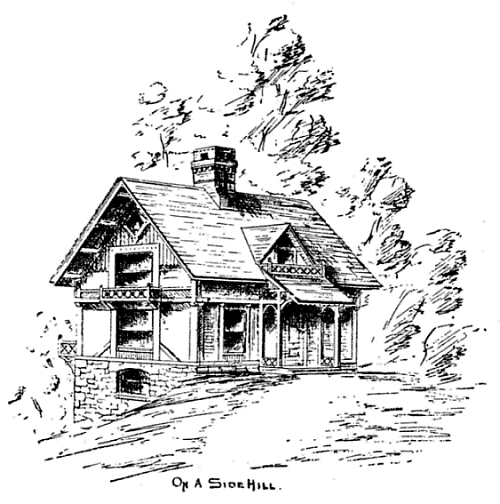
 Now that your "ship" is at last approaching the harbor, I am confident
your first demonstration in honor of its arrival will be building
yourself a house; exchanging your charmingly good-for-nothing
air-castle for an actual flesh-and-blood, matter-of-fact
dwelling-house, two-storied and French-roofed it may be, with all the
modern improvements. In many respects, you will find the real house
far less satisfactory and more perplexing than the creation of your
fancy. Air-castles have some splendid qualities. There are no masons'
and carpenters' contracts to be made, no plumbers' bills to be vexed
over, the furnaces never smoke, and the water-pipes never freeze; they
need no insurance, and you have no vain regrets over mistakes in your
plans, for you may have alterations and additions whenever you please
without making a small pandemonium and eating dust and ashes while
they are in process. Nevertheless, I have no doubt you will plunge at
once into the mysteries and miseries of building, and, knowing your
inexperience, I cannot at such a juncture leave you wholly to your own
devices.
Now that your "ship" is at last approaching the harbor, I am confident
your first demonstration in honor of its arrival will be building
yourself a house; exchanging your charmingly good-for-nothing
air-castle for an actual flesh-and-blood, matter-of-fact
dwelling-house, two-storied and French-roofed it may be, with all the
modern improvements. In many respects, you will find the real house
far less satisfactory and more perplexing than the creation of your
fancy. Air-castles have some splendid qualities. There are no masons'
and carpenters' contracts to be made, no plumbers' bills to be vexed
over, the furnaces never smoke, and the water-pipes never freeze; they
need no insurance, and you have no vain regrets over mistakes in your
plans, for you may have alterations and additions whenever you please
without making a small pandemonium and eating dust and ashes while
they are in process. Nevertheless, I have no doubt you will plunge at
once into the mysteries and miseries of building, and, knowing your
inexperience, I cannot at such a juncture leave you wholly to your own
devices.