To see great men at home is often more pleasant to the visitor
than advantageous to the hero. Men's lives are two-fold, and the life
of habit and instinct is not often, on superficial view, strictly
consistent with the other—the more deliberate, intentional and
principled one, which taxes only the higher powers. Yet, perhaps, if
our rules of judgment were more humane and more sincere, we should find
less discrepancy than it has been usual to imagine, and what there is
would be more indulgently accounted for. The most common-place
man has
an inner and an outer life, which, if displayed separately, might never
be expected to belong to the same individual; and it would be
impossible for him to introduce his dearest friend into the sanctum,
where, as in a spiritual laboratory, his words and actions originate
and are prepared for use. Yet we could accuse him of no hypocrisy on
this ground. The thing is so because Nature says it should be so, and
we must be content with her truth and harmony, even if they be not
ours. So with regard to public and domestic life. If we pursue our hero
to his home, it should be in a home-spirit—a spirit of affection, not
of impertinent intrusion or ungenerous cavil. If we lift the purple
curtains of the tent in which our weary knight reposes, when he has
laid aside his heavy armor and put on his gown of ease, it is not as
malicious servants may pry into the privacy of their superiors, but as
friends love to penetrate the charmed circle within which disguises and
defences are not needed, and personal interest may properly take the
place of distant admiration and respect. In no other temper is it
lawful, or even decent, to follow the great actors on life's stage to
their retirement; and if they be benefactors, the greater the shame if
we coolly criticize what was never meant for any but loving eyes.
The private life of him who is supereminently the hero of
every true American heart, is happily sacred from disrespectful
scrutiny, but less happily closed to the devout approach of those who
would look upon it with more than filial reverence. This is less
remarkable than it may at first sight appear to us who know his merit.
The George Washington of early times was a splendid youth, but his
modesty was equal to his other great qualities, and his neighbors could
not be expected to
foresee the noon of such a morning. And when the first stirring time
was over, and the young soldier settled himself quietly at Mount
Vernon, as a country
gentleman, a member of the Virginia House of Burgesses, a vigorous
farmer and tobacco planter, a churchwarden in two parishes, and a staid
married man with two step-children, to whom he was an active and
faithful guardian, no one thought of recording his life and doings, any
more than those of his brother planters on the Potomac, all landed men,
deer and fox-hunters and zealous fishermen, who visited each other in
the hospitable Southern fashion, and lived in rustic luxury, very much
within themselves. Few, indeed, compared with the longings of our
admiration, are the particulars that have come down to us of
Washington's Home—the home of his natural affections; but he had many
homes of duty, and these the annals of his country will ever keep in
grateful memory. Through these our present design is to trace his
career, succinctly and imperfectly indeed, and with the diffidence
which a character so august naturally inspires. Happily, many
deficiencies in our sketch will be supplied by the intimate knowledge
and the inborn reverence of a large proportion of our readers.
It seems to be a conceded point that ours is not
the age of
reverence, nor our country its home. While the masses were nothing and
individuals every thing, gods or demigods were the natural product of
every public emergency and relief. Mankind in general, ignorant, and of
course indolent, only too happy to be spared the labor of thought and
the responsibility of action, looked up to the great and the fortunate
till their eyes were dazzled, and they saw characters and exploits
through a glorious golden mist, which precluded criticism. It was
easy,
then, to be a hero, for a single success or a happy chance sufficed.
Altars sprang up in every bye-road, and incense fumed without stint or
question.
To-day the case is widely different. We give nothing for
nothing. Whatever esteem or praise we accord, must be justified, inch
by inch, by facts tangible and productive, successes undimmed by any
after failure, and qualities which owe nothing to imagination or
passion in the observer. No aureole is allowed about any head unless it
emanate from it. Our Apollo must actually have sent the shaft, and to
the mark, too, or we sneer at the attitude of triumph. If we erect a
statue, no robe is confessed to be proper drapery but the soiled and
threadbare one of every-day life and toil. No illusion—no poetry! is
the American maxim of our time. Bald, staring, naked literality for us!
He is the true philosopher who can
Peep
and botanize
Upon his
mother's grave
if the flowers required by science happen to grow
there.
All this may be very wise and knowing, yet as long as the
machine called man has something within it which is not exactly a
subject for mathematical measurement, there will remain some little
doubt of the expediency of thus stripping life of its poetry, and
bringing all that is inspiring to the test of line and plummet. Just
now, however, there is no hearing for any argument on this side.
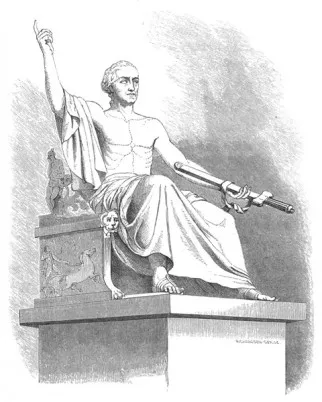
Greenough's Statue of Washington
What shall we think, then, of a character which, in a single
half century, has begun, even among us, to wear something of a mythical
splendor? What must the man have been, whom an age like this
deliberately deifies? Who but Washington has, in any age, secured for
himself such a place in the universal esteem and reverence of his
countrymen, that simple description of him is all that can be
tolerated, the public sense of his merits being such as makes praise
impertinent, and blame impious?
Washington! It
were almost enough to grace our page and our volume with this honored
and beloved name. The commentary upon it is written in every heart. It
is true the most anxious curiosity has been able to find but a small
part of what it would fain know of the first man of all the earth, yet
no doubt remains as to what he was, in every relation of life. The
minutiæ may not be full, but the outline, in which resides the
expression, is perfect. It were too curious to inquire how much of
Washington would have been lost had the rural life of which he was so
fond, bounded his field of action. Providence made the stage ready for
the performer, as the performer for the stage. In his public character,
he was not the man of the time, but for the time, bearing in his very
looks the seal of a grand mission, and seeming, from his surprising
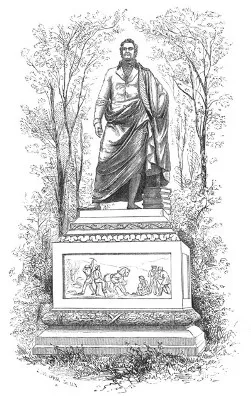
dignity, to have no private domestic side. Greenough's marble statue of
him, that sits unmoved under all the vicissitudes of storm and calm,
gazing with unwinking eyes at the Capitol, is not more impassive or
immovable than the Washington of our imaginations. Yet we know there
must have been another side to this grand figure, less grand, perhaps,
but not less symmetrical, and wonderfully free from those lowering
discrepancies which bring nearer to our own level all other great,
conspicuous men.
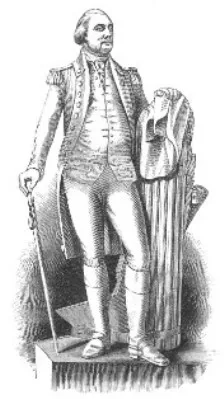
Houdon's Statue of Washington.
We ought to know more of him; but, besides the
other reasons
we have alluded to for our dearth of intelligence, his was not a
writing age on this side the water. Doing, not describing, was the
business of the day. "Our own correspondent" was not born yet;
desperate tourists had not yet forced their way into gentlemen's
drawing-rooms, to steal portraits by pen and pencil, to inquire into
dates and antecedents, and repay enforced hospitality by holding the
most sacred personalities up to the comments of the curious. It would,
indeed, be delightful to possess this kind of knowledge; to ascertain
how George Washington of Fairfax
appeared to the sturdy country
gentlemen, his neighbors; what the "troublesome man" he speaks of in
one of his letters thought of the rich planter he was annoying; whether
Mr. Payne was proud or ashamed when he remembered that he had knocked
down the Father of his Country in a public court-room; what amount of
influence, not to say rule, Mrs. Martha Custis, with her large fortune,
exercised over the Commander-in-chief of the armies of the United
States. But rarer than all it would have been to see Washington himself
deal with one of those gentry, who should have called at Mount Vernon
with a view of favoring the world with such particulars. How he treated
poachers of another sort we know; he mounted his horse, and dashing
into the water, rode directly up to the muzzle of a loaded musket,
which he wrenched from the astounded intruder, and then, drawing the
canoe to land, belabored the scamp soundly with his riding whip. How he
would have faced a loaded pen, and received its owner, we can but
conjecture. We have heard an old gentleman, who had lived in the
neighborhood of Mount Vernon in his boyhood, say that when the General
found any stranger shooting in his grounds, his practice was to take
the gun without a word, and, passing the barrel through the fence, with
one effort of his powerful arm, bend it so as to render it useless,
returning it afterwards very quietly, perhaps observing that his rules
were very well known. The whole neighborhood, our old friend said,
feared the General, not because of any caprice or injustice in his
character, but only for his inflexibility, which must have had its own
trials on a Southern plantation at that early day.
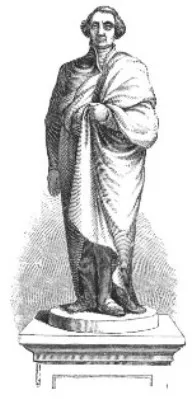
Chantrey's Statue of Washington.
Painting and sculpture have done what they could to give us an
accurate and satisfying idea of the outward appearance of the Father of
our Country, and a surpassing dignity has been the aim if not the
result, of all these efforts. The statue by Chantrey, which graces the
State House at Boston, is perhaps as successful as any in this respect,
and white marble is of all substances the most appropriate for the
purpose. From all, collectively, we derive the impression, or something
more, that in Washington we have one of the few examples on record of a
complete and splendid union and consent of personal and mental
qualifications for greatness
in the same individual; unsurpassed
symmetry and amplitude of mind and body for once contributing to the
efficiency of a single being, to whom, also, opportunities for
development and action proved no less propitious than nature. In the
birth, nurture and destiny of this man, so blest in all good gifts,
Providence seems to have intended the realization of Milton's ideal
type of glorious manhood:
A creature who, endued
With sanctity of reason, might erect
His stature, and, upright with front
serene
Govern the rest, self-knowing; and from
thence
Magnanimous, to correspond with Heaven;
But, grateful to acknowledge whence his
good
Descends, thither, with heart voice and
eyes,
Directed in devotion, to adore
And worship God supreme, who made him
chief
Of all his works.
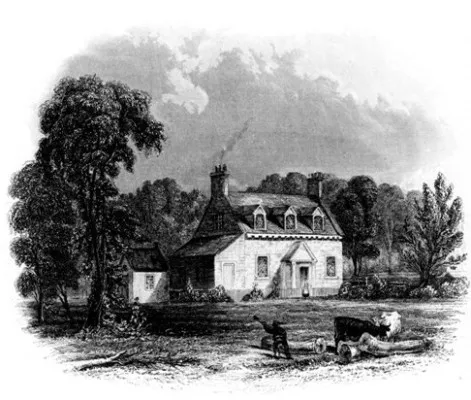
We may the more naturally think this because Washington was so
little indebted to school learning for his mental power. Born in a
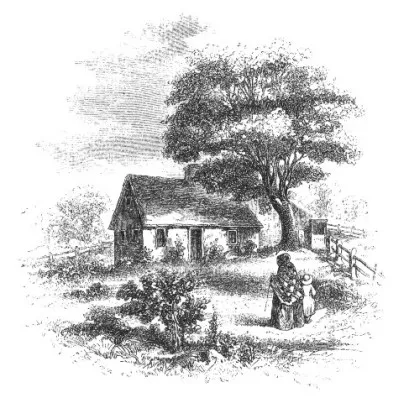
plain farm-house near the Potomac—a hallowed spot now marked only by a
memorial stone and a clump of decaying fig-trees, probably coeval with
the dwelling; none but the simplest elements of knowledge were within
his reach, for although his father was a gentleman of large landed
estate, the country was thinly settled and means of education were few.
To these he applied himself with a force and steadiness even then
remarkable, though with no view more ambitious than to prepare himself
for the agricultural pursuits to which he was destined, by a widowed
mother, eminent for common sense and high integrity. His mother,
characteristically enough, for she was much more practical than
imaginative, always spoke of him as a docile and diligent boy,
passionately fond of athletic exercises, rather than as a brilliant or
ambitious one. In after years, when La Fayette was recounting to her,
in florid phrase, but with the generous enthusiasm which did him so
much honor, the glorious services and successes of her son, she
replied—"I am not surprised; George was always a good boy!" and this
simple phrase from a mother who never uttered a superfluous word,
throws a clear light on his early history. Then we have, besides,
remnants of his school-exercises in arithmetic and geometry, beautiful
in neatness, accuracy and method. At thirteen his mathematical turn had
begun to discover itself, and the precision and elegance of his
handwriting were already remarkable. His precocious wisdom would seem
at that early age to have cast its horoscope, for we have thirty pages
of forms for the transaction of important business, all copied out
beautifully; and joined to this direct preparation for his future
career are "Rules of Civility and Decent Behaviour in Company and
Conversation," to the number of one hundred and ten, all pointing
distinctly at self-control and respect for the rights of others, rather
than at a Chesterfieldian polish or policy, and these he learned so
well that he practised them unfailingly all his life after.
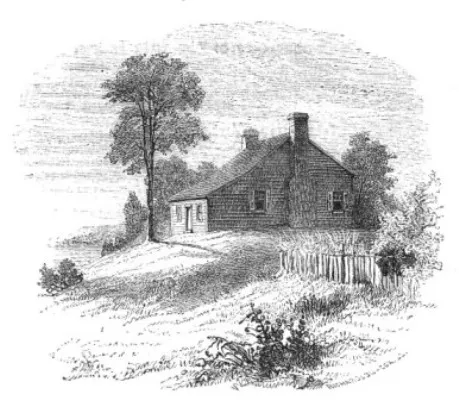
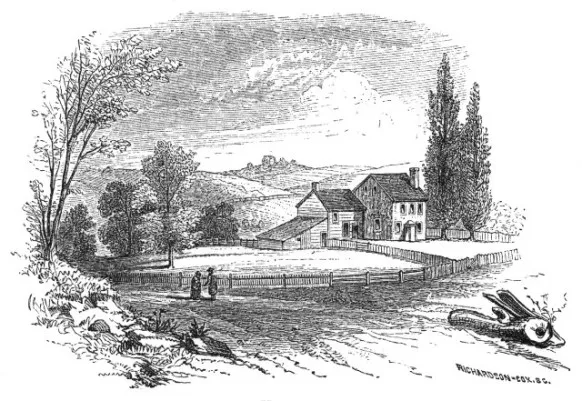
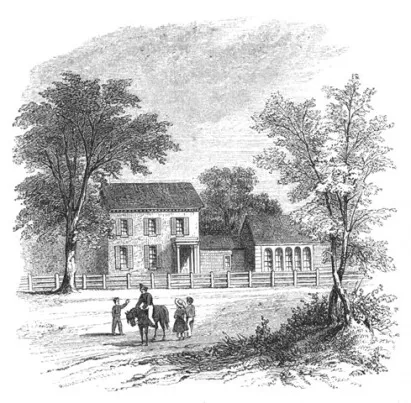
Residence of the Washington Family.
A farm in Stafford County on the Rappahannoc, where his father
had lived for several years before his death, was his share of the
paternal estate, and on this he lived with his mother, till he had
completed his sixteenth year. He desired to enter the British Navy, as
a path to honorable distinction, and one of his half brothers, many
years older than himself, had succeeded in obtaining a warrant for him;
but the mother's reluctance to part with her eldest boy induced him to
relinquish this advantage, and to embrace instead the laborious and
trying life of a surveyor, in those rude, early days of Virginia
exposed to extraordinary hazards. Upon this he entered immediately,
accepting employment offered him by Lord Fairfax, who had come from
England to ascertain the value of an immense tract of land which he had
inherited, lying between the Potomac and Rappahannoc rivers, and
extending beyond the Alleghanies. The surveying party was accompanied
by William Fairfax, a distant relative of his lordship, but the boy of
sixteen was evidently the most important member of the party. When the
hardships of this undertaking became too exhausting, he returned to the
more settled regions, and employed himself in laying out private tracts
and farms, but he spent the greater part of three years in the
wilderness, learning the value of lands, becoming acquainted with the
habits and character of the wild Indian tribes, then so troublesome in
the forests, and fitting himself by labor, study, the endurance of
personal hardships and the exercise of vigilance and systematic effort,
for the arduous path before him.
At nineteen Washington had made so favorable an
impression
that he was appointed, by the government of Virginia, Adjutant-General
with the rank of Major, and charged with the duty of assembling and
exercising the militia, in preparation for expected or present
difficulties on the frontier. He had always shown a turn for military
affairs, beginning with his school-days, when his favorite play was
drilling troops of boys, he himself always taking command; and
noticeable again in his early manhood, when he studied tactics, and
learned the manual exercise and the use of the sword. It was not long
before the talent thus cultivated was called into action. Governor
Dinwiddie sent Major Washington as commissioner to confer with the
officer commanding the French forces, making the delicate inquiry by
what authority he presumed to invade the dominions of his Majesty King
George III., and what were his designs. A winter journey of seven
hundred and fifty miles, at least half of which lay through an unbroken
wilderness, haunted by wild beasts, and more formidable savages, was
the first duty of the youthful Major under this commission, and it
occupied six weeks, marked by many hardships and some adventures. The
famous one of the raft on a half-frozen river, in which Washington
narrowly escaped drowning, and the other of a malcontent Indian's
firing on him, occurred during this journey; but he reached
the French
post in safety, and had an amicable, though not very satisfactory
conference, with the Sieur St. Pierre, a courteous gentleman, but a
wily old soldier. Governor Dinwiddie caused Major Washington's account
of the expedition to be published, and when a little army was formed
for the protection of the frontier, Washington received a command, with
the rank of Colonel, at twenty-two years of age. Advancing at once into
the wilderness, he encountered a French detachment, which he took
prisoners, with their commander, and so proceeded during the remainder
of the season, with general success. The next year, serving as a
volunteer, it was his painful lot, when just recovering from a severe
illness, to witness Braddock's defeat, a misfortune which, it is
unanimously conceded, might have been avoided, if General Braddock had
not been too proud to take his young friend's prudent counsel. All that
an almost frantic bravery could do to retrieve the fortunes of this
disastrous day, Washington, whom we are in the habit of thinking
immovable, and who was at this time weak from the effects of fever, is
reported to have done; and the fact that he had two horses shot under
him, and his coat well riddled with rifle balls, shows how unsparingly
he exposed himself to the enemy's sharp-shooters. A spectator says—"I
saw him take hold of a brass field-piece as if it had been a stick. He
looked like a fury; he tore the sheet lead from the touch-hole; he
pulled with this and pushed with that; and wheeled it round as if it
had been nothing. The powder-monkey rushed up with the fire, and then
the cannon began to bark, and the Indians came down." Nothing but
defeat and disgrace was the result of this unhappy encounter, except to
Washington, who in that instance, as in so many others,
stood out,
individual and conspicuous, by qualities so much in advance of those of
all the men with whom he acted, that no misfortune or disaster ever
caused him to be confounded with them, or included in the most hasty
general censure. It is most instructive as well as interesting to
observe that his mind, never considered brilliant, was yet recognized
from the beginning as almost infallible in its judgments, a tower of
strength for the weak, a terror to the selfish and dishonest. The
uneasiness of Governor Dinwiddie under Washington's superiority is
accounted for only by the fact that that superiority was unquestionable.
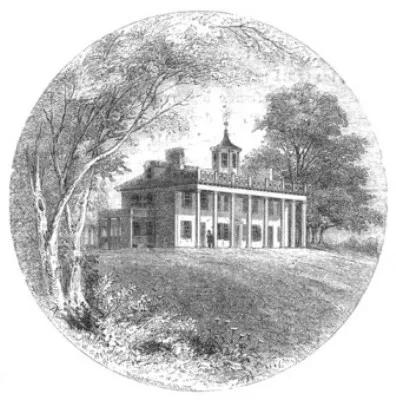
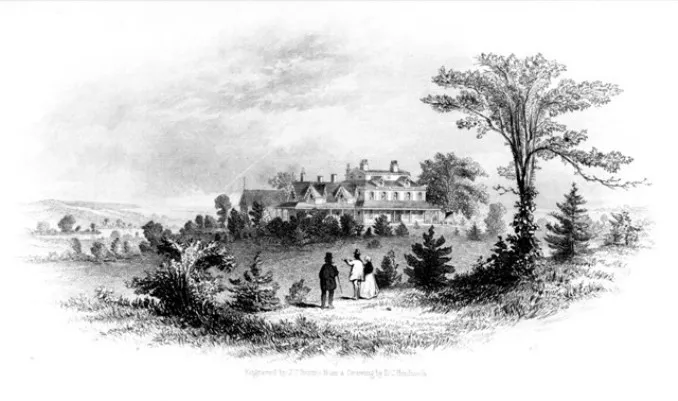
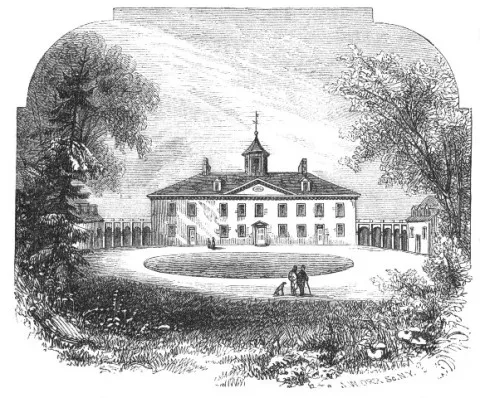
Mount Vernon.
After Braddock's defeat, Washington retired to Mount
Vernon,—which had fallen to him by the will of his half-brother
Lawrence—to recoup his mind and body, after a wasting fever and the
distressing scenes he had been forced to witness. The country rang with
his praises, and even the pulpit could not withhold its tribute. The
Reverend Samuel Davies hardly deserves the reputation of a prophet for
saying, in the course of a eulogy on the bravery of the Virginian
troops,—"As a remarkable instance of this, I may point out that heroic
youth, Colonel Washington, whom I cannot but hope Providence has
hitherto preserved in so signal a manner for some important service to
his country."
When another army was to be raised for frontier
service, the
command was given to Washington, who stipulated for a voice in choosing
his officers, a better system of military regulations, more promptness
in paying the troops, and a thorough reform in the system of procuring
supplies. All these were granted, with the addition of an aid-de-camp
and secretary, to the young colonel of twenty-three. But he
nevertheless had to encounter the evils of insubordination, inactivity,
perverseness and disunion among the troops, with the further vexation
of deficient support on the part of the government, while the terrors
and real dangers and sufferings of the inhabitants of the outer
settlements wrung his heart with anguish. In one of his many
expostulatory letters to the timid and time-serving
Governor Dinwiddie, his feelings burst their usual guarded bounds: "I
am too little acquainted, sir, with pathetic language, to attempt a
description of the people's distresses; but I have a generous soul,
sensible of wrongs and swelling for redress. But what can I do? I see
their situation, know
their danger and participate in their sufferings,
without having it in my power to give them further relief than
uncertain promises. In short, I see inevitable destruction in so clear
a light, that unless vigorous measures are taken by the Assembly, and
speedy assistance sent from below, the poor inhabitants that are now in
forts must unavoidably fall, while the remainder are flying before a
barbarous foe. In fine, the melancholy situation of the people, the
little prospect of assistance, the gross and scandalous abuse cast upon
the officers in general, which reflects upon me in particular for
suffering misconduct of such extraordinary kinds, and the distant
prospect, if any, of gaining honor and reputation in the service, cause
me to lament the hour that gave me a commission, and would induce me,
at any other time than this of imminent danger, to resign, without one
hesitating moment, a command from which I never expect to reap either
honor or benefit; but, on the contrary, have almost an absolute
certainty of incurring displeasure below, while the murder of helpless
families may be laid to my account here. The supplicating tears of the
women and moving petitions of the men melt me into such deadly sorrow,
that I solemnly declare, if I know my own mind, I could offer myself a
willing sacrifice to the butchering enemy, provided that would
contribute to the people's ease."
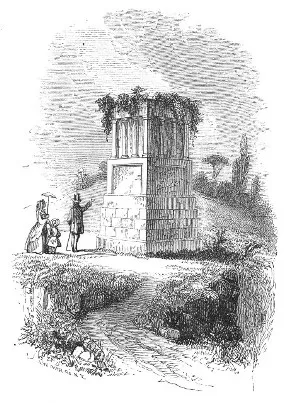
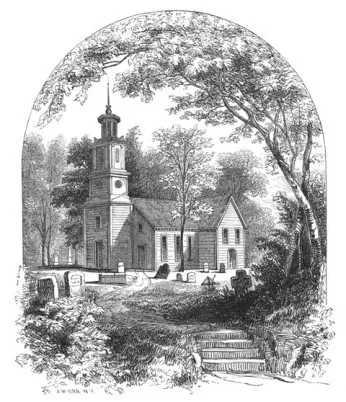
Tomb of Washington's Mother.
This extract is given as being very characteristic;
full of
that fire whose volcanic intensity was so carefully covered under the
snow of caution in after life; and also as a specimen of Washington's
style of writing, clear, earnest, commanding and business-like, but
deficient in all express graces, and valuable rather for substance than
form. We see in his general tone of expression something of that
resolute mother, who, when her son, already the first man in public
estimation, urged her to make Mount Vernon her home for the rest of her
days, tersely replied——"I thank you for your affectionate and dutiful
offers, but my wants are few in this world, and I feel perfectly
competent to take care of myself." Directness is the leading trait in
the style of both mother and son; if either used circumlocution, it was
rather through deliberateness than for diplomacy. Indeed, the alleged
indebtedness of great sons to strong mothers, can hardly find a more
prominent support than in this case. What a Roman pair they were! If
her heart failed her a little, sometimes, as what mother's heart must
not, in view of toils, sacrifices, and dangers like his; if she argued
towards the softer side, how he answered her, appealing to her stronger
self:
Mount
Vernon,
14th Aug.,
1755.
"Honored Madam,
"If it is in my power to avoid going to the Ohio
again, I
shall; but if the command is passed upon me by the general voice of the
country, and offered upon such terms as cannot be objected against, it
would reflect dishonor upon me to refuse it; and that, I am sure, must,
or ought to, give you greater uneasiness than my going in an honorable
command. Upon no other terms will I accept of it. At present I have no
proposals made to me, nor have I advice of such an intention, except
from private hands.
"I am, &c."
When the object for which he had undertaken the
campaign—viz.:
the undisturbed possession of the Ohio River—was accomplished,
Washington resigned his commission, after five years of active and
severe service, his health much broken and his private affairs not a
little disordered. The resignation took effect in December, 1758, and
in January, 1759, he was married, and, as he supposed, finally settled
at Mount Vernon—or,
as he expresses it in his quiet way—"Fixed at this
seat, with an agreeable partner for life, I hope to find more happiness
in retirement than I ever experienced amidst the wide and bustling
world." And in liberal and elegant improvements, and the exercise of a
generous hospitality, the young couple spent the following fifteen
years; the husband attending to his duties as citizen and planter, with
ample time and inclination for fox-hunting and duck-shooting, and the
wife, a kind, comely, thrifty dame, looking well to the ways of her
household, superintending fifteen domestic spinning-wheels, and
presiding at a bountiful table, to the great satisfaction of her
husband and his numerous guests. When the spirit of the people began to
rise against the exactions of the mother country, Washington was among
the foremost to sympathize with the feeling of indignation, and the
desire to resist, peaceably, if possible, forcibly if necessary. Of
this, his letters afford ample proof. When armed resistance was
threatened, Washington was immediately thought of as the Virginia
leader. When Congress began, in earnest, preparations for defence,
Washington was chairman of all the committees on the state of the
country. When the very delicate business of appointing a
commander-in-chief of the American armies was under consideration,
Washington was the man whose name was on every tongue, and who was
unanimously chosen, and that by the direct instrumentality of a son of
Massachusetts, though that noble State, having commenced the struggle,
might well have claimed the honor of furnishing a leader for it. What
generosity of patriotism there was, in the men of those days, and how a
common indignation and a common danger seem to have raised them above
the petty jealousies and heart-burnings
that so disfigure public doings
in time of peace and prosperity! How the greatness of the great man
blazed forth on this new field! What an attitude he took before the
country, when he said, on accepting the position, "I beg leave to
assure the Congress that as no pecuniary consideration could have
tempted me to accept this arduous employment, at the expense of my
domestic ease and happiness, I do not wish to make any profit from it.
I will keep an exact account of my expenses. These, I doubt not they
will discharge, and that is all I desire." There was a natural,
unconscious sovereignty in thus assuming to be the judge of what it
might be proper to expend, in concerns the most momentous, extensive,
and novel, as well as in taking the entire risk, both of payment and of
public approbation,—in a direction in which he had already found the
sensitiveness of the popular mind,—that equals any boldness of
Napoleon's. We can hardly wonder that, in after times, common men
instinctively desired and expected to make him a king.
The battle of Bunker Hill had taken place in the
time that
intervened between Washington's consent and the receipt of his
commission, so that he set out for Cambridge, with no lingering doubt
as to the nature, meaning, or result of the service in which he had
pledged all. He writes to his brother, "I am embarked on a wide ocean,
boundless in its prospect, and in which, perhaps, no safe harbor is to
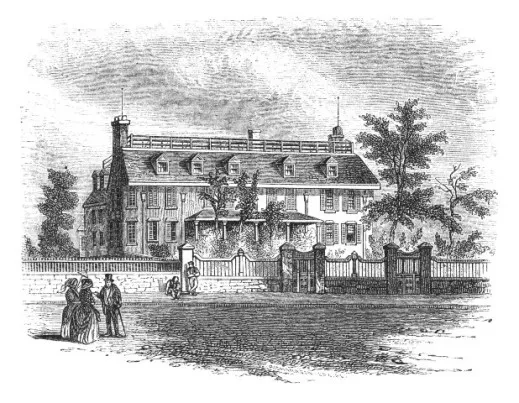
be found." His residence at Cambridge, a fine old mansion, still
stands, and in worthy occupancy. Here it was that he undertook the
intolerable duty of organizing a young army, without clothes, tents,
ammunition, or money, with a rich, bitter and disciplined enemy in
sight, and boiling blood on both sides. Here
it was that General Gage,
with whom he had fought, side by side, twenty years before, on the
Monongahela, so exasperated him by insolent replies to his
remonstrances against the cruel treatment of American prisoners, that
he gave directions for retaliation upon any of the enemy that might
fall into American hands.
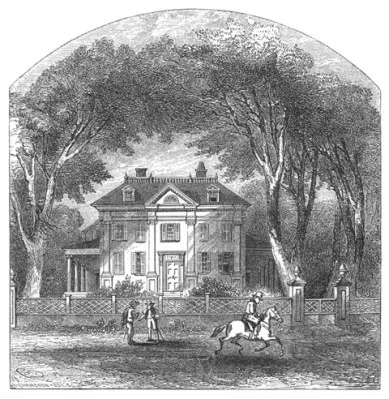
Washington's Headquarters,
Cambridge, 1775.
He was, however, Washington still, even
though burning with a holy anger; and, ere the order could reach its
destination, it was countermanded, and a charge given to all concerned
that the prisoners should be allowed parole, and that
every other
proper indulgence and civility should be shown them. His letters to
General Gage are models of that kind of writing. In writing to Lord
Dartmouth afterwards, the British commander, who had been rebuked with
such cutting and deserved severity, observes with great significance,
"The trials we have had, show the rebels are not the despicable rabble
we have supposed them to be."
Washington was not without a stern kind of wit, on certain
occasions. When the rock was struck hard, it failed not in fire. The
jealousy of military domination was so great as to cause him terrible
solicitudes at this time, and a month's enlistments brought only five
thousand men, while murmurs were heard on all sides against poor pay
and bad living. Thinking of this, at a later day, when a member of the
Convention for forming the Constitution, desired to introduce a clause
limiting the standing army to five thousand men, Washington observed
that he should have no objection to such a clause, "if it were so
amended as to provide that no enemy should presume to invade the United
States with more than three thousand."
Amid all the discouragements of that heavy time,
the
resolution of the commander-in-chief suffered no abatement. "My
situation is so irksome to me at times," he says after enumerating his
difficulties in a few forcible words, "that if I did not consult the
public good more than my own tranquillity, I should long ere this have
put every thing on the cast of a die." But he goes on to say, in a tone
more habitual with him—"If every man was of my mind, the ministers of
Great Britain should know, in a few words, upon what issue the cause
should be put. I would not be deceived by artful declarations, nor
specious pretences, nor would I be amused by unmeaning propositions,
but, in open, undisguised and manly terms, proclaim our wrongs, and our
resolution to be redressed. I would tell them that we had borne much,
that we had long and ardently sought for reconciliation upon honorable
terms; that it had been denied us; that all our attempts after peace
had proved abortive, and had been grossly misrepresented; that we had
done every thing that could be expected from the best of subjects; that
the spirit of freedom rises too high in us to submit to slavery. This I
would tell them, not under covert, but in words as clear as the sun in
its meridian brightness."
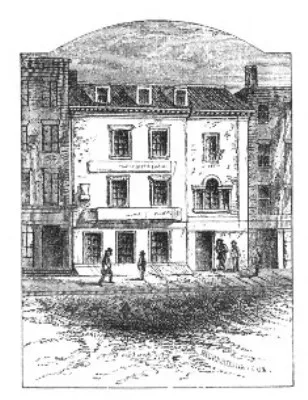
Washington's Headquarters, 180 Pearl
street, New-York. 1776.
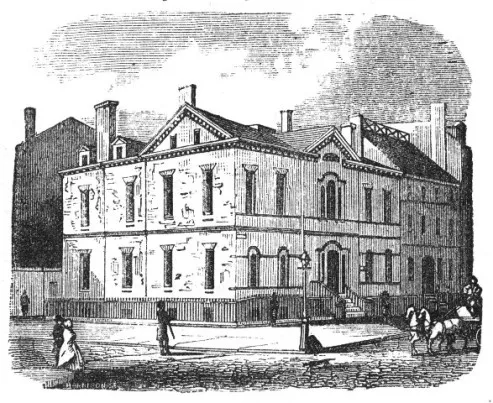
House No. 1 Broadway.
The house No. 1 Broadway, opposite the Bowling-green,
remained unaltered until within a year or two in the shape here
presented, in which it had become familiar to all New-Yorkers. It was
built by Captain Kennedy of the Royal Navy, in April, 1765. There Lee,
Washington, and afterwards Sir Henry Clinton, Robertson, Carleton, and
other British officers were quartered, and here André wrote his letter
to Arnold.—Lossing. It was afterwards occupied by
Aaron Burr. Very recently, this interesting house, which in New-York
may be termed ancient, has been metamorphosed by
the
addition of two or three stories, and it is now reduced
to be the Washington Hotel.
When the British evacuated Boston, Congress voted
Washington a
gold medal, with abundant thanks and praises; and, thus compensated for
the cruel anxieties of the winter, he proceeded with unwavering courage
to New-York, where new labors awaited him, and the mortifying defeat at
Gowanus, turned into almost triumph by the admirable retreat
Afterwards.
The movement from New-York city to Harlem Heights should have
been another glory, and nothing on the part of the Commander-in-Chief
was wanting to make it such, but a panic seized two brigades of
militia, who ran away, sans façon, causing
Washington to lose, for a moment, some portion of the power over his
own emotions for which he is so justly celebrated. He dashed in among
the flying rout, shouting, shaming them, riding exposed within a few
yards of the enemy; and, finding this of no avail, drew his sword and
threatened to "run them through," and cocked and snapped his pistol in
their faces. But all would not do, and General Greene says, in a letter
to a friend, "He was so vexed at the
infamous conduct of the troops,
that he sought death rather than life." Washington, the "man of
marble," would have preferred a thousand deaths to dishonor.
A new army was now to be raised, the term of the last
enlistment having expired; and, to form a just opinion of Washington's
character and talents, every letter of his, to Congress and others
during this period, should be studied. Such wisdom, such indignation,
such patience, such manly firmness, such disappointment! every thing
but despair; the watchfulness, the forethought, the perseverance
displayed in those letters, give a truer idea of the man than all his
battles.
Take a single passage from one of his letters:—"I
am wearied
almost to death with the retrograde motion of things, and I solemnly
protest, that a pecuniary reward of twenty thousand pounds a year would
not induce me to undergo what I do; and after all, perhaps, to lose my
character, as it is impossible, under such a variety of distressing
circumstances, to conduct matters agreeably to public expectation, or
even to the expectation of those who employ me, as they will not make
proper allowances for the difficulties their own errors have
occasioned."
And besides that which came upon him daily, in the
regular
line of duty, the yet more difficult work of bearing up the hearts of
others, whose threats of abandoning the service were the running bass
that made worse the din of war. "I am sorry to find," writes the Chief
to General Schuyler, "that both you and General Montgomery incline to
quit the service. Let me ask you, sir, what is the time for brave men
to exert themselves in the cause of liberty and their country, if this
is not? God knows there is not a difficulty that you
both very justly
complain of, which I have not in an eminent degree experienced, that I
am not every day experiencing. But we must bear up against them, and
make the best of mankind as they are, since we cannot have them as we
wish." In studying the career of Washington, nothing strikes one more
frequently than that no fame came to him fortuitously, not only did he
borrow none, usurp none, fall heir to none that belonged to others; he
earned every tittle that has ever been awarded to him, and evidently
contributed very much, by his secret advice and caution to officers
placed in difficult positions, to enhance the measure of praise
bestowed on his companions in arms.
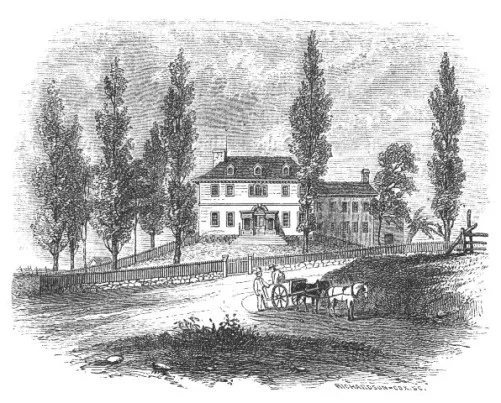
Washington's
Headquarters, Morristown, New Jersey. 1779.
Dark as these times were, Washington's peculiar merits were
every day becoming more and more evident; indeed the
darkest hours were
his opportunities. He might well say, after the loss of Fort
Washington, which had been held contrary to his judgment,—"No person
ever had a greater choice of difficulties to contend with than I have;"
yet he carried the war into New Jersey with all the resolution and
courage of a victor. Never without a party, too often a very large one,
ready to disparage his military skill, and throw doubts upon his energy
in the conduct of the war, he pursued his plans without swerving a
hair's breadth to court the popular gale, though a natural and
honorable love of reputation was one of the ruling passions of his
soul. It was impossible to make the people believe that a series of
daring encounters would have cost the Commander-in-chief far less than
the "Fabian policy," so scorned at the time; but Washington saw then,
in the very heat of the contest, what the result has now made evident
enough to all, that England must carry on a war on the other side of
the globe under an immense disadvantage, and that considering the
general spirit of the American people, the expense to an invading power
must be greater than even the richest nation on earth could long
sustain. That the necessity for delay was intensely mortifying to him,
we have a thousand proofs; and it was not the least bitter drop in his
cup, that in order to conceal from the enemy the deficiencies
occasioned by the delay of Congress to meet his most strenuous
requisitions, he was obliged to magnify his numbers and resources, in a
way which could not but increase the public doubts of his promptness.
No one can read his letters, incessant under these circumstances,
without an intense personal sympathy, that almost forgets the warrior
and the patriot in the man.
His being invested with what was in reality a military
dictatorship, did not help to render him more popular, although he used
his power with his accustomed moderation, conscientiousness and
judgment. In this, as in other cases, he took the whole responsibility
and odium, while he allowed others to reap the credit of particular
efforts; giving to every man at least his due, and content if the
country was served, even though he himself seemed to be doing nothing.
This we gather as much from the letters of others to him as from his
own writings.
The celebrated passage of the Delaware, on
Christmas-day,
1776,—so lifelike represented in Leutze's great picture,—flashed a
cheering light over the prospects of the contest, and lifted up the
hearts of the desponding, if it did not silence the cavils of the
disaffected. The intense cold was as discouraging here as the killing
heat had been at Gowanus. Two men were found frozen to death, and the
whole army suffered terribly; but the success was splendid, and the
enemy's line along the Delaware was broken. The British opened their
eyes very wide at this daring deed of the rebel chief, and sent the
veteran Cornwallis to chastise his insolence. But Washington was not
waiting for him. He had marched to Princeton, harassing the enemy, and
throwing their lines still more into confusion. New Jersey was almost
completely relieved, and the spirits of the country raised to martial
pitch before the campaign closed. Those who had hastily condemned
Washington as half a traitor to the cause, now began to call him the
Saviour of his Country. Success has wondrous power in illuminating
merit, that may yet have been transparent without it. But even now,
when he thought proper to administer to all the oath of allegiance to
the United States, granting leave to the disaffected to retire within
the enemy's lines, a new clamor was raised against him, as assuming
undue and dangerous power. It was said there were no "United States,"
and the Legislature of New Jersey censured the order as interfering
with their prerogative. But Washington made no change. The dangers of
pretended neutrality had become sufficiently apparent to him; and he
chose, as he always did, to defer his personal popularity to the safety
of the great cause. And again he took occasion, though the treatment of
General Lee was in question, to argue against retaliation of the
sufferings of prisoners, in a manly letter, which would serve as a text
in similar cases for all time.
What a blessing was Lafayette's arrival! not only
to the
struggling States, but in particular to Washington. The spirit of the
generous young Frenchman was to the harassed chief as cold water to the
thirsty soul. No jealousies, no fault-finding, no selfish emulation;
but pure, high, uncalculating enthusiasm, and a devotion to the
character and person of Washington that melted the strong man, and
opened those springs of tenderness which cares and duties had well-nigh
choked up. It is not difficult to believe that Lafayette had even more
to do with the success of the war than we are accustomed to think.
Whatever kept up the chief's heart up-bore the army and the country;
for it is plain that, without derogation from the ability or
faithfulness of any of the heroic contributors to the final triumph,
Washington was in a peculiar manner the life and soul,—the main-spring
and the balance-wheel,—the spur and the rein, of the whole movement and
its result. Blessings, then, on Lafayette, the helper and
consoler of
the chosen father of his heart, through so many trials! His name goes
down to posterity on the same breath that is destined for ever to
proclaim the glory of Washington.
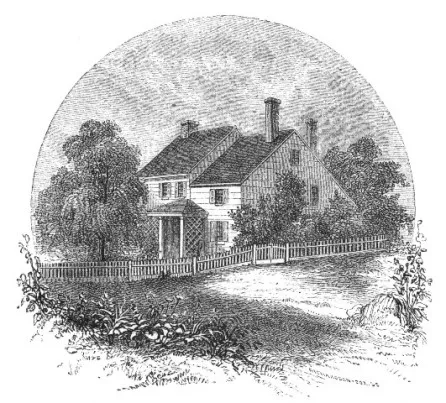
Washington's
Headquarters, Chad's Ford, 1777.
Chad's Ford, in Delaware, was the scene of another of those
disasters which it was Washington's happy fortune to turn into
benefits. The American army retreated from a much superior force, and
retreated in such disorder as could seem, even to its well-wishers,
little better than a flight. But when, after encamping at Germantown,
it was found that the General meant to give battle again, with a
barefooted army, exhausted by forced marches, in a country which
Washington himself says, was "to a man, disaffected," dismay itself
became buoyant, and the opinion spread, not only throughout America,
but even as far as France, that the leader of our armies
was indeed
invincible. A heavy rain and an impenetrable fog defeated our brave
troops; the attempt cost a thousand men. Washington says, solemnly, "It
was a bloody day." Yet the Count de Vergennes, on whose impressions of
America so much depended at that time, told our Commissioners in Paris
that nothing in the course of our struggle had struck him so much as
General Washington's venturing to attack the veteran army of Sir
William Howe, with troops raised within the year. The leader's glory
was never obscured for a moment, to the view of those who were so
placed as to see it in its true light. Providence seems to have
determined that the effective power of this great instrument should be
independent of the glitter of victory.
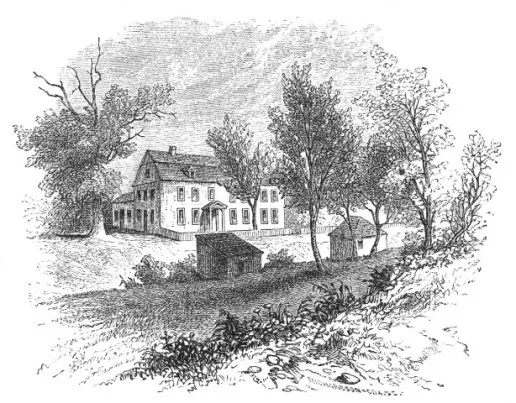
Washington's
Headquarters, White Marsh, 1777.
Encamped at Whitemarsh, fourteen miles from Philadelphia,
Washington, with his half-clad and half-fed troops, awaited an attack
from General Howe who had marched in
that direction with twelve
thousand effective men. But both commanders were wary—the British not
choosing to attack his adversary on his own ground, and the American
not to be decoyed from his chosen position to one less favorable. Some
severe skirmishing was therefore all that ensued, and General Howe
retreated, rather ingloriously, to Philadelphia.
Washington's
Headquarters, Valley Forge, 1777.
This brings us to the terrible winter at Valley
Forge, the
sufferings of which can need no recapitulation for our readers.
Washington felt them with sufficient keenness, yet his invariable
respect for the rights of property extended to that of the disaffected,
and in no extremity was he willing to resort to coercive measures, to
remedy evils which distressed his very soul, and which he shared with
the meanest soldier. His testimony to the patience and fortitude of the
men is emphatic: "Naked and starving as they are, we cannot enough
admire the incomparable patience and fidelity of the soldiery, that
they have not been, ere this, excited by their sufferings to a general
mutiny and dispersion." And while this evil was present, and for the
time irremediable, he writes to Congress on the subject of a suggestion
which had been made of a winter campaign, "I can
assure those gentlemen, that it is a much easier and less distressing
thing to draw remonstrances, in a comfortable room, by a good fireside,
than to occupy a cold bleak hill, and sleep under frost and snow,
without clothes or blankets. However, although they seem to have little
feeling for the naked and distrest soldiers, I feel super-abundantly
for them, and from my soul I pity those miseries which it is neither in
my power to relieve nor prevent."
It was during this period of perplexity and
distress on public
accounts, that the discovery of secret cabals against himself, was
added to Washington's burthens. But whatever was personal was never
more than secondary with him. When the treachery of pretended friends
was disclosed, he showed none of the warmth which attends his statement
of the soldiers' grievances. "My enemies take an ungenerous advantage
of me," he said, "they know the delicacy of my situation, and that
motives of policy deprive me of the defence I might otherwise make
against their insidious attacks. They know I cannot combat their
insinuations, however injurious, without disclosing secrets which it is
of the utmost moment to conceal." * * * "My chief concern arises from
an apprehension of the dangerous consequences which intestine
dissensions may produce to the common cause."
General Howe made no attempt on the camp during the winter,
but his foraging parties were watched and often severely handled by the
Americans. When Dr. Franklin, who
was in Paris, was told that General
Howe had taken Philadelphia, "Say rather," he replied, "that
Philadelphia has taken General Howe," and the advantage was certainly a
problematical one. Philadelphia was evacuated by the British on the
18th of June, 1776, General Clinton having superseded General Howe, who
returned to England in the spring. Washington followed in the footsteps
of the retreating army, and, contrary to the opinion of General Lee,
decided to attack them. At Monmouth occurred the scene so often cited
as proving that Washington could lose his temper—a
testimony to his habitual self-command which no art of praise could
enhance. Finding General Lee with his five thousand men in full retreat
when they should have been rushing on the enemy, the commander-in-chief
addressed the recreant with words of severe reproof, and a look and
manner still more cutting. Receiving in return a most insolent reply,
Washington proceeded, himself, by rapid manœuvres, to array the troops
for battle, and when intelligence arrived that the British were within
fifteen minutes march, he said to General Lee, who had followed him,
deeply mortified,—"Will you command on this ground, or not?" "It is
equal with me where I command," was the answer. "Then I expect you to
take proper measures for checking the enemy," said the General, much
incensed at the offensive manner of Lee. "Your orders shall be obeyed,"
said that officer, "and I will not be the first to leave the field."
And his bravery made it evident that an uncontrolled temper was the
fault for which he afterwards suffered so severely. During the action
Washington exposed himself to every danger, animating and cheering on
the men under the burning sun; and when night came, he lay down in
his cloak at
the foot of a tree, hoping for a general action the next day. But in
the morning Sir Henry Clinton was gone, too far for pursuit under such
killing heat—the thermometer at 96°. Many on both sides had perished
without a wound, from fatigue and thirst.
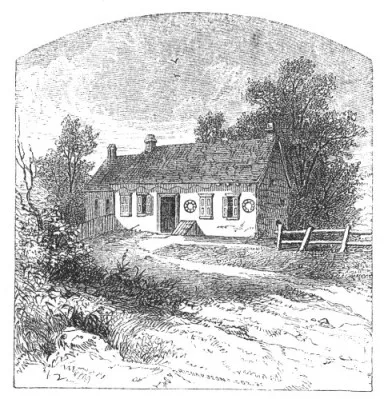
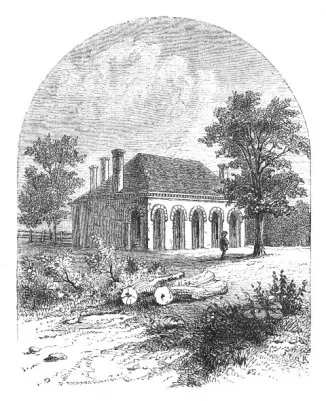
Washington's
Headquarters, Tappan, 1778.
The headquarters at Tappan will always have a sad interest
from the fact that Major André, whose fine private qualities have
almost made the world forget that he was a spy, there met his unhappy
fate. That General Washington suffered severely under the necessity
which obliged him, by the rules of war, to sanction the decision of the
court-martial in this case, we have ample testimony; and an eye-witness
still living observed, that when the windows of the town were thronged
with gazers at the stern procession as it passed, those of the
commander-in-chief were entirely closed, and his house without sign of
life except the two sentinels at the door.
The revolt of a part of the Pennsylvania line, which occurred
in January, 1781, afforded a new occasion for the exercise of
Washington's pacific wisdom. He had felt the grievances of the army too
warmly to be surprised when any portion of it lost patience, and his
prudent and humane suggestions, with the good management of General
Wayne, proved effectual in averting the great danger which now
threatened. But when the troops of New Jersey, emboldened by this mild
treatment, attempted to imitate their Pennsylvania neighbors, they
found Washington prepared, and six hundred men in arms ready to crush
the revolt by force—a catastrophe prevented only by the unconditional
submission of the mutineers, who were obliged to lay down their arms,
make concessions to their officers, and promise obedience.
As we are not giving here a sketch of the Revolutionary War,
we pass at once to the siege and surrender at Yorktown, an event which
shook the country like that heaviest clap of thunder, herald of the
departing storm. All felt that brighter skies were preparing, and the
universal joy did not wait the sanction of a deliberate treaty of
peace. The great game of chess which had been so warily played, on one
side at least, was now in check, if not closed by a final check-mate;
and people on the winning side were fain to unknit their weary brows,
and indulge the repose they had earned. Congress and the country felt
as if the decisive blow had been struck, as if the long agony was over.
Thanks were lavished on the commanders, on the officers, on the troops.
Two stands of the enemy's colors were presented to the
Commander-in-Chief, and to Counts Rochambeau and De Grasse each a piece
of British field ordnance as a trophy. A commemorative column at
Yorktown was decreed, to carry down to posterity the events of the
glorious 17th of October, 1781. There was, in short, a kind of wildness
in the national joy, showing how deep had been the previous
despondency. Watchmen woke the citizens of Philadelphia at one in the
morning, crying "Cornwallis is taken!" Sober, Puritan America was
almost startled from her habitual coolness; almost forgot the still
possible danger. The chief alone, on whom had fallen the heaviest
stress of the long contest, was impelled to new care and forecast by
the victory. He feared the negligence of triumph, and reminded the
government and the nation that all might yet be lost, without
vigilance. "I cannot but flatter myself," he says, "that the States,
rather than relax in their exertions, will be stimulated to the most
vigorous preparations, for another active, glorious, and decisive
campaign." And Congress responded wisely to the appeal, and called on
the States to keep up the military establishment, and to complete their
several quotas of troops at an early day. With his characteristic
modesty and courage, Washington wrote to Congress a letter of advice on
the occasion, of which one sentence may be taken as a specimen.
"Although we cannot, by the best concerted plans, absolutely command
success; although the race is not always to the swift, nor the battle
to the strong; yet, without presumptuously waiting for miracles to be
wrought in our favor, it is an indispensable duty, with the deepest
gratitude to Heaven for the past, and humble confidence in its smiles
on our future operations, to make use of all the means in our power for
our defence and security."
It was this man, pure, devoted, and indefatigable in the cause
of his country and her liberties, that some shortsighted
malcontents, judging his virtue by their own, would now have persuaded
to finish the
struggle for liberty by becoming a king. The discontent of the officers
and soldiers, with the slowness of their pay, had long been a cause of
ferment in the army, and gave to the hasty and the selfish an excuse
for desiring a change in the form of government. The king's troops had
been well fed, well clothed, and well paid, and were sure of half-pay
after the war should be finished, while the continentals, suffering
real personal destitution, were always in arrear, drawing on their
private resources, and with no provision whatever for any permanent
pecuniary recompense. As to the half-pay, Washington had long before
expressed his opinion of the justice as well as policy of such a
provision. "I am ready to declare," he says, "that I do most
religiously believe the salvation of the cause depends upon it, and
without it your officers will moulder to nothing, or be composed of low
and illiterate men, void of capacity for this or any other business. * * *
Personally, as an officer, I have no interest in the decision;
because I have declared, and I now repeat it, that I never will receive
the smallest benefit from the half-pay establishment." But the
deep-seated jealousy of the army, which haunted Congress and the
country, like a Banshee, throughout the whole course of the war, was
too powerful for even Washington's representations. All that could be
effected was an unsatisfactory compromise, and some of the officers saw
or affected to see, in the reluctance of the government to provide
properly for its defenders, a sign of fatal weakness, which but little
recommended the republican form. Under these circumstances, a well
written letter was sent to the Commander-in-Chief, proposing to him the
establishment of a "mixed government," in which the supreme position
was to be given, as of right, to the man who had been the instrument of
Providence in saving the country, in "difficulties apparently
insurmountable by human power," the dignity to be accompanied with the
title of king. Of this
daring proposition a colonel of good standing was made the organ.
Washington's reply may be well known, but it will bear many repetitions.
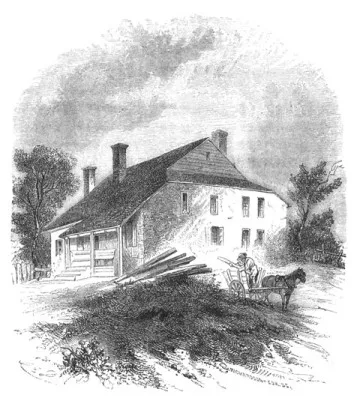
Washington's
Headquarters, Newburgh, N.Y.
Newburgh,
22 May, 1782.
"Sir,
"With a mixture of great surprise and astonishment, I have
read with attention the sentiments you submitted to my perusal. Be
assured, Sir, no occurrence in the course of the war has given me more
painful sensations than your information, of there being such ideas
existing in the army as you have expressed, and I must view with
abhorrence, and reprehend with severity. For the present, the
communication of them will rest in my own bosom, unless some further
agitation of the matter shall make a disclosure necessary.
"I am much at a loss to conceive what part of my conduct
could have given encouragement to an address, which, to me, seems big
with the greatest mischiefs that can befall my country. If I am not
deceived in the knowledge of myself, you could not have found a person
to whom your schemes are more disagreeable. At the same time, in
justice to my own feelings, I must add that no man possesses a more
sincere wish to see ample justice done to the army than I do; and as
far as my powers and influence, in a constitutional way, extend, they
shall be employed to the utmost of my abilities to effect it, should
there be any occasion. Let me conjure you, then, if you have any regard
for your country, concern for yourself or
posterity, or respect for me,
to banish these thoughts from your mind, and never communicate, as from
yourself or any one else, a sentiment of the like nature.
"I am, Sir, &c.,
"George Washington."
This letter is extremely characteristic, not only because it
declines the glittering bait, for that is hardly worth noticing where
Washington is in question, but for the cool and quiet tone of rebuke,
in a case in which most other men would have been disposed to be at
least dramatically indignant. The perfectly respectful way in which he
could show a man that he despised him, is remarkable. He does not even
admit that there has been injustice done to the army, though the fact
had cost him such loads of anxious and ingenious remonstrance; but only
promises to see to it, "should there be any occasion." It would have
been easier for him, at that very moment, at the head of a victorious
army, and with the heart of the nation at his feet, to make himself a
king, than to induce Congress to do justice to the troops and their
brave officers; but identifying himself with his army, he considered
that his own private affair, and would accept no offer of partnership,
however specious. Happily the name of the "very respectable" colonel
has never been disclosed; an instance of mercy not the least noticeable
among the features of this remarkable transaction.
During the negotiations for peace which so soon followed the
surrender at Yorktown, the discontent of the army reached a height
which became alarming. Meetings of officers were called, for the
purpose of preparing threatening resolutions, since called "the
Newburgh addresses," to be offered to Congress.
The alternative
proposed was a relinquishment of the service in a body, if the war
continued, or remaining under arms, in time of peace, until justice
could be obtained from Congress. Washington, having timely notice of
this danger, came forward with his usual decision, wisdom, and
kindliness, to the rescue of the public interest and peace. While he
took occasion, in a general order, to censure the disorderly and
anonymous form proposed, he himself called a meeting of officers,
taking care to converse in private beforehand with many of them,
acknowledging the justice of their complaints, but inculcating
moderation and an honorable mode of obtaining what they desired. It is
said that many of the gentlemen were in tears when they left the
presence of the Commander-in-Chief. When they assembled, he addressed
them in the most impressive manner, imploring them not to tarnish their
hard-won laurels, by selfish passion, in a case in which the vital
interests of the country were concerned. He insisted on the good faith
of Congress, and the certainty that, before the army should be
disbanded, all claims would be satisfactorily adjusted.
His remonstrance proved irresistible. The officers, left to
themselves,—for the General withdrew after he had given utterance to
the advice made so potent by his character and services,—passed
resolutions thanking him for his wise interference, and expressing
their love and respect for him, and their determination to abide by his
counsel. In this emergency Washington may almost have been said to have
saved his country a second time, but in his letters written at the time
he sinks all mention of his own paramount share in restoring
tranquillity, speaking merely of "measures taken to postpone the
meeting," and "the good sense of the officers" having terminated the
affair
"in a manner which reflects the greatest glory on themselves."
His own remonstrances with Congress were immediately renewed, setting
forth the just claims of those who "had so long, so patiently, and so
cheerfully, fought under his direction," so forcibly, that in a very
short time all was conceded, and general harmony and satisfaction
established.
His military labors thus finished,—for the adjudication of the
army claims by Congress was almost simultaneous with the news of the
signing of the treaty at Paris,—Washington might, without impropriety,
have given himself up to the private occupations and enjoyments so
religiously renounced for eight years,—the proclamation of peace to the
army having been made, April 19, 1783, precisely eight years from the
day of the first bloodshedding at Lexington. But the feelings of a
father were too strong within him, and his solicitudes brooded over the
land of his love with that unfailing anxiety for its best good which
had characterized him from the beginning. Yet he modestly observes, in
a letter on the subject to Col. Hamilton, "How far any further essay by
me might be productive of the wished-for end, or appear to arrogate
more than belongs to me, depends so much upon popular opinion, and the
temper and dispositions of the people, that it is not easy to decide."
He wrote a circular letter to the Governors of the several States, full
of wisdom, dignity, and kindness, dwelling principally on four great
points—an indissoluble union of the States; a sacred regard to public
justice; the adoption of a proper military peace establishment; and a
pacific and friendly disposition among the people of the States, which
should induce them to forget local prejudices, and incline them to
mutual concessions. This address is masterly in all respects, and
was felt to be particularly well-timed, the calm and honoured voice of
Washington being at that moment the only one which could hope to be
heard above the din of party, and amid the confusion natural during the
first excitement of joy and triumph.
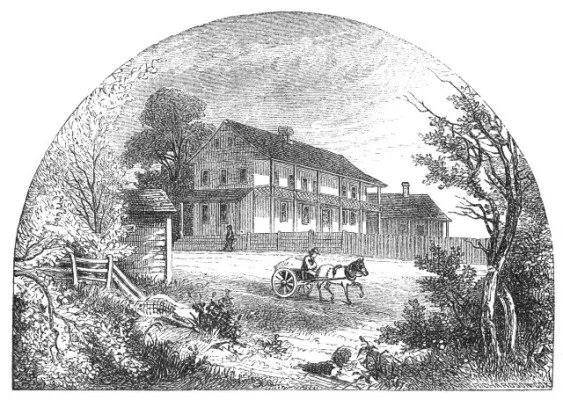
Washington's
Headquarters, Rocky Hill, N.J., 1783
Congress was not too proud to ask the counsel of its brave and
faithful servant, in making arrangements for peace and settling the new
affairs of the country. Washington was invited to Princeton, where
Congress was then sitting, and introduced into the Chamber, where he
was addressed by the President, and congratulated on the success of the
war, to which he had so much contributed. Washington replied with his
usual self-respect and modesty, and retired. A house had been prepared
for him at Rocky Hill, near Princeton, where he resided for some time,
holding conference with committees and members, and giving counsel on
public affairs; and where he wrote that
admirable farewell to his army,
perhaps as full of his own peculiar spirit as any of his public papers.
His thanks to officers and soldiers for their devotion during the war
have no perfunctory coldness in them, but speak the full heart of a
brave and noble captain, reviewing a most trying period, and recalling
with warm gratitude the co-operation of those on whom he relied. Then,
for their future, his cautions and persuasions, the motives he urges,
and the virtues he recommends, all form a curious contrast with those
of Napoleon's addresses to his troops. "Let it be known and
remembered," he says, "that the reputation of the federal armies is
established beyond the reach of malevolence; and let a consciousness of
their achievements and fame still incite the men who composed them to
honorable actions; under the persuasion that the private virtues of
economy, prudence, and industry, will not be less amiable in civil
life, than the more splendid qualities of valor, perseverance and
enterprise were in the field." Thus consistent to the last he honored
all the virtues; showing that while those of the field were not
misplaced in the farm, those of the farm might well be counted among
the best friends of the field—his own life of planter and soldier
forming a glorious commentary on his doctrines.
The evacuation of New-York by the British was a grand affair,
General Washington and Governor George Clinton riding in at the head of
the American troops that came from the northward to take possession,
while Sir Guy Carleton and his legions embarked at the lower end of the
city. The immense cavalcade of the victors embraced both military and
civil authorities, and was closed by a great throng of citizens. This
absolute finale of the war brought on the
Commander-in-Chief
one of those duties at once sweet and painful—taking
leave of his companions in arms; partners in toil and triumph, in
danger and victory. "I cannot come to each of you to take my leave," he
said, as he stood, trembling with emotion, "but I shall be obliged if
each of you will come and take me by the hand." General Knox, the
warm-hearted, stood forward and received the first embrace; then the
rest in succession, silently and with universal tears. Without another
word the General walked from the room, passed through lines of soldiery
to the barge which awaited him, then, turning, waved his hat, and bade
to friends and comrades a silent, heartfelt adieu, which was responded
to in the same solemn spirit. All felt that it was not the hour nor the
man for noisy cheers; the spirit of Washington presided there, as ever,
where honorable and high-minded men were concerned.
The journey southward was a triumphal march. Addresses,
processions, delegations from religious and civil bodies, awaited him
at every pause. When he reached Philadelphia he appeared before
Congress to resign his commission, and no royal abdication was ever so
rich in dignity. All the human life that the house would hold came
together to hear him, and the words, few and simple, wise and kind,
that fell from the lips of the revered chief, proved worthy to be
engraved on every heart. In conclusion he said:—"Having now finished
the work assigned me, I retire from the great theatre of action; and,
bidding an affectionate farewell to this august body, under whose
orders I have so long acted, I here offer my commission, and take my
leave of all the employments of public life." He said afterwards to a
friend:—"I feel now as I conceive a wearied traveller must do, who,
after treading many a step
with a heavy burden on his shoulders, is
eased of the latter, having reached the haven to which all the former
were directed, and from his house-top is looking back, and tracing with
an eager eye the meanders by which he escaped the quicksands and mire
which lay in his way, and into which none but the all-powerful Guide
and Dispenser of human events could have prevented his falling." And to
Lafayette, he says:—"I am not only retired from all public employments,
but I am retiring within myself, and shall be able to view the solitary
walk, and tread the paths of private life with a heartfelt
satisfaction. Envious of none, I am determined to be pleased with all;
and this, my dear friend, being the order of my march, I will move
gently down the stream of life until I sleep with my fathers."
That the public did not anticipate for him the repose and
retirement he so much desired, we may gather from the instructions
sent, at the time he resigned his commission, by the State of
Pennsylvania, to her representatives in Congress, saying that "his
illustrious actions and virtues render his character so splendid and
venerable that it is highly probable the world may make his life in a
considerable degree public;" and that "his very services to his country
may therefore subject him to expenses, unless he permits her gratitude
to interpose." "We are perfectly acquainted," says the paper, "with the
disinterestedness and generosity of his soul. He thinks himself amply
rewarded for all his labors and cares, by the love and prosperity of
his fellow-citizens. It is true no rewards they can bestow can be equal
to his merits, but they ought not to suffer those merits to be
burdensome to him. * * * We are aware of the delicacy with which such a
subject must be treated. But, relying in the good sense of Congress, we
wish it may engage their early attention."
The delegates, on receipt of these instructions, very wisely
bethought themselves of submitting the matter to the person most
concerned before they brought it before Congress, and he, as might have
been expected, entirely declined the intended favor, and put an end to
the project altogether. If he could have been induced to accept
pecuniary compensation, there is no doubt a grateful nation would
gladly have made it ample. But Washington, born to be an example in so
many respects, had provided against all the dangers and temptations of
money, by making himself independent as to his private fortune; having
neglected no opportunity of enlarging it by honorable labor or
judicious management, while he subjected the expenses of his family to
the strictest scrutiny of economy.
Mount
Vernon (rear view).
His first care, on arriving at Mount Vernon, was to ascertain
the condition of his private affairs; his next to make a tour of more
than six hundred miles through the western country, with the double
purpose of inspecting some lands of his, and of ascertaining the
practicability of a communication between the head waters of the great
rivers flowing east and west of the Alleghanies. He travelled entirely
on horseback, in military style, and kept a minute journal of each
day's observations, the result of which he communicated, on his return,
in a letter to the Governor of Virginia, which Mr. Sparks declares to
be "one of the ablest, most sagacious, and most important productions
of his pen," and "the first suggestion of the great system of internal
improvements which has since been pursued in the United States." On a
previous tour, through the northern part of the State of New-York, he
had observed the possibility of a water communication between the
Hudson and the Great Lakes, and appreciated its advantages, thus
foreshowing, at that early date, the existence of the Erie Canal. In
1784, Washington had a final visit from Lafayette, from whom he parted
at Annapolis, with manifestations of a deeper tenderness than the weak
can even know. Arrived at home, he sat down at once to say yet another
word to the beloved: "In the moment of our separation, upon the road as
I travelled, and every hour since," (mark the specification from this
man of exact truth,) "I have felt all that love, respect and attachment
for you, with which length of years, close connection, and your merits
have inspired me. I often asked myself, as our carriages separated,
whether that was the last sight I should ever have of you? And though I
wished to say No! my fears answered Yes!" He was right; they never met
again, but they loved each other always. Lafayette's letters to
Washington are lover-like; they are alone sufficient to show how
capable of the softest feeling was the great heart to which they were
addressed.
Space fails us for even the baldest enumeration of the
instances of care for the public good with which the life of Washington
abounded, when he fancied himself "in retirement," for we have
unconsciously dwelt, with the reverence of affection, upon the picture
of his character during the Revolution, and felt impelled to illustrate
it, where we could, by quotations from his own weighty words; weighty,
because, to him, words were things indeed, and we feel that he never
used one thoughtlessly or untruly. Brevity must now be our chief aim,
and we pass, at once, over all the labor and anxiety which attended the
settlement of the Constitution, to mention the election of Washington
to the Presidency of the States so newly united, by bonds which,
however willingly assumed, were as yet but ill fitted to the wearers.
The unaffected reluctance with which he accepted the trust appears in
every word and action of the time; and it is evident that, as far as
selfish feelings went, he was much more afraid of losing the honor he
had gained than of acquiring new. The heart of the nation was with him,
however, even more than he knew; and the "mind oppressed with more
anxious and painful sensations" than he had words to express at the
outset, was soon calmed, not only by the suggestions of duty, but by
the marks of unbounded love and confidence lavished on him at every
step of his way by a grateful people. The Inaugural Oath was taken,
before an immense concourse of people, on the balcony of Federal Hall,
New-York, April 30, 1789, and the President afterwards delivered his
first Address, in the Senate Chamber of the same building,
now no longer standing, but not very satisfactorily replaced by that
magnificent Grecian temple wherein the United States Government
collects the Customs of New-York.
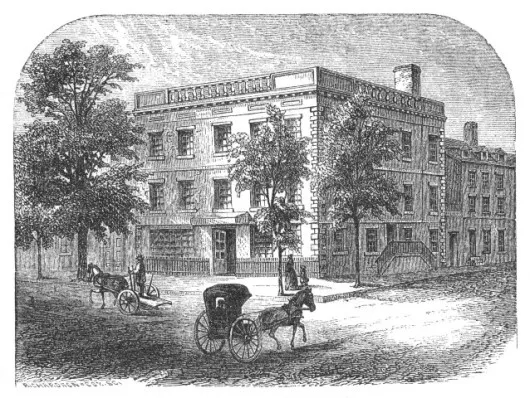
House
of the First Presidential Levee, Cherry street.
The house in which the first
Presidential levee was held will always be a point of interest, and the
consultations between Washington and the great officers of state about
the simple ceremonial of these public receptions, are extremely
curious, as showing the manners and ideas of the times, and the
struggle between the old-country associations natural to gentlemen of
that day, and the recognized necessity of accommodating even court
regulations to the feelings of a people to whom the least shadow of
aristocratic form was necessarily hateful. We must not condemn the
popular scrupulousness of 1789 as puerile and foolish, until we too
have perilled life and fortune in the cause of liberty and equality.
A dangerous illness brought Washington near the grave,
during his first Presidential summer, and he is said never to have
regained
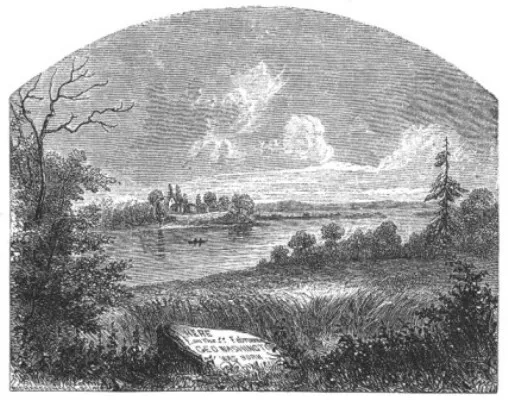
his full strength. In August his mother died, venerable for years and
wisdom, and always honored by her son in a spirit that would have
satisfied a Roman matron. She maintained her simple habits to the last,
and is said never to have exhibited surprise or elation, at her son's
greatest glory, or the highest honors that could be paid him. Her
remains rest under an unfinished monument, near Fredericksburgh,
Virginia.
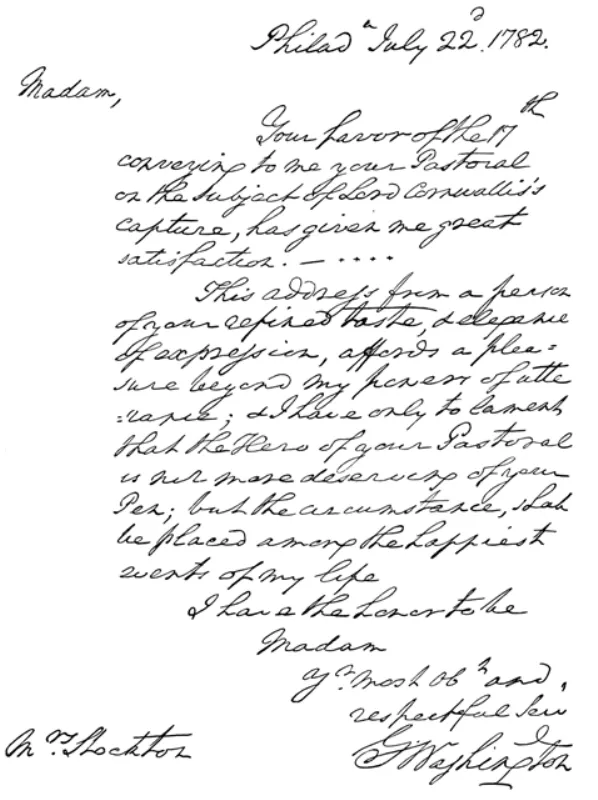
Of the wife of the illustrious Chief, it is often said that
little is known, and there is felt almost a spite against her memory
because she destroyed before her death every letter of her husband to
herself, save only one, written when he accepted the post of
Commander-in-Chief. But, to our thinking, one single letter of hers,
written to Mrs. Warren, after the President's return from a tour
through the eastern States, tells the whole story of her character and
tastes, a story by no means discreditable to the choice of the wisest
of mankind. Mr. Sparks gives the letter entire, as we would gladly do
if it were admissible. We must, however, content ourselves with a few
short extracts:—
"You know me well enough to believe that I am fond only of
what comes from the heart. Under a conviction that the demonstrations
of respect and affection to him originate in that source, I cannot deny
that I have taken some interest and pleasure in them. The difficulties
which presented themselves to view in his first entering upon the
Presidency, seem thus to be in some measure surmounted. * * * I had
little thought, when the war was finished, that any circumstances
could possibly happen which would call the General into public life
again. I
had anticipated that from that moment we should be suffered to grow old
together, in solitude and tranquillity. That was the first and dearest
wish of my heart. I will not, however, contemplate with too much
regret, disappointments that were inevitable, though his feelings and
my own were in perfect unison with respect to our predilection for
private life. Yet I cannot blame him for having acted according to his
ideas of duty, in obeying the voice of his country. The consciousness
of having attempted to do all the good in his power, and the pleasure
of finding his fellow-citizens so well satisfied with the
disinterestedness of his conduct, will doubtless be some compensation
for the great sacrifice I know he has made. * * * With respect to
myself, I sometimes think the arrangement is not quite as it ought to
have been, that I, who had much rather be at home, should occupy a
place with which a great many younger and gayer women would be
extremely pleased. * * * I am still determined to be cheerful and
happy, in whatever situation I may be; for I have learned from
experience that the greater part of our happiness or misery depends on
our dispositions and not on our circumstances. We carry the seeds of
the one or the other about with us, in our minds, wherever we go." The
whole letter bespeaks the good, kind, dutiful and devoted wife, the
loving mother,—for she represents her grandchildren as her chief
joy,—and the sensible, domestic woman. What more can any man ask in the
partner of his bosom? She was the best wife possible for Washington,
and he thought her such, and loved her entirely and always. The picture
by Stuart shows her, even in the decline of life, to have been of a
delicate and sprightly beauty.
Another
eight years of public duty and public life—two
presidential terms—were bravely borne by the pair always longing for
Mount Vernon. The reluctance of Washington to the second term of office
was even stronger than that which he had expressed to the first, but he
was overborne by stress of voices. "The confidence of the whole Union,"
writes Jefferson, "is centred in you. * * * There is sometimes an
eminence of character on which society have such peculiar claims, as to
control the predilection of the individual for a particular walk of
happiness, and restrain him to that alone arising from the present and
future benedictions of mankind. This seems to be your condition, and
the law imposed on you by Providence in forming your character, and
fashioning the events on which it was to operate." And Hamilton says—"I
trust, and I pray God, that you will determine to make a further
sacrifice of your tranquillity and happiness to the public good." And
such were, throughout, the sentiments of the first men of the country,
without distinction of politics. Thus urged, he yielded once more, even
after he had prepared a farewell address to the people on his
contemplated resignation.
It was during this second term that Fox spoke of Washington
before Parliament, concluding thus:—"It must indeed create
astonishment, that, placed in circumstances so critical, and filling
for a series of years a station so conspicuous, his character should
never once have been called in question. * * * For him it has been
reserved to run the race of glory without experiencing the smallest
interruption to the brilliancy of his career." And Mr. Erskine, writing
to Washington himself, says:—"I have taken the liberty to introduce
your august and immortal name in a short sentence which will be found
in the
book I send you.[1] I
have a large acquaintance
among the most valuable and exalted classes of men; but you are the
only human being for whom I ever felt an awful reverence. I sincerely
pray God to grant a long and serene evening to a life so gloriously
devoted to the universal happiness of the world."
The evening was indeed serene, but it was not
destined to be
long. Two years were spent in domestic and social duty and pleasure,
the old Virginia hospitality being carried to an enormous extent at
Mount Vernon, over which General and Mrs. Washington presided, with all
that good sense, dignity, and bonhommie united,
which seems now to have characterized their home life. Mrs. Washington,
content with the greatness described by the wise king, looked well to
her maidens, and so managed the affairs of a large establishment that
"the heart of her husband could safely trust in her, so that he had no
need of spoil." Who knows how much the good management of his
household affairs had to do with Washington's superiority to the
temptations of gain? The ladies should see to it that they so regulate
their habits of expense that their husbands have "no need of spoil."
The extravagant tastes of Mrs. Arnold, amiable woman though she was,
are known to have heightened her husband's rapacity, and thus added to
the incentives which resulted in treason and just ruin. Mrs.
Washington, when she was in the highest position in the nation, wore
gowns spun under her own roof, and always took care, in her
conversation with the ladies about her, to exalt domestic employments,
and represent them as belonging to the duty of woman in any station.
She was supposed to have written a patriotic paper, published in
1780, called "The Sentiments of American Women," but the authorship has
not
been ascertained. The energy and consistency of her patriotic feeling
was, however, perfectly well understood, and she is said to have borne
her part in the conversation of the distinguished company at Mount
Vernon, with invariable dignity and sweetness. The General had returned
with unction to his rural and agricultural pursuits, keeping up his
life-long habit of rising before the sun, and after breakfast making
the tour of the plantation on horseback. These employments were
somewhat interrupted by the speck of war which troubled our horizon in
1798, on which occasion all eyes were turned to him, and his friends
and the President called upon him once more to give his services to the
country. His reply was consistent with the tenor of his life, "In case
of actual invasion by a formidable force, I certainly should not
intrench myself under the cover of age and retirement, if my services
should be required by my country in repelling it." Without waiting for
his reply, the Senate had appointed him to the post of
Commander-in-Chief, and the Secretary at War was despatched immediately
to Mount Vernon with the commission, which was at once accepted. This
involved Washington once more in a press of correspondence and many
anxious duties; and his letters during this time show that his mind had
lost none of its fertility or his judgment of its soundness. He
predicted at once that France would not invade the United States, and
the event justified his foresight. But another Enemy lay in wait for
him, and to this one the hero succumbed, in the same manly spirit in
which he had battled with an earthly foe. Great suffering was crowded
into the twenty-four hours' illness which served to prostrate that
vigorous form, and to still that
active brain; but he could look up, at
the last, and say—"I am not afraid to die."
December 14, 1799, was the day of his death, and the 18th of
the same month saw him laid, by a weeping multitude, in the family
vault at Mount Vernon; not the tomb in which his ashes now repose, but
the old one, which he had been planning to rebuild, saying "Let that be
done first, for perhaps I shall want it first."
We have thus traced the Father of our Country through all his
earthly Homes, to that quiet one by the side of the Potomac, the object
of devout pilgrimage to millions yet unborn. One more Home there is for
him, even in this changing world—that which he possesses in the hearts
of his countrymen, one which we cannot picture or describe, but from
which he can never be displaced by the superior merit of mortal man.
Other heroes may arise, will arise, as the world shall need them,
exponents of their times and incarnations of the highest spirit of the
race from which they spring; but America can have but one
Washington—one man in whom the peculiar virtues of the American
character found their embodiment and their triumph. In saying this we
may well be proud but not vainglorious. If the great truth it implies
be not yet known and read of all men, we should be humbled by the
thought that we are so slow to follow our immortal leader. Washington's
indomitable spirit of freedom, as evident when at nineteen he withstood
the English governor, as when in 1774 he "went to church and fasted all
day," in sympathy with the people of Boston, in their resolution
against the Port Bill; his self-control, the perfection of which made
his fierce passions the sworn servants of virtue; his humanity, which
no
personal suffering or fatigue could blunt, and no provocation
extinguish; his manly temper, never daunted by insolence or turned into
arrogance by triumph; the respect for the civil virtues which he
carried with him through all the temptations and trials of war; the
faith in God and man which sustained him, and was indeed the secret of
his power and his success,—what a legacy are these! All that he
accomplished is less to us than what he was. To have left an example
that will never need defence or substitution to the end of time; an
ideal that will warm the heart and point the aspiration of every true
American, when hundreds of millions shall be proud of the name; to
stand forth, for ever, as what we, happy citizens of the country in
which that great soul was cradled, and to which his heart and life were
devoted, think a MAN
ought to be—what a destiny for him! It is his reward. God has granted
his prayers. Nothing earthly would have satisfied him, as we know by
what he rejected. He has received that for which he labored. Who dare
imagine the complacency—only less than divine, with which the
retrospect of such a life may be fraught! Let us indulge the thought
that when in the heat of party, the lust of power, or the still
deadlier hunger for wealth, we depart from his spirit, he is permitted
to see that the dereliction is but temporary and limited; that his
country is true to him if his countrymen sometimes err; that there is
for ever imprinted, on the heart and life of the nation, the conviction
that in adherence to his precepts and imitation of his character there
is safety, happiness, glory; in departure from that standard,
deterioration and decay. It must be so, for can we conceive him blest
without this?
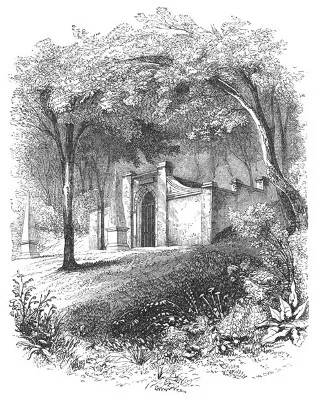
Washington's
Tomb.
As if to stamp the American ideal with all perfection, it is
remarkable that Washington stood pre-eminent in manly strength and
beauty, and that a taste for athletic exercises kept him, in spite of
illnesses brought on by toil, anxiety, and exposure, in firm health
during most of his life. His picture at sixty-two, that which he
himself thought the best likeness
that had been taken of him, exhibits
one of the loveliest faces that an old man ever wore. And it is
marvellous how any one that ever looked into the clear blue depths of
the eye in Stuart's unfinished picture, could be persuaded to believe
Washington stern, cold, and unfeeling. Some have even thought it added
to his dignity to represent him thus. All the historians in the world
could not prove such a contradiction to the stamp of nature. But the
picture by Pine—the old man, faded somewhat, and a little fallen in
outline, wears the face of an angel; mild, firm, modest, sensitive,
aspiring, glorious! It meets your gaze with a tenderness that dims our
eye and seems almost to dim its own. Of all the portraits of
Washington, this and the half-imaginary one made by Mr. Leutze from a
miniature taken when Washington was seventeen, are the most touchingly
beautiful, and, as we verily believe, most characteristic of the man.
It is proper, though scarcely necessary, to say that this
sketch of Washington's life is drawn from Mr. Sparks' history, since no
research can discover a single fact overlooked by that faithful and
just chronicler.
Franklin.