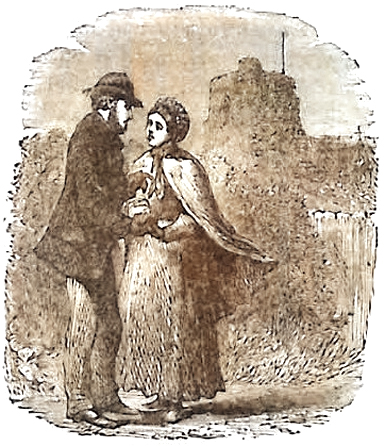
DOMESTIC REVELATIONS.
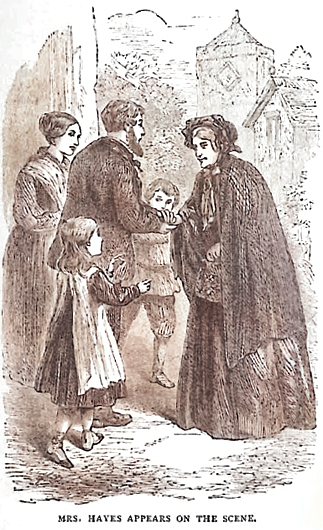
TO none of her attached friends was Mrs. Hayes's visit more welcome
than to Rhoda Lewis, and the sight of the kind old face at the cottage
door caused the maiden to bound forward with a cry of delight, and then
to burst into tears.
"Well, my lassie," said Aunt Hayes, taking her affectionately in her
arms, "what makes you give me such an April welcome?"
"I don't know, I'm so glad to see you," said Rhoda, looking up like a
child that has needed and found a sympathising friend; "I was afraid
you were never coming again."
"That horrid old thing, I do declare," murmured young Mrs. Lewis to
herself behind a large screen which stood between the door and the
fireplace; "but I'll spoil their pleasure."
"Rhoda! Rhoda! You arn't going to leave this grate in such a mess, I
hope. Edward will be in soon, and I've no time to see to it."
"Yes, I'll do it directly, Lydia," said Rhoda; "and you will go up and
see mother meanwhile, Mrs. Hayes."
"I'll sit here awhile first, if you please," said Mrs. Hayes. "How are
you, Mrs. Lewis, and your baby? May I offer it an old woman's blessing?"
"Baby's upstairs on grandmother's bed asleep," peevishly answered
Lydia, offering the tips of her fingers to the old lady's hand. "I
can't have her wakened with talking."
"We'll try not to do that," said Mrs. Hayes, pleasantly. "I will rest
a little and give her time to open her bright eyes upon me. I love
babies, Mrs. Lewis. I dare say you find she teaches you many sweet
lessons that only mother's love can learn."
"I'm fond enough of her when she's quiet," said the young mother,
lazily; "and when she squalls, I give her to Rhoda."
Rhoda was busily "doing up" the hearth and washing the stone, and then
whispered to Lydia that some little addition should be made to the
dinner.
"Nonsense; you didn't ask her to stay, I hope, and without consulting
me," whispered Lydia back again, inconsiderately loud. "Pray do you
forget whose house this is?"
"Never mind," said Rhoda, gently; "I only thought—"
"You only thought of yourself, I dare say. Just get those potatoes
peeled, if you please; and I shall go up and dress ready for my
friends, who are going to call some time to-day."
And young Mrs. Lewis sailed upstairs without deigning further notice of
Mrs. Hayes.
"Come here and let me look at you, child," said Mrs. Hayes, as Rhoda
was going into the back kitchen.
Rhoda turned and stood before her, the colour mounting to her face, and
a smile playing round her mouth. But while she stood, the colour faded
and the smile vanished, and perhaps a tear might spring up instead.
"There, now, go and get your potatoes, and I'll help you to peel them."
"This won't do," thought Aunt Hayes, "she's gone to a skeleton, poor
child."
But though Rhoda would not permit her to touch the potatoes, she very
gladly brought them in a bowl, and sat down on a wooden stool at Mrs.
Hayes's feet to prepare them.
Presently the baby was heard screaming loudly, then young Mrs. Lewis
called from the stairs, "Rhoda, Rhoda! Don't you hear? The child will
kill herself with fright. You know your mother can't do any good with
her."
Rhoda put down her bowl and flew upstairs even before the speech was
ended, and returned in a few minutes with a pretty little babe, which
she put into Mrs. Hayes's arms, and then resumed the potatoes.
"Mother will be so glad to see you, Mrs. Hayes," said she, "and we'll
all go up together."
"Indeed we shan't," said a peevish voice coming down the stairs. "I'm
not going to have my child stifled in a sickroom to please anybody."
Rhoda coloured, but replied calmly:
"Then I'll give her a little walk while Mrs. Hayes sits with mother.
There, Lydia, are the potatoes."
Quickly washing her hands, which were much less delicate than they had
been two years before, she tied on the baby's hood and prepared to walk
out in the park. "Now you'll sit with mother, dear Mrs. Hayes, and I
shall see you again when you come down."
In the distance, Mrs. Lewis, junior, perceived that her husband had met
his sister and child, and was walking slowly by their side.
Up rose evil suspicions that she was being talked about, and that
poor Rhoda was "making mischief," for Edward had several times shown
something of his temper, which she did not intend to "put up" with.
This opinion was almost immediately confirmed by Edward himself on
entering the house.
"Lydia," said he, "what's the matter with Rhoda? She looks thin and
sickly; and I thought when I met her just now that she had been crying."
"Really I cannot be called to account for your sister's tempers,
Edward," said his wife, indignantly; "if she has been complaining of
me, I'll—"
"I'm afraid your conscience complains for her," interrupted Edward;
"Rhoda never complains, but I can see that you are working the poor
girl too hard; and I didn't have my sister here to be your servant,
please to remember that, Lydia."
"She does nothing but what she chooses," replied Lydia, angrily; "and
if she's to be waited on and live in idleness, you must get somebody
else to be her servant, for I shan't."
"Lydia, for shame," said Edward, loudly.
"I won't 'for shame;' you 'for shame,' for speaking so to me," said the
wife of nearly two years.
And as just then Rhoda came in with the baby, she rudely snatched the
child from her arms, went to another room with it, and burst into a
passionate fit of tears, by way of venting her deep sense of injury.
Tears are curious things, and terrible deceivers often, to everybody
but those who shed them. Poor Edward was very fond and proud of
his little daughter, and not yet indifferent to the beauty of his
showy-looking wife, so he kindly followed.
"There, Lydia, I didn't mean to make you unhappy, so kiss and be
friends," said he.
There was something good in the husband who would do thus, and worth
the trouble and love that might improve upon it. But Lydia, in her
selfishness and conceit, did not take the right way, and Edward
transferred his caresses to the baby, feeling that Lydia could be very
disagreeable when she liked.
Mrs. Hayes found the invalid much worse than she expected, and Mrs.
Lewis seemed fully aware that her days were numbered.
"Do not hint this to Rhoda, though, on any account," said she; "the
dear child would fret herself ill. Indeed, I often fear that nursing me
is too much for her."
"It is not attention to you that will harm her," said Mrs. Hayes; "if I
were you, I would have more of it, and so keep her from being at other
people's beck and bidding."
"I did not think of that," said the mother; "she never says a word of
what goes on down there; and I can see, though I don't believe Edward
knows it, that she keeps all his things mended up, just as she used to
do before he married. She certainly has done her best to make up for
her poor brother's unfortunate choice, and I think Lydia tries her very
much with her foolish ways, but she never speaks of her except there
happens to be something that she thinks will please me."
"Good girl," thought Mrs. Hayes; "she's under the Refiner's hands;
He'll see to it that the furnace isn't overheated."
The old lady declined to prolong her visit this time, but on inquiring
for Lydia, and finding that she still sat alone with her baby, she
walked quietly into the room, and shutting the door, sat down opposite
to her.
"My dear," said she, gently, "I can't go without a word with you, and
for your dear baby's sake you must bear with me and forgive me. Will
you try to remember that when you are nursing your child, you are
imparting to her something of the feeling and temper you are in at
the time? If you are heated with anger and passion and ugly thoughts
about others, you are not only disturbing her health now, but laying
the foundation of the same faults, to trouble and distress yourself
by-and-by. You would like, when old and infirm and weary, that she
should be your prop, and help, and blessing; take care, then, that now
you nourish her from the calm and peaceful bosom of a loving mother,
who strives to keep herself in the fear of God, practising those
virtues which she would wish to see unfolding from this precious bud in
due time. You are laden with solemn responsibilities; you will have to
account for them. God help you to do it with joy, and not with shame
and grief.
"Good-by, my dear, and remember that nursing time is, or should be, a
holy time—a mother's best opportunity for prayer—a link with heaven—a
time that determines mighty interests concerning the immortal treasure
she is everything to, for the beginnings of life in body, soul, and
spirit. Oh! Be wise, my dear, be wise and safe and happy."
And away went Aunt Hayes, leaving the astonished Lydia in doubt whether
to be angry or gratified at this mark of tender interest from one she
had endeavoured in her pitiful, way to mortify and insult.
"Now, dear," said Mrs. Hayes to Rhoda, at parting, "I wanted to take
you back with me to spend an hour or two with Milly and all of us, but
I see it isn't just the right time. Come when you can, but don't be
long away from your mother, she needs all your care, and must not be
fretted with the crying of the child."
Poor Rhoda wondered after she was gone whether these words were
intended to convey any particular meaning about her mother's health,
and she softly went back to the room where she lay on her sofa,
apparently asleep. Her thin fingers were between the leaves of a
hymn-book, and the Bible was on the little table beside her. A
beautiful calmness was on her face, and she looked, to Rhoda's alarmed
idea, much more of heaven than of earth.
"Do you feel any worse, mother dear?" she asked, as Mrs. Lewis opened
her eyes and smiled on her.
"No, darling, I suffer much less now, only I think, perhaps, I am
rather weaker. I must not try to leave the bed to-morrow."
Rhoda's heart sank, and from that moment nothing but some peremptory
call upon her sense of duty separated her from her mother's side.
A very few days now made a rapid change in the state of the invalid. As
long as her strength would bear it, she spoke tenderly and faithfully
to her son. That Rhoda would follow her to the home above she was quite
assured; but her son, with his free-and-easy treatment of God's message
to man, his worldliness and self-conceit, she knew was at present very
far from the kingdom of God, and she had fears that his marriage had
not tended to improve his views and principles.
"Now, Rhoda, dearest," said she one night after settling her pillows
and taking some nourishment which her daughter had brought, "lie down
and rest peacefully. I shall want nothing more till morning, and then
you must go with my love to Mrs. Hayes and bring her to see me. God
bless you, my precious child, you have been the comfort of my life
since your father left us."
Rhoda knelt down and kissed the dear lips.
"Nothing more till morning."
Yes, it was quite true, only it will be a "morning without clouds," the
beginning of eternal day.
Mrs. Lewis had passed away in quiet sleep, and Rhoda awoke to the
deepest, saddest sorrow she had ever known. She managed to send a
message to Mrs. Hayes, and it was in those kind arms that tears at last
relieved the agony of her poor crushed heart.
"Poor little dove," said Aunt Hayes, as she sat with the family at the
lodge on her return, "she will feel this loss very bitterly. Her mother
thought Lady Crewe would take her back again; but Mr. Lewis says his
house is her proper home."
"It was only her mother being there that made it home, though I'm
afraid," said Mrs. Taylor. "As long as Mr. Lewis is comfortable when
he chooses to be at home, he does not seem to think how his comfort
is procured. I have been grieved to see all the work of the house put
upon poor Rhoda; and though she is very fond of the baby, and calls it
'Little Peace-maker,' she often looks so weary and dispirited that I've
wondered they didn't observe it, and can allow her to be disturbed by
night as well as by day with managing it."
"You never need wonder at anything that selfish people do," said Mrs.
Hayes, "they are deaf and blind to everything they ought to hear
and see. It's quite true, and no use mincing matters, I feel it now
myself. I've set my heart on making my old farm-house an ark for this
fluttering dove for a little bit, and I shall neither see nor hear
reason why I shouldn't have my way. So Mrs. Edward Lewis must manage
her own baby and do her own work."
"She can't do either, aunt," said Susan, who was present, and seemed to
have known more of Mrs. Lewis than any of the others had.
"Can't! Don't tell me," said Mrs. Hayes. "Women have nothing to do with
such a word, when duty, sense, and principle dictate for them."
"Won't, then, aunt," said Susan, laughing.
"I'm afraid that is nearer the truth, my dear," said Mrs. Hayes; "I
hope you will never put either of those words against anything that
falls to your lot in the providence of God, or by your own act and
choice. If you seek the Lord's direction, be sure nothing will turn
up but what He sees right, and will help you to do and bear; and if
you make a mistake through not waiting for His guidance, don't blame
'Providence' and feel as if you were injured, but make the best of it,
and thank God that you may ask His gracious help to bear and do, even
though you forgot Him before in the matter. There's no friend like Him,
Susan, 'He doth not upbraid.' Blessed God, who can bear so pitifully
with such wilful sinners as we are!"
"It always seems to me," said Susan, "that the worst troubles to bear
are those of our own making. Self-reproach is about the greatest
aggravator of sorrow, and I always feel that in such a case we should
be very patient and kind to those whom, notwithstanding, we are obliged
to blame."
"Yes, black is black, and it's no good to say it's only rather grey, or
not quite white," said Aunt Hayes, meditatively. "Better look the truth
in the face, and deal with what is. I've seen them that are always
looking back, and thinking and sighing over what might have been, and
what they judge ought to have been, so keeping the poor heart always in
a fret and worry, instead of saying in a Christian, reasonable way,—
"'It's a fact that I've got myself into this peck of troubles, and now
I'll do my best to turn them out one by one, and if any of them can't
be made to go, why, I'll just make it useful, and stand my friend after
all. Maybe I must have a reminder of my folly to keep me out of more
mischief.'
"Poor Mr. and Mrs. Lewis may yet be happy if only they'd go the right
way about it. Don't let us give up. When Rhoda goes, they must feel
their own feet, and perhaps they'll agree better to walk together."
"I saw a cockroach on its back the other day," said Mr. Taylor; "how
it did kick, but no other cockroaches came to its help, and at last it
made one desperate bound and got on its legs again; then off it went
like a shot."
"Ay," said Aunt Hayes, "don't any of you children ever get thrown on
your backs through depending on other people. You'll kick long enough
when you're down, and nothing but your own energy will set you on legs
worth trusting."
————————